
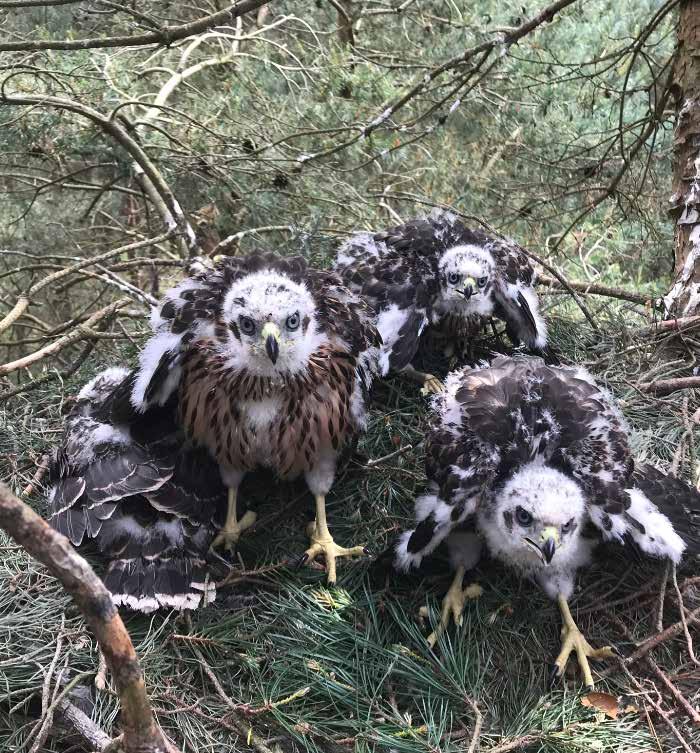

Gi Grieco
Gi Grieco
Welcome to The Harrier. Firstly, the big news is that, at long last, we had our first field trip since March 2020. These trips are an integral part of the group and many of us have missed attending them. It was lovely to meet up after such a long period – many thanks to David for expertly guiding us on the day and writing up the trip report inside.
That first trip was around Eastbridge and Minsmere and it bought into context the possibility of a proposed new power station at Sizewell. Within is an article - one of a couple that ask questions and may not always be popular for all but need discussing - which aims to raise awareness by having birdwatchers participate in a bird race to highlight the importance of the Suffolk coast to birds and other wildlife and the impact of a new station so close to such an important reserve. The other article raises questions on the loss of some of our bird species, the reasons why and what could be done to halt this. Rewilding and new habitat has been a big topic in news and conservation circles of late including on the recent series of Springwatch and the ScrubUpBritain team want to promote the importance of scrub as a habitat. Please feel free to send in your own thoughts on these topics.
With the AGM having to be held online this year the plan is to have a celebratory get together on July 8th, where we can socialise and awards can be presented – details to be emailed and put on the web site. Simon, a
recipient of one of the awards, has written of his love and passion of birds, and particularly raptors and shows why is he is deserving of it. There is also another get together planned, this time for Jean’s memorial - Anne has detailed the plans for this within.
Eddie and the SoSS team have been busy again, ready for the arrival of Swifts and he has written on what the project has undertaken this Spring. Following on from the fun of lockdown birding from last year, Granty has done a follow up of another bout of lockdown birding during the winter and early Spring. For any world birders out there, David has done a review of a new book that covers all the species, and would be a handy reference for any that bird further afield. Finally, we have the quarterly bird review, a selection of species encountered during the period despite lockdown restrictions.

There are two changes to trips later in the year, both to take advantage of better tides.
As reported in the Winter edition of the Harrier, the donations made to Suffolk Bird Group in memory of Jean Garrod have been put towards a memorial seat for both Jean and Ken, which Peter Merchant has sourced from Orwell Mencap, which operates the Genesis joinery works in Ipswich.
This has now been delivered to the Landguard Bird Observatory (LBO), where it is to be placed on the upper observation platform, which was one of Jean and Ken’s favourite places. It will be very secure, well cared for and greatly appreciated here.
Before it is moved up to the platform, we intend to hold a memorial event at ground level in the Observatory and this will take place on Sunday 11 July at 11am (Government restrictions permitting).
Jean and Ken’s daughter and son, Jane and Simon, will be amongst those attending, and their wish is that as many of Jean and Ken’s SBG (or SOG, as they would have known it!) friends be there on the day.
At present it is hoped that the national Coronavirus restrictions will have eased by 11 July, so that everyone who wishes to attend can do so.
However, as we cannot be certain that this will be the case, we would ask that anyone who does wish to join us on the day to please get in touch with me at wright-anne@sky.com or by phone 07767 755965, or via Gi. If you could also please provide a phone number so that we can contact you if it transpires that restrictions are still in place; we can then allow people to attend on a ‘first come, first served’ basis, and contact others if necessary. We will meet all non-LBO members outside the LBO gate, and please be aware that the Council have recently introduced parking charges at Landguard.

Anybody else who is not a member and who would like to visit at a later date to see the seat, could do so on the Observatory’s annual open day, which should take place in late summer but, if this was not convenient, they could contact Gi to arrange to visit with the SBG annual trip to the Fort on 23 October, or with another member on a one-to-one basis when convenient.
Once again, SBG Council members would like to extend their sincere thanks to those who have contributed to the seat, and we look forward to seeing you on 11 July!
Eddie Bathgate
Swifts have been very slow to return this spring; cool temperatures and northerly winds are likely the reason. As I write this in early June it does appear that many pairs have returned and that nesting is underway, if a little late. Encouragingly, early reports from Aldeburgh, Woodbridge and Stutton are that more nest boxes are occupied this year.
Over the winter, around 30 Swift Community Sets have been installed on prominent elevations of public buildings right across the county. From Southwold to Pakenham and Occold to Felixstowe, call systems are attracting Swifts into these new breeding sites. A large proportion of these sets have been funded by the AONB; they are providing substantial resources for Swift conservation in their areas. In addition, a substantial number of nest boxes have been distributed for householders to install, with advice given on how to attract Swifts. We have also supplied boxes, calls and advice to Manningtree and Norwich to help out there.
We still have a number of Swift Community Sets to allocate. Both Needham Market and Stradbroke are working to find locations but if you know of a prominent location where they would welcome Swifts, please get in touch.
Eddie Bathgate

Swift Awareness Week is from 3rd to 11th July. We have the following Swift walks and talks organised around this period. Final details for all of these events will be on our website.
Westleton Village Hall, Friday June 25th
Wickham Market Village Hall, Sunday June 27th
Leiston, Wednesday June 30th
Woodbridge Brook St. car park, Sunday July 4th
Middleton, Tuesday July 6th
Thorpeness, Wednesday July 7th
Martlesham Climate Summit, Saturday September 25th
Nayland, Monday November 8th

The AONB have secured a grant from the Galloper Wind Farm Fund to help Swifts in Middleton, Leiston and Thorpeness. There are 18 free Swift Community Sets available for you to install on suitable elevations (exterior wall over 4.5m high with a clear line of flight). Each set comprises six Swift nest boxes and a call system. If you and/or your Swift-loving friends live in any of these towns and wish to be considered, please email me at Swifts@SuffolkBirdGroup.org with a photograph of the elevation you have in mind.
Simon Evans
One of the earliest birding memories I have was the sighting of an adult male bird whilst on a family walk in Kings forest. The bird had dropped down to drink at one of the old ‘fire pits’ (open water pools) as we were about to set off on our stomp (fire route 204 if you remember it). The nine-year-old me instantly recognised this bird from the books on Dad’s bookshelves, but I couldn’t remember its name. I had to wait until we got home to rediscover it, my first Redstart - ‘WOW’!
Similarly, the images of Birds of Prey from those books sparked something in me that to this day I can’t quite explain; a fascination, a passion, an obsession (this is the one my wife agrees with) – who knows, but I was hooked!
“Raptor” by definition; a bird of prey that primarily hunts and feeds on vertebrates or one who ravishes or plunders. Either way you look at it, the word itself conjures images of mystery, intrigue and terror. To most of us now, they are that avian group which includes
Eagles, Hawks, Kites, Buzzards, Harriers, Falcons, Vultures and Owls. To me, they are a collection of apex predators/scavengers in which I have a long-held interest.
The descriptive sections of those bird books talked of ‘elusive and scarce’ birds residing in regions far away from West Suffolk, in remote mountains, on moorlands – birds of open grassland, coastline, dense forest and every conceivable type of habitat other than that which I believed we had locally. After all, we just had farmland and a few woods, how on earth was I ever going to see any of them?
Oh how wrong I was and how things have developed. Almost 50 years on and yes, we have lots of prime raptor habitat, more than that naïve young lad was aware of and yes, near my Bury St. Edmunds home, there be raptors!
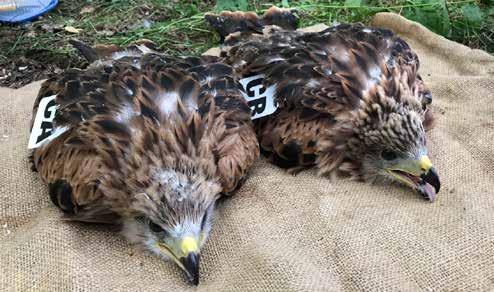
There has been a natural transition in my ‘involvement’ with many birds, but especially raptors, from ‘observation’ as I started to learn my birding craft, shifting to a very much “hands on” approach with ringing, measuring and sampling these stunning birds – essentially with the aim to learn more and possibly, at some point, develop a greater understanding.
I’d decided by the time I was in my early 20’s that I wanted to learn how to become a bird ringer, and so the journey began. Not an easy task locally back then, but frequent trips to the Colchester area and Landguard ensued - I was on my way. The first bird of prey I handled was a young male Sparrowhawk, extracted from a mist net and carefully held for ringing, although I think technically it had hold of me, my face must have been a picture!
Since then I have become involved in many projects and studies and in an attempt to shorten a very long tale, I shall briefly
summarise what I and a few other local raptor enthusiasts have been up to.
From reading about our various subject species it became clear to me that there was a lot to be learned from looking at the birds we handled, in much closer detail. Obtaining a whole suit of biometric measurements and in some cases, contour feather samples which could reveal gender difference determination for example. There are a number of key texts that ringers can refer to and to duplicate and extend these studies seemed only logical. Even if they don’t appear to be of use now, the data may be so in the future.
Proportionally, ringing recovery reports for birds of prey are very low and usually occur as a result of an individual being found dead. Using techniques such as colourringing and wing-tagging allows us to dramatically increase the reporting rates for these individuals, so this has become a more widespread practice. Training in bird handling and welfare takes time and so consideration of these techniques as well as the associated licensing and reporting aspects must be taken into consideration.
This is all well and good in theory but we need to find the nests of these birds to permit the easiest practical application of these techniques.
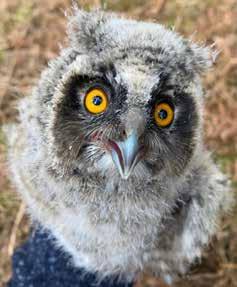
Although I’d meet many of these species in a mist nest at some point, it wasn’t until we started monitoring nest boxes that I’d get to study so many individuals. Kestrel, Little, Tawny and Barn Owls and more recently Peregrines have thankfully made use of our boxes.
For those species that don’t use nest boxes, the next step can involve installing fabricated open nest structures such as baskets. Although we’ve dabbled with these in the past for both Long-eared Owl and Hobby, we haven’t enjoyed much success.
The majority of raptors choose to make nests themselves frequently by utilising preexisting structures such as old crow nests, embellishing them to varying degrees to suit their needs or the situation. This introduces a key element to our studies, that of ‘nest finding’. It’s always surprised me how some birds, even individuals of the same species, can chose to nest close to manmade structures or chose a site nearby daily disturbance yet others can be so secretive in their behaviour that although we’re aware of their presence, actually locating the nest proves almost impossible, especially early in the season.
Nest finding is definitely a refined craft, requiring a lot of skill, a huge amount of
patience and by default, time. Over the years I’ve met a number of people who are exceptionally good and experienced at doing this. I have learned so much in terms of methodology and field craft from these folk, who still point out my failings with guided wisdom “you’re wasting your time doing that” or “try just doing …” - luckily, we have a collection of locally based people who are driven and passionate to help us with this, as well as tolerate my ignorance.
So, if it wasn’t for these nest finders, getting to study many raptors would be difficult to say the least. Breaking away from the traditional practices of this art, modern technology is certainly helping. We can now use drones and thermal imaging to assist and although these can save time and effort, it must be stressed that their use involves following a strict set of rules and guidance, remembering that the bird’s welfare is paramount.
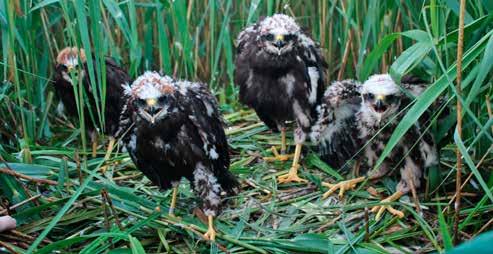
Fortunately, a few of these open-nesters use ground level habitat for breeding and rearing their young. Our local example here being Marsh Harriers. Occasionally they choose a location that is easy to observe and pin point. More often than not, they’ll be deep in a reed bed or crop field – it’s amazing how easy it is to lose your bearings when you’re at water level with vegetation towering over you and little, if anything to assist positional reference. Bring on the tech! Drone flights to assist nest locating with recorded GPS data that can then feed a hand held device to guide you – yes that helps! It’s that or hours of observation watching food passes and nest visits with prey or fresh nest material from multiple angles to triangulate where you think they are. Personally, I enjoy both methods. Either way, nest approach considerations are key. Usually better from water and always with minimum disturbance. Many other species have to be taken into account; as well as covering your tracks for fear of discovery by predators.
So, back into the woods. Tree-nesting raptors invite another critical consideration, that of access. Who’s going up there to take a look
and pass down the chicks, if there are any and is it safe to do so? Is it the right time to do it? So many things to consider. Logically, tree surgeons are the obvious choice, but they have to be the right ones – there’s no point using the ‘best climber’ if they have no knowledge or aptitude to handle what they might find in the nest. Some of my best friends are these ‘right people,’ with the training, skill and attitude to work effectively and safely. One aspect of my professional work involves rope rescue and working at height which has provided me with the knowledge and techniques required. Indeed, I used to ‘nest climb’ for our studies but like a number of us now, old age and aching body parts have forced me into retirement. My role is now definitely ground based! Someone has to fulfil the coordination, risk assessment, ‘Safety Officer’ role, after all.
Our knowledge of tree-nesting birds need not be limited to these ‘snapshot’ nest visits timed on best guess principles of what we observe from the ground. The use of trail cameras on nests is widespread these days. Having assisted BTO and Springwatch projects with these devices we will be making more use of them ourselves. A great way to record colour-ringed adults for example.
Aside from these visits resulting from nest box installation and nest box finding efforts there are those encounters that I consider the ‘happen-chance’ ones. The phone call or email from someone most frequently involving Barn Owls (everyone loves Barn Owls) or more rarely, the ‘Red Kites nesting in my garden’.
One particular such event occurred a number of years ago, following a phone call from Greene King. They had been in touch with the BTO regarding an owl that had found its way into the main brewery building in Bury and ‘needed’ to be removed. The weather had been particularly wet, windy and horrible for a few days, sheltering from which, I’m sure, was the bird’s reason for its predicament. So, Simon “can you go and take a look?” I happened to be free and at home. I turn up
on site to be told “it’s right in the roof space in this dark corner, occasionally flying right past here.” OK I thought, this is doable! I popped up a net on the mezzanine floor and waited for my flyby. Fully expecting to find a Tawny Owl, you can imagine my surprise when a few moments later I was extracting a Short-eared Owl from the net! To cap it off, as a thank you, they presented me with a selection of their finest ales – see, effort can be rewarded.
A related topic I often think of and should perhaps mention briefly here is that of persecution. Most of us are aware via the news and social media of the almost daily occurrences of some birds of prey having been shot or poisoned, somewhere in the UK. I personally find this abhorrent and fortunately it’s rare in our region, but it does occur. We work closely with Rural Crimes Officers across Suffolk, Norfolk, Essex and Cambridgeshire, as well as with the RSPB’s Investigation Team. We liaise with a number of vets’ practices to assist, advise and happily ring prior to release, birds that are successfully rehabilitated. For these, amongst other reasons, we have to respect the privacy and wishes of the landowners with whom we
work. They permit us access and permission to do what we do and are largely genuinely interested to hear what we have to say.
So why do all this? Why spend so much time, effort and money on these projects? Although my passion and interest in the birds is clearly a driving force, it’s what we’re learning about them that matters. How else are we to ensure we’re doing what’s best for them and securing their position in our environment and future?
I have been and am in, a very privileged position. To be able and allowed to get close to these birds, access areas I wouldn’t otherwise and to meet and work with a huge array of people, from whom I have and continue to learn so much. Who’d have thought that I’d get to ring a brood of Buzzard, Red Kite and Goshawk in West Suffolk on the same day! That within 30 minutes of my front door I’d get to handle 14 different species of raptor (to date) and that we’d get to see and share in the dramatic and beneficial effects of our efforts for Suffolk’s Barn Owls! Certainly not that young lad on his family forest walk all those years ago.
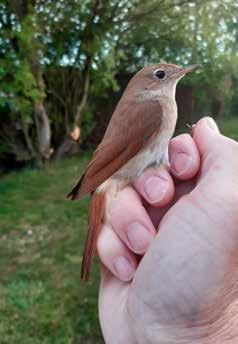
I was lucky enough to move to this wonderful county of Suffolk in February 1991, in thick snow but with much anticipation. It wasn’t long before I realised just how good a move this was when, in the following spring, I was able to see and hear a fantastic array of classic Suffolk specialities. From my garden, I could hear several Nightingales and Nightjar on a warm, calm evening. On a relatively short walk around my surrounding area, I could encounter very good numbers of species such as Willow Warbler, Garden Warbler, Tree Pipit, Nightingale, Turtle Dove, Nightjar, Redstart, Stonechat and Woodlark to name a few.
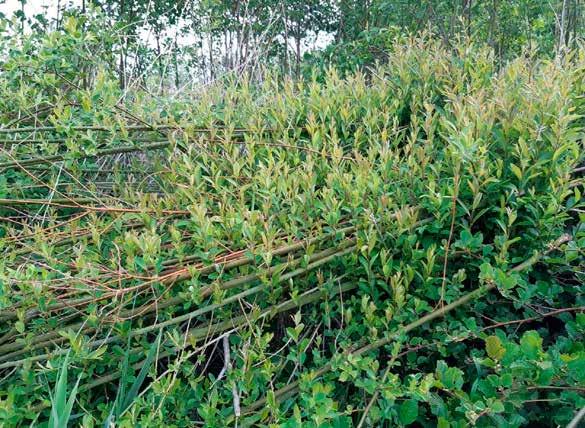
If I take that very same walk today, sadly virtually all those birds have long gone……… but then so has the habitat that they used to breed in. As some of you may be aware, I am involved in the small group named ‘Scrub Up Britain’ who are trying to promote the protection and establishment of this vital but rapidly disappearing habitat. This all came about as I have spent the last twenty or so years witnessing the gradual eradication of one of the most important habitats for an incredibly vast number of birds, plants and insects!
It took me a while to work out just what was going on as year on year, I was seeing less
and less of this key habitat in the woodlands and heaths around me. Some of it was quite obvious when areas were simply ‘ripped out!’ for various reasons that ranged from clearance for an off road bike park, keeping rides clear and, perhaps most frustrating of all, removal by ‘conservationists’ to create a monoculture of heather as breeding habitat for Dartford Warbler and Woodlark. I understand that these species are rare and worthy of protection but would argue that so are Tree Pipit, Nightingale and Turtle Dove, along with several other species that depend on thick impenetrable scrub. Could we not manage for both?
I realise that I won’t be very popular with certain groups, but feel that unless we speak out now, it may be too late to save these rapidly declining species in the Suffolk countryside. For such a massively important habitat, it just seems that it simply isn’t ‘sexy’ enough when compared with other important habitats such as reed beds, marshes, heaths and meadows.
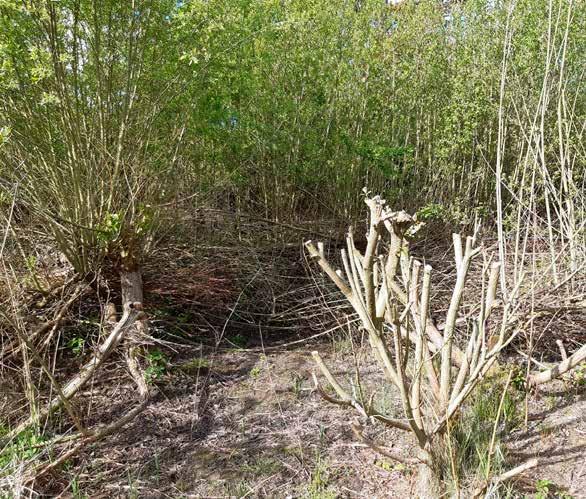
There was a time when you could simply stand back and leave an area and the scrub would ‘magically’ appear, without any need for planting or encouragement. No need for plastic guards and fences, nature would do all the work for us. This is no longer the case as the populations of deer have exploded exponentially! This was always going to occur when there are no apex predators to keep their numbers in check. Even worse, four of the six species (Muntjac, Sika, Fallow and Chinese Water Deer) are not even native to this country and have been introduced. Over the years, all these deer populations, along with the native Red and Roe Deer, have grown and have been putting more and more pressure on our woodland understorey and scrubland.
Even more frustrating, their presence is often celebrated by wildlife trusts and conservation bodies. We feel that the time has come when we must stand up and educate the public about what is actually going on in our beautiful countryside. There are some difficult decisions that really need to be made sooner rather than later. Unless we do this now, our impoverished countryside will be home to fewer and fewer wildlife and variety will be a thing of the past.
We are well aware that there are many factors that are having a negative effect on our decreasing woodland birds such as global warming, farming and habitat destruction for example. But we firmly believe that the biggest threat in the here and now, is over grazing. We could carry on looking into all of these factors and do more appeals and breeding surveys that will simply reveal that the populations of many of our much loved species continue to decline or, even worse, have gone altogether!
There is some great work being done around the country through various rewilding schemes such as the Knepp project. We would love to see more projects like this start up in Suffolk such as the great work going on at the Sinfield Nature Conservation Trust near Hasketon that is now home to good numbers
of Nightingale and still has breeding Turtle Dove. We have made efforts to ‘scrub up’ our own sites at Newbourne and Hollesley with good results but it would be great if some of the bigger conservation bodies embraced this approach as well. Scrub and understorey needs to be nurtured, protected and developed in order for them to become established.
Our hope is that everyone can really push this undervalued but vital habitat all over Suffolk so that it gets the recognition and status it deserves going forward. Who knows, we may then start seeing ‘scrub’ reserves in their own right popping up and woodland management that prioritises a pristine understorey, alive with the sound of all those beautiful birds that have been lost for too long now……..it’s not too late!
ScrubUpBritain
Twitter: @ScrubUpBritain
Grant
Could you ever imagine a scenario in which you gaze up in awe as a White-tailed Eagle soars over your head at Minsmere - and that magical moment is tinged with just a modicum of regret? How about seeing a total of 12 Common Cranes in three parties majestically traversing the sky over the reserve, or a north-bound Eurasian Spoonbill high up in the wide blue yonder over the Scrape, and feeling the same sense of niggling disappointment? Difficult to think how that might happen isn’t it? But it happened to me!
Each of those moments brought home to me just how extraordinary have been the times in which we have recently lived. Let me explain. Plunged back into national lockdown yet again in December, with the horrors of Covid still rampaging through society, our normal birdwatching was curtailed and
our group’s great supporter Justin Zantboer sprung into action. Readers of The Harrier may recall that in the Spring lockdown of 2020 Justin organised a birding challenge for some of his friends in Suffolk and in several other parts of the UK in which participants competed to establish who could see or hear the highest number of bird species from their home during the time our movements were restricted. It was just a bit of fun, of course, but it proved to be immensely successful and united those taking part in the uplifting way that only birding can. So, another lockdown, and another little bit of friendly, if competitive, levity was in order. Lockdown Challenge 2 was on!
From December to the end of March, 15 of us spent many an hour gazing out of our windows or prowling our gardens, eagerly
keeping a tally of the species we detected. It showed again just how therapeutic birding can be, lightening our mood in such dark and dire times. And it showed just how much camaraderie can be created when a spirit of friendship and shared interest prevails. It was all very light-hearted but, just as there was last Spring, there was a competitive edge that provided a little spice. Personally, I hoped to retain my Lockdown Challenge ‘crown’, having proudly won the 2020 competition with 81 species (purely thanks to the panoramic views along the Suffolk coast that I am fortunate enough to enjoy from my Leiston loft). I never dared to hope, however, that I would surpass that total. But I did, thanks to the noticeable hard-weather movement of birds, especially waders, triggered by early February’s ‘Mini-Beastfrom-the-East’, the high water levels that invited many wildfowl species to the valley running westwards from Sizewell towards my house, hours of perseverance and more luck than I could have reasonably hoped for. I was astonished to amass 85 species. (I will not mention the fact that on my first day’s vigil, on December 6, I notched up 39 species
- including only my second-ever house Redthroated Diver and only my third record of Dark-bellied Brent Goose - which is more than two participants scored for the whole of the challenge! Sorry, I did mention it!)
Other highlights for me included a surprise Northern Gannet (second house record) on December 10, a flock of bugling Bewick’s Swans that carolled us on Christmas Day, a first house record of Great White Egret on February 25, and a ringtail Hen Harrier (fourth house record) no doubt disorientated by dense fog flying within 20 metres of my garden on February 28. Perhaps my most enduring memory, however, is that of a firstwinter Little Gull battling against a vicious easterly wind and nearly colliding with my loft windows on February 8.
We’ll all remember these dismal, worrying times in our own ways, of course, but several participants in this Lockdown Challenge have special memories provided by their garden vigils. For second-placed Rob Duncan, his highlights were the second Long-eared Owl to be seen in his garden (personal nature
reserve more like) and his ‘garden tick’ flyover White-fronted Geese. Third-placed Richard Dann fondly recalls his two Black Redstarts and Jamie Everett, in fourth place, was pleased to be accompanied for breakfast by a patio-snooping Moorhen. Sixthplaced David Walsh particularly enjoyed an invasion of 24 species to his garden in the week beginning February 7 - the hardest weather week - including Redwing, Fieldfare, Blackcap and Reed Bunting. The latter species had positively poured into his garden from January 22, with a maximum of 15 on February 12 - one of which liked it so much it stayed for at least 66 days. David also scored his garden’s first Coot on March 25, his sharp ears picking up its nocturnal flyover calls.
Justin’s favourite moment was provided by a flyover Woodcock on February 19 and his daughter Ellie, who took eighth place, was especially pleased by her flyover Whitefronted Geese. For Gi, in 10th place, joining the Common Scoter club when a flock flew over at night on the 24th. Eleventh-placed Jo Conway picks out Green Woodpecker as her highlight - a species she hadn’t seen or heard in her area for a long while. David Pearsons, in 13th place, fondly recalls the hardweather invasion of February 8 when his garden teemed with Fieldfares and Redwings, while also being impressed with his garden’s first Canada Goose. And he did not even have to leave his bedroom to see Peregrine on Ipswich Hospital!
Languishing in a lowly 14th position, the evermischievous Steve Piotrowski typically lists his highlight as ‘ridiculing Bashful Bridges’ stringy old Coot’ - an impish reference to ninth-placed Chris Bridges’ record of a
Coot heard from his caravan near Landguard Common (the species is exceptionally scarce at nearby Landguard Bird Observatory).
So why were my Minsmere sightings of White-tailed Eagle, Common Crane and Eurasian Spoonbill tinged with regret? Well, I would have been able to see all those highflyers had I been in my loft when they were gracing Minsmere skies so I could have had three extra Lockdown Challenge ticks. Oh well, I won with 85 anyway!
Our great friend Justin again came up with a great idea and organised a challenge that once more helped us through some tough times, so grateful thanks to him. Many of us met up at LBO for the awards evening, once Covid restrictions allowed, and was just as enjoyable - with glasses raised and friendships rekindled.
Final Lockdown Challenge 2 scores:
Mark Solomons and Bob Flindall
A major bird race is being planned for Suffolk but the clock is ticking in more ways than one this time.
The proposal is to have a bird race not to raise funds but to raise awareness. With the threat of the Sizewell C twin nuclear power stations looming ever larger, it will be an event designed to spread the message far and wide about how damaging this project is to the local environment. The idea being floated is to have a bird race that covers a large stretch of coastline and beyond likely to be affected by the construction of the giant nuclear power station.
Minsmere, of course, has long been in the forefront of campaigns to stop Sizewell but the ripples sent out by the project will affect the whole Area of Outstanding Natural Beauty (AONB) that covers the jewel in the RSPB’s crown. As most readers will know, the AONB covers nature reserves, heathlands, reedbeds, ancient woodlands and more from
Kessingland in the north, to the River Stour Estuary in North Essex in the south. It takes in Southwold, Aldeburgh, Orford Ness and the estuaries of the Blyth, Alde, Deben and Orwell.
An active Stop Sizewell organisation has already worked hard to whip up support within local communities which includes many of the birding and other groups in the area. But it has been hard to spread that message further. EDF has run its own propaganda campaign promoting the false promise of thousands of highly skilled jobs as if there were gangs of unemployed nuclear technicians sleeping rough in the back streets of Leiston simply waiting for a job. They also claim that disruption will be kept to a minimum as, literally, hundreds of lorries every day trundle through local villages and country roads and thousands of workers will require temporary accommodation in the area over a period of at least 10 years to construct the project; that is likely to be out
of date by the time it is built – and possibly on an island floating out to sea if coastal erosion is affected but also due to climate change and rising sea levels.
But while these counter arguments are preaching to the converted to those who live and love it here, a big bird race will spread the message among the greater birding community and maybe emulate the halcyon days of Bill Oddie led events. Anyone who cares for the Suffolk coast will be aware of the potential damage that could be done to the very special habitats and nature reserves in particular but birders have a greater knowledge of the environmental tightrope that other areas walk, to keep the balance that allows nature to thrive within them and which will be affected by Sizewell C.
With the enthusiasm and experience of birdwatching groups in Suffolk, we hope
David Tomlinson
to be able to get this race off the ground. The Government decision over Sizewell C is expected in April next year though, of course, these things often change. But it does mean a well-organised race will need to take place before then and we’re looking at potentially a January 1st event; perhaps May 2022 if the decision date is put back. It will need to be publicised in every way possible, both locally and nationally, and hopefully through various media. The stamp of approval from famous figures will do no harm including those associated with promoting conservation and nature in this country. The input of birdwatchers will be vital in all of this and opinions will be more than welcome as we seek to get this project off the ground.
Please let us know what you think, initially by email at Robert.flindall@btinternet.com and msolomons@msn.com
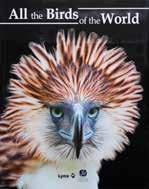
During idle moments, I’ve often pondered what book I would choose to take with me, along with my eight discs, to the BBC’s imaginary desert island, should I ever get the invite (somewhat unlikely!) For a time, I thought that the Lynx Handbook of the Birds of the World would be my choice, but there are 16 volumes, so it hardly qualifies as a single book. Now, at last, I’ve found the answer: All the Birds of the World. Like the Handbook, it’s another handsome Lynx production, and there’s a strong connection between the two. All the Birds has exactly what it says on the cover: illustrations and maps for every known species of bird on this planet. It’s a hefty volume of nearly 1000 pages, while the bird illustrations are, without exception, a sheer delight to look at. There’s
no text at all, but each bird has its English and Latin names, a decent map, and indication of its status, from LC (least concern) through to EW (extinct in the wild). (Spix’s Macaw being the classic example of the latter).
While there may be no text, each species has its own barcode, so you can scan this with your phone or iPad and learn all about the bird. (How clever is that? However, it wouldn’t be any good on a desert island). There’s also a four-section pie chart indicating which of the world’s major taxonomic lists recognises the species in question. In most cases there’s agreement, but for quite a number there’s still a difference between the lumpers and the splitters. A classic example of this is the Tundra Bean Goose, Anser fabalis or Anser serrirostris. continued page 18
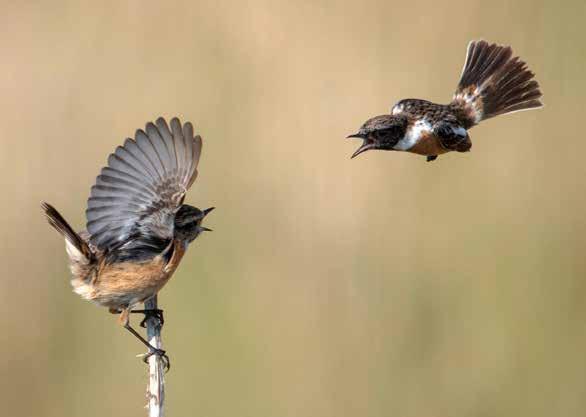
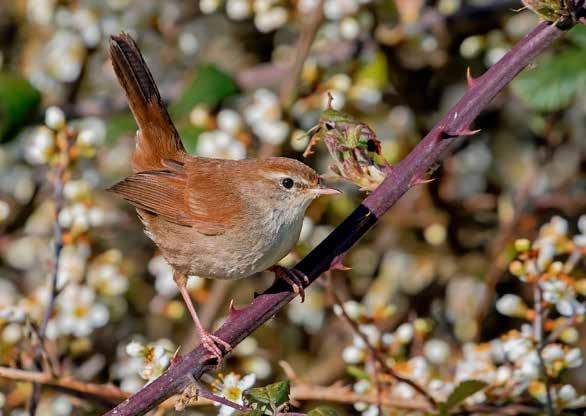
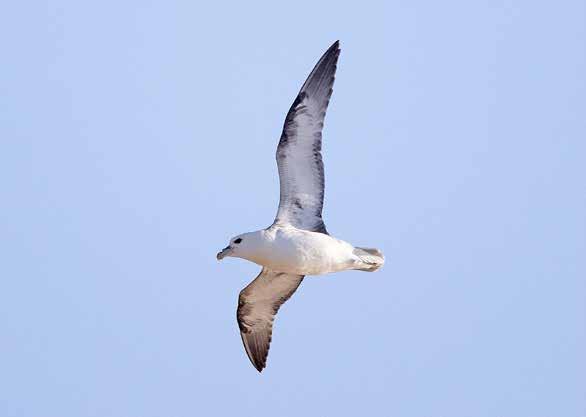
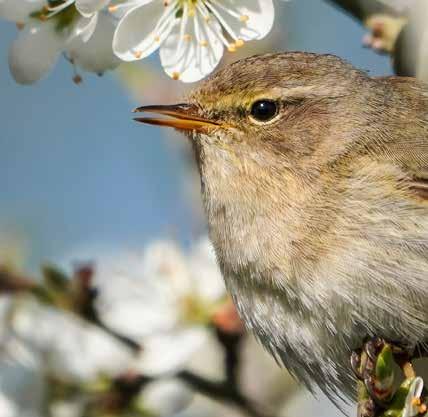
Clockwise...
Top left: Stonechats by Henry Keepin
Top right: Northern Fulmar by Andrew Moon
Bottom right: Chiffchaff by David Borderick
Bottom left: Cetti’s Warbler by Rab King
For many years I kept a world life list, but I gave up updating it 15 years ago. All the Birds has inspired me to resurrect it, incorporating all those lifers I’ve notched up in the past decade and half, in which time I’ve travelled to India several times, along with a few trips to other interesting destinations, such as Namibia, Ghana and Belize. It’s painstaking work, checking the picture and the distribution map, then establishing whether I have seen the bird in question, but it’s been just the job for a lockdown. I am entering each bird in an Excel spreadsheet, initially listing each species, but eventually I will add further notes, such as which countries I’ve seen each bird in.
It is slow and at times tedious work, but it’s much more rewarding than simply ticking birds off a list. It also brings back memories of those magic moments when a bird I’d always wanted to see finally gave itself up. Take for example the Taita Falcon, a small African falcon listed as vulnerable, and with a curiously restricted distribution. I’d looked for this handsome little falcon in Kenya’s Taita Hills, where logically you might expect to find one. I didn’t. I eventually saw my first in Zimbabwe, in one of the spectacular deep gorges below Victoria Falls. However, finding the bird wasn’t easy: to get to the site, I had to wind my way through a minefield, a reminder of the war that had been fought there not that long before.
It’s also been a reminder of failures. One of the most spectacular was my quest to see the Hooded Grebe, a critically endangered species found on a few isolated lakes in the remotest parts of Patagonia. I travelled to a lake that was suitably isolated and difficult to get to, and that was reputedly a reliable stake out. Reaching the lake was a considerable challenge, and even when it was almost in sight there was still a raging Andean torrent to cross on foot (sadly, no Torrent Ducks on it). I duly waded the torrent and climbed up to the lake. There were grebes on the water,
momentarily raising my hopes, but they proved to be the similar Southern Silvery Grebe, a very nice bird, but a common one in Patagonia. The disappointment was intense, and it did take a bottle of Argentinian Malbec to cheer me up that evening.
Since I first started my life list back in the 70s the taxonomy of many birds has changed. Working though the list has produced some surprise armchair ticks, such as Western and Eastern Osprey, and Crested and Southern Caracara (I’d seen the former in Louisiana, the latter in the Falklands). Disappointingly, our very own Red Grouse remains lumped with the widespread Willow Grouse.
Many species have been reclassified, too, leading to new Latin names, which can make it a challenge working out what a particular bird I saw 30 years ago has become today. Quite a few English names have changed as well. When I saw Ochre-lored Flatbills in Trinidad they were still known as Yellowbellied Flycatchers. I might have looked at them a little closer if I’d known of the impending change, as a flatbill sounds a lot more interesting than just another flycatcher. Fortunately, All the Birds has a comprehensive and robust index: despite repeated use I’ve failed to find a single mistake, an impressive achievement for a book like this.
At £65 All the Birds of the World is expensive, but that works out at less than 7p a species - a bargain at the price. One day perhaps I will be able to travel again and see some of those birds that still elude me, such as Torrent Duck and Cock of the Rock, but until then it’s a book to simply enjoy and inspire dreams of birds in distant places.
John Turner
Having just tried and failed for the sixth time to see the Great Grey Shrike a mere mile from home, I was reminded of my light-hearted article printed in the RSPB Local Members’ Group Newsletter no.2 in 1986, reading thus:
Life is funny. I reckon I was a Twitcher before most of the modern band had even heard of Cley (CLAY to my Norfolk friends). Getting mobile in 1960 opened up a new area for me, a hitherto local walking/cycling distance South Essex birder to whom Curlew was still a bonus bird, as was Kestrel. The early sixties saw all sorts of birds delightedly added to the Life List – birds which, in 1985, are hardly worth a second glance to your average Twitcher (once on the year list of course). Black-throated Diver, Slavonian Grebe, Ruff, Snow Bunting etc.
Then, in 1965, I saw a Black-eared Wheatear from the East Bank and really got switched on, temporarily, to the grapevine/network/ pass it on/there it is wavelength when, in ignorance of any strange happening, I turned up at Wells woods to be greeted by a gentleman saying, and I quote:
“I know what you’ve come for!” “Oh yes” said I “and what’s that?” (clenching one fist and grasping Big Bertha my leather-bound brass ‘scope more firmly) “DW” said he, “DW” said I, DTs more likely! “Dusky Warbler – been here two days – 100 yards up the track on the right – in the brambles.” Off I went and, hey presto, one Dusky Warbler and only six other Birdwatchers (sixties term).
Appetite truly whetted. Temporarily freaked out - “heard about the Sabine’s Gull at Hunstanton?
It roosts on the sands and, as the tide comes in, it flies straight inland over the helter skelter – and that’s how we went to Hunstanton in
our clapped out 1937 Ford Anglia – three days running I looked for that thing – not a sniff!
Then there was the Great Grey Shrike on Kelling Heath – always sits in the same bush –you just drive up the hill from Salthouse, turn left and park on the grass (second entrance), walk round the clump of hawthorns and bingo. Ha ha - I heard the same story for five years running but never found it!
Bee-eaters breeding in gravel pits seven miles from home – been there three years –man taken photos – whey hey, off we go, on special permission from pit owners this time – not once but three different visits – nothing, not even a bee – presumably all eaten before the birds took off for warmer climes (if they ever existed).
What about Suffolk?... Pratincoles at Alton, Ring-necked Ducks, Red-breasted Goose, Spotted Crake, I’ve been for them – I’ve missed ‘em. Mind you, I’ve heard a Firecrest and I’ve heard a Serin, but what good is that to a life list? Shorelarks have laughed at me so many times on that Norfolk stretch between Salthouse and Cley that I avoid it between October and May.
Waxwings… they haunt me – turned up in my own garden when I was looking for them in a friend’s. (they were here 5 minutes ago).
People wonder why I no longer chase rarities (it took four weeks before I “twitched” the Dowitcher at Alton) well I just couldn’t face the frustration any more after my six-year-old daughter turned to me on the Pembrokeshire coast one year and said “Daddy, blackbirds don’t have red legs do they?” She’d seen one slip over the edge of the cliff!
It must be my eyes! And ps. I’ve just dipped out on Haley’s Comet!
David Walsh
Sunday, May 23rd
Leader: David Walsh
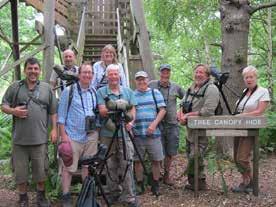
23 May 2021, a ‘red letter’ day. Covid-19 restrictions had been eased six days previously to allow 30 people to meet outdoors, and it was fully 14 months since the last SBG field trip. So it was hardly surprising that no fewer than 22 members booked places on our annual clockwise circular walk around Minsmere, the RSPB’s flagship reserve, and everyone was bang on time for our 7am meet.
Formalities done, we headed along the entrance road then left onto a bridleway. A Garden Warbler burbled relentlessly ahead of us, with a Blackcap conveniently warbling close by for comparison; already our walk was serving a dual purpose of allowing people to meet up for the first time in ages but also a chance to learn. A Lesser Whitethroat ‘rattled’ as a bonus. We were privileged to watch Stone-curlews from three different vantage points, unthinkable a few years ago; a first candidate for ‘bird of the day’. A Bittern boomed and a Cuckoo called distantly as we reluctantly moved on.
With a large group and people keen to catch up, ‘chat’ was both important and inevitable! Nevertheless, in schoolmaster mode, I politely requested some quiet as we entered the woodland stretch to increase our chances of a singing male Redstart; the group and, to an extent, the bird, co-operated! For many of those present, this song was very much ‘new’, and everyone heard it even if it wasn’t keen to show itself. This spot provided what, for
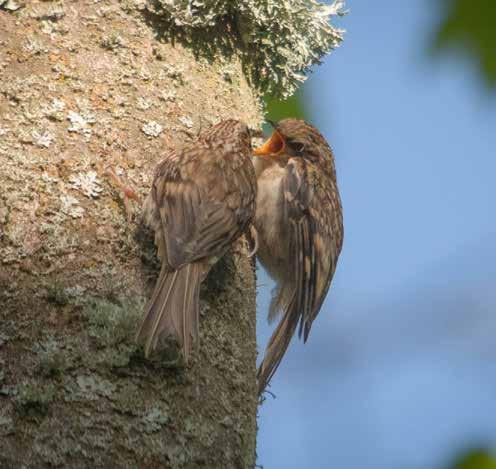
many, was the day’s ‘Champagne Moment’, a recently fledged family of Treecreepers; an adult feeding one of the brood was not only witnessed but photographed!
Dartford Warblers called and sang as we walked across Dunwich Heath before our worst ‘dip’ of the day, the toilets being inexplicably locked. Unmoved, we refuelled on the benches overlooking north marsh then marched south along the newly created path between the dunes and the reedbed. Marsh Harriers made the most of the increasing breeze, and we reminded ourselves not to be blasé! The most unexpected birding moment of the day occurred here, a Turtle Dove appearing over our left shoulders and flying at some speed across north wall and beyond; Minsmere regulars were unsurprisingly envious!
As always there was loads to see as we walked the section of coast between north wall and the sluice. To our left, a summerplumaged Red-throated Diver on a calm sea and two Fulmars moving north were the pick of the birds for those keen to seawatch. To our right, south scrape gave us a superb summer-plumaged Sanderling, Little and Sandwich Terns and Mediterranean Gulls, not forgetting the Avocets.
A Willow Warbler singing in the sluice bushes was lovely, a memory of times past. We pushed on to Lucky Pool and South Levels, one of several chances during the day to
share ‘new’ parts of the reserve with the group even if today there was little of note on offer.
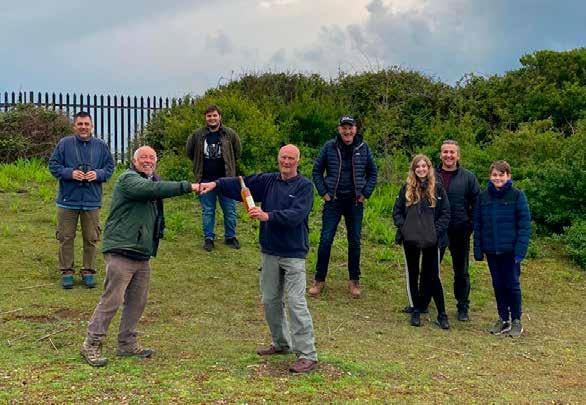
A socially distanced group photograph in the dunes proved surprisingly uneventful before we began the final leg of our walk. A stunning Hobby to our left ended a ‘lull’! We all enjoyed the chance to see Minsmere from a different angle as we pottered westwards, this part of our trip perhaps providing the best opportunity to relax and chat.
I first visited Minsmere in May 1971, as a nine year old on a half term family break from our
home in Wiltshire. We stayed in Rose Cottage in Eastbridge and I couldn’t resist the chance to share this information with the group as we finally reached the road! At this point we said our goodbyes, over 80 species logged and, equally importantly, a fun morning spent together.
Thanks to everyone who took part in a very enjoyable walk. From a leader’s perspective, it was good to catch up with the regulars but also great to meet those on their first SBG field trip. Minsmere is a special place so it was fitting that our first get-together in ages happened to be here.
Tony Gdula
The quarterly review section gives a snapshot of birds seen within the county during the period and is compiled by Tony Gdula, predominantly from data received by Suffolk BINS. All scarce and rare birds are subject to submission and acceptance by either SORC or BBRC. Updated lists on Accepted and Outstanding Records for previous years can be found on the SBG websitehttp://www.suffolkbirdgroup.org/bird-recording.
Two Pale-bellied Brent Geese were among a large flock of Dark-bellied Brent Geese at Kirton from the 14th to the 19th. At Boyton Marsh, three Pink-footed Geese were present on the 17th. A number of Tundra Bean Geese sightings in south-east Suffolk; two were at Boyton on the 3rd, with three there on the 15th, four at Felixstowe Ferry
on the 9th, six at Hollesley Marsh between the 10th and 18th and finally one at Trimley Marsh on the 22nd. Eurasian White-fronted Geese were again noted in large flocks along the coast, most noticeably around 500 at Aldeburgh on the 21st. Numbers of both Bewick’s and Whooper Swans were seen regularly this month; notably 14
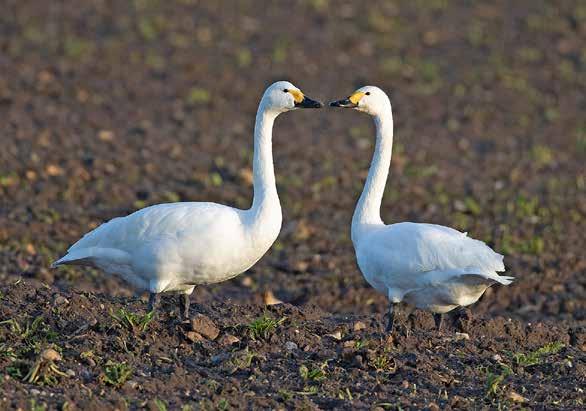
Whoopers at Barsham Marsh and up to four at Minsmere. Minsmere also held up to four Bewick’s Swans and nearby up to seven at Hinton. A female Greater Scaup was noted at Minsmere on the 24th and 27th with a male at Benacre on the 25th and 26th. A single Long-tailed Duck continued to show at Covehithe throughout the month. Velvet Scoter were noted off LBO, two on the 9th and one on the 16th and at least nine offshore at Aldeburgh on the 11th. A solitary Smew was at Minsmere throughout the month. Goosander were seen in small groups during the month at Little Cornard, Worlington, Minsmere, Wenhaston and Thorpeness.
Two adult Cranes seen on Tinkers Marsh at dusk on the 21st and two over Reydon heading towards the Blyth on the 23rd. A Red-necked Grebe was at Minsmere until the 19th. A Slavonian Grebe showed at Breydon Water twice in the month and on the 16th a Black-necked Grebe was sighted on the sea at Benacre. Purple Sandpipers showed at Southwold (1st), North Warren (7th), seven at Ness Point (16th) and Felixstowe (26th). A wintering Ruff was on Martlesham Creek on the 19th and three were at Hollesley Marsh on the 21st. Two Woodcock were at LBO on the 12th followed by several coastal sightings the next day, part of a cold-weather
movement. Jack Snipe showed on the Alde Estuary (11th), Martlesham Creek (12th) and Beccles Common and Oulton Marshes (both 14th). Spotted Redshank were recorded at Fullingpit Meadow, Sudbury on the 10th and Shalford Meadow, Little Cornard on the 12th. A lone Common Sandpiper was seen at Bourne Bridge on the 19th. Little Gulls were at Brantham (8th), Southwold (14th/15th), Benacre (16th) and Kessingland (21st). Three Mediterranean Gulls were offshore at Southwold on the 15th. Iceland Gulls showed at Covehithe on the 4th and around Gunton intermittently between the 6th and 26th. A Yellow-legged Gull was at Southwold on the 15th. Caspian Gulls were noted at Blythburgh (2nd), Southwold (2nd and 15th), Minsmere (5th and 17th/18th), off Aldeburgh (11th) and two at Ness Point (14th).
A Razorbill sat on the sea at Landguard on the 11th. Shags were noted off Landguard on the 3rd, one first-winter bird in Ipswich docks from the 10th to the 21st, with sometimes up to 2 first-winter birds and an adult. Two on the Orwell Estuary off the Strand on the 16th and two on Lake Lothing on the 21st. There were five Spoonbill on Aldeburgh Town Marsh and two at North Warren, both on the 23rd. Singles at both Havergate and
Hollesley Marsh on the 27th. Likely the same Cattle Egret was seen at a few sites in west Suffolk; near West Stow on the 12th, at Lackford on the 21st and 24th and on a flash at Cavenham Heath on the 27th and 28th. Great Egrets, either singly or in pairs, were seen throughout the month at coastal sites and inland.
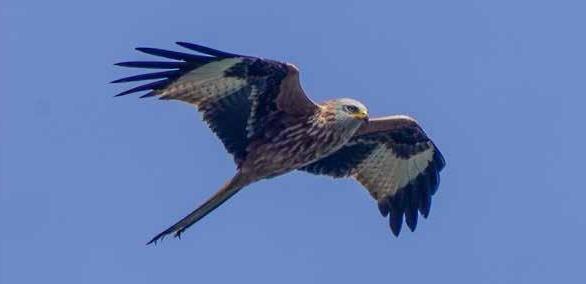
Red Kites were recorded in ones and twos across the month at Westleton, Stowmarket, Woolpit, Freston, Alton Water, Ipswich, Mendham, Waveney, Reydon and North Warren. Hen Harriers were seen singly at Minsmere, Westleton, Middleton, Eastbridge and the Blyth Estuary. Shorteared Owls continue to be seen; this month at Walberswick (11th), Hollesley (14th) and Westleton (28th). Three Lesser-spotted Woodpeckers noted at Santon Downham from the 26th to the 28th. A Merlin was seen at Witnesham on the 17th. A single Great Grey Shrike was at Raydon airfield, Hadleigh on the 14th. Ravens are still around; two at Combs Ford on the 11th and four at Stowmarket on the 23rd. The first Sand Martin of the year noted at Peto’s Marsh on the 27th. A wintering Yellow-browed Warbler was seen in Ipswich on the 8th. A very early Ring Ouzel was reported at Long
Thurlow on the 13th. Black Redstarts were sighted at Kessingland on the 18th, 19th and 28th and one at Landguard on the 25th. Water Pipits were noted at Covehithe (19th), two at Dunwich (20th), and Hollesley Marsh (26th). Eight Twite were recorded at Dunwich on the 20th. A great count of 21 Hawfinches at Sotterley on the 15th with 14 there on the 22nd. Snow Buntings were at Aldeburgh (4th/5th), three at North Warren (7th) and up to 11 on Kessingland beach (13th to 27th). Two Corn Buntings were seen at Lings Lane, Chelmondiston on the 25th
Scarcer February sightings
14th – a Black Brant on the Deben Estuary. Present on a few dates up to the 26th.
23rd – the Hooded Merganser, of unknown origin, was again seen at Staverton pools (also present on the 27th).
26th – a White-tailed Eagle flew over Barton Mills, the first of a few sightings, some which relate to re-introduced birds from the Isle of White scheme. One on the Blyth Estuary on the 27th and 28th and was also noted at Westleton on the latter day.
27th – six Parrot Crossbills were reported from Upper Hollesley Common.
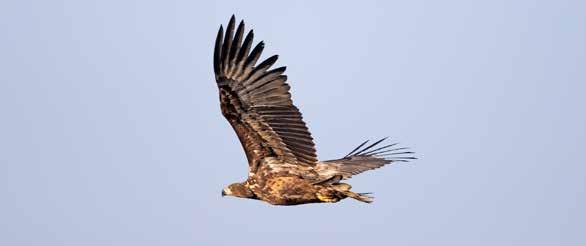
White-tailed Eagle
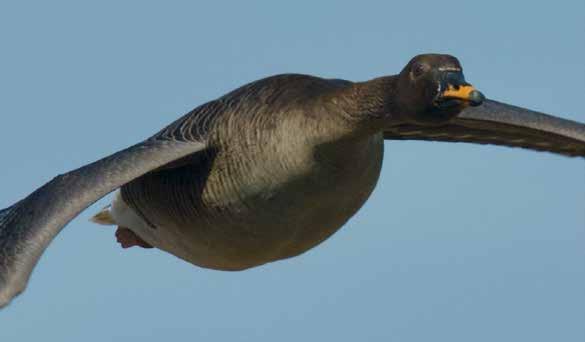
A single Pale-bellied Brent Goose was seen at Slaughden on the 21st. Pink-footed Geese showed at Boyton, Reydon and Hollesley throughout the month. A single Tundra Bean Goose was noted at Trimley on the 19th and 27th. Eurasian White-fronted Geese were present in good numbers, up to 250 at North Warren throughout the month but especially early on. Bewick’s and Whooper Swans were still seen in early March; up to seven Bewick’s at Minsmere and Walberswick and the thirteen Whoopers were seen again on the 1st at Barsham Marshes with up to four at Minsmere. Up to three Garganey were seen from the 15th onwards at Lakenheath, Staverton, Minsmere, Butley, Wickham Market, Bawdsey and Carlton Marshes. One or two Greater Scaup were noted at Benacre, Minsmere and on the Stour Estuary until late in the month and a lone drake Longtailed Duck seems to have been resident at Covehithe throughout the month. Up to four Velvet Scoter were at Dunwich until the middle of the month. A redhead Smew was at Minsmere on the 5th, 13th and 15th and
Goosander showed, usually in pairs, at Little Cornard (6th and 11th), North Warren (19th, 27th and 30th) and Aldeburgh (26th).
A very early Cuckoo was noted at Combs on the 17th. There were several Common Crane sightings; eleven over Brandeston on the 5th and, on the same day, nine were tracked north over Walberswick, Reydon and Benacre then high over Kessingland, Mutford and finally Ellough. Two flew west over Dunwich (9th), two over Cavenham Heath (17th), three at Covehithe (24th) and one was tracked all along the Suffolk coast via Felixstowe, Orford, Easton Broad and Pakefield plus another over Sizewell (25th) and Reydon (26th). One sighting of a Rednecked Grebe, on the Deben Estuary on the 25th but several Slavonian Grebe sightings on the Stour and Orwell Estuaries - up until the 20th. Little Ringed Plovers showed at Hollesley Marsh (7th/8th), Southwold (9th), three on Cattawade flash (12th), Cavenham Heath (28th), Aldeburgh Town Marsh (29th) and two at Carlton Marshes (30th). Up to
24 Purple Sandpipers were at Ness Point until the 9th, then 11 there on the 24th and nine on the 30th. A single Common Sandpiper noted in Ipswich on the 5th. Four Jack Snipe spotted at Dingle Marsh (9th).
Only one Little Gull was seen – at Minsmere on the 31st. The Iceland Gull remained around Gunton and Lowestoft North Denes throughout the month. One was present on Havergate Island on the 14th with one at Minsmere the following day. Caspian Gulls was noted at Covehithe, Southwold, Minsmere and Sizewell on single dates. A Great Northern Diver, as well as hundreds of Redthroated Divers, were off Kessingland on the 7th. One or two Shags were noted in Ipswich waterfront throughout the month with an additional single on Lake Lothing on the 7th. Up to five Spoonbill were at Carlton Marshes, Hollesley, Minsmere, North Warren and Boyton throughout the month. A Cattle Egret was seen at Bures on the 1st then regular sightings at both Cavenham Heath and Snape with a sighting at Lakenheath Fen also.
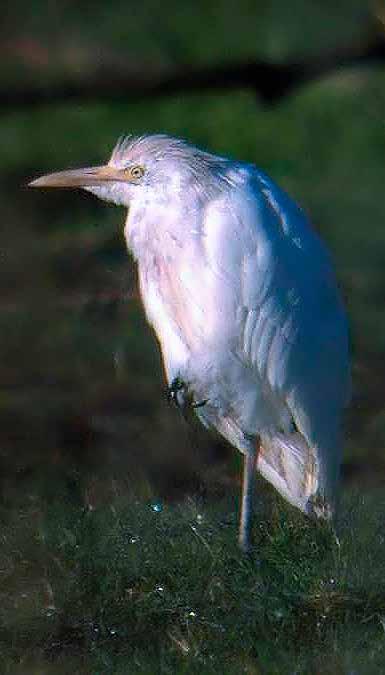
Great Egrets were seen across the county over the month. Red Kites continue to feature prominently – there were many sightings across the county in March, often as pairs (and notably there were multiple sightings over Suffolk on the 14th, 25th, 27th and 29th).
Hen Harriers were seen at Felixstowe (8th), Middleton (12th), Westleton (14th and 20th), Stutton, Minsmere and Dunwich (all 15th), Reydon (19th and 23rd), Walberswick and Covehithe (both on the 24th), the Deben Estuary (25th) and Carlton Marshes (31st). One Osprey sighting – at Halesworth on the 27th. One Long-eared Owl at Capel St. Mary (23rd) and one Short-eared Owl at Blythburgh (25th). Lesser Spotted Woodpeckers showed later in the month; four at Santon Downham on the 20th with
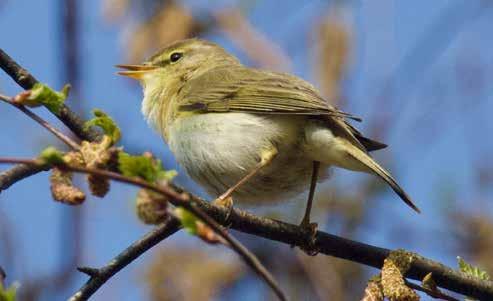
two again on the 31st and one at Woodbridge on the 23rd. Merlin were noted at Shingle Street (2nd) and Stowmarket (23rd). An early Hobby sighting - one at Willisham on the 24th. A Great Grey Shrike was seen at Capel St. Mary throughout the month. Ravens continue to be seen in low numbers across the county. Hirundines started to arriveSand Martins (12th at Lackford Lakes), House Martins (26th at Cavenham and Lackford) and a Swallow (15th at North Warren) all made early appearances. Additionally, warblers started to come in - a Sedge Warbler (30th), Common Whitethroat (White Horse Marsh on 31st) and Willow Warbler (Lakenheath on 31st). Firecrests were around Felixstowe on the 5th plus two were trapped at LBO on the 20th, one at Aldeburgh (21st), Reydon (27th), Minsmere and Dunwich (both 30th).
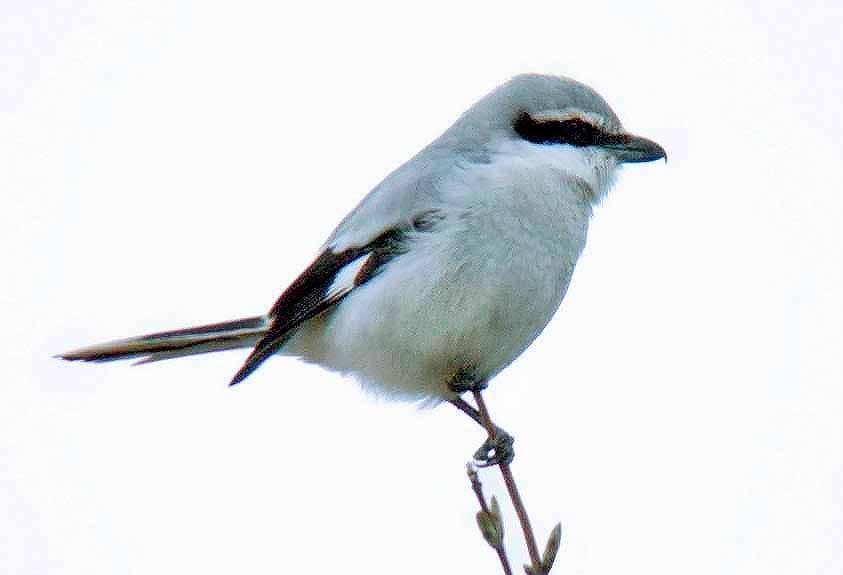
Black Redstarts were sighted regularly through the month at coastal sites with a possible influx on the 30th when the species was noted at eight different locations. The first Wheatear was seen from the 25th at Minsmere and then several sites afterwards, including 13 at Landguard (29th). White Wagtails were sighted at Hollesley Marsh (one on the7th, two on the 9th and six on the 13th), Boyton and two at Southwold (also 9th) and Kessingland (12th). A single Tree Pipit at Brecks (29th) and Water Pipits at Hollesley Marsh (one on 4th and five on the 14th), Southwold (two on the 9th) and two on the Alde Estuary (29th). Brambling were noted at Benacre on the 18th and three were at the Alde Estuary on the 30th. Seven Twite were seen at Dunwich on the 9th. A Mealy Redpoll was at Sizewell on the 28th. Around 18 Hawfinches were seen at Sotterley on the 2nd with two there on the 9th. Kessingland hosted the only Snow Bunting sightingsone on the 12th and five on the 19th.
9th – a Taiga Bean Goose was at Hen Reedbeds and remained throughout the month.
15th – a White-tailed Eagle flew over Carlton. There were a few more sightings in the month including Stowupland on the 19th. There were two birds present on the 21st and 22nd, one of which was from the Isle of Wight re-introduction scheme. On the 22nd one was initially seen over Minsmere and then was tracked further up the coast at a number of sites eventually going north over Kessingland an hour later.
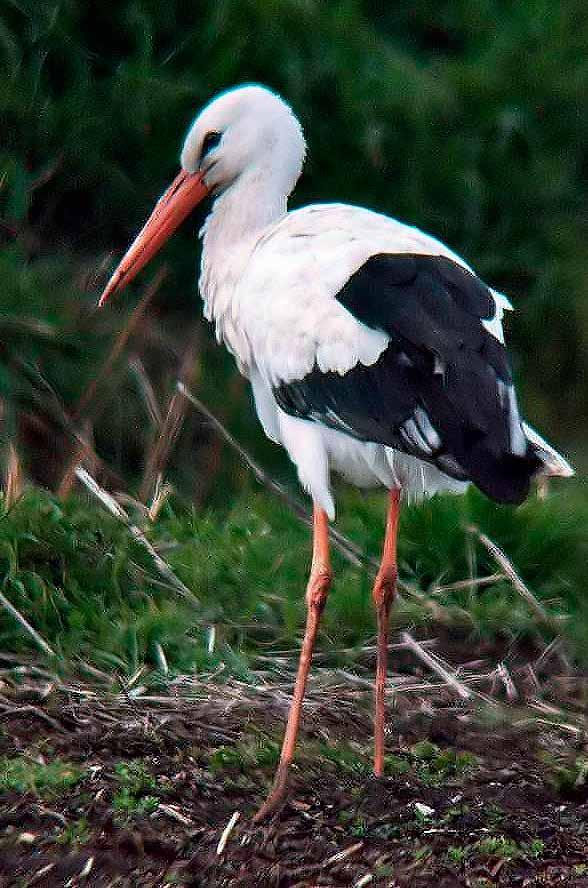
21st – a White Stork at Lakenheath and seen again on the 23rd.
29th – a Rough-legged Buzzard was at Sudbourne.
The wintering geese sightings declined with just the one Eurasian White-fronted Goose at Hollesley Marsh on the 5th and six Pinkfooted Geese south past LBO on the 9th. There were six of the latter at Hollesley Marsh on the 11th then five at the site in the last week of the month. The long-staying Long-tailed Duck was last seen at Covehithe on the 2nd. There were several sightings of Garganey throughout the month at a number of sites, with a maximum count of seven at Lakenheath Fen. Six Velvet Scoters were noted south off Covehithe on the 8th. Three Goosanders at North Warren on the 3rd and 4th. Early Swifts were noted at Ipswich on the 8th. Common Cranes, in twos and threes, were seen over the month at Lakenheath, Dunwich, Snape, Minsmere, Hollesley, Benacre and Carlton Marshes. Two Slavonian Grebes were seen on Alton Water on the 8th and 10th and two Black-necked Grebes were on Livermere Lake on the 9th - both species in resplendent summer plumage. Two Shags showed on groynes at Lowestoft on the 17th. Up to three Little Ringed Plovers showed at Southwold, Hollesley, Trimley and Walberswick. Two Curlew Sandpipers were seen at Trimley Marsh on the 24th. At Ness Point, eight Purple Sandpipers on the 15th. There were single Wood Sandpipers at Great Livermere (24th), Needham Market (26th), Lakenheath (28th), Southwold (29th), then two at Trimley and three on Carlton Marshes (both 30th). Two Temminck’s Stints were also noted at Trimley on the 30th. A single Jack Snipe was observed throughout the month at Hollesley Marsh and also recorded at Trimley Marsh (8th) and Little Cornard (10th). Four Whimbrel were seen on the managed retreat at Trimley on the 13th.
A Little Gull was seen throughout the month at both Minsmere and Trimley Marsh, with two at Walberswick and three at Carlton Marshes on the 20th, up to 20 off Landguard
from the 23rd and six at Great Livermere on the 25th. An Iceland Gull was around Gunton (3rd - 14th) and Cavenham Pits (13th - 26th). There were five Caspian Gulls at Livermere on the 9th and one on Hollesley Marsh on the 21st. There were three Sandwich Terns at Minsmere on the 2nd then rising to around 160 on the 18th! Two Little Terns were seen at Lakenheath Fen on the 28th. Arctic Terns were at Carlton Marshes (up to seven from the 21st to the 28th), offshore at LBO (23rd) and at Great Livermere (up to 14, 24th – 29th). Singles of Black Tern were noted at both Great Livermere (28th) and Castle Marsh North Cove (29th). A Great Skua
showed at Southwold and Covehithe (25th) and Lowestoft (28th). A Pomarine Skua was seen at Southwold on the 25th and an Arctic Skua noted off Landguard (23rd). A single Great Northern Diver was noted offshore at Landguard on the 23rd. Spoonbill were seen singly throughout the month at Aldeburgh, Boyton, Minsmere, North Warren, Hollesley and Walberswick. Cattle Egrets and Great Egrets both appeared in small numbers throughout the month at the usual (and some not-so-usual) sites. The former was noted in a meadow at Framlingham and the bird from last month at Cavenham remained throughout April.
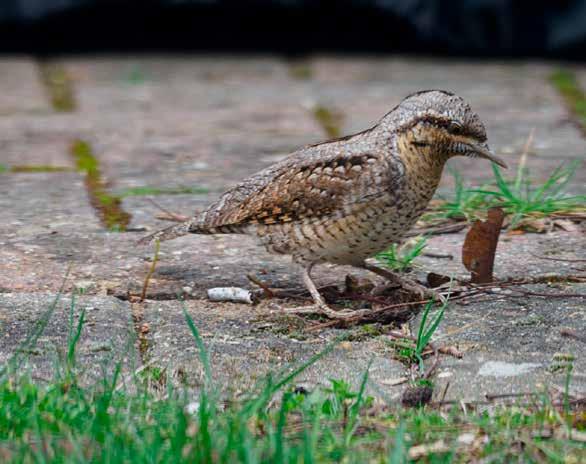
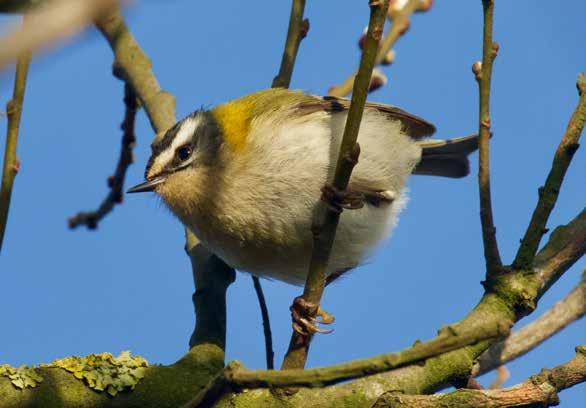
A Hen Harrier was seen at Westleton throughout the month with other sightings at Reydon, Walberswick, Combs Ford, Orfordness, Yoxford and Carlton Marshes. Single sightings of an Osprey at Dalham on the 6th and at Sutton and Snape, both on the 23rd. Short-eared Owls showed at Westleton (2nd), Hollesley (23rd), Walberswick (24th) and Dunwich (27th). Wrynecks were seen at Ipswich (5th), Gunton (13th), Breydon Water south wall (21st), Kessingland (25th) and Southwold (26th). Two Lesser Spotted Woodpeckers were seen at Santon Downham (4th – 8th). A Merlin was at North Warren on the 3rd. The Great Grey Shrike remained at Capel St. Mary until the 10th. Ravens continued to be seen in April; at Needham Market and Sutton (both 4th), Hadleigh (9th) and Woodbridge (30th). There was a lone Firecrest sighting - one at Minsmere on the 2nd. The first Ring Ouzel of the spring was at Trimley Marsh on the 20th with
further sightings at Landguard, Cavenham Heath, Darsham, Tostock, Westleton (two), Martlesham, Walberswick (three) and Worlingham Marsh (two). Cheeringly, Nightingales were recorded at Alton Water from the 8th, then Westleton (12th) and Landguard (20th). A Pied Flycatcher was at Bungay on the 1st. Bird-of-the-month would have to be the Black Redstart, with an abundance of sightings throughout April - the most being eight at Landguard on the 3rd. Common Redstart was sighted at Dunwich (7th), Landguard (9th and 18th) and Kessingland sewage works (18th). The first Yellow Wagtails of the year were two at Carlton Marshes on the 2nd. Single Blueheaded Wagtails were seen at Butley (23rd), Walberswick (29th) and Carlton Marshes (29th/30th). There were 10 White Wagtails at Southwold on the 1st. Water Pipits noted at Reydon (3rd) and Minsmere (14th).
1st – a White-tailed Eagle at Iken. A number of other sightings until the 8th at Great Livermere, Alton Water, Minsmere, Dunwich, Benacre, Carlton Marshes, Combs, Lakenheath, Trimley Marsh. One was reported as having been present for four days at Blythburgh on the 20th. Again some relate to the Isle of Wight reintroductions scheme.
1st – the Rough-legged Buzzard was again seen at Sudbourne until the 3rd and one over Buss Creek, Southwold on the 27th.
1st – the Taiga Bean Goose remained at Hen Reedbeds until the 13th.
6th – a White Stork at Lakenheath and also noted on the 7th and 11th.
7th – a Grey Phalarope was at Minsmere until the 10th with another at Southwold from the 8th to the 12th.
10th – a full summer-plumaged Blackthroated Diver flew north off Southwold, with another north again on the 25th.
13th – a Goshawk was seen over the visitor centre at Minsmere.
17th – an Iberian Chiffchaff was found at Kesgrave, near Foxhall Stadium and remained throughout the month.
19th – a Siberian Chiffchaff was trapped and ringed at Landguard Bird Observatory.
24th – a Goshawk north over the flash at Southwold.
27th – a Purple Heron over Lakenheath Fen RSPB.
29th – a Honey Buzzard over Pipps Ford being mobbed by Common Buzzards
29th – a Hooded Crow on Aldeburgh Town Marsh.
29th – a Hoopoe was found near the visitor centre at Carlton Marshes.
29th – a Black Kite flew over Carlton Marshes and was probably seen the following day at the site over Peto’s Marsh. One was noted on the 30th at North Warren before flying south over Aldeburgh.
Council for 2021
Officers
Chair: Chris Courtney
Vice Chair: Edward Jackson
Secretary: Chris Keeling
Treasurer: Anne Wright
Communications Officer: Alex Rafinski
Projects Officer: Chris Keeling
Suffolk Bird Report Editor and SORC Link: Nick Mason
Harrier Editor and Outdoor Events Coordinator: Gi Grieco
Indoor Events Coordinator: Adam Gretton
President
John Grant
Members
Eddie Bathgate
Peter Merchant
Jamie Everett
Roy Marsh
Matthew Deans
Adam Faiers
Justin Zantboer
Honorary Vice-Presidents
Robin Hopper
Colin Jakes
Mike Jeanes
Mike Marsh
Philip Murphy
Reg Snook
Steve Piotrowski
Bird Recorders
North-east Area Recorder: Andrew Green, 17 Cherrywood, HARLESTON, Norfolk IP20 9LP Tel: 07766 900063 Email: bird-ne@sns.org.uk
South-east Area Recorders:
Gi Grieco Tel: 07951 482547 and Steve Fryett Tel: 07593 382082 4, The Street, Melton, Woodbridge, IP12 1PW. Email: bird-se@sns.org.uk
West Area Recorder:
Colin Jakes, 7 Maltwood Avenue, BURY ST EDMUNDS IP33 3XN Tel: 01284 702215 Email: bird-w@sns.org.uk
c/o SNS, The Museum, High Street, Ipswich, Suffolk IP1 3QH
Founded in 1973 by a group of Suffolk birdwatchers
Associated with the Suffolk Naturalists’ Society
SBG remains an independent birding group and is a registered charity
A voice for Suffolk birdwatchers
With established links to many naturalist and conservation organisations
Media
Actively lobbies to protect key Suffolk habitats
Provides a county-wide field force of bird surveyors
Promotes BTO bird surveys and organises special SBG surveys

Strong web presence - www.suffolkbirdgroup.org
Active Twitter feed - @suffolkbirds1
Quarterly magazine - The Harrier
Annual review - Suffolk Birds report
Annually (20+) field trips - ideal for novices or experts and young or old alike
Opportunities to visit hot spots and receive practical ID tips in the field
Programme of talks and presentations - variety of topics (county, national, or international) with quality speakers
Assists with conservation projects to improve breeding success
- Swifts
- Barn Owls
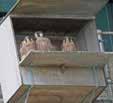
- Peregrines
- Waders
Partners with Suffolk Wildlife Trust and other bird groups
Assists with funding for bird hides and other birding amenities
Contributes to community events, including dawn chorus walks
Provides bursaries for special projects