
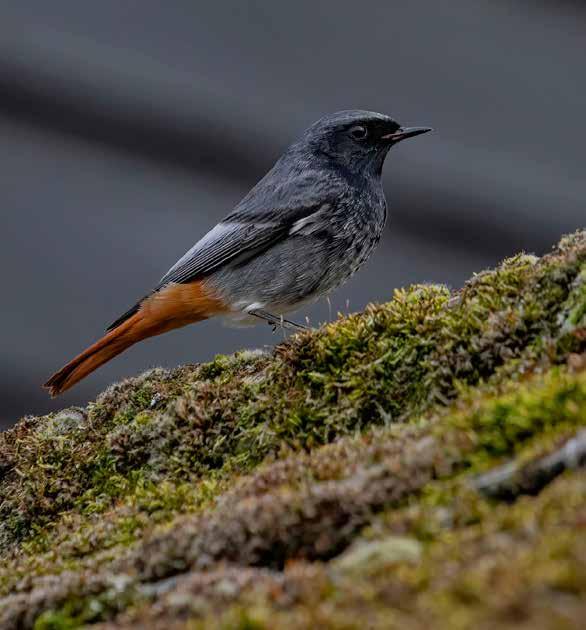

Gi Grieco
Gi Grieco
Welcome to The Harrier. Sometimes I have the odd article that can be saved for the next edition or at least have a few set up to ensure there is enough material but with a month or so to go I felt I might be short. I need not have worried, a flood of articles arrived in my inbox, some I asked for at short notice, so many thanks to all the contributors. I’d also like to thank all the photographers for sending in their bird images, I had a tricky task to select from so many great photos – they really do enhance the magazine. I’d also like to say a big thank you to Alex, SBG Communications officer, for proofreading the editions of The Harrier this year.
Anne has detailed the wonderful donations to Jean’s memorial and the council’s plans. We’ll provide more details in a future edition. Please note the request for nominations for the Garrod Award; this award meant a lot to Jean.
During 2020 we sadly had to cancel many of the events; we were able to put on two talks via technology this autumn but sadly outdoor events were not possible. With the situation still unknown for 2021 we decided not to do a separate events card but we have planned an almost full calendar of events. Please follow the guidelines published within and keep an eye on the web site for updates. We will publish an update in the next edition as well.
In the last Harrier we had a couple of lockdown articles and, with 2020 continuing to be under the restrictions of Covid, we have some further ones including a great account of some fun lockdown birding thanks to our President, Granty. I enjoyed participating and have written up about the House Sparrows in my garden that I found fascinating to watch. It was interesting during the garden lockdown challenge to compare what people encountered, even within the same town, and Dave has given his perspective from his ‘side of the town’. I know both Dave and myself were envious of some of the finds by the Zantboers over the other side! The lockdown also provided the impetus for David to concentrate on his local patch which provided dividends in finding an impressive amount of Nightingale territories.
We have an article on digiscoping, the first of a new mini series on other aspects of how we enjoy our birding. The Save our Suffolk Swift project has been a great success to date and Eddie outlines how we can continue to help them with information on nest boxes available for community groups. Following the lockdown theme we have a book review; having read many of Jeremy’s books I look forward to this one too. Tony has compiled
This has been outstanding from earlier in the year. The deadline for submission had originally been extended and the plan was to draw the winner at either the indoor meeting or council meeting in September. As it transpired, with the talk cancelled and council meetings done online due to Covid, it was delayed. The two bird species to find from the remaining unused letters were Stone-curlew and Marsh Harriers – both species used as a logo for the group. The draw has now taken place and I’m pleased to announce that Peter Napthine is the winner who will receive a £25 book token.
You will all, I’m sure, have read the heartfelt tributes to Jean Garrod in the Autumn edition of the Harrier and, in Gi’s Editorial, the news that she had specified that she would like donations in her memory to be made to Suffolk Bird Group.
I am therefore very pleased to report that over £500 has been gifted to date, and all the SBG Council members would like to extend their sincere thanks to those who have contributed.
We have therefore decided that these donations should be used to acquire a memorial seat for both Jean and Ken, and Peter Merchant has arranged to obtain a
the regular bird review, showing it has been a bumper Autumn and with many of us not able to fully enjoy spring migration it was nice to be able to do so during this period.
Wishing you all a bird-filled 2021 and look forward to meeting up again on our outdoor trips.
Gi Grieco
beautiful oak bench from Orwell Mencap, who operates the Genesis joinery works in Ipswich, which they will then carve with a commemorative message.
There has been a good deal of discussion about where the seat should be sited, although we were all agreed that it should be somewhere that Jean and Ken loved to visit, and where their friends from the birding world would be able to use the seat and remember them both, and the happy times that they spent there over the years. The dilemma was that memorial seats in public spaces are, sadly, often vandalised, and nature reserves and similar sites often have restrictions in place or impose charges.
We have consequently concluded that the Landguard Bird Observatory would be the best site for it, as it was one of Jean and Ken’s favourite places, and because it would be very secure, well cared for and greatly appreciated there.
At present, access to the Observatory is limited to members in line with the national coronavirus restrictions, but once these have eased Council members would like to be able to invite Jean and Ken’s family to the Observatory when the memorial seat is first put in place.
Anybody else who is not a member and who would also like to visit, and in particular those who have so kindly donated, could do so on the Observatory’s annual open day, which is (in normal circumstances) in late summer but, if this was not convenient, they could contact Gi to arrange to visit with the SBG
annual trip to the Fort in October, or with another member on a one-to-one basis.
I only first met Jean a few years ago when I became a member and started attending the evening talks, but even from such a short time I know that she was a very special lady. She always made a point of speaking to new members at the talks and making sure that they felt included and very welcome. Despite her frailty in recent years she was determined to attend these talks whenever she could, not least so that she could catch up with friends old and new, and she will be missed dreadfully by all those who knew her.
If anyone would still like to donate in her memory please just send a cheque payable to Suffolk Bird Group and send it to me at 1 Parklands, Hadleigh Road, Ipswich, IP2 0DE, or contact me for SBG’s bank account details at wright-anne@sky.com or via Gi.
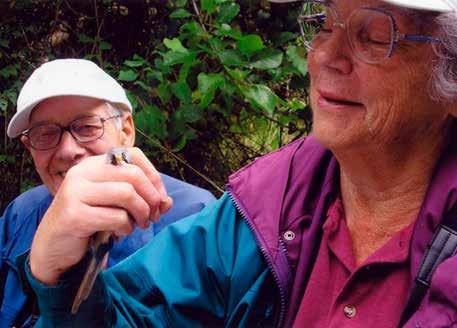
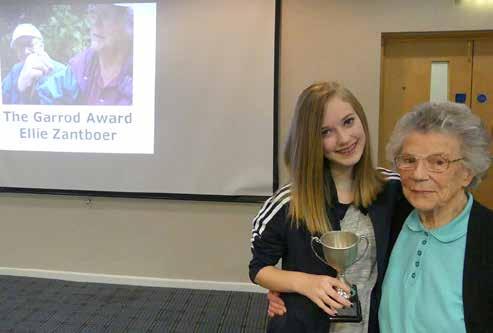
This award was created to celebrate the warm welcome Ken and Jean gave to all – but especially younger – newcomers to SBG. In recognition of this support for younger people, the award is made annually to a young bird or wildlife enthusiast for their involvement or contribution to birding, conservation or the environment in Suffolk. A nomination form can be entered online on the SBG website - www.suffolkbirdgroup. org/the-garrod-award. The winner will receive a certificate, a SBG T-shirt and a year’s membership of SBG. They’ll also have the opportunity to have an article published in The Harrier about their wildlife experiences. The closing date for nominations is January 16th 2021 and the award will be presented at the SBG AGM in March.
David Walsh
In April 2020, with the help of a small number of other local birders, I found 28 singing Nightingales south of Ipswich within walking distance of my home. This article gives some background to this impressive count, tries to put it into context, and mentions other interesting birds found during the same period.
During the lockdown period from late March to mid-May I used my daily exercise walks to explore locally on foot. Living on the southern edge of Ipswich, I am very fortunate to be just a four minute walk from Belstead Brook Park, effectively an informal country park extending to about 250 acres. The Park is managed by Greenways,
their full time staff aided by a number of volunteers; it includes an area of ancient woodland, wet woodland, ponds, meadows, reedbeds, hedges and the brook itself. The Park also acts as a ‘gateway to the local countryside’, and a brisk ten minute walk from home puts me south of the A14 and onto the network of public footpaths of Wherstead and Belstead parishes.
I have been fortunate to note at least one Nightingale in Belstead Brook Park each year, but given the decline in so many areas, I am bracing myself for a spring in the not too distant future when I draw a blank. So I was thrilled to hear one on Easter Day, something to celebrate. This year two singing males settled down on territories, one on the edge of Spring Wood and another close to the Copdock Interchange; the latter was seen and photographed by young local birder Reece Green.
In April, given that the area has long been a stronghold for Nightingales within Suffolk, I decided to make a project of trying to find as many territories as I could on my exercise walks, sharing information with three other local birders: Eric Patrick, Norman Vipond and Ray York. The largely settled weather, with lots of sunshine and calm conditions, was ideal for surveying songbirds, and we were both delighted and amazed to find 21 singing Nightingales within the parish of Wherstead. The vast majority of these were present for at least a week at consistent locations, indicating ‘probable breeding’ using the BTO definition; obviously when surveying it is important to try to avoid recording migrants as breeders. All were audible from public rights of way. It is possible that there were others in the parish in Holbrook Park which wasn’t accessible to us, although as expected the birds we found
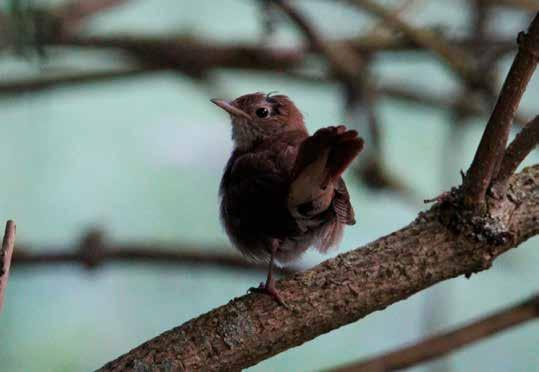
were mostly in scrub rather than woodland. Wherstead is a bigger than average parish, perhaps 12 square kilometres (approx. 5 square miles), but with much of the area arable fields. The aggregate area of suitable scrub and woodland within the parish is of course very much smaller.
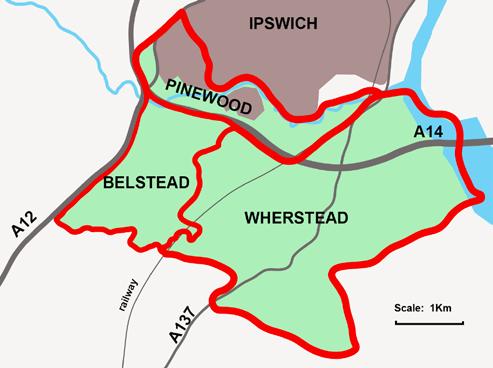
The two territories in Belstead Brook Park mentioned earlier are in Pinewood parish; we also found three singing birds in Belstead parish and two others just beyond Wherstead making seven additional territories and thus 28 in total. After the lockdown finished and we were permitted to drive for exercise, I went a little further afield and found others in Bentley and East Bergholt as well as at Alton Water. It seems possible that there may be as many as 4060 territories in suitable habitat within this area of approximately 50 square kilometres
south of Ipswich, a remarkably significant population given the rapid reductions in some former strongholds not very far north and east of Ipswich and wider national declines.
I talked recently with ScrubUpBritain, a small group of amateur and professional ornithologists and conservationists who are extremely concerned about the decline in many of the iconic summer migrants which are currently disappearing from our shores. They were staggered by the numbers we had located; in the next few weeks I will walk round the locations with members of the group. They have already told me that the habitat, largely scrub in and around woodland close to water bodies, is ideal. Muntjac are undoubtedly present in the area but a significant Nightingale population remains.
The parish of Wherstead is currently writing a Neighbourhood Plan. These plans have social, economic and environmental policies. Identifying and mapping such an important population of Nightingales in this plan would provide an important level of ecological protection.
To put the figure of 21 territories in a single parish into context, in 2018 the Suffolk Bird Report noted 20 at Alton Water and 14 at North Warren as the only two sites with double figure counts. Further afield, Fingringhoe, Friday Wood and Danbury Common in Essex are three known hotspots with 20-30 pairs each. Nationally the best site is thought to be Lodge Hill in Kent with as many as 80 territories in some recent years; it was designated as an SSSI because of the Nightingales.
I didn’t just look for Nightingales this spring! Bit by bit, I surveyed the warblers which breed in or on the fringes of Belstead Brook Park and tallied around 40 territories of both Blackcap and Chiffchaff, 32 Whitethroats, 23 Reed Warblers, eight Sedge Warblers, five Cetti’s Warblers, four Lesser Whitethroats and two Garden Warblers. I heard single Willow Warblers on just two dates; this species no longer breeds in the area. I have recorded Grasshopper Warblers roughly every other year, but not in 2020; I did manage to reach ten species for the year, however, with a singing Marsh Warbler discovered on 21 May. It was in potential breeding habitat but sadly it proved to be a one day bird.
The star attraction for most was the Cuckoo which sang relentlessly day and night in and around Bourne Park, bringing joy to a large number of local residents. Beyond the Park, other rewards for our efforts included two singing Firecrests, a Spotted Flycatcher and a party of nine Crossbills; unfortunately none of these lingered.
The ability to get out and about locally played a big part in helping me remain positive during the spring lockdown, and the variety of sightings showed what can be seen if you keep looking! At the time of writing, my Belstead Brook Park year list is 92 species; to that can be added over 110 different plants, 26 butterflies, 18 dragonflies and some special mammals including Otter, Water Vole and Water Shrew. I fully intend to keep ‘working my patch’ in 2021 and, more specifically, I will redouble my efforts to look for Nightingales in the areas surveyed this year and those a little further afield given the knowledge that the area is significant not just in Suffolk terms but perhaps nationally too. It will be fascinating to see if the high numbers in spring 2020 are sustained and how widely this local hotspot extends.
Eric, Norman and Ray for sharing your information during the lockdown and enthusing about our local patch!
Reece for the Nightingale photo; more of his excellent photos can be seen by searching Reece574 on Flickr.com
Scott Mayson for providing Birdtrack data
Steve Grimwade for assisting with Essex figures
Ed Keeble for producing the map and for his comments on a first draft of this article
Mark Nowers (RSPB) for alerting me to the Wherstead Neighbourhood Plan
ScrubUpBritain for their input and advice
John Grant
Birding is about far more than birds. I’ve always thought that. And if any proof were needed let’s just cast our minds back to the dark days of spring 2020.
I never, ever, thought I’d ever write the phrase ‘dark days of spring’. An oxymoron, surely. A Suffolk spring is usually the time when birders’ spirits soar, when the marvels of migration and renewal in the natural world unfold in all their glory. When us birders are lifted to levels of wonderment that make it a sheer joy to be alive. When being out in the wilds of our (in parts) still spell-binding county is a life-affirming, tingling, electrifying experience and the metaphorical and physical darkness of winter is dispelled with the season’s change. But spring 2020 was depressingly different of course. A new darkness descended. The shackles of lockdown locked tight around
us. Birding for many meant just a fleeting, furtive few glances during permitted exercise followed by many an hour’s more lingering, longing, vigils at the garden window.
With the horrors and heartaches of a rampant Covid-19 pandemic taking terrible tolls on so many, we needed a little Lockdown levity just to get us through. Up steps our group’s vice-chairman Justin Zantboer to provide just the tonic that was required. He devised a Lockdown Challenge. Nothing very heavy, just a wee bit of fun and not overly competitive. Just see how many bird species you could see or hear in your garden or from your home, from Lockdown Day March 23 to the end of May. Not too competitive? Dream on! A WhatsApp group was set up involving Justin and 17 of his birding friends - mainly in Suffolk but also in places as far-flung as Wales,
Leicestershire, Devon and even Warsaw in Poland - and the challenge was up and running. For us all it provided a channel through which we could keep in touch and share our love of birds, swap bird news - and indulge in some gentle ribbing and rivalry!
For me, Justin’s challenge also provided a perfect, well-timed pick-me-up following a six-day stay in hospital after collapsing at home and during a recuperation period in which I was weakened, physically and mentally, often being bed-bound and completely unable to cope with even the briefest of strolls outdoors.
Obviously, the odds were stacked in favour of those with the best outlooks from their homes, but even the most urban of situations brought hours of welcome solace to participants, some jaw-dropping surprises and many a ‘house tick’ - and it wasn’t all that competitive anyway, was it? Not much it wasn’t! I look out across the vast 360-degree vista I am fortunate enough to enjoy from my lofty loft - which became known in Lockdown Challenge parlance as the Leiston Loft Bird Observatory - and each and every time I do so I count myself lucky. Living on the northern edge of Leiston, I can see Theberton Woods distantly to the north, the much under-rated historic monument of Leiston Abbey across the fields, the rippling skyline of Kenton Hills to the north-east, the ‘golf-ball’ dome of Sizewell B and the ugly, monolithic slab of Sizewell A some 1.5 miles away - and the delightful Leiston Sewage Works a little closer. (I may one day also have the joy of gazing out on the hideous industrial wasteland of Sizewell C’s double nuclear reactor construction site for about 15 years - such monsters always overrun their building timetables - if the powers-that-be are reckless enough to mutilate an area that’s supposed to be specially protected for its landscape and wildlife qualities). To
the east, but tantalisingly just out of view, is the sea. Aldringham, Knodishall, Friston and, very distantly, trees that fringe the Alde Estuary are visible to the south.
The challenge’s early pace-maker was ringer Rob Duncan, whose wonderfully crafted mosaic of habitats at his Hollesley home allows him to catch an enviable array of species - as a result, his garden is known as Rob’s Obs. Also in the leading pack was Justin and it has to be said that few could match his infectious enthusiasm for the challenge, with early morning vigils on a precariously positioned chair high up on a flat roof at his north-west Ipswich home illustrating his dedication and stamina. But with panoramic views over such a wide area of east Suffolk, surely I’d be in with a chance of glory? The ornithological rewards gained in countless hours of observation by all the participants were rich indeed. Justin’s excitement at seeing such surprise birds as Glossy Ibis, White-tailed Eagle and Firecrest, and hearing Common Scoter as a nocturnal migrant, was understandably boundless and his admirable total of 74 gained him 3rd place. Rob also notched up White-tailed Eagle, and Common Scoter, along with Nightjar, Wood Lark, Raven and Common Crossbill, among many others. Early on, however, he had graciously withdrawn from the competitive element of the challenge as he deemed it unfair that his total would include birds he had caught in his nets while everyone else was simply watching. His ‘non-competitive’ total of 80 gave him a notional 2nd place.
My own highlights included Black Kite, a total of 15 Common Cranes in three separate parties, Osprey, Spoonbills, Ring Ouzels and Common Crossbills. For the record, with 81 species, I was declared the winner, which was highly satisfying but hardly the point.
In fact, the real point was that we were all winners in the truest sense, because
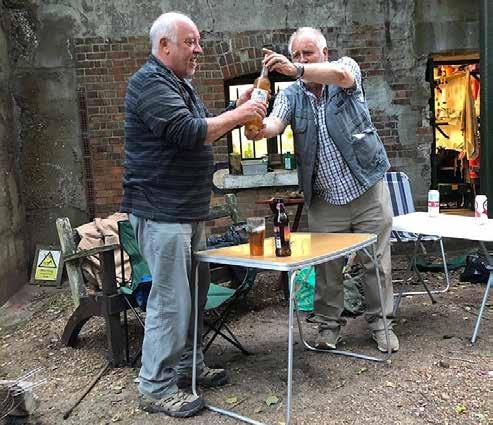
we were united by a common cause, a camaraderie and a common love of birds. We’d helped each other through a difficult, unprecedented time. As lockdown was eased, several participants assembled in a socially distanced manner at Landguard Bird Observatory for a convivial curry. I was deeply honoured to receive the muchcoveted Lockdown Challenge prize - a bottle of Kathy Piotrowski’s Bungay Beaujolais. The way her wildly inebriated husband Steve fell legs and arms akimbo from his chair during the evening revealed the awesome potency of the extraordinary brew. My fondest memory of the challenge, however, was provided by Mr Duncan. That decision of his to withdraw from the competitive element of the event was a lovely, magnanimous
gesture - one that perfectly exemplified the spirit of it all. No, the rivalry wasn’t cutthroat. Far from it. It was light-hearted and friendly. And that, for me, exemplified all that birding is about. It’s about the birds, of course. But it’s also about much, much more. It’s about fun, it’s about helping others enjoy their birds, and, perhaps above all else, it’s about friendship.
As I write, the infernal virus is still causing inexpressible hardship and heartache. We’re in another lockdown and the death toll is staggeringly high - some would say unnecessarily and unforgivably so. Yes, the birds can help us through these tough times. But we shouldn’t forget, we can also help each other through them too.
Dave Pearsons
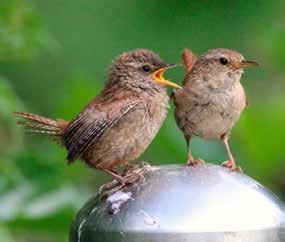
Lockdown during the Spring migration: disaster. However I had my moth trap and loads of invertebrates in the garden so I had the opportunity to study the variety of wildlife in my garden. Fortunately, to add interest, I was invited to a WhatsApp group, set up by Justin Zantboer, to count the bird species seen from my garden. I live in NE Ipswich, close to Heath Road Hospital, so was not expecting big numbers.
House Sparrows are the most numerous birds in the garden and they were making good use of my roof space to begin their breeding activities. The early excitement was provided by a pair of Peregrines, seen from my bedroom, on top of the maternity block, presumably attempting to breed. I saw no evidence of success although I did observe prey being taken in. In early May I spotted another bird of prey perched on an aerial on the maternity block, it was a Hobby and it wasn’t allowed to stay very long! Other raptors spotted from the garden were Common Buzzard, Red Kite, Sparrowhawk and Kestrel.
Late April brought the sound of a Cuckoo to the garden, interestingly probably the same bird was heard by Gi, near Holywells Park, a few minutes earlier and by someone in Marlborough Road then Britannia Road before passing me. A straight line. There were seven new birds to the garden including two Common Terns, which I got thanks to Gi who sent a text to say they were heading my way. Unfortunately I could only hear them in bright hazy sunshine, making them difficult to pick up. The others were Cormorant, Swallow, Jay, Green Woodpecker, Stock Dove and a Little Owl that was heard at night.
The sound of the intro notes to the Nightingale song caused initial excitement but I had to put that down to a mimicking Starling. The song of a Blackcap in next door’s tree was a bonus. Goldfinch numbers were good but it was disappointing to only get one Greenfinch during the Lockdown period. Gulls made their usual sorties looking to scavenge whatever was available, however two flyover Great Black-backed Gulls were nice to see. The local fish keepers were not too happy to see the regular Grey Heron but I was, however they may have enjoyed the three Mallards that put in an occasional appearance.
I enjoyed having an excuse to lay back and enjoy the warm spring sunshine. I could not compete with our President “Granty” who observed the most with more than 80 species. I finished bottom of the pile with 42 species. Considering my habitat I was happy with that. Justin in W Ipswich had some super birds including a White-tailed Eagle and a Glossy Ibis
It was good, but let us hope we can get out in the field for the 2021 Spring migration.
Gi Grieco
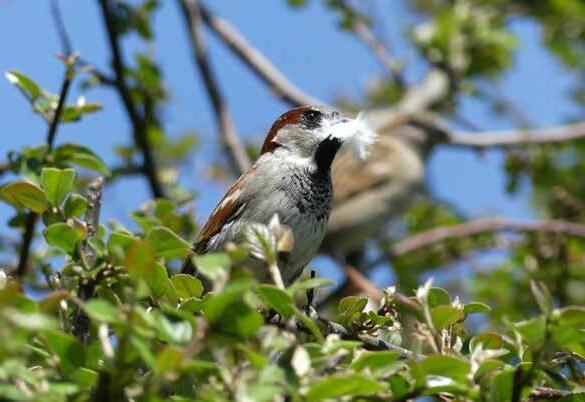
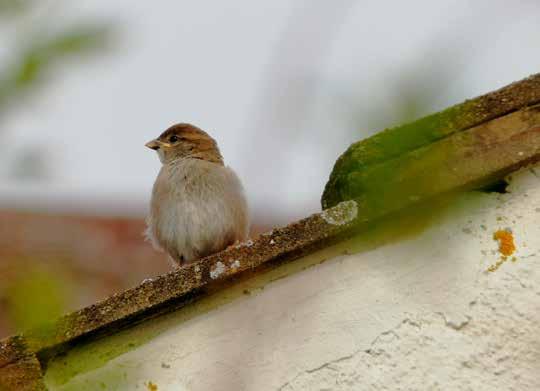
I’m fortunate to have a colony of House Sparrows in my back garden and they regularly keep me entertained. Lockdown has allowed me to spend more time in the garden and watch these birds. From my records over the years the number of birds has been as low as six, but in the last couple has risen greatly and by the end of the breeding season this year there were around 30 birds. They breed in the eaves of my house as well as in some of the neighbours’. The roost site is a thicket of Forsythia with Wild Hop entangled through. In recent years an adjacent Cotoneaster has grown up so they also use that. They can make quite a noise – I’ve recently started to do some ‘nocmig’ recording (more about that in another article in the future) and on the audio files once the House Sparrows
wake they start to build up into a crescendo of chattering! What I did find when I was taking part in a fun competitive garden lockdown listing (organised by SBG member Justin Zantboer, with a number of people from around Suffolk and beyond) was that while trying to listen to fly over birds they could be drowned out by the noise of the House Sparrows. One male was particularly vocal and would announce his territory continuously. This male has a BTO ring, having been rung nearby, and has been present in my garden for a few years.
I’ve found them intelligent birds, quick to make use of resources and also quite agile – they are much better skilled at balancing on the bird feeder than the similarly sized Chaffinch. During the breeding season they
made use of a variety of resources and I watched as one bird swooped across to skilfully catch a floating feather in flight. During the nesting season they also hop on to the grass and I’ve noted that they will not only take dry, cut stems of grass but will also deliberately snip off fresh, green blades. They seem to like to drink regularly so water is put out for them where they also bathe. Nearby is a pile of dust, remnants of an old ant’s nest where after wet weather they build upwards, which the Sparrows also enjoy. A couple of other things I’ve noted that shows they are an intelligent species: they are alert and have a quick reaction time. Any time a Blue Tit or Blackbird makes an alarm call they immediately dive for cover. What I have found funny is that sometimes the alarm is
due to a Woodpigeon or Feral Pigeon flying over fast and not the potential raptor they or the Blue Tits thought it was – something us birders have all fallen for! Another interesting observation, that I note is done by one female bird in particular, was for the bird to move through the hedge or shrubs, some with Ivy growing through, almost out of sight and while doing so jump from branch to branch heavily in order to flush out insects such as Craneflies. When any such insect does get spooked then the House Sparrow will fly out to catch it. I watched this on a number of occasions and deemed it was a deliberate action.
I’ve enjoyed watching them more this year and am grateful for their presence in the garden and look forward to seeing more of their antics in the future.
Barry Woodhouse
My name is Barry Woodhouse and I’m a known digiscoper living in Bury St. Edmunds. I am also a ringer with the BTO ringing scheme and these are my two passions. I have been digiscoping now for 10 years, having learnt from Danny Porter, and find it a challenge every time I’m out in the field. In recent years there has been a big rise in bird photography and one aspect of this is digiscoping.
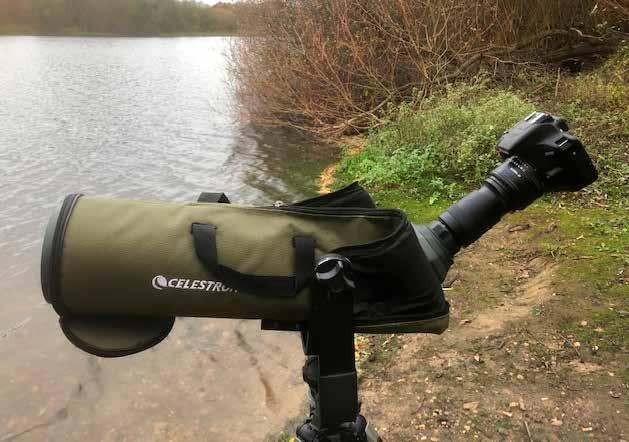
Digiscoping is simply using a digital camera to take photos through a telescope, similarly taking videos is called videscoping while through your binoculars it is known as digibinning. Many birders will be in the field with a telescope so you can utilise that for photography rather have a larger lens with
a DSLR camera. The simplest way is to just hold the camera device up to the telescope and this is known as handheld although it is difficult to keep it steady and to take a photo free from blurriness. Therefore an essential part of the kit is an adapter, to enable the camera device to align to the lens of the scope and to ensure steadiness. There are different adapters depending on what make of camera and telescope you have. Various types of adapters include:
SWAROVSKI TLS APO PHOTO ADAPTER
KOWA TSN-PA8 D-SLP DIGISCOPING ADAPTER
LEICA Q DIGISCOPING ADAPTER
VIKING SMART PHONE ADAPTER FOR DIGISCOPING
Digiscoping takes a lot of patience and practice, with a good knowledge and understanding of how a camera works just as it does with a conventional camera and lens. I personally use Nikon cameras and, at the moment, use a Nikon D3500 coupled with Celestron sporting telescopes. You can then use the scope’s magnification to get decent images. It is better to have a scope with ED glass (extra dispersion) as this will give you sharper images with better clarity. So with my digiscoping I use a combination of aperture ISO and shutter speed, using the right combination depending on the light conditions - so if it’s sunny I use a lower ISO with the right shutter speed and if the light is poor I use a higher ISO. If you have a zoom eyepiece, the more you zoom close in to your subject the more light you would need so it is best to stay at 25x to 30x zoom. Additionally you sometimes need to use some zoom on the camera to ensure you get a full image, known as vignetting. This is because the full frame is not illuminated and leaves a circular image with a black surround. In the early days of digiscoping when it was mostly done with point and
shoot cameras there was a limit of 4x to 5x optical zoom as they would have a smaller objective and be close to the lens of the telescope.
With mobile phones having better and better integrated cameras there has been an increase in using these for digiscoping; this is called phonescoping. Again there are a number adapters to hold the phone next to the telescope, some are specific to phone models but others are more generic such as the Viking adapter listed above. Phones tend to have a bit less control of settings compared to cameras.
You can start to learn the basics of digiscoping; there are helpful websites online such as www.dannysdigiscoping.com and then you can find what works for you. I would say practice, practice, practice with your setup such as starting in your garden using different setting combinations to see what results you get. It will also be easier to select species that are larger and more static, such as ducks and geese on a pond. From there you can then move on to more tricky subjects such as birds in flight.
Eddie Bathgate
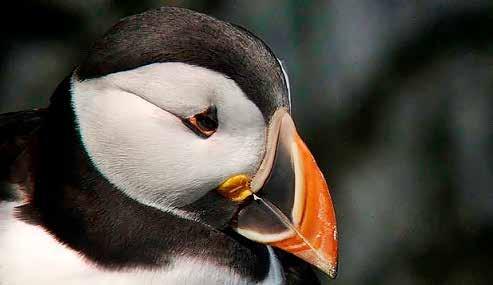
Save Our Suffolk Swifts have raised funds to enable us to supply a number of Swift nest boxes and call systems around Suffolk. We have a number of community packages made up of a call system + 6 nest boxes that we wish to donate to SBG members for installation on community buildings such as libraries, schools, farm shops, pubs and churches all around the county. Our aim is for these to be fitted prior to May 2021, ready for the Swifts’ return. Please let us know if you can place a community package. We also have a number of nest boxes that we are happy to give out to local groups –established or new – as a float. Groups can choose to sell these and use the proceeds to purchase more boxes, or they can ask purchasers to make a payment (ideally adding Gift Aid) via the ‘donate’ button on the SWT website, and we will then re-stock the group.
We are keen to know of locations where a high proportion of nest boxes are occupied, and where there is room for more. SOSSwifts have set aside a number of boxes that we
can donate to such locations, which is an easy way to boost existing populations. Additional nest boxes are available for you to purchase if you wish to extend your colony. Swifts are communal nesters and there is no upper limit to how many nest boxes you can have in one location or along your street. You might like to consider giving nest boxes to your neighbours as a Christmas present.
SOSSwifts has a stock of nest boxes available for a suggested donation of £20. Please let us know if you would like to purchase boxes. If you wish to build your own boxes, HuwsGray (ex-Ridgeons) in Halesworth, 01986 875000, can supply 12mm external ply or 150x25mm treated sawn timber at a discount if you quote ‘Save Our Suffolk Swifts’.
Please contact Eddie Bathgate for further information: Save Our Suffolk Swifts are here to help you help Swifts. swifts@suffolkbirdgroup.org & 07368 334520

• Outdoor meetings must always be undertaken in accordance with the Government legislation and guidance which is in force at the time of the event, including concerning limits on the number of attendees at each event, and the meeting must be cancelled if changes to the rules or guidelines deem it to be necessary.
• Attendance must be pre-booked in advance with the Group Leader, with both name and telephone number being provided (contact numbers on the programme card or SBG website).
• If the numbers pre-booking to attend exceed the permitted number for the group, such that a second Group Leader is required, the separate groups should start at staggered times and/or different points to avoid meeting/crowding.
• Attendees should, on the day before each event, check the SBG website to ensure that it has not been cancelled or, if this is not possible, call the Group Leader.
• If anyone who is intending to attend an event is unwell, and in particular has the known symptoms of Coronavirus, they must not attend the event, and should contact the Group Leader to inform them.
• Group Leaders should undertake a physical survey of the walk prior to the event and, depending upon the Government guidance that is in force at the time, seek to ensure that:
• social distancing between attendees can be maintained at all times, and
• it does not include potential ‘pinch or touch points’, such as
• narrow paths and tracks where separation would be impossible if other walkers were encountered, and
• gates which it would be necessary to open or stiles that needed to be climbed over.
• Those attending should:
• ‘check in’ to a venue with the NHS Test & Trace app if available and
• bring hand sanitiser to maintain good hygiene and
• unless within a family group, should not share optics, and
• please bring a mask, in the unlikely event that one might be required.
• If anyone who has attended an event:
• becomes unwell within the 2 weeks following an event, and in particular
• has a positive Coronavirus test result, or
• has been told by NHS Test & Trace that they should self-isolate, or
• shows the known symptoms of Coronavirus,
• they must inform the Group Leader or Gi Grieco immediately.

SBG memberships are now administered c/o SNS, The Museum, High Street, Ipswich IP1 3QH. See SBG website for details. Single (£17); Family/Household (£20) and Student (£10) SBG annual subscriptions are available. You can also opt for membership with SNS as well, at discounted rates. SBG members are welcome at all Indoor and Outdoor meetings and receive four copies of The Harrier per year.
Email: info@suffolkbirdgroup.org
Website: www.suffolkbirdgroup.org
Charity Number: 801446
SBG Outdoor Programme – 2021
Sunday, February 7th
NORTH WARREN
Meet at North Warren beach car park at 9.30 am.
Map Ref: TM466575.
Leader: David Walsh. Tel. 07947 051223.
Saturday, February 27th
WANTISDEN VALLEY
Meet at Butley Corner car park at 9.30 am. (Long walk possible).
Map Ref: TM350502. Leader: Steve Fryett. Tel. 07593 382082.
Sunday, March 14th
BRECKLAND
Meet at Santon Downham car park at 7.30 am.
Map Ref: TL815877.
Leader: Gi Grieco. Tel. 07951 482547.
Sunday, April 11th
CARLTON MARSHES
Meet at Reserve car park, Burnt Hill Lane, Carlton Colville at 9.00 am.
Map Ref: TM508920.
Leader: Richard Smith. Tel. 01502 586801.
Saturday, April 24th
SHINGLE STREET AND THE SANDLINGS
Meet at Coastguard Cottages car park at 9.00 am. (Long walk possible).
Map Ref: TM369431.
Leader: Steve Fryett. Tel. 07593 382082.
Saturday, May 8th
FINGRINGHOE WICK
Meet at Visitor Centre car park, South Green Road at 9.15 am.
Map Ref: TM048193.
Leader: Ashley Gooding. Tel. 07808 044611.
Sunday, May 23rd
EASTBRIDGE – OFF THE BEATEN TRACK
Meet at Eastbridge at 7.00 am. (Long walk possible).
Map Ref: TM452666.
Leader: David Walsh. Tel. 07947 051223.
Friday, June 11th
MINSMERE (RSPB) RESERVE
Meet at the Reserve car park at 7.00 pm for evening walk ending with Nightjars on the heath. Leader: Paul Gowen. Tel. 01473 311263.
Sunday, June 20th
LAKENHEATH FEN RSPB
Meet at Reserve Centre car park at 8.00 am.
Map Ref: TL719863.
Leader: David Walsh. Tel. 07947 051223.
Sunday, July 4th
RIVER GIPPING
Short walk trip.
Meet at Needham Market car park at 9.30 am.
Map Ref: TM094546.
Leader: Gi Grieco. Tel. 07951 482547.
Sunday, July 25th
SANDWICH BAY OBSERVATORY AND OARE MARSHES
Meet at the Observatory car park, Guildford Road, CT13 9PF at 9.00 am. Contact the leader to discuss car sharing. Map Ref: TR354574. Leader: Adam Faiers. Tel. 07708 521852.
Saturday, August 21st
ABBERTON AND OLD HALL MARSHES
Meet at Abberton Centre car park at 9.00 am. Map Ref: TL964178. Leader: Ashley Gooding. Tel. 07808 044611.
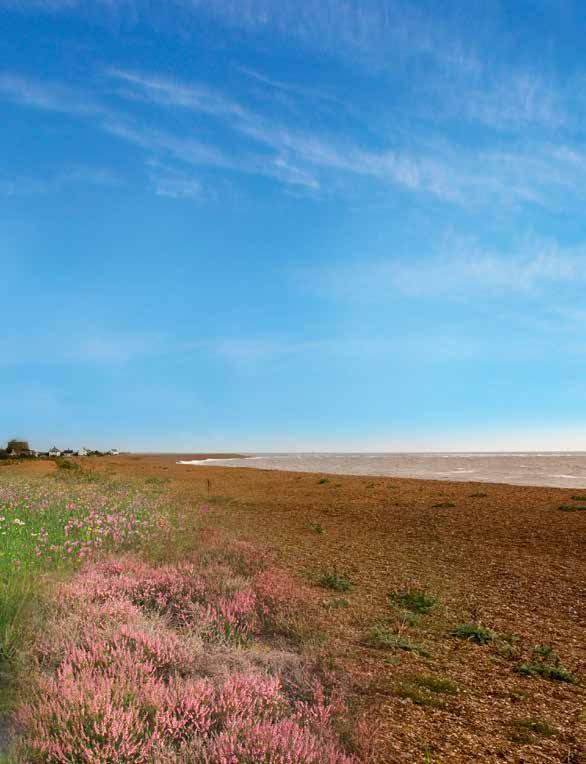
Saturday, September 18th
SHINGLE STREET AND HOLLESLEY MARSH
Meet at Coastguard Cottages at 8.30 am. (Long walk possible).
Map Ref: TM369431.
Leader: Steve Fryett. Tel. 07593 382082.
Saturday, October 9th & Sunday, October 10th
ORFORDNESS (NATIONAL TRUST) RESERVE
Some places available to stay overnight on Saturday in self-catering dormitories. Current entrance fees will apply. Map Ref: TM425495. For further details and to reserve your place, contact Gi Grieco. Tel. 07951 482547. Leaders: Gi Grieco and Eddie Bathgate.
Saturday, October 23rd
AUTUMN OPEN MORNING AT LANDGUARD BIRD OBSERVATORY
Meet at main car park, View Point Road, Felixstowe at 8.00 am.
Map Ref: TM284319.
Leader: Nigel Odin. For details contact Gi Grieco. Tel. 07951 482547.
Sunday, November 28th
LYNFORD ARBORETUM
Meet at Lynford Arboretum car park at 9.00 am. Map Ref: TL822943. Leaders: Val and Ivan Lockwood. Tel. 07309 739920.
Saturday, December 4th
MARTLESHAM CREEK
Meet at Martlesham Church car park at 9.30 am. (Long walk possible).
Map Ref: TM261469. Leader: Steve Fryett. Tel. 07593 382082.
Saturday, December 11th MERSEA ISLAND
Meet at Victoria Esplanade at 9.00 am. Map Ref: TM018124. Leader: Ashley Gooding. Tel. 07808 044611.
SBG Indoor Programme – 2021
NOTES All meetings will commence at 7.30pm. Admission charge (apart from the AGM which is free): £3 for all, non-members most welcome. Additional information/queries: Adam Gretton, Tel. 01473 829156. Adam.gretton@ naturalengland.org.uk
COVID PRECAUTIONS: Face to face meetings will only resume if permitted by Government
guidance – if not possible then talks will remain online (check website for details). It is hoped that face to face talks will also be streamed online.
Please note that the September meeting is in Stowmarket and the October meeting is in Woodbridge; remaining meetings are in Copdock, please check details carefully! Ample free parking is available at all venues.
Thursday, February 25th
‘MAGICAL MADAGASCAR’ and ‘REMOTE CAMERAS AND AUDIO FOR BIRD RESEARCH IN PERU’
Andrew Raine, and Dr Mark Bowler (University of Suffolk) Ipswich Hotel, Old London Road, Copdock IP8 3JD
Thursday, March 25th
ANNUAL GENERAL MEETING
Followed by trophy presentations, SBG and BINS Review of the Year, a raffle andMystery Bird Quiz! Please bring any unwanted bird books / magazines to exchange or donate for Save Our Suffolk Swifts. Ipswich Hotel, Old London Road, Copdock IP8 3JD
Thursday, April 29th
A TRIO OF TALKS including ‘CONFESSIONS OF A LEARNER BIRDER’; ‘SPRING SONGS AND AUTUMN CALLS QUIZ’ & ‘WHITE-BILLED DIVERS’
Anne Wright / Edward Jackson / Ed Keeble Ipswich Hotel, Old London Road, Copdock IP8 3JD
Thursday, September 30th
‘THE SEAFARERS – ON SEABIRDS AND NATURE WRITING’
Stephen Rutt
Please note venue: The Cedars Hotel, Needham Road, Stowmarket, IP14 2AJ
Thursday, October 21st
‘HUMAN INTERACTIONS WITH BIRDS AND WILDLIFE IN THE HORN OF AFRICA AND ARABIA –in the context of drought and conflict’
James Firebrace
Please note venue: Woodbridge Community Hall, Station Road, Woodbridge, Suffolk, IP12 4AU (Joint talk with SWT Woodbridge Group)
Thursday, November 25th
‘THE CONSOLATION OF NATURE – Spring in the Time of Coronavirus’
Jeremy Mynott and Mike McCarthy Ipswich Hotel, Old London Road, Copdock IP8 3JD
Edward Jackson, SBG/SNS Membership
Enclosed with this edition of The Harrier is the 2021 Membership Renewal Form, for use by our subscribing members. However, if you are an honorary member or an institution receiving the magazine, please do pass it on to someone else who may wish to join.
In recognition of the unprecedented circumstances we have all experienced in 2020, both Suffolk Bird Group and Suffolk Naturalists’ Society have once again held our subscriptions for 2021 at the same rates as for 2019.
Your renewal is of course important to us – as is receipt of your completed form, since it acts as our official record of your membership. Mindful of the fact that some of our members do not have internet access, we ask that everyone fills in the forms each year, makes payment using the method that best suits you and posts the form as soon as possible and by 31 January at the latest please.
(If you joined for the first time after 1 September 2020, your subscription includes membership for 2021 as well, but it will still be helpful to receive your form - just add a note to explain this).
As you will know, our membership is administered by SNS, currently based c/o Ipswich Museum. This office is due to move in spring 2021 from the Museum to ‘The Hold’, the new location for the Suffolk Archives service opposite the University of Suffolk. However, please still use the Museum address for this year. If you choose to pay by Direct Debit (the most cost-effective method for us) this should be to SNS (not SBG). You should
receive notification in the New Year that the subscription will be debited from your account. If you choose to pay through the SNS website, please note that the various membership category options are on a dropdown menu, accessed by clicking the arrows to the right of the option box.
Our Gift Aid form is also on the reverse of the Membership Form. As a registered charity, each year SBG currently receives around £1,500 of additional ‘free’ income, courtesy of this HMRC scheme. This is a great help in keeping our subscriptions as low as possible and also supporting our Indoor Events. If you are a taxpayer and haven’t yet signed a Gift Aid declaration, please consider doing so now.
Total SBG membership in 2020 was around 375, still a little short of our target of 400. So please do encourage other birders to join us and enjoy the benefits of membership –maybe as a festive season gift? Additional 2021 Membership Forms can be downloaded from the SBG website.
In order to keep the membership admin as simple as possible, this article is your reminder to renew!
If we have not received your Renewal Form and/or payment, we may assume you no longer wish to be a member or continue to be on the mailing list for next Spring’s edition of The Harrier.
Thanks - we look forward to hearing from you!
Adam Gretton
SBG history was made on 1st October when Kate Rogerson gave an online talk to 36 members, via Google Meet (similar to Zoom, for those who haven’t used it). Kate had recently finished her PhD at UEA (Norwich), including fieldwork in Portugal and Morocco. Alex Rafinski expertly took care of the technical aspects, sending members the online link in advance of the talk. Please note: if you did not receive details then that suggests we do not have your email address – please send Alex your address and he will
be happy to add you to the circulation list.
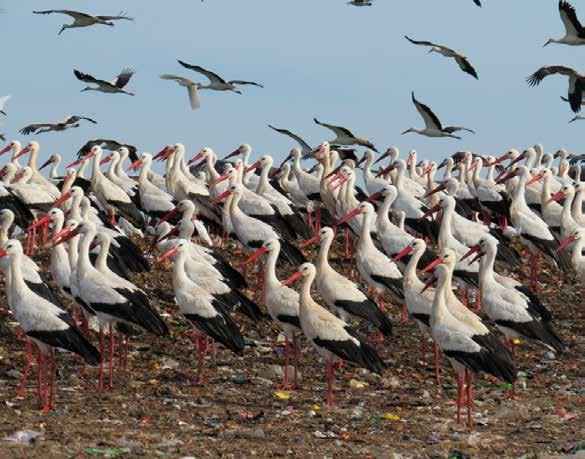
Historically, virtually all European white storks migrated to Africa in winter, but this has changed recently in Iberia, with many more storks remaining over winter, feeding largely on rubbish dumps. However the food supply they have grown accustomed to is being taken away as EU regulations around landfill sites are changing and many are closing down [presumably this may also affect how other birds, notably gulls use such sites in the UK also?].
Kate’s research involved monitoring stork nests and fitting fledgling storks (when large enough) with GPS/GSM satellite tracking units. The results of this tracking were conveyed brilliantly by impressive animated sequences, with one example on the project website, under ‘how do we follow storks’.
http://whitestork.org/index.php/ourresearch/
Kate also described the very exciting events this year at the Knepp Estate in Sussex, with released white storks fledging four young from two nests, as widely reported and covered on Springwatch. More information here, including two juveniles crossing the Straits of Gibraltar on 13/10, shortly after Kate’s talk.
https://www.whitestorkproject.org/news
Written questions were submitted via the chat facility and there was a more informal short Q&A when fewer people were left online. A second very successful online talk was given by Graham Appleton (Wader Tales website) on 26/11 with almost 50 people joining. It is likely that our 25/2 talk next year will also be online – what happens after that will depend on the Covid vaccination roll-out. If anyone has questions about joining online talks, please feel free to contact me or Alex Rafinski –communications@suffolkbirdgroup.org.
Adam Gretton
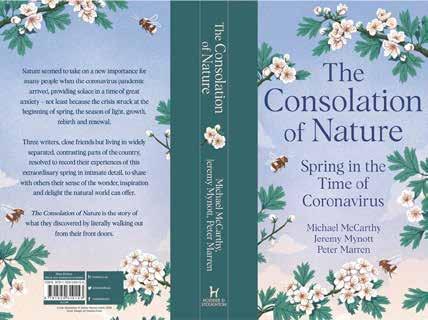
The Consolation of Nature – Spring in the Time of Coronavirus (McCarthy, Mynott & Marren, Hodder Studio, £14.99)
Jeremy Mynott will be known to many members, having given three talks to SOG/ SBG in recent years, most recently on his previous book, Birds in the Ancient World: Winged Words. At the start of the spring lockdown, Jeremy teamed up with two other highly respected environmental writers, Michael McCarthy (Say Goodbye to the Cuckoo and The Moth Snowstorm) and Peter Marren (author of many books, including Bugs Britannica and British Wildlife’s famed ‘Twitcher in the Swamp’ columnist for the last 30 years). Their starting point was very simple, involving no painstaking prior research: to each keep a daily diary of their wildlife observations during the unprecedented days of lockdown. Jeremy’s home range was around Little Thurlow in
West Suffolk, Michael lives in Richmond, near Kew Gardens, and Peter in Ramsbury, Wiltshire.
We all remember the jarring contrast between the horrendous daily news as the pandemic took hold, and the magical spring weather with apparently endless sun-filled days. I heard one suggestion from a meteorologist at the time that the vast reduction in vapour trails may have played a part in this – an interesting idea that the book doesn’t explore. The combination of three different perspectives from three locations works really well, and avoids the possibly slightly claustrophobic feeling that may have resulted from a solo diary account. Having read their recent books, I was used to Jeremy’s and Michael’s style and
approach, but was pleasantly surprised by Peter’s very thoughtful and warm entries, as his ‘Twitcher in the Swamp’ persona is often highly sardonic.
Three of my favourite lines may help illustrate the range of styles and subjects. ‘This butterfly [the orange-tip], more than any other, carries the spring on its wings: that sunshine orange…’ (Peter, 2nd April). ‘Drink it all in, because it will never be this beautiful again’ (Michael, 15th April). ‘If we ‘follow the science’, as we are urged every evening… we have a pressing need to use the present crisis as a catalyst to prepare for this next and even worse one [the climate emergency]. It is a rare chance to make some radical new choices’ (Jeremy 28th April). The book is dedicated to Caroline Lucas; last year Jeremy, along with Mark Cocker and others, were invited by Caroline to write ‘A New Deal for Nature’ for the Green Party.
I would warmly recommend The Consolation of Nature to all who got to know their local patch better back in the spring. With the very wide range of knowledge of the three authors, I am sure everyone will learn a great deal from it – just one example teaser: which Suffolk village is named after an insect? Buy the book to find out (p. 180) or drop me [or the editor] an email if you can’t wait. As well as being a significant and beautifully written historical record of a unique English spring, it would be a great read during next spring, to follow the developing season – but don’t wait till then, it would make an ideal Christmas present! Note: SBG are delighted that both Jeremy and Michael have agreed to talk about the book next year, 25/11/21 (at the Ipswich Hotel, Copdock) – your chance to hear the background story and get the book signed. Copies of their earlier books will also be available.
Tony Gdula
The quarterly review section gives a snapshot of birds seen within the county during the period and is compiled by Tony Gdula, predominantly from data received by Suffolk BINS. All scarce and rare birds are subject to submission and acceptance by either SORC or BBRC. Updated lists on Accepted and Outstanding Records for previous years can be found on the SBG website - http://www.suffolkbirdgroup.org/bird-recording.
Garganey were spotted throughout the month at Carlton Marsh (2), Lakenheath Fen, Boyton Marsh, Trimley Marsh (3), Ramsholt Lodge Marsh and Hazlewood Marsh (3). A single Quail was seen in the Alde estuary on the 15th. A lone Turtle Dove was seen at Ramsholt Lodge Marsh on the 6th. On the 1st, four Common Cranes were seen over Beccles, with the same amount nearby at Earsham on the 3rd with five at Lakenheath Fen the same day plus one recorded by ‘nocmig’ over Ipswich on the 7th. A single Black-necked Grebe showed at Trimley Marshes during the last week of August.
Little Ringed Plovers were recorded at Carlton Marsh with three on the 5th and four on the 31st, two juveniles on the Alde Estuary over the 12/13th, an adult at Benacre Broad on the 24th and four at Ramsholt Lodge Marsh on the 26th. Curlew Sandpipers were spotted at Ramsholt Lodge Marsh with one on the 4th and up to seven between the 23rd and 30th, Trimley Marsh (24th-29th), five offshore at Southwold on the 25th, Alde Estuary (28th and 31st), Minsmere (28th) and five at Wolsey Creek on the Blyth Estuary on the 31st. Two Purple Sandpipers were seen north of the pier at Southwold on the 31st. A Little Stint offshore Landguard Bird Observatory on the
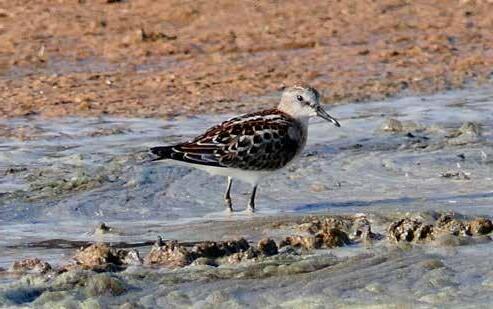
5th, on the Alde Estuary a Norwegian-ringed specimen was present from the 13th to the 15th with a juvenile at the site from the 28th to 31st. Two were at Ramsholt Lodge Marsh on the 24th. A juvenile limosa Blacktailed Godwit was seen at Benacre on the 24th. Wood Sandpipers were recorded throughout the month along coastal sites, often in pairs.
Little Gulls were seen aplenty throughout the month, most frequently off Thorpeness, with a peak of 45 on the 18th. Yellowlegged Gulls were noted at Blythburgh (37 on the 23rd and good numbers thereafter) and also at Ipswich, Minsmere and Southwold. Caspian Gulls were seen at Southwold; two juveniles on the 12th and three on the 25th. A juvenile at Walberswick on the 21st, two at Blythburgh on the 23rd, a juvenile at Cliff Quay, Ipswich on the 25th and 26th and one at North Beach, Gunton
on the 28th. A Roseate Tern was at Trimley Marsh on the 9th and one south offshore at Ness Point on the 15th. An Arctic Tern was on Minsmere scrape on the 17th, seven on the Alde Estuary on the 25th, 14 at Southwold the same day plus two juveniles from there on the 30th, seven north off Slaughden on the 29th with a further two the next day plus two juveniles at Covehithe also on the 30th. Black Terns showed at Sizewell on the 15th, off Thorpeness the next day, two off Ness Point on the 19th, one viewed from Hollesley Marsh on the river mouth on the 21st and one north off Southwold on the 31st. A Pomarine Skua was seen off Ness Point on the 14th and one south off Felixstowe the following day. Three Arctic Skuas were seen off Southwold on the 25th. Two Long-tailed Skuas were off Thorpeness on the 16th, a juvenile was on ‘Lucky Pool’ at Minsmere before flying off
and one north of Corton, both on the 27th, one off both Felixstowe and Slaughden on the 29th. Off Southwold there were two on the 27th, three on the 29th and six on the 30th, with a juvenile off Covehithe and two off Corton the same day. Around 70 Fulmar were seen around Southwold on the 29th. Sooty Shearwater were noted on the 25th with one at Slaughden two off LBO, Southwold three on 27th and one on 29th, Corton one north on 27th and seven on 30th with one nearby off Ness Point the same day. Several Manx Shearwaters were seen at Corton, Ness Point, Southwold, Thorpeness and Slaughden towards the tailend of the month with a peak on the 26th when 10 passed Corton and Ness Point with an additional three later in the afternoon at the former site.
A single Stork species was seen over Pipps Ford on the 9th. A single Shag was noted on groynes near the pier at Southwold on the 28th. Spoonbill were recorded throughout the month at the Ramsholt Lodge Marsh (up to 12, including a Dutch-ringed individual),
Carlton Marsh (up to 5), the Blyth Estuary, the Alde Estuary (up to 12), Dunwich, Aldringham and Covehithe. There were plentiful sightings of Egrets: the once rare Cattle Egret was frequently encountered; at Boyton (up to 4), Felixstowe (3 over the town), 2 at Trimley Marsh for a number of days while on the 7th at least 12 were in the county – 7+ seen north over Mutford and five over Alton Water. Great Egrets were recorded at Trimley, Lakenheath (up to 4), Boyton, the Alde Estuary, Walberswick, Snape and Dunwich throughout the month. Single Red Kites were observed over Kettlebaston (3rd), Deben Estuary (7th), Stowmarket (8th), Hadleigh (9th) and Snape (29th). Several single Ospreys were seen throughout August over Lakenheath, Carlton Marsh, Beccles, the Alde, Blyth and Stour Estuaries and Southwold. Short-eared Owls were observed in at Landguard Point on the 23rd, Aldeburgh Town Marsh on the 24th, one in off at Sizewell, one north over Easton Bavents and one in off at Southwold, all on the 28th. A Wryneck was on the beach by
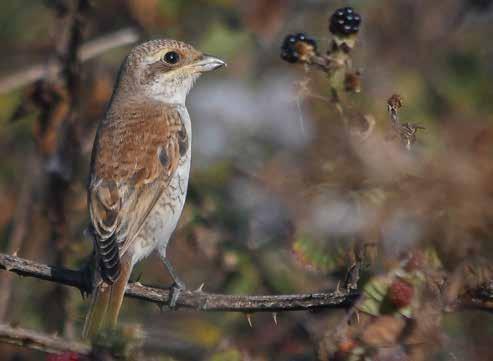
the old caravan park at Thorpeness between the 17th and 20th. A juvenile Red-backed Shrike was seen at Southwold by the water tower between the 15th and 20th, one reported at Minsmere between the 19th and 23rd and an elusive bird at Gunton Warren from the 24th to the 29th. Ravens appeared at both Kettlebaston and Kirton Creek on the 3rd with later showings at Melton on the 8th, Pipps Ford on the 10th and one flew over Havergate Island then landed on Orfordness on the 24th. A Wood Warbler was trapped at LBO on the 2nd with further birds seen on the Alde Estuary on the 15th, one at both Gunton old rail track and Malsters Score, Lowestoft the following day and one reported at Minsmere on the 28th. If there was to be an award for ‘Bird of the Month’, that accolade would go to the Pied Flycatcher, seen throughout the county during the month: peaking with 152 Suffolk sightings on the 15th (down to 36 by the following day). Black Redstarts again featured regularly at Landguard through the month - sometimes a pair. Common Redstart were reported from the 16th with birds at Southwold and Shingle Street the next day. Whinchats also appeared regularly, usually in small groups, around
Shingle Street, Southwold, Felixstowe, Hollesley, Sizewell, Dunwich and the Alde Estuary, where a ‘high’ of 11 were recorded on the 28th. An amazing sight, rarely seen these days were round 50 Yellow Wagtails seen on the Alde Estuary on the 28th.
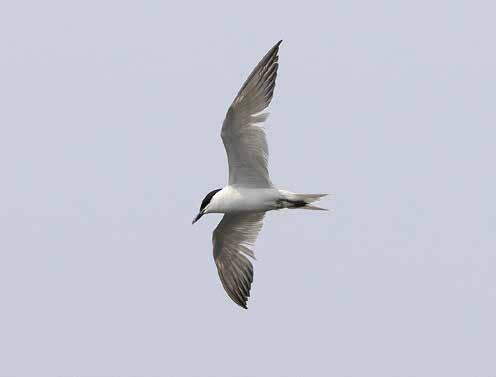
4th – the Gull-billed Tern returned to Alton Water after being seen briefly the previous month and stayed until the 16th allowing many to see the species. The bird was also seen over the River Orwell at Trimley on the 13th.
7th – an adult Pacific Golden Plover was on the Blyth Estuary viewable from Hen Reedbeds.
8th – a Honey Buzzard was seen south over Reydon then not longer after over Walberswick. One west over Barham towards Great Blakenham on the 13th. One south-west over Benacre Broad on the 20th.
A dark-phased bird heading south offshore at Aldeburgh on the 24th. A dark-phased bird flew south over north-west Ipswich on the 24th and one near the Orwell Bridge on the 27th.
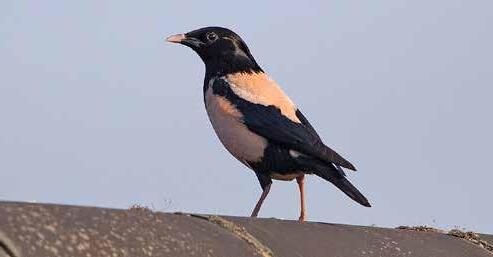
9th – an adult Rose-coloured Starling at Knodishall and again the next day.
14th – a Balearic Shearwater was close inshore at Minsmere. The following day one north off Corton with two north off Southwold. Another was off Thorpeness on the 16th while on the 19th two south off Ness Point that were later seen off Southwold making it a good year for this species in the county.
16th – a Greenish Warbler along the disused rail track at Gunton. 17th – an Ortolan Bunting at Landguard. 25th – there were two probable Cory’s Shearwaters seen off Slaughden.
28th – a juvenile Spotted Crake was found at Botany Marsh and remained until the 31st.
30th – a moulting adult Sabine’s Gull north off Southwold and a juvenile off Ness Point.
A flock of 35 Pink-footed Geese south off Southwold were the first of the autumn followed by up to 16 in Aldeburgh and four at Boyton Marsh – all at the month’s close. A Ruddy Shelduck was seen to come in off at Landguard on the 3rd and was relocated later that day on the Stour at Mistley. Garganey were noted at Trimley Marsh on the 4th and 15th, Botany Marsh on the 5th and Minsmere in the last week of the month. A Greater Scaup flew north off Southwold on the 26th. A drake Velvet Scoter north off Minsmere on the 27th. A Turtle Dove was noted at Stradbroke on the 28th. A Common Crane was seen over Lowestoft on the 16th followed by two over
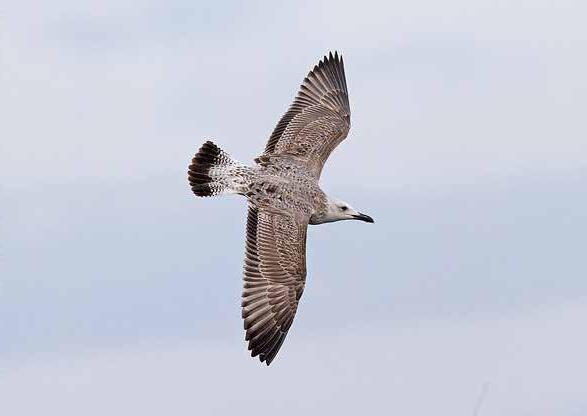
Oulton Marsh the same morning. There were two north over Trimley Marsh on the 28th and sightings the following day with two north over Minsmere early morning and two over Carlton Marsh that appeared to land on Peto’s Marsh. A Black-necked Grebe was at Trimley Marshes on the 2nd. A Little Ringed Plover was seen at Botany Bay on the 5th with birds at both the Alde Estuary and Trimley the next day. Sandpipers featured prominently along the coast: firstly, a Pectoral Sandpiper on the Alde Estuary on the 6th, but easily the most numerous and frequently sighted were Curlew Sandpipers; throughout the month adults and juveniles were often in small groups, with 14 at Havergate on the 11th being the recorded peak. Both Purple and Wood Sandpipers were also frequently seen, the latter at Botany Bay, Trimley and Ramsholt Lodge Marshes at the start of the month. Another regular at coastal sites was the Little Stint, usually in ones and twos but in threes and fours at Minsmere. A Jack Snipe was recorded at Aldeburgh on the 19th and at Kessingland on the 28th. The highest count of Little Gulls were 18 off Sizewell on the 27th. Caspian Gulls were seen at several coastal sites throughout the month. Arctic Terns were noted off LBO, Havergate, Slaughden, Southwold, Sizewell and Minsmere. There were two Black Terns at Alton Water between the 14th and 16th and two at Lakenheath on the 30th. All of the Skuas were recorded; a Pomarine Skua at Southwold on the 17th with three offshore there on the 28th plus there were three at Thorpeness on the 26th. Arctic Skuas were seen at Slaughden (two on the 17th), Southwold (two on the 17th, four on the 18th and 25th, three on the 26th), Minsmere (two on the 18th), Thorpeness (two on the 19th), Gunton (four on the 26th) and one at Landguard (27th). Long-tailed Skuas were seen at Thorpeness (17th and 29th), Covehithe
(17th), Minsmere (18th) and a great record of one inland that flew south-west over Nayland (24th). Great Skuas were seen at Slaughden (17th), three off Ness Point (17th) and Southwold (six on the 18th and three on the 26th). Two Puffins were seen off Gunton cliffs on the 26th. A Great Northern Diver was seen flying north at Sizewell on the 26th. A Leach’s Petrel flew north past Minsmere on the 18th. Shearwaters were present again this month with Sooty Shearwaters seen between the 16th and 20th, with records from Covehithe, Minsmere (up to 2), Slaughden (up to 3), Southwold (up to 4) and Ness Point (up to 4). Manx Shearwaters were also noted during the same period, all singles from the same sites and additionally at Felixstowe and Thorpeness with one later, south close inshore, at Aldeburgh on the 26th. A solitary Shag was seen at Shingle Street on the 1st, another on the River Deben near Kyson Point on the 13th and then two on the sea near Gorleston pier on the 16th. A Glossy Ibis was seen flying south over Southwold and one on Peto’s Marsh, both on the 19th. Spoonbill were seen in good numbers through the month on the Alde Estuary, rising to 44 on the 11th and then 46 at Havergate the next day plus two flew south past LBO on the 13th. In contrast to last month there was just a single Cattle Egret record, one at Reydon on the 26th. Great Egrets were present at a number of sites around the county, particularly along the coast with four being the highest count at Minsmere.
An absence of Red Kites this time – but Osprey were seen throughout the month on the Suffolk estuaries of the Blyth and Deben and particularly the Alde with three on the 13th plus one inland at Badingham on the 4th. Several sightings of Shorteared Owl through the month all along the Suffolk coastal strip. A nice spread of Merlin sightings; one showed on the Alde Estuary
on the 1st, one by Beach Farm, Benacre on the 10th, one in off at East Lane on both the 11th and 20th, another came in off and headed north at Thorpeness on the 28th and one at Hollesley Marsh the following day. Ring-necked Parakeets were sighted again; two south over Lowestoft North Denes on the 23rd and likely the same two birds over Gunton Cliff on the 28th. A Redbacked Shrike was at East Lane between the 6th and 9th. Ravens were seen around Southwold, Minsmere (2), Stowmarket, Burgh (2), Benacre, Kettlebaston and Kersey Tye. Yellow-browed Warblers were seen in ones and twos from the 18th at Hollesley, Aldeburgh, Gunton, Lowestoft, Kessingland, Felixstowe and Orford. A solitary Wood Warbler showed at Havergate Island on the 7th. Ring Ouzel appeared from the 17th onwards at Gunton, Kessingland, Southwold, Thorpeness and Felixstowe. Pied Flycatchers were seen regularly along the
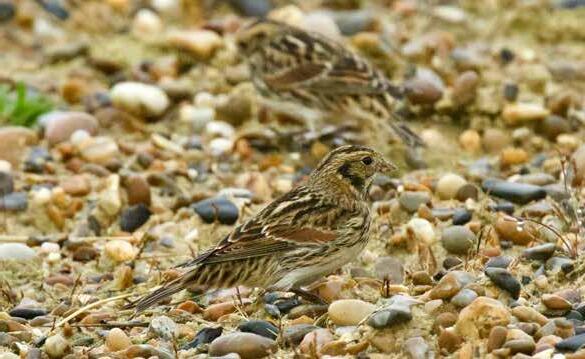
coast. Common Redstarts, however, were seen throughout the month along the coast, the highlight being five around Aldeburgh and Gunton on the 17th. Whinchats were seen regularly in good numbers, especially early in the month, the highest tally being 17 on the Alde Estuary on the 4th. At Thorpeness old caravan park, two Tree Sparrows were seen briefly before flying south on the 10th. A solitary Hawfinch was noted in Kessingland sewage works on the 28th. Snow Buntings were sighted in Dunwich (20th), Kessingland (27th-30th) and two at Shingle Street (30th). Lapland Buntings were found at Bawdsey (8th), over Hen Reedbeds (19th), Kessingland (two on the beach on the 21st, then seven on the 27th and 28th), over Landguard Common (26th), Hollesley (two on the 27th), near Easton Broad (28th) and Shingle Street (29th).
1st – the juvenile Spotted Crake from the previous month still at Botany Bay RSPB plus one at Minsmere on the 21st.
8th – a Balearic Shearwater close north off East Lane with three also north off Southwold and two off Ness Point on the 17th.
8th – a Barred Warbler in bramble on the North Denes with further birds at both Boyton on the 11th and Minsmere, south of the sluice, on the 21st.
10th – a Honey Buzzard south over Hollesley village.
16th – a Hoopoe on the outskirts of Saxmundham.
17th – a Cory’s Shearwater off Ness Point.
18th – a Marsh Warbler was trapped and ringed at Trimley Marshes.
19th – a Great Shearwater was seen flying north off Southwold and later seen off Hamilton Road, Lowestoft.
20th – an adult Sabine’s Gull was off Thorpeness with probably the same bird seen later in the day off Gunton. A juvenile was on the shore pools at Kessingland on the 27th.
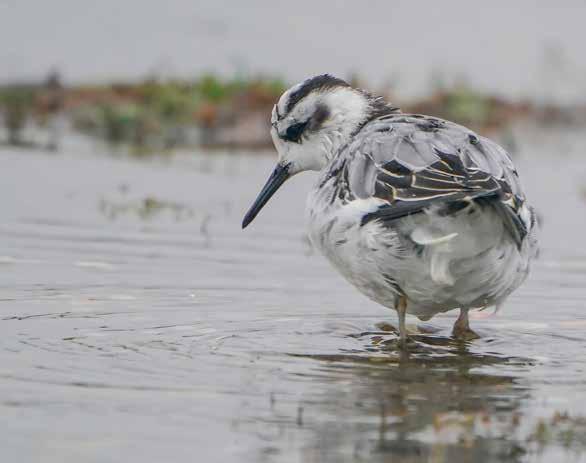
27th – a probable Grey Phalarope was seen off Felixstowe Ferry, with a confiding firstwinter bird on Benacre Pits which was also present the next day.
28th – a Black-browed Albatross was initially noted heading south off Lowestoft and was then tracked down the coast at Southwold, Sizewell and Thorpeness.
A single Tundra Bean Goose was seen at Trimley Marsh on the 18th and likely the same bird at Loompit Lake on the 26th. Eurasian White-fronted Geese were recorded at Bawdsey with 12 north over the manor on the 15th, six on Ramsholt Lodge Marsh on the 18th and 15 at Aldeburgh Town Marsh on the 18th and up to 14 again there on the 30th and 31st. There were 54 Pink-footed Geese west north-west over James Paget Hospital, Gorleston on the 12th with two near Kirton Creek the same day. On Aldeburgh Town Marsh six on the 18th and a single bird at Trimley Marsh on the 21st. A Garganey was at Lackford Lakes on both the 11th and 27th. A Greater Scaup was noted at Carlton Marshes from the 24th and 27th. A Long-tailed Duck was on the East Scrape, Minsmere on the 28th. There were four female Goosanders on the river, seen from Hollesley Marsh, on the 25th. A surprisingly late juvenile Cuckoo was seen at Minsmere on the 6th and another at Walton on the 8th. A Curlew Sandpiper was on the Alde Estuary on the 23rd and
a moulting adult at Carlton Marsh from the 25th to the 27th. Purple Sandpipers were observed along the coast throughout the month, usually in pairs or threes but peaking on seven at Ness Point at the end of the month. A juvenile Little Stint was seen on the Alde Estuary on the 2nd. Jack Snipe were noted in Kessingland, Minsmere, Felixstowe and Southwold early in the month. Caspian Gulls were seen throughout the month, with a high of 11 at Minsmere on the 27th. Two Black Terns were recorded at Lakenheath RSPB on the 1st and a single juvenile at Great Livermere from the 11th to the 13th and one flew north offshore at Southwold on the latter date. Pomarine Skuas seen at Sizewell (2nd), Thorpeness (6th) and Minsmere (14th) – along with Arctic and Long-tailed Skuas also noted offshore on that date.
Two Little Auks off Southwold on the 15th and one at Minsmere the following day. At Slaughden two Great Northern Divers on the 2nd. A confiding Red-throated Diver was seen daily in Ipswich wet dock from the 26th onwards. A Leach’s Petrel
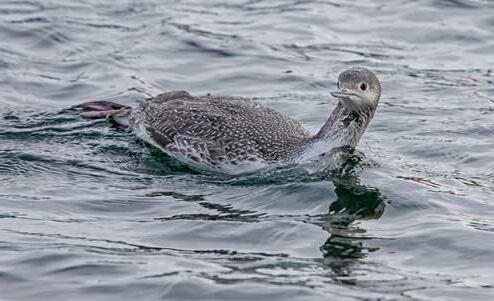
noted at Southwold on the 2nd. A Sooty Shearwater south off Bawdsey on the 2nd, one north off Dunwich (12th) and at Minsmere and Southwold (both 14th). A solitary juvenile Shag was in Ipswich wet dock on the 31st. Spoonbill showed around Blythburgh (5th-8th and 20th), Walberswick (18th) and North Warren (31st). Great Egrets were again present throughout the month along the coast, usually in ones and twos, but with five at Peto’s Marsh on the 17th. Hen Harriers were seen at Benacre (9th), Southwold (10th), the Blyth Estuary (13th) and Sutton and Felixstowe Ferry (both 22nd). Osprey were again on the Deben Estuary (2nd and 6th), Minsmere and Thorpeness (both 5th), Blyth Estuary (6th/7th), Alton Water (7th/8th) and Burgh Castle (12th). Short-eared Owls were also in evidence throughout the month at a number of sites, usually in ones and twos but with three at Carlton Marshes on the 10th and 11th; on the 14th there were four at Minsmere and finally four at Carlton Marsh on the 18th. A Wryneck noted on Lowestoft North Denes on the 3rd and 4th. A Merlin flew north-east over Glemsford on the 7th. There was a fantastic late record of 22 Hobbies at Minsmere on the 10th! Ipswich was again the venue for a pair of Ring-necked Parakeets on the 18th. It was a good month for Great Grey Shrikes; seen along the coast and inland at both Sudbourne and Timworth. Ravens were again along the coast and even inland at Bury St. Edmunds (2 on the 29th) and Hadleigh (31st). Yellow-browed Warblers were frequently sighted in small numbers all along the coast in early October with a final recording of two at Minsmere on the 22nd. A Wood Warbler was a regular sighting at Shingle Street from the 3rd to the 16th. Firecrest were seen throughout the month, usually singly, but with five at Landguard on the 20th. Ring Ouzels were recorded regularly throughout the month. Fieldfare and Redwing began to appear
in excellent numbers; an estimated 12000 Redwing at Trimley Marshes on the 11th and over 4400 at Kirton Creek the following day with approx. 350 Fieldfare at the same time and place. A Spotted Flycatcher was around Southwold between 3rd and 14th. A Pied Flycatcher at Hollesley on the 7th. Black and Common Redstarts were seen throughout the month at coastal sites. There were two Whinchats sighted at Shingle Street on the 10th. Tree Pipits were in evidence; on the Alde Estuary (4 on the 4th), Hollesley (2 on the 4th), Walberswick (2 on the 7th) and Landguard (10th). Water Pipits were present with two north of Corton churchyard on the 17th, one at Hollesley on the 22nd, three at Carlton Marsh from the 24th to 26th and one by the Orwell Bridge on the 29th. Twite showed up in numbers from the 23rd to the end of the month at Dunwich with a maximum of 20+ plus a colour-ringed specimen noted on the 28th and three likewise the following day. A Mealy Redpoll was trapped at LBO on the 7th. Hawfinch were seen around Lowestoft, Thorpeness, Aldeburgh, Landguard and Mildenhall early in the month. Snow Buntings were around Southwold, Walberswick, Shingle Street and Felixstowe Ferry at the tail end of the month whereas Lapland Buntings were sighted early doors in Corton, Benacre, Walberswick, Aldringham and Landguard.
2nd – a Sabine’s Gull north offshore at Slaughden, with one also north off Southwold and one briefly on Minsmere East Scrape before flying out to sea.
3rd – a Great Snipe came in off the sea at LBO and headed inland.
3rd – a Richard’s Pipit at Landguard.
3rd – a Red-breasted Flycatcher at Landguard, with one there the next day and two on the 5th. Further single birds at both Hollesley and Lowestoft North Denes on the 5th.
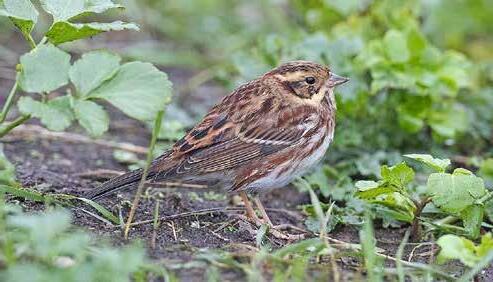
3rd – a very confiding Rustic Bunting by Links Road car park, Lowestoft allowed many birders to enjoy this bird and was present again the next morning briefly.
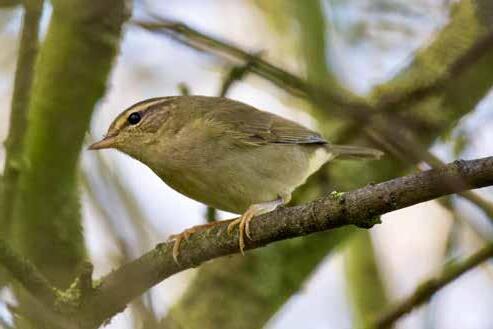
3rd – a good selection of Radde’s Warbler in the county. Initially one at Gunton rail track with a long-staying bird at Southwold from the 4th to the 11th, one at Minsmere on the 5th and 6th and finally one trapped and ringed at LBO on the 13th.
3rd – a Honey Buzzard flew over the observers of the Rustic Bunting at Links Road.
3rd – a Booted Warbler was found late afternoon at Sizewell and present again the next morning.
4th – an adult winter White-winged Black Tern at North Warren before flying south.
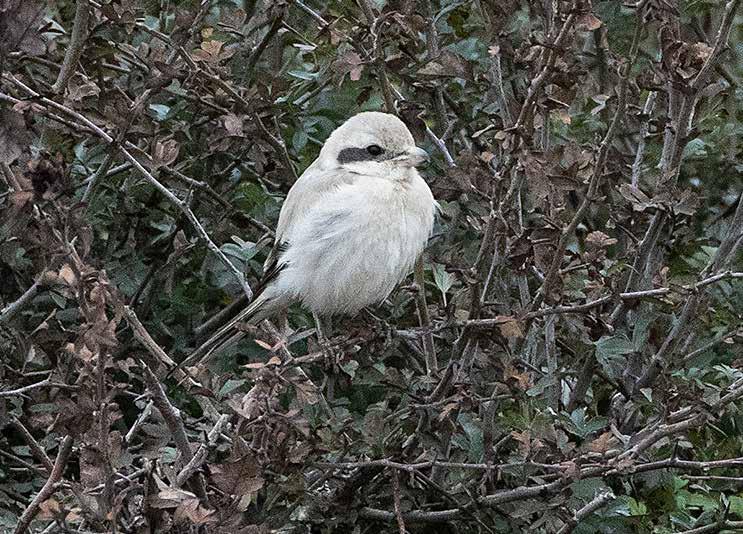
4th – a Steppe Grey Shrike was present at Beach Farm, Benacre until the 7th.
5th – a Pallid Harrier was seen over Hollesley RSPB.
5th – a Red-throated Pipit flew over at Benacre with one on Havergate Island the following day.
5th – a Grey Phalarope flew south offshore at Benacre.
6th – a Baltic Gull was found in fields north of Covehithe Broad.
8th – a Pallid Swift over Walberswick heading towards Southwold.
9th – a Little Bunting was found in a private area by the Alde Estuary with two probable birds south over Landguard on the 29th.
14th – a Pallas’s Warbler at Corton new sewage works. One at East Lane on the 15th, one along Gunton old rail line and one at Corton both on the 16th. The latter was still present the following day with additional birds at both Lowestoft and Hopton. Further birds were seen in the north-east of the county with one at Kirkley on the 22nd and one at Pakefield the next day.
16th – a probable Dusky Warbler at Hollesley RSPB plus one present at Minsmere and again on the 17th.
16th – a Siberian Chiffchaff noted along Lowestoft North Denes.
17th – a Barred Warbler near Dingle Great Hill, Dunwich Marsh.
22nd – a female Parrot Crossbill over Dip Farm golf course, Gunton.
23rd – a probable Upland Sandpiper seen on Woodbridge airfield.
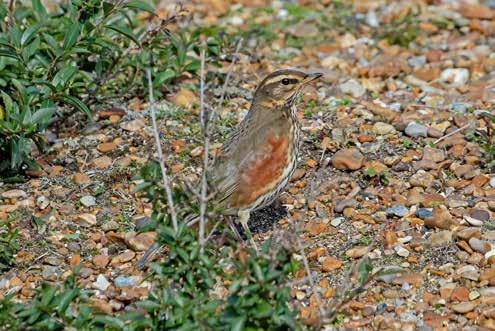
Council for 2021
Officers
Chair: Chris Courtney
Vice Chair: Justin Zantboer
Secretary: Chris Keeling
Treasurer: Anne Wright
Communications Officer: Alex Rafinski
Projects Officer: Chris Keeling
Suffolk Bird Report Editor and SORC Link: Nick Mason
Harrier Editor and Outdoor Events Coordinator: Gi Grieco
Indoor Events Coordinator: Adam Gretton
President
John Grant
Members
Eddie Bathgate
Peter Merchant
Jamie Everett
Roy Marsh
Matthew Deans
Edward Jackson
Adam Faiers
Honorary Vice-Presidents
Robin Hopper
Mike Jeanes
Mike Marsh
Philip Murphy
Reg Snook
Steve Piotrowski
Bird Recorders
North-east Area Recorder: Andrew Green, 17 Cherrywood, HARLESTON, Norfolk IP20 9LP Tel: 07766 900063 Email: bird-ne@sns.org.uk
South-east Area Recorders: Gi Grieco Tel: 07951 482547 and Steve Fryett Tel: 07593 382082 4, The Street, Melton, Woodbridge, IP12 1PW. Email: bird-se@sns.org.uk
West Area Recorder: Colin Jakes, 7 Maltwood Avenue, BURY ST EDMUNDS IP33 3XN Tel: 01284 702215 Email: bird-w@sns.org.uk
c/o SNS, The Museum, High Street, Ipswich, Suffolk IP1 3QH
Founded in 1973 by a group of Suffolk birdwatchers
Associated with the Suffolk Naturalists’ Society
SBG remains an independent birding group and is a registered charity
A voice for Suffolk birdwatchers
With established links to many naturalist and conservation organisations
Media
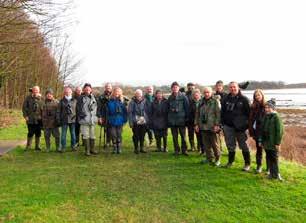
Actively lobbies to protect key Suffolk habitats
Provides a county-wide field force of bird surveyors
Promotes BTO bird surveys and organises special SBG surveys

Strong web presence - www.suffolkbirdgroup.org
Active Twitter feed - @suffolkbirds1
Quarterly magazine - The Harrier
Annual review - Suffolk Birds report
Annually (20+) field trips - ideal for novices or experts and young or old alike
Opportunities to visit hot spots and receive practical ID tips in the field
Programme of talks and presentations - variety of topics (county, national, or international) with quality speakers
Assists with conservation projects to improve breeding success
- Swifts
- Barn Owls
- Peregrines
- Waders
Partners with Suffolk Wildlife Trust and other bird groups
Assists with funding for bird hides and other birding amenities
Contributes to community events, including dawn chorus walks
Provides bursaries for special projects