

Gi Grieco
Gi Grieco
Welcome to this edition of The Harrier. Springtime is a season that lots of us look forward to, a favoured time of year with the returning of summer migrants, the emergence of new life and the wonderful sound of a dawn chorus. With restrictions in place, the ability to enjoy this spectacle was curtailed for many. Despite this, many who have been able to, have enjoyed the birds and wildlife in their garden. In the next Harrier we will have details of some ‘garden lockdown birding’ that occurred.
For this edition, there was a worry that there may be less material; fewer birds encountered, less activity going on - but fortunately I’ve received a nice array of articles. We have an account of our AGM, the last indoor meeting we’ve been able to hold, that includes recognition of worthy recipients. Peter is well known for his wildlife and conservation activities and we’ve been glad to have his knowledge on SBG council in the last couple of years. We’ve been glad to have Tom on some SBG outdoor trips; his sharp eyes have found us some cracking birds. The AGM also saw a new Chair for the group and Chris has given us an account of his birding history and some thoughts. Sadly we recently learnt of the passing of a fond member of the group, Ernie Lucking, and Steve has written a fitting obituary about him.
Save our Suffolk Swifts has been a success in recent years and we have a couple of articles with an update on the project and on surveying Swifts. Fortunately it is a species that arrives later than most and frequents our urban areas which will allow records to be taken. We had an informative talk from Chantal at an SBG indoor
meeting last year so we’re glad to include information and a request for sightings of Little Tern, a species still hanging on in Suffolk.
We do have one garden birding article included, in reference to the RSPB Big Garden Birdwatch earlier in the year, but this comes from Australia and provides an interesting look at some of the species encountered and wherever you may be there are always birds to be seen in a garden. Despite lockdown, an array of birds were still noted and the winter/spring review details these. We did have some field trips earlier in the year and these have been documented. Unfortunately come the next edition none will have taken place. This magazine made it to another country, this time Spain. Adam kicked this series off when he visited China, so if the Harrier accompanies you on any travels we would love to know.
Please keep an eye on our web site for information on when we’ll be able to continue SBG activities.
John Grant
An up-and-coming young naturalist and a well-known and much-loved conservation ‘legend’ of, shall we say, somewhat more advanced years stole the show at Suffolk Bird Group’s Annual General Meeting in February.
SBG council member Alex Rafinski’s 13-yearold son Tom was the proud winner of The Garrod Award and ‘Peregrine Pete’ Peter Merchant took the Denis Ockelton Trophy. Both were hugely popular and deserving recipients as members attending at the Best Western (Ipswich Hotel) Copdock, responded to the presentations with thunderous applause.
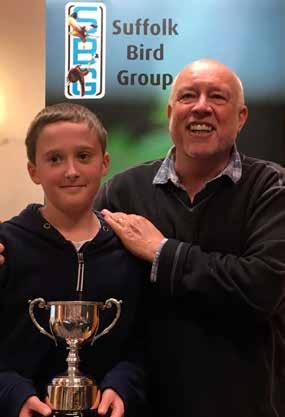
Introducing the awards, group President John Grant referred to The Garrod Award as perhaps the most important part of the evening’s agenda - because it honours the group’s young birder who has shown the greatest level of dedication to ornithology. Youngsters of today will be the guardians of wildlife in the future, he said - and he hoped the next generation would make a better job of looking after nature than the current generation has!
Young Tom looks well on the way to being a compassionate guardian of the future environment and the SBG council had no doubt that his was the strongest nomination for the award, given annually by our dear friend and supporter Jean Garrod in memory of her late husband Ken. Mentored by Alex, Tom has been birding since the tender age of four. Early signs of his talent came at Cley’s Pinkfoot Art Gallery when he impressed all around him by identifying all the species depicted in the exhibited works.
Already notching up a life list of more than 1,000 species in the UK and abroad, perhaps more importantly Tom has gained invaluable experience by helping his father in conducting WeBS counts. Mum and Dad can be proud of young Tom - and so too can the group as a whole. We hope Tom continues to fulfil such outstanding promise and goes on to enjoy a life enriched by the wonders of nature.
‘Peregrine Pete’ has certainly led a life that has been enriched by nature - and his unstinting conservation work has certainly enriched all our lives too. Mr Merchant hardly needs any introduction - already the proud recipient of the RSPB’s very prestigious President’s Award for his services to ornithology, the SBG council wanted to register the group’s own gratitude for Peter’s
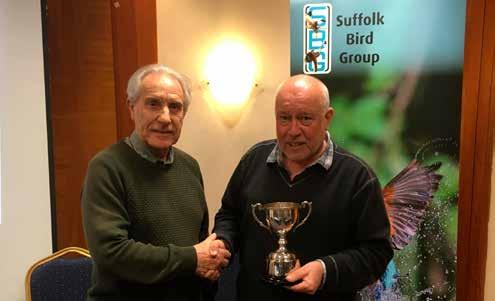
outstanding work. His hide and visitor centre design and construction skills have been put to brilliant use at Trimley Marshes and Havergate Island, but the Ockelton Trophy particularly marks his outstanding work to provide Peregrines with nesting sites in such locations as Ipswich Docks, the Port of Felixstowe and on the BT site at Martlesham Heath. Thanks in no small measure to Peter, thrilling sightings of Peregrines in those areas can now be expected, rather than simply hoped for.
Members of a certain vintage may well remember the kindly, good-natured and ever-enthusiastic founder member of SOG in the west of the county, Ken Carlisle. A great supporter of the group, Ken was once presented with a fine SOG decanter to honour his services. Sadly, Ken died in 1998 and last year the decanter was returned to the group by his family. The AGM heard that the council unanimously decided to award it to Jean Garrod in thanks for her remarkable support for the group over many years. Although Jean was unable to attend the meeting, she would have been there in spirit - and steps were to be taken to ensure she received the decanter as soon as possible.
The ‘nitty-gritty’ of the business of the AGM, such as acceptance of our new constitution and the election of officers, can be seen in the minutes. However, no ‘write-up’ of the evening’s events would be complete without reference to Edward Jackson’s decision to stand down as group chairman. Entirely understandable as it is, with Edward being increasingly involved in a plethora of ‘green’ and conservation-based activities, it is nevertheless a matter of regret for the group. Edward has served us in a truly outstanding manner during his time as chairman - the amount of behind-the-scenes work that he has undertaken with such efficiency and good humour is truly remarkable. He deserves our undying gratitude. Thankfully, Edward will remain as a council member and so the group will continue to benefit from his wise counsel.
Edward’s successor is Chris Courtney. Well known and widely respected as a passionate conservationist, Chris is a very popular figure on the Suffolk birding scene and brings vast experience to the chairmanship role, having already chaired the RSPB’s Ipswich local group for example. Chris deserves our deepest gratitude for stepping up to the plate and we wish him every success.
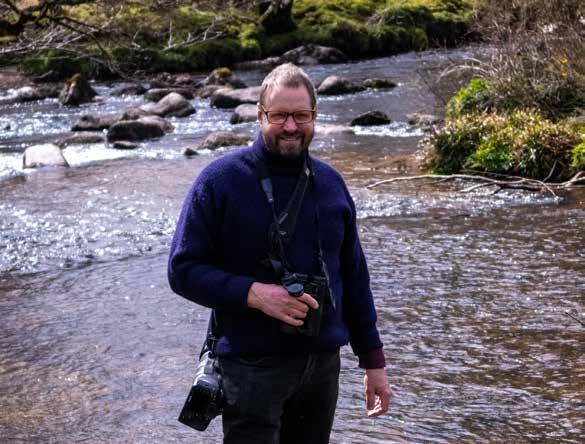
Chris Courtney
I have of course met many of you over the years, at an assortment of our numerous and diverse events since my first joining SBG, (SOG) back in 2003; shortly after my move from London to Ipswich. For those who haven’t and for those who might just be a little curious, here are a few words about who I am!
Despite originally hailing from the big smoke, Suffolk has long held a very special place in my heart. I think my first visit was back in May 1970 when I was dispatched by my Dad at Kings Cross railway station along
with a pack up of sandwiches and my pride and joy Frank Nipole, Charles Frank 8 x 30s onto a Young Ornithologists Club (YOC) coach headed for, where else, but Minsmere. Following what I recall was a rather warm welcome from warden Bert Axell outside his hut, we were conducted around the reserve to discover a glorious array (especially to an impressionable 10 year old) of fabulous beasts: Marsh Harriers, Bearded Tits, booming Bitterns and even actually seeing as well as hearing a mysterious Grasshopper Warbler reeling near the sluice bushes.
Several other YOC holidays (based at Blaxhall Youth Hostel) followed during the 1970s and continued in other forms with family and friends across the ensuing decades; sometimes encompassing culture at Aldeburgh and Snape but always including a birding and natural history element.
Consequently, I felt extraordinarily blessed upon moving to Ipswich with my family in the early 2000s to have gained so much prime birding habitat right on my doorstep. I can’t quite remember how or where I first heard of SBG, but I soon joined and discovered just what a terrific and friendly group it is; enabling me to swiftly get to know lots of other Suffolk birders and through them to discover so much more about my newly adopted county and its plethora of wonderful wildlife locations.
I now fully appreciate that this sense of camaraderie and welcoming approach is very much at the heart of the SBG ethos, a tradition I am very keen to nurture and continue, especially at this time of writing during the pandemic when contact with the natural world has provided so much solace to so many, even for those usually too busy to stop and be aware.
Ten years spent as Group Leader of the RSPB Ipswich Local Group (2007 -2017), was very rewarding, during which time I was involved in a wide variety of public engagement and conservation activities, including schools projects, fundraising, and conservation activities, including the 2016 Ipswich House Sparrow Survey and the Ipswich Swift Streets project. Perhaps I am most proud of our participation in the Save Kiln Meadow Campaign, which culminated in 2011, in protecting some 11 acres in Pinewood from a proposed development of over 100 houses. Home at that time to one of the country’s largest Toad populations as well as European protected Hazel Dormice it also hosts Grass Snakes, Slow Worms and breeding Common
and Lesser Whitethroats, Garden Warblers, as well as the odd pair of Nightingales and back then Willow Warblers. It was designated a Local Nature Reserve by Ipswich Borough Council in 2012.
More recently I joined SBG Council initially as an ordinary member and last year as Vice Chair before taking over from Edward Jackson at this year’s AGM.
I must of course pay tribute to the truly leviathan contributions made by Edward during his term of office during which time he has comprehensively reviewed and modernised virtually all of the administrative aspects of the Group. Including overseeing and designing new and modernised polices, such as our Constitution, Health and Safety, standardised Risk Assessments, GDPR, First Aid, Insurance and Public Liability as well as, with Ed Keeble, a redefinition of our post SWT relationship with the Suffolk Community Barn Owl Project. All of this while continuing with his lead role driving the Save Our Suffolk Swifts project in collaboration with SWT. Many of these activities remain below the radar to the majority of our members, but never the less ensure, behind the scenes the essential smooth, professional and responsible running of the group.
Needless to say on behalf of everyone, I am immensely grateful to Edward and for making my job and those of all the other Council Officers so much easier going forward. Thank You Edward!
Meanwhile, of course we have been obliged to suspend all our normal programme of activities while your Council has continued our scheduled meetings via video-conferencing courtesy of our IT guru Alex Rafinski. (Thank you Alex). Along with the more usual course of business this has enabled some fascinating comparisons of interior decor along with some healthy rivalry between impressive
collections of weighty tomes displayed on monolithic book cases and assorted objet d’art reflecting the suitably esoteric and intellectual interests of your Council members, while others maintain the shrouded mystery of their inner sanctums in a gloom revealing only the reflection of the participant’s spectacles.
We will of course continue to monitor the situation closely, so please keep an eye on the website, for any news on the resumption of outdoor and indoor meetings.
Few of us, select epidemiologists apart, predicted the Covid pandemic and none of us has previously experienced the likes of the lockdown in any of our lifetimes. As already touched upon, having or forging a connection with the natural world has been a much needed salvation and source for the retention of sanity for many of us during this recent period. For birders it has been utterly extraordinary, as to the truly fabulous additions to garden lists that have been recorded - White-tailed Eagle, Goshawk, Black Kite, Montagu’s Harrier, Rosy Starling and Glossy Ibis to name a few. None of them in my garden!
But to paraphrase our old friend Mark Cocker, it has also been about celebrating the ordinary, and due to an enforced slowing down of movement forging a renewed rootedness and deepened connection with place; be not your own back garden, park or other local patch.
Personally, having recently moved to Felixstowe, I have reveled in watching the unfolding of the seasons around the golf course, ferry and Kingsfleet. Slowly watching the buildup and passage of migrating Whimbrel enjoying the relative quiet of the unplayed but still irrigated greens and fairways during the lockdown was certainly one of the gentle highlights of my spring, along with the unexpected Short-eared Owl
that graced the golf course for a few days in early May.
However, the pandemic also provides a warning to us in other ways as it is entirely symptomatic of our broken relationship with and outright abuse of the natural world. This is the view of a 2020 report by the Intergovernmental Science-Policy Platform on Biodiversity and Ecosystem Services (IPBES), a group of scientists, (backed by the United Nations and endorsed by the Natural History Museum), who study the interaction between humans and the natural world. They are not alone among those who consider that ‘rampant deforestation, uncontrolled expansion of agriculture, intensive farming, mining and infrastructure development, as well as the exploitation of wild species have created a “perfect storm” for the spillover of diseases from wildlife to people.’ All this against a backdrop wherein the deterioration of the health of ecosystems, on which we all depend, is actually accelerating ever more rapidly because of how humans exploit and pollute nature. This led the leading the authors to conclude that ‘future pandemics are likely to happen more frequently, spread more rapidly, have greater economic impact and kill more people if we are not extremely careful about the possible impacts of the choices we make today.’
Clearly, this is a big topic for SBG to tackle, but as a group of conservation minded people and along the lines of think globally, act locally; I think we must as effectively as we can, use our voice to initiate and support all measures that work to support the revival of the natural world and the strengthening of environmental regulations. Particularly as we come out of the lockdown and reopen the economy and move to exit the EU. This for the benefit of both our wildlife and our own human wellbeing.
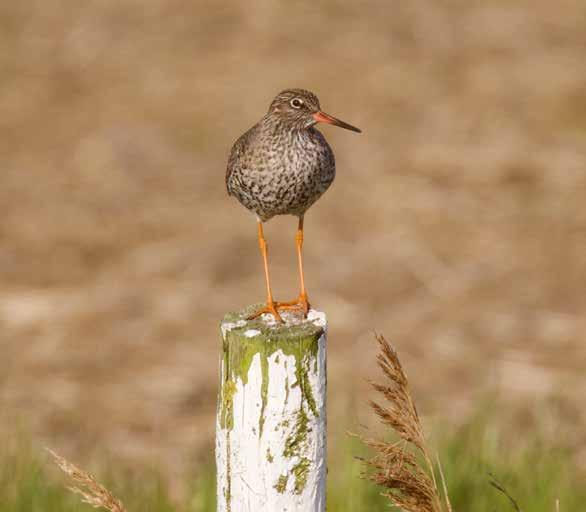
In the last Harrier we covered two ongoing surveys for membership participation; the Rookery Survey and the Breeding Waders of Wet Meadows, a project organised between the RSPB and BTO. At the point of going to print there were restrictions but full lockdown had not commenced. By the time of publication and being posted out to members, full restrictions were in place with no chance to undertake any surveying. This impacted most of the breeding season and only in May, when restrictions were loosened to allow exercise, could any surveying recommence. As a consequence, the Rookery survey will continue next year. I note that a number of rookeries have been recorded prior to lockdown, so thanks to all who have submitted details and these will be added to the data.
Details on BTO surveying guidelines can be found herehttps://www.bto.org/community/news/202006-bto-and-covid-19.
Please follow all restrictions and stay safe.
Steve Piotrowski
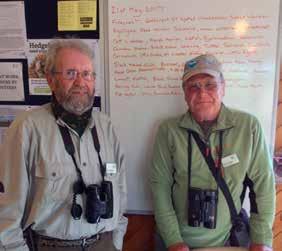
Suffolk’s birding community is still reeling following the sudden loss of our great friend Ernie Lucking. I knew Ernie since the early 1990s when we used to meet each morning whilst the team were ringing birds at Fagbury Cliff at Trimley. Ernie walked his little dog, Monty, daily and as he passed our ringing table would stop to have a friendly chat and to see what birds had been trapped that day.
In more recent years, it was always a joy to meet Ernie at Landguard. Several birders gather at the Obs each morning to log the birds that frequent the point and those seen flying offshore. As we gaze into the rising sun, it’s always tough work and anything remotely unusual is shouted out. “Fulmar soouff” in Ernie’s soft London accent always raised a chuckle! However, Ernie’s “Directionlexia” was rarely spot-on and he often muddled noorf and soouff. Fellow watchers would be thrown by Ernie enquiring about the identity of a bird flying soouff past the green buoy! “Do you mean the one flying north” you would hear someone say. Ernie was never fazed and with a wry smile accompanied by a giggle, he would reply “Oh yeah, that’s wot I meant”. Ernie was nearly always accompanied by his long-suffering birding companion, Dave Langlois. Ernie, with his impish sense of humour, would never miss a chance to goad Dave, whose hearing is somewhat restricted, especially when the pair was seeking out species such as Grasshopper Warbler. This would always bring out the mischievous side of Ernie and he would ask Dave “Can’t you hear it Dave?” bringing the response “You know I bloody well can’t” again evoking that giggling smile which we all knew and loved. During our walks around the reserve, Ernie would
always carry a huge fertiliser bag, to collect litter as we went, and he was party to many rare bird finds.
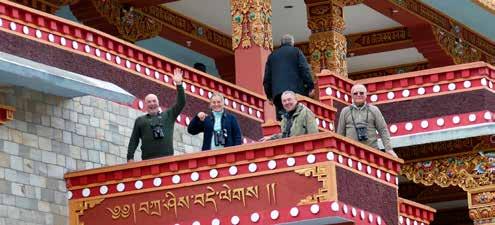
It was a real privilege to accompany him on three amazing tours - to Georgia/Armenia, Kazakhstan and, last year, to north-east India. Ernie had a kind word for everyone and these trips were not without humorous incidents. Tour members will never forget going through customs on the Armenian/ Georgian border. On the Armenian side our passports were checked, but on the Georgian side we had to get out of the minibus and then carry our luggage through the customs office where it was checked for contraband. But where was Ernie? He was not to be seen. Had he popped into the loo – no one knew! We waited but Ernie failed to appear, so the only option was for his travel companions to carry his luggage through and pretend that it belonged to one of us and hope to find Ernie later. As we re-boarded the bus ready for the off, Ernie appeared. He had decided, entirely innocently no doubt, to have a wander through no-man’s-land to admire the view - a wander that was of course unauthorised and very much frowned upon by the grimfaced border guards!
Another incident that will live long in our memories happened during our 2019 tour of
north-east India. It was a tough, full-on tour as we walked many miles each day along mountain passes and jungle trails. Ernie was having ankle trouble but hobbled his way round without complaint. We birdwatched the Sela Pass (a high-altitude mountain pass at an elevation of 4,200m) on one of our days and, like me, Ernie suffered altitude sickness, so both of us remained in the minibus without a care about what the others were seeing!
There were lots of key species that we all wanted to see but a real prize was the stunning pheasant-like Blyth’s Tragopan. It is undoubtedly one of the world’s most beautiful birds, showing vivid colours of crimsons with pale greyish spots, a yellow face and throat and a pale grey lower breast and belly. For days we searched in vain along jungle trails, but this elusive bird remained hidden in dense undergrowth –somewhere!
After a third day of searching, our tour guide heard its distant far-carrying call. It was some way off down a steep and heavilywooded ravine, but we were determined. Our leader began playing a voice lure and after several minutes we were in no doubt that its call was getting louder. The bird was getting closer, slowly making its way up the
slope towards us! We were told to take up position on the opposite side of the road and remain silent. The idea was that we would coax the bird across the road directly in front of us as it was attracted by the tape. Its call got louder and louder and the tension mounted amongst our group. It was now very close but then suddenly it stopped responding. What was happening? Was it still coming?
After a minute of extreme anxiety, we heard Ernie’s quiet voice. “What’s that bird standing in the road behind us?” It was the Tragopan and with that we all swung round in unison. Our sudden movement and burst of excitement was too much for the bird and it immediately flew up the slope and was never seen again. Those who had occupied the front line of our group, but were now at the back, had their views blocked by a mass of human bodies so missed the bird (sorry Will Brame). But thank you Ernie as several of us were blessed with a great, albeit brief, view, and we owe this amazing sighting to you.
Ernie was loved and respected by everyone who knew him and his infectious smile will never be forgotten. He will be missed by birdwatchers throughout Suffolk and elsewhere.
Eddie Bathgate
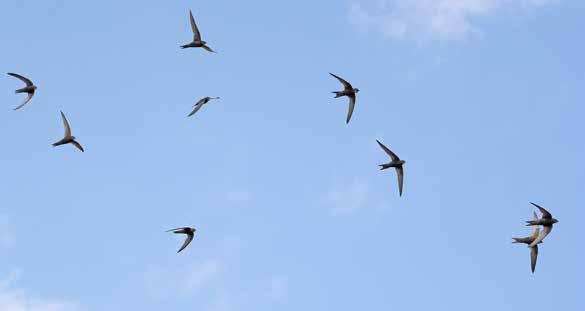
Historically, our Swifts nested in natural nooks and crannies in cliffs and tree holes, as indeed they still do in some northern and eastern areas of their range. Since Roman times, however, they have taken advantage of the built environment to find nest sites in the eaves and beneath the tiles of buildings and in church towers. In Suffolk, as elsewhere in the UK, Swifts have become a communal urban nester.
A summer visitor – with us for just four months – they entertain us with their daring flying antics, low level acrobatics and screaming gyroscopic flights around nest sites. They feed, sleep and can even mate on the wing, landing to fashion a minimal nest cup and breed, with the adults taking turns to brood and feed their young. Research has shown that breeding adults are extremely faithful to their nest sites, returning to them in early May. Juveniles are believed to follow the adult birds back to where they fledged, identifying their own site in year three prior to nesting in year four. It is in year three that available nest sites, coupled with the attraction of Swift calls can be decisive.
The birds are curious and will investigate possible sites, whilst screaming around in tight flocks at low level. Once established, Swifts pair for life, usually producing a single brood of two or three chicks each year and if they survive their first year, can live to almost 20 years. Very few species apart from the Hobby can predate a fit, agile adult on the wing: Swifts are the fastest bird species in level flight, measured at up to 111kph.
Modern building techniques do not favour Swifts. The requirement to achieve an efficient, air-tight built environment with minimal heat loss and sound transmission reduces the nesting opportunities for wildlife. Meanwhile, renovation and conversion of older buildings results in the loss of existing nest sites. Nesting locations are not legally protected outside the breeding season and so can be lost whilst the Swifts are away. The Swift population in SE England halved between 1994 and 2007, with a further third of remaining birds lost between 2009 and 2016. Swifts are in serious trouble and are now ‘Endangered’ as a British breeding bird.
Save Our Suffolk Swifts, a joint campaign between SBG and SWT, was established in 2014 with the aim of reversing this downward trend. Working alongside a nationwide network of Swift support groups (including Dick Newell’s ‘Action for Swifts’ and Edward Mayer’s ‘Swift Conservation’), SOS Swifts organises talks, walks and events throughout the county, encouraging and supporting the establishment of local Swift groups. Support includes surveys of suitable nest sites and recommendation of appropriate call systems, as well as education and advice about Swift protection, to expand existing colonies and create new ones.
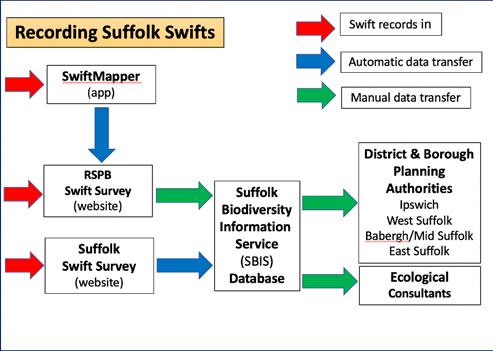
Groups are encouraged to put up Swift nest boxes ahead of the arrival of the birds; to play Swift calls as the birds arrive in May to advertise the sites; and then to log sightings of these distinctive, entertaining ‘screaming parties’ of birds – and their actual nest sites. There are currently two places to log sightings. The Suffolk Swift Survey website, hosted by Suffolk Biodiversity Information Service (suffolkbis.org.uk/swifts) plays a vital role locally because it can influence local planning decisions. Suffolk County Council has classified Swifts as a Suffolk Priority Species in their Biodiversity Action Plan. If a Swift population is already identified in an area set for development, District and Borough Planning Officers are able to set a planning condition to include Swift bricks (specially designed brick inserts for new-build houses that mimic the nooks and crannies favoured by Swifts) in the requirements for the new development and oblige architects and developers to include them in their designs.
The Swift Mapper app, available to download free for smartphones, also logs your records and location and helps provide a nationwide picture. The app has been updated ready for the new Swift season and will automatically transfer any data to a new interactive RSPB Swifts website, which has been redeveloped.
The website was launched in May, SOS Swifts will be given access rights to the data, so that any Suffolk records logged via the app or the new website can be transferred and stored on the Suffolk Swift Survey database as well. So please use the Suffolk Swift Survey if you can, but using the app will also capture your Suffolk records.
Local groups have had remarkable successes. Alan and Christine Collett run ‘Aldeburgh’s Amazing Swifts’ and their group has installed over 100 boxes and gives talks to school children across East Suffolk. Simon Evans has been very active around Bury St Edmunds getting boxes into church towers, with 23 boxes now occupied on St. John’s Church. All Saints Church in Worlington boasted 34 out of 43 boxes occupied in 2018. Andy Rouse has fitted 20 Swift boxes on church towers in Ramsholt, Sutton and Shottisham, whilst David Lowe has arranged for 40 nest boxes to be installed on houses throughout Nayland. Woodbridge Swift Group has put boxes up on the swimming pool and cinema, as well as Farlingaye High School, leading to a school project; Felixstowe has engaged with the library to install nest boxes, a call system and an educational display inside. This is all in addition to the work of numerous individual Swift supporters who put up boxes, play calls and log sightings. SOS Swifts helps local groups build on best practice. Groups in places such as Hasketon, Framlingham, Beccles and Bungay are growing in support and there is still space for more!
If you would like to join or start a local group, please get in touch. If you would like to put Swift boxes on your own property or sponsor boxes in your community, again, please make contact. Finally, if you have contacts within a church, school or public building that might be interested in supporting Swifts, please put us in touch. Email swifts@suffolkbirdgroup. org for more information, we’re here to help
Edward Jackson
When Suffolk Bird Group and Suffolk Wildlife Trust created the SOS Swifts project in 2014, we realised it would be difficult to protect Swift colonies and nesting sites unless their precise locations are known. At that time virtually all Suffolk’s Swifts were nesting in buildings, often the older ones, so it was also vital that these data were made available to consultant ecologists working on plans for developments and also to the Local Authorities that determine subsequent planning applications.
This knowledge could help guard against the inadvertent destruction and loss of existing colonies as a result of larger redevelopments and encourage planners to condition the installation of Swift nest boxes or nest bricks in new developments, especially if an existing colony was nearby. It could also help raise awareness among the wider public that even smallerscale improvements, such as roof repairs or replacing eaves and soffits, could compromise long-standing Swift nest sites.
By 2014, Swift had already been identified as a ‘Suffolk Priority Species’. This means that alongside records of other Priority Species (such as Hazel Dormouse and all the bats), any Swift records submitted to Suffolk Biodiversity Information Service (SBIS) are regularly forwarded to the four Local Planning Authorities, which after the recent mergers are now Ipswich, West Suffolk, Babergh/Mid Suffolk and East Suffolk.
Around that time the RSPB website was running a national Swift Survey, collecting broadly similar information on Swift screaming parties and nest sites. However, these data were only being forwarded to

the National Biodiversity Network database, where they were hardly ever accessed by consultants or planners – and were therefore really of little benefit in efforts to conserve Swift populations. This was one of the main reasons SOS Swifts set up our dedicated Suffolk Swift Survey, hosted on the SBIS website. We could then be sure that Swift records logged there were immediately stored on the main SBIS database, identified as those of a Priority Species and therefore made available to consultants and planners.
Fast forward six years and the ways of recording and capturing Swift data have improved significantly. Over the past 18 months, I’ve been working with Swifts Local Network colleagues from around the UK and with RSPB species protection staff at The Lodge. We’ve had really constructive discussions to review and improve the various recording systems and make them as effective as possible in helping to protect Swifts. The task is even more urgent since Swift is now identified as an ‘Endangered’ British breeding bird.
The other key player in this project is Natural Apptitude, a software and data management company based in Bristol. As a training exercise, staff there had already produced a free smartphone app called SwiftMapper. Designed to make data collection in the field easy, it was broadly based on the existing RSPB survey. After appropriate discussions, RSPB contracted Natural Apptitude for them to work on three areas:

to update the RSPB Swift Survey web page and also link SwiftMapper directly to it
to bring all the main data fields within existing survey systems into line so they are asking the same key questions
and to take over the management of the RSPB Swift database so that its data can be accessed and shared by as many groups and organisations as possible
The revised RSPB Survey with SwiftMapper linked to it went live on the RSPB website in early May (search for ‘RSPB SwiftMapper’).
The app is still a free download for both Apple and Android phones and tablets from their respective app stores. It’s very easy to use and among the many improved features is a mapping tool that creates precision grid references that will be invaluable in locating Swift colonies and nest sites, especially those that are or could be under threat.
It also means that potentially sensitive information such as street addresses don’t need to be entered.
Another innovative feature gives administrator rights to authorised members of Swift groups anywhere in the UK. This allows them go to the RSPB SwiftMapper website, highlight a specific location or larger area – in our case it could be the whole of Suffolk – and download a spreadsheet of data for any selected series of dates. These can then be uploaded as additional local records.
This diagram summarises the three ways that anyone can now use to log their Swift records here in Suffolk, secure in the knowledge that all the data pathways will take them to where in principle they will have most impact.
Information from various UK natural history organisations concerning the ‘Big Garden Birdwatch’ attracted my attention. I decided to have a local garden birdwatch at approximately the same time.
When my wife and I recently moved from a typical Australian suburban bungalow, on a quarter-acre-block (about 1000 sq metres) with several mature trees, to a retirement village (population 312, living on just a few hectares), I was not optimistic about the possibilities of birdwatching, or indeed any sort of wildlife observation. However, although some of the buildings are close together, there are quite extensive gardens; Norfolk Island Pines and Chinese Tallow trees can be seen from my veranda, there is an abundance of Magnolias that seem to be almost permanently in flower and a sprinkling of Frangipanis in some of the garden beds.
Before we moved in, the villa we had leased had been empty for some time, the tiny garden had been neglected, and there was an old Wattlebird’s nest in the supports of the awning shading part of the veranda. Noisy, cackling Wattlebirds are amongst the more frequent visitors to our little garden and veranda: they are (blackbird-sized) members of the Honey-eater family. The much more delicate New Holland Honeyeaters are also welcome visitors to the flowering pot-plants on the veranda.
Interestingly, several of the familiar Australian garden birds have a conspicuous pied, black-and-white coloration.
The Pied Butcherbird is a medium-sized (28-32cm) black and white bird. It has a
full, rather menacing-looking black hood, dark brown eyes and a vicious-looking long, hooked, grey and black bill. The species is described as an ’aggressive feeder’! Pied Butcherbirds prey on small reptiles (such as some of the tiny lizards that scuttle over the low walls), frogs (present in some of the pools in the Village gardens), young birds, as well as larger insects. I noticed an adult feeding several young on one of the Village buildings shortly after we moved in, and another occasionally calls from a Frangipani close to our door.
The Australian Magpie is very different in physique from its European namesake; although black-and-white, it has a robust, almost tubby, crow-like form. Maggies, as they are called, are strongly social, but also very territorial. Their song includes a flutelike caroling. On the other hand the Magpielark is a much more delicate bird, with their cheerful, whistling call individuals and pairs flit around the lawns: they are often quite tame.
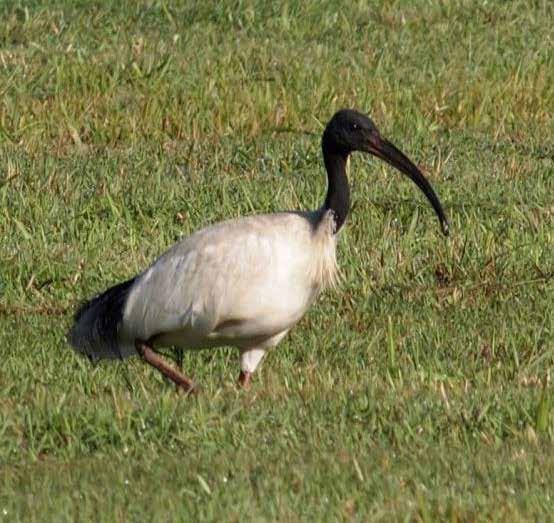
The Australian White Ibis has increased in numbers strikingly over recent decades. Formerly associated with wetlands, it is now abundant in urban areas, parks and gardens. It is a frequent visitor to the Village, and has taken to scrounging from rubbish bins and garbage dumps, to the point that its behaviour is often a nuisance.
If I am allowed to include species that are frequently seen flying over the Village, although they seldom alight, I can list the Sulphur-crested Cockatoo (all white apart from its yellow crest) – a party of about twenty flew over yesterday, calling loudly.
Less than 100 metres from the Village is a small park; there is an attractive avenue of London Plane trees, on some of which someone has placed bat roosting boxes, and what the locals call a ‘mere’. The latter is artificially contained, and quite different from the meres of the East Anglian Breck of my boyhood. But several species of duck frequent it, along with Australasian Grebes (rather similar to the Little Grebes or ‘Dabchicks’ of Suffolk wetlands). In the middle of the ‘mere’ a small solar panel provides the energy for a fountain: a pair of Grebes has built a nest on its support! The occasional lonely Black Swan looks
somehow out of place; a pair of Eurasian Coot (indistinguishable from those of East Anglia) were accompanied by a few young last time I visited (in February it’s late summer here). Two species of Cormorant, the Little Pied and the Black, occasionally wander in from the Indian Ocean shore, just a few kilometres away.
When I moved from the rambling family home of 44 years, surrounded by the muchloved, splendid trees – Jacarandas and Eucalypts – to the Village, I did not think that that there would be much opportunity for garden birding. I’m delighted to say I was mistaken.
Patrick first birdwatched on the Suffolk coast when he was six years of age, in 1947. He has lived in Western Australia for 45 years.
Chantal Macleod-Nolan, RSPB Project Officer
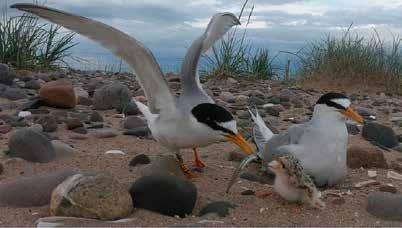
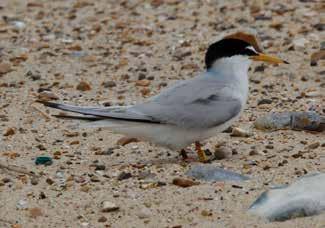
Little Terns are the UK’s second rarest breeding seabird and in 2013 an EU LIFEfunded Little Tern Recovery Project was set up consisting of ten partners (including the RSPB). It covered 26 colony sites within 16 Special Protection Areas across England and Wales. The project’s focus was to protect and monitor these vulnerable ground nesting birds and was supported by 60 members of staff and 250 volunteers. Although the LIFE funding has now ended, the former partners are continuing to share best practice on tern management and raise the public’s awareness.
During the project, a colour-ringing programme was set up to improve our understanding of Little Tern demography in the UK. Apart from the productivity, there is little information on other key demographic rates, such as survival of different age groups and migration rates between sites within the UK. Moreover, Little Terns are subject to a high level of disturbance and flooding, which drive local movements between sites within the breeding season. It is therefore very difficult to model the population trajectory for Little Terns under different scenarios with any confidence.
Using alpha-numeric coded colour rings to identify and track individuals within the populations would enable the project to clarify these rates for the UK and develop a robust population model to inform our conservation strategy.
As a result, the colour-ringing of Little Terns using yellow alpha-numeric coded colour rings started in 2014, mainly in Norfolk, before being expanded to other sites across England and Wales. By 2018, there were over 613 birds colour-ringed across 13 sites, with 147 individuals being adults. Of the 13 sites, three used their own colour rings including Crimdon Dene and Hodbarrow in England. Overall, looking at the colour ringed totals across the LIFE Project, the schemes in Ireland, the Isle of Man and Crimdon in England, represent 77% and 27% of the total number of new Little Tern adults and chicks respectively ringed across the British Isles between 2012-2018.
With this growing pool of individually recognised birds and resightings, the project was able to gain some insight into Little Tern demography including their movements and exchange between breeding colonies. This
includes birds originally ringed at Easington Lagoons, Crimdon, England, the Isle of Man, and Ireland being sighted breeding at Gronant, Wales.
In addition, there have also been several sightings outside of the UK allowing for greater understanding of their migratory movements. Several individuals originally colour-ringed in 2014 at Winterton and Blakeney in England were subsequently resighted in the Gambia the following spring; a chick originally colour-ringed at Chesil, England in 2015 was resighted in Normandy, France in August 2018; and a chick originally colour-ringed in Langstone, England in 2017 was subsequently resighted just a few weeks later in the south of Spain.
Resightings of Little Terns have also yielded more information on their ages as the majority of birds resighted to date during the project had been in their second or third year (third or fourth calendar year). Thirteen individuals were resighted in their first year (second calendar year), which was surprising as it was believed that first year Little Terns largely remained in the wintering grounds and did not return to the UK until their second year. In addition, six percent of two-year-old Little Terns were confirmed to be breeding. This data confirms that the
minimum age of first breeding is two years old and that this may be a more common situation than previously thought.
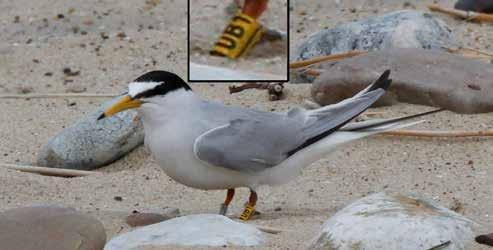
New longevity records were revealed by ringing undertaken during the project. In the first year of the Project, Yellow UAB (which was originally ringed in 1992 at Long Nanny, England) was re-caught and colour-ringed in 2014 on Inner Farne, England making it almost 22 years old and a record at the time. In 2018, a new record was set with a 25-year-old bird being re-trapped at its natal site, Gronant, Wales (originally ringed in 1993). In 2019, the longevity record was raised again to 26 years with the recordholder returning to Gronant to nest.
The LIFE funding has ended but the colour ringing project is continuing. We have gained some great insights from the accumulated data during the five years of the project.
In order to accurately estimate the survival rate of Little Terns in the future, it is necessary for the resighting efforts to increase and build on this existing dataset.
Therefore, we are hoping to raise birdwatchers awareness for this colour ringing project should they observe Little Terns in their area. For more information please visit the Little Tern Project Website (www.littleternproject. org.uk) which provides detail on the various Little Tern colour ringing schemes in the British Isles and who to contact about any sightings.
Reference: Wilson et al. 2019. EU LIFE+ Nature Little Tern Recovery Project Coded-Colour Ringing Programme Report 2018. RSPB

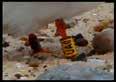
The British Isles Little Tern Colour Ringing Schemes:
¨ Yellow colour rings with a three digit code in black writing include the sites around England, Wales and the Isle of Man colony.
¨ Green colour rings with a three digit code in white are used at the Irish east coast colonies.
¨ Blue colour rings with a two digit code in white are used at the Teesside colonies.
More information on the Little Tern Project: www.littleternproject.org.uk
IMPORTANT INFORMATION: Re-sightings are important but the birds welfare comes first. Little Terns are a Schedule 1 species under the Wildlife and Countryside Act 1981 making it illegal to disturb them during breeding, and for the purposes of photography, without a formal Licence.
If you see any colour rings on little terns please report them through www.ring.ac as well as emailing them to LittleTernSightings@rspb.org.uk.
Please provide full details: noting the colour of the ring, any code, which leg the ring was on, where you saw it (place name/grid reference) and when you saw it (date/time).
Tony Gdula
The quarterly review section gives a snapshot of birds seen within the county during the period and is compiled by Tony Gdula, predominately from data received by Suffolk BINS. All scarce and rare birds are subject to submission and acceptance by either SORC or BBRC. Updated lists on Accepted and Outstanding Records for previous years can be found on the SBG website - http://www.suffolkbirdgroup.org/bird-recording.
The pattern of a mild winter carried on in to February with temperatures higher than typical for the time of the year. There were no day time temperatures below zero with half of the days during the month in doublefigures; the maximum 14C on the 23rd. Similarly night time temperatures were mild for the time of the year, only twice going below zero. There was rain on three-quarters of the days across the month, although generally not high amounts with the highest being 13mm on the 16th and the most in the final week of the month. This rainfall at the end of the month was to be the most significant for the next two months.
Pale-bellied Brent Geese were on the Deben Estuary at Falkenham Marshes from the 11th to 17th. Tundra Bean Geese were seen at Trimley with two on the 1st and 2nd and again on the 29th. At Hollesley Marshes there were up to 21 present between 1st and 5th. Two Pink-footed Geese were seen at Hollesley on the 5th with three present on the Town Marshes long the Alde Estuary on a few dates. Eurasian Greater White-fronted Geese were again seen in the largest numbers throughout the month at Hollesley Marsh (50 - 100), North Warren (45 - 140) and in smaller quantities at the Alde Estuary (up to 30) and Trimley and Boyton Marshes (both
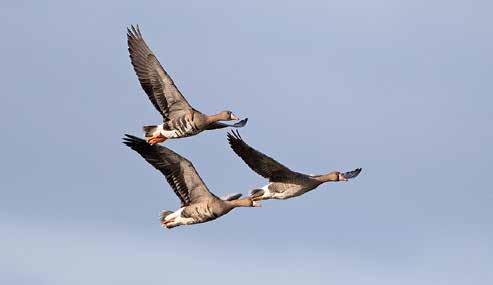
8). Bewick’s Swans were noted in fields at the Hinton crossroads near Blythburgh with 11 on the 1st and 13 on the 3rd. Up to five Whooper Swans were present early in the month at Dunwich and Walberswick Marshes. Three were regularly present at Shingle Street on a winter wheat field beyond the pumping station at Oxley Diary with the same birds also seen at East Lane, Bawdsey and Hollesley Marsh. At Minsmere there were up to six present throughout the month. A drake Red-crested Pochard was seen at Minsmere on the 28th and 29th. Five Greater Scaup were on the Stour estuary on the 6th with a sole female there on the 22nd. A Long-tailed
Duck was recorded on the Orwell Estuary on three separate dates mid-month. A redhead Smew was seen daily throughout the month at Minsmere and Goosander were regularly at both Thorpeness (up to 8) and Minsmere (up to 13).
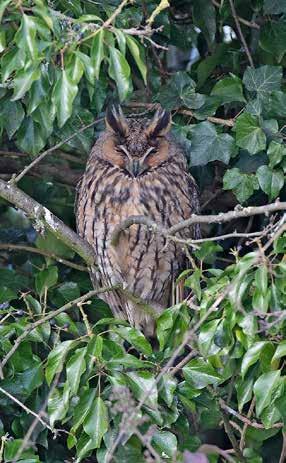
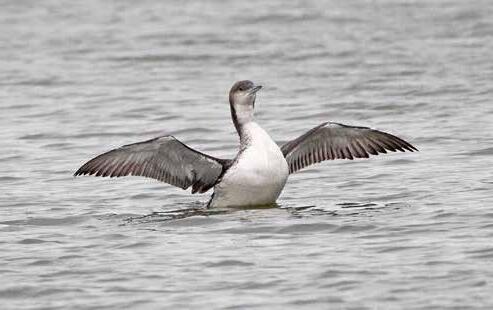
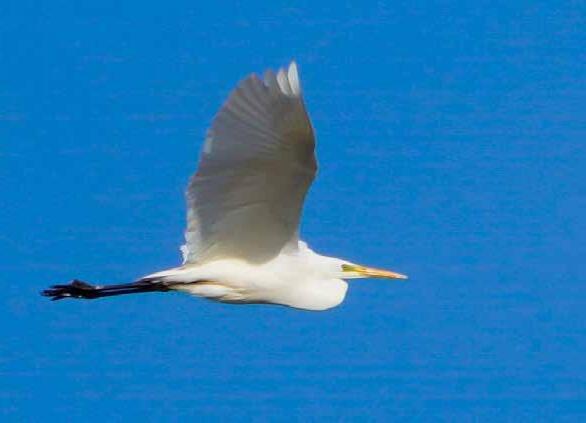
At least 10 Common Crane were noted at Lakenheath on the 7th. There were four Slavonian Grebes on the Stour Estuary on the 3rd with one on the 23rd. A Blacknecked Grebe was on the Deben Estuary at Woodbridge on the 28th. Purple Sandpipers were seen around Ness Point, Lowestoft with 11 on the 2nd and up to 15 by the 28th. There were also two regularly at Landguard Point from the 8th onwards and two at East Lane, Bawdsey on the 29th. Two Jack Snipe at Pipps Ford, Needham Market on the 25th. Yellow-legged Gulls were reported at Hollesley with three on the 9th and two on the 15th and one in Ipswich on the 21st. Up to four Caspian Gulls were at Minsmere in the last week of the month with one also at Hollesley Marsh on the 9th and 14th and on Havergate on the 21st. An Iceland Gull was seen to come in off at Landguard and head up river on the 2nd. Great Northern Divers were again in evidence; a juvenile at Benacre throughout the month and also on the Alde and Orwell Estuaries. Shags were seen at Lowestoft on Lake Lothing with up to two from 12th to 19th and one in Ipswich docks on the 21st. Great Egrets were seen regularly through the month at Dunwich with up to four present, Hollesley Marsh, Carlton Marshes (usually 2), Minsmere and Boyton. Two Red Kites were reported at Cavenham on the 7th, five at Wrentham on the 18th, four at Benacre the following day and one at Minsmere on the 22nd. A Long-eared Owl was seen at Wenhaston on the 4th and 11th. Short-eared Owls were seen at Carlton Marshes on the 2nd, 17th and 19th, on the 3rd at Kingsfleet on the Deben Estuary and at Shingle Street on four dates throughout the month.
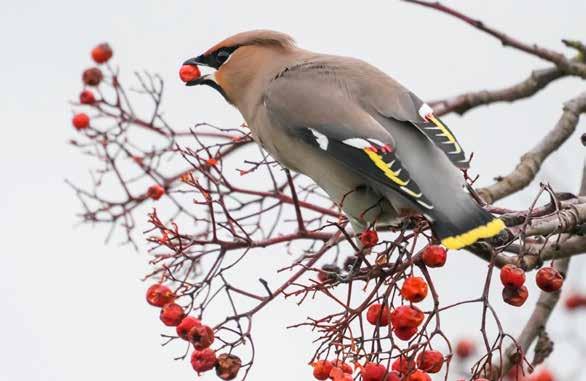
Lesser Spotted Woodpeckers were at Santon Downham with two present on the 19th and another on the 25th. Two Ringnecked Parakeets noted in Ipswich on the 7th. A Raven was recorded at Stutton on the 20th. Six Waxwings noted around Carlton Colville on the 26th. A single Shore Lark was seen throughout the month on Kessingland beach. Firecrest were seen at Bawdsey picnic site on several dates and one at Hollesley on the 22nd. Two Tree Sparrows seen at Easton Bavents on the 7th. Throughout the month Water Pipits were seen at several sites including Trimley Marsh, Levington Creek, at a small farm reservoir at Falkenham, Covehithe Broad, East Lane in sugar beet field, Hollesley Marsh, Carlton Marsh, North Warren, Pipps Ford - with the highest count of eight at Hazlewood Marshes on the 22nd. Four Twite were at Covehithe on the 1st & 5th, while along the beach at Dunwich and Walberswick at least 12 Twite were noted, including a green/orange ringed specimen, on several dates. At Sotterley Park two
Hawfinches seen on the 14th. Two Snow Buntings were seen regularly throughout the month at Landguard - additionally up to seven at East Lane, up to six on Kessingland beach and a maximum of 24 at Dunwich.
A Black Brant was on Falkenham Marshes from the 12th to the end of the month. A Green-winged Teal was present throughout the month at Minsmere with another viewed from the south wall at Breydon Water on the 6th. A probable first-winter Bonaparte’s Gull was reported from the Viewpoint Café at Landguard before flying up river on the 25th. A Black-throated Diver was on Suffolk Water Park, Bramford between the 8th and 20th. The Rough-legged Buzzard that had been present for the winter at Bawdsey was last seen on the 8th. The Eastern Yellow Wagtail reappeared on Havergate Island on the 4th, 7th and 13th after last being seen the previous year on November 14th.
Generally it was a dry, mild month overall. There were limited days of rain, the highest days of rainfall being the 9th with 6.1mm and 6.3mm the following day. Day time temperatures ranged from 7C on the 29th to 15C on the 10th. Night time temperatures were again higher than usual, only twice below zero, -2C on both the 7th and 26th while the highest was 6C on the 11th and 18th.
The Tundra Bean Goose was noted up until the 20th at Covehithe with two regularly at Trimley Marshes. Two Pink-footed Geese were at Hollesley Marsh on the 9th. There were up to 200 Eurasian Greater Whitefronted Geese at Hollesley Marsh up until the 25th, 13 at Aldeburgh Town Marshes and singly at Trimley Marsh. Six Whooper Swans were recorded at Minsmere up to the 7th. The three at Shingle Street remained until the
15th and were also noted at Hollesley Marsh on three dates. A single Garganey was seen towards the end of the month at Lakenheath, one flew over Woodbridge at night identified by sound and finally Minsmere. A Longtailed Duck flew south offshore at Landguard on the 15th. Up to three Smews were seen throughout the month at Minsmere. Goosanders were seen at Pipps Ford and Sharmford Mere, Needham Market, three flew over North Warren and up to six on Thorpeness Meare up to the 20th. The first recorded Cuckoo sighting of the year, a very early arrival, was on the 15th at Stutton.
Common Cranes were seen regularly: Lakenheath with up to four present. Two flew south over Santon Downham on the 1st. Two flew west over Lower Holbrook on the 7th and then were tracked over Chantry Park in north-west Ipswich followed by going over the Whitehouse estate of Ipswich. Four flew over Worlingham Marshes towards Beccles on the 13th with two over Cavenham on the same day. Three flew over Minsmere on
the 22nd and likely the same two birds seen at both Elmswell and Layham on the 28th. A Little Ringed Plover was seen at Flixton Gravel Pits on the 24th. Purple Sandpipers were at Landguard on the 4th and 6th, two at East Lane on the 7th and 15th with nine at Ness Point on the 8th. One Jack Snipe at Flixton Gravel Pits on the 24th and 27th. Caspian Gulls recorded throughout the month, including Minsmere including a firstwinter, on the Orwell Estuary, up to eight at Hollesley Marsh, Trimley Marsh, Southwold and Sizewell. One Sandwich Tern seen at Minsmere on the 23rd. The juvenile Great Northern Diver was again logged at Benacre Broad up until the 21st and an additional sighting on the Stour Estuary on the 5th. Single Shag was seen occasionally at Lake Lothing through the month with two on the 4th. Spoonbills were present at Minsmere (9th), Alde Estuary (13th to the 19th), Carlton Marsh (16th) and Gedgrave (19th). Great Egrets were seen throughout the month at Lakenheath, Boyton, Reydon, Dunwich, Walberswick, Hollesley, Aldeburgh and North Warren.
As if to underline Jeremy Mynott’s article in the last Harrier (no. 200), Red Kites were present throughout the month and throughout the county with Stoke-by-Nayland seeing the largest groups; 9 on the 10th and 6 on the 12th. A ring-tail Hen Harrier was seen at Lakenheath on the 6th, Ewarton on the 26th and at Westleton on the 27th. Short-eared Owls were seen at Carlton Marshes on the 2nd, 7th and 26th, two at Hollesley Marsh on the 4th, plus at Shingle Street, Minsmere and one south through Landguard. Lesser Spotted Woodpeckers were noted at Santon Downham with a maximum of four on the 14th.
A female Merlin was registered at Shingle Street on the 18th. Referencing Jeremy Mynott’s article again for the Raven, birds were seen at Hadleigh and Santon Downham
both on the 15th, two at Tattingstone on the 20th and singles seen at Cavenham and Leavenheath. Waxwings were also seen regularly, with 11 at Rendlesham (7th), eight at Butley (8th), 11 at Bromeswell (9th - 23rd) and four at Wangford (11th - 16th) and singly elsewhere. The first recorded Sand Martin of the year was on the 8th at Ixworth. A single Swallow was seen at Shingle Street on the 21st. Firecrest were noted at Bawdsey on the 1st and 21st, individuals were ringed and released at LBO on the 8th and 14th, then pairs spotted on the 18th and 20th with birds also seen at Shingle Street, Aldeburgh and Thorpeness.
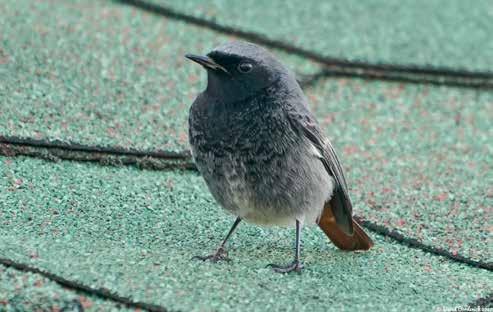
A Ring Ouzel was seen at Great Livermere on the 15th. Black Redstarts were seen regularly throughout the month, mainly along the coast and most often at Sizewell. White Wagtails showed up at Hollesley Marsh, Trimley Marsh, Alde Estuary, North Warren, Kessingland sewage works with a peak on the 17th with 18 in the Benacre area. Water Pipits were seen at Minsmere, Lakenheath, Carlton Marsh, Trimley Marsh, Walberswick, Shingle Street, Southwold and North Warren and most frequently and regularly at Covehithe Broad and Aldeburgh Town Marsh. Twelve Twites were still at Dunwich on the 6th. A Mealy Redpoll was at Hollesley on the 3rd. The two Snow Buntings remained at Landguard until the 13th, while the Kessingland birds had counts of eight on the 7th and 8th with four on the 20th and finally two at Dunwich on the 13th.
The Black Brant was last seen on Falkenham Marshes on the 3rd. The drake Green-winged Teal was present again on the south side of Breydon Water on the 1st. The Minsmere bird was on view until the 12th but from views was thought to be a hybrid. Another bird was on Southwold flash near the Bailey Bridge from the 21st to the 23rd and again on the 28th and 30th. A Black-throated Diver was
seen south off Landguard and seen to land on the sea on the 12th. A Cattle Egret noted off the point at Landguard and then flew inland on the 24th.
A White-tailed Eagle flew over Westleton village on the 27th and on the same day the same bird over Oulton Broad. The following day two were noted over the heath at Westleton with one south over Boyton Marshes and one flew west along the Stour Estuary on the 29th. On the 29th a Roughlegged Buzzard was reported over Barsham.
It was a very dry month with warm temperatures and some strong winds. There were only three day time temperatures in single figures; 8C on the 1st the lowest. The
highest temperature recorded for the month was 23C on the 12th with two further days of 21C, on the 8th and 21st. Night time temperatures ranged from -1C on the 1st to 9C on the 11th. Throughout the month there were only 5 days of rain, with the bulk of rainfall on the last three days of the month with 12.2mm on the 28th being the highest.
Two Grey Partridges were seen at Ellough on the 15th and 22nd. Smew were seen at Minsmere with two on the 2nd and 5th and three between the 7th and 12th. Garganey noted at Southwold with two from 5th to the 19th, one at Great Livermere on the 5th, three on the 11th and then two on the 12th, North Warren on the 6th and Minsmere on the 22nd. Turtle Doves were recorded at Barking (23rd), 2 at Hulver Street (25th) and
North Warren (26th). Common Crane were seen over the Stour Estuary (1st), Leiston (2 on the 2nd, 3 on the 7th), Eastbridge (up to 7 on the 7th and 19th), Reydon (6 on the 7th), Barton Mills (3 on the 22nd), Brecks and Saxmundham (both 24th). A Purple Sandpiper was noted at Landguard on three dates up to the 25th. Good numbers of Whimbrel at Hollesley Marsh, Reydon Marsh with up to 37 on the 4th, Beccles Marshes with up to 45 on the 23rd and 60 on the 29th and four at Southwold on the 29th. A Wood Sandpiper also seen at Southwold on the 26th. Caspian Gulls were seen at Minsmere and Sizewell 13th. A late Glaucous Gull was at Sizewell on the 11th and 13th and Southwold Town marsh on the 26th. There were 43 Little Gulls off Landguard on the 5th and 7 on the 6th and also noted at
Carlton Marsh on the 5th and Great Livermere Lake on the 6th. There were eight probable Arctic Terns over Coddenham on the 17th, 25 offshore at Southwold on the 29th and 15 on the Orwell Estuary the next day. Four Black Terns present at Lakenheath on the 23rd. A Pomarine Skua noted off Dunwich on the 29th.
Two sightings of Great Northern Diver, both at Landguard with one close inshore heading north on the 9th and one on the sea on the 16th. Single Shags were noted at Oulton broad on the 13th and Landguard on the 27th. It proved another good month to see Spoonbill with observations at Hollesley, North Warren, Aldeburgh, Dunwich, Walberswick, Minsmere (including six on the 24th) and three over Oulton Broad on the 25th. An Eurasian Bittern seen at Elmswell on the 10th was a
notable sighting. Great Egrets were present on various dates through the month at the following sites: Aldringham, Dunwich, North Warren, Walberswick and Minsmere with the highest count of four at the latter site on 10th. Building on last month’s sightings, Red Kites were too numerous, too frequent and too widely distributed to list (it might be easier to list where they haven’t been recorded), although 12 at Stoke-by-Nayland is worth a special mention. A ringtail Hen Harrier was seen over Stoke Park, Ipswich on the 17th and Dunwich on the 25th. A Goshawk was noted at Worlingworth on the 11th. Osprey sightings came from Mildenhall (3rd), Walberswick (7th), Crowfield (19th), Felixstowe, Deben Estuary and Melton (all 25th) and the Stour Estuary (26th). Only the one Short-eared Owl sighting this month; one at Hollesley on the 23rd.
Two Ring-necked Parakeets were seen at Bury St. Edmunds on the 17th and with one south-west over Hopton on the 27th. A Great Grey Shrike was spotted at Ipswich on the 22nd. Ravens were seen throughout
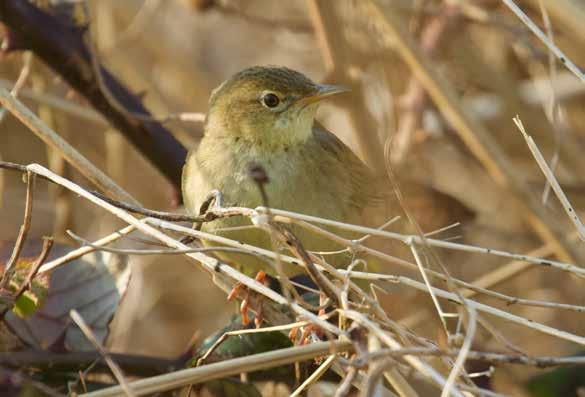
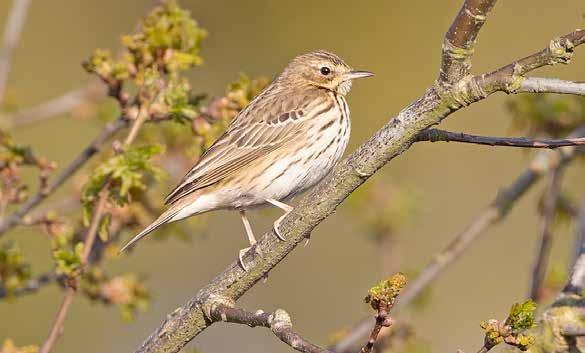
the month at a variety of sites across the county. Grasshopper Warblers recorded from Charsfield, Southwold, Felixstowe Ferry, Beccles Marshes and Hessett. Firecrest were seen at Hollesley, Sizewell, Aldeburgh and LBO. Ring Ouzels also seen regularly, mostly in the second half of the month throughout the coastal region. The first Nightingale of the year was heard at Westleton on the 5th. A Pied Flycatcher was seen at Reydon between the 20 and 24th near the fishing ponds. Black Redstarts were seen regularly, especially early in the month, along the coastal strip. A Whinchat showed at North Warren on the 27th, then Kessingland and Landguard both on the 29th. 12 White Wagtails were at Hollesley on the 2nd. Tree Pipits noted at Minsmere (12th), Felixstowe (23rd), Wenhaston (also 23rd) and Akenham (26th). Water Pipits were seen at Minsmere on the 2nd and 10th. Three Snow Buntings observed on the beach at Southwold on the 1st and nearby at Easton Bavents on the 3rd. A Lapland Bunting was reported south of the village of Peasenhall on the 5th.
The Green-winged Teal on Southwold Town Marsh from the previous month was still present on the 1st. A Glossy Ibis flew south over LBO on the 9th and one over north-west Ipswich on the 30th. On the 16th an adult Purple Heron was found on Southwold Town Marsh and was last seen on the 22nd. A Cattle Egret was present at Boyton (4th, 10th, 12th and 13th). White-tailed Eagle sightings caused a lot of excitement in the month with many birders hoping for a flyover when birds were reported, potentially heading their way! It started with one on the 4th circling with four Buzzards between Bramfield and Wenhaston. The next sighting was photographed over Bungay on the 6th. There were two birds on the 7th; one over north-west Ipswich and then seen again along the Stour estuary and a second one south over Minsmere and later over Hollesley. On the 15th a bird over Bungay heading east and then later on further south one over Mendlesham, next over Pipps Ford and appeared to roost
in nearby Shrubland Park. The following morning the bird was seen to leave the roost at Shrubland Park before subsequently seen over Baylham and Great Blakenham. The Ipswich bird was tagged ‘G324’ while the bird on the 15th and 16th was tagged ‘G393’. Both of these are from the White-tailed Eagle project, a re-introduction scheme on the Isle of Wight. Early morning on the 30th two Black Kites were seen together going south over Minsmere and subsequently split up with further sightings over Leiston, Sizewell Hall and Aldringham Walks area and over Westleton Heath. A Rough-legged Buzzard was reported flying north-east over Ixworth on the 7th. A Hoopoe was on private grounds in Felixstowe on the 23rd. A Wryneck was seen at Snape Warren on the 20th. A Redrumped Swallow flew past LBO on the 27th. A very early Melodious Warbler was trapped at LBO on the 30th. A Wood Warbler was trapped at LBO on the 27th. A Serin was seen and heard over Hollesley Marsh RSPB car park on the 6th and another was heard at Barnham on the 26th.
Chris Keeling
Constructed before the Second World War, the reservoir at Abberton was never intended to be anything other than a concretesided bowl, its design and structure purely functional. With time, nature claimed the cracks in the concrete and wintering wildfowl exploited the margins for food and the open water for roosting. Cormorants found the band of woodland at the western end of the reservoir and founded one of the largest inland nesting colonies in Britain.
Up to 40,000 ducks, swans and geese visit Abberton reservoir each year, leading to its triple designation as a SPA (Special Protection Area), a SSSI (Site of Special Scientific Interest) and a protected Ramsar wetland site. Despite the numbers of birds recorded at Abberton, access was for many years restricted by chain link fences and keep out signs, the greater part of the reservoir viewable only with special permission, ancient right of trespass, or from one of two causeways. Layer Breton crossing the western section or Layer de la Haye with access to the old EWT visitor centre and hides overlooking the eastern section. Everything changed when in June 2015 Sir David Attenborough unveiled an engraved block of granite to mark the completion of the Abberton Reservoir Expansion Scheme which began in 2010 with the aim of doubling capacity and making it the country’s fourth largest reservoir. The site of the old visitor centre at the Layer de la Haye causeway is lost below the new shoreline, but the new visitor centre offers a far more expansive
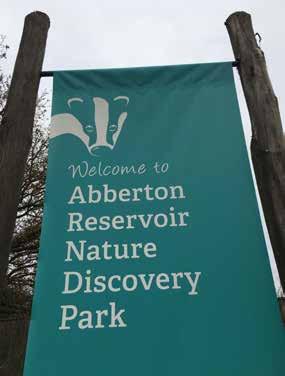
view of the reservoir, only a short walk from the causeway with its conveniently placed view-points.
The December 2019 trip to Abberton was a perfect opportunity to twitch the long-staying drake Ring-necked Duck and four Cattle Egrets that had recently been reported. It was also good to meet up with Ash again and easy to forgive him for taking his knowledge and bird identification skills to Essex, for surely as the designated leader of the group his local knowledge would help us find both species. Sadly, we couldn’t find the Ringnecked Duck but a Great White Egret flying overhead toward the visitor centre was an encouraging first for the day, and nor were we disappointed by the rafts of Pochard, Tufted Duck, Wigeon, Teal, Pintail and Shoveler to which we added a Black-necked Grebe diving and reappearing close to the causeway.
It wasn’t long before we were able to add seven Goosanders to the day’s list; six redhead females and a single male before
continuing on to Billets Farm. We scanned the meadows on the opposite side of the road to the farm entrance for Cattle Egret while noting the absence of any cattle or indeed any large mammal that might be a substitute for the egret’s nominal familiars. Eager expectation ratcheted down from hopeful, to acceptance and finally defeat as we returned to the visitor centre and the hides on the north shore. On the way we spotted two more Great Egrets from the causeway, one wading by the shore and another overhead, boldly edging centre stage with Little Egrets, not quite the new kids on the block but still meriting a mention on BINs while enter stage left, the Cattle Egrets. We would be back at Billets to try again but first the hides and the north shore of the reservoir.
Walking through some Hawthorn and Blackthorn both with a healthy crop of haw and sloe berries on our way to Gwen’s Hide we surprised a flock of Fieldfares foraging among the sloes, briefly scattering in ones and twos to the topmost branches, with their clatter - chack calls. The few became ten, twenty and then sixty or more, flying ahead of our group only to disappear beyond the dips and hollows of the thorn thickets. It is a reminder that, due to the presence of legally protected species and their habitats, it was necessary to create substantially more wildlife habitat when designing and landscaping the new reservoir extension. What had once been a utilitarian concrete-sided bowl now has more habitats for native reptiles, Great Crested Newts, Water Voles and farmland birds than much of the surrounding farmland.
As soon as we were settled into Gwen’s Hide we began to count the first Goldeneye of the day and two more Great Egrets. I recorded in my notes that the Goosander appeared to chase one of the Egrets forcing it to take flight. Goosander form pairs on their wintering grounds so they may have been reacting to the egret’s silhouette, their
biological imperative already registering a threat to Goosander ducklings. We left Gwen’s Hide and made our way to the Bay Hide where Rooks fed in the grassland margins and a Sparrowhawk made a mad dash for a Meadow Pipit.
Another Great Egret flew overhead that may have been the same bird that had appeared to unsettle the Goosanders. Once inside Bay Hide we opened the shutters and began to count more Goldeneye making a rough total of seventy scattered across the bay between the two hides and two further Great Egrets could be seen on the far shore beyond the pumping station. Another Great Egret flew overhead to the far shore as we made our way to the visitor centre, where despite our packed lunches some of us were tempted by bacon and sausage rolls before checking recent sightings on the centre’s notice boards. The elusive Ring-necked Duck was written up on the board in bold strokes of a felt pen along with the Black-necked Grebe and seven Great Egrets. How many Egrets had we seen? At least six, but being so restless and mobile, that it was impossible to be certain.
Lunch over, we made our way straight back to the causeway to search for the Ringnecked Duck among the Pochards and Tufted Ducks. We were enjoying the elegant male Pintail and the females with their slender attenuated profiles when someone called out Long-tailed Duck! And there they were; all thoughts of the rare duck forgotten as we focused our scopes on two Long-tailed Ducks, a first winter male and a female. We quickly added a single male Scaup followed by four more, making a total of three males and two females while the Black-necked Grebe continued to dive and reappear close to the shore at the end of the causeway.
Suitably encouraged we continued on to Billets Farm stopping to search the wet meadows, just in time to see four Cattle Egrets drop down into the meadow before
taking wing again. We followed their line of flight to Wigborough Bay where, despite their nominal association with cattle, we found them feeding amongst a flock of sheep. It was tempting to imagine them joining the gulls and crows in the muddy wastes created by outdoor pigs on the Sandlings, or joining the Red Deer on the heath at Minsmere. The Egrets lingered for a short while, walking amongst the sheep - a perfect picture of a changing countryside. By the time the Egrets had moved on again, flying towards the far end of the western section of the reservoir, we had found a pair of swans on the opposite shore, either Bewick’s or Whooper. We waited for them to turn their heads to check the shape and extent of yellow on their bills. That they were Bewick’s there could be no
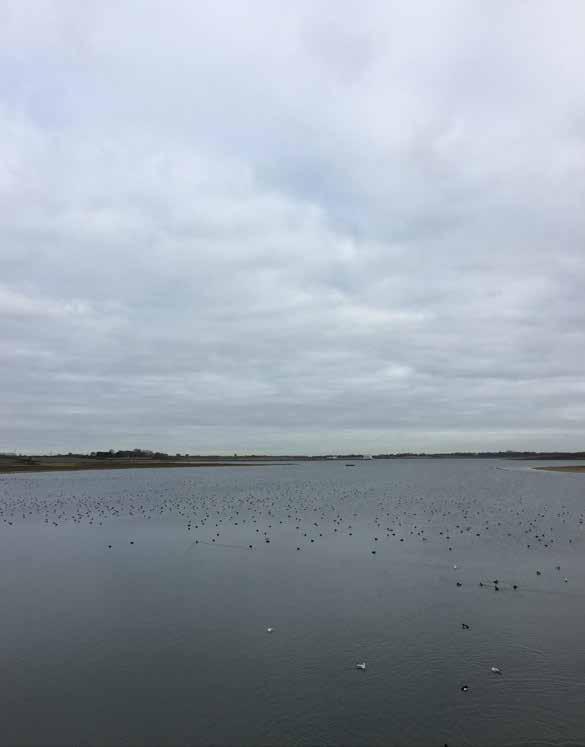
doubt once we got a good look but I couldn’t help wondering if their winter migration will still bring them this far south in a warming climate, even as the Cattle Egrets move north.
A Marsh Harrier flew into the bay and a Kestrel stalled in its chosen spot in the sky, beating the wind with tail fanned and a blur of wings. One last look and back to the visitor centre car park and the option of a drive round to Layer Breton where in the spring Cormorants will return to nest in trees as they have done since 1981. The trees bleach and die under a shower of guano until the cormorants relocate to the nearest trees that can withstand a gale. Saplings pumped up with nitrates and phosphates grow tall enough to fill the gaps, and the cycle begins again.
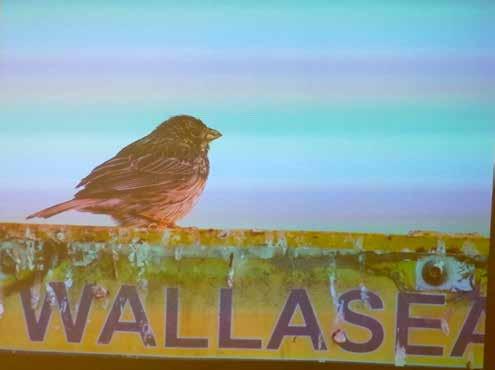
This trip report follows a recent article in the Spring edition of the Harrier revisiting the early days of RSPB Wallasea Wild Coast Project in 2009 when heavy bulldozers and trucks began the transformation of an arable plain, and I and other visitors to the site were required to wear hard hats and high viz rather than my customary camouflage jacket. The update concludes with a description of the less than favourable conditions on the 7th February 2016 when the SBG, or SOG as it was then, visited Wallasea for the first time. Guided by Chris Tyas, the RSPB Project Officer, we followed the tracks of heavy construction equipment into the interior of the island,
where we struggled to steady scopes and bins while scanning the new scrapes and lagoons blasted by gale force winds, our huddle of birders the only barrier between the wind and the North Sea. Conditions for birding were truly terrible, and I offered a grateful prayer of thanks for the Peregrine, two Merlins and a Short-eared Owl that appeared almost miraculously to brave the storm before we had to call it a day and head for home.
On the 25th January this year the weather held fair as did my optimism for the day ahead as members of the SBG once again gathered at the RSPB’s office at Grapnells
Farm. We were met by Rachel Fancy - the RSPB’s new reserves officer now that Chris Tyas has retired. Those of you who joined the first visit to Wallasea in 2016 will remember that Chris gave a presentation on the history of the island and the Wild Coast Project before escorting our group to view the newly created wildlife habitats. Now it was Rachel’s turn to update the SBG about the final stages of the project before guiding us to the newly created scrapes and lagoons where mud, rushes and water are melding into a new wilder landscape already attracting mixed flocks of wildfowl and waders.
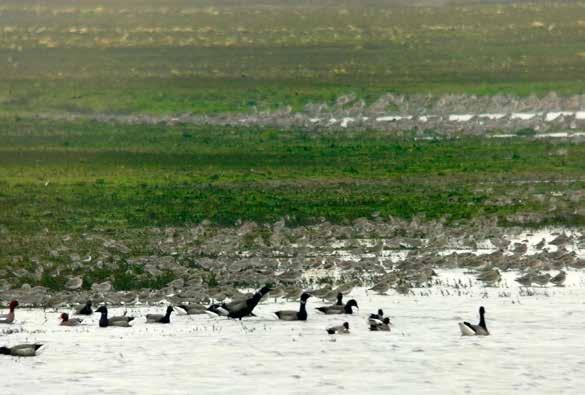
As in 2016 we were taken ‘off trail’ in to areas closed to public access until the network of visitor trails with hides and viewing screens is fully operational. I had hoped for good weather and I hoped that the habitats had developed since my last visit, that there would be good numbers of birds but I was unprepared for the mixed flock of Grey Plover, Knot and Lapwing rolling in ripples and waves more reminiscent of the Wash than the Essex coast. They towered over the marsh; perhaps alarmed by the Marsh Harrier drifting too close to the salting’s muddy margins. An orchestrated swirling panic, a ‘dread’ as a Cornish birding mate calls it, I can’t think of a better description.
As we followed Rachel to a reed screen at the end of the trail overlooking a complex of lagoons and scrapes, a flock of 2-3000 Brent Geese appeared over the western sea wall, distant enough to justify viewing through a scope, further evidence if needed of the breadth and scale of the project. A Kingfisher darted down the length of the ditch while a large flock of Golden Plover could be seen flying into the island to join a mix of Knot, Grey Plover, Ringed Plover and Black-tailed and Bar-tailed Godwit on the scrapes. Scanning the scrapes and a much larger lagoon, where I was hoping for Hen Harrier and Short-eared Owl, we quickly
added Pintail and Shoveler and a Great Egret to the trip list.
With everyone alert for Hen Harrier, two female Marsh Harriers easily focused everyone’s attention on the narrow margin between the crest of the sea wall and the clouds gathering over the estuary. They were soon joined by a single male putting everyone on alert until Gi spotted the first Hen Harrier of the day. Not surprisingly I was thoroughly enjoying the moment, I felt a whole lot more confident that my claims for Wallasea were justified and that a single ringtail Harrier helped to justify the early morning start and the long journey to the Essex coast.
But there was still one more bird that I was hoping we might see as I scanned the saltings and clumps of sea club rush. Suddenly the flicker of a half horseshoe pattern, like a question mark, and then a positive ID as wing tips dipped in ink signalled a Short-eared Owl. No sooner had our attention been claimed by the SEO than a second one appeared to tussle briefly with the first, before breaking away to perch on an earth mound where we could all enjoy the unexpected brightness of its eyes and plumage, like a spark against a low winter sun. Three Kestrels and a single Buzzard added to the complement of raptors seen from the reed screen. It was soon time to follow the trail back to the eastern sea wall, and the saltings of the Roach estuary. Any regrets about abandoning what had proved to be such a profitable viewing position were soon forgotten when two more ringtail Hen Harriers were spotted, quartering the eastern half of the island.
As we drew closer to areas of rough grassland at the end of the trail we searched for Corn Bunting and found our third Short-eared Owl of the day. We eventually found our first Corn Bunting back where we started, at Grapnels Farm, with a large mixed flock of Linnets, Meadow Pipits and Pied Wagtails. At last it was time to head for home.
I had promoted the visit in 2016 as an opportunity to see habitat creation in action, and on a landscape scale. Our visit this year was in every way a follow up to that first visit and an opportunity to see how much the wildlife habitats have developed. Further developments are planned commemorating Charles Darwin and the last resting place of the Beagle on the south shore of Wallasea in the river Crouch. Charles Darwin traveled to Central and South America on a voyage that has inspired a greater understanding of the natural world and our place within it. The RSPB have proposed naming specific lagoons on Wallasea Island in honour of the Beagle, Darwin and the Beagle’s captain, Fitzroy. A poignant reminder that, while we acknowledge the extinction of species in the face of catastrophic events, the consequences
of our actions are only fully understood when we stand at the edge and watch our footprints slipping away with the rising tide.
In the 21st Century, climate change and rising sea levels demonstrate the importance of dynamic natural systems and our dependence upon them. To use yet another marine metaphor - it takes a sea change in how we view the natural world and our place within it before we can begin to understand and value the natural world and not grumble as an elderly retired farmer did to me ‘that it was a waste of good farmland, now it’s just mud for a lot of birds’. There will always be grumblers and naysayers, but I hope all those who joined me for the SBG’s second visit to Wallasea this year will join me again in thanking the RSPB and Crossrail for all that mud, and a lot of birds.
Little did we know that this would be the last SBG trip for some time, lockdown restrictions and social distancing that was to become part of life had not been put in place in the UK. An excellent turn out for this popular trip, once all assembled and kitted up we admired a Great Spotted Woodpecker atop a conifer tree and then this was replaced with a Nuthatch giving great views of this smart species. The first of a couple of interesting beetle species for the day was noted, a Violet Ground Beetle, running cross the car park. We headed up to the church noting further Nuthatch calling up in some Oaks. The feeders in one of the gardens normally hold an array of birds but on this occasion it was fairly quiet with a few Great Tits and Chaffinches.
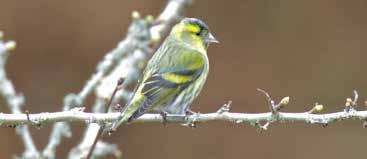
Down by the river, just on to the footpath, we were treated to great views of a normally skulking species, Water Rail. This was working its way along the edge of the river. We walked along noting Siskin in the trees above, a faint Woodlark was heard in the distance and Reed Bunting in the reeds. Within the wooded plantations were heard Great Spotted Woodpecker, Marsh Tit eventually – a species we usually encounter at the site more often, and further flocks of Siskins in trees on the other side of the river. In the skies above, a Buzzard, then the unmistakeable cronking call of a Raven with the group managing good views as it flew through. We were patiently waiting for a species that has declined greatly in Suffolk, but still occurs on the Little Ouse River, the Lesser Spotted Woodpecker. Despite our patience we had no luck, which was a shame as there had been regular sightings
Photo: Chris Courtney Siskin
Sunday, March 15th
Leader: Gi Grieco
in the preceding days noted on social media. Some of the group decided to do a recce back along the path and towards the rail line. The remainder waited a bit longer and had great views of two Grey Wagtails flitting along the far bank within vegetation plus Mandarin Ducks flying past. With no sighting of the woodpecker we headed back to the car park for the next part of the trip, on to Mayday Farm for a walk through Thetford Forest. The weather was on the turn, becoming grey and overcast. We headed to an open area to allow us a vista to scan over the trees. Smaller birds included the odd Crossbill over calling, some Siskins before we saw our first raptors, initially Buzzards but then our target species, Goshawk. Unfortunately a brief view so not all the group got on to it nor the group that had gone for a detour who joined us. As they approached they’d found Lesser Redpoll and Stonechat so we all went to see these then followed the track round towards the small hide by the pool. A good number of birds were in the area with several more Lesser Redpolls, Goldfinches and Greenfinches so some of the group went to the hide for a closer look. There were also many Chaffinches about plus one on the path ahead of us. Untypically it didn’t fly away as we’d expected but kept pecking for food on the ground. Even the presence of Matt as he walked towards it didn’t frighten it but from images we noted that its right leg had a growth. A possible cause of this growth is Fringilla papillomavirus, which forms nodules and warts on the legs of both Chaffinch and Brambling. Other possible causes are mites that cause irritation and scabs or abscesses
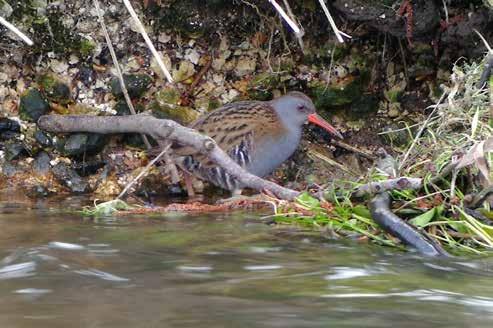
from wounds. The Chaffinch did eventually fly away. We got to a further open area but generally it was quiet with nothing flying over. We did see Stonechat and heading back we also got Woodlark. Lots of finches and tits were flying across the rides and at the junction that has a very small pool, a watering hole that attracts the woodland birds we were treated to a lovely flock of Siskins, birds every now and then flying down to the pool. Crossbills flew over again as we headed back to the cars then the second interesting beetle of the day, a Minotaur Beetle, was found on the track.
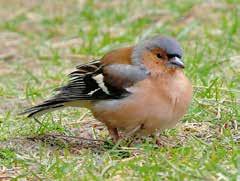
Our final destination was Cavenham Heath; the weather had turned more drizzly. Adam, the SBG indoor event organiser had joined us for this outdoor trip and a work colleague had said a Lesser Spotted Woodpecker had been seen in a strip of woodland on the heath. Due to the weather he questioned whether we’d go for a look but Adam assured him that SBG members are made of sturdy stuff so donning waterproofs we walked down. We couldn’t find the woodpecker but continued down to scan across the heath and were rewarded with four Stone-curlews – a nice end to a great trip.
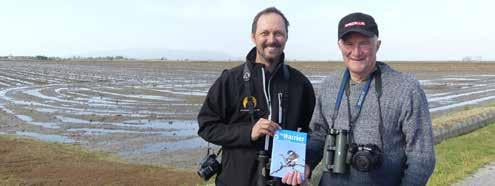
Dave Pearsons
A late decision to visit the Catalonian Pyrenees and the Ebro Delta in February 2020 proved to be fortunate since lock down in Spain started about 10 days after our visit, quickly followed by the UK.
The tour was due to start on Sunday morning at 6.30 am so we decided to travel on the Saturday staying close to Barcelona Airport. True to form we did not waste any birding time and clocked up 17 species in the surrounding streets including the Monk Parakeet, a feral lifer for some of us.
Late February seemed ideal as we were particularly keen to see the Lammergeier and birds, such as White-winged Snowfinch, that breed higher up the mountains in the summer. We used a local company, Barcelona Birding Point, and our guide Carles Oliver was excellent. His local knowledge and birding expertise led to super views of Lammergeier, White-winged Snowfinch and Wallcreeper with reasonable views of Alpine
Accentor and Citril Finch. He arranged a night time trek to find a Tengmalm’s Owl, although we only heard it unfortunately.
The Steppes below the Pyrenees proved interesting with Pin-tailed & Black-bellied Sandgrouse showing well but the highlight for me was four Golden Eagles in flight at the same time and a flock of circa 150 Tree Sparrows, oh to see that in the UK.
Days 5 and 6 were spent in the Ebro Delta area where Moustached Warbler and Bonelli’s Eagle were highlights with a supporting cast of Bluethroat, Audouin’s and Slender-billed Gull. The flocks of Greater Flamingo and Glossy Ibis in flight were spectacular.
Dave Pearsons is seen presenting a copy of the Harrier to Carles, our guide. Finally I should mention the superb accommodation Barcelona Birding Point arranged, one with Beech Martens feeding in the grounds and another with a Scops Owl present.
Thanks to all those who have submitted answers to the wordsearch published in Harrier #200. A mistake unfortunately crept in, with a bird site, Lowestoft Denes, in the list that was not present within the grid. Therefore, although this didn’t impact the answers required, I’ve extended the entry period. Deadline will be September 1st and we’ll aim to pull a name out of the hat at the September indoor meeting, if it goes ahead, or at the SBG council meeting also during that month.
Council for 2020 Officers
President: John Grant
Chair: Chris Courtney
Vice Chair: Justin Zantboer
Secretary: Chris Keeling
Treasurer: Anne Wright
Communications Officer: Alex Rafinski
Projects Officer: Chris Keeling
Suffolk Bird Report Editor and SORC Link: Nick Mason
Harrier Editor and Outdoor Events Coordinator: Gi Grieco
Indoor Events Coordinator: Adam Gretton
Members
Eddie Bathgate
Peter Merchant
Jamie Everett
Roy Marsh
Matthew Deans
Edward Jackson
Adam Faiers
Honorary Vice-Presidents
Jean Garrod
Robin Hopper
Mike Jeanes
Mike Marsh
Philip Murphy
Reg Snook
Steve Piotrowski
Bird Recorders
North-east Area Recorder: Andrew Green, 17 Cherrywood, HARLESTON, Norfolk IP20 9LP Tel: 07766 900063 Email: bird-ne@sns.org.uk
South-east Area Recorders: Gi Grieco Tel: 07951 482547 and Steve Fryett Tel: 07593 382082 4, The Street, Melton, Woodbridge, IP12 1PW. Email: bird-se@sns.org.uk
West Area Recorder: Colin Jakes, 7 Maltwood Avenue, BURY ST EDMUNDS IP33 3XN Tel: 01284 702215 Email: bird-w@sns.org.uk
Memberships
c/o SNS, The Museum, High Street, Ipswich, Suffolk IP1 3QH
Founded in 1973 by a group of Suffolk birdwatchers
Associated with the Suffolk Naturalists’ Society
SBG remains an independent birding group and is a registered charity
A voice for Suffolk birdwatchers
With established links to many naturalist and conservation organisations
Media
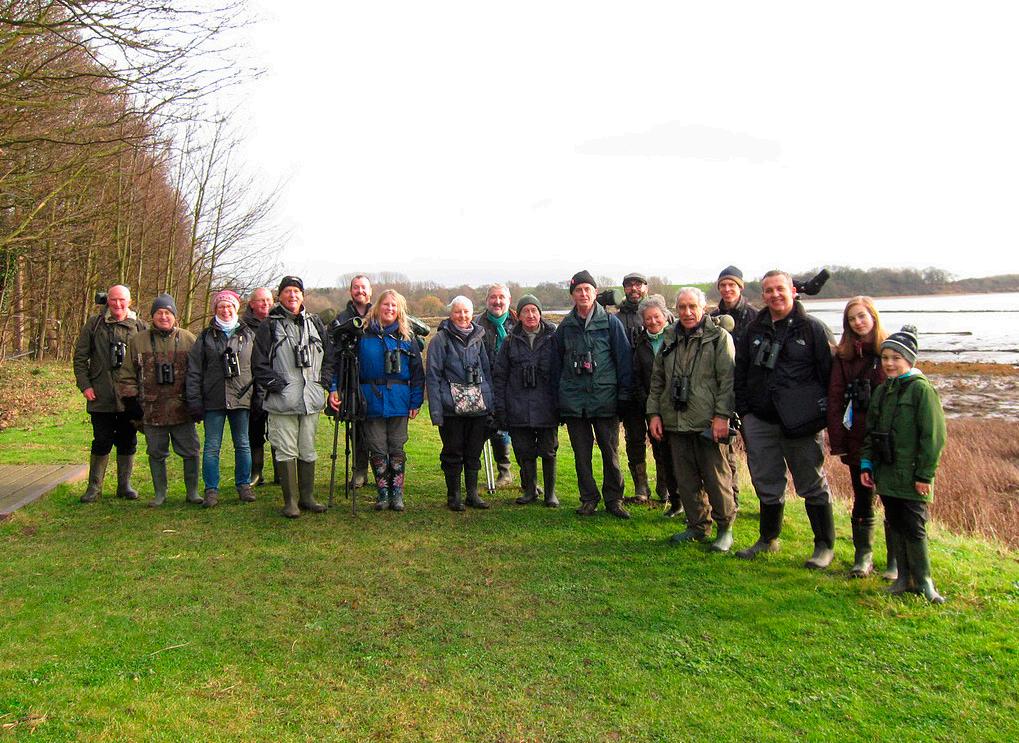
Actively lobbies to protect key Suffolk habitats
Provides a county-wide field force of bird surveyors
Promotes BTO bird surveys and organises special SBG surveys

Strong web presence - www.suffolkbirdgroup.org
Active Twitter feed - @suffolkbirds1
Quarterly magazine - The Harrier
Annual review - Suffolk Birds report
Annually (20+) field trips - ideal for novices or experts and young or old alike
Opportunities to visit hot spots and receive practical ID tips in the field
Programme of talks and presentations - variety of topics (county, national, or international) with quality speakers
Assists with conservation projects to improve breeding success
- Swifts
- Barn Owls
- Peregrines
- Waders
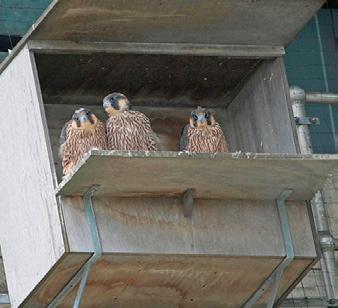
Partners with Suffolk Wildlife Trust and other bird groups
Assists with funding for bird hides and other birding amenities
Contributes to community events, including dawn chorus walks
Provides bursaries for special projects