Kolesnikova_Hostage

Page 1


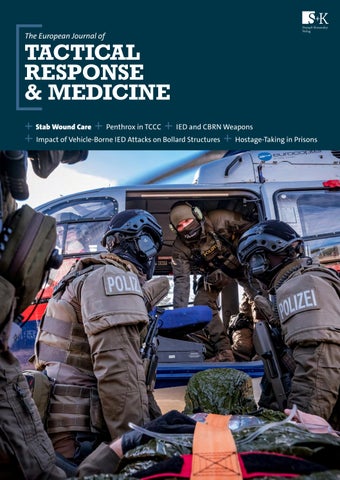
The European Journal of

TACTICAL RESPONSE & MEDICINE

Stab Wound Care   Penthrox in TCCC   IED and CBRN Weapons

Impact of Vehicle-Borne IED Attacks on Bollard Structures   Hostage-Taking in Prisons
and Emergency Management (ICPEM), UK

lina.kolesnikova@ rossnova.com

Hostage-Taking in Prisons: Preventive Measures

Hostage crises in prisons are becoming alarmingly frequent. Across Europe, inmates have taken staff and fellow prisoners captive, exposing deep flaws in correctional systems. Understaffing, poor infrastructure, budget cuts, and rising radicalisation have created volatile conditions behind bars. These incidents do not just endanger lives, they test the credibility of prison authorities and public confidence in state institutions. As Europe faces mounting security challenges, the question is no longer whether another crisis will occur, but how prepared authorities will be when it does. Detention facilities must prepare for hostage crises by implementing clear protocols, training staff, and designating coordinators. Staff, on the other hand, need strong situational awareness and quick alert systems. Additionally, agencies must coordinate response plans and immediate actions such as lockdowns.

Rising Hostage Incidents in Prisons

On August 23, 2024, in penal colony 19, Surovikino, Volgograd, Russia, four prisoners, claiming to be Islamic State (IS) supporters, attacked personnel and other prisoners with knives, taking eight staff members and four inmates hostage. The hostagetakers stated that the attack was revenge for the police detaining those involved in the Moscow Crocus City Hall terrorist attack. All four perpetrators were killed several hours later during the rescue operation. Unfortunately, some hostages also lost their lives. Last January, at a French prison in Arles, an inmate, armed with a makeshift shank, held five

staff members (a medical team and a guard) hostage for several hours before surrendering. The authorities revealed that the hostage taker suffered from “significant psychiatric disturbances”.

An increasing number of correctional and detention facilities worldwide have experienced similar incidents. Given the lack of staff and training, budget cuts, poor condition of prison infrastructure, and the growing number of radicalised inmates, an increase in these cases is expected across the European Union (EU). Therefore, EU, federal, state, and local authorities must recognise the problem, assess the response capabilities of all relevant agencies, and develop situational awareness training.

Fig. 1: Hostage situations in prisons are ongoing emergencies that are challenging to resolve (picture generated with AI).

Ongoing Emergencies

Hostage situations are ongoing emergencies that are challenging to resolve. They also influence public opinion concerning the competence of prison authorities through media coverage. Those factors place extreme pressure on politicians and emergency responders who must rescue the hostages without submitting to the demands of the hostage takers.

Spontaneous Actors, Attention Seekers, and Perpetrators with Mental Health Issues

All hostage crises have four stages: before the crisis (pre-phase), during the crisis (hot phase), rescue as soon as the situation permits (cold phase), and an inquiry to establish the adjustments required for long-term stability (new reality phase).

Most prison hostage crises are situational and spontaneous: An inmate or inmates may take a hostage or hostages impulsively in an attempt to resolve a problem, escape a particular situation, or draw attention to a grievance or conflict with other prisoners or the prison administration. Other situations include prisoners with mental health issues who take hostages during an acute mental health episode or to simulate mental illness as part of a ploy to obtain a desired result, such as attention from mental health professionals or a transfer to a psychiatric facility. Finally, some hostage-takers plan their actions as part of an escape plan, a terrorist attack, or to instigate an affray. Such events can be dramatic and result in casualties.

Most such incidents involve inmates being taken hostage. However, an increasing number of cases involve prison staff (guards, management, medical staff, cleaners, and caterers) or prison visitors being taken hostage. Fortunately, most prison hostage situations are resolved by staff within minutes or hours before they escalate. However, some prison hostage situations take longer to resolve. In 2004, the Lewis Complex Morey Unit hostage situation in Arizona took fifteen days to conclude – the longest in US history.

Prevention is Better Than Cure

Failing to prepare is preparing to fail. All detention facilities must have a protocol to resolve and recover from potential hostage crises. Such protocols should include human resources like hostage coordinators as well as non-human resources like maps of the area and building plans.

Human Resources

• continuous situational awareness and prompt alert capability:

– All prison staff must maintain situational awareness so that staff members recognise when a situation is deteriorating or escalating and take the appropriate actions.

– All detention facilities must have a designated hostage coordinator and a system by which staff can inform that coordinator promptly in the event of a hostage incident.

– All staff must be trained to self-filter situations to minimise false alarms.

• hostage situation protocols that includes continually preparing, training, and exercising the following:

– All staff and outside agencies necessary to deal with hostage situations should be designated, and in-house staff must be aware of how and when to contact them. This must include designated coordinators who ensure that the various agencies collaborate appropriately as and when needed. This prevents panic when a crisis occurs and prevents those involved from downplaying the gravity of such incidents.

– All agencies that could potentially be involved in prison hostage situations must have outside agency response protocols in place (e.g. hostage rescue teams, firefighters, medical teams, police and border control).

– Response plans must include a definitions of the criteria that trigger a response, as well as an immediate response procedure. For example, this could include locking down the area and removing everyone not involved in the incident from the immediate vicinity.

Non-human Resources

• Prison staff and other agencies involved in hostage crises must have access to architectural plans of the detention facility and maps of the surrounding area. The architectural plans must include entry and exit gates, the routes to and from such points, perimeter control points (e.g., guard towers), no-man’s land (restricted areas between perimeter fences or walls), prison population and area separation facilities (lockdown controls), surveillance capabili-

Fig. 2: Working with inmates on a daily basis, especially those with violent tendencies, calls for keen situational awareness and realistic, practice-based training.

ties, and blind zones (camera blindspots).

Prison staff must be aware of access and parking facilities for outside agencies, including rescue services, extra prison personnel, and specialist teams.

• All detention facilities must install, test, and maintain adequate communication channels, inmate and staff surveillance systems, and remote-control systems for all doors and gates.

• Detention facilities must have established intelligence collection and dissemination systems. These should include methods and protocols to pass confidential information between staff members promptly. They should also include procedures and protocols for the timely release of information to the public via media outlets to prevent speculation during crises and inform the surrounding population of any dangers they may face.

Legal and Regulatory Frameworks

Federal, state, and local institutions require a legal framework concerning incarceration and procedures in the event of prison crises, including hostage situations. For example:

• All prisoners should be segregated according to the security threat they pose or their vulnerability. This includes segregation between and within detention facilities.

• High-risk prisoners should be held outside of regions with which they are familiar.

• High-risk and vulnerable offenders must be segregated to help prevent hostage incidents.

Lessons Learned Cycle

After hostage situations have been dealt with, prison, federal, state, and local authorities must launch independent inquiries into all operational stakeholders, including the perpetrators and victims. Such inquiries must include recommendations to prevent and deal with similar future circumstances.

Responses to Prison Hostage Crises

Hostage incident response management is crucial to maintaining public confidence in the state and its institutions. Such responses must be timely to minimise future incidents. Federal, state, and local authorities must establish, continuously train, and test response management teams.

Key Aspects to Manage a Prison Hostage Crisis

• All prison personnel, including non-custodial staff, must be trained concerning their role during hostage situations.

• A pre-established oversight committee should plan responses to hostage situations rather than leave such planning to individual agencies. Such planning should include personnel and methods to support and assist victims and all staff involved in such incidents.

• The oversight committee should learn from previous domestic and international hostage situations.

• Both national and local authorities must establish information dissemination centres.

• Federal, state, and local authorities must have legal frameworks to limit the undue political influence of professional and technical personnel involved in hostage situations.

• Federal, state, and prison authorities must establish protocols for inter-agency liaison and cooperation during hostage situations. These protocols must ensure collaborative (non-conflictive) language and attitudes.

• All detention facilities must establish an emergency medical centre for the secure treatment, categorisation, and dispatch of those injured during hostage situations.

• All facilities must consider potential adverse reactions from the local population, including vigilante action by armed actors.

• Prison authorities should avoid public disclosure of sensitive information that might affect rescue operations or provoke public unrest.

• Prison authorities must have a complete dossier that includes information about each inmate’s background, circumstances, violent tendencies, and mental health.

A coordinated, well-rehearsed response to prison hostage crises is the cornerstone of institutional credibility and operational success.

Conclusion

Detention facility crises can include, but are not limited to, natural disasters, fires, floods, affrays, Improvised Explosive Devices (IEDs), hostage taking, escapes, and other actions that jeopardise the security of inmates, staff, and the surrounding population. Therefore, state institutions, including the management and staff at detention facilities, must be well prepared to respond to such emergencies. However, prison crisis response management involves multiple organisations and agencies. Therefore, designated management teams must oversee multi-agency responses to minimise the impacts of any and all prison crises.

References:

1. Arizona Governor’s Advisory Blue Ribbon Panel (Ed.) (2004) Preliminary Findings and Recommendations: The Morey Unit Hostage Incident. Arizona Office of the Governor. https://azmemory.azlibrary. gov/nodes/view/129934 (accessed: 18 November 2025).

2. Kolesnikova L (2022) Dealing with Mass Hostage Taking Events. Crisis Management Framework. Rossnova Solutions SRL, Kraainem.

3. Kolesnikova L (2006) Learning from Mass Hostage Events. Crisis Response Journal 2: 2.

4. Smith JD Jr (2024) Psychological Profiling of Hostage Takers in Prison. World Mediation Organization. https://worldmediation.org/psychological-profiling-of-hostage-takers-in-prison/ (accessed: 18 November 2025).

3. United Nations (UN) (Ed.) (2013) Prison Incident Management Handbook. https://peacekeeping.un.org/sites/default/files/handbook_pim.pdf (accessed: 18 November 2025).

The Author

Lina Kolesnikova is a Fellow and Director of European and International Affairs at the Institute of Civil Protection and Emergency Management (ICPEM), UK. She has researched and written extensively on a wide range of contemporary global issues and is a frequent speaker and moderator at international conferences and events.

Turn static files into dynamic content formats.

Create a flipbook
Issuu converts static files into: digital portfolios, online yearbooks, online catalogs, digital photo albums and more. Sign up and create your flipbook.