Klemmer_The Capabilities Necessary

Page 1


The European Journal of

TACTICAL RESPONSE & MEDICINE

Stab Wound Care   Penthrox in TCCC   IED and CBRN Weapons

Impact of Vehicle-Borne IED Attacks on Bollard Structures   Hostage-Taking in Prisons
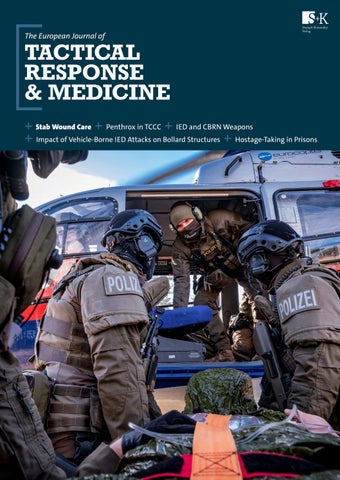
The Capabilities Necessary for the Special Operations Forces (SOF) Medical Chain:

An Analysis of the Required Education and Treatment

The effectiveness of Special Operations Forces (SOF) depends heavily on their ability to sustain a rapid and efficient medical evacuation chain. Delays in casualty treatment significantly increase mortality, making adherence to strict timelines a decisive factor in mission success – immediate self-aid, Damage Control Resuscitation (DCR) within 30 min, and Damage Control Surgery (DCS) within 60 min. Conventional medical services often lack the interoperability, training, and equipment required to meet these demands in dynamic and austere environments. Therefore, it is vital to develop Special Operations-specific medical capabilities, such as highly trained North Atlantic Treaty Organisation (NATO) Special Operations Combat Medics (NSOCMs), mobile DCR units with qualified physicians, and agile surgical teams. This article examines the necessary capabilities, training standards, and interoperability requirements within the SOF evacuation chain to ensure timely treatment, reduce preventable deaths, and maintain operational effectiveness in complex, high-risk missions.

Delays in Treating Front Line Special Forces Operatives Cost Lives

The SOF’s primary operational medical support challenge is the ability to adhere to the timelines of 0 min for self and buddy-assisted rescue, < 30 min for DCR, and < 60 min for DCS in all climates and environments. However, NATO specifies that con-

ventional medical services cannot perform or implement these measures due to a lack of interoperability, training, and equipment.

The casualty treatment and evacuation timelines are determined by human pathogenesis, as defined by US Army Lieutenant Colonel George A. Barbee in his article, “The Strategic Survivability Triad”, and state the following: “95% of trauma patients require

Fig. 1: As part of an exercise, Special Forces practice medical care for wounded soldiers.

surgical interventions no later than 23 minutes after a blunt trauma and 19 minutes after a penetrating trauma.” Furthermore, Kyle N. Remick’s 2014 data confirms that “delays of 59 minutes for a blunt trauma and 39 minutes for a penetrating trauma result in a 50% increase in mortality.” Moreover, British Armed Forces Vice Admiral Alisdair Walker demonstrates in his article, “The ‘Walker Dip’”, that wartime medical advances are often lost due to cuts in funding for medical research and medical equipment after wars, a lack of medical planning, and inadequate adoption of lessons learned in training.

This article is based on the guidelines in “Damage Control Surgery in the Era of Damage Control Resuscitation”. It addresses the minimum training and treatment capability for everyone involved in treating SOF members injured while operating. The following medical capabilities must be platformindependent, adaptable to all climates and environments, and keep pace with the speed and tempo of SOF operations. They must also be integrated into operations in compliance with SOF Tactics, Techniques, and Procedures (TTP).

SOF medical support must meet critical timelines beyond the capability of conventional medical services.

Training and Treatment Capabilities

According to NATO doctrine, NSOCMs and combat medic corpsmen are typically the first to provide advanced trauma care for SOF personnel in tactical environments, following Tactical Combat Casualty Care (TCCC) guidelines and using basic nursing skills. They do so according to the measures described in the NSOCM critical task list, which utilises the MARCH algorithm (Massive Haemorrhage, Airway, Respiration, Circulation, and Hypothermia/Head injury) and includes early blood transfusions. It is important to note that NSOCMs are medically trained SOF soldiers responsible for providing emergency medical treatment to those in their designated units.

To ensure optimal patient outcomes, NSOCMs must accompany tactical units and be capable of providing advanced trauma care in tactical environments according to the TCCC guidelines, carry the necessary medical equipment, and have the ability to rapidly transfer patients to qualified medical personnel for further care.

To prevent a 50% increase in mortality rates, patients must be transferred to a DCR with qualified medical personnel within < 30 min of injury. There-

fore, DCR facilities must be close to tactical operations. The following measures, specified in the NATO Special Operations Medical Technician (NSOMT) Interoperability Framework based on the ten core Prolonged Field Care (PFC) capabilities, should be carried out: ABCDE resuscitation (Airway, Breathing, Circulation, Disability and Exposure/Environment) based on the National Association of Emergency Medical Technicians’ (NAEMT) Prehospital Trauma Life Support (PHTLS) Standard (restricted fluid resuscitation, permissive hypotension), large-bore IV access or IO access, crystalloid limitation when using blood and blood products (massive transfusion protocol), Rapid Sequence Induction (RSI) of anaesthesia and intubation (while considering ketamine as an option for haemodynamically unstable patients), early use of tranexamic acid (TXA), ensuring the patient is warm, dry and clean in preparation for transfer to the DCS. Furthermore, DCR units must

Fig. 2: Using helicopters is essential to shorten evacuation times and improve survival rates.
Fig. 3: The SOF’s primary challenge: to adhere to the timelines of 0 min for self and buddy-assisted rescue

Fig. 4: It is essential that NATO SOF personnel are trained and exercised in the complete evacuation chain during peacetime, crisis, and wartime conditions.

organise casualty extraction even if the injured personnel are in confined spaces or require a high-angle extraction. Much like NSOCMs, DCR units have critical task and equipment lists. However, neither NSOCMs nor DCR units can provide the measures required without a qualified physician. Therefore, DCR units must include qualified physicians. Note: NATO sometimes refers to DCR units as “Special Operations Resuscitation Teams (SORTs)” in doctrines and directives.

After DCR units transport patients to the initial DCS facility, patients are assessed by the Special Operations Surgical Team (SOST). Although the NATO Special Operations University (NSOU) does not define SOST capabilities, the University College Cork defines and teaches SOF personnel the following essential skills as minimum prerequisites: laparotomy for controlling bleeding and intestinal spillage, thoracotomy/clamping for penetrating chest injuries, resolution of cardiac tamponade, temporary restoration of blood flow to limbs using vascular shunts, external fixation of fractures, amputation of mangled limbs, fasciotomy, and decompressive craniotomies.

DCS units must also consider Damage Control Orthopaedics (DCO) to improve patient outcomes and mitigate “second hit” effects from major orthopaedic surgery on patients already compromised by trauma and resuscitation efforts. The core principles of DCO include the following: temporary stabilisation with immediate, minimal techniques to stabilise fractures, haemorrhage control to manage bleeding from the fracture site, and soft tissue management to prevent infection and further complications.

The goal is to stabilise the patient through advanced intensive care nursing so that the Special Operations Critical Care Evacuation Team (SOCCET) can transfer them to the next treatment facility and include a concept for maintaining sedation and analgesia. Patients must be transferred from the DCS to a medical centre capable of carrying out definitive surgery within 24 h of the initial surgery.

The Tägerwille II report, produced by a NATO SOF working group, concluded that specially equipped

and trained personnel with mobile, light, scalable, modular, and flexible surgical capabilities are necessary to meet casualty care timelines in future battlespaces.

DCS units, regardless of platform or environment, must be capable of implementing the DCS procedures no later than 39 min after injury, to prevent a potential increase in mortality of 50%.

Tactical, Technical and Non-Technical Training

NATO requirements stipulate that conventional personnel cannot medically support SOFs and specify that the personnel deployed to do so must be trained in land navigation as well as Survival, Evasion, Resistance and Escape (SERE), including Conduct After Capture (CAC) training, advanced shooting skills, and a minimum of Level 2 English proficiency. The responsibility for fulfilling these obligations lies with national SOF units during the planning and implementation of their TTPs.

Furthermore, NATO requires medical SOF personnel to be trained in various areas, including rotary wing, fixed wing, rucksack, truck, and house operations, including non-technical training for improvised environments, extremely adverse conditions, medical tasks under high stress, combat situations, managing crew resources, and maintaining psychological stability both individually and within a team. This can only be guaranteed if the personnel deployed have undergone a screening and selection process.

In summary, selected personnel must be trained in multi-scenario SOF TTPs to meet the medical personnel requirements for Direct Action (DA), Special Reconnaissance (SR), and Military Assistance (MA) within the necessary timelines. This ensure sustainability at all levels.

Discussion

Considering that a dead hostage or a Dead HighValue Target (HVT) is regarded as a mission failure, the list of medical interventions to be carried out within the specified timelines indicates that SOFs require a coordinated timeline for casualty treatment and transport. Thus, individual treatment options are limited because only specially selected, trained, and equipped personnel can carry them out.

To prevent the “Walker Dip” from occurring, NATO must stipulate that its SOF personnel are trained in and exercised on the complete evacuation chain during peacetime, crisis (NATO Article 4), and wartime conditions (NATO Article 5), within the framework of interoperability.

Tab. 1: Level of Medical Treatment

Level 1 at the point of injury

Level 2 less than 30 min

Self and Buddy-Assisted Aid Damage Control Resuscitation (DCR)

• combat medic/corpsman skill level

• NSOCM Critical Task List (NSHQ-MED Directive 075-001(B))

• NSOMT Critical Task List (NSHQ-MED Directive 075-001(B))

DCR capabilities:

• <c>ABCDE resuscitation

• large-bore IV access or IO access

• use of blood and blood products

• activation of a massive transfusion protocol

• RSI of anaesthesia and intubation

• early use of TXA

• perform regional anaesthesia

• ketamine anaesthesia

• advanced diagnostic

• advanced nursing

Technical capabilities:

• work under confined space conditions

• extraction

• high-angle rescue

Level 3 less than 60 min

Damage Control Surgery (DCS) including Damage Control Orthopaedics (DCO)

DCS capabilities:

• laparotomy for controlling bleeding and intestinal spillage

• thoracotomy for penetrating chest injuries/ clamping

• resolution of cardiac tamponade

• blood flow to a limb using vascular shunts

• amputation of mangled limbs

• fasciotomy

DCO capabilities:

• minimal techniques to stabilise fractures

• external fixation of fractures

• soft tissue management

En route care preparation to perform 2nd look in higher echelon:

• provide platform with diagnostic and ventilation options

• provide safe redosing and secure medication handling during transport for enduring sedation

Timelines outside the doctrinal framework

Prolonged Field Care (PFC)

PFC capabilities:

• monitoring and advanced diagnostic

• fluid management

• RSI capability with subsequent airway maintenance skills

• management of ventilation and oxygenation

• enduring sedation

• advanced nursing skills

• prepare patient for en route care focused on all platforms

References:

1. Barbee GA (2022) The Strategic Survivabillity Triad: The Future of Military Medicine in Support of Combat Power. National Defense University Press. https://ndupress.ndu.edu/Portals/68/Documents/ jfq/jfq-107/jfq-107_102-115_Barbee.pdf (accessed: 11 September 2025).

2. Committee on Tactical Combat Casualty Care, Prolonged Casualty Care Working Group (Eds.) (2023) Consensus Statement. https:// prolongedcasualtycare.org/2023/04/10/official-joint-cotccc-andprolonged-casualty-care-working-group-consensus-statement/ (accessed: 11 September 2025).

3. Lamp CM, MacGoey P, Navarro AP et al. (2014) Damage Control Surgery in the Era of Damage Control Resuscitation. Br J Anaesth 113 (2): 242. DOI: 10.1093/bja/aeu233

4. Medby C, Forestier C, Ingram B et al. (2024) The Tägerwilen II Report: Recommendations from the NATO Prehospital Care Improvement Initiative Task Force. Transfusion 64 (2): 58. DOI: 10.1111/trf.17760.

5. North Atlantic Treaty Organisation (NATO) (Ed.) (2017) NSHQ Directive Medical Standards and Training.

6. Paul (2024) Position Paper – 10 Essential Core Capabilities for Prolonged Field Care. https://prolongedfieldcare.wordpress. com/2015/02/09/10-essential-core-capabilities-for-prolonged-fieldcare (accessed: 11 September 2025).

7. Remick KN, Schwab CW, Smith BP et al. (2014) Defining the Optimal Time to the Operating Room May Salvage Early Trauma

Deaths. J Trauma Acute Care Surg 76 (5): 1251. DOI: 10.1097/ TA.0000000000000218.

8. Rotondo MF, Schwab CW, McGonigal MD et al. (1993) ‘Damage Control’: An Approach for Improved Survival in Exsanguinating Penetrating Abdominal Injury. J Trauma 35 (3): 375.

9. Walker AJ (2018) The ‘Walker Dip’. Journal of the Royal Medical Service 104 (3): 173. DOI: 10.1136/jrnms-104-173.

Klemmer is currently deployed as 2iC DEU SOST and a member of the NATO Panel for NATO SOST. With over 1,000 days of overseas deployment experience, he has served in all positions within the evacuation chain and has also supported medical plans and operations positions during deployments.

The Author
Frank

Turn static files into dynamic content formats.

Create a flipbook
Issuu converts static files into: digital portfolios, online yearbooks, online catalogs, digital photo albums and more. Sign up and create your flipbook.