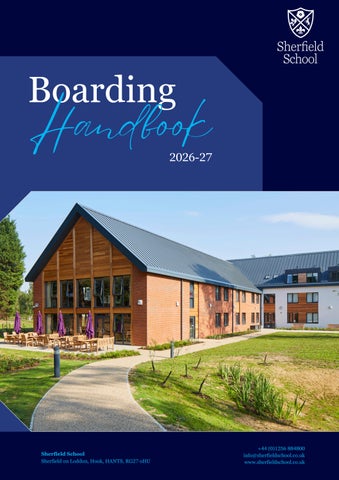
Boarding
Handbook
2026-27
Sherfield School Sherfield on Loddon, Hook, HANTS, RG27 oHU
+44 (0)1256 884800 info@sherfieldschool.co.uk www.sherfieldschool.co.uk
Welcome to
Archers Lodge
Head of Boarding and House Parent
Welcome Oliver Bailey and Abi Robertson Head of Boarding and House Parent
“
Being a part of the Sherfield boarding community for six years, I can confidently say it has played a profound role in shaping who I am today. It has allowed me to grow into an independent and mature individual through the support of dedicated staff who genuinely care about your wellbeing. Living alongside boarders who are from different backgrounds helps you to better understand people and form meaningful friendships that feel like family. Your time here will be spent forming memories, lifelong relationships, and personal growth that you can look back on long after you leave.
Welcome from the Boarders
“
Being a part of the Sherfield boarding community for six years, I can confidently say it has played a profound role in shaping who I am today. It has allowed me to grow into an independent and mature individual through the support of dedicated staff who genuinely care about your wellbeing. Living alongside boarders who are from different backgrounds helps you to better understand people and form meaningful friendships that feel like family. Your time here will be spent forming memories, life-long relationships, and personal growth for you to look back on long after you leave.
Nini Head Boarder
Head of Boarding and House Parents The boarding house is run by the Head of Boarding, Mr Bailey, the House Parent, Mrs Robertson, the Resident Matron, Miss Thomson and supported by a team of resident and visiting tutors. Please contact the house staff about any boarding-related concerns via the following email address BLT@sherfieldschool.co.uk, call +44 (0) 1256 884 800, or the duty phone 07856 157 585.
Co-Educational Boarding Archer’s Lodge is a co-educational boarding house for boarders from Year 5 and above. This allows boarders to mix with a wide range of others beyond their own peer group, and means that siblings have the opportunity to socialise in the house should they wish to. The majority of rooms are twin rooms and boarders are expected to share. Boys and girls socialise together in our shared spaces, but different corridors house boys and girls separately with those of similar ages grouped together. Boys’ corridors are strictly off-limits to girls and vice-versa. There are alarms on each corridor which are set every night to ensure the safety of boarders. At school, each pupil is allocated a Tutor at the start of the year with whom they liaise regularly and this Tutor will contact boarding staff regarding any concerns in school.
Boarding Ethos Archer’s Lodge boarding house offers a high standard of facilities and residential care in a school which possesses all the advantages of a boarding and day school on the same site. The majority of boarders at Sherfield are full boarders; others are weekly boarders, returning home on a Friday evening. However, there is also the opportunity for all students in Year 5 and above to flexi-board and we have some day students that board on an ad-hoc basis throughout the year. Archer’s Lodge is the boarders’ home during term time and we expect all students to be polite, courteous and respectful as well as helpful towards their peers and adults in the house, with the aim of creating an atmosphere of tolerance, optimism and trust. We endeavour to develop students so that they are able to take responsibility for themselves, for others and for their environment, as well as to develop qualities of leadership and the ability to work as part of a team. There are regular Boarding Council meetings which allow boarders to have a say in house matters. Boarders enjoy a close knit and vibrant community in which there are many activities and facilities available outside of school hours and at the weekend. Boarding enhances the educational experience for all students, both day and boarding, in a number of ways. The school strongly believes in a values-based education and boarding reinforces the school’s values of Respect, Courage and Kindness which Sherfield regards as important preparation for a pupil’s life beyond school.
The boarding team, ELT and wider school community aim to fulfil the following:
Respect Develop a boarding culture rooted in mutual trust, respect, and support, where each boarder feels confident engaging with any member of the community, staff or pupil, knowing they will be treated as a valued individual Provide safe, comfortable accommodation that supports a healthy lifestyle and promotes the overall welfare of each boarder Develop the boarders’ qualities of leadership and the ability to work as part of a team
Courage Foster independence, responsibility, and life skills in line with the school motto ‘Ad Vitam Paramus’, while encouraging individual excellence and holistic personal growth Provide the conditions for boarders to develop their intellectual and academic talents, and participate in activities in an atmosphere which values and recognises effort Provide a range of activities, hobbies and opportunities which will assist in the personal, moral, social and cultural development of each boarder Maintain a culture where boarders feel able to turn to members of staff to share the good things in their lives as well as being able to turn to them for advice and support during times of difficulty
Kindness Cultivate a tolerant, open community where boarders and staff work together and enjoy the shared benefits of community life. Encourage boarders to treat new members of the community with kindness and sensitivity, supporting and helping them to settle in to the daily routines and values of the school
Behaviour Sherfield School is a close-knit and friendly community. All members are expected to behave in a manner that promotes cohesion and creates a positive impression for visitors, parents, and the public. Boarders are encouraged to treat the boarding house as their home and to observe the common-sense rules of communal living. The school has comprehensive behaviour, antibullying, and e-safety policies available on the school website. Behavioural expectations are part of the induction for all new students. Online Behaviour Students must adhere to the following guidelines to ensure safety and responsible conduct online: Do not access other students’ login accounts or share passwords. Do not share or distribute images of others without permission, especially if it could cause offence or break the law. Do not install or store programmes that compromise the integrity of the school network. Do not use others’ original work without written permission. Do not download copyrighted materials such as music, videos, or games illegally. Do not access illegal or inappropriate content that may cause harm or distress. Do not use software to bypass the school’s filtering and security systems (Smoothwall). House staff will monitor online behaviour and address any concerns. Smoothwall alerts staff to attempts to access inappropriate material, which will be investigated. Students are responsible for their online conduct and may face disciplinary action for breaches of the ICT agreement or behaviour policy, whether incidents occur inside or outside school.
Behaviour in Boarding Houses Boarders are expected to: Treat others with respect. Keep personal possessions safe and tidy. Clear up after themselves. Respect communal and shared areas. Care for the boarding house environment. Abide by school rules and national laws. Fairness and consistency are key values; all students, boarding or day, should be treated equally and fairly. The boarding house should be a safe and secure place where students feel comfortable and confident. Anti-social, immoral, or illegal behaviour is unacceptable. Boarders should report any such behaviour immediately. Room and Property Furniture is fixed or heavy and must not be rearranged. Students are responsible for keeping their rooms tidy; staff are responsible for cleaning. Students will be liable for damage to property or furnishings. Bullying Policy Sherfield School maintains a zero-tolerance stance on bullying, which includes: Physical, verbal, online, and offline bullying. Bullying related to protected characteristics, age, gender, power imbalances, or any other reason. All incidents of bullying must be reported to staff promptly to ensure swift action.
Boarding
Life
Boarders Return Day
Wednesday 2 September 2026 10:30am - 11:30am: Arrival of new boarders 11:30am - 12:30pm: Window for visiting the school uniform shop 1:00pm - 1:30pm: Boarders and Parents Induction 1:30pm - 2:00pm: Tour of the school 2:00pm - 2:45pm: Lunch in dining hall + parents depart 3:00pm: Returning boarders arrive 5:30pm - 6:30pm: Dinner in boarding house + parents depart 6:30pm: Whole house meeting 7:30pm: Fire drill
Arriving and Departing Arrival Boarders must return to the boarding house the day before lessons begin each term and half-term. The specified arrival time is between 2:00 pm and 8:30 pm, unless otherwise advised by the Head of Boarding or House Parents. An evening meal is provided on the arrival day. Boarders who are unwell should not return to school until they have fully recovered, to protect the boarding community's health. Departure Boarders must leave the school by 5:30 pm on the final day of each term and half-term. All boarders must be present for the full duration of the term. For students on a Student Visa, please note that unauthorised absences may affect visa status. Travel Parents/guardians are responsible for arranging transport and must complete a Destination Form for each term. The school recommends using Alpha Cars (Email: alphacars2000@aol.com | Tel: 01256 444444), a trusted local taxi provider. If travel plans are delayed or change unexpectedly, the boarding staff will ensure students are supervised until collected. A letter will be sent prior to each holiday period requesting confirmation of travel plans - please ensure this is returned promptly.
Introduction and Google Classroom All boarders will receive induction training upon arrival. This induction includes key information about boarding routines, regulations and expectations. The induction information will also be shared via our Google Classroom, which all boarders need to join. Information about trips, cleaning rotas, Google Forms, etc., will all be published on the ‘Archer’s Lodge’ Google Classroom. The code is vgenehw and posted around the house. House staff will, from time to time, post assignments and surveys for boarders to complete, and boarders are expected to complete them in a timely manner.
What to bring What should boarders bring with them? Sherfield School provides many essentials for boarders, including bedding (pillows, duvets, sheets, and towels), exercise books, and textbooks. Laundry is managed by House Staff, though Year 10 students and above may choose to do their laundry themselves. Boarders are encouraged to bring personal items to make their rooms feel comfortable, but are asked to limit belongings to two large boxes or cases for storage purposes. Uniform and school supplies can be purchased in advance from Stevensons, online at www.stevensons.co.uk, or via the second-hand uniform shop.
Key clothing and personal items include: Full Sherfield School uniform and PE kit Casual clothing for weekends and evenings, including a coat for cold or wet weather. Footwear: smart shoes, casual shoes, trainers, slippers Outerwear: a warm jacket and a waterproof coat ALL clothing should be clearly named before you arrive at the boarding house. Boarders will also need: Towels can be provided, but you are welcome to bring your own Toiletries and personal care items Snacks - please note we are an allergy-aware school. No products containing nuts are allowed. Boarders have access to a fridge and a freezer, but we ask that they bring only a limited amount of food at any one time. We encourage boarders to make their room feel homely, so you are welcome to bring: Your own bedding Decorative items (string lights and pictures should not be stuck on walls) A reading lamp An Alexa, an alarm clock, or a speaker (with batteries)
What not to bring For safety reasons, the following items are not permitted in the boarding house: Aerosols Electrical items such as heaters, fridges, kettles, and cookers Nut products Energy Drinks are not permitted in the house A full list of electrical items that are permitted/not permitted can be found in the FAQs section at the back of this handbook.
Uniform and Appearance The rules and regulations for uniform and appearance are covered in the induction. Boarders are expected to arrive at school looking smart as they wish to reflect the school when attending normal and weekend school events. Details of the uniform for each year group/phase are available in the Uniform handbook and the appropriate phase handbook Boarders may wear their own clothes at the weekend, but these should be of an appropriate nature and should not contain slogans or words that could be considered offensive. Boarders must change out of uniform after dinner so that it is in good order for the following day. All school uniform must comply with the lists published separately in the pupil handbooks. All items of clothing and kit, including boarders’ casual clothes, should be clearly marked with names and initials in permanent pen or a name label.
Hygiene Boarders are expected to maintain high standards of personal hygiene by showering daily, especially after physical activity, and regularly changing clothes, including school shirts, underwear, and socks. Bedding such as sheets, pillowcases, and duvet covers should be changed regularly (at least once a fortnight), which is checked by house staff. Students should keep their rooms and communal areas tidy, use the 30 minutes after device collection to prepare for bed, and ensure shower curtains remain inside the shower to prevent water spillage. Spare toiletries are available from staff or can be purchased locally, and gentle reminders will be given to support good hygiene practices.
Food and Kitchen Use Kitchens are available for use during free time until 9:30 pm. Meal preparation must conclude by this time; however, drinks before bedtime are permitted. Food may be stored in labelled containers within cupboards and refrigerators, with the following restrictions: nuts, fresh fish, and meat are prohibited. All cutlery, plates, and bowls must be placed in the dishwasher; items should not be left submerged in sinks. Evening duty teams assist with cleaning the common rooms. Hot food is not permitted to be consumed or stored in bedrooms. Rubbish must be disposed of in bins; food should never be left open in rooms to prevent ant infestations. Students in Year 9 and above may use the induction hob for cooking, provided they are supervised by a member of staff in the common room. Takeaways may be ordered on Fridays, Saturdays, Sundays, or special occasions with prior permission. Orders must be placed before 7:00 pm, and staff should be informed to facilitate delivery.
Daily Routines All daily routines and schedules are explained during induction training and are clearly displayed in the house lobby. It is important that boarders adhere to these routines in order to maintain a respectful and well-organised community. Morning Routine 07:00 – Wake-up time. 07:40 – Morning roll call. Punctuality is essential, as lateness affects the entire boarding house. If a student is late more than five times in a half term, appropriate action will be taken to support the student. 07:45 to 08:25 – Breakfast. All students except 6th Form are expected to remain in the dining room until 08:25. Afternoon & Evening Routine 16:30 – Students in Years 5-9 attend after-school clubs for a minimum of 3 nights per week. Students in Years 10–13 may return to the boarding house at this time if they are not participating in a club Note: Homework Club is not available for boarders after school as we have designated homework time in our evening routine. 17:30 – Evening roll call 17:40 – Dinner 18:30 – Prep (evening study period) -Years 5–8: 30 minutes -Year 9: 1 hour -Years 10–13: 1½ hours Prep is supervised for Years 5-9. Students in Years 9 and below will work in the upstairs common room. Students in Years 10-13 may complete prep in their rooms. On Wednesdays, prep is reduced to 30 minutes to allow time for room tidying, participation in activities, or extended free time. Students who are behind on academic work or whose homework is not completed to a satisfactory standard, as determined by their subject teachers, will be placed in supervised prep sessions.
Bedtime and Device Policy Boarders are permitted to bring devices to the boarding house, but all of these must be declared and listed with the boarding staff upon arrival. Boarders in Years 5-9 hand in their devices 30 minutes before bedtime. Boarders in Years 10-13 may have their access to devices restricted as part of a sanction. Devices are not permitted at mealtimes. Years 5–8 Devices must be handed in by 20:00 Bedtime is at 20:30 Year 9 Devices must be handed in by 21:00 Bedtime is at 21:30 Years 10–13 Devices do not need to be handed in. Bedtime is at 22:00 On Friday and Saturday nights, all bedtimes are extended by 30 minutes. The device cupboard will reopen at 10:00 AM on Saturdays and Sundays.
Digital Technology and Screen Guidelines Access to digital technology is an essential component of student education and daily life, particularly for boarders. All students will be provided with full accounts upon arrival. The school is committed to ensuring good access to digital resources and expects students to use these responsibly, adhering to all guidelines outlined in the school’s policies. Purpose: Digital technology primarily supports learning but should also be embraced for its broader benefits when used responsibly. Personal Safety: Students must report any online behaviour that causes discomfort to themselves or others and must keep their usernames and passwords confidential. Screen Time and Usage: Educational Use: Digital tools are integral to interactive learning, and teachers encourage their effective use in lessons. Addiction: Excessive screen use can affect concentration, relationships, and learning; students should monitor their screen time with support from house staff. Mental Health: Social media and screen use can affect wellbeing; students are expected to treat one another with respect and kindness. Physical Health: Screens can help maintain a balanced lifestyle by monitoring sleep and diet. Community: Mobile phones are prohibited during the school day and at dinner to promote a positive learning environment. Phones found in use during these times will be confiscated overnight. An exception is made for Friday night dinners at the Head of Boarding’s discretion. Responsible Use: Students must avoid accessing harmful or inappropriate material. The use of VPNs is prohibited. Parents are requested to ensure devices are free of inappropriate content before boarding, in support of the school’s duty to maintain a safe environment. Safeguarding: The school employs monitoring systems such as Smoothwall to protect students, and misuse of school networks or data connections is not tolerated.
Weekends Weekends offer boarders a variety of cultural and recreational opportunities, both locally and further afield. Students may choose to participate in organised boarding trips or arrange their own plans to meet with friends or family, subject to school approval. With at least six activities scheduled each weekend across distinct activity blocks, there is something to suit every interest. Some activities are compulsory, others are optional. Year 8 and below are required to sign up for at least four activities Year 9 are required to sign up for at least two activities Year 10 and above are required to sign up for at least one Activity sign-ups must be completed by Tuesday evening each week, with reminders provided during dinner on Monday and Tuesday. An example of our weekend activities:
WeekendLeave
Permission for weekend leave must be submitted in writing to the Head of Boarding at least 24 hours in advance. Boarders must agree on a return time with duty staff and sign in upon their return to the house. Any leave outside agreed-upon times requires the Head of Boarding’s consent. When staying with a host family, both the boarder’s parent/guardian and the host, who must be a responsible adult, must confirm arrangements with the Head of Boarding. During the visit, care responsibility transfers to the boarder’s guardian. Hosts are expected to provide safe and suitable arrangements, including transportation, food, accommodation, and activities, with the boarder’s safety as a priority. Hosts must ensure boarders return directly to school, and any changes to plans must be communicated to House staff immediately. Weekend stays in hotels or bed-and-breakfasts without an acceptable responsible adult are not permitted. Boarders should keep contact details for the House staff and notify their guardians or duty staff promptly if plans change or if they feel uncomfortable. Students in Years 9–13 may sign out to visit Basingstoke, provided their parents have signed the relevant high-risk form. Students in Year 9 must be in a pair or group; older students may take a taxi on their own. Students aged 16 and over may sign out to walk to the village, while those under 16 are escorted by a member of the duty staff.
Curfew The school gates close at 8:30 PM every evening, including weekends, serving as the curfew for the boarding house. This curfew applies during term time and on returning days at the start of terms or half terms. Therefore, all boarders must return to the house before 8:30 PM to ensure they can access the school site and the boarding house.
Door Alarms For the safety and security of all students, boarding house corridors are alarmed overnight. The alarm system is activated at 10:00 PM and deactivated at 7:00 AM on weekdays, and from 10:30 PM to 8:30 AM on weekends. Once activated, opening any alarmed corridor door will trigger the system. These alarms are to be used only in cases of emergency, such as illness or injury. If you do trigger an alarm, you must remain by the door you opened; a member of staff will attend to you as soon as possible.
Caring for
Boarders
Guardians at Sherfield (as per the Guardians and Lodgings Policy) Appointment of Guardians Parents are responsible for appointing a UK-based guardian for their child if the parents do not reside in the UK. This guardian will act on the parents’ behalf while the boarder is at school and must be approved by the school. Guardianship Requirements The school ensures guardianship arrangements promote your child’s welfare, health, and emotional wellbeing. Guardians must be regularly based in the UK during term time and be contactable at all times. Guardians who frequently travel abroad are not suitable. The school will periodically check guardianship arrangements through interviews and surveys. If guardianship arrangements are found to be unsuitable, the school may request a change of guardian. Guardian Responsibilities Serve as a key contact for the school, parents, and your child Care for your child when they are signed out of school and during any temporary school closures or emergencies Arrange travel to and from school at the beginning and end of terms. Provide educational and pastoral support, including attending events such as matches or concerts where possible Liaise with the school regarding holiday plans and provide safe accommodation during half-terms and school holidays Attend Parents’ Meetings if agreed with you Support your child’s wellbeing, advocate on their behalf, and work with the school to address any concerns Be able to attend the school within 48 hours if necessary. Additional Information Any arrangements for lodgings or homestays for students without guardians must be arranged by parents or guardians Senior boarders only live with guardians who have been specifically vetted by the school to ensure their suitability A UK-based guardian or parent must be responsible for your child whenever they are off the school site (except during supervised school trips) If the school has any concerns about guardianship arrangements, we will contact you promptly to discuss and resolve the matter
Safeguarding and Welfare Sherfield School’s Safeguarding Policy [which is available on the school’s website alongside other relevant policies] is applied within Archer’s Lodge boarding house. If a border has any concerns, they can report them to any member of staff, who will respond in the most appropriate way possible and within the guidance set out in the policy. There is information in the house (including a range of national websites and phone lines offering support on specific issues), as well as members of the school whom boarders can contact to raise complaints or concerns. There is also a range of external organisations, and an Independent Person, whom boarders can turn to should they need additional help.
Need to talk? In the boarding house, students may have close friends who can help, or perhaps a senior boy or girl to whom they feel they can turn to, including the Head Boarder. House staff will always be ready to help, or any other members of staff to whom the pupil feels they can comfortably talk. Students are also reminded that they can talk with the following, to highlight just a few: Your Parents or Guardians The Healthzone Child Line – FREEPHONE 0800 1111 The Independent Person – see the poster in the house Office of the Children’s Commissioner - 0800 528 0731
Complaints and Concerns Students wishing to raise a concern should initially speak to House Staff and may bring a friend for support. Suggestions for house changes or activities can be made at boarding council meetings or by speaking with the Head Boarder. Additional avenues for discussion include Tutors, Matron, House Parents, Head of Year, Head of Boarding, Boarding Council, the Independent Person, or other staff members. Complaints should be directed to the Housemaster or duty staff; if the complaint concerns these individuals, students should contact Ms Taylor, the Head of School. The Independent Person is also available for confidential support. Contact details and procedures are posted on the noticeboard.
Medications and Illness Medical Care 1. Medical Registration All overseas and non-UK full boarders are registered with local health services by the school nurse upon arrival. UK boarders and weekly boarders will be given the option to register locally with the school if they wish. The school works with local GPs and dental practices to ensure access to medical and dental care as needed. Any routine appointments (e.g., dentist, optician) or ongoing medical conditions must be clearly communicated and recorded in the school’s internal medical system. The school medical and house teams work closely to support boarders' health needs. 2. Medication Policy All medications, including vitamins and supplements, must be handed in to the school nurse or boarding staff on arrival. Prescription medications must be in their original packaging, clearly labelled with the student’s name, and we may ask for a copy of the written prescription. Medication is not permitted in student bedrooms – prescription or nonprescription. Medications will be securely stored and dispensed twice daily (AM and PM) from the medical office. The following are strictly not allowed: Self-medicating without supervision Sharing medication with other students First aid kits are available around the boarding house, and the boarding staff are all First Aid trained. 3. Illness & Medical Support If a boarder feels unwell, they must report to the school nurse. If experiencing symptoms such as a high temperature, vomiting, or diarrhoea, the student may not attend lessons. In such cases, they will be cared for in the Health Centre or in the boarding house and monitored until they are either collected by their parent/guardian or they are well enough to return to school activities.
English Language Sherfield School celebrates its diverse community, welcoming the cultural richness brought by many nationalities. Our academic instruction is delivered in English, and international students are expected to proactively develop their English proficiency with the school's support to ensure full participation in all aspects of school life. Key Principles: All languages are valued equally and should be respected Students may speak their native languages without undue restriction, provided it does not cause exclusion or isolation English is the primary language for instruction and communication; international students must actively pursue fluency, with this expectation upheld by staff and parents The school balances individual language rights with the collective needs of the community Both academic and informal English skills are encouraged for international students Integration, mutual respect, and inclusivity are actively promoted among all members of the school All students are expected to demonstrate language sensitivity and courteous behaviour Language Use Expectations: English is to be spoken during all lessons; peer communication requiring clarification must have teacher approval Outside lessons, in communal areas such as corridors, boarding houses, queues, and dining spaces, English use is encouraged, though native languages are permitted if they do not exclude others The community is reminded of language’s role in fostering inclusion and should strive to be welcoming English-speaking students are encouraged to recognise that English is a second language for many peers and to support inclusivity by moderating language and providing explanations when needed
Provision for Boarders with Particular Religious, Dietary, Language or Cultural Needs The strength of Archer’s Lodge lies in the diversity of its student community. Many of our students are either secular in their culture or from cultures with older, more precise cultural, religious, or dietary requirements. We will always encourage their participation and support in following a particular religious or cultural festival, for example. Dietary requirements are respected in the initial forms sent to parents before students join the school. Absence for cultural or religious reasons must be approved by the pupil’s Head of Phase, and Boarding staff should be informed of any travel arrangements or planned absence from the house.
Fire Precautions and Practices Fire safety is of paramount importance, and it is essential that every boarder understands and strictly follows all related procedures. Fire exits are clearly marked throughout the boarding house, and prohibited items such as lighters and matches are not allowed on school premises. Regular fire drills are conducted to ensure all boarders can evacuate safely in an emergency. Boarders must adhere to the following safety rules: No matches, lighters, or smoking materials are permitted anywhere on school grounds Electrical equipment may only be used in rooms if it has been checked and approved by staff Corridors must be kept clear at all times to ensure safe and unobstructed escape routes Any faults with electrical appliances or fittings must be reported immediately to a member of staff. Boarders must not attempt repairs themselves Fire Alarm Procedure: If the fire alarm sounds, boarders must: Put on shoes and suitable clothing (after lights out) Leave the building calmly via the nearest fire escape or stairs Avoid running or talking during evacuation Assemble quietly at the designated assembly point in the car park Wait silently and respond when their name is called Only re-enter the building when instructed by staff or emergency services Boarders’ Responsibilities: Keep rooms tidy and corridors free from obstructions Place shoes and coats by the door before bedtime Evacuate quickly, quietly, and sensibly by the nearest safe exit in an emergency Assemble silently at the rear car park assembly point Do not re-enter the building until given permission—no exceptions or excuses The fire plan is displayed in the foyer for reference, and fire safety procedures will be explained during the Boarding Induction upon arrival.
School Grounds To ensure pupil safety, all students must adhere strictly to the school’s ‘out of bounds’ rules. The school site has clearly defined boundaries, access roads, and entrances, and students should consult house staff if uncertain about any restricted areas. Boarders must only use these routes when arriving or leaving the site. Key Guidelines: 1.Students may not leave the school premises without permission from House Staff or the Head of Phase. Sixth Formers may sign out during certain free periods as long as they are up to date with academic work 2.Students must not enter school buildings, including the Boarding house, without a member of staff present 3.Climbing fences or gates around the school is strictly forbidden 4.When visiting Sherfield Village, students must sign out and back in upon return 5.On all off-site trips, students should travel in groups of two or three, carry a charged mobile phone, and have house staff contact details 6.All trip guidelines must be followed without exception 7.Areas beyond the Sports Hall or other locations not visible from the boarding house are out of bounds unless accompanied by staff Out of Bounds Areas: Staff accommodation and the second floor Boys’ and Girls’ corridors Storage rooms Areas outside the immediate sight of the boarding house during boarding times Other students’ rooms when occupants are absent
Frequently asked Questions
Do Boarders Need Any Money? Most expenses are included in the boarding fees; however, boarders may wish to have some pocket money for small purchases at local shops or for souvenirs during trips. All money should be signed in upon arrival, and large cash amounts are strongly discouraged. Prepaid debit cards (e.g., Go Henry) are recommended. The boarding team can assist overseas students with setting up bank accounts. The school does not accept responsibility for money not handed in. When Can Boarders Contact Home? During weekdays, the recommended time to contact family is between the end of prep and lights out, which is typically free time. Communication is encouraged, particularly for overseas boarders. At weekends, boarders have more flexibility to connect with family and friends. For those with significant time zone differences or special circumstances, alternative arrangements can be made through house staff or tutors. What Facilities Are Boarders Able to Use? Boarders have access to a wide range of school facilities, including sports pitches, the sports hall, music practice rooms, and art studios. Use of these facilities is subject to the school timetable and requires staff permission and supervision. Are Boarders Allowed to Go Out? Boarders receive an induction to the school site and the surrounding area upon arrival. Students in Year 9 and above may sign out more independently during designated times, including midweek and weekends. Boarders may visit the local village, and trips to Basingstoke or other locations are organised with prior permission. Certain areas, such as the lake and nearby wooded areas, are out of bounds. All boarders must sign out when leaving the boarding house or school site. Are Boarders Allowed Their Own Food? Boarders may bring a selection of snacks to the boarding house, although all meals are provided in the school dining hall, which offers a healthy, varied menu. The boarding house also provides snacks and treats, and each common room is equipped with a kettle, microwave, and toaster for preparing light evening snacks. Boarders are not permitted to bring or use their own cooking appliances due to health and safety regulations. Please note that Sherfield is a nut-free school.
Can boarders take driving lessons once they are 17? Boarders aged 17 or over may arrange their own driving lessons with approval from House staff. Lessons must not interfere with academic lessons or games commitments unless special permission is granted. Students are responsible for all costs. Can boarders keep a car at school? Boarders are generally not encouraged to keep cars at school. Exceptions may be made with the Head of Boarding's prior agreement. If allowed, boarders need written permission before they can carry other students as passengers. How do boarders sign in and out? Boarders must use the sign-in/out books at Archer’s Lodge with accurate, detailed information, including times. This is crucial for safeguarding, and failure to comply may result in sanctions. How does the school manage safety and security at Archer’s Lodge? The school ensures safety and security at Archer’s Lodge through strict house rules and controlled access. External doors have electronic locks and must remain shut at all times. Students receive an induction covering alarms and emergency procedures. Personal property should be clearly marked, and passports or valuables should be stored in the office safe. Students should report any unknown persons immediately and never share their pin codes. At night, staff on duty secure the house. Students must not enter opposite-sex bedrooms or others’ rooms without permission, and valuables kept in rooms are at the owner’s risk. Exterior doors should never be propped open or opened to visitors or adults without a lanyard. Window blocks must not be removed, and windows should not be forced open. Overall, the building’s security depends on everyone following these rules. Boarders’ Money and Medication Archer’s Lodge provides a secure safe for storing passports and pocket money, which may be accessed as needed. Staff administer all medications, including long-term prescriptions, in accordance with the school health policy. New boarders receive a health induction and security briefing upon arrival. Each boarder is also provided with a lockable drawer in their room for personal valuables. Room Decoration Boarders are encouraged to personalise their rooms to create a homely environment. Each room is equipped with a pinboard for displaying pictures, posters, and other decorations. We ask boarders not to stick lights, photos, posters, etc. to the walls so that they do not chip the paintwork.
Laundry Facilities Washing machines and dryers are available on-site. Senior boarders (Years 10-13) may manage their laundry and ironing independently. Boarders in Year 9 are not permitted to use the laundry facilities, but their laundry is done throughout the week by house staff. All bedding and clothes must be clearly labelled to prevent loss. Bedding is to be changed at least once every fortnight, in accordance with the house bed change routine, typically every other Sunday. Receiving Mail To ensure prompt delivery, all mail for boarders should include the pupil’s full name and be addressed as follows: Archer’s Lodge Sherfield School Sherfield -on-Loddon, Hook Hampshire, RG27 0HU United Kingdom Storage of Possessions During Holidays Boarders may keep their possessions in their rooms throughout the academic year and most holidays. However, during the long summer break, all boarders clear their rooms completely. Unfortunately, we are not able to store pupil belongings as the school prepares for the new term and may host camps during school holidays. Room Allocation and Changes Boarders typically remain in the same room for the duration of the academic year. Any room changes are made at the discretion of the Head of Boarding and occur only when necessary. Room Sharing for New Boarders New boarders are usually paired with existing students to support their transition and help them settle during their initial weeks at school. Supervision of School Facilities at Weekends Use of the sports hall and gym at weekends requires supervision by a member of staff. Boarders are not permitted to use certain equipment or be in the gym without staff present. Age Restrictions on Facility Use Boarders of all ages may use school facilities, but gym users must complete an induction session.
Music Practice Boarders may practise musical instruments in their rooms and can book peripatetic music lessons provided within the school. Pursuing Hobbies at Weekends Boarders with specific hobbies, such as horse riding, golf, or football, may pursue these activities on weekends. Such requests are managed through the activities programme and should be discussed with the House staff to ensure they can be accommodated. What is the school’s policy on electrical items? All electrical items brought into school must comply with British Safety Standards and display the CE safety marking. They are subject to Portable Appliance Testing (PAT) each Autumn term. Unmarked or non-compliant items may be confiscated. Items that heat or cool are generally not permitted in rooms unless explicitly allowed. A detailed list of permitted and non-permitted items is provided below. Prohibited items also include string lights or decorations that cannot be removed without damage. Permitted Items: Cooling fans (excluding electric tower-type hot or cold fans) Laptops and tablets Hair dryers Mobile phones and chargers Music equipment (CD players, docking stations, MP3 players, etc.) Desk lamps (maximum 60-watt bulbs) Hair straighteners or heated hair tools may only be used with a heatproof mat Prohibited Items: Kettles Rice cookers Toasters Sandwich makers Irons Portable electric heaters (oil-filled convectors or fan heaters) Electric blankets Plug-in air fresheners Air fryers Fridges Boarders must immediately report any faults or injuries related to electrical items at any time.
What are the school policies on relationships, smoking, drugs and alcohol? Cigarettes (including e-cigarettes), vapes, alcohol, drugs, and any illegal, anti-social, or dangerous items are strictly prohibited on school premises and in boarding houses. The school enforces a firm disciplinary framework for any breaches, detailed in the Behaviour and Exclusion Policies available on the school website. Student relationships must be appropriate and remain platonic. Sexual relationships are not permitted on school grounds. While socialising between boys and girls is encouraged in common areas, strict separation of girls’ and boys’ living areas is enforced, and students must never enter each other’s rooms. Sixth Form and 18+ boarders are expected to act as role models and are granted freedoms suitable to their age; however, all school rules regarding alcohol, vaping, smoking, and relationships apply equally to them during school hours and schoolrelated activities, including trips and visits. How do boarders celebrate their birthdays? Boarders’ birthdays are always celebrated in the boarding house, and students are given the option of how they wish to celebrate. Parents should notify the House staff of any special arrangements they would like to request.
Term & Key Dates 26-27
Term Dates 2026/27 01
02
03
Autumm Term
Spring Term
Summer Term
Thursday 3rd September to Friday 11th December
Tuesday 5th January Thursday 25th March
Monday 19th April Friday 9th July
Half Term: Monday 15th February - Friday 19th February
Half Term: Monday 31st May to Friday 4th June
Half Term: Monday 19th October Friday 30th October
Bank Holiday: Monday 3rd May Boarders should not book flights to leave or arrive during advertised term-time dates. Boarders' arrival and departure days are as follows: At the beginning of term/half term: Return the day before lessons start. The first day of the Summer term 2026 is Thursday 23 April, the boarders should return on Wednesday 22 April. At the end of term/half term: Leave by 5:30pm on the last day of the half term/term.
+44 (0)1256 884800 info@sherfieldschool.co.uk www.sherfieldschool.co.uk