SUMMER ISSUE 2016
A Special Supplement to
It’s a classic Two Creston men talk about their love of classic cars. ■
By BAILEY POOLMAN
CNA staff reporter bpoolman@crestonnews.com
W
hen it comes to the classics, it’s about the
passion. Bill Stuart and Jim Lippold, both of Creston, know the meaning of passion. They each have classic cars in their garage. Classic cars have a variety of definitions, but generally, the car is a classic if it was made 25 years ago or more. A classic becomes antique in the United States if it is 100 years old.
Humpback sedan,” Stuart said. “We stay with mostly the high-performance-type cars. That’s usually the ones that sell good for us.” Stuart usually finds cars by word of mouth or during a variety of car shows and auctions he attends. These vehicles include a 1928 brown Ford Model A and 1962 white Chevrolet Impala, which is one of his favorites. “It’s something I’ve always been interested in, older cars,” Stuart said. “It’s gotten quite popular in the last 25 or 30 years. ... One thing about an older car is you can have them and not
worry so much about them depreciating.” Stuart’s passion for classics can be seen all across the walls of his office, where framed photos of his family hang interspersed with photos of classic cars on racetracks. Plates with the faces of NASCAR drivers hang there as well, alongside posters and newspaper clippings of more family members. “It’s just like a second love, a love of automobiles,” Stuart said. “The changes that you see over the years and going back to my CLASSIC | 8c
Stuart Stuart, 79, has been in the business of collecting and selling classic cars with his wife and two of their sons for 35 years through the business Hi-Crest Auto. The vehicles are maintained there and either remain part of the collection or are sold to other eager collectors. “We’re very, very picky. We check them out real close. Tony and Billy and I are usually the ones that buy. I just bought a ‘38 Ford
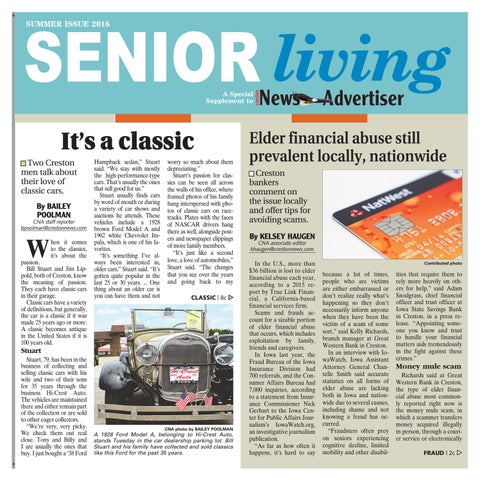
CNA photo by BAILEY POOLMAN
A 1928 Ford Model A, belonging to Hi-Crest Auto, stands Tuesday in the car dealership parking lot. Bill Stuart and his family have collected and sold classics like this Ford for the past 35 years.
living
Elder financial abuse still prevalent locally, nationwide Creston bankers comment on the issue locally and offer tips for avoiding scams. ■
By KELSEY HAUGEN CNA associate editor khaugen@crestonnews.com
In the U.S., more than $36 billion is lost to elder financial abuse each year, according to a 2015 report by True Link Financial, a California-based financial services firm. Scams and frauds account for a sizable portion of elder financial abuse that occurs, which includes exploitation by family, friends and caregivers. In Iowa last year, the Fraud Bureau of the Iowa Insurance Division had 700 referrals, and the Consumer Affairs Bureau had 7,000 inquiries, according to a statement from Insurance Commissioner Nick Gerhart to the Iowa Center for Public Affairs Journalism’s IowaWatch.org, an investigative journalism publication. “As far as how often it happens, it’s hard to say
Contributed photo
because a lot of times, people who are victims are either embarrassed or don’t realize really what’s happening so they don’t necessarily inform anyone when they have been the victim of a scam of some sort,” said Kelly Richards, branch manager at Great Western Bank in Creston. In an interview with IowaWatch, Iowa Assistant Attorney General Chantelle Smith said accurate statistics on all forms of elder abuse are lacking both in Iowa and nationwide due to several causes, including shame and not knowing a fraud has occurred. “Fraudsters often prey on seniors experiencing cognitive decline, limited mobility and other disabil-
ities that require them to rely more heavily on others for help,” said Adam Snodgrass, chief financial officer and trust officer at Iowa State Savings Bank in Creston, in a press release. “Appointing someone you know and trust to handle your financial matters aids tremendously in the fight against these crimes.”
Money mule scam Richards said at Great Western Bank in Creston, the type of elder financial abuse most commonly reported right now is the money mule scam, in which a scammer transfers money acquired illegally in person, through a courier service or electronically FRAUD | 2c
Page 2c— Creston News Advertiser — Wednesday, June 22, 2016
FRAUD: CONT. FROM | 1c
on behalf of others. “Somebody will contact (the victim) and say ‘I need some help with something. If I send you a check, will you send me the cash, and then you can keep the rest?’ And, the check is actually bad, so what happens is when the check comes back bad, the person is stuck paying the full amount even though they sent the cash on to someone else,” she said. At Great Western, there have been other types of fraud or scams reported by senior citizens in the past, but reports are few and far between for aforementioned reasons like shame or lack of knowledge that a scam is occurring.
Mail solicitations At First National Bank in Creston, Assistant Vice President Sydney Hudek said the most commonly reported issue right now regarding senior citizens and fraud involves mail solicitations.
“Financial abuse I don’t think we’ve dealt with all that much. The most that I see, and I don’t know if it’s truly financial abuse, would be the mail solicitations that a lot of customers get,” Hudek said. “Our senior citizens are prone to being very giving people, and a lot of them do get wrapped up into those solicitations they get in the mail.”
Other forms Nationwide, there are several other forms of scams or financial abuse senior citizens should be wary of, according to the FBI website. These include, but are not limited to: • Telemarketing fraud – Fraudulent telemarketers may attempt to sell senior citizens fake products or services by telephone. Telemarketing scams often involve offers of free prizes, low-cost health care products and cheap vacations. • Services not performed – Customers or providers bill insurers for services never given by changing bills or submitting fake ones. • Medicare fraud – Med-
ical equipment manufacturers offer senior citizens free medical products in exchange for Medicare numbers. Because a physician must sign a form certifying equipment or testing is needed before Medicare pays for it, scammers often fake signatures on the forms. The manufacturers then bill Medicare for merchandise or services that were not ordered. • Investment schemes – As they plan for retirement, senior citizens may become victims to investment schemes, which may include advance fee schemes, prime bank note schemes, pyramid schemes and Nigerian letter fraud schemes. • Reverse mortgages – Corrupt professionals in a variety of real estate, financial services and related companies may attempt to steal the equity from a property of an unsuspecting senior citizen. In many scams, victims are offered free homes, investment opportunities and foreclosure or refinance assistance.
Tips to avoid financial abuse Iowa State Savings Bank this month offered a number of tips for senior citizens to avoid falling victim to financial abuse. A few tips are: • Plan ahead to protect your assets and ensure your wishes are followed. Talk to someone at your financial institution, an attorney or financial adviser about the best options for you. • Carefully choose a trustworthy person to act as your agent in all estate-planning matters. • Never give personal information, including your Social Security Number or account number, to anyone over the phone unless you initiated the call and the other party is trusted. • Consult with a financial adviser or attorney before signing any document you don’t understand. • Check references and credentials before hiring anyone. Don’t allow workers to have access to information about your finances. Richards with Great West-
The right way to wash your workout gear (BPT) - If you’re finding more stains on your clothes because the weather is warming up, you’re not alone. You may find yourself doing more loads of laundry during the summer, when outdoor activities like hiking and sports are likely to cause extra stains. To help you take on your growing laundry pile, Whirlpool Corporation’s Institute of Home Science cleaning expert Mary Zeitler weighed in on the best ways to wash workout gear and remove your toughest stains:
lycra and spandex garments inside out before washing. You should also wash these garments in warm - not hot water, and stay away from liquid chlorine bleach which can break down the fabric.
Dirt and mud
Remove excess dirt and mud from the surface and rinse in cold water before adding to the washer. Wash in the warmest water safe for the garment with a gentle detergent and, if necessary, you can follow up with a wash in color-safe bleach for colors or liqWashing athletic uid chlorine bleach for whites. clothes For grass stains, Zeitler says to Zeitler suggests turning check the care label and soak running shorts, yoga pants, the garment in a mixture of de-
tergent and water before add- don’t put your stained clothes ing to the warmest wash that’s in the dryer until you are sure appropriate for the material. it was successfully removed. Another way to wash workSweat and odors out gear is to take advantage Apply liquid detergent or of the PowerWash System a pre-treater to help loosen deodorant, which can trap within the Maytag Front Load sweat and odors. If the odors Washer, which provides great persist, you can always send cleaning power and the ability the garment through another to handle your toughest loads. For more expert tips on cycle before transferring to the laundry, visit Whirlpool Cordryer. No matter what kind of poration’s Institute of Home stain you’re working with, Science. “Friends You Can Depend On”
641-782-6555
Bruce Pearson, Funeral Director
www.pearsonfuneralhomes.com
SM-CP4370000622
ern iterated the importance of not giving out personal information over the phone to anyone not known or trusted. “The scenarios I have seen is (scammers) try to build a relationship,” Richards said. “Sometimes these people who are going to fraud them will spend six months building a relationship with them where they end up trusting them, and then they will fraud them. So, just because you’ve talked to them a few times on the phone doesn’t mean they’re not going to take advantage of you.” Another tip Richards offered is anything that sounds too good to be true typically is. “If (senior citizens) have any questions, they need to contact their local banker,” Richards said. “If they come in and discuss what’s happening and what somebody wants them to do with their money, it would give us an opportunity to counsel them and explain to them what we think may be happening and if it sounds like it’s legitimate.” Hudek said in cases of
fraud at First National, staff may refer clients, or their family members, who are victims to the Consumer Financial Protection Bureau. “Locally, we use Connections a lot, the area agency on aging,” Hudek said. “It’s important for (senior citizens) to be aware of the funds they have, and it’s always good to have a family member involved if there’s any suspicion of fraud. We do have our customers’ welfare and best interest on our minds, and we’ve had training so we are cognizant of anything that might be going on.”
Getting help If you or someone you know suspects an issue of elder financial abuse, local banks and federal agencies suggest you: • Talk to a trusted family member. • Talk to a trusted attorney or officer at your bank. • Contact Adult Protective Services. The Iowa Department of Human Services Dependent Adult Abuse maintains a 24/7 hotline at 1-800-362-2178.
Photo Reprints www.crestonnews.com Click on “Photos” to access our photo store to buy quality reprints of almost any photo in this newspaper...and a lot that aren’t!
STAY FIT TO STAY YOUNG Regular exercise helps you feel well and be able to do everything you want to do. The friendships you form with others in class will sustain you for the long haul.
Join our community of health today! Pick up a fitness class schedule and try one!
Classes for our Active Older Adults: * Tai Chi * Arthritis Aqua * Silver Sneakers * Aqua Interval * Functional Fitness * Aquacise * Parkinson’s & Limited Mobility * Power Walking *Wet-n-Fit
SOUTHERN PRAIRIE YMCA 1201 W Townline, Creston 641-782-9622 www.southernprairieymca.com
Creston News Advertiser — Wednesday, June 22, 2016 — Page 3c
10 smart security steps for seniors (BPT) - From identity theft to home burglary, it’s an unfortunate fact that senior citizens are often a target for criminals. By taking simple security measures while at home and out traveling, you can dramatically reduce the likelihood you or a loved one is victimized. Always lock doors: Whether you’re in a home or an apartment, always keep doors locked. It’s a simple yet effective step to keep property and the residents safe, during the day and in the evening. Secure patio doors: Determined criminals won’t stop even though the front door is locked. Use the Master Lock 265DCCSEN Security Door Bar to restrict patio and sliding glass doors from being pried open. Ask for identification:
When service or delivery people come to the door, ask for ID. If you still feel uneasy, get a number to reschedule the visit and then call the company directly to confirm the employee’s status. Secure small valuables: Whether home or away, use a light portable safe. The Master Lock 5900D SafeSpace Portable Personal Safe keeps cash, documents, electronics and small valuables safe, plus the cable can be wrapped around a fixed object or serve as a carrying handle. Vary routine while home: While home, try to vary the routine periodically. Criminals track when you come and go, so if it’s obvious you’re always gone during certain times, your home can easily be targeted. Maintain routine while
Amana 4 piece Stainless Steel Kitchen Package
2199
rectories and apartment lobbies, list your first initial rather than your full first name. This can help protect your identifi-
cation; strangers won’t know With these simple safety your full name while friends measures, senior citizens can and relatives will recognize feel protected in their homes for years to come. your initial.
$
SAVE$858
MSRP$3666
Sale P Sale Prices rices Va ri Vali Valid lilidd Ju June 22 - Ju July ly 12, 2, 2016
SM-CP4208180624
gone: If traveling, make it seem like someone is home. If you can’t get a house sitter, make sure to stop the newspaper and mail delivery and have a neighbor bring your trash in on the appropriate days. Keep keys close: Skip the obvious doormat or planter and instead store spare keys and access cards securely by using a Master Lock 5422D Push Button Portable Key Safe. Plus, the protective weather cover prevents freezing and jamming. Travel with less: When traveling, avoid drawing attention by wearing minimal jewelry and carrying only the necessary cash. You’ll feel confident and enjoy your trip more when you leave jewelry and other valuables at home. No need to name: For phone books, organization di-
Amana Range Am (AER5630BAS) (AE
• FlexHeat Element • Easy Wipe Ceramic Glass Cooktop
Amana French Door Refrigerator
Amana Over the Range Microwave
(AFI2539ERM)
(AMV1150VAS)
• 24.8 cu. ft. • Farmeless Glass Shelves • Gallon Door Bin
Amana Dishwasher (ADB1100AWS)
• Accusense Soil Sensor • 1,000 Watts Cooking Power • 1-Hour Wash Cycle • CleanRelease Non-Stick • Quiet Rating of 51dB Interior
Page 4c— Creston News Advertiser — Wednesday, June 22, 2016
Do you suffer from a longevity disconnect? (BPT) - They say that age is just a number. For the 10,000 who reach retirement age every day, however, that number may come with a multitude of questions about whether they have done enough to prepare for retirement. The good news is that Americans today are living longer than previous generations. But too many of us don’t realize that this boost in lifespan means we need to fund a retirement that could last for 20 or 30 years. This is what’s known as the longevity disconnect. Calculating how much you need to save for retirement is even more difficult if you don’t realize how long retirement can be.
by Prudential Retirement. A substantial 71 percent of survey respondents fear they may not have sufficient income for their retirement years. Only one in five are highly confident they will have enough to last a lifetime. “Today we have more financial information, education and planning tools available to us than ever before,” says Christine Marcks, president of Prudential Retirement. “But despite the steady drumbeat of headlines about retirement planning, we’re still not getting it right.” Why are people having a hard time saving for retirement? Why are they actually saving less when they need to save more?
What concerns Americans the Blame our brains most? The answer to those questions may surprise
One of the biggest worries Americans have you. Research shows the reason could lie in when it comes to retirement is outliving their how our brains are wired to respond to the money, according to a plan participant survey environment. Humans are conditioned to fo-
cus on survival in the here and now. Yet, our contemporary life demands that we plan for multiple scenarios and contingencies, often with effects that could shape our lives far into the future. Behavioral researchers have found that people actually perceive their future selves as strangers, and many find it difficult to understand the financial needs that “stranger” will have in his or her lifetime. That’s one reason why saving for many years ahead is difficult for us. This and further research from Prudential shows us there are five inherent behavioral biases that make us our own worst enemies when it comes to saving for retirement. Not being aware of increasing life spans (longevity disconnect)Putting off difficult or time-consuming tasks (procrastination)Thinking that bad things only happen to other people (optimism bias)Making decisions based on
what other people are doing (herd mentality) Putting today’s wants ahead of tomorrow’s needs (instant gratification)Smart planning For older Americans approaching retirement, the greatest advice comes from the people who know best: those already in retirement. Many retirees agree that, if they had to do it again, they would take advantage of everything available through their employers. Other advice includes maximizing contributions to your workplace-based retirement plan or IRA, and taking advantage of IRS-allowed catch-up contributions if you’re 50 or older. Retirees also suggest that those approaching retirement assess all the ways they spend money today, and avoid impulse purchases or peer pressure. Careful planning now can help you to achieve your goals of a secure and fulfilling retirement and make it last a lifetime.
In Print, Online & Mobile Star off r t your d the night wit ay info ews an h needrmation d mos to ma you k t of it. e the
Food for Thought Your local newspaper keeps you connected to the faces, places, information and events that matter most to you. With print, online and mobile access, we’ve made it easier than ever to keep your finger on the pulse of what’s happening in our community and around the world.
641-782-2141 • www.crestonnews.com
Creston News Advertiser — Wednesday, June 22, 2016 — Page 5c
Guidance, hope for people living with most common age-related vision problem
(BPT) - Silver screen icon Bette Davis once famously pronounced “getting old ain’t for sissies.” Caring for yourself or a loved one with age-related health issues is no picnic, either. Of all the health issues you may face as you age, vision problems can be particularly devastating. Yet, a new study reveals that many people still don’t understand the leading cause of legal blindness for older Americans - a condition that could seriously affect their quality of life. Age-related macular degeneration (AMD) is the leading cause of vision loss in Americans aged 60 and older, affecting an estimated 15 million people, according to Macular Degeneration Partnership. Prevent Blindness America estimates that 2 million Americans are living with an advanced form, or endstage macular degeneration, where central vision is completely blocked in both eyes and that number is expected to increase as the baby boomer cohort ages. Damage to the macula - the part of the retina that perceives color and fine detail results in the inability to see images in straight-ahead vision, and, therefore, affects
a person’s ability to read, drive, watch TV, focus on small objects, and even see the faces of family and friends. Despite the prevalence of macular degeneration - more than 40 percent of older Americans have it or know someone who does - three out of four people don’t know it’s the leading cause of blindness in people older than 60, according to an awareness survey by Wakefield Research. What’s more, 66 percent say they aren’t confident they could care for a loved one if he or she developed AMD. As macular degeneration worsens and vision diminishes, the need for caregiving increases. In fact, more than a third (35 percent) of people who know someone with macular degeneration say they frequently assist the patient, the survey found. “As their visual acuity decreases, AMD patients may feel the need to ask for help with tasks of daily living, such as shopping, writing checks, or reading menus, hinders their independence,” says Dr. Mark Milner, associate clinical professor at Yale University School of Medicine,
and the co-founder and co-medical director of the Eye Center of Southern Connecticut and Precision LASIK Group. “This puts them at higher risk of feeling depressed, and makes it critical for patients, their caregivers and their physicians to develop an individualized management plan that incorporates a range of treatment and caregiving strategies.” As the need for care increases, the patient becomes more at risk of developing depression and anxiety, a study in Clinical Ophthalmology found. Milner offers some tips for people with AMD and their caregivers: *Make the most of every dialogue with your doctor. Prepare a list of questions to discuss, asking about your specific diagnosis and available treatments *While there is no cure for AMD, lifestyle changes may help slow its progression. If you smoke, quit. Try to lose weight if you need to, and monitor your blood pressure. Be sure to talk to your doctor about these health concerns, too. Simple changes like adjusting lighting and investing in an e-reader that allows you to enlarge print can also make everyday life easier. * Have a serious conversation with your doctor and your family about whether it’s still safe for you to drive. * Seek support. You can find low-vision resource centers and AMD awareness groups across the country. Online resources like the new website, AMDAf-
fectsMe.com, sponsored by CentraSight, can offer comprehensive information about how AMD is diagnosed and treated, as well as stories from caregivers assisting their loved ones living with end-stage AMD. * Research the latest treatments. Medical science is always making progress toward treating incurable conditions like AMD. For example, an FDA-approved and Medicare-eligible surgical device is available for
patients today living with the most advanced form of the disease. The implant magnifies images approximately three times their size onto the healthy portion of the retina, enabling patients to discern the object of interest. To learn more about the implant, visit www. CentraSight.com or call 1-877-99-SIGHT. “As you grow older, it’s important to monitor your vision health, since the early and intermediate stages of macular
degeneration usually have no symptoms,” says Dr. Samuel Masket, a clinical professor at the David Geffen School of Medicine at UCLA. “Only a comprehensive, dilated eye exam can detect AMD. The good news is that preventive and treatment options for patients with macular degeneration have advanced remarkably just in the past 10 years. Now these patients may be able to improve their vision and maintain as much of their independence as possible.”
Rehab to Home
Creston Occupational Therapy Addition • Professional outpatient therapy services • Outpatient and short-term inpatient therapy services • Beautiful private rooms
• • • •
Spacious therapy gym Private entrance Spa tub suite Nurses’ station
1001 Cottonwood, Creston, IA 641-782-8511 www.careinitiatives.org SM-CP3556650622
Page 6c— Creston News Advertiser — Wednesday, June 22, 2016
For Alzheimer’s caregivers, knowledge is power
(BPT) - Michael Snowden was just 12 and his sister 16 when their mother began to exhibit symptoms of Alzheimer’s disease. Although they didn’t receive a definitive diagnosis until seven years later, the need to assume caregiving roles while still in their teens profoundly affected their lives. “Not many people understood the disease or how to take care of her,� Michael says. “We did not really understand the disease ourselves after the diagnosis. Eventually, my sister and I had to take over the caregiving responsibilities. Our lives quickly changed.� The number of Americans with Alzheimer’s is set to triple over the next 35 years. “Unless something is done to change its course, the Alzheimer’s crisis will continue impacting not only the millions of Americans currently living with the disease, but their caregivers, friends and family,� says Ruth Drew, director of family and information services for the Alzheimer’s Association. “Caregiving can become anyone’s
reality. As the prevalence of the disease increases, more people from all walks of life, economic strata and ages will find themselves helping to support someone with Alzheimer’s in the coming years.� Approximately two-thirds of caregivers are adult women - typically wives or daughters of people with Alzheimer’s. A growing number of teenagers and men, however, are finding themselves in a full-time caregiving role. “Facing early-onset Alzheimer’s when my wife, Chris, was in her mid-40s was devastating,� recalls Mark Donham, whose wife passed away from Alzheimer’s in 2011 at the age of 54. “Since we did not have extended family nearby, I decided that I would quit my job and care for Chris full time. We had to live on savings, knowing our financial future would be difficult.� In addition to financial burdens, Alzheimer’s caregivers can become so focused on their role that they neglect their own physical, mental, financial and emotional well-being. In fact, according to the Alzheimer’s Associa-
tion 2016 Alzheimer’s Disease Facts and Figures report, 20 percent of care contributors sacrificed their own medical care by cutting back on doctor visits. “My biggest challenge was trying to figure out ‘how to take care of yourself’ as your loved one declines,� Donham says. For caregivers, he advises, “Be sure to take active steps to take care of yourself so that you can be the best possible caregiver for your loved one.� With more people becoming primary caregivers, the resources provided by the Alzheimer’s Association are more critical than ever. Across the country, Alzheimer’s Association chapters provide face-toface services such as support groups and educational sessions within communities. A professionally staffed 24/7 Helpline (800-272-3900) provides information and advice to more than 300,000 callers each year. Recognizing the growing diversity of Alzheimer’s caregivers, the Helpline also provides translation services in more than 200 languages. The Alzheimer’s and
Dementia Caregiver Center, part of alz.org, offers a wealth of caregiving tips and resources at every stage of the disease. Online message boards and forums allow caregivers to connect with others facing similar challenges to share information, resources and find support at any time of day or night. Support and information can be empowering, the Snowdens and Donham say. “Understand the disease,� Shanelle Snowden says. “Once you are able to educate yourself on the disease, you will be able to cope better and you will be able to take care of your loved one better.� Donham learned from others in the same situation. “Early on in Chris’ disease, I developed coping strategies,� Donham says. “I came to accept the disease, got connected to a support group, and educated myself as to the course of the disease and what help I would need to make sure Chris had the best care possible.� For people facing the task of becoming an Alzheimer’s caregiver, Donham and Snowden offer some advice: Act early, before symptoms become severe. “Face the diagnosis, and use the earliest times to get legal and financial matters in order,� Donham says. “Connect with a support group so that you are not alone on the journey.� The Alzheimer’s Navigator helps those facing the disease to determine their needs and develop an action plan. In addition to planning for the future, knowing the diagnosis early also enables the person with Alzheimer’s to get the maximum benefit from available treatments and participate in clinical studies that help advance research. Alzheimer’s Associa-
tion TrialMatch connects individuals with Alzheimer’s, caregivers, healthy volunteers and physicians with current studies. “Cherish each and every moment with your loved one,� Michael Snowden says. “Create moments of joy by doing the small things like sitting and watching TV together, listening to their favorite song or even just dancing. It will be something you’ll al-
ways remember about that person, and not the negative things that come with the disease. Other people out there are going through the same thing. Remember, this was not a curse put upon you or your loved one; it is something that is making you a stronger person.� To learn more about Alzheimer’s disease and resources for caregivers, visit www. alz.org.
Convenience — and your —
Prescriptions When you are under the weather, don’t forget...we
Deliver FREE
of charge!
Or use our...
Drive-Thru Service Or we can even
your prescription!
“Always accurate, quality prescriptions ...we’ll always make time for you!
405 S. Sumner — Creston —
641-782-6558 Jeff Longstaff, RPh • Wayne “Skipâ€? Carlson, RPh • Taryn Thompson, PharmD
SM-CP4208050622
Creston News Advertiser — Wednesday, June 22, 2016 — Page 7c
Seniors commit suicide twice as often as teens
(BPT) - While teenagers are the age group most associated with suicide risk, the terrible truth is that another group is killing themselves at even higher rates: seniors. Adults aged 65 to 84 are nearly twice as likely to commit suicide as 15 to 24-yearolds, according to the Center for Disease Control and Prevention. Beyond age 85, the suicide risk is 70 percent higher. What’s even more concerning is older adults are six times more likely than teens to complete their suicide attempts. Unlike younger people, seniors are more decisive and more likely to have access to lethal means. Why are seniors attempting suicide at such astonishing rates? The Institute on Aging’s Friendship Line provides insight. At the country’s only free 24-hour crisis call center for seniors and disabled adults, trained volunteers speak with seniors for a variety of reasons. “Considered a ‘warm line’ rather than a ‘hot line,’ the Friendship Line exists for seniors to call for any reason,”
says Patrick Arbore, director and founder of Elderly Suicide Prevention & Grief Related Services at Institute on Aging, who launched the crisis intervention program in 1973. “While some call because they are having a crisis, the majority call due to chronic loneliness and undiagnosed depression. These two reasons are precursors to suicide.” “When I first started working here there was a man who started calling, and he had a traumatic brain injury. He would talk about how he wanted to die and how he didn’t have any purpose in life anymore,” says Kathy Seligman, volunteer with the Friendship Line. This man’s feelings are not unusual for older generations. Many times seniors struggle to understand their purpose in life, and if they are disabled or have little human contact, the negative feelings can compound. However, the Friendship Line offers hope. “The fact that he was calling every day, not just talking to me, but talking to a person at the Friendship Line every
day, he started to realize he could have relationships with people,” Seligman says. “It was really amazing to me to see this man regain his joy at living.” If you have a senior in your life, suicide risk can be difficult to spot. Common signs are often confused as normal parts of the aging process. Arbore says to pay attention for these signals: Subtle cries for help: Seniors are unlikely to say something as straightforward as “I want to die.” They are more likely to say “I don’t want to be a burden,” “There’s no place for me here,” or “I just don’t feel right.” Irritability: Seniors at risk for suicide are more likely to be irritable than sad. They may complain often about physical ailments or inability to do things. These signal low quality of life. Undiagnosed depression: Look for signs of depression such as lost interest in hobbies, loss of appetite or sleep, or giving away prized possessions. Pay close attention during times of change, such as when a spouse dies.
Lack of social interaction: Note seniors that are withdrawn and lack social contact with others. Loneliness and isolation cause seniors to feel their death wouldn’t really effect anyone. “Keep in mind, seniors are unlikely to ask for help because they don’t want to be a burden to anyone,” Arbore says. “It’s up to you to take action if you notice any of these signs or feel something is off.” Here is a three-step action plan to help if you believe an elderly loved one is at risk of suicide: Step 1: Call or visit. Simple yet profoundly effective, calling and visiting regularly helps give seniors purpose and allows them to feel connected. When you eliminate feelings of loneliness you help eliminate thoughts of suicide. Step 2: Schedule a depression screening. Many seniors don’t believe in mental health; they believe in toughing it out. That means they may not speak to their doctor about their depression. Be an advocate and their voice during appointments. Ask the doctor to schedule a depression screening when you observe any red flags. Step 3: Use the Friendship Line. The Friendship Line phone number is 800-9710016. Seniors can call it every day if they’d like for social interaction or to ask health questions. You can even request a volunteer to make an outgoing call directly to a loved one who might be reluctant to reach out. Every year, trained volunteers make and receive 100,000 calls with seniors who often have no other human contact they can count on. Founded in 1985, Institute on Aging (IOA) is one of
Northern California’s largest community-based nonprofit organizations providing comprehensive health, social and psychological services for seniors and adults with disabilities. IOA’s Friendship Line relies largely on donations to
stay free and open 24 hours a day. If you don’t know a senior, but want to help other seniors struggling with depression and suicide, donate to the Friendship Line at http://bit. ly/IOAgingDonate. Learn more at www.ioaging.org.
Making Final Arrangements GREAT STAFF to serve your family & friends
DETAILS Helping/Suggesting Making it easy
PERSONALIZE Making it fit Dad/Mom/Grandpa
Powers Funeral Homes Creston | Afton
641-782-7036
Call today for the convenience of pre-planning SM-CP4208190622
Page 8c— Creston News Advertiser — Wednesday, June 22, 2016
CLASSIC:
him. The 1964 Pontiac Catalina convertible, covered in glossy white paint and lined with chrome, originally belonged to Lippold’s sister, and that was when he fell in love with it. “I’ve always been interested in this car, ever since my sister bought it when I was a kid,” Lippold said. “Ever since I was
16, she wouldn’t let me drive it. It was a big disappointment to me, but now I get to drive it CONT. FROM | 1c whenever I want to. “It was just a 10-year-old car childhood days, these cars in 1974, and I got a good buy were pretty popular then.” on it. I loved it, so I got it,” Catalina Lippold said. “Because of that Lippold, 66, doesn’t collect being a kid thing, I’ve owned it classics; he owns just one. But, for 42 years.” that one classic is enough for For any issues, Lippold has the car worked on. “I just do regular maintenance like oil changes. I’ve had the engine and the transmission overhauled, and when something goes wrong, I fix it,” Lippold said. Throughout the 1960s, the Catalina was a success, taking third place in the automobile industry’s sales after the firstplace Chevrolet Impala and second-place Ford Galaxie 500. The 1964 Catalinas were the last ones made before the CNA photo by BAILEY POOLMAN vehicle was completely reThis green Dodge Dart Swinger sits sheltered in a garage styled. belonging to Bill Stuart in Creston. The vehicle is one of “In Iowa, they (cars) rust several classics Stuart and his family collect and sell out away and disappear, and of the car dealership Hi-Crest Auto.
CNA photo by BAILEY POOLMAN
Jim Lippold smiles for a photo behind the wheel of his 1964 Pontiac Catalina convertible Thursday afternoon in Creston. The vehicle is Lippold’s only classic car. He purchased it when it was 10 years old from his sister and has maintained the vehicle ever since.
people don’t make that longterm commitment to keeping every car,” Lippold said. “You have to want that more than you want something else sitting in your garage. You see a lot of (Pontiac)
GTOs and (Chevrolet) Chevelles from that time, but you don’t see a lot of Catalinas from that time.” Lippold occasionally enters his classic in car shows locally and further away. He shows
the Catalina in the Balloon Days show in Creston, as well as the Goodguys show in Des Moines. He’s also entered the vehicle in a Pontiac show in Lincoln, Nebraska, and Afton in the past.
High Efficiency Laundry Centers SUPER CAPACITY
SUPER SPEED
SUPER EFFICIENCY
SUPER GENTLE LE
Fit more in every load. Wash & dry 3 days of laundry at once. *1
FFLE 4033QT SM-CP3556640622
B
Strong, efficient cleaning performance, every time, with our high efficiency washer with stainless steel tub.
Get your laundry done so soone sooner. oner. r. Quick wash and dry in on only ly 45 minutes. *2
Whiter whites, brighter er col colors colors, ors, and nd fewer allergens with advanc advanced anced ed rinse cycle technology y that hat us uses fresh water.
oyd Appliance Center Inc.
220 N. Pine • Uptown Creston, IA • (641) 782-2163
Selling Amana, KitchenAid, Maytag, Frigidaire, Whirlpool, Speed Queen and Traeger Grills
Servicing most makes and models ~ Locally owned and operated Weekdays: 8:30-5:30 • Saturdays: 9:00-12:00 www.boydappliance.net
FFLE 3911QW 1 Based upon an estimated 5 lbs. of laundry per day for a family of three. Actual load weight may vary with a maximum of 15 lbs. per load. 2 Based on AHAM standard for 8 lb. load for various load compositions when Quick cycle is selected.