

Tucker Cholvin
By Tucker Cholvin


Tucker Cholvin
Tucker Cholvin
![]()


Tucker Cholvin
By Tucker Cholvin


Tucker Cholvin
Tucker Cholvin
By Tucker Cholvin
16 Pope who lent his name to 13 successors (so far)
Fireworks reaction
Native Missourians 24 Camera type, briefly
16 Pope who lent his name to 13 successors (so far) 18 SEA stat
Fireworks reaction
How to speak Siamese?
16 Pope who lent his name to 13 successors (so far)
Native Missourians
26 It might put Alaska in a box
18 SEA stat
Camera type, briefly 25 How to speak Siamese?
Fireworks reaction
16 Pope who lent his name to 13 successors (so far)
27 What comes with mayo in Mexico? 28 Per
26 It might put Alaska in a box
Bill for a drag queen
Native Missourians 24 Camera type, briefly 25 How to speak Siamese?
Fireworks reaction
27 What comes with mayo in Mexico?
Scrub in the tub
Native Missourians
28 Per
Camera type, briefly
26 It might put Alaska in a box
29 Bill for a drag queen
How to speak Siamese?
33 Scrub in the tub 39 Ebb
27 What comes with mayo in Mexico?
Ebb 41 Seattle queen on All Stars 10 43 “Knock it off!”
28 Per
41 Seattle queen on All Stars 10
45 Followed up on some sowing
43 “Knock it off!”
47 ___ voce (softly)
26 It might put Alaska in a box 27 What comes with mayo in Mexico?
48 Likely (to)
29 Bill for a drag queen 33 Scrub in the tub 39 Ebb
Per
45 Followed up on some sowing
Bill for a drag queen
49 Like some Seattle residents in February
41 Seattle queen on All Stars 10
47 ___ voce (softly)
43 “Knock it off!”
Scrub in the tub
48 Likely (to)
50 Prefix with pod…and mom
Ebb
45 Followed up on some sowing
Seattle queen on All Stars 10
49 Like some Seattle residents in February
47 ___ voce (softly)
48 Likely (to)
50 Prefix with pod…and mom
49 Like some Seattle residents in February
“Knock it off!” 45 Followed up on some sowing
47 ___ voce (softly)
51 Org. that shoots for the Moon 52 Liverpudlian, e.g.
48 Likely (to)
50 Prefix with pod…and mom
51 Org. that shoots for the Moon 52 Liverpudlian, e.g. 53 Major force in Bremerton or Bangor 54 TV breakout for Lea Michele 56 Leaders for 52D, briefly
Major force in Bremerton or Bangor
51 Org. that shoots for the Moon
49 Like some Seattle residents in February
TV breakout for Lea Michele
52 Liverpudlian, e.g.
50 Prefix with pod…and mom
Leaders for 52D, briefly
51 Org. that shoots for the Moon
52 Liverpudlian, e.g.
53 Major force in Bremerton or Bangor 54 TV breakout for Lea Michele
56 Leaders for 52D, briefly
Major force in Bremerton or Bangor
TV breakout for Lea Michele
Leaders for 52D, briefly

BY MAGGIE MURPHY SPECIAL TO THE SGN

It was a cold and rainy walk to the Seattle waterfront, where my girlfriend and I attended the vigil for Queer wife and mother Renee Nicole Good, who was killed by an ICE agent in Minneapolis on January 7. I have rarely in my life felt as angry as I have these past few days. Every day, new footage turns up, new angles of the same awful moment that make it ever more abundantly clear that Renee was murdered in cold blood. Instead of a call against politicizing violence or respect for the dead, as was done after the death of Charlie Kirk, our country’s officials smear Renee’s name and call her a domestic terrorist; her killer is deemed innocent without even the veneer of a formal investigation. The heads of the Democratic Party, meanwhile, respond with feckless cowardice and make no promises to dismantle or defund the blatantly evil organization that took her life.
We left the vigil early to attend the Seattle Kraken game, which was perhaps selfish, but in a way also seemed important. It was Pride Night, and we were playing the Minnesota Wild, whose home arena is less than 10 miles from where Renee was shot. It was the first Kraken game of my life where I was quietly in support of the away team. At any sporting event, who you sit near is a bit of a gamble, and next to us was a man who was increasingly disparaging the whole night toward any Pride-themed happenings, taking photos of every rainbow logo and Queer guest, to mock them on Snapchat.
Trash talk at a hockey game is expected — and even something I enjoy — but in every arena, there is a sort of unwritten rule for what is acceptable and what is taking things too far. When the Kraken lost
during overtime, he loudly and mirthfully shouted to everyone around him that he felt Seattle was, to summarize, too Gay for hockey — expressed in a number of words and actions that don’t bear repeating on account of being vehemently homophobic.
So I and those around me told him to get the fuck out of our city. I have never in my life been so close to getting in a physical fight at a sports game, and to some extent I regret that I didn’t throw a punch, even though this guy could’ve beaten me up easily. Because the truth is, he will face no consequences for his actions. He, like the people in charge of our country, like the masked goons who terrorize our immigrant neighbors, can be as mean as he likes with a smile and sleep safely and soundly.
I’m struck not just by the apparent joy he found in kicking down the Queer people
around him on our special night, but by the catastrophic lack of understanding of his own actions. Being a white cis-het man, he has not been and never will be called a slur.
He has never had a long night of looking in the mirror and wishing he was someone else or had a different body because of who he loved or who he was inside.
But as much as I despise the way he treated us, I also pity him.
He will never experience the siblinghood, the courage, or the sense of being that Queer people hold. When he attends an NHL game, he looks down at the rink and sees himself in every player in a way — which is somehow more hollow than me seeing myself in none of them. He will never have a cultural moment like Heated Rivalry. He will never be able to celebrate the first time someone like himself takes to the ice.

BY ANDREW ASHIOFU CHAIR, WASHINGTON STATE STONEWALL DEMOCRATS
Seattle loves to call itself a progressive city. We paint rainbow crosswalks, host one of the largest Pride celebrations in the country, and issue statements of solidarity when tragedy strikes. However, beyond its symbolism, a more difficult reality emerges: Seattle tends to react to issues rather than prevent them, particularly when addressing the needs of LGBTQIA+ people who also face challenges related to race, immigration, disability, unstable housing, and financial insecurity.
A city that waits for harm before acting is not a sanctuary. It is one that has grown com-
fortable with complacency. And our community deserves better.
Many cities nationwide, even those with fewer resources than Seattle, recognize the critical need for dedicated representation of LGBTQIA+ residents in their government structures. These municipalities haven’t settled for symbolic gestures; instead, they have established permanent offices or liaisons to ensure that LGBTQIA+ voices actively shape policy development, funding decisions, and public safety initiatives.
In stark contrast, Seattle, despite its repu-

I do my own work as a way to contribute to a better world in some small form, like many in the Queer community do, especially as my whiteness and status as a citizen puts me in a position of privilege to do so. And all of us do it with a resolve that he will never hold. Because what that man and those like him — including those in our government — hold in cruelty, they will never make up for in spirit.
Despite his best efforts, I look back on the game with happiness. Regardless of to what degree events such as Pride Night are earnest attempts by the Kraken to build community or come from a place of rainbow capitalism or something in between is a debate I’m not interested in contributing to, because I got people in my life to come watch a team that I have rooted for since its inception in an arena that they had never before set foot in. I got to see other openly Queer and Transgender people up on the big screen and the whole stadium bathed in the light of the beautiful artwork of Vegas Vecchio and enjoying the music of DJ Orion. Despite it being a loss for our team, I feel so thankful to have the memory of looking out over the crowd and seeing others adorned with so many flags and colors, smiling and cheering. For every joyous Queer person is a mark of the abject failure of those who seek to bury us.
Maggie Murphy is a Transgender woman, Kraken fan, and graduate student in the epidemiology program at the University of Washington. Her work focuses on HIV prevention and Transgender health.

tation for progressive policies, lacks a formal, dedicated structure to support its Queer community. The city currently has no fulltime LGBTQIA+ office, staff member, or liaison in its government. It relies solely on a volunteer LGBTQ Commission, which operates without the essential resources of fulltime staff, institutional authority, an official office, or a formal mandate to coordinate policy across city departments.
This absence places Seattle at a significant disadvantage, leading to tangible consequences for the community it aims to serve.
Other municipalities have dedicated offices responsible for policy coordination, monitoring disparities, and ensuring adequate representation across government departments. Examples of such dedicated structures include the following:
• Washington, DC: Mayor’s Office of LGBTQ Affairs
• Philadelphia: Office of LGBTQ+ Affairs
• Baltimore: Mayor’s Office of LGBTQ Affairs
• Chicago: LGBTQ+ Advisory Council
• Las Cruces, NM: LGBTQ Liaison
Seattle’s failure to implement a similar dedicated and authorized structure undermines its progressive standing and highlights a gap in its commitment compared to other cities.
Intersectionality goes beyond being just an idea; it truly represents the complex realities faced by LGBTQIA+ people, who are affected by a range of different factors:
• Immigration policy, particularly affecting Queer and Transgender asylum seekers facing specific risks and administrative challenges
• Housing instability, which disproportionately affects LGBTQIA+ youth, seniors, and people living with HIV
• Tax policy, influencing access to healthcare, childcare, and social services
• Small business regulations, shaping the viability of Queer-owned businesses that often serve as cultural hubs and safe environments
• Childcare access, a critical need for LGBTQIA+ parents, chosen families, and working-class Queer households
Despite these needs, LGBTQIA+ perspectives remain largely absent from key decision-making spaces. Without an official office or appointed liaison, these concerns risk being compartmentalized, diminished, or overlooked altogether.
Addressing intersectionality requires established infrastructure, not solely good intentions. Currently, Seattle’s reactive approach activates support only after incidents occur, falling short of providing proactive protection.
Mobilization frequently occurs only in response to specific incidents, such as when a hate crime takes place, a Trans youth is targeted, a community center loses funding, or a crisis necessitates public advocacy. This largely reactive approach leaves LGBTQIA+ people — particularly those who are Black, immigrant, Trans, or disabled — at increased risk. A city that responds solely after harm has occurred cannot be considered protective; rather, it demonstrates negligence.
In the 2025 general elections, LGBTQIA+ voters and organizers were instrumental in securing progressive victories across the board here in Seattle. Specifically, members of the community engaged in door-to-door outreach, contributed financially to campaigns, facilitated mobilization efforts, participated at high rates in voter turnout, and supported the election of leaders committed to equity, housing justice, reproductive freedom, and immigrant rights.
While Seattle has benefited from these efforts, there remains a need for increased
investment in the safety and representation of LGBTQIA+ people. A city that relies on the advocacy and participation of LGBTQIA+ residents to achieve progressive outcomes must also prioritize their protection, inclusion, and engagement in policymaking processes.
What Seattle needs now
Seattle must establish a City Office of LGBTQIA+ Affairs or, at minimum, a fulltime LGBTQIA+ liaison embedded in the Mayor’s Office. This office must:
• coordinate LGBTQIA+ policy across all departments
• ensure representation in housing, public safety, economic development, and immi grant/refugee services
• serve as a direct line between community members and city leadership
• track data on LGBTQIA+ disparities and outcomes
• advocate for funding, programs, and protections before crises occur
• build long-term strategies, not shortterm reactions
Structural change for lasting impact
This is not symbolic. It is structural. Seattle is positioned to be a leader in advancing LGBTQIA+ rights and equity, but true
progress requires a conscious and deliberate choice from city leadership. The opportunity exists, but it must be seized with intention and commitment.
We must move beyond the surface-level gestures such as displaying Pride flags or issuing statements of solidarity that, while well-meaning, are not enough to create meaningful change. Seattle must transition from a city that only responds to harm after it occurs, to one that proactively works to prevent harm from happening in the first place. This means creating an environment in which LGBTQIA+ residents feel safe, supported, and protected every day — not just during Pride Month or in the wake of tragedy but consistently throughout the year. Cities across the nation have already taken decisive steps to ensure the safety and inclusion of their LGBTQIA+ communities. It is time for Seattle to take its place at the forefront of this movement, rather than falling behind.
Our community is entitled to more than reactive policies and symbolic gestures. We deserve genuine representation, comprehensive protection, and an active role in shaping the decisions that affect our lives. And we deserve it now.

BY CALVIN JAY EMERSON
SGN ASSOCIATE EDITOR
Rather than an abandoned subway station or an entire city block, Katie Wilson chose a practical spot for her inauguration: the central lobby of City Hall itself, just a quick elevator ride away from her new office.
It’s one choice, among many to come, that Wilson hopes will reflect her future administration: no frills, no performance, just letting the work speak for itself.
“There’s no more important part of my job, as mayor, than to build up reserved trust,” said Wilson. “That means making true, tangible progress on problems, like homelessness, where progress has eluded our city for so many years.”
On January 2, Katie Wilson was ceremonially inaugurated as the 58th mayor of Seattle. In front of a packed crowd of supporters, she was introduced by a sequence
of organizers who spoke about her personal history and how she found small ways to leave an immense impact, long before she was a political force in the city. Health and transit advocate Ifrah Abshir spoke about how Wilson’s early trust in her, when she was just a Somalian high school student, inspired her to stay optimistic about her career. Homelessness organizer Jarvis Capucion recounted stories of Wilson standing alongside activists — even camping overnight with them — in solidarity with their cause, no matter the weather.
“Katie never gives up,” said think tank founder John Burbank. “The day after Trump’s first election, Katie came to my office and said, ‘Let’s start the movement to Trump-proof Seattle.’ And she did. And we did.”
When Wilson arrived onstage, she spoke about directing her administration to serve those who live paycheck to paycheck, who have to consistently work simply to keep ahead of overwhelming expenses. She spoke about “bread and roses,” a centuryold call to action first written by suffragist Helen Todd in 1911, that has been recently reused and repurposed by progressive feminists. It expresses the idea that our society should not just enable us to achieve our basic needs but also allow us time to appreciate the beauty of life.
Adapted into art, poetry, and music, the idea of “bread and roses” has connected activists and artists across time. Singersongwriter Lucy Dacus actually performed a song of the same name on New Year’s Day, for Zohran Mamdani’s inauguration ceremony as New York City mayor. It’s a
small, coincidental reminder that Wilson and Mamdani, as democratic socialists elected to lead major US cities at the same time, will inevitably be compared to each other. How they may diverge, in terms of success and policy, is what we’ll learn in the coming years.
Now the inauguration is behind us, and the Wilson administration has officially taken charge in Seattle. The mayor hopes she can continue to serve the people directly from her new office, just as she did with her campaign.
“Is anyone here at Seattle City Hall for the very first time?” said Wilson, and hands went up in the crowd. “Welcome! This is your building, and I’m gonna need you to come back here. Again, and again, and again.”
BY MADISON JONES SGN MANAGING EDITOR

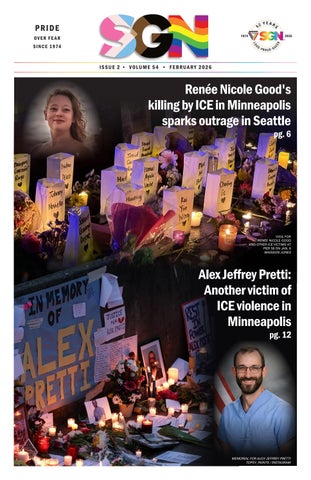
Discontent with Immigration and Customs Enforcement is at an all-time high across the country after 37-year-old Renée Nicole Good was fatally shot by ICE agent Jonathan Ross in Minneapolis, MN, on January 7. Good is the second person known to be killed by ICE in 2026, after the death of Keith Porter Jr. in Los Angeles, who was shot on New Year’s Eve by an offduty ICE officer. This also comes after 32 people were reportedly killed in ICE custody last year
Good was an award-winning poet and Queer woman, married to Becca Good, with whom she was raising a six-year-old son. Two days after her wife’s tragic death, Becca Good released a statement thanking people across the country for their outpouring of love and support, saying that it had been “the most fitting tribute, because if you ever encountered my wife, Renée Nicole Macklin Good, you know that above all else, she was kind. In fact, kindness radiated out of her.”
She spoke of her late wife’s guiding value: “No matter where you come from or what you look like, all of us deserve compassion and kindness.”
And she described the moments leading up to her wife’s death: “We stopped to support our neighbors. We had whistles. They had guns.”
Footage of the incident taken by Ross on his phone showed him approach Good’s vehicle in the street, to which she responded, “It’s fine, dude, I’m not mad at you.”
Ross was then confronted by Good’s wife, who told him to back off, while another ICE agent tried to open the door, yelling, “Get out of the fucking car.” While Good tried to back away, Ross is shown switching the phone in his hand in order to reach for his firearm to fire three shots into the car window. The video shows Good accelerating away and crashing into another parked vehicle. She was reportedly taken to Hennepin County Medical Center, where she later passed away
President Trump and several other administration officials have since made unsubstantiated claims about Good being an aggressor in the situation, with Department of Homeland Security Secretary Kristi Noem going as far as to label Good a “domestic terrorist.”
Seattle’s official response
Several Seattle city-level officials have issued statements condemning Good’s kill-
ing, as well as criticizing ongoing operations by the agency in the area. Seattle City Councilmember Eddie Lin (District 2) stated that “ICE is tearing families apart, detaining people regardless of immigration status, often targeting people based on race and language. District 2, Seattle’s most racially diverse district, has already seen an uptick of activity by ICE and other federal officers.”
Councilmember Bob Kettle (District 7) said, “While federal law enforcement agen-

cies have the right to conduct their duties within the city, we expect them to carry out their missions unaided by our local police, except in clear emergency situations, and in a safe manner.”
Councilmember Alexis Mercedes Rinck (District 8) took aim at Trump in her statement: “ We cannot stand by while the Trump regime erodes the foundations of our constitutional republic and kills people in our streets. Whether it’s in Minneapolis or here in Seattle, the regime’s ongoing terror campaign is causing real harm and perpetuating senseless violence across our communities.”
And Dionne Foster, the at-large councilmember for District 9, wrote that “ICE does not belong here in Seattle or in any community. These actions from the federal government undermine not only the social fabric of our community, but they undermine trust in government and our progress toward creating safe communities.”
Seattle Mayor Katie Wilson took to social media on January 8 to criticize deployments of ICE under Trump. She first responded to the abduction of three people by ICE at Evergreen Washelli Cemetery in North Seattle on the same day as Good’s death, “I am furious at the federal government’s abuse of power,” she said. “It is unacceptable to kidnap people who are simply going about their lives. There is no place for this in Seattle.”
Wilson then responded to Good’s killing, calling it a murder and emphasizing the stakes of the situation: “These are not abstractions. These are real people, real families, and real harm… I know many people in our community are frightened and outraged about the way ICE and other federal enforcement agencies are being deliberately deployed across the country to intimidate and harm our communities. I am heartbroken and outraged too.”
The mayor acknowledged the limited legal authority the City has to prevent federal law enforcement operations but declared that she and other officials, like
City Attorney Erika Evans, would examine every available option at Seattle’s disposal. In her call to action, she encouraged residents to sign up for Washington for All ICE mobilization alerts and to get more involved in holding elected officials accountable in order to keep communities safe.
Vigils and protests
Numerous protests erupted nationally, including in Seattle, in the days since Good’s killing. On the evening of January 7, hundreds of people assembled in front of the Jackson Federal Building to march through the streets. The crowd chanted and carried signs, led by an “Abolish ICE” banner painted in black and white.
The next evening, Seattle Indivisible and Defund Musk held a vigil for Good at Pier 58, at which several speakers voiced their dissatisfaction with her killers. Kathy Herschel of Seattle Indivisible criticized the
Trump administration’s narrative of Good’s death: “Instead of sympathy and understanding, the president and his administration smear her with lies… We will not let ICE lies win out.”
David Montes of ACLU Washington called her death a “preciseless murder” [sic] and pointed out how this was not the first time ICE had killed someone. “We’ve seen this is in LA, in Chicago, in Portland. Renee was on camera, but she was not the first,” he warned.
Several others spoke that evening, including staff from Rep. Pramila Jayapal’s office and Washington Neighborhood Defense, as well as local musician King Youngblood.
Over the weekend, several ICE protests sprouted around the region, from Pyuallup to Mount Vernon, including several localized protests in West Seattle, the U District, U Village, and Capitol Hill.


BY MADISON JONES SGN MANAGING EDITOR
Seattle Ethics and Elections Commission
“That question is well above my pay grade.” In one form or another, this was how Seattle Police Department East Precinct Capt. Jim Britt, joined by his deputy captain and the SPD’s LGBTQ liaison Haden Barton, among others, responded to most of the concerns brought up by community members during January’s SPD LGBTQ Advisory Council meeting.
Without the SPD’s chief and deputy chiefs present — and able to directly address the sensitive, ongoing political issues on people’s minds, including current ICE activity and investigations into police aggression at the Mayday USA event in Cal Anderson Park — the overall tone of the night among attendees was disappointment and further apprehension.
Billy Graham retreat
The meeting started with a conversation surrounding an article published by Erin Barnett in PubliCola on Dec. 16 about a department-wide email inviting officers to attend this year’s Billy Graham National Law Enforcement Ministry event, led by Graham’s son Franklin, who is an avid supporter of Trump and opposes LGBTQIA+ rights. The email was sent by Sgt. Christopher Gregorio, who had previously received a 20-day suspension for shooting Terry Carver, a 57-year-old Black man, in 2020.
Capt. Britt responded that he hadn’t come across the email, but that SPD regularly passes along event information, including ones that are religiously affiliated, for example, a local Catholic Church that reached out concerning a “blue mass” event. Britt said he had confidence that the
(SEEC) would notice if there was a conflict of interest, and that although he doesn’t always see eye to eye with Barnett’s perspective, he felt “she has incredible journalist integrity.”
and ICE
Concerns around ICE operations were the primary focus of attendees during the meeting. Several people asked questions about whether the SPD had any protocol for responding to ICE. Capt. Britt and others deferred most questions to Chief Barnes, who is scheduled to attend next month’s meeting; however, the captain did give a few responses. Of the ICE activity in Minneapolis, including Renee Nicole Good’s death, he said that he and “the police officers that work for me had a problem with it.”
Capt. Britt also explained that a “blue on blue” situation was his major concern for the department, because the SPD does not communicate with ICE and other federal law enforcement about its operations, and that legislation passed under Mayor Harrell, laying out further noncooperation between the SPD and ICE, was awaiting approval by the department.
But the circumstances still made the captain nervous. According to him, ICE’s practices of being hard to identify — by using unmarked vehicles and masks — left the possibility of not knowing how to respond. “We roll into [the situation] like it’s not ICE and we’re wrong,” he said. “Or worse, we roll in like it is ICE and we’re wrong.” He pointed out that SPD officers
have gone through “deconfliction” training that covers what to do when encountering other forms of law enforcement.
When asked whether the SPD could do anything to prevent ICE from performing its operations, including alleged illegal practices, such as entering private homes without a warrant, the captain said, “It would be unlawful to stop federal officials in their duties.”
The lack of satisfaction with the answers given led attendees to put forward a motion to invite Mayor Katie Wilson to the next meeting.
“Guns blazing”
Body cam video from the Seattle Office of the Inspector General for Public Safety (OIG) investigation was released, showing SPD officers discussing their strategy before violently assaulting and arresting 23 Queer counterprotesters during the Mayday event on May 24 last year. The officers in the video are shown plotting their move: “We are past talking to people, we’re here to fuck people up now.”
The SGN asked Capt. Britt and the other SPD officers if they had any comments to make, to which the captain said they cannot comment on an ongoing OIG investigation. Instead, he gave his philosophy on why he tells officers they shouldn’t swear in those kind of tense situations: “You will not only seem more professional, you will be more in control of your emotional faculties.”
Another attendee brought up that it wasn’t the officers’ swearing that upset people but rather the openly malicious intent to do harm against people.
The Seattle LGBTQ Commission put out a statement about the investigation’s findings after the meeting, “demanding accountability and immediate action from Seattle City Council and the mayor, including officer removal, independent public review, and full transparency. Minimal discipline is not justice. Silence is not neutrality. Our community has every right to be angry.”
Mario Teulilo of the Seattle Community Police Commission (CPC) ended the night’s conversation by sharing the 2018 story of his cousin, who was put on the ground by SPD officers and shot in the back of the head. He explained that although the officer who killed his cousin was no longer part of the SPD, he has since joined the Spokane Police Department, known for being one of the worst in the country in terms of police violence. Capt. Britt expressed his condolences, apologizing that had happened. Teulilo expressed appreciation for his response: “Thank you for showing your humanity,” he said, pointing out that the same story — told a week earlier at a CPC meeting — was received less sympathetically: “I’m not familiar with that case,” one of the chiefs said then. Capt. Britt gave final words, asking that community hold the department to a higher standard: “We need to do better. Hold us to better,” he said.
The next SPD LGBTQ Advisory Council meeting will be held on Wednesday, February 11 from 6 to 8 p.m. at the 12th Ave. Arts Building, 1620 12th Ave., Seattle, in the second-floor conference room.
BY CALVIN JAY EMERSON SGN ASSOCIATE EDITOR

By a unanimous vote, Joy Hollingsworth has been elected by her peers as Seattle’s newest City Council president. She is both the first Black woman and openly Queer woman to serve in the role.
Hollingsworth will take over the role from former District 9 councilmember Sara Nelson, who lost dramatically to Dionne Foster in the most recent election. Dan Strauss has been the interim president since November. Hollingsworth will now serve in the role until 2027.
As council president, Hollingsworth now has the ability to both establish new committees and select people to lead or join any existing committees. She is now responsible for setting the City Council agenda and
calling meetings into order. The flow of a council meeting generally goes through the council president.
During her tenure, Nelson routinely inspired concerns about how she managed council meetings, and was criticized as undemocratic. Her decisions to shorten public comment periods and clear the council chambers often led to moments of conflict, such as the arrest of six refugee asylum seekers. Hollingsworth hasn’t spoken directly about how Nelson ran public comment. However, when she had to shorten a committee’s public comment period due to weather concerns last February, she put out an official statement on the matter.
“I want to reassure our constituents who
BY NATHAN BENEDICT AND STEVE NYMAN, COME OUT SEATTLE SPECIAL TO THE SGN
Forty-five years ago, the first major Gay dance club in Seattle that could legally serve hard liquor, opened at 315 Terry Ave. N.
The Depot was a large entertainment complex, with over 10,000 square feet of indoor space. It stretched almost the entire block between Thomas Street to the south and Harrison Street to the north, in an old freight house, with railroad flat cars pulled alongside, left over from when South Lake Union was an important industrial area. (The entrance was mid-block approximately, in the location of the current Terry & Thomas streetcar station.) Two acres of free parking had room for over 150 cars. The complex featured a cabaret, a lounge, a dance bar, and a full-service sit-down restaurant, which restaurant was open daily from 5 p.m. to 1 a.m. and featured table service and an extensive menu.
Ralph Andre described the place in his 1981 SGN column “Bar Seen,” saying it was “flawless, plush, and wonderful! Perfect for dancing, cruising, and conversation with a friend.” Gay Seattle had never had
such an amazing complex, though it was expensive to run.
The Depot expanded the Gay dance and cabaret scene in Seattle. At that time, the combined format had worked well in other cities. The Depot presented national, West Coast, and local entertainers, such as: Sharon McKnight (a 1970s and ’80s Gay icon with country roots), Gilda Radner, Wayland Flowers and Madam, comedian Michael Greer, Terry Hutchinson (“a blond white guy who sings like a black woman”), the local drag trio The Girlfriends, psychic Dr. Richard Ireland, the super popular Gay San Francisco band Pure Trash, Stephanie Mills, Amanda Hughes from Vancouver, BC, and Kelly Marie from Europe. It also presented disco singers such as The Boystown Gang and Lovey Blue from Two Tons of Fun.
Jack Boden, owner Jack Boden, the Gay owner and operator, had an extensive history in the bar and restaurant business. As early as age 14, he worked in his parents’ restaurant and went
did not have the opportunity to provide comments but were signed up that they will have more opportunities to speak at future public hearings,” she wrote. “Your feedback matters and is critical to the process.”
The council president also serves as the city government’s designated survivor. If Mayor Wilson were to resign or be incapacitated in any way, then it would be Hollingsworth who would temporarily step in to fill her role, until the City Council elected an interim president.
That’s exactly what happened to our previous mayor, Bruce Harrell: back in 2017, he actually served as mayor for a five-day stint, after then-mayor Ed Murray resigned in disgrace over allegations of sexual abuse
against children.
Harrell’s short term wasn’t solely performative. During his five days, he instructed the City to submit a bid for Amazon’s second headquarters, and ordered more trash removal in public spaces. It wasn’t much, but those were real policy changes.
For now, however, Hollingsworth is downplaying the importance of her new presidency, in favor of sharing the love among her fellow councilmembers.
“My vote weighs the same as you all. One and one,” said Hollingsworth. “My role is to facilitate the work of this council, not to override it.”

on to do likewise across the US.
In Key Biscayne in the late 1960s and early 1970s, he worked at the Jamaica Inn and the Key Biscayne Yacht Club, where he waited on the likes of President Nixon
and Prince Hitachi (son of Japan’s Emperor Hirohito). Nixon was so impressed with his skills that he made Jack his “diplomatic” waiter. For over a year, Jack cooked gourmet dishes, planned meals, and oversaw
parties for the president in Washington DC, at Camp David, and aboard Air Force One.
Later, in New Orleans, he owned The Salad Shop, a well-liked restaurant on Magazine Street. In 2017, the Times-Picayune listed it as one of New Orleans’ longgone favorite restaurants.
Boren Street Disco
Returning to Seattle, in 1976 Jack opened The Boren Street Disco (1976–85), which was in the old Sons of Norway Hall. The Boren Street is often remembered as Seattle’s best Gay disco, since the space was double height, with an extensive balcony on three sides of the hall, a spacious dance floor, great sound and lights, and a raised fireplace lounge. It displaced Shelly’s Leg as the Gay disco hot spot. It had no restaurant, so due to liquor laws, it could only serve beer and wine.
It closed in 1985, but the location later housed City Beat (1985–88) and then the much-loved Timberline (1987–2004). It is now owned by Cornish College/Seattle University and is named the Raisbeck Performance Hall.
Foxes Restaurant and Lounge
In 1979, Jack opened Foxes Restaurant and Lounge (1979–85) in order to have a Gay liquor bar, which, due to WSLCB regulations, required a restaurant.
One of the motivating factors for Jack to
take over the Terry Avenue Freight House (a straight complex that had opened in 1974) and turn it Gay might have been to open a gay dance club that could serve hard liquor.
Closing of The Depot
With its size, cabaret lineups, and restaurant, The Depot proved expensive to operate. At least one of the cabaret acts, Pure Trash, was never paid; all the checks bounced. As a result, when a member of Pure Trash saw Jack in a popular San Francisco Castro Street bar, he dumped a glass of beer over Jack’s head.
After leaving Seattle in the mid-1980s, Boden worked in Miami, Key Largo, and Hollywood, Florida. Although it was rumored in Seattle that he had been murdered, according to his Miami Herald obituary, he died in 1996 at 45 from bone and lung cancer.
The Depot closed in 1985 after two short years. It was a great complex, and patrons remembering many fun times. Seattle has never seen such an entertainment complex for the Gay community before or since.
For more information about and a detailed map of Seattle’s historical Queer bars, taverns, restaurants, and safe spaces, go to www.comeoutseattle.org. Come Out Seattle is also on Facebook and Instagram.


BY FRANK GAIMARI

Anthony D’Alto is nurturing a lively haven, nestled in the heart of Seattle, where humor and horticulture come together seamlessly. Known online as “Saint Planthony,” D’Alto, 31, has transformed a modest Capitol Hill plant shop into a viral sanctuary, drawing thousands with his infectious blend of wit, wisdom, and greenery. With a smartphone in one hand and a pothos plant in the other, he’s become a digital evangelist, showing how laughter and a bit of flora can be transformative.
Beneath his flamboyant exterior is a deeply passionate nature enthusiast with an insatiable curiosity. D’Alto’s journey to plant stardom is anything but conventional. His move from Florida to Seattle in 2023 marked a turning point, igniting his passion for plants and his advocacy for mental health.
D’Alto’s expertise comes not from formal education but from years of hands-on experimentation. His intuitive grasp of plant biology allows him to translate complex care instructions into practical advice accessible to both novices and seasoned gardeners. Rather than positioning himself as a distant authority, he’s a trusted friend — ready to explain why a fiddle-leaf fig might drop its leaves or how a little humor can help both plants and people thrive.
Saint Planthony’s widespread appeal began on TikTok and Instagram, where he captivated millions by combining practical plant care with sharp humor and pop culture references. His feeds are a kaleidoscope of content: one moment, he’s breaking down the finicky watering schedule of a calathea; the next, he’s delivering a tongue-in-cheek monologue on global affairs while elbow-deep in potting soil. A particularly memorable video — a blend of politics, plants, and psychology — amassed over a million views, cementing his place as a formidable digital presence.
“I never expected the world to be so full of support,” D’Alto reflected, recognizing the vibrant community that has blossomed around him.
At the heart of the Saint Planthony phenomenon is The Plant Store on Capitol Hill, affectionately dubbed the “Gay Plant Store” by locals and internet fans. The nickname, sparked by a cheeky sign out front, has become a symbol of inclusivity and community. Stepping into the shop feels less like entering a retail space and more like joining a lively community hub, where the air is thick with humidity and hospitality.
D’Alto’s videos often feature this unique environment — a place where plant edu-
cation is seamlessly blended with what he wryly calls “thrilling thornication.” His ability to improvise content amid daily shop life adds an unmistakable authenticity, turning the store into a pilgrimage site for fans seeking not just Monstera but belonging.
A significant part of Anthony’s appeal is his undeniable charisma. With a magnetic presence and striking looks, he attracts fans who are as drawn to his persona as to his expertise. Yet his allure goes far beyond appearances. Saint Planthony represents a new kind of expert influencer: approachable, transparent, and genuinely sincere. He readily shows his true self, a quality that resonates deeply with his audience. His quick wit and openness help dissolve the usual distance between creator and follower, cultivating a fan base that trusts his guidance as much as it admires his aesthetic.
More than anything, Saint Planthony serves as a source of emotional support for his viewers. In a world often marked by uncertainty, D’Alto’s content acts as a pressure valve, offering relief from daily stress. Though his videos entertain, they also provide a space where it’s acceptable to feel overwhelmed.
By balancing humor with heartfelt sincerity, he validates his audience’s anxieties and offers a gentle escape into a greener, kinder world. Through his work, he shows that even small spaces can offer profound comfort when the wider world feels overwhelming. To Anthony, plants are more than decorations — they’re companions and grounding mechanisms in turbulent times.
To learn more about the man behind “Saint Planthony,” I met him for coffee on a cold Seattle morning, as the city buzzed outside. Our conversation explored his inspirations, the roots of his digital persona, and the advice he shares with his growing community.
Frank Gaimari: Can you share a bit about your journey into gardening and plant care?
Anthony D’Alto: My journey into gardening and plant care began during one of the most difficult periods of my life. I was living in Florida, recently single, without a car, and feeling completely stuck and isolated. One day, searching for something to focus on, I picked up a couple of plants from the supermarket. At first, I couldn’t even keep them alive, but with nothing else to do and no friends or partner around,
I became determined to figure out how to care for them. That small act of nurturing gave me a sense of purpose, and slowly, it started to pull me out of my depression.
Around the same time, I began exploring the healing potential of mushrooms to help with my depression and PTSD, which had roots in a chaotic childhood. This wasn’t about recreation; it was a genuine attempt to find a path to healing. I was amazed by how these natural organisms could shift my perspective and help me see the world differently. That experience, combined with my growing connection to plants, completely changed my life.
Plants became my anchor, offering me something to care for and learn from. Within a few months, I had over 150 plants, and each day brought new discoveries about them and about myself. Plants didn’t just spark my curiosity; they helped me heal. They lifted me out of a dark place and revealed the beauty and magic in the world that I hadn’t seen before.
FG: What inspired you to start creating TikTok and Instagram videos?
AD: I’ve always had a creative streak when it comes to making videos. It began back in 2002, when I got my first video camera in second grade. The camera came with editing software, and I immediately fell in love with the process of creating something that captured my inner world. Back then, sharing videos meant working with VHS tapes or battling dial-up internet, but for me, it was always about finding a way to show the world from my perspective.
Fast-forward to the winter of 2020, when I lost my job and slipped into a deep depression. During that difficult time, I decided to return to video creation, making animations, dream-inspired clips, and anything that felt meaningful enough to share. It gave me a renewed sense of purpose and a much-needed outlet for self-expression.
Eventually, I got the job at The Plant Store, which helped take my mind off things and provided a new environment to explore. One day, I thought, “Why not make a video about plants?” I posted it, and it received around 3,000 views, far more than any of my previous videos. That moment was a turning point: I realized people were genuinely connecting with what I was creating, and it motivated me to keep going.
Now, creating videos isn’t just about sharing my perspective; it’s about building a community. It’s a way to share what I’ve
learned, connect with others, and create something meaningful together.
FG: How do you come up with ideas for your videos?
AD: Coming up with ideas for my videos is a mix of creativity, overthinking, and finding inspiration in everyday moments. I’ve always had a very active mind. Sometimes it feels like my brain is constantly running “what-if” scenarios. For much of my life, that overthinking could feel overwhelming, but I’ve learned how to redirect it and use it to my advantage. Now, instead of spiraling into intrusive thoughts, I channel that energy into brainstorming ideas for my videos.
Many of my ideas come to me while I’m pacing around, whether at home or at The Plant Store, earbuds in and lost in thought. Movement really helps me think, and I’ll let my mind wander until something clicks. Inspiration might come from a comment I’ve read, a headline I’ve seen, or even just a random thought that pops into my head. I rarely script my videos. Instead, I jot down a few key points and let the rest unfold naturally.
When I first started my page, I had a series where I’d introduce the weekly plant shipments at the store, giving them playful personalities like “Gay” or “Lesbian” plants. People loved it, but I quickly realized I couldn’t keep calling plants “Gay” every week and have it feel fresh. That realization pushed me to experiment with new ideas, weaving in topics like mental health and current events. I’ve found that being honest about struggles, whether they’re my own or about something happening in the world, really resonates with people. It’s not about pretending everything is perfect; it’s about finding humor and connection in tough times.
The comments from my audience are also a huge source of inspiration. Early on, people would leave heartfelt feedback, sharing what they loved or wanted to see more of. Even now, as my page has grown, I still look at the comments to see what’s resonating. It reminds me that the things I’m struggling with aren’t unique. Thousands of people out there feel the same way. When I can make someone feel seen or even get a laugh, that’s what keeps me going. It’s all about creating a space where people can connect, feel understood, and hopefully find a little joy in the process.
FG: How do you balance humor and sincerity in your content?
AD: Balancing humor and sincerity in my content comes naturally to me. It’s how I’ve always dealt with life’s challenges. Growing up in a chaotic household with an abusive stepfather, my sister and I coped by turning everything into a joke. No matter how tough things got, we always found a way to laugh about it. For us, humor wasn’t about ignoring the pain; it was a way to make difficult situations bearable. That mindset has definitely carried over into my videos.
I believe people want to feel truly acknowledged. They don’t want to be bombarded with fake enthusiasm or hollow corporate positivity. That’s why I try to break down those barriers by being honest about what frustrates me too. At the same time, I don’t want to fuel anger or negativity. There’s already enough of that online. Instead, I want my videos to meet people where they are, whether they’re feeling overwhelmed or simply need a moment to breathe.
My goal is to say, “Yeah, it sucks, but let’s calm down, laugh about it, and keep going.” If I can help someone get out of bed or make them feel a little less alone, then I’ve done my job.
FG: What role do plants play in your personal life and mental health?
AD: Plants are more than a part of my life. They’re a lifeline. They give me a sense of control in a world that often feels unpredictable. Caring for them, whether it’s watering, trimming, or simply watching them thrive, creates a small, safe ecosystem that brings me peace and stability. They’re not just a hobby; they’re a source
of
grounding and perspective. When I look at the little world I’ve nurtured, I’m reminded that even during chaos, there’s room for growth, beauty, and calm. Plants don’t just decorate my space; they anchor me.
FG: What’s your favorite plant and why?
AD: My favorite is the Black Magic Begonia. It’s mesmerizing. The plant has deep, almost black leaves with red stems, and when sunlight shines through from behind, the leaves glow a vibrant red. It’s breathtaking.
FG: What’s next for Saint Planthony?
AD: I’m starting a YouTube channel, something I’ve dreamed of doing for more than two years. It will give me the opportunity to dive deeper into my special interests and share even more of what I love with others. I’m excited to create longer, more meaningful content and connect with people on a different level.
Looking ahead, my ultimate dream is to create a true “third space” for the community. I imagine transforming an old church into a greenhouse, filling it with plants to make a peaceful, welcoming place where people can connect, recharge, and experience nature without having to travel far from home. I want it to be a sanctuary, a place where anyone can walk in, breathe deeply, and feel a sense of belonging. In the end, Saint Planthony is doing more than selling plants; he is nurturing a community. He reminds us that even when the world feels like it’s withering, there is
BY FRANK GAIMARI
The lights of Broadway shine a little differently now. The theater community — a world built on storytelling, vulnerability, and the magic of connection — has lost one of its most vibrant storytellers. Bret Hanna-Shuford, a talent whose warmth radiated far beyond the footlights, has taken his final bow at the age of 46. While his departure leaves a profound silence where his laughter once rang, his life remains a resounding anthem of authenticity, love, and artistic resilience.
To know Bret’s work was to witness a master class in joy. From the emerald ambition of Wicked to the whimsical enchantment of The Little Mermaid and Chitty Chitty Bang Bang, Bret did not just perform roles; he inhabited them with a generous spirit. He was the kind of performer who understood that theater is an exchange of energy. Whether onstage at the Lunt-Fontanne Theatre or in front of a camera for The Wolf of Wall Street, he gave everything he had to the audience. Bret’s most significant role, however, was not found in a Playbill. It was the life he built offstage with his husband, Stephen Hanna-Shuford. Together, as “the Broadway Husbands,” they did something revolutionary simply by being themselves. In a world that often complicates LGBTQ+ existence, Bret and Stephen offered a window into the beautiful simplicity of Queer joy. They showed that a fairytale romance is not just for Disney princes on stage — it is something real, tangible, and hard-won.
Their love story evolved into a new chapter with the arrival of their son, Maverick, in 2022. Bret embraced fatherhood with open arms, pouring his heart into

always room for new growth — both in our homes and within ourselves. Through his playful videos, candid advice, and the welcoming atmosphere of his Capitol Hill shop, Anthony D’Alto has created a space where everyone is invited to put down roots and flourish.
Meeting D’Alto in person only deepened my admiration. I found him to be as kind and gentle as his online persona suggests, radiating genuine warmth and curiosity.
Our conversation left me feeling like a member of his ever-growing community — a fan not just of his plant wisdom but of the compassion and joy he brings to everyone who crosses his path.
D’Alto can be found on Instagram at www.instagram.com/saintplanthony/ and Facebook at www.facebook.com/profile. php?id=61575555492261 (or search for “Saint Planthony).
every moment. As a proud dad, he radiated joy and became a passionate advocate for LGBTQ+ families, demonstrating that family is built on love and commitment.
However, his joyful and fulfilling world was turned upside down when he was diagnosed with two rare and aggressive cancers: hemophagocytic lymphohistiocytosis and peripheral T-cell lymphoma. Faced with challenges that would overwhelm most, Bret approached his battle with the same grace, strength, and determination that defined his life. True to his nature, he did not hide his struggle. Instead, he shared it openly, transforming his vulnerability into a beacon of hope and resilience.
Even during hospital stays and treatments that disrupted his graduate studies in Florida, Bret’s creativity never wavered. His upcoming children’s book, Good Night, Break a Leg, serves as a poignant reminder of the lasting impact artists have. Through their work, they leave behind pieces of their soul, ensuring that their voice and spirit continue to inspire long after they are gone.
In conclusion, the incredible legacy of Bret Hanna-Shuford is honored — a true Broadway star who gave his heart and soul to every performance, onstage and off. His light, creativity, and courage touched countless lives, leaving a legacy that continues to inspire. This is his standing ovation — a celebration of a life lived with passion, grace, and purpose.
To learn more about the Broadway Husbands, visit the official website at www.BroadwayHusbands.com


BY MADISON JONES SGN MANAGING EDITOR
The local civil rights and Transgender advocacy organization Gender Justice League (GJL) announced that it will commit $100,000 in 2026 toward defeating two initiatives, IL26-001 (“the Parents’ Bill of Rights”) and IL26-638 (“Protecting Fairness in Girls’ Sports”). Both seek to restrict LGBTQIA+ rights in K-12 education and sports across the state; both are also likely poised to reach their signature-gathering targets by the January 2 deadline, qualifying them for this year’s ballot.
IL26-001 and IL26-638 are products of the conservative organization Let’s Go Washington (LGW) and its millionaire hedge-fund founder Brian Heywood, who
have also been behind other similar initiatives in the past. The initiatives have also been heavily supported by other local rightwing organizations and media personalities like Brandi Kruse and Ari Hoffman
“We have fought hard in Washington state to give every young person, regardless of their race, class, or gender, an equal chance to succeed in school,” said GJL board member Sophia Lee, who laid out the stakes of LGW’s initiatives. “We won’t allow this one man [Brian Heywood] to use his wealth to bully the few Transgender kids brave enough to be their authentic selves in school.”
The GJL has given $80,000 in direct cash
BY FRANK GAIMARI
The streets of South Minneapolis became the scene of tragedy on Saturday, January 24, when Alex Jeffrey Pretti, a 37-year-old ICU nurse, was fatally shot by federal immigration agents. The incident has sent shock waves through a community already reeling from heightened federal law enforcement activity, sparking outrage and demands for answers.
Pretti, by all accounts, was an upstanding member of his community. A homeowner and University of Minnesota graduate, he dedicated his career to helping others, serving as an intensive care nurse for the US Department of Veterans Affairs. He was a legal gun owner with a permit to carry and had no serious criminal record. A neighbor described him as “not a violent person.”


contributions and $20,000 in “in-kind staff time” to Washington Families for Freedom (WFF), which has been at the forefront of the opposition to LGW’s signature-gathering efforts. In a statement, GJL Executive Director Danni Askini explained the group’s motivations: “When politicians and wealthy ideologues try to bully kids out of public life — out of classrooms, sports teams, and our community — we meet them with organization, love, and a relentless defense of [their] right to exist.”
The organization also framed the initiatives in the broader context of the national political discourse on Transgender issues, particularly around Trans youth, and cited
how advocates have been targeted and labeled as extremists by the Trump administration. US Attorney General Pam Bondi, in a Dec. 4 memo, instructed the FBI to crack down on what it deems “domestic terrorists,” including those that practice “radical gender ideology.”
The GJL was also part of a list of “Antifa” organizations in Washington state, given by Brandi Kruse to FBI Director Kash Patel after her visit, alongside others, with President Trump at the White House in late October.
This morning, Pretti found himself in the middle of a tense confrontation involving US Immigration and Customs Enforcement (ICE) agents on Nicollet Avenue. Eyewitness accounts and video footage show Pretti attempting to deescalate the situation and help people navigate the chaotic scene. During the encounter, agents wrestled Pretti to the ground. Within seconds, multiple gunshots were fired, and the man who spent his life saving others lay dying on the sidewalk. He was later pronounced dead at a local hospital.
Pretti’s death is the latest — and most alarming — in a series of violent encounters involving federal agents in Minneapolis. It comes just 17 days after the killing of Renee Good by an ICE agent, an event that had already triggered mass protests across the city. These incidents are part of “Operation Metro Surge,” a federal immigration crackdown that has brought thousands of agents into the state and created an atmosphere of fear and distrust.
The response from local and state officials has been swift and furious. Minnesota Gov. Tim Walz condemned the shooting as “sickening” and demanded an end to the federal operation. Minneapolis Mayor Jacob Frey echoed these sentiments, questioning how many more tragedies must occur before the federal government recognizes the harm its tactics are causing.
As the community mourns the loss of a man described as a hero — both in his career and in his final moments — a larger storm gathers. Protesters have assembled, the National Guard has been activated, and the chasm between local authorities and federal agencies widens. The tragic death of Alex J. Pretti has become more than an isolated incident; it is now a flash point in a growing national crisis over the role and accountability of federal immigration enforcement.


BY CALVIN JAY EMERSON SGN ASSOICATE EDITOR
Vegas Vecchio had a big task on their shoulders. The Seattle Kraken wanted them to make art for the team’s upcoming Pride Night. But it wouldn’t happen in June: The team’s on hiatus by the time June rolls around.
So, this year’s Pride game, versus the Minnesota Wild, had to take place on January 8 — during the month of holiday hangovers and The Big Dark. Creating enthusiasm to celebrate queerness on a cold, rainy Thursday evening was inevitably going to be a challenge.
Vecchio, however, is used to staying flexible. They’re a genderqueer artist and UW alum who started out painting live musicians in Georgetown, where they developed their unique style: kaleidoscopes of intense color against velvety black backgrounds, figures who are both absorbed by their surroundings, yet in contrast, also explode off the canvas.
Despite finding plenty of joy in the musical world, Vecchio knew it was just a temporary stop toward a dream they had to pursue: becoming a professional tattoo artist. They found a mentor, Abra, who taught
them the tools of the trade, despite their creative differences. Abra’s a traditionalist who prefers the hand-poke technique, but Vecchio didn’t quite have the patience for it. They needed to blaze a path that worked uniquely for them.
“The tattoo industry can be really hard to break into, especially if you don’t know a guy who’ll teach you, and especially if you’re not a man, if you’re not cis,” said Vecchio. “So, it was really like a hustle to take a nontraditional approach.”
The hustle has been constant. Vecchio worked hard enough to open their own private tattoo studio, Ruled by Venus Ink, and they’ve inked hundreds of designs since. Still, even with all the experience, the Kraken’s request for them to reimagine the logo was daunting. The first step, coming up with the design, was the easiest part.
“The unicorn was there from the beginning. I was trying to entertain doing something else. I played around with a hyena for a little bit, but nothing else stuck as well as the OG,” said Vecchio about their process. “It just felt like… How could no one have thought of this yet?”
They also had the Kraken’s support to be

creatively risky. As part of their “Common Thread” initiative, the team has allowed their branding to be transformed into a school of salmon, a disco ball, and even the Aztec god Quetzalcóatl. As long as it felt authentic to the LGBTQ+ community, Vecchio would have no problem getting a unicorn across the finish line.
What came next — actualizing the design into a real artistic product — was where things got difficult. In an Instagram tell-all following the logo’s reveal, Vecchio admitted that they “went underground for two months” while working on the project. They had multiple creative breakdowns, stemming from the pressure of having to be an ambassador for Pride. Could the art they make, and even Vecchio , actually represent a holiday that means so many different things for so many people?
“Coal under pressure makes diamonds,” said Vecchio in retrospect. “I don’t think the art would be as moving as it has been if I didn’t go through that.”
Whether the struggle of an artist to make their work is “worth it” is subjective. What is objective, however, is the success Vecchio had in capturing hearts and minds.
Once Pride Night began, you couldn’t be anywhere in Climate Pledge Arena without a unicorn looking back at you. The reimagined logo’s merch — including shirts, hats, and pucks — almost immediately sold out. The charity auction, with jerseys signed by Kraken stars like Berkly Catton and Matty Beniers, was the highest grossing to date: $100,000 in barely a day’s time.
Every cent made off the auction was split between the One Roof Foundation (the Kraken’s philanthropic arm, which provides financial assistance to low-income kids and families) and Seattle Pride, the organizing body behind Seattle PrideFest and the annual Pride Parade. Given the budget deficit of $350,000 that Seattle Pride had to endure last year due to corporate retreats from LGBTQ+ causes, Vecchio’s work now serves as the antidote. The $50,000 raised for Seattle Pride should, hopefully, help to sustain our community’s traditions both this year and beyond.
“Seeing, tonight, the culmination of it all, it really makes it worthwhile,” Vecchio said. “I wouldn’t have it any other way.”


TONY N’ TINA’S WEDDING
February 4–22, 2026
LIT Immersive Events and Entertainment
1000 First Ave. S., Seattle
Love, laughter, and a splash of Gay: Tony n’ Tina’s
BY FRANK GAIMARI
Get ready to say “I do” to one of the wildest, most heartwarming events Seattle has ever seen! Tony n’ Tina’s Wedding isn’t just a show — it’s a party where every guest is family and every moment is filled with laughter, drama, and more than a little bit of fabulousness. Since its off-Broadway debut in 1988, this immersive experience has redefined what it means to “go to the theater,” inviting audience members to join the onstage madness as guests at the most uproarious wedding reception ever conceived.
You’re cordially invited to celebrate the union of Tony Nunzio and Tina Vitale, two young lovers from feuding Italian-American families. The ceremony is heartfelt — and hilariously unpredictable — but the reception is where things really heat up. Picture yourself dancing to a wedding singer, savoring a full Italian feast, and getting swept up in the kind of family drama that would put your own relatives to shame. With a tipsy priest, bickering bridesmaids, and relatives who never learned the meaning of “indoor voice,” you’ll be in the thick of the action — whether you planned it or not.
But this isn’t just a love story between a boy and a girl — it’s a celebration of queerness. Since the show’s creation, Tina’s brother has been a central part of the story,
bringing authenticity and heart to the wedding. His presence infuses the production with a timeless, unapologetically Queer energy, reminding us that families today are as diverse as they are loving (and just as likely to argue over who gets the first slice of cake).
Directing the festivities is Tony Lauria, whose passion for inclusion and representation shines through in every detail. As a proud member of the LGBTQ+ community, Lauria infuses the production with authenticity and joy, blending seasoned New York actors with Seattle’s brightest talents. The result? A cast that feels like a real, if slightly unhinged, family — one you’ll be happy to claim as your own, if only for one unforgettable night. Curious to learn more, I spoke with Lau-

ria about what makes this production so special.
FG: What drew you to Tony n’ Tina’s Wedding, and what has kept you passionate about it over the years?
TL: What first drew me to Tony n’ Tina’s Wedding was the thrill of improv and the energy of New York City’s theater scene. As a young actor with a knack for thinking on my feet, I auditioned twice — once in 1990 and again in 1991. The second time, I landed the role, and what followed was five and a half unforgettable years performing seven shows a week.
At the time, I thought my journey with the production had ended. But in 2004, the opportunity to direct the touring production reignited my love for this oneof-a-kind show.
What keeps Tony n’ Tina’s Wedding so exciting is its ability to evolve. It’s not just a show — it’s a living, breathing experience that grows with the times. Over the years, it has adapted to reflect pop culture, remaining as relevant today as when it first began.
But what truly keeps it fresh is the magic of bringing it to new cities. Every town has its own personality, and working with local casts infuses the production with new energy and perspectives. Each cast member brings something unique — choices, humor, and interpretations that surprise and delight me, even after more than two decades.
The real magic of Tony n’ Tina’s Wedding lies in its ability to connect people — audiences and performers alike. I’ve had the privilege of collaborating with some of the most talented, funny, and creative performers across the country. Their passion and originality breathe new life into the show every time, and that’s what keeps me coming back. It’s not just theater — it’s an ever-changing celebration of creativity, community, and connection.
FG: What do you think makes this show so timeless and universally appealing, and what do you hope audiences take away from their experience?
TL: The timeless appeal of Tony n’ Tina’s Wedding lies in its ability to evolve while staying rooted in something everyone can relate to—a wedding. Weddings are universal, filled with love, chaos, laughter, and unforgettable moments. And just like any great wedding, this show is a party — a wildly fun and hilariously unpredictable one.
What makes it special is the immersive experience. From the moment the audience steps in, they’re not just watching — they’re part of it. We’ve perfected the art of making people feel like they’ve attended the most entertaining, over-the-top wedding ever. It’s an experience that leaves people laughing, dancing, and talking about it long after it’s over.
Our goal is simple: we want audiences to let loose, embrace the chaos, and leave feeling like they were part of something unforgettable. If you come ready to have fun, we’ll make sure you leave with memories of the best “wedding” you’ve ever attended!
FG: How do you balance the scripted elements of the play with the improvisational interactions with the audience?
TL: Balancing the scripted elements with the improvisational interactions is all about creating the perfect illusion of a real wedding. From the moment guests arrive, they’re stepping into a world that feels authentic — complete with a wedding singer, an MC, and even a caterer. The atmosphere is so familiar that most people instinctively know the flow of the event, allowing us to blend the planned with the spontaneous seamlessly.
The magic of improv happens before the ceremony begins and during the reception, where the cast mingles with the audience, creating unscripted, laugh-outloud moments that feel completely organic. When it’s time to shift focus back to the scripted scenes, we know exactly how to command attention and bring everyone together. It’s a delicate dance between chaos and control, and it’s what makes the experience so immersive and unforgettable. The audience isn’t just watching a wedding — they’re living it.
FG: Do audience members dress up for the show, and if so, how has it added to the overall experience?
TL: Absolutely! Many audience members love to dress up for the show, and it adds an incredible layer of authenticity to the experience. Of course, not everyone does — but those who show up underdressed might find themselves at the receiving end of a playful comment from the bride!
What’s impressive is how each city brings its own flair to the event. When the

audience embraces the wedding vibe and comes dressed to impress, it elevates the room’s energy and makes the experience feel even more immersive. It’s like stepping into a real wedding where everyone is part of the celebration. Whether they’re rocking cocktail attire or their best party outfit, it all adds to the fun and makes the night unforgettable.
FG: How do you ensure that LGBTQ+ characters are both funny and respectfully portrayed, and why is representation important in a show like this?
TL: Representation is at the heart of Tony n’ Tina’s Wedding, and we take great care to ensure that LGBTQ+ characters are portrayed with both humor and respect. Tina’s brother, who identifies as Gay, has been part of the show since its creation. Back then, his storyline reflected the cultural realities of the time — his mother was in denial about his sexuality, even though he was out to her. As the world has evolved, so has the character. Today, the conflict has shifted to something more nuanced: his mother now wishes he’d date a nice Italian young man instead of his older Puerto Rican boyfriend. It reflects how families — and society — have grown, while keeping the humor grounded in relatable dynamics.
A Gay actor typically plays the role, and we encourage them to bring their full
humanity, heart, and individuality to the character. This isn’t just about representation — it’s about authenticity. Including Queer characters in an immersive show like this is essential, because it mirrors the diversity of the real world. Weddings are celebrations of love, family, and community, and everyone must see themselves reflected in that joy. It’s not just representation — it’s connection, and it’s what makes the show feel so real and so meaningful.
FG: How do you celebrate your Queer identity through your work, and what does that mean to you?
TL: As an actor, director, and musician, my Queer identity is an integral part of my creative voice. Everything I’ve lived through — from coming out at 19 to surviving the turbulent ’80s, the hopeful ’90s, and the rollercoaster years since — shapes how I approach my work.
Coming out in 1982 wasn’t easy. It was a tough, unforgiving time to be openly Gay, but I made it through. I’m still here, and that’s something I celebrate every single day. My journey, my resilience, and my pride fuel everything I create. It’s not just about surviving — it’s about thriving, and that’s the energy I bring to every project.
FG: What’s the wildest or most memorable thing an audience member has done during a performance?

TL: Over the years, I’ve seen plenty of wild moments — especially all the surprise engagements — but one memory from the ’90s takes the cake. Back then, I was playing the best man, and part of the bit was passing around baggies of fake coke to the audience. Harmless fun, right? Well, not this time. I handed one to the wrong guest — a police officer.
Before I knew it, he was on his feet, ready to escort me out of the theater in handcuffs. The audience thought it was part of the show, laughing and cheering, while I was sweating bullets. Thankfully, the stage manager swooped in, explained it was just a prop, and saved me from what could’ve been the most awkward arrest in theater history.
FG: If you could invite any celebrity to be a guest at Tony n’ Tina’s Wedding, who would it be and why?
TL: If I could invite any celebrity to Tony n’ Tina’s Wedding, it would have to be Bill Murray. He was my first comedic hero, my earliest influence, and the reason I fell in love with the art of absurdity. As a kid, his iconic lounge lizard persona struck a chord deep in my soul — it was weird, it was twisted, and it was brilliant.
That character shaped me in ways I’m still discovering. My career-long dedication to my own warped, pansexual, and delightfully insipid lounge-lizard interpretation is my way of paying homage to the genius that is Bill Murray. Having him at the wedding? That would be the ultimate full-circle moment — and I’d probably spend the entire evening trying to make him laugh.
Tony n’ Tina’s Wedding is more than a play — it’s a riotous, loving salute to the chaos of family, the power of community, and the beauty of love in all its forms. Whether you show up in wedding attire or as your fabulous Queer self, you’ll leave with memories and maybe a few new family members.
Your ticket includes dinner, dancing, an unforgettable show, and endless laughter. Tickets are selling quickly, so gather your friends, bring your family, and get ready for a night of pure joy. Don’t wait — secure your spot now at http://www.tonylovestina. com/get-tickets for the wedding event of the year! Use promo code “Gaytastic” for a special discount.
Frank Gaimari is an author and film reviewer in Seattle. He lives with his husband and their two golden retrievers. You can learn more about his work at www. FrankGaimari.com
BY FRANK GAIMARI
This past month, I had the incredible privilege of seeing Nina West and a dazzling lineup of drag queens perform live at A Drag Queen Christmas in Seattle. The show was a breathtaking spectacle — glittering, glamorous, and overflowing with pure joy. Each queen took the stage with unforgettable performances, but for me, Nina was the undeniable highlight of the evening.
As the host, she radiated warmth, humor, and boundless positivity, lighting up the stage with every word and gesture. By the end of the night, I wasn’t just entertained, I was truly inspired. Her remarkable ability to connect with audiences, make us laugh, and send us home feeling uplifted was nothing short of magical. It was an evening I’ll never forget.
Seeing her live made me curious about the journey that brought her to this moment.
Born on August 10, 1978, in Detroit, Michigan, and raised in small-town Greentown (North Canton), Ohio, Andrew Levitt discovered an early passion for theater and storytelling. That love for the arts eventually brought him to Columbus, Ohio, where the iconic drag persona Nina West was born. She has since inspired millions and become one of the world’s most beloved drag queens — a testament to her resilience, creativity, and heart.
I first discovered Nina during season 11 of RuPaul’s Drag Race, on which she quickly became one of my favorite queens. Her performances were a master class in camp and creativity, blending humor with heartfelt messages that resonated deeply with me and so many others. She didn’t just compete; she created a legacy, earning the title of Miss Congeniality and solidifying her place as a queen who leads with kindness.
Her impact extends far beyond the runway, as she is a multitalented artist who has made her mark in music, theater, and television. Her groundbreaking children’s album, Drag Is Magic, celebrates individuality and self-expression with songs that inspire kids to embrace their authentic selves.
Beyond her music, she has showcased her talents on stage, most notably as Edna Turnblad in the national tour of Hairspray The role was a perfect match for her vibrant personality, and her performance breathed new life into the iconic character, earning glowing reviews and solidifying her reputation as a dynamic performer. Additionally,
she starred in the horror film Queens of the Dead, further demonstrating her versatility and boundless creativity.
What truly sets Nina apart, though, is her unwavering commitment to making the world a better place. She has raised hundreds of thousands of dollars for LGBTQIA+ organizations, including The Trevor Project and the Human Rights Campaign. Through her performances, fundraising, and advocacy, she has become a powerful voice for equality and acceptance.
Nina doesn’t just entertain — she educates, uplifts, and inspires.
When I saw her perform in Seattle, it wasn’t just her incredible talent that left an impression on me — it was her heart. She has a rare ability to turn a packed theater into an intimate gathering, making every person feel seen and valued. Inspired by her warmth and authenticity, I decided to reach out with a few questions I thought her fans — myself included — would love answered. True to form, Nina was beyond gracious, kind, and enthusiastic, agreeing to an interview without hesitation. What followed was a conversation as vibrant and uplifting as the queen herself, in which she shared insights into her journey, her advocacy, and her vision for the future.
Frank Gaimari: Hosting A Drag Queen Christmas must have been a truly unique experience. What was your favorite part of connecting with audiences across the country?
Nina West: Pinpointing my favorite part of the tour is a challenge, because I truly love it all. Meeting the fans, hearing their stories, and feeling their energy brings me so much joy. I love hosting these shows, stepping onto the stage, and sharing something magical with the audience. Traveling across the country during the holiday season and soaking in the beauty and spirit of each place was incredibly special. If I had to choose one thing that stands out, it’s the connection. Last year’s tour reminded me how powerful it is to connect with people on a basic, human level. Bringing joy to others, especially during tough times, is deeply meaningful. Looking out into the audience and seeing people smiling, laughing, and letting go of their worries, even for a little while, is an indescribable feeling. It’s a privilege to be part of that.
What makes it even more incredible is

seeing how audiences, no matter where they’re from, share the same reactions to joy, hope, and laughter. It’s a beautiful reminder that, at our core, we’re all connected by these universal emotions. That’s the best part of the gig — witnessing that connection, feeling that energy, and knowing I get to help create those moments of happiness.
FG: Growing up in Greentown, Ohio, did you ever imagine that drag would take you to such incredible heights?
NW: Honestly, no. I mean, I always had this feeling deep down that I was meant to do something big, something that would make an impact. I felt that calling in my bones, even as a kid. But if you had told me back then that this would be the path I’d take — that drag would be the vehicle to carry me to where I am today — I don’t think I would have believed you.
It’s funny how life works. You have these dreams, these inklings of something greater, but the way it all unfolds can be so unexpected. I never could have predicted that the art of drag, something so vibrant, creative, and deeply personal, would become the thing that not only shaped my career but also allowed me to connect with so many people in such a meaningful way. It’s been a journey beyond anything I could have imagined, and I’m so grateful for it.

FG: What inspired you to make
NW: I started working on the album after the landmark marriage equality ruling. It was a transformative period, watching so many of my Queer friends marry and start families. Witnessing our community grow in such a beautiful way was incredibly inspiring.
I’ll never forget one friend’s comment that stayed with me. They said they wanted to raise their kids with an education that reflected their values — their joy, their love, and the vibrant spirit that defines our community. That simple thought hit me deeply. It planted a seed, and I couldn’t stop thinking about how important it is for children to grow up surrounded by stories, music, and messages that celebrate love, diversity, and acceptance.
That’s where the idea for Drag Is Magic began. It grew from a desire to create something that could bring joy and meaning to families and reflect the beauty of our community and the values we hold dear. Seeing how families have embraced it and how it’s resonated with both kids and parents has been one of the most fulfilling experiences of my life.
FG: You’ve raised significant funds for LGBTQ+ organizations. What motivates you to use your platform for activism?
NW: So many things have fueled my passion for activism, but at its core, it all comes back to one simple yet powerful idea: I never want anyone in our community to feel isolated, alone, or like they don’t matter. That thought has always been the driving force behind everything I do.
No one should ever feel that their life is inconsequential or irrelevant. Everyone deserves to know they are seen, heard, and matter. That belief motivates me to use my platform to make a difference. It pushes me to raise funds, speak out, and fight for change. Knowing I can amplify voices and create spaces where people feel valued and supported — that’s what keeps me going. It’s what drives me every single day.
FG: How did it feel to step into the role of Edna Turnblad in the touring production of Hairspray?
NW: MASSIVE! IMMENSE! EXCITING! A DREAM! That’s exactly how it felt to step into the role of Edna Turnblad in the touring production. Even now, it feels surreal to say that I’ve had the privilege of playing her. Hairspray isn’t just one of the greatest Broadway musicals ever written — it’s a cultural touchstone. The source material is iconic, and the story carries so much heart, humor, and meaning. To
be part of that legacy is nothing short of extraordinary.
What makes it even more special is the lineage of brilliance behind the role. Following in the footsteps of Divine, Harvey Fierstein, and so many other remarkable Ednas is an honor I don’t take lightly. Edna is one of the most beloved characters in American theater — she’s funny, vulnerable, and full of love. Getting to bring my own voice and perspective to such an iconic role was a dream come true.
FG: What’s the most rewarding part of being a role model for young LGBTQIA+ people and their families?
NW: I never set out to be a role model, but I’ve come to understand the importance of that role. For me, it’s about creating a space where people feel seen, respected, and heard — something we all need. The most rewarding part is hearing from fans who share how my work has made them feel safe or understood. Those moments remind me that what I’m doing matters, and that’s incredibly meaningful.
FG: Can you share a moment from RuPaul’s Drag Race that had a lasting impact on you?

NW: I think my elimination from season 11 was the greatest thing that ever happened to me, even though I didn’t realize it at the time. In that moment, it felt like the end of a colossal dream, but what I didn’t see was that it was the beginning of an even greater chapter in my life. That’s really what the whole experience has been — a series of moments that have shaped me in ways I couldn’t have imagined. I’m so grateful that Ru took a chance on me and gave me the opportunity to be part of
the show. Because of that, I’m now living my dreams, and I owe so much of that to him. It’s something I’ll always be thankful for.
FG: How do you stay grounded and maintain your positivity while balancing such a busy career?
NW: Honestly, I stay grounded by surrounding myself with amazing friends who keep me honest, lift me up, challenge me, and support me. They’re my foundation and
my biggest source of strength, and they’re the reason I’m able to keep going, no matter how busy life gets.
FG: What’s next for Nina West? Are there any new projects or dreams you’re excited to pursue?
NW: I’m thrilled to be developing a brand-new solo show, which will premiere in my hometown of Columbus, Ohio, before heading to Provincetown this summer. It’s such a joy to keep exploring new creative avenues and challenging myself. I like to keep as many irons in the fire as possible — there’s always something new to dream up and bring to life!
Nina West is more than a drag queen — she’s a beacon of light, love, and laughter in a world that needs it most. Whether dazzling audiences, creating music that inspires self-expression, or championing LGBTQIA+ causes, Nina’s impact is profound. She shows us that magic happens when we embrace who we are and use our gifts to uplift others.
Nina’s website is www.ninawest.com

BY MK SCOTT
For baritone Joseph Lattanzi and tenor Andy Acosta, Fellow Travelers is not just another operatic engagement. It is a piece that has grown alongside their own lives and careers. It was composed by Gregory Spears, with a libretto by Greg Pierce, and premiered in Cincinnati in 2016, but its history stretches back years earlier.
Lattanzi first encountered it during an early workshop in 2013 or 2014, while he was a graduate student in Cincinnati. “That was the moment when the creators were still discovering what worked and what didn’t,” he recalled. “To see what it’s become now — it’s extraordinary.” By his count, he has been connected to Fellow Travelers for more than a decade, watching it evolve from a tentative new piece into a fixture of the modern operatic repertoire.
Acosta joined the production not long after. In 2017, Minnesota Opera announced a staging that cast him as Tim Laughlin, the earnest young Catholic whose idealism draws him into a dangerous romance with the guarded and enigmatic State Department official Hawkins “Hawk” Fuller. Acosta first sang the role in the summer of 2018.
Since then, both singers have returned to Fellow Travelers repeatedly, in productions across the country, from Virginia and Phoenix to Madison and beyond. Each
return, they say, reveals something new.
“It’s one of those shows that keeps opening up,” Acosta said. “You never feel like you’ve reached the bottom of it.”
Set during the height of McCarthyism in the 1950s, the opera has struck a nerve in cities and regions often assumed to be unreceptive to Queer stories. “People stay after the show,” Lattanzi said. “They don’t want to leave the theater. They want to talk — about history, about people they know, about their own lives.” In military towns, swing states, and politically mixed communities, the response has been remarkably consistent.
Acosta noted that audiences arrive with different entry points: some drawn by Queer history, others by American political history, and still others by the recognizable contours of a love story warped by secrecy, fear, and social constraint. “People will come up afterward and say, ‘That one moment — that’s my story,’” he said. “And it’s never the same moment twice.”
Newly urgent
The work’s cultural footprint has expanded further with the arrival of the Showtime limited series Fellow Travelers, starring Matt Bomer as Hawk and Jonathan Bailey as Tim. Both Lattanzi and Acosta
have watched the series closely, viewing it less as competition than as amplification. “The miniseries stretches the story across decades,” Lattanzi said, “while the opera zeroes in on one crucial period in the late ’50s and early ’60s.”
For Acosta, the overlap is almost unheard of in opera. “We don’t usually get multiple versions of the same story circulating at once,” he said. “It’s like reading the novel and then seeing the film — you expect differences, and discovering them is part of the pleasure.”
Onstage, Fellow Travelers is as demanding as it is intimate. Spears’ score shifts fluidly between musical worlds — minimalism, lush lyricism, even traces of medieval modes — pushing both singers to the edges of their ranges. “Every part of your voice, your soul, your body is engaged,” Acosta said. The relationship between Hawk and Tim anchors the production, culminating in a first kiss that erupts into one of the most exposed and challenging duets either singer has tackled. “It’s not there for shock,” Lattanzi said. “It’s there because it’s true. That’s how this relationship happens.”
That honesty carries through the darkest passages: interrogations, betrayals, and the quiet moral compromises demanded by surveillance and fear. Hawk, Lattanzi
noted, is a study in contradiction — capable of real tenderness and devastating harm. “He doesn’t think of himself as a villain,” he said. “Even the worst choices he makes feel justified to him, even loving.” Tim, by contrast, travels a more visible arc, moving from innocence toward disillusionment as he reckons with faith, desire, and the realization that love offers no immunity from power.
As Fellow Travelers arrives at Seattle Opera, its themes feel newly urgent. Conversations about government monitoring, persecution, and the consequences of being marked or watched land differently now than they did a decade ago.
“People sometimes assume it was written as commentary on the present moment,” Acosta said. “It wasn’t — but that’s how closely it still speaks to us.” Theater, he added, does what it has always done best: it unsettles, reflects, and asks audiences to recognize themselves. Or, as Lattanzi put it, Fellow Travelers offers a reminder — both beautiful and brutal — that history is never as far away as we imagine.
Fellow Travelers opens at Seattle Opera at McCaw Hall on February 21 and plays through March 1.
Go to www.seattleopera.org for tickets.
BY MAC SCOTTY MCGREGOR

At its core, SHe Said, now playing at Intiman Theatre on Capitol Hill, is a love story — not the glossy, fairy-tale version but the kind forged through time, uncertainty, and deep emotional courage.
Jen Ayers met Graham during college orientation. Both were musicians with dreams of being rock stars — creative free spirits who believed fiercely in love and music. They fell in love, built a life together, married, had a child, and stayed deeply connected to family (Jen’s parents live literally next door). From the outside, theirs looked like a settled, loving partnership rooted in shared history.
Then came a Halloween night — and a moment that changed everything.
As they prepared for a costume party, Graham — who had worn drag on previous Halloweens — looked in the mirror and felt something new. When Jen told Graham, “You look really pretty,” Graham replied, “For the first time, I feel like me.” It was a quiet moment, intimate and electric, but it would reverberate through every part of their lives.
The next morning, Jen woke up grappling with what she had seen — not a costume but her partner’s authentic self-reflected back in the mirror.
SHe Said centers the often-unheard story of the partner of someone who comes out as Transgender. While Trans narratives frequently focus — rightly — on the courage it takes to come out, this show explores the parallel journey: what it means to love someone through profound change.
When Graham later began living as Gray, both partners faced deeply human questions. Jen loved Graham — and loved aspects of his masculinity. Could she love Gray? What did this mean for her own identity? Did this change her sexual orientation? These questions are rarely given space in our cultural conversations, yet they are real, tender, and complex like all of us are.
Jen processes emotion through music, and so the piano became her therapy. The songs that anchor SHe Said are not abstract — they are lived experience, written in real time as Jen navigated grief, fear, confusion,
love, and ultimately acceptance. When she saw Gray fully embodied in feminine authenticity — glowing, alive — love began to reassert itself.
As Gray shared with me, there is love on one end of the spectrum and hate on the other. In a world increasingly dominated by fear and division, SHe Said is a conscious choice to stand firmly on the side of love.
Now, these two rock divas love each other out loud, and their story is an example to all of us on loving one another through changes.
Directed by Allison Narver, the production is anchored by a powerhouse band featuring some of Seattle’s most beloved musicians: Kathy Moore on lead guitar, Melissa Montalto on keyboards, RL Heyer on guitar, Geoff Reading on drums, and Richard
that chemistry is palpable
Moore told me that each time she performs the show, something new stands out — and that loving Jen and Gray through this journey has been a beautiful experience. She said that after a preview performance, a mother who attended with her Trans daughter told her that the drive home sparked the most open and honest conversation they had ever shared.
That is the quiet power of this show.
Reactions
I attended the show on Pride Night alongside my dear friend and Gender Justice League co-founder Elayne Wylie, and the

audience was filled with local LGBTQIA+ leaders, activists, and artists. “In this new [era] where Trans people are objectified and politicized, we need to remind ourselves that Trans people are our spouses, siblings, children, grandparents, co-workers, neighbors and friends,” Elayne said. “SHe Said is one of many stories of Trans people that we need to hear. We are still here.”
Aiden Key, a Trans activist and mentor, was also in attendance and deeply moved by the performance. As we spoke afterward about our own coming-out experiences, we reflected on how, for many of us, it once felt like a given that coming out as Trans meant losing your partner. SHe Said offers a different possibility — one that shows how love can endure and even deepen through that journey.
“SHe Said knocked my socks off,” Aiden said. “Jen Ayers opens the door to her heart and invites the whole dang world in. I had tears rolling down my face many times during the show. SHe Said is a road map for anyone on how to love. My heart is that much bigger for the opportunity to enter hers.”
After the show, my friend Aleksa Manila said, “SHe Said is honest and kind, with candor. We often become silent when faced with fear of the unknown — and miss out on love and happiness. Jen Ayers eloquently celebrates that truth through storytelling and song.”
We all change. In any long-term relationship — with a partner, a sibling, a chosen family member — love requires flexibility, courage, and growth. SHe Said reminds us that if we truly love someone, don’t we want them living in their full authenticity?
In a time, saturated with othering and hate, this story dares to insist that love is still possible — and still worth choosing. Do yourself a favor: get tickets, bring friends and family, and witness a story that feels urgently necessary right now.
SHe Said runs through February 1 at Intiman Theatre: www.intiman.org/she-said

BY SARA MICHELLE FETTERS SGN STAFF WRITER
There’s something about watching two great actors in flawless synchronicity bouncing off one another with vivacious, freewheeling enthusiasm. Think William Powell and Myrna Loy in The Thin Man, Billy Crystal and Meg Ryan in When Harry Met Sally, or Jake Gyllenhaal and Heath Ledger in Brokeback Mountain
Thanks to the charismatic, anythinggoes star wattage of Jodie Foster and Daniel Auteuil, the jovial and lively French drama A Private Life makes a similarly striking impression. The two superstars are magical, bringing depth, complexity, pathos, romance, and most of all joy to director Rebecca Zlotowski’s entertaining was-there-or-wasn’t-there murder mystery. They’re delightful.
Lilian Steiner (Foster) is an esteemed psychiatrist whose bedside manner is anything but comforting. She’s stern and unfeelingly direct with her patients, and while she says she has their best interests at heart, truth be told, she’s been going through the motions for some time now. Lilian has seemingly lost her resolve to make a difference in the lives of others, so even when a longtime client suddenly breaks off his sessions (after claiming to have been “cured” of his smoking habit, courtesy of a mysterious hypnotist), her first thought is of the lost income and not
his well-being.
Then comes the sudden passing of Paula Cohen-Solal (Virginie Efira), apparently by suicide, having overdosed on a medication Lilian had prescribed. After a visit from the woman’s inquisitive daughter, Valérie (Luàna Bajrami), who claims that her mother’s death was not by her own hand, the taciturn and hard-hearted psychiatrist is oddly shaken. She comes to believe Paula’s husband, Simon (Mathieu Amalric), may have had a hand in facilitating his wife’s demise. Lilian is determined to prove this was indeed the case, even if she has to transform herself into a clumsy amateur detective.
Auteuil enters the proceedings when Lilian shows up for an impromptu exam by her ex-husband and renowned eye surgeon Dr. Gabriel Haddad. From there, the suspicious events surrounding Paula’s death come spilling out. After a couple of dinners (and even a little hanky-panky), Foster and Auteuil slowly but surely latch on to one another with ebullient ferocity, each moment they share better and more emotionally captivating than the last.
But it’s easy to see why their marriage ended. Their personalities rarely mesh. They argue at the drop of a hat. They seldom agree, even on the frivolous stuff. But their friendship is pure, and their selfless commitment to each other, even when they’re inexcusably asinine, is sublime. Foster and Auteuil make these two so

multidimensional that I forgot, if only for a moment, that a pair of the more recognizable superstars of the past almost fifty years were portraying them. Their bliss is infectious.
This is important for several reasons, but the most essential is that, without Foster and Auteuil, the chances are next to nil that I’d be so willing to overlook most of the film’s more bizarre flights of fancy. Zlotowski, co-writer Anne Berest, and collaborator Gaëlle Macé take some wild swings with their narrative, and while I applaud their ambition, some of what transpires is just too strange, obtuse, and frankly unbelievable to be quickly dismissed.
While Lilian is not meant to be the second coming of Miss Marple or Jessica Fletcher, her sleuthing attempts are still so laughable that they’re hard to take seriously. She’s an inept detective, and although her missteps can be amusing, they can also be head-scratching. Lilian stumbles her way from one clue to the next with such naïve determination that she makes Inspector Clouseau look like Sherlock Holmes in comparison. That takes some doing.
Then there is the subplot involving the hypnotist, Jessica Grangé, superbly underplayed by veteran French character actor Sophie Guillemin. It is during these sequences that A Private Life inexplicably transforms into some CliffsNotes variation
on Kenneth Branagh’s 1991 cult favorite Dead Again. Lilian enters into a genderbending, Lesbian-coded past-life scenario set during the Nazi occupation of Paris, in which she’s having a not-so-clandestine love affair with Paula. The section is gorgeously shot, meticulously designed, and expertly acted, with Foster and Efira generating so much celluloid-melting heat with only the briefest of glances and the most discreet of touches that I had to reach for a tissue to wipe away the sweat.
But there’s no point to any of this. No payoff. While I get that these are scenes designed to allow Lilian to garner fresh insight into how she’s been treating her patients (and, by extension, her loved ones), I still found them so maddeningly peculiar that they took me right out of the story. It’s like they are maliciously vague by design, and I find that frustrating.
The strange thing is that I barely care. Even the feature’s misshapen, misbegotten shortcomings still brought a smile to my face. Zlotowski’s frisky handling of the material is difficult to resist, as are many of the romantic and comedic interludes that are sprinkled throughout. A Private Life is a lot of fun to watch.
As for Foster and Auteuil, their moviestar magnetism is undeniable, and, whenever they share the screen, the film transforms into something essential. The word “perfection” doesn’t even begin to cover it.
a viscerally
BY SARA MICHELLE FETTERS SGN STAFF WRITER
PRIMATE Theaters
A beloved family chimpanzee gets rabies. Carnage ensues. That’s the premise for the visceral horror yarn Primate, and while comparisons to Stephen King’s 1981 novel Cujo, the 1986 Elisabeth Shue thriller Link, and the “Gordy” sequence in Jordan Peele’s 2022 masterwork Nope are inevitable, a closer parallel would likely be Alexandre
Aja’s 2019 alligators-on-a-rampage, homeinvasion hit Crawl. Much like that one, this is a gnarly bit of gory nonsense centered on close-knit family members trying to survive in an impossible situation, with everyone else in the cast nothing more than fodder for a beast looking to feast on blood — and there’s a lot of feasting.
Much to the disappointment of her sister Erin (Gia Hunter), college student Lucy (Johnny Sequoyah) has not been home since
the death of their beloved primatologist mother almost a year prior. Hoping to surprise both her sister and their best-selling author father, Adam (CODA Oscar winner Troy Kotsur), she’s returned to their opulent and secluded Hawaii home for a brief vacation. Erin has brought friends Kate (Victoria Wyant) and Hannah (Jessica Alexander) with her, while the former’s brother Nick (Benjamin Cheng), an island resident, plans to stay with them for the duration of their visit.
The fourth member of the family is Ben (movement specialist Miguel Torres Umba), a friendly and intelligent chimpanzee their late mother had trained to communicate via sign language and with the aid of a tablet. While initially overjoyed that all three of his favorite humans have been reunited under the same roof, a freak bite from a wandering mongoose changes everything. With Adam away at a book signing, Ben begins to deteriorate, rabies slowly warping him into a violently unbalanced monster who sees everyone — even those he loves — as terrifying threats who must be destroyed by any means necessary.
Directed by genre veteran Johannes Roberts (The Strangers: Prey at Night, Resident Evil: Welcome to Racoon City), who cowrote the script alongside his 47 Meters Down collaborator Ernest Riera, this is not a picture for PETA members. It’s straight-up When Animals Attack! exploitation, and the filmmaker makes zero effort to conceal that. An opening prologue goes to great lengths to explicitly showcase exactly what audiences are in for; the face-ripping barn burner had the audience squealing and squirming in

their seats less than 10 minutes in.
The movie is impeccably crafted. During the first act, Roberts slavishly explores the lavish multistory home built into the side of a mountain cliff (complete with a spectacular outdoor pool). He also gives ample freedom to Sequoyah, Hunter, Kotsur, and Wyant to establish their characters. Ultimately, this is the quartet I was most concerned about, and that’s clearly by design. All of the laying out of the geography and focus on the interpersonal dynamics only amplifies the tension later on.
The first act is also a stunning early showcase for Umba. Aided by costume, makeup, and motion capture, it is the actor’s unbelievable performance as Ben that allows what transpires to resonate deeply and painfully. Umba’s eye work is particularly remarkable, and the subtle changes as the chimp
slowly and agonizingly devolves — fighting an internal battle he is tragically destined to lose — is magnificent. I was blown away. Make no mistake, this is brutally unflinching stuff. The deaths are about two steps beyond extreme, and I do wonder how Roberts and company secured an R rating. The level of throat-ripping violence is jarring, as Ben viciously dispatches his victims in surprisingly different ways, right up to the final kill. There are no niceties, and even the most likable characters meet the cruelest, most skull-crushing ends. Even for those (like me) who have made something of a career watching, writing, and, yes, enjoying this sort of thing, some bits are rather difficult to endure. My stomach twisted in a series of knots that remained there long after the film concluded.
I should note that there is also a huge vol-
ume of unbridled stupidity at play. A few of the side characters are stereotypical horndog nincompoops right out of a 1980s teen sex comedy, only slightly updated for today’s cellphone-obsessed, social-media-narcissist era. Additionally, the subplot involving Adam at his book signing goes nowhere of value, and don’t get me started on the normally concerned father’s initial indifference when he finds the dead mongoose in Ben’s pen. It’s fairly laughable (and not in a good way).
But this type of idiocy is par for the course in such outings. The confidence that Roberts brings to his handling of the material, the beauteous, icy-blue creepiness of Simon Bowles’s (The Descent) immaculate production design, and the hushed fluidity that cinematographer Stephen Murphy (Heart Eyes) uses to fuel his adrenalized camerawork is all outstanding, and it also helps mitigate many of the feature’s more obvious missteps. Best of all is the pugnaciously primeval intensity added by composer Adrian Johnston (I Am Not a Serial Killer). His score is like some crazily magnificent melding of Tangerine Dream, John Carpenter, and Wendy Carlos, and it’s hard to imagine this nastiness would work nearly as well without his energetic electronic compositions.
At the end of the day, Primate remains a top-notch slice of animalistic terror about a peaceful creature transformed into an unkillable monster. If that sounds like fun, get your tickets right away. I’ll be watching it again soon myself. Maybe I’ll see you there.

Heavy metal Bone Temple is a theologically dense thrill ride into life, death, and resurrection
BY SARA MICHELLE FETTERS SGN STAFF WRITER
28 YEARS LATER: THE BONE TEMPLE Theaters
While I’m not ready to say I liked 28 Years Later: The Bone Temple more than I did its magnificent predecessor, last summer’s 28 Years Later, I will state that director Nia DaCosta, writer Alex Garland, and producer Danny Boyle deliver one of the more ambitious, disturbing, thought-provoking, and all-around awesome sequels I’m likely to see in 2026 — and it’s only January. This masterfully calibrated entry in the 28 Days Later universe is an angelically abhorrent stunner, overflowing in astute, humanistic insights and socially prescient commentary that’s intermixed amid all the gruesome ultraviolence and skull-crushing intensity. Calling it unforgettable barely scratches the surface.
Soon after the events of the previous installment, young Spike (Alfie Williams) finds himself in the clutches of Sir Lord
Jimmy Crystal (Jack O’Connell) and his seven malevolent, blonde-haired Fingers, all of whom are also named Jimmy. Spike must fight one-on-one with a Finger. If he kills his assailant, he’ll take that kid’s place, be renamed “Jimmy,” and get to look forward to a future of pillaging, marauding, and doing all sorts of irredeemable mischief at Sir Jimmy’s direction. Not exactly a happy ending. But if he doesn’t? Death is death, and it’s probably better via the knife of a Finger than delivered by the blood-smeared teeth of one of the marauding infected that roam freely throughout the United Kingdom.
Meanwhile, Dr. Kelson (Ralph Fiennes) remains the custodian of his ossuary temple. During one of his outings to bring back carcasses so they may have a final resting place and not be left to rot, he again encounters the powerful alpha he has nicknamed “Samson” (Chi Lewis-Parry).
After stunning him with a morphine dart, instead of killing the Rage Virus–infected
behemoth, he treats the zombie’s wounds. There’s something different about Samson, a peculiarity that has Dr. Kelson wondering if there’s more going on behind the man’s eyes than a single-minded desire to rip off the heads of his victims and feast on their mutilated remains.
While this is still Spike’s coming-of-age story, this time he takes on the persona of an active observer, with the parallel plots revolving around Sir Jimmy and Dr. Kelson sliding into the spotlight. The former is a giddily devout satanist, his world having shattered so completely in childhood that he now believes he is the son of the Devil himself, charged with giving humanity “charity” by ending lives and sending souls to Hell. There’s more peace there, after all, than amid the carnage of this zombie wasteland that’s been coldly discarded by the remainder of the world to rot away out of sight (and callously out of mind).
Dr. Kelson is an atheist, but he also still believes in his Hippocratic oath. His rela-
COURTESY 28 YEARS LATER: BONE TEMPLE
tionship — friendship? — with Samson reignites something inside of him: a desire to not only ease the constant suffering of the infected but maybe even resume his experiments involving the Rage Virus itself. Dr. Kelson has no illusions that he’ll find a cure — not with his limited resources. But he may be able to give the infected back something they’ve been missing for almost three decades now: their free will.
There’s no question as to whether Sir Jimmy , his Fingers, and Dr. Kelson will all come into contact; the mystery is what will happen when they do. The entire film is designed to be one gory march that leads directly to that destination. But how it gets there, what happens when these polar opposites meet, and how this affects Spike and his evolving understanding of the world — that all comes as a surprise. There are no easy answers, and the debates over questions of existence, religion, and morality are fascinating in their penetrating, meditative specificity.
While this universe remains grounded in the rules Garland and Boyle established in 28 Days Later (and reaffirmed with 28 Years Later), at no point did I feel like DaCosta was handicapped by that. This is a vibrant sojourn into an apocalypse, with the colorfully vibrant, widescreen cinematography crafted by Oscar nominee Sean Bobbitt (Judas and the Black Messiah) generating an immersive, almost dreamlike aura that gives the gutwrenching terrors a painterly urgency that’s beauteously unsettling. Editor Jake Roberts (Hell or High Water) eschews the documentary-like verité style of the previous entries, allowing scenes to play out to their maximum intensity, no matter how repugnant or disturbing.
But it is how DaCosta handles the intricacies of Garland’s rich, multilayered screenplay that truly impressed me. She has an ability to make theological discussions come off authentically and not like some flowery back-and-forth by a talented, if pretentious, playwright. When O’Connell and Fiennes do get together, their relationship is nothing like I imagined it. DaCosta gives them the freedom to bounce off one another with a tentative, relatable vibrancy. Fear, happiness, curiosity, even joy — they experience it all. The pair travel along an uncertain road as they take careful steps toward a deeper understanding, each inspired by the other to continue their work for as long as they can, no matter the cost.
The performances are strong throughout, and there isn’t a weak link. While Fiennes and O’Connell are extraordinary, praise must also be given to Lewis-Parry as Samson and Erin Kellyman as the most menacing Finger, Jimmy Ink. I don’t want to say too much about either, as going into the intricacies of their characters does tread into spoiler territory. But both are superb, and neither plays it safe. These are rich portraits of fractured humanity starting to heal
itself even when it didn’t know it needed to (or even how to go about it).
The seeds do get set for a third 28 Years
Later entry in Garland and Boyle’s overarching tale. While this cliffhanger isn’t as jaw-dropping or as sudden as the last, I do imagine some viewers will feel unfulfilled. It’s a big tease, and I did hear a few muffled sighs when the screen went black and the familiar strains of a certain John Murphy theme wormed their way inside composer
Hildur Guðnadóttir’s dynamically pugnacious score. Not that it matters. The Bone Temple is phenomenal. Wild, weird, and overflowing in rich ideas, the film is a nasty soliloquy of birth, death, and resurrection that begins like some tragically austere Puccini operetta only to climax with death-metal majesty like it’s the most raucous Iron Maiden concert ever staged. Armageddon has rarely been this beautiful. Or this profound.


BY FRANK GAIMARI
Every so often, I find myself watching a movie that reminds me why I love cinema. As someone who craves the rare, electric thrill only the best films deliver, I’m always searching for something that feels bold, immersive, and unforgettable. Marty Supreme is exactly that — a wild, feverish ride that left me exhilarated, exhausted, and desperate to talk about it.
From the very first scene, director Josh Safdie — known for his frantic, high-stakes storytelling in Uncut Gems and Good Time — had me hooked. This wasn’t just a film; it was an experience — a neon-soaked plunge into the chaotic world of Marty Mauser, whose boundless ambition threatens to consume everything and everyone around him.
While the story is loosely based on table tennis legend Marty Reisman, Marty Supreme is far from a biographical film. Safdie and his cowriter, Ronald Bronstein, take the myth and blow it wide open, crafting a tale that’s as much about the cost of ambition as it is about the man at its center. Timothée Chalamet delivers what I can only describe as a career-defining performance as Marty. He’s magnetic, monstrous, and impossible to look away from. Marty is the living embodiment of narcissism — every move, every word, every glance is calculated for his own gain. He believes the world exists solely to orbit his greatness, whether it’s his next hustle, next victory, or next moment in the spotlight.
Chalamet leans into Marty’s darkness with fearless intensity, making him both electrifying and infuriating. Watching him is like watching a storm — unpredictable, destructive, and utterly captivating. Marty manipulates, cajoles, and performs for the crowd, but beneath the bravado is a man utterly alone, consumed by his own myth.
To him, relationships are nothing more than transactions. Friends, lovers, even rivals — they’re all just stepping stones on his relentless climb toward fleeting glory.
Amid the chaos, Gwyneth Paltrow’s Kay Stone stood out as a striking counterpoint to Marty’s mania. Paltrow, channeling old Hollywood glamour, delivered a luminous,
deeply layered performance. Kay isn’t just a love interest; she’s a woman with her own scars and ambitions, and a quiet strength that makes her impossible to ignore. The chemistry between Paltrow and Chalamet is electric — playful one moment, tense the next, but always crackling with energy. The camera adores her, not just for her beauty but for the vulnerability and defiance that flicker across her face.
The supporting cast added so much depth and texture to Marty’s world. Tyler, the Creator, brought humor and heart as Wally, Marty’s loyal but exasperated friend.
Odessa A’zion’s Rachel was sharp and unflinching, a critic of Marty’s self-serving

ways, while Kevin O’Leary’s Milton Rockwell provided a cerebral foil to Marty’s impulsive chaos. And the cameos! Abel Ferrara, Fran Drescher, Sandra Bernhard, and Penn Jillette kept the film unpredictable and added to its frenetic energy.
Visually, Marty Supreme is a feast for the senses. Darius Khondji’s cinematography drenched 1950s New York in shadows and neon, capturing the city’s grit and glamour with a dreamlike intensity. The editing was relentless, mirroring Marty’s manic energy, while Daniel Lopatin’s score — punctuated by unexpected ’80s tracks — kept the tension high and the atmosphere electric. Marty Supreme is a searing exploration of ambition and its cost. Marty’s selfishness is his weapon and his curse, propelling him to greatness while isolating him from everyone who might have cared. Safdie and Bronstein don’t offer easy answers or tidy resolutions. Instead, they leave us with a portrait of a man who burns bright, crashes hard, and forces us to question whether the price of his ambition was ever worth it. This is a film that demands to be seen on the big screen. It’s loud, vivid, and unforgettable — a cinematic roller coaster that left me breathless. With powerhouse performances, stunning visuals, and unrelenting energy, Marty Supreme is sure to dominate awards season. If you’re looking to make this holiday one to remember, grab your friends or family and experience it together.

BY FRANK GAIMARI
Twinless isn’t just a film — it’s a visceral journey into the raw, unfiltered realities of grief, identity, and the human need for connection. At its heart, it’s a Queer story, unapologetically authentic and unafraid to delve into the complexities of flawed, searching individuals.
The story centers on Roman, a man struggling to navigate life after the devastating loss of his twin brother, Rocky. His grief is a storm of anger, isolation, and self-doubt, leaving him at odds with himself and those around him. Roman’s pain is unmistakable, but it’s his yearning for connection that drives the narrative forward. His journey leads him to a support group for twinless twins, where he meets Dennis, a peculiar and enigmatic figure played by the film’s writer and director, James Sweeney. As their relationship deepens, the plot unravels secrets and explores how loneliness can push people toward unexpected,
and sometimes questionable, choices. The result is a story that feels deeply personal yet universally resonant, especially for anyone who has ever felt out of place or disconnected.
What makes Twinless stand out is its fearless portrayal of Queer identity and the emotional weight of isolation. This isn’t a sanitized or simplified depiction of grief — it’s messy, complicated, and deeply human. Roman’s anger and self-imposed isolation are not just character traits; they are the driving forces of his journey, making his search for solace more poignant. Dennis, on the other hand, defies easy categorization. He gradually reveals layers of vulnerability and desperation, embodying the lengths people will go to in order to connect.
The film’s refusal to shy away from the complexities of its characters is one of its greatest strengths. Rocky, Roman’s twin, is shown as selfish and hedonistic, living for the moment, without regard for the emotional consequences. This feels frustratingly real, adding depth and nuance to
BY TERRI SCHLICHENMEYER
THE QUEER THING ABOUT SIN: WHY THE WEST CAME TO HATE
QUEER LOVE
HARRY TANNER
© 2025 Bloomsbury, $28.00 259 pages
Harry Tanner says that, when he was a teenager, he thought he “was going to hell.”
For years, he’d been attracted to men, and he prayed that it would stop. He asked for help from a lay minister, who offered Tanner websites meant to repress his urges, but they weren’t a panacea. It wasn’t until he went to college that he found the answers he needed and “stopped fearing God’s retribution.”
Being Gay wasn’t a sin. Not ever, but he “still wanted to know why Western culture believed it was for so long.” Says Tanner, “All is not what it seems.”
Many believe that, historically, older men were sexual “mentors” for teenage boys, but Tanner says that in ancient Greece and Rome, same-sex relationships were common between male partners of equal age and between differently-aged pairs, both.
Clarity comes by understanding relationships between husbands and wives then, and careful translation of the word “boy,” to show that age wasn’t a factor, but superiority and inferiority were.
In ancient Athens, Queer love was considered “noble,” but after the Persians sacked Athens, sex between men instead became an acceptable act of aggression aimed at conquered enemies. Confoundingly, raping a male prisoner was encouraged, but “Gay men became symbols of a depraved lack of self-control and abstinence.”
Later, Greeks believed that men could turn into women “if they weren’t sufficiently virile.” Biblical interpretations point to more conflict; Leviticus specifically bans Queer sex, but “the Sumerians actively encouraged it.” The Egyptians hated it, but “there are sporadic clues that same-sex partners lived together in ancient Egypt.”
If ancient history is not your thing, then The Queer Thing About Sin won’t be either. But just know that if you skip this book, you’re missing out on the kind of excite-
the story. In Twinless, Queer characters are allowed to be messy, flawed, and fully human, reflecting the intricacies of real life and relationships.
Aisling Franciosi delivers a standout performance as Marcie, Roman’s steadfast anchor in a world that feels increasingly precarious. Marcie is not just a supporting character; she is the film’s emotional compass, offering warmth, empathy, and a sense of stability. She doesn’t try to fix Roman or his grief; instead, she offers him acceptance and understanding. Franciosi brings a quiet strength to the role, creating a character who is calming and assertive.
Dylan O’Brien delivers a masterful dual performance as both Roman and Rocky, capturing the stark contrast between the brothers. As Roman, he embodies the raw vulnerability of grief; as Rocky, he exudes magnetic yet unsettling charisma. James Sweeney’s portrayal of Dennis is equally compelling, blending charm with an undercurrent of unease that perfectly complements the themes of vulnerability and

ment you get from reading mythology — but what’s here is true, and a much wider view than mere folklore.
Tanner invites readers to go deep inside philosophy, religion, and ancient culture, but the information he brings is not dry. There are major battles brought to life here, vanquished enemies, and death — but also love, acceptance, and even encouragement that the citizens of yore in many societies
deception.
Visually, Twinless is a feast for the senses. Greg Cotten’s cinematography captures the moody, introspective atmosphere of Portland, using the city’s overcast skies and muted tones to mirror the film’s emotional depth. Sweeney’s direction is a delicate balancing act, seamlessly blending dark comedy and psychological drama. Every scene feels intentional, drawing the audience deeper into the characters’ world.
Twinless, which premiered at the 2025 Sundance Film Festival, was met with widespread acclaim, earning the Audience Award in the US Dramatic Competition and a Special Jury Award for O’Brien’s exceptional performance. Its success is a testament to the power of authentic storytelling, particularly in its unapologetic embrace of Queer narratives.
This film is a must-watch — one that demands to be felt as much as seen. It’s a bold, unapologetically Queer exploration of grief, anger, and the unexpected ways we find connection in a disconnected world.

embraced and enjoyed. Tanner explains carefully how religious credo tied in with homosexuality (or didn’t), and he brings readers up to speed through recent times. While this is not a breezy vacation read or a curl-up-with-a-blanket kind of book, The Queer Thing About Sin is absolutely worth spending time with.

Mimosas Cabaret at The Mountain Room
Date: Sundays, February 1-8
Time: 12-4 p.m.
Venue: The Mountain Room:
Bar at the R, 3100 Airport Way South Mimosas Cabaret has risen from the ashes and found a new home!
Join us January 11th, and every Sunday after at The Mountain Room, inside the historic Old Ranier Brewery building, for a fabulous trip through Mimosas Cabaret History!
The Queer Agenda: a live comedy/dating show
Date: Wednesday, February 4
Time: 8-10:30 p.m.
Venue: Chop Suey, 1325 E Madison St, Seattle, WA
Admissions: $18.00 - $22.00
Seattle's hottest queer dating show is live at Chop Suey! Part comedy show, part gay game night, part sapphic social experiment: The Queer Agenda is a wildly entertaining night of live dating games, audience participation, and unhinged queer chaos hosted by Jaleesa Johnson & Raven McIntosh. Whether you're single, taken, poly, or just here for the spectacle, you're invited! Come for the laughs, stay for the love (or the drama).
Tony n' Tina's Wedding
Date: February 4-22
Time: 7:30 p.m.
Venue: LIT Immersive, 1000 1st Ave S, Seattle, WA
Get yourself invited. Hello. It's me. Aunt Rose.You're invited to Tony n' Tina's Wedding, and before you ask - yes, it's that kind of wedding.Tony n' Tina's Wedding is a oneof-a-kind immersive theatrical experience staged as a real Italian-American wedding. From the ceremony to the reception, you are a guest at the wedding - talking to relatives, joining the celebration, and getting swept up in the joy, chaos, and drama of the night. And once you're inside, you're part of the family.You'll laugh. You'll dance the chicken dance. That's how weddings work.
GRINDHAUS with Bosco, Sasha Velour, Lady Camden, Stasha Sanchez, & Special Guests
Date: February 6-7
Time: 10:30 p.m.
Venue: The Crocodile, 2505 1st Avenue, Seattle, WA February 6th s best drag and performance art showcase. International showgirl, producer, and star of RuPauls Drag Race All Stars 10, Bosco, invites you into a world of Drag excellence: Welcome to GRINDHAUS.Joined by drag legends Sasha Velour (RPDR S9 Winner) and Lady Camden (RPDR S14 Runner Up), ballroom,

drag, and pageant icon Stasha Sanchez (HBOs Legendary), plus a dynamite cast of Seattle stars including Miss International Queen 2025, Midori Monet.
Anthony Pennant 'Celebrating the Resilience of Queer Black Relationships'
Date: Saturday, February 7
Time: 7:15-9:15 p.m.
Venue: Charlie's Queer Books, 465 N 36th St,, Seattle, WA
Join us for an evening of reflection, community, and celebration as we officially launch Celebrating theResilience of Black Queer Relationships: A Guide to Multidynamic Relational Therapy (MRT), agroundbreaking model of psychotherapy that redefines relational and systemic therapy through thewisdom and resilience of Black Queer love.
Klezmer Starts Here! A Benefit for Donkeysaddle, with Brivele and Tzepl
Date: Sunday, February 8
Time: 7:30 p.m.
Venue: The Royal Room, 5000 Rainier Ave South, Seattle, WA
This event is a benefit for Donkeysaddle Projects and their work with families in Gaza. Klezmer Starts Here! is a curated series at Seattle's Royal Room presented by the Klein Party and South Hudson Music Project featuring local and national klezmer musicians exploring the breadth and depth of Yiddish music.
@Leztalkaboutit Lesbian/Queer
Sports Night Watch Party
Date: February 10
Time: 8 p.m.
Venue: Pitch the Baby, 600 19th Ave E, Seattle, WA 98112
Admissions: $5.00
Check @leztalkaboutit on Instagram for ticket availability and purchases.
Figure.It.Out - Queer Lifedrawing
Date: Tuesday, February 10
Time: 6-10 p.m.
Venue: Vermillion, 1508 11th Ave, Seattle, WA
Monthly Queer Figure Drawing, every second Tuesday. $15 suggested donation paid to the model. All skill levels welcome. More info here:https://www.instagram. com/figureitout.art/
SPD LGBTQ Advisory Council
February Meeting
Date: Wednesday, February 11
Time: 6-8p.m.
Venue: 12th Avenue Arts, 1620 12th Avenue, Seattle, WA 98112
A monthly event where LGBTQIA+ community members can discuss issues most impacting them with SPD staff and representatives.
Imperial Sovereign Court of Seattle Coronation 2026: Puttin' On the Ritz
Date: February 12-15
Time: February 12-13, 7-8 p.m.; February 14, 4-5 p.m.; February 15, 11-12 p.m.
Venue: Hilton Seattle Airport & Conference Center, 17620 International Blvd., Seattle WA, 98188
Admissions: $25.00-$125.00
Excitement is in the air! Get ready to be part of something extraordinary at Court Of Seattle Organization's fundraising event. It's an event like no other, and we want you to be there!
2026 Coronation schedule:
Feb. 12th - Designer Ball: an evening where fashion, creativity, and community come together to support LGBTQ+ welfare in Seattle.
Feb. 13th - Out of Town Show: where performers and guests come together to raise funds for LGBTQ+ programs, advocacy, and community support.
Feb. 14th - 2026 Coronation
Feb. 15th - Victory Brunch Tickets purchasable online at https:// imperialcourtofseattle.org/coronation/
@Leztalkaboutit I See Red Valentines Party
Date: February 19
Time: 9 p.m.
Venue: Dreamland Bar & Diner, 3401 Evanston Ave N, Seattle, WA 98103
Admissions: $5.00
Check @leztalkaboutit on Instagram for ticket availability and purchases.
Rainbow Elder Play & Connect
Date: Saturday, February 21
Time: 12-2 p.m.
Venue: Crossroads Community Center 16000 NE 10th St, Bellevue, WA
Unplug, play, and connect at Rainbow Elder Play & Connect, a monthly gathering for LGBTQ+ older adults. Beginning February 2026, join us every third Saturday afternoon at Crossroads Community Center for board games, conversation, and community. No registration is required. Questions? Contact hcuellar@bellevuewa. gov. This program is offered in partnership with the City of Bellevue and Pride Across the Bridge. Folks are encouraged to bring their own games that they're interested in sharing. Some of interest that have been shared are: Bananagram Cribbage Uno Terraforming Mars
Seattle Opera - Fellow Travelers
Date: February 21-1
Time: 7:30 p.m.
Venue: McCaw Hall, 321 Mercer Street, Seattle, WA
Admissions: $121.83
Sapphic factory: queer joy party - 21+
Date: Saturday, February 28
Time: 9:30 p.m.
Venue: Chop Suey, 1325 E Madison St, Seattle, WA
If you want to go out dancingand celebrate the sounds of eternal longing,we know a place - sapphic factory queer joy party come dance and be free to the music of chappell roan, muna, fletcher, kehlani, boygenius, kim petras, rina sawayama, marina, kali uchis, elio, ashnikko, girl in red, tegan and sara, and more...¨
Seattle LGBTQ+ Public Leadership
Summit
Date: Saturday, February 28
Time: 1-5:30 p.m.
Venue: Seattle, WA
LGBTQ+ Victory Institute is dedicated to building and supporting a diverse pipeline of lesbian, gay, bisexual, transgender, and queer public leaders who can advance equality and be our voice in the halls of power. The Summit is a FREE half-day training that engages participants in collaborative workshops and discussions on how to run for office or enter public service as an out LGBTQ+ individual, as well as network with local LGBTQ+ leaders and elected officials who are fighting to advance equality in the region.
Seattle Women's Chorus presents Legacy
Date: February 28-1
Time: 7:30-9:30 p.m.
Venue: Benaroya Hall, 200 University Street, Seattle, WA
Seattle Women's Chorus welcomes Resident Conductor Beth Ann Bonnecroy to the podium. Legacy honors the music and stories we inherit, while shaping the ones we leave behind. Songs from female, BIPOC, trans and nonbinary composers are highlighted. We will be among the first groups to perform Moira Smiley's newest anthem celebrating queer experience and queer joy.
CROSSWORD ANSWERS

