Guess we’re all terrorists now: What the new White House memo means for Trans people and organizations
BY GENDER JUSTICE LEAGUE
The White House’s recent memorandum, “Countering Domestic Terrorism and Organized Political Violence,” represents a dangerous expansion of state power that threatens Trans people and organizations.
The memo frames “extremism” as views or actions that conflict with “traditional American” values, including those about family, religion, and morality — explicitly naming “extremism on … gender” and hostility toward those who deviate from “traditional” views. The memo also expands the definition of “domestic terrorism” beyond acts of physical violence to include broad categories, such as “organized ideological campaigns,” “networked movements,” and “efforts to intimidate or influence political outcomes through fear or disruption.”
Framed as a matter of national security, this memo directs federal agencies to surveil, investigate, and criminalize these “ideological networks” and “organized movements” — language that has historically been weaponized against marginalized communities, not used to protect us — and makes clear that the attorney general may designate these groups as “domestic terrorist organizations.”
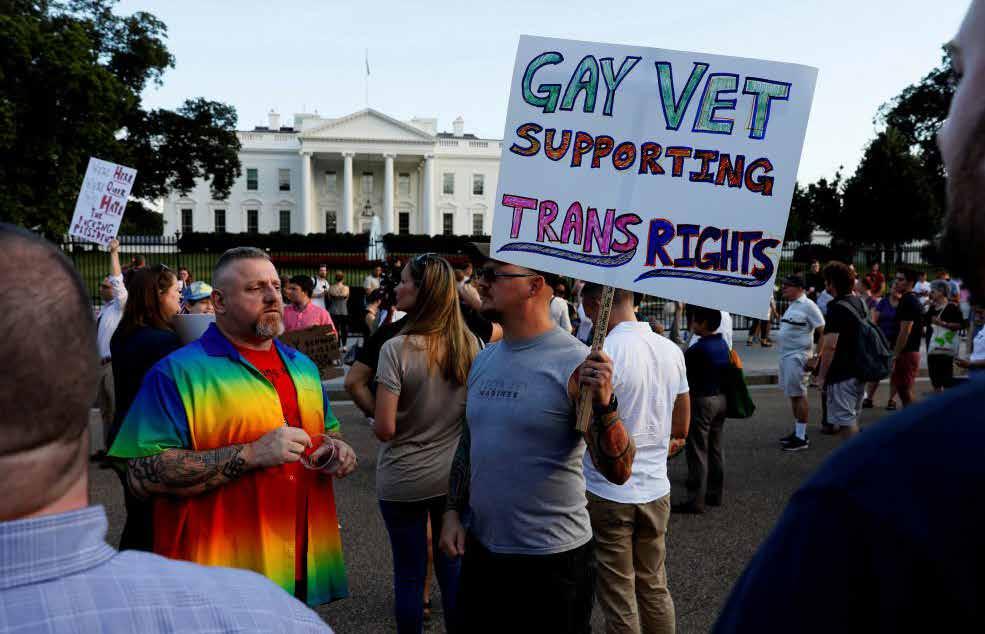
This framing allows the federal government to interpret collective Trans resistance — from protests and mutual aid to digital organizing — as potential threats. Under this memo, the speech and peaceful actions of Trans people may be included in their broad definitions of “organized political violence” or “radicalization.” This opens a pathway for escalating violence directed at Trans people through increased federal attention, scrutiny, surveillance, threats, harassment, and violence. In practice, any Trans person engaged in advocacy or community defense could be surveilled or criminalized under the guise of preventing “political violence.”
Rather than increasing safety, this memo further entrenches state surveillance and punishment for those who disagree with the current administration. Other specific targets outlined in the memo include “antifascists,” counting these groups as violent revolutionaries who must be dealt with by the government. It deflects attention from the real sources of violence that target marginalized people, while consolidating government power to suppress those who dare to advocate for fair and safe housing, healthcare, and self-determination.
Gender Justice League understands the
current landscape as one in which the federal government is actively targeting Trans people and communities through executive orders, policy, and other channels. We see this as part of a broader regime of state violence and institutional erasure: denial of identity, removal of protections, stigmatizing narratives, removal of resources, legal attacks, and creating a climate of fear.
Trans communities have long known that expanded policing and national security frameworks have never brought protection for us; instead, they have brought profiling, criminalization, raids, fear, violence, and death.
What this means
This memo opens the door to intensified state scrutiny of Trans people, activism, and nonprofits like Gender Justice League. By expanding “domestic terrorism” to include ideology, networks, and even nonviolent political organizing, the government positions itself to monitor and criminalize Trans people and resistance under the guise of national security.
Trans people may draw greater attention from federal law enforcement — not as those in need of resources or protection but as people to be watched. Per the definitions in the memo, Trans people — especially Trans activists, protestors, and community organizers — could be unjustly identified, surveilled, investigated, and treated as potential threats and violent terrorists.
The memo charges law enforcement to investigate not only violent acts themselves but the underlying “networks, funding, and ideology” behind them. We have already begun to see this directive subject Transled organizations — particularly those that are vocal, radical, or challenge state violence — to increased and expanded surveillance, scrutiny, and interference, signaling a coordinated effort to chill dissent and weaken our collective power.
For groups like Gender Justice League, which advocate fiercely for Trans life and resist government overreach, this represents a serious threat. The memo gives law enforcement and intelligence agencies broader discretion to label dissent, protest, and mutual aid organizing as potential terrorism. Trans rights advocates, community defense groups, and organizations fighting state violence could easily fall within these vague and politicized definitions of “extremism” or “organized political violence.”
Gender Justice League
Gender Justice League has already been explicitly targeted by this administration — recently evidenced in an October 10 post on X from right-wing media figure Brandi Kruse, who specifically names Gender Justice League in the post, tagging and recommending that FBI Director Kash Patel investigate us for “organized left-wing violence,” alongside the ACLU of WA, Stop the Sweeps, the Seattle Democratic Socialists, Super UW, and the Washington Education Association.
Consistent with their strategy to investigate the funding behind these groups, federal prosecutors in several districts are already investigating the Ford Foundation and Open Society Foundation — a longtime funder of many Trans, LGBTQ+, BIPOC, and democracy-focused nonprofits throughout the country, and a key player in getting grassroots movements off the ground and holding people in power accountable.
Gender Justice League — and especially our executive director, Danni Askini — were also targeted during Trump’s first administration for our work. We fought back and we survived. We know exactly what this fight takes.
What now? What can/should you do?
For individual Trans people and organizers, we recommend starting with reviewing and bolstering your current digital or online practices. As the surveillance and digital targeting of Trans organizers intensifies, we recommend being mindful and intentional about your digital presence and communications, for example: using encrypted messaging platforms, enabling two-factor authentication on your accounts, reviewing your privacy settings, separating organizing accounts from personal ones whenever possible, and limiting data storage on cloud services.
It isn’t paranoid to practice good “digital hygiene”; it’s more like the modern-day equivalent of locking your front door at night. It is about protecting yourself and your communities, ensuring that our lives and organizing can continue safely.
Don’t panic—organize
As the current administration continues to escalate its surveillance and attacks on Trans communities, our collective work to organize, defend, and safeguard our people only becomes more and more critical.
There are so many ways to plug in:
• Sustain Trans orgs: By-and-for Trans organizations like GJL are already facing shrinking resources as major foundations increasingly retreat from funding Trans-led work, with incoming federal investigations sure to exacerbate this chilling effect across philanthropy. GJL and other by-andfor Trans organizations are increasingly reliant on individual donors to sustain their work. If you have the means, please give to help us hold the line — your support directly fuels Trans resistance and survival.
• Mobilize: Your time, energy, and skills are valuable. Volunteer with our legal clinics, advocacy, and mutual aid efforts. Your participation strengthens our collective capacity to keep each other safe. Learn more at GenderJusticeLeague.org/Volunteer.
• Change the narrative: Extremist campaigns begin by isolating and dehumanizing their opposition. In a refusal of today’s anti-Trans narratives, GJL is launching a new narrative project to counter this hate by telling our stories on our own terms — asserting our full humanity, dignity, and right to self-determination. If you may be interested in telling your story, please reach out to us at communications@genderjusticeleague.org.
• Engage in mutual aid: Support Transled mutual aid efforts, show up for your neighbors, and prioritize those at multiple intersections of harm — especially Black and Brown Trans people, immigrants, and Disabled community members who are among the most directly targeted. We keep us safe!
We know you’re scared. We are too. But here’s what we also know: We’re not alone. We lean on each other and find strength together. This is how we hold the line. We’re ready, and we aren’t going anywhere. We’re building legal safeguards, contingency plans, and stronger operations, all while continuing to provide our direct services, legal clinics, and advocacy at full strength. We’ll be here today, tomorrow, next week, and every day that this administration tries to silence us — until we are all free.
SEATTLE NEWS
A new
way forward
for Seattle: The case for Katie Wilson
BY THE SGN EDITORIAL BOARD
Seattle, our beloved and imperfect metropolis, has since 2022 remained a city of immense contradictions. Leaders publicly tout its inclusivity, while simultaneously failing (and sometimes even exacerbating) the issues affecting our most vulnerable: homelessness, gentrification, increased policing and surveillance, and economic hardship.
Emblematic of neoliberal mayors across the country, like Lori Lightfoot and Eric Adams, is the performative lip service for marginalized and working-class residents, while funds continue to go toward inflating police budgets and benefiting large corporations and billionaires. Seattle has, unfortunately, not been spared this same fate. And that reality has occurred under the leadership of Mayor Bruce Harrell.
On May 24, 2025, the Oregon-based, evangelical, anti-LGBTQ+, and anti–reproductive rights group Her Voice MVMT held its Mayday USA event in Cal Anderson Park, to “raise our voices in defense of the family: the sacred and lifegiving union of one man and one woman.” The organizers and their attendees prayed for the defense of Judeo-Christian heterosexual marriage and “biological gender” while Seattle Police Department officers assaulted and pepper-sprayed proLGBTQ+ protesters in attendance, arresting 23 people after the incident.
“I wanted to protect everybody,” Harrell answered plainly to the SGN about his approach to sending SPD officers to the event. In our interview, he stood steadfast in the belief that Mayday USA had a First Amendment right to hold its event on Capitol Hill, even if the group’s sole mission was to call for the abolition of marriage equality, deny the existence of Trans people, and falsely accuse the LGBTQIA+ community of threatening children.
Although the mayor was adamant in our conversation that his character and career
were built on standing up to bullies, his track record has not always reflected it. From telling billionaire Stuart Sloan, “I share your disgust” with the historically Queer Denny Blaine Park, to his own Lesbian niece Monisha Harrell (who told the SGN that she served as senior deputy mayor under her uncle in “one of the most toxic, anti-LGBT administrations I’ve ever experienced”), and despite the mayor more recently trying to institute policies to protect Queer Seattleites, there is still substantial enough evidence for us to question whether Harrell will be able or willing to defend the LGBTQIA+ community he claims to support during his second term in office.
The danger level for Trans and Queer people in Seattle is higher than ever before, given that the Trump administration is eager to send National Guard troops into liberal cities across the country to antagonize those municipalities and enforce its draconian ICE policies. In addition, local conservative journalist Brandi Kruse is encouraging Trump to “stamp out” Antifa and has added Gender Justice League to her Washington state blacklist sent to FBI Director Kash Patel. Harrell, when asked how he’d defend Seattle from a federal incursion, said the city needed experienced leadership that could be “diplomatic” in its approach to Trump. His response left us with many questions as to whether Trump’s threats and demands to erase the existence of immigrant and LGBTQIA+ populations at all levels of American society could be diplomatically reasoned with at all. If anything can be gleaned from the last four years under Harrell, it is that true allyship must be rooted in a broader understanding of the material conditions LGBTQIA+ people of all backgrounds continue to face in this country. Leading the SPD to displace unhoused people, increasing funding for police and sur-
veillance (like ShotSpotter) while failing to properly tax the most wealthy, and undermining the programs tackling systemic issues (like the Seattle Social Housing Authority) are unequivocally not the actions of an ally.
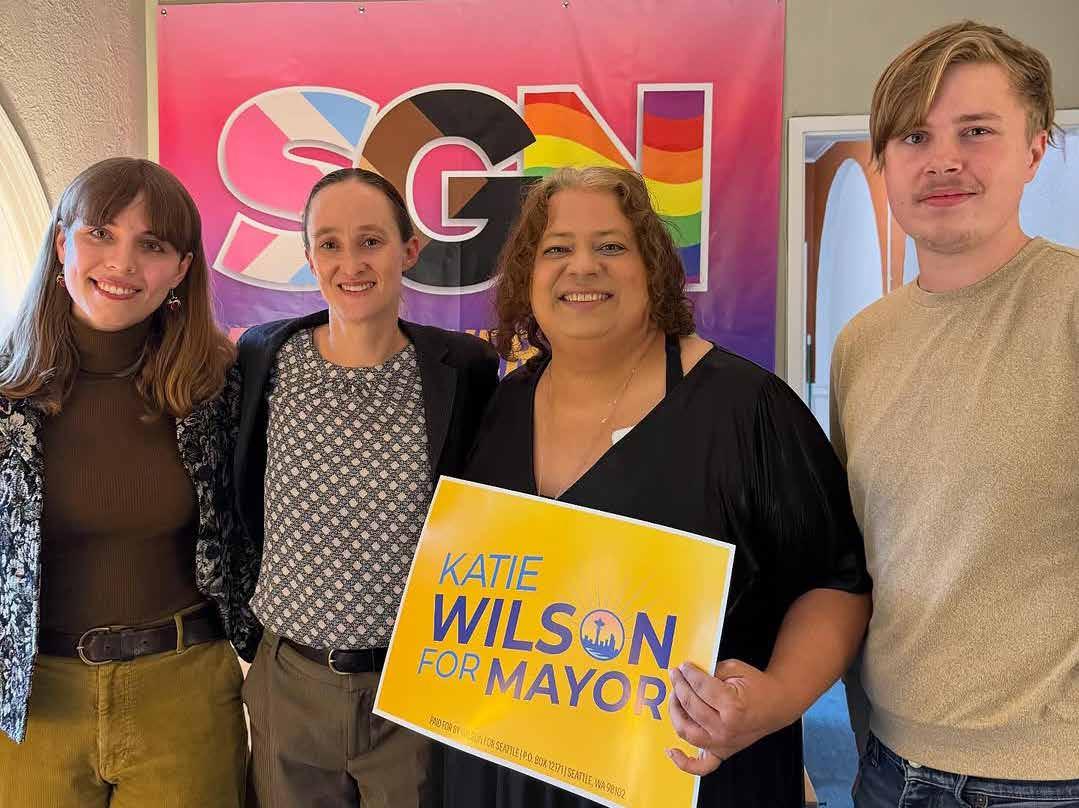
The case for Katie Wilson
At Neighbours Nightclub, the Wilson campaign held a debate watch party on the evening of October 3, hosted by drag queens Harper Bizarre and Miss Texas 1988. The atmosphere was jovial and lighthearted, attended by The Stranger’s editor-in-chief Hannah Murphy Winter, former City Council District 2 candidate Jamie Fackler, several of Wilson’s staffers, and many others. Before the debate, the drag duo riffed onstage about the state of Seattle politics and Queer rights in America, finishing with faux punches with boxing gloves in bedazzled political attire and waving Wilson for Seattle campaign signs.
On-screen, Katie Wilson stood in an oversized blazer while Harrell wore a three-piece suit with a blue necktie. The contrast in their appearances was matched by their answers to Seattle’s problems. Wilson offered an alternative, progressive, yet pragmatic vision for the city; Harrell appealed to voters to maintain the status quo. “She is not prepared for this moment,” the mayor said in his final remarks. However, the policy platform Wilson put forth during the debate and throughout her campaign are anything but unprepared.
The top 10% of US households today own 70% of the country’s wealth, while the bottom 50% only holds 2.4%. Around 1 in 14 of our fellow residents are millionaires: Seattle ranks second in millionaires per capita in the US. Yet the city’s affordable housing, social service, and public transportation systems lag significantly behind those of other comparably sized cities, such as Frankfurt, Germany.
What we found most striking about Wilson during our interview was her frankness and enthusiasm for the policies she offers — whether it be creating a superblock for residents on Capitol Hill similar to the one in Barcelona; a Local News Dollar program, emulating Seattle’s Democracy Vouchers, for residents to put toward community news sources; or advocating for a capital gains tax and a vacancy tax for buildings and housing units that sit empty while working-class people struggle to make ends meet.
Ultimately, Wilson does not try to portray herself as anything other than who she is: a community organizer and mother to a young daughter with a clear, cohesive vision for her city that seeks to grapple with the fundamental struggles of our day. She does not cater to wealthy and corporate interests. She has built a career fighting in coalition with Seattle’s diverse communities for the policies that would benefit the vast majority of citizens, including LGBTQIA+ people.
That is the promise of what a potential Wilson administration has to offer in this election, and that is why the SGN Editorial Board has decided to throw its weight behind her campaign in the general election. As our country descends further into authoritarianism and economic austerity, Trans people, immigrants, and many other groups will continue to be scapegoated by Trump and other bad-faith actors as the main source of America’s problems. And yet, with Katie Wilson comes a chance to offer the rest of the country a glimpse into an alternative way forward — one that puts people first over profit, and ultimately harkens back to our nation’s founding principles of life, liberty, and pursuit of happiness for all — including working-class and LGBTQIA+ people.
MADISON JONES
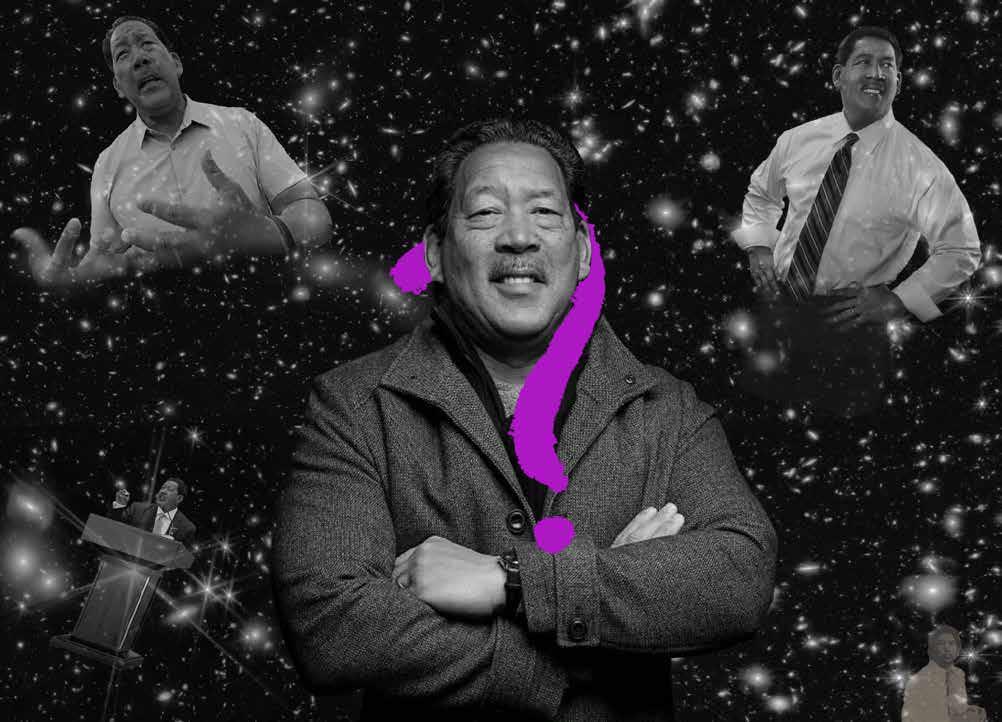
Who really is Bruce Harrell?: An examination of Seattle’s incumbent mayor
BY THE SGN EDITORIAL BOARD
Bruce Harrell was irritated when we asked if he was a moderate. Not one of those quiet irritations born of our pet peeves though, like when your friend corrects your grammar or your roommate forgets their weekly chores. No, this felt like it had something to prove.
“When I proposed body cameras because I wanted accountability through the police department, no one supported that. That’s progressive thought. When Trump took office, and when Roe v. Wade discussions started to erupt, I said, ‘Let’s change the welcoming city status to include women seeking reproductive health care.’ That’s progressive thought!” Harrell proclaimed.
“So when you say, ‘He’s a centrist,’ I’m about as radical as you could get! If you go to the Black community and say, ‘Who’s the most radical politician that’s been in Seattle’s history?’ they’ll say, ‘Bruce Harrell.’ So when they say this ‘centrist’ stuff, without even being general, I’ll say, ‘Who says that?’ I know who says that.”
The “who” could represent a wide swath of voices across his career, whether national media, community activists, or politicians who challenge his incumbency. Yet the frustration comes from a desire to be known by a different label: public servant — the blue-collar ideal of the elected official who puts in the hard work and in return earns the trust and respect of the people.
“My mom and dad worked for the City of Seattle. They were public servants,” said Harrell. “I tell people on the city council: you don’t make a lot of money. I took a huge drop in pay, but I really wanted to be a public servant. Just to solve problems and to fight for underrepresented people. I’ve been around a lot of bigots in my day, and I told myself: if I’m ever in a position of power, I’d always lead with love, faith and hope.”
Yet after 12 years of service, Harrell’s work has not been simply defined by love, faith, and hope. Something went wrong, somewhere along the way, and now he has been a witness to the deterioration of trust in our political institutions. Whenever an outcry is directed at the SPD, Parks & Rec, or the City Council, he regularly takes on the work of damage control, often at the
expense of his own reputation among progressives.
If there is a world where he could be seen as the “public servant” anymore, that would require a consensus on how Harrell thinks through his decisions. Not just his publicfacing self, who tries to be everything to everyone, but the self that exists behind closed doors. Does he hide his true intentions to prioritize business interests, as his opponents suggest, or is he just a genuine idealist whose positivity got swept up in an increasingly cynical world?
Schr ödinger›s experiment suggests that a cat, inside a closed box, is simultaneously alive and dead while it is unseen. In order for its state to be defined, the box must be open. Bruce Harrell, in the court of public opinion, is both duplicitous and honest. He’s both moderate and progressive. It’s time we open the box and settle who Harrell truly is.
Seen as a unifier
From the very beginning, Harrell was playing the game of mayor with a bad hand. The office he inherited from Jenny Durkan had just been sued for trying to conceal her text messages from the press. She had overseen the chaotic, two-week period of CHOP/CHAZ, when officers harmed protesters, businesses were vandalized, and Durkan’s attempts to please both sides ultimately pleased nobody. Trust in the mayor’s office had been damaged by compounding crises. City Hall needed someone who they felt could heal their wounds.
When the Seattle Times first endorsed Harrell for mayor, it described him as a potential unifier. It saw his past experience as a city council president — who notched progressive victories on implementing body cameras and preventing job discrimination against former inmates — as the fix for a dysfunctional relationship between a “farleft” city council and a “more moderate” mayor’s office.
“To set this right, Harrell’s proven consensus-building ability isn’t just a comfort,” wrote the editorial board. “It’s a necessity.”
To make their case, moderates at the time pointed to Harrell’s “Compassionate Seattle” plan. He wanted to put forward a
ballot initiative to address the homelessness crisis. It would have funded substance use treatment, provided more funding to social services, and expedited emergency housing.
Moderates saw the initiative as an opportunity to bridge the gap between themselves and progressives. Progressive groups refused the olive branch. Instead, they said that Compassionate Seattle, despite its name, was an attempt to fundamentally change the city charter, so sweeps would become the default response when addressing encampments.
The truth’s more complicated. The initiative’s text would have encouraged the city to “avoid dispersing people” but also said this could be ignored if “particular problems” arose. It also said that the whole initiative could be “liberally construed to achieve its purposes.” In other words, a world with Compassionate Seattle on the books wouldn’t have forced any mayor to use sweeps but could have been weaponized to justify them.
The initiative never passed, but Harrell ultimately didn’t need justification. He’s swept over 5,000 encampments across his first term. He wanted to look like he was using a scalpel, yet his actions were those of a hammer.
Four years later, the mayor’s words still feel like they’re disconnected from his actions. That’s not to say he doesn’t want to make our city better in good, honest ways. He’s established and expanding the Community Assisted Response & Engagement (CARE) Department. He established permanent paid sick leave for gig workers, and put higher standards for carbon emissions on the books.
However, are we instead more likely to remember his attempt to build a playground in Denny Blaine Park, or the toxic infighting of the City Council he built in his image? How can Harrell truly intend to be a “public servant” yet court controversy at every turn?
Monisha Harrell
Monisha Harrell had long felt supported by her uncle, who helped raise her. They celebrated the holidays together, Pride included. Bruce Harrell never shamed his
niece for her identity as an out Lesbian and LGBTQIA+ rights advocate. When her policy work at Equal Rights Washington resulted in protecting Queer Seattleites from conversion therapy, he rewarded her with an opportunity: to serve as his campaign manager. When he won in 2021, Harrell promoted her to deputy senior mayor.
In another world, with Ms. Harrell’s track record, the Harrells could have done a lot of great work for the Queer community together. Yet as the years went on, Ms. Harrell’s relationship with her uncle soured, and she quietly left his administration in 2023. For a long while, it was just another one of those moments when something went wrong along the way.
That was, until this year, when we got some honest answers.
In a conversation with KUOW, Ms. Harrell revealed that she saw the Harrell administration as a “dog-eat-dog environment,” where unspoken sexism and racism influenced decision-making. It was a bombshell that divided the women around City Hall, three of whom publicly sided with the mayor, six others anonymously siding with Ms. Harrell.
While it’s easy to get lost in the salacious details, such as Mayor Harrell calling Ms. Harrell an “SDM [senior deputy mayor] Nazi”, the most revealing element of the report was how the administration actually operates on a day-to-day basis. Ms. Harrell, who oversaw the city’s budget department, said that a small group of male colleagues disrupted her ability to work. Rather than address issues they had with her directly, they would instead circumnavigate her and share their concerns with the mayor, who then would overturn her decisions.
According to Ms. Harrell, the mayor surrounded himself with a “cadre of men” whom he often conferred with, often at the expense of female voices across city government. Ms. Harrell said she heard less directly from her uncle as time went on, all while he had discussions about her work behind closed doors.
The mayor had seemingly built an environment where power was regularly, and recklessly, delegated. Rather than trust her perspective on important issues, he would
GRAPHIC BY CALVIN JAY EMERSON
often put Ms. Harrell’s choices up to a vote, in which those with lower seniority had equal say as deputy mayors, without weighing in himself. According to Tammy Morales, his lack of a clear vision meant that deputy mayors took care of more citywide issues, but had to fight tooth and nail to have them prioritized.
Starting over If Ms. Harrell’s report is based in truth, then it presents Mayor Harrell’s work in
a new light. Think about when he had to apologize for the SPD’s crass treatment of Jaahnavi Kandula, or when he had to defend Parks & Rec’s choice to have a hateful religious group at Cal Anderson Park. Think of when he had to place his director of external affairs on administrative leave over a sexual assault case, and had to oppose changes to the ethics code put forth by city councilmembers he endorsed. So many unnecessary conflicts and scandals have resulted from departments and
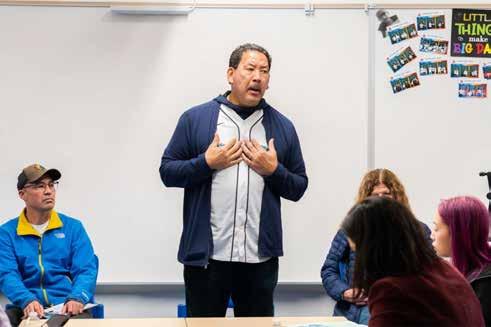
Harrell, Wilson, and others discuss the future of our public schools at the Seattle Education Forum
BY CALVIN JAY EMERSON
SGN ASSOCIATE EDITOR
For a dark time in national politics, the optimism at Rainier Beach High School certainly was as bright as the library’s fluorescent white lights. In a makeshift space between the two manga aisles, a group of young students welcomed guests to the forum and presented the evening’s subject: the well-being of Seattle’s next generation.
Sixteen candidates running in the upcoming general election, including Bruce Harrell, Katie Wilson, Sara Nelson, and Alexis Mercedes-Rinck, came to answer questions from students and parents alike, and to show their vision for the city’s public schools.
Diverging from the traditional town hall format, the candidates were instead separated into breakout rooms with groups of curious constituents, then rotated through them. As we went from room to room, here’s what we overheard.
In the science lab, Wilson and Nelson spoke with Howard, an older gentleman in a neon green raincoat, who wanted to know why City Hall has yet to consider a policy proposal from the 36th District Democrats that would require SPD officers to record the information of anyone they see performing stops, arrests, etc. who’s not a Washington police officer. The hope would be to deter any ICE officers from hiding their identity under a mask and/or everyday clothes.
Nelson wanted to know more about the legality of the proposal, and why Howard
felt that Harrell’s recent $4 million investment in immigration legal aid wasn’t enough. After Howard provided specifics, Nelson said that if the mayor were to advocate for the policy, she wouldn’t object to its implementation.
Sydney, a Seattle Public Schools employee who brought along his first-grade daughter, asked about safety in the South End. Nelson said she’d be open to all “the tools in the toolbox,” including safety response officers (SROs), essentially police officers on school grounds.
Joe Mizrahi, a down-ballot candidate running for the school board, added his two cents to the conversation. Based on feedback he’s heard from families, he thinks that the conversation on “where to place SROs” has gotten too complicated. Most parents, according to Mizrahi, want to prevent violence around school grounds, not inside the school itself. So he proposed stationing SROs outside school grounds, allowing them inside for brief intervals and emergencies, but not to stay. Wilson agreed. Nelson didn’t respond to Mizrahi, and instead asked Sydney what he wanted to see happen.
“If there’s work in progress, we just want to see that demonstrated in our daily lives,” he said.
Across the hall in Ms. Patterson’s computer class, Eddie Lin was asked about recent cuts to scholarships meant for low-
Pride Place residents concerned about e-bike, scooter use
BY MELANIE RODRIGUEZ UW NEWS LAB
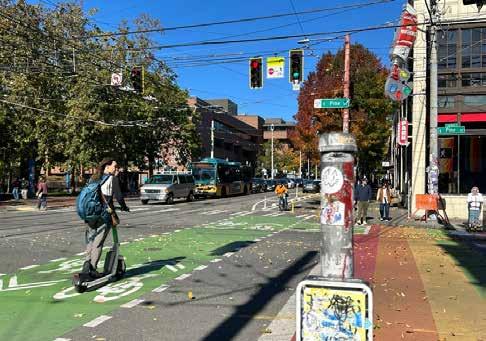
As the number of Lime bikes and scooters grows, so do concerns about their speed and safety on Capitol Hill sidewalks, according to discussion at this month’s LGBTQ+ Advisory Council meeting with Seattle Department of Transportation representatives on Wednesday, October 8.
“We have been getting complaints for as long as we have had scooters,” said Becky Edmonds, SDOT’s shared mobility program manager.
Concerned residents attending the meeting recounted worries about their safety around Lime bikes and scooters in the neighborhood, including reckless driving and parking. Many live at Pride Place, an LGBTQIA+ senior housing community on Capitol Hill.
A common theme was the feeling that residents are unable to leave their front door without having to dodge speeding electric bikes and scooters. A few attendees came with their own research on solutions, including Seattle resident J. Steve Mayo, who said that technology is advanced enough to prevent pedestrian collisions. Lime debuted sidewalk detection in San José in 2020, but it has not been launched
individuals who are supposed to follow Harrell’s vision. Instead, he has to talk his way out of their mistakes. Would those mistakes have happened if he had more directly informed the decision-making? Or if his deputy mayors were more regularly trusted with their choices, rather than having their work shut down by a group vote?
“Hiring people is one of the most important skill sets that a good mayor should have,” said the mayor, in our recent interview. “The stakes are high. You’re hiring
people that will be in charge of hundreds of millions of dollars in budgets. I was a managing partner in a law firm. I was president of the City Council. I’ve had many opportunities to hire people. I went and got certified to be an HR professional, because I realized how serious HR issues are. To put [Katie Wilson] in a place to make these kinds of significant hiring decisions? To start over? I think it’s just a dangerous precedent.”
income students. Lin, interested in the bigger picture, chose to place the problem within the larger context of income inequality. When taxes aren’t equally paid across classes, according to Lin, the pressure to cut back on essential, equitable services will only continue.
“This is the issue of our time,” said Lin. “We need to change the power structure in Olympia and across our city.”
Harrell jumped on Lin’s bandwagon, framing the problem through the lens of policy. “Our country needs to be restructured,” said Harrell. “Which is why a lot of our policies are playing the long game, so that we can achieve true equity.”
Harrell and Lin continued their backand-forth when the mayor was asked about protecting immigrants inside schools. Harrell brought up how he’s raised the budget of the Office of Refugees and Immigrant Affairs by 70% this year. Lin didn’t object to Harrell’s new budget but insisted on mentioning that the City still needed a con-
crete plan for protecting families on the perimeter of school grounds.
“Students and parents are protected when they’re in the building, sure,” said Lin. “but what about once they’re on the sidewalk? In the parking lot?”
Back at the library, when Nelson was asked about how to hold school boards accountable when marginalized students receive poor instruction, she scrambled to read a prewritten script off of her phone. Mizrahi and school board candidate Janis White saw an opportunity to provide a more candid response.
“We hear a lot of talk about improving literary instruction, but unless you have the resources to train educators, it won’t be done,” said White. “So we need to be present, visit school more often, and speak with our educators directly.”
“It’s all about giving proper support,” said Mizrahi. “We know that a student’s education, when we care and invest wisely, can go a long way.”
in Seattle.
“We have cars that can detect a pedestrian,” said Mayo.
During SDOT’s presentation, Edmonds shared initiatives in place to help increase public safety. The department is currently using what it calls a Safe System Approach — lowering speed limits, promoting safe driving, and fostering safe pedestrian practices — to reduce traffic deaths.
Edmonds added that last year Seattle had a total of 6.3 million trips on Lime bikes and scooters, but this year that number is already over 8 million. She also said that data show that many residents use Lime bikes and scooters as their sole mode of transportation. Seattle offers a reduced rate for low income citizens who qualify.
“I think we see a lot more popularity, but of course, a lot more of those ubiquitous issues and growing pains as we figure out how to build up that supportive infrastructure,” said Parker Dawson, Lime’s senior regional lead for government relations for the Pacific Northwest.
Edmonds said that this year more residents have spoken up about safety concerns, especially people riding recklessly.
When SDOT expects bigger crowds during holidays or big events, it can set up “slow zones,” where bikes and scooters are forced to go slower.
Those attending the meeting raised the question of creating more “slow zones” in Seattle or having more regulations for riders of the electric devices. Because GPS isn’t always accurate, setting up no-ride zones is trickier than it sounds and can lead to other safety problems, Dawson said. For example, if the system thinks someone is on the sidewalk when they’re really in
the street, it could suddenly stop the Lime device, which can lead to serious injuries.
Councilmembers also discussed concerns that younger Lime riders were more likely to be riding recklessly. While gathering identification on specific riders who are breaking the law could be a solution, Dawson said that it would be problematic to do so in the current political climate. Reporting reckless riders is possible using the “Find It, Fix It” app.
LIME BIKES AND SCOOTERS SEEN AROUND CAPITOL HILL MELANIE RODRIGUEZ
SEATTLE MAYOR BRUCE HARRELL SPEAKS AT THE SEATTLE EDUCATION FORUM EVENT ON OCT. 15 CALVIN JAY EMERSON
Seattleites march in second No Kings protest
BY LINDSEY
On Saturday, October 18, in front of the Space Needle, Rep. Pramila Jayapal addressed a crowd extending for nearly a mile. She began her speech with a quote by a well-known Founding Father:
“At the 1787 Constitutional Convention, Benjamin Franklin was asked what kind of a government they were establishing — a monarchy or a republic — to which he famously answered, ‘A republic — if you can keep it,’” Jayapal began. “Well, Seattle, we are at that ‘if you can keep it’ moment.”
Jayapal kept the crowd’s rapt attention for nearly 20 minutes, the final speaker before the procession of protesters, dressed in everything from rain gear to blow-up animal costumes, began their march toward Pike Place Market.
Nathan and Sonya, two locals who participated in Saturday’s march, took their outfit inspiration from the famed “Portland Frog,” an activist at ICE protests there, dressed in a silly inflatable frog costume. “We are doing our part as American citizens to take our country in a direction of sanity, kindness, and peace,” Nathan said from inside a blue blow-up axolotl.
While the costumes may seem unserious to some, Nathan described it as a “psychological recognition that we are not a threat.”
“We’re trying to remind everyone that this is peaceful,” Sonya added. “Everyone here knows that, but everyone around the world [needs to know]. This is a peaceful demonstration, because the government is not peaceful right now.”
The march, which at times seemed more like a disorganized parade, remained peaceful. There were no arrests in Seattle; nationwide, no arrests for violence have yet been reported. People of all ages could be seen walking through downtown Seattle’s streets, from families with young children in strollers to groups of older people who recalled protests from the ’70s.
Calls for peace
Speakers, including Jayapal, emphasized the need for peace amid growing political divisions and acts of political violence nationwide. Jayapal recognized the need not only in America but also “peace in Gaza and around the world.”
With so many gathered from across the left-of-center spectrum, the protest’s overall messages were at times vague. For the most part, protesters seemed to be on the
same page as Jayapal, who demanded a “government that works for us — not a king, not for the billionaires,” before specifying the needs of those struggling with debt and calling for affordable housing, childcare, and universal healthcare.
Throughout the protest, the biggest issues voters seemed to advocate for were the abolition of ICE, the removal of National Guard troops from American cities such as Portland and Chicago, freedom for Palestine, and protection and rights for Transgender Americans.
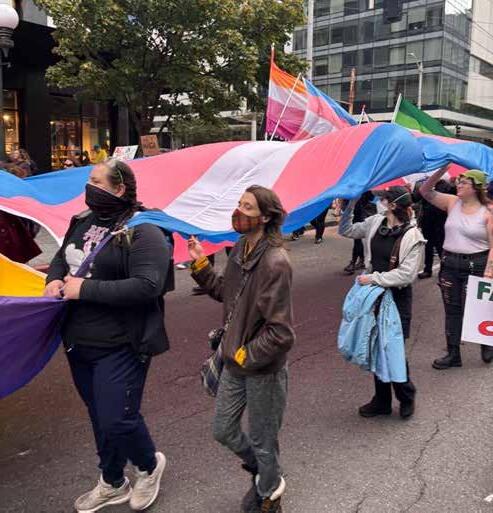
A slew of organizations put together the No Kings protest. One group of activists arrived with Pride flags stretching nearly half a city block. “It’s important to be out here, to be visible,” said Tom, the giant Pride flag organizer. “I didn’t want this march not to have giant Pride flags, because, you know, Trans rights are under attack. Queer rights are under attack. And I’m sick of it.”
Large opposition
Overall, the march was a powerful symbol of the sheer number of Seattleites— and Americans—displeased with Donald Trump’s presidency. The reaction seemed less intense than the immediate pushback toward the administration in 2017, however. That may be a side effect of the vast multitude of transgressions, pulling the focus of protesters in a kaleidoscope of directions.
Jayapal, like many others, pointed out that the overwhelming anti-Trump sentiment Americans are feeling is intentional, as it was orchestrated in Project 2025, which the Associated Press reported three weeks ago is now openly backed by the president.
“As written in Project 2025 and enacted with frightening speed, this is an attempt to destroy our republic, designed to take over control of our government so that it answers only to the king and not to the people,” Jayapal said. “They want to divide
us, so that he can take our power and turn it into his power and reward the billionaires, the corporations, those who bend the knee with trillions of dollars of tax breaks and pardons of violent insurrectionists and sex predators.”
The protest failed to lay out any specific course of action, but it showed just how large the community of Americans opposing Trump’s actions is. Speakers like Jayapal encouraged everyone to participate in nonviolent forms of resistance and suggested visiting her website for more information. The overall emphasis of the day was that the greatest strength anti-Trump Americans have for these next four years will be the endurance we find within our communities.
Taking care
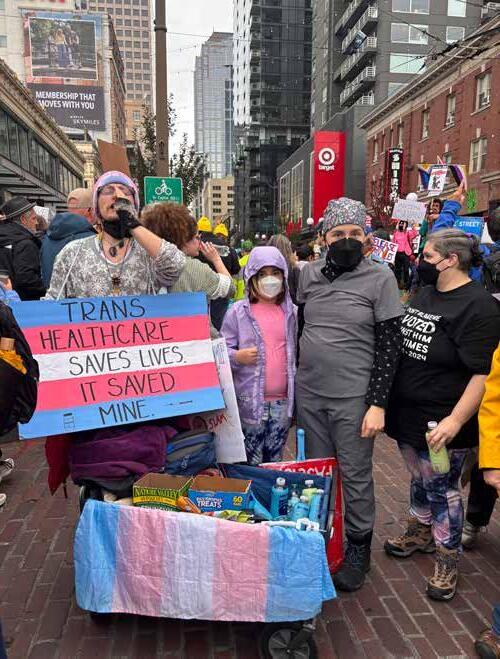
The community’s endurance was fortified on Saturday, in part, by a group of locals handing out free water and snacks to all who passed by. “We stopped by before the thing and just grabbed some snacks and water,” said Celeste, a protester, while handing out granola bars. “I’ve done plenty of protests, and it’s something that people always forget about: taking care of their bodies, you know?”
Taking care of bodies is something Celeste knows a thing or two about. In front of the snack cart stood a sign that read “Trans healthcare saves lives, it saved mine.” For Celeste, preserving access to gender-affirming care for Transgender people was a primary motivator to join the march. So was protecting the rights of facilities like Planned Parenthood.
“I get all of my HRT through Planned Parenthood,” Celeste said. “They absolutely saved my life. Being able to get on testosterone and live authentically as a Transgender person has absolutely helped in so many areas of my life. It matters a lot to me.”
Community building was at the core of the No Kings protest. From the communal chants to strangers posing for photos to show off their blow-up costumes to Trans activists handing out snacks and water to weary walkers at the end of the trek, nearly 90,000 Seattleites did something they don’t usually do: connect and share a communal moment with strangers.
ANDERSON
SGN STAFF WRITER
LINDSEY ANDERSON
LINDSEY ANDERSON
LINDSEY ANDERSON
2025 VOTERS GUIDE
KING COUNTY
King County, Prop 1: Medic One –Emergency Medical Services Levy: Yes
King County Executive: Girmay Zahilay
King County District 3
Sarah Perry
Seattle City Council Position 8: Alexis Mercedes Rinck
Seattle City Council Position 9: Dionne Foster
CITY OF LYNNWOOD
Lynnwood City Council, District 2: Isabel Mata
CITY OF SEATTLE CITY OF RENTON
City of Seattle, Prop 1: Families, Education, Preschool, and Promise Levy: Yes
City of Seattle, Prop 2: Changes to Business and Occupation Tax: Yes
Seattle Mayor: Katie Wilson
Seattle City Attorney: Erika Evans
Seattle City Council District 2: Eddie Lin
Renton City Council, Position 2: Carmen Rivera
CITY OF TACOMA
Tacoma City Council, Position 5: Zev Cook
Tacoma School District No. 10, Director Position 1: Lisa Keating
REGIONAL NEWS
Hope never stops singing: Zooey Zephyr’s fight for democracy
BY RENEE RAKETTY
SGN PUBLISHER
Life in Montana
Reprinted with permission from Out NW
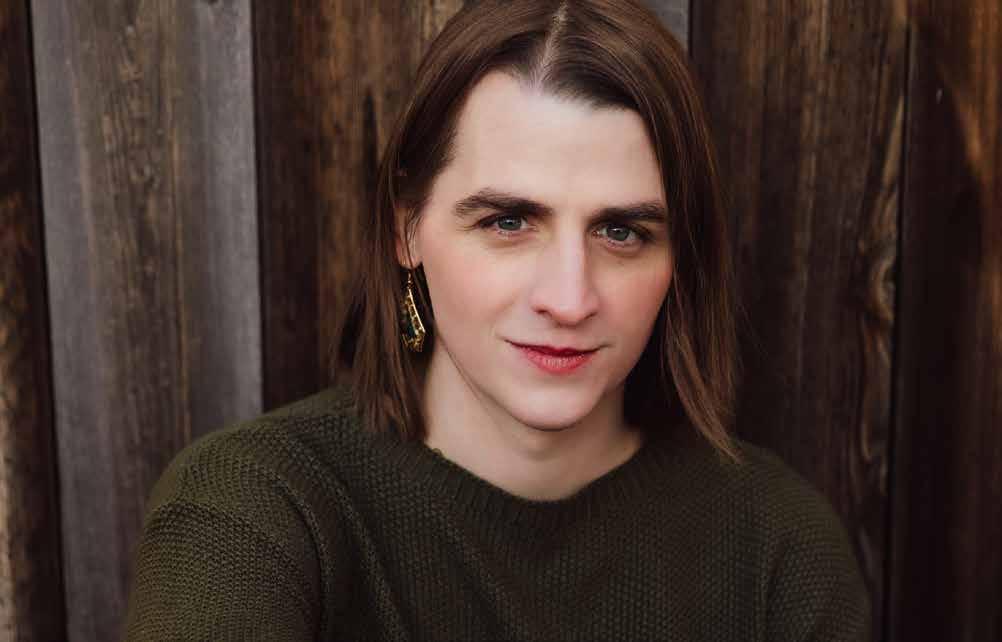
I first met Montana state Rep. Zooey Zephyr in September 2024, when she was the featured speaker at the Victory Fund’s “Victory in Pacific Northwest” event in Seattle, long after she rose to national prominence. And while I take no credit for her success and achievements, I was struck how one high school in Bellevue, Washington, helped put two openly Trans women on a trajectory toward leadership in the LGBTQIA+ community.
In 2022, Zephyr became the first openly Transgender woman elected to the Montana legislature, a powerful moment for equality in a state best known for its vast open landscapes and its ranching and mining history. Just a few months later, she made a passionate floor speech against a bill banning gender-affirming care for minors, telling fellow lawmakers that there would be “blood on their hands” if the bill were to pass, due to the potential for an increase in an already too high suicide rate among Transgender youth. While she only aimed to stress the real-life consequences of the work legislators do at the state capitol in Helena, she was censured by Republican lawmakers shortly thereafter for her remarks. She was barred from House floor, gallery, and anterooms for the rest of the session.
Zephyr told Out NW over Zoom earlier this month that the move was “antidemocratic” and an effort to silence her by using “the powers of the speaker[ship] to ignore folks that you just don’t want to hear from…
“For me, in that moment, it was about democratic principles at its very core. The speech I gave initially was about Trans people. Everything that followed was about what [happens] when people in power [try] to consolidate and use that power to silence the minority. And that is the hallmark of authoritarianism.”
Zephyr’s bravery is featured in the documentary Seat 31: Zooey Zephyr, directed by Kimberly Reed, which was short-listed for the 2025 Academy Award in the Documentary Short category. Her public profile has led to a busy schedule of media interviews, lectures, and keynote speeches.
When asked about her newfound fame, Zephyr deflected, as if to brush off the idea entirely. “Your everyday Montanan can smell the BS a mile away. And so can your colleagues in the legislature,” she retorted. “My political [mantra] is that I am as sweet as I am inevitable. I can still be the kind, loving, sweet-hearted person that I am… and also push for the inevitable change. If you lose your genuineness and you lose your gentleness, every action you take is at risk of corroding your own soul. And the soul of a country. And so I choose to lead this way.”
When asked about life as an openly Trans woman in Montana, Zephyr said that Missoula “is no more difficult to live in [than] many places around the world… I mean, to me, living authentically as yourself felt like not a choice. It was that or die. And so you transition, because it’s who you are. And it’s who you need to be to move through the world and live as yourself.
“I think what calls me to be here is, again, that version of Montana that I still hold on to and that I hear from my colleagues — Democrats and some Republicans — who also yearn for a place where we just care for each other and where we don’t try to scapegoat and villainize certain communities in pursuit of political power... a community where we take care of each other...
“There will always be people falling short of that goal. There will always be monsters in the dark. In every city, no matter how large, no matter how small, no matter how progressive or conservative. They will be there. And the question is, how do you build enough community to buffer against that? I found that here in Montana.”
Zephyr and Erin Reed, famous for her social media persona “Erin in the Morning,” were drawn together by their mutual online LGBTQ+ advocacy, which resulted in a long-distance relationship. In 2023, the two got engaged at Queer Prom in Missoula. Later, they married in what GO Magazine called a “star-studded celebration,” whose guests included filmmaker Lilly Wachowski of The Matrix trilogy, NCAA champion swimmer Lia Thomas, and Colorado state Rep. Brianna Titone.
Sarah Kate Ellis, the CEO of GLAAD, officiated, according to the publication.
“We joked shortly before I proposed to her… that ‘girlfriend’ felt like the wrong word… ‘Wife’ very much feels like the right word,” Zephyr stated glowingly. “And it has been an absolute joy. We just got back from our honeymoon in France!”
Legislative effectiveness
Zephyr ran and won her seat for House District 100 in November 2022, and, after redistricting, won her District 95 seat —both serving Missoula — in 2024 by wide margins. Zephyr remains humble, however, continuing to focus on her legislative efforts, including more compelling speeches on the House floor against anti-Trans bills, one targeting drag performances and Pride events, for example. The bill failed after 13 Republicans joined Democrats. A separate anti-Trans bill saw 29 Republicans break ranks to vote with Zephyr, effectively killing the proposed legislation.
“We stopped, I think, about half of the anti-Trans bills,” Zephyr said. “And we were the only state in the country where … half the Republicans were joining [Democrats] to vote some of those down. So that was incredibly successful on that front.”
When asked about her proudest legislative accomplishments, she spoke not about the headline-grabbing stuff but about protecting children in camps for supposed troubled teens. “There was a bill to basically have people go do semiannual or once-quarterly investigations and interviews with the kids at these [troubled teen] camps… I got an amendment to that bill that [mandating that] unmonitored phone lines be put in place at every camp, with emergency contact numbers posted. It was the first piece of legislation I ever got my stamp on back in 2023… We’re protecting kids and we’re saving lives,” she said proudly.
Seattle influence
Zephyr was born in Billings, Montana, in 1988 but relocated to the Seattle area at the age of 10. She attended Newport High School in Bellevue and went on to earn her
bachelor of arts in administration and creative writing from the University of Washington in 2011.
“I was leaving a very idealized version of Montana in my youth,” she said. “And my mother — we were conservative and religious growing up — was warning of Seattle… like, ‘Oh, the big city, be careful. It’s going to change you.’”
While she is aware of criticism of the city and the “Seattle freeze,” a perceived difficulty by newcomers to make friends, she sees it as “relentlessly building community,” “consciously cultivated,” and a “space that is always looking to pull people in.” She found this to be true during her formative years and on into college. “[People said,] ‘Hey, are you going to read? We’ve got a book club going on. We’ve got a writing club going on. Oh, we all go down to the waterfront every Saturday,’ she recalled. “Everyone was relentlessly building community.”
Zephyr credits her time in Seattle with helping to shape her perspective and attitudes on a lot of issues, but says she remained a Montanan at heart.
Trans athletes
It was in Bellevue that Zephyr excelled at sports, winning five state wrestling titles. She recently told me that her name still hangs from a banner at Newport High School, adding that her time there contributed to her discipline and competitive spirit. She told The Guardian about a sign in the wrestling room (that I also touched after practice each day, having once been a wrestler at Newport many years earlier): “Every day I leave this room a better wrestler and a better person than when I entered.” She claims that this became a motto she still carries with her today. “I love talking about Trans sports,” Zephyr said, because of the level of hypocrisy and misinformation in the discussion. “When we talk about Trans athletes in sports, I always pivot to the NCAA and say, okay, you’ve got 500,000 athletes. Trans people are about 1% of the population. That would put you at — quick math — 5,000 Trans athletes, were everything equal. If you’re saying Trans athletes are taking
COURTESY ZOOEY ZEPHYR
over, you’d expect to see more than that. But you don’t, you see less. And not just a little less. A tenth of that would be 500 — you see less than that. A hundredth would be 50 — you see less than that. When the NCAA head was interviewed, he said there were less than 10 Trans athletes in the NCAA…
“Let’s say you’re someone who is concerned about Trans athletes and you’re rabble-rousing, saying, you know, ‘They’re letting men take over women’s sports,’ rabble, rabble. And I say something like, ‘Okay, well, what about someone who transitioned before puberty? What about them?’ It’s like, ‘Well, I don’t see how that would be a problem.’ It’s like, ‘Well, you’re banning that too.’
“What about a nonathletic sport like chess? They’re banning that too [for Trans people]. They’re banning [Trans people in] fishing. How do you have those conversations? And I think you can peel away at the hypocrisy a little bit.”
Zephyr warns Democrats away from falling into a trap by backing away from Trans inclusion in sports. “[If those on] the right
are in a fervor about something so clear in its lack of evidence, what happens when it comes to healthcare? If it were about fairness, why wouldn’t they want a Trans youth to transition at 13 and [then] say, ‘Okay, if you’ve transitioned before middle puberty, then you can go play on the women’s volleyball team or basketball team.’ It’s never really about that,” she said emphatically.
“And I think we’re starting to see that … the escalation of the Trump administration [has] made those conversations easier. But, I always say, when you see this fracture point, that is the space to walk toward, because the fracture point is revealing about how much the argument on the right falls apart when it has any scrutiny placed upon it.”
Gaming
Zephyr also excelled in competitive gaming back in her college years. According to LGBTQ Nation, she was a top-ranking competitive tournament fighter in Super Smash Bros., and according to her Wikipedia page, she placed in the top eight at the Northwest Majors IV event in Des Moines,
Isabel Mata runs to make changes to Lynnwood City Council
BY MADISON JONES
SGN MANAGING EDITOR
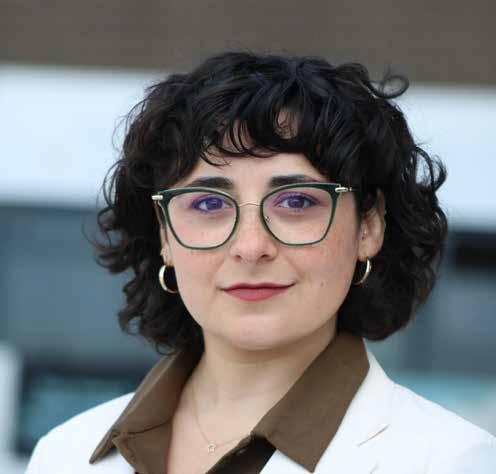
Isabel Mata is a Queer Jewish woman who, over the course of her career, has worn many professional hats: cosmetics marketer, creative consultant, mindfulness teacher, photographer, writer, and even (former) SGN staff writer, known for the column “Ask Izzy.”
Mata now lives in Lynnwood with her husband and three cats, and over the past year she has grown more and more frustrated with the decisions being made at Lynnwood City Hall. With incumbent City Councilmember Patrick Decker not seeking reelection, Mata decided to throw her hat into the ring for the District 2 seat. With the November 4 election approaching, the SGN caught up with Mata to talk about her campaign and what changes she’d like to make if elected.
Madison Jones: What brought you to decide to run for Lynnwood City Council District 2?
Isabel Mata: Ever since Trump got elected the first time, I’ve been feeling very anxious and just kind of angry at the state of the world and everything that is happening on a federal level. It forced me to get a little bit more involved in local government.
Especially [since Trump’s second term,] I knew that, for a lack of a better term, the shit was going to hit the fan in Washington and that we needed to have strong, kind, empathetic, courageous leaders in local government who are willing to fight and use their voices in order to protect the most vulnerable members of our community. I started going to [Lynnwood City Council] meetings probably around nine months ago and started making public comments, and I just wasn’t happy with the way that our city council was running.
MJ: Do you have a background in politics and civics, or was this decision to run more spontaneous?
IM: I have a background in marketing and communications but always have been an activist... Whenever I saw an injustice, I would speak out about what’s going on. In high school, I got bullied pretty badly, especially through this online site called Formspring. I got comments that were basically like [“commit suicide”], and I really, really struggled with it. But I knew I had to do something, so I put together a petition to try to get the website taken down. And then I started a school club that started this journey of activism and leadership: I was
Washington, in May 2014. She mained Ness in Brawl and in Project M. Then, in newer games, she mains Young Link primarily. In 64, it was Ness and Captain Falcon, she revealed.
“Yes, I am a big gamer,” Zephyr said. “These days, I play Stardew Valley with my son and Sea of Thieves. And… I’ve played old school RuneScape for… 24 years at this point. But back in the day, in my college days, I was a competitive Super Smash Bros. player. I traveled the state to play Brawl at the time. And then ultimately Project M. And even traveled… a little bit to other states to play and compete.”
She also likes to escape the world of politics for more imaginative play in Dungeons & Dragons on a weekly basis, often alongside her wife. “It is an absolute blast,” she exclaimed.
Hope in dark times
Zephyr credits her family and young son, now 10, for replenishing her strength and giving her reason to fight for the people of Montana and the LGBTQ+ community, both locally and beyond. She sees
the despair, especially among Transgender Americans, and draws inspiration not only from Queer liberation movements of the past but what she sees unfolding around her.
“It’s hard,” she said. “You know, I don’t think there’s a magic word you can say, given where we’re at, that will suddenly let people know that just around the corner is something beautiful. Our community… came together to care for [its] dying members … when the government… pretended we weren’t there. You look at how much internal care had to happen there, how much rage outward has to exist. And I certainly believe there is a place for that rage, thinking of the ACT UP movement and such.
“I think of someone like [Emily] Dickinson, [who said,] ‘Hope is the thing with feathers that perches in the soul, sings the song without the words, and never stops at all.’ Hope just never stops. And I think when you go back to art, and you see Queer artists [in particular], and you read their words, and you see their struggles, you see embedded with those struggles joy — deep, profound joy — that can take root anywhere.”
youth group president, I was on all kinds of boards…, and then I just always showed up to protests and used my voice as much as I could.
MJ: If elected, what issues would you tackle in your first hundred days in office?
IM: One of the things that’s currently wrong with our [local electoral] system is that our elections don’t have the highest turnout rates. In the primary this year in Lynnwood, we’ve got about 20,000 voters, and only about 5,000 showed up to vote. That’s 15,000 people who are not having a say in what’s going on in local government, in the places that are affected most. The people that do vote right now in Lynnwood are homeowners and [tend to be] much older, and that demographic is much more conservative. But our city is growing astronomically, and there are more and more people who are renting and are cost burdened by the housing market. They’re the ones who our policies impact the most, but they’re not showing up [to vote], and that means they’re not getting representation on the council.
So the first thing I want to do is put together a strategic outreach plan in order to get people more involved in local government, so that we can work better together, rather than just the people at the top having all the power. The most important part of local government is an engaged citizen who is showing up and having their voice heard, because we are creating policies dealing with millions and millions of dollars in a budget that is directly impacting these people.
A presidential election, yes, impacts them on a broader scale in terms of quality of life, like maybe tariffs, but [with local government,] these are things that directly impact them: it’s having a smooth sidewalk, it’s having enough playgrounds and parks, it’s prioritizing infrastructure that keeps you safe. There are so many different ways local government impacts people.
MJ: What are some of the major issues voters have been bringing up on the campaign trail so far?
IM: The number one thing that comes up all the time is safety. We are a microcosm of what’s happening [in the US] and have a lot of youth gun violence. Just in my neighborhood, two kids have died in the last year from gang-related gun violence. People are afraid to send their children on the bus,
to the mall, to the park, like, all of these things that are really necessary for kids and teens to learn independence. Number two is the cost of living. Taxes are really high, and groceries are really expensive. We have one of the highest sales tax rates in all of Washington state, and definitely the highest in Snohomish County (10.6%). I hear all the time, “I’m scared of getting priced out,” and “I’ve lived here for 60 years — if they raise the taxes again, I don’t know if I’ll be able to afford to stay.” So those are the two biggest issues that I hear, and that I’ve been really reflecting on as I go about this campaign.
MJ: How would you go about addressing those challenges?
IM: In terms of youth gun violence, one of the things I’ve noticed is there are really no third spaces for teens to hang out. The mall closes at eight o’clock, and we’ve got one bowling alley that’s even thinking about selling to a developer, so there are no places for these kids to go and be with their friends after school. [Instead], they go to the parks, they go walk around the streets, [which makes] them susceptible and vulnerable, stuff that will get them in trouble. I want to focus on finding ways to partner with developers who are prioritizing creating some of these third spaces. And one of the ways is working with the new Lynnwood Neighborhood Center that’s opening in January. I’m pushing for them to have a teen space that is open late, because then we can have an area that’s got things for them to play together, that gives parents [peace] of mind to let their kids go out and
be independent, be with their friends, and build community.
As far as the cost of living, I want to be a little more creative about ways to bring in different revenues, so that we don’t automatically have to rely on adding more and more taxes. For example, the city council is thinking about a business and occupation (B&O) tax that would make it harder for businesses to get started. We already have so many big-box stores and corporate chains; it’s really important that we incentivize small businesses.
One of my ideas is [about] a really cool area in Lynnwood called Perrinville. I think it would be great for tourism, but there’s no outdoor seating or promenades, just parking lots. I want to see how we can redevelop it to add some more community spaces to draw more people out to Lynnwood, which therefore brings in more sales revenue and eases the burden on our own community.
MJ: Any final messages for Lynnwood voters before election day on November 4?
IM: It’s so incredibly, incredibly important for people to vote and have their voice heard, just to share what they think on a regular basis. Because as city council, it’s our job to represent the [people’s] best interests, whether it’s to Olympia on the state level or up on the dais figuring out what new developments we’re going to push through next. People have so much power, and when they come out and make their voice heard, really amazing changes are possible.
COURTESY ISABEL MATA
NATIONAL NEWS
“A revolutionary, life-changing experience”:
Conservative
Christian Lesbians are coming out later in life
BY SAM DONNDELINGER
This story (https://www.unclosetedmedia.com/p/a-revolutionary-life-changingexperience) was originally published in Uncloseted Media (https://www.unclosetedmedia.com), an LGBTQ-focused investigative news outlet, in partnership with The 19th , a nonprofit newsroom reporting on gender, politics and policy.
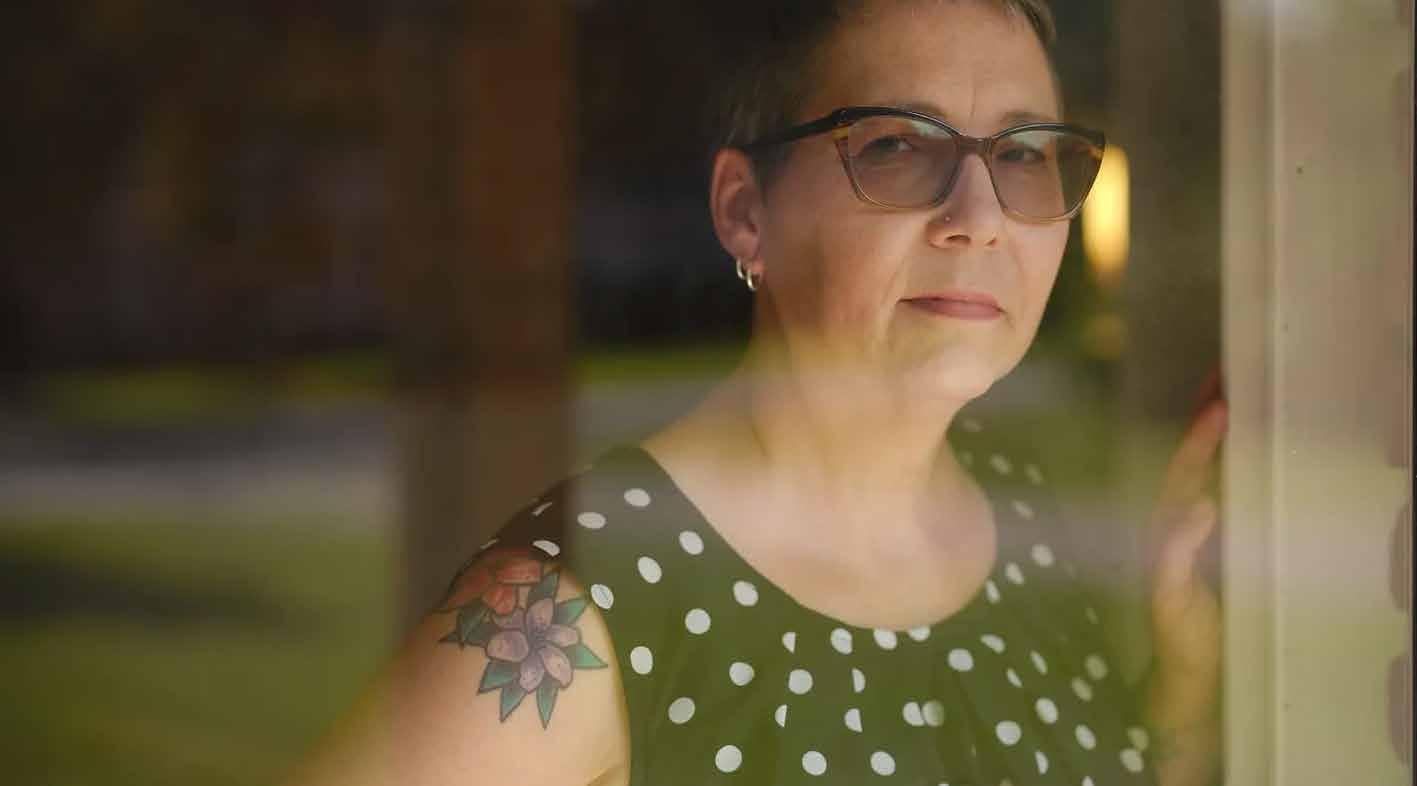
Angela Thompson soaked in the garden tub of her new apartment in Columbia, South Carolina. With a freshly cut bob and a lease penned in her name, she reflected on the 30-year marriage she had just left behind. “I put down a deposit, I got the utilities, and I furnished the [apartment] off Facebook Marketplace,” she told Uncloseted Media and The 19th.
At just 18 years old, Thompson married a youth pastor six years her senior due to pressure from a nondenominational evangelical church she described as “close to a cult.”
“The message from my church was: ‘You find a man, you marry a man, you have his babies, you stay married forever, whether you’re happy or not,’” she said. “Look around and pick a man,” they would tell her.
During Thompson’s marriage, however, something felt terribly wrong, and she turned into a shell of herself. She says she shut down, stopped trying to communicate her needs, put her head down, and kept going.
For the next 30 years, she’d raise four kids and continue to be involved in her church. But at age 48, Thompson realized something earth-shattering: She was a Lesbian.
“I started researching the [LGBTQ] community for my child who came out to me,” she said. “That’s when I found my people. I found people like me. And I didn’t know what that meant.”
After questioning for a few years, Thompson slowly started to come out. “When I told my [ex-] sister-in-law I was Gay, she said, ‘That makes sense. I’ve noticed on social media over the last couple of weeks that you look happy. You look like a full person,’” she said.
“And she was right.”
While Thompson, now 55 and married to a woman, felt isolated in her feelings of shame and confusion for decades, she’s far from alone.
Across the United States, a growing
number of women raised in conservative Christian environments are coming out as Lesbians later in life — often after decades of heterosexual marriage, child-rearing, and religious devotion. Experts say this late realization is rooted in what’s known as compulsory heterosexuality: a cultural and religious pressure that makes straightness feel not just normal but mandatory. For women shaped by strict gender roles and purity culture, recognizing attraction to other women can be delayed by years.
A study from 2013 found that Lesbians are more likely than Gay men to discover their identity later in life, with 14% of Lesbians first thinking they might not be straight when they were age 20 or above, compared to only 3% of Gay men. And a 2019 report found that the average age for women entering a same-sex marriage is significantly higher than for women entering different-sex marriages.
“Women are born into a world built on compulsory heterosexuality and patriarchy,” said Anne-Marie Zanzal, a coach for later-in-life Lesbians and Queer women divorcing men. “So we bury any longing for women so deeply that we forget it was ever ours to claim.”
But Zanzal said that now more than ever, the world is seeing stories of conservative Christian women coming out in midlife.
“There is greater visibility, more expansive language, and safer community spaces — both online and in real life,” she said. “This loosens the grip of old scripts like
compulsory heterosexuality and the good daughter, wife, and mom.”
She said that as stigma lowers and support rises, women in their thirties all the way to their sixties can reexamine longheld assumptions and choose truth over performance. “It’s less a trend of new lesbians and more a cultural shift that makes long-quiet truths speakable, livable, and worth honoring.”
Gender roles and compuls[ory] heterosexuality
Therapists and researchers say many women — especially those raised in conservative Christian environments — have long felt pressure to pursue heterosexual relationships, because anything else seemed unthinkable. The concept of compulsory heterosexuality, coined by the late feminist Adrienne Rich, argues that heterosexuality is not a natural state but an institution, like the patriarchy, that organizes and controls. It sets the norm, making other sexualities seem like deviations.
“It’s like a checklist,” said Emily Bettdur, a coach for later-in-life Lesbians. “Find a man, get married, have kids — that’s what’s supposed to make you happy. But many women do all that and still feel something is off.”
For Thompson, the pressure to conform to heterosexuality was intensified by rigid gender roles enforced in church and at home. As a kid, she was expected to have long hair, to cook, and to wash the dishes.
She wasn’t allowed to do yardwork with her brothers, and couldn’t buy pants if they were too baggy or had too many pockets.
Having grown up in the 1980s, during the height of the AIDS epidemic, Thompson said her religious community linked being Gay with having a disease. “[It] was in the category of being a thief or a drug addict using needles,” she said. “Bad, sinful people we don’t associate with.”
Thompson remembers having a sleepover and kissing a girl when she was 12 years old. Her parents walked in, and she was subsequently banned from sleepovers with that friend. “We were told, ‘Don’t do that.’”
In the church, Thompson said, even though she was the caretaker, she was taught to defer to her husband for parenting decisions like sleep training and letting her kids “cry it out.” She was taught to apologize, keep things bottled in, and not ask for support from her husband. It was also normal for her not to have financial independence.
“I was somewhere a half-step above the children. There is a literal teaching that your husband is above you and you must obey him,” she said.
Uncloseted Media reached out to Thompson’s old church for comment, and they did not respond.
Zanzal said that what is particularly toxic for conservative Christian women is the fear linked with making decisions for themselves, because independence is often associated with wrongdoing.
“When you’re deconstructing faith, you first have to deconstruct what it means to be a woman and what these conservative traditions have taught you,” said Zanzal. “They’re told that they’re second. They are told that they are less than. They’re told that their needs come last.”
For many women, the pressure to conform buries their sense of self.
“Christianity is often taught as a form of control,” said Traci West, a Christian ethics scholar at Drew University Theological School. “It’s so important to recognize that shame is a tool of repression used by the church. And it works to the advantage of those who are considered the superior ones, often heterosexual men. Shame seeps into your identity and your sense of worthlessness. And the only way to regain that worth when you feel shamed often is to be obedient.”
The same is true for Brook, a 48-year-old
ANGELA THOMPSON IN HER HOME IN COLUMBIA, SC IAN CURCIO
ANGELA THOMPSON MARRIED A YOUTH PASTOR WHEN SHE WAS 18, UNDER PRESSURE FROM HER CHRISTIAN EVANGELICAL CHURCH IAN CURCIO
ADDITIONAL REPORTING BY SOPHIE HOLLAND
woman from rural Arkansas who came out two years ago. When she hears the word “Lesbian,” she still feels a tightness in her chest.
“There’s this anxious feeling. Like, ‘Stay away from that,’” she told Uncloseted Media and The 19th.
Brook’s earliest memory of the word “Lesbian” came when she was in sixth grade. Kids at school called her a Lesbian, and she didn’t know what it meant, so she asked her mom.
“She didn’t tell me what it meant, just that it was bad, like a curse word.”
Brook, who asked to use only her first name because she isn’t out to her immediate family, was raised in a Southern Baptist church. She was married to a man for 10 years before she began questioning her sexuality.
“I thought I was doing something wrong the whole time I was married,” she said. “I was so unhappy. The messaging was all about purity, being sinless, untouched, a gift to your husband. That’s what we were taught a proper woman should be. How to sit, act, move, dress.”
Brook said that her marriage was sexless and lacked intimacy. “But I couldn’t leave. … I made that vow in the sight of God in my community that I would be married [until] death do us part,” she said. “The church infused in me that divorce is not an option. You dig your heels in and you push through. There were a lot of really unhappy married people that I was around that just dealt with it.”
According to online resources for lateblooming Lesbians, many women who aren’t experiencing intimacy with men wonder if they are asexual because they are not attracted to their husbands.
Thompson thought she was asexual for years. “I [thought I didn’t] like sex at all, because literally the only form of sex that’s acceptable in that evangelical church movement is male and female, when you are married to each other,” she said. She remembers a friend bringing up to her that she might be Gay. “I was like, ‘What do you mean? No, I think I’m asexual. I honestly don’t care if I ever have sex again. That man can leave me alone. I’m tired.’”
It wasn’t until early 2018 — six months after that first conversation — that her friend gently raised the question again: “Have you considered that you might be
increase in acceptance and visibility, some fear the current social climate will quell that.
“We are currently seeing an extremely dangerous regression rooted in misogyny, homophobia, and transphobia that will have severely negative implications for future generations,” said Mallory Hanfling, a psychotherapist and researcher studying the experience of later-in-life Lesbians coming out. “We’re seeing antiabortion campaigns, … book banning and censorship of LGBTQ education, and normalization of sexual assault and abuse specifically towards girls and women.”
She said that she can no longer clearly see the light at the end of that tunnel, as the world feels less safe for Queer folks day by day.
Gay?” This time, Thompson didn’t dismiss it outright.
Recovering from shame
One 2016 study found that internalized heterosexism — when a Queer person believes that their identity is a bad thing for going against the heterosexual norm — is directly associated with chronic physical health conditions and depression. According to a 2014 article, later-in-life Lesbians face the triple threat of shame from sexism, homophobia, and ageism.
That shame and fear is what kept Addy Sakler, who realized she was a Lesbian when she was a teenager, in the closet until she was 36. Sakler grew up in a conservative Protestant community in Ohio and spent decades internalizing the belief that “God hated Gay people” and that she was broken and in need of healing.
“I was walking around like a zombie, dead inside and depressed and having suicidal ideation,” she told Uncloseted Media and The 19th. “I was cutting myself, hitting myself, and desperate.”
Sakler said she was “white-knuckling it” trying to avoid her attraction to women.
“I would sit at night and just read the Bible and pray to Jesus. And then I put myself in conversion therapy.”
Sakler was in and out of conversion therapy for 30 years trying to cure herself, denying she was a Lesbian to her religious community and living “a double life.”
Zanzal says that for Lesbians from a religious setting, the stakes of leaving are terrifying. “They lose so much community … and they get a lot of shaming for not staying married and for being Queer.”
While Sakler eventually found acceptance at a progressive church that allowed her to explore her Lesbian identity without shame and has been married to her wife for three years now, she still gets triggered by her conservative upbringing.
“I drive by an evangelical church, and it’s a trauma response. I get a pit in my stomach,” she said. “Love was always so conditional. … I sacrificed myself for love and for community. Finally, I couldn’t do it anymore. It was killing me inside. I was like a shrinking violet. … And underneath the shame, there’s so much anger at the people who inflicted this.”
Moving forward
While experts say that there is an
“I expect that if we, as a country, continue in the direction we are headed, folks will understandably choose safety and selfpreservation over living authentically.”
With that in mind, she emphasizes that finding community is crucial for overcoming these hurdles.
Sakler, Thompson, and Brook have all left the church entirely. It wasn’t until they found acceptance in a new environment that they felt they had the space to come out.
“Once I felt safe in my new community, I came out, and it was like this weight just lifted immediately off my shoulders,” Sakler said. “I have healthy self-attachment with [my wife]. As I’ve grown older, I’ve gotten more wisdom and a lot of therapy and more self-acceptance and self-love. That’s been a revolutionary, life-changing experience.”
Brook is still in the process of understanding her identity and said acceptance from her family would have helped. “I really wish my mom hadn’t made it seem like [Lesbians] were something shameful. If she’d just said, ‘That’s a human being who’s worthy of love, no matter who they love,’ that kind of acceptance would’ve meant everything.”
For Thompson, it was when she started working at a new job where she had other Queer women as colleagues that she realized there was a life beyond heterosexuality.
“As I came out to the inner circle of moms in our homeschool co-op, I was pleasantly surprised,” she said. “So many of them said, ‘Well, I’m bBisexual, I just happen to be married to a man.’ I had no idea. But as I opened up to them one-onone, they felt safe to share that too.”
The intimacy and safety felt radical in contrast to the culture she came from. On her first date with her wife, she felt “safe enough to fall asleep with her head on her shoulder,” something she had never done in her 30-year marriage with her ex-husband.
“There’s so much talking. I feel treated with such respect and equality. So much listening. We are always validating each other’s feelings and ideas. That was amazing to me,” she said. “Because in the world I came from, children were mostly seen and not heard, and women were in the same category. I didn’t know that kind of intimacy was even possible. I didn’t know what real love and real safety felt like before I met my wife.”
ADDY SAKLER COURTESY OF SAKLER
ADDY SAKLER (LEFT) AS A TEENAGER COURTESY OF SAKLER
ADDY SAKLER (LEFT) AND HER WIFE COURTESY OF SAKLER
SPORTS
They say that it’s better to have loved someone dearly, accepting the heartbreak of inevitably losing them, than to have never loved at all. Our close connections to each other and the world around us, no matter how much they’ll hurt in the future, make us human in the present.
Mariners fans have been lovestruck for at least five months, when the baseball world woke up to the reality that Cal Raleigh really is that guy. It’s been a wonderful summer, which was fortunate enough to become a wonderful October. It’s all over now.
On Monday, October 20, Toronto’s George Springer scored a three-run homer in the seventh inning, securing the late-game lead by just a single point. The Mariners tried like hell to catch up, but there wasn’t enough time. The Blue Jays would hold on to win the American League Championship series. The Mariners had to go home, now carrying the agony of a lost opportunity on their shoulders.
Seizeless in Seattle: The Mariners end historic season with a heartbreaking Game 7 defeat
BY CALVIN JAY EMERSON SGN ASSOCIATE EDITOR
“I hate to use the word ‘failure,’ but it’s a failure,” said Raleigh after the game.
“What we expected was to get to the World Series and win a World Series. That’s what the bar is and the standard is, and that’s what we want to hold ourselves accountable to.”
Before leaving Toronto in defeat, the Mariners entered the postseason as a hopeful, energized, and unified band of brothers — a complete turnaround from how they started. Lingering cynicism from past seasons and an awful 11-19 record during spring training created expectations for another season of mediocrity. Instead, they blew everyone’s expectations out the window.
While Cal Raleigh’s record-setting offense would capture the headlines, it was a newfound team effort that truly took the Mariners to new heights. Any given player could become Seattle’s hometown hero in any given game. Julio Rodriguez could suddenly go on a hot streak. J.P Crawford
A Storm’s brewing: How WNBA changes will impact Seattle’s team
BY CALVIN JAY EMERSON
SGN ASSOCIATE EDITOR
The players have had enough. After enduring a season chock-full of injuries and toxic discourse, those who keep the WNBA’s engine running are mostly in agreement that they aren’t paid enough. Caitlin Clark, the league’s biggest superstar, made just $78,066 this year from the league. The average programmer has an annual salary of $99,700. Stephen Curry, Clark’s closest NBA equivalent, makes $59 million per year.
This very obvious, gender-based discrepancy no longer can be brushed aside as a difference in popularity. Everyone knows that the WNBA has gone mainstream, with advertisers putting their brands in the league’s limelight hand over fist. The players union is demanding their fair share. As of writing, it’s currently in negotiations with Commissioner Cathy
Englebert. If a deal isn’t made by the Oct. 31 deadline, then a “lockout” would begin. No players would touch the court. The entirety of the 2026 season could be cancelled.
Given the players’ high expectations, and the higher stakes for the league itself, the upcoming season is expected to go through transformational changes. Rosters will change dramatically, salaries will grow exponentially. New teams will debut, and officiating will take a big step forward.
What does this all mean for the Seattle Storm, our local team? After unfortunately repeating history by getting eliminated by the Las Vegas Aces for the third time in five years, it feels like something has to budge. Just doing better than average isn’t enough anymore. There are a lot
The remaining starters — Kirby, Bryce Miller, Logan Gilbert, and Luis Castillo — would be pushed to their limits to make up for his absence.
The Mariners had to endure a 15-inning pitching gauntlet against Detroit ace Tarik Skubal, but they survived long enough to win the division series. Woo was looking healthy enough to soon return, but they’d have only a day to prepare for the next opponent: the Toronto Blue Jays.
Toronto’s strength as a team is their ability to string together runs into a full-blown scoring spree. Once someone gets to first base, it feels like everybody after him does the same, and the bases are loaded before you know it. This is the opposite of Seattle’s game plan, which puts trust in big bats like Raleigh and Rodriguez to score on their own.
“Seattle’s offense relies heavily on home runs, solo home runs. Solo home runs are not gonna beat the Toronto Blue Jays,” said former all-star Derek Jeter. “You gotta be able to score in bulk, but they can’t change who they are.”
could make the stadium erupt with a grand slam. George Kirby could strike out half of the batting roster. There were very few Mariners, at least for a moment, who felt like they had a ceiling on their potential.
Yet the ceiling was always there. It just took the right circumstances, and the right opponent, to make its presence known. The first sign of concern was back in late September when Bryan Woo, the team’s youngest starting pitcher, started feeling a tightness in his chest midgame in Houston. It turned out to be a pectoral injury. Woo, who became invaluable for his fiery fastball and strike-out potential, was suddenly unavailable.
While Woo’s injury was initially described just as “minor inflammation,” it soon became clear that his condition would require a longer recovery than expected. He’d ultimately missed the Mariners’ first postseason series against the Detroit Tigers, and the team was a pitcher short.
The series was also a failure of management. Dan Wilson, the Mariners’ manager, had never led a team into the postseason before. His team’s success came in spite of his lack of experience, and unfortunately, Wilson made choices across the series that drew scrutiny from onlookers. His decision to play relief pitcher Eduard Bazardo against Springer in the seventh inning of Game 7, rather than his reliable closer Andrés Muñoz, will be judged, mocked, and argued over for years to come.
In other bad news, the Mariners will likely let go of either Eugenio Suárez or Josh Naylor before next season. The fan favorites were acquired in a trade with Arizona on one-year contracts. They’re now both free agents, and despite Suárez’s historic grand slam in Game 5, his cold batting streak overall and his hefty price tag will likely make his return a hard sell.
And yet, despite all the bummers, this was still an excellent season for the Mariners. Cal Raleigh homered his way into superstardom. We’ll soon have a new banner in the ballpark’s rafters. An entire generation of Mariners fans had their first taste of true October baseball.
If you’re a fan, you’ll have a lot of reasons to look back on this season fondly in the long term. In the short term, however? You have our permission to grieve.
of opportunities for change across the next seven off-season months, but how many will the Storm actually take?
Shake-up, or settle down?
First and foremost, every starter on the Seattle Storm is up for grabs in free agency.
Skyler Diggins, Nneka Ogwumike, Gabby Williams, Ezi Magbegor, and Brittany Sykes are all able to consider opportunities with other teams, so if the Storm wants to run it back with the same team, they’ll need
to negotiate quickly to secure their all-star players.
We can expect almost everyone to negotiate for higher contracts, as the league’s skyrocketing popularity and revenue has energized players to fight for better pay. This is especially true of Diggins and Ogwumike, who are coming off their second year as the team’s de facto captains on the court. This year’s underwhelming season could suggest that the Storm’s gamble in 2024 — to jump-start the team with the energy of
MICHAEL CONROY
GRAPHIC BY CALVIN JAY EMERSION
a Diggins/Ogwumike pairing — may not be paying off. Yet still, the duo have mostly avoided being blamed for any stagnation. It was Jewell Loyd and coach Noelle Quinn who instead experienced the fallout.
If the Storm still believe that Diggins and Ogwumike are the future, then they’ll pay whatever price they have to. However, if the front office privately has doubts about either player, now’s the right time to search for their replacements. A staggering 80% of the league’s players will be available in free agency this off-season, including allstar point guards like Courtney Williams, Sabrina Ionescu, and UW legend Kelsey Plum.
In other words: It’s time to put up or shut up. Either commit to the starters you have for the long term, or take on the risk of a bold, dramatic rebuild in search of greater pastures.
Block shots, or back off?
The game’s relationship with its referees is looking likely to change next year. Lynx star Napheesa Collier, after all, was spurred
to publicly call out the league’s failings because of a choice, made by a single referee, not to call a foul off her injury during the playoffs. That split-second decision was the spark for a full-blown firestorm across women’s basketball, and we’ve yet to see all of the ensuing fallout.
Players have long believed that the WNBA’s officiating is far too lenient on physical play, resulting in excess injuries. If their concerns are addressed with actual changes, we could see more experienced, hardline referees who are more willing to blow the whistle when rough contact happens on the court.
These changes would have a minimal impact on Seattle overall. The team wasn’t constantly taking fouls or achieving a perfect record last season. The game would change, however, for Ezi Magbegor. The Storm’s starting center has built her career around physically exhausting her opponents near the hoop. She racked up 126 fouls this season, the most of any Storm player and fourth overall in the WNBA. She uses these fouls as a tactical advantage, accumulating
free throws off handsy opponents and adding extra points to her aggressive layups. In a world with more discerning referees, Magbegor would likely get more free throws over the season, but it would come at a cost to her defense. She’s been unafraid to aggressively block shots, which often knocked down smaller players but went uncalled. That wouldn’t fly anymore, and would require Magbegor to work with more grace and precision. If she starts to struggle defensively, the Storm would lose the best shield in their arsenal. Rookie Dominique Malogna would need to majorly step up her game, sooner than expected, to make up for a team without Magbegor at her best.
Wait, who’s our coach?
If the 2026 season started today, the Storm would be a ship adrift without a steering wheel. The big fallout from the team’s failure to move past the Aces was the firing of head coach Noelle Quinn, along with her entire coaching staff. It was a bold move that allows for a clean slate, but it can’t be clean forever. For the Storm to
ARTS & ENTERTAINMENT
play in the big leagues once again, or just play at all, they’re going to need a new leader on the sidelines.
Unfortunately, the front office is facing competition from outside forces. The New York Liberty, Toronto Tempo, and Dallas Wings are all also actively searching for their next head coach. The Portland Fire hired their choice for coach, Alex Sarama, just a week after the WNBA finals came to an end. If these teams have the same wish list of potential prospects (usually assistant coaches from the NBA), then the best options will likely be snatched up in a matter of days and weeks, rather than months. It’s a big ask to find the right coach, let alone an entire team of assistant coaches, on an expedited schedule. Still, the team can’t afford to bring in someone who doesn’t gel with the existing roster. Nobody wants a sequel to the toxic “Loyd vs. Quinn” debacle from a few years ago. The choice of coach won’t just change how the team plays on the court, but if precedent stands, it could also impact who’s willing to stay put in the Storm’s locker room.
Pirates sail the high C’s at Seattle Opera
BY SHARON CUMBERLAND AND ALICE BLOCH
THE PIRATES OF PENZANCE
Seattle Opera McCaw Hall, Seattle Center
October 18 - November 1
The opening weekend audiences at McCaw Hall were delighted by a gang of very polite pirates who brought a new wave of classical shenanigans to Seattle Opera. With first-class singers and brilliant staging, this English-language comedy about a pirate’s apprentice is the perfect blend of humor and song. Gilbert and Sullivan called their works “comic operas” for a good reason: you laugh all the way through, even as the orchestra and singers produce music as beautiful as the operettas of Offenbach or the waltzes of Strauss.
The first sight that greeted the audience was a fabulously theatrical festoon curtain of red velvet and bulb lights that promised something jolly. The Seattle Opera Orchestra, led by David Charles Abell, played the elegant overture (with oboist Mary Lynch VanderKolk’s gorgeous solos) before the curtain lifted on a gang of hollering pirates
pushing their ship onto the stage and wrestling themselves into the boat. Their rapid switch between spoken dialogue and sung arias takes a moment to register with regular operagoers, but it soon becomes perfectly natural when pirates who go “arrrgh!” burst into boisterous song. It’s not unlike going to a Broadway musical, but with a full orchestra and voices of such high quality that amplification is unnecessary. Only in such a setting do audiences get to experience fully staged productions with natural, unmediated music.
Pirates parodies familiar grand operatic conventions about identity confusion, love, and despair — a special pleasure for audiences familiar with the genre, and a great introduction for those visiting the opera for the first time. Like many Gilbert and Sullivan shows, Pirates also mocks the excesses of Victorian Britain — a society so proper that even pirates are required to go through an apprenticeship. And when these orderly pirates lay hands on a band of young ladies, their intention is to find a “doctor of divinity who resides in this vicinity” so they can all get married.
The wonderful singing in both open-
ing weekend performances began with the imposing Pirate King (Reginald Smith Jr.), whose burly baritone and comic presence made it clear that these men aren’t the scary types. After all, they’re from Penzance, a pleasant little seaside town off the tip of Cornwall. (It’s a British joke — as if we said “The Pirates of Orcas Island.”)
When soprano Vanessa Becera sang the heroine Mabel’s first aria in an exaggerated coloratura, everyone in the audience could recognize its cartoon quality, while the young hero, Frederic (the charming tenor David Portillo) produced guffaws in the audience with his extravagantly dramatic aria “Faithless Woman.” One love duet between Frederic and Mabel began with true operatic sentimentality but changed suddenly and ridiculously from a slow melody to a hectic race to the finish as the audience cheered.
Cosplay opportunity
This highly entertaining production gave the audience an excellent opportunity for cosplay: many in the audience were dressed as pirates, and pirate hats were on offer in the gift shop. The popular Seattle Seafair
Pirates even showed up in the lobby in all their fabulous gear to sing hearty sea songs! Youngsters seated near us reported that they’d never attended a Seattle Opera performance before but loved Gilbert and Sullivan operettas ever since performing them in high-school productions. It is to be hoped that these newcomers will return to McCaw Hall now that they’ve stepped across the threshold.
Congratulations all around, especially to conductor Abell and stage director and choreographer Sean Curran (both in their Seattle Opera debuts) for a colorful and inventive production. It was a pleasure to see familiar singers — Tess Altiveros as Mabel’s sister Edith and Ilya Silchukuo as Pirate Samuel — along with a right hearty gang of debutants. It’s not too late for you to get your pirate mojo on!
Performances through November 1. For more information and to purchase tickets, visit www.seattleopera.org.
Music by Arthur Sullivan
Libretto by W. S. Gilbert
COURTESY SEATTLE OPERA
Ballard Collective artists embark on a new beginning after fire damages studio
BY PERRIS LARSON
On the evening of August 8, 55 firefighters responded to a dumpster fire in the alley near the Ballard Collective, which eventually spread inside the building. The blaze damaged businesses, art studios, fashion designs, and supplies, robbing artists of their creative spaces and source of income.
Over a month later, the building still reeked of smoke, pieces were undergoing remediation, and artists still didn’t know where they would go from there.
For Elizabeth Red, the Ballard Collective was the first place where she could create her custom shoes. After attending a shoemaking school in Argentina, Red fell in love with the craft, getting addicted to the process. But with the space at Ballard Collective closed up for the foreseeable future, Red now hopes to rent another space in the Seattle area.
“My art space is like a sanctuary for me,” Red said.
Red’s shoes and supplies were smoke damaged, while other artists had spaces and pieces destroyed beyond repair. Artists making oil paintings, photographs, and sculptures found that a few pieces spared, thanks to other spaces showcasing their work. But the majority of the collective has either been destroyed or is currently going through smoke remediation.
Rachel Wilsey has always been an artistic person but didn’t start making painting a career until 2022. For her, simply the act of painting gives her joy; it is a way of giving back to herself. She enjoys spreading that joy to viewers when they look at her most recent doughnut-style pieces.
While some of Wilsey’s creations are still going through remediation, the spared
pieces are on display at the Smal Market in Ballard, alongside others from the collective. Thanks to the generosity of the market and Ballard Alliance, the artists can have a space there until the end of the year, at no cost.
“Artist studios are really hard to find, so we’re kind of scattered,” Wilsey said. “But to have a space that’s still here in Ballard, that can represent our group, feels really good.”
The collective sentiment over losing the space is not just about the damage to supplies and art, it is the loss of community.
Daniel deWolff, cofounder of Luto Vhum alongside his partner Maëlle deWolff, has been a part of the collective since 2020 as both fashion designer and building manager.
“It’s a good course, not that I want to see it end like this,” he said. “The space felt the way it did, looked the way it did because of all the people who have been through there.”
Jyotsna Ambarukhana has been at the collective since 2022, and it was her first art studio. Ambarukhana focuses on mostly geometric, abstract art. Some of her pieces are also on display at the Smal Market.
“I haven’t made anything, and it’s driving me crazy,” Ambarukhana said. “I feel like it defines my existence in some way, because I’ve always been creative. Without this part, there would be a lot of me that’s not there.”
For many at the collective, including Samantha Kasprowicz, Stephanie Ames, and Aubrey Benasa, their art was a major source of income for them. Ames is an abstract artist working with metal, also with a background in jewelry design. Kasprowicz is a photographic artist, with projects focusing on the invisibility of
women in society and using a banana as a motif. Benasa has been creating oil paintings inspired by Seattle and the PNW since the pandemic.
Still, all of the artists are in a state of limbo. The investigation of the fire is still pending, the building still smells of smoke, and the search for a new space is ongoing. Since the fire, the community response has been supportive, offering help and spaces. Now, all the artists ask is that people continue buying their work and supporting local artists.
To support or learn more about the artists impacted, some GoFundMes and the artists’ social media platforms are provided below:
ART BY RACHEL WILSEY AND JYOTSNA AMBARUKHANA PERRIS LARSON
COURTESY OF AUBREY BENASA
DAMAGE LEFT AFTER THE FIRE SARAH MELTZER
COURTESY OF STEPHANIE AMES
From Saturday, October 18, 2025, to Saturday, January 10, 2026, the Seattle Public Library will host “ Nuestra Euforia/Our Euphoria ,” a showcase of curated works by local Trans and gender-nonconforming artists, and photography by local cultural bearers and icons.
The showcase will feature artist Vaquero Azul, a Dos Espíritus, Mexican, Indigenous artist of Otomí Maya and Boriké n lineage, who weaves moments of “euforia” by blending Charro culture and the theatrics of Queer fantasy aesthetics, “building spaces of calm and empowerment for LGBTQ2IA+ voices” in their workshops and presentations. They believe in a world where Trans, Two Spirit, Dos Espíritus people are celebrated, loved, and left feeling proud of who they are, expressing it in their body of art.
In anticipation of the upcoming showcase, Azul spoke to the SGN about their artwork, identity, and community.
Q: How would you describe your art to someone seeing your work for the first time?
Vaquero Azul: I would describe my work as a celebration of Trans, Dos Espíritus and Two Spirit, gender expansive to gender euforia in Mexican and Mesoamerican joy — an intergenerational, multidimensional, Queer fusion of T4T joy. I want each artwork to radiate that we’re the main characters in our lives, with transcendent Queer love on every page! From the details in the outfits each character wears, to symbols, to Pride flags color palettes! What we wear is powerful, and by taking our rich cultural history and intertwining it together, I like to create something beautiful and full of euphoria in each piece.
Q: What would you say is the message you want other people to take away from your art?
VA: You don’t have to choose. I feel like a lot of my community is living in the diaspora of being in the system of the “United States” actively harming all communities of color. Made to overwhelm, causing us to forget yourself, your cultural history, spirituality, and being in community. We’re so used to having to push ourselves away from our teachings, for the conditional love from our parents and family, to be accepted. You should never have to sacri-
A Q&A with artist Vaquero Azul
BY MADISON JONES SGN MANAGING EDITOR
fice your cultural history just to be a part of the LGBT+ community.
I get comments of “I did not know I could embrace both sides! I feel so seen!” We hold so much religious trauma. It’s so powerful to fight back from that harm and embrace ourselves fully.
We are such vibrant, joyful, and beautiful people and we deserve to see ourselves celebrated in this way with the art we surround ourselves with and the love we have to give. Surround yourself with intentional art that depicts our bodies, our culture, our history.
Q: What are your career goals?
VA: A dream came true of getting to do my first fashion “Nuestra Euforia/I Minagof-Måmi/Our Euphoria” show as a director, curator, and model. We had two amazing Chamorro, powerful people, Roldy (@Hafaroldy on Instagram) and Roquin (@Rockin_Roquin); getting to have them be included at Indigiqueer at Waterfront Park was so beautiful.
I want to keep doing more fashion shows and I’ve already got an idea for my next line. Currently I’ll be focusing on a LGBT+ Nichos project, to make our own personal altars/temples/places to worship at, for the Tacoma Artist Initiative Program.
Q: You’re an artist in residence at the Seattle Public Library. How did this influence your work?
VA: I’ve always dreamed of being a fashion designer, ever since watching Project Runway with my mom. My abuelita taught me how to sew and embroider as a child, and I’ve always been drawn to textiles and clothing. This residency gave me the dream of being in the big city and having my own quiet space to study, sew, breathe and realize my dreams. Getting to have a space separate from work really helped me [home] in, and having so many books to read and explore helped me find inspiration.
Q: Can you tell us about your upcoming show and presentation at the library?
VA: On Saturday, Oct. 4, from 4 p.m. to 6 p.m., I’ll present a program at the Central Library auditorium called “Nuestra Euforia / Our Euphoria.” I’ll share about the history of our communities, our culture, and the layers of the work I do. I want these garments that I designed during this residency at SPL to get to live a full life on stage, to be seen and celebrated with the amazing members of Danza Monarcas. It’ll be a very beautiful evening of celebration and resistance of our Queer & Trans joy.
An art show called Nuestra Euforia / Our Euphoria will open at the Central Library in the Level 8 gallery on Oct. 18. The exhibit will feature my sewing work I made during the artist residency, artwork I’ve made over the years, a Trans Pride ofrenda to honor our Transcestors, art with local artists, photography of cultural bearers, and photographs of our LGBT+ folklórico group, Danza Monarcas.
Through the exhibit, you can get to know about our local Trans, Two Spirit, and gender-expansive icons, because we have so many people who are doing the work that we desperately need during this time of ICE raids and anti-Trans violence. We need to celebrate our cultural bearers; their effect is powerful, and they are people who are making such a massive change in our community. They are running mutual aid funds, making free and accessible healing circles, intentional BIPOC- and LGBTonly events. Or just being the rep we need in white-dominated spaces and opening the door for more of us to take up space together.
The exhibit runs until Jan. 10, 2026.
Q: How can we support you and your communities?
VA: Supporting our communities in Washington state is really vital. The target on our back for our immigrant and Trans communities is massive. We desperately need people to get involved in more than just sharing posts online, and get active in your community, whether it’s showing up to protests, or continuing to keep track of bills in your state (follow the Trans Bill
Tracker website resource to know what anti-Trans bills are going on in your state, so you can fight against them). Follow local orgs that are helping with immigrant communities, support them by being a participant, attend their events, learn, volunteer, send money, and share their mutual aid posts. Contribute the skills you have and donate your time: maybe you have event management skills, graphic designs skills for mutual aid posts, or you’re great at numbers or at arts and crafts.
Speak our names! As a Trans and Two Spirit artist, getting our names in spaces opens the door for us to get more opportunities so we’re not struggling financially all the time! We don’t survive the horrors in isolation — we need community.
Q: Any final thoughts you want to share about the Trans and Two Spirit community?
VA: “Give us our flowers while we’re still here.” Our gender expansiveness has been around since time immemorial.
“Two Spirit” as a term was proposed in 1990 during the Third Annual Intertribal Native American, First Nations, Gay and Lesbian American Conference, held in Winnipeg, by Elder Myra Laramee. [It] is a translation of the Anishinaabemowin term niizh manidoowag, which actually translates to “two spirits.”
For Anishinaabemowin people, this is a traditional term. It was shared for only Indigenous communities. It was offered as a term to unite us away from offensive terminology, as a placeholder, while we work on language revitalization efforts to find the words in our specific Indigenous tribal communities. Someday, I will no longer use the term as I continue to learn and find the words from my peoples.
Honoring our past while moving forward to the future requires us to remain humble and always willing to learn from our Trancestors. We have survived so much and always will. Protest, attend community hearings, explain laws and terminology in accessible ways to your communities, and balance it with art, crafting, food exchanges, time spent outdoors, laughter, dance, and song. Our togetherness heals us, [and] sharing our own abundance, no matter how small, will ripple our change as we lead the future.
COURTESY OF VAQUERO AZUL
COURTESY OF VAQUERO AZUL
From cult classics to political camp: Craig Chester’s next act
BY FRANK GAIMARI
ADAM & STEVE: THE SECOND COMING YouTube Channel
Craig Chester is a name synonymous with authenticity, creativity, and resilience in the film and television industry. His path to becoming an acclaimed actor, writer, and director is truly inspiring. From overcoming personal challenges to breaking barriers in Queer representation, Chester’s career stands as a powerful example of perseverance.
Significant challenges marked Chester’s early years. Born on November 8, 1965, in West Covina, California, and diagnosed with long face syndrome at age 15, he underwent extensive reconstructive surgeries to address the condition. This
transformative experience shaped his perspective and fueled his determination to pursue a career in the arts. After moving to New York City in 1985, Chester studied at the American Academy of Dramatic Arts, where his acting style caught the attention of industry veterans like Joanne Woodward.
Chester’s breakout role came in the critically acclaimed film Swoon (1992), a retelling of the infamous Leopold and Loeb murder case. His performance earned him an Independent Spirit Award nomination and established him as a force in independent cinema. Over the years, Chester appeared in a string of notable films, including Kiss Me, Guido and I Shot Andy Warhol, showcasing his versatility.
In 2005, Chester wrote, directed, and
starred in Adam & Steve, a romantic comedy that has since become a cult classic. The film, costarring Malcolm Gets, Parker Posey, and Chris Kattan, explores the ups and downs of a Gay relationship with humor, heart, and a touch of absurdity. Critics praised Chester’s performance and sharp writing. The film’s blend of slapstick humor and genuine emotion resonated with audiences, cementing its place as a beloved piece of Queer cinema.
Aside from acting, Chester has made significant contributions as a writer with his memoir, Why the Long Face? Published in 2003, it received high praise for its humor and honesty. Chester later moved into television, writing for popular shows like True Blood and creating pilots for major networks. His talent for crafting compelling
stories has made him a highly sought-after figure in the industry.
Chester returns with a new web series, Adam & Steve: The Second Coming, bringing back classic characters to address today’s political climate. The show explores love, resilience, and resistance, highlighting Queer experiences with Chester’s humor.
Eager to learn more about his life and new project, I had the privilege of speaking with him. What follows are his thoughtful and compelling answers to my questions.
Frank Gaimari: As an openly Gay man in the entertainment industry, how has your identity shaped your career and the stories you choose to tell?
Craig Chester: Being an openly Gay man has significantly influenced my career, mainly due to the era I was born into. I came out in 1992, the same year my first film, Swoon, was released. At the time, coming out was widely seen as career suicide, and both my family and agents were deeply concerned about how it might affect my future.
I had just played my breakout role as Nathan Leopold, Jr., earning a Spirit Award nomination for Best Actor and appearing in US Weekly and Interview Magazine Doors were opening. I was meeting with some of my favorite directors, including Mike Nichols and Martin Scorsese. I was ready for a major acting career, similar to the meteoric rise of a Timothée Chalamet today.
However, the early ’90s marked the height of the AIDS epidemic, a time when my identity as a young Gay man was inseparable from politics. Events like the marches on Washington and the “Silence = Death” movement weren’t just historical moments — they were also deeply personal. Staying in the closet would have meant compromising my integrity, and I knew I couldn’t do that and still respect myself.
I believe being openly Gay led to a far more interesting career. As a Gay actor, I have embraced Queer roles in a series of
COURTESY OF CRAIG CHESTER
CRAIG CHESTER AND MALCOLM GETS IN ADAM & STEVE COURTESY OF ADAM & STEVE
compelling films, where my identity has become an asset rather than a limitation. When I transitioned to writing, my first screenplay, Save Me, was developed at Fox Searchlight and explored the ex-Gay movement. That was followed by Adam & Steve In many ways, my politics and experiences have entirely shaped my career and the stories I choose to tell.
FG: Your work explores themes of love and relationships in the LGBTQIA+ community. How much of your personal experience influences the stories you write about?
CC: Everything I write or respond to as an actor is almost always based on my own experiences, and I’ve always drawn inspiration from my life. For three years, I had a monthly Sex and the City-type column in Genre Magazine, where I wrote about dating and being a Gay actor. That column is what led to my book deal for my memoir.
FG: Adam & Steve has become a cult classic in Queer cinema. What inspired you to write and direct such a bold and hilarious love story, and did you expect it to resonate so deeply with audiences?
CC: I wrote Adam & Steve because, for years, I would attend Gay film festivals, stand on stage, and do Q&A sessions for all these dark Queer movies I was in — where I was playing a murderer, a drug addict, or some effete, bitchy snob. I started noticing that the audiences at these festivals were almost always Gay couples. One time, someone raised their hand and asked, “When will someone make a movie about us — normal Gay guys in a relationship?” I thought, “Hmmm, good point. I’ll make that movie.”
The inspiration, I suppose, came from my own life. I’ve had boyfriends, met the parents, and experienced all the things you see in mainstream romantic comedies, but I wanted it to feel authentic to my experience as a Gay man. It was close to my real life — Parker Posey really was my best friend, and I wrote the part for her. What you see on
screen is what our friendship was like at the time. I was new to recovery, so I included that. The unlucky family is very much based on my own. So, you know, write what you know!
FG: As an actor and director, how do you balance the creative demands of being in front of and behind the camera? Which do you prefer?
CC: I absolutely hated directing the movie. I’m not a director, and the original director was let go two weeks before we started shooting, so I stepped in at the last minute. It was just so much to handle — directing and going to western dance-off rehearsals at the same time. I’m a perfectionist, and as an actor, I take my craft very seriously. Acting requires concentration, and it isn’t easy to stay focused when you’re juggling a million things in your mind, including being the director. But I did it, and it turned out fine.
I do enjoy postproduction, though. I loved working with Roddy Bottum on the score, and editing was fun. Now that I’ve directed the web series and played Adam again, I’ve found it easier the second time around. If I direct again, it will only be because I’m a writer, and directing is a means to an end — to ensure what’s in my head makes it onto the screen.
FG: The chemistry between you and Malcolm Gets in Adam & Steve was electric. How did you approach casting and building that dynamic on-screen?
CC: When I wrote Adam & Steve, I was making extra cash doing screenplay coverage for Miramax. Each week, I would receive a stack of scripts to break down for the movie executives, summarizing what each was about and whether it should move forward or not. From that experience, I learned that comedy is difficult to read, and tone is challenging to communicate effectively on the page.
The Adam & Steve script, on paper, was incredibly over the top — almost John Waters-esque. Within the first ten pages,
there’s coke, vomit, and diarrhea! I knew in my head that my movie was also very sweet, but that sweetness didn’t come across on the page. So, instead of sending the script out for potential producers to read, I staged live readings with my friends in NYC and invited producers to the performances. That way, I could control how it was perceived and bring out the sweetness through the performances.
The staged readings themselves gained some popularity. Alan Cumming played Steve in one of them, and in another, I played Steve opposite Mike Albo as Adam. One day, I was sitting across from Malcolm Gets in a social setting and thought, “Huh, he might be good to play Steve in one of these readings.” We did the reading, and that one featured me as Adam, Malcolm as Steve, Parker as Rhonda, and Chris Kattan as Michael. That night was magical. Malcolm and I had this natural but very real chemistry, and so did Parker and Chris. It all just came together.
I absolutely love Malcolm as a person. I love him in a way that exists in its own category — because we have this movie together, this baby, in a sense. He is my movie husband, and I would literally do anything for him. Our on-screen chemistry is one of those inexplicable things, and it’s still there, 20 years later.
FG: Your new web series, Adam and Steve: The Second Coming, sounds like a fascinating continuation of the story. What inspired you to revisit these characters in today’s political climate?
CC: The first conversation I had about the election last November was with my producer, Kirkland Tibbels, who produced Adam & Steve and was set to produce its sequel this year. However, he told me that, because Trump won, our potential investors suddenly got cold feet — and not only that but they were also leaving the country!
It’s always hard to make an indie film, let alone a Gay one. However, with all the uncertainty in the market, it became even more challenging. I was in Florida at the time and called my friend Emily Lansbury to vent about our investors leaving the country and how Project 2025 was going to become a reality. Emily said, “You should just make some Adam & Steve TikToks about this bullshit! Instead of having them retire, have them running away from Christian nationalists!” I loved the spirit of that idea so much that I wrote ten episodes, assembled a group of funny actors, and shot it.
In this post-MAGA world I’ve created, Adam and Steve’s marriage has no value to anyone but them. The series explores what it means to be a Gay person in America today. It’s much darker than the first film, but we’re hoping it will lead into the movie sequel.
FG: Where can viewers watch Adam and Steve: The Second Coming?
CC: We’re releasing it on YouTube, because, honestly, who is going to buy a show called The Second Coming right
now?! Someone like Funny or Die might step in at the last minute — we’re exploring options — but they are limited due to the nature of the material. It’s very South Park, but with a Queer take, using comedy as a form of protest.
The show will be available on our YouTube channel, @adamandstevethesecondcoming
FG: Can you share any details about the cast? Are there any returning actors from the original film, or new faces we should be excited about?
CC: We had no budget to produce this web series, so it doesn’t feature any bigname actors. However, I was able to cast some of my favorite comedians. Nadya Ginsberg, who had a small part in the first movie (as a drunk cocktail waitress at Parker’s comedy club), absolutely blew us all away in this. I think she’s a genius. The same goes for Irene Bremis, whom I met when I was a guest on a podcast she cohosts with Rachel Dratch, called Woo-Woo. I had seen Irene’s comedy special on Netflix and was thrilled to get her on board — they both play crazy MAGA Christian ladies. Michael Musto and Charles Busch also have cameos — they’re in the Gay work camp that Adam is sent to! Cherry Dazzle, one of the Dazzle Dancers in the first movie, plays a vital role in the show, reprising her original character. And Nora Burns and David Ilku, who I’ve been a fan of forever, are also part of the cast.
FG: What has been the most exciting or challenging part of creating this web series, and how does it differ from your experience making the original Adam & Steve film?
CC: The most exciting thing about doing a web series is how immediate it can be. Unlike a movie, which takes a year to come out and go through the entire process — film festivals and the like — we can create content and storylines that are truly current. The downside of that is that it will probably feel dated eventually, serving as a real time capsule.
It was an absolute pleasure speaking with Craig Chester: his passion, creativity, and sharp wit are evident in all his endeavors. Make sure to watch Adam & Steve: The Second Coming — it’s a bold, hilarious, and thought-provoking series that is not to be missed!
Adam & Steve: The Second Coming: https://www.youtube.com/@adamandstevethesecondcoming Why the Long Face?: https://a.co/d/ ijTCnnC
Frank Gaimari is an author, film reviewer, and actor based in Seattle. He lives with his husband and their two golden retrievers. Learn more about his work at FranksFilmReview.com
COURTESY OF CRAIG CHESTER
A spellbinding night: Tim Murray is bringing his comedy to the Emerald City
BY FRANK GAIMARI
WITCHES
Studio X, 1300 E Olive St, Seattle Saturday, November 8 at 6:00 & 9:00 p.m.
$20.00
Seattle, prepare for a night of cackling, camp, and cauldrons. Tim Murray — the irrepressible mind behind the viral sensation Witches — is flying in for a one-nightonly performance that promises to enchant, provoke, and leave you howling for more.
If Murray looks familiar, that’s because he is. You’ve seen him on NBC’s The Other Two, heard the unhinged sleepover energy on his Slumber Party podcast, and spotted him across indie films and off-Broadway. In 2025, he appeared on the Tony Awards.
But Witches is the crown jewel: part standup, part musical, part glitter-soaked fever dream. Think Elvira emceeing a Drag Race maxi-challenge after one too many potions — smarter, Gayer, and gloriously unhinged.
On November 8 at 6:00 and 9:00 p.m., Studio X will transform into a lair when Witches lands for a live taping. Expect sharp stand-up, musical numbers, and a little audience mischief, all brewed from Murray’s obsession with pop-culture witches — Hocus Pocus, The Craft, and Wicked — plus surprise guests and costuming choices that likely qualify as sorcery.
I caught up with Murray to talk about the show’s heart, the high-wire thrill of live performance, and the spell he’d cast if he could. Here are his responses, setting the stage for a wickedly fun night.
Frank Gaimari: In your own words, what is Witches about?
Tim Murray: Witches is my hourlong stand-up and musical comedy about grow-
ing up Gay and stepping into your Queer powers once you find your coven of friends. It’s a celebration of queerness, pop culture, stupidity, community, and most importantly… wigs.
FG: Do you prefer the thrill of live standup over making a film or TV special?
TM: Performing live is certainly a rush, but I really enjoy all ways of getting paid. LOL, kidding. I have done everything in this business, from script writing to film acting to live stand-up and improv, and I really love a little bit of everything. But the feeling of performing live is incredible, and I’m so excited to capture that with an audience in Seattle.
FG: For first-timers, what makes Witches a must-see in person?
TM: Witches really must be seen to be believed. I do a lot of crowd work, and the 11 o’clock number is a song I improvise based on the show each night. People have come back six or seven times, because there is something different every time. I promise to make you laugh your booty off, and then the last song will likely make you cry. So… come have the catharsis we all need right now.
FG: How has your identity shaped your voice on stage?
TM: Being Queer has totally shaped my point of view, which is the entire essence of what makes a comedian. Most people have the capacity to be funny, so to be the person in the room with the microphone asking everyone to listen, you must have a unique
perspective and something to say. And most of what I want to say is about how we navigate through the world as Queers. I want to celebrate it, poke fun at it, pay attention to it, and roast those who have burned us.
FG: What has been the biggest hurdle in breaking into the industry?
TM: The tumultuous break-up I had with Jessica Alba. Joking again. I think the hardest thing for me has been stepping into the power of what makes me unique and special, which is what this show is finally doing for me. When I was in college, my professor told me not to come out, because it would be harder to find work. When I first moved to NYC, an agent refused to take a meeting with me because he knew me socially and said I was “too gGay.” But funnily enough, leaning into that is what has made my voice sharper and funnier. So, the real hurdle is learning not to take other people’s opinions too seriously. Listen to the voice inside you. Angela Lansbury voices mine.
FG: If you could cast one real spell, what would you do first?
TM: I’d give everyone in America free healthcare. Or get us a sequel to the Britney Spears film Crossroads. Both would be healing.
Grab your friends, dust off your pointiest hat, and join the coven. Witches at Studio X is the most fun you’ll have outside a midnight séance — and at $20, it’s a steal. See you on November 8 at 6:00 and 9:00 p.m. May your eyeliner be sharp and your laugh cackly!
Frank Gaimari is an author and film reviewer in Seattle. He lives with his husband and their two golden retrievers. You can learn more about his work at www. FrankGaimari.com.
COURTESY OF TIM MURRAY
Tina Romero on making Queens of the Dead a Queer celebration of community, survival, music, and her father’s zombie legacy
BY SARA MICHELLE FETTERS SGN STAFF WRITER
Tina Romero didn’t want to make a zombie movie. While her father, George A. Romero, didn’t invent the zombie picture, he certainly codified it into the mainstream of genre cinema with his groundbreaking 1968 underground classic Night of the Living Dead, so it’s understandable his daughter wouldn’t necessarily want to follow in those footsteps, especially in her featurelength debut.
“There definitely [were] a lot of complex thoughts and feelings,” said Romero. “These are big shoes to fill, and I didn’t want to force it.”
And yet that’s exactly where Romero ended up with Queens of the Dead, a flamboyantly larger-than-life Queer smorgasbord of zombie mayhem, wicked one-liners, found-family pathos, and community togetherness that speaks to the here and now, even as it cleverly pays homage to previous “…of the Dead” films.
“I needed an authentic a-ha moment,” explained the filmmaker, “and that’s what I had [with Queens of the Dead ]. There was some drama in the Queer-nightlifepromoter scene, and the quote was, ‘When will the Queer community stop devouring its own?’ It smacked me in the face. This is the community I know. These are the characters I could portray. These are the details that I understand. It’s a story I can tell, and that’s what I needed: a story I could tell to get into the sandbox my dad created.”
It was a multicultural, fabulously coifed entry into the genre that Romero couldn’t resist. “Once I knew specifically that the Queer nightlife of New York City was my in, the rest became easy,” she said. “That is my world, and those are my people. The monster? He [George Romero] made that for us already. He set up the rules. Now we get to play with that monster in all the ways, but I knew I wanted to keep very true to his traditions. The monsters needed to be slow. One bite turns you. You got to take out the brain. And then, of course, you need to say some shit when you’re playing with the monster too.”
Social commentary
But all of her father’s films had layers of incisive, hard-hitting social commentary intermixed with all the scares, shocks, and gore. It was imperative that Queens of the Dead do the same. “That was the more difficult part,” admitted Romero. “What
social commentary do we want to tackle in our tapestry of all that is wrong with the world? There’s so much to choose from! For [co-screenwriter] Erin Judge and [me], we wanted to do opioids, we wanted to do phone addiction, we wanted to do infighting within the community, and the problem of too much information in the current ecosystem. Who do you trust? Who do you listen to?”
Big questions, but the film tackles them with a deft mixture of intelligence and silliness that’s frequently surprising. But even more shocking is the aura of hope amid all of the carnage Romero infuses into the film’s DNA — not something most would say about George Romero’s zombie epics, especially the timeless trifecta of Night of the Living Dead, Dawn of the Dead, and Day of the Dead. There’s something inherently pessimistic, maybe even nihilistic, about all three.
“I am a bit more of an optimist than my dad was,” admitted Romero. “It was painful for us to kill [some of the characters]; it was not fun for us to do that, but we knew we needed to. We had to tug on some heartstrings. Ultimately, though, we knew wanted to tell a story of Queer survival, and we wanted the bulk of our characters to get through this together, because that is what this is about. It’s about community sticking together.”
The cast
That theme of community sticking together extended to the casting. The filmmaker assembled a diverse ensemble that included the likes of drag superstar Nina West, rising star Katy O’Brian, Nonbinary comedic sensation Jack Haven, Knives Out scene-stealer Riki Lindhome, Gay icon Cheyenne Jackson, and bona fide legend Margaret Cho. Even Tom Savini pops in for a memorable cameo.
“We started casting years before we had a green light,” said Romero, “and I have to credit my producers for encouraging me to do that. I started writing letters to people many, many years before we had any money.
“Dominique Jackson [from Pose] was actually our first ‘yes,’ and what a powerful yes that is… That was hugely helpful. The stars really aligned, and I couldn’t believe how lucky we got. This cast is unbelievable. I keep saying, all queens, no divas.
Everyone was so down to do this. It was a family-style, down-and-dirty shoot. It was challenging, It was hot. We had zombie prosthetics. We had Drag. People were sweating… just tough as nails, every single one of them. They brought their whole selves to it.”
With so many comedy and creative heavyweights, the director did have to allow for moments of improvisation, but within a controlled environment. “We would talk beforehand… and we would say that, in this moment, we don’t have time to go off book. We need to be on book,” said Romero.
“But, for example, when Kelsey has an axe in her leg, that was scripted as [lyrics from ‘My Favorite Things’ from The Sound of Music], and my producer was like, ‘You can’t do that.’ So I went to Jack and was like, ‘Can you just improvise some singing?’ And Jack is hilarious and brilliant and such a wierdo. They have this direct line to this creative weirdness, and they did several different versions [of ‘There’s an Axe in My Leg’]. There was an old fisherman version. but the pop version they did was by far the best, and that was all an improv take.”
“One of my favorite moments is when Tomás [Matos] is live-streaming and goes, ‘They’re coming to get you, Barbara,’” added Romero. “Obviously, he was thinking of Night of Living Dead, but that was all improv, and I’m obsessed with that moment… [For] me and Aden [Hakimi], my editor, it was brutal trying to decide what to use. We had so many hilarious buttons to end scenes with, and it really became a dance of how do we split the buttons — the last word — between all the people, because there was just so much gold to choose from.”
The biggest issues revolved around Katy O’Brian. A budding superstar after her transformative turn as Kristen Stewart’s bodybuilding girlfriend in the exhilarating 2024 neo noir Love Lies Bleeding, the actor has gone on to significant appearances in gigantic Hollywood blockbusters like Twisters, Mission: Impossible – The Final Reckoning, and the remake of The Running Man. Even though she was a massive fan of Romero and Judge’s screenplay, keeping her on board the production as the film’s heroic club-owning Lesbian lead Dre wasn’t always a sure thing.
COURTESY OF QUEENS OF THE DEAD
“Katy O’Brian said yes before Love Lies Bleeding, and I remember going to see [it] and writing her a letter afterward saying that [it] was so good and that I hope you still want to do this little movie,” Romero said with a smile. “Katy is so good and so talented. She was actually doing Mission: Impossible – The Final Reckoning at the same time she did Queens of the Dead, which is why there’s a special thanks to Tom Cruise. It looks like a joke, but it’s not. Mission: Impossible flew her on their dime back to our set three times, and [Katy] was just down to do it!”
Divine intervention?
The filmmaker has to pinch herself sometimes that all of this is happening right now. More than that, though, Romero’s equally cognizant of how important a national theatrical release for Queens of the Dead is during this current cultural and political moment.
“It’s so special,” said the director. “I’m almost speechless. The way [this] came together feels like there some divine intervention. The fact we got it done so quickly. The fact that IFC is willing to put it out on a big screen this year feels major, because so often you take something like this to a festival and it’s like two, three years before you see a release. Right now! Not even just in a year of a Kesha comeback, but also in a year when this shit has been so bad. Our community is feeling so afraid that they feel the need to hide, that they are being erased, and I love that this [film] is like, nope! We are out here and we’re going to have fun, and we’re going to fight zombies, and we’re going to be colorful — just try not to love us!”
Romero briefly paused before continuing: “I feel incredibly proud to take the George Romero zombie film and make it Gay,” she confessed. “We’re here! What are you going to do about it? And, we’re all here, it’s all of us. One person doesn’t have to carry the weight of survival for the entire Queer community. Everybody’s here. This really was a film made by Queer people very much for Queer people. But I hope everybody comes to the party. Maybe people who wouldn’t normally go to a drag show might go to this movie and come out feeling a bit more empathy.”
Tina Romero digs up a fabulously killer zombie comedy with Queens of the Dead
BY SARA MICHELLE FETTERS
SGN STAFF WRITER
QUEENS OF THE DEAD Theaters
On a seemingly normal day in Brooklyn, club owner and DJ Dre (Katy O’Brian) is floundering. She’s desperate to find a replacement when her latest show’s headliner, international drag superstar Jasmine (Dominique Jackson), cancels at the last minute. Meanwhile, across town in a downtown hospital ER, Dre’s nurse wife Lizzy (Riki Lindhome) is trading barbs with best friend Sam (Jaquel Spivey) — a former drag sensation who ended their career under mysterious circumstances — while caring for Trans patient Jane (Eve Lindley).
Later that evening, and much to the delight of the show’s host and the new arrival’s former drag mother Ginsey Tonic (Nina West), Sam unexpectedly arrives at Dre’s club. Lizzy has convinced him it would be the perfect venue to stage an impromptu comeback, even if it might be for one show only. But Sam and Dre have a complicated history, and there’s no guarantee they’ll be able to work out their personal issues before the patrons start to arrive for their night of drinking, dancing, and sweaty fun.
But before any of that can happen, director Tina Romero, daughter of George A. Romero, triggers the zombie holocaust, and her feature-length debut Queens of the Dead suddenly comes vividly to life in all its rambunctious, triumphantly Queer undead glory — a worthy companion piece to her father’s classics (most notably the
iconic trifecta of Night of the Living Dead, Dawn of the Dead, and Day of the Dead ).
The filmmaker still makes the genre her own, infusing a sense of hope and optimism amid all the bleak, flesh-chomping madness of the apocalypse.
Romero and cowriter Erin Judge split their story into distinct, parallel halves. The first concerns the small group at Dre’s club — which comes to include Jackson and the likes of Jack Haven, Cheyenne Jackson, Tomás Matos, Quincy Dunn-Baker, and the talented Margaret Cho, all of whom get multiple moments to shine — and their attempts to figure out an action plan. The second involves Lizzy and Jane as they make the perilous trek from the hospital to the club in what they can only surmise is a race against time, the former refusing to believe anything bad has happened to her beloved while the latter is calmly elated to have found a friend who seems to honestly care whether or not she lives or dies.
Through all of this, Romero weaves notso-subtle commentary on Queer subculture, found family, the opioid crisis, and social media addiction. These zombies are far more flamboyant than the ones we typically see in these films, almost as if their transformation has given their skin a faint, iridescent shimmer that sparkles in the right light (and especially underneath a disco ball). While they’re all as carnivorous as ever, they’re also prone to mindlessly wandering around, staring at their cellphones as if they’re struggling to post a selfie or upload a viral TikTok video —
Arthur Oakes was just being a nice guy. He never intended to get involved with the Nighswander family, but he did something kind while visiting his mother in prison, it backfired spectacularly, and his goodness led to blackmail. The Nighswanders gave him an option: steal valuable rare books from the college library where he worked — something that hurt Arthur to his very core — and hand them over. If he refused, they’d kill his mother.
And so Arthur became a thief, until the pressure of it became too much and he blurted the truth to his friends. Colin, Van, Donna, Allie, and Gwen immediately understood the stress Arthur had been living under, but what could he do? How else could he ensure his mother’s safety? The Nighswanders had all the cards.
But they didn’t have an old séance film, or an ancient cracked mirror and knowledge of its use — tools that Colin’s grandfather owned. Llewellyn had been somewhat of an Ernest Hemingway type, and from the things in his cabinet, the friends learned that to rid Arthur of evil would take evil. They called forth a dragon to smite the Nighswanders.
No one knew how the conflagration that killed Jayne Nighswander started.
even if none of them any longer knows why they want to do it.
This idea of zombification as a mirror to society’s self-inflicted communal isolation works rather well. It forces the survivors to do the one thing they’ve almost forgotten how to do, and that’s to openly and frankly communicate with others face-to-face. They have to put their differences aside and problem-solve, and they need to do it together, not as individuals. This evolution, especially for Dre and Sam, is wonderful, building to a lovely moment of catharsis and forgiveness.
But I had a rooting interest in all of the characters. This meant that, when some do die — as they sadly must in a story such as this — my heart genuinely ached. Even if they may start out as LGBTQ+ caricatures, that feels entirely by design. Romero and Judge do a sublime job of fleshing each out, even when utilizing narrative shorthand. When they make mistakes or do something selfish, they still resonate. Their lives matter. This makes their fight to get out of Brooklyn alive all the more worth cheering on.
Led by Love Lies Bleeding breakout star O’Brian, it’s a crackerjack ensemble, and every member rises to the occasion. Spivey gets the most multifaceted arc: Sam’s journey to rediscovering their selfconfidence (and inner fabulousness) even brings on a couple of happy tears. But it is West, Lindley, and especially Haven who steal the show. The latter, portraying the semiflighty, emotionally empathetic
Kelsey (adoring wife to Cho’s gung-ho, confidently take-charge Pops), has one outstanding moment after another. Their comebacks and one-liners are consistently amusing, while an impromptu song while dumbfoundedly staring at a perplexing axe wound is nothing short of hysterical. Yet the best thing about Queens of the Dead is how universal its core elements are. While this is a proud, unapologetic saga of Queer survival, Romero has also brazenly crafted something that speaks to humanity in all its myriad textures, colors, races, and genders. She travels into a night of zombie terror and finds a reason to believe that humankind can make a better world that everyone can live in together, no matter their differences before the undead walked among them.
Romero’s world also just happens to be one with a Kesha-enhanced club beat, killer dance moves, flashing lights, stiletto heels, and maybe even a crossbow for good measure. Works for me.
Nobody suspected a dragon had torn her boyfriend apart with immense claws. But the six friends knew, and they breathed a sigh of guilty relief. It was done.
Until the dragon, King Sorrow, appeared to ask for his annual sacrifice…
Put King Sorrow in your hands and savor the heft, knowing that every page belongs in this story, knowing that there’s no fluff or unnecessary threads, that each layer complements the one before it.
Knowing you’re in for a fairy tale that’s a fiery tale.
Author Joe Hill cleverly corrals history, current events, and a witty horror protagonist, then he places them in a severaldecades-long tale of love, sacrifice, and college friendships that aren’t so friendly. You’ll see this as you get to know the six main human characters and their lives and losses organically. Hill’s people are authentically written and humanly flawed despite and within the horror of what they’ve called forward. What happens to your favorite, though, is as if The Breakfast Club and Maleficent had a party, and you were invited.
Don’t let the size of this book scare you. The better scares are waiting inside, and you won’t be sorry when you find them.
For lovers of horror novels, mythology, and happily never after, King Sorrow tips the scales.
COURTESY OF QUEENS OF THE DEAD
PHOTO BY CHAD LUIBI
COMMUNITY CALENDAR
La PutiNoche
Date: Saturday, November 1
Time: 9-10 p.m.
Venue: Queer Bar, 1518 11th Ave, Seattle, WA
La PutiNoche is BACK with a sexier, freakier and much more SINFUL edition
ï¸ This PutiHalloween, Saint & Carlos Vidal-aka LOS PAPIS- return from the underworld to host a night of fuego, sudor y pecado en La PutiNoche.
Pirates Of Penzance w/ Seattle Opera
Date: Saturday, November 1
Time: 7:30 p.m.
Venue: McCaw Hall, 321 Mercer Street, Seattle, WA
TRANSplants - Trans Reading Series & Open Mic with special guest Callum Angus
Date: Saturday, November 1
Time: 5-7 p.m.
Venue: Charlie's Queer Books
Share your own work in progress at the open mic: workshop that poem, sing us a love song, or whip out your novel. Have fun! An intimate, relaxed environment, perfect for newbies. You don't have to read, but you do have to come.
West Brew BabesVol 3
Date: Saturday, November 1
Time: 10-11:30 p.m.
Venue: High Dive, 513 N 36th St, Seattle, WA
Featuring Rupaul's Drag Race Kimoa Blac, Drag show, DJ & go-go's & dancing till 2am.
Seattle Hip Hop Film Festival 2025
Date: Sunday, November 2
Time: 2:30 p.m.
Venue: Washington Hall, 153 14th Ave, Seattle, WA
206 Zulu is a non-profit organization dedicated to providing accessible spaces while serving communities through the upliftment, preservation, and celebration of Hip Hop culture.
EMBODIED ALTARS
DANCE CLASS
Date: November 3-24
Time: 6:30-9 p.m.
Venue: Daybreak Star Indian Cultural Center, 5011 Bernie Whitebear Way, Seattle, WA
EMBODIED ALTARS is an all-levels
dance class hosted by Daybreak Star Radio. Designed by Indigenous Chicana artist and El Sueño director, Alicia Mullikin. Dancers will utilize Indigenous principles within movement, meditation, and song as a way to practice gratitude, honor the land, and recognize their ancestors. The class is for those who are interested in reflection, intention setting, and a discovery of their own stories.
No dance experience necessary.
Sliding Scale: $10-$20* per class.
Queer Silent Book Club Seattle @ Ada's
Date: Monday, November 3
Time: 6-8 p.m.
Venue: Ada's Technical Books and Cafe, 425 15th Avenue East, Seattle, WA
Join us every first Monday at Ada's Technical Books for an hour of reading followed by bookish chitchat!
Shannon Perez-Darby and Guests discuss "How to End Family Policing"
Date: Monday, November 3
Time: 6:30-8 p.m.
Venue: Seattle Central Library
Monday, November 3, 2025, 6:30 - 8pm
Join us for a discussion about "How to End Family Policing: From Outrage to Action".
Shannon Perez-Darby will be joined by Shawn Koyano, SÃ¥hi Velasco, and Sully Sullivan.
Drag Bingo with Queen Macy Marcs
Date: Wednesday, November 5
Time: 7-9 p.m.
Venue: WeRise Wine Bar, 1913 2nd AVE, Seattle, WA
Get ready for a fabulous night of Drag Bingo hosted by the one and only Queen Macy Marcs - it's gonna be a blast!
The Queer Agenda: A Live Dating & Comedy Show
Date: Wednesday, November 5
Time: 8 p.m.
Venue: Chop Suey, 1325 East Madison Street, Seattle, WA
The Queer Agenda: A Live Dating & Comedy Show Looking for loveor just a good laugh? Join us for The Queer Agenda, Seattles favorite queer dating/comedy experience, happening every first Wednesday at Chop Suey.Hosted by the hilarious Jaleesa Johnson (@jaleesajohnson_).
11/8 The Not-Creepy Gathering for People who Want to Fall in Love
@ BALLARD HOMESTEAD
Date: Saturday, November 8
Time: 1-3 p.m.
Venue: Ballard Homestead, 6541 Jones Ave NW, Seattle, WA
www.thenotcreepygathering.com
This structured event is all about connection. It's fun. And surprising. And weird! And real. Let's be open and curious and kind.
EQUALUX 2025
Date: Saturday, November 8
Time: 5-9 p.m.
Venue: The Westin Seattle,
EQUALUX is your invitation to savor the finer things: decadent bites from our region's top chefs, exquisite wines and
cocktails, dazzling entertainment, and an atmosphere as smooth and tempting as fine chocolate. From the first sip to the last sweet bite, you'll be surrounded by friends, flavors, and the spirit of community. This is your night to embrace true decadence - and to make a difference - as we raise critical funds for the GSBA Scholarship & Education Fund, empowering LGBTQ+ rising leaders across Washington.
Figure It Out - Queer Figure Drawing
Date: Tuesday, November 11
Time: 6-10 p.m.
Venue: Vermillion Art Gallery & Bar, 1508 11th Ave, Seattle, WA
Monthly Queer Figure Drawing, every second Tuesday. $15 suggested donation paid to the model. All skill levels welcome.
LGBTQ+ & Jewish Teen Weekend
Retreat
Date: November 14-16
Time: 12 p.m.
Venue: Seattle, WA
Admissions: $0.00 - $54.00
Join our one of a kind Shabbat retreats for LGBTQ+ and ally Jewish teens, ages 13 to 18, to learn, grow, and celebrate who you are in a warm and vibrant community. Created by and for LGBTQ+ Jewish teens, Keshet Shabbatonim bring together young LGBTQ+ and ally Jews from across the country to build community and celebrate Shabbat and their Jewish and LGBTQ+ identities!
In the Light of Their NamesStance Choir
Date: November 15-20
Time: 3pm 11/15 7pm 11/20
Venue: University Congregational UCC 4515 16th Ave NE, Seattle, WA 98105
Our Trans Day of Remembrance concerts, "In the Light of Their Names", are Saturday, November 15 at 3 pm and Thursday, November 20 at 7 pm.
Our concert begins in mourning — bearing witness to lives lost to anti-trans violence, and holding grief and memory with care.
But this is not where we will stay. The arc of our program carries us forward: from grief into healing, from silence into expression, from loss into defiance, and ultimately, into joy. By remembering and singing the names of those we have lost, we not only honor their lives, but we reclaim life itself.
Cloudbreak Presents: Queer Country Dance Night 2! Feat.Dance Lessons, Drag with Count Dykeula & More
Date: Saturday, November 15
Time: 7 p.m.
Venue: Conor Byrne Pub, 5140 Ballard Ave NW, Seattle, WA
Dance Lessons, Drag with Count Dykeula, and Live Music from The Strix & More!
Admissions: $5 Suggested Donation, 21+ Dance Lesson: 7:30pm, Music starts at 8:00pm. Featured Performers: Sara Camille, K Van Petten, Aryana Leon, Dog Mom, Henry Mansfield, Laura Dawn, Jules Tennyson, Fern Spores, Sue Quigley, Alicia Healey, Colleen Seymour, Count Dykeula & The Strix
Thu Tran's Food Party + The Rainbow Bridge
Date: Sunday, November 16
Time: 9 p.m.
Venue: Here-After, 2505 1st Ave, Seattle, WA
First come first serve till we are at capacity. Calling all puppet-lovers, queerdos, millennial nostalgics, and DIY mavens to celebrate the greatest TV show ever made, Thu Trans Food Party, presented by Puppet Perverts and Belltown Film Society! Avant Gossips Puppet Perverts (@AvantGossip) are orchestrating a collection of degenerate artists to perform throughout the night, in between our favorite episodes of Food Party and Dimitri Simakis 2024 short film
The Rainbow Bridge, starring Thu. Puppet Perverts and Food Party are twin flames of trashy DIY creative mayhem, bringing to life the mundane garbage surrounding us and transforming it into boundless, bizarre, and beautiful art.
Capitol Hill Community Safety Social
Date: Monday, November 17
Time: 3-5:30 p.m.
Venue: Stoup Brewing, 903 E Union St, Seattle, WA
Transgender Day of Rememberance
Date: Thursday, November 20
Time: 7 p.m.
Venue: Green River College Auburn 126th Avenue Southeast, Lea Hill Auburn, WA 90092
Join us as we honor our trans and genderdiverse siblings whose lives were taken too soon by anti-trans violence and systemic harm. This event will feature an all-trans lineup of performers who will guide us through a powerful celebration of trans lives, resilience, and community.
Doors open at 6PM, program starts 7PM
Cornish Dance Theater
Date: Friday, November 21-22
Time: 8-10 p.m.
Venue: Cornish Playhouse, 201 Mercer St, Seattle, WA
Cornish College of the Arts at Seattle University's Dance Department is proud to present our Fall 2025 showcase, Cornish Dance Theater. This special showcase features performances by Cornish dance students choreographed by esteemed dance artists, Keyes Wiley and Joseph Hernandez.