FEAR SINCE 1974


![]()
FEAR SINCE 1974


BY ANDREW ZOLOPA, TREATMENT MEDICAL AFFAIRS EXECUTIVE DIRECTOR, GILEAD
SPONSORED BY GILEAD SCIENCES
SPONSORED CONTENT
Even with decades of scientific research in HIV, a major challenge faced by people with HIV (PWH) continues to be HIV drug resistance.
HIV can change or mutate over time, and HIV can develop something called a resistance mutation. When this happens, some HIV treatments may not work as well. Sometimes, HIV can already have a resistance mutation when it’s transmitted, or it can develop while someone is on treatment. But taking HIV treatment as your doctor prescribes can help lower the risk of resistance.
A major goal of HIV treatment is to become undetectable, which means there is so little virus in the blood that a lab test can’t measure it. Current research shows that taking HIV treatment as prescribed and getting to and staying undetectable prevents HIV from spreading through sex. This is also called U=U, or “Undetectable equals Untransmittable.” Reaching an undetectable viral load is a critical milestone for many people living with HIV, and by starting and staying on treatment, they can live longer and healthier lives with HIV as a chronic, manageable condition.
But here’s the challenge: treatment resistance can still stand in the way of getting to and staying undetectable, especially for those who have had to stop or restart care.
In the US in 2022, only about 65% of PWH were virally suppressed, which means having less than 200 copies of HIV per milliliter of blood. For those who do not stay on treatment — sometimes because of stigma and life challenges— the risk of resistance and illness increases. Resistance can mean the virus no longer responds to certain medicines, making treatment harder.
As a clinician and researcher, I’ve seen how resistance can affect how well some treatments work. In the early years of HIV treatment, resistance emerged as a major concern, influencing the decisions
doctors made and shaping community conversations. Resistance isn’t talked about as much today, but that doesn’t mean it has gone away. Resistance is an especially real risk for people who experience care gaps, have trouble taking medicine regularly, or need to restart treatment. However, most people with HIV face some risk of developing resistance. That’s why it’s so important to talk with your healthcare provider about what resistance means and why taking your medicine as prescribed makes such a difference.
That’s why reengaging people in care must go hand-in-hand with clear, supportive conversations about resistance, and making sure each person has access to medicines that fit their unique health needs. The good news is that science continues to evolve. Today, there are multiple treatment options available for PWH who have resistance, giving people more treatment options when restarting care. Your healthcare provider can help guide you to the option that’s right for you.
So, what does this mean if you’re living with HIV? It means that even if you’ve taken breaks from treatment, you can speak with your healthcare provider about restarting with a treatment that may be able to continue to work even if HIV has developed resistance to certain types of medicines. A medicine’s barrier to resistance refers to how well it can work even if the virus develops resistance due to a mutation. We must not lose sight of the foundational goal: staying undetectable over time. That starts with taking your medication as prescribed. Your healthcare provider can help choose a treatment that has a high barrier to resistance — whether it’s your first regimen, you’re switching your regimen, or if you are restarting care.
The importance of awareness around topics like resistance, undetectability, and starting and staying on treatment is what inspired Gilead Sciences to launch
SCIENCES AND PROFESSOR OF MEDICINE, STANFORD UNIVERSITY

Choose U, a new initiative that puts people first in conversations about HIV — encouraging them to prioritize their own health by having informed conversations with their providers and making choices that help lower the risk of resistance, help them achieve undetectability, and prioritize their health for the long term.
As an infectious disease specialist, my advice is simple: talk with your doctor about HIV treatment options that help support your long-term health.
To learn more about HIV, visit ChooseUHIV.com.
By Tucker Cholvin

509 10th Ave E
(2023-2024)
(2020 - 2023)
(1984 - 2020)
(1974 - 1984)


By Tucker Cholvin - Published
By Tucker Cholvin
By Tucker Cholvin


6 Dust particle
6 Dust particle
Popeye's food
Dust particle
Play with like a kitten
Popeye's food
Popeye's food
"___ was saying..."
Play with like a
6 Dust particle
Play with like a kitten
Riverbend buildup
"___ was saying..."
"___ was saying..."
Yellow melon
Popeye's food
Riverbend buildup
Play with like a kitten
Yellow melon
Something doomed or beyond saving
"___ was saying..."
Yearned (for)
Riverbend buildup
Something doomed or beyond saving
Yellow melon
Yearned (for)
Yearned (for)
Character who stated, "Reader, I married him."
Something doomed or beyond saving 13 Yearned (for)
Character who stated, "Reader, I married him."
19 Character who stated, "Reader, I married him."
21 Icon honored with a 2025 statue at Climate Pledge Arena 24 Pence and Gore, briefly
Fr. girls
21 Icon honored with a 2025 statue at Climate Pledge Arena 24 Pence and Gore, briefly
Like some dresses on Drag Race
Small batteries
Fr. girls 27 Like some dresses on Drag Race
Small batteries
Arts college that merged with Seattle University in 2025
Fr. girls 27 Like some dresses on Drag Race
Arts college that merged with
Small batteries
Arts college that merged with Seattle University in 2025
Cole Escola and Nicole Scherzinger took them home in 2025
Arts college that merged with Seattle University in 2025
Cole Escola and Nicole Scherzinger took them home in 2025
___ au chocolat 38 ___ Eisley, Star Wars location
Cole Escola and Nicole Scherzinger took them home in
___ au chocolat
___ au chocolat
39 The original gender-neutral bathroom?
Cole Escola and Nicole Scherzinger took them home in 2025 37 ___ au chocolat 38 ___ Eisley, Star Wars location
___ Eisley, Star Wars
___ Eisley, Star Wars location
The original gender-neutral bathroom?
40 Pitched a tent, maybe
Say repeatedly
The original gender-neutral bathroom? 40 Pitched a tent, maybe
Bashful
39 The original gender-neutral bathroom?
Pitched a tent, maybe
Say repeatedly
Say repeatedly
Bashful
Bashful
40 Pitched a tent, maybe
Street food with Seattle- and Chicago-style varieties
Say repeatedly
Bashful
Street food with Seattle- and Chicago-style varieties
"Psst, ___!"
Street food with Seattle- and Chicago-style varieties 46 "Psst, ___!"
"Psst, ___!" 47 WSJ columnist Peggy
WSJ columnist Peggy
List-ending abbr.
Street food with Seattle- and Chicago-style varieties 46 "Psst, ___!"
List-ending abbr. 49 Self-appointed "Pope of Trash" John
Blending of hair colors
WSJ columnist Peggy
Self-appointed "Pope of Trash" John
Biblical preposition
List-ending abbr.
Blending of hair colors
Even
Biblical preposition
___ Kippur
Even
47 WSJ columnist Peggy 48 List-ending abbr. 49 Self-appointed "Pope of Trash" John 52 Blending of hair colors 55 Biblical preposition 57 Even
Self-appointed "Pope of Trash" John
Vote against
Blending of hair colors
___ Kippur
Biblical preposition
Vote against
___ Kippur 61 Vote against
Art destination on 2nd Ave (abbr)
Even
___ Kippur
Art destination on 2nd Ave (abbr)
Vote against
Art destination on 2nd Ave (abbr)
BY MIKEY ROX
Some gifts scream practical, others whisper luxury, and a few flat-out blur the lines.
From cocoa that feels ceremonial to a cologne that linger like a suggestive smirk, this year’s ultimate gift picks prove that thoughtful (and occasionally naughty) presents don’t have to be prosaic.
Welcome to your holiday cheat sheet for festive tangibles that get noticed, remembered, and maybe even result in a peck of gratitude planted under the mistletoe. Consensually, of course.
Pop the champs — but make it vintage. These tulip-shaped stunners in ambertinted glass bring all the Gatsby vibes without the Jazz Age drama. Whether you’re toasting a milestone or celebrating a Tuesday, their seven-ounce capacities and handwash-only care make ’em as practical as they are pretty. Pair with a thoughtful bottle of bubs and gift with a glittering wink. $18, NantucketLooms.com

Bold, luxurious, and completely flamefree, CTOAN’s wickless candles melt from beneath on a warmer, releasing a subtle, sophisticated fragrances, like sandalwood or lavender. The vulva-shaped wax adds a playful, provocative element to any space — perfect for a bedroom, living room, or anywhere you want elegance with a muffy edge. A gift that celebrates form, intimacy, and self-expression, no fire required. $39, CTOANCO.com


Because the end of the world shouldn’t be a solo act, this spiral-bound guide is your step-by-step road map to surviving and thriving when everything else goes sideways — which might be sooner than you think. Packed with checklists, drills, and a healthy dose of humor, it’s like a survival manual written by your most prepared (and slightly snarky) friend. Whether you’re prepping for a zombie apocalypse or, more realistically, REVOLUTION!, this playbook’s got your back. $40, HereComesTheApocalypse.com

Every meal is a mini celebration — with whimsy at every place setting — with Villeroy & Boch’s Royal Classic festive dinnerware collection that hits all the right notes. Made from premium German porcelain, it features nostalgic little toys, nutcrackers, and rocking horses in delicate relief, giving your holiday spread a playful but refined twist. Dishwasher- and microwave-safe, it’s luxe without the fuss. Gift a piece to a special someone, or start a collection they’ll use (and show off) for years to come. $22-$363, Villeroy-Boch.comEvery meal is a mini celebration — with whimsy at every place setting — with Villeroy & Boch’s Royal Classic festive dinnerware collection that hits all the right notes. Made from premium German porcelain, it features nostalgic little toys, nutcrackers, and rocking horses in delicate relief, giving your holiday spread a playful but refined twist. Dishwasher- and microwave-safe, it’s luxe without the fuss. Gift a piece to a special someone, or start a collection they’ll use (and show off) for years to come. $22-$363, Villeroy-Boch.com
For the one who treats their space like a sanctuary (or just can’t stand sneezes mid-Brunch Club), the Molekule Air Pro is magic in motion. Covering up to a thousand square feet, it doesn’t just capture allergens, VOCs, and smoke — it destroys them, leaving your air feeling luxury-clean. FDA-cleared as a Class II medical device, it’s serious science disguised as modern design. Gift it to your city-dwelling, petloving, candle-burning friend who likes their living room as pristine as their Instagram feed. $1,015, Molekule.com

You a ’hood queen who considers lawn care performance art — or just wants to rule the cul-de-sac in quiet, emission-free glory? Greenworks’ zero-turn electric mower has the muscle of a 24-horsepower gas engine but none of the fumes, drama, or maintenance. Six 60V batteries and a 42-inch deck mean you can mow up to twoand-a-half acres on a single charge — then plug in, recharge, and ride again. It’s whisper-quiet, slope-ready, and smooth enough to make you wonder why you ever pushed anything besides your Queer agenda. The perfect gift for the homeowner who loves sustainability, symmetry, and showing off their freshly striped yard like that fresh fade you get on Fridays. $5,000, GreenworksTools.com


Keep the run-of-the-mill mugs in the cabinet this Christmas and pull out Lococo’s handcrafted Oaxacan versions that demand you slow down and sip like it matters. Paired with a wooden scoop, rechargeable frother, and Lococo’s signature spice hot-chocolate blend (vegan, gluten-free, with adaptogenic mushrooms), this holiday kit turns Mexi-cocoa into a mini ritual you’ll look forward to. Perfect for anyone who loves a little indulgence with a side of ¡ahuevo! energy. $62, LococoMagic.com

Total blackout, zero pressure on the eyes, and Bluetooth speakers built right into the straps: this ain’t your mama’s sleep mask — but it could be. The Manta SOUND sleep mask features C-shaped eye cups that block every hint of light while ultrathin speakers deliver your favorite white noise, meditation, or late-night playlist straight to your ears. With 24-hour battery life, breathable fabric, and easy-to-adjust sound, it turns any bed (or airplane seat) into a five-star sleep suite. Perfect for anyone who treats shut-eye like an art form (or just wants to escape their roommate’s late-night bingin’ and/or bangin’). $159, MantaSleep.com
Effervescent with stone-fruit sweetness and a touch of Italian flair, the Cipriani Bellini & Prosecco gift set brings brunchlevel glamour to any day of the week. The Bellini blends rich white-peach purée with sparkling wine, while the dry ’secco keeps things crisp and celebratory. Pop a bottle, pour a flute, and suddenly winter weeknights feel like a party — even with your pants off. $36, TotalWine.com

Turn the industrial-chic vibe of a shackle into a sleek statement. Mi Tesoro’s platinum-plated stainless-steel necklace sits on an 18-inch wheat chain, featuring a shackle-style latch pendant that’s waterproof, tarnish-free, and totally fuss-les. Beyond style, it nods to a classic gesture in the Queer leather community, replacing a traditional Master lock with something elegant to quietly signal belonging to someone special. Wear it solo for a minimalist edge or layer it like you mean it; either way this piece locks in both your look and your intentions. $90, MiTesoroJewelry.com

Mikey Rox is an award-winning journalist and LGBT lifestyle expert whose work has published in more than a hundred outlets across the world. Connect on Instagram @mikeyroxtravels

British GQ recently crowned Woo(e)d by ALTAIA the “Best Date Night Fragrance,” and honestly, they nailed it. Confident without being cocky — smoky gaïac and Atlas cedarwood grounds the room while supple leather and spicy cardamom do all the flirting — it’s a scent that lingers like good conversation and soft candlelight. Gift it to the one who always turns heads — or keep it for yourself and let them come to (and then on) you. $255,
BeautyHabit.com

Parkside Flask Mojave Edition
Wine nights get a desert glow-up with Parkside’s limited-edition 750-milliliter all-inone flask draped in sun-washed bronze and badland hues like sage, sand, and terracotta — with magnetic stemless tumblers that snap on for effortless shareability. It keeps your vino chilled for 24 hours, pours without drips (no tears for spilled rosé, please), and even lets you laser-engrave your own mantra or inside joke. Perfect for picnics, surprise rooftop clinks, or gifting to your favorite wine (or desert) rat. $149, HighCampFlasks.com

BY MADISON JONES
SGN MANAGING EDITOR
On Wednesday November 5, discussions between Queer community members and Seattle Police Department (SPD) officers got heated during a Seattle University (SU) panel about LGBTQIA+-related policing.
The panelists, representing a wide swath of organizations, law enforcement, and government agencies, came together as part of the university’s “Policing the Rainbow” event, which kicked off with a speech by SU Provost Shane P. Martin. Keynote speaker Dr. Valerie Jenness, a professor of criminology, law, and society at University of California, Irvine, shared her story of how the National Institute of Justice under the Biden administration tasked her team with collecting statistical data on how Queer people view law enforcement across the country. During the presentation, she revealed several interesting findings, including how Trans and Nonbinary people, despite self-reportedly trusting law enforcement least, are also statistically more likely to cooperate in police investigations. She both started off and ended her presentation by asking the event’s attendees to ponder the question: “Do you see the police as a friend or foe?”
However the night’s tone went quickly from cordial to contentious as the panel segment, moderated by Dr. Jenness and SU Assistant Professor Li Huang, got underway. The air became tense as both and SU
Assistant Professor and Assistant Dean of Student Engagement (and Renton City Councilmember) Carmen Rivera and Seattle LGBTQ Commission Co-Chair Kody Allen confronted the panel’s SPD representatives about previous negative interactions with the police force and called for a major cultural change.
Allen shared two harrowing stories of working at a nonprofit housing shelter. In both instances, he described, almost on the verge of tears, how SPD units arrived late during crises, including being 45 minutes late to a situation where he and three other employees were held at gunpoint. Lt. Douglas Raguso responded by explaining how the SPD’s call-response priorities worked in a manner similar to a hospital triage system. Allen replied, unsatisfied, “I am offended by your answer to what I said.” Rivera, who said she has family who worked in the SPD, also said that the answer was disingenuous, claiming that SPD response times have historically been used as a tool to punish marginalized communities. She also was critical of the panel and event as a whole for its lack of Queer and Transgender representation and, as a Queer woman herself, explained how research on Queer people as test subjects without community representation in the process made her “feel like an animal in a zoo.”
Others were also featured on the panel, including SPD Sgt. Dorian Korieo, Seattle Office of Accountability Interim Director Bonnie Glenn, Washington State Patrol Office of Culture and Engagement Commander Amandeep Puri, and Washington State Office of Independent Investigations Director Roger Rogoff.
Cmdr. Puri spoke of the recent creation of her department, and the institutional progress they’ve been able to make so far, such as implementing gender-neutral bathrooms, officer trainings, etc.
Dir. Rogoff likewise mentioned the recentness of his position and agency, founded by Gov. Jay Inslee in response to the 2020 BLM protests and death of George Floyd. And Dir. Glenn shared how being a Black woman working within the system gives her a unique perspective on community policing.
Policing
Sgt. Korieo told the SGN that since Mayor Harrell’s tenure, SPD as an organization has not been able to make public statements without first getting approval from the mayor’s office. He also expressed frustration at the lack of dialogue between the SPD and the LGBTQ+ community, and said that directives needed to come from the top. He also introduced the SGN to Haden Barton, his replacement as the new
SPD LGBTQ+ liaison officer, who was also in attendance.
The SGN had the opportunity to ask Lt. Raguso during the panel about the SPD raid on the Cuff Complex back in January 2024. He replied about needing to enforce the law, regardless of historical precedent and the contradictions inherent in his identity as a Gay man.
But the event’s main contention came to a head when Allen claimed that in the two years since the Seattle LGBTQ+ Commission was founded, out of all the city’s agencies — from IT to Parks and Recreation — the SPD was the only one that hadn’t reached out or responded to attempts for contact. Jacqueline Helfgott, a SU criminology professor, then injected, saying she “hoped it would be a collaborative discussion, instead of attacking.”
Dr. Jenness, an outsider to the local context of Seattle policing and politics, offered as a perspective the story of former Los Angeles police chief Willie Williams, who in 1993 visited the LA Gay and Lesbian Community Service Center, a major shift in police culture toward Queer people. She noted as a moral of the story that it takes people getting out of their comfort zone, on all sides of the table, in order for progress to be made toward collective change.
The AMP’s 10th anniversary reminds us of kindness, loss, and the importance of a Queer-friendly
BY CALVIN JAY EMERSON
SGN ASSOCIATE EDITOR
A decade ago, former Seattle City Councilmember Tom Rasmussen had an idea. Having served as assistant to the ambitious Jeanette Williams, whose advocacy brought a bridge to West Seattle and made Kubota Gardens into a public park, he could recognize an opportunity for urban renewal when he saw one. He was also the first openly Gay man to serve on the council.
Rasmussen knew the history of the AIDS crisis here in Western Washington. During the early 1980s, it was up to local governments to step in and be a source of hope amid the darkness. While other cities twiddled their thumbs, Seattle was the second, after San Francisco, to declare AIDS a public health emergency, in 1983. Public health
departments and Queer clinics worked in tandem to properly track the disease, while establishing support systems like the Chicken Soup Brigade, which brought food and ran chores for housebound Gay men. For those who couldn’t be cured, ways were found to give them proper care and comfort.
Thirty-five years later, Seattleites with
HIV are no longer isolated and stigmatized. Instead, they’re our friends and neighbors, free to live complete lives. Now that the worst is behind us, however, how do we ensure we don’t forget its lessons? That the hard work, difficult choices, and quiet grief our community went through was not in vain?
With some unused city funds, Rasmussen

saw his opportunity to answer these questions, in the form of a dedicated memorial and art project that would become the AIDS Memorial Pathway.
The AMP started as a public-private partnership between Rasmussen and the Museum of History and Industry, which then ballooned into a 35-person group of professional fundraisers, community activists, and first responders to the AIDS crisis. Subcommittees and smaller projects further grew the memorial, including digital
archives preserving the stories of Queer survivors and helpers alike.
On the AMP’s website, alongside the names of 2,000 Washingtonians who have passed, is the story of Dan Mansfield, a Gay, deaf, blind educator who built community and political power for the disabled, told in ASL. There is also Bill Hall, a Tlingit elder and HIV survivor who talks about fighting medical inequities in Indigenous communities. The diversity of perspectives, and the care with which they’ve been

presented, demonstrates the AMP’s commitment to leave no voice unheard.
Even as lived experiences become stories from the past, HIV/AIDS remains a part of our reality. Because a million people were infected with HIV last year, and over 600,000 succumbed to its effects, it is still considered an actively spreading pandemic. People in our community, every day, put in the work to curb its impact.
The AIDS Memorial Pathway is not just the happy ending to a larger story. It serves
as a reminder of how meaningful it can be when Queer people are heard and represented by their elected leaders.
If you’d like to learn more about HIV/ AIDS, the AMP will honor World AIDS Day with the screening of “Common Threads: Stories from the Quilt” at the Cathy Hillenbrand Community Room in Cal Anderson Park,. from 12 to 2 p.m. on December 1. Attendance is free.
BY PERRIS LARSON
As a speech-language pathologist, Nicole Gress saw firsthand how traditional training methods were not working for Trans patients finding their voice. While the methods were effective for those who had a vocal disorder or injury, they were not designed with Trans people in mind, who want to gain control over the gendered perception of their voice. After seeing too many Trans patients not being satisfied after months and years of training, Gress started Undead Voice.
“We just teach them how to fully master the actual instrument of their voice, and then they can use it in whatever range feels most affirming for them,” Gress told the SGN
In January, Undead Voice — which is partnered with PFLAG, Seattle Children’s Gender Clinic, the Independent Business Alliance, and Inside Out Youth Services — will launch Jumpstart, a three-week program at no cost to the user. During the three 90-minute master classes, people can learn more about what goes into voice transitioning and decide whether or not to continue in their training journey. If they decide to continue, Undead Voice will underwrite a $1,000 tuition grant.
Launched in 2020, Undead Voice has helped over 100,000 people find their voice in over 20 countries, with clients as young as nine years old. One of the attributes that makes it different from traditional voice training is its length. Going the traditional route can take one to three years, depending
on healthcare limitations, while the program at Undead Voice takes six months. According to Gress, every member of the lab has access to a voice coach whenever they need guidance or support through their practice.
“I finally feel safe,” said Luke, a Trans man from Atlanta who completed the program. “Not just in my own body but also in the world. My voice consistently outed me, and changing it let me set aside the fear and anxiety that weighed on my shoulders. I can finally just be me.”
Undead Voice leaves environment and gender stereotyping at the door when it comes to training. Traditional methods overemphasize pitch, putting voices in boxes of masculine and feminine without considering the other pillars, like vocal weight and tilt, resonance, and dynamics. Instead of using confining terminology, Undead Voice uses different terms. For example, words like higher, lighter, and thinner are used for the upper range, darker, deeper, and thicker for the lower range.
“We are talking about the quality of the sound,” Gress said. “We are not attaching gender to it, because voice doesn’t inherently have gender; people do.”
Signups for the Jumpstart program can be found at https://www.undeadvoice.com/ joinjumpstart
BY ARIN WALLER
The Indigo Wills Project is a Washingtonbased organization that helps Trans people create wills and assists with the name change process, free of charge. The SGN had the opportunity to talk with the project’s founder, Cirilla Anderson, about what led her to found it and about the process behind creating a will.
The project is named in honor of Indigo Greene, a Transgender woman whose untimely passing led to a legal battle over her burial. Anderson explained that she was a close friend of Greene, and so people in their friend group had reached out to her for legal advice. Despite Greene leaving behind a note expressing her wish to have her remains handled by her fiancée, Mia Larotonda, it did not count as a notarized will. Because Greene was unmarried and didn’t have a legally binding will, she was declared to have died intestate and was returned to her estranged, transphobic parents in Alabama.
An unfortunate reality for many Trans people is that we face increased mortality rates from mental health and hate crimes, especially at an age when most people aren’t
as concerned with having a will. For this reason, Anderson recognized the need for an organization to advance will creation in the Trans community and raise awareness about the importance of such a testament.
The idea of setting up a document detailing what should happen to someone after they die can be quite morbid, and many people don’t want to talk about their death and the impact it would have. This can serve as a barrier to the group’s mission.
“What I try to tell people is to think of your friends, think of people who are going to have to — I don’t want to say pick up the pieces but deal with your passing,” Anderson explained. “And we’ve seen with Mia and with all of Indigo’s partners the incredible strain that that puts on people, and I know no one wants to think about dying, [but] the truth is we are all going to die, and it is something that needs to be on our mind.”
Important questions
Anderson offered reassurance that the process is quick and pain-free, mostly answering a few questions in the comfort
BY CARLY DYKES UW MEDIA LABS
When former FOX 13 journalist-turnedinfluencer Brandi Kruse said that FBI Director Kash Patel should investigate the Seattle-based Gender Justice League for “left-wing violence,” GJL’s Kai AprillTomlin immediately started thinking about how to protect the team from violence and threats, he said.
“The first reaction we had at Gender Justice League was concern for our safety,” said Aprill-Tomlin, the director of communications and development.
Aprill-Tomlin’s concerns are backed by experience, he said. When right-wing influencers target LGBTQIA+ organizations, even a single post can trigger real-world consequences: harassment, doxing, threats to event venues, and the need for heightened security at gatherings like Trans Pride Seattle.
New challenges
Independent content creators are posing new challenges to both local newsrooms and LGBTQIA+ organizations, according to Aprill-Tomlin and Nicole Jennings, a board member of the Western Washington chapter of the Society of Professional Journalists, a nonprofit nationwide organization that works to protect the First Amendment while promoting high ethical standards in journalism.
For example, Kruse and former KOMO reporter Johnathan Choe are influencers who have a combined following of almost 500,000 people across all platforms. Kruse left FOX 13 in 2021 to build a commentary brand called Undivided, while Choe — who was fired by KOMO after his controversial coverage of a Proud Boys rally — makes on-the-ground and political-take videos.
The presence of influencers at breakingnews scenes, and the freedom to operate outside professional media standards, has already caused issues for other reporters who work at traditional media organizations, said Jennings.
of Anderson’s own apartment. People can bring whoever they want to accompany them. She said that the process is streamlined to reduce the stress of thinking about one’s mortality.
The important questions she asks include defining who someone would want as their executor to carry out their wishes, and if there is any personal property they would wish to give to certain people. Another thing people don’t consider: in most cases, if a person dies intestate, their pets will usually end up in an animal shelter.
Anderson also advocates for the creation of a special needs trust, as many people in the Trans community receive public benefits, and if a person on SSI or Medicaid inherits a large amount of money, it will be counted as income, and they can lose their disability benefits. With a special needs trust, a beneficiary can access the funds without being made ineligible for government benefits. Anderson also highlighted the importance of a personal statement, which specifies certain wishes of the person.
“What I [did] with mine, for example, is I really hammered home what I wanted
to have happen after I pass away, who is allowed to be there, who is allowed to have [a] say, what I wanted to be remembered as,” Anderson said. “I put that in no publication was I supposed to be listed as anything other than Cirilla Anderson, [whose] gender is female. I put [that] my parents aren’t allowed to have any say as to what is to happen to me or my belongings after I pass away. [These are the kinds] of things that help hammer down the specifics of it, to make sure that abusive parents don’t have access to your estate.”
The legal battle for Indigo Greene’s remains ongoing, but in recent developments, Larotonda announced that she had received a portion of the ashes. She will continue to fight for custody of the remainder and for legal changes to how Washington handles wills for Trans people in the state Supreme Court.
With Trans Day of Remembrance approaching, we must reflect on those in the community we’ve lost and how, even after death, Trans people are still expected to fight for their right to respect and exist, even though we’re not there to defend ourselves.
“There was one time that this influencer pretended he was from the station that I worked for to be able to get access as a journalist,” Jennings said. “It made me very concerned about the type of reporting he could do… ‘Reporting’ is a very, very loose term. I would call it pot-stirring.”
Jennings said that unclear boundaries around journalistic ethics, including identification, conduct and access, have the potential to create distrust among sources and harm the credibility of professional outlets.
“It would hurt me when I was trying to get man-on-the-street interviews,” Jennings said. “If people talk to him, or they knew about people like him, they’d be afraid to talk to me.”
Alex Bruell, the former president and a current board member of the Western Washington chapter of the SPJ, said some influencers disaffiliate from news organizations for one reason: they want to tell their stories independently. Some see platforms like Substack, Patreon, and Instagram as outlets where they can report freely.
“There’s a lot of ways to do journalism, but there are professional standards for a reason,” Bruell said. “I think news readers should be discerning and should look at where they’re getting their news.”
Bruell said audiences may not know that independent creators and newsroom journalists are held to different expectations.
“It’s two different ways that people are creating and consuming media,” Bruell said. “When someone goes independent, they’re doing their own thing. They may catch stories that other outlets wouldn’t, but their work hopefully doesn’t impugn the work of the places they left.”
Local effects of national shifts
Local media tensions in Seattle are happening alongside national shifts that challenge how “extremism” is defined.
In late September, the White House released a memorandum, “Countering Domestic Terrorism and Organized Politi-

cal Violence,” a national security directive that broadened the definition of extremism, classifying it as views that go against “traditional American” values like family, religion, and morality.
Following the memo, Kruse took to social media to call on FBI Director Patel to investigate Gender Justice League, a human rights organization that focuses on gender, for alleged “organized left-wing violence,” alongside five other organizations.
In a November SGN op-ed, GJL said federal prosecutors are already investigating other LGBTQIA+ organizations, and warned that the directive “opens the door to intensified state scrutiny of Trans people, activism, and nonprofits like Gender Justice League.” GJL said that the broadened definitions around “ideological campaigns” and “networked movements” makes it easier for the government to classify Transgender advocacy as extremist activity.
Real-world effects
“Kruse’s tweet is derivative of a broader right-wing playbook of online targeting and misinformation that fuels harassment
against Trans and Queer organizers,” Aprill-Tomlin said.
Kruse’s tweet, Aprill-Tomlin said, has potential to escalate into real-world harassment and is a reminder of how powerful online narratives can be.
“This type of attention and visibility on the national scale from right-wing audiences has historically brought us increased harassment, both to our organization and to our staff as individuals,” Aprill-Tomlin said. “It signals to us the increased urgency and seriousness of protecting ourselves, so we can continue to do our work supporting the Trans community.”
Social posts like Kruse’s have prompted Gender Justice League to double down on community safety, security, emergency assistance, legal clinics, and legal safeguards, Aprill-Tomlin said.
“Part of me couldn’t help but think, ‘Little old us?,’ but the reality is that Gender Justice League is a key player in Trans organizing across Washington State,” he said. “For a political party that’s obsessed with Trans people, it’s not surprising they’d explicitly name and target Gender Justice League.”
BY CALVIN JAY EMERSON SGN ASSOCIATE EDITOR


Beyond obvious differences of history and gender, the PWHL has used its smaller status to innovate on existing rules and make a centuries-old game feel new again.

What’s the Professional Women’s Hockey League, and how’s it different from the hockey you’ve seen before?
The PWHL, founded in 2022, is the most popular professional sports league for women’s hockey. It shares a lot of its DNA with the NHL, home to the Seattle Kraken. The basics for men — six players on the ice, three periods, highest score wins — are the same. The leagues are not exact twins, however.
There’s no free throw line in hockey. Instead, whenever a player breaks a rule, they have to go to the penalty box, a chamber in which they sit and watch the game unfold for two to five minutes, while their team plays without them and has to deal with one less defender to protect the puck or one less forward to press the offense. The steam is “shorthanded,” in hockey lingo.
As for the other team, a penalty makes for a golden opportunity to exploit a player’s absence, what’s called a “power play,” when the opposing team has an advantage in numbers. Many of the game’s most exciting plays happen in this small window of time.
While shorthanded teams usually focus on survival and protecting the goal, there’s the rare instance when they actually score. In the PWHL only, these lucky goals allow the penalized player to immediately leave the penalty box (called a “jailbreak”), regardless of how much time remains on their sentence. It’s a fun bonus that encourages active play among shorthanded teammates. If they somehow defy the odds, their victory becomes just a bit sweeter!
When a power play begins in the NHL, the shorthanded team can quickly swap their nonpenalized players on the fly, in the hopes of staying competitive. PWHL teams don’t have that same privilege. Whoever’s on the ice is required to stay there until their penalized teammate is let out of the box, no matter how tired they are or how ill-prepared they might be. They have to keep playing.
Hockey players wear guards, pads, and helmets for a reason. The sport simply wouldn’t be the same without checks, which is when one player uses the force of their body to separate an opponent from the puck. If you have a quick temper and an instinct for delivering beatdowns, this is the game for you!
Of course, checks come with their fair share of rules. Whereas the men of the NHL have free range to knock each other around, the PWHL insists that players can only check each other when they’re intending to “gain possession” of the puck. Thankfully, wanting the puck is a consistent part of the game, so you’ll still see plenty of physicality in any match. This rule intends instead to prevent feuding that can — too easily — break out into a fight.
Another odd quirk of the PWHL is that basic wins and losses don’t determine your playoff chances. Instead, each game earns you “points”: three for a straightforward win, but only two if you win in overtime. This system ends up rewarding teams that decisively win, less so for teams who struggle more.

Knight is truly in a class of her own. She’s a four-time Olympic medalist and Team USA and former Boston Fleet captain. She leads the league in combined goals and assists. The PWHL was built to create more icons like Knight, but for now, she’s the lone player you could describe as a superstar. Seattle sent a
clear message when they signed her: we’re already a contender by simply having Hilary Knight on our team. Whenever she plays, she leaves an impact.
Knight’s leadership and play style will almost certainly define Seattle’s offense on the ice. She’s an all-around forward and a natural playmaker, able to both score and
assist in equal measure. She’ll be the anchoring force for a lot of exciting moments, and through her passing game, she’ll cre ate opportunities for her costars to show off their unique talents.


They called her “Shutdown Schroeder” in the Big Apple. She was the first goaltender to hold a PWHL team to zero points. She’s one of a few goalies to have made 500 saves. She’s got a


storied career of disappointing opponents with the shot that “almost went in.”
The best goalies in the game will give you a chance to win, every night, even when your offense has an off day. A firstyear team like Seattle is destined to learn
In 2022, Tejralová and Knight faced off as opponents on hockey’s biggest stage: the Winter Olympics. As the captain for her home country, Czechia, Tejralová led with conviction, but Team USA ultimately outplayed her. That year in the States, Tejralová and Knight were teammates with the Boston Pride. Last year, they
were rivals yet again. Now, they’re allies once more.
Tejralová’s experience on defense and her on-and-off professional relationship with Knight make her an easy veteran to rely on for the Torrent. She’ll share a lot in common with a younger player on the roster, Cayla Barnes: They’re both defend-
ers who bring an offensive edge to their play. They’re both capable of unexpect edly scoring when your eyes are off them. If they both find success on the ice, then they’ll further shape Seattle into the image of a dangerous, unpredict able powerhouse.
and make mistakes as they go, so Schroeder’s mere presence on the ice will be a lifesaver.


Every good captain needs a trusty second-in-command, and luckily for Knight, Seattle’s brought in two of her old friends to help support her ambitions. Alex Carpenter is a reliable member of Team USA who has regularly shared the ice with Knight over the last decade. On her own in New York, she’s been an absolute beast: she earned the most points last year, with five goals and 13 assists, during power plays. Do you need someone who can deliver in a clutch moment? You call the

Carpenter.
Hannah Bilka, meanwhile, has idolized Knight since she was a teenager in Texas. Now, living out her dream scenario, she plays alongside her hero as a promising young sophomore, first for the Boston Fleet and now in Seattle. On the ice, Bilka is a speedster who can scramble out of tough situations. She’ll juke out opposing defenders and leave the whole team disori ented if they aren’t careful enough.
The possibility of Knight, Carpenter,
Seattle’s top three (Knight, Carpenter, and Bilka) won’t be the only ones bringing offensive firepower. The team’s backups, substituting for the starters off the bench, are talented in their own right. Danielle Serdachny will seek redemption after an underwhelming 2024, while Julia
Gosling’s coming off an explosive playoff debut in Toronto, fueled by her strength, size, and ability to apply pressure during power plays.
The most unique forward in Seattle’s arsenal, however, would be Jessie Eldridge. Whereas most players score with
midrange shots, Eldridge has found success by getting unexpectedly close to the opponent’s net, sneaking the puck in with tricky corner shots. She’ll be the card up Seattle’s sleeve, whenever a strong defense calls for an unorthodox solution.
and Bilka playing together on the same team was immediately recognized by insiders as a dangerous triple threat. So much so, Vancouver was expected to steal Bilka away from Seattle in the expansion draft, but they chose Toronto defender Ashton Bell with their #1 pick instead. If this deadly trio ends up dominating, Vancouver might have some buyer’s remorse.


Seattle’s first-ever game won’t be at home but instead 150 miles away, debuting simultaneously with Vancouver in a “new team vs. new team” matchup. Why it’s happening this way is obvious. The league would love a cross-border rivalry, similar to what’s brewed between the Kraken and Canucks over the years, so it has built it into the schedule.
Whether these teams will actually butt heads, beyond the game itself, that’s yet to be seen. We can predict, however, that
the Goldeneyes will be a genuine challenge on the ice. Our Canadian neighbor took advantage of all the same playingstealing opportunities as we’ve been given, but they’re working with a different strategy. Rather than front-loading their offense with superstars, they’ve built depth on both sides of the puck. The backup’s backup in Vancouver will still be immensely talented.
They’ve also got the mind of Brian Idalski, a veteran collegiate coach who is
both feared and praised for his hockey IQ. These two unique advantages give Vancouver a level of versatility, an ability to freely mix and match different players, that Seattle simply doesn’t have. Vancouver could survive a season-ending injury, whereas Seattle needs Knight, Barnes, and Carpenter to continually perform well and stay healthy. They’re the reliable Jeep with spare tires. We’re the million-dollar sports car without an airbag.

It’s difficult for a team to find itself in a rut of mediocrity when its league is only three years old, and yet here we have New York. The Sirens have been last in the standings for two years in a row.
Even worse, Seattle just took three of
their starters, Schroeder, Carpenter, and Eldridge, off New York’s roster during the summer. How do you clean up a mess when people are constantly moving in and out of your house?
By drafting Kristyna Kaltounkoya,
the


#1 collegiate forward with a lethal shot, New York is trying its best to make up for Carpenter’s absence. Will they be able to find a way out of last place? Only time will tell, but I wouldn’t bet on it.

The Fleet, who play in the historically industrial city of Lowell, are a scrappy bunch, with a history of cultivating young up-and-comers. Its players are the only ones to have actually started a fight on the ice! We know they’ll survive losing Hilary Knight on offense, because they shocked
everyone by leaving her unprotected throughout the offseason.
Whether Boston made the right call, given Knight’s potential retirement and hefty price tag, has been a hot-button topic in the league’s comment sections for months. They’ve only got one season

They’ve been holding onto the Walter Cup, the PWHL’s prestigious trophy, since it could be held in the first place. Despite the challenges of an uber-competitive league, and having to endure multiple grueling overtimes during last year’s finals, they somehow survived and established their dominance as the league’s one — and so far only — champions.
This year, they’ll once again try to defy
to prove their doubters wrong. If the Fleet can win a double-digit number of games, without or even against Knight, they’ll likely become the lovable underdogs of the playoffs.


Just a year ago, the Charge was competing against Minnesota in the PWHL finals. Now, their defense has been completely stripped for parts. Vancouver signed away their star goalie, Emerance Maschmeyer, then stole their best defender, Ashton Bell, in the expansion draft.
Tejralová was taken by Seattle right after in the draft, a brutal moment that analyst Emma Buckles later described as a “double homicide.” Ottawa has now been forced to cobble together an all-new defense with free agents and draft picks. The team’s offense will remain strong, but
the odds and go for the elusive “threepeat,” the incredibly rare feat of winning three championships in a row. Patrick Mahomes’ Chiefs tried and failed to do it at the height of their powers. Kobe Bryant and Shaquille O’Neal were the last to do it, long ago as teammates on the Lakers. Such an accomplishment would make the Frost a genuine dynasty in the pro sports world.
You’d think the team’s near-mythic success would convince players to stay put during expansion, and yet, Vancouver was able to lure the team’s two best defenders, Claire Thompson and Sophie Jaques, out of Minnesota. Still, the Frost’s incredibly versatile offense remains, as does a clubhouse culture of self-belief and resilience. They always find a way to punish those who write them off.
expect Ottawa’s opponents to take advan tage of its growing pains around the goal post.


BY FRANK GAIMARI
MARGARET CHO: CHOLIGARCHY MOORE THEATRE, SEATTLE, WA
April 19, 2026, 7:00 pm
Margaret Cho is hitting the road with a brand-new comedy tour, crisscrossing North America in celebration of her 40-year career. Her latest show, Choligarchy, is more than just a series of stand-up dates — it’s a powerful statement about the world today. Audiences can expect an evening of sharp, progressive commentary, all delivered with the unfiltered honesty that has defined Cho’s legacy.
The Choligarchy tour places Cho’s unique voice front and center. As a Queer Asian American woman who has never backed away from the truth, she offers a perspective you won’t find anywhere else. The show features all-new material that tackles the current cultural and political landscape through heartfelt personal stories and fearless humor. It’s an urgent, funny, and deeply moving experience that invites audiences into a space of radical candor. This isn’t just comedy; it’s advocacy through laughter.
The tour marks a major milestone — it’s been 40 years since Cho first stepped onto a comedy stage in San Francisco. But calling her just a comedian doesn’t fully capture her impact. She’s also an actor, musician, writer, and dedicated advocate — constantly pushing boundaries with her work.
From the very beginning, Cho’s career has been defined by her willingness to speak openly about family, identity, sexuality, and mental health. This vulnerability has not only forged a deep bond with her audience but has also paved the way for a new generation of performers to share their own truths. Whether breaking ground with her 1994 sitcom All-American Girl or earning five Grammy nominations for her comedy albums, Cho has always been a trailblazer.
As a longtime fan, I was thrilled to have the opportunity to speak with her. What struck me most was her warmth and candor. Here’s our conversation.
Frank Gaimari: Your career has spanned stand-up, acting, and writing. How does your creative process adapt when you shift between these different modes of expression?
Margaret Cho: My creative process really depends on the type of project I’m
working on, and I find that each medium demands a unique approach. When I’m doing stand-up, I’m balancing my own need for self-expression with connecting to the audience, shaping the material to reflect my voice and their reactions. In contrast, working on movies or reality-based projects means stepping into someone else’s world — I’m there to help bring another person’s vision to life, so my mindset shifts to serve the story rather than my own perspective.
On the other hand, when I’m making music or writing my book, the experience is much more personal and introspective. These projects give me the freedom to fully explore my own ideas and push the boundaries of my creativity, much like stand-up. Ultimately, whether I’m collaborating or working solo, I adapt my approach to suit the demands and opportunities of each creative endeavor.
FG: Reflecting on projects like AllAmerican Girl, what key lessons did you learn that influenced your approach in the entertainment industry?
MC: Working on All-American Girl was a pivotal moment in my career, offering invaluable insight into the inner workings of television and Hollywood. Before that experience, I viewed acting as simply another job, but being at the center of the show made me realize how important it is to have my own voice and agency. In hindsight, I wish I had asserted myself more and truly shared my perspective, but I’m grateful for the lessons I learned — even though the process was incredibly challenging. Ultimately, that experience taught me the importance of owning my story and using my platform to its fullest.
FG: You’ve often drawn from your family and Korean heritage in your work. How has your perspective on sharing these deeply personal stories evolved over the years?
MC: I really enjoy sharing stories about my family and personal experiences. When I talk about my life, I’m not intentionally trying to make a formal statement about Korean American culture or the immigrant experience. Instead, I share what has happened to me — these are just genuine moments from my own life that I find worth sharing.
What I find especially funny and relatable is the feeling of being an outsider, which I think everyone goes through, regardless of background. In my view, feeling a bit disconnected or on the edge of your own culture is a universal human experience. That’s the perspective I try to bring to my comedy. I want people to see themselves in these stories, to realize that feeling like you don’t quite fit in is something we all share.
FG: You’ve been a vocal advocate for mental health awareness. How do you balance channeling personal struggles into your comedy while also protecting your own well-being?
MC: I believe mental health is incredibly important, and sharing my own experiences has always been healing for me — and I hope it’s healing for others too. I really value it when other artists talk openly about their mental health journeys, because it helps remind all of us that we’re not alone in our struggles. For me, dealing with mental health challenges has always been a part of my life. That’s why being honest and open about it matters so much to me. When I share my story, I’m not only helping myself by breaking the silence, but I’m also creating space for others to do the same. I truly believe that sharing our experiences is one of the most powerful ways we can support ourselves and those around us.
FG: As a prominent voice in the LGBTQIA+ community, how have you seen the landscape of Queer representation in media change, and where do you see the most urgent need for progress today?
MC: Over the years, I’ve seen a fundamental shift in how Queer people are represented in the media. There’s a much stronger sense that we deserve equal rights, and visibility has improved as more stories and voices from our community are being shared. But despite this progress, there’s still significant resistance, especially when it comes to protecting our rights like marriage equality, which is under threat. That’s why we must stay alert and keep advocating for our rights.
At the same time, I believe the most urgent need for progress is supporting and protecting the Trans community. The
Queer movement owes so much to the leadership and contributions of Trans people, and we can’t move forward without ensuring they are seen, heard, and safe. Uplifting Trans voices and ensuring their stories are told is crucial. Supporting them should be a core part of our movement.
FG: Your new show, Choligarchy, returns to your political-comedy roots. What inspired this sharper, more confrontational direction?
MC: I’m incredibly frustrated with the state of the union, and I believe humor is my only weapon. The wealthiest people in the world are trying to take over. I want to fight fascism with everything I’ve got. This will be my most blistering and brutally honest show yet! Let’s tear down racism, homophobia, and sexism. We need to act now, before it’s too late to protect what matters most.
FG: When you reflect on your entire body of work, what message do you hope audiences connect with most?
MC: When I look back at my body of work, I hope people laugh — and feel connected. I want them to hear something that resonates — a deeper truth that not only makes them laugh but also reminds them they’re not alone in their thoughts, opinions, ideas, perspectives, or lives. I want people to feel okay. That’s always been my message.
For 40 years, Margaret Cho has been a trailblazer, building an innovative career on persistence and fearless comedy. Her voice remains as relevant and powerful as ever, and she’s bringing her next chapter to the stage.
See Margaret Cho live at Seattle’s Moore Theatre on April 19 at 7:00 pm. Tickets are selling fast — get yours before they’re gone.
Tickets are at https://margaretcho.com
Frank Gaimari is an author, film reviewer, and actor based in Seattle. He lives with his husband and their two golden retrievers. Learn more about his work at http://FrankGaimari.com
BY AISHA MISBAH

French photographer Hervé Lassïnce is a visual artist who creates striking photos of everyday, intimate scenes involving a diverse range of people, notably capturing intimacy between Queer men. His work blends classical references with contemporary photography to create modern art. He began taking photos professionally in 2011, when casual shots of his friends turned into showcasing them in exhibits all over France and Europe. Now Seattle is home to Lassince’s first exhibition in the United States. Nestled in the heart of Capitol Hill, Galerie Orsay Paris-Seattle (713 Broadway E., Seattle) is showcasing a select range of his work from Nov. 6 to Dec. 20.
Lassïnce’s photography is inspired by that of Nan Goldin from the ‘80s and ‘90s, who was known for taking pictures of peo-

ple in intimate relationships and Queer subcultures.
“As a Gay male [growing up], I was not surrounded with Queer images of Gay men in movies or TV shows,” Lassïnce told the SGN. “And when they had such characters in fiction, most of the time they were ridiculous [stereotypes] or very tragic. In my twenties and thirties, I was very skeptical about that and couldn’t recognize my friends.”
Lassïnce began to take photos of his friends as their raw, authentic selves, with their queerness being a natural element. Over the years, Lassïnce has gotten messages on social media from other LGBTQIA+ people about the positive impact his images have had on them.
“In this specific exhibition, there are a lot of men, a lot of Gay white men,” Lassïnce
said. “But in my book, Nous, there are a lot of different people. There are old and young people, children, people I met in India or in Russia, for instance.”
When asked which of the images displayed in the gallery is his favorite, he described a photo titled “Khniss, Tunisia,” depicting a young man playing with a ball as his friend’s arm enters the frame. He said it was the perfect shot.
“Sometimes a street photographer gets this kind of luck, where everything sets in the right place at the right moment,” he said.
Simon Lhopiteau, the gallerist at Galerie Orsay Paris-Seattle, has been a good friend of Lassïnce’s for almost 15 years. He chose 16 images for the gallery to showcase, from among hundreds in Lassïnce’s portfolio.
“You see a photograph, and suddenly you

feel something special; you feel connected with the picture,” Lhopiteau told the SGN
“I had Hervé tell me the [stories] behind all the pictures, and he told me when he took them and circumstances surrounding them.”
Lhopiteau said he wanted people entering the gallery to have the same emotions as he did when he first laid his eyes on the photos.
With his photography, Lassïnce hopes to communicate to people all around the world in a universal language.
“That’s why a lot of people in my pictures are naked, because when you’re naked, you can’t really see where the person is from or their social origin,” he said.
More information about the exhibit can be found at https://galerieorsay.com

BY FRANK GAIMARI

In the ever-evolving world of contemporary art, the enduring appeal of the wellpainted figure remains strong. Few artists embody this more than Philip Gladstone, whose work bridges centuries of tradition with a distinctly modern sensibility. Gladstone’s paintings are intimate, honest, and deeply rooted in the exploration of identity — most often focusing on the male form not as an idealized or heroic subject but as a vessel for vulnerability, tenderness, and self-reflection.
Born in 1963 in Philadelphia, Gladstone had an upbringing that took him through Maryland, Maine, Florida, and Connecticut, owing to his father’s creative career as a graphic designer, illustrator, and cartoonist. Though Gladstone’s father never considered himself a “real” artist, he passed on a vast knowledge of art history and technique, offering an informal but rich education “at his knee.” Beyond these early influences, Gladstone is mainly selftaught, save for a formative summer at the renowned Skowhegan School of Painting and Sculpture at age 19.
Gladstone’s journey into the art world was unconventional. Before devoting himself entirely to painting, he spent nearly two decades as the owner and operator of a frame shop and gallery in Connecticut. In 2004, he began auctioning paintings on eBay and, within months, found that art could comfortably support him. By 2008, he had relocated to Maine, establishing his studio in a renovated barn — an environment that continues to foster his deeply personal and experimental practice.
The heart of Gladstone’s work is his sensitive portrayal of the male nude. He moves away from the gods and warriors of art history, instead painting men in quiet, everyday moments — lounging on wrinkled sheets, bathed in morning light, or lost in
reverie. His nudes are not objects of conquest or fantasy but stand-ins for himself and, by extension, the viewer. As Gladstone himself notes, “When you strip away the social constructs that seek to segment us, a clearer picture emerges, and our common humanity takes precedence over any differences.” His paintings invite viewers to see themselves — stripped of pretense, open, and vulnerable.
Technically, Gladstone’s skill is evident in his confident compositions, mastery of light, and subtle rendering of flesh. His paintings often recall the chiaroscuro of Caravaggio and the compositional rigor of the Old Masters, yet they are unmistakably contemporary in their emotional resonance. Working primarily in acrylic, he employs a limited, earthy palette that heightens the sense of intimacy. Drawings and works on paper supplement his practice, capturing moments of immediacy and serving as preparatory studies and finished statements.
Gladstone’s art has found a particularly devoted following in the LGBTQIA+ community. Though he is not Gay himself, his honest and unguarded depictions of male intimacy have filled a void in mainstream visual culture, offering gentle, respectful, and relatable portraits of longing, comfort, and everyday beauty. As he reflects, “I’ve always felt a little out of place and ‘different’ since childhood… I’d like to believe that by exposing my innermost self in a sometimes painfully honest, unashamed manner through my work, I can help others to celebrate their differences — the beautiful things that make them unique — and be okay with being different.”
Gladstone’s artwork is increasingly showcased in prominent galleries, yet many collectors and enthusiasts discover it online. The interaction with his audi-
ence is crucial: “I spend hours working on each piece alone in a room, but it only truly comes alive through the eyes and minds of others once I’ve shared it.” This sincere exchange highlights the intimacy embedded in his paintings.
Frank Gaimari: What draws you to the male form repeatedly?
Philip Gladstone: I’ve often thought of my process as similar to that of a writer — perhaps a playwright — creating “characters” who act as stand-ins for myself. These characters may or may not resemble me, but they embody my deepest self. Because of this, they’re almost always nude, showing both their vulnerability and the feeling that the viewer is stepping into a private space.
When I paint a male figure, I’ve discovered that, as I work, I begin to feel as though I inhabit his mind and body — as if I am him — rather than simply being an outside observer. When I was young and learning to draw, I attended as many as three life-drawing classes a week. One particular model — a male dancer who could hold any pose for improbable lengths of time — had a lasting impact on me. The work we did together felt like an epiphany, because when I drew him, it felt as though I was drawing myself — a sensation I had never experienced before.
Later, when I had a family and a demanding job, time for painting became scarce, and models were hard to find. During those years, I often painted myself nude late at night using a mirror. I was the model for much of my work — nudes and otherwise — created in the early 2000s, at the beginning of my professional career.
FG: Your paintings of the male nude have
found a devoted LGBTQ+ audience. How does it feel to know your work resonates so powerfully in Queer communities, and do you feel any sense of responsibility or kinship because of their responses?
PG: That quickly became evident from the reactions when I first showed my work, and it was a pleasant surprise to make that connection. As a straight man, I never would have presumed to be qualified to speak about, or to, the experiences of the Gay community. I was expressing myself — my state of mind — through the work. Yet, when you strip away the social constructs that seek to divide us, a clearer picture emerges, and our shared humanity takes precedence over any differences.
Gay men told me they saw themselves in my work, and some initially assumed I must be Gay, imagining that the feelings I was expressing were specific to that experience. They’re not, but as a rule, straight men in this culture seem to be terrified of admitting to those kinds of feelings, so I understand why it might seem that way.
In the early days, I sometimes worried about how a Gay collector might react upon discovering I was straight — would they reject me and view me as inauthentic, a charlatan? But the reality was quite the opposite: they were as surprised and delighted to discover our differences and commonalities as I was, and they welcomed the opportunity to explore them further. Our growing relationships became as meaningful, revelatory, and fulfilling to them as they were to me.
It was kinship, without a doubt — and yes, it brought with it a responsibility to maintain and nurture the honesty and integrity that made these connections possible in the first place, and to continue creating a unique world within my work where
anyone might recognize themselves once they look beneath the surface.
The artist–collector relationship is, among other things, a partnership, with each doing their part to make the work possible and bring it to life. These relationships can be long-lasting and exceptionally intimate; in fact, my relationships with collectors have been among the most personal and fulfilling of my life. I am humbled and very proud that many collectors and fans in the Queer community have told me they see me as an ally, which I most assuredly am.
Like many artists, I have always felt a little out of place and “different” since childhood. I’d like to believe that by exposing my innermost self, sometimes in a painfully honest, unashamed way, through my work, I can help others celebrate their own differences — the beautiful qualities that make them unique — and feel at peace with being different.
FG: How do you respond to viewers who see autobiographical meaning in your work— especially those who assume the art reflects the artist’s identity?
PG: They’re a reflection of myself and an exploration of identity in the broadest sense, but not in a literal or narrative way. I’m not sure I would go so far as to call them “autobiographical.” For example, I painted a long series over several years that people refer to as the “Tubs Series,” depicting nudes in clawfoot tubs surrounded by their pets, musical instruments, and other props. The series proved very popular, yet I don’t have a clawfoot tub and have never taken a bath in one. What inspired the series was the feeling of wanting to crawl into a safe, cocooned space surrounded by my favorite things for comfort — and that’s really what the series is about: what it feels like to be me sometimes.
The “Museum Series,” while fun to paint and observe, also reflects feelings I’ve always experienced — confusion, exposure, and fear — in a world where I seek comfort, peace, and beauty yet instead feel threatened and intimidated by authority figures. In these paintings, the nudes represent me (often a much younger version of myself, as these feelings date back a long

time), while the clothed guard often serves as my nemesis, perhaps shaming me simply for being myself.
About 20 paintings from the Museum Series were included in a show at the Las Cruces (New Mexico) Museum of Art earlier this year — a singular honor, made possible by longtime collectors who arranged to showcase their collection there.
FG: In what ways have the reactions and interpretations from Queer viewers shaped or surprised your own understanding of your paintings?
PG: They’ve often shown me, through their reactions and interpretations, what’s working and what isn’t in a piece — how well I’ve communicated and how close I’ve come to achieving a sort of universality. For me, communication is everything, so feedback is vital. I spend hours working on each piece alone in a room, but the work only truly comes alive through the eyes and minds of others after I’ve shared it.
FG: Do you find yourself consciously thinking about your audience’s expectations (Queer or otherwise) when you’re composing new work, or is the process entirely personal?

PG: I’ve always shared my work, for better or worse, in “real time,” with very little editing. This began in my early days on eBay, when I might list as many as three small paintings a day at auction. I’ve read that many performers — comedians, musicians, and others — describe being at their best when there’s a give-and-take with a live audience, and it’s a little like that for me. My audience’s expectations and reactions inform my work and often inspire new pieces.
I’d be lying if I said I never think about my audience’s tastes and expectations. I haven’t had an outside job for more than 20 years, and this can be an unstable way to make a living at times. So, if I have five pieces in progress and a big tax bill coming due, for example, I might prioritize finishing the one I think will be the most salable. Still, it remains a very personal process, and even after all these years, I can have a panic attack when it’s time to reveal a new piece. I put so much of myself into each one, and I can be very experimental, often taking risks rather than simply repeating past successes.
FG: What do you hope viewers, regardless of identity, first notice or feel when standing in front of one of your male nudes?
PG: Once viewers overcome what can be a kind of reflexive embarrassment that people sometimes feel when confronted by a nude work of art, I hope they realize that what they’re looking at is honest and real — and that they might even see themselves in it. From there, they can appreciate the draftsmanship, brushwork, and other aesthetic qualities. I once did a brief series depicting nudes sitting on toilets, simply for the challenge of creating pieces with that subject matter in a way that wouldn’t provoke laughter. While there were a few giggles, the overwhelming reaction was along the lines of, “I’ve been there,” so I believe I was successful.
FG: For younger Queer artists struggling to find their voice, what advice would you offer about putting their authentic selves into their work?
PG: Trust your instincts, overcome fear, and steer clear of compromise at all costs. Collectors and others will recognize the authenticity in your work. They will want to enter your world, watch you grow, and offer support and encouragement as you navigate your unique, sometimes treacherous, and uncertain path.
Philip Gladstone’s paintings do more than celebrate beauty. They encourage us to take our time, notice our own and others’ grace and vulnerability, and pay attention to the small moments that shape our modern lives. Each canvas lets viewers see the lasting importance of kindness, identity, and connection. This demonstrates that figurative painting, when executed honestly and skillfully, still has a great deal to reveal about who we are and the world we create together.
Philip Gladstone’s website: https://www. philipgladstonestudio.com/ Facebook: https://www.facebook.com/ philip.gladstone.1
Instagram: https://www.instagram.com/ philipgladstone/
Frank Gaimari is an author, film reviewer, and actor based in Seattle, Washington. He lives with his husband and their two golden retrievers. Learn more about his work at http://FrankGaimari.com

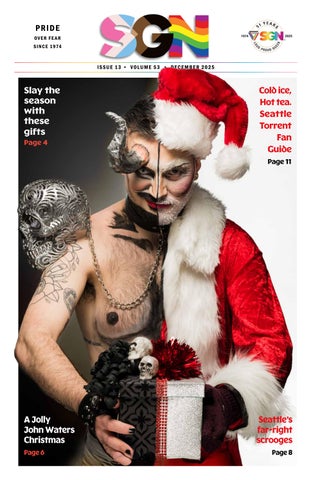
The legendary John Waters: The evangelist of humor delivers a “sermon” at the Neptune
BY MIRYAM GORDON

One night only, on December 2, the John Waters returns to Seattle for his annual Christmas … umm, show? presentation? oration? This is likely going to be a hard ticket to get, but it’s worth a big effort, especially if Waters has become a must-see for those you know.
Waters is, of course, the celebrated filmmaker behind many very well-known movies, some of which include Hairspray, Polyester, Cry-Baby, and Serial Mom. He also does one nonholiday stand-up show and one Christmas one a year.
The blurb at the Neptune Theatre (https:// www.stgpresents.org/events/a-johnwaters-christmas) says (in part), “We’re naughty. We’re nice. But we’ve got lice! Yep, the alternative Clause with flaws, John Waters is back with his demented holiday show that puts the gag in gagster, the hole in holiday, and the stuffer in your stocking. He not only loves Santa, he eats him raw and regurgitates him back up piping hot to eager-beaver filth-tartar lovers everywhere. It’s a whole new world out there, and you know what you have to do! Teabag the reindeer! Knock over the tree! Leave a holiday payday for your whole family to see.”
The SGN recently got a sneak peek at what he’s planning this year. Waters doesn’t want to give it away, but he described this event as a “sermon.” “I do a new show every year,” he told the SGN. “I have to rewrite an entire new show twice a year. It’s a neverending cycle. I try to make fun of myself first. I make fun of everything I really like, not hate. That’s why I’ve been doing this for over 50 years. It’s a 70-minute show. It’s like writing a little book every year.” Waters learned to tour from historic celebs. “Oscar Wilde did it. Wilde did hundreds of shows in little towns,” he said. “I learned from watching my idols. Andy Warhol went to colleges. He did it better. He hired someone to impersonate him — until he got caught! I’ve been trying to get Steve Buscemi to do that for years.”
His sermon: Make ’em laugh
Waters definitely considers his show to be stand-up comedy. “I’m trying to be an evangelist,” he said. “For people to con-
tinue to have a good sense of humor about themselves and be able to laugh. And get along with people they don’t agree with. And listen and at least learn to help change their minds.
“My audience is — no matter what their politics are, they’re not sure what to do these days. I try to make fun of everyone’s politics. That way we can bring it together in a weird, screwed-up way. Make them laugh at their own politics. Nobody these days laughs at their own politics. It used to be the left wing and right wing used humor. Then they’ll listen.
“You don’t treat ’em like they’re stupid. You make people laugh, and then you have sex with them. Then you convert them.”
A traveling carny Waters travels a lot. I wondered if he was concerned about having flight trouble during the shutdown. “I’m a carny basically,” he said. “I’m in a traveling circus, and I’m the side show. Vaudeville, baggy-pants comedians. I get to meet my fans — they get dressed for me.
“I have fear of not flying. I have fear of what flying is going to be like in this situ-

ation on this tour. I’m afraid not to be on airlines. Not working. I live in airports. The driving force is that I have four homes and six employees. I have a lot of bills.
“I leave at 4:00 in the morning, early check-in at my hotel. I go to sleep. I get up and rehearse and do the show, do the meetand-greet. I go to bed, and then it starts all over again. I’m never in the real world. I’m in a plane, a car, the hotel, in the dressing room, and on stage.”
Seeing friends in Seattle, but not Dina Martina
One of the aspects of travel that Waters loves is seeing his friends in each city. He is here for such a short time, however, that he won’t be able to see Dina Martina’s annual Christmas show. “I see Dina all summer in Provincetown [where they both live],” he said.
But he appreciates Seattle and its history with him: I’ve always had a great audience in Seattle. Even before I was doing these shows, my movies have always played there. I’ve been coming to Seattle since the very beginning. It was one of the first places my movies caught on. I certainly feel like I’m welcome there.”
New Christmas single from Sub Pop Waters’ other new creative effort is a Christmas song — with an A side and a B side. “Little Cindy had a spiritual years ago, ‘Happy Birthday, Jesus,’ that was on my Christmas album. [This year,] I covered it. I made it a novelty record; it was not a novelty record when she did it. I’m a fan of novelty records. On the other side, I read The Night Before Christmas in Pig Latin, which is almost impossible to listen to. Last year for Sub Pop I covered the barking dogs for ‘Jingle Bells.’ These records are not meant to be played. They’re just concepts.” If you hanker to hear these, you can go to Sub Pop (https://www.youtube.com/@ subpop) or https://www.youtube.com/ watch?v=r1ilGorkB_A .
For more articles and reviews, go to www.facebook.com/SeattleTheaterWriters . Subscribe at https://MiryamsTheaterMusings.blogspot.com
BY FRANK GAIMARI
Reprinted with permission from Stonewall News Northwest (https://www.stonewallnews.net)
Chi-Chi LaRue, born Larry David Paciotti on November 8, 1959, in Hibbing, Minnesota, is a name synonymous with boldness, creativity, and unapologetic authenticity, a trailblazer in the drag and adult entertainment industries. LaRue’s journey from a small-town upbringing to becoming a celebrated icon is nothing short of extraordinary.
Although I had heard the name ChiChi LaRue, I knew little about the person behind it. Intrigued, I decided to reach out, and to my surprise and delight, LaRue responded. What followed was a warm and candid conversation that left me feeling like I had just spoken to an old friend. LaRue’s charm, humor, and openness put me entirely at ease.
In the early 1980s, Larry Paciotti moved to Minneapolis, where he began performing in drag as Chi-Chi LaRue (pronounced “She-She Lah Roo”). The persona was larger-than-life — flamboyant, brash, and unapologetically fabulous. LaRue quickly became a local sensation, captivating audiences with a mix of humor, charisma, and undeniable talent. This stark contrast to the quieter Paciotti marked the beginning of a lifelong reinvention.
In 1986, LaRue relocated to Los Angeles, a city brimming with opportunities for someone with ambition and flair. Initially hired by Catalina Video as a publicist and sales representative, [he demonstrated a] deep understanding of the adult film industry that soon set him apart. By 1989, he made his directorial debut under the pseudonym Taylor Hudson, as his drag name was considered too feminine for the industry at the time.
LaRue’s career as a director flourished, with hundreds of films to his name, primarily for Falcon Studios. He later expanded his work to include collaborations with Vivid Video and his own label, Rascal Video. LaRue’s films were known for pushing boundaries, blending storytelling with eroticism in a way that challenged norms. Titles like Lost in Vegas and Heaven2Hell (Parts 1 & 2), showcased his ability to cre-
ate compelling narratives within the adult genre.
Beyond his creative vision, LaRue became a vocal advocate for safer sex practices in the adult film industry. In 2006, he famously refused to work with studios that did not require condom use, setting a standard for responsibility and care in a field often criticized for its lack of regulation.
LaRue’s influence extended far beyond the adult film world. He directed music videos, including one for RuPaul’s Drag Race alum Willam Belli, and even performed in a glam-rock band called the Johnny Depp Clones. His drag persona allowed him to connect with audiences in ways that transcended the adult industry, making him a beloved figure in the Queer community.
In addition to his many accomplishments, LaRue made a guest appearance in Madonna’s 1992 music video for Deeper and Deeper, further cementing his status as a pop culture icon.
To gain a deeper understanding of LaRue’s experiences and insights, I took the opportunity to ask him several questions. He graciously shared his thoughts, providing a more personal glimpse into his journey.
Frank Gaimari: What inspired you to create the drag persona Chi-Chi LaRue, and how has it evolved over the years?
Chi-Chi LaRue: When I first started doing drag with three friends, we called ourselves the Weather Gals. Our style was more of a “hag drag.” We didn’t take it too seriously, but the crowds absolutely loved us. We ended up winning several drag contests at First Avenue, the iconic venue where Purple Rain was filmed. In fact, I had the incredible experience of being in Purple Rain myself, which was truly unforgettable.
FG: What role do you think drag plays in shaping Queer culture and visibility today?
CL: I believe drag is a powerful expression of Queer culture, and I absolutely love it. Drag is not only fun but also incredibly informative. Icons like Sister Roma


and many others use drag as a platform to educate and fight against oppression. Drag queens are often the first to step up and help in any situation that threatens Gay or Queer existence.
While I have a deep appreciation for old-school drag, I also enjoy shows like RuPaul’s Drag Race. However, I think the show has given some people the impression that if you’re not doing a death drop, flying from the ceiling, or performing cartwheels, then you’re not doing drag, which couldn’t be further from the truth. I’m good friends with RuPaul and many of the queens who have competed on the show. That said, I’ve also encountered some queens from the show who aren’t very friendly and have let the fame go straight to their heads — just being honest, lol!
FG: What was it like directing your first adult film?
CL: I was both terrified and incredibly eager. My head was swirling with ideas, but I had no idea what I was doing — truly flying by the seat of my pants. The first movie I directed was called Flexxx for In Hand Video, marking my debut feature film. Before that, I directed a segment for William Higgins in the movie Hardman, which featured men dancing, stripping, and performing solo scenes. I must admit, my segment was the standout of the series, at least in my opinion!
After directing my first movie, I was utterly hooked. That first experience sparked a passion that led to a directing career spanning over 40 years. Over the decades, I’ve had the privilege of creating some truly exciting and memorable films... and, admittedly, a fair share of not-so-great ones. Let’s say it’s been a wild ride!
FG: You’ve worked with some iconic performers. What do you look for when casting talent for your movies?
CL: I was always taught that if a guy had two out of three key qualities, he was a contender for a movie. Those three qualities were: face, body, and dick! These days, it feels like porn stars are falling out of the sky, and the content creators on platforms like Just for Fans are stunning. It’s incredibly exciting to see how the industry has evolved!
FG: How do you approach storytelling in adult films, and what sets your work apart from others in the industry?
CL: I’ve always had a knack for coming up with concepts. Honestly, you can turn
just about anything into a porn movie: two guys walking down the street, someone painting a house — the possibilities are endless. You can also dive into more fantastical themes, as I did with my movies Heaven2Hell [and] Night Riders, and my Link series.
To this day, I think my favorite movie I ever directed was a story-driven film called Wrong Side of the Track, starring Johnny Hazzard. The concept for that movie came from a simple video clip Steven Walker shot in Palm Springs. It showed Johnny walking down the railroad tracks, and after watching it, I was inspired to create an entire movie around that moment.
FG: You’ve been a vocal advocate for safer sex practices in the adult industry. What motivated you to take that stand?
CL: It was alarming to see that people were still making movies without practicing safer sex. When I started, I knew I couldn’t take part in those practices. At the time, some were resorting to unorthodox and misguided methods, like squirting nonoxynol-9 into people’s bodies, thinking it would offer protection. I took a strong and vocal stand against it, and I’m proud to say I helped change the minds of prominent industry leaders, including Chuck Holmes from Falcon, who eventually adopted condom use in productions.
My commitment to safer practices wasn’t limited to Gay productions — I also refused to make straight films without using condoms, including the movies I directed for Vivid. I believe the women I worked with truly appreciated that stance, and it reinforced the importance of prioritizing health and safety in the industry.
FG: What are some misconceptions people have about the adult film industry, and how would you address them?
CL: I think many people assume that an adult film set is filled with drugs and sex even before the cameras start rolling, but that couldn’t be further from the truth. In fact, I once kicked down a bathroom door because some of my actors were doing crystal meth in the bathroom of the location. I had to pay for the door, but it was worth it.
As someone who has struggled with alcoholism and addiction myself, I was determined not to let that kind of behavior be a part of my productions. It was important to me to maintain a professional and respectful environment on set.
BY ARIN WALLER
Trans folk punk band Pigeon Pit from Olympia performed a live show at the all-ages Vera Project on Friday, Nov. 21, coinciding with the release of their newest album, Leash Aggression.
Pigeon Pit originally began as a solo venture by Lomes Oleander in 2014. Since then, they have released five albums, available on various music platforms, including Bandcamp and Spotify. Oleander explained that they love performing at the Vera Project, a reason being that youth volunteers run and organize the shows, allowing many of the participants to learn useful skills related to sound design, event planning, and music promotion. Oleander also lamented the dearth all-ages venues: “Having all-ages shows is increasingly hard to find in cities because of the profit incentive of bars and rising cost of living, and the rising cost of having a space with affordable shows.”
The opener for the show was Portlandbased folk singer Lightnin’ Luke, most of whose performances were sing-alongs, after which he would hang out at the merch corner to say hello to fans. It is clear that Lightnin’ Luke is a musician who can engage with an audience and hype up a crowd, making him a perfect fit as the opening act.
Afterward, Pigeon Pit took the stage, and one of the first songs they performed was “Empties” from the album Feather River Canyon Blues. One fan brought a
can of Campbell’s soup, referencing the song “Soup for My Family” from the same album; Jim Rhian, the pedal steel guitarist, used that same can to perform the song. The band also provided the audience with a taste of their newest sound by performing a couple of tracks from their latest album, beginning with “Last Night on Planet Earth,” as well as section dedicated to Oleander’s solo performances, including songs such as “Nights Like These” and “Milk Crates.” Many concertgoers in the pit took to dancing and cheering as the band delivered a stellar performance.
One more act followed, however. New Orleans-based folk band Holy Locust took to the stage with a more traditional Cajun mix of cellos, fiddles, and accordion, having previously performed with Pigeon Pit in Olympia as part of Leash Aggressions’ release.
Discussing the creative process behind Leash Aggression, the band’s second fulllength album of 2025,Oleander explained that the record was produced very quickly, with all the songs written six months after Crazy Arm’s release and recorded in August, before the band left for their UK and Europe tour. “It’s a lot more simple and pulled back and was kind of a speed writing experiment for me,” said Oleander.
Leash Aggression tells a story of the current human condition in acoustic punk fashion, with tracks such as “Landlord Special,” a melancholy solo by Oleander addressing

the current affordability crisis in Washington from the perspective of many within the punk scene, who are outpriced from a more comfortable quality of life.
Modern punk rock has seen a greater representation of Trans musicians, as exemplified by acts such as Um, Jennifer? and Laura Jane Grace of Against Me! Punk is a politically charged genre, and in
an age when Trans rights are facing constant scrutiny and attack, Trans musicians are more relevant now than ever.
“I’ve always found that music, long before I started playing shows, was a way for me to tap into community and to feel connection with other people, and to be exposed to political ideas,” Oleander explained.

WICKED: FOR GOOD
Theaters
BY SARA MICHELLE FETTERS SGN STAFF WRITER
It’s rare that a picture has me as perplexed as Wicked: For Good does. Even though it was filmed back-to-back with its Academy Award–winning predecessor, this one looks a lot better. There’s less digital sludge, the backgrounds have additional tactile pop (and aren’t nearly as intentionally blurry), and the still-impres-
sive sets have a noticeable physicality. All of this and more was lacking from the initial chapter of this revisionist journey to the merry old land of Oz, adapted from the smash Broadway musical and based on the best-selling book by Gregory Maguire. Additionally, stars Cynthia Erivo and Ariana Grande are as terrific as ever as, respectively, the not-so-wicked Wicked Witch of the West Elphaba and Glinda the Good. The final musical number, with the
two coming together in total harmony after spending the majority of the sequel on opposite sides, is beautifully staged (even if the song, “For Good,” is only a bit better than so-so). For me, this was the definitive high-water mark, which, for a brief moment, left an authentically earned smile upon my face. So what’s the problem? The truth is that the story isn’t engaging. It is horribly paced. It brings up interesting ideas involving fas-
cism, gender, sexism, racism, friendship, and found family and then does almost nothing of consequence. Director Jon M. Chu can’t seem to generate forward momentum. Elphaba is pushed into the background of a story that is by all accounts supposed to be focused on her, leaving Glinda to barnstorm into the pink-bubbled spotlight instead. Secondary characters and subplots are tossed around like glittery confetti and almost instantly forgotten.
Granted, these were all issues that plagued the Broadway production as well. The best songs were all in the first act. So were many of the more intriguing story beats. But that show, barely running 150 minutes (a good ten shorter than Wicked: Part One), didn’t allow audiences to dwell on the narrative inadequacies. Instead, it was a full-on sprint to the finish, filled with several gigantic L. Frank Baum Oz tie-ins that had audience members gasping and pointing at the stage.
Here, however, this latest jaunt down the yellow brick road is a seat-numbing 138 minutes. Two new songs are added, one for each of the witches, and neither of them is anything special (Elphaba’s is by far the stronger of the two, but Glinda’s is more interestingly staged). Aspects of the book that couldn’t make it into the Broadway production are added, but not as many as there might have been (especially considering the running time). Instead, Chu filters in frequent momentum-killing flashbacks to the previous film, almost all of which are tediously unnecessary.
If not for Erivo and Grande, it would almost be impossible to believe that the same team that crafted the first half of this epic musical was also responsible for its concluding installment. Precious little is fun, and even less showcases imagination. The best bits, such as Elphaba confronting her sister Nessarose (Marissa Bode) — now the hardhearted governor of Munchkinland — with her selfish hypocrisy and both of them getting disastrously caught up in the perilous limitations of magical incantations, are rushed through so quickly that they become frustratingly
meaningless. Others, like the talking animals potentially leaving Oz for the perils of an interdimensional wasteland or the flying monkeys learning who it was that really betrayed them, barely register at all. Thankfully, Erivo and Grande are still here, and they are marvelous, the latter in particular. The two actors have beguiling chemistry, and the few times the plot brings Elphaba and Glinda together are unquestionably its best moments. The sheer joy of their song-and-dance routine alongside Jeff Goldblum (returning to yuck it up as the not-so-magical Wizard of Oz) is infectious, while the intimately affecting power of “For Good” is undeniable.
Yet even this facet of the production is vexing. This is Elphaba’s tale. She’s at the
center of it. She’s the one who is fighting for Oz, the one attempting to show up the Wizard and his propaganda-creating righthand woman, Madame Morrible (Michelle Yeoh), as the despots they are. Elphaba is the witch who must deal with tragedy firsthand, whether it be the unfortunate transformations of some of those dearest to her into tin figures or beings made entirely of straw, or in seeing the animals she’s trying to protect turn their backs on her in fear. She is the one who has to suffer through the agonizing aftermath of a farmhouse falling from the sky and landing smackdab in the middle of Munchkinland.
But while all that is part of the story, it’s hard not to feel like Chu, along with screenwriters Winnie Holzman (who

BY FRANK GAIMARI
Wicked: For Good returns audiences to the magical world of Oz, promising grand spectacle and heartfelt drama. While it doesn’t always recapture the dazzling heights of its predecessor, the film offers plenty of enchantment — particularly for longtime fans, who will find much to enjoy in this anticipated finale.
The story resumes five years after Elphaba’s bold stand against the Wizard. Now living in exile and known as the “Wicked Witch of the West,” she fights from the shadows to defend the rights of animals. On the other hand, Glinda, who has risen to prominence as the public face of the Wizard’s regime, is engaged to Fiyero, who now serves as Captain of the Guard. Their lives collide once more through personal loss and political unrest, involving Elphaba’s sister Nessarose, the arrival of a mysterious girl from Kansas, and a final, climactic showdown with the Wizard. The narrative ultimately asks Elphaba to embrace her identity, while Glinda must reckon with her own role in Oz’s destiny.
Central to the film’s enduring appeal are the magnetic performances of Cynthia Erivo and Ariana Grande. Erivo commands the screen as Elphaba, her intense yet vulnerable portrayal capturing the character’s quiet strength and internal struggle. With an emotional range that brings Elphaba’s journey vividly to life, Erivo transforms each musical number into a showcase of vocal power and heartfelt storytelling. Her renditions of defiant anthems and moments of quiet heartbreak are equally compelling, ensuring that the audience feels every step of Elphaba’s transformation.
Grande is a standout as Glinda, bringing a delightful blend of wit, charm, and emotional nuance to the role. She transitions effortlessly from comedic timing to dramatic introspection, allowing viewers to see beyond Glinda’s bubbly exterior. Her soaring vocals infuse the character’s songs with energy and uplift, while her ability to convey genuine vulnerability gives depth to Glinda’s
personal growth and self-discovery.
Together, Erivo and Grande are electric. Their dynamic tension and heartfelt connection infuse the film’s most memorable scenes — whether in spirited conflict or moments of forgiveness and friendship. Their harmonic duets stand out as true highlights, with each performer complementing the other in tone and emotion. The synergy between these two remarkable talents elevates the film, giving it its emotional core.
In addition, Jonathan Bailey delivers a crowd-pleasing performance as Fiyero. He doesn’t just step into the role; he owns it with confident charm that is sure to make fans (especially this reviewer) swoon. His striking screen presence, highlighted by his cheeky grins and undeniable charisma, ensures that Fiyero is not only a dashing romantic lead but also genuine “eye candy” — and yes, a little skin makes an appearance, to the delight of many viewers. Bailey adds depth, heart, and a fun energy that brings every scene he’s in to life.
Where the film falters is in its pacing. The first movie set a breathless tone, while this installment sometimes struggles to sustain it. Extended subplots and a few sluggish scenes detract from the overall energy. The decision to split the story into two films is keenly felt, with certain moments that could have benefited from a tighter edit.
Nevertheless, Wicked: For Good is filled with elements that will delight both newcomers and devoted fans. Musical numbers dazzle, costumes burst with color, and the talented cast brings passion to every frame. It may not be a perfect conclusion, but it remains a magical reunion with Oz for anyone who has ever cherished its world. So, gather your friends — and perhaps your admiration for Jonathan Bailey — and prepare for a cinematic journey that’s equal parts dazzling, heartfelt, and, above all, unforgettable.
wrote the book of the Broadway production) and Dana Fox, couldn’t have cared less about their primary protagonist. Instead, all of the best visual and dramatic moments are given to Glinda. Though Grande is more than up to the challenge, showcasing a physicality and internalized dexterity that’s sensational, it’s still a bewildering turn of events. Glinda slowly becomes the main character, stealing Elphaba’s thunder and often relegating her to the sidelines. It’s annoying.
I’m not going to go into the ins and outs of the plot. It should be clear where everything is going, and by the time Dorothy (and her little dog too) show up, even those completely unfamiliar with the Broadway showcase or Maguire’s source material should still have a strong idea of how things will turn out. Chu, to his credit, isn’t concealing anything on that front, and while I know this may sound counterintuitive, this is one instance where being conscious of the outcome helps increase the overall emotional stakes, not diminish them.
All of this only leads me back to where I started — a state of disgruntled bafflement. The technical aspects are too strong, and the performances by Erivo and Grande are much too sublime to dismiss this sequel outright. Still, much like the con man hiding behind the curtain, utilizing sleight of hand and subterfuge to convince the easily fooled that his powers are beyond all imagining, Wicked: For Good has precious little in the way of any actual magic. One might even go so far as to call it a bona fide dud.

BY SARA MICHELLE

In 1974, writer Linda Rosenkrantz had the idea for a new book. She would interview a series of artists, musicians, authors, and other significant figures to narrate in intimate detail what they experienced over the course of a single day. While the project went unrealized, she did sit down with vaunted photographer Peter Hujar, publishing the transcripts of their conversation in her 37-page novella Peter Hujar’s Day in 2021.
Acclaimed independent filmmaker Ira Sachs (Love Is Strange, Passages) was instantly transfixed by the book and became determined to transform it into a feature-length motion picture. With Rebecca Hall as Rosenkrantz and Ben Whishaw as Hujar, what could easily have felt like a filmed version of a two-person off-Broadway play instead becomes hypnotically transformational. The director delivers a picturesque chronicle of everyday life, artistic expression, friendship, and platonic love that leaps off the screen. This is one of 2025’s best, most emotionally intimate stunners.
I sat down with Sachs over Zoom to chat about Peter Hujar’s Day and the numerous difficulties he and his talented creative team overcame so they could bring his meticulously heartfelt adaptation to life. Here are the edited transcripts of our brief conversation:
Sara Michelle Fetters: I don’t know what I expected when I sat down to watch Peter Hujar’s Day, but I do know I did not anticipate being overwhelmed by tears by the end of it. What was your reaction when you first encountered Linda Rosenkranz’s book — it’s barely 37 pages — and when did you know you wanted to make it into a feature film? What was that process like?
Ira Sachs: I found the last page of the book incredibly moving, and specifically the image that Peter shares of himself in the middle of the night, standing in the corner of his apartment at Second Avenue and 12th Street in the East Village in 1974, listening to the sex workers talking about their trade. To me, that was a purely cinematic image and also a very emotional one. It had to do with the indelible and the ephemeral, and … the beauty of everyday life. That he was able to do that was the power of Peter as a storyteller. It’s not what he’s known for — unless you consider his por-
traits a form of storytelling — but he was actually an exceptional storyteller. The richness of his language and the detail of his narration is not normal. It appears normal, because it appears so relaxed and casual, but it is not for most of us.
I immediately decided after I put the book down that I wanted to make the movie with Ben Whishaw, who I was currently working with on Passages. What happened was, about a year later, when were about six weeks out from shooting, I realized I had no idea how to make the film. [laughs] The boundaries of this conversation seemed so limiting.
What freed me up was the realization that I wasn’t going to shoot the film in real time and that I was going to create my own sense of movement by building like 23 scenes in the course of these two having a simple conversation. Suddenly it became about the passing of a day, it becomes about the different ways that friendship realizes itself in different intimate spaces, whether it be a couch or a terrace or a bed, and whether it be day or night. There [were] all these different ways I could invoke the intimacy of the film and the intimacy of their relationship.
SMF: I’m glad you use that word, because that’s one of the words highlighted in my notes: intimacy. The intimacy that Rebecca and Ben, or Linda and Peter, share throughout this day is so natural. Was it difficult for them to be able to slip into that? It felt so pure and effortless on their part.
IS: The talent is pure, but I do think there was initially a lot of stress between the three of us. We didn’t know what the film was going to be, but they still gave it everything. They didn’t know each other before the movie. They’re also British people playing American characters. So nothing is real, but everything is authentic. It’s all genuine.
Have you seen the ending of Suddenly, Last Summer? I think the ending, where Elizabeth Taylor narrates what happened suddenly last summer, is kind of the mood of [our] film, specifically that ending. The last bit of that film, it is both real and unreal at the same time. Nothing is more real than what Elizabeth Taylor describes, and yet, it is through the language of Tennessee Williams and director Joseph L. Mankiewicz that it all becomes realer than real.
That’s something that is new to me: to achieve something that is beyond the real yet maybe still touch on things that are essentially human.
SMF: When you have talents like Ben Whishaw and Rebecca Hall working on a film like this, something that is based on real people, what sort of freedom do you give them to build their own characters? To do their own research? Or do you give them instruction on what they need to go look at before filming or, in the case of Rebecca, do you tell her to go talk to Rosenkranz to get a better idea of what the actual interview may have been like?
IS: I was kind of their mentor, maybe, with the period, the story, Linda, and Peter. That being said, Ben Whishaw lives with a portrait of Peter Hujar hanging in his house, so he was very familiar with [him]. [laughs]
But, there are like fifty-some people who are described in the transcripts and in the film. I did some somewhat cursory research, not the deepest research, but I wanted to give them enough to know who they were talking about. It was like a Wikipedia-stye breakdown of the cast of characters who were being mentioned. But Ben’s ability to bring all of them alive as Peter and to make those characters real is all in how he utilized and ingested that material. It’s all him.
That was what I wasn’t certain of. I didn’t know if he could make every word and every image and every person so vivid in his delivery. That was the surprise for me: how alive he made this story.
With Rebecca, Linda is still with us and very much a part of this project, and [Rebecca] spent a lot of time talking to her. But what Rebecca understood and made visible was the deep love that Linda has for Peter even today, and she did that even without words. Ben does a lot with words, and Rebecca does so much without them.
SMF: Maybe this is a strange comparison, but I’m watching this movie, and the dynamic between Linda and Peter reminded me so much of The Man Who Came to Dinner, where you have Bette Davis active-listening throughout the entire movie and having to react to everything coming out of Monte Woolley’s mouth. He, in turn, is
casually spouting off name after name after name, but still makes them come alive eighty-some years after the film’s release.
Watching Ben in this movie, I felt something similar. When he’s talking about Ben Ginsberg or Lauren Hutton, his words make them become flesh and blood.
IS: Yes, but not only when he’s talking about the well-known names, but also when he’s talking about the names none of us have ever heard of, including me. It’s like a Shakespearean performance. It’s really quite extraordinary how alive it is and how full, through words, to convey a world. Ben is not an actor who seeks quality in the mainstream. A lot of things he does, including short films, experimental theater, documentary work — much of it is stuff you haven’t seen, because he lives in the whirlwind, which I think is to his advantage. He’s not trying to become something. He is something.
In that way, Ben is like some of my favorite actors I’ve ever known, particularly Isabelle Huppert and John Lithgow. They are people who seek creative experience most of all. They live a creative life. I think that’s what Peter did. I think that’s what I’m trying to do. And I think it’s what Ben already does.
SMF: As brilliant as he is, I do not think any of this works as well as it does without Rebecca. I don’t think I’ve seen a better “active-listening” performance in I don’t know how long.
IS: Silence is a beautiful state for the camera to observe. I was as interested in what Rebecca had to say in her expressions as what Ben had to say in his words. In a way, it’s like a four-hander. Not including Peter, there’s Ben and Rebecca, but then there’s also Linda and me. We’re all forms of listener-slash-observer-slash-storyteller. Rebecca is really like me in the film. She has utter curiosity. She has a lot of empathy. She has some desire to move the story along, which is part of her role, but also, she has love. I think, as a director, I had love for both Peter and Ben, but I also had love for Linda and Rebecca, and that’s an essential element to the movie and why I think you were so moved.
SMF: Another essential element is the contributions of Alex Ashe, your cin-
ematographer, and Stephen Phelps, your production designer. It felt like I was a little kid who had just walked into my favorite aunt’s apartment. How difficult was it to achieve that level of accuracy but still keep the visual look rapturously cinematic?
IS: It was all lovingly created. It was a world that was realized with a bit of guidance and influence of photographs that Linda had given us. But accuracy isn’t important to me. Accuracy implies the possibility that this world doesn’t exist. I’m not recreating the past, but I am relishing the text and the story of the past in a very contemporary way.
SMF: How important is it right now for
us to be telling Queer stories that showcase these characters as people being people, that their Queer identity isn’t the be-all and end-all of who they are?
This isn’t a film about Peter being Gay; it is a story about Peter being an artist, a person, a friend, about him living his life with all its inherent ups, downs, and in-betweens.
IS: You’re asking me how important is it for the film to be good. The opposite of what you’re describing is to be bad, as an artist, and being good is difficult enough, I shouldn’t be actively working to make it bad. I think that what is most compelling to me about the film now as an audience member is how Peter pays witness to how hard it is to be good. He’s so uncertain about
the quality of his work, specifically his photograph of Allen Ginsberg, and it is his uncertainty that I find very, very familiar, and very, very touching.
SMF: After you make a film, what is the point where you become comfortable releasing it into the world? What is that experience like?
IS: I think the hardest moment is when you take it to the market and, in the case of independent films, that market is the festival circuit. Capitalism is violent, and it’s not very empathetic to humans. So that’s very hard when you interact with the economy of your field. But it is also what makes you strong and aggressive. It’s a necessary fortitude for me as an artist to engage with
the culture and the economy of my field. As it is for Peter! We can’t resist talking about money when we make art. It’s unavoidable.
SMF: What do you hope audiences take away from your film?
IS: First off, I want them to experience pleasure, because that is what movies are for me. I hope they feel some familiarity with the type of intimacy that the film depicts. I hope that they enjoy these performances and the density and beauty of friendship that they showcase. And, I guess… I guess that I hope that this leads them to explore the voice of the artist Peter Hujar in ways they might otherwise not have.

Austere Peter Hujar’s Day is a priceless snapshot of art, life, love, and undying friendship
BY SARA MICHELLE FETTERS SGN STAFF WRITER
PETER HUJAR’S DAY
Theaters
Ira Sachs has always had an in-depth understanding of the power of language. He’s been equally astute in his grasp of the riveting authority of silence. At their best, his films showcase an inner poetic lyricism that speaks volumes and are captivatingly universal in their powerful eloquence. There’s something incredible about that, especially given that his films have such brazenly Queer content and proudly Gay characters, almost all of whom are doing their best to navigate through various relationship anxieties.
Love Is Strange, Keep the Lights On, Passages — these are three of the features Sachs has written and directed that strike such a chord. The emotional push and pull within their dissimilar dramatic travelogues is haunting in its touching specificity. Sachs achieves a level of character-driven authenticity that transcends eras, genders, and cultural variances. It’s magnificent.
Sachs’s latest, Peter Hujar’s Day, showcases the filmmaker at his best. At first glance, his adaptation of writer Linda Rosenkrantz’s transcripts of her daylong 1974 interview with New York photographer Peter Hujar seems as if it would be more at home on an off-Broadway stage than inside a neighborhood cinema. But Sachs takes this conversation between close friends and makes something heartbreakingly profound out of it. This drama attacks the soul with calmingly intoxicating relish. The somber beauty of two friends engaging face-to-face as one recounts a day in their life to the other is stratospheric in its notso-mundane resonance.
The idea was simple enough: Rosen-
krantz (Rebecca Hall) wants to write a book in which she tasks an assortment of notable people to document an entire day, which they will then recollect to her in a detailed conversation. One of those she invites, Peter Hujar (Ben Whishaw), is an esteemed photographer best known for his black-and-white portraits of celebrities, social gatherings, the Gay liberation movement, and other high-profile events.
While the book never materialized, Rosenkrantz kept the transcript for her interview with Hujar, finally publishing it as a 36-page novella in 2021. Working in tandem with the two actors and director of photography Alex Ashe, Sachs’s adaptation follows the source material virtually wordfor-word. What he and his crack team do from there, however, is produce magic on a seismic level. His film is a time machine that takes the viewer back to 1970s New York with phantasmagoric precision. Rosenkrantz and Hujar leap off the screen, and there were moments when I felt like I was sitting on the edge of the bed, at the kitchen table, or leaning against a ledge, looking over the concrete jungle of the Big Apple right alongside them.
Taking visual cues from the photographer’s now-timeless images, the film is an ephemeral dreamscape of reality and imagination. Ashe’s camerawork, while almost entirely contained within the austere interiors of Rosenkrantz’s apartment, is reminiscent of Gordon Willis’s seminal work on other New York stories like Manhattan, Klute, and Annie Hall. While the camera isn’t entirely stationary, movements are kept to a bare minimum. One second, Ashe zooms out to capture Hujar’s expressive gestures and hand movements. The next, he craftily moves back in for a close-
up centered on Rosenkrantz’s expressively alluring eyes as she actively listens with empathetic fascination to each and every word her friend has to say.
As with production designer Stephen Phelps’s exquisitely detailed period work and the suitably weathered and lived-in clothes crafted by costume designers Eric Daman and Khadija Zegga ï, nothing is out of place, and every detail augments the overall authenticity of the production. But Sachs smartly doesn’t let these elements overshadow the verbal gymnastics Rosenkrantz and Hujar are engaged in. While his film has a surprising surplus in style, what it offers up in emotionally multifaceted substance is even more extraordinary. Both Hall and Whishaw are sensational, even if what is asked of them couldn’t be more different. The former says maybe a tenth of what her co-star does. Granted, this shouldn’t be shocking, considering that this is by design, as Rosenkrantz wanted Hujar to do the majority of the talking. Yet, that does not make Hall’s performance any less masterful. Rarely has a nonverbal central role taken on such shattering articulateness. The actor’s body movements, her eyes — those penetrating, all-seeing eyes — stopped my breath. Hall is sublime.
Whishaw’s work is every bit as outstanding. His rat-a-tat-tat, rhythmic meticulousness as he recounts Hujar’s day is intoxicating. His arms are in constant motion, his hands effetely passing a seemingly continually lit cigarette back and forth as if it were on a string attached to one of his wrists like it was a child’s helium-filled balloon. Whishaw brings a musicality to Hujar’s recollections that play in symbiotic coordination with the film’s George Gershwin–heavy soundtrack. He’s a constant wonder.
Keeping up with all of Hujar’s namedropping as he recounts everyone he recently worked with, encountered, or thought about during his day — a mindblowing roster of giants, ranging from Lauren Hutton to Susan Sontag, Allen Ginsberg to William S. Burroughs, Rod Stewart to Stevie Wonder, all leading to a final tally of 40 or so names — can be a lot of work. It’s doubtful anyone will know who all of them are, let alone the majority (I had to look several up), and I do imagine a fair share of viewers may find that frustrating. I did not. Hujar’s casual cadences reminded me of Monty Woolley in 1941’s acid-tongued holiday classic The Man Who Came to Dinner. Not knowing everyone being referenced is both part of the fun and also cements that character as a man who walks in and out of a multitude of worlds with blasé ease. Hujar isn’t an elite, and while he is awed by many of them, he is decidedly unafraid of working and residing within their spheres.
But the heart of Peter Hujar’s Day is that friendship between the photographer and the writer. Rosenkrantz loves this man, and it is readily apparent that Hujar feels the same. Their platonic stillness has a rapturous malleability that moved me to a tsunami of happily cathartic tears. Sachs delivers a picturesque chronicle of everyday life that’s breathtaking in its verisimilitude. It captures a time and place that may be long gone, but that doesn’t keep it from understanding the here and now in all its complexity and minutiae. If a picture can be worth a thousand words, then this film offers up 76 mesmeric minutes of them that are nothing short of priceless.
BY LINDSEY ANDERSON SGN STAFF WRITER
The holiday season is a time for love, warmth, and fun family traditions. Unfortunately, for many, it can also bring about feelings of depression and a sense of mourning — especially for people with nontraditional families. With all the complex emotions surrounding “the most wonderful time of year” in mind, author Mariama J. Lockington set out to create a Queer holiday romance for those who sometimes feel less than jolly.
Lockington’s work often reflects elements of her own story that were underrepresented in the media she consumed growing up. “I am a transracial adoptee and grew up in a white family,” she told the SGN. “This experience is very nuanced and also not often centered in books or media. When I was a kid, looking for a reflection of myself, I was always looking for books about Black girls like me, Queer girls like me — but I never found them.”
So, she decided to write them.
Her previous novels center around Queer Black girls and their search for identity, though they all take place in the spring and summer. As she began working on I’ve Got My Love to Keep Me Warm while recovering from surgery, she also took in as many made-for-TV holiday romance movies as possible. “As I was watching them, I thought, ‘Wouldn’t it be fun to write a Lifetime-esque story, but with Queer, Black girls at the center?’ So, that’s what I did.”
Hijinks and support
While crafting the story of Lyric and Juniper, two Black Queer girls struggling with their own family dynamics — Lyric spends her time in and out of foster care, while Juniper worries for her parents’ marriage — Lockington realized that the holiday season can often be fraught with anxi-
ety for those with family drama, an issue that is especially relevant for LGBTQIA+ people.
Lockington has also dealt with familial unease during this season. “The holidays have always been a difficult time for me — with seasonal depression, grief, and complicated family dynamics slipping in — so I wanted to honor this as well as provide some magic and joy for those of us who struggle this time of year,” she said.
Lockington has been a storyteller her whole life. As a kid, she used to create her own books out of paper and cardboard. “I always knew I [wanted] to be an author — that has never wavered,” she said.
Her writing style incorporates elements of poetry and lyrical prose, drawing inspiration from her love of slam poetry and spoken word, which she discovered in college and later pursued for her MFA. Not only is Lockington a successful YA author but she also obtained a master’s in education.
“Writing for young people as well as supporting them inside and out of the classroom continues to be a true joy and passion of mine,” she added.
It is through her compassion for young people that Juniper and Lyric come alive on the pages of I’ve Got My Love to Keep Me Warm. While most holiday romances focus on steamy nights by the fire, Lockington makes sure to balance the holiday hijinks with moments of support for readers who may find a strong connection to her fictional characters.
“Holidays are a tough time for so many,” she said. “There’s so much pressure to gather with family, consume, and be merry, but it’s also a time of year where it gets dark really early. Often [it] is cold or gray, when those of us with depression or anxiety struggle the most.

“My biggest advice is not to be afraid to make your own traditions — with friends, family, found family, or even yourself. My wife and I get really excited about stuffing our dogs’ stockings with toys and treats, eating out-of-the-can cinnamon rolls, and watching our favorite musicals on Christmas morning.”
“Most importantly,” she added, “it’s important to be gentle with your heart and body during the holidays. We’re all doing the best we can to survive — and Lyric and Juniper are evidence of this.”
Rom-com tropes
Of course, I’ve Got My Love to Keep Me Warm is also full of fun Hallmark-style holiday rom-com tropes. A fan of holiday classics like Elf and The Holiday, Lockington put a lot of work into studying the best romantic tropes before injecting all the Christmas chaos she possibly could into her latest book. “I love a fake dating trope, and so that’s the main one here that I was excited to try,” she said.
While fake dating is a common trope in romance novels today, Lockington is one

of the few authors to take the gimmick into truly modern territory with a phony influencer relationship. “I’d never seen it done with a social media element — dating for the clicks versus in real life — so that was really fun to develop,” she said. “I’m also playing a little bit with the opposites-attract trope, as Lyric and Juniper are very different girls. This made for exciting tension in this novel, highlighting the imperfections and strengths of each of my characters.” From icy first encounters to warm moments of emotional intimacy, I’ve Got My Love to Keep Me Warm is the perfect holiday romance — both for those who can’t wait to put the Christmas tree up on November 1 and those who may be struggling to catch the holiday spirit this year. Lockington hopes all readers can take away one simple message: “That love is possible and abundant, your dreams don’t have to look like anyone else’s, and that there is magic in the season — even if you can’t always feel it.
BY TERRI SCHLICHENMEYER
RADICAL FAMILY: TRAILBLAZING
LESBIAN MOMS TELL THEIR STORIES
Edited
by MARGARET MOONEY
(c) 2025 Wisconsin Historical Society
Press
$20.00, 150 pages
Once upon a time, if a Lesbian wanted to raise a family, she had two basic options: pregnancy or adoption. That is, says editor Margaret Mooney, if she was willing to buck a heterocentric society that said the former was “selfish, unnatural, and radical” and the latter was often just simply not possible or even legal. Undaunted, and very much wanting kids, many Lesbians ignored the rules. They built “chains” of women who handed off sperm from donor to doctor to potential mother. They demanded that fertility clinics allow single women as customers. They wrote pamphlets and publications aimed at helping others become pregnant by themselves or with partners. They carefully
sought out Lesbian-friendly obstetricians and nurses.
Over time, Lesbians who wanted kids were “emboldened by the feminist movement and the gay and lesbian rights movement” and did what they had to do, omitted facts when needed, traveled abroad when they could, and found workarounds to build a family.
This book tells nine stories of everyday Lesbians who succeeded.
Denise Matyka and Margaret McMurray went to Russia to adopt. Martha Dixon Popp and Alix Olson raised their family, in part and for a while in conjunction with Popp’s husband. Gail Hirn learned from an agriculture publication how to inseminate herself. MC Reisdorf literally stood on her head to get pregnant. Mooney says that, like most Lesbian parents then, she became a mother “without any safety nets...”
Such “struggles likely will feel familiar as you read about [the] desire to become parents…,” says Mooney. “In short, these families are ordinary and extraordinary all
at once.”
In her introduction, Mooney points out that the stories in this book generally take place in the latter part of the last century but that their relevance is in the struggles that could happen tomorrow. There’s urgency in those words, absolutely, and they’re tinged with fear, but don’t let them keep you from Radical Family
What you’ll see inside these nine tales is mostly happy, mostly triumphant — and mostly Wisconsin-centric, though the variety of dream fulfillment is wide enough that the book is appropriate anywhere. The determination leaps out of the pages here, and the storytellers don’t hide their struggles, not with former partners, bureaucracy, or roadblocks. Reading this book is like attending a conference and hearing attendees tell their tales. Bonus: photos and advice for any Lesbian thinking of parenthood, single or partnered.
If you’re in search of positive stories from Lesbian mothers and the wall-busting they did, or if you’ve lived the same tales, this


EMBODIED ALTARS DANCE CLASS
Date: Mondays, December 1-29
Time: 6:30-8:30 p.m.
Venue: Daybreak Star Indian Cultural Center, 5011 Bernie Whitebear Way, Seattle, WA
Cost: Sliding Scale: $10-$20* per class.
EMBODIED ALTARS is an all-levels dance class hosted by Daybreak Star Radio. Designed by Indigenous Chicana artist and El Sueño director, Alicia Mullikin. Dancers will utilize Indigenous principles within movement, meditation, and song as a way to practice gratitude, honor the land, and recognize their ancestors. The class is for those who are interested in reflection, intention setting, and a discovery of their own stories.
No dance experience necessary.
No classes 9/15/25, No classes10/13/25
A Drag Queen Christmas
Date: Wednesday, December 3
Time: 7:30 p.m.
Venue: McCaw Hall, 321 Mercer Street, Seattle, WA
Ages: 18+ Only (Adult theme comedy)
Drag Bingo with Queen Sable St. Jones Holiday Edition
Date: Wednesday, December 3
Time: 7-9 p.m.
Venue: WeRise Wine Bar, 1913 2nd AVE, Seattle, WA
Get ready for a fabulous night of Drag Bingo hosted by the one and only Queen Sable St. Jones- it's gonna be a blast!
The Queer Agenda: A Live Dating & Comedy Show
Date: Wednesday, December 3
Time: 8 p.m.
Venue: Chop Suey, 1325 East Madison Street, Seattle, WA
Cost: $20 advance | $25 at the door Join us for The Queer Agenda, Seattles favorite queer dating/comedy experience, happening every first Wednesday at Chop Suey.Hosted by the hilarious Jaleesa Johnson (@jaleesajohnson_), this one-of-a-kind show blends comedy, chaos, and real-life matchmaking right on stage. Singles and brave volunteers participate in playful dating games and comedic challenges, all while the audience gets in on the fun. Expect queer joy, spicy surprises, and plenty of laughs. :
A Charlie Brown Christmas
Date: December 4-27
Time: 7-7:40 p.m.
Venue: Taproot Theatre 212 N 85th St, Seattle, WA
The all-ages holiday tradition is back! Charlie Brown is depressed by the never-ending commercialism surrounding the holidays. Thankfully, Linus is there to help him find
the true meaning of Christmas in this musical adaptation of the cartoon classic.
LGBTQ2IA+ Centered Weekly
Social Hour
Date: Thursday, December 4
Time: 12:30-1:30 p.m.
Venue: UW Tacoma Snoqualmie (SNO) CEI: The Lavender Lounge, Tacoma, WA
Seattle Men's Chorus: Holly Jolly Jingle
Date: Friday, December 5
Time: 7:30 p.m.
Venue: Pantages Theater, 901 Broadway, Tacoma, WA
The Seattle Men's Chorus rings in everyone's favorite holiday tradition: seasonal classics, Christmas comedy, costumes, dancing and the gayest sing-along in Seattle.
NIGHT SHIFT: A BIG GAY DANCE PARTY!
Date: Saturday, December 6
Time: 9 p.m.
Venue: Chop Suey, 1325 East Madison Street, Seattle, WA
Spinning the music of Lady Gaga, Janelle Monae, Madonna, Megan Thee Stallion, Chappell Roan, Shygirl, Mykki Blanco, Kylie Minogue, Tyler, The Creator, Princess Nokia, Arca, Steve Lacey, Lil Nas X, Blood Orange, Doechii, Rebecca Black, Doja Cat, Willow, & more! 9pm | 21+
TRANSplants - Trans Reading Series & Open Mic
Date: Saturday, December 6
Time: 5-7 p.m.
Venue: Charlie's Queer Books, 465 N 36th St, Seattle, WA 98103
Share your own work in progress at the open mic: workshop that poem, sing us a love song, or whip out your novel. Have fun! An intimate, relaxed environment, perfect for newbies. You don't have to read, but you do have to come.
West Brew Babes Vol4: Fremont's Ultimate Nightlife Drag Show & Live Event
Date: Saturday, December 6
Time: 10-11:30 p.m.
Venue: West Brewing Company, 513 North 36th Street, Seattle, WA
Queer friendly nightlife show in Fremont! Drag Performers, Dancing, Dj's, and good vibes. West Brew Babes is your new must see live show.
The 5th Annual Holly Jolly Holiday Show
Date: Sunday, December 7
Time: 6 p.m.
Venue: Neumos, 925 E Pike St, Seattle, WA
Seattle's favorite seasonal variety show is back after last year's sold-out event! In typi-
cal fashion, the night begins with a showcase of holiday songs sung by a variety of singers while accompanied by pianist Holly Thornton. As the evening continues, you'll be entertained by local comedians, musicians, and drag queens! Rest assured, the party will continue into the night with DJs swinging holiday hits and remixes. This cocktail cabaret-like affair encourages you to walk around and mingle throughout the performances. Be sure to explore the enchanted venue and shop the maker's market filled with local crafters providing custom gift ideas for friends and family!
Figure It Out - Queer Figure Drawing
Date: Tuesday, December 9
Time: 6-10 p.m.
Venue: Vermillion Art Gallery & Bar, 1508 11th Ave, Seattle, WA
Monthly Queer Figure Drawing, every second Tuesday. $15 suggested donation paid to the model. All skill levels welcome.
Anita Spritzer's Gay Apparel
Date: Thursday, December 11-13
Time: 7:30 p.m.
Venue: The Opera Center, 363 Mercer Street, Seattle, WA
Jingle All The Gay!
Date: Friday, December 12
Time: 8 p.m.
Venue: Neptune Theatre, 1303 NE 45th St, Seattle, WA
Queer Holiday Potluck: Sugar Plum Faerie
Date: Saturday, December 13
Time: 6-8 p.m.
Venue: Kirkland, WA - location private, details on ticket
Description Join Pride Across the Bridge for our fifth annual Queer Holiday Potluck, just around the corner on December 13th! This cherished event is a chance for our Eastside 2SLGBTQIA+ community to come together during the long, dark months. The holidays can be a particularly trying time for many in our community, and we want to offer this opportunity for our queer neighbors to connect in a sacred space with great food and even better people! This is a free, all ages event. Attendees are welcome to bring ally friends and family. . We will have a sensory room with a quieter atmosphere and various stimming items for you to experiment. And a game room with a Nintendo Switch and plenty of space for anyone who wants to bring board games or card games to share. We will be joined by Seattle&'s Drag King of Comedic Chaos, Chance Hazard, as this year&'s emcee, as well as other performers! Pride Across the Bridge is so grateful to the City of Kirkland for taking care of community, and helping make this event possible!
www.PrideAcrossTheBridge.org. https:// seattlepride.org/events/queer-holiday-potluck-sugar-plum-faerie
Tacoma City Ballet Presents The Nutcracker
Date: December 13-21
Time: 2 p.m.
Venue: Pantages Theater, 901 Broadway, Tacoma, WA Cost: $65.50
Queer Winter Market
Date: Sunday, December 14
Time: 12-5 p.m.
Venue: Seattle LGBTQ+ Center, 400 E Pine St #100, Seattle, WA 98122
The Queer Winter Market is flocking back to the Center on Sunday, Dec. 14, 2025, and we're ready to highlight baa-rilliant LGBTQ+ makers. Come shop wool-derful wares. From knitwear and candles to prints, jewelry, zines, and sweet treats, all while supporting local BIPOC artists before the holiday season. Masks are required so everyone can feel safe and welcome. Round up your besties, browse one-of-akind gifts, and leave feeling ewe-phoric. Every purchase helps sustain Queer and Trans creators and keeps our community thriving.
DECK THE DISCO BALLS: holiday queer disco night
Date: Saturday, December 20
Time: 9 p.m.-1 a.m.
Venue: Asylum Collective, 108 South Jackson Street B, Seattle, WA international queer disco night spinning vinyl classics and deep cuts amidst selfexpression, dazzling outfits, and yummy hot drinks.
Holly Jolly Jingle KIDS SHOWSeattle Men's Chorus Holiday Show
Date: Saturday, December 20
Time: 2 p.m.
Venue: Benaroya Hall, 200 University Street, Seattle, WA
This year's lineup includes an abbreviated show specifically for children to join in the delight of Holly Jolly Jingle. This onehour show, for those with shorter attention spans, is complete with extra dancing to get the wiggles out and an extended sing-along with general admission seating. Perfect for all ages!
The Official Christmas Bar CrawlSeattle
Date: Saturday, December 20
Time: 4-11:59 p.m.
Venue: The Chapel Lounge, 213 1st Ave S, Seattle, WA Admissions: $12.78


Project is Funded by the National Science Foundation. Project number 2315905. This study has been approved by MSU Denver’s IRB #2023-139. MSU Denver’s Human Subjects Protection Program can be reached at 303-605-5282 or by email at hspp@msudenver.edu.
This project examines how families navigate changing dynamics around sexual orientation across generations.
Participation in this study will consist of a 2hour interview that will take place virtually via Teams. You and each of your family members will each receive $100 for participating. Scan the QR code below to fill out a brief online Screening Form to see if you qualify for participation in this research.
Eligibility Requirements:


Interviews with three family members; across at least two generations Of these family members one must be GLBQ+ (Gay, Lesbian, Bisexual, Queer) Must have known about family member’s sexual orientation for at least two years All members must be 18 years or older
Contact Information
NSFFamilyResearch.com FamilyResearch@MSUDenver.edu
Research Conducted By
Dr. K Scherrer, Metropolitan State University of Denver
Dr. Emily Kazyak, University of Nebraska Lincoln