IMPACT – Your Support in Ac�on –
Financial Freedom
Taking Back Control
For most people, opening a bank account is as simple as going online or making an appointment at the nearest branch. But for a person without government identification or a permanent address, doing so may be impossible. That’s the situation many survivors face when they escape human trafficking. With a new financial access project, we hope to change that.
After signing on to take part in the pilot project, Maxwell began by putting together a consultation group of more than 20 survivors. Those consultations were revealing. One survivor shared that she’d never learned how to use an ATM …
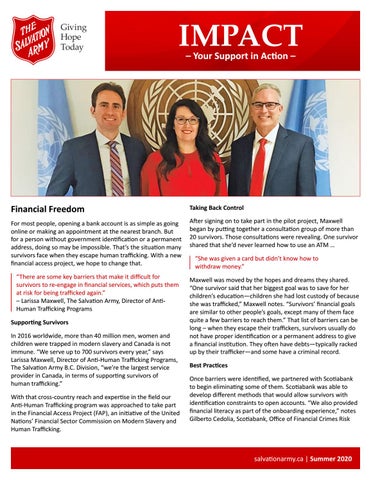
“There are some key barriers that make it difficult for survivors to re-engage in financial services, which puts them at risk for being trafficked again.” – Larissa Maxwell, The Salvation Army, Director of AntiHuman Trafficking Programs
Maxwell was moved by the hopes and dreams they shared. “One survivor said that her biggest goal was to save for her children’s education—children she had lost custody of because she was trafficked,” Maxwell notes. “Survivors’ financial goals are similar to other people’s goals, except many of them face quite a few barriers to reach them.” That list of barriers can be long – when they escape their traffickers, survivors usually do not have proper identification or a permanent address to give a financial institution. They often have debts—typically racked up by their trafficker—and some have a criminal record.
Supporting Survivors In 2016 worldwide, more than 40 million men, women and children were trapped in modern slavery and Canada is not immune. “We serve up to 700 survivors every year,” says Larissa Maxwell, Director of Anti-Human Trafficking Programs, The Salvation Army B.C. Division, “we’re the largest service provider in Canada, in terms of supporting survivors of human trafficking.” With that cross-country reach and expertise in the field our Anti-Human Trafficking program was approached to take part in the Financial Access Project (FAP), an initiative of the United Nations’ Financial Sector Commission on Modern Slavery and Human Trafficking.
“She was given a card but didn’t know how to withdraw money.”
Best Practices Once barriers were identified, we partnered with Scotiabank to begin eliminating some of them. Scotiabank was able to develop different methods that would allow survivors with identification constraints to open accounts. “We also provided financial literacy as part of the onboarding experience,” notes Gilberto Cedolia, Scotiabank, Office of Financial Crimes Risk
salvationarmy.ca | Summer 2020
Management. “Every survivor has a different background, so the onboarding was tailored to each individual.” In September 2019, Maxwell and Stuart Davis, Scotiabank, Global Head Financial Crimes Risk Management and Group Chief Anti-Money Laundering Officer, were invited to present on the pilot project to the U.N. in New York City. While there, Maxwell also gave a presentation on eradicating modernday slavery. “We received a flood of requests to consult with American financial institutions to help them develop similar projects,” says Maxwell. Shining Light During the pilot phase, four survivors participated in the FAP. “The survivors who went through the pilot told me it was the best experience they’d had with any institution—not just financial,” Maxwell shares.
“This program is a shining light down a long dark tunnel for me” – Human trafficking survivor Scotiabank is now moving to make the FAP a permanent initiative and we are looking forward to working together to establish that. Going forward, Maxwell’s goal is to make the program available to every survivor The Salvation Army supports, to set up a national referral system, and to bring all financial institutions across Canada on board. “For survivors to be able to stand on their own two feet financially—that is one of the strongest safeguards against trafficking, abuse and exploitation,” she concludes. To learn more about our anti-human trafficking programs and how you can help visit deborahsgate.ca
THE IMPACT OF YOUR GIFT After Meagan was arrested for drug trafficking she didn’t think life could get any worse, but it did. “After my arrest, I was released on bail and fled to another province to avoid a prison sentence,” says Meagan. “It was a bad move. I was assaulted to the point of being hospitalized for two weeks, lived in a shelter, then in my car. I just wanted to die.” Meagan wanted a better life, but it was hard for her to give up drugs. One day she saw a police officer and asked him to run her name.
Out of Control Meagan, grew up in a small town, in a good family, and excelled in school and sports. But after a soccer injury, she turned to drugs to dull the pain and cope with the disappointment of being unable to play. That was the beginning of her downward spiral that led to years of drug abuse, crime and unhealthy relationships. “It’s crazy how fast I lost control of my life. My addiction to crystal meth, cocaine and heroin cost me a career in nursing, my first house―and my family.”
“I was malnourished and tired of running from the law,” says Meagan. “I was arrested on the spot. That lead me to Drug Treatment Court and to The Salvation Army. They helped me get my life back on track.” Meagan lived at The Salvation Army’s Grace Mansion while she attended drug treatment. Grace Mansion provides 24-hour supervised, safe, stable and supportive housing, counselling and practical assistance to participants of the program. “I always lived in fear. The Salvation Army gave me a safe place to call home, a listening ear and practical support. Without the Army, I wouldn’t be as far along in my recovery.” Meagan was encouraged to get involved in things she loved to do such as volunteering. After completing treatment Meagan
salvationarmy.ca | Summer 2020
has planned to enroll in university to get a business degree. She has her family back and enjoys helping at The Salvation Army that was there for her when she needed it most. “When I got sober I realized all I gave up for drugs,” says Meagan. “There wasn’t much further down I could go.”
Because of the generosity and support of donors like you, we are able to help people like Meagan across B.C. Thank you. To learn more about the work of The Salvation Army in British Columbia, visit salvationarmy.ca/britishcolumbia
during the COVID-19 emergency this unit is worth its weight in gold. The Food for Life program began in April, going out three times a week serving 300 meals every trip right to people’s tents. As numbers of people in the parks grew the program changed and the crew started parking the Community Response Unit in five strategic locations throughout the city. Following the closure of two major encampments in May, the ARC was contacted by the Capital Regional District and was asked to expand the program to 600 meals, seven days per week. The new truck began serving the community by delivering drinks, meals, and a listening ear to vulnerable people and those affected by the COVID-19 outbreak.
Feeding Victoria’s Homeless In Victoria, B.C. the number of people unable to afford a place to live increases every day, significantly more so since the start of the COVID-19 pandemic. “People without homes are sleeping in parks, beside trees and in forest clearings, feeling helpless, lonely, and unsure where their next meal is coming from.” – Major Sheldon Feener, Executive Director Victoria ARC In order to meet this increasing demand, the Victoria Addictions and Rehabilitation Centre (ARC) put forth the Food For Life program, ensuring people in need in their community are fed and hydrated. The Food For Life program was made possible in part thanks to the donations received from the Victoria Rapid Relief Fund initiated by Times Colonist with the Jawl family, and the Victoria Foundation. This new program is run from our newest mobile feeding unit, a 34-foot-long Freightliner outfitted with a commercial kitchen. This Emergency Disaster Services Community Response Unit (CRU), donated by our friends at Walmart is designed to support evacuees and first responders during catastrophic events. With the ability to feed up to 1,000 people every hour; while on standby for other emergencies like floods and fires,
“Some say this is the first time they’ve eaten since the last time we delivered food. Others say they wouldn’t have eaten today without this service. Others remark that they have just finished eating what they were saving from the last we were there,” says Feener. “We know we are making a difference in people’s lives when we pull in with our truck and see the relief in their eyes knowing they won’t go to sleep hungry tonight.” – Jeffrey Baergen, Program Manager Victoria ARC Major Feener describes the range of emotions seen when the truck pulls up and volunteers begin to deliver meals to people in need. “To see despair and pain turn into hopefulness and optimism is why we do what we do,” he says. From April to June 2020 the Food for Life Program delivered a remarkable total of 26,400 meals to the community. The success is attributed to the incredible staff, volunteers and leadership, as well as the generosity and compassion from the community through food donations and financial support. To learn more about our Community Response Unit vehicle watch this video on facebook.com/ thesalvationarmybcdivision/videos/2305199306455888/
salvationarmy.ca | Summer 2020
The diversity at Boundless Vancouver of not only clients, but also staff and volunteers is significant. Kalvin soon discovered all the different languages spoken at the Ministry Unit and enjoys how the mix of Japanese, Korean, French, German, Mandarin, and Cantonese are able to come together to help others. “There is a grandpa in his 80’s that I volunteer alongside. He stays young by being active and if he can do it so can the younger generation.” Kalvin encourages anyone “whether you’re a Christian or not, it feels good to simply to give back. Learn this habit early, put away time, money, or a skill set towards something that’s not for yourself, but for others”.
Using the Pandemic to Help Give Back When the COVID-19 pandemic hit, it affected countless people and businesses across the world. For 26-year-old Kalvin Shum, who was working in the film industry as a lighting technician for Netflix and Amazon Prime, the pandemic completely shut down production, resulting in large layoffs. Typically, Kalvin worked 12 – 16 hour shifts, six days-a-week, so he suddenly had a lot of time on his hands. That was when he decided to spend this extra time helping those in need by returning as a volunteer with The Salvation Army. “I think it’s healthy to volunteer and I encourage my peers to help make an impact in the lives of others too.”
For more information on how you can become a volunteer with us, visit salvationarmy.ca/volunteer
Giving Hope in BC BC’s first Annual Report is now available. Read about the impact of your donations on our programs and services across the province. Visit: issuu.com/salvationarmybcdivision/docs/20192020_bc_annual_report_final
In the past, after working such long shifts Kalvin volunteered to help relieve stress. He started in the kitchen at Vancouver Belkin House, where he helped cook meals for clients in the recovery program. A few months ago a friend from church shared that The Salvation Army was needing help to handle the extra demand the pandemic had put on their programs, so Kalvin signed up at Boundless Vancouver to help with food prep, the Free Food Market and distribution of the COVID-19 Relief Hampers. Fast forward to today and Kalvin has become a regular face at Boundless, volunteering multiple times a week. For Kalvin, volunteering on the frontlines has been a hard look at reality, seeing the different ages and demographics of those in need, ranging from seniors to young families, all affected by homelessness, poverty, and COVID-19. He believes that by volunteering, you are able to give back to your community. “I know what it’s like to experience feelings of helplessness and loneliness, and when someone is able to provide a bit of help it really makes a world of difference.”
salvationarmy.ca | Summer 2020
CORPORATE CORNER
Family Gives Biggest Donation
Our shelters will:
In June, the Rogers family announced a $10 million donation to The Salvation Army to help support Canadians affected by COVID-19. It is the largest private donation we have received in more than our 135 year history of Giving Hope to those in need.
• enhance the provision of shelter and social services • prepare and provide fresh food and prepared take-out meals • pivot from group meals to offer safer options and strengthen long-term community relationships
“The incredible generosity of the Rogers family is critical to the work of The Salvation Army now and in the months ahead,” says Commissioner Floyd J. Tidd, national leader of The Salvation Army. “It allows us to continue to deliver vital, life-changing services to those who have been hit hard by the COVID-19 pandemic.”
Our emergency services will:
In British Columbia, the funds will improve food security, enhance the provision of shelter and social services, and fund additional emergency disaster services vehicles that deliver food to vulnerable children and families.
“Our family is honoured to be able to do a small part to help Canadians and Canadian families as they try to recover from the difficult financial challenges that COVID-19 has brought to so many people, especially people already under financial stress,” said Martha Rogers, Chair of The Rogers Foundation. “All of the money will be donated in 2020 so we can make as immediate an impact as possible.”
Our food banks will: • increase food supply, particularly fresh food • purchase additional equipment, including walk-in freezers and coolers that will allow for safe food management • increase counselling and practical support
• acquire additional emergency disaster services vehicles to assist with meal delivery • provide hot meals to individuals, seniors and families at designated sites • send meal trucks into high-need communities regularly
Thanks to the Rogers family, and donors like you, we are able to continue providing essential services to the vulnerable during the COVID-19 pandemic. For more information or to donate, visit salvationarmy.ca or call 1-800-SAL-ARMY
Thanks to you, our generous supporters, we can continue Giving Hope Today … and every day. Go to salvationarmy.ca/donations to continue making a difference.
salvationarmy.ca | Summer 2020