OUTCROP
Newsletter of the Rocky Mountain Association of Geologists








OUTCROP
Newsletter
of the Rocky Mountain Association of Geologists
730 17th Street, B1, Denver, CO 80202 • 720-672-9898
The Rocky Mountain Association of Geologists (RMAG) is a nonprofit organization whose purposes are to promote interest in geology and allied sciences and their practical application, to foster scientific research and to encourage fellowship and cooperation among its members. The Outcrop is a monthly publication of the RMAG.
2025 OFFICERS
PRESIDENT
AND BOARD OF DIRECTORS RMAG STAFF
Matthew Bauer matthew.w.bauer.pg@gmail.com
PRESIDENT-ELECT Sandra Labrum slabrum@slb.com
1st VICE PRESIDENT
Nate La Fontaine nlafontaine@sm-energy.com
1st VICE PRESIDENT-ELECT Rachael Czechowskyj sea2stars@gmail.com
2nd VICE PRESIDENT Ali Sloan ali@sloanmail.com
2nd VICE PRESIDENT-ELECT Lisa Wolff lwolff@bayless-cos.com
SECRETARY Drew Scherer latirongeo@gmail.com
TREASURER
Astrid Makowitz astridmakowitz@gmail.com
TREASURER-ELECT
Walter Nelson wnelson@integratedenergyresources.com
COUNSELOR
John Benton jbenton@haitechinc.com
ADVERTISING INFORMATION
Rates and sizes can be found on page 44. Advertising rates apply to either black and white or color ads. Submit color ads in RGB color to be compatible with web format. Borders are recommended for advertisements that comprise less than one half page. Digital files must be PC compatible submitted in png, jpg, tif, pdf or eps formats at a minimum of 300 dpi. If you have any questions, please call the RMAG office at 720-672-9898.
Ad copy, signed contract and payment must be received before advertising insertion. Contact the RMAG office for details.
DEADLINES: Ad submissions are the 1st of every month for the following month’s publication.
The Outcrop is a monthly publication of the Rocky Mountain Association of Geologists
DESIGN/LAYOUT: Nate Silva | n8silva.com
EXECUTIVE DIRECTOR
Bridget Crowther bcrowther@rmag.org
LEAD EDITOR
Danielle Robinson danielle.robinson@dvn.com
CONTRIBUTING EDITORS
Elijah Adeniyi eadeniyi@slb.com
Nate LaFontaine nlafontaine@sm-energy.com
RMAG CODE OF CONDUCT
RMAG promotes, provides, and expects professional behavior in every engagement that members and non-members have with the organization and each other. This includes respectful and inclusive interactions free of harassment, intimidation, and discrimination during both online and in-person events, as well as any content delivered by invited speakers and instructors. Oral, written or electronic communications that contain offensive comments or demeaning images related to race, color, religion, sex, national origin, age, disability, or appearance are not appropriate in any venue or media. RMAG reminds members of the diversity and mission statements found on our website. Please direct any questions to staff@rmag.org
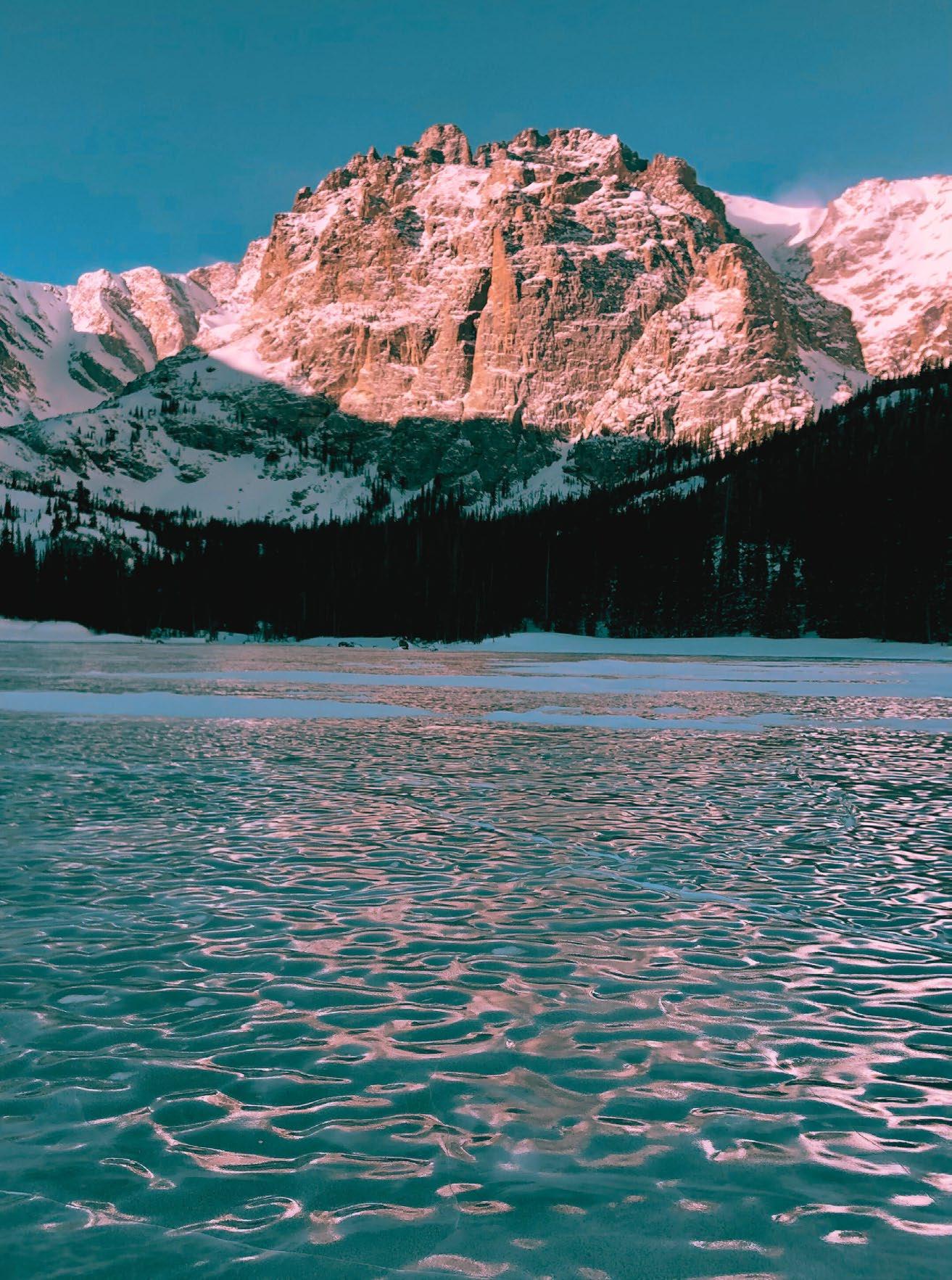

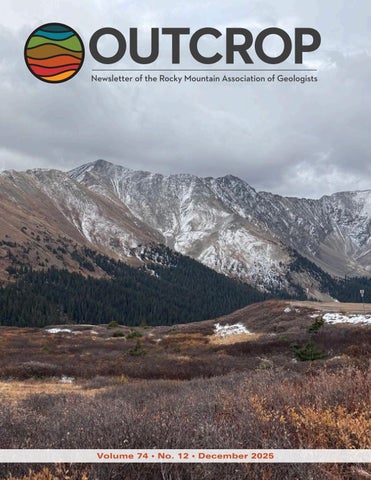
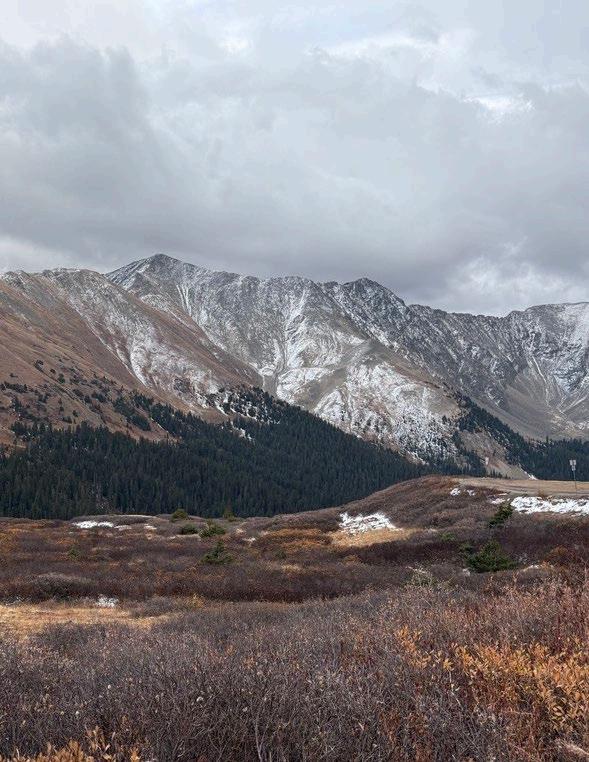
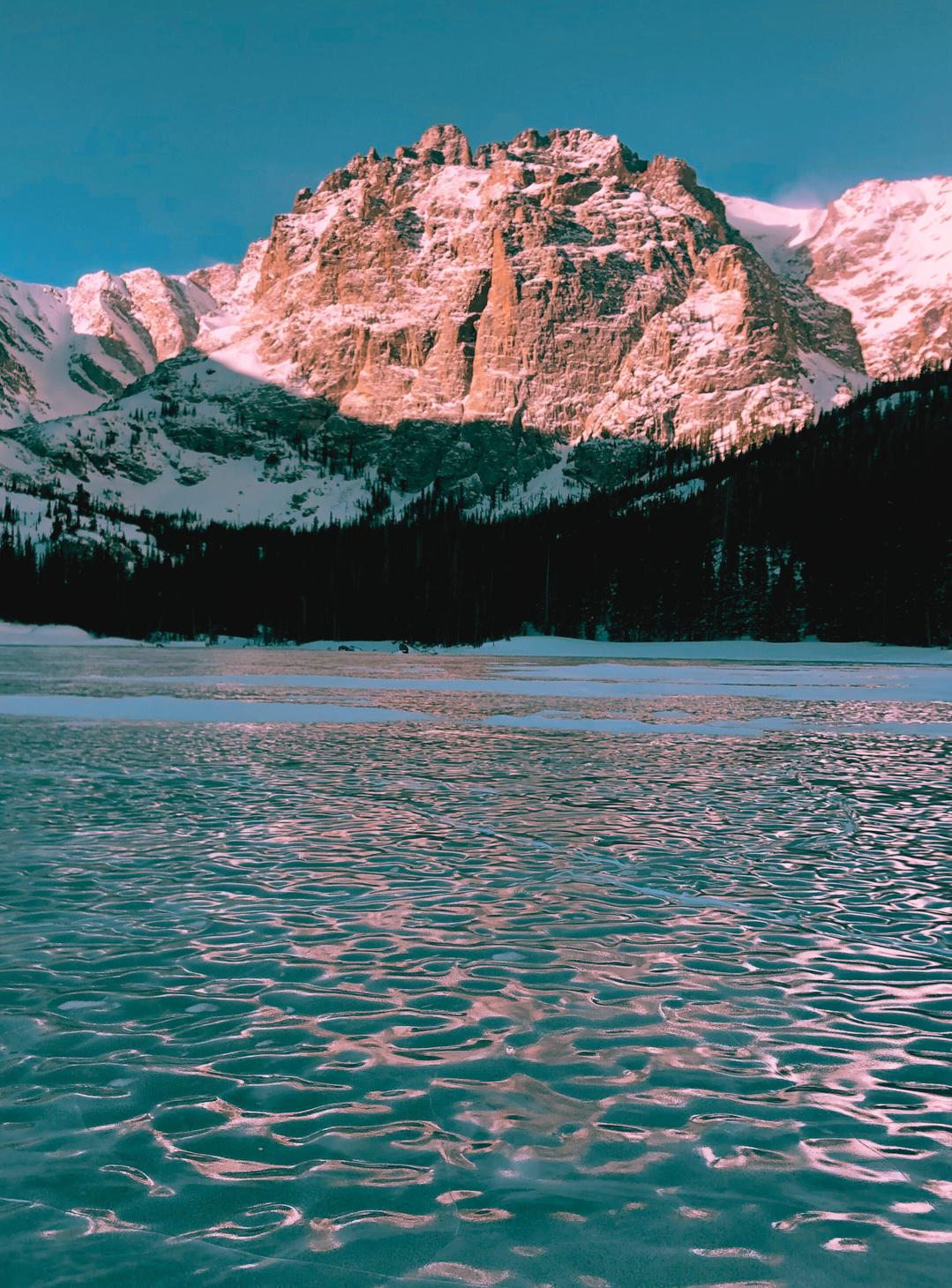
Pass. Photo by Dan Bassett | Read more on 14.
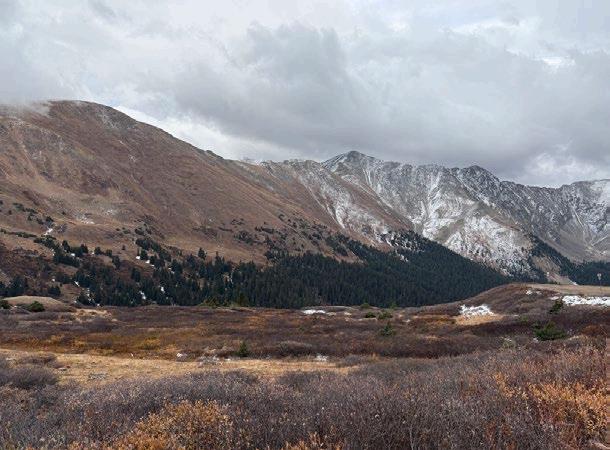
Loveland

MEMBERS
EVENT ATTENDEES
WEBSITE VISITORS
OUTCROP READERS
COMMUNITY CONTACTS
EMAIL SUBSCRIBERS
NETWORKING EVENTS
CONTINUING EDUCATION EVENTS
FIELD TRIPS
IN 2025YOUR SUMMIT SPONSORSHIP DOLLARS SUPPORTED: 1,200 1,400 8,000 8,000 7,000 4,000 28 13 8
2 0 2 6

October 24, 2025
Geoscience Community:
We greatly appreciate every Summit Sponsor and Event Sponsor who contributed to RMAG over the last year. Your support is essential to our organization.
In 2025, the Rocky Mountain Association of Geologists was proud to host a dynamic lineup of events, including the North American Helium & Hydrogen conference, which examined the quickly growing field Members explored the beauty and geological wonders of the Grand Canyon and the San Jaun’s as well geology across the state. Volunteers shared their passion for geoscience with students across the region through classroom visits and community festivals. Members also enjoyed numerous opportunities to connect outside the office through monthly lunches, coffees, happy hours, and our annual Golf Tournament.
Looking ahead, 2026 brings new opportunities for RMAG and our partners. Your financial support allows us to start the year off with a luncheon on the State of the Industry before diving into the impacts of new and evolving technologies on industry including in AI’s ever-growing presence. Plans are coming together to host a fundamentals class series throughout the year, two separate symposiums on the research out of USGS and research on the Mowry. Networking in 2026 will include our regular happy hours and coffee hour networking, plus we’ll have Rockbusters, the Golf Tournament and we’re bringing back the Clay Shoot. With your support RMAG Members share the wonders of earth sciences through community and school outreach. Finally, your financial support is crucial to our publication efforts, which include the monthly Outcrop newsletter and the quarterly Mountain Geologist journal.
Your financial commitment includes enrollment opportunities across all the RMAG events, whether joining the educational opportunities and joining the comradery of the golf tournament your employees will gain access. RMAG also recognizes Summit Sponsors through in-person signage, on our website, in our publications, and on social media.
Thank you to our current Summit Sponsors; we look forward to your continued support in 2026. For those not yet sponsoring, now is the perfect time to get involved. Sponsorship with RMAG d irectly supports the geoscience community – fueling education, networking, and professional development opportunities throughout the Rocky Mountain region.
We invite you to review or sponsorship packages and find the level that best aligns with your company’s goals. Whether you choose to become an annual Summit Sponsor or support a single event, your partnership will help us advance geoscience education and keep our community thriving.
Become a Summit Sponsor by contacting RMAG Executive Director, Bridget Crowther at bcrowther@rmag.org or 720-672-9898 to discuss opportunities and reserve your sponsorship for 2026.
Sincerely,
Sandra Labrum
Bridget Crowther 2026 RMAG President RMAG Executive Director

12
Registration
RMAG 2026 SUMMIT SPONSORSHIP
All sponsor benefits event tickets follow RMAG event registration deadlines. All benefits end 12 months after registration.
Summit Sponsorship benefit term is for 12 months! Specify type of payment on signed form, and send logo and advertisements to staff@rmag.org
Company:
Company Representative:
Address:
City: State: Zip Code:
Phone: Email:
Payment
Name as it appears on Credit Card:
Credit Card #:
Expiration Date:
Signature:
ACH: contact the RMAG office at staff@rmag.org for directions. Mail Checks payable to RMAG:
Rocky Mountain Association of Geologists (RMAG) 730 17th Street, B1 Denver, CO 80202
RMAG events are subject to change. Cancellation or rescheduling of events does not give the sponsor the right to refund. Summit Sponsors will receive benefits at any new events added into the RMAG schedule.
Thank you for your generous support!
P: (720)672-9898 staff@rmag.org www.rmag.org

730 17th Street, B1 Denver, CO 80202
By Drew Scherer, Secretary flatirongeo@gmail.com
Happy fall, we hope you are having a great start to the holiday season and enjoying some snow in the Rockies. The RMAG Board of Directors met on November 19th at 4pm via Zoom with all members but 2 present. The office reported that due to external factors we only ran half of our scheduled events last month due to external factors, but the ones we hosted had good attendance, we also added 7 new members, welcome!
The Finance committee hosted another vote for management of our investment funds, and the board unanimously approved the measure to have 2 years of operating expenses set aside in liquid assets for emergencies and elected the Fidelity-Focused target model which minimizes fees. The Continuing Education committee has confirmed lunches through the end of the year and is working on planning 2026 events
including conferences and symposiums. They are also looking for new committee members and a volunteer to lead the planning efforts for the Oil & Gas + Energy Transition Career Fair, if you or someone you know is interested in that role.
The Publications committee has multiple articles in the works for our winter Mountain Geologist editions and issues of The Outcrop so stay tuned for those to come out shortly! Lastly the Geoscience Outreach committee is working on their 2026 outreach events starting late-January to early February. The Membership and On-the-Rocks committees did not meet in November so there are no updates from those committees.
And that rounds it up for the notes from the November 2025 board meeting, stay warm, stay safe and happy holidays from the RMAG team.


PRESIDENT’S LETTER
By Matthew Bauer
Dear Fellow RMAG Members,
Giving Back
As we close out another remarkable year for the Rocky Mountain Association of Geologists, I want to begin by thanking you for the privilege of serving as your President. It has been an honor to work alongside such a dedicated, curious, and passionate community of geoscientists. Your engagement—whether through attending events, sharing expertise, mentoring students, or simply staying connected—continues to make RMAG a vibrant and resilient organization.
The end of the year is a natural time for reflection, and one theme that stands out for me is the
importance of giving back. RMAG thrives because of volunteers who contribute their time, talent, and energy. From organizing technical talks and field trips to supporting outreach, publications, and our Foundation, every effort strengthens our mission and our community.
If you’ve ever considered getting more involved, I encourage you to take that step in the coming year. Volunteering is not only rewarding, but it’s also a meaningful way to shape the future of RMAG and to support the next generation of geoscientists. Whether you can offer an hour a month serving on the Continuing Education Committee, or take on a larger role, your contribution truly matters.
I’m also excited to share that RMAG’s YouTube channel (@RMAGDenver) now hosts many of our past Luncheon Lectures. If you haven’t already visited the channel, I invite you to explore the growing library of talks, catch up on presentations you may have missed, and share them with colleagues. Please consider subscribing to stay up to date as new content is added—it’s a great way to stay connected and continue learning from our diverse community of experts.
Thank you once again for the opportunity to serve and for everything you do to support RMAG. I wish you and your families a joyful holiday season and a bright start to the new year. I look forward to all we will accomplish together in 2026.
Stay Curious and Be Good to People, —Matthew W. Bauer, PG


YAMPA RIVER AND GREEN RIVER FLOAT TRIP
JUNE 1-5, 2026
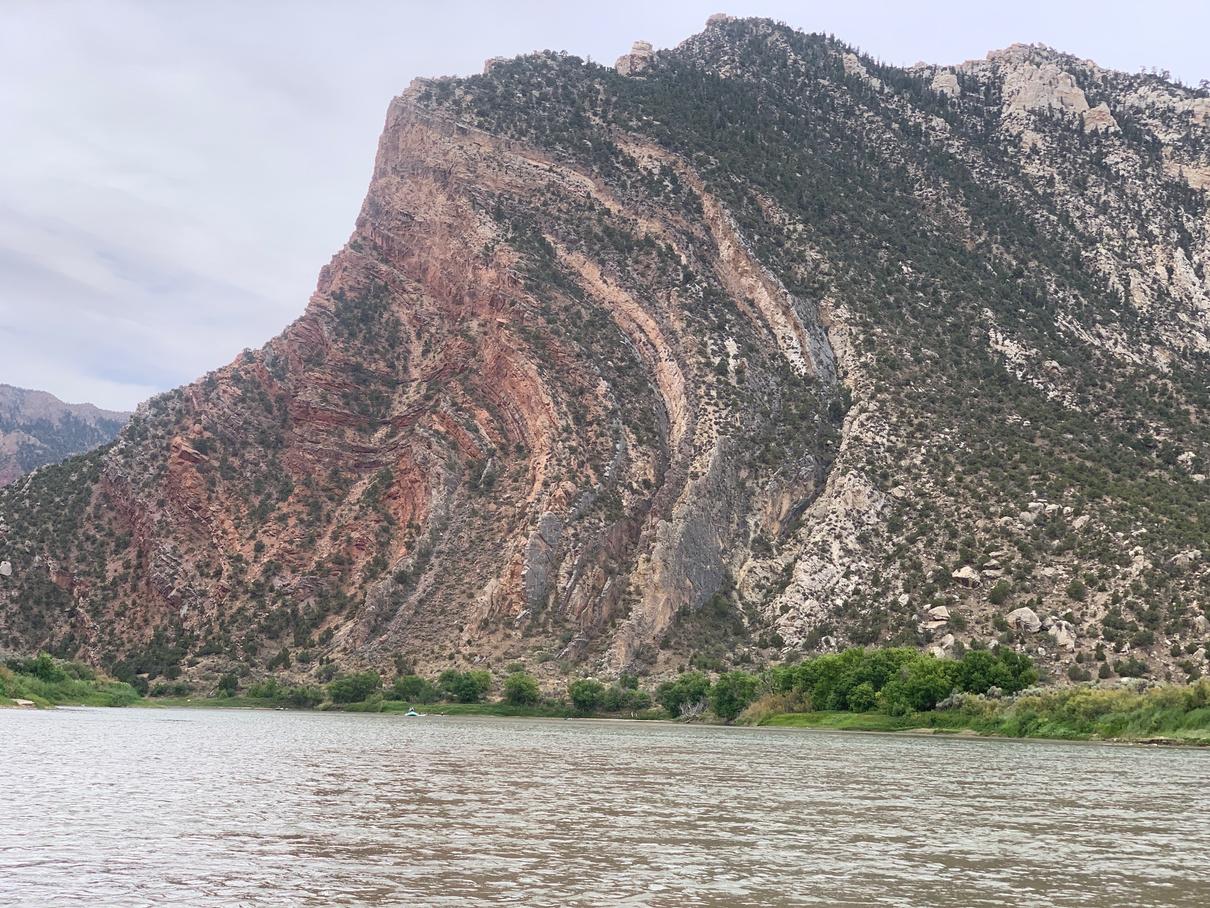
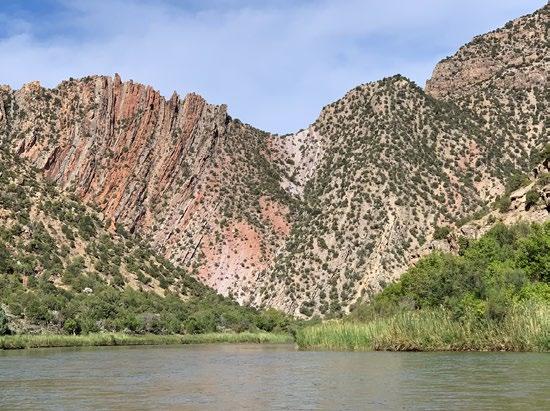
Join RMAG for a five-day float trip on the Yampa and Green Rivers! Guided by Dr. Gary Gianniny, this unforgettable geologic adventure will explore the breathtaking stratigraphy and structures of Dinosaur National Monument including towering Paleozoic canyons to iconic features like the Mitten Park Fault and Split Mountain Anticline.
2025 RMS-AAPG MEETING
KEYSTONE, COLORADO
BY PRESTON KERR, CLAYTON SCHULTZ & NATE LA FONTAINE
INTRODUCTION
“Energy Unroofed” was the theme of this year’s annual conference co-hosted by the Rocky Mountain Section of AAPG and RMAG in Keystone, Colorado. The event certainly lived up to its name over three crisp October days, set against a sky-high backdrop of golden aspens shimmering beneath a fresh dusting of snow on alpine peaks (Photo 1). And while the thin-air may have played a role, it was the breathtakingly good technical talks, core sessions, networking, and connecting that truly defined the conference’s success.
More than 200 attendees made the trip this year. A strong out-of-state presence – particularly from Utah and Wyoming – joined the majority who made the “short” drive up from the Denver metro area (though for some, a classic I-70 closure on the morning of the 6th turned it into a scenic detour through Fairplay). This article summarizes the experience of those who attended, highlighting the technical program, awards, and social events.
EVENTS & AWARDS
Before jumping into the technical content that was shared over the course of the meeting, there were a number of other events that will be highlighted first.
The meeting kicked off on Sunday night with an icebreaker (a literal term for those who made the trek up I-70 on Monday morning) and happy hour where attendees caught up with one another. This social event also afforded the opportunity to examine interesting cores on display from the North Dakota Geologic Survey, who graciously brought four cores from the Williston Basin (Photo 2). These cores covered sections of the stratigraphy that aren’t currently being developed, on theme with much of the technical content shared from the Williston regarding finding the next big play. Unfortunately, the two scheduled field trips did not have critical mass to run and had to be cancelled. Attendees missed out on seeing some excellent exposures of the Cretaceous section throughout the Middle Park Basin, and to learn more about the structural evolution of the Middle Park and Eagle Basins. Trip cancellation has been a theme over the last couple of RMS meetings as enrollment and engagement in field trips has been on the decline, but a trend we hope to see reverse in future meetings!
Monday morning of the conference was kicked off in the opening plenary session with a talk given by Jon Ludwig and Brett Sinclair of Novi Labs. Insights on remaining oil and gas inventory in prominent Rocky Mountain basins, paired with a comparison to the
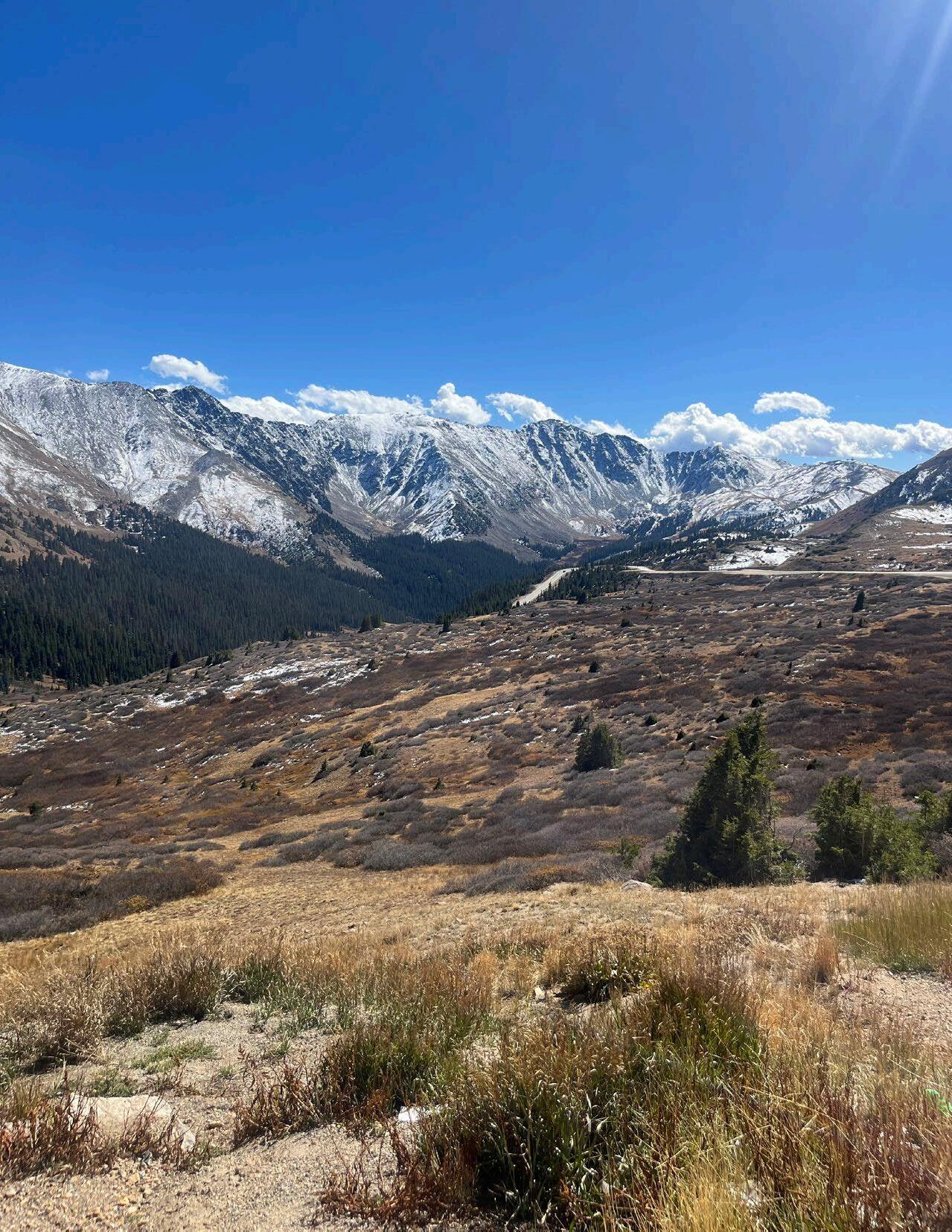
Photo 1. Loveland Pass on the way to this year’s conference in Keystone.
Midland and Delaware basins, provided an enlightening outlook of the local industry. Later in the day, at the all-convention luncheon, Sarah Compton gave an equally enlightening overview of artificial intelligence –a very hot topic in many attendees’ work. Specifically, Sarah spoke to the impact that AI has on geoscientists, both in how it can help and hinder our day-to-day jobs.
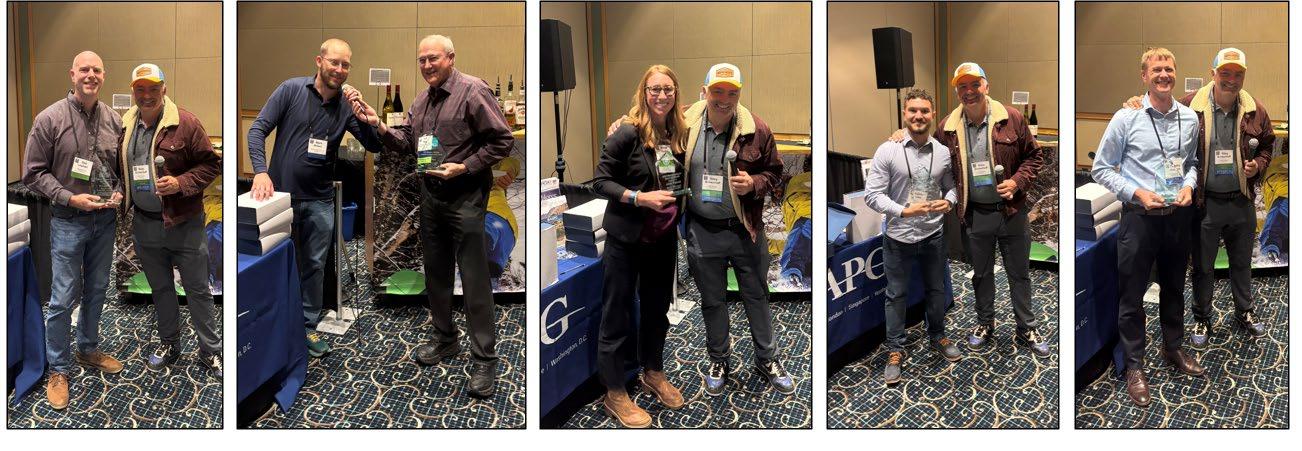
The annual RMS meeting also provides an opportunity to recognize geoscientists across the Rockies through a series of awards. The awards were announced by current past-president of RMS-AAPG Riley Brinkerhoff (with a brief assist from Mark Millard). The first three highlight the best technical content from the prior RMS meeting in Park City, UT, while the other five are awarded for longer-term contributions to the geoscience community (Photo 3):
• A.I. Leverson Award for Best Oral Presentation, 2024: Dan Leiphart
• Steve Champlin Memorial Award for Best Poster Presentation, 2024: Matthew Gatewood
• Runge Award for Best Student Presentation: Nicole Hart-Wagoner
• Robert J. Weimer Lifetime Contribution Award: Jeffrey May
• Julie LeFever Memorial Award: Justin Birdwell
• Distinguished Service Award: Anna Phelps
• John D. Haun Landmark Publication Award: Timothy Nesheim
• Outstanding Young Professional Award: Camilo Uribe Mogollon
Congratulations to all of these outstanding geoscientists!
TECHNICAL PROGRAM
As mentioned in the introduction, “Energy Unroofed” was this year’s slogan going into the conference. To retrospectively distill the content of over eighty technical presentations, however, a clear theme of “Rockies Relevance” was a steady undertone. Although industry activity in the Lower 48 remains focused in the Permian, operators are leveraging technological advancements and geologically driven play concepts to unlock new commercial opportunities in the Rockies. The motivation to continue exploration in the Rockies is multivariate – corporate consolidation, prohibitive entry prices, and demand for inventory are a few factors that may compel some attention to stray from the decade long Permian-centric grasp. But it can also be stated that there is great rock and prolific production coming out of multiple basins within the Rocky Mountain Section boundary.
Three basins shone and delivered the most technical content. Two dedicated sessions were held for both the Uinta and Powder River Basins, and the Williston Basin continues to have the most rig activity and
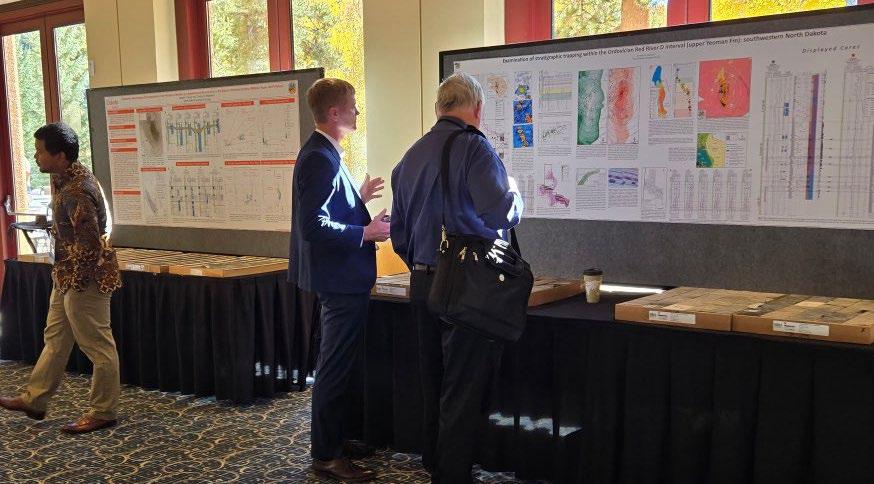
Photo 2. Excellent example of the Red River Cores provided from the North Dakota Geological Survey.
CALL FOR PAPERS
PETROLEUM HISTORY INSTITUTE 2026 ANNUAL SYMPOSIUM AND FIELD TRIP
BAKERSFIELD, CALIFORNIA
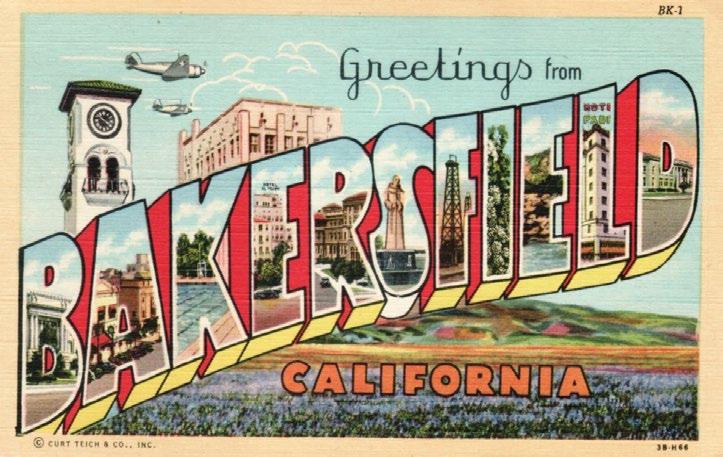
The World of West Coast Petroleum April 16-18, 2026
REGISTRATION AND EVENING RECEPTION Thursday, April 16, 2026
PRESENTATIONS-ORAL AND POSTER – Friday, April 17, 2026 Proceedings to be published in the 2026 Volume of Oil-Industry History
FIELD TRIP – Saturday, April 18, 2026
HEADQUARTERS HOTEL – Double Tree by Hilton, Bakersfield, California RLBK_DT_Hotel@hilton.com, or (661)-323-7111 or (661) 632-2202 For group Rate mention “Petroleum History Institute”
REGISTRATION DETAILS TO FOLLOW
ABSTRACTS BEING ACCEPTED Deadline: March 1, 2026
Please send abstracts to: Dr. William Brice - wbrice@pitt.edu or call Co-chair Vaughn Thompson – (805) 794-0070; geologistvaughn@gmail.com
associated production in the region. In the Uinta, reservoir characterization advancements and development within a thick stack of spatially dynamic lacustrine sediments are yielding results that are competitive with any unconventional basin in the US. It has been said before, but the Powder (keg) feels like it is on the precipice of emerging as a major player, with most content surrounding concepts for unlocking the Mowry. All while the radius of development within the Williston and exploitation of the “Oreo-cookie” Bakken/ThreeForks system continues to grow and push into areas not thought feasible in the past.
Not to be overlooked or understated, work was delivered on emerging and under-exploited zones such as the Mancos in the San Juan Basin and beyond, the Lewis and Teapot in Wyoming, and dormant plays like the Spearfish, Madison Midale, and Red River in North Dakota. It was clear that opportunity for cracking new exploratory codes persists in the Rockies. And while these formations may not currently be house-hold names on an industry scale, it is an example of the value that can be derived from localized section meetings that foster creativity and regional expertise.
While the bulk of content was oil and gas adjacent, there were also sessions around Helium Resources in the Rockies, Geologic Aspects of Carbon Storage, Geothermal and Critical Minerals. In fact, there were two dedicated sessions around carbon storage as well as a panel discussion on CCUS in the Rockies – a first of its kind for the RMS Annual Meeting. The Keystone
Conference Center proved to be an excellent venue for the ice-breaker reception, core display space, conference lunches, and three session rooms. An exhibit hall hosted ten technical posters and a variety of industry vendors. It should be mentioned that the conference (held October 5-7, 2025) was shortly preceded by the Government Shutdown (October 1, 2025). This unforeseen complication resulted in the cancellation of multiple talks slated to be delivered by the USGS. A special thanks goes out to the USGS staff that contributed to the conference planning and desire to present their work – it would have made for a better conference having you there. Lastly, thank you to the seventeen committee chairs that volunteered their time to deliver an awesome conference! The success of the conference would not have been possible without your work and the support of industry sponsors.
In closing, it is an exciting time to be working in the Rockies, and the RMS-AAPG Annual Meeting has again proven to cultivate technical knowledge sharing and collaborative networking unlike any other industry event in the region. The Keystone Conference Center and the looming Continental Divide provided an inspiring location to reconnect, make new friends, and talk Rockies for a few days. Next year’s RMS-AAPG conference will be held in October in Butte, Montana. Planning is in the works with the Montana Geological Society and we hope to see you all there next year (and sign up for the field trips early)!
Photo 3. 2025 Annual Award Winners. From left to right: Dan Leiphart, Jeffrey May (with guest appearance from Mark Millard), Anna Phelps, Camillo Uribe Mogollon, Timothy Nesheim. Also featured is RMS past-president Riley Brinkerhoff.


HYBRID LUNCH TALK
Speaker: Dr. David Krause
Date: December 3, 2025 | 12:00 pm - 1:00 pm

The Madagascar Paleontology Project: Late Cretaceous Game-Changers
Presenter: Dr. David Krause, Denver Museum of Nature and Science
Madagascar is one of the very poorest countries in the world but is rich in fossils, including some of the world’s most spectacular and significant: snaggle-toothed and dome-headed dinosaurs, vegetarian pug-nosed crocodiles, basketball-sized armored frogs, and mammals with swiss-cheese skulls. I will highlight some of these fantastic
discoveries from the Late Cretaceous of Madagascar made over the course of the last 33 years and put them into context of the plate tectonic and biogeographic history of Madagascar, but also of Gondwana as a whole. Given the audience, I will also emphasize various aspects of the stratigraphy, sedimentology, and taphonomy of our field areas.
DR. DAVID KRAUSE is Senior Curator of Vertebrate Paleontology at the Denver Museum of Nature & Science; Emeritus Distinguished Service Professor at Stony Brook University; Founder and Executive Director of the Madagascar Ankizy Fund; former Editor of the Journal of Vertebrate Paleontology; and former President of the Society of Vertebrate Paleontology. Born and raised on a remote cattle ranch in Alberta, Canada, Dr. Krause received his B.Sc. and M.Sc. from the University of Alberta and his Ph.D. from the University of Michigan. He was awarded a Distinguished Alumni Award from the University of Alberta in 2010, an honorary doctorate from The University of Antananarivo (Madagascar) in 2012, and the Romer-Simpson Medal from the Society of Vertebrate Paleontology in 2023 (the society’s highest award). Dr. Krause is a 50-year veteran of field research in Canada, the United States, Pakistan, India, and Madagascar and has published over 135 peer-reviewed research articles and edited four monographic volumes.
John C. Webb Consulting Geologist
Stratigraphy, Sedimentology and Petrography of Clastic and Carbonate Systems
Louisville, Colorado
Reservoir Characterization
Petroleum, SWD, CCUS, Geothermal
Johnwebb20@comcast.net
303.917.0644
WRITE FOR THE OUTCROP
The Outcrop is the monthly online newsletter of the Rocky Mountain Association of Geologists. The Outcrop circulates to the 1900-plus members of the RMAG and about 200 university libraries and industry associates. It's a great opportunity for young professionals to get their name out to other geologists in the community. It provides articles for the benefit and edification of its readers and gives authors a chance to reach local geologists on subjects that interest or concern them. Learn more here.
D eta ile d a nd ac c ura te g eo lo gy at yo u r fin g ertip s in Pe tra , Ge o Grap h ix, A rc GIS , A cc u Map , ge o S C OU T an d o th er d ig ital ma p pin g a p plica tion s
We ste rn USA
Geol ogi cal Edge Set
Ene rgy Al te rnati ve s & Cri ti cal Mine ral s - USA
We ste rn Cana da Geol ogi cal Edge Set
Ene rgy Al te rnati ve s & Cri ti cal Mine ral s - Ca nada
Ea ste rn USA & Ea st ern Ca nada
Geol ogi cal Edge Set
Cent ral USA
Geol ogi cal Edge Set
Me xi co
Geol ogi cal Edge Set
Map la ye rs p rov ided in s ha pe file fo rma t fo r ea sy impor t into a ll ma ppin g app lic at ions .
De liv er ab le s inc lude : f orma tion limits , o utc ro ps, su bc rop e dge s , O &G fie ld s, st ruc tu ra l eleme nt s, re ef s, sh ore lin es , c ha nne ls, pro duc tion f airw a ys , s ha le ga s tr en ds, st ru ct ure con tou rs , iso pa chs , g en era l cult ure , r ene w able & no n-r en ew ab le ene rg y pr ojec ts , min era l dep os it s, mine s, Pet ra T he mat ic Ma p pro je ct s, G eoG ra phix G e oA tla s pro je c ts , Ar cG IS M XD a nd La y er f ile s, re giona l c ro ss -s ec tion s, an d full te ch nica l s upp ort .
For mo re inf orma tio n: Joe l H a rding at + 1 4 03 87 0 8 12 2 joe lha rding@ g eoe dg es .c om ww w.ge oe dge s.c om
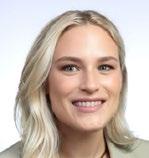
Speaker: Rachael Moreland
Date: January 8, 2025 | 12:00 pm - 1:00 pm
Geoscience Insights Shaping the Future of Energy: The Outlook for 2026
Presenter: Rachael Moreland, S&P Global Commodity Insights
As the upstream sector enters a pivotal phase of technological acceleration and portfolio recalibration, geoscience is reasserting its role at the center of value creation. This year’s session provides a forward-looking assessment of the influences that will shape exploration and production activity in 2026. We will also explore opportunities for geoscience expertise in near adjacent energy segments. The talk examines emerging geoscience-driven trends, from advanced subsurface imaging and AI-enabled prospect evaluation to
basin-scale carbon storage potential and the resurgence of exploration “green shoots” in advantaged basins. Attendees will gain a data-grounded perspective on capital flows, regulatory shifts, geoscience innovation, and the evolving risk/reward balance across North America and key international regions. The session will highlight how geoscientists can play a more strategic role in optimizing resources, lowering development emissions, and enabling a more resilient, technology-powered E&P future.
RACHAEL MORELAND is the Head of Energy Software & Technology Solutions at S&P Global Commodity Insights where she leverages her expertise to deliver cutting-edge solutions to the energy sector. She is a leading product management expert and a trusted advisor in the energy technology space who believes in bringing people together to connect, collaborate, and innovate. In early 2024 she was recognized as one of the Top 50 Women of Impact in Technology.
She focuses on advising energy companies, boards, and leadership teams on their technology strategies and is recognized for her ability to craft and execute transformative plans that drive business growth in high-tech, matrixed organizations.
Rachael shares insights with the product management community through her blog at strategizeproduct.com. She also serves on the board of directors for Energy Outreach Colorado, a nonprofit dedicated to ensuring energy affordability for the state of Colorado and adjacent communities. She holds degrees in Geology and Neuroscience from Hanover College, and certifications in global energy leadership, product management, AI, agile methodologies, and cloud architecture. A passionate advocate for diversity in technology, she actively mentors the next generation of leaders through Women in Tech programs.

RMAG ON THE ROCKS
GRAND CANYON/ COLORADO RIVER TRIP FROM LEE’S FERRY TO DIAMOND CREEK
APRIL 18-MAY 1, 2025
Compiled by Jennifer Wadsworth and David Schoderbek, with contributions from Arleen Cutler, Colleen Fitzpatrick, Danielle Robinson, Bill Cutler, David Taylor, and Scott Waggoner
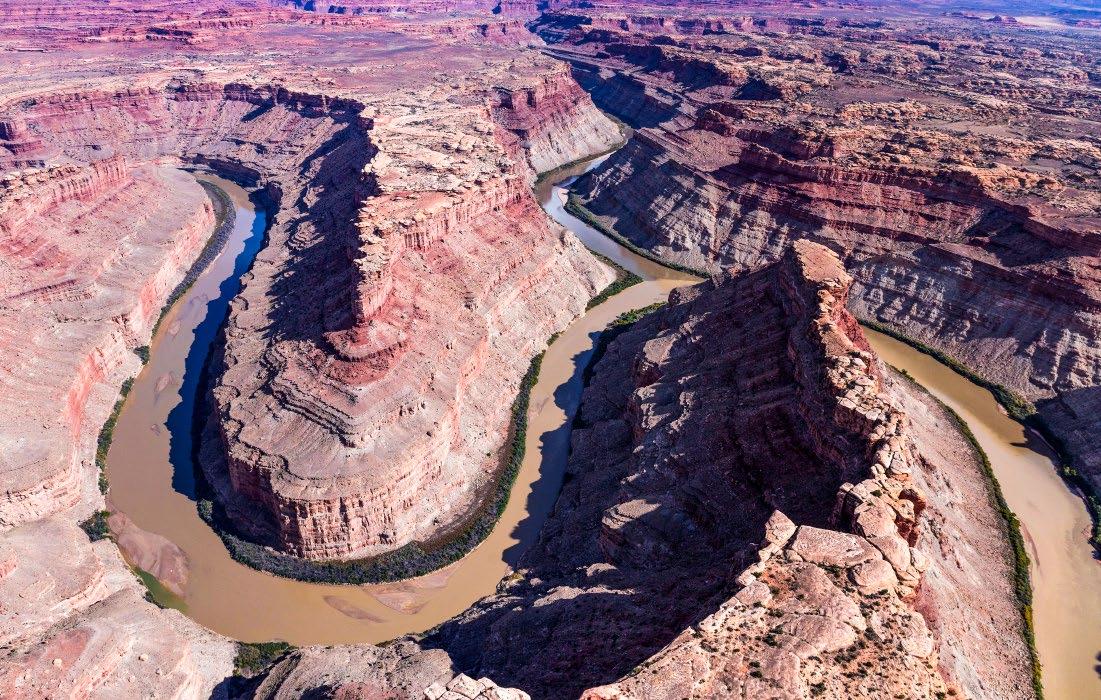
Between April 18th and May 1st this spring, twenty lucky RMAG members floated through 226 miles of the Grand Canyon of the Colorado River, from Lee’s Ferry (just below Glen Canyon Dam) to Diamond Creek on the Hualapai Indian Reservation, near Peach Springs, Arizona (Figure 1). Well, to be more accurate, the members floated, paddled, rowed, oared and occasionally just hung on for dear life. We were accompanied by Dr Gary Gianniny, professor emeritus at Fort Lewis College in Durango, Colorado. Dr Gianniny, a longtime Grand Canyon researcher and river runner, is an excellent companion to guide our observations and aid our understanding of the many geologic features exposed along the river (Figure 2). Rocks, rocks, and more rocks, but even more, anticlines, synclines, monoclines, faults, fractures, seeps, and springs: attendees came away from the Grand Canyon forever changed! See Figure 3 for a brilliant one-page summary of Grand Canyon geology from Karl Karlstrom & Laura Crossey (Karlstrom & Crossey, 2019).
Several RMAG colleagues preceded us on a
private, motorized, research trip down the Grand Canyon in 2023, and contributed excellent technical summaries of their trip to The Outcrop (Kleinhans et al, 2024a & 2024b). Their incomparable photos, figures, and verbiage are extraordinary and inspirational, and we intend to provide some supplemental perspectives, but minimal duplication. Consider this more a guide about the flavor and experience of such a monumental trip, which may help you decide if this is something to add to your bucket list. We asked participants to share some of their personal highlights of our shared journey:
Danielle Robinson, a Tulsa-based geologist, wrote “when we stopped for lunch on river Day 1, the weather blessed us with a rare snow/sleet mix, and I was a tad uncomfortable. It was a bit chilly later at camp, but I had fun searching around Permian Coconino Sandstone boulders for scattered traces of reptile and insect trackways. As we dropped into the Mississippian section downriver on Day 3, I was also a bit uncomfortable climbing up the steep wall of the Mooney Falls Member of the cyclic Redwall Limestone but happy to find several corals
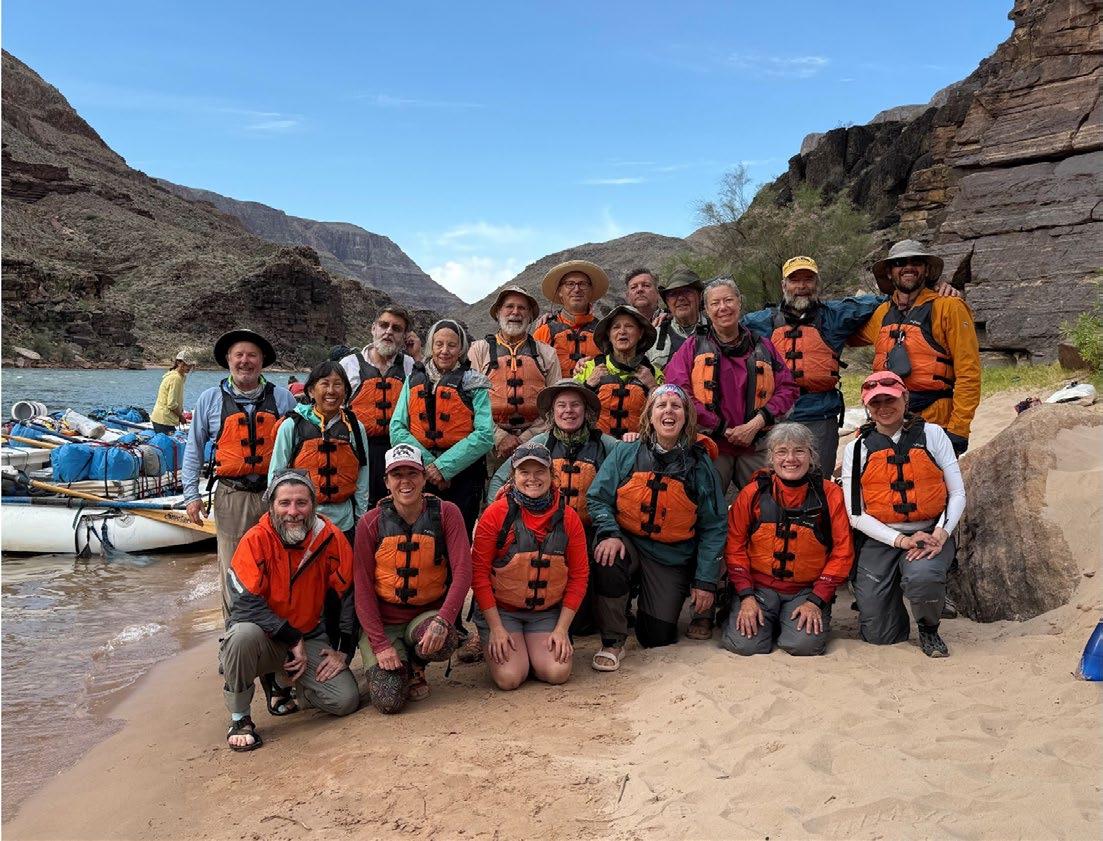
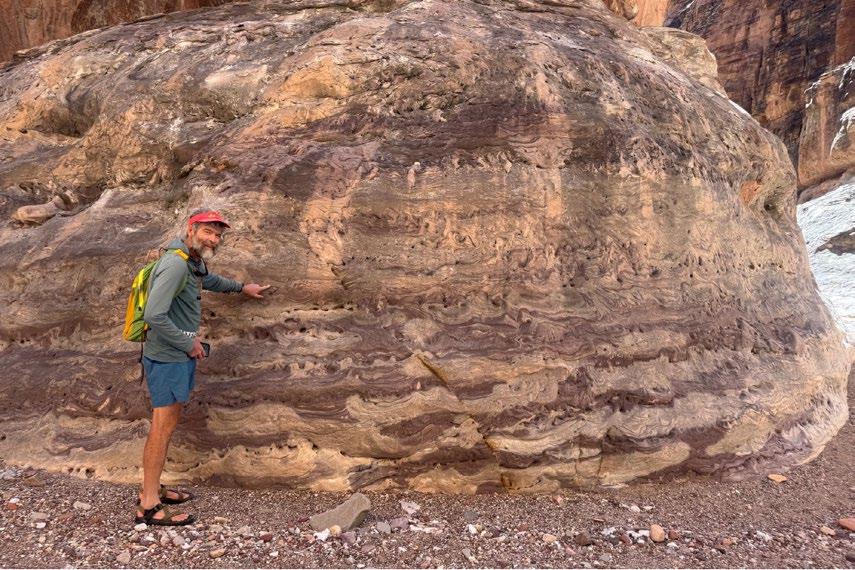
FIGURE 1: Attendees assemble on our final day. Photo credit, Bill Cutler.
FIGURE 2:
Technical Trip Leader Dr Gary Gianniny provides scale for regionally extensive soft-sediment deformation features in Precambrian Shinumo Quartzite
FIGURE 1
FIGURE 2
RMAG ON THE ROCKS: GRAND CANYON
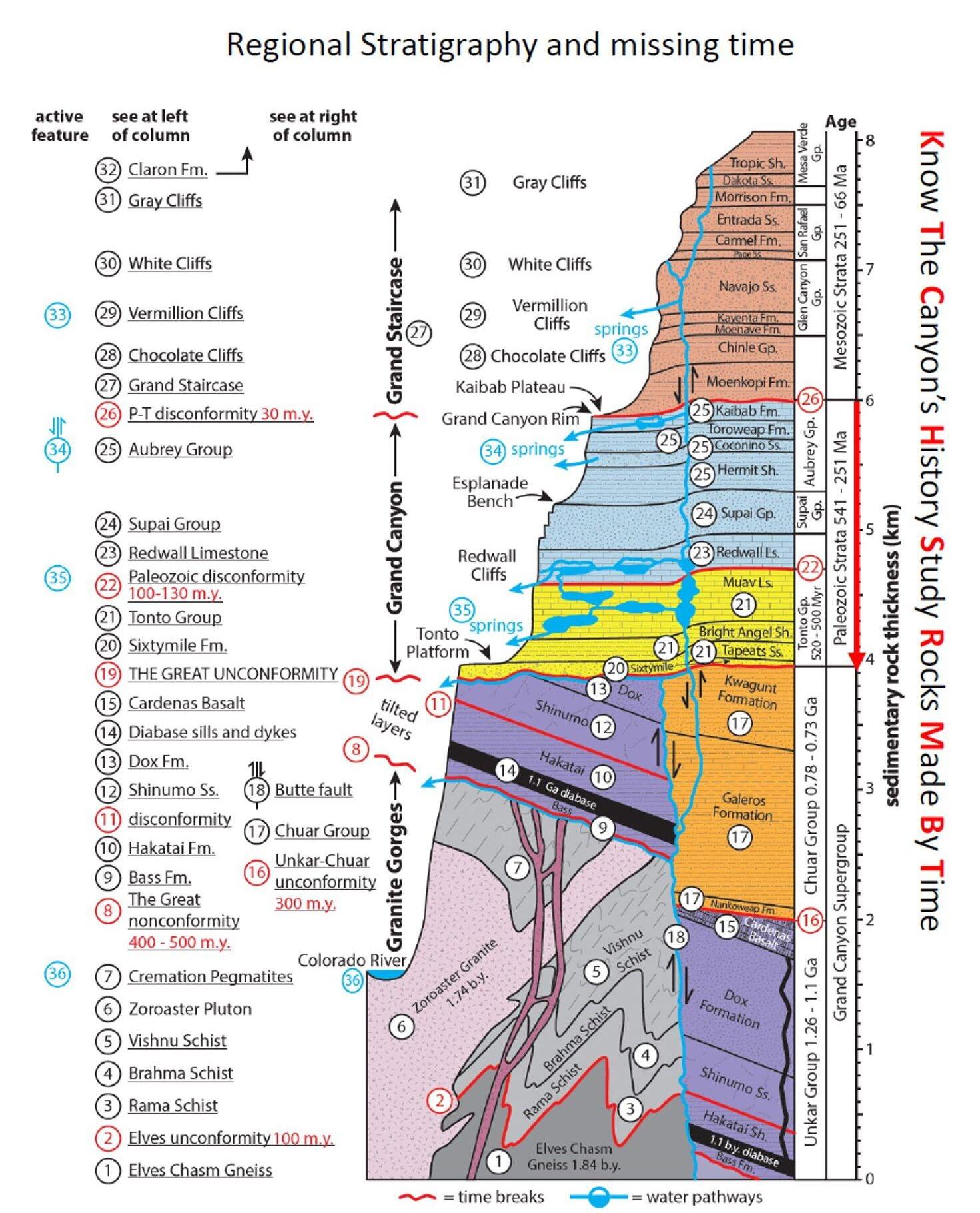
FIGURE 3: Stratigraphic column of the Grand Canyon Region showing the three sets of rocks, correct stratigraphic thicknesses for stratified rocks, numeric ages of units based on geochronology, major unconformities (red) and time missing (not recorded) at each, faults, and water pathways (blue); From Karlstrom and Crossey, 2019
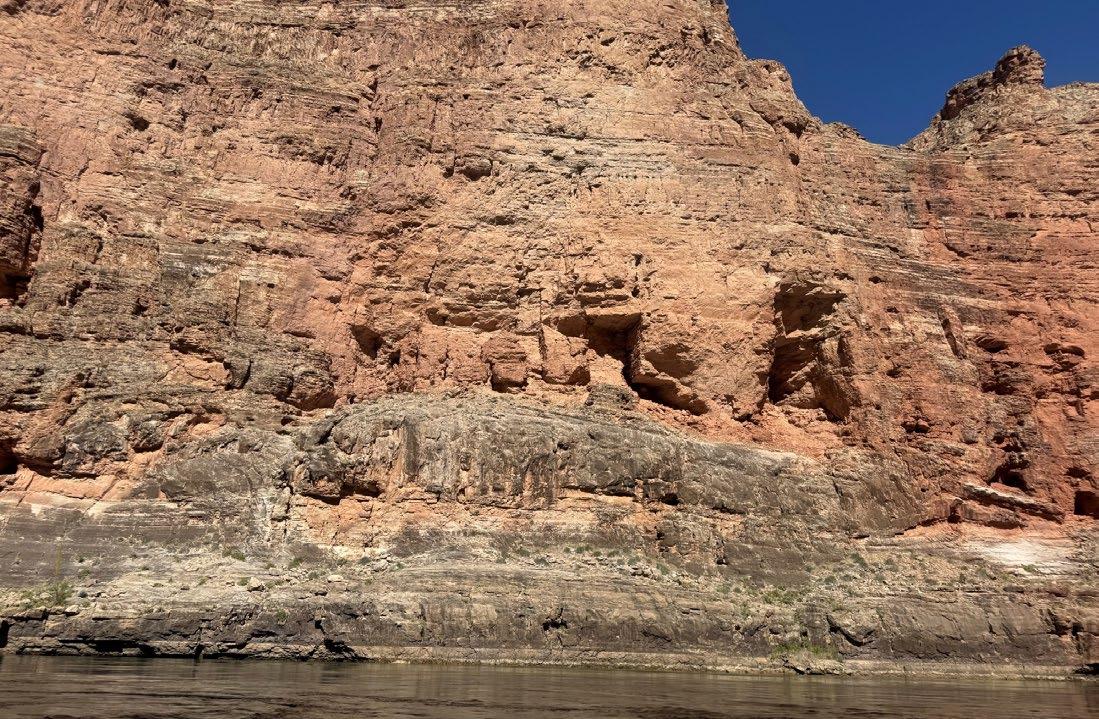
and oolites as well as a fantastic view of the canyon. We continued that day downstream and down-section just below the Mooney Falls to the Thunder Springs Member which draped across and filled in between large carbonate mounds similar to early Mississippian “Waulsortian Mounds” of the Midcontinent (Figure 4). By Day 6, we encountered Hance Rapid, one of the most difficult in the Grand Canyon. The rapids roared loudly as we approached, and I was very uncomfortable with my tiny paddle in hand. We made it through though and were shortly greeted with the Precambrian Vishnu Schist as we entered the Inner Gorge. After feeling like we had just battled the open ocean, it was such a reward to see some of the oldest rocks of the canyon.
On Day 10, I had that same uncomfortable feeling as we were crossing the Tapeats Creek on a hike up the canyon. The water was almost waist high for
me, but I very slowly waded across. The rest of the hike was sometimes a steep uphill battle on our way out of the Precambrian to Thunder Spring, a gorgeous waterfall pouring out the side of the canyon wall from the Cambrian Muav Limestone. The volume of water emanating from the spring was truly incredible and demonstrated that an intricate fault connected karst network existed within the porous carbonates we had investigated earlier on the trip. Later, I was delighted to taste for the first time posole soup that our wonderful guides had cooked for us on a particularly cool evening. I reflected on all the experiences of the trip so far and what I had seen. I realized that sometimes you have to get a little uncomfortable to see some truly outstanding geology, and viewing the Grand Canyon from its core is a very different experience from just viewing it at the rim. It was a great trip!”
David Taylor, a Boulder-based member, added
FIGURE 4: Waulsortian-like Mississippian carbonate mound in Redwall Limestone near river mile 35
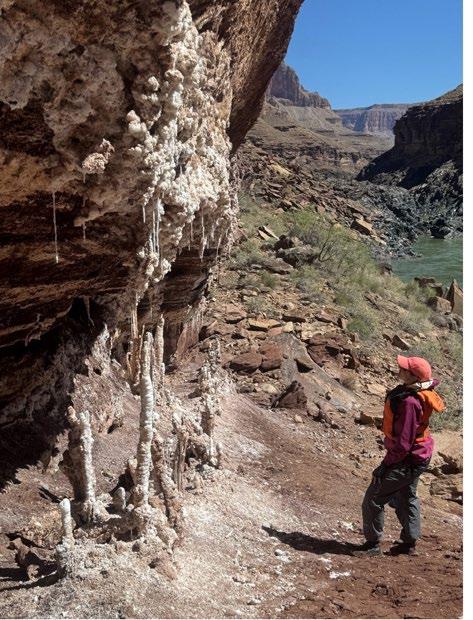
FIGURE 5: Geologist Danielle Robinson observes Halite (NaCl) and Sylvite (KCl) soda straws, stalactites, and stalagmites emerge from base of Cambrian Tapeats Sandstone near river mile 128.
6
7
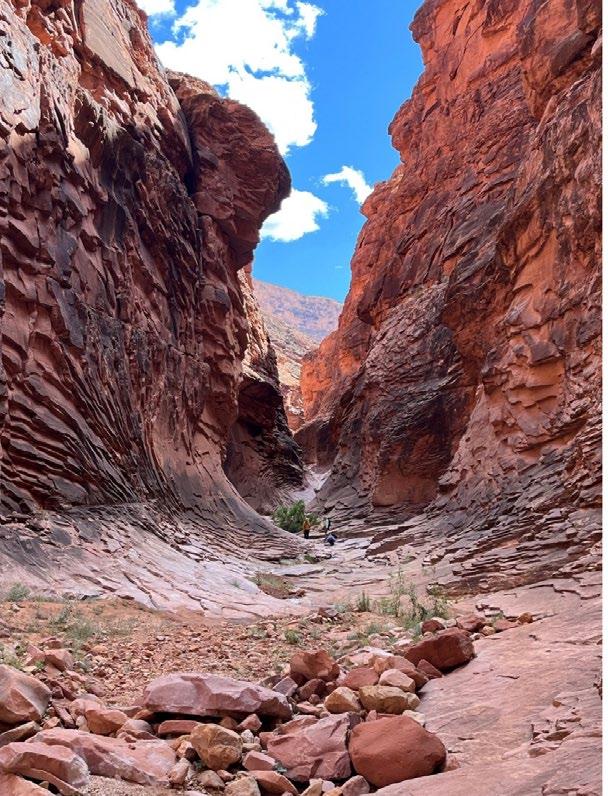
FIGURE 6: Geologists are dwarfed by exfoliation-weathered outcrops of the Permian Esplanade Sandstone in North Canyon, near river mile 21. Photo credit, Michelle Judson.
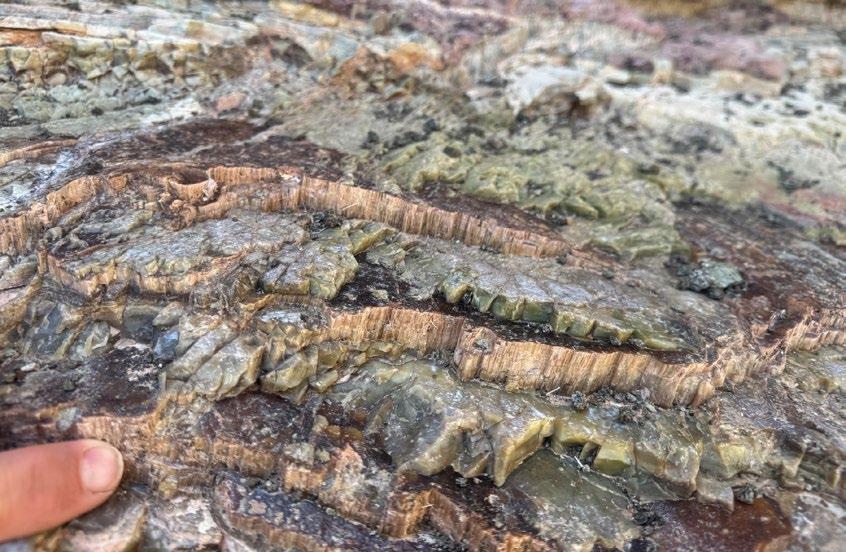
FIGURE 7: Alternating massive green and fibrous (Chrysotile) Serpentine in Precambrian Dox Formation near intrusive contact with intrusive (also Precambrian) Cardenas Diabase sill.
FIGURE
FIGURE
“What a spectacular trip, one which keeps bubbling up in my thoughts daily. Way back when, I considered myself mostly a structural geologist and so was particularly interested in seeing the structures we encountered along the trip. The Colorado Plateau, famous for its “layer-cake” nature and fantastic exposures of sedimentary and stratigraphic features, does not disappoint in the realm of structure either. The Canyon is a wonderful place to see faults and fractures, terminations, reactivations, and all the rest. It would be a fantastic place to spend more time working out the mechanics of it all. Perhaps in my next life.
Two surprises keep coming to mind. First, the unconformity at the top of the Cambrian where it is overlain by the by the Mississippian Redwall Limestone. The beds above and below the contact are parallel, i.e. no noticeable angularity in their orientation, despite a
~140 Ma hiatus represented. That is a long time to be “flat!” That is a time equivalent of now stretching back +/- to the Jurassic.
The second surprise was a modern phenomenon related to the river itself. Many western rivers famous for fishing are “tail waters”, below dams (the Big Horn River, the San Juan River, the South Platte River). The Colorado River in the Grand Canyon is a tailwater, though quite a ways down from the dam. However, there was a striking (to me) lack of aquatic plants and insects, and seemingly fish. (I did manage to catch a Chub later in the trip). I’d “predicted” that once the river was flowing over the Redwall Limestone, the river would exhibit a more hospitable environment for greenery and water critters, and thus the fishing would be better. Sadly, my prediction did not come to pass, as I saw no noticeable difference in the nature
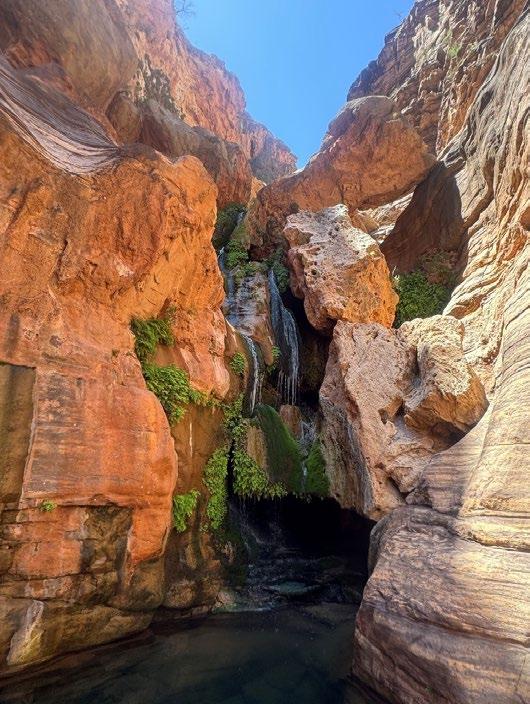
FIGURE 8: Quaternary travertine aprons developed on Cambrian Tapeats Sandstone hide some waterfalls in Elves Chasm along Royal Arch Creek near river mile 117
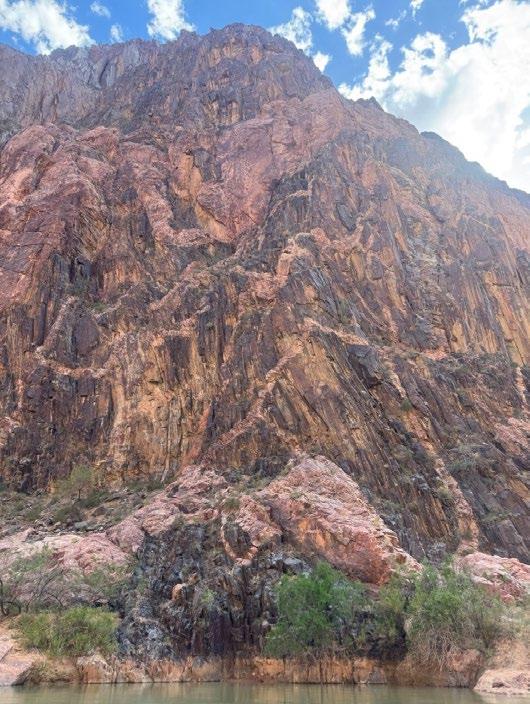
FIGURE 9: Fractured exposures of black Lower Precambrian Brahma Schist contrast with folded pink intrusions of Lower Precambrian Zoroaster Granite near river mile 87.
RMAG ON THE ROCKS: GRAND CANYON
of the river flora and fauna. Yes, this is a oneoff, one-person observation, but it was nonetheless a surprise to me. We had good discussions with the group about this situation, and like many biologic systems there are probably many factors that influence it (changing and inconsistent river flows due to dam releases being a chief culprit). However, it felt odd and off to me that such a big river, flowing through such grandeur that appears largely untouched by people still felt sterile with respect to my expectations.”
Bill Cutler, a Front Range-based consulting geologist, commented: “For sure the trip down the Grand Canyon was about Geology, but not entirely. As a geologist but also an avid fly fisherman, I was intrigued to fish the Colorado River waters. By a bit of research in advance, I determined the first 60 miles of the river below Lees Ferry (and Lake Powell) would likely be clear, cool water, suitable habitat for trout (a non-native species). At mile 61, the ephemeral Little Colorado River (LCR) joins the game and can add significant muddy sediment to the river during runoff, diminishing trout habitat. Sure enough, the Colorado was cool and clear the first 60 miles, and upon setting camp on Day 2, guide Will caught a nice Rainbow Trout off the back of his parked raft and showed me his technique of fishing beneath the back of the boats. Sure enough, I got a nice trout on the line that busted off before I could land him.
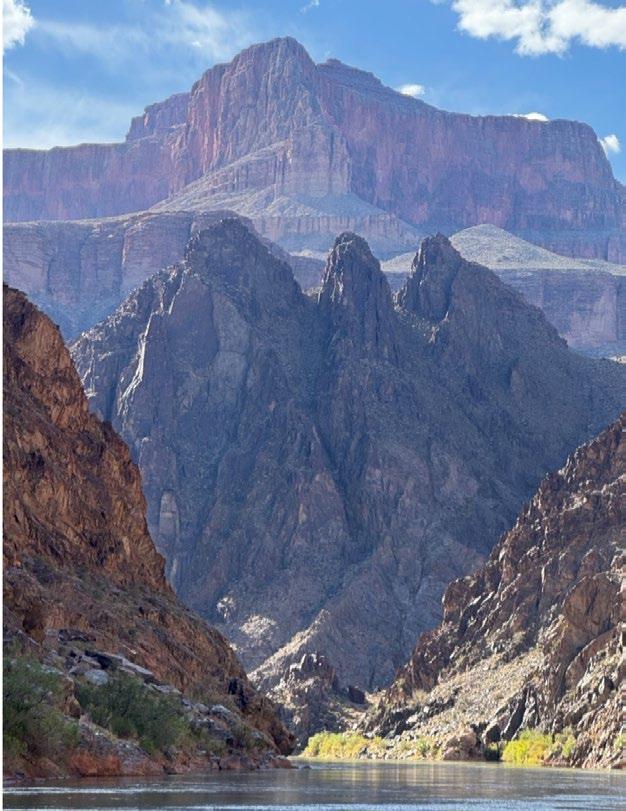
FIGURE 10: Faulted black pinnacles of Lower Precambrian Brahma Schist loom over the Granite Gorge near river mile 91 with Paleozoic sedimentary section all the way up to Permian Coconino Sandstone capping Osiris Temple on skyline
On Day 5 we passed the confluence of the Little Colorado River, and due to heavy rain and snow earlier in the week the water was thick with sediment. The clarity of the Colorado declined drastically thereafter and fishing for trout seemed a thing of the past. But Will turned his attention to catching the elusive Humpback Chub, a native Colorado River fish (federally protected) that Will claimed fed much like a trout. Sure enough, Will, David and I caught several of these beautiful fish on a large trout fly, and quickly released them unharmed back into the cloudy but clean river water. The Humpback Chub! A new species of fish to be caught by this longtime fly fisherman, an unexpected treat to add to the magnificent river experience.”
Bill was joined by his wife Arlene, an occupational therapist by profession, but also a keen observer of the natural world. Arlene shared that “the serene views from the groover of rapids just past or upcoming were a great way to start the day. I rode most of the trip in the front or back of an oar boat observing the talent of the river guides. I came to appreciate their ability to position the boat into the tongue of a rapid and spin the boat straight, just before climbing a giant wave and bobbing through the following wave train. Although I loved the dynamic geology, the plants and animals of the canyon were equally fascinating. We encountered many desert bighorn sheep, observed many birds
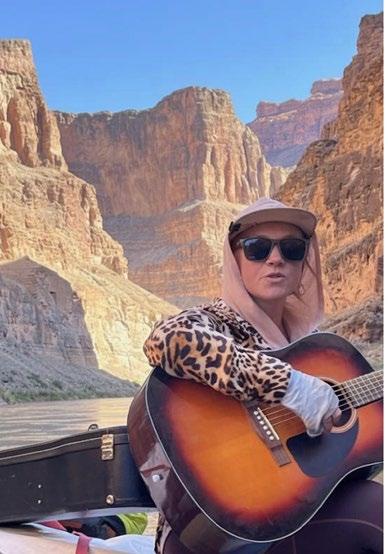
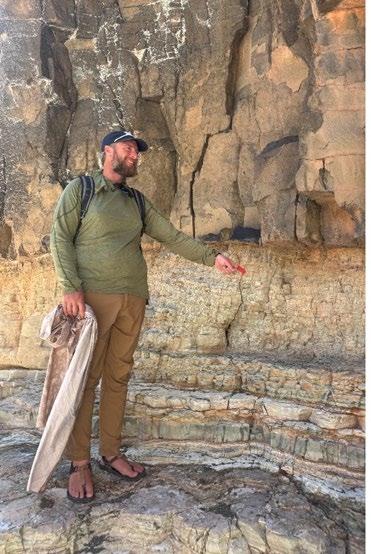
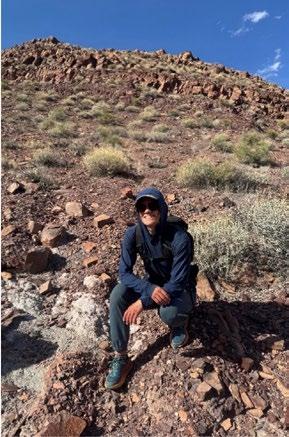
a) Trip Leader Emily serenades attendees during a calm stretch (Photo Credit, Michelle Judson)
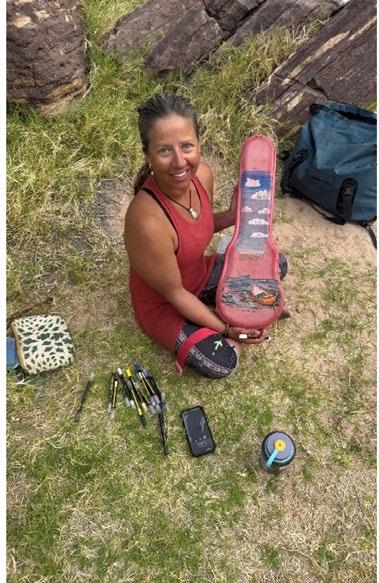
b) Boatman Heather was also our resident artist & yoga instructor
c) River Guide Brendan signals Cardenas Diabase/Dox Sandstone contact
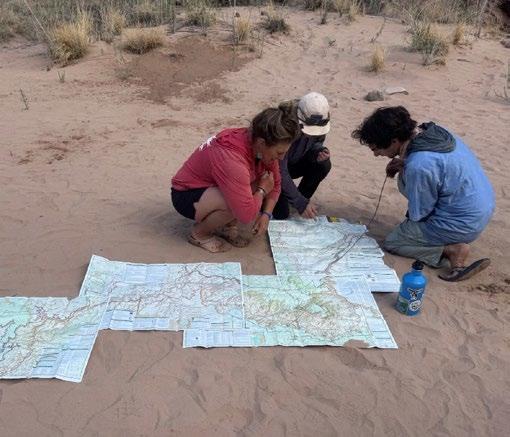
d) Head Cook Michele (L), Trip Leader Emily (C), and River Guide Will (R) review map composite of entire route
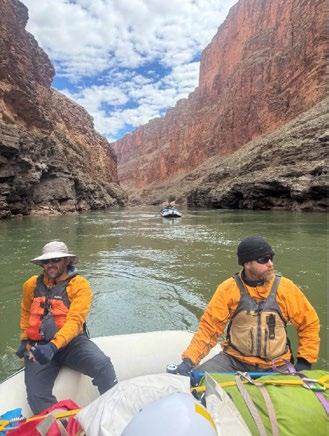
e) Paddle Captain Tom (R) supervises captain trainee Mark Sutcliffe
f) Boatman Margaret confirmed that 1.1 b.y. old volcanic ash is indeed creamy
FIGURE 11:
RMAG ON THE ROCKS: GRAND CANYON
(condors, herons, mergansers, to name a few), chased a variety of lizards around camp for close-up photos, watched the bats arrive around dusk, and reluctantly searched for scorpions by black light (happily not finding many). One of the lasting memories of the trip will be doing the “Grand Canyon Shuffle”, the guide’s name for hopping between the groover and the adjacent 5-gallon bucket!”
Recently retired BP sedimentologist, Jen Wadsworth (Houston-based), was inspired by the vastness of rock volumes:
“What this trip gave me was a brand new comprehension of rock volume and geological time. I have worked with rock volumes my entire career… correlating them, calculating reserves from them, worrying
about their connectivity. I thought I understood them. I did not. Paddling through 226 miles, 3000 vertical feet and 1.5 BA of rock volume gave me a glimpse of the immensity of the concepts of deep geological time and the incredible breadth of rock crust that our boreholes and seismic can barely sample. I may have thought I understood that, intellectually, but the journey through the Grand Canyon gave me a visceral and much more profound feeling of what geological time truly represents. If rocks are opera, I travelled through the Wagner Ring Cycle about 10 times. Birth, life, volcanic passion, explosive dykes, hidden crystals, salty tears, hidden chambers, tragic unconformities, extinction events and, finally, the uplifting glory of the Laramide/Brunnhilde.”
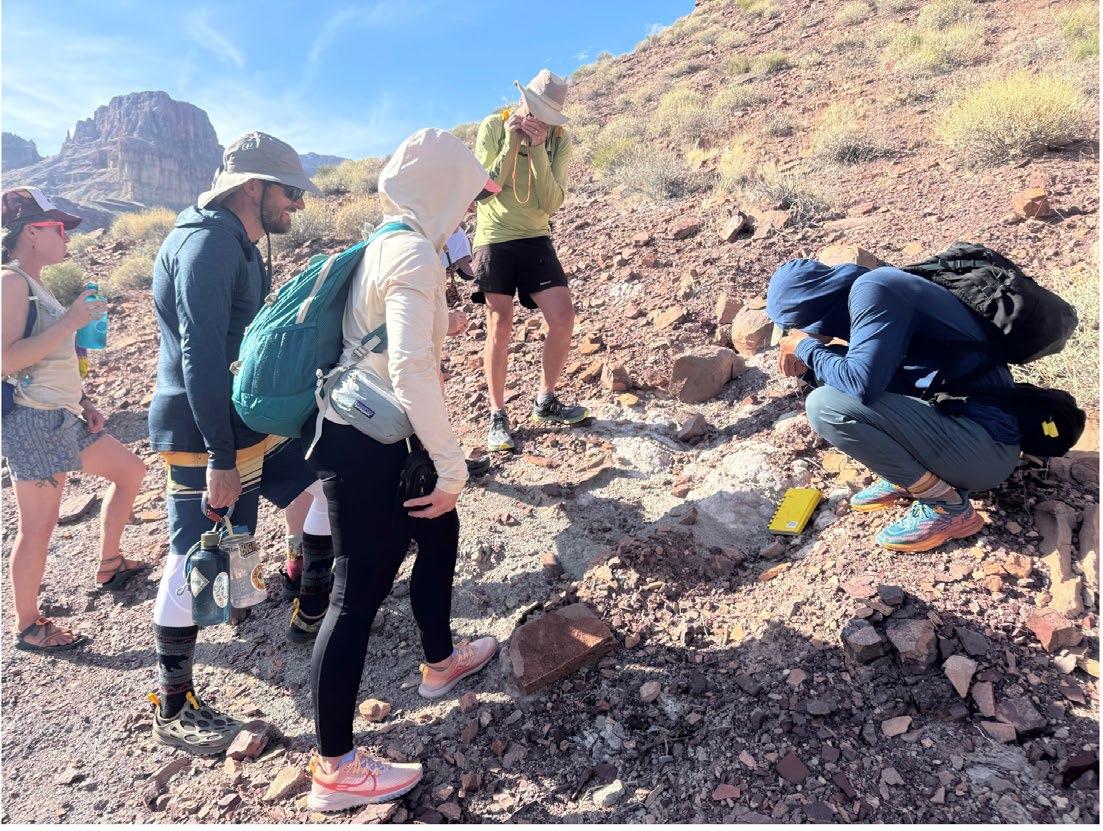
FIGURE 12: Participants examine 1.1 billion year-old volcanic ash in upper Precambrian Bass Formation
RMAG ON THE ROCKS: GRAND CANYON
Jen also pragmatically provides a listicle about the top ten reasons why the Grand Canyon Rafting might not be for you
1. Groovers – we leave no trace behind… and that means everything! All things toilety are handled as hygienically as possible, but it is still a challenge to some people, especially the daytime dewatering stops, which take place in the river.
2. Rapids – these are no joke, you will get wet and be fiercely exhilarated.
3. Scorpions – camp on the open sand, away from cliff faces and scrubby trees, and you will never meet one
4. Snakes – we saw one groggy rattlesnake and stayed well clear.
5. Sunstroke – it can be relentlessly hot, especially in the summer months. Vigilance is required.
6. Challenging hikes up very steep cliffs – optional, but so worth it!
7. Snow – yes, we awoke to snow one morning. You must lug around clothing for all conditions.
8. Diaper Rash – remember to close your wet gear fasteners. When water pools in your paddle pants, it is there for the day. They become puddle pants.
9. Raw paws – sand and water conspire to dehydrate your hands and feet, which can become cracked and painful without a lot of care, ointments, and treasured boatman remedies
10. Excessive laughter – I do believe that several of us had pulled abdominal muscles from extreme mirth and giddiness.
Scott Waggoner, CEO of a geosteering and mudlogging service provider, has been on every float-trip RMAG has recently run. Of the Grand Canyon trip, Scott muses: “The Grand Canyon RMAG trip is like going to… well nowhere else to be frank. Each day has something that leaps out and gives you a good solid smack of wonderment. Halite stalactites/stalagmites dripping under the shelf of the canyon (Figure 5), raging waterfall coming out of the middle of the of the Redwall cliff creating a luscious verdant creek in the
dry desert, ancient Devonian incised valleys, random rock you glance at that has jasper replaced fenestrate bryozoa…. and the list of wonders goes on and on.
One of our rafting guides, who so happens to have a geology degree, brought her guitar, ukulele, and saxophone. Who knew that the acoustics in a sandstone side canyon can be so miraculous to the soul when a lovely voice with a ukulele starts singing about exfoliation (Figure 6). Touching the Great Unconformity (yes it’s a non-conformity), one can’t help but wonder where the hell time goes! And yet, this time will be lodged deeply in my memory banks for the insane outdoor beauty, the diverse geologic candy store, and the incredible fellow geologists who all gathered around to Oooh and Ahhh at the rocks around us as if we
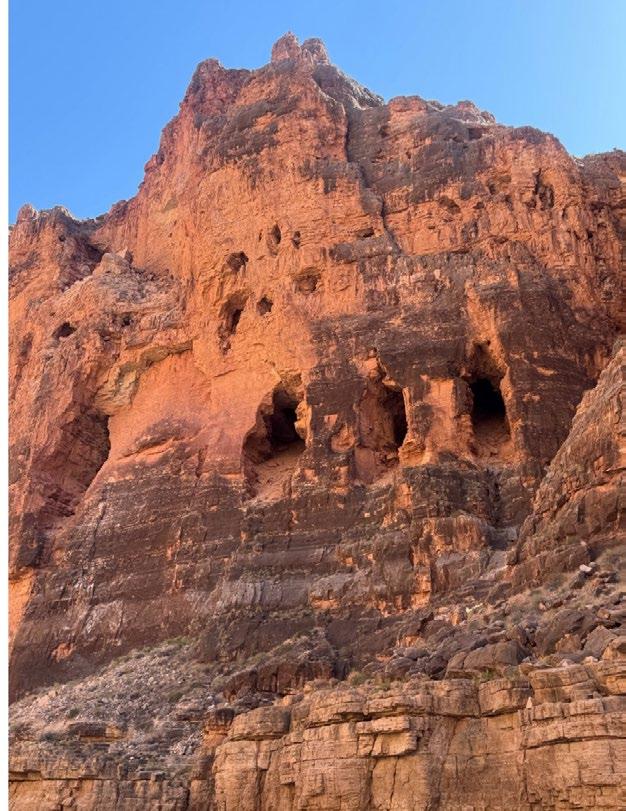
FIGURE 13: Pervasive dissolution pits, vugs, and caves in Mississippian Redwall Limestone near Nautiloid Canyon and river mile 35
RMAG ON THE ROCKS: GRAND CANYON
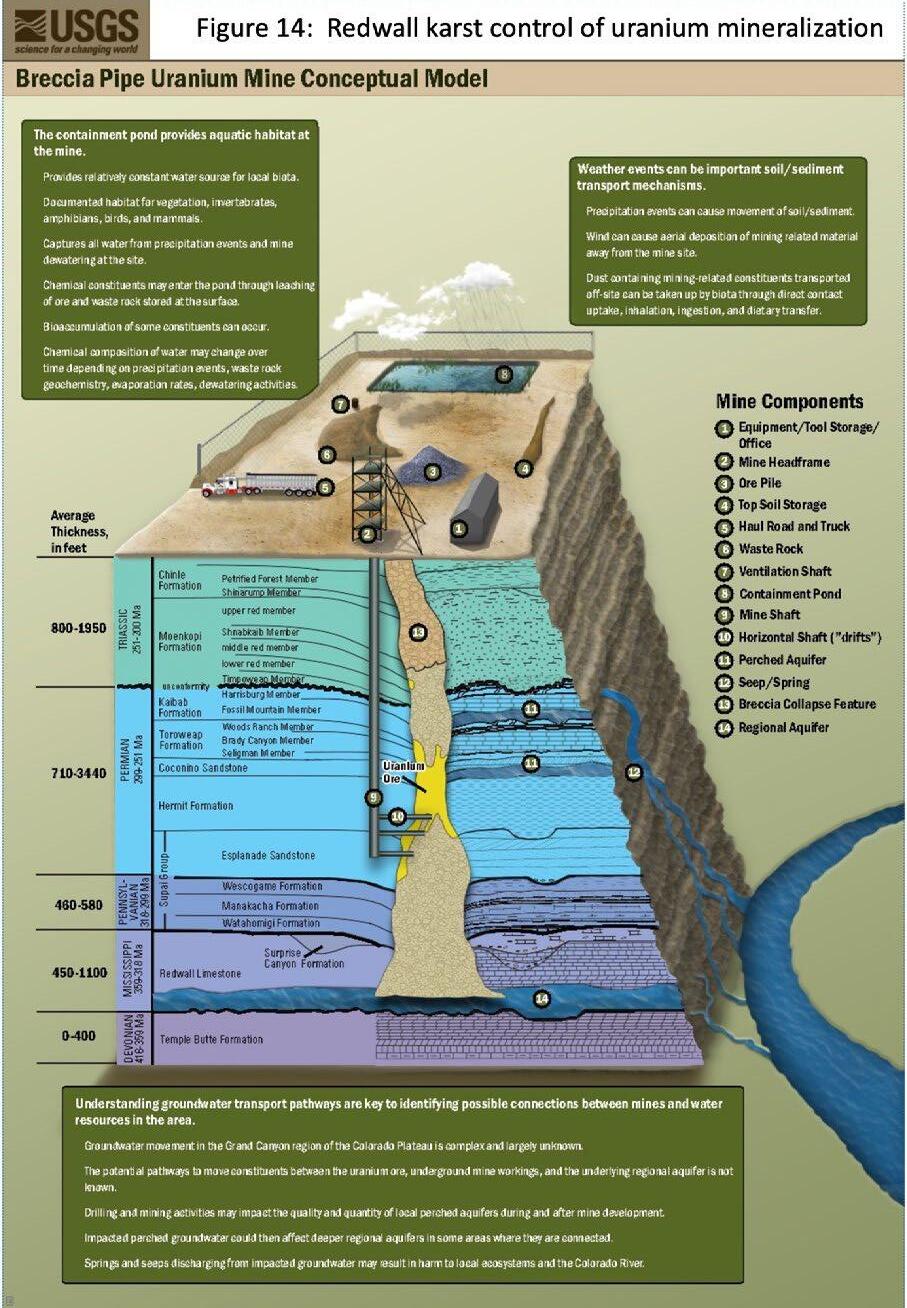
FIGURE 14: Redwall karst control of uranium mineralization
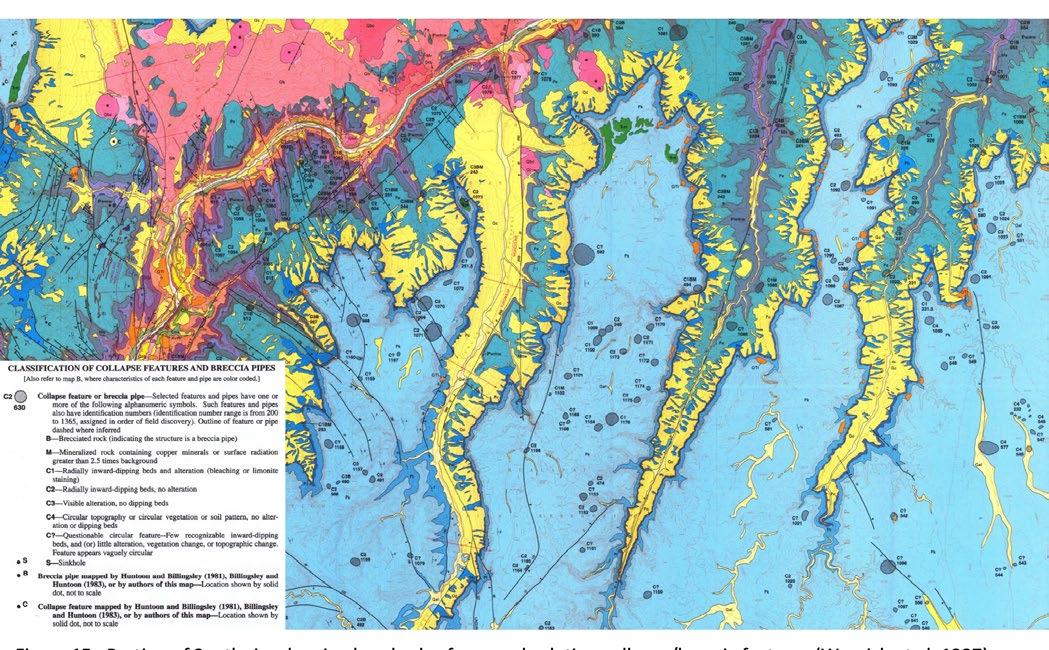
FIGURE 15: (above) Portion of South rim showing hundreds of mapped solution collapse/breccia features (Wenrich et al, 1997)
FIGURE 16: (below) “Upper World” and “Lower World” Waters in the Grand Canyon (Crossey et al, 2006).
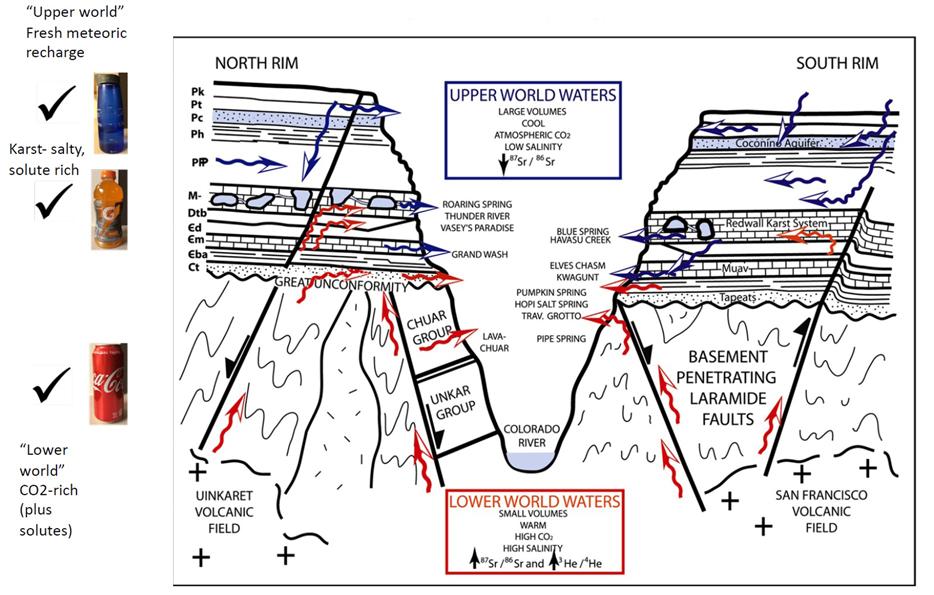
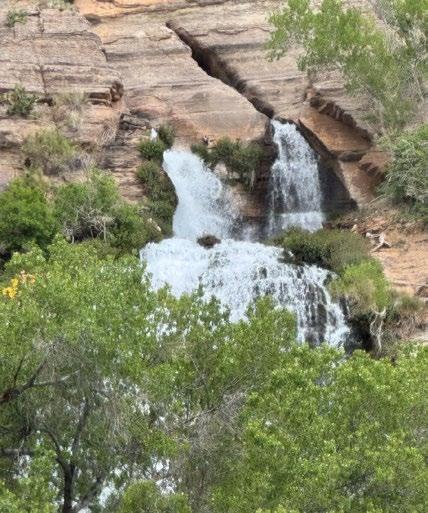
FIGURE 17: (above) Thunder Springs discharges large volume of low TDS “upper world waters” from Cambrian Frenchman Mountain Dolomite (just below Mississippian Redwall Limestone) and Muav Limestone; this spring is the source of the one mile-long Thunder River
FIGURE 18: (right) Tapeats Rapid, river mile 138.5, just below mouth of Tapeats Creek, into which Thunder River flows three miles upstream (to bottom left). Across the river is an exposure of The Great Unconformity, where Cambrian Tapeats Sandstone rests on tilted Upper Precambrian Shinumo Quartzite
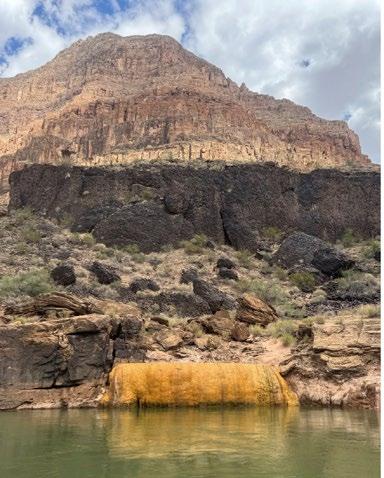
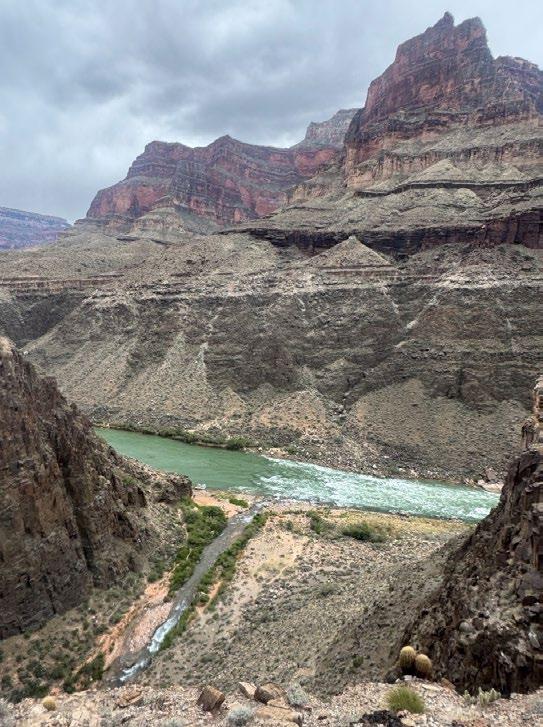
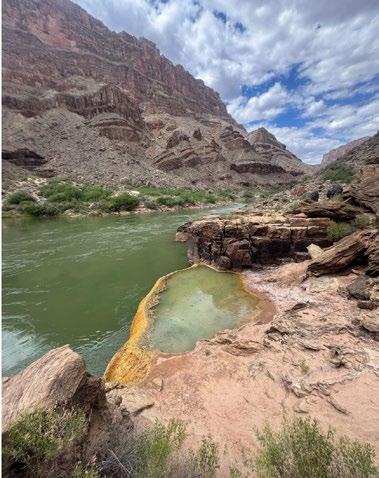
FIGURE 19:
Pumpkin Spring discharges small volumes of high TDS “lower world waters” into Colorado River near river mile 213, resulting in a travertine pool, note erosional remnant of canyondamming basalt flow
RMAG ON THE ROCKS: GRAND CANYON
were in church. Morning coffee call would occasionally come with the deep sounds of a saxophone urging us to wake up and prepare for another day of big cold waves that startle you back into life with laughter and screams. As we rounded a corner and spotted a thin layer of serpentine draped over what appeared to be stromatolites, our group erupted with curiosity - buzzing with questions and chattering in confusion like a flock of hens (Figure 7). That is until we spotted the diabase intrusion and thought back to our late-night college study sessions when we were tested on words like skarn and metasomatism.
The discussions up the trail, down the trail, on the boat, and at camp were a blast of delight on every aspect. You don’t just spend 14 days paddling through the Grand Canyon on an RMAG geology trip and walk away unchanged. Somewhere between the rapids and the rock layers, I found a sense of home—one that feels timeless, etched into memory, and impossible to leave behind.”
Colleen Fitzpatrick, a Montana-based geosteering geologist, shared “Our journey began on a snowy April morning. A band of 20+ intrepid strangers boarded a bus in a snowstorm, enroute to a 14-day, 200+ mile geology trip down the mighty Colorado River. Beyond bearing witness to billions of years of really cool geology, many of us forged lifelong friendships through shared experiences and, trust me, those were some experiences! We took our places in our respective boats and off we went on the adventure of a lifetime. It is hard to put into words how something as majestic as the Grand Canyon can make a tiny hooman [sic] feel, but I will endeavor to do my best.
The desert is often mistaken as barren place, almost devoid of life, harsh and unforgiving. But this place is a place of pure magic, no doubt about it (Figure 8). Sure, the geology is cool, but it is so much more than just the magnificent cliffs lining the emerald green river that keeps itself busy excising billions of years of significant and interesting geologic events (Figures 9 & 10). It is its own ecosystem, full of a diverse array of plants and animals, as well as a strong cultural story, not mine to tell, but one I have much reverence for.
This trip offered an opportunity to slow down and reconnect with the rhythm of the Earth, to just BE in the moment. For two short weeks, we LIVED, breath to
breath, moment to moment, concerning ourselves not with bills to pay, or the latest headlines, but with daily life living on the river. From the fire lining of our gear each morning and night, to helping prep meals, setting out the chair circle for story time with Gary, (our intrepid, loveable, and immensely knowledgeable geology professor), to helping one another find a flat spot to lay our weary selves at the end of a long day, we formed a community.
Integral to that community were those tasked with ferrying a small band of rock dorks and their significant others safely and sagely down the Colorado River. Our guides were some of the most incredible people I have ever met (Figures 11 & 12), each so different from one another, but every single one of them, in equal measure, were more than qualified to educate, guide, and entertain complete strangers for two weeks, with grace, humor, and a wealth of knowledge of all things Grand Canyon! Although Emily Popke, if you’re listening, I never want to hear that drunk whale joke again! Just kidding, I would gladly suffer all twelve minutes just to hang with you in the dory again!
I could expound for days on all of the wondrous things we saw and did, and no doubt there will be much covered by many of my fellow river mates, so instead of droning on, as I seem to have a penchant for, I will leave you with a quote from one of my favorite authors, himself a long time, (though long since deceased), resident and explorer of the American Southwest, the much beloved, cantankerous, lover of all things wild….Ed Abbey. I feel his words encapsulate the spirit of this trip better than mine ever could. But before I go, I will leave you with one small piece of advice. If you are considering a trip like this, or any trip really….do it! Do it now, for you have one shot in this meat suit, on this tiny blue pebble hurtling through the Universe, and time is a commodity few of us can afford…..just do it, because life is short, but it’s wide….”
“The shock of the real. For a little while we are again able to see, as the child sees, a world of marvels. For a few moments we discover that nothing can be taken for granted, for if this ring of stone is marvelous then all which shaped it is marvelous, and our journey here on earth, able to see and touch and hear in the midst of tangible and mysterious things-in-themselves, is
RMAG ON THE ROCKS: GRAND CANYON
the most strange and daring of all adventures.”
—EDWARD ABBEY, DESERT SOLITAIRE
Retired oil & gas geoscientist (and trip organizer)
David Schoderbek, Denver, gushes about springs and waterfalls, uranium, and lava:
“I never expected to learn so much about the Redwall Limestone and its many facies as I did on the RMAG Grand Canyon Float trip. Even though our trip took place in a relatively dry period, and the many springs at Vasey’s Paradise were just seeps, the cascades at Thunder Springs were spectacularly powerful. I started the trip somewhat familiar with regionally correlative Mississippian limestones like Montana’s Madison Limestone, the world-famous and prizedby-stone-carvers Indiana Limestone, the Lake Valley Limestone of New Mexico, and of course Colorado’s Leadville Limestone, but I had no idea that new and insightful work had been done on the Redwall
Limestone by Gary Gianniny and his Fort Lewis College students over the last decade. I entered the Grand Canyon unaware of the profound influence the Redwall Limestone has over both regional groundwater systems (Figure 13) and uranium mineralization!
Uranium mineralization in the Grand Canyon region is localized in solution pipes and have their origins in the aquifer layers near the base of the Redwall Limestone, with collapse extending up through the entire sedimentary column to Earth’s surface (Figure 14). Uranium-bearing fluids have concentrated uranium ore primarily in the Permian Hermit Shale, with subsidiary deposits in the overlying Coconino Sandstone and underlying Esplanade Sandstone. Thousands of collapse and breccia features have been mapped adjacent to the Grand Canyon, but only a few have had the presence or extent of uranium mineralization fully delineated (Figure 15).
Beyond the Redwall Limestone, Gary introduced
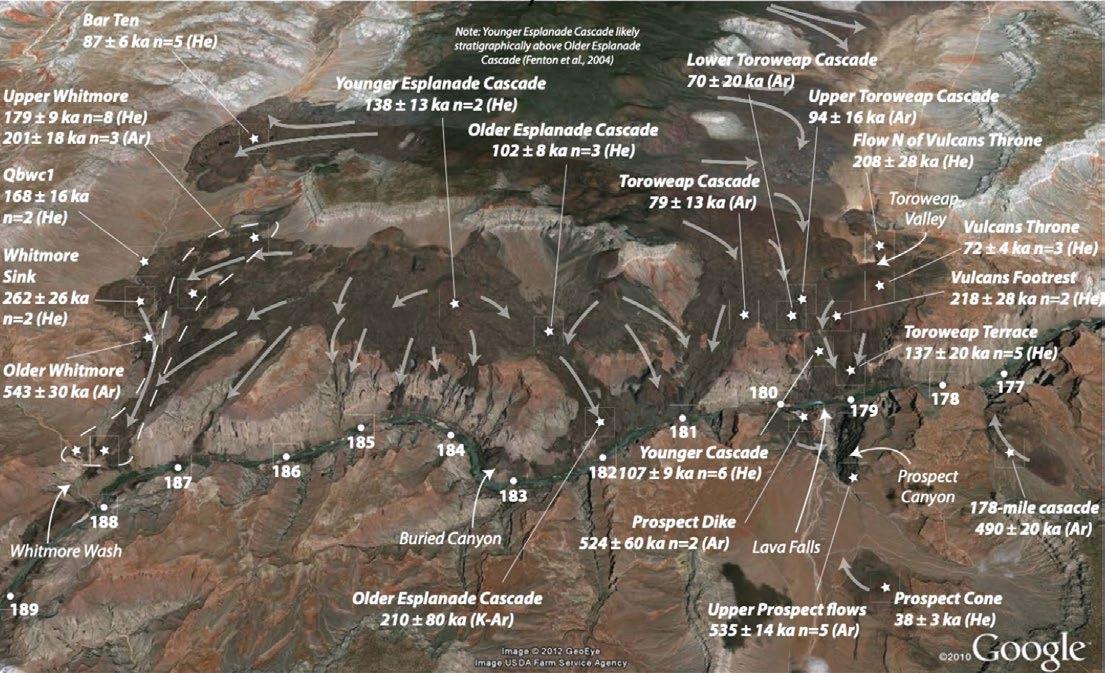
FIGURE 20: (from Crow et al [2015]) Three-dimensional perspective view of the southern Uinkaret volcanic field showing the locations of lava cascades and their ages. 3He ages from Fenton et al (2004.). 40Ar/39AR ages from Pederson et al (2002), Raucci (2024), Karlstrom et al (2007), and this study. 40K/40Ar ages from Hamblin (1994).
RMAG ON THE ROCKS: GRAND CANYON
us to the spectacular work of Laura Crossey and her co-authors (Crossey et al, 2006) that subdivides all the spring and seep products of the Grand Canyon into “upper world” waters and “lower world” waters (Figure 16). Upper world waters, like those at Thunder River (Figures 17 & 18), tend to occur in large volumes, characterized by cool, low salinity waters with atmospheric levels of CO2. Waters of the lower world, like those found at Pumpkin Spring (Figure 19), tend to occur in smaller volumes with both high salinity and high CO2, based on their long residence times in old, mostly Precambrian rocks.
Did somebody say lava? The massive Lava Falls Rapid is the largest in the Grand Canyon, ranked 10 on the Grand Canyon 1-10 scale of rapids, and paddling thru it under the expert guidance of our Paddle Captain Tom was absolutely exhilarating and beyond additional superlatives! The relatively minor amounts of black basalt in the Grand Canyon are misleading. They attest to a far grander story, one of at least five volcanic episodes spanning 700,000 years (Crow et al, 2015). Today only sparse basaltic remnants are left to attest to twelve separate lava flows that cascaded into the Grand Canyon, damming the Colorado River multiple times. Figures 20 and 21 are phenomenal graphics from Crow et al (2015) that tell this story in pictures. It’s not just about Lava Falls!”
REFERENCES
Crossey, L.J., T.P. Fischer, P.J. Patchett, K.E. Karlstrom, D.R. Hilton, D.L. Newell, P Huntoon, A.C. Reynolds, G.A.M. de Leeuw, 2006, Dissected hydrologic system at the Grand Canyon: interaction between deeply derived fluids and plateau aquifer waters in modern springs and travertine: Geology, 34 (1): p25-28
Crow, R. R., K.E. Karlstrom, W McIntosh, L. Peters, L. Crossey, and A. Eyster, 2015, A new model for Quaternary lava dams in Grand Canyon based on 40Ar/39Ar dating, basalt geochemistry, and field mapping: Geosphere, V. 11, No. 5, P1305-1342, doi: 10.1130/GES01128.1
Karlstrom, K.E. and L. Crossey, 2019, The Grand Canyon Trail of Time Companion: Geology essentials for your canyon adventure: Albuquerque, NM, Trail of Time Press, 142p. Kleinhans, Lew, Madeline Marshall, and K.J. McDonough, 2024a, Tales of a Grand Canyon: Geologic highlights of a Colorado River trip, Part 1: The Outcrop, Rocky Mountain Association of Geologists, volume 73, number 4 (April, 2024), p 16-38
Kleinhans, Lew, Madeline Marshall, and K.J. McDonough, 2024b, Tales of a Grand Canyon: Geologic highlights of a Colorado River trip, Part 2: The Outcrop, Rocky Mountain Association of Geologists, volume 73, number 5 (May, 2024), p 16-40
Wenrich, K.J., G.H. Billingsley, and P.W. Huntoon, 1997, Breccia-pipe and geologic map of northeastern part of the Hualapai Indian Reservation and vicinity, Arizona: USGS Miscellaneous MI-2440
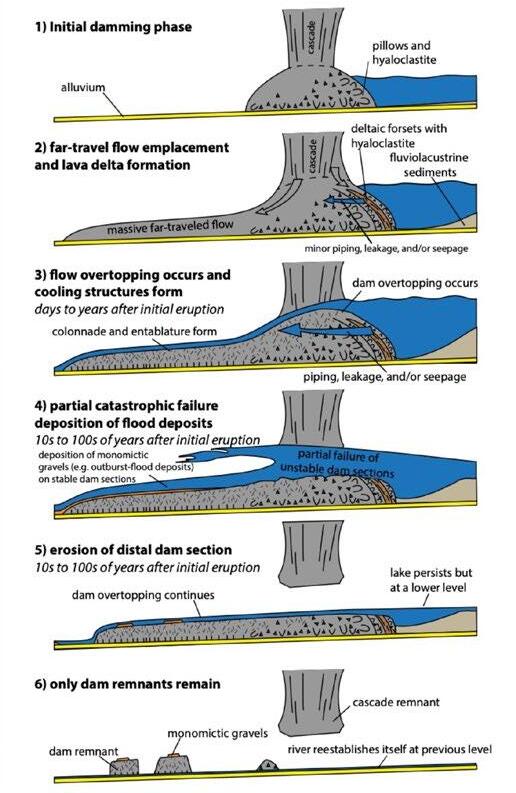
FIGURE 21: (from Crow et al [2015]) Conceptual model showing the inferred stages of dam failure for those dams that are overlain by monomictic basaltic gravels. The Black Ledge and Buried Canyon A dams, which are overlain by fartraveled gravels, failed only after the related lakes completely filled with fluviolacustrine gravels, allowing far-traveled sediments to overtop them; they likely persisted for longer than those overlain with only basaltic gravel.
Reviewed by Rasoul Sorkhabi University of Utah, Salt Lake City
Geology of Texas Revealed
Two new books written by husband-and-wife geologists bring to sight the hidden geology of Texas for those driving on the highways and country roads of the Lone Star State.
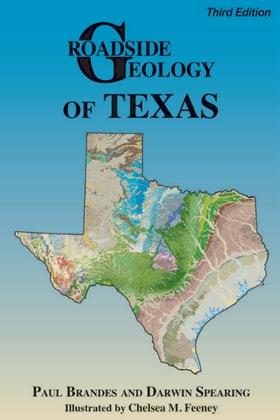
Roadside Geology of Texas by Paul Brandes and Darwin Spearing with illustrations by Chelsea Feeney (Geological Society of America, 2025), 372 pp., $34
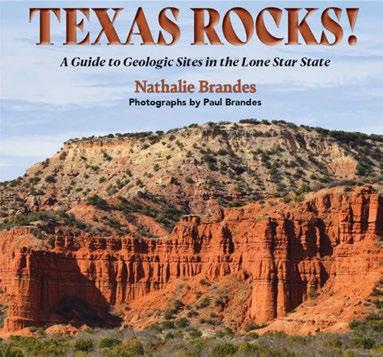
Texas Rocks! A Guide to Geologic Sites in the Lone Star State by Nathalie Brandes, photographs by Paul Brandes (Geological Society of America, 2025), 168 pp., $26
When you look at a map of Texas, what do you see? Well, this depends on the type of map you are looking at. If it is an ordinary geographic map, you will recognize rivers and mountains and will locate roads and towns. But if it is a geologic map, it is a different matter. You will see various colored areas for geologic periods, different patterns for rock types, and lines with symbols representing fault types. To decipher all these on the map, you will need a geological guide. Two recent books, Roadside Geology of Texas by Paul Brandes and Darwin Spearing, and Texas ROCKS! by Nathalie Brandes, provide helpful guides to geologic time travelers driving on Texas roads and who care to stop at scenic viewpoints. These books, both profusely illustrated with maps and photographs, are published by the Geological Society of America.
Roadside to Geology of Texas published this year is the third edition of the book first published in 1979 and then again in 1991 by Mountain Press which was acquired by the Geological Society of America last
October. Robert Sheldon and Darwin Spearing, the authors of the first and second editions of the book, have both passed away, but their efforts constituted the foundation for this new edition. The book contains roadside descriptions of outcrop geology and important geological sites along the roads and between the towns in Texas. It includes geological maps, cross-sections, and photographs. Roads and distances are described, and the longitude and latitude of each photograph are given in the figure caption.
Texas ROCKS! describes 80 geological sites, each site on two pages including location maps and field photographs. Here is one example: Granite Mountain Quarry located northwest of Marble Falls along Ranch Road 1431. The quarry supplied the building stone for the Texas State Capitol completed in 1888. Paul and Nathalie Brandes are husband and wife geologists who both graduated from the New Mexico Institute of Mining Technology and then obtained a master’s degree in geology from Michigan Technological University.
Both books open with an introductory chapter on how Texas formed through geological time. The oldest rocks in Texas are 1.35-billion-year-old granite gneiss found in the Llano Uplift. The origin of the Llano Uplift dates to more than one billion years ago when it formed as part of the Grenville mountain-building process during the assembly of a supercontinent geologists have called Rodinia. The collision of continents, including North America, with one another formed Rodinia. It is amazing to see the rock record of this event in the heart of Texas, for example east of Loyal Valley on Texas State Highway 87.
The second major mountain-building event in Texas occurred during the Permian period, some 320 to 290 million years ago, during the assembly of another supercontinent called Pangea. During this event, North America collided with Northwest Africa to raise the Appalachian and Ouachita mountains. Interstate 30 in northeast Texas and Interstate 35 from Dallas to Austin run roughly along the Ouachita Mountain trend.
The third stop in our geological time travel of Texas is the Western Interior Seaway, existing from 145 to 65 million years ago, which spanned from Texas all the way north to British Columbia in Canada. Yes, during the Cretaceous period, the Gulf of Mexico was connected to the Arctic Ocean. The uplift of the Rocky Mountains put an end to the seaway.
follow the traditional classification of Texas into five geological provinces, each with its own characteristics. These are, from east to west: Coastal Plains, Llano Uplift, Central Plains, High Plains, and West Texas (or Basin-and-Range). Of these, only the Llano Uplift is entirely Texan. The other provinces extend into the neighboring states of Louisiana on the east, Oklahoma in the north, and New Mexico on the west, demonstrating the transcendence of geology beyond human-made borders. If you want to see all of Texas’s geological provinces, take Interstate 10 and 20 from east to west – of course equipped with copies of these two books.
After the Rockies soared to the sky, another major geological activity shaped the region. Named the Basin-and-Range event, it was responsible for the formation of rift valleys such as Rio Grande and the outpouring of volcanic rocks 35 million years ago. These volcanic rocks are exposed in western Texas and extend into New Mexico.
How can one slice Texas geologically? Both books
Texas is best known for its oil and gas produced from subsurface reservoir rocks. More than 40 percent of the United States crude come from Texas. However, as one browses through these books, one appreciates the diversity of geological outcrops and complexity of geological history in Texas. There is so much to see in Texas. The hot and humid climate of Texas is not friendly to geological outcrops as the rocks easily wither, crumble, or are covered with vegetation. One can anticipate future editions of these books in years to come.
But for now, we have the privilege of visiting some of these rocks and parks with family, friends, and bottles of water.
Much labor and love have gone into producing these books – fieldtrips, research, writing, photographing, cartography and illustrations. The result is two books indispensable to teachers and students on geological field trips in Texas; these books also enrich the experience of curious travelers in the Lone Star State who have an eye on the scenery and an ear to the stories of deep time.
DECEMBER 3, 2025
RMAG Luncheon.
IN THE PIPELINE
Contact holly.sell@yahoo.com to add Pipeline events.
Speaker: Dr. David Krause. “The Madagascar Paleontology Project: Late Cretaceous GameChangers.” 12:00-1:00 PM. DERL, 730 17th Street, B1, Denver.
WOGA Holiday Party. “Flannel and Frost.” Liberty Energy, 950 17th Street, 24th Floor, Denver. 4:30-8:00PM
DECEMBER 5, 2025
Rocky Mountain Pipeliners Club- Hollywood Holiday Party.
The Studio Loft at the Ellie Caulkins Opera House. 5PM-10PM. info@rmpipeliners.org
DECEMBER 11, 2025
WOGA Wellhead Wake -Up (Virtual Monthly Coffee Chat) Virtual. 8 AM.
DECEMBER 16, 2025
RMS-SEPM Luncheon. Speaker: Justin Birdwell. “Upper Cretaceous Source Rocks in Western Colorado: USGS Candy Lane Drill Core and More.” information@ rmssepm.org. Wynkoop Brewing Co., 11:30AM1:30 PM
DECEMBER 18, 2025
WOGA Lean- In.
Speakers: Camille Romero and Kelly Saucedo. “Reflecting & Celebrating – Looking Back, Moving Forward.” CANUSA, 600 17th Street, 23rd Floor, Denver. 11:00 AM-12:30 PM.
WELCOME NEW RMAG MEMBERS!
Kenneth Forrester with EOG Resources from Denver, Colorado
Morgan Brown is a Student from Peyton, Colorado
David Nash with New Park from The Woodlands, Texas
Ellen Lamont with the Bureau of Reclamation from Denver, Colorado
William Purves with Highlander Energy LLC from Georgetown, Texas
Chris Riddleberger with Intergrated Reservoir Research from Denver, Colorado
Luke Wilson with ExxonMobil from Dallas, Texas
Ryan Finley with Entrada Consulting Group from Thornton, Colorado
Grant Zimbrick with Dolan Integration Group from Westminister, Colorado
Deanne Foss with Harvest Gas Management LLC from Houston, Texas

Expanded geologic focus:
Why contribute?
• Reach
• Quarterly
• Permanent
• Quick
• Every
Why contribute?
Expanded geologic focus:
• Entire greater Rocky Mountain area of North America
• West Texas and New Mexico to northern British Columbia
• Entire greater Rocky Mountain area of North America
• Reach a broad industry and academic audience
• Great Plains and Mid-Continent region
• West Texas and New Mexico to northern British Columbia
• Quarterly peer reviewed journal
• Great Plains and Mid-Continent region Why contribute?
• Permanent archiving includes AAPG Datapages
• Reach a broad industry and academic audience
• Quarterly peer-reviewed journal
• Quick turn around time
• Every subdiscipline in the geosciences
• Quick turn-around time
https://www.rmag.org/publications/the
• Permanent archiving includes AAPG Datapages
https://www.rmag.org/publications/the
• Every subdiscipline in the geosciences
Expanded geologic focus:
area of North America
• Entire greater Rocky Mountain area of North America
northern British Columbia region
• West Texas and New Mexico to northern British Columbia
• Great Plains and Mid Continent region
Email: mgeditor@rmag.org
https://www.rmag.org/publications/the -mountain-geologist/

CALENDAR – DECEMBER 2025
RMAG offices closed December 25 to January 1
RMAG Luncheon. WOGA Holiday Party.
WOGA Wellhead Wake -Up (Virtual Monthly Coffee Chat)
Rocky Mountain Pipeliners ClubHollywood Holiday Party.
WOGA Lean- In.