STC president promotes power of community colleges.
THE FUTURE OF THE VALLEY
Doing business across borders.
MENTAL LOAD
How workload, stress, and anxiety impact productivity in the workplace.
Minimally Invasive Robotic Surgery
Treatment options includes:
- Treatment of all Gynecologic Problems
- Treatment for Urinary Incontinence or Prolapse
- Sterilization
da Vinci Surgery
✓ R eturn home same day
✓ 1-2 week recovery time
✓ Single incision
✓ Virtually scarless
Standard Surgery
x Prolonged hospital stay
x 6-8 week recovery time
x Larger or multiple incisions
x Higher risk of blood loss
da Vinci Single-Site® & Single Incision Laparoscopy
Anissa Leverett
Great profit margins and quality product. Let Rocky Mountain Chocolate Factory be your fundraising partner
Located at Rio Grande Valley Premium Outlets, Palms Crossing, and La Plaza Mall
GABE PUENTE PUBLISHER/CEO
RGVision was founded in 2009 to praise people for their success and compliment the Rio Grande Valley for its growth. We have covered individuals like Gary Kelly, CEO of Southwest Airlines, to our local surgeons like Dr. Rick Bassett, who patented his own knee used across the globe. Although we still honor individuals like these at our events, RGVision has shifted the focus of our cover stories to issues that pertain to the Rio Grande Valley. We hope to start conversations that will raise awareness and improve the quality of life in the region many of our readers call home. In this issue you will learn about what our local leaders are doing to improve the quality of life in our community and also learn how our educational leaders are changing the trajectory of students lives’ here in the Rio Grande Valley. Thank you for picking up this issue. Continue to be inspired, educated, and informed. Isaiah 43:19
PUBLISHER'S NOTE
Copyright by RGVision Publications Inc. All rights reserved. Reproduction without expressed written permission of the publisher is prohibited. The opinions and views expressed in the magazine don’t necessarily reflect those of our advertisers or collaborators. RGVision magazine is published bi-monthly and circulates 12,000 copies across the Rio Grande Valley in 420 locations with a direct mail distribution to major hospitals and Superintendents within Region 1. The RGVision office is located at 801 N Bryan Rd, Mission, TX 78572.
To receive an annual subscription of RGVision publications for $29.99, email info@RGVisionMagazine.com.
STAFF RGVISION
DOMINIQUE Y. ZMUDA
GRAPHIC DESIGNER/ILLUSTRATOR
GWYN D. ZUBIA
CONTENT MANAGER/ ILLUSTRATOR
DANTE TUEXI
DIGITAL MANAGER
OMAR DÍAZ
PRODUCTION MANAGER
JASON GARZA
VIDEO PRODUCTION LEAD
ANGELICA DINH
GRAPHIC DESIGNER
Adriana Dominguez
Adrian Gonzalez
Susie Martinez
Bill Martin
Dr. Alfonso Mercado
Omar Díaz
Jason Garza
Ben Briones
James Hord
Dominique Zmuda
Johnny Quiroz
John Brush
Amy Casebier
Lori Houston
Sofia Aleman
Cori Smelker
Efrén Olivares
Karla Arredondo
Rod Santa Ana
Angela M. Insalaco
Life Through Lens
Mariela Peña
Jim Lowenstein
Adrienne McCracken
Jose Sanchez
Albert Villarreal
For editorial comments and suggestions, please send e-mails to info@rgvisionmagazine.com.
For advertising information, please call us at 956.379.6017 or e-mail us at info@rgvisionmagazine.com.
A special thank you to all the advertisers who support this publication: you are the power behind the flywheel igniting positive change that keeps the conversation going.
PRINTED IN MEXICO
TABLE OF CONTENTS
2018 VOLUME 10 ISSUE 5
RGVISION MAGAZINE
TRANSFORMATIVE TRAILBLAZING STC president promotes power of community colleges.
The RGV cleans up its water act.
THE FUTURE OF THE VALLEY Doing business across borders.
MENTAL LOAD
How workload, stress, and anxiety impact productivity in the workplace.
EDUCATION QUALITY
Expanding Creativity
pg 8
Educating Young Minds
pg 10
Supporting Students
pg 12
Fall Pumpkin Patch Guide
pg 20
Academic Enrichment
pg 22
Pets at Pace
pg 24
The Benefits of Homeschool
pg 26
Teaching Kindness
pg 28
Ensuring Options
pg 30
Now and Later
pg 32
Passion for Service
pg 34
Gateway to the Valley
pg 38
Fundraising for Cancer
pg 40
Nurturing Contagious Talent
pg 46
Family Separations
pg 50
Leading by Example
pg 52
Eating Disorders
pg 56
Dr. Michael Lago
pg 58
Toxic Beauty
pg 64
Healthy Pumpkin Muffins
pg 66
El Grito
pg 72
The Valley’s Best Tacos
pg 74
Visual Storytelling
pg 76
Garden Guardians
pg 78
Conservation Allies
pg 80
Ambulance Chser
pg 82
After the Flood
pg 84
CREATIVITY Expanding
New Fine Arts Academy to Inspire Next Generation of Artists at HCISD
by Adriana Dominguez
Matthew Garcia was in sixth grade when he picked up his viola in orchestra class for the first time, not realizing the massive impact music would have on his life. Within two weeks, he became first chair of his orchestra. In three months, he was first chair viola in the high school All-Region Orchestra; in a year, he was playing with the University of Texas at Brownsville (now, UTRGV) Symphony Orchestra; a year after that, he had played Carnegie Hall — three times.
This summer, Garcia was accepted into the National Youth Orchestra for the second year in a row. In this organization, he has rubbed elbows with some of the nation’s most highly academically and musically trained students.
“These are some of the most brilliant people I have ever met in my life. It’s just so amazing that I had the opportunity to sit next to these kids, getting to learn with them and live with them. They’ve been playing for 13, 14, 15 years — their entire lives,” he said. “As of right now, I’ve been playing the viola for six years, and because of my Harlingen fine arts education, I was able to stand with some of the best students in the country and be their equal.”
Garcia’s chance to learn music came in middle school, but what if he had had the chance to immerse himself in the arts at a much younger age? Elementary students attending Harlingen CISD now have the chance to do just that.
At the start of the 2018-19 school year, Harlingen CISD launched a new learning experience with a focus on the arts — the Fine Arts Academy at Lee Means Elementary.
“We believe that we must provide choices and opportunities for our families because students have different interests,” said Dr. Art Cavazos, HCISD superintendent. “We need to meet that interest where it is. The fine arts have allowed our students to compete among the very best in the nation. Imagine what they can do if they start in elementary. We’re going to stop imagining and make it happen.”
The new fine arts academy features a unique and vertically aligned curriculum developed with a focus on four different pathways — dance, music, visual arts, and theater. Students receive daily exposure to the fine arts through their subject matter.
To ensure a responsible rollout and to best meet the needs of the Lee Means community, the transformation into a full-fledged Fine Arts Academy will be a four-year process.
“Every year we are going to add a new dimension to what the Fine Arts Academy is going to offer,” said Veronica Kortan, administrator for organizational development. “We believe that when we are going to roll out any innovations, we have to prepare our system and make sure that we are going to be responsible in what we are implementing. At the end of the day, it’s about making sure all of our students are getting their needs met.
FINE ARTS CURRICULUM
While still emphasizing the academic core and strong character values, Lee Means Elementary Fine Arts Academy is inspiring a culture of creativity that extends beyond traditional learning.
In pre-K through second grade, students are introduced to thematic lessons in all four strands — dance, music, visual arts, and theater. These grade levels will participate in one production for the year. In grades three through five, students gain exposure to the four strands through the redesign of the school day.
Additionally, Fine Arts Academy learners have access to after-school enrichment opportunities free of charge on designated days.
“All of our students have enrichment opportunities,” Kortan said. “So for about an hour-and-a-half after
“Every year we are going to add a new dimension to what the Fine Arts Academy is going to offer.”
Veronica Kortan, administrator for Organizational Development
school, we’ll bring in one of our community partners and have an enrichment class that could be, for example, a piano lesson or a dance lesson. This allows our students that are passionate about a particular strand to nurture that passion and continue to develop those skills.”
The Dual Language Academy at Lee Means, which is now in its seventh year, will continue to be a part of the campus programming.
For more information on the campus, visit www.hcisd. org/finearts.
EDUCATING YOUNG MINDS AT AN EARLY AGE
PSJA ISD’s Early Childhood Education Program Prepares Toddlers for Elementary and Beyond
by Adrian Gonzalez
Studies show that early childhood education has a tremendous impact on student life outcomes. Young children are like learning sponges, and as such, every new experience, every word they learn and behaviors they are exposed to can make a lasting impression on their academic success.
Continuing its mission to provide high-quality education at an early age, Pharr-San Juan-Alamo ISD is one of few districts in the Rio Grande Valley currently leading the way in early childhood education through its innovative Pre-Kinder 3 and Pre-Kinder 4 program at
schools and partner day cares.
As part of the program, 3- and 4-year-old students enrolled can receive school readiness instructional support to ensure they are prepared for school. Thanks to partnerships with over 40 local day cares, parents of 3-year-olds can choose to have them attend full-day at these facilities for a fee or attend the district’s in-house half-day Pre-K 3 program offered at all elementary schools.
Through their participation in this program, all participants receive instruction from certified PSJA ISD
teachers. According to PSJA Early Start Pre-K School Principal Consuelo Casas, partnerships through the local day cares in the area allow the day care staff to receive training and guidance from PSJA’s certified teaching staff in order to provide instruction to their student body and ensure students are ready for kindergarten.
“The program is one of the biggest assets we have in our school district as we’re giving our students a very early start on their road to success,” Casas said.
Since its launch with PSJA in 2017, the collaboration has benefited families, the district, and the day cares. One such success includes the Little School House Learning Center in San Juan, one of the PSJA Partner Day Cares that was recently named a Texas Rising Star (TRS) FourStar certified facility.
Macarena Chavez, owner and director of Little School House Learning Center, describes the partnership with PSJA as an important component in earning the TRS Four-Star certification.
“The partnership provides a more structured curriculum, a more structured interaction,” Chavez said. “Everything that I have received from the district is wonderful.”
The Texas Rising Star program is a voluntary, qualitybased child care rating system of child-care providers participating in the Texas Workforce Commission’s subsidized child-care program. The TRS Provider certification system offers three levels of certification (Two-Star, Three-Star, and Four-Star) to encourage providers to attain progressively higher certification requirements leading to a Four-Star level.
Thanks to this success, PSJA ISD’s innovative collaboration has garnered the attention of nearby districts who are now interested in developing similar programs.
In addition to the Pre-K 3 program, 4-year-old students can also be enrolled in the district’s full-day Pre-K 4 program available at all 25 elementary schools. This program does not have any eligibility requirements except for students to be 4 years old by Sept. 1.
According to Casas, offering a Pre-K 3 and 4 program is invaluable for families as they help provide a solid foundation for lifelong learning.
“College ready, college connected and college complete. If you look at those three, that’s our goal,” Casas said about the mission of PSJA ISD. “We’re getting them ready from the very beginning at pre-K, and making sure they are ready for college when they graduate from high school.”
“The program is one of the biggest assets we have in our school district as we’re giving our students a very early start on their road to success.”
Consuelo Casas, PSJA Early Start Pre-K School principal
IDEA-U
Supporting Students to and Through College
by Lori Houston
Since the beginning, IDEA Public Schools has made its mission clear: a college education for all of its graduates. IDEA’s phenomenal college acceptance rate is a testament to that mission, but now it is going the extra mile to make sure that IDEA alumni are making it all the way through their college education.
For many of us, life often gets in the way of our dreams and goals. There can be many reasons why people lose track of or give up on their dream of a higher education.
Financial difficulties, time constraints, and family obligations are just a few, but the leaders at IDEA are committed to supporting alumni through the obstacles that stand between them and their college degree.
IDEA-U is a program that was launched last fall to give students a second chance at college. The hybrid of online and in-person education is specially designed to allow students to study at their own pace while maintaining their work and family obligations. The in-person aspect
“Before IDEA-U, I didn’t know what my plan was, but now I’m halfway there and I can see how this program really is helping me obtain the bachelor’s degree that I really want.”
Rafael Figueroa, student
gives them the extra support and guidance they need to stay on track and focused.
Life happened to Rafael Figueroa, and his dream of a college education was cut short. While working full-time at a convenience store, he would run into people he went to school with who were graduating college. He had left college four years ago, and when he would see them, he would think, “I just need to graduate, I need to continue.”
When he received a phone call about the program from Maria Esther Rodriguez, the director of undergraduate persistence, he was hopeful for the first time in years. “I really didn't plan to go back to college, so when I heard about IDEA-U, I wanted to continue my education,” he said. “I wanted to have a bachelor's degree so I can find a career instead of just working at the place I was working at.”
Figueroa attended an informational meeting and after having the program explained to him — the flexibility, the affordability, and the in-person support — he was excited to start. “At first, I thought it was going to be hard since I was away from university for about four years, but I got a lot of support from the interns and the academic advisers, which I saw every week,” he said.
The IDEA-U program is project-based, which allows the students to complete a degree at an accelerated pace. Figueroa finished his associate degree within nine months, and is now working on his bachelor’s degree.
The blend of online curriculum and in-person direction and support are well-suited to working adults. The curriculum is administered through College for America, an online institution associated with Southern New Hampshire University. The in-person component consists of a physical location in Weslaco where the students are required to spend 12 hours per week participating in study groups or independent study, and advisement sessions.
“In the traditional college, I actually never saw my adviser,” Figueroa said.
The flexibility in the required hours of attendance really helps full-time workers. At one point, Figueroa could only go to the center on Fridays and Saturdays. The office has night and weekend hours in addition to the normal business hours.
As most of the students enrolled in IDEA-U have been away from the classroom for awhile, and online learning may be new to them, there was an introductory period built in. The program launched in October 2017, but August and September were used for academic onboarding where students got a chance to tune up their academic skills in English, writing, and math.
“You get to see if online college is for you,” Figueroa said of the onboarding initiative. “For some people, it is not for them.”
IDEA-U has also given Figueroa an added element to his education. He now has an internship with the program where he is honing his business and communication skills in real world situations.
“They send me out to recruitment meetings, show me how to interact with students and how to help them with their projects,” Figueroa said. “They’ve pretty much helped me out in all the areas that I wanted to work on.”
IDEA-U is currently recruiting new cohorts every three months. It started with 54 students in the first cohort, and plans to expand to over 100 by the end of the year.
Figueroa recommends IDEA-U to anyone who has been diverted from their goals by life circumstances.
“Before IDEA-U, I didn't know what my plan was, but now I'm halfway there and I can see how this program really is helping me obtain the bachelor’s degree that I really want,” he said.
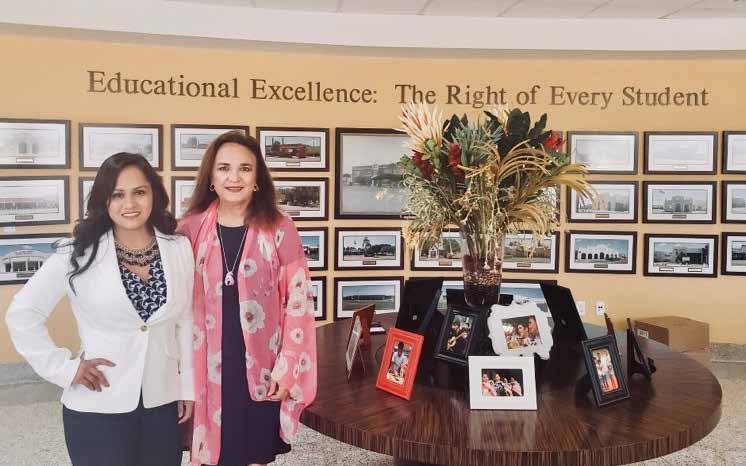
TRANSFORMATIVE TRAILBLAZING
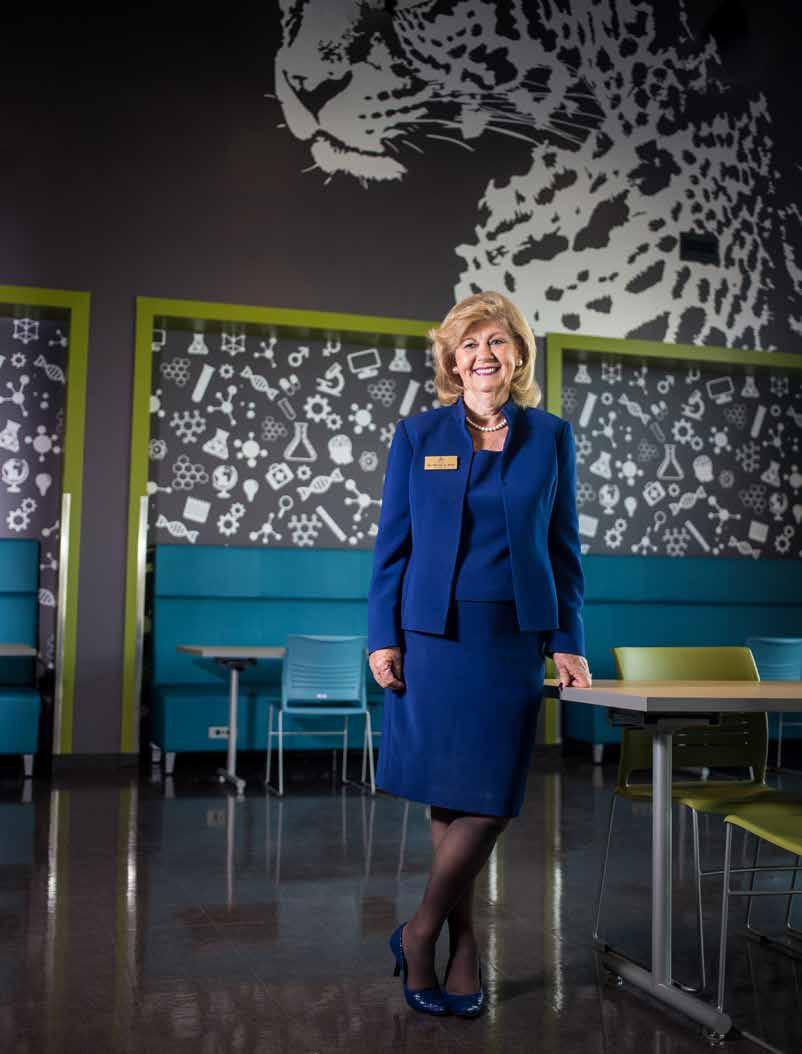
STC President Promotes Power of Community Colleges
by Amy Casebier | photos by Ben Briones and James Hord
You might be hard-pressed to find a stronger supporter of community colleges than Dr. Shirley A. Reed, president of South Texas College.
“My commitment and support for the community colleges, is really very personal in that I was not on a very good path when I left high school,” she said. “It was a painful path, a bad marriage and lots of unpleasantries. It wasn’t until I literally discovered the community college and received the positive reinforcement and encouragement that I could go to college that I believed I could do well.”
That exposure shaped the trajectory of Reed’s life.“My whole professional career really has been community colleges,” she said. “I have got over 45 years at this point.”
Before Reed became the founding president of STC in 1993, she was a community college administrator in Arizona. And when she did apply for the open position in deep South Texas, it was a new experience for her. “I had never served as a president of a community college,” she said.
Hiring someone without experience helming an institution was a difficult decision for the Board of Trustees, Reed added.
“I didn’t know the region, but I had returned after my doctorate and earned a second master’s in international business, so I was very familiar with the budding development of NAFTA, the maquila industry, and the economy of South Texas,” she said. “I knew developing a community college would be transformative for the region. I applied, and after a major search, I was the last one standing.”
Though STC is unique given its location and the
population it serves, it has important factors in common with comparable institutions across the nation.
“Community college really serves as a catalyst for economic development, which leads to regional prosperity and better quality of life for families,” Reed said. “Through the community college, students are provided affordable access to higher ed, whether they’re 16 or 65. We’re affordable, we’re conveniently located, we have very high quality programs, and we have passionate faculty and staff committed to the success of each student.”
Many institutions across the country look to STC as an example in many arenas, including its dual enrollment program, she added. Education leaders frequently travel here to pepper STC officials with questions about program implementation and student success.
Reed also pointed to the success of students who enroll in the college’s applied degrees in technology.
“This is just an example of if you provide the path and the opportunity, and make it affordable, you’re going to have a larger number of graduates and a better-educated community,” she said.
STC continues to grow with the completion of new facilities on its five campus as the result of bond construction worth $159 million. The final project was slated to be finished in August — the Regional Center for Public Safety Excellence located in Pharr, which will strengthen training for law enforcement professionals and students.
Future projects for STC include taking part in guided pathways, a nationwide initiative to streamline college curriculum.
“I frequently say that the community college put me on a better path, it saved my life, and I just think others should have that same opportunity.”
Dr. Shirley A. Reed, president of South Texas College
“We are making a real effort to take a fresh look at all the degrees we offer,” Reed said. “We have 122 different degrees and certificates. So you want to go to college and you come in and you have to choose one of those 122 — is that reasonable? We’re now trying to rein in those wide variety of degrees and get them focused a little more.”
The drive to continue to grow and enhance STC’s offerings for the RGV community is an important mission for Reed.
“That passion, it’s deep inside. It’s a core value. I can feel the emotion talking about it,” she said. “I frequently say that the community college put me on a better path, it saved my life, and I just think others should have that same opportunity.”
The region has taken note of Reed’s contribution to the Rio Grande Valley. This year, the City of McAllen honored Reed as a female community trailblazer.
“I’ve really reflected on what has transpired with STC over the years and my role as president because it truly has been one of being a trailblazer, building the institution, working with the leadership and community, leading faculty, administrators and the Board,” Reed said. “It was all new territory because nothing like this was here before.”
Even with everything she and STC have achieved, Reed prefers to look to the future instead of the past.
“I try not to reflect back on ‘look at how far we’ve come,’” she said. “Instead, I stay very focused on how much further we need to go. There’s so much more to be done. There’s a real urgency on getting it done for the sake of the economy of the Valley and all those families still living in poverty.”
Reed highlighted economic growth in the region and the corresponding jobs that have been created. However, she pointed out that many of the jobs were in the service industry — necessary, but low-paying.
“The economy of a community is directly related to the educational level of the residents of that community,” Reed said. “That’s what the Valley is struggling with currently. We have to have a competitive workforce in this community. We must have that workforce prepared.”
Some of the most lucrative careers in the Valley originate in positions that require further education, Reed said, citing Rio Grande LNG, the port expansion in Brownsville, SpaceX’s Boca Chica launch site, and the dramatic expansion of health care in the region.
“If you think of a nurse with two years of college making $60,000, $70,000 a year, that’s how you drive an economy and you make a region prosper,” she said. “That’s what STC has been doing with great success.”
Reed has some advice for individuals on the fence about earning a degree.
“From my perspective, stopping the excuses, stopping the procrastination, stopping the ‘I want to be’ and just do something is the first step. It is time to do it for a better quality of life for yourself,” she said. “There’s no magic. Of course you can do it. But if you don’t take the first step, you’ll never do it. It is time to do it for a better quality of life for yourself.”
EDINBURG RADIOLOGY
FALL PUMPKIN PATCH GUIDE
FOR THE RIO GRANDE VALLEY
by Lori Houston
Temperatures are starting to cool down, school is in session and the countdown to all of the autumn and winter holidays has begun. All around the Rio Grande Valley, churches, schools, and other organizations are gearing up for fall and hosting pumpkin patches. These events make a great experience for kids, and provide a great backdrop for fall photos and oftentimes have other activities you and your little ones can participate in. Here is a list of pumpkin patches opening all across the Rio Grande Valley this season:
First United Methodist Church of Brownsville — 1225 Boca Chica Blvd., Brownsville, TX
Join the members of the FUMC in Brownsville for their annual Pumpkin Patch from Oct. 13 through Oct. 31 benefiting the Good Neighbors Settlement House. The pumpkins come from a Navajo Indian Reservation in New Mexico and prices vary, but picture taking is free. Day cares and preschools can call ahead and schedule story time and a fun pumpkin science experiment.
First United Methodist Church of Harlingen — 321 E. Harrison Ave., Harlingen, TX
The FUMC in Harlingen will be opening their pumpkin patch from Oct. 12 through Oct. 31. Stop by to enjoy pumpkins of all colors and sizes and take some amazing fall photos. School groups can schedule story and activity time at the pumpkin patch, as well.
Donna’s Corn Maze — 807 N. Valley View Road, Donna, TX
Corn maze organizers plan to open the first Friday in October and will be open every weekend in October. Expect a full-sized and a mini-corn maze for the little ones. In addition to the maze, organizers offer tractor rides, hay rides, and barrel train rides. The pillow jump and pedal karts and adventure barn are sure to keep your
family entertained. All the attractions are included in the entry fee of $10 per person. You can get more information by calling (956) 239-4504.
First United Methodist Church of Edinburg — 3707 W. University Drive, Edinburg, TX
There is normally a large number of pumpkins on display and available for purchase at the beginning of October. For current information, please call (956) 381-9806.
Maddie’s Pumpkin Patch — 6712 N. Bentsen Road, McAllen, TX
An awesome red barn makes Maddie’s Pumpkin Patch a picture perfect location to visit this fall. The location is open every day starting in October through the day before Thanksgiving. This 5-acre farm in McAllen has it all, from hay rides to a petting zoo. Get a perfect fall family picture in the pumpkin patch, then enjoy the little corn maze and other games. The cost will be $5 per person or $20 for a car-load. For more information, call (956) 457-3035.
St. Mark United Methodist Church — 301 Pecan Blvd., McAllen, TX
St. Mark's will have a huge selection of pumpkins for a wonderful photo background for local families along with other activities during the month of October. Call (956) 6821481 for the most updated information.
ACADEMICEnrichment
La Joya ISD Secures Grant to Start Community Learning Centers
by Susie Martinez
La Joya Independent School District recently secured a whopping $1,500,000 annual budget through the Texas 21st Century Community Learning Centers Cycle 10 grant. The grant was secured through the assistance of the Educational Research Institute, the district’s external grant writing and management firm, and Mrs. Maria Belem Leal, grant development coordinator. This collaboration among both parties created a successful grant submission for the district.
Grant funds will be distributed between 10 of La Joya ISD’s participating campuses:
1.
2. Ann Richards Middle School
3.
4.
5.
6. Benavides Elementary
7. Sam Fordyce Elementary
8. Seguin Elementary
9. Tabasco Elementary
10. Zapata Elementary
The purpose of the grant program is to support the creation of community learning centers that provide academic enrichment opportunities during non-school hours for children. The program helps students meet state and local student standards in core academic subjects, such as reading and math, offers students a broad array of enrichment activities that can complement their regular academic programs, and offers literacy and other educational services to the families of participating children. La Joya ISD is one of 13 awarded applicants eligible for up to four years of continued funding, contingent on availability of funds and meeting established performance requirements.
Janeth Leal was recently approved by La Joya ISD Board of Trustees as the Afterschool Centers of Education (ACE) director for the project. Leal and Dr. Alda T. Benavides, superintendent of schools, are enthusiastic about the project and look forward to the implementation of the ACE centers at designated schools as early as Aug. 27.
Additionally, La Joya ISD also received recent success in the submission of the 2018–2020 School Transformation Fund - Implementation Grant for Juarez Lincoln High School with an award of $300,000. La Joya ISD – Juarez Lincoln High School will “transform classroom instruction through a rigorous and focused Transformation Model which will target teacher
Juarez Lincoln High School
Saenz Middle School
JD Salinas Middle School
Domingo Trevino Middle School
instruction, integrate technology in the classrooms, and transfer teachers’ 21st century skills to their students. This plan is based on research from Dr. Laura Goe’s (Teacher Quality and Student Achievement, March 2008) examination of teacher quality and will include providing Advanced Placement (AP) Certification for all core content subject teachers, regardless of their teaching assignment, in order to increase rigor in the classroom. Additional training, such as an IT3 (Intensive Teacher Technology Training) Academy and a School Transformation Leadership Retreat, will help the campus in completing its transformation.
La Joya ISD is ecstatic about receiving both of these grant awards and is eagerly awaiting the implementation of the programs. Through the implementation of these programs, La Joya ISD will continue to make great strides towards reaching the district’s mission to provide “educational excellence through rigor, relevance, and relationships” and its commitment to its students, schools, and community.
The
program helps students meet state and local student standards in core academic subjects, such as reading and math, and offers students a broad array of enrichment activities that can complement their regular academic programs.
Janeth Leal, ACE director, left, and Dr. Alda Benavides, superintendent, right.
PETS AT PACE
Academy’s Animals Contribute to Curriculum
by Sofia Aleman
Harlingen-based Waldorf School Pace Academy recognizes the astounding benefits that come with incorporating animals into the curriculum. Tending to pets or farm animals can prompt responsibility in a child and help them to recognize that their behavior and actions directly affect the wellbeing of the pet. Children learn they must have a respect for life when they realize animals must be cared for whether they “feel like it” or not.
“I love animals and I will tell you we use them for team building, teaching kids’ responsibilities, executive functioning,” said Robin Wilson-Clipson, principal of Pace Academy. “We’ve also used them to teach nutrition.”
In addition, having animals encourages kids to connect with nature and the world around them. All of a sudden, they’re out of the classroom and seeing, feeling, and interacting as part of hands-on learning.
On campus, Pace Academy allows their students to participate in taking care of chickens. By caring for a living animal, kids recognize the big role they have to stay responsible.
Wilson-Clipson explains that the younger grades help gather eggs in the morning “simply because it brings them so much joy.” And when the time comes to harvest eggs some of the older kids will participate, as well. The students also get to enjoy the experience of feeding and grooming the chickens, like making sure their feathers are all intact. Older students share in the responsibility of loading hay into the chicken coop and keeping a wind block to help the chickens stay warm during the winter. “I explain to the students these animals need to be treated with dignity,” Wilson-Clipson said.
Along the lines of treating an animal with dignity, Wilson-
Clipson explains to the students that their food comes from animals, including these chickens. By recognizing the process of getting a chicken to become a chicken nugget, students gain a better of understanding of why it’s important not to waste food. “You need to have more reverence for your food,” Wilson-Clipson added.
“So we teach them that even that pear or that apple that they’re eating started out as a tiny little seed and it took six months to grow,” she said. “There was a lot of energy that went into making that apple, so let’s not be wasteful when we’re eating.”
And that’s not all. Pace Academy makes sure to utilize the chickens to teach standards-based academic skills, like math, reading, and science.
Wilson-Clipson explains she likes for the children to distinguish the anatomical differences between the chickens and humans. Students will also learn about diet, including what nourishes chickens compared to what nourishes humans. They talk about body and bone structure, like the digestive system of the chicken.
“We talk about how their hearing and their sight is different than ours according to what is a predator and what is a prey animal,” Wilson-Clipson said. “Like the one horse that we have, I explain to them you don’t walk up on a horse without giving them notice because in the wild they are prey and if you startle them they may lash out at you in defense for their life. So those are important things for kids to learn as far as how to treat animals, how to be gentler, and through this you’re teaching them how to be more gentle with each other, as well.”
Keep the Beat
You may be at higher risk for heart disease if you have:
• Family history of heart disease
• High cholesterol
• High blood pressure
• Diabetes
• Or if you are a smoker (current or former)
Symptoms of heart disease may include:
• Pressure/pain in chest
• Pain or discomfort that spreads into shoulders, neck, arms or jaw
• Shortness of breath
• Swelling in feet, ankles, legs or abdomen
• Tiredness, fatigue, lack of appetite
Cardiologists
Federico Azpurua, MD
Carlos D. Giraldo, MD, FACC
Swarnalatha Kanneganti, MD
Dileep Menon, MD
Luis E. Padula, MD, FACC
Carlos Pimentel, MD, FACC, FSCAI
Juan Diego Posada, MD, FACC
Ofsman Quintana, MD, FACC, FSCAI
Cardiothoracic Surgery
Lester M Dyke, MD
Electrophysiology
Eric Taylor, MD, FACC
THE BENEFITS OF HOMESCHOOL
Nurturing the Whole Child
by Sofia Aleman
Educational equity is one of the most important aspects of a child’s foundation. Parents want their children to succeed academically and grow into adulthood with multiple employment options, healthy socialization skills, and a multitude of other talents and skills. For most children, this means entrusting their educational pathways to the public school system, or for others, maybe a private school like Montessori or Waldorf. What happens in the classroom will help this child grow as an individual and aid in developing lifelong learners and strong positive character traits. Recently in the Valley, there has been an increase in parents who are benefiting from taking control of their child’s academics and bringing them back into the home for school.
Homeschooling parents in the Valley highlight the benefits of educating their children at home, including an increased opportunity for character-building based on
personalized foundational principles and values that can not be found outside the home.
“People get the misconception that when they homeschool, it’s just subjects, but once you start homeschooling, you realize that, yes, subjects are important, but what you’re dealing more with is character training. We get to work on character training when we spend most of our waking hours with these little humans,” said Mio Cabeza, a 10-year homeschool mom of four children in Edinburg. “My husband and I wanted to have the biggest and strongest impact on their lives emotionally, spiritually, and mentally.”
In addition to being the strongest impact on your child, one Valley mom says homeschooling encourages a lifelong learning lifestyle.
“Even though there are a lot of different homeschool learning philosophies, most of them do focus on the fact
that learning is not just something you do during a set amount of time, learning is all the time,” said Melissa Nuñez, homeschooling mom of three years and mom of three. When parents carry out one-on-one learning, it is easy to navigate through multiple questions, delve deeper, or repeat a certain subject. “My son has the opportunity to be open-minded, learn, be wrong, make mistakes, and we’re doing it all together and I like the way that works,” Nuñez added.
Confidence is another benefit that comes from children who are able to converse frequently and achieve educational goals at their own pace.
“One thing people notice about my daughter is that she’s so well-mannered and behaves more mature,” said Nicole Armijo, a three-year homeschooler and mom of three children in McAllen. “People notice she’s so good at making friends, she goes up to kids at the park and asks them their name. She’s just more confident.”
One of the reasons Armijo attributes homeschooling as a boost to her daughter’s confidence is because if her daughter has an issue with another child during play dates or co-op homeschool groups, she is able to talk through her dilemma immediately.
“We talk about how to deal with the situation,” Armijo said. “I think it’s helped her with her confidence and with her maturity. She doesn’t lash out or act ‘her age’ about it.”
Olivia Lopez, a three-year homeschooler, and mom of two children in Raymondville also highlights the changes in confidence she sees in her daughter and the compliments in maturity and advanced critical thinking skills her daughter receives from people in their community and church. But another aspect of homeschooling that has been beneficial for their family is flexibility. While both public school and private school students attend a scheduled eight-hour school day, homeschool children have the flexibility to start school at whatever hour is best for them and commonly finish their work within a couple of hours.
“My husband and I do ministry and sometimes we’re on call and up late at night,” Lopez said. “My daughter can sleep late the next day and we can start school when she wakes up. The schedule is the biggest drive for us.”
While homeschooling does present challenges for every family, Cabeza says the countless benefits of homeschooling outweigh any presented downside. “I knew the bonding and the time I was spending with my kids would outweigh the struggles,” she said. “We always do things together as a family and you get to witness the fruit in your kids.” For each family, the trials of education at home differ, but all parents guarantee that socialization is not one of them.
“It’s a passion for me when we talk about homeschool— we’re not just talking about notebooks and textbooks, we’re talking about the whole person as an individual.”
Mio Cabeza , a 10-year homeschool mom of four children in Edinburg
For most parents with children in an organized school system, the idea that your child will no longer have friends if you started homeschooling is inapplicable. In fact, socialization outside of school is more accurately compared to real world interactions. Children are able to converse with people who are in all age groups and all walks of life while in social situations outside of the public or private school classroom.
“We are exposing them to adults, younger children, young adults, teenagers, and kids their own age everyday,” said Nuñez of her 7-year-old son and 3-year-old daughter. “My son can have a conversation with a 7-yearold, a 15-year-old, or a 30-year-old, without hesitation, he has so much confidence. … The longer I homeschool, it just seems like such a funny thing to be worried about, because we interact with people all the time and with all ages — not just with their age.”
So whether parents choose to homeschool because of freedom in educational choices, individualized instruction, stronger family ties, or flexibility, they only hope for the best outcome for each individual child. All parents agreed homeschooling does not have merely one face. It is the least restrictive style of learning and each family benefits from different styles.
“It’s a passion for me when we talk about homeschool — we’re not just talking about notebooks and textbooks, we’re talking about the whole person as an individual,” Cabeza said. “We want the whole person, the student, to be nurtured in every way, shape, and form. In every capacity we want to understand, how do they learn best? And that takes time, investment, and a lot of prayer and guidance.”
Attract More Bees with Honey Using Compassion in Classroom
by Sofia Aleman
The state of Texas continues to place a lot of emphasis on anti-bullying laws and regulations in schools — more specifically, cyberbullying within the students on their campus. Teachers and administrators are encouraged to take action if they see any type of harassment or bullying between students or serious changes in behavior if a student appears emotionally unwell. While anti-bullying laws are an excellent resource and method of protecting each child’s physical and emotional well-being, some teachers are taking it one step further: modeling and teaching methods of kindness in the classroom. Teaching kindness in the classroom means teachers treat children with respect and kindness and model scenarios in which students learn how to approach real-world situations with kindness. For older students, teachers will place high expectations for students to react in kind ways toward their peers, temper their anger or disagreements in healthy ways, and seek methods of solution and peace with other students. It also includes training on how to value themselves and others and promote positivity in their demeanor. For younger
children, it’s all these things in addition to an emphasis on learning to share and how to wait for toys when sharing is impossible.
Robin Wilson-Clipson, principal and teacher at Pace Academy in Harlingen, noticed a need to teach kindness in her school as a proactive approach against bullying, and has noted incredible success with her students. She emphasizes how teaching kindness offers children longlasting character qualities that carry on to adulthood.
“When you’re teaching anti-bullying, you’re reacting to something that’s already happened — you’re waiting for something to happen and then you’re teaching children how to arm themselves against bullying, but at that point, somebody has already been injured,” Wilson-Clipson said. “However, I truly believe that the way to not have to teach anti-bullying is to just teach kindness. We can teach students how to interact with their peers in a positive and wholesome way.”
Junior high students in Wilson-Clipson’s class have learned to disagree in healthy ways that don’t lead to aggressive behavior or emotional explosions. Students
“
have gained a respect for different opinions when it comes to lifestyle choices or preferences, and don’t judge one another. Promoting a positive and understanding environment has increased productivity within the class because students feel comfortable and safe.
“When children are taught kindness in the classroom, large group discussions in class — no matter what it’s about, science, math, English, poetry, movies, video games, no matter what it is — the conversation is more open and students are more apt to share what they truly believe because they know they can bring information to the group and not be criticized for their viewpoint or ridiculed or shamed because they don’t think the same way as everyone else,” Wilson-Clipson said. “It helps with their expansion of knowledge and mind — and people can share openly and freely without risking being hurt.”
Rachel Rodriguez, head of the math department and an eighth-grade teacher at Todd Middle School in Donna, also agrees that fostering a safe environment is key to academic success and should be included into the class culture and expectations.
“I think as a teacher it’s my job not to just teach math,” Rodriguez said. “We should go a step further and teach students to be good citizens, and respect is a big part of it.”
Every year Rodriguez uses an activity with her students called “The Trash Bag Activity” that aims at promoting respect in the classroom and producing a safe environment, and every year she sees impactful results among students and their peers. Students in each of her classes receives a blank index card. On one side students are instructed to write about a time in their life they have been emotionally or physically hurt by another person. She gives examples of types of bullying and encourages students to be raw and truthful when writing their experience because the index cards remain anonymous. Students share hurtful and painful moments that sometimes even surprise Rodriguez. On the opposite side of the index card, students are then
We should go a step further and teach students to be good citizens, and respect is a big part of it.”
instructed to write a time they have hurt someone else. She shares an example of students who didn’t actually bully a child but perhaps just laughed along or ignored bullying. Once students finish the assignment, she then passes along a trash bag to symbolize that each hurtful experience represents “trash” and will not be tolerated in the classroom. She assures students that she will protect them if she sees bullying and expects respectful behavior to both her and their peers while in her class.
“No matter what, students will respect my classroom ... it’s a self-check for them and I let them know that no matter what’s going on out there right now, they’re in the classroom — they have to throw disrespect in the trash,” Rodriguez said.
Both educators agreed that teaching kindness in the classroom not only affects the current learning environment but aids in creating more respectful and understanding students, friends, employees, and citizens, as well as encourages other teachers to adopt teaching kindness.
Rachel Rodriguez, Todd Middle School math department head
ENSURINGoptions
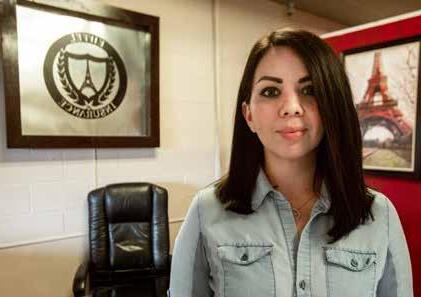
Greater Mission Chamber of Commerce’s Featured Member of the Month Mayra Perez of Eiffel Insurance in Mission
by RGVision
We met with the Greater Mission Chamber of Commerce’s Featured Member of the Month Mayra Perez, owner of Eiffel Insurance in Mission. Perez shared a little about her company’s services, multiple locations, and the ways in which the Greater Mission Chamber of Commerce has helped her business gain recognition in the Mission area and beyond.
Mayra Perez: My name is Mayra Perez. I’m the owner of Eiffel Insurance. We are an auto-home-life-and commercial insurance company. It’s an agency broker. We do life home auto and commercial insurance.
RGVision: Tell us a little about Eiffel Insurance.
MP: We look for the best rate for our customers. We are a broker, so we have a bunch of insurance companies that we can offer you. Some of them would be like Progressive,
ACC Insurance, Empower, Connect Insurance — so we compare and look for the best rate. Our main bread and butter is auto insurance — personal insurance. We look for the best rate for you to get auto insurance for liability or full coverage. We also specialize in commercial insurance, like for trucking businesses. We offer home insurance — we have various companies for that. We also offer life insurance.
R: How long has Eiffel Insurance been around?
MP: We have been in business since April 2014, so two years.
R: Do you have more locations?
MP: Yes, we have a total of four locations in the Valley: Mission, McAllen, San Juan and Weslaco.
R: What has your experience been as a member of the
“Before working with the Chamber of Commerce, people didn’t really know where we were. It really has helped my business as far as letting people know that we are a part of the Chamber so now I get more walk-ins — I get more business.
-
Mayra
Perez, owner of Eiffel Insurance
Greater Mission Chamber of Commerce?
MP: Working with the Mission Chamber has been exciting. It has opened my eyes to getting new ideas for my business and how to fit in with Mission and to get a feel for how Mission works, since I’m not originally from Mission. So as far as social media, meeting new people — just getting new ideas. They have helped me a lot.
R: What are your future plans with the Greater Mission Chamber of Commerce?
MP: The Mission Chamber of Commerce will help me, just like they did my grand opening here at this location. They’re going to help me do my grand openings at my other three locations I have, even though they are not in Mission. But I do plan on opening at least two more locations here in the area of
“Mission, which we’re already talking with them about — getting ideas as far as grand openings, marketing, and social media, and things like that.
R: How was working with the Greater Mission Chamber of Commerce made a difference in your business?
MP: Before working with the Chamber of Commerce, people didn’t really know where we were. It really has helped my business as far as letting people know that we are a part of the Chamber so now I get more walk-ins — I get more business. They recognize me more through social media. So we have gotten more business due to Mission Chamber.
SATURDAY SEPTEMBER 22-23
+ Fiesta de Palmas
SATURDAY OCTOBER 13
+ Sunset Live Outdoor Concert
SATURDAY OCTOBER 20
+ Saxet Gun Show
SATURDAY NOVEMBER 3
+ Franco Escamilla
SATURDAY NOVEMBER 10
+ Sunset Live Outdoor Concert
SATURDAY DECEMBER 1
+ McAllen Holiday Parade 2018
1845 Capital of Raymond James, 1400 N. McColl Road, Suite 101 | McAllen 956-331-2777
Now and Later
Generation-Skipping
Transfer Trusts
Allow for Tax-Efficient Wealth Transfer
The new tax law, passed in late December, temporarily raised the lifetime exclusion for estate, gift, and generationskipping taxes to just over $11 million per person. The higher exemption, which adjusts for inflation while in effect, sunsets at the end of 2025.
That means, for the next eight years, each person can gift or transfer up to $11.2 million without having to pay federal gift or estate taxes. That amount doubles for couples, and can be combined with the annual gift exclusion, which allows you to give $15,000 in 2018 to any number of people without reducing your federal lifetime gift tax exemption.
In effect, federal estate taxes will be rendered moot for all but the wealthiest of Americans. But the tax is steep on the amount that exceeds the limit: 40 percent. Note that the generation-skipping transfer (GST) tax, imposed at a 40 percent flat rate, is in addition to gift or estate tax, depending on whether the transfer is made during life or at death.
Of course, when it comes to financial planning, taxes should take the back-burner to achieving your goals, but they should be considered. Especially now that you have an opportunity to transfer more wealth to your family through existing or newly formed irrevocable trusts, including generation-skipping trusts.
Skipping Generations for a Reason, or Three
One strategy is the generation-skipping trust, which bypasses your immediate children in order to benefit your grandchildren even more down the line. There are three key reasons to do so:
• This helps protect significant family wealth from substantial future tax liability. This is especially beneficial
if your children are financially comfortable, and you want to provide for your grandchildren or even your greatgrandchildren. Your children can benefit from the income generated by the assets in the trust, but they don’t own the assets in the trust and can be given no access to the trust principal or limited access at the trustee’s discretion, depending on your objectives. The underlying assets will transfer tax free to the generation after.
• You can fund a generation-skipping trust with up to $11.2 million, allocating your lifetime exemption and your GST exemption to the trust to avoid gift tax as well as future GST tax liability.
• Once the exemption is applied, future appreciation of the trust assets is allocated to the trust beneficiaries directly. If the trust is irrevocable, your family won’t have to pay GST tax even if the trust assets appreciate considerably after your gift is complete.
Estate and tax planning is complicated; layering on temporary rules that may or may not be made permanent dials up the complexity when it comes to navigating federal estate, gift and generation-skipping transfer taxes, as well as state estate or inheritance taxes. You’ll want expert guides — your adviser, accountant, and lawyer come to mind — to help you take maximum advantage of the generation-skipping transfer tax lifetime exemption.
Please note, changes in tax laws may occur at any time and could have a substantial impact upon each person’s situation. Raymond James does not provide tax or legal advice. You should discuss tax or legal matters with the appropriate professional.
As featured in WORTHWHILE , a quarterly periodical dedicated to serving the clients of Raymond James advisors and affiliated advisory firms.
WHEN WE SERVE TOGETHER IN OUR COMMUNITIES, EVERYONE SOARS.
Southwest Airlines® proudly partners with those who are helping to shape our communities all across America. One good deed—when coupled with another and another and another—can truly make a positive difference in our daily lives.
PASSION FOR SERVICE
by Amy Casebier
Award-Winning RGV Lawyer Puts Clients First
If not for a perpetually late friend, Jesus “Jesse” Gonzalez might never have become a lawyer.
“I’d have to wait in his house while he got ready and he had a lot of information for lawyers like the LSAT examination,” Gonzalez said. “He had all these exams to prepare you.”
In the half-hour Gonzalez waited, he read the materials, answered sample questions, and graded himself.
“I would get them right all the time,” Gonzalez said. “I would say, ‘man, this law stuff is so easy.’ That was my first hint that if this is something you want to do, obviously you can do it because you’re answering all these questions right.”
That natural affinity for law foreshadowed the future. Now, Gonzalez is an award-winning personal injury attorney at J. Gonzalez Law Firm, with offices in McAllen, Brownsville, and Rio Grande City. Through the firm, Gonzalez takes on thousands of cases every year, helping both Valley residents and clients across the country.
Prior to becoming a lawyer, Gonzalez was passionate about helping people. He felt frustrated that he couldn’t do more when he saw loved ones in need of legal aid.
“I remembered thinking, ‘I’m so powerless to help my friends and family because I’m not a lawyer,’” Gonzalez said. “To be in a position to help people with their problems would be cool — to be able to be that person they could go to for help.”
“I got a phone call from a local lawyer that handled personal injury cases that said, ‘hey, why don’t you come and work for me?’” Gonzalez said. “I considered it because my educational debt was enormous.”
Though his dream was educational law, Gonzalez had also discovered a passion for personal injury law.
“I took classes that focused on essentially helping people when they’ve been hurt by people that are negligent or reckless,” he said. “I thought, ‘well, this is going to be a good fit.’”
During his first job in law, Gonzalez worked closely with accident victims. At a later job at a different firm, he represented insurance companies, gaining the opposite perspective of the cases he represented before. That diversity of knowledge today helps Gonzalez study the tactics insurance companies use to deny victims their rights.
“I worked essentially both sides of the aisle, representing the accident victims and representing the big companies that were fighting the accident victims, so I got a pretty good idea of what it was to work both sides,” Gonzalez said. “After that, I decided it’s time to open up my own practice.”
J. Gonzalez Law Firm opened its doors in 2001, but it wasn’t until about five years later that business really started to boom. At first, it was difficult to find cases.
At the time, Gonzalez enjoyed teaching fifth grade at Benavides Elementary School in La Joya — though the John Grisham book “The Firm” also fascinated him. While getting his master’s degree in education at the then-University of Texas-Pan American, Gonzalez fell in love with a course on educational law.
“At the time, I felt like there were a lot of things that needed to be fixed in our educational system,” he said. “I thought if the only way to make meaningful change that will not just impact your students but impact an entire school district is if you are actually a part of the people that are doing legislation or passing certain laws or fighting for certain laws.”
He decided to become an educational lawyer, graduating from St. Mary’s University School of Law in 2000. But while preparing to move to Temple University in Philadelphia, Pennsylvania to begin an LLM degree in educational law, Gonzalez’s future changed.
J. Gonzalez Law Firm opened its doors in 2001, but it wasn’t until about five years later that business really started to boom. At first, it was difficult to find cases.
“We have a problem in South Texas with a lot of people that illegally solicit accident victims,” Gonzalez said. “The very few that were left were being taken up by established law firms that had been representing accident victims for decades before I ever graduated.”
But once Gonzalez moved his office to a more visible location, learned how to market his firm more effectively, and started using the number 1-800-CAR-CRASH, more clients took notice.
Gonzalez fulfilled his dream of becoming a lawyer — even though he had to ignore the well-meaning advice of those around him.
“I was told by many people, ‘don’t do it, it’s too competitive, you’re not going to survive, you’re not going to be able to support your family, you’re already an established teacher, you’re good at what you do, stay in the teaching profession,’” Gonzalez said. “This came from my mom and my dad and my own family.
“Then the people that tried to talk me out of it the most were lawyers themselves who said, ‘don’t do it, it’s not a good profession, it’s not worth it,’” he continued. “I can’t even remember one person that said, ‘go for it, congratulations.’”
Fellow lawyers also tried to talk Gonzalez out of what he was best at — personal injury law.
“Be careful when you have a dream because when you talk to people about your dream, you’re going to find that a lot of people want to destroy it,” he said. “So I tell people, don’t let anyone talk you out of your dreams if that’s what you want to do, and that’s your passion. Stay the course.”
Staying the course has enabled Gonzalez to help countless clients put their lives back together. He says one of his favorite parts about being a lawyer is enabling clients to be “whole again” after an accident.
"When I’m in a position to essentially give them the help they need medically so that they recover 100 percent from their injuries and I’m able to give them compensation for the pain and suffering that they’ve suffered, to me, that’s pretty special because you want
Lawyers named Gonzalez the Lawyer of the Year for his practice and region four times since 2013, including this year. Gonzalez is also a lifetime charter member of the Best Attorneys of America organization — a group that less than 1 percent of lawyers in the country belong to. The firm also earned recognition from Three Best Rated for “Top 3 Personal Injury Lawyers” in McAllen.
Most recently, Gonzalez received membership in the Million Dollar Advocates Forum. Only lawyers who win million and multi-million dollar settlements are accepted — fewer than 5,000 U.S. lawyers belong in the group.
“We’ve gotten awards and recognitions for delivering outstanding customer service,” Gonzalez said. “Those are the things that I’m very proud of not because I won the awards, because there are people in organizations that are seeing the good work that we’re doing. That’s being reflected by the results that we get and the feedback that we’re getting from our clients.”
Client feedback is essential to the success of J. Gonzalez Law Firm. With the experience of representing thousands of cases, Gonzalez learns lessons from each client interaction. He applies those lessons to improving
That passion sets Gonzalez apart from his competition, garnering awards and recognition from national organizations. Peer-reviewed organization Best Lawyers named Gonzalez the Lawyer of the Year for his practice and region four times since 2013, including this year.
to put your client back in the position they were in before these accidents occur,” Gonzalez said.
However, the nature of the profession means that there are some wrongs Gonzalez can’t put right.
“You can never bring a loved one back by any amount of money you win for a client,” he said. “But the only resource that we have as lawyers is our courtroom, our laws. Being able to champion their cause and being that person they trust is a critical thing that drives me every day.”
It goes back to Gonzalez’s early desire to help those he saw in need.
“That hasn’t changed — that person that I was back then is the same person wanting to be that champion, wanting to be that person that people go to to try to make them whole again,” he said.
That passion sets Gonzalez apart from his competition, garnering awards and recognition from national organizations. Peer-reviewed organization Best
client experience at the firm, going above and beyond to ensure clients are taken care of.
“All of our clients have my personal cell number the instant they hire me,” Gonzalez said. “I let them know that I’m available 24/7. They have access to me directly.”
The direct line of communication ensures that clients don’t feel like they’re getting the runaround — and it’s just one commitment Gonzalez has made to provide the excellent service his firm is known for.
“It’s not enough that we are the highest-rated firm today,” he said. “If we can be a better firm next month, next week, and continue to improve, then the way that I see it is we’re just distancing ourselves more and more from our competition. I don’t want to just be a little better than my competition, I want to be a lot better. At some point, I want to get even better than that.”
Learn more about the J. Gonzalez Law Firm by visiting www.jgonzalezlawfirm.com or calling (956) 630-6700.
Gateway Valley to the
Explore RGV to Highlight Area Attractions, Boost Tourism
by Amy Casebier | photo by Albert Villarreal
Ron Garza wants everyone to know that there are plenty of things to do in the Rio Grande Valley — about 800 unique regional attractions, to be exact.
“We really want to dispel that myth that you hear all the time about there’s nothing to do in the Valley, because there really is a lot to do, and a lot of it is outdoors,” said Garza, the executive director of the Lower Rio Grande Valley Development Council. “We have a lot of natural, beautiful assets here and I think this is going to be a way to expose that.”
After receiving a federal grant, the LRGVDC began work on Explore RGV, a project aimed at promoting regional tourism. Explore RGV will include an interactive, map-based website and mobile app spotlighting points of interest across the Valley. The website and app, designed by RGVision Media, are set to go live during September, Garza said — in plenty of time for Winter Texans. A printed guide produced by RGV Partnership will complement Explore RGV.
Garza first had the idea for a tool like Explore RGV during quarterly meetings with the nine Valley cities with populations above 25,000.
“The same consistent theme kept coming up about the
perception of the Valley,” he said. “The city leaders invest a lot of money into helping portray a more accurate perception. Tourism dollars are important to economic vitality.”
Normally, cities each work to promote attractions within their own limits. But during the LRGVDC meetings, leaders brainstormed ways to work together to promote the entire Rio Grande Valley.
“We know that from a visitor’s standpoint, you don’t come and do one thing in the Valley,” Garza said. “We’re a metropolis and most visitors externally never really know what city they’re in.”
While there are anchor attractions throughout the region — such as Brownsville’s Gladys Porter Zoo or McAllen’s La Plaza Mall — Garza tasked Blanca Davila, an economic development specialist with LRGVDC, and a team to identify additional points of interest to include in Explore RGV. Over several months, they compiled a list of about 800 natural assets — “little hidden jewels,” Davila said.
“When they were working on it, they would kind of come back with some energy around, ‘I had no idea this was here, I had no idea,’” Garza said. “There’s a lot of
“We really want to dispel that myth that you hear all the time about there’s nothing to do in the Valley, because there really is a lot to do, and a lot of it is outdoors.”
Ron Garza, executive director of LRGVDC
things that have kind of moved to my list of things I want to see.”
He added that he has spent most of his life in the area and still hasn’t heard of some of the assets identified by Davila and the team, who pored over maps and consulted with chambers of commerce from around the Valley.
“We focused on the things that have been here for years and will hopefully be here for a long, long time,” Garza said, steering clear of restaurants and hotels that might not have as much lasting power as museums and parks. Lesser-known assets from smaller communities will get just as much attention as better-publicized sites.
With input from Valley leaders, LRGVDC picked the most visited 30 attractions in the region. Those entries into Explore RGV’s database will include a flyover video of the site.
“We wanted to provide some kind of tool that people could do from their couch a thousand miles away and hopefully plan a trip around it,” Garza said. “You’ll be able to transport yourself to the Valley in a heartbeat. I know when I see some of the videos, you’re just blown away.”
Explore RGV is for more than potential tourists and visitors to the Valley.
“We wanted to create a tool that people who have lived here all their lives can still use,” Garza said.
And once Explore RGV goes live, Garza calls it a “foundation” for all users discovering the region’s unique gems.
“Once this tool is ready for use, then it’s kind of the gateway that might lead you to a certain city, that might lead you to a certain type of traveler,” Garza said. “You could navigate a whole trip as a shopper, you could navigate a whole trip as an outdoor enthusiast, as kind of a museum or a historical buff, a birder. It’s going to drive
you the way you want to be driven.”
This natural progression has led to further development within Explore RGV.
“What’s really cool is you’ll be able to tailor this,” Garza said. “You’ll see a map of the Valley, but then you’ll get to populate what you want to go see.” In the future, the website and app will feature sample itineraries based on the user’s interests as well as the amount of time that will be spent in the region.
Explore RGV is being developed at a moment when tourism for the region is poised to take off — in the form of SpaceX’s Boca Chica facility.
“This is a great time,” Garza said. “I know once rockets start launching, people are going to start googling ‘Rio Grande Valley’ a lot more and this will be a prime tool for attracting people down here.”
photo by Jose Sanchez
photo by Jose Sanchez
FUNDRAISING FOR CANCER
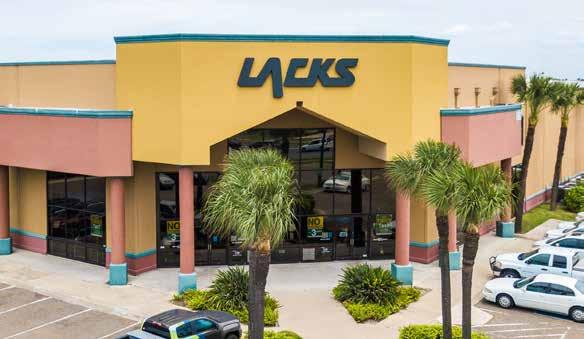
Lack’s Furniture Supports Cancer Patients in the RGV through the Cattle Baron’s Ball
by Sofia Aleman | photos by James Hord
The 22nd annual Cattle Baron’s Ball, a fundraiser for the American Cancer Society, will be taking place from 7 to midnight Saturday, Sept. 22 at the Pharr Events Center. The American Cancer Society of the Rio Grande Valley alongside many generous sponsors hosts an annual country-themed gala aimed to save lives, find cures, and fight back against cancer.
People are lining up for tickets for one incredible evening of great food, an open bar, live country music, dancing, and a spectacular auction. This year, guests of the gala are anticipating an incredible lineup of country artists, including The Powell Brothers, Lauren Corzine, and headliner Sawyer Brown.
“Aside from the fact that it’s one of the most fun events in South Texas, it’s a big party, all of the proceeds raised benefit local patient programs,” said Clara Chapa, community development manager for the South Texas Region of The American Cancer Society.
All of the proceeds raised at the Cattle Baron’s Ball assist local residents with programs that help families with provisions like free wigs for anyone diagnosed with cancer and is undergoing chemotherapy. Another one of the programs includes the help of trusted volunteers who provide transportation assistance for any cancer-related appointments for patients who don’t have vehicles and would otherwise not make it to their appointments. In addition, the American Cancer Society, with the help of donors, is able to provide lodging assistance for patients who have to travel outside of the Valley for treatments,
meaning a guaranteed free hotel stay for families. One of the more exclusive and fun programs offered in the Valley is called “Look Good, Feel Better,” which takes place once a month at the ACS’ local office in McAllen. The program is designed for women undergoing radiation and chemotherapy by providing a safe space for fellowship and makeup tutorials.
“Once some women start undergoing radiation and chemotherapy treatments, their skin changes or they have hair loss and it affects their self-esteem, but this helps them get together with others who might be going through the same thing,” Chapa said.
Volunteer cosmetologists come in once a month and provide free makeup tutorials and help women learn how to care for the radical skin changes that happen because of their cancer treatments. Women get a chance to take home free makeup kits and cherish time bonding with other women undergoing similar experiences. It serves as an encouraging safe haven and aids in boosting their self-esteem and confidence. Without funds from the Cattle Baron’s Ball and generous supporters from the community, some of these programs wouldn’t exist.
One of the biggest contributors to the Cattle Baron’s Ball for the past five years has been Lacks Furniture. This year, Lacks will be the presenting sponsor at the gala, donating $20,000. Every year, Lacks supports the community by raising money not only for the Cattle Baron’s Ball but by organizing other fundraisers for the American Cancer Society like the Zumbathon and “Shop
“They’ve been so great to us. Every dollar that Lack’s raises remains local in our community so that is a big impact that they’re making here in the Valley for people undergoing cancer and cancer treatment who are in need of help.”
Clara Chapa, community development manager for the South Texas Region of The American Cancer Society
for a Cause” events every October. Lacks also raises funds through a one-of-a kind golf and fishing tournament every spring.
“We truly appreciate their continuous support,” Chapa said of Lacks. “They've been so great to us. Every dollar that Lack’s raises remains local in our community so that is a big impact that they’re making here in the Valley for people undergoing cancer and cancer treatment who are in need of help.”
Lacks, a locally owned and operated company, first started donating to the American Cancer Society because of one of the Lacks managers was diagnosed with breast cancer. After co-workers witnessed her battle, there was a greater awareness of cancer at the company. After participating in Relay for Life, a walk-a-thon dedicated to cancer patients, leaders at Lacks were amazed at all that the American Cancer Society did for cancer patients around the Valley. It was then the partnership and bond between Lacks and the ACS began to flourish.
“This is our 83rd anniversary this year,” said Kris Karr, advertising director for Lacks Furniture. “Thanks to the support of the South Texas community, we are who we are. We’ve grown because of the community and this is just our way of giving back and saying thank you. We like to support the American Cancer Society because they give back to the community, as well.
“The fact that the Cattle Baron’s Ball brings the community together for one purpose — to raise funds for cancer, to celebrate life, and support those who are battling — shows so much support,” Karr added. “Everybody shows up for support and I just think that, in itself, is what it’s all about.”
Anyone in the community can participate in this priceless night that gives back to cancer patients of the Valley.
Tickets will be available at the local American Cancer Society office in McAllen. For more information, call Chapa at (956) 682-8329 or send an email to clara. chapa@cancer.org. Tickets are $150 per person or $250 for two people. Visit the website at www.cbbrgv.org and follow the Cattle Baron’s Ball on Facebook at Cattle Baron’s Ball of the RGV.
Make sure to be a part of this one spectacular night a year. Locals unite to relish in the fun, food, and entertainment that help people and families of those undergoing cancer know they are cherished.
Doing Business ACROSS BORDERS
THE FUTURE OF THE
VALLEY
by Cori Smelker
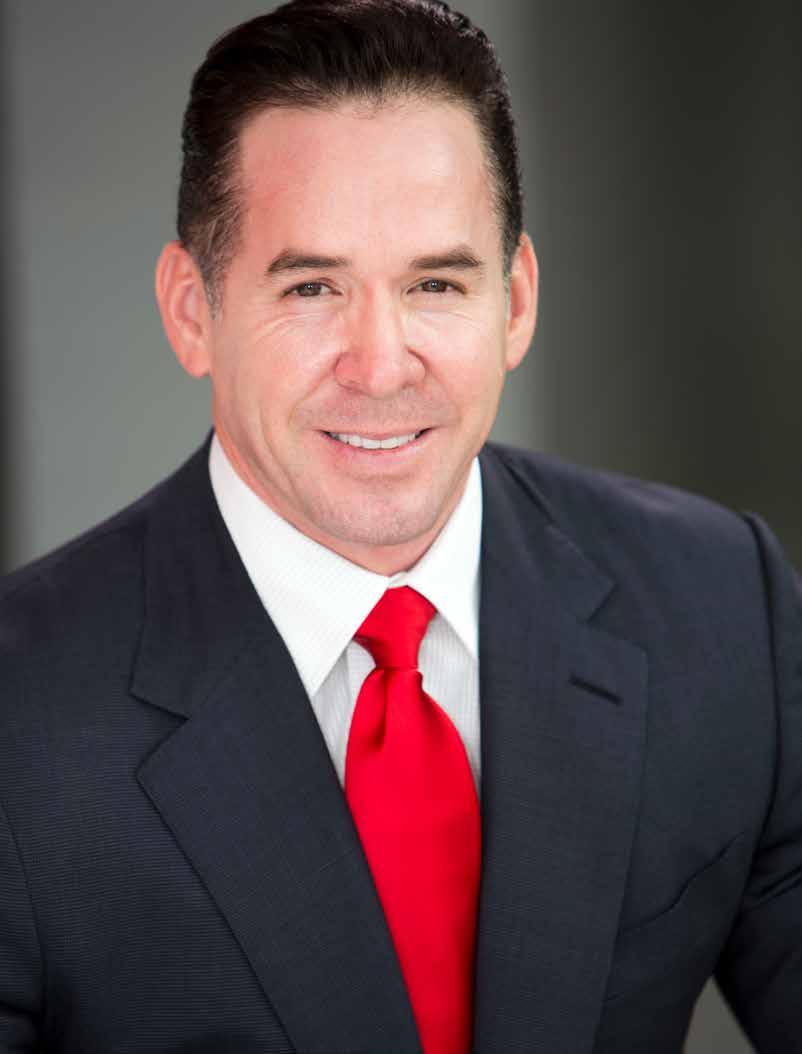
Change is the only constant in this world and with change comes opportunities. No one is better qualified to spearhead change in the Rio Grande Valley in terms of border trade than Sergio Contreras, the president and CEO of the Rio Grande Valley Partnership, a regional chamber of commerce in the Rio Grande Valley.
Contreras is also the vice chairman of The Border Trade Alliance (BTA), an organization that for over 30 years has provided a forum for providing solutions on issues pertaining to the U.S.-Canada and U.S.-Mexico border regions. Representatives from all three countries, and from both the public and private sector, are involved in this alliance. Trade among these three countries is necessary to the economic viability of each region, but for the residents of the Valley, it is essentially the region’s lifeblood. No trade equals no jobs.
According to Contreras, the BTA is committed to working with the current administration and Congress to ensure the ports of entry are best equipped to speed the
passage of legitimate trade and travel while preventing the entrance of contraband or individuals who would seek to do harm. Although illegal immigration is not the focus of the BTA, they do work closely with the Department of Homeland Security and other governmental organizations to prevent it.
Just how important is our trade with Mexico? Five million U.S. jobs can be attributed to trade with Mexico, and many of those jobs are performed right here in the Valley. Contreras explains that just moving goods across the continent was responsible for nearly 50,000 jobs in the trucking industry alone in 2016.
Border trade is the backbone of this region. Without it we would not see component parts moving back and forth before they become part of a finished product (such as cars, machinery, etc.). Going to the grocery store and choosing fresh fruits and vegetables that are technically out of season is a direct result of the good work of the BTA. The ability for workers, shoppers, and tourists to
cross the border and to enjoy attractions on either side, or to visit family and friends, is made easy because of the BTA. By any of these measures, well-functioning ports of entry are essential to our nation’s economic health.
But like anything that is valuable, it needs protection and to be secured. Without the proper resources — personnel, technology, and infrastructure — smugglers or others with ulterior motives could exploit our ports. This has become a hot button issue for people on both sides of the political aisle, but the stance of the BTA is that there is a need for additional resources for Customs and Border Protection (CBP) personnel. The reason is simple:
More resources devoted to inspecting and clearing legitimate freight and travelers means more resources for ensuring that smuggling does not happen.
If we want to keep our borders secure, and go even further in securing them for the future, staffing, specifically for the CBP employees, needs to increase. Currently, there are 1,200 positions open (not all in the Valley, but a fair number of them here). The process to fill these positions has been slow and it can take up to a year for a new hire to be brought on.
Just how much of a difference can hiring more CBP officers make to the security of our borders and to our economic stability? Contreras has a surprising statistic: “The National Center for Risk and Economic Analysis of Terrorism Events at the University of Southern California found in 2013 that the addition of just one CBP officer can inject $2 million into the U.S. economy and create 33 jobs.
“Quite simply, trade means jobs,” he said.
What does this mean for the Valley in particular? If more officers are hired, delays can be lessened. Delays lead to increased costs for consumers, and poorer air quality in and around border communities due to idling trucks. One change has already been implemented, and that is unified cargo processing (UCP).
Under UCP, U.S. and Mexican customs personnel work side by side on U.S. soil to conduct both outbound and inbound inspections. Each country’s officer can decide whether to send a shipment to secondary inspection. If a more invasive inspection is required, UCP ensures that a shipment is only unloaded once, if at all, rather than what exists under the current inspection model, where a truck would often be unloaded in its country of origin and its country of destination.
The Valley stands on the cusp of being a part of the port of the future. We have the ability to deliver real improvements in all areas of border security, and that in turn will expand job-creating commerce and trade.
In the case of the international bridge in Rio Grande City, 100 percent of northbound cargo is eligible for UCP, essentially doubling the bridge’s importing infrastructure capacity. The port still maintains the ability to electronically scan 100 percent of cargo and share inspection images with Mexico.
UCP is a perfect example of making our ports of entry more efficient through better regulations, while ensuring security and increasing capacity, which is a win-win for everybody. New technology increases non-intrusive cargo searches, and scans more efficiently than ever before.
The Valley stands on the cusp of being a part of the port of the future. We have the ability to deliver real improvements in all areas of border security, and that in turn will expand job-creating commerce and trade.
It’s a good time to live and work in the Valley as we look to the future of border security working hand in hand with technology, business, and government.
MISSION ECONOMIC DEVELOPMENT CORPORATION
by
Lori Houston | photos by Dominique Zmuda
Nurturing Contagious Talent
Mission has been investing in their human capital in new and innovative ways. The Mission Economic Development Corporation created a new program at the beginning of 2017 aimed at fostering creative and business expertise among local residents.
The Expert-In-Residence program was modeled on an idea that is seen in big information technology companies like Google or Facebook.
“They usually have positions called Entrepreneur-InResidence, which is normally an entrepreneur that has a really tech-savvy idea that is at the cusp of taking it to the next level,” said Alex Meade, the CEO of Mission EDC.
They are typically taken in and nurtured by the big company and allowed to only focus on that idea — while being paid a salary. But they also have to share their skill-set with other people in the company who may be aspiring entrepreneurs, as well. In those cases, an ownership stake is involved, as the big tech company then becomes part owner in the new venture.
“We decided to take that idea and create an expertin-residence that wasn’t only focused on entrepreneurs, but also able to foster talented artists in the community,” Meade said. For the last year-and-a-half, Mission EDC has been inviting different experts and paying them a stipend to come live in Mission for three or four months and
share their expertise with Rio Grande Valley residents.
The first expert was Jackie Neale, the digital media director for the Metropolitan Museum of Art in New York City.
“Her experience and exposure to talent was more than we typically see down here,” Meade said. While she was in Mission, she taught 20 talented photographers from the region to perfect their skills.
The second expert was focused on utilizing technology to engage the community. Originally from
Mark Peterson, former director of Global Business Development for Procter & Gamble
Jackie Neale, digital media director for the Metropolitan Museum of Art
Alberto Altamirano, cofounder of Cityflag
“Nurturing talent is going to allow us to create this contagious type of attitude that attracts even more talent.”
Alex
the CEO of Mission EDC
Mission, Alberto Altamirano is the co-founder of Cityflag, a civic-technology platform that helps citizens and local government work together to improve communities. He was also recently named to Forbes Magazine’s 30 under 30 list. The executive team of Cityflag offered workshops in social entrepreneurship during their time as ExpertsIn-Residence.
Mark Peterson, the former director of Global Business Development for Procter & Gamble, was the third expert in the program.
“His area of expertise was more marketing- and business-oriented, so what he did was help nurture some of the entrepreneurs here in the area,” Meade said.
According to Meade, small businesses and entrepreneurs can really benefit from having this kind of opportunity. “We learned that if a small business has to hire an expert or a consultant to help them take the next step, they’re not likely to do it because they are lacking the resources,” he said. “So we decided to take on that burden and basically cover those costs to allow entrepreneurs in the region to have somebody to reach out to that can help them get to the next level.”
Meade says he believes that the community will be the ultimate beneficiary of this program because if the business succeeds in getting to the next level, they will likely hire more people and invest more in the community. Through this program, that impact is also scaled to include more people because several local businesses were able to take advantage of the services.
Peterson helped between 15 and 20 businesses. He not only gave specific advice, but also visited the businesses and followed up to see how things were going during his time as Expert-In-Residence. “Mark Peterson has gone above and beyond the advice and the help and support that he could give to the small businesses that we have had here,” Meade said.
Even though Peterson’s initial commitment is over, he has pledged to continue to communicate with the businesses he has mentored and intends to return once a month to consult with any of the original entrepreneurs who still want to talk to him.
So far, most of the experts for the program have been selected from recommendations from people in the Center for Education and Economic Development building and other members of the community. Meade is excited to be on the front end of this new way of encouraging creative, technological, and business growth within the community.
“Nurturing talent is going to allow us to create this contagious type of attitude that attracts even more talent,” he said.
Meade,
Accepting Students Living Anywhere in the RGV!
FAMILY SEPARATIONS
The Valley in the National Spotlight
by Efrén Olivares
Earlier this summer, the Rio Grande Valley drew national and international attention for an unprecedented reason. With the announcement of the federal government’s “zero tolerance” policy on immigration, immigrants traveling with their children started being separated by immigration agents. Children as young as a few months old were separated from their mothers. As the number of separated children grew from dozens to hundreds and then thousands, public concern around the issue spread from the Rio Grande Valley to the rest of the state, the country, and the world.
Many of the people crossing the border were asylumseekers, people fleeing violence and threats in their countries to protect their children. Others were so-called “economic migrants” — people looking for a better opportunity for themselves and their families. Regardless of the reason for crossing, U.S. immigration agents separated children from their parents and prosecuted the parents criminally for “illegal entry,” a misdemeanor. According to the government’s numbers, nearly 3,000 children were taken from their parents and sent to shelters around the country. At the time of writing this article, many had been reunited, but hundreds remained separated, including over 400 parents who were deported to Central America while their children remained in the United States.
Caught in the middle of this storm, the Valley, as usual, did not disappoint.
This crisis gave rise to many needs. On the one hand, there was the need for legal representation. The federal public defenders were the first to have contact with these confused and distressed parents, representing them in their criminal cases.
The Texas Civil Rights Project, an organization with offices in Alamo, represented the families in a case at the Inter-American Commission on Human Rights, based in Washington, D.C. (Full disclosure: The author is an attorney at TCRP.)
On the immigration representation front, the ProBono Asylum Representation Project, or ProBAR, took the lead assisting and orienting these families. Texas RioGrande Legal Aid, with offices in Edinburg, Mercedes, and Brownsville, also provides extensive support to some of these families, particularly those incarcerated in family detention facilities in South Texas. Even local private immigration attorneys stepped up to the plate and took many of these cases pro bono: Jodi Goodwin, Carlos M. Garcia, and Thelma Garcia, to name a few.
And on the social services front, Catholic Charities, both at their Respite Center in McAllen and at the Basilica Hotel in San Juan, stepped up to provide much needed support to the separated families: food, shelter,
“We know and care immensely about this community, and we will continue to be here after the national media attention goes away. It is critical that our voices are heard.”
Dani Marrero Hi, founder and director of Neta
clothing, and assistance reaching their families all over the country.
On the media front, our local print and digital outlets have been covering the issue thoroughly and responsibly. NetaRGV, a digital platform founded and run entirely here in the Valley, has provided extensive coverage, including publishing an audio file of some of the detained children.
“It is important for those of us who are from and live here in the Valley to raise our voices,” said Dani Marrero Hi, founder and director of Neta. “We know and care immensely about this community, and we will continue to be here after the national media attention goes away. It is critical that our voices are heard.”
While many families have already been reunited, the issue is far from being resolved. Many remain separated, and it will likely take many weeks before they are all reunited — especially the ones who have already been deported. For those who have been reunited, the road ahead is long. They have suffered a highly traumatic experience and will need psychological, emotional, and counseling support in the communities where they settle. Both mothers and children have told us stories of going weeks without knowing where the other one was. This was highly traumatic for children, especially the young ones, who did not understand why their mom or dad “left” them and did not come to get them. Many
moms told us that the first time they spoke on the phone to their children, the children would ask “Mommy, why did you leave me? Why won’t you come and get me? When will you come and get me?” Young children simply do not understand the politics or policies around immigration, and they suffer the tragic consequences.
With litigation around this crisis still pending, it will take some time for all the dust to finally settle, and for all of us to understand why and how this happened: Who was in charge of taking the children? Why were some families lied to? Why were hundreds of parents deported without their children? In a democratic society such as ours, all of this information should and will be known, even if it takes time.
In the meantime, those of us who live here in the Valley can continue to support the local organizations that were exemplary in their response to this crisis, either with inkind or monetary donations. In addition, we can all feel proud to be part of a community that will respond and mobilize to address a national crisis in the best possible way, always looking out for one another. And when the eyes of the world are upon us, we know that the Valley will not simply talk the talk, but rather walk the walk, get the job done, and leave politics aside.
LEADING BY EXAMPLE
Vitalis Medical Transport Provides Valuable Services to RGV
by Lori Houston | photo by Jason Garza
“You can do anything you set your mind to, so don’t doubt yourself and always push yourself.” These are the words of wisdom Anna Vargas lives by daily that helped to push her to start her own business, Vitalis, a medical transport company serving the Rio Grande Valley.
Right after college, Vargas started working as a marketer for a medical transport business that her sister owned. She was responsible for helping the company reach as many potential clients as possible. The manager at the time took Vargas under her wing and taught her all about the business.
“While I was there, I pretty much learned the ropes,” Vargas said. “I started paying attention to all of the facets involved in the company and the operation of it. At that point my husband said ‘Hey, why don’t you open up your own business?’”
At first she was surprised at the idea, and a little reluctant. Vargas says she felt like she was too new at it all. Ultimately, it was her husband’s support as well as her own experience that empowered her to actually give it a try. “He [her husband] just kind of said, ‘here’s the money, figure it out,’” Vargas said. “So I started doing research
and studying, and sure enough, a year later, Vitalis was born.”
Technically, she and her sister are now competitors, but they each target a different aspect of the industry. Vargas focuses on private clients while her sister deals with medical facilities that need transport. “So we don’t really get in each other's way,” Vargas said, laughing.
Vargas started Vitalis Medical Transport with one ambulance, two medics, and herself. She has since grown the business to 10 vehicles and 25 employees. Her company is fulfilling a definite need here in the Rio Grande Valley. Her non-emergency ambulance transport service supports patients in a wide variety of situations.
“People don’t often think about the elderly and pediatric patients that require transport on a stretcher because they cannot tolerate a wheelchair, or cannot get in or out of bed on their own because of their condition,” Vargas said. They require the assistance of two medically trained personnel to come in and transfer them onto the stretcher and transport them to a treatment session, doctor appointment, or non-emergency hospital visit. The staff at Vitalis is trained to respond to any emergencies if
Vargas started Vitalis Medical Transport with one ambulance, two medics, and herself. She has since grown the business to 10 vehicles and 25 employees.
one occurs during a transport.
Vitalis is there to support the community, especially during difficult situations. “Some people, family caregivers, might not know that there is someone they can call and they don’t have to struggle alone when their loved-one needs transport,” Vargas said. Most of their clients need to be picked up as well as dropped off at their destination.
Vargas feels driven to help her community, and through her entrepreneurship, she has created a company that is making a difference in the quality of her customer’s lives. Medical transport has traditionally been a maledominated industry, yet she is one of the few women who have opened this type of business in the area.
She now wants to encourage other women to feel empowered. “You can make a change, you can make a difference,” she said. Vargas is a firm believer in setting goals, and going out there and accomplishing them. After realizing she could create a successful business, Vargas set a new goal and is in the process of getting another venture off the ground. Soon, her entrepreneurial spirit will be the driving force behind two successful local business.
“I’m no different than any other Latina, born and raised here,” Vargas said.
THE TRUTH ABOUT EATING DISORDERS: Anorexia, Bulimia, and Binge Eating Disorders
There are different types of eating disorders each with their own diagnostic criteria. The most common eating disorders include anorexia nervosa, bulimia nervosa, and binge eating disorders. They are characterized by disturbed eating behaviors, change in eating patterns, and a significant impairment of health. With the start of the academic year, parents and educators are encouraged to recognize the signs and symptoms of eating disorders, as it can help students get the treatment they need.
ANOREXIA NERVOSA
Anorexia nervosa is a psychological eating disorder. Individuals with anorexia nervosa may believe that they are overweight when in reality they are alarmingly thin. These individuals may avoid, restrict — or eat very little food — and exercise excessively. This disorder may lead to losing a large amount of weight and death
by medical conditions produced by starvation. Some symptoms include extreme thinness, strong fear of gaining weight, and a distorted body image. Individuals with anorexia nervosa typically weigh 15 percent less than the indicated body mass index (BMI) they should have in accordance with their sex, age, and height. Over time, anorexia can lead to brittle hair and nails, thinning of bones, low blood pressure, infertility, and damage to organs such as the brain and heart. Statistics show that anorexia is the third most common chronic illness in the younger population, following asthma (the most common) and type 1 diabetes.
BULIMIA
Bulimia may present itself as episodes of eating large amounts of food and feeling a lack of control of these episodes. These episodes tend to be followed
by vomiting, use of laxatives, fasting, and excessive exercise. In comparison to anorexia, individuals with bulimia can maintain normal weight or be overweight. Symptoms of bulimia include chronically inflamed and sore throat, severe dehydration from vomiting, swollen salivary glands, worn out tooth enamel and decaying teeth (from exposure to stomach acid), and acid reflux disorder. As people with bulimia can have a normal range body weight for their height and age, Families Empowered and Supporting Treatment of Eating Disorders (F.E.A.S.T.) believe bulimia nervosa in the student population is often under-reported and under-diagnosed.
BINGE-EATING
Binge eating disorder was recently recognized as a clinical condition by the DSM5. It is characterized by individuals losing control over their eating. This disorder, unlike bulimia, does not include purging. Therefore, these individualbs are often overweight or obese. Some symptoms include eating large amounts of food, eating fast during binge episodes, eating even when full or not hungry, eating alone to avoid embarrassment, and feeling distressed or guilty about eating.
THE STATISTICS
Thirty million people across the United States suffer from an eating disorder. Eating disorders do not discriminate between gender, age, race/ethnic groups, and economic classes. Eating disorders are extremely dangerous. According to epidemiologic research, eating disorders have the highest mortality rate of any mental illness, and at least one person dies every 62 minutes as a result of an eating disorder. Additionally, up to 50 percent of individuals with eating disorders engage in substance abuse. This rate is five times higher than the general population.
CAUSES
Eating disorders are caused by a wide variety of different factors. One common trend seen from people who suffer from anorexia, bulimia, and binge eating disorder is body issues and poor self-esteem. Many times, body issues are prominent because of the media’s influence on what is considered ideal. The media often portrays and celebrates people who are thin, and frequently frowns upon the rest. One study conducted on 238 undergraduate female students demonstrated that media had a direct effect on eating disorder symptoms. Consequently, the media influences the way teenagers and young adults interact with each other, facilitating the introduction of poor self-esteem and body issues.
TREATMENTS
Treatments for anorexia nervosa and bulimia include a comprehensive and holistic approach that covers individual and family/group therapy, medical services, and in some cases psychiatric medication such as antidepressants. Monitoring exercise and nutritional counseling are also imperative components of the treatment plan. The National Institute of Mental Health emphasizes that treatment and intervention are imperative to start as early as possible, given that individuals diagnosed with eating disorders are at higher risk of suicide and/or developing other mental health problems. If you or a loved one is struggling with an eating disorder and/or is on the road to recovery, contact a support group or hotlines provided below.
WARNING SIGNS
While the following list is not all inclusive, here are some warning signs that may indicate to educators, parents, and friends if a student has an eating disorder:
Avoidance in eating food during social situations
Weight gain, weight loss, or variation in weight
Using the restroom immediately after eating
An excessive diet plan and/or excessive exercise
Disapproving comments about their weight and appearance
Calluses on knuckles that can occur from sticking their fingers down their throat
If you or a loved one is struggling with an eating disorder, contact any of the following hotlines. If immediate danger is present, call 9-1-1.
National Eating Disorders Association Helpline: 1-800-9312237
Crisis Textline: Text CONNECT to 741741 — in service 24 hours a day, 365 days a year
References Available Upon Request (Co-Authors include Dr. Mercado’s Mental Health Lab at UTRGV: Abigail Nunez-Saenz, Andy Torres, Jose Garcia, Paola Salazar, and Stephanie Arellano)
Dr. Michael Lago
Valley Care Clinics Pediatric Orthopedic Surgeon Specializing in Scoliosis
by RGVision | photo by Johnny Quiroz
Dr. Michael Lago is a Valley Care Clinics pediatric orthopedic specialist specializing in scoliosis, hip problems and lower extremity deformities. He practices in McAllen, as well as the surrounding cities in the Rio Grande Valley. Dr. Lago is an accomplished surgeon with a passion for helping children. Our staff had the privilege of meeting with Dr. Lago to learn more about what it means to be a pediatric orthopedic surgeon and the difference he is making in the lives of Valley residents.
RGVision: Tell us a little about yourself.
Dr. Michael Lago: I was born and raised in Miami. I’m a first-generation American, my parents are Cuban.
As far as education, I’ve trained at multiple places.
I got my undergrad at Florida State, I did medical school here in Texas at the University of Texas at Houston. I did my residency — basic orthopedic training at the University of Florida at Tampa — and then my specialized training in pediatric spine and orthopedics was done at University of Utah at Shriners. Now I’m here in the Valley.
R: What’s unique about working here in the Valley? Why did you come here?
DR. ML: One thing that makes the Valley unique is that it’s extremely underserved. It’s one of the only areas in the country where the birth rate is still going up as opposed to the rest of the country, where it’s
slowing down, so there are a lot of opportunities and lots of patients who need help.
R: What drove you to be a pediatric orthopedic surgeon?
DR. ML: I have a son with special needs.
R: Is there a moment that stands out to you as a physician? Something that changed the way you react to patients or with children?
DR. ML: When I found out my son had special needs and the way he was treated. That left a huge impression on me and I wanted to be there for families whenever a hard diagnosis had to be delivered and I wanted to be available and I wanted to comfort them in their times of need.
R: When it comes to your specialty of pediatric orthopedics, what’s your passion?
DR. ML: Within the field of pediatric orthopedics my passion is scoliosis. A close second is hip problems or lower extremity deformities but my true passion is scoliosis.
R: Can you describe scoliosis in layman’s terms?
DR. ML: Scoliosis is a three-dimensional deformity in the spine that occurs at any age of childhood and sometimes even in some adults. But for kids, it happens most of the time when they’re growing. The most common form is the adolescent kind, which is discovered between ages 10 and 14.
Scoliosis is a three-dimensional deformity in the spine that occurs at any age of childhood and sometimes even in some adults.
R: Who does it happen to?
DR. ML: Scoliosis is most commonly found in girls and most operated on in girls. I don’t know why it occurs most often in girls but it does happen in boys, as well.
R: What can parents notice in their child? When do they become cognizant that their child might have scoliosis?
DR. ML: Here in the Valley, it’s easy to catch early because the children are usually wearing light clothing. In the north lots of kids go into winter normal and come out with scoliosis and the parents won’t know because children have been wearing sweaters all winter. But noticeable signs of scoliosis are when the child bends over they can notice if one side of the ribs are higher than the other or one shoulder is asymmetric or maybe even their torso shifted a little bit to the side.
R: Does it hurt? Will your child complain of pain?
DR. ML: Sometimes they will complain of pain. Sometimes there’s no pain. Traditionally scoliosis itself is not associated with pain unless its curves are very extreme. Most of the pain that kids have when they have scoliosis are the same aches and pains that other children get as normal growing pains.
R: How is it diagnosed?
DR. ML: First there’s a screening test: Adams Forward Bend Test. Basically, the patient bends over and you examine their back, you examine for symmetry of the spine itself to make sure that it’s in a straight line or not. You also look at the ribs and the torso. The way it’s confirmed is with X-rays.
R: How is it treated?
DR. ML: Scoliosis has several treatments. The most common treatment is bracing if the patient is a candidate
for that. But if the bracing fails and the patient has a curve over a certain magnitude, then they are eligible for surgery.
R: So is surgery the last option or is it a quality of life thing? Can this deformity be life-threatening or lifealtering?
DR. ML: So scoliosis itself can be life-limiting and lifealtering. It can change the quality of life depending on the curve magnitude. If the curve gets big enough, it can impair pulmonary function and cardiac function. It can also cause pain, meaning limited quality of life in that matter.
R: It’s a pretty major surgery for a child. What’s the recovery time?
DR. ML: The surgery is a major surgery — we’re operating on a child’s spine. The recovery depends on the actual child. Some children recover faster than others, but traditionally, I’ve gotten kids back to school within a month. After the first month they’re going to school part time for a couple weeks, then they gradually build up at two months or go completely back to their full school hours. If they play sports, usually at six months.
R: Can scoliosis affect anybody?
DR. ML: Scoliosis is found in many families across all socioeconomic statuses.
R: Is it genetic?
DR. ML: Like anything else, scoliosis is associated with genetics but questions are still being investigated by science.
MENTAL LOAD
How Workload, Stress, and Anxiety Impact Productivity at Work
by Sofia Aleman
Happy employees make happy customers. When employees believe their work is valued and they find respect and peace in the workplace, the quality of the service or product your company provides will greatly impact how many customers are happily spreading the word about your business. But what happens when the opposite is true and employees believe they are undervalued, their creative qualities are stifled, they do not have a clear understanding of their job roles, or they feel too hard-pressed to make deadlines? When employees don’t have an open line of communication with their employers and are experiencing stress, fatigue, anxiety, or are undergoing micromanagement while completing their assigned tasks, it will start to create a heavy mental load and ultimately affect productivity.
“Mental load is the feeling of being overwhelmed trying to effectively and efficiently manage different roles — people start to feel very stressed, and maybe sometimes even anxious with the number of goals and responsibilities that they’re trying to manage,” said Karla Arredondo, an occupational therapist and owner of Feminae Women’s Health and Holistic Services, a women's health practice that embraces the mind-body connection of women during their prenatal and postnatal stages.
More often, mental load affects people with jobs that require a lot of creativity, like teaching, marketing, advertising, writing, film, owning a restaurant, and many more careers with multiple potential outcomes based on individual ingenuity. It happens when meeting the bottom line isn’t coupled with creative opportunity, when deadlines become too burdensome and quantity outweighs quality in the
Employees who enjoy their job use their sick days less often, take the time to do their best, have fresh and creative ideas, and bring in happy customers.
workplace, or when there’s not an equal opportunity for communication and collaboration.
“We think that the most important part of our job is being productive,” Arredondo said.
And while production is ultimately the goal, the quality of the product should matter.
Many employers make the mistake of getting caught up in production without taking into account that each varied task requires strategic planning or creative brainstorming that should be included into the workload and counted as valuable. Employees frantically scramble around to “produce, produce, produce,” and creative opportunity is squelched. The more common saying is giving reverence to what is happening “behind the scenes,” even to the employee outside of work. And making sure employers understand how workload or work assignments are affecting the employee.
“When we just look at the workload and not take into account mental and emotional well-being it can lead to burnout, and can lead to more serious conditions related to someone's mental and emotional well-being — looking just at a visible list of things someone needs to do while ignoring their well-being is a very incomplete approach,” Arredondo said.
Frank Mitchell, an independent contractor for HealthMarkets Health Insurance, which services the Valley, explains all companies are in the business of making money. Ultimately, there has to be a profit to make the business successful and every employee is hired to add value to the company in some way. And while employers are advised to evaluate their employees, provide constructive feedback, and redirect or reprimand when necessary, they should still take time to listen to the concerns of their employees and help them where applicable.
“Management’s sole purpose other than making sure they get the most out of every employee is figuring out a way to help their employees meet their goals and be a part of the process — the happier you can get those people, the better the results will be,” Mitchell said. “Checking up on your employees and reviewing their progress is important, but sitting down and grilling somebody about how far along they are with something or if they’ve met their goals is a lazy way to do it.”
Employers will notice signs of their employees being overworked, stressed, or fatigued in the workplace if they
start to come in too early, stay too late, or work during their lunch break multiple times. They might also become combative or resentful of their co-workers, not receptive to new information, or show tense body language — especially at meetings with their supervisors.
But thankfully there are solutions. Both Mitchell and Arredondo agree that education on the matter and consistent communication, which includes active listening, are among some of the leading solutions to fostering amity in the workplace.
“Communication of course is the key — a supervisor or a business owner has to have an open door of communication with their employees so that their employees can say, without being condemned for it, ‘I can’t finish that’ or ‘that’s too much — I need an extra three hours or three days,’ whatever the case may be,” Mitchell said. “Management has to be receptive receiving that information so that they can decide whether it’s the right thing to do and of course to get the results that they’re looking for — that’s what management is about.”
Another way to support quality of products or services and minimize stress in the workplace is allowing for employees to be creative, even if it includes working on projects outside of their assigned job roles. Management needs to listen and evaluate new ideas, and give employees time to collaborate, plan, and brainstorm.
“When you allow somebody to be creative on something other than what they’ve been assigned, it helps them think outside the box on what they have been assigned,” Mitchell said.
Mitchell also recommends social activities outside of the workplace that promote togetherness and team building. Minimizing stress- and anxiety-related health issues can even include granting employees a set number of paid time off without hassle, and supplying health insurance.
Employees who enjoy their job use their sick days less often, take the time to do their best, have fresh and creative ideas, and bring in happy customers.
For more information on small business health insurance with HealthMarkets, contact Frank Mitchell at fmitchell@ healthmarkets.com. And for more information on women’s health occupational therapy, contact Karla Arredondo at (956) 224-9294 or visit www.feminaehealth.com.
Toxic Beauty
by Karla Arredondo / photo by Dominique Zmuda
The rise of awareness about the food we eat and its direct impact on our health continues to expand, and it is gaining momentum in our area. Diving deeper into health and wellness, and how our everyday choices affect these, we looked at beauty and personal care products. In the era of bloggers and social media influencers, our decisions are significantly manipulated by the messages we get daily in our social media feeds. That gorgeous video blogger whose complexion looks perfect has tested so many products, she knows what she’s talking about. Or the celebrities showing us their beauty routines, who we feel an intimate friendship with because we comment on their posts and they even reply sometimes, we listen to them. Of course we will buy what they recommend. But what exactly are we putting on our skin?
Our skin is the largest organ in our body, the first line
of defense from the environment. It is a living system that breathes and absorbs what we place on it. Do we nourish it with natural, organic products in harmony with our biology, or are we adding dead, artificial ingredients and chemicals? What we put on our skin ends up in our system, just like the food we eat. It has an effect on our brain chemistry, our hormonal balance, and even in the likelihood of developing disease. Are we making safe and informed choices? Is it enough that a product is expensive? What if it says “natural” and “organic”? How can we tell if a product is “clean”?
The Think Dirty® App is a wonderful resource to have on your phone if you want to immediately obtain feedback on the products you are contemplating buying. You scan a product’s barcode, hold for a few seconds, and, voilà! The app provides a rating number and color
(from Dirty to Clean; red to green), a list of ingredients and their individual toxicity number rating, and on an adjacent tab, Think Dirty® shares their recommendations for similar products. That’s it! It is amazingly simple to use, yet invaluable in helping you navigate your journey towards cleaner, safer beauty and personal care products for you and your family.
In cases where you scan or search for an item, and it is not found on the app’s database, you have the option to enter it manually. You will then have submitted a new product that Think Dirty® will rate and add to their database for future reference. Additionally, you can personalize your experience, by adding items to different lists, such as My Bathroom Shelf, Dirty Products, Clean Products, Products I Liked, Kitchen Cleaners, Baby, and more.
The purpose of Think Dirty® is to help consumers identify the potential risks associated with the personal care products they use every day. Think Dirty® considers it best to focus on the chemical content of the products they review, rather that “greenwashing,” or taking into account a manufacturer’s social or environmental responsibility to artificially lower a product’s toxicity rating. Think Dirty® states, “We assess the overall risk of a given product based on the potential health impacts of its published ingredients. Each ingredient listed on the product label or manufacturer’s website is evaluated for documented evidence of Carcinogenicity, Developmental & Reproductive Toxicity and/or Allergenicity & Immunotoxicity.” This is what their Rating Scale, or Dirty Meter, looks like:
While there are many factors to consider when deciding if a product is “clean” or “dirty,” the following list includes absolute toxic ingredients to avoid, rated 10-7 by Think Dirty®, and present in popular brands of beauty and personal care products.
Fragrance/Parfum
BHA / BHT, PEGs, Petrochemicals
Parabens
Phthalates
Formaldehyde-releasing agents
Siloxanes
Sulfates
Non-biodegradable ingredients
Considering going deeper into living a healthier life by making more mindful choices when it comes to every day beauty and personal care products, even household and cleaning products, can quickly become overwhelming. The Think Dirty® App simplifies this process and is a true sidekick when it comes to helping you make more informed purchases, and even offers their best rated suggestions for similar products. Our skin—the largest organ in our body— is the first line of defense from the environment, but it also needs our care and support. Making gradual but consistent changes in the products you apply to your skin, or what you come in contact with, such as laundry detergent and household cleaning products, produces exponential positive changes to overall health and wellness in the long run.
UPCOMING EVENTS
TUESDAY SEPTEMBER 4
+ Dr Cesar Lozano “No Te Enganches”
WED-SUN SEPTEMBER 12-16
+ Les Misérables
SATURDAY SEPTEMBER 22-23
+ Fiesta de Palmas
SUNDAY SEPTEMBER 23
+ Ballet Folklorico de Mexico de Amalia Hernandez
FRIDAY SEPTEMBER 28
+ Valley Symphony I: A Night In Paris
SUNDAY SEPTEMBER 30
+ Pareja De Tres
FRIDAY OCTOBER 26
+ Valley Symphony II: A Harry Potter Halloween
SUNDAY OCTOBER 28
+ Gipsy Kings ft. Andre Reyes
SUNDAY NOVEMBER 3
+ José Madero
TUESDAY NOVEMBER 13
+ America Loves The Movies: McAllen Wind Ensemble
956.681.3800
www.mcallenpac.net
graphic by Think Dirty®
HEALTHY PUMPKIN MUFFINS
(WITH THE LEFTOVERS OF THE HALLOWEEN PUMPKIN)
photo by Omar Díaz
Remove the pumpkin pulp and seeds by placing them in bowls separately. Place the seeds in water for 10 to 15 minutes, drain and reserve.
DRY INGREDIENTS:
1 1/2 cup of oatmeal
1 / 2 cup of almond or walnut flour
3 sachets of stevia
2 tablespoons of cinnamon powder
1 tablespoon of baking powder
1 pinch of sea salt
WET INGREDIENTS:
1 cup of pumpkin pulp
1/2 cup of coconut or almond milk without sugar
1 beaten egg
1 tablespoon of organic low calorie agave honey
2 tablespoons of liquid coconut oil
PREPARATION
1. Heat the oven to 350 degrees F
2. Mix the dry and wet ingredients separately and then add until a homogeneous mixture is obtained (add the coconut oil to the end and beat well)
3. Empty the mixture in a mold for cupcakes (with paper cups)
4. Add pumpkin seeds previously washed and dried on the top
5. Put the mold in the oven for 20 to 25 minutes (dip a toothpick in the center of the muffin to see if it is well cooked)
6. Let cool for a few minutes before enjoying
RECIPE PROVIDED BY: ANA KAREN TORRES
Bachelor of Science (BS): Nutrition
More recipes can be found on Facebook: @anakarentorresonlinenutrition
Below the SURFACE
The RGV Cleans up its Water Act
by Rod Santa Ana
It’s hard to imagine now, but when Joe Sanchez first ran for mayor of Weslaco in the 1970s, he vowed to eliminate the many outhouses located throughout the city.
He won, and eventually fulfilled his promise to hook up all residences to a central sewer system.
Sanchez arguably started a massive project that continues to this day in the Rio Grande Valley: developing an infrastructure of water delivery and wastewater treatment that are both efficient and environmentally friendly.
Without such systems, the economy and quality of life here would suffer, experts say.
IN THE BEGINNING
The Valley’s original water delivery system was constructed by land companies in the early 1900s. It consisted of some 50 pumphouses along the Rio Grande that pushed water via canals from the river to agricultural fields.
At its peak, the system was irrigating 1 million acres of land and was considered the largest privately owned irrigation project in the world.
Successful farming brought in outside cash, which led to the development of banks and commerce that eventually created the explosive economy and population growth we’re seeing today.
Along the way, agriculture’s irrigation system was burdened with added duties it was not designed for: providing water to municipalities and industry.
In times of drought, the antiquated water system was deemed wasteful and inadequate. Outhouses and crude open-pit sewer systems would no longer do.
CLEANING UP OUR ACT
While it’s not often mentioned or sexy enough to grab headlines, the impressive saga of the Valley’s booming economy, commerce, and population is also the impressive story of updating and upgrading its water delivery and wastewater treatment infrastructure.
Untold millions have been spent on this massive project and many more will be spent as the Valley slowly but surely catches up to where its infrastructure should be.
Jaime Flores, a younger relative of Joe Sanchez, who vividly remembers his plan to improve Weslaco, has also played a major role in the Valley’s infrastructure upgrade. He coordinates the efforts of state, federal, and local agencies, as well as stakeholders, to contribute funds, input, and strategies.
Flores is the watershed coordinator of the Arroyo Colorado in South Texas for Texas A&M’s Texas Water Resources Institute.
He’s been on the job 10 years and says the progress
“FOR THE FIRST TIME, BACTERIA COUNTS HAVE FINALLY LEVELED OFF. THERE IS LIGHT AT THE END OF THE TUNNEL. WE CAN NO LONGER AFFORD TO REMAIN UNEDUCATED AND STUCK IN OUR OLD WAYS.”
- JAIME FLORES,
watershed coordinator of the Arroyo Colorado at Texas A&M’s Texas Water Resources Institute
he’s seen during that time has been remarkable.
“Since I’ve been in this job,” Flores said, “about $150 million has been spent just on upgrading sewer treatment plants in the Valley.”
He said the city of Alamo is the most recent, and one of the last, cities in the Valley to convert to what’s called a mechanical treatment system.
“These modern systems replace systems that were the vestiges of the 1950s and ’60s when cities would dump their sewage in an open lagoonal system and treat it with chemicals,” he said. “Those systems were very large, smelly, unsanitary, inefficient and not environmentally friendly.”
Flores said until now, the Valley’s antiquated infrastructure had always been about 30 years behind other large metropolitan areas of Texas.
“But we’re catching up to areas like San Antonio, Houston, and Dallas,” he said. “And it all goes back to new rules and regulations by the state that improve the quality of water and effluent produced by water and waste treatment facilities.”
The state can impose stiff fines on cities that fail to meet the new standards.
“But in many cases, if there is a violation, the state can offer the city alternatives,” Flores said. “In lieu of paying a $5 million fine, for example, the city can invest that money in a modern sewer system in order to meet the new effluent limits.”
Flores said many other Valley cities have upgraded their sewer treatment plants and it’s starting to show. For years, bacteria levels in the Arroyo Colorado had consistently been on the increase.
“For the first time, bacteria counts have finally leveled off,” he said. “There is light at the end of the tunnel. We
can no longer afford to remain uneducated and stuck in our old ways.”
CLEANING UP THE ARROYO
If the Rio Grande is our only source of potable water, or tap, the Arroyo Colorado, which runs 90 miles from near Mission to the Lower Laguna Madre, serves as the Valley’s “drain.”
The estuary in the lower 25 miles of the arroyo is an important nursery for many fish, crab, and shrimp species.
But after years of receiving pollutants as it drains water from the Valley to the Gulf of Mexico, both the arroyo and the bay are on the state’s list of impaired water bodies. Flores has led impressive efforts to reduce their bacteria levels.
FARMERS ARE NOW MORE WATER SAVVY
The Rio Grande has come under tremendous pressures recently from drought, climate change, a rapid population growth, and a lack of inflows from Mexico.
But farmers, the Valley’s largest water users, have become much more efficient in their use of the precious liquid.
Collaborative efforts among agricultural agencies of the Texas A&M University system, irrigation districts, the TWRI, and others have led to the widespread use of better farming methods and technologies that help save water.
“Irrigation districts have made great strides in lining many miles of canals, and building pipe systems to avoid seepage,” said Dr. Juan Enciso, an irrigation engineer at Texas A&M AgriLife Research in Weslaco.
“These districts have also invested in automatic gates
to accommodate supply and demand while increasing the reliability of the delivery system,” he added. “Farmers now level their fields routinely to irrigate more efficiently and avoid deep percolation and water runoff. They’ve also gotten away from using earthen ditches in their fields and instead use flexible plastic pipes.”
Enciso said these efforts have not only saved countless acre-feet of water over the years, growers have actually seen a surge in productivity.
Other on-farm efforts include the use of soil water sensors, tighter irrigation schedules, and the use of small reservoirs to supply water for drip irrigation and pressurized irrigation systems.
“Farmers know they need to protect the environment by reducing sediment and fertilizer loadings in agricultural runoff that could wind up in the Arroyo Colorado,” he said.
Victor Gutierrez, a TWRI AgriLife Extension assistant, said his office has worked for years with growers on a soil campaign to reduce the use of fertilizers.
“With free soil testing to determine nutrients already in the soil, growers can see for themselves that adding extra amounts of fertilizer other than what is recommended may be a waste of money that won’t considerably increase crop production. That helps reduce runoff contamination.”
TRACKING THE NUMBERS
Dr. John Tracy, director of the Texas Water Resources Institute in College Station, said he’s often asked how “the water crisis,” or shortage, will eventually be resolved.
“My standard answer is that there is no water crisis, per se,” he said. “There are just competing interests for water, and on top of that, a natural situation where climate causes variations in how much water is available.”
That constant pressure, Tracy said, forces us to make decisions on how to manage the water we do have. Therefore, it’s important to have the proper tools in place to get through the current pressure, as well as those that will inevitably come in the future.
“I can tell you by looking at hard data on water availability and use, which is released every five years by the U.S. Geological Service, as a country and a state such as Texas, we are using less water than we did 20 years ago in each water-use sector, including industrial, agricultural, municipal and others,” Tracy said.
We are using less water even though crop production is higher, the economy is larger, and the population has increased compared to 20 years ago. How is that possible?
Tracy said the answer lies in the fact that water was
more plentiful and cheaper 20 to 40 years ago and evaluating waste was not worth the effort.
“The quickest way to waste water is to not measure what you’re using,” he said. “So, the first step toward a better water future in the Lower Rio Grande Valley is just data — measure everything: what’s coming out of the river, how much is agriculture using, how much are municipalities using, how much is going into homes, everything.”
Tracy said unlike the past, it is now relatively cheap to gather and store massive amounts of data, and by measuring where water is being wasted, steps can be taken to stop it.
And that reduction in water use will continue even in times of plenty. People, he said, have an amazing ability to adapt if they know where water is being wasted.
“If we look back 30 years at what the projections were of water use per capita today, we can see that that didn’t materialize,” he said. “Why? Because people are now more aware, thanks to technology, of water use. People will not pay for something of zero value if they’re made aware of where their water is being wasted.”
ANOTHER GROWTH EXPLOSION IS COMING
Tracy said studies clearly show that the Valley’s economy and population growth in the future will become an even greater significant sector of the state’s overall economy.
“So we need to get this water situation right,” he said. “Not only is the Valley population growing, the skill set is moving from day labor to blue and white collar jobs as well as in technology, all underpinned by agriculture.
“So we need to manage our water quantity and quality issues correctly in order to support the huge economic growth that’s coming.”
EL GRITO
A Celebration of Mexican Independence Day on 16 de septiembre
by Sofia Aleman
On the 16th of September, Mexicans all over the world celebrate Mexican Independence Day with a traditional grito, or declaration.
It first started in 1521 when Hernán Cortés, the leader of a Spanish invasion, landed in Mexico. At this time, the Aztecs had built a great empire and the Spaniards aimed their attacks at them.
Fast forward to 1808. After many years of Mexico struggling to find its identity, Spain was invaded by the French. Napoleon I forced King Ferdinand VII to renounce his throne in order to replace his role as emperor with Napoleon's brother, Joseph Bonaparte. Two secret societies were birthed in Mexico after this occasion in history: Spanish officials in Mexico who supported Ferdinand, and another group who advocated independence from Spain.
Miguel Hidalgo y Costilla, a Roman Catholic priest, belonged to a pro-independence group in San Miguel near Dolores, Mexico, and is well known for his revolutionary acts and as one of the leading participants in Mexican independence. According to a Britannica article titled “Miguel Hidalgo y Costilla,” Hidalgo was holding
secret meetings where he discussed “His interest in the economic advancement of his parishioners — for example, through the introduction of newer methods of agriculture — and his political convictions regarding the oppression of the people by the Spanish authorities ...”
Once found out, several members of his proindependence group were arrested. After being warned to flee the country, Hidalgo decided first to strengthen the people through a public declaration of encouragement.
“On Sept. 16, 1810, Hidalgo rang the church bell in Dolores to call his parishioners to an announcement of revolution against the Spanish. His speech was not only an encouragement to revolt but a cry for racial equality and the redistribution of land. It became known as the Grito de Dolores ‘Cry of Dolores,’” according to the Britannica article titled “Miguel Hidalgo y Costilla.”
“A grito is like a declaration, ‘grito de independencia’ — they translate it as cry, but basically it’s a declaration,” said Amado Balderas, Mexican American studies teacher for Johnny G. Economedes High School in Edinburg.
And although scholars have not been able to pinpoint the exact words Hidalgo used, according to Balderas they
“I think the embracing of culture is very important because it makes you a whole person.”
have collaboratively agreed it is a mixture of these phrases.
“Vive la Virgen de Guadalupe”- Long live the Virgin of Guadalupe
The Mexicans at that time gravitated to the Virgin of Guadalupe because it’s associated with Mexico’s indigenous past and a deity called Tonantzin. Before that, the Spanish had a hard time converting Mexicans into Catholics. But after her appearance to a Nahua man in 1531 on Tepeyac Hill, north of Mexico City, there was a shrine dedicated to her and she was recognized by the Catholic church as a manifestation of the Virgin Mary. The Virgen de Guadalupe was viewed by many Mexican people then and currently to be a special protector of Native American peoples.
“Muerte a los gachupines”- Death to the gachupines
The gachupines were the Spanish who ruled Mexico. The word gachupin is a Nahuatl word that means “he who hits you in the head with a boot or a spur.” It’s where the current word gacho comes from meaning somebody who’s mean, but it more accurately represents someone who hits you. After invasion of Mexico, the Spanish were the only ones allowed on horses and as a result would hit the natives in the head as they rode, so the Spaniards were called gachupines. It is a word that is currently culturally identifiable but is a derogatory term.
“Bajo con el mal gobierno”- Down with the bad government
This statement refers to the abuse and oppression that was taking place against the indigenous peoples of Mexico.
This has led to the current custom of giving a grito on 16 de septiembre. In Mexico, although the historical context may not be explained in detail every single year, residents can expect a special grito performed by the current president. All over the Valley, people can be heard crying out the recognizable grito just like the original one Hidalgo did in 1810.
Though the holiday isn’t nationally celebrated or marketed as much as cinco de mayo, people whose heritage is in Mexico are encouraged to learn the history of the country and embrace their culture.
“I think the embracing of culture is very important because it makes you a whole person, the Mestizo and indigenous culture of our foundation cannot be erased — the tacos, the molcajete, the chile — when it’s by itself on its own, it’s very rich and delicious,” Balderas said.
“Culture to some degree for me and embracing the culture I think just makes you a better person, it puts a solid in your ground, as a Mexican-American in the United States, when you embrace your ‘Mexicanness,’ you’re embracing 20,000 years of history,” he added.
A lawyer, a tax accountant and a financial advisor walk into a bar. Seriously. That was the start of a well-coordinated plan that’s still paying off in 2018.
Managing wealth is no joke. And advice coordination is essential as wealth grows, and grows more complex. From thoughtfully planning for a long retirement to addressing unique needs like concentrated equity positions or selling a business, a Raymond James financial advisor can pull the pieces together to orchestrate a properly synched approach. LIFE WELL PLANNED.
Bill Martin, CFP® Vice President, Investments
Amado Bald eras, Mexican American studies teacher for Johnny G. Economedes High School in Edinburg
The Valley’s
BEST TACOS
AN RGVISION FOODIE GUIDE
RGVision wants to know where we can locate some of the Rio Grande Valley’s best and most frequented restaurants for all types of foods and treats. For this issue, we asked our readers to vote for their favorite taco spots for three different categories of tacos: street, breakfast and gourmet. We compiled that list of the top voted places and published it as a guide where you can find the most delicious and authentic tacos across the RGV! We encourage you to try as many of these taco joints as possible, and upload photos on Instagram and Facebook, and tag us at @rgvisionmagazine.
Street Tacos Breakfast Tacos Gourmet Tacos
Taquería Río Bravo, Mission
Nana’s Taquería, Weslaco
Taquito Express, Brownsville
Taquería El Último Taco, Brownsville
El Rodeo Taco Express, McAllen
Manuel’s, Port Isabel
Taquería El Papa Taco, Mission
El Pato, 13 locations Valley-wide
Kali’s Tortillería & Bakery, Mcallen
Espi & T’s, McAllen
El Santuario Tacos & Cocktails, Olmito
Nuri, McAllen
Rio Grande Grill, Harlingen
Bodega Tavern & Kitchen, McAllen
Green Ceviche, Edinburg
VISUAL Storytelling
Is Instagram the Social Media Platform for Your Blog?
by Angela M. Insalaco | photos by Life Through Lens and Mariela Peña
Have you ever thought about starting a blog? In today’s society, “content” constantly surrounds us. You can go online, navigate a couple of clicks, and bam — you are online, communicating with the masses.
For many people who decide to start a blog, Instagram is the go-to social media channel of choice as a visual platform that allows a writer to connect with an audience in a fresh and new way.
For the novice blogger, there are some obvious attractions to using Instagram. After speaking to several local bloggers using this platform, a recurring theme was they started blogs on Instagram because they were looking for a creative outlet.
There are several reasons that people like using Instagram over other social media platforms. No matter what your interests are, there is a high probability you will be able to find an audience.
You can find a community of like-minded individuals for almost any topic imaginable. Whether you are interested in local restaurants in the Rio Grande Valley or
you are interested in 18th century Gothic poetry, chances are you can find a community that shares your passions and interests.
Mariela Peña’s @agoodskinday about skincare was a natural progression after dealing with her own skincare challenges. “It started as a hobby, it was a way for me to talk about skincare, beauty and products … it’s basically just me talking about other products,” she said. This has led, in less than one year, to over 11,000 followers from all around the world.
One of nice things about Instagram is that in addition to being industry centric, you can also be geographically centric.
“Instagram kind of works to get me business and collaborations in my area,” said Seems Fuentes, a food-music-fashion blogger in the Rio Grande Valley. By focusing in on a specific location, Fuentes via @ thergvseems has been able to establish herself as the go-to-person for knowing what’s what in the Rio Grande Valley.
“
“ IT STARTED AS A HOBBY, IT WAS A WAY FOR ME TO TALK ABOUT SKINCARE, BEAUTY AND PRODUCTS...
- Mariela Peña
HERE ARE SEVEN TIPS FOR STARTING A BLOG ON INSTAGRAM:
1. Be genuine: You want your audience to like, trust, and respect you.
2. Be relatable: You want to be viewed as a friend, not as a business trying to sell something.
3. Be knowledgeable: If you are going to start a blog, you need to have some knowledge of your industry.
4. Follow others who have similar interests: By following others in similar industries, you are fostering a sense of community.
5. Be positive: As with all social media platforms, you want to keep your posts positive.
6. Use hashtags: Hashtags are important to get others to share posts and for you to follow others.
7. Etiquette is important: Photos should always be credited to the original source.
Instagram’s users tend to skew younger. It is the platform of choice for Generation Z and millennials who have grown up with technology and are comfortable navigating the visual medium that it uses.
As people love using Instagram to the exclusion of other social media platforms, there are some negatives to using the platform.
As with other social media platforms, the more successful you become, the more haters and “trolls” you will encounter. Eventually, you will run into someone who disagrees with what you are saying.
According to both Peña and Fuentes, you can’t let the haters get to you. Stay positive with your message and don’t get down into the mud fighting with people. Having loyal followers is a very empowering feeling to the online blogger whose mission is to provide quality information. Loyal followers may also engage trolls on your behalf, allowing you to stay out of the fray.
Something to note — your Instagram followers may expect you to be like your Instagram persona all the time. Instagram, like television, allows people to cultivate a public persona, and when your followers meet you in real life, there may occasionally be disappointment you are not exactly as you are on Instagram. It’s almost akin to finding out that your favorite actor is completely different in real life than the character they play on a show or a movie.
If you are looking for a way to promote your blog through visual storytelling, then Instagram is the choice for you.
Happy blogging!
SPIDERS IN THE RIO GRANDE VALLEY Garden
GUARDIANS
by Lori Houston | photo by Dominique Zmuda
Anybody who has been the first person down a path in the morning and managed to get a spider web in their face likely considers spiders a nuisance. There are also plenty of people who just think they’re creepy. But according to John Brush, Urban Ecologist at Quinta Mazatlan, “They're actually very helpful predators.”
There are roughly 43,000 species of spiders known in the world, and Brush estimates that there's probably many more thousands that have not been documented yet. Texas A&M University’s Department of Entomology says that there are likely over a thousand species within Texas, and most of those can be found in South Texas.
Venomous spiders like the black widow and the brown recluse are usually some of the first that come to mind when people think about spiders. Although their venom can be deadly to humans, Brush says encountering one
of those is pretty rare because they normally hide under things and are not aggressive. “Being bitten by a spider is actually very unusual, and normally requires you to be picking up the spider and really kind of harassing it,” he said.
Spiders can sometimes be divided into two categories, based on their hunting styles: spiders who trap their prey in webs, and spiders who hunt for their prey.
SPIDERS WHO TRAP
Silver Garden Spider
The silver garden spider is seen a lot in the Rio Grande Valley, especially at Quinta Mazatlan, Brush says. They are a member of the orb weaver species and can get to be fairly large. Including their legs, they can be about the
size of a quarter. All spiders have eight legs, but this spider frequently holds its legs in pairs, forming an X. They tend to build their webs in cacti, agave, or other spiny plants.
Spiny Backed Orb Weaver
The spiny backed orb weaver is much smaller than the silver garden spider, roughly half the size of a dime. The abdomen is hexagonal in shape and they have little spines that stick out of the sides of the abdomen. They come in a variety of colors, but in this area, the most common color combinations to be observed are red and white, mostly red, yellow-orange, and white. “They're completely harmless,” Brush said. “They're unable to bite you for the most part.”
Tropical Orb Weaver
The tropical orb weaver has a very large abdomen, and it can have a variety of markings on the back. In most cases, it's some kind of whitish or greenish spots or streaks going down the abdomen. According to Brush, these spiders will build their web each night, and then during the day, they end up having their webs taken down and have to rebuild them again in the evening.
Orchard Orb Weaver
The orchard orb weaver is usually a mix of green, orange, and white and has a long, eggshaped abdomen. “A lot of the times, I see them upside down, meaning that they build a web and they hang out on the underside of the web,” Brush said. “But they're relatively small, and again, they're perfectly harmless to humans.”
SPIDERS WHO HUNT
Texas Tan Tarantula
The most common species of tarantula in the Rio Grande Valley is the Texas tan tarantula. They can often be seen after a rain, especially out in the ranch countries. They are mostly encountered at night, late evening or early in the morning. Sometimes, during the day, you can see them just outside their burrows, which are holes dug in the ground at an angle, just big enough for the spider to fit into. Some tarantulas can get to be the size of your palm.
Bold Jumping Spider
A common hunting spider that you can see around your house is the bold jumping spider. This one is black and white, and its most interesting feature is its mandible, or jaw. Bold jumping spiders are bright green and really stick out. They are active hunting spiders, using their jumping ability to pounce on their prey like a cat. The female of the species is about the size of a penny.
Green Lynx Spider
The Green lynx spider is a hunter, as well, because it doesn’t build a web. These spiders hunt in flowering plants, eating the insects that are attracted to the plant. The green lynx spider is totally green and has very hairy legs. They can get quite large.
Crab Spider
Crab spiders also hang out on flowers, but since they come in a lot of different colors, they really blend in with the plants. Their hunting style is more like “sit and wait” directly on a flower. Then they use their long front legs to reach out and grab their prey when it comes by.
Wolf Spider
The wolf spider is large and brown and is an active hunter as well. They are often found in urban areas in people’s yards and homes. “In some of the species of wolf spiders, the female will carry her baby spiderlings on her back for a while,” Brush said. “And so you can actually see hundreds of little baby spiders on the back of the mother spider as she runs around.”
GLOBAL IMPACT OF SPIDERS
It’s important to have a healthy spider community in your area to help serve as pest control and keep insect populations in check. This is especially important for agriculture, as spiders help control the insects that damage crops. Spiders are one of the most important predators that we have in terms of getting rid of other pests.
“According to a recent study, about 400 to 800 million tons of prey are killed every year by the global spider community,” Brush said.
Crab Spider
Green Lynx Spider
Orchard Orbweaver
Silver Garden Spider
Tropical Orbweaver
photos courtesy of John Brush
Texas Tan Tarantula
CONSERVATION ALLIES
Sea Turtle Inc. Works to Aid Turtles, Educate Public
by
For the endangered sea turtles found on the Texas coast, people are a double-edged sword. Those who understand what’s at stake for the vulnerable creatures can make for great allies, but individuals who are unaware of the impact humans have on turtles can be harmful.
One step people can take to start learning how they can help with sea turtle conservation is to visit Sea Turtle Inc., located at 6617 Padre Blvd. on South Padre Island. Visitors to the facility can expect to see resident and rehabilitating sea turtles in tanks, a wealth of educational material, and talks led by staff members. A variety of special programming — and a gift shop — is also available.
Founded in 1977, Sea Turtle Inc. was originally intended to specifically help the highly endangered
Kemp’s ridley sea turtle, which nests in South Texas. Now, the organization has expanded its mission to conserve all sea turtle species, rehabilitate injured sea turtles, and educate the public about sea turtles.
“The public can do a lot to help sea turtles,” Sea Turtle Inc. conservation coordinator Mariana Devlin wrote in an email. “One of the easiest things to do is to cut down our use of single-use plastics that can easily end up in the ocean.”
Single-use plastics include items like plastic water bottles, cutlery, straws, and coffee cups, among others. Devlin recommends transitioning to reusable beverage containers and stainless steel straws.
“Also, try recycling,” she added. “It is easy and a good way to help not just sea turtles, but the planet as a whole.”
Amy Casebier | photos by Jim Lowenstein and Adrienne McCracken
Beach-goers at the Island have an additional call to action.
“People can make a big difference by picking up after their trash and keeping the native vegetation intact,” Devlin wrote.
The Texas coast is home to five different sea turtle species, she added. These include the Green sea turtle, the Loggerhead sea turtle, the Hawksbill sea turtle, the Kemp’s ridley sea turtle, and the rarely seen Leatherback sea turtle.
“All of these species are either classified as threatened or endangered, but the most vulnerable to date is the one that nests here in South Texas, the Kemp’s ridley,” Devlin wrote.
Most of the dangers for sea turtles come from humans, including pollution.
“At Sea Turtle Inc., we rescue and rehabilitate a lot of turtles that get entangled in fishing line, turtles that get hit by boats, and turtles that ingest marine debris,” Devlin wrote. “Other threats that sea turtles face include poaching of eggs and nesting females, destruction of nesting habitat for beach development, and natural predator attacks.”
There are a number of challenges workers and volunteers at Sea Turtle Inc. face while attempting to help sea turtles. Some issues include litter on the beach, illegal fishing and dumping of nets, beach drivers who speed in nesting areas, patrolling a remote area, maintaining equipment, and more, Devlin wrote.
But in spite of the challenges, Sea Turtle Inc. still plays
an important role in sea turtle conservation.
“Every year, we rescue and rehabilitate hundreds of sea turtles. Rehabilitation, coupled with education, is one of the most important ways in which we contribute to sea turtle conservation,” Devlin wrote. “Sea Turtle Inc. patrols hundreds of miles looking for sea turtle nests every year. Sea turtle eggs are relocated to a protected area where they safely incubate away from predators and vehicular traffic. Once hatched, baby sea turtles are safely released into the ocean.”
When possible, Sea Turtle Inc. posts alerts of when there will be a public release of hatchlings, providing a once-in-a-lifetime opportunity for people who attend.
For Devlin, there’s a clear picture of what conservation success looks like.
“It looks like an empty rehabilitation facility and nesting neophytes every year,” she wrote. Neophytes are first-time nesting female sea turtles. “A clean beach and a full corral. People leaving our facility after being educated, motivated to make a difference.”
And Sea Turtle Inc. welcomes people interested in having a greater impact on sea turtle conservation.
“If you want to be more directly involved in sea turtle conservation, you can also volunteer with our organization,” Devlin wrote. “We are always looking for volunteers to help us run all aspects of our programs.”
For more information about sea turtle conservation and Sea Turtle Inc., visit the organization’s website at www. seaturtleinc.org.
What You Need to Know About
“AMBULANCE CHASERS”
by Efrén Olivares
If you’ve ever been in a car wreck, chances are you have some experience with “ambulance chasers.” The term comes from the unethical practice of some attorneys and others working with or for them of soliciting business after a traffic accident, especially if there were injuries that may lead to a lawsuit against the responsible party. They “chase” the ambulance to try to talk to any injured victims and take their cases.
Anyone involved in a wreck can be a target. Here are five things you should know about this illegal practice here in the Valley.
1. Attorneys cannot solicit, or offer their services, to you in relation to a specific incident
The Texas Disciplinary Rules of Professional Conduct prohibit attorneys and those working with or for them from seeking “professional employment concerning a matter arising out of a particular occurrence or event.”
That means that an attorney cannot offer their services — by either giving you a business card, or asking you to come to their office to discuss you case — in relation to a specific event, such as a car accident. Attorneys who engage in this practice either directly or indirectly can be subject to discipline by the State Bar of Texas. Unfortunately, not all attorneys abide by this prohibition.
2. This prohibition also applies to other persons working with or for lawyers
Some attorneys rely on paralegals, hospital employees, therapists, paramedics, tow truck drivers, so-called “runners,” and others to solicit business from potential clients. This practice is as unethical as it is for the lawyers to engage in it directly. Some of these individuals have access to information or to the specific people involved in a wreck, and therefore they have access to contact information of the victims. They may also obtain this information from either private or public documents, such as police reports, and in some cases they may even come to your house to offer their services.
Those who engage in this practice make it seem as if they truly want to help you, which is their way to try to convince you. But beware! In addition to being unethical, these individuals do not have your best interest at heart.
3. “Runners” tend to work on a commission basis — they’re trying to get a commission, not help you
Most often these individuals will tell you fantastic stories about how much money you will recover if you hire this or that lawyer, or what great medical services you will receive for you and any relative who was also involved in the accident. They’re experienced in doing this and
Those who engage in this practice make it seem as if they truly want to help you, which is their way to try to convince you. But beware! In addition to being unethical, these individuals do not have your best interest at heart.
will tell you what you want to hear. But remember: These individuals work on commission, meaning that they get paid for taking your business to a certain lawyer or law office. They are simply trying to make that commission, not to help you.
Here is a quick tip to see whether a person is a runner working (unethically) for a lawyer: If someone solicits your business after an accident, ask them what office they work for, and ask for a phone number. Call that number, and ask if the person who solicited you works there. If they do not work there, that should be a red flag that this person is a runner working on commission. If they do work at that office and they did solicit your business, you can report them to the State Bar of Texas for violating Rules 7.03 and 8.04, by calling 1-800-932-1900.
4. Lawyers and law offices can advertise their business to you, but not solicit after a specific accident or other incident
The prohibition against solicitation does not mean that attorneys cannot advertise their services to you.
You surely have seen the billboards around the Valley, seen ads on TV, heard them on the radio, and probably even seen them online. That is all permissible, within the rules. The general rule is that attorneys cannot offer their services for a specific accident (“I can help you with the accident you were in yesterday”), but they can offer their services generally (“I can help you if you’re ever in an accident”).
5. Choose your own, reputable lawyer: Word of mouth recommendations are the best
If you ever need to hire an attorney, whether for an accident or for anything else, the best thing you can do is go with someone who is reputable. Look up potential lawyers on the State Bar of Texas website (texasbar.com) to ensure they are licensed and in good standing. Try to talk to other clients the lawyer has represented in the past, ideally in a similar case. As in most things, word of mouth recommendations are usually the best way to go.
AFTER THE FLOOD
McAllen Leaders Share Resources, Advice, Insights Following June Deluge
by Amy Casebier
McAllen city attorney Kevin Pagan first had the indication that there might be a problem with flooding in the city the day before it happened. On Wednesday, June 20, the MidValley experienced a deluge.
“What we were responding to was a request for mutual aid,” said Pagan, who is also McAllen’s emergency management coordinator. “When there are cities having problems that overwhelm that city’s ability to respond, we call on our sister cities in the area. McAllen had actually helped respond to some of the events on June 20.”
And by Thursday morning, June 21, McAllen would be experiencing a flooding event of its own.
“Some folk are not aware of this, but the systems within a particular city, including McAllen, are heavily dependent on systems outside of our city — the county drainage system that takes the water out of a city and eventually over to the Gulf,” Pagan said. “So it was clear to me that those systems were going to be at or near capacity Wednesday night. Going into Thursday morning, if there was significant rain, then we would have to deal with the fact that those constraints would already be upon us.”
Pagan joined McAllen Mayor Jim Darling and other city, weather, and disaster response officials during a town hall meeting held July 5 at Las Palmas Community Center
in McAllen. Community leaders recounted the events of the June 21 flood, which left over 20,000 homes impacted in Hidalgo County. The meeting was aimed at explaining the incident to the public and distributing information on recovery resources.
“I know how serious it is for almost all of you out there,” Darling said at the start of the meeting. “Hopefully there will be an avenue to recover and that’s what obviously what we’re all here for.”
Residents affected by the flooding can apply to the Federal Emergency Management Agency for aid — President Donald Trump signed a federal disaster declaration July 6. In McAllen alone, 2,700 homes had water in them, according to city engineer Yvette Barrera.
The high volume of rainfall in a short period of time made problems crop up quickly, said Barry Goldsmith, warning coordination meteorologist with the National Weather Service in Brownsville.
“A category nada, no hurricane, can produce a problem — don’t ever forget that,” he said. “It’s super-duper important to remember that the Valley floods, period.”
At 7 a.m. June 21, hard rain began to fall in Mission, eventually spreading to McAllen at a rate in excess of 1 inch per hour. By 8 a.m., Pagan was receiving calls of flooded
streets and intersections.
“A lot of folks are not aware that the streets themselves are actually part of our drainage plans,” he said. “For the City of McAllen, the underground drainage is designed for the water to runoff and be removed from the city, but once that system reaches its capacity because of the rate of rainfall or because of the amount of rainfall received over a period of time, then the next stage of the drainage plan for the city is for that water to collect into the streets and stay within the curbs of various streets.”
This makes it difficult to drive, but ideally keeps the water away from homes and businesses, Pagan explained.
But after 8 a.m., Pagan activated a city emergency center. McAllen Public Works Department employees began distributing pump equipment, the McAllen Fire Department started conducting vehicle and medical rescues, and the mayor was notified of the state of emergency.
“I noticed something that disturbed me, that concerned me quite a bit, and that was that there was no pattern to where these rescues were occurring,” Pagan said. “They were occurring again in almost every quadrant of the city of McAllen.”
By noon, Darling declared a state of disaster in the city to free up additional resources. And amid the deluge around 11 a.m., first lady Melania Trump landed at McAllen-Miller International Airport to visit migrant children separated from their families.
“It’s never just one thing that happens in these events,” Pagan said.
After about an hour of hearing from McAllen officials and disaster response leaders at the town hall meeting, a woman in the audience stood up.
“I personally along with so many of us here don’t want to go through the process of either being evacuated from our homes or needing this assistance,” she said. “What is the City of McAllen doing for future drainage?”
Murmurs of assent and loud applause drowned out the rest of her comments. Darling responded with information on the bond passed in May that allocated $25 million for drainage and traffic improvements in the city — and a caveat.
“I have to tell you in all likelihood, even with the improvements that we did with the new bond issue, we still wouldn’t have avoided all the problems that we had,” he said. “Even if we provided the best drainage in the world, in the city of McAllen, we still have to get our water out of the city through other jurisdictions.
“It’s a countywide situation, number one. And number two, you can’t build a system that would meet this amount of rainfall. I understand you’re frustrated. It was an
unprecedented rain.”
More people commented afterward, detailing blocked drains that received no city attention, water pouring into houses, and problematic, flood-prone neighborhoods. The mayor ended the meeting after about 25 minutes of these testimonials, encouraging upset residents to make individual appointments with McAllen officials.
Danella Hughes, the executive director of the American Red Cross of South Texas, urged attendees to be prepared for emergencies.
“Please sign up for local alerts and warnings — make sure you stay informed,” she said, emphasizing the importance of having an evacuation plan in place as well as an emergency kit filled with important papers and a three days’ supply of medication, food, and water for every member of a family. Hughes added that the Red Cross had distributed over 21,000 meals and snacks following the flood.
Pagan encouraged McAllen residents to enroll in CodeRed, an emergency message app that distributes information to users. The city developed it to automatically send messages to all landlines, but residents with only cellphones must enroll via the city website.
Pagan also offered advice on residents recovering from flood damage. First, call your insurance provider to make sure you don’t have flood coverage — FEMA will require proof of non-coverage before issuing aid. In some cases, though, homeowner’s insurance will cover flood damages. Document all repairs efforts, including saving receipts, for possible reimbursement. McAllen waived the requirement to obtain building permits prior to repairing flood damages.
To apply for federal aid via FEMA, visit www.disasterassistance.gov or call (800) 621-3362.
For links to more resources for flood recovery in McAllen, go to www.mcallen.net/ departments/emergency.
To see a National Weather Service rainfall map of the flooding event, visit www. weather.gov/bro/2018event_greatjuneflood.
For tips on emergency preparedness, go to www.redcross.org/get-help/how-toprepare-for-emergencies/types-of-emergencies/flood#Before.
To request cleanup assistance, call the crisis cleanup hotline at (800) 451-1954.
To volunteer in the cleanup efforts, call (956) 242-4773.
Complete OB/GYN Care to Fit Your Style
Choose a provider who fits your needs and style.
“I love obstetrics and teaching patients about family planning and contraception. From teens to working with women going through menopause, it’s a joy to see my patients evolve over time.”
- DR. PETTLE
“The most important thing we do in my office is to listen to our patients and support them. My job is to help women feel better mentally, physically and emotionally, and steer them towards successful pregnancy and gynecological outcomes.”
- DR. DIAGNE
“I try to be a friend and a good listener. Then I take time to explain things. It’s important that women understand what is happening to them”
- DR. GUARDIA-RULLAN
“My approach is to treat each patient as an individual, and serve as a partner in achieving her obstetrical or gynecological goals at all stages of her life.”
- DR. NII-MOI
“I consider being a doctor to women a privilege, and becoming a mother has helped me relate to my patients in a whole new way.”
- DR. MORALES
Just Right For You
From family planning, to fertility, pregnancy and specialized gynecological care, the specialists at Valley Care Clinics represent a caring team that supports the wide-ranging health needs of women.
Women’s Health Services
• Annual exams and wellness screenings
• Adolescent and adult gynecology
• Family planning and contraception
• Polycystic ovary syndrome (PCOS)
• Prenatal consultation
• Pregnancy induced hypertension
• C-sections and VBACs
• Infertility
Book
• Breast disorders
• High-risk pregnancies
• Pelvic organ prolapse repairs
• Urinary incontinence
• Menopause and postmenopausal disorders
• Hormone replacement therapy
• Minimally invasive and da Vinci® robotic surgery