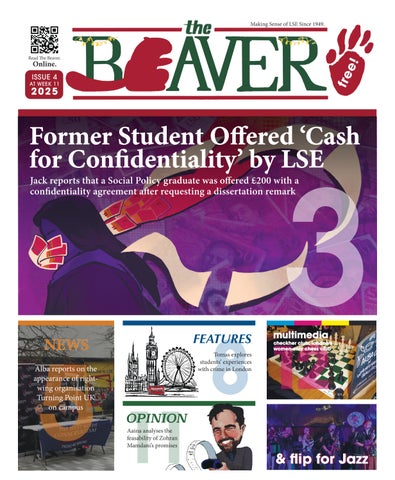
Jack reports that a Social Policy graduate was o ered £200 with a con dentiality agreement a er requesting a dissertation remark
Alba reports on the appearance of rightwing organisation Turning Point UK on campus
Tomas explores students’ experiences with crime in London
Aaina analyses the feasability of Zohran Mamdani’s promises
Meet the Team
Executive Editor
Janset An executive.beaver@lsesu.org
Managing Editor
Lucas Ngai
managing.beaver@lsesu.org
Flipside Editor
Skye Slatcher editor. ipside@lsesu.org
Frontside Editor
Suchita !epkanjana editor.beaver@lsesu.org
Multimedia Editor
Sylvain Chan multimedia.beaver@lsesu.org
News Editors
Amy O’ Donoghue
Jack Baker
Features Editors
Vasavi Singhal
Angelika Santaniello
Opinion Editors
Shreya Gupta
Aaina Saini
Review Editors
Jessica Chan
Iman Waseem
Part B Editor
Zara Noor
Social Editors
Amelia Hancock
Aashi Bains
Sport Editors
Emerson Lam
Harry Roberts
Illustration Heads
Vivika Sahajpal
Laura Liu
Website Editors
Natasha Pinto
Philippa Park
Photography Head
Yuvi Chahar
Podcast Editors
Salma Abuletta
Noor Sayegh
Formatting Editor
Oliver Chan
Social Secretary
Isabella Liu
Social Media
Sophie Alcock
Yashve Rai
Anika Balwada
Anisha Shinde
Khushi Khandelwal
e Beaver’s Autumn Term Wrapped
Sylvain Chan
Multimedia Editor
Last year, for our nal editorial of the Autumn Term, I helped expertly make a graphic on Canva recapping our achievements of the term, parodying the Spotify Wrapped aesthetic.
Here, I am doing the same for this edition but without the graphic because there is not enough space on this page. (Clearly I have priorities…
now go play the games our editors made.)
!is year, we have 38 members on the editorial board! !at’s a 26.66% increase, and for the rst time in a while, we’ve had a bustling multimedia team. Notable shoutout to our consistent group of talented, contributing artists — I honestly owe them my life.
In AT alone, we have managed to upload 24 reels on Instagram (go follow @
Connections
Edie Maytum Games Writer
to play: nd four groups of four words that share something in common
DOUBTFIRE COULD PAUL WILL Answers
SANTANA, WILL, SUE, FINN Famous guitarists: MAY, PAUL, HENDRIX, CLAPTON Last words of Robin Williams Films: DOUBTFIRE, SOCIETY, FEET,
Modal verbs: COULD, SHOULD, MIGHT,
Paci c weather phenomenon
1 “It’s ___!” (“See you then!”)
6 Korean national drink
10 Frozen friend?
14 Staircase post 15 A necessity in Singapore’s governance, perhaps
16 Animal rights org.
Timeline to receive 28-Across, 43-Across, and 58-Across
Happily-a er connector 20 Ideal height for gallery work, typically
beaveronline) — which is 71.43% more than we did in the entirety of last year. And it’s only going uphill from here! Stay on the lookout for the release of our investigative series.
We’ve also held 8 events so far — including our pizzaful launch parties a er the release of every issue, a digital art workshop with the Visual Arts Society, a blackout poetry event with the recently revived (and %ourishing) Poetry
Society, and a speaker event featuring Michael Shear with the Eastern European Society!
Unfortunately, it seems we’ve encountered one (1) libel scare, though it de nitely was not as drastic as last year’s, so we’ll count it as 0.5. !at’s all the details we shall share.
Looking forward to what our society holds in Winter Term!
A Very Christmas Crossword
Gate guards
___ Maria: co ee liqueur
Two-toned ocean predator
Tree tenant, from a true love
34 Clock face
35 “Deck the Halls” recurring snippet
36 EU member, or start of movie genre
37 Regarding, to lawyers
38 Written excuse from the doctor
39 Gi -wrapping adhesive 40 Amnesty Intl., e.g. 41 Nitrogen compounds
42 Animal Crossing
Unwanted stocking stu er 61 State of most Vinted items
62 “Reward” for poor service
63 Unpleasant mark found in a bowl
64 Tiny, like an iPod? 65 Tears away wrapping paper
1 Pay to play 2 Like a morning meadow 3 “Just ___ bit more”
Any opinions expressed herein are those of their respective authors and not necessarily those of the LSE Students’ Union or Beaver Editorial Sta .
!e Beaver is issued under a Creative Commons license. Attribution necessary. Printed at Ili e Print, Cambridge.
NEWS
Former Student O ered 'Cash for Con dentiality' A er LSE Refusal to Remark Dissertation
Jac
k Ba k er News Editor
Aformer LSE undergraduate has spoken out about ongoing legal action following the Department of Social Policy’s refusal to remark her dissertation. After receiving a 57, Rehab Asad Shaikh missed her offer for a graduate programme at the University of Cambridge, and has since been attempting to convince the department to revisit its finding.
After receiving the result at the end of 2023, Rehab described being “devastated” after hav-
"She received a new grade of 72 — an increase of 15 marks."
News Editors
Jack Baker
Amy O’Donoghue news.beaver@lsesu.org
ing poured so much “love and thought” into the project. The School informed her that the dissertation hadn’t been marked according to the usual process due to the Marking and Assessment Boycott that took place that year. Instead of accepting this result, Rehab requested the grade be revisited. She states that the department eventually offered “£200 cash with a confidentiality agreement, but refused to remark”.
When speaking to The Beaver, Rehab noted the emotional impact this process has had on her, stating her plans for eventually pursuing a PhD had been “completely derailed”.
Following this, she took the case to the Office of the Independent Adjudicator, the body
responsible for actioning student complaints about higher education providers. Following extensive questioning and investigation, the organisation sided with Rehab, prompting LSE to offer a re-mark.
In July of this year — two years on — she received an updated transcript, with a new grade of 72 (an increase of 15 marks and two grades). Rehab claims that the drawn-out process has had a “serious impact” on her “mental health and wellbeing, something that LSE has refused to acknowledge”.
In addition to her own case, Rehab said she was “aware of loads of people unhappy with their marks, but who didn’t pursue action because they knew LSE wouldn’t do anything”. They
also expressed concerns over the “shady marking process” during this period of time. Prior to complaining externally, Rehab had approached the School Secretary, who didn’t uphold her complaint.
Following receipt of the new transcript, Rehab received the David Piachaud Prize for Conspicuous Achievement, before being informed it had been “entered in error” only two hours later.
A er challenging this ex planation, the Department reinstated the prize due to the "obvious distress and anxiety it caused her".
Rehab to instruct the law firm LBMW to seek compensation for the emotional and professional damage she has suffered as a result of the drawn-out process. Her legal team is currently working on this, as well as pushing for an independent investigation into the entire process.
Rehab has since pursued an MSc at the University of Oxford, and now works as an Analyst at the Ministry of Justice. In her social media posts, she calls on LSE and other institutions to “respect teachers with better working conditions and better pay”, to avoid situations like this happening again.
When approached for comment, a spokesperson for LSE said they were not able to comment on “a case that is ongoing”.
Amnesty UK Launch National ‘Defend Dissent’ Campaign at LSE
Skye Slatcher Flipside Editor Photography
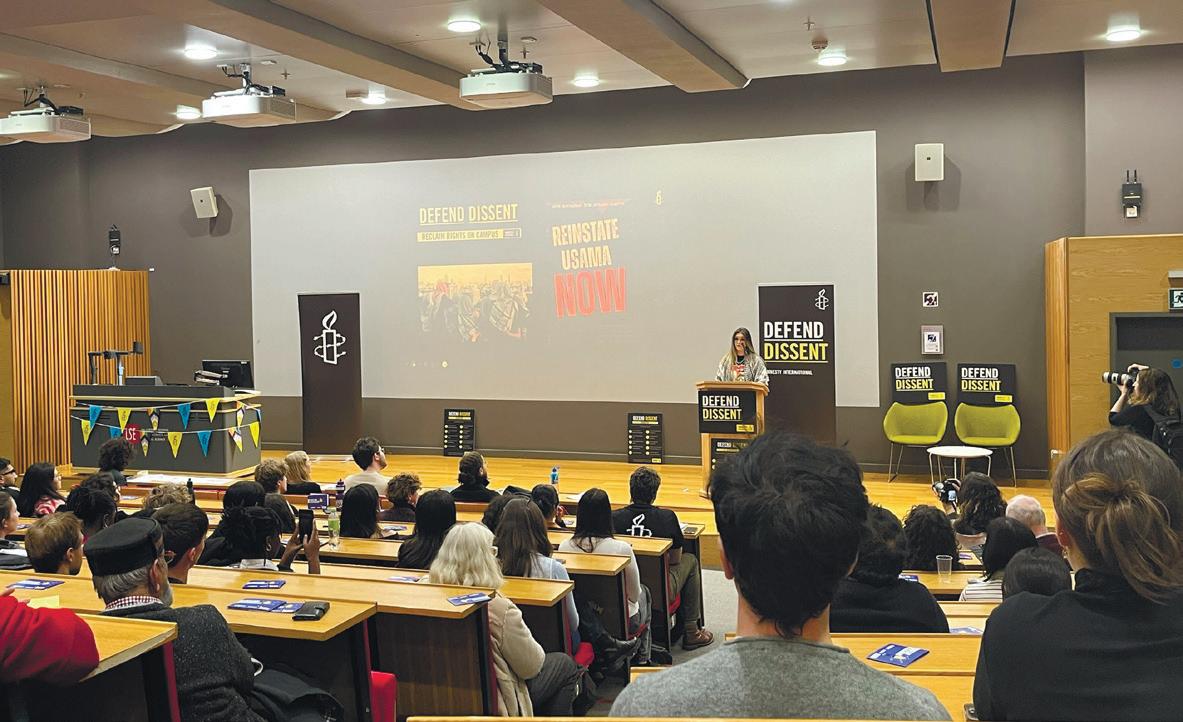
On 25 November 2025, Amnesty UK launched their newest campaign: Defend Dissent.
"e Amnesty team took to the Sheikh Zayed "eatre in CKK to publicly launch the student-led movement, to !ght for the rights to free speech on university campuses.
"ey highlighted some of the core !ndings of their report, which will be released in ear-
ly 2026. Across UK universities, they have identi!ed clear trends of increasing restrictions on protest and assembly, excessive policing and surveillance of students, and disproportionate disciplinary action. "ey found that some universities o ered to monitor their students’ social media for arms companies. Students and academics speaking out for Palestinian rights have been especially targeted.
"ey made clear their goal for the campaign: “A UK higher education sector where all students can freely express their
views, challenge ideas, and engage in open debate without fear of censorship, reprisal, or institutional barriers. "ese rights are supported by clear, enforceable policies that make freedom of expression a reality on every campus.” "ey aim to combat the chilling e ect of university censorship and to “challenge powerful institutions”.
"eir Charter encompasses ten core pillars, which they hope to see embraced by universities nationally. "e Charter has already been accepted by SOAS Student Union. "eir goal at SOAS is to have 300 supporters publicly backing the programme by January. William O’Donnell, SOAS Student and one of the campaign’s national leads, said: “Student repression has gone on long enough across our campuses. "ese are our spaces, our hubs, from which we have a right to speak and express. Universities must protect student voice […] It was great to see so many passionate activ-
ists at the launch event. We have the momentum, now our institutions must listen!”
This final administrative failure by the School encouraged in the later activities and barnstorming (a style of community organising popular in the US).
"e campaign itself aims to build and strengthen a coalition, within and across campuses, between students, sta , and communities. Karishma Patel, a former BBC journalist who le the organisation over Gaza, highlighted the importance of standing up to institutions that do not embrace debate and dissent. Usama Ghanem, a King’s College student currently facing deportation due to his expulsion from the university, spoke about this. He discussed his own experiences of speech being policed on campus, and drew comparisons to him and his father’s experiences in Egypt in the 2010s. Annabelle Flood, one of the LSE 7, also spoke about the censorship and disciplinary action she faced from LSE administration. "ese !rst-hand insights into these very real issues proved rousing material for the audience, who engaged wholeheartedly
On request for comment, an LSE spokesperson said: "Freedom of speech and the right to protest are of the utmost importance to LSE.
We will take measures against protestors only if a protest crosses the line into illegality, is threatening or harassing to individuals, or signi!cantly disrupts our community or important School business.
We opened an investigation after the 7 July protest because the methods alleged to have been used by the protestors met these conditions. "e protest signi!cantly disrupted the Summer School registration and resulted in complaints from multiple members of sta that they felt intimidated, harassed, and threatened."
LSE Government Society Multi-Party Debate: a Recap
Amy O’Donoghue News Editor
On 26 November 2025, students representing $ve di erent UK political parties took part in LSE Government Society’s annual debate. Labour, Conservatives, Liberal Democrats, Greens, and for the $rst time, Reform, took to the oor in a multi-party debate on the economy, immigration, and the environment. Scores of students attended as spectators. Labour was declared the winner at the end.
Dissent quickly began to dominate the atmosphere, with the academic chair describing the inclusion of Reform as “plat forming fascists”, much to the chagrin of their debaters.
e $rst debate topic was the economy. e discussion fo cused on taxation and debt, with the Green Party candidate stating that we should not be afraid to borrow to spend in order to $x the economic failures of neoliberalism. He was then described as a “fanatic fool” by the Conservative debater, who advocated cutting various taxes, including VAT.
e Reform representative began his speech by proclaiming that, “if you’re lying in bed in your council house with 15 kids, you just won the lottery,” with the Budget that had been announced by Reeves on the same day. His comment was later criticised by the Labour representative as o ensive.
Reform advocated “tearing up the EU regulatory rulebook” and stopping the use of hotels to house asylum seekers to cut spending.
Labour highlighted some of the measures that had been announced in the Budget, such as the mansion tax and the end of the two-child bene$t cap, arguing these were bene$cial steps towards a fairer and more ecient economy.
e Liberal Democrat posited that the rest of the parties were
speaking in rhetoric and not facts, alleging that the Liberal Democrats were the only ones who weren’t deferring to populism. He argued for trade agreements with Europe, claiming the absence of such agreements is currently costing the UK £90 billion a year. Additionally, he suggested that legalising cannabis would be a useful way to raise tax revenue.
e second round of debate focused on energy and the environment. is round began with Labour, who claimed they were the only party who could save the country from
e Liberal Democrat debaber highlighted that their party was committed to net zero by 2045 (sooner than any other party), and stated that green transition would create hundreds of thousands of jobs. She also posited that “every pound invested in renewables is one less sent to Russia”.
e Green Party representative focused on the idea that all the other parties were ignoring the impending threat of climate change in favour of short-term factors, proclaiming that the Greens are the only party who acknowledge medium-term
the “apocalyptic nightmare” of climate change. He advocated ensuring green transition without facilitating wars, which he alleged other parties were apologists for. He later...
accused Reform UK of receiving Russian donations. e Reform representative responded that the party has only received an insigni cant amount of money from Russian donors.
Reform went on to oppose renewable energy projects, call the other speakers communists, and repeatedly deny the existence of climate change, claiming that the UK currently spends £40 billion pounds a year on an issue that “doesn’t really exist”.
could still succeed if the planes were allowed to take o
e Green representative argued that the other parties fail to recognise the threat of climate change that is displacing people and driving migration. He also criticised the “cultural obsession” he believed was evident in Reform’s “closeted Islamist” remark and a rmed that Britain’s multiculturalism is its strength. Referring to the ‘Island of Strangers’ speech that Keir Starmer controversially gave this year, the Green debater declared that, looking at the ames, he sees “not a
pressed surprise to e Beaver at the perceived organisational failures, referring to the rowdy nature of the event and the apparent failure of the chair to be neutral. e insults that were thrown around by some of the speakers were also a matter of contention. One attendee at the event told e Beaver that a “derogatory and o ensive comment” was “thrown” at her from one of the debaters, and that neither the chair nor the committee did anything despite hearing it.
When contacted for comment, LSE Government Society told e Beaver:
“LSE Government Society acknowledges the concerns raised about the chairing of the debate that took place on the 26th of November. is is something we are taking seriously and are looking into, alongside our various stakeholders. LSE has clear policies regarding how events should be conducted, and as a society, we followed all of these. e chair was briefed before the event. We condemn all disrespectful language and behaviour.”
An LSE spokesperson said:
demands. She reiterated that not doing enough now only increases costs in the future and a rmed that the Greens would integrate the green sector and invest in renewables.
e $nal round of debate was centred on immigration. A chain of insults such as “communist” and “closeted Islamist” were launched from the Reform debater, towards both his opponents and the academic chair (who is meant to be neutral), for his supposed partiality. Reform argued for the introduction of deportation centres, a six-month deportation window, and the repeal of the ECHR.
e Conservative candidate began by acknowledging the bene$ts of migration, and then went on to argue that the Rwanda relocation scheme
river of blood, just a heavily polluted river”.
Reform responded that “the island of strangers” risk is real and has brought about a social cohesion problem in the UK.
e Lib Dem pointed out that immigration has increased since Brexit. Labour closed the debate, arguing that diversity is a strength, that racial minorities in the UK must be protected, and that Labour is taking adequate steps to stop small boat crossings, noting that in the past week, no crossings have occurred.
e atmosphere at the debate was raucous, with consistent heckling and shouting throughout the event. Some students in attendance ex-
“We are in contact with the LSE Government Society and Department of Government about the debate in question and understand they are looking into concerns raised about the chairing of the event.
“Hateful language of any kind has no place at LSE and is totally unacceptable. We all have a responsibility to treat others with respect and dignity at all times and the School takes any reports of hateful language extremely seriously. We encourage any students or sta who have experienced or witnessed such behaviour to get in touch via one of our many channels, such as Report and Support.”
‘Everyone Should be Concerned’: Turning Point UK Sets up Stall in Front of CBG, Sparking Outrage
Alba Azzarello Staff Writer
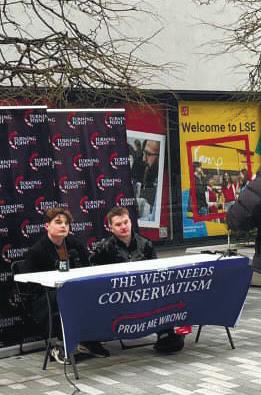
On Thursday, 20 November 2025, exactly six years after it was kicked off of campus in 2019, Turning Point UK reappeared at LSE, setting up a stall in the Plaza with a banner reading the quintessential Turning Point mantra: ‘Prove Me Wrong’.
Turning Point UK is the British branch of Turning Point USA, an ultra-conservative activist organisation founded by Charlie Kirk. Turning Point USA has the stated mission to “identify, educate, train, and organise students to promote the principles of fiscal responsibility, free markets, and limited government”. It operates through affiliated student groups on American university and high school campuses, recruiting ‘field representatives’ to create forums for discussion on right-wing issues.
It is well known for its ‘Professor Watchlist’, which names professors who are accused of ‘discriminating’ against conservative students and spreading ‘leftist propaganda’. Turning Point USA has evolved to include multiple offshoots including national and regional summits, a grassroots activist arm, a faith division focusing on religious advocacy, and a charitable arm. The group raised $85 million in 2024 alone, largely backed by conservative private donors.
Turning Point USA has been criticised for controversial comments made by its prominent leaders. It promotes a staunch anti-immigration stance, conservative views on gender, identity and sexuality, Christian nationalist thinking, and pronatalist traditional views of women’s role in society. Notable representatives of the organisation also promote the racist ‘grand replacement theory’.
Turning Point UK (TPUK) was created in 2019 and has since
been endorsed by notable conservative figures such as Reform UK leader Nigel Farage and former Home Secretary Priti Patel. Its mission is “to challenge the often far-left bias in our educational institutions, particularly focusing on universities across the country” through chapters and campaign groups at different UK universities. While LSE briefly had a Turning Point UK chapter in the past, it has since been shut down.
TPUK’s stand featured two TPUK representatives, one of whom is an LSE student, seated at a table with a microphone and a banner reading: “The West needs conservatism. Prove me wrong.” Students were invited to engage in filmed debates with the two TPUK members. Many students rejected TPUK’s presence on campus, with one student criticising the organisation saying, “this campus is smarter than you” and “you aren’t allowed to be here”, be fore attempting to take down the organisation’s banner. When one representative asked the student: “Do you think that’s promoting good culture?”, the student responded stating: “You know what’s bad culture? You promoting racist ideology.”
that completely disagrees with our views, it documents the opinions of young people, and that goes towards the rightwing in terms of how we actually win back these people.” He expanded, stating: “I think that every single university, regardless of its political affiliation, should have a Turning Point UK chapter and stand to engage in discussion.” The representative affirmed that “it’s good to continue the legacy of our late founder Charlie Kirk”, making it clear that Kirk’s ideology and influence lives on, an ocean away. The representative stated that TPUK would be back, denoting the protests “pathetic”.
When asked why they felt it was important to protest, one student responded:
“As a prestigious university, if LSE is producing students who support and accept fascist ideology, they need to reflect on what type of education they are getting.”
Another student stated: “Inviting fascists arrested for inciting violence and having someone like that on campus to get more people to subscribe to fascist ideology — everyone should be concerned.”
Protests quickly commenced, with students blocking the stand touting flags and chanting: “Fascists off our campus.” TPUK began packing up soon after. Protesters later started to chant, “Charlie’s in a box.”
One student protester’s identity was later revealed by Turning Point UK’s official X account. Violent comments immediately spread to the student’s account, using slurs, offensive language, and calling for their expulsion. Both TPUK representatives reposted the student’s identity. The student has since deleted their account.
One representative felt that, despite LSE’s left-leaning reputation, “Even if it is an area
One protester recounts meeting “many outraged students, rightfully so”. Many students were visibly uncomfortable with TPUK’s presence on campus. Others had mixed feel-
ings about TPUK’s stand. One student stated that, while he doesn’t support TPUK, it’s interesting to have those conversations. He elaborated, arguing that “we live in the age of UberEats politics, of Trumpian politics, where policy doesn’t matter but reaction matters, it’s like watching a reality TV show, so I suppose that’s why their style has become like that. I don’t think that’s good, but I still think we should have the discussion on campus, no one else is doing it.” Upon further reflection, the student felt that “they should not be platformed”. In reference to the protests, the student said, “what these people are doing (referring to the protesters) is right, they have the right to free speech, but I think there’s a way to do it where there’s a certain sensibility that should be done”, criticising the use of the “Charlie’s in a box” slogan.
While some LSESU Conservative Society members were involved in the event, the LSESU Conservatives were “not directly affiliated with the event”, contrary to FOX News Digital’s report. Upon a request for comment, the Conservatives stated that, “the society neither endorses nor opposes TPUK,” clarifying that the Conservative Society member involved was “acting in his own capacity”.
An LSE spokesperson added: “Freedom of academic enquiry, thought, and speech underpins everything we do at LSE. This event was on a public highway, and neither LSE nor the LSESU had any notification that it was taking place.”
!ank You to Our Copyeditors!
e Beaver’s copyeditor team is instrumental to the professional presentation of our publication.
Head Copyeditors
Wa Ali
Aristides Hall
Assistant Copyeditors
Isabella-Mae
ompson-Maskell
Isabella Stevenson
Mihir Raddi
Edna Yeghnanyan
Zara Branigan
Rachel Murphy
Mihika Sharma
Angelica Di Monte
Varisa Sirisook
Noemi Ladak
FEATURES
"Sitting
on the Side Watching em Play": Universities as a Gateway for Women into Male-Dominated Sports
Elodie Clements
Contributing Writer
Max James Photography
The Lionesses’ victory at the 2022 UEFA Women’s European Championship propelled girls’ participation in sports into the spotlight like never before. While the younger generation has been inspired to get involved in male-dominated sports, universities are o en le to bridge this gap for women who previously missed out.
Alongside massively increasing coverage of the women’s game, the Lionesses pioneered the dawn of a new era in women’s sports, with the number of girls under 16 participating in football skyrocketing by 140% the following year. is was paired with a massive increase in participation in other traditionally masculine sports like rugby.
In 2022, gender-equal access to sports was included in PE curriculum standards. Although the younger generation is overcoming traditional gender roles in sports, current young women have grown up without
the opportunity to participate in male-dominated sports.
is exclusion in secondary school has led universities to become a hub for women's participation in male-dominated sports, creating inclusive environments run by women, for women.
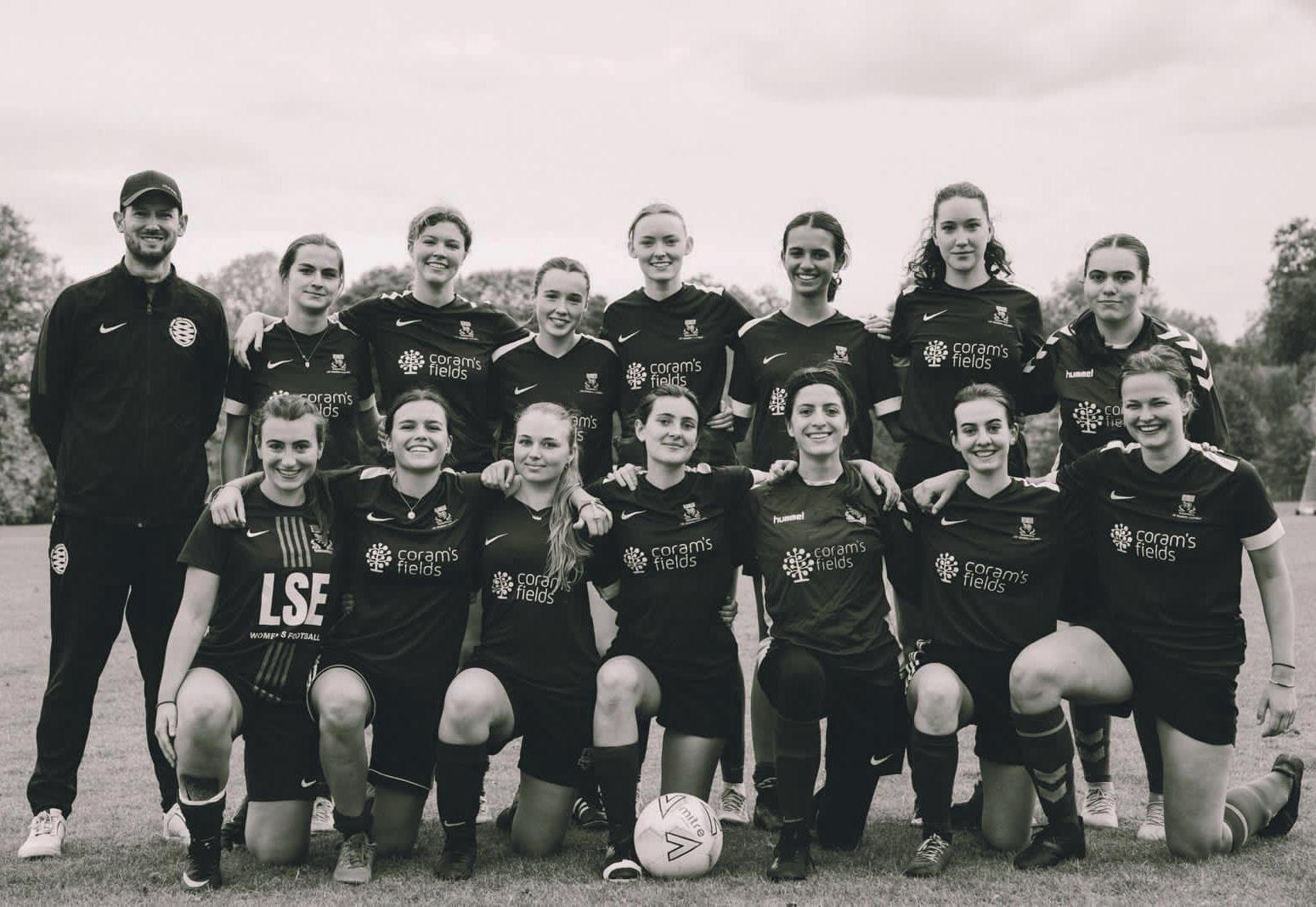
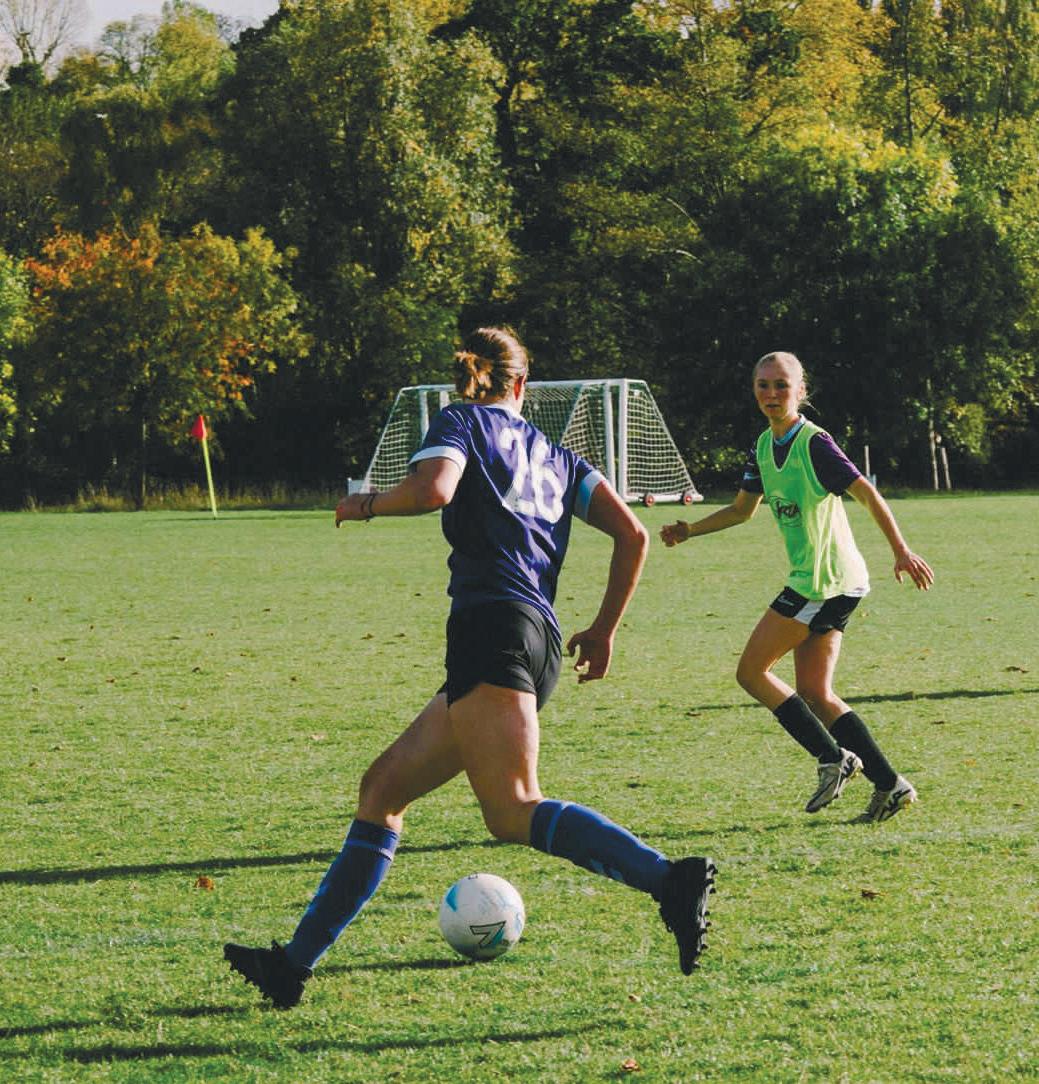
As of 2024, LSESU Women’s Football Club had tripled its size compared to the year before. is is one of many similar stories nationwide as women’s university sports see increasing growth and success.
University sports societies pro vide a gateway to opportunity for those who had little chance to participate in male-dominat ed sports at secondary school.
ing that interest in a girls’ football team was few and far between, when most girls would have had hardly any opportunity to play football previously.
In 2024, 46% of girls aged 1415 reported that a lack of condence stopped them from participating in school sports. Where there are opportunities to get involved in male-dominated sport, these have historically been a case of o ering limited inclusion into a male space.
Although currently part of LSE’s WFC, Portia, from the UK, had no opportunity to play football at her school. “My school didn’t have a girls' football team. [When] they tried to make one, I was the only one who showed up.” Football wasn’t in the girls’ PE curriculum, and she didn’t have the option to play with the boys.
While Portia had some previous experience playing football with her brothers, it’s hardly surpris-
is exclusion in secondary school has led universities to become a hub for women's participation in male-dominated sports ..."
For a beginner, being thrown into the deep end amongst a group of boys who have years of experience is an intimidating prospect. Very rarely have these opportunities been shaped to cater to women and girls.
is is what Adeife, another WFC player, found when trying to play football at her school in Nigeria: “ e boys would never pass to us.” Although there were sometimes opportunities for girls to play football with the boys, these sessions were “centred around the boys”. “We would just end up sitting on the side watching them play.”
is is the experience of most girls trying to get involved with sports where male participation is the norm: ideas of which sports are appropriate for girls to participate in permeate not only the culture of sport, but the institutions that facilitate it.
Football isn’t the only sport where women and girls have been disregarded. Paulina, who currently plays for LSESU Women’s Rugby, also holds a green belt in Japanese Jiu-Jitsu. Growing up in Germany, she faced stigma from her community for competing in a sport that women were not deemed “tough” enough to partake in.
"[I]deas of which sports are appropriate for girls to participate in permeate not only the culture of sport, but the institutions that facilitate it."
While some boys purposely gave her an advantage because of her gender, she added: “Some boys would refuse to ght me because I was a girl it was really annoying.” Well-intentioned or not, these gestures removed her agency over participation in a mixed-gender sport and prevented her from getting a taste of the full jiu-jitsu experience.
ere are other ways women are prevented from getting the experiences they want out of sport. Liadh, from the Republic of Ireland, joined Women’s Rugby at LSE because there was no women’s water polo team.
Although university clearly still has some way to go in securing gender parity in women’s sports, it also provides a wealth of opportunities for women to get involved in sports they have been previously excluded from.
BUCS, the organisation that facilitates competitive university sport, found that there had been a 30%
increase in the number and size of women’s teams over the past decade. In particular, the number of women’s rugby union teams rose by a whopping 41%. In many cases, the most popular women’s sports societies are those which might not have been accessible before university.
At LSE, the Women’s Rugby Club’s inclusivity is one of its major selling points to potential new members. “You can pick it up late and still have fun,” said Liadh, re%ecting on how sports where it is more normal to start at a young age don’t have the same kind of inclusivity. e same is true for LSE Women’s Football, which expects many incoming members each year to be beginners.
Clearly, university is a force for good in encouraging the participation of all in sport, but particularly that of women. As women’s sport continues to grow, it is important to provide for young adults who missed out at secondary school a role primarily shouldered by universities.
Vasavi Singhal features.beaver@lsesu.org
A Global LSE: How do International Students Feel About Changing UK Migration Laws?
Willow Imam
Contributing
Yuvi Chahar
Photography
Writer
On 11 November 2025, LSE celebrated Migrant Solidarity Day, making posters to commemorate LSE’s support of the many international students and sta that ll its halls; one day later, the only Welsh Parliament member of Reform UK, the current most popular party in the UK, was found to have used a racial slur against Chinese people, which the leader of the party, Nigel Farage, called a “pretty minor o ence”.
is rhetorical shi surrounding immigrants to the UK perhaps cannot be clearer than in the proposed changes to UK migration laws.
Notably, for the 70% of students and 40% of sta at LSE that come from outside the UK, proposed changes include an international student levy that would make international fees more expensive, shortening the length of graduate visas from two years to 18 months and the hike of skilled worker visa salary requirements to £41,000, the second hike in as many years.
A demonstration of the unfairness of these proposals could be found last month, when the government announced a requirement for immigrants to be able to speak an A-level standard English, not two months a er almost 30% of Year 11 students failed GCSE English.
"[I]t feels like the ground underneath us keeps shi ing."
ying degrees.
A Chinese student in the Sociology department said [they] followed them “closely”, whereas Kristeena, a postgraduate student from Jamaica, said she hadn’t: “I just assume every time there are proposed changes there will be more ways to make life harder for immigrants so far I haven’t been wrong.”
Among students planning to stay in the UK, these proposals were met with a sense of “despondency and sadness”. ey felt they “paid very high inter-
so much to the UK, were being targeted “because tackling other, more complex forms of migration is harder”.
When asked about how it affected their ability to plan for the future, multiple students said it created a sense of precarity as they never knew if they would be able to a ord to stay in the UK, with much of the standard guidance no longer applying the moment the law changed.
According to Kristeena, “it feels like the ground underneath us keeps shi ing.” She
e changes also narrow the career possibilities of international students who wish to stay in the UK.
“Because of the high salary threshold for a Skilled Worker visa, very few rms outside of
ing framed as a problem in policy and news”.
ere is a diversity in experience though, as one puts it:
“For students who always intended to return to their home country a er graduating, the
" e culture of LSE was seen as bene"cial as it allows for sta and students to discuss these issues with a 'sympathetic ear and an open space',"
Finance or Law can o er such a high starting salary. is makes the already narrow career choices for international students even more hyper-fo-
"'[W]e’re not an economic problem, a political problem or a burden', and 'policy should be addressing existing problems, not inventing problems out of people.'”
national tuition fees, followed every rule of the society, and worked hard”, but were being treated as a threat, le feeling undervalued and unwelcome by the government.
With this in mind, some international students I knew in the Media and Communications and Sociology departments followed these changes to var-
Many students thought this was part of a political game by the Labour Government in response to the popularity of Reform: one student spoke about feeling that international students, despite bringing
re%ected on “fellow international students who are self-funding their Graduate Visa just to work in sectors they love, knowing they have almost zero chance of sponsorship a er their visa expires”.
Sindhoora, a PhD student from India, a rmed this uncertainty, saying, “it makes it di cult for us to think we can stay back and get a job.”
cused on Investment Banking and Consulting.”
However, some felt that not all were being treated equally. Skilled migrants were seen as somewhat valuable, whilst in ternational students are treat ed as nothing more than “cash cows”. ere is also a contrast between the treatment of im migrants of certain origins: Sindhoora felt that immigrants from the Global South “are be
government's tone doesn't seem to have a major impact.”
e culture of LSE was seen as bene cial as it allows for sta and students to discuss these issues with a “sympathetic ear and an open space”, as Sindhoora puts it. “It is di erent from my previous institute, where it was di cult to discuss these issues openly.”
Ultimately, the international students I spoke to wished the government understood that they only wanted to be treated as “equal human beings”, and that these policies are a detriment to the UK, as “the UK will witness a signi cant drop in the skilled and talented workers it claims to want to attract”.
For international students, the changes proposed by the Government have created a real sense of dejection about the current state of politics and uncertainty about their futures.
Many international students feel that the government wants to use them as money makers or as chess pieces in a political game with Reform UK. As Sindhoora explained, “we’re not an economic problem, a
Perception Versus Reality: How Dangerous is London?
Tomas Corej Staff Writer
Vivika Sahajpal Illustration
Londoners — including LSE students — have been facing real issues with crime. However, data does not suggest the UK's capital has become "lawless", as far-right politicians have been claiming.
Few topics in London have been attracting as much attention as crime, and for many LSE students who moved to the city in recent months, it has been of particular concern. is issue, ampli"ed by social media algorithms, has occupied the centre of political discourse.
e perception of rising crime has also gained political ground more generally. A YouGov poll published in September shows that 51% of Brits think violent crime in London is rising, while only 7% believe the opposite.
Simon Harding, Director of Criminology Services Limited, explains that London is "presenting a range of problems, which have hit the headlines lately".
"Such media coverage tends to ebb and ow regarding crime, and can o"en be politically driven," he tells e Beaver.
Crime is certainly a real issue
"Because I was already aware that London wasn't the safest place, but I didn't expect this unsafeness would permeate into the university,"
for many in London who have witnessed it "rsthand, including numerous LSE students.
e Beaver spoke to James*, whose wallet was stolen on LSE campus on his birthday. James explains he placed his bag on a chair in the basement where his friends were sitting. " en, I went to get my lunch. During that time, I did not take care of my bag. But, three of my friends were there, so it was not le unattended per se,” he says.
When he came back, he ate his lunch and walked towards the library when suddenly, he got a noti"cation on his phone that his payment had been declined.
"I reached into my bag and my wallet was gone, but everything else was still there. So the robber walked to the Apple Store and tried to buy an iPhone, or something of high value. But because I had too little money in my prepaid foreign exchange card, the payment didn't go through,” James continues.
As he explains, this incident led him to be "more vigilant", even on campus. "Because I was already aware that London wasn't the safest place, but I didn't expect this unsafeness
would permeate into the university," he adds.
ere indeed are real challenges London experiences, including an increase in shopli ing.
One issue that has gained most of the attention is phone snatching. According to the Metropolitan Police, around 80,000 devices were stolen in London last year: amounting to one every 6.7 minutes.
" is has increased. It is large ly due to the fact that phones are more expensive," Harding claims. Besides their increased price, smartphones also permit online banking, and can contain multiple personal details that al low for ongoing fraud and banking the
On the other hand, Londoners are less likely to be a victim of violent crime than people across the rest of England and Wales, as the Mayor's o ce data demonstrates.
While Mayor Khan's critics often point out that the number of knife o%ences has almost doubled in the last few years, Harding explains that London's violent robbery at knifepoint is "lower than in other European cities", and gun crime is "low and almost completely isolated to certain street gangs and or-
ganised crime".
Of course, measuring the crime rates comes with methodological challenges. For example, as London's population has been rising, he doubts whether available statistics fully account for demographic changes.
Regardless, the Mayor's o ce data indicates substantial improvements, including a drop in homicides to a ten-year low. In 2024, London had 1.2 recorded homicides per 100,000 residents, which is lower than New York (4.0), Berlin (3.4), Brussels (3.2), Toronto (1.7), and Paris (1.4).
of partnership, and to generate new ideas and actions," Harding summarises.
In this environment, many LSE students are taking precautions even if they have not personally experienced anything. Ayesha, an international student, says she "generally feels safe" in London, but wants to "stay aware".
Meanwhile, Peter* tells e Beaver he comes from a country “where the safety situation is pretty bad”, so he “knows how to take care” of himself. He says he has not experienced any issues in London.
"[S]ocial media [...] 'tends to highlight sensational events, creating a feedback loop of fear [...]"'
Alberto Costa, Professor of Applied Criminology at the University of West London, believes that there is a "perception gap" that is ampli"ed by social media, which "tends to highlight sensational events, creating a feedback loop of fear, while o cial data shows violent crime leading to injury has actually been falling across London boroughs".
If there are any increases in particular types of crime, Harding believes they have "almost certainly been assisted by a decrease in the number of police o cers in London".
Earlier this year, the Metropolitan Force announced it would have to lose 1,700 o cers due to a £260m hole in its budget.
According to Mayor Khan, the funding crisis is the consequence of 14 years of the Conservative government.
at said, Harding emphasises that "crime reduction is not only the role of the police but of many di erent agencies, who all need to play a part."
" is was more e%ective 15 to 20 years ago than it is now, due to government cuts and political decisions. e only way to address the current crime challenges is to return to this way
In a comment for e Beaver, LSE also said student safety on campus is "of utmost importance". " e LSE Security team is available on campus 24 hours a day, 365 days a year. ey can be contacted by phone or in person by any student or sta% member wishing to report a crime or raise a concern.”
In conclusion, the issue of crime in London is of utmost importance for many Londoners, notwithstanding the LSE students. While it is unlikely to go away, it is crucial for this discussion to be driven by facts and expertise as opposed to hatred spread by politicians.
e Mayor of London’s o ce was contacted for comment, but e Beaver did not receive a reply.
*Names have been changed to preserve anonymity.
Read the full article online.
OPINION
Why
Won’t LSE Divest? Part 1: e Performativity of the ESG Review
Janset An Executive Editor
Serena Fadil Illustrator
King’s College Cambridge, Trinity College Dublin, Goldsmiths University, Swansea University, and University of Portsmouth are just a few universities across the UK that have made an explicit commitment to adopting a more ethical investment framework. Some have already divested from egregious corporate extractions of fossil fuels or violations of human rights through arms manufacturing.
e question there fore, remains: why won’t LSE divest?
have been hashed out, and it is time to move on.
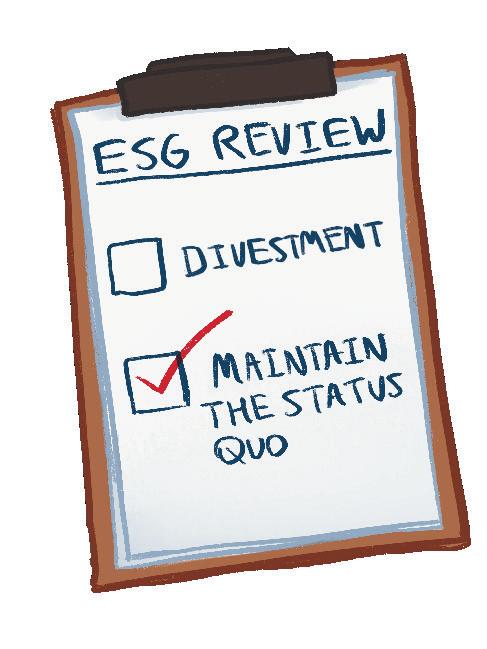
However, I believe we need to nitpick the ESG Review Process. Council’s decision to protect its portfolios was not because deliberation suggested it to be the most commendable choice. Rather, divestment was ruled out ipso facto by the university — in other words, it was never on the negotiation table
TROUBLESOME BEGINNINGS
Clear-cut responsibilities of the bodies involved, resourcing, nancing were requirements for a streamlined investment policy review.
is question has already been deliberated on — ESG (Environmental, Social, Governance) Review Process was announced in July 2024 to revisit LSE’s ESG Policy, which aims to minimise investment exposure to harmful industries.
Two bodies were created for this process: the Consultative Group and the Review Group e former was composed of students, academic sta , and professional services sta , while the latter was a mixture of LSE’s independent members and academic experts. e role of the Consultative Group was to “advise” the Review Group in its recommendations to Council.
rough public workshops and welcoming online submissions, the school sought to engage and educate on the complexities surrounding nebulous institutional endowments.
In July 2025, Council announced, following consideration of the Review Group’s report, that no drastic changes in investment trajectories would take place. erefore, the divestment dilemma seems to
of this meeting that this would be their last point of in-person contact with the Review Group.
AN IGNORED ADVISOR
e Consultative Group’s opportunities to “advise” were restricted and, at times, blatantly rejected by the Review Group.
During the whole process, the Consultative Group received only one piece of documentation to o er up its comments on: the Review Group’s sixpage rejection of the Consultative Group’s Working Paper 1.
an aversion to potential nan cial losses. ey argued that funds for education, research, and scholarships would su er if divestment were enacted. How ever, this logic exposes the ox ymoron entrenched in the logic of the university.
Firstly, investing in unethical activities is not the only pro able avenue — LSE could have looked into investing in net-ze ro real estate and low-emissions technology. With this current scal trajectory, the university is actively subverting its own pol icies, such as LSE’s Ethics Code and the Sustainability Strategic Plan.
However, a er speaking to Dr. Dena Qaddumi, who was an LSE fellow in the Sociology Department and a member of the Consultative Group, I was informed that this was not the case. She indicated that the whole process was strewn together with such haste that there was a lack of clarity and structure to the proceedings.
No meetings were held between the two groups in the preparatory stages of the process to clarify how discussions would materialise into actionable outcomes. Dr. Qaddumi noted that the ESG Review Process lacked some basic administrative procedures. e Review Group, which was responsible for organising meetings, kept no meeting minutes, nor set agendas in advance. e irony is that such a standard of conduct would not be tolerated even in the most trivial of student society meetings.
Furthermore, obscurity was exacerbated by the fact that the two groups only held four o cial meetings, lasting 30 minutes to an hour, over a vemonth period. e last meeting took place on 14 May 2025; however, this was unbeknownst to the Consultative Group. In fact, they found out at the start
Despite this, the Consultative Group took the initiative to make numerous suggestions and introduce nuance into discussions. Early on, they re quested to meet with LSE’s as set managers to discuss simu lations of how nances would stand in the face of exclusionary criteria; they also urged the LSE to liaise with an external independent ethical investment advisor. However, both pieces of “advice” were ignored.
LSE currently has over £70 million investments in 113 companies involved in the global arms trade.
It is important to conceptualise the full weight of this statistic and its staggering implications.
In fact, the Review Group rejected the former proposal, claiming that there was sucient nancial expertise already present in the Review Group. ey also explained that nancial simulations would be too costly — both reasons come across as patronising and unengaging.
An LSE spokesperson has informed e Beaver that the boundaries of advice allegedly “followed the terms of reference.”
Despite the Consultative Group’s multiple suggestions of action, none were taken up by the Review Group. Why?
CONTRADICTIONS
It is unequivocal that the Review Group’s reluctance to adopt the Consultative Group’s suggestions was motivated by
For a six-month period in 2024, more tons of bombs were dropped onto Gaza compared to the combined e ects of the bombing of Dresden, Hamburg and London in World War II. One company LSE’s investment portfolio can be traced back to is Lockheed Martin, a supplier of F-35 Jets to the Israel Air Force. e thought that our university may have contributed to the nancial stamp of approval on some of the jets carrying out these decimating missions on Gaza is spine-chilling.
DISAPPOINTING OUTCOME
LSE stands alone with its lack of engagement in overviewing its endowments. Dr. Qaddumi noted how colleagues in other universities participating in similar ESG Reviews had experienced an organised proceeding, with suggestions by sta being taken on board proactively by senior management.
LSE had the capability of resourcing and nancing the ESG Review Process su ciently; it has demonstrated this elsewhere on campus. When it comes to fostering a sense of belonging and enabling dialogues between di erent groups on campus, the LSE was not frugal at all — as part of the Innovation Fund for the Campus Relations Group, the university has funded eight projects.
Yet, they deemed nancial simulations of di erent investment strategies too costly. ey did not consider hiring an external independent ethics advisor. e hypocrisy is comical and striking proof of the university stigmatising divestment.
An LSE spokesperson has contested, however, that the university will continue to “review the current investment lters related to fossil fuels, tobacco and armaments” to reduce appropriate exposure to these industries. ey further added that the ESG Policy will be reviewed every ve years “as is the general practice at peer institutions.”
Dr. Qaddumi shared her observations on how the Review Group’s approach to managing the university’s endowments seemed more akin to managing a for-pro t business, rather
(Continued on next page)
OPINION
than a charity advancing higher education for the public bene t.
If we adopt this metric of “business,” then we can certainly claim that the LSE has triumphed. Between 2023–2024, the Assets in Apartheid report revealed that LSE held £89 million in investments linked to alleged crimes against the Palestinian people, the global arms trade, and climate breakdown. By 2024–2025, that
gure had risen to more than £131 million.
Fundamentally, the handling of the ESG Review Process was a blatant disrespect to the work of the volunteers who contributed to the Consultative Group. According to the Terms of Reference, written submissions from the Consultative Group were not a requirement. Regardless, they engaged in exhaustive and meticulous research to produce
a 20-page Concluding Report with 96 pages of Appendices. "is Report did not even feature under the Council’s email sent as a school-wide announcement on the 10th of July — yet, Council was considerate enough to include a link to the Review Group’s report. It took the Consultative Group reaching out to the School for their work to be rightfully circulated across campus.
I have covered only the tip of
the iceberg in this article. I will continue to scrutinise the Review in the hopes of answering the formidable question, “Why Won’t LSE Divest?” We need to be equpped with the language to call out questionable institutional conduct, should it reappear again in the future.
Media Relations Response: "Following the recent review of the Environmental, Social and Governance (ESG) Policy, LSE
Does APEC Still Matter in a Fragmented World?
Chanseung Kim
Contributing Writer
April Yang
Illustrator
The Asia-Paci c Economic Cooperation (APEC) Summit in Gyeongju, South Korea, concluded with the APEC Economic Leaders' Meeting on 1 November 2025, where leaders adopted a joint declaration rea rming their commitment to multilateral cooperation and a market-driven free trade order. "e statement acknowledged growing challenges to the liberal trading system that have long underpinned APEC’s values. In recent years, the rise of protectionist policies under the Trump administration has further weakened the foundations of multilateral trade. While it was a positive sign that all member economies reached a consensus, some observers noted that the declaration’s omission of any direct mention of the World Trade Organisation (WTO) re$ects the broader decline of global support for free trade.
In recent years, APEC has slipped from the spotlight, overshadowed by other international forums such as the G20, G7, and Comprehensive and Progressive Agreement for Trans-Paci c Partnership (CPTPP). Growing political tensions amongst mem-
"Despite some skepticism, APEC remains a crucial forum for dialogue and regional cooperation."
bers, fuelled by the escalating U.S.-China rivalry, have made it harder for the group to issue in$uential joint statements as it once did. With the WTO gridlocked and protectionism on the rise, multilateral trade negotiations have steadily lost momentum. APEC’s voluntary, non-binding framework has also drawn criticism for
growth, and the region’s major economies sought ways to advance trade liberalisation and deepen economic integration. APEC emerged as a $exible forum built on consensus and voluntary participation, designed to promote shared prosperity through inclusive growth, economic cooperation, and technological exchange.
APEC STILL MATTERS BECAUSE DIALOGUE DOES
Regardless, APEC continues to play a practical role in fostering cooperation. As new issues such as digital trade and AI governance rise to the forefront, APEC’s role as a coordinator of emerging global
limiting its ability to deliver concrete outcomes. In this fragmented global landscape, one question remains: Does APEC still matter?
Despite some skepticism, APEC remains a crucial forum for dialogue and regional cooperation.
HOW APEC’s VISION FADED
At its establishment in 1989, APEC embraced the idea of “open regionalism”. In the late 1980s, the Asia-Paci c region underwent rapid economic
Today, APEC nds itself increasingly shaped by geopolitical competition. Under Trump’s “America First” policy, Washington moved away from multilateralism in favour of bilateral deals and replaced its advocacy of free trade with a focus on so-called “fair trade”. As tensions grew, APEC became less of a forum for cooperation and more of a stage for U.S.-China confrontation, with the rivalry between them eroding consensus and weakening the momentum for collective action.
remains fully committed to strengthening our approach to responsible investment."
" e review itself included a thorough assessment of the policy and addressed questions raised by LSE students and sta related to the School’s investments."
Read the full response and the school’s background information online.
frontation. Even at times of heightened tension amongst great powers, it has remained one of the few venues where leaders can meet and communicate directly. Notably, the rst U.S.–China summit under Trump’s second administration took place on the sidelines of this year's APEC summit, amid escalating trade disputes. As open rivalry and geopolitical divisions increasingly limit opportunities for cooperation, APEC’s non-binding yet enduring space for exchange has become more important than ever. Beyond formal agreements, simply sustaining dialogue and continuous engagement within APEC is now a notable achievement itself.
e APEC Summit demonstrated that Asia remains central to international diplomacy. With emerging issues such as AI governance and digital trade coming to the fore, the need for an inclusive and $exible framework for dialogue has become more pressing. Ultimately, APEC’s true signi cance today is measured not just by the agreements it issues, but by its ability to keep dialogue alive and maintain engagement across the region. agendas has become more signi cant. At this year’s Gyeongju summit, members adopted the “APEC AI Initiative”, a policy framework designed to help all economies in the region take part in and bene t from the AI transition. "e South Korean presidential o ce called it APEC’s rst codi ed AI vision, marking the leaders’ rst agreement on AI with both the United States and China participating.
APEC continues to o er a forum for cautious, consensus-driven dialogue, building trust whilst avoiding open con-
A 'Suitable' Mayor? Zohran Mamdani's NYC
Aaina Saini Opinion Editor
Zohran Mamdani’s humble yet charismatic mayoral campaign captivated audiences far beyond New York, not because he embodied the familiar, sterile alternative to hardline conservatism, but because he broke from it. He o%ered the global le something it had been starved of: a candidate who spoke plainly and earnestly about acting upon, intervening in, and hearing the burdens of ordinary people.
Republicans dismissed him as a utopian communist, while academics questioned the scal burden of his agenda. Yet the polls bent in his direction, and then the election conrmed his victory. "e question now follows: What does victory translate into? What, in the machinery of New York, can actually be delivered?
"is article is my attempt to break down this question by examining some of his policies one by one, and tracing where New York’s political constraints end and Mamdani’s promises begin.
"e question now follows:
What does victory translate into? What, in the machinery of New York, can actually be delivered?"
identi es some challenges. Mamdani proposes only ve stores, one per borough. It is unrealistic to expect these grocery stores to be able to supply for the entirety of eight million NYC residents. "is seemingly simple idea ignores distribution and price distortions. Scarcity also produces distortion: Who gets access rst? Who is pushed out? And if government-run stores undercut private retailers too aggressively, they risk collapsing the very ecosystem that keeps neighbourhoods a$oat. Killing o% competition is not food justice.
e policy is feasible, but not without prerequisites. Access would likely need to be prioritised through income-based assessments or rationing cards to ensure that low-income residents and disadvantaged communities bene t rst. And the city’s existing purchasing power is an asset waiting to be leveraged, since New York already buys food for schools, hospitals, shelters, and community colleges. Folding the grocery store network into these procurement systems could unlock real economies of scale and make contracts competitive.
CITY-OWNED GROCERY STORES
Mamdani has argued that removing rent and property tax from such stores will shrink overhead and translate into lower prices for consumers. "e idea of city-owned subsidised stores is hardly unprecedented. Britain’s wartime “British Restaurants” capped meal costs; Poland’s milk bars fed entire generations; and in the present day, India, China, Brazil, and Mexico all operate variants of publicly supported food outlets.
Looking into the speci cs, one
“taxing the corporations” may well mean taxing themselves.
As for capital ight, the panic is overstated. In an era where proximity to talent, investors, and opportunity still matters, millionaires are unlikely to abandon New York for good. But what I anticipate will happen is subtler: assets quietly moved outside city jurisdiction, portfolios rearranged, wealth rerouted to satellite residences just beyond the line — close enough to commute, far enough to evade. While I believe tax increases on the wealthy are necessary, it could very well back re when increased in a small locus of a
"What I anticipate will happen is subtler: assets quietly moved outside city jurisdiction, portfolios rearranged, wealth rerouted to satellite residences just beyond the line — close enough to commute, far enough to evade."
would need to be purchased, maintained, and sta%ed, which means capital costs on one end, higher operational costs on the other. A recession in the coming years is hardly improbable. Income and corporate taxes are cyclical, being abundant in good times and facing downturns during recessions. Meanwhile, the costs of free buses and subsidised groceries remain xed. e question practical-
INCREASED TAXES –CORPORATE AND WEALTH
For much of the expanded public-service agenda, the revenue engine is stated clearly: hike the corporate tax rate from 7.25% to 11.5% for top earners and levy a $at 2% surcharge for anyone making over a million dollars.
"e campaign frames corporate tax increase as a burden to big business, but tax incidence theory suggests that corporations rarely pay the bill handed to them. "ey hand it to you. A McDonald’s or Starbucks operating in New York does not absorb a 2.5% tax hike out of goodwill; it li s its prices by the same amount. Mamdani never addresses this, and the public seems blissfully unaware that
nation that otherwise supports wealth accumulation and provides easy exit options.
FREE BUSES?
Free public transit has been tested from Tallinn to Luxembourg, but never at the scale Mamdani now proposes. "e projected price tag, somewhere between $600 and $800 million annually, sounds almost quaint for a metropolis with a $115 billion+ budget.
However, the estimate assumes today’s bus system, frozen exactly as it is today, simply stripped of fares. What it ignores is Mamdani’s own projection of ridership jumping by 23%. And buses do not magically increase in size to absorb crowds: additional vehicles
ly asks itself: Can these programs withstand an economic downturn, or are we building permanent obligations on top of volatile revenue?
"e calculation starts to resemble a budget built on wishful thinking: $600 to 800 million for now. For how long? At what cost? And with what margin for the bureaucratic ine ciencies that plague every large-scale public service?
"e plan is not impossible. It is, in fact, achievable. But only with a clearer accounting of future costs, in$ation, and the mess of practical implementation.
us, while ambitious, Mamdani’s proposals are within the limits of reason and in
no way impede free markets or resemble Soviet-style communism. If anything, the loudest threats to the free market have come not from Mamdani but from the red hat wearing MAGA itself. As analysts like IP have noted, Trump has pushed the U.S. economy toward something eerily reminiscent of the Chinese Communist Party model: deep political intrusion into private enterprise, punitive targeting of individual business leaders, and a government that bullies rms into obedience.
What used to be crisis-speci c interventions, such as Troubled Asset Relief Programs (TARP), auto bailouts, and temporary industrial incentives, have mutated under MAGA into a sprawling apparatus of political interference, weaponized regulation, and economic coercion. It is a style of governance less free-market than quasi-Marxist, if not outright Maoist, in its appetite for control. In this light, Mamdani’s agenda looks less like revolution and more like responsible governance.
And yet, from where I stand, an Indian woman in the United Kingdom, raised on Mira Nair’s lms and familiar with the occasional writings of Mahmood Mamdani — I nd myself hoping, perhaps irrationally, for Zohran’s success. Not only because his campaign o%ers a rare counterweight in a political climate increasingly hostile to immigrants, especially a er his surprisingly civil meeting with Trump, but because it a rms a belief I refuse to relinquish: that meritocracy need not depend on predation, that a city can upli the vulnerable without surrendering to the wealthy.
Read the full article online.
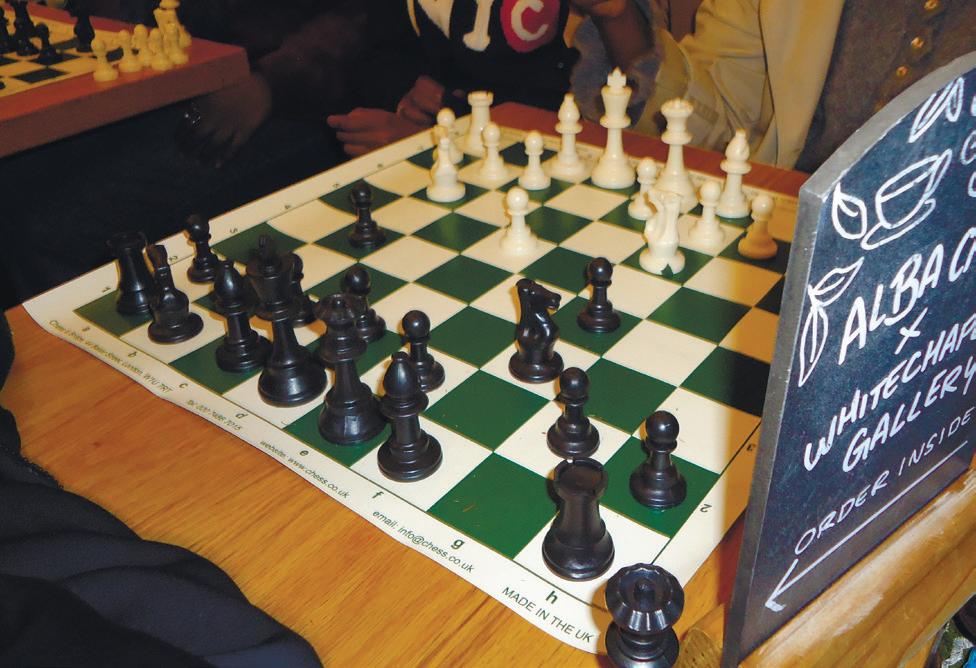
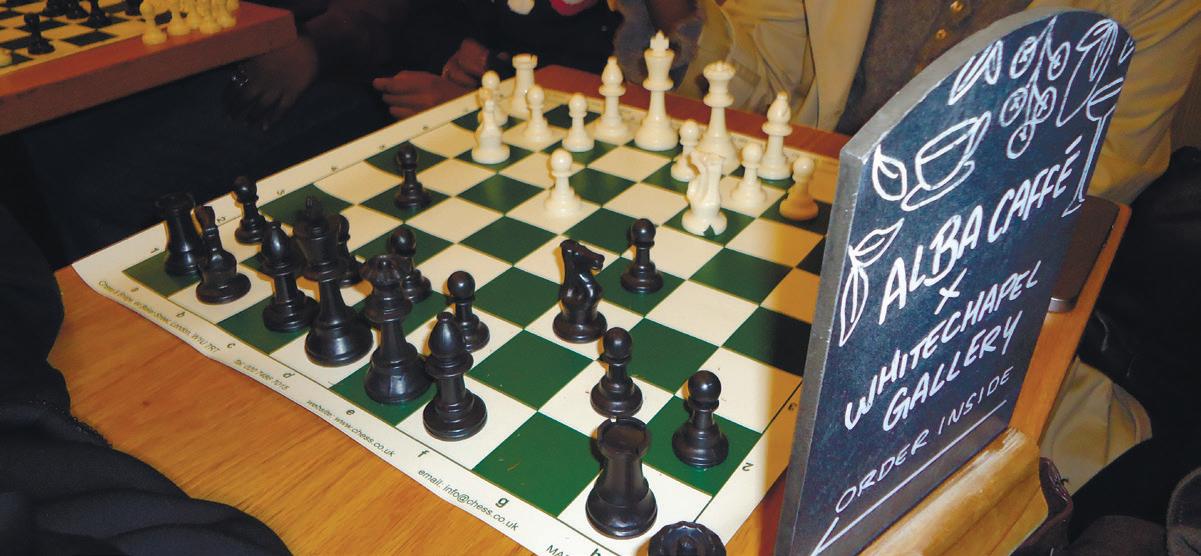
n a small room chequered by no more than 5 cafe tables, groups of women huddledes decorated by familiar
In this small nook at Whitechapel High Street, comfortable silence lapped against momentary sighs of -
Small conversations swayed to the background lo-f music until the-perience with the Checkher Club, a that I had learned-
sic before hurriedly sitting back down and coaching her ‘rival’ through the tactical , as I would come to learn over coffee, has been operating the club independently since February of thisegy around it. “There’s just so much you learn in chess that you can apply to life.”
CREATING COMMUNITY THROUGH CHESS
However, Ubah felt practicing online on sites like Lichess was unsatisfactory as they fail to embody the “social aspect of chess”. This screen detox opens new
“People assume [because] I run a chesstually not that good. I don’t care about my desire to get better is not
It’s clear many people like Haniah* resonate withterspersed commentary on our game with questions about the latest books she was reading. She found solace in “learning how to play while socialising over a hot drink”.
Leveraging the community fostered through the club, Ubah has also held a collaborative event on November 15 with The Coffee House Acton to raise funds in support of those affected by the It’s not just about chess,” she explains, “but also about giving and supporting. [It’s asking] ‘how can we mobilise ourselves and
Collectivity distills even into its event coordination. While technically a one-person team, Ubah fnds she is able to balance admin, videography, marketing, and other logistics because of her strong support system. “My friends will help set up the boards when I’m running late,” she cites as an example. “There are so many people that I can talk to and ask for advice.”
I asked Ubah what her favourite memories from running the club thus far were. And after much deliberation, she described the joy from simply seeing people slowly coming out of their shells. “By the end of the chess club, they get really excited, and I think seeing that transition is really nice [...] and that’s what I really love: people opening up and coming back as well.”
ON WOMAN-ONLY SPACES
The timelessness and accessibility of chess lend it a thriving pursuit. And yet — even after the surge in its popularity following Netfix’s ‘The Queen’s Gambit’ about chess prodigy Beth Harmon — women remain underrepresented.
Refecting on her own experiences at London’s oth er chess clubs, Ubah fnds there is a prevailing “culture of wanting to win” amongst the rows of men.
Having similarly been the only woman at past chess events, Camila* — frst-timer to the last session of December — echoes this sentiment. “I’m open to playing with people of different skill levels, but I’m unable to learn […] or enjoy playing with men […] because they don’t seem re ceptive to teaching me. Whereas here, everyone is encouraging and giving advice and friendly [because] everyone is on that same journey with you.”
Some people on social media have been critical of the Checkher Club being a ‘single-sex space’. “When you make a space that is just for women, people always have an issue.” Antagonistic comments that ask why there isn’t a ‘men’s chess club’ are the least of her concerns, though: “that’s literally any chess club,” Ubah laughs.
It’s a vicious cycle. Whether subconsciously or not, if physical and online spaces are unwelcom ing to women, they will be discouraged from try ing out chess, is a male-dominated feld.
These factors underscore Ubah’s motivation to “give women a safe and comfortable space to connect and play chess.” Touching upon queer inclusivity, she furthermore states that “if you feel like [being a woman] applies to you, then you are more than welcome to come.”
Visit the Checkher Club on Instagram!
Sociologist Henri Lefebvre observes that this carving of co-created (physical) spaces, where none may have existed prior, stems from a desire to “reshape the processes of urbanisation” disjointed by capitalism. Paradoxically, as David Harvey observes, the systemic dominance of fnance remains an impediment to creating a truly “coherent oppositional movement”.
That is to say, these community initiatives are often stretched thin by the confnes of capitalist expectations.
Scouting for venues has been the trickiest part thus far. It took four months for Checkher Club to fnd another suitable location after its original open-plan area saw unwelcome onlookers. Their current venue, Alba Caffe, was chosen in the end because Ubah resonated with their women-led motif. Laila*, a frequenter to the club since its resurgence in October, compliments the “cozy and friendly” environment — a far cry from her frst experience at a different club, overstimulated by blasting music.
It was also rare to fnd spaces that offered its services for free or at reduced rates. “It was really hard because I don’t want to charge people [to play chess …] but how do I pay for boards [or] pay to acquire the space? There are a lot of
ing culture. Such fnancial barriers create an exclusivity that is antithetical to the social function of the city.
“To me, £5 [the price of a Checkher Club ticket currently] is a cup of coffee, but that’s not the same for everybody [else]. If someone wants to fnd something consistent, they should be able to play a board game for free.”
The commodifcation of social activities warps it from an impromptu, organic decision into an obligatory task. “I think [clubs] lose the aspect of being a third space when you have to pay,” says Ubah. The process of buying tickets and stressing about if they get sold out may also be a “mental burden”.
“My goal for the chess club is not only for it to be free,” she concludes, “but also for it to be more regular … I want you to be able to wake up one day and think, ‘oh it’s Monday, let me go pop by and play chess.’”
Arriving at the café for their last event of the year before the Christmas break on Sunday, I felt the room was alive with matches and conversations equal in energy. While confronted with London’s uncertain landscape, it is certain that the Checkher Club will continue to bloom as its ethos resonates with more and more people.
*Names have been changed to preserve anonymity
Written and Illustrated
by Sylvain Chan
WOMAN-ONLY CHESS CLUB
Syl speaks with Ubah, founder of the woman-only chess club Checkher club, and discusses about community, the importance of curating female spaces, and the chokehold ticketing culture has on London.
“MY DESIRE TO GET BETTER [AT CHESS] IS NOT GREATER THAN THE DESIRE TO MEET NEW PEOPLE”
SPORT
EDITED BY EMERSON LAM & HARRY ROBERTS
Enfield Town FC: What it Means to be a FanOwned Football Club
Written by ANGELIKA SANTANIELLO
Photography by TOM SCOTT
team’s use of their platform to increase the participation of women and girls in football, as one of the largest and longest established girls and women’s football clubs in South East England. He observed, “We currently use our platform really well.” “We want to promote it even further; we want to grow and keep growing to encourage more girls to play football.”
For the football fans among Beaver readers, I’m sure we’ve all heard supporters throw in their two-pence about actions on the pitch. For the most part, it’s usually about the referee’s decision. Sometimes, you even get supporters wishing they could take the manager’s role, shouting ‘cross!’ or co-ordinating speci c tactical manoeuvres. At least, in my experience, these types of technical comments end up di use, lost in the game’s commotion.
But what happens when fans actually have a say in how the club is run?
For North-London-based National League South team, En eld Town FC (ETFC), fans actually have this power. Formed in 2001, the Club is the rst wholly fan-owned club in the UK.
Being from En eld and having gone to a few games myself, I wondered what this meant for the day-to-day running of the club, especially in a time when a club’s status and players’ popularity are heavily driven by their club’s income. To get a glimpse of this supporter-owned club spirit, I went to their men’s rst team home game against Maidstone United — who were placed 11th at the time of the match compared to ETFC’s standing in the relegation zone at 21st — on Tuesday 25 November.
Hearing from the Board
I rst spoke to Vice Chairman Paul Millington about how the club’s ethos links to his vision of success. According to him, it is about “having a football club that will be here for future generations [...] I like to think we prove something [on and] o the eld.”
How can the ‘o the pitch’ element be taken further? !is points to questions as to whether this model can be the new norm for football teams. Millington seemed more hesitant to be entirely optimistic — the club “can’t compete with those [professional] teams nancially”.
!at’s not to say being fully fan-owned creates an ‘unworkable team’ — supporters want to see their club grow. On this, Millington commented on ETFC’s ‘Doing it Together’ crowdfunding campaign in 2024 to improve the home grounds.
“We have been very lucky that our support base has been very generous to us over the years.” But, the club is “aware that [they] need to move out of that area, because [they] can’t keep going back to the same people for money all the time.”
For a club centred on avoiding “going back to the same people [...] all the time” — it’s important to re ect on how all people in the local community can get involved with the club’s project. Our minds may rst go to thinking about those le out in the international dominance of men’s football.
John Carrigy (Vice Chair of the En eld Town Ladies FC) commented on the
Millington also spoke about the club’s accessibility arrangements, explaining that “we generate our own funds to [fund all parts of] these […] activities.” “To continue, we need to […] [have] an infrastructure to have the people with specialist people to deliver that type of course,” he concluded.
The Beaver Goes to Enfield
For the 612 fans in attendance on Tuesday, there was perhaps a wave of worry as to whether ETFC could keep their winning streak a!er beating Farnborough FC 5–1 the previous Saturday.
I had the opportunity to talk to captain Mickey Parcell, who was unable to play, ahead of the game about what fan support means for him as captain and as a player on the pitch. He emphasised that “you feel [fan] interaction more whether you feel that on the pitch from people watching”.
“You see, this club means a lot to people.”
Indeed, this couldn’t be clearer than what I saw at the home stand, around the pitch, and at the bar.
!e rst half of the match saw an oscillation in supporter optimism, seeing Reynolds’ missed opportunity to score, instead hitting the advertising boarders, and Moore’s nish at the 41st Minute, giving Maidstone a 1–0 lead.
!e fans’ perseverance pulled through in the second half. Youngs scored the equaliser, chipping the ball in at the 63rd minute a er a cross in the 6-yard box. Reynolds secured ETFC’s victory at the 69th minute.
Fans were in for a tough match on a cold Tuesday evening — players were in for an even harder battle it seems, as ETFC players pushed to get their second win a er a loss spell across previous matches.
Reynolds captured this sentiment when I spoke to him a er the game. Before joining his teammates to celebrate their performance at the stadium’s bar, he took the opportunity to dedicate a core part of his success to fans:
“ ey’re like our second win, they give us a little bit more of a boost, that little bit more of a ght. ey’re loud every game, they travel with us.”
As we can see, there is a certain vibrancy to a fan-owned football club model. It adds to the inherent dynamism of the sport and builds the community atmosphere integral to smaller local teams. I think the Club’s approach is best summarised by the engravings on one of their scarves at the merch stand — ETFC focuses on ‘making friends not millionaires’. What we are yet to see is whether or not this will extend to bigger teams.
Read Angelika's article online for more details about the interview and the game!
Dear Sky Sports, Women do not need pink subtitles to understand sports.
You may have seen Sky Sports’ newly-launched TikTok page ‘Halo’ for female sports fans. Or maybe you didn’t, as it was taken down merely three days later.
Sky Sports' 'Halo' was described as the “brand-new TikTok channel created speci cally to engage and entertain female sports fans […] providing an inclusive platform for women to enjoy all sports, while amplifying female voices and perspectives.” Andy Gill, Sky Sports’ head of social media and audience development, added that it was, “NOT a women’s sports account; it’s sports content through a female lens”, meaning “fun, trend-led, and relatable content.”
If some were intrigued by the initial premise, they were quickly disillusioned. Described as Sky Sports’ “lil sis”, Halo’s rst few posts were all made up of pastel-coloured captions, bubble-letter graphics, pink sparkles, and heart-strewn edits. And despite positioning itself as a women-focused space, nearly half of its rst 11 videos on the account featured male athletes. e rst 'Halo' post included a clip of Manchester City striker Erling Haaland scoring against Bournemouth, with the caption “how the matcha + hot girl walk combo hits”. In a comment under the post, one user wrote: “Can’t believe this is what you think female sports fans like.” 'Halo' responded with: “Can’t believe you brought that kind of energy.” Heavily criticised for being patronising and misogynistic, parodies of Halo’s posts sprung up everywhere, with Bracknell Town FC adding pink bows and Labubus to footage of their gameplay, or Manchester City player Kerstin Casparij making a satirical video of her grasping the o side rule only once it appeared in pink lettering.
As a result, and not even three days a er its launch, the Sky Sports 'Halo' account deleted all its posts and issued a statement that read: “We’ve listened. We didn’t get it right. As a result, we’re stopping all activity on this account.” !e account is now private.
So why did female sports fans even need to be siphoned o into their own TikTok channel? Why couldn’t Sky Sports just create social media content that everyone can enjoy?
Ice Hockey's Greatest Game:
The 'Miracle On Ice'
Written by EMERSON LAM
“Do you believe in miracles? Yes!”
One of the most iconic lines ever uttered by a sports announcer; this marked the conclusion of a 4–3 up set by the United States Ice Hockey team against the Soviet Union team. To outsiders, this could easily come o as a regular Olympic match, with only a medal on the line. However, the reality involved many more factors that made the match nothing short of an absolute thriller: from the increasing political tensions between the US and USSR, the “underdog” status that the young American team held, to the momentum gained by both teams in the tournament and the national pride on show for the Americans, this match was driven by a background like no other, making its nale all the more impressive.
!e TikTok bio set the scene from the very rst post: “Sky Sports’ lil sis”. Women are positioned as the younger sibling. Not equal, but adjacent. 'Halo' becomes an annex to the main product rather than a space with genuine editorial weight.
!e content follows the same logic. Sport is packaged as so , easy, pink, and polite. Women are imagined as an audience that needs it translated into sparkly captions, as if a female football fan, basketball fan, or boxing fan has never engaged with the sport beyond Instagram Reels.
Sky Sports runs separate TikTok channels for football, golf, Formula 1, and so on. But somehow, female fans are treated as some monolithic block, with their very own all-encompassing account. Why should content about the Lionesses and Ellie Kildunne be exiled to 'Halo' rather than treated as equally thrilling as the men’s sports? And what do any of these sports have in common, bar the fact that all the players are the same gender?
Halo’s content once again pushes the stereotype that female sports fans are only there for the trends and good-looking players, without actually caring about the rules or nuances of the games.
Women are already discussing game strategies and team politics. !ey are the engineers, journalists, strategists, and fans who do not require anything diluted for them. It is patronising, not empowering, to have the main broadcaster in the UK assume they need to be eased into sports. Sky Sports isn’t just any brand; it’s the biggest media platform in British sport. What it publishes shapes culture, and signals who it thinks sport is for.
If Sky Sports wanted to support women, they could have hired more female analysts and presenters, given more airtime to female content creators, boosted female journalists, or worked actively at shutting down harassment in their own comment sections. Instead, it settled for being cute. If 'Halo' wants to earn its audience’s trust, it needs to treat women not as a marketing niche or a “little sister”, but as what they truly are: skilled, passionate fans who do not need their sport served with pink bows.
Regards, CHLOÉ CERISIER
Continue reading Chloé's open letter online!
the NHL), they were allowed in international tournaments. ese players were at such a level that, even against teams of NHL All-Stars, which consisted of the best American and Canadian players, they had defeated the team two games to one.
Needless to say, the Americans were at a massive disadvantage even before the tournament, forced to select only their amateur players, of which many were around college level. However, coach Herb Brooks still made the most of the situation, recruiting young players and pushing them to their best. A er intensive training and exhibition matches, they faced the Soviets in one nal warm-up game … and got absolutely walloped, losing 3–10.
Were the Americans going to do well in the tournament? At that point, people surely didn’t think so. !e only ones who could change the outcome were the players themselves.
Beginning with the dynamics of the Soviet and American teams: thanks to the Cold War, the dramatically worsening tensions between the two nations helped elevate the Soviets to a clear ‘villain’ status in the eyes of the average American. Of course, the Soviet Ice Hockey team was nothing to sco at, with some of the strongest players in the world taking part. Even with Olympic rules stating that only amateur athletes could compete, since Soviet players were technically not taking part in professional leagues (being barred from
Despite low expectations, the Americans slowly but surely began to show their prowess. !e team managed to go undefeated, drawing with Sweden and defeating Norway, Romania, and West Germany. !e Soviets matched the Americans by handily defeating Japan, the Netherlands, Poland, Finland, and Canada. !ese two teams, coming into the tournament with completely di erent reputations, were now destined on a collision course with each other.
!en came game time.
Want to know how the game goes? Continue reading online!
SOCIAL!
EDITED BY AASHI BAINS & AMELIA HANCOCK
A (Belated) Reflection on My First Bonfire Night
Written by SOPHIE ALCOCK
As an international student, Bon!re Night is a British institution I had never previously been privy to. But the prospect of a free !reworks display would excite anyone, so on a mild November evening, I decided to call my friends out for an impromptu gathering.
I managed to enter Coram’s Fields a er making my way through the snaking entry queue. Meanwhile, in a parallel queue, my friends were unfortunately told the space had reached capacity. Finding myself alone in a crowded park with half an hour until the show, I had nothing better to do than to wait. Instead, I stood and watched the scene around me: children playing, teenagers crying, parents catching up with one another.
My friends describe me as a collected person, yet large crowds make me feel irrationally perturbed. Standing in the sea of people meant no personal space. Once you chose
your spot, that was it; leaving meant an inevitable loss of the best view of the night. As I settled in, what struck me wasn’t just my own discomfort, but the general chaos around me. Unattended children ran about, disappearing in and out of the crowd. Suddenly, the matching wristbands for parents and children made sense; it was evident this was not the !rst year many children had found themselves lost. Still, the parents seemed unfazed, and it did not seem like my place to say anything.
The Holiday of Giving and Getting Views
Written by AMELIA HANCOCK
Illustrated by LAURA LIU
e question of “is charity really charity if you lm it?” has existed for as nearly as long as social media itself. However, the rise of TikTok and the ongoing cost-of-living crisis have made this debate even more pressing. With Christmas just around the corner, both charities and individuals have stepped up to help those in need have a joyful festive period. My ‘For You Page’ has been !lled with Dunelm’s ‘Delivery Joy at Christmas’ tags and its American equivalent, ‘Walmart’s Angel Trees’, which helps children from low-income families wake up to presents on Christmas Day. Yet, alongside these heartwarming initiatives sits a growing ethical dilemma: to what extent does recording charitable initiatives increase awareness, and when does it become performative and exploitative?
Before social media, charities relied on local communities and word of mouth for awareness, but as the internet grew, visibility expanded, and help could ood in from further a!eld. Videos of gi -tag programmes are regularly reaching hundreds of thousands of viewers, creating ripple e ects of participation. For example, last year, Dunelm and Age UK delivered 272,000 gi s to vulnerable people. is scale of impact that TikTok can bring is one known all too well to a mother in Shropshire. Jasmin came onto TikTok at the end of August this year, needing to raise £1.5 million for her 14-month-old son’s life-saving surgery. Just over two months later, donations from the internet had achieved this goal. From this, it’s clear that !lming charitable e orts can mobilise support on a scale that had been thought unimaginable.
A celebratory atmosphere enveloped the participants, with lively music and performances lling the park. Local groups and aspiring musicians enthused the onlookers with their acts, and I certainly found it an entertaining show. I was pleasantly surprised by the sense of community fostered at this event. At this park, I was surrounded by people of all backgrounds and ages coming together to celebrate a uniquely English tradition. Something about it was truly wholesome and inclusive; no one needed to justify themselves to have a good time. Just as I started to get restless from the wait, a girl pushed her way past the crowds in tears, followed by some concerned-looking friends. It seemed that this event would not be remembered fondly by some. Perhaps to some, this would become a memory of separation or loss, rather than one of unity.
e !rework display was phenomenal. Audible gasps were heard as the ares shot up and bloomed into grandiose bursts of coloured lights. Just as the display seemed to end, the next round of even bigger !reworks went o .
Continue Sophie’s re!ection online!
But where is that line between genuine visibility and performative charity? Filming vulnerable people comes with moral backlash, but some argue that in uencers need to capture their acts to earn the money that they can then give away. Many point out that this can be done without displaying the identities of those receiving help. Finnish in uencer Aurikatarina, for example, built her platform by o ering free deep cleanings to people in di cult situations, amassing 11.5 million followers on TikTok. She did so without !lming the homeowners themselves. Yet, the ethics become even more complex in cases like philanthropic YouTuber MrBeast, whose videos routinely feature people competing for money. Although those who appear in his content give contractual consent, critics argue that this is complicated by !nancial need.
Another question over ‘visibility versus performativity’ is how we decide which acts should be recorded and which are better le unseen. Does every item you buy for a homeless person outside the shop need to be lmed?
Small, spontaneous gestures, such as buying someone a hot drink or offering money for the bus fare, arguably o er little value by being turned into content. Yet, many smaller accounts !lm these moments in an attempt to gain followers. TikTokers such as Jimmy Darts or Zachery Dereniowiski (MD Motivator) have succeeded in building large audiences through these acts. In contrast, creators who have substantial platforms already !lm larger, organised initiatives such as food bank drives or charity fundraisers in partnership with organisations, where visibility can genuinely increase participation. e distinction of performance and exploitation lies in where visibility is given to the cause, not the creator.
Charity is o en de!ned as the generosity towards the needy and su ering. So, when the person performing the good deed gains more than the person receiving it, can we still con dently call it charity? Social media has blurred this line, but its visibility is valuable when directed at large initiatives that bene!t from awareness. Smaller acts, especially those involving vulnerable acts, should not require a camera. Even in a digital age, it’s worth remembering that not everything needs to be !lmed.
Winter Wonderland
you’re looking for a slightly cheaper al ternative, you can instead board the 139 at Oxford Street under the sea of celestial-themed lights. Marvel at the lights as the bus turns onto Regent’s Street, passing under the ceiling of angels and the famous Hamleys’ Christmas windows, before heading towards Picadilly Circus, Trafalgar Square and down the Strand. If you fancy yourself a walking tour, consider adding in Carnaby Street, known for its changing annual theme. is year’s display, ‘All is Bright’, is vibrant, colourful, and one not to miss.
Widely considered London’s ultimate Christmas experience, Winter Wonderland at Hyde Park really does have it all. Of course, you can still treat yourself to mulled wine and Bratwursts, but there’s so much more to enjoy beyond the food. Whether you’re prepared to brave exhilarating rides or take a peaceful journey down the ice slide (for the less adventurous of us), there’s something for everyone. If you’re in the mood to unwind, you can sit back and take in panoramic views of London from the Giant Wheel or put your skating skills to the test at the ice rink. Whether you crave an adrenaline rush or just a bit of everything, Winter Wonderland is always a perfect option.
department’s annual skate or practising for fun, London boasts a selection of beautiful spots to take to the rink. Perfect for an evening skate a er campus, Somerset House is only around the corner from LSE and o ers the ultimate, picture-perfect rink in its courtyard. Or, if you’re trying to practice your skating whilst admiring your future workplace (which may be the perfect view for some of us), Canary Wharf o ers slightly more a ordable o to enjoy whilst plotting your moves into the corporate world.
Battersea Power Station
For a slightly less crowded market experience, head over to Battersea Power Station. Around the back, you’ll !nd giant baubles and Christmas trees perfect for a photo, along with a funfair and ice rink overlooking the ames. If you’re a er something a bit calmer, take a seat in the glass house (or a private igloo if you’re a er a pricier outing) and enjoy some refreshments, or try out the homemade sweets from the nearby stands. If you’re looking for more traditional homemade goods, the station’s interior will be packed with stalls on the 13th and 14th of December. On the other days, it is beautifully lit and makes the perfect spot for a bit of Christmas shopping.
PART B
EDITED BY ZARA NOOR
Introducing... Derin!
I’m Derin, the new co-editor of Part B. A little about myself: I’m a fourth year undergraduate studying Language Culture and Society, recently having returned from my year abroad in Shanghai.
Like most international students I’ve grown up all over, living in Istanbul until the age of nine, and then Taipei before coming to LSE. I have a deep attatchment to these two cities and my memories of them animate most of my writing and thinking. I’m very passionate about languages (hence the degree), and have a special so! spot for the people and societies in Asia.
My typical Sunday with nothing to do involves me mostly cooking and cafe hopping, though I can’t pretend to be a co ee connoisseur or a good cook. emes I’d love to explore in my new role as Part B co-editor predominantly revolve around identity, belonging and community. I really want to look at how we LSE student navigate these precarious and messy years of our lives, through creative writing. So, I’m interested in anything you have to say and write.
If you’re thinking of submitting to e Beaver, whether it be a poem you wrote during reading week or a dra! of your rst novel, I’d love to hear all about it. Get in contact with me at d.bohcaci@lse.ac.uk if you have any questions!
I Do Not Build With Sand
Written by WAFI ALI
Illustrated by LAURA LIU
I am a solitary hermit in a field of confusion; I remain past the dusk, emitting disillusion; I am the one who understands; For I do not build with the sand.
My value is undeniably less than a grain; Yet in the storm I am not the one who feigns integrity. I am the solidarity of the land; For I do not build with the sand.
When the sun does shine, they carve gilded spires; Gold mammoth palaces, laid upon their pyres. But I will be safe when tide strikes strand; For I do not build with the sand.
When the wind comes calling, where is your refuge? When the hail shrieks curses, you find no culpable deluge. Your castles are bleak: on illusions you stand; For that is why I do not build with the sand.
Behind them are grand houses, colours ablaze; They boast vast vineyards, all are transiently fazed. But mortar of ego, bricks of brittle pride; All do crumble when reckoning arrives.
Just like the castles, they are a living death; Singing silent screams, awaiting their last breath. At the setting of the sun, they are grey all around; As if they were built from the same sand.
Then comes the awakening, the storm finds its prey; Castles, palaces, lay in disarray. The kings of the beach flee, now forgotten; Their wrecked creations are all they had begotten.
The dawn finds the shore swept smooth and clean; Freshly bequeathed for new folly to be seen. My still dark attire, my isolated brand; I am the one who did not build with the sand.
I continue to shape my lone stone sequel; The fools of the past, they were never truly evil; But in their futile formations, they now understand, For never to build with the sand.
Hi readers!
Stop Making Plans!
Written by KATE SNELLING
Stop making plans. I’m not referring to plans for the weekend or what you want to eat for dinner. Little plans give you something to look forward to and are absolutely important. What I’m referring to are life plans. ese days, when someone asks me what I plan to do with my degrees, with my life, I just shrug and laugh. “All I know is what I want to do next,” I tell them. I don’t have long term goals.
Of course, there are things that I think would be nice. It would be nice to move to Vancouver or Paris or back to Alaska. It would be nice to do a PhD and become an economist or work as a hiking guide or a fashion designer. It would be nice to meet someone. Nevertheless, I refrain from setting the expectation that any of these things might happen.
Some of the “real adults” in my life might be reading this and thinking this is terrible advice. I am still young, and I obviously don’t know much, but I do know that our generation is di erent from the ones before us. We live in an era of rising Fascism and a climate crisis. As young people, we don’t know if the plans we make will even be possible in the future. is may seem pessimistic, but at the end of the pessimism pipeline is freedom. e freedom to pursue absolutely anything we want.
In college, I was so laser-focused on making everyone else happy, on following the classic business school to consulting career path, on reaching my goal, that each job rejection was excruciatingly painful. My depression was at its peak, and I didn’t even actually know if I wanted to work in the corporate world (spoiler alert, I didn’t). For an entire semester, as I watched my friends succeed at getting the good and right jobs, I woke up every single morning already crying at my inability to do the same.
The Year My Heritage Spoke First
Written by ANISHA SHINDE
Illustrated by VIVIKA SAHAJPAL
“Wait, you’re from Shanghai?”
e girl I’ve just met on move-in day lights up. “My mom’s from Shanghai too!” And suddenly we’re o — swapping stories about Nanjing East Road, debating which Yang’s Dumplings location is best, laughing about our grandparents. I’ve visited Shanghai every year, and now all those memories I could barely talk about back home are spilling out. It feels good. e speci c smell of the metro, that one street vendor, the way my grandmother speaks — things I kept mostly to myself in Singapore suddenly became this instant bond with someone I met twenty minutes ago. But walking back to my room later, something sits strangely in my chest. Not bad strange. Just ... di erent.
People wonder how I am so nonchalant about the future now, but they don’t know how hard it was for me to get to this place. I didn’t have a choice to work in corporate when I moved to Alaska for a summer because I hadn’t gotten any job o ers. I meant to go there for a couple months, go home, and get back to work. My perspective changed when I met other seasonal workers who exempli ed this carefree mindset and were clearly much happier.
e coolest people I know are o working at hostels in Australia or doing yoga training in Costa Rica. ese are the people who, instead of desperately clinging to a certain path, embrace the opportunities of life as they come.
!ings change, and they change unexpectedly. With a long-term goal in mind, you’re setting yourself up to be disappointed.
I know people, and I know you know people, who have a rigorously scheduled life plan. Married by 29, kids by 30. Some of my best friends plan this way, and I don’t fault them for it. Don’t listen to me if you don’t want to (I know nothing, really). I just know that if I had this kind of plan, I would be very sad if I reached the nish line with nothing to show for it. Going with the ebbs and ows of life means I have no idea what will happen and at what time, and I have learned to embrace it rather than fear what is to come.
You know the episode of Gilmore Girls in which Paris doesn’t get into Harvard and has a mental breakdown in front of the whole school? I always thought both Paris and Rory were insane for not keeping their options open and having backup plans or safety schools. Because unless you are one of the few lucky ones, life almost never happens the way you want or expect.
Odds are, you won’t be a Rory, so don’t be a Paris.
London changed that. Suddenly, both sides of my heritage became things I could actively use. Not in a calculated way, but as bridges to other people, ways to nd community in a city where I knew nobody. Meeting someone from Shanghai meant I nally had someone who got those references I’d been storing up. Dancing garba at London’s Navratri celebrations meant connecting with other Indians who understood that spec joy. For the rst time, I was putting both cultures out there not just experiencing them at home, but using them as part of how I introduced myself as a fresher.
When I celebrated dandiya here with my new Indian friends from LSE, it was the same music, the same steps. We were laughing, spinning, having the best time. But it felt di erent from doing it with my Singaporean school friends, whom I’d grown up with. Dandiya was just something we did together, not the reason we came together. ese were people I’d met weeks ago, people I connected with because we’d both grown up celebrating Navratri.
In Singapore, my heritage was a fact. In London, it became a conversation starter.
Back home, being mixed was simply who I was. I went to an Indian international school, where my Chinese side lived quietly in the background, surfacing only at home. Chinese food for dinner was normal; visiting Shanghai every year was just what we did, but I rarely had people to share those experiences with outside my house. My Indian side had more space — Hindi at the temple, going to my aunt’s house for every festival, and school friends who just understood those references. I’d look forward to dandiya with my friends every year, not because we were making a statement, but rather because that’s what we did. Being half-Chinese, half-Indian wasn’t something I wore proudly outside my family — it was just quietly, unremarkably me.
It unsettled me at rst — I’d never worn my cultures this openly before. In Singapore, they were just part of the background of my life. Here, they became part of how I put myself out there, how I found my people. And that felt strange because it was so intentional, so visible, so di erent from the quiet, unremarkable way I’d lived them before.
But here’s the thing: it’s been good. Really good. I’ve built genuine friendships and a strong community here through these connections. Yes, it’s bittersweet. I do miss when my heritage didn’t need to be a conversation starter, when it was just the air I breathed. But London’s teaching me that both modes of belonging matter.
And I’m grateful for that. For the Shanghai conversations I never got to have before. For the dandiya nights with new friends. Learning that home isn’t just where culture feels easy, but also where you choose to create it, one shared story at a time. And that’s not a loss, it’s just di erent. Maybe even richer.
REVIEW
EDITED BY JESSICA CHAN & IMAN WASEEM
Welcome to the Cabaret!
Written by AAINA SAINI
Frankenstein (2025): Adaptations & Accuracy
Written by VARISA SIRISOOK
Illustrated by APRIL YANG
As a fan of Mary Shelley’s Frankenstein and Guillermo del Toro’s !lms, the director’s long-awaited adaptation was my most anticipated !lm of 2025 and one of my favourite watches so far this year.
Frankenstein is a visual feast: vivid costumes combining Victorian silhouettes and anatomical inspiration complement a world of imposing architecture and sprawling natural landscapes. e design of the Creature himself, which renders Jacob Elordi almost unrecognisable, leans into the organic, forgoing the bolts and staples associated with the pop culture !gure in favour of scars aligned with bones and muscles.
e cast perfectly carries the bold emotions of the story. Oscar Isaac delivers a passionate and arrogant Victor Frankenstein in contrast to Mia Goth, who brings a quiet intensity and resilience to Elizabeth Harlander as Victor’s foil. Between them, Elordi’s vulnerability as the Creature shines from his !rst steps into sentience to the !lm’s uncertain, hopeful ending.
e conversation around this !lm o en centres on its diversions from the source material. While an adaptation deserves to be viewed on its own merit, neither could I avoid comparing the !lm to the story. In particular, when these changes altered the themes of the original. Where Shelley blames Victor’s rejection of his Creature squarely on his pride and lack of responsibility, del Toro makes him more violent and has him perpetuate his father’s abuse.
Even knowing the story, I found myself hopeful watching Victor meet his creation for the !rst time. Not with the revulsion of his novel counterpart, but with an embrace, and to bring him into the sun. However, he soon becomes frustrated with the newborn’s progress in learning speech, and punishes him the way he was. At the same time, Elizabeth has a more
Barbie in the Nutcracker
Written by JESSICA CHAN
Illustrated by APRIL YANG
active role and closer connection to the Creature. As Victor’s future sister-inlaw (instead of adopted sister and !ancée), she replaces the family that the Creature destroys as revenge for being denied his own, and provides the understanding his maker withholds, and empathy over their marginalisation.
e !lm’s reinterpretation of these characters, along with the fewer victims at the Creature’s hands, makes del Toro’s Frankenstein more — and his Creature less — guilty. Although not incompatible with the novel’s exploration of innocent nature versus corrupt nurture in patriarchal Victorian society, the !lm focuses more on generational trauma and abuse than on Shelley’s systemic examination of hierarchy and the human condition.
While some critique the !lm for its melodramatic direction and lack of subtlety, I appreciate its emotionality and unapologetic defence of the Creature, just as I appreciate the complexity of Shelley’s prose. Frankenstein (2025) not only demands that we accept the Creature’s right as a person to respect and equality, but forces us to feel for his right as a child to his father’s love and acceptance, awed as they both are.
In an unoccupied SAL classroom, I rewatched cracker for the !rst time in years — I have to say, there’s just something magical about the old Barbie movies that really cannot be replicated. Not to mention being reminded of how every one of these ended with a moral, where in this one, “when you’re kind, brave, and clever, anything is possible.”
When Barbie debuted into the movie world in 2001, she started o with some of the most cutting-edge animation technology of the time, and the icon ic soundtrack of Tchaikovsky’s Nutcracker London Symphony Orchestra. You really cannot go wrong with this combination.
e actual plot is driven mostly by the comedy of the Mouse King (played by Tim Curry, by the way?!) and his pathetic bat sidekick, while the main characters make some less than wise choices. e stakes in this movie are surprisingly high, and then there’s a plot twist on the island that I hadn’t even realised was a core memory for
!nd that the pacing of the movie is generally rather slow, and I do not think this is just an attention de!cit issue. I say this with all the a in my heart, but every character in this movie moves and talks with this unintentional pause that makes me look around the screen like it’s an O ce episode, and there’s a joke I’m missing out on.
Major Mint and Captain Candy, while not particularly impactful side characters, are my favourites, especially with the underlying tension between the two of them for the
e New York City Ballet choreographed the movie. Why was the entire arts industry funding Barbie’s rst movie? Mattel really wanted this to be a success, and frankly, it worked. e dancing in this movie is a little sparse, but it is a nice touch to see Clara, the main character (who looks identical to Barbie), gain con!dence with every musical number. e ending sequence, that is, at least 5 minutes straight of dancing, might actually be my favourite segment as they celebrate Clara and e Nutcracker’s transformation into their true selves.
While the ‘it was all a dream’ ending is a little cliché, I nd it a sweet and whimsical movie to watch over the Christmas season. Happy Holidays, everyone!
Three Months of London’s Music Scene
written by SKYE SLATCHER & illustration by
SERENA FADIL
In the week that Spotify decided I have a listening age of 73 and that I am the 323rd top listener of Flyte globally, I have been reflecting on what has been an incredibly busy few months. But these are months that for me have been amazingly filled with music and arts. I think I have watched more live music in the last few months than in the rest of the years of my life combined. Since September, and if I am remembering the chaos of these past months correctly, I have enjoyed (to varying extents) live music at over 25 venues in London (and one more in Barcelona). All of that time is not included in Spotify’s analysis of my 59,378 listening minutes, so I have taken it upon myself to do my own live music venue wrapped for 1 September – 30 November 2025.
Ninety One Living Room
I’ve been here a couple of times now. I remember when I walked in for the rst time I was so surprised that it does in fact look exactly like someone’s living room, despite that being in the name. It’s been pretty great every time. e crowd is usually very chill so for a relaxed evening out, this is ideal. ey have really fun jazz performances most nights. I could live here.
O2 Brixton
Loyle Carner performed here in November and it was amazing. I loved that the whole standing area here is slanted, so you can still get a pretty decent view from the back. Loyle, as expected, attracted a pretty specific crowd. The architecture around the stage is unique (kind of out of place?) — it is based on Venice’s Rialto Bridge. A pretty standard concert space other than that.
is is easily one of the most memorable of the venues I’ve visited. e space itself is pretty unassuming — just a cafe that turns into a performance space in the evenings. What made my evening here so memorable was the music I saw. I’m not even sure I actually have the words to describe what it was that I watched — it was pitched to me as a jazz evening (‘twas not). It was certainly avant-garde. It consisted of a documentary and live performance of what I can only describe as people playing instruments incorrectly. It felt like it might t into some part of a horror movie maybe. (I should also add here that this was booked without actually checking what the performance would be - wanted a surprise. I do this o en.)
e audience consisted of an incredibly mixed bag of people. From 65+ year olds, to the most insu erable looking performative males you’ve ever laid eyes on, what surprised me was that they (for the most part) seemed really into it. Instead, I stood near the back trying not to laugh. I, unfortunately, did not manage to stay for the whole performance. It was, uh, not my cup of tea. I do hope to go back to Cafe OTO though, and see if there is something else in their programme that oats my boat.
Cafe OTO
Colour
Factory
A must-visit for the Orii Community’s weekly jazz jam sessions on Mondays. The first half is for beginners or newcomers to the London music scene, with the latter half featuring more seasoned performers. It is so fun to see everyone (o!en having never performed together before) find their flow and give each other space to show o . The crowd is great and the performers get super into it, which makes everything more fun! If you’ve never been to a jam session before, this is definitely one to go to.
Union Chapel
Once again, I knew nothing about the performance I would be watching here other than the names Sam Amidon and omas Bartlett. I loved the music here — an hour of Bartlett on the piano (impressively leaning down to sip his wine without stopping) and an hour and a half of Sam Amidon’s folk experiments, showcasing his projects delving into the history and modernisation of the genre. is place is also stunning. But the seats, my god, they are so uncomfortable. I was in dire need of a chiropractor a er this.
NT’s Lo
The space itself here is pretty unassuming, but when they set the lights to red and you see the overground go past in the background, it becomes the coolest place ever. Their Jazz Wednesdays feature some great musicians from the London scene — the guitarist I saw had done some Tiny Desk concerts. Great drinks and pizza too.
River Cafe, Putney
I watched Flyte, my favourite band, here. It was a small gig for about 30 people. £5 a ticket. I had such an amazing time. Listening to them play for about an hour in this tiny cafe was kind of life-changing. I wish more artists would do this.
Alexandra Palace
Another famous venue, but one you should de nitely visit before you leave London or graduate from LSE. My best piece of advice is to plan your route to avoid having to climb the hill — you’ll be grateful you did. I got here pretty late and managed to be right at the front in the middle with an amazing view of Dom Dolla. One strange observation I had here was the completely uncoordinated dress code of the crowd. Most other places, everyone is dressed relatively similarly. Here, it looked like everyone had come for di erent events.
Ain’t Nothin But
Tucked away in Carnaby, this place has been a xture of the London music scene since 1993. It is the city’s “home of the blues”. It gets busy quite quickly, so keep that in mind when visiting. When I went, I was kind of hypnotised by the man on the harmonica — I can’t remember his name.
Pizza Express Jazz Club
Pizza and Jazz. Need I say more?
Drumsheds
Best sound system of the venues I’ve visited. I saw DJ Snake here. Loved it. e crowd was a lot of 30-40 year old men, which for some reason I wasn’t really expecting. e visuals on the screens behind the stage are unreal. e sta and security team were all great. Unsurprisingly the toilet situation was pretty gross — that’s my only complaint.
Old Blue Last
A great Shoreditch pub with jazz downstairs and a range of live music upstairs. Downstairs is usually free, upstairs is ticketed (and so loud — too loud for me).
The Haggerston
e Sunday jazz nights here are legendary. ey have become a goto hotspot for jazz lovers in Dalston. Expect a lively crowd and a lot of energy. e saxophonist might just be the coolest person in London. He accessorised his out t with sunglasses and Crocs, which could only be pulled o with a certain level of snazziness.
I have had an incredibly musical three months — I hope that continues in 2026 and beyond. I seem to end all of my Flipside articles with some message or lesson I’ve taken from my conversation with my interviewee. I’m not sure I have a clear one from this, other than maybe: how lucky we are to live in a city SO FULL of music!