The year 2026 will be significant for the global textileandapparelindustry,withastronglineupof international exhibitions that shape sourcing, technology, and market trends. These events continue to be essential platforms for innovation, business networking, and strategic growth—and Times International will play an important role acrossmanyofthemthroughitseditorialcoverage, industryinsights,andglobalmediapresence.
The calendar opens with Heimtextil, the world's leading show for home and contract textiles, followed by Domotex, a crucial destination for carpetsandflooringsolutions.InAsia,Intertextile Shanghai and Yarn Expo Spring remain vital sourcing hubs connecting manufacturers and buyersworldwide.
Fortechnicaltextilesandprocessingtechnologies, Techtextil and Texprocess in Frankfurt showcase breakthroughs in high-performance materials, nonwovens, automation, and digital manufacturing. INDEX in Geneva and Filtech in Cologne continue to lead the nonwoven and filtrationsectors.
Across regions, Techtextil North America and Cinte Techtextil China reinforce global collaboration. Meanwhile, ITMAAsia + CITME presents next-generation machinery and sustainablemanufacturing.
For the Indian textile industry, India ITME 2026 will be a landmark event, fostering global partnershipsandacceleratingmodernization.
Together, these exhibitions, supported by Times International's reporting, make 2026 a transformativeyearforthesector.
The spotlight at ITMAASIA+ CITME 2025 shone brightlyonTaiwan'stextilemachineryindustry,as it redefined the future ofAsian manufacturing with a compelling vision of smart automation, digital transformation,andsustainability.Atthelandmark event, “Reshaping Asian Manufacturing: Taiwan's Smart & Sustainable Textile Solutions,” Taiwan showcased how technology and responsibility can together shape a cleaner, smarter, and more resilient globaltextilefuture.
Organized by the Taiwan External Trade Development Council (TAITRA) in collaboration withtheTaiwanAssociationofMachineryIndustry (TAMI), the presentation brought together global buyers, industry leaders, and media representatives. The message was clear and confident — innovation fromTaiwanisenablingthetextileworldtoevolve towardprecision,sustainability,andefficiencylike neverbefore.
DrivingtheSmartandGreenRevolution
For decades, Taiwan has been the quiet force behind
Asia's industrial modernization. At this event, that strength came alive — powered by AI-driven automation,energy-efficienttechnologies,andecoconscious design philosophies.Six of Taiwan's most advanced machinery manufacturers unveiled breakthrough solutions that seamlessly merge intelligence with environmental stewardship, proving that productivity and sustainability are not opposites,butperfectpartnersinprogress.
Each innovation presented marked a leap toward a circular, low-carbon textile supply chain, reaffirmingTaiwan'sgloballeadershipinengineering excellenceanditsdedicationtoempoweringindustries worldwide.
ACME — Setting the Gold Standard for SustainableDyeing
ACMEMachineryIndustryCo.,Ltd.captivatedthe audience with the AM-ICD Intelligent Conveyor Drive Dyeing Machine, the world's first system to achieve a liquor ratio as low as 1:1–1.5.This innovation reduces water, steam, and chemical
consumptionbyover65%,transformingdyeingintoa low-energy, low-emission process. Its constantspeedandlow-tensionfabrichandlingensureflawless, even color results — ideal for knits, warp knits, and nonwovens.WithAM-ICD,ACMEisn'tjustbuilding machinery — it's redefining what sustainable manufacturingmeansinthetextileworld.
Copower Technology — Digital Intelligence from LabtoProduction
CopowerTechnologyCo.,Ltd.unveiledCASMAD, an automated “command center” that revolutionizes dye formulation through robotics, traceability, and smartscheduling.Running24/7,ithandleseverything from powder dosing to solution preparation with precision and consistency. By bridging R&D and production, CASMAD enables textile labs and factoriestoscaleseamlesslywhilemaintainingquality and safety — a true step forward in total process automation.
KUANS Micro-Auto — Data-Driven Dyeing for theFuture
KUANSMicro-AutoCo.,Ltd.introduceditsSmart DyeingAnalyzer,aremarkableAI-basedsystemthat replacesguessworkwithreal-timeintelligence. Itmonitors dye absorption, pH, and fiberbehavior across multiple light wavelengths — an innovation particularly crucial for recycled and blended materials.Thisaward-winningsolutionempowersdye houses to reduce chemical use, cut waste, and acceleratedevelopment,reflectingTaiwan'smastery inapplyingAIforsustainableprecision
Asia Kingdom — Protecting the Beauty of Every Fabric
Asia Kingdom Machinery Industry Co., Ltd. presented its Digital Protect Technology, a breakthrough system that uses AI-controlled servo mechanisms to safeguard delicate textiles such as spandex,swimwear,andperformancefabrics. By automatically adjusting fabric tension and pressure,itpreventsdeformation,glossvariation,and reprocessing — ensuring durability, stability, and premium quality.This “digital guardian” underscores
how Taiwan's blend of craftsmanship and digital expertiseaddsmeasurablevaluetotextileexcellence.
LogicArt—PoweringtheFullyDigitalDyeHouse
Apioneerinautomation,LogicArtAutomationCo., Ltd.introduceditsDyeHouseSmartTotalSolution —theworld'sonlyend-to-endautomationplatform integrating auto-dosing, chemical control, energy management, and predictive maintenance.Used in over 50 countries, including 70% of Adidas' upstreamsupplypartners,LogicArt'stechnologyis redefining factory management for the Industry 4.0 era, ensuring consistency, safety, and sustainability acrosscontinents.
PailungMachineryMillCo.,Ltd.,aglobalnamein knitting innovation, unveiled its next-generation electronic jacquard circular knitting machine and Smart Knitting Solution platform.Featuring ultrafine gauge precision, real-time defect detection, and setup time reduced from hours to just 30 minutes, this system transforms traditional knitting into a selfoptimizing, intelligent process.By combining AI, automation, and creativity, Pailung is empowering manufacturers to deliver high-performance fabrics withspeed,beauty,andsustainability
ShapingtheFutureofTextileExcellence
Together, these six companies embody Taiwan's shared vision — to lead Asia's textile industry toward a smarter, cleaner, and more connected future.FromintelligentknittingandAI-drivendyeing to total plant automation, their innovations are proof that technology and sustainability can thrive hand inhand.
Birla Cellulose, the cellulosic fibres business of the Aditya Birla Group, has once again demonstrated its leadership in sustainable sourcing and forest conservation by earning the coveted Dark Green Shirt rating for the sixth consecutive year in Canopy's Hot Button Report 2025.
Canopy's Hot Button Report is a globally recognized benchmark assessing the environmental performance of man-made cellulosicfibre(MMCF)producers,withastrong focusonforestprotection,transparency,andnextgenerationsolutions.TheDarkGreenShirtisthe highest category awarded, signifying excellence insustainablesourcingandinnovation.
Commenting on the development, MrVadiraj Kulkarni,BusinessHead,BirlaCellulose,said, “Receiving Canopy's Dark Green Shirt for the sixth year in a row reaffirms our leadership in sustainable sourcing and NextGen innovations. We remain dedicated to advancing circular solutions and collaborating with partners to protect ancient and endangered forests while delivering high-performance, nature-positive fibrestotheglobaltextileindustry”
Reinforcing this recognition, Canopy commended Birla Cellulose for its consistent leadership and commitmenttosustainableinnovation.
“CongratulationstoAdityaBirla(BirlaCellulose) on their Dark Green Shirt rating in the 2025 edition of the Hot Button Report. Since the inception of the Hot Button in 2016, Birla has been a leader in the MMCF sector” said Nicole Rycroft, Founder and Executive Director of Canopy. “With opportunities to significantly increase their use of Next Gen inputs along with theirprioritizationofscalingcircularalternatives, we are optimistic about them continuing to be at the fore of the industry and perform strongly in futureeditionsoftheHotButtonReport.
AboutCanopy'sHotButtonReport:
Canopy'sHotButtonReportisthego-toresource for brands and retailers in the fashion industry when it comes to ensuring that they are sourcing from MMCF producers who are eliminating the risksrelatedtobiodiversitylossanddeforestation in their supply chain. The importance of environmentallyfriendlybusinesspracticesinthe textile industry has indeed gained a significant amountoftractionasmorethan550globalbrands arelookingtosourcefrom'greenshirt'producers. The brands in question have combined annual revenues of over US $1 trillion, so this commitment from the brands can be viewed as a huge step in the right direction. The ranking of 'dark green shirt producer' is one that has gained an impressive amount of popularity amongst brands and signifies the highest level of implementationofCanopyStylerequirementsfor Ancient and Endangered Forest conservation, transparency, Traceability and next-generation solutions.
BirlaCelluloseoperates11sitesforpulpandfibre manufacturing that apply environmentally efficient closed-loop technologies including recycled materials and enhanced conservation of natural resources. Its five advanced research centres are equipped with state-of-the-art facilities and pilot plants. Birla Cellulose's fibres aremadefromrenewablewoodandareproduced using a closed-loop process with significantly lower carbon emissions and lower resource consumption.
Birla Cellulose collaborates actively with its upstream and downstream partners to create a bigger and broader positive impact on the sustainabilityofitsvaluechain.
Visithttps://www.livabybirlacellulose.com/
MafatlalIndustriesDeliversRecord₹2,269.9Crore
Half-YearlyRevenue,Up56.8%YoY;
OperatingEBITDAJumps
53.5%
Backed by a ₹900 crore order book and robust operational performance, the company remains poised to surpass last year's results.
MafatlalIndustriesLimited,acentury-oldleading name in Indian textiles, announced today its unauditedfinancialresultsforthequarterandhalf yearendedSeptember30,2025(Q2&H1FY26). The company reported its highest-ever halfyearly revenue, driven by robust growth in the institutional, uniforms, consumer durables, and textilesegments.
For H1FY26, revenue from operations grew significantly on aYoYbasis from ₹1,447.3 crore to ₹2,269.9 crore, led by the execution of large institutional orders and increased traction in the textile and related product segments. The company'soperatingEBITDAalsosawahealthy year-on-year growth of 53.5%, reflecting improved operational efficiency and improved underlyingbusinessperformance.
During Q2FY26, the company clocked a healthy improvement in operational profitability, and operating EBITDA growth outpaced total EBITDA growth, as operations fueled profitability rather than non-recurring income sources.
The digital infrastructure segment gained momentum during the quarter, driven by institutional orders for setting up Personalized Adaptive Learning (PAL) Labs equipped with integrated software solutions and after-sales service.
The company's institutional and uniforms businesses continued to be key growth drivers, supportedbylarge-scaleordersacrossstates,such as:
Ÿ Supplyofconsumabledurablearticlesto~6.6 lakh beneficiaries across 358 talukas in Maharashtra.
Ÿ Supplyof~133.93lakhmetersofuniform fabric (school and workwear) and ~18.8 lakh piecesofuniformgarmentsacrossIndia.
As of September 30, 2025, the company's gross debtwas₹58.0crore,ofwhichlong-termdebtwas ₹31.5crore.Thecompanycontinuestomaintaina healthybalancesheet.
The Board of Directors also approved an interim dividendof₹1.25perequityshareforFy26.
Commenting on the performance, Mr. M. B. Raghunath,ChiefExecutiveOfficer,said:“We arepleasedtoreportourhighest-everhalf-yearly performanceinH1FY26.Thisgrowthreflectsour focused business strategy, asset-light model, and disciplined execution across segments. Our institutionalanduniformsbusinessescontinueto demonstrate strength, supported by operational excellence and value-added offerings. With a
Mafatlal Industries Limited, the flagship companyoftheArvindMafatlalGroup,standsas oneofIndia'smostenduringandtrustednamesin textiles,withalegacyspanningover120years.
Asapioneerininnovationandquality,Mafatlal's portfolio today covers an extensive range of suiting, shirting, voiles, white fabrics, and specialized uniform textiles catering to schools, corporates, healthcare, manufacturing, and hospitality sectors across India and overseas. Expanding beyond its textile leadership, the company's Health & Hygiene division manufactures a diversified range of adult and baby care products, feminine hygiene essentials, and medical disposables, strengthening its presence in the consumer and institutional segments.
Building on its legacy of innovation and excellence, Mafatlal has strategically diversified into Digital Infrastructure and Consumer Durables,reflectingitsforward-lookingapproach andcommitmenttonationalgrowthpriorities.
With an unwavering focus on quality, reliability,
andtrust,MafatlalIndustriescontinuestoevolve, blending heritage with modernity to meet India's dynamicinstitutionalandconsumerneeds.
Arvind Mafatlal Group is a multi-sector Indian business group operating across textiles, chemicals,education,ITservices,andhealthand hygiene.TheGroupincludesMafatlalIndustries, NOCIL Limited, Get Set Learn and Vrata Tech Solutions. Founded in 1905, the Group has operations in India and the Middle East, serving institutional, industrial, and consumer markets. Mafatlal Industries manufactures textile fabrics foruniforms,retail,andinstitutionaluse.NOCIL is India's largest manufacturer of rubber chemicals, supplying to global tyre and rubber goods manufacturers. Get Set Learn is a digital learningplatformforstudentsandschools,while VrataTechoffersIT&infrastructureservices.The Groupoperatesthroughafamily-ownedstructure, and its companies are active across B2B & B2C segments. Through its businesses and the family office, the Group further supports multiple philanthropic&sustainabilityinitiatives.
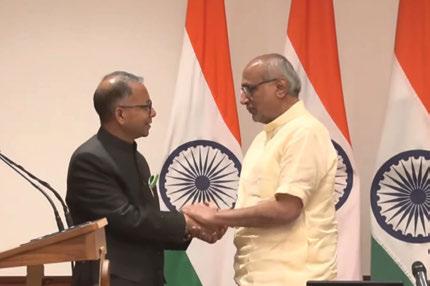
NewlyelectedRajyaSabhaMemberfromPunjab andindustrialistShriRajinderGuptawasswornin asaMemberofParliament(RajyaSabha)inNew Delhi.Theoathofofficewasadministeredbythe Vice President of India and Rajya Sabha Chairman, Shri C. P. Radhakrishnan, in the ParliamentHouse.
Rajinder Gupta, Chairman of the Trident Group, was elected unopposed to the Rajya Sabha last month. A leading figure in India's industrial landscape,Shri.Guptaisknownfortransforming Trident into a globally recognized conglomerate with interests in textiles, paper, energy, and chemicals.
Apart from being an entrepreneur, Shri Rajinder Gupta is also a noted philanthropist, actively involved in initiatives related to healthcare, education, skill development, and employment generation,especiallyforruralyouthandwomen.
The swearing-in ceremony marks the beginning of Gupta's parliamentary journey, where he is expectedtocontributehisextensiveexperiencein industry, innovation, and social welfare toward national policymaking and the development of Punjab.
AboutTridentGroup.
Trident Limited is the flagship company of Trident Group, an Indian business conglomerate and global player. Headquartered in Ludhiana, Punjab,Trident Limited is a vertically integrated textile (Yarn, Bath & Bed Linen) and Paper (Wheat Straw-based) manufacturer. Trident's towels, yarns, bedsheets, and paper businesses haveearnedglobalrecognitionandaredelighting millionsofcustomersacrossIndiaandtheworld. Trident is one of the largest players in home textilesinIndia.
Supplying national, captive, and retailer-owned brands;theorganizationishighlydecoratedwith awards from its customers, vendors, and various government entities in recognition of advancing the highest standards in product quality, social responsibility, and environmental stewardship. The company operates in three major business segments:Textiles,Paper,andChemicals,withits manufacturing facilities in Punjab and Madhya Pradesh.
When the global textile community converges, innovationfindsitspulse.ITMAASIA+CITME 2025, hosted at Singapore Expo from 28–31 October 2025, proved to be much more than an exhibition—itwasastatementofintentfroman industrydeterminedtoreimagineitsfuture.With over 800 exhibitors from 30 countries and a bustling visitor base exceeding 30,000 professionals, the event became a vibrant confluence of technology, collaboration, and sustainability—threethreadsnowinseparablein the evolving fabric of global textile manufacturing.
AsthefirsteditioninSingapore,theshowcarried a renewed energy, reflective of Asia's growing influenceasbothaproductionhubandacrucible of innovation. Across 70,000 square meters of exhibition space, the hum of machinery, the gleam of smart digital interfaces, and the chatter of business networking echoed one message clearly — the textile industry's transformation journeyhasentereditsdecisivedecade.
AGlobalStagewithAsianEnergy
The decision to host ITMA ASIA + CITME in Singapore marked a strategic shift toward the heartoftheworld'sfastest-growingtextileregion. As Asia drives more than 70% of global textile output, the exhibition symbolized how regional innovationcanpowerglobalprogress.
Exhibitors from CEMATEX associations, including ACIMIT, SWISSMEM, VDMA, and TMAS, shared the floor with Asian technology leaders and start-ups alike. Together, they represented a spectrum of expertise — from legacyprecisionengineeringtoagile,data-driven manufacturing.
“Thisisthedecadeofintelligenttextiles—where machinery, materials, and data converge,” remarkedoneexhibitor.Indeed,walkingthrough
thehallsfeltlikewalkingintothefuture—where sustainability isn't a checkbox but an embedded designprinciple.
Hall 2: Weaving, Braiding, and Nonwoven Breakthroughs
InHall2,weavingandnonwovenmachinerytook center stage, showcasing not only mechanical prowess but also ecological intelligence. Leaders like Dilo, Dornier, Haijia, and Herzog unveilednext-generationequipmentdesignedfor eco-efficient production — with innovations such as reduced selvedge waste, lower compressed air consumption, and smart digital controlsensuringenergyoptimization.
Nonwoven technologies drew particular interest, underscoring their pivotal role in technical textiles, filtration, hygiene, and mobility applications. Dilo's high-speed crosslappers stood as testaments to how performance and sustainabilitynowadvancehand-in-hand.
For an industry long criticized for resource intensity, these machines demonstrated that efficiencyisthenewcompetitiveness.Theeraof high-speed production is giving way to highsense production — where precision, data, and sustainabilitydefineexcellence.
Hall 3–4: Spinning and Fibre Innovation — TheCoreofChange
Thespinningsector,housedinHalls3and4,was a reflection of global fibre transformation. With global fibre consumption poised to reach 125 million tons in 2026, spinning remains the backbone of textile manufacturing — yet its role israpidlyevolving.
Companies such as Oerlikon Barmag, Saurer, Truetzschler, LMW, Rieter and Toyota showcased technologies emphasizing automation.
The editorial takeaway? The spinning floor of ITMAASIA2025nolongerrepresentsthestartof production, but rather the start of a more consciousindustrialecosystem.
Hall 5: Knitting, Embroidery, and the Art of DigitalDesign
In , creativity met computation. Brands Hall 5 such as Karl Mayer, Keumyong, and Santoni broughtforwardanewgenerationofknittingand embroiderysystemsthatblurredthelinesbetween fashion,function,andsustainability.
Visitors were captivated not just by speed or precision,butbyhowdigitalknittingplatforms are reshaping the creative process. With design flexibility built into the machine logic itself, the textile designer of tomorrow will not merely selectyarns—theywill .codefabrics
Halls 6–8: Finishing, Printing, and the New ChemistryofTextiles
Finishing remains the heartbeat of textile quality —andinSingapore,itwasclearthatthissectoris being rewritten through science and sustainability.AcrossHalls6to8,companieslike Benninger, Canlar, Konica Minolta, SPG, and Thies introduced modular dyeing, finishing, and printing systems that drastically reduce water, energy,andchemicalconsumption
Benninger's advanced resource-saving dyeing lines precision digital , Konica Minolta's printers AI-integrated dye control , and Thies' systems demonstrated how sustainability and productivitycannowcoexist.
The new mantra? Color meets conscience. As mills worldwide strive to meet ESG goals, these innovations offer realistic pathways to compliance and competitiveness. Beyond machinery, the — chemistry of sustainability drivenbyautomationandsmartdosing—wasthe invisibleheroofthisyear'sfinishingshowcase.
Digitalisation and Recycling: A Value Chain Reinvented
The digital revolution was no longer confined to thesoftwarezone;itwaswovenintoeverysector. From to AI-driven monitoring systems predictive maintenance platforms and automated process optimizers, the industry displayeditsreadinessforadata-firstfuture.
Recycling technologies took equal prominence. Fibre sorting, material recovery, and circular spinningsystemsshowcasedhowmanufacturers are closing the loop. The integration of digitalisation and recycling signals a paradigm shift—datawilldrivethecirculareconomy.
Predictive analytics, once a luxury, is now essential for sustainability. In factories of the future, machines will no longer wait for failure; they will anticipate, adapt, and self-correct — conservingenergyandreducingdowntime.
Live Demonstrations: The Theatre of Innovation
Beyond static displays, ITMA ASIA + CITME 2025 elevated engagement through live machinery demonstrations held every hour acrossfourdays.Theselivesessionstransformed technical conversations into sensory experiences —therhythmichumoflooms,thefluidmotionof knitting machines, and the precision of robotic handlingsystemscreatedasymphonyofprogress.
Forvisitors,itwasnotjustaboutseeingmachines, but feeling the momentum of an industry that never stands still. Each demonstration was a chapterintheunfoldingstoryofhowtechnology ishumanizingproductivity.
ConnectingMinds,BuildingFutures
More than an exhibition, ITMAASIA+ CITME 2025 was a — where platform of dialogue engineers, entrepreneurs, and innovators exchanged more than business cards. They
exchanged perspectives on the shared future of globaltextiles.
Networking hubs and the Media Centre buzzed with discussions on traceability, material innovation, and workforce transformation. Sustainabilitywasnolongeranisolatedtheme— itwasthecommonvocabularyconnectingevery hallandeveryconversation.
Singapore's efficiency, connectivity, and commitment to sustainability amplified the exhibition's message: Asia is ready to lead the nextindustrialrenaissance.
The Editorial Perspective: The Threads of Tomorrow
From an editor's standpoint, ITMA ASIA + CITME 2025 reflected a rare convergence — where ambition met accountability. The show mirrored the global textile industry's transition from incremental improvement to transformationalinnovation
Threeeditorialobservationsstoodout:
1.SustainabilityasStrategy,NotSlogan
Whatoncebeganascompliancehasnowbecome core strategy. Every hall — from spinning to finishing—reflectedadeliberateefforttoembed environmental intelligence into equipment design.
2.DigitalisationastheGreatEqualizer
WhetherforEuropeanmachinerygiantsorAsian mid-sized manufacturers, digital tools are leveling the playing field. From AI-enabled predictive maintenance to cloud-based quality tracking, digitalisation is redefining competitiveness.
3.CollaborationastheCatalyst
The presence of CEMATEX associations alongside Asian exhibitors exemplified the importance of cross-continental collaboration. In this interconnected era, innovation thrives not insilosbutinsharedecosystems.
Beyond2025:TheRoadAhead
As the curtains fell on ITMA ASIA + CITME 2025,onethingwasclear—theindustry'sfuture is not about choosing between technology and sustainability,butaboutfusingthemseamlessly
The challenges ahead are immense: rising raw materialcosts,regulatorypressures,andevolving consumer expectations. Yet, the optimism in Singapore was palpable. The collective momentum of manufacturers, innovators, and technologistspromisesafuturewheretextilesare notjustmadeforpeople,butalsofortheplanet.
With Asia's leadership, European engineering precision, and global collaboration, the path ahead is promising — one defined by smart factories, circular systems, and conscious creativity.
AClosingReflection
ITMAASIA+CITME2025willberemembered notjustasanexhibition,butasaturningpoint— where textile machinery became a medium of purpose,notjustproduction.
Ineveryhall,ineverybooth,thenarrativewasthe same: innovation must serve humanity. The textile industry — once defined by threads and fabrics — is now defined by ideas, data, and sustainability.
As reflects on this TIMES INTERNATIONAL landmarkevent,onethoughtresonatesdeeply:
“We are not merely witnessing the evolution of machines. We are witnessing the evolution of mindset—whereprogressismeasurednotonlyin outputbutinimpact.”
Thefutureoftextilesishere—dynamic,digital, and deeply driven by responsibility.And as we lookahead,itisclear:therealinnovationliesnot inwhatmachinescando,butinwhathumanity choosestodowiththem.
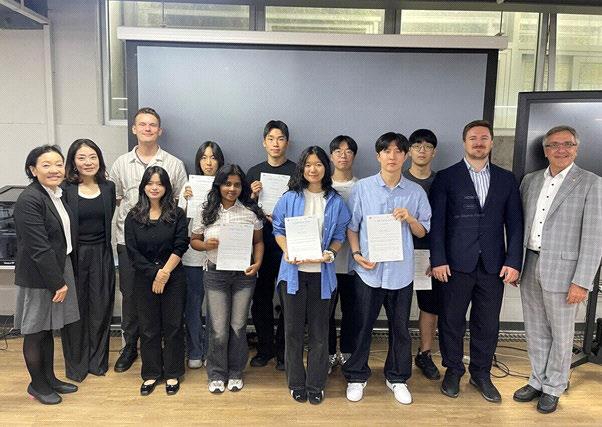
TheAachenSummerSchoolhasestablisheditself as an important platform for promoting cooperation between RWTH Aachen University and Seoul National University. The focus is on practice-oriented research projects in the field of 4D and robotics technologies, which have been successfullyimplementedforyearsattheInstitut fürTextiltechnikofRWTHAachenUniversity.
This year, the theme of the Summer School was soft robotics and 4D materials. Participating students had the opportunity to develop innovative concepts for gripping systems by working with various actuators and stepper motors.
The programme structure comprised two intensiveweeks.Inthefirstweek,varioussample projects, including a three-finger gripper, were presented and replicated. In the second week, students were able to develop a modular system under supervision and implement their own projectideas.
The International Office at RWTH Aachen University encouraged German students to take
partinthisuniqueopportunityduringtheirstayin Korea. Associate Professor Howon Lee specifically promoted the summer school to Germanmechanicalengineeringstudents.
The participants consisted of mechanical engineers, electrical engineers, materials scientists and industrial engineers. Each group presented the results of their work in a final presentation.
Particularly noteworthy was the participation of DrHokyenongRheeandMsJayoungNafromthe German Academic Exchange Service (DAAD), who gave the students insights into possible funding programmes for studying abroad. This initiative underscores the motto of the summer school:'Let'sshapethefuturetogether!'
This event impressively demonstrates how international cooperation in education can not only impart knowledge, but also build bridges between cultures – a decisive step towards an innovativefutureinthefieldof4Dandrobotics.
® At the heart of their innovation is cycora , a revolutionary material that combines circularity with performance excellence. Made through ® textile-to-textile (T2T) recycling, cycora deliversvirgin-qualitypolyesterwhileemitting 78% fewer greenhouse gases and ensuring a fully traceable supply chain. It eliminates the need for virgin resource extraction, preventing textile waste from ending up in landfills or incinerators — a promise that transforms sustainabilityfromconcepttopractice.
The textile industry stands at a defining crossroads—betweenwasteandworth,between thedisposableandtheregenerative.AttheITMF Start-up Awards 2025, this vision of circular transformation found its strongest voice in Ambercycle, a California-based innovation company that has dared to make the impossible possible: turning discarded garments into new, high-quality textiles through molecular regeneration.
Founded in 2015, Ambercycle began with a simple but radical goal — to solve the growing crisis of textile waste, one of the most urgent environmental challenges of our time. By 2019, their first pilot in Los Angeles was operational, and by 2021, they had created their first regenerated garment made entirely from postconsumertextilewaste.
The world has taken notice. With a $75 million partnershipwithINDITEX,andcollaborations with leading fashion houses like GANNI, ®cycora is already redefining the possibilities of circular fashion. At Paris Fashion Week, the ®cycora xGANNIjerseywornbyTaylorSwift became more than a design statement — it became a symbol of what the future of fashion could look like when sustainability meets star power.
Beyonditsmaterials,Ambercycleispioneeringa circular ecosystem where every stage — from recycling and production to distribution and consumption — is connected through data, transparency,andresponsibility.
“We want to live in a beautiful world,” says the ® team — and through cycora, they are proving that such a world can be built, thread by thread, fibrebyfibre.
Ambercycle's journey is not merely about recycling fabric; it's about regenerating value, trust,andhope—provingthatthemostpowerful fabricofthefuturewillbewovennotfromoil,but fromimagination.
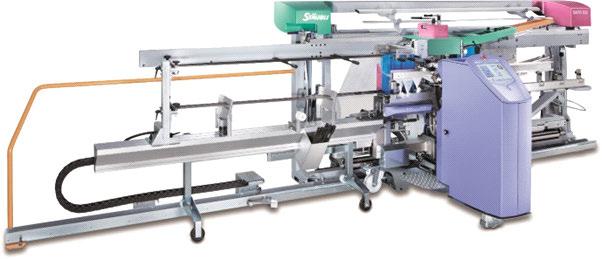
AtITMAASIA+CITME 2025,Stäubliraisesthe bar for textile engineering with the launch of the SAFIR PRO S37 – an advanced automatic drawing-in machine built to power the next generation of high-speed, high-precision weaving. Purpose-engineered for filament yarns, this breakthrough solution helps mills achieve faster processes, superior fabric quality, and consistentlyreliableresults.
SAFIR PRO S37 automatic drawing-in machine , Offering a very high-speed with efficiency,flexibilityandhigh-fabricquality
Inaworldwherespeed,accuracy,andautomation define competitiveness, the SAFIR PRO S37 standsasagame-changerforapplicationssuchas airbags, sportswear, waterproof fabrics, and technicalmaterialslikefiberglassusedinprinted circuitboards.
KeyAdvantagesoftheSAFIRPROS37
Ÿ Exceptional drawing-in performance for filamentyarns
Ÿ Optimized engineering for lower downtime andsmoothworkflows
Ÿ AWC Layer & Offset Management for precision,flexibility,anderror-freedouble-beam handling
Empowering Excellence Across Every Fabric Application
At the Stäubli booth, visitors can explore a full spectrum of weaving innovations designed to elevateproductivityandquality:
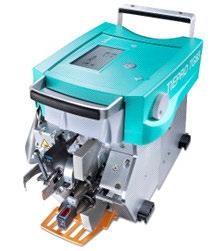
Ÿ TIEPROWarpTyingMachine–High-speed tying with unmatched reliability. A special customer story from Danarmas, Indonesia, showcases its success: “Low maintenance costs, user-friendly design, and outstanding productivity,”notestheDirector.
Ÿ LX PRO Jacquard Machine – High output, low energy consumption, and versatility across flat,terry,andtechnicalfabrics.
LX PRO Jacquard machine,Robust, wear resistantandenergyefficient
Ÿ ALPHA580UNIVERSALCarpetWeaving System – Displaying premium-quality carpet samplescreatedwithprecisionanddurability.
Backed by more than 130 years of R&D excellence, Stäubli continues to empower mills worldwidewithmachinerythatblendsreliability, performance,andfuture-drivendesign.
MyStäubli – Your Digital Partner in Productivity
The MyStäubli portal offers mills an integrated service ecosystem—technical documents, tutorials, maintenance tracking, and real-time support—ensuring seamless operations and maximumuptimeanytime,anywhere..
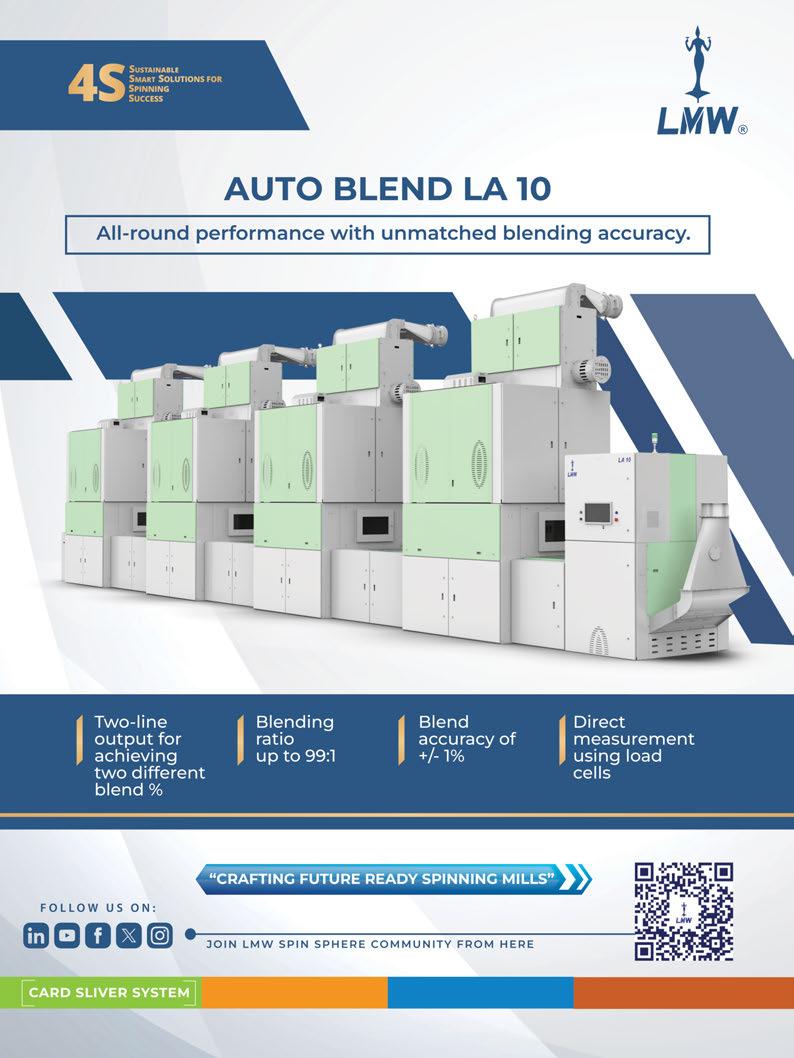
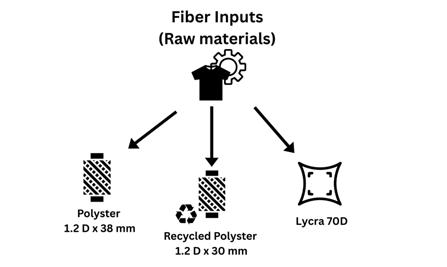
Manmade fibres today form the backbone of the globaltextileindustry,drivenbytheirversatility, performance, and ability to meet the rising demand for both everyday and specialized applications.Amongthem,polyesterstandsoutas the most widely used fibre, available in both virgin and recycled forms. Virgin polyester continuestopowerhigh-volumesegmentssuchas fashion, sportswear, and home textiles, while recycled polyester—produced from postconsumer waste such as PET bottles—has emerged as a sustainable alternative, enabling mills to combine performance with environmental responsibility. LMW's range of smart spinning machines has been instrumental in enabling mills to efficiently process these fibres—delivering consistent quality, high productivity, and superior yarn performance across both virgin and recycled polyesterapplications.
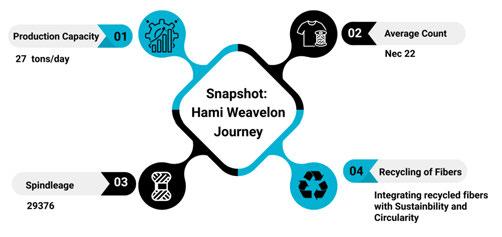
In this evolving context, HAMI Weavelon Pvt. Ltd., Surat, has strategically embraced both virgin and recycled polyester fibres to cater to diverseend-usesegments.Thecompanyproduces high-quality compact yarns—both SIRO and single.
This synergy of sustainability and performance, enabled by LMW's technology, has empowered HAMI Weavelon to set new benchmarks in polyester and recycled polyester yarnprocessingandtakeatransformativeleapin the manmade fibre value chain by deploying LMW's advanced SIRO Compact Spinning Technology.
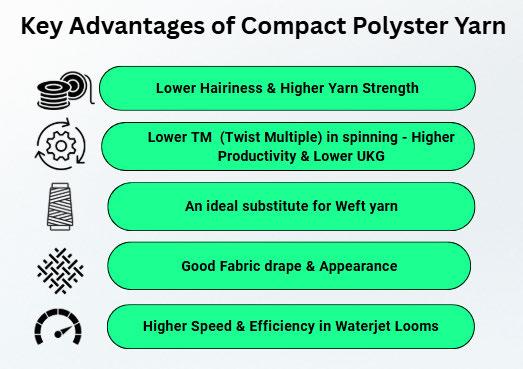
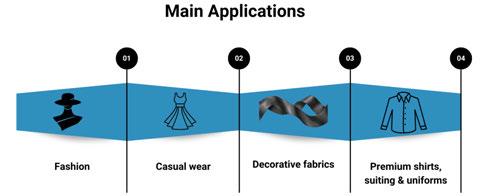
The result is yarns that deliver superior uniformity, smoothness, and strength—tailored for premium apparel, uniforms, and fashion fabrics. The single and SIRO compact polyester yarns offer distinct efficiency and production benefitsinthedownstreamweavingprocess.
TheBeginningofaVision
Establishedin2021,HAMIWeavelonPvt.Ltd. emerged as a dynamic name in Surat's textile landscape. Known for producing high-quality wovenfabricsusingadvancedshuttle-lesslooms, the company initially relied on outsourced compact and slub yarns. However, to ensure
SPINNING
complete quality control and supply flexibility, the management envisioned an integrated spinning-to-weavingsetup.
With this forward-thinking approach, HAMI WeavelonpartneredwithLMW—agloballeader in spinning technology—to establish a state-ofthe-art spinning facility capable of producing a widerangeofyarns.
“From the very beginning, LMW team has been by our side — when we were new to spinning, they patiently explained every aspect of the process, guided us on how to move forward, and advised us on the right machines and configurations for our requirements.What truly setsLMWapartistheirunwaveringcommitment
even after installation; whenever we face a challenge,theirsupportteamisalwaysjustacall away and at our doorstep without delay. It has been a remarkable experience working with LMW.” - — Mr. Chirag Saharia, Director, HAMIWeavelonPvt.Ltd.
The LMWAdvantage: Excellence inMMFSpinningPerformance
KeyAchievements
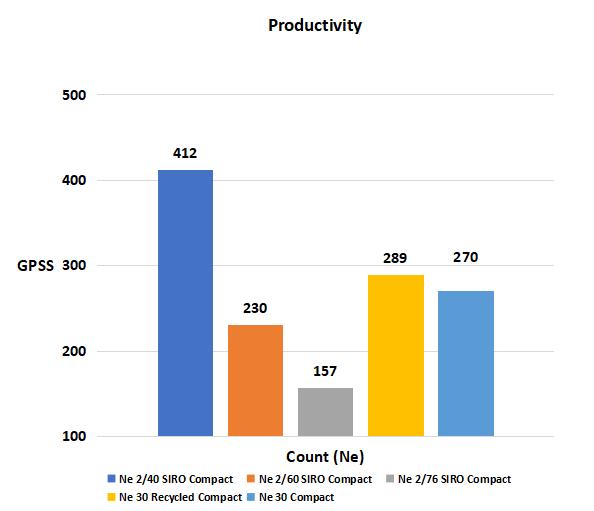
The Ne 2/40 Siro Compact yarn exhibits the highest productivity at 412 GPSS, makingitthemostefficientamongthefive types. The productivity of Ne 2/60 Siro Compactisat230GPSS,andtheNe2/76 SiroCompactyarnhastheproductivityat 157GPSS.TheNe30RecycledCompact and Ne 30 Compact yarns shows similar productivity levels at 289 and 270 GPSS respectively.
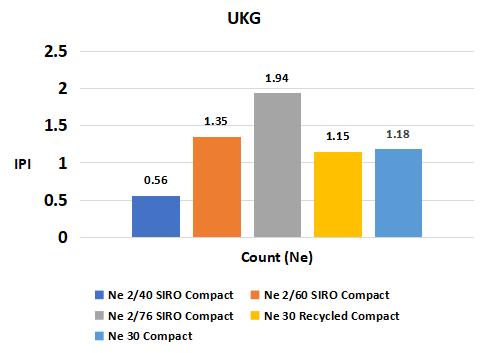
TheNe2/40SiroCompactyarnachievesa UKG of 0.56, reflecting steady output at thisfinercount.Movingtoslightlycoarser and more specialized counts, the Ne 2/60 Siro Compact records a UKG of 1.35, while the Ne 2/76 Siro Compact reaches 1.94, showcasing the mill's ability to handle higher-count yarns with consistent productivity. In the compact and recycled yarn segment, Ne 30 Recycled Compact and Ne 30 Compact maintain UKGs of 1.15 and 1.18, respectively, showing efficient processing and optimal machine performance.
SPINNING
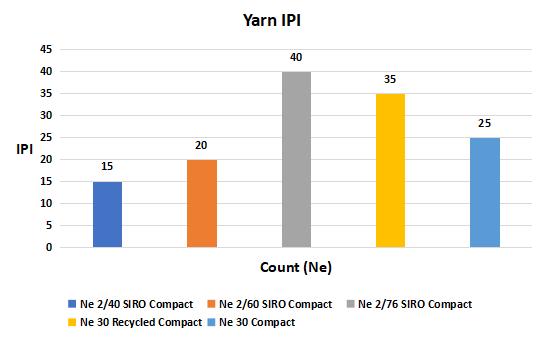
FortheNe2/40SiroCompact,theIPIstandsat 15, highlighting smooth and uniform yarn at this finer count. As the yarn count increases, the Ne 2/60SiroCompactrecordsanIPIof20,whilethe Ne2/76SiroCompactreaches40,reflectingthe
natural variation challenges in higher-count yarns.IntheNe30range,theRecycledCompact yarnmaintainsanIPIof35,whiletheStandard Compact yarn shows 25, demonstrating good qualitycontroleveninrecycledandcoarseryarns.
Conclusion
HAMIWeavelon'sevolutionreflectsthefutureof textiles — where innovation, sustainability, and
smart integration redefine growth.Together with LMW,thecompanyisbuildingnotjustyarnsand fabrics, but a stronger, greener, and globally competitivetextileecosystem
KarmaCane, the pioneering sugar-derived biopolymer developed by UK-based Teysha Technologies, is emerging as one of the most promising alternatives to petroleum-based plastics.Fullybiodegradableandengineeredfrom agricultural waste sugars, KarmaCane leaves behind no microfibres, toxins or residues—offeringfashionandalliedindustriesa truly sustainable materials pathway. Its adaptabilitymakesitsuitableforeverythingfrom buttons,trimsandeyewearframestocoatingsand water-repellentfinishes.
KarmaCane's breakthrough moment came with the Mission: Everest expedition, where products made from this biopolymer endured sub-zero temperatures, harsh winds and intense UV radiation. This successful field test validated its strength, reliability and performance in extreme conditions—proving that biodegradability does not have to come at the cost of durability. With OECD 310 certification, KarmaCane safely biodegrades into natural sugars rather than microplastics,acidsorpersistentpollutants.
What sets KarmaCane apart is its unmatched versatility.Itcanbeengineeredashardsolidsfor durablegoods,stickyliquidsforcosmetics,waterbased dispersions for packaging barriers, and evenfilamentsfor3Dprinting.Earlyapplications already span consumer goods, medical devices, marine equipment and fibre-based packaging. Manufacturingtrials through extrusion, injection moulding and coatings further confirm its compatibilitywithexistingindustrialsystems.
As Teysha prepares for tonne-scale production, modellingsuggestsKarmaCanewillsoonbecostcompetitive with conventional plastics such as
PET and ABS. Its potential impact is profound—eliminating microplastics in cosmetics, replacing plastic laminates in packaging, offering safer medical materials and providingmarine-friendlysolutions.
Inaworldracingtocomplywithtighteningglobal regulationsonplastics,KarmaCanestandsoutas a scalable, high-performance and truly biodegradable platform poised to reshape materialscienceforagreenertomorrow.
HowsoondoyouforeseeKarmaCanereaching large-scale industrial adoption, and what are the key challenges in replacing conventional plasticsinthefashionandapparelsector?
We're already well on the way to large-scale adoption. KarmaCane has been validated across multiple manufacturing routes, extrusion, injection moulding and coating, and we're now scaling monomer and polymer production through third-party industrial assets to reach tonne-level volumes.That approach lets us grow quicklywithoutbuildingnewinfrastructurefrom scratch.
We anticipate commercial-scale supply within 12–18months,withearlyadoptionalreadyunder wayinpackagingandfashionaccessories.
The biggest challenge in fashion isn't the chemistry, it's the inertia of legacy systems. The industryisbuiltonlow-costpetroplasticssuchas PET and polycarbonate. To replace them,sustainable materials must be drop-in
INNOVATION
compatible, cost-competitive, and backed by verifiedperformance.KarmaCaneisdesignedfor precisely that, it runs on standard plastics machinery, so converters don't need to retool or changeprocesses.
WithtighteningEUmicroplasticsrestrictionsand brand-level sustainability commitments,demand for scientifically proven biodegradable materials is growing fast. KarmaCane is one of the few platforms that can meet those technical and regulatoryexpectationssimultaneously.
KarmaCane has demonstrated adaptability across eyewear, packaging, and coatings — howareitsmaterialpropertiestailoredtomeet suchdiverseperformancerequirements?
TheversatilitycomesfromKarmaCane'smodular sugar-based polycarbonate chemistry. We don't rely on fermentation or biological modification for this modularity, instead, we chemically functionalisesugarsfromagriculturalwastesuch ascassava,sugar-caneandevenpotatopeels.By varying those functional groups, we can control mechanical strength,flexibility, transparency and degradationrate.
That means one platform can deliver rigid, highimpact grades for eyewear frames, flexible and transparent films for packaging, or water-based dispersionsforcoatingsonpaperandtextiles.The eyewear frames tested during the Mission: Everest2025expeditionareagoodexample,they withstoodextremeUVexposureandtemperatures below –40 °C, proving durability in real-world conditions.
For packaging, we can engineer water- and grease-resistant coatings that remain fully compostable,andfortextilesorouterwear,wecan
adjust surface energy and hydrophobicity to achievebreathableyetprotectivefinishes.It'sthe same underlying polymer family, just precisely tunedforeachusecase.
Beyond biodegradability, what measurable environmentalbenefitsdoesKarmaCaneoffer comparedtopetroleum-basedpolymers?
Biodegradability is only part of the picture. The fulllife-cycleimpactiswhereKarmaCanestands out.
Ÿ Manufacturingefficiency:Ourpolymerisation processrunsatlowertemperaturesandpressures than petrochemical plastic synthesis, saving roughly20–30%inenergydemand.
Ÿ End-of-life:KarmaCaneisOECD310-certified biodegradable, breaking down fully into nontoxic natural sugars, water and CO₂, leaving no microplasticsorpersistentresidues.
Ÿ System compatibility: Because it can be processed on existing industrial equipment, the transition cost and carbon overhead of adoption areminimal.
A comparative life-cycle assessment now under way is already showing strong reductions in greenhouse-gasemissionsandcumulativeenergy userelativetoPET,ABSandPLA.
When combined with its proven performance in extreme conditions, KarmaCane demonstrates thatacircular,bio-basedmaterialseconomyisnot a future concept — it's something we can scale responsiblytoday.
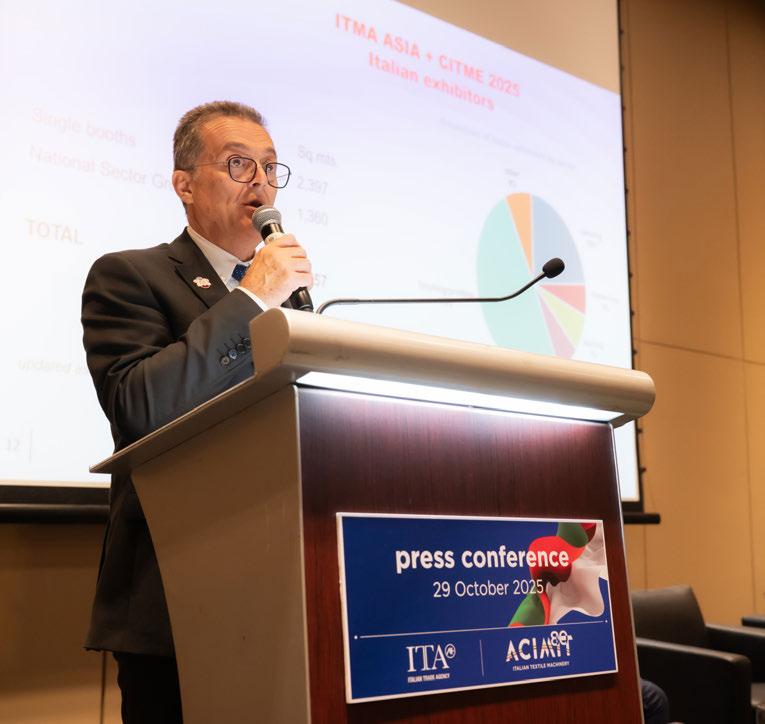
Q1: How does ACIMIT plan to strengthen trade and technological collaboration with major textile-producing countries such as IndiaandBangladesh?
A: Collaboration with textile companies in key marketcountriesisfundamentaltopromotingour sector.Activities carried out in cooperation with the Italian Trade Agency, such as technology symposiums and incoming missions, provide an opportunity to learn about the needs and opportunities of different markets. Another activityaimedatstrengtheningpartnershipswith textile companies involves the technological training centres, which is a long-term initiative. Thefirststepistoequipthelocaltrainingpartners with Italian technologies for specific textile processes.Oncethecentrehasbeenequippedwith the standardised technologies, a series of promotional and training activities are then planned to raise awareness among local textile companiesabouttheuseofItaliantechnology.We currently have centres operating in India, Mongolia, Pakistan, and Vietnam, with more in thepipeline.
Q2: What key strategies are being implemented by ACIMIT to sustain and expand Italy’s leadership in textile machinery exportsamidglobalcompetition?
A: The leadership of Italian textile machinery manufacturers is increasingly based on offering sustainable, automatised and digitised technologies. In this regard,ACIMIT's activities focusonprovidingtheappropriatetoolstoenable its member companies to achieve these
Spokesperson: Marco Salvadè, President, ACIMIT (the Association of Italian Textile Machinery Manufacturers)
objectives.The Sustainable Technologies project focuses on CLIMA (Committed to Low Impact Machinery), a voluntary declaration by Italian textile machinery manufacturers, verified and certifiedbytheinternationalbodyRINA.CLIMA aims to make the energy and environmental performance of each machine clear and easy to understand. Currently, around 50 ACIMIT membercompanieshavejoinedthisinitiative.
Q3: How important are international partnerships and trade policies in promoting innovation and expanding ACIMIT’s global reach?
A: With regards to international partnerships, ACIMIT is committed to establishing strong relationships with similar national associations representingthelocaltextileindustryindifferent countries, as well as with training institutes and universities that can serve as a bridge to textile companies and future entrepreneurs. Though trade policies are outside its direct control, ACIMIT supports measures that promote fair, opentradeandactivelypushesforthereductionof tariffs that hold back its member companies’ commercialgrowth.
AboutMarcoSalvadè
Born in Como in 1967, Marco Salvadè is the President of Salvadè Srl, a family-owned company specialising in finishing machinery foundedin1967.ActivewithinACIMITformany years,hehasbeenamemberoftheAssociation’s GeneralCouncilsince2018andpartoftheItalian
delegation to CEMATEX (Committee of European Textile MachineryAssociations) since 2023.
InJuly2024,SalvadèwasappointedPresidentof ACIMIT, succeeding Alessandro Zucchi. As president, he aims to strengthen the sense of belonging among member companies and align the Association’s strategies with evolving economicandgeopoliticaldynamics.
AboutACIMIT
ACIMIT (Association of Italian Textile Machinery Manufacturers) is a non-profit organisation that represents and promotes Italy’s textile machinery industry worldwide. Comprising around 300 manufacturers and employing approximately 13,000 people, the sector exports about 86% of its production, highlightingitsstronginternationalpresence.
ACIMIT supports the industry through trade missions, exhibitions, and technical seminars, fostering global collaboration and innovation. Italian textile machinery is celebrated for its creativity,quality,reliability,andcommitmentto sustainability — reflected in initiatives like the Sustainable Technologies project and the ACIMITGreenLabel,whichcertifiesmachinery for energy and water efficiency. Covering all stagesoftextileproduction—fromspinningand weaving to dyeing, finishing, and printing — ACIMIT embodies the excellence and forwardthinkingspiritofItalianmanufacturing.
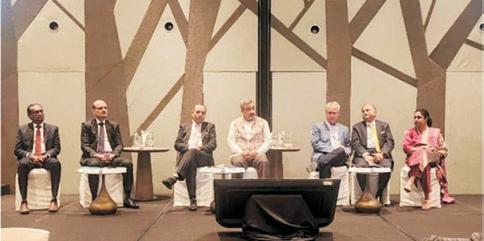
Distinguished Guests (L-R) Mr. Senthil Kumar, Hon' Treasurer, India ITME Society; Mr. Hemant Sharma, President – Polyester, Reliance Industries Ltd.; Mr. Rohit Kansal (I.A.S), Additional Secretary, Ministry of Textiles, Govt of India; H. E. Dr. Shilpak Ambule (IFS), High Commissioner of India to Singapore; Mr. Jason Kent, CEO, British Textile Machinery Association; Mr. Ketan Sanghvi, Chairman, India ITMESociety;Dr.SeemaSrivastava,ExecutiveDirector,IndiaITMESociety.
The India ITME Society's India Networking Program,heldon29thOctober2025inSingapore, marked a pivotal moment in the evolution of India's textile and textile engineering sectors. OrganizedalongsideCITME+ASIA,theprogram convened Ministry of Textiles officials, global machinery associations, entrepreneurs, and innovators for a high-impact exchange of ideas andopportunities.
With participation from 183 delegates representing leading economies and textile hubs, the platform demonstrated India's expanding global influence and the industry's collective commitment to shaping a more integrated, technology-driven future. At the centre of discussions was the strategic potential unlocked by partnerships such as the UK–India FTA and Singapore CECA—agreements poised to strengthen trade, enhance market access, and accelerateknowledgesharing.
Mr.RohitKansal,AdditionalSecretary,Ministry ofTextiles, highlighted India's emergence as one of the world's top hubs for weaving and knitting machinery installations, powered by a rapidly growingdomesticmarketandstrongvalue-chain expansion.
Reinforcingtheinternationaldimension,H.E.Dr. Shilpak Ambule emphasized Singapore's vital role as India's largest trading partner inASEAN and a global leader in design, distribution, and retail. Industry voices—including Reliance IndustriesLtd.andtheBritishTextileMachinery Association—converged on a common belief: India is positioned to become a responsible, resilient, and trusted global sourcing and manufacturingdestination.
ChairmanMr.KetanSanghviunderscoredIndia's robust economic outlook, reflected in rising consumer spending and strengthening industry confidence—factorsthatsignalaneraofinclusive andsustainabletextilegrowth.Withtheupcoming India ITME 2026, this momentum is set to translate into deeper global collaboration and innovation.
This program stands as a testament to India's determination to lead the next chapter of global textile transformation—progress driven by partnership, powered by vision, and woven with purpose.
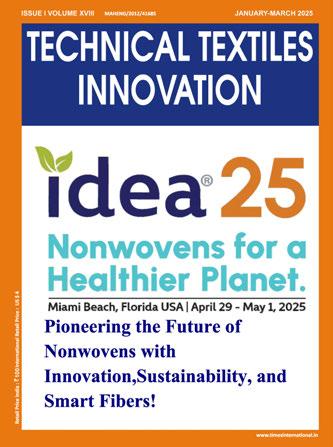
Technical Textiles Innovation is a leading quarterly magazine dedicated to the growing world of technical textiles. It offers in-depth coverage of innovations across segments like geotextiles, medical textiles, protective wear, automotive textiles, and smart fabrics. Each issue features expert articles, market trends, sustainability insights, and interviews with key industry players. Distributed globally at major exhibitions and directly to decision-makers, the magazine is a trusted resource for and innovators. With a strong focus on technology, sustainability, and market opportunities, Technical Textiles Innovationplaysakeyroleinadvancing thefutureofthetechnicaltextileindustry