SEPTEMBER 2020
TOWARDS POST-2020 EXPERTISE WITH #14
INVASIVE ALIEN SPECIES A GLOBAL THREAT TO BIODIVERSITY: WHAT WILL THE FUTURE BRING? Wolfgang Rabitsch Environment Agency Austria, Vienna, Austria
Trends indicate that the increasing trajectory of Invasive Alien Species will continue in the absence of ambitious mitigation approaches. Adaptive management strategies are key, including prevention across pathways and control measures in high areas of conservation. These actions need to be evidencebased, transparently communicated and underpinned by progressive targets. BIODIVERSITY IMPACTS ARE MORE SEVERE ON ISOLATED ISLANDS, WHERE IAS CAUSE THE REDUCTION OR EXTINCTION OF NATIVE, OFTEN ENDEMIC SPECIES.
The introduction and spread of Invasive Alien Species (IAS) by humans in regions previously beyond the reach of natural colonisation have become a defining feature of biodiversity loss. The plants, animals, pathogens, and other organisms introduced to an area in which they did not occur have repercussions on biodiversity and ecosystem services, the economy, health, and well-being. It was estimated that overall costs from IAS amounted to 5% of the global GDP, but it was recently suggested that these may be underestimations 1. Invasive alien insects alone cost a minimum of USD 70 billion/year 2. All ecosystems, continents, and oceans are affected, even the polar regions, but impacts are not evenly distributed. Biodiversity impacts are more severe on isolated islands, where IAS cause the reduction or extinction of native, often endemic species. Social-economic impacts, specifically on agriculture, food security, and well-being, threaten developing countries where IAS lead to considerable financial losses. Health impacts, including spread of diseases, are of global concern. Biological invasions are a fingerprint of the Anthropocene 3, and it is time for the parties to the Convention on Biological Diversity (CBD) to increase efforts and address these challenges through ambitious targets underpinned by unequivocal actions.
01
TOWARDS POST-2020 — EXPERTISE ON #14
HUMAN ACTIVITIES ACCOUNT FOR INVASIVE ALIEN SPECIES AS A DRIVER OF BIODIVERSITY LOSS Biological invasions arise from the transfer of organisms from their native range, transportation along specific pathways, and introduction to a new region where some species prosper and spread. Through every step of this process, species have to overcome several barriers. Encountering a matching climate and suitable habitats, food and shelter, and conspecifics for reproduction are some of those. Increased volumes of transported goods and weakened barriers, as well as incremented susceptibility of recipient habitats, all contribute to growing numbers of alien species around the world, some of which may become damaging and so termed invasive. Trade and transport networks Introduce invasive alien species to new locations ORGANISMS ARRIVE IN NEW LOCATION
POPULATION SPREADS
Harlequin Ladybird, Harmonia axyridis
1
Bradshaw, C.J., et al. (2016) Massive yet grossly underestimated global costs of invasive insects. Nature Communications 7:12986. https://cutt.ly/NfT0Uao
2
Pyšek P., et al. (2020) Scientists’ warning on invasive alien species. Bio. Rev. (in press), doi: 0.1111/brv.12627
3
McGeoch, M. & Jetz, W. (2019) Measure and reduce the harm caused by biological invasions. One Earth 1: 171-174.
4
Bellard, C., et al. (2016) Alien species as a driver of recent extinctions. Biology Letters 12(2), 20150623.
5
Blackburn, T., et al. (2019) Alien versus native species as drivers of recent extinctions. Frontiers Ecol Evol 17(4): 203-207. https://cutt.ly/zfT0WXv
6
02
Seebens, H., et al. (2017) No saturation in the accumulation of alien species worldwide. Nature Comm. 8: 14435. https://cutt.ly/OfT0EGD
Habitat disturbance and land use change Facilitates the establishment of alien species
INCREASING IMPACT ON NATURE AND SOCIETY
POPULATION GROWS
POPULATION ESTABLISHES
Climate changes Releases some species from abiotic constraints on survival, growth and spread
Factors that facilitate the arrival, establishment, and spread of Invasive Alien Species, resulting in negative outcomes for biodiversity, ecosystems, and society 3.
There is a multitude of ways, so called intentional and unintentional pathways, in which IAS are introduced and spread. The relevance of different pathways can change over time, and new pathways can emerge, but among the most important are the ornamental plant and animal pet trade, contaminants on organic products (nursery material, seeds, timber), stowaways in containers, vehicles, and luggage, as well as ballast water and hull fouling in the marine environment. The construction of waterways (e.g. Rhine-MainDanube-Canal, Suez Channel, St. Lawrence Seaway), connecting previously separated water catchments, is also a major catalyst. Each IAS will interact with the environment in different form and apply a multitude and variation of negative impacts on biodiversity. These are exerted through mechanisms including competition, predation and herbivory, transmission of pathogens, hybridisation, alterations in the interactions between species (e.g. predator and prey or plant and pollinators), and changes in ecosystem processes and functions (e.g. decomposition rates or nutrient cycling). Ultimately, IAS can result in the reduction or extinction of native species. This is of particular concern for endemic species and island ecosystems,
SEPTEMBER 2020
where 86% of all documented historic extinctions are associated with IAS 4. IAS are considered a contributing cause of 25% of plant extinctions and 33% of animal extinctions globally 5, from the long extinct dodo in Mauritius to the Guam rail, which is considered extinct in the wild.
WITH THE LOSS OR DECLINE OF NATIVE SPECIES, THE ECOSYSTEM SERVICES THEY PROVIDE ARE ALSO LOST. EVIDENCE OF IMPACTS INCLUDE DISRUPTIONS OF POLLINATING INSECT NETWORKS AND INCREASING EROSION, BUT THERE CAN ALSO BE DIRECT EFFECTS ON HUMAN AND ANIMAL HEALTH.
Introduced predators and pathogens often have dramatic consequences when they interact with native species that lack co-evolutionary adaptation. The rosy wolfsnail is responsible for the extinction or dramatic decline of more than one hundred snail species on islands in the Pacific and Indian Oceans. Among the high diversity of water-mould oomycete Phytophthora-species, potato blight, cocoa black pod, and sudden oak death are examples of diseases responsible for famine and serious economic and ecological damage around the world. It is worth noting that an increasing number of species which pose threats to human well-being are being translocated globally. The spread of the Asian tiger mosquito, a competent vector of several viruses such as West Nile, dengue, Zika and chikungunya, highlights one of these extreme human health impacts.
WHAT IS THE LIKELY FUTURE OF IAS? Numbers of alien species and their impacts have increased worldwide in recent decades, and there is no evidence that the rate of arrivals is at saturation 6. The increasing volumes of traded goods, using new transport links and hubs, will ensure a continued supply of IAS. Data on alien insects in Europe has shown that their rate of spread has accelerated in recent decades 7. A strong increase in alien plant species is expected in the next decades, especially for emerging economies in megadiverse regions. This is partly due to a historic legacy effect, the socalled “invasion debt”. Biological invasions often take some time to unfold; it can take decades or even centuries for alien species to establish in the wild or become invasive after introduction. This time-lag does provide a window of opportunity to act before impacts may occur. It is important to take measures as soon as possible to increase cost-efficiency and their probability of success. Biological invasions, however, cannot be considered in isolation. IAS react to and interact with other drivers of environmental change including climate change and human-induced habitat change, especially under increased nutrient availability and
INVASIVE ALIEN SPECIES, A GLOBAL THREAT TO BIODIVERSITY: WHAT WILL THE FUTURE BRING?
TOWARDS POST-2020 — EXPERTISE ON #14
high levels of disturbance.
to reduce these in the future.
These modifications increase the susceptibility of the recipient habitats, promote biological invasions, and heighten the risks related to IAS for biodiversity, economies, and health. Measures to deal with one driver should not be at odds with measures to reduce impacts from the others. Actions to mitigate climate change, for example, need to be considered carefully so that they do not result in unacceptable risks; the use of IAS as energy plants or for carbon capture in forestry should thus be assessed for risks.
“TO ADDRESS FUTURE IMPACTS THROUGH THE PREVENTION OF IAS INTRODUCTIONS IS ESSENTIAL BUT NOT SUFFICIENT. IT IS ALSO ESSENTIAL TO ERADICATE OR CONTROL THE MOST HARMFUL ESTABLISHED SPECIES WHENEVER POSSIBLE AND FEASIBLE.”
Urbanisation is a known driver of biological invasions, and it is predicted to continue and intensify. Cities, including their transport hubs for people and goods (e.g. harbours), often provide sufficient resources for generalist species to survive after arrival, increase in numbers, and then spread into the natural environment. But there is also a chance to develop future (mega)cities and suburban regions in a more sustainable, “greener” way of living, e.g. by promoting native plants for private gardens, public parks, and landscaping.
THE NEED TO REFLECT AND BUILD ON EXISTING SUCCESSES WHILE SPEEDING UP ACTION AGAINST IAS Water Hyacinth, Eichhornia crassipes.
7
Roques, A., et al. (2016) Temporal and interspecific variation in rates of spread for insect species invading Europe during the last 200 years. Biological Invasions 18: 907-920. https://cutt.ly/cfT0Ivc
While promising initiatives, global cooperation, and regional efforts exist, greater commitment is necessary to protect biodiversity, the economy, and health from the negative impacts of IAS while acknowledging the broad context of our rapidly changing world. Introduced predators, such as rats, stoats, and possums, are a threat to the unique biodiversity of New Zealand. The “Predator Free New Zealand” initiative aims to completely remove these by 2050, based on successful campaigns on several off-shore islands over the last decades. This initiative brings together different sectors and key players, from governmental bodies to private landowners, communities, and businesses, working together towards a common goal. The ambitious vision is to set an aspiring new target of local and national IAS management with global impact. The “Working for Water” programme in the biodiversity hotspots of South Africa successfully combines IAS plant management with economic support and education for underprivileged and young people. It was initiated in 1995 and is funded by the government and private companies. Effective prioritisation of activities and targeted goal-setting and planning are key to further improve returns on investment. The “Ballast Water Management Convention” entered into force in 2017 and—although some technical standards still need to be developed to ensure implementation by 2024—will help minimise the uptake and discharge of IAS transported with cargo ships around the globe. Negative impacts from marine IAS are of considerable environmental concern and high economic costs, and the full implementation of the Convention is a key strategy
03
SEPTEMBER 2020
Piero Genovesi, IUCN Invasive Species Specialist Group
Current and future trade negotiations represent an unprecedented opportunity to find global convergence on the strengthening of prevention as the most cost-effective strategy in IAS management, backed up by the relevant multilateral environmental agreements. Dedicated studies and monitoring schemes will enable keeping track of changes in either direction, to unambiguously demonstrate impacts and to provide an evidence base for policy decisions. Horizon-scanning approaches support better predictions about the IAS that might arrive to a region in the future. Such predictions then inform the application of new and emerging technologies to support early detection (e.g. Environmental DNA, citizen science), to observe and monitor spread (e.g. remote sensing, drones) and to improve cost-benefits of management action and longterm control (e.g. habitat restoration, adaptive management, nature-based solutions). Already established measures, including those related to inspections and biosecurity, will remain important and should be improved wherever necessary, particularly on remote islands. Pathway action plans are another key instrument in the endeavour to reduce negative impacts from IAS. Initiatives such as the Global Register of Introduced and Invasive Species, supported by the Secretariat of the Convention on Biological Diversity, has the potential, if strengthened, to become a leading supporting tool, in particular for countries with needs in means and capacity. Although the management of IAS is challenging, it is important to share success stories (and failures) to learn from.
SUPPORTING A LONG-TERM SCIENCE-POLICY DIALOGUE ON IAS PREPAREDNESS AND RESPONSE Available data on IAS is mostly disconnected from policy targets, but data and data flows are at a much more advanced state than in the previous decade to inform decisions. The rise in numbers of alien species and the expected increase of their impacts, facilitated by other drivers of environmental change, call for more ambitious target-setting. It has been suggested that beside the focus on species and pathways, targets may also need to take into account the most vulnerable areas (e.g. key biodiversity areas, islands, protected areas, wetlands) to achieve high conservation benefits. Biological invasions are
INVASIVE ALIEN SPECIES, A GLOBAL THREAT TO BIODIVERSITY: WHAT WILL THE FUTURE BRING?
TOWARDS POST-2020 — EXPERTISE ON #14
Emerging and concerning developments also call for attention, including e-commerce in the pet trade sector and new shipping or trading routes that contribute to increasing introductions and impacts of IAS. On the other hand, the precautionary principle remains of high importance with innovative technologies to control IAS that yet have to prove their sustainability (e.g. gene drives). When IAS are used for economic benefits or for climate change mitigation, rigorous risk analysis of the species, techniques, and activities are necessary to evaluate the risks for society. It is necessary that the polluter is held responsible and liable, redresses caused damages, and does not pass on any costs to societies and communities. Developing holistic, multi-sectoral, and evidence-based approaches to prevention and response to IAS will thus inform biodiversity-friendly decision-making.
Information and knowledgesharing, exchange of expertise and open data, and cross-sectoral alliances must be strengthened to protect biodiversity, economy, and health from negative impacts of Invasive Alien Species
Evidence shows that economic activities are among the main drivers of IAS introduction, establishment, and spread. To halt the impact of IAS on biodiversity, transformative change is needed across sectors and societies. In this endeavour, particular support should be made available to developing countries, including knowledge transfer and a stimulation of resource mobilisation from public and private sources, improved baseline data (monitoring and surveillance) and impact studies. Identifying invasion hotspots and translocation pathways, strengthening early prevention and response, and supporting the most vulnerable regions and habitats are key to establishing a sturdy Post-2020 Global Biodiversity Framework that effectively addresses IAS and their consequences.
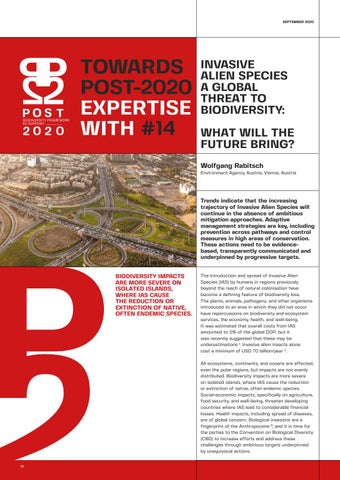
NO SINGLE SOLUTION TO THIS COMPLEX PROBLEM! Cover page picture: Aerial view of highway and buildings in Teheran Province, Iran.
Key instruments are readily available for implementation, and now is the time to increase commitment to take strong action from global to national and local levels. + Strengthen global cooperation and partnerships, information and knowledge-sharing, exchange of expertise and open data, development of standards, capacity-building, and intergovernmental work.
4POST2020BD.NET @4POST2020BD
04
+ Build cross-sectoral alliances with the economic sectors, from global enterprises to small businesses. These need to be tailored to the risks, e.g. stringent national biosecurity measures at tourism destinations of high conservation value, or in-depth risk analysis for alien species used in landscaping and gardening, agroforestry, and the pet trade. + Raise awareness at all levels, from individuals (e.g. pet owners) to commercial stakeholders (e.g. pet suppliers). + Identify responsibilities and liabilities for activities that have a negative impact on the environment, e.g. based on existing codes of conduct for different sectors. + Strengthen evidence-based research and synthesis on IAS, including development of meaningful indicators that are better connected to policy targets. + Communicate impacts transparently and based on scientific evidence, engage in debates with stakeholders and communities while considering the long-term risks and costs to the environment and societies. + Enhance surveillance and monitoring of IAS using a mixture of established and new techniques, e.g. citizen science and remote sensing. + Step up management efforts, from contingency planning and prevention, early detection, and eradication, to control and the restoration of impacted habitats. Prioritise management targets to overcome budgetary limitations and focus on the most damaging IAS. + Promote national and international funding opportunities, including dedicated emergency funds for rapid response. The global IPBES “Thematic assessment of invasive alien species and their control” will provide a stateof-the-art analysis on the status and trends, impacts and drivers of IAS and their management. CBD COP15 decisions and the post-2020 framework should acknowledge this assessment. COP15 is the ideal arena to share and discuss strong international action and offers the opportunity to collectively cooperate towards ambitious new targets to tackle one of the most important drivers of global biodiversity loss—Invasive Alien Species.
POST2020 BIODIVERSITY FRAMEWORK – EU SUPPORT IS FUNDED BY THE EUROPEAN UNION AND IMPLEMENTED BY EXPERTISE FRANCE. IT AIMS AT FACILITATING A COMPREHENSIVE AND PARTICIPATORY PROCESS LEADING TO THE ADOPTION OF AN AMBITIOUS POST-2020 GLOBAL BIODIVERSITY FRAMEWORK THAT FOSTERS COMMITMENT AND IMPLEMENTATION.
INVASIVE ALIEN SPECIES, A GLOBAL THREAT TO BIODIVERSITY: WHAT WILL THE FUTURE BRING?
BRANDING & DESIGN ©️ ADDB.FR
complex and dynamic, and more evidence-based quantitative data is necessary to achieve SMART targets. Although these assessments of impacts remain challenging, this should not detain us from taking bold action now.
SEPTEMBER 2020