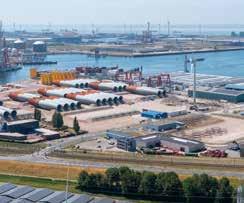
COVERING THE PORT AREA OF GHENT, TERNEUZEN AND VLISSINGEN
North Sea Port and Promotion Council North Sea Port will be in attendance at various events and trade shows. Below you’ll find a snapshot of the upcoming events that might be of interest to you.
An impressive port
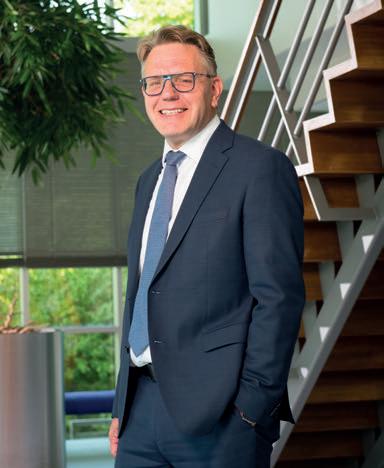
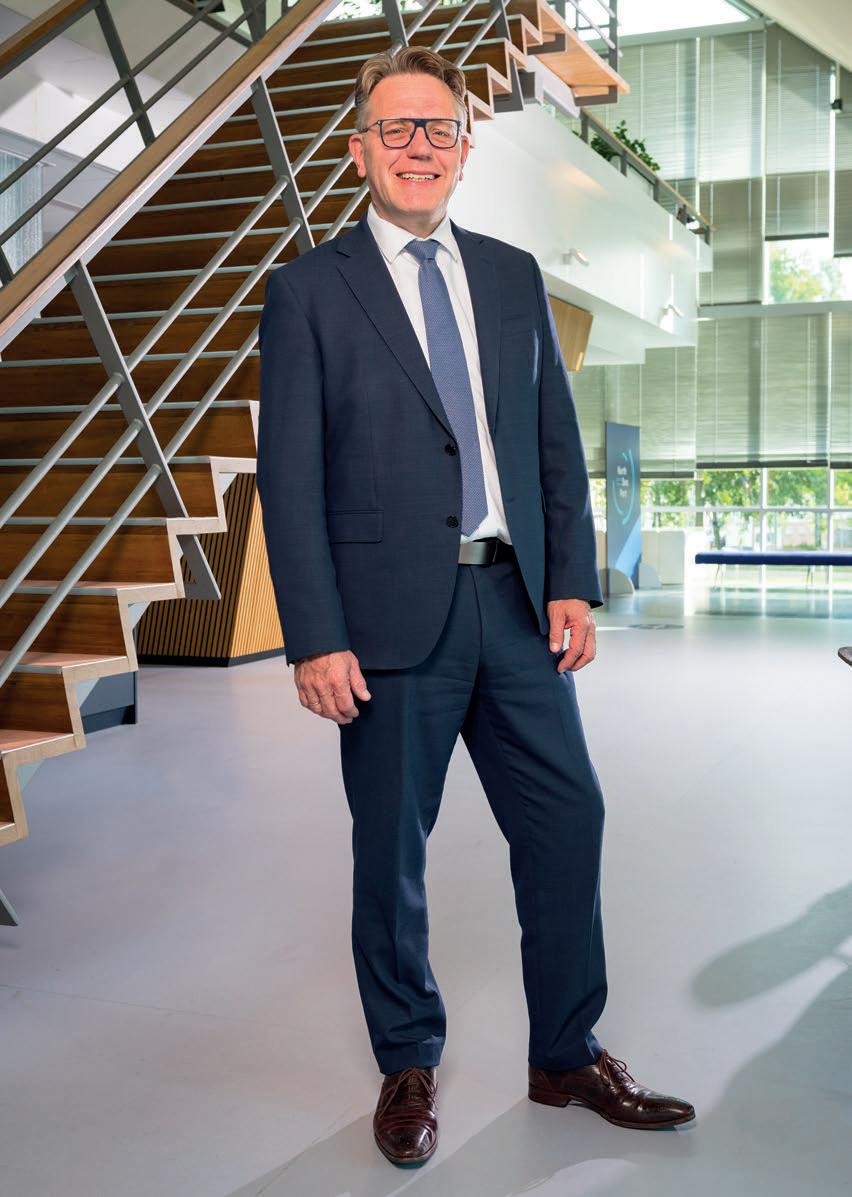
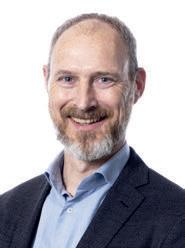
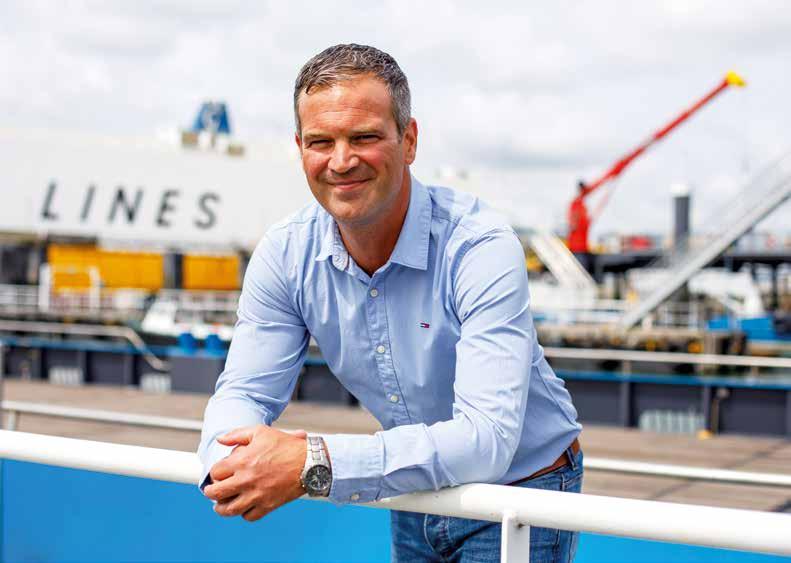
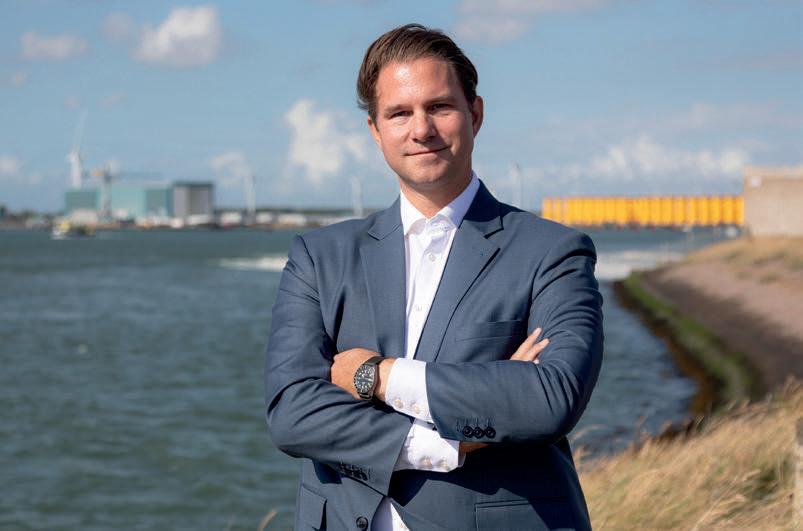
I am proud to have taken on the assignment of CEO of North Sea Port as of 1 June, a position that I hold with great honour and responsibility. From my previous contacts with the Trade Association Seaports I already knew our port well, but now that I am in the middle of it every day, I really experience how impressive it is.
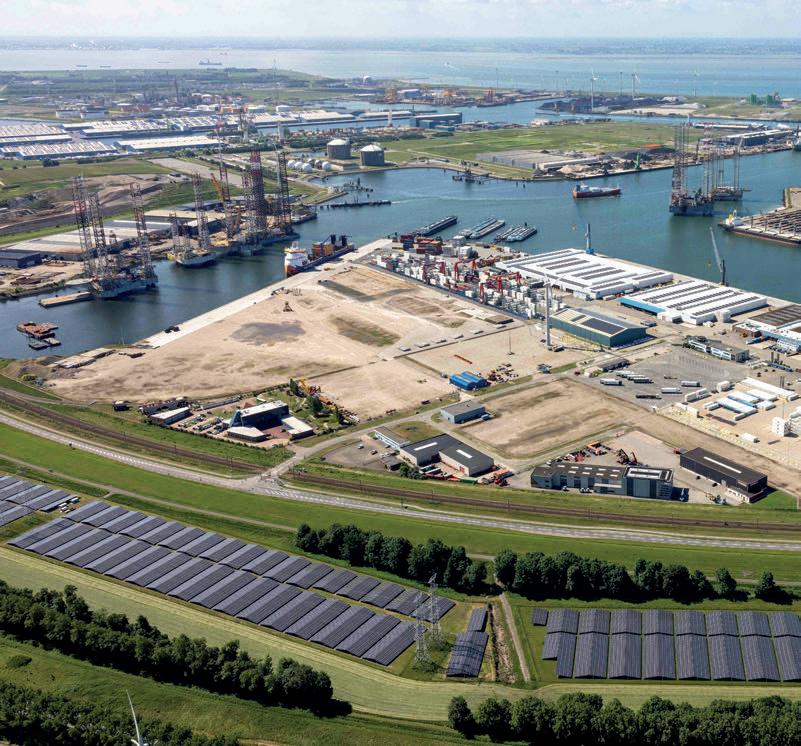
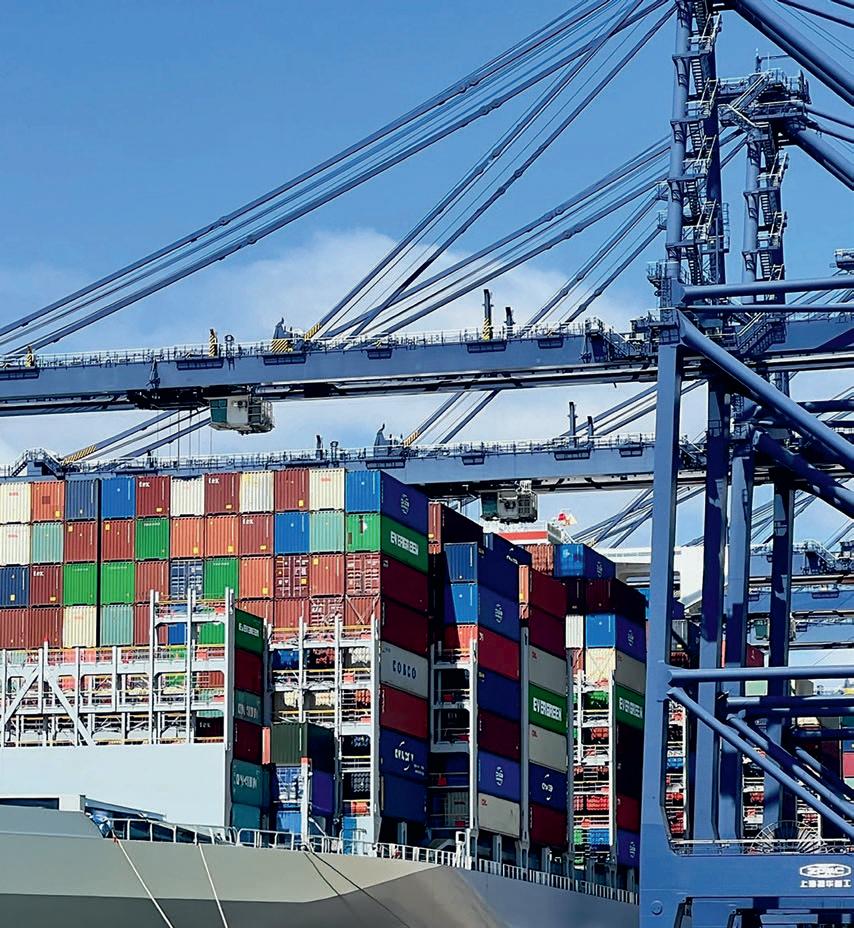
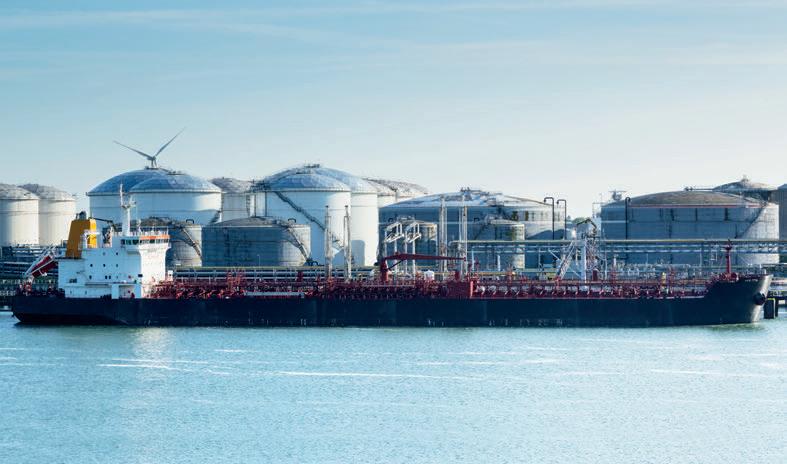
With 9,100ha, 106,000 (in)direct jobs and a span of 60km from Vlissingen to Ghent, North Sea Port is among the top ten in Europe. This is evident not only from the size, but also from the many investments in the field of energy, sustainability, logistics, shipping, quality of life, and safety. In recent months, I have visited many companies and had political talks. I will continue to do that in the future, because the challenges are great.
To further develop our role as a leading European port, investments and adaptations are needed. Think of regulations to be adjusted at Dutch, Belgian, Flemish and European levels, as well as investments in infrastructure, for example, quays in Vlissingen and Terneuzen that are being renewed, or pipelines for the transport of hydrogen and CO2. And we want to further optimise the Ghent-Terneuzen Canal together with the Netherlands and Flanders so that vessels with more draught can soon sail through the Nieuwe Sluis to the Massagoedhaven in Terneuzen. Then we look forward to wider vessels sailing as far as Ghent.
I want to work with you and our partners, I want to work hard for this in the coming years, in Flanders, Belgium, the Netherlands, and in Europe.
Finally, a personal note: after more than forty years I exchanged Groningen for Zeeland. Not merely professionally as CEO of Groningen Seaports to North Sea Port, but also personally to a new place of residence, close to our port. This gives me the chance to get to know this beautiful region even better. Tips for discoveries are always welcome.
With kind regards,
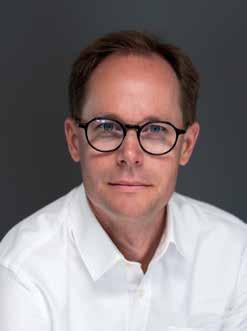
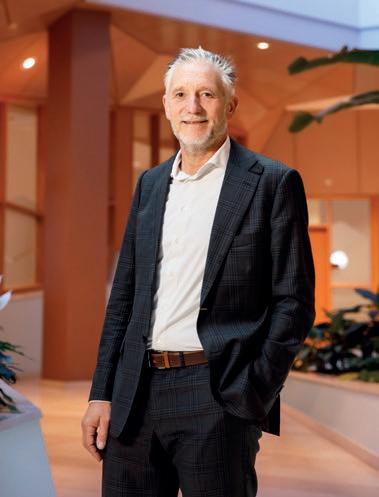
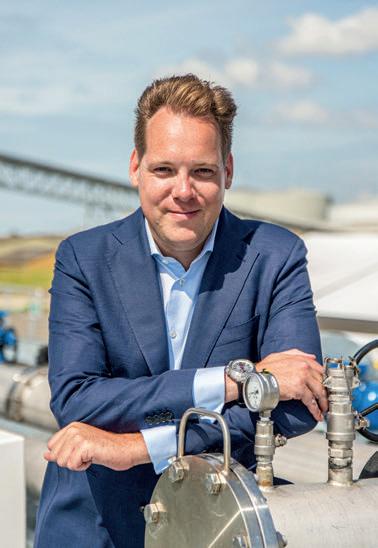
Cas König, CEO of North Sea Port
The nitrogen deadlock
North Sea Port and the many companies active in the region want to continue developing, including in the field of sustainability. Ironically, it is precisely the regulations aimed at reducing nitrogen emissions that are hindering these efforts.
Let’s first go back to basics. What is this all about?
The nitrogen issue revolves around excessive emissions of nitrogen compounds such as ammonia (NH3) and nitrogen oxides (NOx). These compounds, once emitted, eventually settle on and in the ground. This so-called nitrogen deposition can, in excessive amounts, be harmful to nature and public health. It can lead to a loss of biodiversity, as plants that thrive
in nutrient-poor soils are outcompeted by those that prefer nutrient-rich soils. Regarding public health, nitrogen oxides in the air can cause respiratory problems. All of this has led to government measures to reduce emissions. Generally, these measures have a delaying effect on the permitting process, negatively impacting economic activity. Nitrogen emissions are an international issue, not least because nitrogen travels across
borders. Emissions from one country can therefore impact another. The European Union has made agreements to protect biodiversity and reduce nitrogen emissions. These agreements, such as the Habitats Directive, oblige all member states to protect nature, which can create international pressure on countries that emit too much nitrogen.
Natura 2000 areas
Naturally, the current nitrogen crisis has also led to undesirable project delays in the North Sea Port area. We spoke about this with Ivory Mast, spatial planning and environmental advisor at the port authority. “The Netherlands is one of the countries with the highest nitrogen emissions per hectare in Europe and therefore suffers greatly from the consequences of excessive nitrogen in nature. Our port is largely located in or near Natura 2000 areas, such as the Western Scheldt River and Saeftinghe, Kop van Schouwen, and Manteling van Walchereren, which means that nitrogen emissions from current
activities in our port can impact these areas. That is why permits are required for activities to ensure that consequent depositions are within allowed limits. For companies looking to expand, this may mean they can’t obtain a permit, as the expansion, directly or indirectly, could lead to higher nitrogen deposition in the near Natura 2000 areas. The same applies to companies that want to establish themselves in the port area. If their arrival leads to increased deposition, it can result in long and difficult permitting procedures. The problem is that the deposition from all activities in the region, such as industry, agriculture, and construction, are limited by the level of nitrogen deposition that is allowed in nearby Natura 2000 areas. So, if a company wants to establish itself here and the N2000 areas in 25km proximity of the port area are already at the deposition limit, it becomes very difficult for that company to get a permit.”
25 kilometres
Ivory Mast continues, “There are two types of nitrogen emissions involved here. Ammonia, mainly emitted by the agricultural sector, and nitrogen oxides, mostly from industry, such as combustion processes in the industry and logistics, chemical production processes, and shipping. The difference is that nitrogen oxides disperse over a wide area, while ammonia settles more locally. So, if a new development in the port requires a permit, its depositions are assessed for effects up to 25km away. The reverse also applies. Although we have many companies in our port emitting nitrogen, and they’re working hard to reduce it, their emissions count for only a relatively small portion. Additionally, vessels sailing along the coast, whether or not they have our port as destination, are also included in
Ivory Mast, spatial planning and environmental advisor at North Sea Port.
The current nitrogen crisis also leads to undesirable project delays in the North Sea Port area.
the total deposition. These vessels can be important for us, not only those that call at our port, but also when they are just passing by the North Sea coast line. Many such factors affect the nitrogen space available to us, all interconnected like pieces of a complex sliding puzzle. Moving one piece affects the entire puzzle.”
Vicious circle
“There are certainly various ways to tackle the nitrogen crisis,” Ivory Mast emphasises. “This aligns with North Sea Port’s ambitions to be a sustainable port. Many nitrogen-emitting companies are already working to reduce emissions through sustainability projects at their facilities. In addition, companies at North Sea Port are investing heavily in wind turbines, solar panels, and electric work vehicles. Several existing and new companies also have plans to build electrolysers for green hydrogen production. All of these measures help reduce nitrogen emissions across the industrial chain but the process is gradual, it doesn’t happen overnight. As long as nitrogen permitting possibilities remain tight for North Sea Port, we risk losing potential new companies that give up because they can’t get a permit due to the nitrogen limits. This is, of course, the last thing we want. The difficult part is that even sustainable projects still involve some nitrogen emissions. An electrolyser, for instance, however green, still has to be built. Construction requires the transport of materials, production of components, and so on. Right now, it’s often not possible to carry out all these activities entirely nitrogen-neutral. Unfortunately, even becoming green still produces emissions. As a result, our sustainability plans are at risk, and we risk ending up in a kind of vicious cycle.”
Connector
The port authority itself is taking explicit steps to support companies in this complex situation. “North Sea Port acts as a connector in this matter,” Ivory Mast explains. “We are constantly in discussions with, for example, the Province of Zeeland to coordinate what nitrogen space remains and what opportunities it allows. Fortunately, the Province recognises the problems and tries to collaborate with us and businesses where possible. We also work together with other seaports in the Branche Organisatie Zeehavens (BOZ, the Dutch seaports trade association), to defend our mutual interests in this dossier. We meet almost monthly to share knowledge and learn from each other’s challenges. BOZ also communicates our concerns to the government about the stagnation caused by nitrogen regulations.” Ivory Mast adds, “Of course, we’re ready to help companies directly wherever we can. We advise companies facing permitting issues related to nitrogen to always contact us. A company remains responsible for its own permitting process, but we can assist, even just by knowing our way around the involved authorities. This is especially important for foreign companies. They often don’t know the context or the dos and don’ts. Due to the complexity, companies are increasingly forced to hire external expertise, which leads to high costs. That’s why we recommend contacting us first if a company gets stuck. For this purpose we have a dedicated mail address: stikstof@northseaport.com.”
Informing
“Another important role we play is continuously informing policymakers about the crucial economic role of the port and the initiatives being developed to operate sustainably and
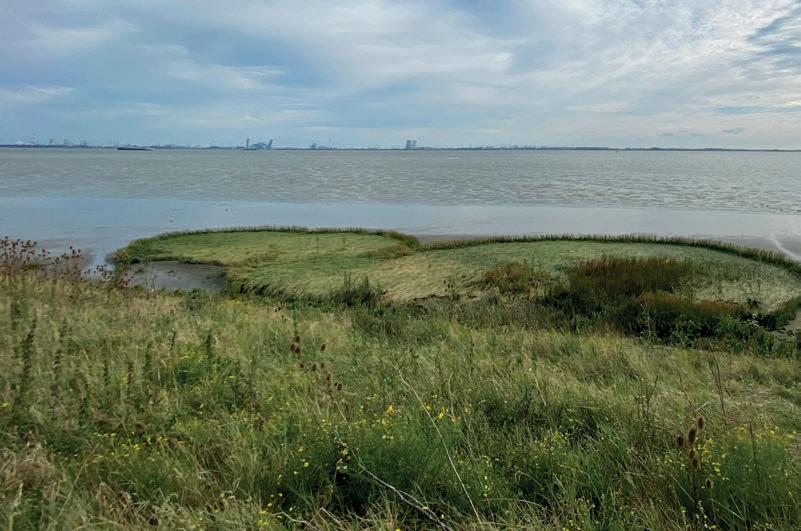
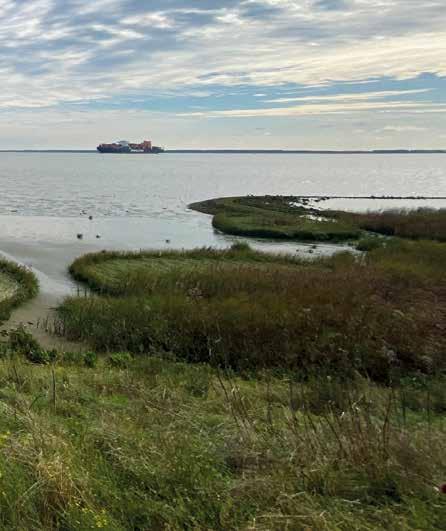
North Sea Port is largely located in or near Natura 2000 areas, such as the Western Scheldt River.
Retroactive effect
A major problem is how often and how quickly the regulations change, not just due to elections but also because the rules are sometimes changed mid-process, even retroactively. Ivory Mast gives an example: “At the end of last year, the Raad van State (the Dutch Council of State) made a ruling in the Netherlands on internal offsetting with unused nitrogen space at two companies in the province of Noord-Brabant. This ruling affects nature permits across all provinces, including Zeeland. The ruling restricts the possibility for companies to offset nitrogen emissions from an old and a new project at the same location (the so-called internal offsetting). Previously, companies with an existing nature permit could start a new project as long as total emissions didn’t increase. Now, each new project is assessed on its own, without considering the existing situation. This means a new permit is almost always required. The ruling also affects companies that internally offset between 1 January 2020, and 1 January 2025, and which, under the old rules, did not need a permit. Under the new rules, these activities may now require a permit. Companies have until 1 January 2030, to determine whether a nature permit is needed or to modify their activities. These kinds of retroactive rulings make things very difficult for businesses. Let me be clear: North Sea Port also recognises the environmental damage caused by nitrogen emissions and supports efforts to reduce them. But we strongly believe that not all nitrogen space should be allocated exclusively to nature. There must also be room for economic development. The Council of State’s decision only makes it harder for businesses to realise their plans.”
Threat
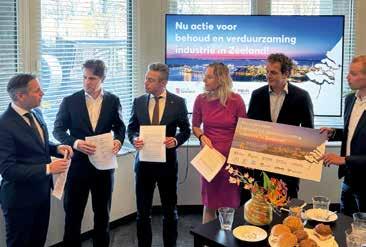
circularly. For example, we regularly travel to The Hague to present our case, as we recently did at the Zeeuwse Dag (Zeeland Day) event. This annual event brings together Zeeland governments, civil servants, and business representatives in press centre Nieuwspoort in The Hague, also inviting representatives from Dutch political parties and policymakers. We also regularly invite politicians and their staff to Zeeland to give them a firsthand look at our port. We must keep emphasising that the nitrogen issue poses a real threat to the development of our port and, with it, to the economy and employment within the region.”
Ivory Mast concludes, “Industry ports across Europe, and our port is no exception, are already under pressure from high production costs and a tight labour market. The nitrogen crisis now poses an additional and very real threat. It’s not for nothing that some companies are seriously considering relocating to regions where operations are easier. That is, of course, something we, as Europe, should avoid. Recent geopolitical developments have shown that we must become less dependent on other regions and produce as much as possible within Europe itself. Strict and complex nitrogen regulations that drive companies to move operations overseas certainly don’t help. It is therefore crucial that a solution be found to break this nitrogen deadlock!”
I. NORTHSEAPORT.COM
North Sea Port regularly invites politicians and their staff to Zeeland to give them a firsthand look at our port.
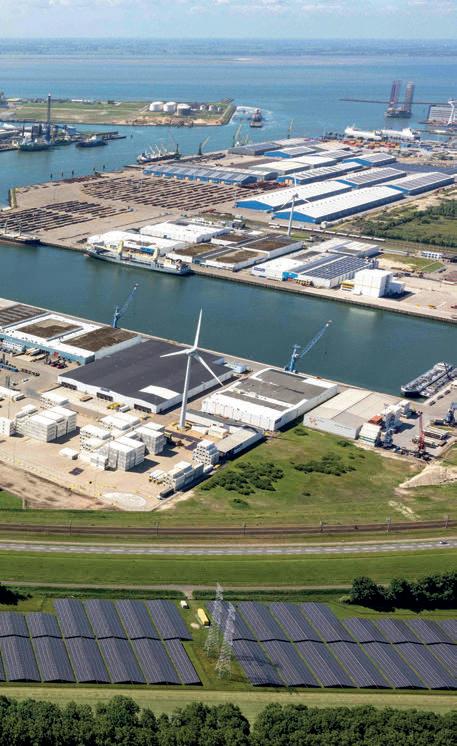
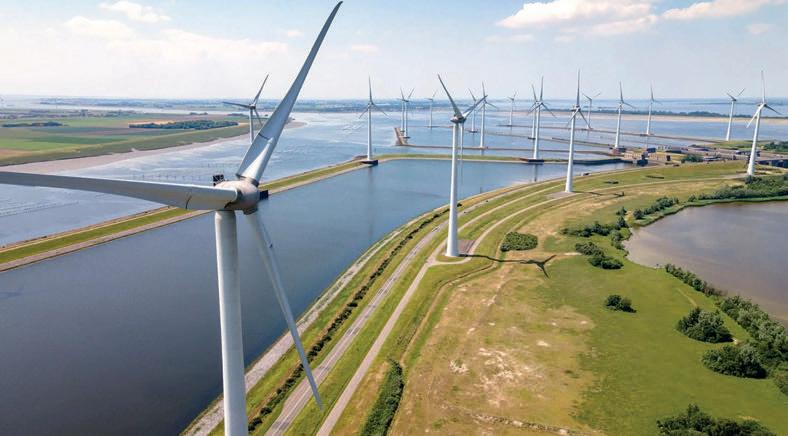
Companies at North Sea Port are investing heavily in wind turbines, solar panels, and electric work vehicles.
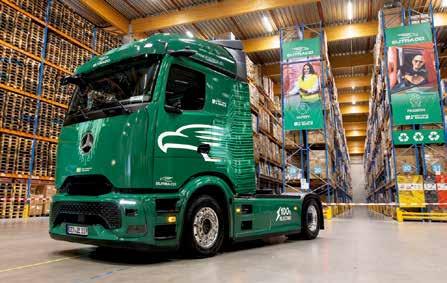
Image courtesy of Eutraco.
First of a kind
Perenco successfully completes world first carbon storage trial
We live in interesting times. As we move towards the energy transition, we are witnessing technological development on a scale perhaps never seen before, as one innovation after another is presented as a possible sustainability solution.
All of these new technologies, however, must first be tested before they can pass into everyday use. Recently, oil and gas specialist Perenco, operating out of the shipyard of sister company Dixstone, has undertaken a carbon injection trial to a depleted gas reservoir – the first test of its kind anywhere in the world.
Towards carbon neutrality
The story begins with a pledge from the UK Government to invest in the region of 22 billion GBP in carbon capture and storage (CCS) programmes. The government aims to make the country carbon neutral by 2050, as well as a carbon storage leader – a significant ambition, for which it has set itself an ultimate target of over 100 million t per year of geological carbon storage.
The idea is to isolate CO2 from industrial emissions, and concentrate it at typically >95% before transporting it to locations offshore and storing it safely under the seabed in legacy gas fields. To these ends, companies were invited to submit applications through a competitive tender process – with the possibility of ultimately securing a commercial licence in the event of a successful appraisal outcome.
Award winning application
Having committed itself, amongst other technical works, to performing an industrial gas injection test to assess the performance of storage in an ultra depleted reservoir, Perenco was awarded three licences from the government’s North Sea Transition Authority (NSTA). The largest of these relates to the
Poseidon Project on Leman field – a consortium led by Perenco (80%), Carbon Catalyst (10%) and Harbour Energy (10%). The project aims to repurpose the depleted gas reservoir, 48km off the East Anglian coast, for the storage of carbon. The field is 29km long, 8km wide, 240m thick and is located at a depth of 1,800m. It has the capacity to store a significant billion t of CO2 making it one of the largest geological stores worldwide.
The mother ship
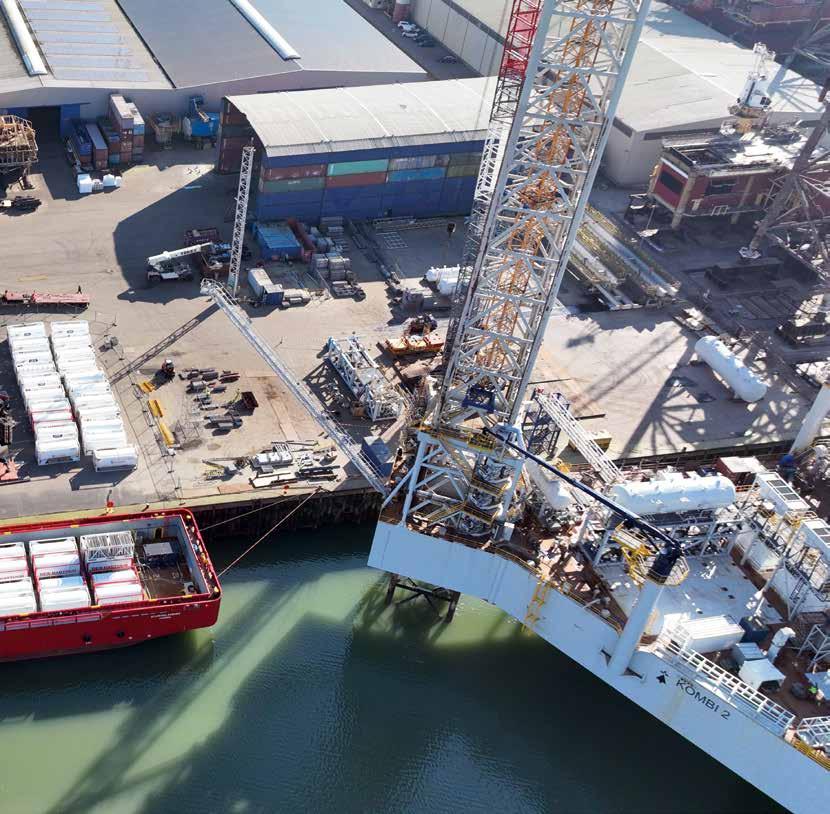
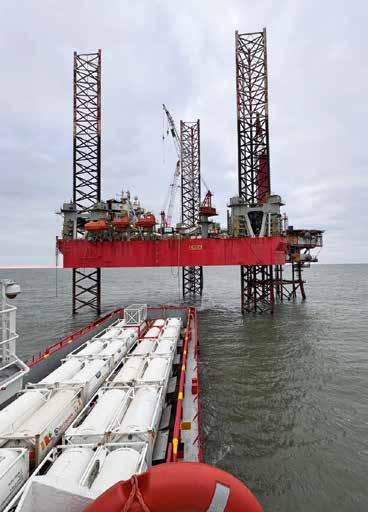
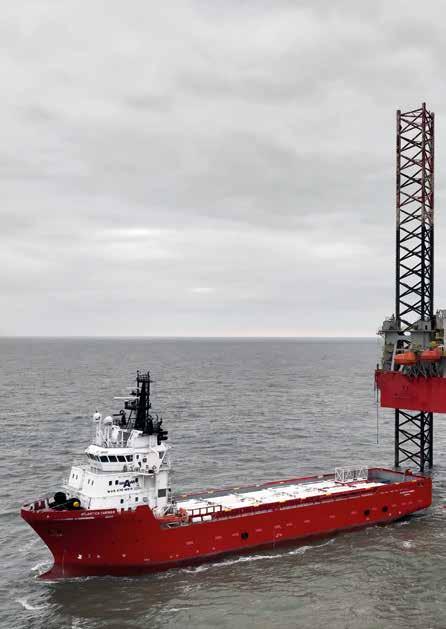
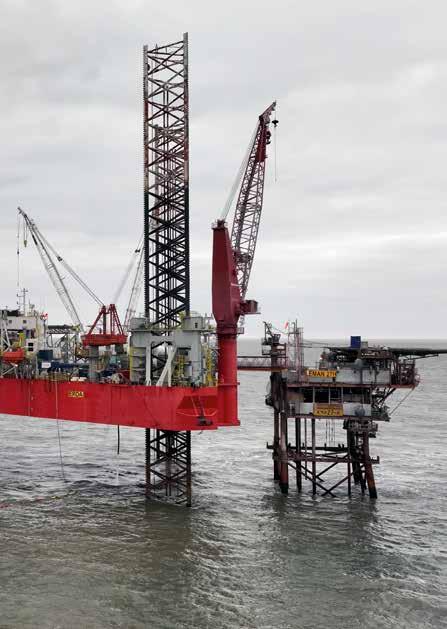
“The mother ship for the trial,” says Dixstone CEO, and former Poseidon project director Louis Hannecart, “was the Dixstone yard in Vlissingen. From here we equipped the jack-up vessel –Petrodec’s Erda and supplied the CO2 to carry out the test.”
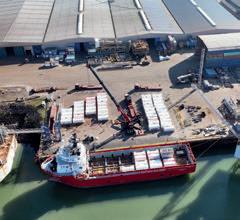
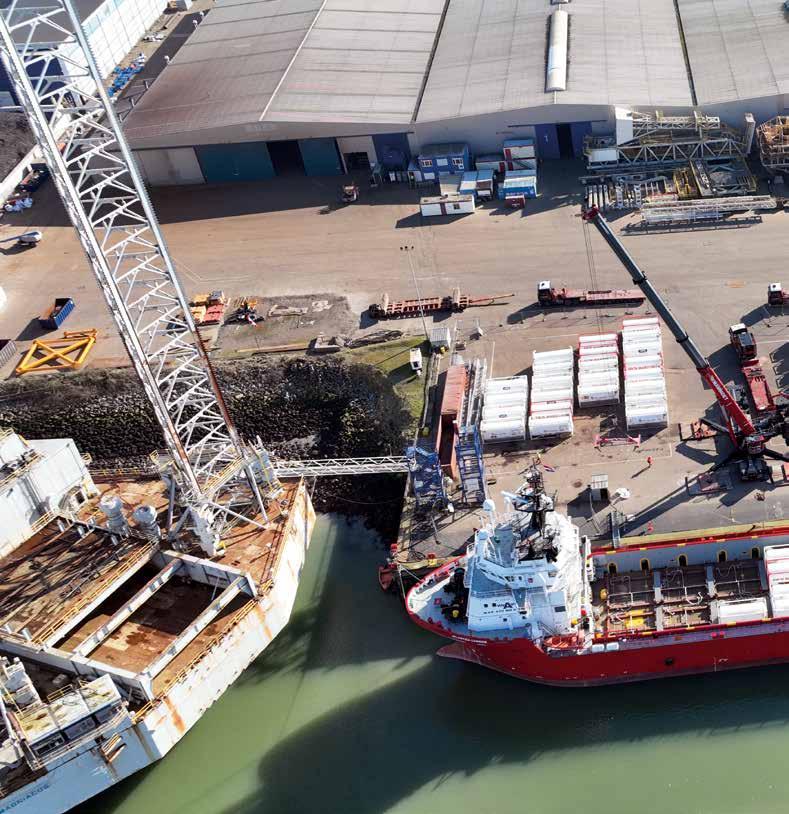
Storage of CO2 tanks on the quayside in North Sea Port.
Louis Hannecart, CEO of Dixstone (former CCS manager at Perenco).
All images courtesy of Perenco.
First though, he explains, the project team carried out a thorough makeover of the existing Leman platform and well and equipped the Erda – with the injection facilities required for the task. At this point, Erda became the first rig to receive a UK approved safety case for CO2 operations support.
Boldly going where no one has gone before
The trial, explains general manager Petrodec Rainier Verhulst, required storage on the quayside for up to 750t of CO2 at a time, as well as empty tanks, a supply boat to transfer the CO2 offshore and supply it to the Erda offshore by means of hoses, and a dedicated crane to lift tanks on and off the vessel. It was, he states, anything but straightforward.
“Nobody has ever done anything like this before. Therefore, no one really knew what was required in order to store such volumes of CO2 on the quayside in Vlissingen, or how to go about securing the relevant local permits. The undertaking of the project required a lot of very thorough preparation and stakeholder management beforehand.”
A helping hand
Thankfully, he says, help was at hand.
“North Sea Port has been very supportive of the project. The communication was very good between us. We were very open and made sure that we had all the risk assessments in place. Rijkswaterstaat were also very helpful, as was the Germeente Borsele (local authority), although it was a lengthy process to obtain the permit.
“Plus, there are parties active in the port whose help we were also able to call upon, such as consultant BMD, which works
We are very confident, and very inspired by the experience we have gained during the trial. We’ve made a successful start.
with a lot of companies in the area, Holland Shipyards and Shipyard Reimerswaal, from where the vessel was mobilised.”
Compressed and cooled
Sourcing the CO2 in quantities required for the test was also something of a challenge, he says.
“As CCS is in its infancy at the present time, there is not a ready supply of industrial CO2 available. Therefore, we had to use food grade CO2. This is only available in winter; the commercial demand for products such as soft drinks and beer in the summer means there is not enough production capacity from the plants to feed this operation.”
The CO2 was supplied by Air Liquide’s Geleen plant, having first been compressed into liquid and cooled – reducing the volume by a factor of 500, thereby making it easy to transport. Even so, the trial required no fewer than five trucks a day travelling between Air Liquide’s location in Geleen in Limburg in
The Leman field – 48 km from the UL coast, 1,800m below the seabed and capable of storing 1 billion t of CO2
The trial involved a total of eleven shipments of CO2
the south of the Netherlands and North Sea Port.
The liquid CO2 was transported in cryogenic containers at a temperature of -20º and pressure of 20bar.
In port, the vessel performed an offshore trail transfer of 400t liquid CO2 onto the Erda successfully.
The first trial offshore shipment of 500t took place successfully in January this year. “After that, we still had another ten shipments to go,” Rainier Verhulst says.
Progressive injection
In total, the trial involved eleven shipments of CO2 and fifteen injection cycles. These included injecting the CO2 into the reservoir in a variety of states, continues Louis Hannecart.
“The first phase was to heat the CO2 up to expand it and inject it as a gas,” he states. “With this, we could safely establish that everything was working as it should be. From there, we could progress to injecting warm pressurised CO2 and, finally, to cold liquid CO2 that would expand only upon reaching the reservoir. This provided the opportunity to measure the effects of the cool down and examine the capacity of the natural ground to absorb it.”
This capacity, Louis Hannecart points out, had very important implications for the future of this model of CCS. When confronted by the question of carbon storage, he says, a lot of people ask the same question – ‘what about leaks?’
Proven over millions of years
Here, the use of legacy gas fields as storage locations has an advantage over the alternative of using a saline aquifer.
“With that method, liquid CO2 is pumped into a geological structure filled with water, displacing it as it expands. The benefit of the depleted gas field is that you have a geological structure, typically in the region of 2,000m below the seabed, that we know has contained gas for millions of years – we know from their history depleting as gas stores that they are tight. Additionally, these sites are mapped; we know their volume and we refill them at pressures that are well below their original pressures as gas stores.”
As expected, the trial, which was completed on schedule in March this year, backed up these expectations. The safe injection of liquid CO2 into the field demonstrates not only the capability of the Leman injector wells but also validates the opportunity to develop a commercial carbon storage model in this legacy gas site.
“It means you don’t have to warm the CO2,“ Louis Hannecart asserts, “If you think about this from the point of view of a commercial service, this makes a big difference – the less you need to condition the product, the more cost effective it will be to dispose safely underground.”
The next phase
With the trial successfully behind it, the Poseidon project is ready to move to the next phase. The project participants are now working to prepare the application for a commercial licence.
Before the project can take on an international scope there are, though, some hurdles to be overcome. For instance, there are currently no regulations covering the import of carbon from outside the UK. Negotiations, as part of the UK’s wider realignment with the EU, are ongoing, however.
In the meantime, Perenco and the consortium are preparing to build a project based on a service on shelf; collecting CO2 from the east coast of the UK for storage at the Leman location.
“We want to leverage the knowledge we have gained from the trial, while keeping an international vision for the long-term,” Louis Hannecart says.
Confidence in the future
As such, he continues, the project team is making contact with projects in other countries.
“Our team has made contact with the Porthos Project in Rotterdam and the Greensand Project in Denmark. It’s important that we work in synergy and international collaboration with other similar projects. Sharing of information will help to stimulate the development of CCS projects broadly.” Ultimately, he says, he has confidence in a successful outcome. “We are very confident, and very inspired by the experience we have gained during the trial. We are a long way from a big network to which everyone is connected, but we have projects in development. We’ve made a successful start. We have proven basic technical information to build a project, and that’s fundamentally important for the emitters. It’s not only about making it work economically, but technically efficient as well to meet emitters’ needs. We believe technical transparence is key for confidence in this nascent industry. With this trial, we have taken that step.” I. DIXSTONE.COM
Cas König, CEO of North Sea Port, “In our new strategic plan, the basic ideas about how we want to shape this port for the future, will not fundamentally be altered. Sustainability remains the foundation on which we build.”
New captain at the helm
At the beginning of June, Cas König took over the reins of North Sea Port. He brings to his new job a background in environmental engineering, an economic and industrial expertise acquired during stints at the top of chemical companies, and a familiarity with port business after eight years as CEO of Groningen Seaports, the operator of the Dutch ports of Delfzijl and Eemshaven. North Sea Port is not entirely unknown territory to him.
Q: How much did you know about North Sea Port before becoming successor to Daan Schalck?
A: I knew the port fairly well. The five biggest Dutch seaports regularly assemble to discuss matters of common interest. So, I had met Jan Lagasse and Daan Schalck more than once. I had also visited North Sea Port and sailed the sea canal from Ghent to Terneuzen and back on a boat trip with Groningen Seaports’ Supervisory Board not so long ago. But I realise now I did not fully grasp then how big this port actually is.
Q: What are the main differences – and similarities – between North Sea Port and Groningen Seaports?
A: In terms of activities, the similarities are quite substantial. Both offer a strong mix of maritime transportation and inland navigation. Both host an important chemical cluster, both play a major role in the supply and distribution of energy, both serve as a platform for the offshore wind industry, to name just a few. Both port authorities also have local and regional authorities as shareholders and are a combination of more than one port. And like all ports today, they are facing big challenges when it comes to dealing with network congestion, their environmental impact, the interaction with local communities.
Drug trafficking is more of a problem here than in Groningen. And as far as infrastructure is concerned, a large part of North Sea Port is sitting behind locks.
The biggest difference lies of course with the cross-border dimension of North Sea Port. And North Sea Port operates on a truly different scale: it is three times bigger in terms of port area and the same goes for the port authority’s workforce and turnover. Moreover, North Sea Port handles ten times more cargo volume. When I tell people than with our 9,000 hectares, our port area is only 25% smaller than Rotterdam or Antwerp, they are surprised. We are a first-rank European seaport. It’s –alas – a secret too well kept.
Q: What are your first impressions after three months in your new job?
A: North Sea Port is a very professional organisation. It is remarkable to see how people from two different countries cooperate so intensely. I expected the border to be a difficult hurdle to take at every step. That is certainly not the case within North Sea Port itself.
Regarding the port community, the unescapable fact is that our industry is under heavy pressure, like everywhere in Europe. But at the same time, there are splendid opportunities to seize, if only because we will always need energy and the only way
forward is making our society more sustainable. And for energyintensive industry, there is no better place to be than a port like ours.
Q: You have been standing at the crossroads of economy and ecology for most of your career. How does your personal profile fit with North Sea Port’s ambitions?
A: Sustainability is part of my DNA, so to say, and it definitely is the future. I also bring to this job my Dutch network and a strong dose of boardroom dynamics. I know how big international groups work and reason, how you can convince them that an investment in a certain location is the right thing to do. I look forward to helping shape the future of North Sea Port in the coming years.
Q: The context in which ports operate, has drastically changed over the past year. The tariff war of the Trump administration has created unrest and uncertainty in the world economy. What does that mean for North Sea Port?
A: Economic instability and uncertainty are always bad for business. The United States is the second largest trading partner, in volume, of North Sea Port. Luckily, 90% of these flows are import and only 10% export, but the companies responsile for that 10% are of course worried about how things will evolve.
The geopolitical situation has also become a source of concern. Ports are very vulnerable to potential outside attacks. We used to not worry about that for a very long period, but today we need to fully integrate safety and security into our way of doing things. At North Sea Port, several people are working full-time on this.
Q: As a result of this have environmental and climate ambitions been scaled back?
A: In Europe, if things do not move as fast as we had thought or hoped, this is due in the first place to the fact that we did not scale up our infrastructure to the required level at the necessary pace. The technology to make our economy more sustainable is available. But the basic infrastructure – the pipelines, the power grid… – is lagging behind, making it impossible to reach the goals we have set for ourselves. And even if the supply side would have been ready, the right business case is often lacking because demand is too low, and public authorities did not take the right measures to foster the greening of industry. As a consequence, investments are stalled or are being reassessed. It all starts with the right preconditions and regulatory stability.
Because both are missing, the process of making our economy more sustainable is slowed down.
It is being felt in ports like North Sea Port, with their multinationals that take a worldwide look at where they will make their next investments. We should create a situation where those companies would be crazy not to invest here. We are not even close.
Q: What can North Sea Port do to get there?
A: A port with a public shareholding can take advantage of its good relationship with the different authorities. When North Sea Port comes with a request to strengthen its economy or infrastructure, it speaks from a different position than an individual company. Its demand will fit into a long-term vision that benefits the whole port community and takes into account the societal context. In that respect we have an important role to play as connector.
Q: Are the main challenges different in Belgium and the Netherlands?
A: We all have to cope with problems like nitrogen, grid capacity and the impact of port activities on the environment and surrounding communities. We will have to do more than we already do – in full transparency – to explain what we need and why we need it, because we will come to a point where we need additional space to continue to play our part. Our land reserve has shrunk considerably over the past years due to the fact that we were able to attract new investments. The circular economy will increase the demand for land. You can partly resolve the issue by redeveloping existing port areas and make more intensive use of available land. But in the end, we will have to break new ground, while maintaining the right balance between economy and ecology.
Q: North Sea Port is drafting its new Strategic Plan. Will it redefine your goals and ambitions?
A: We will make our new strategic plan public on November 17. It will not bring a revolution, even if items such as security will get much more attention. The basic ideas about how we want to shape this port for the future, will not fundamentally be altered. Sustainability remains the foundation on which we build. This is absolutely essential to keep the licence to operate we need to bring about the required developments.
Q: The new lock in Terneuzen is fully operational. What impact will it have?
A: It’s the kind of infrastructure you build for a hundred years. It strengthens our nautical capacities, for instance by allowing the bigger seagoing vessels to come in at low tide on the Scheldt. This facilitates nautical planning and speeds up operations. North Sea Port makes no secret of the fact that it would very much like to see, in the near future, a deeper canal with a draught for ships of 14.5 to 15m to the bulk cargo port in Terneuzen. That is about 2km beyond the lock and the deepening work is technically feasible in the short term. Oceangoing vessels with a deep draught would then no longer need to transfer cargo on the Western Scheldt to pass through the New Lock but could do so more cheaply and safely at the port. The port authority also looks forward to 43m-wide vessels sailing from the New Lock to Kluizendok and Rodenhuizedok in Ghent thereafter. For a ship of this kind carrying dry or liquid bulk, that would mean cost savings of several hundred thousand euros.
The rail link between Ghent and Terneuzen is another important
Cas König, the short version
• 58 years, living in Zeeland with his partner.
• Studied environmental engineering, later completed an MBA degree.
• Gained practical experience both in his homeland and abroad.
• Developed a particular affinity for environmental issues and health & safety in relation to economic activities, at the intersection of sustainability and economics.
• Was CEO and managing director of ESD-SIC and Klesch Aluminium Delfzijl.
• Was voted Plant Manager of the Year in 2013 by the Dutch and Flemish process industry.
• Chaired the Industry Table of the Northern Netherlands since 2018, made up of 26 industrial and energy companies, with the aim to explore ways to reduce CO2 emissions in the Emmen-Eemshaven area.
• Was appointed CEO of Groningen Seaports in 2017.
• Is CEO of North Sea Port since 1 June.
We used to not worry about security for a very long period, but today we need to fully integrate safety and security into our way of doing things.
project. Belgium and the Netherlands have put aside 100 million euros each for the extension and upgrading of our rail infrastructure. And Flanders is investing about 1 billion euros in the upgrading of the R4 beltway around the Ghent port area. It will eliminate a few more bottlenecks and thus facilitate the connection with our hinterland for road haulage and make roads safer for the communities surrounding our port. That is no less important for North Sea Port.
Q: How optimistic are you about the future?
A: We may have had to reconsider the timeline for certain ambitions – without altering them – but I am confident that our strategy is the right one and will bear fruit in due time, with CO2 capture and storage leading the way. Again, much will depend on how the public authorities will support and facilitate these developments. Regulatory stability is a crucial element in this respect.
Q: A closing remark?
A: Within North Sea Port, everyone is proud of our port authority. Working on a cross-border basis is one of our trump cards. It also gives us the scale we need to be attractive and efficient and to find the right people. But in practice you often run into differences, big and small, in rules and procedures between our two countries that needlessly complicate matters. We urgently need to get rid of that. Authorities on both sides of the border should be willing to consider our port as a special case. That is the best way to get the maximal return out of this truly splendid cooperation.
TRADING & TRANSPORT
Shipping Trading & Transport, these are the activities we perform on a daily base.
We offer all disciplines under one roof, our clients get full and complete service, all from one central coordination center, meaning that all services are just one phone call away.
Working from our offices in Rotterdam, Vlissingen, Terneuzen and Amsterdam, we can deal with all logistic and environmental matters.
X
x Our services
x
Crew service
Port agencies
Chartering
Subsidiary
x
Why a future-proof maritime facility strategy will be vital in North Sea Port’s green transition
Decarbonisation targets, climate resilience challenges, shifting markets, and higher demands for stakeholder engagement; there’s no doubt that ports, shipyards, and terminals are facing unprecedented change. Having a clear, strategic and futureproof plan is vital, but when you’re managing the day-to-day complexity of a maritime facility, finding time for strategic planning is easier said than done.
North Sea Port finds itself in a particularly complex position. On the one hand, it’s uniquely placed to turn these changes into opportunities, particularly around green initiatives. Already, the port is operating in line with broader governmental visions for a hydrogen economy, adopting the ambitious goal of becoming a carbon neutral port, strengthening its connections to the Delta Rhine Corridor, and electrifying terminals by providing shore power facilities.
At the same time, these opportunities can easily be missed and even become major risks if assets and operations aren’t supported by long-term vision and strategy. So, how can North Sea Port and nearby companies and terminals navigate the change ahead and make the most of green opportunities? Haskoning’s Bas Wijdeven, director business development maritime Netherlands, Peter Bos, leading professional maritime solutions for renewable energy and Dimitri Quist,
strategic project manager CAPEX-HSE & account manager Zeeland-Vlaanderen at answer that question by exploring five opportunities to optimise high-emission activities across North Sea Port: carbon capture storage, importing and using renewable energy through hydrogen derivatives, electrification, wind energy and climate adaptation.
For 140 years, Haskoning has supported the maritime industry with in-depth consultancy and engineering expertise. Its team of 850+ maritime professionals cover every aspect of the industry with financial, commercial, operational, and technical knowledge, alongside expertise in sustainability, climate resilience, permitting, and stakeholder engagement. With the increasing complexity in port development and operations and developing stakeholder involvement, tightening regulations, and rising integration requirements in the energy
Haskoning has supported the maritime industry for over 140 years.
All images courtesy of Haskoning.
production and user chains, North Sea Port and other port networks need multi-disciplinary support to achieve their goals.
Haskoning aims to help here, supporting port and maritime clients in a broad range of services including water, mobility, buildings, energy, industry, and safety consultancy, design and engineering with global expertise, applied locally from its offices in Goes, Delft and Amersfoort.
“Ports typically start their decarbonisation journeys with a “green port health check” that accurately assesses current operations and emissions and compares targets and goals with actual state of business,” Bas Wijdeven begins.
“A comprehensive health check ensures all elements contribute to a broader goal: enabling ports to operate more efficiently, responsibly, and with future readiness. But it requires consultancy partners that have local context and deep maritime sector experience.”
Carbon capture storage
Decarbonisation starts with replacing coal or gas generated energy supply with hydrogen or other renewable energy sources, says Peter Bos. “The move to these renewable energies will take time, so carbon capture and storage (CCS) as a means of supporting decarbonisation in the port domain is crucial while this transition is ongoing.
“The Netherlands offers a strong example of CCS projects and best practices. The country is well underway with providing the required infrastructure for transport and injection of CO2 in depleted gas fields in the North Sea.”
He offers the examples of the Porthos and Aramis initiatives, as well as other CCS efforts focused on direct injection. They are key enablers for industry to invest in carbon capture installations with a direct option to dispose of collected CO2
Haskoning is involved in designing maritime infrastructure for CO2 shipping in Moerdijk and in Rotterdam.
Importing and using renewable energy through hydrogen derivatives
Global shipping and industry are both making the transition towards hydrogen derivatives, such as ammonia and methanol.
This transition is far from instant though, explains Peter Bos. “Committed demand is not yet consistent, especially in regions with ideal conditions for generating solar and wind energy that are struggling to materialise their potential with concrete projects. This creates a chicken and egg problem, where a lack
of availability of renewable bunker fuel in turn makes it hard to invest in the required infrastructure.
“This situation will not change in the short term. For example, it is likely that the current fleet will only gradually be replaced with greener alternatives like partial wind power, nuclear, or onboard carbon capture and storage. The order book of vessels using ammonia or methanol for propulsion is filling up. But the lifetime of a vessel is typically 30 years or more, so diesel is expected to remain part of the energy mix for some time.”
Even though it’s many years out, ports must start preparing themselves for these green, new, often hazardous products now, he says. The process of adjusting infrastructure, developing legal frameworks, engaging stakeholders and changing operational procedures will take several years.
“Ammonia, for example, is highly toxic, dissolves in water, and is heavier than air. Each of these characteristics brings environmental risks and requires specific mitigation measures. Handling ammonia in large quantities must be done with care and in close cooperation with authorities and stakeholders. Bringing a port to a fully operational level with ammonia will take several years, and will demand a gradual step up, using pilot projects to gain experience.”
All of which will, of course, require significant investments. The challenge is that these investments will not deliver direct returns, as green energy at this moment is not price competitive with conventional energy sources. So, there must be other drivers
Peter Bos, leading professional maritime solutions for renewable energy at Haskoning.
Bas Wijdeven, director business development maritime Netherlands at Haskoning.
that push the energy transition forwards, Peter Bos continues.
“Targets from the International Maritime Organization are in play, offering serious incentives for vessel owners that decarbonise their fleet. For ports, this creates opportunities to win new contracts with carriers and logistics companies by providing adequate, safe infrastructure, efficient operations, and affordable renewable bunker fuels.”
Electrification
Bas Wijdeven states that the energy consumption of vessels is easier to decarbonise in ports compared to shipping at sea. “Recent EU regulations and the Paris Climate Agreement are also pushing ports to take initiatives to electrify terminal equipment and supply shore power sourced from renewable
energy. Deploying shore power systems helps reduce shiprelated emissions, particularly benefiting the densely populated urban areas surrounding ports where noise and air quality concerns are most critical. North Sea Port is no exception, and this is underpinned by ongoing technical and economic feasibility studies conducted by Haskoning for various terminals within North Sea Port.
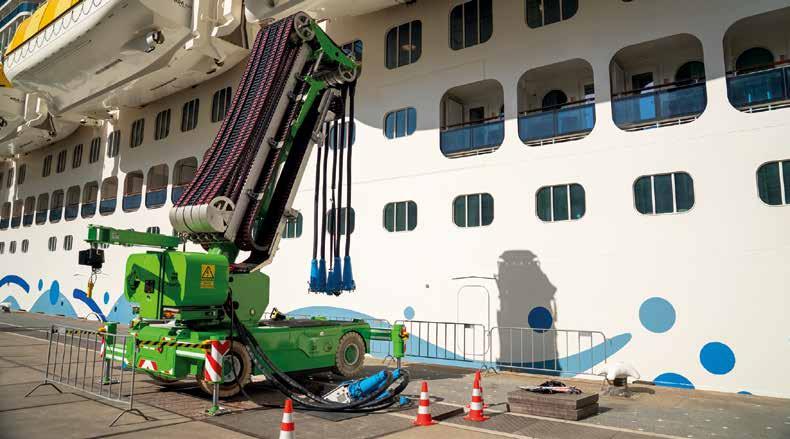
“One of the main challenges in deploying shore power systems is ensuring sufficient grid connection capacity, alongside the complex spatial planning required for the additional electrical and civil infrastructure. This includes components such as cable ducts and cable pits, substations, a converter station, and a cable management system to connect the ship.
“Retrofitting existing quay walls and jetties with ship connection systems can affect terminal operations. It demands a thorough assessment of these assets and the operational processes they support to determine necessary modifications. Additionally, selecting the most suitable cable management system is critical to guarantee safe, efficient, and uninterrupted terminal operations.”
Since 2005, Haskoning has realised more than 1,000 shore power connections worldwide – including the majority of shore power connections in the Netherlands for seagoing vessels. The company has also been heavily involved in the development of a 16MW system: the largest shore power system in the Netherlands, designed to support the world’s biggest cruise ships shored at the Port of Rotterdam. Haskoning supported the project with system capacity assessments, system integration in existing buildings and structures, concept design, and project implementation support. Since 2024, Haskoning
Recent regulatory changes are pushing ports to take initiaitve.
has also been involved in shore power projects for deep-sea container terminals in Rotterdam, initiated by Rotterdam Shore Power (RSP).
Wind energy
Electrification opportunities are further strengthened by North Sea Port’s proximity to offshore wind parks on the North Sea, providing the port and local industry with excellent opportunities to decarbonise their operations, says Dimitri Quist.
“In addition to its connectivity to existing wind farms, North Sea Port also has a vital role to play in facilitating the construction and operation of offshore wind infrastructure.
The construction of the caissons for the Princess Elisabeth Island, the world’s first manmade energy island, is a strong showcase of the potential role for the port’s business community.”
Over the past two years, Haskoning has been supporting TM Edison with design and construction of the caissons of the Princess Elisabeth Island, connecting offshore wind farms in the Belgian sector of the North Sea to the mainland electricity grid and other European grids. The caissons are built in the construction yard in the Vlissingen port area.
Climate adaptation
Climate adaptation isn’t optional; it’s essential for all ports, Dimitri Quist continues. “North Sea Port must adapt to climate change to maintain its license to operate and ensure potential investments in electrification, renewables, and other green initiatives are future proof. Ports all over the world are executing risk assessments and identifying and quantifying climate risks and opportunities across their assets and operations. North Sea Port is also taking decisive steps in building its long-term climate adaptation strategy.”
The green transition is complex, but provides unique opportunities
“Despite the challenges ahead, North Sea Port is uniquely positioned for a bright green future. By playing a proactive role in green initiatives, North Sea Port can support the energy transition of its ports, the industry within the port’s boundaries, and the wider transition throughout Belgium, the Netherlands and the rest of Europe.
While seizing these opportunities will require extensive engineering, compliance and permitting expertise, strong consultancy across port infrastructure and operations will also be key to ensure a smooth transition to a green future across North Sea Port – and the industries it supports,” Bas Wijdeven concludes.
I. HASKONING.NL
Climate adaptation is not an option for ports; it’s essential.
Haskoning’s track record in maritime sustainable projects includes supporting the installation of the largest shore power system in the Netherlands.
Recycling at the next level
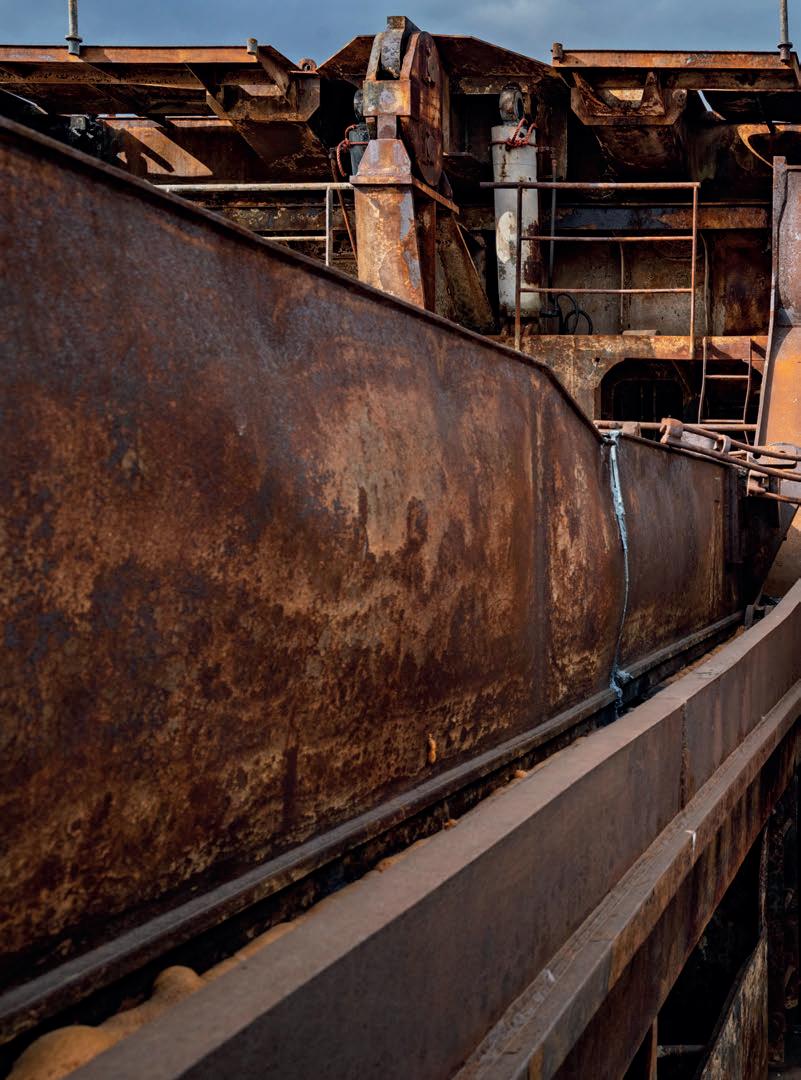
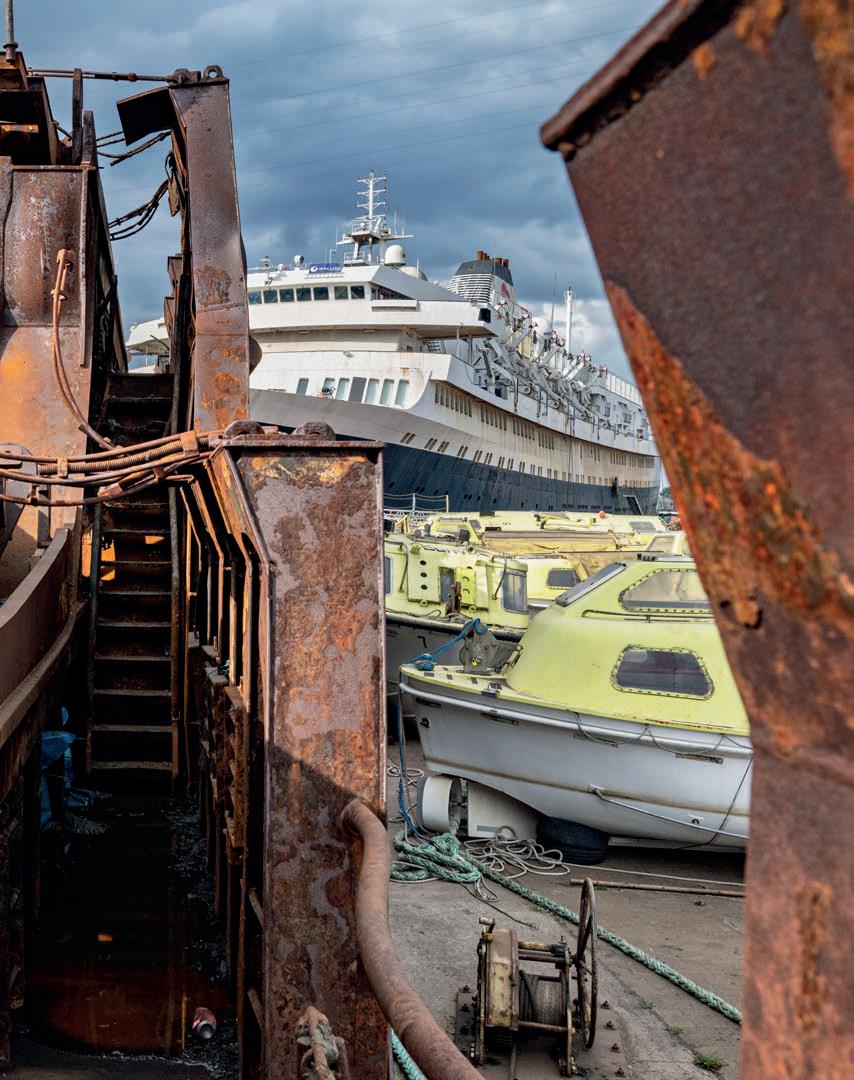
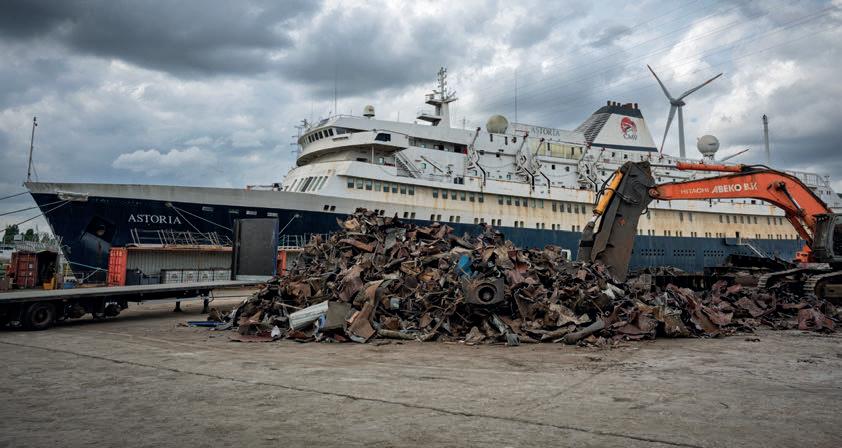
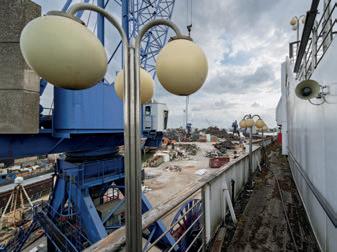
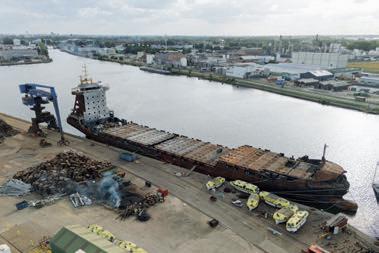
Galloo Gent has recently been in the headlines with its purchase of the cruise ship Astoria, intended for scrapping at Galloo’s site between the Noorddok and the Sifferdok in Ghent. Even though the dismantling of the 1948-built cruise ship naturally captures the imagination, Galloo Gent has much more to offer than the recycling of this single ship. As the export terminal of one of the leading recycling companies for ferrous and non-ferrous metals in Western Europe, nearly 800,000t of scrap metal is exported through this recycling yard in North Sea Port. And while the Astoria received all the attention, the next discarded historyridden ship has already docked.
Family business Galloo was founded in 1939 in Menen, Belgium, near the French border. Over the years, the company has become one of the market leaders in Europe in the recycling of scrap metal and plastics, not only from local consumer goods such as vehicles, electrical household appliances or local production waste from the metalworking industry, but also from much larger discarded goods such as buildings, bridges, ships or trains. Galloo is still familyowned today and has 44 branches in Belgium, France, and the Netherlands. With the water-bound site in Ghent and a collection and recycling hub in Terneuzen, the company is well-established in the North Sea Port area as well.
Galloo Gent
“Galloo’s expansion into France in 1989 was almost inevitable as the company grew,” says Peter Wyntin, head of ship recycling at Galloo Gent, “since the border runs right through our site in Menen. But the acquisition of the site in Ghent in 2002 was another important milestone for Galloo’s international trade, as it was Galloo’s only water-bound terminal. Our terminal remains an important logistics hub for Galloo’s international trade today, as the ferrous metal from
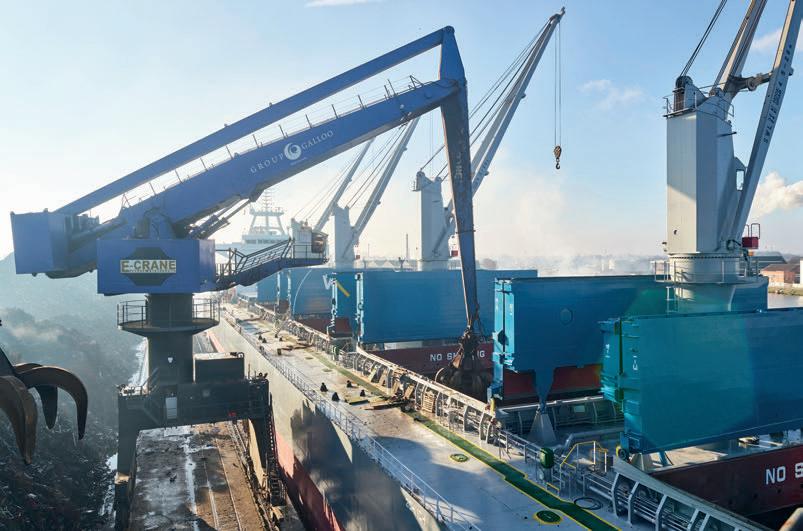
other Galloo branches is exported through our site. Our two hydraulic e-cranes load a 30,000-tonne seagoing vessel bound for the Mediterranean biweekly.
“Furthermore, we are the only Galloo branch that can dismantle and recycle ships, as we have a dedicated dock to scrap large vessels. However, dismantling large ships is only a small fraction of our recycling activities. We dismantle 40 to 50 ships each year, but these also include smaller vessels such as barges and yachts. And we also process train carriages, local production waste from the metalworking industry, and scrap from buildings or commercial properties that we demolish. Of course, the dismantling of these large ships captures the imagination, especially since we are the only recycling yard in Belgium that is approved by the European Commission under the EU Ship Recycling Regulation.”
Ship recycling
“However, recycling these large ships begins with months of preparation,” Peter Wyntin states. “Before you make an offer on such a ship, you must spend months studying the pricing and preparing the paperwork. And once we have bought the
vessel, we must organise everything on site so that the ship can make a safe towage journey to Ghent. For this, we usually travel with a team of two or three people from Galloo to the port where the ship is moored. Then, before the ship arrives, we make an inventory of all hazardous products, so we know what is located where. This inventory is, of course, also made for smaller vessels. In fact, once the vessel is docked at our quay, our procedure for dismantling is in principle always the same, whether it is a 15-metre pleasure yacht, a 40-metre inland vessel, or a 160-metre Astoria.”
He explains, “We always start with the preliminary dismantling. This means that we remove everything from the interior and sort it into around 65 different waste streams: textiles, A-grade wood, B-grade wood, mattresses, lamps, smoke detectors, to name but a few. More than 98% of each ship is put to good use. This is all done manually, so you can imagine that for a ship like the Astoria, with all its cabins, this is obviously much more work than for a barge. Currently, about ten people are working on this pre-dismantling, but we may scale this up to twenty soon. We are currently working with a team of about 40 employees, but like most companies within the port, we have several vacancies for technical staff. Spontaneous applications are welcome!
“Once the preliminary dismantling has been completed,” Peter Wyntin continues, “we remove any asbestos that may be present. Then we use shears to cut pieces of about 20t from the ship, which we will continue to scale up on the quay. This implies removing all leftover cables, pipes and remaining waste materials from the steel so that it can be sorted into the various waste streams using small cranes. In this manner, we will gradually dismantle the entire ship horizontally, deck by deck, until we are left with a hull about six metres high. This hull will then be pulled onto our concrete demolition slope, where we will further dismantle and scale it up with the mobile cutting shears.
“The scrap metal, our core business, is then sold and exported. The waste streams are disposed of – or sold – to our regular partners. Occasionally, we can also sell separate items of value, such as engines, if they are still recent, but that doesn’t happen very often. You wouldn’t believe how many phone calls and emails I get about the Astoria, from people who want to come and check out the interior. Everyone thinks the ship is still authentic from 1948. However, it was completely stripped and converted in Italy in the late 1990s, so it no longer retains any vintage character. Moreover, you mustn’t forget that this is a large recycling yard: we can’t welcome people here every day who want to buy a chair or some lamps!
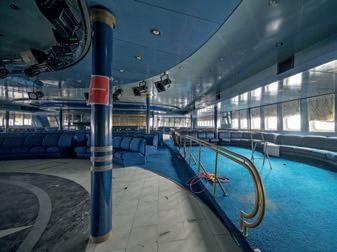
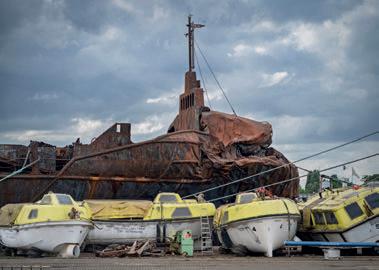
The Astoria’s once luxurious interior will first have to be dismantled manually before the actual scrapping can begin. Given the size and type of this vessel, this pre-scrapping process will take up to six months.
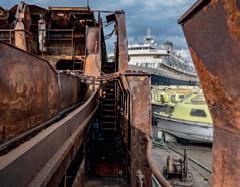
The cruise ship Astoria, once famous, now in a state of faded glory.
We always start with the preliminary dismantling. This means that we remove everything from the interior and sort it into around 65 different waste streams.
“To give you an idea of the timing,” he adds, “we will need about six months to dismantle the Astoria’s interior. Meanwhile, we are simultaneously scrapping the container ship Solong with the shears. The Solong arrived here last week, but it is completely burnt out. This is ideal for us actually, because it means the dismantling of the interior takes much less time. We hope to have the Solong ready by November-December so that we can continue with the scrapping of the Astoria straight away.”
The Astoria: a small history
The Astoria was built as the passenger ship Stockholm in 1948. The Stockholm sailed between Sweden and the United States and became famous after its collision with the Andrea Doria in 1956. The Andrea Doria sank, but the Stockholm survived and managed to reach New York, albeit badly damaged. The ship was then sold several times, changing its name each time.
“At the end of the 1990s, the Astoria was completely rebuilt in Genoa,” Peter Wyntin says. “In fact, only the steel hull was retained. During the COVID-19 pandemic, the shipping company went bankrupt, and the ship was sold in Tilbury to an American bitcoin billionaire. No one knows what the man actually planned to do with it, but what is certain is that the ship was on its way to Portugal when it encountered bad weather and had to take shelter in Rotterdam. The owner then paid port fees for months on end, until one and a half years ago, when he suddenly stopped paying. The port of Rotterdam subsequently impounded the ship and sold it in a public auction, to us, as the sole bidder.
“In fact,” he adds, “We are currently keeping track of another ship with a similar story. This ship is currently being offered for sale by the owner, but once they realise that they will probably have to pay extra to have the ship scrapped – after all, it still has to be towed from Lisbon to the scrapyard – the story will be similar: the owners will stop paying the harbour fees, the ship will be chained up and eventually sold at a public auction. We will therefore be keeping a close eye on this ship in the coming years, so that we are called in when it comes up for auction.”
The Solong
“The Solong has a completely different history,” Peter Wyntin says. “This is the container ship that crashed into the oil tanker Stena Immaculate in the North Sea, in March 2025, off East Yorkshire. The Solong caught fire with 140 containers of whisky on board. That’s quite the fire accelerant, and the ship burned down completely. As a shipwreck, that’s ideal for us, because all combustible materials were removed in the fire. The biggest workload for this ship was actually the mountain of paperwork.
After the collision, the Solong was towed to Aberdeen, where we bought it directly from the insurance company. As the Solong sailed under a Portuguese flag, it must be scrapped at a European-approved shipyard, according to the European
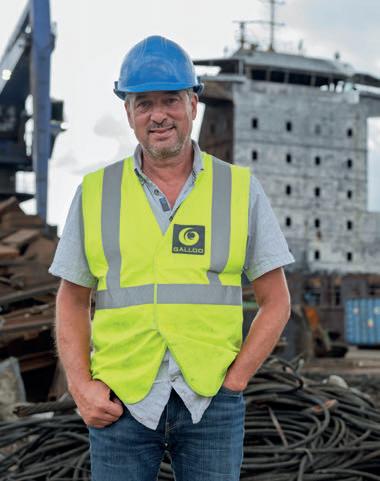
Peter Wyntin, Head of ship recycling at Galloo Gent.
The Solong burnt out completely after its collision with the oil tanker Stena Immaculate in the North Sea off the coast of East Yorkshire. The 140 containers of whisky on board the Solong were quite the fire accelerant.
Commission’s Ship Recycling Regulation. However, as this ship was docked in Aberdeen, and the UK is no longer part of the European Union, the EVOA legislation for waste applied, and we had to apply for an export licence for the UK as well as an import licence for Belgium. Once in Belgium, however, the EU Ship Recycling Regulation kicked in again, because it remains a Portuguese ship. Which means we had to file a second procedure for the EU Ship Regulation.”
Paperwork and the EU Ship Regulation
The EU Ship Recycling Regulation from 2019 states that any ship that sails under a European flag must also be dismantled in an approved European scrapyard. This is a step forward, environmentally speaking, as it prevents several ships from ending up on the ship scrap yards – or graveyards in some cases – on far-away beaches, most famously those in Bangladesh. We are, however, a far cry from actual solutions, Peter Wyntin says.
“There are just so many loopholes,” he clarifies. “Owners can just re-flag the ship and evade the regulation entirely. The European Commission holds the EU-member states responsible for the enforcement of their laws and regulations, but shipping is, at its core, an international affair. Furthermore, each member state interprets the regulations at its own discretion, making the paperwork mountain even more complicated. On average, we need four to six months per ship to organise all the paperwork; it’s a huge mess. And, to add insult to injury, the European Commission has also approved nine Turkish scrap yards as European scrap yards. That is just incomprehensible to me, as, to my knowledge, they do not work by the same health, safety or environmental standards as we do. They just sail a
ship onto the beach in the Mediterranean. Could you imagine us just sailing a ship on the beach in Oostende and dismantling it there? It’s just not a level playing field, as they do not have to abide by the same legislation as we do, only by the Ship Recycling Regulation. Mind you, for the environment worldwide, it would be much better if these yards were subjected to the same waste and environmental legislation!”
Circularity and sustainability
“After all, as Galloo, we believe sustainability is our core business,” Peter Wyntin says. “Our company’s mission is: Working together towards a circular world by developing 100% sustainable solutions. This is reflected in everything we do, from urban mining for precious metals in Menen to multimodal transport. In fact, Galloo has been using barges for inland transport for many years, and now also has two barges of its own. Galloo Gent has, like all Galloo sites, a cemented floor with underground drainage throughout the entire terrain, to ensure that rainwater that comes into contact with the scrap metal cannot penetrate the soil. We have a biological water treatment plant with oil separation and an activated carbon filter to treat this rainwater before it is released. Furthermore, we have our own Galloo Cleaning Truck, dedicated to keeping the site and surrounding areas clean and dust-free to minimise the impact on soil, water and air. For the same reason, we keep our sites moist during periods of drought to capture dust spread by the transport or handling of the metal. Any measures that can be taken will be taken. That is Galloo’s motto: Committed as one to give Earth its second nature.”
I. GALLOO.COM
Galloo Gent’s hydraulic e-cranes load a 30,000-tonne seagoing vessel bound for the Mediterranean biweekly.
Image courtesy of Galloo Gent.
Looking for neighbours!
Sloe-Office offers first-class office space at a prime location
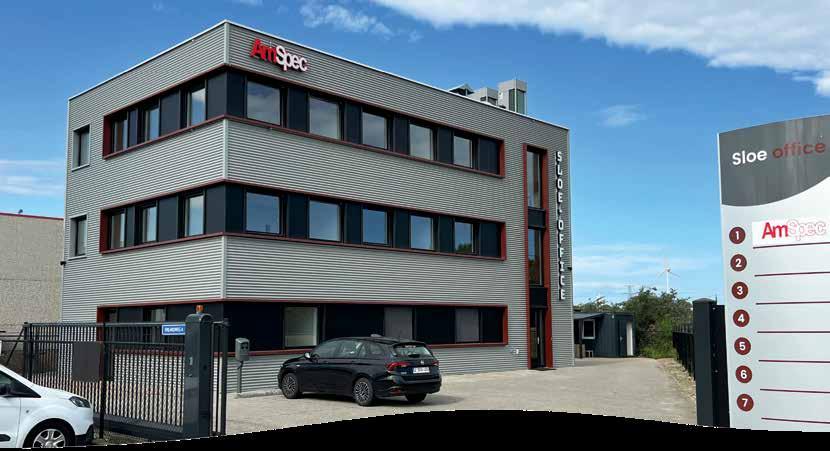
When one of our clients outgrew their office, they asked us, if there might be another place available. KustWerk started searching and came across a building in Vlissingen-Oost. This was purchased and thoroughly renovated.
Two additional floors were added, the building was fully updated to modern standards, and ultimately fitted with luxurious, contemporary offices and matching facilities: Sloe-Office was born. The above-mentioned client was the first to move into Sloe-Office, and now we are looking for neighbours for them to take up the remaining office spaces at this prime location.
Plenty of opportunities
The term ‘prime location’ is no exaggeration here. Sloe-Office is located at the beginning of the Finlandweg in Vlissingen-Oost, right by the exit roads leading to the A58 and the southern route toward Belgium. Moreover, the multi-tenant office building is surrounded by extensive industrial and logistics activities, offering plenty of opportunities.
Well-equipped
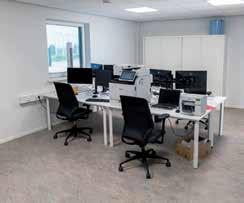
KustWerk aims to take all the hassle away for its tenants by providing well-equipped, readyto-use office spaces. Sloe-Office features its own parking facilities for both bicycles
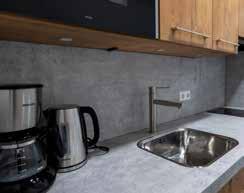
and cars. Electric vehicles can be charged at several charging stations. Tenants also have access to a video conferencing/meeting room with a large TV screen, and there is a cozy lunchroom. Each floor is equipped with a fully fitted kitchen, restrooms, and a shower. Through a secure electronic (chip) lock, you enter an office that comes with its own video doorbell, a dedicated secure high-speed internet connection, and an advanced air conditioning and ventilation system.
Pleasantly surprised
Offices can be rented either furnished or unfurnished. KustWerk offers flexible rental terms. Short periods are also possible, such as a week or even half a day. The meeting room is also for rent by non-tenants of Sloe-Office. In short, if you are looking for a modern office space in Zeeland, you simply can’t miss Sloe-Office. Feel free to contact us for a tailor-made proposal. You’ll be pleasantly surprised by our attractive rates and rental conditions.
A bridge to a renewable future
Zeeland Energy Terminal: paving the way to transition
With the growing number of sustainability focused projects featured in each edition of PortNews, its clear to see that the energy transition is gathering pace. Carbon neutrality doesn’t take place overnight, however.
As we continue to innovate, and learn the lessons associated with new technologies, we continue to rely on conventional energy sources – and to develop the means to use them responsibly and as efficiently as possible.
Energy independent & secure
This is particularly important given that the drive towards renewable energy is accompanied by a desire to increase European energy independence and security.
At the present time, gas still has an important role to play in supplying our homes and businesses with energy. In the Netherlands, however, the cessation of production in the north of the country has left the country increasingly dependent on imports as it seeks to reduce its reliance on Russian gas.
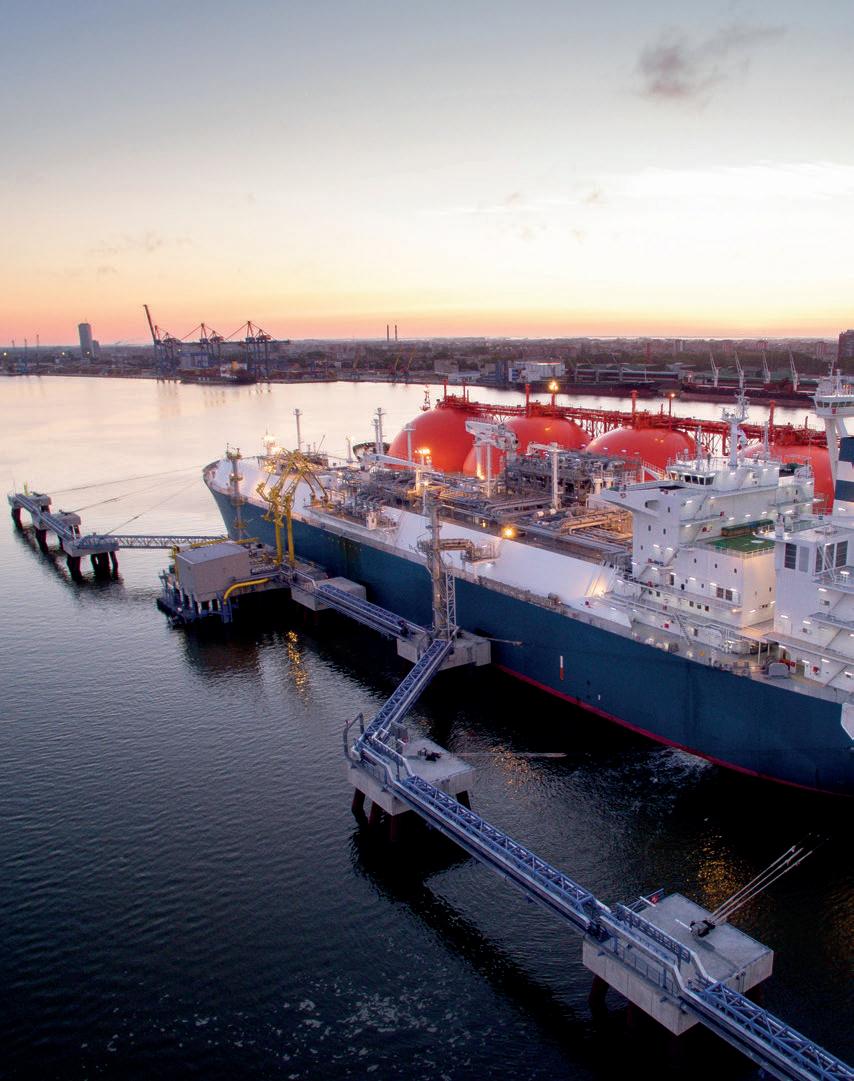
Energy terminal company VTTI, together with LNG maritime service provider Höegh EVI (Essential Value Infrastructure), is working on a project that aims to provide a stepping stone to a renewable future, while simultaneously supporting European energy security.
Perfect pairing
The two companies provide a good combination, explains VTTI project director Guido Custers. VTTI is a terminal operator, active in seventeen countries. While it is currently mainly involved in oil-related products, the company is taking a long-term view, considering opportunities for the future.
As such, it is focusing on products such as renewable oils, ammonia for conversion into hydrogen and, crucially for this story, liquified natural gas (LNG) as temporary solutions to support the transition to a renewable energy market.
Höegh EVI, meanwhile is a branch of the renowned Norwegian shipping company specialised in the delivery of critical infrastructure for the import, storage and regassification of LNG. Höegh EVI currently operates a fleet of ten floating LNG terminals around the world, as well as three LNG carriers.
Pairing their expertise, the companies are collaborating on Zeeland Energy Terminal (ZET) – a floating liquified natural gas (LNG) terminal to be located in North Sea Port with the capacity to handle up to 7.5 billion m3 gas per year – equivalent to 25% of the Netherlands’ current annual consumption.
Both companies, independently, had been considering such a project for some years. The Russian invasion of Ukraine, however, accelerated developments and brought the two partners together.
An ideal terminal location
When considering such a terminal, it became quickly apparent, Guido says, that the area of North Sea Port would be the ideal location.
All images courtesy of Vtti.
“If we consider the national picture in the Netherlands, there is an LNG terminal already in Eemshaven, in the Province of Groningen in the north of the country, and another in the Port of Rotterdam, approximately in the middle. North Sea Port, in the southwest, close to national borders, was the logical place for a third, ensuring the energy security of the entire country, and possibly neighbouring countries close by.”
Additionally, he says, North Sea Port’s focus on the energy industry, and the abundance of related industrial partners, lend support to the idea of creating a terminal in the area.
“Plus, North Sea Port provides us with the opportunity to locate the terminal in the Netherlands. With the country’s Title Transfer Facility (TTF), a virtual trading point for gas that acts as a key benchmark for European prices, this location is very interesting for our clients.”
A further advantage of North Sea Port as the location for the proposed terminal is the flexibility that exists.
“As well as the great support we have received from North Sea Port, there are also so many options available in the port, including several locations we could choose from to locate the terminal.”
Superior sea access
Ultimately, after considering options in both Vlissingen and Terneuzen, the partners are now primary investigating to position the terminal in Vlissingen, which offered multiple benefits, says Guido Custers.
“As well as the availability of the required 400 metres length of quayside, and space for onshore infrastructure, Vlissingen offers great access from the sea for the tankers supplying the terminal. Furthermore, we have access here to the heat we need in order to carry out regassification of the LNG, as well as good access to the gas grid.”
That’s the beauty of a floating terminal; it offers the market flexibility. It can quickly make way for the energy solutions of the future.
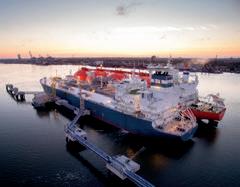
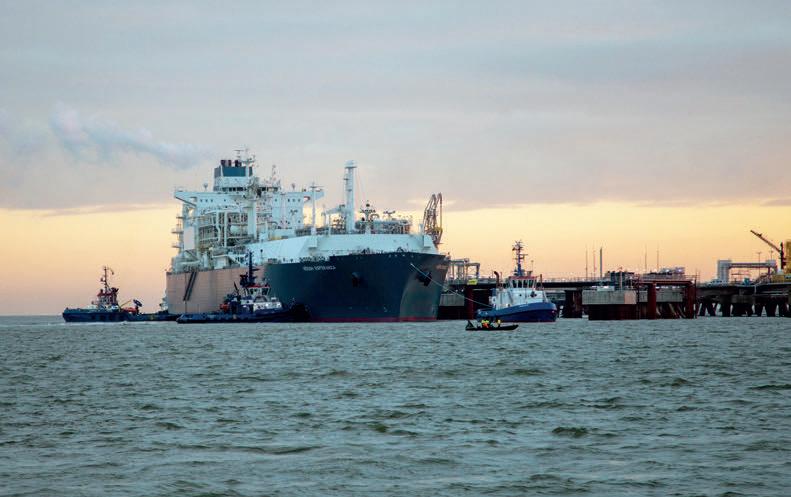
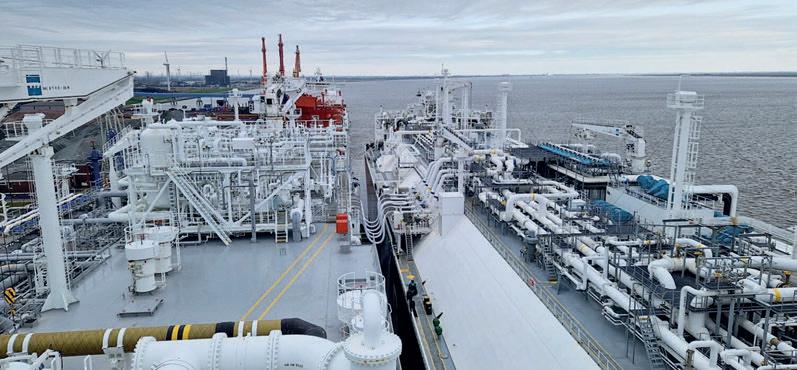
The primary feature of the terminal will be a floating storage and regassification unit (FSRU) moored in the harbour and connected to the hinterland by a gas pipeline. Every five to six days, a tanker will arrive, supplying the FSRU with LNG from around the world.
Cooled & cost-efficient
LNG represents a safe, and cost-efficient means to transport the gas. To facilitate this, natural gas is first cooled to -162ºC. At this stage, it becomes liquified, reducing its volume by a factor of 600.
The LNG is then transported in tankers to the FSRU, where it is discharged for storage. When it is required, the LNG is then put through a process of regassification – achieved by warming it up to around 5ºC.
For much of the year, this can be accomplished using the seawater in which the FSRU is positioned.
“Below five degrees Celsius, however, it’s impossible to turn the LNG back into natural gas, so we will be working with a local partner in the colder months, utilising their waste heat to conduct the process in a sustainable manner,” explains Guido Custers.
Beyond the FSRU, the requirements of the terminal are minimal, he states. It requires a quayside of approximately 400 metres, and in the region of 2.5 - 3Ha space on land for infrastructure
North Sea Port’s energy focus and abundance of industrial partners make it the ideal location for ZET.
including gas and water pipelines and electricity cables and a frequency converter.
Major milestone
In May this year, the partners announced a significant milestone in the ZET project with the official launch of the permitting process. The initial phase, the Intent and Participation phase involved calling for the submission of reactions from local businesses and residents.
“Stakeholder engagement is of crucial importance to this process. There are two main streams involved. One is the official, formal process, by which people can submit thoughts and enquiries to the KGG (Ministry of Climate and Green Growth, in Dutch Ministerie van Klimaat en Groene Groei),” Guido Custers states.
“Besides this, we are developing a plan in which we look very closely at what the local community expects from us and what their needs surrounding such a project are. As such, we will conduct regular meetings and use a range of communications channels to provide ongoing information and ensure consultation with stakeholders.”
The project partners hope for a successful conclusion to the permitting phase some time end of 2026, which would then enable them to begin construction in the first half of 2027. With this, ZET will be on track to commence operations by 2029.
What does the future hold?
The terminal is expected to be active for a minimum of fifteen years, though it may have a longer life – depending on the progress of renewable energy solutions.
“To ensure the commercial viability of the project, we calculated that it needs to be active for fifteen years, and that is the term of the ZET contract. During that time, however, we do expect to see changes in the energy picture. Perhaps, the terminal will have another fifteen years lifespan beyond that, but who knows? By then, maybe renewables will have advanced to such a degree that it will no longer be necessary.”
Whatever the future holds, ZET is an ideal solution, Guido Custers says.
“That’s the beauty of a floating terminal,” he states. “It offers the market the flexibility it needs. Renewable energy is advancing. In the event of accelerated developments, such a terminal can quickly make way for the energy solutions of the future.”
I. VTTI.COM
I. HOEGHEVI.COM
Guido Custers, director of ZET project.
The beauty of a floating terminal is its flexibility.
Going offshore
The Maaskade Group’s route to the offshore energy industry
The Maaskade Group operates in various locations in Belgium and the Netherlands. This includes a number of activities in North Sea Port and, for this reason, the company became a member of the Promotion Council North Sea Port.
The first vessel under the flag of the Maaskade Group set sail back in 1961. Things have certainly changed at the company since then. Initially, Maaskade was solely focused on the transportation of food and feed, operating a fleet of barges transporting molasses and vinasse for the animal feed and fermentation industries.
The path to growth
In the early 1990s, however, the Wassenaar family took the lead at Maaskade. At this point, the company began on a path of significant growth that continues to the present day.
The first change was to the name of the business. In 1992, the Bevrachterskantoor Maaskade became Maaskade
The Maaskade Group has been on a path of growth since the 1990s.
All images courtesy Maaskade Group.
The big step was our joint venture, beginning in 2021, with Sima Charters. With this, we entered the North Sea crew transfer vessel (CTV) market.
Bevrachters. At the same time, a number of newbuild vessels were commissioned to develop the company’s seven-strong fleet of barges. The first newbuild was the MTS Kralingen. Today, Maaskade Bevrachters operates a fleet of 50 inland tanker barges, of which more than 20 have stainless steel tanks. In total, the fleet boasts of capacity of approximately 100,000 metric t.
The group continued to grow over the next few years, expanding its operations internationally, and with acquisitions and collaborations.
“It all began with the company we know today as Maaskade Bevrachters,” says group CTO Sander Wassenaar, the second generation of his family at the company. “When my father took over in the early 90s, we began to diversify.”
Into new markets
The first step was the acquisition of Rederij Kruysifix in 1996.
“With this we entered a new market, transporting vegetable oils –sunflower, rapeseed, palm and coconut, for example. From here, we built more of our own vessels and expanded into dry bulk.”
In 2002, Maaskade Bevrachters opened a new office in Ghent, bringing its activities into the North Sea Ports sphere for the first time. A number of developments during the coming years further cemented the relationship between Maaskade Bevrachters and the port.
These include the 2006 opening of Mariliq NV, the Maaskade Group’s specialist in transportation for the chemical, petrochemical, bioenergy, and paper industries, as well as niche markets. Mariliq currently operates a fleet of fifteen barges, with a total capacity of 27,000 metric t.
Fast forward a couple of years to 2008, and the group acquired Ghent-based Agrominne, a shipping company specialised in dry bulk with a scope spanning everything from grain and fertilisers to metals and project cargo.
The connection with North Sea Port continued to develop in 2011 when the Maaskade Group established Navonus –independent port agency and cargo survey company all rolled into one.
Broad scope of activities
Today, the group consists of no fewer than 21 different entities, specialising in areas from feed transportation to liquid nonhazardous goods storage and from dry bulk to wastewater handling. The company currently employs 140 people onshore alone.
The Maaskade group’s activities result in over 175 barges and vessels on the move every day, transporting more than 10 million metric t of cargo per year. The group boasts 30,000m3 liquid cargo storage capacity and 25,000m3 storage capacity for dry cargo and general cargo.
From inland to offshore
In recent years, the company has continued its growth. It has, however, expanded in a different direction from that it embarked
Sander Wassenaar, CTO of the Maaskade Group.
upon all those years ago. In the last years, the Maaskade Group has been increasingly getting involved in the offshore energy sectors.
“It started perhaps seven or eight years ago,” explains Sander Wassenaar. “Then we had just one tug, based in Scheveningen, supporting offshore work taking place in the North Sea.” That particular operation was not to last long, but it did set the company on course for more offshore operations.
Crew transfer
“The big step was our joint venture, beginning in 2021, with Sima Charters. With this, we entered the North Sea crew transfer vessel (CTV) market,” he says.
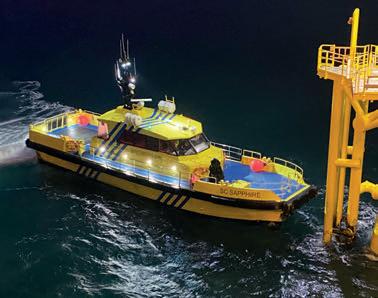
Sima Charters operates a fleet of 22 CTVs, offering transportation of up to 24 passengers, as well as supplies and spare parts to merchant vessels at anchor along the Dutch and Belgian coast. As well as supporting the oil and gas industry, serving on dredging and construction projects and windfarms offshore, 24/7. The fleet is multifunctional, able to additionally carry out survey operations, once the passengers have disembarked at their offshore location.
“The multipurpose nature of the vessels also sees them taking part in a wide range of offshore engineering projects,” Sander Wassenaar states. “As well as work on wind farms and construction sites, this includes bridges, tunnels, and pipelines, for example.”
While primarily focused on adhoc activities along the Belgian and Dutch coasts, Sima Charters supports a wide range of projects around the world.
The company also has a commercial vessel trading branch –SIMA Shipbrokers, which helps operators to buy, sell of find their perfect vessel. It specialises in a comprehensive range of vessels covering everything from barges to yachts and tugs to ferries.
Combining strengths
In 2023, the group’s offshore focus was broadened again, when it entered into a strategic partnership with Gairloch Support Services (GSS). Combining the strengths of the Maaskade Group, Sima Charters and GSS, the business, renamed as Nauticas Marine Services, was able to broaden its offering in response to the evolving needs of the offshore energy industries – particularly the growing renewables sector.
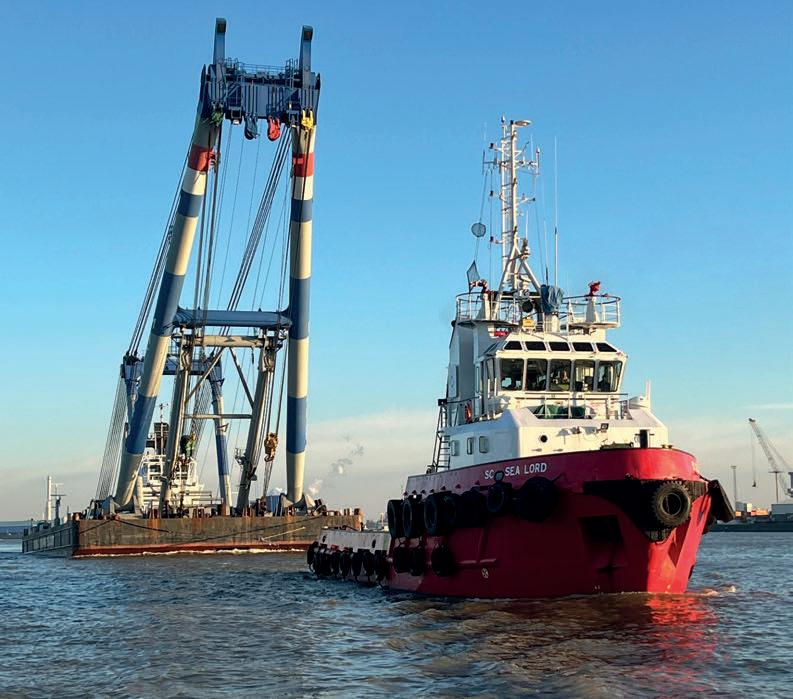
The company operates a fleet of nine vessels, comprising Shoalbusters, Eurocarriers, tugs and ultra shallow draught DP2 multi purpose support vessels (MPSV). With its diverse fleet, Nauticas performs a wide scope of activities for the dredging, offshore and construction sectors including towing & pushing, dredging support, harbour construction & maintenance, buoy & anchor handling, survey work and unexploded ordinance (UXO) clearance and pollution control.
End-to-end solutions
“Most recently, we have also acquired shares in the company Tresios, an offshore contractor with offices in Rotterdam, as well as in Athens, Greece,” says Sander Wassenaar. “The company is able to undertake a very wide range of tasks, all around the world.”
The company’s services cover construction including SURF (subsea, umbilical, riser, flowline), installation & decommissioning and subsea intervention scopes. Additionally, Tresios undertakes a range of marine services covering maritime operations such as vessel surveys, contract management and chartering & procurement, transport operations such as heavy marine transport, re-floating & salvage and platform (de)installation, as well as maritime engineering, covering mobilisation, sea fastening, mooring, and vessel stability & modification.
Tresios also provides marine services, including vessel assurance, contract and chartering support, and maritime transport operations. Tresios specialise in technically demanding scopes where the integration of engineering and offshore execution is key – such as heavy transport, re-floating & salvage, and platform (de)installation. The company’s maritime engineering services include mobilisation, sea fastening, mooring, and vessel stability, strengthening and modification.
Planning for the future
Tresios is able to provide a turnkey, end-to-end service to its clients. As such, says Sander Wassenaar, the company is able to function as both subcontractor and main contractor.
“Presently, while we have acted as main contractor on a number of projects, Tresios is most often supporting projects as a subcontractor. This is an area we have identified for potential future growth. We would like to use our expertise to support our clients as a one-stop-shop service, providing efficient project
The group entered the CTV market in 2021.
The first step offshore: a joint venture with Sima Charters.
support from beginning to end.”
The Maaskade Group’s connection with Tresios also led to the establishment of a new member of the group able to provide support to the offshore industry – Mr James.
Onboarding expertise
Mr James Workforce & Crewing provides specialised staffing and crew management services for the offshore, maritime, and onshore industrial sectors. The company recruits, supplies, and manages skilled personnel for projects worldwide, covering positions such as operators, riggers, technicians, and other key roles.
Originally part of the Tresios brand, the Crewing & Careers division was rebranded as Mr. James Workforce & Crewing in September 2024, a strategic move that enhances clarity and focus for both entities
In addition to recruitment, Mr James handles full crew logistics, including mobilisation, demobilisation, payroll, and required training or certifications. The company ensures compliance with industry standards and project-specific requirements, enabling clients to focus on their core operations while Mr James manages the workforce side efficiently and reliably.
What sets Mr. James apart, Sander says, is its personalised, client-focused approach – built on deep knowledge of relevant industries, high flexibility, and unwavering dedication and care. The company emphasises being available to handle any workforce or crewing challenge with a “personal touch”.
The journey continues
It has then, been quite a journey into the offshore sectors for the Maaskade Group so far, taking it into a wide range of different specialist fields and broadening its offering to clients extensively.
Where does Sander Wassenaar see the future for the group’s offshore activities?
The present time is not without its challenges, he says.
“A couple of years ago, we saw a surge in the price of oil, mainly due to the conflict between Russia and Ukraine. At the time, there were a lot of people showing interest in starting new projects. That’s slowed down again now.
“At the same time, though, there hasn’t really been the acceleration of renewable projects we might have anticipated. The reduction in available subsidies is giving a lot of the large players pause for thought.”
Towards renewable energy
In the end, however, he’s quite clear where the future lies. “We’re certainly going in the direction of green, renewable energy.”
This, he says, is good news for the Maaskade Group.
“We operate a diverse fleet, so we can find work in different sectors when things are a little slower offshore. We’re currently working on projects around the world extending harbours and supporting construction of new airport runways, for example.
“But the plans for the future of offshore wind are clear to see; there is going to be a lot of construction taking place in the coming years, both in the North Sea and farther afield. With the various companies within the Maaskade Group, my colleagues and I are looking forward to supporting both the installation and the ongoing maintenance of these projects, from our offices all over the world – including in North Sea Port.” I. MAASKADE.NL
The offshore journey continues for the Maaskade Group.
The Maaskade Group combines the strengths of multiple business lines to offshore a wide range of offshore support services.
Enhancing your corporate assets
Format Architecten, located in Dok Noord, at the heart of Ghent and North Sea Port, is an architectural firm that specialises in long-term partnerships with companies in the port to maintain and improve their corporate assets, from concept to design, from renovation to administration.
Format Architecten was founded in 2016 by Edwin Lesthaeghe, initially as a sole proprietorship and then as a corporation since 2020. “I hired my first employee in January 2020, just before the COVID-19 pandemic broke out in Belgium,” says Edwin Lesthaeghe, managing director and owner of Format Architecten. “That was interesting, to say the least. But we managed to get through it successfully, and we actually still work for some of the regular customers we acquired back then. As an architectural firm, we usually work for end users, rarely for
project developers. Our goal is to build a long-term relationship with our customers, based on a facilitating approach.”
Locally anchored
“Working in North Sea Port really is a home game for us,” Edwin Lesthaeghe says. “Our agency in Ghent has strong local roots. With eight employees, we are a relatively small firm, although I do sometimes work with freelancers to handle peak periods. That offers flexibility, both for us and for our clients, as we
Format Architecten is committed to assisting its customers in the mission of climate neutrality by 2030, while at the same time improving the landscape for the employees of the port companies.
can always react quickly. Another great asset is the diversity of our group; we have both experienced professionals and newcomers, people with fifteen years of experience and more, as well as people with none to four years of experience. This offers a unique blend of insights, experiences and ideas for our clients, and it also makes us a good training ground for novice architects. We have a solid circle of people we focus on, and try to train as well as possible and who we want to take good care of so that they stay with us for as long as possible. We have fun working in our small team, as the assignments are always diverse and, therefore, challenging and exciting.
“One reason for this is that, as a small agency, we choose the projects we want to do ourselves. Some firms tend to think ‘the bigger the better’. But not me, not at all. I used to manage a big firm like that, and it’s really not my cup of tea. Now, with our firm at North Sea Port, we are truly becoming our clients’ house architects, and we genuinely enjoy doing that. Giving people a proper work environment where they’ll love working, creating a safe space with attention to greening and sustainability, those are our values. It is exciting work, and we also get a lot of appreciation for it from our customers and their employees, which is very nice. That’s why we love working in the port area. We are currently active in various sectors, but would like to focus more on the companies in North Sea Port and expand our client portfolio here even further.”
A one-stop architectural shop
“As architects, we assist our clients in maintaining their corporate buildings and sites,” Edwin Lesthaeghe clarifies. “We operate as a single point of contact for all possible projects related to the construction, extension, renovation, improvement or preservation of their sites. These may not always be the most grand, glamorous architectural projects, but they are absolutely essential. Which is not to say, by the way, that we cannot work internationally. For example, one of our clients had a project in Grenoble (France), and we went with them. We can work throughout Europe, and we offer a comprehensive service, which can be very extensive since we really are our clients’ house architects, for all their projects, big and small. A parking lot that needs to be modified? A concrete slab to be poured? Administrative hassle with permits? We are there for you!
Some of our colleagues look down on this so-called smaller work, but it is often indispensable to keep the factory running, improve efficiency, or provide a nice and safe workplace for your employees. The key concept here, in fact, is stability. We find stability with our clients in North Sea Port, and notice that companies in the port are looking for stability as well. We aim to be an architectural one-stop shop for our customers. Of course, we can also participate in major development projects, although we will then probably work in teams with other parties. We take care of the architectural part; we are not engineers. However,
Format Architecten aims to be an architectural one-stop shop for its customers.
we do work in cooperation with engineers. External facilitating companies or multidisciplinary engineering firms can also come to us for support, although we work mainly for the end-users.”
A masterplan
“For our regular customers, we often work with multi-year plans, or masterplans as we call them, for all sorts of projects across their entire site or multiple sites. This masterplan brings together all the short- and long-term projects that need to be realised and provides a framework,” Edwin Lesthaeghe explains. “This can be quite diverse and largely depends on the needs and wishes of the customer. For instance, it could be a complete renovation project with an expansion or renewal of the site, or the ongoing pursuit of achieving CO2 neutrality, but sometimes it is simply maintenance; removing moisture from the walls, reinforcing roofs, glazing, and keeping the plans up to date. The nice assignments are, of course, the ones where we also get to tackle the interior to give the offices a nice look and feel, or beautify the outdoor and recreational corporate areas to address the War for Talent. So what we do for our companies is very varied, but that also makes it exciting.
“To illustrate,” he adds, “For one of our customers, we recently built a shelter for a truck filling line, as well as a brand-new warehouse for petrochemicals, some gate offices, a 1,000m² lab and some buildings for technical installations. For another client, we carried out a value engineering of nearly 100 buildings, enabling them to set up a large plan for renovations for the next few years, intended to create equality in the quality of their buildings and working conditions for their staff across all sites. It is very diverse, but basically, it all boils down to this: these companies have large assets and we are their partner for the maintenance of those corporate assets, both for the offices and the warehouses, and the internal roads system, and so on. We therefore meet up at least quarterly with
our clients to go over their list of projects, create a framework and offer assistance where we can, not only in terms of structures and renovation, but also in terms of furnishing and mapping workspaces. The masterplan is a total concept: from structural work and design to the number of printers and ring binders they need.”
Workspace design
“Nowadays, it is by no means just about the building for most businesses,” Edwin Lesthaeghe states. “Design often begins with the interior, which has to be technical and functional as well as aesthetic and sustainable, and the structure of the building is then largely designed around that. That is why we offer a complete package, combining basic functional design with high-end design if necessary, and always in close consultation with our clients. After all, as a showcase to the outside world, you might want your gateway building to stand out, be a bit fancier, or contain a special design. But the inside of a production site must above all be functional and might need to comply, for instance, with Seveso directives. We have experience with that too, incidentally. Furthermore, you want to create a pleasant, contemporary workplace for your employees. That is why we usually – and preferably – also coordinate the entire interior design and furnishing. We call this light project management: we design and map out the complete interior, including a floor plan of the furniture, the number of printers and ring binders needed, etcetera. Lighting fixtures are matched to table positions, we help select tables, chairs and cabinets and check deliveries if necessary. We work all-round and from start to finish.”
Micro dossiers and permits
“As an architectural firm, we can also take care of permits for our customers,” Edwin Lesthaeghe says. “In Belgium, when you make investments to improve sustainability or to lower your emissions, you often also need environmental or building permits, but to obtain these, you will need signed documents from an architect. Our clients can therefore contact us with a planned investment project in mind. We then draw up the plans, file the permit, and of course sign as architects. This can also be done, for example, for demolition projects, which also require permits. By now, we have become specialised in these environmental permits – we call these our micro dossiers – and have established good connections with the government bodies in the port. We are one of the few agencies willing to provide these administrative services for clients, without further ado.”
Working towards a sustainable port
Of course, we can also assist in the complete process of designing energy-saving solutions. I myself have been living near the port (in Ghent) for 22 years now, which creates a close bond. With my architectural firm, I would very much like to contribute to the mission of climate neutrality by 2030, which is why we commit ourselves to improving and optimising our clients’ old and new assets. At the same time, we also want to put our efforts into improving the landscape for the employees of the port companies. Assignments that allow us to create a healthier and comfortable environment for people are among the nicest ones out there.”
Edwin Lesthaeghe, managing director and owner of Format Architecten.
At work in the port
Havenwerk has been a constant presence in the Zeeland part of North Sea Port for 20 years. What started as a simple domain name has since grown into a specialised personnel service provider for ports and industrial logistics.
That domain name naturally requires some explanation, and director Ton Veraart is happy to clarify. “The name Havenwerk was initially created as the domain name havenwerk.nl. This domain was registered for the Transferpunt Haven project. This project, for which I was the lead applicant, was set up to connect education and employment in the port sector. The project ended in 2004, and I decided to take over the business and the domain name. That same year I launched the current company Havenwerk.”
Flying start
“We initially focused on seconding forklift drivers to various terminals in the port and to port-related industries. Although
we no longer exclusively supply forklift drivers, the core of our work remains the same. We had quite a flying start in 2005, partly because until 2011 we were responsible for the entire raw materials logistics at the aluminium factory Pechiney and its successors in Vlissingen-Oost. This established our name and allowed us to expand quickly. Today, the company, which still has its headquarters in Zeeland, has grown into a successful organisation with 160 skilled professionals in the field.”
Flexinuity
Over the years, some things have changed, according to Ton Veraart. “A term that has always characterised Havenwerk is flexinuity. This stands for flexibility, continuity, and quality. Due
In port logistics, flexibility remains essential, since loading and unloading ships requires quick responses.
Image courtesy of Havenwerk.
to the currently tight labour market, flexibility has somewhat receded into the background, and clients now value long-term commitments more. Still, there are nuances. In port logistics, flexibility remains essential, since loading and unloading vessels requires quick responses – vessels do not always arrive at the planned time and often need to depart quickly. Also, some branches, such as heavy lifting and rigger work, still ask for flexibility and ad-hoc planning.”
Niek Mast, manager at Havenwerk adds, “That’s why it’s important to have people on standby and ready to work. In industry, however, there is more need for continuity, since processes generally follow a fixed and predictable pattern. Yet even here, current geopolitical and economic developments are creating a certain demand for flexibility.”
Permanent contracts
“What mainly sets us apart from other players in the market is that our professionals are employed on permanent contracts
What mainly sets us apart from other players in the market is that our professionals are employed on permanent contracts with us.
with us”, Niek Mast continues. From this position, they work for various clients. This guarantees continuity, something valued by both our clients and employees. It’s not surprising that we now have many loyal and satisfied clients, as well as employees with long service records. One example is Rob, a true figurehead of Havenwerk. He has been with us for eleven years and, thanks to his experience, can work for at least ten of our clients. Each year he typically works at around four different companies. For him, the advantage is the variety combined with the security of a permanent job, with all the associated benefits
Director of Havenwerk Ton Veraart (l), and manager Niek Mast (r) in front of Business Center Seaports.
and conditions. For our clients, it ensures they receive a skilled professional who knows his way around and doesn’t require additional explanation. In that sense, he is no different from their own permanent employees.”
Portscool
“Rob is a great example of our approach and the role our employees play in it”, Niek Mast states. “I want to emphasise this, because while flexibility is seen as a positive in business in general, flexible labour is not always considered equal. This unfair perception has been created by certain agencies that are less conscientious and focus mainly on short-term gains, paying little attention to skills and reliability. It should be clear that we are very different from that, and the market recognises this. All our people are skilled and motivated. With our Portscool project, we even train people ourselves, together with various clients, ensuring they can get started quickly with the necessary basic knowledge.”
Safety first
Ton Veraart continues, “In addition to permanent contracts and the expertise of our people, another key aspect that sets Havenwerk apart is the importance we place on safe working. All our employees are professionally trained and hold valid VCA certification along with all other required work-related certificates. Regular toolbox meetings, proper PPE, and a modern certified safety management system keep our people up to date with the safety standards and requirements in both industry and port logistics. We take safe working so seriously that we even select our clients accordingly. We want to be sure our people end up in safe workplaces, because we believe that craftsmanship and safe working go hand in hand.”
Feeling at home
Of the people working for Havenwerk, about half are employed in the ports of Rotterdam and Amsterdam. The other half work in the Zeeland region, mainly in the ports of Terneuzen and Vlissingen. “Zeeland is still important to us. Unfortunately, due to legislation, it’s not possible for our people to work in the Ghent part of North Sea Port,” says Ton Veraart. “That’s quite odd, really, and it would be great if arrangements could be made for this. It would only strengthen the success story of North Sea Port. It remains strange that we can place people in Amsterdam or Groningen, 200km from our base in Zeeland, without any problem, but not in Ghent, just 50km away. We feel at home here and have no intention of leaving.”
Relocated
Recently, Havenwerk moved to premises at the Engelandweg in Vlissingen-Oost. “For the past few years, we rented the Witte Huis in Vlissingen, a landmark building in a beautiful location,” says Ton Veraart. “That lease has ended, and although we’ve been considering several building sites in Vlissingen for some time, nothing concrete has come of it yet. That’s why we’re pleased to have been able to rent space at Business Center Seaports in Vlissingen-Oost. We actually started out in this part of the port, and it feels good to be back. It’s also very convenient, being so close to many of our clients. So actually, we are very happy with this recent move and new location.”
I. HAVENWERK.NL
Although Havenwerk no longer exclusively supplies forklift drivers, the core of the company’s work remains the same.
Image courtesy of Havenwerk.
STT Agencies aims for long-term relationships
Ship agents play a crucial role in maritime logistics and are indispensable to a seaport. A good example is STT Agencies, based in the North Sea Port, which has been ensuring the efficient handling of sea-going vessels since 1991.
Over the years, STT Agencies has built strong relationships with various parties in the North Sea Port area, such as terminals, towage companies, boatmen, and the port authority’s captain’s office.
“As ship agents, we represent various shipping companies,” explains Robbert van de Graaf, commercial manager at STT Agencies. “We also work for several other ship agents, coordinating ships calling in the harbours of Terneuzen and Vlissingen. Over the years, we have built strong relationships with various parties in the North Sea Port area, such as terminals, towage companies, boatmen, and the port authority’s captain’s office. We are much more familiar with the region than agents who are not based here themselves, which is why many choose to use our services. For example, we collaborate with about eight ship agents from Antwerp and around seven from Rotterdam. Among them are well-established names such as AGZ Port Services, Antwerp Port Services, S5, Broekman, Cross Ocean, VertomCory, and Inchcape. Through these
partnerships, we have built an extensive network for which we act as representatives in Vlissingen and Terneuzen.”
A word is enough
Robbert van de Graaf continues, “One of our earliest partnerships that I definitely want to highlight is with Vertom Agencies (now VertomCory Agencies). For this Rotterdambased agent, we have been handling the ships of ECL (Europe Caribbean Line) for many years. ECL operates a service from Dover and Vlissingen to Paramaribo in Suriname and Georgetown in Guyana. As far as I know, this is the longeststanding liner service in Vlissingen, and it’s quite unique that we’ve been acting as agent for this service from the very beginning. In fact, this long-term relationship reflects our way
of working. We do not believe in short-term profit but rather in building lasting contacts and relationships with our clients. What’s great is that you can see this within our organisation as well, where several people have been working since our founding. Both our clients and partners in the port greatly appreciate this, as it is obviously very pleasant to always deal with the same people. Their expertise and experience mean that they know their way around and often only need half a word to quickly and effectively take the right steps to handle the vessels in our care efficiently and accurately.”
An extensive rang of services
As ship agents, STT provides an extensive range of services for its clients. Robbert van de Graaf explains, “An important task for us is to ensure that customs documents, cargo papers, and various other forms are in order before a ship is allowed to load and/or unload. In recent years, this paperwork has been completely digitalised, so we now visit the ships less frequently than before, when our clerks had to board every arriving ship to collect and later return the documents after processing. Unfortunately, this has reduced our contact with the vessels and their captains, but we still try to visit regularly, especially when a ship calls at North Sea Port for the first time, to introduce ourselves and identify any needs. We believe it is important for the captains to feel welcome, and we are well aware that we have a role to play in that. Naturally, when a captain feels that the ship and cargo are well cared for in a port, they will inform the shipping company, and will be happy to return.”
A good ship agent must be a real multitasker with knowledge of maritime law, logistics, and communication.
Point of contact
“In addition to the above tasks, we arrange appointments for the vessels with pilots, tug services, stevedores, boatmen, and other parties in the port to ensure a smooth arrival and berthing. Of course, good contact with the port service of North Sea Port is also important. We play a role in cargo management to ensure that the cargo is handled correctly from the ship, making sure the logistics process does not come to a halt. Naturally, we
Robbert van de Graaf, commercial manager at STT Agencies.
We play a role in cargo management to ensure that the cargo is handled correctly from the ship, making sure the logistics process does not come to a halt.
are also the vessel’s point of contact for anything they need –be it ordering fuel and supplies, arranging repairs for which we bring in a technician, or organising the cleaning of cargo holds and the collection of ship waste. For this, we make grateful use of the company Vertom Cleaning, created after the merger of our Zeeland Maritime Cleaning with Van Hamburg Cleaning. Vertom Cleaning has an office in our building and equipment on-site, making it very easy for us to arrange ship cleaning and waste collection. STT can also arrange crew changes, including transport to and from the airport or hotel, booking flights, and if desired, assisting with visa applications. Our own chartering department has extensive knowledge of both coastal and deepsea shipping, specialising in dry and breakbulk cargo, tankers, and reefer cargoes.”
Multitasker
Robbert van de Graaf continues: “A key task we are also responsible for as agents is coordination in the event of ship accidents. In 2003, for example, there was the collision between the Pelican 1 and the Maersk Bahrain on the Western Scheldt river. Salvaging the Pelican 1 was a dangerous and complex operation. In poor weather conditions, containers had to be transferred from the ship onto pontoons to increase the vessel’s buoyancy. It was a real challenge to eventually get the ship to Vlissingen for repairs. The coordinating role we played helped establish our reputation, although of course, we prefer not to see such incidents. As you can see, a good ship agent must be a real multitasker with knowledge of maritime law, logistics, and communication,” Robbert van de Graaf explains. “Gradually, we have become much more than just a ship agent by also taking on more and more tasks of the stevedore. Over the years, we have grown considerably as an organisation, also because the number of ships we handle has increased. When I started, we handled about 50 ships a month. Now, on average, it’s 90. With the growth in staff, we now have a balanced team of older, more experienced people combined with young talent who represent our clients 24/7. This mix of young and old keeps us sharp, enabling us to respond to new developments and opportunities that the market offers.”
Royal Navy
Robbert van de Graaf has now been working at STT for twenty years as of September this year. In that time, he has seen and experienced a lot. A recent project he’s proud of is the 2022 transport of the bridge and lock components for the Nieuw Sluis (New Lock) Terneuzen from China to Zeeland. “The Nieuw Sluis (New Lock) Terneuzen is one of the largest sea locks in the world, and it’s truly amazing that we were able to act as ship agent for the heavy-lift transport of the bridge and lock sections from Asia to Zeeland. These sections first had to be unloaded in Vlissingen, then transferred onto pontoons for storage at Mammoet’s terminal in the Autrichehaven in the Terneuzen part of North Sea Port. After temporary storage, they were towed to the lock for installation – a transport we were also able to arrange. These are wonderful projects that look good on our track record. As STT we also are the regular agent for the Royal Netherlands Navy for ships coming in for maintenance and
repairs at the Damen shipyard in Vlissingen. The fact that the navy entrusts this work to us really means something.”
Down-to-earth company
Since 1991, much has changed in the maritime world, and STT has been able to adapt and keep up. Despite these changes and the company’s growth, STT continues to guard its service quality. “Of course, we are no longer the company we were in 1991, but at our core, we still do things the way we want to. I sometimes jokingly say that everything changes except STT, and in fact, that’s still true. We remain the down-to-earth Zeeland company that works hard for its clients because that’s what got us where we are today, and it’s how we want to continue into the future,” says Robbert van de Graaf.
I. AGENCY-STT.COM
For Vertom Agencies, STT has been handling the ships of ECL (Europe Caribbean Line) for many years. ECL operates a service from Dover and Vlissingen to Paramaribo in Suriname and Georgetown in Guyana. Probaly the longest-standing liner service in Vlissingen.
STT Agencies acted as the shipping agent for the heavy-lift transport of the bridge and lock sections for the Nieuwe Sluis Terneuzen.
Image courtesy of North Sea Port / Tom D’haenens.
Image courtesy of Europe Caribbean Line.
The softest rock on earth
Talc, a natural mineral, has been known and used for thousands of years, with both the ancient Egyptians and the Romans utilising it for health and skincare purposes. Today, it is used as an additive in many different industries and applications due to its unique physical properties. At North Sea Port, between the Sifferdok and Noorddok in Ghent, we find a talc processing plant that is part of one of the world’s largest producers of talc, with over a hundred years of talc expertise: Imerys.
Imerys Talc Belgium at North Sea Port.
“Since the 1990s, French-based company Imerys has expanded rapidly through numerous investments and acquisitions,” says Sophie Réal, Site Manager of Imerys Talc Belgium. “By specialising in industrial minerals processing, the company became the global leader in mineral-based speciality products for a wide range of applications, from automotive to construction, from agriculture to healthcare. In fact, Imerys was founded in 1880 as Peñarroya, a company specialising in non-ferrous minerals. Peñarroya then became Imetal after its first expansion in 1974, before changing its name to Imerys in 1990.”
Imerys Talc Belgium
“Imerys Talc Belgium was acquired by Imerys in 2011,” Sophie Réal says. “Before that, it was part of another mining group, but it has always been – since it was built 60 years ago – a talc processing plant. We have the advantage of being a waterbound site, which means we can use both sea transport and road transport to deliver to our customers and import the crude rocks that are either used directly at our plant or shipped to other Imerys sites nearby.
“The crude talc we process in Ghent comes from several mines across the planet,” she explains, “including the Imerys’ Three Springs mine in Australia and the Trimouns mine in the Ariège – in the French Pyrenees – which is the largest talc quarry in operation in the world. In Europe, Imerys also operates talc mines in Austria and Italy, but these are not valorised here at North Sea Port. Furthermore, Imerys has processing plants in Italy and Austria that are adjacent to the mines, so naturally, most of the talc extracted there is also processed locally. What’s more, each of Imerys’ global processing plants has more or
less its own focus. That is because different types of talc have different properties. It is for the same reason that we sometimes import talc from mines owned by other companies as well, to get these different types of crude talc. However, we partner only with mining companies that meet our quality standards and adhere to our values, verified through regular audits.
“At the same time, the applications and properties also vary according to the grade, which is why we have both standard and fine milling of the talc, as well as ultra-fine milling at our plant. First, we crush the crude mineral we receive from the mines into rocks of about 200mm. After that, the rocks are distributed to different installations for each grade: 100-50 µm (standard), 30-15 µm (fine) or 10-1 µm (ultra-fine powder). Each grade is sold in bulk, big bags or small packaging, according to the customer’s wishes.”
The extraordinary properties of talc
“Talc is a hydrated magnesium silicate mineral that comes in different types, due to hydrothermal activity and morphology,” Sophie Réal explains. “The mineral composition may vary, as it is defined together with associated minerals such as chlorites, which makes for different colourings. As for morphology, talc can either be lamellar (macro-crystalline) or platty (microcrystalline). Lamellar means that the rock is composed of several layers of thin plates. This type of talc has different applications than the micro-crystalline one, which is more granular. Of course, we do also blend different types of talc to create a unique combination of properties. To give you an idea: with milling – and in some cases blending – crude talc minerals, we are able to offer 60 different end products, each with its unique set of properties.
Imerys Talc Belgium is a water-bound site, which enables them to use multimodal transport to deliver to customers and import the crude rocks.
All images courtesy of Imerys Talc Belgium.
“Talc indeed has a very wide range of properties that make it a very desirable additive for many end uses,” she says. “Talc is hydrophobic and oleophilic, meaning it is water repellent but has an affinity with oils. Talc can be used for strengthening, thickening or whitening materials, and as an anti-sticking agent, an anti-caking agent or an adsorbent as well. Talc is a well-known additive to paint because it improves the optical properties and makes the paint more durable. But it is also used in agriculture as a natural insecticide and to protect crops against UV light. Other end uses for talc include rubber, plastics, ceramics, skin care and beauty products, paper and cardboard, pharmaceutical excipients and even foods. And it is sustainable too! Not only is talc ideal for organic farming, its unique properties also make it a natural solution for strengthening and enhancing materials used in automotive and construction, amongst others. In this way, it helps our customers create more durable products while at the same time lowering their carbon footprint.”
Sustainability
“Sustainability is very important for Imerys indeed.” Sophie Réal states. “The company is strongly committed to lowering its ecological footprint, not only in using green energy – we have our own wind turbine on site – but also in continuously searching for improvements, both for sustainable solutions for our customers and for our own processes. Imerys goes to great lengths to preserve and restore nature around the mines as well. Here at our site in North Sea Port, we have two insect houses, two bee hives for honeybees, with a flower field to sustain them, and we even grow some fruits here on site. This commitment to green solutions and sustainability truly is one of the things that make Imerys unique. Of course, Imerys also stands out because of its portfolio. As a group, we have over 30 minerals in our portfolio, and every year we launch new sustainable mineral-based solutions for a greener future.”
Visiting Luzenac
Do you want to learn more about talc and talc mining, in combination with some excellent views of the French Pyrenees?
Talc indeed has a very wide range of properties that make it a very desirable additive for many end uses.
Imerys’ French mine in Luzenac, the largest talc quarry in operation in the world, can be visited with a guided tour! In the village of Luzenac, you’ll find a museum dedicated to talc and the talc quarry. After visiting the museum, you can book a guided tour of the mine by coach, which lies 1,700m above the village of Luzenac and offers great views of the Pyrenees, weather permitting, including the Bonascre plateau, the Beille plateau, the Pic du Tarbésou or the Pic du Montcalm. All information about visiting and booking a tour can be found at: sites-touristiques-ariege.fr/en/talcaneo/ I. IMERYS.COM/MINERALS/TALC
Different types of talc have different properties and applications, depending on mineral composition, morphology and grade.
By milling in three grades – and in some cases blending – crude talc minerals, Imerys Talc Belgium can offer 60 different end products, each with its unique set of properties.
Making the transition work
Developing safe, sustainable energy strategies with COMCAM
Energy specialist COMCAM was founded in 2010 in Germany.
At the outset, the company was focused on energy trading – a totally different operation to that which it undertakes today. But this was a different time. Back then there were many significant energy deals taking place daily – notably the procurement of billions of m3 Russian gas. COMCAM would support its clients, such as banks and investment funds, by sourcing, trading and divesting energy. Additionally, the company was active in the setting up, and expansion of energy trading companies.
COMCAM has grown since then and currently operates offices in Germany, the Netherlands, Belgium, the UK and Czechia.
According to co-founder and CEO Philipp Keller, the location of COMCAM’s head office in Middelburg is ideal. For one thing, the company serves many clients in the Netherlands. Additionally, the office is close to North Sea Port, putting COMCAM in close proximity to a significant number of businesses in the logistics sector – one of the fields in which it specialises.
Intelligence in energy
In 2014, COMCAM began to apply the considerable experience it had gained in the energy markets to a new business model –energy portfolio management (EPM). The thinking behind EPM is to strategically manage the consumption and costs of energy for the long-term, proving companies with improved efficiency.
“The keyword here is energy intelligence,” says Philipp Keller. “With energy portfolio management you have clear insight into what you consume, what you produce, what you deliver.”
This knowledge, he says, forms the foundation for a futureproof energy strategy delivering insight, results, and peace of mind.
Continual analysis
Behind the EPM approach are four key components: analysis, procurement, strategy and risk management. For COMCAM, analysis is not a one-time activity, it is an ongoing process whereby the company is continually monitoring the energy
Philipp Keller, co-founder and CEO of COMCAM.
Until a few years ago, your energy was the same price every day. It was predictable and reliable – though it didn’t provide access to the wider opportunities in the market.
market in order to either take action on behalf of its clients or provide them with the advice they need to act themselves.
Armed with the right information, COMCAM is then in a position to create a customised energy procurement strategy, based on the client’s budget, risk appetite and sustainability goals. It is an approach, Philipp Keller explains, that larger companies have taken for years already. What COMCAM has done is make it available to all.
Growing interest
The timing is good; interest in energy management has gained significant ground in recent years. There are a number of reasons for this, amongst them is fluctuations in pricing.
“Until a few years ago, your energy was the same price every day. It was predictable and reliable – though it didn’t provide access to the wider opportunities in the market. Nowadays, you have dynamic pricing. Every day you get a different price. You might be safe for 300 days of the year because the price is good. But what about the other 65 days? You can literally go bankrupt because there is a huge and sudden spike in prices and you cannot pay.”
One example of this is the spike resulting from the energy crisis following Russia’s invasion of Ukraine in 2022.
“At that moment, the world changed,” Philipp Keller states. “Energy sources that we had taken for granted for years were no longer reliable. All of a sudden, companies had to source
new energy, and prices were between five and ten times as high as they were used to.”
At this point, he says, the benefits of energy portfolio management became plain to see.
“At the time, we saw large companies struggling and energy companies falling out of the market. But our clients were quite safe. We had a risk strategy in place. We were looking far ahead with a procurement plan – you buy the right amount of energy, at the right time. Sometimes you pay a little more, sometimes less, but you are always safe. Whatever unforeseen events occur, you will survive.”
And unforeseen events continue.
In 2024 and 2025, the world is again facing heightened geopolitical tension – most notably in the Middle East. As the Israel–Iran conflict escalated, the energy market wasn’t experiencing a one-day shock. “Markets don’t just react anymore – they reprice,” Philipp explains. “We’re not dealing with disruption. We’re dealing with anticipation. And anticipation comes with real costs.”
Recent weeks have shown this clearly. Front-month TTF gas has surged by over 5%, reaching a 10-week high. Brent crude oil has jumped nearly 8%. Electricity futures in gas-dependent markets are tracking upward across Europe. Gasunie, the Dutch gas infrastructure operator, continues to warn of system strain due to LNG sensitivity and import logistics under stress. “That’s why energy strategy must evolve,” Philipp says. “It’s
Current geopolitical events are forcing a rethink in energy.
no longer just about catching a good price. It’s about building structural resilience into your procurement, your financials, and your operations. And doing so before the risk is fully priced.”
At COMCAM, this has become a core focus. “We translate geopolitical signals and market risks into procurement foresight – helping clients act early, hedge effectively, and stay resilient. That’s what energy intelligence means today.”
The drive to sustainability
A further factor driving interest in energy portfolio management is the energy transition. Industry, stimulated by ever more stringent environmental regulations, is desperately seeking ways to reduce its carbon footprint. Often, Philipp Keller says, people are not necessarily looking in the right places.
“Right now, there is a focus on technology to solve the problem. Technology will certainly play an important role in the energy transition, but it’s a tool, not the solution.”
He offers the example of vehicle electrification – a growing phenomenon in recent years as people in both domestic and business spheres look to the battery as a means to reduce CO2 output. The result, however, Philipp Keller says, has not been a dramatic lowering of emissions, but intense pressure on existing infrastructure.
“There is a map of grid congestion in the Netherlands,” he explains. “A few years ago, it was all white. Now, with everyone rushing to electrify at the same time, there’s a lot of red on there. The increased demand for electricity has become a real issue. The grid cannot meet demand. Far from solving the energy transition, electrification is holding it up.”
Management by design
There are other examples, states Philipp Keller, pointing to solar energy. Look back ten years, he says, and subsidies for solar panels were abundant.
“What we saw then was companies taking advantage of this
wide availability of public money and covering their roofs with solar panels. All day long they would be able to produce energy, but all too often, it was too much. They didn’t need it.
“The EPM approach would have been to first look at the profile. What are the peak hours of consumption? Then you can cover the peak hours with solar panels. All of a sudden, the investment has reduced by millions of euros and the payback time by years, leaving money for other projects. This makes more financial sense and helps a lot more people.”
The transition – a holistic view
COMCAM’s answer to the energy transition, then, is a holistic one. Instead of focusing intensely on one, often unproven, and heavily subsidised source, the solution is to draw on all options, at the best moment, thereby fully realising the opportunities presented by the market.
“What has happened with the transition so far is an example of how human development works. It’s a learning curve. And that’s OK, so long as we do learn from it. The solution lies in management by design – in having the right plan in place. This means building a strategy that is connected to the specific needs of individual businesses. One that takes into account capacity, market conditions, and the goals of the organisation. The energy transition without prioritisation is paralysis. This is where we are now.
“All too often, we look to governments to fix the problem. Instead, it would be better for governments to do what they do best: listen to the market and create a framework for businesses to operate in within the regulations. This way, we can make our way towards a sustainable future far more efficiently, with much lower costs and controlled risks. In these dynamic times, this can provide companies with a lot of confidence and security.”
Interest in energy management has gained ground in recent years.
Image courtesy of COMCAM.
Far away, yet at home
It’s a busy time for the people at Strandhotel Westduin in Koudekerke. As summer approaches, many tourists come to enjoy the unique location and excellent service of the hotel. In addition, more and more business guests are discovering the friendly location.
PortNews speaks with Bart Braam (sales manager), Andrea Wesdorp (HR/operations manager), and Anne Fleur De Nood (sales and marketing employee) at the hotel. What makes this hotel so special, and why is it increasingly popular for business stays or activities?
Family business
In a market where upscaling through takeovers by hotel chains is more the rule than the exception, Strandhotel Westduin is one of the few remaining independent family businesses, a strong point that sets the hotel apart. “As a family operated hotel, we have a flat organisational structure,” explains Andrea Wesdorp. “This means we have short lines of communication, allowing us to make decisions quickly and respond flexibly when needed. As a family business, we also don’t just focus on the short term, we want to be a solid and healthy company now and in the future. This plays an important role in our way of working.” Bart Braam adds: “This long-term thinking translates into the way we treat our employees. Many have been with us for years. They truly form the heart of our company. They know better than anyone how to maintain our high service level. It’s important to us that our guests leave satisfied and want to return. That applies to recreational guests and certainly also to the business market. We find that our approach is well received because more and more business parties are finding their way to our hotel and are happy to book their next stay or event with us.”
Business guests
Anne Fleur de Nood explains: “When it comes to business guests, we actually distinguish two types of stays. First, there are so-called long-stay guests. These are people who have to stay in the region for an extended period for work. Some stay here for weeks on end, think of foreign technicians working on a maintenance project in the port. Others only stay during the week, going home at the weekend and returning on Sunday evening or Monday morning. In addition to the long-stay guests, we also have business guests who book a pre- or post-stay in connection with meetings at our hotel. It’s not always
equipped with every comfort.
All images courtesy of Strandhotel Westduin.
Strandhotel Westduin is one of the few remaining independent family businesses, a strong point that sets the hotel apart.
The restaurant staff often offers to prepare something different for theire business guests. Nine multifunctional meeting rooms for groups of four to 500 persons.
meetings; it can also be team outings, such as for teambuilding or a strategic session.”
All facilities
With all the activity in the province, not least because of the companies in the North Sea Port area, there’s a growing need for meeting and accommodation venues, and Westduin is responding well to this. “As a hotel, we have all the facilities to serve the business guests,” says Andrea Wesdorp. “First of all, we offer nine multifunctional meeting rooms for groups of four to 500 persons. In addition, we have about 116 rooms in total, all equipped with every comfort. We’re open all year and adapt to the seasons. While tourists no longer only come to Zeeland during the holidays, we always have enough capacity for business reservations.”
“We increasingly see that business clients make arrangements with us for longer periods,” adds Bart Braam. “These parties don’t always book rooms consecutively for the whole period, but only when their people need to be in Zeeland for a project. It could also be rooms for crews waiting for their ship to arrive in the port. Because we have enough capacity, we can always offer rooms for these overnight stays, even last minute.”
Surprised
“Many of our business guests, whether they’re staying the night, have a meeting, or participate in a teambuilding activity, are surprised by our facilities,” says Anne Fleur de Nood enthusiastically. “Of course, our hotel is fully equipped to make our business guests as comfortable as possible. We have beautiful, well-equipped meeting rooms, which, if desired, can also be used as a separate breakfast area. On our grounds, we offer various options for teambuilding or other activities. Naturally, this includes familiar things like yoga and sports, but we recently also organised laser clay shooting on our large lawn. And, as if that weren’t enough, the dunes, beach, and sea are less than 50m from our hotel, offering many
more possibilities. Our location is truly unique compared with the regular business hotels that are often situated alongside highways. Nothing can compare with a nice walk at the beach after a long working day. Of course, being located close to the sea means that we also attract a lot of tourists. For most of our business guests this is no problem at all as they love the holiday atmosphere created by the sound of flipflops in our corridors and the relaxed and happy mood of our recreational guests. Also, we regularly receive compliments from workshop leaders and trainers who are surprised by our extensive options for enriching their sessions.”
Favourite drink
“Of course, it’s not just about our facilities,” Andrea Wesdorp states. “What shouldn’t be forgotten is the commitment and involvement of our team. Our business guests appreciate that our people always go the extra mile to give them the best possible experience. Some guests stay for a long period and eventually have tried everything on our menu. The restaurant staff notices this and offers to prepare something different for these guests. The nice thing is that these guests are often happy to eat whatever is on the menu for our staff that day, they just join in with the regular meal!
“This attention often goes much further,” explains Bart Braam. “People don’t always have time for breakfast at the hotel, so on request, we are happy to prepare a breakfast package to go, tailored to their preferences. Our staff also recognise our regular business guests and will respond to that by, for example, surprising someone returning from a hard day’s work with his or her favourite beer. Even addressing people by name is often appreciated. These kinds of details make the stay a little more pleasant and, over time, make guests feel truly at home in our hotel, no matter how far away from home they are. And that’s exactly what we aim to achieve.”
I. WESTDUIN.NL
From left to right: Bart Braam (sales manager), Andrea Wesdorp (HR/operations manager), and Anne Fleur de Nood (sales and marketing employee).
Tailored pumping solutions for the maritime industry
Our Services
Mariflex provides custom on-site filtration and pumping services for a wide range of liquid bulk products, including molasses, de-bunkering, and other viscous liquids. Our experienced team delivers fast, tailored solutions to minimize downtime, whether for onboard pumping, de-bunkering operations, or liquid transfer.
We offer reliable equipment, including pump sets, hydraulic power packs, and centrifugal or positive displacement pumps. Our flexible solutions are available both onshore and onboard vessels, ensuring smooth and safe operations for chemicals, edible oils, biofuels, and petroleum products.
With Mariflex, you get reliable service, project coordination, and expertise—tailored to meet your specific pumping needs.
24/7 Operational Support
North Sea Port: Ghent
North Sea Port: Ghent
Zeekanaal Ghent - Terneuzen: The depth of water in the canal is 13.5 m and there are no currents or tides. Inside the port there are five large docks and three
smaller docks, offering a total quay length of
Zeekanaal Ghent - Terneuzen: The depth of water in the canal is 13.5 m and there are no currents or tides. Inside the port there are five large docks and three smaller docks, offering a total quay length of 31 kilometres for vessels up to 92,000 DWT. 22 kilometers with a depth of water of at least 12.5 metres. All the docks have direct access to the canal.
31 kilometres for vessels up to 92,000 DWT. 22 kilometers with a depth of water of at least 12.5 metres. All the docks have direct access to the canal.
• Kluizendok: Is a brand-new dock. Has a total quay length of 4,300 metres with a depth of water of 13.5 metres and a width of 350 metres.
• Kluizendok: Is a brand-new dock. Has a total quay length of 4,300 metres with a depth of water of 13.5 metres and a width of 350 metres.
• Rodenhuizedok: Quay on the southern side is 790 metres long with 13.5 metres of depth. Width of 270 metres.
• Rodenhuizedok: Quay on the southern side is 790 metres long with 13.5 metres of depth. Width of 270 metres.
• Mercatordok: Quay is 1,800 metres long with 13.5 metres of depth. Width of 250 metres.
• Mercatordok: Quay is 1,800 metres long with 13.5 metres of depth. Width of 250 metres.
• Alphonse Sifferdok: Quay is 4,800 metres long, with 12.5 – 13.5 metres depth. Width of 300 metres.
• Alphonse Sifferdok: Quay is 4,800 metres long, with 12.5 – 13.5 metres depth. Width of 300 metres.
• Grootdok, Noorddok, Middendok and Zuiddok:
• Grootdok, Noorddok, Middendok and Zuiddok:
Total quay length of 6,855 metres. 6,575 metres with 13 metres depth of water, and 280 metres with 8.5 metres depth of water.
Total quay length of 6,855 metres. 6,575 metres with 13 metres depth of water, and 280 metres with 8.5 metres depth of water.
Width: Grootdok: 150 metres
Width: Grootdok: 150 metres
Noorddok: 200 metres
Noorddok: 200 metres
Middendok: 250 metres
Middendok: 250 metres
Zuiddok: 220 metres
Zuiddok: 220 metres
Zelzate • Ghent •
Zuiddok
Middendok Alphonse Sifferdok
Mercatordok
Rodenhuizedok
Noorddok Grootdok
Kluizendok
Zeekanaal Ghent - Terneuzen
• Terneuzen Western Scheldt
• Hoek
North Sea Port: Terneuzen
North Sea Port: Terneuzen
Ghent-Terneuzen channel (Kanaalzone)
Ghent-Terneuzen channel (Kanaalzone)
• Noorderkanaalhaven: North quay: 170 metres; South quay: 192 metres.
• Noorderkanaalhaven: North quay: 170 metres; South quay: 192 metres.
• Zuiderkanaalhaven: North quay: 225 metres; South quay: 230 metres.
• Zuiderkanaalhaven: North quay: 225 metres; South quay: 230 metres.
• Massagoedhaven: 978 metres.
• Massagoedhaven: 978 metres.
• Zevenaarhaven: North quay: 421 metres and 555 metres; South quay: 259 metres.
• Zevenaarhaven: North quay: 421 metres and 555 metres; South quay: 259 metres.
• Axelse Vlaktehaven: 290 metres.
• Axelse Vlaktehaven: 290 metres.
• Autrichehaven: 850 metres.
• Autrichehaven: 850 metres.
Braakmanhaven
Braakmanhaven
Braakmanhaven is part of North Sea Port, located directly on Western ScheIdt with no locks. Four berths for seagoing vesseIs and three berths for inland vessels.
Braakmanhaven is part of North Sea Port, located directly on Western ScheIdt with no locks. Four berths for seagoing vesseIs and three berths for inland vessels.
• Scheldt Jetty: 0ne berth for vessels up to 22,500 dwt or 200 metres LOA.
• Dow’s Scheldt Jetty: One berth for vessels up to 22,500 dwt or 200 metres LOA.
• Oceandock: North and south berths.
• Dow’s Oceandock: North and south berths.
• Zeeland Container Terminal: 185 metres.
• Zeeland Container Terminal: 185 metres.
• 0iltanking Jetties: Jetty 0tter 1 and Jetty 0tter 2.
• EVOS Terneuzen.
• Braakman: Docks A, B and C.
• Dow’s Braakman: Docks A, B and C.
• Philippine •
•
• Westdorpe
Sluiskil
Zelzate
Sas van Gent
Autrichehaven
Zijkanaal C
Zijkanaal E
Zijkanaal H
Zijkanaal B
Zijkanaal D
Massagoedhaven
Zijkanaal A
Braakmanhaven Zevenaarhaven
Zijkanaal G
Zijkanaal F
• Middelburg
• Middelburg
Lewedorp •
• Nieuw- en Sint Joosland
• Nieuw- en Sint Joosland
Bijleveldhaven
• Oost-Souburg
• Oost-Souburg
• Vlissingen
• Vlissingen
• Ritthem
• Ritthem
• Nieuwdorp
• Nieuwdorp
’s-Heerenhoek
’s-Heerenhoek
•
W es t ers c he lde
es t ers c he lde
North Sea Port: Vlissingen
Vlissingen port area
North Sea Port: Vlissingen
• Sloehaven: Suitable for alI kinds of transshipment including LPG and chemical bulk 920 metres of quay. Cobelfret RoRo jetties: Four berths.
• Sloehaven: Suitable for alI kinds of transshipment including LPG and chemical bulk 920 metres of quay. Cobelfret RoRo jetties: Four berths.
920 metres of quay.
• Bijleveldhaven: 1,980 metres of quay. North bank is 300 metres long.
• Sloehaven: Suitable for alI kinds of transshipment including LPG and chemical bulk 920 metres of quay. Cobelfret RoRo jetties: Four berths.
• Bijleveldhaven: 1,980 metres of quay. North bank is 300 metres long. Can accommodate largest reefer vessels.
• Bijleveldhaven: 1,980 metres of quay. North bank is 300 metres long.
• Bijleveldhaven: 1,980 metres of quay. North bank is 300 metres long.
• Westhofhaven: 475 metres of quay. Can accommodate largest reefer vessels. East side jetty for discharging peat and general cargo quay.
• Westhofhaven: 475 metres of quay. Can accommodate large offshore vessels.
• Westhofhaven: 475 metres of quay. Can accommodate largest reefer vessels. East side jetty for discharging peat and general cargo quay.
• Borssele
• Borssele
• Terneuzen
• Westhofhaven: 475 metres of quay. Can accommodate largest reefer vessels. East side jetty for discharging peat and general cargo quay.
• Kaloothaven: 1,130 metres of quay.
• Kaloothaven: 1,130 metres of quay. Two jetties on south bank, one for inland barges.
• Kaloothaven: 1,130 metres of quay. Two jetties on south bank, one for inland barges.
• Scaldiahaven: Over 1,700 metres of quay. South side used by Verbrugge for handling and storage of cellulose and metals. Transverse quay is 250 metres long.
• Scaldiahaven: Over 1,700 metres of quay. South side used by Verbrugge for handling and storage of cellulose and metals. Transverse quay is 250 metres long.
• Kaloothaven: 1,130 metres of quay. Two jetties on south bank, one for inland barges.
• Scaldiahaven: Over 1,700 metres of quay. South side used by Verbrugge for handling and storage of cellulose and metals. Transverse quay is 250 metres long.
• Van Citterskanaal/haven: Six jetties for inland vessels and coasters. 0n south bank, 275 metres. 0n north bank, 200 metres. Heerema quay: 230 metres and 220 metres.
• Van Citterskanaal/haven: Six jetties for inland vessels and coasters. 0n south bank, 275 metres. 0n north bank, 200 metres. Heerema quay: 230 metres and 220 metres.
• Scaldiahaven: Over 1,700 metres of quay. South side used handling and storage of cellulose and metals. Transverse quay is 250 metres long.
• Van Citterskanaal/haven: Six jetties for inland vessels and coasters. 0n south bank, 275 metres. 0n north bank, 200 metres. Heerema quay: 230 metres and 220 metres.
• Quarleshaven: Extension of Sloehaven to NNE, 315 metres of quay. Set of two mooring buoys on east bank with a span of 320 metres. Zalco quay: East bank, length of 150 metres. Vopak Terminal VIissingen: Four LPG jetties.
• Quarleshaven: Extension of Sloehaven to NNE, 315 metres of quay. Set of two mooring buoys on east bank with a span of 320 metres. Zalco quay: East bank, length of 150 metres. Vopak Terminal VIissingen: Four LPG jetties.
• Quarleshaven: Extension of Sloehaven to NNE, 315 metres of quay. Set of two mooring buoys on east bank with a span of 320 metres. Zalco quay: East bank, length of 150 metres. Vopak Terminal VIissingen: Four LPG jetties.
• Van Citterskanaal/haven: Six jetties for inland vessels and coasters. 0n south bank, 275 metres. 0n north bank, 200 metres. Quay: 230 metres and 220 metres.
• Zeeland Refinery Pier: Located on Western Scheldt. Accommodates tankers up to 100,000 dwt with maximum LOA of 280 metres.
• Zeeland Refinery Pier: Located on Western Scheldt. Accommodates tankers up to 100,000 dwt with maximum LOA of 280 metres.
• Zeeland Refinery Pier: Located on Western Scheldt. Accommodates tankers up to 100,000 dwt with maximum LOA of 280 metres.
• Quarleshaven: Extension of Sloehaven to NNE, 315 metres of quay. Set of two mooring buoys on east bank with a span of 320 metres.
• Buitenhaven: Located outside lock system with direct access to sea, 300 metres of quay. Northern basin has area for coasters and Iighters. Vesta also operates an oil jetty for tankers.
• Buitenhaven: Located outside lock system with direct access to sea, 300 metres of quay. Northern basin has area for coasters and Iighters. Vesta also operates an oil jetty for tankers.
• Buitenhaven: Located outside lock system with direct access to sea, 300 metres of quay. Northern basin has area for coasters and Iighters. Vesta also operates an oil jetty for tankers.
• Zeeland Refinery Pier: Located on Westernscheldt River. Accommodates tankers up to 100,000 dwt with maximum LOA of 280 metres.
• Buitenhaven: Located outside lock system with direct access to sea, 300 metres of quay. Northern basin has area for coasters and Iighters. Vesta also operates an oil jetty for tankers.
Sloehaven
Buitenhaven
Quarleshaven
Bijleveldhaven
Westhofhaven
Van Cittershaven
Van Citterskanaal
Scaldiahaven
Zeeland Refinery Pier
Sloehaven
Buitenhaven
Quarleshaven
Westhofhaven
Van Cittershaven
Scaldiahaven
Zeeland Refinery Pier
Van Citterskanaal
Kaloothaven
The Promotion Council North Sea Port is pleased to welcome new members. Founded in 1993, the Promotion Council North Sea Port represents members located in North Sea Port. Together they offer a complete range of the best possible port facilities and all the logistics solutions you need. See pages 61-64 for a complete list of members.
SECURE LOGISTICS
Draaicentrum is a full-service metalworking company specialising in turning, milling, and welding for the offshore, agricultural, and steel construction sectors. With a modern machine park and an experienced team, the company delivers high-quality custom work – from single parts to small and medium-sized series. It combines precision machining with practical expertise and offers proactive support in finding technical solutions. Whether it’s individual components, assembled products, or complex constructions – Draaicentrum ensures reliable and durable results.
The company works closely with its clients, delivering according to specifications, drawings, or models. Thanks to its broad expertise, Draaicentrum can manage projects from start to finish – from machining individual components to welding assembled structures. Draaicentrum stands for craftsmanship, reliability, and a solutionoriented approach and doesn’t think in limitations, but in practical, manufacturable solutions that perform.
Jan De Nul in a few words? That is water, land and energy. On these three fronts the company addresses some of the greatest challenges of our time, threatening global quality of life.
Most people know Jan De Nul from large, complex projects, such as the Palm Island in Dubai, the locks in the Panama Canal or the construction of the new headquarters for the European Council in Brussels. The company is an expert with a clear focus on offshore energy, dredging solutions, construction projects and planet redevelopment. It constructs the energy transition by installing and connecting offshore infrastructure for renewable energy. It focuses on nature-
Imagine a world where access gates never cause delays. No queues, no unnecessary costs, no hassle. That is what Secure Logistics stands for. With smart and secure identity and access solutions, Secure Logistics ensures seamless access to terminals, distribution centres, business
inclusive solutions to build future-proof harbours and protect our coastlines in a changing world. It designs and constructs buildings and mobility infrastructure using the most innovative and sustainable building and foundation techniques. It offers circular solutions to redevelop polluted sites to create new space for the next generations. Jan De Nul stands for a team of 9,000 professionals, working together and sharing knowledge on vessels, sites and offices around the world. Adding the extensive onshore and offshore fleet, Jan De Nul can offer total solutions to unburden its clients.
I. JANDENUL.COM
parks and more. It makes complex access processes simple, reliable and fast. Secure Logistics is your partner in working more efficiently and enabling secure access, always with privacy at the core.
I. SECURE-LOGISTICS.NL
➔ JAN DE NUL
I. DRAAICENTRUM.NL
JAN DE NUL
Vertraco Shipping is the managing- and commercial agent of Europe Caribbean Line (ECL). ECL is its own, unique shipping company between Northwest Europe and the north coast of South America. Europe Caribbean Line (ECL) makes it possible to ship goods quickly, directly, and frequently from Northwest Europe to the countries of Guyana and Suriname. This unique reefer transport service from Vertraco is ideal for both private individuals and businesses. Every two weeks a ship departs from Vlissingen with the ports of Paramaribo, Suriname and Georgetown, Guyana as its final destinations. In addition, another ship
ZR Company designs experiences that build connection, spark momentum, and strengthen collaboration; exactly what teams need to grow. For organisations that know: when you invest in people, it shows in the results. ZR-Company helps organisations grow, not with quick fixes, but by creating genuine connection between people. Through powerful team-building programmes, sharp business training, and hands-on support for works councils.
Whether it’s an energising offsite in Zeeland, a two-day leadership retreat, or a tailored works council training: ZR Company takes care of
departs from Dover to Guyana every week. The South Caribbean Service is a monthly service with fixed ports of call at Antwerp (Belgium), Hull (UK), Gijón (Spain), Georgetown (Guyana), Paramaribo (Suriname), Point Lisas (Trinidad), Matanzas/ Puerto Ordaz (Venezuela), Kingston (Jamaica) and Rotterdam (the Netherlands). Other destinations in the region outside of these ports can also be reached. The ships in this service transport both import and export cargo.
I. VERTRACO.NL
Join Promotion Council North Sea Port
Promotion Council North Sea Port offers the parties concerned with the port area a platform to meet, do business and exchange information. It is a business networking organisation that wants to bring everyone involved in North Sea Port together and facilitate stronger connections.
Companies and institutions that have a direct or indirect interest in the enhancing North Sea Port’s position, can become members.
every detail. From the right trainer to the right setting, always designed to move your people forward. The approach is personal, engaging, and practical, because people learn best when it feels real – when it resonates, and when it lasts.
ZR Company works across the Netherlands, with SME, government bodies, and international companies. Its clients include HR-professionals, team leads, and works council members who know: investing in people pays off.
I. ZRCOMPANY.NL
ZR COMPANY
meet | connec t | promot e
Members of Promotion Council North Sea Port
5G Multimodal
www.5gmultimodal.com
A.C. Rijnberg transportservice B.V. www.rijnberg.com
aaff www.aaff.nl
Aannemingsmaatschappij Van Gelder B.V. www.vangelder.com
ABN AMRO www.abnamro.nl
Access World Terminals B.V. www.accessworld.com
Adriaanse & van der Weel Advocaten www.avdw.nl
Aerssens & Partners www.aenpmakelaars.nl
Aertssen Lifting N.V. www.aertssen.be
Agro Minne www.agro-minne.be
AmSpec PMI B.V. www.polarismarineinspections.nl
ASD Group / Vervaeke www.industrial.vervaeke.be
AXXAZ www.axxaz.nl
BMD Advies www.bmdzuid.nl
Boels Rental B.V. www.boels.com
Bolckmans N.V. www.bolckmans.be
Boluda Towage Europe www.boluda.eu
Bouwgroep Peters B.V. www.bouwgroep-peters.nl
BOW Terminal www.bowterminal.nl
Brandwacht Huren België www.brandwachthuren.be
Brandwacht Huren Nederland www.brandwachthuren.nl
Cemminerals N.V. www.cemminerals.be
Clarksons Port Services BV www.clarksons.com
CLdN www.cldn.com
COMCAM International www.comcamenergy.com
Competence Development Center www.bbeu-cdc.org
Control Union Belgium N.V. www.petersoncontrolunion.com
Cordeel Nederland B.V. www.cordeel.nl
C.T.O.B. Transport & Logistics www.ctob-logistics.com
Customs Support Terneuzen www.customssupport.com
Damen Naval www.damen.com
Damen Shiprepair Vlissingen www.damen.com
Danser Group www.danser.nl
DB Cargo Belgium B.V. www.dbgargo.com
DB Cargo Nederland N.V. www.nldb.cargo.com
De Baerdemaecker N.V. www.stukwerkers.com
De Jong Shipping www.dejongshipping.com
De Ruyter Training & Consultancy www.drtc.nl
De Zeeuwse Alliantie Notarissen www.dezeeuwsealliantie.nl
Zéfranco Communicatieservice Frans www.zefranco.com
ZR Company www.zrcompany.nl
ZTZ Logistics B.V. www.ztzlogistics.com
COLOPHON
About PortNews
Covering the port area of North Sea Port, PortNews is the official publication of the Promotion Council North Sea Port and port authority North Sea Port.
Circulation and subscriptions
Distributed to a wide international audience, the high quality quarterly magazine promotes the activities of companies active in the ports to key customers, business partners, stakeholders, as well as at major international trade events. PortNews is available in hard copy as well as a digital version. Each issue has approximately 10,000 readers.
Editorial Committee
The content of PortNews is the responsibility of the Editorial Committee.
Contact: • John Dane, Chairman, Promotion Council North Sea Port
• Michael Moreau, Communication Manager, North Sea Port
• Charles van den Oosterkamp, Director, OMC Services BV
Special thanks to everyone who kindly contributed their time and expertise to put together this issue of PortNews. Find out more about contributing to future issues of PortNews by contacting Charles van den Oosterkamp, info@omc-services.com, tel. +31 (0)6 10 979 655.
Free subscription or additional copies?
Would you like a free subscription to PortNews, or would you like to receive additional copies of PortNews free of charge for promoting the port and your organisation to your business relations? Please contact the publisher at info@pc-nsp.com or contacteer@northseaport.com.
P.O. Box 132 4530 AC Terneuzen, The Netherlands T +31 (0)115 647 400
John Kennedylaan 32, Harbour 3000A, 9042 Ghent, Belgium T +32 (0)9 251 0550 E contacteer@northseaport.com I www.northseaport.com
Follow us on:
IMPRINT
Copyright 2025. All rights reserved. The contents of this magazine may not be reproduced in whole or in part without the express written consent of the publisher(s). PortNews is a production of OMC Services BV on behalf of the Promotion Council North Sea Port and North Sea Port. The opinions expressed in PortNews are not necessarily those of the Editorial Committee or the publishers. While every effort has been made to ensure the accuracy of information in PortNews, no liability can be accepted for any errors or omissions.
meet | connec t | promot e
P.O. Box 5130
4380 KC Vlissingen, The Netherlands T +31 (0)118 491 320 E info@pc-nsp.com I www.pc-nsp.com