COVERING THE PORT AREA OF GHENT, TERNEUZEN AND VLISSINGEN
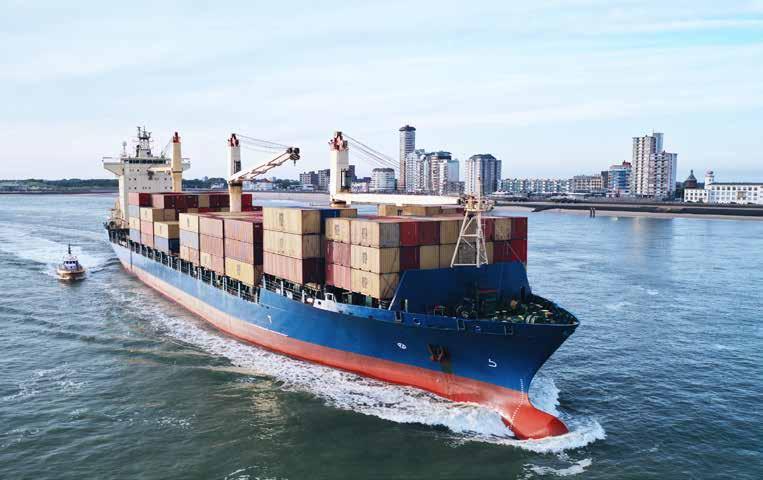
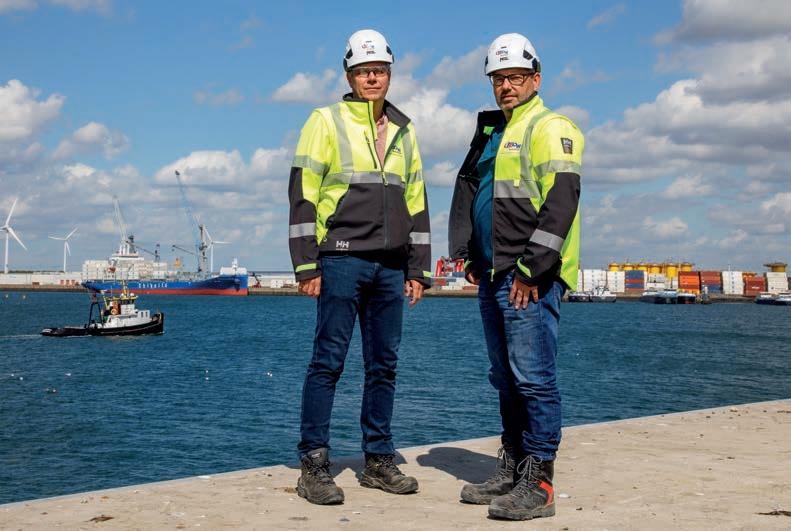
Our pilots ensure a safe and smooth passage
North Sea Port and Promotion Council North Sea Port will be in attendance at various events and trade shows. Below you’ll find a snapshot of the upcoming events that might be of interest to you.
Looking forward to the new year
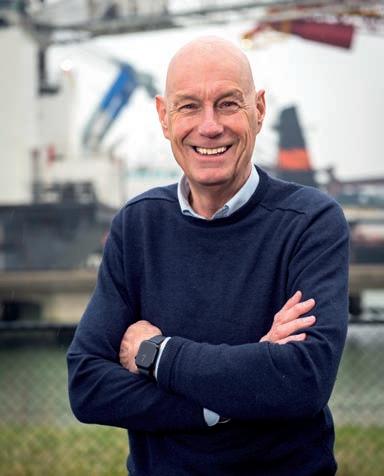
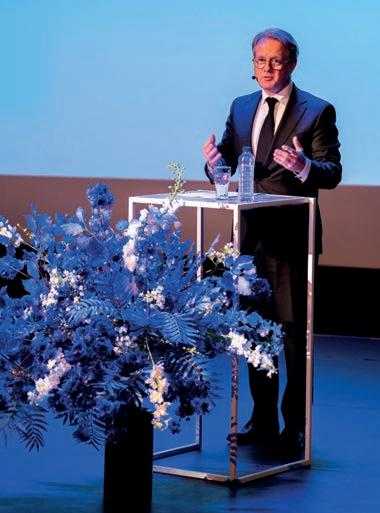
As the new chair of Promotion Council
North Sea Port, I’m about to complete my first year in this role. It has been a year in which we continued to build, within a new structure, on the strong foundation laid by the previous board: an effective and enjoyable team working towards the goals of the Promotion Council.
I have greatly enjoyed our activities this year – the various networking events, trade fair participations, and the visits and conversations with companies, North Sea Port shareholders, and fellow promotion councils. These have provided me with many valuable insights. I have experienced the cooperation within our Operational Team, which handles day-to-day matters, as well as with our board and with North Sea Port, as very effective, cooperative, and constructive. Their support and feedback help us further develop the Promotion Council. The expansion of the Council with Flemish members rightly reflects the dynamic that exists in and around North Sea Port.
Our networking events were exceptionally well attended this year, and we received positive feedback on the format, topics, and speakers. That’s something we can be proud of. The positive response gives us great energy to keep this up. This year also saw the implementation of our new Strategic Plan: Promotion Council North Sea Port Foundation 2025-2028. In this plan, we describe how we intend to achieve our objectives and which actions are required to do so. You can find the details on our website: pc-nsp.com.
Above all, we will continue to focus on the relevance of the topics at our networking events, always striving for high-quality speakers. We are also pleased that, once again next year, we will publish this fine magazine together with North Sea Port and participate in various
trade fairs – all in support and promotion of the port area and our members.
2026 will undoubtedly be another eventful year. There is much happening in the world that affects our port. We hope to meet many companies again at our various events and to continue growing with both new Dutch and Flemish members. For now, on behalf of the Promotion Council, I wish you all happy holidays, a pleasant year-end, and a successful and healthy 2026.
With kind regards,
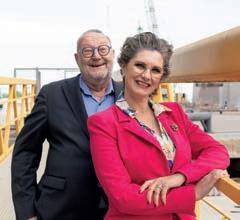
John Dane Chairman Promotion Council North Sea Port
Impact 2030
North Sea Port presents new strategic plan
"Impact 2030 is a plan we can be proud of."
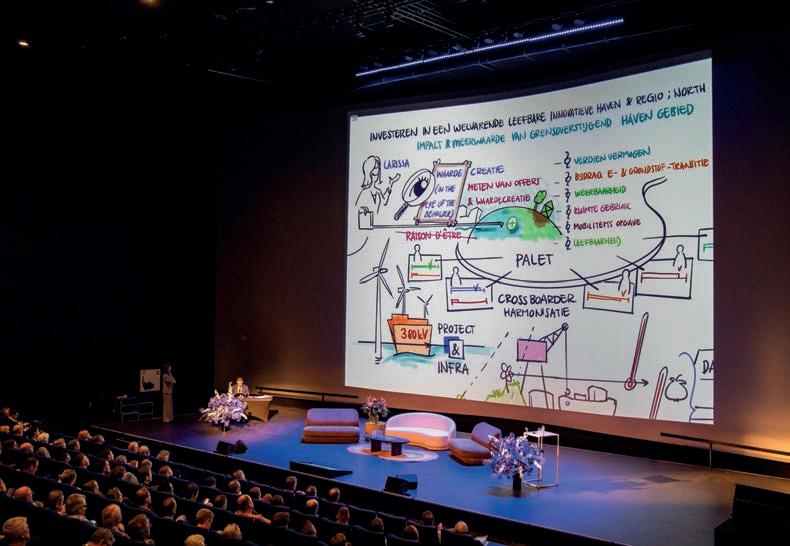
On 17 November, North Sea Port presented its new strategic plan entitled Impact 2030 at the North Sea Port Conference. With this plan, the port authority continues the course set out in the previous plan, Connect 2025, while also looking ahead towards 2035.
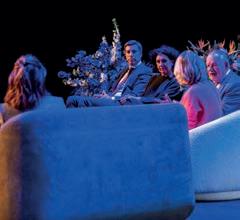
The new strategic plan, Impact 2030, was presented on 17 November 2025 during the North Sea Port Conference.
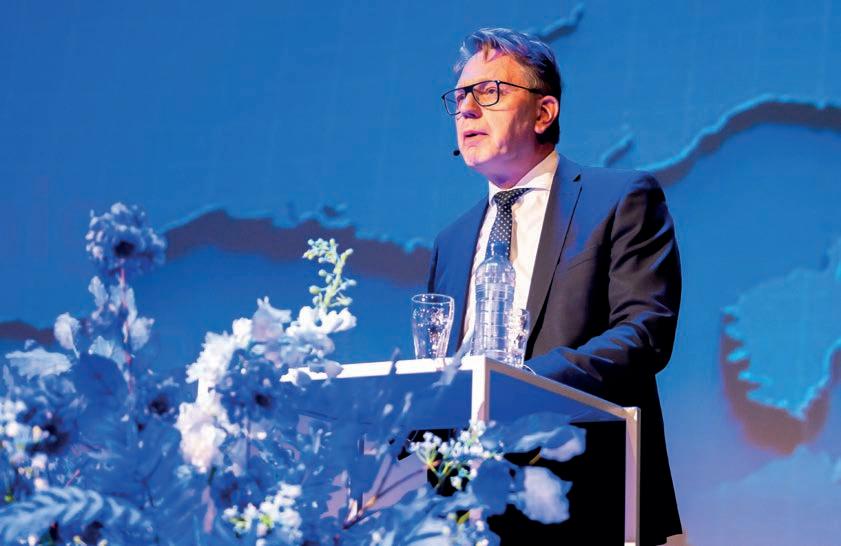
Cas König, CEO of North Sea Port, described the new strategic plan as a solid foundation for targeted, sustainable growth of industry in North Sea Port’s cross-border port area, while ensuring a good balance with the local environment. Robert Tieman, Dutch Minister of Infrastructure and Water Management opened the conference with a keynote addressing the importance of ports. He stated that ports are the driving force of the economy, although they face major challenges. Port economist from Erasmus Centre for Urban, Port and Transport Logistics (Erasmus University Rotterdam), Larissa van der Lugt was also present at the event. In her keynote, she spoke about the external research she conducted together with port economist from Ghent University, Professor Theo Notteboom into North Sea Port’s added value at regional, national and European levels. According to her North Sea Port operates from its core purpose, facilitating and contributing to both economic and societal value, by collaborating with the right companies that help realise the ambition.
Re-evaluation
In this article, Cas König provides us with an explanation of the new plan. “The world around us is changing rapidly, and
developments within our organisation and port area are also ongoing,” he explains. “This required an evaluation and possibly an adjustment of our plans as previously set out in Connect 2025. Of course, the intention was not to completely abandon the main lines of Connect 2025. The strategy for the port authority as a European top port has been set irreversibly in motion. Our new strategic plan, Impact 2030, is therefore mainly an update of Connect 2025. To achieve this, we first evaluated Connect 2025. Where do we stand now? What is going well and what can be improved?”
External analysis
Cas König continues, “In addition, we asked port economists Professor Theo Notteboom and his colleague Larissa van der Lugt to carry out an external analysis. Based on their and our findings, we have arrived at the new Impact 2030 strategy, which sets the course for the next five years. In shaping Impact 2030, we naturally also consulted our staff, for whom we organised internal sessions. It is important not only to focus on planning, but also on implementation. We also spoke with customers and stakeholders. Since our plans must align with their expectations of us, we also engaged with our shareholders. Key conditions for them included the importance of safety and liveability. With our new plan, we are also looking ahead to 2035.”
At the North Sea Port Conference CEO Cas König of North Sea Port described the new strategic plan as a solid foundation for targeted, sustainable growth of industry in North Sea Port’s cross-border port area, while ensuring a good balance with the local environment.
Our new plan is an urgent call to all involved, not the least the national governments, to help us accelerate.
Call for acceleration
“Although a number of large-scale projects from Connect 2025 are still ongoing, the new plan is aimed at speeding things up,” stresses Cas König. “A lot has already been initiated, but we also find that things often do not proceed quickly enough. There are numerous reasons for this. As a result, the Netherlands and Belgium are missing out on opportunities, for example, if companies ultimately decide to locate elsewhere. We want to emphasise that North Sea Port is making choices to retain and strengthen strategically important industry for the Netherlands and Flanders, Belgium and thus for our port. Our new plan is therefore an urgent call to all involved, not least the national governments, to help us accelerate. As an example, I refer to our article in the previous PortNews 20.3; september; page 4 about the nitrogen issue. Companies are willing to invest in sustainability, but are still too often hindered by restrictive regulations or uncertainty about the timely realisation of necessary infrastructure (e.g. for hydrogen, electricity, CO2).”
Action domains
“Our new strategic plan focuses on five so-called action domains that North Sea Port will concentrate on in the coming period,” explains Cas König. “We have defined the action domains as follows:
• We are a European top port for clients with sustainable ambitions in the manufacturing and process industries and related logistics.
• We increase our resilience and invest in the safety of the port and its surroundings.
• We make room for targeted growth in view of ambitions for the raw materials transition, energy transition, and sustainable multimodal logistics.
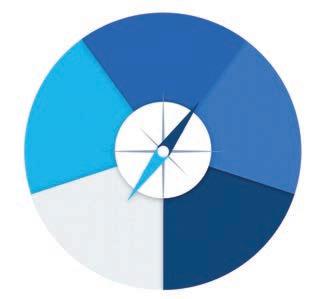
North Sea Port’s strategic compass.
Added value
#wavemaker
Connector
Customer intimacy
European top port
Examples of Flagship Projects
Examples within Action Domain 1
• Cross-border H2 infrastructure: To enable the transport of hydrogen within, to and from our port area, a cross-border network of pipelines is being constructed.
• Deep-C Circular: Deep-C Circular is a 40ha site with a high-quality deep-sea quay. This unique development location focuses on the import of hydrogen (carriers) and circular materials, and on the associated manufacturing and process industry.
Examples within Action Domain 2
• Digital and physical fencing: North Sea Port is strengthening the monitoring of risk areas and the control of entry and exit with a physical fence, supplemented by a digital shield around the port.
• Host Nation Support projects: North Sea Port has years of experience in supporting defence and facilitating military transports as part of Host Nation Support. North Sea Port facilitates commercial projects that serve national interests and monitors the progress of port operations.
Examples within Action Domain 3
• North-C Circular: North Sea Port is working with ArcelorMittal Belgium and the Flemish Government on the development of 150 hectares of industrial land, enabling ArcelorMittal Belgium to make major advances in the energy and raw materials transition.
• We realise and accelerate the implementation of smart and sustainable port infrastructure.
• We strengthen our management for effective and sustainable logistic chain connections.
For each action domain, we illustrate this with several striking projects that concretely implement the plans. These are some striking examples to facilitate discussion about the opportunities and challenges in our port.” (see box ‘Examples of Flagship Projects’).
Strategic compass
Since the merger into North Sea Port, both the organisation of the port authority and the port area itself have developed further. According to Cas König, this has also influenced the way the plans in Impact 2030 have been shaped. “Since our merger, we have been able to build our cross-border DNA. This DNA is defined by our position as a European top port and our Customer Intimacy & Connector approach. Other important elements of this DNA are our continuous desire to create impact and (added) value for clients and for our wider environment, and that we do this through our pioneering organisation. To stay on course in a rapidly changing world, we are now building further on this DNA. Of course, our port area, and more specifically the companies operating there, is also important in shaping North Sea Port’s development. It is clear that our port is primarily one for process and manufacturing industries and associated logistics. Both our organisation and the port bear the name North Sea Port. Together they reinforce each other, depend on
• Sustainable spatial development strategy for the port: The Spatial Development Strategy (ROS) is a spatial vision and development perspective for our targeted growth ambitions as a European top port.
Examples within Action Domain 4
• Smart port infrastructure inspections: With smart inspections, the condition of our port assets is monitored using advanced technologies such as sensors, machine learning and AI.
• Optimisations of the Ghent-Terneuzen Canal: As the first optimisation of the canal, it must be deepened from the North Sea locks to the Bulk Goods Port, and the Bulk Goods quay must be adapted.
Examples within Action Domain 5
• North Sea Portal: North Sea Portal is the customer-focused finishing touch to the digital port environment. It provides a one-stop-shop for the port community to streamline their logistics processes and the associated digital services and information exchange.
• Green Shipping Corridor between North Sea Port and Port of Gothenburg: The coalition of DFDS, North Sea Port, Port of Gothenburg and Port of Antwerp-Bruges is working together to make the shipping corridor between Sweden and Belgium greener.
Keynote speaker Robert Tieman, Dutch Minister of Infrastructure and Water Management at the North Sea Port Conference. He stated that ports are the driving force of the economy, although they face major challenges.
each other and determine our strategic compass. In this way, we can steer towards sustainable growth, social added value and economic resilience.”
Three key messages
With the plan Impact 2030, North Sea Port also put forward three core messages at the North Sea Port Conference:
• North Sea Port has set itself up to create the right conditions for the port; together with the port authority, other stakeholders must also get to work; acceleration is needed in the implementation of some major (infrastructure) projects in order to achieve results in time.
• W ith Impact 2030, North Sea Port is placing an even greater emphasis on safety and resilience. To this end, the port authority is investing in security in the port (e.g. criminal undermining) and its immediate surroundings, and North Sea Port is working on increasing our port’s resilience (e.g. cybercrime).
• Space is essential for the development of the port. It is important to make good use of existing space, but North Sea Ports also needs to discuss area expansion. Efforts must also be made to realise environmental operating space.
“I must say that Impact 2030 is a plan we can be proud of,” concludes Cas König. “It is a compact, clear and actionoriented plan with concrete intended results. It clearly states our role and also provides tools for the port business community, governments and partners. Thus, it is not only an update of existing plans, but also includes substantially new elements. It addresses the opportunities that exist, explains what we can be held accountable for, and also what we expect from the business community and governments.
Impact 2030 thus invites us to jointly shape and accelerate the strategic development of our Dutch-Flemish port area! For more impact, for more value. Everyone from their own role and responsibility.”
I. NORTHSEAPORT.COM
Port economist from Erasmus Centre for Urban, Port and Transport Logistics (Erasmus University Rotterdam), Larissa van der Lugt at the North Sea Port Conference. According to her, North Sea Port operates from its core purpose facilitating and contributing to both economic and societal value, by collaborating with the right companies that help realise the ambition.
North Sea Port is a European top port for clients with sustainable ambitions in the manufacturing and process industries and related logistics.
Image courtey of North Sea Port / Tom D’haenens.
BOW Terminal expands at the Quarleshaven
Recently, North Sea Port has granted the operation of a 34m2 site at the Quarleshaven to BOW Terminal (BOW). With this second location in Vlissingen-Oost, the company can significantly expand its services to the offshore industry.
With the site, which was released after the failure of Bulk Terminal Zeeland, BOW can respond excellently to demand from the offshore wind market and the increasing scale in this sector. “We are happy with the award to further shape our activities in offshore wind at this beautiful location and to supplement this with associated bulk flows (rock armour) and adjacent storage and transhipment,” says Jack Kloosterboer, director/owner of BOW on the North Sea Port website. Cas König, CEO of North Sea Port, says in the same message, “The
new operator aligns with the port company’s requirements to be active in the energy and/or commodity transition, have deepsea port-related activities and to make the most of the existing infrastructure and site.”
Plenty of opportunities
Jean Pierre van Lieshout and Sander Maranus, both general managers at BOW, see plenty of opportunities to successfully exploit the market potential of offshore wind. “We currently
Image courtesy of BOW Terminal.
have 17.5ha of land at the Westhofhaven in Vlissingen-Oost,” explains Jean-Pierre van Lieshout. “With this terminal, we have been able to serve various offshore wind projects as a marshalling yard in recent years. We do see that the scale in this industry continues with ever-increasing parks, larger turbines and larger installation and transport vessels. Space to store and handle the various parts is becoming increasingly scarce throughout Europe. We are therefore getting applications from more and more countries. In the meantime, we have completed
projects for parks in Belgium, France, the Netherlands, and the UK. Germany is also starting to become interesting for us with applications for projects. As a result, the challenge of being able to work efficiently on our Westhofhaven terminal is increasing. This sometimes means that we now have to move to other locations in the port to help customers, for example with the storage of rock armour, or even have to turn customers down. With the expansion at the Quarleshaven, we will solve this problem at once.”
Delayed, not cancelled
Although the market seems somewhat uncertain at the moment, because various governments have slowed down developments within the offshore wind sector, Sander Maranus remains enthusiastic about the opportunities that this market offers. “Many projects have indeed been delayed, but that doesn’t mean they have been cancelled. In any case, many government plans were not always realistic. At the moment, it simply lacks sufficient marshalling yards, sufficient suitable vessels and also sufficient material. In that respect, this postponement is not unfavourable for the market because it gives the various parties, including ourselves, more opportunity to prepare for the various projects to come.”
Unique
Sander Maranus continues, “With the site at the Quarleshaven, we will soon be able to offer a complete offshore wind package. Now we focus mainly on the storage of monopiles and transition pieces (TP), but with the extra quay length and square metres of terrain, the possibilities to offer our customers a complete package increase significantly. For many offshore wind developers, it is a big plus in terms of efficiency when the various parts of a project can be concentrated at one point instead of spread over various ports and/or terminals.”
“In addition,” adds Jean Pierre van Lieshout, “the various parts of a wind turbine are getting bigger and therefore require more storage space. The ships are also getting bigger and with the 700m of quay length at the Quarleshaven, this solves a major problem in that respect. If we have to, we can handle two ships at the same time. That is quite unique.”
The storage in warehouses is basically new to us, but we see that there is already interest in renting storage space in the market.
Warehouses
In addition to an open area, the location at the Quarleshaven also has a number of storage sheds. They were also taken over by BOW. “The storage in warehouses is basically new to us, but we see that there is already interest in renting storage space in the market. In any case, some material from former BTZ customers is still stored in the warehouses and chances are of course that they will choose to leave it there when we finally get started,” says Jean-Pierre van Lieshout. “The sheds are mainly used for the storage of dry bulk and that is of course interesting to us because this yields extra tons and therefore extra income.”
Strengthen
Next to the large open area, the quay at the Quarleshaven is an important USP. “We will soon have access to a contiguous quay of 700m. Of course, this offers many opportunities,” explains Sander Maranus. “To make full use of the quay to handle the offshore project load, it is necessary to strengthen it. At the moment the load is 5t/m2, and we are going to bring that to 20t/m2. Of course, we prefer to do this at once, but it is more likely that we will carry out this investment in phases. So we will soon have access to a total of 1,000m quay and that is not really common in the market in which we operate.”
Sander Maranus (l) and Jean Pierre van Lieshout (r), both general managers of Bow Terminal.
Project team
“Before the first vessel is in front of us in the Quarleshaven on the quay, some things still need to be arranged,” adds JeanPierre van Lieshout. “Of course, we want this terminal to meet at least the same standards and requirements as our terminal in the Westhofhaven. But there is also, for example, a new fence needed around the site and new office space. In addition, work must be carried out on site, utilities (especially electricity) expanded, monitoring must be regulated, and so on. For some of these matters, permits are required, which can also take extra time.”
One stop shop
Sander Maranus states, “Fortunately, receiving offshore related bulk, such as the aforementioned rock armour, does not need any preparations, which is why we hope to be operational at the Quarleshaven in early 2026.” It is clear that both general managers see plenty of opportunities with the new terminal. “The Quarleshaven and area behind it are gradually starting to become a real offshore one-stop shop location,” says Jean Pierre van Lieshout. “At the moment, there are already several parties active in the offshore industry at this location. Think of DEME, Smulders and Shipyard Reimerswaal. Soon, with our arrival, an extra activity will be added, creating an even more complete offer for offshore wind developers and contractors.”
Replacement
Although the focus at the moment is mainly on the construction of new wind farms, BOW is already thinking far ahead. “Now, of course, we focus mainly on supporting new construction projects,” says Sander Maranus, “but from about 2030, many offshore wind farms will have to be replaced. All parts of these turbines must of course be brought ashore somewhere, if possible for recycling or reuse. With our terminals, we will also be able to facilitate this receipt of materials and the related raw material transition. So, as far as we are concerned, the future can bring our two terminals in Vlissingen a lot of benefits and it is up to us to sort that out.” I. BOWTERMINAL.NL
The terrain in details
• Direct access to the North Sea via the Western Scheldt
• Located on the new Quarlesquay.
• Total area: 33.9ha (339,000m2).
• Two storage sheds: 35,000m2 and 5,000m2
• Total quay length: 700m.
• Current maximum draught: 12.5m LAT.
• 450m designed for a maximum draught of 14.5m LAT.
• 250m designed for a maximum draught of 12.5m LAT.
river.
Bow Terminal’s new terminal at the Quarleshaven.
Bow Terminal Quarleshaven
Now Bow Terminal focuses mainly on the storage of monopiles and transition pieces (TP), but with the extra quay length and square metres of terrain, the possibilities to offer its customers a complete package increase significantly.
Image courtesy of BOW Terminal.
Image courtesy of BOW Terminal.
Greener routes for sustainable sea salt
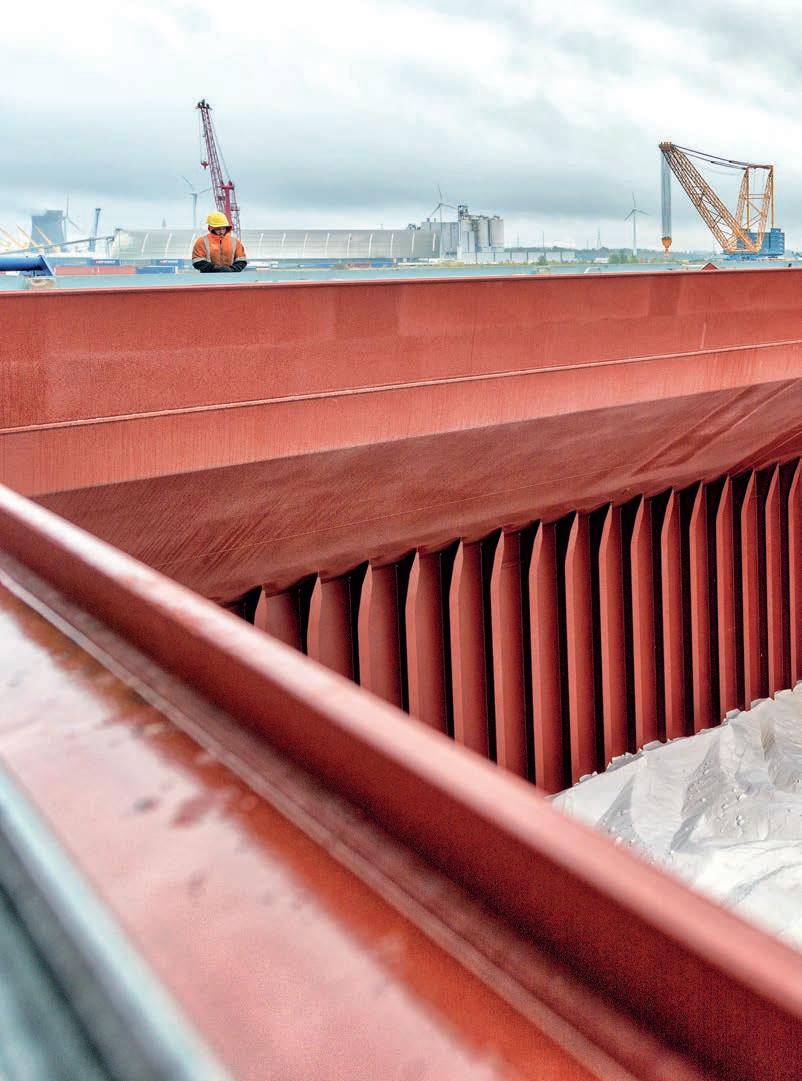
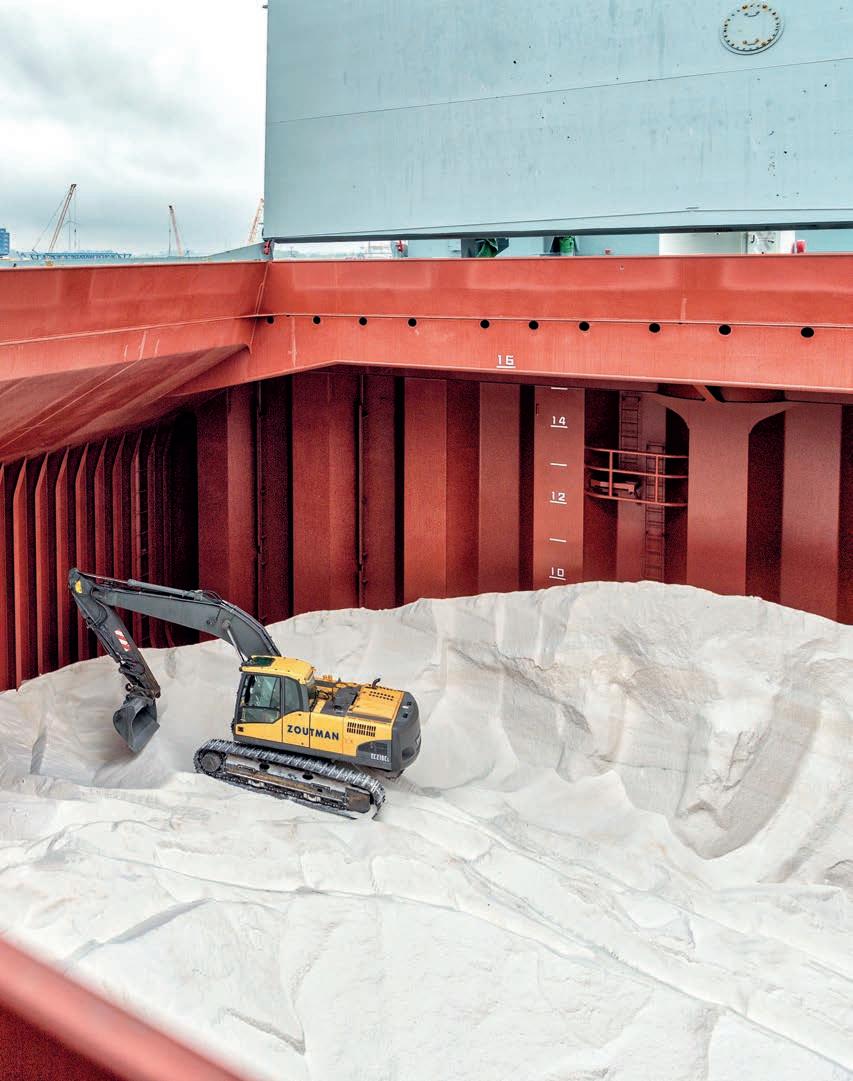
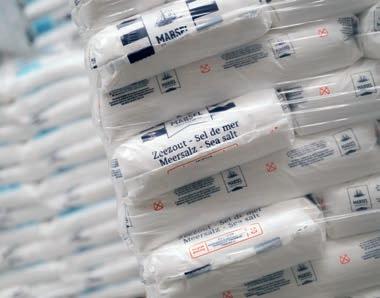
ZOUTMAN charters its own sea-going vessels to import the raw sea-salt to its facility in North Sea Port, hereby consciously choosing more sustainable ships and larger tonnages to reduce emissions.
All images courtesy of ZOUTMAN.
Sea salt producer ZOUTMAN has recently reshaped its outbound logistics as part of its ambitious course towards net-zero greenhouse gas emissions by 2047. By switching its container flows to multimodal transport, the company reduces thousands of truck miles each year, amounting to 143t fewer CO2 emissions in outbound transport alone.
Clean Salt, Clear Goals
ZOUTMAN produces high-quality food salt as well as sea salt for industrial, agricultural, and technical applications, such as de-icing salt and salt for swimming pools. The choice for refining sea salt was made from an ecological point of view, as sea salt offers significant ecological advantages over traditional mined salt, says Maarten Delbaere, sustainability manager at ZOUTMAN, “Not only is sea salt an inexhaustible and renewable resource, it is also a natural raw material obtained using only natural evaporation processes (wind and sun) in warm overseas areas. Harvesting raw sea salt produces 30 times fewer CO2 emissions in comparison to traditional mining salt. Moreover, our refining process is a physical one, without the use of chemical additives. In offering natural sea salt as an alternative to
mined salt, sustainability has always been an intrinsic part of our mission. This is now once again reflected in our sustainability programme, ‘Clean Salt, Clear Goals’, which we launched in 2024 to embed sustainability in every aspect of our organisation and work towards a climate-neutral production. Reshaping our outbound logistics was one of the key elements of this trajectory.”
Road to water
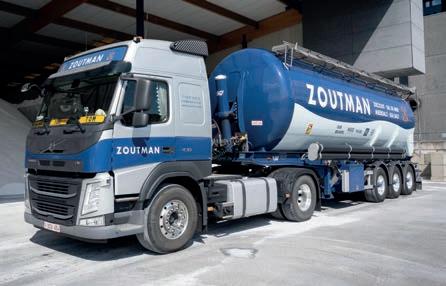
“Our inbound and internal transport flows of the raw material already were multimodal for many years, explains Wouter Lambert, supply chain manager at ZOUTMAN, “But our outbound logistics were historically mainly conducted by road. Even though we had been inquiring about using inland waterways and railways to transport our packaged goods many years ago, we noticed that the infrastructure and backing for this were not optimal. However, the start of production in Ghent in our new salt tower in 2023 – the tallest and most modern in the world – and the kick-off of our sustainability programme provided an excellent opportunity to revisit this issue. In cooperation with POM West Flanders and Multimodaal.Vlaanderen, we investigated various goods flows with multimodal potential. The results are impressive: we have been able to shift 80 to 90% of our container transport to inland waterways. For our Roeselare production site, there’s a container barge travelling nearly daily between the Wielsbeke inland terminal and the deep sea container terminals in the Port of Antwerp-Bruges. At North Sea Port, our containers travel through the Stukwerkers Container Terminal at the Sifferdok. To give you an idea, this shift amounts to a yearly reduction of 66,000km of road transport towards the container terminals. That is a significant reduction in emissions. Not only that, but we also notice that, as a bonus, we have a little more breathing room in our administrative handling of container shipments, because saturation of the deep sea container terminals meant that free time per truck was becoming increasingly limited.”
Road to rail
“We conducted a similar exercise for rail transport,” Wouter Lambert says. “We first investigated which flows could be transferred to rail without impacting our customer service. Important factors to take into account were stable deliveries,
has thoroughly reformed its outbound logistics by switching to intermodal transport whilst optimising its road transport deliveries.
costs, and, of course, possible routes, as we never use external parties for intermediate storage. Delivery had to be made directly from ZOUTMAN to our customers without increasing current transit times. After extensive research and testing, the first export flow to be switched over in its entirety was our trade with Poland. These are packaged goods that we load into 45ft containers, which are then transported to Poland by train. This switch alone accounts for 56,300km less road transport and a saving of 86t of CO2 per year. In the meantime, we are also in the process of switching our export flows to Brittany, France, to rail. We are constantly investigating new intermodal opportunities, and our logistics team works very hard to implement them.”
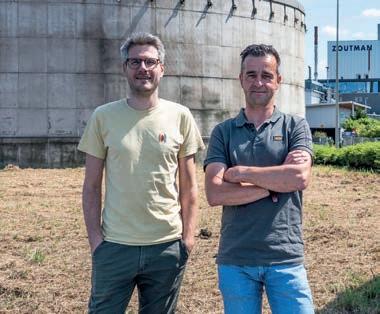
Maarten Delbaere, sustainability manager at ZOUTMAN, and Wouter Lambert, supply chain manager at ZOUTMAN.
ZOUTMAN
“Additionally, we are also optimising our road transport deliveries,” Maarten Delbaere adds. “Although we currently export to 60 countries worldwide, 40% of our production is delivered locally to customers in Belgium, and a significant percentage is exported to our neighbouring countries. Road transport, therefore, remains important, which is why we are also looking for ways to make it more sustainable. Since we can now deliver the same products and quality from both our production sites, we can also reduce the number of kilometres travelled to the customer in this respect. In addition, we are investigating the possibilities of electric transport in the future.”
Natural and green refining processes
“Of course,” Maarten Delbaere says, “our sustainability programme includes more than greenifying our logistics. Combining climate-neutrality with the expected increase in production requires optimising our already sustainable process even further, every step of the way. This begins with the feedstock. We purchase high-quality raw sea salt from warm overseas regions such as Australia and the Caribbean, since these regions can harvest year-round and deliver high-quality salt. Transport of raw sea salt is then carried out exclusively by sea-going vessels, which we charter ourselves. We consciously choose more sustainable ships and large tonnages to reduce emissions. We currently receive vessels of up to 80,000t in Ghent, so we are very pleased with the new lock in Terneuzen. However, we are also eagerly awaiting the solutions for the bottleneck in Zelzate, as this would allow us to receive even larger vessels, of up to 150,000t. After all, the more tonnage we can transport in such a ship, the better it is for the environment. The sea salt we receive in Ghent is then partially shipped by inland waterways to feed our production facility in Roeselare;
another part is processed in our new production facility in Ghent. The process remains the same, though. In both facilities, we start with the same raw material to refine all our different products.”
He explains, “Salt for the food industry and water softening salt follow the same process: washing, then sieving, drying, and breaking into different grain sizes. This salt is also screened for impurities using cameras. The refining process for road salt or other technical products is sometimes simpler, but not always, as food-grade salt in larger grain sizes is often used for industrial applications, too. Take water softening salt, for example: this may be used for water softening in breweries, so it must also be food-grade. The entire refining process is done using natural, physical processes. The washing process includes a double washing with a screw that mixes the salt with water. The first washing is done with brine, the second with fresh water. The salt does not dissolve in either case; it remains in its crystallised form. After sieving, the salt is then dried until it reaches a moisture content of 0.1-0.2%, so that it does not cake in the silos. We store the salt in silos without any additives, so it must be dry enough to store without caking. To make the drying process even more sustainable, we are looking into the possibilities of using green hydrogen in the future. In addition, a wind turbine will be installed on our site in North Sea Port, in collaboration with Luminus, which will supply all electricity consumption for our Ghent site.”
“Furthermore, we also recover the water used for washing,” says Wouter Lambert. “In fact, both of our production sites have a Zero-Discharge status, which means that we do not discharge our process water but recover it, to produce other saleable products, for instance. We are targeting 100% recovery of our process water by 2030.”
“Ultimately, it’s all part of a logical story,” concludes Maarten Delbaere. “ZOUTMAN’s core mission is a green one: to replace mined salt with much more sustainable sea salt. We therefore process it as sustainably as possible. Now that our logistics are also as environmentally friendly as possible, this story ticks all the boxes.”
I. ZOUTMAN.COM
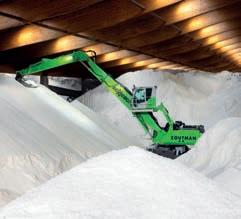
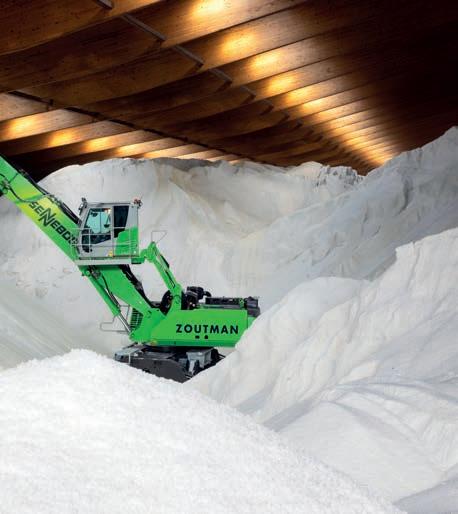
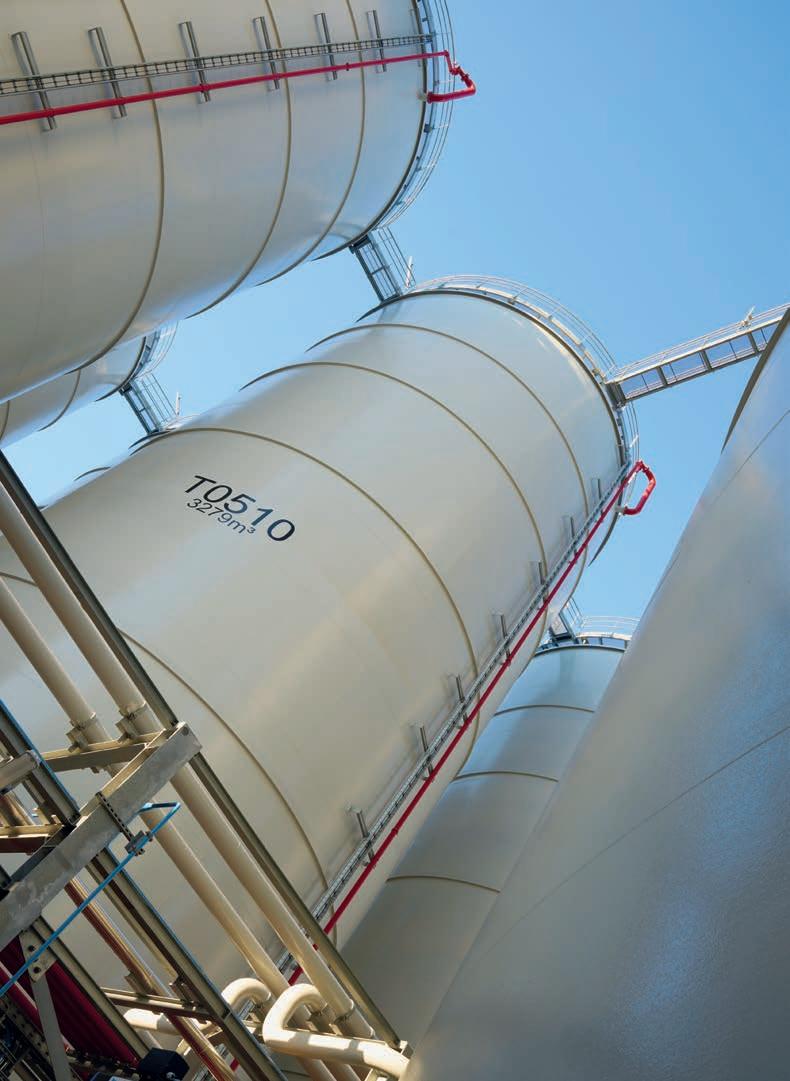
The refined salt is stored in silos in different grain sizes until it is ready to be packed and shipped to the customers.
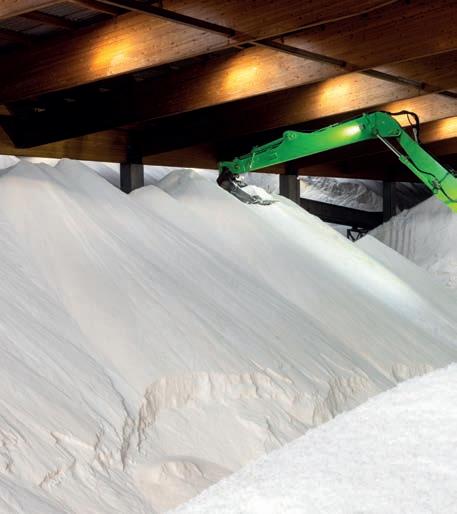
Sea salt offers significant ecological advantages over traditional mined salt. It is an inexhaustible and renewable resource, obtained using only natural evaporation processes.
New name, same ambitions
Lion Storage becomes Return Industrial Solutions
Energy storage offers a vital solution for balancing electricity supply and demand, accelerating the integration of renewable energy, and alleviating grid congestion. In the North Sea Port area, several battery storage projects have already been successfully implemented. Building on this momentum, development is now underway on the 350MW Mufasa project, one of the region’s most ambitious energy storage initiatives to date.
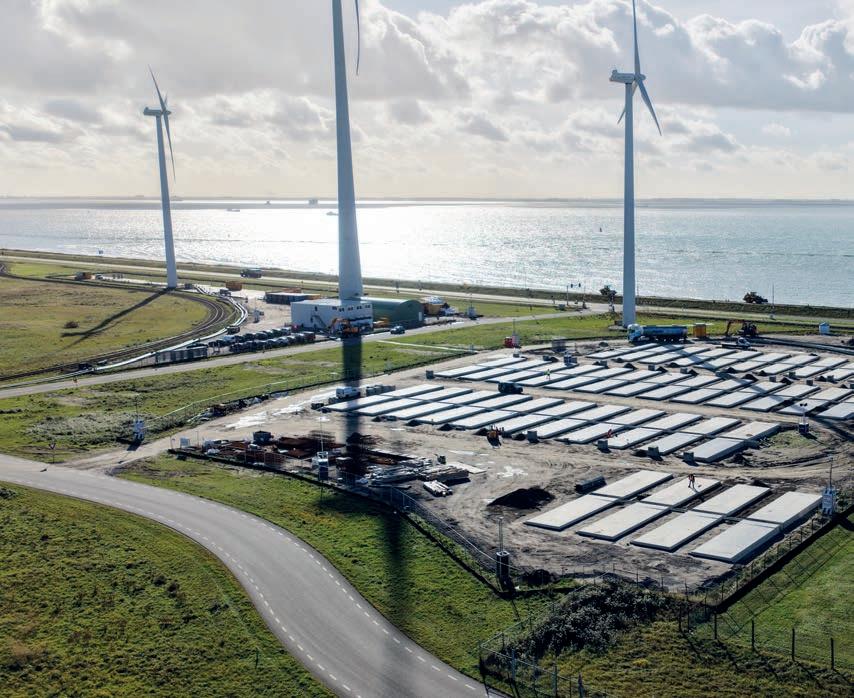
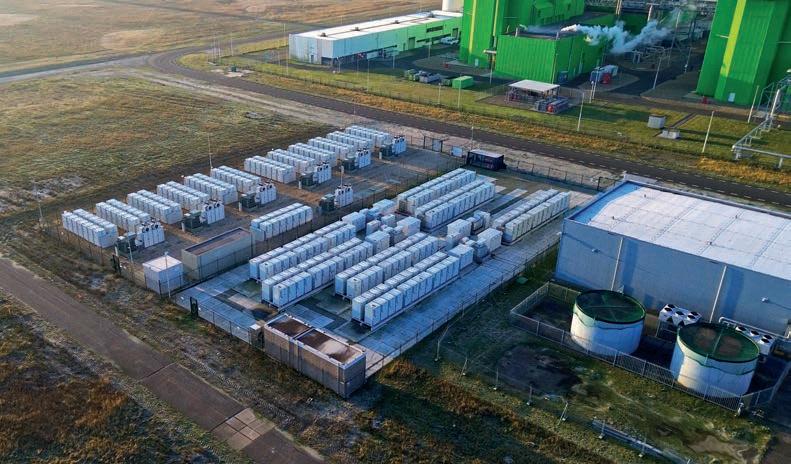
Mufasa was developed by the Return Industrial Solutions (RIS) team, formerly known as Lion Storage or ‘the Lions’ (see also PortNews 19.2; May 2024; page 34). The construction of the project is progressing steadily. Mufasa will feature Megapack 2 XL, Tesla’s utility-scale energy storage system. The batteries will be able to charge and discharge 1,400MWh at a 350MW power capacity, several times a day: enough to supply well over 200,000 households. As the largest battery energy storage system (BESS) in the Netherlands and one of the largest energy storage projects in Europe, it sets a new benchmark for balancing and securing power grids.
In full swing
Arno Hendriks is co-founder and managing director of RIS and provides an update on the project’s progress. “Earlier this year, we proudly announced the successful financing of the Mufasa project. Construction at the Vlissingen-Oost site is now progressing rapidly. The site has been fully cleared, and civil works are well underway, including terrain levelling, foundation pouring for the battery units, and cable route drilling. These milestones mark a significant step forward in delivering one of the region’s most impactful energy storage projects.
“Tesla, SPIE and their various subcontractors are working at a steady pace every day to prepare the site for the arrival of the
Image courtesy of Return Industrial Solutions.
About Return
Dutch company Return, with its head office in Amsterdam, develops and operates battery storage assets across Europe, with strong hubs in the Netherlands, Belgium, Germany, and Spain. The company is continuously expanding into strategic locations to keep up with the growing demand for energy flexibility. At present, the company has 70MW of battery capacity online, enough to supply 175,000 European households with electricity. Furthermore, 500MW of batteries are under construction, enough capacity for the peak demand of nearly 250,000 households. Finally, a further 7GW of projects are in development. Besides Mufasa, Return has already realised projects in North Sea Port. These are Castor and Pollux in Vlissingen-Oost. Operational since December 2023 and providing 60MW. In Terneuzen, Star has been operational since November 2021 with a storage capacity of 10MW.
batteries,” explains Arno Hendriks. He continues, “The coming months will focus on civil works and horizontal drilling of the 150kV cable. The first batteries are expected on site around May 2026. In total, there will be 372 batteries, each weighing approximately 40MT. These will be transported to the location in several shipments and then placed on their foundations one by one.”
“Due to the large number of batteries, the work involving transport, loading and unloading will take several months. In addition to the batteries, we also expect the delivery of two high-voltage transformers, each weighing about 200t. These will be delivered as some of the final components. Once all the equipment is in place and fully integrated, a test phase lasting several weeks will follow. Once all tests have been successfully completed and TenneT has given its approval, the system will be connected to the high-voltage grid. Commissioning is scheduled for April 2027.”
Pan European Flexibility platform
Lion Storage has officially rebranded as Return Industrial Solutions (RIS), marking a significant milestone in the company’s evolution. Arno Hendriks, explains the rationale behind the name change, “As we shared in our interview last year, Lion Storage operated as a sister company to SemperPower, which has developed several battery storage projects across Zeeland (PortNews 18.1; March 2023; page 28). Earlier this year, SemperPower transitioned to the name Return, and following the summer, we announced our own rebranding to Return Industrial Solutions.
This change reflects a strategic development: Return increased its minority stake in Lion Storage to a majority share of 51%, integrating RIS into its Pan-European Flexibility platform a network dedicated to delivering customer-centric energy storage solutions across the continent. Within this platform, RIS focuses on battery applications tailored to industrial infrastructure, including:
Arno Hendriks, co-founder and managing director of Return Industrial Solutions.
Construction of Mufasa at the Vlissingen-Oost site is progressing rapidly.
Image courtesy of Return Industrial Solutions.
• behind-the-meter systems at large industrial sites;
• behind-the-meter with new closed distribution centres;
• shore power solutions with integrated battery storage;
• hybrid energy systems for data centres and other highenergy demand facilities.”
Arno Hendriks adds, “This rebranding is more than a name change – it’s a reflection of our strengthened commitment to industrial energy users. As part of Return, we’re better positioned to deliver smart, scalable storage solutions that support the energy transition and keep systems reliable and resilient.”
Deep understanding
“Within Return, Return Industrial Solutions focuses on battery storage projects within complex, industrial and non-standard configurations. For a small country, the Netherlands has both high energy production and a large number of large-scale energy users. Nevertheless, the energy transmission system of the grid operator is currently reaching its limits, resulting in all of us experiencing the impact of grid congestion – our grid is no longer a ‘copper plate’. At the same time, our industry wants to become more sustainable, which in many applications translates into electrification. Return Industrial Solutions focuses on solving both current and future challenges in this energy transition for large users. Central to this are a deep understanding of system technology, industry knowledge and long-term cooperation.”
Exploring the limits
Previously, Arno Hendriks stated that the company aimed to grow to a storage capacity of 1.5GW, and he explains that this ambition still stands. “Our ambitions remain unchanged, or are even greater than ever. With Return, we are working on a pan-European network of large-scale battery systems. In addition, with RIS we are continually exploring the limits of what
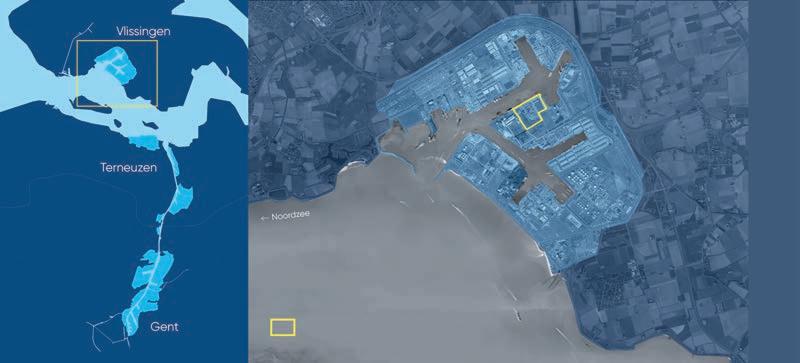
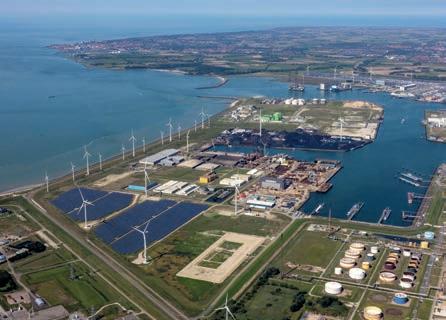
In the North Sea Port area, various initiatives are being developed that will contribute to the energy transition. The marked area indicates the Mufasa project.
is possible with energy storage and are now developing various projects with leading companies in different sectors.
In this way, we are creating an energy system that increasingly runs on sustainable electricity and generates value for both society and the investment climate in the Netherlands (and Europe). Our solutions not only accelerate the sustainable energy transition by, for example, reducing so-called curtailment (shutting down wind turbines), but also create space on the high-voltage grid. This way, we also enable companies to expand or develop new activities, and in the case of Mufasa, support the development of the North Sea Port area.”
I. RETURN.ENERGY
Image courtesy of North Sea Port/Tom D’Haenens.
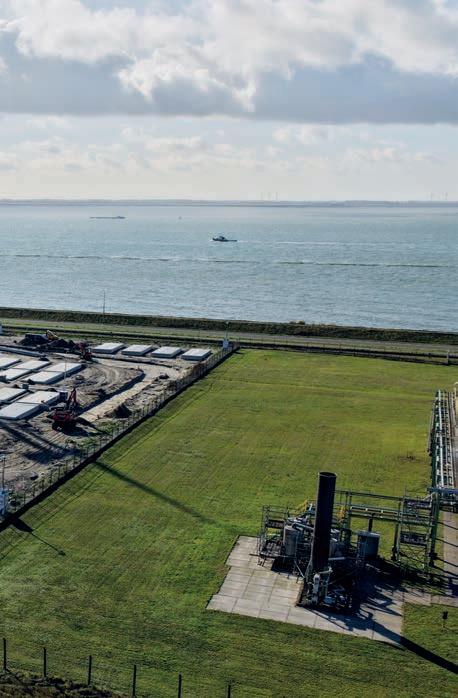
Close to the project Mufasa location, Castor and Pollux have been operational since December 2023.
Image courtesy of Return Industrial Solutions.
Growing a better world together
In the North Sea Port area, various projects are being realised that contribute to the energy transition. Many of these projects would not be possible without the support of financiers. One such financier is Rabobank.
At present, construction is underway in Vlissingen-Oost of one of the largest battery storage facilities in the Benelux. This 354MW project, named Mufasa, is being built by Return Industrial Solutions. A consortium of six banks, including Rabobank, contributed to the project financing associated with the EUR 350 million investment.
DNA
According to John Heijnsdijk, corporate director Rabobank Zuid-West Nederland, this investment was not only a commercial consideration, but also fits within the company’s sustainability objectives. “Supporting sustainable initiatives is seamlessly aligned with our DNA,” he explains. “We have expressed this in our mission ‘Growing a better world together’. As a co-operative bank, a bank with members, we pay out co-operative dividends annually along the so-called ‘transition to society’. Projects that contribute to the energy transition fit in perfectly here.”
Electricity problems
Energy transition business development manager Huib van Gorkom is actively involved in many projects that make the energy transition in the south-west of the Netherlands possible. “Of course, with these kinds of projects, we also look at the interests of our private and business customers,” he explains. “At the moment, congestion is threatening to arise in Zeeland’s electricity network, and moreover, due to a shortage of electricity, many projects – including those of our customers – are being postponed. By helping to enable a battery storage project like Mufasa, we are contributing to a solution for these electricity problems. In doing so, we can support our customers further.”
Energy hub
John Heijnsdijk continues, “To make the energy transition and a circular economy possible, we strongly believe in what we call smart business parks. North Sea Port is certainly a good example of this. The port area truly acts as an energy hub, playing a role in the supply of raw materials for sustainable energy generation, in the production of sustainable energy, and in its storage and distribution, and we are keen to contribute to the realisation of projects that fit into this, such as Mufasa.”
Rabo Transition Tickets
“In addition to the Mufasa project, we support more promising initiatives to help accelerate the energy transition,” says Huib van Gorkom. “This support not only consists of contributions from co-operative dividends, but also through traditional financing and by offering advice and coaching. For example, we also use the co-operative dividend to provide so-called Rabo Transition Tickets to companies, in collaboration with Dockwize. Companies can submit ideas which, after assessment, can be rewarded with an amount of EUR 5,000, or even with a contribution of EUR 25,000. In addition, until the end of this year, we are offering a so-called SME sustainability contribution, which means we provide grants to companies that have invested in the energy transition. These mainly concern smaller projects, such as installing a charging station or solar panels.”
A long process
“We have set ourselves the goal of ultimately providing no support for the use and consumption of fossil fuels. In financial terms, this means reducing the financing of emissions to zero. We realise this will be a long process. On the other hand, every step, no matter how small, brings us closer to this goal,” John Heijnsdijk concludes.
I. RABOBANK.NL
Corporate director Rabobank Zuid-West Nederland, John Heijnsdijk (l) and Huib van Gorkom, energy transition business development manager of Rabobank (r).
The transition advances
Latest developments at LBC Tank Terminals add momentum to an energy transition already underway
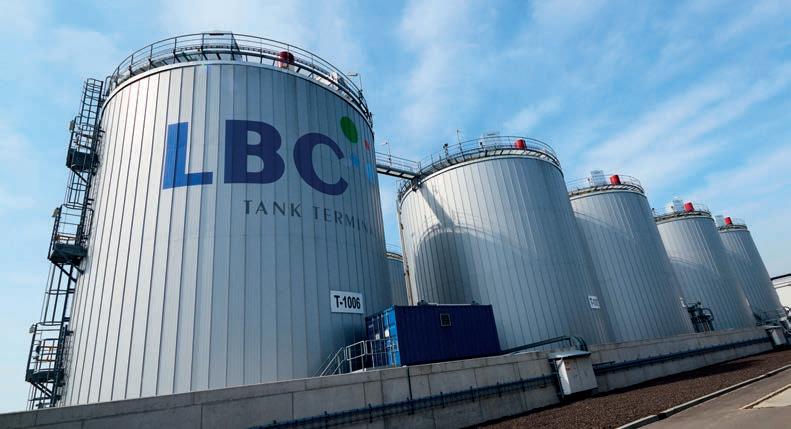
Earlier this year, in PortNews 20.1 we heard from LBC Tank Terminal’s general manager Alexander Fokker about the development of the company’s new green energy terminal in North Sea Port. Since then, there have been a number of interesting developments, both at LBC, and in the world at large.
LBC’s project will see the construction, over the next few years, of an energy hub for the import, storage and handling of hydrogen carriers, renewable energy products and lowcarbon fuels. The hub’s location in the Amsterdam-RotterdamAntwerp (ARA) region, will enable the supply of these products throughout Northwest Europe.
On track
At the present time, we often see reports in the media of a slowdown in the energy transition. At LBC, however, Alexander Fokker remains positive.
“Things are progressing quite well here. We remain on schedule, aiming to begin operations in 2029, followed by the cracking of ammonia in 2030.”
Despite this, he admits it’s not all plain sailing.
“The world is challenging right now. Things are very dynamic, especially in our sector, and there are certainly a number of geopolitical issues impacting the transition.”
Developing a new market
One example, he says, is the development of policy, both at the national and European levels. While governments have made clear their vocal support for the energy transition, in many cases the rhetoric is yet to be backed up with clear policies; a situation that makes it difficult to invest in large, capital-intensive projects.
One result of this – and, in Alexander Fokker’s view, by far the most complex challenge that the industry must overcome– is a lack of infrastructure.
“While the oil and gas industry evolved, organically, over time, with the energy transition everybody has to develop at the same time. We need to create, and develop, demand. Once there is demand, production will follow, as will the logistics to connect
all the pieces together. Terminals, pipelines, ships, all need to be built. And this is only possible if the market is developed, with regulations, certification programmes, audit processes and a clear picture of the credit market.”
The transition underway
This, he states, requires governmental intervention.
“We need government to take their role by mitigating risk and underwriting certain developments – with policy, but also with funding.
“On the whole, I am still very enthusiastic. Here in the Netherlands, the main political parties have signalled a willingness to support local industry and that they want to progress with the transition. I have expectations that, following the forthcoming national elections, they will take the necessary steps to help us move forward.”
Besides, he says, whatever happens in the political sphere now, there is a momentum that is pushing things from the bottom upwards – the transition has started. It’s no longer a question of ‘if’, but of ‘when’. Things have certainly changed in the past five years.
“Back then there was widespread enthusiasm and an expectation that a significant transition would take place in a short space of time. Since then, reality has caught up with us and we can see that this might take longer than initially anticipated, but some fundamental steps have been taken. We’ve seen legislation implemented, technological advancements and projects starting to be built.”
First wave
In his view, Alexander Fokker explains, we are currently in the first wave of the transition – a period in which the market will be required to prove itself.
For its part, LBC is currently focusing all its energy on doing just that.
“We have announced our plans to the market, and the project has received a lot of positive feedback and support. We see
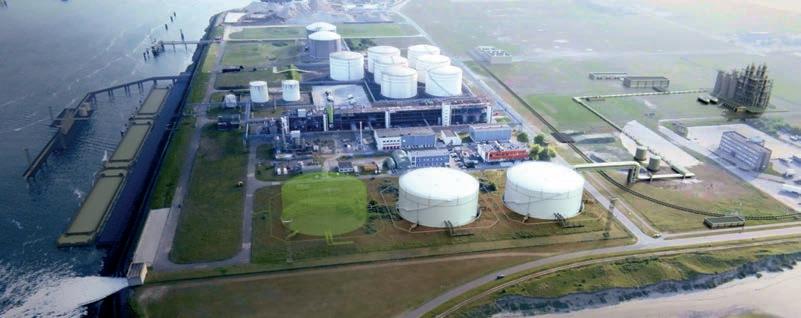
An impression of how the Vlissingen site will look in the future.
an opportunity to be a first mover and are putting all our efforts into getting our infrastructure in place. In the coming years, these steps we take now will serve to demonstrate that these solutions work, and that they are reliable. With that, we should start to see prices for green energies drop a little and new opportunities will open up for the next wave.”
Under new ownership
LBC’s project in North Sea Port took a significant step forward with the announcement in June this year that the company has been acquired by multimodal shipping company Mitsui O.S.K.
Lines (MOL). This move sees MOL implementing tank storage into its business portfolio alongside marine transportation. With this, the group has taken a further step in positioning the chemical logistics business as a strategic growth domain, aligned with its vision of becoming a social infrastructure service provider.MOL says that its acquisition of LBC, as well as strengthening its chemical logistics service, allows it to respond quickly to diverse client needs, while enabling it to accelerate the growth of its next generation energy business.
Market makers
“What MOL is doing is very smart; the company recognises the need, as we discussed, to get the whole chain in action. Therefore, they are investing in the entire process – production facilities, storage and transhipment.”
The company, he explains, is committed to reducing its emissions in line with the Paris Agreement, aiming to achieve a 45% reduction in greenhouse gas emissions by 2035, on the road to zero emissions by 2050. One route to this is significant investment in green projects such as this one. Another example is the group’s ownership and chartering of a fleet of vessels able to both transport and run on ammonia.
Long-term stability
Alexander Fokker describes the acquisition as a very important and positive development for LBC.
“We now have a strong and long-term strategic owner. MOL is a significant player, and one which has a lot of knowledge on ammonia. It is, furthermore, an owner aligned with our ambition and strategic focus on the energy transition. This allows us to leverage our combined capabilities and capture new opportunities. For us as a company, and specifically here in North Sea Port, it’s a big step, demonstrating to our clients, suppliers, and the authorities that there is a long-term commitment and stability in what we are doing.”
I. LBCTT.COM
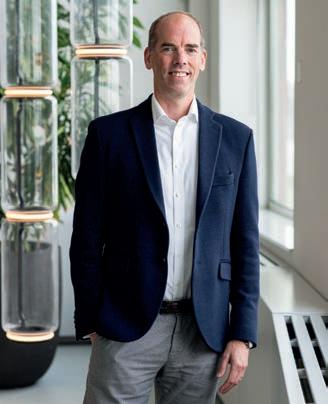
Alexander Fokker, general manager at LBC Tank Terminal.
MOL's acqusition of LBC positions the company well for the future.
Tailored pumping solutions for the maritime industry
Our Services
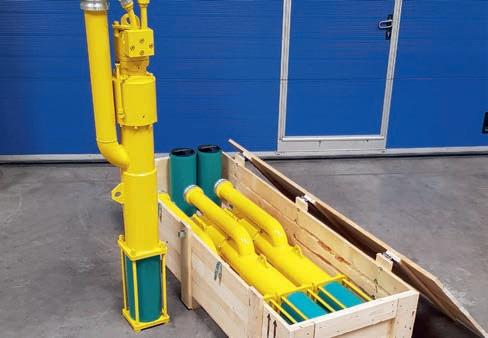
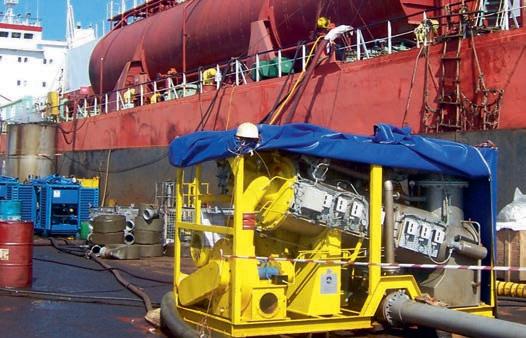
Mariflex provides custom on-site filtration and pumping services for a wide range of liquid bulk products, including molasses, de-bunkering, and other viscous liquids. Our experienced team delivers fast, tailored solutions to minimize downtime, whether for onboard pumping, de-bunkering operations, or liquid transfer.
We offer reliable equipment, including pump sets, hydraulic power packs, and centrifugal or positive displacement pumps. Our flexible solutions are available both onshore and onboard vessels, ensuring smooth and safe operations for chemicals, edible oils, biofuels, and petroleum products.
With Mariflex, you get reliable service, project coordination, and expertise—tailored to meet your specific pumping needs.
24/7 Operational Support
Driving the energy transition
Ghent Renewables, a fast-growing company in the circular and renewable feedstock sector, is reinforcing its position at North Sea Port with an expansion of its storage and treatment capacity for waste oils. Although relatively young, the company has rapidly evolved into a key link between waste collection and the production of sustainable fuels and renewable chemicals.
Expanding into a fast-growing market
Ghent Renewables was established in 2022 at the Kluizendok in Ghent as a joint venture between Cargill and GTS (Ghent Storage & Transport). Conveniently squeezed between Cargill’s biofuel plant on the other side of the water and GTS’s terminal for liquid bulk further down the road at Kluizendok, Ghent Renewables was originally founded for the pretreatment and storage of the waste oils that serve as feedstock for Cargill’s biofuel facility, as Jonas Uytdenhouwen, chief technical officer at Ghent Renewables explains: “Together with GTS we provide a logistic service for Cargill’s plant, both for the pretreatment and the storage and transshipment of the waste oils. To this end, we started with a tank storage park of 50,000 m² and a treatment unit for waste oils with a capacity of 100,000 t per year. Now, we plan to increase our capacity to 200,000 t per year, whilst also broadening our treatment capabilities. We currently offer a one-step acid washing process for waste oils. This will transition to a two-step process that includes adsorption filtration after the acid washing. With this expansion, we address the increasing demand for refined waste oils used in both biofuels (e.g. coprocessing) and sustainable aviation fuel (SAF) production. There is a lot of potential for growth in this market, and we aim to play a pivotal role in this growth.”
“We are actively investing in SAF,” adds Jonathan Feys, chief commercial officer at GTS, “as it poses a unique growth opportunity. In fact, our strategy for expansion is closely aligned with the European Commission’s Fit for 55 initiative. This initiative aims to achieve significant reductions in greenhouse gas emissions, particularly CO2, ultimately striving for energy neutrality. The European Union has developed a comprehensive roadmap, within which SAF serves as a key element of the
With a significant expansion in both capacity and treatment capabilities, Ghent Renewables addresses the increasing demand for refined waste oils used in both biofuels and sustainable aviation fuel production.
transition towards fully green aviation. Currently, the industry is in its initial phase, with the requirement that 2% of all kerosene burned in Europe must be biofuel – a figure set to rise steadily until full implementation by 2030. Recent market trends demonstrate rapid growth: over a period of eighteen months, our SAF storage will increase from zero to 140,000m³, as part of meeting the 2% mandate. At Ghent Renewables, we intend to respond to this growing market. Both at GTS and Ghent Renewables sites, we are planning significant investments to offer our customers a circular logistics story. What makes us unique is that we focus on both the storage and treatment of the feedstock for biofuel and on innovative distribution solutions for direct delivery of the finished product to the end market. We therefore offer a circular partnership: from feedstock to aeroplane.”
Circular logistics
“Unlike traditional fossil kerosene, which is usually transported to the airports through underground pipelines, much SAF is now transported to airports by rail,” Jonathan Feys explains. “That’s partly due to discussions about fossil fuel and biofuel being sent down the same pipes, but also simply because the available capacity is limited. The choice for delivery by rail is practical and sustainable, as not all airports are water-bound and one train can replace up to sixty-five lorries, delivering 1,300 tonnes in a single journey. Our unique location at the Kluizendok and our connection to the recently completed ring track enable us to deliver the finished product by train to the airports. To make optimal use of this connection, we’re going to construct four private tracks by the first half of 2027, in addition to our current connection to the ring track with public tracks. This will allow us to load two block trains simultaneously, and four to six block trains each day. That is quite unheard of in the storage market in Europe today.
“Simultaneously, we are also expanding our water connection. Our location at the Kluizendok enables us to receive large vessels, and we are in the process of creating a second quay connection, next to the one we already have in use, so that we can easily take in those larger volumes. And of course, we will also significantly expand our tank storage with a new tank park of nine 1,500m³ tanks and sixteen tanks of 6,300m², the latter being dedicated to GTS. It is a significant investment, but that is what makes us stand out. That willingness to invest and the dedication to circularity and the energy transition, which runs like a green theme through our company. From the viewpoint of GTS, at its core a storage group, this move towards production is quite atypical. But it is definitely a path we want to continue on, and with the experience
Jonas Uytdenhouwen, chief technical officer at Ghent Renewables.
Ghent Renewables is one of only a handful of treatment plants in Europe that offer the valorisation service of second-generation waste oils to customers.
and knowledge base we have here at Ghent Renewables, we definitely can. After all, the pretreatment we do here requires great skill. To me, it seems more of a craft, even an art.”
Knowledge hub for waste oil valorisation
“There is definitely a shortage on the market for these purified waste oils that we produce here,” says Jonas Uytdenhouwen. “The first-generation biofuel used mostly edible, vegetablebased feedstock, but the second generation also uses nonedible biomass. As Ghent Renewables, we are one of only a handful of treatment plants in Europe that offer the valorisation service of these waste oils to customers. The waste oils we store and treat here are indeed very diverse, from used cooking oil and food waste oils to POME (palm oil mill effluent), acid oils and spent bleaching earth oils, and many others. The variability of waste oils is enormous, and we are building an important knowledge base here on processing these oils. Now that the market for these waste oils as feedstock is booming, we have three years of experience to our advantage, and we can easily scale up. The adsorption filtration, which will be operational as of the second quarter of 2026, is an important next step in this process, as it will allow us to deliver low-metal feedstock.”
He explains: “To prepare the waste oils for further processing, we add water, steam and a mild acid. We feed the mixture into a centrifuge, a tricanter, and separate the water that contains all impurities that are water-soluble, and a solid fraction, which typically consists of all the small fractions that are normally found in waste. For example, the small bits of chicken and fries that remain in cooking oil. That’s the acid washing. The adsorption filtration is a second step that purifies the oils from metals. Metals end up in waste oils in various ways, but they are difficult to remove when using traditional filtration approaches. With our new adsorption filtration, we use bleaching earths as an adsorbent to filter these metals out. This is important because the catalysts used in the refining processes for biofuels and biokerosene are very sensitive to metals. Delivering lowmetal feedstock to our customers implies a significant cost reduction, avoiding early replacement for those catalysts.”
In-house laboratory
“Furthermore, we are also developing our in-house laboratory,” Jonas Uytdenhouwen adds. “Currently, the laboratory is highly internally focused, as its main role is to support our production. Conducting analysis internally means we don’t have to rely on external laboratories, which is more efficient. However, our laboratory is also an additional service to our customers, since we can simulate our processes on a laboratory scale. This enables us to predict what will happen on a larger scale and to determine as much as possible in advance the costs, quality and yield involved, three important parameters in our business.”
“This definitely takes some of the pressure off our customers,” Jonathan Feys agrees. Obviously, every batch will be different, but this way we can remove some of the uncertainty about workability and cost price. It is no longer purely trial and error.”
Increasing staff levels
“Of course, to process and manage these larger volumes, we need to increase our workforce significantly,” Jonas Uytdenhouwen says. “We need more good people at all levels of our organisation, not only because of the increase in production capacity and complexity, but also because we want our operations to run 24/7 by the end of next year. This is a process that is already taking place; we see a new face
nearly every day. Our operator staff has nearly doubled in recent months, and our staff levels will probably grow another 40-50% in the next six months. Recruiting all these people is quite a challenge. There is a significant shortage of available process operators on the market currently, something we can only counter by investing a lot of time in the ones that we do find. It is no less challenging to find white-collar workers, although we are fortunate that our green story does seem to attract motivated people who want to help build our mission. This green story, at the forefront of the energy transition, is also what appealed to me about joining Ghent Renewables.”
“We have a lot to offer our employees,” Jonathan Feys adds. “Our growth is almost exponential; there are so many exciting opportunities for personal growth in our organisation. But we remain, at heart, a family business. And we are indeed very committed to the energy transition and circularity, and I think that is a great story that appeals to the new generation. Everything we do here is green, from our operations to the design of our tanks and the energy efficiency of our process units.”
“Indeed,” Jonas Uytdenhouwen agrees. “Converting low-value products into fuel; that’s circularity at its best. And what’s more, our expansion will not stop here, as in the upcoming years, we want to double our capacity once again. We have big plans for the future!”
I. GTSGHENT.BE
Jonathan Feys, chief commercial officer at GTS.
Given the enormous diversity of waste oils, Ghent Renewables is building an important knowledge base on processing these oils.
Power in the port
DHG Smartlog Vlissingen brings lithium-ion battery distribution capabilities to North Sea Port.
The David Hart Group (DHG) is specialised in the investment in, and development of, high quality logistical real estate. Founded in 1997 by David Hart, the company has an impressive track record of projects to its name.
The work of DHG is based on three pillars. DHG Participations focuses on the investment in companies with both funding and expertise, while DHG TwoZero develops solutions for companies experiencing grid congestion.
Smart logistics
Also within the DHG portfolio are the so-called DHG Smartlog sites – a portmanteau of ‘smart’ and ‘logistics’ – a new
benchmark in XXL warehousing and distribution. The aim of the Smartlog distribution centres is to provide a state-of-theart facility for the safe storage and handling of a wide range of goods – including those of a hazardous nature.
Sustainability is a focus of the facilities – Smartlog locations currently feature enough solar panel installations to generate 76 MWp electricity, sufficient to power 27,000 households.
The Smartlog sites are located in key logistic hotspots with direct access to road, rail, water or air routes, providing businesses with efficient reach to the European hinterland.
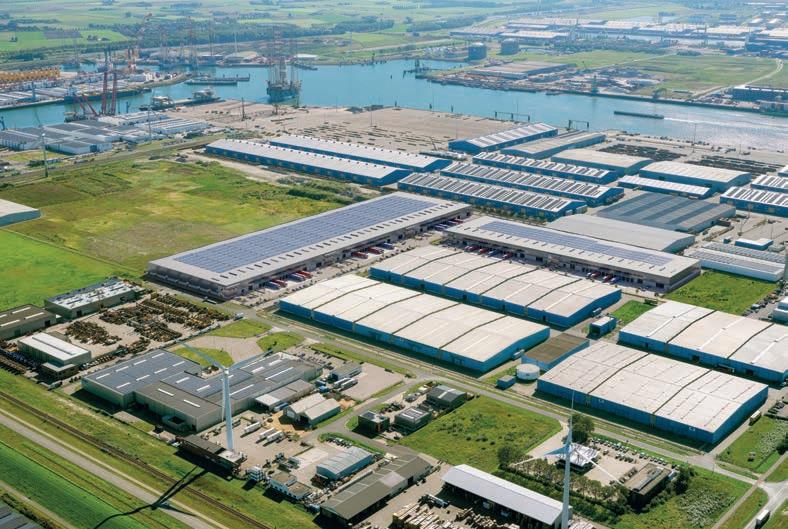
To date, DHG has developed a significant 1,600,000m2 of Smartlog space, with a further 700,000m2 in development.
All images courtesy of DHG.
Strategic location
Recently, the company has been working on the construction of a new, 78,775m2 Smartlog facility in North Sea Port – Smartlog Vlissingen. The complex, when complete in February next year, will comprise a total of five high quality warehouses ranging from 11,000m2 to 16,000m2, as well as office space.
Hans van Driel, DHG Logistics Director, says the company first became interested in North Sea Port as a result of its strategic location and multimodal transport connections.
“We find North Sea Port to be an excellent port, and it is in a very good logistical location. You have good barge connections to deep ocean ports in Rotterdam and Antwerp, road and rail
connections to the European hinterland, and short sea services to the UK.”
On own risk
Seeing the potential, DHG got in contact with North Sea Port, which was able to offer the company the lease of 11ac of land for development. And, with that, DHG got started on the development of the new warehousing facility, applying, Hans van Driel explains, the traditional approach for which the company has become so well known.
“We do everything ‘on our own risk’. We don’t wait for a customer, we start developing and, parallel to that, our sales
Smartlog Vlissingen: new capabilities for North Sea Port.
organisation connects to our network and begins to find logistics service providers interested in leasing the facilities on a long-term basis.”
Finding a niche
In the fourth quarter of last year, DHG had already begun the construction of the site when the company hit on an idea for its future use.
“We noticed that there are a lot of lithium-ion batteries in the market nowadays,” Hans van Driel explains. The batteries have become increasingly popular in recent years for a number of reasons. Lithium-ion batteries offer a favourable combination of high energy density, high efficiency, fast charging, long life, and low weight, ensuring their suitability for use in a wide range of applications.
At the same time as interest in the batteries is rising, there is a shortage of suitable distribution locations.
“We realised there might be a niche in the market. However, we also understood that it might be difficult to get the environmental licence required to operate such a facility.”
This is due to the specific safety considerations involved in storing, handling and distributing lithium-ion batteries. Under certain conditions, a battery may heat up, which is why preventive measures such as thermal monitoring, early detection and isolation procedures are applied to ensure safety and avoid any risk to the surroundings.
To cover these risks, the Dutch Government has established a directive – PGS (Publication Series on Hazardous Substances in Dutch) 37-2, specifically relating to regulations and guidelines on the storage of lithium-ion batteries and accumulators.
With this expansion, we aim to give a further boost to the area, focusing on warehouse logistics in North Sea Port.
Classified experience
DHG, however, has extensive experience in the development of sites for the handling of hazardous materials, including flammable goods, and toxins. Hans van Driel, during his long career in logistics, has also gained significant knowledge of working on projects involving classified products.
“At this point in the project, we entered into consultation with the Veiligheidsregio Zeeland (regional safety authority). We explained to them what we wanted to do, and how we intended to do everything according to PGS 37-2 requirements.”
This required, for example, that DHG install sprinkler systems in the warehousing, as well as water separation so that, in the event of a sprinkler situation, no pollutants would be able to enter the water system. The company was also required to ensure the fireproofing of all separation walls between the compartments for a period of at least two hours.
“Additionally, we knew that it would be very important to have the right clients in place – logistics service providers who are experienced in the handling of lithium-ion batteries and are certified to do so,” states Hans van Driel.
“We were very impressed with the safety authorities and the local fire service. They were very pragmatic, and very knowledgeable. They had a clear understanding of how our operation would work.”
The state-of-the-art facility offers safe, efficient storage and handling of lithium-ion batteries.
Total scope
While construction was ongoing, DHG undertook the application process for the environmental licence. This process took approximately eight months, but at the end, the company received full approval and was awarded a permit to handle all major lithium-ion batteries. This covers the full scope of categories of micro, compact, mobile, and max – comprising batteries for everything from mobile telephones to laptops, and bicycles & tools to cars. In total, the facility is permitted to store up to 40,000t of lithium ion at any one time.
The contact with the safety authorities is ongoing, Hans van Driel continues. “We still have a lot of communication with the fire service. Every time we have a new customer that will begin operations in the facility, we bring them into contact with the safety authorities so that they can inform them of what batteries they are planning to store. They are also required to establish a warehouse plan and prepare processes for storage and checking – all of which must be approved by the fire service prior to implementation. Every step is taken to minimise the possibility of an incident.”
Market success
While site development and permit applications were ongoing, DHG was already busy with introducing Smartlog Vlissingen to the market, where it was met with an enthusiastic response.
“The first warehouses will be operational by the beginning of November, with completion expected in February next year.
However, we have already seen that there is a lot of interest in the market, with 80% of warehousing space already leased to clients.
“This was as we expected. This is, after all, one of the first major, licensed facilities in the Netherlands able to store the full spectrum of lithium-ion batteries from micro right through to max.” Hans van Driel concludes, “We intend to further expand our plans. A building permit is currently being prepared for the development of an additional five warehouse units. With this expansion, we aim to give a further boost to the area, focusing on warehouse logistics in North Sea Port.
I. DHG.NL
Hans van Driel, director of DHG logistics.
The state-of-the-art facility offers safe, efficient storage and handling of lithium-ion batteries.
Across generations
As Volvo Group Ghent marks its 50th anniversary this year, it celebrates five decades of manufacturing excellence and sustainability leadership. Since its opening in 1975, the facility has grown into Volvo Group’s largest distribution centre and one of Europe’s largest truck production sites. With the construction of a new zero-emission mobility hub, Volvo Group Ghent remains a driving force for sustainable transport and industrial innovation in North Sea Port.
Volvo Group Ghent
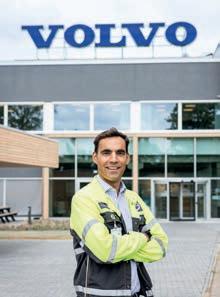
In 1973, the Swedish Volvo Group began with a distribution centre in Ghent and planned to relocate its truck assembly from Brussels to Ghent. Two years later, in 1975, the first truck rolled out of the new factory. The central location of the port within Europe, its accessibility from Sweden, the knowledge pool and proximity to Ghent University were the underlying reasons behind this decision, says Koen Leemans, managing director of Volvo Group Belgium. It was the beginning of a real success story.
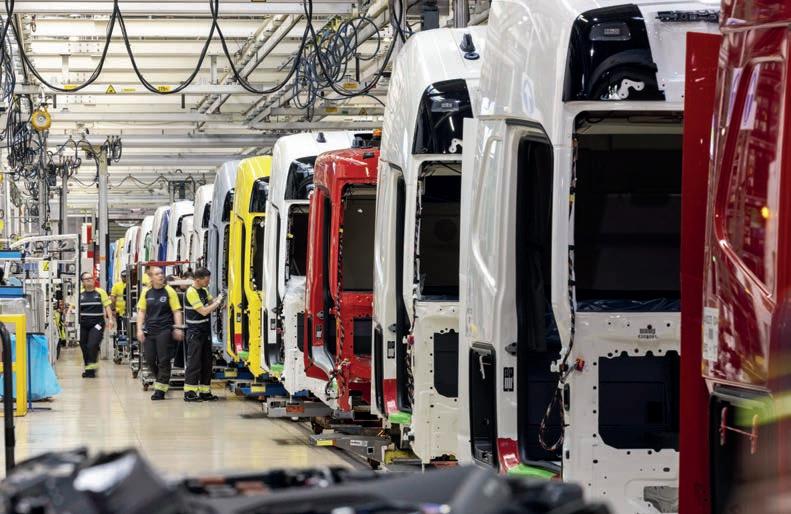
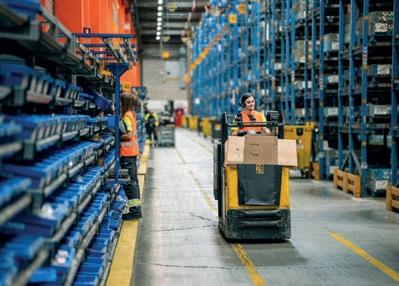
“Our site comprises two major businesses,” Koen Leemans explains. “Firstly, we have, of course, the truck factory, which is now the Volvo Group’s largest volume factory. A third of all Volvo trucks worldwide are made here, as we mainly serve the European market outside of Scandinavia. We produce over 40,000 trucks each year in North Sea Port. Secondly, we have a 116,000m² distribution centre here on site that serves the entire European market for spare parts, not only for trucks, but also for Volvo construction equipment, Volvo buses, and industrial and marine engines. These
are all businesses that fall under the Swedish Volvo Group, and our distribution centre is the central distribution centre for Europe for all of them. Noteworthy here, to avoid confusion, is that Volvo Cars was once part of the Volvo Group but was sold at the end of the 1990s. We share a brand, but we are not the same group.
“In addition to our two core activities,” he adds, “we obviously also have several support divisions such as IT and logistics, and, not least, Volvo Group Uptime Solutions, a call centre for support and preventive maintenance, where assistance is available in eighteen languages. And we also have a training centre here in Ghent, which primarily focuses on training new employees, but also offers a full range of courses for existing staff. This is important because our employees need to stay up to date with new technologies and changing skills, including in the area of assembly. After all, building trucks is still largely manual work. That’s because we build so many different variants of trucks, with lots of options and lots of different configurations. The diversity in trucks is so great that it is difficult
A third of all Volvo trucks worldwide are made at Volvo Group’s factory in North Sea Port.
All images courtesy of Volvo Group Ghent.
to standardise, which is why our employees are so important: we need skilled people to build our trucks. This is also one of the reasons why our training centre works closely with schools, both secondary schools for technical programmes or STEM workshops, and with universities, in engineering programmes, for example. We find this cooperation to be of great value for the future, as it enables us to learn what is important to young people and how we can find common ground. This is something we are very committed to, which is why we started our 50th anniversary event with a day focused on students.”
50th anniversary celebration: across generations
“The theme of our 50th anniversary event was across generations,” Koen Leemans explains. For our anniversary, we decided to focus on a wide range of target groups in a single week. On the first day, we started with students; in the morning, we organised workshops in electromechanics and assembly for secondary schools, and in the afternoon, we brought a bunch of university students here for a keynote session with our CEO, as well as several other workshops and opportunities to speak with our managers.
“Our last day, Saturday, was our biggest event: a family day with various activities, during which our employees could come to the site with their families and show them their workplace. We also invited retired staff to attend, as those are the generations who have enabled our growth over the years. It was incredible how many people attended, and also to see how impressed retired employees were by how much has changed here over the last five to ten years.
“Then, in between, during the week, we focused on external partners with whom we collaborate frequently, such as North Sea Port, Stad Gent, and some of our close suppliers. We also welcomed 150 loyal Belgian customers, and on Thursday, we were honoured to welcome King Filip of Belgium, MinisterPresident of the Government of Flanders Matthias Diependaele and Flemish Minister for Mobility, Public Works, Ports and Sport Annick De Ridder. It was a busy week, but very pleasant, and it was great to see how all these people are part of our story. A story, amongst others, of sustainable transport, because that is something we are very committed to.”
Sustainable transport
“Sustainability and commitment to the environment are core values for the Volvo Group and also for our site,” Koen Leemans says. “At Volvo Group Ghent, we are pioneers in this field. In 2007, we were one of the first automotive sites in the world to become CO2 neutral. Since then, we have continued to work towards becoming CO2 positive. We are now in the process of replacing the wind turbine we installed in 2007 with newer, more efficient ones, but in the meantime, we have also added 15,000 solar panels and built a biomass plant on site. Our logistics flow is also constantly being optimised. Parts that come from Sweden, such as engines, gearboxes or frames, arrive by boat or train. And, for the short distances between the ship and the factories that do require truck transport, we have set up a last-mile project in collaboration with DFDS, both in Sweden and here in the port, to ensure that these distances are also bridged by electric transport.
“In 2022,” he continues, “a battery pack factory was launched, and in 2023, we started producing electric trucks. All internal transport is either electric or runs on biodiesel, and all diesel trucks leaving the factory also run on biodiesel. Our latest project is the zero-emission mobility hub, for which the first symbolic groundbreaking ceremony took place during our anniversary week. This will be a publicly accessible charging station for heavy transport, in collaboration with Milence and Air Products, which will be operational early next year and will also offer hydrogen at a later stage. In addition to all this, we also opened a new visitor centre on the site at the end of last year, which goes to show that Volvo Group continues to invest heavily in our Ghent site and is fully committed to the future here in North Sea Port.”
I. VOLVOGROUP.COM
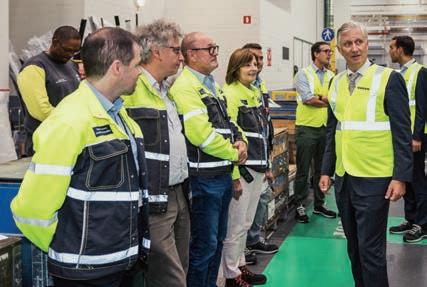
During his visit, King Philip of Belgium spoke with several employees who were happy to explain the various activities at the truck factory in Ghent.
Koen Leemans, managing director of Volvo Group Belgium.
The 116,000m² distribution centre in North Sea Port is Volvo Group’s largest and serves the entire European market for spare parts, not only for trucks, but also for Volvo construction equipment, Volvo buses, and industrial and marine engines.
Something to celebrate
Vlaeynatie marks anniversaries with opening of new facilities and plans for the future.
There has been plenty to celebrate recently at Vlaeynatie. The maritime bulk supply chain specialist has just celebrated its 180 year anniversary. At the same time, it has spent ten years at its current location in Westdorpe in North Sea Port. And, if that were not sufficient reason for a party, the company has also opened an impressive new facility, providing it with an additional 30,000m2 of space.
Huge success
To mark these combined achievements, Vlaeynatie held a full week of celebrations. These included a special event for employees and their families, as CEO Lieven Vander Elstraeten explains.
“The family event was a huge success. We had food and entertainment, bouncy castles and candy stores. And we had a train that took visitors on tours through our facilities. You could see that the kids were really impressed to see what their mums and dads do here, and they clearly enjoyed getting up close to some of the machinery. It was a lot of fun.”
The following week, Vlaeynatie held another event, with more guests.
“This time, we had an official opening event for the new facilities, welcoming representatives of North Sea Port, local government officials, as well as clients and suppliers. After opening the new terminals, we took a boat trip on the GhentTerneuzen Canal and viewed the new lock.”
Altogether, the new facility comprises three terminals, in addition to the three already existing – the so-called T1 and T2, and the Zeeland Sugar Terminal.
T3 is a storage facility for bulk fertilisers. T4 is a packaging hall where the company has installed a new packaging line for 25kg bags, as well as for bags up to 1,200kg. T5 is a warehouse with racking for the storage of packed cargo. Altogether, the new building represents an investment of EUR 25 million.
Active role for North Sea Port
North Sea Port has played a very active role in enabling Vlaeynatie to realise this expansion, Lieven Vander Elstraeten says.
“We’ve enjoyed a very close, very smooth cooperation with North Sea Port recently. The road that runs past our facilities was previously a public right of way. However, with the expansion, our equipment needed to cross the road to reach the new facilities. This is not permissible on a public highway.
“North Sea Port has made a significant investment in new road infrastructure to provide the public with an alternative route so that the road could be made private. The work has been carried out to a high standard, too, with bicycle paths, which ensure that people – including our employees – are able to cycle safely to work in the harbour.”
Vlaeynatie recenlty celebrated the opening of a new facility.
Inside the box
The new terminals are not the only recent developments at Vlaeynatie, Lieven Vander Elstraeten continues.
“The last two years, we also developed our container storage facilities, turning them into an official container depot.”
Typically, he explains, when someone approaches a shipping line to book a container, the container must first be collected from a container depot , located in Antwerp or Rotterdam, before loading the cargo on to it, returning it to the port and loading it onto a deep sea vessel.
“What happens here, is that we now have a standard buffer of empty containers ready at the terminal. We have containers from both MSC and CMA. We’re also in discussion with other shipping lines to expand on this in the future to give our clients increased flexibility.
“We don’t have to wait for an empty container to arrive – it’s already on site. With this, we can offer customers a much faster turnaround and less waiting times in port area– we just have to take the container, already filled, to Antwerp. And we are in a perfect position to do that, either by water, rail or road.”
On track
Vlaeynatie has long operated a daily barge service to the Port of Antwerp. In the past months, there have also been logistical developments at the company.
“This year, we started with a rail connection to Antwerp on a weekly basis,” he explains. “Currently, we’re looking at increasing that to twice weekly. This underscores our commitment to becoming a more sustainable company by using intermodal transport solutions.
“Using a rail connection offers our customers the advantage of avoiding road congestion, which can be a challenge in the Port
of Antwerp. The throughput is much faster – faster even than with a barge.”
The company also uses its excellent rail connections – and its own containers – to bring sugar to the Zeeland Sugar Terminal from all over Europe – the frequency of which has increased to coincide with the season, which runs from October to February.
Advancing digitalisation
Another area that has seen recent developments is the Vlaeynatie Academy. This year the company has been digitalising its training in a bid to move away from paperwork. For every packaging machine there are now screens where trainees can open manuals to see how to operate and maintain the machine step-by-step, helping to increase productivity and efficiency.
The company set up the Academy soon after relocating to Westdorpe. The idea was to provide training for employees that would enable them to develop the flexibility and versatility needed to perform a range of different tasks, Lieven Vander Elstraeten says.
“One day we’ll have to handle 120 containers. The next it’s just 20. With that kind of fluctuation, we need access to a pool of experienced people able to do things safely, in order to be able to upscale quickly.
“What we have done with the Academy is to create an environment where people can come into the company with little to no knowledge of the work, and we teach them the required skills ourselves.
“For example, we need operators who can work on semi- and fully-automatic machines. We also need good technicians who can maintain them; the materials we work with are quite corrosive. It’s much more difficult to maintain our machines
Lieven Vander Elstraeten, CEO at Vlaeynatie.
than ones that, for instance, make plastic materials. It can be a challenge.”
Training technicians
However, it can also be a challenge just to find technicians, he states.
“What we’ve been doing with the Academy is recruiting from both sides of the border to fill team leadership roles, or packing roles, and then providing the new personnel with time in the technical department, where they can train to be technicians. This way, we have someone who has a comprehensive overview of what we are doing – they know how to operate, but also how to look after, the equipment. This is someone who is ideal for a supervisory role.”
The story continues...
This round up of recent developments, brings us up to date with the situation at Vlaeynatie. It’s not, however, the end of the story. The company has more plans on the horizon.
“When the Director of North Sea Port came here for the opening, he mentioned that Vlaeynatie was one of the fastest growing businesses in the port,” says Lieven Vander Elstraeten. “We’re certainly going to be continuing that growth in the coming years.”
He explains that this will include a further 6 million euros investment in a new 10,000m2 warehouse for palletised cargo to be opened mid-2026.
“On top of that, we are also developing a 2,000m2 maintenance workshop so we can better look after our equipment – cranes, forklift trucks and packing items, for example. This will also enable us to integrate our transport company, Swagemakers, to this location, where we will then be able to maintain the vehicles, too.”
Beyond this, Lieven Vander Elstraeten says, Vlaeynatie is in discussion with North Sea Port about the possibility of taking up an additional concession that would enable the company to develop an additional area of approximately 120,000m2 of warehouse and packaging space.
Beyond expectations
So far, since moving to Westdorpe, the company has seen more development than was originally expected, Lieven Vander Elstraeten says.
“We didn’t expect we would grow this much when we arrived here. We started out with just one warehouse, for one long-term client, but it’s grown organically from there. When we look back over the last ten years, we are surprised where we are today.
“Our shareholders have been very supportive and willing to invest in the company and making available the funds we need to expand, and that legacy is continuing.
“North Sea Port has also been a very supportive partner – and also a partner that is entrepreneurial. We know when we are talking to the port that we are talking to people who know how to run a business.”
VLAEYNATIE.EU
The new facility provides Vlaeynatie with an additional 30,000m2 space.
The company has further plans for expansion in the coming year.
North Sea Port allocates rail zone for five companies to Lineas
Following a tender process, the Belgian rail operator Lineas has been awarded a contract for the first railway zone in North Sea Port. The tender award is an important step towards increased efficiency and more sustainable rail transport in the Ghent section of the port.
North Sea Port launched its first group procurement for rail transport in May 2025, at the request of five companies. The companies are jointly purchasing their rail transportation in order to make it more transparent, reliable and efficient. The companies, all of which are located on the left bank of the GhentTerneuzen Canal, are PVS, Eastman Chemical, EOC Belgium, KRONOS Europe and a logistics subsidiary of ArcelorMittal.
Commencing January 1, 2026, the collaboration with Lineas will run for two years.
Towards increased rail share
Cas König, CEO of North Sea Port said, “With this group purchase, North Sea Port is taking a step toward its strategic goal of increasing rail’s modal split share from 10% to 15%.
Consolidating volumes not only yields economies of scale but also highlights potential operational improvements. These improvements will be pursued in collaboration with the Belgian rail operator Infrabel and the partners involved.”
All images courtesy of Lineas.
We aim at further increasing efficiency and making a tangible contribution to the modal shift and climate targets.
Port collaboration
Throughout the process, North Sea Port acted as a neutral party between the five companies in the port and potential rail operators. The port authority worked closely with Railport, a subsidiary of Port of Antwerp-Bruges, which already has experience with several rail tenders.
Luc Pirenne, CCO at Lineas said, “We are delighted with this recognition of our services. The extension of our cooperation with North Sea Port shows the confidence customers place in our operations and expertise and underlines our mission to drive modal shift through reliable, efficient, and sustainable rail solutions.”
This highlights Lineas’ expertise and strong collaboration with industrial partners and customers benefit from:
• Reliability and continuity: guaranteed shuttle and last-mile operations between Antwerp and Ghent.
• Efficiency and flexibility: optimised connections that allow customers to adapt transport capacity to their needs.
• Sustainability: strengthening rail freight as a greener alternative to road transport, helping customers meet their climate ambitions.
Erik Van Ockenburg, CEO at Lineas, added, “This fits perfectly into our strategy to further strengthen the rail network with frequent, reliable connections between the most important ports and industrial clusters. We aim at further increasing efficiency and making a tangible contribution to the modal shift and climate targets.”
I. LINEAS.NET
Luc Pirenne, CCO at Lineas.
Erik Van Ockenburg, CEO at Lineas.
The Belgian rail operator Lineas has been awarded the first railway zone in North Sea Port.
For Daniela Verwilligen and Joost Schuijs of ZR Company, it’s all about the people.
A passion for people
At ZR Company, everything starts with people. Connection, attention, and curiosity. The company believes teams grow when there’s space to listen, learn, and laugh together.
When Daniela Verwilligen started ZR Company, the timing couldn’t have been more challenging. The beginning of the company coincided with the corona pandemic. The world went into lockdown, offices were empty, and team events were suddenly off the map. But instead of waiting things out, she decided to move.
“I saw someone on LinkedIn looking for help with an online event,” Daniela says. “I’d never done it before, but I thought – why not? Let’s try.”
That first project changed everything. It wasn’t just about sending out packages for an online meeting – it was about creating a sense of togetherness at a distance. And it’s where Daniela met Joost Schuijs.
“He had posted the request,” she remembers. “We started talking, realised we lived nearby, and there was an instant click.”
What began as a small collaboration quickly grew into something bigger.
Joost Schuijs says, a big step for him. “I’d been a director of a contracting company for 29 years. To go into something like this was a real change for me.”
Two ways of thinking, one shared goal
Originally from Bucharest, Daniela brings a touch of Latin energy to everything she does; warm, expressive and always ready to embrace something new with both hands. She brings passion and creativity to every project, while Joost adds calm, structure and a sharp practical eye.
“We think very differently,” Daniela says with a smile. “I move fast and follow my gut; Joost takes a step back, looks at the
bigger picture, and makes sure everything fits. Those two worlds complement each other perfectly.”
At ZR Company, that balance makes all the difference , because in the end, it’s always about the people. “
“We want to help people. And we want to work with companies that share that value, companies that see the importance of people to their success,” she says.
“Everything is about people,” rejoins Joost Schuijs. “What we do, and how we do it. Working with companies that are aligned with this, we can get off to the best possible start.”
Tailored team training
The ZR Company is specialised in the development and facilitation of team events – kick off meetings, team development, and team building, brining people together and helping teams work better, not just harder.
“We actually want to emphasise the difference between the different team members,” Daniela Verwilligen says. “Everyone is unique, but together they make up the team. It’s about getting to know those differences so that people can understand one another and learn how to work best with one another, using their strengths to bring the team to another level.”
This, she explains, is the thinking behind the ZR Company logo – an assortment of diverse shapes that nonetheless collectively, form a perfect square.
Once the ZR Company is connected with a business it begins its work of tailoring an event to meet the specific requirements of its clients.
“We work with clients in all sorts of different sectors. So, the requirements are always different. What we’re looking at is
We are always on location. This way, we can make sure that the client can fully focus on what is happening without having to worry about any logistical issues.
something that is aligned perfectly with the company culture, but which is different from what they do every day,” Joost Schuijs says.
Getaway from the day-to-day
To ensure that break with the everyday, ZR Company events always take place away from the office.
“We find that to be the best for people, and for the trainer, too. We take people out of the working environment and place them somewhere they can relax. This way, we can get the best possible results from the event,” continues Daniela Verwilligen.
Beyond fun: building real connection
A crucial factor, Daniela Verwilligen and Joost Schuijs agree, is the team building.
“It’s very important to strike a balance between learning and enjoyment. You can go somewhere and learn, learn, learn. But, if you are not having fun, how much of the information you have gained is going to stick?” Daniela Verwilligen asks, rhetorically. She explains how a typical event might look. Usually, it will take place over two days – at a specially selected location, suited to the company culture. First up is the actual training part of the event. This is often followed by a motivating presentation from an inspirational speaker – and then it’s time to unwind. Again, the fun parts of the event will be tailored to the client, but can feature such things as games, city trips, a boat ride, a competition. Joost Schuijs offers an example.
“We had a customer that wanted to improve communications between members of the management team. We started off
with some training on effective communication, and after that we went sailing. That’s a fun activity that suited the company culture, and one that required them to communicate with one another, so it was practical, too.”
Personal service
Daniela Verwilligen and Joost Schuijs may not lead the training themselves, but they’re always present to make sure everything flows seamlessly and everyone feels taken care of.
“We are always on location,” Daniela Verwilligen says. “This way, we can make sure that the client can fully focus on what is happening without having to worry about any logistical issues. We find it important that they have the time to speak with their colleagues and to enjoy what’s happening.”
This is just one example of the ZR Company’s personal approach in action.
“We are a small company, but this is actually our strength. Not only does it allow us to be very flexible, but we’re also able to provide a personal service. When you pick up the telephone, it will be me or Joost that answers. And it will be one of us that handles everything for you, meaning that the coordination of the event takes place at one central point, with very short lines of communication, making things as straightforward as possible for the customer,” Daniela Verwilligen concludes.
I. ZRCOMPANY.NL
The ZR Company is seeking the balance between learning and fun.
TRADING & TRANSPORT
Shipping Trading & Transport, these are the activities we perform on a daily base.
We offer all disciplines under one roof, our clients get full and complete service, all from one central coordination center, meaning that all services are just one phone call away.
Working from our offices in Rotterdam, Vlissingen, Terneuzen and Amsterdam, we can deal with all logistic and environmental matters.
X
x Our services
x
Crew service
Port agencies
Chartering
Subsidiary
x
Biotechnology for a better world
Bio Base Europe Pilot Plant is a leading state-of-the-art pilot facility that transforms bio-based laboratory concepts into full-scale industrial processes. Since its founding in 2008, Bio Base Europe Pilot Plant has played a pivotal role in the global bio-economy by providing process development, scaling-up, and custom manufacturing services for bio-based products and processes.
Bridging the valley of death
Bio Base Europe Pilot Plant was founded by managing director Wim Soetaert, professor of industrial biotechnology at Ghent University. He has built the world-renowned and world’s largest pilot plant from scratch, driven by the incentive to bridge the infamous ‘valley of death’ in biotechnology: that critical phase between academic research and full commercial production, where many innovations fail due to scale-up risks, a lack of expertise, or financial constraints. “I had been working in several industrial environments in France and Germany for thirteen years before becoming a professor back in Belgium,” says Professor Wim Soetaert. “And I realised that one of the biggest obstacles in innovation trajectories is scaling up a process developed on a laboratory scale to a viable large-scale industrial process. This gap between the development of a new technology on a laboratory scale and the production at a commercial scale is often referred to as the valley of death, because that is where things typically go wrong. Far too many times, new developments die a silent death, not because they are unsound, but because it was impossible to get them from the laboratory to the factory.
“First of all,” he explains, “this scale-up requires a pilot plant,
a test factory that translates a process from laboratory scale to large industrial scale. Most companies do not have a pilot plant, and building one is extremely expensive. An openaccess pilot plant, as a service provider, such as the Bio Base Europe Pilot Plant, did not really exist. Or at least not on the scale of our pilot plant in North Sea Port, which is quite large! In addition, the process of scaling up in a pilot plant involves trial and error, testing, experimentation and pricey failures. It takes time and involves costs that a company often cannot or is unwilling to bear. So that’s where it stops. The innovation and technology exist, but they don’t reach the market or industry. This is a fundamental problem within the bio-economy – a problem I wanted to solve by building a pilot plant that could provide exactly that service to companies, start-ups and research teams. With the ultimate aim to make the world more sustainable.”
Changing the world with biotechnology
“Sustainability truly is the core mission of Bio Base Europe Pilot Plant,” Professor Wim Soetaert states. “We want to change the world. That may sound presumptuous, but it isn’t. Because what we do already has a real impact on the global
Bio Base Europe Pilot Plant’s biotechnicians and bio-engineers have the know-how to scale up innovative new technologies from laboratory scale to industrial level.
bio-economy. Everyone involved with industrial biotechnology knows us; companies from all over the world come to North Sea Port to scale up their processes. Our business proposal is as simple as it is successful: instead of scaling up your processes yourself, which takes a long time and costs a lot without any guarantee of success, come to us, because we can do it faster, better and more efficiently. We specialise in this difficult phase and have the know-how to do so. Because scaling up a technology from laboratory scale to industrial level is not just a matter of doing the same thing and multiplying it by a thousand or a hundred thousand. The technological process itself, once scaled up by us, often becomes something completely different. Understandably, people who work in laboratories often lack the competence and know-how to do this. But that know-how is available here, in North Sea Port, with the Bio Base Europe Pilot Plant’s biotechnicians and bioengineers.
“Our job begins when there is a laboratory process that still requires a great deal of work. We do not conduct fundamental research ourselves; we entrust that to companies, universities and other research institutions. In terms of the TRL, or Technology Readiness Level, we usually start at TRL 3 and bring it to TRL 9. The concept of Technology Readiness Levels (TRL) originated at NASA, with TRLs 1 to 3 covering the stages of concept development and research, and TRL 9 marking a fully production-ready technology or product. Over the years, we have completed around a thousand projects. These projects are widely diverse, from long-term projects lasting several years to projects lasting just three days. The products we create include bioplastics, biodetergents, biopesticides, biosurfactants and nutritional ingredients for various end markets. In fact, we can convert our feedstock – all possible forms of biomass – into nearly anything. By accelerating and enabling these innovations at the Bio Base Europe Pilot Plant, we are helping to build the bio-based economy, which is a sustainable, circular economy, as opposed to the fossil-based economy, which relies on petroleum, coal and natural gas, and causes major environmental and climate problems.”
Industrial biotechnology for an evolving market
“Biotechnology is a broad concept,” says Professor Wim Soetaert, “but essentially it means that we use microorganisms
– microscopic creatures, bacteria, fungi and yeasts – to convert biomass into all sorts of products. Many people immediately think of the pharmaceutical field when they hear ‘biotechnology’, but that is only a part of the possible applications of biotechnology. We focus on industrial biotechnology, which uses biotechnology to produce all sorts of products. Of course, we do notice certain trends. Ten years ago, the focus was mainly on biofuels, which have now largely found their way into production. Now, we are seeing a rising interest in bio-based colourants, for instance. There are various
Professor Wim Soetaert, managing director of Bio Base Europe Pilot Plant.
Bio Base Europe Pilot Plant is the world’s largest independent, open-access pilot plant, where bio-based laboratory concepts are transformed into full-scale industrial processes.
reasons for this, including political ones: in the United States, for example, they are finally phasing out chemical food colourants, which have long been banned in Europe.
“Another example of a popular area of innovation is microbial proteins as an alternative to animal products. We can produce cheese with cheese protein that is identical to the protein in milk. The difference is that no cows are involved. We extract the genetic information for cheese protein from the cow, insert it into a microbe, and the microbe then produces cheese protein that we can use to make cheese that is exactly the same as any other cheese. We also cultivate certain fungi – a type of mushroom – that is growing into mycelium that we can use to produce a meat substitute. Again, without any animals involved. Some of these products are already available in retail, but the development of these products and technologies has only just begun. Livestock farming is one of the most polluting human activities; people often underestimate the amount of CO2 emissions, land, and water required to raise animals. So we replace animals with microbes to produce our food. By reducing the need for livestock farming, we can have an enormous impact towards a much more sustainable world.”
Exponential growth
“Of course, many of our innovations are hidden,” Professor Wim Soetaert states. “It is our customers who bring the products to market, expand their technological capabilities, build factories and earn money. We help our customers move forward with their development. Many of our achievements are confidential, and sometimes we even remain unaware of
their future uses. Customers come here with a piece of their puzzle and solve it without us knowing what happens with the technology afterwards. That is unfortunate, but we are a service provider, and confidentiality is an important part of industrial innovation. Fortunately, we also have plenty of customers who communicate about their innovation and are happy to have worked with us. Ultimately, that is why we do it: it makes us proud when a new sustainable product is launched, when a new factory is built, when investments are made, when the world changes.
“That sustainable mission is truly hardwired in our DNA at Bio Base Europe Pilot Plant. First of all, we are a nonprofit organisation. All profits we make are reinvested in the expansion of the pilot plant. The goal is not to make money for shareholders; our goal is to accelerate innovation and thereby contribute to a better world. And that is precisely what we do. We currently employ 170 people and continue to grow, in terms of the quantity of projects but also in complementary activities such as consultancy and engineering services. Our reputation and mission attract talent from all over the world, and we have become quite an international organisation. About one-third of our employees come from abroad. And there’s also a significant number of my students who join the Bio Base Europe Pilot Plant. As a professor, I have the privilege to train and create my own workforce,” he jokes. “Nevertheless, we are always on the lookout for motivated, competent people, because we are still growing. Over the years, our growth has been around 25% per year, and we do not intend to stop here. However, it hasn’t always been an easy journey.”
A hub of technological innovation
“From a strictly economic point of view, building a pilot plant is not a profitable venture” Professor Wim Soetaert explains. “The construction of the pilot plant was only possible thanks to a European Interreg project and required an initial investment of 21 million euros. This significant investment, combined with our business plan for a pilot plant that wouldn’t produce large tonnages, caused many parties to see us as being unrealistic, woolly, even. The support of North Sea Port was therefore very valuable. Ports are also subject to the demand for sustainability and new technologies, and fortunately, North Sea Port realised this. In Ghent, we converted a run-down fire station into an active pilot plant, which became operational in 2011. Gradually, we have grown, and additional investments have been made. To date, approximately 100 million euros have been invested in the Pilot Plant. And that is why there are so few pilot plants in the world. It involves huge investments, and keeping the plant operational is not easy either. It is certainly not a gold mine. The added value is not in making money, but in the innovation it brings to the world. And those are two very different things. We are a bit of an odd one out in the port, because we are not a logistics or production company. But at the same time, we have a lot to offer. We have a turnover of around 25 million euros per year and employ 170 people. And, thanks to our unique position in the world, innovative companies and start-ups from all over the world come to North Sea Port. They see our facilities and know-how, get to know our port, and sometimes even settle here. I am very pleased to see that North Sea Port is strongly committed to sustainability and innovation. The sustainable ambition of both North Sea Port and Bio Base Europe Pilot Plant reinforces the catalytic role that we play in creating a more sustainable economy through innovation.”
I. BBEU.ORG
Bio Base Europe Pilot Plant bridges the infamous ‘valley of death’ in biotechnology: the critical phase between academic research and full commercial production, where many innovations fail due to scale-up risks, a lack of expertise, or financial constraints.
Bringing the port into motion
Earlier this year, Terberg Tractors Belgium signed a distributor agreement with Konecranes Lift Trucks. This enables Terberg to sell and service the full line-up of Konecranes forklifts, reach stackers, and container handlers. With this collaboration, Terberg Tractors in Belgium has become a single point of contact for sales, service, spare parts and advice for a full range of vehicles used in port operations, all from its state-of-the-art 2,000m² facility in North Sea Port.
All images courtesy of Terberg Tractors & Konecranes Lift Trucks.
Combining fixed values
Terberg Tractors Belgium is part of the Dutch Royal Terberg Group, an organisation established in mobile equipment for port and industrial operations worldwide, which was founded in 1869. In 2022, the company built a state-of-the-art, 2,000m² facility as a hub for the sales and service of Dutch-built tractors for RoRo terminals and industrial yards.
Konecranes Lift Trucks’ history began in the 1950s in Sweden. The company, part of the Finnish Konecranes group, stands today as a global leader in lifting solutions, powering container terminals, bulk facilities, and multimodal hubs with equipment that blends ecoefficiency with high performance and digital intelligence.
“Our partnership with Konecranes Lift Trucks truly makes us a onestop shop in Belgium and Luxembourg,” says Lies Barra, managing director of Terberg Tractors in the Benelux. “The combination of the two companies makes perfect sense, both in terms of innovation and sustainability and in terms of service to our customers. Terberg Tractors Belgium now sells, rents and services all specialised vehicles used in the port for loading and unloading ships. The product portfolios of both companies complement each other perfectly, enabling us to provide our customers with optimal peace of mind. They now have a single point of contact in North Sea Port who can assist them with terminal tractors, reach stackers, forklifts and container handlers, both with diesel engines and electric variants. Our extensive portfolio means we can offer a suitable solution for every logistics environment, from distribution centres to ports.”
Full service, non-stop
“Our services are available on a 24/7 basis, both for Terberg vehicles and for Konecranes vehicles,” adds Dominik Thielman, after-sales manager for Terberg Tractors in the Benelux. “With features like a roller brake testing unit and a spray-painting shop, our service centre at North Sea Port offers a comprehensive suite of vehicle servicing options. Naturally, our technicians are also on call for on-site repairs with our customers. Day after day, they are on call for maintenance, repairs and advice, sometimes
Konecranes’ user-friendly electric empty container handlers, available in single or double stacking, have a load capacity of 9-11t and lift 21% faster than a diesel model.
agreements, but it is also possible to enter into a full-service contract for sales. This completely unburdens the customer. However, it is also possible to work on a cost-plus basis, and even if our customer has their own on-site garage, we can supply spare parts. We always tailor our services to the customer’s needs; everything is possible, both in terms of service and machines, to keep operations running smoothly.”
Bringing the port into motion
When it comes to the transition toward electrification of ports and terminals, Terberg is not just a provider – it’s a pioneer. With an electric fleet and innovative proofs of concept, they are working diligently to make port operations more environmentally sustainable, much like Konecranes, which has been developing Ecolifting solutions to reduce fossil fuel carbon emissions for years.
“It is the perfect synergy,” Lies Barra says. “When it comes to environmental sustainability, Terberg Tractors and Konecranes make a perfect fit. Both companies are fully committed to electrification and innovation. Take, for example, Konecranes’ electric forklifts. They not only offer durable performance with advanced eco-efficient features to boost productivity and eliminate tailpipe emissions, but they are also able to handle slopes up to 20% faster than a diesel forklift. All models are powered by high-capacity Li-ion batteries, manufactured with clean energy. The newest 18-25t heavy-duty workhorse has the same lifting mechanisms as a diesel forklift and operates up to 10% faster, while smaller 10-18t models improve speed by up to 25%. And these electric forklifts are better for the drivers as well. Drivers benefit from up to 50% less noise and vibration during operations, and the cabins used are the safest and most spacious in the industry.”
solving problems before they even happen. And there’s always someone on standby, day or night. The port never waits, and neither do we. At Terberg, we offer a 24-hour repair service. If it is impossible to repair the machine within these 24 hours, we will instantly provide a replacement. We are currently working hard to offer this service for the Konecranes portfolio soon as well.
“Additionally, we also offer our customers full-service contracts. This full service is, of course, already included in our rental
“In fact, it is usually the drivers who need to be convinced of the performance of electric vehicles,” Dominik Thielman says. “This is one of the reasons we are currently performing demonstrations at various locations with our new 4x4 drive EV terminal tractor, the RT253EV RoRo tractor, before starting full-scale production in 2026. We are offering these demonstrations to give customers a taste of electric driving, including in terms of performance, because customers tend to think that performance is somewhat lacking compared to a diesel vehicle. That is obviously not the case, quite the opposite in fact. But the people who operate these machines daily need to experience them. After all, seeing is believing, and we have noticed that the drivers tend to be convinced as soon as they drive our electric machines for the first time. Our 2x4 drive tractors have long been in use with our customers – we are now manufacturing our third-generation YTs – and we get great feedback on their performance. However, there was still a demand for an EV tractor capable of handling the heavy tonnages and steep ramps of RoRo ships. That is why we started a proof of concept three years ago, after which we developed the RT253EV, Terberg’s first electric four-wheel drive tractor. It has been specially designed for RoRo ships and port terminals and is also suitable for rough terrain that requires all-wheel drive. Incidentally, we also did tests and a proof of concept for hydrogen-powered engines, so we are ready for future developments in that area.”
“Another game-changer in electrifying port operations is Konecranes’ electric empty container handler,” Lies Barra adds. These user-friendly electric handlers have a load capacity of 9-11t and are available in single or double stacking. They lift
Dominik Thielman, after-sales manager for Terberg Tractors in the Benelux, and Lies Barra, managing director of Terberg Tractors in the Benelux.
Konecranes’ electric empty container handlers have an operational time of nine to twelve hours.
21% faster than a diesel model and have an operational time of nine to twelve hours. This machine is already an established value at container terminals. And let’s not forget, of course, our Drive by Wire technology.”
Automated Terminal Tractor (ATT)
“Terberg has developed a new ‘drive-by-wire’ (DBW) technology for terminal automation that, in combination with the autonomous software from one of our partners, will enable the ATT to drive around the terminal without drivers,”
Dominik Thielman explains. “This is done wirelessly, by satellites. Autonomous terminal shunters have been requested by some of our customers who, given the current labour market shortages, are experiencing significant problems with staff shortages and finding drivers. We are now working on mixed traffic situations, where we enable our ATTs to operate alongside conventional trucks, using cameras, radars, and laser sensors for navigation, collision avoidance, and pedestrian detection. A central computer analyses sensor data in real time and manages routing decisions. It is an exciting innovation, not least for our technicians who will have to keep these machines running, once operational.”
Exciting job opportunities
“We provide in-depth EV training programmes for our technicians,” Dominik Thielman says. “Keeping up-to-date with new technologies is naturally extremely important for our technicians, not least for their own safety. After all, these machines operate under high voltage. That is why our EV technicians receive thorough in-house training.”
“Not only do we provide our employees with an in-house training programme, but we also aid our customers by providing
external training if required,” Lies Barra adds. “Furthermore, we are still on the lookout for motivated people who want to join us and grow with us in our sustainable and innovative journey. Technicians, notably, are difficult to find these days, but at Terberg Tractors in North Sea Port, we do have a great deal of diversity and technological innovation to offer our employees. Technicians here work with diesel engines, electric motors, innovative automation and will possibly even work with hydrogen engines in the future. We truly bring the port into motion, and together with Konecranes, we are fully committed to making it an even more environmentally sustainable port.”
I. TERBERGSPECIALVEHICLES.COM
The RT253EV, Terberg’s first electric four-wheel drive tractor, has been specially designed for RoRo ships and port terminals.
Konecranes’ 18-25t and 10-18t electric forklifts. The newest 18-25t heavy-duty workhorse has the same lifting mechanisms as a diesel forklift and operates up to 10% faster, while smaller 10-18t models improve speed by up to 25%.
Collaboration is key
Zeeland Connect ready for the next steps
Things are going well for Zeeland Connect, the independent innovation network that strengthens the Zeeland logistics sector by stimulating cooperation between government, education, and business through knowledge sharing and facilitating projects.
After a period in which much attention was given to setting up and organising the network, real momentum is now being made in achieving objectives and plans. So, it’s time for a new conversation with programme manager Mariko Rouw, together with Zeeland Connect’s new chair, Manon van Opdorp.
Structure
“We look back on a wonderful period for Zeeland Connect,” says Mariko Rouw. “Recently, our team has moved mountains. Firstly, we have been busy further structuring our organisation. We have managed to appoint a new innovation manager for the Autonomous Transport Innovation Line, which means that every line now has its own manager. This provides clarity and focus, especially because the lines are now anchored in a new multi-year vision. The innovation manager for the Autonomous Transport Innovation Line is Jennifer Vermaas, for the Zero
Emission Logistics Innovation Line it’s Rick Suurmond. Remco de Rijke is the innovation manager for Logistics Flows and Connections, and Rutger van der Male for Digitalisation and Robotics.”
Expert groups
Mariko Rouw continues: “For each Innovation Line, an expert group has been formed. Representatives from our partners take part in these. New partners are also invited to participate in one or more expert groups.” Manon van Opdorp adds, “These expert groups are a great form of collaboration. Our partners understand that taking part in Zeeland Connect activities is not just about giving, but that it actually brings value to businesses, too. Everyone realises that as a company, you cannot face the various challenges of our sector alone and that you need to work together. The willingness to collaborate is visible not
On average, Zeeland Connect organises more than one event per week, such as the Annual Congress in 2024.
Image courtesy of Zeeland Connect.
Zeeland Connect aims to make the sector smarter, more sustainable, and future-proof.
only within the expert groups, but also between groups, partly because companies can sit on several expert groups.”
Growth
Within the innovation lines, Zeeland Connect organises various appealing and topical meetings and activities that have attracted a lot of interest and have led to significant membership growth over the past two years. “Zeeland Connect aims to make the sector smarter, more sustainable, and futureproof,” Mariko Rouw explains. “Through inspiring workshops, hands-on masterclasses, individual support for entrepreneurs, and joint innovation projects, we are working on our innovation lines. In addition, we collaborate with knowledge institutions and companies to ensure proper training for the logistics workforce of the future. With powerful networking events, projects, and campaigns, we showcase what Zeeland has to offer – and we literally bring knowledge, people, and opportunities into motion.
Growth
“All of our activities resonate in the region,” adds Manon van Opdorp. “As a result, 85 paying parties have now joined us. It’s good to see it’s not just large companies, but also SMEs. This gives us a good and representative reflection of Zeeland’s logistics and transport-related business community. It’s also
notable that parties from outside Zeeland have found us and are eager to join, meaning we now have a network covering the whole of the south-west of the Netherlands. Currently, communication about our themes is still primarily handled by our project managers and organisation. One of our goals is to ensure that partners also publicise our projects. In this way, there is broader support. Our partners can be proud of what has been achieved. They have contributed and should certainly share this.”
Hands-on mentality
Manon van Opdorp has taken over as chair from Ronald Wielemaker as from 1 January of this year. In the past few years he was involved with Zeeland Connect, but felt it was time to hand over the baton. “I ran into Ronald Wielemaker at the Zeeland Connect CEO dinner and we got talking,” Manon van Opdorp elaborates. “He told me he was stepping down as chair and asked if I would consider taking over. I was surprised by his question and needed time to think. If I commit to something, I want to truly add value. So, I talked with Zeeland Connect about our mutual expectations and took up the challenge. I’ve now found my feet at Zeeland Connect. I’m pleased to see that, as a network, we’re genuinely making a difference. That suits my hands-on mentality. As mentioned, our partners don’t just participate to listen, but to achieve results together, which is great to be part of.”
Think Tank
Within the various innovation lines, Zeeland Connect initially focused mainly on technical challenges, but according to Mariko Rouw, other issues also pose threats to the logistics sector. “Our sector doesn’t only deal with technical challenges. For instance, we have a less positive image as an employer
Programme manager Mariko Rouw of Zeeland Connect and Zeeland Connect’s chair, Manon van Opdorp.
and it’s seen mainly as a man’s world. We want to play our part in changing this, which is why the think tank ‘Human Capital, Logistics & Innovation’ has been established. Its aim is to work on a better labour market image for the sector.” “I now have eighteen years of experience in the transport sector,” says Manon van Opdorp. “When I started, I was one of the few women in a sector that, especially at board level, was dominated by men in grey suits. I’m pleased that, in my own way, I can contribute to diversity. It might be a coincidence, but in 2023 I was practically the only woman at our annual CEO dinner, and at the last dinner around 20% of attendees were women. Of course, it’s not just about numbers. The fact is, a certain degree of diversity creates a different dynamic in an organisation. And for our sector’s healthy future, we need everyone – young, old, men, women, regardless of background. We need to help dispel the image that exists about the sector by showing that, at every level, it’s a fantastic one to work in.”
A true action network
Zeeland Connect has gained momentum and the whole team shows great enthusiasm in working alongside partners. “Our team really make things happen,” says Manon van Opdorp. “Everyone is highly motivated. My main role is to ensure that people stay focused on our objectives, as we mustn’t try to do too much at once. Making choices and setting priorities is essential. As things stand, you could say we’ve grown from a nice networking club into a true action network. There’s not just talk, but real action towards solutions, and that’s something we can all be proud of.” Mariko Rouw adds, “The people within our team and network are indeed the driving force. Collaboration is key, and Zeeland Connect is an excellent example of how this leads to success. We also hear from various partners that they appreciate their employees being involved with Zeeland Connect in any way. This involvement adds real value for us, for the individuals themselves, and for the participating companies.” Manon van Opdorp concludes, “People used to be very focused on themselves. The current generation is more
Some activities organised by Zeeland Connect
On average Zeeland Connect organises more than one meeting or event per week.
• ‘Zero Emission Truck Academy’ (supporting 50 companies in 2023/2024).
• ‘Zero Emission Van Academy (‘supporting 60 companies in 2024/2025.
• ‘Innovation Toolbox’ – toolbox to help companies to implement an innovation or any other important change (2025).
• Project ‘Mussels, fries and a local beer’. Crossborder collaboration project for 100 logistic students from universities of applied sciences in Zeeland, West, and East Flanders (September – December 2025).
• DEK project: driver’s license (code 95) for e-truck and renting e-truck for the promotion of electric driving (2025).
• Supporting companies with their applications for subsidies, such as for the modal shift to reduce road transport.
• CEO dinner for 70 decision makers from the transport sector (2025).
• Supply Chain Inspiration trip to Venlo with 20 companies from Zeeland (2025).
• Annual Congress (27 November) with 150 participants from the partner network.
• A variety of network meetings and workshops.
willing to seek and offer help, which is of course essential for successful cooperation. Developments in our sector are moving so fast that, as an individual company, it’s almost impossible to keep up. Zeeland Connect is therefore the partnership to meet these developments successfully.”
I. ZEELANDCONNECT.NL
In 2025, 70 decision makers for the transport sector joined Zeeland Connect’s CEO dinner.
Image courtesy of Zeeland Connect.
A sustainable gateway to Ghent
North Sea Port has built a new, state-of-the-art river cruise terminal in Ghent, marking a significant step towards more sustainable and effectively managed cruise tourism arriving at the port. Located at the head of the Grootdok in North Sea Port, the new jetty provides a clean, organised arrival point that connects directly with the city’s transport network.
From a sustainable perspective
The new terminal centralises all river cruise activity at a single, purpose-built site and allows up to four river-cruise ships to berth simultaneously (two on each side of the jetty). The aim was to organise river cruises docking at North Sea Port in a better, more logical, smoother and more sustainable way, says Annelies De Groote, commercial manager at North Sea Port. “The main focus of this project was on infrastructure and sustainability,” she explains. “We started in October 2020, with the intention to create a central arrival point for river cruises, with a water access point and a facility where ships could connect to shore power instead of running their diesel generators. Enabling these cruise ships to turn off their diesel engines while moored in our port significantly reduces CO2
emissions, fine particles, NOx, and SOx, not to mention the important reduction of noise pollution for the neighbourhood. Previously, the river cruise ships moored at the Rigakaai, the quay on the right-hand side of the Grootdok. But there was no power supply there, so we had to find a more suitable location. In addition, constructing the terminal elsewhere cleared the Rigakaai for other activities, as this is a location that is suitable for transhipment and other logistic operations.”
“Our search for the ideal location for the river cruise terminal eventually led us to the head of the Grootdok, which is next to North Sea Port’s visitor centre,” adds Stefaan De Keukeleire, project manager at North Sea Port. “Once the location was decided upon, we designed a terminal specifically for that
Stefaan De Keukeleire, project manager at North Sea Port, and Annelies De Groote, commercial manager at North Sea Port, at the new river cruise terminal in Ghent.
components for
were
location. This initial design phase was carried out in close consultation with the shipping companies to determine what was possible and desirable for them. We also extend our gratitude to Connecting Europe Facility (CEF) for Transport, BENEFIC (European Connections), the Flemish Department of Mobility and Public Works, and the City of Ghent for their financial support and contributions towards the realisation of the pier.
“Ultimately, the jetty we built is 85m long and 6m wide, with additional mooring piles at the end. As passengers usually disembark in the middle of the ships, it was neither necessary nor desirable to build a jetty that would span the entire length of two river cruise ships. The four shore power cabinets were then put in the middle of the jetty itself. They enable each ship to connect to a 400-amp connection, allowing it to operate entirely on shore power and switch off its generators. Each cabinet also features a 125-amp and 63-amp connection, a control panel, and a manual outlining how to connect to the system and which cable to use for each power rating. These cabinets and connections were thoroughly tested beforehand and are operated by Connect for Shore. They provide the online service for the shore power application. This ensures a consistent system within North Sea Port; for instance, barges mooring there also use shore power via Connect for Shore. We calculated in advance that each river cruise ship that connects to shore power saves 1,2t of CO2. This results in a substantial reduction of 500t of CO2 emissions from one season of river cruises calling at Ghent.”
“These cruise ships do indeed require a considerable amount of energy,” Annelies De Groote says. “Although smaller than their
oceangoing counterparts, they still accommodate an average of 150 passengers on board. That’s a lot of different cabins, each equipped with lights, chargers, televisions... All that energy no longer has to be generated by the ships’ diesel generators, but now comes from green electricity via shore power cabinets.”
A user-friendly online registration platform
“Alongside the construction of the terminal, we created a user-friendly online registration platform with a schedule of time slots,” Annelies De Groote adds. “The shipping companies can now book available berthing slots themselves in realtime instead of before sending an e-mail to a North Sea Port employee who kept track of everything manually. Furthermore, the platform can be used for both our river cruise terminals: in Terneuzen and in Ghent. This online booking process is running quite smoothly, and we notice that the slots keep getting filled even in what used to be quieter periods. We now allow only four cruise ships to dock at the same time—a decrease from previous peak times—yet we’re still approaching the typical yearly figure of 300-400 cruise ships. Of course, not only is the booking process more streamlined, but the new river cruise terminal offers a far more attractive arrival experience for visitors. Tourists disembarking at the new river cruise terminal arrive at a clean, organised and welcoming environment, right next to North Sea Port’s visitor centre.”
Carefully thought-out design
“The well-thought-out design of the jetty and the well-organised facilities indeed make it much more attractive to call at Ghent,” Stefaan De Keukeleire agrees. “The river cruise terminal is now
Image of Van der Straaten Aannemingsmaatschappij.
The huge
the new terminal
prefabricated in the Netherlands and brought by floating pontoons to the Grootdok in Ghent, where they were assembled from the water.
also illuminated at night, for example. This lighting design was carefully studied, exploring a variety of options, from petite lamp posts to a large lantern positioned centrally. In the end, it was decided to embed the lighting directly within the concrete. This solution provides gentle, indirect illumination at floor level, ensuring pedestrians can see their way clearly without harsh shadows or dazzling glare. This approach also minimises the risk of accidental damage to the lighting itself. At the far end of the pier, a totem pole acts as a beacon and cultivates a special atmosphere for the location. The interplay of light along the jetty was thoroughly planned: the beacon at the top of the totem pole is fitted with LED lights emitting a crisp, white glow at 4,000K, while the floor-level lighting delivers a much warmer 3,000K hue. Together, these two types of light create a particularly pleasant ambience and visual effect. Additionally, the jetty features a freshwater supply at the far end, and of course, essential infrastructure such as fenders for mooring and bollards for securing vessels is also provided.”
There’s more than meets the eye
The construction of the river cruise terminal was no small feat. What may appear to be just a concrete jetty to the casual passer-by is actually a well-thought-out, elaborate and carefully prepared structure that required extensive planning, design and sustainability studies, as Stefaan De Keukeleire explains:
“As a passerby, you only see the pier. But there is also a lot of work and careful planning involved on shore as well. To power the shore power cabinets, for example, we had to install a transformer station on the left side of the Grootdok. The cables running from these units to the transformer station on shore are very thick, heavy-duty cables that need to be cooled during hot summer days. On shore, we therefore used a special type of sand that allows the cables to dissipate and conduct their
heat more effectively, and we also laid water-permeable clinker bricks on top, so that rainwater can add extra cooling. Then, when it came to routing the cables onto the pier, particular consideration had to be given to the independent movement of the jetty. Since the jetty stands apart from the shore, as it is designed to absorb the motion and energy when vessels berth, the cabling needed similar flexibility. This challenge was met by securing the cables at two points on each side, creating loops between the jetty and the quay to accommodate any movement. And once onto the pier, the cables are housed within a dedicated cable channel fitted with grids and removable plates. This not only supports cooling but also ensures easy access for any maintenance that may be required.
“Furthermore, assembling these huge components on site, directly in the water, presented its own set of challenges. Factors such as tidal fluctuations and the constant movement of the components in the water complicated the precise alignment required, especially since most components were prefabricated entirely in the Netherlands by contractor Van der Straaten and brought by floating pontoons to the Grootdok in Ghent. This was not only more practical, because of the confined location, but also more sustainable.”
“Indeed, sustainability was our number one priority in the tender for and the design of the terminal,” Annelies De Groote concludes. “Every aspect of the design was meticulously evaluated for its environmental impact, including CO2 emissions, ecological footprint and lifecycle costs. It was an elaborate process, but the result is definitely a hydraulic engineering marvel to be proud of.
I. NORTHSEAPORT.COM
A dedicated cable channel was built in the middle of the new pier to support cooling of the heavyduty electric cables as well as to ensure easy access for any maintenance that may be required.
North Sea Port: Ghent
North Sea Port: Ghent
Zeekanaal Ghent - Terneuzen: The depth of water in the canal is 13.5 m and there are no currents or tides. Inside the port there are five large docks and three
smaller docks, offering a total quay length of
Zeekanaal Ghent - Terneuzen: The depth of water in the canal is 13.5 m and there are no currents or tides. Inside the port there are five large docks and three smaller docks, offering a total quay length of 31 kilometres for vessels up to 92,000 DWT. 22 kilometers with a depth of water of at least 12.5 metres. All the docks have direct access to the canal.
31 kilometres for vessels up to 92,000 DWT. 22 kilometers with a depth of water of at least 12.5 metres. All the docks have direct access to the canal.
• Kluizendok: Is a brand-new dock. Has a total quay length of 4,300 metres with a depth of water of 13.5 metres and a width of 350 metres.
• Kluizendok: Is a brand-new dock. Has a total quay length of 4,300 metres with a depth of water of 13.5 metres and a width of 350 metres.
• Rodenhuizedok: Quay on the southern side is 790 metres long with 13.5 metres of depth. Width of 270 metres.
• Rodenhuizedok: Quay on the southern side is 790 metres long with 13.5 metres of depth. Width of 270 metres.
• Mercatordok: Quay is 1,800 metres long with 13.5 metres of depth. Width of 250 metres.
• Mercatordok: Quay is 1,800 metres long with 13.5 metres of depth. Width of 250 metres.
• Alphonse Sifferdok: Quay is 4,800 metres long, with 12.5 – 13.5 metres depth. Width of 300 metres.
• Alphonse Sifferdok: Quay is 4,800 metres long, with 12.5 – 13.5 metres depth. Width of 300 metres.
• Grootdok, Noorddok, Middendok and Zuiddok:
• Grootdok, Noorddok, Middendok and Zuiddok:
Total quay length of 6,855 metres. 6,575 metres with 13 metres depth of water, and 280 metres with 8.5 metres depth of water.
Total quay length of 6,855 metres. 6,575 metres with 13 metres depth of water, and 280 metres with 8.5 metres depth of water.
Width: Grootdok: 150 metres
Width: Grootdok: 150 metres
Noorddok: 200 metres
Noorddok: 200 metres
Middendok: 250 metres
Middendok: 250 metres
Zuiddok: 220 metres
Zuiddok: 220 metres
Zelzate • Ghent •
Zuiddok
Middendok
Alphonse Sifferdok
Mercatordok
Rodenhuizedok
Noorddok
Grootdok
Kluizendok
Zeekanaal Ghent - Terneuzen
• Terneuzen Western Scheldt
• Hoek
North Sea Port: Terneuzen
North Sea Port: Terneuzen
Ghent-Terneuzen channel (Kanaalzone)
Ghent-Terneuzen channel (Kanaalzone)
• Noorderkanaalhaven: North quay: 170 metres; South quay: 192 metres.
• Noorderkanaalhaven: North quay: 170 metres; South quay: 192 metres.
• Zuiderkanaalhaven: North quay: 225 metres; South quay: 230 metres.
• Massagoedhaven: 978 metres.
• Zuiderkanaalhaven: North quay: 225 metres; South quay: 230 metres.
• Massagoedhaven: 978 metres.
• Zevenaarhaven: North quay: 421 metres and 555 metres; South quay: 259 metres.
• Zevenaarhaven: North quay: 421 metres and 555 metres; South quay: 259 metres.
• Axelse Vlaktehaven: 290 metres.
• Axelse Vlaktehaven: 290 metres.
• Autrichehaven: 850 metres.
• Autrichehaven: 850 metres.
Braakmanhaven
Braakmanhaven
Braakmanhaven is part of North Sea Port, located directly on Western ScheIdt with no locks. Four berths for seagoing vesseIs and three berths for inland vessels.
Braakmanhaven is part of North Sea Port, located directly on Western ScheIdt with no locks. Four berths for seagoing vesseIs and three berths for inland vessels.
• Scheldt Jetty: 0ne berth for vessels up to 22,500 dwt or 200 metres LOA.
• Dow’s Scheldt Jetty: One berth for vessels up to 22,500 dwt or 200 metres LOA.
• Oceandock: North and south berths.
• Dow’s Oceandock: North and south berths.
• Zeeland Container Terminal: 185 metres.
• Zeeland Container Terminal: 185 metres.
• 0iltanking Jetties: Jetty 0tter 1 and Jetty 0tter 2.
• EVOS Terneuzen.
• Braakman: Docks A, B and C.
• Dow’s Braakman: Docks A, B and C.
• Philippine •
•
• Westdorpe
Sluiskil
Zelzate
Sas van Gent
Autrichehaven
Zijkanaal C
Zijkanaal E
Zijkanaal H
Zijkanaal B
Zijkanaal D Massagoedhaven
A
Braakmanhaven
Zijkanaal G
Zijkanaal F
• Middelburg
• Middelburg
Lewedorp •
Lewedorp
• Nieuw- en Sint Joosland
• Nieuw- en Sint Joosland
•
• Oost-Souburg
• Oost-Souburg
• Vlissingen
• Ritthem
• Ritthem
W es t ers c he lde
• Nieuwdorp
• Nieuwdorp
’s-Heerenhoek
•
• Borssele
• Borssele
Vlissingen port area
North Sea Port: Vlissingen
Vlissingen
North Sea Port: Vlissingen
’s-Heerenhoek • Terneuzen
• Sloehaven: Suitable for alI kinds of transshipment including LPG and chemical bulk 920 metres of quay.
• Sloehaven: Suitable for alI kinds of transshipment including LPG and chemical bulk 920 metres of quay. Cobelfret RoRo jetties: Four berths.
• Sloehaven: Suitable for alI kinds of transshipment including LPG and chemical bulk 920 metres of quay. Cobelfret RoRo jetties: Four berths.
• Bijleveldhaven: 1,980 metres of quay. North bank is 300 metres long.
• Sloehaven: Suitable for alI kinds of transshipment including LPG and chemical bulk 920 metres of quay. Cobelfret RoRo jetties: Four berths.
• Bijleveldhaven: 1,980 metres of quay. North bank is 300 metres long. Can accommodate largest reefer vessels.
• Bijleveldhaven: 1,980 metres of quay. North bank is 300 metres long.
• Bijleveldhaven: 1,980 metres of quay. North bank is 300 metres long.
• Westhofhaven: 475 metres of quay. Can accommodate largest reefer vessels. East side jetty for discharging peat and general cargo quay.
• Westhofhaven: 475 metres of quay. Can accommodate largest reefer vessels. East side jetty for discharging peat and general cargo quay.
• Westhofhaven: 475 metres of quay. Can accommodate large offshore vessels.
• Westhofhaven: 475 metres of quay. Can accommodate largest reefer vessels. East side jetty for discharging peat and general cargo quay.
• Kaloothaven: 1,130 metres of quay.
• Kaloothaven: 1,130 metres of quay. Two jetties on south bank, one for inland barges.
• Kaloothaven: 1,130 metres of quay. Two jetties on south bank, one for inland barges.
• Scaldiahaven: Over 1,700 metres of quay. South side used by Verbrugge for handling and storage of cellulose and metals. Transverse quay is 250 metres long.
• Scaldiahaven: Over 1,700 metres of quay. South side used by Verbrugge for handling and storage of cellulose and metals. Transverse quay is 250 metres long.
• Kaloothaven: 1,130 metres of quay. Two jetties on south bank, one for inland barges.
• Scaldiahaven: Over 1,700 metres of quay. South side used by Verbrugge for handling and storage of cellulose and metals. Transverse quay is 250 metres long.
• Van Citterskanaal/haven: Six jetties for inland vessels and coasters. 0n south bank, 275 metres. 0n north bank, 200 metres. Heerema quay: 230 metres and 220 metres.
• Van Citterskanaal/haven: Six jetties for inland vessels and coasters. 0n south bank, 275 metres. 0n north bank, 200 metres. Heerema quay: 230 metres and 220 metres.
• Scaldiahaven: Over 1,700 metres of quay. South side used handling and storage of cellulose and metals. Transverse quay is 250 metres long.
• Van Citterskanaal/haven: Six jetties for inland vessels and coasters. 0n south bank, 275 metres. 0n north bank, 200 metres. Heerema quay: 230 metres and 220 metres.
• Quarleshaven: Extension of Sloehaven to NNE, 315 metres of quay. Set of two mooring buoys on east bank with a span of 320 metres. Zalco quay: East bank, length of 150 metres. Vopak Terminal VIissingen: Four LPG jetties.
• Quarleshaven: Extension of Sloehaven to NNE, 315 metres of quay. Set of two mooring buoys on east bank with a span of 320 metres. Zalco quay: East bank, length of 150 metres. Vopak Terminal VIissingen: Four LPG jetties.
• Van Citterskanaal/haven: Six jetties for inland vessels and coasters. 0n south bank, 275 metres. 0n north bank, 200 metres. Quay: 230 metres and 220 metres.
• Quarleshaven: Extension of Sloehaven to NNE, 315 metres of quay. Set of two mooring buoys on east bank with a span of 320 metres. Zalco quay: East bank, length of 150 metres. Vopak Terminal VIissingen: Four LPG jetties.
• Zeeland Refinery Pier: Located on Western Scheldt. Accommodates tankers up to 100,000 dwt with maximum LOA of 280 metres.
• Zeeland Refinery Pier: Located on Western Scheldt. Accommodates tankers up to 100,000 dwt with maximum LOA of 280 metres.
• Zeeland Refinery Pier: Located on Western Scheldt. Accommodates tankers up to 100,000 dwt with maximum LOA of 280 metres.
• Quarleshaven: Extension of Sloehaven to NNE, 315 metres of quay. Set of two mooring buoys on east bank with a span of 320 metres.
• Buitenhaven: Located outside lock system with direct access to sea, 300 metres of quay. Northern basin has area for coasters and Iighters. Vesta also operates an oil jetty for tankers.
• Buitenhaven: Located outside lock system with direct access to sea, 300 metres of quay. Northern basin has area for coasters and Iighters. Vesta also operates an oil jetty for tankers.
• Buitenhaven: Located outside lock system with direct access to sea, 300 metres of quay. Northern basin has area for coasters and Iighters. Vesta also operates an oil jetty for tankers.
• Zeeland Refinery Pier: Located on Westernscheldt River. Accommodates tankers up to 100,000 dwt with maximum LOA of 280 metres.
• Buitenhaven: Located outside lock system with direct access to sea, 300 metres of quay. Northern basin has area for coasters and Iighters. Vesta also operates an oil jetty for tankers.
Sloehaven
Buitenhaven
Quarleshaven
Bijleveldhaven
Westhofhaven
Van Cittershaven
Van Citterskanaal
Scaldiahaven
Zeeland Refinery Pier
Sloehaven
Buitenhaven
Quarleshaven
Westhofhaven
Van Cittershaven Scaldiahaven
Zeeland Refinery Pier
Van Citterskanaal
Kaloothaven
meet | connec t | promot e
Members of Promotion Council North Sea Port
5G Multimodal
www.5gmultimodal.com
A.C. Rijnberg transportservice B.V. www.rijnberg.com
aaff www.aaff.nl
Aannemingsmaatschappij Van Gelder B.V. www.vangelder.com
ABN AMRO www.abnamro.nl
Access World Terminals B.V. www.accessworld.com
AC Timber Trading www.actimbertrading.com
Adriaanse & van der Weel Advocaten www.avdw.nl
Aerssens & Partners www.aenpmakelaars.nl
Aertssen Lifting N.V. www.aertssen.be
Agro Minne www.agro-minne.be
AmSpec PMI B.V. www.polarismarineinspections.nl
ASD Group / Vervaeke www.industrial.vervaeke.be
AXXAZ www.axxaz.nl
BMD Advies www.bmdzuid.nl
Boels Rental B.V. www.boels.com
Bolckmans N.V. www.bolckmans.be
Boluda Towage Europe www.boluda.eu
Bouwgroep Peters B.V. www.bouwgroep-peters.nl
BOW Terminal www.bowterminal.nl
Brandwacht Huren België www.brandwachthuren.be
Brandwacht Huren Nederland www.brandwachthuren.nl
Cemminerals N.V. www.cemminerals.be
Clarksons Port Services BV www.clarksons.com
CLdN www.cldn.com
COMCAM International www.comcamenergy.com
Competence Development Center www.bbeu-cdc.org
Control Union Belgium N.V. www.petersoncontrolunion.com
Cordeel Nederland B.V. www.cordeel.nl
C.T.O.B. Transport & Logistics www.ctob-logistics.com
Customs Support Terneuzen www.customssupport.com
Damen Naval www.damen.com
Damen Shiprepair Vlissingen www.damen.com
Danser Group www.danser.nl
DB Cargo Belgium B.V. www.dbgargo.com
DB Cargo Nederland N.V. www.nldb.cargo.com
De Baerdemaecker N.V. www.stukwerkers.com
De Jong Shipping www.dejongshipping.com
De Ruyter Training & Consultancy www.drtc.nl
De Zeeuwse Alliantie Notarissen www.dezeeuwsealliantie.nl
Zéfranco Communicatieservice Frans www.zefranco.com
ZR Company www.zrcompany.nl
ZTZ Logistics B.V. www.ztzlogistics.com
COLOPHON
About PortNews
Covering the port area of North Sea Port, PortNews is the official publication of the Promotion Council North Sea Port and port authority North Sea Port.
Circulation and subscriptions
Distributed to a wide international audience, the high quality quarterly magazine promotes the activities of companies active in the ports to key customers, business partners, stakeholders, as well as at major international trade events. PortNews is available in hard copy as well as a digital version. Each issue has approximately 10,000 readers.
Editorial Committee
The content of PortNews is the responsibility of the Editorial Committee.
Contact: • John Dane, Chairman, Promotion Council North Sea Port
• Michael Moreau, Communication Manager, North Sea Port
• Charles van den Oosterkamp, Director, OMC Services BV
Special thanks to everyone who kindly contributed their time and expertise to put together this issue of PortNews. Find out more about contributing to future issues of PortNews by contacting Charles van den Oosterkamp, info@omc-services.com, tel. +31 (0)6 10 979 655.
Free subscription or additional copies?
Would you like a free subscription to PortNews, or would you like to receive additional copies of PortNews free of charge for promoting the port and your organisation to your business relations? Please contact the publisher at info@pc-nsp.com or contacteer@northseaport.com.
P.O. Box 132 4530 AC Terneuzen, The Netherlands T +31 (0)115 647 400
John Kennedylaan 32, Harbour 3000A, 9042 Ghent, Belgium T +32 (0)9 251 0550 E contacteer@northseaport.com I www.northseaport.com
Follow us on:
IMPRINT
Copyright 2025. All rights reserved. The contents of this magazine may not be reproduced in whole or in part without the express written consent of the publisher(s). PortNews is a production of OMC Services BV on behalf of the Promotion Council North Sea Port and North Sea Port. The opinions expressed in PortNews are not necessarily those of the Editorial Committee or the publishers. While every effort has been made to ensure the accuracy of information in PortNews, no liability can be accepted for any errors or omissions.
meet | connec t | promot e
P.O. Box 5130
4380 KC Vlissingen, The Netherlands T +31 (0)118 491 320 E info@pc-nsp.com I www.pc-nsp.com
Follow us on:
PRODUCTION
OMC SERVICES BV
Management
Charles van den Oosterkamp
Contributing editors
Arno Dirkzwager
Ben Littler
Tamara De Maesschalck
Contributing photographers
Foto-atelier De Rammelaere BV
Limit Fotografie
Mark Neelemans Fotografie Scherp! Fotografie
Contact E info@omc-services.com T +31 (0)6 10 979 655