BUYER FORMS AND DOCUMENTS


This pamphlet provides general information about real estate brokerage and summarizes the laws related to real estate brokerage relationships. It describes a real estate broker’s duties to the seller/landlord and buyer/tenant. Detailed and complete information about real estate brokerage relationships is available in chapter 18.86 RCW.
If you have any questions about the information in this pamphlet, contact your broker or the designated broker of your broker’s firm.
To provide real estate brokerage services in Washington, a broker must be licensed under chapter 18.85 RCW and licensed with a real estate firm, which also must be licensed. Each real estate firm has a designated broker who is responsible for supervising the brokers licensed with the firm. Some firms may have branch offices that are supervised by a branch manager and some firms may delegate certain supervisory duties to one or more managing brokers.
The Washington State Department of Licensing is responsible for enforcing all laws and rules relating to the conduct of real estate firms and brokers.
I n an agency relationship, a broker is referred to as an “agent” and the seller/landlord and buyer/tenant is referred to as the “principal.” For simplicity, in this pamphlet, seller includes landlord, and buyer includes tenant.
A real estate firm and broker must enter into a written services agreement with a seller to establish an agency relationship. The firm will then appoint one or more brokers to be agents of the seller. The firm’s designated broker and any managing broker responsible for the supervision of those brokers are also agents of the seller.
A real estate firm and broker(s) who perform real estate brokerage services for a buyer establish an agency relationship by performing those services. The firm’s designated broker and any managing broker responsible for the supervision of that broker are also agents of the buyer. A written services agreement between the buyer and the firm must be entered into before, or as soon as reasonably practical after, a broker begins rendering real estate brokerage services to the buyer.
A limited dual agent provides limited representation to both the buyer and the seller in a transaction. Limited dual agency requires the consent of each principal in a written services agreement and may occur in two situations: (1) When the buyer and the seller are represented by the same broker, in which case the broker’s designated broker and any managing broker responsible for the supervision of that broker are also limited dual agents; and (2) when the buyer and the seller are represented by different brokers in the same firm, in which case each broker solely represents the principal the broker was appointed to represent, but the broker’s designated broker and any managing broker responsible for the supervision of those brokers are limited dual agents.
Once established, an agency relationship continues until the earliest of the following:
1. Completion of performance by the broker;
2. Expiration of the term agreed upon by the parties;
3. Termination of the relationship by mutual agreement of the parties; or
4. Termination of the relationship by notice from either party to the other. However, such a termination does not affect the contractual rights of either party.
A written services agreement between the firm and principal must contain the following:
1. The term (duration) of the agreement;
2. Name of the broker(s) appointed to act as an agent for the principal;
3. Whether the agency relationship is exclusive (which does not allow the principal to enter into an agency relationship with another firm during the term) or nonexclusive (which allows the principal to enter into an agency relationship with multiple firms at the same time);
4. Whether the principal consents to limited dual agency;
5. The terms of compensation;
6. In an agreement with a buyer, whether the broker agrees to show a property when there is no agreement or offer by any party or firm to pay compensation to the broker’s firm; and
7. Any other agreements between the parties.
A broker owes the following duties to all parties in a transaction:
1. To exercise reasonable skill and care;
2. To deal honestly and in good faith;
3. To timely present all written offers, written notices, and other written communications to and from either party;
4. To disclose all existing material facts known by the broker and not apparent or readily ascertainable to a party. A material fact includes information that substantially adversely affects the value of the property or a party’s ability to perform its obligations in a transaction, or operates to materially impair or defeat the purpose of the transaction. However, a broker does not have any duty to investigate matters that the broker has not agreed to investigate;
5. To account in a timely manner for all money and property received from or on behalf of either party;
6. To provide this pamphlet to all parties to whom the broker renders real estate brokerage services and to any unrepresented party;
7. To disclose in writing who the broker represents; and
8. To disclose in writing any terms of compensation offered by a party or a real estate firm to a real estate firm representing another party.
Brokers who represent a seller must market residential property to all members of the public and all other brokers and may not market the property to an exclusive group of buyers or brokers only, unless the health or safety of the owner or occupant requires.
A broker owes the following duties to their principal (either the buyer or seller):
1. To be loyal to their principal by taking no action that is adverse or detrimental to their principal’s interest in a transaction;
2. To timely disclose to their principal any conflicts of interest;
3. To advise their principal to seek expert advice on matters relating to the transaction that are beyond the broker’s expertise;
4. To not disclose any confidential information from or about their principal; and
5. To make a good faith and continuous effort to find a property for the buyer or to find a buyer for the seller’s property, until the principal has entered a contract for the purchase or sale of property or as agreed otherwise in writing.
A lim ited dual agent may not advocate terms favorable to one principal to the detriment of the other principal. A broker, acting as a limited dual agent, owes the following duties to both the buyer and seller:
1. To take no action that is adverse or detrimental to either principal’s interest in a transaction;
2. To timely disclose to both principals any conflicts of interest;
3. To advise both principals to seek expert advice on matters relating to the transaction that are beyond the limited dual agent’s expertise;
4. To not disclose any confidential information from or about either principal; and
5. To make a good faith and continuous effort to find a property for the buyer and to find a buyer for the seller’s property, until the principals have entered a contract for the purchase or sale of property or as agreed otherwise in writing.
In any real estate transaction, a firm’s compensation may be paid by the seller, the buyer, a third party, or by sharing the compensation between firms. To receive compensation from any party, a firm must have a written services agreement with the party the firm represents (or provide a “Compensation Disclosure” to the buyer in a transaction for commercial real estate).
A services agreement must contain the following regarding compensation:
1. The amount the principal agrees to compensate the firm for broker’s services as an agent or limited dual agent;
2. The principal’s consent, if any, and any terms of such consent, to compensation sharing between firms and parties; and
3. The principal’s consent, if any, and any terms of such consent, to compensation of the firm by more than one party.
A “short sale” is a transaction where the seller’s proceeds from the sale are insufficient to cover seller’s obligations at closing (e.g., the seller’s outstanding mortgage is greater than the sale price). If a sale is a short sale, the seller’s real estate firm must disclose to the seller that the decision by any beneficiary or mortgagee, to release its interest in the property for less than the amount the seller owes to allow the sale to proceed, does not automatically relieve the seller of the obligation to pay any debt or costs remaining at closing, including real estate firms’ compensation.






















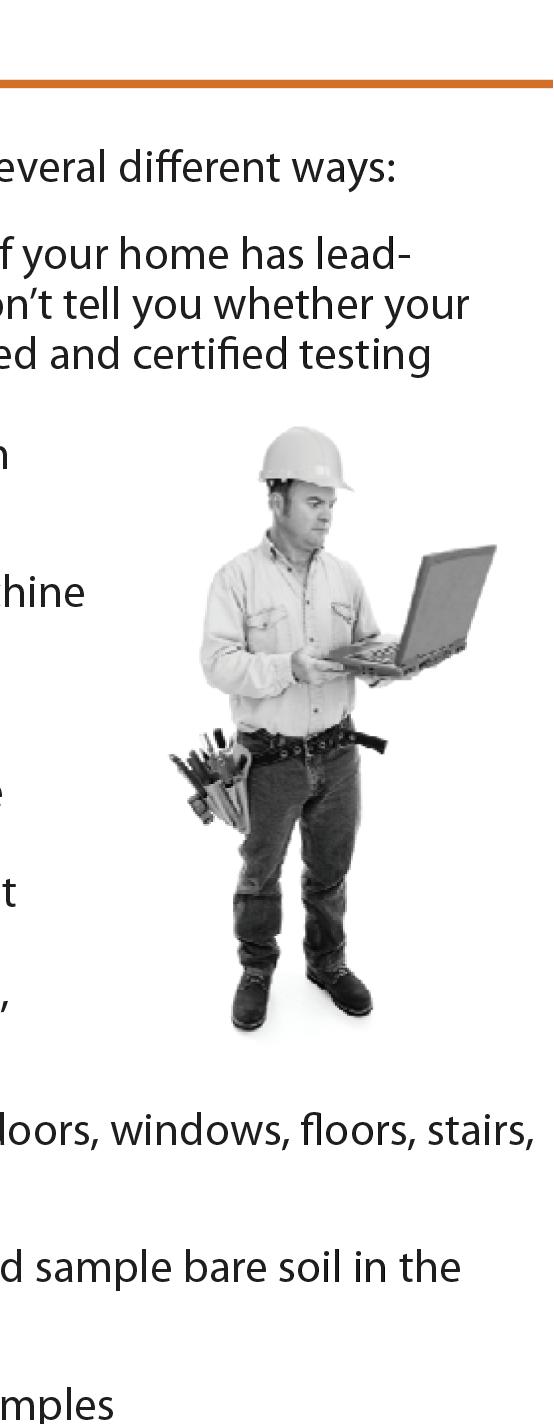
In preparing for renovation, repair, or painting work in a pre-1978 home, Lead-Safe Certi ed renovators (see page 12) may:
• Take paint chip samples to determine if lead-based paint is present in the area planned for renovation and send them to an EPA-recognized lead lab for analysis. In housing receiving federal assistance, the person collecting these samples must be a certi ed lead-based paint inspector or risk assessor
• Use EPA-recognized tests kits to determine if lead-based paint is absent (but not in housing receiving federal assistance)
• Presume that lead-based paint is present and use lead-safe work practices
There are state and federal programs in place to ensure that testing is done safely, reliably, and e ectively. Contact your state or local agency for more information, visit epa.gov/lead, or call 1-800-424-LEAD (5323) for a list of contacts in your area.3
3 Hearing- or speech-challenged individuals may access this number through TTY by calling the Federal Relay Service at 1-800-877-8339.



If your home has had lead abatement work done or if the housing is receiving federal assistance, once the work is completed, dust cleanup activities must be conducted until clearance testing indicates that lead dust levels are below the following levels:
• 10 micrograms per square foot (μg/ft2) for oors, including carpeted oors
• 100 μg/ft2 for interior windows sills
• 400 μg/ft2 for window troughs
Abatements are designed to permanently eliminate lead-based paint hazards. However, lead dust can be reintroduced into an abated area.
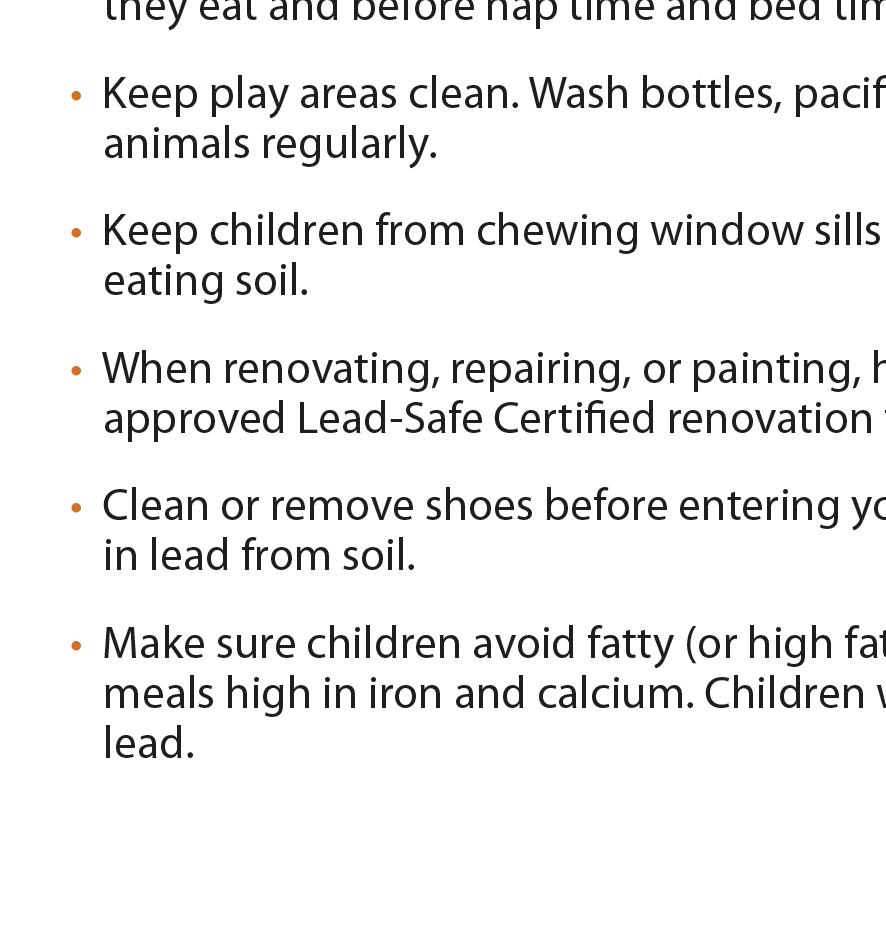
• Use a HEPA vacuum on all furniture and other items returned to the area, to reduce the potential for reintroducing lead dust.
• Regularly clean oors, window sills, troughs, and other hard surfaces with a damp cloth or sponge and a general all-purpose cleaner.
Please see page 9 for more information on steps you can take to protect your home after the abatement. For help in locating certi ed lead abatement professionals in your area, call your state or local agency (see pages 15 and 16), epa.gov/lead, or call 1-800-424-LEAD.







Explanations on key items in the purchase and sale contract for single family homes.

Item 5: Included Items - The Seller decides what items will be sold along with the home. You can check additional boxes as “requests” when you make your offer. (See Page 2, Item C for more info on included items.)

Item 7: Earnest Money - You can pay Earnest Money with a personal check or wire transfer the funds. This money is due within two days of mutual acceptance (both parties accepting the terms). The majority of the time, the Earnest Money will be held by the Closing Agent (usually your Title & Escrow company).




Item 8: Default - Selecting ‘Forfeiture of Earnest Money’ means that, if the deal falls through, you’re only financially responsible for the Earnest Money that you paid (this is defined later in the agreement on Page 4, Item O, Section i. as a maximum of 5% of the purchase price).

Item 13: Charges/Assessments - The Seller is responsible for paying any utility charges or Local Improvement District charges that were due before the Closing Date. This section applies to charges that occurred before the Closing Date, but were billed/due after the Closing Date.

Item 14: Seller Citizenship - If the Seller is legally a ‘foreign person,’ the sale of the property will be subject to Foreign Investment in Real Property Tax Act (FIRPTA) income tax withholding.


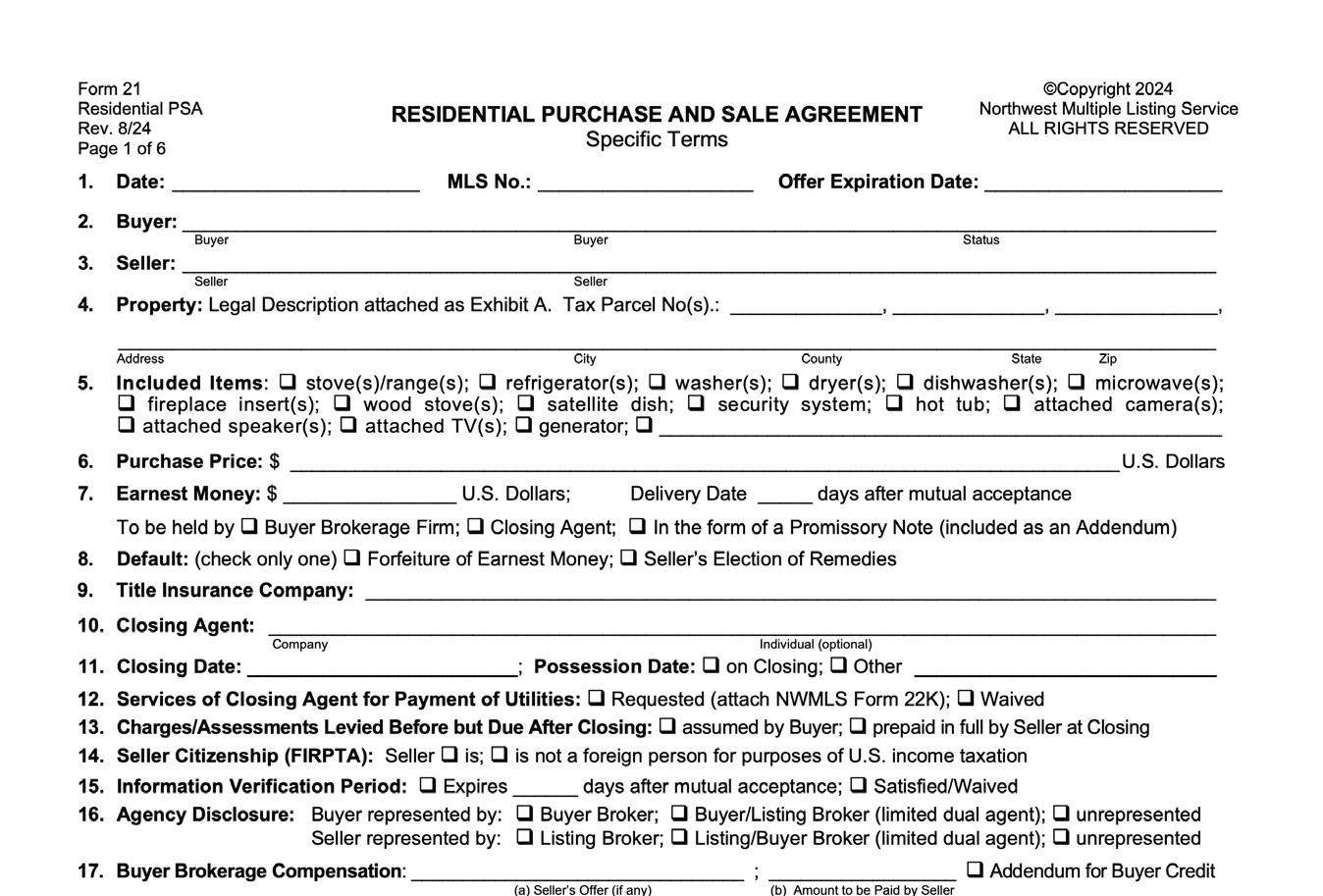





Item 15: Information Verification Period - This section refers to the paragraph on page 5, item W that gives you, by default, 3 days to verify you like the neighborhood. In competitive offer scenarios clients often choose to waive this period.

Item 17: Buyer Brokerage Compensation - The first box here shows what amount the seller listed on the NWMLS for the buyer broker compensation that they’re willing to cover. The second box shows the amount of that compensation that will be paid out from this sale to the buyer broker’s firm.
Explanations on key items in the purchase and sale contract for single family homes.

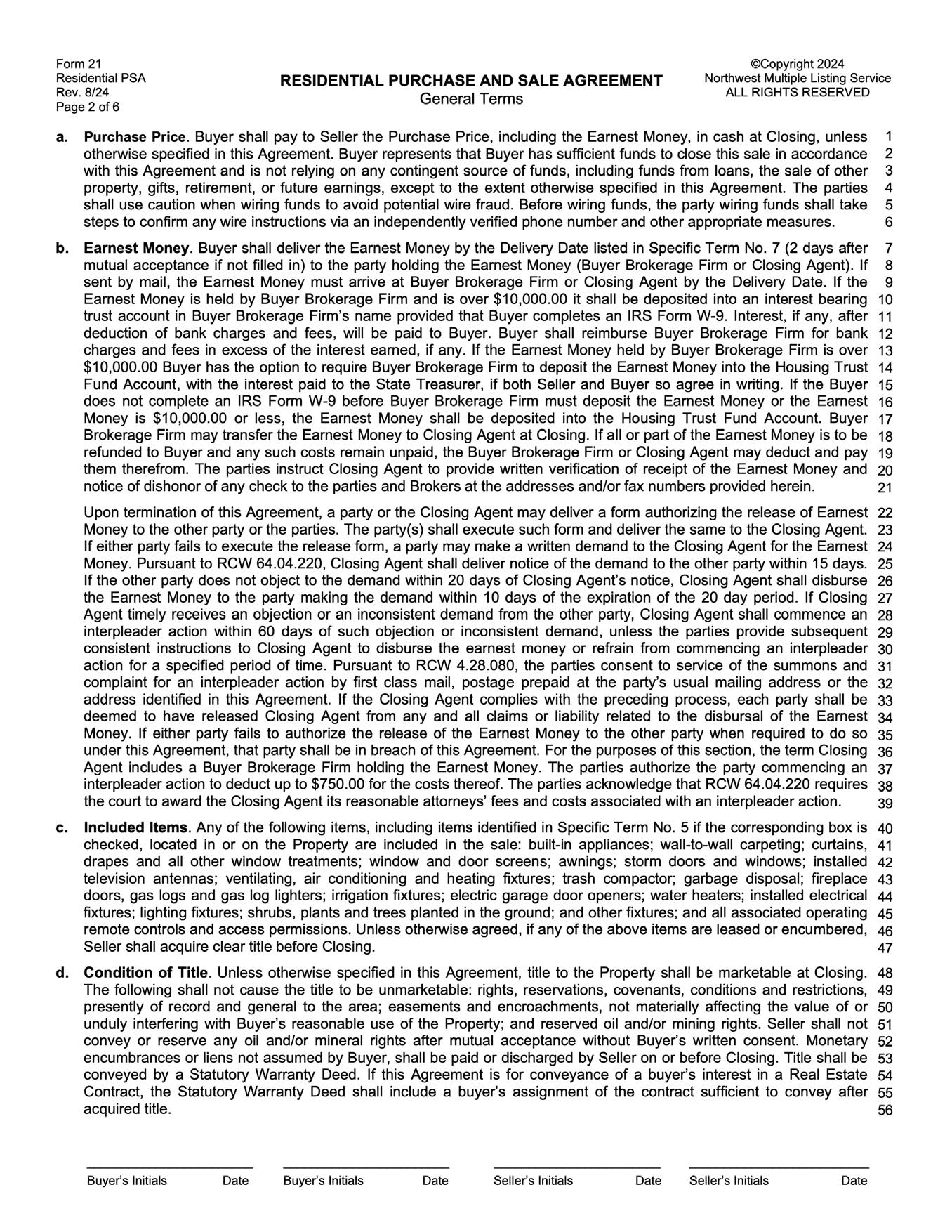

Item a: Purchase Price - This paragraph defines how you’ll pay for the property at Closing: either by paying cash, or by financing the sale if we have the Financing Addendum included. It also states that you have enough money to purchase it without relying on any other sources of money, unless we have attached a Contingency Addendum. If you’re using gifts, 401K withdrawals, etc. you’ll want to check with your lender and make sure you have access to all the funds before making the offer.

Item b: Earnest Money - The Earnest Money is due within two days of mutual acceptance, and you’ll deliver it to us or directly to the Closing Agent.

Item d: Condition of Title - This means that, on the Closing Date, the Seller must be able to give you the title to the property “clean” of any liens or other problems that would make you unable to take the property. Keep in mind that a ‘clean’ title can still include things like easements that have been granted to a neighbor with a shared driveway, or encroachments of a tree onto the property, or other restrictions or conditions. ‘Clean’ title would be free of any monetary encumbrances.
Explanations on key items in the purchase and sale contract for single family homes.
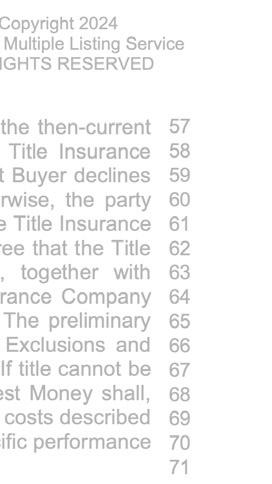

Item f: Closing & Possession - ‘Closing’ is the day that all the paperwork is recorded (Page 1, Item 11). You’ll take possession on Closing Day at 9:00 PM, unless otherwise specified.

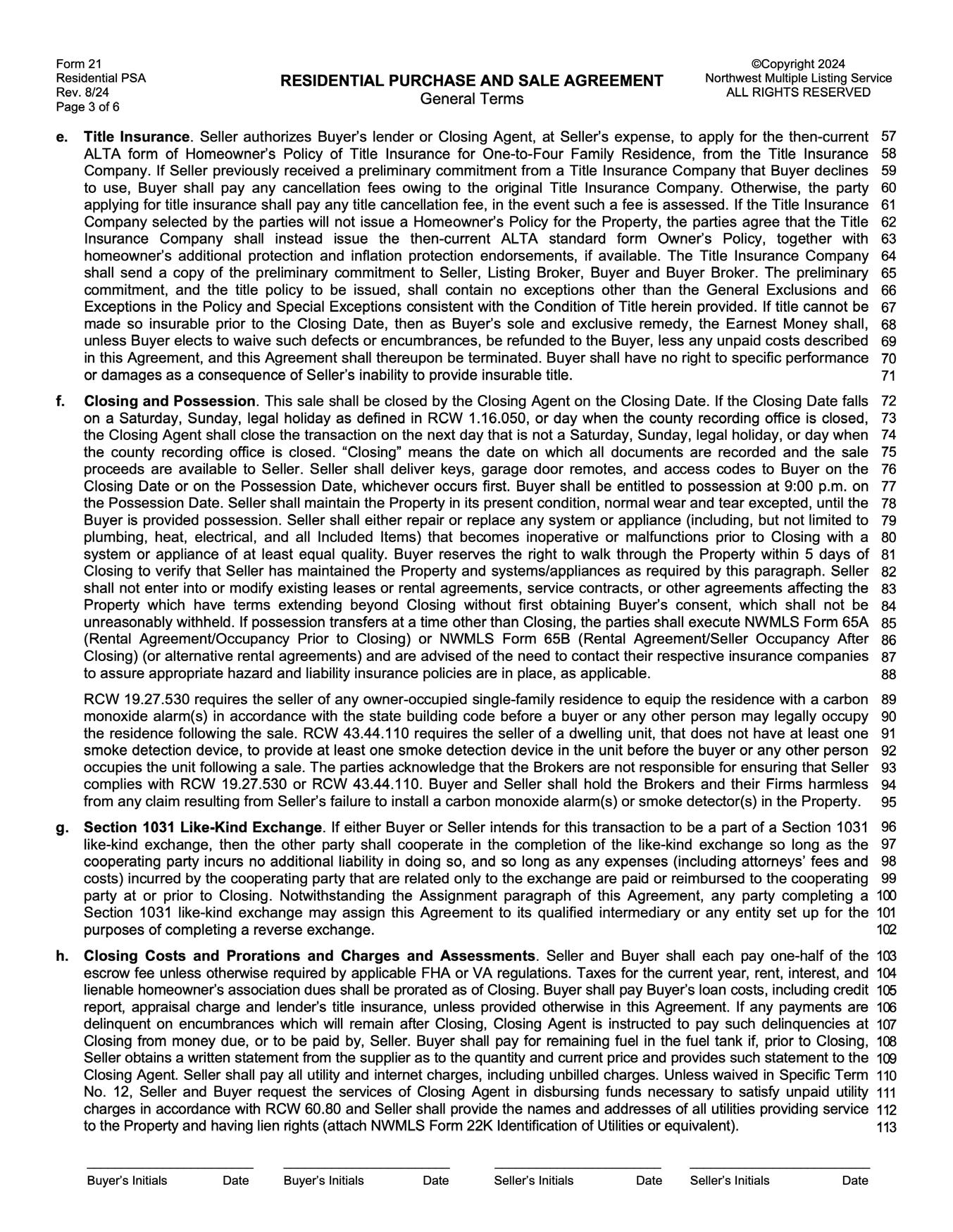

Item h: Closing Costs & Prorations & Charges & Assessments - See our “How Property Taxes Work” handout for an explanation of how payment of property taxes is handled.
Explanations on key items in the purchase and sale contract for single family homes.
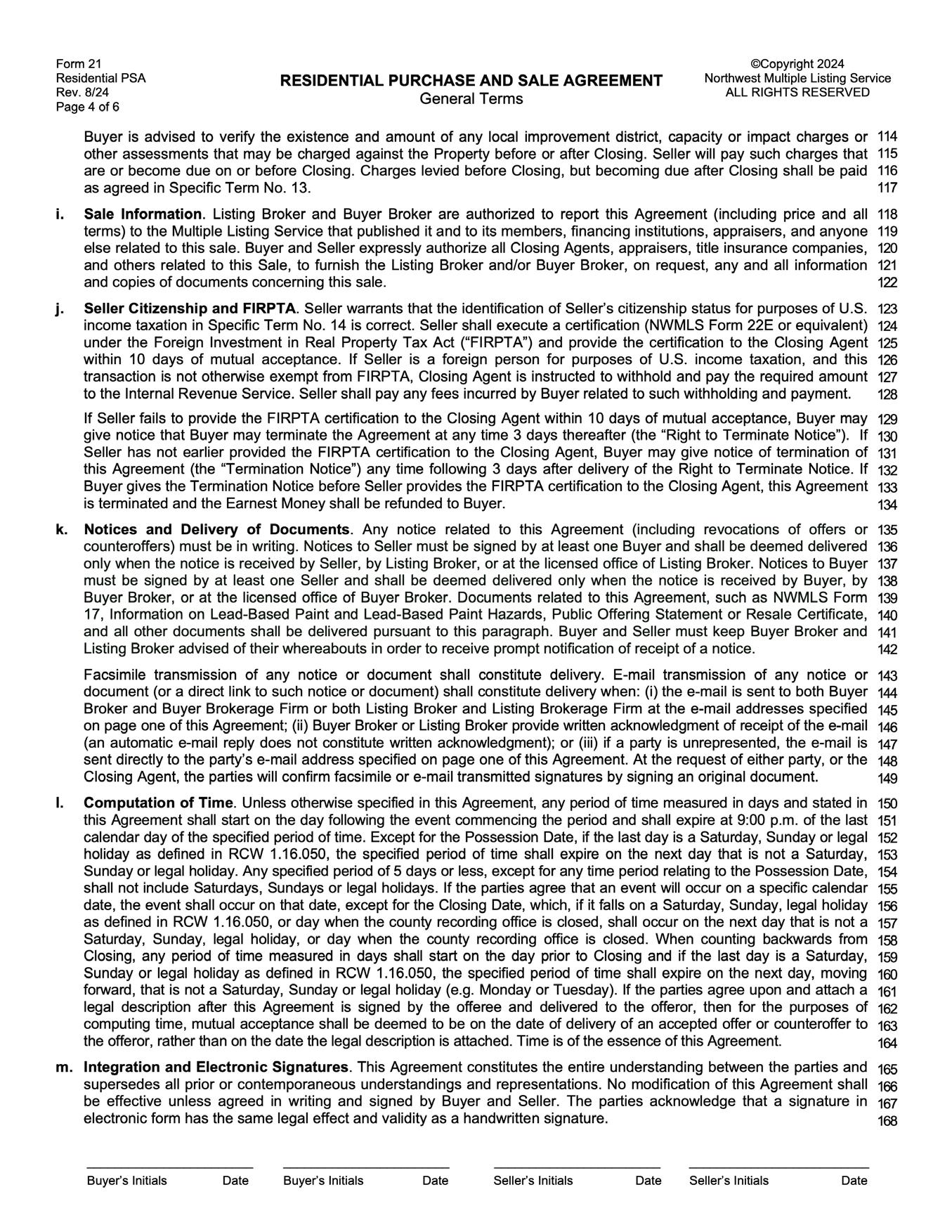
Item j: Seller Citizenship and FIRPTAThe Escrow company will take care of verifying that the Seller’s citizenship status is correct. It’s important that you know the status, because unpaid taxes might pass to you if the Seller’s citizenship is incorrect.

Item l: Computation of Time - The day you take possession of the property can take place on any day. If any other due date within the agreement falls on a Saturday, Sunday, or legal holiday, it normally rolls forward to the next day that isn’t a Sat/Sun/holiday, unless otherwise agreed upon.


Explanations on key items in the purchase and sale contract for single family homes.
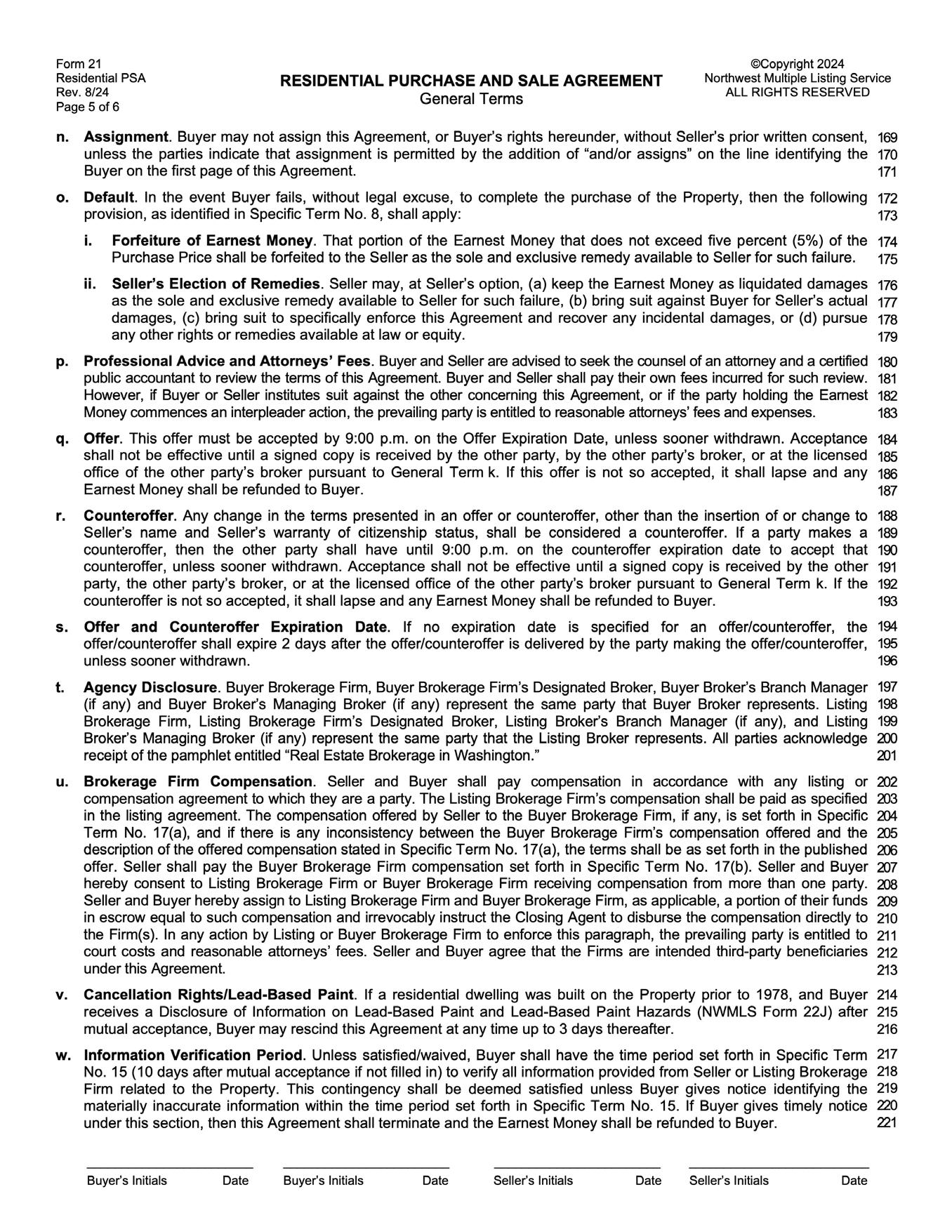

Item q: Offer - ‘Acceptance’ of the offer happens when we’ve received an all-around signed copy of this agreement back from the Seller. The Seller has until 9:00 PM on the Offer Expiration Date to accept your offer, unless you withdraw your offer before then.
Item r: Counteroffer - If the Seller changes anything on the agreement when they send it back to us, that makes it a ‘Counteroffer’ and a new deadline is set. You then have until that deadline (Counteroffer Expiration Date) to either accept it, or counter with more changes.


Item t: Agency Disclosure - Pointe3 Real Estate is the Selling Firm and I represent you under Pointe3 Real Estate. If for any reason I’m not able to complete the transaction, Pointe3 Real Estate will appoint another Broker within the Firm to carry out the transaction.
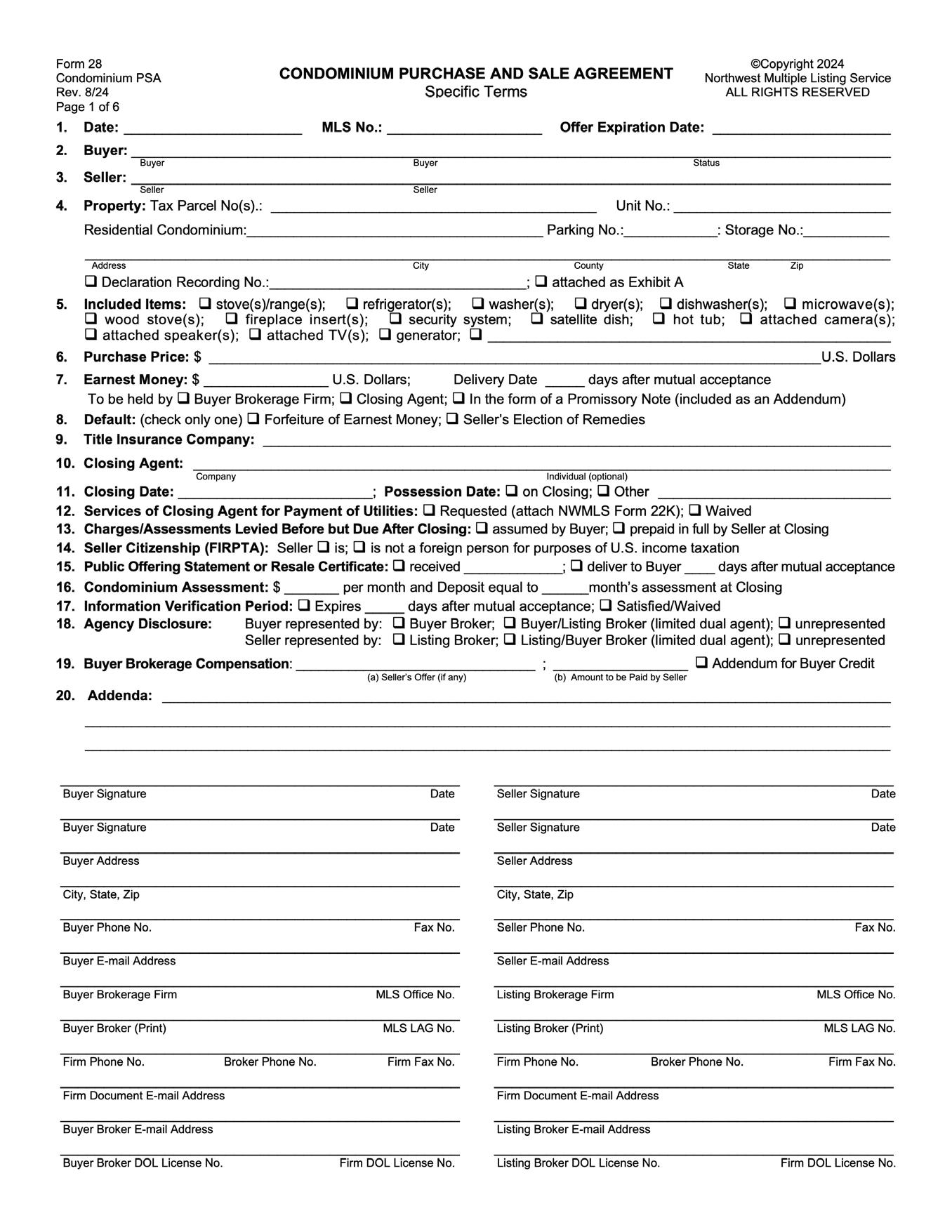
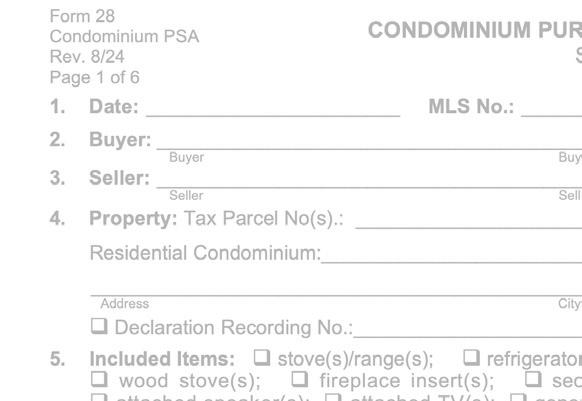
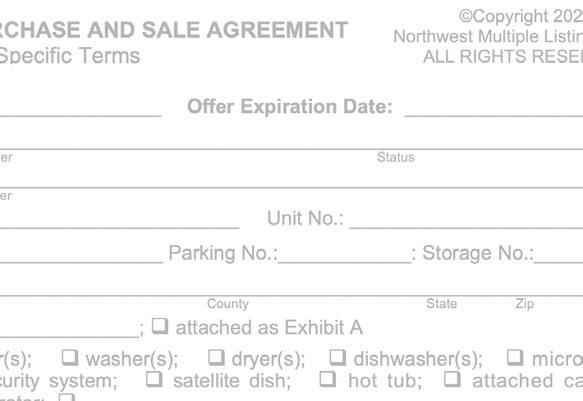
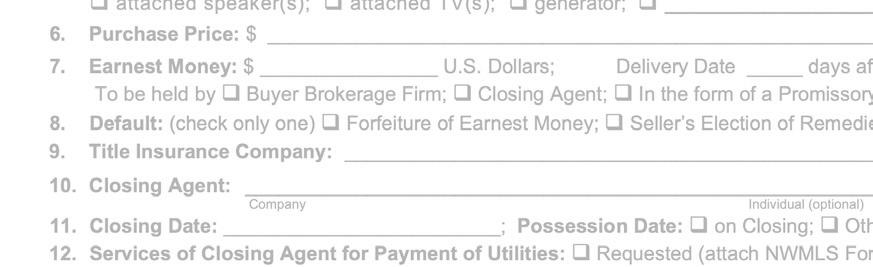
The Condominium Purchase & Sale is similar to the Residential one, with a few additions.


Item 13: Charges/Assessments
Levied Before but Due After Closing - Just like the Residential Purchase & Sale, the Seller is responsible for paying the charges that were due before the Closing Date - including any condominium special assessments (such as home owners’ association dues). This section applies to charges that occurred before the Closing Date, but were billed/due after the Closing Date.

Item 16: Resale Certificate - See our handout “Condo vs. Single Family vs. Townhouse” for more info on Resale Certificates.

Item 17: Condominium Assessment
- This is the monthly home owners’ association dues. Many times, the association requires a reserve of some funds in advance, in case you don’t make some payments in the future. If they do, it’ll be due at Closing per the association’s guidelines.
Working with a lender to finance the purchase? We’ll use this form.
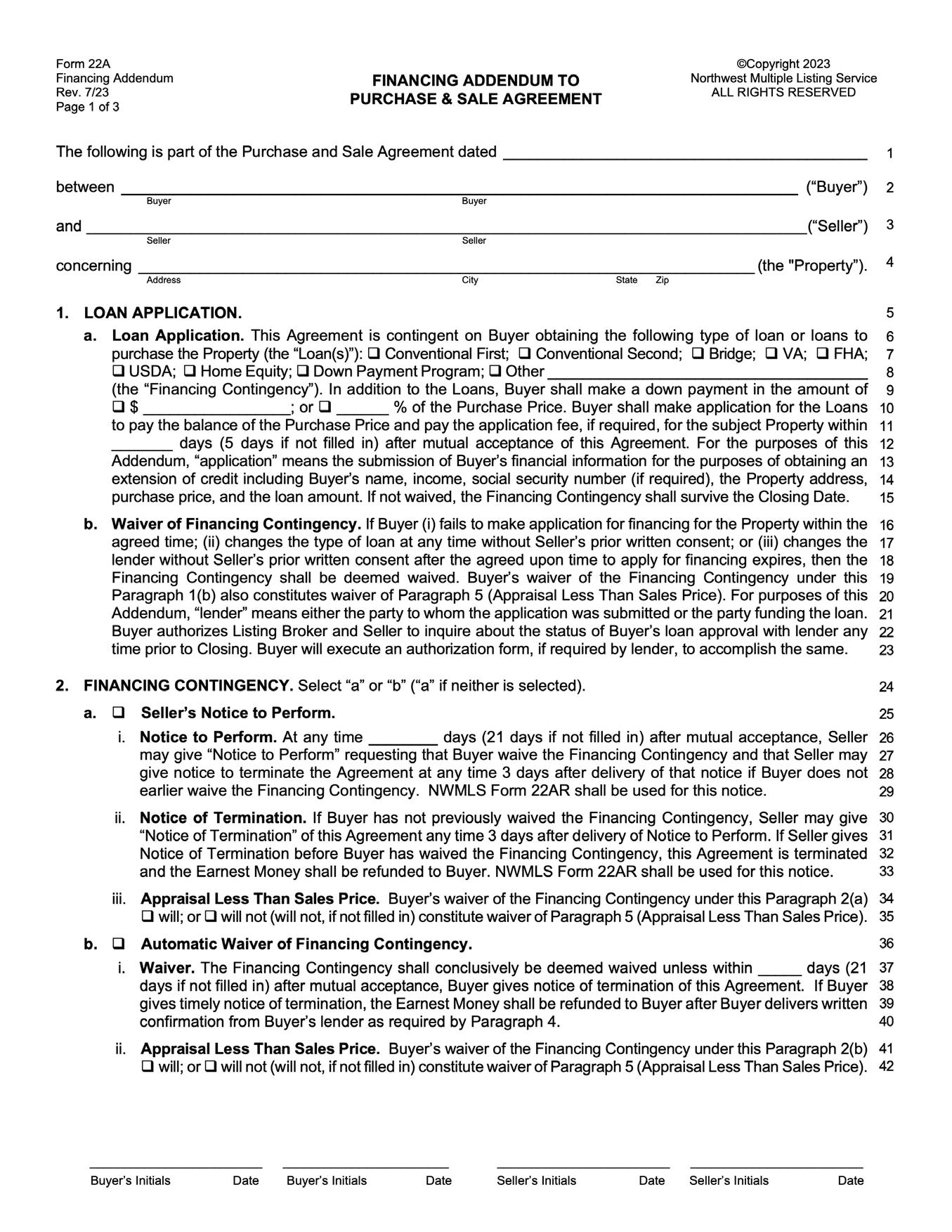


Item 1a: Loan Application/Waiver of Contingency - You need to provide all the information about your loan when you’re making an offer. If you decide to change lenders, or change your loan type during the transaction, the Seller has to agree to it in writing first. Your pre-approval takes care of most of the items for the loan application. A completed Purchase & Sales Agreement is usually the last step in your application process.

Item 2: Financing Contingency - If the seller issues a Notice to Perform, you’ll have three days to waive the financing contingency. If you don’t, the seller can cancel the contract at any time after that and your earnest money will be refunded. Waiving means you must proceed with the purchase, even if your financing fails, or risk losing your Earnest Money.
Some agreements include an automatic waiver after a set number of days. If your financing fails for any reason and you do not proceed with the purchase you will likely lose your Earnest Money.
Working with a lender to finance the purchase? We’ll use this form.
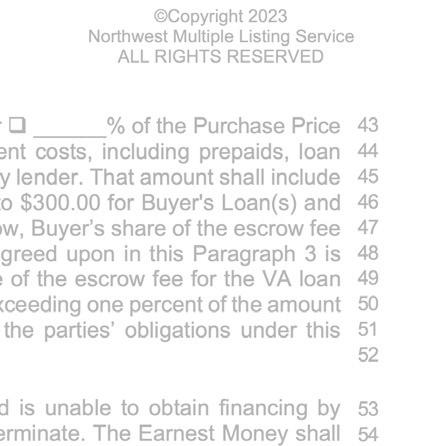
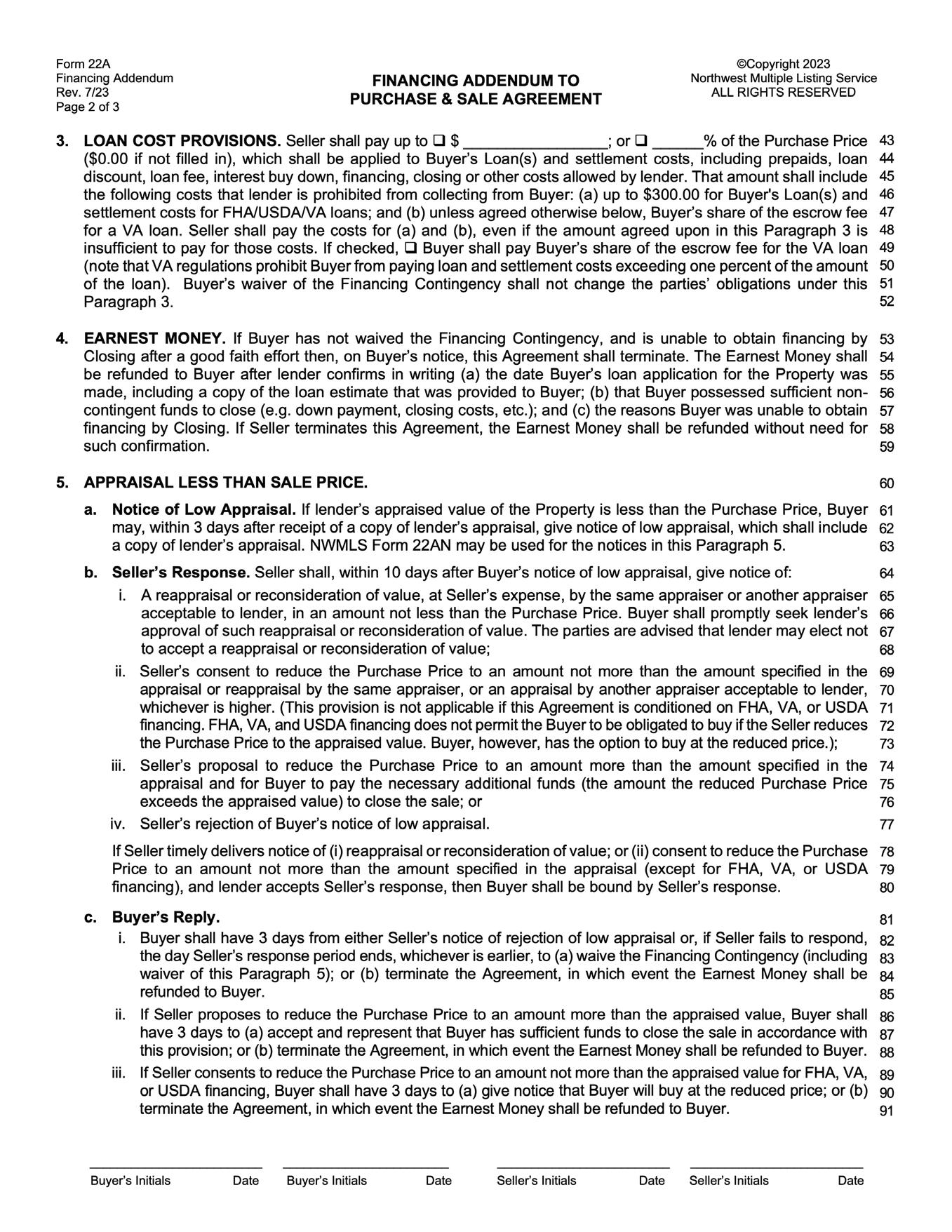

Item 5: Appraisal Less Than Sale Price - If the lender’s appraisal comes in low, the Seller can either re-appraise the property themselves with an appraiser approved by the buyer’s lender, reduce the Purchase Price, reduce the Purchase Price and have you pay the difference, or reject the low appraisal. You then decide whether to accept or terminate. (Keep in mind, if you waive the Financing Contingency to strengthen your offer, this Appraisal Contingency will also be waived unless otherwise noted.)
These are additional common items that come up during a sale.


Item 1: Square Footage/Lot Size / Encroachments - You’re responsible for verifying the square footage, the size of the lot, or any encroachments - don’t rely on the Seller’s claims in any advertisements.
Item 2: Title Insurance - The Seller is required to pay the premium for Title Insurance for you. Extended coverage requires an ALTA survey which can be $2-5k and once it’s disclosed, these items are excepted from coverage. Standard coverage is less expensive and doesn’t cover for anything in the future (e.g. an encroachment). In most cases, the ALTA Homeowner’s policy in the original Purchase & Sale is the best coverage.

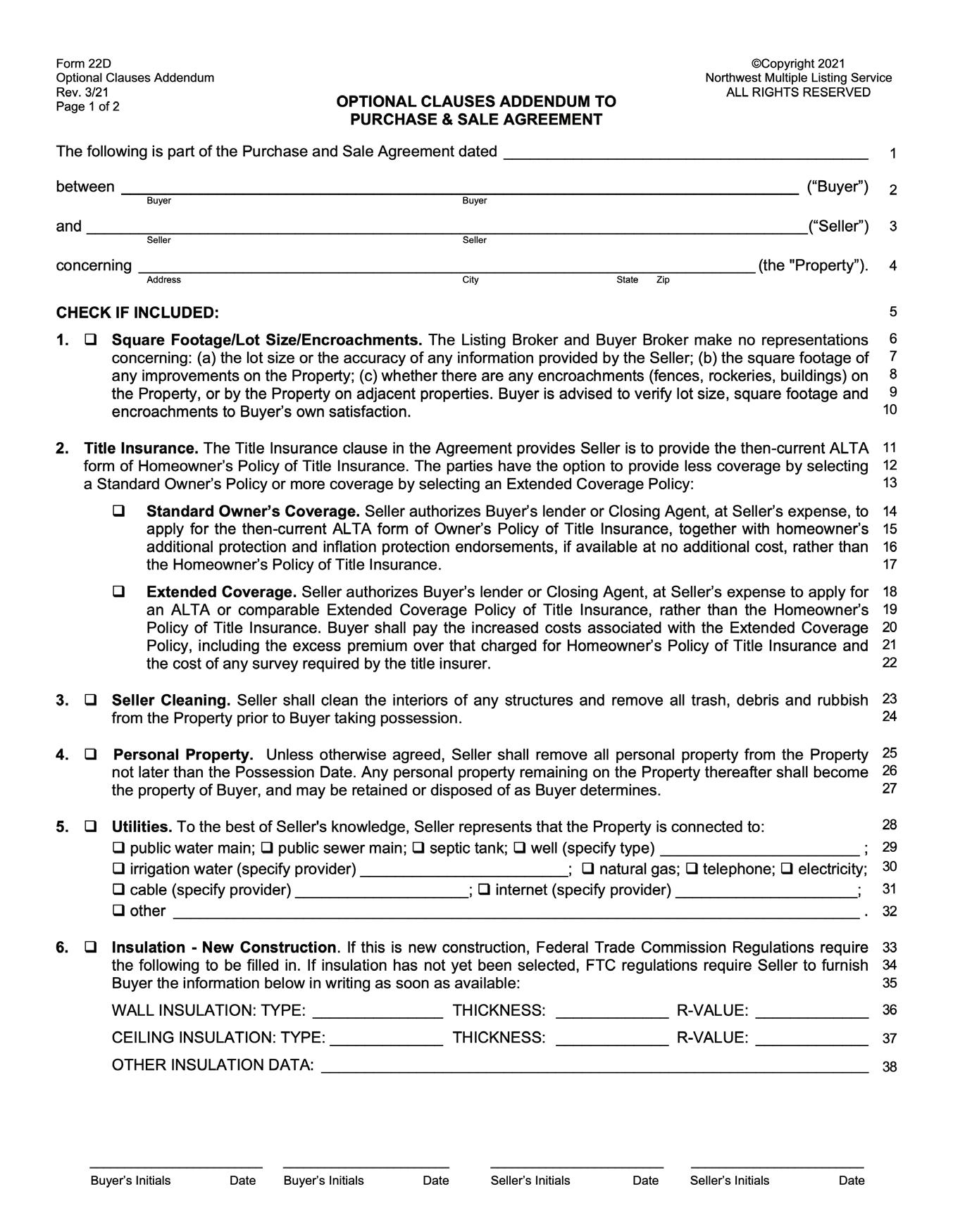



Item 3: Seller Cleaning - The Seller is required to clean out any trash from inside the property before you take possession - but this doesn’t mean they have to have the home professionally cleaned.
These are additional common items that come up during a sale.
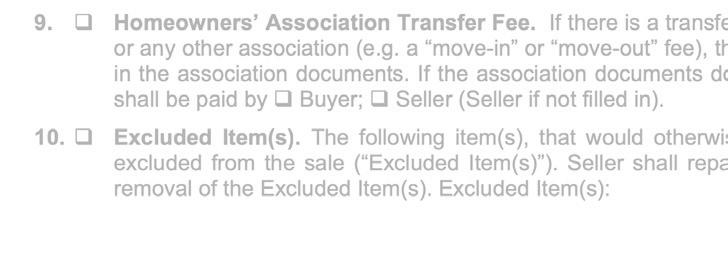
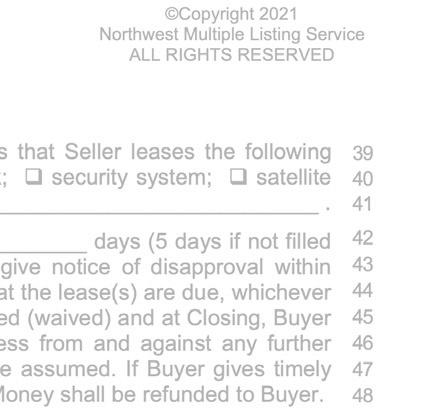
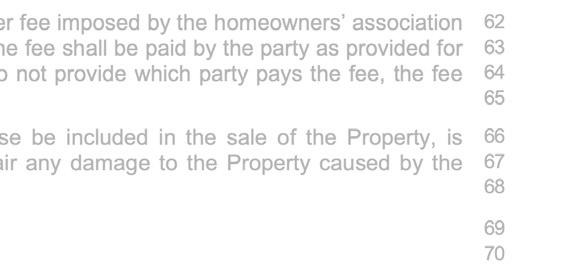
Item 8: Homeowners’ Association Review Period - You can decide to make your offer conditioned on reviewing and approving the homeowners’ association’s rules and regulations, by-laws, financials, etc.

Item 11: Home Warranty - Home warranties do not automatically come with the home. Some Sellers or listing brokers decide to provide a one year warranty, which would be indicated in their listing.


We’ll use this if you’re doing a pre-inspection or making the sale contingent on the inspection.
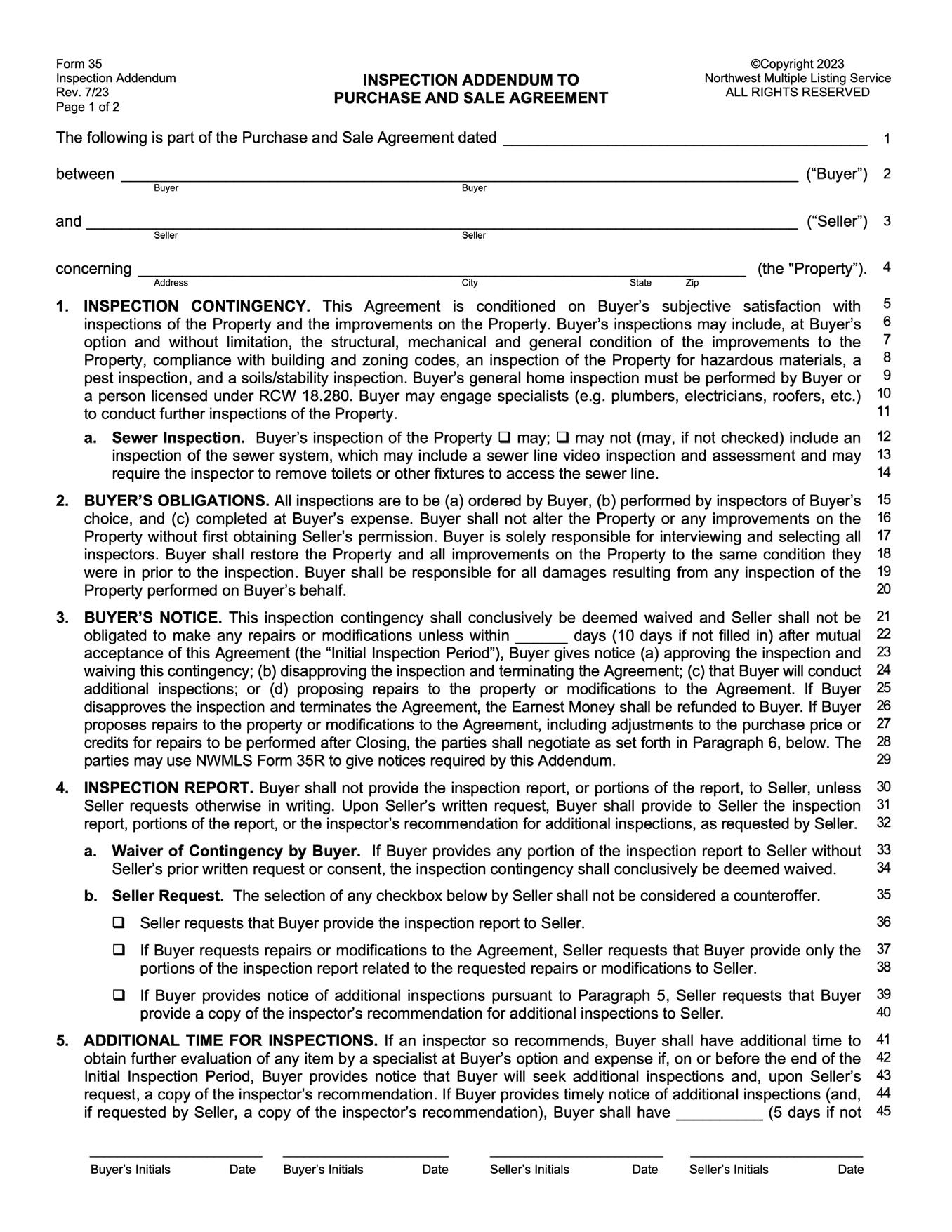
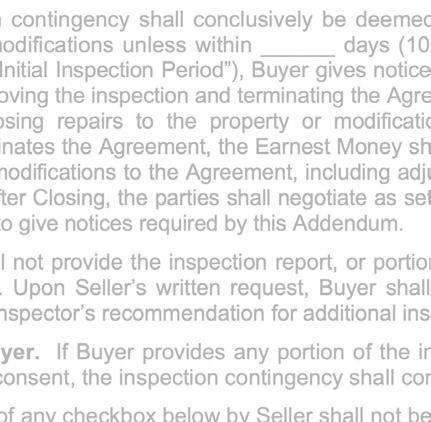
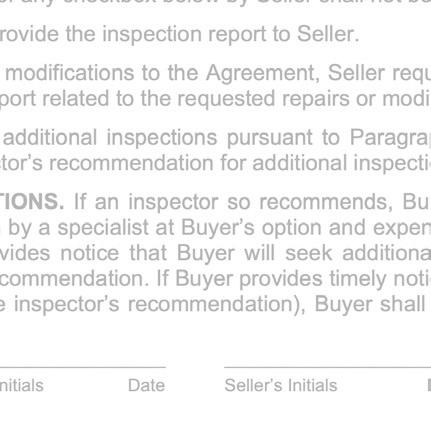
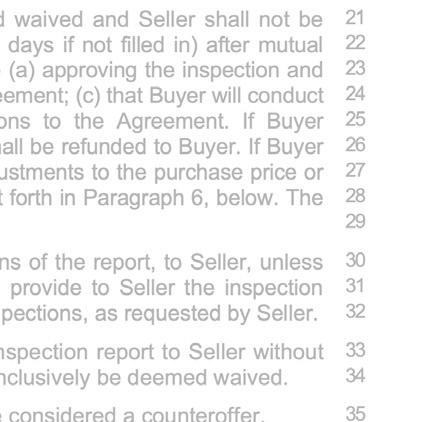
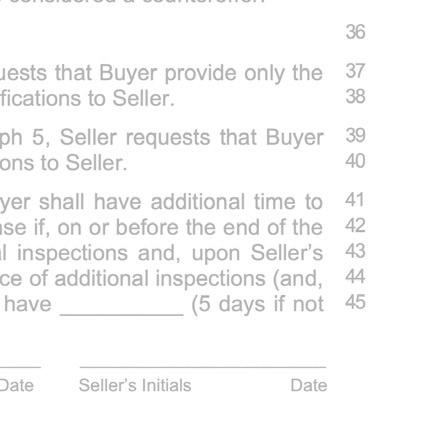

This gives you the right to inspect the property, and then, if problems are discovered, either request that the Seller fix the problems, terminate the agreement without giving the Seller an opportunity to fix them, or change the terms of your offer.
You can decide to pre-inspect the property before making an offer (this will be on Form 35P). Doing this will allow you to craft your initial offer based on your findings, and allow you to agree to purchase the property as is (often used as a way to strengthen your offer in a competitive market). We strongly advise that you conduct a pre-inspection rather than waive the inspection altogether, but if you do waive inspection that would be reflected on Form 35W.

This would be used if you want to escalate your offer price to compete with other offers..
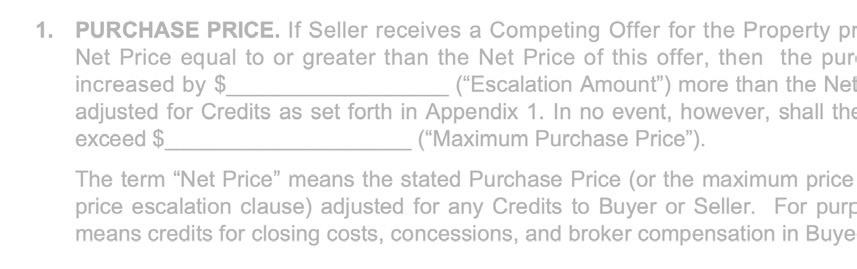
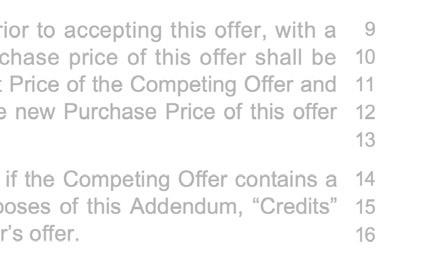
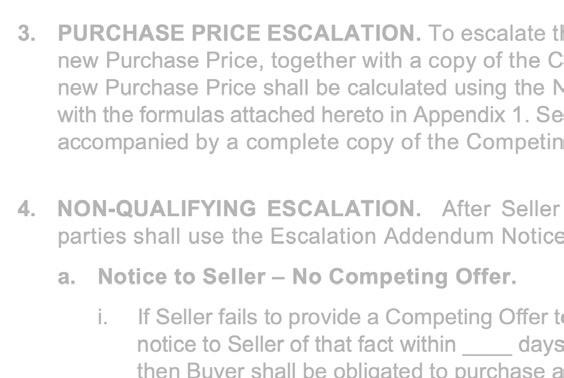
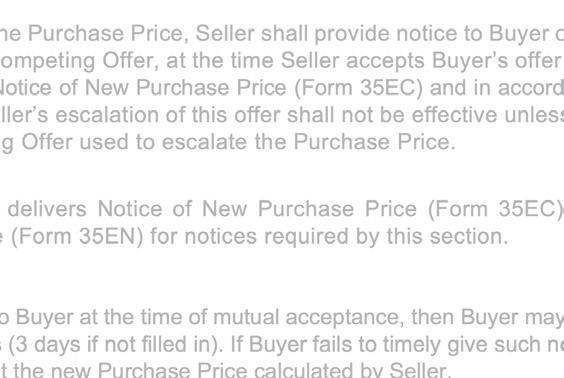


Notice to Buyer - This addendum is used when you want to increase your offer price if the Seller receives another offer that is equal or higher than your offer. It’s not legally binding until the offer is signed around by all parties, the competing offer is given, and everyone has accepted the terms. Until then, the Seller can continue to negotiate with any buyers, and can disclose the terms of your offer to other buyers.

Item 2: Competing Offer - This can contain almost any terms, but it must close within the time period specified, and it can’t be contingent on the sale of your old home if it hasn’t been listed for sale yet. Requiring that the full purchase price be paid in cash at closing prevents the Seller from financing a portion of a competing offer.
This addresses what happens if there are issues with the property’s title.
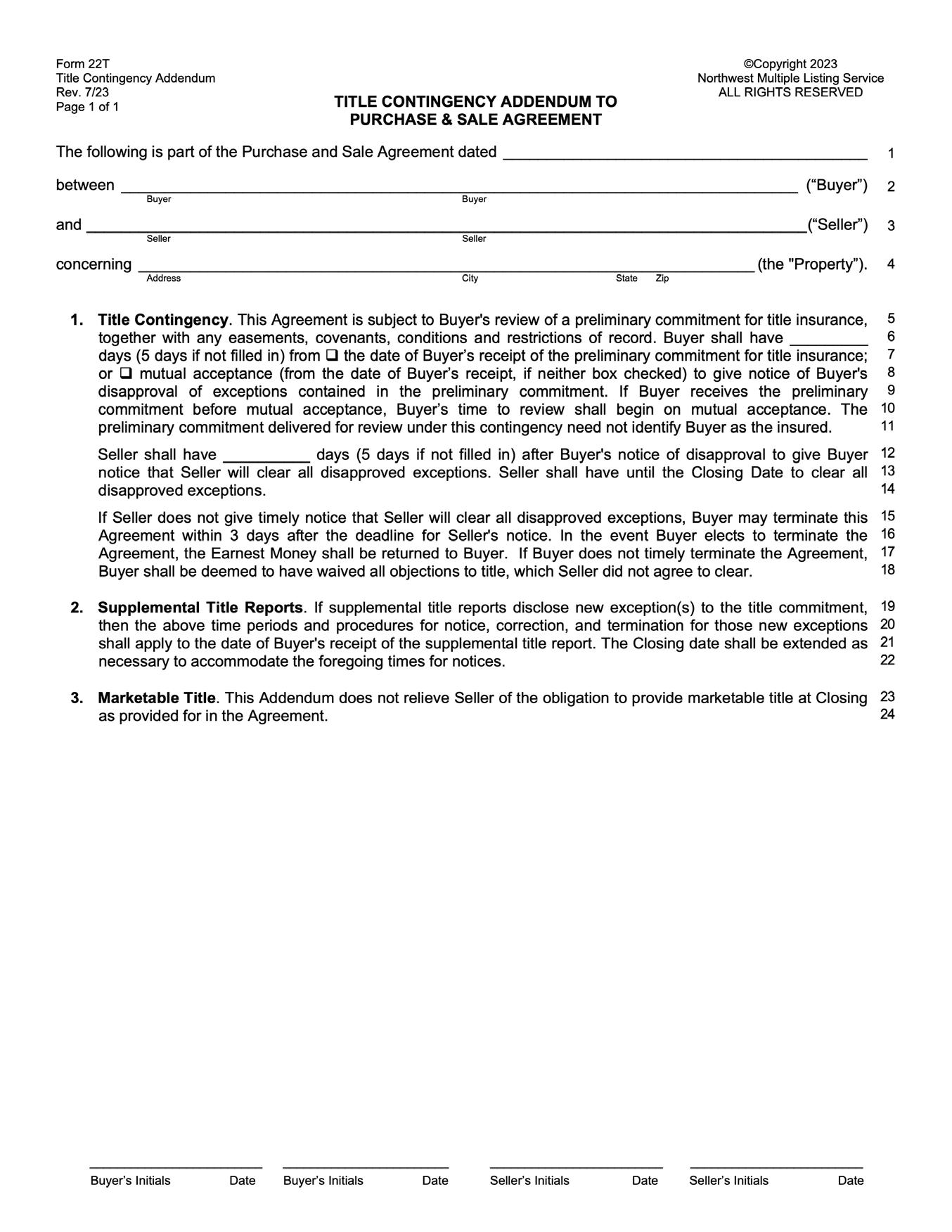

1: Title Contingency - As you read about in the Purchase & Sale Agreement, Page 2, Item D, the Seller is required to provide a ‘clean’ title to you at Closing. If there are issues on the title, the Seller has five days to clear those up prior to Closing. The Seller has to give notice within three days that they agree to clear them up, otherwise you can terminate the agreement and get your Earnest Money back.


Item 2: Supplemental Title Reports - If you get a new title report before Closing that discloses new problems, all the time periods reset and the clock starts again. The Closing Date will get extended to accommodate the new timelines.