November 7, 2025 | 16 Cheshvan 5786
Candlelighting 4:52 p.m. | Havdalah 5:51 p.m. | Vol. 68, No. 45 | pittsburghjewishchronicle.org
New group works to expose anti-Zionism as Jew hatred
NOTEWORTHY LOCAL Restoring sight
The work of Dr. José-Alain Sahel LOCAL
Page 2
Federation's new community study
$2
‘Antisemitic speech is constitutionally protected,’ says Georgetown professor at Pitt’s Center for Civil Rights and Racial Justice event By David Rullo | Senior Staff Writer
Planning for the future of Jewish Pittsburgh Page 3
LOCAL
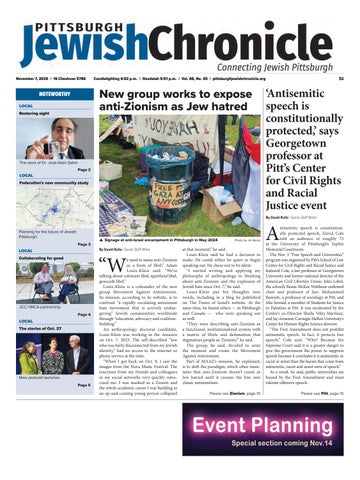
Signage at anti-Israel encampment in Pittsburgh in May 2024 By David Rullo | Senior Staff Writer
“W
Collaborating for good
JCC-YMCA partnership Page 4
LOCAL The stories of Oct. 27
New podcast launches Page 5
e need to name anti-Zionism as a form of libel,” Adam Louis-Klein said. “We’re talking about colonizer libel, apartheid libel, genocide libel.” Louis-Klein is a cofounder of the new group Movement Against Antizionism. Its mission, according to its website, is to confront “a rapidly escalating antizionist hate movement that is actively endangering” Jewish communities worldwide through “education, advocacy and coalitionbuilding.” An anthropology doctoral candidate, Louis-Klein was working in the Amazon on Oct. 7, 2023. The self-described “Jew who was fairly disconnected from my Jewish identity,” had no access to the internet or phone service at the time. “When I got back on Oct. 9, I saw the images from the Nova Music Festival. The reactions from my friends and colleagues in my social networks very quickly ostracized me. I was marked as a Zionist and the whole academic career I was building as an up-and-coming young person collapsed
Photo by Jim Busis
at that moment,” he said. Louis-Klein said he had a decision to make: He could either be quiet or begin speaking out. He chose not to be silent. “I started writing and applying my philosophy of anthropology to thinking about anti-Zionism and the explosion of Jewish hate since Oct. 7,” he said. Louis-Klein put his thoughts into words, including in a blog he published on The Times of Israel’s website. At the same time, he found others — in Pittsburgh and Canada — who were speaking out as well. “They were describing anti-Zionism as a functional, institutionalized system with a matrix of libels and defamation that stigmatizes people as ‘Zionists,’” he said. The group, he said, decided to seize the moment and create the Movement Against Antizionism. Part of MAAZ’s mission, he explained, is to shift the paradigm, which often maintains that anti-Zionism doesn’t count as Jew hatred until it crosses the line into classic antisemitism. Please see Zionism, page 10
A
ntisemitic speech is constitutionally protected speech, David Cole told an audience of roughly 75 at the University of Pittsburgh’s Teplitz Memorial Courtroom. The Nov. 3 “Free Speech and Universities” program was organized by Pitt’s School of Law Center for Civil Rights and Racial Justice and featured Cole, a law professor at Georgetown University and former national director of the American Civil Liberties Union; Jules Lobel, the school’s Bessie McKee Walthour endowed chair and professor of law; Mohammed Bamyeh, a professor of sociology at Pitt; and Mia Suwaid, a member of Students for Justice in Palestine at Pitt. It was moderated by the Center’s co-Director Sheila Vélez Martínez, and Jay Aronson, Carnegie Mellon University’s Center for Human Rights Science director. “The First Amendment does not prohibit antisemitic speech. In fact, it protects free speech,” Cole said. “Why? Because the Supreme Court said it is a greater danger to give the government the power to suppress speech because it concludes it is antisemitic or racist or sexist than the harms that come from antisemitic, racist and sexist sorts of speech.” As a result, he said, public universities are bound by the First Amendment and must tolerate offensive speech. Please see Pitt, page 10
Headlines Pitt researcher helps restore sight through groundbreaking implant — LOCAL— By Adam Reinherz | Senior Staff Writer
“I think this shows the value of persistence, the value of collaboration and the importance of being focused on the needs of the people.”
F
or Jewish Pittsburgher Dr. José-Alain Sahel, the dream of giving sight to the blind is becoming a reality. A new system — relying on a wireless retinal implant and high-tech glasses — helped most patients in a major study regain measurable vision, according to results published in the New England Journal of Medicine. Released last month, the study showed that of 32 people who completed 12 months of follow-up, 26 achieved meaningful visual improvement. Study participants, on average, improved by 25 letters (about five lines on a standard eye chart) thanks to the device; 81% percent of people studied gained 10 or more letters. Sahel, a Squirrel Hill resident who serves as distinguished professor of ophthalmology at the University of Pittsburgh Medical School, told the Chronicle that the research represents a “long-term investment” from partners worldwide. Nearly two decades ago, Sahel and other researchers, including Stanford University Professor of Ophthalmology Daniel Palanker and colleagues throughout Europe, undertook measures to develop necessary technology, surgery, clinical protocols and the clinical trial. “The device we imagined in 2005 now works in patients remarkably well,” Palanker told Stanford Medicine News Center following last month’s announcement. Geographic atrophy due to age-related
–DR. JOSÉ-ALAIN SAHEL
p Dr. José-Alain Sahel holds the PRIMA implant.
macular degeneration affects more than 5 million people worldwide. For these individuals, no known therapies are currently available. The PRIMA (photovoltaic retina implant microarray) system hopefully can help. Relying on a 2×2 mm wireless chip, implanted in the back of the eye, and a pair of hightech glasses, PRIMA allowed some study participants to read with acuity equivalent to 20/42 vision.
Photo courtesy of UPMC
“The fact that we are able to restore some vision — it’s not perfect — but some vision to these people is important,” Sahel said. Countless hours preceded last month’s announcement. Reflecting on the tireless contribution of multiple partners, Sahel said researchers worldwide are engaged in a “long-term fight against blindness.” These advancements represent “many decades of work by multiple people,” he
said. “I think this shows the value of persistence, the value of collaboration and the importance of being focused on the needs of the people.” Though the research has garnered widespread attention, “it’s only a milestone, it’s not a final step,” he continued. “We are continuing to work on refining the device, refining the technology to make it even better.” PJC Adam Reinherz can be reached at areinherz@pittsburghjewishchronicle.org.
5915 Beacon St., 5th Floor Pittsburgh, PA 15217
Main phone number: 412-687-1000
Subscriptions: 412-687-1000, ext. 2 SUBSCRIPTIONS subscriptions@pittsburghjewishchronicle.org 412-687-1000, ext. 2 TO ADVERTISE advertising@pittsburghjewishchronicle.org 412-687-1000, ext. 1 EDITORIAL DEPARTMENT Email: newsdesk@pittsburghjewishchronicle.org BOARD OF TRUSTEES Evan H. Stein, Chair Evan Indianer, Vice Chair Derek Smith, Treasurer Gayle R. Kraut, Secretary Gail Childs, Dan Droz, Malke Steinfeld Frank, Seth Glick, Judith Kanal, Cátia Kossovsky, Charles Saul GENERAL COUNSEL Stuart R. Kaplan, Esq.
2
NOVEMBER 7, 2025
Jim Busis, CEO and Publisher 412-228-4690 jbusis@pittsburghjewishchronicle.org EDITORIAL Toby Tabachnick, Editor 412-228-4577 ttabachnick@pittsburghjewishchronicle.org Adam Reinherz, Senior Staff Writer 412-687-1000 areinherz@pittsburghjewishchronicle.org David Rullo, Senior Staff Writer 412-687-1000 drullo@pittsburghjewishchronicle.org ADVERTISING Amy Weiss, Account Executive (412) 613-0697 aweiss@pittsburghjewishchronicle.org
PRODUCTION Jeni Mann Tough Production Manager Carl Weigel Art/Production Coordinator Subscriptions subscriptions@pittsburghjewishchronicle.org 412-687-1000, ext. 2 Published every Friday by the Pittsburgh Jewish Publication and Education Foundation 5915 Beacon St., 5th Floor Pittsburgh, PA 15217 Phone: 412-687-1000 POSTMASTER: Send address change to PITTSBURGH JEWISH CHRONICLE, 5915 BEACON ST., 5TH FLOOR PITTSBURGH, PA 15217 (PERIODICAL RATE POSTAGE PAID AT PITTSBURGH, PA AND AT ADDITIONAL MAILING OFFICES) USPS 582-740
PITTSBURGH JEWISH CHRONICLE
Manuscripts, letters, documents and photographs sent to the Pittsburgh Jewish Chronicle become the property of this publication, which is not responsible for the return or loss of such items. The Pittsburgh Jewish Chronicle does not endorse the goods or services advertised or covered in its pages and makes no representation to the kashrut of food products and services in said advertising or articles. The publisher is not liable for damages if, for any reason whatsoever, he fails to publish an advertisement or for any error in an advertisement. Acceptance of advertisers and of ad copy is subject to the publisher’s approval. The Pittsburgh Jewish Chronicle is not responsible if ads violate applicable laws and the advertiser will indemnify, hold harmless and defend the Pittsburgh Jewish Chronicle from all claims made by governmental agencies and consumers for any reason based on ads appearing in the Pittsburgh Jewish Chronicle.
PITTSBURGHJEWISHCHRONICLE.ORG
Headlines New study charts Pittsburgh Jewry’s strengths, struggles and shifts — LOCAL — By Toby Tabachnick | Editor
T
here is a strong base of young Jewish adults in Greater Pittsburgh, with 41% of Jewish Pittsburghers between the ages of 25 and 54. That demographic could help the community grow — if those young adults decide to stay here. Because the area is home to fewer Jewish children than other Jewish communities of similar size, the need to invest in families is paramount. And while the number of Jewish residents in Greater Pittsburgh remains stable, and the majority of Jews continue to live in the East End, there is a growing number of Jewish families living north and south of the city limits. These are just some of the takeaways from a new survey of Jewish Pittsburgh that reveals both strengths and challenges that may help the community plan for its future. The 2025 Community Pulse Survey was funded and led locally by the Jewish Federation of Greater Pittsburgh in partnership with the Jewish Federations of North America and the research firm Burson. The survey was conducted from May to June 2025 with interviews of 532 local Jewish adults. It’s been eight years since the last comprehensive community study of Jewish Pittsburgh was completed, conducted by researchers at Brandeis University. That study included interviews with approximately 2,100 Jewish households throughout Greater Pittsburgh. Ilene Rinn, the Federation’s associate vice president of planning and impact, said it was the right time to survey the community again. “Our last community study was done in 2017 and so much in Pittsburgh has changed since then,” she said. “There was the tragic shooting, COVID — and so we felt it was the right time to take the pulse of the community.” Moreover, she noted, JFNA, the umbrella organization of Federations in North America, is piloting an Impact Index Program, surveying cohorts of cities of similar size to obtain data that will help community leaders “make more informed decisions about funding, engagement, etc.” Pittsburgh was one of 26 communities nationwide to participate in the initiative. Other communities in Pittsburgh’s cohort included Atlanta, Baltimore, Detroit, Palm Beach and Washington, D.C. While the recent survey “was a not as deep or comprehensive as the 2017 study,” Rinn said, “it still gave us some good data to work with.” Greater Pittsburgh is home to 46,300 Jewish residents, according to the new survey. Rinn said that number is consistent with the number reported in 2017, which was 49,200. The apparent disparity, she said, can be attributed to the ways the respective surveys were conducted. “It’s within the margin of error,” she said, “so it’s still stable.” Other insights from the survey include the finding that Jews in Pittsburgh “are more engaged and satisfied than those in most other U.S. communities surveyed,” while “only about half say they feel a deep sense of belonging in Jewish community life.” Additionally, while antisemitism remains a major concern, most Jewish Pittsburghers feel comfortable expressing their Jewish identity PITTSBURGHJEWISHCHRONICLE.ORG
p Population of Jewish Pittsburgh remains stable; the majority of households are in the East End with a shift to the north and south Image courtesy of the Jewish Federation of Greater Pittsburgh
publicly, due to strong security measures in place. More than half of Pittsburgh’s Jewish community has seen antisemitic content and nearly a third have faced antisemitic remarks directly, while vandalism and physical attacks remain uncommon. Pittsburgh is ahead of the curve nationally for awareness of antisemitism and security resources, with 68% of Jewish Pittsburghers knowing where to turn if they are the target of antisemitism, compared to 46% nationally. The survey also measured diversity and inclusion, concluding that 12% of Jewish households have at least one member who is LGBTQ+; 17% of households have a member who has a disability; 29% of household have a member who is neurodivergent; and 28% of households have a member with a mental health challenge. One in five households is struggling financially. Regarding Israel, 83% of Jewish Pittsburghers said it is important “that Israel is both a Jewish and democratic state”; 68% feel “emotionally attached to Israel”; 61% said they “have a responsibility to care for Israel”; and 79% said they “sometimes find it hard to support actions taken by the Israeli government.” A quarter of Jewish Pittsburghers “don’t want to be in community with other Jews who disagree with their views about Israel,” according to the survey. As for political leanings, 21% of Jewish Pittsburghers are very liberal; 26% are somewhat liberal; 36% are moderate; 11% are somewhat conservative; and 6% are conservative. About 80% of the people who took the survey “were engaged with the Jewish community, and wanted to be more engaged,” Rinn said, noting that since Oct. 7, 2023, when Hamas launched its attack on Israel, Jewish communities worldwide have trended toward increased engagement. “This study reinforced that and gave us some sort of specifics about what they were looking for,” she said.
The Federation plans to use the data to guide programming and strengthen collaborations. “This research reinforces the strength of our Jewish community, but it also gives us the clear direction we need to grow stronger together,” said Jeff Finkelstein, Federation’s president and CEO. “Because of this study, we and our partners can plan smarter, allocate more effectively and ensure that our community is welcoming, supportive and connected. That is the very heart of what Federation does.” Rinn served as the study’s liaison between JFNA and Pittsburgh, and will work with the Federation’s manager of research and analysis “to figure out what to do next, how to shop this around to other constituencies.” The results of the survey will help the Federation in fundraising, planning and marketing, according to David Heyman, the Federation’s associate vice president of marketing. “We’ve been talking about security a lot recently, and so the fact that people do feel safer, and they know where to go if they have an incident and so forth, those are all reassuring to
PITTSBURGH JEWISH CHRONICLE
us,” he said. “But I think also the demographic research tells us that we’ve got a large young adult audience, that 41% that we need to make certain that when we’re picking communication, both channels and messaging, that we’re doing that in a way that’s going to be impactful to that part of the community.” In terms of engagement, Rinn said the survey results will help the Federation plan how best to serve the Jewish population, especially young adults, now and for years to come. “We want to make sure that we’re planning not only for their needs now, but thinking about what are the things that, as they age, have a family — what sort of things would keep them in Pittsburgh,” she said. The Federation has been convening some small focus groups, “sharing this data with young adults, trying to get a little more granular to tweak and adjust some of the programming that we are doing so that we meet their needs now and for the future.” PJC Toby Tabachnick can be reached at ttabachnick@pittsburghjewishchronicle.org.
PLAN AHEAD:
Protect Yourself and Your Loved Ones – Your Way We provide expert help with long term care planning, powers of attorney, wills, trusts and special needs. We help you implement legal and tax strategies to protect your wealth during your life and afterwards. mhm@ahmpc.com 4927 William Flinn Highway Allison Park, Pennsylvania 15101 We make house calls!
NOVEMBER 7, 2025
3
Headlines Partnership between JCC and YMCA aims for ‘Unity in Community’ — LOCAL — By Adam Reinherz | Senior Staff Writer
T
wo organizations, each predicated on community, are working together for the greater whole. A partnership between the Jewish Community Center of Greater Pittsburgh and the YMCA of Greater Pittsburgh seeks to bring people together and spark meaningful conversation in an effort to combat hate. Dubbed “Unity in Community,” the collaboration offers Pittsburghers months of programming and opportunities for communal betterment. Between January and May, participants in the Curious Conversations Speaker Series will discuss issues including racism,
Jew-hatred, diversity, inclusion and LGBTQ+ rights. The topics, explained leaders from the two organizations, should serve as a springboard for new knowledge, cultural awareness and friendship. Connecting through time spent together and genuine dialogue nurtures both individual and collective growth, Carolyn Grady, senior vice president and chief development officer at the YMCA of Greater Pittsburgh, said. “When we do this, and do it in an intentional way, we improve the possibility for collaboration and understanding.” Conversing and learning together makes sense given the organizations’ shared values, according to Jason Kunzman, president and CEO of the JCC. “We are both deeply invested in perpetuating the stance that hate of any kind has
Edith is Unstoppable Another Bright Future Powered by Achieva
Because of Achieva’s support services, Edith is living her best life. At VaultArt Studio, Edith utilizes professional-level arts instruction, exhibition space, and career coaching to transform her creativity as a painter and illustrator.
Learn More
achieva.info/bright-futures
p Pittsburgh JCC CEO Jason Kunzman and YMCA CEO Amy Kienle discuss the Unity in Community collaboration. Photo courtesy of the YMCA of Greater Pittsburgh
no place in our community, that the only way to obtain a better understanding of one another’s perspectives is through the work and diligence involved in discussion and conversation, and that we have a lot to learn from one another,” he said. The Unity in Community collaboration is already making a positive impact on young people in Pittsburgh. Apart from conversations between summer camp staff from the JCC and YMCA, thousands of campers from the two organizations participated in Camp Kindness Day last summer. Kicked off by City Controller Rachael Heisler, the day offered campers meaningful ways to give back — through making bracelets, writing thank you notes and assembling care packages for others. Kunzman hopes Pittsburgh’s adults can become similar change agents, he said. The goal is that this becomes the “launching pad for something more long-standing and [yields] a deeper relationship between the two organizations and the communities that we serve.” Within the region, more than 100,000 people benefit from the JCC and YMCA each year. Whether it’s current users or new members, thousands can gain from the collaboration, according to representatives of the two organizations. “This partnership reflects our shared belief that community thrives when we learn from one another and work together to confront hate,” Amy Kienle, the YMCA’s CEO said in a prepared statement. Bringing Pittsburghers together is not only a figurative aspiration but a literal one,
given local challenges. According to a 2024 report from the Chamber of Commerce, Pittsburgh is the sixth loneliest city in the U.S., with nearly 46% of Pittsburghers living alone. The danger of social isolation and loneliness was spotlighted throughout the pandemic and in a 2023 advisory by former U.S. Surgeon General Vivek Murthy. Creating social connections, and maintaining adult friendships, according to researchers, are necessary ingredients for healthy living. In recent years, both the Pittsburgh JCC and YMCA have provided robust programming aimed at amplifying community. This new project, Kunzman said, is another “explicit” attempt to bring Pittsburghers together and better the region. “The societal divide that many of us are experiencing can be characterized as a crisis,” he continued. “Let’s leverage that as an opportunity for two very well-intentioned and like-minded organizations to come together.” Joining the collaboration and participating in the speaker series is a “wonderful way we can all make Pittsburgh an even better place,” Grady said. “And when we make Pittsburgh a better place we are moving the world to a better place.” Registration opportunities and other details regarding the speaker series will be released shortly. Events, according to organizers, are slated to occur in accessible venues including the JCC, YMCA, churches and local community centers. PJC Adam Reinherz can be reached at areinherz@pittsburghjewishchronicle.org.
STORIES COME TO life HERE. Connect with Pittsburgh Jewish Chronicle.
In your mailbox or all the time online at pittsburghjewishchronicle.org 5915 Beacon Street, 5th Floor, Pittsburgh, PA 15217 4
NOVEMBER 7, 2025
PITTSBURGH JEWISH CHRONICLE
PITTSBURGHJEWISHCHRONICLE.ORG
Headlines ‘October 27th Podcast’ shares reflections on Pittsburgh synagogue shooting — LOCAL — By Deborah Weisberg | Special to the Chronicle
A
lan Mallinger recalls the last time he saw his mother alive the day of the Pittsburgh synagogue shooting, Oct. 27, 2018. He had looked out his bedroom window to watch family matriarch Rose Mallinger, 97, climb into his sister’s car to go to Shabbat services just blocks away at Tree of Life Congregation in Squirrel Hill. Hours later he would learn that Rose had been murdered and his sister, Andrea Wedner, seriously wounded during the shooting — the deadliest antisemitic attack in American history — that claimed 11 lives. Audrey Glickman had just begun to lead services at Tree of Life that fateful morning when she heard gunshots down the hall. She and a fellow worshipper hurried up steps to a room where they covered themselves with prayer shawls, hoping to blend in with bags of donated clothing. In the aftermath, in the Jewish Community Center of Greater Pittsburgh, she recalls the distress of family members waiting to hear, as well as the “bunches of therapists” who showed up to give care. Mallinger, Glickman and four other western Pennsylvanians less directly affected by the shooting share their thoughts and feelings about that tragic event in “October 27th Podcast,” newly released by oral historians Noah Schoen of Squirrel Hill and Aliza Becker of Chicago. The podcast is adapted from their “Meanings of October 27th,” a collection of 105 oral histories of Jews and others, ages 16 to 96, conducted between 2019 and 2021. Six additional, half-hour episodes are slated for release in December. Besides shooting survivors and victims’ family, any number of narrators could have been chosen to tell their deeply moving stories, Becker said. “We wanted a certain amount of diversity — different voices — but there are so many compelling stories. People opened their hearts. To some extent it was the luck of the draw.” To give context to their insights and reflections, narrators were asked to begin with their personal histories. They also were asked to talk about Oct. 27, how it affected their lives, their understanding of antisemitism, and what they want future generations to learn from their experience. Glickman describes the bustling Squirrel Hill of her youth, with its bakeries and kosher butcher shops, Poli’s restaurant and Weinstein’s delicatessen. She talks about being the second girl to celebrate her bat mitzvah at B’nai Emunah, and about the antisemitism she experienced from kids in the Greenfield neighborhood where she lived. The massacre did not surprise her, she says. “As soon as I heard the gunfire, I knew what it was, because we were in a synagogue.
p Audrey Glickman (left), Andrea Wedner and Ron Wedner at the 2024 Eradicate Hate Global Summit
Photo by Sally Maxson/Eradicate Hate Global Summit
I understand some people were painfully stricken that it would happen here. But it didn’t surprise me in the least. I wish I would have known how to stop it before it happened, but no, it doesn’t surprise me.” Glickman says keeping “way too busy for my own good” helped her to cope with the trauma. A similar strategy worked for Tracy Baton, a Black progressive political activist who was in a meeting of the 14th Ward Independent Democratic Club when she was texted about the shooting by someone who was there. She recalls offering her organizing skills to a high school student-led vigil in Squirrel Hill the night of the shooting and again several days later for a community march under the banner “No Place for Hate.” Feeling needed helped her to get through the immediate aftermath of the shooting, she says, while also revealing a poignant moment during the student vigil when she leaned against a support beam at Forbes and Murray avenues, and wept. For Baton, antisemitism aligns with racism, which she encountered as a teen living in Squirrel Hill. She recalls being one of three Black girls enrolled in the scholars program at Allderdice High School, but experiencing social isolation. The idea for the oral history project began with Becker, who wanted to learn firsthand “what it was like to be in a community where everyone is connected and experiencing this kind of antisemitic hate crime, this kind of loss.” “I knew I couldn’t do it without a Pittsburgh partner,” said Becker, who serendipitously connected with Schoen through his mother and her friend, Nancy Bernstein. “When Nancy told me that Noah had left his job, I
audaciously called him. He thought about it for a couple of weeks and said yes.” They made an interesting team, Becker said, given that Noah grew up in Pittsburgh and had worked as a community organizer. Becker had spent a decade collecting stories about the American Jewish experience and had only ever traveled through Pittsburgh on her way to New York. The pair loosely networked to find narrators and spent time on a listening tour before they began recording. “We took a slow, thoughtful approach,” said Becker, noting the contrast with news coverage. “Oral histories perform a healing, not an extraction. The person speaking has agency and we let them take the lead.” Although they came from different places, she said, “everyone felt like the shooting happened to them, and they wanted to know how they could do good.” One of Schoen’s takeaways was that many non-Jews care about the Jewish community although they don’t always know how to show it, he said, “and we, as Jews, don’t always know how to receive it.” “On the listening tour, almost every Jewish person we talked with had a story about something a non-Jew had done to comfort them.” “We get discouraged by antisemitism,” he said, “and don’t notice that we may have more allies than we feel.” They include Clara Gourley, one of two then-high school students heard in the podcast. Gourley describes growing up in New Bethlehem, a small white, conservative, Christian town about an hour north of Pittsburgh. She speaks of her devotion to
her faith and how caring her neighbors are toward each other. With no Jews in her community, Gourley’s first glimpse into Jewish life, she says, was a Holocaust class at her high school. It moved her to call out antisemitism when she saw it among other students, including one who drew a swastika on his Chromebook. She learned of the Pittsburgh synagogue shooting while reading USA Today online and recalls sitting back in her chair and thinking, “How?” In church the following Sunday a man raised his hand and asked for prayers for those impacted by the shooting. On a drive through Pittsburgh, Gourley was struck by the Stronger Than Hate signs everywhere, and “how even after something so terrible that will change the city forever, people respond by coming together.” The podcast and “Meanings of October 27” are being stored at the Rauh Jewish Archives at the Heinz History Center, where their historical significance will continue to grow over time, said Rauh Jewish Archives Director Eric Lidji. “It’s a really remarkable collection, amazing in scope.” The narratives are distinct, nuanced and complex, he said, lauding Schoen and Becker with providing people a safe place to process their experiences. Becker is hopeful that the podcast will foster kindness. “I want people to understand about human compassion and to care deeply about the impact of harmful events on the community. I would like to see a broad conversation about antisemitism.” PJC Deborah Weisberg is a freelance writer living in Pittsburgh.
www.pittsburghjewishchronicle.org PITTSBURGHJEWISHCHRONICLE.ORG
PITTSBURGH JEWISH CHRONICLE
NOVEMBER 7, 2025
5
Calendar Submit calendar items on the Chronicle’s website, pittsburghjewishchronicle.org. Submissions also will be included in print. Events will run in the print edition beginning one month prior to the date as space allows. The deadline for submissions is Friday, noon. SATURDAY, NOV. 8 Celebrate Shabbat with Shalom Tots. After reading the PJ Library book “Shabbat Box” by Lesley Simpson, attendees will jump into hands-on crafting activities. Create a custom Shabbat box, make candle holders, design a wine cup and challah cover, divide ingredients for “challah in a bag” and, of course, bedazzle the box. 10 a.m. Free. Temple Ohav Shalom, 8400 Thompson Run Road, Allison Park. facebook.com/share/19xXLvXnpM/?mibextid=wwXIfr. SATURDAY, NOV. 8-THURSDAY, NOV. 13 Congregation Beth Shalom invites you to the second annual Pittsburgh Jewish Book Festival. Most authors are free, but headliners either cost $10 per ticket, $18 for an All-Festival Pass or $180 for a Pass Plus, which includes meet-and-greets. Our low prices are made possible by the Jewish Federation of Greater Pittsburgh, a generous member family and the Pittsburgh Jewish Chronicle. 5915 Beacon Street. bethshalompgh.org/2025-jewishbook-festival. SUNDAY, NOV. 9 Join Rodef Shalom Congregation at Fifth and Morewood (Rodef Shalom Congregation) for the annual Ruth and Bernard Levaur Contemporary Lecture. Rabbi Danny Schiff will present “What Our Current Jewish Reality Demands of Us.” 7 p.m. Free. 4905 Fifth Ave. rodefshalom.org/levaur. SUNDAYS, NOV. 9, 23 Join Chabad Young Professionals for Mommy and Me, a special space for moms and their little ones to connect, play and build Jewish community. Join them for this series celebrating the beauty and warmth of fall. RSVP required. 10 a.m. $10. CYP Loft. cyppittsburgh.com/MM.
SUNDAYS, NOV. 9-DEC. 28 Join Chabad of Squirrel Hill for its Men’s Tefillin Club. Services and tefillin are followed by a delicious breakfast and engaging discussions on current events. 8:30 a.m. 1700 Beechwood Blvd. chabadpgh.com. Join a lay-led online Parashah study group to discuss the weekly Torah portion. No Hebrew knowledge needed. The goal is to build community while deepening understanding of the text. 8:30 p.m. For more information, visit bethshalompgh.org/online-parashah. MONDAYS, NOV. 10-DEC. 29 Join Congregation Beth Shalom for a weekly Talmud study. 9:15 a.m. For more information, visit bethshalompgh.org. Join Temple Sinai for an evening of mahjong every Monday (except holidays). Whether you are just starting out or have years of experience, you are sure to enjoy the camaraderie and good times as you make new friends or cherish moments with long-term pals. All are welcome. Winners will be awarded Giant Eagle gift cards. All players should have their own mahjong cards. Contact Susan Cohen at susan_k_cohen@yahoo. com if you have questions. $5. templesinaipgh.org. TUESDAYS, NOV. 11-NOV. 26 Enter the intricate world of the Talmud, the monumental classic that has defined Jewish learning for centuries. Discover its history, authors and significance — and experience it for yourself. You’ll learn the key terms, logical principles and historical context required to decode every part of the Talmudic page. Classes given by Chabad Young Professional’s Rabbi Henoch Rosenfeld. 7:45 p.m. $36. cyppittsburgh.com/Talmud. TUESDAYS, NOV. 11-JUNE 30, 2026 Join Beth El’s Rabbi Alex Greenbaum and his Bible/ Talmud Adult Education class for a thoughtprovoking weekly session of Bible and Talmudic study. This program is available both in person and virtually. Call the office at 412-561-1168 to receive
the Zoom link or to make an in-person reservation. 10:30 a.m. 1900 Cochran Rd. bethelcong.org. WEDNESDAYS, NOV. 12-DEC. 10 Join Chabad of the South Hills for a new JLI course, “The Kabbalah of Meaning,” exploring Jewish wisdom for finding the purpose that connects parts of life. No previous Jewish learning required. Online or in person. This course will satisfy the continuing education requirements of physicians, health care professionals, psychologists, social workers, LMFTs and LMHC/LPCs. 7:30 p.m. chabadsh.com. WEDNESDAYS, NOV. 12–DEC. 31 Bring the parashah alive and make it personally relevant and meaningful with Rabbi Mark Goodman in this weekly Parashah Discussion: Life & Text. 12:15 p.m. For more information, visit bethshalompgh.org/life-text. Join Chabad of the South Hills for Baby Loves Shabbat, music and movement for ages 0 to 3. Challah making and Shabbat songs. 3:45 p.m. 1701 Bower Hill Road. chabadsh.com. THURSDAY, NOV. 13 Come together for a chance to learn, laugh and share in the joy of baking with friends at Chabad Young Professionals’ Rugelach Bake. Join them for a cozy, hands-on evening as you roll, fill and bake everyone’s favorite Jewish pastry — rugelach. Learn the art of creating these flaky, irresistible treats from scratch while enjoying good company, light refreshments and warm community vibes. For men and women. 7:30 p.m. $15. cyppittsburgh.com/Bake. SATURDAY, NOV. 15 Join Rodef Shalom Congregation at Fifth and Morewood for a Strauss/Warschauer Duo Klezmer Concert featuring Deborah Strauss (violin, accordion, vocals, dance) and Cantor Jeff Warschauer (guitar, mandolin, vocals), part of a weekend festival of Yiddish culture. 7 p.m. $10. 4905 Fifth Ave. Find out more about festival programs and purchase concert tickets at rodefshalom.org/yiddish. SUNDAY, NOV. 16 Join Young Peoples Synagogue for a Jewish Pittsburgh bus tour of the North Side hosted by Eric Lidji, director of the Rauh Jewish Archives. Breakfast at 9 a.m. in the YPS social hall at Denniston and Forbes; the trolley leaves at 10 a.m. $36. Open to YPS members, guests and the Jewish community. For more information, call Rebecca Spiegel at 412-421-3213, or email rebecca.spiegel1@ verizon.net.
All are welcome to join Rodef Shalom and Temple Sinai as they’re joined by Anna Kislanski, CEO of the Israel Movement for Reform and Progressive Judaism, for a conversation about the Reform Movement in Israel. 7 p.m. Free. 4905 Fifth Ave. RSVP at rodefshalom.org/reform. TUESDAY, NOV. 18 Join Chabad of Squirrel Hill for Tanya and Tea, a Torah class exploring our inner world and strategies for spiritual growth. 7 p.m. Email caltein@ chabadpgh.com for the address. chabadpgh.com. THURSDAYS, DEC. 4, JAN. 8, FEB. 5 Join Rabbi Amy Greenbaum and the Beth El community for the all-virtual Beth El’s Virtual Hope and Healing Program on the first Thursday of the month. This is a safe space to chant, breathe, pray for healing and seek peace. Feel free to keep your camera off and just listen. Call the office at 412561-1168 to receive the Zoom link. 5:30 p.m. Free. bethelcong.org. SATURDAY, DEC. 6 Families with young children are invited to attend Shabbat With You and spend Shabbat morning at Fifth and Morewood (Rodef Shalom) for a fun and engaging Shabbat morning service followed by lox, bagels and play time. 9 a.m. $5 per family. rodefshalom.org/shabbatwithyou. SATURDAY, DEC. 13 Join in community and enjoy a smorgasbord of dairy delights, at the Cheese Ball, a causal and cheesy evening to support Shaare Torah Congregation. A cocktail hour will be followed by a presentation by Brent Delman, “The Cheese Guy.” Participants will indulge in a selection of cheese pairings while learning about the kosher cheese business and what it takes to acquire some of the best kosher cheeses in the world. Heavy appetizers, along with wine, beer and a specialty cocktail are included. All food will be chalav yisrael. Casual attire. 7:45 p.m. Learn more and register online at shaaretorah.net/ event/cheese. WEDNESDAY, DEC. 17 Chabad of the Souths Hills invites you to its Grand Chanukah seniors lunch. Enjoy a delicious kosher lunch with hot latkes and a presentation by the Jewish Association on Aging and AgeWell Pittsburgh. $5 suggested donation. 1 p.m. Preregistration strongly suggested at 412-278-2658. 1701 McFarland Road. chabadsh.com. PJC
Join the Chronicle Book Club!
T 3473 Butler Street, Pittsburgh, PA 15201 412.586.4347 sentirestaurant.com Free off street parking after 6:00PM 6
NOVEMBER 7, 2025
he Pittsburgh Jewish Chronicle invites you to join the Chronicle Book Club for its Dec. 7 discussion of “Hostage,” by Eli Sharabi. From Amazon.com: “On October 7, 2023, Hamas terrorists stormed Kibbutz Be’eri, shattering the peaceful life Eli Sharabi had built with his British wife, Lianne, and their teenage daughters, Noiya and Yahel. Dragged barefoot out his front door while his family watched in horror, Sharabi was plunged deep into the suffocating darkness of Gaza’s tunnels. As war raged above him, he endured a grueling 491 days in captivity, all the while holding onto the hope that he would one day be reunited with his loved ones. “Eli Sharabi’s story is one of hunger and heartache, of physical pain, longing, loneliness and a helplessness that threatens to destroy the soul. But it is also a story of strength, of resilience, and of the human spirit’s refusal to surrender. It is about the camaraderie forged in captivity, the quiet power of faith, and one man’s unrelenting decision to choose life, time and time again.”
How it works
We will meet on Zoom on Sunday, Dec. 7, at 1 p.m.
What to do
Buy: “Hostage.” It is available at area Barnes & Noble stores and from online retailers, including Amazon and Barnes & Noble. It is also available through the Carnegie Library system. Email: Contact us at drullo@pittsburghjewishchronicle.org, and write “Chronicle Book Club” in the subject line. We will send you a Zoom link for the discussion meeting. PJC
Your hosts
Toby Tabachnick, Chronicle editor David Rullo, Chronicle senior staff writer
PITTSBURGH JEWISH CHRONICLE
PITTSBURGHJEWISHCHRONICLE.ORG
Headlines No longer ‘Judenfrei,’ Estonia boasts future-focused model developing Jewish youth — WORLD — By Adam Reinherz | Senior Staff Writer
T
ALLINN, Estonia — Even when preserving the past, there’s a singular mindset in Estonia’s largest Jewish community: Fixate on the future. Speaking with members of a Classrooms Without Borders delegation (including this reporter) in September, Estonian lay leaders, Jewish professionals and residents said the quest to grow Tallinn’s Jewish community necessitates investment in the young. The forward-focused approach, explained guide David Shlick, 48, follows a “painful” history. While walking Tallinn’s cobblestone streets and pointing to preserved medieval buildings, the fourth-generation Estonian delivered insights to travelers. “I’m not teaching,” he said. “I’m just sharing what I have.”
Following freedom
Initial traces of Estonian Jewry date to the 14th century; however, Tallinn’s Jewish community mostly began 500 years later when Jewish men, plucked from their homes as children by the czarist army, relocated to the area. Referred to as cantonists, these military men could leave the Pale of Settlement and venture beyond the primary region of Jewish residence after conscription — around ages 12 or 13 — and successfully complete 25 years of service to the Russian empire. Near the end of the 19th century, Tallinn’s tiny Jewish community grew. In 1883, a synagogue was built. Cultural and religious amenities, including the creation of a mikvah and schools, followed. By the eve of World War I, more than 1,000 Jews called the picturesque city home. After declaring independence in 1918, and battles with German and Soviet forces, Estonia was autonomous from 1920-1940. Still, Shlick said, Estonians, whose population approached 1 million, were “mostly never in control of their own lives.” In June 1940, Soviets occupied Estonia. Jewish institutions were disbanded. At least half the country’s 4,500 Jews fled, according to the U.S. Holocaust Memorial Museum. Those who remained were terrorized. Between June 13 to 30, 1941, 400 Jews (almost 10% of Estonia’s Jewish population) were deported. The group was among 10,000 Estonians — nearly a quarter of whom were under 16 years old — sent to Siberian prisons and other Soviet sites. Weeks later, Germany invaded Estonia. Jews were subjected to injustices, including confiscation of property, requisite donning of yellow stars and murder. The totality of crime was confirmed in a beautiful Berlin suburb on Jan. 20, 1942, when high ranking Nazis and members of the Wannsee Conference declared Estonia Judenfrei (free of Jews). After German occupation ended in the fall PITTSBURGHJEWISHCHRONICLE.ORG
p Local teens experience informal Jewish education.
of 1944, Jewish members of the Soviet Army and other returnees to Estonia encountered an area of “total annihilation,” according to author Josef Katz. Gone were synagogues and earlier signs of Jewish life. Despite destruction, a demographic “oddity” arose: Estonia was the only European country whose post-war Jewish population surpassed pre-war totals.
Photo courtesy of Tallinn JCC
By 1959, 5,400 Jews called Estonia home. Residence during post-war Soviet occupation afforded some aspects of survival. Jews could live relatively safely, but virtually all religious and cultural Jewish practices were forbidden.
We are the children
Standing inside the capital city’s Estonian
Jewish Museum, a small third-floor space inside the Jewish Community Center, Aleksandr Zdankevitš, 40, chair of the Council of the Jewish Community of Estonia, recalled dichotomous childhood experiences. “During the Soviet Union, we had no Jewish life here,” he said. But in 1992, nearly a year after Estonia declared independence again and shortly after the Tallinn Jewish School reopened — founded in 1924, the institution shuttered during the Holocaust and post-war period — Zdankevitš enrolled. Growing up in an environment with a functioning school and “established Jewish community” impacted him and his classmates, he continued. The directors and board members now driving Tallinn’s Jewish future represent a “generation who were born here” and experienced active Jewish engagement as “chanichim (students), madrichim (youth leaders) and youth directors.” Echoing Zdankevitš sentiment, JCC director Irina Shlick said, “Me and my team, we all grew up in a Jewish environment.” Exposure to education, camping and community reaffirmed the need to further the model. “Passing the tradition through to the next generation is what’s important.” Shlick, 40, has worked in the Jewish world for 20 years. During that span she’s determined a recipe for sustainable community: continuous informal Jewish education. With engagement rates “higher than anywhere else in the Baltic states,” the Jewish professional has data to back her beliefs. Estonia’s Jewish community has 2,134 members. Nearly 250 events are annually held. More than 1,000 adults participate. Within the JCC’s Youth Centre, weekly activities and camps welcome approximately 360 kids and teenagers. The nearby Tallinn Jewish School boasts 365 students, while Aviv, a private Jewish kindergarten, has 45 pupils.
Casual, constant, committed
Unlike the rigidity of school, with its subject-based goals, or camp’s intermittent exposures, the JCC promotes yearlong “informal education” by cultivating layered Jewish involvement among Estonia’s youth. With groups mostly bifurcated between children 7 to 12 and teens 13 to 18, there’s a predictable pathway for learning and leading. Some of the youngest learners spend three hours each Sunday experiencing the Jewish calendar through cooking, Hebrew, arts, and play therapy with a psychologist, Shlick said. These students represent the first stage in a stratified approach, explained youth director Mark Dorfman, 26. As children age, different opportunities exist. A new program for 10- to 13-year-olds pairs informal Jewish education with life skills. For older teens, several hours of weekly offerings probe Jewish topics and daily life. Conversation, such as what to make of Yom Ha’Atzmaut amid the Israel-Hamas war, prompts questioning and growth, Dorfman explained. p Guide David Shlick describes Estonia's Jewish past.
PITTSBURGH JEWISH CHRONICLE
Photo by Adam Reinherz
Please see Estonia, page 11
NOVEMBER 7, 2025
7
Honoring University of Pittsburgh Chancellor Joan Gabel HONORARY CHAIR: EVA TANSKY BLUM CHAIRS: NANCY AND STEVEN COHEN JOSHUA SHAPIRA
JCC Big Night Derby first Committee Meeting
! n o i t a r b e l e c t a e r g a r o f p u g n i r We’re gea Big Night Derby will be a night of fun and philanthropy, where every dollar raised helps the JCC build a stronger community. • BECOME A BIG NIGHT SPONSOR: Make it part of your year-end giving or fulfill your pledge in 2026 • Donate to our Luxury Silent Auction • Tell your friends and family!
For more information and to pledge, please contact Sara Rhoades, Director of Annual Giving, at srhoades@jccpgh.org or 412-697-3510.
8
NOVEMBER 7, 2025
PITTSBURGH JEWISH CHRONICLE
PITTSBURGHJEWISHCHRONICLE.ORG
Headlines — WORLD — Alabama man arrested for allegedly planning attacks on synagogues
An Alabama man was arrested last week for allegedly planning attacks on synagogues in Alabama and surrounding states as well as public figures, JTA reported. Jeremy Wayne Shoemaker, 33, of Needham, Alabama, was arrested after the FBI and local agencies were alerted of “credible threats of violence” he made to local synagogues, the Clarke County Sheriff ’s Office announced. During his arrest, law enforcement also seized “weapons, more than a suitcase full of ammo, body armor and other items related to the plans of violence” in Shoemaker’s possession, the office said. Following an investigation, the Clark County Sheriff ’s office said they believed Shoemaker had “intentions of not being taken alive” and potentially planned to attack “public figures” as well. While the sheriff ’s office said that federal charges were “likely,” Shoemaker was locally charged during his arrest with resisting arrest and certain persons forbidden to possess a firearm. It was not clear if prosecutors were seeking hate crime charges. In 2023, at least five Jewish congregations in Alabama received emailed bomb threats. In 2024, the state saw 67 antisemitic incidents overall, including four incidents where Jewish institutions were targeted, according to the Anti-Defamation League’s annual antisemitism audit.
German government pledges record $1B in funding for Holocaust survivor home care
The German government has agreed to allocate $1.08 billion in funds for home care for survivors for 2026, marking the largest budget for home care in its history of Holocaust reparations, reflecting the growing needs of an aging survivor population. The funding, which was secured following negotiations with the Conference on Jewish Material Claims Against Germany, or Claims Conference, will now enable all Holocaust survivors currently on waitlists for home care to receive it, according to Stuart E. Eizenstat, who leads negotiations on behalf of the Claims Conference. Last year, Germany also set a record for Holocaust reparations, spending $1.5 billion overall. But as the survivor population ages, with the median age now at 87, the need for home care has become the dominant expense. Eizenstat said that of the remaining estimated 200,000 survivors, over 80% of the population in countries that made up the Soviet Union are living below or near the poverty line. In the United States and Israel, around a third are living in or near the poverty line. The negotiation also secured funding for a group the Claims Conference referred to as “Righteous Rescuers,” or non-Jewish people who risked their lives to save Jews during the Holocaust. The German government also extended its support for Holocaust education programs through 2029, totaling $205 million over the next four years. The Claims Conference first negotiated support for Holocaust education from Germany in 2022.
Today in Israeli History — ISRAEL — Items are provided by the Center for Israel Education (israeled.org), where you can find more details.
Nov. 7, 1878 — Talmud scholar Karelitz is born
Avraham Yeshayahu Karelitz, the Chazon Ish and one of the 20th century’s greatest Talmud scholars, is born in Belarus. After making aliyah in 1933, he helps build a strong Haredi community in Israel.
Nov. 8, 1936 — Maccabi Tel Aviv finishes U.S. tour
Maccabi Tel Aviv completes an 11-match soccer tour of the United States with a 4-1 loss to an all-star team at Yankee Stadium. The tour raises money for Polish Jewry and for sports in the Yishuv in Palestine.
p Founded in 1906, Maccabi Tel Aviv Football Club is three years older than its home city.
Nov. 9, 1952 — President Chaim Weizmann dies
Chaim Weizmann, the first president of Israel, dies in Rehovot after a yearlong illness. Born in Poland, he moved to England in 1904 and developed friendships that helped win the Balfour Declaration. PITTSBURGHJEWISHCHRONICLE.ORG
Nov. 10, 1975 — U.N. equates Zionism with racism
The U.N. General Assembly passes Resolution 3379, defining Zionism as a form of racism and racial discrimination, on a vote of 72-35 with 32 abstentions. The resolution is revoked in 1991.
Ben & Jerry’s co-founder scoops up ‘Palestine peace’ sorbet after clash with Unilever
One of the anti-Israel founders of the ice-cream company Ben & Jerry’s is striking out on his own over a politically charged frozen treat, JNS reported. Ben Cohen announced last week that he is making a watermelon-flavored sorbet with a theme of “peace in Palestine.” He said that parent company Unilever and its ice cream spinoff, Magnum, “stopped Ben & Jerry’s from creating a flavor for Palestine.” “I’m doing what they couldn’t,” Cohen said, sharing a video of himself crushing watermelons into juice. “I’m making a watermelon-flavored ice-cream that calls for permanent peace in Palestine and for repairing all the damage that was done there.” The watermelon has become a symbol of support for Palestinians and for “Palestine,” its supporters say, although most countries don’t recognize such a state. The melon’s red, green and white color scheme mirrors the palette of the Palestinian flag. Cohen invited followers to submit ideas for ingredients and container designs and to tag “Justice for Palestine,” and Unilever and Magnum in their replies. Some users responded with artificial intelligence-generated designs for flavors like “terror misu” and “mintifada.” Cohen’s move is the latest chapter in a rocky relationship between the Vermont-based ice-cream brand and its corporate parent. In 2024, Ben & Jerry’s independent board sued Unilever, accusing it of silencing pro-Palestinian messaging and firing longtime CEO David Stever without board approval. Cohen and co-founder Jerry Greenfield, who sold their company to Unilever for $326
WINE
THANKSGIVING DAY SPECIALS
MEAT
Order Your
750 ML
SERVES 6 NO SUBSTITUTIONS ORDERS MUST BE PLACED BY FRIDAY NOV. 21 HALF TURKEY $130 WHOLE TURKEY $190 WITH NATURAL GRAVY STUFFING CANDIED FRESH YAMS STIR FRY VEGETABLES CRANBERRY SAUCE DINNER ROLLS & PUMPKIN PIE
GROCERY
DELI
COOKED FOODS
YEHUDA SHABBOS CANDLES $ .19
$ .99
GUACAMOLE
BUTTERNUT SQUASH SOUP $ .99
JOYVIN 750 ML
Leah Rabin, a peace activist since the assassination of her husband, Prime Minister Yitzhak Rabin, dies at 72 a few days after a heart attack. She was born in Konigsberg, Germany, and made aliyah as a child.
Nov. 13, 1893 — Artist Reuven Rubin is born
Acclaimed painter Reuven Rubin is born in Galatz, Romania. He sells his bicycle in 1912 to afford to travel to Jerusalem and enroll in the Bezalel School of Arts and Crafts. He also studies in Paris. PJC
— Compiled by Toby Tabachnick
PRICES EFFECTIVE SUNDAY, NOVEMBER 9 – FRIDAY, NOVEMBER 14, 2025 Candle Lighting Time Friday, November 7, 2025 • 4:52 p.m.
9.99
Nov. 12, 2000 — Leah Rabin dies
Fairfax County Public Schools, a district in Northern Virginia with almost 183,000 students in nearly 200 schools and centers, condemned videos that two Muslim Student Association chapters posted depicting staged kidnappings of those who refused to attend chapter meetings, JNS reported. A spokeswoman for the district told JNS the district “has been made aware of social-media videos featuring high school student organization members that are neither school- nor division-approved.” “These videos depict violence, including kidnappings, with victims being hooded and placed in the trunk of a car, among other things,” she said. “Acting out these types of violent acts is traumatizing for many of us to watch and, given world events, especially traumatizing to our Jewish students, staff and community.” The spokeswoman said that the district “would never consider these videos to be appropriate or acceptable content,” and anyone found to have violated student conduct rules “will be held accountable for their actions.” The videos reportedly show students putting a keffiyeh on the head of a “captive,” someone donning a sweatshirt with an apparent map of Israel with colors of the Palestinian flag and a student’s head covered with a bag as he is placed in a car trunk. PJC
1916 MURRAY AVENUE 412-421-1015 • 412-421-4450 • FAX 412-421-4451
$
Yisrael Amir is born in Vilna. He makes aliyah in 1923 and rises through the Haganah. David Ben-Gurion names p Yisrael Amir died him the first Israeli just 10 days short of Air Force commander his 100th birthday. By Ya’acov Sa’ar, Israeli in May 1948 though Government Press Office, he has no aviation CC BY-SA 3.0 experience.
‘Especially traumatizing’ to Jews, Virginia district says of Muslim student groups’ staged kidnappings
Murray Avenue Kosher RED OR WHITE
Nov. 11, 1902 — Air Force founder Yisrael Amir is born
million in 2000, have accused the conglomerate of “muzzling” their values. Despite the founders’ repeated offers to buy back the brand, Unilever has said it has no plans to sell.
VISIONE $
ROSÉ
28.99
8
72 CT
WHITE ROCK SELTZER $ .29
1
EA
9
Fresh Turkeys Now!
LB
SHOR HABOR LEAN PASTRAMI SLICED $ .59
27
LB
STORE HOURS
Sunday • 8 a.m. – 6 p.m. Monday • 8 a.m. – 6 p.m. Tuesday • 8 a.m. – 6 p.m. Wednesday • 8 a.m. – 6 p.m. Thursday • 8 a.m. – 8 p.m. Friday • 8 a.m. – 3 p.m.
11
QT
PICKLED BEETS $ .79
4
LB
STREIT'S SOUP MIX ALL VARIETIES $ .19
A&H SALAMI SLICED $ .99
STUFFED PEPPERS WITH BEEF $ .99
ELITE MINI PESEK ZAMAN $ .29
KALAMATA OLIVES $ .99
SWEET POTATO PIE $ .99
2
12
6 OZ
14.1 OZ
HOMEMADE SALADS & SOUPS DELI PARTY TRAYS
PITTSBURGH JEWISH CHRONICLE
12 8
LB
LB
We Prepare Trays for All Occasions UNDER THE SUPERVISION OF VAAD OF PITTSBURGH
8
11
LB
EA
CATERING SPECIALISTS DELICIOUS FRIED CHICKEN WE RESERVE THE RIGHT TO LIMIT QUANTITIES.
NOVEMBER 7, 2025
9
Headlines Zionism: Continued from page 1
History, he said, is replete with examples of anti-Zionism that begin with blood libels. “We only use ‘blood libel’ for something that was this medieval, primitive thing and not something that exists today,” he said. “These conspiracy theories of Jews being communists who are going to invade Central Europe, those are blood libels, as well. They cause people to hate Jews because they make people believe claims about Jews as if they are true.” MAAZ aims to “identify antizionism through its constitutive libels, which are distinct from libels of the past: colonizer libel, apartheid libel, genocide libel,” he said. The intention is for institutions to define anti-Zionism as hate and identify the libels it’s premised on. By naming it and explaining what it is, Louis-Klein said, anti-Zionist discourse will collapse. Attacking anti-Zionism this way, he said, will win the argument that groups like Jewish Voice for Peace can’t be antisemitic because they are Jewish and simply opposed to Zionists and Israel. “When you recognize it as its own form of anti-Jewish hate — it’s hatred of the Jewish state, the Jewish nation — it’s quite logical to see it as a hate movement that is trying to recruit individual Jews, to disconnect them from that peoplehood and collective identity,” Louis-Klein said. MAAZ, he said, is nonpartisan and
“When you recognize it as its own form of anti-Jewish hate — it’s hatred of the Jewish state, the Jewish nation — it’s quite logical to see it as a hate movement that is trying to recruit individual Jews, to disconnect them from that peoplehood and collective identity." –ADAM LOUIS-KLEIN welcomes progressives, who can stay in their political lane, care about the fate of Palestinians and still take a stand against anti-Zionist hate. Rona Kaufman, a law professor at Duquesne University, said it’s been clear to her since Oct. 7 that anti-Zionism is a form of Jew-hatred. That is not a new idea, she said, but it was one she didn’t believe would gain momentum. “I didn’t take it seriously,” Kaufman said. “I didn’t believe that so many people would be seduced by the movement.” In the days immediately following Oct. 7, she thought the world would recognize the danger of Hamas and its ideology. “No respectable person would ally themselves with a hate movement,” she said. “This was not just hate — there was burning and mutilation and rape, more vicious than we’ve ever seen before.” Sadly, Kaufman said, she was wrong and
anti-Zionism has been on the rise since Oct. 7. The term “anti-Zionism” is meant to differ from “antisemitism,” which-Zionists typically describe as a specific form of antiJewish bias, largely connected to post-World War II hatred. As an example, Kaufman pointed to Rep. Summer Lee, who represents Squirrel Hill. Lee, Kaufman said, has attended some Jewish community events, like the Pittsburgh synagogue shooting commemoration, and has condemned “antisemitism,” but is anti-Zionist. Anti-Zionists differ from those who genuinely want to learn about what’s happening in Israel and are willing to discuss whether there’s a famine in Gaza, for example, and why that is, Kaufman said. Instead, anti-Zionism is based on libels, such as “Israel is a colonizer,” “Israel is an apartheid state,” “Israel commits genocide.” At the Thomas R. Kline School of Law
Pitt: Continued from page 1
The remarks were similar to those Cole made when he testified at a hearing convened by the U.S. House Committee on Education and the Workforce earlier this year. Cole’s assertion came during a lengthy presentation in which he took umbrage with President Donald Trump’s administration and its attempts to force universities like Columbia and Harvard to address the uptick in antisemitic activity following Hamas’ terrorist attack on Oct. 7, 2023, and Israel’s response. “The Trump administration believes these institutions are too liberal so they’re using antisemitism as an excuse to punish them for being too liberal,” Cole said. The bulk of Cole’s time at the Nov. 3 event was spent addressing the Trump administration’s actions as they relate to Title VI of the Civil Right Act of 1964, which prohibits discrimination on the basis of race, color and national origin in programs and activities receiving federal financial assistance. Cole argued that even if actions committed by students violated Title VI, universities cannot be punished for those violations because the regulation applies to the schools, not students. In his concluding remarks, Cole referenced Pitt’s suspension of SJP earlier this year and the federal court battle that eventually resulted in the group’s reinstatement three weeks earlier than what the university imposed. “I find my hope in lawyers, like those here, the ACLU that sued this administration for the 10
NOVEMBER 7, 2025
p University of Pittsburgh’s School of Law Center for Civil Rights and Racial Justice director Sheila Vélez Martínez led a panel discussion titled “Free Speech and Universities.” Photo by David Rullo
actions it took against the Palestinian student group here,” he said. “When the government targets your free speech, you have two choices. You can capitulate or you can fight. For me, that means you only have one choice.” Lobel followed Cole. The pair co-authored the book, “Less Safe, Less Free: Why America is Losing the Battle on Terror.” The Pitt law professor was listed as a pro bono lawyer representing SJP in its lawsuit against the university that employs him. He spent most of his time at the event recounting the case and making at least one assertion that might point to the next legal battle between progressive groups and the university. “There are broad issues at this university in terms of free speech. The first involves where you can protest and what kind of protest can you engage in,” he said. “The university says many of these places are our property and it may be true
that a classroom isn’t an appropriate forum for a raucous demonstration, but certainly the streets outside of the student union or the Cathedral of Learning, outside of the main university buildings are either public, or what we know in the law as quasi-public forums.” Lobel also argued that pro-Palestinian groups have a right to protest in places like Hillman Library, the location of a demonstration that caught the attention of the university last year. It doesn’t matter, Lobel said, if people found this type of behavior off-putting. “They say, ‘This is offensive for us, we are Jewish students,’ for example, ‘and we get offended by this.’ Doesn’t matter because if you allow a public university to prohibit things that are offensive, we won’t have free speech at all,” he said. SJP’s Suwaid discussed her family’s history, accusing Israel of genocide and accusing Pitt of
PITTSBURGH JEWISH CHRONICLE
of Duquesne University, Kaufman teaches constitutional law, employment discrimination, family law and gender discrimination. She said the best evidence in a discrimination case demonstrates that two people are treated differently based on a trait. “As soon as you point out to an antiZionist that they’re treating Israel differently, they revert to ‘whataboutisms,’” she said. Becoming involved with MAAZ was an easy choice for Kaufman, who said she wants to be a part of “intellectually honest discourse.” “Anti-Zionists have been very successful in selling the idea that anti-Zionism is a legitimate political movement. It’s not. It’s a form of Jew hatred. It’s libel that stigmatizes Jews, ultimately justifying violence against them, followed by a denial and then a new libel,” she said. Kaufman has co-founded the Center for Jewish Law and Policy, which will ground the fight against Jewish hatred in the law. Pittsburgh, which has seen more than its share of Jew hatred, including the Pittsburgh synagogue shooting, anti-Israel encampments, vandalism and plots by those who identify with Hamas and other terrorist groups, will host the first MAAZ conference in the summer of 2026. For Louis-Klein, the goal is to build a non-partisan movement to combat Jewish hatred. “We’re ready,” he said, “to create an energetic movement and create a new paradigm.” PJC David Rullo can be reached at drullo@ pittsburghjewishchronicle.org. surveilling SJP’s activities. She claimed the university has an anti-Palestinian viewpoint, citing an email sent by Chancellor Joan Gabel that condemned Hamas’ Oct. 7 attack on Israel as evidence. “I’m going to start honing in on this sort of hypocrisy of the university’s administration and their clear pro-Israel, pro-Zionist stance,” she said. The university, she asserted, used the email and subsequent actions as “doubling down on suppressing Palestinian political speech.” The final speaker, Bamyeh, spoke against the university’s 2022 adoption of the International Holocaust Remembrance Alliance’s definition of antisemitism. He called the definition, adopted by 46 countries, 316 NGOs and 349 educational institutions, “kind of a questionable kind of definition.” He accused the university and the administration of being “unresponsive” and “authoritarian” in its actions since Oct. 7. While the speakers advocated for free speech, they failed to address SJP's attempts to quell the speech of pro-Israel speakers on campus, including IDF veteran Yadin Gellman last year. CMU’s Aronson, who identified as Jewish during the event, closed the formal presentation. “We don’t have a right to be comfortable. I think that’s something that’s really important,” he said. “We don’t even have the right to go through life and never feel like there is some sort of threat or someone that is threatening toward us.” PJC David Rullo can be reached at drullo@ pittsburghjewishchronicle.org. PITTSBURGHJEWISHCHRONICLE.ORG
Headlines Harrisburg diocese condemns Auschwitz gates in Catholic school’s Halloween float — REGIONAL — By Grace Gilson | JTA
C
atholic leaders in Harrisburg, Pennsylvania, have apologized after a local Catholic school included a replica of the gates of Auschwitz in its Halloween parade. “I was shocked and appalled to learn that the Halloween parade float from Saint Joseph Catholic school in Hanover included a replica of the Auschwitz Concentration Camp gate, bearing the words ‘Arbeit Macht Frei,’” Timothy Senior, the city’s top Catholic bishop, said in a statement on Saturday, after images of the display began going viral. The words over the gate to Auschwitz mean
Estonia: Continued from page 7
Within the Centre, students are expected to support others. Older teens are tasked with disseminating knowledge to younger learners. But conveying information requires verbal competencies. Programming is largely delivered in Russian, with some reliance on Estonian and English. Linguistic fluidity marks a push between past and present, Shlick said. The Estonian Jewish community was essentially “destroyed during World War II.” People who returned and tried to rebuild largely came from Belarus, Russia and Ukraine. Russian was their primary language. Today, most students use Estonian in school. Among JCC youth, about 80% speak Russian and Estonian. While a polyglot society offers many benefits, difficulties emerge when children are unable to articulate their thoughts. In discussions conducted in Russian, for instance, a limited vocabulary can lead to communication barriers, Shlick continued. Politics adds another dimension. Given Estonia’s proximity to Russia, many adults receive their news from Russian media; dialogue at home and at the JCC is consequently impacted.
“Work makes you free” and was intended by the Nazis as a cruel deception for the prisoners who entered through them, largely Jews who would be gassed and worked to death. Senior said the feature had not been included in an approved plan for the float. “The inclusion of this image — one that represents the horrific suffering and murder of millions of innocent people, including six million Jews during the Holocaust — is profoundly offensive and unacceptable,” he said, adding, “I express my sincere apology to our Jewish brothers and sisters and to all who were hurt or offended by this display.” The Halloween parade, which was livestreamed on Thursday, showed around a dozen children marching alongside the float. Images of the display were shared on the Hanover Area Watch Group Facebook page, where criticism
from local parents and residents resounded in the comments. The display was the work of Galen S. Shelly, a York, Pennsylvania, resident who explained his use of the gates in a comment on the Facebook page early Saturday morning. “I wanted to illustrate the idea none of us get out of this life alive,” Shelly told PennLive of the display. “I never intended anything to be like this. I couldn’t have anticipated it. I made a mistake and I ask everyone’s forgiveness.” The display drew condemnation from the York Jewish Community Center, Jewish Federation of Greater Harrisburg and the Jewish Federation of Greater Philadelphia, which also thanked Senior for his acknowledgement of the display in a joint statement on Saturday. “The recent use of Nazi imagery on a float
“It’s complicated,” Shlick said. Recently, the JCC has welcomed “neutral specialists,” including journalists, who can “give a fair overview” of events. Other experts invited include mental health professionals.
So close and shofar
Each year, the JCC operates multiple weeklong camps. Largely led by teens, experiences require months of preparation. Post-pandemic, JCC staff (which totals four) noticed several difficulties. “We had a huge amount of kids who just couldn’t communicate between themselves,” Shlick said. Whether it was an inability to make eye contact or respond to social cues, interactions were amiss. Heading into camp, JCC staff asked a mental health professional to facilitate conversation. That decision, Shlick said, proved doubly beneficial. Not only did the expert run ice breakers and youth programs, but she also held “private sessions if somebody just wanted to talk.” At the time, much was on teens’ minds — camp began shortly after Russia invaded Ukraine. In Estonia, some teens have Russian heritage; others come from families who’ve fled Ukraine. “There were conflicts from time to time. Kids would say hard stuff to each
p An overlook in Tallinn, Estonia
other,” Shlick said. Having a professional on site “helped us to work through that” and other challenges. Shlick said the JCC strives to create a “safe” environment for children and parents. And though routine programming is focused on the young, ample opportunities for parent enrichment exists. Through its Jewish Parents Academy, Shabbat and holiday-related gatherings, the JCC provides multiple venues to discuss child-raising, educational concerns or meaningful ways to celebrate Judaism. Longtime educator and CWB founder and executive director Tsipy Gur applauded the Estonians’ efforts. Along with commending staffers and lay leaders for rearing another generation of Jews, she praised Rabbi Efraim Shmuel Kot and Beit Bella, a modern synagogue, with 150 members, adjacent to the JCC. Speaking with CWB travelers, Kot likened Estonia’s Jewish community to the shape of a shofar: “It started out narrow, but step-by-step it’s growing.”
Authoring our story
p Estonian Jewish leaders and professionals join Classrooms Without Borders travelers at the Tallinn JCC. Photo by Adam Reinherz
PITTSBURGHJEWISHCHRONICLE.ORG
in a Halloween parade in Hanover is another painful reminder that hateful symbols and rhetoric still find their way into public spaces,” the statement read. “These acts, intentional or not, contribute to fear and anxiety among Jewish individuals and all who understand the devastating history those symbols represent.” The company that volunteered to pull the float, Metcalf Cleaning, issued its own apology on Facebook Saturday, writing that it was “not involved in the creation of its decorations or messaging.” “Regrettably, the float contained a phrase in German that was later found to be derogatory,” the statement read. “At the time, we were unaware of its meaning and significance. We recognize that we should have taken a closer look at the float prior to the parade, and we are truly sorry for that oversight.” PJC
With an inability to gather and operate routine programming during the pandemic, Shlick and colleagues recommitted to reaching the young. JCC professionals created pamphlets, papers, even coloring books, containing infographics about Jewish practices.
PITTSBURGH JEWISH CHRONICLE
Photo by Adam Reinherz
“We’re design freaks,” Shlick said with a laugh. The purpose was to help users understand holidays, traditions and prayers through accessible materials. “They would be interesting for kids, because they’re colorful, and fast and easy for parents, because you don’t need to think that much.” Initial copies were printed in Russian. Estonian versions followed. Another booklet, which Shlick shared before CWB travelers departed, was titled “Jewish Tallinn.” Complete with photos, the text tells Estonia’s Jewish story. Starting with the cantonists’ arrival in the mid-19th century, journalists’ reports describe buildings and streets erected, traversed and celebrated by Tallinn’s Jews. On the booklet’s last page is an image of an unassuming home. Beside the picture is written, “Nothing is Jewish about the past of this building … It is the present that counts. In 2013, kindergarten ‘Aviv’ of the Jewish Community of Estonia opened.” After noting the school’s location, the text concludes: “This means there will be a Jewish future for this modest building and for all of us.” PJC Adam Reinherz can be reached at areinherz@pittsburghjewishchronicle.org. NOVEMBER 7, 2025
11
Opinion Why I’m betting on Jewish grad students Guest Columnist Meir S. Zimmerman
I
t is clear that the perceived American exceptionalism is over. Over the past year, I’ve sat in countless meetings — briefings, webinars, panels, roundtables, conferences — all focused on how to respond to the rise in antisemitism. But I kept coming back to a deeper question: Are we investing in the kind of Jewish identity that can carry us forward? One that inspires pride, meaning, and connection — not just in moments of crisis, but in everyday life? According to the Jewish Federations of North America’s 2025 Survey of Jewish Life since October 7, we’re seeing what researchers have called a “surge” in engagement. About 31% of Jews nationally report seeking out or deepening their engagement in Jewish life, particularly in response to the pain and polarization of this moment. And a majority of those who’ve leaned in describe their experience using overwhelmingly positive terms — “belonging,” “inspiring,” “finding home.” I believe the most powerful response to antisemitism is a proud, joyful and resilient Jewish identity. More specifically, an
American Jewish identity built on more than just Zionism or defined by the antisemitism we face. That’s why I chose to take this job. This fall, I joined the Jewish Grad Organization as the new regional director for the Mid-Atlantic to focus on one thing: investing in Jewish identity, leadership and
and professionally intense years of their lives. Graduate students are the future doctors, lawyers, policymakers, scientists and scholars. They are the brightest minds of our future — and also some of the loneliest Jews in our community. They’re wrestling with their identity in increasingly hostile
Investing in Jewish grad students isn’t just a nice thing to do — it’s a strategic imperative. community at the graduate school level. Because here’s the truth: Our traditional Jewish pipeline — the one that runs from Hebrew school or day school, sometimes through Jewish summer camp, and then through Hillel or Chabad on campus — often drops off the moment young Jews graduate from college. That next chapter, the one where they suddenly have to build community for themselves, is where too many young Jews get lost. No more built-in Hillel or Chabad at their school. No more peers showing up for Friday night dinners just because it’s happening in the dorm lounge. And all this is unfolding just as young Jews are entering some of the most intellectually
environments, where antisemitism is often masked as academic debate and antiZionism has become a litmus test for belonging. I’ve already seen what investment in grad students looks like in action. In Pittsburgh, we’re investing in graduate student leaders — providing everything from funding and logistical support to leadership development and mentorship — who are building meaningful, peer-led Jewish communities at Pitt, Duquesne and Carnegie Mellon University. Watching these students integrate Jewish identity and community into the lives and careers they’re building is both inspiring and deeply hopeful for the future of Jewish life.
The future of Jewish life is not being decided decades from now. It’s being decided now — in graduate classrooms, in research labs, in student lounges and in quiet moments of identity-formation. I took this job because I want to be there in those moments. Our community needs to be there. I want these young Jews to know they are not alone, and I want to help empower them to find their full Jewish selves and bring it into the world they’re shaping. Investing in Jewish grad students isn’t just a nice thing to do — it’s a strategic imperative. Because the best way to fight antisemitism isn’t only to call it out; it’s to make sure that being Jewish feels like something worth standing up for. And that starts with belonging. I believe deeply in the power of community, in the resilience of identity and in the future of our people. And I’m proud to say that my response to hate will be love — love of tradition, love of peoplehood, love of the generations still to come. If we want a future where Jews flourish — intellectually, spiritually, communally — we need to build it now. PJC Meir S. Zimmerman serves as the Mid-Atlantic regional director for the Jewish Grad Organization, where he works to strengthen Jewish identity, leadership and community among graduate students across the region.
A sign in my neighborhood says ‘The Holocaust is fake’ — I wish I felt surprised Guest Columnist Aviya Kushner
W
hen I saw a sign on my streetcorner in Chicago that said “The Holocaust is fake,” I immediately stopped. I had just left the pool and was on my way to shop for Shabbat. Disgusted, I brought an older neighbor to take a look. I knew he had taken down his mezuzah in fear after some of the protests after Oct. 7 and had only recently put another Jewish symbol back up. I wanted company as I snapped a picture of the sign, but I also wanted him to be aware of what was happening in the neighborhood. Because these days, the truth and lies are blurred. Later, I learned that similar stickers and graffiti, some of it misspelled, had appeared on other corners and benches on the Far North side of Chicago, traditionally a stronghold of the Jewish community here, which is the third largest in the U.S. “Holocaust” and “fake” are two words whose meanings used to be clear to all. Yet the doubt cast on both “Holocaust” and “fake” represent two disturbing trends; their convergence is dangerous, and entirely predictable. Those who traffic in Holocaust minimization and denial have been recent guests on The Joe Rogan Experience, the country’s #1 12
NOVEMBER 7, 2025
podcast, which has far more listeners than network television. Rogan, who has hosted the “Holocaust revisionist” Darryl Cooper, has 19.4 million subscribers on YouTube, 19.7 million on Instagram and 15 million on X. Meanwhile, NBC and CBS News average 5.6 and 3.6 million viewers, respectively.
Redefining fake
Meanwhile, the mainstream news media, where fact-checking is prized, has been maligned for years as “fake news,” a term the current U.S. president uses so often that no one blinks when something real is dismissed. When fact-checked information is “fake,” it’s not surprising to see history described that way too. The Holocaust was the ultimate truth of the 20th century. The ghettos, the crematoria, the gas chambers — so many elements of the industrialized and intentional slaughter of an entire people were without precedent and were the final stop on centuries of anti-Jewish hatred. In the weeks after Oct. 7, I was haunted by the thought that the “genocide” charge against Israel was not just about criticizing Israel, but at root, about minimizing the Holocaust. The term “genocide” was coined by Raphael Lemkin, a Polish-Jewish lawyer who had lost 49 members of his family in the Holocaust. Yet the world’s oldest Holocaust archive changed its name in September 2019 from the Wiener Library for the Study of the Holocaust and Genocide to the Wiener Holocaust
Library. The Library, located in London, stated that it wanted to clarify “the centrality of the Holocaust” to our work without changing its “commitment to furthering the study of genocide.” A few years earlier, in 2011, Jeremy Corbyn, who would become Labour Party leader in 2015, sought to change “Holocaust Memorial Day” to “Genocide Memorial Day — Never Again for Anyone” in 2011. That prompted swift backlash. “Holocaust Memorial Day already rightly includes all victims of the Nazis and subsequent genocides,” Karen Pollock, chief executive of the UK’s Holocaust Educational Trust, wrote at the time on Twitter. “But the Holocaust was a specific crime, with antisemitism at its core. Any attempt to remove that specificity is a form of denial and distortion.”
Changing the meaning of the word ‘Holocaust’
Increasingly, the word ‘Holocaust’ is being used to describe what was not the Holocaust. Simon and Schuster is currently promoting a forthcoming book edited by Susan Abulhawa that it describes as documenting “the holocaust of our time.” The editor’s note accompanying the copy that reviewers have received is signed “From the river to the sea.” According to the United States Holocaust Museum, “approximately 9.5 million Jews lived in Europe in 1933, the year Hitler came to power. This number represented 1.7% of Europe’s total population and more than 60
PITTSBURGH JEWISH CHRONICLE
percent of the world’s Jewish population. By 1945, most European Jews — 2 out of every 3 — had been killed.” The world Jewish population still hasn’t recovered its 1933 levels. Even in this moment where words and numbers increasingly do not matter, there is no account — not even from the Hamas-run Health Ministry itself — that suggests that 2/3 of Gazans have been killed in this conflict. This is not to minimize the tremendous suffering of both Israelis and Palestinians in a war that began with a Hamas-led attack on Israel, in which some Gazan civilians participated. It was a horrible and harrowing two years. Returned Israeli hostages have described being held in the homes of ordinary Gazans. CNN reported that three hostages were held in the home of a physician whose son was a freelance journalist for the US-based Palestine Chronicle. The son filed dispatches about the war in Gaza while his family held hostages. Fact-check: A military attack and hostage-taking were not features of the Jewish community’s experience during the Holocaust. What is real? What is fake? Who’s a journalist? Who’s a hostage-holder? What’s “news”? What’s “experience”? What’s the difference between the Holocaust and the holocaust? Please see Kushner, page 13
PITTSBURGHJEWISHCHRONICLE.ORG
Opinion Chronicle poll results: Mamdani’s past vs. recent rhetoric
L
ast week, the Chronicle asked its readers in an online poll the following question: “In evaluating Zohran Mamdani’s record regarding antisemitism, how important is a candidate’s past rhetoric versus their more recent rhetoric?” Of the 256 people who responded, 28% said past rhetoric is more important than recent rhetoric; 9% said recent rhetoric is more important than past rhetoric; 59% said both matter equally; 2% said neither matters much; and 2% said they were unsure. Comments were submitted by 73 people. A few follow. I’m always suspicious when rhetoric changes. Usually it’s to get votes. Recent rhetoric has been sanitized for the campaign. People can and do really change, but sudden changes are suspect. Absent evidence of real personal change, past behavior establishes a trend line and we should look at where that line leads.
Kushner: Continued from page 12
In this world where facts can be fake and nothing is taboo, anything seems possible. You can make the Holocaust into a lowercase “holocaust.” You can make Raphael Lemkin, the columnist for Zionist World, into an anti-Zionist, which was what Lemkin’s
In evaluating Zohran Mamdani’s record regarding antisemitism, how important is a candidate’s past rhetoric versus their more recent rhetoric? 2%
2%
Unsure
Neither matters much
to advance their regressive social agenda. More Jews will benefit more by the New York envisioned by Mamdani than will be harmed by it. For a candidate, saying what will get them elected is less important than what was said when they were not looking for votes. What about Cuomo’s past actions as opposed to rhetoric, in which he sexually harassed 13 women and caused senior citizen deaths in nursing homes during the COVID crisis? Mamdani is a breath of fresh air in comparison.
28%
Past rhetoric is more important than recent rhetoric
59%
Both matter equally
9%
Recent rhetoric is more important than past rhetoric
It’s a question of whether the individual has changed their rhetoric because of how they want to appear, or whether they have changed their views. How can we possibly know which is true?
In this particular case the Trump-inspired Republicans are using fears of antisemitism
Hold politicians accountable for every word they’ve ever uttered officially in public.
family asserted that the Lemkin Institute was doing, as it used their relative’s name while attacking Israel. And you can put up a sticker in a Jewish neighborhood claiming that the “Holocaust is fake.”
numb to this already,” one wrote. I’m glad I’m still disgusted. I’m writing this to encourage you to be disgusted, too. Resist the guests on podcast “experience” forums who claim that antisemitism is being exaggerated, and that the Holocaust wasn’t that bad. Because once holocaust is just a word, marketing copy from a publisher, devoid of Jewish content, and cleansed of historical accuracy, all words can be redefined to serve
Holding on to disgust
I wrote to various family members with a photo of the sign in my neighborhood. None reacted too strongly; “I hate to say it, but I’m
Believe what he said when he wasn’t running for mayor. Mamdani becoming the mayor of NYC would be utterly disastrous for Jews everywhere, not just there: He exemplifies the mainstreaming of Jew hate, thinly but slickly disguised as anti-Zionism. It bears repeating that support for Palestinian rights and opposition to Israel is not the same as antisemitism. An antisemite never changes his stripes. PJC — Compiled by Toby Tabachnick
Chronicle weekly poll question: Have you been directly affected by the shutdown of the federal government? Go to pittsburghjewishchronicle.org to respond. PJC
this kingdom of lies we increasingly seem to be living in. PJC Aviya Kushner is the Forward’s language columnist and the author of “Wolf Lamb Bomb” and “The Grammar of God.” This story was originally published on the Forward. To get the Forward’s free email newsletters delivered to your inbox, go to forward. com/newsletters.
— LETTERS — Public shaming must be condemned from all sides
Our neighbors who were listed on the Reverse Canary Mission website are to be commended for having the courage to stand behind their convictions in the face of a public (and misguided attempt) to silence speech deemed by some as undesirable (“Duquesne law professor, Pitt scholar listed on ‘Reverse Canary Mission’ website,” Oct. 31). Having had a page of my own on the original Canary Mission site, I share my neighbors’ disregard for these tactics, and I appreciate the Chronicle’s work in pointing out that this public shaming is both ineffective and contrary to the ideas of free expression and good faith public debate. The individuals quoted in the article were right to emphasize the importance of free expression. In that spirit, I invite them to join me in condemning both the original Canary Mission and the new Reverse Canary Mission site. Harry Hochheiser Squirrel Hill
A glimpse of hope in Israel
In her opinion piece, “Protective presence in the West Bank” (Oct. 31), Rebecca Mayer writes about her experience as a volunteer with a group offering protective presence to vulnerable Palestinian communities. The volunteers try to deter and document attacks on these communities carried out by violent Jewish settlers. Mayer says that the actions carried out by these volunteers presents a vision of Israel to the world that Israel opposes acts of violence. True, the volunteers oppose violence, but the world also sees that the actions of the volunteers are made necessary because of settler violence. A few days ago in Jerusalem I witnessed a scene that truly demonstrated what Jewish/Arab coexistence could be. I entered the amazing new Israel National Library located across the street from the Knesset. In the lobby was a group of young girls, all wearing modest religious
dress. They were listening to a guide talking about the library. The guide was speaking in the girls’ native language, Arabic. I looked at these young girls out on a school trip. Nothing unusual. Nothing dramatic. And I thought to myself, “Why can’t the relationship between all Jews and Arabs in Israel/Palestine be this way?” Seeing these students gave me hope that, one day, peace is possible. Mitchell Nyer Pittsburgh
A dangerous litmus test for Jewish voters
Many rabbis across the United States view the election of Zohran Mamdani with alarm (“1,000+ rabbis sign letter opposing Mamdani and the ‘political normalization’ of antiZionism,” Oct. 31). They make no mention of his platform and qualifications, only of his views about Israeli policies and Palestinian rights. The fact that they would publish a letter expressing their concern that Mamdani’s election might “normalize” those views and trigger even more antisemitic acts suggests that in every election, regardless of office, and regardless of a candidate’s qualifications, Jews ought to vote against any candidate whose views with respect to Israeli policies and Palestinian rights are similar to Mamdani’s. Encouraging Jews to apply such a litmus test is itself dangerous. It would support a belief that the loyalty of Jews to Israel transcends their loyalty to the country in which they happen to be citizens. As the American Jewish Committee notes, “For centuries, these antisemitic accusations of disloyalty have led to the harassment, marginalization, oppression, and murder of Jewish people.” Jack Ochs Pittsburgh
We invite you to submit letters for publication. Letters must include name, address and daytime phone number; addresses and phone numbers will not be published. Letters may not exceed 500 words and may be edited for length and clarity; they cannot be returned. Send letters to:letters@pittsburghjewishchronicle.org or Pittsburgh Jewish Chronicle, 5915 Beacon St., 5th Floor, Pittsburgh, PA 15217 We regret that owing to the volume of correspondence, we cannot reply to every letter. PITTSBURGHJEWISHCHRONICLE.ORG
PITTSBURGH JEWISH CHRONICLE
NOVEMBER 7, 2025
13
Life & Culture Caramel apples — FOOD — By Jessica Grann | Special to the Chronicle
W
hen I was a child, I begged my mother to buy caramel apples every autumn, when the typical two-pack encased in plastic would appear like magic on store shelves. She simply told me they didn’t taste good and refused to purchase them. When I was a bit older, I used my babysitting money to buy a pack, and they were beyond awful. You couldn’t get a decent bite without your gums practically bleeding from the rockhard, unripened apple. A caramel apple was just the sort of treat my great-grandmother would make at home. She had her seasonal rotations, and the autumn months meant caramel apples, caramel corn balls, and an array
of cakes and pies. Great-grandma ran circles around other adults half her age, and she let me hang around her apron strings and watch. She was bright and industrious, and always played and created with me. She’s in all my oldest and happiest memories, and when I make caramel apples for my family, it feels like she’s with me once again. One bite of the buttery caramel apple with salty peanuts takes me back to my great-grandma’s house and floods me with nostalgia for my Midwestern childhood. This treat is pure Americana and fun to make with children — it’s like a cooking lesson and an art project mixed into one. And, as usual, my mom was right: Caramel apples are always better when you make them at home. I believe with all of my heart that love is the best ingredient in all recipes.
Are you on Medicare and confused about your health plan during this annual enrollment period? I can answer any questions and help you find a plan that suits your personal needs. I have over 25 years of experience in the Health Insurance market representing the major carriers in the industry. Give me a call to review your current plan and your options. No fee charged. Ron Reinfeld, Licensed Broker 412-896-0024•rrcd@aol.com *Not affiliated with or endorsed by the government or federal Medicare program
p Caramel apples
Thank You for your Support! Mexic
an Restaurant
NOW OPEN IN SQUIRREL HILL! DINE-IN • FULL BAR • DELIVERY • TAKEOUT
FINE MEXICAN CUISINE & LARGE SELECTION OF TEQUILA HAPPY HOUR MONDAY–THURSDAY 4–7:30PM FULL MENU OPEN 7 DAYS A WEEK MON–THURS 11–10PM • FRI & SAT 11–10:30PM • SUN 12–9:30PM FREE PARKING AFTER 6PM • SUNDAYS: FREE ALL DAY
1731 Murray Avenue • Pittburgh, PA 15217
casadeltequilafineeaterypa.com • 412.291.8927
14
NOVEMBER 7, 2025
Ingredients:
4 medium-sized apples 1 13-ounce bag Kraft caramels 2 tablespoons whipping cream ½ cup chopped salted peanuts Thick wooden skewers or chopsticks
You can use any type of apple, sweet or tart — just choose ones that stand without wobbling. Wash and dry the apples, then insert a thick wooden skewer into the top, straight down into the core and lining up with the stem. I save my takeout chopsticks for just this sort of thing, but you can order special wooden sticks that are strong enough to hold the apple when eating. Chop the peanuts and put them in a medium-sized bowl. Unwrap all the caramels. (They come individually packaged, so this will take a few minutes.) You can use a double boiler to melt the caramels, but I typically fill a saucepan with a few inches of water and place a larger glass oven-safe bowl over the pan for melting. Add all the caramel cubes with 2 tablespoons of heavy whipping cream. You can use water in a pinch, but the heavy cream richens the flavor. Bring the pan of water to a boil, place the bowl over the pan, reduce the heat to medium-low and allow the caramel to melt. This can take 15-20 minutes. Stir the bowl occasionally with a rubber spatula. Once everything is melted, mix it well with the spatula and reduce the heat to low, leaving the pan over the flame. If you
PITTSBURGH JEWISH CHRONICLE
Photo by Jessica Grann
have a kitchen thermometer, the optimal temperature for the caramel is between 190 F and 200 F. If the caramel is too cool it will be difficult to spread, and if it’s too hot it will slide off of the apple. (Be careful because there is something about caramel that holds in the heat and it can give you a really bad burn.) Pick up each apple by the wooden stick and turn it over into the warm caramel, rotating it for good coverage. Use a hot pad or mitt and tip the bowl to the side to help coat the apples. After each apple is coated, dip it into the peanuts, then repeat. You can make plain apples without nuts, just expect the caramel to pool a little at the bottom. The nuts help hold it in place a bit better. Set each apple on a prepared tray, lined with parchment or wax paper. If your kitchen is warm, you may want to put the apples in the fridge to set; otherwise set them out to cool. They can be eaten after resting for 25 minutes. If making ahead, line a square baking dish with parchment or wax paper and tent the dish with plastic wrap over the sticks, pressing it down onto the baking dish to seal at the edge. If you have a bit of extra caramel left over, mix peanuts into the caramel. When it’s cool enough to touch, you can form small balls for a few extra treats. Enjoy and bless your hands! PJC Jessica Grann is a home chef living in Pittsburgh. PITTSBURGHJEWISHCHRONICLE.ORG
s s e n t i F g n i n fi e d e R : H G P C JC Experience our brand new workout space • New equipment including additional squat racks, heavy bags and escape functional training equipment • Turf flooring and new sleds • New layout with a spacious and open floor plan • Additional strength training machines • Fully renovated Recovery Room
Contact the JCC Membership Office: 412-697-3522 or email membership@jccpgh.org
PITTSBURGHJEWISHCHRONICLE.ORG
PITTSBURGH JEWISH CHRONICLE
NOVEMBER 7, 2025
15
Life & Culture Ellison’s Oracle poised to run TikTok, raising hopes for tougher rules against antisemitism — SOCIAL MEDIA — By Asaf Elia-Shalev | JTA
A
merican Jewish leaders have blamed Tiktok for allowing antisemitism to spread among young people and Israeli Prime Minister Benjamin Netanyahu recently accused China of using the platform to promote anti-Israel sentiment around the world — a charge China denies. The allegations form a backdrop to the high-stakes negotiations over TikTok’s future in the United States that may be finally heading to a resolution. Treasury Secretary Scott Bessent announced last week that Beijing has green-lit a multi-billion dollar deal that would bring the social media platform’s operations in the United States under American control. “In Kuala Lumpur, we finalized the TikTok agreement in terms of getting Chinese approval, and I would expect that would go forward in the coming weeks and months, and we’ll finally see a resolution to that,” Bessent told Fox Business following a meeting between President Donald Trump and Chinese leader Xi Jinping. The deal follows a law passed last year requiring China-based ByteDance to sell or face a ban of the app, which U.S. officials have called a national security risk.
p Oracle co-founder Larry Ellison speaks during a news conference with U.S. President Donald Trump in the Roosevelt Room of the White House on Jan. 21, 2025, in Washington, D.C. Photo by Andrew Harnik/Getty Images
Details of the agreement have not been released, but the White House has previously said that a consortium of U.S. investors led by Oracle Corporation — whose co-founder, Larry Ellison, is a longtime supporter of Jewish causes and of Israel — would acquire a controlling stake in the app. For the leader of one of the largest and most broadly representative Jewish groups
Markets change. Our relationships endure. Managing wealth is our craft.
Markets may be shifting, but we’re here to help. With insightful advice that’s focused on your goals, we’ll guide you through the uncertainty. And with the strength and stability of UBS, you’ll have the power of 160 years of wealth management expertise working harder than ever for you. Together, we’ll find the solutions you need. Let’s talk. Lee Oleinick Financial Advisor Managing Director–Wealth Management 412-665-9914
Chris Butsko Financial Advisor Senior Vice President–Wealth Management 412-665-9918
Jack Greenberg Financial Advisor Vice President–Wealth Management 412-665-9911
Andrew Oleinick Financial Advisor 412-665-9902
advisors.ubs.com/walnut
As a firm providing wealth management services to clients, UBS Financial Services Inc. offers investment advisory services in its capacity as an SEC-registered investment adviser and brokerage services in its capacity as an SEC-registered broker-dealer. Investment advisory services and brokerage services are separate and distinct, differ in material ways and are governed by different laws and separate arrangements. It is important that you understand the ways in which we conduct business, and that you carefully read the agreements and disclosures that we provide to you about the products or services we offer. For more information, please review the client relationship summary provided at ubs.com/relationshipsummary, or ask your UBS Financial Advisor for a copy. © UBS 2025. All rights reserved. UBS Financial Services Inc. is a subsidiary of UBS Group AG. Member FINRA/SIPC. BO_10242025-1 IS2306586 Exp.: 11/30/2024
NOVEMBER 7, 2025
news JEWS CAN USE. Every Friday in the
Walnut Wealth Management Group UBS Financial Services Inc. 600 Grant Street, Suite 4650 Pittsburgh, PA 15219
16
in the country, these developments are hopeful. “At the Jewish Federations of North America, we are optimistic about this moment,” JFNA CEO Eric Fingerhut said last week while moderating a panel on the deal at the organization’s Washington headquarters. “Frankly, the part that makes us the most optimistic is the parties that seem to be associated with the deal on the American side, especially Oracle and Larry Ellison personally, who’s been such a strong supporter of our community.” Also on the panel was social media expert Sarah O’Quinn, the U.S. director for public affairs at Center for Countering Digital Hate, who said she shared Fingerhut’s optimism that TikTok’s new owners would take steps to lessen the spread of antisemitism on the platform. “This change in leadership — are they going to improve their policy?” O’Quinn asked rhetorically. “I think that’s probably true based on… the broad support coming from Ellison and Oracle on that [issue].” Ellison, who was raised in a Reform Jewish household, briefly topped the list of richest people this year amid the surge in the value of tech stocks linked to the artificial intelligence boom. He has donated millions to Friends of the Israel
Defense Forces, among other Israel-related causes and is reportedly close to Netanyahu. He says his affinity for Israel comes from his appreciation for the country’s record of tech innovation and resilience. Ellison’s views in the debate over whether online hate speech should be countered with content moderation and policies restricting user expression are unknown. He became a major investor in Twitter when Elon Musk took over the platform, changed its name to X and altered its rules in a way that has allowed Neo-Nazis and other antisemites to gain a wide reach. During the panel, Fingerhut said that even while it became clear that antisemitism was a problem on TikTok, JFNA was the only Jewish group that lobbied for the bill that would force its sale. He revealed internal concerns at the time that JFNA’s involvement could activate antisemitic tropes about Jewish power in politics. “We asked ourselves that question when we were making the decision about whether to get involved,” he said. “Is this going to undermine the bill because it’ll become a target of … ‘here comes the Jewish community seeking to attack this company.” He said JFNA ultimately decided to enter the fray because it was a severe case, and an opportunity to hold lawmakers to their commitment to fighting antisemitism. Panelists offered varying levels of optimism about TikTok’s future but there was a consensus that the new owners should strive for cooperation and transparency with users and advocates over antisemitism and other forms of harm. Daniel Kelley of the Center for Technology and Society at the Anti-Defamation League noted that the company has already become increasingly responsive, saying that his colleagues are now meeting with TikTok trust and safety staff on a monthly basis. Quinn added that the best tool advocates have to influence social media companies in the absence of government regulation is public pressure. “The most important thing as Americans and people who represent communities across the country is to make sure that you’re sharing stories about how social media has harmed you or your family,” she said. PJC
and all the time online @pittsburghjewishchronicle.org. For home delivery, call 412-687-1000, ext. 2.
PITTSBURGH JEWISH CHRONICLE
PITTSBURGHJEWISHCHRONICLE.ORG
Life & Culture Was the ‘Yiddish Sherlock Holmes’ the first Jewish superhero? — BOOKS — By PJ Grisar | Forward
I
n 1908, around 30 years before Batman was first billed as the World’s Greatest Detective, and 15 after Sherlock Holmes solved his final case, another sleuth made his bombastic debut, rescuing a rabbi’s kidnapped granddaughter. This hero distinguished himself in a major way. As the back blurb of his adventures insisted, “Max Spitzkopf IS A JEW — and he has always taken every opportunity to stand up FOR JEWS.” The adventures of Spitzkopf, the nattily-dressed, pistol-brandishing Viennese gentleman, renowned throughout AustriaHungary for his gumshoeing, were published in 32-page pulp pamphlets across the Yiddishreading world. In his memoir, Isaac Bashevis Singer, vividly recalled devouring these stories as a child, and he was far from alone. Yet for all their popularity, copies of the original volumes, like Batman’s first appearance in Detective Comics #27, are exceedingly rare. In 2017, Mikhl Yashinsky was a fellow at the Yiddish Book Center in Amherst, Massachusetts, when it received the first five stories in a bound volume from a donor. They were in rough shape, their cheap paper crumbling. Yashinsky set out to translate them. “He was really a kind of Jewish superhero,” said Yashinsky, whose full translation of the 15 Spitzkopf stories, written by Jonas Kreppel, is out now. (He received the other 10 from the Yale Judaica Library, one of the only institutions in the world to have the complete collection.) The cases Spitzkopf and his capable Watsonian assistant, Fuchs, take on reflect the early 20th-century conditions of Jews in Galicia. Spitzkopf uncovers a blood libel plot — and thwarts a Passover pogrom. He frees a young Jewish woman from sexual slavery in Constantinople. While Arthur Conan Doyle’s stories, which were translated to Yiddish, certainly had a literary edge on these mysteries, Spitzkopf was an avenger for his people. And whereas these Jewish cause célèbres rarely had a happy outcome, Kreppel, the author, always served up poetic justice. The writer was so sensitive to his readers, no doubt affected by the prejudice and violence he ripped from the headlines, he didn’t leave them in suspense, revealing the villains’ machinations early on. While Spitzkopf is described in the translation’s subtitle as the Yiddish Sherlock Holmes, Yashinsky said the stories themselves are scanty when it comes to the character’s Yiddishkeit. The text itself calls him the “Viennese Sherlock,” and he appears to be a well-assimilated Austrian citizen, written in a distinctly German-inflected Yiddish. He is just the kind of person his creator aspired to be. Kreppel, born into a Hasidic family in Drohobycz, Galicia, was a prolific writer on many subjects in four languages (Yiddish, German, Hebrew and Polish). He edited Jüdische Korrespondenz, a newspaper of German-Jewish concerns, wrote a still-used reference text on German Jewry, “Juden und Judentum von heute” (“Jews and Judaism of Today”) and countless political tracts. (He also published one-off, sensationalist adventure stories with titles like “My Son-in-Law
PITTSBURGHJEWISHCHRONICLE.ORG
Come Together as we honor Rabbi Seth Adelson
Spitzkopf tussles with an assailant on a bridge. Photo courtesy of White Goat Press
the Murderer.”) Initially poised for a rabbinical career, Kreppel settled in Vienna and eventually served the Austrian government as a press officer and advisor to the foreign consulate. Ever the patriot, and a defender of his fellow Jews, he was an early critic and victim of Nazism. The Nazis sent him to Dachau in 1938 and murdered him in Buchenwald on July 21, 1940. Yashinsky translates the Spitzkopf stories with a flair reminiscent of gangster flicks. He also cites inspiration from his maternal grandparents, voice actors Elizabeth and Rubin Weiss, who performed a variety of roles on radio serials like “The Lone Ranger” and “Challenge of the Yukon.” “They played those villains and damsels in distress,” said Yashinsky, himself an actor, who recorded a brief selection of the Spitzkopf stories for the current exhibition at the Yiddish Book Center. The crooks Spitzkopf tracks down speak of “cheesing it” when they wish to make themselves scarce. Antisemitic Poles speak in heavy dialects of the loathed Żydzi they plan to blame for the death of a child before Passover. The Yiddish literati of the early 20th century looked askance at Kreppel’s stories, deriding them as “shund,” originally a term for waste left after butchering animals. Yashinsky read that Yoel Teitelbaum, founder of the Satmar Hasidim, was scandalized that his words were “distributed far and wide as though they were Holy Writ.” Yashinsky believes they have value. “To me, it’s important to take seriously the popular culture of the day,” Yashinsky said. “They’re stories of heroism and of sticking up for the persecuted and defending them. So I think that’s relevant in any time, and especially in ours.” Perhaps it’s wish fulfillment, like the claims on every booklet that Max Spitzkopf was a man who “LIVES AND BREATHES.” He didn’t do either, but those who read of his exploits likely felt better believing the lie. PJC
For 10 Years of Dedicated Leadership
Saturday, November 22, 2025 7:00PM - 11:00PM To RSVP, visit: BethShalomPgh.org/Gala-2025 or scan QR code below.
This story originally appeared in the Forward. To get the Forward’s free email newsletters delivered to your inbox, go to forward.com/newsletters. PITTSBURGH JEWISH CHRONICLE
NOVEMBER 7, 2025 17
Torah The captivating lesson of Avraham’s self-sacrifice Rabbi Yossi Rosenblum Parshat Vayeira Genesis 18:1 – 22:24
T
hey were young Israeli men and women. Held in captivity by savage terrorists, one would expect them to question the ways of the Creator. Yet the opposite occurred! Eitan Horn of Kibbutz Nir Oz revealed that in Gaza, he fasted on Yom Kippur and observed the holy day properly for the first time in his life. When Segev Kalfon saw Hamas terrorists on a Gaza stage prior to his release, he wanted to jump on the platform and scream: “Shema Yisrael, Hashem Elokeinu, Hashem Echad.” Rom Braslavsky was promised more food and better conditions if he would convert. But he kept repeating: “I am a strong Jew!” Once free, he said: “A Jew must know that he comes from greatness, that he’s not like everyone else.”
Avraham possessed. However, this test was tied to Avraham’s very being. On an emotional level, Avraham was being asked to choose between following G-d and following his own head and heart, which were bound to his son. In fact, Avraham had already shown that he was prepared to sacrifice his own life when he was thrown into a flaming pit by King Nimrod. Asking Avraham to sacrifice his son and remain alive was something else altogether. Furthermore, Avraham had spent his life teaching the world about a compassionate G-d who made man in His image, and who emphasized living a just and righteous life. Now Avraham was being asked to reject those values and commit cold-blooded murder. There is further point. Throughout thousands of years, Jews have given their lives for the sake of G-d’s name. Yet Avraham’s experience was/is so integral to Jewish life and faith that we say it in our prayers daily and make special mention of it on Rosh Hashanah, the
Look at the effect that hostages are having on other Jews! Their spark has brought out the hidden spark in other Jews from all walks of life, all around the world.
Business & Professional Directory HOME CARE
BUYING – AUTOS
Honest & Dependable
VEHICLES WANTEDWE PAY CA$H!
Experienced In-Home Caregiver
Krystle Davidson Licensed CNA & Direct Care Worker 15+ years homecare experience Medication certified Well-versed in kosher practices Experienced in hospice care Rates from $25/hr
412-758-0759
apureblessinghomecare@gmail.com
18
NOVEMBER 7, 2025
BUYING DOMESTIC & FOREIGN VEHICLES: CARS • TRUCKS • SUVS • VANS GOOD/WRECKED/ MECHANICAL PROBLEMS LEGAL TITLE TRANSFER PURCHASED AT YOUR LOCATION
Call Denny Offstein
724-287-7771 Auto Sales 7 Days a Week
Please support our advertisers, and mention that you saw their ad here.
We depend on them, and they depend on you!
Omer Shem Tov said that in captivity he spoke to Hashem and he felt that Hashem was with him, listening. These are all incredible testimonies to the “Pintele Yid,” the Holy Spark present in every Jew. Yet many of the hostages never thought about that spark, or even knew it existed until they were taken into the dungeons of hell. Like fire in a flintstone, the spark remained hidden, just waiting to be revealed. What caused many of the hostages to display it while they were still in captivity? It defies logic. Yet the answer is in this week’s Torah portion, Vayeira, in which Hashem asks Avraham, “Please take your son, your only son, whom you love, Yitzchak … and offer him as a sacrifice.” The sages in the Talmud (Sanhedrin 89b) explain, “The Holy One, Blessed be He, told Avraham. ‘I have tested you many times, and you have withstood all of them. Please withstand this test, as well, so that no one will say that the other tests were meaningless.’” It is a strange passage. Each previous test had meaning or it would not have been given. What was different about this test? One possible response is that each previous trial uncovered a different quality or power that
Day of Judgment. Our sages state, “All beginnings are difficult.” Avraham was the first Jew to undergo such a test. He cleared the way for a myriad of others to follow over time. Beyond that, he performed his deed with love and fear that integrated self-sacrifice and self-nullification to Hashem. In this way, Avraham showed that he, and by extension his seed, were worthy of having the Pintele Yid, a Holy Soul, implanted within every Jewish body. How do we know that all this reflects the truth of Judaism and the Jewish people? Look at the effect that hostages are having on other Jews. Their spark has brought out the hidden spark in other Jews from all walks of life, all around the world. It is a spark that blazes with love and longing for Hashem. It is a spark which cannot be extinguished by anyone or anything. Ultimately, it is a spark that will light the way to a new era of peace and prosperity in Israel and around the worId with the coming of Moshiach! PJC Rabbi Yossi Rosenblum is head of school of Yeshiva Schools of Pittsburgh and rabbi of Congregation Kesser Torah. This column is a service of the Vaad Harabonim of Greater Pittsburgh.
bagel factory
Warm up with and delicatessen homemade matzoh Stop in for some of your fall favorites: Pumpkin babka ball soup, muffins, coffee cake, pumpkin & cinnamon french toast! potato 5885 Forbes Avenue • Squirrel Hill, PA 15217 pancakes Open 6 days a week (Tuesday-Sunday) • 412-521-8100
PITTSBURGH JEWISH CHRONICLE
PITTSBURGHJEWISHCHRONICLE.ORG
Obituaries GARFINKEL: Dan L. Garfinkel, 75, of Pittsburgh, passed away on Oct. 30, 2025, from Lewy Body Dementia. Beloved husband of Nancy Ackerman Garfinkel. Loving father of Benjamin (Jenna) Garfinkel and Eli Garfinkel. Son of the late Bertram Garfinkel and Margaret Garfinkel Weiner. Brother of Ellen (Daniel) Worthington and Karen Garfinkel, all of Cleveland, Ohio. Brother-in-law of Bill and Leslie Ackerman and Holli and Joe Novelly. Also survived by nieces and nephews. Dan grew up in the Cleveland suburb of Pepper Pike — “before it became fashionable,” as he loved to say. The middle child between two sisters, Dan shared an especially close bond with his older sister, Ellen Worthington. The two could send each other into uncontrollable laughter whenever they were together. A graduate of Brandeis University with a degree in English literature, Dan began his career in New York City as a junior editor at Viking Press. He later returned to Cleveland to work at the State Theater, promoting “Jacques Brel Is Alive and Well and Living in Paris” — a production that played a key role in the revitalization of Playhouse Square. The show was a major success. During that time, Dan collaborated with rock radio station WMMS-FM to promote the production, and soon after, station management persuaded their ownership to hire him as WMMS’s first full-time promotions director. At WMMS, Dan’s creativity and attention to detail helped cement the station’s legendary status as a rock and roll icon. He created logos, merchandise and major listener events, always pushing for excellence. Known for his exacting standards, he earned the affectionate nickname “The Duck” for his habit of quacking out demands as deadlines approached. Dan was also one of the founding members of the Cleveland International Film Festival, which continues to thrive today. After leaving WMMS, Dan worked with McVay Media, a leading broadcast consulting company, and later with Dorsey & Co., a Fortune 1000 consulting firm, where he served as a “gun for hire.” In December 1989, a consulting trip to Pittsburgh changed his life. While working with a local radio station that was shifting formats from “elevator music” to adult contemporary, Dan met Nancy Ackerman, who was managing the sales department. Sparks flew immediately. Before leaving for Cleveland, Dan stepped into her office, closed the door, and declared, “I would like to court you.” On their fourth date, he proposed, and six months later, they were married. Dan went on to serve as communications and employee relations director at TCI Cable Company. After Comcast acquired TCI, he enjoyed time as a stay-at-home
Rabbi Alvin Kass, longestserving NYPD chaplain famed for 9/11 response, dies at 89 — NEWS OBITUARY — By Philissa Cramer | JTA
L
ess than a week after rushing to Ground Zero as a police chaplain on 9/11, Rabbi Alvin Kass led Rosh Hashanah services — not only for his Brooklyn congregation but at a makeshift synagogue at LaGuardia Airport for emergency responders who had flooded into New York City after the terrorist attacks. “It was,” he would later say, “the most meaningful religious service in my career.” Kass died on Oct. 29 at 89 as the longestserving chaplain in the New York Police Department, with a career that included responses to global terrorism, local violence and the intimate needs of police officers — as well as a hostage crisis that he famously resolved with a non-kosher pastrami sandwich. He had worked until weeks before his death and, days earlier, had tuned in from his hospital room to a ceremony honoring him for 60 years of service within the NYPD. “As our longtime spiritual director, he anchored Shomrim in Torah values and
PITTSBURGHJEWISHCHRONICLE.ORG
dad before returning to radio as a sales executive at WAMO-FM in Pittsburgh. He later became director of the South Hills Jewish Community Center, a position he held until his retirement. When Dan’s illness could no longer be managed at home, he moved to Whitetail Springs in Whitehall, a Pittsburgh suburb. The family extends heartfelt thanks to the compassionate staff there for their exceptional care and kindness, and to Commonwealth Hospice for their support in Dan’s final months. Dan loved to cook, read nonfiction, watch the Penguins and travel. Above all, he loved his family — his wife of 35 years, Nancy; his sons, Ben and Eli; and his daughter-in-law, Jenna. He was deeply grateful to have been able to attend Ben and Jenna’s wedding in May of this year. Dan’s remains were donated to the ARDC at the University of Pittsburgh and to the Anatomic Gift Foundation for research and organ donation. Dan was deeply loved and respected by all who knew him. He will be greatly missed. Memorial services were held at Temple Emanuel of South Hills. The family suggests donations to Temple Emanuel of South Hills (Pittsburgh) or to Casa San Jose (casasanjose.org/en/donate). Arrangements entrusted to Ralph Schugar Chapel, Inc. schugar.com PJC
D’Alessandro Funeral Home and Crematory Ltd. “Always A Higher Standard”
Dustin A. D’Alessandro, Supervisor • Daniel T. D’Alessandro, Funeral Director
4522 Butler St. • Pittsburgh, PA 15201 (412) 682-6500 • www.dalessandroltd.com
Jewish Association on Aging gratefully acknowledges contributions from the following:
A gift from ...
In memory of...
Anonymous . . . . . . . . . . . . . . . . . . . . . . . . . . . . . . . . . . . . . . . . . . . . . . . . . . . . . . . . . . . . . . . . .J . Jay Eger Edward M . Goldston Z"L . . . . . . . . . . . . . . . . . . . . . . . . . . . . . . . . . . . . . . . . . . . . . . . . Linda Goldston Edward M . Goldston Z"L . . . . . . . . . . . . . . . . . . . . . . . . . . . . . . . . . . . . . . . . . . . . . . . . . . Mike Leebov Irwin Goldston . . . . . . . . . . . . . . . . . . . . . . . . . . . . . . . . . . . . . . . . . . . . . . . . . . . . . . . . .Isaac Goldstein Lynne Gottesman & Debra Ritt . . . . . . . . . . . . . . . . . . . . . . . . . . . . . . . . . . . . . . . . . . . .Lena Wesoky Jocelyn D . Katz . . . . . . . . . . . . . . . . . . . . . . . . . . . . . . . . . . . . . . . . . . . . . . . . . . . . . . . . .Pauline Daniels Nathaniel S . Pirchesky . . . . . . . . . . . . . . . . . . . . . . . . . . . . . . . . . . . . . . . . . . . . . . . Michael Pirchesky Patricia Wolbe . . . . . . . . . . . . . . . . . . . . . . . . . . . . . . . . . . . . . . . . . . . . . . . . . . . . . . . Morris O . Guttman
Contact the Development department at 412-586-2690 or development@jaapgh.org for more information.
THIS WEEK’S YAHRZEITS — Sunday November 9: Dorothy Bender, Joyce Fienberg, Harold I . Freed, Richard Gottfried, Elizabeth D . Gusky, David Lederman, David Jacob Lerner, Grace Levenson, Anna Roth Levitan, Rose Mallinger, Eugene Marchbein, Benjamin Miller, Freda (Fritzi) Paul, Michael Pirchesky, Esther Portnoy, Jerry Rabinowitz, Cecil Rosenthal, David Rosenthal, Rose Schultz Saltsburg, Isaac Serrins, Bernice Simon, Sylvan Simon, Daniel Stein, Harry Tepper, Melvin Wax, Jessie S . Yorkin, Irving Younger
p NYPD Chief Chaplain Rabbi Alvin Kass receiving the Medal of Honor at the 23rd annual Ellis Island Medals of Honor ceremony and gala on Ellis Island, New York City, May 9, 2009.
Photo by George Napolitano/Getty Images
service, guiding us through milestones, line-of-duty tragedies, and everyday decisions alike,” the Shomrim Society, a fraternal organization for Jewish police officers, said in a statement. “His counsel shaped our traditions, his presence steadied our hearts, and his example set the standard for what it means to be a Shomrim leader.”
Monday November 10: Herzl L . Amdur, Louis J . Azen, Wilma Rosenberg Blau, Dorothy Brand, Sally Brenner, Nat M . Cherkosly, Morris Cohen, Pauline Daniels, Gertrude Dektor, Gertrude Frank, Bella Friedman, Ruth A . Gold, Isaac Goldstein, Dr . Robert Grauer, Morris O . Guttman, Anna Lewinter Hirsh, Rose Hoffman, Sylvia Israel, Israel Leff, James Samuel Levine, Albert Love, Benjamin R . Protas, Elizabeth Rome, Samuel Rudick, Ruth Witt Simon, Sidney Wein Tuesday November 11: Estherita Cohen, Emanuel Feldman, Solis L . Goldman, Helen Gottesman, Barbara Rom Krum, Abe M . Miller, Geoffrey Roberts Wednesday November 12: Dr . Max A . Antis, Frank Cohen, Rose Feigenbaum, Bernard Aaron Feldman, William L . Fogel, Rose Glick, Blanche Moskowitz Gould, Saul Kopelson, Rachel Lazarus, Celia Meyers, Harold L . Roth, Sarah Safier, Theodore Sokoler, David Volkin, Lena Wesoky Thursday November 13: Robert Scott Ackerman, Emery J . Feldman, Linda Goldston, Nathan Israel, Paul Kimball, Morris B . Kirschenbaum, Mary Mannheimer, Saul I . Perilman, Rosalyn Serrins, Mitchell Shulman, Rose Stern, Paul Emanuel Tauberg, Samuel Viess, Clara Weiner, Martha Weis, Louis Zweig Friday November 14: Bernard Berkovitz, Dorothy M . Brill, James Cohen, Sidney H . Eger, Ephraim Farber, Howard Joseph Green, Charlotte R . Greenfield, Julius Gusky, Samuel Hackman, Max Hoffman, Mike Leebov, Albert S . Mar, Frances Turk, Edward Witt Saturday November 15: Meyer R . Bochner, Elliot Borofsky, J . Jay Eger, Annie Chotiner Ellovich, Olga Engel, Mildred Flanick, Mildred Hahn, Morris Bernard Marcus, Freda Miller, Richard S . Rosenfeld, Sarah Schwartz Rudick, Milton E . Steinfeld, Abraham Stevenson
Please see Kass, page 20
PITTSBURGH JEWISH CHRONICLE
NOVEMBER 7, 2025
19
Obituaries Kass: Continued from page 19
Born and raised in New Jersey, Kass attended Camp Ramah before enrolling at Columbia University in 1953. His freshman-year roommates there were Robert Alter, who would become a preeminent translator of the Bible, and Shalom Schwartz, later a leading psychologist in Israel. After graduating from college, he earned both a doctorate from New York University and ordination as a Conservative rabbi from the Jewish Theological Seminary of America before joining the U.S. Air Force as a chaplain. Returning stateside, he took a pulpit in Queens before being urged to join the city’s police department as a chaplain. At the time, he was only the third Jewish chaplain to work for the NYPD. He would become its longest-serving and the first threestar chaplain, working under eight mayors and 21 police chiefs. At the same time, Kass spent decades in congregations, helming the East Midwood Jewish Center, a Conservative synagogue in Brooklyn, for 36 years until his retirement in 2014. “He was just a very kind and unassuming person — and a dream to work with,” said Rabbi Sam Levine, the synagogue’s current rabbi who also served as cantor during Kass’ tenure. “His gifts allowed him to lead this community through some very difficult times, particularly over a battle
over egalitarianism, which he was extremely devoted to.” Kass had been exempted from courses intended to teach rabbis-to-be how to deliver sermons, Levine said, because he was so gifted a speaker, delivering complex comments extemporaneously to great effect. “It was like watching a magician in a way,” he said.
its spiritual heart — a source of strength, guidance, and faith for generations of police officers and their families,” Tisch said, adding, “His loss is immeasurable. His example is everlasting.” Within the NYPD, Kass was responsible for the spiritual care of all officers but especially the thousands who are Jewish.
“The main responsibility for a spiritual leader is to bring all people closer together, including those of your own faith.” –RABBI ALVIN KASS
The NYC Benevolent Association called Kass “a true pillar of the NYPD” in a Facebook post mourning him. “Every time we bowed our heads for one of his prayers, we appreciated his deep faith, his old-school wit and his unshakable devotion to the men and women who protect NYC,” the group said. “He was a champion of all that is good and noble about our profession. May his memory be a blessing.” NYPD Police Commissioner Jessica Tisch, who is Jewish, mourned Kass in a statement following his death. She noted that he was the youngest chaplain in the department’s history when he came on at age 30. “Nearly six decades later, he remained
Kass successfully advocated for the right of Jewish police officers not to work on Shabbat and major Jewish holidays while also serving as the primary Jewish figure for Jewish officers who were otherwise unaffiliated with Jewish communities. “The main responsibility for a spiritual leader is to bring all people closer together, including those of your own faith,” he told the New York Jewish Week when he was honored as one of “36 to Watch” in 2024. “I feel particularly proud that the Shomrim Society embraces Jews of all backgrounds and points of view. The organization is a paragon of the unity that ought to bind all Jews together.” After the terrorist attacks in Lower Manhattan on Sept. 11, 2001, Kass reported to Ground Zero, where he encountered a police officer he described as “crying like a baby” as well as the families of officers who were unaccounted for. Later, he attended the funerals of every police officer who was killed that day, including two who were Jewish. “I told their families that you’re supposed to say ‘Baruch atah Adonai, eloheinu melech ha’olam, dayan ha emet’: Blessed is the Lord our God, ruler of the universe, who is a judge of truth, or truthful judge. This means, essentially, that He knows what He’s doing. We don’t,” Kass wrote in an essay for The Forward on the 20th anniversary of the attack. “We can’t comprehend what He’s doing very often, but presumably He knows what he is doing, and we submit. We bow our head to what is often inscrutable and incomprehensible, and we accept it with a measure of faith and hope,” he continued. “That really
is the essential message of Judaism, in the face of evil.” Kass would later say that 9/11 marked a transition in the role of the chaplain within the NYPD, peeling back some of the stigma that had been associated with seeking spiritual care in a department where machismo was long the currency. Kass’ own encounters on the job ranged from lofty to the low-brow. He was pulled away from his son’s bar mitzvah celebration to tend to an officer who had been shot, according to a 2006 profile in the Columbia alumni magazine. On another occasion he flew upstate between Friday night services and Shabbat morning services to inform a family that their officer son had been murdered. One of Kass’s more famous escapades came in 1981 when he was called in to negotiate with a Jewish man who had taken a woman hostage. “I talked to him all night to give up his gun,” Kass recalled in a 2012 interview with the Wall Street Journal, neither the first nor last time he would recount the incident. “I was an utter failure. But by morning he was hungry.” The hostage team ordered pastrami sandwiches from the (non-kosher) Carnegie Deli for the hostage-taker and for Kass. Kass traded one overstuffed sandwich for the man’s gun — but it turned out he had another. Kass, who ate only kosher meat, had not touched his sandwich and persuaded the man to accept it in exchange for the other gun. The police swooped in and ended the crisis. The NYPD commissioner noted the incident when promoting Kass to threestar chief in 2016, saying, “In a feat that has become legendary, you were able to trade two pastrami sandwiches for the man’s two guns.” But for Kass, whose small stature added to a widespread impression of modesty, the real feat came not in his ability to disarm the hostage-taker but in the man’s appetite. “Have you seen the sandwiches from the Carnegie Deli?” he recalled. “They’re huge.” Kass is survived by his three children and three grandchildren; his son Danny (Debby Gillman) Kass lives in Pittsburgh. He was married for 54 years to Miryom Kass, an educator, until her death in 2017. Speaking at the 2016 ceremony marking 50 years with the NYPD, Kass said about Miryom, “She has been by confidant, my partner, my co-worker, she’s been my inspiration, she’s been my chaplain.” PJC
PITTSBU RGH NEWEST ’S FUNERA L HOME
• Serving the Pittsburgh Jewish Community with Traditional Jewish funerals • Specially Developed Taharah Room with Mikva facilities for Chevra Kadisha • Accommodations for Shomer • Guaranteed advanced funeral planning LOCALLY OWNED and OPERATED
DEBORAH S. PRISE Licensed Jewish Funeral Director
20
NOVEMBER 7, 2025
PITTSBURGH JEWISH CHRONICLE
1650 GREENTREE ROAD • PITTSBURGH, PA 15220 412.563.2800 • FAX 412.563.5347
SERVING Scott Twp., Greentree, Carnegie, Mt. Lebanon, Upper St. Clair and Bethel Park
PITTSBURGHJEWISHCHRONICLE.ORG
Real Estate
1621 OVERTON LN
REALTOR SERVICES
1660 SHELBURNE LN
1554 OVERTON LN
FOR RENT 5125 Fifth Ave.
2 & 3 Bedrooms Corner of Fifth and Wilkins Spacious 1500-2250 square feet
”Finest in Shadyside”
412-661-4456 THEwww.kaminrealty.kamin.com BEST OF THE
Contact me today to discuss all of your real estate needs!
h
Sherri Mayer, Realtor
Squirrel Hill Office C: 412-760-0412 O: 412-421-9121x225 sherrimayer@howardhanna.com HowardHanna.com
Are You Buying or Selling a Home? Let Us Guide You Through the Process! CALL THE SMITH-ROSENTHAL TEAM TODAY.
LUXURY IS PERSONAL. TRUST M AT TTERS. R ESULTS SP EAK. A MATTERS. RESULTS SPEAK.
THE BEST OF THE
INTHE YOUR EMAIL BEST OF THE
h
INBOX h
With over 20 years of luxury
THE BEST OF THE
Pittsburgh’s East End, my
IN YOUR EMAIL IN YOUR EMAIL INBOX 5 TIMES A WEEK. INBOX
real estate experience in
TIMES 5 5TIMES WEEK. h AAWEEK.
clients trust me to turn
IN YOUR EMAIL INBOX
“Just Listed” into “SOLD”.
5 TIMES A WEEK.
Is your home next? Sign up on
Smith-Rosenthal Team
the right hand side
Jason A. Smith & Caryn Rosenthal
of our homepage.
Jasonasmith@howardhanna.com Carynrosenthal@howardhanna.com
Sign up on side pittsburghjewishchronicle.org the right hand
Jason: 412-969-2930 | Caryn: 412-389-1695
5501 Baum Blvd. Pittsburgh PA 15232 Shadyside Office | 412-361-4000
Sign up on
Sign up on
the right hand side
our homepage. of our homepage. theofright hand side pittsburghjewishchronicle.org ofpittsburghjewishchronicle.org our homepage.
SHOWCASE YOUR PROPERTIES EVERY WEEK IN THE PITTSBURGH JEWISH CHRONICLE
MELISSA REICH REALTOR® | GREEN | SRES 412-215-8056 MOBILE 412-521-1000 OFFICE
PENDING SQUIRREL HILL • N OF FORBES • $1,195,000
pittsburghjewishchronicle.org
Contact Amy Weiss to schedule your advertising aweiss@pittsburghjewishchronicle.org 412-613-0697 advertising@pittsburghjewishchronicle.org
First time offered
Magnificent showplace. Large 4+ bedroom home on large lot. With a magnificent covered porch. Home is bright and airy center hall with exciting kitchen and first floor laundry. See the great bathrooms and more.
SHADYSIDE • $495,000
First time offered
Close to shopping and restaurants. Large charming 5 bedroom home with off street parking. Hardwood floors open kitchen and more.
SHADYSIDE • $875,000
5000 Fifth Ave, Unit #101
3 bedrooms, 2½ bathrooms, balcony, 2 indoor parking spaces, full-time building attendant, guest suite, exercise room, own storage room, great amenities in this luxury building.
OAKLAND - THE MADISON • $799,000 220 N Bellefield, Unit #1003
Light-filled spacious 3 bedroom, in-unit laundry, unbelievable closets. Great terrace, 2 parking spaces. Party room, guest suite, exercise room and great storage room. Luxury living near universities, hospitals and more.
h PITTSBURGHJEWISHCHRONICLE.ORG
JILL and MARK PORTLAND
RE/MAX REALTY BROKERS 412.521.1000 EXT. 200 412.496.5600 JILL | 412.480.3110 MARK PITTSBURGH JEWISH CHRONICLE
NOVEMBER 7, 2025
21
Life & Culture New film revives little-known legacy of Mormon teen executed for opposing Hitler — FILM — By Rich Tenorio | The Times of Israel
T
he year is 1942 and 17-year-old Helmuth Hubener is standing before a red-robed Nazi judge, accused of committing high treason against the Third Reich. The judge marvels that a religious youth like Hubener — a practicing member of the Church of Jesus Christ of Latter-Day Saints — could be responsible for distributing anti-Nazi leaflets in his hometown of Hamburg and other German municipalities. Hubener’s lawyer presents the teen with a way out, advising him to falsely denounce his friend Karl-Heinz Schnibbe as the real mastermind of the plot. He presents Hubener with a statement he has already drafted to read in court. But rather than frame his friend, Hubener puts down the statement and gives dramatic testimony, stating that Germany is ruled by a lunatic, fighting an unwinnable war. The judge remonstrates with him, but the teenager gets the better of the argument: “Hitler will stop at nothing. The people deserve the truth.” Infuriated, the judge orders Hubener physically silenced. A harsh sentencing awaits. The scene marks a pivotal moment in the new feature film “Truth and Treason,” which debuted in nearly 2,000 theaters across the
p Ewan Horrocks as Helmuth Hubener holds a sign in a still from “Truth and Treason.” Photo courtesy of Angel Studios
United States on Oct. 17. The drama in the faith-based film comes from the real-life story of Hubener, described by the production as “the youngest resistance fighter Nazi Germany sentenced to death for taking a stand against Hitler.” Distributor Angel Studios is no stranger to World War II dramas or films with religious messages, having combined both in 2024’s “Bonhoeffer: Pastor, Spy, Assassin.” Hubener’s story is less well-known than that the anti-Hitler clergyman Dietrich Bonhoeffer, despite his selfless acts and ultimate sacrifice. “I was fortunate to discover one of the
Stephanie was articulate, sensitive and detailed as she helped us
navigate and then select what she felt best suited our needs.
— SHARYN AND LARRY RUBIN
MEDICARE INDIVIDUAL PHONE NUMBER: 412-790-2881
22
NOVEMBER 7, 2025
most powerful stories to come out of WWII, and almost no one has heard of it,” director Matt Whitaker said in a press release. “I can’t wait for the world to experience this incredible story of heroism.” Ewan Horrocks, the British actor who plays Hubener, called Hubener “a young voice who stood up and did something so brave.” “It’s about standing up for people and speaking the truth,” Horrocks told The Times of Israel on a virtual media day. “Speaking for people who can’t necessarily voice themselves as well, which is a really beautiful and powerful thing.” The Bonhoeffer film garnered controversy over its alleged depictions of the famously pacifist pastor as a gun-toting adversary of Hitler who joins an assassination plot against the Fuhrer. “Truth and Treason,” in contrast, focuses on acts of civil disobedience, and has so far won plaudits from critics. In the film, a mixture of motivations prompts Hubener to disseminate anti-Nazi messages on red note cards in mail slots and on car windshields. Already wise to Nazi propagandists’ lies about how Germany is faring in the war thanks to clandestinely listening to antifascist British radio broadcasts, he becomes upset when Nazis arrest his Jewish friend, Salomon Schwarz, and ransack his house. “[Hubener] sees [Salomon] as an absolute equal,” said actress Joanna Christie, who plays Hubener’s mother, Emma Hubener. “His faith teaches him that we are all equals, and there is no reason why [Salomon] should be treated any differently.” After Schwarz’s home has been looted, a disconsolate Hubener meets with his local bishop, who had displayed a sign outside their church banning Jews. “We can’t always expect to understand why things happen the way they do,” the bishop says. A few moments later, the bishop advises, “Never let anything shake your faith. Be true to your convictions.” “God will use you to further the work of his Reich,” he adds. It’s fair to say Hubener’s convictions are indeed unshaken by this disturbing encounter. He borrows a typewriter from the bishop and some red notecards from the Hamburg banned-books archive, which happens to be in city hall, his place of employment. He convinces his friends, Schnibbe and Rudi Wobbe, to join him in the dangerous pursuit of distributing the leaflets. Yet Hubener is the one behind their erudite messages. “He did what he could,” Horrocks said. “[The authorities] thought he was a university professor… What a compliment that is to his writings. He was a very smart kid, a bright kid and a very thoughtful, deepthinking individual.” To prepare for her audition for the role of Hubener’s mother, Christie watched “Truth & Conviction: The Helmuth Hubener Story,” a 2002 documentary also directed by Whitaker. She described herself as moved by interview footage with Schnibbe, who endured Nazi imprisonment and survived the war. “It was incredible to see [Schnibbe], as an old man, talking about his childhood, and his friends, and his deep friendships with the other boys, and him talking about his fear about what they were doing, and how scared he was,” Christie said. “But also the laughs
PITTSBURGH JEWISH CHRONICLE
and the jokes and the friendship between the lads. That documentary was so amazing to have, to then… inform our performances and our storytelling.” Whitaker’s latest film isn’t a straightforward suspense story. Some of its characters are complex. Gestapo agent Erwin Mussener — played by Rupert Evans, who starred in “The Man in the High Castle” — is relentless in searching for the individual or individuals behind the red typewritten messages. Yet he’s also a grieving father who lost his daughter to an Allied air raid. Meanwhile, Hubener has an office romance with colleague Elli Kluge (British actress Sylvie Varcoe). Amazingly, she’s willing to look the other way when she finds out about his antifascist double life. Ultimately, Hubener can’t outrun his pursuers. He winds up in jail, subject to physical abuse by Mussener, who gets him to turn in Schnibbe and Wobbe. The three young defendants appear before Germany’s highest court on four charges. A “Heil Hitler” begins the proceedings, with Emma in the audience. “The second half [of the film] was incredibly emotional for me,” Christie said. “It is an unimaginable situation… [As] a mother, it was just an absolute nightmare.” She added, “The script is so well-written.” Despite being under 18, Hubener was sentenced to death, becoming the youngest German executed under the Nazi legal system. Though excommunicated by the Mormon church, he was reinstated after the war, and today is remembered by the LDS community as a martyr who remained true to his beliefs, though few non-Mormons are aware of his heroics. “When we first got the script and were asked to audition, I was shocked I did not know the story,” Christie said. “How was this not already a movie?” In the credits, photos of the cast appear beside black-and-white historical images of their real-life counterparts, along with textual explanations of their fates. Schnibbe and Wobbe both survived imprisonment by the Nazis and, in Schnibbe’s case, the Soviets as well. After the war, the two reunited and remained lifelong friends. However, their Jewish friend Schwarz was killed at Auschwitz after being deported there on Feb. 12, 1943. Schnibbe, who was also Mormon, eventually immigrated to the United States and died in Utah in 2010 at age 86. Aside from its theatrical release, “Truth and Treason” is also being distributed as a four-part TV series. Whitaker invites viewers of the film to download a QR code that will allow them to access the series and share it with others, a fitting act for a film about the power of sharing a message. “At the bottom of the leaflets, Helmuth typed one quick instruction: ‘This is a chain letter. Pass it on,’” Whitaker says in a “special message” during the credits. “If this film moved you, don’t let it stop with you.” “In [the] present day, there is so much injustice in the world,” Christie reflected. “Sometimes it feels that the world has become very selfish and self-centered, and divided based on faith, based on ethnicity… We are all human beings, and we need to come together and treat each other equally and keep fighting for that basic humanity. So I really hope that the film inspires people to remember that.” PJC
PITTSBURGHJEWISHCHRONICLE.ORG
Community Walk4Friendship
More than 700 community members joined Friendship Circle of Pittsburgh for its fifth annual Walk4Friendship on Nov. 2. Funds raised support The Beacon teen wellness center, Bunny Bakes inclusive employment initiative and the more than 450 free programs Friendship Circle annually provides.
p Participants celebrate friendship, community and disability inclusion.
Race you home
While competing alongside Hillel Academy of Pittsburgh teammates in the PIAA District 7 WPIAL Championships 2025, siblings Coby and Miri Shaw qualified for the PIAA State Championships 2025.
p Quick kin
Photo courtesy of Hillel Academy of Pittsburgh
It’s all in the ark
p High praise for helping lower scores Photo courtesy of Stephen Flash
From paper to paper
Yeshiva Schools of Pittsburgh 10th grade girls learned about the Rishonim (prominent rabbinic sages who lived between the 11th and 15th centuries). Students concluded the unit by creating paper doll biographies of key Sefaradi and Ashkenazi Rishonim.
p Scissors-aided study
Photo courtesy of Yeshiva Schools of Pittsburgh
Temple David congregants can gain easier access to the bimah thanks to a new wheelchair accessible lift.
Photo courtesy of Parkway Jewish Center
PITTSBURGHJEWISHCHRONICLE.ORG
Stephen Flash, of Edgewood Country Club, received the 2025 Tri State Section Teacher of the Year award. The Tri State PGA section consists of over 360 golf professionals in western Pennsylvania, West Virginia and Maryland.
What a lift
Parkway Jewish Center and Cantor Laura Berman hosted a Tot Shabbat.
p With the ark aiding instruction, students learned about an ark.
Photo courtesy of Friendship Circle of Pittsburgh
Macher and Shaker
p Increasing access to holiness
PITTSBURGH JEWISH CHRONICLE
Photo courtesy of Temple David
NOVEMBER 7, 2025
23
Pittsburgh Jewish Book Festival Congregation Beth Shalom
Saturday, November 8 to Thursday, November 13, 2025
PITTSBURGH JEWISH book festival
Register at: BethShalomPgh.org or scan QR code. 24
NOVEMBER 7, 2025
PITTSBURGH JEWISH CHRONICLE
PITTSBURGHJEWISHCHRONICLE.ORG