Public Perspective is the Pittsburgh Public Theater's newsletter tor subscribers and friends, publishedperiodically throughout the season.
been frequent returns to the screen and an extraordinary number of television performances, she has been primarily of the theater - in the New York theater in The Four-poster, Auntie Mame, A Very Special Baby, Enter Laughing, Riverside Drive, Barefoot in the Park, Vieux Carre and others; on tour and in stock in 0, Mistress Mine, Kind Lady, The Innocents, The Rivals, The Madwoman of Chai/lot, The Importance of Being Ernest, She Stoops to Conquer, The Little Foxes, Butterflies Are Free, and Cabaret.
She was one of the earliest top dramatic stars of television, starring in such plays adapted for television as Theatre, The Letter, Dark Victory, Kind Lady, Angel Street, and Madman for which she received an Emmy nomination.
It Long Last Legroom!
Our beautifully renovated theater will be a treat for your limbs as well as your eyes. No more cramped legs (we've increased the legroom between rows from 29 to 35 inches). And no more stiff necks from twisting sideways to see the stage (every seat is 10th row center or better). We've added a new lounge, too, where you can enjoy refreshments and chat with friends before the play, during intermissions and after performances. And we've added a second box office window so that we can serve you better and faster with ticket pick-ups and exchanges.
Let's give a round of applause to architect LP. Perfido Associates, general contractor Massaro Corporation, and the theater's fine technical crew for working long and hard all summer to make this much-needed renovation a reality!
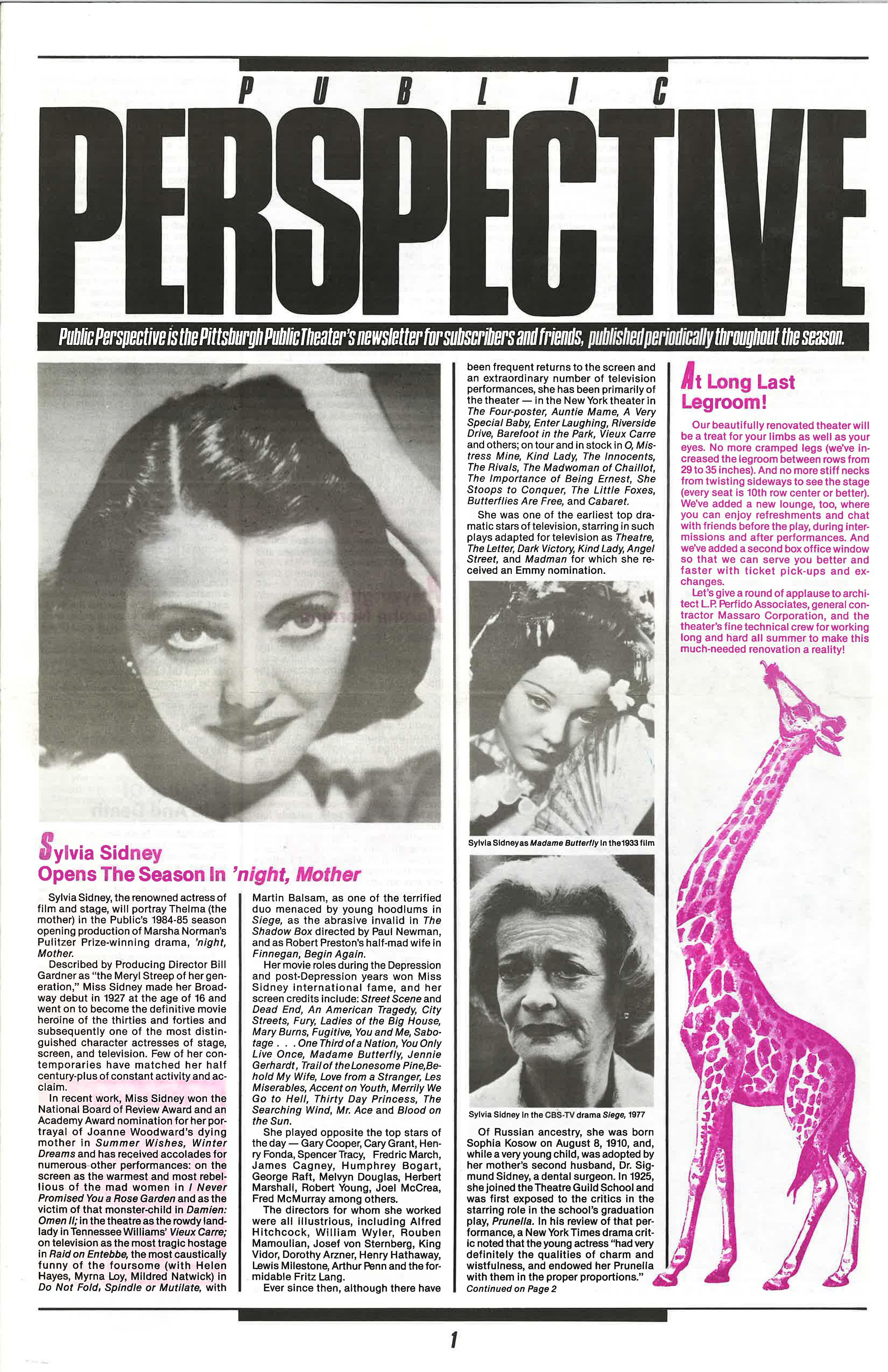
Sylvia Sidney Opens The Season In 'night, Mother
Sylvia Sidney, the renowned actress of film and stage, will portray Thelma (the mother) in the Public's 1984-85 season opening production of Marsha Norman's Pulitzer Prize-winning drama, 'night, Mother.
Described by Producing Director Bill Gardner as "the Meryl Streep of her generation," Miss Sidney made her Broadway debut in 1927 at the age of 16 and went on to become the definitive movie heroine of the thirties and forties and subsequently one of the most distinguished character actresses of stage, screen, and television. Few of her contemporaries have matched her half century-plus of constant activity and acclaim.
In recent work, Miss Sidney won the National Board of Review Award and an Academy Award nomination for her portrayal of Joanne Woodward's dying mother in Summer Wishes, Winter Dreams and has rec,eived accolades for numerous-other performances: on the screen as the warmest and most rebellious of the mad women in I Never Promised You a Rose Garden and as the victim of that monster-child in Damien: Omen II; in the theatre as the rowdy landlady in Tennessee Williams' Vieux Carre; on television as the most tragic hostage in Raid on Entebbe, the most caustically funny of the foursome (with Helen Hayes, Myrna Loy, Mildred Natwick) in Do Not Fold, Spindle or Mutilate, with
Martin Balsam, as one of the terrified duo menaced by young hoodlums in Siege, as the abrasive invalid in The Shadow Box directed by Paul Newman, and as Robert Preston's half-mad wife in Finnegan, Begin Again.
Her movie roles during the Depression and post-Depression years won Miss Sidney international fame, and her screen credits include: Street Scene and Dead End, An American Tragedy, City Streets, Fury, Ladies of the Big House, Mary Burns, Fugitive, You and Me, Sabotage One Third of a Nation, You Only Live Once, Madame Butterfly, Jennie Gerhardt, Trail of the Lonesome Pine,Behold My Wife, Love from a Stranger, Les Miserables, Accent on Youth, Merrily We Go to Hell, Thirty Day Princess, The Searching Wind, Mr. Ace and Blood on the Sun.
She played opposite the top stars of the day - Gary Cooper, Cary Grant, Henry Fonda, Spencer Tracy, Fredric March, James Cagney, Humphrey Bogart, George Raft, Melvyn Douglas, Herbert Marshall, Robert Young, Joel McCrea, Fred McMurray among others.
The directors for whom she worked were all illustrious, including Alfred Hitchcock, William Wyler, Rouben Mamoulian, Josef von Sternberg, King Vidor, Dorothy Arzner, Henry Hathaway, Lewis Milestone, Arthur Penn and the formidable Fritz Lang.
Ever since then, although there have
Sidney In the C BS -TV drama Siege, 1977
Of Russian ancestry, she was born Sophia Kosow on August 8, 1910, and, while a very young child, was adopted by her mother's second husband, Dr. Sigmund Sidney, a dental surgeon. In 1925, she joined the Theatre Guild School and was first exposed to the critics in the starring role in the school's graduation play, Prune/la. In his review of that performance, a New York Times drama critic noted that the young actress "had very definitely the qualities of charm and wistfulness, and endowed her Prunella with them in the proper proportions."
Continued on Page 2
This led to leading roles on Broadway in Gods of the Lightening, Many a Slip, Nice Woman, and Mirrors, as well as to stock engagements in Denver and Rochester. During this period she made one film appearance in Thru Different Eyes but, unhappy with the experience, returned to Broadway to play Dot in Bad Girl. Her triumph provoked another call from Hollywood, this time from the brilliant Rouben Mamoulian to replace Clara Bow opposite Gary Cooper in City Streets. And the rest , as they say, is history.
Miss Sidney's first marriage, to publisher Bennett Cerf in 1935, was dissolved eight months later. On August 15, 1938, she married Luther Adler, the actor, by whom she has one son, Jacob ("Jody"). The couple was divorced in 1946. A third marriage, to Carlton Alsop, the publicist, in 1947, also ended in divorce. Since the mid-1970's, when her son contracted amyotrophic lateral sclerosis (popularly known as "Lou Gehrig's disease") Miss Sidney has been a dedicated volunteer for the National ALS Foundation. In 1981 she assembled the starstudded honorary committee for Byron Janis' ALS benefit concert at Carnegie Hall.
An expert needlepointer, Miss Sidney has written two best-selling books on the art: "The Sylvia Sidney Needlepoint Book" and "The Sylvia Sidney Question and Answer Book on Needlepoint."
She is even more famous in other circles for her breeding and exhibition of championship pugs. Each one, she feels , has a personality all his own, influenced by the signs of the zodiac.
Miss Sidney resides quietly in a century-old house in the Connecticut countryside, where she breeds her pugs, works on her needlepoint, reads a great deal and watches TV - anything except old Sylvia Sidney movies. She never sees them. Never.
Th e Q uotab l e
Sy lvia Sidney
"Those were the days when they used to pay me by the teardrop, and since I needed the money, I compromised and played the tragic heroine in a few duds."
"It was too much fame, too much stardom too soon. "
"I didn't leave Hollywood because of anybody but myself. I just got disgusted with myself. I didn 't know who I was, as an actress or a person."
"There isn't a role that I wouldn't accept, provided it's good and has something to say."
"You cannot be a leading lady unless you're tall."
"I wouldn't know what to do with myself if I retired."
"The role you're doing ought to be your favorite. If you don't like a part it's probably because you ' ve a feeling of inadequacy about it."
"I suppose fifteen is a rather early age to decide what you want to be. But I wanted so much to go on the stage. From my first consciousness of life, almost, I loved the theater. I wasn't stage struck in the sense that most youngsters are rather I felt somehow that in the theater one has a medium for the expression of beauty combining all other expressions of beauty, and that I would never be truly happy until I became identified with it."
"With a face like mine, of slightly Oriental cast, I always dreamed of playing an Oriental character."
"I was supposed to need handling then because I was inclined to be impatient with some of the trimmings surrounding stardom. I liked my independence and wanted to live my own life, and not be at the mercy of fan magazines, columnists and studio press agents. I was discontented with the shoddiness of many of my movies. And the small talk of Hollywood social life bored me. After I finished a movie I wanted to get back to New York where I could feel stimulated."
"I used to fight. Yes, it's true. I even used to throw telephone books and anything else I could get to at the time. Everything which didn't go smoothly annoyed me terribly. And I flew off the handle, and got myself greatly disliked. But now - well, now I keep my mouth shut, and my hands busy with knitting needles ."
" Prima donnas in anything are bad Having a child was a great leveling agent. Those babies couldn ' t care less that their parents were famous."
"Women who try to hide their age just call attention to it. Why lie about it? It's easier to be frank about it I've enjoyed every age in my life. I've never wanted to go back."
"I believe in reducing a part to basic emotions - and they haven' t changed • since drama began, and they won't If you start worrying about style in a play you create a lot of confusion you don t have to. Once you've got emotions analyzed , the playwright's lines almost automatically take care of particular style."
"My hands have always been fullwith play scripts, pugs, or canvases, and generally all three at once."
P1aywright Marsha Norman
by Stephen Berwind
" I am convinced that the fact that I am 5 feet 4 is a real factor in the way I view the world Eighty percent of the people on the planet are taller than I am I'm wandering around in this world of giants." The serious , petite young woman who views herself as inhabiting a world of giants is Marsha Norman, author of the Broadway hit and Pulitzer Prize-winning play, 'night, Mothe r Even in a world of giants, Marsha Norman demands our attention.
The eldest of four children born to Billie and Bertha Williams, Ms. Norman was born in Louisville, Kentucky, and grew up in a home dominated by her parents' fundamentalist religious beliefs. A lonely, sometimes isolated child, Ms. Norman was a diligent student, winning a scholarship to Agnes Scott College where she majored in philosophy When she was not attending classes or studying, she worked in the burn unit of an Atlanta hospital.
Returning to Louisville after graduation , her concern for what she calls the "least of our brethren" led her to take a job in the Children's Unit of Central State Hospital. Also during this time she married her former English teacher Michael Norman, whose name she still uses professionally. They are now divorced and she has has remarried.
Exhausted after two years at the hospital , she left to work with gifted children and write free-lance articles for the local paper and magazines. These years in Louisville brought a deep sense of isolation to Ms. Norman, which she feels allowed her the freedom to choose to do "whatever I wanted." And what she wanted to do was write for the theater. " I actually th i nk I'm incapable of [writing] anything other than drama," she said.
Her first play, Getting Out , was cowinner of the 1977 Actors Theatre of Lou i sville New Play Festival and it estab1ished Norman as a writer to be reckoned with. It displays many of what have become Norman trademarks: a sensitivity to her Kentucky regional heritage, a concern w i th the lyrically commonplace in ordinary lives, a commitment to honesty, and a dry sense of humor. The idea for the play was contained in Ms Norman 's memories of a 13 year-old girl she had encountered at Central State, a girl so violent that she seemed to bruise people
just by walking into a room. Ms. Norman tells us, "After Getting Out, I knew that the theater was where I belonged. I'd felt lost for my entire life before that. That's how the people I write about are, toothey're trying to figure out what they should do But once they figure it out, there's no stopping them."
Ms. Norman's next few plays, although not regarded as up to the level of her ti rst success, nonetheless exhibited moments of exquisite detail and reflected her continuing concern with thwarted dreams and derailed lives. It was during this period that she met and married Dann Byck, Jr., a successful Louisville retailer and a founder and first president of Actors Theatre. In 1981, ti •;e Bycks moved to New York City when Dann decided to become a theatrical producer There Ms Norman wrote 'night, Mother.
At one point in the writing of 'night, Mother, Ms. Norman hit an impasse, so she phoned Anne Pitoniak and Kathy Bates, two actors she had known from Louisville. She asked them to come to her apartment and read the play aloud. Ms. Bates remembers , " It was a cold reading, but there wasn't anything cold about it. I fe~t that we had read something profound." Moved by their reactions Ms Norman continued working with the two actresses as she revised the play during a series of readings at Circle Repertory Company. From there the play was first produced by the American Repertory Theater in Cambridge, Mass., then moving on to Broadway where it received critical acclaim and advanced Norman into the front ranks of contemporary American dramatists.
Since then Ms. Norman has had a production of her newest play Traveler in the Dark, at the American Repertory Theater where it received a mixed critical reaction. Her current project is The Shakers, a musical based on the Shaker religious sect. She tells us she admires the Shakers' "commitment to excellence, their sacrifice for design, which is what I think I do in my own life."
When reflecting on the possible effect of her own success, Ms. Norman talks of her hope that she may serve as a rolemodel for those who fol low her She also offers this challenge : "To any twelve-year old who wants to wr i te I want to say, 'There is a place for you in the American theater. Now come get it!' " That is a challenge that Marsha Norman continues to meet.
AM atter Of Life And Deat h
The Public 's Tenth Anniversary Season opening production, the Pulitzer Prize-winner 'night, Mother by Marsha Norman, is a play with deep and serious intent. Two women - Thelma, an unremarkable widow, and Jessie, her divorced and equally unremarkable daughter - constitute the cast. The setting is an ordinary home somewhere in middle-America on a seemingly ordinary Saturday night.
As the play begins, Jessie prepares to perform her weekly ritual of giving her mother a manicure It is an evening like any other until - calmly, almost as a throwaway line - Jessie says, "I'm going to kill myself, Mama." And over the next 90 wrenching minutes that are counte d by the kitchen clock on stage and on our own watches, Mama - and the rest of us - must face the fact that she is not kidding.
by Mars a Norman Ptev ew S ptember 25,0c ober 2 Opening Oc ober 3 Flnal pe ormance October 28 Cast Thelma Cate SyMa e slecat s. ~•
Directed by Pllter S.n L ghttn gner 1Clr1cll erOa,y Co n rFloza rRoy t lnformat , taJI the Box Offlc at (412 32 -
Critics On 'night, Mother
"a shattering evening" Frank Rich, The New York Times
"Marsha Norman's profound achievement" Frank Rich, The New York Times
"the best American play of the year" Jack Kroll, Newsweek
"theater at its most moving. moving, shattering, devastating," Ed Blank, The Pittsburgh Press
"a rich theatrical experience" Christopher Rawson, The Pittsburgh Post-Gazette
"written with excruciating honesty" Kate Stout, Saturday Review
"one of the compelling experiences of a lifetime," Ed Blank, The Pittsburgh Press
"diamond sharp and expressive" Douglas Watt, The Daily News
"filled with remarkable insights" Edwin Wilson, The Wall Street Journal
"deliversajolt" Howard Kissel, Women's Wear Daily
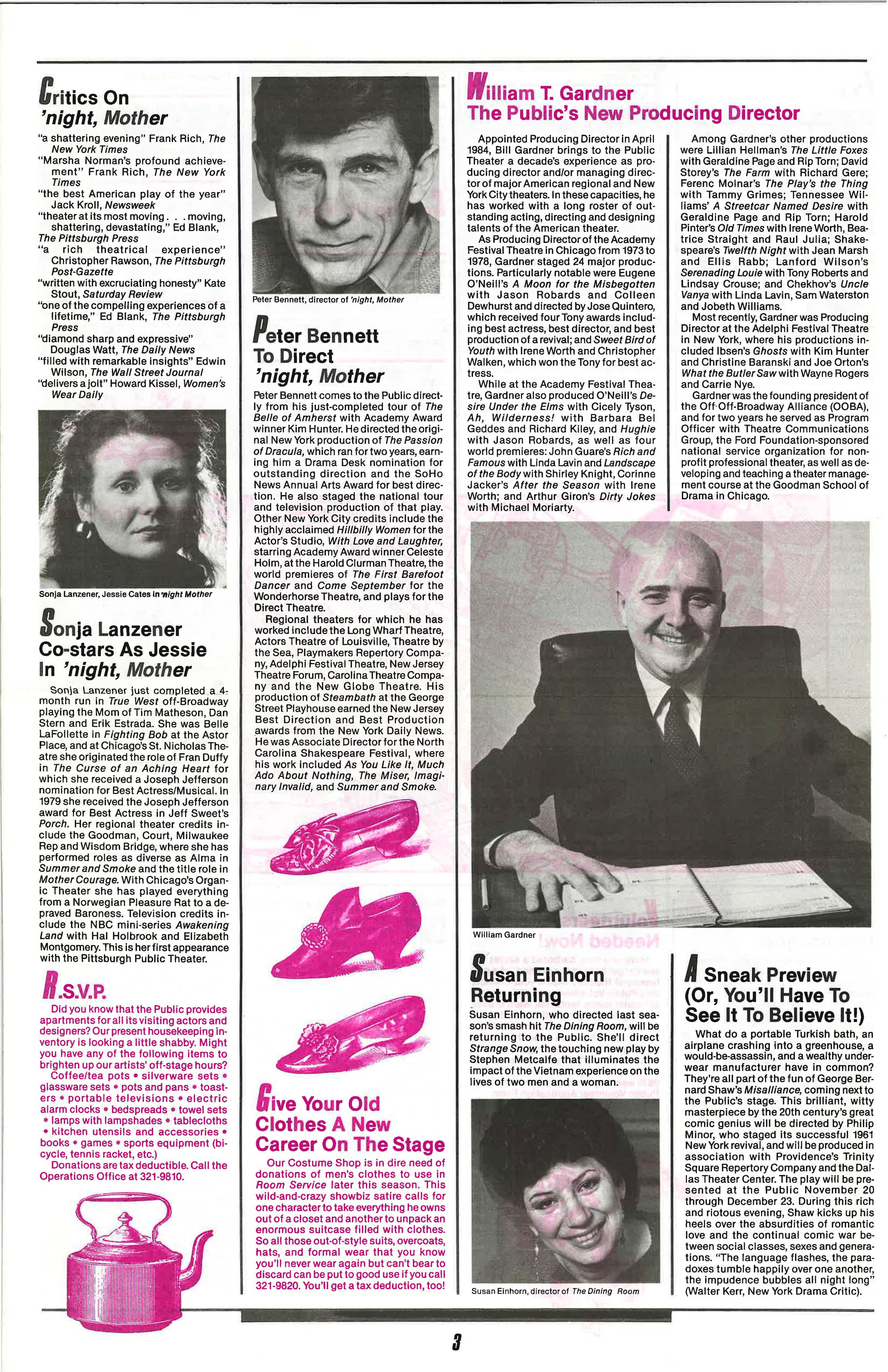
Sonja Lanzener
Co-stars As Jessie I n 'night, Mother
Sonja Lanzener just completed a 4, month run in True West off-Broadway playing the Mom of Tim Matheson, Dan Stern and Erik Estrada. She was Belle LaFollette in Fighting Bob at the Astor Place, and at Chicago's St. Nicholas Theatre she originated the role of Fran Duffy in The Curse of an Aching Heart for which she received a Joseph Jefferson nomination for Best ActresslMusical. In 1979 she received the Joseph Jefferson award for Best Actress in Jeff Sweet's Porch. Her regional theater credits include the Goodman, Court, Milwaukee Rep and Wisdom Bridge, where she has performed roles as diverse as Alma in Summer and Smoke and the title role in Mother Courage. With Chicago's Organic Theater she has played everything from a Norwegian Pleasure Rat to a depraved Baroness. Television credits include the NBC mini-series Awakening Land with Hal Holbrook and Elizabeth Montgomery. This is her first appearance with the Pittsburgh Public Theater.
1.s .V.P.
Did you know that the Public provides apartments for all its visiting actors and des igners? Our present housekeeping inventory is looking a little shabby. Might you have any of the following items to brighten up our artists' oft-stage hours?
Coffeelte a pots • silverware sets • glassware sets • pots and pans • toasters
• portable televisions
• electric alarm clocks • bedspreads • towel sets
• lamps with lampshades • tablecloths
• kitchen utensils and accessories
• books • games • sports equipment (bicycle , tennis racket , etc.)
Donations are tax deductible Cal I the Operations Office at 321-9810
Peter Bennett To Direct 'night, Mother
Peter Bennett comes to the Public directly from his just-completed tour of The Belle of Amherst with Academy Award winner Kim Hunter. He directed the original New York production of The Passion of Dracula, which ran for two years, earning him a Drama Desk nomination for outstanding direction and the SoHo News Annual Arts Award for best direction. He also staged the national tour and television production of that play. Other New York City credits include the highly acclaimed Hillbilly Women for the Actor's Studio, With Love and Laughter, starring Academy Award winner Celeste Holm, at the Harold Clurman Theatre, the world premieres of The First Barefoot Dancer and Come September for the Wonderhorse Theatre, and plays for the Direct Theatre.
Regional theaters for which he has worked include the Long Wharf Theatre, Actors Theatre of Louisville, Theatre by the Sea, Playmakers Repertory Company, Adelphi Festival Theatre, New Jersey Theatre Forum, Carolina Theatre Company and the New Globe Theatre. His production of Steambath at the George Street Playhouse earned the New Jersey Best Direction and Best Production awards from the New York Daily News. He was Associate Director for the North Carolina Shakespeare Festival, where his work included As You Like It, Much Ado About Nothing, The Miser, Imaginary Invalid, and Summer and Smoke.
lfilli a m T. Gardn er Th e P u bli c's New
Produc i ng Director
Appointed Producing Director in April 1984, Bill Gardner brings to the Public Theater a decade's experience as producing director and/or managing director of major American regional and New York City theaters. In these capacities, he has worked with a long roster of outstanding acting, directing and designing talents of the American theater.
As Producing Director of the Academy Festival Theatre in Chicago from 1973 to 1978, Gardner staged 24 major productions. Particularly notable were Eugene O'Neill's A Moon for the Misbegotten with Jason Robards and Colleen Dewhurst and directed by Jose Quintero, which received four Tony awards including best actress, best director, and best production of a revival; and Sweet Bird of Youth with Irene Worth and Christopher Walken, which won the Tony for best actress.
While at the Academy Festival Theatre, Gardner also produced O'Neill's Desire Under the Elms with Cicely Tyson, Ah, Wilderness! with Barbara Bel Geddes and Richard Kiley, and Hughie with Jason Robards, as well as four world premieres: John Guare's Rich and Famous with Linda Lavin and Landscape of the Body with Shirley Knight, Corinne Jacker's After the Season with Irene Worth; and Arthur Giron's Dirty Jokes with Michael Moriarty.
Among Gardner's other productions were Lillian Hellman's The Little Foxes with Geraldine Page and Rip Torn; David Storey's The Farm with Richard Gere; Ferenc Molnar's The Play's the Thing with Tammy Grimes; Tennessee Williams' A Streetcar Named Desire with Geraldine Page and Rip Torn; Harold Pinter's Old Times with Irene Worth, Beatrice Straight and Raul Julia; Shakespeare's Twelfth Night with Jean Marsh and Ellis Rabb; Lanford Wilson's Serenading Louie with Tony Roberts and Lindsay Crouse; and Chekhov's Uncle Vanya with Linda Lavin, Sam Waterston and Jobeth Williams.
Most recently, Gardner was Producing Director at the Adelphi Festival Theatre in New York, where his productions included Ibsen's Ghosts with Kim Hunter and Christine Baranski and Joe Orton's What the Butler Saw with Wayne Rogers and Carrie Nye.
Gardner was the founding president of the Off Off-Broadway Alliance (OOBA), and for two years he served as Program Officer with Theatre Communications Group, the Ford Foundation-sponsored national service organization for nonprofit professional theater, as well as developing and teaching a theater management course at the Goodman School of Drama in Chicago.
Gi ve Yo u r O ld C lot h es A N e w
Career O n Th e Stage
Our Costume Shop is in d i re need of donations of men's clothes to use in Room Service later th i s season. This wild-and-crazy showbiz satire calls for one character to take everything he owns out of a closet and another to unpack an enormous suitcase filled with clothes. So all those out-of-style suits, overcoats, hats, and formal wear that you know you'll never wear again but can't bear to discard can be put to good use if you call 321-9820. You'll get a tax deduction , too!
Susan Einhorn _Returning
Susan Einhorn, who directed last season's smash hit The Dining Room, will be returning to the Public. She'll direct Strange Snow, the touching new play by Stephen Metcalfe that illuminates the impact of the Vietnam experience on the I ives of two men and a woman.
(Or, You'll Have To See It To
What do a portable Turkish bath, an airplane crashing into a greenhouse, a would-be-assassin, and a wealthy underwear manufacturer have in common?
They're all part of the fun of George Bernard Shaw's Misalliance, coming next to the Public's stage. This brilliant, witty masterpiece by the 20th century's great comic genius will be directed by Philip Minor, who staged its successful 1961 New York revival, and will be produced in association with Providence's Trinity Square Repertory Company and the Dallas Theater Center. The play will be presented at the Public November 20 through December 23. During this rich and riotous evening, Shaw kicks up his heels over the absurdities of romantic love and the continual comic war between social classes, sexes and generations. "The language flashes, the paradoxes tumble happily over one another, the impudence bubbles all night long" (Walter Kerr, New York Drama Critic).
Box Office Hours
Mondays 10:00 a.m. to 5:30 p.m.
Tuesdays thru 10:00 a.m. to 9:00 p.m.
Fridays
Saturdays 12 noon to 9:00 p.m.
Sundays 12 noon to 8:00 p.m.
Holiday hours may vary.
Performance Schedule
Tuesday thru Sunday evenings
Sunday and alternating Saturday and Thursday matinees
Curtain Times
Tuesday thru Saturday evenings
Sunday evenings
Matinees
Single Ticket Prices
Opening (Wed. eve.)
Tues.-Wed.-Thurs.-Sun. eve. Fri.-Sat. eve.
Thurs.-Sat.-Sun. matinee
Preview Fri.-Sat. eve. 15.50
Preview Sun. matinee 11.00
Student and senior citizen ½ price discounts are available 30 minutes before curtain time (if the performance is not sold-out) with valid identification.
Group Rates
Special discounts of up to 50% off regular ticket prices are available for groups of 20 or more. Contact Pat Hart at (412) 323-8200 for more information and assistance in planning your group outing.
Can't Make It? Too Late to Exchange? Take a Tax Deduction! If you find you are unable to attend a performance and cannot exchange your tickets, you may take a tax deduction for the amount paid for each ticket not used. Just release your tickets for resale by calling the Box Office as soon as possible but as late as curtain time on the day of performance and give your name and seat location. Your seats can then be sold to someone else. The result? A tax deduction for you, a full house for us, and no turns.ways at the box office. How to Obtain Single Tickets
1 In person at the Box Office
2. By mail. Enclose payment, note performance desired, include name, address, telephone number and a stamped self-addressed envelope. Mail to: Pittsburgh Public Theater Box Office, One Allegheny Square, Pittsburgh, PA 15212.
3. By telephone, You may charge single tickets to your American Express, MasterCard, or Visa accounts by calling the Box Office at (412) 321-9800.
Choice Subscriber Seats Still Available
Call today and get your order in before all the best sea1s are gone for the season. Call our Subscriber Hotline (412) 3219805 - Mon.-Fri. - 11:00 a.m.-5:00 p.m.
Please have your credit card ready. Save up to 60% over single ticket prices
Coming Up N ext
November 20-December 23
Misalliance by George Bernard Shaw
A brilliant, witty masterpiece by the 20th century's great comic genius. Shaw kicks up his heels over the absurdities of romantic love and the continual comic war between social classes, sexes and generations.
January 8-February 10
Strange Show by Stephen Metcalfe
A tender-hearted and strong comedydrama by one of America's exciting young playwrights. During a turbulent and sometimes humorous reunion, two Vietnam veterans and the sister of one come to terms with their memories of the war, with themselves and with love
February 26-March 31
Room Service by John Murray and Allen Boretz
This outrageously hilarious romp is one of America's best showbiz satires. Araucous, whiz-bang farce with a zany cast of characters and no-holds-barred laughter.
April 16-May 19
Becoming Memories by Arthur Giron
Te nt h An niversary C ha mp agne!
Join us in celebrating our 10th year and newly renovated theater with a glass of champagne se lected by Peter Machamer. Sample Peter's selection at the bar in our new lounge - where cocktails, beer, wine, juice, coffee, and candy are also available.
lave Your Ni g htca p Wi t h Us!
Our delightful new lounge, with a newly-built bar, is open after the performance is over, as well as during intermissions and before curtain time. So linger a while with friends and have your nightcap in the afterglow of a great Public performance
Pre-Order
With Panache!
Avoid congested concessions lines at intermission by pre-ordering your refreshments before curtain time. Place and pay for your order in the lounge upon arrival; it'll be ready and waiting in the lobby at Intermission.
Volun teers N eed e d Now !
Have you long harbored a secret desire to "get behind the scenes" of a professional theater? Now's your chance! Be a Public Volunteer and fulfill a variety of theater-lovers' fantasies. Want to peek in on Opening Night parties? Meet an actor "up close?" Help out in the Gift Shop or the administrative office? Or enjoy Season 10 from the vantage point of a Volunteer Usher? Whatever your inclination, we can use your help now. Call 3219810 weekdays between 9 and 5 for your Public Volunteer Application Form.
Pittsburgh Public Theater One Allegheny Square Pittsburgh, Pennsylvania 15212-5318
Editor: Lloyd Carter
Designer: Michael Neill
Producing Director: William T. Gardner
This extraordinary new play is a loving look at the American past, in the tradition of Quilters and The Dining Room. Based on authentic family histories of the early 20th century, here's a warm and passionate tribute to courtship and marriage.
June 4-July 7
Spectacular Finale To Be Selected
An exciting production of a world classic, or a colorful musical, or a new American play. We're talking to some of America's ff nest actors, directors and playwrights in order to present the best possible choice forourTen tfl Anniversary Finale.
The Public Theater is located in Allegheny Center on the North Shore of the Allegheny River, just across the 6th and 7th Street Bridges from downtown Pittsburgh. In addition to adjacent street parking, convenient indoor parking is avai Iable below the Allegheny Center enclosed shopping mall (use Entrance #3 or #4).Bus transportation to the Public is av·ailable via Route 16D Woods Run from downtown and 54C from Oakland.
Special ACCESS Transportation For Senior Citizens Or Disabled Patrons
You can easily travel round trip between your home and the Pittsburgh Public Theater by taxi , special mini-bus or van (with hydraulic lift for wheelchairs). If you're a senior citizen, or disabled, please call ACCESS at 562-5353. Regina Lackner will give you details and ar range for your special ACCESS transportation tickets at a 90% discount price.