S
wimming is a sport most enjoy the world over, whether for fun or exercise, the immersion in water is something we consider vital in the hot Texas summer. For one Texas swimmer, the sport is something even more special. Jan Miller, of Gatesville, has been swimming most of her life. She began swimming as most of us do, taking lessons as a child to equip herself with the required skills for the pastime. However, once a neighborhood boy challenged her to a swim race, swimming began to take a different meaning. Determined not to let the neighborhood boy beat her, she looked at her lessons with a more competitive eye. This lesson in determination paid off, not only because she beat her first adversary, but also because it incited a life of competitive swimming. As a child, her swim coach immediately noticed her potential commenting on what a natural born swimmer she was. With the support of her mother, she joined a local swim club in her home state of California. Jan would go on to swim through high school, swimming for Sierra High School, in Whittier, California. It was during this time that Jan won her first All-American Award. Competitive swimmers are awarded an All-American Award when considered to be the best in the nation for that event. Upon attending the 1966 Sierra High School athletic banquet, Jan received her first National All-American Award. She quickly realized she
26 Our Hometowns | Volume 1 Issue 2
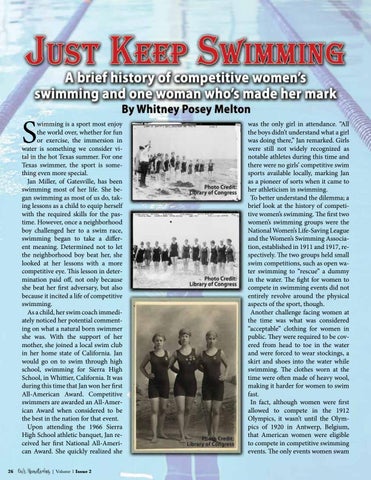
was the only girl in attendance. “All the boys didn’t understand what a girl was doing there,” Jan remarked. Girls were still not widely recognized as notable athletes during this time and there were no girls’ competitive swim sports available locally, marking Jan as a pioneer of sorts when it came to her athleticism in swimming. To better understand the dilemma; a brief look at the history of competitive women’s swimming. The first two women’s swimming groups were the National Women’s Life-Saving League and the Women’s Swimming Association, established in 1911 and 1917, respectively. The two groups held small swim competitions, such as open water swimming to “rescue” a dummy in the water. The fight for women to compete in swimming events did not entirely revolve around the physical aspects of the sport, though. Another challenge facing women at the time was what was considered “acceptable” clothing for women in public. They were required to be covered from head to toe in the water and were forced to wear stockings, a skirt and shoes into the water while swimming. The clothes worn at the time were often made of heavy wool, making it harder for women to swim fast. In fact, although women were first allowed to compete in the 1912 Olympics, it wasn’t until the Olympics of 1920 in Antwerp, Belgium, that American women were eligible to compete in competitive swimming events. The only events women swam