8
WHY FINLAND
from the one-size-fits-all approach of today. “Tomorrow, when a patient comes to a clinic with certain symptoms, instead of performing the traditional run of expensive tests, we will simply use genome sequencing to identify the mutant genotypes responsible for the disorder,” predicts Tyynismaa. This is what is called personalised medicine: an approach that emphasises the uniqueness of each patient’s particular disease risks.
While genomic diagnostic methods are advancing rapidly, a vast amount of work still needs to be done before DNA sequencing can be applied routinely to deliver targeted cures for individual patients. “But every time we identify a disease gene, we understand a little bit more about the underlying mechanisms. This doesn’t translate directly into treatments yet, but there have been cases where we have been able to offer suggestions – for instance we can target a known pathway with an
“OUR EXPERIENCE WITH RARE DISEASES WILL HELP US SOLVE THE MYSTERIES OF THE COMMON ONES.”
existing drug. These cases are rare, but it’s a promising start,” she says. DNA TREASURE TROVE Tyynismaa believes Finland has the potential to become a global leader in genomic diagnostics. “But we have to convince policymakers that it’s a cost-effective option,” she says. A clear advantage for Finland – in addition to being an established forerunner in genetic research – is its wellorganised healthcare system. “Luckily people in Finland are very willing to participate in genetic studies,” says Tyynismaa. Another goldmine for medical researchers is Finland’s unique gene pool. “It’s very limited, and we have specific diseases that aren’t present anywhere else, which is excellent for research. There has been lots of overseas interest in Finnish biobanks,” she says. GENETIC DESTINY With quiet determination, Tyynismaa has steadily risen to the forefront of her field. After publishing an award-winning PhD, she secured a position at Helsinki University as post-doctoral research fellow, followed by tenure as academy research fellow, being the first ever to hold the two positions simultaneously – and all before turning 40.
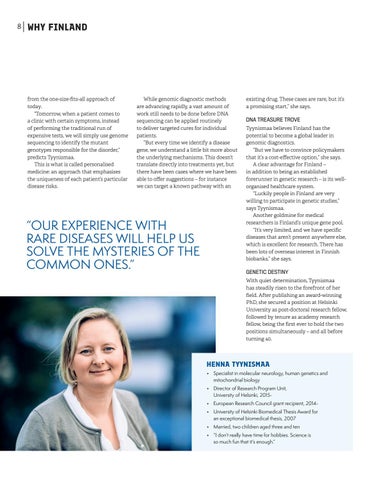
HENNA TYYNISMAA • Specialist in molecular neurology, human genetics and mitochondrial biology • Director of Research Program Unit, University of Helsinki, 2015• European Research Council grant recipient, 2014• University of Helsinki Biomedical Thesis Award for an exceptional biomedical thesis, 2007 • Married, two children aged three and ten • “I don’t really have time for hobbies. Science is so much fun that it’s enough.”