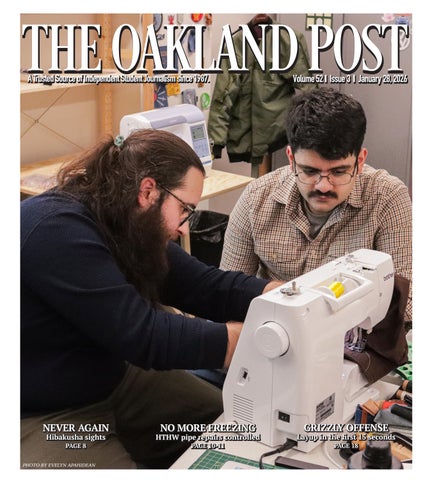
A Trusted Source of Independent Student Journalism since 1987. NO MORE FREEZING HTHW pipe repairs controlled PAGE 10-11
Volume 52 l Issue 3 | January 28, 2026
GRIZZLY OFFENSE
Layup in the first 15 seconds PAGE 18 NEVER AGAIN Hibakusha sights PAGE 8
PHOTO BY EVELYN APAHIDEAN
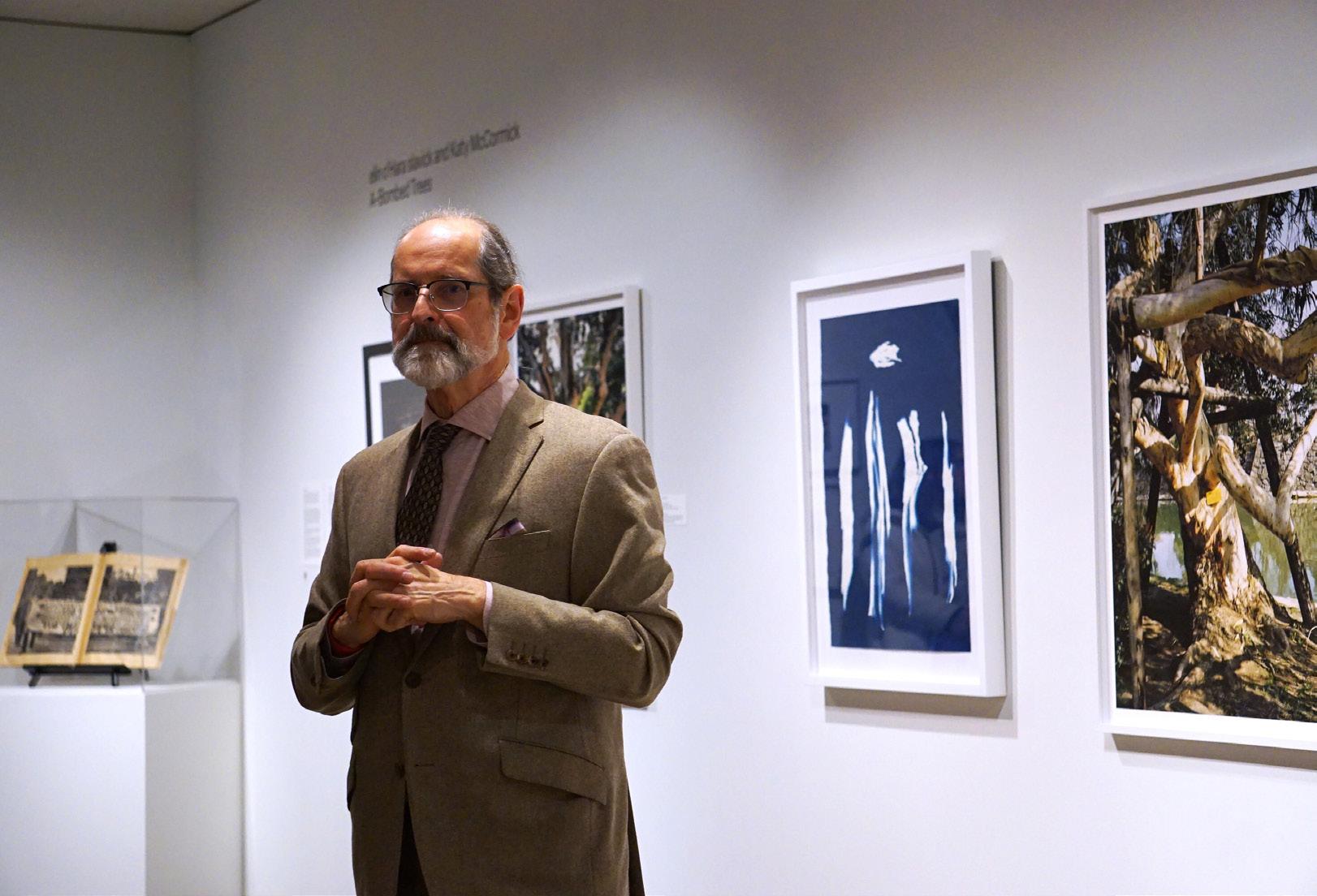
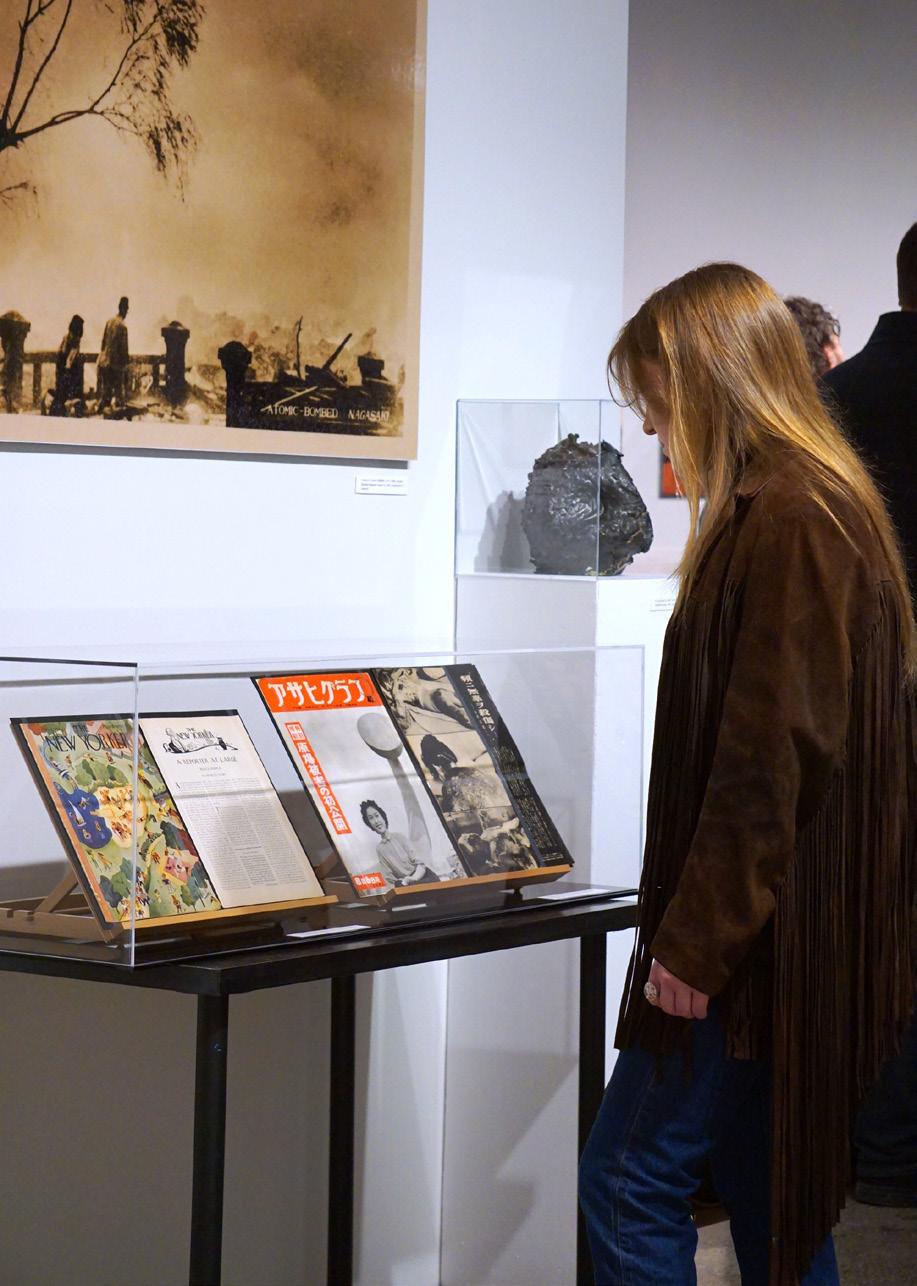
CLAUDE BAILLARGEON. The memory of Hiroshima and Nagasaki, currently delineating the sights of OU’s Art Gallery, commemorates the 60,000 killed and more than 200,000 survivors of the atomic bombing.
PHOTO BY LILIANA ROSE VALENZ
oaklandpostonline.com
COPY & VISUAL
Evelyn Apahidean Photographer
Claire Sanderlin Photographer
Jacob Schmidt Photographer
Matthew Vigelius Photographer
O’Hara Diamond Graphic Designer
Anna Friedrich Graphic Designer
Ava Guest Graphic Designer
Dylan Hecker Graphic Designer
REPORTERS
Alexa Dudek
Michael Gordon
Matthew Lewakowski
Maria Magnoli
Andrew May
Maryam Moss
Mike Okoronkwo
Matilde Rabajoli
Maddie Short
EDITORIAL BOARD
Adrian Jimenez Morales Editor-in-Chief ajimenezmorales@oakland.edu
Don Ritenburgh Business Adviser ritenbur@oakland.edu
248.370.2533
Why students chose Oakland University
JENNIFER THOMASMA Campus Reporter
From academics to affordability, students at Oakland University said a range of factors influenced their decision to attend. While each student’s path looks different, many described choosing OU as a decision rooted in support and practicality rather than prestige. For these students, Oakland represented a place that met their needs rather than a name alone.
For senior Tasia Little, who is majoring in criminal justice and art history, Oakland became an option during an unexpected transition. Little began her college career at Wayne State University, commuting from Flint to Detroit after graduating high school at 17. After her first year, changes to her financial aid eligibility reduced the assistance she received, leaving her unable to afford continuing at Wayne State.
With the semester approaching, Little said she had limited time to find a university that would accept her credits and allow her to continue both majors. Oakland stood out as the only option that met those needs, offering both programs and a later semester start date. The timing allowed her to apply, meet with an adviser and register for classes without delaying her education.
Since Oakland serves many commuter and transfer students, Little said the university was accommodating throughout the transfer process.
“Because Oakland is a mostly commuter school and they have a lot of transfers, they were really good about my credits transferring over,” Little said.
She said that support made a stressful transition
more manageable.
Although adjusting to a smaller campus and a different curriculum was challenging, Little said she appreciated the more personal classroom environment. Smaller class sizes made it easier to build relationships with professors and classmates.
“I got to know my teachers and I got to know the people in my class. It wasn’t so impersonal,” Little said.
For freshman engineering major Juliana Prange, the decision centered on campus environment and community.
Prange said she toured several engineering schools across Michigan before deciding Oakland felt like the right fit.
After visiting campuses she described as overly industrial, Oakland’s open spaces and greenery stood out.
“I needed somewhere green,” Prange said. “A lot of the engineering schools I looked at were just concrete. I wanted trees and open space.” Prange, who lives on campus, said being able to walk to class and spend time outdoors helped ease her transition into college life.
Prange also said the campus community has played a major role in her experience so far.
“The community here is so welcoming and so diverse,” Prange said. Although her first semester was academically challenging, she said campus resources and peer support helped her adjust. “There’s so much help here. You just have to ask,” she said.
For senior Samantha Perlick, a criminal justice major, the decision to attend Oakland came down to academic fit and location. After researching programs, Perlick said OU’s criminal justice program stood out as a strong match.
“I researched all the criminal justice programs and I found that this one would be a good fit,” Perlick said.
Now nearing graduation, Perlick said her experience has largely matched her expectations. While transitioning from community college to a university setting was challenging, she credited faculty support for helping her succeed.
“University is a little bit harder than community college, but all the professors were amazing,” Perlick said.
Although their reasons varied, each student described choosing Oakland as a decision shaped by real-life needs. Whether driven by financial realities, academic programs or campus environment, their stories reflect how students weigh one of the biggest decisions of college. For many, Oakland represented a place that felt possible, not just impressive.
Keeper of the Dream celebration: How far have we come?
ADRIAN JIMENEZ MORALES Editor-in-Chief
Reflecting on the question “How far have we come?” Oakland University hosted its 34th annual Keeper of the Dream scholarship celebration on Jan. 19. The event honored the legacy of Dr. Martin Luther King Jr. while recognizing students who embody his vision. Surrounded by family and community members, seven Golden Grizzlies were recognized for advancing equity and unity on campus.
The celebration, organized by the Center for Multicultural Initiatives (CMI), recognized students who have contributed to interracial understanding and goodwill. The ceremony also inaugurated African American Celebration Month at OU.
Student body president Marcus Johnson was among the Keeper of the Dream (KOD) recipients recognized beyond OU’s campus. Johnson has established initiatives such as establishing VOICE committees for underrepresented minority students and increasing support for commuter students. His leadership reflects a commitment to inclusive student representation.
“Words can’t express how I feel, I’m just illuminated with joy, proud, grateful,” Darryl Jason Emerson, Johnson’s father, said. “He retained a lot of his education, his brilliance, his wisdom, his knowledge from his mother.”
KOD recipient Jaliyah Eaton also drew inspiration from her family. Eaton said her grandmother, Inez Williams, shaped her commitment to breaking down cultural barriers. Williams’ example motivated Eaton to advocate for unity and compassion on campus.
As an admissions programming assistant, orientation group leader and CMI peer mentor, Eaton supports underrepresented
students throughout their academic journeys. She works with students from recruitment through campus involvement. Her efforts focus on creating access and belonging.
Also a CMI peer mentor, Mercy Jeffries was awarded at the ceremony for her academic excellence and leadership in the Department of Dance. Jeffries was recognized by Dance Chair Gregory Patterson. She was also honored by Mae Dennis, assistant director of Orientation and New Student Programs, for setting an example of excellence at OU.
Nursing major Treasure Golden was also named a Keeper of the Dream recipient. Golden said her experiences in predominantly white spaces motivated her to create inclusive environments. Her leadership centers on ensuring students feel seen and supported.
Golden holds several leadership roles, including chair of the Empower Our Families Initiative and member of OU’s NAACP Reorganization Committee. She also serves as chair of the Charter Committee for the National Council of Negro Women. Through these roles, Golden has worked to promote equity and fair treatment across campus.
Mechanical engineering student Jayson Miller was also honored as a Keeper of the Dream recipient. According to his mother, Kisha Martin, Miller’s journey reflects perseverance and growth. Miller is a leader in the CMI and the Honors College.
“He did not want to go to school, he was mad at me for dropping him off at preschool, and then look what he did,” Martin said. “I was so excited, I was surprised, I was honored, shocked. I’m proud of him.” She expressed pride in Miller’s academic success and leadership.
Honors College student Qamar Naji also received the Keeper of the Dream scholarship. Naji is a member of the Alpha Lambda Delta Honors Society and is active on campus. Her involvement spans academic and service-based initiatives.
As an ECLIPSE scholar in the School of Health Sciences and a volunteer at OUCARES, Naji supports international students. She helps bridge cultural and language barriers. Her work focuses on fostering inclusion and access.
International scholar Mariem Samb was honored at the ceremony for her advocacy for women’s and children’s health. Through her involvement with the African Student Union, Samb has expanded multicultural engagement on campus. As an undergraduate researcher, she has also supported mothers in Ghana, fostering a sense of community at OU and beyond.
“We have really big role models, whether it is our parents, our grandparents…all those people really inspire us,” Fatoumata Samb, Mariem Samb’s sister and past Keeper of the Dream recipient, said. “They keep giving us strength and send us love, and today, we aspire to be role models for the leaders of tomorrow. I think that’s why we keep doing what we do.”
PHOTO BY ADRIAN JIMENEZ MORALES
PHOTO COURTESY OF OAKLAND UNIVERSITY
WXOU brings classic hits to campus with throwback Thursday
MICHAEL GORDON Campus Reporter
Music from the past reverberated through the Oakland Center at Oakland University on January 22 as the WXOU radio station hosted a Throwback Thursday event. The event invited students to enjoy classic music from a variety of genres along with food and a fun night centered on nostalgia and community. Songs from the 1970s, 1980s and 1990s filled the space throughout the evening. Organizers said the goal was to introduce students to older sounds while creating an inclusive environment for campus connection.
WXOU, broadcasting on 88.3 FM and nicknamed “the soundtrack of Oakland University,” is the university’s student-run radio station. In addition to on-air programming, the organization hosts musicrelated events throughout the year.
“We just love to come out here and show people love and music for real,” Justin Hayes, event coordinator for WXOU, said. “We’re trying to showcase older music. You’ve got people dancing, enjoying themselves and we’ve got food. It’s been going great.”
Hayes said the idea behind Throwback Thursday was to celebrate music across generations while giving students a break from academic stress. He added that the energy of the crowd made the event worthwhile.
Hayes said WXOU already has several upcoming events planned for the community, including a fitness-themed gathering at the Crofoot, a
venue in downtown Pontiac, and a three-on-three night in March focused on Detroit-style rap and performances. “We’ve got something going pretty much once a month,” he said.
In addition to music, the Throwback Thursday event featured food and a casual open-entry atmosphere in the Oakland Center that encouraged students to dance, socialize and enjoy the festivities. Organizers also included a costume contest inspired by different musical eras, with themed prizes awarded to standout participants.
WXOU leaders said events like Throwback Thursday align with the station’s mission of using music to bring students together and celebrate creativity on campus. Hayes said the station hopes to continue expanding its presence through inperson programming while remaining accessible to all students. “We love every type of music out here,” he said. “This is just another way to share that and build community.”
WXOU officially began broadcasting in 1967, a milestone often highlighted on the station’s T-shirts, stickers and other merchandise frequently given away around campus. Much of the music played during Throwback Thursday originated from an era when the station was not yet known as WXOU. At the time, it operated under earlier call signs such as WVW, WOU and WOUX while functioning as a carrier current station, which broadcasts through a building’s electrical wiring rather than over AM or FM frequencies.
The event served as a nod to those earlier decades, connecting students to musical styles that predated
Qamar Naji: Keeper of the dream
JENNIFER THOMASMA
Campus Reporter
Backstage at a campus cultural event during her freshman year, Qamar Naji noticed another student standing alone, preparing to represent her country.
Naji — who also goes by Luna to some students on campus — said she introduced herself and asked about the student’s traditional outfit. As more students gathered, Naji began switching between languages to explain the student’s culture to new friends.
“What started as silence and awkward glances of curiosity soon turned into a space where I tried to make differences learned about, understood, and celebrated rather than ‘tolerated,’” Naji said.
It is the kind of moment Naji aims to create across campus: one where people feel seen, understood and welcomed. That approach to service and inclusion earned her a Keeper of the Dream scholarship, which recognizes Oakland University students whose leadership helps break down racial and cultural stereotypes and promotes unity.
The Keeper of the Dream Scholarship Award was established in January 1993 and recognizes students who contribute to interracial understanding and goodwill. The program honors the legacy of the Rev. Martin Luther King Jr. and awards scholarships up to $10,000.
For Naji, the award brought both relief and validation.
“It represents hope — hope that our society is still fighting for equality and fairness against all forms of discrimination,” Naji said. “It assures me that the efforts that reflect the dream are valued, seen, and celebrated.”
Naji said she was “extremely nervous” opening the decision
letter and skimmed for key words before realizing she had been selected. Her first thought, she said, was to call her parents.
“I wanted them to be the first to know that their support and sacrifices throughout my freshman year were finally acknowledged,” Naji said. “This award affirmed that I am taking the right steps toward a path that aligns with how they raised me — to serve those in need, to stand up for fairness and to make a meaningful difference.”
Naji is a sophomore majoring in health science preprofessions. She said her campus involvement centers on inclusion and service, including volunteering weekly with OUCARES during the semester. She also helps with events through the Office for Student Involvement (OSI), serves as a student representative on a council that works with the provost’s office, and is the social media coordinator for OU’s Diverse Dental Society, a pre-dental club.
At OUCARES, Naji volunteers with the basketball program, helping participants with drills and ending sessions with a
PHOTO COURTESY OF QAMAR NAJI
WXOU’s transition to FM broadcasting and adoption of its current call sign in 1994. Students can stay up to date on future WXOU events by following the station on social media or visiting the WXOU room on the lower floor of the Oakland Center near the Grizz Den. WXOU broadcasts on 88.3 FM.
coaches vs. players game. She said she measures impact through small moments — a participant trying something new, building confidence, or celebrating a success.
One day, she arrived a few minutes late while sick and learned participants had been asking about her.
“I was proud to know that I managed to create a warmer atmosphere for them that they missed,” Naji said, adding that some participants have nicknamed her “Princess Pearl.”
Naji said she previously served on the e-board for the Arabic Medical Terminology Society, where she planned game nights featuring basic emergency room terminology in Arabic and English, along with study sessions intended to welcome students of different majors and backgrounds.
“I chose health care because I love helping others,” Naji said. “I want every patient to [be] seen as a person, not judged or treated differently because of their nationality, skin color or language barriers.”
Off campus, Naji volunteers at the Gary Burnstein Community Health Clinic, where she helps prepare rooms, set up dental exam trays, sanitize tools, welcome patients and record vital signs before treatment. She also assists during dental procedures and sometimes interprets for patients, she said, especially those from Middle Eastern backgrounds.
“Patients can usually communicate their case better in their native language,” Naji said.
Naji said her path at OU has included challenges, including financial difficulties and immigration restrictions that affected her ability to work and obtain a driver’s license. Still, she said she found support by asking questions and using campus resources — and she encourages other students to do the same.
“Do not give up if you feel like you know less,” Naji said. “Utilize campus resources because they are there for you. Start with OSI.”
PHOTO COURTESY OF WXOU
Jayson Miller named Keeper of the Dream Scholarship Recipient
MICHAEL GORDON Campus Reporter
Jayson Miller, a fourth-year student at Oakland University, has been named one of seven recipients of the university’s Keeper of the Dream Scholarship for the 34th annual celebration. The award is one of the institution’s most prestigious honors and recognizes leadership, service and commitment to the values of Dr. Martin Luther King Jr. The recognition highlights Miller’s contributions both on campus and in the surrounding community.
The scholarship honors students whose work extends beyond classroom activities and reflects a dedication to breaking down barriers and creating positive change. It recognizes involvement that reaches beyond academics and focuses on service and leadership. For Jayson, the recognition represents a meaningful milestone in his journey.
“This award means a lot to me because it shows that the work that I’m doing is being recognized,” Miller said. “It lets me know that the work I’m doing outside of just classes, breaking down cultural barriers, is really being seen.” He said the acknowledgment confirms that his efforts are making an impact.
Jayson said the scholarship shows his commitment to service and encourages him to continue his efforts. He noted that the recognition is not only personal but also serves as motivation. He said meaningful work can have a real and lasting impact.
“It motivates me to keep it going,” he said. “Just being able to get this recognition really means a lot.” He added that the encouragement pushes him to stay focused on his goals.
The Keeper of the Dream Scholarship is awarded annually to students who demonstrate academic excellence, leadership and service while embodying the legacy of Dr. King. Recipients are selected based on their contributions to equity, inclusion and community engagement at Oakland University. The selection criteria are outlined by the Center of Multicultural Initiatives Office according to its website statement.
Jayson Miller said the scholarship will play an important role in helping him pursue his academic and personal
goals. He believes that receiving support at this stage of his life allows him to continue building initiatives with longterm impact. The assistance provides him with additional motivation and opportunity.
“It’s definitely a big help to my life goals,” Miller said. “Being able to do the work now, I can start something at this young age and keep it going for a long time. I want to be a motivating factor for others to want to do the same thing and make an impact in their own unique way.”
Now entering his fourth year at the university, Miller said his journey has been shaped by perseverance and growth. He plans to continue his studies into a fifth year. He views the scholarship as a motivational tool to help him move forward.
“It’s been a long journey,” he said. “Staying motivated is what’s keeping me going, and the scholarship is going to help with that.” He said the recognition reinforces his determination to continue.
Miller also reflected on how his time at Oakland University has influenced his personal development. He said being on campus for several years helped him better understand himself and the community he wants to build. The experience has shaped his perspective and goals.
“I’ve learned a lot about myself and the people I want to surround myself with since I was a freshman,” he said. “It’s been a very unique experience, and I’m really happy with how things have turned out so far.”
Looking ahead, Miller said he is excited for what comes next. He hopes his journey can inspire other students to pursue leadership and service opportunities. He said he is ready to continue making an impact.
“I’m ready to see what’s next”.
Oakland University wins ‘Best PR for Good’ award
ADRIAN JIMENEZ MORALES Editor-in-Chief
As a Visiting Professor at Oakland University, Colleen Lafferty has already made a lasting impact on the campus community. Through collaboration with Grizz Recovery (GR), Lafferty provided students with hands-on public relations experience. For this, the Detroit Chapter of the Public Relations Society of America (PRSA) awarded Lafferty and her Winter 2025 PR-3410 class with the “2025 Best PR for Good” recognition.
Now supporting an assisted living company through her Advertising Agency Workshop course, Lafferty and her former students reflected on how service-based work shaped their education. The course emphasizes real-world application while addressing community needs. Students said the experience helped clarify their career goals.
“What I loved about it was the opportunity to gain reallife advertising experience with a local client,” creative writing major Angelina McGuire said.
McGuire participated in the PR-3410 course and said the experience influenced her professional direction.
“Since taking the class, my career goals have become more advertising-oriented. The course has also made me a stronger speaker, leader and above all, a better listener,” McGuire said.
The course, part of the PR and Advertising program, allowed students to create an advertising agency focused on the needs of the local community. Students took charge of building the agency from the ground up and developing strategies to meet client goals. Working with Grizz Recovery provided a meaningful and rewarding opportunity to apply
their skills in a real-world setting.
“Grizz Recovery, which is part of Oakland University, is a wonderful Recovery Center for students who are going through all types of things, whether it is addictions from substance abuse or other forms of addiction,” Lafferty said. “They invited us to do this project to not only create awareness, but also to support what they were doing.”
The main goal was to build respect and excitement for a campus group that required intentional and thoughtful public relations, Lafferty explained. The professional structure of the project mirrored industry expectations and
helped prepare students for future careers. This real-world approach appealed to both faculty and students.
“Classes like this are important so students can see what it’s like to have a ‘real job’ because you are able to learn in more of a real-world setting rather than just doing assignments and hearing about it,” Kaylee Chapp, a graphic design student who participated in the class, said. “That way you can get a look at what it might be like after graduation.”
Through events and a social media campaign, Grizz Recovery saw increased engagement. Students who created the strategy also became more invested in the organization’s mission. The experience extended beyond the classroom.
“I found myself increasingly passionate about not only the success of this CRP, Collegiate Recovery Program, but the success of numerous CRPs state-wide,” McGuire said. “These essential programs are built from the blood, sweat and tears of everyday people and student leaders, who rise to the challenge of breaking social stigmas to provide a safe space for countless students in recovery. Getting to be involved with this mission was an honor.”
With multiple universities considered for the “2025 Best PR for Good” award, Lafferty received the recognition in December 2025. By the time the award was announced, many of the students involved had already graduated. Lafferty said she remains grateful for their contributions.
“In the long run, whether you’re working for a firm that is trying to sell a product, create brand awareness, whatever the task may be, with a twist of good, it all comes together,” Lafferty said. “So whether it’s advertising for good or PR for good, truthfully, everything you create, whether it’s your words or your campaigns, should be done for good and if they are, you’ve got a winning combination.”
PHOTO COURTESY OF OAKLAND UNIVERSITY NEWS
PHOTO BY ADRIAN JIMENEZ MORALES
America’s ideological divorce: Cyberpunk 2026
ANDREW MCNAMARA MAY Features Reporter
The sky above Minneapolis was the color of an iPhone, set to a dead Twitch stream. An agent caught in ice executes a meticulous quick draw while capturing it all on an iPhone.
Bang.
“F—— b—-,” he delivers, smoke curling from the barrel. A bizarre postmodern maneuver — something one would expect from Ryan Gosling in “Blade Runner 2049,” not from a law enforcement officer.
But here we are.
The deets
America is a playground for the wealthy built atop extreme poverty. A glowing city stacked vertically, where the rich tower above the proletariat. Authority now invokes “Neuromancer,” Cyberpunk 2077, “RoboCop” — the list of cyberpunk dystopias aligning uncomfortably well with the present moment is startling.
The powerful, those aligned with the prevailing narrative, appear able to exercise extraordinary discretion — even over life and death.
At least, that is one of the stories.
It is the version most likely to proliferate, reinforced through education, media and the quiet gravity of institutional bias. It is a frightening story, and like all Lovecraftian horror, it contains an element of truth.
But it is not the part that should keep us awake at night.
In “Neuromancer” and classic cyberpunk, government and corporations possess a cartoonish, 1980s anime-style evil. They know they are the villain. They sell human minds to corporations and eliminate dissent without illusion or apology.
That was science fiction.
What fiction failed to predict is that those in power would not see themselves as the evil corporation. Instead, they — like college students, activists and dissidents — cast themselves as the countercultural hackers fighting the system.
This was true before Donald Trump’s reelection. It is even more true now.
Figures at the center of viral confrontations are not perceived by their supporters as authoritarian symbols. Understanding this moment — without endorsing it — requires entering the mind’s eye of those involved.
In that internal cinema, Nine Inch Nails plays. The
wind cuts across a buzzed scalp and a steel-leather trench coat. Snowballs arc through the air, thrown by those who reject a system the figure believes, sincerely, he is defending.
At minimum, it is emotionally literate to acknowledge that the unusual actions of federal enforcement have produced unusual reactions. Law enforcement agents — some new to the role, some repurposed — are being treated differently by both their institutions and the public than traditional officers.
And they are filming it.
For fans.
Just as a braindance in Cyberpunk lets you relive another person’s final moments tearing through Night City, social media now delivers death in 4K. The American public — and the developed world more broadly — has never been asked to metabolize this volume of violent intimacy.
This journalist is old enough to remember that in 2012, watching someone die online required effort. You had to seek out the darkest corners of the internet, navigate sketchy browsers and stumble into places most people never wanted to go.
Honestly, they were simpler days.
Now, all you have to do is look up.
Sometimes, you don’t even have to do that.
The real villain
The real antagonist is not a superintelligent AI in the cinematic sense, but the algorithm itself — the opaque machinery of X and its peers. Its power lies in timing: inserting traumatic imagery into a feed at the precise moment a user is most emotionally vulnerable.
The sensory details of death — the metallic tang of blood, the warmth, the shock — flow directly into the bloodstream like a handheld cyberspace IV.
There is no incentive to de-escalate. In the attention economy, outrage pays. Trauma retains.
Negativity bias — the psychological tendency for bad experiences to outweigh good ones by a factor of five — is foundational human wiring. Recent research suggests online media consumption exploits this bias with ruthless efficiency.
This is why cities like Minneapolis, and America at large, appear trapped in two or more mutually exclusive realities.
They are not disagreeing.
They are living in different worlds.
Where reality and illusion collide
William Gibson predicted a world where cyberspace
and reality blur into one — where digital ghosts speak, addicts fund the corporations that immolate society for profit and high technology coexists with low life.
Gray smog. Cultural fragmentation. Police clashing with executive authority. Streets filled with people carrying entirely different narratives in their heads.
In the 1960s, five television channels delivered the same reality in slightly different tones. Today, there is no shared substrate. Each individual occupies a personalized informational universe, curated by machines with more processing power than any computer used to send humans to the moon.
This is not 2077.
Ana de Armas is not for sale as a holographic companion. But digital girlfriends exist. Synthetic intimacy, like algorithmic outrage, delivers tailored realities directly into receptive minds.
This is America in 2026.
Everyone is asking the same question: Why is it all falling apart now?
The answer is painfully simple. Collapse is profitable.
The fracture itself is becoming a product. Division, addiction and dependency — on drugs, sports betting, pornography, ultra-processed food, social media and AI — are not side effects. They are features.
Even in the dark night of the national soul, someone is making money.
The cost may be the soul of the country itself.
Yet this is not a call to despair.
Unplug
There is still hope. The tension exists precisely because people are not yet fully disconnected from reality.
Put down the phone.
Touch some grass — snow, for now.
Find a third place: a coffee shop, a library, anywhere not optimized for engagement metrics.
Talk to someone who looks like they might disagree with you. See them as a person. Try to understand why they believe what they believe.
The physical world is chaotic, uncomfortable and profoundly human. But it is only there — off keyboards, in that imperfect, meaty reality — that we can remember what connects us.
The cyberpunk writers of the 1980s foresaw this moment. Cyberspace will not save America.
We will.
Together.
In reality.
Journaling: A simple habit for boosting student well-being
MADDIE SHORT
Features Reporter
For some students, communicating emotions to others can feel daunting. Fear of judgment or vulnerability may discourage open conversations, especially when trust feels uncertain. Journaling offers an alternative outlet — a private space to express emotions that may be difficult to share aloud — and mental health experts say it can be beneficial.
In a college environment where students balance academics, work, social lives and extracurriculars, stress can accumulate quickly. Having a consistent, low-pressure method to process those emotions may help students feel more grounded and selfaware, particularly during high-stress periods such as midterms and finals.
The University of Rochester Medical Center says journaling can help individuals identify sources of stress and anxiety.
“When you have a problem and you’re stressed, keeping a journal can help you identify what’s causing that stress or anxiety,” the center said. “Once you’ve identified your stressors, you can work on a plan to resolve the problems and reduce your stress.”
Oakland University students Melayna Gargasoulas, a junior, and Alexa Kownacki, a senior, both acknowledge the potential benefits of journaling, even if they do not practice it regularly.
“I don’t journal, but I have considered doing it before,” Gargasoulas said. “I know it is common,
and I think it is a good way to start or end your day.”
Setting aside even a few minutes each morning or evening can allow students to reflect on daily events and process emotions before moving on to the next task, she said. This habit can also encourage mindfulness, helping students slow down and recognize patterns in their thoughts or behaviors over time.
“I definitely think it can improve mental health by getting thoughts out of your mind and onto paper,” Kownacki said.
Rather than allowing emotions to build up when talking to others feels difficult, writing can serve as a release, she added.
Journaling prompts do not need to be structured or specific, the students said. Entries can reflect daily experiences, emotions or personal goals.
“If I were to start journaling, I would probably write my feelings for that day, what I did that day, and what I wish would have gone better,” Gargasoulas said. She believes reflection is a key part of journaling and can help clarify future goals. This type of self-reflection can be especially useful for students navigating personal growth and longterm decision-making during their college years.
Kownacki, a member of the Oakland University softball team, said her journaling would likely include reflections on athletic performance, such as how she can improve mentally in the game, along with everyday thoughts.
Common prompts include questions such as: “What do I want to accomplish today?” “How did today make me feel?” and “What can I do this week
to better myself?”
One of journaling’s appeals is its lack of rules, Gargasoulas said. There is no required topic, word count or deadline. This flexibility allows journaling to adapt to individual needs, whether someone prefers bullet points, full paragraphs or brief notes throughout the day.
“By journaling, you can write out how you are feeling and assess the situation from there,” she said. Ultimately, journaling allows individuals to sit with their thoughts and document both positive and negative moments without concern for outside judgment, offering a personal space for reflection and emotional processing.
More than just a swipe: The risks and rewards of online dating
MARYANNE SANFORD Sports Reporter
Thirty years ago, meeting a romantic partner often meant being set up by friends, or perhaps trying your hand at speed-dating. Today, if you want to meet the love of your life, the process usually starts online. In 1995, less than a decade after the launch of the World Wide Web, the first major dating website, Match.com, debuted, turning the dating game on its head.
After Match.com’s success, other companies followed suit. Sites such as eHarmony, OurTime and FarmersOnly launched in an effort to replicate its model.
Online dating websites faced new competition in 2009, however, when Grindr launched on iOS and introduced location-based matching. Tinder soon adapted the concept, popularizing the now-familiar swipe. Together, these platforms reshaped how people meet romantic partners — but not without also amplifying risks including stalking, scams and human trafficking.
Creating an online dating profile often feels like marketing yourself. You select your best photos and craft a brief biography, hoping that exposure to a wide pool of potential matches will lead to a meaningful connection. Dating algorithms attempt to pair you with compatible matches, but even promising conversations can end after an in-person meeting that fails to spark.
In many cases, rejection is handled politely and
without conflict. But sometimes, when you reject someone, they take it personally, turning what began as a harmless interaction into an uncomfortable or even dangerous situation.
One of the greatest risks of online dating is the false sense of security that can develop when you message someone for days or weeks before meeting in person. While most dating apps allow you to block or report suspicious behavior, you can still be vulnerable to stalking, catfishing and manipulation.
Human traffickers and scammers often exploit these platforms by creating fake profiles and building trust with people who appear isolated or emotionally vulnerable. Young adults and first-time users are especially at risk, as they may be less
familiar with warning signs or safety tools available within the apps.
Location-based dating apps pose additional safety concerns. By sharing proximity data, you may unintentionally reveal patterns about where you live, work or spend time. That information can be misused by people with harmful intentions, making privacy a growing concern in digital dating.
Despite the risks, online dating remains one of the most common ways couples meet today. For many, these platforms may provide access to a broader range of potential partners than traditional dating methods ever could.
Dating apps have also helped connect you with people across different backgrounds, interests and communities that might not otherwise intersect.
As online dating continues to evolve, so does the responsibility of both the companies that operate these platforms and you as a user. While technology has made finding love more accessible, it has also underscored the importance of awareness, caution and accountability.
In a world where a single swipe can change your life in seconds, navigating online dating safely is just as important as finding the right match. Share your plans with a trusted friend, use locationsharing tools when meeting someone new and speak up if a situation begins to feel unsafe.
PHOTO COURTESY OF UNSPLASH
PHOTO COURTESY OF UNSPLASH
Memorializing the Hibakusha Experience debuts at Wilson Hall
ANDREW MCNAMARA MAY
Features Reporter
Like a bolt of divine vengeance, the pinnacle of human particle-physics achievement descended toward a large city at terminal velocity. In a matter of moments, more than 60,000 souls were erased.
To those present in Hiroshima on Aug. 6, 1945, it must have seemed less like an act of war and more like the cruelty of a spiteful god.
But it was not divine punishment. It was a vindictive act of man — against humanity.
Memorializing the Hibakusha Experience encourages those who live in a world still breathing in those ashes to pause and remember the human element of the story.
The exhibit “offers a timely reminder of the extreme actions governments will endorse in moments of intolerance, when dehumanizing perceived enemies is accepted without protest,” Ora Hirsch Pescovitz, president of Oakland University, said.
If the reward for watering the garden of injustice is these fruits, perhaps the world needs an eternal drought.
Walking into the exhibit is deeply uncomfortable.
In popular culture, the mushroom cloud is almost always viewed from above. “Godzilla.” “Oppenheimer.” Fallout. This is the mushroom cloud that is remembered: the triumphant, postwar, mid-century ball of hellfire. A symbol rendered abstract by distance. It is an unjust depiction.
To those who were most affected, the mushroom cloud looked nothing like that. It was a tower of smoke that simply went up — a towering monument to slaughter.
A chilling photograph taken at Ujina, one of the islands that make up Hiroshima, roughly 20 minutes after Little Boy detonated, pulls the mind into a
different space. It triggers a kind of empathy from hell.
It is often asked how Japanese culture and media developed such uniquely dark ideas. “Berserk.” “The Ring.” Junji Ito’s entire career. Resident Evil. Silent Hill. Even The Legend of Zelda is often rich in postapocalyptic and nihilistic lore.
Death, decay, despair and rot — present even in a children’s game. Why?
This exhibit lays out the receipts for how those cultural instincts were purchased.
Hiroshima represents the kind of shared trauma that, historically, civilizations have built religions around. In the modern age, however, it has created a memetic itch — a compulsion to confront humanity’s ability to manifest hell on Earth.
“This is the human experience of a very violent human story,” Chiaoning Su, director of the Barry M. Klein Center for Culture and Globalization, said. “I am very happy that, 80 years removed from World War II, we can bring this example of human suffering to the university, and all share the feeling of ‘never again.’”
The bomb represents all four horsemen of the apocalypse at once.
This exhibit traces the footprints left behind by each of those wretched stallions.
War gallops in first, showcased by scorched artifacts — human-made cockroaches that endured anything. Relics that survived hellfire bearing scars. The objects themselves have become scars.
Pestilence follows, breathing a long radioactive sigh as its hooves strike Oakland’s campus. The ground itself becomes poison. Its accounting is laid bare in rotting flesh and the nightmarish rashes of radiation sickness.
The so-called “Hiroshima head,” infamous for appearing in nightmares, inspired this metaphor.
Famine gazes merrily upon his brother’s destruction, carrying scales and weighing the ever-diminishing calories consumed by emaciated figures throughout the exhibit. The land, the water and all of nature’s bounty became contaminated. Black, oily rain tracked nuclear fallout through every ecosystem it touched.
Finally, Death rides in, wielding his sword. Photographs capture the full desecration of the human form — imagery more fitting for “Hellraiser” than a history textbook.
DNA itself, the code that makes us human, was violated by radiation. Death did not stop with those present at the detonation. Even descendants of the Hibakusha carry its grim touch in their veins.
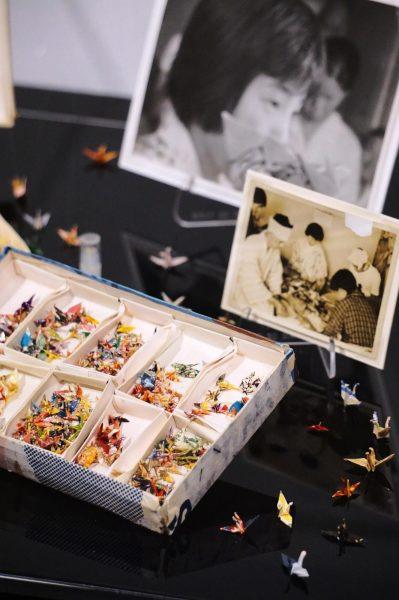
The Hiroshima-Nagasaki Peace Mask Project stands as a macabre manifestation of this legacy.
By capturing the faces of three generations of Hibakusha and their diaspora, it demonstrates that long after the bodies are removed from the streets, nuclear detonation continues to send shockwaves through time — waves whose duration remains unknown, but terrifyingly long.
This is the first time the exhibit has ever left Wilmington College. While housed there, it served as an emotional catalyst for the Peace Resource Center, founded in 1975 by Barbara Reynolds to promote peaceoriented education within the American curriculum. Its board has included figures such as Noam Chomsky and John Hersey.
For decades, the Peace Resource Center has acted as a beacon against nuclear deterrence culture, lending resources that document the bomb’s havoc to institutions nationwide. In doing so, it has carried the “never again” message more meaningfully than slogans ever could.
It is now the responsibility of the Oakland University
community — and the surrounding community — to absorb that message. It is a unique privilege to examine this level of destruction so thoroughly.
In an increasingly tense and multicultural world, the specter of nuclear war looms larger than ever. All it would realistically take is a limited nuclear exchange between India and Pakistan for billions to die deaths too horrific to belong anywhere but the underworld. This is considered a best-case scenario.
Does anyone honestly believe that if satellites detected nuclear weapons airborne, the world’s great powers would sleep?
That no colonel would sweat in a bunker?
That no paranoid statesman would panic?
Game theory does not support this optimism.
A problem gambler who wants to keep his home must eventually learn when to leave the table. Hiroshima and Nagasaki are the table. For more than 80 years, nuclear deterrence has been a poker game rich in bluffing, tension and hatred. If every player decided to show their hand at once — the most likely outcome under rudimentary game theory — the table would be flipped.
The original ending of this article read: “Otherwise, the whole world would be this exhibit.”
That undersells the reality.
Weapons have grown unimaginably in scale and number. To compare what would follow to this exhibit is an insult both to those who built these weapons and to those who have fought to abolish them.
The world will not become this exhibit.
It will be far worse.
There will not be a soul—or even a cat—left to curate it.
The exhibit will run at Wilson Hall through April 5. See it. It’s free. Missing it only taxes our potential futures.
PHOTO BY LILIANA VALENZA
PHOTO BY LILIANA VALENZA
The quiet power of solitude
MADDIE SHORT
Features Reporter
Solitude is defined as the quality or state of being alone or remote from society. Many people immediately associate the word with loneliness, often linked to sadness.
But being alone does not have to mean feeling lonely. Loneliness is an emotion that can arise whether you are alone in your room or at a concert surrounded by thousands of people. There is a distinct joy in doing things for yourself and by yourself, creating a sense of self-reliance that can be beneficial in many ways.
For instance, some people use solitude to develop creative pursuits, such as writing, painting, or composing music. Others may spend their time in nature, hiking or simply sitting in a quiet park, noticing details that often go overlooked in daily life.
Even mundane tasks, like cooking a meal or organizing a room, can become meditative and deeply satisfying when done alone. These moments allow for reflection, growth, and an increased awareness of your priorities and personal values.
In a 2024 podcast episode from the American Psychological Association, researchers indicated the average U.S. adult spends up to one-third of their waking hours alone.
“What we’re doing in those moments, how we’re thinking, how we’re dealing with our emotions, all of those things are going to shape the solitude
experience,” psychologist Netta Weinstein said.
Finding joy in your alone time can help you create healthier and more meaningful relationships. The peace you cultivate within yourself adds to the happiness you experience with others.
Solitude also encourages mindfulness, a practice that can reduce stress and improve mental clarity. By stepping away from constant social interactions and digital distractions, individuals can reconnect with their inner thoughts and emotions.
Mindfulness in solitude allows you to notice patterns in your thinking, recognize sources of tension, and appreciate small moments of joy that might otherwise be missed. Over time, this practice
can increase resilience and provide a foundation for coping with challenges more effectively.
A 2023 article from the University of Reading indicated the utility of deliberate solitude in working toward the promotion of greater general wellbeing.
“Choosing solitude and using it intentionally for its benefits may be key to balancing solitude amid the demands of modern life,” the article said.
Solitude allows you to form a friendship with yourself, independent of other connections. Spending time alone helps you understand who you are on a deeper level, without the influence of others’ voices or opinions. Silence during this time does not have to be frightening; instead, it can be an opportunity to focus on your thoughts.
It is a time for self-reflection, where you can examine your past without dwelling on it and consider what you want for your future. You become familiar with your abilities, helping you set reasonable goals you can pursue while alone.
Being alone also frees you from concern over others’ judgments, which often hold us back. Try a hobby you’ve always wanted to explore, visit a new coffee shop, or simply embrace being by yourself.
The peace of solitude comes when you recognize that you do not need to be with others to feel happiness. True contentment comes from within. Being alone with your thoughts does not make you lonely; it makes you confident and comfortable in your own company.
Crafternoons and creative collaboration at OU’s Makerspace
CAEL TANNER
Features Editor
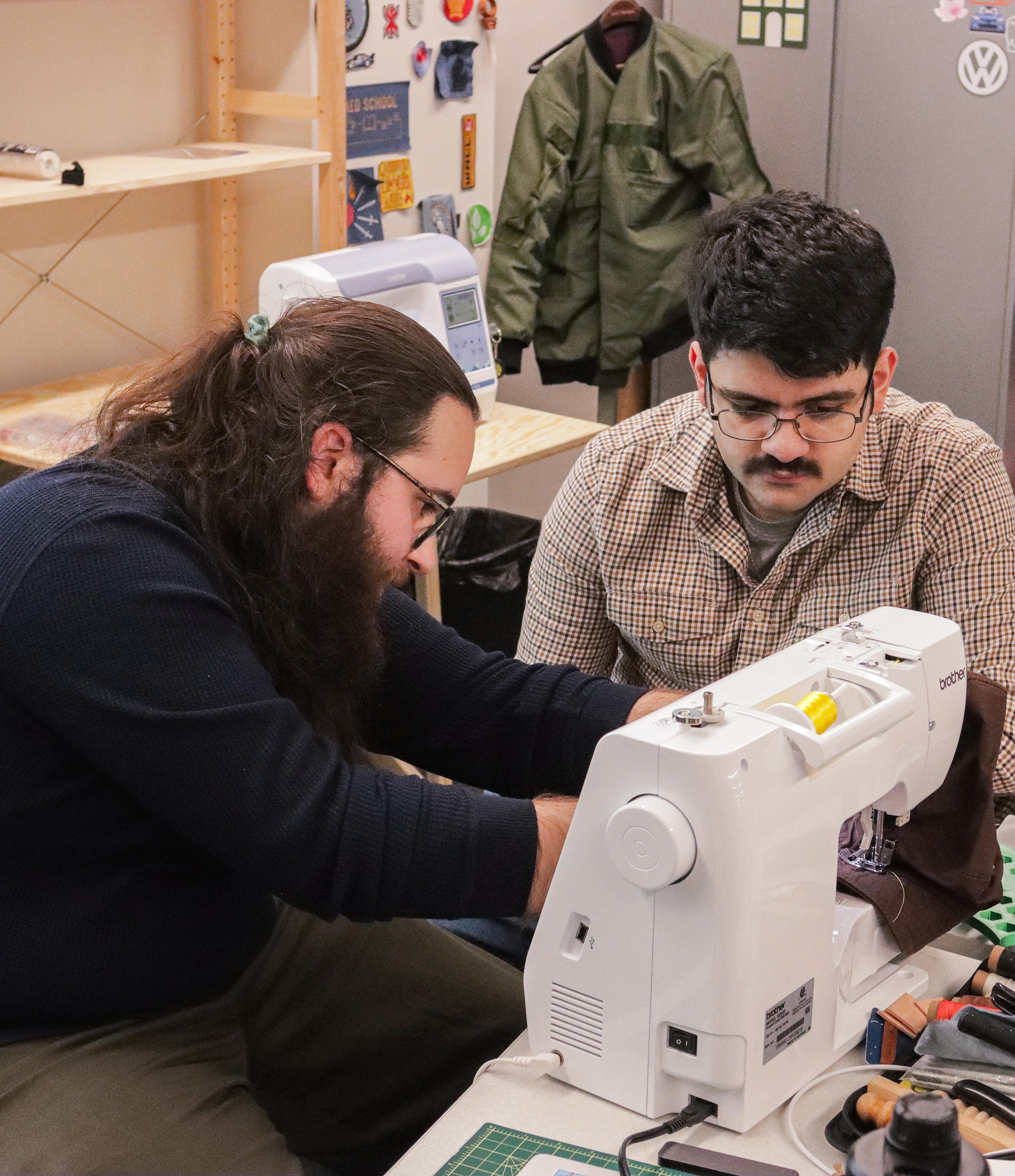
On the first floor of Kresge Library, the Oakland University Makerspace offers a unique environment for members of the OU community to answer the call to create. Spools of filament spin, sewing machines whir and students gather around shared worktables, turning creative inspiration into tangible art and objects of functional utility.
According to the OU Libraries, the Makerspace works to support creativity and experiential learning regardless of major or skill level. The library describes it as a place where users can “learn by doing,” with engineering students prototyping class projects alongside art majors working with textiles and new participants stopping by for drop-in hours.
Built for collaboration and experimentation, the Makerspace was founded in October 2017 as part of OU Libraries’ effort to support hands-on learning across disciplines. Following pandemicrelated closure and staffing issues, the space reopened in March 2025 under the management of Makerspace Coordinator Drew Ulmer. “You can sit down, ask for help, and work with other people who are also creative,” Ulmer said. “I don’t know if you’ve ever tried to cut out a perfect circle with a pair of scissors – it doesn’t go well. Having a machine able to do it for you makes life a lot easier.”
Designed as an open-access environment, the space invites students, faculty and staff to design,
prototype and invent using tools that might otherwise be out of reach. Three 3D printers, sewing and embroidery machines, a Cricut cutting machine, button makers and a sticker printer anchor the space, along with a wide variety of hand tools and craft supplies.
All supplies and materials are free for students, faculty and staff to use.
“Anything that you can think of, we have, and if we don’t have it, there’s a good chance we’ll get it,” Ulmer said. Among the Makerspace’s key community.
building efforts are Crafternoons, a weekly event held Fridays from noon to 5 p.m. The open studio time encourages participants to bring any project or idea and work alongside others.
“We started Crafternoons a few months ago as a way to bring community into the Makerspace,” Ulmer said. “We have a lot of faculty and staff that come down during the day to relax a little bit and stop staring at screens, and they’ve actually been a big help with students. It’s a way for everyone to be able to use the space, whether it’s for class, for fun, for projects, to hang out with friends –anything, really.”
The Makerspace also employs knowledgeable student workers who assist visitors. Issa Batarseh, an OU senior majoring in cybersecurity engineering, began working in the space earlier this semester.
“Staff work with you to plan out how you can do whatever it is you want to do,” Batarseh said. “Anything you can imagine – people come in with ideas, and you can really go wild with your creativity.”
The space supports academic work as well.
Batarseh explained that students often utilize Makerspace amenities for class projects that require 3D printing and other technical aptitudes, such as a project for a cybersecurity class of his which involved developing parts for drones.
“We worked with drones and needed a battery holder, so I 3D-printed one,” he said. “Here, you can just think of it and do it.”
Events such as 3D printing and sewing and embroidery training are hosted to instruct and educate students in developing tangible design, engineering and creative manufacturing skills with various tools and machines.
Beyond weekly programming, the Makerspace plans to host future workshops teaching proper tool operation for specific skills such as belt making, bookmark crafting and candlemaking. Registration in advance is required, but event materials and attendance remain free.
The Makerspace is open for drop-in hours from 10 a.m. to 4 p.m. Monday through Thursday and 10 a.m. to 5 p.m. Fridays during Crafternoons. The space recently expanded its schedule, hosting its first weekend opening Saturday, Jan. 24.
“If I’m here and the lights are on, you are welcome to come in, relax, work on a project or just hang out,” Ulmer said.
PHOTO COURTESY OF UNSPLASH
‘We’ve got it all controlled now’: An exclusive follow-up with Oakland University
Editor’s Note: This interview has been condensed for clarity.
On Jan. 21, The Oakland Post was invited for an exclusive tour of the Central Heating Plant (CHP) and a sit-down interview with Oakland University administrators and facility managers.
The tour marks the third week of the new winter semester, following the campus closure from Thanksgiving break to the new year due to multiple leaks in the High Temperature Hot Water (HTHW) system.
The tour was led by Randy Powell, heating plant supervisor, Stephen W. Mackey, senior vice president for finance and administration, and Siraj Khan, associate vice president for facilities management.
“What I hope people get out of this today is that they can see the complexity of this whole operation and also get an appreciation for that. We’re here, 24/7, 365; there are no days off. There are no minutes off,” Mackey said. “We do have monitoring on all the buildings.”
The tour started with a breakdown of the facility and its cogeneration unit, which generates electricity and thermal energy from a single fuel source.
“Our cogeneration unit, actually, there’s a turbine in there and we use the waste heat from the exhaust off that turbine, about 1,000 degrees,” Powell said. “We use that to heat our hot water for utility usage on campus. It also has a 4.6 megawatt generator on the backside of it that creates about 60% of our electrical demand on campus on a yearly basis.”
In addition to a cogeneration unit, the facility also employs a duct burner as a secondary heating option.
“We also have another piece of equipment. It’s called a waste heat recovery unit, or a duct burner – we call it. There’s a three-stage boiler inside there, so if that 1,000 degrees exhaust off the gas-fired turbine isn’t enough
to meet our campus demand, we have the duct burner on that gives us three additional stages of heat and another several 100 degrees to meet our demand,” Powell said. “We have a loop here in the plant that constantly circulates and that water is pulled off of that bridge and then distributed through the system, pumps underground, through all the to all the buildings on campus.”
The water from the CHP leaves the facility at 260 degrees to reach a water-to-water heat exchanger, lowering it to 170 degrees, allowing it to run through air machines, perimeter heating and variable air value boxes in all buildings.
“So we’re basically taking that heat off take and we’re heating up the water to run all the boilers on campus,” Mackey said.
The Oakland Post: How did the operations look different during the pipe leaks?
“Leading up to our shutdown for repair, we were actually adding quite a lot of makeup water every day because of the leak – that’s how we kept the plant online. We were upwards of 9,000 [makeup] gallons a day on average at that time, until we had all the parts, pieces and labor force in place to do the repair,” Powell said.
“Once we shut the plant down, all of our heatgenerating equipment went down, but we still monitored the buildings out there. We have eight operators here that work around the clock, three different shifts and we were doing some maintenance out on campus for all of our equipment out there. We’re not only responsible for what’s here in the plant, we’re responsible for all of our high temp hot water distribution system valves, everything out all over campus and I had the guys working on that, plus doing some maintenance here in the plant, plus working with the repair crew to do some draining and then refilling and things like that. So we stayed pretty busy
during that shutdown,” Powell said.
“It was definitely a challenge that none of us have ever had to go through before, even the gentleman that just walked in here, he’s been here the longest, almost 20 years and never had anything like this happen before,” Powell said.
The Oakland Post: Are there any lessons learned from that, or anything that would have helped the process?
“The biggest thing is … we knew the system needed to be upgraded. We had it on our master plan to do in phase one. It didn’t wait for us,” Mackey said. “And so it’s not shocking it happened. It’s just a really unfortunate moment in time when it did happen and we tried to mitigate that risk by going with the Thanksgiving week. And unfortunately, a new leak popped up and then another and it just became this domino effect. And we’ve got it all controlled now.”
The Oakland Post: Were there any signs before Thanksgiving that there might be a leak, or even years before, were there any pointers?
“We knew that there was a leak. It wasn’t big – there’s leaks all over the place,” Mackey said.
“Siraj calls me, he’s like, ‘we got a problem,’ because the leak had become a leak – like 9,000 gallons a day is pouring out of the leak where it was a lot less before that. So clearly, the crack was getting bigger. That was in October and that’s when we went into the emergency planning of ‘can we wait until winter break to do this?’ That was the big question.”
With a forecast warning of colder days earlier than usual in the year, Mackey explained, the OU administration did not feel comfortable waiting until the end of Fall 2025 to bring the heating system offline.
Powell explained some of the factors that contributed to the leaks that followed the initial rupture.
“Typically, in this system here, we add
makeup water every day. We have to because … this is a very complicated system and we have leaks,” Powell said. “We also have something called expansion and contraction and evaporation. So a lot of that water will evaporate, so we have to add — we have to keep water in our system so that we keep our system viable.”
An increase in the demand for makeup water to maintain the facility running hinted at a leak.
“My operators came to me and said, ‘Hey, I think we have a leak. We’re using more water than we normally do,’ and that was up and around the 2000-gallon range in a 24-hour period. So myself [and] one of my operators, we went looking. We didn’t find it where we thought we might find it. So we decided to go down in the tunnel,” Powell said. “When we got to the 2000-gallon range, is when it was determined that we really had a leak we needed to address ASAP. The problem, as Steve mentioned, is it didn’t wait for us. It had its own agenda and that leak, that crack in that pipe, just got bigger and bigger and bigger and we did very well keeping up with it for as long as we did. It was almost a month that we were adding, three weeks to a month, roughly, that we were adding all that water, keeping this plant alive. It was a phenomenal feat.” Powell said.
“Our water bill is going to go way up,” Mackey said, with no billing number yet. The CHP has been saving about $2.5 million a year in energy costs, he explained.
The Oakland Post: With keeping the CHP going, are there any renovation plans?
“We are planning the acceleration of some of our most critical loops points because this section of pipe is kind of all the same age – it tells you that there’s potential failures in there,” Mackey said. “Our priority right now is to get redundant boilers in all the buildings. So you saw it in housing, you can see it out on the sidewalk. There’s a temporary one out there. Housing is fully independent [of] this plant. Now we can heat housing without this plant.”
The redundant systems allow for flexible repairs and updates to the HTHW system,
he explained, with the mobile heating units and gas tanks as a secondary backup plan.
“This is also part of our longer-term design around our sustainability plans. So what this is, is kind of just changed the order in which things were going to happen. So it’s moved us up,” Mackey said.
With rainwater usually draining into the tunnels, it was difficult to discern if the leak was an infrastructure problem or the regular storm rain, Khan added.
“The leak was not very obvious by the visual, looking at that – the leak was in the underground pipe, which is outside of the tunnel. There is no way you can see it visually. So that was another struggle there,” Khan said. “Even though we brought the companies in the past to detect something like that. But these underground pipes are buried, like 12 feet underground and there is no way they can really detect that. And it’s about, it’s about 55 plus year old underground piping
The Oakland Post: Are there any plans to renovate those really old sections of the pipes? What does that look like?
“The old section, we have replaced roughly 40% of the old section already on campus, time by time as we get the funding,” Khan said. “We are constantly replacing the old section.”
The Oakland Post: Is the weather this week and as we go into the little extreme weather days, posing any challenges?
“Typically, when we’re 20 degrees or less, we’ll ramp our output here. We’ll raise our output temperature up 10 to 15 degrees. Well, in this case, we’re currently not doing that. We’ve lowered our system pressure on our piping system, because now we know that it has some deficiencies and we’re trying to preserve it until all these redundant boilers and everything get installed so that they can prepare us for repairs,” Powell said.
Buildings like Hannah Hall, Dodge and the Math and Science Center, the farthest away from the CHP, might experience some cold areas. Systems like a steam cap system that prevents the water from boiling and roiling help maintain the system under control even
during extreme weather.
“All those occupants in those buildings, students, staff, faculty, everybody,” Powell said. “Those are our customers and we treat them as good as we can with what we’ve got. So we’re doing the best we can and we really haven’t had a lot of complaints.”
The Oakland Post: Last time we talked, $1.1 million was the projected expenditure. Has it gone up?
“For the leaks and the refunds we gave for student housing and some of the other things. So that three-week period cost us just over $5 million; the redundant heat is significantly more,” Mackey said.
The Oakland Post: A lot of people have been asking about the gas tanks outside of the buildings, in the parking lot. Are those a safety concern?
“When we went through that shutdown and it started getting really cold, all those assets were brought in from all over the Midwest, Ohio, Indiana, all over Michigan – we drained every rentable asset in the region. We’re keeping them here in case we have a failure. Because if we can’t heat the buildings above about 35 degrees… we will [have] what we call ‘losing the building,’ meaning the sprinklers, the fire sprinkler system, will freeze, but all the plumbing in the building will freeze — You’re gonna end up with breaks and everything else. Miraculously, we did not have one freeze break,” Mackey said. “What you’re going to see is as we get the buildings, the redundancy put in place, that equipment will start to disappear.”
story by Mallory Waligora & Adrian Jimenez Morales photo by Adrian Jimenez Morales graphic by August Wicker
Engineering Beauty: The Detroit Auto Show
SARAH WASIELEWSKI Arts Reporter
For many people, cars are simply a method of transportation, a way to get from one location to another. They are judged by practicality, efficiency and reliability rather than appearance. For others, cars function as a statement, broadcasting the owner’s income, taste and personal style.
Regardless of individual attitude, cars are an integral part of a Michigander’s life. As the heart of the United States auto industry, Michigan has over a million automobile related jobs, producing 21% of all U.S. auto production. Cars are more than machines, but cultural symbols, creative achievements and increasingly, works of art.
Nowhere is this idea more visible than at the Detroit Auto Show, hosted annually at Huntington Place in the city most closely associated with the rise of the automobile. Not just a marketplace for new vehicles, it is a curated exhibit where engineering, design and imagination intersect. Much like an art museum, the cars are exhibited in a stylized setting with carefully constructed environments to evoke an emotional response from the visitors. Concept and luxury cars in particular are displayed as sculptural pieces rather than practical pieces of machinery.
Walking through the show, the artistic intent behind many of the vehicles is clear. The bright red of the Ferrari collection is especially eye-catching, with the high sheen of the glossy paint reflecting the overhead lights and surrounding displays.
Even looking at the stationary vehicles, visitors can feel their speed. The bold color choice evokes feelings of speed, passion and power, qualities long associated with the Ferrari brand. In this setting, the Ferraris are not just modes of transportation but symbols of luxury and prestige.
Similarly striking is the Pagani Huayra Roadster,
one of the hyper cars on display in the ultra-luxury gallery. This vehicle represents not just the pinnacle of car performance but also artistic styling. Its distinctive tear drop shaped rearview mirrors and rounded, flowing body panels are reminiscent of forms found in nature.
In contrast to aggressive muscle cars, with blocky, angular shapes, the Pagani Huayra Roadster’s styling emphasizes organic curves, suggesting movement even while the car stands still. Every detail is deliberate, from the exposed carbon fiber to the intricate interior details, reinforcing the idea that the car was designed to be admired as much as driven.
While the Detroit Auto Show attracts significant local and international media attention, it is not just for industry insiders or car buyers. Walk around the show, and visitors will see children clambering in and out of Ford trucks and Jeeps. Couples meander the showroom floor, stopping to admire the luxury cars. The event becomes a shared cultural experience rather than a commercial showroom alone.
The Detroit Auto Show is a living example of how cars exist at the intersection of function and expression. While they remain essential tools of transportation, they also represent artistic creativity and cultural identity. In Michigan, a state shaped by the automotive industry, viewing cars as art encourages a deeper appreciation for the designers, engineers and workers whose vision transforms machinery into symbols of identity and innovation.
Fight the brainrot: Analog entertainment
MARISSA GETSCHMAN Arts Editor
As the days roll on by, the planet is slowly growing more and more dystopian with people walking around like zombies, eyes glued to a screen while the world burns down around them. One of the best ways to fight against the mass desensitization happening around the world is to simply disengage. Still fight back against evil and speak out for what is right and good, but don’t become consumed. Take a step back for a set time every day to engage with something that won’t drive an existential crisis.
There are a number of games that can be played with just a simple deck of cards, some of which don’t even require more than one person. For example, Solitaire is played by laying out seven columns of cards from 1 card to 7 cards and then using strategy to sort them in order by their suit. The game can be played alone leisurely, timed or with a second deck and a friend to compete against.
Yahtzee is another beloved game using five dice and a sheet of paper that can be played alone to relax or competitively against a friend. Simply list out the categories and start strategically matching patterns. Both of the above games can also be found free to play online without download, but that defeats the purpose of putting down the tech for a little while.
Those who have picked up a physical copy of this newspaper know that print certainly isn’t a dead art form (and yes, journalism is an art). Perhaps those same souls might enjoy making a zine: a small,
8-page magazine used for a number of different outlets. Some artists chose to make them bigger or more professionally, but this is focused on the easily accessible.
Zines can be literally anything the artist can think of: A collage work/mini scrapbook, a political statement, a comic book, a story book, an artbook, anything. There was even a collaborative zine circulating Varner Hall just last year that asked students to leave a nice comment for the next one to read.
Zines in particular have a number of different subcultures that accompany the art-form, from activism and education to relaxation and comedy. Detroit hosts a large community of zine makers and has become home to the annual “Detroit Zine Fest” in April each year.
There’s something magical about working on a project that leaves a tangible product that can be held in one’s own hands. Pick up a new hobby! Make friendship bracelets, learn to sew, make the little DIY projects that have been sitting forgotten in a Pinterest board for the last decade.
Visit the local library and read a physical book, breathe in the smell of well-read pages. The library is a great service that gains more funding to be even greater each time it is used. There is camaraderie to be found within fellow library-goers or another activity that can be done in the comfort of one’s own home after checking out a book, boardgame or other rentable media.
This article merely scratches the surface of the world of analog media and entertainment. Last October, a similar article was published by arts reporter Sarah Wasielewski highlighting more analog sources with growing popularity among Generation Z to engage with.
PHOTO COURTESY OF HUNTINGTON PLACE
IMAGE COURTESY OF NATIONAL PARKS PRINT SHOP.
Viral student composer Ethan McMurray to premiere first violin concerto at Varner Hall
MARIA MAGNOLI Arts Reporter
About one year ago, a standout student in the Oakland University School of Music, Theatre and Dance (SMTD) went viral on Instagram for his “little mushroom symphony” composition. As the video nears its first anniversary, he will be premiering his very first violin concerto in Varner Hall on Feb. 17 at 7:30 p.m.
Ethan McMurray, a violin performance major from Clarkston, uploaded a reel to Instagram in March of 2025, exhibiting a 35-piece symphony based on the intriguing whistling sounds produced by a grilled mushroom. Gaining immediate attention, it received 17 million views across platforms and landed him features in Today and Click on Detroit | WDIV Local 4.
Viewers commended the young talent, saying, “it’s giving…Mulan,” “this is how Disney music is made” and “any chance I could learn music composition from you?”
Taking full advantage of his now large following, he wrote a work for the instrument he loves most: the violin. The Oakland University Chamber Orchestra (OUCO), led by conductor Zeljko Milicevic — an ensemble McMurray has participated in since his freshman year — will perform the work alongside the soloist and the featured collaborator of the evening.
Playing the violin solo is Elizabeth Rowin. She is the professor of violin studies at OU, Detroit Broadway National Tour violinist and most importantly — Ethan’s teacher. Rowin holds degrees from the Mannes School of Music in New York and the University of Michigan.
“[The piece’s technique is] highly challenging, almost virtuosic, similar to the 24 Paganini Caprices for unaccompanied violin. I navigate fast-moving triplets, stacks of diminished arpeggios and double stops, from the lowest to the highest range of the violin. When combined with the singing melody of the orchestra and drama of the piano part, the overall effect is very exciting and moving,” Rowin described.
Supporting the virtuosic strings is a monstrous piano part to be played by Martyna Gogołkiewicz, “Oakland Symphony Orchestra Concerto Competition Winner 2024.” Gogołkiewicz is a junior double major in piano performance and pedagogy, minor in jazz studies.
McMurray says the content of this concerto was inspired by Mendelssohn’s “Violin Concerto in E minor, Op. 64,” in addition to other violin favorites. With violin as his primary instrument, writing the soloist’s part felt quite innate.
“I think [the character to the concerto] is book ended with a melancholic, darker type of feel. In the middle, it gets pretty classical, and a lot of it draws on classical waltz inspiration. Listeners might pick up on some Tchaikovsky influence,” McMurray said.
The composer took to Instagram and TikTok in November, giving viewers a glimpse of what they can expect. A video of the score itself and its cascading contour highlight the incessant influxes of drama the piece has.
Since his virality from the “little mushroom symphony,” McMurray has become more in tune with how he posts online.
“I’ve had to learn what to show and what to withhold when posting a video. You want to post something that will entice the audience, but you don’t necessarily want to give everything away,” McMurray said. “That has created a lot of interest about the concerto on Tiktok.”
When McMurray first presented the idea of the concerto to Rowin, he said it would be “A Schindler’s List-esque solo” — reminiscing, beautiful, slow and
legato. But after drafting the first exposition, it turned noticeably more virtuosic.
Subsequently, he sent the first draft to Rowin, anxiously awaiting her approval. Fortunately, she agreed to the challenge, and has been working with McMurray to bring his vision to life since.
“She [Rowin] has been an amazing collaborator and has put up with all of the insane passages that I’ve written for her,” McMurray said. “We are always communicating about articulation and bowing. It is definitely a different feeling being on the other side of the violin, but she is so much of a friend at this point that it has been a great experience.”
Having been in the OUCO for three years now, this
energy between the solo violin and integrated piano passages” are evident in the concerto, Milicevic said. He is quite fond of the dialogue that occurs between parts. Milicevic remarked that it is always a delight to work with students like McMurray.
“Watching Ethan’s craft evolve over time has been exciting as he has steadily developed and flourished in his compositional language… I know the audience will love it,” Milicevic said. “The piece employs a cinematic, adventuresome spirit and I feel everyone will relate to its accessibility.”
“I feel so grateful to be working with such talented and kind musicians like Professor Rowin and Mr. M so early in my career. They both have taught me so much
project holds meaning beyond the typical performance: it is a cumulation of the friends he has met at OU, the improvement in his composition style and the people who have helped him along the way.
Milicevic has shown McMurray an additional side to the world of composing: bringing the music to life with the orchestra. During rehearsals, he has methodically demonstrated to McMurray how to take an idea on the score and translate it into something more than just notes on a page.
“A supportive yet energetically punctuated accompaniment in the string parts and the bursts of
about being a composer,” McMurray said.
Tickets for the premiere on Feb. 17 can be purchased online at https://www.etix.com or at the box office in Varner Hall. The performance is free to OU students and will be followed by a reception with light refreshments. To see what McMurray composes next, follow him on Instagram @ethanmcmurray_, TikTok @ ethan.mcmurray or visit his website https://ethanmcmurray/home.
PHOTO COURTESY OF ANA MILLER @ANA.GRACE.PHOTOGRAPHY ON INSTAGRAM.
Noah Kahan: The voice of quiet thoughts
ALEXA DUDEK Campus Reporter
Songs written by a musician from a small town in Vermont may not seem destined to resonate with millions, but Noah Kahan’s lyrics capture the young adult experience with striking accuracy. His music explores themes such as mental health struggles, the complicated emotions tied to returning home and overwhelming nostalgia. Through honest storytelling, Kahan has built a strong connection with listeners who see their own experiences reflected in his work.
Throughout his discography, Kahan remains open about his personal mental health struggles. This vulnerability presents him as an artist who feels approachable and relatable to fans. His willingness to share difficult emotions has played a major role in building a devoted audience.
Kahan’s debut album, “Busyhead,” resonated with listeners who have struggled with mental health. The title track, “Busyhead,” explores the feeling of overthinking and becoming trapped in one’s own mind. The album struck a chord with many young adults facing anxiety during major life transitions.
“Busyhead“ particularly resonates with those leaving home for opportunities like college. The album offers a sense of comfort for listeners who feel overwhelmed by their thoughts. For many, it provided reassurance during an uncertain period of personal growth.
The debut album created a space for fans to connect and share similar experiences. Through
creating and performing music, Kahan helped normalize conversations around mental health. His work encouraged listeners to feel less alone in their struggles.
Beyond his music career, Kahan also serves as a mental health advocate through his foundation, “the Busyhead Project.” Launched in 2023, the project aims to end the stigma surrounding mental health. The foundation’s name reflects Kahan’s debut album and his commitment to combining music with advocacy.
Kahan’s honesty through both his music and advocacy shows that vulnerability can be a strength. In a world where mental health is often stigmatized, his openness has been widely appreciated by fans. His authenticity continues to set him apart as an artist.
Released in 2020, “Cape Elizabeth” captures feelings of worry, longing and yearning for simpler times. The project gained recognition as a comfort album during the COVID-19 quarantine. Although it was initially considered a hidden gem, it played a significant role in Kahan’s artistic growth.
“Cape Elizabeth“ laid the groundwork for the success of “Stick Season.” While it did not achieve the same level of popularity, it remains deeply meaningful to longtime fans. Many believe it deserves equal recognition for its emotional depth.
With “Stick Season,” Kahan shifted toward a folk-pop sound. The album propelled his career forward and gained widespread attention on social media platforms like TikTok. Its success marked a turning point in his popularity.
Addie’s Albums: Son Of Spergy
ADDISON KOCH
Campus Editor
Daniel Caesar has never been afraid of vulnerability, but on his latest album “Son of Spergy” the Canadian R&B singer turns inward more deeply than ever before.
The album, released Oct. 24, 2025, through Republic Records, is a reflective, gospel-inspired body of work centered on reconciliation with faith, love and most notably family. The album reflects a “grassroots” approach, featuring acoustic guitars, gospel arrangements and minimal production giving the album an intimate, almost confessional feel.
Following the massive success of his 2017 debut “Freudian” and a Grammy win for “Best Part” Caesar said he has spent much of his career grappling with expectations, both internal and external. On “Son of Spergy”, named after his father’s nickname, Caesar embraces growth rather than perfection, exploring what it means to inherit traits, mistakes and love from the people who raised him and those he has found along the way.
The album opens with “Rain Down” featuring the artist, Sampha, performing a haunting gospel and piano-led track. Caesar’s soft vocals and church-like harmonies immediately set the tone, introducing faith as a recurring theme. References to God, blessings and surrender appear throughout the album as questions rather than statements.
“Have a Baby (With Me)” the album’s second track and one of its most emotional, is a desperate
plea with a delicate piano sound. Caesar sings to a partner who is already emotionally gone, asking her to commit to a future even as the present falls apart. It’s vulnerable, uncomfortable and honest. The song feels less about having a child and more about clinging to love before it disappears.
“Call On Me” shifts slightly in sound, introducing electric guitar and subtle African-inspired background vocals performed by Caesar’s father, Norwill Simmonds. It explores unconditional love, the willingness to give endlessly, even at a personal cost. This theme of sacrifice appears repeatedly, especially when love and faith intersect.
One of the album’s most touching moments comes with “Baby Blue,” also featuring Simmonds. The track could be compared to a love letter, to a partner, to peace and even to God himself. Caesar sings about being seen during his lowest moments and finding calm in someone else’s presence. Like most of the outros on the album, gospel harmonies close out the song.
“Root of All Evil” takes a different turn. With layered instrumentation and self-analyzing lyrics, Caesar confronts his own ego, temptation and moral conflict. Lines like “Am I a man or a beast?” feel like pages pulled straight from a journal, as he questions whether fame has pulled him away from who he truly wants to be.
“Who Knows,” a personal favorite track on the album, strips everything back. Soft guitar, piano and background vocals accompany Caesar as he reflects on uncertainty in love, commitment and himself. He admits his flaws without defensiveness, asking
“Being able to get out and play the songs and share that experience with people is just a miracle,” Kahan said in an interview with Billboard Magazine. He expressed gratitude for the opportunities that followed the album’s success. The project solidified his place in the mainstream music scene.
In “I Was / I Am,” Kahan reflects on personal growth and self-discovery. The album explores the contrast between who he was at the beginning of his career and who he has become. These themes make the project especially relatable to listeners.
“This album is about taking stock of the person you were and how that’s made you the person you are,” Kahan said in an interview with Atwood Magazine. Though less popular than “Stick Season,” the album offers a reflective and therapeutic listening experience. Many fans consider it an underrated release.
On Jan. 20, 2026, Kahan announced the release date for his highly anticipated new single, “The Great Divide.” Fans pieced together clues from TikToks, social media posts and snippets of the song. The roll-out highlighted the strong connection between Kahan and his audience.
Kahan’s discography is more than a collection of songs. His music serves as a therapeutic experience for listeners navigating mental health struggles and personal growth. Through honesty and emotional depth, Kahan continues to resonate with those learning how to understand their own minds.
whether it’s a crime to be unsure, while further questioning what the future holds and whether he is deserving of the love he hopes to keep.
“Moon,” featuring Bon Iver, continues the album’s existential questioning. The song shifts halfway through, trading instrumentation for isolated vocals and an echoing guitar. Caesar grapples with faith, identity and the meaning of love, sounding both lost and hopeful at once.
“Touching God,” with Yebba and Blood Orange, may be the album’s most overtly religious track. It captures a crisis of faith, the feeling of believing in God while also feeling abandoned by Him. Choir-like harmonies from Yebba, Blood Orange and of course Caesar provide him with reassurance in a biblical reference about spiritual growth and maturity.
“Sign of the Times” reflects on aging, loss and gratitude. The song considers love, mortality and the desire to build a future with someone. It continues Caesar’s search for meaning through faith and personal growth.
“Emily’s Song” stands out as a thankful goodbye. It acknowledges a past love for the clarity it provided, even if it couldn’t last. The track feels like acceptance rather than regret. and forgiveness, for his father and himself.
Continue reading at oaklandpostonline.com
Michigan faces lawsuit by the Trump administration over cage-free egg production law
SOPHIA CURRAN Political Editor
On Jan. 22, The Trump administration filed a lawsuit against the state of Michigan’s cage-free egg production law over its control over interstate commerce.
The lawsuit is directed towards the state of Michigan, Agricultural Director Tim Boring and Attorney General Dana Nessel.
Taking effect on Jan. 1, Michigan legislatures updated the Animal Industry Act (Public Act 466 of 1988) by passing Public Act 132 — which was officially passed in 2019. The law requires that farmers raising over 3,000 egg-laying hens in an indoor vicinity must be able to roam freely around — hence the term “cage-free.”
The law also prohibits business owners from purchasing and working with producers—from inside and outside the state — who engage in confined egg production that does not align with their law. The law does not apply to eggs sold in liquid or cooked form.
Several states have also enacted cage-free laws, such as Arizona, California, Massachusetts and Ohio. The Trump administration also chose to sue California over its egg production laws in July of 2025.
Cage-free systems allow hens to freely roam and lay eggs in their own nests without caged confinement. Farmers are beginning to switch to the cage-free lifestyle instead of caging hens in battery cages. Battery cages on average only allow 67 square inches of space.
“Battery cages present inherent animal welfare problems, most notably by their small size and barren
conditions,” poultry welfare expert Michael Appleby said. “Hens are unable to engage in many of their natural behaviors and endure high levels of stress and frustration. Cage-free egg production, while not perfect, does not entail such inherent animal welfare disadvantages and is a very good step in the right direction for the egg industry.”
While cage-free conditions are a healthier alternative for hens compared to battery cages, there are still setbacks to the system that prevent it from being “cruelty-free.” They still involve the practices of any other domestication systems for hens, such as beak
mutilation, overcrowding and are typically slaughtered before reaching two years of age.
The Trump administration filed a lawsuit against Michigan’s decision to use the cage-free practice, believing that it has raised egg prices and created an “unnecessary red tape” for large-scale commercial egg producers.
In January 2025, the cost of eggs at a national average of $4.95, more than the $2.52 of this month last year and $4.82 the year before that.
“Michigan’s imposition of state-specific egg quality standards has raised prices for American consumers,” the lawsuit claims. “By design and effect, Michigan’s ban on noncompliant eggs restricts supply and increases compliance costs, contributing to higher prices for American families. Regardless of the intent or effect of Michigan’s Sale Ban, it is the prerogative of the federal government alone to regulate the quality and inspection of eggs in interstate commerce.”
State governments are allowed to control their own intrastate (within state borders) without the intervention of the national government. With that being said, the national government has the legal right to regulate interstate (between state borders) and foreign commerce.
The national government believes that Michigan’s choice to reject egg companies that do not practice cagefree production from other states violates their right to patrol interstate commerce. Michigan Gov. Gretchen Whitmer, Boring and Attorney General Nessel have not yet responded to the case. U.S. District Judge Jane Beckering, appointed by former President Joe Biden, is expected to handle the case in Grand Rapids.
The 2026 Detroit Auto Show: A celebration of industrial resilience
MARYAM MOSS
Political Reporter
On Jan. 17, the annual Detroit Auto Show was opened to public viewing, drawing locals and out-of-state residents alike to marvel at the curated displays of designer vehicles, be chauffeured along high-speed tracks and experience product features firsthand.
This year’s showing, held at the Huntington Place convention center in Detroit from Jan. 17 to 25, showcased both the resilience of statewide auto innovation and the important transnational links that sustain it, amid tariff battles that affect local producers.
A professional driver at the locale reflected on the legacy of the city’s automotive industry.
“Detroit is full of wealth, old wealth,” she said. Among these long-tapped resources is capital in cars, as a trade, financial and cultural asset.
In 1896, entrepreneur Henry Ford debuted the first gasoline-powered vehicle years before officially founding Ford Motor Co. in 1903. It soon employed mass-assembly line techniques to cut worker costs and production times. Other companies blossomed on the heels of Ford’s first factories, including Chrysler and General Motors, the first of its kind to consolidate other brands into its namesake. Decades later, the city is still “on the map” for its global leadership in auto-making.
The auto show honored this heritage with a gallery of vintage models alongside newer ones like an autonomous vehicle and Ford Bronco with a multi-camera display and advanced tilt capacities. Among the vehicle displays were locally produced Fords and Chryslers, custom-wrapped
cars and international brands like the Italian Alfa Romeo and the Dodge Charge. Assembled in Windsor, Canada, the Dodge was awarded Car of the Year.
These appearances complemented native production with the trans-border cooperation that has reinforced the auto industry nationally. However, decades-strong links are being tested by tensions among manufacturing partners.
Gov. Gretchen Whitmer, in attendance on the second Industry Day of the show, delivered a keynote address. In it, she recognized the challenges and wins of the past year in auto manufacturing, emphasizing the need to protect tradepartnerships.
“Without our allies, we cannot stand a chance,” Whitmer said.
Whitmer’s statement comes as the US prepares to renegotiate the terms of the United States-Mexico-Canada Free Trade Agreement (UNSCA) in July, after an initial wave of tariffs by the Trump administration were levied against Mexico and Canada last year.
The international tariffs undermined the UNSCA trade agreement between the three nations which share critical trade links, from import-export volumes to agriculture, energy and manufacturing and the American supply chain — the lifeline of automaking.
Michigan’s auto industry is vitalized by cross-border traffic, in which car parts from Canada are carried to city plants. These trade flows can take place over several months, between the conception stage and a finished product.
Dale Hader, President of the wheel-making plant Citic Discastal in Sterling Heights, stated, between 30% and 40% of auto parts used in Michigan vehicles are sourced from Canada, making tariffs disruptive to both trade flows and consumer purchases when costs are passed on from
manufacturing.
Another challenge to car-making was electric vehicles (EVs), after President Trump rescinded policies introduced by Biden to incentivize EV manufacturing and penalize noncompliance with fuel-efficiency standards. Environmental activists like Kathy Harris of the Natural Resources Defense Council (NDRC), maintain that this ultimately benefits the oil industry while raising prices for consumers, despite a reduction in up-front vehicle costs.
Despite setbacks, the electric vehicle market still managed to attract curiosity at the show, despite waning zeal. A “mock” charging station featured a model car and charger to help visitors understand the mechanisms of an EV. Consumer information, in the form of signs stationed nearby, emphasized the environmental benefits of purchasing a clean energy vehicle (CEV) over a gaspowered one.
Whitmer uplifted CEV manufacturing with the announcement of an executive directive to help Michigan explore geologic hydrogen as a new energy. If found to be a reliable source, it could place the state at the forefront of renewable energy discoveries, offering yet another alternative to foreign fuel.
With its clever curation of vehicles from around the globe, speeches from industry leaders and clever user experiences, this year’s auto show enamored many.
“Interchangeable ports, lightweight plastic, and polymers” as design solutions, as commented on by Gov. Whitmer, exemplify how Michigan strives to buffer its industry amid competition and supply chain challenges—drawing from the strengths of natural reserves and local genius.
PHOTO BY JACK CAFFREY
Not a ceasefire: A war on movement in the West Bank
MARYAM MOSS Political Reporter
From 2018 to 2025, the number of settlements sponsored by the Israeli government in the occupied West Bank has increased by roughly 272,000. Growth has accelerated since Oct 2023, when Israel began a military bombardment of the Gaza Strip that has killed over 70,000 Palestinians after an attack by Hamas on Southern Israel.
During the Six Day war of 1967, Israel captured the Golan Heights from Syria, the Gaza Strip and Sinai Peninsula from Egypt and the West Bank and East Jerusalem from Jordanian troops, tripling the number of territories under its control. 300,000 Palestinians in the West Bank and East Jerusalem were displaced as a result and continued to be as Israel began establishing settlements in the captured territories.
In earlier days, settlement expansion did not occur at the rapid pace it does now. Previously, appeals to create them could face scrutiny from the Israeli Court, which, in some circumstances, prohibited establishments that did not serve a military purpose. In the decades following the 1970s, however, Israel began to rewrite its legal provisions, making it easier to seize land for settlements at whim.
The increase in state-sponsored settlements comes as “social, cultural, and political shifts” have shaped a government that aligns a national security agenda with its settler population. Emboldened by government support, more right-wing extremists have taken up positions in the Israeli military and cabinet since the 1990s and exercise greater sway over lawmaking. The approach draws a parallel to the Trump administration, which has seen neutral agencies like the Federal Communications Commission and the Department of Justice become political weapons of the president.
On Oct. 10, 2025, the first phase of a ceasefire was brokered between Israel and Hamas following mounting pressure from the U.S. and international community. However, the prospect of the twostate solution envisioned for decades weathers as unsanctioned attacks on Palestinians continue.
In Dec. 2025, Israel annexed additional land to create settlements that straddle the perimeters of state-controlled zones and the remaining lands held by Palestinians. A recent report from the government stated that it had seized about 700 dunams (about 173 acres) of land, as verified by Israeli media. Documents expressed the intention to fragment the West Bank, creating isolated enclaves that would undermine communication and the geographic linkage between Palestinian villages. The plan represents a broader agenda to erode the possibility of Palestinian statehood through forced removals.
More than 1,000 Palestinians were displaced this year in East Jerusalem and Area C, an Israelicontrolled zone in the West Bank, due to unsanctioned settler violence, restrictions on movement and housing demolitions. Destructions to property come both in the form of government-issued demolition orders on houses and obliteration of the neighborhoods home to Palestinians before the war.
The Israeli government argued that these neighborhoods were located along an underground passageway used by Hamas militants. The claim remains unverified.
Israel’s forced displacement of more than 1.9 million Palestinians — during and after the ceasefire’s inception—constitutes a crime against
humanity. Under the Fourth Geneva Convention on the obligations of an occupying power, any evacuation order in an occupied territory during wartime must be carried out safely — without the prevention of humanitarian aid — and facilitate the return of all IDPs (internally displaced persons) to their homes.
The ongoing attempts to obstruct humanitarian workers, critical aid and displaced individuals seeking the right of return through the tight control of border crossings have illustrated how mobility itself is being weaponized.
The aggressions amount to a full-scale assault on Palestinians’ livelihoods, dignity and identity.
Ajith Sunghay, head of the OHCHR (Officer of the High Commissioner for Human Rights), expressed alarm over the systematic tactics being used to annex large tracts of the West Bank and alter the landscape geopolitically.
“It has done so also by reshaping the West Bank with an extensive network of checkpoints and gates, which ensure freedom of action to settlers while segregating Palestinian towns and villages,” he said.
The accelerating seizure of lands, privatelyowned by generations of Palestinian families, is described as a “stranglehold” on the landscape. The color-coded map provided by Al-Jazeera above identifies the spatial spread of Areas A-C throughout the West Bank, each letter denoting a zone under Palestinian, Israeli or joint control.
As visual data shows, Areas A-C, occupied East Jerusalem, and Israeli settlements do not follow linear borders but are clustered around each other, with settler outposts depicted as scattered dots. It makes apparent the fragmentation of the West Bank as lands with different political designations collide with each other, cutting across the lands and farmsteads home to Palestinians for generations.
Meanwhile checkpoints, run by the Israeli military, prolong travel and restrict access to oncefrequented sites, like the streams and groves that are centerpieces of Palestinian community.
Farmer Yousef Dar-Al Musa, 67, who was attacked by settlers while trying to visit his olive trees, reflected on how violence has disrupted agriculture, and the long-practiced traditions associated with it.
In an interview, he explained that, while previous seasons were accompanied by festivities as villagers gathered to press their harvested olives, this year there is no produce to sell. Despite this, agricultural families cling to traditional livelihoods.
The resilience of Palestinian communities in spite of cruelties that traverses generations, from the attempted ethnic cleansing of the 1948 Nakba to ruthless dispossessions. Amid the uncertainty of future statehood is an ancestral bond to land.
Said Abu Yousef of its significance: “The earth is our life, from our ancestors, going back 10,000 years.”
Luehring leads Oakland to rivalry win over Detroit Mercy
MATT LEWAKOWSKI Sports Reporter
In a highly competitive Horizon League matchup, the Oakland University Golden Grizzlies women’s basketball team secured a hard fought 80 70 victory over the Detroit Mercy Titans at Calihan Hall on Saturday, Jan. 18, 2026.
The result marks the team’s second straight win and highlights a balanced offensive performance and late game dominance that helped Oakland prevail in a fast paced Metro Series showdown.
From the opening tip, the Golden Grizzlies showed confidence and aggressiveness, quickly establishing offensive rhythm and asserting control in crucial moments. Oakland jumped out early as Angie Smith converted a layup within the game’s first 15 seconds, setting the tone for what would be an energetic and commanding contest.
A standout performance for Oakland came from freshman guard Makenzie Luehring, who led all scorers with a career high 25 points. Luehring showcased her scoring versatility, consistently attacking from all areas of the court and providing the Golden Grizzlies with momentum shifting baskets throughout the contest.
Complementing Luehring’s breakout game was forward Layla Gold, who recorded a double double with 13 points and 10 rebounds, marking her third such performance this season. Gold’s presence inside helped Oakland control the paint and crash the boards effectively against Detroit Mercy’s defense.
Guard Jazmine “Jazzy” Dupree Hebert added a spark from beyond the arc, finishing with 10 points, including
key three point shots that helped extend Oakland’s lead at critical junctures. Meanwhile, Filippa Goula contributed 12 points and five assists, making all six of her free throw attempts and stabilizing the offense during stretches when the lead tightened.
The first quarter was tightly contested, with both teams trading baskets and momentum. Oakland’s early edge, built on sharp shooting and transition play, resulted in a narrow 20 18 lead at the quarter’s end. Throughout the opening 20 minutes, Luehring’s perimeter shooting (4 for 8 from three) and efficient scoring helped keep the Golden Grizzlies ahead, even amid pushes from the Titans.
Detroit Mercy fought back to tie the game in the second quarter, but Oakland responded with crucial plays from Gold and Dupree Hebert to preserve a slim lead entering halftime. The first half ended knotted at 37 37, setting the stage for a decisive second half.
Oakland’s offense found another gear in the third quarter, turning steady but narrow leads into more comfortable advantages. Luehring connected on another perimeter shot early in the period, and timely baskets from Gold and Lianna Baxter helped fuel a 47 39 advantage late in the quarter. Oakland’s defensive effort also rose, with key steals and stops preventing Detroit Mercy from gaining traction.
The fourth quarter proved decisive, as Oakland outscored Detroit Mercy 26 20 thanks to a series of transition buckets and tough mid range scoring. Baxter’s layup extended the Golden Grizzlies’ edge early, and back to back drives from Sereniti Roberts Adams pushed the margin even further. Oakland’s balanced scoring and controlled pace helped thwart multiple late rallies from the Titans, allowing the Grizzlies to seal the 80 70 win.
With the victory, the Golden Grizzlies improved their record in Horizon League play and built momentum heading into upcoming conference matchups. Next on the schedule for Oakland is a road contest against Green Bay on Thursday, Jan. 22, where the team will look to extend its winning ways.
The Golden Grizzlies’ balanced scoring, strong defense and ability to execute in the fourth quarter have become hallmark traits of this season’s squad — traits that could prove invaluable as the Horizon League race tightens and postseason aspirations come into focus.
Patriots and Seahawks reach Super Bowl LX
JAMES ELLING
Sports Editor
For the second time in 11 years, the Seattle Seahawks will match up with the New England Patriots in the Super Bowl.
While Tom Brady won’t lead the Patriots out of the tunnel and the Legion of Boom no longer anchors the Seahawks’ secondary — as was the case in Super Bowl XLIX — this year’s matchup features two talented teams built to win from top to bottom.
Ahead of the 2025 NFL season, neither team was considered a contender. Analysts routinely left them out of playoff conversations, and any optimism surrounding their outlooks was dismissed as a “hot take.”
As the wins piled up, fans still viewed them as fun but unserious fairytales — until they kept winning. The talk has shifted.
The “longshots,” told it wasn’t quite their time, each posted 14–3 records, stacked playoff victories and now hold their respective conference championship trophies.
On Sunday afternoon, the Patriots were the last team standing in a stingy defensive slugfest, edging the Denver Broncos 10–7.
Drake Maye, New England’s MVP‑candidate quarterback, never found a passing rhythm — and it only got tougher as heavy snow and gusting winds blanketed the grass at Mile High Stadium — but he made enough plays with his legs to help the Patriots survive.
New England’s real hero, as has been the case throughout the postseason, was its defense.
The unit held the Broncos to just 181 yards of offense and seven points. Their 8.7 points allowed per game would rank
as the second‑best playoff run in NFL history. Three sacks, multiple forced turnovers and a shutout after Denver’s opening drive took the pressure off their young quarterback and punched their ticket to the big game.
Soon after, the Seahawks topped the Los Angeles Rams 31–27 in a modern shootout between two of the league’s best teams.
Former castaway quarterback Sam Darnold further proved his success is far from fluky, throwing for 346 yards, three touchdowns and no turnovers.
“He’s the same guy every day, no matter the circumstance,” Seahawks head coach Mike MacDonald said. “He’s an ultimate competitor, he’s a phenomenal leader, and he just keeps fighting.”
Darnold’s favorite target, breakout wide receiver Jaxon Smith‑Njigba, continued to shine with 10 receptions for 153 yards and a touchdown.
Despite the 27 points allowed, Seattle’s defense played
a defining role in its path to the Super Bowl. On a night when Rams quarterback Matthew Stafford orchestrated a star‑studded offense with rhythmic precision, a middling defense might have surrendered 40 or 50 points. Instead, Seattle calmly absorbed momentum swings and delivered a fourth‑down stop with the game on the line, holding on until the clock hit zero.
On Feb. 8, the humble giants will meet in Super Bowl LX in Santa Clara, Calif.
New England had won just 16 games over the previous three seasons combined — now they seek their 18th of this one. The Patriots are looking to kick‑start their third dynasty of the 21st century, ushering in a new era under first‑year head coach Mike Vrabel and Maye, who is set to become the second‑youngest quarterback ever to start a Super Bowl.
“It’s a new team; it’s a new era,” Maye said. “I respect and appreciate what the Patriots dynasty did… but we changed the narrative and look forward to bringing our best football.”
Seattle, meanwhile, will try to stake its claim as “next up,” seeking revenge for the heartbreaking loss in their last postseason meeting, one of the most iconic Super Bowls in league history.
In what many believed would be a transition year, the Seahawks now have the chance to exorcise old demons and hoist their second Lombardi Trophy.
Two teams told to wait their turn refused to listen. For New England, it’s a chance to prove the dynasty never truly died — only evolved. For Seattle, it’s an opportunity to rewrite its history and claim a place among the league’s elite.
Two teams dismissed as afterthoughts now stand one win — Super Bowl LX — from immortality.
PHOTO COURTESY OF NFL
PHOTO COURTESY OF GOLDEN GRIZZLIES
Tactical lessons from the O’rena to the Metro Series
MIKE OKORONKWO Sports Reporter
For the Oakland Golden Grizzlies, the last four days have been a masterclass in the volatility of mid-major basketball. In the span of 96 hours, the program experienced both the frustration of a historic letdown and the exhilaration of a hardfought rivalry win. To analyze this week is to analyze a team still searching for its definitive identity as the Horizon League schedule intensifies.
The Indy Post-Mortem: A Failure of Execution
Wednesday’s loss to IU Indy wasn’t just a missed opportunity; it was arguably the most disjointed performance Oakland has put on the floor this season. Entering the contest, the Jaguars were a 2-9 team sitting at the bottom of the conference standings. On paper, Oakland held every advantage, yet the execution on the court suggested otherwise.
The primary culprit was a total breakdown in interior containment. IU Indy treated the paint like an open invitation, racking up 68 points near the rim compared to Oakland’s 36. Tuburu Naivalurua, usually the anchor of the frontcourt, struggled to find his footing against Finley Woodard. Woodard’s touch on floaters and timing around the glass led to a 22-point night on 11-of-14 shooting — an efficiency rate that is almost impossible to overcome.
Tactically, the Golden Grizzlies’ defensive identity seemed to vanish. The zone looked porous and lacked the lateral communication necessary to deter drives. By the time the staff adjusted to a man-to-man scheme in the second half, the damage was already done. IU Indy’s Kyler D’Augustino and Micah Davis were already in rhythm, using pump fakes to exploit Oakland’s eager closeouts. The lack of rim protection was particularly evident whenever Isaac Garrett was off the floor, exposing a lack of pure size that conference opponents will continue to target.
Even Brody Robinson’s record-breaking 11 assists came with a caveat. While his playmaking was a bright spot, IU Indy’s defensive game plan was clear: exhaust him. The Jaguars applied fullcourt pressure and played a physical, hacking brand of defense that the officials largely ignored. Robinson struggled to finish through contact, and the team’s overall poor shot selection — often early in the shot clock — compounded the frustration.
Redemption in the Metro Series
If Wednesday was a lesson in what happens when focus slips, Saturday’s victory over Detroit Mercy was a testament to resilience. In a game defined by “togetherness,” Oakland looked like a completely different unit.
The catalyst for the turnaround was Ziare Wells. Wells delivered a clinical performance, finishing 11-of-13 from the field. His efficiency wasn’t just about hot shooting; it was the result of high-level off-ball movement and commitment to the offensive flow. He punished Detroit Mercy at all three levels, navigating heavy contact at the rim and hitting momentum-swinging shots in the second half that effectively sealed the win.
Complementing Wells was the steady hand of Brody Robinson. Robinson’s response to Wednesday’s physical toll was a 10-to-1 assist-toturnover ratio. Managing that kind of ball security in a rivalry game, while maintaining a .75 freethrow rate, shows a level of maturity essential for a primary ball-handler. He didn’t just facilitate; he
controlled the tempo and forced the Titans to play at Oakland’s pace.
The Supporting Cast and the Injury Report
The victory was further solidified by a supporting cast that stepped up to meet the moment. Legent Geeter provided a vital offensive spark, shooting 9-of-13 and knocking down several contested buckets that quelled Detroit Mercy runs. On the glass, Michael Hogue dominated the margins, securing four crucial offensive rebounds and hitting a timely three-pointer that shifted momentum in Oakland’s favor.
Naivalurua appeared rejuvenated in the second half, finally providing the defensive presence and rebounding authority that had been absent against the Jaguars. Most importantly, the team defense found its teeth, successfully limiting Orlando Lovejoy and proving that the previous defensive collapse was an outlier rather than a trend.
The one concern lingering from the win is the status of Isaac Garrett, who went down with an apparent injury in the second half. His absence again highlighted how much Oakland relies on him for rim protection, though early indications suggest the injury is less severe than it initially appeared.
Looking Ahead: The Scouting Report for Purdue Fort Wayne
The Golden Grizzlies must pivot quickly as they prepare to face Purdue Fort Wayne on Wednesday, Jan. 28. The matchup will serve as a critical test of whether the defensive improvements seen against Detroit Mercy can be sustained against one of the league’s most potent scorers.
The focal point of the scouting report is Corey Hadnot II. Hadnot has been on a tear this season, leading the Horizon League with 20.0 points per game. His ability to dismantle Oakland’s defense is
well-documented; in their last meeting, he exploded for 33 points on 12-of-19 shooting. Over his last five games, he has averaged 18.4 points and 4.2 assists while shooting 52.2% from the floor. Keeping him off the free-throw line — where he shoots 83.3% — and contesting his mid-range looks will be the primary defensive objective.
But Oakland cannot afford to focus solely on Hadnot. The Mastodons boast a deep backcourt featuring DeAndre Craig and Mikale Stevenson, both of whom require disciplined perimeter defense. The most intriguing statistical challenge lies in the paint with Darius Duffy, the Horizon League’s most efficient interior finisher at 69.6% on two-point attempts. If Oakland’s interior rotation is slow to help, Duffy will punish them.
The x-factor Wednesday night is the availability of Garrett. As the team’s premier shot-blocker and rim protector, his presence significantly alters how opponents attack the lane. The coaching staff faces a difficult decision: play Garrett to solidify the defense, or exercise caution to avoid aggravating the injury. If Garrett sits, the pressure on Naivalurua to stay out of foul trouble and contain Duffy becomes the most important storyline of the game.
The Bottom Line
The Golden Grizzlies are a team that lives and dies by their energy and defensive discipline. When the box-outs are inconsistent and the shot selection is rushed, they are vulnerable to anyone in the league. But when they play with the togetherness and grit displayed against Detroit Mercy, they are as dangerous as anyone in the Horizon. Moving forward, the goal is simple: bury the IU Indy tape and bottle the Metro Series effort. Wednesday night will reveal whether this team is ready to climb the standings for good.
Filippa Goula finds her rhythm at Oakland
MARYANNE SANFORD
Sports Reporter
Filippa Goula is a graduate student from Ano Liosia, Greece, playing her first year on the Oakland University women’s basketball team. Even though the season isn’t over, she has spared no time in showing her worth and making her mark.
Goula averages 7.4 points per game, holds an 80.8 free-throw percentage and a 26.8 three-point percentage. She has seen the court in 19 games this season and started 17 of them. One of her most recent feats came during the Golden Grizzlies’ first blacktop Horizon League win over Milwaukee, where she scored 17 monumental points.
“After my eye injury and all the work I’ve put in, it felt good to finally see it pay off. Getting that first home court Horizon League win made it even more special,” Goula said.
Before that home court win, the Golden Grizzlies struggled through a three-game losing streak, but Goula helped motivate the team with positive energy, staying vocal and learning from the losses to move forward. She stays motivated by growth, competition and the desire to be better than the day before.
“I also want to show up for my teammates. Knowing people are counting on me pushes me every day,” Goula said.
Goula is a player who doesn’t let anything get to her in a game. From pressure to mistakes, she stays focused, keeps learning and moves forward. She knows mistakes happen and remains persistent that they can’t affect the next play.
“Pressure is part of the game, so I trust my preparation and focus on doing my job for the team,” Goula said.
This mentality comes from being a player with experience in two countries. She has grown immensely as a player, but the biggest difference she sees is how the game in the U.S. feels slower and less physical compared to Greece.
Before her basketball career began, she would play with her family for fun and found herself not liking the sport.
“I didn’t even know how to dribble,” Goula said.
But after watching her sister play, she became fascinated with basketball, trying to learn new things herself until a coach asked her to join — and everything took off from there. She remains inspired by her family, despite being thousands of miles away.
“Their support and sacrifices motivate me every day, and they push me to be better both on and off the court,” Goula said.
Despite joining a new team and program, Goula has used her energy, experience, determination and natural ability to make her mark on the Golden Grizzlies as they finish their season with 11 games left before the start of the Horizon League tournament.
Goula begins each game with a reminder of where she comes from by listening to “Mi Stamatas” by Greek artist Bloody Hawk. She also continues her tradition of topping off her games with Olive Garden Alfredo pasta and sometimes steak with a salad.
With every game, Goula adds another layer to her basketball story — a story built on resilience, gratitude and a quiet confidence that travels with her from Greece to Rochester.
Indiana completes perfect season, captures first National Championship
MATT LEWAKOWSKI
Sports Reporter
College football history was made on Jan. 19, 2026. A legacy was created, an empire was formed and a career is just getting started. The Indiana Hoosiers became undeniable.
On Jan. 19, the No. 1 seed Indiana Hoosiers, led by coach Curt Cignetti, took on the No. 10 seed Miami Hurricanes, led by coach Mario Cristobal. The two teams faced off for the most coveted prize in college football: the National Championship.
Indiana, a program long absent from college football’s biggest stage, finished the season 16-0 and captured its first national title. The Hoosiers relied on discipline, defense and timely execution to hold off a late Miami rally and secure one of the most improbable championships in CFP history.
The Hoosiers controlled the tempo early, taking a 10-0 lead into halftime behind a steady offensive approach and a defense that limited Miami’s explosive playmakers. Indiana quarterback Fernando Mendoza managed the game efficiently, completing 16 of 27 passes for 186 yards without a turnover. While Indiana did not record a passing touchdown, Mendoza’s decision-making proved critical in sustaining drives and avoiding mistakes.
Miami struggled to find rhythm in the first half, failing to score until the third quarter. Hurricanes quarterback Carson Beck finished with 232 passing yards and one touchdown, but an interception and early stalled drives kept Miami playing from behind
for most of the night. Indiana’s defensive front consistently pressured Beck, disrupting timing and forcing hurried throws.
Special teams played a decisive role in the outcome. Indiana blocked a second-quarter punt and returned it for a touchdown — a momentum-shifting play that extended the Hoosiers’ lead and energized a fan base unaccustomed to championship moments. That score proved vital as Miami surged late.
PHOTO COURTESY OF WTAE
The Hurricanes mounted a comeback in the fourth quarter behind running back Mark Fletcher Jr., who rushed for 112 yards and two touchdowns. Miami narrowed the gap to 20-14 and later pulled within six points, setting up a tense final stretch. With the pressure mounting, Indiana turned to Mendoza’s legs.
Facing a crucial fourth-and-four late in the fourth quarter, Mendoza kept the ball on a designed run and broke free for a 12-yard touchdown, giving Indiana a 27-14 lead and reclaiming momentum. Miami added a late score but could not recover the onside kick, allowing Indiana to run out the clock.
Defensively, Indiana was anchored by linebacker Mikail Kamara, who earned defensive MVP honors after recording multiple tackles for loss and helping contain Miami’s run game when it mattered most. The Hoosiers finished with two takeaways and repeatedly won the field-position battle.
The question everyone is asking: What is next for Fernando Mendoza? Mendoza made headlines with his now-famous LinkedIn status — “open for work.” He is declaring for the 2026 NFL Draft and is projected to go No. 1 overall to the Tom Brady–owned Las Vegas Raiders.
For Indiana, the championship represents a transformational moment for the program and the Big Ten Conference. For Miami, the loss marked another near miss in its quest to return to the national championship heights last reached in the early 2000s.
On a night defined by resilience and belief, Indiana football reached the summit of the sport.