Don Ritenburgh Business Adviser ritenbur@oakland.edu
248.370.2533
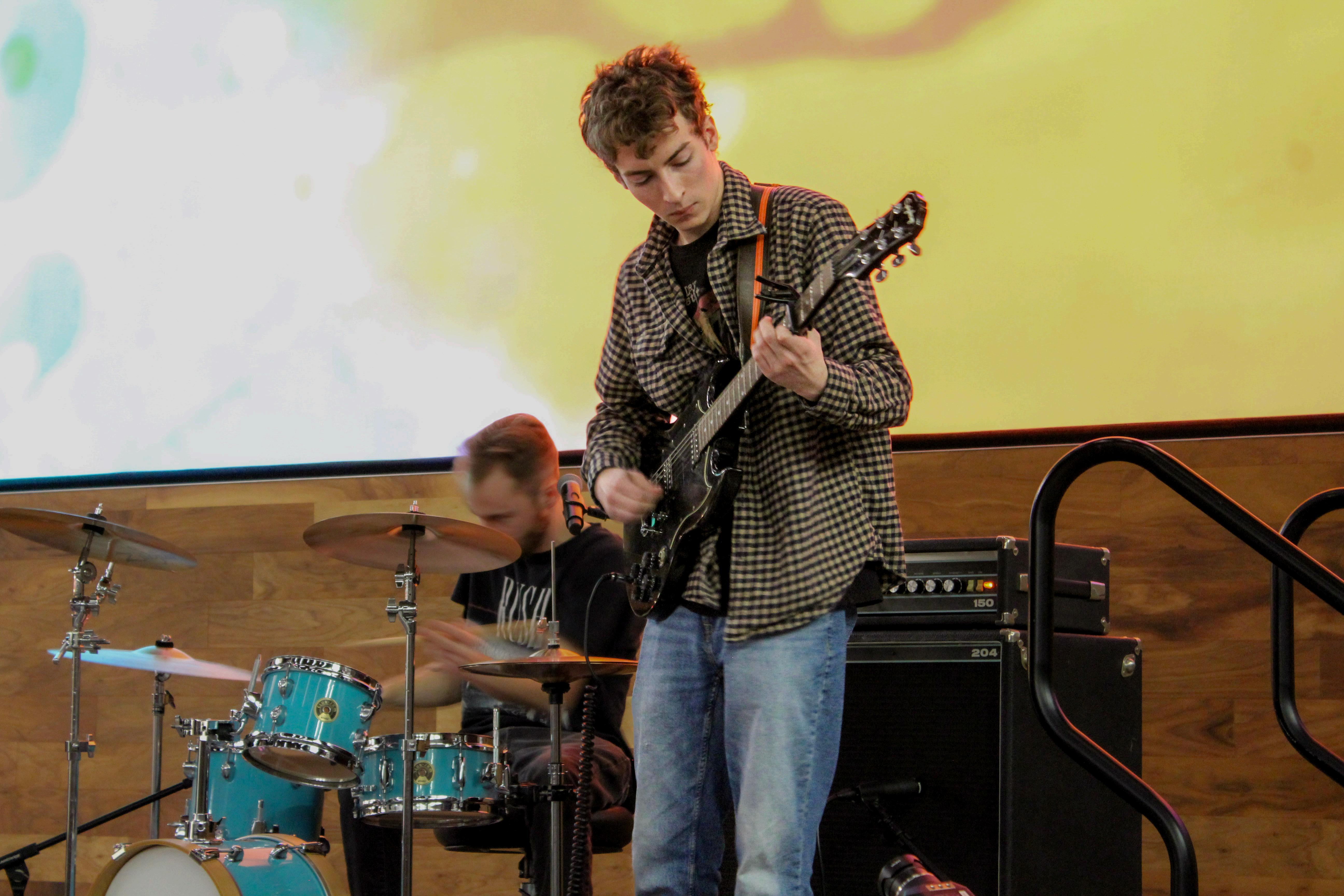
EXIT TICKET TAKES THE STAGE Ian Hughes, member of OU-based band Exit Ticket, rocks out and shreds during a performance at Grizzlies Art and Film Festival.
PHOTO BY CLAIRE SANDERLIN
Letter from the editor: How did this happen
CHELSEA BOSSERT Editor-in-Chief
I love being a Golden Grizzly, and I love being a student at Oakland University. The experiences and memories I have accumulated over these last three years here have been monumental to my development as a person and as a journalist. But even I — who bleeds black and gold — have some choice words for the fall 2025 semester.
I love OU, but this is tough love. Let’s talk about it. Four key issues plagued this semester at OU. These issues will encompass topics surrounding the university as a whole.
The dripping tap
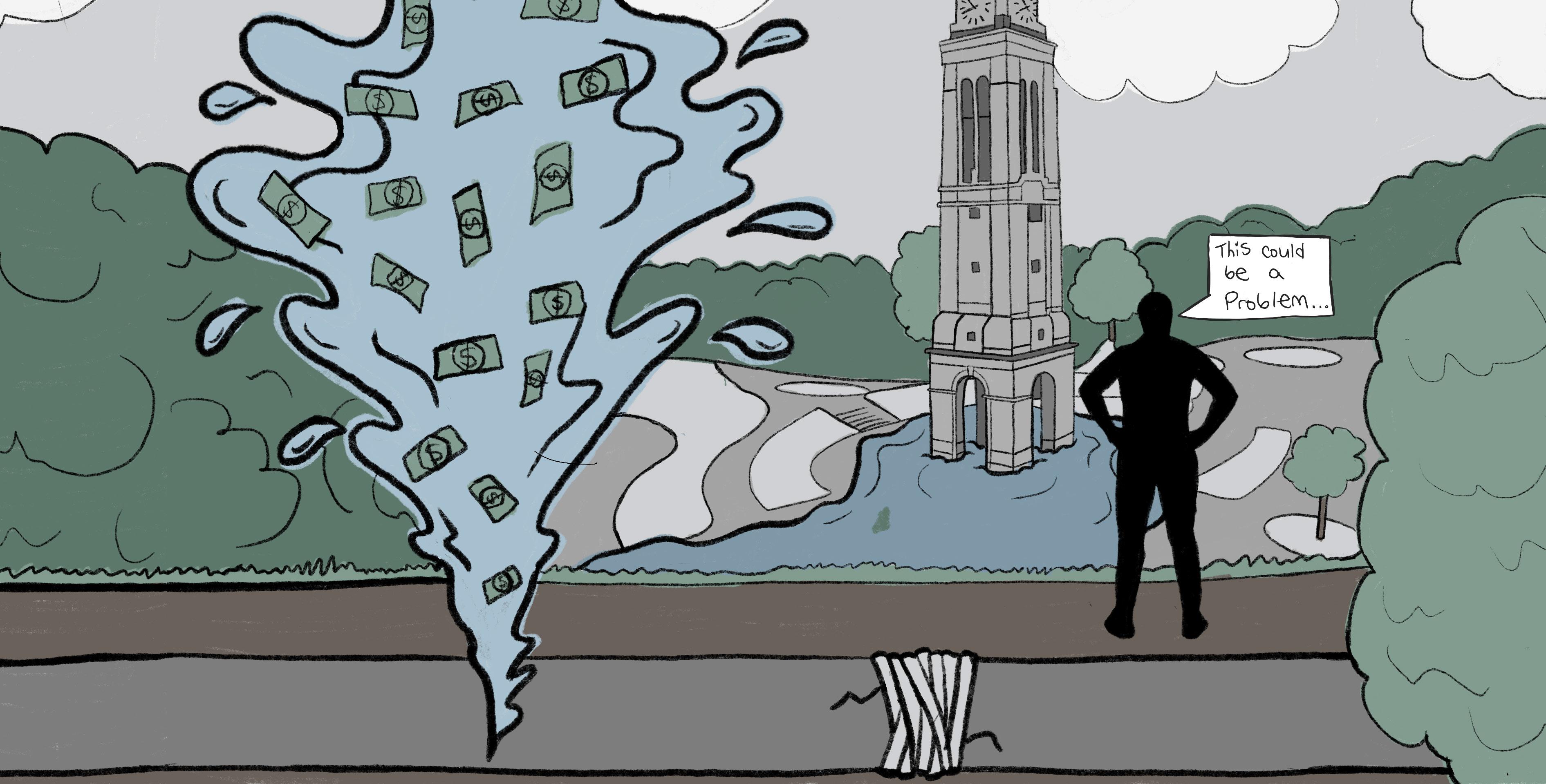
First, the biggest obstacle that is curtailing students, faculty, staff and members of the community is the pipe leak issue.
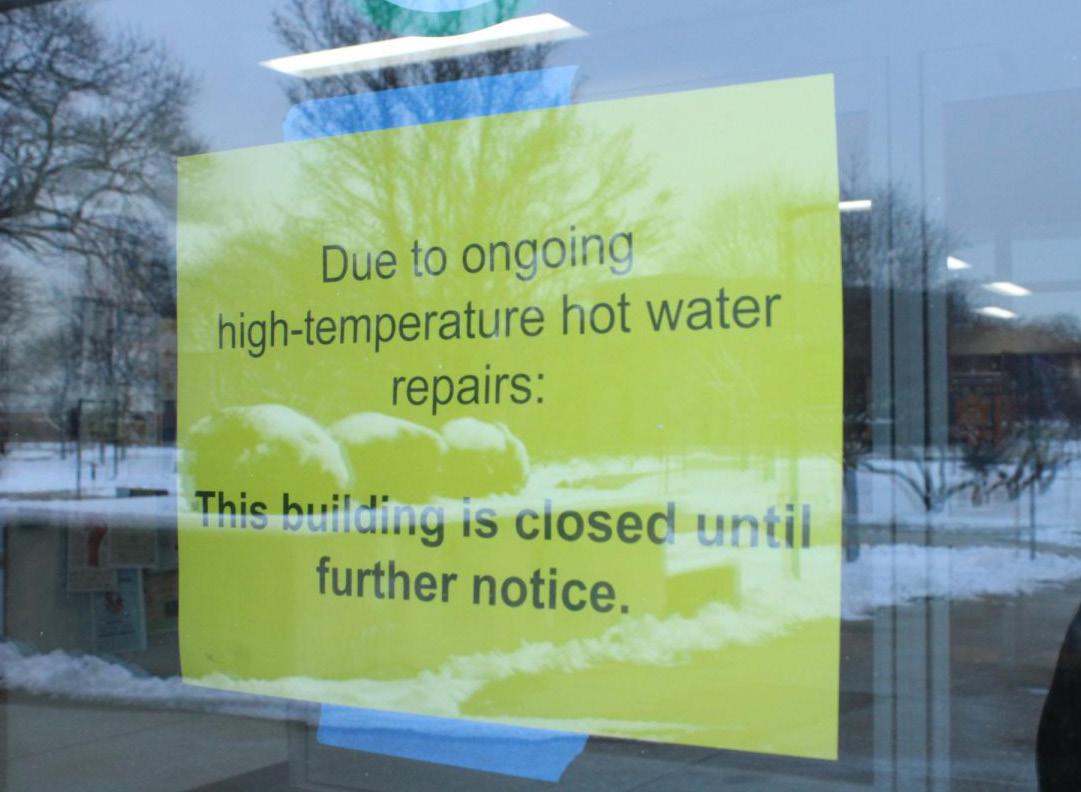
The high temperature hot water (HTHW) pipe leak has been detrimental to OU. It has been an unmitigated disaster that has permeated all forms of education, student life and workplace on campus. It’s frankly embarrassing.
It’s embarrassing how we got to this point. It’s embarrassing that a Division One, publicly lauded, award-winning, grant-magnet, culturally diverse, equitable and prestigious university got to this point.
In August of 2020, the Board of Trustees (BOT) approved a 5 million project to replace a portion of the HTHW pipe after it was discovered that there was — you guessed it — a leak. In just five short years, another leak has come up. Same pipe, same system. It seems that no matter how much money the BOT tries to extract and suck from the students who pay tuition — as well as the surrounding residents — the mechanical blowback arrives all the same.
This pipe issue is here, once again. It also seems like it is staying for a while.
The university initially thought the repairs would take only ten days. In fact, through the official Campus Communication email, it only took five — half the time allotted — to report that the repairs were successful.
They passed inspection, but accordingly, due to a combination of bad luck and Mother Nature herself. The pipe started to leak, once again.
Everyone is pissed.
Students are pissed, faculty are pissed, staff are pissed, food service workers — who will not be getting paid over the closure and most likely for the rest of the calendar year — are all really pissed off right now.
Faculty have either had to move classes online, some have had to cancel exams and in-person projects, others, such as the School of Music, Theatre and Dance (SMTD) faculty, are moving their performances and recitals off-campus — everything is thrown off by this one mistake that keeps coming back to haunt the BOT and OU.
After the 44.2 million dollar investment that paid off in 2024, with the renovation of South Foundation Hall, it’s not absurd to suggest that the university has money to spend.
The issue is how this university spends its money and what it chooses as wise investments.
This brings us to issue number two.
Infest the rats nest
In November of 2025, Senior Vice President for Finance and Administration and Treasurer to the BOT, Stephen Mackey, made his way down to The Ambassador room in the Oakland Center. There, he got up on the podium and, along with the Executive Director for Finance and Administration, Penny Vigneau, they plainly stated that the motivation for the OU data center project was: a lack of money (slide two).
The reason given for why this was suddenly an issue
is due to the enrollment figures, trends and perceived plateaus over the next decade. Along with the potential good press given to a school with “one of the first sustainable University Data Centers in the country.”
This is absolutely a lofty goal. The promise to the community that a data center will be sustainable, environmentally friendly, all while creating plentiful opportunities for the OU community, is bold.
Data centers are costly. Not just to build, but to maintain, to supply water to, to manage electricity and energy for — there are a plethora of issues with data centers that this Op-Ed will not even touch.
Back to the meeting with Mackey and Vigneau. They both attended this meeting, with the express intent of trying to convince members of Oakland University Student Congress (OUSC) that this data center plan is not set in stone.
They consistently repeated the fact that they were still in the “pre-development” or “due diligence” phase of the project. This is where they weigh environmental factors, assess the planned development site (P-35), align with OU’s sustainability promise by conducting “heat recapture” studies and begin their campus engagement.
Needless to say, the campus has not been engaged.
Saying that OUSC was skeptical was an understatement. Some might even say they were hostile to the idea that a data center was planned to be built on their campus, right next to the Native American Heritage site near P-35, no less.
They brought up every possible concern that they could with Mackey and Vigneau: environmental, sustainability, energy, millage, economic impact, job creation, opportunity creation. Mackey and Vigneau, through their professional and corporate demeanor, showed a lack of understanding and nuance with OUSC.
Not to mention, their continued talking point of “due diligence” is immediately brought into question and squashed by the fact that if they do not hit any hiccups, they’ll have this project up and under construction by the end of 2026 (slide ten).
The blatant disregard for the student body was not only felt in dealing with the pipe — but with the proposed data center as well.
This goes much further than one would ever have hoped it would. The leak is not just passing through the administration and the BOT, but it is permeating the very substantial services that students rely on.
This brings us to issue three.
Phantom Island
Food and shelter — two of the key needs of humans to survive. If either of those needs is neglected, then the body cannot function.
This is true for students, because students are also human — people tend to forget this fact.
As such, students deserve to have everything that they need in order to be successful. This does not mean: vacating and pushing students out of residence halls right before Thanksgiving.
Many of these students who live in Vandenberg, Hamlin and Van Wagoner Hall are international students or students who cannot return home on such short notice. Queer students also live in these dorms — some of them do not have safe homes to return to.
Oakland University did the bare minimum by placing the least fortunate of these examples of students in temporary residence, either in student apartments or non-affected dorms like Hillcrest.
However, the lack of planning permeates through the barrier once again. This hits our most vulnerable students and it is unacceptable that the university even got to this point.
In keeping with the theme of the rest of the year, due to the heating shortage, Vandenberg Dining Hall is now closed for the entirety of the campus closure.
In 2023, Hillcrest Hall closed its regular dining hall
hours, instead opting for mobile-exclusive ordering options. Two years later, Vandenberg Dining Hall is now closed for its regular weekend hours, in lieu of extended hours at the Pioneer Food Court.
The money is there, we know it is. The simple solution is to pay workers more — or just hire more employees. Dining halls like these are essential and it is a stain on this university’s reputation as a “first-choice” school to be treating the students like their needs simply do not matter.
I understand that being the Editor in Chief for The Oakland Post is a privilege. It is also a responsibility. It was a responsibility I have never, ever taken lightly as both a journalist and as a student. Newspapers — especially those run by students — have been bastions of free speech and free expression for decades.
I understand that I am privileged to have been guided by my peers and faculty — many of whom I call my best friends — to uplift student voices on campus.
Free speech, as we know it on OU’s campus, has been called into question in the fall semester of 2025.
My final point.
I’m in your mind
Public Forum Zones on this campus are disgraceful. The idea of having free speech (protests, grievances, petitions) being relegated to a specific area and under scrutiny from a public university is despicable.
In order to reliably follow the guidelines of the Oakland Center’s reservation policy, one must jump through several hoops in order to publicly express oneself.
There’s a caveat: this is all optional.
There’s nothing really to say here. Spending money to put up signs around the OC, quietly at that, and to specifically ask people to follow the rules and have their freedom of speech be approved is dumbfounding.
There has been a lot on my mind as of late. I’ve been trying to connect the dots on why this semester has been off. This is the last piece of the grand, ubiquitous puzzle.
These signs that designate the Public Forum Zones were noticed on campus the last week of October, over a whole month since the vigil held for the late conservative activist, Charlie Kirk, was held on campus in mid-September.
The vigil attracted over 1,000 students and visitors to Elliott Tower. They upheld their beliefs — but most importantly, they were given permission to be there.
OU students protested this vigil, directly outside the event, as well as with a separate event afterwards. Both are free and protected forms of speech.
My point with all of this is that after these events took place, these pseudo-requirements were put in place. It is a dangerous precedent to set — I’m not here for it.
How did this happen — what now?
This is my last Op-Ed. My last letter from the editor. In total, I’ve published 5, including the one that you are reading now.
My time at the post has been nothing if not eventful. I’ve outlined my gripes with OU in this letter;, however, I am still eternally grateful for my time here and the friends I have made along the way.
Like I said before, running The Oakland Post is a privilege. It’s also a lot of hard work.
I have cherished and am currently cherishing every moment of it. Even the crazy ones.
Be grateful for the opportunities you have at OU, but also, be skeptical — ask tough questions.
Be curious, be bold, be golden.
With all my gratitude, Chelsea Bossert
EIC of The Oakland Post
Letter to the editor: Regarding the data center (NAAC)
MULTIPLE FACULTY
To the Oakland University Community and Our Neighbors:
We write as faculty at Oakland University, and as members of Oakland’s Native American Advisory Committee not only to alert our immediate, campus community about the university’s plans to build a data center on campus, but to alert our neighbors in Auburn Hills, Rochester Hills, Rochester, and beyond as well, who deserve transparency around this project.
The proposed location for this data center is P35, a parking lot that is next to the Native American Heritage Site, an area that was designated by President Ora Pescovitz as a Heritage Site in 2022. The Heritage Site was officially announced during a ceremony that unveiled Oakland’s new land acknowledgment, and in her speech, President Pescovitz states that the newly adopted land acknowledgement “cannot be seen as our attempt to just check a box when it comes to diversity, equity and inclusion. It must be backed up by our continued journey to advance diversity and tolerance at Oakland.
Quite simply, our acknowledgment statement must be a representation of our values. The statement references the past, but the statement must reflect our actions in the present and our commitment to honoring and acknowledging native peoples who have been historically marginalized, from American institutions, from politics, and from academia.”
Research is already revealing that data centers pose great risks to environmental and human health. Data center operations rely on both the significant intake and outflow of water for system cooling, leading to unregulated issues of resource consumption, water quality impairment, or run-off.
Rapid growth in direct and indirect energy consumption associated with data centers’ high energy use can put a strain on local infrastructure leading to price hikes, overload, resource prioritization issues and increased emissions. In addition, noise is the data center impact that area residents find most disturbing. Data center noise has been described as a “drone” or “hum.” The sound can be detected up to 3 miles away and can cause members of communities to suffer headaches, stress, sleep disturbances, as well as anxiety, and memory and concentration issues. Wildlife are also harmed by sound levels, which disrupt animal communication and can force new migration patterns.
Data centers are projected to contribute astronomically to electronic waste, most of which is already not managed properly and contributes to environmental contamination that disproportionately impacts low-income communities and countries.
But this data center is not only an issue that concerns Oakland University. Citizens from a variety of communities across Michigan and the U.S., from rural to suburban, to our neighbors in Rochester Hills and Auburn Hills, are concerned about the impacts of data centers on our health and environment. The data center is not only next door to the Native American Heritage Site–it is next door to you, our friends in neighboring communities.
It’s troubling that in a mere three years of having adopted a land acknowledgement and designating a Native American Heritage Site on campus that Oakland would reverse course. Power plants and chemical industries have been disproportionately located in communities of color for decades, burdening these communities with poor air quality, noxious odors, and heavy truck traffic, all of which can harm residents’ health. As energy demands soar from data centers, these same communities will bear the brunt of dirty fuels and negative health outcomes.
The environmental impact of the data center would
have a substantial negative effect on the students in the Hillcrest Hall dorm, the biopreserve, and the Native American Heritage Site which is in close proximity to the proposed data center location. As Kyle Powys Whyte (Citizen Pottawatomi Nation) has noted, Indigenous peoples in the United States experience health and culture harms from toxic environments at disproportionate rates because settler institutions pollute those environments where Native people live and work. Native students at Oakland who learn on the Native American Heritage Site deserve to do so safely. All Oakland University students, staff, faculty, and community who live, learn, and perform cultural practices on the land in the biopreserve and the surrounding area deserve to do so with sustainable, long-term safety. The plant and animal relatives who have learned over the past three years to trust the Heritage Site and to flourish in the preserve, deserve our care.
Oakland University’s stated commitment to sharing stewardship of the land with Native peoples is a responsibility for a thriving future for the land. A data center so close to the Heritage Site and biopreserve does not reflect this commitment.
Only recently did faculty even know about the Request for Proposals (RFP) that had been published by the university for the project, and we were stunned to learn that the RFP was issued on June 16th, 2025, and the sealed proposals were due for consideration by July 29, 2025. The RFP even states that the purpose for building a data center is to “introduce a diverse mix of functions and activities that align with the university’s mission, vision, and strategic priorities.”
However, this statement is contradicted by the many facts surrounding the extractive and polluting damage that data centers do to the environment and cannot be reconciled with Oakland’s claims to valuing sustainability or being stewards of place. Oakland University’s RFP states that a proposal that contains facets that are “sustainable” would be preferred, but what does that mean?
As Ben Green explains, “The AI industry is aggressively touting data centers as a boon for local economies. In response, many states—including Michigan—have passed tax breaks to incentivize data center construction. But when you look at the evidence, it’s clear that data centers are harmful for the environment and that tax breaks are a bad deal for local communities. The growth of data centers has meant that fossil fuel plants slated for closure are staying open. Meanwhile, consumers face higher energy rates. And despite the promises of bringing tech jobs, data centers provide few long-term, high-paying jobs.”
According to the University of Michigan’s Ford School report, “What Happens When Data Centers Come to Town,” evidence from existing data centers in Georgia, Illinois, Indiana, Iowa, Michigan, Nebraska, Utah, Virginia, and Washington, shows that the effects of the tax breaks benefit the corporations more than local communities.
And in an extreme move that compromises OU’s promise of “honoring and acknowledging native peoples,” the plan to build this data center next to the Native American Heritage Site is a symbolic decision that undermines any claims to respecting the worldviews, histories, and experiences of not only Native peoples but the Black and Brown communities who have suffered systems of environmental injustices for centuries.
What Oakland University seems to be forgetting, however, is that everyone will be impacted, not just Black, Brown, or Native people. This project does not only concern our campus. Oakland should be having public hearings with our neighbors.
Yet, because public universities are often exempt from zoning regulations, Oakland is not required to hold public meetings with its community or neighbors. Considering the outcry from other communities with proposed data centers, there is no meaningful dialogue if the Oakland administration continues to plan a data center without sustained, accessible, transparent, discourse with all communities involved. A “public” university should be making this a public concern.
We urge Oakland University to be transparent and accountable to our campus community and to our neighbors about their plans to build a data center. We urge the public to make their voices part of the conversation.
Sincerely,
Megan Peiser(Choctaw Nation of Oklahoma), Department of English, Creative Writing, and Film; Co-Chair of the Native American Advisory Committee
Keith Williams (Oneida Nation of Wisconsin), Department of Psychology
Andrea Knutson
Department of English, Creative Writing, and Film Mozhgon Rajaee
Department of Public and Environmental Wellness
PHOTO COURTESY OF OAKLAND UNIVERSITY
Letter to the editor: AI and OU (and Apocalypse on the Planet?)
JAMES W. PERKINSON
Contributor
The Age of AI has commenced; Oakland University is pursuing construction of a new data center on campus. Now what? As a former OU adjunct/instructor (twelve years total) and long-time CASE-OU (Campus Alliance for Sustainability and the Environment-OU) Steering Committee member and social ethics professor at a seminary in Detroit, I have been profoundly exercised to get clear on my own response to the Age.
Almost daily research sifting through wildly divergent uptakes in podcasts and papers online has led to a basic conviction: we really have no real clue what we are doing. I don’t pretend to offer counsel, but only to sketch, in barest outline, the dilemma. And dilemma it is.
For nearly 10,000 years—since we first began to re-sculpt fields of einkorn wheat in the Mid-East to serve human desire “for more”— we have been ramping up technological intervention into wild nature with everexpanding effect.
Since the industrial revolution those effects have gone hyper; since the digital era, “hyper” is now a J-curve gone exponential. And what increasing numbers of “big picture” theorists (e.g., Ryan, Owie, Schmachtenberger, among others) are now at pains to clarify—echoing what indigenous peoples have been saying throughout the entire history of colonization— is how unprecedented the “corner” is into which we have (not “backed” but) “launched” ourselves, globally.
Again and again, I hear friends, colleagues, acquaintances of various persuasions all say, “AI is here; we can’t go back, it is not going away, how do we make it work for us?” Good question. But its simplicity hides the real issue. Who is the “us” for which it should be made effective?
And here the dilemma that has marshaled like a slow-gathering tsunami is now mushrooming as monstrous! Serious pursuit of that question brings us up against a longstanding inability on the part of our species to take full account of the effects of our presence on the planet. An accounting problem.
As our technological sophistication and incalculable cleverness has gone global and now seemingly total, we are faced with a failure of similar proportion. For the last 10,000 years technology has been made acolyte to what the theorists I reference call “multi-polar traps”—options on the part of whoever innovates the latest “advance” (in speed, comprehensiveness, efficiency, etc.) of whatever the tool is, that forces everyone else to similarly adopt that breakthrough, or be out-competed and left in the dust (“in the dust” of competitive advantage, funding, political support, etc.) for the next new option.
Our ability to take current technology, mobilize a bit of time, effort, and backing, to realize a new version or adaptation, or combination with other tools, almost inevitably gets roped into service of a narrow goal of competitive advantage. And everyone else either must conform or effectively “disappear.”
But technology is ultimately always composed of the materials, bodies, physicality, of other creatures, other “beings” (we now call them “resources”). When engaged in barter historically, our realization of advantage by way of innovation of such, was always limited by that physicality—and the resulting need for storage and transport.
With the invention of money as a signifier of value (coming into its own some 2,500 years ago to pay soldiers at a distance from their homes), we seemingly escaped the limits of those physical “objects.” We could now amass dollars, yen, euros (or whatever the name of the paper, or now, digital representation) “infinitely.”
But we deceived ourselves into thinking that such valuation was itself infinite. Money only has meaning in reference to actual “goods” that we value (e.g., foods, materials for shelter, energy for transport, etc.). And all of those “things” are themselves limited . . . as is the planet from which they come. There is not infinite land, iron, oil, water. And our technological prowess is now clearly blowing back on us in terms of observable, measurable, decimation of the planetary “systems” making life possible.
We are fast approaching—and in some cases already beyond—planetary boundaries regarding climate warming, habitat loss, species extinction, chemical and plastic pollution, beyond which lie self-reinforcing feedback loops that will continue the adverse changes without further human provocation.
Obviously, these are all huge topics, requiring massive metrics to well discuss, for which there is not space here. But the bottomline is indeed accounting: it is clear we are racing past virtually every such boundary— every indication of sustainable viability that our science can offer—without capacity to ask the central, and finally only, significant question: what works for the whole planet to continue its amazing ensemble of complexity into on-going Life?
What works—not for the narrow advantage (measurable today in financial interest-taking) of my person, my family, my country, my company, externalizing the costs of such onto the rest of everything else but for the whole kit and caboodle to remain viable?
For 10,000 years, we have tethered techinnovation to narrowly defined, competitive advantage-realization, by externalizing costcalculation and actual costs, whatever way we can. Externalizing the “costs” of that innovation onto other species, onto the quality of air, onto the potability of water, onto the availability of land, onto the health of other human bodies—especially among indigenous communities who do not live by such dynamics.
All of those “externalized” domains are deteriorating rapidly. And now the costs are coming due.
With AI, that tethering is both economic and political. The coWwwwmpetition between companies and countries is such that no one can dare slow down to ask about safety, about viability, about, survivability. Because such concerns for “wisdom,” for the condition of the whole of this irreducibly interdependent ensemble of living systems called Earth, will translate almost immediately into “losing the race.”
The problem is, in our now globalized system of externalization, “winning the race” now means even the winners lose it. Even Elon Musk has to drink water and breathe air. But no matter—full speed ahead with SpaceX and StarBase. Everything else is just collateral damage! See you on Mars.
What to do? I don’t know. But unleashing exponentially proliferating Power in the form of AI’s combinability with every other technology we have ever invented—and the obligation to do so immediately or lose the food on your plate—looks exactly like apocalypse to me.
OUSC General Body Meeting: Organic Farm updates and updating OU withdrawal policy
MALLORY WALIGORA, MARIA MAGNOLI, CAEL TANNER, MARYAM SOMO, AND MADISON SHORT
On Nov. 18, Oakland University Student Congress (OUSC) held its weekly General Body Meeting. Several topics were covered, including updates from the Student Organic Farm and a discussion involving student withdrawal policies from courses.
Student Organic Farm
Fay Hansen, associate professor of biological sciences and director of the Campus Student Organic Farm (CSOF), shared a report about the farm, its background and various benefits the operation provides for students.
CSOF, founded in 2010, applied for and received a grant, which majorly impacted the growth of the farm. The purpose of the original grant was to offer an emphasis on high-impact learning for lifelong skills concerning healthy living and practical environmental sustainability.
“We got this grant that converted the farm from simply a volunteer student-initiated project to an academic unit, which, in my opinion, is the only reason it’s still standing,” Hansen said.
Additionally, the CSOF offers educational aspects, including five academic classes as an extension of the biological sciences department, as well as a new urban agriculture and agroecology minor introduced in 2018. Hansen described CSOF as “a classroom without walls.”
“They’re all active learning classes, and, I would say, largely transformational for most students,” Hansen said. “It’s a different way of learning, STEM and problem solving… It’s been really valuable for student experiences in terms of academia, but also in terms of social activities.”
CSOF offers student employment, leadership training and interdisciplinary volunteering opportunities. Students can sell fresh produce at a fall-exclusive farm stand on campus or be involved with the student organization Growing Grizzlies. Hansen emphasized the sustainable life skills, hands-on learning and real-world problem solving for students involved with the farm.
Additional opportunities for collaboration extend from the farm into the heart of campus with the Farm Stand. Originating as a single table in 2012, the stand now consists of a large tent operated by students, club members and volunteers on central campus through the majority of the Fall semester. Through the grant-supported program Grizz Greens, the student organization further amplifies community outreach by sharing produce with the Golden Grizzlies Pantry.
“We’re able to donate quite a bit, up to 182 pounds so far this fall,” Hansen said. “We try to have very studentfriendly produce that students can use, whether they have a stove or not, fresh food, salads, fruits, finger food, that kind of thing. We are still able to provide some now,
possibly through the rest of the term.”
Hansen indicated a hope for further support from OUSC in such forms as a prospective degree and certificate in horticultural therapy, as well as conducting additional uses for the space in a student stress relief capacity.
“So it’s not just being in a classroom,” Hansen said. “You develop this relationship where you have an investment of your time and learning. You don’t often do classwork in a hammock.”
Student enrollment
Guest speaker Neil Baumgartner, associate vice president of student success and advising, came to share a potential new change in enrollment policy presented by the Committee for Academic Recovery and Success (CARS).
“The proposal is going to forward what we view as something that is very student focused and very much at the heart of it came out of the Committee for Academic Recovery and Success which is a newer committee on campus that is really focused on how we look at our policies, our practices, our processes, our way of doing things, to make sure that we are really putting the students at the center of everything and to try to help more students be successful,” Baumgartner said.
Baumgartner discussed a proposal to extend the withdrawal deadline from the end of the ninth week to the final day of classes before the start of the exam period – essentially extending the class withdrawal window through the entire length of the semester.
Baumgartner explained this new policy would create an increased chance of success for students with a better grasp and initial concepts, prompting further exposure to class material and the opportunity to demonstrate deeper understanding, recover from early struggles and withdraw from a course without consequence.
“We know not all struggles are academic in nature,” Baumgartner said. “In fact, I would say the majority are not. It’s not about ability. It’s about a lot of other things going on in life. And so it’s recognizing that and giving people an opportunity to accommodate.”
Several other universities across Michigan offer similar extensions up to final exams. The proposed policy addresses priorities of the current landscape and aligns with other institutions’ policies.
“I met with the dean of our med[ical] school earlier this week, and they don’t have a concern about this policy … there are other universities that already have this policy, pretty much in our state – Eastern Michigan and North[ern] Michigan already have this,” Baumgartner said.
Changes to financial aid rules and regulations were a prominent talking point in the conversation. These changes may have effects on students’ courses and their ability to retake courses.
Students must maintain satisfactory academic progress (SAP) to receive any aid. Graduate and
professional studies students will have to explain patterns of repeated courses regardless of grade. Financial aid cannot pay for classes not in a student’s program, so retakes of classes no longer needed for their degree are no longer eligible for funding.
“There are changes coming in the financial aid rules where financial aid won’t even pay for that class for you to repeat it if it’s not in your program of study. You’d be stuck in this cycle where you take a class, fail it, it having negative implications on your GPA or financial aid, and then financial aid won’t pay for you to repeat it,” Baumgartner said.
This new policy would, in theory, decrease C-DFWI rates – the percentage of enrolled students who withdrew, had an incomplete, or received a final grade of C-, D, or F for a course. Baumgartner emphasized the need for student support to continue to improve passing rates.
C.R. 68-13
C.R. 68-13, proposed by Marion Brumer, is a resolution that supports this new university withdrawal policy.
“The current OU withdrawal policy dictates that courses may be withdrawn without academic penalty through the 9th week in a full semester and the 5th week of a half semester,” the resolution said. “Within the coming weeks, the OU Senate will be considering reforms to the current withdrawal policy. The reforms would dictate that students may withdraw from courses and receive a “W” grade on their transcript through the last day of classes for each respective course length.”
This withdrawal policy was originally brought to the University Senate in the winter semester of 2025, in which “faculty members voiced concerns and advocates for the policy have worked with campus faculty members and stakeholders to address concerns since.”
This resolution emphasizes the advocacy of student mental health and how this proposal will be in support of helping students maintain their mental health through withdrawal decisions.
“Nationally speaking, mental health challenges are ranked as one of the top three most commonly cited reasons that students drop out and do not complete their degree. An extension of the withdrawal deadline through the proposed reforms would supplement current efforts to improve campus mental health by providing students with more time to make an informed decision about their potential to pass a class in spite of mental health challenges,” the resolution said.
The resolution is in support of the new withdrawal policy, noting that it will help students retain financial aid and their academic standing.
“An F grade is more harmful to maintaining Satisfactory Academic Progress than a W grade because an F negatively impacts GPA and completion percentage, whereas a W impacts only the completion percentage,” the resolution explained.
BY
PHOTO
CLAIRE SANBERLIN
SPB brings back another night of creativity with “OU has Talent”
MARYAM SOMO Campus Reporter
Oakland University is full of hidden talent that many don’t get a chance to express; however, every year on one night, they are allowed to express themselves and their creativity freely.
The Student Program Board (SPB), which strives to enhance student life through high-quality and diverse programs, activities, and events for the OU community, hosted its annual “OU Has Talent” show on Thursday, Nov. 20, in the Habitat. The show featured 12 acts, including both group and individual performances.
“I think it brings everybody together,” Sommer Fishpaw, president of SPB, said. “I see how many people show up for this event to support their friends. I did the show last year and it was a lot of fun and I just had a sense of community in the talent show. I think the talent show presents the opportunity to those students who feel like they aren’t seen in the arts.”
SPB has been putting on this annual talent show for years, starting with open auditions that invite students to showcase their abilities for a chance to earn a spot in the event.
“We base the selections on what we think the student body would be interested in,” Fishpaw said. “We try to find something that would be appropriate for students to see here on campus and just find those students who have talent.”
This annual talent show is one of the most loved and anticipated events of the year, showcasing student talents such as singing, dancing and expressive
art. Friends, family, students and faculty filled The Habitat in support of the performers, creating an atmosphere full of cheers and positivity.
“My roommate is part of the Infinity dance team, that’s why I’m here tonight,” student attendee Tamaya Monday said. “I feel like Oakland doesn’t really give us a chance to be individualistic and this is a great opportunity for students to showcase their individuality.”
Another student attendee, who came to the show to support a friend performing, shared her thoughts on the event.
“I think it’s amazing, especially because you saw so many diverse individuals, like you saw an Indian classical dance, hip hop, singing, you got to see it all,” student attendee Huda Rao said. “You’re able to see how diverse the student body is. I think it’s important because it develops and supports an inclusive environment and I think the only way you’re going to get more people to come to this university is if you show that you’re being inclusive.”
The president of Infinity, a student dance team focused on hip-hop and K-pop dance, shared the value of both participating in the talent show and attending to support other performers.
“I think if there was a world where we took [the talent show] away, it would make students miss a lot of networking opportunities,” Denetria Gibson said. “I think a lot of people come out and see this and they find new things to be involved in. I know a lot of our members found us through the talent show.”
Although the night was filled with singing and dancing, a mix of styles made the show unique, including K-pop dance, piano performances, tap
Minor and Major expo
ADRIAN JIMENEZ
MORALES
Campus Editor
Offering over 275 degree programs, with new additions every year, Oakland University hosted the Major and Minor expo on Nov. 20, allowing students to explore, combine and gain expertise in their dream careers.
Organized by an interdisciplinary committee led by the First Year Advising Center (FYAC), the event allowed students to connect with faculty, advisers and administrators and answer inquiries about new programs, changing degrees and exploring new careers.
“I don’t know any student who comes to Oakland really, knowing all 140 majors plus all the even more minors,” Assistant Director of Advising at the FYAC Rachel Stagman said. “One of the biggest goals of this event is just to put all those opportunities in one place and make it easy for students to literally just walk around and be able to talk to the faculty, current students — the people who really know the program best.”
With all academic departments involved, the occasion also brought in employers for networking opportunities and the Career and Life Design Center to support students at any point of their college career.
Often overlooked, minors, concentrations and combined programs are offered in all departments for students to add to their area of expertise, to complement a specific discipline or to diversify their skills.
“As a minor, [creative writing] can be very useful to show that you know how to think creatively and
critically, even if your majors are already set,” Katie Hartsock, associate professor of English and creative writing, said. “We have had minors who are engineers, anthropologists, who are biologists. We’ve had a wide variety of Creative Writing minors and it’s always exciting to see how they bring their realm of expertise to a poem or to a personal essay.”
The opportunities to combine disciplines go beyond the student’s curriculum, with the university supporting collaborations between departments, as Jon Carroll, associate professor of anthropology, explained.
“I’m working with the bio preserve committee, so I’m handling a lot of the archeological work that may need to be done on campus, but also in the preserve specifically,” Carroll said. He highlighted the new minor in applied geographic information science as one for the programs that allows for joint efforts between departments and students.
“It’s open to any major on campus,” Carroll said. “So if you’re into, you know, science and technology, or if you’re curious about how your phone gets you to where you want to go in the world, I teach that.”
With an increase in enrollment this year, Tom Raffel, associate professor of biological sciences, explained that years of planning go into assembling a new major after even decades of conversations. He specifically featured the new Bachelors of ecology, evolution and environmental biology, which exceeded the estimated number of enrolled students in its first year.
“I started designing this major almost eight years ago, but people have been talking about needing a major like this since before I came here 13 years ago,” Raffel said. “You can modify an old program, but it’s
dancing, expressive art dance, and traditional Indian dance. The variety of performances highlighted the diversity of the OU campus community and the importance of celebrating and sharing different cultures and talents.
“I’ve been learning classical dance for 13 years and I never really got a chance to show it or portray it in my college and this was a perfect opportunity to do so,” traditional Indian dance performer Amrata Balur said. “I feel like Indian classical dance is really underrepresented and I know no one really knows about it, so I felt like it was sort of my responsibility to bring it forward and show people the beauty of it.”
The night’s performances captivated the audience and judges, highlighting the creativity, talent and diversity of OU’s students.
“Well, it confirmed that Oakland absolutely has talent, right?” Dean Graeme Harper of the Honors College, a judge for the show, said. “It was spectacular, and it was really hard to choose between the different acts, because there was some fabulous stuff, very different. Not everybody was doing the same thing. It was a tough call, really. Just a really great experience.”
The show concluded with the three judges selecting the top three winners, along with a people’s choice award. First place went to the Infinity dance team, who received a $250 prize; second place went to singer Arwen Burkey, with a $150 prize; and third place went to traditional Indian dancer Amrata Balur, who earned $100. The people’s choice award was won by the dance team Intrigue.
a little bit harder to totally change the structure. I think that’s something you can look for in new majors.”
Analysis of learning outcomes, market shares, similar programs at nearby universities and various assessments go into the years of planning a new program, Raffel said. After pulling the curtain on a new degree, professors agreed that the most important thing is to maintain communication with students who might be interested. Talking to current advisers and emailing the professors in charge of the desired program was widely recommended by professionals at the fair.
“I highly recommend that [students] try to first attend one of our information sessions because it answers a lot,” Catherine McMullen, advisor at the School of Nursing, said. “It’ll talk about all the prerequisites, the course requirements and it will help students, you know, kind of get an overall idea plus any specific questions they might have, they’ll be answered.”
Beyond majors, the university and professors have worked to streamline the transition between undergrad and master’s programs, offering combined programs like the bachelor’s and master’s in accounting (B.S./ MACC) program at the School of Business. These programs allow students to save time and money to complete graduate studies.
“So you do your undergraduate in accounting and then you add, normally, one more year for the student to complete the master’s program,” Department Chair of Accounting and Finance, Liang Fu, said. “That’s going to help them get to that 150 credit hours, because to be eligible to sit for the CPA exam, you do need 150 credit hours.”
CAIR-ing for community: Thanksgiving luncheon
ERIN BANES Campus Reporter
Thanksgiving is often seen as a time for gratitude and generosity and this week, Creating American and International Relationships (CAIR) brought that spirit to Oakland University. On Wednesday, Nov. 20, the student organization hosted a Thanksgiving luncheon from 11:30 a.m. to 1 p.m., featuring a discussion on the holiday’s history with retired OU professor Richard Stamps and a conversation about student support resources with Charlie Dimmock, manager of the Golden Grizzlies Pantry.
The event blended cultural education with community service, offering a traditional Thanksgiving meal—including halal and vegetarian options—and collecting donations for the campus food pantry.
Natali Salaytah, CAIR president and graduate assistant to the International Students and Scholars Office, said the luncheon revives a tradition once hosted by OU’s Global Engagement Office.
“The main purpose of CAIR is to enrich international students’ experiences here in Michigan and a part of that is to provide opportunities to participate in uniquely American traditions such as a family-style Thanksgiving meal,” Salaytah said.
Inclusivity was a priority for the group.
“Being mindful of dietary restrictions and providing food options for all our members and guests is an important cultural competency that supports inclusion and accessibility,” Salaytah added.
Stamps spoke about the cultural significance of Thanksgiving and the contributions of Native Americans to the holiday meal.
“Whenever you go to a new country, if you want to fit in, it’s valuable for you to learn something about their culture, their language, their history,” he said.
He also addressed misconceptions about what we consider traditional Thanksgiving foods.
“Most Americans have no clue where all of our good Thanksgiving foods came from,” Stamps said. “If you take away all the Native American things— the potatoes, the tomatoes, the pumpkins—you really miss something.”
The luncheon also spotlighted the Golden Grizzlies Pantry, which provides food, hygiene products and clothing to students in need.
“The pantry is detrimental to improving food security on campus,” Dimmock said. “We try to mitigate financial burdens so students can focus on their studies.”
Dimmock noted that donations are especially critical this year. “SNAP benefits were cut off during the government shutdown, and we saw a lot of people come into our pantry that we had never seen before,” he said.
For many international students, the event was an opportunity to connect and learn. Raina, a student taking supplementary classes through the English as a Second Language Institute (ESL), said she attended to improve her language skills and meet new people.
“I really enjoy this campus life,” she said. “I like to go to the gym after class and make new friends— it helps improve my English.”
Joan, a Brazilian student studying English as a second language, agreed.
“Events like this help build a stronger sense of community,” he said. “The campus connects with all cultures around the world and that’s really good.”
Salaytah hopes students left with more than a full plate.
“We want international students to create core, positive memories of their time in the USA,” she said. “We hope all our attendees can really connect with the spirit of Thanksgiving in celebrating crosscultural friendships and harmony.”
Native American artist panel explores identity and culture
ADRIAN JIMENEZ MORALES
Campus
Editor
With questions on identity, activism and inspiration, the Native American Artist Panel explored the art scene at Oakland University and the advances Native American students have made in their personal projects and national conversation.
Moderated by the Associate Dean of Kresge Library, Beth Wallis, the panel featured two OU artists. Sada Reed and Katie Kraemer, both multidisciplinary artists and OU alumni, explored themes like displacement and remembrance, shared their creative process and questioned the place of art in everyday life.
“My inspiration for much of my work is the lack of concrete documentation of Native American culture and Native American people,” Kraemer said. “The concrete photos or writings that we have about Native American people have often been skewed by colonist viewpoints or photos that do not tell the true story of the Native American existence. My goal is through my photography to make an honest documentation of my life and the lives of other people around me.”
Technique, subject matter and medium are all influenced by tradition and culture. Under that premise, Wallis allowed the panelists to explore the themes behind Kraemer’s photography and Reed’s sculpture.
“My most recent piece was about displacement and chronic pain that I deal with on a day-to-day basis,” Reed said. “A lot of my inspiration is just coming from myself and what I’ve been ruminating on a lot, which is also where the pacing around with a journal comes
in because it’s just what’s naturally coming to me and what is from my thoughts.”
From epiphanies that inspire a piece to the planning phase of assembling the materials necessary, both artists offered a look behind the curtain of their finished pieces.
“A lot of times, when it gets to a point where I kind of have to ask, ‘Is this salvageable or is this not?’ If it’s salvageable, I’m gonna put work into it, not eat, not sleep until it’s ready, because I’ll have nightmares,” Reed said. “But if it isn’t salvageable, that’s when I cannibalize it. I cannibalize it. I just take it apart, use the materials for something else, like I have a step-bystep, because it happens a lot.”
Beyond the museums and galleries, the panelists explained that art and culture are often one and the same — alive in the quotidian details of our identity.
PHOTO BY ADRIAN JIMENEZ MORALES
“A lot of community and culture in Native American communities is art,” Kraemer said. “Every culture does that and you just don’t know it, because Native American culture tends to highlight it and revere it as a sacred part of our culture. But everybody does it every day, in a way, when you put on makeup in the morning, or you pick out your outfit. You pick it out sort of as armor to wear for the day of how you wanted to represent yourself.”
As an effort to take art to places other than the glass displays or monuments, the artists explained that OU’s art scene is growing alongside the students’ discipline and interests — not without challenges.
“People are afraid to go to the studio, especially post-COVID, like people aren’t showing up to a lot of stuff,” Reed said. “The gallery is open and free for everyone, not just students. We have art all in the basement of Wilson Hall. There are installations all over. There are installations in the library. So there is an art scene. It just feels like a lot of people don’t necessarily know about it.”
At the end of the day, both panelists agreed that art and exploring identity through art is as necessary as breathing, a part of life that does not fade with the paintings or crumble under sculptures.
“There comes a time in every artist’s life, where you go, ‘Oh, it’s the way my brain works,’ that’s why I’m an artist,” Kraemer said. “You visualize the world in pieces, instead of as a whole. And then after you’ve understood the pieces, it comes together as a whole, which is the same way art works. So you have to sort of come to this realization that, ‘Oh, I’m an artist.’”
PHOTO COURTESY OF NICHE
Curtains close on Varner Hall amid campus closure
AUGUST WICKER Managing Editor
With the recent Oakland University campus closure, over 15,000 students are adjusting to classes being moved online or even off campus. However, performing arts majors are impacted differently.
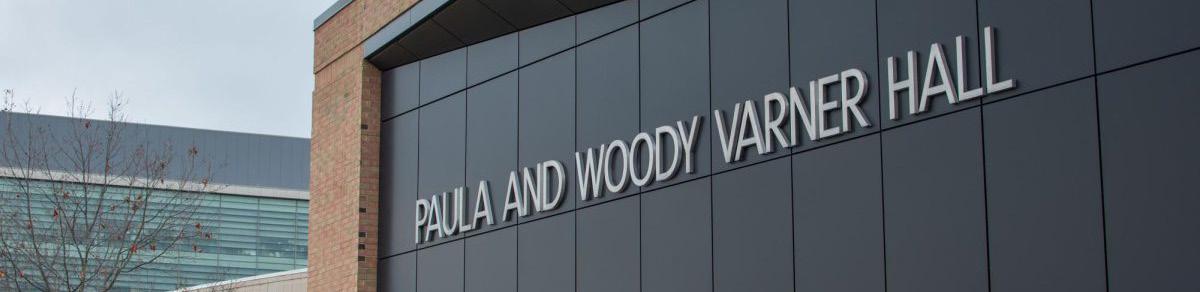
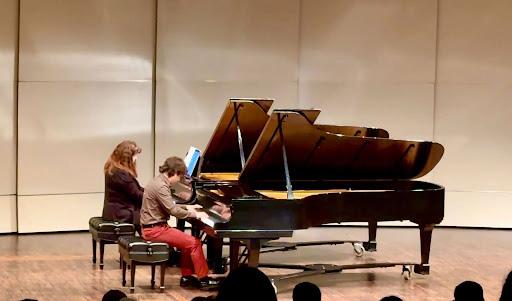
Varner Hall is home to OU’s School of Music, Theatre and Dance, housing all of the performance, practice, and storage spaces for students and faculty alike. The end of the semester is typically when many final performances and concerts are held. This means the emergency maintenance has rescheduled or cancelled many scheduled concerts, recitals and more.
The Symphonic Band and Wind Symphony Concert, the play Mr. Burns, the Jazz Singers Concert and the Chamber Orchestra Concert were the first events to be cancelled when the campus was set to reopen on Monday, December 1.
Abigail Shinska, a third-year Music Education major, described the closure as causing lots of “panic and worry.” As a former campus resident, she can practice at home, but she worries about residents being unable to practice and prepare for Final Performance Exams.
“Classes not being in person is impacting learning greatly,” Shinska said “My professors have stated that they have no clue what they’re going to do. I’m sure this is not going to be a quick fix at all.”
The Wind Symphony performance is being rescheduled for next semester, but the Symphonic
Band performance has been cancelled.
Even non-majors are being impacted. The Oakland Post’s own Ava Guest, a Graphic Design major and Music Technology minor, was disappointed to learn that her ensembles, the Golden Grizzly Jazz Singers and Gold Vibrations, had their performances cancelled.
“We had to cancel [the Jazz Singers] concert, which a lot of very, very talented singers spent a lot of time on,” Guest said. “It was pretty crushing.”
While the OU community was notified about the closure via email on November 12, some students have expressed that this could have been prevented.
“I feel like a problem big enough to close the entire school doesn’t just happen overnight, you know?” Guest said. “It’s got to have built up over negligence of some sort.”
OU’s SMTD is widely renowned throughout southeast Michigan, with the musical theatre
program being ranked #3 in the state. Students and faculty from all over the world come here to learn and teach the performing arts, a critical creative field.
The cancellation of all these events that hundreds of students have spent all semester working on is devastating not only to everyone involved, but potential audiences that will never see all that hard work come to life.
Several performances have been moved to local churches, such as the Strings Studio Recital on December 5 at Northminster Presbyterian Church in Troy, MI. However, Final Performance Exams, which are required for every music major at the end of each semester, moving off campus could lead to further problems for students without reliable transportation.
Hopefully, next semester will not have the same unexpected curtain call.
PHOTO BY LINDSEY SOBKOWSKI
Frozen chaos: Science and survival at Oakland University during the pipe leak
ANDREW MAY Opinion Columnist
A pipe burst does not discriminate. Hot/cold. Low-pressure/high-pressure. These are simplistic, predictable mechanics within nature. Their behavior can be measured as they spread through an environment.
Entropy: chaos, the primordial disorder that follows such mechanisms, is not so predictable. The sciences at Oakland University display that beautiful principle.
Strolling around Pyrale House, nothing seems immediately atypical. Unaffected by the loss of hot water, Pyrale House stands a flickering candle on an altar surrounded by the smoke of its extinguished brethren.
Certain niche psychology labs require the use of external facilities, such as Animal Psychology, have not been spared from the madness. Animals will have a much more challenging time achieving their highest self at the once peaceful—now stagnant—grounds of OU.
The campus itself is sporadic, to say so politely. The student body walks about, generally poorly informed and with minimal idea of how they are affected.
The Human Health Building is also generally unaffected by the water pipe bedlam. Juniors and seniors in the Nursing Program who were available for comment insisted that aside from the core-eds being online—which one even
scoffed was a bonus, nothing in their schedule has changed.
An amateur looking at this situation may call this the story: operations could be conducted largely as normal. This is a glaring mistake.
The true story lies in the fact that all those most affected by the pipe were not readily available for any comment. Information on the closure is also scant. Communication seems to be sent to faculty and students on a need-to-know basis. This has resulted in a terrible culture.
One can easily find gossip about what’s going on in the absence of hot water. Forgotten esoteric techniques being used to heat dorms. Dissections being performed while using space heaters to keep the space remotely livable. What is harder to nail down is anyone suffering from maladies caused by the pipe maintenance.
Just as many of the students with cold housing decided to go home for the holidays a month early, many of the labs and sciences have gone off the radar. Not only did the air freeze with the snowstorm, but life on campus itself reached absolute zero.
In the halls with water access, one might stick around to commiserate about how dead campus is and how a university can offer such third world living conditions at a one-percent price tag. Instead, it is like a true commuter college. Students escape the classroom like celebrities fleeing paparazzi—only into much less glamorous vehicles.
The roads between the labs are torn apart by
construction, snow, and ice.
In a roundabout way, that feels like the overall state of the sciences at Oakland University in this administrative chaos. Much as Pyrale and the Human Health Building still get heat; some enclaves of science persist in the tundra.
Professor Todd Shackleford still sits in his office in Pyrale listening to Dream Theatre, reading two books at the same time while managing a team of graduate students and research assistants investigating the mechanisms behind psychological selection pressures in human mating.
Medical students and nursing students are still gallivanting about sleep deprived as if they own the place. It’s as if those most affected by the failure simply disappeared into thin air, like water evaporating shortly after bursting from a pipe.
This story was written by a journalist with intense connections to a handful of labs with a 24-hour window to understand how the sciences were coping with the shutdown from the water main break.
Short answer: they didn’t.
In the absence of heat during the coldest Cyber Monday in recent Michigan history, students decided that warmth is more comfortable than the science that costs them thousands of dollars a semester—at an institution that seems more interested in parlaying with the press than the student body.
Campus closure forces professors to adapt quickly
MARYANNE SANFORD Sports
Reporter
Thanks to the recent campus closure, professors have been given the option to either move their classes online or to different facilities off the main campus. These professors didn’t have much time to make their decisions and needed to tell the students what was going to happen within around 36 hours to spare before classes were expected to resume.
This tight turnaround caused confusion for both faculty and students, as many were trying to balance holiday travel, family plans, and ongoing semester workloads.
Many professors have mentioned that the adjustments have added unexpected stress, making this period the most challenging part of the semester, and maybe even their careers.
Tom Discenna, a Communications professor, expresses his concern with students who are displaced by the interruption after having to figure out where to go and what to do for the extended Thanksgiving break and turning around to dorms still being closed and classes being moved elsewhere.
He also had to decide to move presentations for projects to a video format instead of being able to have in-class discussions on projects that students have been working hard on. The shift not only changes the format but also changes the energy and interaction that these presentations bring to the classroom.
“It feels a little like the pandemic in that we are all moving quickly to make the best of a bad situation,” Professor Discenna said.
This shows how professors are just doing their best to accommodate students and themselves to finish out the semester.
Then there are professors who teach courses that need to be in person, like Professor Christie DeSano, who teaches American Sign Language.
She finds it difficult to move a class like ASL online, but is thankful for how technology has evolved, and thanks to platforms like ZOOM and Google Meet, she is still able to teach her students signs.
But it proves to be difficult when she has assigned students a signed song presentation project, where students learn to sign at least 30 seconds of a song that they chose.
It is difficult for her to be able to properly assess the students when they are on her screen and not in person.
“ASL is a full body experience, one which uses the hands, face, and entire body to portray meaning,” Professor DeSano said.
She feels for the students who were not able to show their hard work to the class after working all semester to understand the language to the point of being able to sign a song.
There are so many more professors who teach handson classes that were forced to move to an online format, or even off campus to different facilities.
As the semester finishes up under these circumstances, both students and faculty are learning to adapt in real time. For many, the transition has been emotionally and academically exhausting, but it has also shown how committed the campus community is to keep learning moving forward.
Professors like Discenna and DeSano are doing everything they can to preserve the quality of their courses despite limitations.
PHOTO COURTESY OF PIXABAY
Oakland University’s community responds to limited campus reopening
MARYAM SOMO Campus Reporter
After the extended Thanksgiving break from Nov. 21 through Nov. 30 due to repairs on the high-temperature hot water (HTHW) pipe system, students, faculty and staff anticipated their return to Oakland University on Dec. 1. Information for returns was sent to students on Nov. 26 detailing the expectations for the following week.
The communication email explained that the university planned to resume normal operations at 5 a.m. Monday, Dec. 1, with University Housing reopening to residents as scheduled Sunday afternoon.
However, these plans for reopening campus were put on hold after the university communicated to the OU community that a new leak had emerged due to temperature and pressure fluctuations, affecting around 20 buildings and halting returns to campus, including student housing.
On Dec. 1, the official emergency campus closure in effect during the break ended as planned, but the university shifted to modified operations out of necessity. This left most of OU’s campus largely empty, with only students in the operating residence halls and essential faculty, staff and student employees on campus.
With over 15,000 students and only a couple of weeks left in the semester before finals, the campus would normally be filled with activity. Instead, only a small number of students were present, and the campus remained very quiet and still after the closure ended.
Reactions from the Oakland University community reflect their thoughts on the campus closure and return.
“I will say my office is freezing.”
Senior IT major Gabrielle Germanski shared her experience returning to campus for the first time after the
closure while working as a tech support associate in the computing technology office.
“There’s no one here,” Germanski said. “I don’t know, I’m not really getting any tickets right now, kind of just like freezing in my office.”
On her way to her office, while speaking with The Oakland Post, Germanski also mentioned that she had brought a heated blanket with her to work to help battle the cold temperatures.
“This feels good, actually.”
Gabrielle Lee, a freshman living at Oak View Hall, expressed the bright side of the campus closure and the sparsity of students on campus.
“When I walk around campus, it’s peaceful and I get to talk to myself while looking around and see how OU is so beautiful and get to see the atmosphere,” Lee said.
While some students are having a difficult time with the closure and the reduced campus activity, others, like Lee, are using this time as an opportunity to find some peace and quiet on campus.
Lee is also able to stay on campus, as Oak View Hall has heating during this time.
“It feels good to have heat,” Lee said. “I do kinda feel bad for people who don’t have heat on campus, but hey, I guess stuff happens.”
“We were supposed to do a lab, but it got cancelled when I got here.”
With OU communications changing frequently, students and faculty are still adjusting to how to handle their courses, especially lab work, while managing schedules and completing assignments.
Alexander Doskoris, a senior biology major, had commuted to campus for a lab in his class, but after arriving on campus, he was told by his professor that it was cancelled.
“She cancelled it when I got her around 10:30 a.m.,” Doskoris said.
Last-minute changes to schedules and course expectations are occurring across campus as confusion grows over which buildings are available during repairs.
“I’m mostly doing all of my class work online now.”
Due to the building being affected by the leak in the pipe system, many professors are simply opting out of in-person classes and moving their coursework online.
“For my ASL class, we were going to present a song in person this week, but now we have to record ourselves and submit it,” sophomore Ronza Somo said. “It’s really more of an in-person class because we practice with our professor and each other, but we have to do it online now,”
Somo also mentioned that as a clinical and diagnostic student, she has lab work and has had professors encouraging her to come to campus for labs, but the building restrictions make it confusing.
“It’s crushing because I have to tell people to leave.”
The Oakland Center, one of the buildings affected, is a popular spot for students to study and hang out, but it was restricted to appointment-only visits.
The Oakland Post spoke to Nick Devic, the student employed front desk attendant at the only open entrance of the Oakland Center, who was monitoring people entering the building.
“It’s sad to see,” Devic said, “I like coming here to study too, but it’s sad that everything needs to be closed down. It’s definitely colder with everyone trying to open the doors here; you can definitely feel the breeze coming in.”
The unexpected campus closure serves as unprecedented and confusing times for everyone in the OU community. For further clarification and updates on the situation, visit The Oakland Post or the official Oakland University hot water repair updates.
High temperature hot The full timeline
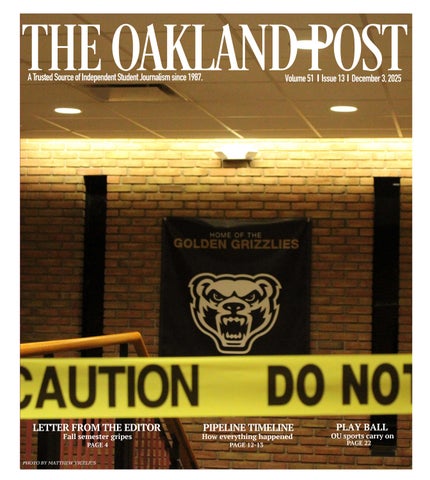
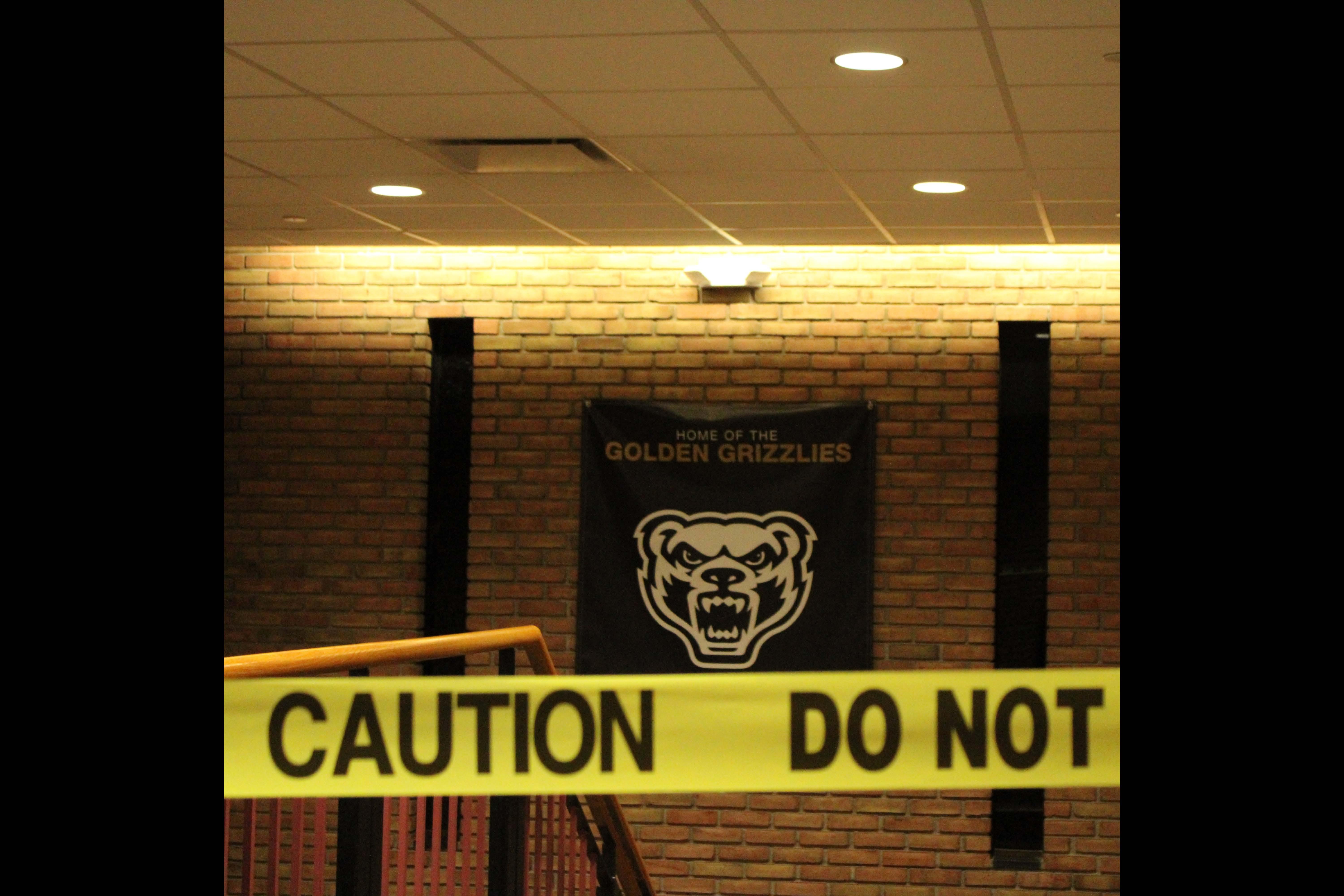
With Oakland University’s main campus being partially closed during the week before finals (12/1-12/7), due to a failed high temperature hot water (HTHW) pipe repair, Oakland University has been in constant communication with students, faculty, staff and community members at-large. In this complicated situation, it can be helpful to simplify and signify the main points of interest. Here’s a full timeline of what we know, what’s going on and what could happen.
TUESDAY, NOVEMBER 18, 2025
MONDAY, NOVEMBER 10, 2025
Oakland University Communications announced that campus will be closed from November 21 through November 30 due to a need to conduct emergency repairs on the high temperature hot water (HTHW) pipe.
Additionally, it was announced that classes during the closure period would be cancelled.
It was announced through official OU Communications that there is a contingency plan in place in case of a need to shut down the campus early — due to a more immediate pipe failure.
A walk-in computer lab is established on west campus and will be open during the week of the shutdown. This lab was put in-place for students with technological needs.
In a successful repair scenario, it was subsequently announced that campus would re-open at 5 a.m., on December 1.
FRIDAY, NOVEMBER 21, 2025
Campus officially closes for the emergency HTHW pipe repairs.
WEDNESDAY, NOVEMBER 12, 2025
OU Communications clarified policies put in place during the closure, including adjusting the testing rule during the week before finals and when specific buildings will be closed on Friday, November 21.
THURSDAY, NOVEMBER 20, 2025
OU Communications announced that trucks containing pipe repair and fire-suppression equipment would be arriving onto campus on Thursday.
story by Chelsea Bossert graphic by August Wicker
hot water (HTHW) pipe
timeline of events at OU
SATURDAY, NOVEMBER 29, 2025
After an announcement of successful repairs of the HTHW pipe system, OU Communications broke the news that due to a new leak emerging after a repressurization of the system — as well as a subsequent temperature fluctuation. Due to this, it was announced that 22 buildings on campus would be impacted by the pipe leak. This impact would include a partial heating failure that affects these buildings.
The communication also laid out the groundwork for the next week, including what students, faculty and staff should expect from housing, facilities and employment.
The buildings impacted by partial heating included: Biomedical Research Support Facility, Central Heating Plant, Dodge Hall, Elliot Hall, Engineering Center, Hamlin Hall, Hannah Hall, Hill House, Kresge Library, Math and Science Center, Meadowbrook Theater, North Foundation Hall, Oakland Center, O’Dowd Hall, Pawley Hall, Recreation and Athletic Center, South Foundation Hall, Vandenberg Hall, Van Wagoner Hall, Varner Hall and Wilson Hall East and West.
WEDNESDAY, NOVEMBER 26, 2025
It was announced through OU Communication channels that the HTHW pipe was successfully repaired and passed the proper inspections in order to resume normal university operations. The next step was to move to “refilling and pressurizing the system.”
University housing was announced to be re-opening on Sunday, November 30 after 12 p.m., it was also reiterated that campus would re-open on Monday, December 1 at 5 a.m. as scheduled.
WEEK OF MONDAY, 12/1-12/7 – WHERE WE ARE NOW
Students from Hamlin Hall, Vandenberg Hall and Van Wagoner Hall are actively being relocated to dorms and student apartments with heat this week.
Remote work for faculty, staff and student employees is occurring and encouraged by supervisors — in lieu of in-office work.
Repairs are actively being made while campus is partially closed due to the HTHW leak.
On Monday, December 1, at 2:41 p.m., OU
Communications sent out a brief update announcing that in order to prevent the loss of heat in the affected buildings, a decision was made to lock all the doors in those buildings.
Kresge Library was also announced to be closed through Thursday, December 11.
SUNDAY, NOVEMBER 30, 2025
It was announced that part of Pioneer Drive would be P-16 and P-17 on Sunday, November 30 — until further notice.
Additionally, it was announced that specific entrances to the partial heat-affected buildings would be open to faculty and staff to enter in. People entering those buildings were advised to only enter for “absolutely necessary” reasons.
Other announcements included Varner Hall being “directly impacted” by the heat shortage, The 2025 President’s Colloquium being postponed and the Recreation and Wellness center being shut down on Monday, December 1.
More information about the state of the HTHW repairs and the on-going situation surrounding campus-life, visit The Oakland Post for continued coverage. If you or someone you know has questions about the HTHW pipe situation that is occurring at OU, call (248) 370-2100 for further information.
Student workers react to partial campus closing due to HTHWS repairs
ADRIAN JIMENEZ MORALES
Campus
Editor
With 22 buildings across campus closed on Dec. 1, student workers found themselves with a wide range of feelings and work situations resulting from the ongoing High Temperature Hot Water System (HTHWS) repairs.
On Nov. 29, Campus Communications informed all Oakland University members that 22 buildings would be closed. Residence Halls, classroom buildings, Kresge Library and the Rec Well among these, impacting hundreds of student employees.
With Hamlin Hall, Vandenberg Hall and Van Wagoner Hall closed for the remainder of the semester, one of the first student workers directly impacted by the new HTHWS leak were Resident Assistants (RAs).
“Since Nov 21, I have not had to be on duty, work the service desk, or start any housing closing procedures,” Lexie Cousineau, an RA at Hamlin Hall, said. “I was not able to be relocated due to me living in a closer range to campus.”
Left with questions regarding the timeliness of the HTHWS repairs, Cousineau could not host closing events for her floor residents, perform closing health and safety inspections or help students with their checkout procedures.
“Thankfully, as an RA I still earn my bi-weekly stipend and I can still hold other meetings online with my position in CMI, but I am unable to work other oncampus jobs due to the closure, making my paycheck much smaller since I am not able to work more hours,” Cousineau said. “This makes my situation about earning money before the holidays a lot more stressful.”
Luis Sanchez, a student working as a catering assistant in the Oakland Center, shared the concerns over his finances as his job practically halted alongside the heating systems.
“Due to the pipes’ problem, I haven’t been able to work at all, so I stopped receiving any kind of income from my work,” Sanchez said. “Makes me in some way anxious because I was counting on those scheduled hours.”
A resident of Hillcrest Hall, he didn’t have to move out like Cousineau. However, he also encountered stress with reduced dining options and last-minute roommates.
“The short dining options [have] made me move away from campus. I feel they should compensate us in some way,” Sanchez said. “Housing just sent me an email saying that they were introducing more people in the dorm and that was it.”
As of Monday, Dec. 1, the Golden Grizzlies Pantry remained open for students facing food insecurity, pantry manager Charlie Dimock said.
“Thankfully, our student staff is so supportive, and a lot of them live on campus, so it makes it easier for us to maintain the hours that we were already at,” Dimock said. “So I’ve had to take some time out of my day that I wouldn’t have had to to adjust our hours, like on our social media, which isn’t a huge deal, just because, as you have seen, like foot traffic is kind of down today, and we don’t have as many people coming into the pantry right now.”
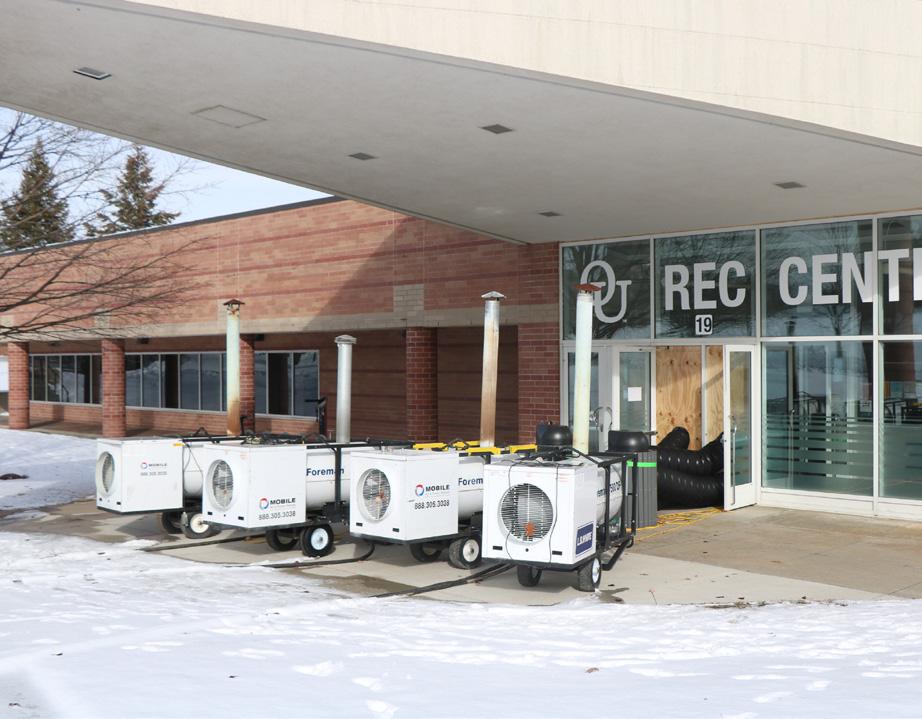
With heating equipment installed by the entrances to the Oakland Center — like many other buildings across campus — and heating units placed inside its hallways, the pantry continued operations even though doors were to remain locked according to a campus communication email sent on Dec. 1 at 3 p.m.
“I’m really appreciative of our higher-ups and how communicative they’ve been with us during this uncertain time, because if we didn’t have that communication, then we wouldn’t know what we were doing,” Savannah Lopez, student assistant at the pantry, said. “We would be scrambling and so thankful you’ve got Jean and right on our or right by us on our side.”
One of the main sources of communication between student workers at the OC and the administration was Senior Director of the Office for Student Involvement, Jean Ann Miller. She explained that streamlining communication in an efficient manner and student safety have been the top priorities of the administration.
“I was there all weekend long, on the phone with students, with my peers, administrators, all just trying
to come up with the game plan that is the best for the students, because we have the students ‘ heart, mind and soul and spirit in mind,” Miller said.
Managing over 105 student employees, Miller expressed concern for repercussions on personal finances and housing situations for a lot of students. At the same time, she focused her energy on offering resources for students to navigate the untimely challenges.
“Student employment was allowing for remote work, so we’re complying in that respect,” Miller said. “I did ask the question up at the Dean of Students Office, they do have an emergency relief fund. I was given the information that to apply for that, they just need to contact financial aid in terms of eligibility.”
Cancelling food orders, room reservations and postponing events became routine in the basement of the OC, where the OSI continued operations at the beginning of the week. As other departments may deal with more abrupt closings, the Rec Well slowed down rather silently, ending most of the regular operations for the rest of the semester.
“The rec is essentially completely closed until next semester, at least in my department so I will be out of work, at the rec at least, until then,” Izabella Stanczak, wellness ambassador said. “I feel the partial campus closure has helped significantly in offering more time to catch up on homework. I do not like not being able to work though, but it is more like a well needed forced break.”
Nonetheless, many student employees remained optimistic, even humorous, about the sudden silence at OU.
“It’s not really that much different at all, except that it’s like Jaden said, it’s quieter, it’s more calm here, and we get closer parking spots,” Nicholas Rushaj, a tutor at the Engineering Centre, said as the work day wrapped up during the last week of classes of the Fall 2025 semester.
PHOTO COURTESY OF UNSPLASH
PHOTO COURTESY OF OAKLAND UNIVERSITY DEVELOPMENT
PHOTO BY ADRIAN JIMENEZ MORALES
PHOTO COURTESY OF WIKIMEDIA COMMONS
PHOTO COURTESY OF UNSPLASH
10 Tips for staying safe on Michigan roads this winter
MARYANNE SANFORD
Sports Reporter
As the Michigan winter season approaches, drivers will once again face increased risks when navigating snowy and icy roads. According to Michigan Auto Law, approximately 24,000 vehicle crashes occur in the state each year due to winter weather conditions. Oakland County ranks among the leading counties for weather-related crashes, underscoring the need for caution as temperatures drop and road conditions deteriorate.
The following 10 tips offer practical guidance to help Michigan drivers stay safe throughout the winter driving season. With preparation, responsible driving and awareness, motorists can significantly reduce the likelihood of accidents.
1. Slow down
Speed is one of the leading contributors to winter crashes. Driving too fast makes it harder to stop, often taking up to 10 times longer in snowy or icy conditions. Even reducing your speed by 5 mph can lower the risk of sliding or losing traction. Maintaining a slower pace gives you more time to adjust to sudden hazards.
2. Install winter tires
Once temperatures consistently fall below 45 degrees, consider switching to winter tires. These tires are designed to maintain traction on snow, slush and ice. They are especially important on untreated roads, bridges and overpasses, which tend to freeze first. A proper set of winter tires can help
prevent skidding and improve vehicle handling.
3. Increasing follow distance
Leave at least 5 to 6 seconds of space between your vehicle and the vehicle ahead. This greater following distance gives you more time to react if the driver in front brakes suddenly. During heavy snowfall or icy conditions, increasing your following distance to 8 to 10 seconds provides an even safer cushion.
4. Brake and accelerate gently
Avoid slamming on the brakes or rapidly pumping the gas pedal. Gentle pressure helps prevent your tires from spinning or sliding. Ease into acceleration and begin braking earlier than normal to maintain control of your vehicle.
5. Take turns slowly
Quick or sharp turns on slippery roads can cause your vehicle to slide sideways or spin out. Reduce your speed before entering a turn and avoid sudden steering movements. Controlled turning helps keep your tires in contact with the road.
6. Use low-beam headlights
When driving during a snowstorm at night, use low-beam headlights. High beams tend to reflect light off falling snow, reducing visibility. Low beams help you see the road more clearly and allow other drivers to spot your vehicle.
7. Watch for black ice
Black ice is a thin, nearly invisible sheet of ice that makes pavement appear wet. It is most common in shaded areas, on bridges and during early morning or late evening hours. Use caution and slow down if road surfaces look slick, especially
when temperatures hover around freezing.
8. Avoid distractions
Michigan law prohibits handheld phone use while driving. Stay off your phone and keep your eyes on the road. Icy roads demand full attention, and even a brief distraction can lead to serious consequences. Practicing alert driving is essential year-round but especially crucial in winter conditions.
9. Prepare your vehicle before driving
Before heading out, check your wiper blades, clear snow and ice from windows and mirrors, and ensure your gas tank is at least half full to prevent freezing. Keep an emergency kit stocked with warm blankets, gloves, jumper cables, batteries, a flashlight, a firstaid kit and nonperishable food. Storing salt or cat litter in your vehicle can also provide traction if you become stuck.
10. Stay informed about weather conditions
Check weather alerts and road reports before leaving home. Being aware of incoming storms or hazardous road conditions allows you to avoid dangerous routes and plan for additional travel time. If conditions are severe, and plans can be changed, postponing travel may be the safest option.
Michigan winters are unpredictable and can become hazardous quickly, but thoughtful preparation and cautious driving can make a significant difference. By following these tips, drivers can help protect themselves and others on the road.
Students turn to online shopping ahead of Black Friday crowds
MADISON SHORT
Features Reporter
Black Friday falls on Nov. 28, and as the day approaches, consumers are either preparing for the chaos of in-person shopping, planning to browse deals from home, or choosing instead not to participate. Online Black Friday sales have dramatically increased as in-store shopping continues to decline.
According to Drive Research, 71 percent of this year’s Black Friday purchases are expected to be online, while only 29 percent will take place in person. Retailers such as Target, Walmart and Amazon have shifted marketing strategies accordingly, adopting digital-first campaigns in response to current e-commerce trends.
Oakland University student shoppers offered a variety of opinions on the rise of Black Friday digital shopping trends. Many prefer to avoid crowded stores when similar deals are available on their laptops and phones, allowing them to shop comfortably and at their own pace.
Others suggest prime discounts are not as common as they were in past shopping seasons, with traditional 50 to 75 percent markdowns now reduced to closer to 25 percent.
“I don’t like having to deal with the large crowds,” Annabelle Holliday, a senior who does her Black Friday shopping online, said.
“I feel like a lot of people are feeling the same as me with not wanting to go out and deal with all
the people, and online is much more convenient,” Holliday said.
Holliday believes that stores offer fewer deep discounts than in previous years, noting that very few still provide “true Black Friday deals.”
“It’s more efficient and less chaotic,” junior Kendall Bluestein said. “I feel like their deals aren’t as good as they were in the past.” Bluestein
does not participate in Black Friday shopping, considering many discounts to be insignificant and too often limited to items she does not want or need.
Although both prefer online shopping to the traditional in-person shopping experience, they acknowledge certain unique advantages that inperson shopping can provide.
“In-person shopping and being able to see the physical product so you can try it on — I think it gives the nostalgic feeling of Black Friday shopping, like when we were younger,” Holliday said.
Clothing and accessories are the most commonly purchased items during Black Friday, both online and in stores. Some shoppers may prefer trying items on in person rather than waiting to receive a product, sometimes only to end up returning it.
“When shopping online, you can take your time,” Bluestein said. “You don’t need to rush.”
Crowds and lines can be a common concern for some students shopping in-person as well. Drive Research reported that 29 percent of shoppers are willing to wait up to two hours to enter a store, with 42 percent waiting an additional 30 minutes or more in checkout lines. Some retailers adjust store opening times and security measures to manage high customer traffic during peak hours.
“You can visit many different websites in a shorter amount of time than visiting each store in person,” Holliday said.
While some may find the packed mall atmosphere and hunt for deals exciting, others prefer the simplicity and calm convenience of shopping from home.
PHOTO COURTESY OF UNSPLASH
OU AMA preps for Chicago conference with fundraising push
ADDISON KOCH Features Reporter
Oakland University’s chapter of the American Marketing Association (AMA) held its Social Media Agency Spotlight & Conference Prep Meeting on Nov. 18 from noon to 1 p.m. in Room 234 of the Stinson Center, bringing together marketing students for an afternoon of entrepreneurship, planning and networking. The AMA chapter at OU provides hands-on professional development for students interested in marketing, business strategy and digital branding. Participation in national events is considered highly valuable for members seeking internships and industry connections.
Students gathered over brunch and heard from Chris George, co-founder and CEO of SubSummit, the largest conference dedicated to direct-to-consumer subscriptions. George, who has founded and acquired multiple ventures, including Moonlight Bingo and Gentleman’s Box, shared insights from his work in subscription marketing and social media management.
He spoke on the continued appeal of subscriptions among younger consumers, noting that the flexibility and personalization aspects of subscription models are considered major drivers of growth. George also described how building strong online communities can help maintain subscriber engagement and foster rapport, encouraging students to think creatively about how brands can adapt to shifting market demands.
George tied his advice directly to one of the meeting’s main focuses: preparation for a student trip to the upcoming 2026 AMA International Collegiate Conference in Chicago on March 12-14.
This year, the chapter hopes to bring 15 to 20 students to the conference. To qualify for funding and discounted pricing, students must complete a Google Form concerning travel and pay the $29 student membership fee by Dec. 1. According to the chapter, travel will likely be arranged by train at an estimated cost of $100 to $150 per person, with students sharing rooms in groups of four. Conference offerings include competitions like Perfect Pitch, which organizers emphasized as a low-pressure opportunity for students to practice public speaking and make industry connections.
A major portion of the meeting focused on fundraising for the trip. The chapter has set a $4,000 goal to support travel, lodging and registration costs, with each student aiming to raise between $250 and $300. George led students through a workshop on how to make effective fundraising appeals.
He said that asking for donations can feel uncomfortable, but by sharing personal goals and explaining how the opportunity could shape students’ futures, the request becomes more persuasive and meaningful. Students also discussed how the conference could help them network with professionals and gain practical marketing experience, brainstorming how to incorporate those strengths into fundraising pitches.
The chapter is planning several initiatives, including an influencer-style social media campaign, a sidewalk sale featuring donated items and an annual giving push with sharable QR codes. A December fundraising night is also being organized to allow students to support one another as they make calls, draft messages and track donations together.
AMA leaders encouraged chapter members to start developing fundraising strategies over the holiday season and to communicate early with friends and family who may be willing to contribute.
The meeting closed with reminders of upcoming deadlines and an invitation to continue discussing ideas over brunch. With entrepreneurial advice from George and a clear roadmap for travel and fundraising planning, the AMA chapter is positioning itself for one of its strongest conference showings yet.
PHOTO COURTESY OF UNSPLASH
A desolate walk through campus
MALLORY WALIGORA
Content Editor
Editor’s note: This walk was completed before the campus operations update that announced all doors to closed buildings would be locked.
I’m a student who has always liked school.
I like seeing my classmates, many of whom I have become close friends with after the semester ends. I like getting to know my professors and hearing about their stories: past life experiences, strange jobs they had in the ‘90s and the reason they fell in love with their field. I like putting on a nice outfit for class and feeling ready for the day. I like getting homework done in the Oakland Center, hearing the hum of conversations around me. I like OU men’s basketball, and I love writing for The Oakland Post. Heck, I’m even one of the lucky students who actually enjoys her major.
At first, I was originally fine with a nineday-long Thanksgiving break during the initial campus closure. To tell you the truth, I was even pleased. I had homework to catch up on, and I had laundry to do.
But when the university announced another week without on-campus classes, I was frustrated. In all honesty, this is the most important week of my semester. I have final project presentations, final exams to review for and I have one-on-one office hour appointments. Out of all the possible weeks to be on campus, this is the one I needed the most.
I recognize things can be worse. I could live far from home, or I could even be an international student. I also recognize that the heating pipes are not an issue that can magically be fixed, nor do I blame the Oakland University administration. But I think it is fair to say that my frustrations are valid.
In the true spirit of journalism, The Oakland Post met in the lobby of Hillcrest Hall, one of the few buildings that was still open, to plan our news schedule for the next few days. We normally gather around a long, sturdy wooden table in the Oakland Center in our office, but that day, we huddled on couches in a dormitory lobby.
After our weekly staff meeting, I took a walk around campus with three other reporters to see what was going on. I wanted to see firsthand what the campus looked like — not what I heard through a campus-wide email.
Let me tell you what I saw.
Elliott Hall
Our walk began at Elliott Hall. We tugged on the doors, with a sign reading “THESE DOORS ARE OPEN,” in all caps. When we tried to open the doors, they didn’t open, even after trying the handicap button and multiple doors.
My first impression of our campus walk was general confusion and a lack of communication from the signage. Excuse my pun, but it was literally a door in our face.
Engineering Center
We then took a quick walk over to the Engineering Center, expecting more locked doors. However, the main entrance was open. On our walk inside the building, we met a student worker, who led us to her office space.
She explained that she would be working on campus this week, despite the closure and continuing her research.
My spirits were lifted for the first time that day. At least a student researcher could get the access she needed. On the upper floor, we met her three fellow coworkers quietly working on their projects. It was a small but uplifting win of the day.
Dodge Hall
We then walked over to the side entrance of Dodge Hall, and the doors were unlocked. There were no signs — it was just open.
As a journalist, I’d like to think I have a wide vocabulary, but no word quite describes my experience in Doge Hall better than: cold. It felt almost haunted. Half the lights were off, the building was silent and it was noticeably cold. I was wearing my winter coat, earmuffs, mittens, a large scarf and jeans. I could still feel the chillthroughout the building.
South Foundation Hall
South Foundation, in contrast, was weirdly hot. After being in there for only a few minutes, I had to take off my jacket. There were a lot of heaters, machines and pipes throughout the entire building. It felt less like an academic building and more like a dystopian nightmare.
The Oakland Center
A lot of strange things happened in The Oakland Center. Firstly, there was only one working entrance — all the others were closed.
A staffer from the welcome desk greeted us. Students are only allowed to enter the OC if they have an appointment.
“Do you have an appointment?”
“We’re with The Oakland Post,” I replied.
And with that, no appointment made, we got in. Sometimes, all you need is a confident
voice and a sense of journalistic authority to be let into places you probably shouldn’t be.
The OC was hot, especially near the Habitat. It was also lonely. It’s a space meant for students to meet with friends, to get homework done and to hang out after a long day. This was the opposite of what I’m used to. I saw only a handful of people in the building.
I finished our campus walk feeling mildly disheartened. This is usually a lively campus, yet I saw a total of ten people the entire walk. On a Monday, our busiest day, that silence spoke loudly.
At the end of the day, I spent an hour with friends, wandering around a campus I love.
See you next semester, Oakland. Whatever altruistic higher power that controls the heating — please fix the pipes.
Check out The Oakland Post’s Instagram reel that provides a visual account of the experience.
PHOTOS
GRAPHIC BY ANNA FRIEDRICH
Second annual GAFF spotlights student artistry
MARISSA GETSCHMAN
Arts
Editor
The second annual Grizzlies Arts Film Festival (GAFF), hosted by Student Video Productions (SVP), took place on Tuesday Nov 18 from 5-8pm. What started as a single hour event thrown together last minute the previous year has bloomed into a three-hour lower Oakland Center takeover.
Upon entering the OC on Tuesday, students were greeted by a table directing them to the Habitat for live music, performed by bands Raccoon Dog Fight and Exit Ticket and a series of student produced short films. The Lake Huron room housed an art gallery also featured by the event.
GAFF serves as a way for student artists to display their work to the public in an interactive competition. The focus was primarily to share, but viewers were invited to vote for their favorite artworks via a QR code.
Of the eleven films, two won awards; “Jekyll” by William Gilbert, which serves as a prequel to “Jekyll and Hyde” in which Dr. Jekyll presents his serum to a priest, a doctor and a judge, and “Telltale Nanners: Directors Cut” by Daniel Walleman.
“I’ve got my Filmmaking I project that was the version I had to turn in and then I’ve got the director’s cut, which is almost completely different footage, because he didn’t like the content of it because people die. It’s about a guy who slips on a banana and dies and his ghost haunts his friend with bananas,” Walleman said in regard to “Telltale Nanners.”
Walleman also shared the class version which followed a guy who was mad that his friend kept throwing banana peels at him in Mario Kart.
Rather than a ghost haunting with bananas, a friend terrorizes another with a harmless banana prank.
Of the six artists featured in the gallery, one walked away with an award: Gavin Wagner with his model train display.
“This is what I like to do and I heard about this and I asked them if I could show this and they said I could,” Wagner said. “It’s my passion. I like to build model trains, buildings and stuff, so this is one of my layouts that I’ve been working on for two years. Everything on it, I built myself either from a kit or from scratch”
Wagner also shared that he has a smaller display in his dorm as a way to spark joy throughout the semester. A small pleasure to help push through the daily grind of university life. Art should always be an outlet for creative expression, a way to push boundaries.
“It felt good to just be able to scribble color. So what else can I do with line art and just being free with what I want to do,” secretary of SVP, Michaiah Williams said. “This is the first time I’ve ever put my art on display for people”
“You’re going to feel good to be in a room with other people that are very similar to you, and you see their project, they see your project, you start talking and make friends. It’s just really rewarding” Ivaramoix Del Rosario, president of SVP, said when asked why future students should participate.
“Overall, this event went from like one hour to three. So it’s a major step up. I’m very happy with how it turned out, I know it’s going to be better next year and I know every year following that it’s going to be even better,” Del Rosario concluded.
PHOTO BY CLAIRE SANDERLIN
Apocalyptic Fever Dream: A Review of Mr. Burns, A Post-Electric PlayPost-Electric Play
ADDISON KOCH
Features Reporter
Oakland University’s School of Music, Theatre and Dance delivered an unforgettable theatrical experience with its production of “Mr. Burns, A Post-Electric Play.” Directed by Jacob Ben Widmar, the show transformed Varner Studio Theatre’s blackbox stage into a world where storytelling becomes a part of survival — and “The Simpsons” lives on as legend.
The play opens in a post-apocalyptic America, where a small group of survivors gathers around a fire, trying to piece together an old episode of “The Simpsons” from memory. What begins as a casual conversation quickly deepens into a portrait of how culture, and human connection, persist even after American society collapses.
The first act sets a serious tone as the audience begins to learn what happened to the survivors, though it is still punctuated by humor. Zander Warstler (Matt) stood out to me immediately with a natural, conversational delivery that made his scenes feel unscripted. Gavin Delorin (Sam) brought emotional nuance through his expressive acting and great line delivery. Wyatt Cleaveland (Gibson) brought authenticity to the stage, delivering his lines with a natural ease that made each moment feel lived-in.
Act II marks the production’s first major time jump — seven years into the future — and the design team made sure audiences felt it. Scenic designer Trish Brown unveiled an entirely new set, including a full apartment backdrop that was unexpectedly large for the scope of the black box theatre. This act trended toward
the comedic and musical before swerving sharply into a chilling gunshot sequence. The moment was executed with precision and convincing blood effects, leaving the audience little time to process before the scene snapped to black. Brynn Cecile (Colleen) delivered an emotionally sharp performance throughout the scene,
offering a commanding presence as the group’s director during the comedy sketch scenes.
By Act III, 75 years have passed, and the play reshapes itself yet again. What begins as musical theater turns into ritual — a surreal, mythic retelling of the world and the characters of “The Simpsons.” The cast’s singing was outstanding, supported by strong music direction from Laura Blanchard and live instrumentation, which was evident throughout but especially prominent in the final act.
This act belonged in particular to the performers embodying the iconic Springfield resident characters. Ian Finfrock (Mr. Burns) commanded the stage with charismatic, wicked energy, instilling an undeniable poise into the villain. Mirabella Ziegler (Lisa) was animated, expressive and difficult to look away from.
The production’s world-building was strengthened by contributions across departments: imaginative costumes by Jaci Taylor; props by Annie Eloise Findlay; hair and makeup by Cadence Potts; vibrant lighting by John Goff and Lorelei Preiss; and immersive sound design from Natalie Sevick. Together, these elements formed a post-electric world that felt both fractured and full of new life.
“Mr. Burns, a Post-Electric Play” is a story about the endurance of art — how stories reshape people, outlive them, and eventually become the myths that define a society. Oakland University’s production embraced every layer of that idea. Across its three genre-bending acts, the show was serious, funny, unsettling and at times entirely surreal, but always compelling.
The Oakland University Piano Studio dazzles Varner Hall concertgoers
MARIA MAGNOLI
Arts Reporter
On Sunday, November 16 at 3 p.m., Oakland University’s very own piano studio performed an astounding program.
As a piano performance major myself, there was something different in the air this semester. Perhaps it was the slew of new students, the fact that it is concerto competition season, the dense variety of music from all four periods (baroque, classical, romantic and contemporary) or the strong sense of camaraderie that exists among the students.
When people hear “Oakland University,” a commuter school with a nice selection of majors likely comes to mind. What they might not expect is a first-class piano faculty with top of the line credentials.
Tian Tian, associate professor of piano, earned a bachelor’s and master’s from Juilliard and a doctorate from the Eastman School of Music. I-Chen Yeh earned a bachelor’s from the Oberlin Conservatory of Music, a master’s from Eastman and a doctorate from Bowling Green State University. Rebecca Happel earned her doctorate from the University of Michigan.
Senior Tony Perez Chavez opened the afternoon with a vigorous Concerto in d minor, BWV 1052 by J.S. Bach — a work he is preparing for the upcoming concerto competition. With Happel playing the orchestra part beside him, he gave the audience a taste of what is to come this December.
“I chose this piece because it was my introduction to Bach concerti, and I love the cadenza section; I feel
satisfied with my performance, but I’m also proud that I was able to keep my composure even with mistakes. The progress I’ve made with the piece has been very slow and gradual but extremely rewarding for me,”
Perez Chavez said.
Sticking to the baroque theme, graduate student Katie Ringl and sophomore Jorge Palacios-Rodriguez carried on with two sonatas by Scarlatti — glimmering spectators with their clean articulation and ornamentation. This was Palacios-Rodriguez’s first recital as a piano performance major, and he is already thriving.
Kathryn Manhart, freshman, introduced the classical section with Haydn Sonata in C Major, Hob. XVI: 50. She was left with a positive feeling following her first official performance at Oakland.
PHOTO BY
“It was awesome to perform in a concert with the other piano students, and I enjoyed listening to everyone! I was really nervous while playing my Haydn piece, since I’m not used to playing from memory, but overall I think I did a nice job! Thanks to everyone who came.” Manhart said.
Audience members immediately recognized a familiar tune when freshman Emilie Martin played Mozart Sonata in G Major, K. 283. Another familiar bell was rung as senior George Sinnott performed Mozart Sonata in a minor, K. 310.
Junior Martyna Gogołkiewicz launched the romantic section with the fiery Chopin Sonata in b-flat minor, Op. 35. Concertgoers were stunned by the enormous sound which filled the entire hall. I followed playing one of my favorite Rachmaninoff preludes: B-Flat Major, Op. 23 No. 2.
Senior Yuhan Wei prolonged the Rachmaninoff set with Étude-Tableaux, Op. 33 No. 9 in C# minor, and Geoff Good wrapped up the set leaving the audiences’ jaws on the floor with Rachmaninoff Sonata No. 2 in B-flat minor, Op. 36.
Two pianos to start and two pianos to end. Gogołkiewicz and Palacios-Rodriguez closed together with “Jupiter” from Gustav Holst’s “The Planets.” An exhilarating ride from start to finish, students reflected on progress and improvements to be.
“Before stepping onto the stage, I was a little anxious. However, once I got on and sat in front of the piano, I felt better and enjoyed the moment. Performing a piano duet for the first time with Martyna was a fun experience as well,” Palacios-Rodriguez said.
MARIA MAGNOLI
IMAGE COURTESY OF OAKLAND UNIVERSITY
OUSC and Pantry to continue addressing the needs of students during closure
SOPHIA CURRAN Political Editor
Oakland University Student Congress (OUSC) and Golden Grizzlies Pantry are adapting in ways not seen before on campus.
Since the campus closure, student organizations here at Oakland have been working hard to navigate these unforeseen circumstances so they can still help those on campus.
OUSC President Marcus Johnson has been working endlessly with Oakland’s administration to ensure the needs of students here on campus are met. However, the situation hasn’t been an easy one for him.
“The biggest obstacle following the shutdown has been maintaining continuity for students while the situation keeps shifting. When the university loses a central space like the Oakland Center (OC), it affects everything from student engagement to access to basic resources, so a lot of our work has been focused on keeping things running without adding confusion or stress for students,” Johnson said.
OUSC and the administration are sending out information to students as new developments arise, and Johnson and his legislature are working hard to address the needs of the whole student body.
“In the days ahead, our focus is on stabilizing student-facing services and making sure no one falls through the cracks. That includes pushing out updated information as when we receive it, working with departments that were displaced by the shutdown and
making sure our own operations remain accessible while the OC is in flux,” Johnson said.
While students are currently juggling this new situation of finals and campus accessibility, they also run the risk of facing financial struggles.
“Our other focus is going to be on pointing students toward resources they can utilize to ensure they are not unduly burdened financially. So far I’ve been directing anyone who asks me to apply for reimbursement through the Student Emergency Relief Fund out of the Dean of Student’s office to ensure that nobody faces any financial burdens due to circumstances beyond their control,” Johnson said.
For those who are still on campus, ensuring food security has been a top priority to OUSC and Oakland’s administration.
“I have been in consistent communication with the Student Affairs Division as well as the Office of Student Involvement to make sure that students who utilize our food pantry don’t experience interruptions,” Johnson said. “We’re also coordinating with Student Affairs to make sure that students know where food support is located and how to access it despite the building changes and decreased dining options.”
As advised by the university, Hillcrest Hall has been a major source for students who need to eat. But, for those who have been facing food insecurity, the Golden Grizzlies Pantry is still supplying free food and personal hygiene items.
Pantry manager Charlie Dimock has noticed a decline in students coming in to get food and other needs.
“So it was a little bit difficult not knowing if the
OC was going to be open or not, and staff members, some of them, are at home right now, so they’re not able to come to their shifts. But overall, we’re handling it pretty well. We have seen a decline in attendance just because people don’t know that the OC is open. But we’re trying to use our social media as much as we can to kind of let students know that we are open and how they can have access,” Dimock said.
Supplies provided by the pantry go beyond campus grounds, as those who face insecurity even at home are free to take what they need.
“We have a lot of non-perishable food products that students would really like to have, especially over the winter break or the holiday break,” Dimock said. “So I’m hoping that students do come in here and utilize our services, even if they are coming in for the first time — that’s what we’re always looking for is new people — because we really want to help the OU community, and that’s what our mission is — is to reduce food insecurity on campus.”
Located in the Lake Superior room in the basement of the OC, the pantry has been facing obstacles due to the building’s closure. However, pantry accessibility is still open via its modified hours.
The OC is currently not open to regular, public use. However, students who are looking for the pantry are advised to enter through the northeast entrance of the building.
As Oakland is learning to adapt to this peculiar way of living and learning, OUSC and Golden Grizzlies Pantry are welcoming students and to voice their needs and concerns.
Government passes Epstein Files Transparency Act
MATILDE RABAJOLI
Political Reporter
You have heard the name before: Jeffrey Epstein. Whether it has been across headlines on the news outlet you watch, on social media pages or via videos of his face and his relationship to President Trump, the infamous man and his crimes have been at the upfront of American politics recently.
However, it is incredibly easy to get swayed in one direction or another, so let us take a look at what exactly has occurred in regard to Mr. Epstein, how it affects our American President and what the release of his files from federal protection means for the future of the nation.
President Trump reportedly resisted the release of the Epstein Files that allegedly hold evidence gathered by federal prosecutors during major investigations of Epstein himself. The evidence includes witness stands and collected electronic and physical proof of the sexual trafficking of minors in which Epstein was found guilty of.
President Trump suddenly changed his mind and urged his fellow Republicans to vote for the publication as the Oval Office received a bill to release said files after the Senate’s approval. President Trump saw the bill on his desk by Wednesday night.
“Perhaps the truth about these Democrats, and their associations with Jeffrey Epstein, will soon be revealed, because I HAVE JUST SIGNED THE BILL TO RELEASE THE EPSTEIN FILES!”
Trump said on social media.
The case of Jeffrey Epstein has been delicate from its beginning. The timeline began in March of 2005, when the parents of underage girls began police investigations against Epstein after paying girls for “massages” that quickly turned into sexual abuse, some starting as early as 2002.
After Epstein pleaded guilty to solicitation of prostitution, including with minors under the age of 18, he was sentenced to serve 18 months. He was released from prison almost 6 months early and avoided serving any more time until 2019 for newfound accusations for running a sexual trafficking ring that targeted young, underage girls.
He was found dead later that year while in federal prison. Seeing as a trial was still ongoing before his death, the prosecution moved to drop the charges.
Judge Richard Berman invited anyone to still speak on the case. Anonymously, twenty women took up this offer and discussed their experiences and provided their accounts to both defense and prosecuting attorneys present.
“The Court believes that where, as here, a defendant has died before any judgment has been entered against him, the public may still have an informational interest in the process by which the prosecutor seeks dismissal of an indictment,” Berman said.
The story of Epstein has been debated for all this time due to the increasing interest from not just domestic, but also international public opinion as to how President Trump is reportedly named within these FBI files, as Attorney General Bondi informed him.
The media-captured friendship between previous financier Epstein and President Trump has been reportedly said to have involved Trump in incriminating positions. News outlets have shared that President Trump was a knowledgeable and active participant “about the girls,” from tapes, pictures and private conversation from Epstein himself.
The Attorney General Pam Bondi received questions regarding how the administration would move forward after the files’ release. “We have released over 33,000 Epstein documents to the Hill, and we will continue to follow the law and to have maximum transparency. Also, we will always encourage all victims to come forward,” Bondi said.
While Epstein is not alive to defend himself, his legacy leaves a scorn in American politics. It is up to the justice system to bring the truth to the American people and justice to his victims.
What is OU Athletics doing during the campus closure?
MARYANNE SANFORD Sports Reporter
Amid campus closure, athletics is set to host three basketball games and a swim meet, leaving many wondering: What are they going to do?
With no time to spare, athletics is being forced to decide what to do, as they do not have heat, and it is difficult to reach the O’Rena due to the partial closure of Pioneer Drive.
Men’s Basketball fifth-year Tuburu “Buru” Naivalurua feels that the main disruption is in the classroom rather than on the court, as classes have been moved online or canceled altogether.
When it comes to housing, most athletes are luckily among those who remain unaffected.
“All of my teammates were part of the lucky few who stay in apartments that still have their heating working,” Naivalurua said.
He believes there is a possibility of the games being moved or rescheduled, but will wait to see if the campus situation will improve before then.
Alex Masnsfeild, a men’s track and field athlete, expressed how the team is still able to do their lifts in the Rec center, but practices are being held off campus as they prepare for the indoor season.
Outside of sports that are currently in season, there are athletes like Josh Francou and Cole Thompson, men’s soccer athletes, who are finding the closures to be difficult in their offseason.
“We can’t do any type of training because the gyms are closed, we can’t maintain,” Francou said.
The swim team is experiencing some stress as their Golden Grizzly Classic is expected to be held in the Oakland University Aquatic Center from Wednesday, Dec. 3, through Saturday, Dec. 6.
There is concern about whether the pool is able to remain heated for the athletes to swim in it, let alone the building, so they don’t get cold and risk getting injured.
As these events grow closer, athletics has yet to make any announcements on whether they will be rescheduled or moved to another facility. Concern over how many factors will affect the games also grows for fans, students, players, and coaches.
“There is definitely some concern for the upcoming games,” Naivalurua said.
The struggle for this week brings a lot of stress to the athletes about what the next move will be.
Once the week is over, the Men’s and Women’s Basketball teams are fortunate to have away games for the remainder of December and are able to practice in their facility on West Campus, where heating is not an issue.
They hold hope that when we return in January, the issues will be fixed in time for Women’s Basketball to play Purdue Fort Wayne on Jan 2, 2026, Men’s Basketball to play Robert Morris on Jan. 6, 2026 in the OU Credit Union O’Rena, and the swim team to host Miami and Denison on Jan. 9-10, 2026 in the Oakland University Aquatics Center.
PHOTO BY MAGGIE WILLARD
White-hot start isn’t enough: Oakland falls to UCF 87-83
MIKE OKORONKWO
Sports Reporter
The Oakland Golden Grizzlies’ high-stakes road trip to Orlando was a 40-minute masterclass in strategy, individual brilliance and costly execution errors, ultimately resulting in an 87-83 defeat to the physical UCF Knights on Nov. 17. The game showcased both Oakland’s immense ceiling and the fatal vulnerabilities of its defensive scheme against elite opposition.
Brett White II bombardment
Oakland started the game determined to match the Knights’ superior athleticism with hyper-tempo pressure. The ignition point was the scorching hot shooting of reserve Brett White II. Running off pindown screens and off-ball action, White torched UCF’s perimeter defense for a flurry of three-pointers, often hitting shots that were well-contested. His sheer volume and efficiency — including crucial backto-back makes — forced a desperate and dramatic strategic shift from the Knights.
The result was a textbook halftime adjustment by UCF. Their perimeter defenders abandoned simple containment and transitioned to active denial, chasing White over the top of every screen and denying him all space, effectively removing the Grizzlies’ primary perimeter weapon for much of the second half.
The interior counter: pressure and physicality
With the three-point line compromised, the offensive burden shifted entirely to the Grizzlies’ interior forces, leading to moments of brilliant, highleverage scoring.
Isaac Garrett was an interior anchor, leveraging his physical presence and unpredictable lowpost footwork to score 23 points and grab seven rebounds against the suffocating UCF frontcourt. His performance was crucial in keeping pace with UCF’s own dominant big man, Jamichael Stillwell.
Brody Robinson proved to be an unafraid floor general, using downhill attacks to generate consistent rim pressure. This translated to frequent trips to the foul line, a necessary tactic when perimeter shots weren’t falling. While he is an undeniable facilitator and great at drawing fouls, his costly decisions and missed opportunities late in the game prevented him from being the clutch shot creator Oakland needed to close the gap.
The essential “glue guy” was Tuburu Naivalurua. Despite a quiet shooting night, his seniority and high basketball IQ showed through his role as a great connective passer, tallying 11 points, six rebounds and five assists while keeping the ball moving when Robinson and Garrett drew double-teams.
Defensive flaws and personnel strain
Despite the offensive resilience that erased a 15-point deficit, the game was lost on the defensive end due to two critical issues: personnel strain and systemic vulnerability.
Oakland’s defense was compromised early when Garrett was sidelined by foul trouble and received a technical by halftime. His absence robbed the base zone defense of its anchor, creating hectic rotations and allowing the Knights to find easy offense. UCF, led by the physical inside play of Stillwell, successfully exploited the holes in the zone. Multiple possessions saw costly defensive breakdowns and poor closeouts, leading to uncontested baskets for Stillwell and others, often due to poor low-post rotation that left open lanes under the rim.
Compounding the issue was the shooting slump of Nassim Mashhour, who finished 2-of-11 overall and 0-for-7 from beyond the arc. While White’s firsthalf heroics balanced the box score, the volatility of the perimeter game highlighted the need for more consistent contributors on the wing, especially when the defense keys in on the primary threats.
Lessons learned
Ultimately, the tight 87-83 scoreline proves Oakland can compete with high-major talent. However, the game served as a valuable — albeit painful — lesson that high-stakes environments demand perfect execution. To win these battles, the Grizzlies must shore up the low-post coverage of their zone and find a way to maintain their defensive integrity even when their interior anchor is sidelined.
Women’s Basketball turning up the heat
MARYANNE
Sports Reporter
SANFORD
The Oakland University women’s basketball team has already been showing its strength against big opponents before opening conference play on Dec. 3.
With games against programs like the University of Wisconsin, Harvard and Michigan State University in their preseason, the Golden Grizzlies have shown they know how to hold their heads high and display resilience.
After an 80-75 win over Miami University (Ohio), the team’s confidence is up.
“I love the up and down, I love the adversity,” women’s basketball head coach Keisha Newell said in response to losses against Harvard and Charlotte University in the Raising the B.A.R. Invitational following the Miami win.
Newell and the team are focusing on discipline and trusting that discipline in tough stretches.
As they make their way through preseason games, they inch closer to their first Horizon League matchup against the Wright State Raiders in Dayton on Dec. 3. The team believes the preseason is crucial in preparing for league play.
“We’ve got to be ready to go by December third,” Newell said, noting the team’s goal of improving in-game adjustments and awareness.
Defensively, the Grizzlies have built a strong identity, forcing 16.2 turnovers with 7.6 steals per game.
“They need to be pushed,” Newell said.
The team is putting in hard work to maintain its
defensive intensity while continuing to build its offense.
For weekly preparation, the Grizzlies assess what kind of week it has been and what they need most. During practice, the focus is intentionally on themselves rather than solely on the opponent.
“If we’re focusing on someone else, then we’re not focusing on what we want to do right now,” Newell said.
Off the court, the team’s strength is equally visible.
“What they are going through as student-athletes — the way they are being pushed physically, mentally, and still maintaining what they are doing in the classroom and being good people,” Newell said.
When it comes to the long term, the team finds it hard to look ahead while in the middle of the season. but hopes remain high.
A season ago, Oakland finished 6-14 in the Horizon League under Newell’s new leadership. This season, they were ranked ninth of 11 teams in the preseason coaches’ poll. Regardless, the team is focused on itself and feels everything is coming together.
“I think we are definitely building something special,” Newell said.
The Grizzlies work hard to trust each other and build a family-like relationship. The older, more experienced players are also learning new things under a new head coach, while continuing to provide guidance to younger teammates.
As the team progresses toward Horizon League play, it holds high expectations for the conference season and where it will end up, and is more than willing to put in the work it takes to get there.
As of Nov. 22, Oakland sits at 2-3 with wins against Cleary and Miami (Ohio), and losses to Wisconsin, Harvard and Charlotte.
The Grizzlies also hope to see fans at their next home game against the Cleveland State Vikings on Dec. 6 at noon in a packed OU Credit Union O’Rena.
PHOTO COURTSEY OF OAKLAND SPORTS
PHOTO COURTESY OF OAKLAND SPORTS
Every Sunday matters: The brutal reality of the NFC North
JAMES ELLING Sports Editor
The NFC North has always been defined by grit, tradition and bitter rivalries, and 2025 is as much of a bloodbath as ever.
With Chicago banking its future on Caleb Williams and a fresh coaching staff, Detroit fighting to prove last year’s dominance wasn’t a fluke, Green Bay blending youth with urgency in a win-now push and Minnesota navigating the growing pains of a rookie quarterback after a surprising run, the division is far from chalk.
Four franchises — each with something to prove — collide in a division where the margin between glory and disappointment has rarely been thinner, and every Sunday feels pivotal to the standings.
The Chicago Bears
The Bears sit in first place at 8-3 — I do not care.
Chicago has two convincing victories, 31-16 over the Dallas Cowboys and 26-14 over the New Orleans Saints. Beyond that, they have had a knack for squeaking out tight wins against poor opponents.
Don’t get me wrong, the ability to win close games is maybe the single most important characteristic a football team can have. That said, these wins have come against the Raiders, Commanders, Giants, Bengals without Joe Burrow, Vikings in their worst offensive showing of the season and the Steelers without Aaron Rodgers — by a combined 16 points.
The Bears have a point differential of -3, despite their impressive record. I expect the Bears’ excitement will soon come to an end.
Next week they square off with the Eagles in Philadelphia, where one of the NFL’s best defenses will be waiting to impose its will. They will then face the Green Bay Packers twice in 14 days. Historically, the Packers “own” the Bears, as Aaron Rodgers would say.
Sandwiched between the two matchups with the Packers is the Bears’ only remaining game against a team that doesn’t have at least seven wins. They’ll face the Cleveland Browns, whose dominant defense boasts maybe the best defensive player I’ve ever seen in Myles Garrett. The Browns’ offense may not put up much of a fight, though.
In Week 17, the Bears will head to San Francisco for a primetime matchup with the 49ers. Despite injuries, the 49ers have looked formidable, making them better than every team the Bears have beaten thus far.
Chicago will welcome the Detroit Lions to Soldier Field for their only remaining divisional game and their final game of the season. In their first matchup, the Lions decimated the Bears 52-21.
The Bears, under first-year head coach Ben Johnson, ought to be proud of their eight wins through 11 games — but don’t expect that number to grow beyond nine through all 17.
The Green Bay Packers
The Packers sit in second place at 7-3-1. Through two weeks, the Packers looked like the best team in the NFL after dominant wins over the Lions and Commanders. Since then, things have been a little more shaky.
The highs have included two-score wins over the Bengals and Steelers. The lows are characterized by losses to the Browns and Panthers on lastsecond field goals. Somewhere between fall too-
close-for-comfort wins over the Cardinals and Giants, a tie with the Cowboys and a respectable loss to the Eagles.
Most recently, they beat the Vikings 23-9 in a game where Green Bay gained just 288 yards but held the Vikings to only 145. The win put them at 2-0 in the division.
Looking ahead, Green Bay will head to Detroit to battle the Lions on Thanksgiving. They’ll face the Bears twice on Dec. 7 and 20 while playing the Broncos in Denver in between. A hungry Ravens team will come to Green Bay in Week 17, and the Packers will end the regular season in Minnesota against the Vikings.
In the end, their ceiling is entirely defined by the play of Jordan Love. Inconsistent as it may be, when he plays his best they might be the best team in the NFL. When he looks disoriented, they’ve proven they can lose to any team in the league.
Assuming Love winds up somewhere close to average, they should take care of business against theBears and Vikings. The high-powered matchups with the Lions, Broncos and Ravens will be the Packers’ chance to prove they’re legit. I expect them to go 1-2 in those games and finish the season 11-5-1, good for a top-two division finish and a playoff berth.
The Detroit Lions
The winner of the NFC North each of the last two seasons, the Lions have had a much tougher road in 2025. They now sit in third place at 7-4.
The excitement of statement wins against the Ravens and Buccaneers has been mitigated by losses in their other heavyweight matchups, against the Packers, Chiefs and Eagles.
The Lions hang their hat on handling their business against inferior opponents. They’ve beaten the Bears, Browns, Bengals, Commanders and Giants by a combined 97 points.
Their one blemish in this regard was a threepoint loss to the Vikings in Week 9. The Lions struggled offensively — to the point of changing play callers the next day — while Minnesota played its best offensive game of the season.
In Week 12, Detroit gutted out a 34-27 overtime win over an inspired New York Giants team, led by Jameis Winston, who might have played the game of his life.
The Lions’ Thanksgiving matchup with the Packers will set the tone for the rest of the season. Detroit should be hungry for revenge after its Week 1 dud in Green Bay. A win would establish significant momentum toward a third consecutive divisional title, but a loss could signify the fizzling out of a once-promising season.
A week later, the Lions will welcome the Dallas Cowboys to Ford Field for Thursday Night Football, hoping to punish their unofficial rivals. Jared Goff will then return to Los Angeles for a proper test against the Rams, who might be the best team in football.
The Steelers, Vikings and Bears will round out the final three weeks of Detroit’s regular season, giving Detroit a buffet of formidable yet beatable opponents.
If the Lions are to do anything meaningful this season, they’ll simply have to be better than they have been as of late. They’ve produced top-tier offense and top-tier defense, but Detroit has to figure out how to do both in the same game.
If the Lions click those puzzle pieces together, they shouldn’t lose more than one or two games
the rest of the regular season, placing them beside the Packers near the top of the division.
The Minnesota Vikings
The only team in the division that hasn’t spent time in first place, the 4-7 Vikings have had the least to write home about.
After finishing 14-3 a season ago, the 2025 season has been less about winning games and more about ushering in the JJ McCarthy era.
McCarthy has looked like the truth at times, especially against the Lions and in the fourth quarter of the Vikings’ Week 1 comeback against the Bears. At other times — the other seven quarters he’s played against the Bears and against the Falcons, Ravens and Packers — he’s looked like a fish out of water.
Despite McCarthy’s inconsistencies, Brian Flores coaches a defensive unit that can fluster any quarterback and give Minnesota a fighting chance in every game.
The 23-9 loss to the Packers in Week 12 was indicative of the Vikings’ floor with McCarthy at the helm.
Next week, they’ll have their work cut out for them against the red-hot Seahawks and quarterback Sam Darnold, who led the Vikings to their 14 wins in 2024 — and who they probably wish they never let leave Minnesota.
After that, the Vikings will take a lessthan-intimidating tour through the NFC East, with winnable games against the Commanders, Cowboys and Giants, before closing the season with tough divisional games against the revenge-hungry Lions and the streaking Packers.
While 2025 may not be the year of the Viking, Minnesota should take solace in knowing it’s the NFL’s best last-place team.
The NFC North in 2025 is a gauntlet where no win comes easy and no lead feels safe — whether it’s Chicago’s fragile record, Green Bay’s reliance on Jordan Love, Detroit’s search for balance or Minnesota’s rookie growing pains, every team has both promise and peril. One thing is certain: the NFC North will be incredibly entertaining for years to come.