News: Biannual aWake All Night held in Benson Page 6
Opinion: The demise of the Ameri- Sports: Deacons defeat Boston College at home basketball game can novel Page 11 Page 8
Life: Netflix releases new, terrifying series You Page 17
Old Gold&Black
WAKE FOREST’S STUDENT NEWSPAPER SINCE 1916 VOL. 105, NO. 3
T H U R S DAY, JA N UA RY 31 , 2 019 “Cover s the campus like the magnolias”
wfuogb.com
Lilting Banshees host reunion show On Jan. 26, the comedy troupe took the stage to perform a variety of new and old skits BY LILLIAN JOHNSON Editor-in-Chief johnlg16@wfu.edu
Ever wondered how Wake Forest’s campus came to be? President Nathan O. Hatch looked at the vast swath of land before him. He ordered for there to be many bricks, squirrels and kids from New Jersey. As a final requirement, he created an active student body. After a few trial and errors on this front, an active student body of crusaders arrived with signs touting “Impeach Reeves,” “I want to toast my own bagel” and “Bring back Campus Grounds.” Over the course of six days, Hatch created Wake Forest. On the seventh day, he declared a reading day — even though the students complained that Sundays were already a day of rest.
See Banshees, Page 16 Olivia Field/ Old Gold & Black
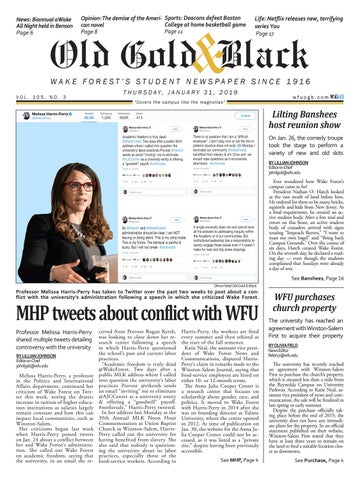
Professor Melissa Harris-Perry has taken to Twitter over the past two weeks to post about a conflict with the university’s administration following a speech in which she criticized Wake Forest.
MHP tweets about conflict with WFU Professor Melissa Harris-Perry shared multiple tweets detailing controversy with the university BY LILLIAN JOHNSON Editor-in-Chief johnlg16@wfu.edu
Melissa Harris-Perry, a professor in the Politics and International Affairs department, continued her criticism of Wake Forest on Twitter this week, noting the drastic increase in tuition of higher education institutions as salaries largely remain constant and how this can impact local communities, such as Winston-Salem. Her criticisms began last week when Harris-Perry posted tweets on Jan. 24 about a conflict between her and Wake Forest’s administration. She called out Wake Forest on academic freedom, saying that the university, in an email she re-
ceived from Provost Rogan Kersh, was looking to close down her research center following a speech in which Harris-Perry questioned the school’s past and current labor practices. “Academic freedom is truly dead @WakeForest. Two days after a public MLK address where I called into question the university’s labor practices Provost @rtkersh sends an email “inviting” me to eliminate @AJCCenter as a university entity & offering a “goodwill” payoff. #notforsale,” Harris-Perry tweeted. In her address last Monday at the 39th Annual MLK Noon Hour Commemoration at Union Baptist Church in Winston-Salem, HarrisPerry called out the university for having benefited from slavery. She also said that nobody is questioning the university about its labor practices, especially those of the food-service workers. According to
Harris-Perry, the workers are fired every summer and then rehired at the start of the fall semester. Katie Neal, the assistant vice president of Wake Forest News and Communications, disputed HarrisPerry’s claim in remarks made to the Winston-Salem Journal, saying that food-service employees are hired on either 10- or 12-month terms. The Anna Julia Cooper Center is a research center that focuses on scholarship about gender, race, and politics. It moved to Wake Forest with Harris-Perry in 2014 after she was its founding director at Tulane University, where the center opened in 2012. At time of publication on Jan. 30, the website for the Anna Julia Cooper Center could not be accessed, as it was listed as a “private site,” despite having been previously accessible. See MHP, Page 4
WFU purchases church property The university has reached an agreement with Winston-Salem First to acquire their property BY OLIVIA FIELD News Editor fielor17@wfu.edu
The university has recently reached an agreement with Winston-Salem First to purchase the church’s property, which is situated less than a mile from the Reynolda Campus on University Parkway. According to Katie Neal, assistant vice president of news and communication, the sale will be finalized in late spring or early summer. Despite the purchase officially taking place before the end of 2019, the university does not have any immediate plans for the property. In an official statement published on their website, Winston-Salem First stated that they have at least three years to remain on the land to find a suitable location closer to downtown.
See Purchase, Page 4
OGB
OGB reflects “a year after shooting, racist incident This column represents the views of the Old Gold & Black Editorial Board.
As all Wake Forest upperclassmen remember, the beginning of the Spring 2018 semester was a tumultuous and emotional time for the student body. One year later, the Wake Forest community is still grappling with the violence and racism that touched our campus. On Jan. 20, 2018, Najee Ali Baker, a Winston-Salem State student, was shot outside the Barn, an on-campus space used to host events. He was transported to the hospital, where he later died of his injuries. Just the day prior, late in the evening of Jan. 19, on-campus bias reporting systems were notified that a freshman had posted an online video in which
It is essential that the ... community engages in conversations to ensure that all students have a safe and welcoming home on our campus."
she admitted to being drunk and calling her resident adviser a racial slur. Later, university administration said that she was no longer enrolled at Wake Forest. These incidents, which rocked the campus community, were a stark reminder that while the Wake Forest campus often feels like a bubble insulated from the rest of the world, it is not immune to some of the problems faced by the outside world. To
Old Gold &Black
THE STUDENT NEWSPAPER OF WAKE FOREST UNIVERSIT Y SINCE 1916 LILLIAN JOHNSON EDITOR-IN-CHIEF johnlg16@wfu.edu
REN SCHMITT PRINT MANAGING EDITOR schmwm16@wfu.edu
>> NEWS
Olivia Field, fielor17@wfu.edu Assistant: Caroline Walker, walkct18@wfu.edu Elizabeth Maline, malied17@wfu.edu
>> SPORTS
Sam Wexler, wexlsn17@wfu.edu Assistant: Nick Lalli, lalldp18@wfu.edu
>> OPINION
Kyle Ferrer, ferrka16@wfu.edu Assistant: Jack Portman, portjt17@wfu.edu Senior Opinion Adviser: David Ajamy, ajamdg15@wfu.edu
>> LIFE
Emily Beauchamp, beauea17@wfu.edu Assistant: Catherine Regen, regecl17@wfu.edu Andy Killebrew, killae17@wfu.edu
>> SCI & TECH
Kiley Price, prickj15@wfu.edu Jonathan Trattner, tratjd17@wfu.edu
>> DIGITAL MEDIA EDITOR Lizzie Snyder, snydem15@wfu.edu
>> ADVISER
Phoebe Zerwick, zerwicp@wfu.edu
>> STAFF MANAGERS
Becky Swig, swigrr15@wfu.edu Julia Haines, hainjm15@wfu.edu
be sure, the country as a whole is currently contending with how to address both gun violence and the continuing scourge of racism, and it is essential that the Wake Forest community engages in similar conversations to ensure that all students have a safe and welcoming home on our campus. In addition, a year after these two incidents, the Editorial Board of the Old Gold & Black urges the university administration to continue to address student safety on campus seriously and realistically. In order to prevent events like those that took place last January from repeating themselves, every member
of the Wake Forest community must remain diligent in continuing to support healthy, open discourse on campus and resist the urge to turn a blind eye to quietly deplorable behavior. If we centralize the voices of students who face racism every day, we can make progress improving the campus climate for everyone. Further, though admitting it may be painful, gun violence is a reality of modern American life. Wake Forest's students and administration must avoid complacency through both maintaining and improving campus policy regarding the prevention of and preparedness for violence.
FOLLOW THE OGB ON FACEBOOK, TWITTER AND INSTAGRAM FACEBOOK.COM/OGB1916
BROOKS HALLOCK BUSINESS MANAGER
hallab15@wfu.edu
AMANDA WILCOX ONLINE MANAGING EDITOR wilcaf16@wfu.edu
>> POLICIES
The Old Gold & Black is published Thursdays during the school year, except during examinations, summer and holiday periods, by Triangle Printing of Durham. Š 2014 WFU Media Board. All rights reserved. The views expressed in all editorials and advertisements contained within this publication do not necessarily reflect the opinions of the OGB. As part of our commitment to reporting news fairly and accurately, we will not remove any previously published content. If an error in either our online or print content is brought to our attention, we will revise the originally published article with an appended correction. In order to facilitate thoughtful and appropriate debate, profane, vulgar, or inflammatory comments on our website are not allowed and will be deleted. For more information on our commenting policy, please see our website. We reserve the right to reject advertisements deemed inappropriate. Our full policy, and how to advertise with the OGB, can be found on our website.
>> SUBMISSIONS
The OGB welcomes submissions in the form of story tips, columns and letters to the editor. Letters to the editor should be fewer than 500 words, and columns should be around 500 words. Send yours via e-mail to hainjm15wfu.edu the Monday before publication. We reserve the right to edit all letters for length and clarity. No anonymous letters will be printed.
>> ONLINE MEDIA
Web: wfuogb.com Facebook: facebook.com/ogb1916 Twitter: @wfu_ogb Instagram: @wfu_ogb Snapchat: @wfu_ogb
@WFU_OGB
@WAKEFOREST_OGB
News | Old Gold & Black
BY CAROLINE WALKER Asst. News Editor walkct18@wfu.edu
Thursday, January 31, 2019 | Page 3
Deacon Profile: Brian Cohen
peer-to-peer network of faculty and staff who are empowered to integrate sustainability into the workplace within their departments. Greeks Go Green is our peer network for students in Greek life and is currently coordinated by two student interns who guide representatives through established peer education frameworks. And as a former student-athlete and coach, I'm particularly passionate about working with the Student-Athlete Sustainability Network, a self-explanatory group that is always welcoming new members.
Brian Cohen has been Wake Forest’s Program Coordinator for the Office of Sustainability since August 2016. He holds a master’s degree in Environmental Management from Duke University’s Nicholas School of the Environment and a bachelor’s degree in Environmental Studies from Bucknell University. Cohen dedicates his time to improving the level of sustainability across Wake Forest’s campus. His efforts and the Office of Sustainability’s initiatives have recently been brought to fruition, as Wake Forest achieved a STARS gold rating this past year for an exceptional degree of sustainability achievements in aspects of higher education.
How do you hope to impart the ideal of sustainability to the Wake Forest community?
Why are you passionate about sustainability? It's hard not to be passionate. Sustainability is, quite literally, what our future depends on. We're at a really precarious time in human history where our collective decisions will have major ramifications for our species moving forward. We can either be complicit in the problem or work towards a solution.
Photo courtesy of Office of Sustainability
Wake Forest recently earned a STARS gold rat- Program Coordinator Brian Cohen leads integral susing that recognized a high level of sustainability tainability initiatives across Wake Forest's campus. achievements in aspects of higher education. How My personal passion is working with others and has the Office of Sustainability accomplished this helping them grow into roles as leaders for sustaingoal? ability. I'd love to continue to increase the number of students, faculty and staff involved in our peer educaIt has really been a team effort. We partner with stu- tion programs and help them develop leadership abilidents, faculty and staff throughout campus to achieve ties that they can use both at Wake Forest and beyond. our goals, and we couldn't do what we do without The Office of Sustainability aims to empower others to them. For example, Facilities has been instrumental in lead, and this is where I believe I can make the biggest installing technology that allows Wake Forest to con- impact. serve energy and water. Dining has greatly increased their sourcing of thirdWhat are some significant sustainability initiaparty-certified products and has implemented numer- tives that you have supported? ous waste-reduction initiatives; an increasing number of faculty are incorporating sustainability concepts Some of the initiatives that first come to mind are into their courses and more and more students are the Compost Crew, the Plant-Forward Dining Compursuing sustainability as a field of study, a research mittee, the Green Team, Greeks Go Green and the interest or simply a way of life. Student-Athlete Sustainability Network. Sustainability is a shared value at Wake Forest, and The Compost Crew came about due to student init's exciting to see more and more members of the terest in reducing the amount of food waste sent to campus community making it a priority every year. the landfill, and it quickly exploded in popularity. The We still have a lot of work to do, but earning a STARS group also supports our zero-landfill event initiative, gold rating is an affirmation that we're moving in the which is quickly becoming the norm on campus. The right direction. Compost Crew, along with the Plant-Forward Dining Committee, dedicated to encouraging others to priDo you have any personal goals in respect to sus- oritize plant-based foods in their diets, are each now comprised of 75 to 80 people. The Green Team is a tainability achievements?
It's really a combination of methods. Wake Forest students are known for their academic prowess, so infusing sustainability in the classroom is obviously a priority. Peer education is proven to be effective, and that's a model we use quite a bit. Fun events and celebrations are more important than people may realize — community is a huge part of sustainability — and there's no reason why sustainability can't be fun. And leading by example, not just as individuals but as a university, sets the tone for who we are and who we aspire to be. How will you assess the impact that your work has on sustainability? You mentioned STARS earlier, and that's a great comprehensive tool for tracking our progress. Looking at quantifiable metrics, such as waste generated per person, energy consumed per square foot and students involved in environmental initiatives certainly provides value, but so does assessing the quality of student, faculty and staff interaction and involvement. How do you envision improving sustainability on Wake Forest’s campus in the future? One of our priorities moving forward is the continued development of our climate action plan and how we intend to mitigate our impact on climate change by reducing our greenhouse gas emissions. Besides that, we'll continue to expand our current projects and seek to empower our students, faculty and staff. We can't be successful without the rest of the Wake Forest community. Plus, some of our most successful programs have been student-generated, so we always welcome others' thoughts, ideas and involvement in future initiatives.
POLICE BEAT Miscellaneous • WSPD assisted with a report of sexual assault at Poteat. The report was filed on Jan. 24 at 4:30 p.m. • Unknown subject activated the fire alarm in Palmer. The report was filed on Jan. 26 at 5:11 p.m. • A noise complaint was reported on Macon Drive. The report was filed on Jan. 26 at 4:36 p.m. • A noise complaint was reported at Polo Road. The report was filed on Jan. 26 at 5:16 p.m. • A noise complaint was reported at Polo Road. The report was filed on Jan. 26 at 5:31 p.m. • Subject activated the fire alarm in Angelou. The report was filed on Jan. 27 at 1:39 a.m. • Discharge of firearm was reported at Wakefield Drive. The report was filed on Jan. 27 at 1:30 a.m. Underage Consumption/Intoxication • Offender was intoxicated. He was transported to WFUBMC from Last Resort. The report was filed on Jan. 25 at 2:01 a.m. • Offender was intoxicated in Angelou. The report was filed on Jan. 25 at 2:38 a.m.
• Offender was found intoxicated near University Parkway and transported to Student Health. The report was filed on Jan. 27 at 12:38 a.m. • Offender became intoxicated at a Lambda Chi function. Offender was transported to WFUBMC from Luter. The report was filed on Jan. 27 at 1:52 a.m. Larceny • Unknown subject(s) removed an unsecured Apple computer from ZSR Library. The report was filed on Jan. 23 at 12:40 p.m. • Unknown subject(s) removed a rented projector from a U-Haul parked in Lot Q. The report was filed on Jan. 23 at 3:28 p.m. • Unknown subject(s) removed clothing from the laundry in Poteat. The report was filed on Jan. 25 at 6:22 p.m. • Unknown subject(s) removed a belt from a room in Taylor. The report was filed on Jan. 25 at 7:00 p.m. • Anonymous caller reported possible thefts by an employee. The report was filed on Jan. 25 at 10:06 p.m.
Page 4 |Thursday, January 31, 2019
Old Gold & Black | News
Purchase: WFU obtains new property Continued from Page 1
President Nathan O. Hatch explained that the acquisition of the church is part of a long term strategy and will “give [the university] a reach to make a more integral campus.” Neal stated that the property will be included in future planning efforts. The decision to buy Winston-Salem First follows the $28.42 million purchase of Deacon Place, a housing facility that is only a three-minute walk from the church, last December. “Given the proximity of Winston-Salem First and Deacon Place to campus, we had to consider the opportunities to purchase these properties when their owners approached us about them,” Neal said. When Winston-Salem First announced the agreement to sell with the university, they also separately disclosed the decision to end funding for the Winston-Salem Christian School (WSCS). According to their official statement, the Board of Trustees made the choice to stop their financial support of WSCS independently from the selling of the property. “The school was not included in any information concerning the purchase,” Head of WSCS Bryan Wolfe said. “We are a ministry of Winston-Salem First, so we are not our own entity, but the first time I was informed of the decision [to sell the property] was a board meeting on Wednesday, Jan. 23rd.” With no financial backing from the church, WSCS is working to refigure their future plans. Wolfe said that he reached out to the university, in hopes that they would extend an agreement similar to the Church’s postponed relocation plan. According to Wolfe, Vice President Hof Milan offered to meet on Monday Feb. 4 to further discuss the school’s future.
Olivia Field / Old Gold & Black
Winston Salem First is located less than a mile away from the university’s Reynolda campus.
“We have had a couple conversations about relocating the school for the 2019-2020 school year, but the timing of the communication has made this a very difficult undertaking,” Wolfe said. “It is our hope that Wake Forest would be willing to extend a similar offer that was negotiated for the church, allowing us a window to remain on campus and prepare for relocation.”
WSCS is also looking at a location on Patterson Avenue, but Wolfe explained that the building, offered by another local church, is in need of $500,000 in renovations to be ready for the 20192020 school year. A gofundme.com page was created Jan. 24 with the goal of raising $500,000 for the school “to remain operational” for next year. The campaign has received a total of $20,935 from 95 donations. Winston-Salem First’s decision to sell reflects their interest in creating deeper connections with the Winston-Salem community, as they are moving with the goal of “provid[ing] a space where [they] can better serve and minister to the Winston-Salem community.” Wolfe also expanded upon WSCS’s role in the city. “Approximately 60 percent of our students are from Title I schools in Winston-Salem, and nearly one-third of our families are here on the North Carolina Opportunity grant, yet we have surgeons, doctors, lawyers and local businesses represented in our community,” Wolfe said. “We even have 40 families that identify Wake Forest or Wake Forest Baptist as their employer.” According to Neal, the university is open to discussion about the school’s presence on the property. “We have spoken with the head of school and assured him we would meet with school leadership about potentially making the school building available for a period beyond Wake Forest’s purchase of the property,” Neal said. “Of course, funding for the school would also be a key component to its continuation.”
MHP: Professor criticizes university on Twitter Continued from Page 1
Harris-Perry’s tweets on Jan. 24 continued, all ending with the hashtag #notforsale. She went on to say in her tweets that she was not given a faculty office this year despite having taught three classes last semester. Harris-Perry also tweeted that she is a “difficult employee” and that she will not be “leaving or staying silent.” Harris-Perry did not immediately respond to requests for comment. A statement given by Wake Forest said, “Her recent comments about the University are misleading and disappointing.” Provost Rogan Kersh declined to make a further comment. On the website for the Politics and International Affairs department, neither office location nor campus phone is listed for Harris-Perry. The chair of the department, Peter Siavelis, said that Harris-Perry is currently being provided with an office that is ready for her to move in to and will be in Kirby along with the other politics professors. Siavelis also confirmed that Harris-Perry taught three classes last semester — Race, Class, and Social Justice; America’s First Ladies; and Wake the Vote: Midterms Matter — and is team teaching a class — Black Women Activism — this semester with Jessica Stewart. Stewart is a postdoctoral fellow in the Politics and International Affairs department, according to her website, and will become an assistant professor at
Emory University in the fall, according to her Twitter account. This is not the first time that Harris-Perry has been in conflict with members of the university’s administration. At the end of last semester, Harris-Perry and Siavelis were in conflict over her medical leave and student evaluations in an email exchange obtained by the Old Gold & Black. Siavelis had emailed her students requesting that they attend a session so that they could fill out course evaluations, as Harris-Perry had recently gone on medical leave. Harris-Perry responded by telling students to disregard Siavelis, who she said was “dimly seeking to be helpful” and has no right to interfere with her courses. In the same email thread, Siavelis responded telling students to follow his directions, which had the endorsement of the Dean of the College. Harris-Perry replied that she was suspending her medical leave in order to be available to students. In addition to her students from her fall semester classes, other members of the university’s administration, such as Kersh and two faculty members from the Politics and International Affairs department, were copied on the email exchange. Siavelis declined to comment on the emails, saying that “the emails speak for themselves.” This week’s tweets by Harris-Perry, posted on Jan. 28, focused on the policies and practices of higher education institutions.
Her posts this week begin by saying that while tuition prices have drastically increased, the salaries of professors have remained stagnant, and the salaries of college presidents have increased. Harris-Perry included graphs from sources such as the National Center for Education Statistics and the U.S. Department of Education. In her posts, Harris-Perry said that these patterns are true at Wake Forest, where tuition is costly and President Nathan O. Hatch was one of the highest-paid college presidents in 2015. In her tweets, Harris-Perry said that communities have a vested interest in holding colleges and universities accountable. She tweeted that Wake Forest and its affiliate hospital are the biggest employer in WinstonSalem and that the “pervasive” 10-month contract for food service employees on campus creates a “working class” akin to that of the “government shutdown.” She continued her tweets, adding that universities have an obligation to engage in issues of inequality. Harris-Perry also shared sources for more information on this topic, like the Education Trust, ending these tweets with the hashtag #EducationVoices. Harris-Perry, an alumnus of the university, is nationally known for her political commentary talk show, Melissa Harris-Perry, that ran on MSNBC from 2012 to 2016. She also previously served as the director of the Pro Humanitate Institute. Harris-Perry also leads the Wake the Vote and Reporting Across the Divide programs.
News | Old Gold & Black
Thursday, January 31, 2019 |Page 5
Affluence plays a role in party culture Although not the definitive cause, dents come from the bottom 20 percent incomes. affluence is a dominant factor in ofSenior Austin Hill, who has experiparty culture enced party culture from a distance as BY LILLIAN JOHNSON Editor-in-Chief johnlg16@wfu.edu
In looking at what causes party culture, it becomes a question of the chicken and the egg: which came first? At Wake Forest, where party culture reigns, many of the factors that feed this culture have long existed, such as a popular athletics program, a limited number of exciting social opportunities off-campus and an active Greek community. But behind all this is another looming factor: affluence. Nationally representative data shows that students attending high schools with high proportions of affluence are much more likely to report intoxication and the use of illicit drugs, according to a Washington Post article by psychology professor Suniya Luthar. If caught, these students usually get out of trouble and continue their behavior, which can lead to higher rates of substance abuse, as research suggests. This data is relatively new, with the first findings having only been published in the late 1990s. Until that point, suburban affluence was never thought of as a risk factor for substance use and abuse. Peter Rives, assistant director of Wellbeing – Alcohol and Substance Abuse Prevention, believes these findings are consistent with Wake Forest’s own experience regarding affluence and drinking. “We admit fewer non-drinkers and fewer-low risk drinkers than our national comparison schools,” he said. “Then we admit more problematic drinkers and more heavy episodic drinkers than our comparisons.” Money, Money, Money Wake Forest, with its top-ranking education, research opportunities and parties, comes at a hefty price tag. For the 2019 – 2020 school year, total cost of attendance is roughly $74,424 dollars. Despite being on the higher end of the cost of attendance range, Wake Forest has a price tag that is consistent with many of its equally small, equally selective liberal arts peer institutions. However, the university has a smaller endowment per student than many of its peer institutions, as Wake Forest became a national school long after its peer institutions did. According to Bill Wells, the director of Student Financial Aid, about 47 percent of students pay full tuition. Given that they can afford to pay full price, those families’ incomes must be significant — and they are. Seventy-one percent of Wake Forest students hail from the top 20 percent of incomes nationally, according to a report by the Equality of Opportunity Project. Within that, 22 percent come from the top 1 percent. Only 2.3 percent of stu-
a student on financial aid, thinks that increasing the number of middle- and lower-income students on campus could lead to a shift in the party culture, which he described as inherently exclusive. “We take way too many students who can pay out of pocket and I feel like because of that we don’t have a diverse student body,” Hill said. This lack of diversity, especially in terms of socioeconomic status, creates a bubble in which the party culture exists, and it can be difficult to penetrate from the outside. “All the sociological research shows that hook-up culture, heavy drinking, all those things bundled [in party culture] is an upper-middle class, white phenomenon,” said Nate French, director of the Magnolia Scholars program. He added that Magnolia Scholars, who are first generation students and are typically from lower socioeconomic backgrounds, tend not to participate in party culture. As Wells said, it takes money and leisure to party — which the more affluent students have and less affluent students have not. To increase the number of students from lower socioeconomic statuses, Wake Forest first has to — and has been working on — increasing the endowment for scholarships through donors, Wells said. “It’s a heavy lift,” he said. “We will eventually do this, but [it’s] not going to change overnight.” The Greek Connection Some attribute Greek life as the cause of party culture; others say that it would still exist without it. But, it is undeniable that Greek life is connected to these intersecting issues of affluence and party culture. According to Cornell University, while only 2 percent of the U.S. population is in fraternities, 80 percent of Fortune 500 executives, 76 percent of U.S. senators and congressmen, 85 percent of Supreme Court justices and all but two presidents since 1825 have been in fraternities. With these high positions come money and status that breed more money and status, and in turn, more wealthy Greek life participants. “At most institutions, Greek systems begin to connect to a class elite because you are paying monthly fees, as well as tuition and other stuff like that,” said French. “And your work study can’t pay the fraternity or sorority bill, or at least it usually can’t.” Wake Forest has a high percentage — over half — of students who participate in Greek life. With semesterly dues upwards of several hundred dollars, the additional money required for that can make it appear that Greek students are also the ones who can afford to party. “It costs a lot of money to be in Greek
life, so a lot of those kids are the ones primarily involved in the party culture,” said junior Maren Morris, who was in a sorority before disaffiliating due to her growing dissatisfaction with the upkeep of status and image associated with it. And even though Greek life is not just centered around partying, they are often the ones throwing the parties and providing alcohol, Morris said. “The kids that are able to go out and party all the time, I don’t know how much responsibility they have,” Morris said. “Which makes me think that perhaps their lifestyles back home have maybe given them a sense of entitlement.” The dues and other costs associated with being in Greek life can be a barrier for students of a lower socioeconomic status, which in turn has it appear to be only for the wealthy students. “It’s been a criticism of fraternity and sorority life for a very long time that it’s an elitist group and it’s a pay-to-play deal where you pay for your friends,” said Betsy Adams, director of Fraternity and Sorority Life. While there is national data that supports that large Greek communities, such as the one at Wake Forest, correlates with higher rates of problematic drinking, it’s not the ultimate cause. Those who desire to party will seek it out and find it. Referring to alcohol, Adams said, “If you don’t have the money to get it yourself but there were places where you could get it for free, you’d probably find where you could get it for free.” And free alcohol doesn’t just translate
into fraternity party, it’s any party. But first, one has to know how to get in. The Know-How of Getting an Invitation Senior Austin Hill noted that it was the higher-income students who always knew about the parties, even though everyone wanted to get in on them. He remembered that as a freshman, on the first day of classes, everyone was talking about where they had gone out the night before and where they were going that night. “I was like, ‘How do you know about all this?’” Hill said. “And they answered that they’ve been doing programs here for a few years now and were here for the pre-orientation programs. I couldn’t do those things because they were expensive.” As Hill’s story exemplifies, a student needs to know how to make the connections that will allow them entrance into this party culture. “It’s problematic because it’s not open to everyone,” French said, referring to the party culture. “On the other hand, it can teach students how to navigate the world [of networking].” Even if it can teach other students how to navigate the social world, the students from higher socioeconomic statuses already have the connections and already have the ability to access alcohol or an invitation to the party. While money is not the sole causative factor to party culture, it definitely plays some role. “Money’s a prerequisite,” said Wells. “You’ve gotta have it in order to be able to do it.”
Caroline Walker/Old Gold & Black
Old Gold & Black | News
Page 6 | Thursday, January 31, 2019
Student Union hosts aWake All Night On Saturday, Jan. 26, Student Union held aWake All Night in Benson University Center as they do at the start of each semester. The theme of the event was “Jurassic Forest,” and students were able to enjoy food and to participate in fun activites like an egg hunt, karoake, Stuff-a-Bear and a game show. Emily Beauchamp/ Old Gold & Black
Students participated in Stuff-a- Sophomore Logan Richardson belts out a song from High School Musical during karoake. Bear during the event on Saturday. This was just one of the many fun activities offered during aWake All Night: Jurassic Forest.
Senior Maaheen Hasnain said, “It’s one of our favorite Wake Forest traditions. Freshman Christian Estrada works at the raffle We come to every single one, and we’ve been coming since freshman year.” table, which was a way for students to win prizes.
The virtual reality game was popular during aWake Students played various versions of casino games throughout the night during the All Night. Here, a student tests out his skills. late-night event. Here, students relax while enjoying an exciting round of blackjack.
T H U R S D AY, J A N U A R Y 3 1 , 2 0 1 9
PAG E 7 Online
at : w w w. w f u o g b . c o m
A s s o c i at e E d i to r s :
Kiley Price, prickj15@wfu.edu J o n a t h a n Tr a t t n e r, t r a t j d 17 @ w f u . e d u
OLD GOLD & BLACK
SCIENCE & TECHNOLOGY
Zoologist showcases work with camera traps Smile! How camera trapping enables big data research BY STEPHANIE BILODEAU Staff Writer bilosm13@wfu.edu
Zoologist Roland Kays delivered the first Monday seminar of the semester to approximately 40 students and faculty in the Biology department on Jan. 28. His topic, “Making the most of wildlife ‘big data’ from camera trapping and animal tracking,” is applicable to multiple labs at Wake Forest, which use camera traps and tracking data in their own research. Kays is a Smithsonian Research Associate, a research associate professor at NC State and the head of the NC Museum of Natural Sciences Biodiversity Lab. One issue that Kays raised is that historical museum data does not provide a sufficient record of species ranges and spatial distributions, especially as animals move and change their behaviors in response to new threats, like habitat destruction and climate change. “The world is changing very fast, so we need data that can keep up with that,” Kays said. This is where the camera trapping and location tracking come in.
Camera traps are motion-activated devices that can be mounted on structures like trees and are triggered to take a photo or short video whenever an animal walks by it. They are often used by hunters to monitor game animals like deer, but camera traps are also an important research tool for studying specific populations or simply to record which species pass through an area. Kays’ team utilizes camera traps to observe wild animals using humanmade hiking trails for easy movement through the forest. One of their recent projects investigated the effects of trails, hikers and hunting on animal behavior in parks throughout North Carolina.
They found that, for most species, habitat was more important than human recreation in determining where the animals went, and hiking trails actually had positive effects for some species, although high numbers of hikers had mostly negative effects. Unsurprisingly, hunting had a negative effect on deer, but many other animals were undisturbed by it. One of the most unique facets of Kays’ research, including the trail project, is that most of the work is done by members of the general public. These “citizen scientists” complete an online training course and are then given trail cameras to deploy and monitor. They
submit their images to Kays’ group through eMammal, an online database of camera trap data from around the world. Kays says North Carolina residents can even check out a camera trap at their local library to participate in the project. The other type of data that Kays talked about is location tracking of individual animals. The advent of GPS has greatly improved both the quality and quantity of data that scientists can collect about animal movement and behavior, using GPS collars, tags or backpacks to track individual creatures. Much of this data is stored in Movebank, a global database of animal movement which, like eMammal, Kays helped to create. He used data from a fisher, a member of the weasel family, in Schenectady, NY, to demonstrate how more frequent readings from a GPS collar can improve our understanding of how the animal uses specific features in the landscape to move and hunt. Robbie Baldwin, a Wake Forest graduate student in Michael Anderson’s lab, uses camera traps in his own research with deer at Pilot Mountain State Park. “[Kays] is at the forefront of combining different types of movement and camera trap data and thinking about Photo courtesy of Wikimedia Commons the ways that movement and camera Some of Roland Kays' research fieldwork was done in Panama, where he often trap data really complement each othworked with both ocelots and Western Lowland olingos, as pictured above. er,” Baldwin said. “I think that’s really
Why you should be thankful for salt this winter Find out the real reason why salting the streets helps prevent ice buildup BY EMMA RICKARD Contributing Writer rickee18@wfu.edu
At the end of last semester, there was a snow storm that left approximately 10 inches of snow on the Wake Forest campus. In preparation for the snow, you might remember salt being spread on sidewalks, pathways and roads. If you are from a place where it snows regularly, you probably know why this salt is used, and you might have even had to spread some on your driveway yourself. Even people who are from somewhere where it does not snow regularly might know salt’s seemingly magical ability to keep the roads clear and free of ice, but how exactly does road salt accomplish this goal? The road salt used to break up ice accumulation is called halite, also known as “rock salt,” which is essentially the same as the table salt you use to add some extra flavor to your dinner in
its most natural state. We take special care to purify the salt before it can be consumed, but road salt does not go through this purification process. If you have ever seen road salt up close, you can easily spot the impurities in the salt; each large crystal typically has forms of debris and can have browngrayish tinting. Due to the low cost and easy maintenance of these large crystals, road salt is an excellent tool for keeping ice from accumulating by actually lowering the freezing point of water. As many of you may have learned in one of your middle school science classes, water freezes into ice at 32°F. Through freezing point depression, road salt lowers this temperature threshold. Different salt concentrations can lower the temperature needed for ice to form, ranging from temperatures around 20°F to a temperature of 2°F. This freezing point depression means that temperatures colder than freezing are necessary for ice to form. The road salt is more effective if it is wet, which is why the trucks you see before a snowstorm often spread brine, a mixture of salt and water. When these
trucks go to work after the precipitation begins to fall, they only have to spread the road salt because the salt is activated by the moisture in the precipitation. Through this process, snow is prevented from forming ice, and ice is prevented from accumulating during a harsh winter storm, making it safer for us to be out on the sidewalks and roads sooner. However, using road salt can have a few negative effects. The spreading of salt may contribute to some environmental problems. The impurities in road salt (contaminants including lead, phosphorus, etc.) are spread back into the environment through leaching, which is the process of draining minerals out of a substance with percolating water. Additionally, if the actual temperature of the roadway is low enough and there is already ice, spreading salt will not make much of a difference. If there is already ice, it is difficult for the salt to actually penetrate the solid crystalline structure of the ice. Road salt does a better job at preventing ice accumulation or breaking it up as it forms than it does at melting ice that has already formed. Regardless of these issues, road salt is still the most common measure that is taken against ice accumulation.
Overall, using road salt to prevent and break up ice accumulation is a cost-effective way to keep roads, and therefore people, safer with minimal negative effects. This mineral is an amazing tool that shortens the time that people have to be stuck away from work, stores or family. As winter weather continues to occur this semester, you can expect to see road salt at work on the streets and sidewalks breaking up ice and making transportation easier and safer.
Photo courtesy of Wikipedia
Road salt is one of the most efficient methods to prevent ice on the roads.
OPINION
T h u r s d ay, J a n u a r y 31 , 2 01 9
PAG E 8
Online Editor:
at : w w w. w f u o g b . c o m
K y l e F e r r e r, f e r r k a 1 6 @ w f u . e d u
OLD GOLD & BLACK
The views expressed in all opinion columns represent those of the article’s author, not the opinions of the Old Gold & Black Editorial Board
“ Exhibition effectively engages photographer’s work Visual Anthropology
The complexification of Edward Curtis’ photography rightly addresses both criticism and praise
Jack Portman
Staff Columnist porttjt17@wfu.edu The interfaces between circulating imagery and the popular imagination are essential in understanding how conceptions of cultural groups are formed. While the capacity of the photographer to find meaning and order in her chaotic lived reality invests great value in photography as an art form, this very faculty of the photographic practice can cause misrepresentation. I’ve previously discussed the role of media imagery in perpetuating notions of indigenous primitivity through voyeuristic photographic practices. However, when problematic depictions of native peoples are ingrained in the history of photographic art,
The curatorial staff fully embraced the work’s criticism...yielding a beautifully complex narrative concerning the role and influence of photography...” reconciling historical importance and narrative injustice can become an exercise in curatorial activism. Edward Sheppard Curtis began his photography career in 1887, and he quickly found his muse in the Native American. His magnum opus, a massive project titled The North American Indian, can be regarded as one of the most expansive salvage ethnographies in the field of visual anthropology. Curtis introduced the 20-volume collection by declaring that such an expansive project of documentation was immediately necessary in the face of waning native populations “or the opportunity will be lost.” What came of Curtis’ massive body of work was an impressive catalogue of extremely high-quality images. Curtis employed light and composition in a groundbreaking way, especially considering the equipment at hand in the early 20th century. However, despite its technical proficiency,
Curtis’ work recently has become controversial. Many accuse Curtis of stereotyping the Native American experience. Testimony provides that, in fact, Curtis often staged his photographs to embrace popular idealizations of Native American life. Furthermore, much of Curtis’ work depicts objects, especially baskets. The absence of humans in much of his photography perpetuated the “vanishing race” narrative he overtly peddled and reduced his subjects to essentially an “arts and crafts” culture. Anthropologist Harald E.L. Prins surmised that Curtis’ imagery conforms to these notions by “appealing to his society’s infatuation with romantic primitivism.” But while many criticize his work, many stand by it, attesting to its monumental role in preserving Native American culture. George P. Horse Capture, formerly a curator at the Plains Indian Museum, even criticizes criticism of Curtis’ work: “several Indian individuals have viewed Curtis and his works critically, remarking that the images continue to stereotype. To me, such comments say more about the critics than about the photographer.” I viewed an assortment of Curtis’ photog-
raphy in exhibition at the de Long Museum in San Francisco over the summer. The signage acknowledged Curtis’ technical mastery and simultaneously engaged extensively with the criticism surrounding the work. Each photograph the museum displayed was accompanied by the testimonies of those Curtis encountered during his ethnographic survey, as well as perspectives from contemporary Native American people regarding the problematic nature of the work. This, to me, is the standard to which museums should seek to address problematic art. The curatorial staff fully embraced the work’s criticism so much as to make it a central facet of the exhibit, yielding a beautifully complex narrative concerning the role and influence of photography and the differing perspectives through which art can be understood. The work of Edward Sheppard Curtis underscores the extent to which imagery is fundamental in constructing the way we understand culture; it’s a portrayal of dignity and humanity at its best, or an objectification and stereotype at its worst. Some works may even manage to achieve both.
Roth’s masterpiece, American Pastoral. In Roth’s Pulitzer Prize-winning novel, Swede Levov, the upper-middle class archetype, finds the political turmoil of the 1960s “blasting to smithereens his particular form of utopian thinking,” and shredding the uniquely-American idealism implicit in the country’s founding. It may have been that this particular era brought to a head all of America’s historical delusions, that it was the perfect time for any writer to join their political admixture with the country’s spurious purity and placidity, but Roth’s specific gifts seem to have coincided with a culture just ripe enough to be harvested. We only need read American Pastoral to understand how an entire ideological foundation was shattered, how Americans were transported out of “the longed-for American pastoral and into everything that is its antithesis and its enemy, into the fury, the violence, and the desperation of the counterpastoral, into the indigenous American berserk.” One moves through American Pastoral, as well as Updike’s Rabbit tetralogy, with a sort of slow-enveloping density, massaged by the rhythm of the writing and scale of the ideas. It is not only the manipulation of language that holds our attention, but the feeling of a gentle becoming. Disparate from other great novels, where the main achievement ends up being the reader as unlikely
empath, these writers use their characters as unique cultural sieves, through whom dominant ideas subtly change, mix with and are rejected by their informed disposition. Not only is the broader cultural embodiment captured, relayed and wormed around in in the abstract, but also embroils Roth’s characters. They exist in the cultural world so deeply that each ends up helping define the other. The characters and places are idiosyncratically spun, while constantly making the double movement between personal and political. Like every armchair-gripping citizen in their living room, they tell their personal histories and current struggles while the national emanates vital, unconscious control over their lives. Of course, all of my claims about these writers have been said before, and I am coming from a place of personal experience, to which no real objective truth can be acceded. But there is something to be said about even the perceived. What Roth and Updike do in their mid-twentieth century work consists of an entire liberal education: history, politics, philosophy, psychology, literature. They wrangled America the best they could, and forged major works of art by simultaneously complicating and distilling the personal through the universal. That, I think, is worth a mention.
“ wrangled a now-extinct zeitgeist Mid-century writers Literature
The Great American Novel struggles amid splintered culture and internet esoterica
Kyle Ferrer
Staff Columnist ferrka16@wfu.edu
Who will write the next great American novel? What does that even mean? In the shifting cultural-political landscape, the Great American Novel, as a category, seems to be increasingly open to more diverse submissions. Those whose work that, in previous decades, may not have been considered consummate or sweeping or palatable due to racial regulations, gender favoritism, etc., can now more comfortably tell their tale. Of course, our exclusionary problem obtains, and the (hopefully) eventual goal of literary, social and intellectual egalitarianism remains just that: a goal. But the next Great American Novel will no doubt have the most difficulty being forged. It will be a project of bottomless accounting, forging a gestalt from a literal infinity of cultural moments. As the “zeitgeist” darts and splinters into a million esoteric
What I wish to say, in the tradition of Douthatian polemics, is that there was a time...when American writers acheived something special.” corners of the internet, the idea of a unified cultural disposition stands to dissipate. The next Great American Novel, by nature of the present cultural expansion, could be a story of historical consequence, a sweeping, how-we-ended-up-here tale that doesn’t capture the present as much as it accounts for it. Since our moment consists of an infinite amount of micro-moments, our art could very well end up as a sad and dithering morass. But my goal is not so much to point out the shifting cultural sands, an overall positive for literature, nor is it to fully elucidate the upshot of a splintered culture. What I wish to say, in the tradition of Douthatian polemics, is that there was a time, however whitey-hetero-male it was, when American writers achieved something special. There was a period, I think, from the second half of the twentieth century up until the proliferation of the internet, when a serious literary culture in America coincided with some of our very best writers. I’m thinking mostly of the post-Fitzgerald Johns, -Updike and -Cheever, and Philip Roth, specifically
Opinion | Old Gold & Black
Thursday, January 31, 2019 | Page 9
No reason to“fear primary pileup in the left lane Electoral Prognosis
The panoply of potential Democratic candidates allows the best to emerge
Amanda Wilcox Staff Columnist wilcaf16@wfu.edu
In the short time since Sen. Elizabeth Warren formed a presidential campaign exploratory committee on New Year’s Eve, the Democratic primary floodgates have opened. Although a year remains before the Iowa caucus, no fewer than eight Democrats have already tossed their hats in the ring for the nomination. Some contenders, such as Warren and Sen. Kamala Harris, are considered the big fish in the pond; others, such as Rep. John Delaney and South Bend, Ind., Mayor Pete Buttigieg, are far less familiar. Other Democrats, such as former Vice President Joe Biden and Sens. Bernie Sanders, Amy Klobuchar, Sherrod Brown and Cory Booker, are said to be seriously contemplating primary runs. Taken as a whole, the projected primary field is diverse in age, ethnicity, gender, background and position on the progressive side of the ideological spectrum. Accounting for the many others who are expected to declare their intention to
Generally, a primary field of this size is anyone's game, which will force Democratic voters to approach the campaign with an open mind." run in the coming months, a field of 20 or more Democratic candidates is likely. While some political commentators are sighing in anguish over the chaos and derision that they perceive to be inherent in such a crowded primary, I firmly believe that there is little reason to fear a pileup in the left lane. In many ways, the dynamics of a large field will result in a better general election candidate. This early on in the election cycle — nay, this long before an excruciatingly long election cycle even begins — I am not of the mind that gatekeeping, or debating whether or not a particular candidate “should” run, is helpful or productive. Too many nail-biting Democrats on Twitter and in political opinion columns are currently complaining that the party lacks a leader, that too many people are thinking of running, that so-and-so is best and that all others should stand down. The bottom line is that any Democrat who wants to run should run — and most who hit the trail won’t make it to the first debate in all likelihood. Generally, a primary field of this size is anyone’s game, which will force Democratic voters to approach the campaign with an open mind. It will not be help-
ful to survey the candidates as one might choose a romantic partner — to be swept off one’s feet by one favorite candidate, to quickly dismiss others as inadequate and to refuse support to the eventual frontrunner. This strategy would maximize intraparty fractures and conflict just in time for the general election, when unity will be crucial. From the candidates’ perspective, competition is a good thing and is revelatory. Candidates simply cannot reasonably run opposition campaigns to more than 20 competitors; as a result, they will have to define themselves in positive ways and prove why their platforms, records, temperaments and visions for the country make them better than the rest. Moreover, each candidate will bring along a certain standard of expertise on his or her signature issue, forcing others to do their homework in order to contribute in a credible way during debates. If every candidate is pressured to be as compelling as Elizabeth Warren on financial reform or Sherrod Brown on labor and unions, each one will emerge a little stronger. In addition, competition in the field could help assuage some of the fears that Democrats, including myself, have voiced in recent months — namely, that Democrats will run a second-string candidate and assume he or she can squeak by in the Electoral College just as an antithesis to Trump. Every candidate in the Democrat-
ic primary will be clearly identified as progressive, and all of their voting records will be the same in the most important ways (yes on Obamacare, no on Trump’s tax cuts, no on weakening Dodd-Frank). As a result, primary candidates will be forced to make their case to voters in ways other than simply saying, “I’m a Democrat, and I’m not Donald Trump.” Democrats are often accused of not having a message, but the crowded primary will be an excellent opportunity for candidates to prove that they do have a message — jobs, health care, a habitable planet — and to put said message to work. All of the aforementioned benefits are predicated on one critical assumption: Democrats of all stripes will rally around the party nominee with everything that we have for the general election. Of course, we will all have favorite candidates, and allegiances will change as the field winnows down. It will not be helpful, however, to stoke intraparty conflicts about ideological purity between candidates. Trump is such a threat to the rule of law, the sanctity of American democracy and standing of the country in the world that there is nothing more important than ensuring that he is a one-term president. Who cares if the nominee only fulfills 75 percent of your checklist? Ousting Trump from the White House should be far and away the number-one criterium on that list. Nothing else matters compared to that.
tests. Nor did the overhead drone see any. This changes the rhetoric of the attack from a freak accident to a premeditated operation. Clinton confirmed this lie when she later was caught telling the Egyptian prime minister, “We know that the attack in Libya had nothing to do with the film. It was a planned attack — not a protest." #3: "The U.S. government did all they could to rescue the Americans in Benghazi." I hope that nobody still believes this. Nevertheless, it’s important. On June 6, 2012, a bomb was detonated in front of the U.S. security consulate by local terrorists, directed towards the Libyan militants who protected the U.S. Embassy. Footage of this would have to have been revealed to Secretary Clinton; however, no security or surveillance measures were improved. Once the Sept. 11 attack was underway, the security consulate made multiple requests for air support to AFRICOM and other closer American bases, including one in Italy that was only a 20-minute flight away. It never came. A later request was made for a simple flyover. That never came either. Clinton knew about the attacks as they were happening. However, her authority was not used in America’s interest. On May 22, 2012, Ambassador Chris Stevens would begin his service in Libya. Less than four months later, he would be killed. Sean Smith would serve as Stevens’
information officer and would also die on the dawn of Sept. 12. Glen Doherty and Tyrone Woods both served as Navy SEALS and were working as CIA security contractors on the night of the attack. They too, never made it home. Four Americans died on that night and the news media, alongside the Obama administration, scrambled to cover it up. The reason was that in President Obama’s ensuing re-election, it was imperative to his image that he seemed as innocent as possible when it came to this catastrophe. What it actually was was a disturbing example of government neglect disguised as a freak accident. The reason the embassy in Benghazi wasn’t well-protected is because it was considered a “temporary diplomatic outpost,” which cost it multiple security regulations. In other words, an embassy would be too expensive to protect. After four heroic Americans died in the fiasco, the Obama administration covered it up as a random, unfortunate act of terror, when in fact it wasn’t. It was a thirteen-hour long battle where three American servicemen and an ambassador were killed. This is the truth of the matter that you were never told. When it comes to American lives, it’s sad how disrespectful our leaders can be. Understand this, in the name of an election, our armed forces were disgraced ,and our population was deceived. This is the truth of the situation. Don’t believe the lies.
“ to be a case of government neglect Benghazi proves Benghazi
The truth about Benghazi was shrouded in partisan rhetoric; now it comes to light
John Manos
Staff Columnist manojd18@wfu.edu On Sept. 11, 2012, U.S. news outlets reported that the American Embassy in Libya was hit by a spontaneous mortar strike that arose out of mass street protests in response to an anti-Islamic video. In it, the U.S. ambassador to Libya, a CIA agent, two CIA security contractors and former Navy SEALS were unfortunately killed in the collateral damage. This event is now infamously referred to as “Benghazi.” If you care at all about the real truth, this article will serve you well. If not, then I guess you can sympathize with Hillary Clinton in saying, “What difference does it make?” What difference does it make? Four Americans were killed in an embassy that wasn’t even officially recognized as legitimate. After all of this, the Obama administration released an apology to the attackers. This story is shrouded with myths propagated by the extreme left-wing media. I will now proceed to expose them.
The U.S. government did all they could to rescue the Americans in Benghazi. I hope nobody still believes this." #1: “Benghazi was a spontaneous terrorist attack.” The news made the situation appear as if everything was normal until, in the early morning hours, three mortars randomly struck the U.S. security outpost, killing two Americans. This happened the same night that the U.S. ambassador and a bodyguard of his were entrapped in a house burned by a mob of angry Libyans, eventually killing the two. All, coincidentally, on 9/11. First of all, mortars aren’t random. The idea that the coordinates of the security outpost were taken, then a hand mortar was cranked to match them, suggests that intel was taken on the Americans in Benghazi weeks before. Not only that, the mortar strikes came as a "final blow," after a long night of fighting. The truth is, the attack was a siege. Proven unsuccessful, the terrorists resorted to their back-up plan, mortar strikes. #2: "Benghazi was caused by an antiIslamic film" — another lie. The news reported on alleged street protests in Benghazi responding to a video. However, the real protests took place almost 800 miles away in Cairo, Egypt. The security contractors at the Libyan embassy never reported any pro-
Opinion | Old Gold & Black
Thursday, January 31, 2019 | Page 10
“ is continually whitewashed King's legacy Martin Luther King, Jr.
The nature of King's radical, political action has been sanitized and misapplied
Natalie Wilson Staff Columnist wilsnh15@wfu.edu
Maybe it’s the 24-hour media cycle, the omnipresence of social media, the rhetoric of the current administration or some combination of those, but according to numerous columns penned in the fall of 2018 for publications ranging from The Atlantic to the Washington Post to NPR, many Americans felt that last year was one in which our nation was more divided, polarized and partisan than ever before. In these columns, those writers make desparate, exasperated pleas to save the country, calling for respectability, civility, love and the recognition of everyone’s humanity. As the calendar rolled over to the new year, Jan. 21, 2019, presented a way to turn over a new leaf in pursuit of a more unified, harmonious America: remembering (some of ) the words of Martin Luther King, Jr. But America — a country in which child poverty rates today are higher than during King’s lifetime, a country where entire groups of people have been legally subordinated from day one through
But cherry-picking the words of Martin Luther King Jr....is more than dishonest and insulting." slavery, exclusive immigration policies, Jim Crow laws, mass incarceration and deportation and a country from which states seceded to fight for their right to that subordination — was absolutely not more divided in 2018 than ever before. But rather than recognize that on the national holiday honoring King, public officials, politicians, celebrities, agencies and more appealed to the values of a rewritten, palatable, uncontroversial version of King who would remind us that “hate cannot drive out hate, only love can do that.” But cherry-picking the words of King, a bold speaker who was jailed for his radical activism over 30 times, to promote peace, civility, and the colorblind, white-beneficial status quo, is more than dishonest and insulting to his work and legacy. It’s racist. And as Cornel West, a Harvard University professor, wrote in an opinion column for The Guardian, “If King were alive today, his words would threaten most of those who now sing his praises.” Just days after the start of the new year, I paid my first visit to the Martin Luther King, Jr. Memorial located in West Potomac Park next to the National Mall in Washington, D.C. It was dusk, the air was quiet, and King’s likeness ris-
ing “out of the mountain of despair, a stone of hope,” overlooking the Tidal Basin and flanked on either side by walls of the leader’s famous quotes, was a powerful and breathtaking tribute that I felt honored to witness. In a number of my classes, my professors have challenged the popular whitewashing of King’s legacy, assigning “Letter from a Birmingham Jail” in syllabi and pointing out the way our intentional misremembering of King has allowed him to be a tool of propaganda, a radical leader reshaped into a martyr of the status quo. So I’d tried to enter the space with a critical eye in an attempt to honor who King really was. As I walked around the 450-foot crescent shaped inscription wall, reading King's most quoted lines from his 1955 Montgomery Bus Boycott in Alabama to his final sermon delivered in 1968 at the National Cathedral just four days before his assassination, I was actually initially impressed. The engravings seem to paint a fuller picture of King than the colorblind one this country usually celebrates. The quotes proclaim King’s opposition of the Vietnam War, his definition of peace as “the presence of justice” rather than “merely the absense of tension” and his belief “that peoples everywhere can have three meals a day for their bodies, education and culture for their minds, and dignity, equality and freedom for their spirits.” Maybe this monument had actually gotten it right, and wasn’t just depicting
the King with which white D.C. would be comfortable. After all, when the monument opened in 2011, New York Times art critic Edward Rothstein criticized its depiction of King as overly "stern," asking, “Is this the Dr. King of the 'I Have a Dream' speech?” to which King's son responded that “if my father was not confrontational, given what he was facing at the time, what else could he be?” But then one quote in particular stood out to me: “We shall overcome because the arc of the moral universe is long, but it bends towards justice.” I recognized it, because I’d learned in a previous class that it’s been entirely taken out of context. King didn’t believe that time was the answer to racial progress or that things were naturally getting better and would naturally continue to become better as we “improved” — he believed in activism. And now I have to wonder, what other quotes on that D.C. monument are oversimplified? On Jan. 21, a viral Facebook post, written and published by user Brianna Westover stated it simply: “He was hated. He was a radical. He was a leftist. He believed in universal healthcare. He believed in eradicating poverty. He was anti-war. He acknowledged that those taking more violent or chaotic methods of protest were valid. He blocked traffic on major roads. He was considered one of the most dangerous men by the FBI. He was killed for these ideals.”
ing ridiculous) in a sweatshirt underneath a jean jacket. This isn’t the Caribbean, and I need to get that in my head. Socially, I had a wake-up call, as well. Like many girls entering college, movies and mothers’ glory stories make sororities seem to them like the focal point of social life, but that is simply not true. I thought you were bound by your letters and colors, but they are just symbols of an extra social club made for fun and service. My friends and I split into six different sororities and are going to make a conscious effort to stay together, while simultaneously making new friends in our Greek organizations along the way. Coming in, I thought everyone was just friends with their “sisters” but after observing people for a semester here it seems virtually impossible to not be friends with people outside of your sisterhood. The same goes for boys, as it is unlikely that you will only become friends with “frat” guys or ones all from the same organization, either. Although it is an important aspect to many, in the end, they are a bit artificial and just meant to join you with similar people. On a more serious note, after I got in to Wake Forest, people at home would
say, “You’ll fit right in," meaning that everyone there would be just like me. It only took a few days of classes to discover that not everyone shared my ideas, sense of humor or academic preferences. My friends here happen to all think quite similarly to me on political and social issues, but occasionally my bubble will pop when I hear somone outside of us giving a total opposite opinion. What’s gone on in the news regarding free speech at Wake Forest recently and the discussions I’ve had in class about this have reminded me that although we all may all have closely related intelligence levels, we are not all like-minded when it comes to beliefs. I should never come into a situation assuming that everyone is my religion, political party or has the same background as me just because we chose the same college. This was one of the hardest lessons to learn so far and I have found peace with letting people think what they want and perhaps negotiating in a rational way with them. I know that there are still so many things about Wake Forest that I am still naive about, but for now I hope I’ve passed over my peak of naivete.
Freshman year“ requires acknowledgement of diversity Retrospection
The spring semester provides opportunity for introspection and personal growth
Kate Federer
Staff Columnist fedekm18@wfu.edu Perhaps this may not be an opinion so much as a freshman advice column today, but I can twist it to make it an opinion: my former self was blind to some truths. This person is not my childhood identity, but someone I was very recently: firstsemester Kate. I had entered Wake Forest last August truly believing that I was completely prepared to take on whatever this university had to throw at me, and up until about December, I was still convinced of that. My first mistake was considering the Pit to be my ultimate happy place. Of course, the daily excursions to the dining hall may unfortunately come with seeing some familiar faces you’ve embarrassed yourself around before, but I was used to that. Now, walking in there comes
It only took a few days of classes to discover that not everyone shared my ideas, sense of humor or academic preferences." with a new base level of stress in result of the lack of tables available, as the juniors from abroad need to eat, too. Who knew that there were about 500 people that just didn’t exist to me for five months that could make the place I go to for lunch everyday suddenly a tense disaster of finding somewhere to sit? Although, I am technically stepping on their turf, and I should have mentally prepared myself for this war zone. I’ve become so much more inclined to go to Benson or Uber Eats for some junk to feed myself, but my Deacon Dollars and debit card are screaming. Up until that North Carolina-shaking snow storm during finals week, I genuinely thought Wake Forest was going to be some sort of a tropical paradise compared to the New Jersey climate. Instead this “paradise” is just maybe five to ten degrees warmer than home. I seriously came without a proper coat, thinking I could be a “girl that layers.” You know, one who shows up to class (actually look-
SPORTS OLD GOLD & BLACK
T H U R S D AY, J A N U A R Y 3 1 , 2 0 1 9
PAG E 11
Online at: www.wfuogb.com Twitter: @sports_ogb Editor: Samantha Wexler, wexlsn17@wfu.edu Asst. Editor: Nick Lalli, lalldp18@wfu.edu
Eagles squeak past the Deacons at home The Deacs could not find the basket to end the game, falling to 1-6 in the ACC BY CHRISTIAN ODJAKJIAN Staff Writer odjact18@wfu.edu The Men’s Basketball team lost a tough home game to Boston College on Saturday, going scoreless in the final four and a half minutes en route to a 65-61 defeat. With the loss, Wake Forest dropped to 8-11 on the season and 1-6 in conference play. Senior Torry Johnson was out for the Deacs with a shoulder injury, and a knee issue held freshman guard Wynston Tabbs out for the Eagles. He is their third-leading scorer, averaging 13.9 points per game. “Boston College got off to a too comfortable start," Head Coach Danny Manning said during the post-game press conference. The Eagles opened the game on an 8-0 run. The 9,487 fans in attendance were very quiet during the first few minutes of the first half, except for the loud sighs and groans promoted by the frustrating amount of near misses by the Deacs. Wake Forest got on the board with a layup from Chaundee Brown a little under four minutes into the game. The evenly-matched teams battled closely the rest of the half, but a 10-0 spurt
across five minutes gave Wake Forest a 3327 lead. The run was highlighted by an Olivier Sarr dunk off a nice wrap around pass by Jaylen Hoard. At halftime, the Deacons lead was 35-31. The second half was close throughout, as the largest lead by either team was when the Deacs lead 38-31 after a three from Hoard. The Coliseum erupted after a fast break layup by Sharone Wright, Jr. that gave the Deacs a 52-48 lead with just under 10 minutes remaining, but a timeout by BC Head Coach Jim Christian settled down the crowd. A corner three by Isaiah Mucius one minute later got the fans energized again, but Christian smartly used another timeout to halt Wake from feeding off the momentum and putting together a run. The Deacs led 61-56 after a second chance layup by Hoard with four and a half minutes remaining, which was the last time they would see the ball go through the net. The game was tied at 61 for over two minutes, but with 15 seconds remaining, Boston College’s Ky Bowman hit an offbalance three at the end of the shot clock which turned out to be the game winner. Hoard played a great game for the Deacs, scoring 22 points on 9-13 shooting to go along with 11 rebounds. However, he was only able to get off one shot during the team’s scoreless stretch at the end of the game. “We would like for him to be a little bit more assertive, certainly in moments like
that, but I thought he made some smart plays in terms of passing the ball when a crowd came around him,” Manning said. The reliable junior guard Brandon Childress had his toughest game of the season, scoring only 8 points on 3-16 shooting, including missing all nine of his attempts from downtown. He distributed the ball well, notching seven assists, but also
turned the ball over a career high eight times. Manning took responsibility for his leader’s tough night, saying, “I probably should have rested him a spell like I normally do, so a lot of that falls on me.” “At the end of the day we turned the ball over far too many times,” Manning said. The Deacs had 16 turnovers, compared to just seven for the Eagles.
Photo Courtesy of Wake Forest Athletic Communications
Freshman Jaylen Hoard continues to give the Deacons a needed boost when he is in the game, but so far it's not enough to win in the ACC.
Dear Cole: An open letter from Wake Forest A top high school basketball prospect is considering the Demon Deacons; here's why he should come to Wake BY JOSEPH RAFSHOON Contributing Writer rafsjm17@wfu.edu The number-one high school point guard is considering coming to Wake Forest. Cole Anthony is a gifted athlete with skills we haven't seen since all-star Kyrie Irving left for Duke University. Could he be the next Wake Forest Basketball legend? The five-star recruit is a highly-touted prospect turning coaches’ heads. The son of former NBA player Greg Anthony, the Portland, Oregon, native grew up in a basketball family. The prodigy attended Archbishop Molloy (NY) High School but bolted to the basketball powerhouse Oak Hill Academy (VA) for his senior year to play under legendary high school coach Steve Smith. Anthony possesses raw talent and is known for putting in practice time on the court. The 18-year-old flies by defenders easily and powers his way into the lane with his sturdy 6’3" frame. His high-flying dunks are supported by his massive 43-inch vertical. His ball handling creates confusion for defenders, as he stealthily breaks down opponents on the way to the hoop. Anthony reads the court well to create slick passes and plays for his teammates. In addition, Anthony has a deep shooting range, allowing him to pull the trigger from anywhere. He has narrowed down his list to five schools in addition to Wake Forest: UNC, Notre Dame, Oregon, Georgetown
and Miami. In early January, he visited Winston-Salem. Afterwards, Anthony posted on Instagram a photo of himself during a shootaround at Lawrence Joel Veterans Memorial Coliseum. Anthony commented below the photos that he “loved the Wake Forest visit.” Let’s see if we can sway Cole to the wear the old gold and black under Coach Danny Manning. Dear Cole, I know you have heard thousands of opinions of where you should go to school next year, and it is your decision to make, but hear me out. Wake Forest wants you. You will be the guy that will restore prominence to this historic program, and you will go down as a legend for it. Unlike other schools where you will be jockeying for attention, Wake Forest will view you as a leader from the get-go. You will step right in as the face of the program: a position that will help you mature and grow as a person and athlete. This position can shape your NBA career. Take John Collins, for example. From 2015 to 2017, the 6’10"power-forward took responsibility leading the Deacons as soon as he stepped on campus. When he decided to join the Deacons, Wake Forest had not been to March Madness since 2010. However, Collins was determined to be the athlete that turned things around. In 2017, he led the team to a 19-14 record and bid in the tournament. The leadership abilities Collins learned at Wake Forest made him one of the most NBA-ready players in the draft. Take the challenge of putting Wake Forest back on the map as a gift. Challenges make us push ourselves to places we thought our bodies or minds could never go.
Playing against teams like Golden State and players like LeBron James will be hard, but it will seem less so after elevating Wake Forest to new heights. I hear you keep talking about wanting your school to feel like a big family. With only 5,000 students, Wake Forest makes it easy to forge close bonds with your peers, teachers and coaches. Athletes aren’t isolated; we all eat together, drink together and play pickup basketball in the gym. The family vibe does not end there. Our basketball coach Danny Manning was your team USA coach and you are close with current basketball player Isaiah Mucius. Not only will Coach Manning mentor you, but you have an alumni base that includes Chris Paul, Tim Duncan and John Collins to reach out to. Last year, Wake Forest asked Paul to return to campus so he could give a speech to the entire undergraduate population and meet with athletic teams. In Paul’s speech, he illuminated the fact that he learned the values of service and the ability to be a leader from Wake Forest. We love Paul so much that we have a Chris Paul Day on campus. We wear Chris Paul t-shirts and eat Krispy Kreme donuts. How would it feel to have a Cole Anthony Day? We revere our Wake Forest sports legends and you would be no different. Oh, and I heard your mom does not just want a “basketball school.” Our academics have earned us the #27 US News ranking for being the most outstanding university. And yeah, that’s three spots higher than that light blue school down the road. Take your time. Any decision you make will be great. However, you would look pretty good in old gold and black. Have fun during your senior year and good luck. Go Deacs!
Old Gold & Black | Sports
Page 12 | Thursday, January 31, 2019
NFL: Super Bowl LIII Preview The young Rams will take on the veteran Patriots in Atlanta on Sunday, Feb. 3 BY DANIEL PACHINO Senior Writer pachdb15@wfu.edu
After what has been an as fun and exciting NFL season as any in recent memory, only two teams remain. This Sunday, Feb. 3, the Los Angeles Rams and New England Patriots will face off in the Super Bowl in Atlanta, GA. The young Rams are in their first Super Bowl since they lost to a young Tom Brady in the 2001 game. Brady, Head Coach Bill Belichick and the Patriots, meanwhile, are in their third-consecutive Super Bowl and their ninth overall for the quarterback and coach duo. Both won instant-classic overtime games in their respective conference championships — the Rams over the Saints in New Orleans and the Patriots over the Chiefs in Kansas City — to get here. LA got here primarily on the backs of a strong, balanced offensive attack that features an excellent running game and timely play-action passing, paired with a star-studded, opportunistic defense and world-class play-calling by 33-year-old
Head Coach Sean McVay. The Patriots, meanwhile have a good, but certainly not great, defense that has been aided by a tremendous running game and offense, predicated on controlling time of possession with runs and quick throws. New England’s three-headed-monster backfield includes rookie Sony Michel, a bruiser in Rex Burkhead, and one of the league’s greatest pass-catching backs in James White, who always seems to come alive in the biggest games. A major priority for McVay’s game plan in this game must be to win the battle at the line of scrimmage and keep the Patriots’ rushing attack in check, thus forcing their shaky defense onto the field as much as possible. Luckily for the Rams, they have the best interior defensive lineman in the league in Aaron Donald who should help in limiting the Patriots ability to run the ball. Offensively, McVay and the Rams should try to continue doing what they have done all season to get here. Their rushing attack is as strong as any in the league, which helps set up one of the most efficient play-action passing schemes in the league, as well. Although Todd Gurley has not looked like himself of late, CJ Anderson has stepped up in his place. If one of the two backs can have a similar game to the one they had
against the Cowboys on Sunday, it could be a long night for the Patriots. A good day of running the ball will also open up more easy throws for Jared Goff and his many weapons over the middle of the field. Because of that, look for the Rams to attempt to establish the run early on Sunday. With all that said, I foresee another close Super Bowl game that comes down to the wire much like in the past
couple of seasons. It certainly is hard to envision the Patriots losing consecutive Super Bowls, especially given all the tremendous success Brady and Belichick have shared over the years, which is why I predict the Patriots will win a nail-biter 34-28. This definitely won’t be the last time we see Goff, Donald, McVay and the Rams in the Super Bowl though, as the young team from LA will be a force for many years to come.
Wally Skalij/Los Angeles Times/TNS
Sean McVay, the head coach of the Los Angeles Rams, is considered one of the best offensive-minded coaches in the NFL today, seen through his team.
ACC Men's Basketball: Week in review
Fun upsets last week led to a monotonous week of upsets this week as teams like Louisville and Duke continue to reign BY DANIEL PACHINO Senior Writer pachdb15@wfu.edu
After what was a very exciting week in ACC basketball the week prior, this past week did not feature nearly the same level of drama. Practically every game went about as expected, the favorites won, and few games came down to the wire. With that said, there were a number of noteworthy games that deserve looking back upon. In particular, Louisville continued to show that 2019 will not be a rebuilding year in Chris Mack’s first year as head coach, but instead they intend to compete in a loaded ACC. Last Thursday, Jan. 24, the Cardinals had one of their first big tests, which they handled well by knocking off NC State 84-77 at home. Louisville had a very balanced attack with five players in double figures and seven players with at least nine points. Just two days later, Louisville took on the surprisingly decent Pitt, but handled them easily, disposing of the Panthers 66-51 in a game that was hardly ever close. NC State was able to avenge its tough loss to Louisville with a miraculous come-from-behind win at home over Clemson on Saturday, Jan. 26. Trailing by six with just over 25 seconds remaining, hope seemed all but lost for the Wolfpack, but Clemson was unable to hit its free throws down the stretch, thus leaving the door open for NC State. Clemson led by one at the line with 7.5 seconds left but missed the free throw, and State drove down with no timeouts when CJ Bryce kicked back out to Braxton Beverly for a 35-foot three-point dagger, which he drilled at the buzzer, giving NC State the 69-67 win. In another Saturday showdown between two of the ACC’s cellar dwellers, Boston College came from behind to steal one at the LJVM Coliseum against Wake Forest. The Demon Deacons led for much of the game, thanks in large part to freshman Jaylen Hoard’s 22 points and 10 rebounds. The team’s 16 turnovers, however, were what
haunted Wake Forest, as they allowed a Boston College team that shot just 41.5 percent overall for the game to stay close. As the Eagles crept back into the game in the final seconds, Ky Bowman drilled a miraculous three as the shot-clock expired to take the 64-61 lead and essentially end the game. The ACC’s top dogs in Duke and Virginia each had undefeated weeks after up-and-down weeks the week prior. On Saturday, Duke took down Georgia Tech in Atlanta in Trey Jones’ return from his shoulder injury against Syracuse. On Monday, Jan. 28, Duke dominated a struggling Notre Dame team behind another incredible Zion Williamson performance in which he had 26 points, nine rebounds and four assists. Things got a bit testy for UVA, however, on Tuesday
night, Jan. 29 in Raleigh against NC State. This game went back-and-forth all night between these two as neither team was ever able to get any separation. With the game tied at 55 in the final seconds, UVA went to Ty Jerome to try and win it in regulation, but he missed a running floater on the left side which sent the game to overtime. With the game tied in the final minute, though, Jerome found Kyle Guy for a contested corner three to give UVA a 66-65 lead for the victory on the road in Raleigh. Some of the big games to watch for this week include a UNC-Louisville matchup on Saturday, and a cross town rivalry game between NC State and UNC in Chapel Hill next Tuesday night.
Joe Robbins/Getty Images/TNS
The Duke Blue Devils went into South Bend, Ind., with something to prove after a down week for their program. They easily handled Notre Dame on the back of freshman Zion Williamson's 26 points.
Sports | Old Gold & Black
Thursday, January 31, 2019 | Page 13
Spotlight: Jennifer Kupcho BY SAMANTHA WEXLER Sports Editor wexlsn17@wfu.edu Coming all the way from Colorado, Jennifer Kupcho surprised a few folks in the ACC and continues to do so. They should be very used to Kupcho as a winner. The 2015 Colorado Women’s Golf Association Player of the Year, she won a state championship and was the runner-up and the low-amateur at the Colorado Women’s Open. She also won the Colorado Junior PGA Championship and the Big I Junior Classic prior to coming to Wake Forest. Since arriving, Kupcho has rewritten the Wake Forest record books, starting with the school freshman record, which she earned with a 73.18 scoring average. In her first season she was named All-ACC, Honorable Mention All-American and T-6th at the NCAA Championship. She was the first player in program history to conclude the NCAA Championship under par, setting herself in the spotlight as one of the best athletes to ever come through Wake Forest. That play continued as a sophomore, setting school records with a 70.61 scoring average, 12 consecutive rounds under par and 15-under to win the Tar Heel Invitational. She placed runner-up at the NCAA Championship, was named AllACC and a was consensus first-team AllAmerican by various outlets. Still, she wanted to taste that sweet victory at NCAAs after watching it slip away from her sophomore year. She got that dream in her junior season, as she won the NCAA title. This season saw her rewrite her own school record with a 70.60 scoring average, a single-round record of 64, as well as become the First National Player of the Year in program history by winning the 2018 Honda Award. She was named All-ACC, First Team All-American and became the No.1 amateur in the world in July of 2018. She has one more season that is about to begin and the sky truly is the limit for what Jennifer Kupcho can do in her last rounds in the black and gold. Regardless, she has made her mark as one of the most successful athletes to ever come through Wake Forest, and she will continue to thrive on the professional circuit as well.
Samantha Wexler: Walk me through the NCAAs in 2017. What was that like? Jennifer Kupcho: Yeah, I mean the year before it was kind of a tough time but I was able to recover. My assistant was the same both years, and he had walked with me all of the year before, so we kind of got
over t h e whole thing together. Definitely showing up that last day, it was kind of scary. I mean yeah, I was up near the lead, I don’t exactly remember where I was, but I know six holes in I had c o m pletely dropped, and I was so out of it and I looked at him and I was like “Ryan, It’s gonna happen again, I’m going to be so close and lose again.” And he was like no stop, don’t think like that, you’re fine, and he just encouraged me. I think
one of the main differences was that he had learned from the year before what to do, and then also because my whole team had made it that year, they were all cheering me on and being obnoxiously loud. It made me relaxed because they were laughing, and it made me laugh and I think that just relaxed me and forget about what I’d just done. SW: You won the Honda Award. What was that experience like? JK: It was really cool, they actually flew us out to LA with all the other sports who got it too, so I got to meet a lot of other really good athletes and national champions. It was really cool to get to meet the other people and see their mindsets, that was definitely the coolest part. SW: So it appears as thought you have a career in the LPGA set up after graduation, can you walk me through that? JK: I had to go to qualifying school, “Q School,” and that was at the beginning of November. I played 8 rounds of golf, which was a lot. I did well enough to get my card, and I had always been planning to just graduate. I’ve always wanted to get the degree, just in case I get injured or something. It’s going to be there after I’m done, it’s not going somewhere, so it was easy to just stay because I don’t really want to leave. It’s college, you’re never going to get that year back. SW: How will what you learned at Wake help you start your professional career? JK: Probably time management. Just because it’s such a big thing at Wake, especially with sports.
Personal Profile Hometown: Westminster, Colorado Class: Senior Accolades: - 2018 NCAA Champion - 2018 Honda Award Winner for Golf - First wire-to-wire NCAA champion since 2002 - First National Player of the Year in program history - Ranked the No. 1 amateur in the world in July 2018
Photo courtesy of Wake Forest Athletic Communications
Photo courtesy of Wake Forest Athletic Communications
Deac Notes Track and Field performs well at the Bob Pollock Invitational at Clemson University
Men’s Tennis Qualifies for ITA Indoor Team Nationals in Chicago
The track team continued its impressive start to the season at the Bob Pollock Invitational with three overall event winners. To close out day one, the men’s DMR team won the 4000m distance medley relay. At the start of day two, freshman Zach Facioni, 2018 ACC Cross Country Freshman of the Year, cruised to victory in the men’s 3000m by nearly six seconds. Finally, senior Robert Heppenstall, a 3x All-American, won the 800m.
The men’s tennis team qualified for ITA Indoor Team Nationals in Chicago after defeating Memphis. The freshmen duo of Siddhant Banthia and Melios Efstathiou quickly took Court 3, Alan Gadjiev and Julian Zlobinsky won on Court 2, Bar Botzer and Petros Chrysochos were up 5-4 and had match point. Chrysochos and Yuval Solomon then both won, and Zlobinsky then clinched the match with a victory at the No. 6 spot.
Photo courtesy of Wake Forest Athletic Communications
Photo courtesy of Wake Forest Athletic Communications
Page 14 | Thursday, January 31, 2019
Old Gold & Black | Sports
UFC: What’s really being fought for? Money and ratings seems to be the only real thing at stake in UFC fights today BY JP MELINSON Contributing Writer melijp17@wfu.edu
Dana White does not want to showcase the best fighters in the world in the best fights. White is concerned solely with taking your money. This is the central issue surrounding the latest UFC Fight Night at the Barclays Center in Brooklyn on Jan. 19, with the main event being the Henry Cejudo - T.J. Dillashaw bout. Ordinarily, fights between two incumbent champions are huge. Being a twodivision champion is what elevated Conor McGregor to his current status as a pop-culture icon. It landed him a fight with Floyd Mayweather. That’s the problem. The outcome of Mayweather - McGregor was, to anyone with remote knowledge of combat sports, a foregone conclusion. Every boxing fan alive knew that Conor McGregor was about to be paid a ludicrous amount of money to embarrass himself in front of millions of people. That fight was a blatant cash grab by all parties involved. In that respect, Mayweather - McGregor is not too different from Cejudo - Dillashaw.
The UFC flyweight division is weird. There have been two men to ever hold the UFC flyweight championship. The first was Demetrious Johnson, who made 11 successful defenses of the belt (the most consecutive defenses in history) before dropping it to Cejudo in August. Johnson is no longer with the promotion and is now on the roster of ONE Championship. Since then, Cejudo has made one defense of the belt at the Dillashaw fight on Jan. 19. Late in 2018, UFC announced that the flyweight division would be dissolved and many of its 125-pound fighters were released outright without the option to move up to the 135-pound bantamweight division. This raised some questions about why this fight was taking place. If the flyweight division will be gone by the end of 2019, why is there a need for a title fight in January? Why not have Cejudo, who is an extremely capable fighter (he wiped the mat with Dillashaw, earning a TKO victory 32 seconds into the first round), challenge Dillashaw for the bantamweight belt? After all, the bantamweight division isn’t going anywhere anytime soon. The answer to that question is that White does not promote the best fighters in the world. White promotes fighters that people will care about and pay to see. If they happen to be good, then they get the big time
pay-per-view “McGregor” treatment. If not, they can fight James Vick in Nebraska on cable in front of 6,000 people. White really likes Dillashaw. He has been one of the most marketed fighters in the last year. When White booked Cejudo - Dillashaw, he was hoping that Dillashaw would not only be able to perform an insane weight cut to get down to 125, but that he also would be able to fight at the same level that he does at 135. If the fight went White’s way, there would have been another win for Dillashaw and another two-division champ to main event big time payper-views. Cejudo had other ideas. And apparently, UFC does too. The promoters dug themselves a deeper PR hole when, at the time of writing, the official UFC webpage blasts the reader with a photo of a celebratory Cejudo and the headline “STATEMENT MADE,” while also noting that Cejudo has been “pleading to keep the flyweight division around.” So, if this fight wasn’t actually a sham, and there is a possibility that the UFC flyweight division stays put, then the entire announcement of its elimination was an instrument to grab attention for this final fight for the championship. A chance to show that Cejudo and the rest of the flyweights can not only hack it with the big
boys, but also cause them some serious problems. This reality is unlikely given the release of many flyweights, but it isn’t beyond UFC to bend the rules in order to get what they want. White wanted Jones - Gustafsson too. When the Nevada State Athletic Commission wouldn’t let Jon Jones compete at UFC 232, UFC moved the event on short notice to California. Whichever of these is the case, one thing is clear; White just wants more money.
Myung J. Chun/Los Angeles Times/TNSCommunications
Conor McGregor has become both a UFC and pop-culture icon.
NHL: State of the league at the All-Star Break Powerhouses emerging as favorites for the title, while others fall by the wayside BY SAMANTHA WEXLER Sports Editor wexlsn17@wfu.edu
After another great NHL All-Star Game, this one in San Jose, it’s time to return to the reality of the playoff grind. The coolest moment in the All-Star game in my opinion was Kendall Coyne Schofield in the skills competition. Since Nathan MacKinnon was a late scratch at All-Star Weekend, she took MacKinnon’s place and demonstrated her speed. Having a woman out there on the NHL All-Star ice was a cool moment. It also gave her the credit she deserves for her successes. Another crazy moment was Henrik Lundqvist making 12 straight saves to defeat Andrei Vasilevskiy. Absolutely ridiculous. So, in standings land, all of the All-Star players will return to their team in playoff clinching mode. For some teams, like the Tampa Bay Lightning and the Calgary Flames, this time is just tune-up season for the playoffs. Other teams on the bubble, like the Carolina Hurricanes, need a strong push to get them to the playoffs. Eastern Conference In the East, as well as all of the NHL, the story of this year circles around the Tampa Bay Lightning. They simply cannot be stopped. Through 49 games so far, they sit at 37-10-2 with 76 points. Their closest Eastern Division rival is the Islanders,
who sit a whopping 13 points back at 63 points. There is a huge group throughout the Atlantic and Metropolitan with a point total currently between 63 and 58 points, the difference in a few games really. Those teams are the Islanders, Maple Leafs, Canadiens, Capitals, Blue Jackets, Bruins and Penguins. Really any of those teams could make the playoffs given a good spell of a few games in a row. It should be telling how these teams come off the All-Star break. Teams like the Devils and Senators are all but eliminated, dwelling at the bottom of their respective divisions with too much ground to realistically make up.
the playoffs with very strong teams leading the field on both sides of things. There’s also some interesting stories this year, like the apparent death of the Chicago Blackhawks. After firing Coach Quenneville partway through the year, they cannot get out of their rut. With new teams emerging as powerhouses in both the East and the West it should be a good few months of regular season hockey and a great playoff season.
Western Conference The Western powerhouse this year looks to be the Calgary Flames, who currently are sitting three points back from the Lightning with 73 points. They have totaled a record of 33-13-5 so far and started the All-Star break on a three-game win streak. They look to stay hot coming off the break but their playoff berth is essentially guaranteed. In the Pacific, the Sharks and the Golden Knights both look strong and are pulling away from the rest of the group with a point total currently in the sixties. In the Central, the Jets are looking good again this year as are the Predators. Both are sitting at 64 points, nine away from their nearest competition in the Wild. Two former powerhouses in the Blackhawks and the Kings look to be all but eliminated from the playoffs with their records in the mid-to-low forDirk Shadd/ Tampa Bay Times./ TNS ties. That just won’t get it done. The Tampa Bay Lightning’s success is turnAll in all, this looks to be an interesting year in ing an unexpected town into a hockey mecca.
Thursday, January 31, 2019 |Page 15
Old Gold & Black | Sports
NBA: Harden and the Rockets resurge James Harden continued MVP performance to carry Houston Rockets BY RENTING CAI Staff Writer cair17@wfu.edu
When injuries kept hurting the Houston Rockets, defending MVP James Harden carried the team on his shoulder. Rockets’ franchise player Harden has scored at least 30 points for 23-straight games after he led the team to win against Orlando Magic on Jan. 27. This record is the fourth best throughout NBA history. Despite having the best regular season record in the Western Conference last year, Houston was not at their best this season, as they once dropped to the second-worst spot in their division. After Rockets signed former all-star player Carmelo Anthony in the past offseason, they were expected to have good performances. However, it turned out that Anthony did not fit in the Rockets’ system. Additionally, two of their starting players, Chris Paul and Clint Capela, could not play due to injuries. Harden stepped out to help get his team out of the dumps. He averaged an astonishing 36 points per game this season, including a five-game stretch of averaging 52.6 points. In the game against the New York Knicks on January 24, Harden scored a career-high 61 points. It was the second time he scored over 60 points in his career. When Harden was interviewed about
his recent performance by Rockets’ reporter Ben DuBose, he said, “I love to hoop. The grind these days, the adversity, guys are injured so you’ve got to play a bigger role. You’ve got to figure ways to win games. That’s what makes me prevail and be who I am.” Harden is best known for his one-onone ability, especially his step-back threepointers and the ability to make physical contact to get to the foul line. With his performance this season, Harden gets a lot of attention from the opponents. This creates a lot of wide-open opportunities for his teammates. Averaging over eight assists per game, Harden has proven himself capable of finding open teammates too. Under the Rockets’ offensive system, which encourages a lot of three-point attempts and layups, Harden maximized his offensive style. 56 percent of his shots are three-pointers, and his 213 made threepointers are the most in the league. Meanwhile, Harden gets almost 12 free-throw attempts per game. With 430 made freethrows this season, he leads the league in that as well. Leading the team to win against some great teams in the league demonstrated Harden’s confidence this season. In a game on Jan. 3 against Rockets’ conference rival, the Golden State Warriors, where two former MVPs Steph Curry and Kevin Durant play, Harden carried his team to win a close one. The Warriors led for almost the entire game, and Harden only got 15 points in the first half with a low percentage performance. However, Harden helped the Rock-
ets score 39 points in the third quarter. He contributed 13 points and 6 assists in the third quarter. In the fourth quarter, he used his signature step-back three-pointer in front of Warriors’ star Durant to take the game to the overtime. Harden’s confidence was on another level during the overtime. He made 11 points along with 3 three-pointers, and he hit a
buzzer-beating three-pointer after Warriors’ star Curry made a clutch mid-range shot. Harden scored a triple-double with 44 points, 10 rebounds and 15 assists. The performance against the Warriors reflected Harden’s play for the entire season. With Harden’s leadership, the Rockets are now back in the fifth spot in the Western Conference with 29 wins and 20 losses.
Luis Sinco/Los Angeles Times/TNS
Given his instrumental role in the team’s success, it should be no surprise to NBA fans that James Harden is now being talked about with players such as Lebron James
Premier League: First half of the season recap Young talented stars taking on historically successful programs is the story of this season thus far BY CAMERON LIZZA Staff Writer cair17@wfu.edu
The 2018-2019 Premier League season has been one of the most interesting so far. The reigning champions, Manchester City, were many people’s favorites to win the title at the beginning of the season. They kept their starting 11 and added a key piece in Riyad Mahrez from Leicester City, so they had the potential to maintain their dominance. Unfortunately, their star midfielder, Kevin De Bruyne, suffered a knee injury that kept him sidelined for the first half of the season. This escalated the challenges Manchester City already faced in the new year, including a reworked Liverpool squad that is confident in their ability to win the title. Last season, Liverpool was disappointed in their 4th-place finish and a defeat in the Champions League final. They are the only team with a chance to dethrone Manchester City. The season began with dominant performances by Manchester City, Chelsea and Liverpool which was not surprising based on their lineups. On the other hand, Manchester United had a disappointing start, which may have been a result of the disgruntled relationship between Paul Pogba and Jose Mourinho. Pogba was noticeably unhappy and it showed in his play. Eventually, Jose Mourinho was
fired and replaced by Ole Gunnar Solskjær. Under Solskjær, Pogba and Rashford began to help Manchester United climb the table, but they have to capitalize on every opportunity to keep their chances alive. Arsenal has also had an interesting season. Forward Pierre-Emerick Aubameyang is an all-around weapon with consistent positioning, blistering speed and an amazing shot. A key addition to this team is Lucas Torreira, who was brought in the summer from Sampdoria. He has incredible potential, and playing in the Premier League allows him to impress the world with his passing and keen decision making. The lack of a reliable group of defenders, however, will mean Arsenal’s best-case finish is probably a shot at fourth. In England, the winter months take a toll on the players because of the weather and the frequency of games. Teams may play two games in a week in rain and snow, which causes many problems. Tottenham Hotspur have been impacted by this more than anyone else. They are currently in third place but they are going to be without key performers Harry Kane and Dele Alli for the foreseeable future. Without Kane and his 14 goals, fans will be worried about their future. Since the Premier League is so competitive, each year new stars emerge, which can bring attention to clubs other than the top six teams. Take Everton for example and their new start Lucas Digne and Richarlison, who were bought this summer. Digne can take set pieces, cross and defend with speed. If he continues this type of play, he could be considered as one of the top fullbacks in the Premier League. The 21-year-old Richarlison has picked up
a solid nine goals on the campaign. This duo can cause problems if they gain some team chemistry. For West Ham United, Felipe Anderson has helped his team maintain a spot in the middle of the table by stepping up in the absence of the Hammers’ key contributors Marko Arnautovic and Manuel Lanzini. Once those two regain health and form, the East London club will have some serious firepower for Manuel Pellegrini to play with. Currently, the battle for the title is between Liverpool and Manchester City. Liverpool has a four point advantage but they were defeated by Manchester City earlier this month. Either team could win the title, so the second half of the season is going to be crucial.
Pedro Portal/Miami Herald/TNS
Manchester City, per usual, are one of the top teams to beat this season in the Premier League.
LIFE
T H U R S D AY, J A N U A R Y 3 1 , 2 0 1 9
PAG E 16
Online
OLD GOLD & BLACK
at : w w w. w f u o g b . c o m e d i t o r : E m i l y B e a u c h a m p , b e a u e a 17 @ w f u . e d u A S S I S TANT EDIT O R S : C a t h e r i n e R e g e n , r e g e c l 17 @ w f u . e d u A n d y K i l l e b r e w , k i l l a e 17 @ w f u . e d u
Banshees: “Best Of” show features old, new sketches Continued from Page 1
At least, that’s how the Lilting Banshees told it. Their re-imagining of the creation story for Wake Forest opened their Saturday, Jan. 25 “Best Of ” show in Brendle Recital Hall. Saturday’s show served as the 25th anniversary and reunion of the Banshees, with more than 40 alumni of the comedy troupe in attendance. For them, the evening capped off a day of reliving their best college memories, writing new sketches and performing old classics for the other generations. “Being in these classrooms in Tribble today writing jokes with people, I laughed harder than I think I’ve laughed in a long, long time,” said Nick Gray, ‘04. “It’s funny to see this bond that we share through so many years; not knowing the [more recent] Banshees, we still seem to have so much in common just because it was like we were the weirdos.” The Banshees were founded in 1993, when a group of students involved in theatre, including Ben Tomlin, ‘94, and Matt Jones, ‘96, realized there was a need for a comedy troupe on campus. Even now, 25 years later, some of the Banshees’ processes and traditions have remained the same. “The khaki pants and white shirt was something I started,” said Tomlin. “Unfortunately I saddled them with it, to which I say I’m sorry, but they seem stuck. It feels like a brand now.” It also on-brand for the Banshees to border on sexually explicit. The second skit of the night was a family dinner riddled with sexual tension between the father and mother, who brought out a rotisserie chicken and an eggplant. The skit ends, children cowering in the corner, with the mother straddling the table, and the father, shirt ripped open, with the chicken (which was later flung into the audi-
Emily Beauchamp / Old Gold & Black
ence) on his chest. Admittedly, it’s difficult to see those two Banshees in a class or around campus having seen them get hot and heavy on stage. You could tell when the Banshees were performing past skits, like the one with the caveman discovery of a cow’s udders, because the alumni were laughing before anything even happened. And once it did, they couldn’t control their laughter. Even during the show, there were more evident interactions between the current and past Banshees. After a skit that mocked a UPS meeting, the Banshees, in all states of beige undress, climbed into the audience of alumni and played “Let’s Get It On” by Marvin Gaye. Banshees are equally as known for their between-skit dances — let’s petition for the Banshees to release a Spotify playlist, because they play more bangers than a frat party. What made this reunion special was the announcement of a fund for the Lilting Banshees in
Emily Beauchamp / Old Gold & Black
memory of alumni James Buescher, ‘98, who died in a car accident in 2010. Organized by Shane Harris, ‘98, and other members of the Banshees from the earlier years, this fund will help support the Banshees “in their efforts to grow and become more nationally recognized,” said Harris. That can mean funding to attend a comedy festival or to engage in comedic competitions. Before the show, the older Banshees mingled in Brendle and laughed over their favorite skits from their time. There was one called Final Exam, which featured “Flight of the Bumblebee” and was just people doing different exam preparations. Without any words, one student wore a sombrero, one did yoga stretches and many were pretend throwing up. Another favorite mentioned was a mock fashion show based on the clean laundry you had left. Tomlin, in addition to many other alumni, noted how the level of comedic genius has grown as the troupe has aged. “If I were to attempt to audition for the Banshees today, I wouldn’t make it,” said Tomlin, the founder of the Banshees. “Today we had the opportunity to see skits that were performed by several different generational groups, and they get progressively funnier, smarter, more abstract. I feel like they’re better informed about comedy and writing than we were. We just wanted to goof off and write our own material. I don’t think anybody really thought too hard about it. What’s happening here is more sophisticated.” Kristen Eppley England, ‘98, joined the Banshees when she auditioned to avoid a biology final. “I didn’t know what it was, and it ended up completely changing my life,” she said. “25 years later, here I am with my dearest friends, and I can’t wait for my stomach to hurt so bad from laughing.” The Banshees anniversary have proven that comedy transcends and ties together generations. For Harris, coming back is like seeing a baby that you created — but didn’t raise — and seeing that baby succeed.
Thursday, January 31, 2019 | Page 17
Life | Old Gold & Black
Album Review | Heard it in a Past Life
THE HOT Maggie Rogers is genre-defying LIST There is something for everyone in Maggie Rogers’ new album BY KATE TENDER Staff Writer tendke18@wfu.edu Maggie Rogers’ new album, Heard it in a Past Life, was released Jan. 18, 2019, and includes both new songs as well as a few familiar ones such as “Alaska” and “On + Off.” Rogers has been known for her eclectic mix of genres, including indie, pop and electra; and has been called “genre defying” by Time. She was first introduced to fame when a clip of a song she wrote and sang went viral and was seen by Pharrell Williams, which landed her a record deal. However, this album is more than an addition to her collection of music; it was a personal journey for Rogers. Building on what made Pharrell so awestruck by her original “Alaska” demo, she brings her originality and authenticity into this new album. Inspired by her whirlwind jump to fame, Rogers wanted to ground herself and didn’t want to lose what made her passionate. “Fallingwater,” Rogers
wrote in a handwritten letter shared on Instagram, is about “these past two years, this giant transition and ride that I’ve been on. It’s a song that celebrates rapid change and how simultaneously scary and electric it can feel.” For each song, Rogers has shared the backstories. While some songs retained her folksy vibe, others sounded more like the conventional pop hits such as “Knife.” There was a level of exploration that Rogers was experimenting with regarding her tunes and lyrics. While I preferred the folksy tunes to pop, I think artistic exploration is important for every artist. However, her lyrics are refreshingly honest and the core of her music, which is why it appeals to so many people. Rogers has been compared to having a sound similar to early Stevie Nicks’, but she is able to incorporate the contemporary themes that make songs so popular today. “Give a Little” is a prime example of this since it has more of a pop beat than acoustic vibes. In addition, “Retrograde” has is a mix of pop with a bit of techno in the background that makes it more upbeat and catchier. My personal favorites are her two classics “On + Off” and “Alaska,” but of her new songs, I was a fan of “Fallingwater,”
and I enjoyed the quirky tune of “Burning” as well. If you’ve liked Maggie Rogers in the past, you’ll probably like her new album. And if you’ve never heard her, I’d recommend giving her a listen. There’s something for everyone in her authentic and original songs. Overall, I would say that Heard It in A Past Life was well done, and I’m excited to see what she comes out with next.
Top 10 Sundance Films Everyone Should See By Catherine Regen Sundance might be the pinnacle of film critic snobbery, but here are a few films that look promising.
1. 3. 5. Photo courtesy of amazon.com
The album reflects Rogers’ desire to stay grounded in her fame.
7.
TV Show Review | You
Paradise Hills The Souvenir Little Monsters Native Son Extremely Wicked, Shockingly Evil and Vile Honey Boy The Farewell
Netflix’s You has horror based in reality This show will make you want to delete all your social media and invest in some blinds BY JEANIE BALL Contributing Writer ballea17@wfu.edu Perhaps the most alluring (and terrifying) characteristic of Neflix’s most recent binge-worthy series, You, is how eerily realistic it is. Friends who urged me to watch also declared that they had changed their Instagram profile settings from “public” to “private” after viewing it, piquing my interest and sending me to check that my own settings were indeed already set on private. Twelve hours later, I finished the show, and was left with a deep distrust for bookstore workers and charming young men. You, starring Gossip Girl’s Penn Badgley and Once Upon a Time’s Elizabeth Lail, opens with close up shots of the female protagonist Guinevere Beck (known by her friends as Beck), paired with a voiceover from unassuming bookstore clerk Joe. From his first “Well, hello there,” viewers are tasked with figuring out whether Joe is the typical male hero who ultimately gets the girl to fall in love with him, or if his intentions are malicious and Beck should turn and run in the opposite direction. As the story unfolds, we hear more voiceovers revealing Joe’s internal thoughts, and it becomes clear that Joe is a narcissistic, psychologically twisted stalker disguised as a charismatic nice-guy, with the intention of becoming the perfect guy for Beck.
Late Night
Photo courtesy of imdb.com
Viewers find it easy to fear the unhinged and impulsive Joe. While the message from the beginning seems simple (don’t allow random men to stalk your social media and maybe get some curtains for the huge windows in your apartment), the real point that You drives home is how easy it is to assume the best of someone. After all, if we weren’t allowed to hear Joe’s thoughts or see the disturbing things he does when he’s not with Beck, we could be fooled into believing he is the perfect boyfriend and that he and Beck belong together. Instead, viewers are essentially trapped in Joe’s perspective, where he romanticizes his habit of watching her through her windows and justifies
how each murder he commits is an act of chivalry. He prides himself on how he removes the “obstacles” in the way of Beck’s happiness, which turn out to be other people in her life who he perceives as a threat. As alarming as this seems, the show presents Joe in a somewhat sympathetic light, and the audience finds themselves rooting for him at certain times. Each time he saves himself from being found out by Beck or her friends, viewers are almost inclined to breathe a sigh of relief. It’s almost enough to let one forget, or at least excuse Joe’s crimes, which include stalking, aggressive and abusive control, sexual assault and murder. The interactions between Joe and Beck follow the typical storyline of a romantic comedy, creating the unsettling authenticity that urged my friends to make sure their Instagrams were set on private. How many rom-coms begin with the same situation where the boy meets the girl in an innocent, cute coincidence, sparking a relationship that progresses as they continue to run into each other? They all resolve in an unrealistic but romantic conclusion, where it turns out the two characters are meant to be together, ignoring the questionable means that the guy uses to get the girl’s attention. You takes this overdone plot line and twists it into a more logical conclusion, where the female character turns out to be in real danger. Concluding with a terrifying finale, You romanticizes Joe and Beck’s relationship with underlying horror that makes the viewer want to scream at Beck to get herself out. The most frightening part? It makes you feel like the same thing could happen to you.
9.
Big Time Adolescence The Last Black Man in San Francisco
DRINK OF THE WEEK
• 1 oz coffee liqueur • 2 oz vodka • 1 oz fresh cream Add all ingredients to a rocks glass over ice. Stir, enjoy, and consider the role of masculinity in the arbitrary gendering of alcoholic beverages! Remember, only 21+!
Courtesy of Jack Portman
Page 18 | Thursday, January 31, 2019
Old Gold & Black | Life
Advice Column | Room Organization
Maximize dorm space in a few easy steps Reorganizing furniture can give you a new lease on life and more space to live it
BY MACKENZIE NOE Staff Writer noemj18@wfu.edu Everyone is aware that one of the biggest issues on campus is the severe lack of space in dorm rooms. Especially people who live in Angelou, which is one of the most outdated dorms on campus, where the rooms are very miniscule. You can barely house six people in a dorm! I should know; I hardly have any wiggle room to move around. That is, until I changed the layout to take full advantage of my sardine can. When I first started my quest, I tried to think of what I could do to open up the space. Mackenzie Noe / Old Gold & Black Right off the bat, it becomes apparent that the furniture takes up the most space. So how do you get rid of Lofting your bed is the quickest and easiyour furniture? Well, you can’t; you’ll get in trouble. But est way to create more space in your dorm. there are some ways to make it take up less space. One could simply make a leaning furniture tower. You could antisocial or do you need to study for that test in that put the desk at the end of the bed so your feet have room class, ya know, the one where you have no idea what’s to move, with the dresser on top, and the bookshelf on going on? You can use a blanket as a curtain to seclude top of that. But if that doesn’t suit you, then you can yourself from the world and even string some lights up just raise your bed. Lofting is very underrated at Wake on the bed posts and the bottom of the wall. Decorate Forest. Forget the wardrobe; this is the door to Narnia. with some posters, pictures or artwork on the walls. You You want a man/woman cave? Or a wide open floor to can even use the extra pole left to hang up wet clothes, dump a new load of laundry on? This is how you do it. lights, you name it. Lofting your bed is the answer. If you want a nice With the desk under the bed, you can take the stacked place to study, you can put your desk under there, and dresser and bookshelf from earlier and stick it next to maybe even a bean bag if you’d like. Are you feeling the bed, so the top becomes a night stand. Although
you have long arms like a sloth, you can pick up and drop off knick-knacks onto desk under your bed. So if you want more open space you can put your dresser, bookshelf and desk under the bed instead of having a night stand. You may not agree with my decoration techniques and have already decided on keeping your bed where it’s at, but take in this last, and most important, reason. Not only does lofting your bed give you more open space, but it puts you closer to the WiFi server. So if you’re trying to submit something on Sakai that’s due in three minutes and the connection is failing you, you’re close enough to slap some sense into it. Now you’ll have almost the entire area open, all thanks to lofting your bed. Yes, lofting your bed can free up space faster than Hermione can say Wingardium Leviosa, but if that’s too much work for you, there are other options as well. The windowsill can be a great place to put more decorations, Post-it notes, books or other little things. The top of the microwave can hold food or cooking items. You can even maximize space further by putting all the books you had to buy (but only needed for one week of class) in the extra space in the fridge or freezer. Another great little secret is to buy one of the little carts with drawers, and put this by the fridge to carry the mounds of extra food or other items. You can even put bags, or in my case my flute, on the top of the cart. Spaces in between furniture, like the dresser and desk, can house a trash can or backpack or hide stacks of laundry. Now with all the new free space, you can open up a mini golf course in your room and make some serious bank. Happy lofting and happy golfing.
Humor Column | Spring Break Destinations
There are many different options for Spring Break Don’t have spring break plans yet? Don’t worry; the list is never ending, and there is something for everyone. BY DAVID AJAMY Senior Opinion Adviser ajamdg15@wfu.edu As the spring semester starts, discussions of what one is doing for Spring Break fill the air. From going home to going to Cancun, one’s destination is only the limit of their mind (and pocket). For those uncertain of their plans, or looking for alternative plans, I am here for you. Considering my meticulous and detailed analytical work of Spring Break locations, I have compiled the best Spring Break spots of 2019. I will say, though, with such a short amount of time before break, start booking your stays now, my friends. My first recommendation is for those in need of a more traditional Spring Break. While Vanessa Hudgens won’t be here, you could take a trip down south to Cancun with Brad and that hunk Chad. However, please make no assumptions about them. While they are going to Cancun, they’re not going for the babes or the beer. Rather, they are going for the culture. Both Brad and Chad are recently declared anthropology majors, and they got the department to pay for their research trip this year. They have room for one more, so time is short for those interested. You can reach them at 336-422-5384, please no implicit offers though, this is academic research only. Okay, so maybe Brad and Chad’s gig isn’t your thing. But, you are craving a southwest vibe and you are not interested in traveling far. My next recom-
mendation is for you. It has locations all over the United States. There is even one on campus, so you are covered. You may be new to the establishment, but Moe’s Southwest Grill will provide you with all the grease you need. From chips to burritos, they will make sure your stomach is feeling like it’s on Spring Break. And if the Moe’s hits your stomach too hard, I hope you find yourself near a bathroom. Speaking of bathrooms, my next Spring Break destination recommendation will have you exploring one more than you ever thought you would. I’ve had many experiences with first-year boy restrooms, sadly, and from this I have seen and smelled what no one else should ever see or smell. This recommendation is for the brave, those willing to climb the Mount Everest of our campus. The prime boy’s bathroom is located on Babcock’s second floor. There you will find all the bodily fluids possible and an aroma that will change your perception of smell forever. If this fills you with fear, that’s okay because my next endorsement is a little easier on the senses. This next location is tried and true, as a friend of mine visited once. He came back and explained that while there, he found himself. Some will say this place doesn’t exist, but finding the University of Phoenix is part of the process. In finding it, you will find yourself. Due to this, I knew I had to include it in my list of recommendations. Now, for those real gamers out there, I’ve got the place for you. You may ask, “Where we droppin,’ boys?” My answer is and will always be Tilted Towers. Tilted Towers has all the loot you will need during spring break. And if you’re lucky, you will find some thick Chug Jugs so you can get tipsy. For more info, you can go to MLGguides.com or watch me game some noobs on my Twitch stream.
This final destination, and probably one of the best, is for those of you who are in need a hotter resort of sorts. One that also allows you to see some relatives of the coconut. While you may not have the money to see some real coconuts, you will definitely feel like you’re at the beach here. A good friend of mine has a slim thick pair of pants that will fit your needs. When he wears his skin-tight Nike pants, he leaves nothing to the imagination. While the nightly price to stay near his package is high, it’s worth it for all you out there single and ready for some heat in your life. Look, y’all, Spring Break is a not just a week off school, it’s a time to calm your mind, learn about yourself and have fun. I hope my wide assortment of prime destinations helps you have a sweaty and chiefin’ spring break.
Emily Beauchamp / Old Gold & Black
There are a ton of different places to visit during your Spring Break; all you have to do is choose.
Life | Old Gold & Black
Thursday, January 31, 2019 | Page 19
Roma captures the ups, downs of maid’s life The new movie, Roma, focuses on various the aspects of mundane and domestic life, while also incorporating several elements of tragedy in its story.
BY KYLE FERRER Opinion Editor ferrka16@wfu.edu
The first third of Roma, the new Netflix film written, directed, shot and co-edited by Alfonso Cuarón, works as a lullaby; that is to say, in the age of ubiquitous detonations, the nascent stages of Cuarón’s film come across as gentle, rocking and also a little boring. But what starts as a cool observance of domestic experience morphs into a harrowing tale about the sad realities foisted upon those whose world pays them no attention. Cleo (Yalitza Aparicio) is a woman dictated by everything, it seems, except an ego. Working as a maid for an upper-middle class Mexican family in the early 1970s, Cleo is blown about by the whims and wills of others, their shortcomings draped on her quiet servitude like a weighted shawl. And while the first half of Roma is nobly committed to world-building absorption, the appeal of Cleo’s ambient servitude is, at first, uniquely granular, but then becomes a slightly tedious trailing. As Cuarón’s camera mimics the grinding domesticity (it never flatters, never shakes, but only observes in infinitesimal glances and languid pans, following Cleo from room to room, chore to chore), we begin to fade, only to realize later that perhaps that is the point. The small and large indignities of domestic work, shown to us with a fluidity that mimics their incessant rain, float behind the final third’s drama. We are left even more viscerally agape at tragedy and humanity, having attended it for such a long time. Cleo’s work exists in the background of an uppermiddle class family, one that is somewhat guarded against the politically-charged danger of the street. It makes sense, then, that their tragedy takes a subtler path. The father, Sr. Antonio (Fernando Grediaga), is a doctor, whose negligence comes from absentia. When he is present in the house, watching television with his family, his mind floats by the door, and he is, like most things in life, a soft-pedaled disappointment, whose ghostly implication has a stronger effect than any sort of abusive presence. At first, he leaves under the guise of research, then fails to return because of a mistress. His entrance into the film (a scene
Photo courtesy of imdb.com
where he barely squeezes his car into the garage) literalizes how hemmed in he feels by suburban life, and Cuarón shoots the scene with an apposite tension. As the car roars and struggles like Laocoön, sad, chainsmoking Antonio languishes inside it, not a vicious patriarch, but an apathetic one. Antonio’s wife, Sra. Sofia (Marina de Tavira), progresses through myriad reactions to her husband’s desertion, realistic in her degrees and tuned to various emotional timbres. Eventually, Sra. Sofia becomes one of the most satisfying parts of Roma. After an initial response, told to Cleo in a fit of tears, that “we women always end up alone,” Sra. Sofia blooms out of her desolation into a loving, salvific matriarch. But while the family temporarily derails, Cleo struggles to not only swat away the random failings foisted upon her (allowing a son to listen to his mother’s emotional breakdown, not satisfying kneejerk Draconian cleaning standards), but also gets impregnated by an indifferent oddball, whose single impulse is toward a national martial arts program. Cleo’s pregnancy will not get in the way of his advancement, and his unsettling aggression when she confronts him increases the impetus of her happenstance pregnancy. And as this pregnancy progresses, as the un-fathered family subtly breaks, the volatile cityscape erupts. A
Photo courtesy of imdb.com
violent student protest bursts in on Cleo’s maternity shopping, and with a gun pointed to her face (the gunman an illustration of the small and large world collapsing) and several shot dead behind her, her water breaks. And if the apparent tragedy isn’t enough, the rare glints of happiness in the film have an imminent doom to them, too, as when Cleo and her friend Adela (Nancy García García) joke in their quarters, or go on a double date. These events of relief seem to quiver dangerously, conditionally, since everything is conditional in a servile role, upon the fickleness of those served. Yet Cuarón finds a way to lavish his subject with love, because what else is there? His camera moves with a matter-of-factness that slides into an honest subjectivity, a bald-fact amorousness that Cuarón clearly sees in his subject. And we see it, too. Yes, the entirety of Roma speaks of the undulating quality of existence, and despite the surrealistic feel the camera gives it at times, the film mostly is downhill. Cleo gets ignobly whipped around, and there isn’t much slapstick. But that’s not what we came for, and what we get from the slow-burn is a much grander love, even though the immediate upshot of placing our main character in the working class, especially the servant class, is a climactic dry-heaving. Cleo cannot afford to simmer and then erupt in the face of her tragic circumstance; instead, she must, for the sake of her remaining, brave the coming wind indefinitely. She can never ask De Niro’s most famous question, “Are you talking to me?”, because everyone most assuredly is not. Yet they project their needs and desires, complaints and redirected insults, onto her compliant servitude, and she can never respond. Cuarón, in his contained presentation of Cleo and her family within the larger politico-social milieu, elevates the material from the individual to the universal, creating the only portrait that’s known to be effective, that of the contextualized person. Through the silver-silk visuals, Cuarón works in the tradition of Marquez’s magical realism, but Cuarón’s magic comes from a diverse admixture: a marooned individual in the context of familial subtlety in the context of political volatility. What’s that mean, you ask? It means you need to see Roma.
Page 20 | Thursday, Janurary 31, 2019
Old Gold & Black | Life
Eight easy steps to file your taxes
With the new year comes many exciting things: new resolutions, new classes and having to file your taxes. If having to do so causes you stress, then worry not, because I’m here to walk you through all of your tax season concerns. Benjamin Franklin once said, “Only two things are sure, death and taxes,” so the tombstone below gives a concise guide for learning an adult skill and being well on your way to financial literacy. BY ANDY KILLEBREW Asst. Life Editor killae17@wfu.edu
1. 2. 3. 4. 5. 6. 7. 8.
As any responsible college student would do, the first priority in approaching your taxes is to call a qualified professional, like your long-neglected mother. This will take longer than you might want: as a dutiful child, you’ll have to fill her in on your classes, friends, love interests and summer plans. After her impassioned exhortations to call more often, you still won’t have your necessary W-2 form from your employer, but at least your mom has put it in the mail to be delivered in the next three to five business days. As a bonus for reminding her that she can still provide guidance in your life, she promises to package the form with some snacks and the blanket you left at home over winter break. You’ve waited patiently for four business days, so now it’s time to trudge to Benson in order to retrieve your W-2. Upon reaching your PO box, you discover that even though your mom tracked the delivery information and sent you a kind text to remind you to go check the mail, the package still hasn’t been processed and placed in your box. You walk back to your residence hall, shivering and disappointed.
After going back to Benson three days later, you finally have your W-2 and snacks in hand! There are also a couple of thoughtfully placed photos of your dog in the box, so you spend the rest of the evening scrolling through old photos of her. Now that you have the appropriate forms to actually file your taxes, it’s time to create a pro and con list for calling your parents for help on the issue. On the one hand, doing so will greatly lighten your workload and proceeding alone could potentially lead to not getting as much money back as possible. On the other hand, calling them could lead to an unnecessarily long lecture regarding the transactions on your last financial statement. You’re particularly worried about potentially having to explain a $50 charge from Wake Mart. After neglecting to call home, a quick Google search for “filing my taxes” results in a plethora of advertisements promoting the service of various agencies promising free, easy tax returns. You have a healthy distrust of the algorithms and funds that have determined that these websites should be the ones to appear in your search engine, but you eventually select the first option out of five. Upon being prompted to create an account before proceeding, you cave and call your parents. You successfully dodge the Wake Mart conversation, create an account and file your taxes! Apparently, with recent developments in tax filing technology, the only thing that you had to do involved taking a picture of your W-2 and allowing the website to extract your relevant information. A sky blue, eye-catching graphic pops up notifying you that the grand total for your return comes out to a monumental $44. You forgot to stay on the phone long enough to consult your parents on how to actually receive your money, so you’re forced to spend the next 30 minutes trying to figure out how to enter the routing information to your checking account. The time wasted sifting through your desk and underneath your bed to find the relevant information only complicated this process, but you at least found a $5 McDonald’s gift card in the process. Finally, your taxes have been filed, and your money is due sometime within the next two months.
And last but certainly not least, the eighth and final step to filing your taxes. Unsubscribe from an email list that you accidentally signed up for somewhere along the way.