Winston-Salem joins second nationwide “No Kings” protests
Protesters criticized what they call the Trump administration’s abuse of power, actions on single issues
"After the first nationwide “No Kings Day” movement this summer,

ing an estimated seven million at one of the over 2,700 demonstrations
ANDREW BRAUN Managing Editor
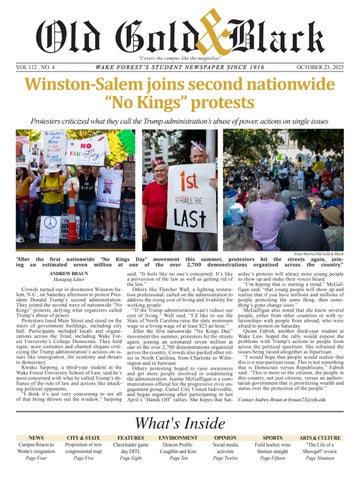
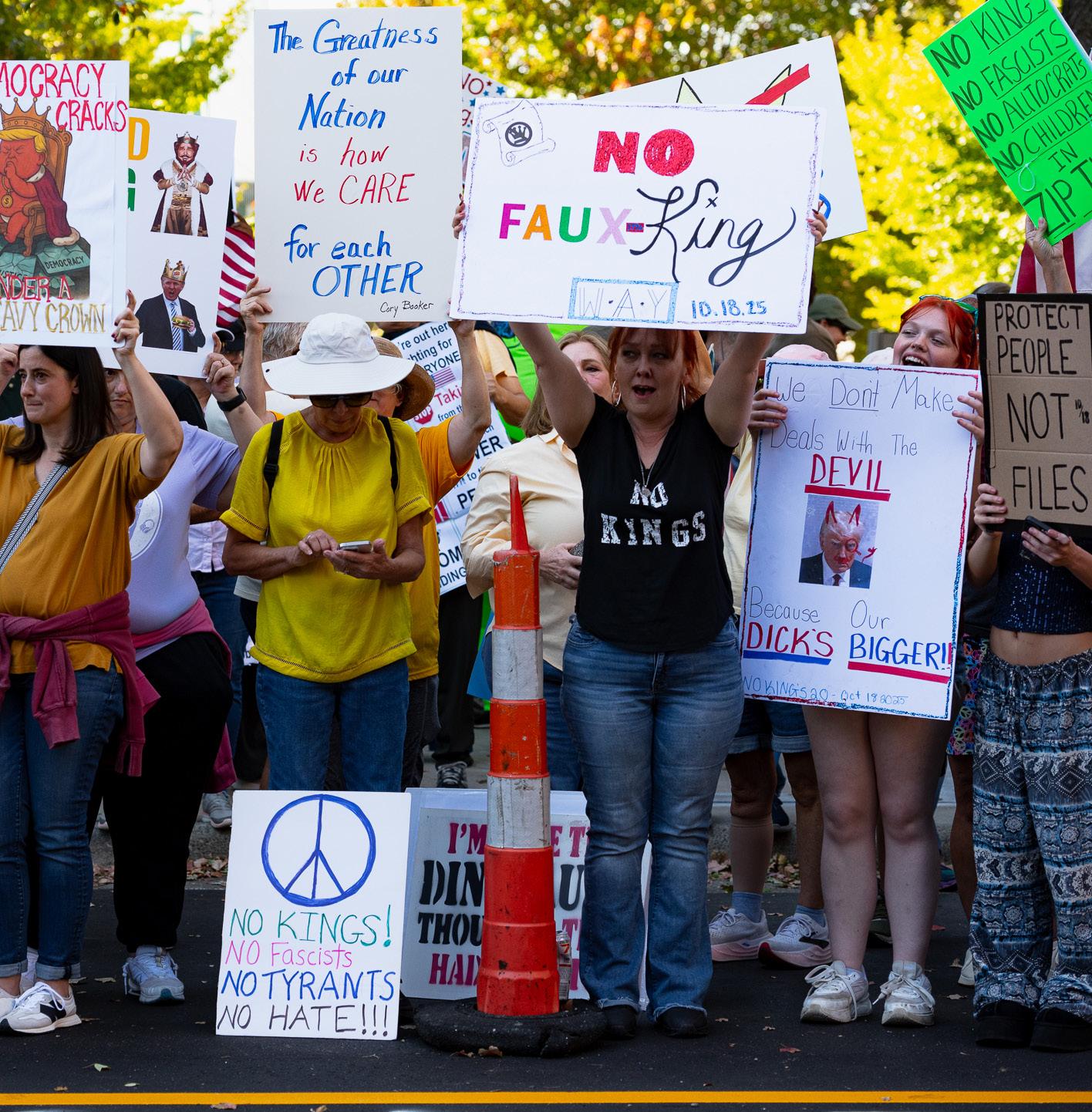
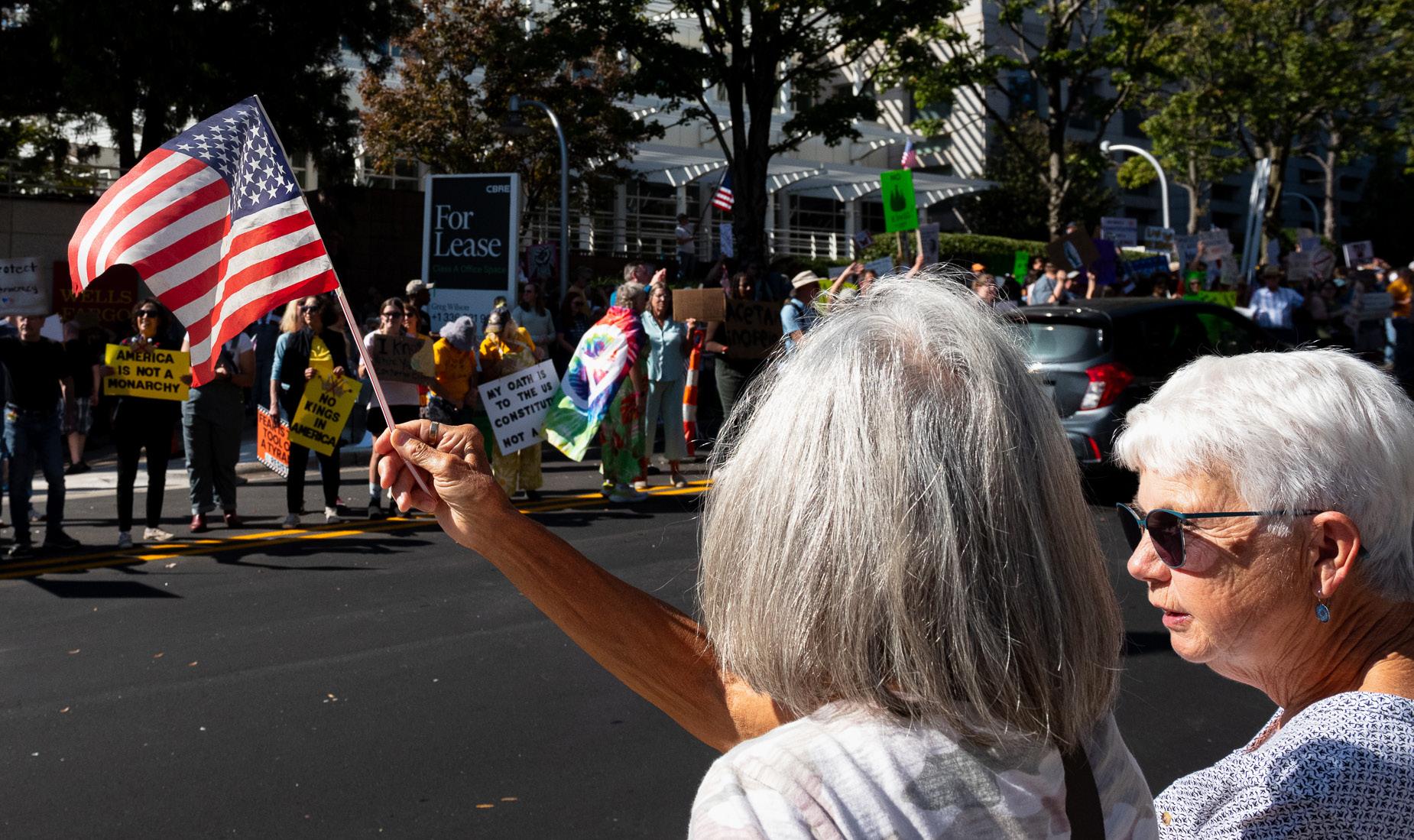
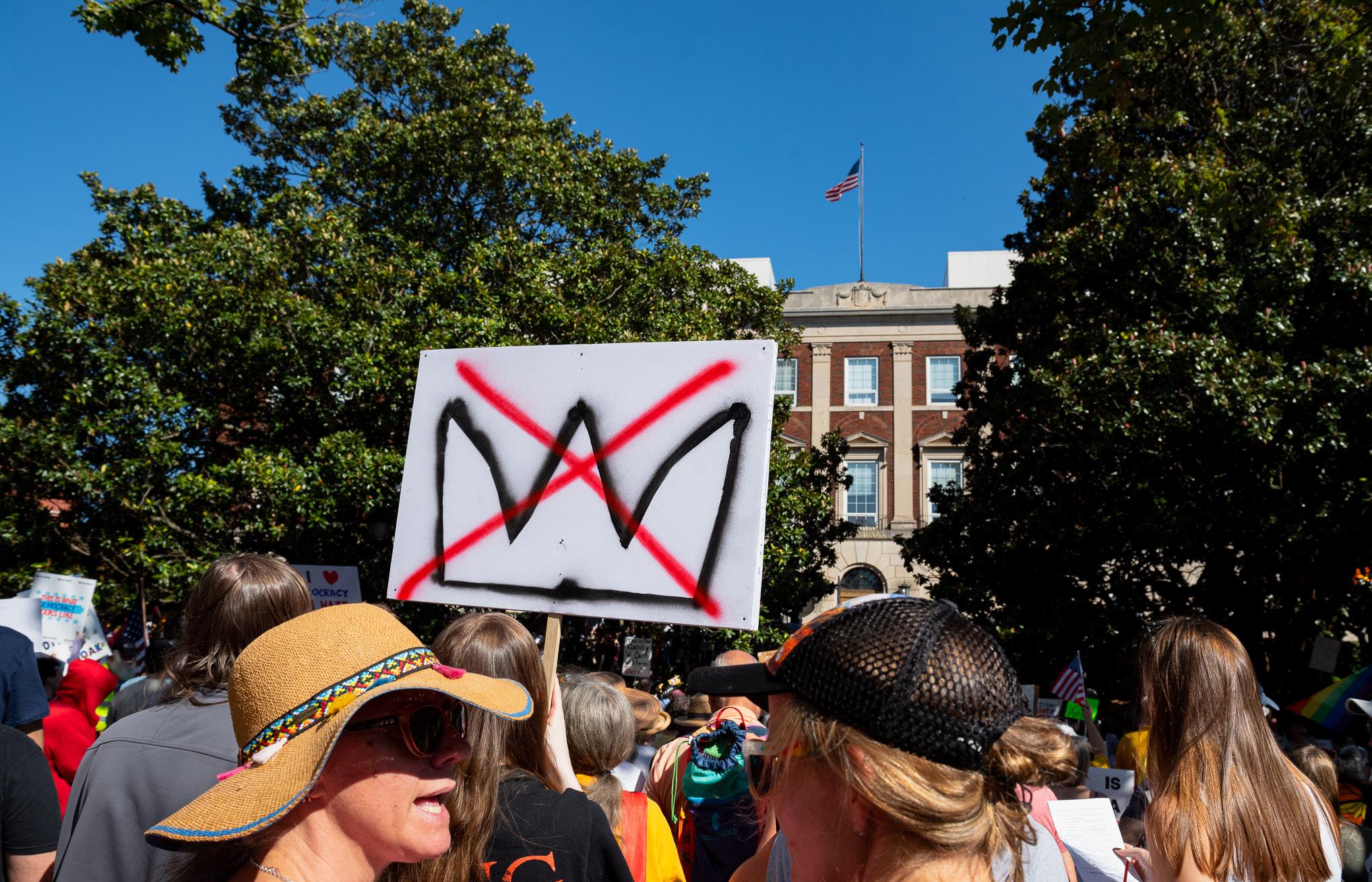
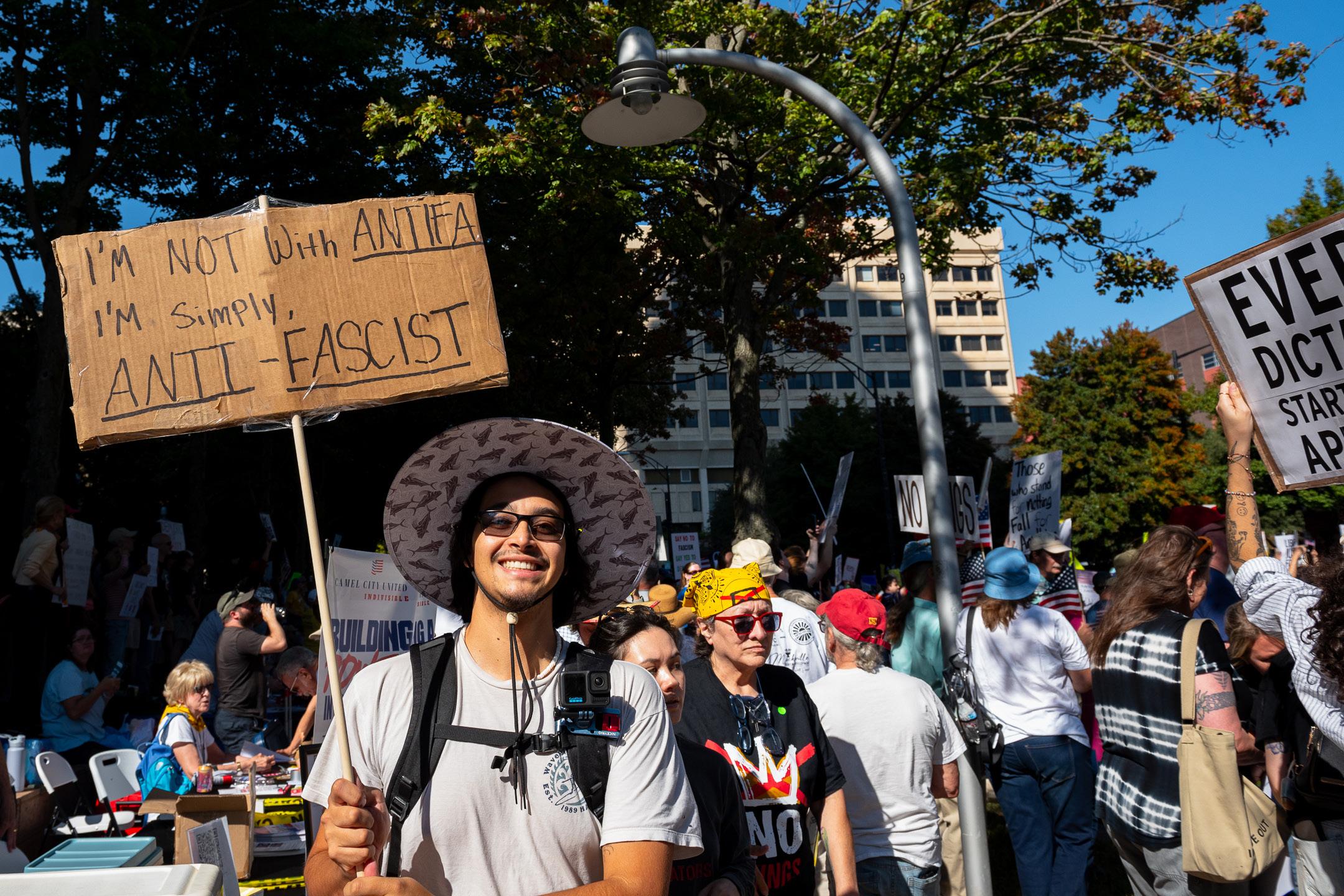
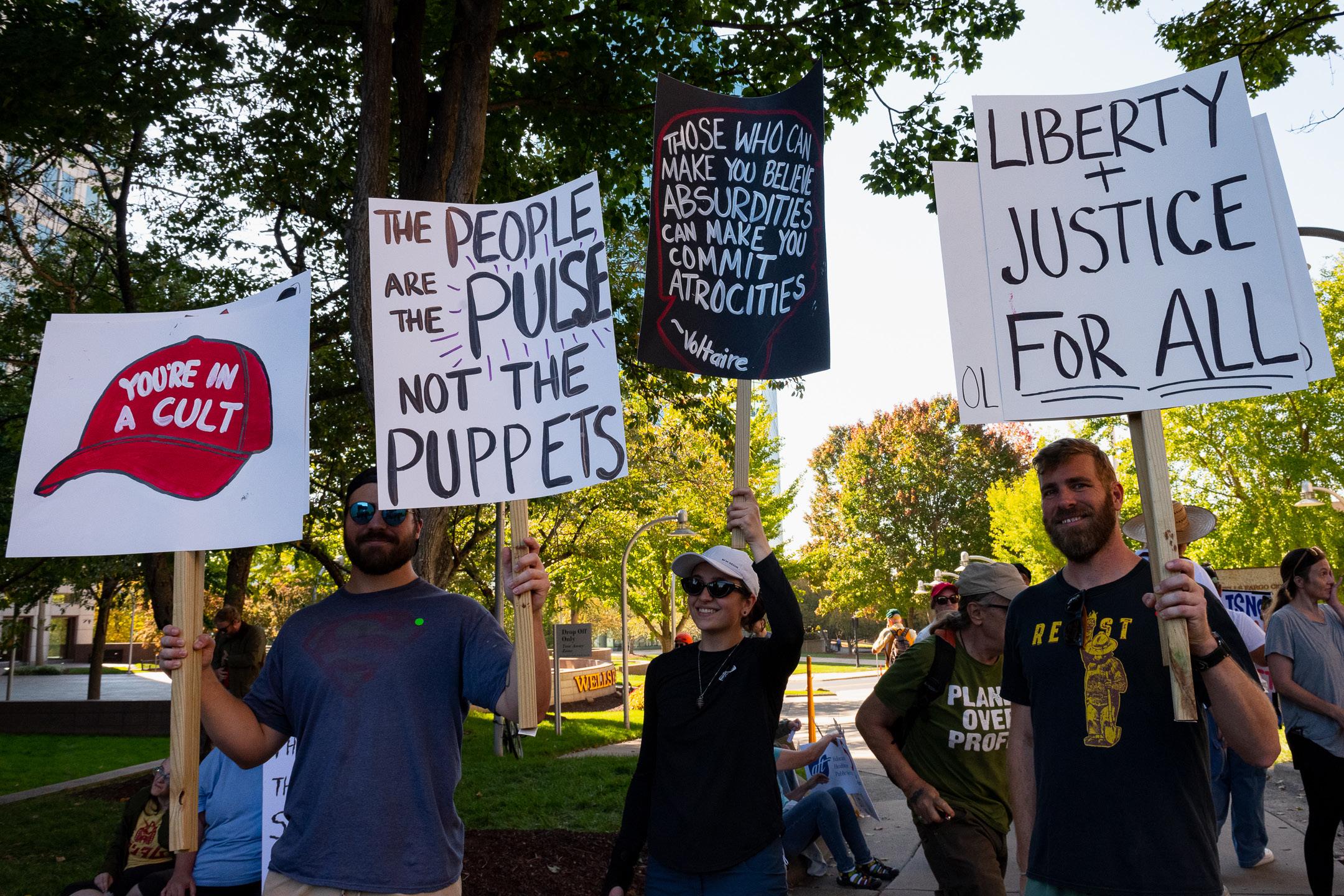
Crowds turned out in downtown Winston-Salem, N.C., on Saturday afternoon to protest President Donald Trump’s second administration. They joined the second wave of nationwide “No Kings” protests, defying what organizers called Trump’s abuse of power.
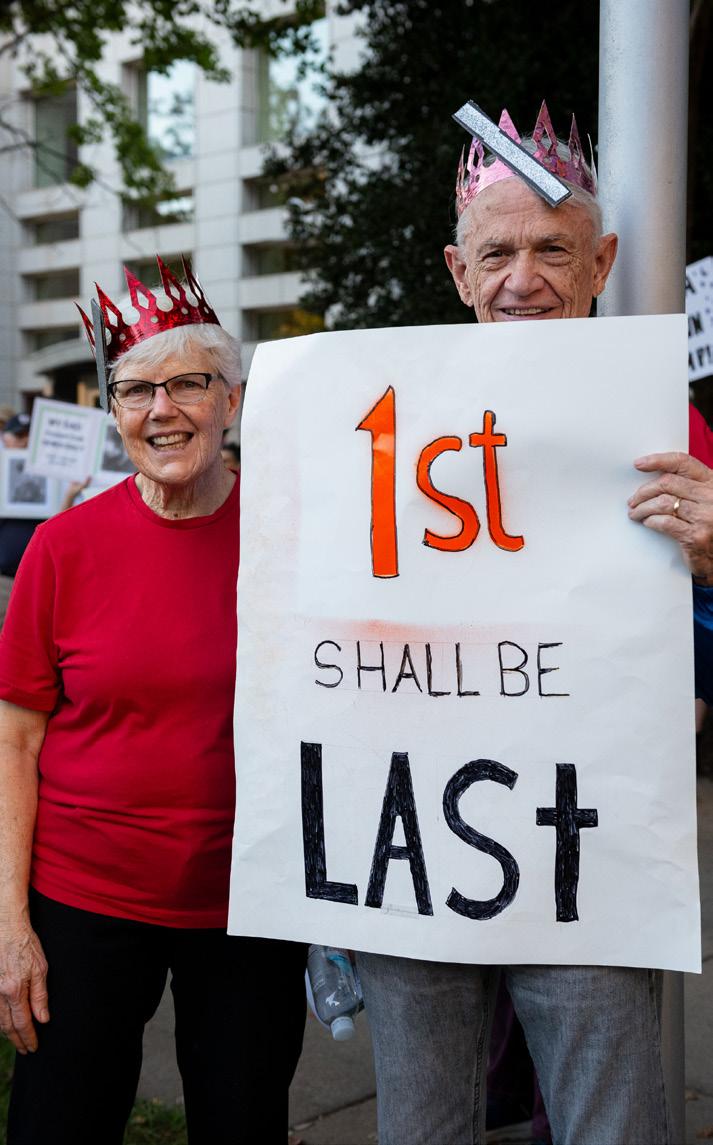
Protestors lined Main Street and stood on the stairs of government buildings, including city hall. Participants included locals and organizations across the Triad, including Wake Forest University’s College Democrats. They held signs, wore costumes and chanted slogans criticizing the Trump administration’s actions on issues like immigration, the economy and threats to democracy.
Kwaku Sarpong, a third-year student at the Wa ke Forest University School of Law, said he’s most concerned with what he called Trump’s defiance of the rule of law and actions like attacking political opponents.
“I think it’s just very concerning to see all of that being thrown out the window,” Sarpong
said. “It feels like no one’s concerned. It’s like a perversion of the law as well as getting rid of the law.”
Others like Fletcher Wall, a lighting restoration professional, called on the administration to address the rising cost of living and livability for working people.
“If the Trump administration can’t reduce our cost of living,” Wall said, “I’d like to see the State of North Carolina raise the state minimum wage to a living wage of at least $23 an hour.”
After the first nationwide “No Kings Day” movement this summer, protestors hit the streets again, joining an estimated seven million at one of the over 2,700 demonstrations organized across the country. Crowds also packed other cities in North Carolina, from Charlotte to Wilmington and in between.
Others protesting hoped to raise awareness and get more people involved in condemning the administration. Jeanne McGaffigan is a communications official for the progressive civic engagement group, Camel City United Indivisible, and began organizing after participating in last April’s “Hands Off” rallies. She hopes that Sat -
urday’s protests will attract more young people to show up and make their voices heard.
“I’m hoping that is starting a trend,” McGaffigan said, “that young people will show up and realize that if you have millions and millions of people protesting the same thing, then something’s gotta change soon.”
McGaffigan also noted that she knew several people, either from other countries or with relationships with people from abroad, who were afraid to protest on Saturday.
Quinn Fabish, another third-year student at Wake Law, hoped the rally would expose the problems with Trump’s actions to people from across the political spectrum. She reframed the issues being raised altogether as bipartisan.
“I would hope that people would realize that this is a non-partisan issue. This is not something that is Democrats versus Republicans,” Fabish said. “This is more so the citizens, the people in this country, not just citizens, versus an authoritarian government that is prioritizing wealth and status over the protection of the people.”
Contact Andrew Braun at brauar23@wfu.edu
Covers the campus like the magnolia s ”
Evan Harris/Old Gold & Black
protestors hit the streets again, join-
organized across the country."
Old Gold & Black
This column represents the views of the editor-in-chief of the Old Gold & Black, Ella Klein.
In support of the Indiana Daily Student
Last week, the student newspaper at the University of Indiana Bloomington was barred from putting out a print edition, and its advisor was fired. The Indiana Daily Student, one of the best student newspapers in the country, was censored. The school proposed that this decision was due to budget issues, but denied any extra funding that was given to the newspaper. In the New York Times, one of the co-editors-in-chief of the paper, 21-year-old Andrew Miller, shared,
“The media school tries to construe this as a business deci -
sion, but fundamentally they are trying to tell us what we can and cannot print,” Miller said.
This was not a budgetary decision. Any obstruction of the freedom of the press, or any other infringement on the Bill of Rights, is illegal and pervasively wrong. But that doesn’t mean it's not happening.
Perhaps you’ve read an earlier editorial of mine and heard my plea for ethical journalism or increased numbers of student reporters. This is not because the paper does not have enough writers, but because writers are increasingly scared to write for
us in this current political climate.
Since my start at the paper, I have only seen an increase in fearmongering from outside parties and news outlets. I have seen larger newspapers than ours and The Indiana Daily Student bow their heads and compromise their journalistic values due to political pressures, especially from pressures given by the Trump administration.
Let me be clear: The Old Gold & Black would never compromise any of our values due to institutional pressure. However, as students, like the Indiana Stu -
Old Gold&Black
THE STUDENT NEWSPAPER OF WAKE FOREST UNIVERSITY SINCE 1916
ELLA KLEIN EDITOR-IN-CHIEF kleiek22@wfu.edu
ANDREW BRAUN MANAGING EDITOR brauar23@wfu.edu
>> NEWS
Caroline Khalaf, khalca23@wfu.edu
Jill Yoder, yodejs24@wfu.edu
>> CITY & STATE
James Watson, watsjc22@wfu.edu
Nick Costantino, costnp24@wfu.edu
>> FEATURES
Alexandra Meier, meieam22@wfu.edu
Miriam Fabrycky, fabrml24@wfu.edu
>> ENVIRONMENT
Reese Lile, lilerl24@wfu.edu
>> OPINION
Towne Moores, moortv24@wfu.edu
Sara Catherine Bradshaw, bradsc24@ wfu.edu
>> SPORTS
Scottie Kimmelman, kimmsd22@wfu.edu
James Lombardo, lombjp23@wfu.edu
SKYLER VILLAMAR-JONES DEPUTY EDITOR villsc22@wfu.edu
>> ARTS & CULTURE
Lydia Derris, derrlf23@wfu.edu
Grace Schuringa, schugh24@wfu.edu
>> PHOTO
Piper Saunders, saunpg23@wfu.edu
>> VIDEO
Jack Perez, perejw22@wfu.edu
Evan Harris, harres22@wfu.edu
>> SOCIAL MEDIA
Sophie Chan, chansr23@wfu.edu
>> COPY EDITORS
Jenna Jordan, aginjr21@wfu.edu
Elle Yormak, yormeh24@wfu.edu
Presley Tsang, tsanpe24@wfu.edu
>> DESIGN CHIEF
Cate Goldman, goldcr24@wfu.edu
>> ADVERTISING DIRECTOR
Jordan Rill, rillje22@wfu.edu
>> ADVISER
Ivan Weiss, weiij@wfu.edu
dent Daily, we are at the mercy of the University for funding and printing concerns. Wake Forest University has always worked with us, not against us, and understands the newspaper is important to the integrity of the campus. I hope it stays that way.
As an organization, we stand with The Indiana News Daily and call on the university to reinstate its print edition, to stop the censorship. We call on every administration to understand that a student newspaper is a vital part of student life and university accountability.
WILL KUNISAKI MULTIMEDIA DIRECTOR kuniwx23@wfu.edu
>> POLICIES
RYDER SOLBERG BUSINESS MANAGER solbrs23@wfu.edu
Our job as a newspaper is to be a platform for all voices, not just the ones we agree with. However, we reserve the right to reject advertisements that are vulgar, inaccurate, obscene or violate Wake Forest’s policies on nondiscrimination, diversity, equity, and inclusion as they pertain to student organizations. We will also reject any advertisements that promote illegal activities according to the state of North Carolina.
Not only do we hold our newspaper and its contents to a high standard, but we also expect that those who choose to use us as an outlet for their ideas, opinions and skill hold themselves and their content to a high ethical standard.
The Old Gold & Black is published Thursdays during the school year, except during examinations, summer and holiday periods, by Triangle Web Printing of Durham. The views expressed in all opinion pieces and advertisements contained within this publication do not necessarily reflect the opinions of the Old Gold & Black. As part of our commitment to reporting news fairly and accurately, we will not remove any previously published content online unless it is retracted. If an error in either our online or print content is brought to our attention, we will revise the originally published article with an appended correction. In order to facilitate thoughtful and appropriate debate, profane, vulgar, or inflammatory comments on our website are not allowed and will be deleted. Comments which incite violence, target individuals in a form of cyber bullying, or which promote ideas which vilify marginalized communities will be deleted, and proper authorities may be notified and involved.
>> SUBMISSIONS
The OGB welcomes submissions in the form of story tips, columns and letters to the editor. Letters to the editor should be fewer than 500 words, and columns should be around 500 words. Send yours via e-mail to stopmf21@wfu.edu the Monday before publication. We reserve the right to edit all letters for length and clarity. No anonymous letters will be printed.
>> ONLINE MEDIA
Website: wfuogb.com
Facebook: facebook.com/ogb1916
X (Twitter): @wfuogb
Instagram: @wfuogb
TikTok: @wfuogb
Sports X (Twitter): @wfuogbsports
Hit the Bricks 2025 shatters records
$348K was raised for the Brian Piccolo cancer research fund
ELLA AUCOIN Contributing Writer
On Oct. 1, Hit the Bricks raised more than $348,000 for the Brian Piccolo Cancer Research Fund.
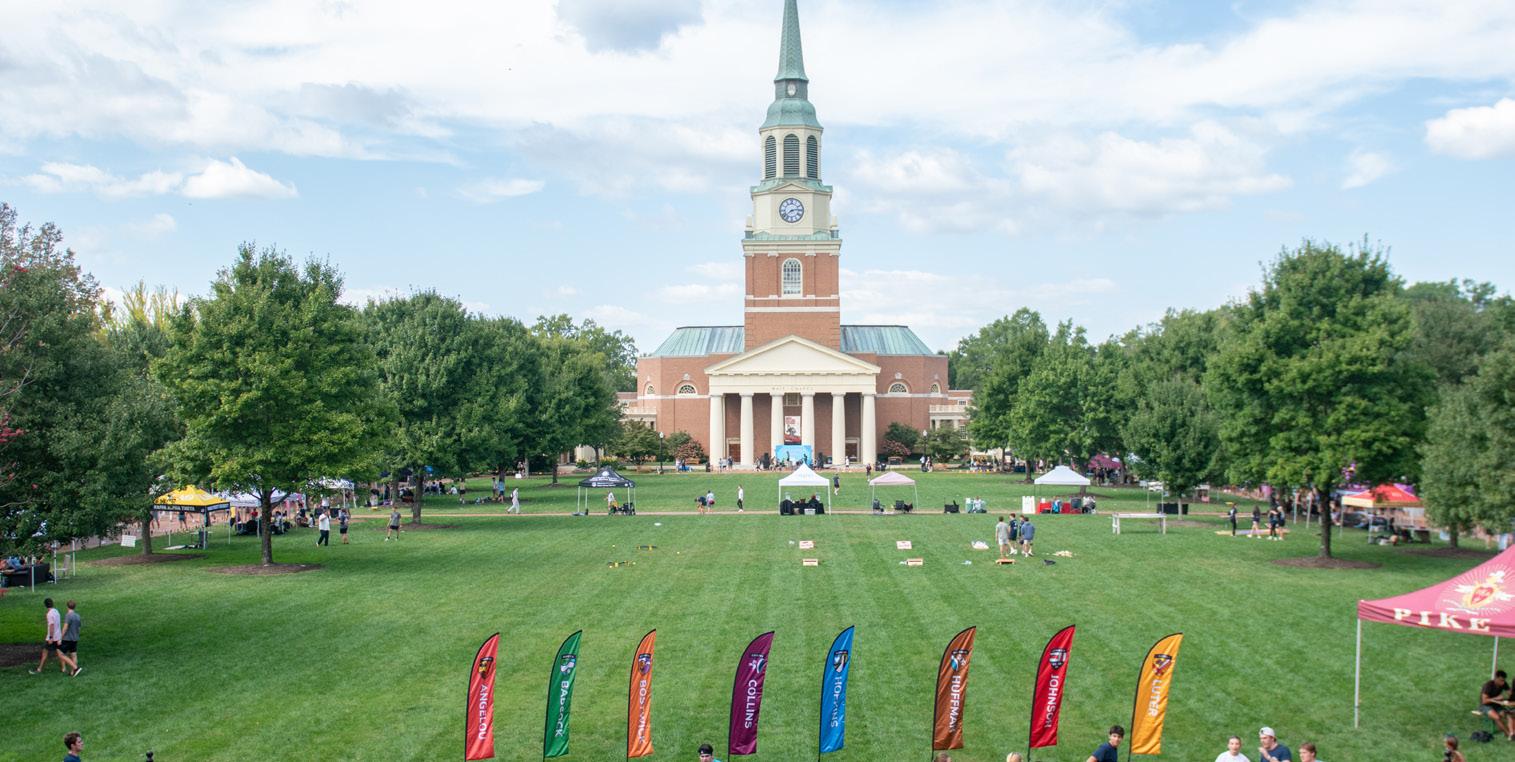
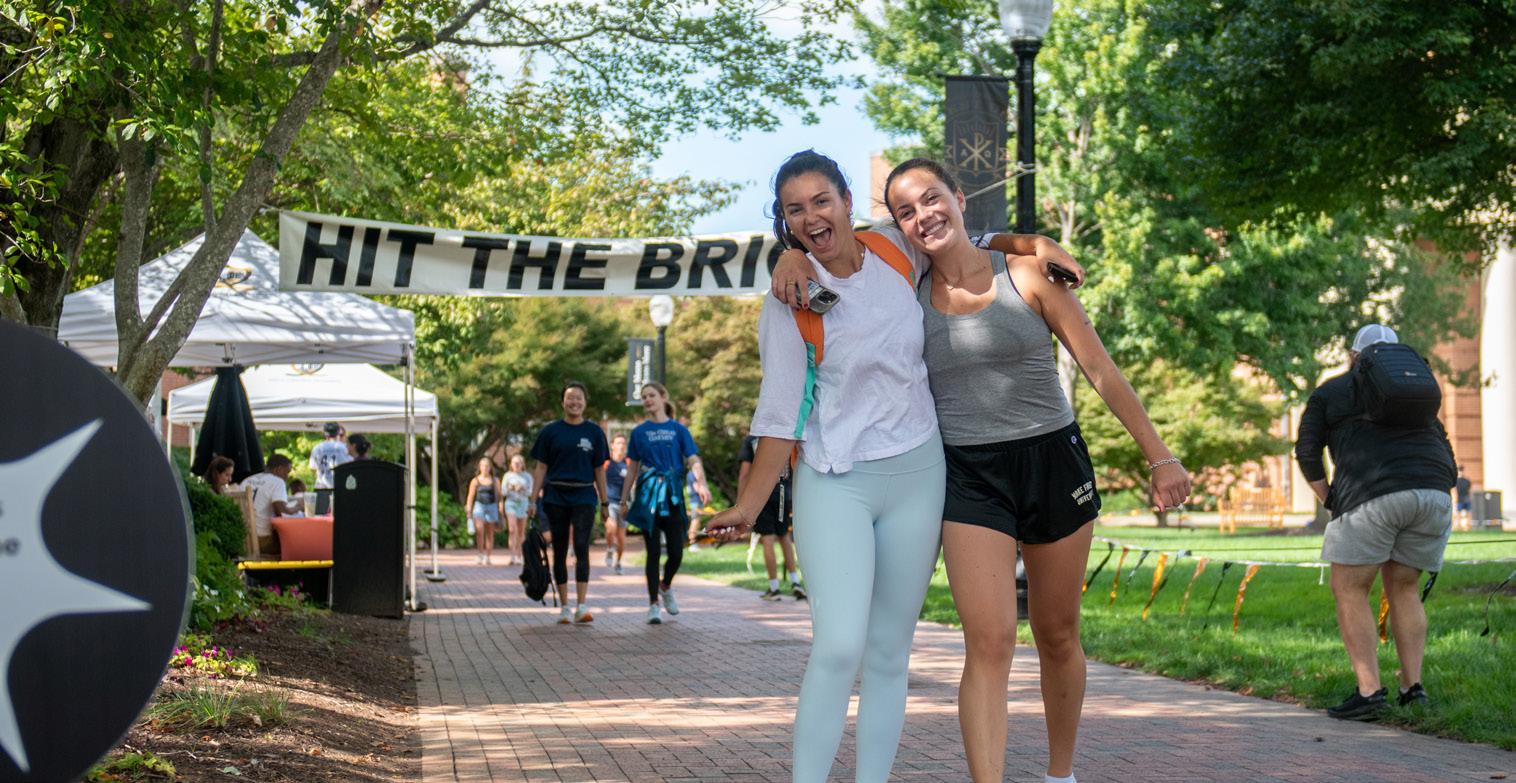
More than 2,264 participants circled the Quad to honor the legacy of former NFL player Brian Piccolo, surpassing the number of participants in any previous campus philanthropy event in the university’s history. Hearn Plaza was buzzing with students, faculty, staff, alumni and even Piccolo’s daughter, Traci Piccolo.
This year’s event was marked by remembrance and record-breaking impact.
“Hit the Bricks has evolved in so many ways, most significantly in our reach and engagement with campus,” Theo Berson, executive director of Hit the Bricks, said. “While I don’t have the data on the participants 23 events ago, we now have about 2,300 participants, reaching the ratio of almost 1 in 2 students on campus.”
What began in 2003 has grown into a powerful show of campus unity, with student groups running lap after lap to raise funds and awareness for cancer research. After raising $311,913 last year, Hit the Bricks has raised more than $2 million for the Brian Piccolo Cancer Research Fund since 2003.
Although the annual relay race is
the face of the fundraiser, there is also immense work put in behind the scenes.
“I first met with the Hit the Bricks faculty adviser in mid-October last year in preparation for Wednesday’s event,” Berson said. “We worked on this for just about 50 weeks.”
Many people are motivated to participate in the event to honor loved ones who have suffered from cancer. Professor Heath Greene contributed many laps to the Luter Residence Hall team on behalf of his family members.
“My father and stepmother are both fighting cancer right now,
so it’s even more near and dear to me,” Greene said. “They gave a cool donation that supposedly made Angelou run backward.”
What makes the event so special is the community it draws. The atmosphere is competitive, but it is united by a passion for the cause.
“My favorite part of today’s event so far has been getting to be together with the community and see all my friends, whether they’re on my team or on another team out here,” sophomore Sean Wilcox, treasurer of Club Running, said.
Contact Ella Aucoin at aucoeg25@wfu.edu
Wrongful conviction day speaker calls for justice as Robert Robertson faces execution
Attorney Margaret Amshay highlighted the case of Robert Roberson, who was sentenced under discredited medical science
ARIC
LOIACONO
Contributing Writer
Robert Roberson spent more than two decades on death row for a crime many experts now say he did not commit.
On Oct. 9 at Wake Forest University School of Law, attorney Margaret Amshay urged students to consider the human toll behind wrongful convictions. She pointed to the case of Robert Roberson, a Texas father convicted under discredited medical science, who now faces execution on Oct. 16.
The Society for Criminal Justice Reform (SCJR) hosted this event as part of International Wrongful Conviction Day, seeking to raise awareness about the failures in the criminal justice system.
The event’s keynote speaker, Margaret Amshay, a recent law school graduate now working at the Mecklenburg County Public Defender’s Office, shared a personal account of her time working on Roberson’s case. Specifically, Amshay had assisted Roberson’s attorney, Gretchen Sween, during law
school, allowing her to spend time with Roberson.
“I think about Robert every day,” Amshay said. “I very quickly could tell that he was just the most kind, caring, faithful man.”
Robert Roberson was convicted based on the medical diagnosis of shaken baby syndrome, which is also known as abusive head trauma. His daughter Nikki Roberson’s injuries were said to be intentional harm. At the time, neither Roberson’s autism nor his daughter’s prior medical conditions were considered, leading to a misinterpretation of Roberson’s behavior.
To give attendees a deeper understanding, Amshay played a documentary clip featuring an interview with Brian Wharton, the detective who originally investigated the case. In the footage, Wharton reflects on his role with visible regret.
“I’m convinced we did the wrong thing,” Wharton said.
Amshay became emotional as she recalled her first visit with Roberson in prison.
“When I met him, one of the first things he asked me was my name, my favorite color, and my birthday,” Amshay said.
“Gretchen told me that every time he meets someone, he gets their name and their birthday, goes back to his cell and writes it down.”
As she spoke, Amshay held up the handmade birthday card Roberson had sent her, showing students the small drawings inside.
Amshay then turned to the larger implications of the case, urging students to examine how science and bias can intersect to produce injustice.
“It’s very clear now that Roberson’s autism caused the lack of eye contact and focus on minute details… they read it as suspicious,” Amshay said.
She emphasized that persistence of flawed medical science – specifically the once-widely-accepted shaken baby syndrome diagnosis – reveals a justice system more focused on closing cases than uncovering truth.
After the talk, students reflected on what they had learned.
Sarah Bauknight, a first-year law
student, said Roberson’s story made her reconsider how common wrongful conviction cases may be.
“It’s clear that Robert is innocent,” Bauknight said. “But what struck me most is how common his circumstances are. This work isn’t just for Robert, it’s for everyone caught in the same terrible situation.”
Second-year law student and member of SCJR, Jack Woods, discussed how the event reinforced how resistant the system can be to admitting mistakes.
“It’s crazy how the system can still be kind of unresponsive and seem to just be completely apathetic to the prospect of an innocent man being executed,” Woods said. “I think it can make you pretty cynical about the whole system.”
As the program concluded, students were reminded that Roberson’s execution date is fast approaching.
Readers who wish to advocate for Roberson’s clemency can sign the petition here or learn more through the Innocence Project’s campaign.
Contact Aric Loiacono at loiaat25@wfu.edu
Hearn Plaza was buzzing during Hit the Bricks as students, faculty, and community members ran laps to raise money for cancer research.
Piper Saunders/Old Gold & Black
Hearn Plaza was buzzing during Hit the Bricks as students, faculty, and community members ran laps to raise money for cancer research.
Piper Saunders/Old Gold & Black
Campus reacts to President Susan R. Wente’s resignation
University commends Wente for her leadership as she concludes her presidency
ELLA AUCOIN Contributing Writer
President Susan R. Wente plans to conclude her presidency on June 30, 2026, after five years as president at Wake Forest. The university made the announcement in a broadcast titled “A message from President Wente” on Wednesday, Oct. 1, 2025.
Following a “sabbatical,” Wente plans to return to her “roots” as a faculty member and science educator.
“In higher education, timing is critical, and I believe now is the right moment to begin this transition,” Wente said. “This is because Wake Forest is in a strong, stable, and even enviable position among the nation’s universities. And with nine months to carefully plan before June 30, I am confident our university is wellpositioned to attract an extraordinary new leader.”
Administrators and community leaders praised Wente’s impact on the community.
“President Wente has engaged faculty in a collaborative spirit to shape Wake Forest’s direction,” Steve Virgil, chair of the Wake Forest University Faculty Senate, said. “Her openness to dialogue, her support for research and teaching, and her respect for faculty and her appreciation of shared governance have strengthened the academic core of the university.”
Student Body President Amaya Williams reflected on the ways Wente interacted with the student body.
“I felt a real sense of appreciation and gratitude for her commitment to Wake Forest while reading her message,” Williams said. “She has always shown genuine care for students and taken the time to connect with us directly.”
Along with gratitude, the Wake Forest campus reacted with surprise on Wednesday afternoon.
“My first reaction to her resignation was that it felt so rushed and completely out of the blue,” senior Jeffery Ayako.
The announcement was made on the same day as Hit the Bricks, the annual campus fundraising event for the Brian Piccolo Cancer Research Fund. Junior Mati Romagnoli was concerned that the announcement took focus away from the fundraiser.
“I really didn’t see it coming, but I feel li ke what shocked me rather than just her resigning was the timing. I thought it was just not right,” Roma gnoli said. “I thought it was
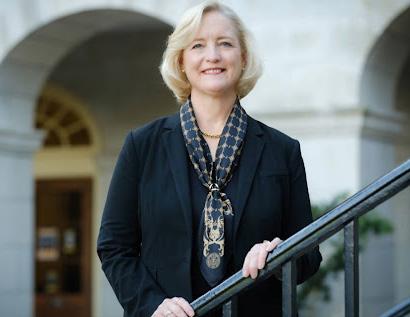
“Students reflected on the ways in which Wente impacted the
throughout
and
not super delicate to send out communication l ike that today because it would take a lot of attention away from the event.”
S urprise was a common theme.
“I think I had an inclination that it would happen eventually, but I didn’t think it would happen until the end of another year,” sophomore Maya Chavis said.
As Wake Forest transitions to new leadership, students are interested in seeing what the future holds.
“To be honest, the direction Wake has been going in lately feels off with the loss of departments like the ODI,” Ayako said. “I hope this opens up space for new leadership and a clearer sense of direction for the university.”
Students expect Wake For est to continue in greatness.
“The future of Wake has a large amount of potential,” Chavis said. “One of the great things about Wake is that it has an amazing student body and faculty, and this won’t
POLICE BEAT
chan ge depending on who is president.”
According to junior Sarah Lekan, the new president’s efforts need to be a continuation of what Wente was working on.
“I see Wake moving in a good and more prosperous direction in the future, but the new president definitely needs to come in and pick up the work that Wente was doing,” Lekan said. “Wente had a goal of improving our ranking again after it dropped two years ago, so it will b e important for the new president to come in with the same mindset and, hopefully, help in returning Wake to a top 30 institution.”
President Wente’s impact on the university will be present, even after she is gone.
“I’m confident that the foundation she’s built will allow Wake Forest to continue growing in strength and community,” Williams said.
Contact Ella Aucoin at aucoeg25@wfu.edu
• A victim’s clothing items were taken from the laundry room at Davis Residence Hall. The report was filed at 11:47 a.m. on Oct. 7.
• A victim’s vehicle was hit in the Z2 parking lot. The report was filed at 7:05 p.m. on Oct. 8.
• An Amazon employee left with a package after delivery, the victim contacted amazon and received a new item. The report was filed at 11:11 a.m. on Oct. 9.
• Unknown subject(s) removed a victim’s laundry bag from the laundry room in Angelou Residence Hall. The report was filed at 4:10 p.m. on Oct. 10.
• Unknown subject(s) removed victims passport and social security card from room desk in Polo Residence Hall. The report was filed at 8:05 p.m. on Oct. 10.
• The suspects entered several dorm rooms in Babcock Hall, one resident is reporting missing approximately $120 cash. The report was filed at 7:00 p.m. on Oct. 16.
• An unknown driver attempted to force the Polo Entrance gate open with their vehicle. The report was filed at 1:08 a.m. on Oct. 17.
• An unknown person attempted to cut the converter from a student’s vehicle in Lot Z4. The report was filed at 9:53 a.m. on Oct. 17.
• Offenders smoked marijuana and one of them needed medical assistance. The report was filed at 1:00 a.m. on Oct. 18.
• Offender consumed alcohol underage and entered a victim’s room in Bostwick Residence Hall. The report was filed at 5:32 a.m. on Oct. 18.
university
her presidency
what the future holds for Wake Forest.”
Courtesy of Wake Forest University
CITY & STATE
Nick Costantino, costnp24@wfu.edu
OLD GOLD & BLACK
James Watson, watsjc22@wfu.edu PAGE 5
THURSDAY, OCTOBER 23, 2025
North Carolina Republicans move to gerrymander Democrats out of power
JAMES WATSON City & State Editor
On Wednesday, Oct. 22, the NC legislature passed a new congressional map that would effectively eliminate the district of one of the state's four Democratic congressional representatives, locking down the seat for the Republican Party. This is the fourth set of congressional maps the state has drawn and enacted since 2020.
The new map redraws North Carolina’s 1st congressional district, currently occupied by Rep. Don Davis (D-N.C.). It would dilute Davis’s Democratic voting constituency by encompassing the surrounding conservative-leaning counties. This would draw in voters who voted for President Trump by a higher margin in the 2024 presidential election.
The 1st is currently the only “competitive” congressional district under the makeup of the 2023 maps, and its elimination would effectively guarantee Republicans complete control of the state’s 11 of the 14 seats in the U.S. House of Representatives. Republicans attempted to eliminate Davis’s seat in their 2023 map, but he still won reelection in 2024 by just two percentage points. President Donald Trump won the whole state in 2024 by just under 200,000 votes.
Citing Trump, NC Republicans are proposing a new congressional map
Trump’s call for redistricting
“The #NCGA is ready to help Republicans secure Congress and move @realDonaldTrump’s agenda forward!” Senate leader Phil Berger wrote on social media following the map’s unveiling.
Berger is facing a potential primary by Rockingham County Sheriff Sam Page. Trump has yet to endorse Berger’s reelection — or his challenger.
Republicans are moving to redraw the state’s map in response to a broader push by Trump to encourage Republican legislatures to engage in mid-cycle redistricting. These efforts would secure more Republican seats ahead of the 2026 midterm elections.
“President Trump earned a clear mandate from the voters of North Carolina and the rest of the country, and we intend to defend it by drawing an additional Republican Congressional seat,” House Speaker Destin Hall said in a statement.
Gov. Stein cannot intervene
In North Carolina, the maps would only need a simple majority in both chambers to become law. Under state law, the Governor cannot veto congressional maps. This law was introduced by Gov. Stein’s predecessor,
The proposed map would target the district of House Democrat Don Davis, who won reelection by two points in 2024.
Roy Cooper, when he was a state legislator.
In a press release, Governor Stein sharply criticized the General Assembly for prioritizing the apparent partisan gerrymander over working on other priorities.
“The General Assembly works for North Carolina, not Donald Trump. The Republican leadership in the General Assembly has failed to pass a budget, failed to pay our teachers and law enforcement what they deserve, and failed to fully fund Medicaid,” Stein said.
Earlier this month, a federal judge rejected claims of racial gerrymandering in the state’s 2023 congressional maps. The NC 1st was also in dispute in that suit.
Last week, the U.S. Supreme Court reheard oral arguments in Louisiana v. Callais. If the court’s conservative justices don’t uphold Louisiana's map, the decision will enable further mid-cycle redistricting in other states. Estimates suggest up to 19 seats could be drawn in favor of the Republicans as a result. The legality of mid-cycle redistricting in North Carolina is unclear. The Supreme Court ceded federal courts’ ability to hear partisan gerrymandering claims in 2019 in a case involving another set of North Carolina Republican-drawn congressional maps.
Contact James Watson at watsjc22@wfu.edu
SCOTUS considers fate of NC energy giant
NICK COSTANTINO City & State Editor
A case potentially being heard by the U.S. Supreme Court this term could decide the future of Duke Energy’s business practices. “Duke Energy v. NTE Carolinas”, which involves the company’s operations in Fayetteville, N.C., the sixth-largest city in the state. The case is awaiting input from the U.S. Solicitor General before it proceeds to the U.S. Supreme Court.
NTE Carolinas first sued Duke Energy in 2019, alleging that Duke Energy has monopoly power over North Carolina’s energy market and has practiced anticompetitive conduct to maintain that power.
Duke Energy is one of the largest domestic energy companies in the U.S., serving almost 8 million customers and dominating the energy market in the Carolinas. NTE Carolinas is a Floridabased company that builds and operates power plants, but relies on the transmis-
If heard, the antitrust case will decide the future of Duke Energy
sion lines of other companies, like Duke Energy, to get electricity to customers.
The case centers around whether Duke Energy prevented NTE from negotiating with the city of Fayetteville by offering immense discounts and disrupting the construction of a new power plant that NTE was building amid the contract negotiations. The North Carolina Western District Court ruled in favor of Duke Energy in 2022, finding it did not engage in anticompetitive behavior.
The 4th U.S. Circuit Court of Appeals reversed this decision, finding the district court did not consider the whole of Duke’s conduct and there were genuine disputes over its actions. The court sent the case back to the district court level for further arguments.
Duke Energy has petitioned the Supreme Court to review the decision, saying the legal theory the appeals court used in its decision is outdated and legally incorrect. The dispute centers around the ‘monopoly broth’ theory, which “permits the aggregation of independently lawful business practices into
a single antitrust violation.”
“If an antitrust plaintiff pleads a series of independently lawful acts, each of which does not violate this Court’s precedents, those acts cannot together add up to some nebulous antitrust violation,” Duke’s lawyers wrote. “The court of appeals concluded otherwise, embracing a ‘monopoly broth’ theory prominent in the 1960s to 1980s but long since discarded.”
Lawyers for NTE Carolinas argued that anticompetitive behavior can’t always be neatly labeled, and a reasonable jury would look at the sum of all their actions as anticompetitive.
“Because this Court’s specific tests for common types of monopolistic conduct do not cover all the ‘many different forms’ of anticompetitive conduct, which ‘cannot always be categorized,’ the court below also considered Duke’s course of conduct ‘as a whole’ and found that a reasonable jury could find it anti-competitive,” NTE Carolinas’ lawyers wrote.
Kent Chandler and Joshua Macey
wrote in Bloomberg Law the importance of this case and called for the government to pursue more of these antitrust cases in the future.
“Federal regulators should follow the Fourth Circuit’s lead and do more to prevent monopolies from maintaining their position through non-economic, anticompetitive conduct,” they said. “Until they do, electric bills across the country will be unnecessarily high, and existing monopolists will keep new resources out of the market.
The Court is considering taking up the case but is awaiting input from the U.S. Solicitor General before deciding to formally hear arguments in it. Now that the Court’s October term has begun, the decision to hear the case could come soon. If it does not decide to take the case, the case will be sent back down to the district court.
Contact Nick Costantino at costnp24@wfu.edu
Courtesy of ncleg.gov




FEATURES
Alexandra Meier, meieam22@wfu.edu
Miriam Fabrycky, fabrml24@wfu.edu
Deacon profile: Harry S. Truman Scholar Eli Leadham
Wake Forest senior named Harry S. Truman Scholar
VICTORIA RODRIGUEZ Contributing Writer
Eli Leadham had no idea what to expect when he received an invitation to join an unsuspecting Zoom call with Sociology professor Hana Brown. He simply assumed they would review more details about the recent application he had submitted, talking and reconnecting as they had for the past few months.
When he logged onto the call, Wake Forest President Susan R. Wente’s face appeared.
She informed him that the Truman Foundation added his name to the list of 18 Wake Forest students to be named a Harry S. Truman Scholar, the most prestigious graduate fellowship for juniors committed to careers in public service.
Aiming to test aspiring leaders at a crucial point in their development, the scholarship recognizes dedication, leadership and academic excellence. Apart from the alumni network and esteemed reputation, the award also supports a $30,000 scholarship for graduate school.
“Public service has different definitions for everyone,” Leadham said. “The Truman Scholarship really is an affirmation that public service, in some way, shape or form, is the right path for me. It will be an investment in my future financially and through being connected to the Truman family, which includes groundbreaking scholars.”
Since arriving at Wake Forest as a presidential scholar in debate, Eli Leadham has been a zealous advocate for criminal justice reform and sexual assault prevention. Staring in high school, Leadham has dedicated much of his time to debate a safer community, stemming from the personal experience of being sexually assaulted at a high school tournament.
“Debate was a really cool way to see perspectives from the other side,” Leadham said. “You’re defending a resolution, but then you also have to negate it. I think this opens up your perspective, and so that’s why you kind of inherently have to care about others.”
Leadham’s interests in public service lie in ending mass incarceration and addressing discrimination in the criminal and legal systems. A big advocate for sexual and domestic assault prevention, Leadham has dedicated his time to multiple organizations, both within Wake Forest and outside of the community.
The senior has used his personal experience as a survivor to advocate for sexual assault prevention at the U.S. Attorney’s Office of Sexual Offense and Domestic Violence. On campus, he is the Interpersonal Violence Prevention Student Assistant in the Office of Wellbeing and a member of Advocacy Leaders in Interpersonal Violence Education (ALIVE).
“I am excited to think further about the prison re-entry process and use restorative justice practices when exploring communal reintegration,” Leadham said.
Leadham is also actively involved in abolitionist organizations like the Triad Abolition Project, a Winston-Salem organization committed to advocating for survivors of sexual violence and reducing the over-reliance on prisons. He has been involved in the Forsyth County Bail Fund, facilitated know-your-rights workshops, offered consultations for clemency petitioners and documented legal proceedings as a court watcher.
“Right now, our criminal justice system is failing those it is built to protect, survivors, and I see it as my future to advocate for those most vulnerable,” Leadham said.
Leadham describes the process of applying for the Truman Scholarship as time-consuming, challenging
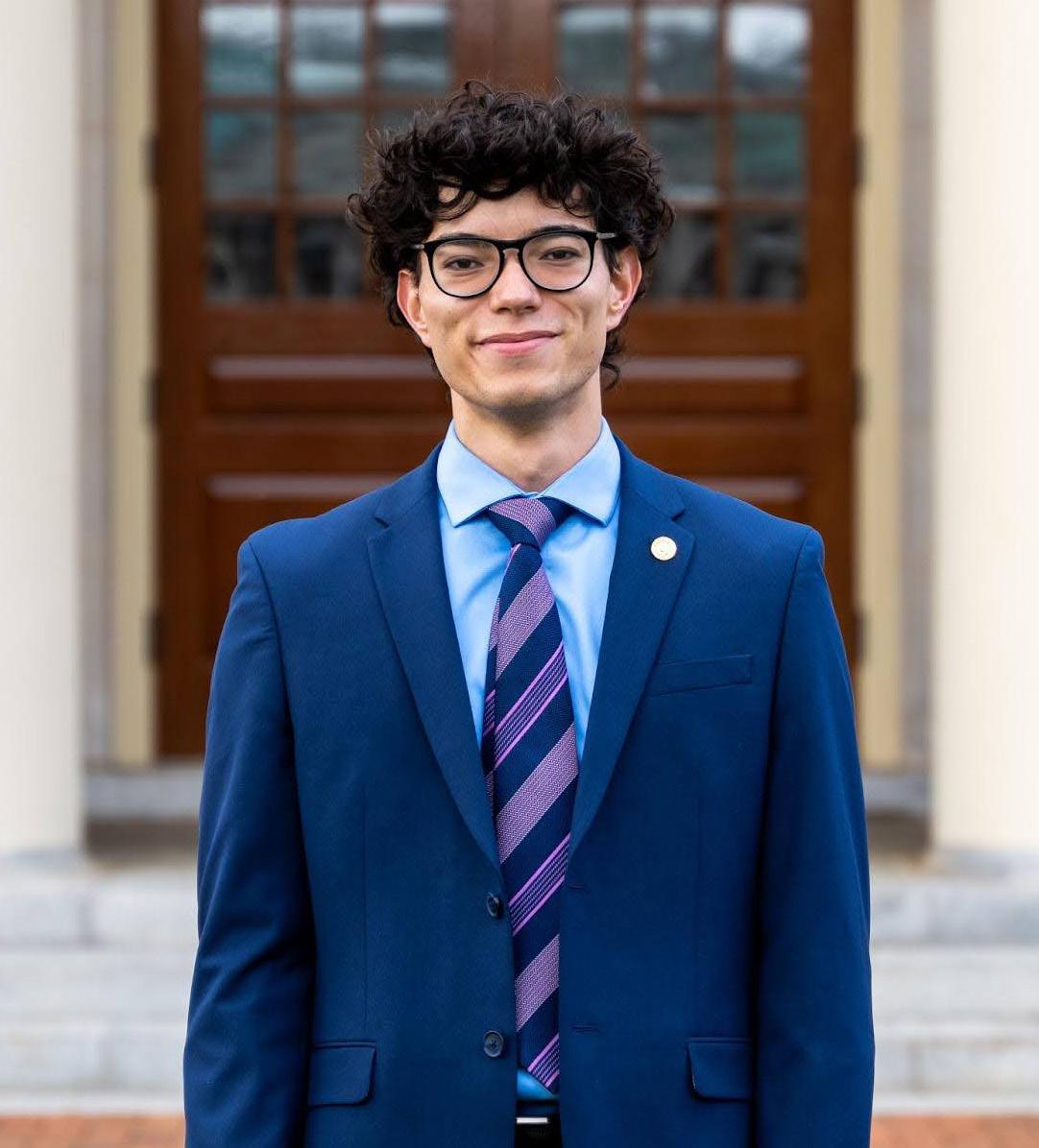
Eli Leadham is one of 18 Wake Forest students to be named Harry S. Truman Scholar.
and most importantly, meticulously deliberate.
“The application process requires you to jump with both feet in because the competition is so steep,” Leadham said. “It was a marathon instead of a sprint and it took a whole village of friends, professors and debate coaches to review countless drafts to receive an institutional nomination.”
This process was all the more difficult due to Leadham being abroad for the entirety of his junior year.
As a Richter Scholarship recipient, Leadham traveled to Japan, attending Kansai Gaidai University to study and research the historical legacy of the atomic bomb-
ings of Hiroshima and Nagasaki.
It was not a typical application. Apart from specific character count requirements for public service questions, it also included a policy proposal, a hypothetical statement asking to detail a policy and creating an entire legislation the recipient would implement at the national or statewide level.
Thankfully, he had a myriad of support and resources. Brown, who is both a Truman Scholar herself and Wake Forest’s Truman Advisor, introduced Leadham to the award and offered instrumental support in his application process.
As he became a finalist, Leadham’s debate history came to his aid. The interviewers asked adversarial and aggressive questions, attempting to rattle the recipient. Leadham acknowledges that his extensive background in debate was a good skill to have.
“I really had to stand my ground,” Leadham said. “I was stubborn and dug my heels into it.”
Leadham highlights the Wake Forest Faculty, their support and mentorship, not only for the help on his application but for everything they have done throughout all his years on campus, which ultimately made the process nearly seamless.
Looking ahead to the future, Leadham has several different ideas for his next adventure; getting experience in fellowships, a master’s degree and a paralegal job are all options. His eventual goal is to become a practicing attorney, exploring international human rights.
While Leadham acknowledges the scholarship will help him in his journey, he has put in the work throughout his entire academic life to reach the prestigious and respectable reputation that he now holds so early in his career.
“I learned to put all my eggs in one basket,” Leadham said. “And, when it comes down to it, hard work beats talent when talent doesn’t work hard.”
Contact Victoria Rodriguez at rodrv25@wfu.edu
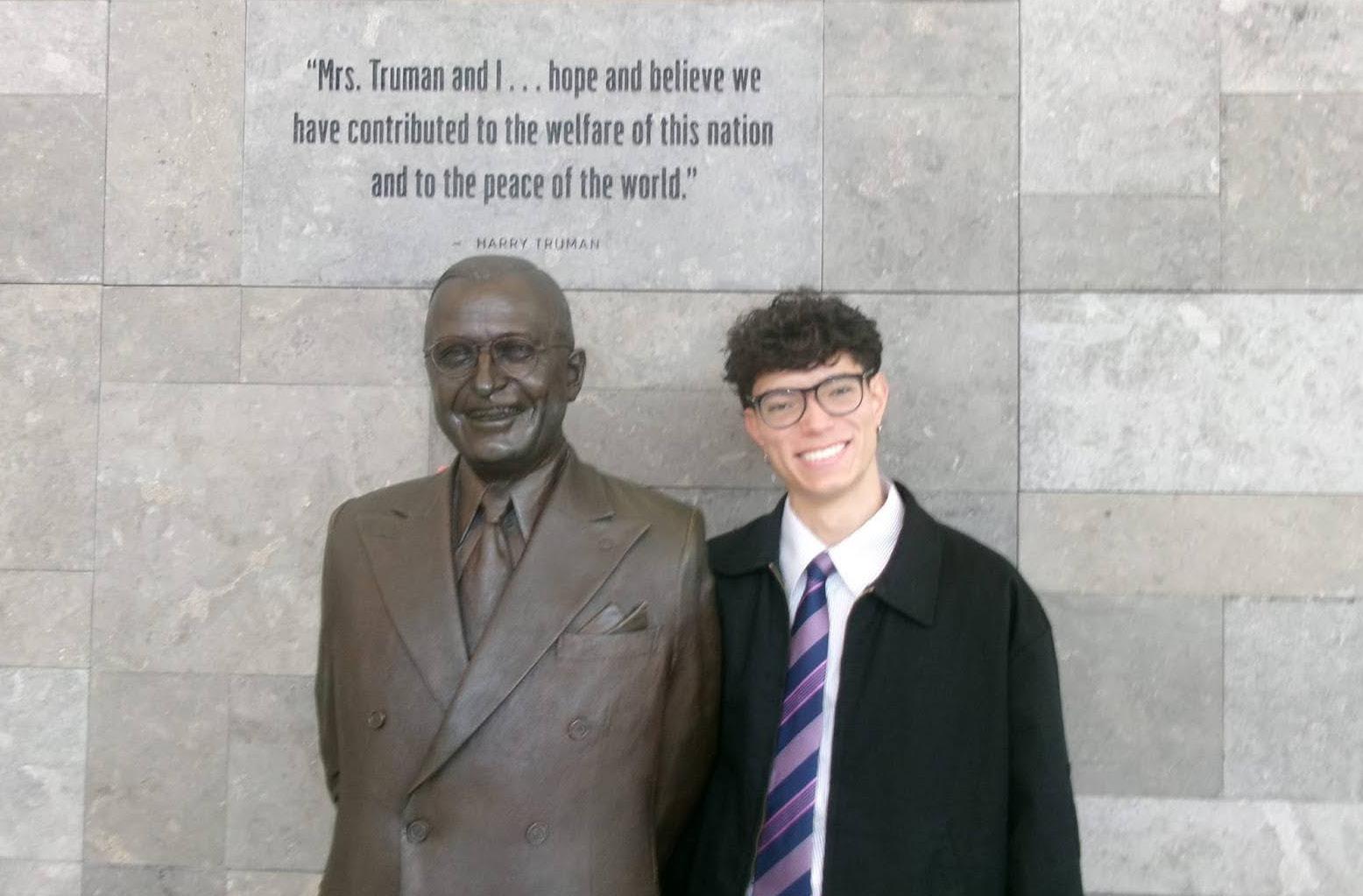
Photo Courtesy of Eli Leadham
Eli Leadham attended the Truman Scholar Leadership Week at William Jewell College in Liberty, Missouri.
Chris Wallace/Old Gold & Black
A day in the life of a Wake Forest cheerleader on game day
A behind-the-scenes look at the Georgia Tech vs. Wake Forest football game
ELIZABETH DAVIS
Contributing Writer
It’s 8 a.m. at Allegacy Stadium. My teammates and I arrive for the day, arms full of bags, uniforms, pom-poms and snacks for later, in anticipation of Wake Forest to take on Georgia Tech in football.
Even during my second year on the cheerleading team, I find myself exhilarated by the game day environment.
For the first hours of the day, we touched up hair and makeup, ensuring the whole team was “game day ready.” We spent time on the field with the band, reviewed pre-game choreography, went over sideline routines and warmed up with stretches. Although we had already cheered at several games this season, the anticipation of seeing the stadium come alive in just a few short hours was a unique thrill
“Preparing for game day is a lot of making sure everyone has what they need—snacks, bows, uniforms, gear, pep talks and hair spray,”
Annie Forbes, head of the Wake Forest spirit program, said. “It’s a lot of physical prep work while also reviewing material and making sure the team feels ready. Most schools have managers to handle these things, but we take pride in doing it ourselves. It builds ownership.”
By 9:15 a.m., my teammates and I line up along the Deacon Walk at the entrance to the stadium, welcoming the football team into the stadium for our first appearance of the day. Fans' energy encourages me to cheer loudly and smile big, especially as the Demon Deacon starts riding in on his motorcycle with the foot ball team
The joy of fans and seeing children watch in awe reminds me that being a cheerleader is a special opportunity to make people's days better. Deacon Walk is one of my favorite parts of game day because it sets the tone for everything that follows.
“The Deacon Walk is almost like the kickoff of the day as it’s the preview of the show,” Forbes said. “For us, it’s a rare chance to be fully in the mix with the community. Some of those moments become core memories for fans.”
The Georgia Tech game had even more excitement than usual. The ACC Network broadcast a special game day segment, featuring the new Head Coach for the 2025 football season, Jake Dickert. The cheer team, along with the dance team and Spirit of the Old Gold and Black (SOTOGB) were all featured in the broadcast as the background behind the reporters.
From there, we headed to the Gold Lot for a tailgate pep rally. I perform sideline dances and the fight song with my teammates, greeting family in town for Family Weekend, taking photos and eating a quick pre-game meal.
“Pep rallies and fan-facing events are priorities this season because they connect us directly to the community,” Forbes said. “We’re rebranding the program, and these personal experiences with fans help them invest in our spirit longterm. By being more accessible, we bring the excitement to them.”
At exactly 11:38 a.m., it is time for the pregame routine, waiting for our cue to run onto the field and get in position. Walking onto the field with the band playing behind us, I always feel a rush of adrenaline during game time. Our pregame

routine is designed to fire up the crowd, ending with the fight song and by the time we finished, I could feel the stadium buzzing with energy for the football team to run out of the tunnel.
“I love getting to cheer for all the fans in the stadium,” junior cheerleader Logan Sullivan said. “From leading the ‘WAKE! FOREST!’ chant at kickoff to cheering at the hill, it is such a privilege to be a part of creating an electric game day atmosphere!”
Once the game begins, we split into our three groups— Bowtie, Tophat and Cain, an homage to the Demon Deacon. I spent the first quarter in front of the student section where I could feel the back-and-forth with the crowd and hear every cheer ripple through the stands. I spent the following quarters at various locations by the hill, where many families gather on the grass with their children. I love the families who come to the game and feed off their energy.
“Rotating sections throughout the game is intentional,” Forbes said. “It keeps the stadium engaged and makes sure every fan feels connected to the action, not just the student section.”
“
Each game reminds me why I continue to push myself, jump higher and cheer louder.
Halftime was extra special this week with Junior Spirit Day, which is an initiative through the Wake Forest Spirit Program that allows children to learn a short routine and perform it at a Wake Forest sporting event to showcase their best cheer and dance skills. Watching the “Mini Deacs” perform the dance they had been practicing made me smile as much as they did. Their nervous excitement was contagious and I found myself cheering harder to encourage them.
When the final whistle blew, my teammates and I gathered our signs, megaphones and flags. We circled up for a quick closing meeting with Head Cheer Coach Loveday-Donovan and assisting coaches, ending with our usual “Go Deacs!”
Although gamedays can be tiring, I wouldn’t trade the gameday experience for anything. It’s about more than just cheering, but representing Wake Forest, building tradition, connecting with fans and fueling the Demon Deacon spirit that carries through every corner of the stadium. Each game reminds me why I continue to push myself, jump higher and cheer louder. In those moments, I am part of something bigger than myself.
“What makes Wake Forest cheerleaders unique is your ability to see the vision in the program, to advocate for yourselves, and to carry on a tradition not just for today, but for those who come after you,” Head of Wake Forest spirit program, Annie Forbes, said.
Photo Courtesy of Wake Forest Athletics
“Let me know that you will not be an easy victim”
RAD instructor Tony Chambers trains students in self-defense
MIRIAM FABRYCKY Features Editor
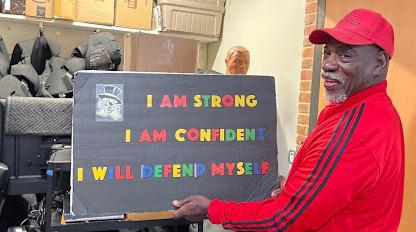
“I am strong! I am capable! I will defend myself!” a student shouted. A man in a bright red tracksuit and a matching baseball cap, identifying him as a Rape Aggression Defense (RAD) instructor, pointed at another student, who repeated the chant.
The instructor, Wake Forest security officer Tony Chambers, has RAD students read this mantra from a colorful cardboard sign at the start of every class.
“I want you to read it with your mean voice, with your mad voice,” Chambers said. “Let me know that you will not be an easy victim.”
Stunning and running
“Make noise” is one of the first lessons in RAD for Women, an HES course supported by University Police. Chambers has taught RAD at Wake Forest for ten years, following thirty years on the North Carolina State Highway Patrol.
Each section of the popular seven-week course enrolls about fifteen female students. Twice a week, these students meet in a room padded with wrestling mats in the Sutton Wellbeing Center to learn self-defense techniques.
The RAD curriculum includes a manual, videos and even essay assignments. However, students spend most of their time practicing an extensive list of physical maneuvers to deter sexual assault. There aren’t just generic punches, according to Chambers, but “fists, palm strikes, spear hands, extended knuckles.” Each kick is classified as a “sweep kick, straight kick, front snap kick [or] knee straight.” Chambers explains the proper form for all.
“You think everybody knows how to make a fist, but everybody don’t,” Chambers said. “If that fist is not made proper and you hit something the wrong way, you’re going to injure yourself.”

Fight week
After half a semester of practice, it’s time for “fight week.” Students wait in the hallway as Chambers calls them into the classroom one by one. Each student suits up in a helmet, gloves, elbow pads and knee pads and stands on one side of the room with her eyes closed. Her goal is to reach a line of blue painter’s tape on the other side of the room.
“In the real world, there’s not going to be a blue line ten, fifteen yards away,” Chambers said. “But what it does is get them in the habit of running.”
Before they can run, the students must fight. They keep their eyes closed until another certified RAD instructor grabs them. They fight their way out of the first “attacker’s” grip, then dodge a second. The instructors wear bulky protective suits, but some students are so powerful that the shielding gear proves insufficient.
“Our aggressors will act like a normal person would if they were kicked or punched, [but] sometimes [they] don’t have to act,” Chambers laughed. “If we don’t walk out of here with bruises, I let you down.”
“In a stressful situation, your body resorts back to how you trained,” Chambers continued. “If you train halfway, that’s all it knows.”
Senior Carrigan Pitts, who recently completed the course, said she was a “little nervous” for fight week.
“The people you have to take down are like, big boys… and they really don’t take it easy on you,” Pitts said. “They don’t hurt you or anything, but they really want to see what you’ve learned for the class.”
Despite her initial worries, however, Pitts felt it was important for her and her classmates to learn to “fight for as hard and as long as [they could].”
“I was really surprised [by] how much [Chambers] affirmed us,” Pitts said. “I thought it would be all physical, but we talked a lot about mental health and having confidence in yourself.”
Chambers said that psychological stamina can be just as important as physical strength in a highstakes situation.
“People think that defense is just fighting [but] self-defense is keeping yourself safe all-around,” Chambers said. “You got to train the mind as well as the body. If you ain’t mentally prepared to do it, you could be the best puncher and kicker in the class… [but] you’re not going to do it.”
Changing curriculums
Chambers acknowledged that certain aspects of the RAD curriculum have changed since he began teaching. There’s now a greater emphasis that resistance is not always a realistic response during sexual assault.
“You might to choose to comply… doesn’t mean that you’re weak,” Chambers said. “You might have a reason. You might have to temporarily comply until you get away, [or] the person might have a gun.”
As most rapes are perpetrated by someone the victim knows rather than a stranger, RAD also touches on the topic of domestic violence.
“Don’t go back to all your friends [or] your significant other [and show] all these techniques that you’ve learned,” Chambers warned. “If you’ve told your boyfriend [or] girlfriend, you’ve given away your plan. Protect your game plan.”
Chambers is also quick to emphasize that RAD is not a fighting course. He teaches students to “stun and run” in a dangerous situation, fighting only as much as necessary to separate themselves from an aggressor so they can escape to safety.
“We didn’t teach you no wrestling techniques,” Chambers said. “Get that good punch or kick in The more power you got, the more time it’s going to give you to run off… don’t stand there and continue to punch.”
“I always thought it was best to do what you’re told and be more concerned about your life,” Pitts said. “But [Chambers said] that’s completely not true. You need to fight – don’t let them take you anywhere.”
Mental considerations
Pitts also did not expect so many exercises focused on strengthening students’ boldness, such as shouting “I am strong! I am capable! I will defend myself!” at the start of every class.
Wake Forest’s RAD program will change again next semester: in Spring 2026, Chambers will teach RAD for Men for the first time. Compared to its equivalent for women, the men’s section will focus more on de-escalating violent situations.
Carrigan Pitts said having only women classmates helped the course feel like a “safe and empowering environment” and was glad that men would soon be able to enroll in their own version as well.
“If it was a mixed gender class, maybe people would feel embarrassed to try their best or yell out,” Pitts said. “It’s really important that men get this opportunity, too.”
Miriam Fabrycky/Old Gold & Black
RAD instructor Tony Chambers has his students repeat this mantra at the start of every class to boost their confidence. He says mental stamina is critical for self-defense.
Photo Courtesy of University Police
In the half-semester course, female students learn physical self-defense maneuvers enabling them to quickly escape a violent situation.
Deacon Profile: Outdoor Pursuits’ Bella Coughlin and Connor Kim
Coughlin and Kim help create a community of adventure through OP
REESE LILE Environment Editor
Outdoor Pursuits (OP) is a program run through Wake Forest Campus Recreation that aims to get students off campus and into nature. They lead trips in which students hike, camp, rock climb, backpack and kayak — among other adventures — encouraging students to try new things and simply have fun outside.
An important part of the program is the student employment opportunities that OP offers. Alongside a staff member, student employees lead the trips offcampus and supervise the OP rental center and climbing wall in the gym.
Bella Coughlin is a junior who is double-majoring in physics and mathematics, and has been working for OP for a year. She has always loved being outdoors, and she says that one of the best things about working for OP is all of the ways it has allowed her to engage with her co-workers and work as a team. She says her favorite memory with OP so far has been the Wilderness to Wake program, a five-day pre-orientation program that takes cohorts of incoming Wake Forest freshmen on outdoor adventures.
Coughlin believes that programs like OP are important because they allow students to explore a variety of different activities safely and provide accessibility to activities that people may not have been able to engage in before.
Coughlin also believes that OP is a positive presence on campus because it encourages students to go out into nature and get off campus.
“I feel like it’s just good for people’s souls in a way. Just getting outside is very peaceful. I think everybody should spend more time outdoors, and I think that getting off of Wake [Forest]’s campus is important because a lot of people are moving to North Carolina and never really engaging in the rest of the state,” Coughlin said. “So I think we do a good job of showing people the rest of
North Carolina.”
Connor Kim, a senior who is majoring in accounting, is another OP student employee. Kim has been working for OP since the fall of his sophomore year, and says that for him, the best part of OP is the people he has met and gotten the chance to work with in the community.
Kim is also the president of the climbing club, which meets twice a week at the climbing wall in the gym. He is passionate about climbing and enjoys leading many of the climbing trips through OP. For him, the two go hand-in-hand.
“I love to rock climb, and I like seeing other people get excited about the sport,” Kim said. “So if I’m able to be that person who can show them how things work or give them the opportunity to go outside and climb — which many people might not have the opportunity if it wasn’t for outdoor pursuits — I think it is super valuable… that was something that was given to me when I was a freshman. So I think it’s awesome that we have this program that allows people to do that.”
Like Coughlin, Kim thinks that OP is critical in providing students with a community in which they can explore nature and outdoor sports with others.
“I think it’s awesome that anyone can find a community. There are no barriers to entry. It’s super cool how people can just come together over a common interest and we have something like Outdoor Pursuits that will help facilitate that,” Kim said. “I also think it’s super cool how [for] a lot of our trips, some people just sign up for the trip without knowing people beforehand. And there are a lot of people in that boat, so when they sign up for a trip, they end up meeting a bunch of new people that they wouldn’t have met before.”
Kim also points out that OP provides these opportunities in a very affordable way. Many of the activities that OP offers would be quite expensive through outside professional services. But OP offers these
same opportunities at low or no cost, which increases accessibility and allows people to explore all kinds of avenues.
“OP gives people that outlet to get outside and pursue hobbies and passions that maybe they wouldn’t have been able to before, but it’s made possible through the program and the community it builds,” Kim said.
Contact Reese Lile at lilerl24@wfu.edu

Photo courtesy of LinkedIn
Senior Connor Kim has been working for Outdoor Pursuits since his Sophomore fall.
Photo courtesy of LinkedIn
Bella Coughlin is a junior who has been working for Outdoor Pursuits for a year.
climbing
Photo courtesy of Wake Forest University
Environmental Justice: How North Carolina sparked its global push
From grassroots protests to Wake Forest’s own initiatives in equity and sustainability
CAMILLE WALL
Contributing Writer
The environmental justice movement is one that has attracted national attention in recent years. What is at the core of this movement? What is environmental justice fighting for?
The American Public Health Association defines environmental justice as “the fair treatment and meaningful involvement of all people regardless of race, color, national origin or income, with respect to the development, implementation, and enforcement of environmental laws, regulations and policies.”
Essentially, all people have the right to live under equal environmental protections and can include themselves in all activities corresponding to those rights. This concept is often associated with people of color being the primary inhabitants of America’s most polluted environments. These communities often disproportionately experience environmenta l threats, such as contaminated water or harsh pollution from a nearby plant, for exa mple.
The national environmental justice movement is considered by many to have been initiated by a series of protests in Warren County, N.C., in the 1970s after the state’s government chose to store thousands of pounds of toxic soil in a predominantly black community. Ultimately, t he Warren County community lost the legal fight for justice. However, they unknowingly
jump-started a movement that continues to become more relevant through the decades as climate issues escalate.
The environmental justice movement continued to progress nationally, becoming a n important issue for the Democratic Party, especially in the early 1990 s with the election of Bill Clinton. Since then, environmental justic e has become more prominent in federal policy, like the Biden administration’s Justice40 Initiative, which aimed to allocate 40% of certain climate and environmental investments to disadvantaged communities.
At the 2022 State of the Union Address, President Biden promoted this initiative, saying, “We’ll create good jobs for millions of Americans… and we’ll do it all to withstand the devastating effects of climate change and promote environmental justice.”
In recent years, Wake Forest University has implemented this movement in its campus life through the cre ation of the Environmental and Epistemic Justice Initiative, with a goal to collaborate with people of all backgrounds to create a Science and Technology Studies curriculum that acknowledges the effects of race on discussions of our environmental practices, concerns and pol icies.
In April, Wake Forest held the 2025 Mellon Environmental Justice Summit with Reverend Benjamin Chavis. Reverend Chavis is a wellknown civil rights and environmental
justice activist, who even coined the term “environmental racism” and was present at the Warren County protests. At the summ it, he celebrated the progress the movement has made sinc e the 1970s, while still acknowledging there are rema ining challenges.
“
The catalyst for a growing and vibrant environmental justice movement throughout the world today.
“We recognize that what began in Warren County, North Carolina, in 1982 was the catalyst for a growing, vibrant environmental justice movement throughout the world today with an outcry demanding justice a nd equality,” Chavis said. “The solution to environmental racism is environmental justice for all of humanity.”
At Wake Forest, students, faculty, and staff have the opportunity to carry forward this movement to ensure greater equity in our futu re communities through advocacy and daily choices that priorit ize both sustainability and justic e.
Contact Camille Wall at wallcm24@wfu.edu

Happy climate news
Column REESE LILE Environment Editor
The headlines are filled with stories of polar ice caps melting, pollution choking our cities and the billion s of microplastics in everything we own and eat. While it is important to stay informed about the problems in the environment, it is just as important to acknowledge what IS going well.
To flip the script for a minute, let’s look at some h appy news in the world of the environment.
“Ocean Eyes” singer is helping save the oceans
Pop singer Billie Eilish recently launched an upcycled merchandise project with Universal Music Group, which is projected to turn old shirts and sweatshirts into over 280,000 new shirts. Aside from keeping unused clothing out of landfills, Eilish has also partnered with other small sustainable clothing companies to create Earth Day collections this past spring.
Herbicides are out, sheep are in
Carpenter Preserve in Neenah, Wis., has initiated a natural cleanup of the area using sheep and goats. The livestock grazing targets invasive plants that are disrupting the local ecosystem. Herbicides can degrade the land and soil, and seep into surface and groundwater, posing risks to wildlife and humans, as well as lead to environmental remediation costs. Instead, livestock offer a natural method for species control and may provide fertilizer that benefits the land a s well.
Insects, Guts and Drones
Flight requires extreme intricacy, and scientists are drawing inspiration from the folds found in nature… from the wrinkles and layers of the large intestines of a baby chick to the tiny folds of the wings of insects. Researchers at Purdue University are exam ining the wings of an insect called an earwig, which has what they call “bistable” wings. This means that it can be at rest open or closed and has almost unfathomable folding techniques that allow the bug to pack very large wings into a very small space. The researchers believe that studying these wings may allow them to model drones that can fly more efficiently and fold more compactly.
Reese Lile at
Protestors in Warren County fighting against the PCB landfill were a catalyst for the environmental justice movement throughout the world.
Courtesy of Greg Gibson
OPINION
OLD GOLD & BLACK
PAGE 12
THURSDAY, OCTOBER 23, 2025
Towne Moores, moortv22@wfu.edu
Sara Catherine Bradshaw, bradsc24@wfu.edu
The views expressed in all opinion columns represent those of the article’s author, not the opinions of the Old Gold & Black Editorial Board
When activism turns performative
Genuine activism requires genuine action
SYED ABDULLAH Staff Writer
Lately, it feels like everything is being labeled as performative. Men are “performative” for drinking matcha. Women are “performative” for following Formula 1. Even wearing loafers or pleated trousers can somehow be spun as a performance. The word has become so overused that it’s lost its meaning, and that matters when we’re talking about activism online.
Because here’s the thing: not all social media activism is hollow. At its best, it connects people to causes, spreads stories that would otherwise go unheard and creates action. At its worst, it’s a little more than a performance. It’s a signal to followers that says “I care,” without doing much else.
So what exactly do we mean by these terms?
Social media activism is the use of platforms like Instagram, TikTok, or X to promote social change, raise awareness and mobilize support. It allows ordinary people to spread information quickly and amplify voices that might otherwise go unheard. Campaigns like Black Lives Matter and #MeToo started with simple hashtags but grew into worldwide conversations and movements, showing the power of digital communication to spark collective action.
Performative activism, on the other hand, is activism done more for appearance than impact. It happens when people post about a cause to boost their social standing or prove they are politically awarerather than out of genuine commitment to change. Corporations that plaster rainbow logos during Pride Month while funding anti-LGBTQ politicians are one example. On an individual level, it often becomes more about looking informed than being involved, a post that signals awareness but stops short of real effort.
We’ve all seen it: waves of coordinated infographics, brands suddenly posting about a social issue when it’s trending orinfluencers sharing politically charged content they may not even understand. Social media allows people to present a curated version of themselves, and activism is no exception. It’s easy to post about a cause for social validation rather than genuine belief. And when activism becomes more about aesthetics than action, the actual fight for change takes a backseat.
The danger here is that performative activism can create a false sense of accomplishment. People feel like they’ve contributed by sharing a post or commenting on a viral video, even if they haven’t taken any meaningful steps toward real-world change. In many cases, companies and influencers use activism as a marketing tool, capitalizing on social movements to boost engagement and sales rather than genuinely supporting the causes they promote. A clear example of this in corporate spaces is rainbow washing (sometimes called pink washing), when brands adopt LGBTQ+ symbols like rainbow logos or Pride merchandise to appear inclusive while providing little or no meaningful support behind the scenes.
In today’s culture, it matters where brands stand. Companies can no longer afford to stay
ambiguous or neutral on major social issues because people notice and they care. Consumers are becoming increasingly conscious of their purchases, and many are willing to spend a little more on products that align with their values, whether that means choosing environmentally friendly packaging, supporting ethical labor practices or buying from brands that demonstrate real commitment rather than empty statements.
The trouble is that the line between genuine and performative activism is not always clear. Sharing a hashtag can be a meaningful first step toward awareness, but without any real understanding or follow-up, it risks becoming hollow. The infamous black squares of #BlackoutTuesday in 2020 showed how easily good intentions can backfire; millions of posts meant to show solidarity ended up overwhelming communication channels and silencing the very voices they aimed to amplify. The same pattern repeats today. With issues like Palestine and Israel dominating headlines, many people rush to repost graphics or simplified takes without understanding the complexity of the conflict, which can flatten nuance and drown out the perspectives of those most directly affected.
Performative activism can unintentionally hurt the causes it claims to support. When solidarity becomes trend driven, movements risk being trivialized, diluted, or even co-opted by corporations.
Still, dismissing every online effort as “performative” is just as unhelpful. For many young people, Instagram stories and TikToks are their
main window into current events. Most do not regularly watch or read the news, so social media often becomes the primary way they learn about issues such as immigration crackdowns, humanitarian crises, or systemic racism, whether that is the recent Supreme Court decision allowing ICE to conduct stops based on race, accent, or job, Israel’s attacks on civilians in Gaza,, or protests against police brutality. Awareness alone does not fix injustice, but it can plant a seed.
Sometimes, even surface-level participation can help create momentum. A flood of hashtags, reposts, or profile picture changes might look shallow, but in sheer numbers they can push a cause into mainstream visibility. The challenge is making sure that visibility leads to depth, with awareness followed by action.
The difference, then, comes down to intent and action. Are you posting to look good, or are you actually listening, learning, donating and showing up? Are you uplifting voices from the communities affected, or are you centering yourself? Those questions matter more than whether you shared a post in the first place.
Social media shouldn’t be the end of activism, but it can be the beginning. Performative activism thrives on appearances. Genuine activism insists on action. And if we want real solidarity, we can’t afford to confuse the two.
Contact Syed Abdullah at abdusm23@wfu.

The murder of George Floyd in May of 2020 sparked Black Lives Matter protests across the country and all over social media platforms.
Photo Courtesy of AP News
Pay them what you owe them
WNBA players do not get the salaries they deserve
SHANI SCHWARTZ Staff Writer
As a young girl, all of my role models were NBA players. I idolized Kevin Durant, wearing his jersey every day, and had his life-sized fat head on my bedroom wall. My dream was to be the first female player in the NBA. In a country where a women’s professional basketball league exists, a young girl’s dream should never have to be to make it to the men’s league.
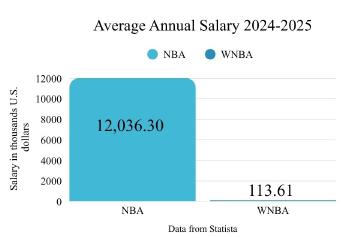
The average WNBA player’s yearly salary is around $102,000, with a league minimum of $66.079. The average salary of a UPS driver exceeds this number. While this used to be an issue of low revenue, this is no longer the case. WNBA revenue has increased by 200% since 2022 and is currently valued at $3.5 billion. The issue is instead
rooted in the allocation of revenue. WNBA players are only earning about 9.3% of the league’s revenue. Their male counterparts make around 49-51% of the NBA’s total revenue, resulting in salaries that range between $5 million and $50 million per year. NBA bench warmers who have never seen substantial court time in their entire careers are making money that no WNBA all-star could even dream of.
It is not realistic for WNBA players to have identical salaries to NBA players due to the gap in league revenue, but it is reasonable for them to make the same percentage of that revenue, especially with the increase in viewership of WNBA games.
Just five years ago, my brothers would mock me for putting women’s basketball on the living room TV. Now, they are turning those games on

themselves, buying player jerseys and asking to get tickets to see their favorite players in town.
Caitlin Clark has become a household name. Viewership has risen 170% in the past season alone. Merchandise sales have surged over 1000% in 2025. Ticket sales have increased 145%. The league is at its highest point yet and is continuing to grow. With three expansion teams planned for the next few years and star college players like Juju Watkins still to join, the value of the league is in good hands.
Yet, it is the league itself that has
failed to keep up.
Players are still forced to compete overseas in the offseason to make a sustainable salary. Without a true offseason, players are more prone to injury. Furthermore, being constantly on prevents skill growth, putting the players in worse positions for their upcoming seasons.
The league must do better. The first step is to pay the players what they owe them.
Contact Shani Schwartz at schwsr24@wfu.edu
As I’m writing this on a Friday night, I’m surrounded by hall mates who have decided to “fade” the frats and stay in. We’re playing games like “Jackbox,” “Quiplash,” and “Werewolves” instead of dancing in basements to flashing lights. Within the last couple of years, we, Gen-Z, have been labeled the “stay-athome generation.” We drink less than previous generations by about 10% and go out to bars and parties at a much lower rate than previous generations did.
While staying in has become perfectly normal to my generation, previous generations don’t seem to understand this trend. Our parents spent years nagging us not to go out, but now they worry that we don’t go out and explore enough.
The tales of my parents’ childhood follow the typical storyline of setting out in the morning, either gallivanting through the neighborhood unsupervised or being dropped off at the mall with
some cash and a meeting location for pickup. This often turns into bemoaning how kids nowadays never get out of the house or have adventures with friends.
The funny thing is that these are the same people who have forced their kids to install apps like Life 360 and demand answers to who, what, when and where before we ever set out.
Jonathan Haidt, a social psychologist, attributes this to the idea that parents have less faith in their neighbors to look out for their kids than they used to. Additionally, we are now viewed with more distrust by society and immediate skepticism when we hang out in public places. The places where it is still socially acceptable for kids to gather have simply priced us out. No longer are movies, bowling lanes or arcades a weekly hangout spot, but a financial commitment that requires weeks of forewarning and budgeting for some
As a result, we have grown comfortable with staying in and hanging out with friends, often virtually. Now, I would be remiss to not mention the effects of COVID-19 and how it forced us inside during some of our most forma-
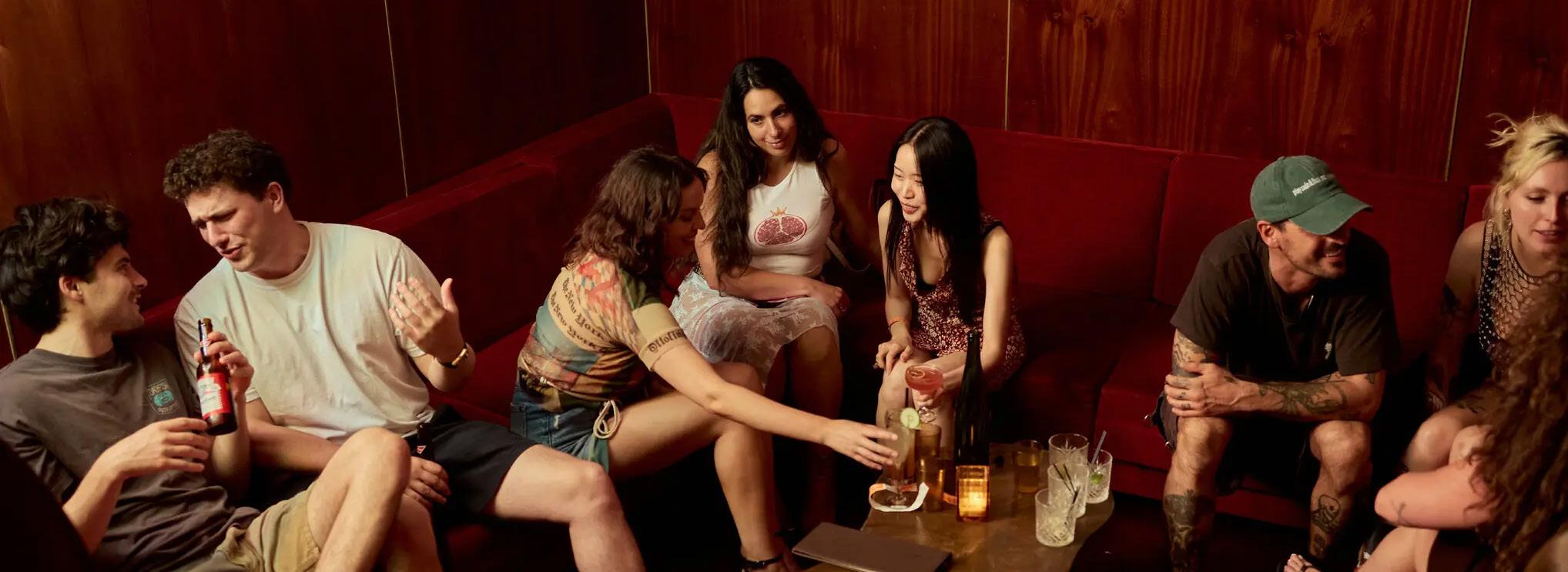
tive years. However, we discovered that we could develop relationships and exert independence from our parents while still at home. Going out lost some of its development impetus.
Now, my hall mates and I are developing these relationships in our common room rather than in a frat basement. A perk of which is the ability to hear each other clearly and engage in longer, more meaningful conversations.
Yes, we are the “stay-at-home genera-
tion.” It’s something that was forced upon us rather than chosen by us, but, as with everything, it has its perks and drawbacks. So, the next time you hear someone criticizing our generation’s propensity to stay in, ask yourself (and maybe them, if you’re willing to have that conversation): Is it really such a bad thing?
The Las Vegas Aces beat the Phoenix Mercury 90-88 on Wednesday in the WBNA finals.
Photo Courtesy of ESPN
This graph by displays the difference between the average annual salary earned by NBA and WBNA players during the 2024-2025 season.
Towne Moores/Old Gold & Black
Photo Courtesy of The New York Times
The Trump Administration's Firings
How the mass firing of probationary employees reflects the instability of our democracy
HENRY HOLT
Conributing Writer
On Friday, Sept. 12, Judge William Alsup in the Northern District of California ruled that the Office of Personnel Management (OPM) did not have the legal authority to terminate probationary employees or execute dismissals without following proper procedures.
In its totality, this case is another example of the Trump administration overstepping its lawful domain. This concept is perhaps best demonstrated in statistics. At the moment, President Trump is on track to sign 329 executive orders this year. The last president to average more than 100 executive orders in a year was Harry S. Truman in his 2nd term, with an average of 101.
Probationary employees are newly hired civil servants undergoing an evaluation period in which their capabilities and performance are assessed to determine if they are suited for permanent employment. These employees do not possess the same job security as their permanent counterparts. That is to say, they can be fired more easily and do not have the same procedural rights.
In total, nearly 25,000 employees were laid off. The Trump administration views this measure as a part of its larger plan to downsize the bureaucracy and decrease federal spending, a task headed by Elon Musk’s former federal stomping grounds, DOGE.
The conversation of bureaucratic size and scope in an increasingly digitized world is incredibly intricate. The Trump administration is entitled to its view that the government is too large and the platform to make the reforms that they see fit.
The problem with a government led primar-
ily through executive action, such as the one that prompted the dismissal of many probationary employees, is that it overloads the court system, passes impermanent policy and temporarily circumvents the other branches. In short, a government relying on executive action begins to compromise its democratic tenets.
In the case of “The American Federation of Government Employees, AFL-CIO, etc. v. United States Office of Personal Management,” the district court decided that the OPM violated the Administrative Procedure Act. This act dictates federal law on how government agencies operate. In the context of this case, Alsup ruled that the OPM violated the act because it did not exhibit reason-based decision-making behind its actions.
Essentially, the court asserts that OPM decided who to fire, when to fire them and directed several agencies to fire under false pretenses. The latter is reflected in the letter template that the OPM provided to multiple agencies. This template said that employees were dismissed based on performance.
The reason provided in the letter directly contrasts with the initial message that the OPM gave to the 17 agencies involved. This message urged the agencies to retain only employees deemed “mission-critical.” Furthermore, the criteria of “mission-critical” were not actually in the hands of each agency. Instead, they had to appeal to the “exemption process” of the OPM.
At face value, the requirement to appeal to the OPM’s “exemption process” may seem logical because certain agencies might claim to need more employees than are actually “mission-critical.” This perspective fails to acknowledge that each agency is made up of experts in that respective field – experts
undoubtedly more qualified than the OPM in determining what personnel are needed.
Additionally, the OPM has a clear partisan slant. Earlier this year, CNN reported that “gaining quick access and control to the data and computer systems of OPM was fundamental to DOGE’s ability to infiltrate key Washington nerve centers. Political appointees and advisers connected to Musk or major tech firms now sit in top leadership positions across agencies that comprise the federal government’s personnel, technology, property and acquisition operations.”
With the OPM’s high-ranking officials loyal to Trump, they were clearly going to advocate for bureaucratic downsizing even when unnecessary. Indeed, this was the basis on which the case that Alsup presided over was based.
The OPM’s behavior in the litigation of the case further showcases the dangerous centralization of executive power taking place at the moment. Not only did the OPM act illegally, but they also attempted to prevent the judicial system’s constitutional right to review and check its power.
This sacrifice of democratic values is an incredibly short-sighted endeavor solely concerned with the volume of policy that can be passed, neglecting key voices and demographics elsewhere in the government. It reflects the growing polarization within our nation and sets the precedent for erosion of the rule of law. It calls us, as citizens, to recognize that our democracy is not as secure as we presume it to be.
The maintenance of our way of life as Americans requires constant attention not only to the proclaimed ends of those who represent us in government, but also the means they use to achieve it.
Contact Henry Holt at holthe25@wfu.edu

Courtesy of The Hill
James Lombardo, lombjp23@wfu.edu
Scottie Kimmelman, kimmsd22@wfu.edu
us on X
PAGE 15
Thursday, October 23, 2025
Field Hockey extends win streak to 13 in ACC doubleheader
Schoenbeck tallies four against California to lift the Deacs to their 13th straight and stay undefeated in conference play
ELLA MAYNARD Staff Writer
Wake Forest added two more to the win column this past weekend as they took down new conference foes Stanford and California on Friday and Sunday, respectively.
Friday vs. Stanford
In the 3-1 victory over Stanford, the Demon Deacons hit their 50th goal of the season, after senior Amelia Frey recorded her second straight game with a score. It marked the first time since 2022 that Wake Forest has scored 50 or more goals in a season.
Just minutes into the first quarter, captain Mia Montag converted a penalty corner to open the scoring for the Deacs, with Lena Keller earning the assist.
In the third quarter, Lauren Storey found the back of the net for the 14th time this season, off an assist from Flo Tuthill, extending the lead to 3-0.
Momentum shifted slightly in the second half as Wake Forest made uncharacteristic plays, allowing Stanford to capitalize with three minutes left in regulation.
“We didn't learn the lessons and
play to our principles, and then in the fourth quarter, there were probably three or four minutes of great hockey,” Averill said.
Tensions rose in the closing minutes. Goalkeeper Ellie Todd made an uncharacteristic mistake that led to a green card, resulting in a penalty corner for the Cardinal and leaving the Deacs without a goalkeeper.
Stanford earned not one, but two chances at an empty net, but both golden opportunities at a late comeback were shut down by Wake Forest’s stellar defense.
Despite the win, Averill expected more.
“I'm very disappointed in our discipline,” Averill said. “It's a lesson that we will take, with a win, and you better believe we'll make corrections.”
Sunday vs. California
Wake Forest had the chance to erase the previous game’s mistakes as the California Bears traveled to Winston-Salem, where they fell 6-2 to the Demon Deacons.
Schoenbeck was the driving force of the attack and highlighted the scoring with four goals–including
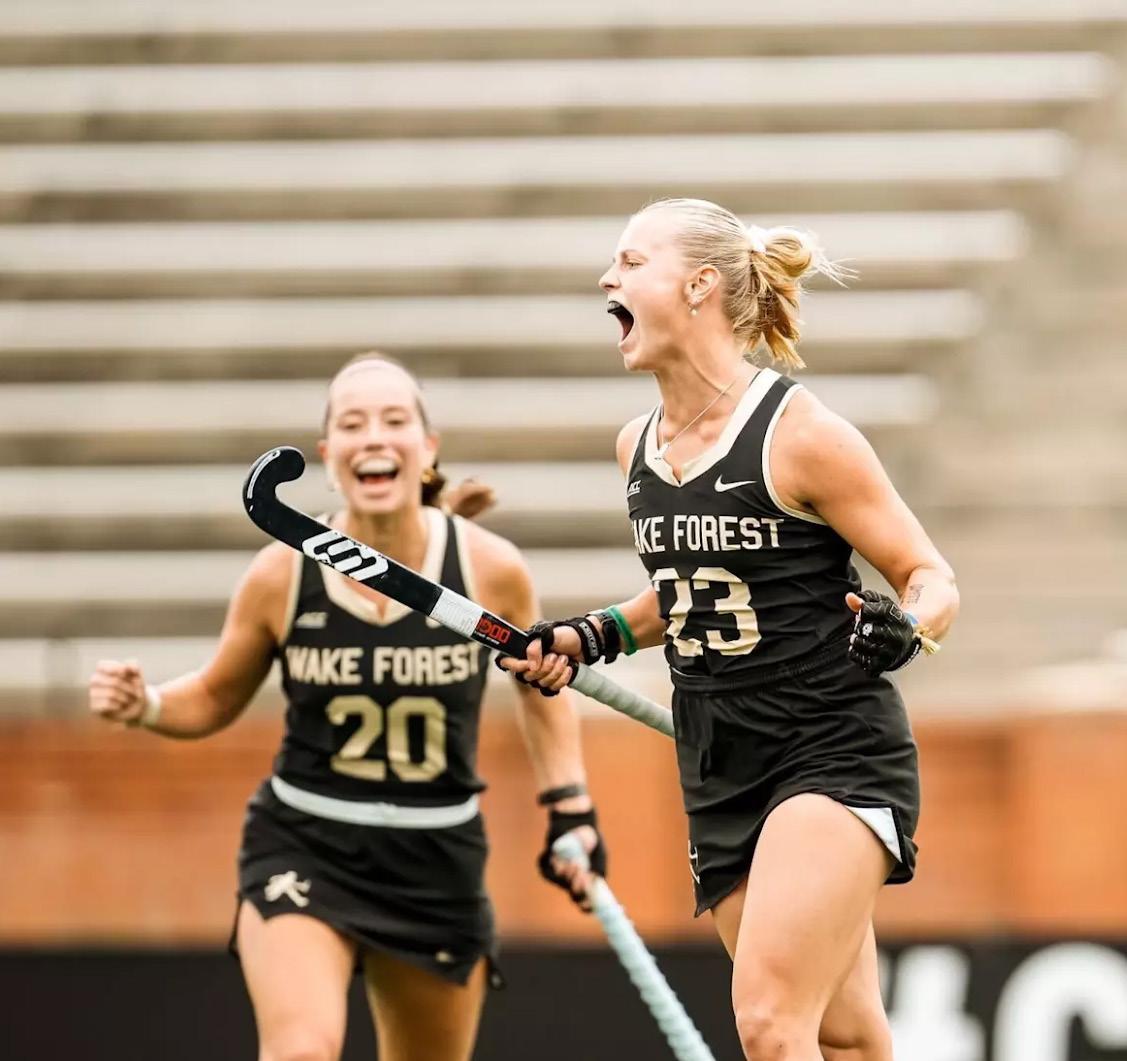
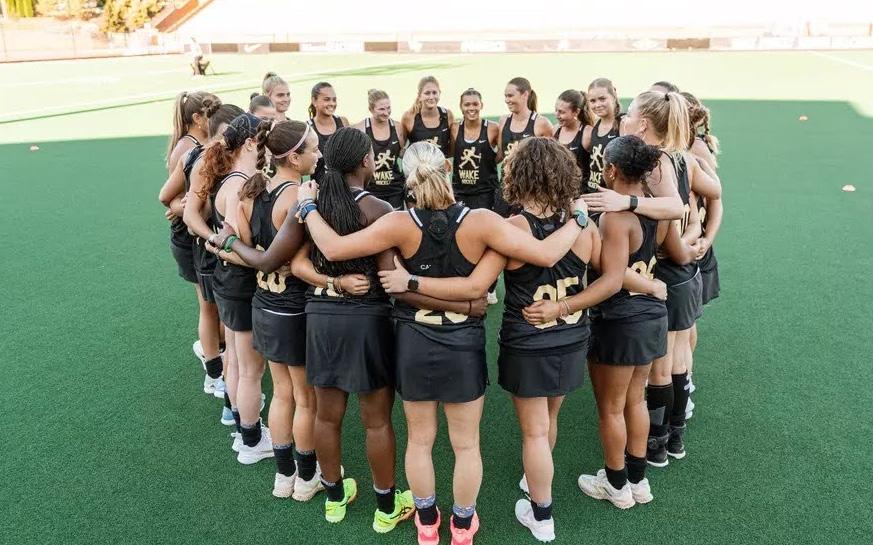
one from a penalty stroke–bringing her total to 18 on the season.
Frey continued her scoring streak, putting one past the goalie for her third straight game off a feed from Georgia Pollock.
The Demon Deacons celebrated once again with a minute left in the third quarter as junior Rory Heslin tapped one in for her first career goal, extending the lead to 4-1.
The Deacs finished with an 18-9 edge in shots and a 6-5 advantage in penalty corners, cruising to yet another win.
“Going into this weekend, we had confidence in our ability to compete and bring the heat to the competition,” junior Flo Tuthill said, who recorded an assist in both games. “Nothing changes for the games to come, we will stay humble, no matter the opposition; Each game is about us and our progress in the process to become champions.”
Wake Forest will have no shortage of challenging opponents to close out the season, meeting with No. 8 Duke Friday, Oct. 24, followed by Appalachian State and finally No. 3 Virginia.
The entire field hockey team huddles up before taking on Stanford in Friday’s matchup. The Deamon Deacons took down the Cardinal to win their 13th straight game.
Photo courtesy of Wake Forest Athletics
Photo courtesy of Wake Forest Athletics
Junior Mia Schoenbeck celebrates one of her four goals in Wake’s victory against Cal for her 18th goal of the year on Sunday.
Photo courtesy of Wake Forest Athletics
Men’s Soccer draws Louisville in Annual Genna Wiley Memorial Match
Deacs Struggle to Capitalize on Opportunities in Key ACC Bout
GRIFFIN LAMPHIER Staff Writer
The Deacs looked to take care of business at Spry Stadium on Friday night as they welcomed the struggling Louisville Cardinals to town, but ultimately tied 1-1. They donned special pink Genna Wiley jerseys to be auctioned off in support of the Cancer Health Equity Patient Care fund at Atrium Health Wake Forest Baptist.
The Wake Forest offensive front applied constant pressure in the opening minutes, with multiple pressure-filled attacks, including a great find from midfielder Jeffrey White to defenseman Christian Escribano in front, but his shot deflected high. The Cardinals answered with their own attack, as the Deacs made some miscues in their own half, allowing for some dangerous chances, including multiple from the Cardinals’ star forward Chase Vasquez.
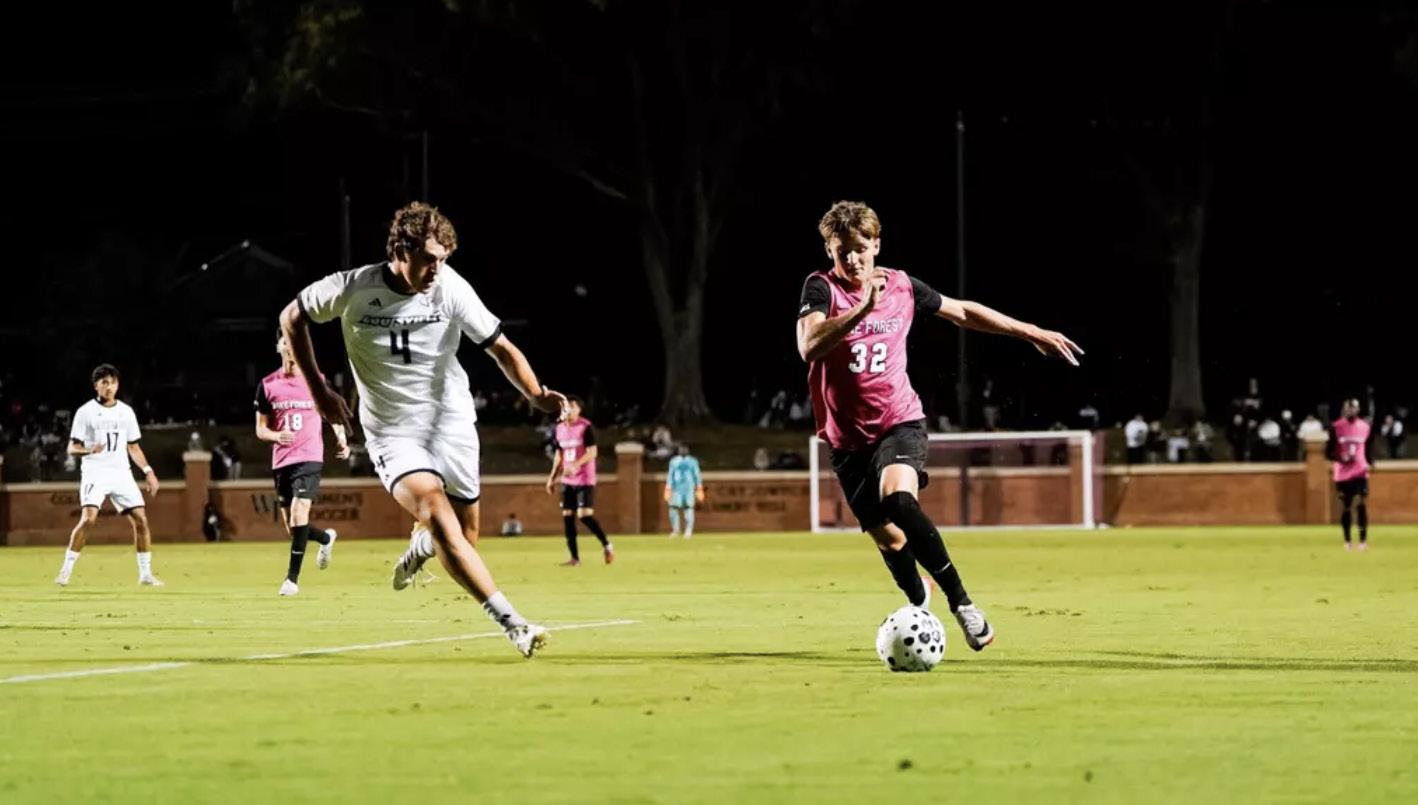
Junior Tate Lorentz streaks in towards the net. The forward would go on to notch two shots against Louisville.
The remaining half for Wake Forest consisted of quick and accurate passing, leading to plenty of open opportunities. In response, the Cardinals began to play much more physically. Louisville goalkeeper Alex Svetanoff was forced to be active as he made an impressive diving save in the 21st minute, and fouls in the 22nd and 23rd minutes gave Wake free kicks.
Then, in the 26th minute, the Deacs got their best chance of the night as Harvey Sarajian found Tate Lorentz streaking towards the goal on a beautiful ball, but the junior forward couldn’t find the back of the net. After a stretch of limited action, Wake Forest loaded up for a final push at the end of the half. Lorentz and Ethan Subachan both got some open chances, but their shots were off target.
With just 24 seconds remaining, freshman midfielder Alfred Debah broke away on the rush and found himself in prime positioning to try and give the Deacs the lead. He picked his spot and found twine to the right of a diving Svetanoff for his first collegiate goal.
Louisville was on the attack to equalize at the beginning of the second half. Vasquez got multiple high-danger chances, but he was thwarted, once by Deacon goalkeeper Jonah Mednard,
Golf finishes second in Hamptons
SCOTTIE KIMMELMAN Sports Editor
It was a successful performance for the Wake Forest Men’s Golf team, which finished second in the Hamptons Intercollegiate. In the field of 11, the Demon Deacons were able to overcome adversity and fend off several top-tier college squads.
Following an underwhelming 294 in round one, a string of dominant individual forces led to the strong finish. Doing everything they could to fight the strong winds, a competitive placement was all that the Deacons could hope for heading into round two later on Monday afternoon. Despite trailing the powerhouse Georgia by a whopping 19 strokes after 18 holes, hopes were still high for this club.
With a back nine that included eight birdies from the top four, momentum was on the side of Wake Forest. The trio of Nicholas Prieto, Tom Haberer and Kyle Haas took charge with solid scores of 68 and two 70’s, respectively. It was good enough to get the Demon Deacons back in the driver’s seat and make a push on Tuesday’s round three.
“It was a very good team effort today,” Coach Jerry Hass said following play on Monday. “For the most part, we did a great job of realizing we will make those birdies at the end of the round.”
With the aim of “hanging around,”
an above-average final round would be crucial in Wake Forest’s quest to win a third straight tournament, according to Haas. Facing even more adverse conditions on Tuesday morning, as well as the prospect of battling two SEC schools, their work was truly cut out for them.
After an even front nine followed by back-to-back bogeys on ten and eleven, Haberer made his mark by notching eagles on the 13th and 15th, along with a birdie on 16. His clutch performance, though, was not the only one that gave the Demon Deacons a fighting chance against Georgia and Ole Miss.
To counter Haberer’s final round score of 69, Prieto again played hero with a terrific score of 70. His consistent play, while encouraging, wasn’t quite sufficient to put his team on top. Even with the Rebels struggling immensely in round three, the Bulldogs did just enough to claim the victory amidst the surging effort from Wake Forest.
“We just ran out of holes today, but made a nice charge on the backside,” Haas said. “A lot of positives this week to reflect on this Maidstone golf course. We will be back in action in Charleston next week as we continue to make the Black & Gold proud.”
and once by a great combined effort from defensemen Daniel Krueger and Travis Smith Jr.
Finally, Vasquez’s aggression paid off, as he got off another shot in the 68th minute that deflected off the top left corner of the woodwork and directly to Cardinals’ freshman forward Quenton Wilson, who gave Mednard no chance as he cashed in to tie the game at one goal apiece.
Moments later, the Deacons’ Sarajian was able to break free of the Louisville defense and give himself a grade-A opportunity, as his shot beat Svetanoff, but leaked just inches wide of reinstating the Wake Forest lead. More chances came for the Deacs, including another from Sarajian, but they couldn’t find a way to finish.
Louisville made one last push for the win with a few moments to go, but stout defensive play kept them from taking advantage, including a fantastic effort by White with just under five minutes to go, as he cut off a pass to a wideopen Cardinal attacker all alone in the box. The final minutes ticked away, and despite all their opportunities, the Deacs left a point on the table with a draw.
Contact Griffin Lamphier at lampgm25@wfu.edu
Intercollegiate

Photo courtesy of Wake Forest Athletics
Photo courtesy of Wake Forest Athletics
Wake Forest Basketball lands three top 2026 recruits
Steve Forbes is adding four-star talent to load up for the future
JAMES LOMBARDO Sports Editor
On Tuesday, Wake Forest Basketball landed its third 2026 commitment from Quentin Coleman, adding to Steve Forbes’s impressive recruiting class.
Coleman, the 6’3” shooting guard from St. Louis, chose the Demon Deacons over Iowa, St. Louis University and Texas Tech. He is ranked 100th in the nation according to On3, and was named 2025 3A Missouri Player of the Year in his junior season.
Coleman is projected to join a very thin Demon Deacons guard rotation. Seniors Mekhi Mason and Nate Calmese are entering their final years of eligibility, leaving only Juke Harris, Myles Colvin and Isaac Carr ahead of Coleman on next year’s depth chart.
Coach Forbes also picked up two of the nation’s best forward recruits in September. Gavin and Gallagher Placide, a pair of twins from Colorado,
committed to the Demon Deacons together.
Gavin is ranked 51st in the nation, and Gallagher is ranked 84th in the nation, according to On3.
Both forwards already have the size to play at the next level, standing tall at 6’9”. Gavin weighs in at 225 lbs, while Gallagher is 215 lbs.
The duo is extremely strong defensively, and they should give Forbes more flexibility from the forward spots. They also show playmaking and ball-handling potential, as both are comfortable running the offense for their high school team.
While many top players have yet to commit to other programs, On3 ranks this Wake Forest recruiting class 8th in the nation and 1st in the ACC.
The season begins at the Joel on Nov. 3 against American, where Coach Forbes will showcase his newly revamped roster.
Contact James Lombardo at lombjp@wfu.edu
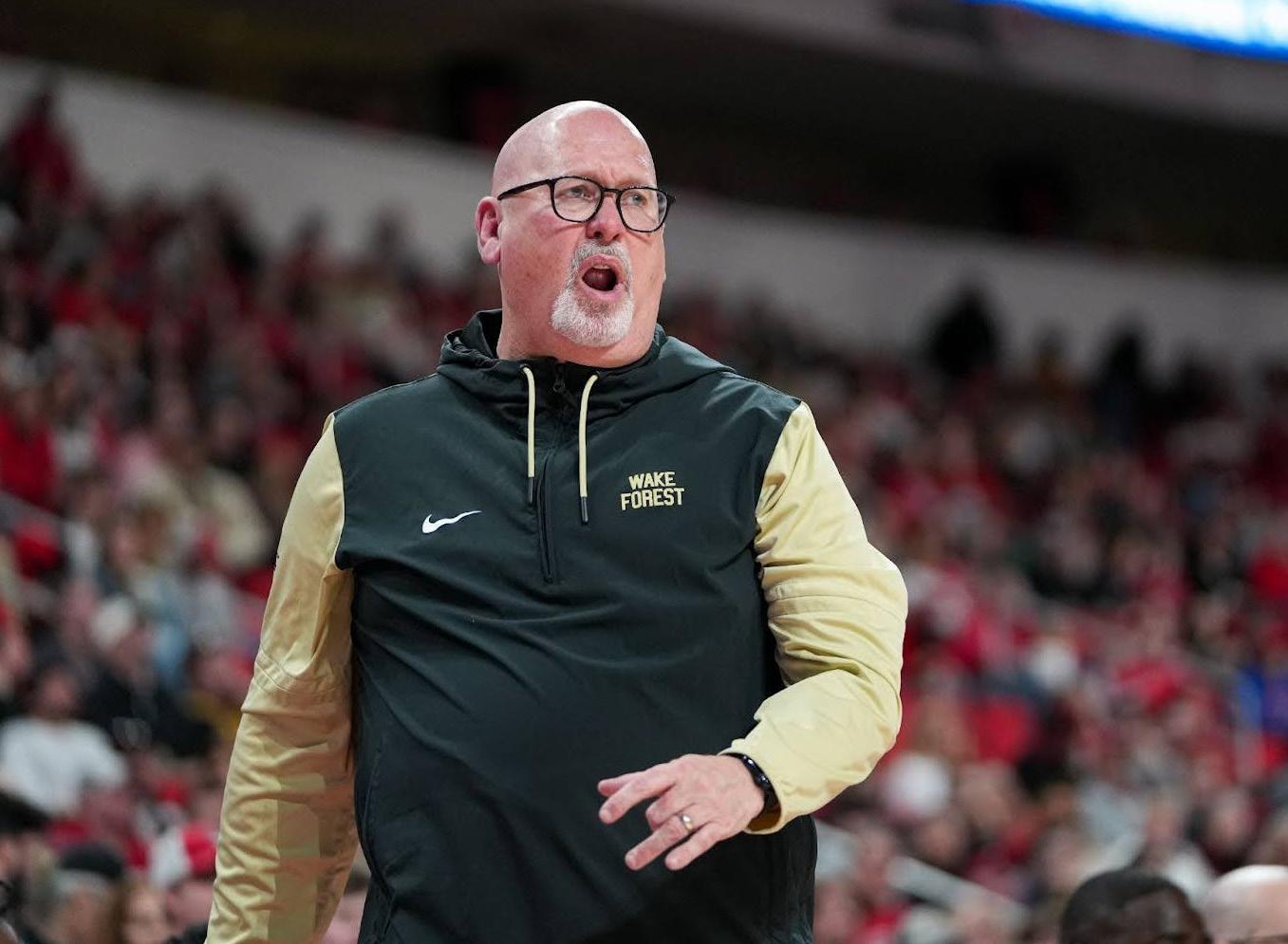
Deacon domination at ITA Carolina Regional
Wake Forest men’s tennis achieves standout results in Cary
ARIC LOIACONO Contributing Writer
Last week, the Wake Forest men’s tennis team turned in a strong start to its fall season at the ITA Carolina Regional Championships in Cary, N.C.
Leading the charge, junior Luca Pow made his way to his singles final after five back-to-back wins. This included a quarterfinal upset over No. 38 Roan Jones of UNC 6-3, 7-6 (8), and a comeback semifinal victory against Veljko Krstic of Elon, 6-7 (5), 6-2, 6-4. Following these victories, though, Pow withdrew from the championship
match against Romain Gales from Clemson, due to a precaution after four days of intense competition.
As a result of this dominating performance by Pow, he earned an auto-berth in the 2025 NCAA Singles Championships.
“Luca has been building toward

this,” head coach Tony Bresky said. “He’s competing with confidence and showing the leadership you want from a second-year player.”
Aside from Pow, though, other Deacons have excelled. For example, Kacper Syzmkowiak made it to the semis with an explosive four straight wins before facing defeat against Gales, 4-6, 1-6. Additionally, Andrew Delgado made his way to the quarterfinals and ended with a 3-6, 4-6 decision to the eventual champion, Romain Gales.
Then, in doubles, Wake Forest’s pairings of Pow/Syzmkowiak and Guilleme/Zauber both advanced to the Round of 16 before finally exiting against highly ranked opponents.
“Having three guys make the quarterfinals or better shows how well this group is coming together,” Bresky said. “It’s a good sign for where we’re headed this spring.”
Although the ITA Carolina Regional does not recognize team awards, this weekend’s performance from the Deacons does not go unnoticed, as multiple players advanced to the later rounds, showcasing a strong potential for the upcoming dual-match season.
“This region is one of the toughest in college tennis,” Bresky said. “Our guys battled through that level all weekend, and that experience is invaluable for what’s next.”
So with the Carolina Regional at its close, the Wake Forest men's tennis team will continue to blaze a path through its individual fall season before team play commences in January.
For the full match details and results, visit GoDeacs.com
Will Kuniaski/Old Gold & Black
Steve Forbes shouting directions in last season’s matchup vs. NC State. The Wake Forest head coach has been active in this year’s recruiting class. Contact Scottie Kimmelman
Junior Luca Pow gets ready to attack the net against his opponent in the Intercollegiate Tennis Association Carolina Regional.
Photo courtesy of Wake Forest Athletics
ARTS & CULTURE
PAGE 18
WEDNESDAY, OCTOBER 23, 2025
The Art of Forgetting
Memory, love and the slow disappearance of return
Lydia Derris, derrlf23@wfu.edu
Grace Schuringa, schugh24@wfu.edu
LYDIA DERRIS Arts & Culture Editor
On-demand art is weakening our artistic memory — where does love flourish if not in the artistic mind? No one is immune to it, because everyone wants to be somebody and everyone wants to be loved.
It’s no new thought that we all have an internal drive to be seen, to be loved. Whether this is achieved through putting in years of work and dedication to hone a craft, whether it's having dreams of becoming writers, film critics or simply curating the most enviable Instagram, the drive to matter remains.
But the overconsumption of overavailable art — and the false archival of that art into our digital “memory” — and the instant gratification of feeling, via Spotify stream, Letterboxd reviews, Goodreads logs and even online-dating apps, is limiting complex digestion of the art that we consume and the experiences we have. Each occurrence is presupposed on the availability of a “next encounter.”
What once required digestion now demands only documentation. Every encounter exists under the shadow of a next one: the next listen, next watch, next match.
The result is a diminishing of attention itself. And if we aren’t paying attention to something, we certainly cannot love it.

Courtesey of Associated Press Chris Marker's "The Owl's Legacy" (1989) moruns the ways ideas and cultural legacies become unindemensional when made endleessly available.
Transposing this phenomenon onto interpersonal interactions, more broadly, beholds a bleak, but hardly deniable truth: we are trapped in an endless cycle of searching, dominated by a socio-cultural “on-to-the-next” logic that hollows the present.
If we are consistently thinking about and preparing for a “next” prospect, or flipping tabs without paying close attention to what we are experiencing, what exactly are we committing to memory? And if we don’t remember, did we ever really experience it?
The way we scroll through art, always looking for the next song or film, reflects the way we scroll through people, both governed by the promise of a distinctively unidentifiable “something,” just beyond reach.
This erosion of memory is not just cultural but emotional. Love, like art, requires a kind of repetition — the willingness to revisit, to linger, to be changed. To love is to return. And the ability to return to something is denotatively a function of memory.
As Freud observed in “Beyond the Pleasure Principle,” “we are compelled to repeat what has marked us,” even if it hurt us; that “repetition is not regression but a search for mastery, for meaning.”
Thinker Julia Kristeva in “Tales of Love” says, “To love is to return again and again to the scene of recognition.” This is not a return of sameness, but a capacity to dwell in, and grow with, what cannot be made new.
But what happens when the structure of return itself collapses? When art and
intimacy are replaced by the “algorithmic new,” the repetition that once deepened us is replaced by the refresh and mute buttons.
There was a time when delay and desire were intertwined. Going to the bookstore. Waiting in line for a film. Buying a record and listening to it obsessively because it was the only one you had. Writing to someone you met by chance, waiting weeks for a reply, holding them in imagination while they were away. These acts stitched love and art into the long memory of a life.
As Sven Birkerts wrote, the old emporia of art “symbolized the presence, the value, of their presence in the community.” Now, art is no longer in the community; it is the community, a shared feed of endless circulation. If art fails to stimulate us in the span of its acquisition, we abandon it. Speed has become not only our condition but our aesthetic. Summoned instantly, art is consumed instantly — and forgotten just as fast.
The concern doesn’t lie in whether art and love can survive this optimization of experience, but whether we can remember what either once felt like.
Contact Lydia Derris at derrlf23@wfu.edu
Anthony Aston Players presents: ‘Orion’
WHITNEY DONOHUE
Contributing Writer
Matthew McLachlan’s play “Orion” requires a special touch to execute — and the Anthony Aston Players have that touch.
With its four-person cast and simple, character-driven plot, the show risks losing its strong emotional resonance if not in the right hands. Luckily, Wake Forest’s theater organization, Anthony Aston Players, under the direction of junior Maya Roth, brought this beautiful play to life with authenticity and heart.
“Orion” ran from Oct. 3-5 in the Ring Theater. The intimate atmosphere of the Ring lent itself perfectly to the emotional vulnerability of the story, allowing for the immersion of the audience into the characters’ stories. Orion follows four friends: Sam, Scott, Abby and Gwen as they come of age, facing love, heartbreak and recovering
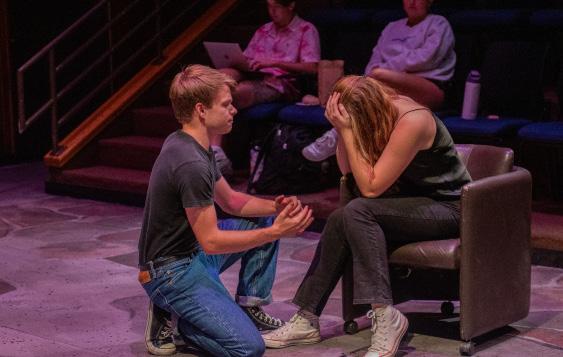
from the past. The cast embodied each of these characters with individual style, embracing both their emotional
journeys and unique personalities. Andrew Wilson (‘29) softened Sam’s endearing awkwardness, while Abby’s internal conflict re -
vealed itself through a powerful performance by Emily Crehan (‘29). Vanessa Brandt (‘29) and Patrick Eaton (‘27) nurtured Gwen and Scott’s candid confessions to the audience with genuineness and care.
The cast’s combination of authentic emotion, comedic timing and heartfelt connection with the audience gave this story a fresh life and resonance. The work of the scenic, sound, light and wardrobe teams allowed the Ring to be transformed into apartments, bars and a courtyard over the course of years seamlessly and intelligently. Maya Roth’s rendition of “Orion” shared a beautiful story of love lost and love given to the Wake Forest community. It showcases the importance of student-led art and the power of theater to unite diverse communities.
Contact Whitney Donohue at donowj24@wfu.edu
OLD GOLD & BLACK
Old Gold & Black/Piper Saunders
Maya Roth's rendition of "Orion" in Wake Forest University's Ring Theater, shared a beautiful story of love lost and love given.
Geese’s new album could make cobras dance
When boring music is the standard, “Getting Killed,” is the best we can do
LEXI DEAN Contributing Writer
The opening track, “Trinidad,” is a bewildering listen. The irregular 13/8 meter, along with the discordant blasts of horns and keys, isn’t sonically pleasant.
Cameron Winter’s vocals and lyrics also work to unsettle the listener, with repeated chants of the line: “There’s a bomb in my car,” followed by a description of sons, daughters, wives and husbands being in various states of disarray. “Trinidad” is hardly an enjoyable song, but it is distinct.
The rest of the songs on the album never get as strange or off-putting as the opener, but they very rarely end up in standard song structures. The lead single for the project, “Taxes,” sounds more like an extended jam, constantly building in a linear fashion with no choruses or bridges, than like the standard indie-rock fare.
“Au Pays du Cocaine,” a favorite of mine, comes close to a standard versechorus structure, with the repeated chorus lines of “Like a sailor in a big green

Geese’s latest album, “Getting Killed,” is a breathe of spring air among the overwhelming and bland releases choking the music scence.
boat / Like a sailor in a big green coat / You can be free,” but, even here, the song is more linear-jam anything else. It should be hardly necessary to say that much of modern pop music is in a dire state. The new Taylor Swift album, “The Life of a Showgirl,” has been met
with a lukewarm, or at times hostile, critical response. Sabrina Carpenter’s newest project was met with a more mixed reaction than her 2024 album “Short N Sweet.”
There is an abundance of very boring, very formulaic songs that are being re-
“The Life of a Showgirl”
leased. “Ordinary,” by Alex Warren, has little to say and little to give in terms of musicality, and it has made its home on the Billboard Hot 100 very comfortably.
Geese cut through the polished corporate-music landscape and deliver an album that never lets you know what’s coming next.
Winter’s lyrics are full of metaphor and symbolism, his vocal performance imbuing them with a kind of otherworldliness that is difficult to describe. When I first heard “Trinidad,” it was the first song I heard on an otherwise cold Friday morning, and the only thought going through my head was: “I can’t believe someone let them make this.” I fell in love with the rest of the album the moment I heard it.
Whether you’re dancing with the cobras or crying over the freedom of a sailor with a green boat and a green coat, “Getting Killed” has something for you, and, if you don’t like the song you’re listening to, at least you’ll never be able to say that it wasn’t interesting.
Contact Lexi Dean at deanla24@wfu.edu
is a letdown
My raw take on Taylor Swift’s new album from the perspective of a true Swiftie
HANNAH ORDAN Contributing Writer
For as long as I can remember, I have been a Taylor Swift fan. My very first concert was her 1989 world tour, at just eight years old, and I’ve been hooked on her music ever since. From jamming out to “Red” in the back of my mom’s car to blasting “Folklore” behind the wheel myself, almost all of Swift’s albums have been integral to my journey of growing up.
When Swift announced the news of her twelfth studio album, “The Life of a Showgirl,” back in August, I had high hopes. I was just about to start my first year of college, and the timing felt perfect to receive twelve new songs that could put all of my complicated, teenage emotions into poetic lyrics, just as her first eleven albums had done.
I was sadly mistaken.
While there are admittedly a few songs that I do enjoy like “The Fate of Ophelia” and “Elizabeth Taylor,” the album as a whole has been an unfortunate letdown. Instead of the clever, relatable lyrics that Swifties like myself are accustomed to, the new album showcases lines of awkward, cringeworthy puns that make it difficult to keep a straight face.
For example, during the chorus of track five, “Eldest Daughter,” Swift sings, “But I’m not a bad bi**h, and this isn’t savage.” In contrast to the melodic piano playing in the background, these lyrics feel like a sharp turn in the wrong direction for many Swift fans.
Avid Swiftie and freshman Annie

Swift decked eout as a feathered and mythical show-girl in her new album “Life of a Showgirl,” her new album which was released this past week on all streaming platforms.
Walker expressed her disappointment with the new album, and said, “I think the lyrics just don’t have much depth. Compared to “The Tortured Poets Department,” where her music had a lot of power and relatability, “The Life of a Showgirl” seems like somewhat of a letdown.”
Similarly, freshman Karis Krabill shared, “If you compare [‘The Life of a
Showgirl’] to albums like ‘Folklore’ or ‘Evermore,’ her lyrics were a lot more raw and authentic. This album seems like she is trying to fit into the new, sexual sound and image of what it means to be a pop star today. I feel like she prides herself on being a poet, and this album seems to completely contradict that notion.”
As much as I hoped “The Life of a
Showgirl” would mark the next chapter in my connection with Swift’s work, the album instead feels like a disappointment. While it saddens me to dislike a record of hers, my role as a dedicated Swiftie remains true. For now, I can only wait for her next release.
Contact Hannah Ordan at ordahg25@wfu.edu
Courtesy of the Associated Press
Courtesy of the Associated Press
Word Search
EVAN LIPETZ Staff Cruciverbalist
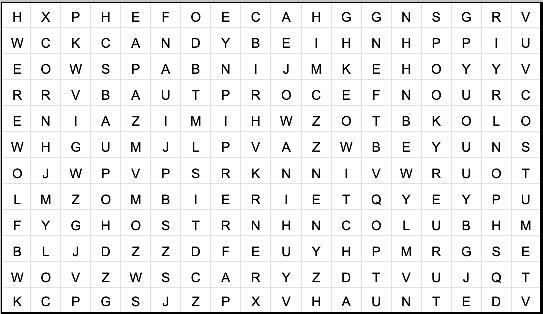
WORD LIST
Candy Cemetery
Cobwebs
Corn
Costume
Ghost
Ghoul
Haunted Phantom
Pumpkin
Scary
Spooky
Vampire Werewolf
Witch Zombie
Contact Evan Lipetz at lipeek22@wfu.edu
“One Battle After Another” disappoints
Leonardo DiCaprio as Bob Ferguson during the final act of “One Battle After Another.”
HENRY YATES Contributing Writer
Director Paul Thomas Anderson is widely considered to be one of the top filmmakers working today, and his films like “Boogie Nights,” “There Will Be Blood” and most recently, “Licorice Pizza” (2021), have made him a legend. His most recent film, “One Battle After Another,” hit theaters on Sept. 26, 2025, to critical acclaim and the best opening box office revenue of Anderson’s career. It follows Leonardo DiCaprio’s Bob Ferguson as he attempts to rescue his daughter Willa (Chase Infiniti) after his revolutionary past comes back to haunt him. Running parallel to this is Col. Lockjaw, played by Sean Penn, who is hunting Bob down and has a mysterious connection to Willa.
In many ways, “One Battle After Another” continues Anderson’s trends. It is technically sophisticated, as Anderson builds out tension and release in the ways only a master director could, and has standout performances by DiCaprio and newcomer Infiniti. At no point is a cut wasted or the blocking confusing, and the use of VistaVision creates a grainy look that has the one-shot authenticity of film. As a father-daughter flick, the film initially stumbles. It takes far too long to get to the central relationship and spends far too little time setting a foundational plot. However, down the stretch,
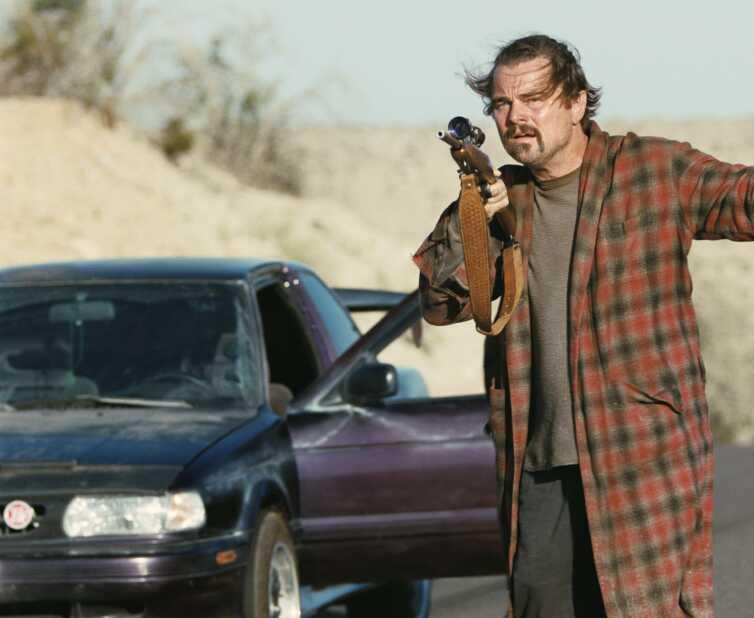
DiCaprio and Infiniti’s performances endear both characters to the audience, while creating a scenario where you root desperately for their reunion. At one point, I thought Anderson would cut this reunion short in tragedy and found myself terrified at the thought; thankfully, he does not. This is the beating heart of the film, and its best aspect.
The politics of the film, on the other hand, in many ways, shoot it in the foot. Much of this has to do with the first forty or so minutes of the film, which hurt the overall narrative. It takes a long time to set up and spell out clearly what the rest of the film will treat as a mystery, removing potential narrative tension from the script. Beyond that, it introduces both Bob and
Willa’s mother, played by Teyana Taylor, as violent far-left radicals who aren’t afraid to kill and destroy property in the pursuit of a vague “revolutionary” cause.
Beyond just seeming a bit tonedeaf due to recent events (though, as the film has been in production for years, Anderson could not have foreseen this), the film waits a long time to condemn them for their selfish actions. While I applaud Anderson, who both wrote and directed, for attempting to consider the rising role violence and white supremacy play in current American culture, the film fails in many ways to take a coherent moral stance or explain what is going on.
This makes for a confusing experience that leaves you wondering if the film condones violence in the name of political beliefs in modern-day America, which is not a position I’d imagine that Anderson would like his audience to internalize and act upon.
“One Battle After Another” is well-made and well-acted, but ultimately its muddled politics and strange structure keep it from becoming a masterpiece.
Contact Henry Yates at yatehs24@wfu.edu
Courtesy of the Associated Press
Leonardo DiCaprio in his role as father Bob Ferguson during the final act of “One Battle After Another.”