Project Pumpkin celebrates recordbreaking year despite rainy setback
The beloved tradition overcame weather challenges to raise $15,000 and welcome hundreds of local children to campus
ELLA AUCOIN Contributing Writer
On Oct. 28, Project Pumpkin hosted its 36th annual event, with record-breaking impact, despite its setbacks.
“This year seriously marks a record year in every way,” Internal Director Grayson Weavil said. “We had a record number of student organizations who were interested in having a booth, even though we had to cap it at 70. We had a record number of first- year students that completed volunteer training. We also raised $15,000 for the freedom school, which is a record fundraising number for Project Pumpkin.”
One of Wake Forest University’s most cherished student-led traditions, Project Pumpkin, was launched in 1989, by then- student Libby Bell (’93). What began as an effort to connect the Wake Forest campus with the broader Winston-Salem community has grown into a signature event that continues to foster unity and service.
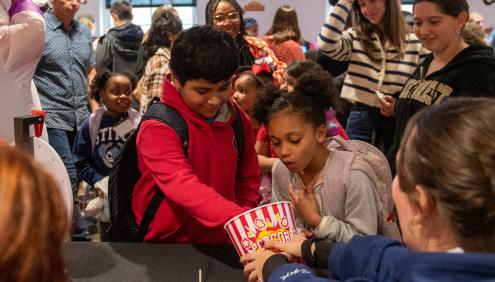
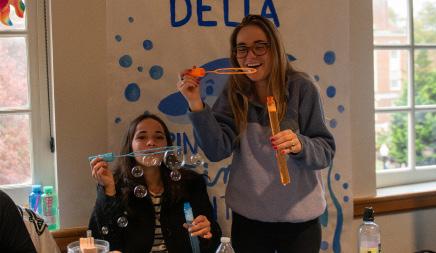
Each year, about 400 children from area schools and after- school programs are welcomed to campus for an afternoon of trick-or-treating, games, entertainment and educational activities. Beyond the festivities, Project Pumpkin raises funds to support the Wake Forest University Children’s Defense Fund Freedom School.
“A lot of the kids in the surrounding area face food insecurity,“ Agency Co-chair Jackie Beauregard explained. “Winston Salem is still in the top 5 most food insecure cities in the nation. Additionally, specifically this year, there’s been an immense amount of turnover in staff due to millions of dollars in debt the local school system got itself into. Many schools we reached out to simply did not have the time, resources or manpower to make it to the event this year.”
Usually taking over Wake Forest’s Quad, the weather had other plans for this year’s event.
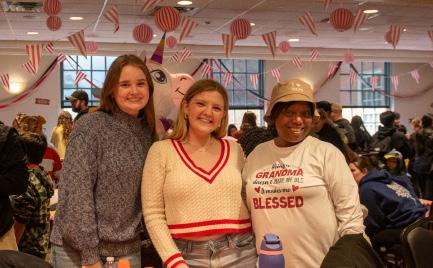
“My favorite part of this year‘s event was honestly seeing how successful the indoor event was despite making the decision to move inside at 7:30 a.m..” Weavil said. “Our decorations were absolutely adorable inside, and Benson 401 worked perfectly with our ‘Under the Boardwalk’ theme. The students were able to enter through the middle of the room on a boardwalk, with the carnival side to the left and the beach side on the right.”
With the unexpected rainstorms that occurred morning of, Benson was quickly transformed into
a magical world for the eager trick-or-treaters.
“The space gave us the opportunity to utilize different decorations and take creative liberties we may not have the chance to outside.” Quinn Walters, PR chair for Project Pumpkin, describes.
While the face of the event is the buzzing activity on the day of, there is significant effort put in behind the scenes.
The Executive team begins planning in late August, recruiting schools and after-school programs to attend, collecting permission slips and organizing check-in materials like name tags and wristbands.
Additionally, transportation must be coordinated with the local school system. The transportation team creates bus schedules and works with Campus Police for safety.
The team works with Wake Forest facilities to arrange tables, chairs and other logistics, even small details like mowing the Quad. Additionally, the outreach and operations chairs recruit student organizations, approve their educational games and design the event layout, adjusting plans as needed if the location changes, like it did this year.
Without the careful planning Beauregard explained goes on prior to the event, Project Pumpkin would not see the amount of success it has been able to.
“In all, even the days I felt overwhelmed and stressed from the communication I had to do with the schools, it’s all worth it to give these kids the best Halloween possible because we never know what’s going on at home, or if they’ll be making it back again next year.”
Contact Ella Aucoin at aucoeg25@wfu.edu

Cate Goldman/Old Gold & Black
Piper Saunders/Old Gold & Black
Old Gold & Black
This column represents the views of the Executive Board of the Old Gold & Black
AI is not compatible with journalism
Barring AI’s so-far inevitable mistakes, from bad grammar to false facts, writers using AI sacrifice a paramount part of their journalistic identity — their humanity. Journalism requires compassion for the people you write about, and uniquely human appeals to transmit one’s experiences to others. When journalists use AI, they cannot appreciate the gravity of the source and the community’s experiences that they write about. Instead, using AI to practice journalism deprives a source or subject of the humanity to which they are entitled.
Even then, there is something cathartic and beautiful about writ -
ing down or typing out another person’s experience for the world to read. When students plug something into an LLM like ChatGPT, their words are calculated too. They disengage with the uniquely human appeals that only a writer with a heart and pen can wholly bring to life.
Beyond this, all journalism should be based on the truth. We, as student journalists, have committed to honor the ethical code of journalism — this means reporting on the facts, not generated by AI. The baseline of every good story is a journalist with a strong moral code and an impeccable work ethic. When students use AI, they not
only violate ethical codes but they deprive themselves of an invaluable learning experience.
Wake Forest’s community members each come from a unique background and have their own story to share. While The Old Gold & Black cannot speak with every individual affiliated with the University, using AI and falsifying sources robs even more people of the opportunity to use their voice. Our community has so much passion; it would be a shame to ignore that and use AI instead.
We understand it is a big ask to ditch ChatGPT entirely, and we understand how it may be tempt -
Old Gold&Black
THE STUDENT NEWSPAPER OF WAKE FOREST UNIVERSITY SINCE 1916
ELLA KLEIN EDITOR-IN-CHIEF kleiek22@wfu.edu
ANDREW BRAUN MANAGING EDITOR brauar23@wfu.edu
>> NEWS
Caroline Khalaf, khalca23@wfu.edu
Jill Yoder, yodejs24@wfu.edu
>> CITY & STATE
James Watson, watsjc22@wfu.edu
Nick Costantino, costnp24@wfu.edu
>> FEATURES
Alexandra Meier, meieam22@wfu.edu
Miriam Fabrycky, fabrml24@wfu.edu
>> ENVIRONMENT
Reese Lile, lilerl24@wfu.edu
>> OPINION
Towne Moores, moortv24@wfu.edu
Sara Catherine Bradshaw, bradsc24@ wfu.edu
>> SPORTS
Scottie Kimmelman, kimmsd22@wfu.edu James Lombardo, lombjp23@wfu.edu
SKYLER VILLAMAR-JONES DEPUTY EDITOR villsc22@wfu.edu
>> ARTS & CULTURE
Lydia Derris, derrlf23@wfu.edu
Grace Schuringa, schugh24@wfu.edu
>> PHOTO
Piper Saunders, saunpg23@wfu.edu
>> VIDEO
Jack Perez, perejw22@wfu.edu
Evan Harris, harres22@wfu.edu
>> SOCIAL MEDIA
Sophie Chan, chansr23@wfu.edu
>> COPY EDITORS
Jenna Jordan, aginjr21@wfu.edu
Elle Yormak, yormeh24@wfu.edu
Presley Tsang, tsanpe24@wfu.edu
>> DESIGN CHIEF
Cate Goldman, goldcr24@wfu.edu
>> ADVERTISING DIRECTOR
Jordan Rill, rillje22@wfu.edu
>> ADVISER
Ivan Weiss, weiij@wfu.edu
ing to rely on its power. But to our Old Gold & Black community, we want to make it clear that AI has no place in student journalism. We hope that reporting allows writers to attend an event they would not have otherwise, speak with students, staff or faculty they have not previously met and write an article that informs others on what is happening in the Wake Forest community. There is real value in journalism, and the Old Gold & Black has the privilege of giving a voice to aspiring writers. Using AI undermines this opportunity and the very principles journalism stands for.
WILL KUNISAKI MULTIMEDIA DIRECTOR kuniwx23@wfu.edu
>> POLICIES
RYDER SOLBERG BUSINESS MANAGER solbrs23@wfu.edu
Our job as a newspaper is to be a platform for all voices, not just the ones we agree with. However, we reserve the right to reject advertisements that are vulgar, inaccurate, obscene or violate Wake Forest’s policies on nondiscrimination, diversity, equity, and inclusion as they pertain to student organizations. We will also reject any advertisements that promote illegal activities according to the state of North Carolina.
Not only do we hold our newspaper and its contents to a high standard, but we also expect that those who choose to use us as an outlet for their ideas, opinions and skill hold themselves and their content to a high ethical standard.
The Old Gold & Black is published Thursdays during the school year, except during examinations, summer and holiday periods, by Triangle Web Printing of Durham. The views expressed in all opinion pieces and advertisements contained within this publication do not necessarily reflect the opinions of the Old Gold & Black. As part of our commitment to reporting news fairly and accurately, we will not remove any previously published content online unless it is retracted. If an error in either our online or print content is brought to our attention, we will revise the originally published article with an appended correction. In order to facilitate thoughtful and appropriate debate, profane, vulgar, or inflammatory comments on our website are not allowed and will be deleted. Comments which incite violence, target individuals in a form of cyber bullying, or which promote ideas which vilify marginalized communities will be deleted, and proper authorities may be notified and involved.
>> SUBMISSIONS
The OGB welcomes submissions in the form of story tips, columns and letters to the editor. Letters to the editor should be fewer than 500 words, and columns should be around 500 words. Send yours via e-mail to stopmf21@wfu.edu the Monday before publication. We reserve the right to edit all letters for length and clarity. No anonymous letters will be printed.
>> ONLINE MEDIA
Website: wfuogb.com
Facebook: facebook.com/ogb1916
X (Twitter): @wfuogb
Instagram: @wfuogb
TikTok: @wfuogb
Sports X (Twitter): @wfuogbsports
Alumni and students join together for Homecoming 2025
Wake Forest’s annual Homecoming weekend brought alumni, students and staff together for three days of celebration
ARIC LOIACONO Contributing Writer
Wake Forest University’s campus came alive on October 25-27 for Homecoming 2025, in which students, families, and alumni gathered for events ranging from Friday’s “Party So Dear” on Manchester Plaza to Saturday’s football game at Allegacy Stadium.
For Ashleigh Hampson, a 2024 graduate who now works on campus, the weekend brought a sense of return.
“Campus felt much more like home
being surrounded by my friends and classmates that have now moved away,” Hampson said. “I’m so thankful that I still get to be on the Reynolda campus for my job, but there’s something different about the student experience that’s hard to mimic in a staff role.”
The weekend began Friday afternoon with “Party So Dear” on Manchester Plaza. During this spirited tradition, music, food, and a crowd of alumni and students filled the lower quad. Later in the evening, the Reunion Party Village hosted the reunion classes on Poteat
Field. Each class had its own tent where large buffets of food and a DJ kept the night going.
While Homecoming is open to all alumni, this year’s reunion was special because it specifically honored graduates celebrating milestone years ending in five or zero, including the Classes of 1960-2020.
Saturday featured the Alumni Tailgate Festival on the Hearn Plaza, along with the much- awaited football game against Southern Methodist University, families, students and alumni en-
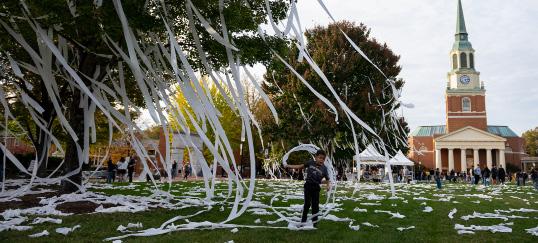
veloped the Quad for food and games before heading to Allegacy Stadium. The Deacs secured a dramatic walkoff field goal, ultimately winning the game 13-12.
Current sophomore Andy Behrman described the game to be extra exciting with alumni and families returning for the weekend.
“I’d be lying if I said it wasn’t the formation of the shirtless section,” Behrman said. “It was nice to see so many people staying until the end despite the low- scoring game. The vibes were electric and it definitely felt like a social phenomenon.”
Behrman continued on how the reunion energy elevated the student experience as a whole.
“It’s really nice to be with old friends and have a campus that’s much more busy and vibrant,” Andy said.
Hampson added that Homecoming captures what makes Wake distinctive.
“The relationships you make by living on campus are so much deeper,” Hampson said. “Wake is such a relational place, which makes reconnecting after years something that’s a priority.”
As the lights dimmed and the alumni packed up their tents, Wake Forest’s sense of community remained on full display, proving once more that Homecoming isn’t just about a weekend of events, but more importantly, it represents coming home.
Contact Aric Loiacono at loiaat25@wfu.edu
Wake Forest chapter of Turning Point USA starts conversations on campus
SYDNEY
GLENN &
CAROLINE KHALAF Staff Writer& News Editor
Wake Forest students recently started a chapter of Turning Point USA (TPUSA) on campus to honor its founder, Charlie Kirk, who was shot on Sept. 10, 2025 during a campus speech at Utah Valley University. On Monday, Nov. 3, TPUSA at Wake Forest put on a tabling event in Benson University Center to engage with the student body.
“Our chapter’s goal is to increase membership and campus awareness of TPUSA here at Wake Forest, giving students a space to engage with like-minded peers or to hear an opinion differing from their own,” said the President of Wake Forest’s chapter, Paige Shephard.
Kirk, the 31-year-old activist, founded TPUSA in 2012 to spread conservative ideals on high school, college and university campuses. Kirk planned to visit multiple U.S. college campuses to speak on behalf of TPUSA before his assassination.
The tabling event
On the table were signs stating mes-
The chapter tabled in Benson to engage with the student body
sages like “strong family, strong country” and “before the womb you were already known, called and appointed by God,” Additionally, the chapter was handing out pamphlets of the Constitution of the United States, as well as stickers and buttons that said “don’t just pass exams, vote to pass policies” and “socialism sucks.”
Junior Esrom Ghirmay originally approached the table to see what their plans were on campus. After some personal reflection, he felt the need to come back later and ask the chapter about more serious topics.
“I came back and asked if they thought that the values they promoted could make certain students feel unsafe, specifically the LGBTQ+ community, because they had a sign on their table that suggested the recognition of only two different genders, which is disrespecting the lives of members of our Wake community,” Ghirmay said.
Chartering on campus
Tabling was just the first step for the chapter to create space for student discussion. The chapter began in the spring
of 2025, but the organization is now in the process of obtaining an official charter. This means the chapter would be officially recognized by the national Turning Point USA organization and signifies that they have met the national organization’s requirements for formation and operation, including having a minimum number of members.
“Although we had already begun our chartering process on campus before his death, we noticed an eruption of passion after Sept. 10, with 160 current members,” Shepard said. “If awarded a charter, we are excited to bring speakers to campus for larger events, working with the school to organize and execute events larger than just tabling.”
According to @tpusawfu on Instagram, the chapter said they are “thrilled with how our tabling event went. There were great and respectful discussions.”
Ghirmay recounted the manner of conversation at the table.
“The conversation was relatively calmmannered; it was just frustrating that the members of the group would frequently interject themselves while I would be mid-sentence and also disregard essen-
tially anything I said that was not aligned with their views,” Ghirmay said.
Sophomore chapter member Maddox Watson said he is proud of what TPUSA was doing at its tabling event.
“Students should feel comfortable voicing their opinions regardless of different perspectives they have,” Watson said. “I think TPUSA allows that to happen openly and respectfully, creating an environment where people can disagree productively.”
The TPUSA chapter at Wake Forest is rooted in Kirk’s values, but not every student on campus stands for the same ideals.
“They negatively affect all minority students and other marginalized groups,” Ghirmay said. “It is extremely disappointing that Wake allows a group that believes that an entire group of people should not and does not find a home on this campus. This is scaring me for what the university will look like for students in the years to come.”
Contact Sydney Glenn & Caroline Khalaf at glennsd24@wfu.edu, khalca23@wfu.
Following the football victory against SMU on Oct. 25, students, alumni and their families embarked on one of Wake Forest University’s time honored traditions of rolling the quad.
Evan Harris/Old Gold & Black
Hopkins Hall Dedication Ceremony Honors Beth and Larry Hopkins
Alumni, students and faculty shared stories and words of appreciation for the couple’s impact
JILL YODER News Editor
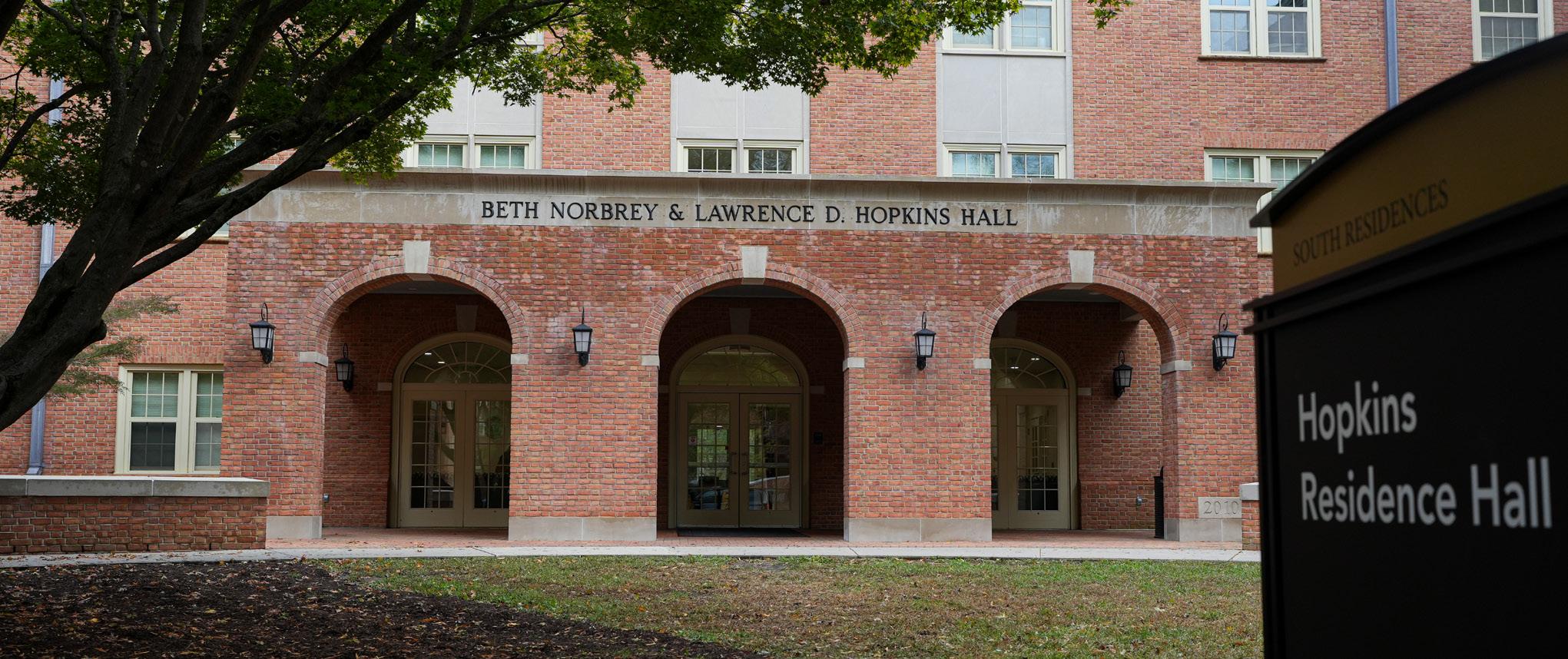
Wake Forest University honored the legacies of Beth N. Hopkins and Larry D. Hopkins at a formal dedication ceremony of Hopkins Hall on Saturday, Oct. 25. The honorific renaming of the former South Residence Hall was announced in February 2025.
Homecoming weekend brought alumni of all generations to campus, many of whom gathered in front of Hopkins Hall for the ceremony, alongside current students and staff. President Susan R. Wente opened the ceremony, and was followed by many guests who spoke of the impact of Beth and Larry Hopkins.
“There are so many reasons to celebrate this building being named for Beth and Larry Hopkins,” J. Reid Morgan, former senior vice president and general counsel member for Wake Forest, said in his speech. “It is certainly a way of expressing the gratitude and admiration in our hearts today. And, it is a way of honoring model lives and their golden, magical story at Wake Forest.”
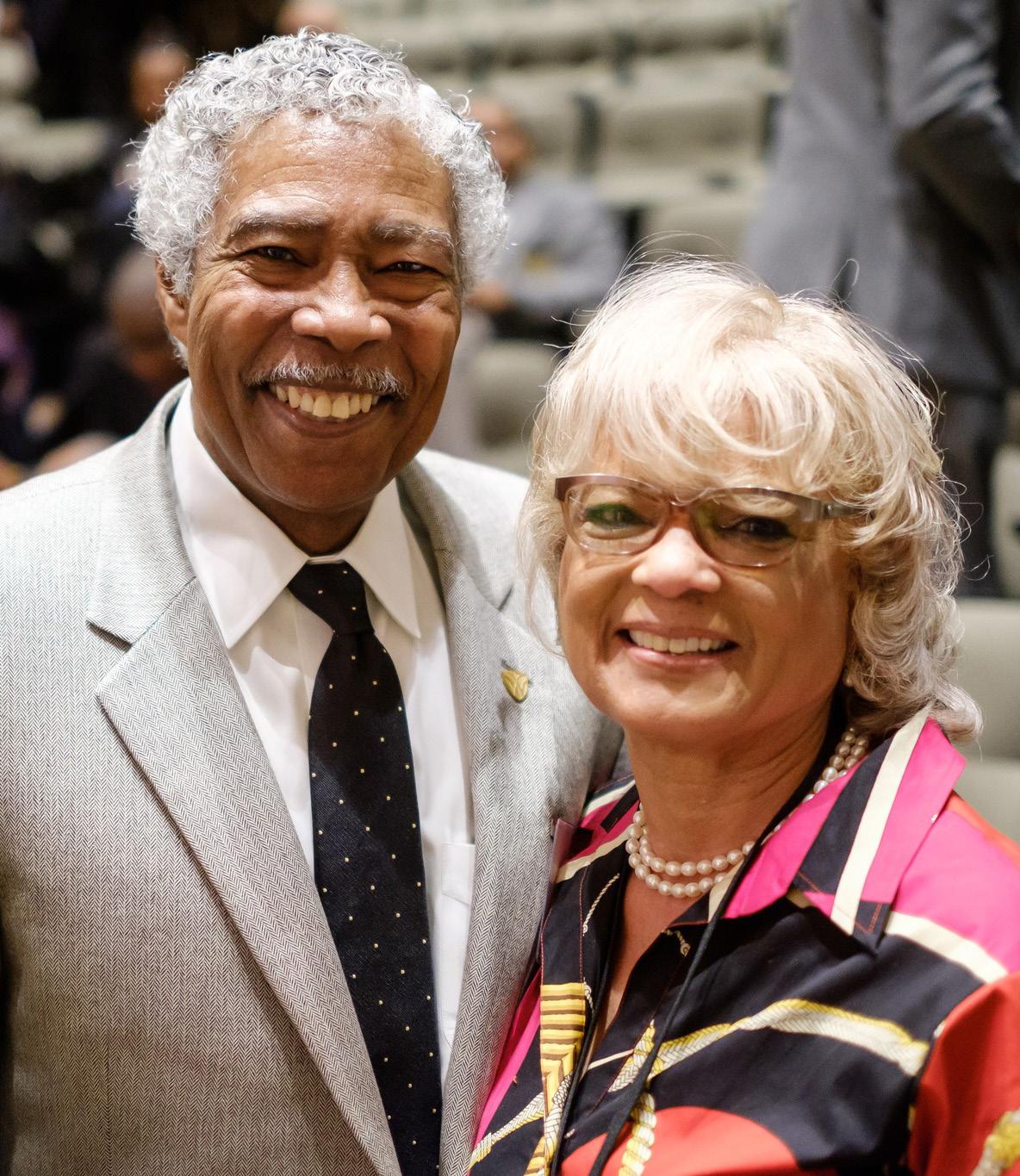
Beth Hopkins’ impact on the University began when she first set foot on Wake Forest’s campus in 1969 as one of the first two African American female students to live in a residence hall. As an undergraduate student, she worked purposefully towards her goal of becoming a lawyer and to push through the prejudice that her and fellow Black students faced.
“We had decided that nobody was going to outwork us,” Hopkins said in an interview with the Old Gold & Black. “So, we were really very de -
termined, very academically oriented, very goaloriented and we were unified.”
Upon graduation, Beth Hopkins attended law school at the College of William & Mary. Following several years working for prominent law firms in Virginia and Louisiana, Hopkins returned to Winston-Salem with her husband and began working in Wake Forest’s history department and law school, while her husband went into medicine.
The most rewarding part of her work here, Hopkins said, was “being in the classroom, watching minds evolve, listening to really good discussions about how one culture perceived the other culture, and how we could come to an understanding as to what was important to each culture.”
Charlie Crisp, a 2021 graduate of Wake Forest, attended the dedication ceremony in support of her former teacher, Hopkins.
“To me, it seemed like a big world, so there was a lot that I didn’t know about race and she exposed me to a lot. She opened my eyes to so much and challenged how I saw the world,” Crisp said. “I just appreciate her so much for that and the difference she made for me in broadening my horizons. So, I owe her a lot.”
Larry Hopkins entered Wake Forest in the fall of 1970 on a football scholarship and was the Demon Deacon’s starting running back for two years. He graduated in 1972 as the first African American at Wake Forest to earn a degree in chemistry.
After graduating from Wake Forest School of Medicine in 1977, Larry Hopkins completed his residency at Virginia Commonwealth University. He served in the United States Air Force for several years before returning to Winston-Salem to practice obstetrics and gynecology at Forsyth Hospital and Baptist Hospital.
Larry Hopkins passed away in November 2020. Hopkins considers her husband’s greatest legacy to be his instrumental role in convincing Forsyth Hospital to build a center in the Boston Thurman section of Winston-Salem, an area that, at the
POLICE BEAT
time, had the highest infant mortality rate in the United States.
“They will remember Dr. Hopkins as one who was committed to serve all of his patients, irrespective of their economic resources,” Hopkins said. “In fact, his motto was to treat every patient as he would have treated his mother or me.”
The Hopkins mentored hundreds of students in their time as Wake Forest trustees. The lasting impact they had on the community was undeniable during the dedication ceremony. Friends, students, colleagues and family spoke towards the guidance, love and encouragement that the Hopkins gave to everyone they met.
To many attendees of the event, the naming of Hopkins Hall is symbolic of the history and strength of Black culture on the Wake Forest campus.
“This is a celebration that we’ve been waiting for at Wake Forest,” class of 2012 alumna Carmen Lee Hazel Green said. “It [marks] the longterm development and cultivation of multicultural studies, of Black history on this campus and maintaining that through a stamp like this of having a residence hall.”
The last speaker of the ceremony, Hopkins, shared her thanks on behalf of herself and her husband. Her words mirrored the love and selflessness at the heart of the Hopkins’ legacies, and she called current and future generations towards hope and justice.
“Together, our community will traverse the current storms,” she said. “Many of us have been working and praying for humanity a long time. I ask that you sing for justice, that you run for fair play, that you shout for the greater good. And as a Wake Forest and Winston Salem community, let the world know that we are not afraid to march for the truth.”
Contact Jill Yoder at yodejs24@wfu.edu
• Unknown subject was drinking underage at an off campus party when they fell and hit their head. They were transported off campus. The report was filed at 1:36 a.m. on Oct. 30.
• Unknown subject was found unconscious in the second floor bathroom of Collins Residence Hall after consuming alcohol in their room. The report was filed at 3:40 a.m. on Oct. 30.
• Unknown subject removed a victim’s wallet from a locker in Reynolds Gym. It was found in a Kirby Hall bathroom. The report was filed at 5:12 p.m. on Oct. 30.
• Unknown subject consumed alcohol underage at an off- campus Chi Psi party. They were transported to the hospital. The report was filed at 12:19 a.m. on Nov. 1.
• Unknown subject consumed alcohol underage and refused transport. The report was filed at 3:03 a.m. on Nov. 1.
• Unknown subject stated that others consumed marijuana in their apartment at Deacon Place. The report was filed at 7:10 on Nov. 1.
The newly named Hopkins Residence Hall is located on Wake Forest’s South Campus among the other freshman residence halls.
Will Kunisaki / Old Gold & Black
Beth and Larry Hopkins were honored during Homecoming Weekend 2025.
Courtesy of Wake Forest University
CITY & STATE
Nick Costantino, costnp24@wfu.edu
James Watson, watsjc22@wfu.edu
OLD GOLD & BLACK
THURSDAY, NOVEMBER 6, 2025
SNAP benefits partially restored after lawsuit joined by NC
SNAP emergency fund will only cover 50% of eligible households’ needs
NICK COSTANTINO City & State Editor
In a win for more than two dozen st ates — including North Carolina — that sued the Trump administration to pay for SNAP benefits, a federal judge ordered that the Trump administration must tap into an emergency fund to pay out benefits. However, the fund of $5 billion will not cover the full $8 billion monthly cost of SNAP, meaning eligible recipients will only receive 50% of their normal payment.
SNAP, or the Supplemental Nutrition Assistance Program, is a federal program that pays out approximately $100 billion in food aid to 42 million Americans annually. Approximately 12.5 percent of North Carolina residents and 14.1% of Forsyth County residents receive SNAP benefits.
On October 28, dozens of states sued the administration to release an emergency fund for SNAP benefits that is held when the government cannot normally pay for the program. The states argued that this lapse in funding is an emergency because the government cannot pay for the program anymore. The Trump administration argued that this fund can only be used if an unforeseen emergency, like a natu-
ral disaster, occurs. A district judge agreed, ruling in their favor.
Because this emergency fund totals $5 billion, only 50% of the normal benefits will be covered, meaning food banks and local governments will have to step in to cover the shortfall. Food banks across North Carolina are already bracing for the increased demand, and Gov. Stein has pledged $18 million to food banks with help from other partners.
“With the help of generous partners, North Carolina is taking action to keep families fed,” Gov. Sten said. “Shoring up our state’s food banks will serve as a critical, but fleeting, lifeline for families in need, and I hope other North Carolina organizations will also step up in this time of need. Whether it’s paying our military, ensuring no child goes hungry, or lowering health care costs, leaders in Washington need to come together immediately to find a bipartisan solution that provides long-term stability for millions of Americans.”
N.C. Attorney General Jeff Jackson emphasized the importance of helping out local communities as SNAP recipients receive less funding than usual.
“The Agriculture Department just told the court it will use its entire emergency fund over the next month
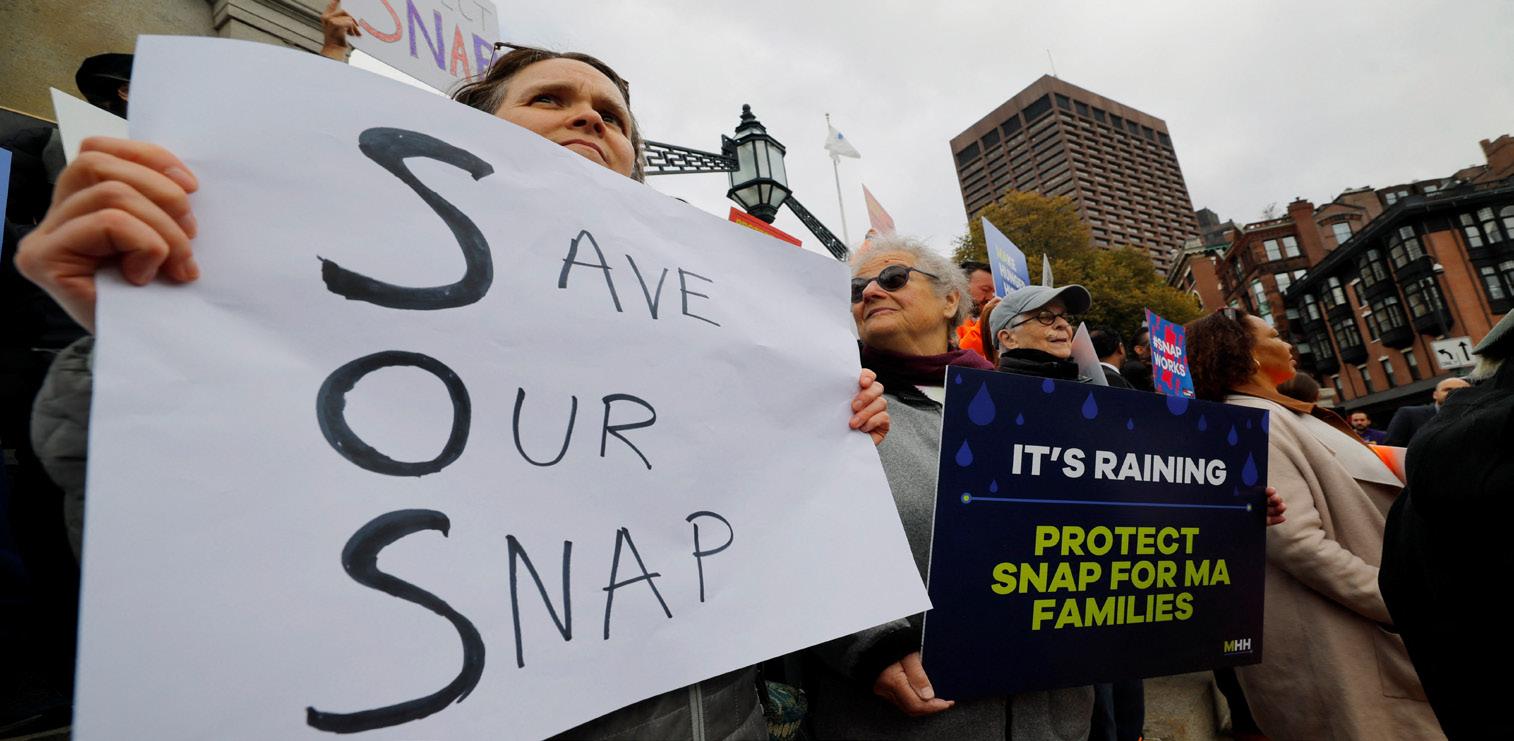
12 percent of North Carolina residents and 14 percent of Forsyth County residents receive SNAP benefits every year.
to make 50% payments to every SNAP recipient,” Jackson said. “That will zero out the emergency fund. My office is still reviewing the order to see what else we can do to help, but until this shutdown ends, we all need to provide extra support to our local food pantries.”
Organizations across Forsyth County are coming together to bridge this gap as this funding lapses. Winston-Salem/Forsyth County Schools said no child will go without a meal
while at school. Second Harvest Food Bank has added $500,00 worth of food to its facilities as demand rises.
“Food is a basic human need. No one in Forsyth County should go hungry. The idea that thousands of children, babies, and families in our community could face a food deficit is simply unacceptable,” Forsyth County Manager Shontell Robinson said.
Contact Nick Costantino at costnp24@wfu.edu
NC lawmakers hamstring access to civil legal aid
NC’s Interest in the Lawyers' Trust Account (IOLTA) was frozen by the state earlier this summer
JAMES WATSON City & State Editor
A state program funding free legal se rvices was frozen in June. The legislature isn’t rushing to fix it.
The Interest on the Lawyers' Trust Account, or IOLTA, is a high-interest bank account that lawyers across the state contribute client funds to. The interest generated from these accounts is distributed as grants to civil legal aid groups across the state.
To date, NC IOLTA has awarded $134 million to its grantees to help provide North Carolinans access to free legal services.
Earlier this summer, the North Carolina General Assembly voted to halt awarding new grants from the state bar’s IOLTA fund for the 2026 grant cycle. The freeze was buried in a provision of a bipartisan public safety bill. Republican lawmakers cited that the funds, which are used to help North Carolinians access free legal services, were being awarded to leftist causes.
“We’ve heard from a number of
folks that IOLTA does good work, and we have seen evidence of that, but IOLTA has also gone somewhat rogue, awarding grants to leftist groups with leftist ideologies,” Rep Harry Warren (R-Rowan) said at the House Select Committee on Oversight and Reform hearing on October 22.
Looking at the last grant cycle's recipients reveals that IOLTA does not fund any partisan political organizations. In fact, one of the biggest grantees last year was Pisgah Legal Services, a group that has been working with victims of Hurricane Helene in Western North Carolina — just a few counties over from Rep. Rowan's district.
Now, legal service providers across the state are feeling the squeeze. The state’s largest nonprofit law firm, Legal Aid NC (LANC), is losing over $6 million in funding as a result of the freeze.
This past week, they announced that they were ending their lease on their Pembroke office.
“The Pembroke office is the second LANC location facing the potential for closure due to the IOLTA freeze, which
threatens access to legal assistance for vulnerable communities across North Carolina,” the group said in a statement. “The impact would be deeply felt by Pembroke residents — particularly veterans, seniors, survivors of domestic violence, and disaster victims — who rely on LANC’s services for safety and stability.”
Only a month ago, they announced that they were closing their Rocky Mount office as well.
“When we say the Pledge of Allegiance, we promise liberty and justice for all,” LANC’s CEO, Ashley Campbell, said. “Our flag reminds us of that promise every day. This is what IOLTA funds are for — making those words real for every North Carolinian. We are deeply disappointed that we cannot use those funds to serve the people in Nash County who deserve fairness and protection under the law.”
In the Triad, the Children’s Law Center of Central North Carolina said they are trying to close the financial gap to make up for the loss of IOLTA.
“We are looking into how we continue serving children, but it is certainly a challenge,” Executive Director Iris Sunshine said. “The freeze does pose a challenge for us, and we are having to look for alternative sources of funding.”
According to NC IOLTA’s website, the center received $85,000 in grant awards last year.
“These are challenging times in the nonprofit sector for organizations like the Children's Law Center, as well as other nonprofits in the Triad and across the state, due to reductions in public funding,” Sunshine said.
Lawmakers say they are using the freeze — which lasts until July — to investigate IOLTA’s grantees. Until then, a central pillar of funding for the state’s legal aid community hangs in limbo, leaving North Carolinians across the state without access to free legal services.
Contact James Watson at watsjc22@wfu.edu
Courtesy of Reuters
Winston-Salem’s transit makeover is on the move
WSTA is revamping routes and adding new features for riders
ANDREW BRAUN Managing Editor
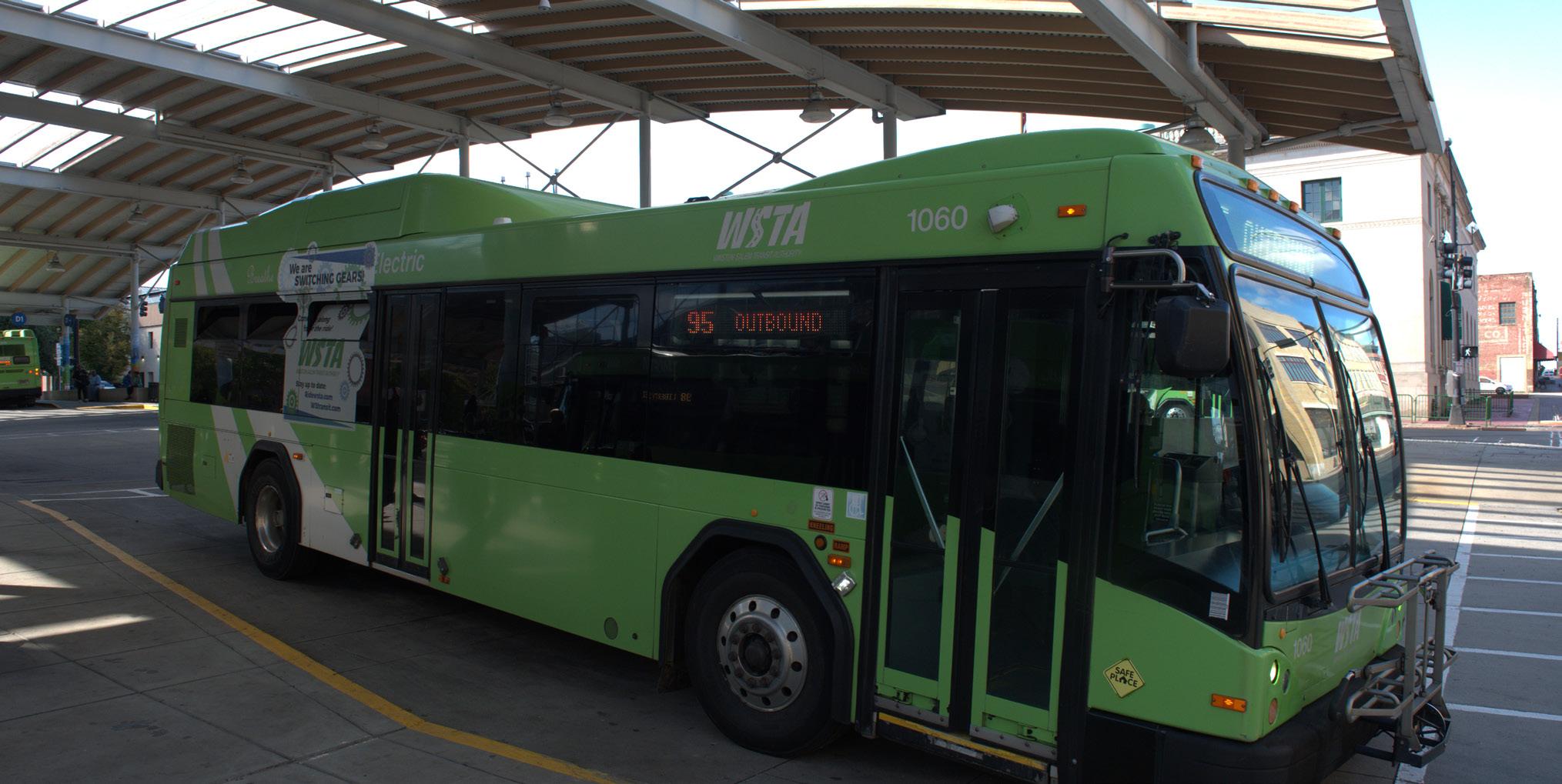
Across Winston-Salem, green city buses are tacked with posters letting riders and passersby know that the city’s transit system is “Switching Gears.”
The Winston-Salem Transit Authority (WSTA) is aiming to improve its service with better routes and brand-new features, expanding access for riders. After the City of Winston-Salem contracted a new firm, RATP Dev USA, to manage operations and maintenance for its transit agency, WSTA is launching services that catch up with other transit networks in Greensboro and the Triangle.
“I think providing reliable and desirable transit to the community would be amazing,” said WSTA Transportation Project Planner Maddie Burgiss. “We already have a really strong ridership base, but how can we just improve our service?”
Route revamps
WSTA’s biggest proposed renovations are route changes in its Vision Plan. Behind the plan, Burgiss said, there is a push to broaden the number of jobs passengers can reach in an hour when they ride WSTA’s city buses. Besides expanding WSTA’s coverage and reaching more passengers, the plan’s most ambitious goal is to slash wait times for riders.
The agency has already seen success with some new route designs. With increased frequency already attracting better ridership on higher volume routes, the WSTA Vision aims to decrease headways to 30 minutes on most routes and even 15 minutes on others.
WSTA is also exploring routes that connect passengers more directly to busier destinations. After Winston-Salem Mayor Allen Joines called on the city to review WSTA’s traditional “hub-and-spoke” system, the agency is looking for ways to bypass a connection downtown at the Clark Campbell Transportation Center on the way to their work. While Joines alluded to smaller hubs replacing downtown’s central station, Burgiss emphasized the importance of new route types such as crosstown routes that avoid stopping altogether.
WSTA said riders already have access to more options. So far, route changes have increased the number of jobs riders can access by three times on some routes and up to ten times on others.
“Our job access center points have changed,” Burgiss said. “We still have a huge job pool here in downtown, but how can we get people to Hanes Mall, Atrium Health and Novant Health quicker?"
Burgiss also said microtransit — on-demand rideshare services using smaller vehicles — could be useful for WSTA in the future. With these systems already expanding across North Carolina, Burgiss said more flexible ride services could complement WSTA’s existing, heavier fixed-route services in the city limits.
“The main idea of microtransit I see in Winston would definitely be getting people to another bus line,” Burgiss said. “So, ‘how can we make that zone line up with a fixed route line,’ and then that way people have endless options throughout the city.”
Easier access
Getting people on board involves making buses convenient to hop on and off. For WSTA’s existing riders, Burgiss said that starts with affordable fares. The agency already offers fixed-route
rides at just a dollar, and announced last month it would cap daily charges at $2 starting next year. That means Winston-Salem joins other cities like Raleigh and Greensboro, limiting how much passengers have to spend each day before enjoying unlimited rides for free.
we’re constantly working to make sure that the places they need to go are on our routes.”
Both Peterson and Burgiss say WSTA is particularly interested in getting young people on board. They each note that cheap and reliable transit is plenty attractive for young adults at Winston-Salem’s universities, K-12 public schools or anyone waiting to get their driver’s license.
The WSTA Vision aims to decrease headways to 30 minutes on most routes and even 15 minutes on others.
“I think for us, the standard dollar fare is amazing; that’s a huge base of our ridership,” Burgiss said. Whenever I’m riding the bus, [passengers] will be like, ‘We just love the city for keeping it a dollar compared to other transit agencies.’”
The system is also integrating technology to increase accessibility and will partner with the mobile app Umo in the near future. According to WSTA’s website, the app offers cashless payment options and easier transfers to regional partner services like the Piedmont Authority for Regional Transportation (PART).
WSTA is also addressing safety concerns about its services. With new security measures, like an improved incident reporting system and a 90-minute limit on visits to the downtown transit center, loitering and crime rates are already down.
Getting people on board
Of course, another task of WSTA’s is ensuring Winston-Salem is aware of its improvements. WSTA’s Director of Community Engagement and Marketing, Brandie Peterson, said one of the agency’s biggest challenges is reaching all the right potential riders with the perks of public transit.
“We’re trying to help the community to see that they can ride the bus safely,” Peterson said, “that it can get them where they need to go, and that
Besides increasing ridership and even decreasing the number of people in cars, Peterson said that young people are especially important for advancing public transit projects. She notes that growing ridership and demonstrating demand among Winston-Salem’s youth is important for WSTA’s larger goals, like bus rapid transit (BRT), that require significant community buyin. Generating that interest, Peterson adds, starts with Winston-Salem’s younger riders.
“The more people in that demographic that we can get to utilize the current system will help us to increase what we’re doing in the future,“ Peterson said. “Advocacy is something that is needed for the public for transit in general. Young people are advocates when it comes to that.”
Contact Andrew Braun at brauar23@wfu.edu

One of WSTA’s hybrid electric buses waits at the Clark Campbell Transportation Center in downtown Winston-Salem, displaying in its back right window, “We are SWITCHING GEARS!”
Andrew Braun/Old Gold & Black
WSTA vehicles pull into and away from the Clark Campbell Center.
Andrew Braun/Old Gold & Black
FEATURES
Alexandra Meier, meieam22@wfu.edu
Miriam Fabrycky, fabrml24@wfu.edu
Unemployment is on the rise: Should you be worried?
AI and the unpredictable job market present an uncertain future
NICK CONSTANTINO Staff Writer
Senior Celeste Lynch thought she could get a job in Washington, D.C. after graduation. When nearly her entire professional network lost their jobs, she began to doubt her plans.
“Almost my entire network in D.C. this summer became unemployed,” said Lynch, who is majoring in Politics and International Affairs. “That was definitely a little jarring, and [it] sort of pushed me to pivot a little bit in a different direction. Now I’m considering roles in the private sector, with the defense industry.”
Uncertain futures
Similar stories are common among this year’s seniors as the economy slows and companies replace entry-level positions with AI.
Wake Forest graduates will soon enter a job market rife with uncertainty. The unemployment rate for individuals entering the workforce for the first time, including recent college graduates, is at its highest level since 2016.
Senior Brady Puckett, who is majoring in finance, expressed disappointment at seeing his classmates encounter difficulties while searching for employment.
“It is surprising to see, especially at a school like Wake Forest University, where so many kids who are so talented and apply themselves in many different ways are struggling,” Puckett said.
Student strategies and some hopeful news
As companies scale back hiring, many students are choosing to delay their job search by pursuing graduate or professional school instead of entering the job market.
According to an Aurora University study, 42% of college students and recent graduates say that economic concerns are pushing them to think about graduate school.
“If we can help students prepare to use that kind of tool effectively once they’ve started in their first job, then they are going to look that much better to their employer.
Senior Caleb Pembele acknowledged “a lot of uncertainty” surrounding his peers’ job searches but pointed out that college-educated individuals like Wake Forest students typically fare better than other groups.
“It’s understandable that college grads are disappointed about the current situation,” Pembele said. “But in the long term, they will be fine…there are other people in the economy that we should be more concerned about.”
Starting their first week back at Wake Forest, students gather at the fire pits to make new friends and catch up with old ones.
Wake Forest Economics Professor Robert Whaples echoed these hopeful sentiments by explaining that this year’s graduates will enter a workforce with more opportunities than many previous classes.
“The good news is that despite the trends… even right now the unemployment rate for recent college graduates is only 5%,” Whaples said in a statement. “So it’s not like we’re getting to the really elevated levels we did during the gray bars when there’s a recession.”
Historic unemployment levels, though, cannot predict how the rise of AI will change the workforce. The rapid dissemination of new technologies like ChatGPT raises the question of whether companies will still offer traditional entry-level jobs for future graduates.
Economics professor Andre Mouton said in a statement that these concerns will only intensify in the coming years.
“In terms of large-scale business adoption, [AI is] still relatively early-stage,” Mouton said. “With that being said, young college graduates are really gonna be the first to feel a brunt…it’s not a given that if you put it off [for] two years by going to grad school, that it’s going to be better.”
Resources and reassurance
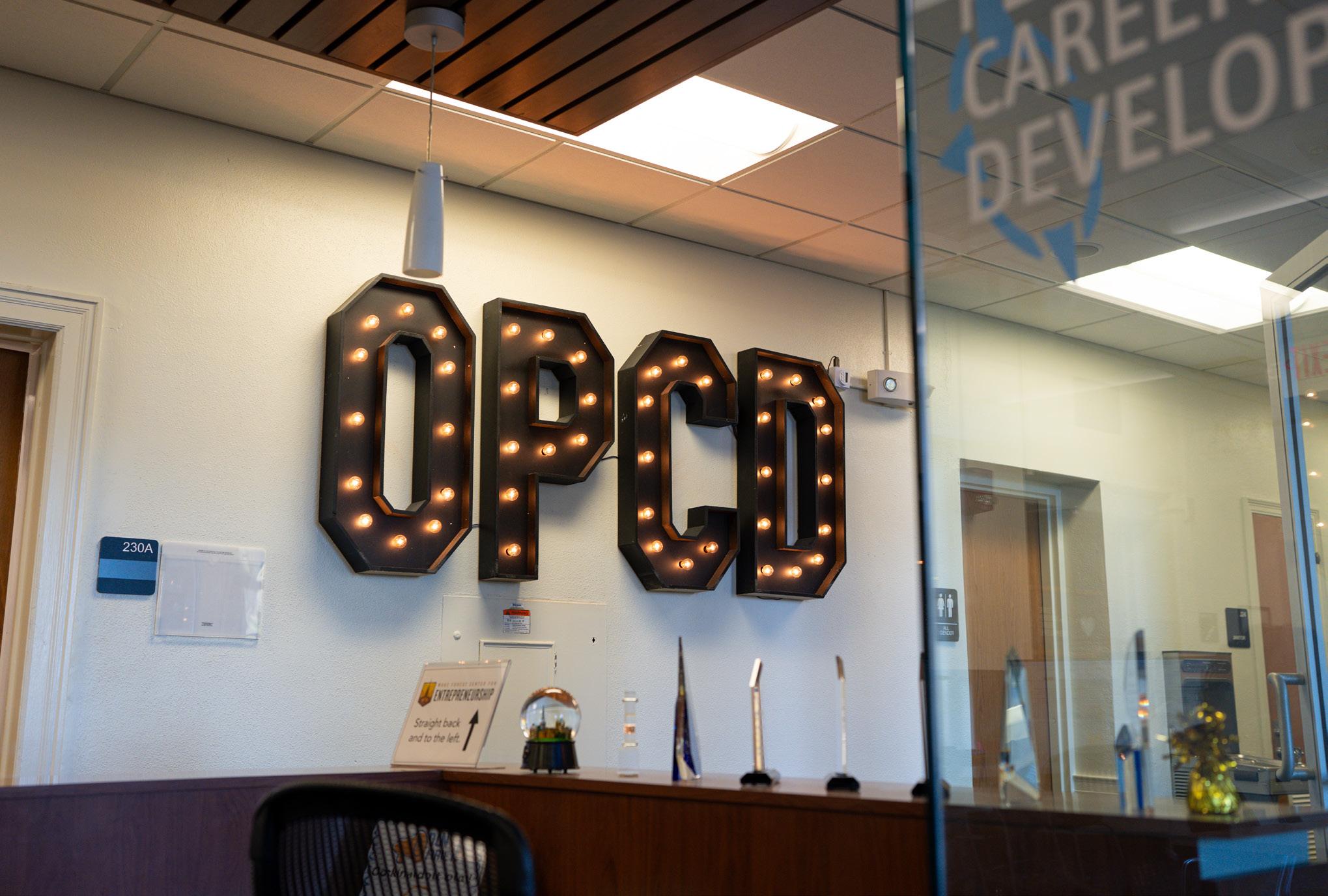
The Office of Personal and Career Development (OPCD) can be an excellent resource for Wake Forest students navigating employment uncertainty.
Patrick Sullivan, senior director of operations and special projects at the OPCD, recommends students familiarize themselves with AI technologies.
“More and more employers are using AI or their employees are using AI,” Sullivan said. “If we can help students prepare to use that kind of tool effectively once they’ve started in their first job, then they are going to look that much better to their employer.”
“It’s understandable that college grads are disappointed about the current situation, but in the long term, they will be fine... there are other people inthe economy that we should be more concerned about.
Senior Marley Schwarz, a Politics major, said that despite her worries for the future, she feels that her Wake Forest education will equip her for the future.
“There’s definitely a sense of nervousness,” Schwarz said. “Especially for people who aren’t in pretty cut-and-dry fields, like banking or engineering… but I also think here at Wake Forest, we’re coming from a really good institution. It’s not like we’re totally without resources.”
Contact Nick Constantino at costnp24@wfu.edu
Will Kunisaki/Old Gold & Black
Q&A with John Currie
Wake Forest Athletics Director reflects on Screamin' Demons and student fan experience
BENJAMIN PAPPAS
Video Contributer
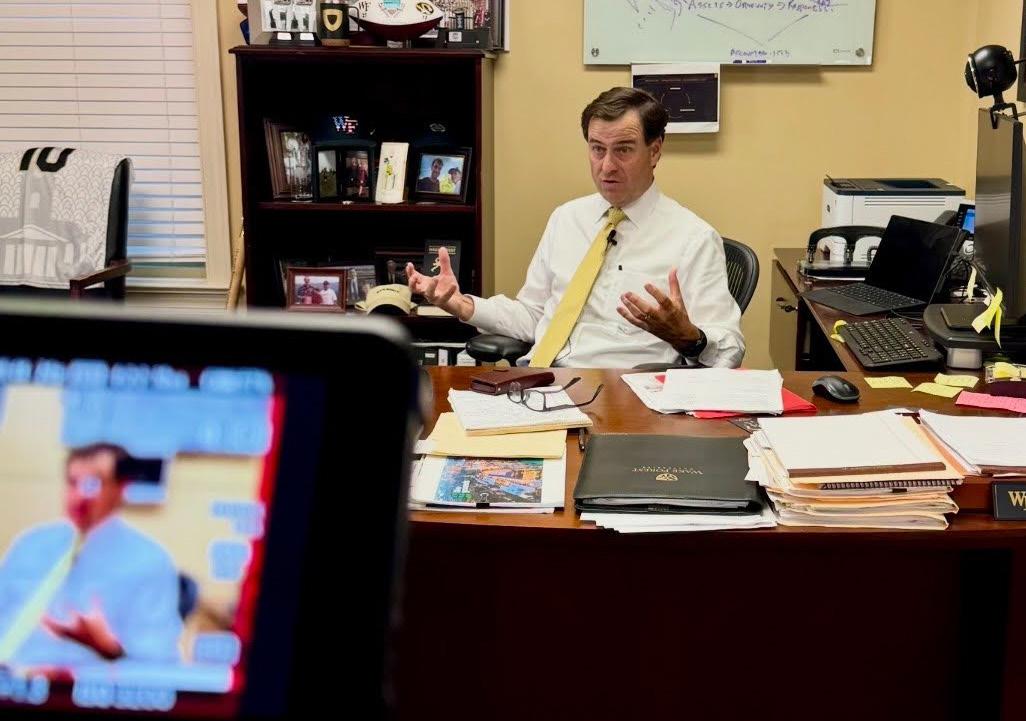
John Currie is Vice President and Director of Athletics at Wake Forest. In his fifteenth year as a Power Four Athletics Director, he sat down with Benjamin Pappas, Old Gold & Black video contributor, to reflect on his work. The full interview, available on the Old Gold & Black’s YouTube channel, has been edited for brevity and clarity.
Benjamin Pappas: Can you describe your role as Athletics Director?
John Currie: I work to deliver on the five core goals of athletics at Wake Forest: creating a world-class student-athlete experience; integrity in academics, compliance, finance, inclusion and safety; value to the university and WinstonSalem and Triad communities; winning championships and creating the best fan experience in North Carolina.
Pappas: How do you see collaboration between athletics and students showing up in your role as Athletics Director?
Currie: One of the things we do in athletics is bring people together. I was a student at Wake Forest in the early 90s, and even got my first job as an intern at the Deacon Club. Some of the great lifetime memories that Wake Forest alumni talk about are celebrating an athletic win on the quad or being in a party together after a big win. The unifying aspect of those moments is unique, because it's not individual groups celebrating: it's a collaboration of all groups. I was talking to a former football player who said his best memory of Wake Forest was not one of his big football
wins; it was celebrating with students on the quad. To him, that was iconically Wake Forest.
Pappas: What recent changes have you seen in the fan experience at Wake Forest?
Currie: There have been a lot of changes to athletics in the past six years. COVID-19 acted as a reset for us because, coming out of the pandemic, we had two classes that had never seen the Wake Forest fan experience. We also had a really good football team with high anticipation. That became the year that we collaborated with Campus Life to transform the student tailgate zone, which previously was discombobulated and underwhelming. We also created the firstyear field run, which is a tradition that now every current class has taken part in.
Pappas: What impact does Wake Forest's fan base have on the athletic department?
Currie: There's really a symbiotic relationship between fans and athletes at Wake Forest. When you have full stadiums and excited fan bases, that's motivating for student athletes. When we talk about having 80% of our students at a game, that's better than any other school in America except maybe the service academies. We also work hard to ensure our student-athletes are engaging with fellow students and other athletic teams at Wake. I remember early in the year, Josh Harrison, a junior on our football team who is injured this year, was out there at a soccer game leading cheers in front of the team. That doesn't happen everywhere in the country. That's what defines the Wake Forest brand.
Pappas: How do you encourage such a high
student turnout to games?
Currie: A lot of people come to Wake Forest familiar with the Big Four and the ACC, but others come from places where college athletics aren't a big deal. So we have to educate students. Why is it a big deal that we're a part of the Big Four? Why is it a big deal that Wake Forest and NC State have the second-oldest continuous football rivalry in the country? Why is it important that we've won 11 national championships? There's a lot of education that goes into it. And then there's Screamin' Demon Rewards. The app gives you the ability to track attendance and provide incentives for staying at games. Ultimately, it has to be fun and easy, because Wake Forest students are busy. We have to be efficient and communicate well so that students are excited to contribute to the energy of the fan base.
Pappas: What are your goals for the student fan experience in the future?
Currie: We have several new staff members in our fan experience office, like Gray Bray, who is our announcer at the games — he's really passionate. I would say there are opportunities to build an even more robust and broad group of student leaders, with opportunities for students from all different class years to get involved in different organizations. And I also think that building moments of tradition into the games is important. At football games, for instance, they introduced a new tradition where they play a specific song at the end of the first quarter. So we're getting people into a pattern of knowing that song so that at future games, everybody sings it.
Pappas: Is it difficult to start new athletic traditions?
Currie: Yeah, sometimes it takes a little while to figure things out. One of the great traditions that not everybody knows right now is that at the end of our football games, the team goes over to the marching band and they all link arms to sing the alma mater. And the students that are left there sing it with them. There was a bigger crowd at the Georgia Tech game because it was really down to the wire, and so there was a bigger crowd doing it. We saw some students who were starting to leave and then were like “Oh, this is cool. We should stay.” And they turned around and came back in to be a part of that moment.
Pappas: If you could send one message to student fans, what would it be?
Currie: Don't ever underestimate how one person and another person and another person cheering for a common thing is really strong and powerful. It's amazing at Wake Forest that we have such a spirited fan base, and it's exciting to think about how we can pull even more people in as it grows.
Contact Benjamin Pappas at pappbw24@wfu.edu
John Currie, Vice President and Director of Athletics, began his tenure as Athletics Director in 2019. He graduated from Wake Forest in 1993.
Will Kunisaki/Old Gold & Black
Three to Four Ounces literary magazine pushes creative boundaries
This fall’s theme, ‘food for thought,’ encourages student submissions in a variety of artistic mediums
BIANCA REZNIC Staff Writer
Wake Forest’s literary magazine, Three to Four Ounces, has been a home for student creativity long before the university settled in Winston-Salem. Founded in 1882 and originally called “The Wake Forest Student,” the studentrun publication is the university’s oldest club. Drawing on Don DeLillo’s novel “Americana”, the magazine’s title describes the human soul as weighing “three to four ounces.”
According to Three to Four Ounces’ Chief Editor and senior Bella Santos, the title represents the creative essence that the publication seeks to capture in its submissions.
“
I kind of feel like I’ve become an ambassador for student creatives on campus.
“The idea is that our magazine holds the human soul,” Santos said.
Each semester, the magazine publishes poetry, prose, art and photography works. Recently, they began experimenting with new forms of media by introducing QR codes that link to short films and original music. The innovation allows a community of student creators not only to celebrate other art forms, but also to keep up with the competition of other collegiate literary magazines.
“We enter a lot of contests… the stakes keep changing each year because all other college literary magazines keep coming up with more revolutionary stuff to do,” Santos said.
“
With the literary magazine, you’re a part of one entity that has one united, serious vision.
That push has earned the club national recognition. Three to Four Ounces recently received multiple Pinnacle Awards from the College Media Association, including honors for Best Cover and Best Literary Magazine Spread.
“One of the things [the competitions] evaluate by is the diversity of types of submissions. So by adding in short films and music, it adds more media [which contributed to our success],” Santos said.
The magazine’s executive team, composed of 19 students, votes each semester on a new theme that guides submissions. This fall’s edition, ‘Food for Thought’, brings a retro dinerinspired aesthetic and incorporates the history of DeLilo’s “Americana” back into the magazine. The staff has been promoting the issue with literal food for thought in the form of donuts with paper thoughts on them, food erasers, and themed tabling events in Benson.
One may also spot an underlying pattern in how the themes of the magazine correlate with
the seasons.
“A lot of times in the fall, the themes are – as I say– funnier and funkier and spring is more serious and solemn,” Santos said.
Beyond the design and outreach, Santos says the team fully reads every submission they receive every semester to ensure every piece gets attention.
“Last semester we got 115 submissions… [we] read every single piece. Even if you don’t love the first page, you never know if it’s going to get way better.”
With an easy submission process, via Google Form, student contributors can share their work and gain inspiration from the magazine’s themes.
“I actually heard about them through a friend,” sophomore Noah Brown said. “After I posted a poem on Instagram, someone told me I should submit it…I love the themes chosen because they allow you to hone in on something a little more specific, which I think makes room for great writing.”
Sophomore Lexi Dean, who submitted for the first time this semester, agreed.
“I’d write regardless of the magazine,” Dean said. “The theme for this issue, food for thought, was nice because it’s broad enough that you can take it a bunch of different places but still specific enough to help people who need more of a guideline.”
For Santos, the publication acts as a creative outlet, as well as a space for connection. Under her leadership, Three to Four Ounces has become a hub for collaboration and a place where writers, artists, and designers can come together to share ideas, feedback, and encouragement.
“A lot of times in the fall, the themes are - as I say- funnier and funkier and spring is more serious and solemn.
“I kind of feel like I’ve become an ambassador for student creatives on campus,” she said. “Getting to be the person people talk to about their creative ideas is awesome. And I care a lot about fostering student creativity.”
Santos also reflects on how the magazine allows students to turn individual ideas into something larger.
“With the literary magazine, you’re a part of one entity that has one united, serious vision as three to four ounces, but [we also] get to diversify each semester and make a different thing each semester,” Santos said. “It’s one thing, but also a million things in one.”
With each new edition, the magazine continues the tradition of capturing the human soul and inspiring both creators and readers alike.
Contact Bianca Reznic at reznab24@wfu.edu
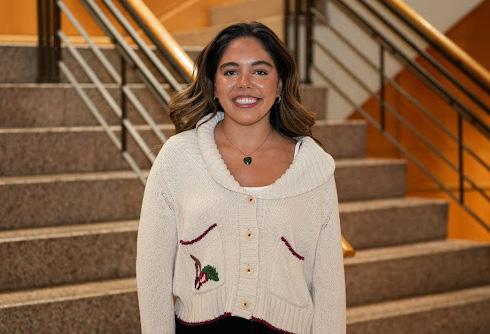
Senior Bella Santos is Chief Editor of Wake Forest’s literary magazine, Three to Four Ounces, which publishes poetry, prose, art and photography.
Photographer Name/Old Gold & Black
ENVIRONMENT
10 THURSDAY, NOVEMBER 6, 2025
How bad is AI for the environment, really?
A closer look at the impacts of AI use on the environment
With the emergence and incorporation of AI systems across the world in various academic, workforce and household settings, comes considerable effects on the environment. However, it can also be used as a powerful tool in controlling climate change.
Among college-age students, the most popular AI chatbox is ChatGPT, and according to Fortune, one in three students on average use ChatGPT regularly. But how bad is it, really? And what can be done to limit the impacts?
There is a general understanding that AI is harmful, but the actual consequences are not known to most people. Chat-GPT emits an estimated 8.4 million tons of carbon dioxide per year, which is more than twice the amount emitted by individuals. A major contributor to this is the data systems used to control and monitor AI, which run off fossil fuels, emitting greenhouse gases into the environment and harming the Earth’s atmosphere. The level of energy required to maintain data systems is frequently overwhelming, so solar and wind-powered systems might not be sustainable for the demand of AI.
Another serious impact of data centers is the amount of water required to keep them cool. The Environmental and Energy Study Institute says that large data centers use approximately five million gallons per day of water, equivalent to the water use of towns with populations up to 50,000. This is especially harmful to water-scarce areas, which is where many of these data centers are built.

The familiar logo for OpenAI and ChatGPT, one of the most popular AI engines. The level of energy required to maintain data systems is incredibly demanding.
The Environmental and Energy Study Institute says that large data centers use approximately five million gallons per day of water, equivalent to the water use of towns with populations up to 50,000.
One of the benefits of AI is that it helps many students achieve greater efficiency in their schoolwork, analyze data and help improve overall academic performance, something that Stephen Smith, assistant teaching professor of environmental studies, says can be a tool when used appropriately.
“I do encourage students to be discerning i n
their use of AI because I view it as a powerful tool for learning, but it can also be used in the wrong ways,” Smith said. “To adapt to this, I have changed the way I do some assignments in class. I do spend class time talking about the limitations of AI so students can learn to be careful with these tools.”
Smith encourages students to be conscious of the benefits and consequences of using AI. It is a tool that will continue to grow in the future; therefore, it is crucial to understand how to manage it sustainably, while being aware of the potential influences it has on the planet.
“There is no such thing as a human activity that doesn’t have an environmental impact,” Smith said. “I think my position on AI’s impact is ambivalent. I think we have to look at longterm planning, like considering where data centers will be built. We can consider how we can do the best job and have the impacts as minimal as possible.”
So while the usage of AI has negative effects on the environment, it
can also be used in a sustainable way, just like every other choice we make regarding our environment, and potentially help combat climate change. The United Nations Climate Change spoke to this point.
“AI can minimize energy waste, optimize energy consumption and distribution and identify emission hotspots”while also “strengthening early warning systems predicting climate change”, the U.N. said.
Educating students on the environmental impacts of AI use and implementing ways to use AI responsibly is a step in the right direction to monitor the overall impact. Smith believes that students who are passionate about the environment should take advantage of this.
“I think if you care a lot about it, go into a career where you can have a meaningful impact on the way things are done,” Smith said. “Use AI to your advantage to potentially make the world a better place.”
ADA MCELROY Environment Editor
OLD GOLD & BLACK
Dado Ruvic/Reuters
Is the fast-fashion castle crumbling?
The reign of SHEIN chic might — hopefully — be over
MARGRETHE JENSEN Contributing Writer
Fast fashion may slowly be going out of style, and I’m here for it.
Maybe you’ve seen unboxings on your feeds stop mentioning ASOS, or perhaps the name Uniqlo now just sounds a bit outlandish.
Gen Z is maturing. With maturity comes the realization that you don’t need fifteen variations of a black going-out top and that staple white tee isn’t going to be found on an online store named “boohoo.” We’re starting to need clothes for the real world, and no respectable pantsuit is going to be bought for $15.
Fast fashion includes any brand that produces mass amounts of clothing at the lowest price point possible, while still remaining “trendy.” Many fast fashion brands exploit workers, harm the environment through their dependency on plastic fabrics and cause massive carbon footprints. Gen-Zers are usually labelled as caring the most about the environment and sustainability, but studies still show nine out of 10 Gen Zers continue to purchase from fast fashion brands.
Fast fashion is an ugly cycle: you think you’re saving money, but the majority of the time, due to low production quality and investment, the clothing arrives flawed or tears after five uses, and you have to continue buying the same thing.
The most sustainable thing to do is purchase something a little more expensive, but a lot more durable. Part of the fun of shopping is finding something completely unique and exciting from a random boutique you stumbled into, or finally purchasing something you’ve been saving up for.
“
We’re starting to need clothes for the real world, and no respectable pantsuit is going to be bought for $15.
My favorite piece of clothing, which I also get the most compliments on, is a skirt that is more than twenty years old and was passed down to me by my mother. Essentially, the clothing that usually ends up sculpting your personal style and becoming the most meaningful to you is likely not going to be copyand-paste clothing from Abercrombie.
Timeless brands like J.Crew are putting more effort into targeting Gen Z, and perhaps more classic brands will follow. J.Crew recently ran an impressive social media mar-
keting campaign announcing its 2025 “cohort” wearing the Rollneck sweater, a staple since 1988.
Notable members of the group included Benito Skinner, the creator of “Overcompensating” and cohost of the podcast “Ride,” the singer Maggie Rogers, and actress Lukita Maxwell, best known for her role in “Shrinking.” Even though Google still classifies them as a “mall brand,” it’s clear their social media team is working hard to elevate them and target Gen Z and I am living proof that it’s working.
Brands like J.Crew are putting forth their best effort to entice GenZers, but that doesn't mean fast fashion brands such as H&M and Zara aren't still incredibly popular — and I must admit I have trouble staying off the Zara website myself. Although the $20 tops are tempting, I am trying to buy only quality pieces that I find truly special, instead of loading up on trendy clothes.
Maybe as our generation continues to mature and grow into our personalities and our personal styles, we will turn away from the herd mentality surrounding fashion. As for now, as much as it pains me to admit it, SHEIN chic might be here to stay for a little while longer.
Contact Camille Wall at wallcm24@wfu.edu

Happy climate news
Column REESE LILE Environment Editor
The headlines are filled with stories of polar ice caps melting, pollution choking our cities and the billions of microplastics in everything we own and eat. While it is important to stay informed about the problems in the environment, it is just as important to acknowledge what IS going well.
To flip the script for a minute, let’s look at some happy news in the world of the environment.
The Beavers are Back!
For over five centuries, the Eurasian beaver has been missing the rivers along northern Portugal as a result of riverbank development, overhunting, and deforestation. But now, they appear to be popping back up, thanks to work by a group of conservationists known as Rewilding Portugal and other conservation efforts in neighboring Spain. This is incredibly important for the biodiversity and ecosystem stability in these areas.
It’s Always Sunny in Vatican
The Vatican City has joined seven other countries that has achieved complete energy independence, running only on renewable sources. This effort was accomplished by Pope Francis, who, before his death, spearheaded the construction of a solar installation that could supply energy to the entire Vatican City. The other seven countries that can claim complete energy independence are Albania, Bhutan, Nepal, Paraguay, Iceland, Ethiopia and the Democratic of Congo—all of which generate around 99.7% of their consumed electricity through renewable means.
Buildings can Sweat
Scientists from Singapore have developed a paint that regulates the temperature of a building by “sweating.” A cement-based coating in the paint reflects sunlight and releases water, which cools the building without using electricity. Even more interesting, the pain reabsorbs water from rain and moisture in the air to replace water lost during its evaporation, just like human skin would.
Green Lights Only
In an effort to reduce carbon emissions from vehicles, Copenhagen synchronized traffic lights on many of the major roads so that a cyclist going around 12.4 mph can glide through green lights the entire way to work. This effort increases the emphasis on cyclists, improves safety and may encourage more people to opt for bicycles over cars.
A view shows banners of Chinese fast-fashion retailer Shein on the facade of the Bazar de l'Hotel de Ville, Le BHV Marais department store.
OPINION
OLD GOLD & BLACK
PAGE 12
THURSDAY, NOVEMBER 6, 2025
Towne Moores, moortv22@wfu.edu
Sara Catherine Bradshaw, bradsc24@wfu.edu
The views expressed in all opinion columns represent those of the article’s author, not the opinions of the Old Gold & Black Editorial Board
Rate My Professors isn’t as reliable as we think
How accurate is the anonymous rating website, and how much should we trust it?
SYED ABDULLAH Staff Writer
I still remember the night before class registration, my freshman spring. Someone showed me the website Rate My Professors, just to check whether the professor for my discrete mathematics class was worth taking.
There it was: a 2.3 out of 5, stacked with fourteen “awful” ratings and not a single positive review in sight. I remember thinking, uh oh. But all the other sections were full, and I wanted to get the class over with. So I took it anyway.
That, in hindsight, was a terrible idea. I spent the semester convincing myself I was wasting time sitting through lectures. I even joked that I could teach the course better, except I wasn’t totally joking. That attitude turned into a habit of skipping class, tanking my participation grade, and teaching myself the material from the textbook. I ended up doing fine on my own, but the whole thing solidified one rule for me: never register for a class again without checking Rate My Professors first.
For the next few semesters, it became a ritual. I’d open Rate My Professors before I even opened the course list. But this fall, that routine didn’t help much.
When you start taking upper-division classes, the number of sections drops fast. Introductory courses like Calculus might have ten sections in the fall, but by your junior or senior year, you are lucky if the electives you actually want to take even show up on the schedule. Required classes usually have at least one section, and the one I needed to take did. Naturally, I checked the reviews for the only professor teaching the course. When I opened her page, I saw ten reviews. Every single one rated her a one. Not a one and a half, not a two, but just a clean line of ones. The comments were even worse. “Genuinely the worst experience I’ve ever had in a classroom.” “Does not give partial credit.” “Goes super fast through lectures.” “Verbally abusive.” You get the picture.
I hesitated. The class cap was only seven students. That number somehow made me more nervous. Still, I signed up. I figured, if it’s that bad, I’ll drop it.
Halfway through the semester, I can honestly say that those reviews were not entirely wrong, but somewhat incomplete. She turned out to be one of the kindest professors I’ve ever had. When she noticed I had the old edition of the textbook, she didn’t make me buy the new one. Instead, she photocopies the homework problem pages for me before every class. She’s tough, but she’s also generous, patient and genuinely wants us to
understand the material.
This experience made me rethink how much faith I’d been putting in a website full of anonymous posts. Yes, Rate My Professors can help you gauge workload, assignment style or how lecture-heavy a class might be. It doesn’t tell you how the person actually is once you’re in their classroom. Those small, human moments rarely make it into the reviews.
Some of the reviews are fair. Every student has a right to share their experience, especially if a class really was disorganized or unclear. But a lot of them make me roll my eyes.
I’ve seen people complain about attendance policies more than once. One even said the professor “only” allowed four unexcused absences, which is basically two full weeks of class. That’s more than generous. We’re all paying to be here, and missing that many classes shouldn’t be something to brag about.
And then there are the reviews that dock points for things like having an accent or talking too fast. Sure, sometimes communication can be tough, but that’s not a reason to tear down
someone’s reputation online. There’s a difference between saying a class was challenging and making it sound like the professor shouldn’t be teaching at all.
Plus, negativity is louder. Like any review site, people are more likely to leave comments when they’re angry than when they’re content. A student who earned a D for missing eight classes is probably not going to write, “Totally fair, my bad.”
We already fill out anonymous course evaluations at the end of every semester. Maybe those are the ones that should matter more, because professors actually read them and can do something about what we say.
So as registration season approaches again, I’ll probably still check Rate My Professors (out of habit, if nothing else). But I’ll try to take it less seriously this time. Because sometimes, a page full of ones doesn’t mean “bad teacher.” It just means “tough class.” And sometimes, the toughest professors end up teaching you the most.
Contact Syed Abdullah at abdusm23@wfu.edu

Towne Moores/Old Gold & Black
The state of states
The unlawfulness of Trump’s National Guard deployment actions
COMMERCE FISK Contributing Writer
In the darkness of the night on Oct. 4, 101 members of the California National Guard entered Oregon on a plane, authorized to pass over state lines by President Donald J. Trump.
His rationale: Portland, Ore., is a “war-ravaged city” with protestors threatening ICE facilities. His justification: Title 10 authority, a loose, exploitative ability to deploy the National Guard to “execute the law.”
These actions come amidst several other planned deployments by Trump in largely Democrat-run cities, including Washington D.C, Memphis, Los Angeles, New York and most recently, Chicago.
Fortunately, both federal statutes and the Constitution deem these actions largely illegal and unconstitutional. Unfortunately, it doesn’t seem like this administration has read either.
“There is no insurrection in Portland. No threat to national security. No fires, no bombs and no fatalities due to civil unrest,” U.S District Judge Karin J. Immergut has noted. Immergut, a Trump-appointed judge, issued a block on the president’s deployment only to be ignored by the administration.
Immergut refers to the troubling notion that the President has absolute discretion in classifying what an emergency is, a perception supported by Su-
preme Court precedent in Luther v. Borden, which designated emergency classification a “political question”.
However, these early cases aren’t entirely indicative of the current legal perspective. In 1952, President Truman was famously barred from seizing and operating steel mills across the country during the Korean War in the decisive case, Youngstown Sheet & Tube Co. v. Sawyer, which concluded that the president acts as a legislator in unilaterally seizing assets for an emergency.
Although that emergency was explicit, the 1972 “Keith Case” is especially prevalent in deciphering whether emergencies are politically motivated. The court ruled that the government required a judicial warrant before conducting domestic surveillance, worrying that “domestic security” intrusions can easily be politically motivated, violating the Fourth Amendment.
Statutory evidence also combats Trump’s reckless deployments. Most importantly, but also most perilously, lies the Posse Comitatus Act of 1878, which prohibited the military from taking an active role in civil law enforcement over fears of militant overbearance.
The act contains two discreet loopholes, one concerning the DC national guard and the other instituting “Title 32 status”, a position where guard members receive federal funds to act under presidential orders while still under state control.
Historically, mutual aid agreements, based on Public Law 104-321, are the only cases such interstate deployment at the request of governors is applicable, most often used for natural disasters like during Hurricane Katrina. Trump’s administration has forgone these conventional routes and coerced state governors to quell fabricated dangers.
If we take away every law and ruling, the practical questions of democracy remain. If Title 10 Authority allows the president to compel National Guard members to act under federal authority on the dangerously general premise of enforcing the law, who's to say the executive can’t warp law towards political ambitions? We cannot be afraid to question the motives of our leaders, nor succumb to the fear induced by their political machines. A bipartisan reiteration of individual liberty is needed to correct these abuses of power.
California Gov. Gavin Newsom has joined Oregon in a suit against the president, attempting to block California’s National Guard from Portland while peaceful protestors continue to come faceto-face with militarized officers on the streets of American cities.
Newsom calls it as it is: “A breathtaking abuse of law and power.
Contact Commerce Fisk at fiskcm25@wfu.edu
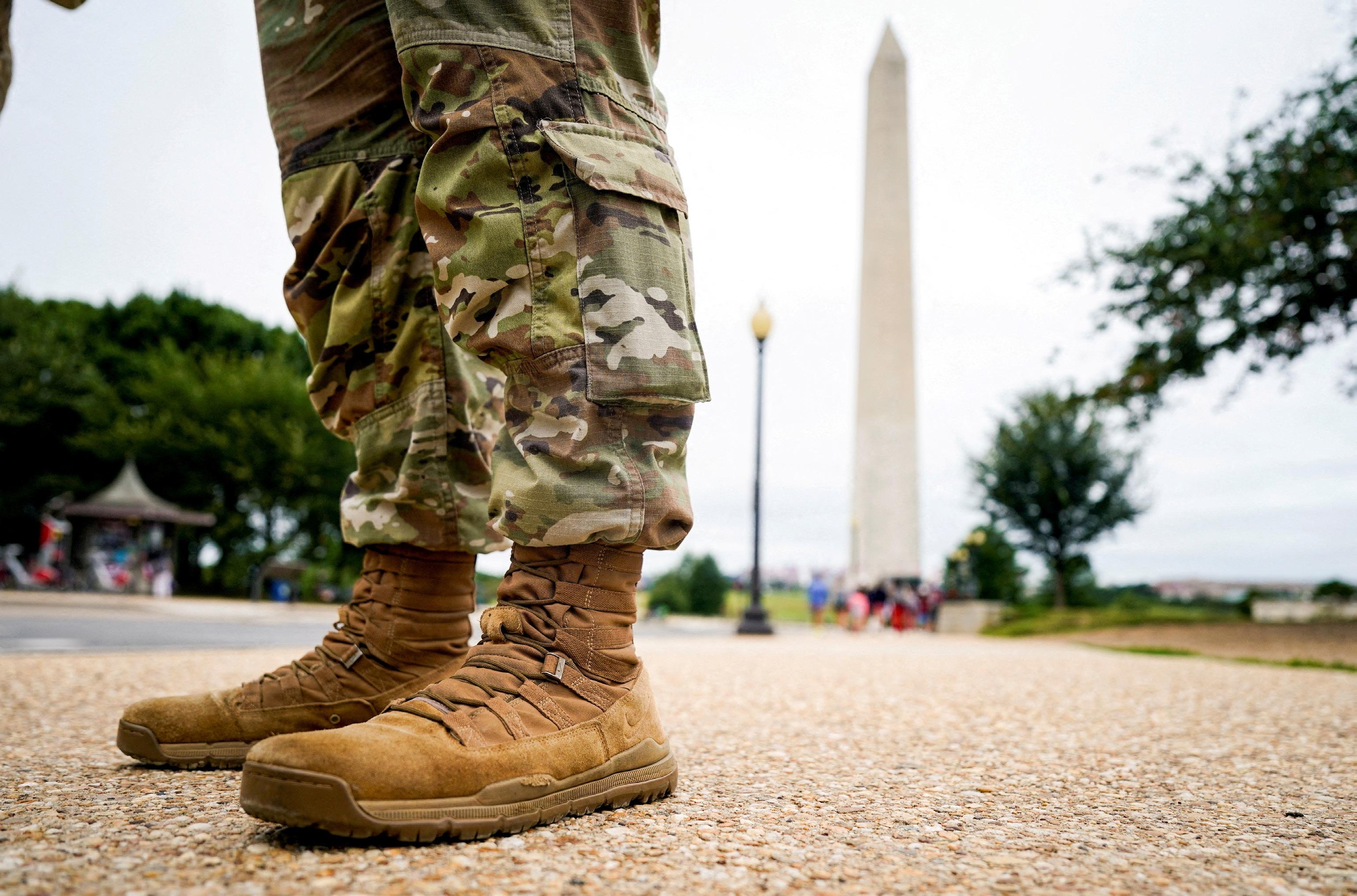
Photo Courtesy of Reuters
Op-Ed: Be not dismayed
A letter to the Black students of Wake Forest University
CHASE CLARK Contributing Writer
In 2008, Maya Angelou published “Letters to My Daughter," a collection of wisdom gathered from her extraordinary life. One chapter recounts how she came to teach at Wake Forest University. In it, Angelou cites a local phrase describing North Carolina as “The Valley of Humility, towered over by two mountains of conceit.”
As a North Carolina native, I remember being startled by that description. But with time, I’ve come to understand it. The things I love most about this state — and about Wake Forest — are the same: the warmth of the people, the culture of hard work and the wealth of opportunities to grow. These places have molded me. I claim them both proudly.
Still, Angelou’s words carry a warning. She reminds us that “blethering ignorance” — the loud, insistent kind of prejudice — can be found anywhere.
That truth revealed itself on Nov. 3, 2025. As I walked down the stairs between the third and second floors of Benson Student Center, I saw a table promoting an organization whose history speaks for itself — one that has endangered the safety and dignity of marginalized communities, whether they admit it or not.
I won’t give the group the publicity it seeks. What matters far more were the faces of the Black students who passed that table: faces marked by fear, anger and disappointment.
This letter is for them.
We’ve been here before
Moments like these can shake you, not just because of what they reveal about others, but because of what they demand from you. They remind us that racism and white supremacy are not new. They are among the oldest institutions in this country, sustained not by originality but by repetition.
And yet, generation after generation, Black people have met those institutions with endurance, creativity and faith. The instructions for surviving such moments were written long before we arrived at Wake Forest, and they will continue to guide those who come after us.
We have been asked to achieve excellence in spaces that were not designed with us in mind — to earn degrees and distinctions while carrying the daily weight of microaggressions, isolation and expectation. And still, we do it.
We become scholars, campus leaders, homecoming queens and student body presidents. We excel, even when the terms of success are uneven. That, in itself, is worth celebrating.
As the poet Lucille Clifton once said, “Come celebrate with me that every day something has tried to kill me and has failed.”
What to do with the hurt
I know it’s hard. I know the mixture of emotions that moments like this bring — the betrayal, the surprise and the anger. I have felt them all too. It’s natu-
ral to feel disheartened, to wonder if this place will ever fully see us.
But I have learned to use that pain as motivation — not to become hardened, but to become grounded. It reminds me that our presence here is powerful, that our progress matters and that we must keep moving forward despite those who wish we wouldn’t.
And while resilience is important, so is rest. I encourage you to take time for silence, to check in with yourself and to protect your peace. Rest is not retreat. It’s a strategy — a way of ensuring that when you return, you do so replenished and ready.
Most importantly, communicate. Reach out to one another. Speak honestly about what you’re feeling. You do not have to navigate this campus, or this pain, alone.
Choosing where to look
Toni Morrison encouraged us to consider racism a distraction. Its purpose is to pull our attention away from our work, our joy and our collective progress. We must refuse to be distracted.
Let us not grant power to those who thrive on spectacle. Let us continue to build and nurture community — to laugh louder, love harder and learn together. Our unity, our brilliance and our capacity for joy have always been our strongest forms of resistance. Be not dismayed. We have been here before. And every time, we have risen higher.
Contact Chase Clark at clarca22@wfu.edu
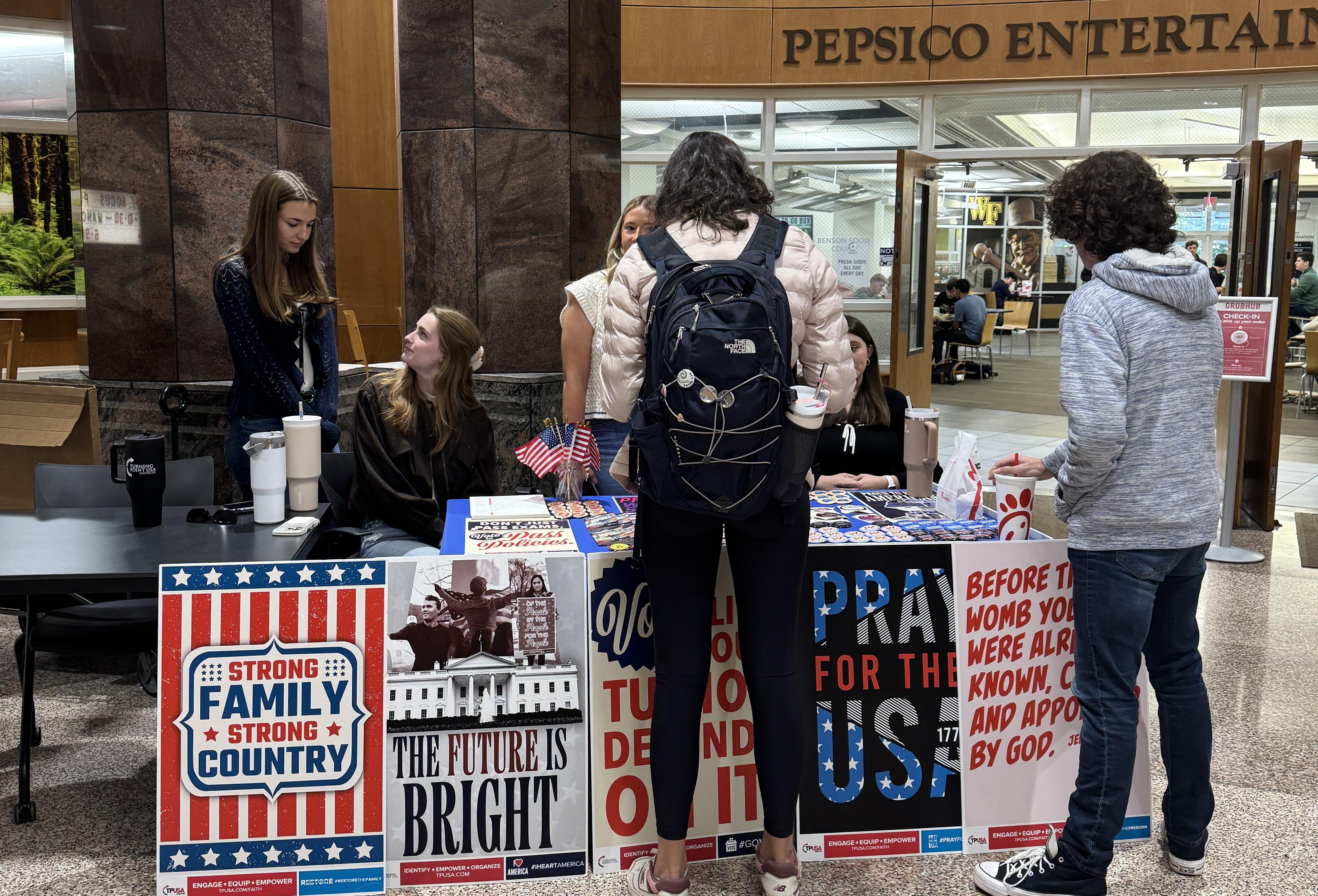
Photo Courtesy of Chase Clark
Turning Point USA set up a table in the Benson University Center on Monday afternoon
James Lombardo, lombjp23@wfu.edu
Scottie Kimmelman, kimmsd22@wfu.edu
First half fireworks propel Men’s Basketball to convincing opening night victory
Deacs take down American as Mason, Spillers each score 20
GRIFFIN
LAMPHIER Staff Writer
Men’s Basketball began their 2025-26 campaign with a 88-74 over American University Monday night at Lawrence Joel Veterans Memorial Coliseum.
Wake Forest got out to a quick start, with Washington transfer guard Mekhi Mason scoring the opening bucket en route to a 7-0 run in the first three minutes of the game. American responded with a quick 8-0 run of their own as the Deacs turned the ball over a few times. However, Wake was forcing plenty of turnovers themselves. One word could describe the defense from Steve Forbes’ squad: active. Nearly every Deac was finding a way to get a hand on the basketball one way or another, especially Redshirt sophomore Marquis Mitrovich Marion and graduate student Tre’Von Spillers. The turnovers they were able to force allowed for an exciting exhibition of transition
offense.
The Deacs athleticism was on display early and often. Midway through the first half, Denver transfer guard Sebastian Akins launched a lob in transition from nearly half court, and Purdue transfer Myles Colvin got way up to throw it down with a one-handed slam. After the game, Head Coach Steve Forbes remarked, “I couldn’t believe he caught it, let alone dunked it … I don’t think [Hakeem] Olajuwan could’ve caught that thing.” Colvin was feeling it for the next few minutes, at one point he had four straight baskets.
The middle stretch of the first half featured the two teams trading punches, as Wake struggled to connect from behind the arc and the Eagles had some small runs to keep the lead within the mid-single digits. Wake finally had some sustained success late in the half as continued defensive pressure and elite playmaking led to more steals and high-percentage looks. The Deacs
had eight dunks in the first half, with 12 assists on 17 field goals. Mason led the scoring at the half with 13, finally making the Deacs’ first two threes in the final minutes as Wake led at the break, 46-34.
The second half featured Wake slowly building their lead from the low teens to the high teens, as American continued to capitalize on mistakes to stay in it. The Eagles implemented a full-court press, which forced the Deacs to get a bit out of rhythm on the offensive side of things, causing a few turnovers. Small mistakes or losses of focus were keeping it from being a blowout. American’s Wyatt Nausadis had a stellar second half, putting up 16 points to keep things somewhat close.
For Wake, Juke Harris made his presence felt on the scoreboard, as the Deacon sophomore consistently scored with contact, including off some feeds from Mason and Washington State transfer Nate Calmese
He capped off an 18 point, seven rebound performance with a late game lob to Spillers and a fastbreak slam of his own in the final minute. The Eagles got some garbage time buckets, but Wake got the convincing opening night win, 88-74.
Mason finished the game with a double-double on 20 points and 10 rebounds, meanwhile Spillers also had 20 with eight rebounds. Calmese fell just short of a double-double, with 10 points and nine assists and five of Wake’s 16 steals.
Coach Forbes was pleased with his team’s ability to adjust, “ I come into the game as a coach thinking, how are we going to play when we don’t shoot threes? Because we’ve just been banging them … I was encouraged more by the fact that we could score 88 points and not rely as much on the three as we have.” OLD GOLD & BLACK
Contact Griffin Lamphier at lampgm25@wfu.edu
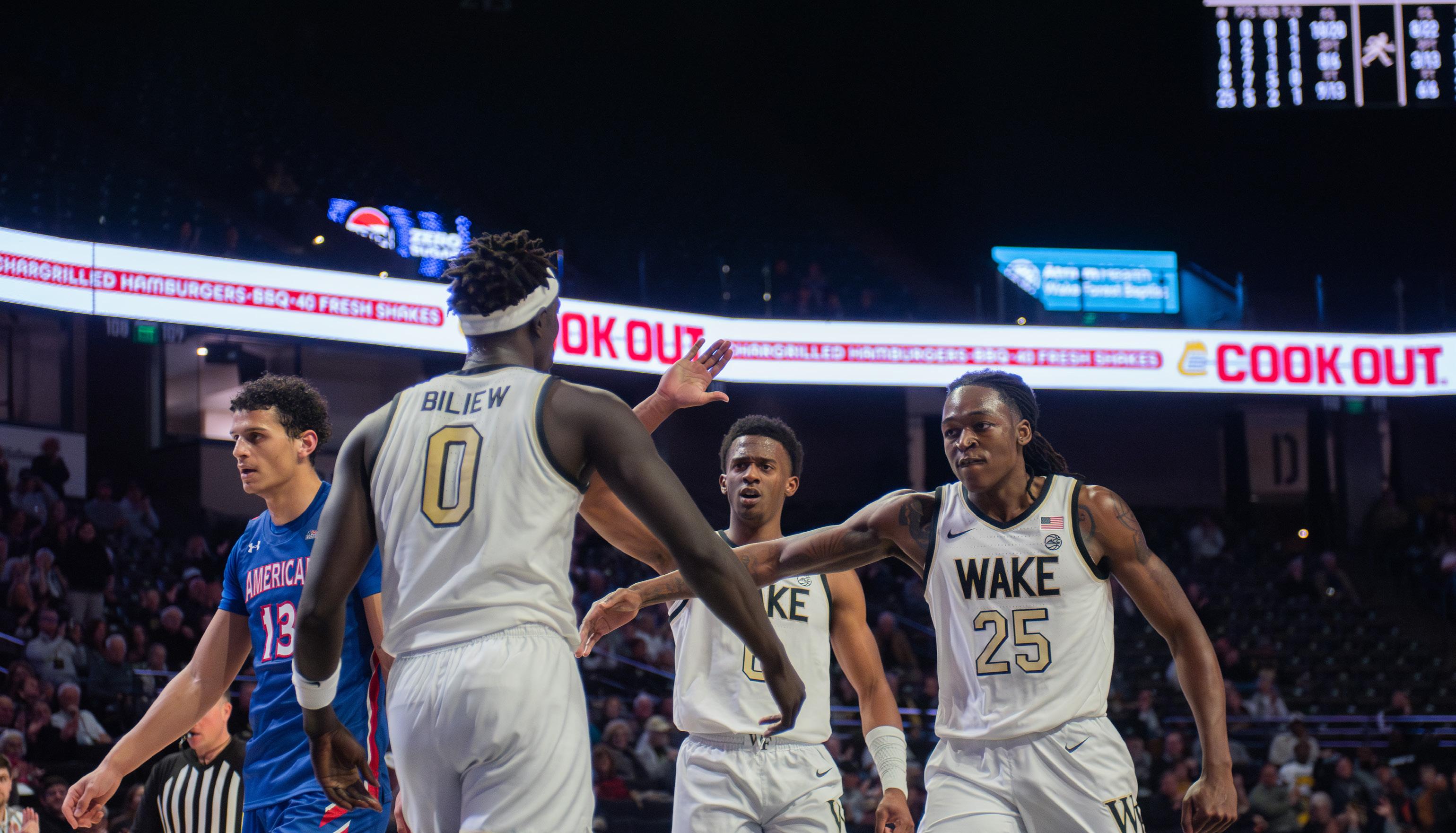
Piper Saunders/Old Gold & Black
Wake Forest topples Notre Dame 3-0 on senior night
The Demon Deacons end their regular season with a win, will be headed
SCOTTIE
KIMMELMAN Sports Editor
It was nothing but good news for the Wake Forest Men’s Soccer team last Friday as the Demon Deacons took down Notre Dame in convincing fashion. On the 16th and final game of the season, all heads were turned towards the senior class on their special night at Spry Stadium.
The entire group of four, all of whom were celebrated before kickoff, contributed to the eventual victory. Defenseman Vlad Walent broke the ice in the 37th minute with a penalty kick that gave the Demon Deacons the early lead. It was Walent’s first goal since his sophomore campaign two years ago and the sixth of his career.
Midfielder Cooper Flax also made his mark against the Fighting Irish. Flax notched both a goal and an assist in his 76 minutes of work. The senior’s only score, a snipe that trickled through the right side of the net, came from just outside the penalty arc 60 minutes into the game.
Flax, who has spent his entire college career at Wake Forest, ends his season with seven goals and seven assists, good for a team-leading 21 points. His strong play will be looked upon in the coming weeks as the Demon Deacons rev up for the ACC Tournament.
Just four minutes after Flax’s goal, a masked Jeffrey White connected for his third goal and eighth point of the season. It was Flax, though, who conducted the entire play with a gorgeous ball that found Junior Tate Lorentz on the wing. With plenty of space and room to attack, the transfer from North Carolina fed a perfect pass to a wide-open White, who was there to finish the job.
“What a great win at home against a really good Notre Dame team,” Coach Bobby Muuss said following Friday’s victory. “When you get a group of guys that believe and play the brand I think we did today, I thought that was Wake Forest football at its best.”
The season is still far from over for the Demon Deacons who, starting this Wednesday, will begin competing in the ACC Tournament. Listed as the 10 seed, Wake Forest will take on the SMU Mustangs in Dallas to kick things off on November 5.
As the defending ACC champions, expectations are still sky high for this Demon Deacon squad that has repeatedly shown its outstanding competitive nature. While they may not be as dominant as the group in 2024, there is no question that this team can repeat last year’s impressive feat.
Contact Scottie Kimmelman at kimmsd22@wfu.edu
to the ACC Tournament next week
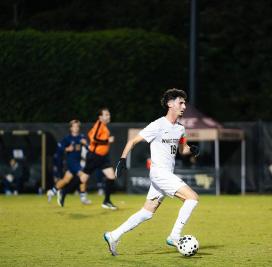
Senior Cooper Flax streaks in towards the net in his final regular season game for the Demon Deacons last Friday.
Football gets embarrassed in Tallahassee
The Demon Deacons’ offense struggled to find momentum all game long
lost 42-7 in Tallahassee as the offense failed to gain any momentum throughout the game.
Wake Forest football fell apart in their game against Florida State after last weekend’s incredible alumni weekend victory over SMU. The Demon Deacons
Head Coach Jake Dickert started Robby Ashford at quarterback following Deshawn Purdie’s three-turnover game last week. Ashford and the Demon Deacons
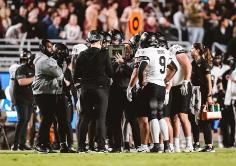
started strongly, running the ball, but were unable to score in the first half.
The defense gave up a long catch and run to receiver Duce Robinson at the end of the first quarter, allowing Florida State to score its first touchdown shortly into the second quarter.
Sloppy play and turnovers plagued Wake Forest throughout the game. Florida State forced fumbles from several ball carriers, stalling many Demon Deacon drives.
Later in the second quarter, quarterback Tommy Castellanos delivered a long strike to Randy Pittman Jr., allowing the Seminoles to find the endzone at the end of the half.
“Defensively, we were on the field too much and we gave up too many big plays really for the first time all season,” Dickert said.
Even though Florida State only led 14-0 at the half, it felt like the Demon Deacons would have to climb a mountain to overcome the deficit.
In the second half, Wake Forest was able to hold off Florida State’s explosive offense until a fumbled snap by Robby Ashford left the Seminoles in Demon Deacon territory.
After that, Florida State piled on touchdown after touchdown.
Following another Robby Ashford interception at the end of the third quar-
ter, Dickert turned to Deshawn Purdie to close out the game. Ashford ended the game completing 12 of his 21 passes for 93 yards, adding 59 yards on the ground.
“[We] didn’t have much going on offense,” Dickert said. “Didn’t execute and put any drives together or finish.”
Purdie eventually tossed a six-yard touchdown to wide receiver Micah Mays Jr. to put the Demon Deacons on the scoreboard and avoid the shutout. Unfortunately for Wake Forest, that touchdown ended up being their only points of the game.
Star running back Demond Claiborne also struggled in this game, only posting 14 carries for 27 yards.
“Our team has to respond to this game,” Dickert said. “This is the first time since we’ve all been together that we’ve had this type of result.”
The Demon Deacons must figure out their offensive woes if they want to compete in a bowl game this season. With just a few games left on their schedule, they need to pick up at least one more win to become bowl eligible.
Wake Forest has another tough matchup ahead of them, as they face the No. 12 Virginia Cavaliers in Charlottesville, VA. The Cavaliers are first in the ACC and boast an 8-1 record.
Contact James Lombardo at lombjp23@wfu.edu
The Demon Deacons defensive unit huddles next to Jake Dickert as they get ready for a new drive.
JAMES LOMBARDO Sports Editor
Photo courtesy of Wake Forest Athletics
Will Kunisaki/Old Gold & Black
No. 6 Demon Deacons fall to No. 4 Virginia in regular season finale
With the loss, Wake Forest shares the title of ACC regular season co-champions with Virginia and North Carolina
ELLA MAYNARD Staff Writer
the Cavaliers defeated the Demon Deacons 5-3. The Deacs
found the back of the net three times against a Virginia defense that had allowed just six goals this season.
Virginia scored the opening goal with a minute left in the opening frame, where they then found momentum and raced out to a 3-0 lead.
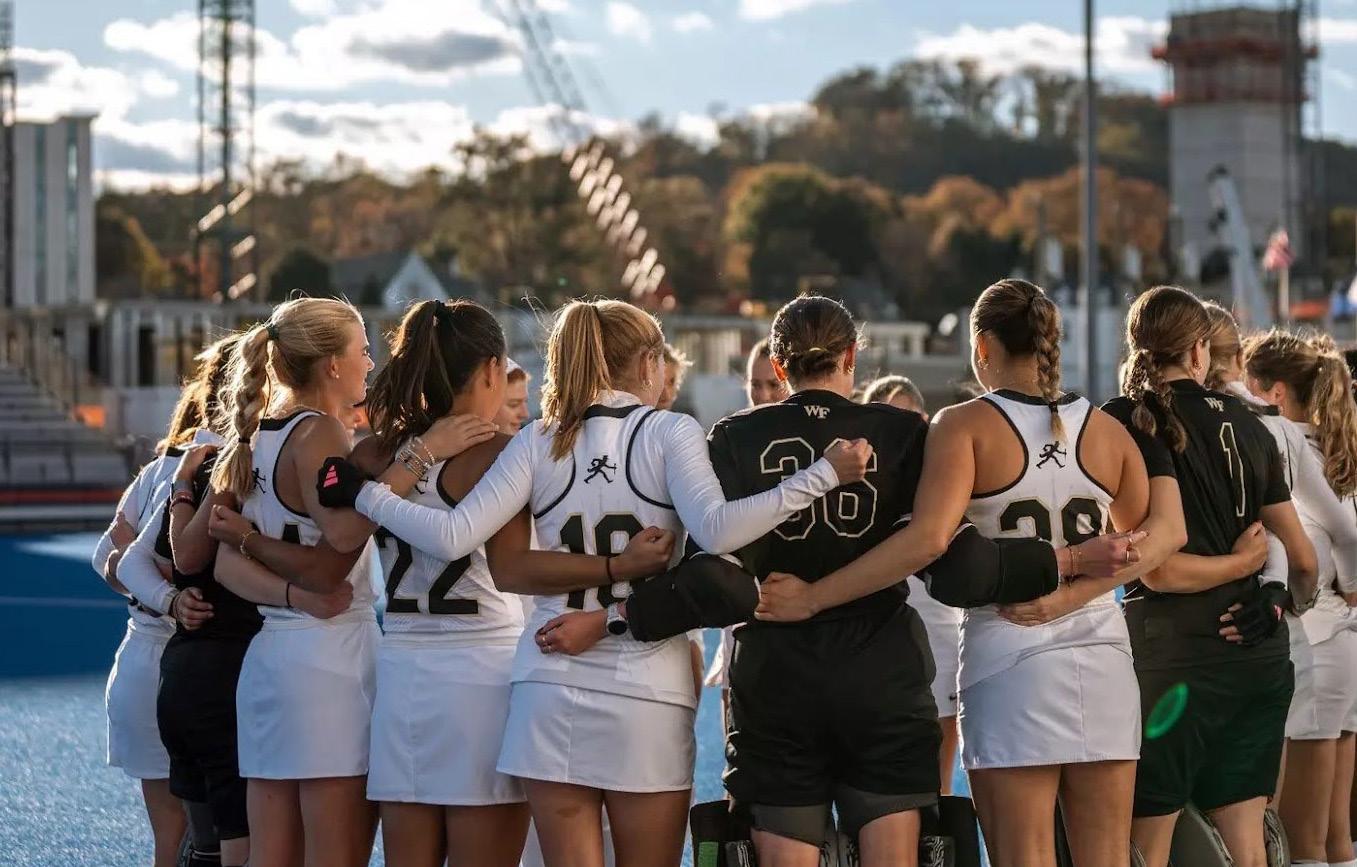
The first half was characterized by gritty but rushed play from Wake Forest, only firing four total shots and earning three consecutive corners. The Demon Deacons were unable to convert on any of said opportunities.
Second-half play was much cleaner from the Demon Deacons, where they piled on 17 shots throughout. Senior Amelia Frey cut the deficit to 3-1 with an unassisted goal with 10 minutes remaining in the third quarter.
The Hoos added two more to make it 5-1 just a minute into the fourth quarter.
A sign of life sparked for the Deacs when junior Faye Janse found the back of the net with an impressive, baseballlike goal to make it 5-2. Junior Mia Schoenbeck lofted an aerial pass into the circle that bounced off a Cavalier stick and perfectly set up Janse.
Less than a minute later, Schoenbeck tallied on her signature drag flick with just under 13 minutes remaining. Despite the late surge, the Deacs couldn’t complete the comeback.
“Unfortunately, just a little too late from the squad tonight,” Head Coach Jen Averill said. “We didn't attack and didn't press early and often enough.”
The Deacs showed their fight and continued to press, firing 10 shots and
earning seven penalty corners in the final minutes, but Virginia made four crucial saves to hold off the comeback.
“I'm incredibly proud of this group for the 2025 regular season campaign. I would have liked this game to go a little bit differently, not only in the goals we allowed, but also in being able to manage each quarter,” Averill said.
The 2025 ACC Field Hockey Championship will start on Tuesday, Nov. 4, at Trager Stadium in Louisville, Ky. Averill noted that she is excited to get to Louisville and get back to work for the ACC tournament.
Following the loss, the rest of the ACC games finished up to set the bracket for the upcoming conference tournament. North Carolina beat Duke to grab the #1 seed in the tournament. Virginia grabbed the #2 seed by beating Wake Forest, and subsequently, Wake dropped to the #3 seed.
The Deacs will face #6 Syracuse at 6 p.m. on Tuesday, Nov. 4, in what looks to be a tight match.
Contact Ella Maynard at maynir24@wfu.edu
Los Angeles Dodgers win their second straight World Series
Yamamoto and Rojas play hero against the Toronto Blue Jays in a thrilling Game 7 matchup
SCOTTIE KIMMELMAN Sports Editor
It had been a quarter century since a Major League Baseball team repeated as World Series Champions. Until yesterday.
Last night, the Los Angeles Dodgers defeated the Toronto Blue Jays in an exhilarating 11-inning matchup-turnedinstant classic. Backed by the heroics of second baseman Miguel Rojas and pitcher Yoshinobu Yamamoto, the defending champs reached the mountaintop for the second consecutive season.
The scoring commenced in the third inning when Blue Jays second baseman Bo Bichette launched a three-run home run off Shohei Ohtani, sending the Rogers Center into a frenzy. Bichette was given the golden opportunity when Los Angeles decided to walk Vladimir Guerrero Jr. with a runner on third and one out. The longtime Blue Jay seized the opportunity and knocked Ohtani out of the game with the 442-foot blast.
But the Dodgers refused to roll over. By adding runs in the 4th, 6th, and 8th innings, Los Angeles was able to make it a one-score game heading into the 9th. With a championship at their fingertips, the Blue Jays turned to season-long closer Jeff Hoffman to slam the door.
After getting the first out of the inning, Hoffman was tasked with facing Miguel Rojas, who entered the game hitless in the World Series. On a 3-2 pitch, Rojas took a hanging slider from Hoffman and ripped it into the left field bleachers for a game-tying homer. The shot silenced the crowd of 44,000 plus and gave Rojas the signature moment of his career.
“I was never trying to hit a home run there,” Rojas said. “I think it was the first home run I hit against a right-hander this year. And it came at the biggest moment of my life.”
In the bottom half of the inning, the Blue Jays had Los Angeles on the ropes with the bases loaded and one out. Yoshinobu Yamamoto, the Dodger starter who threw 96 pitches the previous night, was in to save the day. If the tired ace made any mistake, Toronto would have its first World Series win in over 30 years.
Instead, two miraculous defensive plays from Rojas at second and centerfielder Andy Pages kept the game going into extra innings.
In the 11th, Will Smith came up to the dish with two outs, looking for a good pitch. Shane Bieber, another starter pitching in relief, gave the Dodger catcher just that. Smith took a hanging slider from Bieber and sent it to the seats in left, exactly where Rojas knocked his out earlier in the game.
Leading by one and heading to the bottom half of the inning, it was Yamamoto’s game to finish. Despite the Blue Jays threatening with runners on the corners, Yamamoto induced the game-ending double play, earning him World Series MVP honors and sending the Dodgers back to the promised land.
"To do what we've done in this span of time is pretty remarkable,” Dodgers Manager Dave Roberts said. “I guess let the pundits and all the fans talk about if it's a dynasty or not, but I'm pretty happy with where we're at."
Contact Scottie Kimmelman at kimmsd22@wfu.edu

Wake Forest field hockey’s 15-game win streak ended on Friday night in Charlottesville as
Photo courtesy of Wake Forest Athletics
The Wake Forest Deamon Deacons field hockey team gathers in a huddle as they prepare to take on No. 4 Virginia Cavaliers.
Photo courtesy of the Los Angeles Times
World Series MVP Yoshinobu Yamamoto lifts the Willie Mays award in celebration. The Dodgers ace earned the win a day after starting Game 6.
ARTS & CULTURE
PAGE 18
THURSDAY, NOVEMBER 3, 2025
Lydia Derris, derrlf23@wfu.edu
Grace Schuringa, schugh24@wfu.edu
A/perture cinema is a community-centered space
A move-going experience that goes beyond the silver screen
GRACE
SCHURINGA Arts & Culture Editor
Located in the heart of WinstonSalem is a still-standing remnant of silver screen days gone by.
With four intimate theaters, a concession stand and a bar, a/perture cinema has all the offerings of your local AMC and more — private screenings and both sustainability and equality pledges.
Centered around a diverse community and sustainability, the efforts of a/perture cinema go beyond the entertainment of their visitors. With new releases, local films and so much more — the intentionality beyond the cinema encourages a thoughtful form of movie-going that is unique to Winston-Salem.
Halloween is on the horizon and the weather is cooling, which means there is arguably no better time to grab a friend, a glass of wine and nestle into a theater seat.
A/perture cinema, located on 311 West Fourth Street in downtown Winston-Salem is more than just a theater.
Their spotlight horror film happens to be a personal favorite: The Exorcist. It will be shown both on Oct.
29 and 30 at 8 p.m. Student discount tickets are available for purchase.
Other showings include “Springsteen: Deliver Me From Nowhere,” which follows the life of American legend Bruce Springsteen and “The Mastermind,” a museum heist that reverberates in light of current events.
Looking ahead, a/perture will bring back classics like “Singing in the Rain,” “The Outsiders” and “The Sound of Music” with various November screenings.
New releases will also appear on the silver screen like “Die My Love” starring Jennifer Lawrence and Robert Pattinson as well as the sequel to the movie “Wicked.”
a/perture is a cinematic experience that goes beyond the movie and is an obvious alternative to big-name theatres when it comes to picking your next film.
311 West Fourth Street Winston-Salem, NC 27101
Contact Grace Schuringa at schugh24@wfu.edu
Taking a ride in a big red truck
An insider’s look into the Winston-Salem Fire Department
GRACE SCHURINGA Arts & Culture Editor
Sirens blare throughout Fire Station 3, located in downtown Winston-Salem. An alarm notifies the station of an emergency, as the words “cardiac arrest” are announced on repeat through the piercing sirens.
Fireman Ethan Adams says, “We have 80 seconds to respond en route to a call,” running toward the red truck. I follow suit, strapping myself into the cab of the vehicle.
“Or what?” I pry.
“Or I have to fill out a lot of paperwork,” He quips back.
The double-door garage opens and the truck pulls out. Immediately, one thing becomes very clear: operating this vehicle is no easy feat. Still, Orren Wade, the engineer at Station 3, commanded it with expert precision.
On the job
When we arrive on scene, a middleaged man stumbles out of the house, a cigarette between his lips, his hands covering his face and his shoulders shaking. The neighbors discovered his son in the backyard this morning. Most likely, he had been dead all evening.
“If there is greater than 15 minutes of unknown downtime, we don’t attempt CPR,” Sam Harvey, the officer in charge, says as we make our way back to the truck.
“What happens to the body?” I inquire.
“There are companies they can call. My buddy used to own a body removal service, actually,” Adams replies casually.
My first hour with the Winston-Salem Fire Department was macabre, but provided me with a much-needed reality check.
“When you’ve seen so much death, you become sort of desensitized to it,” Adams says.
What he wasn’t saying was this: these men willingly witness the unthinkable every day so that no one else has to.
“The thing about firemen is that we would willingly give up our lives for any stranger,” Captain Michael Guteriez said.
The second call we receive comes an hour later. Initially, it was classified as an active shooter at Forsyth Technical Community College. When we arrive, we are redirected from a nearby apartment complex where the victim resides with his grandmother to an on-campus building. Inside, a young boy sits gripping his arm. Despite the blood, his speech is even.
“Do you remember your [guardian’s] number?” The medic asks.
He begins to recite the number with such clarity before abruptly stopping.
That’s when a radio transmission fills the room. “[Guardian] also injured here. Taking [them] to the hospital.”
A family member was identified as the person responsible for the shooting. The
cause remains unclear.
That’s one story — the messy, convoluted experiences that come with the job.
The other story is this: the firemen behind them.
The Firemen
“The only difference between the fire station and your home is that we have a bigger garage.” Captain Jonothan Lindholm said. “We spend a third of our lives with each other. We’re family.”
This sentiment was abundantly clear to me before Lindholm said anything. Despite the hectic morning, the men's spirits remained high, joking and laughing with one another in the face of disaster.
The job does not come without its risks, and numerous firemen have the scars to show it. Captain Blake Groce was injured at a house fire while coming down from a ladder when his leg caught on a fence.
Gutierrez recalls the incident and the fear he felt.
“I was with him at the hospital. We were scared that they were going to have to amputate a leg.”
Lindholm describes having shared similarly frightening experiences.
“I've been in two situations where I've thought I wasn't coming out of the fire. It's a sobering thought. I’ve cheated death twice,” he said. “We call them near misses now, back then we just called them good stories.”
duty at Allegacy Football
Regardless of these instances, Lindholm reflects that the worst part of the job is its physical limitations.
“I only have two years till I need to retire. I don't want to, but I have to. Physically, my body has paid the price of the job,” he said. “I want to do this till I physically can't, but I have to know my limitations. First and foremost, I am responsible for the safety of all my firemen.”
Battalion Chief John Suders, praised by his captains as “one of the best around,” recognizes the fruit of his labors in his firemen. After his tenure as fire chief concludes, his legacy will continue through them.
He says that, no matter who's at the helm, “at the end of the day, the doors will go up and the trucks will go out.”
Contact Grace Schuringa at schugh24@wfu.edu
OLD GOLD & BLACK
Will Kunisaki/Old Gold & Black
Ken Chen/Old Gold & Black Winston-Salem fire department on
stadium.
The Carolina Classic
Grace Schuringa Arts & Culture Editor
Mechanical clangs and cheers draw me toward the Grand Stadium at The Carolina Classic Fair. What do I see? Beaten down cars of every color racing to complete a makeshift track. The locals call it a “demo derby.” I prefer the moniker, “real life bumper cars.”
Fireworks, joyful screams and the ding of a winning throw — the fair is an experience, to say the least.
Starting in February in Florida, the 10-day event makes its way to WinstonSalem Fairgrounds once a year. The entire production is praiseworthy; with its rides, vendors, beer garden and petting zoo, the Carolina Classic does it all.
This year marks the 143rd anniversary of its establishment. Originally, the fair was conceptualized to educate the public on agriculture in the area.
Cary Hester, the assistant fair director at the Carolina Classic, has been working behind the scenes on the event for

Celebrating the 143rd Anniversary of The Carolina Classic
over 20 years. Their mission, as she explains it, is “to get people knowledgeable about where products come from.
They’re not just coming out of a grocery store, they’re actually being grown by farmers.”
Two days before the start of the event, which took place on Oct. 3 this year, contestants had the opportunity to enter a competitive entry for the chance to win part of the $225,000 prize fund. This year, over 20,000 people — kids, adults and seniors alike — threw their hats in the ring.
Lili Craven, who started as the events and branding manager in 2024, describes her favorite part of the fair as “seeing the joy of kids when they win a blue ribbon.”
A production of this magnitude does not come without its risks. However, the Carolina Classic team does months of preparation, threat assessment and protocol manipulation to ensure the safety of their visitors.
The fair concluded on Sunday, Oct. 13; the small entry fee is a small price to pay to experience all the offerings at the Carolina Classic.
Contact Grace Schuringa at deanla24@wfu.edu
HENRY YATES Contributing Writer
Music biopics are all the rage in Hollywood. With James Mangold’s “A Complete Unknown” racking up eight Oscar nominations last year, the trend continues, and this year’s primary music biopic is Scott Cooper’s “Springsteen: Deliver Me from Nowhere.”
The film chronicles a very specific period in Springsteen’s life: the time he spent in the early 1980s writing and recording the songs that would eventually become his albums “Nebraska” and “Born in the USA,” with special focus on the former.
The film uses “Nebraska” and its unconventional creation to explore Bruce’s psyche at this point in his life. A series of flashbacks is scattered throughout the film, all pertaining to Bruce’s troubled relationship with his father. The film uses his father’s past emotional and physical abuse to examine the trauma that adult Bruce goes through. It depicts a Springsteen who has internalized his father’s actions as his own fault and considers himself responsible.
It’s a fascinating premise, particularly given the intimacy and darkness of the album. The problem is that the film never settles any of this. It repeats over and over that Bruce needs “Nebraska,” and depicts him spiraling further and further as he writes and fights for the album more and more. In the end, he gets help, but the film skips over his growth arc and simply shows him as “better” at the end. It even concludes the father plot point in a way that felt inauthentic and downright tone-deaf to how the relationship had been por-

Reuters/Jaimi Joy
Jeremy Allen White attends the premiere of “Springsteen: Deliver Me from Nowhere” at the London Film Festival in London, Britain, October 15, 2025.
trayed. So, rather than a poignant exploration of depression, generational trauma, abuse and the power of art as catharsis, the viewer gets a long series of semi-connected scenes of Jeremy Allen White sitting in rooms, shaking his head and occasionally trying to talk like Bruce Springsteen.
White is a fantastic actor. As a fan of “The Bear,” I know what he’s capable of. However, there’s very little to write home about his performance. Anything good he does here is done far better in his other performances. Even as a standard “biopic performance,” it falters;
you only see White, you do not see Springsteen.
In the film, he performs alongside Jeremy Strong, whose work in “Succession” might be one of the greatest television performances of all time, but Strong, even more so, plays a one-note character. Both are beyond capable performers, so I fault the script and the direction.
Overall, “Springsteen: Deliver Me from Nowhere” is on the weaker end of music biopics. While I respect it for the boldness to try an unconventional narrative structure for the genre,
it ultimately serves up a large bowl of “meh” that fails to live up to its potential. A Bruce Springsteen film covering important topics, detailing a time in his life when some of his most iconic songs were written, featuring two of the top working actors today, should have been an easy base hit, if not a home run. “Deliver Me from Nowhere” fails at this and thus fails to reach the heights of some of its genre peers.
Contact Henry Yates at yatehs24@wfu.edu
Will Kunisaki/Old Gold & Black
The Soduku
EVAN LIPETZ Staff Cruciverbalist

Contact Evan Lipetz at lipeek22@wfu.edu