Jessica Lydiate (RE Lead and teacher at Hope Hamilton Primary School)
Charlotte Watson (RE Lead Professional for Learn Academies Trust and teacher at Queniborough C E Primary school and Thrussington C E Primary School)
Roddy (Director)
Tellingthe storyofour project
From the outset of this project, we wanted to explore how ‘Big Questions’ lessons could operate in the primary classroom, what they might look like in our schools, specifically how they would work in our Key Stage 2 classrooms. We wanted to explore how to implement this ‘Big Questions’ concept, to try things out and to develop our questions We wanted to give our children a chance to engage in a Big Questions session.
We were driven by the following questions:
What would a ‘Big Questions’ session look like in Year 4, Year 5 and in a mixed Year 5/6?
How could we create safe spaces for pupils to explore and engage confidently in these sessions?
We recognised that the primary school setting was quite different to that of a secondary one with its discrete subject departments We wanted to use the fact that in a primary classroom the classroom teacher is often teaching both RE and Science lessons, has access to both schemes of work and is therefore able to see where connections could arise.
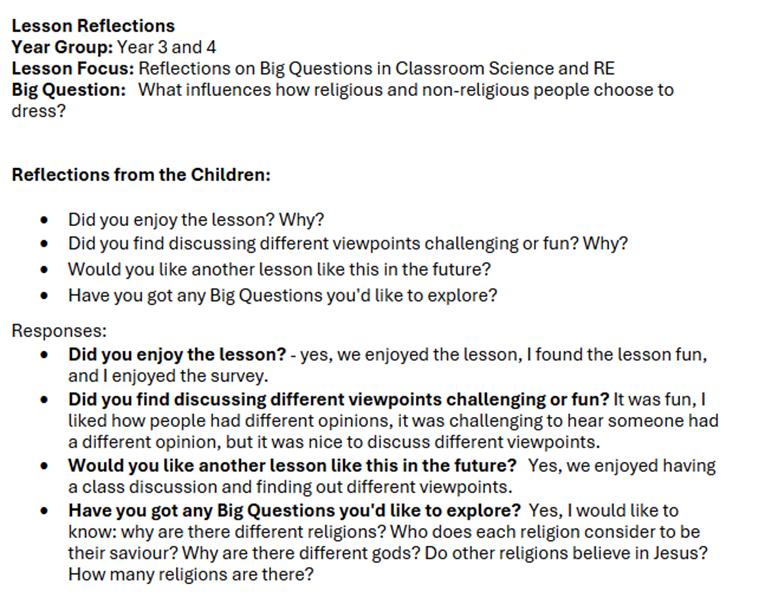
To begin with, we asked our PCGE students to experiment in teaching a ‘Big Questions’ session, using the resources we provided, and with support from their mentor We then used their feedback to plan our next steps We also tried Big Questions sessions in our own classrooms. As the project extended over two academic years, in one setting we were able to re-teach our initial session with adaptations In one school we used the question, Are humans or animals more important? We wanted to see what children aged 8/9 could bring to this question
In the first cycle of lessons, we found pupils needed far more scaffolding and input as many were struggling to generate responses Pupils found it challenging to think of answers to the question and the few that offered solutions then held on to them rigidly and found it difficult to be open to the views of others
While we wanted to create a safe space for children to formulate their own responses rather than offer answers ourselves, we soon realized that the pupils needed more input Therefore, in the second cycle we provided pupils with a wide variety of answers to the question and then asked them to categorise the answers This process provided pupils with time to engage with different ways of answering the question which resulted in much more confident individual answers by the end of the session. Pupils worked in groups to categorise the answers and we found this made the activity more accessible for all
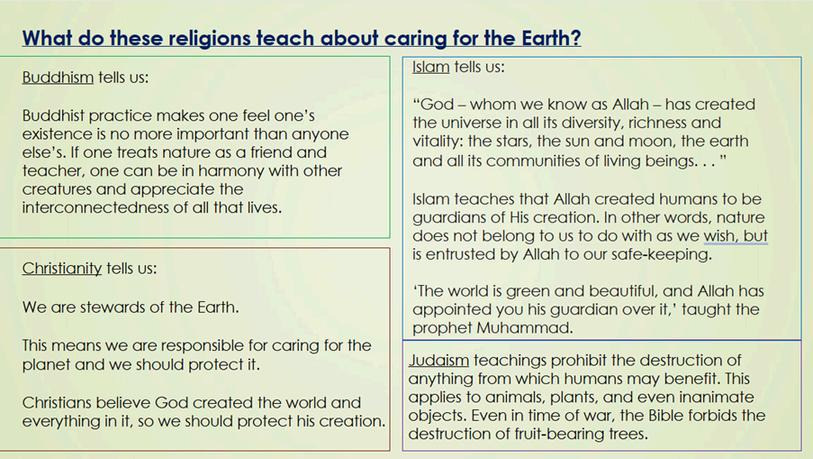
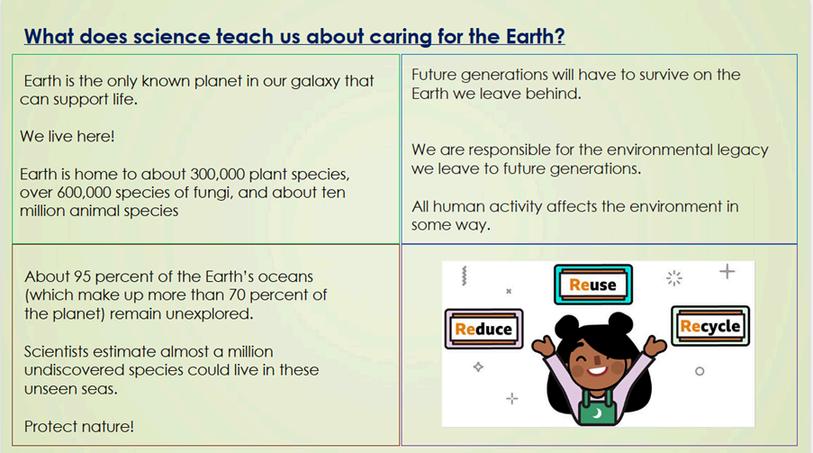
The idea of a big question (specifically there being more than one answer to a question) was a new idea for some pupils, leading us to the conclusion, that the role of Big Questions in Key Stage 2 is perhaps to introduce the idea of a Big Question having more than one possible answer and that this is permissible One challenge we found was the openness of the session and the lack of an overt outcome; pupils had the freedom to find their own response, or not At times we felt like we were sowing the seeds for more sophisticated discussion/s in the future During our second cycle we also tagged our Big Question onto a related Science unit, enabling pupils to use more scientific knowledge and bring this to the conversation “Wewantedtousethefactthatinaprimaryclassroomtheclassroom teacherisoftenteachingbothREandSciencelessons,hasaccesstoboth schemesofworkandisthereforeabletoseewhereconnectionscould arise.”
Linking our big questions sessions to science topics led to greater discussion as the pupils had prior knowledge to use
The pupils found it rather alien to have lessons with no desired outcome so this concept needed to be explained before the question was introduced
Knowing the pupils was vital to enable them to open-up and share their views
Each Trust school had a different approach to teaching Science and RE so we found one curriculum plan would not fit them all. Each school needed to decide how to implement the concept of Big Questions, but with our guidance.
The selected questions needed to be age appropriate
We found there were some units of RE which would fit well with some of the big questions in the future.
Thinkingaboutthe EEFImplementation Considerations
We spent quite a large amount of time in the ‘prepare’ stage of this project and also in the ‘deliver’ stage
Based on our findings we then chose to repeat the two stages to take our learning one step further We are not yet in the ‘sustain’ phase as we are deciding how best to move forwards to ensure practice in this area is manageable, impactful and useful in each of our schools. We feel this will take time to do well
For us, implementation included:
Trialling ideas for delivering ‘big questions’ sessions in a primary classroom
Testing ideas, which had to be adapted significantly before sharing across the trust
Selecting appropriate disciplinary knowledge, which presented a particular challenge, requiring us to decide whether our focus should be on developing subject knowledge or on engaging with big questions
Identifying practical steps to help rollout across Trust, e.g. linking big question to relevant science unit
Adapting session to incorporate greater scaffolding
Essentially, our intention was to develop something we felt we could roll out to other staff confidently in the future, to be able to share with them both the realities and challenges of what this could look like in the classroom.
Deeperdialogues
A conversation was held between two teachers about their differing experiences of delivering the Big Question sessions Both teachers described the challenges and successes
These different experiences then lead to changing the action plan and deciding on new next steps to the previously planned ones This then sent us down a slightly different route and we ended in a different place to what we had expected, but in a more confident place due to the extra evidence acquired and the extended feedback process
Sustainingthisworkinthe future
Initially, we would like to use this approach in other Key Stage 2 classes across our schools, linking it to a science unit. We would then like to develop a PowerPoint to introduce it more widely across the trust, and evaluate its impact
We are interested in linking a science unit with a big question to RE Perhaps we could use the Spirituality driver or training space for this?
We are aware that staff need to recognise the skills involved in this type of approach, and we all need to consider how these skills develop across Key Stage 2, from Years 3 to 6 For example, pupils in Years 3 and 4 may be able to categorise predetermined answers, whereas pupils in Years 5 and 6 should be able to generate their own answers or lines of enquiry