
BigQuestions inClassrooms


ProjectReport:BlueCoatChurchofEngland Academy

Inspiringaweandwonderin childrenusingmetacognitive strategiesinbothREand science.
Participatingstaff
Chloe Gordon
Anna Baskerville
Diane Tuft
Alice Homer

Tellingthe storyofour project
“Beforethisproject began,conversations betweenleadersin departmentswere isolated,howeverricher conversationsandcrossdepartment collaborationarenow occurringmore frequently,whichisvery exciting!”
Our aim for the BQIC project was to inspire awe and wonder in our pupils, by encouraging them to think deeper and broaden their minds. We planned to do this by linking language and metacognition and enriching co-operation between subjects. We achieved this by making connections between the RE curriculum and the science curriculum, through asking big questions each lesson but also by considering how the questions were framed and using shared language across the two subjects
We planned to reinforce pupils’ disciplinary knowledge through making connections between RE concepts and science concepts more explicit. Metacognitive strategies such as ‘stop and jot’ and ‘turn and talk’ tasks enabled this across both subjects.
We hoped to achieve an open culture in all classrooms, where students understood that they were free to express their own beliefs and that they were free to change their opinions, but there was no obligation to do so. We tried to achieve this by embedding a ‘big question ’ into the start of all lessons, giving opportunities to revisit and reflect on the big question throughout the lesson.
Thinkingaboutconnecting waysofknowinginREand Science
Research shows that a high-quality curriculum embeds disciplinary knowledge within substantive knowledge We achieved this through carefully audited schemes of work that identify cross-over areas between subjects, and considering timeframes for topics to be taught, which enabled teachers to make cross-curricular references during lessons, which made sense for the pupils
We built teachers’ subject knowledge by having an open dialogue between departments with shared resources. We made thematic connections around big questions and real-world issues, connecting science topics like evolution, cloning and adaptation to RE themes like creation story and world view, so pupils could transfer and integrate knowledge across subjects.
Both subject curriculums are designed to emphasize progression, sequence and revisiting of concepts, enabling knowledge to become more embedded as regularly revisited
Thinkingaboutthe EEFImplementation Considerations
This project engaged all staff in both RE and science departments, but also senior leaders who united in deciding a focus of metacognition for our project.
All staff involved monitored and adapted ideas and resources along the way, to improve implementation We considered what we were implementing and developed systems to allow us to implement it, like meetings with the school’s Diocesan Advisor
We adopted a set of implementation strategies that have been prepared and delivered in lessons, which we hope to sustain moving forward
“Thisprojectengagedallstaff inbothREandscience departments,butalsosenior leaderswhounitedindecidinga focusofmetacognitionforour project.”

Deeperdialogues
At the start of the project, a conversation occurred between one of the project leaders and a member of the science department, where the staff member identified their concerns with the project occurring, as science and RE are different subjects.
During the conversation, the project leader identified the cross over areas between the subjects, and the project leader and member of the science department concluded that although some topics are taught by both subjects, students struggle to retrieve and understand the difference between subject-specific vocabulary. Through this conversation, the reluctant staff member identified that through collaboration, we could improve the student’s disciplinary knowledge
Sustainingthisworkinthe future
To build our project even further, we need to identify differences between understandings according to age of students, gender and religious beliefs. Contextual factors seem to be a central area that needs further exploration, allowing us to understand pupils’ personal knowledge and worldview even further.
We need to continue embedding our metacognitive strategies across all lessons in both departments and then expand to other departments where links could be made, e g geography Now that we have trialled these strategies, we would like to carry out student voice surveys to analyse the effectiveness of the strategies used
Keyoutcomes
Enhancedcrosscurricularcollaboration betweenREand Science.
Improved metacognitive strategiesembedded inlessons.
Strongerdisciplinary knowledgethrough thematic connections. 01 02 03

Resourcesandoutcomes
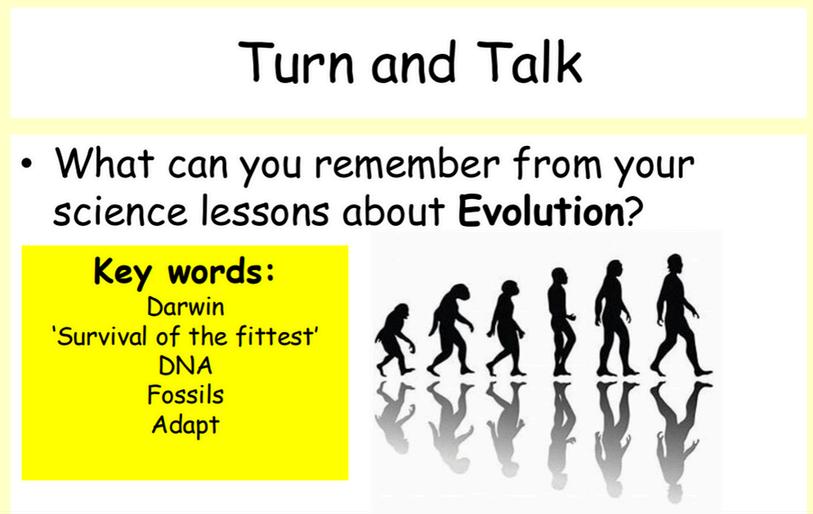
1: Example of slide linking RE lessons to prior scientific knowledge
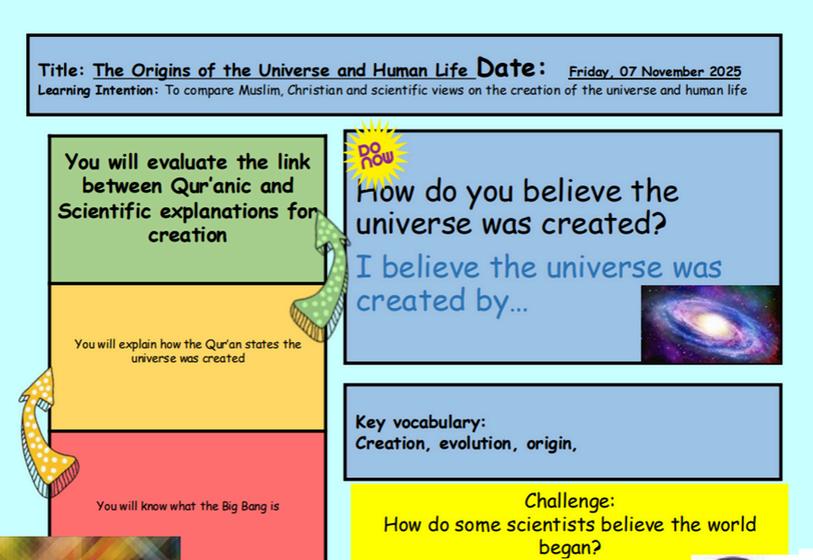
Figure
Figure 2: Example of lesson linking science and Religious Education
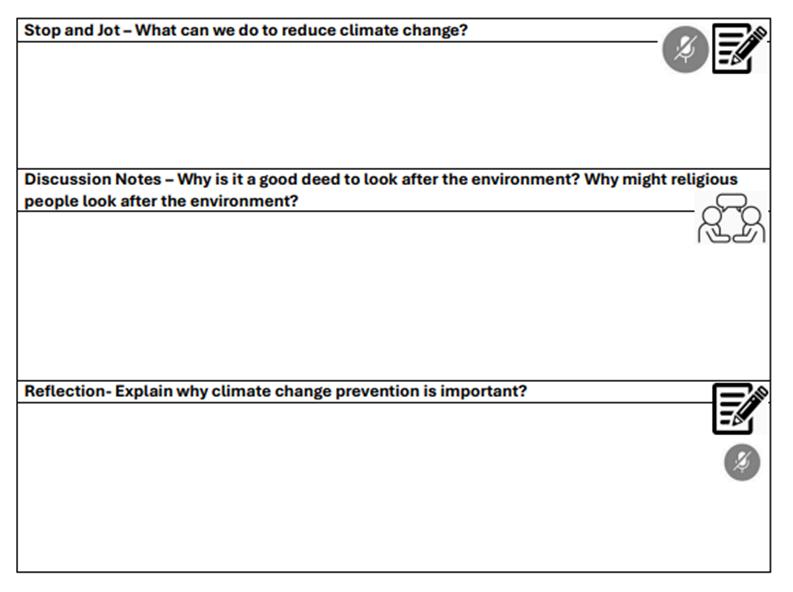
Figure 3: Example of metacognition ‘stop and jot’ sheet