

Delaware County Bar Association 2026 Officers
President
Matthew J. Bilker, Esquire
President Elect
Hon. Jennifer M. DiPillo
Vice President
Michael H. Hill, Esquire
Treasurer Amy D. Cappelli, Esquire
Recording Secretary Gregory Hurchalla, Esquire
Corresponding Secretary
Vasiliki Gouliaberis, Esquire
Past Presidents
Michael J. Davey, Esquire
Rachael L. Kemmey, Esquire
Young Lawyers Section President Lindsay Ettl, Esquire
Directors
Christopher M. Brown, Esquire
Hon. John P. Capuzzi, Sr. Hon. Gabriella H. Coleman
Katayoun M. Copeland, Esquire
Andrew J. Edelberg, Esquire
Jennifer L. Galante, Esquire
Mark P. Much, Esquire
Michael V. Puppio, Jr., Esquire
Vincent A. Rongione, Esquire
Kristen M. Russhing, Esquire
Kenneth R. Schuster, Esquire
Tyler J. Therriault, Esquire
Staff
Executive Director
Rachel Prince
Deputy Director and CLE Coordinator
Nancy Ravert Ward
Legal Journal
Jacqueline Csop
Accounting
Debby Sulek
Communications & Events Specialist
Nicole D’Alonzo
Delaware County Bar Association 335 West Front Street, Media, PA 19063 (p) 610-566-6625 (f) 610-566-7952 www.delcobar.org
The opinions expressed in this material are for general information only and are not intended to provide specific legal or other advice or recommendations for any individuals. The placement of paid advertising does not imply endorsement by the Delaware County Bar Association.
© 2026 All rights reserved, No portion of this publication may be reproduced electronically or in print without the expressed written consent of the publisher.
If you would like to provide editorial content for future issues of en banc please forward your story ideas to Nicole D’Alonzo, Communications Specialist & Editor – nicole@delcobar.com Article content consideration will be given to DCBA members, sponsors and partners first, but we welcome content suggestions from the Delaware County community as well. All content placement is solely at the discretion of the Association.

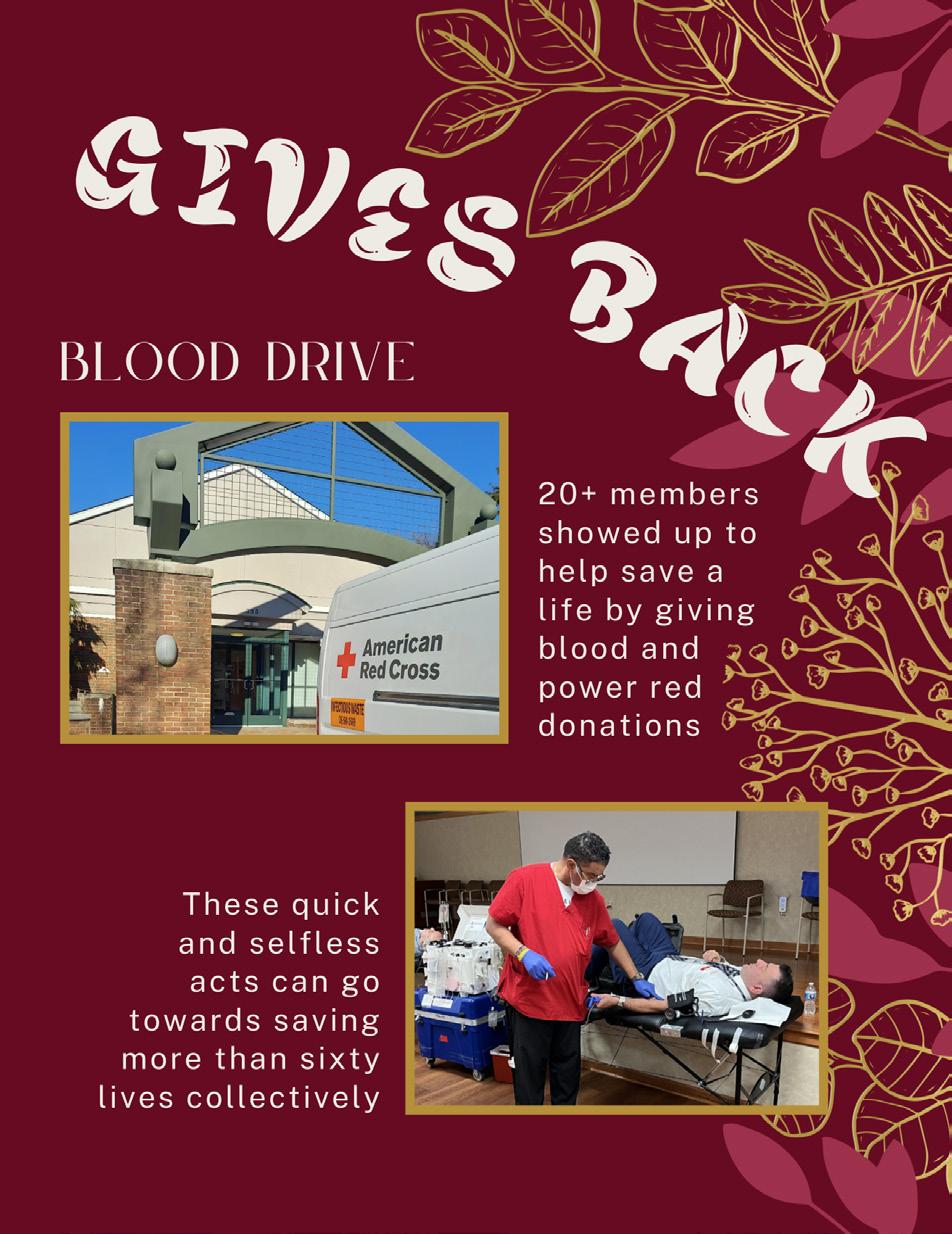
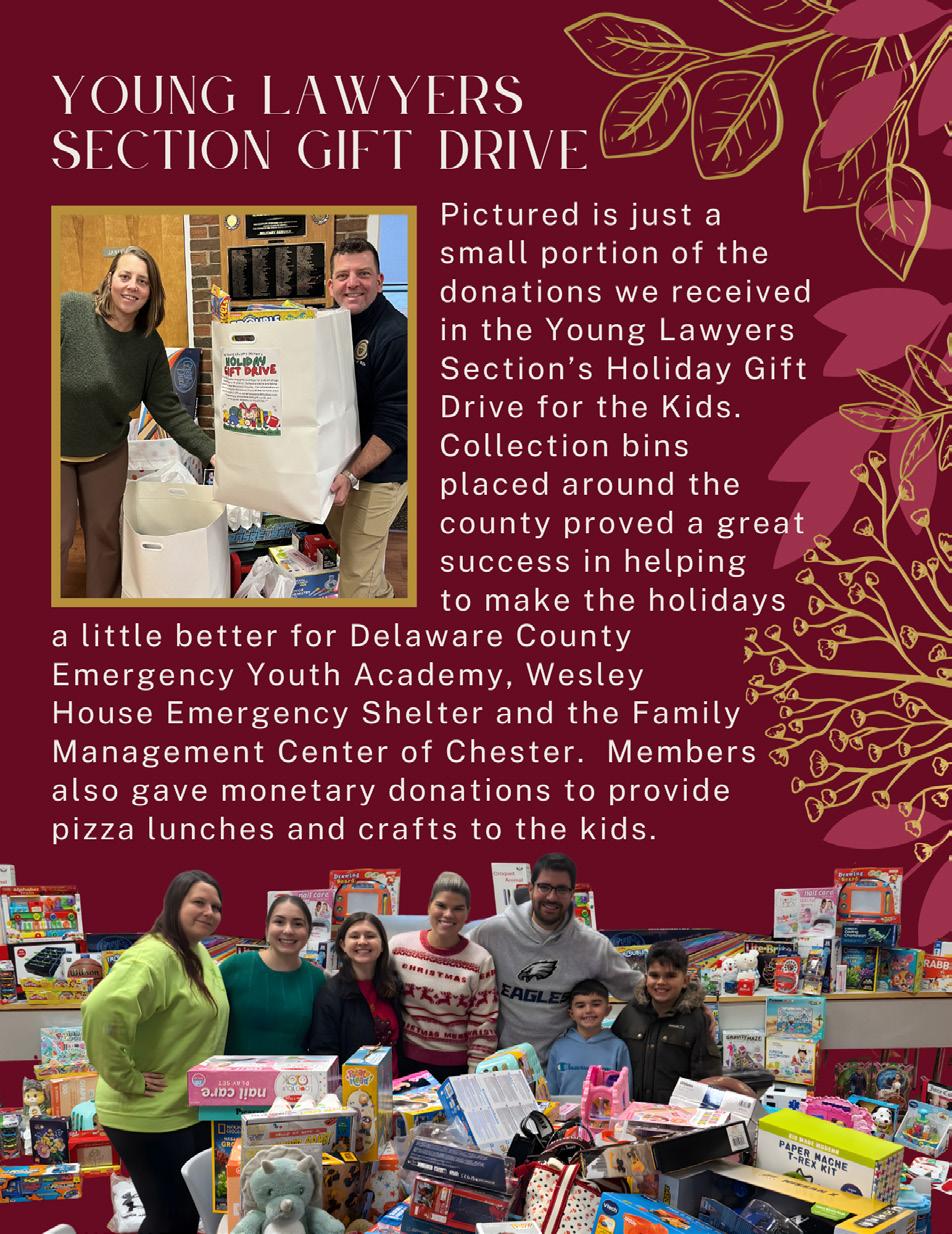
A Bar Association is often seen as a place where attorneys gather to discuss legal matters, pursue continuing education, and network. While all of that is true, our reach extends far beyond our membership—because who would we be without the people of Delaware County?
Throughout the year, we host a variety of fundraising events, with proceeds benefiting other non-profit organizations and individuals in need. Turn to pages 8-9 for a look at just a few of the ways the DCBA has given back to the community in recent months.
As we dive headfirst into 2026, we plan to expand our community engagement by making some events more public and introducing new ones—such as our Community Yard Sale—which we hope will draw in local residents who may not yet know what the Bar Association is, the space we have available, or the services we provide.
Take a peek at Upcoming Events at right to see what else we have planned.
I encourage every member to participate in at least one event this year. Whether you're new to the Bar or a longtime member, there’s truly something for everyone—and those shared experiences help build a stronger and more connected legal community.
We also welcome your ideas for CLE topics in 2026, as well as suggestions for events you believe would be valuable or successful.
As always, to contribute articles, propose interviews, suggest topics, or submit column ideas for consideration, please send your submissions to me at nicole@delcobar.com.
Kindly,
Nicole D’Alonzo Editor, en banc Communications & Events Specialist, Delaware County Bar Association

Every year around this time, I experience a unique rite of passage. While many professionals report to a single CEO, department head, or manager for years at a time, I have the rare privilege (and a touch of anxiety, sort of like switching lanes at rush hour) of welcoming a new “boss” every 12 months. Each president brings their own vision, their own leadership style, and a new partnership that we forge throughout the year. And just when we hit our stride…well, it’s time to turn the page again.
This annual transition is more than a change in title. It’s a heartfelt goodbye to a President who, over the course of hundreds of meetings, calls, late-night emergency texts, jokes, frustrations, dreams, and victories, becomes a true colleague and friend. We spend so much time together that by the end of the year, saying goodbye feels less like shaking hands with a predecessor and more like watching a best friend pack up and move to a new city.
This year, that farewell was especially meaningful. When I think back to even before my very first days as an employee at the DCBA, I think of Michael Davey, who served as Treasurer at the time and was deeply involved in my hiring process. He was one of the first people to believe in me and the many big ideas I had for the Delaware County Bar Association. Fast-forward three years, and we’ve gone from interviews and
onboarding, to navigating an entire presidential year side by side.
Working with Mike this past year has been a full-circle moment, one built on mutual respect, determination, and a shared commitment to strengthening our Bar. It is surreal to close this chapter after everything we’ve accomplished together. Mike, thank you for your leadership, your guidance, and your trust. The DCBA is better because of the mark you left on it.
Now we look toward a new chapter and a new leader. Our incoming President, Matt Bilker, enters his term with big ideas, fresh vibrant enthusiasm, and a genuine dedication to our members. With America’s 250th anniversary during his tenure, I know this will be an exciting year filled with commemorative events, meaningful conversations, and a few new initiatives we’ll be unveiling throughout 2026. Matt brings vision and a vigor filled with forward momentum, and I cannot wait to partner with him to bring that energy to our entire membership.
Before going any further, I need to acknowledge the people who rarely stand in the spotlight but make everything at the DCBA possible…our exceptional staff.
Every email you receive, every billing question answered, every CLE you attend, every event you enjoy, the free notary that comes with your membership, every registration processed, every legal journal detail double-checked…a DCBA staff member is behind it. Nothing happens here without their care, their effort, and their commitment.
They work early mornings, late evenings, and everything in between to ensure that our members feel supported, informed, and connected. Their dedication isn’t just professional, it’s personal. They take pride in this Association and in serving each of you. If you see them, please take a moment to express your appreciation. They truly deserve it.
Like many of the local bar associations across Pennsylvania, we are experiencing a decline in membership. As our long-serving members retire, step back, or sadly pass on, we are not seeing enough younger members joining to fill the gaps. This is more than a statistic; it’s a crossroads moment for the future of the DCBA.
If you are a firm with young attorneys, please bring them with you to the Bar. Show them what community looks like outside of the courtroom and billable hours. Introduce them to your contemporaries who may very well become mentors, future colleagues, and friends.
And if your young lawyers aren’t interested in joining, please ask them why…and then tell me. Their answers matter. Their needs matter. Their barriers matter…and I want to build a Bar that meets them right where they are while still forging forward with the traditions and legacies built by our seasoned members.
Sincerely,
Rachael L. Kemmey, Esq.
Please pass this message from me on to a young lawyer you may know:
continued on next page >
Have kids and no Sitter?
Same. That doesn’t mean you stay home, it means we create a kids’ corner at an event and bring in a Ms. Rachel look-alike so you can network and feel empowered by and connected to your profession while your little ones are entertained—you deserve that.
Worried you won’t know anyone?
Call me. I’ll be your “designated buddy,” your built-in welcome crew. I’ll meet you at the door, walk in with you, and stay by your side until you feel comfortable and connected.
Does having access to the gym at the DCBA with updated equipment, where you can squeeze in a 7 a.m. endorphin boost before heading to the office, speak to you?
Tell me. I take all suggestions to heart, and while I may not be able to make each one come to fruition, I will work hard to find a comparable alternative if one exists. That is my commitment to you.
The future of this Association depends on listening to, empowering, and uplifting our next generation of lawyers. I intend to do exactly that.
As I enter my fourth year as your Executive Director, I feel more committed than ever to honoring where we’ve been,
embracing where we’re going, and making sure every member, new, seasoned, returning, or future, feels at home here. Leadership may change each year, but the Delaware County Bar Association’s purpose, mission, and the community we are committed to remain strong because of people like you.
Here’s to a new chapter, a new President, and a year filled with impact, connection, and momentum. The baton keeps moving, and each of us plays a part in carrying it forward.
In the words of Lynyrd Skynyrd, a reminder that fits this moment perfectly:
“If you want to play in Texas, you gotta have a fiddle in the band.”
Just kidding.
“If I leave here tomorrow, would you still remember me?”
—Lynyrd Skynyrd, “Free Bird”
A fitting reminder that while roles change and chapters end, the relationships and the legacy we build together remain long after the year is over.

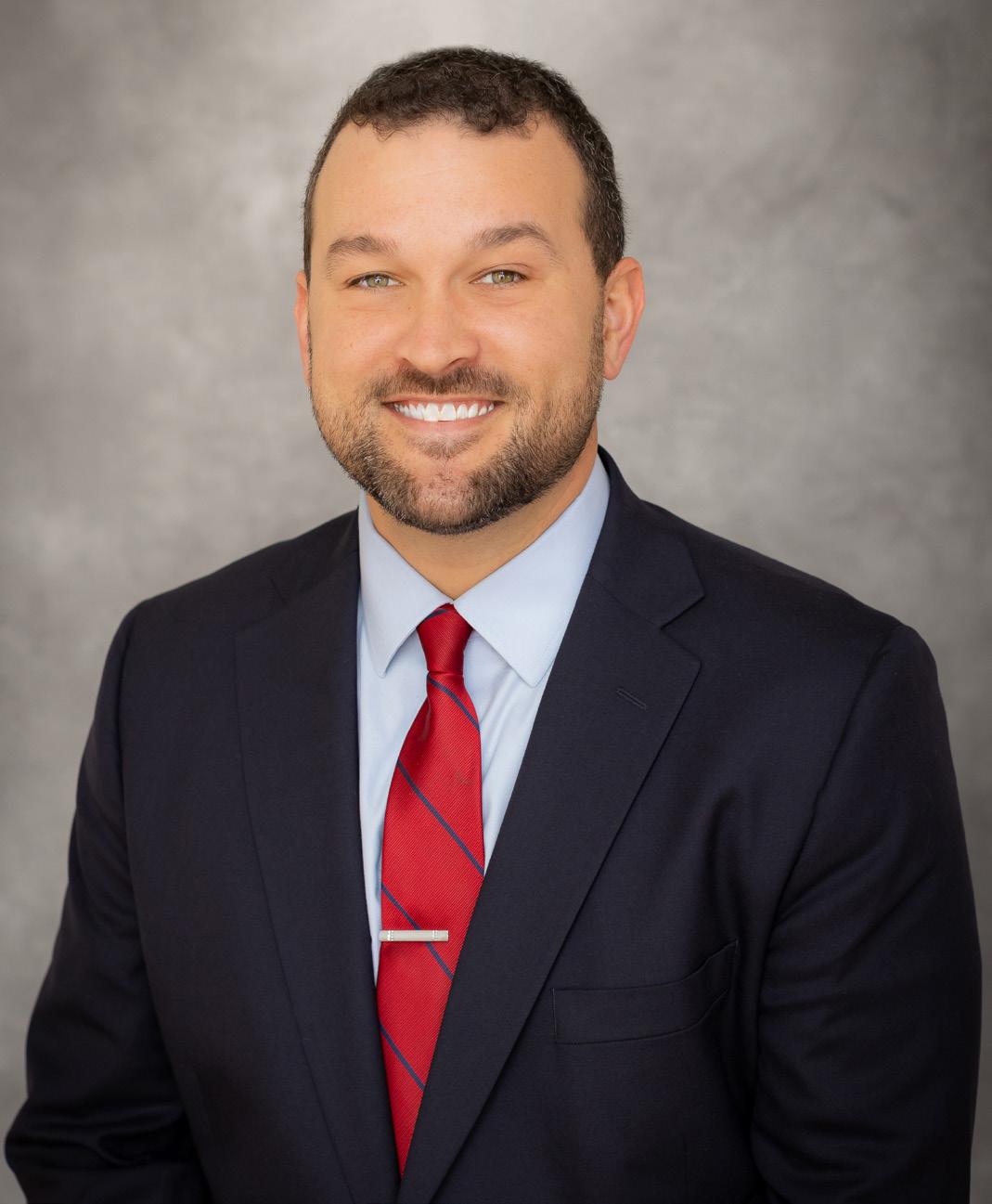
Members of the Delaware County Bar Association, colleagues, and friends:
It is an honor to have been chosen by our members as the 90th President of the Delaware County Bar Association. I am deeply grateful for the confidence you have shown in me and for the leadership precedents set by those who came before— lawyers who strengthened our Association, elevated our profession, and reaffirmed our shared commitment to the rule of law in Delaware County.
As I think about how I can contribute to the lasting success of the DCBA, it is clear to me, at the outset, that our Bar Association is strongest when our members are engaged, connected, and supported.
Engagement is easily preached but can be difficult to practice. This is a community of advocates, counselors, and public servants—all of whom are required to balance demanding professional obligations with responsibilities to our families, colleagues, and communities. But when we come together through this Association, we find not just resources that make us better practitioners, but also connectivity that helps to fulfill us.
For this reason, it will be the chief objective of the Delaware County Bar Association to increase member engagement and participation over the next year.
Engagement should be so much more than just passive attendance—it should be meaningful involvement. And the DCBA can assist with that. We can diversify the educational programming that we will offer at the DCBA along with including more lawyers to offer it. We can expand on CLE offerings through practice-area roundtables and skills workshops. We can continue offering our traditional, annual events in ways that feel more special and less routine or habitual.
To the members of our Association who are looking to become more active—good habits are difficult to break. Make it a point to review the annual events schedule and note on your own calendar the CLEs and social events that you would be interested in attending. Join one of our sections or committees that fits with your practice area and jump into the work those members are doing. Set aside time on certain Friday afternoons to attend memorial services for those lawyers who have left us and who are being recognized for their services to the DCBA.
The strength of the DCBA lies in the relationships we build, and I want to ensure that every member—regardless of practice area, experience level, or schedule—has a path to contribute and connect.
To that end—if you have an idea, a concern, or a vision— share it. If you are willing to get involved—do so. The success of the Delaware County Bar Association has always come from the commitment of its members.
I am really looking forward to the next year. I am grateful for the opportunity to serve the members of this Association. If there is something I can do to help any of you—please reach out—and if I can help, I will. I am committed to ensuring that our Association continues to be a place where lawyers support one another, serve the public, uphold the highest standards of our profession, and find a sense of belonging.
Thank you for the privilege of serving as your President. I look forward to working with all of you—and to a year marked by engagement, collaboration, and renewed purpose.
Matt Bilker, Esquire

• MLM has returned a dividend to policyholders annually since 1988, over $83 million total
• First dollar defense- a loss only deductible can produce a substantial savings for firms facing nuisance type claims
• Full prior acts coverage
• Offers an array of services to mitigate risks including three free CLEs for policyholders each policy year, $165 value
and the
James C. Schwartzman, Esq.
• Judge, Court of Judicial Discipline
• Former Chairman, Judicial Conduct Board of Pennsylvania
• Former Chairman, Disciplinary Board of the Supreme Court of Pennsylvania
• Former Chairman, Continuing Legal Education Board of the Supreme Court of Pennsylvania
• Former Chairman, Supreme Court of Pennsylvania Interest on Lawyers Trust Account Board
• Former Federal Prosecutor
• Selected by his peers as one of the top 100 Super Lawyers in PA and the top 100 Super Lawyers in Philadelphia
• Named by his peers as Best Lawyers in America 2022 and 2015 Philadelphia “Lawyer of the Year” Ethics and Professional Responsibility Law and Legal Malpractice Law
1500 Market Street, East Tower, Suite 1800 • Philadelphia, PA 19102 (215) 751-2863
Get a fast quote today!
Kiernan Waters, Esq. 443-293-6038
kwaters@mlmins.com www.mlmins.com
By Stan Popovich

It can be frustrating for any lawyer to struggle with their mental health and to get their family, friends, and their clients to understand where they are coming from. Although most people may be understanding, there are usually one or two people who will make things more challenging for you.
As a result, here are seven suggestions that a lawyer can do to discuss their mental health issues with their family, friends, and their coworkers in the legal profession.
1. Listen to the professionals: Your friends may mean well, but when it comes down to it, the professionals are aware of your circumstances more than anyone. It is important that you listen and follow the advice from your doctor or medical professional rather than following the advice of your friends and other people you may know.
2. Don’t argue with others: It is important that you do not get into arguments with those who are giving you a tough time. It is not your job to worry about how others may view your circumstances. Focus on managing your mental health and legal career rather than trying to get everyone’s approval.
3. Choose your friends wisely: Distance yourself from those who won’t make an effort to help understand what you are going through. You need to surround yourself with positive and supportive people. If you have problems or issues with a particular person, then it’s best to keep your distance and hang out with those people who are more supportive.
4.Be careful on who you talk to: Do not discuss your personal struggles with your clients. If anyone asks
you any questions, just say that you’re dealing with a lot of stress and anxiety. Many of your clients will be able to relate and not ask you a million questions. Also be careful on what you say to your supervisors and partners.
5. Attend a mental health support group: There are many mental health awareness support groups in any given area. Many hospitals, churches, and counselors in your area will be able to provide you with a list of these organizations. These groups will be aware of your situation and can give you additional advice regarding your concerns.
6. You are not alone: There are many lawyers who struggle with their fears, anxieties, and depression. Many of your coworkers and clients more than likely struggled with anxiety and stress sometime in their life. Do not feel that you are alone when it comes to your mental health situation, because there all kinds of people around you who can relate to your problems.
7. Your goal is to get better: Focus on how you can handle the anxieties and stresses in your life rather than arguing with others who are giving you a difficult time. This isn’t a public relations event where you need to get approval from everyone. This is your life, and you need to be more concerned about getting your life and legal career back on track rather than pleasing everyone else.
Stan is the author of A Layman's Guide to Managing Fear which covers a variety of techniques that can drastically improve your mental health. For more information, please visit Stan's website at http://www.managingfear.com.
By Matt Holliday
Greetings, to all my attorney friends in Delaware County. For those who don’t know me, my name is Matt Holliday and I have the pleasure of being the Executive Director of the Pennsylvania Bar Association (PBA). In that role, I’m often fortunate enough to be able to collaborate with county bar officers and Executive Directors, in different programs that benefit our mutual members and the public at large.
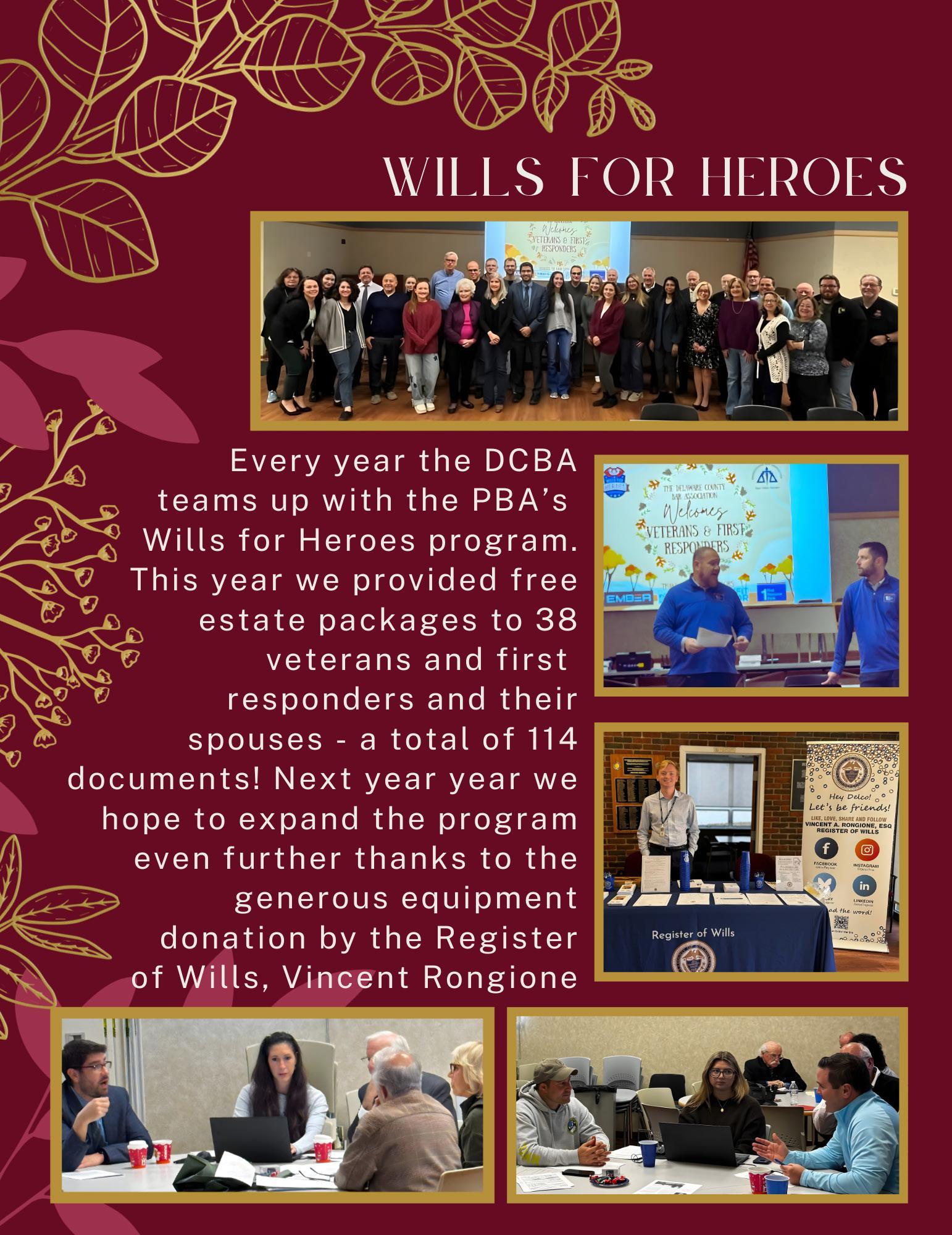
One of these great programs is the Pennsylvania Bar Association’s Wills for Heroes events that are put on all around the state. These clinics provide free estate planning documents to veterans, first responders, and their families.
I’m proud to say that since the program began in our state over 26,000 people have been given these vital documents free of charge thanks to the PBA, our county bar partners, and attorneys like you.
I’m even prouder to say that Delaware County has come through for their veteran and first responder community in a big way. Your Register of Wills, Vince Rongione, included in his budget this year, funding for 12 new computers and printers dedicated solely for the use of the Wills for Heroes
program in Delaware County. We are so grateful for his and the Delaware County government’s commitment to this wonderful program.
While the PBA is always happy to lug our equipment around the state and bring it from county to county, having new and dedicated equipment permanently housed in your own county will make it so much easier to host even more Wills for Heroes clinics throughout the year in Delco.
I’m also happy to announce that the PBA has invested $25,000 in having new Wills for Heroes software developed that will make the volunteer attorneys’ job at these clinics much easier and more efficient. As soon as the developer has delivered the finished product, we will make it available to our friends in Delaware County for your use.

It is my hope that the continued collaboration between our great organizations will ensure that all the veterans and first responders in Delaware County will feel appreciated and valued by the legal community for the sacrifices they have made.
I look forward to seeing many of you at your upcoming President’s Dinner in January. Having spent most of my childhood in Delaware County it is always nice to come home.
Thank you for all you do for the Delaware County Bar, the Pennsylvania Bar, and the people of our Commonwealth.
We are excited to welcome two new judges to the bench this year. Take a moment to learn a little more about them in this issue’s edition of Initial Consult.
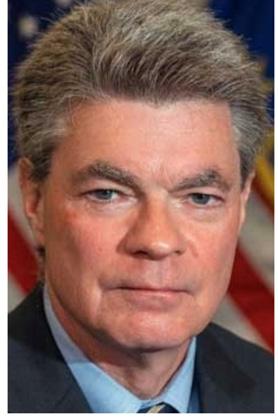
Delaware County Court of Common Pleas
Began Practicing Law: 2000
Previous Practice: Criminal prosecutor in state and federal courts
Area(s) of Law: Family & Criminal law

What is your favorite hobby outside of work?

Delaware County Court of Common Pleas
Began Practicing Law: 1986
Previous Practice: Early in my career, I practiced bankruptcy and insurance defense law. Starting in 1993, I focused primarily on consumer law, including consumer fraud claims and warranty litigation. In 1995, I started my own firm focusing on consumer law.
Area(s) of Law: I realize that different divisions of the Court have different needs at different times. I am looking forward to working in the Family Division and perhaps, in the future, the Civil Division.
My favorite hobbies are running for exercise and walking my dogs Toby & Milo.
What is the best piece of advice you’ve ever received?
Be yourself and treat people well.
What is your favorite quote or saying that resonates with you?
“Few of us will have the greatness to bend history itself, but each of us can work to change a small portion of the events. It is from numberless diverse acts of courage and belief that human history is shaped…” —Robert F. Kennedy’s speech on Affirmation Day in South Africa, ironically, the date coincided with that of his death

If you were to pursue a different career path outside of law, what would it be?
An airplane pilot. I have always been fascinated by aviation, aircraft, and airports.
What is your favorite hobby outside of work?
I love watching movies, particularly old movies. The Criterion Channel is a great source for movies. I also like puttering around my yard and gardens.
What is the best piece of advice you’ve ever received?
“Talk less and listen more.”
two years later in 1968 and known as the “Ripple of Hope” speech.
What has been your most rewarding professional experience so far?
Serving as Delaware County District Attorney.
What is one book or movie that has greatly influenced your life and why?
When I was a 17-year-old student at Ridley High School, I read Robert Kennedy And His Times, by Arthur M. Schlesinger, Jr., and it inspired me to pursue a life in public service in order to offer hope and justice to everyone in our society, not just the powerful.
What is one book or movie that has greatly influenced your life and why?
Demon Copperhead, by Barbara Kingsolver. This book packs a lot of themes, including how public policy decisions, both long-term and short-term, can have profound unintended influences on society and individuals. Reading how the protagonist ultimately copes with his universe of hardships and begins a new, more promising path forward, is refreshing.
What’s the most adventurous thing you’ve ever done?
A 12-day backpacking trip with my youngest son and his Boy Scout troop in the Rocky Mountains. I still wonder how I made it.
By Marion Hoffman Fraley, Communications Director, Legal Aid of Southeastern PA
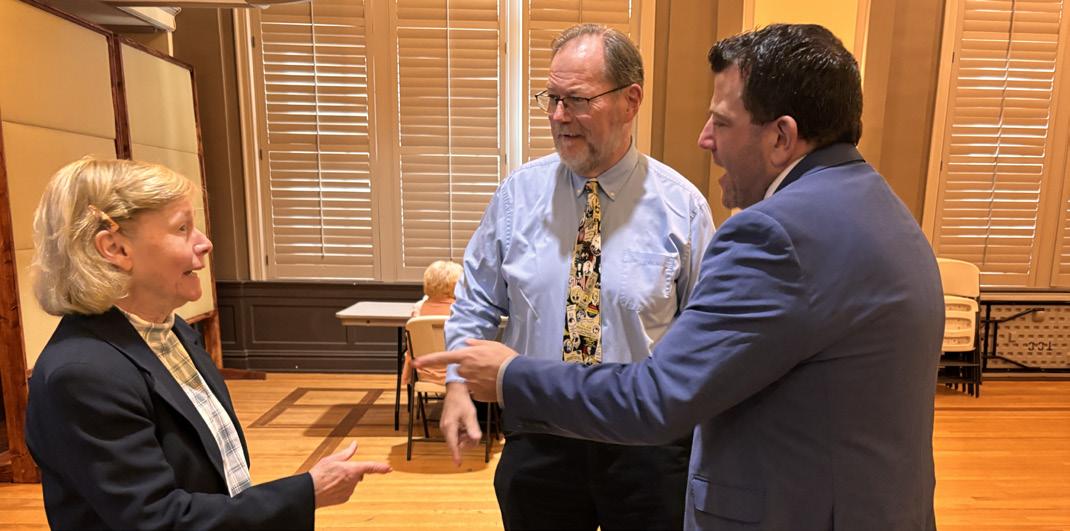
Multiple partners combined forces to help older adults in Delaware County as part of Pro Bono Month. Legal Aid of Southeastern PA (LASP) teamed up with State Sen. Tim Kearney; State Rep. Gina H. Curry; the Pennsylvania Bar Association’s Real Property, Probate and Trust Law (RPPT) Section; and Delaware County Register of Wills Vincent A. Rongione, Esq., to present a Senior Estate Planning Clinic on Oct. 16, 2025.
The clinic helped six low-income clients, who met with a pro bono attorney and received a will, living will, and a power of attorney. Eight additional people received information or referrals to start the process with LASP or elsewhere, for a total of 14 people helped at the clinic.
Sen. Tim Kearney wrote in a Facebook post, “From simple wills to healthcare directives, our partners made sure every attendee left feeling informed and empowered about their future.”
The clinic was held at the 20th Century Club in Lansdowne. Volunteers included one paralegal student, seven law students, seven attorneys, and one notary.
Notary volunteer: Christine Flynn.
Pro bono attorneys: Dana Breslin, Michael Frisbee, Daniel Hicks, Rich Packel, David Keller Trevaskis, Emily Vener, and Delores Verdeur.
Law student volunteers: Makayla Roccia, Widener University Delaware Law School; Ruoyun Dai, University of Pennsylvania Carey Law School; Anni Greene, Penn Law; Arielle Jackson, Villanova University Charles Widger School of Law; John Kim, Penn Law; Sakolpat (Billy) Rujiravanich, Penn Law; and Alexandra Tolhurst, Widener.
Paralegal student volunteer: Mark Rowan, Villanova.
There are multiple pro bono opportunities available in Delaware County. LASP is an accredited provider of CLE credit. To receive CLE credit for pro bono service to LASP, volunteers must volunteer five hours per credit, for up to three credits per annual compliance period. Pro bono attorneys who represent LASP clients are covered by LASP’s malpractice insurance.
Ongoing pro bono opportunities in Delaware County include:
• No fault, no asset divorces
• Simple wills, powers of attorney, healthcare directives for older adults ages 60+
• Debt counseling & bankruptcy
• Custody (limited scope available)
• Expungements
• Other civil legal issues
• Are you a retired attorney? Check out Emeritus Attorney Status.
To learn more, visit lasp.org/pro-bono or contact Cassidy Heiserman, LASP Staff Attorney and Delaware County Pro Bono Coordinator, at cheiserman@lasp.org.
Furtherreading
CLE credit for pro bono service: https://www.pacle.org/providers/pro-bono
Emeritus Attorney Status: https://www.padisciplinaryboard.org/for-attorneys/resources (scroll to Emeritus Attorney)
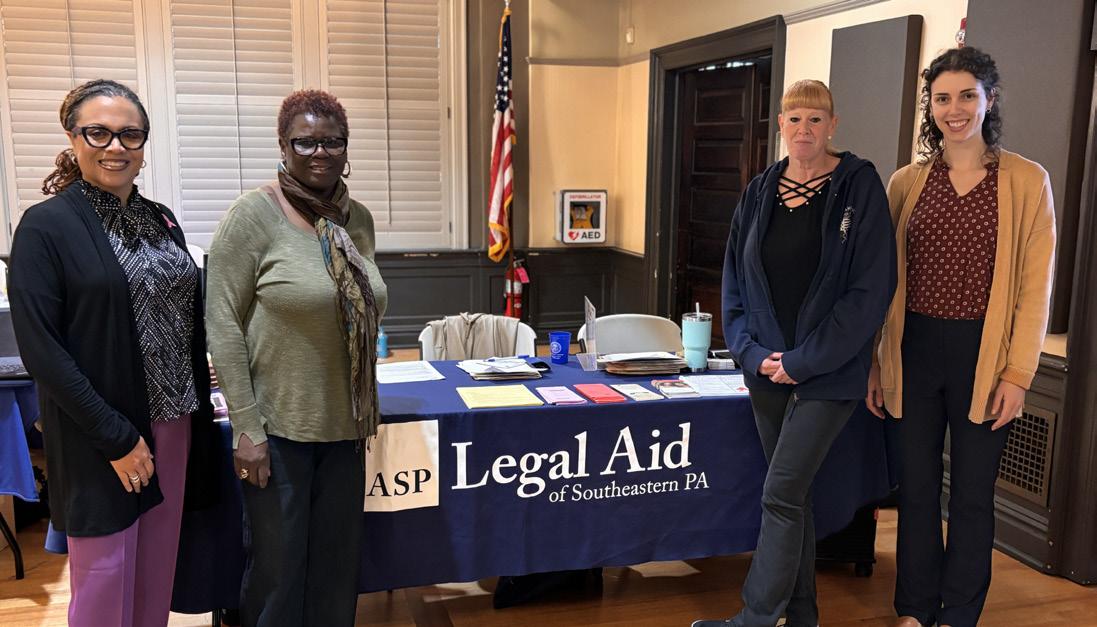
Rep. Gina Curry (at left) with members of Legal Aid of Southeastern PA’s team; Rita Dawson (second from left), LASP Paralegal; Chris Walters, Administrative Assistant; and Cassidy Heiserman, Staff Attorney and Delaware County Pro Bono Coordinator.
By the Honorable John P. Capuzzi
As a fellow member of the bench of Delaware County Courthouse, I had the honor and privilege of working closely with the Honorable Barry C. Dozor. He was not only my colleague, but also my friend.
Barry was genuine and sincere in every sense of the word. He loved the law and took great pride in serving as a judge. He always believed he could make things better—and he often did. He cherished the many relationships that grew from his legal career, and his kindness and relatability reached far beyond the courtroom.
To him, family came first. He was blessed to have Rose as his rock, and he loved talking about his children and grandchildren. Whenever he did, his eyes would light up with pride and joy.
As a commissioner in Marple Township, Barry worked tirelessly to improve the quality of life for all the residents. He was very well respected by the other commissioners, the township, and staff. He also had a unique gift with photo-ops. As president of the commissioners, you are often asked to be at events where pictures are taken. When I was president, Barry was
always ready to be my stand-in.
He had a wonderful sense of humor and a remarkably good nature. He never took offense at a friendly tease, and I can’t recall a time when he ever lost his temper. “Pleasant” and “kind” could have easily been his middle names.
Barry will always be remembered as a pillar of the legal community. As I reflect on my time with him, I feel moved to write one last letter to my friend—to let him know how deeply he was appreciated by his family, his friends, and the people of Delaware County.
Dear Barry:
Your family, Rose, Josh, Ian, Courtney, and your grandchildren, as well as the entire legal community, miss you dearly. We never got a chance to say goodbye or tell you how really special you were. We all grieve your untimely departure, but all of us who knew you are much better for it. You were a beacon of hope and love for so many, and we all hope we can keep that beacon shining brightly in your memory.
I know Rose is heartbroken. You were college sweethearts. You were together for over fifty years. Rose was and always will be the rose of your life here and in heaven.
Speaking of heaven, I am sure you and the good Lord have had many a conversation. You probably told Him about changes you thought should be made or how do to things in a certain way. I am also very sure He said, “Barry! Can I speak now?” We all know that for you, speaking and brevity were never counterparts.
You didn’t have a chance to say goodbye to Sam (Auslander), who cared for you and was one of your biggest supporters. As your partner for so many years, he got to put up with all your quirky idiosyncrasies every day. I know how much you enjoyed any chance to have lunch with Sam, as he was one person who you could rely on to provide a different perspective on the issue at-hand.
I always admired your intellectual side, something most never got to witness up close. The bench books which are the staples in the criminal, civil, and family divisions were your creation. The jury book I use in criminal trials is your masterpiece. Most importantly, you saw to it that these were kept up-to-date.
Opinions. No, not your take on everything under the sun, but your legal opinions. You always spent a great amount of time researching the law, reviewing the transcripts, and looking at the exhibits
before you put pen to paper. Your opinions were always well-written (though sometimes verbose) and set a high legal standard. Very, very rarely did the Uppers ever find fault with your legal analysis. Just as important, you made sure these were published so that the lawyers gained an understanding of the critical elements of the case and your reasoning.
You were also a fine educator. You saw it as your obligation to mentor young lawyers and law students. Every intern or extern that you guided sang your praises. All of them are better attorneys because you took time to share your knowledge.
Your love for the residents of Marple Township is on display as one rides through the town. You were a fantastic proponent of the parks, and Veterans Park is a prime example of the effort you put forth to make this a reality. You also worked diligently to keep the taxes as low as possible, always reminding us that we needed to make Marple affordable for the senior citizens and not force them to have to sell. Also, and not surprisingly, you knew the name of every township employee and all of them appreciated that you would take time to speak with them and get their input.
Lunch in the conference room was always a trip. We discussed everything under the sun, from best TV shows to world problems. We also had a ton of laughs. Given the chance to be emperors, we could have solved all the problems and made peoples’ lives better. Limited to our cafeteria empires, I know we did the best we could.
The Bagel Shop has often been a corner hangout for old judges. How much we loved to congregate at an outside table to kibitz among ourselves and with the passersby. You made sure your seat faced the sidewalk because you didn’t want to miss a thing. This was a time of great camaraderie and a break from the tensions of the day.
I think the only thing you loved almost as much as your family was FOOD. Many of us thought you were the clone of Inquirer columnist and restaurant critic, Craig Lebon, aka “the hungriest, thirstiest, crumb-trackin’ man in Philly”. You never missed a chance to give us spot-on reviews of each of the restaurants where you ate. It was Barry’s weekly guide to fine dining, and some not so fine.
Whether registering for a conference or checking in to a hotel, your first question
was what time is lunch or dinner? On the road trips, there wasn’t a rest stop that you didn’t want to visit.
Driving was never one of your strengths. Riding with you was white knuckle, because when you spoke you had to look at the person, not the roadway. As a result, when we attended the Bench Bar or the judges’ conference, I drove so that we would get there safely. But these trips were also comedy shows for the other passengers. Like the trip to Pittsburgh in a whiteout and you wanted to take pictures when I couldn’t see the road. I’m sorry that I told you where to stick that camera.
Some people equated us with being like Oscar (you) and Felix (me), or Abbott (me) and Costello (you). We had this way about us that could make ourselves and others laugh. We were not a made-up skit, but we were darn funny without even trying to be.
To Beverly, Lisa, Danielle, and Ashley, you were a cross between the absentminded professor and Mr. Rodgers. They were always reminding you of what needed to be done and when. In return, you made sure they were appreciated and happy as part of your neighborhood.
You relished being a Trustee at West Chester University. I always thought it was because food was served, but sadly (for you) that was not to be. Your goal was simply to make WCU the best in the state.
We shared time together at the Broomall Little League. Not that you could hit a baseball, but you did offer encouragement to the players, something that is needed now more than ever. Besides, those high white socks were something to behold.
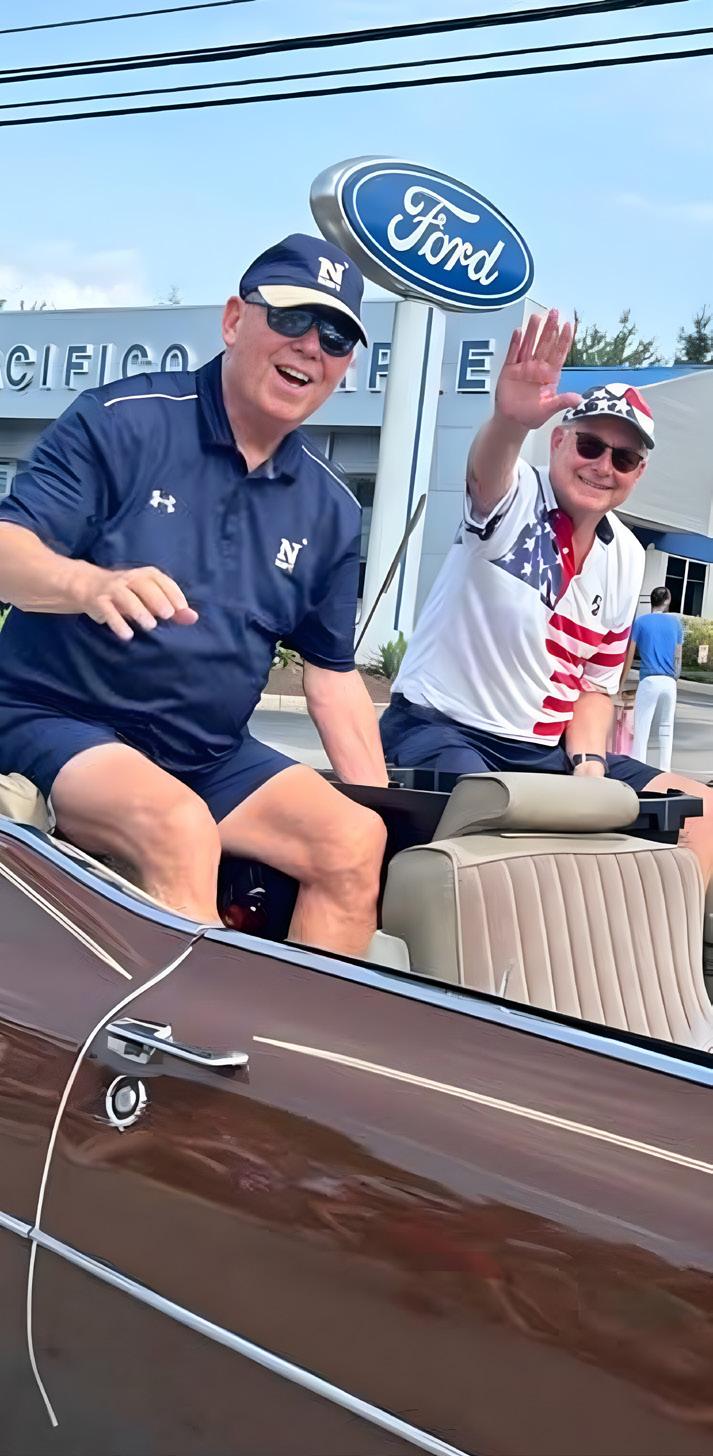
We rode together each year in the Marple Newtown 4th of July parade. It was always a great event and riding with you and throwing out candy to the kids was really a blast. The downside was that I consistently had to remind you to save some of the candy until we got to Marple.
With our chambers being side-by-side, I could tell your walk coming down the hall. I called it the Barry “shuffle.” It was unique, but it was your trademark. Oh, how I miss hearing that sound!
There is so much more I could say, but my tears are clouding my eyes.
Rest well, my dear friend. A life better lived, there could not be.
Very truly yours,
The Honorable John P. Capuzzi
Did you know that the Delaware County Bar Association has 33 AD HOC committees? These committees play a vital role in keeping the Association connected, collaborative, and operating at its highest potential.
Whether you’re eager to network, serve, or help shape the future of the Bar, there’s a committee waiting for you.
To join one of these committees, or to get more information about them, please contact DCBA Deputy Director Nancy Ravert Ward at nancy@delcobar.com.
Accounting and the Law
Alternate Dispute Resolution
Arbitration
Civil Law Committee
Community Outreach
County Government Relations
Criminal Law Committee
Elder Law Committee
Federal Courts Committee
Fee Dispute Resolution
Historical Committee
Immigration Law
Intellectual Property and Technology
Juvenile Law Committee
Labor, Employment and Civil Rights
Law Day
Lawyers Concerned for Lawyers
Legal Journal
Legislative
Magisterial District Judges Committee
Mentoring
Mock Trial Committee
Municipal Law
Orphans’ Court Committee
Past Presidents
Pro Bono and Legal Services to the Poor
Real Estate Practices
Recreation, Activities, and Golf
Semiquincentennial Committee
Solo Practitioners and Small Firms
Unauthorized Practice of Law
Veterans and Military Service Committee
Workers’ Compensation
Written by Colleen M. Neary, Esquire, Chair of the DCBA’s Semiquincentennial Committee, in coordination with Andrea Silva, Director of America250PADelco
A Message to Our Members: Championing Constitutional Heritage Through Historic Collaboration
As we approach America’s Semiquincentennial—the 250th anniversary of the Declaration of Independence—the Delaware County Bar Association (DCBA) is proud to announce our strategic partnership with America250PADelco to commemorate this historic milestone. This collaboration offers DCBA members a unique opportunity to showcase our profession’s dedication to constitutional principles while engaging our community in meaningful civic education.
The DCBA: At the Forefront of Delco’s Constitutional Celebration
The Delaware County Bar Association has long served as the voice of the legal profession in our county, upholding the rule of law and promoting justice. Now, we have the privilege of extending that mission through a special partnership with America250PADelco, the official initiative charged by Delaware County Council with commemorating our nation’s 250th birthday.
Declaration of Independence Readings: The DCBA’s Signature Initiative
The centerpiece of our partnership will be the Declaration of Independence Readings for Delco, scheduled for
Wednesday, July 8, 2026.
As most of you know, on July 4, 1776, the Declaration of Independence was approved by the Delegates to the Second Continental Congress, just up the Pike at the Pennsylvania State House, now known as Independence Hall.
Without access to telephone, telegram, fax, or email, how did “We the People” find out about this cry for independence? Through town criers, of course. On July 8, 1776, the Declaration was read at the county courthouse, which of course, was the 1724 historic courthouse in Chester, the oldest building in continuous public use in the country.
DCBA is coordinating this countywide event, which will take place not only at the historic 1724 courthouse, but across the County.
This initiative invites DCBA members and other community volunteers to read the Declaration at designated sites, with each reading recorded by a videographer. These individual readings will honor our nation’s foundational ideals and serve as a reminder of the courage it took to establish American independence. Following the event, a video montage will be created, showcasing the many voices representing Delco’s diverse community.
If you or your organization is interested in participating in this historic event, please contact Rachel Prince, Executive Director of the DCBA,
at rachel@delcobar.com; or Colleen Neary, Esq., chairman of the DCBA Semiquincentennial committee, at cneary@sweeneynearylaw.com.
The DCBA’s involvement extends beyond the Declaration readings. Our Association is planning a two-week exhibition of historical legal artifacts and films, open to the public. This exhibition will offer visitors a one of a kind look at artifacts from the DCBA archives dating back to our founding in 1872.
Additionally, Law Day on May 1, 2026, will provide another opportunity for our members to engage with the public. This annual celebration will be held on the first Friday of May to honor the rule of law. The event features a public ceremony at the Courthouse in Media, the presentation of awards, recognition of local students for their essay and art contests, and a luncheon hosted by the Bar Association.
Supporting America250PADelco’s Community-Based Approach
The DCBA’s initiatives will complement America250PADelco’s collaborative framework, which connects government, non-profits, businesses, and volunteers in a celebration “created by the people, for the people.” Their mission is to provide experiences that
ignite imaginations, elevate diverse stories, inspire service, and highlight the American founding through Delco’s unique lens. This approach aligns perfectly with our profession’s dedication to inclusive justice and equal protection under the law.
DCBA and DelcoVolunteers: Legal Professionals in Service
Our partnership also connects DCBA members with DelcoVolunteers, America250PADelco’s county-wide call to service that inspires “We the People of Delco” to engage with our history and act in our communities.
As attorneys, we have a proud tradition of pro bono service and community involvement. The DelcoVolunteers initiative offers our members additional structured opportunities to contribute their time and expertise to commemorative projects and events held in Delco in 2026. democracy.
“Volunteerism has been considered a hallmark of American civic life, with roots dating back to the nation’s founding,” notes the DCBA committee. “As legal professionals, we are uniquely positioned to volunteer in ways that educate the public about the constitutional principles that shape our work every day.”
The “We the People Party”: Launching Our Partnership
The DCBA’s partnership with America250PADelco was officially recognized at the “We the People Party” on January 9, 2026. This festive evening served as the kick-off for Delaware County’s Semiquincentennial celebrations, bringing together community leaders, businesses, nonprofit organizations, and residents to build excitement for the year ahead.
DCBA members and the public were encouraged to attend this event, which featured historic-inspired cuisine and entertainment. Learn more about the various initiatives planned throughout the anniversary year by visiting America250PADelco.org.
Supporting the Celebration Through DCBA Member Philanthropy
The DCBA is encouraging all members to make a special gift to the Association in honor of America’s 250th anniversary. All funds raised will cover our year-
long sponsorship recognition with America250PADelco and support free history and civic educational programs for the public in 2026.
This philanthropic component continues our profession’s tradition of service and community support. By contributing to these educational initiatives, you can help ensure that the principles we uphold professionally are understood and appreciated by the broader community.
The partnership between the DCBA and America250PADelco represents more than a series of events—it’s an investment in the civic health of our community and a demonstration of the legal profession’s leadership role in preserving constitutional principles.
Delaware County’s significance in America's founding story makes it an ideal setting for meaningful commemoration. The DCBA’s participation ensures that the legal foundations of our democracy receive appropriate focus during this milestone anniversary.
As we navigate 2026, this partnership reminds us that the documents we cite in our daily practice are not merely historical artifacts, but living principles that continue to guide our nation. Through the Declaration readings, educational exhibitions, and volunteer initiatives, the DCBA will help ensure that the Semiquincentennial celebration leaves a legacy of civic engagement and constitutional understanding in Delaware County.
We invite all DCBA members to participate in this historic partnership. Whether you wish to serve as a Declaration reader, contribute to the historical exhibition, volunteer for educational programs, or support these initiatives through philanthropy, your involvement will strengthen both our association and our community.
For more information on how to participate, contact the DCBA office or visit the Delco250 website at https://www. america250padelco.org. Together, we can ensure that the legal profession plays a leading role in commemorating America’s 250th anniversary in Delaware County.
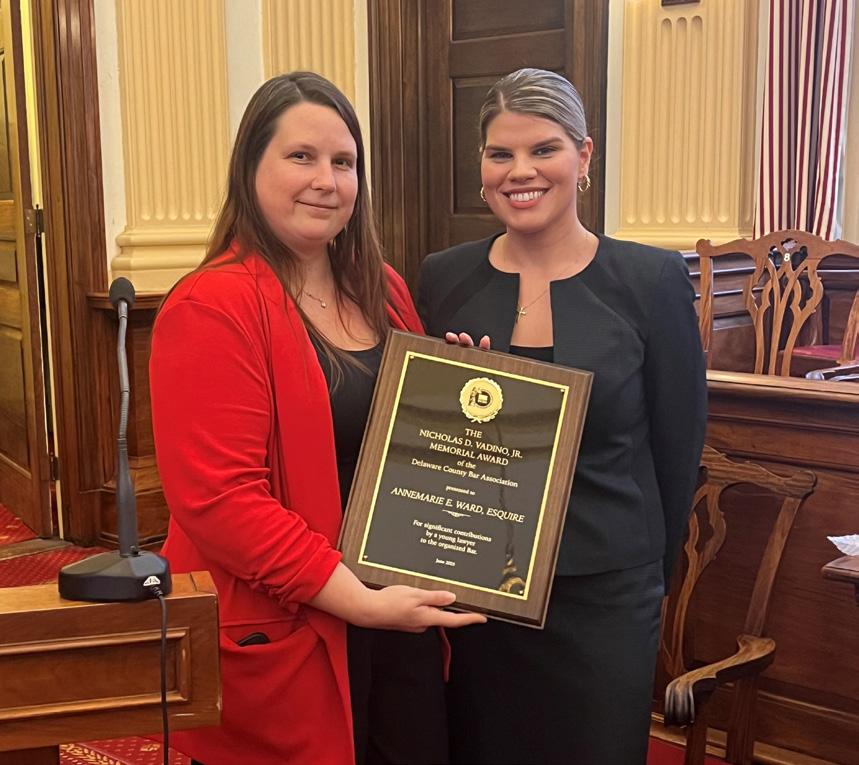
Nicholas D. Vadino, Jr.
significant contributions by
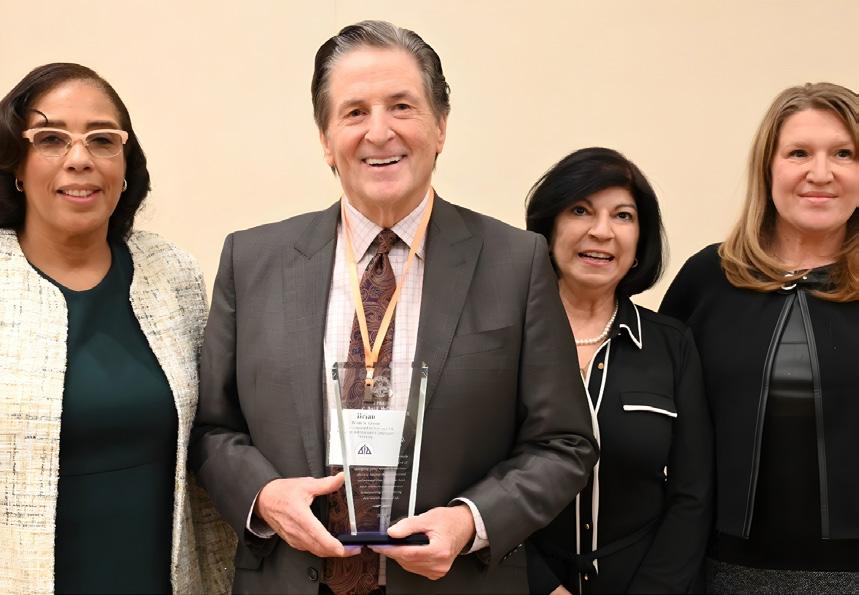
C. Dale McClain Award: Awarded to an individual who has made substantial contributions to the goal of identifying issues relevant to attorneys’ efforts to balance their professional and personal lives, as well as made strides to assist attorneys in maintaining and improving their overall quality of life.
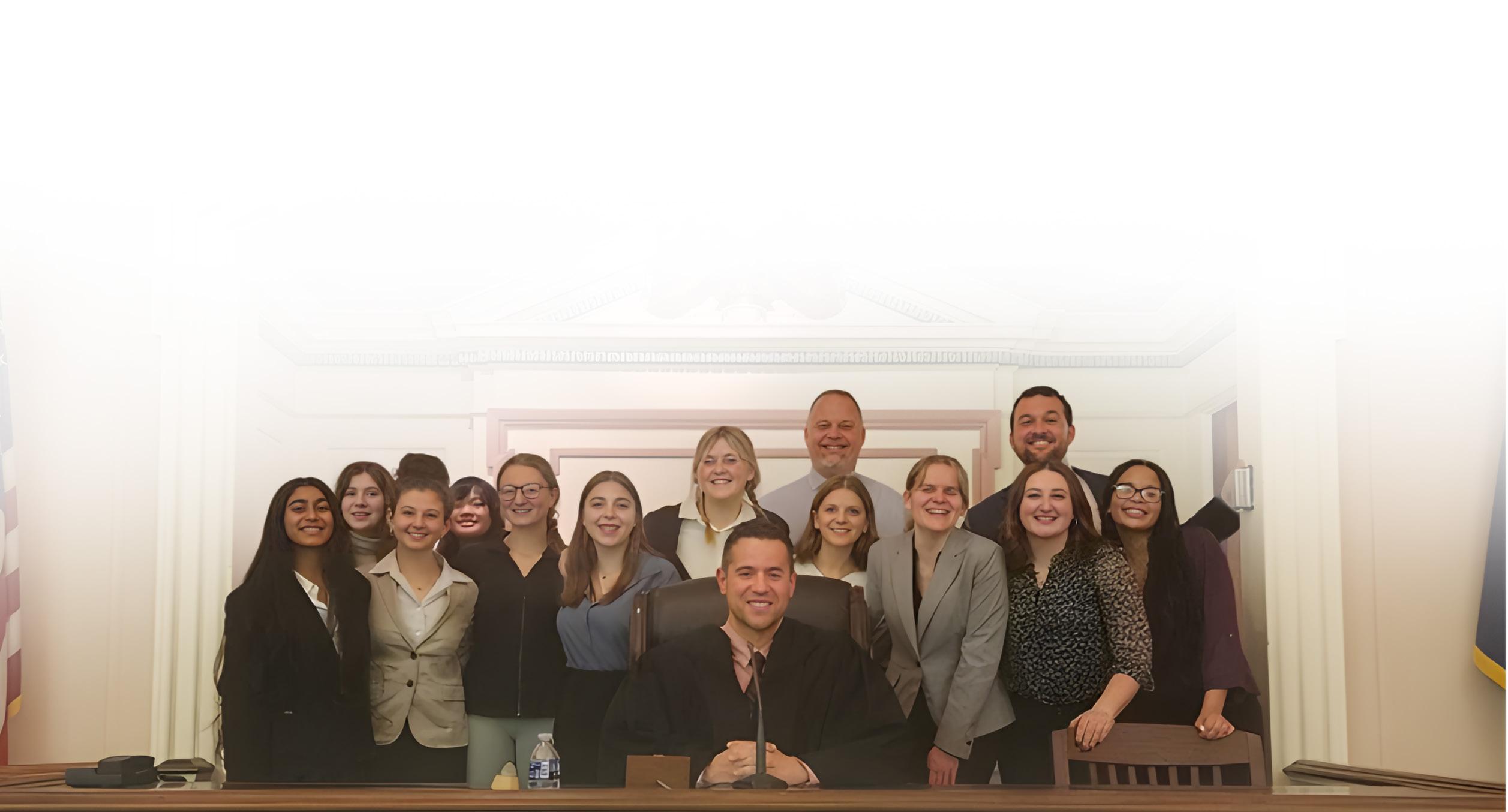
By Annemarie Ward, Esquire, Co-Chair of the DCBA Mock Trial Committee
Each year, the Delaware County Mock Trial Competition brings together bright, motivated high school students for an unforgettable experience—one that blends education, advocacy, and community engagement. Part of a statewide program organized by the Young Lawyers Division of the Pennsylvania Bar Association (PBA), this competition gives students the chance to advance beyond the county level to state championships and, ultimately, the national stage. It’s an opportunity for young advocates to showcase their skills in a setting that mirrors real courtroom practice.
As the coordinator of Delaware County’s Mock Trial program for the past five years, I’ve seen the transformation this experience brings to students. Many arrive unsure of themselves—quiet, hesitant, and unfamiliar with courtroom procedure. By the end of the season, they’re standing tall, thinking critically, and advocating with confidence. I’ve watched students discover their voices, develop resilience, and even decide to pursue careers in law because of the
skills and inspiration they gained here. It’s more than a competition—it’s a catalyst for growth.
Role of Delaware County’s Legal Community
While the program offers a path to state and national recognition, its success begins right here in Delaware County—and that’s where you come in. Local attorneys and judges make this experience possible by volunteering as jurors, presiding judges, and mentors. Your participation ensures students receive authentic feedback and encouragement from professionals who understand the demands of the courtroom.
We are thrilled to announce that Judge Krull will serve as our Judicial Liaison this year, strengthening the connection between the bench and the bar and helping ensure a successful competition.
This year, the Delaware County Bar Association’s Mock Trial Committee is considering an exciting change: hosting all preliminary rounds on a single Saturday. The proposed date—February
21, 2026—would feature two sessions (9:00 a.m.–12:00 p.m. and 1:00 p.m.–4:00 p.m.), streamlining scheduling and making it easier for volunteers to participate. This innovation reflects the Committee’s commitment to accessibility and engagement.
The Mock Trial Competition is more than a contest; it’s a tradition that fosters critical thinking, public speaking, and teamwork. Students prepare months in advance, studying case materials, crafting arguments, and learning courtroom procedure. For many, this is their first exposure to the legal system—a hands-on experience that often sparks a lifelong interest in law. Mock Trial is more than an academic exercise—it’s a confidence builder. Students learn to think on their feet, analyze complex issues, and advocate persuasively. These skills transcend the courtroom, preparing participants for success in college, careers, and civic life. By volunteering locally, you help lay the foundation for these students to shine—not just in Delaware County, but at the state and national levels.
The success of this program depends on the generosity of our legal community. By volunteering as a juror or judge, you not only support aspiring advocates but also strengthen the profession’s future. Plus, volunteers enjoy perks such as a Bench Bar Conference discount, recognition in the program, and even local dining vouchers as a token of appreciation. Contact the Delaware County Bar Association at 610-566-6625 for more information on how to participate.

By Christopher M. Brown
Winter is Coming. Years ago, the now-rising 2026 Delaware County Bar Association President, Matt Bilker, and I did a podcast on the topic “Estate of Robert Baratheon,” based on the first episodes of Season One of the HBO series Game of Thrones. A new spin-off series set in the same fictional fantasy-verse, “A Knight of the Seven Kingdoms,” premiered on January 18, 2026.
In addition to having read the completed works, I have also read the World of Ice and Fire, the sort of Encyclopedia Britannica-tome of a book that contained tons of background history and lore. Growing up, I had done the same thing with the Lord of the Rings books, complete with the humongous fullbackstory monstrosity of a book, so this was my adult version of that. Of all the Martin writings, my favorite so far are the three brief novellas of the series Dunk and Egg. Of these novellas, the first of these is the source material on which “A Knight of the Seven Kingdoms” is based. Without spoiling anything, the main character’s profession is that of a Hedge Knight. Hedge Knights are referred to as such because they do not have a permanent castle or home, and often sleep under the hedges that grow alongside the roads of much of Westeros. The closest thing to compare it to historically, is a “knight errant” meaning a knight with no particular liege lord. This is the opposite of a “landed knight,” or someone sworn by oath to another, or that had his own castle. Speaking of oaths, the knights in
the world of the Seven Kingdoms swear an oath to their liege. In the Song of Ice and Fire, the Knight’s oath taken in the Seven Kingdoms is as follows:
“I swear before the Seven that I will be brave in battle and just in peace, I will protect the innocent and defend the weak,
I will obey my liege lord and honor my king,
I will keep faith with my brothers and never take up arms against them, I will be the shield that guards the realms of men.”
In the Dunk and Egg novellas, it is said that a Hedge Knight may keep his oath the best. As a solo law practitioner, I believe that this ideal can hold true. The attorney not beholden to a particular set of partners or firm structure may be the very most ethical. However, like the Seven Kingdoms, and setting my bias aside, it could also mean they are a listless mercenary unchecked by a superior or a colleague, so it really cuts both ways.
A Hedge Knight’s wealth is invested in his horse and his armor. Similarly, the solo practitioner must invest in themself. A Hedge Knight needs or certainly benefits from having a squire, while the solo practitioner can similarly benefit from a skilled paralegal or associate.
Is a lawyer some kind of knight? The term “esquire” comes from the Old French esquier (or escuyer), which came from the Latin scutarius (scutum means “shield”), meaning a shield-bearer, a servant to the code of honor and protector of another’s cause.
In medieval England, an esquire was literally a squire (a young man who served a knight and aspired to knighthood himself). By the 15th–16th centuries, as knighthood waned, esquire became a mark of social rank just below a knight. Clerks, justices, and lawyers began to use it as a courtesy title, signaling professional status rather than noble service. In England, Esq. was appended to the names of “gentlemen entitled to bear arms,” not just attorneys. When the title crossed to America, it lost its hereditary or noble meaning and became professionally descriptive, most notably as a term of respect for licensed attorneys. As used around the U.S. today, “Esquire” is a self-applied professional courtesy title signifying that one is admitted to the bar. A little bit disappointing that it is not bestowed upon us.
While it is not a formal rank, it does retain the symbolic echo of service and representation, standing in another’s stead on their behalf, bearing their shield. In many ways, every attorney is the bearer of the shield of law on behalf of their clients. Though this would not extend to actual “Trial by Combat,” many members of our Bar Association may feel the mental and physical effects of combat after a trial and beg to disagree.
So, as you prepare for the upcoming battle (or more aptly, your next court appearance or client meeting), remember to stay true to your oaths, and enjoy the premiere of “A Knight of the Seven Kingdoms” this winter.

By He Who Knows
Whiskey—spelled with or without the “e”—is more than just a spirit. It’s a story in a glass, a distilled expression of place, tradition, and time. From the misty glens of Scotland to the serene stills of Japan, whiskey has long been a global pursuit of craftsmanship and character. But in recent decades, one style has surged ahead to capture the imagination of connoisseurs and casual drinkers alike: Bourbon.
Once a regional curiosity from Kentucky, bourbon has become the undisputed king of whiskey. Its bold, sweet, and approachable profile—rich with notes of caramel, vanilla, and oak—has made it a favorite not just in the United States, but around the world. What was once a humble corn-based spirit born of frontier ingenuity is now a cultural icon, a collector’s obsession, and a booming industry.
Bourbon’s rise is no accident. It’s the result of a perfect storm: a renewed appreciation for American craftsmanship, the global cocktail renaissance, and a growing thirst for more

flavor and a unique authenticity. Whether it’s a small-batch bottle from a historic distillery or a limited-edition release aged to perfection, bourbon offers a uniquely American take on whiskey that balances tradition with innovation.
As we explore the world of whiskey, we’ll trace its roots, understand its many styles, and discover why bourbon—once the underdog—now sits proudly on the throne.
WHISK (“E” or no “E”) Y
The spelling of the spirit, whether “whiskey” or “whisky,” reflects a history of traditions, with “whiskey” (with an “e”) typically used mainly in Ireland and the United States, and “whisky” (without an “e”) used mainly in Scotland, Canada, and Japan. This difference is explained below and can be traced to 19th-century marketing efforts by Irish distillers to differentiate their product from Scotch. Whiskey (with an “e”) is used primarily in Ireland and the United States.
• Ireland: Irish producers began using the “e” to distinguish their product from Scotch whisky during the 19th century. The spelling is associated with a spirit typically triple-distilled for a smoother, less smoky profile.
• United States: Immigrants from Ireland brought the “e” spelling to the U.S. in the 1700s, where it was widely adopted. This includes classic American varieties like Bourbon and Tennessee whiskey, although some brands like George Dickel, Old Forester, and Maker’s Mark are exceptions.
Whisky (without an “e”) is typically used for products from countries without an “e” in their name, such as Scotland, Canada, and Japan
• Scotland: Known as the birthplace of whisky. Scotland's product is always spelled “whisky.” Scotch whisky is required by the Scotch Whisky Regulations to be produced and matured in Scotland for at least three years. Its famously smoky flavor comes from drying the malted barley over peat fires.
• Canada: Canadian distillers followed Scotland's lead and spell their product “whisky.”
• Japan: The founder of Japanese
whisky studied in Scotland, so the country adopted the Scottish spelling for its celebrated spirits.
• Irish whiskey: The Irish Whiskey Act of 1980 dictates that Irishproduced spirits must be distilled and aged in Ireland and are most often labeled “whiskey” but allow for either spelling.
• United States: (Where Bourbon was born) Regulations state that the word may be spelled as either “whisky” or “whiskey” on a label.
How Whiskey is Made
Whiskey is made through a process that combines science and craft, and time does the rest.
• Start with your Grains (see flavor profiles of grains below): Although some other grains are used less frequently, barley, corn, rye, or wheat are the grains of choice in most cases. The particular and specific grains and percentages of each are called a mash bill (i.e. Buffalo Trace is 89.5% Corn, 7% Rye, 3.5% Malted Barley; Jack Daniel’s is 80% Corn, 12% Malted Barley, 8% Rye; Pappy Van Winkle is 76.5% Corn, 20% Wheat, 3.5% Malted Barley).
• Malting: For malt whiskey, barley is soaked in water, allowed to germinate, and then dried in a kiln. This activates enzymes that convert starches into fermentable sugars. Historically the Irish used barley but did not malt it.
• Mashing: The grain is then ground into grist and mixed with hot water in a mash tun (a large, insulated vessel). This process extracts sugars from the grain, creating a sweet liquid called wort.
• Fermentation: The wort is transferred to a fermentation vessel (usually stainless steel but historically wooden washbacks, still used today in some distilleries). Yeast is added, which converts sugars into alcohol and produces flavor and aroma compounds, such as esters and phenols, which add to the character and complexity of the whiskey. This results in a beer-like liquid called wash (a/k/a distiller’s beer), typically around 6–10% ABV. ABV is Alcohol By Volume (in the
U.S. and many other countries, we use the term Proof, which is equal to twice the ABV, for instance 45% ABV= 90 Proof).
• Distillation: The wash (or beer) is distilled in pot stills (for some Scotch and Irish whiskey) or column stills (common in American whiskey). Distillation concentrates the alcohol and refines the flavors. The result is a clear spirit called new make spirit or white dog, usually around 60–70% ABV.
• Maturation: The spirit is aged in oak barrels, which impart color, flavor, and complexity.
- American whiskey (like bourbon) must be aged in new, charred oak barrels
- Scotch and Irish whiskies/ whiskeys often use used barrels, like ex-bourbon or sherry casks. Maturation time varies, but most whiskeys age for at least three years, with older whiskeys selling at higher prices.
• Bottling: After aging, the whiskey may be filtered, diluted to bottling strength (usually 40–46% ABV), and then bottled. Some are Full Proof, Barrel Strength, or Cask Strength, meaning they’re bottled straight from the barrel with minimal processing. Full Proof can also mean bottled at the strength it went into the barrel.
Each grain in a mash bill contributes unique flavor characteristics to the final product.
• Corn: Corn imparts a sweet and fullbodied flavor. It contributes notes of caramel and vanilla, which are then enhanced by barrel aging.
• Rye: This grain adds a spicy, peppery, and robust flavor. High-rye bourbons are known for their bold character and dry finish. Rye is the primary grain in rye whiskey, which must contain at least 51% rye.
• Wheat: When used instead of rye, wheat creates a softer, mellower whiskey with a smoother texture. Bourbons with a wheat component, known as “wheated bourbons,” are sweeter, with honey or baked bread notes.
continued on next page >
• Malted Barley: This grain is essential for its enzymes, which convert the starches in other grains into fermentable sugars during the mashing process. Malted barley also adds nutty, cereal, and malty notes to the flavor profile
“All Bourbon is Whiskey, but all Whiskey is not Bourbon”…What Makes Bourbon, Bourbon?
Legally, bourbon must meet specific criteria:
• Made in the United States (not just Kentucky)
• At least 51% corn in the mash bill
• Aged in new, charred oak barrels
• Distilled to no more than 160 proof
• Entered the barrel at no more than 125 proof
• Bottled at a minimum of 80 proof
• No additives—only water may be added to adjust proof
These rules create a whiskey that is rich, sweet, and full-bodied, with signature notes of caramel, vanilla, baking spice, and toasted oak. The high corn content gives bourbon its natural sweetness, while the charred barrels contribute depth and complexity.
The World of Whiskey: How Bourbon Claimed the Crown Whiskey is not just a drink—it’s a journey. A journey through time, across continents, and into the heart of human craftsmanship. From the smoky peat of Islay to the delicate harmony of Japanese blends, whiskey tells the story of the land and the people who shape it. But in recent years, one style has risen above the rest, capturing the imagination of collectors, bartenders, and everyday drinkers alike: Bourbon.
Once a regional spirit tied closely to the hills of Kentucky, Bourbon has become a global phenomenon. It now stands as the king of whiskey, not just in sales, but in cultural cachet, innovation, and influence.
The Rise of Bourbon
Bourbon’s origins are humble; it was seen as a working man’s drink. However, in the early 21st century, things changed. A new generation of drinkers began to rediscover bourbon, drawn to its authenticity, its bold flavor, and its deep connection to American history. Craft distilleries began to emerge, reviving old
recipes and experimenting with new mash bills, barrel finishes, and aging techniques. Meanwhile, established brands like Buffalo Trace, Maker’s Mark, and Wild Turkey began releasing limited editions that sparked a collector’s frenzy.
The result?
A bourbon boom that shows no signs of slowing down:
According to globalgrowthinsights.com, globally, Bourbon’s appeal is expanding, with exports to Europe and Asia growing significantly. International sales now account for over 20% of the total market, fueled by the rise of cocktail culture and the demand for premium spirits. The craft distillery sector has also contributed to this growth, with more than 60% of new distilleries producing Bourbon as a primary product. This renaissance highlights Bourbon’s unique flavor profile and its ability to adapt to evolving consumer preferences.
Why Bourbon Reigns Superior
So why has bourbon taken the throne in the world of whiskey? A few key reasons:
• Approachability: Bourbon’s natural sweetness and smooth finish make it an ideal entry point for new whiskey drinkers. It’s bold without being harsh, complex without being intimidating.
• Versatility: Bourbon shines neat, on the rocks, or in cocktails. Classics like the Old Fashioned, Mint Julep, and Whiskey Sour all showcase bourbon’s depth and character.
• Craftsmanship and Innovation: From small-batch bottlings to single-barrel expressions, bourbon producers have embraced quality and transparency. Age statements, mash bills, and barrel finishes are proudly displayed, inviting drinkers to explore and compare.
• Cultural: Bourbon has become a symbol of American heritage and pride. It’s featured in films, music, and literature. It’s the drink of choice for chefs, bartenders, and celebrities. And with the rise of Bourbon tourism—especially along Kentucky’s famed Bourbon Trail— it’s now a destination experience.
• Inadvertent Help: In 1802 the Whiskey Tax was repealed, so Congress added tariffs to rum and
molasses, the key ingredient of rum. This added to the cost of rum, making it more expensive than the cheaper Kentucky whiskey.
• Intended Help: In 1964, Congress passed a resolution naming bourbon as “America’s Native Spirit,” thereby protecting the name, and the business interests of the distillers who made/make it from foreign competition.
As global demand continues to rise, bourbon is evolving. Distillers are experimenting with heirloom grains, alternative barrel finishes (like sherry or port), and longer aging periods. International markets—from Europe to Asia—are embracing bourbon with enthusiasm, and new distilleries are popping up across the U.S., from Texas to Massachusetts.
Yet even as it innovates, bourbon remains rooted in tradition. It’s a spirit that honors its past while embracing the future—a balance that few other whiskeys have managed so successfully.
In the grand tapestry of whiskey, every style has its place. But today, it’s bourbon that wears the crown. There’s never been a better time to raise a glass to bourbon— the king of whiskey.
What does the term “allocated” mean regarding whiskey?
It refers to whiskeys that have a much higher demand than supply, therefore, distilling companies (such as Buffalo Trace) limit which stores get their product and how much they get. Examples of such bourbons are Buffalo Trace, Weller’s, Pappy Van Winkle, Blanton’s, Eagle Rare (all Sazerac products, Buffalo Trace’s parent company). Many other companies have products that are allocated.
Because of their scarcity, these bourbons sell for more than their MSRP (Manufacturer’s Suggested Retail Price). This market, called the “secondary market,” takes place in stores, on the internet and through private sales by individuals, with prices ranging from 20% to 1000% markups. Unfortunately, there are plenty of people who are willing to pay these higher prices to taste these forbidden nectars of the Gods!
Rye whiskey and bourbon whiskey are often confused; however, they have some very basic differences and flavor profiles. This can be further confused by products called “high rye” bourbons, where the mash bill contains over a certain amount: usually 35% of rye while still maintaining the 51% corn necessary to be called a bourbon.
• Bourbon has strict requirements: It must be made in the U.S; it must be aged in new and charred American Oak barrels; its mash must be barreled at no more than 125 proof and bottled at no less than 80 proof; and it must be made with no added colors or flavors
• Rye whiskey can be made in any country. U.S. rye whiskey, however, must also meet certain requirements. The mash must contain a least 51% rye, otherwise it is made the same as bourbon.
Rye is spicier than bourbon. Its use in bourbon can add extra flavors, fruitiness, and spiciness.
Glencairn Glass: The accepted standard for scotch. The tulip shape focuses aroma and flavor.
Bourbon Trail Glass: Designed for Kentucky bourbon lovers. Its flared rim and wide bowl enhance aroma and sipping comfort by allowing the alcohol to escape (be directed away from the nose).
Taster Glass: Designed to narrow down the aroma/flavor and direct it into the nose much like the Glencairn and the Copita.
Neat Glass: Engineered to minimize alcohol burn and highlight subtle aromas—great for tastings and sensory analysis.
Copita: Used in professional nosing. Its narrow stem and tulip bowl concentrate aromas much like the Glencairn. The stem keeps the warmth of the hand from affecting the taste.
Highball: Tall and slim, perfect for whiskey cocktails with soda or ginger ale. Snifter: Often used for Brandy and ideal for aged single malts. The wide bowl warms the whiskey and the narrow rim traps aromas.
Rocks/Lowball/Tumbler: Classic; great for bourbon, rye, or any whiskey/ whisky on the rocks.
How to Taste Whiskey
Pour a minimum about the width of your index finger into a glass of your choosing and let it sit for 10 or 15 minutes. Next, put the glass up to your nose (partly over your nose) and take in the aroma. This is called “nosing.” Keep your mouth open while inhaling.
Next, sip a small amount and swish it around in your mouth before swallowing. Swallow. Take another sip…
You are now ready to taste it. …
• Begins as beer: The fermented grain mash, known as “wash” or “distiller’s beer,” is essentially an unhopped beer. It must be distilled to become whiskey.
• Aging is everything: After distillation, the spirit is a clear, unaged liquid called “white dog” or “new make spirit.” It gets its color and much of its flavor from aging in wooden casks.
• It doesn’t age in the bottle: Once bottled, whiskey stops aging. A 12-year-old whiskey bottled years ago will still taste like a 12-year-old whiskey.
• The “Angel’s Share”: Distillers call the portion of whiskey that evaporates from the barrel during aging the “Angel’s Share.” This can account for a 2% loss in Scotland and an even greater loss in hotter climates.
• George Washington, distiller: After his presidency, George Washington became one of the largest whiskey distillers in the U.S., producing rye whiskey at his Mount Vernon estate. This is more interesting knowing that it was George Washington in 1794 who led an army of troops to quash the Whiskey Rebellion (described below).
• The Whiskey Rebellion: An early U.S. tax on whiskey in 1791, designed to help pay for the Revolutionary War, led to a farmer’s revolt in Pennsylvania. These farmers operated small stills to supplement their income. The rebellion got quite violent. The Tax was repealed in 1802.
• Jack Daniel's is not labeled a “bourbon”: The main difference
is the “Lincoln County Process,” a charcoal filtering step that Tennessee whiskey undergoes before aging. While that process does not keep it from being a bourbon, the company chooses to highlight its tradition and extra step by labeling Jack Daniels a “Tennessee Whiskey.”
• More barrels than people: The state of Kentucky is home to more barrels of aging bourbon than it has residents.
• A “distinctive product”: The United States Congress officially recognized bourbon as a “distinctive product of the United States” with a concurrent resolution on May 4, 1964. This makes it the only spirit in the world with this official designation.
• The name’s origin: The name “bourbon” likely came from the original Bourbon County in Virginia, a region that included much of modern-day Eastern Kentucky. It was named after the French royal House of Bourbon as a tribute for their help in the American Revolution. Some give credit to Jacob Spears, an enterprising farmer and distiller who moved to Kentucky’s Bourbon County in the 1780’s. He shipped barrels of whiskey, labeled as bourbon, down the Mississippi River to New Orleans.
• The first bottled bourbon: Before the late 19th century, most bourbon was sold by the barrel. Old Forester was the first bourbon sold exclusively in sealed bottles, a practice that helped ensure product authenticity and quality.
• The sour mash process: Most bourbon is made using a “sour mash” process, where some of the fermented mash from a previous batch is used to start a new one. This ensures consistency and pH balance, but contrary to popular belief, it does not make the bourbon taste sour.
• New, charred barrels: To be called bourbon, the whiskey must be aged in new, charred oak barrels. Once a barrel is used for bourbon, it cannot be reused for another batch. These “spent” barrels are in high demand and often sold to distilleries in Scotland, Ireland, and Mexico to age other spirits.
continued on next page >
• Elijah Craig, a Baptist minister who opened a distillery in 1789, was the first to take corn whiskey (moonshine) and age it in a charred oak cask. This gave his whiskey that distinctive color and taste for which bourbon has become known. (It is said that he charred a former fish barrel to get rid of the smell.)
• Not just Kentucky: While 95% of the world’s bourbon is made in Kentucky, it can legally be made anywhere in the United States, if it adheres to the federal regulations. However, only bourbon made in Kentucky can be labeled as “Kentucky Straight Bourbon.”
• Weather’s influence: Bourbon’s flavor is heavily influenced by its location in the distillery’s warehouse, known as a rickhouse (or rackhouse). The temperature fluctuations cause the wood in the barrel to expand and contract, pushing the whiskey in and out of the charred wood and extracting more flavor. Barrels on the warmer top floors age faster than those on the bottom floors.
• Straws and the Mint Julep: The modern drinking straw was invented because of a mint julep cocktail. Inventor Marvin C. Stone was displeased with how the rye grass straws of his day would fall apart and taint his bourbon, so he created a paper alternative.
Consider a visit to the Kentucky Bourbon Trail, a collection of distillery tours, tastings, and other experiences centered around all things bourbon. Take a detour over to Tennessee and visit Jack Daniels or George Dickel, and many other craft distilleries.
For a shorter, easier experience, visit Louisville, Kentucky, where you can visit many distilleries and tasting rooms; have an Old Fashioned cocktail where it was first conceived; visit Churchill Downs (venue of the Kentucky Derby); have the Big Brown for dinner at the original Brown Hotel; have a piece of Derby Pie; and visit the many wonderful restaurants including The Last Refuge (a restaurant located in an old church) devoted to Bob Dylan, his music, and his Bourbon Company Heaven’s Door. It can be found in the Nulu section of Louisville.
Bourbon Recommendations
• Beginners: Elijah Craig Small Batch
$30.00; Evan Williams Single Barrel $34.99; Nelson Bros. Rye $37.99; Old Grandad 114 $30.00; Wild Turkey 101 $30.00
• Occasional Enthusiasts: Wild Turkey Rare Breed $40.00; John Bowman Single Barrel $59.99; Center Stave Port Finish $44.99; Prohibition Style $59.99
• Enthusiasts: Old Forester Single Barrel Barrel Strength $89.99; Knob Creek 12 Cask Strength $59.99; Blanton’s $99.99; Rabbit Hole Dareringer $79.99; Larceny Barrel Proof $75.00; Elijah Craig Barrel Proof $75.00
• Bourbon Lovers (Fanatics): Jim Beam Little Book “The Infinite” $159.00; Knob Creek 15 $99.99; Weller 12 $150.00; Weller Antique 107 $150.00; Stagg Jr. $199.00; Old Forester 1924 $189.99

• Bourbon Elite (Crazy): Heaven’s Door The Bootleg Series (any Volume) $600.00; Blanton’s Gold $199.99; Weller Full Proof $200.00; John Larue Weller $4500.00; Pappy Van Winkle 23 $4500.00
*In the next issue we will further discuss the differences and interdependencies of whisk(e)y made in the following Countries:
• Scotland: single malts and smoky peat.
• Ireland: smooth, triple-distilled expressions.
• Japan: refined the art with precision and balance.
• Canada: rye and light-bodied blends.
• USA: bourbons, ryes, and other whiskeys/whiskies.
We will show you the common ownership of many of the national and international brands. Who owns what is very surprising and explains a lot.

September 1, 1935August 1, 2025
Judge Keeler, known as “Charlie” to his friends, was a life-long resident of Delaware County. He was a graduate of West Catholic High School and received an accounting degree from Villanova University. His legal education was a result of an Army Reserve scholarship. Following law school, he went into the Naval Reserve and ultimately ended up analyzing military code for the Air Force. Judge Keeler worked at several prestigious Delaware County law firms until 1981, when Governor Thornburgh tapped him to fill a vacancy on the Delaware County Court of Common Pleas bench where he was then elected and re-elected to serve 30 years on the bench.
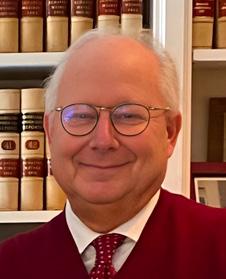
May 23, 1949August 23, 2025
The Honorable Barry Charles Dozor’s sudden passing deeply shook the community and underscored the lasting impact he made within Delaware County and far beyond. Judge Dozor served for 25 years on the Delaware County Court of Common Pleas, presiding in the civil, criminal, and family divisions. A friend to all he met, he never made anyone feel discourteous for simply calling him “Barry”; titles mattered far less to him than genuine connection.
In his brief time after leaving the bench, Barry continued to devote himself to public
service through mediation and arbitration work. Before his judicial appointment, he practiced law in partnership with Sam Auslander for 26 years. He was also elected Commissioner of Marple Township for five terms and served as Commissioner for several neighboring communities.
Barry met his wife of 53 years, Rose, while attending West Chester University. He later became part of the inaugural graduating class of Delaware Law School—now Widener University Law School—in 1975. His greatest joys were his family, his flower garden, time spent at the beach, and being a devoted foodie.
See page 14 for a heartfelt letter penned posthumously to Judge Dozor from his colleague and dear friend, the Honorable John P. Capuzzi.

July 16, 1958October 8, 2025
Jeffrey passed away peacefully following a courageous twoand-a-half-year battle with pancreatic cancer. His affinity for law showed early in his life when, as a child, he was always eager and confident in arguing his “case” in any given situation. Jeff was an alumni of Lewisburg High School, Albright College, and Widener University Delaware Law School. He began his career at Pepper Hamilton & Sheetz, and later moved to Holsten and White before establishing his own law practice in Media, PA, where his wife, Jackie, worked alongside
him as both his office manager and legal assistant. He took great pride in being admitted to the U.S. Supreme Court Bar, arguing before the Pennsylvania Supreme Court and the Third Circuit Court of Appeals.
Jeff measured his success not by accolades, but by his ability to help others—building deep connections with friends and family, his lifelong clients, and just about anyone in need. His tireless advocacy of the victims of a tragic accident in 1998, at the notorious “Dead Man’s Curve” section of Route 1, lead PennDOT to install a concrete median across that stretch of highway, creating a safety measure that likely saved countless lives thereafter.
Outside the office, Jeff was an avid motorcyclist and golfer who also took great joy in his Porsche, recreational shooting, and spending time at the family cottage in central Pennsylvania’s western region.
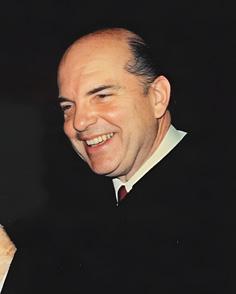
May 16, 1927November 2, 2025
Francis passed away peacefully at the age of 98. He grew up in West Philadelphia and Springfield, PA. After serving in the US Navy in World War II, he attained a B.A. from St. Joseph’s College, and a J.D. from the University of Pennsylvania. He was admitted to the Pennsylvania and Delaware County Bar Associations in 1953, and later to the US Supreme Court Bar Association and the Association of Trial Lawyers of America.
Francis enjoyed traveling the world with his wife, Eleanor, and was a proud father of five and grandfather of seven. He was deeply dedicated to his practice and valued the many experiences he gained as a defense attorney.
October 9, 1934October 15, 2025
The Honorable Deacon Clement J. McGovern, Jr., was born in the City of Chester, Pennsylvania, where he later served as Treasurer and Councilman. He was a graduate of St. James High School, St. Joseph’s University, the University of Pennsylvania Law School, and the National Judicial College.
Judge McGovern served the nation in the United States Air Force as a Judge Advocate General and went on to have active general law practice while also teaching as a professor of law. In 1973, he was elected to the Court of Common Pleas in Delaware County where he served as Judge for 27 years.
Judge McGovern was ordained a permanent Deacon in the Roman Catholic Church in 1986. In 2003, he was awarded the Pro Ecclesia en Pontifice medal by Pope John Paul II, for prolonged and exceptional service to the church and the Roman Pontiff.

Matthew J. Bilker, Esquire: Congratulations to our 2026 DCBA President, Matthew J. Bilker, Esquire, on being named to both the Million Dollar Advocates Forum and the Multi-Million Dollar Advocated Forum—two of the most prestigious trial lawyer organizations in the nation! He joins his fellow Eckell Sparks Partner and DCBA Member Leonard A. Sloane, Esquire, in this distinguished recognition.

David Keller Trevaskis, Esquire: Congratulations to David K. Trevaskis, Esquire, on his retirement! The Delaware County Bar Association has had the honor of working closely with David for many years in both his capacity as the Director of Pro Bono Services at the Pennsylvania Bar Association, and with his support of the Wills for Heroes Program put on at the Bar Association each November to help provide estate documents for veterans and first responders.
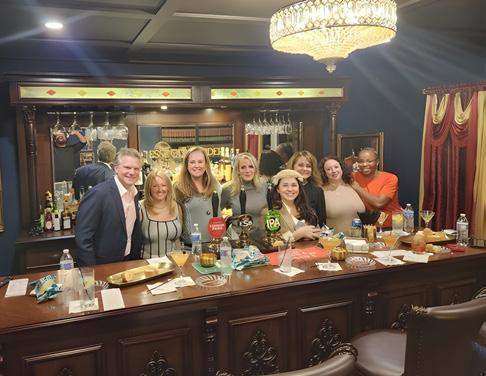
A fun item auctioned at this year’s DCBA Family Law Section Auction night was a happy hour donated by The Barris Firm, at their in-house pub, The Barrister. The winner, Alicia Fastman, shared her prize with Tiffany Griffin, Alice Buggy Miller, Jordan Reilly, Jessica Sirolly, and Beth Ann Marshall and a great time was had by all.
• Elysia Mancini Duerr District Court 32-2-53
• W. Keith Williams District Court 32-2-47
• Catherine M. Baggiano, Esquire
• Emily Brett Barkann, Esquire, of the Marrone Law Firm
• George Broseman, Esquire, of Kaplin Steward Meloff Reiter & Stein, P.C.
• Rachel Hannah Cook, Esquire, of the Delaware County District Attorney’s Office
• Jordan Scott Davis, Esquire, of Raffaele Puppio
• Nicole DeLuca of DeLuca & Associates, LLC
• Emily Dodds, Esquire, of the Delaware County District Attorney’s Office
• Cierra Eckenrode, Esquire, of the Delaware County District Attorney’s Office
• Joseph Faia, Esquire, of Thompson Hine, LLP
• Katherine A. Guckin, Esquire, of Marcus & Hoffman, P.C.
• Robert R. Hopkins, Esquire, of the Law Offices of Robert R. Hopkins, LLC
• Mary M.N. Jacob, Esquire, of Legal Aid of Southeastern Pennsylvania
• Aaron Edward Keating, Esquire
• Melanie Ann Reynolds, Esquire, of the PA Office of the Attorney General
• Deborah L. Roffman, Esquire, of the Law Office of Deborah L. Roffman
• Randi Lynne Rubin, Esquire, of Royer Cooper Cohen Braunfeld LLC
• John Joseph Savarese, Jr., Esquire
• Bryan H. Sullivan, Esquire, of Marcus & Hoffman, P.C.
ASSOCIATES
• Mark Plachta, Esquire of Kilkenny Law, LLC
LAW STUDENTS
• Nicholas Anni
• Mark Davies
• Tammi Forbes
• Azmar Housey
• Alexandra Oliver
• Olivia Pironti
• Jennifer Reeder
• Rachel Sergent
• Afershe Woodson
• Mira Yuan