
NEWCASTLE & HUNTER REGION VIETNAM VETERANS PEACEKEEPERS & PEACEMAKERS
Assisting all past and present ADF members with establishing their eligibility, processing and preparing their claim forms for submission to the DVA.
We can also assist with pension upgrades after 12 months.
We also help you lodge appeals against decisions handed down by the DVA, prepare submissions and represent you at the Veterans Review Board.
PHONE 02 4951 2666 TO MAKE AN APPOINTMENT
OFFICE HOURS: MONDAY & THURSDAY 9AM TO 1PM

Due to privacy laws, hospitals are not permitted to disclose to our Welfare Officers if member has been admitted.
Allan Crumpton
If you or a family member has been admitted to hospital and need assitance or require a visit, please contact our Welfare Officer, Allan Crumpton on (02) 4951 2666.
THESE ARE FREE SERVICES AND YOU DO NOT HAVE TO BE A VIETNAM VETERAN TO QUALIFY
we are well into another year, hoping you all had a wonderful Christmas and a joyous New Year, here’s hoping this year is better than the last. Unfortunately, our President has been called away on a serious family matter, I have spoken with him and things are better than first thought however he is still away. By the time you receive this Magazine we will have held the AGM, as this is not an election year there should not be any changes. As I have mentioned in the Welfare Report we are often short of hands in the Office and at the Markets. The markets are our main money spinner allowing us to do our Pensions and Welfare work. The cost of leasing the Printer, ink, paper etc. is a considerable expense that we need to cover, the money from the markets goes a long way towards this.
I must thank Bill Morris, Bill has served on the Committee for longer than I can remember, I think he may have been an original member of the Organization. He was a Senior Advocate for many years until the change from TIP training to ATDP around 5 years ago. He is currently part of the Functions Committee. Unfortunately, Bill had to resign his position from the Committee for family reasons. We wish you well Bill and Fran and thank you both for the years of service given.
Another stalwart, although not a member but the daughter of a Vietnam Vet and a lady who has been an amazing help to Veterans and their Families and has assisted me greatly in my role as the Welfare Officer. Wendy Waldron who we were proud to have working from our office is going back to her studies as well as caring for family. We wish you and the family well and hope to have you back with your Masters.
Bon Hayes one of our senior advocates has been forced to resign as an advocate due to ill health, Bon studied and provided advocacy services at an amazing rate. He assisted so many Veterans in their quest for the support they deserved from DVA for their service to the Country. Thank you, Bon.
It would be remiss of me not to mention the work our President Michael has been doing going through the files of Veterans with Stephen Machen, often coming into the office on days the office is closed. Angelo one of our advocates is now doing up a data base to assist with the recording of files and making it much easier for the advocates to perform their duties. Another thank you goes to Keith Robinson, often when we have been short on staff at the Markets Robbo turns up and assists. Similarly, Ron Kennedy comes into the office and assists with the front desk duties as well as showing people like myself how to use the printer or the computer. A big “thank you” to you all. It is becoming increasingly difficult to provide our services in a reliable and timely manner despite the best efforts of our dedicated volunteers.
It is obvious, that as the membership continues to age and the number of volunteers decreases, changes to the manner in which we operate will be forced upon us. As an organisation we must confront this inevitability and the discussion on this issue much commence sooner than later.
A draft plan will need to be prepared to examine the future options and members are encouraged to provide the Committee with any ideas or suggestions, preferably in writing.
Many organisations are confronting this particular issue, including most ex-services groups. Maybe the time has come when we need “to look outside the square” and consider the benefits of amalgamation, collaboration and/or the engagement of paid professionals to provide the necessary services in the absence of volunteers.
The problem will not go away and we must start to prepare for the future now.
Cheers…
Allan
Allan Crumpton Vice President

NEWCASTLE WAR WIDOWS AND ANZAC CHUCH SERVICE
MONDAY THE 14TH APRIL
Newcastle’s Christchurch Cathedral
The service will commence at 11:00am.
It will be a Try Service event, held in two stages Church service with the presenting of the three services colors. At the conclusion of the church service the congregation is invited to the blessing of the War Widow’s Lawn of remembrance.
NOTE: As this event is so close to Easter there may be changes. Please be aware of this and watch out for any notices, that may affect the date and timing. *
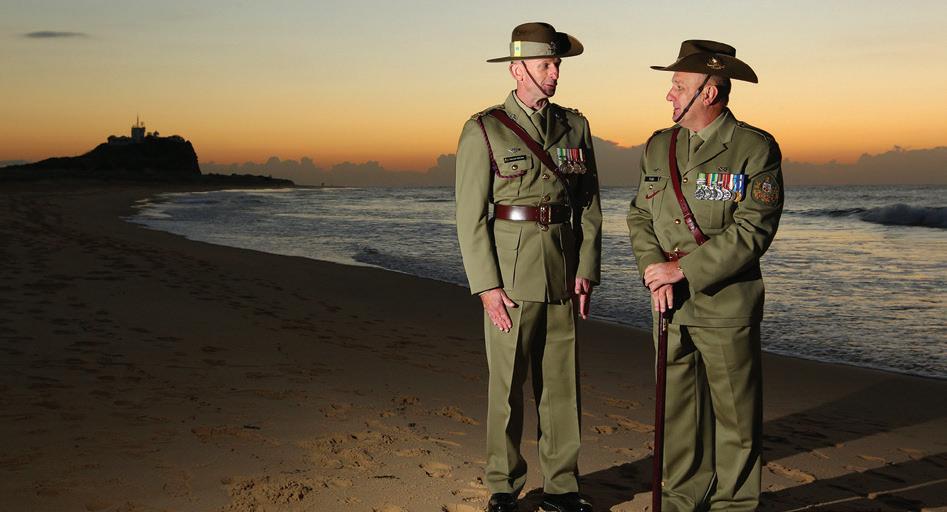
NEWCASTLE ANZAC DAY DAWN SERVICE
FRIDAY THE 25TH APRIL
Camp Shortland, Pasha Way, Newcastle East NSW 2300 (Nobbys Beach)
Attendees are requested to be on site at 4:00am, Service will commence at 5:00am. This is a televised and podcast event so timing is essential. VIP and VVIP must be identified by issued pass and parking closes at 4:00am.
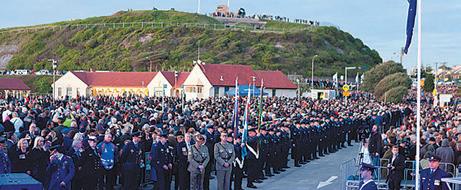
ANZAC DAY PARADE
The parade will march off at 9:10am Sharp so as to arrive in Civic Park for the 10:00am ANZAC Commemorative Service
Form up for the parade will be at the western end of the Newcastle Hunter Street Mall, Corner of Perkins Street. Form up will extend into the Mall and into Perkins Street.
NOTE: These arrangements are subject to change depending on access to form up areas specified at this time. Volunteer Parade Marshalls will be on site to give direction to form up areas.*
ANZAC DAY COMMEMORATIVE SERVICE
This event will take place in Civic Park King Street Newcastle at the main memorial cenotaph .The service is scheduled to commence at 10:00am after the main parade.
The Strzelecki Look Out ANZAC Walk Sunset service will not be presented this year. As Easter and ANZAC Day fall in the same week this year it has stretched band and clergy resources to the point that the evet had to be canceled
The regular Sunset service held on the eve of the 24th April in the Civic Park Memorial Grove also will not be held this year. This information has come available at the time of the producing of this newsletter. This event in the past has been organized by Gerry Baily the president of the Civic Park Memorial Grove Committee. Gerry was not well last year and his health has diminished. Hopefully the event will be re-established for future years through the committee.
* For all events final dates and timings will be published on the City of Newcastle RSL Sub Branch website newcastlersl.org.au and their Facebook page.

WITH Allan Crumpton, Welfare Officer
WELL, who would believe it here we are a quarter of the way through the century and almost a quarter of the way through another year, how time flies when you are having fun or is it as we get older. This getting older thing is a bit of an issue and I have spoken about it previously. We had to give away the cooking of the BBQ at the markets because we were having difficulty manning it. We now just collect the monies from the Stall holders, we need 5 people on the last Sunday of the month. One sits in the Gazebo to talk to anyone who comes along and wants to find out about the Markets, the others pair up and two collect the monies from the top section and the other two collect from the bottom. It usually takes around two hours. If we get enough helpers we will only have to do it a couple of times a year. If you or someone you know can help let us know at the office and we will put you on the roster.
At the moment our pension officers are snowed under, we have one Level 2 Advocate, one Level 1 who is training up for Level 2 and another who is just about to do the qualifying test for Level 1. We are always on the lookout for people to come along and assist with Advocacy. Currently I am the only Wellbeing Officer, I do work for our organisation, TPI and the Wallsend RSL. During the past 12 months I spent almost 500 hours speaking with around 1020 vets and/or their family members by phone, in hospital, at their homes or in the office and travelled almost 5000km in making visits.
I know I have spoken of this previously but it is so important, having a current Will, Power of Attorney and Enduring Power of Attorney and then letting someone know who has the original. An issue has come
up recently where people thought the last Will was made in the late 1990’s and them some time later a Will made in 2015 turns up. Although the contents of the will were similar another Executor had been added but there have been changes to the Act regarding Wills in 2006 which could make a considerable difference to how your property is distributed. Again, the issue of passwords and where we have bank accounts or investments keep cropping up. It all gets down to communicating with our next of kin or those who need to know. We need to keep them in a safe place but someone needs to know where that safe place is.
Cheers, Allan

Piggott's Pharmacy are proud to be your local NDIS provider, offering a comprehensive range of services and products.
Assistive products for personal care and household tasks
Personal mobility equipment and Consumables tailored to meet the unique needs of our clients
Assistance with travel and equipment
Assistive equipment for recreation
In-home support
Vision and hearing equipment
Community nursing care
Innovative community participation
Communication & information equipment
Exercise physiology & personal wellbeing
Plan management
Support work
Therapeutic support

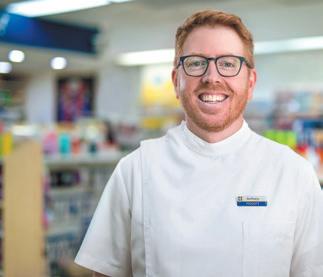
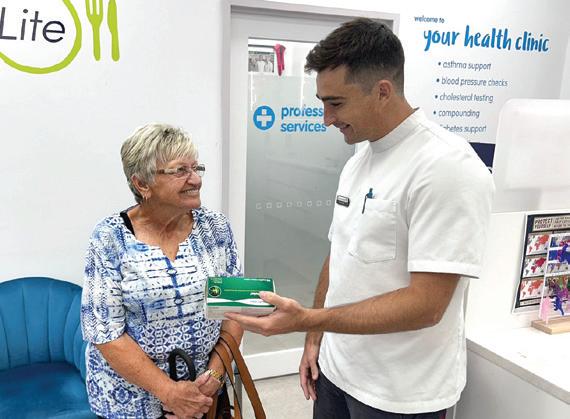
At Piggott’s Pharmacy, our team of dedicated professionals are committed to delivering empathetic and personalised care, enhancing the quality of life for our clients.
With a strong presence in Newcastle and the Hunter Valley, we are a trusted NDIS provider, known for our personable, empathetic, and professional approach. We are dedicated to fostering independence and social participation, helping our clients lead fulfilling lives!
Contact Kurt today on 0428 448 044 for more information on how we can assist you, or drop into your local Piggott's Pharmacy.
For all of your NDIS support and healthcare needs

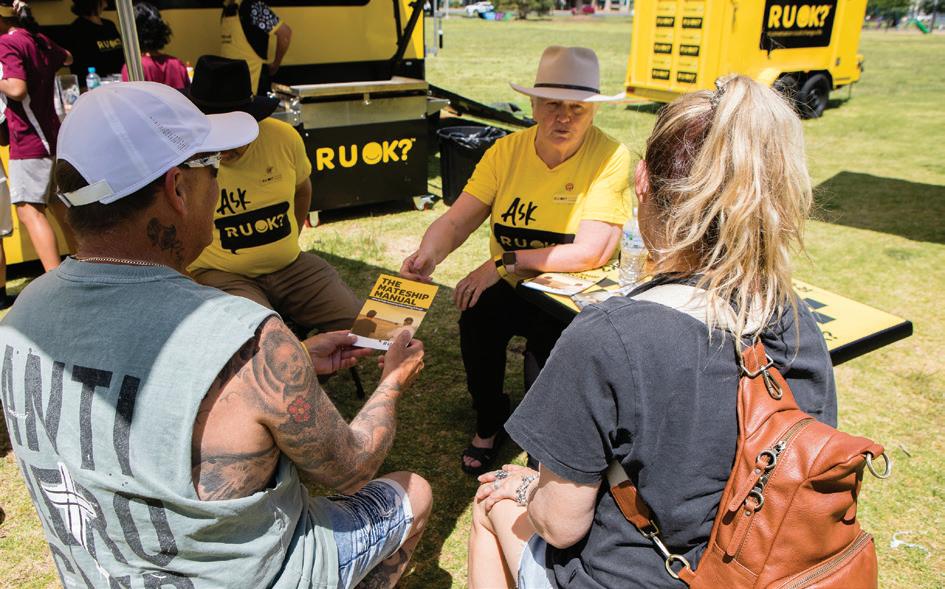
THER U OK? Conversation Convoy will connect with communities across the Hunter region this April, fostering meaningful conversations and encouraging people to check in with those around them. Free community events will offer a cuppa and a chance to learn more about the vital role we can all play in looking out for our friends, family, and colleagues, helping to increase feelings of connection, and belonging.
“In recent years there has been a lot for Australians to deal with, and many are still navigating the impact of natural disasters, the pandemic, and now cost of living increases are adding more pressure on those who might already be struggling to manage,” said Katherine Newton, R U OK? CEO. “On top of these additional stressors, the people you care about go through life’s ups and downs every day.”
“So, while R U OK?Day on Thursday 11 September 2025, is our National Day of Action; we’re encouraging people to Ask R U OK? Any Day of the year because a conversation can change a life,” continued Ms Newton.
R U OK? will share free practical tools and tips to encourage people to stay connected and have conversations any day of the year to help those close to them through difficult times.
“Sometimes it won’t be obvious that someone is having a hard time, sometimes there aren’t any signs,” shared Ms Newton, “But we know that when we ask early, check in regularly and be genuine with our offer of support, we can help people feel connected and supported through whatever they are navigating.”
The R U OK? Conversation Convoy travels around the country as part of the R U OK? outreach work in regional and rural communities. Throughout 2025, the R U OK? Conversation Convoy will spend time in regional communities across NSW, QLD and SA.
“By taking the R U OK? Conversation Convoy throughout the country, we want to empower Australians with the confidence to have a meaningful conversation if they spot the signs someone close to them might be struggling with life,” added Ms Newton.
“It’s important for us to meet people where they are at. Some people find it easier to talk with someone in person to find out what services and organisations are available to support them.”
During the Convoy, R U OK? link in with local services, visit community organisations, schools, and workplaces, provide resources, and listen to feedback.
“We know that locals know best, and the Conversation Convoy will give R U OK? the opportunity to hear directly from
communities to better understand their current needs,” added Ms Newton. “This informs the development of future resources and campaigns to ensure they are practical and useful,” Ms Newton said.
The R U OK? Conversation Convoy is made possible thanks to the generous support of our partners: CONNOR Clothing, The Audi Foundation, KitKat, Nescafé, Spirit Super and AXL+CO by CONNOR.
A full schedule of the R U OK? Conversation Convoy public events, and resources to help support local communities can be found at ruok.org.au.
Visit ruok.org.au for free tips and tools to build a R U OK? culture across your year. For support at any time of day or night, Lifeline provides free and confidential crisis support. Call 13 11 14, text 0477 13 11 14 or chat online at lifeline.org.au
13YARN is a free 24/7 service offering crisis support for Aboriginal & Torres Strait Islander people. Call 13YARN (13 92 76).
YOU
could be a victim of financial elder abuse and not even know it.
The National Elder Abuse Prevalence Study (NEAPS) reported that 2% of Australians 65 years and older reported experiencing financial abuse in 2020.
Being pressured into giving or loaning money, possessions or property was the most common form of financial abuse. Would you know if you were the victim of financial elder abuse?
According to NEAPS, the main perpetrators of financial abuse were adult children, with sons being twice as likely as daughters to financially abuse their parents. This was found to be commonly due to the adult child experiencing financial problems or mental health problems.
What constitutes financial abuse? It includes:
n Threatening, coercing, pressuring or manipulating you to hand over assets, money or property.
n Taking control of your finances and denying you access to your own money.
n Unauthorised use of your funds and bank accounts.
n Not contributing to household expenses and refusing to vacate your house.
n Pressuring you or influencing you to change your Will.
n Pressuring you or influencing you to appoint them as your Attorney, with power to deal with your finances and property.
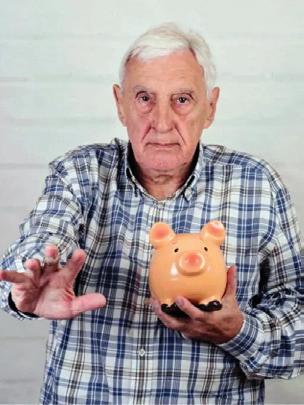
If you have been the victim of financial elder abuse, you can seek legal advice and assistance.
Only 14% of the people who reported experiencing elder abuse in the NEAPS study sought legal advice. And yet legal advice and representation may help the older person return, as much as possible, to the position they were in before the financial abuse occurred.
In the case of Grant v Grant (No 2) [2020] NSWSC 1288, the daughter Nerez Grant, while acting as her father’s attorney, transferred $134,700 from his bank account. She also transferred her father’s Killcare property to her daughter Kashaya. Nerez

was ordered to pay the amount back with interest and Kashaya was ordered to transfer the property back.
In the case of Issa v Owens [2023] QSC 4, Hind Issa was about 78 years old when she discovered that her son James Karbotli had mortgaged her home I Mermaid Waters, Queensland in order to secure a $1 million loan for his business. James defaulted on the loan and the lender was in the process of taking possession of the property. James had forged his mother’s signature on the loan documents.
Following legal proceedings, the mortgage was deemed to be null and void and she was able to keep her home.
In the case of Petrovski v Nasev; The Estate of Janakievska [2011] NSWSC 1275, for years Alex Nasev harassed, threatened and coerced his sister-in-law Vasilka Janakievska to get her to make a Will that left a property she owned in Erskineville to him. When Vasilka made the Will, she was 82 years old, suffering from a defective memory and directed by Alex.
The Will was only discovered after Vasilka’s death. The Court determined that the Will had been executed subject to Alex’s undue influence and ordered that Vasilka’s estate be administered in accordance with her earlier Will.
If you believe that you or someone you know may have been the victim of financial elder abuse, seek legal advice. There may be a legal remedy.

It is often very difficult to discuss death and dying with loved ones however the reality is that if you have any final wishes it is very important that they are made known or are readily available to those responsible for organising your affairs, funeral and associated matters.
When one dies events generally move quickly, funeral arrangements are stressful and there are a myriad of issues that need resolution.
It is recommended that prior planning can greatly assist your loved ones and ensure that your wishes are carried out.
The following checklist or something similar can be of great assistance.
PREPARE LEGAL DOCUMENTS
n Will, list executor/s, solicitor or any other relevant person or professional
n Enduring Power of Attorney,list details of attorney
n Binding death nominations for superannuation
n Organ donation registration
n Body donation consent form
MAKING ADMINISTRATION EASIER
n Roll superannuation into a single account ( consider life insurance implications)
n Close bank accounts that are not needed
n List the distribution of valued personal items not listed in your will such as motor vehicles, boats, jewellery etc..
n Make gifts of items prior to passing (There may be tax implications)
n Detail how email, online storage etc are to be dealt with
n Login details and passwords for phones, computers and other devices
n Bank/Building Society or like accounts, list account details, passwords and if you have cryptocurrency how to gain access
n Details of shares, bonds, promissory notes and other investments including outstanding loans you may have made and want paid to your estate
n Subscriptions, club memberships and other associations with which you have been involved
n Utility and other bills that are recurring
n Safety deposit box and/or safe, list security numbers, combinations, key locations etc
n Where appropriate make a list of all assets and liabilities
n List other important documents,
n Details of funeral insurance or prepaid funeral
n Any preferred funeral celebrant, either clergy or civil
n Any special funeral arrangements such as Ex Service, Lodge etc
n Preferences for burial, cremation, flowers, charity donations etc
n Pallbearers, music
The list provided does not necessarily cover all circumstances nor will all items listed apply to everyone.
It is suggested that you prepare or have someone prepare the relevant information and ensure that its location is known to those persons who will be responsible for carrying out your wishes.
It is of vital importance that the whereabouts of all info and/or documents detailed in the information is disclosed and easily located.
It is stressed that this information is provided for guidance only and you are urged to arrange for legal advice if you consider such to be necessary.
Various organisations provide detailed checklist that you may find convenient:
• National Seniors Assoc, Estate Planning, Things to Consider
• DVA Planning Ahead, A Guide to Putting Your Affairs in Order
• Salvation Army, Your Will, How to Determine Your Estate (copies are available from the office of The Hunter Veteran,s & Families Support Centre, 15 Tyrrell St, Wallsend.)
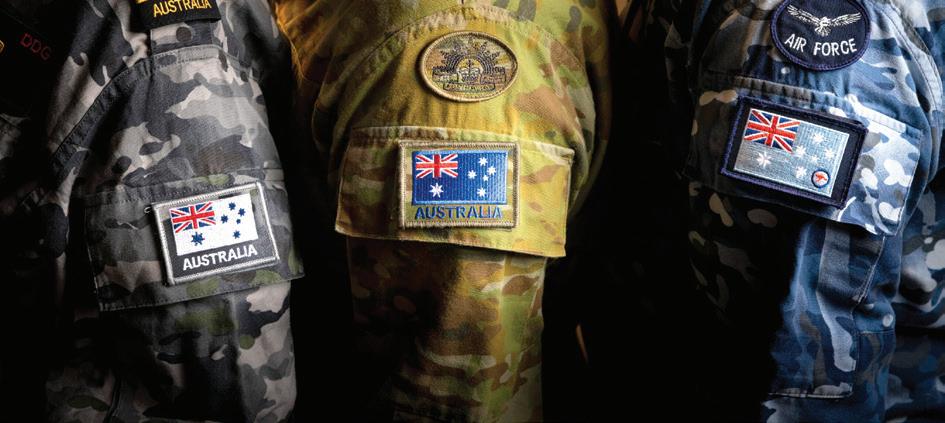
THE single ongoing Act provides greater clarity for veterans and veteran families about their benefits and entitlements.
Consolidating the legislation into one Act will ensure more consistent compensation
outcomes for veterans and families.
To give financial certainty to veterans and families, a key feature o·f the new model is the 'grandparenting' arrangements.
Anyone receiving benefits before the Act's
commencement date of 1 July 2026 will not have any reduction in those payments before or after 1 July 2026. They will also continue to be indexed annually.
What will this inean for you?
From 1 July 2026 the improved MRCA will provide VEA veterans (with service-related conditions) access to the MRCA Household Services program. Currently, VEA-only veterans can only access services under the Veterans Home Care (VHC) program. The table below outlines the two programs, their eligibilities, and potential services that can be accessed.
Program
Program Intent
Veterans’ Home Care
To provide practical help at home so you can continue to live independently
DVA website link https://www.dva.gov.au/get-support/health-support/ care-home-or-aged-care/services-support-you-home/ veterans-home-care-vhc/help-so-you-can-stay-yourhome
Program Eligibility
Household Services and Attendant Care
To provide extra support if you need help at home because of a service-related injury or condition.
https://www.dva.gov.au/get-support/health-support/care-home-oraged-care/services-support-you-home/household-services https://www.dva.gov.au/get-support/health-support/care-home-oraged-care/services-support-you-home/attendant-care
Veterans may be eligible under both programs. Both programs can be accessed at the same time however there can be no duplication of services.
- Gold card holders
- White card holders for accepted service-related conditions
Eligibility for VHC is related to card eligibility and assessed clinical need. There is no requirement to have conditions accepted as service-related.
Current: Veterans who were responsible for household tasks and are no longer able to manage due to their accepted service-related conditions (DRCA/MRCA).
From 1 July 2026: All veterans who are unable to manage household tasks due to their accepted service-related conditions (VEA/DRCA/ MRCA).
Accessing the Program Call VHC assessment agency for an assessment Claim form
Limits Based on clinical assessed need, you may be able to receive:
- Domestic help as required
- Personal Care Maximum 1.5 hours / week
- In-home respite Maximum 196 hours
- Residential respite careMaximum 28 days
- Emergency short term reliefMaximum 216 hours
- Garden maintenance Maximum 15 hours / year note: some services require a co-payment
Current: Maximum value of services
DRCA $574.76 / week
MRCA $597.13 / week
From 1 July 2026:
Maximum value of services $597.13 / week
Personal Care provided under Attendant Care Programs - see below Services Available
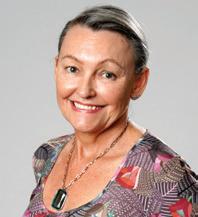
BY Sonia Hornery MP, State Member for Wallsend
IT’SA new year and we have many new projects coming up while following up on the many matters rolling over from last year. Our Government is taking seriously many societal and criminal issues occurring across the state. From petty crime to serious crime, all affect someone in some way. Our local community deserves to feel safe and secure in our streets, in their homes, on the bus or in their local shopping centre. The Minns Government has increased penalties for knife crime, stealing cars and joyriding and many other matters. We have introduced a range of measures to increase Police recruitment following years of stagnant recruitment numbers.
In happier news, the John Hunter Hospital Shuttle Bus has seen wonderful use and

patronage and is a free service that will take you from McDonald Jones Stadium to the Hospital and back on a looped service from 6am - 6pm daily. The Government has invested in free TAFE courses to build up our future generations of trades that we will rely on.
We are probably all aware of the difficulty brought about by the Housing Crisis, working with the Federal Government, we are increasing the supply of social and
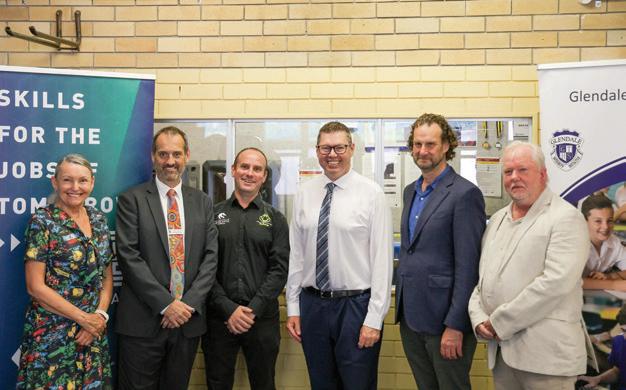
affordable housing to make it easier for not just the vulnerable in our society, but even working families to get into a home. We’ve adjusted the rental laws to balance more favourably renters rights with owners rights to make a fairer system for all.
I have also had the opportunity to speak in Parliament about some fantastic achievements by individual residents and local community groups such as local historians, fundraising charities and sporting achievements. If you can think of a person or organisation that deserves a shout out in Parliament, let my office know so we can put together a Community Recognition Statement.
On a lighter note, did you know that congratulatory messages are available for 50th, 60th, 65th and 70th wedding anniversaries and 80th, 90th and 100th birthdays? These messages can be arranged through my office with a couple of weeks’ notice and the details and confirmation, like a marriage or birth certificate.
Remember, we’re here to help you, so if there’s a State Government issue that you need some help with, call my office on 4950 0955, email wallsend@parliament.nsw. gov.au or visit the office at 67 Nelson Street, Wallsend. You can also keep up to date with what I’m doing at Parliament or in the community by visiting my website at www.soniahornery.com.au.

BY Tim Roberts AM Emeritus Professor at the University of Newcastle & Director of InnovAAte Pty Ltd
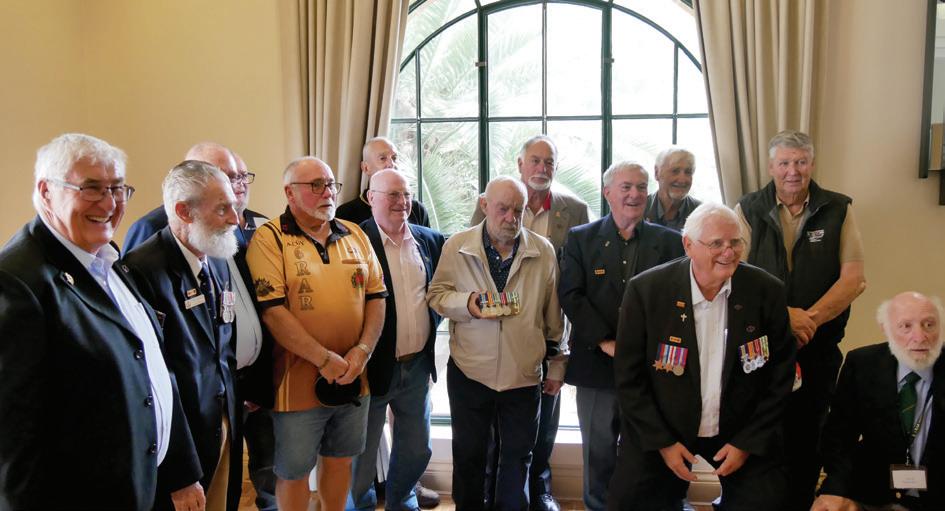
INOCTOBER last year, I had the privilege of joining a special lunch with a group of Vietnam War veterans from A Company, 6th Battalion, Royal Australian Regiment (6RAR). They had gathered in Newcastle to reunite with one of their own—Alwyn Craig—who had been lost to them for decades. This incredible story is a testament to the kindness of strangers, the unexpected twists of fate, and the power of family connections.
For more than 30 years, anyone who regularly traveled along Hunter Street in Newcastle would have noticed a short, disheveled homeless man moving slowly through the city. He spent his days walking the streets, sitting on train station benches, and sleeping rough. He rarely spoke, and his withdrawn nature made it difficult for even the most well-meaning people to engage with him. Despite his presence becoming a
familiar part of Newcastle’s landscape, very few knew his story.
One of the people who did try to help was John Cross, Director of the City Sleep Safe charity. Over time, John gained Alwyn’s trust and, in late 2023, helped him obtain a birth certificate and a pension. It was then discovered that Alwyn had not only been lost to his family for the last 30 years but also to his army mates, who had known him as “Shorty.” Since leaving the army in the early 1980s, he had completely vanished from their lives.
Wanting to reconnect Alwyn with his family, John Cross reached out to journalist Matthew Kelly from the Newcastle Herald. Matthew wrote an article in December 2023, which in turn caught the attention of retired journalist Greg Ray. Greg then shared Alwyn’s story in his newsletter, reaching about a thousand subscribers. This is where serendipity stepped in. One of Greg’s readers, Felicity Patrick—originally from Newcastle but now living in Florida, USA—recognised Alwyn’s name. Years earlier, Felicity had taken a DNA test to trace her biological family, as she had been adopted as a child. To her amazement, she realised that Alwyn was her uncle! In an extraordinary coincidence, she had unknowingly walked past him on Hunter
Street years before, never realising their connection.
Through these unexpected connections, Alwyn’s family in Wollongong finally found their long-lost brother. They also welcomed Felicity, who now had a newfound family link. The Returned and Services League (RSL) stepped in, helping Alwyn receive his long-overdue war service medals, a veteran’s gold health card, an aged care package, and an apartment in Newcastle’s East End. He also received additional financial support on top of his pension.
The final piece of this heartwarming journey came in October 2024, when the A Company 6RAR Association held its annual gathering in Wangi Wangi. John Cross invited them to a special luncheon at City Hall to honor Alwyn. During the event, Barry Francis from the 6RAR Association shared stories about their long-lost brotherin-arms and read two poems he had written for the occasion.
This incredible journey—from homelessness and isolation to rediscovery and reconnection—was made possible by the kindness of strangers, the persistence of caring individuals, and a little bit of serendipity. Alwyn Craig, once lost, was finally found.
Written by Barry Francis
Alone on the streets of Newcastle
Detached from the maddening crowds
Wandering familiar pathways
A homeless vagabond strays
No worldly goods or possessions
No place for him to call home
He sleeps in the alleys and shop fronts
Then next morning, again, he will roam
He was known to those who had seen him
As “Old Pete”, the Newcastle Bum
But the stories they tell of his downfall
Were just tales, some folks had begun
In fact, he’s a Vietnam Veteran
To his mates he was called Shorty Craig
And the love of his life had been murdered
By the VC, in one of their raids
Poor Shorty could never forget her
The Vietnamese love of his life
And her death was haunting him daily
This girl, who should be his wife
Then one day the trauma and sorrow
And bad memories, all came to a head
When he walked out the house one morning
And aimlessly wandered instead
His family and friends had spent years
In search, without any clue
But Shorty, it seems, disappeared
On the streets, where nobody knew
Then a miracle, some thirty years later
From Florida, an internet search
Of a newspaper story on Shorty
And his identity, was discovered at last
So Shorty is now receiving
The help that a Veteran deserves
And he’s learning again to trust people
And we hope, his life can reverse
Soon, his mates will proudly present him
With his medals and badges unclaimed
For his part in the war in Vietnam
At a reunion, that’s already planned
So now, we all hope that our Shorty
Who’s life, it seems, was on hold
Joins in with his mates when he meets them
As they welcome him back to the fold.
Written by Barry Francis
Roaming the streets of Newcastle
Are homeless, wandering, souls
Who sleep on the streets, without blankets or sheets
Exposed to the hot and the cold
These lonely homeless people
Wander the streets every day
Some just need a hand, to


make a fresh stand
And someone to show them the way
Now, there’s a man who’s making a difference
John Cross, a kind-hearted soul
He’s devoted his life, to the homeless in strife
With his team, who all get involved
John has been running an outreach
With the help of a like-minded crew
They’re housing and feeding, the homeless and needing
Such kind-hearted folks, through and through
Their aim is to make the lives better
Of those they tend to each day
They do it with love, and some help from above
And let nothing, stand in their way
So, genuine, kind-hearted and caring
Is the way I’d describe this man
For the big-hearted way, he gives every day
Helping as much as he can
So, John Cross, we applaud and commend you
For the changes to lives you have made
So thanks for the care, and for just being there
And helping our mate Shorty Craig.


The Albanese Labor Government has responded to the Final Report from the Royal Commission into Defence and Veteran Suicide, committing to real, meaningful and enduring reform.
The Royal Commission was the most significant and comprehensive inquiry conducted into suicide and suicidality in Defence and veteran communities. It heard harrowing evidence about the cultural problems and identified deficiencies with the approach, services and support of the Department of Veterans’ Affairs.
The Albanese Labor Government has accepted the overwhelming majority of the Royal Commission’s recommendations, and has appointed Mr Michael Manthorpe PSM, former Commonwealth Ombudsman, to work across government to establish an independent statutory body to provide oversight and evidencebased advice to the new Defence and Veterans Services Commission.
In the last sitting week of February, the parliament passed the most significant legislative reform of Australia’s veteran support system in a century.
The Royal Commission recommended the urgent simplification and harmonisation of the veteran compensation and rehabilitation system, and the Albanese Labor Government has now achieved this. This reform will make it easier for veterans and their families to understand their entitlements, simpler for advocates to support veterans making DVA claims, and it will streamline claims processing within the Department of Veterans’ Affairs.
I am proud to have supported this transformational reform.
Other announcements include:
Releasing the Defence and Veteran Wellbeing Strategy 2025-230, which will further assist in responding to the Royal Commissions Final Report. The strategy was developed in consultation with Defence and veteran families. $30 million to address veteran homelessness. Ten ex-service organisaitons, including three in NSW, are set to recieve $26 million in capital grant funding to increase housing supply, while the remaining $6 million will fund delivery of specialist wrap around support services to veterans and families.
tI’m here to help
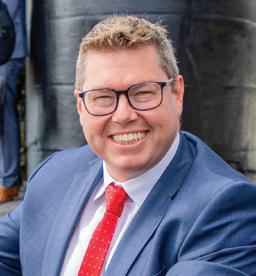
BY Pat Conroy MP Federal Member for Shortland
IAMproud to let you know that in February, Parliament passed the most significant legislative reform of Australia’s veteran support system in a century. It came off the back of the Royal Commission into Defence and Veteran Suicide’s Final Report which recommended the establishment of a new statutory entity to provide independent oversight of system reform now known as the Defence and Veterans’ Service Commission.
This reform will bring the three current systems governing veterans’ entitlements under a single Act: an improved Military Rehabilitation and Compensation Act 2004 (MRCA). This will make it easier for veterans and families to understand their entitlements, simpler for advocates to support veterans making DVA claims, and it will streamline claims processing within the Department of Veterans' Affairs.
This all means veterans and families will be able to access the benefits and supports that they need and deserve, faster. When the changes come into effect on 1 July 2026, no veteran will see a reduction in their current payments. This legislation will open a pathway to a Gold Card for many veterans that were previously not eligible.
The Albanese Government consulted extensively over the last two years with veterans, families, advocates, and a wide range of ex-service organisations on this legislation to make sure we got these reforms right. I am confident this historic reform will benefit veterans and families for generations to come.
With a federal election due by late May, I want to take this opportunity to thank everyone in our community for your support. Being your Federal Member of Parliament is a privilege and honour that I don’t take for granted.
I want to acknowledge that it’s been a tough few years for many in our community. Cost of living pressures have lasted longer than any of us would have liked or expected which has made it very challenging for local households and businesses.
While it’s not job done, I am really proud of the cost-of-living support delivered by the Albanese Government during this time that didn’t drive up inflation. This included tax cuts, energy bill relief, cheaper childcare, cheaper medicines, and increased rent assistance.
Locally, I’ve worked hard to deliver:
n $28 million to save the GP Access After Hours service
n Two new Labor-built Medicare Urgent Care Clinics in Charlestown and Lake Haven.
n Free TAFE courses to give locals the skills they need for good, secure jobs.
n A permanent dredge for Lake Macquarie to protect our coastline and boost local jobs.
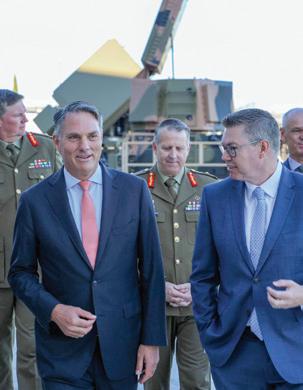
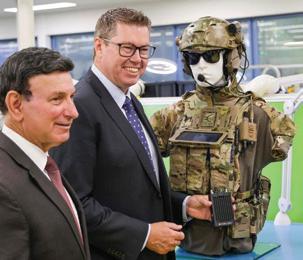
Above: Backing Australian innovators and home-grown ingenuity. The kind of tech that gives our Australian Defence Force the cutting-edge capabilities they need to keep us all safe.
There’s more to be done, and I hope to be able to secure our community’s support to be the Federal Member for Shortland for another three years.
If you have any issues, please contact my office on 4947 9546 or pat.conroy.mp@aph.gov.au. You can also keep up to date with what I am doing via my Facebook and Instagram pages and my website, www.patconroy.com.au
Thank you for your service,
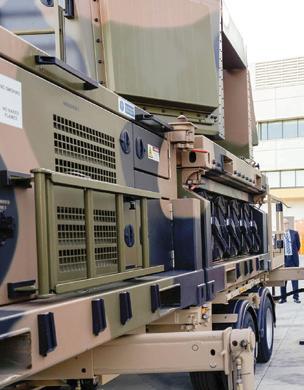
and it’ll support 700 local jobs too.
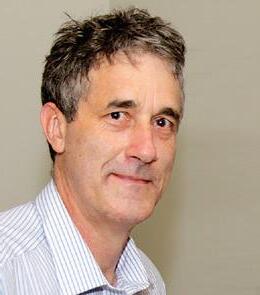


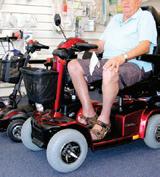


With over 25 years experience, Rex has become well known in the region for his clinical practice across a range of areas including: Department of Veteran’s Affairs’ Patients, Psychiatry, General Surgical Care, Occupational Rehabilitation CTP and Workers Compensation. Rex is committed to the care and advocacy of his patients. His practice is based on the belief that independent living and meaningful occupation should be optimised to achieve and maintain the best possible quality of life for everyone!
Advise on DVA Services and other Government Services such as Home Care Packages
Advise on DVA Homecare and respite Services
Falls prevention assessment and education
Pressure care needs such as bed overlays and Roho cushion
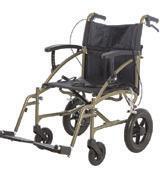
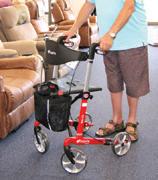
Mobility and aids such as walkers and walking stick
Access options such as ramp and possibly a stairlift
Incontinence Needs
Scooter assessments for those eligible DVA clients
Activities of daily living assessment
Minor modifications such as rails in the shower, W.C and at stairs and hand held shower



Bathroom, dressing and bedroom equipment
Recommendations for appropriate equipment according to need, such as following eg. spinal surgery, total knee or Hip replacement
Personal response systems
Lymphedema management
Seating options such as dining and lounge
room chairs with arms and possibly an electric operated recliner chair if eligible
Wheelchairs, walkers and bed sticks
Kitchen and cooking equipment such as electric operated jar and bottle openers
Lighting needs such as outdoor sensor lights & indoor lights
Retractable garden hose
Back care education
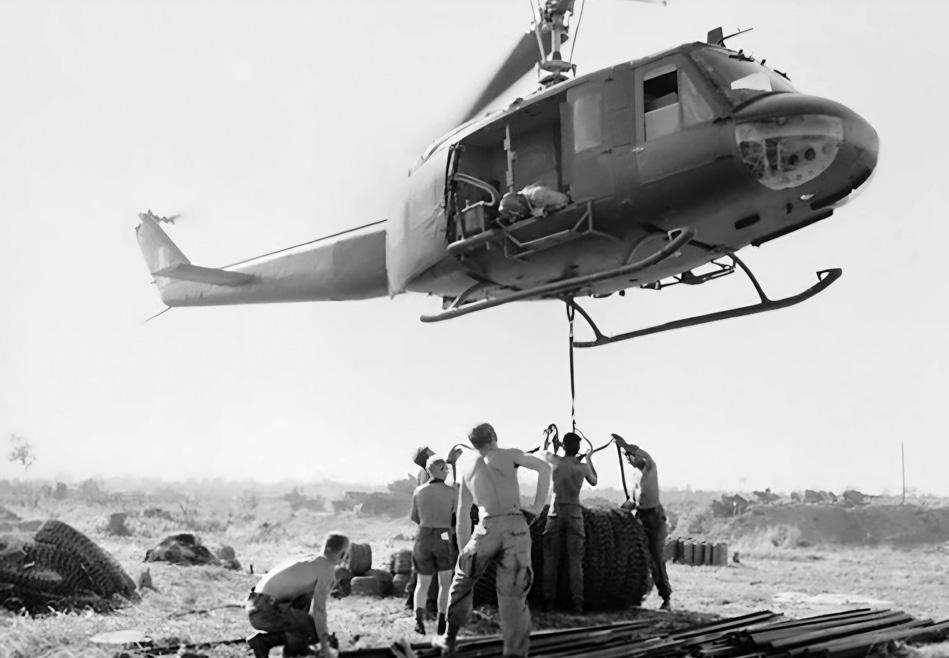
BETWEEN the 12th of May and the 6th of June 1968 Australian forces together with New Zealand and United States artillery were engaged in the most prolonged and continuous engagement of our involvement in Vietnam.
The action took place 40km northeast of Saigon. The operation was known as Toan Thang and involved Australian, US and South Vietnam forces.
The Australian Task Force was allocated an area of operations Surfers and the units directly involved were 1 RAR, 3RAR, A Sqr 3 Cav Rgt, C Sqr 1st Armoured Reg,102 Battery RAA, 131 Locating Battery RAA, 161 Battery RNZA, 141 & 165 Regts US. Support was provided by 161 Recce Flight, US Gunships, Puff the Magic Dragon (C47 Transport, mini guns/flares), US selfpropelled AA guns, and other US and SVN artillery from surrounding bases.
Fire Support Base CORAL was located on a crucial North Vietnamese infiltration route to and from Saigon and the US bases of Bien Hoa and Long Binh.
It was obvious that the NVA would vigorously contest the presence of Allied forces in such a crucial location.
The establishment of Coral on the 12th of May incurred difficulties, some due to inadequate planning and some due to circumstances beyond Australian control.
The initial aerial reconnaissance some days before the incursion was conducted from a US helicopter by the unit commanders, however the pilot would not fly below 600 metres due to the risk of ground fire as considerable enemy activity had been detected in the area. A detailed examination of the topography for the proposed LZ and FSB was not possible.
On the morning of the move (12 May) another aerial reconnaissance was
undertaken and it was determined that the original site selected was unsuitable. Another site 1000m to the SW was chosen. American infantry was already patrolling in the area and were tasked with securing the LZ until the Australian forces arrived. The US forces had to hastily move and secure the new location which took additional unplanned time.
The first unit to arrive was the NZ 161 battery followed by 102 battery. There was confusion as to which unit should be located where, probably due to changed location and eventually it was determined that the artillery batteries should relocate 1500m to the SE, another unplanned delay.
The helicopters ordered to carry the remainder of the force that day were diverted to a US action. This further time delay was crucial.
Continued over page

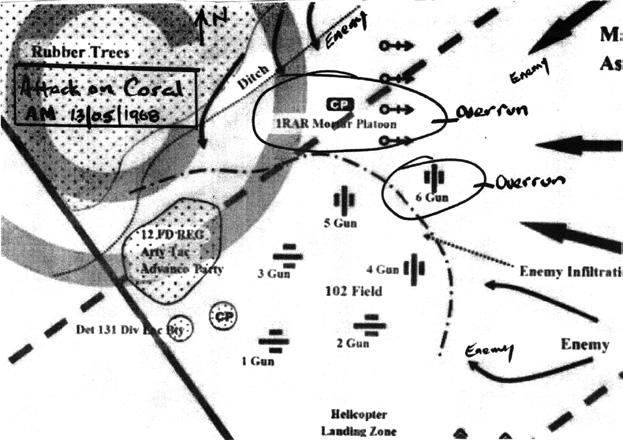
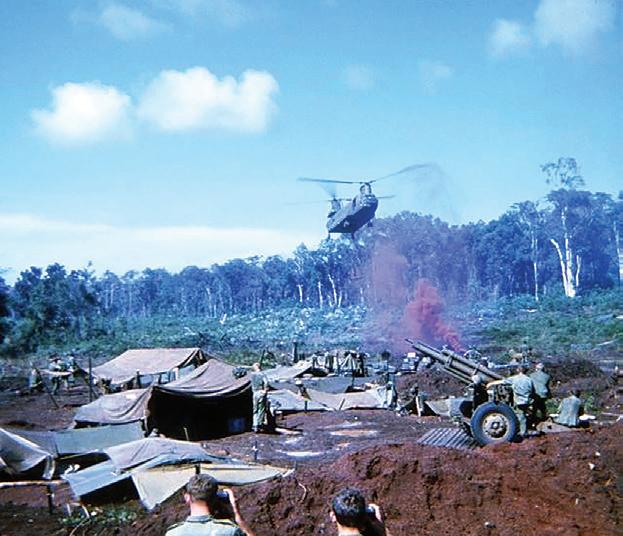
On the afternoon of 13 May 1968, the central and south-eastern areas of Fire Support Base (FSB) Coral were under occupation following the establishment of the base late on 12 May. In the early hours of 13 May, as FSB Coral was only partly set up, a North Vietnamese Army (NVA) unit launched an attack from the north-east. The units directly under attack included the 102nd Field Battery, positioned just above the purple smoke marking its helicopter landing zone, with its 105 mm howitzers enclosed within circular bunds. Artillery Tactical Headquarters (Forward) of the 12th Field Regiment was located between a cross-track and a ditch to the north, surrounded by rubber trees, while the Mortar Platoon was situated close by, indicated by a small puff of white smoke near the easterly howitzer.
Units not directly facing the attack included Headquarters of the Mortar Platoon, positioned east of the intersection near the photograph's centre, with marker panels identifying its boundaries. Most of the Anti-tank Platoon was also nearby, along with the Assault Pioneer Platoon, which was not visible in the photograph but located to the east and south-east of Headquarters.
On that day, reinforcing units were present, including B Company of the Mortar Platoon, with some weapon pits visible in the south-east corner of the photograph. Additionally, Battery A from the 2/35th Artillery (US Army) was stationed just north of the photograph's centre. Headquarters (Main) of the 1st Australian Task Force and the forward Maintenance Area were positioned beyond Battery A. Near the intersection close to Headquarters were nine carriers from 2 Troop A Squadron 3rd Cavalry Regiment, which had escorted most of the reinforcements into Coral.
From page 17
Final elements of 1 RAR including the Mortar Platoon did not arrive until two hours before dark.
This left little time to establish defensive positions, including the preparation of gun and mortar positions, the digging of individual fire pits, construction of command posts etc.
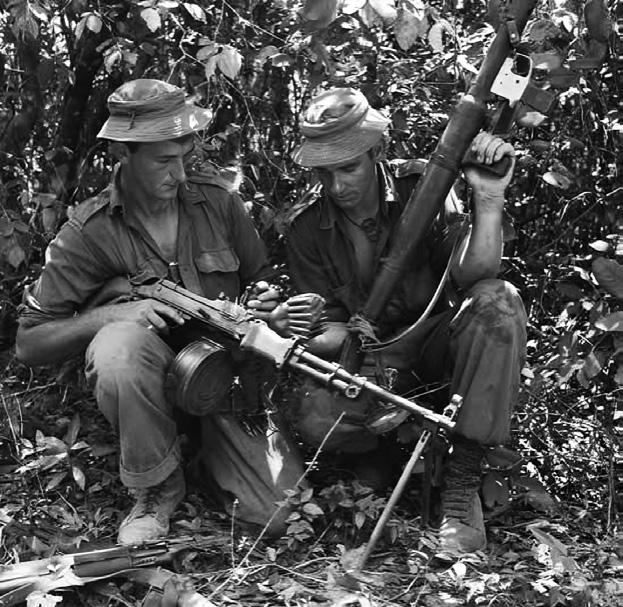
Fortunately the small bulldozer attached to 102 battery was able to partially establish bunds for 4, 5 & 6 guns which subsequently proved fortuitous. The mortar platoon had little time to prepare substantial defences. There was no time to erect perimeter wire or organise claymore mines. M60 machine guns were located to provide lines of fire across the mortars and 102 battery.
The coordination and communication was criticised in commentary and apparently led to the vulnerability surrounding the set up of the defences. The infantry units were under orders to interdict and block enemy movement from the S and SW (from SAIGON). Night ambush positions were established some distance from Coral leaving wide gaps in the defences.
At the initial intelligence briefings commanders on the ground were advised that they should expect to confront an enemy fleeing from defeat in Saigon and would likely consist of small groups who were ill disciplined and not seeking to engage allied forces.
In the meantime US and SVN intelligence reports indicated that large numbers of troops had been observed moving from the N and NW towards Saigon. It was also known that the NVA 7th Division was located in the vicinity of Coral.
The later operational orders noted that the enemy units expected to pass through AO Surfers would consist of a substantial enemy force. It was advised that it was likely that they would be deployed tactically, be well coordinated and have high morale.
The commanders on the ground at Coral deny knowledge of this intelligence having been passed to them.
What occurred on the morning of 13 May was not expected and the inadequate preparation clearly indicates that this was the case. There was no expectation that an attack would originate from the
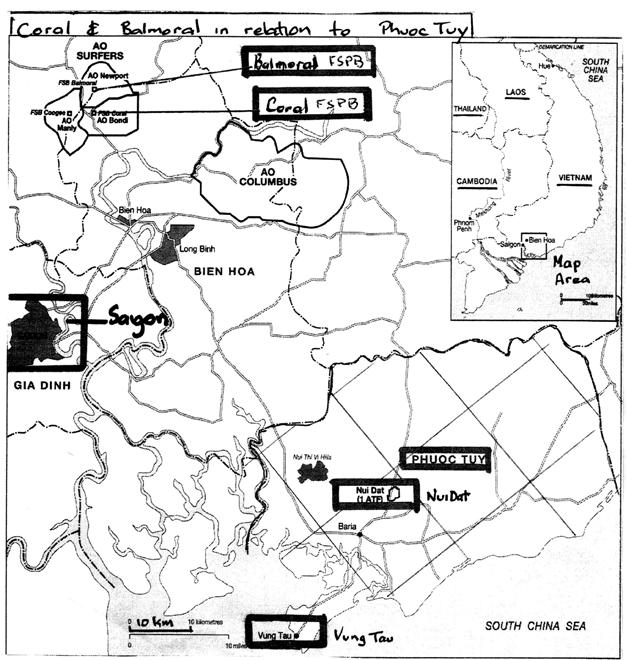
Above illustrates the relative positions of Coral & Balmoral
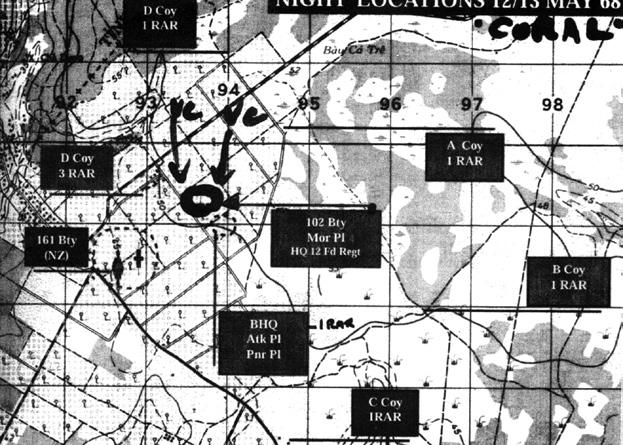
N and NW. While the hasty preparations were underway to establish the defences the enemy observers were noting the preparations and recording strategic information in relation to gun placements, gaps in defences, machine gun positions etc.
0230 13 MAY
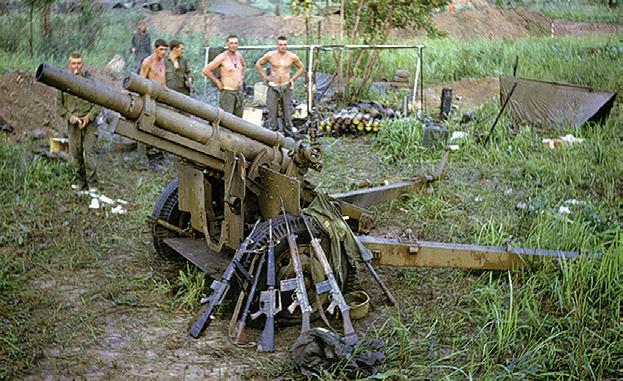
The first indication of an enemy attack occurred when D Coy 1 RAR fired on 3 enemy near their ambush position and almost immediately RPG rockets were directed into the 11 Platoon position. The main thrust of the attack was directed at the mortar platoon and 102 battery. The mortar platoon was overrun as was number 6 gun of 102 battery. The number 4 gun fired splintex over “open sights” (gun at the horizontal)
The situation was chaotic and desperate. The gunners on 4 and 5 guns were forced to defend their gun positions using grenades and small arms and the surviving mortar platoon members desperately struggled to repel the advancing enemy. The platoon commander ordered the survivors to “lay flat” while the guns fired splintex over their bodies which annihilated the attackers and halted the assault.
The intense fighting continued for over an hour until the superior fire power of the defenders. (Small arms, artillery from coral and US guns within range, mortars from 3RAR and flechette from the 90mm recoilless rifles of the anti tank platoon. In the air US gunships and “Puff” strafed the attackers and provided illumination.)
In an attempt to cover their retreat the NVA attempted a further attack about 30 minutes later however this was quickly repelled by artillery fire. Task Force casualties were 11 KIA and 28 wounded. The half strength mortar platoon on 1RAR was almost decimated with 5 KIA and 8 wounded. Enemy bodies found in the area numbered 52, together with large quantities of weapons and equipment. The area showed a lot of evidence that many other casualties had been removed from battle. On the morning of the 13 May Task Force headquarters arrived from Bearcat by helicopter and a road convoy arrived with
supplies and materials to establish a forward maintenance depot.
1RAR was deployed into defensive positions around the perimeter of Coral and work was undertaken to build a strong defensive base. Pits were dug to depth with overhead protection, protected command posts were built, perimeter wire positioned, claymore mines positioned on likely attack paths, M60 machine guns on tripods positioned with covering arks of fire,and the guns plotted fire targets.
The addition of US 155mm guns added to the defensive firepower. Meanwhile 3RAR established FSB Coogee 4000m to the west of Coral and 161 battery and elements of 3 cavalry were redeployed to that location.
3RAR undertook ambushes of company strength from Coogee.
It was considered inevitable that the NVA would attack again given the strategic location of Coral. Enemy reconnaissance patrols were observed around the perimeter which confirmed their continued presence.
1RAR conducted platoon strength reconnaissance patrols to a distance of 3000m to 4000m on 14 May. In the course of these patrols three Australians were killed and at least 12 enemy bodies identified with evidence of others being removed.
It was during these contacts that L/Cpl David Griffiths and Pte Richard Norden were awarded the Distinguished Combat Medal for their brave actions. Pte Norden’s award was posthumously upgraded to the Victoria Cross in 2024.
Continued over page
From page 19
SECOND ATTACK ON CORAL
16 MAY 0230
The second attack was signalled to the Task Force just prior with the appearance of green tracer rounds in the sky near Coral. (The NVA used green tracer, we used red. ) The attack started out as a replica of the first attack with tracer which gave away any element of surprise, the timing and the direction of attack. Tactically it was surprising that a different approach was not taken.
Fire was initially directed towards A Coy 1 RAR (Figure 2) however on this occasion the defences were prepared. The guns and mortars were quick to respond and directed rounds onto the advancing enemy. After action reports showed that at stages up to 60 guns and mortars had fired on the attackers. (105mm,155mm, 1 x 8inch and 81mm mortars).
The battalion strength assault was halted at the wire however a section of 3Pl was hit hard and isolated. The platoon commander responded quickly and in fact ordered the platoon to fix bayonets much to the dismay of many. With the aid of close support mortar fire the situation was stabilised. The platoon commander Lt Weekes was awarded the Military Cross for his decisive action and leadership.
Support was also provided by US gun ships and fighter bombers with napalm. As the enemy continued to attack, A Coy with the support of Armored Personnel Carriers launched a counter attack recapturing the section of 3Pl previously isolated.
The NVA broke contact at 0630 after a 6 hour action and withdrew to the NW while harassed by artillery.
Casualties for the Task Force were 5 killed and 19 wounded. A patrol of the area located 34 enemy bodies and the usual evidence of large numbers of casualties being removed from the area. Later intelligence indicated that of the 800 enemy involved fewer than 100 remained fit for action.
3RAR continued to operate as a blocking force from Coogee with considerable success.
On 20 May Colonel Dunstan the Task Force 2 ic took command at Coral (Brigadier Hughes went on pre planned leave).
A further less intense attack took place in the early hours of May 22 however artillery fire thwarted this offensive before it could gain momentum.
Colonel Dunstan ordered Centurion tanks from C Squadron of 1 Armoured Regiment to redeploy from Nui Dat to Coral. 1 Troop remained at Coral and 2 Troop was sent to Coogee together with one of the 2 US 40mm self propelled anti aircraft guns which had recently been added to the Coral defences. As enemy contact had diminished in the Coogee AO the Task Force Command ordered the closure of Coogee and the establishment of FSB Balmoral 4500m to the north of Coral.
In order to avoid the mistake of alerting the NVA to the establishment of the new base the initial movement of troops to the area was by foot.
Early on the 24 May 2 companies with the headquarters group of 3 RAR and a number of APC departed Coogee and were able to establish a defensive position at Balmoral without the knowledge of the enemy. The remainder of the battalion arrived by helicopter in the latter part of the day, thus denying the enemy an opportunity to plan an immediate attack.
The guns of 161 battery were returned to Coral where all available FSB artillery was consolidated in one location and positioned so as to provide support for both Coral and Balmoral.
Early on 25 May 4 tanks and 2 platoons from 1 RAR left for Balmoral where
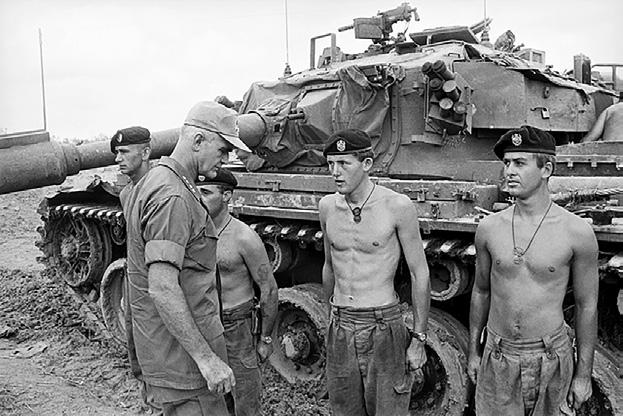
the tanks were to bolster defences, the accompanying infantry was to return to Coral.
On route the infantry came under heavy fire from a bunker system and were pinned down and unable to withdraw.The tanks were able to provide the necessary support which enabled the withdrawal. The tanks once again proved their worth in dealing with bunker systems.
FIRST ATTACK ON BALMORAL 0345 26 MAY
Following the opening barrage from mortars and rockets a battalion strength attack was launched across the open ground to the NE. The attack was directed at the D Coy position and simultaneously a feint attack was initiated towards A Coy from the S.
Fighting continued until 0500 when the enemy broke contact.
During daylight 2 tanks had been positioned out of sight of the perimeter and after dark had been repositioned to either end of the D coy defences. The presence of the tanks surprised the attackers and played a crucial role in suppressing the attack. Gunships and artillery provided harassing fire on the retreating enemy. Only 6 enemy bodies were found by the clearing patrol together with a large quantity of equipment and ammunition. Evidence indicated that many casualties had been removed from the area of attack.
3 RAR casualties were 3 killed and 14 wounded.
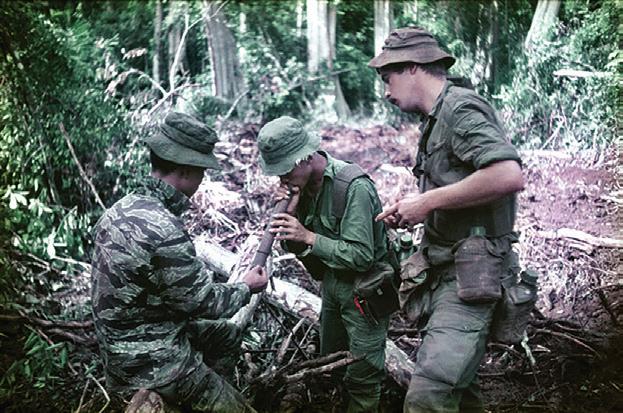
On the26 May D Coy 1 RAR and tanks were directed to clear the bunker system encountered the previous day on route to Balmoral.
The patrol was fired upon from the bunker system located in thick scrub at 1230 and fierce bunker to bunker fighting continued until 1600 when the order was given to withdraw. With night approaching and the realisation that the bunker system was much larger than initially thought it was considered that the inherent risks made the continuation of the action at that time unnecessary.
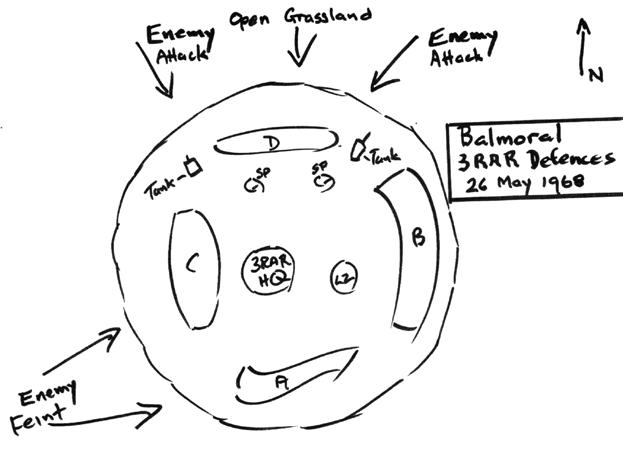
The bunker system was later destroyed by artillery and bombing.
At least 14 bunkers were destroyed, 7 enemy bodies located together with large quantities of weapons etc. and the usual evidence of many more casualties having been removed. There were no Australian casualties. Many bunkers and the troops inside were crushed by the tanks. The action once again showed the effectiveness of tanks against bunkers.
SECOND ATTACK ON BALMORAL 0230 28 MAY
The NVA launched a regimental strength offensive, applying tactics almost identical to the first attack. Initial bombardment, feint from the S and the main thrust again directed at D Coy.
The attack ceased after about 30 minutes, with sporadic probes continuing until dawn.
Gunships, artillery and mortars pursued the enemy withdrawal. A number of enemy had taken refuge in old bomb craters and a tank was used to clear and secure the area.
Enemy dead found in the locality numbered 42, 15 prisoners were captured with 8 of these being wounded. Australian casualties were 1 killed and 8 wounded.
Members of 3 RAR noted that many of the casualties were very young, 16 or 17, which confirmed intelligence that the NVA were recruiting boys as young as 15.
Continued over page
From page 21
Major Phillips OC of D Coy was awarded the MC for his leadership. There were no further attacks on Coral or Balmoral although the infantry continued to patrol the area. The final major contact occurred on 30 May 3000m E of Coral. The lead platoon (9 Pl) of C Coy 1 RAR came under attack and were pinned down and suffered a number of casualties. The opposing forces were only about 15m apart which prohibited the use of artillery and mortars. Two tanks supported by APC were dispatched from Coral. They were able to clear several bunkers which enabled 9 platoons to withdraw after 3 hrs of contact. An M60 was left behind during the withdrawal.
The bunker system was then engaged with air strikes, mortars and artillery.
Three days later C Coy returned to the area to retrieve the M60 only to find the system abandoned and bodies littering the area.
Confirmed dead enemy were 24 and inspection indicated a further 21 had been entombed in the destroyed bunkers.
Australia had 1 killed and 7 wounded.
Patrolling continued until early June with few contacts which indicated that the enemy had vacated the area and it was no longer providing secure access to Saigon. Mission accomplished!
Balmoral was vacated on 5 June and Coral on the 6th.
During the 26 days of operations in AO Surfers the Task Force inflicted heavy casualties on the NVA and local force VC. The designated objective of providing a blocking force was achieved.
The operation resulted in 26 Australians being killed in action, 108 allied forces were wounded including 5 New Zealanders and 5 Americans.
The official casualty count for enemy forces was 267 killed and 11 captured. Strong evidence and observation from the ground and air suggests a much higher casualty rate.
The actions at Coral and Balmoral were different, previously the Task Force had engaged in counter insurgency operations. In AO Surfers they faced regimental strength main force troops , who were well trained, well equipped, and most able fighters. The competence of their leadership has been questioned on the basis of tactics used, the lack of flexibility and the lack of noise discipline in preparation for
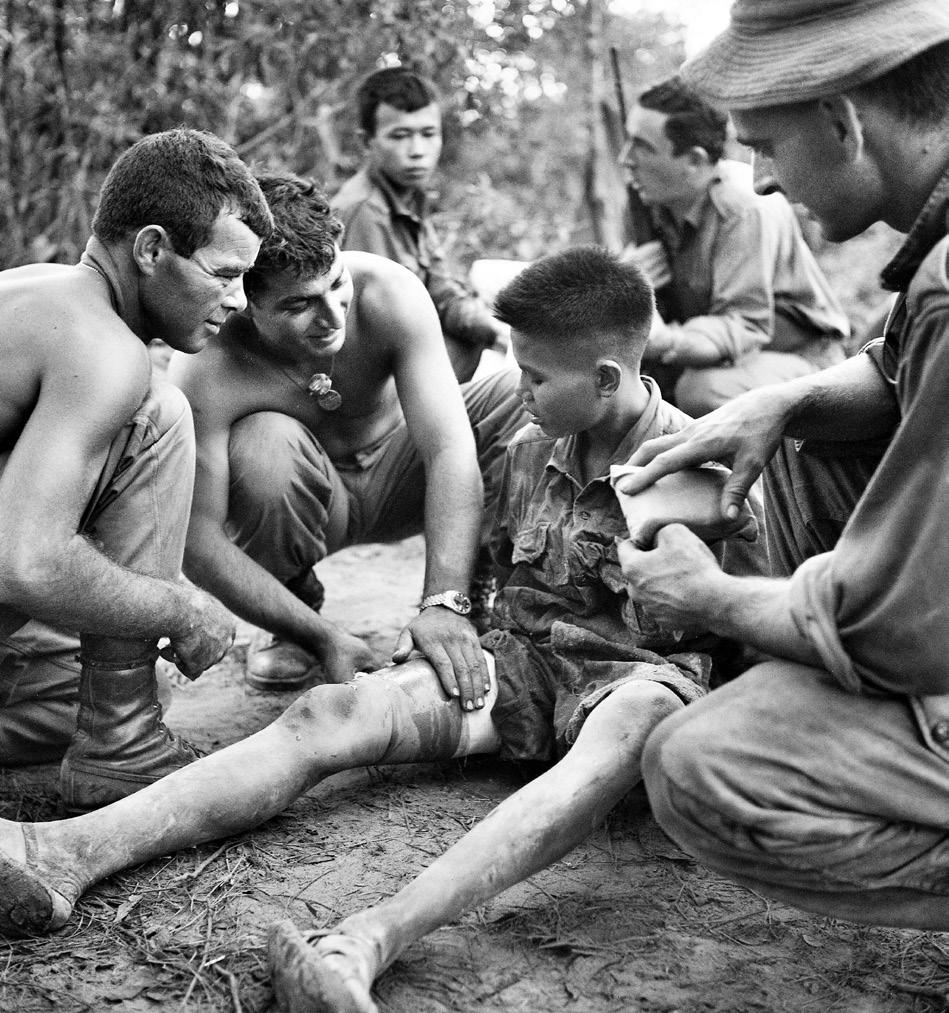
Three soldiers from the 3rd Battalion, The Royal Australian Regiment (3RAR), treat a captured North Vietnamese soldier's leg wounds after a fierce battle at Fire Support Base (FSB) Balmoral in Bien Hoa Province. Identified on the left is Corporal David Francis Butler; second from left is Private Enrico Lepore. The unidentified soldier at right is holding a shell dressing.
attacks. The constant use of tracer (green) fired into the air to provide direction indicators was a constant sign that an attack was imminent.
From an Australian perspective the poor dissemination and communication of intelligence was a clear weakness as was the lack of a disciplined and coordinated movement to Coral and the determination
of structured defences in a timely manner. The Australian commanders and troops were able to adapt to the changed mode of operation and employ set piece tactics to good effect.
In future editions of Hunter Veterans News it is proposed to tell the personal stories of some who were present at Coral and
Balmoral. Most of the stories will be from members of our Association.
A GRUNT
ACKNOWLEDGEMENTS: Information Sources:The Battle of Coral ( Lex McAulay) - Second to None ( Colonel Ian Ahearn OAM) - Coral/Balmoral DVA (Ian Hodges) -Battle of Coral-Balmoral AWM - Wikipedia ( Coral/Balmoral References) and Veterans who were there.
BY Dr Gillian Maddock Clinical Psychologist
EMDR Australia Training & Consultation
FOR many Australian veterans, the effects of trauma linger long after service ends. PostTraumatic Stress Disorder (PTSD) remains a significant challenge, impacting mental health, relationships, and overall well-being. One of the most effective and scientifically supported therapies for PTSD is Eye Movement Desensitisation and Reprocessing (EMDR), a treatment developed in the late 1980s by psychologist Dr. Francine Shapiro.
Dr. Shapiro noticed that bilateral (side to side) eye movements seemed to reduce the intensity of distressing thoughts. Intrigued, she conducted early research trials, initially focusing on war veterans (USA) and other individuals suffering from PTSD. Her studies demonstrated remarkable success, with many participants experiencing a reduction in the emotional distress tied to their traumatic memories and many experienced complete resolution of disturbance, although the memory could still be recalled.
Since then, EMDR has been researched extensively including Randomised Controlled Trials (RCTs). Over 40 RCTs
have been conducted on PTSD, and beyond that to include anxiety, depression, phobias, and even chronic pain. As a therapy it rewires the brain so that memories can be retained, but disturbing details and feelings are removed so that you know the event happened, but you also know it is over and you can learn from it.
When most people think of PTSD in Veterans, it is thought associated with a single traumatic event in combat—such as a firefight, an explosion, or the death of fellow soldiers. While these events can lead to PTSD, trauma can also result from repeated adverse experiences that accumulate over time, leaving a lasting impact.
In trauma therapy, “Big T” Traumas and “little t” traumas are identified. Big T Trauma refers to life-threatening events such as combat, natural disasters, assault, or severe accidents. Little t trauma includes experiences that may not seem catastrophic, but still leave psychological and emotional scars, such as prolonged stress, verbal abuse, or moral injury.
Many veterans are familiar with moral injury, which occurs when one is forced
to act against deeply held ethical beliefs or is unable to take action when they believe they should. This experience is common among both conscripted veterans and those in peacekeeping roles. It can also extend into post-military life, where PTSD prevents veterans participating in things like community and family events.
Trauma does not have to happen directly to an individual for it to leave a mark. Witnessing the suffering of others can also have profound psychological effects.
One of the most misunderstood aspects of PTSD is that it is not necessarily the traumatic event itself, but rather the injury it causes to an individual’s psyche. Traumatic injury is deeply personal, explaining why a group of soldiers can experience the same event but respond differently. Trauma affects each person uniquely based on past experiences, personality, coping mechanisms, and support systems.
If you experience persistent distressing thoughts or bodily sensations related to past trauma, seeking help is important. Trauma therapists work with these experiences regularly, and treatment often alleviates their impact.
Trauma, in its simplest form, is any adverse event that leaves a mark on an individual’s mental, emotional, or physical well-being. This definition extends beyond combat and includes experiences such as childhood neglect, domestic violence, bullying, or prolonged stress.
For veterans, traumatic experiences are not limited to direct combat. Other experiences that can contribute to PTSD include:
n Witnessing death or severe injury
n Losing close friends or comrades
n Experiencing or witnessing atrocities
n Moral injury—being forced to act against personal ethical beliefs
n Exposure to prolonged high-stress environments
n Experiencing military sexual trauma (MST)
Trauma does not only affect the individual who experiences it directly. Family members, close friends, and colleagues can also be deeply impacted as they witness personality changes, emotional withdrawal, and struggles with depression and anxiety, alcohol and drug use, often associated with PTSD.
PTSD & ALLOSTATIC OVERLOAD: THE HIDDEN COST OF CHRONIC STRESS
While PTSD is a primary reason veterans seek EMDR therapy, it is not the only consideration. PTSD is often accompanied by allostatic overload, a condition where the body’s stress response system becomes overwhelmed due to chronic exposure to trauma and high-stress environments.
Allostatic overload occurs when the physiological mechanisms designed to help us adapt to stress—such as the release of cortisol and adrenaline—are activated too frequently or for prolonged periods. Over time, this persistent state of stress wears down the body, leading to a range of health problems beyond psychological distress.
Symptoms of allostatic overload include:
n Chronic fatigue and sleep disturbances
n Increased blood pressure and cardiovascular issues
n Weakened immune system, leading to frequent illness
MEMORY & COGNITIVE IMPAIRMENTS
Increased inflammation and pain sensitivity
Mood instability, anxiety, and depression
For veterans, the cumulative effects of trauma, combat stress, prolonged military
service, or untreated PTSD and other mental health symptoms, can place a heavy burden on the body’s ability to regulate stress. This not only exacerbates PTSD symptoms but also contributes to physical health problems, including heart disease, metabolic disorders, and chronic pain. EMDR therapy provides more than just relief from PTSD symptoms; it also helps reduce the overall allostatic load on a veteran’s mind and body. By reprocessing traumatic memories and reducing their emotional charge, EMDR assists in breaking the cycle of chronic stress, allowing the nervous system to recalibrate and function more effectively. This can lead to improvements in sleep, mood stability, and overall well-being, ultimately supporting a veteran’s long-term health beyond mental health alone.

While PTSD may result from a single traumatic event, more often it is associated with repetitive events and so some individuals develop Complex PTSD (CPTSD), which arises from repeated, prolonged exposure to traumatic situations. CPTSD is particularly relevant to veterans who have experienced ongoing stress and trauma over months or years.
Unlike PTSD, which is primarily associated with flashbacks, nightmares, and hypervigilance, CPTSD also includes:
n Emotional dysregulation (difficulty controlling emotions)
n Persistent feelings of guilt or shameChronic feelings of worthlessness
n Difficulty maintaining relationships
n Dissociation or feeling disconnected from oneself
For many veterans, CPTSD can stem from experiences such as extended deployments, multiple exposures to traumatic events, and institutional betrayal, where the military or government is perceived to have failed in protecting or supporting service members adequately. I have commonly seen patients who are described as having a “different personality” after they returned from combat, and this may be explained by the “complex” part of PTSD.
HOW EMDR HELPS VETERANS WITH PTSD AND CPTSD
EMDR therapy offers a unique approach to processing trauma by leveraging the brain’s natural ability to heal from distressing memories. The therapy involves guiding the patient through bilateral stimulation—usually in the form of guided eye movements—while they recall traumatic experiences. This process helps rewire how the brain stores and processes traumatic memories, reducing their emotional intensity over time. EMDR can be integrated with medication and other therapies but clinicians must have undertaken EMDR training.
For many Australian veterans, PTSD has been a lifelong struggle, often exacerbated by decades of silence and inadequate mental health support. The stigma surrounding mental health in the military has historically prevented many from seeking help. You may be thinking that it is too late to try another treatment approach, that other approaches have had limited impact or perhaps you are curious as to why you have not heard of EMDR, if it has been researched since the 1990s. All treatments take time to establish and research and there is often a period of scepticism until something can be reliably shown to produce the effects expected. The World Health Organisation and the Australian Psychological Society now rate EMDR as having the highest level of evidence base for treatment of PTSD in children, adolescents and adults. With growing evidence, comes growing awareness and an increased availability of effective treatments like EMDR, and with this, more veterans are finding hope and healing. If you would like to discuss PTSD or other mental health issues with someone, contact your GP and seek DVA referral to a clinician trained in EMDR or Open Arms, where some clinicians may provide EMDR.
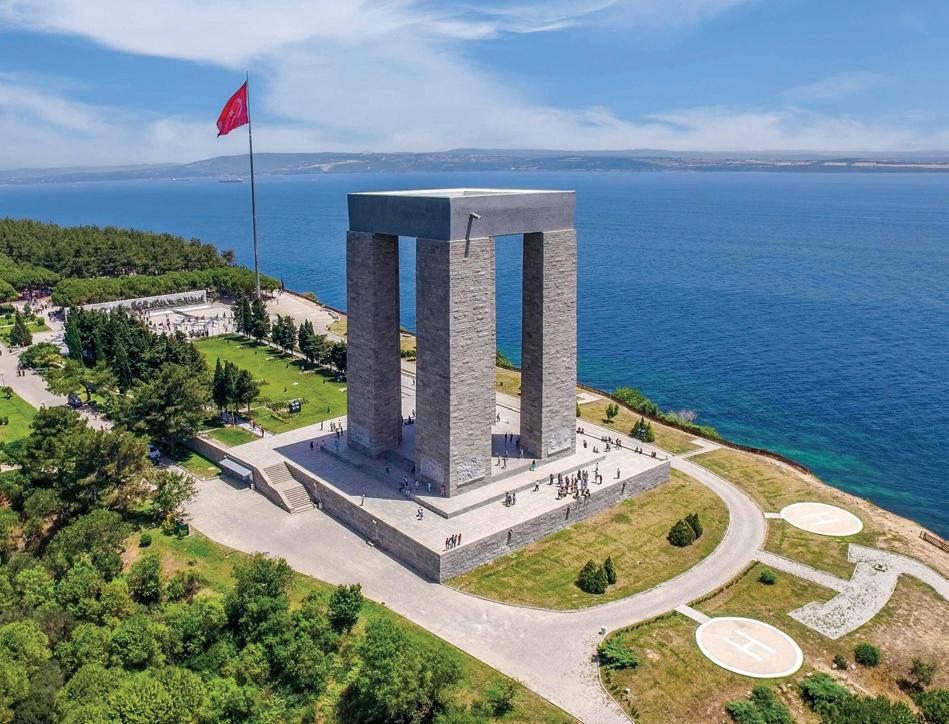
Today, ANZAC Cove (Anzak Koyu in Turkish) is quiet, with the occasional fishing boat passing along offshore. A small grassy field at the foot of Plugge's Plateau has been designated as the ANZAC Cove Commemorative Site, seeing many visitors here on ANZAC Day.

A message from Sonia Gregory Deputy Commissioner NSW / ACT Department of Veterans’ Affairs (DVA 2025
IS off to a flying start and here at the Department of Veterans’ Affairs (DVA), we are already looking towards Anzac Day. Anzac Day provides Australians with an opportunity to remember and reflect upon the service and sacrifice of all those who have served, and to honour the more than 103,000 service personnel who have given their lives in our country’s name.
In recent times, it has become popular for Australians to travel overseas to see where the battles took place and honour our service personnel on the fields where they fell.
Each year, DVA delivers Anzac Day services on behalf of the Australian Government at Gallipoli in Türkiye and at the Australian National Memorial near VillersBretonneux in France. Both sites hold special significance in Australia’s proud military history.
110 years ago, on 25 April 1915, soldiers from the Australian and New Zealand Army Corps (ANZAC) landed on the rugged shores of the Gallipoli peninsula. Their aim was to assist British naval forces in gaining command of the Dardanelles strait, which offered access to the Turkish capital, Constantinople.
Over the next eight months, more than 8,700 Australians and some 2,700 New Zealanders
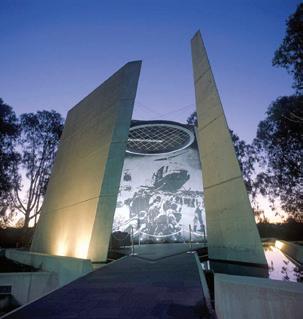
lost their lives. These original Anzacs are remembered for their courage, loyalty, endurance, selflessness and mateship. Over the three years which followed, Australian personnel continued to distinguish themselves, this time on the Western Front and in Mesopotamia, Sinai and Palestine.
The Australian National Memorial in France is located on the site where an intense battle was fought as part of wider efforts to halt the German spring offensive which threatened to break through Allied lines. Throughout early April 1918, Australian units helped defend VillersBretonneux from this onslaught, but at dawn on 24 April the Germans attacked and captured the town. The Australian 13th and 15th Brigades led a British counterattack that enveloped the town, and successfully cleared it of German forces by 25 April, coinciding with the anniversary of the Anzac landings at Gallipoli.
General Monash wrote that he considered the attack ‘the finest thing yet done in the war by Australians or any other troops.’ If you are planning to attend the international Anzac Day Dawn Services in Türkiye or France, you will need to register for an attendance pass for entry. It’s free and available online at commemorations.teg. com.au Registration is essential. You can also watch the services live on the ABC.
Of course, the men and women who wear our uniform today continue to carry on the proud legacy of the original Anzacs around the globe – on land, at sea and in the air.
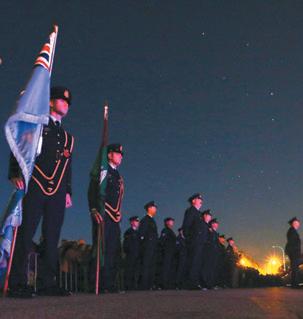
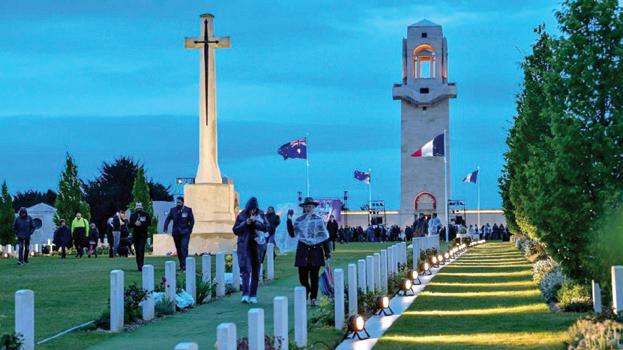
Villers-Bretonneux became famous in 1918, when the German advance on Amiens ended in the capture of the village by their tanks and infantry on 23 April. On the following day, the 4th and 5th Australian Divisions, with units of the 8th and 18th Divisions, recaptured the whole of the village and on 8 August 1918, the 2nd and 5th Australian Divisions advanced from its eastern outskirts in the Battle of Amiens.
The memorial is the Australian National Memorial erected to commemorate all Australian soldiers who fought in France and Belgium during the First World War, to their dead, and especially to name those of the dead whose graves are not known.
The Australian servicemen named on this memorial died on the battlefields of the Somme 1916-18, Pozieres, Bapaume
On Anzac Day, I encourage you to attend a commemorative event whether it be overseas or in your local area. Local Anzac Day services and marches are usually organised by the ex-service organisations and the RSL sub-branch in your region. The Australian Government also holds the national Dawn Service at the Australian War Memorial in Canberra.
To commemorate Anzac Day each year, the DVA Commemorations Branch on behalf of the Minister for Veterans’ Affairs, distributes a package of commemorative resources to over 17,500 schools, ex-service organisations and community groups. The resources raise awareness of Anzac Day and encourage Australians to honour the service and sacrifice of veterans and their families, by taking part in commemoration.
1917, Arras 1917, Bullecourt, Messines 1917, Ypres 1917, Menin Road, Polygon Wood, Broodseinde, Poelcappelle, Passchendaele, Avre, Ancre 1918, Villers-Bretonneux, Lys, Hazebrouck, Hamel, Marne 1918, Amiens, Albert 1918, Albert 1918 (Chuignes), Mont-St. Quentin, Hindenburg Line, Epehy, St. Quentin Canal and Beaurevoir.
Both the cemetery and memorial were designed by Sir Edwin Lutyens. The memorial was unveiled by King George VI on 22 July 1938.
Of the 10,982 names displayed at the unveiling of the Villers-Bretonneux Memorial the burial places of many have since been identified and this continues to this day. As a result, there are currently 10,729 Australian servicemen officially commemorated by this memorial.
The 2025 Anzac Day commemorative packages include 4 posters and information about new education resources as well as this year’s Anzac Day Schools’ Awards (ADSA) competition.
DVA has also developed a free, downloadable kitbag to support anyone involved in their local Anzac Day event. The kitbag includes speeches, music and hymns, the Ode of Remembrance, commemorative activities for children and more. Download the Anzac Day kitbag from DVA’s Anzac Portal: https://anzacportal.dva.gov.au/adkitbag
This Anzac Day, please take the opportunity to honour all those who have served and safeguard the memory of those who have given their lives in our name.
Lest we forget.
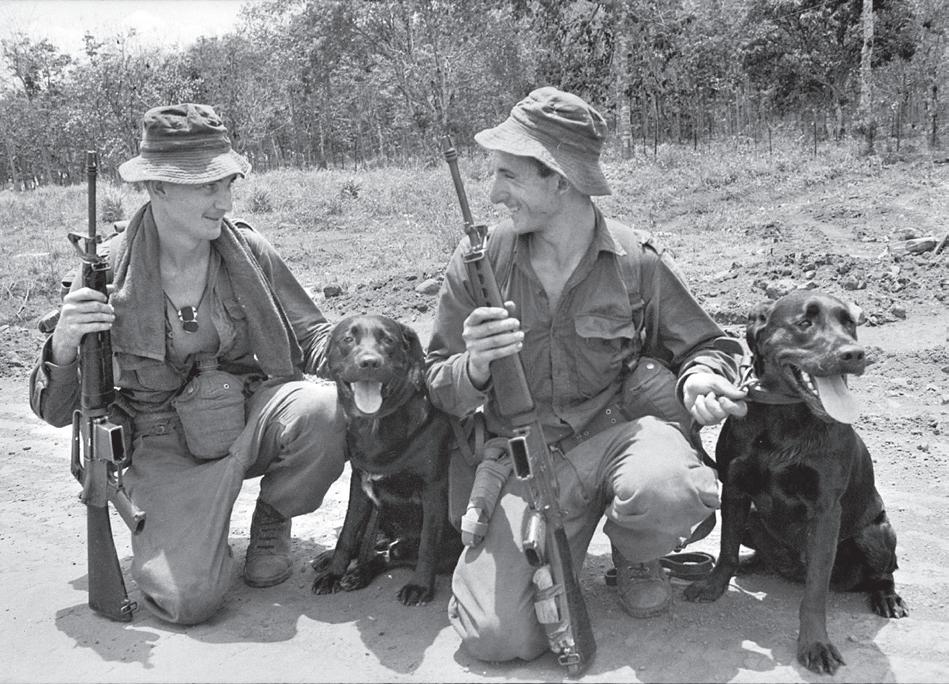
TRACKER dogs served with the Royal Australian Regiment in Vietnam from 1967 until 1971.
The dogs were black labradors and were specially trained at the Ingleburn Infantry Centre to seek out the enemy under jungle conditions. Training usually commenced when the dogs were about 10 months old and continued until they were deemed ready for their task.
In Vietnam 2 dogs were usually posted to each battalion and operated in tracker teams consisting of 2 dogs, 2 handlers, a visual tracker (an infantry soldier trained to determine enemy strength, their weapon types and other relevant intelligence) 2 cover men who were directly responsible for providing protection for the dogs and handlers, a machine gunner and a signaller. These teams were part of reconnaissance platoon in Support Coy.
Their primary role was to follow enemy tracks and their hideouts following contacts. Their highly developed sense of smell and hearing also on occasions led to the detection of unseen enemy.
In total 11 tracker dogs were deployed to Vietnam, each serving a tour of 3 years. Due to Australian quarantine restrictions the dogs were not allowed to return to Australia and following their service homes were found for them in Saigon, usually with embassy and diplomatic staff .
The only dog to die while on service was Cassius who died of heat exhaustion while on a training run.
The dog’s names were Caesar, Cassius, Janus, Julian, Juno, Justin, Marcian, Marcus, Milo, Tiber and Trojan.
As one would expect the bond between dog and handler was special and the loyalty and affection unconditional.
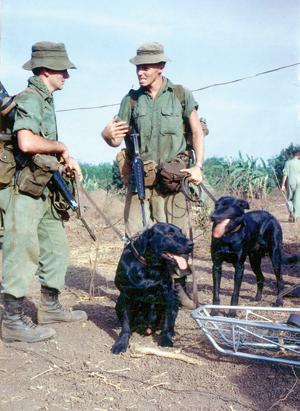
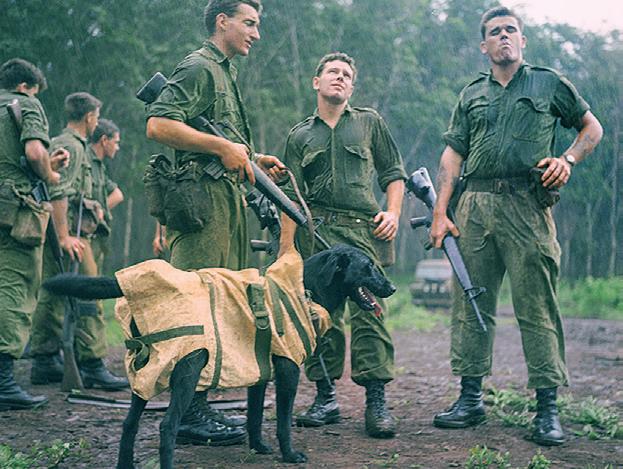
Tracker dog Tiber waits to carry out helicopter winching training with their handlers and soldiers from 7RAR in Nui Dat, 1967.
The exploit of Tiber during the second attack on FSB Coral in May 1968 Lex McAulay is recorded in his book “The Battle of Coral” as follows:
“Frightened by the horrendous night, Tiber, one of the dogs from Les Tranter’s tracker teams, broke loose from its handler and fled across the battlefield,
heading for Mick Bindley’s comms centre. Tranter radioed an urgent message, Bindley looked out, saw the dog, leaped out and chased it and made “one of my less successful rugby tackles at him and missed, then asked myself the very reasonable question: what the hell am I doing chasing a dog around at this time of night? And very smartly returned to the pit”.
Tiber “slunk back into the Australian lines” around 1000 hrs next morning. His handler Bryan Meehan said “You look real ashamed don’t you? So you reckon you’re going to get a hiding”. He lay down on Brian’s boots with his head turned away. Brian just gave him a pat and a drink.
In 2007 approval was granted for 2 medals to be awarded to military working dogs: n The Canine Service Medal - service for at least 5 years overseas. n The War Dog Operational Medal - for overseas operational service in excess of 28 days.
The tracker dogs were an important part of a combat team and their abilities were highly regarded by all who served with them.


BY Stephen W. Finney OAM JP Director of Ceremonies
Newcastle and Hunter Region Vietnam Veterans Incorporated
IWOULD
like to report to the Vietnam Veterans and the families of the nineteen servicemen who were killed in action in South Vietnam that this memorial that has been standing now in Civic Park – King Street Newcastle for over 40 years as a reminder of those 19 who paid the supreme sacrifice has recently been refurbished with anew plaque.
The original plaque had become very badly weather worn, graffitied and abused over the past 40 years. Now it is brand new and
hopefully will continue to enhance our memorial to our mates.
The memorial has been designed and built around the number 19 it is 1900mm at its highest point and 850mm (half of 1900) at its lowest point. The walls are 5700mm (3 times 1900) long and are finished in a harsh surface denoting the harsh acceptance that Vietnam Veterans received when they returned from their tour of duty. The surface finishes gradually into a softer smooth face of granite tiles representing the gradual acceptance of the veterans as the years have passed.
The passage between the memorial walls with the tall tree in the center reminds us that life goes on. Over all this memorial stands to remind the people of Newcastle, what happened in those bad times and the price that was paid.
On behalf of the Vietnam Veterans and the families of the KIA to give the staff and workers of EDSTEIN MONUMENTAL operating out of Sandgate Newcastle a
Please come along to one of our
Meets 10-30am second Friday of the Month at RSL Sub-Branch Hall 48 Baker Street, Mayfield
Contact Di on 4956 9450 for more deatils
Meets 9.30am every second Monday of the month at RSL Sub-Branch Hall, East Maitland
Contact Carol on 4932 0070 for more deatils
thank you the excellent job they did on the refurbishment of the memorial plaque. The Vietnam Veterans meet at the memorial on the Saturday closest to the 18th of August (The gazetted Vietnam Veterans Remembrance Day) each year for a memorial service that commences at 4:00pm.
For the past 18 years we have profiled the life of one of the 19 KIA at this service this year we will be profiling the last one:
WAYNE ALLAN BLANCK
Sergeant [Sgt] (Temporary Warrant Officer Class 2 (T/WO2)
Service Number: 38033
Unit: AATTV (RA INF)
Service: Army
Date of Death: 20 September 1966
Place of Death: South Vietnam Cause of Death: Killed In Action
This service is open to the general public and all are welcome.
Meets 10am every third Tuesday of the month at the Legacy Room, Lauren Lane (off Pitt Street), Singleton

Contact Betty on 0413 415 838 for more details



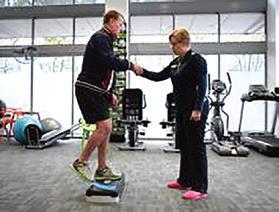
Recovery Station has been providing health services to the Veteran community for over 15
We deliver allied health services from our clinics and within the comfort of your own home. We have empowered thousands of individuals to achieve their personal health goals by providing the foundations for living a better quality of life. We are proud to have assisted people to transition out of nursing homes, live independently, drive safely again, communicate with ease, walk with confidence and to live a quality of life.

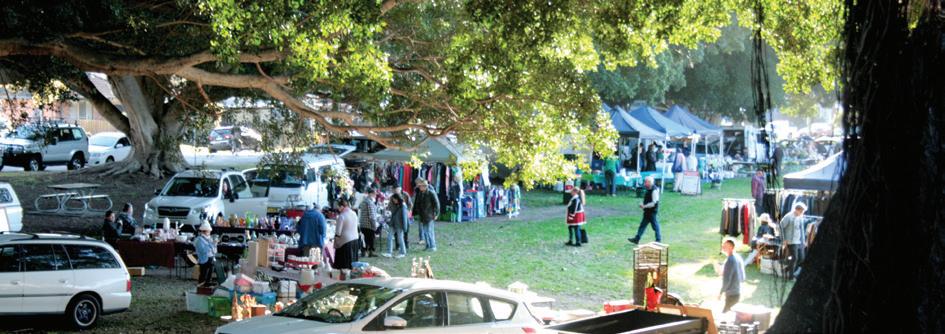
THE Islington Markets held at Wickhan Park have been operated by the Newcastle & Hunter Region Vietnam Veterans for over 40 years.
Held on the last Sunday of the month, the regular income received from 100 plus stall holders monthly has provided a regular income to support our work, we presently receive approximately 2 thousand dollars per month.
In order to properly operate the markets a team of 5 is required each month to collect
the money and provide information to those in attendance.
We need at least 20 volunteers operating in teams of 5, which would enable each team to be present only a couple of times per year for about 2 hours a time. Many hands make light work! and at present the very few regular helpers are struggling to service the markets. Unless more helpers can be found it is inevitable that we we will have to give up our licence to operate and forfeit our
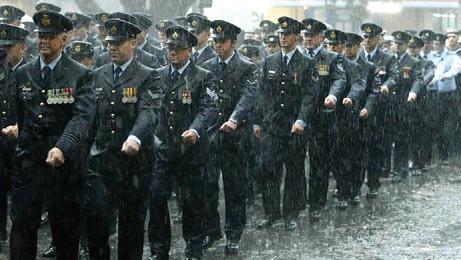
The RSL is the largest representation Veterans have to watch over our government and The City of Newcastle RSL Sub-Branch have been a strong supporter of Veterans for many years. For mateship and Verterans support join a Sub-Branch today.
income source which is a major contributor to our operating expenses.
We need your help, please consider organising a team of five or volunteer individually by contacting Joss Dohmer on 0418 779 360 or the office on 4951 2633
You may even wish to ask your wife, partner or a friend to give a hand too. It is not difficult work and if we can get enough helpers the time involved would only be about 4 hours per year.

You will meet your Care Coordinator, who will listen to your story and identify needs. We will then either directly assist or connect you to the right services.
Who is Eligible?
Any ADF veteran, reservist or their family member residing within the Central Coast Local Government Area and the NSW Hunter Region.
How do we help?
If you are struggling to navigate the services, your Care Coordinator can help find a way forward with support and referrals. They will act on your advice and provide choices.
We can offer help in the following areas:
• connection with physical and mental health services such as GPs, Allied Health Professionals (Physio, Podiatrists etc.)
• connection with social and community services
• increase understanding of your overall health and wellbeing



Supportive relationships – Don’t do this alone. It is important to connect with others (friends, family or colleagues) who care about you. Allow them to care for you when you need it.
2. Sharing with others – Find someone you feel comfortable
3. Be true to yourself – Don’t dismiss your place of strength, be it a set of beliefs, a religion, faith or traditional/ alternative healing techniques. Your place of strength is as individual as your grieving process. There is no right answer - only you know what works for you.
We support anyone who has been bereaved or impacted by suicide including:
• individuals, families, friends, witnesses
• schools, workplaces and community groups
• first responders and service providers
To find your local StandBy site please use our website www.standbysupport.com.au
Many people are impacted by each suicide death including family members, close friends, kinship groups, colleagues and whole communities.

4. Get moving – Any physical activity is worth it. Exercise can lift you when you’re feeling low. Getting outside in the sunshine is also beneficial.
5. Be patient – Understand the healing process takes time. Take care of your physical health – Grief can be hard on your body. Looking after yourself includes eating regular healthy meals, getting plenty of sleep and regular exercise and avoiding overuse of alcohol, tobacco, caffeine and other drugs. A check-up with your GP may assist you with this.
Practise self care – Be kind to yourself. Do things that bring you enjoyment and comfort, such as listening to relaxing music, massage, a warm bath or meditation.
8. Go outside – Spend some time outdoors. Fresh air and sunlight can assist your overall health and wellbeing.
9. Reach out – You may be able to work through your grief with the help of family and friends, or you may need extra support. Don’t be afraid to ask.