Portfolio Part 1

Page 1


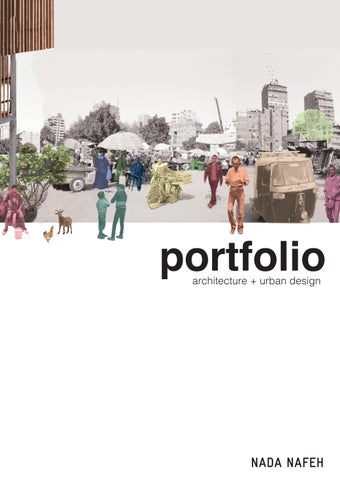
architecture + urban design portfolio

PROJECTS

INFRA++ STRENGTHENING RESILIENCE AND PARTICIPATION AT LOCAL LEVEL 2021-2022

German Agency for International Cooperation (GIZ) GmbH

For more information, please visit: [in]formal Pattern Language© interactive design guide + database for patterns: www.informalpatternlanguages.com https://issuu.com/nnafeh/docs/_in_formal_pattern_language_e-book

This work is subject to copyright. All rights are reserved.

No part of this publication may be reproduced, distributed, or transmitted in any form or by any means, including translation, photocopying, reprinting, reuse of illustrations, recitation, recording, broadcasting, reproduction on microflms or in other electronic or mechanical methods, and storage in data banks, without the prior written permission of the author.

02

A METHODOLOGY FOR THE IMPLEMENTATION OF THE 2030 URBAN AGENDA AND SUSTAINABLE DEVELOPMENT GOALS 2021

German Agency for International Cooperation (GIZ) GmbH 04

[in]FORMAL PATTERN LANGUAGE 2015-2024

2023 - 2024 Preparation of Publication 2019 - 2021 Research in Practice Grant Holcim Foundation for Sustainable Construction 2014 - 2015 M.Arch Thesis University of Waterloo

05

[in]FORMAL PATTERN LANGUAGE DESIGN MODULE | ARCH. DESIGN STUDIO II

The American University in Cairo (AUC) Fall 2024 A formal informal Pattern Language Zamalek Edition Spring 2025 A formal informal Pattern Language Downtown Cairo Edition 2024- PRESENT

03

PARTICIPATORY INFRASTRUCTURE PROGRAM (PIP) 2018-2020

Urban Development Cluster

German Agency for International Cooperation (GIZ) GmbH

06 PILGRIMAGE 2014

Comprehensive Building Design Studio University of Waterloo

INFRA++

AND STRENGTHENING RESILIENCE AND PARTICIPATION AT LOCAL LEVEL

ORGANIZATION GERMAN AGENCY FOR INTERNATIONAL COOPERATION (GIZ) GMBH 2021-2022

DATE

YEMEN SITE

MAP OF SELECTED LANDING SITES

INFRASTRUCTURE REHABILITATION PROCESS:

TOWARDS THE SUCCESSFUL APPLICATION OF INFRA++

Designing a participatory process and design guidelines for the rehabilitation of traditional fshing landing sites in Yemen with respect to context, community and local heritage

BASELINE STUDY socio-economic market analysis

ANALYSIS PHASE

TENDERING & COMMISSIONING

1 3

SELECTION OF LANDIND SITES

INVOLVEMENT OF STAKEHOLDERS political partners, beneficiaries, implementing partners

DESIGN PHASE

PRELIMINARY DESIGN drawings, digital 3D model, EIA, cost estimation

DETAILED DESIGN technical planning building permit BOQ 5

CONTINOUS MONITORING

PARTCIPATORY CONSULTATION AND VERIFICATIONS BETWEEN BENEFICIARIES, GIZ AND IMPLEMENTING PARTNERS

4 8 2 7

IMPLEMENTATION PHASE

TENDERING & AWARDING commissioning of local construction company 6

WARRANTY / MAINTENANCE capacity development for local partners

COORDINATION WITH GOVERNMENTAL ACTORS AND LOCAL COOPERATIVES

POSTIMPLEMENTATION

IMPLEMENTATION construction works handover to partners maintenance & operation plans

IMPACT EVALUATION

INTEGRATED IMPLEMENTATION OF THE 2030 URBAN AGENDA AND SUSTAINABLE DEVELOPMENT GOALS

ORGANIZATION

METHODOLOGY AND A GUIDE FOR ASSESSMENT AND IDENTIFYING INTERLINKAGES

Report Purpose and Scope

This publication presents a methodology and guide for the assessment of projects in respect to relevant design policies and guidelines from the 2030 Urban Agenda.

Featured projects are assessed in relation to their proposed design concepts, the corresponding activities and results, which are then attributed to the relevant SDG goal.

The proposed SDG wheel provides a tool to navigate between synergies and trade-offs, as well as a visual summary of each project’s national agenda, which include short, medium- and long-term urban strategies for different sectors.

DESIGN YOUR PROJECT

This tool should enable projects to assess their own contribution to the implementation of 2030 Urban Agenda. Interested projects can use the provided SDG wheel to visualize their project‘s proposed program in terms of meeting global SDGs and design objectives.

HOW TO USE THE SDGs WHEEL?

The SDGs wheel can be used by projects in workshops and preliminary design sessions to analyse and visualize their project‘s functional program and design components to meet global urban design guidelines and policies.

5 GREEN

INFRASTRUCTURE IN AMMAN (ILCA)

Greater Amman, Jordan 2017-2021

€ 5m

COMMISSIONED BY POLITICAL PARTNER

MAIN IMPLEMENTING PARTNERS

Federal Ministry for Economic Cooperation and Development (BMZ), Germany Ministry of Environment Greater Amman Municipality (GAM)

MAIN PROJECT ACTIVITIES On behalf of the German Federal Ministry for Economic Cooperation and Development (BMZ), the Deutsche Gesellschaft für Internationale Zusammenarbeit (GIZ) GmbH implements a pilot project set up to develop elements of green infrastructure at selected sites in East Amman, improve access to services and help address the disruption of the social fabric.

‘Improving Living Conditions in disadvantaged Areas in Amman’ (ILCA) also intends to raise awareness on the potentials of green infrastructure to mitigate/adapt to climate change, and support Jordan to achieve their commitments to global and national agendas such as SDGs and NDCs.

Furthermore, the project intends to mainstream integrated participatory development of Public Open Space (POS) within relevant partner institutions through strategic capacity development measures.

STRONG INSTITUTIONS

The participatory process applied in the development of green infrastructure networks promotes the dialogue between the involved partners, Ministry of Environment, Greater Amman Municipality, local communities

SUSTAINABLE CITIES AND COMMUNITIES

Through the rehabilitation of three public space sites, the project improves the quality of living conditions in east Amman. The project is locally integrated into GAM’s wider strategy to develop walkability, by improving the access to public space by public transport

SDGs AND THEIR INTERLINKAGES

INTERLINKAGES BETWEEN SDGs

SYNERGY

EQUAL ACCESS TO JUSTICE FOR ALL

The implementation of the green public spaces plays a prominent role in improving urban well-being - with particular attention given to women and girls’ specific needs through increased access to public space “for all”.

SDG 11 & SDG 16

ILCA supports the Training Institute of the Municipality (GAM) to work on applying green infrastructure principles in planning of public open space in their courses for their employees.

SDG 11 & SDG 13

ILCA works on raising awareness on the potential of green infrastructure to mitigate/adapt to climate change.

SDG 10 & SDG 13

The needs of the residents due to the lack of basic and critical services may not prioritise environmental aspects or the implementation of green areas and open spaces

SDG 8 & SDG 13

Green public spaces might present an opportunity for residents to establish commercial activities and small businesses, however this may result in decreasing the green areas

SDG 5 & SDG 11

Improving the quality of public space contributes to improving the accessibility of women to public space

Turn static files into dynamic content formats.
Create a flipbook
Issuu converts static files into: digital portfolios, online yearbooks, online catalogs, digital photo albums and more. Sign up and create your flipbook.