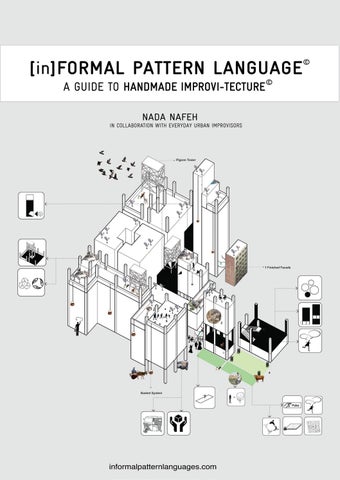
IN COLLABORATION WITH EVERYDAY URBAN IMPROVISORS
© 2015 Nada Nafeh. All Rights Reserved.
This work is subject to copyright. All rights are reserved.
No part of this publication may be reproduced, distributed, or transmitted in any form or by any means, including translation, photocopying, reprinting, reuse of illustrations, recitation, recording, broadcasting, reproduction on microflms or in other electronic or mechanical methods, and storage in data banks, without the prior written permission of the author.
For participation, collaboration and more information about the [in]formal Pattern Language© initiative, please visit: www.informalpatternlanguages.com
A copy of the M.Arch thesis submitted to the University of Waterloo, in 2015, is available at: http://hdl.handle.net/10012/9849
Extracts from the e-book are available at:
https://issuu.com/nnafeh/docs/_in_formal_pattern_language_e-book
More extracts from the [in]formal Pattern Language© manual can be requested
MODELING | IMPROVI-TECTURE© TOOLS
Improvi-tecture© tools are actions to optimize and retroft [in]formal patterns using the same inherent and intelligent [in]formal tactics that produced the patterns. Optimization occurs by infusing subtle aggregations, while providing general regulations that make patterns more sustainable. Like compiled patterns, Improvi-tecture© tools need to be constantly updated. Unlocking a positive [in]formal design vocabulary, such as [in]completeness, urban timeshare, hyperfunctionality, exchangeable skin, incrementalism, compactness, etc. the toolkit is designed to guide community members, designers, and planners during the whole process, from preparing for an intervention to design and operation. One of the most important aspects is the fact, that the toolkit was not imposed but self-generated by participants. Every tool is inscribed with the name of its creator.
EXAMPLE FROM THE GUIDE
pigeon droppings used as a fertilizer for fower boxes
hanging herbs to dry
PIGEON BREEDING
male dominated activity entry restricted to owners
PULLEY SYSTEM
facilitates harvest and delivery of tools
FLOWER BOX
women educate their children on urban farming
Edible plants are either consumed or sold in the market
SITTING AREA
an extension for microeconomies + socializing (optional light weight space divider: fabric / wood)
HYDROPONIC SYSTEM
Used PVC pipes are attached to the pigeon tower structure. Plants absorb nutrition through their roots from constant fowing water. Water runs in a closed cycle
WATER CULTURE
Edible plants sit on a platform made of styrofoam and foat on the nutrient solution. Water is flled manually with a hose to reduce costs and energy
WASTE COLLECTION
organic waste recyclable waste
waste collected by toktok twice a week
SPACE FOR MICRO-ECONOMIES
income generating opportunities for women in close proximity to their homes and children.
Figure 4.1 Operation of optimized pigeon tower during daytime
OPTIMIZED PIGEON TOWER
DURING EVENINGS + NIGHT
FEMALE PIGEONS + SQUABS
Breeding female pigeon is only for consumption and reproduction.
WATCH TOWER
Hiding place for breeders to observe foreign incoming pigeons without scaring them. The tower is provided with a small pulley system to control closing and opening of the nets.
SITTING AREA
outdoor informal classroom or sitting area
OPERABLE NET
Operable net at the 4 corners and on top to catch foreign incoming pigeons
MALE PIGEONS
Every pigeon breeder trains his pigeons at a negotiated time every day. Making circular motions with a red fag, male pigeons are trained to navigate, circle the neighbourhood then come back. Part of the training is to keep male pigeons away from females until a certain age.
FEEDING AREA
STRUCTURE
top: reused door frames base: reused scaffolding and decking wood members
EVENING CLASSROOM
young adults and co-op students help children with their school work or teach adults about urban farming and income generating skills.
Figure 4.2 Operation of optimized pigeon tower during evenings & night time
For participation, collaboration and more information about the [in]formal Pattern Language initiative, please visit: www.informalpatternlanguages.com