[Disclaimer: All members of VSJP who are quoted in this article will be referred to anonymously out of concern for their safety.]
On Dec. 2, Vassar College administrators informed members of Vassar’s chapter of Students for Justice in Palestine (VSJP) that their upcoming teach-in on the Popular Front for the Liberation of Palestine (PFLP) would be canceled due to concerns about the PFLP’s status as a U.S.-designated foreign terrorist organization (FTO), as well as objections and threats that administrators received regarding the event.
In an email to members of VSJP’s executive board obtained by The Miscellany News, Vassar Director of Student Activities and Associate Director of Campus Activities Will Rush explained that the administration’s concerns originated from the promotional materials created to advertise the event, which had been posted online. Rush wrote: “The event
Josie Wenner
Ireada lot of books this year (80 and counting). Here are my top picks, in no particular order.
“Demon Copperhead,” Barbara Kingsolver
“Demon Copperhead” is my top book of the year. I cannot recommend it enough. Born to a single mother struggling with addiction in Appalachian Virginia, Damon Fields is christened “Demon Copperhead” in this modern retelling of Dickens’ “David Copperfield.” The novel explores systemic poverty and the opioid crisis as Demon is thrown into one predicament after another. He performs forced labor in his first foster home, faces his mother’s death and struggles with a severe football injury along with drug addiction. He also finds kinship with a neighboring family, discovers a passion for art from his teacher and falls in love, all while longing his whole life to see the ocean. If you like the hero’s journey, social commentary and crying, this book is the one for you.
“Shark Heart,” Emily Habeck
“Shark Heart” is utterly unique. The novel follows Lewis, a theater teacher who has been given a rare diagnosis: Over the course
Vassar College’s student newspaper of record since 1866
Coyote Joe releases new album
He is back, renamed and at the top of his game: Vassar rapper Jolyn Prescott ’27, aka Coyote Joe, has released his third album, “COYOTEJOE!” Some fans of Vassar’s rap scene might know him better as Sir J Cryptic—fear not, he is still his same talented self. Coyote Joe is a performer to watch in the world of Vassar music: from performing in the rap group Cypher at Tiny Desk to playing shows in Rockefeller Hall and the Mug, he commands any stage he gets on. Now, he has something new to say. Two years in the making, Coyote Joe’s self-titled release is energetic, expansive and, in my opinion, his best work yet.
Thematically, Prescott gets vulnerable on “COYOTEJOE!” “For me, it is really personal. I think about the music that I like and music I wanna hear,” Prescott said in an interview with The Miscellany News “This album is inspired by hard times. You might come down pretty hard, and it feels really hard to get back up. There’s not a lot of music that can bring that feeling out of people, that drive to want to better yourself and proceed even though things are stressful and dire. I think in some of these songs you can feel that, this anxiety and energy of having to push past something you might not necessarily want to.”
Prescott’s vocal performance on this album is artful. I had to keep looking at the
of a year, he will transform into a great white shark while retaining his mind and memories. Flashbacks also tell the story of Lewis’ wife, Wren, her experience with her mother Angela’s reptilian transformation and Angela’s own childhood and teen pregnancy. The novel’s prose is poetic and almost lyrical, vividly depicting the magical realism of the world that Wren and Lewis inhabit. Habeck’s characters are complex, emotional and real. Her rich descriptions of their lives build immense empathy with readers, who will cry alongside Wren, grow up with Angela and maybe even swim along with Lewis. If you enjoy animals, poetry and getting emotional, you should put “Shark Heart” on your list.
“Patricia Wants to Cuddle,” Samantha Allen
“Patricia Wants to Cuddle” is pure camp. An in-universe “The Bachelor” films on a remote island in the Pacific Northwest, and its catty, ditzy, Instagram-obsessed cast gets picked off one by one by a mysterious, hairy, sasquatchian figure. The novel jumps between multiple perspectives, but its sarcastic and pragmatic main character, Renee, grounds the narration with snide comments to her co-stars and questions about her life’s trajectory. If you like terrible reality TV, cryptids and laughing out loud, this book is for you.
“A Visit from the Goon Squad,” Jennifer Egan
A tapestry of short stories and interconnected characters, “A Visit from the Goon Squad” is incredible. The first story begins with Sasha, a kleptomaniac who works as an assistant to music executive Bennie Salazar. The 12 stories that follow feature characters who are all connected in some way to Sasha or Bennie, from Bennie’s former bandmate and ex-friend to Sasha’s daughter speaking from 15 years in the future. No character is perfect, but their mistakes make their stories feel real and human. If you like the music industry, short story collections and human connection, “A Visit from the Goon Squad” should be on your list.
“Jane and Dan at the End of the World,” Colleen Oakley
Funny and intelligent, “Jane and Dan at the End of the World” is Colleen Oakley’s best book yet. Jane goes into her anniversary dinner with her husband, Dan, planning on asking him for a divorce. However, their date is interrupted by an eco-terrorist group taking the restaurant hostage, and the terrorists’ every move strangely mirrors the plot of Jane’s (failed) debut novel. It is relevant, hilarious and exciting. If you enjoy
Big Tim deeply appreciates the work that Big Little Tim and Ray have put into tidying up the store, but if we are honest with ourselves, the place still looks like a hoarder’s garage. It began that way, after all, when Big Tim—a lifelong collector, hoarder and picker himself—started selling things out of his garage at home. A storefront was the next step up.
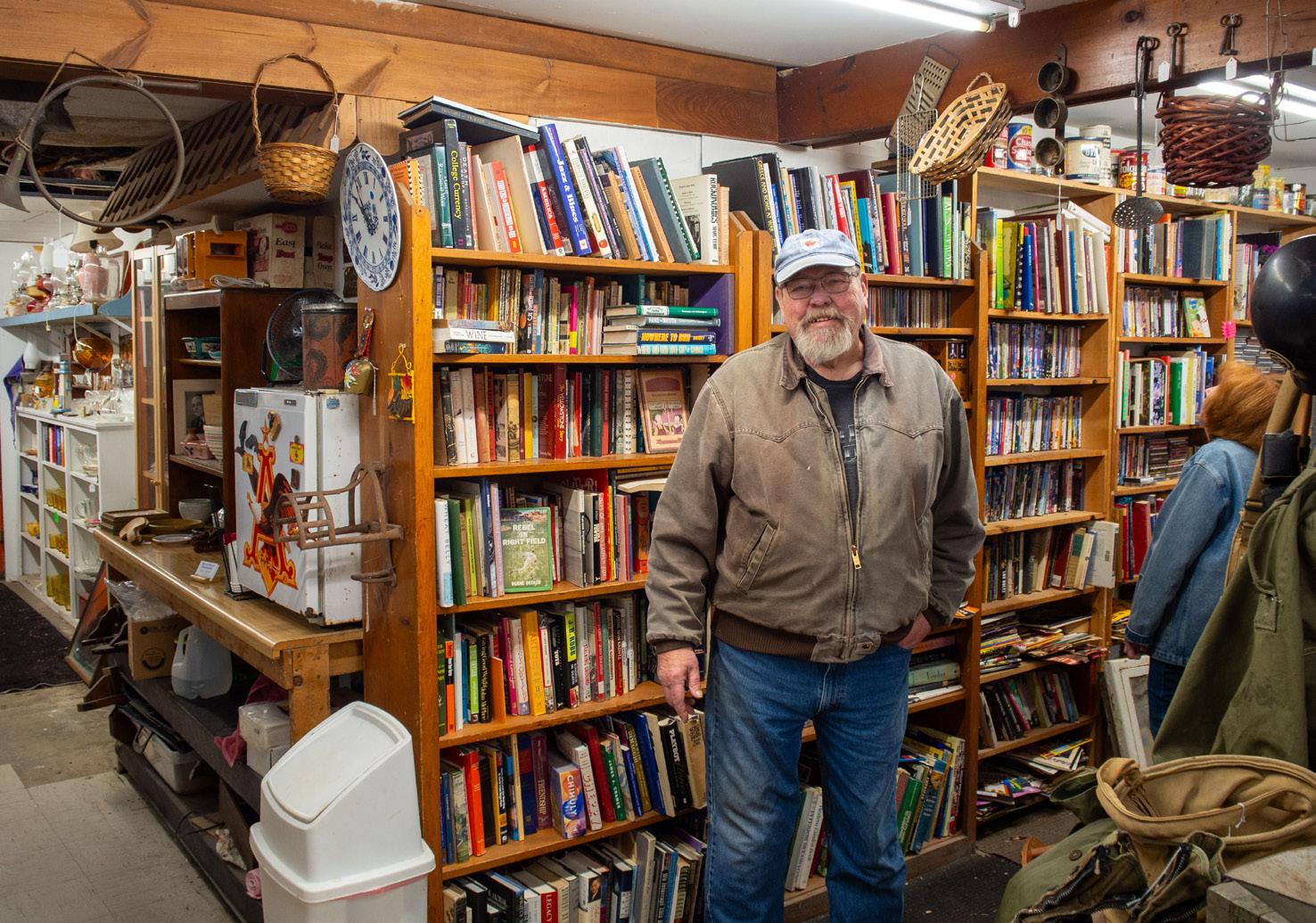
Bulls Head Treasures is a 30-minute drive from Poughkeepsie in the small town of Stanfordville, New York. It is a cozy place, but this vibe was not curated. It is a massive, massive collection of things. It is 7,200 square feet of old fancy china, glassware, army equipment, posters, framed paintings, a 1695 Gutenberg Bible, rare baseball cards, sterling jewelry, film cameras in leather cases, dolls, die-cast cars, engravings, brass signs, lamps, dressers, fishing rods and, curiously, a shirt that says “Hex the Patriarchy.” Once, while I was wandering through the store, an elderly couple entered. The husband paused a few feet from the door, and as his wife walked ahead of him, he said, “Hold
Antiquing on page 6
Ines Rozzo discusses neo-colonialism in Argentina.
song credits on my first listen—from melodic rhythm on “C4” to raspy murmuring
See Coyote on page 4
Image courtesy of Eli Lerdau ’29.
Noah Duncan Columnist
Letter to the Editor: Addressing Arlington Redevelopment
Earlier this year, I spoke to an Arlington resident whose building is currently planned to be demolished as part of Vassar College’s redevelopment plan. She told me that, before the building on 9 Collegeview Avenue was The Barber Haus NY, Vassar had not expressed interest in purchasing it. However, she said, when the building became The Barber Haus, Vassar suddenly became interested in acquiring the property. The reasons for this, from what she claimed her landlord had told her, was that Vassar thought The Barber Haus “created an unsafe environment,” and that they wanted to buy the building “to rein it in.” Her landlord then shared that part of Vassar’s criteria for purchasing Arlington property is whether the properties and people who occupy them “fit the theme of the neighborhood.”
It is deeply unsettling that Vassar, a private institution that ultimately pays no taxes—aside from its private real estate holdings—to Poughkeepsie, can determine what the “theme” of the neighborhood should or should not be. The people who live in Arlington have lives that exist independently of the College. They should not have to be subject to the College’s decisions on what they or their businesses should look like.
This is what makes Arlington Capital Investors (ACI), Vassar’s jointly-owned LLC, so insidious. Vassar has used its deep pockets to systematically buy land across Arlington, allowing them to control Arlington’s future. They are appropriating property and making it so that people’s right to existence lies not in their own hands, but instead in the hands of the faceless LLCs which own, control and gentrify urban space. People and businesses in Arlington are going to be cleared away, and because
Vassar has amassed so much real estate power, there is nothing that can be done to stop it.
Destruction is inseparable from this proposal. To redevelop, in this context, is to erode historic architecture, level businesses and displace people who have made Arlington their home for decades. This type of irresponsible city planning has been tried before. Urban renewal failed in the 1960s. There is enough historical precedent to show that leveling “blighted” neighborhoods to build high-rise apartments or expanded economic districts only leads to displacement, gentrification and destruction of communities. A good town does not demolish before it constructs, but works with what already exists to create a community that suits the needs of all of its longtime residents.
Vassar has been clear about what their objective is with this project. As it currently exists, Vassar Deputy to the President Wesley Dixon has implied that Arlington is not attractive enough for Vassar’s prospective students and families. As a result, the administration is using redevelopment as an opportunity to turn the neighborhood into a more of a “college town,” suiting the needs of Vassar’s students over Arlington’s actual long time residents. The goal is to erode the identity of Arlington as an independent neighborhood and turn it into a commercial offshoot of Vassar. Any motivation to improve the community appears secondary to their insatiable desire to improve student experience, and drive more enrollment.
The energy on campus this week has been palpable. I feel the outrage from each and every student I talk to about it. I hear it in their conversations and see it in the slew of angry posts on Fizz. It is rare that our campus is
as universally incensed as it is right now. But simply being outraged is not enough. It is too often a pattern that widespread political anger lasts, at most, a couple of weeks before ultimately dissolving, as protests fail and popular support inevitably wanes. We must not let this happen. We must turn this energy into direct action.
Political anger is nothing without organization. If we do not mobilize across the campus to make the administration feel our disapproval of this plan, our protests will never make it past hollow critique. It is not enough to claim solidarity with those in Arlington. That solidarity will be worth nothing when Arlington residents are uprooted from their homes and their multi-decade businesses are destroyed, all while you— Vassar students—continue your college experience unaffected.
The mobilization must involve a joint effort from students, faculty and staff. The campus’ political organizations must unify in the shared goal of protesting the College’s plans. The administration has no reason to respond to us unless we challenge the power that they hold.
President Bradley sent out an email offering participation as the solution, suggesting that “public comment” is the way to move forward with the redevelopment. I believe that participation would only normalize what the administration intends to do. When they claim to “listen to the concerns of students and community members,” they are merely checking boxes. It doesn’t matter that they may value your perspective. No amount of “public comment” will change the fact that Vassar is the owner, so Vassar holds the power. Participating in their “community workshops” will do nothing to stop the inevita-
ble destruction and will only create a displacement that is slightly more palatable to the people who are not the ones being displaced. The owner of the House of Nutrition, who presently faces the destruction of his building, said it best of Vassar: “Don’t play ball with those guys, they’re not nice.”
As the semester ends, remember that this issue is still ongoing. While you go home to your family, Bacio’s will still be fighting the College in court to keep their lease, and those whose homes are scheduled to be destroyed will be wondering where they will be living next year. What is ideological to us is material to the people of Arlington. All we can do is listen to the demands they have and organize as a campus to turn those demands into reality. Vassar may hold institutional power, but their institutional power can be broken by enough people with a strong enough will to act.
Lastly, if you are a Vassar student, I hope all of this reminds you of what type of institution you attend. The College loves to tell us that we stand on the once homeland of the Munsee Lenapee people, and condemn the structures that enable and perpetuate such displacement. But projects like Arlington Redevelopment show how empty these statements are. As they presently stand to demolish communities and dispossess people from their land in Arlington, the College cements itself as an institution that will condemn settler colonialism in name only, while happily carrying on its legacy whenever it serves their interests. Vassar, as an institution, is just like its land acknowledgement: hypocritical, insufficient and hollow.
Signed, Hadley Amato, Class of 2028
THE MISCELLANY NEWS
EDITOR-IN-CHIEF
MANAGING EDITOR
SENIOR EDITORS
CONTRIBUTING EDITORS
NEWS EDITORS
ARTS EDITOR
ASSISTANT ARTS EDITORS
FEATURES EDITORS
OPINIONS EDITOR
ASSISTANT OPINIONS EDITORS
HUMOR EDITOR
ASSISTANT HUMOR EDITOR
SPORTS EDITORS
DESIGN EDITORS
ASSISTANT DESIGN EDITORS
COPY EDITOR
ASSISTANT COPY EDITORS
GRAPHICS EDITOR
GAMES EDITOR
SOCIAL MEDIA MANAGER
LIVE EVENTS CHAIR
WEBMASTER
REPORTERS/COLUMNISTS
Allison Lowe
Luke Jenkins
Kathryn Carvel
Darja Coutts
Madeleine Nicks
Clara Alger
Carina Cole
Soren Fischer
Hadley Amato
Julian Balsley
Grace Finke
Aurelia Harrison
Yaksha Gummadapu
Sydney Jones
Jacob Cifuentes
Zoe Rodriguez
Ian Watanabe
Emma daRosa
Wren Buehler
Henry France
Casey McMenamin
Molly Delahunty
Lucas Seguinot
Teresa Garcia-Green
Hannah Wells
Anabel Lee
Sadie
Bakken-Durchslag
Paige Hahn
Annie McShane
Sadie Keesbury
Mia Liloia
Denver Brown
Hunter Farhat
Jordan Alch
David Bray
Eduardo Culmer
Noah Daube-Valois
Armaan Desai
Noah Duncan
Jackson Hrebin
Lora Janczewski
Brendan Kennedy
Evan Seker
Erin Thatcher
CARTOONIST
COPY STAFF
Andrew Chu
Nikola Parker Cooperman
Elliot Evans
Cooper Jaffe
Quinn Kou
Ren Nicolau
Tess Novack
Julia Weber
MISCELLANY
Image courtesy of Karen Mogami ’24.
VSJP event cancelled over concerns from admin
Continued from VSJP on page 1 flyer and social media posts were brought to my attention yesterday, and I wanted to connect as soon as possible. Given that the United States has designated PFLP to be a foreign terrorist organization as of 1997, there are concerns about this event. Therefore, I am asking that you cancel this event - including removing any promotional materials that associate the College with this event.”
In an Instagram post which has since been taken down from VSJP’s account, VSJP wrote: “Check out this teach in on the PFLP (the Popular Front for the Liberation of Palestine) titled ‘They Will Certainly Be Victorious: On Palestine, Pan-Arabism, and the Popular Front’ on Tuesday, December 9! We will discuss how the Palestinian resistance group’s historic example can inform our organizing today.” The event would have been led by a graduate student from a nearby university with expertise on the PFLP.
The PFLP is a Marxist-Leninist political group founded in the aftermath of the 1967 Six-Day War and 1948 Nakba with the goal of liberating Palestine through armed struggle. Israel began an illegal military occupation of the Gaza Strip and West Bank following the Six-Day War, marking Israel’s control over all of historic Palestine. The United States, European Union, United Kingdom, Canada, Australia and Japan designated the PFLP a foreign terrorist organization due to its hijacking of four planes on Sept. 6, 1970, and the assassination of Israel’s far-right Minister of Tourism, Rehavam Ze’evi following Israel’s assassination of the PFLP Secretary-General Abu Ali Mustafa. In the PFLP’s 1969 founding document, the organization wrote: “The only weapon left to the masses in order to restore history and progress and truly defeat enemies and potential enemies in the long run is revolutionary violence in confronting Zionist violence and reaction. There is no other option in front of the masses of the Arab nation–they face a fierce enemy who wants them to surrender unconditionally.” Historian Francesco Leopardi has argued that for decades, the PFLP was widely popular and a major contributor to the Palestinian struggle. A member of VSJP wrote, “We intended to contextualize the PFLP in the historical circumstances of Israeli violence and displacement following the Nakba and the 1967 war. And so the PFLP, like many other national liberation groups in and outside of Palestine, were responding to a colonial situation. We hold that anti-colonial resistance is inevitable under occupation.”
Rush explained in his email to the VSJP executive board members, “In this case, because it is unlawful to knowingly provide any support or resources to a foreign terrorist organization, there is a level of institutional and student risk that prevents us from being able to permit the event to move forward.” Rush is referring to 18 U.S.C. 2339B, a law which prohibits individuals from providing material support to terrorist organizations. While the text of 18 U.S.C. 2339B specifically refers to fundraising on behalf of a terrorist organization, the College’s General Counsel Shay Humphrey wrote to The Miscellany News, “According to the Antiterrorism Act, providing ‘material support’ means providing any money, lodging, training, expert advice or assistance, communications equipment, facilities, personnel, transportation, or other physical assets to
an FTO. Any association with an FTO can raise an allegation of providing material support and due process rights of citizens and non-citizens are extremely curtailed when a terrorism charge is made.”
Members of VSJP dispute Rush’s characterization of the event, arguing that their organization was not providing material support for a terrorist organization. “Material support means, according to U.S. law, having a direct channel of money or resources between us and the supposed ‘terrorist’ group itself or having someone from the group come in and us paying them for the event,” said a member of VSJP who received Rush’s email. “That’s what is illegal. We are not at all affiliated [with the PFLP].” The member of VSJP continued, “It’s just murky. It’s just people interpreting it to be [supporting the PFLP]. But their interpretations of it doesn’t mean that it’s true.”
Humphrey wrote, “The promotional materials for the VSJP event did not make clear what was happening at the event, so there were concerns raised about whether it could lead to allegations of a violation of this law… We did not know anything else about the event other than what was on the promotional materials. We did learn more about the event after meeting with VSJP and clarified that any event marketing should be explicit about the educational nature of the event.”
In an email to a Miscellany News reporter, a member of VSJP who was involved in drafting the post wrote, “To my knowledge the intention of the event was to learn about the history of the PFLP. All of our teach-in’s are not only purely educational, but also critical—meaning we don’t glorify or blindly support the activities of any movement or group we study. At the same time I believe it would be naive to learn about a Palestinian resistance group without discussing how we can critically learn from it as a group dedicated to Palestinian liberation.” Another VSJP member commented, “Anything politically involved will have discourse attached and if the school wants to allow for those political dialogues, it has to be able to facilitate events that go into these issues in the future.”
On Dec. 3, members of VSJP met with Rush, a member of the Vassar Student Association (VSA) and Humphrey. “When we got to the meeting, there was sort of this assumption that had been made that by talking about the PFLP, by bringing in a speaker, that we were somehow contributing to material support,” said a member of VSJP who was present at the meeting. Representatives of VSJP who were present at the meeting alleged that they tried to reach an agreement with administrators which would have allowed the teach-in to take place, but that administrators did not accept such suggestions.
The event’s cancellation raised concerns about censorship among some members of VSJP. “I feel that the college wielding their ability to repress critical discussion of certain topics should be concerning not only to the members of VSJP, but also to people in other student groups and academic departments who host intellectually guided discussions about any subjects, figures, or groups that are controversial,” wrote the student involved in drafting VSJP’s post. In response to concerns about violations of students’ rights to free speech, Humphrey wrote: “Any individuals or organizations associated with a designated foreign terrorism orga-
nization (FTO) may be criminally prosecuted for providing material support to the FTO. Terrorism-related charges are powerful tools that allow the government to completely avoid an individual’s First Amendment rights, otherwise applicable in criminal prosecutions.”
Members of VSJP alleged that, during Rush and VSJP’s Dec. 3 meeting, the members of Vassar’s administration also cited attention from conservative and Zionist social media accounts and organizations as justification for canceling the event.
On Dec. 1, shortly after VSJP posted the promotional material on Instagram, Israel War Room, a Zionist organization and digital platform with approximately 386,000 followers on X, uploaded a screenshot of VSJP’s post to X, writing: “VSJP at @Vassar is holding a ‘teach in’ glorifying the PFLP — a US-designated terrorist group — and focusing on how VSJP can learn from the terror group’s ‘historic example.’ The PFLP is a Marxist-Leninist terrorist group famous for hijacking passenger planes to ‘free Palestine.’ It has also carried out many other terror attacks and participated in the October 7 massacre.”
The post has approximately 30,000 views at the time of publication. Members of VSJP who attended the meeting with Rush on Dec. 3 noted in an interview with The Miscellany News that administrators showed them Israel War Room’s post after they inquired about the threats the College had received about their event.
The post by Israel War Room was reposted by Leo Terrell, Department of Justice (DOJ) Senior Counsel and the chair of the DOJ’s Task Force to Combat Antisemitism. Recently, Terrell has led the Trump administration’s efforts against universities accused of supporting antisemitism.
In a Dec. 1 post on X, Terrell wrote of the teach-in: “I’ve seen a lot of things, but this is absolutely BONKERS!! @Vassar, what are you doing about this??!” In the post, Terrell tagged prominent Republican politicians, including President Donald Trump and Attorney General Pamela Bondi.
VSJP’s teach-in was ultimately canceled. On Dec. 5, VSJP’s Instagram account posted a statement regarding the decision, writing: “Vassar administration cancels educational event on the history of the Popular Liberation Front for Palestine (PFLP), citing material support for terrorism. We rebuke the college’s complicity with the federal government’s fascist agenda and suppression of anti-imperial education!”
In response to VSJP’s post, Israel War Room posted another screenshot of VSJP’s account, writing: “BREAKING: @ Vassar has rightfully shut down an SJP event promoting terrorism and glorifying the PFLP terrorist organization. Support for terrorism must not be tolerated on US college campuses.” Hours later, Terrell reposted Israel War Room’s post, tagging Vassar’s X account, and writing the caption, “Some good news!”
Representatives of VSJP noted to a Miscellany News reporter that administrators showed them three emails that the College received from the Anti-Defamation League, an organization dedicated to combating antisemitism, encouraging the cancellation of the teach-in. The first email wrote: “If Vassar permits a student organization to exist that holds out a terrorist organization, that promotes violence, as an example to emulate, then
this calls into question the moral validity of Vassar as an institution. This behavior makes clear that VSJP is an antisemitic organization that promotes violence, and that its continued behavior and presence on campus is dangerous to Vassar’s Jewish students… To Jews, this is no different than a student organization choosing to emulate the Klu Klux Klan or another white supremacy organization.”
The second email shown to members of VSJP noted: “I would also advise the college shield itself from massive liability stemming from allegations it aided and abetted terrorism by reporting to the FBI and ICE any employees and students at VC who are involved with VSJP or any other group advocating for violence against Jews and their homeland, Israel, whether they do so on or off the campus. Last, to shield VC from liability, I would also strongly encourage the college to notify every student applicant who is not a U.S. citizen that VC will not admit to its student body those who do not swear they are unaffiliated with VSJP or any other ‘Palestinian’ advocacy group as well as all other groups promoting anti-American and anti-Western attitudes.”
The final email read: “If you allow VSJP or other pro-Palestine (i.e., pro-Islamist) events to be held on Vassar’s campus, prepare yourself for lawsuits and a boycott of financial support from a large pool of alumni.”
In conversations with The Miscellany News, members of VSJP expressed their shock and outrage over the statements and threats emailed to administrators, but also noted their frustrations with the College’s response to these messages. A member of VSJP said: “It seems they’re much more concerned about public allegations of antisemitism and loss of funding, less so [concerned] for actual students, because they don’t want to protect us from FBI investigations either.” Although there is no concrete evidence that members of VSJP are being investigated by the Federal Bureau of Investigation, the Senate’s committee on Health, Education, Labor & Pensions launched an investigation into the American Muslims for Palestine organization, a group that some politicians claim helped college students organize and facilitate demonstrations in support of Palestine. The member of VSJP continued: “That does not seem to be their central concern. It’s the public image of the College, which they blame on us. They blame us for putting the College into [the] federal spotlight instead of the fascist federal agenda itself, which is super manipulative.”
“Pushing SJP to cancel this event goes against Vassar’s message of furthering education and pushing students towards critical thinking,” wrote a member of VSJP. “Making certain knowledge off limits only serves to obscure them, and this limit put on knowledge and learning makes students more susceptible to misinformation on all ends. In class, we don’t simply brush past controversial topics or viewpoints; we are encouraged to instead learn about them so we can be more aware of these subjects and their relations as a whole and think about them critically.”
Moving forward, VSJP will continue to hold events on campus. As of publication, the organization has planned two teachins for the Spring 2026 semester: one on the history of Palestine and Kashmir and one on the genocide currently taking place in Sudan.
New sound, new name: Coyote Joe drops self-titled album
on “NEW$KIN,” Prescott has an incredible ability to sound like three different rappers on one track. In my experience, there is often a kind of trap artist that finds a cadence and rhythm and sticks to it. Prescott refuses to be confined to one sound, moving from fastpaced exuberance into raw emotion seamlessly.
Part of what makes the production on this album so impressive is how it supports Prescott’s rapping, no matter where he goes. There were a lot of standouts for me on this album—including “Stopwatch” and “U dont know shi”—but “Paranoid” might be my favorite. The soundscape is bone-chilling; whispered voices in the background call out over and over, “They’re watching me / I can’t see ‘em.”
Prescott works in collaboration with his producers to find beats on platforms like YouTube. His main producer and sound engineer is his close friend Alex Lewin-Knauer ’27. “Alex and I have been roommates all through college. He’s in the room when I’m writing, when I’m recording, he will tell me if I need to redo something or if something’s not sounding right.”
Production-wise, Prescott is involved from start to finish. “As the process goes, I listen to the unreleased track constantly in cycles to keep fresh,” Prescott said. “As I’m working on it, I’m finding things that I like, things that do and don’t work, things I wanna try, that’s the process. On songs like ‘Stopwatch,’ ‘C4,’ ‘HASZTT,’ some of the harder and bouncier songs, I’m really proud of. Something I’ve been intentionally trying to do with my style
is upping the cadence, maintaining these humorous but serious tones throughout. ‘THE INTRO’ was the first song we did for the album that we felt like, ‘This is what we have to match.’ A lot of people touched it: In the beginning, there’s this sound effect of a rocket. Our friend and roommate Klaus recommended that, and Alex tweaked it to sound like it does now. We worked on three or four versions before landing on this one.”
Raised in the Bronx, Prescott has been putting out music since 2016. Before moving over to bigger music streaming services in 2020, he and a few of his friends started putting out their early music on SoundCloud while in middle school.
Presott names longtime friend and rapper IAMTHEKLOUD (Lenny Santos) as one of his favorite collaborators—the two of them have performed together for years and worked together on tracks like “BAGHDAD,” which has over 5,000 streams on Spotify: “If he wasn’t making music, I don’t know if I would be.”
Prescott and Santos developed their rap sensibilities side by side. “We were really inspired by people like XXXTentacion, Ski Mask the Slump God and duo rappers, underground rappers. We actually started rapping in our theater teacher’s closet in school. We would record during lunch, where we’d have like 30 minutes in this closet, all of us recording on a phone together. It was a janky setup, but we had a lot of fun.”
When Prescott came to Vassar, he was in the process of dropping his first album, “Lve Like Yu Knt Die,” which included music he had written and performed in high school. The following spring, Prescott dropped “THE
SPR1NG BRE4K TAPE” where he collaborated with several other musicians, including Vassar artists such as Naomi Sullins ’27 and Finntann Mangalam ’27. “It was a very acoustic-sounding, very Vassar-sounding project. IAMTHEKLOUD made a comment like, ‘You only dropped one rap song this year, man, what are you doing?’ Which, hey, sometimes that’s what you gotta do, but I made a promise to him and myself that this next one would be a harder, more true to my own rap, album.”
A fun fact people may not know about Prescott: he has a passion for making cover art. The cover of “COYOTEJOE!” is a photo of Prescott at age 10 that he distorted and recol-
ored himself. He has also made several pieces for IAMTHEKLOUD.
Though he has found success and community here, Prescott also expressed occasional frustration with how the Vassar music scene— which skews towards indie-rock—receives rap and hip-hop. However, he feels this struggle is mitigated by the opportunity to explore what rap can look like in a mixed-genre environment. “Going to stuff like orchestra concerts, getting involved with those experiences, even if they feel cliche or really Vassar-y, they’re all valuable for my creative process when I get to write and when I think about the direction to take a song.”
Broadway comes home: A unique production of ‘Our Town’
“Our Town” her favorite play, this experience affected Federer Butz in a way that it never had before.
In my opinion, there is no better feeling than the last few moments before the beginning of a show. The lights dim, a hush falls over the crowd, and the air is thick with anticipation of the magic that is about to begin on stage right before your very eyes.
I felt this thrill on Nov. 16, as I sat in a crowded theater awaiting a very unique performance. The Playbill in my hand featured Broadway stars like Norbert Leo Butz, Michelle Federer Butz and Emily Harvey-Lee. However, this production was not a Broadway show but rather a local staging of “Our Town” in Maplewood, New Jersey.
Thornton Wilder’s American classic tells the story of the Webb and Gibbs families against the fictional backdrop of Grover’s Corners, New Hampshire. The play follows the two families over the course of 12 years, concluding with an emotional monologue about the value of the little things and the importance of appreciating everyday life.
At the helm of this production was actress Michelle Federer Butz, known for her role as the original Nessarose in “Wicked” on Broadway. Federer Butz, who has been a resident of the Maplewood area for over 20 years, shared in an interview with The Miscellany News that she originally got the idea for the show in her hometown of Shaker Heights, Ohio.
“I had a friend who was turning 50, and he called me and said, ‘You know what I want to do for my 50th? I want to do a reading of ‘Our Town,’ and I want you to play Emily,’” Federer Butz said. “I threw myself into it as if I was going to be on Broadway.” Although she had always considered
“I’d always loved Our Town, but it hits you differently at different ages,” Federer Butz said. “All of a sudden, I was walloped by it, and I could not stop thinking about it.”
Luckily, Maplewood is filled with former Broadway actors like Federer Butz herself. She started brainstorming ways that she could give “Our Town” a life there.
“We do a lot of fundraisers in Maplewood because we have so many musical theater performers out here,” Federer Butz said. “I just thought about how powerful ‘Our Town’ is to me and what a universal play it is, and I thought, ‘Wow, wouldn’t it be nice to just share this play with our community?’”
Maplewood’s production of “Our Town” was not just for entertainment purposes. The show served as a fundraiser for the Achieve Foundation, which is a local education foundation that raises funds from private sources to improve educational programs and facilities in the Maplewood and South Orange area. Amy Straub, a Maplewood small-business owner and member of the Achieve Foundation Board of Trustees, shared what the Foundation means to her.
“The Achieve Foundation is essential because it steps in to partner and support our school district community where resources are limited and helps address needs that directly affect a child’s educational experience,” Straub said. “Whether it’s free tutoring, supporting the arts, providing STEAM programming like our annual Maker Madness event or funding classroom innovations through teacher grants, Achieve ensures that every student has access to op-
portunities that spark curiosity, confidence and a sense of belonging.”
Alongside being an actor, Federer Butz is a substitute teacher in the Maplewood area and is currently going back to school to pursue her postbaccalaureate teaching certification. Her connection to teaching inspired her to reach out to Achieve.
“I’ve never directed before and I’ve never produced anything before so I knew I needed someone to handle marketing and tickets and all of that,” Federer Butz said. “Achieve agreed to produce it, so that combination just worked.”
After securing the producer for the show, Federer Butz moved to casting. However, she did not want to bring this vision to life in the typical way. She aimed to draw a wider audience than just the theater community in Maplewood.
“I started thinking about casting people who weren't the usual suspects of fundraisers around town,” Federer Butz said. “What became very clear to me is that in doing this, the audience would be made up of not the usual suspects. I knew that if I cast a wide net in the casting, I would cast a wide net in the audience.”
Inspired by the themes of the play, she wanted to cast pillars of Maplewood who did not have acting experience.
“[Maplewood] is where I live,” Federer Butz said. “This is my daily life. My deepest connections are here and my loosest ties that still affect me are here. I go into The Able Baker, and I get my favorite cookie. And who knows, on my death bed, will I think of that cookie because I love it that much? So then I needed Julie Paulie, the owner of the Able Baker in my play.”
As a small-business owner and 10-year Maplewood resident herself, Straub shared similar sentiments about the culture of the
town.
“[Maplewood] has truly become home in every sense,” Straub said. “We’ve raised our children here, built friendships, I've grown a small business and seen firsthand how special this community is.”
Once she had solidified a cast of local small-business owners, Columbia High School and Maplewood Middle School teachers and faculty, the town’s former mayor and more, Federer Butz decided to enlist some Maplewood residents with theater experience.
“I knew I needed anchors in that process, so I knew I needed actors in that process,” Federer Butz said. “I knew that those actors would act as mentors to the people who've never been on stage before.”
Putting inexperienced actors on a stage was a gamble, but Federer Butz had little doubt about the capabilities of the people she had chosen.
“I had a hunch that that would work, and I was right because I watched the non-actors get lost in the play,” Federer Butz said. “It’s really about the play. The words are so powerful and so excellent, and I watched them get lost in it the way an actor gets lost in it.”
Achieve’s production of “Our Town” was a smashing success. The auditorium was filled, the event raised over $26,000, and by the end of the show, there was not a dry eye in the house—myself included. Straub shared that she felt immensely proud of the show and hopes to do more fundraisers like it in the future.
“The success of this event shows how powerful it is when our community comes together around art, storytelling and a shared purpose,” Straub said. “It is definitely one of my favorite [Maplewood] memories thus far.”
Continued from Coyote on page 1
Annie McShane Graphics Editor
Image courtesy of Jolyn Prescott ’27.
Reading through 2025: An amateur critic’s recommendations
heists, making fun of absurd fine dining and questioning if things can possibly be too woke, “Jane and Dan at the End of the World” is the book for you.
“James,” Percival Everett
This book is a masterpiece. “James” is a retelling of Mark Twain’s “Adventures of Huckleberry Finn” told from the perspective of Jim, an enslaved man who accompanies Huck on his travels. Twain’s Jim is a simple, foolish sidekick, while Everett’s James is intelligent, cunning and driven. When James hears that his enslaver plans to sell him, separating him from his wife and daughter, he runs away with Huck Finn and plans to free his family. The novel is gripping and intense, detailing the horrors of slavery as well as James’ strong internal compass and quest for freedom. If you like thinking critically about classic novels, historical fiction and justice, you should read “James.”
“The Glass Castle,” Jeanette Walls
Jeanette Walls and her siblings spent their childhoods bouncing around between Nevada, California and Arizona before eventually settling in rural West Virginia. As Walls ages, her idealized view of her parents’ adventurous spirits morphs into a realistic understanding of their irresponsibility and neglect. Walls ruminates on the hardships of her childhood while also looking back fondly on its magic. Her memoir is complex, heartwrenching and captivating. If you like nonfiction, coming-of-age stories and positive sibling relationships, “The Glass Castle” is waiting for you.
“Swamplandia!”, Karen Russell “Swamplandia!” is about the alligator-wrestling Bigtree family and their theme park (Swamplandia!) deep in the Florida Everglades. The novel’s main narrator is 13-year-old Ava Bigtree, struggling to find her place in her family. Ava’s mother is dead, her brother has run away to the
mainland, her father is failing to keep the business afloat and her sister is talking to ghosts. Russell’s prose depicts a world so unique it almost does not feel real, but her tender, authentic characters bring the story to life. Readers feel as though they are trudging along with Ava as she moves through her swamp, entertaining tourists, fighting through sawgrass and all the while coming into her identity as a proud Bigtree—another warrior in a long line of alligator wrestlers. If you like dysfunctional families, ghost stories and alligators, this book is for you.
“Annie Bot,” Sierra Greer
Annie is the perfect girlfriend—just like she was programmed to be. Annie is a robot designed to fulfill every emotional and physical need of her human companion, Doug. As Annie’s intelligence evolves and she becomes more and more human, she begins to question her purpose and whether she wants more out of life than just Doug. “Annie Bot” is a smart, funny commentary on independence, toxic masculinity and control. If you hate Reddit incels and love female autonomy and sci-fi, this book is the one for you.
“Martyr!”, Kaveh Akbar
Cyrus Shams is a depressed Iranian-American poet living in Indiana, fascinated by martyrdom. Cyrus’ exploration of martyrs and his mother’s death decades ago takes him to a performance art exhibit in Brooklyn, where his world changes forever.
“Martyr!” is a deep meditation on the meaning of life, happiness and martyrdom for Cyrus, as well as those close to him. If you like hearing both sides of the story, making art and deep introspection, “Martyr!” should be on your list, but really, “Martyr!” should be on everyone’s list because it is a really good book.
Honorable Mentions
This year, I read too many good books to
fit into one article. Some other books I really enjoyed are:
“Nothing to See Here,” Kevin Wilson
• “The Power,” Naomi Alderman
• “Stop Me If You’ve Heard This One,” Kristen Arnett
“Great Circle,” Maggie Shipstead
“The Underground Railroad,” Colson Whitehead
“Greta & Valdin,” Rebecca K Reilly “Penance,” Eliza Clark
• “Bunny,” Mona Awad
• “Blood Test,” Charles Baxter “Atmosphere,” Taylor Jenkins Reid “Cleopatra and Frankenstein,” Coco Mellors
LCD Soundsystem plays yet another residency
After some hesitation due to expensive ticket prices, I snagged two tickets to LCD Soundsystem’s annual New York City residency. I had wanted to hear them live since my dad played their music around the house while I was growing up. However, my expectations for an exciting concert and lively crowd at the Knockdown Center were unfortunately not met.
Buying the tickets, I was unaware of LCD Soundsystem's pattern of perpetual residencies. They have held an annual New York City residency since 2021 at the Knockdown Center in Queens, in addition to some other mini-residencies sprinkled across other U.S. cities. The band’s switch to residency-style shows came as a result of their exhaustion with touring in recent years. Frontman and lead singer James Murphy addressed this change in a long-winded Facebook post in March of 2022: “there’s a thing with tour, also, where you invest so much time, energy, and cost into ‘getting ready’ that you wind up touring for ages just to make it worthwhile… then you need a big break again. then you are reluctant to start all over again. it’s a cycle.” Therefore, they ended up making the decision to mainly stick to shows in their home city of New York, adding that they
would start doing residencies in other cities in 2023, which they have followed up on with residencies like the one they will have in Chicago in March of 2026.
A few months before this public statement, in January of 2022, the documentary “Meet Me in the Bathroom” was released. The documentary, based on the 2017 book by Lizzy Goodman, analyzes the rise of the new indie-rock scene in Brooklyn and New York during the early 2000s. It focuses on bands like The Strokes, The Moldy Peaches, LCD Soundsystem and more. This documentary re-sparked my obsession with LCD Soundsystem, despite the way Murphy is portrayed in it. In search of a band just as explosive as The Strokes at the time, Murphy comes across as an uptight producer with big hopes and dreams. He founded Death From Above Records with his partner-in-crime Tim Goldsworthy. The pair had hoped to create a new sound—or arguably reinvent an old one—in combining rock with retro dance music. They signed a few bands with little success.
Murphy became frustrated with the competitive emerging indie-rock scene and decided to start experimenting for himself, eventually forming LCD Soundsystem. At its conception, the band had a unique, disco-like sound during a time when indie rock dominated the charts. Today, they still lean on the sounds of a time passed
to counteractively rejuvenate their music, attracting people of all ages. For instance, their 2022 single, “new body rhumba (from the film White Noise),” has the familiar female shout used by the B-52s echoing in the background, ringing in the music of the 80s.
At the show my friend and I attended on Dec. 4, the audience made their 80s influence even more evident. The crowd mainly consisted of middle-aged people, mixed with just a handful of people around me and my friend’s age. Honestly, we were slightly disappointed to find ourselves as some of the youngest people there. Additionally, our hopes that the crowd would want to go crazy over some of the band’s more upbeat songs were not fulfilled. Everyone around us mainly stood there nodding their heads, with the exception of a few millennial types who thrashed around, such as the botoxed woman standing next to us with oversized disco ball earrings and a glowing Geek Bar. However, I do not think one can blame the audience for this lack of enthusiasm—I believe that the blame for the unfulfilling show should be placed on the band.
With depleting flickers of cool, Murphy and the other members are evidently descending out of their glory days. The giant disco ball hanging above them now shines a bit dimmer. Their live performance did not live up to the richness of their record-
ed music. I did not want to believe it, but my friend agreed. What made it worse was Murphy hanging over the drum set for the majority of the show, reading his own lyrics from a thick packet of paper resting on one of the tom drums. Shockingly, he even appeared to be reading the lyrics during “I Can Change,” one of the band’s most popular songs. While he was not standing over the drum set with his head hung low, he was scurrying to the side of the stage to pour himself a shot from a handle of vodka. At one point, Murphy joked that you should “stick with your friends no matter how terrible they are,” seemingly meaning he knew it was not a great show. That got me and my friend laughing. Additionally, throughout the show, he continuously and comically commented, “Don’t worry, we’re just getting warmed up!” and “We’re almost there!” Unfortunately, I do not think they ever got fully “warmed up.”
While I was extremely excited to get to see LCD Soundsystem live, I do not think the show I attended was worth the expensive ticket. It seems to me that the band has gotten too comfortable in their annual, perpetual cycle of residencies. Despite the well-executed light spectacle and the spacious warehouse venue, LCD Soundsystem did not sound sharp. My perception of the band has, unfortunately, been tainted by the lackluster performance I witnessed.
Annie McShane/The Miscellany News.
Sophia Marchioli Guest Columnist
FEATURES
Local antiquing gem is collector’s paradise
on, Sally. This is all too much to handle.”
There are three pillars of Bulls Head Treasures. There is Big Tim, who founded the place eight years ago. There is his son, Big Little Tim, who later joined the operation.
day when we can put some cash in the drawer and get some shit out the door.”
Bulls Head has many other sayings. Some favorite repeated phrases from the store’s Facebook, which is run by Big Tim: “No running in the halls.” “The bigger your pile, the
His name was initially just Little Tim, but then, he got bigger than his dad. Then there is Ray, a recent retiree who volunteers at the store and has quickly become integral to it. The Tims have recently coerced him into taking gas money for his services. Ray also repairs lamps.
The store has gained something of a cult following, entirely by word of mouth. “People will come from Jersey once a month, from Connecticut—we get a lot of Connecticut,” says Ray. People come to Bull’s Head on vacation or on recommendation from family nearby; many leave wishing they
bigger your smile.” And the classic: “If it fits in your car, it is on sale.”
The whole Facebook, actually, is a delight—it makes clear, above all else, that the proprietors of Bulls Head are having a really good time. There is a picture of a stained glass panel with the caption “SWEET !!!”
Small cast-iron pans hang against the wall: “We do have pan pan, but no pizza pizza.”
Business notices: “Remember , 10 to 6 today we are here to get our ‘Treasures’ to their next stage of preservation !!!! Brad , come get the platter before someone else does !!! Butcher cast iron plaque gone , your fault. LOL.” And
had more space in their return carry-ons. It is the kind of place that is hard to leave empty-handed. Many return customers buy on house tabs that the guys keep tallied on notepads. Purchases are only recorded by hand. A lot of the business relies on trust. The store has free coffee in the back for customers or anyone at least willing to stay for a chat. When Big Tim started the store, he made the coffee for himself, but he was not going to finish a whole pot alone.
On the day of my most recent visit, Big Tim had his day off, so it was just Ray and Big Little Tim—B.L.T., as his dad calls him on the store’s Facebook. Ray had on jeans, a Carhartt jacket and a hat that said “Shop Stanfordville.” B.L.T. had on a hoodie and a hat that said “Don’t Tread on Freedom.”
The three of us were talking. B.L.T. looked at Ray and grinned sort of mischievously. “Can I tell him that thing we always say?” Ray nodded.
“It’s a good day—wait, what is it? It’s a good
for a few seconds and gave me a rather low price for it. I asked about the books and CDs, and he waved his hand: “Don’t worry about it.”
Ray seemed restless, and he and I took to wandering around the store. He spoke about the store, and the Tims, with reverence. “This is the kind of place I go when I go on vacation,” he said. He remains, insistently, a volunteer, though he now owns some equity in the store. Ray told me that it was only after he offered to look through the books recently that they found out the store was making money. This has never affected their willingness to cut deals.
“I’ll knock the price in half when it’s kids,” Ray said to me. “It’s such a thrill to see someone eight, 12 years old, collecting things. It’s a lost art, really.” Ray himself started collecting vintage lighters when he was around that age. He now has 500 and struggles to find space for them. He has brought home
appreciate that, you know, and we’d look at each other like, ‘We’re taking this. We’re taking this.’”
They got upwards of 1,500 items from that house, including sets of hundreds of diecast cars and ceramic horses. Some of those sold for a pretty penny on eBay—which Bulls Head uses, semi-reluctantly. In a store where every single customer gets greeted at the door, the shift to the impersonality of online shopping is rather stark.
“This business would be so much easier in a steel building with just a computer,” Big Little Tim said. Their margin is much higher on eBay; they make more money there. But the physical store is going nowhere. The guys are, simply, having too much fun. It is impossible to spend more than 10 minutes inside the store without hearing the ding of the front doorbell and a “Oh, hi Bill, how’s it going?” or a “Hey there, Donna!” The returning customers, the inevitable conversation
of course. He regrets nothing.
Our conversation, though, kept circling back to a house five miles down the road. Ray and B.L.T. were taken to look through it after an elderly couple they had distantly known had passed away. The couple had been hoarders too, and the collection they left behind was so large that it took the two guys four months to comb through all of it. And despite the mold-related cough Ray picked up, those four months seemed like heaven. “Boy, we had fun,” he told me. “Every once in a while, you’d hit something extraordinary. I’d be wrapping up stuff and I’d hear, ‘Ray, Ray, come over here!’ And it’d be, like, some solid bronze horse. And we’d both be able to
when a customer admires a particular find or asks about an object’s history, the chances for a collector to show off their collection— these, really, are the point.
Nothing, I have learned, makes a collector’s face light up more than the chance to talk about their collection—or more generally, about their love for things. At Bulls Head, people get to light up over and over—from the fellow-traveler hoarders to curious onlookers to young collectors-in-training. It is all about the hunt and the mutual appreciation for the hunt. It is about admiring things old and well-crafted and seeing them, as Big Tim put it, “to their next stage of preservation !!!!” Ray, for his part, could not be happier. He has found his place. He told me: “I’m gonna do this until I can’t anymore.”
the perennial: “Ray has decided yet again we need more room for fresh finds.”
In that last post, we see the philosophy of the place laid bare. Purchases at Bulls Head Treasures do not seem to be about revenue. Rather, they clear room for more treasures. The more time that one spends at Bulls Head, the more one realizes that it only operates as a store because such a situation keeps the whole thing going: the hunt for more finds and more things to marvel at. Ray and B.L.T. enthusiastically told me about a mysterious but well-made box with a plunger and razor blade that, for months, they could not identify for the life of them. One day, a few months later, a customer saw it and remarked, in passing, “Oh, that’s a funny pencil sharpener.”
The store has a somewhat laissez-faire attitude towards pricing. Most items are unmarked. The first time I came in, I brought a shirt and some books and CDs to the counter. Big Tim, at the register, looked at the shirt
carved wooden ducks and die-cast cars and even a handmade table from the store—paid for,
Noah Duncan/The Miscellany News.
Ranking the London Underground
Leah Novak Guest Columnist
Ispentthis semester studying in London, England with the Vassar Media and Culture Studies Program at Goldsmiths, University of London. My family and friends, eager to hear about my time across the pond, often ask what it is that I love so much about this beautiful city. My answer remains: public transportation. Sure, every major metropolitan area has some form of it but the Underground is special. While in London, I rode hundreds of trains so that you do not have to, and I present to you my official ranking.
Disclaimer: This list includes all Underground or “Tube” lines as well as the Overground and the Docklands Light Railway (DLR). The Elizabeth Line will be considered a Tube line as it is a frequent TFL service that crosses central London underground. It does not include the IFS Cloud Cable Car, ThamesLink and London Trams.
14. The Waterloo & City Line
It pains me to put any Tube line last, but, unfortunately, the Waterloo & City Line takes the bottom spot. This line is one of two that I had to actively make an effort to ride in order to craft this list. The Waterloo & City Line only has two stops: Waterloo and Bank. That is it. It is mostly used by financial district commuters, and it is only open on weekdays. This line has significance to those working in the financial district but it is not very efficient for an average Joe like myself. However, Waterloo & City certainly wins for prettiest color with its light turquoise.
13. The Circle Line
Now we move on to the Circle Line. While the Circle Line has a plethora of stops in comparison to Waterloo & City, you can reach every stop via another line, running in tandem with the District, Hammersmith & City and Metropolitan Lines. If anything, the Circle Line has only ever left me confused and bewildered. None of my Circle Line trips were memorable, and I spent the majority of my trip thinking about how I was actually meant to be on the District Line.
12. The Docklands Light Railway
For some of my Vassar Media and Culture Studies Program peers, this will be a controversial placement. Admittedly, the DLR only ranks this high because it feels like a themepark attraction. There is no driving cab, all of the DLR trains are automated.You can sit at the front and look out the window, it is exhilarating. However, it ranks lower because it is
similar to the Waterloo & City Line, serving financial district commuters with limited stops. As the name implies, it mainly serves the Docklands, which I did not frequent. But the few times I did find myself traveling to the Docklands area, I enjoyed the DLR.
11. The Metropolitan Line Unfortunately, this was the second line that I had to actively make an effort to ride in order to make this list, mainly because I resided in South East London, and the Metropolitan Line runs along many other lines in central London. However, it does get points for having express service during peak hours and for being one of only two lines that cross the boundary of Greater London into the “Home Counties,” which are the counties that border London proper.
10. The Hammersmith & City (H&C) Line
The H&C Line and I got very acquainted when my family came to visit and stayed in Aldgate East. My main issue with the line is similar to that of the Circle— every stop can be reached via any other line that it runs along. Because of this, the line also boasts pretty long wait times, which is far from convenient. However, the H&C finds redemption because it is rarely overcrowded relative to other Underground lines. It also has some beautiful above-ground moments where the Sun (sometimes) can shine in. Points for a very “pretty in pink” aesthetic, but it does not compensate for what the line lacks in efficiency.
9. The Central Line
Now, this may be a controversial ranking for Central as it is widely considered to be London’s most hated line. For me, the line just barely breaks the top 10 because of its practicality. It is perfect if you need to quickly go to the east or west in central London. However, I, along with many Londoners, find the line to be rather scary, if not outright depressing. The windows on the train are darkened more than on other lines; it is always crowded and it is always hot. It was the line I found to be most frequently delayed or suspended. But the Central Line is part of the Night Tube service, which means it runs on Friday and Saturday nights. For all its faults, it has saved me many times, earning the ninth spot.
8. The Northern Line
Frankly, it pains me to put the Northern Line in eighth. As the name implies, it is great for quick and simple northbound or southbound travel in London. However, in central London, the line splits into two branches. This often means waiting longer for a train
that is actually traveling via the correct branch. Sometimes, you will even have to switch to another branch partway through your journey. Also, the line is notoriously loud. It is impossible to have a conversation with someone, even if they are directly next to you. But the Northern Line is special, offering good service and Night Tube.
7. The Bakerloo Line
The Bakerloo Line is known for being in desperate need of a makeover. When you step onto the train, it feels as though you have been transported to the 1970s. And, to a certain extent, you have. The majority of the line still uses the same trains from 1972, a whopping 50 or so years past their shelf life. The trains also have lots of graffiti that is very possibly older than most Vassar students. However, I find this to be charming. I love how the old stock still has facing seats, and all Bakerloo seating feels more akin to couches than individual chairs. I have always had quick, decent service on the Bakerloo. Once it gets a much-needed facelift—which may even include an extension into Lewisham—it will only get better.
6. The Piccadilly Line
The Piccadilly Line does not necessarily excel, but it also never disappoints, so the middle of the list is fitting. I was never a regular on Piccadilly, but every time I took the line, it was pleasant. Piccadilly covers a lot of key stations, going from the Heathrow terminals to King’s Cross St. Pancras and Arsenal. On top of that, the line offers Night Tube service. Practical, quick and reliable—the Piccadilly Line is solid.
5. The District Line
The District Line stops at a whopping 60 stations, with service extending from Upminster to Richmond. While this often means a slightly slower journey, with frequent stops, it is a price that I am certainly willing to pay. The District Line is perfect for visiting the many museums of Kensington, particularly the Victoria & Albert Museum, which was a personal favorite of mine. It always feels a lot less packed than other lines since more often than not I was able to secure a seat.
4. The Overground
The Overground is made up of a few different lines that were all named in 2024: the Lioness, Liberty, Mildmay, Suffragette, Weaver and Windrush Lines. Goldsmiths is situated directly next to the New Cross Gate station on the Windrush Line, so the Overground was my lifeline in terms of getting from South East to central London. The Overground of-
fers fantastic views, has a generally great frequency of service and was always there for me when I needed it most. The Windrush Line, especially considering its Night Tube service, was particularly stellar. The Overground was such an important part of my London experience, and I will always remember it fondly
3. The Victoria Line
If I had to describe the Victoria Line in one word, it would be fast. Not in terms of average speed, but it is undeniably the most frequent service. At peak times, the line serves up trains every 100 seconds. That is up to 36 trains per hour! The line also services key stations as a vital North-to-South service. Admittedly, it does get pretty hot on the trains, but the Victoria Line’s efficiency is in a league of its own. Extra points for Night Tube service!
2. The Elizabeth Line
Named after the former queen, the Elizabeth Line is certainly fit for one. It is the newest line, running its first service in May 2022, It is considered to be a “distinct service” rather than an Underground Line because it is a hybrid heavy rail service. The trains are Class 345, and they are large, modern, accessible, air-conditioned and smooth. It follows a route similar to the Central Line and offers service all the way to Heathrow. The Elizabeth Line is always a joy to ride, but there is one Tube line that takes the top spot…
1. The Jubilee Line
Oh, my sweet Jubilee. This will forever be my favorite line. The Jubilee Line has incredibly consistent service, with trains typically arriving and departing every two minutes. I took this line almost every time I ventured beyond South East London, and yet I cannot recall a single time when the line was suspended or closed. It gets quite busy during rush hour, but given how incredibly useful the line is, I cannot complain. Jubilee is incredibly interconnected; it is the one and only line that connects with every other mainline service. It is also a part of the Night Tube service, which is just the cherry on top. What is even better? It makes a cool sound as it arrives and departs, something that the other lines lack. The Jubilee Line is dependable, efficient, practical—there is not much else you need in a train. Jubilee was always an absolute pleasure to ride.
However, there are not any real losers here. As I prepare to leave England in a week, I find myself savoring every trip I can on the system that keeps London going. I know I will miss it greatly.
Finding a job in climate technology and sustainability
It is no surprise that the world’s environment is constantly changing; we hear and see it on a daily basis. This may seem like a hopeless situation—stuck in an age where all news seems to put on blast how screwed we are— but it opens up more opportunities for climate jobs and ways to change our environment for the better.
On Wednesday, Dec. 4, students and faculty gathered for the first College to Climate meeting. The topic: “How to Find a Job in Climate Tech and Sustainability.” The Center for Career Education welcomed two of the co-founders of the College to Climate organization, Jessica Harrington, who graduated from Temple University in 2020, and Larsen Burack, who graduated from Elon University in 2023. They started off the presentation by sharing how they became interested in focus-
ing on the climate as a possible career path. In this process, they both faced the same issue: What exactly would that job be? The founders of this organization shared the struggle of not knowing how to get involved in climate-related professions due to the lack of resources and connections for finding what fit their ideals. I am sure many of us can relate to this feeling, whether or not we consider going into sustainability as a career. It is easy to know your general interests, but finding jobs or internships that relate to those interests may appear daunting or, at times, even unattainable. This is why Burack connected with other students across multiple universities to host virtual meet-ups for climate professionals to share their experiences. In doing so, a small group of students quickly became a national organization, helping thousands across the globe find climate jobs.
\But what exactly are climate jobs? Harrington and Burack share that climate jobs
are any that help address the issue of climate change. In this sense, “climate” becomes a genre of jobs rather than an industry, opening up countless opportunities to apply your passions in developing significant change. The co-founders stressed that climate jobs are all-inclusive and that there is no “right” path for getting a job in climate and sustainability. Professionals come from all types of backgrounds and majors; one is not better than the other and each has their strengths. For those seeking jobs in the field, Harrington and Burack shared, there are seven main verticals of climate: energy, food and land use, transportation, infrastructure, carbon, climate management and industry. Among these sectors, there are many ways to get involved; whether this is through engineering, climate research, consulting, analyst work, policymaking or journalism, the speakers iterated that there are opportunities out there waiting for you. Burack and Harrington then shared re-
sources for students to find possible opportunities in climate and sustainability, one of which was ClimateTechList, a website with an extensive range of all open jobs and internship opportunities in climate-related fields across the world. Attendee Eve Escobar ‘28 states, “It’s hard to find internships close to where I live, so being introduced to a resource like this is a game changer”. The co-founders also highlighted the importance of reaching out and utilizing LinkedIn. Many jobs are on the hidden job market, which are unadvertised openings only granted to those who reach out. It may seem intimidating to start a conversation or ask for opportunities from people you do not know, but it is worth it. Even if you do not secure a position, it is valuable to ask about the path an individual with your dream career took to get there. Build connections. Seek opportunities. Know that under the surface of the discouraging job market, there are hundreds of ways to step closer to your goals.
Lora Janczewski Columnist
FEATURES
Staging Candidness: Photography and cultural production
Eli Lerdau Guest Columnist
Since the dawn of photography as an art form, photographers have been chasing the almost-holy candidness of life. Of course, this makes perfect sense: A work of candidness is not only beautiful to look at, but it symbolizes humanity in its rawest form. A truly candid photo, such as the work of Alice Chapman, evokes powerful emotion due to its nature of realness. It allows the viewer to truly enter the world the photographer inhabits, and the photographer to open the seemingly real world to the viewer.
This candid nature, however, is not easy to achieve. In fact, it is constrained by the field in which the photographer works. Street photographers and journalists root their work in the capture of reality, and wildlife photographers are linked to the intrinsically raw nature of the wild, but for those outside the aforementioned spheres, such as fashion photographers, portrait photographers, and others, candidness is a task to achieve. Thus, we enter the realm of staged candid photography, a classic of contemporary photography. Yet staged candidness raises a new issue—that of simulation and the hyperreal.
In “Simulacra and Simulation,” Jean Baudrillard discusses the issue of a simulated reality. A simulacrum, according to Baudrillard, is that which exists as a copy of an object with no original position in the world. He gives the example of the cowboy in Westerns, which is meant to be a copy of Western ranchers. Of course, in the “Wild West,” as it is known, the lawlessness and untamed nature of life depicted in Westerns never existed, nor did the cowboys of interest. In the chapter “The Precession of Simulacra,”
he defines hyperreality as the state of life in which simulacra have overtaken the real in the question of meaningfulness. In essence, the world and culture are defined by images rooted in an unreal nature, and culture loses its grounding in actuality. The boundaries between real and simulation are blurred to the point of hardly existing at all. One can simply look at the images in the news for contemporary evidence of this. The mass discussion of immigrant crime has led to it becoming a reality, not in lived experience but in the minds of the people. Millions of Americans have convinced themselves that immigration is bound to bring lawlessness and violence to our cities, when the reality is the opposite. In essence, images of the unreal have taken precedence in our minds and taken on a form of reality.
But how does this relate to photography and staged candidness? Staged candidness is hardly any more real than the Western; it is meant to replicate a state that does not exist. One may be inclined to respond, “Staged candidness is meant to represent real candidness,” but this is a critical error. The candidness that staged candid photography seeks to replicate never existed. Take, for example, classic candid social media posing, which encourages you to pose in such a way to mimic a real-world interaction, but, of course, no interaction or moment can be so perfect. The staged nature of these images inherently takes away any true candid nature within them. They are simulacra. Yet, this type of staged candidness has become omnipresent in our post-modern world. The aforementioned social media candidness runs wild through our phones. Scrolling through your Instagram will bring up dozens of posts from people posing in a way to simulate real interactions or the real world.
It is a classic facet of online existence. In our post-modern world, dominated by ubiquitous instant internet access, the unreal has become intensely culturally dominant.
This new world we exist in is one where photography has superseded painting as the dominant form of art. Susan Sontag discusses this issue in her seminal text, “On Photography.” Sontag posits that photography lives within a different sphere than painting, with the latter rooted in the unreal. Photography holds itself to a fictitious standard of reality, with a presumption of realness founded in its disposition as a raw capture; painting, in contrast, exists in the opposite world. Painting is an innately unreal form, with it being a wholly created art. It holds no basis in reality, neither assumed nor intended. Thus, the new world wherein we reside, one in which photography takes the central role in cultural production, has shifted the dynamic of reality in culture. With photography superseding painting as the primary art form, the position of simulation has changed. Simulation has become the defining element of art and culture, and this is only encouraged by the rising trend of staged candidness.
But if staged candidness exists, there obviously must be some real candidness. Real candidness has an undeniable beauty in it, whether in street photography, as I mentioned previously, or, more notably, in nature. For example, Warner Herzog’s 2005 documentary “Grizzly Man” is partially a collection of footage taken by animal activist Timothy Treadwell. Treadwell’s career consisted of going deep into bear country in Northern Alaska, the last sizable remaining truly wild portion of America. This area is, by nature of it being untamed, entirely candid. Treadwell’s footage has an element of
beauty within it that is near impossible to describe. A shot featured in the documentary shows a family of foxes running in front of the camera while a bear lounges in the background. The shot is plainly unstaged. The bear is, in fact, just sitting, and the foxes are, in fact, just running. There is a real sense of beauty within it—one that simply cannot be captured on a traditional film set. While this is videography, the concept remains true. Wildlife photography is naturally candid, and thus has a beauty to it that sets it apart from staged candid photography.
The question then arises, why does this matter? Why should anyone care about the propensity for modern photography to be dominated by staged candidness? The answer lies in its aforementioned nature as an element of the omnipresent unreal in our culture. This tendency towards staged candidness only pushes our culture deeper into a spiral of unreality. The consequences of this become evident when one consults social media. A defining trait of contemporary social media is the feeling of being left out of some core life experiences when one sees these staged candid photographs. When we assign socio-cultural and internal value to photographs—which we undoubtedly do— and these photographs become dominated by the unreal, the value becomes inherently negative. While the impact of social media is hardly comparable to that of Trump’s unreal rhetoric, the concept of the decay of reality remains true. Where social media’s candid photography creates an essence of simulation, Treadwell and other nature documentarians, along with street photographers and journalists, build the real. This is not to say it is evil to stage candid photos; rather, we must understand the position they hold within wider society, art and culture.
How SNAP cuts affected PHS families
The Miscellany News is pleased to announce the winner of our second-annual Young Journalists Writing Contest: Zoe-Madison Fletcher! Fletcher is a member of the class of 2027 at Poughkeepsie High School. Students from PHS's Pioneer Post submitted original works to The Misc for the opportunity of publication. We extend thanks to Ms. J. Robin Ward, faculty advisor to Pionner Post, and Charlotte Robertson 25, former Editor-in-Chief of The Misc, for their assistance in bringing this project to fruition.
Overview of the SNAP Cuts
The reduction of SNAP benefits in November 2025 made many headlines across the country. For many students at Poughkeepsie High School (PHS), this policy struck close to home. This cut was more than just a check; for many families, it meant less food on the table, empty stomachs at the dinner table and food being saved for a later day.
More than a million American families depend on the Supplemental Nutrition Assistance Program (SNAP) every month to help pay for groceries. During the government shutdown, 65 percent of families’ benefits were reduced.
President Donald J. Trump signed the One Big Beautiful Bill on July 4, 2025. This bill affected SNAP by changing the eligibility, benefits and program administration. This bill also made it harder for immigrants to be eligible for SNAP and ultimately cut the amount of funds people get.
The government shutdown was from Oct. 1, 2025 to Nov. 12, 2025. Brooke Rollins, head of the U.S. Department of Agriculture (USDA), decided to cut the SNAP benefit program due to a lack of funds, meaning there was no new legally authorized money to distribute funding to the program.
The USDA warned that SNAP benefits
could be paused due to insufficient funds, but instead of fully pausing the benefits, the government reduced them by 65 percent. Not all households were affected to the same degree, but some saw a deeper cut in funds.
This national action led many PHS students and their families to struggle to afford groceries. Families who were already struggling to save money are now struggling even more due to the lack of food assistance, causing them to cut back on fresh food, skip meals and rely more on school-issued food. How PHS Students and Families Were Affected
At PHS, several students shared how the cuts affected their homes and day-to-day lives. Marquis Serrano (class of 2026) described the immediate financial strain on his family: “Food is more expensive, and we don’t receive the money we used to count on to buy groceries. We just have less on the table now.”
He also shared that the change created stress not only for him but also for his entire family. “It has affected me a whole bunch because my mom is having money problems right now. Because of the cuts, she has to spend her real money for food. That leaves her with very little leftover to manage for the rest of the month or week,” he explained.
Another student, who wished not to be named, explained that the cut even affected his personal health and athletic activities: “I work out, and with less food and less protein, I’ve had less energy. It’s like malnutrition, it affects my training and how I feel every day.”
Students expressed they wanted a stable source of food for themselves and their family. Even if it is just $400, many low-income families depend on SNAP to give them nutritious meals.
Why These Cuts Hit Families Hard
The SNAP cut revealed just how much students at PHS are relying on the government-funded program to receive adequate resources in order to meet a simple need for survival. Many low-income families live paycheck to paycheck, and that money is barely enough to pay rent and provide meals too.
SNAP is more than just an “assistance program.” For many families—especially PHS students—it is the difference between eating or going without. This shutdown illustrates how families are affected directly.
The cut is even more challenging to navigate for immigrant students. “For immigrants, it’s really hard to find jobs because we don’t always have the documents or Social Security numbers. We have to use tax IDs,
and not every job accepts that, so we rely on SNAP more than people realize,” one student from the class of 2026 explained.
Beyond the shutdown: The struggle remains
The federal government’s 65 percent cut of SNAP benefits does a lot more than reduce monthly access to food. It disrupts PHS students’ day to day lives; it deeply affects their families, routines and health. PHS students reveal this hidden truth: SNAP is more than a number on a check. It is real families, real meals and real futures at stake. The shutdown may have ended, but the consequences for low-income households remain. So the question also remains: “Is this going to be my last meal for the month?”
Image courtesy of Zoe-Madison Fletcher.
From the desk of Allison Lowe, Editor-in-Chief
May-December: Ethan Slater dumps Ariana Grande, starts torrid affair with President Bradley Breaking News
Your guide to stirring shit this holiday season
Thanksgiving Day has come and gone, and for many of us, our relatives have come and gone with it. Not everyone here comes from a leftist utopia. Many of us go home to towns full of racist, homophobic insane people preying on our downfall. I want to speak to you, my brethren. Those born into an NPR-listening household need not read on. The holidays present a practically perfect opportunity to release some pent up anger. There’s no shortage of ways to get people yelling at the dinner table. Yelling at old people is great, I get that! Still, as we enter winter break, I want to offer all of you black sheep a few more creative ways to stir the pot this holiday season.
Vassar Catalogue
A surefire way to chap your conservative relatives’ asses is to just start reading from the Vassar catalogue. “Oh dearest Uncle Larry, won’t you help me decide
what the final class I register for next semester will be?” Your parents will be thrilled at the start of this seemingly innocent exchange. They will come to regret letting their guard down. A few classes that would upset any conservative relatives include WFQS 381: “How Queer is That?,” DRAM 225: “Design Detectives,” MEDS 265: “Modern Art and the Mass Media” and AMST 242: “Who Cares?” All these classes sound wonderful to our Vassar minds, but that schedule is what my extended family has nightmares about me taking, and I’m sure you can relate! Give the catalogue a read and try this out, you won’t be disappointed.
Sex, Drugs, Rock and Roll!
If you want to cause some serious purse clutching, crank some Led Zeppelin and lean back in your chair with a joint in one hand and a rose toy in the other. Any one of these activities could be fine, depending on the flavor of conservative family you hail from, but the combination of all
three really drives women haters wild. As a cherry on top, sitting unsafely in your chair will drive your mom crazy.
Pee
If all else fails, you can always piss yourself. I know you’ve got it in you, lugging around that big ass Owala. When your family just won’t listen any longer or your
mom is about to yell at you for trying to explain the word “polycule” to your great uncle, whip out whatever you’ve got and let ‘er rip! Famously, people don’t like it when you pee on them.
If all else fails, you can always tell your family that you’re planning on declaring a Global 19th Century Studies major. Happy fight-idays!
Vassar redevelopment includes building Tesla dealership
Researcher
On Thursday, Dec. 4, The Miscellany News published a report detailing Vassar College’s plan to redevelop 2.24 acres of downtown Arlington. The administration alleges that a significant number of students chose not to attend Vassar because of the current state of downtown Arlington. An unnamed source tells us another factor is at play: “Conservative applicants simply don’t want to attend Vassar because of the progressive atmosphere,” they told The Misc “We’ve proposed creating a welcoming environment for them, including ICE detention facilities, Tesla dealerships, animal slaughterhouses and firearm manufacturing factories.” Administrators are also in talks with a Saudi Arabian contractor over the feasibility of setting up an oil refinery at the Preserve. The redevelopment plan as a whole has sparked outrage across campus. A large con-
cern outlined in the report is the plight of tenants living in soon-to-be-destroyed apartments, as affordable housing is sparse in the area. The Vice President of Facilities brushed off this concern. “Evicted families can live in tents on the Nircle,” he said. When told by a reporter that this offer sounded ridiculous and unsafe, the Vice President said that evictees could instead sleep on the lawn in front of the library. “This gives community members a place to live and, most importantly, makes it difficult for future encampments to happen in that area.”
While Vassar will be building affordable housing complexes, administrators expect the selection process to be competitive.
“Propsective tenants will have to submit multiple essays and may choose to submit test scores. Roughly 15 to 20 percent of applicants will be admitted,” the Director of Admissions continued, “and it will be slightly higher for those who apply early decision.”
Affected residents have demanded Vas-
sar guarantee them access to the affordable housing units that will be built. The two parties are currently in negotiations. Vassar’s sole proposal is to issue a statement honoring all of the people negatively affected by the redevelopment in a 30 second acknowledgement every semester.
A.J. Sawyer, the president of the housing development team working with Vassar, did seem to show remorse. “I wish the world wasn’t so brutal,” he said. “It’s devastating that our only option is to evict businesses with two days' notice and send dozens of families onto the streets.”
The report names the existing Juliet Building as one of the only structures that may remain. “At Vassar, we believe in fostering learning across every facet of campus,” President Bradley said. “That’s why we’ll be naming one of the new complexes Romeo. Together, the Romeo and Juliet buildings will symbolize the unfortunate recent tragedies which have occurred here.” When asked
to confirm that she was referring to the negative consequences of the planned project, President Bradley clarified that she was instead referring to the 2025 College Board rankings, in which Vassar’s ranking dropped from last year.
Critics have classified the redevelopment as a long-term cash move by an institution already worth over a billion dollars. Vassar spokesman John Macey rejected the idea of Vassar’s riches, explaining in an interview yesterday, “Defending ourselves in court against gender pay gap lawsuits is extremely expensive.”
Vassar has evidently received enough backlash over the recent course of events to announce a gracious offer. Macey shared the College’s change of heart in an email to the student body last night: “It’s time to finally put our money where our mouth is. We are proud to announce that we will award any evicted person 20 Brewer Bucks, redeemable only at Tesla.”
Emma daRosa Pee
Annie McShane/The Miscellany News.
Noah Daube-Valois Redevelopment
President Bradley unites students against Evil Menace
Evan Seker Menace Blaster
On Nov. 20, 2025, President Bradley made a college-wide announcement, canceling all classes for the week. Students were informed they were now enrolled into ERAD 211: “Eradication of the EVIL MENACE!” The Evil Menace, the President proclaimed, is a “strange species of spotted three-foot tall aliens with no arms, or legs, who [had] built a Death Ray currently aimed at Rockefeller Hall.” When asked for an explanation on how these limbless aliens had managed to construct such complex technology—or really, any technology at all—she declined to comment. Instead, she brought her husband onto the scene, who announced that armaments available for student use would be deployed at strategic drop locations around campus, like the Library, the other Library “and that really long boring building only the Chem majors go to.”
“All weapons,” John began, “are only en-
abled for use against the Evil Menace—I mean, Menaci. They’ll be disabled otherwise, just in case you thought of using them as a way to skip class.” Unbeknownst to the President and her husband, many professors— mostly in the English Department—have begun offering exemptions to these rules through “Duel Enrollment” credits available to enterprising students skilled in hand and mind, allowing them to skip assignments entirely if they are able to defeat their professors in (non-lethal, and also probably not that dangerous) trial by combat. Certain professors—meaning those in the English Department—have also begun to assign additional readings to students in preparation for these duels, such as “The Book of Five Rings” by Miyamoto Musashi. Extra credit is to be assigned according to Vassar rules and regulations—that is, it would be normally: Classes are suspended, so now anything goes! Ambitious students have been found turning in their Duel Enrollment credits for things such as “perfect” attendance grades,
105s on end of term papers, finals and even regular exams.
Shockingly, there is a large amount of divide among students about the freezing of classes: “So wait, you’re telling me we all get As? Stephanie gets an A and so do I? Stephanie fucking sucks! I hate her!” said Robert Fermented ’27, in a swear-filled tirade that got written down before we could censor it.
Once the Evil Menace has been eradicated, and everyone returns to their regular course schedule (or progresses on to ERAD-212, which is currently accepting sign-ups for any interested academics: Students will create biological weapons, weave dissent among enemy nations and spread propaganda, bridging introductory theory from ERAD-211 with high-level concepts developed in BIOC-356, HIST-303, GEOL-394, and ANTH-321) President Bradley assumes everything will go back to normal, give or take a few loose timelines:
“What we may have lost in academic rigor, we have made up for in being LITERAL-
LY awesome!” the President declared while speeding down College Avenue on a motorcycle. But then, suddenly, she stopped. In her tracks. To note: The motorcycle somehow produced human footprints on contact with the road instead of skid marks. Vassar Theologians consider this just one of many Bradleyian Mysteries that excite the College’s Ideo-Theology Department—which also include the unanswerable question of when exactly she learned how to build motorcycles. The President then spoke:
“Vassar Students, I tell you, it is time to soar higher and look above! It is time… to INVADE THE MOON! Sources—my husband as well as our Astronomers at both Observatories, the new one and the dinky old one—have informed me that the Evil Menace has made its home at the Lunar Core, which only warm-blooded, genomically human academics like yourselves can access. Onward and away, to the nearest bathroom! Yes, we’ve retrofitted the toilets into launch stations. Trust us, they’re very fun.”
Vassar launches new study abroad program at Marist
ferences in the Marist lifestyle; for instance, they have boys there.
Vassar’s very own Office of (Inter)national Programs is excited to launch a brand-new cross-cultural immersion program in partnership with Wesleyan University. Vassar is known for its comprehensive, full-life approach to engaged global citizenship, which is why students will be offered a chance to immerse themselves in a new way of life at Vassar-Wesleyan Marist.
Starting in the Fall of 2026, Vassar-Wesleyan Marist (VWM) will give students the opportunity to further their education at a location that has been described as “a little bit closer to the Hudson” and “across the street from that strip mall.” Marist University’s signature educational approach emphasizes experiential learning to enrich classroom instruction. Admin loved that Marist uses big words just like us; Dean Luis even rubbed his feet together like a little cricket, overjoyed by the use of the term “experiential.” Chirp, little cricket, and be merry.
The College wants to be transparent about the fact that this kind of immersion won’t be without its own cultural shocks. Students who wish to study at Vassar-Wesleyan Marist should anticipate certain dif-
In an interview with Assistant Dean for Global Partnerships and International Programs Kerry Zuccaro, students asked literally why in the world someone would study abroad at Marist. Complaints included: “It’s right there.” But, while Vassar-Wesleyan Paris might be able to offer students sights such as the Eiffel Tower and the Arc de Triomphe, Assistant Dean Zuccaro shared with us the crown jewels of Vassar-Wesleyan Marist, including really big gray building, your Tinder match from freshman year and frat houses, which are apparently where they keep the boys. Also, again, Marist is a little bit closer to the Hudson. If you went to Paris, you’d be so far away from the Hudson. Assistant Dean Zuccaro isn’t
even sure how one could get to the Hudson from Paris, noting that 3,600 miles “seems too far to drive.”
Prospective VWM students should also know that, while Vassar is a college, Marist recently became a university due to an allegedly unanimous vote by its Board of Trustees. However, many suspect that this was achieved under immense pressure from Marist President Kevin Weinman. Standing at a whopping 4’11”, President Weinman has been known to, in his own words, “air a bitch out like a queef” to compensate for his delicate and vulnerable body. We’re not sure how this partnership will affect Vassar’s current collegiate status. In a contemplative conversation with President Bradley, Marist President Kevin Weinman reportedly asked, “how u hating from out-
side tha club.” The Marist student population remains unsure how President Weinman keeps coming up with these clapbacks, calling his habit “unsettling if you don’t know Chris Brown like that.”
Well, screw you, Kevin Weinman. Vassar students can go to a big scary school with boys, too. Administrators agree that it’s about time for Vassar to offer a study abroad program that is a little more intracontinental. Dean Luis ate this right up. The sheer number of letters in this word (16) put a definitive spring in his step. Go, little cricket, go.
Students looking to study abroad next fall are encouraged to turn their gaze a little closer to home. Expand your intellectual horizons right here in “the Paris of Dutchess County”: Poughkeepsie, New York.
Vassar to create new 24-hour section in the Deece
“You greedy bastards just can’t get enough, can you?” said Head of Dining, Gordon Common when asked to comment.
As the renovation of the Library’s 24hour section draws to a close, Vassar College has announced plans to create a new 24-hour section in the Gordon Commons dining hall, commonly referred to as the Deece. The new section will consist of the west side of the first floor, from the dishroom and soda machines over to the window, colloquially referred to as the “straight side” of the dining hall.
“We’re adding a 24-hour section to the Deece because my DoorDash fees have really been adding up recently,” said President Bradley. “When the midnight snack urge hits, I just can’t say no. But now, instead of paying an absurd amount of money for someone to drive my food to me at 2 a.m., I can send John into the Deece for free!”
“It’s never good enough. I give and I give and you just keep taking. Sure, 24-hour dining hall. Go right ahead. Do you want to come sleep at my house, too? Do you want to have sex with my wife? Do you want everything I own and everything I am? What the hell, just go right ahead and take it.”
The new 24-hour section will be painted a sickeningly bright orange to distinguish it from the rest of the dining hall. The main dining hall entrance will close at 11 p.m. and students will have to enter through the side, setting off the emergency alarm every time the door opens. Food will be served depending on the whims of the dining staff, who have told The Misc that they plan on taking bribes.
Some students are thrilled with the pro-
posed change. “I’ve always said there’s just not enough Deece in my life,” said Sam Vandyck ’27. “Sometimes I’m in there from 7 a.m. to 11 p.m. and it’s still not enough. Maybe I’ll start sleeping there.”
Others question whether the all-hours access is necessary. “First the 24-hour section in the library and now the Deece? What’s next, 24-hour dorms?” said Maria Milovanovic ’27. “Please. It builds character to have to sleep outside if you don't get to your dorm by 9 p.m.” When told that dormitories do in fact have 24-hour card access, Milovanovic threw her pillow and sleeping bag to the ground and stormed off.
Some students have their own ideas for the new space. “I’m hoping that the Deece takes on more of a speakeasy vibe, like in season three of ‘Riverdale,’” said Zach Flisakowski ’27, self-proclaimed “Riverdale” aficionado. “Veronica opens up a secret speak-
easy in the basement of the town diner. Do you think the Deece would do anything like that?” When asked about the possibility of a speakeasy, Gordon Common began to tear his hair out and throw it at Misc reporters, who quickly retreated.
On that note, the Retreat, Street Eats and Express will adjust their operating hours due to the new Gordon Commons changes. The Retreat will keep the same daily hours and will be open one weekend a month, invite-only. Street Eats will continue serving loaded fries vaguely inspired by various ethnic cuisines five days a week. Express will be open between 11:00 a.m. and 11:01 a.m., 2:03 p.m. and 2:05 p.m. and 4:16 p.m. and 4:23 p.m. seven days a week.
The new 24-hour section of the Deece will open at the start of the 2026 spring semester. The deans will serve 3 a.m. breakfast to celebrate the grand opening.
Andrew Chu/The Miscellany News.
Josie Wenner Late-Night Luncher
Anna Berggren
Studied a Broad Last Night
ARIES March 21 | April 19
HOROSCOPES
Emma daRosa Lex Luthor Lover
Have you ever played weed chicken to finish your assignments? It’s so fun! Basically, you eat a gummy and work as hard as possible until you can’t deny being high. Don’t worry, I would never do that to finish writing your horoscope…
TAURUS April 20 | May 20
Maybe you just need oneee more study snack to get through today. Ok maybe just several more. No more than 10! What the hell, everyone knows the best papers run on Welch's fruit snacks. Go crazy!
GEMINI May 21 | June 20
You’re going to turn in the most beautiful final paper this week. Unfortunately, the assignment is to write 20 pages on Martin Luther, so your ode to Lex Luthor won’t quite cut it. Maybe you’ll still get points for creativity?
LIBRA Sept. 23 | Oct. 22
All your final papers are completely nonsensical. You really should just give up now. I guess maybe you could try to sell your soul or something? I don’t know though, I’ve heard that it's really a buyers market lately.
SCORPIO Oct. 23 | Nov. 21
Sometimes you just need a new point of view to get out of a writing rut. Scramble onto the Bradley’s roof to finish your final papers this week. Be careful though, I’ve heard a certain Brohn Jadley likes to smoke chronic up there if you know what I mean…
SAGITTARIUS Nov. 22 | Dec. 21
You’ll have the best luck studying in the Nircle igloo this week. Everyone knows that the colder you are, the better you write. Either you finish your finals or you die of exposure, it’s up to you!
CANCER June 21 | July 22
You’re going to fail your religion final unless you commit! It’s time to pull a JD Vance. That’s right, convert to Catholicism. It happens to all of us at one point or another. At least they serve wine at mass!
CAPRICORN Dec. 22 | Jan. 19
LEO July 23 | Aug. 22
If you’re serious about finals, there’s only one thing to do. Find a child somewhere. Offer said child access to the Deece ice cream. In return, demand that the child sprays you with a fine mist of freezing water anytime you stop studying. Any child would jump at this opportunity.
I heard a very special someone is going to be waiting for you in the library basement! That’s right, your 10-year-old self. Do you want to disappoint her? Would she be proud of you for squandering the privileged education at the pretty school she once dreamed of? Would she use ChatGPT to write? Chew on that…
AQUARIUS Jan. 20 | Feb. 18
Did you know some people have to take actual exams? I always thought that was a myth perpetuated by Big Blue Book. If that’s you this week… man, I don’t know what the fuck to tell you. What the helly.
Maybe you should stop making paper chains and start making paper progress instead. Nobody will enjoy your “Little Women Christmas” decorations when you’ll be on “Little Academic Probation” this Christmas.
PISCES Feb. 19 | March 20
Maybe instead of writing your final papers, you could go to your professor’s house and cook a beautiful meal. Sear a lovely steak, baste it with garlic rosemary butter. Poach some carrots and serve with a grainy mustard sauce. Grainy mustard is the way to a professor’s heart.
OPINIONS
Analyzing the new face of colonialism in Argentina
Ines Rozzo Guest Columnist
Images from Buenos Aires have circled the world: Argentinians flooding the streets, pots and pans clanging, banners unfurled. What headlines call “protests of austerity” is, in reality, something far larger and older. It is a struggle over who gets to shape the destiny of this country and whether foreign interests will continue to dictate its economic future under the guise of “reform.” The U.S. involvement in Argentina today echoes patterns of domination that have shaped Latin America for generations. The crisis is not only economic—it is part of a long history of foreign interference that has repeatedly undermined national sovereignty.
As an Argentinian who grew up moving between Buenos Aires and the province of San Juan, I have seen these forces play out in my daily life. People who once worked in San Juan’s energy sector now face layoffs after the privatization of key services. Bus fares have doubled; hospital budgets shrink. These changes are not abstract “adjustments.” They are the dismantling of the social state that held provincial life together. Yet, if you listen to Washington, Wall Street or the International Monetary Fund (IMF), these sacrifices are a necessary price for “stability.” But stability for whom?
This is where Nigerian economist A.O. Adeoye becomes essential. Writing about Structural Adjustment Programs imposed on Nigeria in the ’80s, Adeoye describes an “economic masquerade,” a performance in which powerful nations use the language of economic science to disguise policies that extract wealth, deepen dependency and discipline entire populations. Privatization, austerity, currency devaluation and deregulation are framed as neutral and inevitable. Beneath that mask lies what Adeoye calls a “vulgar economy,” one that redistributes power upward and outward, while claiming that suffering is salvation.
Argentina is living proof of Adeoye’s analysis. The current crisis began in 2018, under President Mauricio Macri, when Argentina accepted the largest IMF loan in the institution’s history—authorized at $57 billion, with about $44 to $45 billion dis-
bursed. Behind the scenes, this was not an impartial economic decision. It was political. Then—U.S. President Donald Trump personally pressured the IMF to rush and expand the loan to help Macri win reelection.
This violated the IMF’s own rules against issuing massive loans to politically vulnerable governments. However, Washington’s strategic interests outweighed concern for Argentina’s long-term stability. The money flowed in, then immediately out, financing capital flight instead of development or social programs. Argentina was left with debt but no growth. This is colonial logic in modern form: powerful nations using financial institutions to keep others indebted and compliant.
The dynamic became clear during Argentina’s 2025 midterm election cycle. Trump publicly stated that U.S. support— political, financial and economic—would evaporate if President Javier Milei did not win reelection, a blatant attempt to pressure a sovereign election. When a foreign power implies, “Vote for this candidate or your economy will suffer,” the line between diplomacy and coercion evaporates. Milei, with his ideological alignment and open admiration for Trump, became the preferred candidate for maintaining U.S. influence over Argentina’s economic direction.
Since taking officew, Milei has advanced a radical austerity regime that mirrors the structural adjustment programs the IMF pushed across the Global South in the late 20th century—policies that Adeoye shows were never about development, but about domination. Cuts to subsidies, mass deregulation, the closure of ministries and the threat of dollarization all serve foreign interests more than Argentine citizens. Dollarization in particular would effectively hand Argentina’s monetary sovereignty to the U.S. Federal Reserve—a move no serious world power would ever consider for itself.
What we are witnessing is neocolonialism. Colonialism no longer needs gunboats or viceroys. Today, it operates through financial institutions, debt negotiations and “conditionalities.” The tools have changed, but the hierarchy remains: Powerful nations and corporations set the rules, while countries like Argentina
follow them. When Milei pushes privatization and subsidy cuts to satisfy international creditors, he is adhering to a global economic order that positions Argentina as a borrower, not a partner.
The United States, historically intertwined with the IMF and World Bank, plays an outsized role in shaping Argentina’s economic options. The United States holds the largest voting power in the IMF. Its geopolitical preferences shape lending conditions. And the ideology it champions—radical market fundamentalism—has become the prerequisite for financial support.
The results are predictable. Ordinary people bear the burden of austerity, while international investors profit from crisis. Local industries collapse under foreign competition. Social protections evaporate. Public assets are sold at crisis prices. If this is “assistance,” it looks more like extraction.
Critics accuse Milei of “selling Argentina out,” but the truth is more structural than personal: The system itself pushes countries like Argentina toward these choices. Unless we name this system for what it is—a modernized form of colonial control—we will remain caught within it.
Across South America, the story is familiar. From Central Intelligence Agen-
cy-backed coups during the Cold War to subtle pressure campaigns today, the United States has long shaped elections and economic outcomes throughout the region. Ecuador’s IMF agreements sparked massive uprisings. Chile’s neoliberal constitution, rooted in dictatorship and foreign guidance, triggered the largest protests since Pinochet. Colombia, Peru and Brazil have all faced foreign-driven austerity cycles that deepen inequality and corrode democracy.
Argentina is not an exception. It is a case study.
What happens next will determine whether the country remains trapped in this cycle or begins to break from it. The crowds filling the streets of Buenos Aires and the cacerolazos echoing through San Juan are not simply protests against inflation or frustration with a single administration—they are a refusal to accept an economic order designed elsewhere. Adeoye reminds us that an “economic masquerade” survives only as long as people believe the mask. The task ahead is to reject these imposed policies and reclaim the right to imagine an economy that serves its people rather than foreign creditors. If Argentina is a case study, then let it also be a turning point—proof that sovereignty is still worth fighting for.
Happy Holidays to everyone...including Android users
We all have one friend who turns the group chat green. Despite their constant defenses, such as that their “camera is better” and that they “did not have a choice in which phone they got,” our Android phone-using friends receive never-ending chastisement for their phones from Apple product users.
Speaking as an Android user myself, I do not wish to play the victim. Rather, I would like to speak about a rather diabolical insecurity of mine… Dare I say, “first world problem”? I have had an Android since my 12th birthday, the day I received my first phone. My entire family uses Androids for a multitude of reasons. The main reason is that, out of all the cellphone cameras, Android’s are more sophisticated than Apple cameras. Years since I got my first phone, although I am biased, I still agree that my camera quality is better than the iPhone’s; however, I digress. At first, my phone did not make me feel
different from my peers who, at the time, were only iPhone users. However, as I collected more of my friends’ phone numbers, I began to learn that they had an issue: the green bubble. Years go by, and suddenly, I am left off sport team group chats and friend group chats because they all created threads without me to preserve their eyes from green bubbles. This type of exclusion, like most types of exclusion, was frustrating. I understand that it can be irritating to create a new group chat every time the group would like to add or subtract members. However, what is more irritating is the fact that despite committing myself to these groups, I would never receive crucial information such as canceled practices and invitations to birthday parties.
I recently spoke with another student, Kori McLane ’29, who uses an Android, and I noticed that we shared a lot of similar experiences, such as getting left out and having to politely warn people that our phones are different. We feel as though texting us should warrant a disclaimer for the display of the color green. We both agree that it is so annoying
having to create new group chats all the time
However, as I collected more of my friends’ phone numbers, I began to learn that they had an issue: the green bubble. Years go by, and suddenly, I am left off sport team group chats and friend group chats because they all created threads without me to preserve their eyes from green bubbles.
and not being able to use the same functions as Apple users. Yet, we both acknowledge that missing out on communication is not some-
thing that we should accept. Kori shared that using apps such as WhatsApp and GroupMe are simple solutions to solve these cumbersome grievances that Apple users share with us regarding our phones, and I agree, for it is not that hard to accommodate your friends, especially when the accommodation is something as basic as communication.
Another thing that Kori shared with me was that “Androids matter, too,” and I fullheartedly agree. We should not judge people based on the technology that they own, especially because Androids are truly effective at their main purpose, to make phone calls and text, as well as include a slew of additional bells and whistles. Some of these cool components are the multitude of appearance customization features and a split-screen function that allows you to see two apps at once. Thus, my wish is to end this cycle of exclusion and have people understand that every piece of technology we own is valuable. Just because someone owns a different cellphone does not mean that it is lesser. Android users are still our friends.
Zoe Anaya Guest Columnist
Annie McShane/The Miscellany News.
OPINIONS
Letter to the Editor
Thank you for your recent coverage of our proposed Arlington redevelopment project. We write to not only address concerns raised in the article about communication, but to also provide additional context regarding how Arlington Capital Investors, LLC and our management company, TCD Management Corp., have supported the current tenants. The tenants quoted in the article are valued members of our community, and we take their concerns seriously. However, the article did not fully reflect the support ourmanagement company has provided. We would like to offer additional information aboutour efforts.
Our Record of Tenant Support
Our management company’s practices have gone significantly beyond standard landlord responsibilities. They have worked with numerous tenants to establish flexible payment arrangements, allowing them to pay rent over extended periods rather than requiring full payment on the first of each month. We have extended this courtesy without penalty or late fees. Since acquiring these buildings, which had long suffered from deferred maintenance, we have invested in numerous
improvements, with a particular focus on life-safety upgrades and repairs that directly affect tenants’ well-being. We have also consistently addressed maintenance issues that would typically be the tenant’s financial responsibility under their lease agreements, directly paying for necessary work rather than requiring tenants to bear those costs. This reflects our philosophy that maintaining property quality and safety serves both the tenants’ interests and the character of the community.
All of the apartments we currently lease at this site are considered affordable housing, and this commitment to affordability is central to our long-term plans. A key objective of the proposed redevelopment is to create new, modern, affordable housing that continues to serve current and future residents of this area.
Throughout this period, our approach has been guided by a commitment to treat tenants with respect and fairness. We have made every effort to be the best possible landlord under these circumstances, recognizing that these individuals have built their lives and livelihoods in these buildings.
Addressing Communication Con-
cerns
The article suggests that some tenants feel they have been “kept in the dark” regarding future plans. We understand that perception and would like to explain our approach.
At this stage, project plans and timelines are not yet final. Key elements—including scheduling, construction sequencing and the specific relocation assistance we will offer—are still being developed and remain subject to regulatory review. We will need to navigate a multi-phase approval process.
We have been deliberate about not convening formal meetings with tenants to discuss relocation scenarios before we have concrete information to share. Our concern has been that meeting too early— without a definitive plan and timeline— could create more anxiety and speculation rather than clarity. We did not want to alarm tenants with hypothetical scenarios that might change significantly as the project moves through approval and design.
We recognize that uncertainty itself can be stressful. However, we have decided that presenting incomplete or speculative information would ultimately be more unsettling than waiting until we can provide definite answers. We believed it would be
irresponsible to discuss relocation logistics before we could speak with confidence about dates, options and support.
Our Commitment Going Forward
Our intention has never been to withhold information. Given our new understanding of the situation, even before plans become definite, we will now meet individually and collectively with tenants. We will answer questions, address concerns and work with each tenant constructively to navigate any transition.
Our management office will continue to be available to respond to questions about day-to-day issues and the general project status. We remain committed to transparentcommunication, prompt attention to maintenance and safety concerns, flexibility for tenants who need accommodation and fair and respectful treatment throughout the transition.
We welcome the opportunity to discuss our practices further and invite members of your staff to contact our office for additional information.
Sincerely,
Arlington Capital Investors
David S. Kaminski, Asset Manager
‘Black Myth Wukong’ should have won Game of The Year
Jacob Cifuentes Opinions Editor
Thursday, Dec. 11 is a very special day. Gamers around the world will gather—on their individual screens—to watch the 11th Game Awards (TGA) broadcast. If you have ever perused a TikTok comment section under a video showcasing gameplay of a popular release, you will have seen users spam the term “goty,” meaning “Game of the Year.” From among all of the awards given in the TGA ceremony and other award shows in the video game industry, none are as coveted as the GOTY award. Recognition is given in particular to a team of game developers when they win this award, as development is a great investment of time, money and even health. However, because of strange nominations and wins, The Game Awards have become a problematic yearly affair.
TGA’s website defines the GOTY as this:
From among all of the awards given in the TGA ceremony and other award shows in the video game industry, none are as coveted as the GOTY award.
“Recognizing a game that delivers the absolute best experience across all creative and technical fields.” 90 percent of this decision is made by a jury of gaming media outlets and 10 percent by the general public, who can vote on their website until Wednesday, Dec. 10. There is also the Players’ Voice Award, for which the winner is chosen by the public popular vote after three rounds of voting. This year, there are 30 nominees, while the GOTY has six. That being
said, the metric that allows a game to be nominated or awarded is vague and nearly impossible to pin down. Knowing that, we cannot really make any claims as to why some games were and were not celebrated. What we do know is which games won the jury’s vote versus the popular vote.
Let us look at the two games that were both nominated for the highest prize last year: “Black Myth Wukong” from the Chinese studio Game Science and “Astro Bot” from Sony’s Team Asobi. As a disclaimer, I played “Black Myth Wukong” but not “Astro Bot.” The former is an adventure game heavily based on the classic Chinese novel, “Journey To The West,” which follows the monkey king, Wukong and his trials and tribulations in search of Buddhist scriptures. The game is an imagined sequel to the original story. “Astro Bot,” on the other hand, is a game where the player can “join Astro on a supersized space adventure,” according to its official game information on the Playstation store. “Astro Bot” is a nostalgia-filled experience with cameos from many beloved PlayStation franchises. Unfortunately, it is also exclusively on the PS5, meaning consumers who only own Xbox or Nintendo consoles, or a PC, cannot play this game. Take two seconds to think about which game should have won. Spoiler alert! It was “Astro Bot,” while “Black Myth Wukong” won the Players’ Voice…
My confusion is this: How does a game win GOTY if it does not win the popular vote? You would think the “experts” would make the same, if not a similar decision, as the consumer base. It is not the case that “Astro Bot” was a runner-up in the Players’ Voice—it did not even make it past the first round of voting—so how would it deserve the award for having the “best experience”? It also seems rather strange that the jury is primarily made up of gaming media outlets, as “Black Myth Wukong” faced significant criticism from American gaming journalists after its studio told live streamers with early access to avoid discussing
“feminist propaganda” while playing the game. Culture war discussion aside, the American gaming industry sees plenty of misogyny in its workplaces, between play-
I can assure you that I am not a sore loser, but I deeply care about what messages are sent in the gaming industry and culture by the outcomes of TGA.
ers and many games’ depiction of women. Accusations of misogyny did not stop the notoriously abusive American studio, Blizzard’s “Overwatch” from winning GOTY in 2016. I am not accusing TGA of being rigged, but it seems as if economic tensions between the United States and China have impacted the gaming industry, and in turn, influenced the outcome of TGA’s G7 nation-centric awards ceremony.
This habit of sidelining Chinese games continues this year. Chinese studio NetEase’s “Marvel Rivals,” a successful online hero-shooter released just before TGA 2024, was eligible for nomination in several categories this year. Which cuts did it make? Only the “Best Ongoing Game” award, which makes it compete with long-running juggernauts such as “Fortnite” and “Final Fantasy XIV” instead of other multiplayer games released in the last year. One could argue that it simply did not deserve a nomination in any other category, but, as I have said before, there is no real way to know why “Marvel Rivals” was—I think unfairly—unrecognized, but we can theorize.
You may be thinking, “So what? What
does it matter if the games you like did not win?” I can assure you that I am not a sore loser, but I deeply care about what messages are sent in the gaming industry and culture by the outcomes of TGA. When games based on recycling old franchises and characters to make profits, like “Fortnite” and “Astro Bot,” win over games that are original or utilize developer creativity to remix tropes, mechanics and stories like “Black Myth Wukong” and “Ghost of Tsushima,” it communicates a sour message to the culture: that game companies should transition to focusing on consumerism and marketing over the artistic quality of their product. That is not a culture that I want to participate in. I would much rather see a gaming culture that enthusiastically celebrates innovation, storytelling and consumer-friendly policy across any national borders.
On a higher note, this year’s show is looking more in line with the TGA that I want to see. The nominees for GOTY are
I would much rather see a gaming culture that enthusiastically celebrates innovation, storytelling and consumer-friendly policy across any national borders.
all deserving of the prize, and “Expedition 33,” an indie-made action-rpg based on the French Belle Époque, looks like it will take the cake. While I voted for “Hades II”—another indie game—I would not be upset with this outcome. I look forward to sitting on my beanbag, eating popcorn and watching an authentic celebration of an industry and art form that I love—in between loads of ads and announcements, of course.
Weiss breaks Vassar record
Our goal with Brewers Ballin’ is to feature Vassar athletes who starred for their team the week previous to publishing. If you would like to nominate an athlete, please email hfrance@vassar.edu.
Brewers Ballin’
Name: Ruthie Weiss
Team: Women’s Track
Year: First-year
Stats: Ruthie Weiss ’29 broke the indoor Vassar record in the high jump at the West Point Crowell Open on Dec. 6. In Weiss’s first ever indoor meet, the first-year jumped over a height of 1.52 meters, narrowly missing the podium and finishing fourth overall.
Statement:
“The season has honestly been so fun. I love how my team strives to put an emphasis on the “team” aspect of track despite it being, for the most part, an individual sport. I really saw this come through at the meet on Saturday, where everyone in the same events warmed up together. This was especially helpful as a first-year, because I wasn’t fully acclimated to meet-day warm-ups. During the event, the other high jumpers really helped me mentally as well, especially since I was feeling pretty anxious as I was coming off a sickness with minimal practice in the last month and had not high jumped since junior year. High Jump is also an interesting event because besides Pole Vault, it is the only event in Track and Field to end in failure. Despite a win or PR, your last attempt is a scratch, but on our team we do a good job acknowledging this fact and using it to stay mentally strong, which has helped me a lot this year. Indoor track was also a great new experience, I loved how concentrated all the events were. Watching the mile in between attempts was particularly awesome. Overall, I’m happy with how practices have been going, and I hope to get back into more events and clear some higher bars as I’m feeling better.”
Women’s Swim 3rd
Women’s Rugby 73-0 vs. Binghampton
Women’s Squash 0-9 vs. Hamilton College
Lindsey Shoulders ’29 tabbed ROTW
Women’s Basketball forward Lindsey Shoulders ’29 was awarded the Liberty League ROTW award for helping Vassar to a 2-0 start in league play. Against Ithaca College on Dec. 5, Shoulders exploded for 21 points and eight rebounds.
Recent Results
Men’s Squash 0-9 vs. Hamilton College
Women’s Basketball 66-58 vs.William Smith College
Men’s Basketball 85-74 vs. Hobart College
Last week in Vassar Brewers sports
Women’s Rugby Finishes Third at NCR Championships
After falling to eventual national champions USCGA on Dec. 6, the Brewers showed up determined to bring hardware back to Poughkeepsie in the third place match. The Brewers dominated Binghamton University 73-0 to cap another stellar season at 12-1 overall.
Haley Schoenegge ’27 named cotrack POTW
Vassar’s All-American junior broke her own school record in the 3000m with a time of 9:32.71 at the Armory Collegiate Distance Carnival. Schoenegge’s time is the fastest in all of Division III by a staggering margin of 20 seconds.
Upcoming Match Spotlight
Women’s Basketball Tufts vs. Brunswick, ME December 29, 4 p.m.
Previewing the 2025 College Football Playoffs
David Bray Columnist
The College Football Playoff (CFP) is the culmination of this season of college football, a sport increasingly influenced by money and power, as Casey McMenamin and I wrote last year. The CFP began its current form in 2014 with a four-team field, replacing the Bowl Championship Series in which the top two teams played in one of the New Year’s Six bowls (Rose Bowl, Sugar Bowl, Orange Bowl, Cotton Bowl, Peach Bowl and Fiesta Bowl).
The current CFP consists of a 12-team bracket. The five highest-ranked conference champions receive automatic bids while the next seven highest ranked teams receive atlarge bids. The first round features the No. 5 through No. 12 seeds playing at the higher seed’s home field. Winners advance to play the top four seeds, who received byes, in classic New Year’s Six bowl games. The quarterfinals and semifinals rotate among these bowls, culminating in the National Championship. This year, the title game takes place in Miami at Hard Rock Stadium. A 13-member committee of former coaches, players, athletic directors and journalists determines the rankings.
The Big Ten and Southeastern Conference
(SEC) continue to dominate, fielding three Big Ten teams (Indiana, Ohio State and Oregon) and five SEC teams (Alabama, Oklahoma, Ole Miss, Texas A&M and Georgia). They are followed by one from the Big 12 (Texas Tech), one from the Atlantic Coast Conference (ACC) (Miami) and two from Group of Five (G5) leagues (James Madison and Tulane).
At the top of the bracket, Indiana, having jumped from No. 2 seed after a 13-10 win over Ohio State in the Big Ten Championship, will play the winner of No. 8 Oklahoma and No. 9 Alabama. Alabama fell to No. 9 seed after a 28-7 loss to Georgia in the SEC Championship. No. 2 seed Ohio State will play the winner of Texas A&M and Miami. Texas A&M, previously projected for a bye, fell to No. 7 seed after a regular season loss to Texas knocked them out of SEC title contention.
SEC Champion and No. 3 seed Georgia takes on the winner of No. 6 seed Ole Miss and No. 11 seed Tulane. Both lower seeds lost their head coaches: Lane Kiffin left Ole Miss for LSU in dramatic fashion while Jon Sumrall left Tulane for Florida more cordially. While Ole Miss barred Kiffin from coaching the playoffs, Sumrall will remain with his team for the rest of this season. See Henry France and Casey McMenamin’s article in The Miscellany News for more on the Kiffin drama. Finally, Big 12 Champion and No. 4 seed
Texas Tech faces the winner of No. 5 seed Oregon and No. 12 seed James Madison. The Red Raiders solidified their bye with a decisive win over BYU.
Selection Day rarely passes without controversy. In 2023, an undefeated Florida State was left out in favor of Alabama, solidifying the push for the 12-team expansion. While excluding an undefeated G5 team was not unheard of (such as UCF in 2017), snubbing an undefeated Power Five champion was unprecedented.
This year, drama centered on the committee choosing between Miami, Alabama and Notre Dame for two at-large bids. As an independent school, Notre Dame faces unique scrutiny; they play no conference championship. The Irish were ranked ahead of Miami for most of the season despite a Week 2 headto-head loss, largely because Miami suffered
two upsets in a cannibalized ACC. Alabama, despite losing the SEC Championship, boasted wins over Vanderbilt and Georgia. Their resume was complicated by losses to Oklahoma and a 5-7 Florida State their first game. Ultimately, the committee excluded Notre Dame, sparking calls for further expansion.
The ACC Championship featured two preseason unranked opponents: No. 17 ranked Virginia (10-2) and unranked Duke (7-5). Duke’s overtime upset ensured no ACC team received an automatic bid. Many speculated the conference might be left out entirely, a historic catastrophe avoided only by Miami’s at-large entry.
While we will not have a crowned champion until Jan. 19, we can rest easy knowing that this CFP has already delivered an audience of entertainment, and the games have not even begun.
Winter sports heat up
Henry France Sports Editors
The Brewers enjoyed a successful fall sports season with conference championships, NCAA tournament appearances and individual accolades, but as the temperatures outside continue dropping, winter sports here at Vassar are only heating up. With defending champions seeking another banner, talented rookies stepping into the spotlight and other programs set for breakout years, the winter sports season is bound to be electric. Below is how each winter squad stacks up heading into the new season.
Men’s Basketball
The Brewers enter this season looking to build on one of the strongest campaigns in program history. Last year, Vassar finished 16-10 and posted a program-best 12-6 Liberty League record but fell short in the playoffs, losing to St. Lawrence University in the opening round. With nearly every key contributor from last year’s squad returning, expectations in Poughkeepsie are higher than ever. Leading the charge is Shea “The Enigma” Fitzgerald ’27, the reigning Liberty League Player of the Year and National Association of Basketball Coaches Third Team All-American. Fitzgerald averaged 19.7 points per game last season while also adding 75 assists, cementing himself as one of the most explosive players in the landscape. His ability to score the basketball and create for his teammates will once again be central to Vassar’s identity. Joining Fitzgerald in the backcourt is fellow standout Avery Lee ’27, an All-Liberty League First Team selection who put up 15.5 points per game and dished out 65 assists a year ago. Together, Fitzgerald and Lee form one of the most potent scoring duos, not only in the Liberty League but in the nation.
The Brewers have carried last season’s momentum into the 2025-26 campaign, opening the year at 6-1 overall and 2-0 in Liberty League play with their only loss coming to New England Small College Athletic Conference powerhouse Williams College on Dec. 3. The Brewers are averaging 85.1 points per
game thus far with Fitzgerald and Lee combining for an average of 35 points per game.
The Brewers are talented and seasoned. If the squad can stay healthy, there is no reason they will not be playing for hardware at the end of the season.
Women’s Basketball
First year Head Coach Carly Assimon steps into a program with championship expectations and the history to back them up. The women’s basketball team has proven that they are one of the preeminent programs in Division III hoops, entering the season fresh off two consecutive Liberty League championships and NCAA tournament berths.
Getting back to championship games will require a heavy dose of two-time First Team All-Liberty League guard, whose veteran leadership and scoring ability will be crucial for the Brewers this year. Coach Assimon will also benefit from an influx of young talent, most notably from talented rookie Lindsey Shoulders ’29, a dynamic player who can score the basketball and rebound.
Despite entering the season with a new coach and a reloaded roster, the Brewers have shown promise in the early stages of the season. The Brewers sit at 3-3 overall with tight losses to SUNY New Paltz, Mt. St. Mary (NY) and No. 13 Trinity College (Conn.), but more importantly, they have opened 2-0 in Liberty League play. In a rematch of last season’s Liberty League Championship game on Dec. 5, the Brewers bested Ithaca College in a 6058 barnburner. As the squad gels and learns Coach Assimon’s system, the Brewers will undoubtedly be competing for another Liberty League championship this year.
Men’s Swim and Dive
After a strong start to the season, winning their first two races against Bard College and SUNY New Paltz, respectively, the men’s swim and dive team has entered something of a skid, dropping their past four duel races before finishing fourth of six at the Bomber Invitational this past weekend. At Ithaca, Lucas Jauregui ’27, Kieran Lakhan ’29, Sam Deluca ’26 and Eli House ’28 took fourth place
in the men’s 400-yard medley relay to earn the squad points. Looking ahead, the team will look to get back in the win column after the new year against Trinity College on Jan. 13.
Women’s Swim and Dive Women’s swim and dive won their first three races of the season and in dominant fashion no less, trouncing Bard College, SUNY New Paltz and Brandeis University by over 100 points each. The squad cooled down, dropping their next three meets to Montclair State University, Skidmore College and last year’s Liberty League runner-up Rensselaer Polytechnic Institute. Most recently, the squad picked up solid points at the Bomber Invitational, finishing fourth of seven teams at the meet. To start the Bomber Invitational, the team of Abby Ford ’29, Anna Little ’27, Vivien Li ’27 and Addie Wiener ’26 snagged a third place finish in the women’s 400-yard medley relay. Little took second place in the women’s 400-yard IM with teammate Wiener finishing second in the women’s 200-, 500- and 1650-yard freestyle. After the intermission, the squad returns to action in Hartford, Connecticut against Trinity College.
Men’s Indoor Track and Field
The men’s and women’s track and field teams returned to action, kicking off the indoor season at the Armory Collegiate Distance Carnival in New York City as well at the West Point Crowell Open in West Point, New York. Ryan Fernandes ’28 broke the indoor school record in the 60 meters on Dec. 5, finishing ninth overall in the event. In the 400 meter, Jagger Gullov-Singh ’29 secured a top10 finish with a time of 59:78. Sean Miller ’27 and Lincoln Neiswend ’29 shared the podium in the 800m, finishing first and second, respectively.
Women’s Indoor Track and Field Lainie D’Auria ’28 placed third in the women’s 200m final with a time of 27.46. Lianna Camille took gold in the women’s 400m final with a time of 1:02.53. Vassar snagged the top three spots in the women’s 800m final
as Lizzie Lowe ’27, Perri Koo ’29 and Malaika Dechet-Wetzel ’29 finished first, second and third, respectively. Dechet-Wetzel and Lowe would go on to take first and second, respectively, in the women’s mile final. Chloe Bibula ’28 earned a third place finish in a fast 5000m race, and All-American Junior Jahmilia Dennis ’27 took home silver in the women’s 60m hurdles as well as the triple jump.
Men’s and Women’s Fencing
The men’s and women’s fencing team has had a rocky season, beginning with a strong showing at the New England Intercollegiate Fencing Conference The Big One in early November before hosting the storied Vassar Invitational, trading wins and losses with strong competition. A week later, at the Matt Lampell Invite, both teams swept all weapon classes. In December, the team returned to action at the Sacred Heart Traditional MultiMeet where both sides beat Long Island University despite a number of setbacks against other competition. The squad returns to action after the holidays at the NFC Conference Meet in January in Wellesley, Massachusetts.
Men and Women’s Squash
The men’s squash team is suffering another disappointing season as they lost their seventh straight match on Dec. 6 to drop to 2-7 on the year. The Brewers are learning from first year Head Coach Nku Patrick. Patrick, the two-time national champion player at Trinity College, has his work cut out for him to change the culture of the Brewers squash program. The women’s squash team has shown promise in 2025 despite a difficult 4-9 start to the season. Former All-Liberty League First Team selection Charlotte Tobin ’28 has been awarded two Liberty League Performer of the Week awards, and first-year teammate Hope Fireison has picked up a Rookie of the Week award. The Brewers have a strong base of young talent to build on and refreshed energy with the new leadership of Head Coach Patrick, but it will take time before the program competes at a championship level.
Casey McMenamin,
Image courtesy of 3rd US Infantry Regiment “The Old Gaurd” via Wikimedia Commons.
The Miscellany Crossword
"Event Mini"
By: Olivia Blank
This past Friday, we hosted our second live crossword puzzle competition! Thank you to everyone who showed up to compete! Here is a photo of our winners, alongside one of the minis which was part of the competition. If you did not get a chance to come, go ahead and try your hand at it!
Winners of the 15x15 puzzle competition: In first place, Mia Ryan ’27 with a time of 9:50 In second place, Teddy Golumbeski 27 with a time of 10:12 In third place, Josie Wenner 27 with a time of 10:30 With runners up Elia Smith ’26 (12:26) and Sadie Helgeson ’27 (20:28)
ACROSS
1. SoCal Metropolitan region
7. Mens rea, say 8. To-do list
9. What you can do to increase jawline definition, per TikTok
10. Ranch add-on
12. "Do You Hear the People Sing?" musical, for short 14. Fictional Plaza Hotel resident