The Miscellany News
Vassar College’s student newspaper of record since 1866
Vassar College’s student newspaper of record since 1866
The real estate partnership Arlington Capital Investors LLC (ACI), of which Vassar College is a 50 percent investor, is planning to demolish and redevelop 2.24 acres of land in downtown Arlington over the next two years. The businesses and housing currently on this land will be closed or relocated, and two three-story buildings with retail and housing spaces will be built in their place.
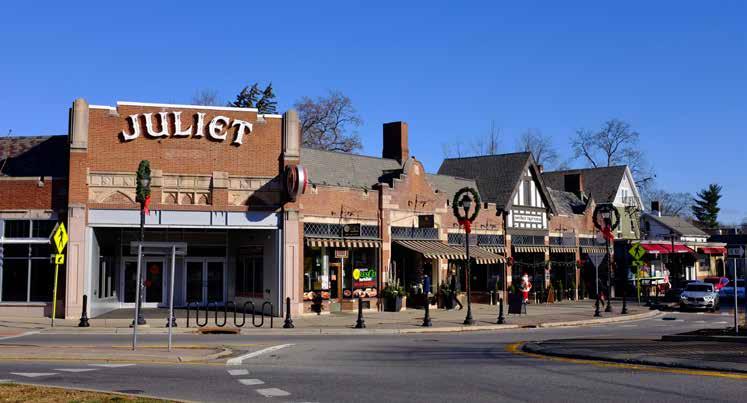
According to an application ACI submitted in October to the New York Department of Environmental Conservation, the planned mixed-use buildings will consist of approximately 150 apartments and 25,000 square feet of retail and restaurant space, as well as an underground parking garage. Renderings submitted in the application show the new structures and the Juliet Building—which extends from the former La Vickyna to Savona’s Trattoria and Bar—creating a triangle around a central courtyard, with the new buildings standing multiple stories above the surrounding buildings. According to David Kaminski, the renderings may not represent ACI’s ultimate application to the Town Board. Kaminski is a partner in the property management firm TC Development Corp. (TCD), which has been hired by ACI to run its daily operations; Kaminski is ACI’s Asset Manager. By email, Vassar Vice President for Finance and Administration Bryan Swarthout told The Miscellany News that as 50 percent partner
in ACI, for major decisions, “Vassar’s vote is required to move forward.”
The application states, “Virtually the entire Site would undergo some form of new construction. The old buildings will be demolished except for the [Juliet] Building fronting Raymond and Collegeview Avenues, except that the rear portion of the building will also be demolished as part of the project.” Per the application’s proposed timeline, demolition
Isabel Holmes Guest Columnist
If you are familiar with the Retreat at Vassar College, you are probably familiar with Vassar community member Chris Sayain. Chris is an employee at Retreat, one of Vassar’s dining options. He most frequently works the serving stations at either Bol or Fyr, offering you one of two meal options and likely a compliment on your outfit. Chris is a Poughkeepsie local and native, having attended Poughkeepsie High School as a teenager, where he ran track and played football. He still lives in Poughkeepsie now, with his two Jack Russell terriers and his cat.
Chris began working at Vassar almost three years ago, joining his cousin who works in the kitchen at Retreat here on campus. Three years into his time, Chris explained that the highlight of his daily routine is being able to engage with others, his coworkers and Retreat goers: “My favorite part of the day is chatting with people. I love to be downstairs and be able to chat with others. I love when people stop by to chat with me, even when they’re not in my line.” This positive outlook on daily interactions is what makes Chris such a memorable presence, always leaving those he interacts with feeling brighter. He also
noted that he enjoys a good outfit, often offering up a compliment for anyone well dressed. “I’m big on fashion and I see a lot of nicely dressed fits, great accessories, so it’s free support to compliment somebody.”
His interest in a good outfit is not the only artistic expression he has participated in. His main interests have always leaned towards the arts in all forms—particularly visual art. In his spare time, he continues to enjoy art both for joy and for his career. “I’ve been very big into art since I was a child, I enjoy working with digital art, with clay, with fashion.” In addition to engaging with art and design throughout school, he is currently working towards creating a digital comic and an online game with friends from high school. “I’m in a small group from high school, we’re working on a computer game. It’s sort of Contra-esque.” Through graphic design and coding, the group is working towards building a game inspired by the ones they enjoy playing on their own time.
Chris explained that he enjoyed gaming and the arts throughout his childhood, but it became more than just a hobby when he reached high school. With his friend group, he was able to create his own online store, turning his skill with art, design and fashion into a professional endeavor. “I had my own online store, I still have my
See Chris on page 10
would take place between October 2026 and February 2027. Construction would begin in May 2027 and be completed by June 2028.
Kaminski explained by email to the Miscellany, “This process is underway and it’s unclear when work will commence at any of the properties, however the state/town mandated approval process must first be navigated, so there will be no immediate work starting. It is also possible that any project could be constructed in phases.” In an interview with Miscellany reporters, Swarthout said, “Where we are with this right now is our initial concept of design is too expensive, and so we’re reworking it and trying to think about that. And so the schedule is really uncertain for what’s going to happen from here, so we really can’t think about what may or may not happen and when at this point in time, because it’s just too
Madeline Nusbaum Guest Reporter
OnNov. 23, the Vassar Alliance for Ukraine hosted an event titled “International Efforts to End the Russo-Ukrainian War.” The aim of this panel was to spread awareness and understanding surrounding the ongoing war in Ukraine. This event was led by Vassar Alliance for Ukraine President Karolina Naidon ’26 and Treasurer Mary Lemza ’27.
The event consisted of two panelist groups, each featuring three individuals. Naidon introduced the event by discussing the historic tensions that have existed between Russia and Ukraine, with the beginning of the current war being marked by Russia’s occupation of Crimea and Donbas in 2014. Naidon detailed the recent proposal to end the war called the 28-point plan, a peace agreement proposed by U.S. President Donald Trump, as well as countless other previous attempts to resolve this over a decade-long war. She ended the introduction by stating that Russia has historically attempted to disband Ukrainian cultural practices and erase Ukrainian history, but events hosted by Ukrainian groups and
organizations, such as the Vassar Alliance for Ukraine, prevent that loss from occurring.
The first panel, “War and Justice: International Humanitarian Law and Prosecution of War Crimes in Ukraine,” consisted of a variety of perspectives and expertise relating to international conflicts. One panelist was Vitalina Shevchenko, a current Youth Delegate at the United Nations (U.N.) and a member of the Mine Action Office under the Ministry of Economy of Ukraine. Another was Mariya Nikolova ’07, a specialist in international humanitarian law who currently works at the International Criminal Tribunal. Nikolova’s work consists of supporting judges in drafting the legal documents that define war crimes and ensuring reparations are given to wartime victims.
Shevchenko’s expertise in the inner workings of the U.N. helped to both frame the discussion about the legality of the war in terms of U.N. policy and highlight the overarching U.N. charter policies that have been broken. She discussed that the U.N. virtually has no power in resolving the conflict. Shevchenko stat-
Tina Mao covers Vassar ACCESS’ new Disability Affinity Space.

Annie McShane reviews John Chu’s moving “Wicked: For Good.” 8 ARTS

Darja Coutts takes readers on an automotive adventure. 6

Continued from Ukraine on page 1
-ed, “We also have to be realistic in addressing his cause, as the Security Council [and the ability to create a peace negotiation] will not change so long as Russia is there and has veto power.”
Another panelist, Vassar Associate Professor of History Michaela Pohl, whose research focuses on the Soviet Union and its diasporas, also gave insight into the genesis of the conflict and war. When the panel was asked about how previous Russian conflicts have unfolded in comparison to this one, Pohl stated that historically, Russia has used intense war tactics such as “Terror bombing to make the population afraid… [and] ruin the interior of cities or villages.” According to Pohl, this war is different because Russia has a greater plan to transform Ukraine into a state in total support, controlled by Russia.
Nikolova highlighted that her greatest fears about the conflict are related to the 28-point plan. Point 26 of this plan would grant both countries amnesty for their actions. Nikolova stated, “This is an unlawful provision under International Humanitarian Law as no amnesty for war crimes can ever be granted.” She also discussed that Ukrainian losses from illegal Russian war tactics have been much greater, further amplifying the unjustness behind granting amnesty. Pohl ended the discussion by highlighting that loss on both sides of the war has to be viewed as upsetting, as no matter what, a human life should not be taken for such an egregious and unnecessary conflict.
In between panels, artist Vitalia Deriabina displayed her artwork around the room and gave a brief overview of their style, Petrykivka, a traditional Ukrainian art form. According to Derbina, Petrykivka is an “art of free people,” and has been viewed as a symbol of hope throughout the war. She shared that individuals sometimes feel tired of discussing the war, as it can be an overwhelmingly heavy topic, so she has used her art to open up discussion in a lighter form.
The second panel, “Advocacy Efforts Abroad: Diaspora and International Organizations’ Voices,” featured Marianna Tretiak, who helped start the national advocacy program within the Ukrainian National Women’s League of America and is now a National Advocacy Chair. The panel also featured Alexander “Sashko” Krapikia, a board member of the American Coalition for Ukraine (ACU), and returning panelist Vitalina Shevchenko.
Tretiak discussed how she has gotten involved with advocating for specific policies with U.S. state legislators and how the ACU constantly has to choose which pieces of legislation are deemed most important, which can sometimes feel like a difficult and unfair task. She said, “If you prioritize everything, you prioritize nothing. We try to for our summits and for advocacy in general, decide, this is our top line task and then everything else, we have to focus on one thing.” Tretiak also highlighted the importance of ad-
vocacy among both Republicans and Democrats, arguing that this issue is larger than partisanship.
Many students attended the event to show support for the Vassar Alliance for Ukraine and learn more about the conflict itself. When asked what she thought about the event, Brynne Mershon ’27 commented, “I think it’s having the opportunity to…make [myself] more and more aware of not just what is going on but the historical and sociopolitical and all the implications of what is going on.” Additionally, Alyssa Smith ’28 said, “It was really inspiring to see the youth perspective from Vitalina Shevchenko and how she has been working with the U.N. and other organizations to actively help people.”
When asked about what Vassar College students can do to support our peers who may be impacted by this conflict and support Ukraine as a whole, Nikolova stated, “The most important thing is to stay properly informed…and reach out to your peers as they are the ones who can tell you how to best support them.” Shevchenko said that small actions, such as “So I would absolutely suggest, inspire. As we did say, it can be as small as putting on [Ukrainian] music at the bar.”
She continued, “Your legislator really wants to hear from you, and the voice of the constituent more than anyone else. In-person meetings with constituents help sway legislators more than any other tool if you want to convince somebody of something.”that the U.N. virtually has no power in resolving the conflict.
Shevchenko stated, “We also have to be realistic in addressing this cause, as the Security Council [and the ability to create a peace negotiation] will not change so long as Russia is there and has veto power.”
Another panelist, Vassar Associate Professor of History Michaela Pohl, whose research focuses on the Soviet Union and its diasporas, also gave insight into the genesis of the conflict and war. When the panel was asked about how previous Russian conflicts have unfolded in comparison to this one, Pohl stated that historically, Russia has used intense war tactics such as “Terror bombing to make the population afraid… [and] ruin the interior of cities or villages.” According to Pohl, this war is different because Russia has a greater plan to transform Ukraine into a state in total support, controlled by Russia.
Nikolova highlighted that her greatest fears about the conflict are related to the 28-point plan. Point 26 of this plan would grant both countries amnesty for their actions. Nikolova stated, “This is an unlawful provision under International Humanitarian Law as no amnesty for war crimes can ever be granted.” She also discussed that Ukrainian losses from illegal Russian war tactics have been much greater, further amplifying the unjustness behind granting amnesty. Pohl ended the discussion by highlighting that loss on both sides of the war has to be viewed as upsetting, as no matter what, a human life should
not be taken for such an egregious and unnecessary conflict.
In between panels, artist Vitalia Deriabina displayed her artwork around the room and gave a brief overview of their style, Petrykivka, a traditional Ukrainian art form. According to Derbina, Petrykivka is an “art of free people,” and has been viewed as a symbol of hope throughout the war. She shared that individuals sometimes feel tired of discussing the war, as it can be an overwhelmingly heavy topic, so she has used her art to open up discussion in a lighter form.
The second panel, “Advocacy Efforts Abroad: Diaspora and International Organizations’ Voices,” featured Marianna Tretiak, who helped start the national advocacy program within the Ukrainian National Women’s League of America and is now a National Advocacy Chair.
The panel also featured Alexander “Sashko” Krapikia, a board member of the American Coalition for Ukraine (ACU), and returning panelist Vitalina Shevchenko.
Tretiak discussed how she has gotten involved with advocating for specific policies with U.S. state legislators and how the ACU constantly has to choose which pieces of legislation are deemed most important, which can sometimes feel like a difficult and unfair task. She said, “If you prioritize everything, you prioritize nothing. We try to for our summits and for advocacy in general, decide, this is our top line task and then everything else, we have to focus on one thing.” Tretiak also highlighted the importance of advocacy among both Republicans and Democrats, arguing that this issue is larger than partisanship.
Many students attended the event to show support for the Vassar Alliance for Ukraine and learn more about the conflict itself. When asked what she thought about the event, Brynne Mershon ’27 commented, “I think it’s having the opportunity to…make [myself] more and more aware of not just what is going on but the historical and sociopolitical and all the implications of what is going on.” Additionally, Alyssa Smith ’28 said, “It was really inspiring to see the youth perspective from Vitalina Shevchenko and how she has been working with the U.N. and other organizations to actively help people.”
When asked about what Vassar College students can do to support our peers who may be impacted by this conflict and support Ukraine as a whole, Nikolova stated, “The most important thing is to stay properly informed…and reach out to your peers as they are the ones who can tell you how to best support them.” Shevchenko said, “So I would absolutely suggest, inspire. As we did say, it can be as small as putting on [Ukrainian] music at the bar.” She continued, “Your legislator really wants to hear from you, and the voice of the constituent more than anyone else. In-person meetings with constituents help sway legislators more than any other tool if you want to convince somebody of something.”
EDITOR-IN-CHIEF MANAGING EDITOR SENIOR EDITORS
CONTRIBUTING EDITOR NEWS EDITORS
ASSISTANT NEWS EDITOR ARTS EDITOR
ASSISTANT ARTS EDITORS
FEATURES EDITOR
ASSISTANT FEATURES EDITOR
OPINIONS EDITOR
ASSISTANT OPINIONS EDITOR
HUMOR EDITORS
ASSISTANT HUMOR EDITOR SPORTS EDITORS
ASSISTANT SPORTS EDITOR DESIGN EDITORS
ASSISTANT DESIGN EDITORS
COPY EDITORS
ASSISTANT COPY EDITORS
GRAPHICS EDITOR GAMES EDITOR
ASSISTANT GAMES EDITOR
SOCIAL MEDIA MANAGER
LIVE EVENTS CHAIR WEBMASTER REPORTERS/COLUMNISTS
Carina Cole
Allison Lowe
Darja Coutts
Luke Jenkins
Soren Fischer
Clara Alger
Julian Balsley
Emma Brown
Hadley Amato
Madeleine Nicks
Grace Finke
Aurelia Harrison
Ben Kaplan
Yaksha Gummadapu
Sydney Jones
Jacob Cifuentes
Ian Watanabe
Zoe Rodriguez
Emma daRosa
Josie Wenner
Wren Buehler
Henry France
Casey McMenamin
Holland Kaplan
Molly Delahunty
Lucas Seguinot
Teresa Garcia-Green
Hannah Wells
Kathryn Carvel
Anabel Lee
Sadie Bakken-Durchslag
Paige Hahn
Annie McShane
Sadie Keesbury
Olivia Blank
Mia Liloia
Denver Brown
Hunter Farhat
Jordan Alch
David Bray
Eduardo Culmer
Noah Daube-Valois
Armaan Desai
Noah Duncan
Jackson Hrebin
Lora Janczewski
Brendan Kenendy
Evan Seker
Erin Thatcher
CARTOONIST COPY STAFF
Andrew Chu
Nikola Parker Cooperman
Elliott Evans
Cooper Jaffe
Gabrielle Lyman
Ren Nicolau
Tess Novack
Julia Weber
Continued from Arlington on page 1 early.”
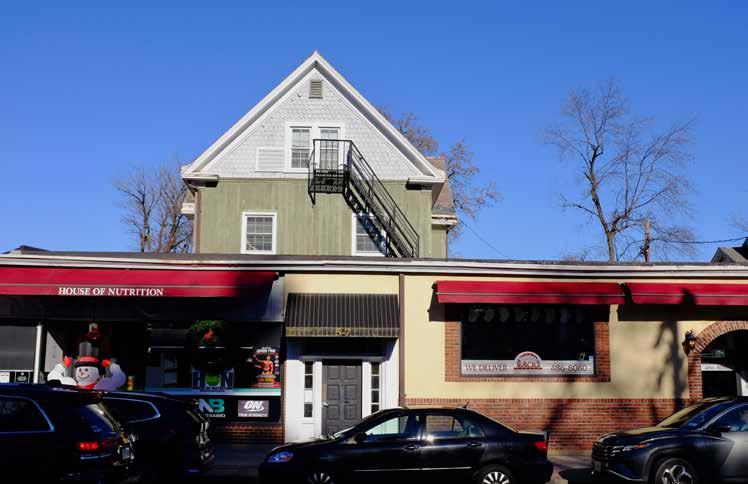
The redevelopment project spans 11 parcels of land in Arlington which currently make up almost a dozen businesses and half a dozen residential buildings, from New Nelly’s Restaurant to Barber Haus NY. “ACI has acquired several properties in Arlington along Collegeview, Fairmont and Lagrange Avenues with the intent to redevelop the properties with the goals: bring more commercial and residential density to the area for vibrancy and to support the businesses in the area, create more affordable housing [and] enhance Arlington as a place to live, work, play, and create,” Kaminski wrote.
As The Miscellany News previously reported, the majority of these properties are owned by ACI and College Properties, a for-profit company owned by Vassar. However, KNC Management owns the building occupied by New Nelly’s, Twisted Soul Desserts and Gladmore Cleaners; 14 Lagrange is owned by private individuals. Kaminski wrote, “ACI does have an option to purchase that property [New Nelly’s, Twisted Soul and Gladmore], but we have not yet decided if we will proceed to purchase that property. Accordingly, we have not spoken to any of the tenants in that building.”
According to Vassar Deputy to the President and Secretary of the Board of Trustees Wesley Dixon, he and Swarthout began actively working in Arlington real estate around 2018. Through College Properties, Vassar has owned Arlington property since 1999 and has been a part of the Arlington Business Improvement District (ABID) since 2001. Swarthout has been ABID Treasurer since 2014.
Dixon explained that Vassar decided to become more active in Arlington real estate for two main reasons. First, some businesses were closing due to financial issues or retirement. Second, said Dixon, “We were getting a considerable amount of feedback from families and students who were admitted to Vassar but chose not to come, that they did not feel that the Arlington area was an area that was exciting or enticing or feeling like a college town to them.” Administrators began “grassroots diplomacy” to find local businesses hoping to open second or third locations who could succeed financially while maintaining a local feel.
Dixon emphasized that the College has been careful not to contribute to white flight from the diverse City of Poughkeepsie to the predominantly white Town. Such flight has caused an economic downturn in the City, exacerbated by IBM jobs in the Town. “We don’t want to unintentionally contribute to the continued potential pouring out or parasitic effect that might have on the city of Poughkeepsie,” Dixon explained. “We were very keen to ask people if they’re ready or willing to expand to a second or third location, because, in particular, if they existed in the City of Poughkeepsie, we were not trying to, by virtue of having them come to Arlington, take them out of the City of Poughkeepsie.”
In interviews with The Miscellany News, business owners and tenants in buildings owned by ACI alleged that Kaminski gave different amounts of information to different tenants about the futures of their businesses and homes. Some business owners and residents were told outright that their buildings were set for demolition, while others were never informed, only learning about the planned redevelopment by asking neighbors or Vassar administrators directly.
“When ACI acquired the properties, I informed all the tenants that at some point the buildings would come down and that to the
extent that we could help them find new locations in Arlington, we would,” Kaminski wrote. “The goal was to be transparent and provide as much notice as possible to minimize the disruption to them.” In an email to The Miscellany News, Swarthout explained, “We remain early in the planning process and yet we have communicated with all tenants about it.”
Multiple business owners and tenants described living under a cloud of uncertainty, waiting to learn when they must pack up their lives and move at a moment’s notice.
“We’re all paranoid, we’re stressed, we’re scared, because we don’t know. We just don’t know,” Shanna Treasure, who works in Vassar Facilities Operations and lives in an apartment behind Bacio’s, told The Miscellany News. “We just hold our breath and we’re just waiting to see.”
Pizzeria Bacio Ristorante
Gerardo Carina has run Pizzeria Bacio, located across the street from Vassar, for 18 years. “I built this place with my own hands,” Franco Carina, Gerardo’s brother, told The Miscellany News. For most of that time, Gerardo renewed his five-year lease informally via email or an in-person conversation: When Gerardo would tell his landlord that he wanted to renew his lease, his landlord would simply remove the old date from the document and write a new one in.
Then, on Oct. 31, 2023, ACI purchased the property. In December 2024, Gerardo and his accountant, Cathy Servodio, had a meeting with Kaminski, during which Kaminski informed Gerardo about the planned demolitions, as well as ACI’s plans to redevelop Arlington in two phases. At this meeting, Gerardo and Servodio alleged that Kaminski told them that Bacio’s could move into a vacant space in the building that would be constructed during Phase I. The building would be located on the grass field next to Crafted Kup and the buildings currently occupied by New Nelly’s, Twisted Soul and Gladmore. “When building one was ready, they were going to move me in,” said Gerardo. “They were going to do the layout and the only thing I had to do was bring my equipment.” In an interview with Miscellany reporters, Servodio confirmed this version of events. Gerardo recalled telling Kaminski, “I wanna stay at College Avenue,” in Bacio’s current location, but explained that he was happy to move to
a new location under an agreement that ACI would cover his expenses.
However, Gerardo also noted that when he brought up renewing his current lease multiple times in early meetings, Kaminski told him not to worry.
Gerardo, Franco, Servodio and a Bacio’s employee all told Miscellany reporters that on more than one occasion, Kaminski reassured Gerardo that ACI would not close his business. In Franco’s retelling, Kaminski said, “We’ll always have a place for you guys. Even if we renovate, whatever, we’re going to have a place for you.”
In early 2025, the College put on two community workshops, or charrettes, that brought together local government officials, Vassar administrators, students, business owners and town planners. Dixon explained, “There was a conversation about, ‘What do we all want Arlington to be, and as such, what kinds of things are possible to help us get to that place?’” In addition to the charrette, the College sent out a survey to the community that received over 500 responses.
On March 10, Servodio informed Kaminski by email that the Bacio’s owners would like to renew their lease, according to copies of the correspondences obtained by The Miscellany News. Servodio received a response from Jennifer Berlind, TCD’s Principal Manager, that day, informing her that she would pass the message along to Kaminski. Gerardo and Servodio contended that this was the last communication they had with Kaminski, or any other representative from ACI or Vassar, until August.
On Aug. 15, Servodio sent Kaminski an email informing him once again that the owners of Bacio’s wanted to extend their lease. On Aug. 21, Gerardo, Servodio and Kaminski met at ACI’s office. At the time, Gerardo believed he would be signing an extension for his lease at the meeting. Servodio remembered, “He said that I must have misunderstood him about him taking care of the move and everything.” Kaminski then showed Gerardo and Servodio a lease for the space in the Juliet Building that previously housed La Vickyna, a building owned by College Properties. (In an email to The Miscellany News, Swarthout confirmed that all College Properties buildings to be redeveloped will be transferred to ACI.)
One week later, Kaminski, Gerardo and a contractor met at the Juliet to survey the
space. Gerardo noted that because the building was not equipped to accommodate a pizzeria, the space would have to be renovated. The contractor was tasked with providing ACI and the owners of Bacio’s a rough estimate of the cost of such renovations. During this meeting, Gerardo claimed that he raised concerns about the cost of moving his equipment and renovating the restaurant. Despite these concerns, Franco recalled telling Kaminski, “We’re going to take the spot because we have no option. You’re giving us no option.” Gerardo remembered Franco saying that, even if ACI or Vassar did not give the Carinas money to assist with the move, they would still do so if given no other option.
On Sept. 18, Kaminski sent Servodio an email about the possibility of ACI loaning Gerardo $50,000 for renovations. Gerardo alleges that, with interest on the loan, he would have had to repay ACI $75,000. (Swarthout confirmed that Gerardo was offered a loan but did not recall the exact amount or interest rate offered.) In the email, Kaminski informed Servodio, “College Properties would like to have a response to the offer no later than next Friday, September 26.”
On Sept. 19, Servodio responded with an inquiry about the contractor’s estimate for the renovations, which had not been communicated to Bacio’s. The following day, Kaminski sent Servodio a copy of an architect’s report on their inspection of the premises, but did not provide an estimate. In a follow-up email sent three minutes later, Kaminski wrote, “I should note that before we go through a due diligence effort to price out the improvements, we would want to get a preliminary indication if the numbers work for Gerry to make this move, based on the Term Sheet that was submitted.” “We never got an estimate,” said Servodio. “What if it cost 200 grand to get that place set up?” Servodio explained to The Miscellany News that she did not respond to Kaminski’s Sept. 19 email because Gerardo had requested that Kaminski communicate with him directly. Swarthout told The Miscellany News that offers about the Juliet space were made in August, September and October. “The last offer, we offered them a pretty significant discount on the rent so that it wouldn’t cost them any more, at least in the short run, to be in that space compared to their current space, even though the one we’re offering them in the
See Arlington on page 4
Continued from Arlington on page 3
Juliet building is much bigger,” Swarthout recalled. “And then we offered them a loan to help them move.”
On Oct. 7, Kaminski wrote in an email to Servodio, “Vassar College is asking if there is any interest in moving forward with the lease for the location on Raymond Ave. They have been approached by another restaurant and need an answer ASAP.” The next day, Kaminski met with Gerardo, Franco and multiple builders the Carinas knew at the Juliet.
During this meeting, Gerardo alleged that Kaminski informed him that the new space would not be able to accommodate outdoor seating, an option available for customers at the current Bacio’s location. Gerardo claims that during this meeting, he requested that ACI sign a non-compete agreement barring the company from leasing a space in one of the planned buildings to another pizzeria. However, he claimed that Kaminski said he could not make that commitment. Servodio, who was present for this conversation, confirmed to Miscellany reporters that this was an accurate account of Kaminski’s comments.
Gerardo also raised concerns about the amount of time that renovations would take, given that his restaurant would not be in operation while moving out of his current location and into the new space. Due to these concerns, Gerardo recalled once again bringing up the lease renewal for Bacio’s current space, at which point he alleged Kaminski became angry. Gerardo then remembered telling Kaminski he would retain an attorney.
Hours later, Kaminski sent Gerardo a text that began, “Before you spend lots of money on an attorney, please read our lease.” He then informed Gerardo that the lease stated, “Written notice of the exercise of the option to renew must be received by the Landlord, either personally delivered or mailed to Landlord at Landlord’s address via certified mail, receipt requested. Landlord must receive such written notice by Tenant on or before December 1, 2024.” Kaminski ended the text, “You neither delivered anything to us personally nor did you send a certified mail. Case closed.”
On Oct. 9, Kaminski sent Gerardo another text asking if Gerardo could meet him and Swarthout at the Juliet on Oct. 13 at 9:30 a.m. Gerardo confirmed the meeting, but, in a subsequent message, wrote, “Before we meet up Monday at 9:30 I want to make sure that the people that I wanted to be there they’re gonna be there. I will let you know 100% tomorrow thank you.” In response, Kaminski asked Gerardo to confirm the meeting as soon as possible. He added, “Vassar is requesting financial statements from the past three years and a personal financial statement from you and any other partners with a financial interest.” Gerardo never responded to this text. At 9:20 a.m. on Oct. 13, Kaminski texted Gerardo to confirm that morning’s meeting, given that Gerardo had not responded to this message. Gerardo explained to The Miscellany News that he did not respond to the messages because he felt his English was not good enough to understand their details.
Gerardo added that he felt caught off guard by Kaminski’s attempts to schedule a new meeting so shortly after their previous one had ended with Gerardo acquiring an attorney.
At 5:20 p.m. on Oct. 13, Kaminski informed Gerardo via text that ACI was rescinding their offer to rent the vacant space at the Juliet Building to Bacio’s. In the text, Kaminski wrote, “College Properties has decided they are going to proceed with another tenant for that space. Their offer to you is hereby removed.”
Swarthout explained, “During this whole
time, there was another local business really expressing a lot of interest in being in that space. We kind of held them off because we wanted to let the conversation with Bacio’s to play out and give Bacio’s the opportunity.”
However, after the missed meeting, “Given their hesitation and how long it’s been taking, we did eventually offer [the Juliet space] to them. And so we are going to be bringing [in] another local business.”
Gerardo and Franco told The Miscellany News that they were surprised by Kaminski’s text, having believed, up until that point, that they would be relocating to the Juliet. Gerardo said that this text was the first he had heard of another restaurant being interested in the space, although Kaminski informed Servodio of the other restaurant’s interest on Oct. 7. Swarthout contested this version of events, saying, “Over many months, we were talking about [the space in the Juliet Building] and exploring this with them [Gerardo and Franco], and they really didn’t show a lot of interest.”
Kaminski echoed Swarthout, writing, “Over the course of many months, Bacio’s owner considered it and expressed doubts about the space and concerns about the cost.” Gerardo told the Miscellany, “I never said that I didn’t want the spot. And I never said that I cannot afford to pay the rent.” He continued, “I was just taking my time, because [I wanted to] comprehend everything [that] went on, because up to that time, everything was a lie.”
On Oct. 14, Gerardo’s attorney emailed Kaminski to inform him that Gerardo had retained counsel. She asked to be put in contact with a representative of College Properties to follow up on moving into the Juliet space. She clarified that, by doing so, she was not waiving the Carinas’ current lease, which she said Gerardo had “duly renewed” for another five years.
Kaminski responded on Oct. 21. He wrote, “This claim [that Gerardo renewed his lease] is categorically rejected and is wholly without merit.” He alleged that Gerardo had not given him written notice in-person or by certified mail by the deadline of Dec. 1, 2024. He concluded, “The tenant’s failure to comply with these express contractual requirements renders any purported renewal ‘null and void’... Any continued assertion of a renewed lease term will be viewed as a bad faith attempt to create rights that do not exist under the Lease.”
On Nov. 13, Gerardo received a letter from ACI’s attorney informing him that to stay in his current location, instead of a fiveyear lease renewal, he would have to sign a six-month lease, which would then move to month-to-month. Kaminski previously offered a month-to-month lease in September, which Gerardo did not sign at a lawyer’s advice. A copy of Kaminski’s letter obtained by The Miscellany News, dated Nov. 12, noted that unless Gerardo agreed to the updated lease by Nov. 14, ACI would refuse to accept his rent payment on the current lease’s expiration date of Nov. 30. The letter stated, “The Tenant must vacate the Premises, remove all of the Tenant’s personal property from the Premises, and surrender possession of the Premises to the Landlord in the condition required by the Lease on or before the Termination Date [Nov. 30].”
Gerardo’s attorney informed Miscellany reporters that a landlord giving tenants such a short time frame for deciding whether to agree to a new lease is highly unusual. She noted having only seen this sort of behavior from what she described as “predatory landlords.”
On Nov. 14, Gerardo’s attorney reached out to the attorney representing ACI, contesting ACI’s demand that Gerardo respond to their new lease offer one day after he received the
letter. She wrote, “Your client’s proposal raises material issues requiring careful review and consultation, which cannot reasonably be completed within 24 hours.” On Nov. 21, the attorney sent a follow-up letter to ACI’s attorney, writing, “Your client’s recent conduct, including imposing unreasonable deadlines and attempting to force a ‘take-it-or-leave-it’ arrangement inconsistent with the Lease, raises significant concerns regarding the covenant of good faith and fair dealing, which is implied in every contract under New York law.”
Also on Nov. 21, Kaminski emailed Servodio, informing Bacio’s accountant that Gerardo would have to pay water and sewage bills, in addition to real estate taxes, by Nov. 30. In this correspondence, Kaminski reiterated: “Besides the two amounts set forth above, Landlord will not accept any further rental payments.”
Despite ACI’s demands, Bacio’s resolved not to vacate their restaurant by Nov. 30. Instead, the Carinas intend to take the issue to court, where they plan to argue that ACI had a duty to honor their right to renew their lease. “We’ll have the lease,” said Gerardo. “We’ll have the emails. And we’ll see what the judge says.” As of the date of publication, Gerardo has not received any additional information from ACI regarding his lease or possible eviction. “Also, December’s rent will get mailed,” Servodio said, noting that the Carinas’ lawyer assumes the rent will be returned. “We’ll mail January’s rent.”
Bacio’s has been an involved member of the Vassar community for years. At the Arlington Amble, an orientation week activity during which first-year students are acquainted with local businesses, Bacio’s staff hand out free t-shirts to the new class. For years, Bacio’s stayed open until 4 a.m. on the weekends in order to serve Vassar students. “I tried to treat the college kids the best I could’ve,” said Gerardo.
“They have catered to Vassar more than any business on that block,” said Shannon Holmes, who has worked at Bacio’s for seven years. “I just don’t understand why somebody would do something so horrible.”
Waiting to see if December’s rent would be returned, Gerardo said, “What’s my next spot? Really, I’m gonna be on the street, or no?”
Barber Haus NY
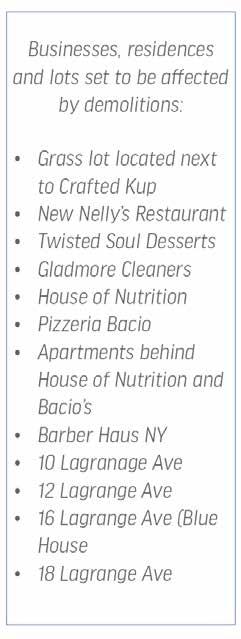
Barber Haus, located at 9 Collegeview Ave, would also be torn down in ACI’s planned redevelopment. In the nearly 10 years since the business opened, Barber Haus owner Jaime Anglero has been on a month-to-month lease. Like Bacio’s, Barber Haus’ building was acquired by ACI on Oct. 31, 2023. But, despite Kaminski’s claim, Anglero was never told of any planned demolition and only learned of the potential redevelopment by speaking with the Carinas. “Speak to us like human beings,” said Anglero in a conversation with The Miscellany News. “This is not a gangster thing… Speak to us like gentlemen. And that’s it. That’s all we’re asking for.”
Anglero expressed his frustration with ACI and Vassar’s perceived lack of regard for local businesses: “When it comes to Arlington Business Capital, who’s Arlington Business Capital? He’s [Gerardo] been 20 years. I’ve been here 10 years. We’re Arlington Business Capital.” He noted his dissatisfaction with ACI’s treatment of Bacio’s in their negotiations, especially why they rescinded their offer to rent the pizzeria space in the Juliet. “If it’s not your fault, not his fault, come together and talk about it,” said Anglero. “Not, ‘Oh, well, you didn’t sign this and you didn’t give me this.’ He’s a pizza guy. He doesn’t read emails. I’m a barber. I don’t look at my
emails… You know where we’re at. Come by… What’s so horrible about that? That’s all we’re asking for. Just be up front with us.”
Like Gerardo, Anglero discussed his disappointment with ACI’s conduct given his business’ contributions to the community. “We’re here for you guys, really,” said Anglero. “I cut hair on campus during COVID. I was on campus cutting hair by the cafeteria. We do the [Arlington] Amble every year… I do stuff with the baseball team. We do stuff with the volleyball guys.” In light of the local business’ involvement with Vassar students, Anglero said, “This is shocking to me that they would be comfortable doing this.”
Though Anglero opposes ACI’s redevelopment of Arlington, he did acknowledge that the Bacio’s and Barber Haus buildings need repairs. “All these buildings are crap, but you don’t have to handle it the way you did… There are renovations that could be done, but that’s different than kicking people out of here.”
House of Nutrition, located next door to Bacio’s and purchased by ACI on the same day, is another local business that will be affected by the demolitions. Even before ACI owned House of Nutrition’s building, owner Matt Johnson described having negative encounters with College Properties. According to Johnson, House of Nutrition was previously located at 1 Collegeview Ave, which is now occupied by Savona’s. After College Properties acquired the building, they elected not to renew House of Nutrition’s lease, instead offering the space to another business. Today, House of Nutrition still has two years left in its five-year agreement with ACI. Johnson reflected, “A lot of people’s leases are up, and they’re at the mercy of ‘the kings.’ I’ve been in that situation… And I learned a hard lesson then—don’t play ball with those guys, they’re not nice.”
When ACI first acquired the property, Johnson alleged that Kaminski told him that
See Arlington on page 5
Continued from Arlington on page 4
3 Collegeview Ave would be demolished in the coming years, but was not given a concrete timeline. Swarthout told The Miscellany News, “The project is intended to be phased, with current occupants able to move into new space in the neighborhood either temporarily or permanently should they desire to do so when their current locations are redeveloped.” However, Johnson maintained that, to date, no one from ACI has offered him a new space, nor helped him locate one.
Knowing that demolition is imminent, Johnson said that he feels stuck in his lease agreement: “I can’t go someplace that I know is open right now and move my store, because then they’re going to fuck me and stick me for two years in my lease… Because you know they will. They’re not nice. So I got to wait ’til my lease runs out.” He continued, “I only hope that they at least give me six months, 12 months, something acceptable.”
However, Johnson expressed hopefulness about ACI’s plans for redevelopment. Though he had previously opposed the plans for Arlington, he noted that he has come to appreciate many of them, including the newly constructed roundabouts on Raymond Avenue. “I’ve learned after being around here for almost 40 years, that they’re not wrong,” said Johnson. “It’s just that we’re in the way, and that sucks. So, I’ve accepted my fate.”
Shannon Holmes
Shannon Holmes, a current Bacio’s employee, lived in an apartment above Barber Haus with her son and husband for nine years. Holmes and her family moved out of their home due to concerns over the property’s potential demolition.
Holmes only rented from ACI beginning in late 2023. Holmes described that her previous landlord would fix issues “almost immediately.” She maintained that this was not the case under ACI. “Everything was brushed off,” said Holmes. “And I blame that partly on the fact that [Kaminski] knew he was tearing the buildings down anyways. I’m sure he was like, ‘Why spend money on something I plan on destroying?’ But [he was] being negligent in the fact that people actually live there.”
While ACI owned Holmes’s apartment, she claimed that the unit’s roof was leaking, pieces of the ceiling were falling off and the walls were severely cracked. Holmes alleged that she communicated these concerns to Kaminski, but that no action was ever taken. Instead, Holmes said, “They came in and put in fire extinguishers and the necessary stuff, but that was about it.”
Ultimately, Holmes and her family moved out of her former apartment on Oct. 1, 2025. “We had been looking for a place because we knew, obviously, the building was being torn down and we didn’t want to be left out on the streets because we were on a monthto-month agreement with Kaminski,” said Holmes. She reported that the apartment’s condition also motivated the move.
While Holmes is no longer ACI’s tenant, she remains concerned about the impact that the company’s demolitions could have on her life. “I’m completely stressed,” said Holmes. “I mean, not only have I had to move, but now I’m losing my livelihood. I’ve been working at Bacio’s now for seven years.”
Shanna Treasure
Shanna Treasure works in Vassar Facilities Operations and has lived in the apartments behind Bacio’s for 16 years. When ACI bought her property in 2023, her old landlord gave everyone new year-long leases and told them that Berlind would be their new point of contact. According to Treasure, no one from ACI told her or her neighbors that demolitions

were planned. However, Treasure explained, “I started hearing talk from my neighbor saying that we were going to be evicted.” Her neighbor asked, “‘Because you worked for Vassar, I was wondering if you heard anything?’ And I said, ‘No.’” She responded, “‘But now that you inform me in this, I am definitely going to ask.’”
At a Vassar event in Fall 2024, Treasure ran into “very important people” in the Vassar administration, whom she declined to name. “I asked one of these very important people,” Treasure remembered, “‘Were they going to evict us all?’ Just so we have a heads up, just so we’re not just blindsided.” She continued, “This person told me, ‘No.’ They had no intentions of putting anyone out. They know we work. They know that people have families. People are there with their children. They know the rents in the area are extremely high. They know that the building has reasonable rent. So they had no plans.”
In late Spring 2025, Treasure asked the same administrator if her building would be demolished. Now, Treasure said, “They confirmed to me, ‘Yes, we want to make a Vassar-friendly high rise.’” According to Treasure, the administrator said final plans were uncertain, but that they wanted the redevelopment to resemble Eastdale Village.
Treasure said that if her building is demolished, she will have nowhere else to go. “I love my apartment… It’s very reasonable. You’re not completely drowning in bills,” she explained. “Now, I have no idea where I’m going to go.”
Swarthout told the Miscellany, “As we approach this, one of the things we want to do is really bolster the high-quality and diverse and affordable, engaging community that is Arlington and build more housing and make more affordable housing available.” He added by email that occupants affected by redevelopment would be able to temporarily or permanently move into new neighborhood spaces.
Town Supervisor Rebecca Edwards, on leave from her position as Vassar Professor of History on the Eloise Ellery Chair, told the Miscellany News by email, “This [redevelopment plan] is an opportunity to think about an array of issues related to Arlington. Those include what amount and types of housing are available, including expanded affordable housing, which is a very high priority for the Town.”
Treasure explained that she feels disillusioned from the lack of clear communication about her home’s future. “I don’t trust you,” she said of the administrator. “Now you’re just kind of in limbo, because you ask people questions and nobody wants to give you an honest answer. So now I literally don’t know if I’m going to come home and there’s going to be a 30-day eviction notice on my door.”
According to Treasure, her whole building is living under the stress of their home’s uncertain future. In prior years, she and her neighbors put up wreaths and other Christ-
mas decorations. Now, she described, “I haven’t even decorated for Christmas because I don’t know if I’m going to be there or not… It’s just a bland, un-holiday building when it wasn’t like [that]. We used to love to decorate.”
Blue House
16 Lagrange Ave, commonly called Blue House, has been Vassar student housing for years. ACI bought the property on Jan. 22, 2024, making it ACI’s third property on Lagrange.
One day after moving into Blue House, one of the tenants had to permanently leave the property because of a pre-existing health issue they claimed was exacerbated by the house’s conditions. The other students were unsure of what made the house uninhabitable for their housemate but speculated mold may have contributed. To check, they purchased at-home mold testing kits from a hardware store, which produced positive results. However, the students noted that these tests can be inaccurate and wanted professional testing to confirm. They also worried that factors other than mold may have contributed to their housemate’s illness.
The students reached out to Kaminski about their concerns about mold on Sept. 2, 2025. Kaminski called them shortly thereafter, telling them that they should immediately move out of Blue House and into 30 Lagrange Ave, a house that ACI owns down the street. Kaminski told them that they should tour the new house that same day.
When they arrived at 30 Lagrange Ave, the students expressed concerns with the house. While the students each had their own room in Blue House, 30 Lagrange was smaller and would have required them to share bedrooms, though the students alleged that Kaminski told them that ACI would potentially move some of the walls to accommodate.
The students were also concerned about the condition of the space. “There was fiberglass exposed in the attic in pretty sophisticated quantities,” said Blue House resident Kwabena Adae ’26. “And we also found mold in the basement that we took photos of before we left the house.”
The house was also unfurnished and Kaminski informed the students that they could not bring any of their old furniture to 30 Lagrange, in case it was infected by mold. “We would have had to furnish the entire thing by ourselves in the middle of the semester and then be [expected] to be leaving in about six months,” said Adae.
Hours after the students toured 30 Lagrange, Kaminski called to ask them whether or not they would accept his offer and move into the new house. At that time, only two of Blue House’s residents had toured 30 Lagrange. Ultimately, the students felt that the new house was not a safer option for them.
“I think my personal biggest issue with that was, they were telling us to leave this house without having done any professional mold testing,” said Blue House resident Avery Nahf
’26. “They were saying, ‘This is the issue, this is our reason for asking and pressuring you to leave.’ They were not doing any proper testing to find out if this was actually an issue in the house.” Nahf added, “Every reason they gave for why they wouldn’t do precautionary measures, we heard equally as much as, ‘We care about your health, but we won’t put any money into the house because it’s set to be demolished.’”
The residents of Blue House allege that Berlind informed them on Sept. 22 that if they refused to move out of 16 Lagrange, she would ask them to sign a document waiving their right to a healthy and habitable house.
Instead, the students pushed for ACI to order professional mold testing for Blue House. However, according to the students, Kaminski was initially reluctant to do so. The students alleged that Kaminski said he did not want to pay for remediation in a property he had plans to demolish. According to the students, on Sept. 24, Kaminski told them that New York State’s Warranty of Habitability can be waived due to the economic waste doctrine. The Warranty of Habitability establishes a landlord’s responsibility to provide a safe and healthy environment for their tenants. The economic waste doctrine, a legal principle established by Jacob & Youngs, Inc. v. Kent, applies in situations in which the cost of a particular repair is substantially greater than the increased value of the property, if the repair was completed.
After repeatedly expressing their desire for professional mold testing to Kaminski with no resolution, the students sent an email to members of Vassar’s administration, including President Elizabeth Bradley, and Kaminski on Sept. 29 detailing their experiences with ACI, their concerns about Blue House and their demands moving forward.
In the email, the students wrote, “We understand that mold abatement may be costly and disrupt plans for the re-development of the area. However, our lease was renewed with the agreement that we would have a safe and habitable place to live until June 1st, 2026. Your financial interests do not waive this agreement.” The students also requested a “clearly defined settlement offer” that met their housing and health needs while addressing their financial losses, such as the cost of moving and purchasing new furniture, if ACI declined to remediate the mold.
The students only received a response from Kaminski. After the students sent this email, Kaminski agreed to hiring professionals to test for mold. The testing concluded that eight to 10 square feet of mold were discovered in the attic which would require remediation, but that Blue House was safe to inhabit. Professionals conducted mold remediation in Blue House in October.
“It was a long, arduous process and a tense process between us and our landlords,” said Nahf. “I’ve lost a lot of trust in them. In the end, we don’t know where we’re at now. Is the house safe? Is it not safe? It’s hard to tell.”
On Thursday, Nov. 20, the Disability Living Room—Vassar College’s new affinity space for disabled and neurodivergent students—officially opened. Members of the Vassar community gathered in Jewett House 122, the chosen location of the Disability Living Room, to celebrate the affinity space’s grand opening with a ribbon-cutting ceremony followed by pizza.
The glass door entrance leads to a large table that occupies the center of the room. The sides of the room are lined with couches of different shapes and colors. A bookshelf that sits next to the table is replete with literature on disability and a box of sensory toys.
The creation of the Disability Living Room is made possible through sustained efforts from Vassar ACCESS in collaboration with the Office of Student Living and Wellness and Dean Luis Inoa. Vassar ACCESS, which took shape in 2022 and was officially recognized as a club by the Vassar Student Association in Spring 2023, is dedicated to building community for disabled and neurodivergent students and advocating for a more accessible campus.
In the past, ACCESS has worked with academic departments on campus to create an inclusive pedagogy workshop series, which they hope will foster better classroom environments and academic spaces for disabled students. In particular, ACCESS President Louisa Braun ’26 shared, “We spent a lot of time advocating for a button to open the Bridge doors. That was one of our small but tangible achievements in the past few years.”
ACCESS’s other events range from silent
disco nights in the Mug to study break sessions in the disability lounge. The space that was previously referred to as the disability lounge is now the official disability affinity space known as the Disability Living Room. “Students work together on their own priorities for accessibility on campus and learn from each other since accessibility looks different for everybody,” Braun added.
ACCESS has been working on creating an affinity space since its founding. The project was started by founding executive board member Thayer Lehman-Borer ’26. According to Braun, Lehman-Borer took inspiration from the Women’s Center and LGBTQ+ Center and felt it was necessary for Vassar to have an accessible space for disabled students.
Braun told The Miscellany News that they hope the disability affinity space will be multifunctional: “People can work in there, go in there to decompress, have meetings there and do activities and crafts. We want it to be a space where disabled students could build community and a supportive peer network, and a space that celebrates disabled identities and provides support for disability advocacy and disability justice on campus.”
Although it has officially launched, ACCESS members feel that the Disability Living Room remains unfinished in more ways than one. In particular, several members expressed frustration at the fact that the automatic door button leading to the Disability Living Room, meant to make the entrance accessible, does not work.
ACCESS member Isabel Auerbach ’27 emphasized, “I think it is completely shameful that we are an affinity space surrounding disability, it is a place for disabled students, and you cannot get into the room
without the help of someone who can open the door.”
Braun also communicated intentions to make the space fully accessible: “We are trying to get a sign of the space with braille as well and also a button to have the door become fully accessible.”
On top of addressing the inaccessibility of the affinity space, members of the Vassar community spoke about other things they would like to see in the Disability Living Room. Auerbach commented, “The walls are bare, we don’t have art that we’ve hung up yet and we were originally planning to have more plants in the space.”
Assistant Professor of English Pasquale Toscano, who attended the event, had similar visions: “One of the things that seems really important to me is having books written by disabled authors and other kinds of artwork. I think [we should] really create a space where there’s a sense that disabled people are creating art, they’re contributing to culture. This is not an identity that is only about tragedy, or only about sorrow, or only about hardship. This is an identity that has a tremendous range of beauty and insight and ethical wisdom to share with the broader community.”
When discussing his idea of a completed disability affinity space, Toscano underscored, “What one person requires or what the cookie-cutter version of accessibility requires may not actually be ideal for everyone, and there may have to be some compromises. At the end of the day, it’s about acknowledging and realizing our particular needs. Disability gives us the vocabulary for communicating physical contingencies and exigencies that society would rather have suppressed.”
The opening of the Disability Living Room
marks a significant step in disability advocacy at Vassar; however, ACCESS members feel that it also highlights the lack of disability awareness and the absence of accessibility across campus. For instance, Auerbach and Braun shared that the Disability Living Room is located in Jewett House because it is one of three accessible dorm buildings on campus, along with Noyes House and Main House. The space was originally set to open in Cushing House, which was planned to be renovated to become accessible. However, after renovations were repeatedly delayed, the club had to relocate the affinity space to Jewett House.
Auerbach is unsatisfied with Vassar handling of disability accommodations: “I have a friend who has been trying to get accommodations for years. It is currently this person’s last or second-to-last semester here, and they have only just gotten accommodations regarding stuff like test-taking.” They expanded, “But there’s also these problems regarding mobility on campus. Only three of the dorms are accessible all the time.”
In line with Auerbach’s comment, Toscano reflected that creating accessibility at older academic institutions like Vassar is often seen as a process that would destroy the beauty of the existing architecture. “But, you know, this is when we get into this rut of thinking, well, disability or access necessarily mean a violation of beauty, which is not the case,” Toscano remarked. He continued, “And so I think when we’re talking about what we want specifically a disabled space to be, we have to be thinking about not just what’s practical. We also have to allow ourselves the luxury—because it’s not, in fact, a luxury—to insist on the importance of cultivating a sense of disability pride and true disability culture.”
On Tuesday, Nov. 18 at 7 p.m., students and faculty gathered together in Rockefeller Hall 300 to hear the Vice President of Energy at Wendel Companies Jason Denue present Wendel’s work-in-progress climate action plan for Vassar College. Wendel is an engineering and architecture firm dedicated to creating customized solutions and energy projects for large organizations.Denue began his talk by explaining that Wendel has created over 50 energy plans with other well-known colleges, before turning to Wendel’s partnership with Vassar. Since around August 2025, he and 20 team members have been collaborating with both the Office of Sustainability and Vassar’s Climate Action and Sustainability Committee to structure a plan to decarbonize the College.
Before Denue described what the process of switching to an environmentally friendly energy system would look like at Vassar, he proposed that an alignment of “core values” is most crucial in making sustainable energy changes happen. He remarked that in order for decarbonization to begin, “The science, student demand, state and federal policy, business, and climate resilience must all work together.” With carbon dioxide emissions continuing to increase, and with climate change ranking as one of Generation Z’s highest concerns, Denue proclaimed the importance of making energy changes to improve energy efficiency, reduce carbon emissions on campus and build climate resiliency for the future.
Providing an overview of Vassar’s current energy system, Denue broke it down into three parts: load, plant and utility. A thermal load is the amount of energy needed to be added or removed from a room in order to heat or cool it. The loads are serviced by Vassar’s two different types of energy plants: a chilled water system, that removes energy from buildings to cool them, and a steam system that includes the radiators which warm the dorms. The campus’ steam systems are controlled by a central boiler plant that creates steam by consuming primarily natural gas, which contributes to carbon emissions.
Energy utilities are companies which provide energy to service the plants. The utilities Vassar relies on provide both natural gas and electricity. Electricity generates less emissions than natural gas. However, it is more expensive, which poses an “economic problem” to transition to sustainable energy, according to Denue.
Denue proposed that transitioning from a steam system to a more efficient geothermal system could be a possible, gradual solution to decarbonizing Vassar. Geothermal energy is renewable and emits 99 percent less CO2 than natural gas. Geothermal energy systems draw heat from wells dug deep into the ground, and heat pumps can warm and cool buildings by using the ground as a heat source to warm in the winter and a heat sink to cool in the summer.
Denue emphasized that Vassar’s old buildings, which rely on embedded energy infrastructure, and its current maximum utility grid capacity—the max amount of power that can be used—will be two chal-
lenges for Wendel to work around. Furthermore, building geothermal wells will cause surface drilling and disruption, and could affect natural landscapes on campus depending on where they are implemented. Because geothermal heating systems draw energy from the ground, load imbalances can also occur when more heat energy is extracted during the winter than injected during the summer to cool buildings. In order for geothermal energy to be implemented at Vassar, Denue explained, these issues would need to be addressed over time. He clarified that, “Energy efficiency continues to be a great opportunity.”
As Denue shared, Wendel was brought in to provide guidance for a cleaner campus energy infrastructure during the short, middle and long-term future, since decarbonization cannot happen overnight. He asserted of decarbonization, “It is a noble cause, and right now everyone is trying to attack the same problem.”
Denue was not able to provide an exact timeline for when implementation of projects would take place, however he estimated the climate action plan would occur in increments of five, 10, 15 and 20 years. Wendel is still in the process of mapping out what each step will look like, but Denue emphasized that Wendel plans to strategically attack locations on campus where old steam energy systems already need to be replaced first, due to aging or broken parts.
Director of Sustainability Ken Foster feels positively about the partnership between Vassar and Wendel. In a written comment to The Miscellany News, Foster stated, “As
the session showed, Wendel is doing significant in-depth work to enable Vassar to chart a path to reducing carbon emissions by gradually transitioning the campus to geothermal heating and cooling.” He continued, “Once their study is finished early next year, we’ll be using their findings and recommendation to craft a new Vassar Climate Action Plan.”
Students who attended the presentation expressed both their concerns and excitement about Vassar and Wendel’s preliminary climate action plan. Vassar Student Association Sustainability Executive and member of Students for Equitable Environmental Decisions (SEED) Genevieve Roech ’27 said, “I think that one of the most important parts within our decarbonization process is transparency, which is why we wanted to host Wendel Companies to do an open student session.” She elaborated, “I think that Vassar is taking the just and equitable steps into the future by conducting this decarbonization study, but we are still extremely far from our sustainability end goals. Right now, we have the ball rolling, but as we move forward in this process, we [students] need to keep it going.”
Laszlo Lawless ’28 commented, “I overestimated how far along they were and I wanted to see more of the specifics in terms of what will happen to which buildings when, especially with the upcoming renovations to the Old Laundry Building.” He expanded, “I want that kind of transparency and I think we should be excited about this as a student population, but for this to work, the messaging has to be there and that’s where students can come in.”
Melody Hamilton Guest Columnist
In recent years, Future Waitstaff of America (FWA) has put on some sizable musicals. Large ensembles of students have crowded backstage and into pits to perform the likes of “Jesus Christ Superstar,” “Something Rotten” and “The Addams Family.” Naturally, beautiful sets and costumes, large orchestras and smiling ensembles are a key part of musical theater’s appeal. However, when audiences entered the Susan Stein Shiva Theater late this November, the show that unfolded was quite the departure from the spectacle and grandiosity that one might expect from a musical. The set was little more than some cardboard boxes and elaborate spike tape, while the pit contained only a conductor, a keyboardist and a drummer. Despite the extreme simplicity, the cast of two—yes, just two—proceeded to perform a hilarious, heartfelt two-act piece.
“Gutenberg! The Musical!” is a show within a show. Bud and Doug, two amateur writers with Broadway-sized dreams, present a chaotic but heartfelt “backers’ audition” for the wildly inaccurate musical they have written about Johannes Gutenberg, the inventor of the printing press. With a makeshift set and a stack of hats to represent each character, the two attempt to play every role in the show, hoping to charm a producer into funding their dream. Their earnest determination and genuine love for theater drive a story that is not about the birth of the printing press at all, but instead about the power of teamwork and unwavering enthusiasm.
FWA’s rendition of this show was led by Director Susan Crumbley ’28, who has been a fan of the musical for quite some time. “While on the surface it’s a comedy about the invention of the printing press, at its core ‘Gutenberg’ is about following your dreams, no matter how absurd,” she explained. “The story of Bud and Doug, like the one that they wrote about Johannes Gutenberg, is about creativity, friendship and what you can do if you have the passion to follow your dreams.”
Crumbley has been an active member of the theater community during her years at Vassar, but this was her first time in the director’s seat. “Working on Gutenberg truly helped me understand how to communicate with everyone involved in the show, and also challenged my organizational skills and multitasking abilities,” she said.
This fall, the roles of Bud and Doug were played by Angela Chen ’28 and Danny Allan ’26, respectively. Understandably, the two noted that the sheer amount of material was initially quite daunting to memorize. Chen explained, “Memorizing lines for a two-person show is the same as memorizing the entire show, and that made it difficult for me to differentiate between my and Danny’s lines.” Allan emphasized this idea as well, mentioning how overwhelming the material was in the beginning. “At the start of rehearsal, it was an intimidating wall, and I wasn’t always confident in my ability to surmount it,” he said. “Realizing that I was capable of slowly dismantling that wall was a great satisfaction… It was exhausting to perform for that long, but knowing that every laugh or gasp
was a reaction to me and Angela made every second worth it.”
Once the brunt of the memorization was complete, small mistakes were inevitable. However, it became clear to the co-stars that this show was forgiving in terms of messing up. “Laughing off errors and moving on is the spirit of the show, and some of my favorite moments of every performance came from little mistakes,” Allan remarked. Chen expanded on this point, saying, “I think those little imperfections made the show even more real because things in life rarely go exactly as planned.”
In addition to overcoming technical challenges, the co-stars explained that learning to trust each other was a crucial part of bringing this show to life. “Because of the nature of this show, we both had to put a lot of trust into the other person physically, vocally, and mentally, which helped us get closer,” Chen explained. Allan echoed this sentiment, saying, “Learning to trust how hilarious Angela
was, and constantly striving to up my energy to match what she was giving brought me a lot closer to her on stage.”
It is clear that trust and teamwork were central to making this show a success. What the musical lacked in spectacle it more than made up for in heart, humor and the sheer joy of collaborative theater. Indeed, for everyone involved, the process behind the scenes seemed just as meaningful as the performances themselves. “This group of people has been incredibly wonderful to work with. I could not have chosen a more hardworking, talented group to put on this production with,” Crumbley reflected. “They astounded me daily with their creativity and dedication to the show, and they truly made the entire process a dream come true.” It seems that, in a medium often defined by scale, FWA’s rendition of “Gutenberg! The Musical!” is a reminder that spectacle may have its place in theater—but so should passion, heart and unwavering trust in one’s team.

Brendan Kennedy Columnist
FKAtwigs has never maintained the ordinary. “Where are the thinkers?” she asked earlier this year during a keynote conversation for Resident Advisor, an electronic music community. Despite being tormented on social media for this claim, which was perceived as pretentious, perhaps FKA twigs had a point. twigs asserted that society is too focused on passive consumption and lacks critical reflection in a world dominated by short-form content; she believes genuine contemplation is absent. Earlier this year, she was ready to challenge her arbitrary declarations with the release of “Eusexua,” an experimental, genre-bending opus. The Grammy-nominated “Eusexua” explores the momentum leading up to a powerful experience, such as the clarity of a pure idea or sexual freedom. Presently, however, twigs is ready to further challenge the disorientation and self-reflection she yearned to locate in “Eusexua.”
Enter “EUSEXUA Afterglow,” twigs’ recent follow-up album that puts a euphoric night out at the club and its unfiltered aftermath on display. “I feel vulnerable here, and that’s sexy,” twigs vocalizes in an evocative social media post upon the album’s release, in which she further narrates “Afterglow” as the chaos in perfection. twigs places the two albums as sisters. Where the early “Eusexua” explores the buildup to a high-powered experience, “Afterglow” explores its fallout, detailing encounters associated with coming down from a high, moments of loneliness, emotional hunger and sensual connections to both strangers and loved ones.
The physical transition between the two albums is distinguished at the beginning of
the first track, “Love Crimes,” where twigs details repeated heartbreak within an ambient setting. Suddenly intense, cryptic bass escapes from the background, throwing the audience into the middle of an astonishing rave dance floor. “You don’t understand / I had to let you go,” twigs repeats as high-energy, hypnotic production floods your ears. Immediately, twigs forgets the build-up explored in “Eusexua” and instead throws the listener straight into her shared elation.
The following song, “Slushy,” drops the previous fast-paced club setting and instead flows the listener through the wind out of a car sunroof. twigs uses the image of a slushy to symbolize simple pleasures, using her imagination to create a positive reality amidst life’s challenges. The production is dreamy, deconstructed and alien-like, reminiscent of the chilling album cover.
“I think being famous is funny,” twigs strides in the hyper, catchy collaboration track, “Wild and Alone,” with PinkPantheress. This pop banger mixes a typical Jersey-club sample with uncanny electronic movement that makes you want to dance. PinkPantheress and twigs detail the loneliness associated with being in the spotlight, specifically how even being constantly surrounded by people can assert a sense of isolation. They glide over lighthearted, bumpy beats, encapsulating the presence of isolation even within large social events, such as a party.
The next tune, “HARD,” sets off with an ethereal, frutiger aero-reminiscent sound before placing a metallic-like drum overtop. This four-on-the-floor, jivey rhythm sees twigs effortlessly navigate through the recording, where she discusses the intersection of physical desire and emotional uncertainty in a relationship. This piece is
‘Afterglow’: a review
twigs at her best: emotionally vulnerable while maintaining thrilling production, trapping the listener in her unique “Eusexua” world. The music video for “HARD” pictures twigs losing herself within sandswept choreography inside a black-andwhite filtered desert, a representation of twigs reclaiming her body after trauma. twigs follows “HARD” with the album’s quirky single: “Cheap Hotel.” Production-wise, “Cheap Hotel” follows the crash from a high. The introduction is quick, groovy and crushingly spiritual as distorted vocals hastily slide through wavy synths. Then, it slows down into an absorbing, cavernous dub. Practically, this song is evocative of the theoretical after-party twigs would host following a loopy night out at the club. Picture twigs positioned around a kitchen marble countertop at 4 a.m., lecturing her closest companions as “Cheap Hotel” plays distantly from the other room. Lyrically, the piece traces a night where twigs and her friends party while using a stolen credit card, placing them within surreal, and often intimate, moments inside a “cheap hotel.”
Skillfully, twigs refuses to lose her momentum throughout the remainder of the album. “Touch A Girl” sees twigs slowing down the tempo, while still including snippets of intense maneuvers and deep production. Its enticing melody traps the listener in a world of the frustration of a one-sided relationship, where one partner only desires physical intimacy without a deeper emotional connection. “Predictable Girl” presents sensual, autotuned moans, skittish rhythms and mutated vocals. The chorus is purposely difficult to follow, allowing the listener to get lost within its individualized whisper-and-bass sounds while whirling to the song’s frantic production. “Piece of Mine” is smooth and sophis-
ticated; twigs bounces within the cracks of subtle glitches and synths as an original composition of rap-like vocals slide in the background.
The high point of the album arrives as a five-minute ballroom chant titled “Sushi.” The first half of the track features a steady, danceable beat, typical of twigs’ music. She proclaims the spontaneous, carefree joy of a week-long relationship, detailing fun, pleasure-seeking activities, such as karaoke or getting sushi. The second half of the track transforms into a vibrant, vogue house anthem, seeing twigs at both her most joyful and artistically visionary. This New York City ballroom-inspired conclusion has a vigorously crafted production that engrosses the audience within twigs’ world of floating DJ mixes and glimmering, carefree attitude—a freeing escape and a glaring career highlight.
The final piece of the album, “Stereo Boy,” is twigs at her most emotional state. She details the pain of a disconnected relationship, using the metaphor of static on a radio as a representation of emotional disconnection and unavailability. This shattering ballad sees a blend of droning and chiming guitar arpeggios upon glitching electronic synths. twigs’ vocals are purposely disengaged and mundane; the soaring sensations of the party have collapsed, and she is forced to face the realities of her existence.
“EUSEXUA Afterglow” is daring, but none other than twigs could take on a feat of advanced electronic beats dispersed inside a hazy, sometimes sensual emotional comedown. twigs has certainly found her golden spot sonically, and her confidence is dazzling. With “Afterglow,” FKA twigs proves she can chase joy without losing her edge—an album that is electric, polished and still somehow stops “to think.”
Annie McShane Graphics Editor
Over the past year, “Wicked” has taken the world by storm—or rather, by tornado. In its opening week, “Wicked: Part I” became the highest-grossing movie based on a Broadway musical to hit the domestic box offices and the biggest global and domestic opening for a movie based on a Broadway show. The soundtrack hit over a billion streams on Spotify in February of this year, and, as of its closing in theaters, the film beat out “Mamma Mia” for the highest-grossing film adaptation of a Broadway musical, totaling over $750 million worldwide. All of this smashing success means that “Wicked: For Good,” the second installment in the two-part movie series, has some big (ruby red) shoes to fill.
Luckily, as both a born-and-raised Kansan who has experienced many a tornado and a dedicated thespian who saw the first installment three times in theaters, I am somewhat of a “Wicked” expert. Thus, I am here to offer my honest review of “Wicked: For Good”
Luckily, as both a bornand-raised Kansan who has experienced many a tornado and a dedicated thespian who saw the first installment three times in theaters, I am somewhat of a “Wicked” expert. Thus, I am here to offer my honest review of “Wicked: For Good” and let you know that I do believe you will be changed for the better.
and let you know that I do believe you will be changed for the better.
Although I had faith in director John M. Chu’s ability to translate the musical’s second act from stage to screen, I still went into my viewing of “Wicked: For Good” feeling a bit nervous. How could the second movie live up to the pure greatness of the first? What if it was not any good at all? Why, that would be positively scandalocious!
However, I decided to trust my instincts, close my eyes and leap, and on Saturday, Nov. 22, I hopped on the Emerald Express (my friend Hannah’s car) and made the long trip to Oz (the Poughkeepsie Galleria Regal Cinemas). Popcorn in one hand and pink bubble slushy in the other, I leaned back in my seat and let the opening notes take me somewhere over the rainbow.
The first track, “Every Day More Wicked,” draws us right back into the intensity of the opener of the first movie, “No One Mourns the Wicked.” This time, instead of rejoicifying, the people of Munchkinland are feeling afraid because of the misinformation they are being fed about the “wicked” witch of the west. This darker rendition of the earlier song immediately sets the tone of the movie. This is not about the glory days at dear old Shiz, and nobody is dancing through life this time around.
The next few songs get us acquainted with where our characters are now. It has been five years since Elphaba (Cynthia Erivo) flew off into the western sky and left Glinda (Ariana Grande), Fiyero (Jonathan Bailey), Nessa (Marissa Bode) and Boq (Ethan Slater) on the ground. Songs like “Thank Goodness/I Couldn’t Be Happier,” “The Wicked Witch of the East” and “No Place Like Home”—one of the two new additions from the musical’s original composer, Stephen Schwartz—align with the somber tone of the movie’s opener and catch us up on how all of these characters have changed since their time at school together. While these songs were enjoyable, none of them stood out in the same way as the hit songs in the first movie.
However, things really started picking up from Elphaba and Fiyero’s love duet, “As Long As You’re Mine,” onward. I have always
thought the songs in the first act of the musical were better than the second, so I was not expecting to come out of the movie with any new favorites. However, after hearing Erivo and Bailey’s rendition of this ballad, my ranking of top favorite “Wicked” songs is definitely going to shift. I might even go as far as to say that this version is better than the original Broadway version.
After this point, the movie just keeps getting darker and darker. Although I was familiar with the storyline from watching poor-quality videos of the stage version on YouTube, the way the intensity was portrayed in the movie version brought a whole new level of sadness. Most notably, the way the scene cut back and forth between Elphaba casting spells and Fiyero being attacked during “No Good Deed” made it much more emotional than how I have seen it portrayed on stage.
After about two hours of buildup, the movie reached its long-awaited conclusion with Elphaba and Glinda’s emotional goodbye in “For Good.” Cue the waterworks! This is my favorite song in the show—and objectively the best song in the show—and I think Erivo and Grande definitely did it justice. While this song is not the most vocally demanding,
the acting made it a standout of the movie. It is not just Elphaba and Glinda’s final song together but also their final conversation. Erivo and Grande really captured the weight of that moment, and there was not a dry eye in the theater. I think it is safe to say we were all changed for good.
Once the movie was over, my friends and I wiped our tears and relocated to Chili’s for a very important conference about our thoughts on the film. About half of the group thought it was just as good as the first one, and the other half thought it was even better. I think I will have to see it a few more times, which I will be doing over both Thanksgiving and Winter Break, before I can fully decide my ranking. Nonetheless, I definitely think that “Wicked: For Good” reached the high bar set by the first movie and lived up to expectations.
So, let us be glad, let us be grateful, let us rejoicify that “Wicked: For Good” is just as good as—if not better than—its predecessor. Hop on your broomstick and defy a little gravity: whatever it takes to make it into theaters to see “Wicked: For Good.” I could not be happier to report that this is one you do not want to miss.

Benji Boyd Guest Columnist
On the evenings of Friday and Saturday, Nov. 21 and 22, the doors of the Vassar Chapel were wide open to receive the throngs of students and guests waiting in line, tickets in hand. Ever since posters displaying students in various scandalous states of undress under the tagline “Whoreship and Prayer” began appearing around campus, it had been the talk of the town, sparking much interest and several scandals on the popular student forum app Fizz. But as they say, there is no such thing as bad press. According to one of the Burlesque club co-presidents, who goes by the stage name Muse, both nights were completely sold out.
As guests filed down the aisles and filled the Chapel pews, the neon stage lights and speakers blasting “Judas” by Lady Gaga helped set the mood of the evening. At 9 p.m., club co-presidents Bareback Zak and Muse took the stage to lay the ground rules: No photos or videos, no entering after the doors are closed and cheering for performers is mandatory.
What followed was a series of 16 performances punctuated by a 10-minute intermission, which wrapped up around 11 p.m.. Performers, including but not limited to,
Sack-Religious, Lightning McQueef, Eden d’Bush and Dua Labia danced, lip-synched and stripped to everything from “Closer” by Nine Inch Nails to “Spellbound” by Siouxsie and the Banshees. While some numbers followed the religious throughline, such as “Touched by the Holy Spirit,” “Red Sea” and “Blasphemy,” others deviated according to the interests of the performers.
According to Muse, the theme of “Whoreship and Prayer” was a loose outline to help performers come up with routines and pitch them to the group. Although Burlesque is an audition-based organization, accepted members are allowed almost complete creative freedom over their numbers. Typically, a group leader pitches an idea to the club and either recruits other performers or develops it as a solo number. The performances in “Whoreship and Prayer” ranged from a single performer on the stage to nearly the entire club, with a wide variety of costumes, themes and song choices represented. Many Burlesque members make their own costumes, and the amount that they take off over the course of their act is entirely up to them.
While some performances involved the traditional strip-tease, others more closely resembled lip-synched dance numbers with well-practiced choreography and creative use of costume pieces. One number,
entitled “Burlesque Has Great Jeans,” began with a group of performers emerging in blue jeans and blonde wigs, which they proceeded to tear off as the beat dropped over an overlaid audio of Sydney Sweeney’s infamous American Eagle commercial. The use of the ad, which has been widely criticized for the racist implications of the wordplay associating “jeans” with “genes,” demonstrates how the subversive medium of burlesque can be used to make social statements and critique mainstream culture. The performers then took their message one step further by imitating choreography from Gap’s “Better In Denim” ad, which features the music group Katseye. This commercial is widely viewed as a response to American Eagle, promoting values of diversity and self-expression in contrast to thinly veiled bigotry.
According to Muse, Burlesque’s reasoning for their controversial theme of religion follows a similar logic.
“Our goal was to examine the relationship between sexuality and religion—human intersectionalities that exist in a chaotic harmony and have existed in the realm of artistic expression for centuries,” commented Muse over email correspondence, later adding: “I grew up very religious . . . which is partially why this show was so meaningful to me; my spirituality is still a huge part of
my life, but the relationship between my body, sexuality, and my spirituality has always been a bit of a struggle to untangle.”
When the theme was first released, many students took to Fizz to argue over Burlesque’s use of religious symbols. While some anonymous users complained that the use of the Chapel for a show that appeared to poke fun at Christianity was disrespectful, others defended the non-denominational function of the Chapel and Vassar students’ rights to freely express themselves.
For Muse, Burlesque has been a way to explore her sexuality, queerness and creativity in a way that feels both vulnerable and safe within the Vassar community.
“Burlesque has always been a place to allow marginalized individuals who are often sexually dismissed or commoditized a space to reclaim those parts of themselves,” she writes. “The goal of our space is to uplift our members while providing them with a sense of a genuine, loving community.”
After weeks of rehearsing for their packed two-night run, the Burlesque performers are being given a rest until their show next semester. However, according to Muse, the club executive board members are hoping to host a talk on the history of burlesque and a movement workshop open to the whole campus.
Darja Coutts Senior Editor
It is a gray but surprisingly warm and windless Monday, Nov. 3. My mom and I are in the Poughkeepsie Train Station, gazing at the Hudson River. She is going over her travel plans with me again, outlining the details of her journey home to Tallinn, Estonia. A group of teenagers takes the stairs down to the train, and we decide it is probably time to stop delaying the inevitable and follow them. On the platform below, I give her a hug and snap a quick silly picture of her, feeling like a proud mother sending my daughter off to her first day of school. She drags her luggage onto the train, we wave goodbye one more time and I walk back up to the parking lot, already missing her but feeling excited for the month to come. There, waiting for me, is my mom’s 2019 Subaru Crosstrek.
For some context, I am not fortunate enough to be able to afford a car of my own, but I am fortunate enough to have a mom who lets me steal hers all the time. And I love this car. I learned how to drive in this car, we have explored the Northeast in this car and I take this car to and from work in the summers. Whenever my friends and I go anywhere, I always elect to be the driver; in fact, they love the Subaru almost as much as I do—almost
Living only a short two and a half hours away from Vassar, there has never been a need for me to have a car on campus, even though I love driving. But when my mom decided to let me babysit her Subaru while she was visiting home, I knew it would be fun to experience having a car of my own at Vassar for the first time.
However, as is typical for a college student in November, I was incredibly busy with a myriad of readings, papers and assignments. During the week, I rarely had
time to drive the car, and because I was assigned to the distant South Lot, I felt less of a drive to go, well, drive.
What finally pushed me to drive the Subaru after a hectic week was a team bonding get-together planned months in advance: bowling with my fellow interns from the LGBTQ+ Center. We went to Spins Bowls in Wappingers Falls—they also have a location only a 20-minute walk from campus!—which was a hilarious experience for me, who has not been bowling since I was a kid. While my mom was sending me pictures of the beautiful medieval architecture of Tallinn, I was bowling gutterballs left and right and getting crushed by my coworkers—who all have a collective hidden talent, apparently. I did get one lucky strike though—thanks to the power of the Subaru, of course. Driving back to campus to the mellow sounds of Charlie Burg’s album after a late lunch at Dave’s Hot Chicken made for a perfect Sunday.
Toward the end of another stressful week with minimal driving, and after a string of way too many nights staying up late reading “Anna Karenina,” I was feeling antsy. I wanted to do something spontaneous. I was craving Wendy’s. So, during my last class of the day, I texted my friend on a whim and asked her if she wanted to eat fast food and go on a Target run. After we indulged in french fries and a Frosty, we eyed the beautiful teapots and the delicious-sounding teas of Tea Talk. Among the never-ending parking lots of the Poughkeepsie Plaza, the sky rewarded us for surviving the week with a beautiful sunset—the kind that reflected off the parked cars and glittered in our eyes.
The adventures continued just a couple days later when my friends and I filled the Subaru, blasted “Man Or Muppet” and drove down to Cold Spring—a 40-minute drive from Vassar, or a few stops away on
the Metro-North. We found parking on Main Street and strolled through the town, window-shopping and trying to soak up the warm sun on the partly cloudy November day. For food, we stopped at Angie’s Bake Shop & Cafe, where I scarfed down one of the best cranberry orange muffins I have ever tasted alongside a rich, cozy hot chocolate. From the Cold Spring Pier, we took pictures and basked in the beautiful cliffs of Storm King Mountain across the river. Because we were on a bit of a time crunch, we drove over to Beacon and enjoyed matcha and coffee from Beacon Coffee Co. & Mercantile. We did not have time to explore any of the other stores, but by walking through Beacon’s Main Street, we definitely brainstormed for the next time we decide to visit—whether that is by car, train or bus, since Beacon is accessible by all three.
Although, this is not everything that I did while I had the Subaru—I also saw “Wicked: For Good” with a friend, enjoyed numerous grocery trips and baked pies at my boss’ house. These were just a few of the many highlights. All in all, it was amazing to drive around, scream the lyrics to my fa-
vorite songs solo or with company and have a sense of freedom when I needed an escape from the monotony of campus life.
When I first came to Vassar, I always felt like I was missing out in comparison to the other first-years on campus who had their cars. Every year since then, as the restriction has gotten tighter and incoming firstyears and sophomores can no longer have cars on campus, I have sympathy for them. However, as a junior who has never had a car on campus, I will tell you: it is not essential to the Vassar experience. You do not need a car to have fun on and off campus! I love the Dutchess County Public Transit system and have frequently utilized it in the past; many of the places I have listed above are available via bus, the Metro-North or the Vassar Student Association’s Saturday Shuttle, so do not be afraid to take advantage of them!
My time with the car ended with me speeding to pick my mom up from the train station with her two suitcases full of Estonian candy. As I drove her home, we exchanged our stories from the past couple weeks, and what was at the heart of all of my adventures? The Subaru, of course.


tistic ambition today, with his tech ventures as well as writing and creating a comic—an adventure story. For both of these projects, he is honing his skills in pixel art to create the graphics for the game and images for his book.
His creativity for art and fashion also extends to his interactions with others. He uses his appreciation for clothing and personal expression to connect with others. Chris’ warm compliments stem from his own personal values, which are centered around communication in all forms. “People need to talk things out more often, and be respectful about it. I also believe in communication in the chain effect. If I say something good to somebody, maybe they’ll say something nice to the next person and make them feel good—I’m pretty big on that.” Speaking from personal experience,
this chain effect is certainly present at Re-
“Sometimes when you’re thinking about your bad mood, I try to say I’ll put this away and it will get better over time. I like talking to students and my coworkers. If I have some nice conversations with people, it helps me chill out.”
treat when Chris is working. Without fail, an interaction with him is one that spreads a

smile onto another person’s face and ignites a wholesome exchange of kindness. When asked what motivates his constant brightness with his interactions, he explained that it comes from empathy. He thinks about what helps him when his mood is low and tries to do the same for others. “Sometimes when you’re thinking about your bad mood, I try to say I’ll put this away and it will get better over time. I like talking to students and my coworkers. If I have some nice conversations with people, it helps me chill out.” His outlook on how we engage with others makes Retreat a better place.
Through compliments, a joyful disposition and thoughtful conversation, Chris Sayain is brightening the Vassar community. Everyone who goes to Retreat is lucky to be able to interact with such a positive presence, one that will surely improve your day.
me?
Ioften find myself existing as an observer.
The instant I capture an image, colors grow fuller, dullness disappears, and shadows and fleeting gestures take on deeper significance. As I adjust exposures and increase contrasts, a wave of euphoria washes over me. The satisfaction of completing the image floods my body. I discover meaning in where my gaze lands, in the darting eyes that pause on ordinary things and in cultivating memories from still moments. I perceive these moments quietly, heeding how people and objects inhabit the world without interruption and letting conversations manifest through unfiltered expressions and presence.
A boy’s palm folds between his father’s palm, calloused hands softly soothing. The eyes of strangers glint courteously on the train. The smell of cigarettes clings to the clothes of a Romanian father whose forehead is creased and eyes sullen. Silhouettes linger on porcelain airport floors. Sweat drips down the face of a frail Phoenician man holding a faded cardboard sign, his lips parched and chapped from lack of water. A cumulus cloud hangs in harmony above a bonsai tree like the Creation of Adam, two hands almost touching. A wooden Arcadia door channel beams with light, a portal to a mystic world. My baby sister jumps into a giant puddle, rain droplets stretching with elasticity and pulling her fully into the present. A German woman with blue doe eyes framed by wired glasses reads quietly on a rustic bench in Berlin’s Tiergarten, a hunting ground where nobles once stood. Each observation becomes a fragment, a time capsule bearing traces of myself through what I witness and capture.
At the same time, I wrestled with this part of myself, wondering if my focus was misguided. I tried to flatten this way of living to appear more visible, more integrated, to mute my way of seeing and brighten only after hours. In environments where external achievement took precedence over internal experience, I attempted to suppress and obscure the meaning I found in small observations. It is difficult to express the emptiness that could arise in such a solitary pursuit, to recognize one’s source of grounding as an invisible cloak worn willingly. It felt selfish to hope to be observed in a similar light. Amid the weight of a simple flick of the wrist or a tap of a hand, when watched with eyes and not ears, I carried a silent wonder: might attention of that kind ever mirror itself onto
The wave of hopelessness and dismissal followed me like uninvited critics. I recall moments late at night, sitting alone on a bench and feeling as if I were standing at the crest of a wave, waiting for it to break and crash unrestrained, to be witnessed and felt. Seeing became a compulsion I felt I had to fight. Reaching for my camera and walking around by myself, I began to perceive my observations as aimless. Subtle movements I observed whispered pragmatically that such meaning was impractical, meant only to be witnessed passively.
These taunting swells lingered as I made my way to Vogelstein Theater on the eve-

ning of Nov. 13 to attend the screening of RaMell Ross’ documentary, “Hale County This Morning, This Evening.” By then, I was well acquainted with the theater. Inside its emerald green walls and intimate environment, I was reminded of driving through the Rocky Mountains where shifting images of evergreens, seen from a car window, blurred into a solid shade. Once introductions concluded, the lights dimmed, and the film began. I was transfixed.
Immediately, I noticed the director’s choice of shots, interpreting each one as an extension of his inner world, and recognized his way of observing as aligned with my own. Woven in every frame, I saw feel-
ing before meaning: high school basketball players’ silhouettes cast onto concrete walls, minute gestures that became self-portraits, music restoring presence from reflective filters, people treated not as spectacles or characters but as individuals worthy of being known in everything hidden or overlooked. The act of perceiving someone through a perspective novel to them restored salience. The camera oscillated between sharp and soft focus, creating emotional resonance from uncurated moments. Life’s poetic fragments revealed the truest parts of humanity, a story serendipitously understood.
A small jet plane drifted across the sky as a young girl cried in angst. Smoke pierced the sunlight. A bee circled the bed of a pickup truck. A hand draped across the tailgate contained a wordless verse. Struck with a profound frisson, my body leaned forward subconsciously. Goosebumps spread. My throat caught with a cry as images of a woman singing in a chapel appeared. Tears welled from her closed eyes. Between every squint and crescendo of her voice, I held her struggles, hopes and exhaustion voyeuristically, watching as they overflowed in a devotional plea.
As the film came to a halt and the screen turned to black, the soft crackle of Billie Holiday’s “Stars Fell on Alabama” echoed. Usually, I would let myself exit events of that kind quietly, but as the theater emptied, regret festered. I took a deep breath, attempting to temper the tidal feeling the film left in me, and approached RaMell Ross just before he left. Through a slew of “uh’s” and “umm’s,” I introduced myself and told him how much the documentary impacted me. I sensed his composure become more animated, his attention fully directed despite being pressed for time. I began to ask him a series of questions, becoming unintentionally reflexive, and noticed that his words connected with me on a level I had never experienced.
I asked if, when he captured shots of shadows and fragments, there was meaning already attached, or if it was feeling first. He responded that feeling always came first, and meaning emerged once dismissed details could be studied closely. I asked if this desire to uncover meaning in the insignificant was how he understood himself. His eyes widened with a smile. “Absolutely,” he said. I then asked him if that way of seeing ever shuts off for him, and he answered with a discerning no.
I told him it might sound intense for a brief encounter with a stranger, but it was the first time I felt my relationship to the
world being reflected back at me by another successful person. Having engaged with photography and close observation as a solitary witness, I struggle to maintain that perspective. The on-and-off switch flickers in moments where I become skeptical of its value. I do not claim to be unique or assert my approach as noteworthy; I had simply yet to find those who share it. He told me that for a while, he felt the same way. Over time, however, he has been able to meet people who reflect his inner world back to him. Before he left for dinner, I asked a final
He assured me to keep creating and to continue photographing, because it is oxygen to your lungs, not an attention seeking disposition.
question: Did he ever feel discouraged? He told me not in the ordinary sense. In unison, we said, “It’s just the way you are.” Both of us smiled before shaking hands and exchanging parting words. He assured me to keep creating and to continue photographing, because it is oxygen to your lungs, not an attention-seeking disposition. There was no mold to fit, no conventional path to follow, no environment or hardship that could extinguish something so innate, felt with eyes open or closed, in sound or in silence. In that moment, I felt seen in a way that required no acknowledgment, a connection unspoken, unmade for me, yet found when I needed it most.
On the walk back to my dorm, I put my headphones on and sat down on one of the benches near Noyes. I wore the same denim jacket I always gravitate towards when the air is brisk but not frigid, staring at the same moonlit sky that has accompanied me many nights before, but this time, I felt different. Meddling thoughts washed onto shore, and I realized the wave did not crash to be witnessed; rather, it was intrinsic. This past summer, in a conversation with Sallie Crotty, a published memoirist and poetry writer, she asked, “Who sees you?” I told her that through observing the world and writing for others, I see and find clarity within myself, a contentment that cannot be fractured.
the
On a cold autumn morning in 1879, Theresa T. Turkey stepped out of her tiny turkey house to greet the day. She stretched, flapping her wings as the brisk November breeze ruffled her feathers. Suddenly, she heard an odd noise to her left. It sounded like a grown man trying very hard to move silently through a dense forest. Theresa stood still for a second, listening, and then shrugged. Oh well. Probably just a squirrel. After all, no man would dare enter the Forest of Tasty Turkeys. BANG! An old-timey rifle sounded 20 feet from Theresa. She squawked and leapt into the air, turning back and forth to locate the source of the sound. There! Hidden in a dense thicket ahead of her was a man wearing a wool coat and a jaunty cap. He painstakingly reloaded his rifle and pointed it directly at Theresa’s face. As she stared down her beak at the barrel of the gun, she thought back on her life thus far. She was still so young, and she had never even left the Forest of Tasty Turkeys. So much she still wanted to accomplish. So much plant matter left uneaten. So many squawks left unsquawked. So many chipmunks still left to chase. Theresa couldn’t die today at the hands of a human. She wouldn’t. So before the man could fire off another shot, Theresa mustered all of her turkey strength and leapt into the sky.
As the gun went off below, Theresa flapped her wings wildly and flew up to a branch about 10 feet off the ground. Panting, she wiped a drop of sweat off her
turkey brow. Flying was hard work. She peered down at the forest floor and saw the man scratching his head with bewilderment. She could practically see the wheels turning in his head, wondering where she had gone. She couldn’t help but let out a hoot of laughter at the confused human, who craned his head up at the noise. Theresa gasped and quickly covered her beak, but it was too late. The man had heard her. He grinned, revealing a mouth full of flat teeth, and cocked his gun up at the sky. Theresa’s throat tightened with fear. She would have to fly again to escape.
Theresa soared into the sky once more as the gun went off again with a BANG. This time, however, she wasn’t quite as lucky. Theresa felt the bullet graze her wing, pulling off a clump of her feathers with it. Unbalanced, she teetered through the air, wobbling back and forth as she tried to regain control. Unfortunately, her struggles were all for naught.
Theresa T. Turkey crash-landed in the local village just on the outskirts of the Forest of Tasty Turkeys. She landed with a splat on the ground, rolled through the local garlic vendor’s stall and skidded in through the open front door of 123 Main Street, coming to rest in the lit fireplace. The residents of the house, not recognizing the foreign object, cowered in terror and decided to leave it alone. After a few hours, however, something started to smell delicious. The matriarch of the house bravely strode over to the fireplace and removed the mysterious specimen. Recognizing it to be a fully cooked turkey, she plopped it onto a serving dish and put it on the table

for Thanksgiving dinner. And that is the story of how my great-great-great grandmother invented my family’s legendary half-plucked turkey recipe.
INGREDIENTS
1 turkey
3 cups of oil
59 cloves of garlic
Salt and pepper to taste
INSTRUCTIONS
1. Remove feathers from one half of the turkey (some prefer to pluck either the top or bottom half, but the traditional recipe removes the feathers from the left side of the tur-
key).
2. Brush the turkey with the oil, making sure to sufficiently coat the feathers. Your turkey should be oily and dripping.
3. Dump the whole cloves of garlic in a bowl. Shake it around a little to activate the garlic.
4. Drop the turkey into the bowl of garlic. Mix it around to thoroughly infuse the turkey with the garlic flavors.
5. Leave your turkey in an open flame for three to four hours, taking care to ensure it doesn’t burn.
6. Add salt and pepper to taste and enjoy!

Emma daRosa GBC Gobbler






ARIES March 21 | April 19
You’ve been such a turkey this year! No more gobbling. Everyone is sick of the gobbling. It’s not cute…

LIBRA Sept. 23 | Oct. 22
TAURUS April 20 | May 20
This week will be as sexy as someone who brings a fresh, delicious, some might say perfect radicchio salad with roasted squash and goat cheese and pomegranate and an orange maple vinaigrette to Thanksgiving that just adds so much needed acid and balance to the meal.

SCORPIO Oct. 23 | Nov. 21
People should get high with their cousins on days besides Thanksgiving. You should get high with your cousins RIGHT NOW. I don’t have cousins, so tell me what it’s like!
The stars are really saying like “Scorpios are so green bean casserole and they’ll have a perfect week.” That’s probably because GBC is my favorite holiday dish and Scorpios are my favorite people.
GEMINI May 21 | June 20
You’re going to have a very stuffing week. It’ll get better when you’re not inside something else. Go outside!!!
CANCER June 21 | July 22
LEO July 23 | Aug. 22
VIRGO Aug. 23 | Sept. 22
Don’t act like such a sweet potato casserole this week. You don’t need all those marshmallows! You’re sweet enough as is, take all those clothes off!
You know that feeling of melancholy that strikes when you realize you and your cousins might never spend another holiday all in the same house as you get older? Your week will be like that.
Be like a ham at Thanksgiving this week! Unwanted, sort of out of place and glazeeeeed in sweet, sweeeet honey.

SAGITTARIUS Nov. 22 | Dec. 21

CAPRICORN Dec. 22 | Jan. 19

AQUARIUS Jan. 20 | Feb. 18

PISCES Feb. 19 | March 20
Gonna be a sort of burnt pumpkin pie week for you. Dry and disappointing, but salvageable with plenty of whipped cream!
Some people you’ve been surrounding yourself with have been acting like instant mashed potatoes! Set out this week to find some eal potato friends. It may take more effort, but they’ll be so much tastier.
You know how people sometimes bring those midwestern cool whip salads to holiday dinners? And they look gross? They can actually be delicious. Something to ponder this week.
Your week will be like a huge leftover sandwich. A giant mess without enough leftover gravy to moisten things up.
Many have asked how I, Wren Buehler, do it all. How am I so okay at humor writing while also being so okay at academics? How do I have such luscious hair while still having time to play with dead bugs? And how can I pull, despite routinely dedicating multiple hours a week to playing board games?
Let me let you in on a little secret: Every year, as the days grow shorter, I partake in copious quantities of the most nutritious red slop you can legally eat. That’s right, I eat six pounds of cranberry sauce every year, and you can too, if you follow along with the attached guide.
1. Make the sauce
What, did you think you could get results with sauce out of a can? Don’t fuck with me. I’ll kill you. Making the sauce is the most important step of the process, but it’s not complicated. I prefer to use the sauce recipe I discovered scrawled on the walls of a tomb in primeval picture-script, but I can’t share that, so I’d recommend just using the one on the back of the Ocean Spray bag.
The most important thing to remember when making cranberry sauce is that it is a fundamentally Orphic process. The sauce is Eurydice, and you are the doomed bard. If you let doubt creep in for even a moment—convince yourself that the sauce is overboiling, and cut the heat— then the batch will be ruined, and your wife will be consigned to Hades. So don’t do that.
2. Thanksgiving Day
This is phase one of your sauce-eating, and it requires you to make some sacrifices. Not human ones. Not human sacrifices. I don’t endorse that. I want to make it clear to anyone reading this who might be in the jury for my upcoming trial that I do not endorse human sacrifice. I just mean you’d better not load up on turkey and sweet potato casserole. This is night one of your transformation, so you’d better get at least a pound in now.
3. The week afterwards
Now here’s where things kick into high gear. Every meal you eat for a week afterwards should have a bowl of cranberry sauce with it. Every snack should be replaced with cranberry sauce. Put it on
toast. In a sandwich. Eat it on its own. Before you know it, you’ll have eaten six pounds of cranberry sauce! But that’s not enough, is it? You won’t be satisfied. I never am.
4. Make more sauce
After Thanksgiving, cranberries are on sale. Buy them. Make more sauce. You’ve outgrown your doubt. You know nothing is overboiling. Everything is proceeding as planned.
5. Submerge yourself in sauce
Sauce is the blood of the cranberry; sticky-sweet and half-congealed. You cannot merely fill yourself with sauce. You must surround yourself with it. Make more. A bathtub’s worth. When it’s full, lower yourself in. Feel the cranberries engulfing your body, a Hellmouth eager to swallow you and spit you out. Close your eyes and let your head fall below the sauce.
6. Sauce floods my mind
I cannot remember my name. I cannot remember my face. I cannot hear my loved ones retch as they find my body slowly mellifying in an unparting Red
Sea. Such things are beneath me. All I need do is fall into a deep sleep. I open my mouth and let the sauce pour into my lungs. I have returned to the womb. Cranberry sauce is my new mother.
7. Enjoy the end of the semester! Congratulations. If everything has gone to plan, you’ve eaten six pounds of cranberry sauce and are ready to return to campus as a new woman. I hope you’re happy. I know I am!

Seth Earl Jenkins Guest Columnist
In 1957, Martin Luther King Jr. delivered his sermon “Loving Your Enemies” at Dexter Avenue Baptist Church. In it, King offers one of the hardest moral instructions imaginable. He tells us that we must love our enemies. He tells us why failure to do so destroys us. He gives us a set of practical steps for carrying out this task, grounding everything in the words of Jesus: “But I say unto you, Love your enemies, bless them that curse you, do good to them that hate you, and pray for them which despitefully use you.” For King, this was not soft piety. This was the foundation for his personal Swaraj, or self-rule.
So, how do we love our enemies? King gives us four clear steps.
The first step is to examine ourselves. Before we look outward, we must look inward. We must ask whether there is something in us that contributed to the conflict or shaped the hostility we face. King says plainly that we must begin with ourselves, stating, “There might be something within you that arouses the tragic hate response in the other individual.” This is not self-blame. It is self-honesty. It is the refusal to imagine that we are pure and others are the sole source of tension or harm.
The second step is to look for the good in your enemy. King quotes Goethe. “There is enough stuff in me to make both a gentleman and a rogue,” King says that we must
learn to find the gentleman even in those who have hurt us. This is not a call to pretend their wrongs do not matter. It is a call to see their full humanity instead of reducing them to the worst thing they have done.
The third step is the most shocking. When the moment arrives to strike your enemy, you must not do it. King insists that retaliation—even justified retaliation—locks us into an endless cycle of destruction. Here he stands beside Liu Xiaobo, who wrote that he had no enemies. To refuse to strike back is not a weakness. It is a decision to create the possibility of something new. It is the refusal to let hate write the script of your life.
The fourth and final step is to use the power of love to transform your enemy and yourself. King teaches that hate is a self-replicating force. It destroys everything it touches. Love alone can break the cycle. Love is not sentiment. It is the disciplined choice to build when it would be easier to destroy.
This framework becomes difficult when we apply it to the present. It becomes almost impossible when we apply it to Jeffrey Epstein. Yet that is exactly where King’s teaching becomes most relevant. King did not intend for this principle to be used only on mild enemies. It was designed for the worst cases. For the ones who test whether we mean what we say about justice and dignity. Epstein did monstrous things, but he was not a monster. Hundreds of people around him also acted in monstrous ways. They covered for him, enabled him or allowed him to
operate in plain sight. Human beings built the networks that protected him. Human beings flew on his planes. They vouched for him, and they allowed a system of wealth, silence and connection to bury the truth for years. If we pretend Epstein was something other than human, we avoid the truth that other humans made his crimes possible. And if we refuse to confront that truth, we will never repair the systems that allowed it.
So, how do King’s four steps guide us here?
First, we examine ourselves. We ask what conditions, tolerances, silences and cultural values allowed people to look the other way. We ask whether we, too, have ever ignored wrongdoing because it was inconvenient to confront it. This is not about blaming the victims. It is about recognizing that a society creates the conditions for its harms.
Second, we look for the good in our enemies. This is the hardest part to accept. King is not asking us to erase Epstein’s crimes. He is asking us to remember that Epstein was loved by someone. He had the capacity to do good even if he failed to do so. If we refuse to acknowledge this, we turn him into a monster and free ourselves from the responsibility of understanding how human beings commit great harm.
Third, when the moment comes to strike, we refuse. When the list of names is released and the scale of the network becomes clear, we resist the temptation to burn homes, form mobs or destroy people without process. We demand investiga-
tions. We demand accountability. We demand reform. However, we do not destroy for destruction’s sake. Vengeance feels powerful, but it produces only more violence. King teaches that refusing to strike is the only way to create something new.
Fourth, we use the power of love to transform our enemy and ourselves. This does not mean allowing the powerful to escape justice. It means insisting that justice be rooted in humanity rather than rage. Love is what allows truth to surface without creating new cycles of corruption and retaliation. Love is what ensures that our fight for justice does not turn us into the very thing we oppose.
Epstein was a human being. Because he was human, his crimes were not unintentional. They were chosen. They were supported by a culture that values wealth more than dignity and silence more than truth. Calling him a monster may feel satisfying, but it excuses the rest of us from asking the harder questions.
Loving your enemies is not easy. It is not naive. It is the clearest form of political and moral discipline available. If we lose our humanity while fighting evil, then evil has already won. King preached this in a world that was ready to kill him. If he could hold to this ethic back then, we can at least attempt it now. To love your enemy is to refuse to become like them. It is to refuse the poison. And it is to insist that justice be real even when the guilty are powerful, protected or beloved.
Guest Columnist
It was a speech that sparked the powder keg leading to the Revolutionary War, the fall of the Berlin Wall, and brought America into World War II, among other historical events. Speeches, though overlooked, are deeply ingrained within American culture and history. It is then unfortunate how they have fallen by the wayside for short, simple, social media posts. Most recently, a tweet and a “truth,” respectively, incorrectly announced the death of two national guardsmen and the closing of Venezuela’s airspace. Two historical events that were given the same platform as a fancy dinner or a funny meme. Even when historical events are given the respect they deserve, the speeches given in their wake often fall flat and are not remembered, such as Donald Trump’s remarks at Charlie Kirk’s funeral or Joe Biden’s condemnation of the assassination attempt on Donald Trump. While both events garnered an Oval Office Address, you would discover it hard to find anyone who remembered what was said. Speeches are becoming rarer and rarer and, when they are given, they are uninspired
and lack memorability.
This is not to say, however, that speeches are no longer important. It is not a post that will turn the gears of change, but a speech. Speeches are now more important than ever. As America slowly peels back its civil liberties, it is not a tweet that will shine a beacon of hope. As great as tweets are for spreading information—and misinformation—they fail to allow the reader to feel like part of a crowd. As more and more political figures chose to make historic announcements over X, they chose to let their movement fizzle and die. When Nancy Pelosi chose to announce her retirement over a video distributed over X, she chose to let her historic, decades-long career end with a sputter. Instead of gathering a crowd or talking on the House floor, she chose to go silently into the night. When Donald Trump ignited the flame that led to the January 6th Insurrection, he did so through an in-person rally because, in the moment, the fire was sparked. When he finally told the rioters to “go home,” he did so over a video released on X. He lit the fire through a speech, then extinguished it through a tweet, further cementing the power and lack thereof of both mediums.
It is with a speech that a presidential bid begins or ends. Yet, within recent history, it has only ended them. The last time a speech truly launched someone onto the national stage was Barack Obama’s 2004 Democratic National Committee speech, in which he declared, “There’s not a liberal America and a conservative America; there’s the United States of America.” It was with this sentiment that he became the first African American president, since this idea, a more united America, became the focal point of his candidacy. It is then unfortunate that the next presumed Democratic candidate uses posts mocking Trump’s style to launch himself into the national spotlight. While it is true that California Governor Gavin Newsom has done a lot to resist the Trump administration, such as suing them and “Trump-proofing” the state, it is words that will be remembered, not actions. People will not remember a tweet in all caps. Most people could not tell you how FDR directly supported the American people through the Great Depression, but they could tell you that “the only thing we have to fear is fear itself.” They could not tell you about the science behind how America got to the moon, but they could tell you that “We
choose to go to the Moon. We choose to go to the Moon... We choose to go to the Moon in this decade and do the other things, not because they are easy, but because they are hard.” If Gavin Newsom truly wants to win the election, he must get his platform into the mainstream, not through tweets but rather by organizing rallies, making speeches and uniting crowds.
Gavin Newsom will not be blazing the trail; however, he will follow in Bernie Sanders’ and AOC’s footsteps. Bernie Sanders’ and AOC’s joint “Fighting Oligarchy” tour cleared the forgotten path for Democrats—a path not used since 2004. While no one speech of theirs was necessarily historic or memorable, they remain as proof that speeches work. They helped unite the Democrats in a way not seen since before the pandemic. It showed that there was power in a crowd and that a speech can still move people even with shortened attention spans. Times have changed, and they will continue to do so, but throughout it all, the ability to rally a diverse crowd around a common goal will remain important. It might have been forgotten, but as we march farther into Trump’s second term, what we need will become clear—a great speech.

Our goal with Brewers Ballin’ is to feature Vassar athletes who starred for their team the week previous to publishing. If you would like to nominate an athlete, please email hfrance@vassar.edu.

courtesy of Lindsey Shoulders ’29.
Women’s Basketball L, 68-72 vs. Mt. St. Mary (NY)
Men’s Basketball W, 105-58 vs. Mt. St. Mary (NY)
Name: Lindsey Shoulders
Year: First-year
Team: Women’s Basketball
Stats: Brewers First Year Guard was named Liberty League Rookie of the Week for the second straight week following a double-double performance against Misericordia University. Shoulders grabbed 13 rebounds and scored 12 points in the Brewers commanding 36 point win over the Cougars. In the following game against Mt. St. Mary (NY), Shoulders nearly recorded another double-double, finishing with nine points and nine boards. Shoulders currently sits at third in the Liberty League averaging 9.7 rebounds per game.
Statement: “I feel really excited and grateful to be a part of this team. Playing basketball at Vassar has been such a special experience so far -- there’s a lot of love and dedication between players and coaches that fuels our fight and success. We’re only going to keep getting better and better and I can’t wait to see all the greatness to come for us.”
Women’s Cross Country 10/32 @ NCAA Nat’l Championships
Sean Miller (M XC) 56/294 @ NCAA Nat’l Championships
M Soccer earn All-Region Awards
Four Brewers were named to the United States Coaches All-Region teams: Fiske ’26 earned a 1st Team nod; Tobolski ’28 was named a 2nd Team selection; Wildman ’26 landed a 3rd Team selection; Mejia ’27 was tabbed a 4th Team selection.
Women’s XC jump to top-10 finish at nationals
Heading into the meet ranked 21st in the country, the women’s cross country team leaped 11 places for a program-best tenth place finish.
McAusland named all-American
The Junior women’s volleyball player earned her first career all-American title, and Vassar’s first since 2018 after being named an AVCA honorable mention.
Men’s Basketball Hobart College vs. AFC Gym December 6 @ 4:00 p.m.
Holland Kaplan Assistant Sports Editor
The Nebraska Cornhuskers did not just finish their regular season undefeated: They owned it.
With a dominant three-set sweep over Ohio State to close the schedule, the Huskers stamped a flawless 30-0 mark on the 2025 regular season. This finish cemented one of the most commanding regular-season runs the program has seen in decades, the kind of benchmark that gets remembered forever.
This is only the third time in program history that Nebraska has had a run like this, joining the legendary 1994 and 2000 teams. The way they did it? Pure and utter control. Nebraska has only dropped seven sets all
up for air on the court. In conference play, just one set was lost, reminding the nation that Nebraska means business, especially after losing in the finals and semifinals the past two years.
Senior Night in Lincoln carried all the emotional weight one would expect from these iconic seniors. The on-court dominance was prevalent as Harper Murray attacked with confidence, Andi Jackson hit an .800 and the entire roster played with a sly synchronicity.
This season has not been accidental, especially with the new Head Coach and Husker alumna Dani Busboom Kelly stepping in.
In her first year at the helm, Kelly has created a squad that is intentional, disciplined and brutal in the best way possible. From Nebraska’s blocking putting pressure on
messy passes, it is clear that they are playing the kind of volleyball that wins trophies.
Here is the truth: An undefeated regular season is impressive, but as we all know, anything can happen in the playoffs. Nebraska has proven this entire season that they deserve to be the No.1 team in the country, but the NCAA tournament is always unpredictable. If we are talking about odds, I believe Nebraska is built for a national championship more than ever before.
This team is playing in a different way than in the past two years. The depth is everywhere. When Murray gets shut down, Jackson steps up. When the blockers camp on the middles, Laney Choboy and Olivia Mauch are there to cover. Their defence is elite, calm and efficient, and personally, I would be scared to hit against Rebekah Al-
ly who they are and what they want.
The biggest opponent for Nebraska this late in the season is the weight of the moment. The perfect season paints a giant target on their back as the team to beat, and teams love nothing more than trying to spoil that. But if this group has shown anything, it is that they know how to respond not just in individual skills, but as a unit.
My prediction is that Nebraska will make it to the Final Four, and in all honesty, I feel like this is their championship to lose. If their stars stay healthy and their composure stays sharp, the Huskers have a very real shot at finishing what they started: a perfect season with the national championship trophy in hand. This team is currently making history, and it is clear they are not
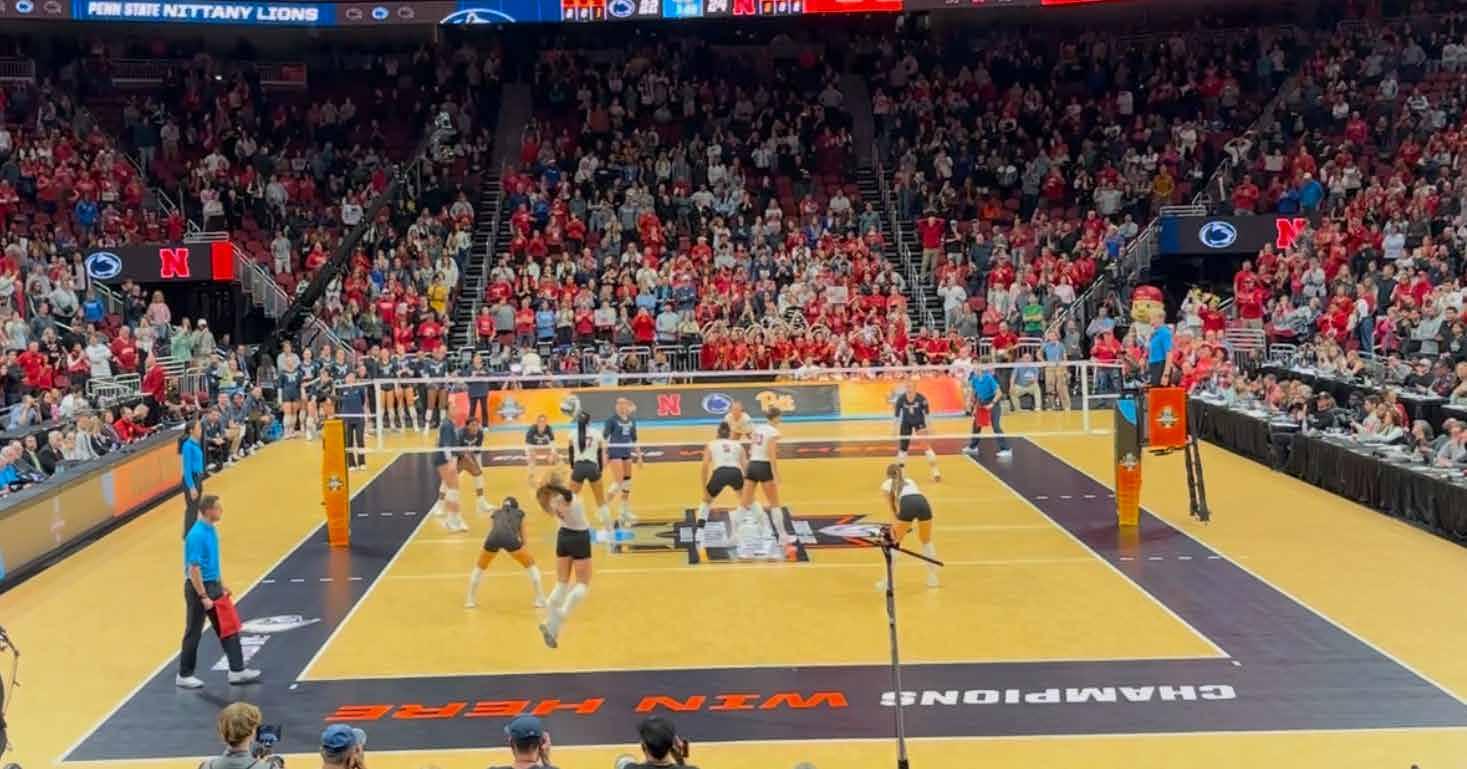
Tomost college football coaches, an eerie late-night meeting with the athletic director and two idling jets on a nearby runway would signal the biggest crisis of their career. For Lane Kiffin, however, it is simply the start of the workweek. Following a historic 11-1 season at Ole Miss that included an Egg Bowl win, narrowly missing the SEC Championship Game and the program’s first-ever trip to the College Football Playoff (CFP), Coach Kiffin has decided to leave Oxford, Mississippi, and take the top job at SEC foe Louisiana State University (LSU). Unfortunately for Kiffin, the Ole Miss administration does not want him to finish out the season and playoffs on the Rebels’ sideline. The top brass in Oxford recognizes that any success in the CFP would help the recruiting efforts in Baton Rouge rather than in Oxford. Kiffin is no stranger to leaving programs behind in dramatic fashion, but his departure from Oxford is unique. As one agent reported to On3Sports, “Only Lane Kiffin would burn a bridge while still trying to stand on it.” It appears that Kiffin was attempting to have his cake and eat it too by
demanding to finish coaching the remainder of the season. Kiffin is famous for being a players-first coach, so it is not surprising that he wanted to finish the year out with the players in his locker room, but from the perspective of the Ole Miss administration, coaching the rest of the season is a non-starter. In the age of the transfer portal, Ole Miss wants to minimize the poaching of their roster. Fortunately for Ole Miss, Kiffin can not officially contact players in the transfer portal until Jan. 2; however, the rest of his coaching staff is up for grabs. Following the meeting between Kiffin and Ole Miss Athletic Director Keith Carter, the two parties entered into a bidding frenzy over Kiffin’s offensive staff. Kiffin reportedly told his staff, “If they’re not on the plane to Baton Rouge today, they won’t have a spot.”
Kiffin has a history of changes of employment involving planes, none more infamous than his firing from the University of Southern California (USC). Following a disappointing loss to Arizona State in 2013, Kiffin was fired on the tarmac as the team arrived back in Los Angeles at 3 a.m. Despite coaching under NCAA sanctions that limited the number of scholarships Kiffin could give out, USC fired the young head coach in
the middle of the season. This episode became one of the most talked-about firings in college football history, cementing Kiffin’s reputation as the drama queen of college football.
In an era when college football looks more and more like a carousel of talent, with each day, Kiffin’s move is just the latest head coaching change involving schools eager to break through.
Coach Kiffin is one of the preeminent names in college football. Kiffin is the son of the late, legendary defensive coach Monte Kiffin. Monte Kiffin was a legendary defensive mind in football history, running the Tampa Bay Buccaneers’ lock-down defense for over a decade. After a stint at Tennessee, the senior Kiffin took a job as Lane Kiffin’s assistant coach at USC. About 15 years later, Lane Kiffin is looking at one of the biggest contracts in college football coaching history.
Kiffin is set to ink a seven-year deal worth $12 million annually with the potential for incentive-based bonuses. This contract will make Kiffin one of the highest-paid coaches in college football history. Kiffin will also be given the keys to the world-famous LSU recruiting machine. In the age of the transfer
portal, coaches no longer have to wait multiple years to build up their rosters in order to compete. With the combination of Kiffin’s recruiting acumen, the brand value of LSU and cold hard cash, Kiffin should be able to buy top-tier talent and turn the 7-5 Tigers around very quickly. If Kiffin can not win right away, Tigers fans will want him gone. As evident by the firing of former blockbuster hire Brian Kelly in late October, the four-time national champion Tigers expect championships, and they will not hesitate to fire a big-name coach if their expectations are not met.
What does the hiring of Lane Kiffin at LSU mean for the rest of the college football landscape? As Kiffin boarded a jet to Baton Rouge, he was met with a cloud of boos from fans who adored him—and his top three squad in the SEC—just hours ago. As powerhouse schools line up to pay high schoolers millions of dollars, the expectations of team leaders will grow. Just as in professional sports, colleges will expect nothing short of excellence from their teams. The stakes are higher than ever, but Lane Kiffin is up to the task. The Miscellany News fully expects the LSU Tigers to compete for conference and national championship titles right away.
By: Sadie Keesbury

ACROSS
1. Suffixes with lemon or lime
5. _____ in the back
9. Where to watch the Red Sox or Patriots
10. Great lake
11. Prefix after hepta- but before nona
12. High _____ or low _____
13. What stormtroopers famously have?
15. FAFSA’s companion
16. Draw a _____, or what many of this puzzle’s clues contain
18. Pen _____ (letter buddy)
20. Poughkeepsie liquor store, or Deece station
23. Base neutralizer
25. _____ what _____ (c’est la vie)
26. Leaning tower of _____
27. Artery alternative
28. Exasperated groans
29 Goddess of strife
1. Q_____
2. Art ______
3. To ordain and _____
4. Slow garden friend
5. Ready, _____, go!
6. Imp
7. Helps
8. The _____ knees
14. _____ Zedong
17. Innocent
18. Mama’s partner, maybe
19. “Can I bum _____?”
21. IV alternative?
22. 9 digit IDs
24. _____ Kapital

Answer to last week’s puzzle: “Just a Number”