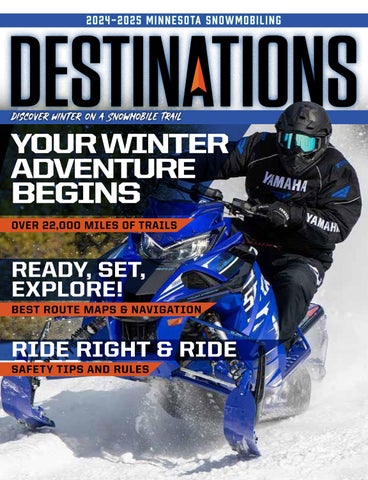
Articles, photographs and manuscripts are encouraged, but the Publisher suggests a query be sent prior to sending materials. Unsolicited articles and photographs are accepted and should be addressed to: Minnesota Snowmobiling DESTINATIONS
6595 Edenvale Blvd Ste 180 Eden Prairie MN 55346
All materials will be handled with reasonable care; however, the Publisher assumes no responsibility for return or safety of artwork, photographs, or manuscripts. Materials not accompanied by a stamped, self-addressed envelope cannot be returned.
Advertising copy: Send all advertising materials to: Ad Department
Minnesota Snowmobiling DESTINATIONS
6595 Edenvale Blvd Ste 180 Eden Prairie MN 55346 Printed in U.S.A.
2024-2025 Minnesota Destinations
5 MODERN MAPPING
Discovering your route with the newest navigation tools from Arctic Cat, Polaris, SkiDoo, and OnX.
6 CENTRAL
Minnesota's central region boasts the highest number of snowmobile riders in the world, featuring famous lakes to the north and stunning bluffs to the south.
7 SOUTH
Experience a different side of Minnesota as you navigate through lush wooded riverbanks and wide-open rolling fields. This destination is perfect for those chasing fresh snow.
8 NORTHWEST
Experience the roots of snowmobiling as you walk in the footsteps of Paul Bunyan and explore a winter landscape unlike any other.
10 NORTHEAST
Take frequent rides! Whether you ride late, or ride early. The famous Iron Range, the majestic North Shore, and breathtaking wilderness can all be found in northeastern Minnesota.
MINNESOTA DEPARTMENT OF NATURAL RESOURCES DNR Administrative Regions
MAKE MORE TRACKS IN MINNESOTA
With over 22,000 miles of groomed, marked, and interconnected snowmobile trails, Minnesota is considered one of the top snowmobiling destinations in the world. Beyond just trails, the state’s stunning landscapes, warm hospitality, and rich history in the sport make it truly exceptional. Minnesota is home to two of the four major snowmobile manufacturers and hosts numerous significant snowmobiling events, including the Midwest Ride In, Hay Days, and the Blackwoods Blizzard Tour charitable fundraiser, establishing it as a snowmobiling paradise.
Although it’s nearly impossible to cover all the trails, destinations, and events in a single guide, this book aims to provide an overview and guide you in planning your snowmobiling adventure. When navigating Minnesota’s extensive trail system, there are multiple ways to get started, including traditional paper maps and electronic resources. Combining both methods is an excellent strategy to ensure you don’t overlook any highlights and remain updated on the latest changes and reroutes.
To obtain the most current paper trail maps, reach out to local chambers of commerce, tourism offices, or local merchants in your chosen destination. Additionally, smartphone mapping apps are increasingly popular; we highlight some of the most widely used ones, such as Ride Command, Garmin, and OnX, on the next page. You can also access electronic maps through the Minnesota Department of Natural Resources (MnDNR) website.
STAY ON TRAIL
Trails are widely considered the safest option for snowmobiling, as local snowmobile clubs are responsible for signing, grooming, and maintaining many of them. The majority of Minnesota’s trails are on private property, with landowners granting snowmobile clubs special permission to build and maintain these routes. It’s essential to respect this generosity by remaining on the marked trails and avoiding shortcuts or trespassing.
Snowmobiles are allowed to operate in the roadside ditches of state and county roads, either at the bottom of the ditch or along the outer slope of the right-of-way. Always stay alert for oncoming traffic, driveways, and other hazards that may be present in the ditches, such as drainage culverts.
TRAIL ETIQUETTE
Treat the trails with the same respect you would show the roads. Stay to the right side of the trail, follow posted signs and speed limits (maximum of 50 mph, slower on designated lakes), and never ride faster than you can safely control your sled. Maintain a proper distance between snowmobiles, avoid stopping in blind spots or in the middle of the trail, and ensure you have ample space to stop.
Stay alert and be prepared for unexpected hazards or icy trail conditions.
Never operate a snowmobile under the influence of alcohol; the margins for error are slim when snowmobiling, and any impairment poses serious risks to both yourself and others. Remember that a DUI on a snowmobile can affect your driver’s license. Many snowmobilers use hand signals to communicate stopping, turning, and to inform oncoming riders of how many people are in their group. A raised hand is more than just a friendly greeting; it conveys important information. For more snowmobiling safety tips and information, visit the Minnesota Department of Natural Resources website and search for snowmobiling.
WHAT FIRST-TIME SNOWMOBILERS SHOULD KNOW
Snowmobile Safety Course: Anyone born after December 31, 1976, is required to have a safety training certificate. This course is not only mandatory but also informative and available to all snowmobilers. For more information, visit dnr.state.mn.us/safety/ vehicle/snowmobile.
Photo: Wayne Davis
Additionally, saferiderssafetyawareness.org offers an
program.
Guided Rides: Many resorts that rent snowmobiles also offer guided rides and additional snowmobile gear rentals, including jackets, boots, and helmets. This is an excellent way for beginners to familiarize themselves with the snowmobile, its equipment, and the trail system.
Contact a Club: Members of local snowmobile clubs are often eager to take new snowmobilers on rides in their area. A great way to show appreciation for their assistance is to become a member of the club. You can find a list of clubs organized by county at mnsnowmobiler.org.
DIGITAL ROUTES: NAVIGATING WITH MODERN TECHNOLOGY
Polaris Ride Command
Polaris was the first manufacturer to explore and offer digital mapping capabilities, and after ten years of experience, Ride Command has become a preferred resource for digital trail mapping. In addition to standard mapping features, Ride Command allows you to track other riders, communicate, plan routes, and share your rides. Best of all, you can access Ride Command via your smartphone, on the website, or through an in-vehicle display.
ON-X
BRP GO
Like Ride Command, the BRP Go digital mapping application is available on your smartphone, web, or on equipped Ski-Doo and Lynx snowmobiles. Collaborating closely with local snowmobile clubs and associations, the BRP Go app continuously updates trails and points of interest. With this app, you can plan your route, enjoy turn-by-turn navigation, and discover stops along the way, including scenic overlooks, hotels, and restaurants.
ARCTIC CAT G8/GARMIN
Originally designed as a hunting app that provided information on public and private land ownership and access areas, OnX has evolved into an excellent outdoor adventure mapping resource, including a specific version for snowmobiling. The OnX Offroad application lets you switch between dirt and snow routes, making it easy to find trails while also allowing you to plan and create routes, as well as track your journey.
Garmin, known for its leadership in handheld satellite navigation, collaborated with Arctic Cat to develop a digital navigation application tailored for snowmobiles. The Arctic Cat G8 display comes with integrated Garmin mapping, allowing users to preload trails that feature points of interest like restaurants, gas stations, and campgrounds. The maps offer layered views that include topography, public and private lands, along with other various features.
RESOURCES
For trail information, conditions and trip planning assistance:
Minnesota DNR 651-296-6157 or 888-646-6367 dnr.state.mn.us/snowmobiling
Minnesota United Snowmobilers Association (MnUSA)
To find clubs and trail information 763-577-0185 mnsnowmobiler.org
How to Register a Snowmobilemndnr.gov/regulations/snowmobile/index.html
Stunning Lake Views, Gorgeous Bluffs, and the Highest Number of Snowmobilers Anywhere central
At first glance, Minnesota’s Central region seems largely defined by the ever-expanding Minneapolis/St. Paul metropolitan area. While the "Twin Cities" certainly play a significant role in this area, they also help create a snowmobiling hub that often draws the attention of the global snowmobiling community.
Just past the concrete jungle to the north, the trail system comes alive, leading to Elk River, known as the river city and home to ERX Motor Park—one of the largest and finest motorsports and events venues in the Midwest. This expansive 400-acre venue hosts the Midwest Ride In, the world’s largest antique, vintage, and classic snowmobile event. Taking place on the last weekend of January, the Ride In features vintage sled displays, trail riding, racing, a swap meet, and plenty of opportunities for socializing around large outdoor bonfires.
Mille Lacs, the second-largest lake in Minnesota, is a popular destination for snowmobile trips, especially for those who enjoy both snowmobiling and ice fishing. Although there are no dedicated snowmobile trails on the lake, a scenic day ride around its perimeter covers approximately 100 miles.
Riding around the lake provides access to some trails near the frozen eastern shore, while others lead into diverse terrain. However, the true highlight—and a local favorite—lies in the trails winding through Mille Lacs Kathio State Park.
These trails meander through wooded hills, skirt Shakopee Lake, and follow the initial stretches of the Rum River as it begins its winding journey toward the Mississippi.
Traveling east toward Hinckley along the 114-mile-long Soo Line South Trail, you can venture into a network of logging trails known as the Red Top Trails. This region, bordered on the east by the meandering Mississippi River, is one of the few areas in Minnesota untouched by the scraping forces of ancient glaciers.
Instead, you'll discover bluffs, rolling hills, and hidden streams interspersed among rich farmlands. This dynamic and ever-changing landscape is mirrored by the snowmobile trails that rise and fall. When these trails are blanketed with fresh snow, they create a magical ride through one of the most picturesque areas in the entire Upper Midwest.
south Southern Minnesota: A Snowmobiler's Hidden Gem
While most people tend to head north when seeking snowmobiling destinations, exploring the less traveled routes can offer experiences that outshine the usual options. This is particularly true for Minnesota's Southern Region. Although the trail system here may not be as extensive as in the north, the local clubs take pride in maintaining some of the best trails in the state.
The Minnesota River, which carves a distinctive "V" through the center of the region, contributes to the area’s stunning scenery. The river bottom trails and wooded bluffs rise from the floodplain, providing a habitat rich in wildlife.
To fully enjoy the southern trails, it’s best to keep an eye on the weather, have your sleds loaded in the trailer, and be ready to adapt your travel plans. Storm chasers—riders
who follow freshly fallen snow to make first tracks—often prioritize Southern Minnesota for this very reason.
This region also features the Casey Jones Trail, a rails-to-trails route named after the legendary railroad engineer and one of Minnesota's first officially designated state trails. Another noteworthy trail is the Blazing Star State Trail, which extends from Albert Lea Lake in Albert Lea to Myre-Big Island State Park, eventually connecting to Austin via Big Island State Park.
In addition to the river bottom and bluff routes, the Glacial Lake Trail offers another scenic option. This 22-mile multi-use trail runs between Willmar, Spicer, New London, and Hawick, providing a great way to take in the many lakes that pepper the region.
NORTHwest
From Forests to Prairies: Your Adventure Awaits
One of the defining features that makes Minnesota a beloved snowmobiling destination is its remarkable diversity. Spanning from north to south and east to west, the state showcases a wide range of terrains, with the Northwest serving as a prime example. The region is characterized by dense, often secluded forests along its eastern edge, which gradually give way to the enchanting openness of the prairie as you head west.
The Northwest is the birthplace of Minnesota snowmobiling, thanks to brothers Edgar and Allen Hetteen and their friend David Johnson, who began experimenting in their hoist and derrick shop in Roseau. This endeavor led to the creation of two significant outcomes: a prototype snowmobile named the Sno-Traveler and the establishment of Polaris, named after the North Star as it was the northernmost company in the U.S. Later, Edgar Hetteen co-founded Arctic Cat in Thief River Falls. Both factories offer guided tours, and you can ride your snowmobile right up to their front doors. Be sure to call ahead to confirm tour schedules and availability.
Due to its northern location, the weather systems affecting this area often go unnoticed in other regions of the state. The cold and snow arrive early and linger late. While other parts of Minnesota may still be waiting for rideable conditions, the Northwest is already busy grooming and enjoying its vast network of high-speed trails. If you’re looking for a place to accumulate miles with minimal traffic and a friendly atmosphere, the Northwest is the perfect destination.
In this region, you’ll find everything from well-groomed ditches and expansive lake routes to some of the state’s most remote and wooded trails. Numerous welcoming businesses, hotels, and resorts also call this area home. For those interested in ice fishing while enjoying the northern experience, the frozen expanses of Lake of the Woods and Upper Red Lake offer some of the best opportunities, with plenty of resorts and guides available to help you catch your limit.
The
various statues, landmarks, and tributes celebrating his story scattered throughout the lake country. According to the tale, the lakes in the area were formed by the footprints left behind by Paul and his Blue Ox, Babe. At the heart of this region is Park Rapids, a popular snowmobiling hub known for its excellent lodging, food, and hospitality.
Water plays a significant role in this part of Minnesota, with the headwaters of the Mississippi River located here. You can snowmobile nearly directly to the spot, followed by a short walk to where the river begins its lengthy 2,552-mile journey to the Gulf of Mexico. Be sure to take a photo next to the iconic headwaters marker, which dates back to the 1930s, during your visit to the park.
At the southern end of this region, Alexandria and Detroit Lakes serve as snowmobile hubs, both offering numerous accommodations and amenities. While the trail connecting these two towns can become busy, a less-traveled section exists in the western part of Otter Tail County, including the towns of Pelican Rapids, Elizabeth, and Rothsay. In total, the county features approximately 500 miles of trails.
Beyond Itasca State Park, the area is home to several other parks. One standout is Maplewood State Park, a 9,000-acre area near Pelican Rapids characterized by a series of high hills that dramatically contrast the surrounding farmlands. The park’s highest point reaches about 1,600 feet, a 300-foot elevation change from the
Northwest is also steeped in the legend of Paul Bunyan, with
fields below. This land was formed during the last ice age and lies on the edge of the Red River Valley, within the Alexandria Moraine.
Another favorite snowmobiling destination is Inspiration Peak, located near Urbank. Snowmobile to the summit for a breathtaking view that inspired author F. Scott Fitzgerald to describe over 50 lakes below as "sequins fallen on an old paisley shawl." Standing at an elevation of 1,750 feet, it is one of the highest points in the state and the tallest in Otter Tail County, rising about 400 feet above the surrounding landscape.
NORTHeast
Must-Explore Snowmobile Trails in Minnesota
Whether you're an experienced rider or a newcomer, Minnesota’s Northeast region is considered an essential snowmobiling destination for all. This area experiences early and abundant snowfall, often offering riding opportunities when other regions are just beginning to see grass. But it’s not just the impressive snow and fantastic trails that make this region special; it’s also home to one of the most iconic shorelines in the United States—the North Shore.
North Shore
The North Shore, adorned with charming communities and stunning rock formations, is a year-round destination, particularly magical in winter. The waters of Lake Superior contribute significantly to snowfall, creating a snowpack that is unparalleled elsewhere in the state. When cold winds blow off the frigid waters of Superior, the lake-effect snow
phenomenon kicks in, delivering considerable snowfall to the treecovered hills along Minnesota's northeastern border.
Typically, the snowmobiling season runs from December 1, through the end of March, with riders taking advantage of the trails early and late in the season. The iconic CJ Ramstad North Shore Trail gracefully follows the shoreline's northeastern path. This trail is both remote and breathtaking, with minimal road crossings and frequent wildlife encounters. While it’s possible to ride the entire trail in a single day, many riders prefer to explore it in segments, allowing them to truly experience the heart of the Arrowhead region.
Iron Range
Venturing further inland, the Iron Range boasts some of the most popular and exhilarating snowmobile trails in the state. Although the
mining activity has largely faded, the area is now known for its unique charm and warm hospitality. Riders here take snowmobiling seriously, resulting in some of the best-groomed and marked trails available.
The Iron Range is strategically located near over 2,000 miles of snowmobile trails, including the renowned Arrowhead State Trail and the Taconite State Trail. Cruise through the Superior National Forest and enjoy a variety of terrains with plenty of straightaways, twists, and turns. Dedicated groomers ensure the trails are in excellent condition, making it easy to access the local towns—Hibbing, Chisholm, Mountain
Iron, Buhl, Virginia, Eveleth, Gilbert, Biwabik, Aurora, Hoyt Lakes, Embarrass, and Meadowlands—via wellmaintained spurs. Make the most of your trip by stopping at trailside bars, restaurants, and hotels.
The Arrowhead and Taconite state trails form the backbone of the region’s trail network. The Taconite Trail stretches 165
miles from Grand Rapids to Ely and is a popular multi-use route shared by snowmobilers, cross-country skiers, dogsledders, and fat-tire bikers. The trail meanders through remote wetlands, picturesque birch, aspen, and spruce forests, and along frozen lakes and streams.
At its northern end, the trail connects with the David Dill - Arrowhead Trail, which runs 135 miles between International Falls and Tower, featuring multiple trail shelters along the way. The 25-mile Aurora Trail links Biwabik and Hoyt Lakes, passing by two mine pits and a former
Civilian Conservation Corps camp. An offshoot to the north leads to the deep snows of the Giants Ridge area, where higher elevations provide a more challenging riding experience.
Voyageurs
Last but certainly not least, the Northeast region includes some of the most remote and rugged wilderness in the contiguous United States. The Voyageurs area is a favorite among snowmobilers for its
RIDE PREMIERE TRAILS IN
combination of scenic trails, breathtaking landscapes, and outstanding hospitality provided by world-class resorts.
This part of Minnesota features vast terrain and remote trails, offering a unique riding experience. Whether you're navigating the single-width Chain of Lakes Trail, the twists of the Arrowhead Trail, or the frozen waterways of the Voyageur Trail, you'll likely be retracing the paths of early timber prospectors and fur traders who first explored this remarkable region.
With crisp snow underfoot and lakes frozen solid, a nighttime ride can offer a spectacular display of the aurora borealis on clear nights. The skies in Voyageurs National Park serve as a canvas for stars, the moon, and dancing northern lights, making it one of the few places in the lower 48 states where you can enjoy such views without light pollution.
Voyageurs National Park is one of the few national parks in the country that permits snowmobile trails. Snowmobiling has been integral to the area since the park's designation, and ongoing usage is explicitly included in its charter, making it the perfect way to experience the park during Minnesota's enchanting winter months.
Photo: Wayne Davis
Trails wind through forests and glide over lake surfaces throughout Voyageurs National Park. The gateway communities of Crane Lake, Orr, Ash River, Kabetogama, International Falls, Ranier and Rainy Lake provide bases for your excursions into the National Park. You will find near pristine wilderness cloaked in the stillness of winter. Voyageurs was established because of the spectacular scenery, rich natural resources and vibrant history of this important piece of the north American waterways. You will not be disappointed. Each gateway community will have options for food, fuel and lodging. The trails will be clearly marked and well-groomed with staked trails to mark the lake surface portions. Any of the communities would be glad to send you a map. They appear in the advertising adjacent.