

by Rob Taylor Jr.
Courier Staff Writer
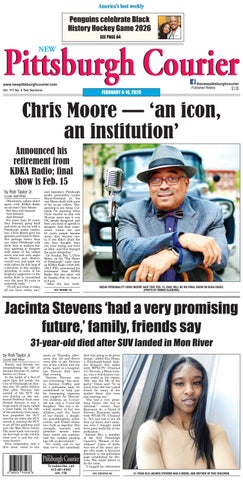
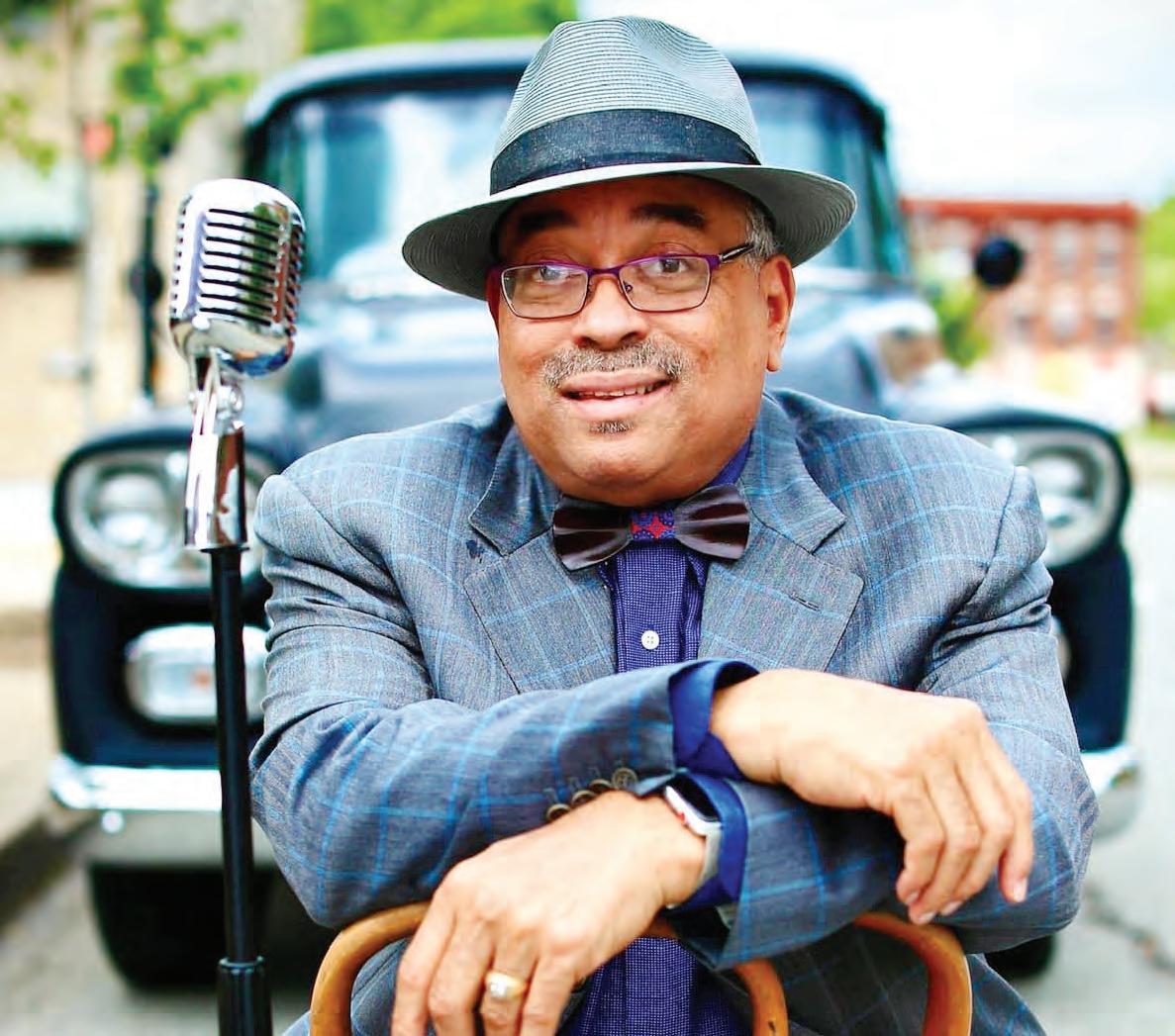
Oftentimes, callers didn't agree with KDKA Radio on-air host Chris Moore. But they still listened. And listened. And listened.
For more than 30 years, they listened, going back and forth on the air with a Pittsburgh media institution. Chris Moore gave his opinions and stuck to them. But perhaps better than any other Pittsburgh talk show host in modern history, agreeing to disagree with many of the callers never was met with anger on Moore's part. Moore's overall way and quick wit with callers for this long of a duration in this market, according to some of his longtime supporters in the media field, is unmatched over the past 30 years in news/talk radio.
"I'll tell you what, it takes all you have within you,”
by Rob Taylor Jr. Courier Staff Writer
Family and friends are remembering the life of Jacinta Stevens, 31, better known as Cinna. In the midst of a foot of snow that fell inside the City of Pittsburgh on Sunday, Jan. 25, police believe that after Stevens lost control of the SUV she was driving on the outbound Parkway East near Second Avenue, it was a large batch of snow, called a snow bank, on the side of the parkway that somehow propelled the SUV into the air when the SUV struck it, causing the SUV to go off the parkway and into the Mon River below. The snow bank was nearly six feet high as the vehicle went over it and the concrete barrier. First responders and a dive team raced to the

said legendary Pittsburgh media personality Lynne Hayes-Freeland on the way Moore dealt with some of his on-air callers. “Disagreeing is one thing. Certainly I'm guessing when Chris started in this role 30-some years ago, it was OK, people disagreed, and then you kind of agreed to disagree. And then somewhere within the last 10 years, people became mean, they became nasty, if you didn't think the way they thought, then you were wrong, you were an idiot...and that changed the game altogether."
On Sunday, Feb. 1, Chris Moore, on his "The Moore of Pittsburgh" radio show on KDKA Radio (1020 AM, 100.1 FM), announced his retirement from KDKA Radio. His last show will be Sunday, Feb. 15, from 5 to 9 p.m. "After the last week-
scene on Thursday afternoon, Jan. 29, and divers were able to get Stevens out of the vehicle and out of the water to a hospital, but Stevens died later that evening.
"Jacinta Stevens was our everything," her cousin, Antwan Griffin, said on a gofundme page he established to help pay for homegoing expenses and support for Stevens' two children, an 11-yearold son and a 7-year-old daughter. "She was a devoted mother to her two children...and the heart of our family: a daughter, granddaughter, sister, cousin, and friend whose love held us together. Her strength, warmth, and presence meant more than words can capture, and her sudden passing has left us devastated."
"It's really sad to see that we've lost somebody
that was going to do great things," added Eva Dixon, a Pittsburgh-based fashion designer who spoke with WPXI-TV (Channel 11). Stevens, a Black woman, was a well-known runway model in the region. "She was the life of the party," Dixon said. "In so many ways she was a good friend for many of the models there who were just starting out."
"She had a very promising future, she was so talented," voiced Tony Bazemore Jr., a friend of Stevens. Bazemore spoke with WTAE-TV (Channel 4). "It's just sad to see all that cut short, she's someone who I thought could have gone really far in her profession."
Saloam Bey, a member of the New Pittsburgh Courier's "Women of Excellence" Class of 2018, was one of the many people who made a financial donation to the gofundme page established for Stevens. She urged others to do the same.
"I hugged her downtown

by Stacy M. Brown
Senior
NNPA Newswire
National Correspondent
America watched it happen in real time.
Journalists were arrested for doing their jobs. Not in some distant dictatorship. Not under cover of night in a failed state. In the United States of America.
Don Lemon. Georgia Fort. Trahem Jeen Crews. Jamael Lydell Lundy. Their crime was witnessing power and reporting it.
While the arrests were immediate and the outrage was instant, the courage was nowhere to be found.
Yes, statements poured in. Carefully worded. Properly formatted. Issued by politicians, civil rights organizations, advocacy groups, and celebrities. Condemnations. Expressions of concern. Warnings about precedent. All of it swift. All of it predictable. All of it ultimately safe. And yet, here we are. The arrests were not a misunderstanding. They were not overzealous enforcement. They were not a procedural error to be corrected quietly. They were a deliberate, calculated escalation. A message. A threat. A line drawn by an administration that has made clear it no longer recognizes limits.
This was a 9/11-style assault on the First Amendment. Not because of the body count, but because of the consequence.
After 9/11, Americans woke up in a country where rights could be suspended in the name of power. After these arrests, journalists woke up in a country where truth itself is treated as a threat.
The facts are damning. Federal agents arrested journalists after a federal magistrate judge declined to issue warrants. Charges were pursued over the reported objections of career prosecutors. Journalists were detained overnight. All of it aimed squarely at reporting on federal agent activity and public protest.
The American Civil Liberties Union did not mince words. Esha Bhandari called it extremely concerning. Deepinder Mayell warned that arresting journalists should alarm everyone. Amnesty International labeled it an authoritarian practice. Public Citizen called it an egregious violation of the First Amendment.
They are all correct. And still insufficient.
Because this is not only about the press. It is about who the press is.
This is an assault on Black journalists.
Georgia Fort is an Emmy-winning Minnesota-based journalist whose reporting has centered on communities too often ignored. Don Lemon is a global figure who dared to criticize power and refused to flinch.
Jamael Lundy and Trahem

Jeen Crews were documenting protests and state force the way journalists have always done in moments of upheaval.
There is no coincidence here. Black journalists have always occupied the most dangerous intersection in American history. Truth and Blackness have always been treated as insurgencies.
The Black Press of America was born before the end of slavery. Two hundred years ago, Black journalists understood what many still refuse to admit. That power does not yield to politeness. That silence is collaboration. That the truth must be printed even when it invites retaliation.
In 2027, the Black Press will mark its 200th anniversary. It has survived slave catchers, lynch mobs, Jim Crow, COINTELPRO, redlining, FBI surveillance, advertising boycotts, and government intimidation. It has survived because Black journalists understood that the price of silence is always higher than the cost of courage. And yet today, as federal agents arrest journalists, as citizens are killed by masked officers in broad daylight, as norms collapse, and as civil rights are stripped away piece by piece, the question remains unanswered.
Where is the real pushback?
Where is the Republican willing to risk a career?
Where is the Democrat willing to shut down business as usual?
Where is the senator willing to grind the chamber to a halt?
Where is the Supreme Court justice willing to speak before history forces their silence to speak for them?
Statements are not resistance. Press releases do not stop authoritarianism. Carefully calibrated outrage does not reverse the collapse of democracy.
House Democratic Leader Hakeem Jeffries said the American people are demanding accountability.

• FEBRUARY 4
1913—Civil rights heroine Rosa Parks is born on this day in Tuskegee, Ala. It was her refusal in December 1955 to give up her seat to a White man on a Montgomery, Ala., bus that sparked the modern Civil Rights Movement. For refusing to obey the laws of segregation, she was arrested and convicted. Montgomery Blacks responded with a boycott of city buses. A young minister named Martin Luther King Jr. was called upon to lead the boycott, which would last for nearly 13 months. The drama and accompanying legal challenge all the way to the U.S. Supreme Court captivated the nation and propelled Dr. King into the national international spotlight as the nation’s premier civil rights leader. Mrs. Parks died in 2005 at 92.
• FEBRUARY 5
Senate Democratic Leader Chuck Schumer called the arrest of Don Lemon a dark message to journalists everywhere. Mayor Karen Bass called it an egregious assault on constitutionally protected rights. Rev. Al Sharpton called it a sledgehammer to the knees of the First Amendment. Senators Bernie Sanders and Elizabeth Warren warned of tin-pot dictatorship and spine-chilling assaults on press freedom. They are right. And still the arrests happened. ICE continues to occupy communities. Federal power continues to be weaponized. The Department of Justice continues to be bent toward vengeance rather than law. The Federal Reserve is looted in plain sight. Racism is no longer dog whistled. It is sanctioned. The ambition is not governance. It is domination.
So when the history books are written, the ones not erased or rewritten by this administration, who will be remembered as having the guts to stand up?
It may not be the ones with titles. It may not be the ones with gavels. It may not be the ones with lifetime appointments.
It may be the journalists.
It may be Georgia Fort, standing in a church, documenting power intruding on sacred space.
It may be Don Lemon, livestreaming protest while knowing exactly how much the administration despises him.
It may be Black journalists who once again find themselves on the front lines, absorbing the blows meant for democracy itself.
No matter what ails America, history shows the same pattern. Black America bleeds first. Black America resists longest. Black America saves what others abandon.
The question is not whether this moment will be remembered.
The question is who will be remembered with honor.
Silence will answer for everyone else.
1866—Congressman Thaddeus Stevens , one of the great White heroes of Black history, offers his famous amendment to the Freedman’s Bureau bill to use land confiscated from former slave owners as well as some public lands to guarantee each adult former slave “40 acres and a mule.” However, even after the Civil War there was enough anti-Black and pro-South sentiment in Congress to defeat the measure 126 to 37. If the Stevens measure had passed, it may have changed the entire course of Black history in America because the former slaves would have had a solid economic foundation upon which to build their new lives and the poverty which plagued African Americans for the next 100 years could have been prevented.
1934—Henry “Hammerin’ Hank” Aaron was born on this day in Mobile, Ala. The baseball great and eventual home run king (until Barry Bonds) began his career with the old Negro Baseball League playing for the Indianapolis Clowns before joining the Atlanta Braves in 1954.
1945—Jamaican Reggae legend Bob Marley, is born on this day as Robert Nesta Marley in Nine Miles, Saint Ann, Jamaica. He used his music not only to entertain but to tirelessly spread Reggae and the Rastafarian religion from Africa to Europe and the U.S. Much of his music deals with the struggles of the impoverished and the oppressed. Marley died from complications due to cancer in Miami in May 1981.
• FEBRUARY 6
1820—The first organized emigration of Blacks from the U.S. back to Africa occurs . Eighty-six free Blacks leave New York Harbor on a ship named the “Mayflower of Liberia.” The group lands on the West African coast on March 9 and joins with exslaves freed by Britain to help form what would eventually become the West African nation of Sierra Leone.
1993—Tennis star Arthur Ashe dies on this day after contracting AIDS from a 1988 blood transfusion. Ashe was the first African American to win at Wimbledon defeating Jimmy Connors in the finals in 1975. Born and raised in Richmond, Va., Ashe was also known for his activism in various social causes. Once asked what type of attitude was required of a champion, Ashe responded, “The ideal attitude is to be physically loose and mentally tight.”
• FEBRUARY 7
1871—Alcorn A&M College (later “University”) opens in Mississippi. The great Black legislator Hiram Revels resigns his seat in Congress to become the first president of the institution, which would grow to become one of the leading Black colleges in the nation. At first it was only open to men but began admitting women in 1895.
1883—Eubie Blake is born James Hubert Blake in Baltimore, Md. Along with Noble Sissle, he popularizes Ragtime music. The genre had its birth in Black bars and whore houses in Southern and Midwestern cities. But Sissle and Blake took it mainstream with hits ranging from the “Charleston Rag” to “I’m Just Wild about Harry” to “Shuffle Along.” Blake died when he was 100 years old on Feb. 12, 1983.
1967—Comedian-actor Chris Rock is born on this day in Andrews, S.C. He is the oldest of seven children.
• FEBRUARY 8
1894—Congress repeals the Enforcement Act and thus made it easier for states, especially in the South,
to take away Black voting rights. Originally passed in 1870, the Act had established criminal penalties for interfering with a person’s right to vote. After its repeal, Southern states passed a host of measures including poll taxes, literacy tests and so-called vouchers of “good character”—all designed to block or limit the number of Blacks who could vote.
1925—Marcus Mosiah Garvey, the “Black Moses,” enters federal prison in Atlanta, Ga., after being convicted of what many Blacks felt were trumped up mail fraud charges. Garvey, a master of grandeur and showmanship, had built the largest Black mass movement in African American history by emphasizing racial pride, economic empowerment and the building of a Black empire in Africa. Born in Jamaica and having traveled throughout South America, Garvey had become distressed with the plights of Blacks throughout the world and organized the Universal Negro Improvement Association—UNIA—in 1914. He brought the UNIA to America in 1915 and its growth exploded. At its height, the UNIA had several hundred thousand members and owned businesses ranging from bakeries to shipping lines. Garvey’s rapid growth and increasing power on masses of Blacks are what attracted negative attention from the federal government. After his imprisonment, the organization never recovered. He died in London, England in 1940.
1968— In what became known as “The Orangeburg Massacre” police opened fire on protesting Black students on the campus of South Carolina State University. The officers responded to rock-throwing with a volley of shots, which left three students dead and 27 wounded. The students were protesting a segregated bowling alley near the school’s campus in Orangeburg, S.C. The students killed were Samuel Hammond, Delano Middleton and Henry Smith. 1978—Leon Spinks defeats Muhammad Ali and captures the heavyweight boxing championship. Ali regains the title in September of the same year becoming the first person to win the title three times.
1944—Award winning novelist Alice Walker is born in Eatonton, Ga. She is known for “telling the Black woman’s story.” Perhaps her most famous novel was “The Color Purple.” 1995—Dr. Bernard Harris becomes the first African American to walk in space as part of a joint Russian and American mission. However, Harris was far from being the first Black person in space. That honor goes to a Black Cuban pilot who flew aboard the So
• FEBRUARY 10
1854— Educator Joseph Charles Price is born on this day in Elizabeth City, N.C. Largely unknown today, Price was a world-renowned scholar who founded North Carolina’s Livingstone University. He was also a powerful preacher and orator who raised funds to advance African American education throughout the nation. His basic educational theory was “educate the whole person”—hands, head and heart.
1927— Opera singer Leontyne Price is born Mary Violet Leontyne Price in Laurel, Miss. She first achieved international fame when she was selected to play “Bess” during the European tour of the George Gershwin Broadway production of “Porgy and Bess.” She became a sensation in Europe, signing contracts to sing in just about every European language. She made her debut at the Metropolitan Opera House in New York City in 1961.
1989—Ron Brown was elected chairman of the Democratic Party, becoming the first African American to head one of the two major political parties.
1992— Renowned author Alex Haley dies. He was also a biographer and scriptwriter. Haley is perhaps best known for the novel “Roots,” which became a major television series, and for the “Autobiography of Malcolm X.” Haley was born Aug. 11, 1921, in Ithaca, N.Y.
1992— Heavyweight boxing champion Mike Tyson was convicted in Indianapolis of the rape of beauty pageant contestant Desiree Washington.
end of very bad weather when I had to call off once, I realized I should follow through on my private discussions with family and friends to consider retirement," Moore said on-air. "I've been working in this business 50 years and I know I'm supposed to be here when I'm supposed to be here, but because of medical issues, I couldn't." Moore said he tendered his retirement letter to KDKA Radio management prior to the Feb. 1 show. He told listeners that he will still be accessible via his in-person hosting of events throughout the region, such as an event for the North Hills Ebony Women organization in late February. He said he would also be seen at New Horizon Theater productions and doing narration for other functions. Prior to joining KDKA Radio in 1994, Moore was first employed in 1972 as a camera operator for KETS-TV in his hometown of Little Rock, Arkansas. He worked continuously in the field for KETC-TV in St. Louis, Missouri, for five years as a producer/journalist, at KWMU Radio (St. Louis) as a street reporter, and then came to Pittsburgh as a producer/host at WQED-TV in 1980. Moore also worked for WPXI-TV for 10 years as a television host and was often seen on its sister channel, PCNC. Moore has been responsible for many shows and documentaries that deal with issues of public importance, ranging from mentoring African American youngsters to improving American literacy. He is also an experienced producer of gospel and jazz music programs. Moore is the creator and former host of a radio show called "Black Talk" that aired on the old WCXJ-AM in Pittsburgh.
Most Pittsburghers were introduced to Moore as the host of "Black Horizons" on WQED-TV (Channel 13). He also hosted the program, “OnQ,” on WQED.
But there are some Pittsburghers who may not know how dedicated Moore was to inspiring the next generation of journalists. He was instrumental in the founding and implementation of the Frank Bolden Urban Journalism Workshop, where aspiring high school journalists, mostly high schoolers of color, would learn the ins and outs of the business during a designated period in the summer. The workshop was under the umbrella of the Pittsburgh Black Media Federation.
"Chris Moore is an extraordinary mentor!" exclaimed Brian Cook Sr., past president of the Pittsburgh Black Media Federation and now Director of Communications and Marketing for Central Catholic High School. "After my years in national radio, he encouraged me to pursue public television and work
on documentaries where I ultimately won an Emmy. I didn't go through the Urban Journalism Workshop as a student; I always volunteered to teach classes once I became a professional in the media industry. However, even as a teacher of students I always learned from him and remembered his simple, yet effective, catchphrase, 'You can and you WILL!'"
Cook also said that Moore's guidance "is unmatched and I constantly use pieces of things that I have learned from him when I teach the current students that I mentor."
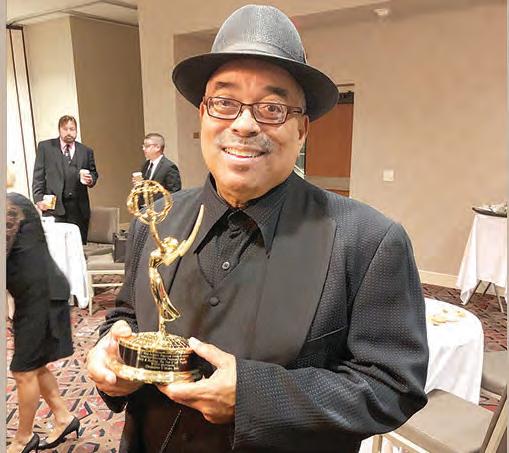
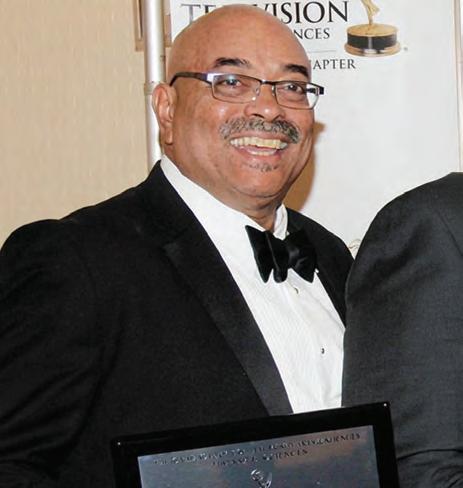
Moore is a multiple Mid-Atlantic Regional Emmy Award winner, and was inducted into the National Academy of Television Arts and Sciences (NATAS) Gold Circle Award in 2025 for his career of more than 50 years of service. He had previously received the NATAS Silver Circle Award in 2018. Moore also received the Key to the City of Pittsburgh from then-mayor Ed Gainey in 2025.
Moore emceed hundreds of events throughout his years in Pittsburgh, including Courier events such as the "Men of Excellence."
“Chris’ service to the Pittsburgh community and our country has been immeasurable. His dedication to lead those in his community on and off the air has been remarkable and extensive,” said Michael Spacciapolli, Audacy Pittsburgh SVP and Market Manager, in a statement to the Courier. Audacy Pittsburgh owns KDKA Radio, WAMO Radio and three other radio properties. “A driving force on the air, Chris always spoke from the heart and never backed down from a challenge. We will celebrate his retirement and are so grateful for everything he did at KDKA.”
“I know for a generation of journalists like myself, he was not only an inspiration, but he was instructional,” added Ervin Dyer, Ph.D., Senior Editor at Pitt Magazine and a former Pittsburgh Post-Gazette reporter. Dyer is a longtime PBMF member and currently serves as the organization’s Robert L. Vann Media Awards Committee Chair. “He not only made us want to do journalism better, but he was instrumental in teaching us how to do journalism better.”
Carmen Lee, Senior Communications Officer for The Heinz Endowments, told the Courier on Feb. 3 that Moore "was one of the reasons why I joined the Pittsburgh Black Media Federation. And the Pittsburgh Black Media Federation is one of the reasons that I've stayed in Pittsburgh all these years."
Lee, who came to Pittsburgh in 1985 to become a reporter for the Pittsburgh Post-Gazette, admired all the work that Moore did with the young people in the Urban Journalism
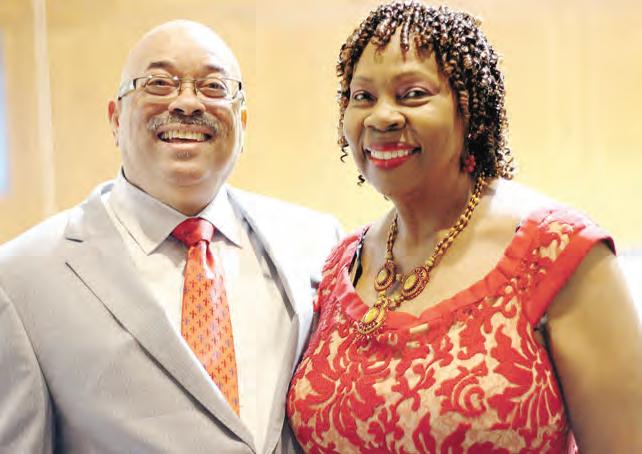
Workshop through PBMF. "His commitment to the youth, and his commitment to community has always impressed me, and it really made a difference in my life here in Pittsburgh," Lee said. "He's an icon, he's an institution," Lee added, "and even if he's retiring, he will always be an icon and institution."





by Stacy M. Brown NNPA Newswire Senior National Correspondent
The losses came steadily in 2025, not as a single rupture but as a quiet procession. Voices that once filled sanctuaries, arenas, studios, television screens, and living rooms went still. The year closed with Black America taking inventory not only of who died, but of what each life carried into the culture and what now remains behind. From gospel and soul to film, television, activism, and sport, the deaths cut across generations. Some were expected after long lives. Others arrived with shocking speed. Together, they formed a ledger of Black excellence that shaped the country even when the country did not always return the favor.
Among the first major losses was Sam Moore, one half of the legendary duo Sam and Dave, whose gospel-rooted soul helped define an era. Moore died January 10 at 89, closing a chapter on a voice that powered songs still stitched into American music history Days later, Atlanta lost DJ Unk, whose club anthems “Walk It Out” and “2 Step” became cultural shorthand for an entire moment in Southern hip hop. He was 43. February brought a deeper reckoning. Roberta Flack died at 88, her voice measured, deliberate, and intimate in a way that reshaped R&B and pop. “The First Time Ever I Saw Your Face”

and “Killing Me Softly” did not demand attention. They commanded it by restraint. Gwen McCrae, whose disco-infused soul powered dance floors for decades, died days earlier at 81. Roy Ayers, the vibraphonist behind “Everybody Loves the Sunshine,” followed, leaving behind a catalog that bridged jazz, funk, and hip-hop sampling culture. The deaths were not confined to music. George Foreman, heavyweight champion, minister, and businessman, died in March at 76. His life traced an arc from Olympic gold to redemption, faith, and entrepreneurship. Voletta Wallace, the mother and steward of The Notorious B.I.G.’s legacy, died at 72, having spent decades protecting her son’s memory while navigating the machinery of fame that followed his death. Spring brought another
wave. Angie Stone died at 63 following a vehicle crash. Her voice carried the weight of lived experience, anchoring neo-soul with honesty rather than polish. D’Wayne Wiggins of Tony! Toni! Toné! died at 64, leaving behind a sound that defined Oakland R&B and a generation of Black romance songs that never apologized for vulnerability. By summer, the losses extended further into television and cultural memory. Ananda Lewis, the MTV VJ whose presence offered intelligence and warmth during the network’s most influential era, died at 52. Walter Scott, co-founder of The Whispers, died at 81, closing the book on one of the most consistent vocal groups in R&B history. Later in the year came deaths that carried historical weight beyond entertainment. Betty Reid Soskin, the nation’s old-
est National Park Service ranger, died at 104. She spent her final decades correcting the historical record, insisting that Black women’s labor and sacrifice during World War II be acknowledged by the country that benefited from it. Viola Ford Fletcher, the oldest known survivor of the 1921 Tulsa Race Massacre, died at 111, taking with her a living link to one of the nation’s most suppressed atrocities.
Actors who once defined Black television also left. Danielle Spencer, remembered as Dee on “What’s Happening,” died at 60 after a long battle with cancer. Malcolm-Jamal Warner, forever associated with Theo Huxtable yet far more expansive in his career, died at 54. He spent his later years directing, recording spoken word, and openly addressing mental health in Black communities.
Music losses continued into the fall. Don Bryant, the Memphis soul songwriter behind “I Can’t Stand the Rain,” died at 83, leaving behind a body of work that centered Black love without spectacle. Jimmy Cliff, the reggae pioneer whose voice carried protest and hope across borders, died at 81, closing a career that introduced global audiences to Jamaican music and political conscience.
The year ended with the death of Richard Smallwood at 77, one of gospel music’s most influential composers. His songs, including “Total Praise,” were not merely performed but lived, sung in churches during moments of grief, gratitude, and survival. Other deaths documented in 2025 included Sly Stone, Michael Sumler, Kevin Arkadie, Carl Carlton, Phil Upchurch, Elden Campbell, Jamil Abdullah
Kenny Easley, Micheal Ray Richardson, Lenny Wilkens, Marshawn Kneeland, Young Bleed, Posta Boy, Mtulazaji Davis, known as P.E.A.C.E., D’Angelo, Ike Turner Jr., Kimberly Hébert Gregory, Arthur Jones, Joshua Allen, Lawrence Moten, Assata Shakur, and Vivian Ayers Allen. What unites these lives is not celebrity but consequence. Each shaped how Black people saw themselves and how the nation heard Black voices. Some fought for recognition. Others created space where none existed. All left evidence. As Betty Reid Soskin once said as she contemplated history, “What gets remembered depends on who is in the room doing the remembering.”

by Annie Selak Georgetown University
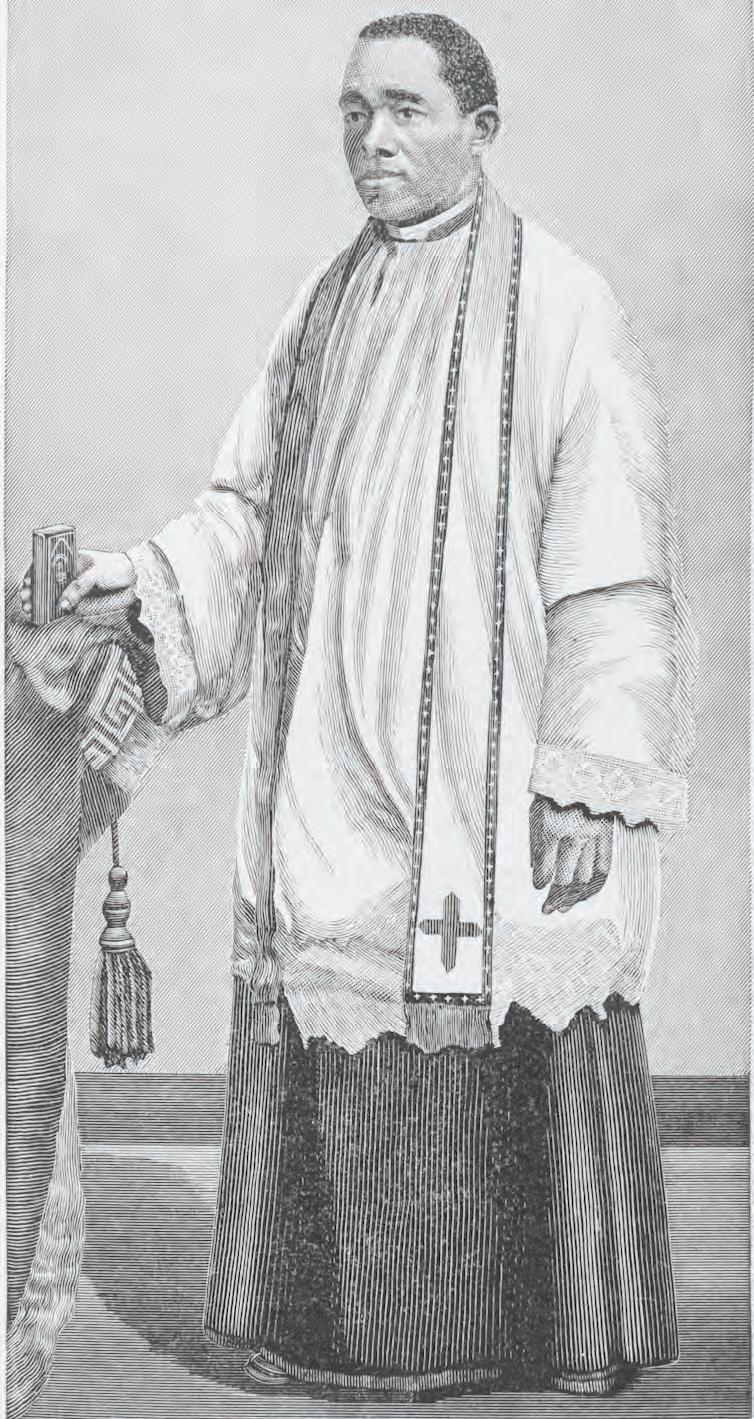
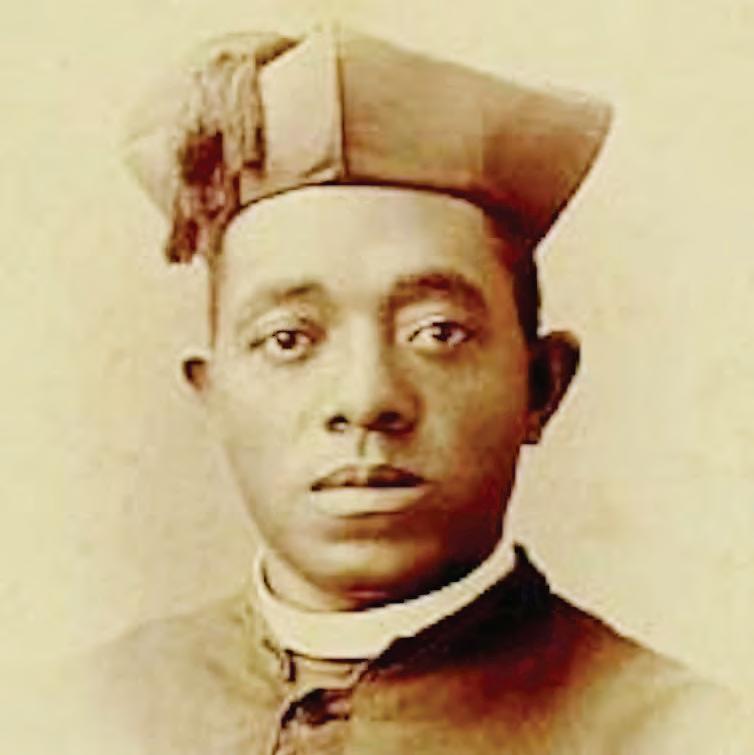
The first publicly recognized Black priest in the United States, Augustus Tolton, may not be a household name. Yet I believe his story—from being born enslaved to becoming a college valedictorian— deserves to be a staple of Black History Month.
“Good Father Gus” is now a candidate for sainthood.
My forthcoming book, “The Wounded Church,” examines ways that the Catholic Church has excluded people during different chapters of its history, from women to African American people. One chapter of history that many Americans may not know about was how the U.S. church barred Black men from becoming priests—a chapter that ended with Tolton’s ordination in the late 19th century.
Slavery to seminary Tolton was born on April 1, 1854 in Missouri, where he and his family were enslaved. He was baptized as Catholic as an infant. He escaped slavery in 1863 with his mother and siblings, eventually settling together in Quincy, Illinois. Life in Quincy was far from a dream come true. He attempted to attend an integrated public school and a Catholic parish school, but was bullied and faced discrimination, causing him to leave. Tolton worked at a tobacco factory—the first of several manual jobs he held as a young man, while also establishing a Sunday school for Black Catholics.
Eventually, he encountered the Rev. Peter McGirr, an Irish immigrant priest who allowed the boy to attend St. Peter’s, a local parish school for White Catholics, when the tobacco factory where Tolton was employed was closed in the winter. McGirr’s decision was controversial, but Tolton pushed on and excelled. He began private tutoring by priests at Saint Francis Solanus College, now Quincy University. In 1880, he graduated as the valedictorian.
By then, it was clear that Tolton was extraordinary —even when working at a soda bottling plant, for example, he had learned German, Latin and Greek. He wanted to become a priest, yet was rejected by U.S. seminaries.
The Vatican allowed Black men to be ordained, but church hierarchy in the U.S. would not admit Black men to seminaries. Their exclusion was driven by White priests “internally beholden to the racist doctrines of the day,” as Nate Tinner-Williams,
co-founder and editor of the Black Catholic Messenger, wrote in a 2021 article. Tolton applied to the Mill Hill Missionaries in London, a group that was devoted to serving Black Catholics, and was rejected by them as well. At the time, the only Black men who were Catholic priests in the U.S. were biracial Americans who passed as White and did not openly identify themselves as Black. The most famous of these was Patrick Healy, who served as president of Georgetown University from 1873-82. Healy and his brothers were ordained in Europe. With no route to ordination in his home country, Tolton traveled to Rome to complete his seminary education. He was ordained on Easter Saturday in 1886 and celebrated his first Mass in Saint Peter’s Basilica. He planned on going somewhere in Africa as a missionary, but was instead sent to the United States. As Tolton later recalled, “It was said that I would be the only priest of my race in America and would not likely succeed.”
‘Good Father Gus’ After ordination, Tolton returned to his home country and celebrated Masses in New York and New Jersey before settling in in his hometown of Quincy. The Masses were like a triumphant return for Tolton: filled to capacity, and drawing in people from surrounding areas to celebrate the country’s first Mass presided over by a Black priest. “Good Father Gus” was popular, and known for being a “fluent and graceful talker” with “a singing voice of exceptional sweetness.” Yet his ministry encountered backlash— though not from parishioners. He encountered jealousy from other ministers.
Tolton told James Gibbons, archbishop of Baltimore, that Black Protestant ministers were nervous that their members would leave and become Catholic. White Catholic priests “rejoiced at my arrival,” Tolton wrote, but “now they wish I were away because too many White people come down to my church from other parishes.”
Tolton’s most influential chapter began when he moved to Chicago in 1889. He was sent as a “missionary” to the Black community in Chicago, with the hope of establishing a Black Catholic church. He served the parish of St. Monica’s, described at the time as “probably the only Catholic church in the
West that has been built by colored members of that faith for their own use.”
This success took a toll.
Tolton had periods of sickness and took a temporary leave of absence from St. Monica’s in 1895. It is unclear whether he suffered from mental illness or physical illness. During a

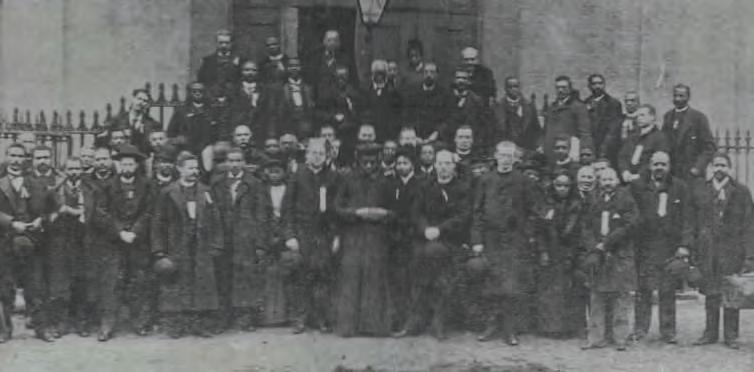
Charles Randolph Uncles. John Henry Dorsey received the Holy Orders in 1902, becoming the second Black man ordained in the U.S. and the country’s fifth Black priest.
heat wave, he collapsed on the street. He died the next day, on July 8, 1897, at age 43. Road to sainthood
Tolton’s legacy continues beyond his life and early death. As the first Black priest in the U.S., “whom all knew and recognized as Black,” according to Cyprian Davis, a Black Catholic monk and historian of the church, Tolton opened the doors to other Black men being ordained.
Ten years after Tolton applied to join the Mill Hill Missionaries, the order accepted a Black man for seminary and priesthood:


“Good Father Gus” is now on the path toward sainthood. In 2019, Pope Francis advanced Tolton’s cause for sainthood, making his name officially “The Venerable Father Augustus Tolton.” The next steps, beatification and canonization, require evidence of miracles, which the Archdiocese of Chicago and the Vatican are evaluating.
Today, some schools and programs carry Tolton’s name, introducing him to a new generation. But while church law and practice no longer prohibit the ordination of Black men to the priesthood, full equity in church ministry remains elusive.
Black women were long excluded from joining religious orders, and they started their own congregations in the mid-19th century. A Black man did not become a U.S. cardinal until 2020, when Wilton Gregory was named cardinal of Washington, D.C.
During Black History Month, I believe Tolton’s life and legacy offer a vital example of how one man overcame obstacles to pursue priesthood, encountering success and loneliness along the way.
(Annie Selak, Director, Women's Center, Georgetown University)
This article is republished from The Conversation under a Creative Commons license. Read the original article.


by Jerry Zolten Penn State
The Negro trade is…itself…an enormously profitable occupation for the retailer who knows his way about…. The segregation of the Negro population has enabled dealers to build up a trade catering to this race exclusively. Yet record companies routinely took advantage of the more unschooled, vernacular performers— especially Black ones, who were already denied access to broader markets. It was standard operating procedure back in the days of “race music”—the name given to recordings by Black artists that were marketed to the Black buying public.
“Some will rob you with a six-gun…and some with a fountain pen.” So said Woody Guthrie in his song “Pretty Boy Floyd.”
Bottom line: if record companies could get away with it, there was no bottom line. No negotiated contract to sign. No publishing. No royalties. Wham bam thank you man. Take a low-ball flat fee and hit the road. Anonymity was also implicit in the deal, so many Black artists were forgotten, their only legacy the era’s brittle shellac disks that were able to withstand the wear of time.
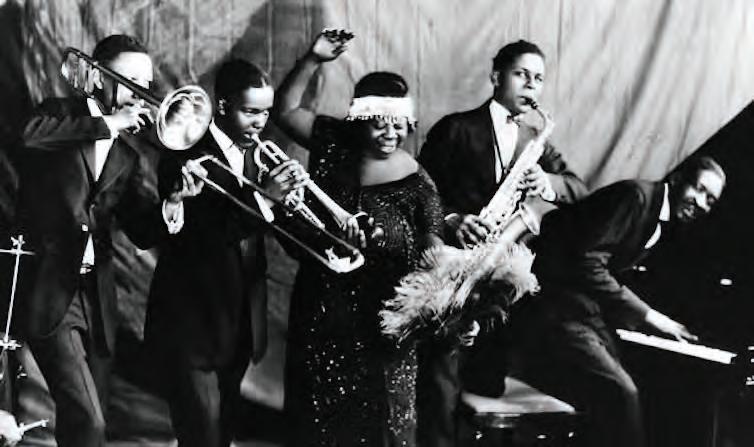
One of the most prominent early race labels was Paramount Records, which, between 1917 and 1932, recorded a breathtaking cross-section of seminal African American artists.
In 2013 I learned that Jack White of Third Man Records (in partnership with Dean Blackwood’s Revenant Records) would be putting together a compilation of Paramount’s historic recordings. The project would be a grand collaboration of two deluxe volumes that would contain a stunning 1,600 tracks. I was part of a team of researchers and writers tasked with unearthing new information about the featured artists and their songs. For me, it was an opportunity to put a face on some of Paramount’s more enigmatic artists. Listening to track after track, a zeitgeist began to coalesce. As voices from the grooves accrued
to tell a story of a collective Black experience, I came to see these performances as cumulative cultural memory—each track a brushstroke in a painting of a long-forgotten landscape. Here’s a taste of what I found.
Pullman Porters Quartette
The Pullman Company, manufacturers of railroad passenger cars, was magnanimous towards its African American workforce. Among other benefits, they provided in-house musical instruction, which included a cappella quartet singing lessons. The Pullman quartets, I learned, were a franchise: multiple configurations of singers performing concurrently under the company banner. They put on
went: Jog-a-long, boys, jog-along, boys, Be careful when you smile, Do the latest style, But jog-a-long, jog-a-long boys.
Jog-a-long, boys, jog-along, boys, Don’t fool with google eyes, That would not be wise, But jog-a-long, jog-a-long boys. At first, it seemed as if it were no more than a silly ditty performed in upbeat counterpoint harmony. Then it hit me: they were making light of a horrific reality—specifically, that a Black man who dared to smile or even look askance at a White woman was putting himself in grave danger. Look your best, but don’t
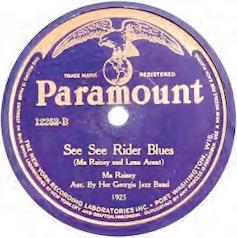
“SOME
concerts, either performing live on the radio, or on long haul train routes as a form of passenger entertainment. The men who made the records were billed as the “President’s Own”—the working Pullman porters considered the company’s premier lineup. In the late 1920s, The Pullman Porters Quartette of Chicago recorded a number of sides for Paramount. One tune was “Jog-a-Long Boys,” where they sang of sad roosters and being turned down by widow Brown, the “fattest gal in town.” The chorus
forget your place…and just jog along, boys. ‘Joga-long Boys,’ by The Pullman Porters Quartet of Chicago.
Horace George Horace George of Horace George’s Jubilee Harmonizers was a showman and an opportunist, a versatile musician who performed in whatever style sold, whether it was novelty gospel, blues, comedy or jazz.
His gospel group cut one record for Paramount in 1924, but he first surfaced as early as 1906, advertised in the Indianapolis Freeman as “the great
clarinetist, comedian, and vocalist.” A few years later, George found himself in Seattle as the “Famous Colored Comedian…who gives correct images,” and later as the “Man with the Clarinet” in a touring black vaudeville troupe, the Great Dixieland Spectacle Company.
In the late 1910s, a Black newspaper—the Indianapolis Freeman—called Horace George “a novelty on any bill.” The novelty? He could play three clarinets at once!
Rev TT Rose
Beyond the rollicking piano-driven gospel sides he cut for Paramount in the late 1920s, nothing was known of Rev T T Rose. Rose’s “Goodbye Babylon” was the title track of Dust-to-Digital’s 2004 Grammy-nominated collection, Goodbye, Babylon. It was also inspiration for a rock ‘n’ roll tune by the Black Keys. And Rose’s recording of “If I Had My Way, I’d Tear This Building Down”—later performed by artists ranging from Rev. Gary Davis to the Grateful Dead—is one of the earliest known recorded versions of that song.
Rev Rose’s personal story was the most heartening of all. He lived in Springfield, Illinois, and I located his 90-plus-yearold daughter Dorothy, who described her father as a man on a mission to end racism and institutionalized segregation.
As a child, Rose had witnessed the aftermath of the infamous 1908 Springfield Race Riots, an event that precipitated the formation of the NAACP. In the late 1920s Rose moved from Chicago to Springfield, in order to minister the city’s Black community.
In an oral history recording, Rev Rose described Springfield as “just really a type of Southern town” with an “overpowering resentment of the Negro… distrust and the fear that the Negro might someday become stronger.” When he returned to Springfield, he observed that the time that had elapsed since the race riots was “a very short span of time to erase all the scars and the prejudices and the hate that was engendered…in that very unfortunate affair.” It was a hate, he con-
tinued, that “Kind of hung like a cloud from an atomic bomb over the whole neighborhood” causing the Black citizens of Springfield to go “into themselves quite a bit.”
After his short recording career with Paramount in the late 1920s, Rev Rose went on to become a regional bishop in the Church of God in Christ. He recorded because he thought songs could both uplift and spread messages of hope and perseverance in the struggle for Civil Rights. When he sang “If I Had My Way,” it’s clear that the building he wanted to tear down was no less than the edi-
fice of racism. Lord, if I had my way, Oh Lord, if I, if I had my way, In this wicked world, if I had my way, God, knows I’d tear this building down.
(Jerry Zolten, Associate Professor of Communication Arts and Sciences, Penn State) This article is republished from The Conversation under a Creative Commons license. Read the original article.





Saturday, Feb. 7
11 a.m.–3 p.m. at Carnegie Museums of Art and Natural History
Envisioning a Just Pittsburgh Program and Performance, 11 a.m.
Charles “Teenie” Harris Community Archivist Talk, Noon
Docent Guided Tour: Black Artists and Connections to Pittsburgh, 1 p.m.
Step Performance by The National Pan-Hellenic Council, 1:30 p.m. Drumming and Dancing by Sankofa Village, 2 p.m.
Visit carnegiemuseums.org/black-history-month
Stevens worked for the Housing Authority of the City of Pittsburgh, in addition to her modeling. She attended Peabody High School and played volleyball for the Highlanders. On social media, there have been countless tributes to Stevens. And the reason why there have been so many tributes to her could be because of how she treated others.
"There’s no way this news hit my line," Dontrell Hill said on Facebook. "We grew up together, the kids are all family, we family. I can’t believe my sister gone fam."
For those who knew her, and even for those who didn't, thousands have visited Stevens' Facebook page since the tragedy occurred. On
just about 5 hours before this tragedy," Bey wrote on Facebook. "Life is fragile, and we never know the half of a second, the Lord will call us home. Friday (Jan. 30) was the first time I could step into the shower. Saturday (Jan. 31) was the first time I could eat a full meal. This grief has been heavy, but God is my refuge. Comm-Unity, I’m calling on you. Now is the time to stand together in love, faith, and action. We are believing GOD not just to meet this need, but to exceed every expectation. I’m calling on every person who reads this, Give as you are led. Love is an action word, I'm asking you to move with the power of love. Be the hands and feet of GOD in this moment. We thank you in advance, and we love you with the love of GOD."
her page, people saw a post from Stevens that could be taken as words of wisdom. Stevens made the following post on Thursday, Jan. 29, at 6:37 a.m., just hours before the incident occurred:
"Your life when they like you is the same life when they don’t; keep living happy."


BAPTIST TEMPLE CHURCH
Sunday Worship: 8 a.m. and 10:45 a.m.
7241 Race Street Pittsburgh, Pa., 15208

Bountiful Blessings: 1st, 3rd Tuesday, 5-7 p.m. 312 Viola St. Duquesne, Pa., 15110 116 South Highland Ave. Pittsburgh, Pa., 15206 412-441-3800
Pastor—Rev. Dr. Rodney Adam Lyde

“Let all Bitterness, Wrath, Anger, Clamor and Evil speaking, BE PUT AWAY FROM YOU, with all Malice: And BE YE KIND ONE TO ANOTHER, Tenderhearted, Forgiving One Another, even as God for Christ’s sake hath FORGIVEN YOU.” - Ephesians 4:31-32
REV. WALKER SAYS: The Word of God: Ephesians 5:1-2—Be ye therefore followers of God, as dear children; and Walk in LOVE, as Christ also has LOVED US, and has given Himself for us an Offering and Sacrifice to God for a sweetsmelling savour.
2001 Wylie Avenue Pittsburgh, Pa., 15219 www.baptisttemple.church www.ebenezerbaptistpgh.org
Pastor—Rev. Dorothy Stubbs


EBENEZER MISSIONARY BAPTIST CHURCH
Sunday Worship Service: 11 a.m.
Sr. Pastor—Rev. Dr. Vincent K. Campbell
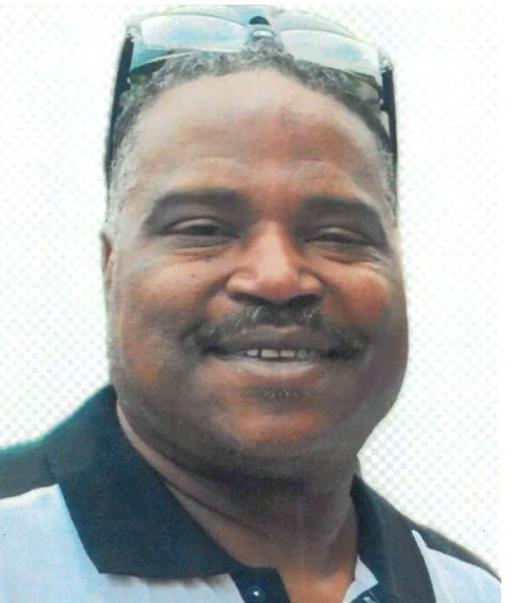
I have to tell you, this one was different. Yes, of course I/we have been through some things and we’ve lost some people. All were important, but as you know, in life some just a little more than others...some were just really special! Such was the case in the recent passing of one of the most important and most memorable young men I’ve had the pleasure of knowing. And if you know me even a little bit, you know I’ve known many. The young many that I speak of is James Sumpter Bailey, aka “Jim-Bay,” who passed on Friday, Jan. 2, and was remembered by standing-room-only family and friends at the House of Law funeral home.
But allow me to digress and “Go back to the future” and set this up as it unfolded. I was one of many in a long line of wanna-be athletes growing up in Penn Hills with dreams of being a high school football player...follow in the footsteps of the great Hubie Bryant, who everyone growing up in Penn Hills football circles wanted to be...and go on to college. While the greater part of the dream was fulfilled, it certainly wasn’t worthy of any special celebration, but a good run nevertheless.
What makes the beginning so interesting is that I grew up on a small street in Penn Hills named Banfield Street that was literally a 15-minute walking distance from the Homewood YMCA, one of the community’s stellar and most important landmarks.... That’s where it all started and this is where the story takes shape!
You see, to be honest with
you, growing up in Penn Hills with a few cushions made life a little soft. Now don’t get me wrong. Not for everybody and not all the time. Trust me when I tell ya, you wouldn’t want to lock horns and tangle with the likes of Hubie Bryant, Dwayne Rideout, Larry
“Splash” Johnson, “Mogan David” Knight, Wayne Ross, or anybody named “Stevenson” or “Carmack,” just to name a few. Point being, we fought the good fight, won some—lost some...as a matter of fact, Banfield Street produced 10 accomplished athletes in a one block, 13-home radius that included seven high school Hall-of-Famers. But still, in hindsight, we assumed life to be a little easier.
It’s true that I grew up in Penn Hills, but it was Homewood that grew me into manhood. I learned a tremendous amount about real life in Homewood-Brushton. That 15-minute walk began the greatest part of my professional life!
Gotta flash forward here before I get handed my walking papers by my editor. Graduated Penn Hills 1970...graduated Slippery Rock University 1974... while setting up my office in my first-ever professional job out of college after being hired three months after graduation by the
legendary Joe Lewis, the former director of the H-B YMCA. Two very spirited but very skinny twelve year-old boys walked up to me and asked, “Hey mister, can we have a basketball team here at ‘the Y?'” My first thought was yeah, but we’re gonna need more muscle!
The two young boys I speak of were the late, great Thomas “Junebug” Howard (Westinghouse H.S. All-Star, Dapper Dan roundball superstar, college basketball recruit and soon-to-be Connie Hawkins League Hall of Famer) and his lifetime partner, Jimmy “Jimmy-Nick” Nichols (Westinghouse basketball star, fierce competitor and Connie Hawkins Hall-ofFamer).
Jimmy Nick immediately ran out and said, “I’ll be right back. I am gonna get Jim-Bay”! To which, “I thought, who is Jim Bay?”
When “Nick” returned, he had “Jim-Bay” with him. Turns out “Jim-Bay” was the almost-grown “manchild” who was all any team would need to move from the bottom of the pack to championship game-level qualification. What was true then, remained true until his passing. Yes, he was a big young man, but a gentle giant to be sure...strong, forceful, but a good person, and yes, the skill set was there, no doubt. He wasn’t the 30-point-a-game man, but he was the guy to stop the other team’s 30-pointa-game man and gave you 10-plus rebounds and the grunt work inside the paint with no fear...thus the reasons he was just inducted to the Connie Hawkins Summer Basketball League Hall of Fame last
year!
That in essence was the start of it all. The Jr. YMCA team that went undefeated that first year. Then the start of the nationally recognized Connie Hawkins NCAA Pro-Am Summer Basketball League. Then seemingly overnight, the development and growth of “The Y-Guys” and all that followed including the start of...“The Homewood Horses” Connie Hawkins League champions that included “Bug,” “Nick,” “Jim-Bay,” Eric Carter, aka “Big E,” Joe Eboe, Adrian Page, Ron Brown, “Sweet Pea,” Bruce McClain, Reggie Dukes, Morrie "Skylab" Cox, Jimmy Cox, the late, great Tyrone “Moon” Howard, Gerald Lovelace, Charlie Gains, and the Youngblood Brothers. The team led most of the time by the great Nate Duck and coached by several, but none better than Coach Fletcher!!! And an endless list that helped me become the man I became including the ladies on staff at the “Y,” Vickie Slater, Mike Booker, aka “The Voice of Hawkins League,” and the first Connie Hawkins League staff. My autobiography...if it’s ever written (and not likely)...will give evidence that yes, I achieved a variety of things, but it was the day-to-day at “The Y”... the meeting of the legends Connie Hawkins, Kenny Durrett, Will Graham, and the pleasure and privilege of meeting the historic Mr. Chuck Cooper, and getting to know the family of the great Maurice Stokes, both of whom were Westinghouse grads. And the others who taught me the method by which to operate: Marshall Prentice,
Leroy Freeman, Marcus Tomlin, Brother Elijah, Prentice Parish, and Neil Dorsey. Along with the powerful education on leadership given to me by the Reverend Duane Darkins, Harvey Adams, Nate Smith and Mayor Bob Pitts. And I would be remiss in not naming the people who taught me the game of basketball: Eddie Jefferies, Mr. Carl Kohlman, the legendary George “Due” Brown, and Kirk Bruce, just to name a few. The involvement and investment of Westinghouse High School has to be mentioned and thanked as they welcomed us in for games, practices, youth programs, personal and financial support and, most importantly, the Westinghouse legend
that was “The House” and the power and recognition that came with it. And most importantly... you, the people of Homewood-Brushton who cared and supported and always showed up to shout out loud and clear, we got you... and to redeliver the slogan time and time again, “The House, The House, The House and all that surrounds it will never fall!!!"
God bless you James “Jim-Bay” Bailey for being one of my first, for being in my life, and being the champion and great and successful man you were. Special respect, love and thank you to his wife, Sadie, children, family and friends.
RIP “JIM BAY”—I LOVE YOU MAN!
There have been additional dissonant rumblings about entertainer "Bad Bunny" being the featured halftime entertainment for Super Bowl LX. During the recent Grammy awards, after country music performer Jelly Roll won an award, he said during his acceptance speech that “the Super Bowl halftime show needs to be country music.” Excuse me, the NFL players of color demographics are more than 50 percent. Saying that: “The Super Bowl halftime show needs to be country music” is like saying that "Lil Wayne" should be the headliner at the 2026 "International Polka Festival" to be held in Warsaw, Poland. With all of his “tattoos” on full display, I suspect that “Monsieur Jelly” has a few Maga-ish associates and friends.
Sam Neuman posted an article on awfulannouncing.com titled: "NFL player takes stance against Bad Bunny."
Mr. Neuman writes: “An unnamed AFC offensive player told The Athletic he doesn’t like Bad Bunny as the Super Bowl halftime performer because, 'I think there are better examples of character and morality than Bad Bunny.'" That’s quite a stance from an anonymous player who’s part of a league that’s spent decades covering up, downplaying, and failing to properly address sexual assault allegations, domestic violence arrests, and a litany
of other serious criminal behavior from its players. The Athletic’s anonymous player survey, released Monday, Feb. 2, found 58.6 percent of players supported Bad Bunny as the halftime performer, while 41.4 percent did not. Beyond the character comment, the primary complaints were not knowing who Bad Bunny is and a preference for “someone who’s synonymous with football and football culture.” Why are these writers allowed to cite and refer to anonymous sources, referring to these opinionated surveys and misinformation disguised as facts? This kind of cowardly and yellow journalism was supposedly banned over a century ago. However, bad habits die hard but are embalmed and preserved so that the practice of yellow journalism may continue to be practiced and preserved forever. In case you may have forgotten, according to msn. com: “Yellow journalism” is characterized by the use of sensationalized headlines, and exaggerated claims to capture the attention of readers. This style of journalism often prioritizes
entertainment over factual reporting, leading to a distortion of the truth as well as unnamed and fabricated sources. Remember the “yellow double line” on the highway that drivers are cautioned from crossing? The same goes for the yellow line on the road of journalism that editors and writers are not supposed to cross when writing and publishing a story. Do many of them fail to adhere to those standards? The answer is an emphatic, “he__ yes.” Remember, often in today's journalism, sensationalism comes first, facts and honesty are a distant second and third.
Former NFL player Darius Butler commented on the recent non-hiring trend of Black coaches. Butler said: "10 vacancies. Not 1 Black hire. 1 Black OC. We got a pipeline problem!" Baa, baa, black sheep have you any wool? Yes sir, yes sir, 10 teams full. Presently, two pairs of brothers are currently employed as NFL head coaches. They are Jim and John Harbaugh and the brothers LaFleur, Matt LaFleur and his brother Mike. There are powers-that-be that continue to blatantly and intentionally dishonor, invalidate and disregard the fight for equal coaching employment in the NFL that the late great Pittsburgh Steelers owner Dan Rooney and civil rights attorney Johnny Cochran fought for.
Micah Adams recently posted an article echoing the concern of Darius Butler on sporting news.com: "Alarming data shows NFL's bias toward Black head coach prospects hasn't improved."
Mr. Adams wrote: “While the superficial optics aren't great—Todd Bowles, DeMeco Ryans and Aaron Glenn are now the NFL's only Black head coaches with the departure of Mike Tomlin, the NFL's longest-tenured head coach—the sobering reality is actually far bleaker.”
And to add insult to injury, factually.com posted that: “The percentage of Black players in the current NFL is 53.5 percent.” Are head coaching candidates expected to pass a DNA purity test before they are considered to be hired?
Why would the Black and Gold put the prospect of the future success of their franchise at risk on the shoulders of not one, but two has-beens who should have been “put out on the ice” a few years ago. Mike McCarthy was axed as the head coach of the Green Bay Packers after failing to deliver another NFL championship to Green Bay with Aaron Rodgers as the starting QB. By the way, when McCarthy was kicked to the curb, Rodgers was in his mid-30s.
Hmm, so that being said, what gives anyone the remote idea that McCarthy will be able deliver a cham-
pionship to Pittsburgh with Aaron Rodgers at the helm fast approaching his mid40s? In the early days that Brett Favre, the Packers HOF QB, sat under Mike McCarthy. Packers’ backup QB Ty Detmer was the backup QB at Green Bay and said that Brett Favre did not even know what a nickel defense was. So much for McCarthy being such an offense and quarterback guru. Ryan Wilson posted an article on cbs.com on June 10, 2017: "Ty Detmer confirms Brett Favre had no idea what a nickel defense was." Ryan Wilson wrote: “Brett Favre, by his own admission, will never be mistaken as the NFL's Norman Einstein,” not Albert Einstein. “Favre admitted that for a couple of years he hesitated to ask what a nickel defense was. He eventually mustered up the nerve to ask.
“Finally, I said, 'I just gotta know,' so I said, 'Ty, I gotta ask you a question.' And Ty was about as goofy as I was. He says, 'What's that?'
I said, 'What's a nickel defense?' He gets real quiet.
He says, 'Are you serious?' 'Yeah, I'm serious.' He says, 'Well, they basically take out a linebacker and bring in a DB.' I said, 'That's it?'
He said, 'That's it.' I said, 'who gives a s__t?'" Mike McCarthy is now primed and presumed to be the head coach ready to take the "yinzer train" to the promised land ‘so people get ready because for
years, McCarthy allowed a football illiterate to draw plays in the dirt and gave him the complete autonomy to do so. Taking those past failures of the leadership of Mike McCarthy into consideration, the window for the Steelers to claim another Lombardi Trophy may not only be closing, but under the leadership of Mike McCarthy and Aaron Rodgers, may be in the process of being nailed completely shut.
Super Bowl LX Hey folks, it’s that time again. The New England Patriots and the Seattle Seahawks are due to face off on Feb. 8, 2026, at Levi's Stadium in Santa Clara, California. I don’t give the Patriots much of a chance for victory because after all, they defeated a Broncos team for the AFC Championship that had lost their starting QB Bo Nix to injury. Nix was replaced by an inexperienced second-string QB, Jarrett Stidham. In Super Bowl LX, the Patriots defense is going to be forced to deal with a Seahawks team with a relatively healthy offense and defense. Also, the Seahawks defense is going to cause multiple turnovers, dismantling the Patriots QB Drake Maye in the process. Seahawks easily over the Patriots, 23-10.

How modern lending standards are recreating old inequities and what Black homebuyers must do about it...
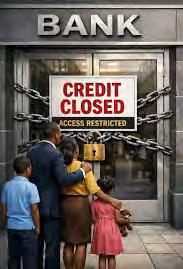
There is no headline announcing it. No legislation was formally passed. No explicit policy declaring exclusion. And yet, for many Black homebuyers today, the door to homeownership is quietly narrowing again. The return of credit barriers is subtle, technical, and often hidden behind the language of “risk management,” “market uncertainty,” and “investor caution.” But make no mistake, the impact is real, measurable, and disproportionately carried by Black Americans.
This is not Jim Crow lending. This is something more sophisticated and arguably more dangerous. Historically, Black Americans were denied access to mortgage credit through explicit mechanisms redlining maps, racially restrictive covenants, and federal underwriting guidelines that openly exclud-

ed Black neighborhoods. Today, exclusion no longer needs race to function. It operates through higher minimum credit score overlays than agency guidelines require, stricter debt-to-income caps imposed by lenders rather than the GSEs, reduced tolerance for non-traditional income such as bonuses, commissions, or self-employment, heightened scrutiny of reserves and liquidity, and automated underwriting systems trained on historically biased data. These standards are presented as neutral. But neutrality does not equal fairness when starting positions are unequal. Black borrowers, even those with advanced degrees and strong incomes, are more likely to carry higher student loan debt, have thinner credit files despite responsible payment histories, be self-employed or earn variable income, and support extended family financially through informal obligations that underwriting models do not recognize. In short, the modern credit box penalizes realities common in Black economic life without acknowledging the historical and structural context that produced them.
There is a dangerous myth that education alone insulates Black Americans from systemic barriers. It does not. A Black attorney carrying student loan debt with a 690 FICO can be denied a mortgage, while a borrower with inherited wealth and a 720 score is approved without question revealing how the system favors privilege over potential. A Black entrepreneur with strong cash flow but irregular income may be deemed risky, while salaried W-2 income is rewarded regardless of long-term wealth trajectory. The system favors predictability, not potential. And predictability often correlates with generational advantage.

by Aswad Walker
Houston Defender
WORD IN BLACK—When Houston entrepreneur Jerome D. Love appeared recently on “The Kelly Clark-
and the city of Houston continue to help shape a national conversation about entrepreneurship and modern success.
The timing is telling. According to Charles Schwab’s 2025 Modern
I recently posted about these new “Trump Accounts” on my Facebook page. I was surprised… but not shocked by the overwhelming negative responses. The short of it is this: a great majority of the people on my page weren’t optimistic about the Trump Accounts because of their disdain for President Trump.
One person went as far as saying, “I don’t dance with the devil.” Another said, “I don’t trust nothing with Trump’s name on it.” And honestly—I get it. First, anything branded with “Trump” automatically carries political baggage. Many Americans simply don’t trust anything associated with his name, regardless of merit. But beyond politics, policy experts have also raised concerns about who will benefit the most. I responded plainly:
“Trust me. I vetted these accounts. Trump slapped his name on them—but the accounts themselves are solid. He doesn’t administer the money, he doesn’t pick the stocks, and he doesn’t hold the keys. In fact, you can select the bank or brokerage firm of your choosing.” That’s the part many people are missing. This isn’t about politics. This is about opportunity. This is about wealth-building.
These Aren’t New—They’re Basically “Baby Bonds” Here’s something most folks don’t re-
son Show,” he wasn’t there to promote a new app, book, or investment product. He was there to ask a deceptively simple question—one that sits at the heart of American ambition and anxiety alike: What is rich?
That question anchors Love’s new YouTube docuseries, “What Is Rich?”, which explores how Americans define wealth beyond money through candid conversations about purpose, health, faith, family, and community.
Executive produced by Emmy Award–winning producer Rushion McDonald—best known for his long-running role on “The Steve Harvey Show”—the series is co-created by Love, an NAACP Image Award winner as host of “The Black Money Tree” podcast. In the process, Love
alize. Trump Accounts are essentially a version of what’s long been discussed in Washington as “baby bonds.”
For years, politicians have pushed for government-funded investment accounts for children as a way to close the wealth gap and give every kid a financial head start.
Senator Cory Booker has championed baby bond proposals for nearly a decade. Progressive lawmakers like Rashida Tlaib and Ayanna Pressley have also supported similar concepts — accounts seeded at birth and allowed to grow over time.
exists.
Wealth Survey, Americans believe it takes about $2.3 million in net worth to be considered rich. Financial advisors often define “high-net-worth” as $1 million in liquid assets, with higher tiers beginning at $5–10 million and $30 million-plus. Perception varies widely: Boomers set the bar at around $2.8 million, while Gen Z is closer to $1.7 million. In high-cost cities like San Francisco, residents believe it takes more than $4 million to be wealthy, while Houston and Dallas hover near the national average.
Yet, Love’s docuseries suggests that even those numbers miss the point.
A moment that changed the question
The genesis of “What Is Rich?” traces back to a deeply personal experience. In 2014, Love’s father was
So What Are Trump Accounts—Really?
At their core, Trump Accounts are newly introduced tax-advantaged investment vehicles designed to help children build assets for adulthood.
But every time the idea came up, it stalled. Too expensive. Too controversial. Too much government involvement. It never made it across the finish line. Trump, on the other hand, used his political power to finally push a version of it through—just with his branding attached and more private-sector involvement. Call it baby bonds. Call it Trump Accounts. Call it whatever you want. The concept has been around for years. The difference is: this time, it actually
Think of them as a hybrid between a 529 college savings plan and a Roth IRA—but aimed at creating a nest egg long before kids even hit their teenage years. While the branding is political, the mechanics are institutional. Here’s how they actually work.
Core Structure & Eligibility
Children under 18 can have an account opened.
However, only newborns born between January 1, 2025 and December 31, 2028 receive the one-time $1,000 government deposit. Babies born in 2025 can receive that deposit retroactively once parents activate the account.
Older children can still have accounts —just without the starter money. Beginning in 2026, parents will open or claim these accounts using IRS Form 4547, linking the child’s Social Security
diagnosed with cancer and called his son one morning, asking for help getting to a medical procedure. Love left work immediately and was able to be there.
“Later on, I thought about it, and I just couldn’t stop thinking,” Love recalled. “I said, ‘Man, what if I had a traditional job and I asked my boss and he told me no?’”
That realization stayed with him.
“A lot of times, people say that they want to be rich or they want money, but really, what they want is what money brings—security, freedom, and the ability to choose your own destiny,” Love said. “So many people don’t have that God-given right because they don’t have the resources.” That insight pushed him to create something educational, designed to help people understand money not as an end in itself, but as a tool for building lives, businesses, and communities.
number to an approved financial institution.
There will also be an online portal where families can select providers like Fidelity or Vanguard. Again—you control where the money goes. Funding & Investment Rules
These are not regular savings accounts. The annual contribution limit is $5,000 per child. And that money can come from:
Even states Employers can contribute up to $2,500 tax-free toward a child’s account. The funds
Redefining ‘rich’
For Love, the defining moment came later that same day, over a dinner conversation with his father about their views on what constitutes success.
“You needed me, and I was able to be there for you,” he said. “With that, I think this right here is success. Everyone wants to create better lives for their families, and you can’t do that without the financial means.”
But the series argues that financial means are only one layer.
Carol Guess, chair of the Texas Association of African American Chambers, defines rich as something far more profound.
“I define rich as being at peace with yourself and with God,” she said. “Shalom peace—fullness in every area of your life.”
Bria Fuller, a personal trainer and healthcare professional, views richness through the lens of health.
“I’m going to define rich as the care we give our bodies and the benefits we receive from that care,” she said, noting that longevity, mobility, and freedom matter more with time than material possessions.
For Jene Washington, Ph.D., a retiree and board member of Manna House (a food pantry located across the street from Texas Southern University), richness is rooted in service and human connection.
“Rich is not just about money,” she said. “It’s about giving back, accepting people where they are. There are people with no money who are just as rich as a billionaire.”
Washington sees that richness every time she volunteers at the Manna House.
“People drive up to our Manna House and thank us just for being there, and they consider themselves rich,” she said.
Marcus Davis, owner of the Breakfast Klub and tbk Holdings, expands the definition to collective power.
“When a community can sustain itself—investing in our businesses, banks, HBCUs, and institutions—that’s what’s rich,” he said. “When a community can depend on itself.”
Even NBA star C.J. McCollum draws a distinction.
“Rich is more short-term,” he said.
“Wealth is a long-term strategy.”
Myths about money
Several voices in the series and within the Houston community caution against confusing money with fulfillment. Fuller notes that in later years, what matters most is health. Guess, who works closely with high-net-worth individuals, is even more direct.
“Things cannot bring fullness,” said Guess. “There are people with money who still feel insecure, unsettled, or emotionally unstable.”
Guess points to public examples— wealthy influencers, entertainers, and executives undone by pressure or despair.
“Mo’ money, mo’ problems,” she said, quoting Biggie Smalls. “Unless it’s obtained through purpose.”
Without spiritual and emotional grounding, she argues, money can amplify paranoia and mistrust instead of peace Road to real riches
Across the series, a common truth emerges.
“You’re not rich because of what you have,” Love said. “You’re rich because of the choices you can make.”
He emphasizes systems over windfalls.
“If I give you $10 million without a framework, it’ll be gone,” he said. His own wealth-building philosophy—“Attitude, Action, and Achievement”—focuses on mindset, movement, and maintenance.
For others, the path includes faith, service, and discipline. Washington credits her church community (Pilgrim Congregational United Church of Christ) for reinforcing a life of giving. Fuller advocates consistency over extremes—30 to 45 minutes of daily movement, paired with prop-
er nutrition and hydration.
Where to watch
“What Is Rich?” premiered on YouTube on Jan. 12 and is available via The Black Money Tree channel by searching “What Is Rich.” Love says larger distribution deals are in progress, with the potential to reach nearly 100 million households. In the meantime, the series offers something more valuable than a dollar figure. It reframes success as freedom, purpose, health, peace, and community—measures of wealth that compound over time and can’t be lost in a market downturn.
by Alice T. Crowe
NNPA NewsWire Imagine trying to take out $40 from an ATM, but the machine won’t give you cash. Instead, it’s a cryptocurrency ATM that only lets you buy bitcoin, and it charges a high fee. These machines allow you to buy or sell cryptocurrency using cash or a debit card. You have no idea that they are not connected to banks or the regular
banking system. Many of these crypto ATMs are concentrated in Black neighborhoods. It’s not a coincidence. Crypto companies target Black consumers. Big crypto firms such as Circle, Coinbase, Ripple and Crypto.com are trying to become banks by applying for special permission, a national trust bank charter from the Office of the Comptroller of the Currency (OCC). While this does not appear to be problematic, it will allow these firms to offer many of the services that regular banks provide, such as accepting payments and facilitating deposits. Having a name that includes the word “bank” or “trust “can be misleading. Obtain-
ing national trust bank status would give these financial institutions the legitimacy and market credibility they need to gain consumers’ trust. Here’s the problem: these firms don’t have to follow the same rules as banks. For example, banks must keep customers’ money safe and help local communities, as required by the Community Reinvestment Act. Banks make loans with customer deposits for houses, businesses and schools. Crypto companies are not required to carry Federal Deposit Insurance. Crypto is a challenge to trace or freeze. There is no undoing a transaction if it is the result of a scam or theft. Banks have a dispute process and are required to provide recourse for loss or theft. Crypto banks don’t.
To be sure, crypto will benefit those who can afford to take the losses. Yes, traditional financial institutions exclude, exploit and oppress Black people in America. Redlining, loan rejection, predatory lending and banks that overly scrutinize Black customers are real. Black people are all too ready to jump ship for something better. Crypto companies exploit this desire with the narrative that crypto is a panacea for racism and societal ills. But crypto is a very niche market used by only a tiny fraction of Americans, as per a Federal Reserve Board study. The volatility and
risk involved can devastate Black community gains.
Given all the celebrity Black faces used to promote crypto, how does crypto benefit the Black collective? Do most people have the financial ability to absorb the losses given crypto’s volatility? Especially when Black families have less wealth than White families in America. White families have six times the wealth of Black families. The wealth gap alone makes crypto a risky bet for most Black people.
Crypto firms target Black customers using Black icons, celebrity partnerships, crypto ball performances at presidential inaugurations, and the placement of Bitcoin ATMs all over the hood, much like predatory payday loans and check-cashing services. Some Black celebrities promote crypto by asking for payment in bitcoin. Beware, the same predatory hands that are reaching out to save Black people may also be there to bite them.
(Alice T. Crowe, a lawyer, educator and entrepreneur that has practiced law for over 25 years in New York.) The opinions expressed in this commentary are those of the writer and not necessarily those of the NNPA.
Credit is not just a financial tool. It is a gatekeeper to wealth creation. When credit tightens, fewer Black households enter homeownership, entry happens later in life reducing equity growth. Families and communities lose owner stability and political leverage. This is how inequality compounds quietly, mathematically, and over time.
We are at a dangerous inflection point. Rising interest rates, market volatility, and regulatory pressure have made lenders more conservative. History shows us that when caution replaces inclusion, those who need access the most are always the first to be excluded. When Black homeownership declines, the consequences ripple across generations lower net worth, reduced educational mobility, weaker community institutions, and diminished political influence. This is not accidental. It is structural. We must expand credit evaluation beyond the “score” by valuing rental pay-
ments, utilities and cell phone payments. Creditworthiness is behavior, not just a number. We must support community-based and mission-driven lenders. CDFIs, Black-owned banks, and mission-aligned mortgage professionals often understand nuance better than large institutions. Black borrowers must be strategic about where they apply, not just whether they qualify.
We must demand transparency in algorithmic lending. AI and automated underwriting systems must be audited for disparate impact. If the data reflects historical bias, the decision will too. Technology without accountability becomes discrimination by proxy. We must educate early and aggressively. Financial literacy cannot begin at the loan application. Credit strategy education, mortgage readiness planning, and a focus on wealth rather than income must be normalized long before adulthood. And we must reframe homeownership as a collective strategy, not an individual achievement.
Buying in our communities, advocating for fair appraisal practices, supporting policies that expand access, and teaching ownership to the next generation are acts of community defense.
The return of credit barriers is quiet, but its consequences will be loud. If we fail to confront this moment, we risk losing decades of hard-won progress. But if we recognize the system for what it is, adapt intelligently, and organize collectively, we can still bend the arc toward ownership, equity, and legacy.
Property is Power! Because Ownership multiplies opportunities. Restricted access multiplies disadvantages.
(Dr. Anthony O. Kellum—CEO of Kellum Mortgage, LLC
Homeownership Advocate, Speaker, Author NMLS # 1267030 NMLS #1567030
O: 313-263-6388 W: www.KelluMortgage.com.)
Property is Power! is a movement to promote home and community ownership. Studies indicate that homeownership leads to higher graduation rates, family wealth, and community involvement.
• Skills training
• Buying a first home
• Starting a business
The goal is wealth-building—not spending sprees.
The Growth Potential
Now this is where the magic (and math) comes in. If a child only gets the government’s $1,000 and nothing else is added, that money could grow to roughly $5,000 to $8,000 by adulthood. Helpful—but not life-changing. But if families consistently contribute over time? Those balances could easily reach the six-figure range. I’m talking up to $150,000.
That’s college paid for. That’s a home down payment. That’s startup capital. Some employers and philanthropists are even discussing matching contributions—which could dramatically boost balances for working families. The Criticism (And It’s Fair) Experts argue that wealthier families will benefit the most—because they’re the ones most able to max out yearly contributions.
Lower-income families may only rely on the $1,000 seed money. And since funds are locked up, families living paycheck to

Accounts
Because I’m not interested in who gets the credit. I’m interested in who gets the opportunity. And if these accounts can plant seeds of financial independence for a new generation, then it’s a policy worth examining without political blinders. Sometimes building a better future means separating the message from the messenger. At the end of the day, I told my Facebook followers we have to be pragmatic. We constantly complain that the government doesn’t provide tools
the result is the same: A generation of kids who could enter adulthood as investors—not just consumers. I’m putting my feelings about the name aside because, for our children’s financial future, the math checks out. And when it comes to
It has happened again…ICE (Immigration and Customs Enforcement) has shown staggering brutality toward Americans, and if anyone still questions their dubious “wisdom,” dispensing putrid language, insults, and super-lies, we will dig ourselves into deeper holes. Along these lines, it must be concluded that there is no solid reason why Alex Pretti and Renee Nicole Good were murdered by ICE AGENTS!
It is chilling to realize that our government is literally attacking itself!!!! It can’t be seen any other way. Along with the recent deaths-by-ICE previously cited, we can include the horrendous activities that ICE AGENTS are utilizing to achieve their other objectives, and a lot of these rely on ignorance, apathy, and just plain meanness of their constituents.
Some people have concluded that ICE AGENTS is one of the weapons that the President of the United States, Donald John Trump, is using to deconstruct the country. Just about every U.S. initiative that has been an asset in the past seems to be targeted now.
One of the most volatile recent issues plaguing the beleaguered American community are the lies that are CONSTANTLY bandied about by the federal government to cover their tracks. For example, there is outrage in Minneapolis, Minnesota (and elsewhere) due to the two people ICE agents murdered, along with a third person who was shot but whose injuries were not life-threatening.
One of the most egregious things connected with this current situation is the actual deaths of the two aforementioned, innocent people. Neither had criminal records nor were they immigrants. The regime, however, has decided to embrace a series of lies that encourage people not to believe what they clearly see!
This last point is especially perplexing…both Alex Pretti and Renee Nicole Good are victims of outrageous lies manufactured by our lawless regime. Both victims have been labeled as Domestic Terrorists, and according to Greg Bovino, Border Control Manager at Large, Pretti was planning to massacre ICE agents.
Anyone who saw the videos of these events was able to see the falsehoods spread by Trump, Kristi Noem (the United States Secretary of Homeland Security), and others. However, they continue to insist that their version of events is true in spite of numerous videos circulating that debunk them. They are piling lies on top of lies. Remember, Trump has said that he could “shoot somebody and I wouldn’t lose voters.” Based on the way his minions are accepting what he says as truth he was right.
Fortunately, among more objective observers, there are those who don’t buy the lies. They see through them. As previously mentioned, several citizens used their cell phones to record ICE’s activities. As a result, just about everything Trump, Bovino, and Kristi Noem say is obviously a lie because incidents were recorded!
The hypocrisy demonstrated by our government is nauseating! And the fact that Democrats are acting as though their hands are tied exacerbates the situation. Trump will not even allow agents based in Minneapolis to share information with his people to assist with research related to Minnesota’s two aforementioned murders. Again, the Trump regime operates as though it is hiding something!
The United States will end up being a remote shadow of itself if the Trump regime is not reigned in! The entire platform is a sour tower of lies that needs to be dismantled. The Trump regime is not infallible. The videos have revealed the truth, all of which debunk the regime’s lies. What is certain is that if lies prevail we may lose our country. With that said, ICE is behaving like the Keystone Cops (Kops). The Keystone Cops were an incredibly incompetent, comical police force dressed in ill-fitting, unkempt uniforms that were popular in the early part of the last century. However, there is nothing funny about ICE. How can we remedy our situation? For starters, get rid of ICE or change strategies; impeach Trump again (or 25th Amendment him); and plan a National Boycott. This could be the beginning of righting the wrongs that are currently dominant in American society. Aluta continua.
(Reprinted from the Chicago Crusader)

Founded 1910
Rod Doss Editor & Publisher
A.
TriceEdney—Most of us remember the time we had a few freedoms no matter who was President of the United States. The rights are found in our Bill of Rights. Now, we are not so sure what we have the right to do without standing up to the President and his minions who seem never to have read what those rights are. Recently, the people in Minnesota and beyond have discovered that rights like assembly, free press, religion, association, and petitioning the government are no longer guaranteed as taught in school, but they are willing to do what is necessary to bring them back and to the attention to those now governing without the slightest idea what those rights are. Minnesotans and those who are protesting are reminding them of what those rights are.
Just over the past few days, we’ve looked closely at what has happened in Minnesota, but Minnesota is not the only place we must have our eyes and ears open with a plan on what we are prepared to do to stop the madness. Renee Good was simply parked in the area where others were assembled, and was shot to death in her face as she tried to move her car.
A doctor tried to do what doctors are charged with doing after Renee was shot. Alex Pretti was doing what he was trained to do to help
someone in distress when he was shot and died. He was trained to do just what he was trying to do—aid a person in need of medical services when you are at the scene. The doctor tried to provide his services, but was abruptly stopped by ICE.
A few days later Alex Pretti, a nurse, was killed as he tried to do what any medical person would do. He tried to aid a woman who’d been manhandled and brutally knocked to the ground by ICE agents. For that, he was attacked by ICE, thrown to the ground, beaten and shot several times. He was murdered in cold blood while claiming he had brandished a gun which he had not. ICE tried to hoodwink the entire world as we saw no gun. The gun which Mr. Pettit had he had the right to carry it, and it was in his pocket.
A few days later, a veteran news person, Don Lemon, had his home invaded with an arrest warrant and was arrested while working as a press person—exercising his freedom of the press right! Georgia
Fort, another member of the press was arrested at her home for a violation of her right to be a member of the press! We saw those ICE folk sneaking around her house looking through her windows and trying to arrest her with no regard for the children in her home.
This is not just Minnesota’s fight, it belongs to all of us, and we must be determined to find ways to stop the evil acts against our people.
These are our rights we are being asked to protect. So, think about the meaning for you and your family about the cold bloodied murder of Ms. Good and Mr. Pettit, and how the people of Minnesota are responding, then come up with an action you can and are willing to take if something ICE were doing to your family, then join the people across the country legally protesting to show Trump they are in solidarity with stopping the tyrannical government we now have, and they are standing against such action. We are Americans and our families fought to gain the Constitution offers us, and “We ain’t gonna let nobody take them away.”
We applaud Don Lemon, Georgia Fort and the people of Minnesota as they are leading the way in protecting our rights.
(Dr. E. Faye Williams is President of The Dick Gregory Society.)
NNPA stands with Georgia Fort, Don Lemon, and all arrested
History has a way of repeating itself. Today, it rhymes with the clicking of handcuffs on two of our own: Don Lemon and Georgia Fort. We know this playbook. We saw it in 1942, when the Department of Justice threatened John Sengstacke and the NNPA with sedition. We saw it in the 1960s when Southern sheriffs labeled journalists “outside agitators” to hide their own brutality. The strategy hasn’t changed— only the statutes have. By weaponizing the FACE Act and the Ku Klux Klan Act to turn reporters into “conspirators,” this government is attempting to resurrect the same walls of silence that the Black Press has spent two centuries tearing down. There is a bitter, hollow irony in seeing the KKK Act—a law forged during Reconstruction to protect
Black lives from White terror—now being used to prosecute Black journalists for the “crime” of holding a camera.
When federal agents arrived at Georgia Fort’s door while her children were watching, they are sending a message to every independent journalist of color: your camera is a liability, and your witness is a crime. In 1918, when the government tried to use the Espionage Act to muzzle W.E.B. Du Bois, he looked them in the eye and said: “The right of the people to
speak and to print is a right which no government in a democracy can safely take away.” He knew then what we must remember now: you cannot build a democracy by arresting its witnesses.
Dr. Du Bois taught us that the Black Press is the only press that is “really free” because it refuses to be owned by the powerful. He called this work the “voice of the voiceless.” We, the NNPA, stand with Georgia Fort, Don Lemon, and all those arrested. We demand these charges be dropped immediately. We close with Du Bois’s eternal warning: “If the government thinks it can silence our complaints, it is making a mistake.” And we shall not be moved.
(Dr. Benjamin F. Chavis Jr. is President and CEO, National Newspaper Publishers Association)
The enthusiasm gap no one wants to talk
(TriceEdneyWire.com)—When
Mike Espy lost his U.S. Senate special runoff election in 2018, one has to contemplate what the outcome would have been had more Black voters turned out. Espy was well-known statewide. He previously served as U.S. representative for Mississippi’s 2nd congressional district from 1987 to 1993. He later became the first African American and the first person from the Deep South to serve as U.S. Secretary of Agriculture in the Clinton administration. In the 2018 special runoff election, Espy lost to Cindy HydeSmith 53.6 percent to 46.4 percent, a margin of about 7.2 percentage points (roughly 68,000 votes).
Mississippi is a tough state for any Black candidate to win a statewide election. It has some of the highest structural barriers to voting in the nation, making it harder for people of color to navigate the bureaucracy when attempting to cast a vote. Analysts describe Mississippi as an extreme case of racially polarized voting, where White voters will systematically back the candidate opposed by Black voters. Espy did not clear his own stated goal of 35 percent Black turnout largely because of the structural suppression, chronic low-turnout patterns, and the limits of a midterm, off-cycle runoff in a deeply Republican state. The restrictive election rules can be hard for Black voters to overcome in any state, not just in Mississippi. Unfortunately, the lack of motivation and apathy by infrequent Black voters may be even harder to overcome. Too often, Black voters will deem a contest as unwinnable; therefore, the motivation to turn out and vote doesn’t exist for them. After the 2018 election, members of the Mississippi Black Legislative Black Caucus later said there was enthusiasm in some Black communities (especially the Delta), but also concern that excitement was not uniform or intense enough to drive truly exceptional Black turnout numbers statewide.
This lack of “uniform excitement” is not always related to voter sup-

pression. Espy’s 2018 Black turnout share (32.5 percent) was lower than the 2012 Barack Obama peak (3637 percent). Obama’s presence on the ballot in 2012 energized Black turnout in Mississippi, reaching historical levels. In 2018, it was a different story. There was no Black presidential candidate, no national “first Black president” moment, and a lower-salience special runoff; as a result, enthusiasm was weaker despite Espy himself being a history-making candidate. Understanding what Mike Espy as U.S. Senator would mean to the Black community was the motivation that made Republican White voters automatically turn out and vote for his opponent. The same understanding should have automatically motivated Black voters to turn out and support Espy. This is true regardless of whether Obama is on the ballot. Given that Obama and Espy shared the same political ideology, which would best serve Black communities, that should have been the common denominator and motivating factor for high voter turnout for both candidates. There should never be an “enthusiasm gap” with the stakes being so high when the election outcome does not benefit people of color. In this year’s mid-term election, Texas has the potential to flip its U.S. Senate seat blue. In an encouraging sign leading into the mid-term election, the Democratic candidate scored a major upset in a special election runoff for state Senate District 9, a district that President Trump won by 17 points in 2024. But will the winner of the Democratic primary election between U. S. Rep. Jasmine Crockett and state legislator James Talarico for the U.S. Senate run into the
same “enthusiasm gap” problem that hurt James Espy and Beto O’Rourke in their general elections? Low turnout among Black voters is not all attributed to Republican voter suppression tactics. Beto O’Rourke lost the 2018 Texas U.S. Senate race to Ted Cruz by approximately 215,000 votes (50.9 percent to 48.3 percent).
Because the margin of victory was so narrow, even a modestly higher turnout among infrequent Democratic-leaning voters could have changed the outcome of the election in O’Rourke’s favor. O’Rourke’s coalition depended on big enough wins in urban and diverse counties to offset Cruz’s strength in small rural counties. Will a significant number of Black voters maintain a “it won’t matter” attitude and not support Jasmine Crockett in either the primary or general elections? If James Talarico wins the Democratic primary, will Black voters who supported Jasmine Crockett in the primary election decide to stay home rather than support Talarico in the general election? Talarico supporters have raised questions about whether Crockett would make a strong statewide candidate and whether Talarico could win over more Trump voters.
Will supporters who voted for Talarico in the primary vote for Crockett in the general election? Mark Jones, a fellow in political science at the Baker Institute and a political science professor at Rice University, told Newsweek that there is little difference between Crockett and Talarico in terms of policy, and both have high favorability among Democrats. There is too much on the line at the national level that the voters needed to defeat the Republican candidate can ill afford to stay home in either the primary or general elections. Regardless of whether it’s Crockett or Talarico, Black voters need to show up in historic levels. (David W. Marshall is the founder of the faith-based organization TRB: The Reconciled Body and the author of the book God Bless Our Divided America.)
(TriceEdneyWire.com)‚“Dear Jonas: Considering your Country decided not to give me the Nobel Peace Prize for having stopped 8 Wars PLUS, I no longer feel an obligation to think purely of Peace, although it will always be predominant, but can now think about what is good and proper for the United States of America.” Text from President trump to Norwegian Prime Minister Jonas Støre, on Jan 18, at 4:15 p.m.
Fact Check: The “Country” of Norway does not control the de cisions of the Norwegian Nobel Committee. It is an independent body. Its decisions are separate from Norwegian foreign policy. Also, Donald Trump has not “…stopped 8 Wars PLUS…” Israel continues to attack Hamas, fighting continues between Thai land and Cambodia and between Congolese forces and Rwan da backed rebels.
Donald Trump claims that the US must acquire Greenland, citing U.S. national security interests. On January 16th Trump posted, “The United States needs Greenland for the purpose of National Security…It is vital for the Golden Dome that we are building. NATO should be leading the way for us to get it. IF WE DON’T, RUSSIA OR CHINA WILL, AND THAT IS NOT GOING TO HAPPEN!” This fearmongering or China and Rus sophobia is not new. It has been the basis of American foreign policy for several years.
One of the most dominant forces in focusing US policy on Chi na and the former Soviet Union was President Carter’s National Security Advisor, Zbigniew Brzeninski. He played a pivotal role in the careers of Secretaries of State Madeleine Albright and Hil ary Clinton. He played an intellectually important role in shap ing the world view of National Security Adviser, Condoleezza Rice. His doctrine on US foreign policy influenced many others, including President Barack Obama. Brzezinski’s world view and approach to policy dominates the policy landscape even today. In his 1997 book The Grand Chessboard, Brzezinski writes, “For the first time ever, a non-Eurasian power has emerged…The last decade of the twentieth century has witnessed a tectonic shift in world affairs…The defeat and collapse of the Soviet Union was the final step in the rapid ascendance of a Western Hemisphere power, the United States, as the sole and, indeed, the first truly global power…it is imperative that no Eurasian challenger emerges, capable of dominating Eurasia and thus also of challenging America.” This remains the dominant and controlling focus of American foreign policy to this day.
In today’s context, the focus is on preventing China and/or Rus sia from challenging the US as the sole unipolar hegemon. The problem confronting those Brzezinski acolytes and the reality that they refuse to accept is that change is occurring and can’t be stopped. The time is passing from the unipolar to a multipolar dynamic. They are trying to defy the realities of history. All em pires run their course, usually due to advancements in technol ogy that they fail to adapt to and military overreach. This is at the crux of Trump’s insane obsession with and threats to invade or annex Greenland.
Trump’s visions of grandeur in the Western Hemisphere have him unilaterally proclaiming that the Gulf of Mexico is now to be called the Gulf of America, annexing Greenland (the self gov erning territory within the Kingdom of Denmark) and threaten ing to make the sovereign nation of Canada the 51st state of the United States. When viewing a map one must ask, is trying to squeeze Canada Trump’s real objective in acquiring Greenland?
I believe that Trump is trying to leave his mark on the world by further expanding American territory as President Andrew Jackson did in 1803 with the Louisiana Purchase and as Presi dent Andrew Johnson did in 1867 with the purchase of Alaska. The difference is that both of those transactions had willing sell
Dr. WIlliam Leon III
Commentary
ers and willing buyers. French President Napoleon Bonaparte sold Louisiana to the US in 1803 to offset France’s losses during the Haitian Revolution and to raise money for a pending war with Britain. Russia sold Alaska to the US in 1867 after experi encing financial struggles after the Crimean War.
The world is now aghast at Trump’s threats to attack Green land. The United States of America, a NATO member, is threat ening to invade another NATO member. Such an invasion would trigger an Article 5 response by the other NATO member coun tries against the US in support of Greenland. Trump is threaten ing to impose an additional 10 percent tariff on the eight Europe an countries that are opposing American control of Greenland. He has threatened France with a 200 percent tariff on French wine, which for all intent and purposes will be an embargo, and he wants to charge countries $1B to join his grift in Palestine called the “Board of Peace”. Most believe the pending US/EU trade agreement is now DOA.
An obviously nervous and sometimes incoherent Scott Bes sent, the Treasury Secretary tried to defend Trump’s proposed tariffs on “Meet the Press” by stating that the goal is to avoid a future national emergency. Bessent said, “the national emergen cy is avoiding a national emergency.” What?
From the broader ideological perspective, Trump’s extrajudicial murders in the Caribbean, the kidnapping of Venezuelan Presi dent Maduro and his wife and threatening Greenland, Iran and Cuba are just more examples of American imperialism. In his 1915 Atlantic article entitle, “The African Roots of War”, W.E.B DuBois provided an analysis of the rise of imperialism and the outbreak of World War I. Imperialism being defined as the main taining and extending of power over foreign nations, particular ly through expansionism, employing both hard power (military and economic power) and soft power (diplomatic power and cul tural imperialism). The world saw a similar attempt at imperial ism being deployed leading into the beginning of WWII. Trump appears to be desperately imposing imperialism and trying to start WWIII.
DuBois saw imperialism as deeply linked to racism, capital ism, and the subjugation of darker peoples. He saw it as a global system where powerful nations exploited colonies for resources, thereby undermining democracy both abroad and at home. Just as DuBois warned us about racism, capitalism and subjugation, Dr. King warned us about the Three Evils of Society, the “tri ple prong sickness that has been lurking within our body politic from its very beginning…the sickness of racism, excessive mate rialism and militarism.”
Will this attempt at imperialist expansion, ego and the fail ure to acknowledge that the empire is waning become Trump’s Waterloo? Will this quest to conquer Greenland, Venezuela and possibly Canada, lead the US to the definitive defeat that ends these ambitions? The downfall begins with a mistaken belief that because Trump’s America is exerting control over present events, he can also control the future. This arrogance demon strates the failure of learning the lessons of the past. Every empire runs its course and eventually falls into the dustbin of history. But, before it fails the rhetoric becomes more bellicose, the policies become repressive and the actions become more ag gressive and dangerous. The last kicks of a dying mule are the most dangerous. How do we save ourselves from these imperialists, oligarchs and hegemons? Read, read, read; organize, organize, organize; agitate, agitate, agitate; resist, resist, resist; and pray for rain. (Dr. Wilmer Leon is a nationally broadcast radio talk-show host.)
PushBlack is a website that offers uplifting stories from Black history to inspire people to take liberated actions for the benefit of Black communities. One such story was called “The History Behind Huey Newton’s Most Iconic Photo.” It referred to the image of the Black Panther co founder sitting on a peacock chair wearing a black coat and beret. He was holding a shot gun in his right hand and a spear in his left, with two African shields leaning against the wall.
PushBlack said, “The photo created the exact effect the Black Panther Party wanted. It became a symbol of Blackness, communi ty, and resistance and defiance of White violence.” It reminded Black people “that their strength was in unity and self defense.”
The original Black Panther Party (1966–1982) also established free breakfast programs for children, health clinics, food pantries, trans portation assistance, and adult literacy classes. Original Black Panther members believed that their social programs were more vital than their encouragement of armed resistance to police brutality. However, after the Black Panther Party was officially disbanded, the next generation was drawn to iconic images of armed struggle against “the system” and favored that over social work.
For instance, in 1998, White supremacists dragged Black man James Byrd Jr. three miles behind a pickup vehicle in Jasper, Texas. Byrd’s death was officially described as a lynching by dragging. This inci dent sparked as much outrage in Black communities as the Rodney King beating seven years prior. Members of the New Black Panther Party gained national attention when they appeared in Jasper to provide security for the Byrd family.
The New Black Panther Party was founded in the early 1990s but was later taken over by an ex Nation of Islam member. In Jasper, they marched about with guns and got into a fight with White suprema cists. On election day in 2008, the New Panthers regained national headlines when they stood in front of a Philadelphia voting center to “provide security against voter intimidation.” One of the New Pan thers wielded a police style baton, yet it was the New Panthers that
were accused of intimidating voters. These publicity stunts, combined with subsequent marches and me lees, prompted the remaining mem bers of the original organization to condemn the New Black Panther Party. Bobby Seale, co founder of the original organization, described the New Panthers’ language as xenophobic and absurd. Seale also argued that the New Panthers were unconcerned about developing social initiatives in communities, implying that they failed to carry on the original organization’s actual mission.
In 2002, an event was held in Washington, D.C., to commemorate the 35th anniversary of the found ing of the original Black Panther Party. Several original members attended, but the ceremony was dis rupted by 30 members of the New Black Panther Party, who “ordered” the original members to stop openly criticizing them or face severe con sequences.
The Southern Poverty Law Center reported that in 2015, two mem bers of the original organization attended a New Panthers meeting in Atlanta, Georgia. The original members accused them of hijacking the legacy of the Black Panther Party. The New Panthers assaulted the original members. Following the assault, Elbert Howard, one of the original organization’s found ing members, described the New Panthers as a reactionary group led by thugs.
It is critical to remember the schism that split the original orga nization in the early 1970s. Faction A believed The Black Panthers had made their point by demonstrating they were a self defense move ment, but they needed to prioritize winning seats on city councils and expanding community programs. Faction B rejected those ideas as “reformist” rather than “revolu tionary.” Faction B advocated open conflict with the powers that op press Black communities. Faction B
became the Black Liberation Army, while Faction A remained the Black Panther Party. Therefore, any new group claim ing to be Black Panthers who are dressed like Huey Newton’s iconic portrait while displaying guns is not carrying on the legacy of faction A; rather, they are copying faction B. For instance, at a recent anti ICE protest in Philadelphia, a group appeared on the scene dressed like Huey Newton and, of course, carrying guns. Their spokesperson claimed that the group was a direct continuation of the original organi zation but “more aggressive.” The spokesperson advocated for the abolition of ICE and for the need to protect immigrants.
However, the comment that drew the most media attention was when the spokesperson declared that if an ICE agent “ran up on him,” he would “put a hole in their chest the size of a window.” He further stated, “Those who serve the public should be fearful of the public.”
This brief protest appearance went viral.
Those who opposed ICE welcomed the Philadelphia Panthers for joining the fight against Trump’s authoritarianism, but those who continue the work of the original organization called them imposters.
The chairman of the San Diego chapter of the Black Panther Party issued a statement informing the public that they do not endorse, support, or agree with the “foolish rhetoric” from the spokesperson in Philadelphia. The chairman remarked that encouraging armed violence and making open ended threats is not the proper Panther approach. More importantly, the chairman stated that the spokes person’s violent rhetoric “will get people killed” and “plays into the hands of oppressive forces, grant ing them ammunition needed to attack actual Black Panthers that are committed to the serious and just actions of raising consciousness and empowering people to make progressive change.”
Huey Newton once said, “The task is to transform society; only the people can do that—not heroes, not celebrities, and not stars.” And not New Panthers or copy cats.
(TriceEdneyWire.com)–“Officers in unmarked cars and masks are indiscriminately arresting people based on the language they speak or the color of their skin. They’re detaining U.S. citizens! Even folks without criminal records. They’re disregarding Americans’ constitutional rights and throwing due process to the wind. This is NOT what a safe city looks like: Kids are terrified to go to school. Families can’t go to the grocery store. It’s horrifying.”—Senator John Hicken looper
A violent death at the hands of law enforcement. An official account riddled with falsehoods, clearly contradicted by video evi dence. A citizen uprising against injustice and brutality.
Nearly six years after the murder of George Floyd by Minneapolis police inspired a nationwide reck oning on civil and human rights, history appears to be repeating itself with the fatal shooting of Minnesota nurse Alex Pretti by immigration enforcement agents. Law enforcement doesn’t have to look like this. In the wake of Floyd murder, the National Urban League developed 21 Pillars for Re defining Public Safety and Restor ing Community Trust, a framework for criminal justice advocacy.
Each of the 21 Pillars address es one of five goals—goals that current immigration enforcement agencies not only fail to meet but are actively undermining: Collaboration with communities to build a restorative system
Accountability Reform of divisive policies Transparency, reporting, and data collection Improved hiring standards and training
The aggressive and confronta tional tactics of federal immigra tion agents undermine both the fairness and effectiveness of the immigration system—and make communities less safe. Adoption of the 21 Pillars framework would transform the relationship between immigrant communities and immi gration enforcement agencies and restore public safety.
Collaboration: The Program, which deputizes local police as immigration agents, damag es longstanding trust‑building
Marc H. Morial
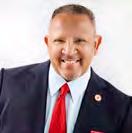
strategies that help reduce crime. Fear of deportation deters immi grants from calling 911, seeking medical care, or sending children to school. Local law enforcement au thorities say this fear makes their jobs “harder” and compromises their ability to detect and prevent crime.
Law enforcement depends on cooperation from victims and witnesses. When that cooperation collapses, crime increases, offenders go unpunished, and public safety declines for everyone.
Accountability: Immigration en forcement agents concealing their identities behind masks undermine due process and equal protec tion by preventing individuals from verifying the legitimacy of arrests and seeking justice for abuse. 21 Pillars calls for robust policies and procedures to investigate mis conduct and enforce disciplinary standards. The Trump adminis tration has barred state and local authorities from reviewing evi dence related to Pretti’s death and is, itself, conducting only a cursory review of the shooting. Meanwhile, the administration has eliminated personnel responsible for investi gating abuses within the agency and restricted congressional over sight of ICE detention. As outlined in 21 Pillars, civilian review boards, body worn cameras, mandatory officer identification, and full public reporting of critical incidents would bring accountability to a far too opaque system Reform of divisive policies: In addition to the use of masks to conceal agents’ identities, immi gration enforcement is further undermining public trust and community safety with the use of racial profiling, aggressive milita rized tactics and indiscriminate use of excessive force. At least eight people have been killed by feder al immigration agents or died in custody in the first month of 2026 alone. An overwhelming of Amer
icans say it’s unacceptable for agents to use people’s appearance or the language they speak as a reason to check their immigration status, and a clear majority believe immigration enforcement is too aggressive. Increasingly, enforce ment has focused on people who have no criminal history, diverting resources away from those who pose actual public‑safety risks. Transparency, reporting, and data collection: Federal immigra tion authorities have a pattern of limited transparency… and slow or incomplete accountability around ICE use‑of‑force and public arrests,” while regularly withhold ing records, including use‑of‑force reports, requiring FOIA litigation to obtain even basic informa tion. Only with complete and transparent data can policymakers and oversight agencies detect devi ations, correct course, and hold the agency accountable for both errors and abuses.
Improved hiring standards and training: A recent viral account of a journalist’s experience revealed just how lax hiring procedures are for immigration enforcement. The reporter was offered a job following a six minute interview without “a single signature on agency paper work.” The Trump administration has relaxed hiring and training standards, and even used White na tionalist imagery and language in recruiting. Stringent background checks, higher recruiting standards screened, and thorough training will result in fewer dangerous raids, unlawful arrests, and unjus tified incidents of excessive force. The Homeland Security Act of 2002, following the September 11 attacks, combined the functions of the Immigration and Naturaliza tion Service and the United States Customs Service under a new agency, Immigration and Customs Enforcement. Its primary responsi bility is “to preserve national secu rity and public safety.” The current policies and practices of the agency serve only to endanger public safety and terrorize communities. Adoption of 21 Pillars would allow the agency to fulfill its mission ef fectively, efficiently, and humanely.
LEGAL ADVERTISING Legal Notices
Estate of KYLE M. BAIRD, Deceased, of Glassport, Pennsylvania. Estate No. 0225-7574. Mary Rae Martin, Executor or to Robert S. Bootay, Atty, 6 Clairton Blvd., Pittsburgh, PA 15236
Estate of NANCY F. MCCLOSKEY, Deceased, of Bethel Park, Allegheny County, Pennsylvania. Estate No. 02-26-00345. Michael D. McCloskey, Executor, 805 Church Hill Road, Finleyville, PA 15332 or to ROBIN L. RARIE, Atty; BRENLOVE & FULLER, LLC. 401 Washington Avenue, Bridgeville, PA 15017
Estate of MS. MARIA S. TRUNZO, Deceased, of 1412 4th Avenue, Coraopolis, PA 15108. Estate No. 02-09-02313. Ms Ana Trunzo, Administratrix, c/o Feldman Law Group, PLLC, 1322 5th Avenue, Coraopolis, PA 15108
Estate of Kathy W. Arnheim of Pittsburgh, No. 00351 of 2026, Rachel Neuhaus,Extr., or to Devin Hallett Snyder, Esq., Strassburger McKenna Gutnick & Gefsky, 444 Liberty Avenue, Ste. 2200, Pittsburgh, PA 15222
Estate of SALLIE M. PORTIS, A/K/A SALLIE MAUD PORTIS Case No. 461 of 2026. Pamela Portis appointed Administratrix by Order dated January 23, 2026. Peter B. Lewis Counsel, Neighborhood Legal Services, 928 Penn Ave., Pittsburgh, PA 15222
Petition to Determine Title to 1533 Marlboro Avenue, Pittsburgh, PA 15221, formerly owned by ALBERTA B. SMITH, deceased, filed January 23, 2026 by Chester Smith, No. 463 of 2026. Peter B. Lewis Counsel, Neighborhood Legal Services, 928 Penn Ave., Pittsburgh, PA 15222.
ANNOUNCEMENTS Meetings
NOTICE OF SCHEDULED QUARTERLY MEETING (Pursuant to the Act of July 19, 1994, P.L. #386, 65 P.S. 261) THE CITY OF PITTSBURGH-EQUIPMENT
LEASING AUTHORITY BOARD MEETING SHALL BE HELD ON:
Friday, February 6, 2026 at 2:00 P.M.
CITY COUNTY BUILDING, ROOM 646 (THE LEARNING LAB) PITTSBURGH, PA 15219
ELA business to be considered. This meeting is open to the public to participate in person or via conference call at the following number: Call-in Number: 1-412-851-3584 Guest Passcode: 202 409 159#
LEGAL AD NOTICE IS HEREBY given the Emsworth Zoning Hearing Board has scheduled a public hearing for Tuesday, February 10, 2026,7 p.m., prevailing time , at the Emsworth Borough Building, 171 Center Avenue, Pittsburgh, PA, 15202, regarding the application from Sandra Bolain/Southern Heritage Investment, Pittsburgh PA 15202 for a Variance to Emsworth Ord. 995 Section 245-38-C seeking relief from minimum frontage for two lots. All those interested in the above hearing should be present at the above time and place and you will have an opportunity to be heard.
CATHY JONES Borough Secretary
NOTICE – TOWNSHIP OF KILBUCK
The Board of Supervisors of the Township of Kilbuck will hold a public meeting to consider the adoption of an Ordinance establishing a new stop intersection and clarifying that the Board of Supervisors may establish additional stop intersections via ordinance, said meeting to be held on February 24th at 7:00 p.m. at the Kilbuck Township Municipal Building, 343 Eicher Road, Pittsburgh, PA 15237, at which time all interested persons may attend and be heard.
SUMMARY
The proposed ordinance would establish an all-way stop controlled intersection at the intersection of Highland Drive and Thornridge Road, and clarify that the Board of Supervisors of the Township of Kilbuck may from time to time establish additional stop intersections by ordinance. A copy of the proposed Ordinance may be examined in the Township office, without charge, or obtained for a charge not greater than the cost thereof, during regular business hours.
Andrew Wright, Township Manager

TOWNSHIP OF WILKINS
PUBLIC NOTICE OF INTENT TO ADOPT
PROPOSED ORDINANCE NUMBER 1140
The Wilkins Township Board of Commissioners will consider adoption of the following ordinances at a public meeting to be held on the 23th day of February 2026 at 7:00 p.m. in the Municipal Building, 110 Peffer Road, Wilkins Township, Pennsylvania. The complete text of the Ordinances is on file and may be inspected in the Office of the Township Secretary at the aforesaid Municipal Building during normal business hours.
The title and a summary of the ordinances are as follows.
PROPOSED ORDINANCE #1140
TITLE
AN ORDINANCE OF THE TOWNSHIP OF WILKINS, COUNTY OF ALLEGHENY AND COMMONWEALTH OF PENNSYLVANIA AMENDING THE CODIFIED BOOK OF ORDINANCES, PART II, CHAPTER 201, FIRE PREVENTION, TO PROVIDE FOR THE ADOPTION OF THE 2021 EDITION OF THE INTERNATIONAL FIRE CODE, AND APPENDICES, COPYRIGHT 2020 BY THE INTERNATIONAL CODE COUNCIL, INCORPORATED.
SUMMARY
The Ordinance adopts the 2021 edition of the International Fire Code, replacing the 2018 code.
PROPOSED ORDINANCE #1141
TITLE
AN ORDINANCE OF THE TOWNSHIP OF WILKINS, COUNTY OF ALLEGHENY AND COMMONWEALTH OF PENNSYLVANIA AMENDING THE CODIFIED BOOK OF ORDINANCES, PART II, CHAPTER 310, PROPERTY MAINTENANCE, TO PROVIDE FOR THE ADOPTION OF THE 2021 INTERNATIONAL PROPERTY MAINTENANCE CODE, AND APPENDICES, COPYRIGHT 2020 BY THE INTERNATIONAL CODE COUNCIL, INCORPORATED.
SUMMARY
The Ordinance adopts the 2021 edition of the International Property Maintenance Code, replacing the 2018 code. The Ordinance also adopts new language regarding shrubs, bushes and hedges and private garages.
SECTION 8 WAITING LIST
Allegheny County Housing Authority will be accepting applications for the Section 8 Housing Choice Program. You must apply online at www.achsng.com. Applications will be accepted staring at 6:00 am on Wednesday, February 4. 2026 and will remain open until 11:00 pm on Thursday, February 5, 2026. There will also be a limited amount of computers to use from 8:30 am until 3:00 pm both days at 301 Chartiers Ave. in McKees Rocks, PA 15136. No further applications will be accepted after these dates and times. All applications will be entered into a lottery, regardless of the date and time of application.
Support the publication that is ALWAYS focused on Pittsburgh’s African American community.

Subscribe to the Courier today by calling 412-481-8302, ext. 136.
LEGAL ADVERTISING Bids/Proposals
ADVERTISEMENT FOR BIDS
ALLEGHENY COUNTY, PENNSYLVANIA
January 29, 2026
Office of the County Controller of Allegheny County, Room 104, Court House, Pittsburgh, PA., will receive separate and closed Bids until 11:30 A.M. prevailing local time, Wednesday February 25, 2026 through the proprietary platform of the third party vendor Bonfire eProcurement Solution, and a representative of the Department of Public Works will open and read the Proposals in the Conference Room 505A, County Office Building, 542 Forbes Avenue Pittsburgh, PA., 15219, at 11:30 A.M., for the following:
DEPARTMENT OF PUBLIC WORKS
2025 ADA RAMPS
COUNTY PROJECT NO: ADAR-2025
VARIOUS MUNICIPALITIES
As a prospective bidder please note the following general Project information regarding Pre-Bid Information, Bidding Requirements, and Contract Conditions. See the Project Manual and Drawings for detailed information, responsibilities, and instructions.
PRE-BID INFORMATION: View the Proposal, Specifications and Drawings on Bonfire eProcurement’s website https://alleghenycountydpw. bonfirehub.com/opportunities/216541. The Proposal, Specifications and Drawings may also be viewed at the Office of the Contract Manager, Room 504, County Office Building, Pittsburgh, PA. Please adhere to all COVID-19 safety procedures.
BIDDING REQUIREMENTS: The County requires pre-qualification of bidders, including subcontractors, as specified in Section 102.01 of Commonwealth of Pennsylvania Department of Transportation Specifications, 408/2020, Current Change of the Pennsylvania Department of Transportation, on this project. Submit bid on the supplied Bid Forms in accordance with the Instructions to Bidders and General and Supplementary Conditions; include the following documents with the Bid Form, PROPOSAL:
• Bid Security - certified check or surety company bond on County’s form to the order of/or running to the County of Allegheny in the amount of five (5%) percent of the Bid as evidence that you, the Bidder, will accept and carry out the conditions of the Contract in case of award. The County will accept only bonds written by Surety Companies acceptable on Federal Bonds per the current Federal Register Circular 570. Federal Register Circular 570 is available for inspection in the Contract Office, Room 504, County Office Building, Pittsburgh, PA 15219.
• Bidder Certification of Pre-Qualification, Classification and Work Capacity.
• List of Subcontractors
• Statement of Joint Venture Participation
• MBE and WBE Goals Attainment Certification - (ONLY NECESSARY
IF YOU CAN NOT MEET THE SPECIFIED MBE AND WBE GOALS)
• Work Sheet Required Amount Performed by Contractor (Non-Federal Project)
• MBE/WBE Subcontractor and Supplier Solicitation Sheet
• MBE/WBE Subcontractor and Supplier Commitment Sheet
THE COUNTY WILL REJECT BIDS THAT DO NOT INCLUDE THE EXECUTED DOCUMENTS SPECIFIED ABOVE WITH THE BID FORM.
You may not withdraw your bid for a period of Sixty (60) days after the scheduled closing time for receipt of bids. The County Manager reserves the right to reject any and all bids or waive any informalities in the bidding.
CONTRACT CONDITIONS: In accordance with the provisions of the “Pennsylvania Prevailing Wage Act” of August 15, 1961, P.L. 987, as Department of Labor and Industry, the prevailing minimum wage predetermination requirements as set forth in the Attachments apply to this Project.
For technical questions, contact Olivia Mall, Project Manager, at 412350-5923. For contract related questions, contact the Contracts Division, at 412-350-7646. Project completion is to occur by October 21, 2026.
The County of Allegheny County hereby notifies all bidders that it will affirmatively ensure that in any contract entered into pursuant to this advertisement, minority business enterprises / women business enterprises [MBE/WBE] will be afforded the full opportunity to submit bids on the grounds of race, sex, color or national origin in consideration for an award. It is a condition of the bidding process/contract that all responsive bidders/contractors shall follow the minority business enterprises/women’s business enterprises
Amy Weise Clements
Acting Controller County of Allegheny

NOTICE OF DEFAULT AND FORECLOSURE SALE
WHEREAS, on February 01, 2011, a certain mortgage was executed by ROBERT A. SOKOL, as mortgagor in favor of MORTGAGE ELECTRONIC REGISTRATION SYSTEMS INC., AS MORTGAGEE, AS NOMINEE FOR AMERICAN ADVISORS GROUP, ITS SUCCESSORS AND ASSIGNS as mortgagee and was recorded in Office of the Recorder of Deeds of Allegheny County in Mortgage Book M VL 39202 Page 326 Instrument # 2011-18714 (“Mortgage”); and WHEREAS, the Mortgage encumbers property located at 1605 Union Avenue Mckeesport, PA 15132, parcel number 0382-C-00301-0000-00(“Property”); and WHEREAS the mortgage IS IN SERIOUS DEFAULT due to violation of (a)(v): An obligation of the Borrower under this Security Instrument is not performed ;and WHEREAS, the Property was owned by ROBERT A. SOKOL by virtue of deed dated 5/15/1998 and recorded 6/3/1998 in Book 212 Page 385; and WHEREAS, the Mortgage is now owned by the Secretary of the United States Department of Housing and Urban Development (“Secretary”), pursuant to an assignment recorded on 2/5/2018 in Book M VL 48913 Page 78 Instrument # 2018-7836, in the Office of the Recorder of Deeds of Allegheny County, Pennsylvania; and WHEREAS the entire amount delinquent as of 10/29/2025 is $125,717.87 plus interest, costs and other charges through the sale date; and WHEREAS, by virtue of this default, the Secretary has declared the entire amount of the indebtedness secured by the Mortgage to be immediately due and payable; NOW THEREFORE, pursuant to powers vested in me by the Single Family Mortgage Foreclosure Act of 1994, l2 U.S.C. 3751 et seq., by 24 CFR Part 29, and by the Secretary’s designation of me as Foreclosure Commissioner, recorded on 10/15/2024 in Misc. BK-DE VL-14933, in the Office of the Recorder of Deeds of Allegheny County, Pennsylvania, notice is hereby given that on 02/17/2026; at 10:00 AM at at the Main Entrance of the Allegheny County Courthouse located at 436 Grant St, Pittsburgh, PA 15219 all real property and personal property at or used in connection with the following described premises will be sold at public action to the highest bidder: THE LAND DESCRIBED HEREIN IS SITUATED IN THE STATE OF PENNSYLVANIA, COUNTY OF ALLEGHENY, AND IS DESCRIBED AS FOLLOWS: ALL THAT CERTAIN LOT OR PIECE OF GROUND SITUATE IN THE 7TH WARD OF THE CITY OF MCKEESPORT, COUNTY OF ALLEGHENY AND COMMONWEALTH OF PENNSYLVANIA. BEING LOT NO. 723 IN THE CENTRAL PARK PLAN OF LOTS, AS RECORDED IN THE OFFICE OF THE RECORDER OF DEEDS OF ALLEGHENY COUNTY, IN PLAN BOOK VOLUME 19, PAGE 99. HAVING ERECTED THEREON A DWELLING MUNICIPALLY KNOWN AS 1605 UNION STREET. BEING DESIGNATED IN THE DEED REGISTRY OFFICE OF ALLEGHENY COUNTY AS LOT AND BLOCK 382-C-301.
BEING THE SAME PROPERTY WHICH MARY C HURST, EXECUTRIX OF THE ESTATE OF DELLA L. CAMPBELL A/K/A DELLA L. CAMPBELL A/K/A DELLA WATHERWAX, BY HER DEED DATED JULY 7, 1987, AND RECORDED IN THE OFFICE OF THE RECORDER OF DEEDS OF ALLEGHENY COUNTY, IN DEED BOOK VOLUME 7601, PAGE 340, GRANTED AND CONVEYED UNTO ROBERT. A SOKOL AND JUDITH C. SOKOL, HIS WIFE. THE SAID ROBERT A. SOKOL AND JUDITH C. SOKOL WERE DIVORCED IN THE COURT OF COMMON PLEAS OF ALLEGHENY COUNTY, PENNSYLVANIA, ON SEPTEMBER 1, 1997, AT NO. GD92-05122. PARCEL NUMBER(S): 0382-C-00301-0000-00
The sale will be held 02/17/2026; at 10:00 AM at the Main Entrance of the Allegheny County Courthouse located at 436 Grant St, Pittsburgh, PA 15219. The Secretary of Housing and Urban Development will bid $125,717.87 plus interest, costs and other charges through the sale date. Ten percent (10%) of the highest bid is the deposit required at the sale. The amount that must be paid to HUD by the mortgagors or someone acting on their behalf so that the sale may be stayed is the total delinquent amount of $125,717.87 as of 10/29/2025, plus all other amounts that would be due under the mortgage agreement if payments under the mortgage had not been accelerated, advertising costs and postage expenses incurred in giving notice, mileage by the most reasonable road distance for posting notices and for the Foreclosure Commissioner’s attendance at the sale, reasonable and customary costs incurred for title and lien record searches, the necessary out-of-pocket costs incurred by the Foreclosure Commissioner for recording documents, a commission for the Foreclosure Commissioner, and all other costs incurred in connection with the foreclosure prior to reinstatement. There will be no proration of taxes, rents or other income or liabilities, except that the purchaser will pay, at or before closing, his prorata share of any real estate taxes that have been paid by the Secretary to the date of the foreclosure sale.
When making their bid, all bidders, except the Secretary, must submit a deposit totaling ten percent 10% of the Secretary’s bid as set forth above in the form of a certified check or cashier’s check made out to the Secretary of HUD. Each oral bid need not be accompanied by a deposit. If the successful bid is oral, a deposit of ten (10%) percent must be presented before the bidding is closed. The deposit is nonrefundable. The remainder of the purchase price must be delivered within thirty (30) days of the sale or at such other time as the Secretary may determine for good cause shown, time being of the essence. This amount, like the bid deposits, must be delivered in the form of a certified or cashier’s check. If the Secretary is the high bidder, he need not pay the bid amount in cash. The successful bidder will pay all conveyance fees, all real estate and other taxes that are due on or after the delivery of the remainder of the payment and all other costs associated with the transfer of title. At the conclusion of the sale, the deposits of the unsuccessful bidders will be returned to them.
The Secretary may grant an extension of time within which to deliver the remainder of the payment. All extensions will be for fifteen (15) days, and a fee will be charged in the amount of $150.00 for each fifteen (15) day extension requested. The extension fee shall be paid in the form of a certified or cashier’s check made payable to the Secretary of Housing and Urban Development. If the high bidder closes the sale prior to the expiration of any extension period, the unused portion of the extension fee shall be applied toward the amount due.
If the high bidder is unable to close the sale within the required period, or within any extensions of time granted by the Secretary, the high bidder’s deposit will be forfeited, and the Commissioner may, at the direction of the HUD Field Office Representative, offer the Property to the second highest bidder for an amount equal to the highest price offered by that bidder. There is no right of redemption, or right of possession based upon a right of redemption, in the mortgagor or others subsequent to a foreclosure completed pursuant to the Act. Therefore, the Foreclosure Commissioner will issue a Deed to the purchaser(s) upon receipt of the entire purchase price in accordance with the terms of the sale as provided herein.
KML LAW GROUP, P.C. Foreclosure Commissioners (215-825-6305)
LEGAL ADVERTISING
Bids/Proposals
Bids/Proposals
ALLEGHENY COUNTY SANITARY AUTHORITY
LEGAL NOTICE
CONTRACT NO. 1837
EMERGENCY SEWER TELEVISING CONTRACT 2026
Sealed Bids for CONTRACT NO. 1837–EMERGENCY SEWER TELEVISING
CONTRACT 2026 shall be received at the Engineering Department office of the Allegheny County Sanitary Authority, 3300 Preble Avenue, Pittsburgh, PA, 15233, until 11:00 A.M., Prevailing Time, Wednesday, February 25, 2026, and then shall be Publicly Opened and read via Microsoft Teams. A Pre-Bid Meeting will be held via Microsoft Teams on Friday, February 13, 2026 at 10:00 A.M., Prevailing Time. An Invitation will be required to access this meeting. If interested in obtaining an Invitation to the Pre-Bid Meeting, contact Jacqueline Kresen’s email at contract.clerks@alcosan.org.
ALCOSAN encourages businesses owned and operated by minorities and women to submit bids on Authority Contracts or to participate as subcontractors or suppliers to successful Bidders. Successful Bidders are to use minority and women’s businesses to the fullest extent possible. Contract Documents may be examined and obtained at the Engineering office of the Authority. A non-refundable fee of One hundred dollars ($100) (no cash or credit cards will be accepted) will be charged for each set of Contract Documents received. Bid Security shall be furnished by providing with the Bid a Certified Check or Bid Bond in the amount of 10% of the Bid Price. Contract documents must be purchased directly from ALCOSAN to qualify as an eligible bidder. Any questions regarding the Technical Specifications should be directed to Steven Bristol, Project Engineer II, ALCOSAN, via email at steven.bristol@alcosan.org .
Any questions regarding the Purchase of Contract Bidding Documents should be directed to Collin Keller, ALCOSAN, via email at contract.clerks@alcosan.org.
The Authority reserves the right to reject any or all bids, to waive any informality in any bid and to accept any bid should it be deemed in the interest of the Authority to do so.
ALLEGHENY COUNTY SANITARY AUTHORITY
Michael Lichte P.E. Director of Regional Conveyance
ALLEGHENY COUNTY SANITARY AUTHORITY LEGAL NOTICE CONTRACT NO. 1819
SCREEN REPLACEMENTS AT ELLA AND CORLISS PUMP STATIONS
Sealed Bids for CONTRACT NO. 1819- SCREEN REPLACEMENTS AT ELLA AND CORLISS PUMP STATIONS shall be received at the Engineering Department office of the Allegheny County Sanitary Authority, 3300 Preble Avenue, Pittsburgh, PA, 15233, until 2:00 P.M., Prevailing Time, Tuesday, March 10, 2026, and then shall be Publicly Opened and read via Microsoft Virtual Teams Meeting. A Pre-Bid Meeting will be held via Microsoft Virtual Teams Meeting on Thursday, February 12, 2026, at 10:00 A.M., Prevailing Time. An Invitation will be required to access this meeting. If interested in obtaining a Invitation to the Pre-Bid Meeting, contact Jacqueline Kresen via email at jacqueline.kresen@alcosan.org.
ALCOSAN encourages businesses owned and operated by minorities and women to submit bids on Authority Contracts or to participate as subcontractors or suppliers to successful Bidders. Successful Bidders are to use minority and women’s businesses to the fullest extent possible. Contract Documents may be examined and obtained at the Engineering office of the Authority. A non-refundable fee of One hundred dollars ($100) (no cash or credit cards will be accepted) will be charged for each set of Contract Documents received. Bid Security shall be furnished by providing with the Bid a Certified Check or Bid Bond in the amount of 10% of the Bid Price. Contract documents must be purchased directly from ALCOSAN to qualify as an eligible bidder. Any questions regarding the Technical Specifications should be directed to Shawn McWilliams, ALCOSAN, via email at shawn.mcwilliams@alcosan.org . Any questions regarding the Purchase of Contract Documents should be directed to Collin Keller, ALCOSAN, via email at contract.clerks@alcosan.org. The Authority reserves the right to reject any or all bids, to waive any informality in any bid and to accept any bid should it be deemed in the interest of the Authority to do so.
ALLEGHENY COUNTY SANITARY AUTHORITY Michael Lichte P.E. Director of Regional Conveyance
HOUSING AUTHORITY OF THE COUNTY OF BEAVER BEAVER, PENNSYLVANIA INVITATION TO BID
The HOUSING AUTHORITY OF THE COUNTY OF BEAVER will receive sealed bids, in duplicate, until 10:00 AM. (local time) on Thursday, February 26, 2026 at the office of the Housing Authority of the County of Beaver, James F. Tress Administration Building, 300 State Avenue (Vanport), Beaver, Pennsylvania at which time and place all bids will be publicly opened and read aloud for the following:
Exterior Painting and Site Improvements 269 1st Street, 285 1st Street, and 2012 Duss Avenue, Ambridge, PA 1402 5th Avenue, New Brighton, PA
A fifteen percent (15 %) bid bond is required for this project.
Proposed forms of contract documents, including Plans and Specifications may be obtained from the Sleighter Design by first mailing $150.00 in the form of a check made payable to Sleighter Design, 1060 Eberly Way, Lemon Furnace, PA 15456 for each set of documents to obtained. A non-refundable check for $35.00 is required if plans are to be mailed. Digital plans may be purchased for $50.00 Contractors MUST obtain copies of the documents from Sleighter Design. DEPOSITS ARE NOT REFUNDABLE. Plans and specifications will be available on Wednesday, January 28, 2026. Please call to arrange for purchase (724) 438-4010.
EQUAL EMPLOYMENT OPPORTUNITY, Section 3 and Build America, Buy America (BABA) Compliance are required.
A Pre-Bid Conference will be held at 10:00 AM on Wednesday, February 11, 2026 at the James F. Tress Administration Building, 300 State Ave, Beaver, PA 15009
OFFICIAL ADVERTISEMENT THE BOARD OF PUBLIC EDUCATION OF THE SCHOOL DISTRICT OF PITTSBURGH
Sealed proposals shall be deposited at the Administration Building, Bellefield Entrance Lobby, 341 South Bellefield Avenue, Pittsburgh, Pa., 15213, on Tuesday February 10, 2026, until 2:00 P.M., local prevailing time for:
•Pittsburgh Administration
Building
Emergency Generator Replacement
Electrical, General, and Asbestos
Primes
•Pittsburgh Sterrett & Pittsburgh
Science & Technology
Emergency Generator Replacement
Electrical, General and Asbestos
Primes
•Pittsburgh Perry & Pittsburgh
Obama
Gym & Pool
Electrical Prime
Lighting Replacement
Project Manual and Drawings will be available for purchase on Tuesday January 20, 2026 , at Modern Reproductions (412-488-7700), 127 McKean Street, Pittsburgh, Pa., 15219 between 9:00 A.M. and 4:00 P.M. The cost of the Project
Manual Documents is non-refundable.
Project details and dates are described in each project manual.
The City of Altoona is now accepting applications for Entry Level Police Officers. Information and applications are available online at www.altoonapa.gov and in the Human Resources Department of City Hall at 1301 12th Street, Suite 400, Altoona, PA. Applications and applicable supporting documentation must be submitted to the Human Resources Department by Noon on Friday, February 20, 2026
The City of Altoona is an Equal Opportunity Employer
The Borough of Bellevue is accepting applications for a Part-time Temporary Mechanic in their Department of Public Works. Applications are available at the Municipal Building, 537 Bayne Ave., Bellevue., PA. 15202, M-F, 9AM to 4PM. or on the Borough Website at www.bellevuepa.org
Applications will be accepted until the position is filled.
James E. Kelly Director of Administrative Services
Main & Elm Development Company, headquartered in Pittsburgh, PA, seeks Senior Project ManagerReal Estate Development responsible for managing comprehensive real estate dvlpmnt prjcts, including w/ respect to new construction as well as renovation of existing properties. Hybrid role requiring min. three days in office/wk. To apply, send resume to info@mainandelm.org.
SOFTWARE DEVELOPER
Pittsburgh Regional Transit is seeking
a Software Developer to develop, test, maintain, and support the Port Authority of Allegheny County d/b/a Pittsburgh Regional Transit (PRT)’s internet and intranet sites, enhance communication and reduce redundancy within the company. Designs, and document tests and debugs new software and web applications, web services and software systems and/or applications.
Essential Functions:
· Design, develop and maintain existing Internet and intranet web applications and services which can include classic .NET and SQL
· Design, develop, document test, and debug new software and web applications, web services and software systems and/or applications.
· Participate in software design meetings and analyze user needs to determine technical requirements.
· Write technical specifications based on conceptual design and business requirements.
Job requirements include:
· High school diploma or GED.
· Bachelor’s degree in software development or related field from an accredited college or university. Related experience may be substituted for education on a year-for-year basis.
· Minimum of three (3) years’ experience in NET, HTML, XML, jQuery/JavaScript and CSS and SQL. No certifications or licenses required.
ADVERTISEMENT REQUEST FOR PROPOSAL3159 Colocation Data Center Services
Due date: 2:00 P.M. Prevailing Time on Wednesday, February 25, 2026
Any bid or proposals received after this deadline will be considered as a “late bid” and will be returned unopened to the offerer. Proposals may require Bid Bonds, Performance Bonds, Payment Bonds, and Surety as dictated by the specifications. No bidder may withdraw his bid or proposal for a period of ninety (90) days after the scheduled closing time for receipt of bids.
The Board of Trustees reserves the right to reject any and all bids.
The Community College of Allegheny County is an Affirmative Action/ Equal Employment Opportunity Employer and encourages bids from Minority/Disadvantaged owned businesses. For more information, contact Michael Cvetic at mcvetic@ccac.edu.
Community College of Allegheny County Purchasing Department 800 Allegheny Ave. Pittsburgh, PA 15233
· Proven experience developing web applications using the Software Development Life Cycle.
· Experience with Visual Studio.
· Effective and professional communication skills.
· Experience with Windows desktop and server environments.
Preferred attributes:
· Experience with IIS web services, SSL, application deployment and server management and configuration using a VMware server environment.
· Experience with MVC.
· Experience with responsive web design.
· Experience with .NET Core.
· Experience with Microsoft SharePoint development.
· Experience with Nintex forms workflow or similar workflow software.
· Experience with Microsoft SQL Server.
· Experience with TFS, GIT or other source control systems.

SPECIALIST
Pittsburgh Regional Transit is seeking a Information Security Specialist to lead and maintain Information Security technical and human-centered initiatives for Port Authority of Allegheny County d/b/a Pittsburgh Regional Transit (PRT). Maintains policies, procedures, standards and documentation to assess, monitor, report, escalate and remediate IT risk and compliance issues. Evaluates business objectives, derive technical requirements and develops secure, reliable, and efficient security solutions for the business.
Provides oversight regarding audit, regulatory and risk assessment activities across all IT functional areas. Implements mitigation strategies and approaches based on both audit and assessment feedback and management participation.
Essential Functions:
· Support Information Security and Incident Response activities for PRT.
o Develop, lead, and assist in human -centered information security awareness, training, informational campaigns, and other activities focused on ensuring that internal customers are well-prepared for Information Security risks.
o In support of secure authentication environment, process password reset requests and further the implementation of single sign-on and self-service authentication management.
o Monitor and analyze alerts to identify security issues for remediation.
o Support the implementation of critical security controls as they relate to PCI/HIPPA and risk assessments.
Job requirements include:
· High school diploma or GED.
· Bachelor’s degree in information security or related field from an accredited college or university. Related experience plus certifications may be substituted for education on a year-for-year basis.
· Minimum of five (5) years’ experience in architecture and design of network infrastructure including network equipment, Wi-Fi, firewalls, intrusion detection systems, intrusion prevention systems and application security along with 2 years of hands-on experience in security engineering/ operations on network infrastructure and Data Center systems (experience may be concurrent).
· Ability to develop and execute:
o Information Security training (both live and recorded),
o policies and standards, o and network penetration testing (and evaluation).
· Ability to evaluate vulnerability assessments, risk analysis, contract review, management of gap remediation and compliance testing.
· Strong analytical and problem
- solving skills are necessary.
· Strong documentation and organizational skills
· Excellent written and verbal communication and inter-personal skills
· Demonstrated ability in the use of Microsoft 365 platform.
· Valid PA driver’s license.
Preferred attributes:
· Ability to employ risk identification/ analysis of desktop, server, application, database, and overall network security principles.
· CISSP, GSEC, GIAC, or other security certifications are desired (training for these can be provided by Authority, if necessary).
Annual Salary $71,500 - $107,300
We offer a comprehensive compensation and benefits package. Interested candidates should forward a cover letter (with salary requirements) and resume to:
Danielle Jacobson Employment Department 345 Sixth Avenue, 3rd Floor Pittsburgh, PA 15222-2527 DJacobson@RidePRT.org EOE
Pittsburgh Regional Transit is seeking a Vehicle Project Coordinator to create and complete projects required to procure revenue vehicles required by Port Authority of Allegheny County d/b/a Pittsburgh Regional Transit (PRT) to provide service for current and future operational needs. Prepares specifications with general and special conditions, and technical and schedule requirements. Reviews and evaluates manufacturers’ requests for changes and prepares recommendations regarding approval or disapproval; prepares contract change orders as required; reviews and recommends invoice payments to manufacturers. Reviews and monitors work performed by suppliers at manufacturing facilities for compliance with specification requirements related to quality and schedule. Prepares scope of work documents for vehicle inspection consultant services and assists with negotiating consultant contracts for same. Participates in the bidding process for revenue vehicles.
Essential Functions:
· Develops and manages programs for the procurement of the number and types of vehicles needed by the Operations Division to meet service demands. This will include preparation of complete specifications with special and general conditions and technical and schedule requirement. Specification technical requirements are to be developed in conjunction with the Manager of Vehicle Projects and the Manager of Bus Maintenance and other departments, as required. · Reviews and evaluates manufacturers’ requests for changes. Prepares recommendations regarding approval or disapproval for review of executive management in accordance with established PRT and department administrative procedures. Prepares contract change orders as required. Reviews and recommends for payment, invoices received from the manufacturer. · Investigates maintenance incidents, such as accidents, fires, or other unforeseen failures to determine and report upon cause and corrective action needed.
Job requirements include:
· High school diploma.
· Associate’s degree or two (2) years of college in mechanical, electrical, civil, automotive, or related engineering or technology fields from an accredited college or university. Related experience may be substituted for education on a year-for-year basis.
· Minimum of three (3) years’ experience in manufacturing and maintenance of vehicle equipment, specifications development. No certifications or licenses required.
· Demonstrated ability in the use of Windows, Microsoft Word, and Excel.
· Professional and effective communication skills.
· Ability to function as a team player and work harmoniously with other people.
· Valid PA driver’s license.
Preferred attributes:
· Four (4) years supervisory/ management experience in bus and/or transit vehicle maintenance.
Annual Salary $72,900 - $109,400 We offer a comprehensive compensation and benefits package. Interested candidates should forward a cover letter (with salary requirements) and resume to:
Stacey Tunie Employment Department 345 Sixth Avenue, 3rd Floor Pittsburgh, PA 15222-2527 STunie@RidePRT.org EOE