Thursday, July 22, 2021
ONE HUNDRED AND THIRTY YEARS OF EDITORIAL FREEDOM
inside
michigandaily.com
UMich rebrands Office of Institutional Equity to improve sexual misconduct support and prevention
NEWS
Vaccination Goal 76% of students have reported their vaccination, surpassing the goal of 75% >> SEE PAGE 2
CHRISTIAN JULIANO Summer Managing News Editor
OPINION
Lost in Translation Americans are falling behind in foreign language learning >> SEE PAGE 5
MICHIGAN IN COLOR
Blended Fabric Reflects on how to find confidence and strength in oneself, becoming a strong asset >> SEE PAGE 7
ARTS
“Space Jam”
The Michigan Daily attends the block party hosted by Warner Bros Studios >> SEE PAGE 9
SPORTS
MLB Draft
Hajjar was selected by Minnesota Twins in MLB draft with the 61st overall pick > SEE PAGE 12
INDEX Vol. CXXIX, No. 112 © 2020 The Michigan Daily
NEWS .................................... 2 OPINION................................ 4 MiC......................................... 6 ARTS.......................................8 STATEMENT..........................10 SPORTS.................................12
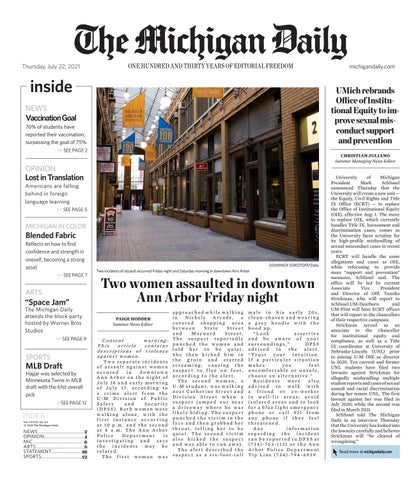
DOMINICK SOKOTOFF/Daily Two incidents of assault occurred Friday night and Saturday morning in downtown Ann Arbor.
Two women assaulted in downtown Ann Arbor Friday night PAIGE HODDER Summer News Editor
Content warning: This article contains descriptions of violence against women.
Two separate incidents of assault against women occured in downtown Ann Arbor on the night of July 16 a nd ea rly mor ning o f J u l y 1 7, a c c o r d i n g t o a crime alert from the U-M Division of Public Safety and Securit y (DPSS). Bot h women were walking alone, with the first instance occurring at 10 p.m. and the second at 4 a.m. The Ann Arbor Police Department is investigating and says the incidents may be related. The f irst woman was
approached while walking in Nickels Arcade, a covered shopping area between State Street and Maynard Street. The suspect reportedly punched the woman and told her to be quiet. She then kicked him in the g roin and started screaming, causing the suspect to f lee on foot, according to the alert. The second woman, a U-M student, was walking near Catherine Street and Division Street when a suspect jumped out near a driveway where he was likely hiding. The suspect punched the victim in the face and then grabbed her throat, telling her to be quiet. The second victim also kicked the suspect a n d w a s a b l e t o r u n a w a y. The alert described the s u s p e c t a s a s i x-f o o t- t a l l
male in his early 20s, clean-shaven and wearing a g rey hoodie with the hood up. “Look assertive and be aware of your surrounding s,” DPSS advised in the alert. “Trust your intuition. If a particular situation makes you feel uncomfortable or unsafe, choose a n a lter nat ive.” Residents were also advised to walk with a f riend or co -worker in well-lit areas, avoid isolated areas and to look for a blue light emergency phone or call 911 from any phone if they feel threatened. Any information regarding the incident ca n be repor ted to DPSS at (7 3 4) -76 3 -1 1 31 o r t h e A n n Arbor Police Department T ip L i n e (7 3 4) -7 9 4 - 6 939.
University of Michigan President Mark Schlissel announced Thursday that the University will create a new unit — the Equity, Civil Rights and Title IX Office (ECRT) — to replace the Office of Institutional Equity (OIE), effective Aug. 1. The move to replace OIE, which currently handles Title IX, harassment and discrimination cases, comes as the University faces scrutiny for its high-profile mishandling of sexual misconduct cases in recent years. ECRT will handle the same allegations and cases as OIE, while refocusing to provide more “support and prevention” measures, Schlissel said. The office will be led by current Associate Vice President and Director of OIE Tamiko Strickman, who will report to Schlissel.UM-Dearborn and UM-Flint will have ECRT offices that will report to the chancellors of their respective campuses. Strickman served as an associate to the chancellor for institutional equity and compliance, as well as a Title IX coordinator at University of Nebraska-Lincoln (UNL) prior to joining U-M OIE as director in 2020. Ten current and former UNL students have filed two lawsuits against Strickman for allegedly mishandling multiple student reports and cases of sexual assault and racial discrimination during her tenure UNL. The first lawsuit against her was filed in July 2020, while the second was filed in March 2021. Schlissel told The Michigan Daily in an interview Thursday that the University has looked into the lawsuits carefully and believes Strickman will “be cleared of wrongdoing.” Read more at michigandaily.com
2 NEWS
Thursday, July 22, 2021 The Michigan Daily — michigandaily.com
‘Culture of trust’: Dean Curzan asks LSA employees to not ask others about vaccination status GEORGE WEYKAMP Summer News Editor
LSA Dean Anne Curzan is asking employees to refrain from asking fellow employees or students to disclose their vaccination status this fall, regardless of whether they are wearing a face covering or not. “The giving and receiving of trust is part of our community values,” Curzan wrote in a Friday email to all LSA faculty, staff and graduate students. “Building on that culture of trust, we also ask that you not ask other staff, faculty, or students about their vaccination status.” While broader University of Michigan guidance, which applies to the entire University, allows for staff and faculty to verify the vaccination status of students to ensure they comply with the mask policy, Curzan wrote that LSA does not recommend employees ask to check the status of students they
meet with. And despite broader U-M guidance allowing for employers and supervisors to inquire about an employee’s COVID-19 vaccination status if said employee is indoors and not wearing a face covering, Curzan said LSA supervisors should consider this option with caution. “We encourage supervisors to exercise this option with caution as we work to balance a sense of safety with trust in one another,” Curzan wrote. For equity’s sake, Curzan wrote, if an LSA supervisor asks one employee to verify their vaccination status, they should ask all unmasked employees. Curzan added that an employee is not required to disclose their vaccination status to anyone except their direct supervisor, and that other employees are discouraged from requesting their coworker’s vaccination status. Read more at michigandaily.com
76% of UMich students have self-reported vaccination, clearing benchmark PAIGE HODDER
Summer News Editor
The University of Michigan announced Tuesday that 76% of students planning to attend classes in Ann Arbor in the fall had officially reported their COVID-19 vaccination to the University. With 35,075 students vaccinated, the University has surpassed its goal of 75% of the student body being immunized against COVID-19. Previously, the University announced that if the student body reached a 75% vaccination rate and community transmission rates remained low, vaccinated students would no longer be required to wear face coverings in classrooms. U-M Chief Health Officer Preeti Malani wrote in the announcement that this is a critical step for the University community, with the ultimate goal of achieving a more normal fall semester experience.
“Vaccination of our entire community is the best way to ensure a healthy and vibrant campus experience in the fall,” Malani wrote. “We thank each and every one of you for your effort.” As for adjustments to fall COVID-19 protocols, the University is still evaluating the new vaccination status benchmark and the community transmission metrics established by the Campus Health Response Committee before making any decisions. In a statement released on the COVID-19 dashboard, the University said they would update their policy by July 31. The University estimates there are still 10,000 students who have yet to report their vaccination status. The announcement reminded these students that they are expected to do so through the COVID-19 Vaccination SelfReport Form as soon as possible. Read more at michigandaily.com
420 Maynard St. Ann Arbor, MI 48109-1327 www.michigandaily.com
CALDER LEWIS Editor in Chief eic@michigandaily.com
KATIE LYNGKLIP
Business Manager business@michigandaily.com
CONTACT INFORMATION News Tips Corrections Letters to the Editor News section Photo Department Arts Section Editorial Page Sports Section Advertising
tipline@michigandaily.com corrections@michigandaily.com tothedaily@michigandaily.com news@michigandaily.com photo@michigandaily.com arts@michigandaily.com opinion@michigandaily.com sports@michigandaily.com wmg-contact@umich.edu
EDITORIAL STAFF Madison Gagne Managing Editor mbgagne@umich.edu
Allison Engkvist Digital Managing Editor engkvist@umich.edu
Christian Juliano and Shannon Stocking Managing News Editors news@michigandaily.com
Josh Taubman and Max Wadley Managing Sports Editors sports@michigandaily.com
Rosa Sofia Kaminski and Julian Wray Managing Arts Editors arts@michigandaily.com
Becca Mahon and Dominick Sokotoff Managing Photo Editors photo@michigandaily.com
Sarah Chung and Allison Yih Managing Design Editors design@michigandaily.com
Ethan Patrick and Caroline Atkinson Managing Copy Editors copydesk@michigandaily.com
Eliya Imtiaz and Lola Yang Managing Michigan in Color Editors michiganincolor@michigandaily.com
Amelia Duffy and Zoe Storer Managing Social Media Editors socialmedia@michigandaily.com
Mary Rolfes Editorial Page Editor opinion@michigandaily.com
Margaret Rudnick Managing Video Editor video@michigandaily.com
Samantha Cole Managing Statement Editor statement@michigandaily.com
The Michigan Daily (ISSN 0745-967) is published Monday through Friday during the fall and winter terms by students at the University of Michigan. One copy is available free of charge to all readers. Additional copies may be picked up at the Daily’s office for $2 per issue. Subscriptions for September - April are $250, and year-long subscriptions are $275. University affiliates are subject to a reduced
MADELINE HINKLEY/Daily Student vaccination rates have surpassed the University’s immunization goal for fall semester.
subscription rate. Subscriptions must be prepaid.
Thursday, July 22, 2021 The Michigan Daily — michigandaily.com
NEWS 3
Schlissel: Administrator leading new civil rights office will “be cleared of wrongdoing” in civil rights lawsuits CALDER LEWIS Summer Editor-in-Chief
The University of Michigan is replacing the Office of Institutional Equity (OIE) with the Equity, Civil Rights and Title IX Office (ECRT) in an effort to improve sexual misconduct prevention and support. The Michigan Daily sat down with President Mark Schlissel and Regent Jordan Acker (D), chair of the Board of Regents, to discuss criticisms of U-M sexual misconduct investigations, civil rights lawsuits filed against ECRT’s future director Tamiko Strickman and additional resources devoted to the new office. Read more about ECRT here and more about other U-M efforts announced Thursday here. This interview has been edited for clarity. The Michigan Daily: ECRT intends to “shift the focus from one of investigations to one that provides care and leads with support and prevention” — important goals, I think everyone can agree. However, the investigative process itself has also been subject to criticism. Some complainants say their investigators were sloppy or favored respondents from the outset, and others, including yourself, President Schlissel, have said investigations and adjudication take too long. How will the changes announced today make investigations more accurate and timely? Mark Schlissel: One of the challenges that students in particular have when they’re going
through an investigation either as a claimant or respondent is their point of contact. Their point of contact previously has been the investigator, and that’s pretty tough, because when you have a person who’s doing the investigation and you’re trying to get information from them and you’re trying to get support from them, it’s a very ambivalent role — we recognize that through many of the complaints that have come about investigations. That prompted us to set up a brand new position called an Equity Specialist and a Support Coordinator. The idea is that they’ll be the point of contact for students, faculty or staff going through an investigation so that whenever you want to know what’s the current status of things, or what’s going to happen next, or when should I expect to hear — but not just that — who can I tap into help to help me through this period of time where things seem to be lingering and taking a long time? So that focus of care and support would really be delivered through the Equity Specialists, helping both the respondent and a claimant through a process which we’re trying to make more timely. One of the problems in timing, as we look at cases that have dragged on, is there are winter breaks and there are summer vacations and there are exam periods, and many parties to an investigation often request a delay for very valid reasons. You add those things up, and they keep pushing the process to be longer and longer. In recent years we’ve hired more investigators, and that hasn’t
solved the problem. We really hope that by providing dedicated support staff to work with respondents and claimants, it’ll make the process something less foreboding and more helpful and supportive in outcome. Jordan Acker: One of the things that we took really seriously when devising how we were going to make changes was listening to students and listening to people who had been on both sides of these issues to see what the complaints were. I can say this until I’m blue in the face because it’s so important: Making sure we have community buy-in is perhaps the most important thing. You can have the best policies in the whole world, but they’re meaningless if the community doesn’t trust them and the community doesn’t feel like their input has been taken and taken seriously. I think that was a big part of this push with Guidepost, with our administration. We didn’t just want a one-size-fits-all policy just thrown on walls, we wanted the policies that worked for Michigan. And ultimately, that required a significant amount of listening, and I think they were going to be more successful in this area because of that. TMD: Besides sending the initial outreach, what is the functional difference between the new role of Equity Specialist and the role that Office of Student Conflict Resolution (OSCR) case managers have played in the last couple of years? MS: OSCR is focused on the disciplinary step. This new position is within ECRT, which is the successor to OIE, and it has purview
DOMINICK SOKOTOFF/Daily
President Mark Schlissel speaks at a Regent’s meeting at the Richard L. Postema Family Clubhouse in February 2020.
over faculty and staff as well. And to be honest, the faculty and staff were somewhat jealous in that SAPAC does an outstanding job with prevention and education work and support work, but SAPAC is focused on students. Now, in this office, we’ll have SAPAC-like activity that’s helpful and supportive to faculty and staff as well. TMD: Tamiko Strickman, current director of OIE and soon to be named director of ECRT, led the University of Nebraska Office of Institutional Equity and Compliance before coming to Michigan. Two lawsuits filed by ten total plaintiffs allege Strickman and her office repeatedly violated federal civil rights and sex discrimination law when handling cases. One of these lawsuits has attracted attention from the Department of Justice. Allegations, for example, include
that she allegedly told a Black student that race discrimination claims “Will never be fully investigated because students on campus have a right to free speech.” Do the allegations in these lawsuits and the mistrust the community may have because of them give you any pause in appointing Strickman to this position? MS: Yeah, I’ll say two things to that. One is we looked very carefully at the lawsuits you’re mentioning, and we looked at the nature of the suit, and we had our general counsel speak to the general counsel and the communications staff at Nebraska. We spoke to Tammy (Tamiko) about these cases as well, and we satisfied ourselves that ultimately she’ll be cleared of wrongdoing in these cases. Read more at michigandaily.com
President Biden issues state of disaster for Washtenaw County following June storms GEORGE WEYKAMP Daily News Editor
P re sident Jo e Biden a n nou nce d Thu r s d ay t h at a m ajor d i sa s t er ex i s t e d w it h i n t he s t at e of M ich ig a n fol low i ng a s er ie s of s evere s t or m s , t or n ado s a nd f lo o d i ng t h at i mpac t e d much of Wa sht en aw a nd Way ne cou nt ie s f rom Ju ne 25 t o
Ju ne 26 , 2021 . The move come s a f t er t he Wa sht en aw Cou nt y B oa rd of Com m i s sioner s ( WCBC) c a l le d on M ich ig a n G over nor Gret chen Wh it mer t o de cla re a s t at e of emer g enc y for Wa sht en aw Cou nt y fol low i ng t he f lo o d s t o prov ide f u r t her s upp or t a nd rel ief for a f fe c t e d i nd iv idu a l s . Biden’s de cla rat ion of emer g enc y i n M ich ig a n a l low s for fe dera l a s si s t a nce a nd
f u nd i ng t o b e m ade ava i la ble t o a f fe c t e d i nd iv idu a l s . I n t he de cla r at ion , Biden w rot e t h at t he Fe der a l E mer g enc y M a n a g ement A g enc y (F EM A) a nd t he D epa r t ment of Homela nd S e c u r it y n a me d S cot t A . Bu r g e s s a s t he Co ord i n at i ng O f f icer for Fe der a l R e cover y O p er at ion s i n t he a rea s i mpac t e d by t he s evere weat her. “A s si s t a nce c a n i nclude g r a nt s for t emp ora r y hou si ng
a nd home repa i r s , low- co s t loa n s t o cover u n i n s u re d prop er t y lo s s e s , a nd ot her prog r a m s t o help i nd iv idu a l s a nd bu si ne s s ow ner s re cover f rom t he ef fe c t s of t he d i sa s t er,” t he de cla r at ion read s . The fe der a l g over n ment i s cont i nu i ng t o a s s e s s d a m a g e i n ot her a rea s a nd cou nt ie s out side of Way ne a nd Wa sht en aw Cou nt ie s . Biden w rot e t h at add it ion a l for m s
of a s si s t a nce m ay b e m ade ava i la ble a f t er a s s e s sment s a re complet e. Wa sht en aw or Way ne Cou nt y re sident s a nd bu si ne s s e s who s u s t a i ne d d a m a g e du r i ng t he s t or m s can b eg i n apply i ng for fe dera l a s si s t a nce at ht t p:// w w w.d i sa s t er a s si s t a nce. g ov/ or by c a l l i ng 1- 8 0 0 - 621F EM A(3362) or 1- 8 0 0 - 4 627585 for hea r i ng-i mpa i re d i nd iv idu a l s .
4 OPINION
Thursday, July 22, 2021 The Michigan Daily — michigandaily.
Edited and managed by students at the University of Michigan since 1890. 420 Maynard St. Ann Arbor, MI 48109 tothedaily@michigandaily.com
MARY ROLFES
CALDER LEWIS
Editorial Page Editor
Editor in Chief
EDITORIAL BOARD MEMBERS Julian Barnard Zack Blumberg Brittany Bowman Elizabeth Cook
Brandon Cowit Jess D’Agostino Andrew Gerace Jessie Mitchell
Mary Rolfes Gabrijela Skoko Jack Tumoowsky Joel Weiner
Unsigned editorials reflect the official position of The Daily’s Editorial Board. All other signed articles and illustrations represent solely the views of their authors.
BENJAMIN DAVIS | OPINION COLUMNIST
The ills of geographic narcissism and metropolitan bias
M
ajor cities are hubs of cultural innovation, economic opportunities and often seats of political power. As such, political bias can be swayed in favor of these metropolitan areas over less populous, rural regions. I’m in favor of metropolitan bias — born out of globalization and fostered by 20th-century technological innovation — due to the greater interconnectedness of international culture it has given
Design by Jessica Chiu
us. But there are domestic political and social consequences that these benefits need to be weighed against. The concept of geographical narcissism, from my understanding, is not limited to metropolitan settings but is most often invoked in regards to them. It refers to the psychological effects stemming from the historical, economic and cultural causes of the growing ruralurban divide in the United States. It can take the form of a sort of
condescension toward rural people from city dwellers. This is fostered by the metropolitan bias existent in U.S. economic and social policy. Metropolitan bias is a favoring of major cities at the expense of secondary cities and rural areas. As a bias witnessed on an international scale, it has been defined by the uneven development and increasing concentration of wealth and social resources in top metropolitan areas such as New York City and Shanghai
in recent decades. Some economists, urban planners and geographers laud the funneling of resources into big cities because of the benefits these areas can reap from the increasingly global economy. Globalization refers to “the growing interdependence of the world’s economies, cultures, and populations, brought about by cross-border trade in goods and services, technology, and flows of investment, people, and information”; this encompasses phenomena as diverse as the rising popularity of K-pop across the globe to major trade relations between the world’s most prosperous economies. Metropolitan areas act as flagship cities for a nation where international cooperation and exchange can occur. According to this line of thinking, by supporting economic and political policies favoring metropolitan development, the U.S. would be able to sustain its presence in the globalized world. One of the most visible downsides to metropolitan bias in the U.S. is the exacerbation of the deep rural-urban political divide. Katherine J. Cramer, a political science professor at the University of Wisconsin-Madison, has termed this phenomenon “The Politics of Resentment,” which is also the title of her 2016 book on the subject. It describes the political awareness of rural people and their resentment of the “liberal elite” — or the fact that voters in rural areas are wary of politicians because they believe that the politicians may not respect the values of their community and contribute to an unequal distribution of resources. The swing state of Wisconsin is an example of this in action: Rural Wisconsinites, in the 2016 election, felt that no one was listening to their wants or concerns. They felt as if they were not allocated their fair share of political power nor government funding, while most of the power and taxpayer dollars went to major cities. These are the sentiments that former President Donald Trump tapped into which helped him flip the state red. Metropolitan bias is a cause of the political polarization that is toxifying the US. A metro-biased policy that creates a concentration of economic and social resources in few urban centers lends itself to an economy that is vulnerable to disaster — natural, military or otherwise. Such a strategy means that any sort of ailment that befalls a densely populated, economic superpower metropolis is going to have ripple effects across the economy. Take New York City as an example.
Damages that accrued after 9/11 and Hurricane Sandy were a monumental tax on the city and nation’s economy. Notably, one of the hardest-hit sectors of the New York economy after the 9/11 attacks was the export industry — finance, information and entertainment, among others — which is an even greater injury to the economy in the globalized world. Now, it’s fruitless to make an argument that an even dispersal of resources would have ended in fewer damages due to these horrific disasters. But it does point to the fact that a heavy concentration of resources due to metropolitan bias in policy increases the vulnerability of a region. If that metro area is injured by a disaster, it creates a greater negative impact than if resources were not biased toward the metropolitan area. For those that reside outside of these mega metropolises trying to access city resources, it is near impossible if they do not have access to economic means. Moving to the city for a better job and access to social resources is a luxury. Historically, moving to economically prosperous areas was common in the U.S., but this has slowed dramatically in recent decades. Wages have increased in cities like New York. Housing prices, however, are so drastically high that they trump any income gains people would earn by moving. Most of the new income gained by moving to the metropolitan area would be siphoned into housing, so people stay put outside of the metro areas. Metropolitan bias aids a coalescence of geographic and class boundaries, where the higher classes have the ability to reside in resource-rich cities while lower classes are ever more stuck in regions where opportunities, social and economic, are lacking. The metropolitan bias in national policy that results in the accumulation of resources, economic and social, in metropolitan areas may be beneficial for the globalized economy in which the U.S. is situated. However, the downsides of this type of policy may outweigh the positives. Political division and fragility of the economy may not be worth the gains from globalization. This is not to discount the merits of globalization, but the domestic consequences of policy based on international relations must be taken into account. If the trend of metropolitan bias is to continue, the effects — positive and negative — must be considered. Benjamin Davis is an Opinion Columnist and can be reached at bendav@umich.edu.
OPINION 5
Thursday, July 22, 2021 The Michigan Daily — michigandaily.com
OLIVIA MOURADIAN | OPINION COLUMNIST
Lost in translation: Americans are falling behind in foreign language
I
’m standing at a restaurant in southern France, near Montpellier. Aided only by my scarce French 103 knowledge, I’m staying silent and attempting to understand what two native French speakers are saying. One of these native speakers is my host for a month, and she explains to the other that I am American. He gives me a knowing look and says, “Ahhh,” as if my silence now makes sense to him. Within my first week here, this association between being American and not speaking the language has become a trend. While I am sure some native speakers make assumptions that visitors from other countries do not know their language, there is a pointed sense of certainty about my language skills — or lack thereof — that arises when I say, “I am from America.” Considering the emphasis that many other countries put on learning languages from a young age, I doubt this certainty would be the same if I was not from America.
When looking at the way foreign languages are taught, or more precisely not taught, in the American school system, these assumptions have some merit. American students fall behind in language learning from a young age. As there is no national mandate for foreign language classes, decisions regarding these classes are
left up to the states or even to individual school districts. The numbers would suggest that most states and school districts do not deem a foreign language requirement to be of much importance, with only 20% of K-12 students learning a foreign language. To put this figure into perspective, the median portion of primary and
Design by Erin Shi
secondary school students learning a language across European countries is 92%. And if American students decide to continue their education after high school, the chances of them taking a foreign language are even lower. Since 2009, foreign language enrollments among college students have continued to decrease; in 2016, there were only 7.5 enrollments in foreign language courses per 100 students enrolled at American colleges. Despite this decline in foreign language class enrollment, the demand for bilingual people in the U.S. job market is rising. Job postings from U.S. employers looking for bilingual employees more than doubled between 2010 and 2015. This increase in demand is understandable considering the fact that American companies lose over $2 billion annually on cultural or language misunderstandings. Knowing another language expands one’s potential network, and thus, many
American companies compensate employees with an additional $67,000 to $128,000 over their lifetime for their language skills. Beyond the financial advantages, there are prominent mental and cultural benefits to knowing another language. Cognitively, language skills increase the likelihood of taking favorable risks and help with memory and the aging brain which reduces the chance for Alzheimer’s and dementia. Culturally, knowing a language can be a necessity for communication; it acts as a door to the customs, habits and identity of a culture. In each of the world’s approximately 6,500 languages, there are words that describe emotions that cannot be translated without losing some of their original meaning. Read more at michigandaily.com
Olivia Mouradian is an Opinion Columnist and can be reached at omouradi@umich.edu.
JULIA VERKLAN MALONEY | OPINION COLUMNIST
D
If you’re reading this, you’re not a goldfish
ear reader, thank you for viewing the words that I’ve typed. Now that I have your attention, please do not be a part of the roughly 27% of American adults who did not read or listen to even a part of a book this year. Common excuses as to why you may have a hard time finishing this sentence or turning to the next page of your book include the rise in technology that has shifted our value of entertainment or the fact that you frankly do not have the time nor willpower to make it to the final punctuation mark. Words have transcended from the page and been translated to pixels — some of which you are engaging with right now. It’s just reality that there’s a good chance I’ve lost you by this sentence. If I still have you reading, there is a theory that supposedly explains your reduced attention span and the willingness of your eyes to remain fixated to my words: that your attention span is less than that of a goldfish. This aquatic association is, in fact, a myth not corroborated by science, and is no excuse as to why you cannot sit down with a book for an extended amount of time or even finish this article. As communicative and visually
stimulated humans (not goldfish), we have a desire to be entertained. Many find themselves sharing their favorite new Netflix series, but they could just as easily be sharing their connection to their favorite chapters or characters. After all, no research suggests that watching “Bridgerton” will make you live longer or improve your memory as opposed to if you read the series. Yet finding love for books is a connection that requires work — just like any relationship. We have preferences and dislikes, we get bored and we have different paths. Instead of sitting around waiting for love at first sight, simply walking into a bookstore or sitting down in a library may be the right approach to being a book lover either again or for the first time. Lucky for you, Ann Arbor is home to some of the best independent bookstores turned meeting spots for your literary love affair, regardless of your background or past relationships with books. I was someone who, at one point, was able to read one book each day. The passion was there, and I genuinely cared about words. This care and dedication to words slowly faded with time, though, which prevented
the pages from turning and even the book from making it off the shelf. I attributed this lag to a lack of time but, in reality, my time was simply misplaced. We choose what keeps us entertained and how we spend our free time. With that, we can choose to stimulate our minds and imaginations equally as we do our eyes, choosing words in place of screen time. Being attentive is a skill and is not equal for everyone, but it is a skill that we should seek to foster, as it has positive implications beyond the page. It was opening the door to Literati’s bookstore on the corner of East Washington Street that made me reevaluate how I spend my free time and decide to take back my attention span. The exposed spines and spread of color that fills the shelves can be intimidating — especially for someone trying to find the passion again. The intimidation factor does not have to be present so long as we are attentive to the end goal — that attentiveness, of course, being longer than that of a goldfish. Upon entering there is a quiet sense of community, for although patrons wander the stacks in silence, it is a welcoming silence. Literacy is a privilege, and there-
fore those who can read and write can also imagine and learn in a capacity that shouldn’t be taken for granted. There is a reason why words are equated with power, according to our
no matter your speed nor your level. Mind stimulation is not confined to a screen nor to someone’s age. Finding this power and becoming a book lover instead of a book avoider is pos-
world’s wisest. Nineteen percent of adults in the U.S. are reported to be in the lowest level of literacy, with only 48% in the highest, according to a 2019 study conducted by the Program for the International Assessment of Adult Competencies. Sitting down and reading a book is a step towards finding your personal power and achieving a higher level of literacy,
sible so long that you recognize the positive effect it can have on you and the realization that you are not, in fact, a goldfish. Thank you for reading to the end of this article — maybe you can start thinking about what to read next.
Design by Megan Young
Julia Maloney is an Opinion Columnist and can be reached at jvmalo@umich.edu.
6 MICHIGAN IN COLOR
Thursday, July 22, 2021 The Michigan Daily — michigandaily.com
Summer of Soul-searching
KARIS CLARK MiC Columnist
Summer is a season of sustainment. A time to relax, to recover. To revel, to recuperate. A time to romanticize. A time to run free. We greet the heat, welcome the warmth of our wondrous world and its inhabitants, welcoming and witnessing the abundance provided to us in this temporal juncture of ecliptic orbit. At the 1969 Harlem Cultural Festival, the site centered in Black director Questlove’s “Summer of Soul (…Or, When the Revolution Could Not Be Televised)” sends us back in time to a particular summer in the sixties, allowing us to bask in the beauty of a significant coalescence of community, celebration, freedom, joy, soul. In just under two hours, six weeks of footage from half a century ago is brought forth, featuring an array of Black performers showcasing a pantheon of Black music styles of the sixties, jazz, gospel, blues, Motown, R&B and more. The interplay of these genres is a testament to the expansive versatility, creativity and spirit of Afrikan peoples. Summer of Soul displays the serious range of Black artists, the distinct ways they expressed themselves creatively in a time of great tribulation. An epoch of enormous change, of striking radical sentimentalism. The summer of ‘69 followed the violence, upheaval and disarray of that of ‘68 — a summer often compared to that of 2020 in terms of their extreme political unrest in the form of riots, police brutality and contentious presidential elections. The parallels between the two become even more proclaimed when looking at the attention given to the Space Age astronomical advancements of the time. In July of 196,9 we saw the landing on the moon with Apollo 11. Today, billionaires are racing to go to space. Two summers, where America is, as the Reverend Jesse Jackson puts it in the film, “more concerned about the moon than men.” Hearing the negative sentiments towards the moon landing in the documentary opened my eyes to the differing perspectives held at the time, namely by the disillusioned Black community. A footage from a newsreel in the documentary details a Black man claiming that the money used to go to space “could’ve been used to feed poor Black people.” As billionaire tech mogul Elon Musk, who accumulated his wealth through the exploitation of workers and minorities domestically and abroad embarks on his own
mission to the stars, I’m stuck asking the same question. The Harlem Cultural Festival in ‘69, while seen as a vehicle for revolutionary drive, could also be considered as a placation of an increasingly radicalizing populace much like how we’ve witnessed attempts at pacifying present-day movements for liberation (virtue-signaling, commodification of Blackness, emphasis on non-violent means of protest on behalf of the white power structure). German philosopher Walter Benjamin in his text, “The Work of Art in the Age of Its Technological Reproducibility,” maintains that fascism will allow for the masses to express themselves on an aesthetic
level while simultaneously rejecting changes in economic relations of power. While music cannot be reduced to a mere means for aesthetic pleasure and enjoyment, the curated experience of festival under the whims of capital does in some manifestation serve as a way to appease the masses and avoid uprising and upheaval. Nonetheless, cinema, which Benjamin characterizes as bringing out the soul of things, allows us to see the Harlem Cultural Festival of 1969 for what it really is: a liberating coming together of culture, style and communal spirit. The film further exemplifies the revolutionary nature of the event in its totality through its editing. The use of montage, specifically montage of the masses, is reminiscent of prominent Soviet-era film director Esfir Shub, who
used archival footage and associative editing to convey political sentiment. The quick shots, flashing imagery of the Afro-modern, Pan-Africanist fashion styles and paraphernalia in conjunction with the militancy and fiery passion of the Black Panthers and The Young Lords interspersed together informs the audience that something larger is at play. At the start of the festival, as seen in the film, the Black Panthers provided security in lieu of the police. This is important to note, especially in a time where the abolition of police and policing is at the forefront of conversation, the Black Panthers’ notions of community safety through Black self-defense
spearing into the incorporeal, what at first appears to be a physical gathering of 300,000 cuts deep into the realms of the metaphysical — the spiritual. Herein lies the timeless and transcendent, titular soul of the Summer of Soul. Soul music being a synthesis of R&B, gospel and blues is synonymous with our own soul’s capacity for stringing together our series of selves — our pain, zour joy, love, madness, jealousy, rage, trauma, all the harrowing of hallmarks of feeling in a fleeting existence. “The memory is in the music,” as Black jazz artist Sidney Bechet once said. The communal spirit cultivated via CallResponse, the musical signifyin(g)
for the involvement of Black people in the highly segregated and racist American music industry. Gospel has its roots in the spirituals and hymns of enslaved Afrikan peoples who in the midst of their misery, found solace and strength to transcend their subjugation through faith. The bloodsoaked, bittersweet blessing next to the corrosive wound that is racialcapitalism emerges in the endurance, wisdom, resilience and creativity instilled in the collective unconscious of the Afrikan community. As time went by, gospel evolved into R&B. R&B into rock-and-roll, motown, soul, disco and hip-hop, which were integrated into rap and countless other genres. These musical styles — originating in Black culture with roots in Afrikan religious tradition — operate in dialectical motion and are in essence emanations of a multitudinous soul. In his book, “Race Music,” Black author Guthrie Ramsey connects ethnic identity to musical practice, drawing a parallel between their continual dialogue with a historical past to present, and their capacity for performative nature. He states, “Musical codes and ethnic markers are rather unstable: what they mean depends on many contingencies, such as historical context, geographic, who is uttering them, and who is interpreting them. The perceived boundaries surrounding ethnicity and musical styles are rigorously policed.” The Harlem Festival of 1969, despite being an open display of Black artists’ musical prowess, was forgotten and overlooked for nearly half a century. Yet since Black music has entered the mainstream, it is now subject to commodification and appropriation with little regard for its This image is from Searchlight Pictures’ official Youtube channel. origins, meaning or purpose. When cannot be neglected. In the Black bringing forth calls, riffs, runs, grunts, thinking about Ramsey’s notion of Panther Party Platform and Program screams, moans, yells and shouts all ethnicity and musical performance of 1966, number seven of the ten point serve as means to convey the freedom in tandem with the Harlem Cultural program demands an end to police found in feeling the music, mystical Festival of ‘69, it’s clear that in the past, brutality and the murder of Black melodies, interlocking rhythms, what was once Black music performed people, calling for Black people to Heavenly harmonies. Spirituality is at primarily for Black audiences with arm themselves as a means to defend the root of all Afrikan music. Thus, it the intent of conveying the Black against racist law enforcement. The makes sense that the characteristics experience(s), has now been turned cultural styles of the time as detailed of spontaneous spiritual possession into an exploitive entertainment in the documentary demonstrate the (catching the Holy Ghost) arise in industry for capital, to be consumed new sense of self-determination, pride a variety of instantaneous forms. by mass-audiences and listeners with and agency for all Afrikan peoples. In Musical expression is at its core a little connection to or care for the what one festival attendee in the film deeply religious experience. Black culture. Drive by any predominantly refers to as “a sea of Black people,” you author Jerma A. Jackson asserts white institution on the weekend can see afros abound and dashikis in her book, “Singing in my Soul,” (including yours truly) and you will dawned. A spectacle complete with that “music, an aural medium, is the most likely hear hip-hop and rap cut off shirts, sombreros, bell-bottoms elusive manipulation of time through blasting from the speakers of any bar, and beyond that, a reminder of the space.” As she states, it was the club, party or function. artistic autonomy and authenticity “intractable, fluid, and impervious” Afrikan peoples were postulating. nature of gospel music, prominently in Read more at michigandaily.com Surpassing the sublunary and the 20th century, which was a catalyst
Thursday, July 22 2021 The Michigan Daily — michigandaily.com
MICHIGAN IN COLOR 7
Finding confidence in my own skin
ANDREW NAKAMURA/Daily
ANDREW NAKAMURA MiC Columnist
The stiff spine of my dusty middle school yearbook creased as I opened the book to my graduating class’s section. I scanned across the rows of faces of people I no longer know, only to stop dead at my own portrait. From the thick blue square-shaped glasses to the lime green polo shirt, I don’t even recognize my middle school yearbook picture anymore. From birth until ninth grade, my life was centered around video games, books and anime. Needless to say, I couldn’t have cared less about fashion. I was perfectly content wearing whatever my mom found in the clearance section at Old Navy. I mean, most boys my age didn’t care much about looks, so I didn’t bother. My prepubescent self strolled into high school decked out in khaki cargo shorts and oversized shirts, without a hint of shame. However, when I began high school, I realized the high-pitched cadence of my voice and aversion to anything sports-related pushed me away from my male classmates. It didn’t help that I also came to realize that I was gay. I already wasn’t very popular, and I absolutely did not want to stick out from the rest of my class. When other boys started to develop a
sense of fashion, I copied their plaid button-ups and cargo shorts in order to fit in. However, I was fat, which added an extra barrier preventing me from assimilation. The tight cuts of the shirts were unflattering and accentuated my rolls. My shorts nearly cut off circulation to my lower body. My insecure and scared teenage self wanted so desperately to blend in with my peers, but the flesh I wore was inherently — for lack of a better term — unfashionable. In order to escape the lonely and judgmental real world, I sunk a lot of time into the internet. My eyes stayed glued to my Instagram explore page for hours each day, fantasizing about an alternate universe where I could be straight and thin. Amid my endless scrolling, I stumbled across the Instagram account @tokyofashion, a page dedicated to capturing fashionable passersby on the streets of Harajuku, Japan. Monochromatic black outfits accented with chains and metal jewelry, pastel embellished fairy-tale inspired dresses and modern clothing mixed with vintage kimonos were all commonly featured on the Instagram page, despite looking so completely different from each other. Every single outfit was so fascinating to me, especially since the Harajuku fashion scene was unlike anything I had seen both in public and on television growing up.
As a fifth-generation immigrant, the threads tying me back to my heritage have worn thin. My family never ate Japanese food when I was growing up, nor did we celebrate Japanese traditions. I couldn’t speak Japanese at all, and I still have never set foot in Japan. Even though I am ethnically Japanese, sometimes I questioned whether I was “really” Asian if I knew next to nothing about my culture. I felt like I was doing everything wrong. I was too gay to assimilate into manhood. Too fat and Asian to be desired and accepted by the overwhelmingly white and thin queer community, yet not really “Asian enough” to feel Asian. Each identity label I wore clashed with another, rendering me as discombobulated as a mismatched outfit. I only wanted to blend in with everyone around me, but I always ended up sticking out like a loose thread. As I scrolled through @tokyofashion, I started to pay attention to the people wearing the outfits. Across the wide range of styles, many of the people featured were high school students not much older than me who thrived in the attention of the camera. As a shy person, I aspired to have their confidence, and I was determined to replicate it. If these kids just like me found so much confidence in clothing, then maybe I could do the same if I fol-
lowed suit. I chose to trade in my plain plaid shirts for bright colors, swapped my cargo shorts for jeans and started styling my hair. Immediately my classmates noticed my metamorphosis — and for the first time, I loved the attention. For the next few years, I hunted for new outfit ideas to keep the spotlight on me. However, every day when I got home, when I shed my meticulously curated outfits, all of my confidence came off with it. None of my internal conflicts were resolved; I was still insecure about being fat, alienated for being gay, and disconnected from my Asian heritage. My problems were never sewn into the stitches of my clothing, they were woven into the fabric of my soul. The truth is, my confidence was only ever limited to the confines of society’s definition of beauty. Every day I would wrap my belt around my stomach so tight that it left lasting red marks on my body just to appear thinner. Even as I craved the attention of others, I was still so afraid to show the real me. If I wanted to fully become confident in myself, rather than forcing myself to fit into beauty, I had to force beauty to fit me. However, beauty standards weren’t the only social expectation I needed to overcome. At the same time, I came to understand that my liberation as a queer person could
only be achieved by defying assimilation into heterosexist, patriarchal society. I realized that there was no “correct” way to be Asian and that I was free to define my own identity. I walked through the hallways with my head held a little higher, not just safe in my cloth armor, but confident in my own skin. I am not a patchwork of labels, but rather I am made from a blend of fabrics all working together to excel in everything. It was only through the intersection of my identities that I found the courage to break through society’s mold. If I could never be accepted as I am, then I would have to accept myself. When I look back on my clothing in middle school, truthfully, they were ugly. However, I do not cringe or regret wearing them, because I know that I was authentic to myself and I felt good wearing those outfits. Much like in my preteen years, instead of trying to look good, I now aim to dress however I want, because I know in my heart that I am beautiful whether I am wearing flip-flops or platform Doc Martens. I am still thankful for every compliment I receive, but I no longer rely on them to feel confident. I found strength in fashion, but now I know that I am my own strongest asset.
8 ARTS
Thursday, July 22, 2021 The Michigan Daily — michigandaily.com
A^3 Spotlight: Sanjena Sathian is fascinated by inner worlds MEERA S. KUMAR Daily Arts Writer
A³ (Asian American Authors) Spotlight is a writer interview series created by TMD’s Michigan in Color and Arts to spotlight and celebrate Asian American authors. The goal of this series is to feature artists whose content diversifies the landscape of Asian diasporic literature. At the beginning of our call, Sanjena Sathian wanders through boxes stacked within her new home in Atlanta, scavenging for a pair of earphones. The moment is rare: Sathian, a high-achieving journalist and previously, a high-school debate prodigy, seems to never lose track of her bearings. Her responses to even my most ridiculous questions are deliberate, and a touch irreverent. Sathian is often compared to her high-achieving main character Anita from her critically acclaimed debut novel, “Gold Diggers,” currently being produced into a TV series by Mindy Kaling’s production company. “Gold Diggers,” which focuses on second-generation millennial IndianAmericans, is about the toll ambition takes, even on those who succeed. For our debut Asian American author spotlight, The Michigan Daily sat down with Sathian to discuss her experiences as an Indian American writer. Fresh off her (virtual) book tour, Sathian’s had quite the unconventional author experience. “Gold Diggers,” published in 2021, follows Neil, a lostin-thought high school boy in the Bush-era Atlanta suburbs lacking in a valuable currency of the IndianAmerican community: ambition. Infatuated with his driven neighbor, Anita, Neil gets pulled into Anita’s alchemical secret to success. As Anita and her mother Anjali steal gold to brew lemonade that “harnesses the ambition” of the owner, Neil downs the liquid in copious quantities until tragedy strikes. The book is a deeply entertaining mixture of comedy, history and magic, yet it manages to feel shockingly realistic (apart from the lemonade). Instead of flying across the country on her book tour, Sathian has stayed home and watched her book be born into other worlds through the eyes of the internet. The author made sure to stop virtually at Ann Arbor’s Literati Bookstore, where she often spent her free afternoons in the summer when she stayed in Ann Arbor for high school debate camp. When her virtual
tour was initially announced, Sathian was disappointed because the book release was a long-awaited dream — she had decided to be an author around the time she was in fourth grade. In hindsight, she’s relieved, mentioning that with an in-person book tour, the story would’ve been harder to let go of. Sathian, for all her success in chasing facts, sees something beautiful in the abstract. I asked the author, who’s also a creative writing teacher, what makes a good story. Many would be intimidated with a request to whittle down their teaching philosophy expounded over the course of a few months into a couple of sentences, but Sathian only takes a few pensive seconds to answer: “A good story entertains in some way. It doesn’t have to be, like, ha-ha funny all the time, but it makes you want to live in it, and it makes you want to keep reading.” She ponders a little longer, adding, “I think it says something about the human condition, if that doesn’t sound too pompous — I think a lot of good storytelling is about trying to understand oneself better, and then turning that contemplative gaze on the outside world. There’s a lot to do with self and non-self and the interaction between those two forces. I also think the sentences just have to be good.” Funnily enough, many close to Sathian have gone back and forth over whether characters from “Gold Diggers” are modeled after them. Her novel is deeply relatable, so honest in her storytelling that many assumed she pulled inspiration directly from her reality. Sathian finds the discussion a little ridiculous. She mentions that the “hardest part was my parents — I had to sit them down and give them a speech, saying, you know, some of these things seem really recognizable to you, but I hope you’ll also see that these characters are not you.” Neil’s thoroughly distinctive, narrating voice is extremely different from the way that many perceive Sathian, and she mentioned that when her brother read the book, he said something along the lines of: “It’s so great that you chose a narrator that isn’t you, and it’s not an autobiographical novel!” Laughing, she says, “If that’s what you feel, it’s not for me to tell you otherwise!” Ultimately, Sathian, the documentarian of Indian-American ambition, is still figuring it out herself. As we joke about which character from “Gold Diggers” is representative of our zodiac signs, we also reflect. While many are sure that Sathian is an Anita — high-achieving, effortless — Sathian views herself as more
Design by Brianna Manzor
of a Neil, saying, “When I was in high school and college I passed for someone who had her shit together.” There, she had countless moments oscillating between hyperintensity and “like, a meditation retreat, or not talking to anyone for a couple of months and just writing.” Neil, like her, has always been preoccupied with exploring inner life. Perhaps that’s why “Gold Diggers” was such an important story for Sathian — to say there’s a toll that ambition takes. “We don’t make enough space for the Neils of the world,” she declares. “People like him, who are considered on the edges of functional society, especially in Indian-American society.” She continues, “I’m not sure I pass for an Anita anymore, seeing as I’m a writer.” We talk extensively about how the Indian-American community has treated her profession, and by extension, her. It’s always painful to be dismissed, and Sathian has had to deal with more than her fair share of snide or misunderstanding comments. She describes how, as she’s grown older, a new incarnation of condescension has surfaced: Snide comments evolve from “I’m sorry, you’re a writer?” to “I’m sorry, you’re this weird, barren, spinster writer? What do we do with you?” The frankness of her comments catches me off-guard, but she explains that she’s open about her process in case others, especially Indian Americans, are looking at her career trajectory. “If other people are out there reading this who want to
be writers or do something outside the norm, you have to be prepared for it to be awkward and difficult and to feel like you’re on the margins for a lot of life,” she says. “Sometimes it gets easier, and then there’s a new generation of people who are confused by you.” So how does she deal with the barrage of skepticism from her community about her career as a writer? Sathian offers the phrase, “Be a dick about your own time.” She warns that extended families often regard the career with extreme skepticism and disdain, mentioning the phrase, “Oh, well, you don’t have a ‘job’ job!” as an excuse for ridicule. On the topic of encouragement from South Asian culture to write (à la Lakshmi Joshi at the end of “Gold Diggers”), she mentions her grandmother, a wellknown Sahitya Akademi Awardwinning Malayalam to English literary translator, looking on with pride during her childhood. She adds, “the way Lakshmi encourages Neil is silly in some ways,” telling Neil he has to “achieve” the book. She mentions that she, also, has received a lot of wellmeaning encouragement from elders, where the scope of achievement normally seen in other fields for Indian Americans is translated into the arts. “It’s great,” she says. “But be careful of being proud of a member of your community for doing well. Art has value in and of itself, so we have to be careful as we as second-generation Indian Americans assimilate to not
just recreate the cycles of achievement in art, if we do go that way.” She adds on jokingly, “I haven’t figured out how to, yet.” When speaking about the obsession with ambition in her story, I’m struck by the realization that “Gold Digger’s” Anjali Joshi could’ve easily been my mother, or thousands of other Indian women. Anjali Joshi comes from a “modern” family: Although she had some opportunities, her family didn’t care to invest in her further education, believing their sons to be a much better use of their time. Thankfully, when discussing Sathian’s own background, I was told that her mother’s family told Sathian’s mother to “study like a boy.” Sathian recounts how even when she lived in Mumbai, she recalls seeing peers her age caught up in the same cycles of patriarchal oppression. In the novel, Anjali takes her goals and shoves them on her daughter in an unhealthy way. Many like Anita are unsure of how to pursue ambition in a healthy way; for years, in her quest to succeed, Anita ends up in a dependent relationship similar to her mother and father. Sathian depicts generational patterns in her fiction that play out in ways that ring eerily true for many. It’s only inevitable then, that Sathian’s work is compared to that of Jhumpa Lahiri, the sole voice commonly recognized when telling diasporic stories. Read more at michigandaily.com
Thursday, July 22, 2021 The Michigan Daily — michigandaily.com
ARTS 9
‘Space Jam’ block party was a slam dunk HADLEY SAMARCO Daily Arts Writer
Earlier this month, while New York Cit y was in the middle of a visit from tropical storm Elsa, it got another unexpected visitor. In anticipation of the release of “Space Jam: A New Legacy,” Warner Bros Studios hosted a block part y promoting the movie at Mae Grant Park in East Harlem, inviting local kids, families, fans and inf luencers alike to join them for a weekend of festivities. The Michigan Daily attended the event, which was more than just a celebration of the new “Space Jam” movie: They also announced that the playg round and specif ically basketball court at Mae Grant Park will be getting a f ull ref urbishment, courtesy of
Warner Bros and the Space Jam team, set to be completed by mid-Aug ust. Renovations include new nets and backboards for the basketball hoops, along with a f ull-court mural by popular g raff iti artist CR ASH. In honor of the event, the playg round got a f ull Looney Tunes makeover: Banners advertising the movie and cutouts depicting “Space Jam” characters and imager y adorned the fences and walls, and themed vendor tents were set up along the perimeter of the space featuring things like food, craf ts and even a DJ booth. Lola and Bugs Bunny themselves came out for the event wearing their space jam gear, and there were ample opportunities for a good picture — they even had the iconic Looney Tunes “That’s all
Folks!” popup for the attendees that never miss a photo-op. When “Space Jam” came out in 1996, it lef t an enormous impression in its wake. Even though it did not receive high critical acclaim, the movie became an unlikely cult classic and a must-see for children raised af ter its release. The marriage of Looney Tunes and basketball brought something to the movie for just about ever yone; with memories of the orig inal still nostalg ic for many, “A New Legacy” has big shoes to f ill. “I think communit y is ever y thing,” Malcolm D. Lee, “A New Legacy” director who spoke at the event opening on Friday, said. Lee introduced their plans for updating the park and g iving back to the local communit y, and he specif ically emphasized his
goal to make the court a place where ever yone can come together and let the kids know that they’re valued within their local communit y. The park will hopef ully become a place to gather and connect with others, as well as create a hub for the local youth in the years to come. This emphasis on communit y struck a chord with the legacy lef t by the orig inal movie, which brought so many people together through a shared love for it. Hearing the plans to bring together the local youth at the park, it felt like Lee was tr ying to do just that with his movie: “Space Jam: A New Legacy” aims to be a movie that brings together new and old fans worldwide. The part y hosted DJ Framos from the Z100 radio station, who highlighted the
soundtrack from the new movie. Throughout the day there were various performers, activities and food available to the g uests as well. The rain held off for the majorit y of the event, making for a f un couple of days f ull of laughing kids and a communit y brought together. At the end of the day, the block part y was about the kids in the local communit y and providing them with a g reat experience and some special memories to take home with them. It was truly an amazing moment to see them smiling over coloring sheets and showing off all the swag they got to take home from the event. “Space Jam: A New Legacy” was released in theaters and to stream on HBO: Max on Friday, July 16.
This image is from the official Youtube channel of Warner Bros.
Lebron James in ‘Space Jam: A New Legacy.’
10 STATEMENT
Thursday, July 22, 2021 The Michigan Daily — michigandaily.com
A statement on The Statement BY LEAH LESZCZYNSKI
Design by Erin Ruark
The Michigan Daily’s magazine, The Statement, is quickly described as a “longform magazine that intertwines the genres of news, opinion and creative nonfiction.” That might serve as an adequate elevator pitch; however, after nearly a year of writing for The Statement, learning its history and internalizing the brilliant contributions of my fellow studentwriters, I feel that more thought is owed to the development of The Daily’s current magazine. The Statement was birthed out of The Daily’s 2005 revamping of its weekly magazine, the Weekend Magazine. The Daily’s 2005 editor-in-chief, Jason Pesick, told me via phone that the motivation behind the redevelopment “was to put more analysis and sophistication and thought into The Daily, and one way to do that was to put some longer-form journalism into The Daily.” In the Editors’ Note published alongside the debut of The Statement, Pesick and 2005 Magazine Editor Doug Wernert explained that, compared with the Weekend Magazine, “it is more intelligent, with the
goal of exposing new ideas and information to readers,” noting that their overall vision for the magazine has shifted. The magazine’s name as of 2005, The Statement, pays homage to the Port Huron Statement, a 25,700-word manifesto drafted in 1962 as the founding document of Students for a Democratic Society (SDS). Amid the Vietnam and Cold Wars and staggering inequality in all forms, a coalition of student activists led by University of Michigan student Tom Hayden met in Port Huron, Michigan, to condemn the militarization, economic conditions and racism coinciding with inequality and apathy in the United States and around the globe. In their book exploring the impact of the document to show that “[its] ideas that inspired a generation of young radicals more than half a century ago are just as important and provocative today,” sociologist Richard Flacks and historian Nelson Lichtenstein credit the Port Huron Statement as the “New Left’s Founding Manifesto.” Drafted by the same group that pushed JFK to create the Peace Corps on the steps of
the Michigan Union, the Port Huron Statement inspired LBJ’s “Great Society” speech, penned by Richard Goodwin, and has been cited both in admiration and dissent. Pesick and Wernert shared that using the Port Huron Statement as the magazine’s eponym was not necessarily due to ideological admiration for the document. However, I feel that I ought to consider why the Port Huron Statement was still relevant enough nearly fifty years after its drafting to impact the evolution of The Daily’s magazine. In contrast with the News and Opinion sections on The Michigan Daily, The Statement provides a different type of literary freedom to its writers. Statement pieces produce long-form analyses of whatever topics the editors and authors deem worthy. Additionally, authors have relatively greater latitude with regards to the style and structure of their pieces, resulting in the inclusion of fiction, poetry, personal narratives and perspectives in Statement pieces. As a result, The Statement provides a space for students to write unapologetically and
creatively about the countless concerning issues that face them and those around them. Perhaps inevitably, these efforts mirror those of the original Statement’s authors, who offered the document as “an effort rooted in the ancient, still unfulfilled conception of man as a being struggling for determining influence over his circumstances.” Of course, we are both a product and proponent of our circumstances. It is a messy ebb and flow — perhaps,as they wrote in 1962, a “push and pull between suspicion of change and desire for change, between dogmatism and radicalism” — The Statement embraces this reality. Each piece acknowledges and explores our circumstances that circulate between frontpage news, kitchen table small talk and sitcom lines, in an attempt to evince them as important issues in the society we are to inherit. Finding meaning and motivation in the changeable circumstances of our personal experiences, The Statement, in topics arguably less devastating than those of the 1960s, still attempts “to make war and
peace relevant to the problems of everyday life, by relating it to the backyard (shelters), the baby (fallout), the job (military contracts) …” Perhaps as a generation who came into a world always threatened by nuclear war while the U.S. sustained conflicts in the Middle East, we don’t feel the concepts of war and peace as personally as those on the verge of being sent to Vietnam or facing social exile for interracial marriage. Instead, more recent Statement pieces include assertions and understandings of one’s atheism, frustrations with the ever-present struggle to be “cool,” reflections on low-income students’ struggles to pay rent, recollections of a parent’s life shortly after their passing and dialogues on body dysmorphia. The Statement approaches the intimate concepts of love, loss and struggle, as well as those seemingly more generalizable, of housing, sex and student life, bringing awareness and analysis to pieces otherwise unpublished and without a place at The Daily. Read more at michigandaily.com
Thursday, July 22, 2021 The Michigan Daily — michigandaily.com
STATEMENT 11
Growing up with Taylor Swift: Part 1
BY ANDIE HOROWITZ AND ABBY SNYDER
Design by Jessica Chiu
This is the first article of a threepart series dedicated to analyzing and reminiscing on Taylor Swift’s discography. The second and third articles will be released in the months to come. Hi. We’re Andie and Abby, and we are, to put it lightly, obsessed with Taylor Swift, and have been for most of our lives. Taylor was our soundtrack for growing up, and we’re older now (if not all that much wiser). As we head into our senior year of college, we’ve decided that there is no better time to go through Taylor’s discography, album by album, and look back on all her music. Revisiting all of this is also prescient as Taylor re-records her catalog. As the result of the contract signed by an ingenuous, idealistic Swift back in 2006 with Big Machine Records, headed by Nashville industry veteran Scott Borchetta, Taylor Swift does not own (and has never owned) any of the albums she produced with the label, despite being its biggest success by a country mile. She tried to buy her masters (the original recordings of the six albums she put out with Big Machine) back from the label, to no avail. Instead, it was sold in 2019 to a company owned by Scooter Braun, the manager of several artists with whom Swift has publicly feuded. Most notable of these artists is Kanye West, who infamously interrupted Taylor’s acceptance speech for Best Video by a Female Artist at the 2009 VMAs
and went on to rap crudely about her on his 2016 track, “Famous” (“I feel like me and Taylor might still have sex / Why? I made that bitch famous”) without her permission. Her nude likeness was also used in the “Famous” music video without her permission; Braun was West’s manager throughout this period. Swift’s sense of betrayal in reaction to Braun’s acquisition of the valuable asset that is her catalog is understandable, especially given her efforts to buy it back from Borchetta herself and his refusal to sell it to her. So, she’s re-recording everything, with the idea that her re-recorded versions, known as Taylor’s Versions, will replace the originals, thereby de-valuing the asset and taking back control of her art for herself. In doing so, she’s sending a powerful message: Taylor Swift is not a commodity to be bought or sold. She is an artist before and after anything else, and she more than deserves to be taken seriously. For an artist like Taylor Swift, the basic requirement of respect has unfortunately been a massive ask. Since the start of her career, she’s been written off by critics and much of the industry as a basic, boy-crazy, hopeless romantic who writes music for young girls and no one else. This is in and of itself an assumption grounded in layers upon layers of misogyny. Taylor’s music portrays incredibly real and intense experiences with unparalleled depth and poignancy. That is no small feat, nor should it be treated
as such. And that represents only the half of the ridiculous patriarchal regularities that Taylor has had to deal with since coming into the public eye at all of fourteen years old. On top of all of this, Taylor is a victim of sexual assault, and made the indescribably brave decision to take out a very public case. She was then horrifically, publicly ridiculed in the pre-Me Too era for speaking up for herself, and in doing so, for countless others with similar experiences. Taylor has been criticized by feminists throughout her career, but so much of Swift’s experience is inherently empowering, from her fight against the man who assaulted her, to taking control of her art back from entitled men who never should’ve had it in the first place. She’s far from perfect, but it’s important to recognize the misogyny that is so inherent in so many of the struggles Swift has faced. Despite all of these monumental obstacles, Taylor has put out a wide variety of really great music — she’s a lyrical mastermind with 3 albums of the year under her belt, and she’s not even close to being done. It’s about time we properly go through and recognize her genius. This is the first of a three-part series, because (if you can’t already tell) we have a lot to say about this. Like, a LOT a lot. We’ve grouped her albums into threes chronologically, so today we’ll cover Taylor Swift, Fearless and Speak Now, complete with our
analysis and memories; we’ll move through the rest of her discography in the next two articles. If you don’t think this series sounds interesting, or worthy of your precious time, you’re exactly who it’s written for. We hope it serves as a wake-up call: show Taylor some damn respect. TAYLOR SWIFT: THE DEBUT Abby: The debut album is rarely anyone’s favorite, but it gets an undeservedly bad rep because Taylor’s discography has a rare kind of depth and quality to it, so we compare it to albums that are just on a whole other level. It’s like comparing the personal statement essay that got you into Michigan with your senior thesis. But Taylor Swift deserves a reputation(haha) as so much more than just the album that introduced us to this artist. Not everyone can get down with country, but it’s important to remember that this album is a solid country debut. Just because it doesn’t match the danceability of 1989 or the storytelling of folklore and evermore doesn’t mean it isn’t good in its own right. It’s just in a different category. But as a country album, and especially as a debut country album, this is a good one: it’s well-rounded, easy to listen to, and lends itself to driving around with the windows down (riding shotgun with your hair undone in the front seat of his car, if you will). It’s got the up-tempo breakup anthems (Should’ve Said No, Tell Me Why), the slow-and-sweet songs (Tim McGraw) and hints of
the emotional depth we would come to expect from Taylor. Sure, it’s no album of the year, no sellout tour, but it’s a fun country album, and there is nothing wrong with that. Andie: I think it’s especially important to note that the debut was a breakout album. Taylor was fourteen when this album was released, and she still, albeit with the help of her team, made a name for herself in the world of country. In order to do that, she had to appeal to an audience used to specific country song elements. And boy, did Taylor lean into it. Take “Our Song” for example, the third single released from the debut that absolutely dominated the charts. The lyrics are filled with quintessential country staples (mentions of cars, mamas, God, and amen), the rhythm is guided by a country band, and her voice carries a sweet Southern twang. Taylor carries this energy into the iconic “Our Song” music video, a production filled with platinum blonde curls, cowboy boots, and princess-esque dresses. Even as a brunette six-year-old from the Northeast, I couldn’t help but buy into it. The beauty she emitted combined with the fun nature of the song felt too whimsical to ignore. For a first grader, the video painted the perfect scene of a picturesque relationship. And maybe, just maybe, I still daydream about wearing her purple strapless gown on a date. Read more at michigandaily.com
12 SPORTS
Thursday, July 22, 2021 The Michigan Daily — michigandaily.
Hajjar selected by Twins in MLB draft JACK WHITTEN Daily Sports Writer
Redshirt sophomore left-hander Steven Hajjar was selected by the Minnesota Twins with the 61st overall pick of the 2021 MLB draft on Monday. Hajjar redshirted his freshman year to rehab a torn ACL sustained while playing pickup basketball. He impressed as the No. 2 starter in a pandemic-shortened 2020 season, and entered the 2021 campaign as one of the most hyped left-handed pitchers in college baseball. Before his redshirt sophomore season began, he was named a Preseason All-American by Baseball America, was included on the USA Baseball Golden Spikes Preseason Watch List and was projected as a late first-round pick in the amateur draft. Hajjar was also named the ace of the Michigan baseball team’s pitching staff. Hajjar lived up to these expectations on the mound. He posted a 4-2 record, a 3.09 ERA and a Big Ten-best 110 strikeouts. All of his 14 starts lasted at
least five innings, and seven If Hajjar can make the necessary rotation in a few years as the Josh Donaldson and Byron Buxton were quality starts. He was one improvements and rise through the aging Kenta Maeda, J.A. Happ and as his teammates rather than his of the Wolverines’ lone bright Twins’ farm system, he could find Michael Pineda retire. And with adversaries, Hajjar has a clear path spots in their short-lived playoff a spot in the Minnesota starting intimidating righties Nelson Cruz, to a winning career with the Twins. appearance, throwing six innings and striking out nine against Connecticut. At the end of the season, Hajjar was named to the all-Big Ten First Team and to the all-South Bend Regional Second Team. Hajjar continued to impress at the MLB Draft Combine, where he threw a breaking ball with 2,677 revolutions per minute — a higher spin rate than the big-league average breaking ball of about 2,500 rpms — and a 97-mph fastball. But MLB scouts say his best pitch is the changeup, which complements his fastball well. In the Twins’ system, Hajjar will likely work on improving his command, refining his curveball and gyro slider and adding velocity to the fastball, which hovered in the high-80s for most of the year. After working out of several basesloaded james and never having a bad start this season, it’s clear that GRACE BEAL/Daily his mental game is already very Hajjar was drafted 61st overall by the Minnesota Twins in the second round of the 2021 MLB Draft. polished.
Michigan athletics partners with The M Den in first deal of its kind MAX WADLEY
Summer Managing Sports Editor
Michigan athletics has made history. In the wake of new name, image, and likeness (NIL) regulations by the NCAA, the University of Michigan partnered with The M Den, in a deal that is believed to be the first of its kind. The M Den will now be able to sell custom Michigan football jerseys, meaning customers can have their name and a personal number on a Wolverine jersey. Currently, retailers are not allowed to sell jerseys with the name of a current NCAA athlete on them. With this new customizable deal, however, The M Den can now sell jerseys with the name of a current player, if the jersey is a custom order. The store cannot, however, outright sell the jersey of a current player as a non-custom order. “We could print any of the other 10 billion people on the planet with their name and number on the planet,
except for the current players, two weeks ago,” The M Den president and co-owner Scott Hirth said. “So, the only thing that changed is now we can add to the 10 billion people on the planet, the 130 players on the team.” The deal exploits a loophole that’s been exposed by the new NCAA regulations regarding NIL, and could change in the future as college sports grows into the new era of athletes owning their names. Michigan football athletes will be paid quarterly for custom orders with their names, and each player is paid the same amount for each jersey sold. “We’re trying to maximize this for Michigan and make it the premier school for NIL,” former Michigan football player Jared Wangler said, per ESPN. Wangler founded Valiant Management Group, an NIL agency that seeks to help athletes secure NIL contracts with businesses. Read more at michigandaily.com
GRACE BEAL/Daily The M Den will now be selling custom player jerseys following the new NIL laws.
SPORTS 13 The last name has a legacy. That’s no issue for Luke Hughes. Thursday, July 22, 2021 The Michigan Daily — michigandaily.com
JOSH TAUBMAN
Summer Managing Sports Editor
Take a look at the incoming freshman class for the Michigan hockey team and there’s one name that may stand out: Luke Hughes. The Hughes name is hard to overlook for any fan of Michigan — or hockey in general. The eldest brother, Quinn, played for the Wolverines from 2017-2019 and was the number seven overall pick of the Vancouver Canucks in the 2018 NHL draft. In his first NHL season, he finished as a finalist for Rookie of the Year. The middle brother, Jack, didn’t go the college route, but that didn’t affect his stock. He was selected by the New Jersey Devils first overall pick in the 2019 NHL draft. But Luke, the youngest brother, may just be the most talented of the three. His six-foot-two frame makes him three inches taller than either of his brothers. On the ice, he’s both a lockdown defenseman and a threat on the offensive end. Off the ice, he’s preparing for the NHL draft — and soaking up all of his brothers’ advice. “(My brothers) kind of taught me going into the year that you got to be ready for everything,” Luke told reporters last week. “You’ve got to stay level minded and you can’t get too high or low all through the year. I’ve watched most of my brother’s games, every time they’re playing and I’m not. We talk a lot, talk about plays and little areas of what you can do and can’t do. That’s huge for me and that’s a really good tool I use a lot.” Last season, he put up laudable numbers, amassing 34 points in 38 games for the U-18 US National Team Development Program (USNTDP). He has all the makings of a great hockey player — and his coach knows it. “He’s really mature. At a young age, he already has a very mature, professional approach,” USNTDP coach Dan Muse said. “He really strives to make sure that he’s finding ways to get a little bit better every day. He’s extremely dedicated to his craft, and he’s handled all that outside noise extremely well.” That outside noise is quickly reaching a fever pitch. He’s a likely top-ten pick and his raw potential could help him go even higher, if refined. With less than a week to go until the draft, fans of the NHL
franchises picking early should be salivating over the prospects of selecting Luke and seeing him one day suit up for their squad. But for Michigan fans, they’ll only have to wait a few more months. “Luke’s a very talented player. He’s really taken huge strides even the last year, the last two years,” Michigan coach Mel Pearson said. “He’s just starting to grow into himself and his game. (He’s a) very, very good hockey player.” Pearson is no stranger to the talent of the Hughes family. In his first year as head coach of the Wolverines, he watched Quinn put up 29 points as a freshman — third most on the team. He played a key part in leading Michigan to the Frozen Four. Quinn is long gone from Ann Arbor, but his impact can still be felt. Since Quinn, and throughout Pearson’s tenure, the Wolverines have relied upon an offensive defenseman to be a key cog in their game plan: namely Cam York, who’s now left for the NHL, and most recently freshman Owen Power. That role is now bestowed to Luke. Following in the footsteps of an older
brother who left such a legacy at Michigan can be a daunting position for most players. But for Luke, it’s right where he wants to be. “There’s certain individuals who don’t want to come here because you’re following either your dad or a brother and they don’t want any part of that, and they’ll go somewhere else.” Pearson said. “But not Luke. He wants to be here and he’s a different player than Quinn and he’s a different player than Jack but he’s his own guy too. I don’t think there’s any added pressure on him. And if there is some pressure, he invites that in.” The last name may cause people to tune in, but Luke’s unique abilities on the ice are what holds peoples’ attention. If he keeps playing the way he has been, he won’t be known as just “Quinn’s younger brother” for much longer. “He’s able to get the puck out of the defensive zone so quick that there’s a lot of times, because he’s so good at that, he doesn’t have to defend as much as maybe other players do,” Muse said. “That makes him who he is.” The transition to the college game
is never straightforward, but Luke’s time with the USNTDP gave him the unique opportunity to play collegiate teams. In February, the USNTDP took on Arizona State in a two game exhibition series. Over those two games the USNTDP scored eight goals. Luke assisted on four of them. He’s already proving his game is college ready. When he does arrive in Ann Arbor, he’s coming into an ideal situation because Michigan is loaded with talent for the 20212022 season. Loaded may even be an understatement. By the time Luke hears his name called in the draft, there could already be three other Wolverines off the board. Power has become the consensus number one overall pick. Forwards Matty Beniers and Kent Johnson are both expected to go in the top ten as well. Power and Beniers have already indicated they’re leaning towards coming back for their sophomore seasons and Michigan is also returning the services of forward Thomas Bordeleau — the reigning Big Ten Freshman of the Year. Safe to say, the addition of Hughes is icing on
the cake for what could be the best Wolverine hockey team in a decade. “We’re going to be a really good team next year and hopefully we can go pretty far and try to win it all,” Luke said. “I’m super excited for my time and watching my brother Quinn go through it and how much he grew up as a player, as a person, I’m really excited for that.” With the talent, the draft hype, the expectations and the last name he bears, the pressure is definitely on for Luke. But with his approach to the game, it’s a pressure he embraces. “We always just talked about continuing to find ways to get a little bit better every day,” Muse said. “That’s the main focus that we had in the development this year. I think he’s got a great head on his shoulders; he’s got a mature approach when it comes to the draft. I feel like he handled (the pressure) well throughout the year.”x When Luke hears his name called on draft night it will be the culmination of a hockey journey. But the chance to make a name for himself at Michigan is only just beginning.
Courtesy of Rena Laverty/USA Hockey NTDP Luke Hughes is ready to build a legacy of his own at Michigan.