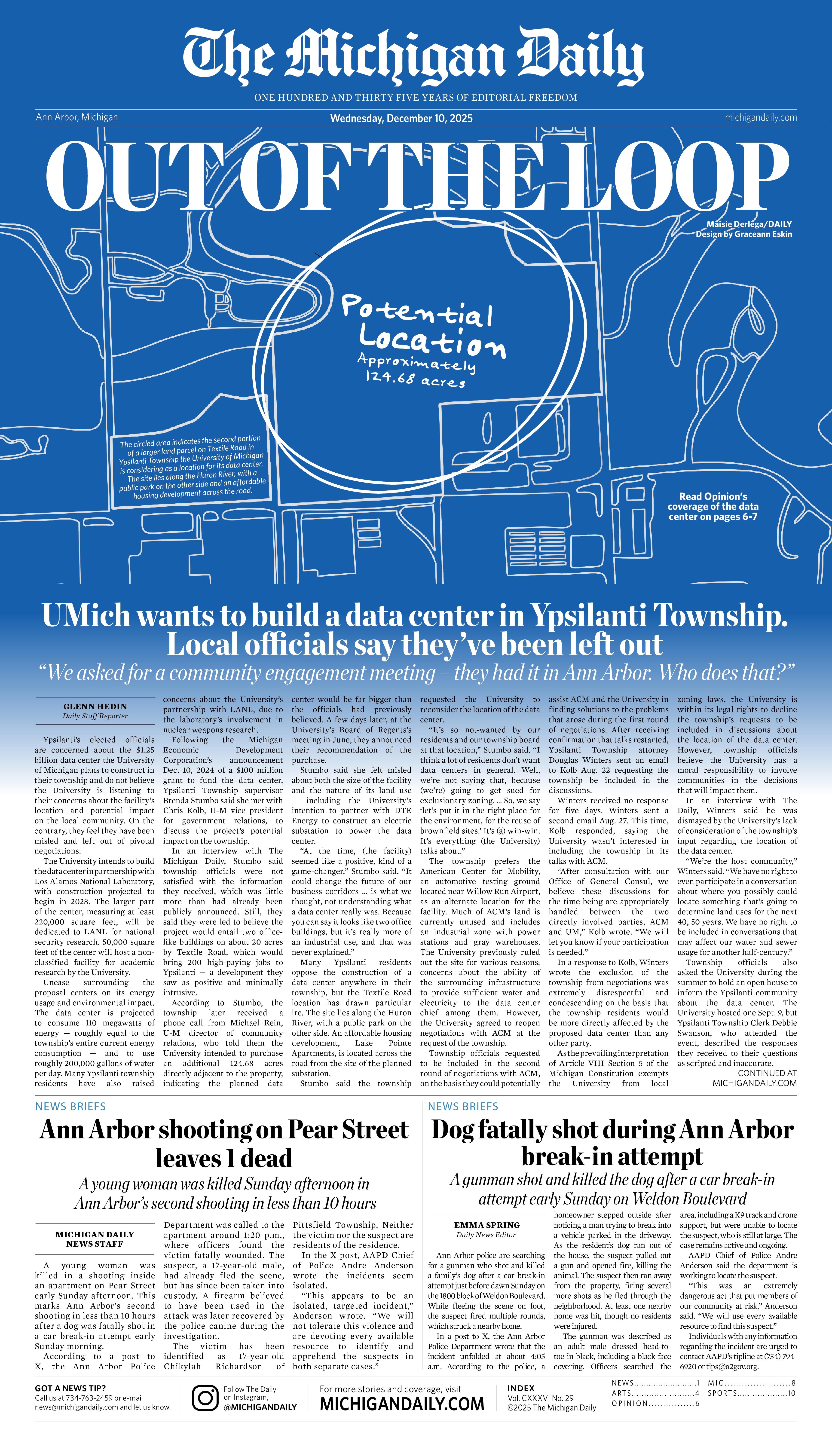
TAHRIR Coalition hangs banners across UMich campus in protest of University ties to Israel
“It is not just financial contributions to Israeli institutions and the Israeli occupation, but it is also ideological, academic and research collaborations.”
Members of the TAHRIR Coalition, a coalition of more than 90 pro-Palestine student organizations at the University of Michigan, hung banners around the Ann Arbor campus Thursday afternoon in protest of the University’s ties with Israel.
The coalition hung banners in the School of Public Health and College of Engineering buildings at 2 p.m., and the Ford School of Public Policy and the School of Social Work buildings at 5 p.m.
Beforehand, TAHRIR Coalition members distributed flyers around each building detailing the University’s partnerships with Israeli academic institutions. The flyers targeted the departments housed by each building. Those distributed around the Public Health School building criticized the University’s partnership with the Weizmann Institute of Science and the Technion – Israel Institute of Technology, citing their provision of technical support for Israeli weapons development. Brochures distributed at the College of Engineering criticized the U.S.-Israel Binational Science Foundation, claiming the University has received research funding from the Israeli government.
The banner, hoisted over the Public Health School lobby, read “Cut Ties With Genocide / Ben Gurion University.” TAHRIR held a concurrent study-in in the Public Health School lobby with more than 20 coalition members, and members hung paper over their laptops which read “Divestment is our demand / No peace on stolen land.”
One TAHRIR organizer, who requested anonymity for fear of retribution and will be referred to as Cameron, said the banner at the Public Health School addressed what they viewed as a lack of awareness among Public Health students of the ties between the University and Israeli institutions.
“While these ties do exist, and we’ve been able to do research on them, the amount of awareness prevalent within the (Public Health School) community is still relatively low,” Cameron said.
“Our goal with this banner drop is to put these ties at the forefront of people’s minds.”
Despite the protest’s focus on individual departments, Cameron said the coalition’s message extended to the University as a whole for supporting Israel both financially and academically.
“It is not just financial contributions to Israeli institutions and the Israeli occupation, but
it is also ideological, academic and research collaborations, all of which are actively fueling the occupation in historic Palestine,” Cameron said.
At 5 p.m., masked TAHRIR members gathered on the balcony of the Public Policy School atrium during a holiday party held for Public Policy students and community members. Protesters hung two banners over the balcony, one of which read “Ford Funds Genocide / Academic Boycott Now.”
As an a capella group began to sing Christmas carols, TAHRIR members threw handfuls of flyers accusing the Public Policy School of complicity with mass surveillance and global militarism down onto the gathering.
Simultaneously, a small group of TAHRIR Coalition members gathered in the basement of the Social Work School to set up another banner which read “What would the code of ethics say about U-M’s ties to Israel?”
In an interview with The Daily, Social Work student James Suleyman, a member of TAHRIR, said the National Association of Social Workers’ Code of Ethics aligns with the aims of the coalition.
“We care about social justice and human dignity and human relationships — that people get
what they need, anti-racism, anti-discrimination, all of those things,” Suleyman said. “We’re asking people, ‘Okay, if you call yourself a social worker and you really care about these things, why are we staying silent about all of this complicity that’s going on?’”
Other organizers gathered signatures for TAHRIR’s academic boycott pledge and organized an art project where the protest’s supporters could place painted handprints on a large piece of paper. Suleyman said the project produced a visual medium for the support of the coalition.
“We just wanted to create a little visual representation of how there are people that care about this and that are willing to take these steps to cut ties with genocide,” Suleyman said.
In an interview with The Daily, LSA sophomore Summit Louth, CSG representative, said he believes the academic boycott is too broad.
“We need to acknowledge the humanity in everybody and not just what their nationality is,” Louth said. “I agree entirely with boycotting people who sympathize with or try to justify genocide. … I just don’t sympathize boycotting anything that has the word Israeli on it.”
CONTINUED AT MICHIGANDAILY.COM
Ann Arbor hosts annual Midnight Madness celebration
Local businesses downtown extended their hours late into the evening for holiday sales and live music
it’s kind of another Black Friday. You’re getting a lot of these deals and incentives for one night only, and it really is beneficial to the businesses.”
On Friday night, Ann Arbor community members visited downtown storefronts on Main Street, State Street and Kerrytown districts in celebration of the annual Midnight Madness. Sponsored by Destination Ann Arbor and the Ann Arbor Downtown Development Authority, businesses extended their hours, offering in-store promotions and free refreshments. Local organizations also hosted various activities, including donation opportunities and live music.
In an interview with The Michigan Daily, Ashley Schafer, executive director of Main Street Area Association, said the purpose of Midnight Madness is to encourage community engagement with downtown businesses as the weather gets colder.
“The event itself is really to just get people downtown to take advantage of midnight shopping,” Schafer said. “It’s hard to get people out of their houses to shop and dine when it gets to be freezing temperatures. This event is just to support those businesses, and
Schafer said an important addition to this year’s event is the A2Zero Winter Gear Swap, where people could donate or take clothing items in a sustainable way.
“The whole idea of (the A2Zero Winter Gear Swap) is right now, and every year, people are really struggling financially to put food on the table, stay warm (and) have the gear that they need for themselves or their children,” Schafer said. “So, this is a newer component, and the reason why we’re doing it is just a way to give back to the community in a time where people are kind of in need the most.”
In an interview with The Daily, Claire DeBlanc, sustainability coordinator for the Ann Arbor Office of Sustainability and Innovations, said the clothing swaps support A2Zero’s broader carbon neutrality goals.
“Our main goal with clothing swaps, and all of our programming that we do for A2Zero, is to reach carbon neutrality as a community in a just and equitable way by 2030,” DeBlanc said. “So, all of
the stuff we are doing — whether it’s clothing swaps, home energy rebates, anything like that—is all to ultimately reach the carbon neutrality goal for the city.”
Galens Medical Society, a University of Michigan student organization aiming to improve local child welfare, hosted its annual “Galens Tag Days” fundraiser during Midnight Madness. In an interview with The Daily, Rackham and Medical School student Aaron Renberg, Galens Medical Society member, said the event was originally
intended for the C.S. Mott Children’s Hospital but expanded to raise money for more charities. “This is the 99th ‘Tag Days’ for children’s charities in Washtenaw County,” Renberg said. “Originally, it was mostly to support Mott Children’s Hospital and a lot of the Child (and Family) Life programs there. Over the years, it has expanded more and more so now we accept applications from children’s charities all over the county.” CONTINUED AT MICHIGANDAILY.COM
Stanford Lipsey Student Publications Building 420 Maynard St. Ann Arbor, MI 48109-1327 734-418-4115 www.michigandaily.com
MARY COREY and ZHANE YAMIN Co-Editors in Chief eic@michigandaily.com
ELLA THOMPSON Business Manager business@michigandaily.com
NEWS TIPS tipline@michigandaily.com
LETTERS TO THE EDITOR tothedaily@michigandaily.com
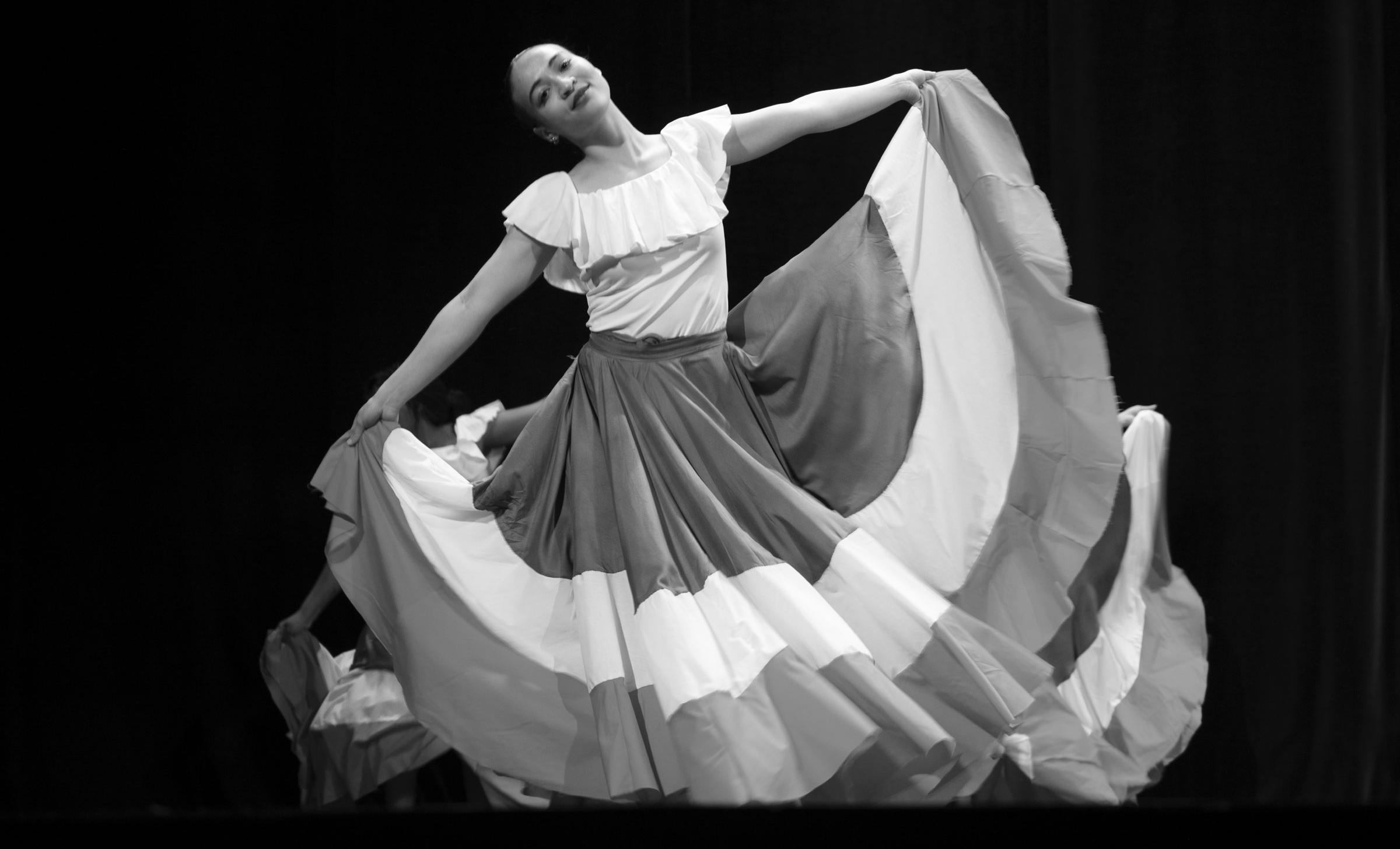
LSA Senior Philomena La Fave performs at the Caribbean Student Association “Echoes of the Islands” cultural showcase in the Michigan Theater Friday evening.
BRADY MIDDLEBROOK
ZOOEY RAUX AND MYA WEISS Daily Staff Reporters
ANN ARBOR
‘Where in Ann Arbor do you feel most unsafe?’ Residents weigh in Michigan Daily survey finds
some individuals perceive downtown State Street as unsafe
EMMA SPRING Daily News Editor
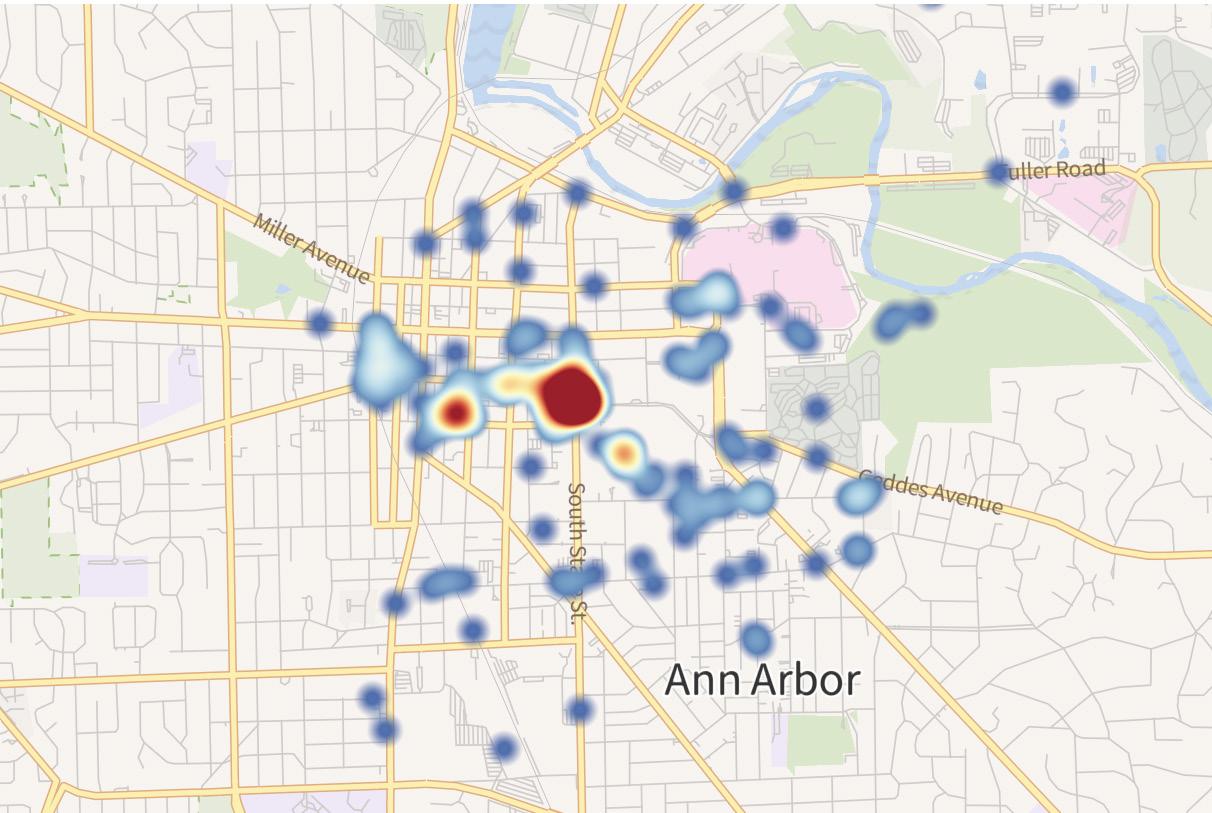
A Michigan Daily survey of 322 people walking through the Diag in October and November asked residents where they feel the most unsafe in Ann Arbor. The survey found many feel unsafe along State Street, with secondary clusters of concern near the Diag and Blake Transit Center. Of the 322 people surveyed, 68 said they did not feel particularly unsafe anywhere.
The survey was conducted at various times of day on weekdays and weekends. The Daily approached respondents at random, and participation was voluntary and anonymous, unless individuals agreed to an interview. The survey measured perception of safety and was not designed to reflect actual crime risk.
The Daily’s survey reflects perception rather than verified incidents. Several factors including sample size, demographic composition, time of day when respondents were approached and location of the interview may limit its generalizability. These limitations indicate that the survey provides insight into how some students and residents perceive safety in specific areas but does not measure actual risk.
According to the Ann Arbor Police Department’s year-to-date incident map through Nov. 23, 2025, the highest concentration of reported crime occurred roughly near Main Street, State Street and South University Avenue.
CONTINUED AT MICHIGANDAILY.COM
University of Michigan students and Ann Arbor community members gathered Tuesday evening at the Yost Ice Arena to skate as part of “Skate to the Source,” an event organized by the University’s chapter of BLUE Missions. The event helped to raise awareness and gather donations for the water and sanitation crises in the Dominican Republic.
According to BLUE Missions, about 703 million people worldwide lack stable access to clean water. BLUE Missions volunteers aid in the installation of clean water infrastructure, including ceramic-activated water filters, gravity-fed aqueducts and ventilated pit latrines. The organization is
sponsored entirely by donations, including those from the event’s ticket sales, and helps fund youth service trips connecting families in the Dominican Republic to clean water.
In an interview with The Michigan Daily, Engineering senior Ceci Bunge, president of the University’s chapter of BLUE Missions, said she started the chapter after previously volunteering with the organization.
“I started BLUE Missions a couple of years ago — three years ago now — because I had gone on a mission trip with them when I was in high school,” Bunge said. “I really fell in love with their mission and their focus on service and bringing volunteers into the communities that they’re serving and getting to serve alongside them.”
The “Skate to the Source” challenge was created to raise awareness for the walk that
Dominican women and children face daily to access clean water — about three kilometers, according to the organization. To complete the challenge, each participant skated the same distance, equal to 18 laps around Yost Ice Arena.
“That’s usually in a mountainous region,” Bunge said. “So it can be a very hilly and sometimes very dangerous trek …
Hundreds of community members met virtually with the Michigan Public Service Commission Wednesday evening to share their opinions on DTE Energy’srequest to supply power to a data center planned for Saline. The data center was proposed by OpenAI, Oracle and data center developer Related Digital. The meeting featured
comments from residents about environmental, ethical and economic concerns regarding the plan for the data center.
DTE filed the request ex parte, which means interested parties, such as Michigan Attorney General Dana Nessel’s office, cannot file testimony or conduct discovery before the MPSC decides whether to approve the project.
MPSC Chair Dan Scripps started the meeting by noting that the state of Michigan is at a
crossroads regarding artificial intelligence facilities in local communities. He said the Michigan Legislature passed incentives last year to attract data centers to the state — including tax breaks exempting data centers from equipment sales and use taxes — in order to facilitate economic growth.
“We know some people are excited about the potential opportunities this and other data centers could provide,” Scripps said. “But we also know that
folks in Saline Township and across the state are concerned about data center development.
… I want to acknowledge the very real frustration, concern and even anger we’ve heard and read about over the last few weeks.”
MPSC Commissioner Katherine Peretick said MPSC values hearing thoughts from residents who will be impacted by these kinds of decisions.
“Here in Michigan, we need to be really thoughtful about how we ensure that we
protect residents on the issues of affordability, reliability and resource adequacy,” Peretick said. “We know that there are right and wrong ways of doing this that we have seen play out across the country. Here in Michigan, we’re doing things differently. We’re learning from the experiences of those states and actively working to ensure Michigan gets better results.”
Theresa Staley, administrative law judge for the Michigan Office of
Administrative Hearings and Rules, then opened the floor for public comment. Michael Alaimo, Michigan Chamber of Commerce senior director of legislative and external affairs, voiced the MCOC’s support for DTE’s request. He said the chamber reviewed the application through the lenses of transparency and potential electrical grid benefits.
CONTINUED AT MICHIGANDAILY.COM
The case for sports edits
Go into any of the typical shortform video platforms and you’ll find the usual suspects: scantily clad women, condensed sketch humor and the velocity-inducing, maddeningly cut amalgamation of someone’s favorite athlete making tough throws or posterizing a defender on a dunk — in other words, the sports edit. Instagram has decided sports edits are a great addition to my algorithm because, to quote my less-literary sensibilities, they “go hard.” I mean, look at this clip of Victor Wembanyama making step-back threes over Kanye West’s “Monster” and tell me it doesn’t, again, “go hard.”
A sports edit’s objective is often to push an agenda about the editor’s athlete of choice through the careful curation of highlights. This practice, at least in basketball, owes its roots to the HoopMixtape and Ballislife era of compilations, which
featured edits of high school basketball players set to hip-hop tracks. Those mixtapes would get word out on the prospects of the time, like John Wall or Michael Porter Jr., and served as the nation’s conduit into talent before they were cemented in the professional leagues.
However, the modern sportsediting practice often lies beyond utilitarian ends. In these instances, a sort of decoy effect is observed, in which unrelated clips of other media beguilingly transition into the athlete as a sort of bait and hook. Maybe some tangential fact is used, like how Lamelo Ball’s height is 6 foot 7 inches (yes, this is the origin of that). And the sports edit — unlike, say, an artist’s paintings — is never quite original. The medium brings itself into being via reconstruction from other media: clips juxtaposed together, transformed through various visual effects and set to a musical mashup. If TikTok has become this generation’s lingua franca, then the media it is producing
will someday serve as the youth’s foundational artistic elements, the pen and paper, akin to what the phoneme is for the writer. Then something like a sports edit, erratic in its reweaving of video and sound, will be the resulting prose.
There is storytelling potency in the edit. For example: Jayden Daniels negotiating with the ghost of Robert Griffin III — the tragically injured phenom quarterback of previous Washington stardom — could be expressed in an 850-word think piece no one will read … or in an edit set against a quote from “Fullmetal Alchemist,” of all things.
Is it going too far, then, to tie sports edits back to literary history, back into something like Pindar’s victory odes for the winners of the Greek Olympic games? Yes, one was made by one of the canonical lyric poets of Greece and the other by a 14-year-old in their bedroom, but the reverence is still there. CONTINUED AT MICHIGANDAILY.COM
‘SANDA’ is ridiculous in the best possible way
NICOLAS EISENBERG Daily Arts Writer
“SANDA” eludes description. Calling it “an action-comedy starring Santa Claus” is highly reductive of the show as a whole, but it is admittedly the most succinct and apt explanation to preface potential viewers about what they may be getting themselves into. Should a viewer accept the bizarre concept at face value and stick with it, however, they will be rewarded with both an interesting story about coming of age in a rapidly worsening world and, in my opinion, the best-looking animated show airing this year.
Set in 2080 Japan, where a declining birthrate has left the country with less than 50,000 children, “SANDA” follows Kazushinge Sanda (Ayumu Murase, “Haikyu!!”), the last living descendant of Santa Claus, as he is unwillingly recruited by his classmate Shiori Fuyumura (Umeka Shôji, “One Piece”) to help her find her lost friend who she believes was kidnapped by the state.
The plot of “SANDA” is absurd, wasting no time throwing the viewer directly into the deep end of its narrative. Before we learn about either protagonist, the very first scene of the show presents Fuyumura bringing a knife down upon Sanda in what seems like an attempt to murder
him. It’s only halfway through the first episode that “SANDA” is willing to lay its cards down and reveal exactly what is going on to the audience. By forcing Sanda to meet specific requirements — giving a gift to a child wearing a red item of clothing, which Fuyumura accomplishes by first stabbing him in the heart and turning his white shirt red — she is able to unseal his latent ability to transform into Santa Claus. This isn’t the end of her antics, however, and to test Sanda again, she plants a bomb in the classroom he’s in, forcing him to use his Santa Claus powers to save his peers. The first episode, as well as the following few, may give viewers tonal whiplash, but that is exactly the appeal. The series is unabashedly ridiculous and constantly finds ways to up the ante, introducing increasingly bizarre characters and bombastic set-pieces that leave the viewer curious about what could possibly happen next. What helps “SANDA” reach new heights is some truly inspired artistic direction. Science SARU has produced multiple compelling shows in the last couple of years, but the art direction in “SANDA” feels like their best adaptation of a manga yet. The plot’s outlandish beats are matched by a similarly cartoonish art style, the two elements complementing each other and working to maintain a cohesive vibe. This is particularly
evident in the way Fuyumura is drawn: She is immediately recognizable in any scene due to her lanky figure, curly hair and big, bulging eyes. In particularly intense scenes, the lighting casts her as a silhouette, obscuring every part of her except for her cartoonishly large eyeballs, through which her terrifying presence is made known. As we get to know Fuyumura, we see her express shock, joy, relief and anguish through those very same eyes; the way she is depicted helps communicate to the audience the tone and emotional weight of the scene just as much as the writing does. But underneath the absurdity of the story and the spectacle of the animation, there’s also a very human element to “SANDA” that keeps it compelling. Paru Itagaki (“Beastars”), the original creator, commits herself to creating a world that pursues one very specific question: If a government decided childhood purity and its preservation are the most paramount values in society, what kind of people and culture would arise from this decision?
In the exploration of this question, “SANDA” becomes an unflinching exploration of adolescence. In the show, children are the most protected class in society, but they are kept separate and isolated from the world.
CONTINUED AT MICHIGANDAILY.COM
The Michigan Daily’s favorite last lines
THE MICHIGAN DAILY BOOK REVIEW
Every time another semester draws to a close, whether the first on campus or the last, a sort of nostalgia arises over the thought of things ending. The last time you wandered through the Diag without a suffocating puffer is often a memory lost to time. The last football game of the season — not much luck there. Even the last lecture for a class that you always kind of hated feels a bit bittersweet. I often find myself wanting things to end in a poignant way, or at least in a memorable one. Endings matter to us, in life and in literature, and so, as this semester draws to a close, 10 Daily Arts Writers have compiled their favorite final lines for your reading pleasure.
— Cora Rolfes, Senior Arts Editor
“Looking for Alaska” by John Green
“Thomas Edison’s last words were: ‘It’s very beautiful over there.’ I don’t know where there is, but I believe it’s somewhere, and I hope it’s beautiful.”
For a book originally titled “Famous Last Words,” the last line of John Green’s “Looking for Alaska” had to pull its weight. And, thankfully, it succeeds — this line, like so many others in the book, still manages to floor me even today. Ending a book ravaged by grief and death, this line marks a bittersweet forgiveness, a path to acceptance and peace after making big mistakes. It paints a not-so-scary picture of the afterlife, but also a realistic one. Narrator Miles doesn’t promise that the beautiful “there” Jefferson sees is real, he just hopes that it is.
that death might not be worth spending so much time thinking about after all.
I no longer believe in a specific afterlife; I have no idea what my final moments will feel like. But this line reminds me that I also don’t know how much it really matters. I, too, just hope that the “somewhere” is beautiful.
— Campbell Johns, Senior Arts Editor
“The Sun Also Rises” by Ernest Hemingway
“‘Oh, Jake,’ Brett said, ‘we could have had such a damned good time together.’
“‘Yes,’ I said. ‘Isn’t it pretty to think so?’”
James, “used up words.” This final exchange perfectly encapsulates how the protagonist’s wound in battle — which left him unable to have sex — led him to repress his desires and reserve himself to simply contemplating happiness. It is a testament to Hemingway’s ability to convey such depth of emotion by omitting so much.
— Lorenzo Norbis , Daily Arts Writer
“Katabasis” by R.F. Kuang
“And together they emerged, to rebehold the stars.”
I read this last line for the first time when I was 16, quarantined in my bedroom. I was experiencing a (likely Phoebe Bridgers-induced) obsession with death, unpacking my beliefs about the afterlife and getting more and more scared as I did so. This line helped me get out of my panic, helped me realize
With his sparse prose and dissolute characters, Ernest Hemingway ushered in the first novel of his Lost Generation. While “The Sun Also Rises” is essentially a novel about American and British expats traveling to Pamplona for the bull fights, it is more fundamentally the story of struggling through disillusionment in the wake of World War I. In line with Hemingway’s iceberg technique (which we probably all learned in high school English), there’s something deeply existential underpinning the couple’s dialogue here — but you wouldn’t immediately recognize this without reading about these discontented, aimless characters and their fights and amours. I love these last lines because they don’t work as standalone quotes; to appreciate the tragedy of Jake’s words, one needs to understand how his masculinity and self-conception were irrevocably shattered by a war that had, according to Henry
R.F. Kuang’s “Katabasis” is a razor-sharp reworking of the underworld tradition, transforming Dante’s descent into a scalding critique of modern academia. Rather than relying on homage, Kuang uses the structure of hell to map the pressures, distortions and seductions of elite institutions. “Hell is a campus,” one of our sojourners declares not even 100 pages into the novel. Kuang’s writing insists that the descent alone isn’t the story: the return is. Even as the narrative exposes how institutions extract, exploit and disfigure, it also gestures toward the fragile work of reclaiming selfhood from the ruins.
“Katabasis” succeeds not because it condemns academia, but because it recognizes the possibility of life beyond it, built on connection rather than competition, on choosing to step back into the world rather than endlessly circling its mechanisms.
— Estlin Salah , Daily Arts Writer
Photo courtesy of Darrin Zhou
DARRIN ZHOU Daily
Maheen Rashid/DAILY
‘You Have to Want to Fall’: R.F. Kuang’s ‘Katabasis’ and Escher’s
ESTLIN SALAH Daily Arts Writer
“Katabasis” announces itself as a novel about ambition, punishment and the systems that shape who gets forgiven and who gets destroyed. It’s a book steeped in academic hunger and moral vertigo, drawing from Dante’s “Inferno” without ever feeling like simple imitation. Instead, R.F. Kuang uses the architecture of hell as a framework for a story about the modern academy and how it entices, degrades and ultimately devours the people inside it. The result is a novel that is brilliant, uncomfortable and pointedly uninterested in letting the reader stay neutral.
In “Katabasis,” magic exists and is honed in the bureaucratic way only academia allows. Precisely hand-drawn pentagrams and mind-numbingly difficult logic puzzles are the shaky scaffolding students climb toward degrees, grants and tenure. One dear postgraduate student, Alice Law, is our sojourner through hell, on a mission to retrieve the soul of the abusive academic advisor she sort-of killed. Despite her many grievances with the man, she needs him alive to complete her degree (and to inflict her own violences onto him).
What makes “Katabasis” so arresting is not simply its concept, but the people Kuang creates to move through it: characters
rendered with the kind of clarity that makes their unraveling feel both inevitable and preventable. Kuang builds her cast as both individuals and archetypes, deeply human figures whose flaws just so happen to map neatly onto the punishments of Dante’s hell.
At the center of all this is Alice, whose ambition operates like a gravitational field. She is brilliant, defensive and hungry in ways that are both admirable and corrosive. Kuang refuses to frame this hunger as tragedy or triumph; instead, it becomes the compass by which every moral choice bends. Her psychological descent is not a fall but a series of small, perfectly reasonable decisions that accumulate until she’s left in free fall. Her tumultuous relationships with the surrounding characters serve to sharpen the novel’s central tension, asking us to consider how much of who we are is shaped by the institutions we want to belong to. What may put some readers off is the novel’s sheer literariness; it is unabashedly epic in scope and unafraid to show its scaffolding. The structure echoes Dante’s guided descent through hell, except in this version Alice is guided by a rotating cast of dead academic advisors, meaning that every layer of her descent comes with a secondary stratum of academic critique. This metaarchitecture was certainly an
ambitious move, but I felt it occasionally drew me from the emotional core of the story given how much it echoed Dante-butcleverer.
Yet while Kuang draws on the epic lineage of underworld journeys — Dante, Orpheus, Aeneas — her primary interest is not theological. Instead, she turns hell into a campus, reshaping each court into a commentary on the systems, pressures and abuses embedded in elite academic institutions. If Dante weaponized hell to illuminate the moral failures of medieval Florence, Kuang uses it to expose how modern academia reproduces hierarchy, cruelty and self-delusion under the guise of intellectual pursuit.
Dante arranged hell into nine circles that descend from natural landscapes toward increasingly architectural spaces — his version of the Florentine society and corruption within it. Kuang mirrors this movement, but her reconfiguration is pointedly institutional. Her hell begins with order — a library, a student center, the Bridge of Sighs — then collapses into deserts, bogs and mountains before finally returning to the hyper-constructed City of Dis. Easily, this reads as a reflection on the psychological arc of academic disillusionment: Students enter-believing in the structure, descending into competition and exploitation and, eventually, confronting the cold machinery of the institution itself.
staircase of academia
Each court in “Katabasis,” while taking inspiration from Dante, is unmistakably academic in shape and logic. Pride unfolds in an infinite library where the work never ends; Desire compresses Lust and Gluttony into a single place defined by want and deprivation; Greed is reimagined as the Bridge of Sighs, its very structure composed of the souls who gave themselves over to their institution. As the descent continues, the courts shift from orderly spaces to chaotic terrains: bogs of furious souls, deserts of self-imprisonment and towers built on skeletons with soul-reading academic advisors perched on top. By the time Alice reaches Oathbreakers, Kuang’s reimagining of Treason, hell becomes a dissertation hall, its
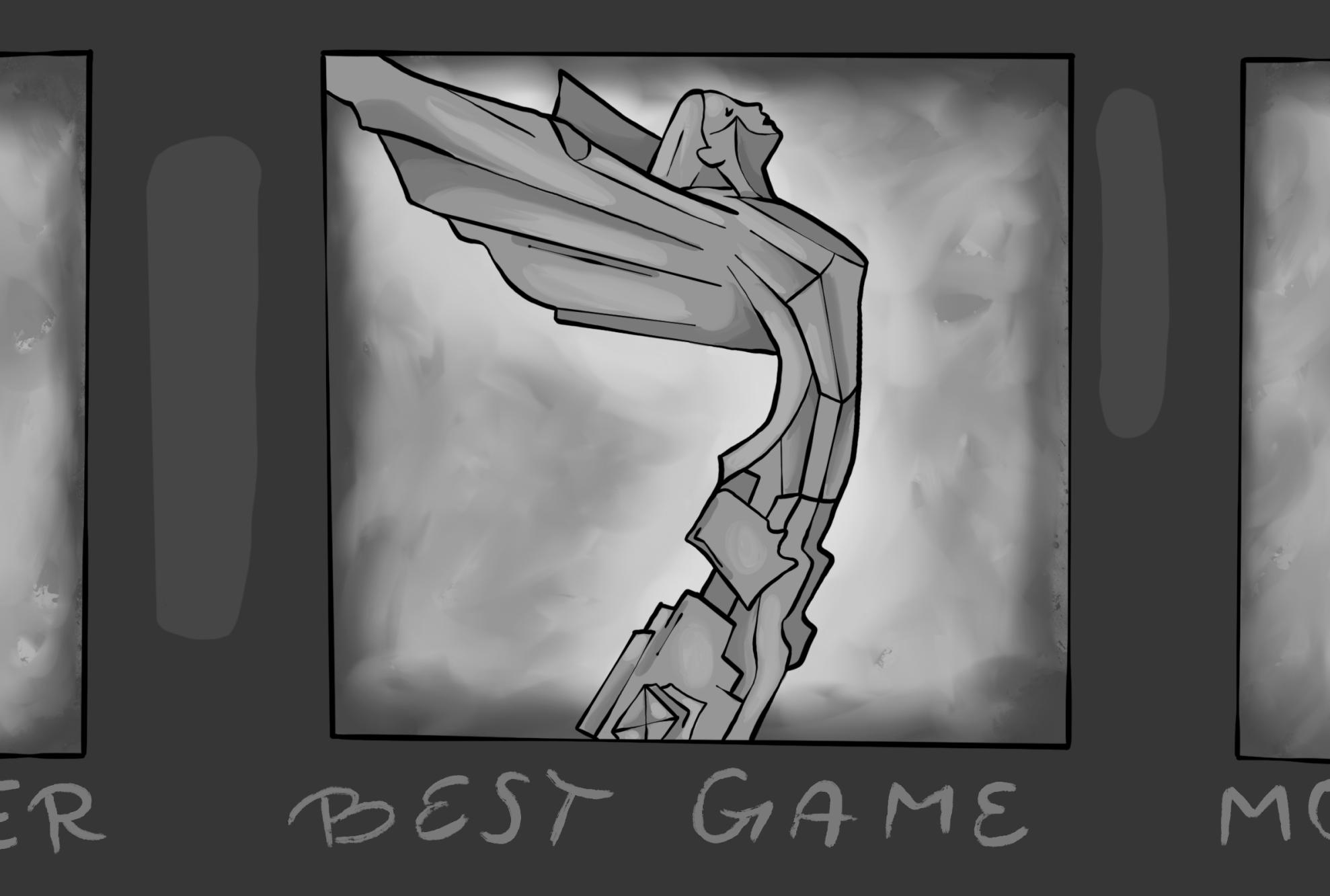
Digital Culture’s 2025 Game of the Year superlatives
DAILY DIGITAL CULTURE WRITERS
This year, there have been a ton of amazing game releases. Hollow Knight: Silksong, Clair Obscur: Expedition 33 and Death Stranding 2: On the Beach all made waves. With the announcement of the 2025 Game Awards nominees, it’s time to reflect on the past year of gaming.
However, we’d prefer to make our own awards. The Michigan Daily’s Digital Culture Beat’s 2025 Game of the Year superlatives aren’t about consensus; it’s all about vibes, surprise hits and cultural whiplash. Instead of asking which game was “best,” we’re looking at the titles that carved out space in the collective imagination, whether through excellence or absurdity. This was a year where massive blockbusters stood shoulder-to-shoulder with tiny indies and long-delayed legends finally resurfaced. Consider this our scrapbook of 2025 — a highlight reel of games that left dents in the discourse. These superlatives aren’t definitive, but they are a confession of what we couldn’t stop talking about, shamelessly or not.
The nominees for game of the year 2025 are all extremely strong, but our choice for game of the year remains clear: Clair Obscure: Expedition 33. Compared to the other nominees, Expedition 33 certainly had less press, but it is an experience that should not be missed. The game’s story is truly moving, with an opening chapter that’s hard to forget and a unique world that is well worth exploring — and that’s not even mentioning the game’s powerful cast of characters. Combat is engaging and strategic in a way that few role-playing games manage to accomplish, and exploring the world is an absolute charm thanks to the great art and sound direction. Expedition 33 is not only great in its own regard, but it is also doing a great service to role-playing games as a whole, breathing life into a genre that has struggled to find ground for the past few years. With an indie
studio at the helm, it is even more impressive to see all they have been able to accomplish. The game is a work of art that deserves the highest recognition it can get, and it was the best gaming experience this year had to offer by far. Considering the game’s quality, story and gameplay, Expedition 33 is the easy pick for game of the year.
— Hudsen Mazurek, Daily Arts Writer
Most Fun: Donkey Kong Bananza
What Donkey Kong Bananza has over every other Game of the Year nominee is the addictive power of fun, fluid platforming coupled with the ability to destroy almost any environment. There are three buttons dedicated to punching, one to ripping dirt straight from the ground and another to surf on that piece of ground, roots and all. The sound of collecting a Banandium Gem (the game’s main collectible) is still stuck in my head all these months later. “Oh, banana.”
Bananza’s qualities are all in the game feel. The movement starts out fast enough but reaches incredible speeds once you become adept at playing and its platforming challenges begin to buckle before you (or, more likely, are punched out of existence by you).
Bananza takes what worked from Donkey Kong 64 and replaces
what didn’t with the DNA of the Country series and Super Mario Odyssey, two of the best platforming inspirations imaginable.
Most of all, collecting bananas and punching straight through dirt, wood and concrete is just plain fun. It really makes you feel like you’re Donkey Kong.
— Ariel Litwak , Digital Culture Beat Editor
Longest Worthwhile Wait: Hollow Knight: Silksong
For six long years, fans of the first game waited for Hollow Knight: Silksong. Ever since the first teaser trailer, we were all on the edge of our seats to see what Team Cherry could do with their sequel to the original Hollow Knight — and they sure did make us sit for a while. Years passed as we waited for news, clinging onto every scrap of information we got. Any time the game was even mentioned in passing, discussion spread like wildfire trying to guess what it could mean. We had years to speculate what was to come, and every single day felt like we were getting farther from the end.
Then, this year, we got the release date. It felt like a dream, like a long-lost friend you always meant to visit was finally coming home. But it wasn’t a dream. When the game released, it instantly crashed almost every storefront and kept them down for several hours.
When the dust settled, we were left with a game that lived up to its predecessor. Stories will be told for generations of the myth that came true: Silksong.
— Hudsen Mazurek , Daily Arts Writer
Biggest Thing You Missed: Dispatch Dispatch is an absolutely phenomenal game. The story is one of the best, if not the best, narratives of the year. Yet, here we are, living in a world where it was only nominated for one category. Now, that isn’t to say a nomination isn’t a big deal — it is incredible to see the game nominated — but it deserved more. Words cannot describe how much of a shame it is to not even see the game nominated for best narrative or best performance. Dispatch isn’t a perfect game, but it is really great at what it needs to be. With excellent writing, a fun cast of characters and amazing vocal performances, it is simply a mystery as to why the game received only one nomination. Perhaps the lack of nominations comes from the game’s release later in the year, but Dispatch has most certainly been this year’s most shafted game at the Game Awards. — Hudsen Mazurek , Daily Arts Writer CONTINUED AT MICHIGANDAILY.COM
inhabitants drafting arguments for why they deserve another chance at life. The courts no longer feel like separate punishments but steps in a continuous downward journey, each space stranger, heavier and more consuming than the last.
Kuang uses hell not to map moral failures but to anatomize an institution and how it forms, distorts, exploits and seduces its members. “Katabasis” is less a spiritual allegory than an academic one, depicting a world where the pursuit of knowledge is inseparable from the systems that gatekeep it. Her hell is a university only because the university is already halfway to hell itself. Frequently, the Escher staircase is invoked: impossible, looping
stairwells where every ascent is also a descent and no amount of effort will ever lead to escape. It’s an apt metaphor for academia, a place where students climb endlessly only to find themselves back where they started, repeating the same arguments, anxieties and rites of intellectual worthiness. Progress here is ouroboros, continually starting anew while simultaneously eating yourself as you go. Still, the novel refuses to end in that trap. Alice abandons her original revenge plot, confronting not only the advisor who exploited her but the version of herself shaped by his shadow.
CONTINUED AT MICHIGANDAILY.COM
‘Pitcher Perfect’ is a fuzzy, feel-good romance with real emotional bite
Tessa Bailey’s “Pitcher Perfect” is a bright, breezy and charming romance that’s just messy enough to keep things interesting. The book kicks off Bailey’s new baseballthemed series with the author’s signature mix of humor, tension and heartfelt emotional payoff. It’s the kind of rom-com formula that works not because it’s reinventing anything, but because Bailey knows how to make familiar beats feel fresh. The story centers Robbie Corrigan, a National Hockey League rookie and relentless flirt, and Skylar Paige, a Division I softball pitcher who is laserfocused on her sport — and so over men like Robbie. But when Skylar needs a fake boyfriend to make her longtime crush (and her brother’s best friend) finally notice her during their family’s annual wilderness competition, Robbie volunteers as tribute. It’s a setup tailor-made for chaos, and Bailey leans into every possible source of tension it invites.
Skylar herself is easily one of the strongest female leads Bailey has written to-date: fiercely independent, guarded and quietly carrying the weight of being the only one in her family who didn’t go to Brown University. The “outsider in your own family” ache hits harder than expected here. Skylar is the person constantly trying to prove herself because she doesn’t think she meets someone else’s standard of “perfect.”
She’s the definition of TikTok’s beloved “thought daughter” — introspective and devout in her overthinking. If you’ve ever felt like you were trying to earn your own family’s approval, her journey will likely feel uncomfortably familiar.
That said, “Pitcher Perfect” isn’t without its flaws. When Skylar and Robbie first meet, she overhears him make a casually
sexist locker room remark. It’s a genuine red flag, but instead of addressing it, the book just moves on. Before you know it, the two are fake-dating, and Robbie is suddenly a changed man just because he’s fallen for Skylar. The emotional logic here is thin, and it’s one of the places where the story feels like it skipped a step.
A second skip can be found in the full-on insta-love (or, rather, insta-lust) of the characters. These tropes don’t necessarily have to be a bad thing — sometimes an immediate gravitational pull can be its own kind of fun — but there were moments in this story where a deeper, more gradually built connection would have enriched the romance. Bailey leans into the insta-love trope often, and it works for the breezy tone she cultivates in her work. But the emotional highs would have been more impactful if Skylar and Robbie’s bond had been developed just a bit more intentionally. Still, Bailey manages to anchor the narrative with emotional sincerity. Even amid the wilderness games, flirty dares and Robbie’s attempts at proving he’s more than just a charming disaster, there’s a real sweetness in the way both characters try to figure out what they owe themselves. Skylar’s arc is especially poignant: Returning home and mending things with her family isn’t just an external reset but an internal one, too, and Robbie becoming part of that rebuilding feels more clandestine than engineered. As for the enemies-tolovers label? It’s more “lightlyannoyed-to-lovers.” Despite their antagonism early on, the pair’s dynamic skews heavily toward the lover’s side. There’s not much bite to their supposed enmity, but the story doesn’t suffer for it — instead, the book simply falls more squarely into comfort read territory than the tension-heavy romance that the book jacket promises.
Selena Zou/DAILY
AVA EMERY Daily Arts Writer
Michigan in Color is The Michigan Daily’s section by and for People of Color.
In this space, we invite our contributors to be vulnerable and authentic about our experiences and the important issues in our world today.
Our work represents our identities in a way that is both unapologetic and creative. We are a community that reclaims our stories on our own terms.
Be still because you can
Stillness is rarely seen for what it is. It is equated with a lack of progress, a lack of movement to push yourself to be better. The opposite of stillness, motion — which is what really captivates modern-day society — is revered for its productivity and success. I’ve always strived for motion and, though stillness may have been a temptation, I never allowed myself more than a couple of passing glances in fear of the failure it may bring. However, I’ve come to learn that stillness is not my enemy. It is a privilege I inherited, one that I have wasted and one that I am now learning to honor. There once was a time when stillness came naturally to my lineage. My great-grandmother knew it before it was taken from her. She had a rhythm and a place where the world felt calm enough to hone her passion as a renowned seamstress.
But the stillness didn’t last. Her home was taken away, and she was forced to flee to countries where she was not treated equally as a displaced Palestinian. Finding herself in Lebanon, she raised my grandmother in the refugee camps until the latter eventually raised a family of her own. Under these conditions, my ancestors never knew safety and stability. In the camps, uncertainty lived among the hundreds of thousands who sought the next step in their perilous journey. Finding greater opportunities for their family, my grandmother and grandfather then moved to the United Arab Emirates. After a few years there, the Gulf War broke out, and my grandmother’s family once again found themselves fleeing their
home. In 1990, they arrived in Windsor, Canada, a place where people did not understand them, not only because of the lack of a common language but also because of the basic difference in their way of life.
As she had done before, my mother had to acquaint herself with the unfamiliar. As a part of a family of eight with no financial stability, my mom realized that she needed to create her own opportunities to succeed. She commuted to the U.S. to work long shifts at Anita’s Kitchen, saving every dollar to help pay her tuition at Henry Ford College. When the money she earned fell short for tuition, my mom followed her familiar route to the student billing office. Each time, she negotiated her way into a few days’ leeway. Her negotiation skills are still sharp to this day — I, and any salesperson she’s ever come in contact with, can attest to that.
By the time she got a handle on her life in Canada, my mother had my brother and me, who she had to support mostly alone. Working long shifts as a dental office manager, my mother came back to her mother’s house tired, yet never empty. Somehow, she would have the energy to take us to the riverside to ride our bikes or to swimming lessons. In keeping us occupied, my mother bore the brunt of the reality and hardships of our lives. After some years in Canada, we moved to the U.S. There was never an option for stillness amid all the change.
Watching my mother move through life gracefully, I thought the best way to honor her legacy was to continue the familiar pattern of movement. I filled my time with various club meetings and classes, and anything else that might push me closer to a stable
future. In my mind, to pause was to fail her. To rest was to waste the motion she had passed down to me, marring her work and the work of generations before her.
However, what I’ve failed to realize is that the work that my mother, grandmother and her mother have done were attempts to regain the equilibrium there once was. They worked to gift me the same stillness my greatgrandmother did before the world took it from her. They created space for my motion to be thoughtful, not an action necessary to survive.
I am not suggesting that welcoming this concept of stillness is easy. I often find myself uncomfortable and even reluctant to let it take hold of me. I still occupy my time with things that I know will drive my future. I still account for my resume when I add something to my schedule.
Maybe the key to everything is balance. Do things because they benefit you and because they interest you. Find ways to have a stable future while also following your passions. Don’t let it be a forked path of choosing one or the other. That is what the stillness provides; it is a moment to look inwardly and consider, What am I passionate about? What will fulfill me in the future? Those are the questions my parents never got to answer for themselves because they were busy moving to keep the water below their ears.
So, I’ve bravely decided to sit with this stillness by my side. I greet it, knowing it is an old friend carried from generations before me. I sit still for you, Mama, and for those who cannot sit still. In the stillness, I find clarity about what I want to offer the world.
If you are given the privilege, I encourage you to find a moment to spare. I encourage you to sit still.
Friendships I meant to keep
Whenever I go to the library to study, I always seem to pass a group of friends. How do I know they’re friends, you may ask? The laughter. The talking. Somehow, they’re always reminiscing about their weekend or how close they’ve all been since high school.
To me, high school seems like a lifetime ago. The thought that a friendship can even last past high school almost seems like an unachievable milestone, another unspoken constant I always seem to miss. One everyone understands but me.
When I entered the University of Michigan, I had one friend from high school. We weren’t super close back then, but since we were going to the same college, I made it a point to hang out every once in a while. During breaks, she would always talk about going back home to hang out with our old friends, the ones we used to walk to class with, laugh with and get in trouble with. The ones I haven’t texted in years.
When she would talk about the high school friends she had visited recently, I would wonder, “How does she make it work?”
Sometimes, I want to follow in her footsteps and reach out, too, but each time, I’m stuck in the same overthinking limbo, telling myself they probably already have their own lives, their own new inner circle. School takes up my thoughts until I convince myself that I’ll have time to reach out later.
But then, later becomes tomorrow.
Tomorrow becomes next week.
And next week is never.
I don’t really talk to anyone from middle school anymore. High school, either.
On Instagram, I see them living joyously and remember the life we once shared. I scroll through my contacts and just see names. First name, last name. People I recognize but can’t quite place, like a mirage that only appears when I reminisce. It’s not that they don’t mean anything. It’s just that my mind seems to erase the details faster than I can keep up with or hold on to them.
The scars that never fade
Maybe that’s just how things go. As you grow old, you change, people drift and settings change. But people don’t always drift because they’ve changed. Sometimes it’s due to the change in things around them: new schools, new routines, new distances.
Growing up isn’t the issue; it’s now more about the different paths we go down. As I’ve entered my 20s, I think I’m now starting to realize how easily it seems to be happening around me — and how I’ve let it.
College is no different. I meet people, I like them and we talk for a while.
Sometimes, it happens so fast for other people. A friend of mine will introduce me to someone they just met yesterday, either at a study group or another one of the many events held on campus. Somehow, they are so close. They know everything about each other. To make me feel included they’ll pull me into the conversation, and everyone is always kind, but I get awkward and quiet, like I suddenly forget how to speak.
We exchange Instagrams, promise to hang out, laugh like we are going to become friends tomorrow and then nothing happens.
No messages. No hangouts.
Just another “maybe we should grab dinner” that later fades into the list of things I never made happen.
I had another friend the summer before my freshman year. We used to live a few doors apart. She was the first person I ever had a sleepover with. We’d go on late-night walks exploring Ann Arbor, talking about everything. She would tell me about her life as an adoptee and her family in Michigan, while I would tell her about myself, my life and what I like to call my undiagnosed ADHD. We would laugh and talk about our future careers and how we were going to achieve together.
Once sophomore year arrived, neither of us got dorm housing. I still lived on campus; she lived 20 minutes away. At first, there was silence, no calls, no texts, but it didn’t feel foreign. We had both assumed that we would run into each other eventually. But then her career path changed and our schedules no longer aligned.
She’d text me asking if I would want to grab food or go on a walk. I would always see it a day late and wouldn’t know how to respond. Once I finally texted first, she answered immediately, making my guilt even worse. We spent days planning, but last minute, she had to cancel.
In my mind, it was my fault because I hadn’t reached out sooner, because I let the moment slip away. The guilt made me overcompensate, reaching out even if I was busy or had nothing to say. I had now become afraid that I was watching another friendship slowly fade. It feels like I’m collecting people like souvenirs, storing them away in a display case and never revisiting them. The world keeps spinning while I stand still in the middle, watching faces blur into motion. I can see them smiling, graduating, moving forward, and I tell myself I’ll catch up later. But later keeps moving further away.
Maybe it’s because I’m always behind, another assignment I never finished, another exam I can’t focus on, another unread message I don’t have the energy for. I get so overwhelmed that I just stand still. It’s easier to tell myself I’ll do it later than to admit how drained I’ve become.
It’s not that I don’t want to connect. I just don’t know how to. It feels like every friendship belongs to a specific time period in my life, and once that time passes, I don’t know how to go back. Reaching out almost feels foreign. Like I’m disturbing the balance of the universe somehow, reopening a door that’s already quietly closed.
In my head, I make it a bigger deal than it really is. To me, it feels like too much time has passed. But to them, it’s probably just a text that never came.
When you open your eyes one day and realize how temporary everything is, it’s quite shocking. There’s a kind of loneliness in it. I do have friends here, people I care about. But sometimes I wake up and remember how each important period in my life has ended with a quiet closing of a door. After middle school. After high school.
CONTINUED AT MICHIGANDAILY.COM
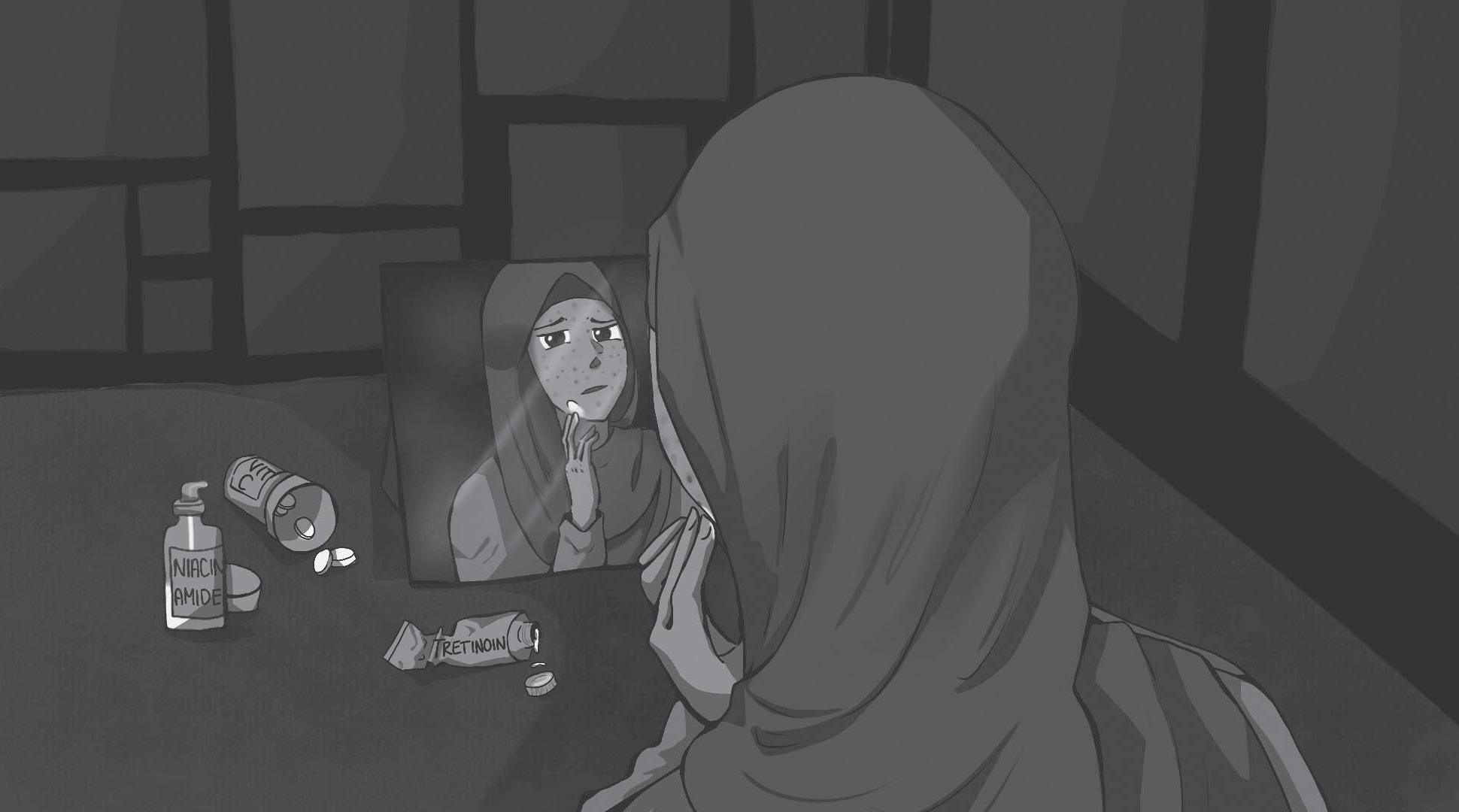
Given how often I am there, I am sure that the local CVS Pharmacy technician knows me by name. The last time I visited, I didn’t even have to offer my date of birth. Maybe they’ve been tracking my purchases, wondering what new topical I’ll be attempting next: Vitamin C, Kojic, Niacinamide, Benzoyl peroxide. Skincare products line the perimeter of my desk — a visual timeline of all the money and effort wasted into perfecting a look I am unsure I can ever achieve.
As I apply each product to my face, my mind drifts to my mother’s features, my grandma’s and those of all the women I adore.
With how often this predicament occurs, I think I could create a guide dedicated to rating different dermatology offices in Michigan (extra points for the addition of a fish tank in the waiting room). My latest visit was entirely unplanned; I skipped classes and thought the best thing to do was to face my greatest insecurity — acne scars — headon. Productive, right?. OK, that’s a lie. The truth is that the previous night, I did what any girl dealing with great ambition but afflicted with minimal productivity would do. I made a list in my Notes app. The title, of course, always contains something like “need,” “2025” or “must do.” That particular night, at 3:07 in the morning, I decided I had to clear my skin once and for all, leading me to skip class in pursuit of the perfect complexion.
I think of the deep-set dark circles, constantly furrowed with purplish hues, that are characteristic of my mom’s pale face. They add a touch of sincerity onto her otherwise relaxed, timid demeanor. But when it comes to the shadows that line my own eyes, I constantly find my hands gravitating to toward pulling at that skin, desperately trying to find the answer to the insecurities I assume is hidden under those veins. These dark circles are an heirloom of my maternal heritage and yet I continue to foolishly believe that this endearing quirk passed on to me can be erased. Since I started college, my inability to come to terms with this god-awful condition — hyperpigmentation — has only worsened. Now that I was walking distance from a Target and equipped with independence, I purchased tons of faulty goods till my sink cupboard couldn’t handle anymore. With one swipe of my MCard on TheRide bus and a picture of my insurance plan (courtesy of my dad) in hand, I made my way through the network of dermatologists and estheticians in Ann Arbor’s network. I find, though, that each time I board the bus to head to a new appointment, I check how much the cancellation fee is. As much as I hope for a newly prescribed regimen that will be the answer to my problems, I also dread the later realization that I wasted $50 just to be coddled by a professional.
However, to my dismay, this appointment was not the salvation I had dreamed of. As I sat in the cushioned brown seat of the room, I took note of how superficial the place was.
To the left of me was a massive interactive screen for patients to browse through, and the paintings on the wall looked like they belonged in a museum. When the dermatologist finally made his way to my room, he wasted no time. The session lasted all but 30 minutes as I nervously listed out my concerns. I tried to sound smart by using big words like “angular cheilitis” but he was clearly not impressed. His cordiality was intimidating and I knew he did not care for my sob story. He had a piercing glance, and my questions seemed to be exhausting him. This was my first time visiting a male dermatologist, and I already knew I would be returning to my preferred doctors clad in pink scrubs after this. Once he quickly slapped “tretinoin” and “hydrocortisone” onto a piece of paper and exchanged a glance with the medical assistant in the room, I was on my way out with a card reminding me of my next appointment and a billing statement. After taking a glance at it, I quickly folded it up. The latter prescription irked me: Having to pay for health care has now made me an avid fanatic of Western medicine. If I am coming all the way to a new clinic with an appointment I had to beg for, then I expect medication that I have never
heard of and cannot pronounce. I could have just picked up the hydrocortisone over the counter, but here I was, paying an additional $15 for fancier packaging. It was the tretinoin, however, that left me disappointed with myself. I knew it was a harsh treatment, and this unwelcoming reality check made it clear that I underestimated my own vulnerability.
It felt like a slap in the face reminding me that my acne was not just exaggerated in my head. It was, in fact, something that stood out about me. Having to lather my face in concentrated chemicals rather than a soothing emulsion was jarring, the stinging sensation leaving behind a stark echo of the pain that comes with being naive.
Each night as I map out those pea-sized dots, I think of all the women like me, whose complexion has always been
their greatest vulnerability. Who rely on quality color correctors to feel comfortable in their makeup. Who obsess over concealers.
Who have relentlessly dealt with comments on how tired they look, suggestions to try a turmeric mask or warnings to stay away from the sun at all costs.
To think that you may never be able to embrace your natural skin is scary. I do not necessarily fear being judged but rather I fear the idea the idea that I may never feel comfortable in my own canvas.
Hyperpigmentation is something that women of Color have historically been taught to veil. But, what we fail to note is that this pigmentation is the manifestation of our resistance.
A biological marker of the way in which our identities persist. It brings me to reflect on the women in my village who
oversee large rice fields, and despite the sun’s harsh rays, continue to labor tirelessly to serve their communities. Their skin never burns. Instead, they absorb the sunlight, fueling their spirits, and the traces left behind are a testament of their endurance. These women share a lineage with me and pass on their legacies. This genetic predisposition is not a burden to me; it’s an honor to carry on their legacy.
I have always been sympathetic to statements about faith. One thing my aunts and grandmas would always say was, “God made us this way.” As I stood there ignorantly covering my face with my hands to block the sun’s rays in fear I would grow “darker,” it became clear to me that God did, in fact, make us the way we are.
FAHMIDA RAHMAN MiC Columnist
NOUR KAMOUNI MiC Columnist
HILARY ADJEI MiC Columnist
How would you define yourself?
Being in my last year of college (even writing that feels surreal), I’ve found myself grappling with this question more and more. Who am I? What do I have to show for my years spent here? What can I cling to as I approach this next life transition? This question of selfdefinition plagues me (often at the most inconvenient times — nothing like an identity crisis the night before a 2,000-word essay is due).
It’s easy to look to tangible things to define myself. I am a student at the University of Michigan. I am a Chinese American woman. I am an ISTP on the Myers-Briggs type indicator. According to my Hinge profile, I am someone who likes little trinkets and long YouTube video deep dives on niche topics. Yet for all of these labels, none of them feel truly “right,” with the ability to fully put into words everything I feel I am.
I went into college with a list of things I wanted to be — smart, accomplished, caring and so on. I was in desperate pursuit of things I thought would define me and allow me to become that person. I craved to be that person on the college brochures, smiling on the lawn with a huge, diverse friend group. I wanted a prestigious major, someone with internship
ANNIKA SREEDHAR MiC Columnist
Sometimes when I close my eyes, I can still picture it — I’m five years old, sitting outside my grandparents’ home on a rainy July morning in India. I’m on my Appuppa’s lap on his rocking chair, safe from the rain, as we eat a true Malayali delicacy: mango coated with salt, pepper and chili powder. He laughs, and asks me to sing our favorite song for him: “Kinavile Janalakal” from the hit 2010 Malayalam movie “Pranchiyettan & the Saint.”
I have been singing ever since I was two years old. I like to think that I inherited this trait from my Appuppa, who was a “Swami,” or Hindu spiritual teacher who often sang “bhajans,” or religious hymns, at the family temple. One of my earliest memories of singing involves me as a toddler climbing up our temple stage and interrupting my grandpa singing just so I could accompany him, even though I didn’t know any of the words. However, at five years old, I had an entirely different outlook on singing. If Appuppa asked me to sing any song in English, I would’ve done it with no hesitation. However,
KARAH
POST MiC Columnist
Vogue journalist Chanté Joseph recently declared that having a boyfriend is embarrassing. Being the avid man-hater that I am, I immediately fell for this clickbait. Since the article came out, the overwhelming response that ensued has been entertaining to witness.
Heterosexual women seem to embrace their singlehood as a superpower now that it’s deemed a social faux pas to have a boyfriend. If Vogue said it was acceptable to be single, what other affirmation could you need? However, Joseph’s argument falls short of what I thought her charged headline would address. She starts her piece claiming that some women want a boyfriend for materialistic reasons like social benefits or financial status. What she
The process of self definition
offers and a lengthy resume. That’s how I would know I truly made it — when I became that idealized person with the trophies to show for it. And for a while, I thought these were things I could attain. I took the hardest classes, chose a major with good financial prospects. I carefully curated my personality and humor to match the people I was surrounded by, joining multiple clubs and floating between friend groups.
After years of subscribing to this mentality, I hit a wall. It wasn’t that I didn’t succeed; to a great extent, I had become the person I was looking to become. But when a friend asked me if I liked who I was, I had nothing to say. I wasn’t even sure how to begin to answer. I could list all these accomplishments I had, but they only gave the outward appearance of all of these things I wanted to be. I had spent all this time chasing these things without stopping to really think about how these things affected me. If anything, after all these things, I was more unsure of who I was. If the goal was to define myself, I had failed miserably.
I could feel myself growing more apathetic every time I attended a class I had no interest in, solely for the sake of a letter grade. Every time I decided I didn’t want to think and doomscrolled for hours, my brain became a little more numb. Becoming someone who could just walk by a person in need
our special song was in Malayalam, a language spoken in Kerala, a state in Southern India. I didn’t know Malayalam like I knew English. Little five-year-old me did not want to disappoint her Appuppa, but at the same time, I was so nervous and embarrassed that I’d get the words all wrong and be shamed by my loved ones for not knowing how to speak my cultural language properly, let alone sing it.
In a matter of a few years, I’d gone from being unafraid to sing in front of people in a different language to being utterly terrified to sing a few verses in front of my beloved grandfather. Why had I become so self-conscious?
I believe our actions are a result of our environments and the people around us. Growing up, I was surrounded by multilingual people, including in my own family, who could speak, read and write fluently in so many beautiful languages. In my eyes, they were these incredibly intelligent people who knew so much more about the world since they could understand it in multiple languages and perspectives. I wanted to be like them because I thought if I could learn multiple languages, I could be intelligent too. In elementary school, I remember
because I had “better” things to get to made me feel just a little less human every time. A common rhetoric I heard growing up in an immigrant community was to pursue stability first, then your passions. Focus on the other things after you accomplish these things first. But more and more, I found myself unable to keep ignoring the process that would get me there. Defining myself through these tangible things was flawed by design. These milestones could only capture moments in time, a static being rather than the everchanging person I actually was. I had made most of my college decisions as if in a vacuum, as if achieving these goals would somehow move me from point A to point B in maturity. As if the only thing that mattered to me was the before and after points, completely missing all the selves I was in between. I failed to see how the transition states drove the end product, and so, the more I tried to control the narrative of who I became, the more I felt the definition of myself slipping away. I feel as if I have changed drastically from when I first started college, and not due to all the things I initially sought. But it’s hard for me to point out large, tangible things that have caused that. When I think about the things that have shaped me towards the person I want to be, it wasn’t having an engineering degree
or being able to say I have a lot of friends. This was a change that was much more gradual, a combination of thousands of little moments over the years.
Staying up late talking to a friend for hours helped me understand both myself and her a little more. Every time I struggled through long, dense class readings instead of feeding it to AI, I felt capable and hardworking. A random Saturday when I woke up early to volunteer at a soup kitchen made me more empathetic. No moment throughout the process was truly meaningless. It can be very daunting knowing that every moment shapes me in a certain way. As a somewhat anxious
Who do I sing for?
spending hours trying to make sense of the Malayalam practice books my mom would get for me from India. I told my parents to start speaking to me in only Malayalam so that I could actively practice speaking with native speakers. For a time, this worked. It technically helped me understand Malayalam fluently. If someone speaks to me in Malayalam, I know exactly what they are trying to tell me, even colloquial terms and slang. Despite understanding the words, I could still not pronounce them, no matter how hard I tried.
I theorize that this phenomenon, dubbed receptive bilingualism by linguists, must have occurred from the years I spent accumulating the vocabulary when other people spoke. Whenever I made a mistake or my brain couldn’t understand certain concepts, I felt this sort of shame. I felt like I wasn’t intelligent enough to speak like the rest of my family. Eventually, I stopped trying to respond to my family in Malayalam completely, because my inability to respond to the sentences I understood frustrated me, and admittedly, my ego was hurt.
But when I sang? My ego was hurt even more. Music is one of the most important things in my life,
and I am incredibly passionate about it. I find that singing and playing music is one of the most rewarding experiences in my life, and it acts as an escape route to all the stress I face daily. I pride myself on being a talented musician. Perhaps this is because of my desire to be perfect, but I feel confident in my abilities to sing and feel joy even when all else goes wrong.
Singing is also a huge part of Malayali culture and Indian culture as a whole. Malayalam songs tend to be super lyrical and poetic, with an emphasis on high notes and flowy rhythms. I’m a perfectionist, particularly in singing. I could not break this mindset that if I messed up when singing in Malayalam, I was a bad singer and the stereotype of an American-born and raised-Indian girl who doesn’t know anything about her language or culture.
It is truly unfortunate that this mindset was ingrained in me at such a young age. It wasn’t even a true statement, but I couldn’t help but feel like it was so representative of me.
I don’t know what I was feeling on that day in July. Maybe it was the excitement from being in India or from spending time with my Appuppa in person that made me
person, I don’t need that additional pressure placed on my day-to-day activities. It can also feel quite hopeless at times. I will always be constrained by finances, time and what society says that I can and cannot do.
However, there’s a certain beauty in the knowledge that no action is insignificant. Moments that I thought didn’t matter still had some sort of meaning. And I have the ability to be a part of someone’s change just by existing.
To some extent, I can still control my definition of myself. But this time, it won’t come from these large sweeping milestones, but rather an emphasis on all the little processes
that shape up to a larger meaning. There is a certain autonomy that comes with this knowledge; with the choices I do have, I want to live with as much intentionality as possible. So I find myself in a state of constant negotiation over who I am. I don’t think I can find a way to fully define myself. By the time I have figured out some working definition, I will already have become a slightly different person. I still agonize over the big decisions. Did I choose the right career path? Where do I want to live after graduation?
CONTINUED AT
push that fear rising in my throat all the way down and start singing. I do not know how I did it, but I managed to sing this much of the song:
Slowly, the wind is making me fall asleep as the moonlight feathers run through my hair.
“Kinaavile Janaalakal, thurannidunnathaaraano“
Who is opening the windows of my dream?
“Vimookamaam vipanchiyal, viral thottathaaraano“
Who is playing the silent veena?
After I sang those six lines, I disastrously messed up the remaining verses, but my Appuppa cheered and applauded so loudly the neighbors could hear from across the street. I still felt super embarrassed, but I felt a lot happier knowing I could make my grandfather happy.
After that day, my Appuppa would make me sing those six lines for him again and again, either to him
Are boyfriends really all that embarrassing?
takes issue with, though, is how women center their online personalities around having a partner, making them come across as “culturally loserish.” But this is only part of the picture. On the contrary, I’d like to think that boyfriends are out of style for a different reason, one that has more to do with single women finding liberation in their independence. Unlike Joseph tries to portray, hating “boyfriend culture” is not a breakthrough concept. By focusing only on the performative aspects of why boyfriends might be embarrassing, we further perpetuate the patriarchal notion that a woman can only amount to as much as her male counterpart allows her to.
I’ve heard it time and time again: Gen Z and millennials are marrying less. Cosmopolitan attributes this to the fact that getting married is no longer seen as a rite of passage into adulthood and that we are
cautioned by high divorce rates seen among our parents’ and older generations. Having a boyfriend or husband isn’t as much of a necessity now as it was 90 years ago. Traditionally, men are seen as the authority figures, and to achieve some semblance of social status and economic stability, a woman typically needed a man. But within the last 20 years, there’s a majority of women who have been able to support themselves into adulthood. By writing their own narratives, women’s goals of marriage are diminished. Today, there are more means for women to achieve things like financial security on their own, thereby changing societal expectations of the necessity of heterosexual relationships. Whether that’s through higher education, independent business ventures or self-sufficiency in other forms, women are creating opportunities for themselves that were once often dominated by men. The effects
of this matriarchal cultural shift take form in the changing dating scene. I think Gracie Abrams captures the nuances of this shift best in her song “Tough Love.” In the chorus, she sings, “No chance I waste my 20s on random men / Not one of them is smarter than all of my friends.” When I think about dating now, I am weighing what someone can add to my life that isn’t already being met by myself, my friends or my loved ones. Why would I waste my time on a random man who, in fact, isn’t as cool, smart, funny or as intellectually stimulating as all of my friends? Now that would be embarrassing!
But there are many reasons why Gen Z heterosexual women are breaking the pattern of dating and marrying young. Our generation is exhausted by the “woes of modern dating.” Whether that’s being subjected to the toxicity of dating apps or always feeling
the need to compare the best parts of ourselves digitally, the challenges are endless. And, when the options range from situationship final bosses to tote-carrying performative males who listen to Clairo, drink oat milk matcha lattes and read “Pride and Prejudice,” women aren’t exactly jumping at the opportunity to get hitched. Now, of course, these archetypes are exaggerations. However, not settling for men who don’t meet your standards is becoming the new cultural norm.
Having tried my hand at dating University of Michigan men, I came to learn and redefine what my own standards were.
After some horrid dates, a few toxic situationships and a lot of disappointment, I can usually tell 20 minutes into a date if there will be another. This isn’t a trait that I’m necessarily proud of, but one that I have learned with time. My closest friends know that after the end of one
while he was getting ready to go to the temple, or in front of people who came to visit him.
When my Appuppa passed away, I stopped singing “Kinavile Janalakal” entirely. It felt like there was no point in singing if he wasn’t there to hear me, and I certainly didn’t want to hear myself butcher the lyrics over and over again. It suddenly clicked to me that the only person who was shaming me was myself. I constantly told myself that I wasn’t good enough, but whenever I did actually try to speak Malayalam to my family, I received such strong praise. So it doesn’t matter how badly I sing or speak Malayalam, I should at least keep trying, because I shouldn’t let myself or anyone else silence my voice just because I am not as eloquent as others are. I shouldn’t abandon my goals just because I’m not reaching them as fast as I would like them to be. The only way we can learn is to actively try.
So whenever I feel self-conscious about my Malayalam or singing skills in general, I just think back to that rainy July morning. I can still feel my Appuppa smiling and laughing alongside me as we eat that salty yet sweet mango. That truly is all the motivation I need.
situationship in particular, my self-esteem reached an all-time low. After months of working on myself, I finally realized that I didn’t need to waste my time trying to convince someone else to be with me. In doing so, I learned that self-compassion and a sense of independence are a few prerequisites for setting high standards. Maybe I am being indoctrinated by my TikTok algorithm, but it seems to me that there are other single people online expressing this comfort in not having a partner. Discourse online, as well as pop culture works like Sabrina Carpenter’s song “Manchild,” made me initially think that there was a whole movement building on the idea that hating men is cool. (I mean, “Manchild” is literally a song about the ineptitude of men that women scream-sing at men in public.)
AMY XIU MiC Columnist
Zakira Khandaker/MiC
ANNA LIAO Daily Sports Writer
A shiny new banner in Cliff Keen Arena hung over the Michigan men’s gymnastics team as the team warmed up for its intrasquad exhibition, but many of its current athletes hadn’t competed in the NCAA Championships when the title was earned. After the Wolverines secured their ring in 2025, three of the four athletes who excelled on still rings graduated. But Michigan isn’t focusing on roster turnover and the
pressure of defending the championship title — instead, it’s staying optimistic about its trajectory for the season as the Wolverines debuted a refreshed look and new talent on still rings at its annual Maize and Blue Intrasquad meet. Anxiety that the team might lose momentum after last season’s success is justified. Michigan’s still rings graduating class was composed of 2024 Olympic bronze medalist Paul Juda and All-Americans Rithik Puri and Javier Alfonso. These losses
meant that the only remaining member of the 2025 NCAA Championship still rings squad is senior Fred Richard. But the Wolverines are already adapting to remedy that.
“We won an NCAA (Championship), but we’re not slacking because we know we’re a whole different team,” Richard said. “So it keeps us humble in the gym, working harder than ever, and it makes none of us hold back.”
The array of candidates featured at the Intrasquad to complement Richard offered
Brock Mantanona beats the brackets but stops just short at Cliff Keen Invitational
GABE MILLER Daily Sports Writer
During its stint at the Cliff Keen Las Vegas Invitational, the No.15 Michigan wrestling team fought hard from top to bottom to clinch second place out of 30 teams. In this sweeping display of talent, one wrestler took charge and captured second place individually, the highest of anyone on the team.
Redshirt freshman Brock Mantanona came out ready to battle as the sixth seed in the 184pound bracket. The preparation for this tournament has been building since his showing on the very same mats a year ago. Then, Mantanona placed seventh during his true freshman season — a podium finish, yet a far cry from what he knew he was capable of. Mantanona spent the offseason
training for his first real year. Wrestling at 165 pounds last year, he jumped up the classes to weigh in a whole two classes heavier at the tournament.
“A lot of the guys in my lower weight at 165 were a lot faster,” Mantanona said. “Now that I’m up two classes, these guys are a lot bigger and stronger. It’s a different (kind of) physicality.”
With these looming concerns of physicality, Mantanona remained confident in his ability, a confidence that he would prove was wellfounded. Where experience in this tournament clashed with unfamiliarity in a new weight class, Mantanona had much to prove.
He started the tournament out hot and was surprised by an offensive battle against Appalachian State’s Tomas Booker. Both wrestlers accrued takedown after takedown, and
subsequent escape after escape.
In the end, Mantanona’s shots proved more fruitful as he left the mat winning by 15-10, and adding a decision victory to the Wolverines’ team score.
His fire burned through the next few bouts, and he locked down all his defenses. During his bouts with South Dakota State’s Brock Fettig and California Polytechnic’s Ceasar Garza, neither one was able to nab a takedown on Mantanona. In his most precarious positions in the bout, he used a throw-by to avoid any sort of pressure to his wrist control, allowing him to cruise further into the semifinals.
Against Oklahoma’s Brian Soldano during his penultimate match, Mantanona had to be prepared for whatever would come his way.
CONTINUED AT MICHIGANDAILY.COM
a first glimpse of that hard work. In particular, junior Akshay Puri stepped out of his brother’s shadow as he took to the rings.
Akshay executed a routine that almost appeared like the ones Rithik and other alumni competed months before. Of the team, his execution of the hirondelle remained the most level, and he showed few signs of fatigue as his routine progressed. One of the best execution scores of the field, 8.850, paired with the highest difficulty score, 4.6, to push
GYMNASTICS
NCAA Championship
Akshay above the rest of his team by 0.2 points. The best execution score on the still rings, however, belonged to senior Robert Noll, who came 0.1 points short of his career-high overall score of 13.25. While Noll proved his reliability, younger specialists like Akshay have begun to emerge as leaders in the event. Landing immediately outside the podium by 0.75 points, junior Jake Islam competed still rings for the first time in over a year, and freshman Joseph Hale made his collegiate debut 0.05 points behind Islam. With the
entire season ahead, the makeup of the still rings group remains up in the air, but the Intrasquad provided confidence that it won’t suffer from the flexibility.
“The rings team is going to be a solid team,” Xiao said. “They’re not going to be that much behind the rest of the team.”
In a team training under the pressure of an NCAA Championship ring, there’s little room for any single event to fall behind. By exercising its newfound talent, the Wolverines intend to keep their grip on the rings and stay in the spotlight.
Freshmen shine in Team Maize victory at Michigan Intrasquad Exhibition
NASCHA MARTINEZ Daily Sports Writer
At the Maize and Blue Intrasquad, the Michigan men’s gymnastics team hit the floor running to start their season.
The meet hailed a new swath of notably consistent high-scoring performances by members of Team Maize throughout the meet, especially spotlighting the freshmen’s overarching potential. Structured in largely the same format as a regular meet, the six-event competition shed light on the on-mat confidence brought by new faces and the returning leadership from older competitors like senior and Olympian Fred Richard.
how to handle pressure, and now, I get to spread it to these guys, get them on the right training plans.
But they take every correction. They’re hungry to learn, they’re humble, and so they learn quick.
And it’s showing that a lot of them were in the top three on a lot of events. They’re going to be right in the mix with us.”
The freshmen Richard mentioned consisted of Eli Osuna, Chase Pappas, Joseph Hale and Adam Lakomy. Osuna and Lakomy, who took home floor and vault, respectively, for the Team Maize, demonstrated exceedingly high levels of on-mat confidence and precision in performing their new skills at the college level.
Capture your senior moment for this year's edition of the Michiganensian Yearboook!
This year we have partnered with Lauren Studios- ALL SENIORS should check their spam emails to schedule their sessions today!
You’ll
TRACK & FIELD
“I definitely have shifted to that leadership role,” Richard said. “I figured it out: how to compete,
In each rotation, the freshmen landed intricate floor routines and, especially in the fourth rotation, complex ring routines that showcased younger talent on the team.
“The team is always there,” Osuna said. “I am always hanging out with them. Or if I need someone, there’s always someone.”
Osuna’s teammates prepared him well. Scoring a 13.75 in the first rotation with his first-ever collegiate floor routine and as one of only two all-arounders, Osuna’s college debut shows high promise with his high-difficulty skills and consistent landings even as one of the newest members of the team. Aside from Team Maize, Team Blue displayed their own individual prowess, despite coming up second. Team Blue competitor, Pappas, initially started off the event on floor in stride with his first-ever collegiate routine, meriting a 13.
CONTINUED AT MICHIGANDAILY.COM
Blue and Gold Invitational tests Michigan runners
of all experience levels
CAITLIN MORAN Daily Sports Writer
The Michigan men’s and women’s track and field teams opened their seasons at the Blue and Gold Invitational in South Bend, Ind., squaring off against various Midwestern universities including Notre Dame, Marquette, DePaul and
Despite sending a small group of just 20 track athletes to the meet, the Wolverines were successful in many of
tilted inwards, or “banked.” To prepare for this change, runners must become comfortable with block starts and cutting in on a banked track.
“The goal was to get some kids going in racing,” Michigan coach Steven Rajewski said. “We typically don’t compete a ton of athletes in December this first weekend. I think it’s an opportunity for some athletes to gauge where they’re at early in the season, coming off of training in the fall.”
With such a small group of athletes attending the meet, the focus for the participating Wolverines was primarily on individual improvements. For younger athletes, the meet was an opportunity to gain valuable experience at the collegiate level. For returning athletes, it was a chance to evaluate their progress. Wherever the athletes were in their careers, however, they shared a similar goal: beating their competition.
“We’re going to put the jersey on, we’re going to line up, we’re going to fire the gun and we’re going to compete against the other people that are there,” Rajewski said. “And I thought
we did that top to bottom. Every race we had Michigan athletes in, we competed. We won some races, and we were in the top two or three of some other races.” The Wolverines’ hard preseason training paid off as they saw fast times across the board, from sprints to longdistance runs. Michigan ended the meet with four first-place finishes in the men’s 400-meter, women’s 300-meter, women’s 3,000-meter and men’s 3,000meter races. An additional six athletes placed either second or third in their respective events. Along with several experienced Wolverines who ran their personal best times, multiple runners made marks on the program in their college debuts.
“One of the stronger (performances) was Malachi Mosley, who was a true freshman in his first race,” Rajewski said. “His 400 time is number 10 in school history. I think he’ll run a lot faster down the road, but it was neat for him to have a pretty massive PR his first time out.”
CONTINUED AT MICHIGANDAILY.COM
Marketing Student Wanted
I am looking for a marketing student to help me promote a novel set in Ann Arbor in the late 1960s.
The Education of Crazy Jane.
Offering $30/hr for a few hrs/wk for a few weeks, perhaps longer depending on sales.
Reply to: Steven B. Sandler at sbsmail14@gmail.com
One of the boys: Michigan hockey’s Conner Adcock continues to break the ice
SOPHIE MATTHEWS Daily Sports Writer
Just over a year ago, the Michigan hockey team gathered to cheer on its newest teammate, Conner Adcock, as he signed his National Letter of Intent and committed his future to the program. Sitting beside former captain Jacob Truscott, as well as Wolverines coach Brandon Naurato, Adcock put the pen to paper, cementing a spot on the team and a lifetime of bonds that will last far beyond Adcock’s tenure at Michigan. Conner’s home consists of his parents Melissa and Steve Adcock and his dog Bear. Having no siblings of his own, Conner has always valued the camaraderie of teammates.
But long before the Wolverines, Conner garnered a substantial team of his own, who cheered him on through his journey living with cerebral palsy. Ten years ago, Melissa created an Instagram account documenting Conner’s progress, originally followed by close friends and family members. Now, nearly 3,000 users follow along as Conner shares snippets of his daily life, showing everything from physical therapy sessions to relaxing with Bear.
Many felt captivated, even inspired by Conner’s heroics and relentless spirit, regardless of the circumstances. That inspiration attracted the attention of former Michigan and now Detroit Lions defensive end Aidan Hutchinson through Hutch’s Heroes, calling Conner his “good luck charm” in a press conference.
“(Conner) was actually on (Hutchinson’s) water bottle that time,” Steve told to The Michigan Daily. “We didn’t know until the next morning. People would text us that night during the interview and said, ‘Oh my god, Conner’s (Hutch’s hero).’ ” Countless press interviews, articles surrounding his
MEN’S BASKETBALL
interaction with Hutchinson and eventually an opportunity to meet his hero in person cemented Conner’s foundation in the Detroit sports world. He made appearances at a Detroit Tigers game and skated on the ice at Little Caesars Arena, home of the Red Wings and Pistons, before his relationship with the Wolverines began.
Team IMPACT is a non-profit organization that supports children with serious illness or disability, connecting them with a college sports team to engage in a once-in-a-lifetime opportunity. Michigan has worked with Team IMPACT since 2014, connecting children with various sports teams within the University. Conner, an avid hockey fan, was very excited when given the opportunity to be the Wolverines’ next Team IMPACT teammate.
Once he signed with the team,
Naurato presented Conner with his own uniform, sporting No. 5 alongside then-junior defenseman Tyler Duke. Now a year later, his role within the team has grown immensely, and continues to grow deeper as time passes. The Wolverines have become a second home for Conner and his family. Spending time at Yost Ice Arena with the players and joining that brotherhood is all he could ask for. Although all of Conner’s teammates have a special place in his heart, one stands out from the rest.
“It is pretty fun being on the ice,” Conner told The Daily. “I miss (Truscott) being on the ice with me, but I still am in touch with him.”
Truscott was by Conner’s side from his initial signing, with the two developing a special bond as the season progressed. After every home game, fans would watch as
No. 3 Michigan spreads the wealth in 101-60
DREW LENARD Daily Sports Writer
The last time Rutgers came to visit Michigan at Crisler Center, the Wolverines needed a prayer.
Down one point to the Scarlet Knights with just over a second to play, Michigan then-senior guard Nimari Burnett threw up a desperation three from five feet beyond the 3-point line, a Hail Mary that was answered just a second later. The ball touched nothing but nylon on its way through the hoop, and the Wolverines celebrated their narrow escape.
Saturday afternoon, the No. 3 Michigan men’s basketball team (8-0 overall, 1-0 Big Ten) would face Rutgers (5-5, 0-2) again to open up this year’s Big Ten slate. In a comfortable 101-60 Wolverines victory, a fruitless first half of shooting from the Scarlet Knights was punished by Michigan and their elite passing game, opening up a 25-point lead at the half that only grew. This time, there was no need for any saving grace.
Burnett secured his second consecutive bucket against Rutgers by scoring the first points of Saturday’s game for the Wolverines. Burnett was assisted by junior guard Elliot Cadeau on the score, something quite a few Michigan athletes could say by the time the day was over. Cadeau, the Wolverines’ “engine,” finished the first half with seven assists to four different teammates. He
win over Rutgers
led a chorus of nine Michigan players that recorded an assist throughout the contest, and inspired a selfless effort out of the team.
“We shared (the ball) great, and Elliot comes out and he just makes that our identity,“ Wolverines sophomore guard L.J. Cason said. “He just gets everybody involved, makes us play more together as a team. And when everybody’s touching the ball on offense, we’re more enthusiastic on defense.”
The gameplan for Michigan quickly became feeding the ball inside, more often to sophomore forward Morez Johnson Jr. than anyone else. Johnson was nothing short of a problem for Rutgers in the first half, going 7-for-8 from the field and doing most of his damage by getting feeds from his teammates at the block. From there, his physicality took care of the rest, bullying the Scarlet Knights inside for 15 first-half points. But it wasn’t just Johnson doing the damage. The Wolverines looked as cohesive as they had all season in the half-court, with guards and bigs alike catching lobs and burying catch-and-shoot threes all evening long. Even before Michigan pulled away in the first half, their ability to share the rock made it look as if they were the only team on the court.
“We have two of everything,” Michigan coach Dusty May said, referring to depth on his roster. “There’s a real
accountability to the group, that we’re all doing it and we’re all putting in the work.”
By the final whistle, six different Michigan players found themselves with double digits in the score column. That is simply impossible without an unselfish roster of athletes more than willing to give up a shot for the better look. And that’s all that happened Saturday.
The Scarlet Knights didn’t have much luck moving the ball themselves in the first half, and took quite a few shots outside the paint as a result. Those shots just didn’t fall, especially from beyond the arc. Tallied alongside blocks on the inside and steals on the exterior, the Wolverines had plenty of looks in the transition game, which they took advantage of as they carried a 50-25 lead into the locker room at half.
Doubling their opponent’s score going into the second half, the Wolverines’ attack moved north of the 3-point line as they tested their luck from range. In a two minute stretch near the midpoint of the half, they hit the jackpot on five consecutive threes — four of which were assisted — and put Rutgers to bed.
Blowing out yet another opponent by more than 40 points Saturday and scoring more than 100 points in their third consecutive game, the Wolverines continue to look like a complete roster — in early December. Nowhere was that more apparent Saturday night than in their unselfishness.
Truscott brought Conner onto the ice to partake in team celebrations, the two laughing in conversation as they took in the moment together. Outside of the public’s eye, the two could be caught playing video games, hitting the golf course or having fun skating around.
With Truscott’s departure from Michigan, the two have less opportunities to spend time together. Truscott now resides on the west side of the state where he continues to play hockey. He and Conner do not let the distance hinder their friendship, though, as a quick phone call can be just the cure after a long day.
“I’m doing it not only to make Conner’s day,” Truscott told The Daily. “But when I’m feeling down or I just need someone to talk to, I’ll give him a call because I always know he’s going to have a smile and he’s going to cheer me up.”
The two will chat for long
FOOTBALL
stretches of time, usually ending just in time for Conner’s bedtime. These conversations inspire Truscott as he sees how regardless of the circumstances, Conner maintains a positive attitude that’s contagious to anyone crossing his path. That is what has made him such a valuable component to the Wolverines, as he embodies the tight-knit culture that Michigan values. Throughout the hockey world, it’s known that the Wolverines are a particularly close group and Conner enjoys having 27-plus brothers to share moments with forever.
Conner has been raised knowing the importance of giving back to the community. Spending his first Christmas in the hospital, he slept in a pair of donated festive pajamas.
This struck a chord with his family, and every year since he runs a pajama drive around the holiday season, donating thousands of sets
to various hospitals in the area. This season, Michigan hosted a game in honor of Conner and Team IMPACT where they promoted the pajama drive to fans and attendees. The special night resulted in a victory over No. 2 Wisconsin, but it also garnered over 350 pajama sets to add to the drive.
In the following weeks, the team came together at Yost to help unbox and sort the sets, even featuring an appearance from Truscott. Conner’s entire group of supporters are sure to partake in endeavors important to him, emphasizing the true meaning of a team: He’s never at it alone. Since his time with the Wolverines began, Conner has relished the opportunity to be in such a storied environment. However, when recalling favorite moments with the team, he beams recounting moments of laughter with the boys.
“One time we were dancing after a win and (senior forward T.J. Hughes) made me do a wheelie,” Conner said. “After that, I was going to make my way over to T.J.’s spot and I was getting a little too close to the ‘M.’ If you touch it, you have to kiss it and I remember one time Mom stepped on the ‘M’ and Ethan had to kiss it.”
Being clued in on silly yet important traditions has been the difference between Conner being not just a fan, but a teammate. Plus, now he can pass that veteran knowledge to the 14 newcomers this season.
“You get all these new guys every year,” Truscott said. “For me, my biggest thing that I wanted to do was get those guys involved as much as possible because when I’m gone, someone had to take over and be familiar with the process. Conner’s still the team IMPACT teammate this year so it was good for the new guys to really step up and create that relationship.”
CONTINUED AT MICHIGANDAILY.COM
SportsMonday: Michigan doesn’t need a 10th win, it needs to retain its roster
JONATHAN WUCHTER Managing Sports Editor
There’s a nonzero chance freshman quarterback Bryce Underwood has played his last game for the Michigan football team.
In the back of fans’ minds — and possibly even the coaches’ — there has to be that creeping worry. The transfer portal has brought free agency to college football and, if he wanted to, Underwood could entertain multi-million-dollar offers and promises galore.
He probably won’t. The Wolverines’ push during the end of his high school career was clearly appealing both financially and opportunity wise. He also seems to like the “hometown hero” proposition and, presumably, the loss to Ohio State left a bitter taste in his mouth.
“Enjoy every single game, because you’ll never know what’s your last snap, last play,” Underwood said Nov. 22 after Michigan’s win over Maryland. “So just take every one and not for granted.”
The Wolverines can’t take Underwood, or the young core that emerged this year alongside him, for granted. Michigan can never really be sure when anyone’s last snap will happen, or if it already happened. Now, the Wolverines have more to lose from the transfer portal than they have to win. Throughout the season, Michigan coach Sherrone
Moore has pointed out how young his team is. Post the Buckeyes’ beating, he conjured a consolation goal of reaching 10 wins after missing the playoff.
For the Big Ten’s youngest squad, Moore believes a Citrus Bowl win is plenty to build on.
But if Moore isn’t careful — if he doesn’t prioritize roster retention over a fruitless bowl — the foundation could fall out from beneath his program. Then, 10 wins will matter a whole lot less.
As unlikely as it is, an Underwood departure would sting most. It might even inspire an open letter to fans written in comic sans font about betrayal. Crazy things happen in the lawless world of college football, and Underwood leaving is conceivable.
Nobody expected now-UCLA quarterback Nico Iamaleava to bolt from Tennessee over the winter. The Volunteers played a College Football Playoff game last year and there was optimism they’d make their way back. Like Underwood, he was a former five-star recruit with a lucrative deal in place.
Underwood has also been open about his lofty aspirations to be the best quarterback ever at the next level. Of the eight quarterbacks drafted in the first round over the past two years, just two never transferred. Making it to the next level requires developing in the right place. Shockingly, 17 year olds get it wrong sometimes. Even more surprisingly, people and their situations change.
Plenty of the Wolverines’ other young pieces could see greener pastures. Freshman wide receiver Andrew Marsh quickly emerged as the most dangerous weapon in a limited passing attack. Michigan should be pursuing help out wide, but retaining Marsh takes precedent. Even as NIL compensation has begun to dominate conversations regarding transfers, playing time has remained principal. The Wolverines were willing to roll out youth on both sides of the ball all year. Reaffirming that commitment in the Citrus Bowl is as important as winning the game itself.
“Our football program, finishing 9-3, winning 10 games is a huge deal,” Moore said Sunday. “So we are going to do everything we can to put ourselves in the best position this month as we go to and as we travel down there to Orlando in a beautiful environment, beautiful venue to enjoy, but also we are there to win a football game and just get better as a football team.” Michigan doesn’t have many reasons to get better as a football team this year. Its season is, for all intents and purposes, over. There’s no improving the team to prepare for next year, there’s only building next year’s team — starting with retaining young talent.
Photo courtesy of Melissa Adcock
No. 1 Michigan shuts down No. 3 Michigan State on the road in close state-rivalry contest, 3-0
SOPHIE MATTHEWS Daily Sports Writer
EAST LANSING — A topthree matchup always draws attention across the country. However, this topthree matchup is different from the rest. The Michigan-Michigan State rivalry spans decades, making it the talk of hockey town every weekend the two meet. And Friday’s game didn’t disappoint, remaining true to such a close contest until the end.
The No. 1 Michigan hockey team (15-3 overall, 6-2 Big Ten) emerged victorious against No. 3 Michigan State (11-3, 4-2), 3-0, by crossing the finish line with
two last-minute goals after a nailbiting first two periods to enter the second half of the series with momentum swinging in its favor. Friday’s matchup left zero room for error and even the ugliest plays would require the most heartfelt battles. The moment the puck first hit the ice, it was guns blazing for the two teams, with the Spartans immediately getting shots off.
A chaotic effort to clear the puck from the defensive end finally went in the Wolverines’ direction as senior forward Josh Eernisse ushered it into Michigan State’s zone. A fresh line change gave Michigan an opportunity to strike. Instantly putting on the pressure proved hurtful for the Spartans once freshman forward Malcolm
Spence rocketed a one-timer past Michigan State goaltender Trey Augustine, putting the Wolverines up 1-0 five minutes into the game.
“I was just happy that we could get a goal to start off,” Spence said. “That was kind of what we’re thinking about, getting a quick goal off. But off the start on the road is huge. So obviously, just happy to get that one in.”
The first goal set the tone for each team in different ways. Michigan now had the upper hand, forcing the Spartans on an uphill journey. And Michigan State required a quick response if it wanted to remove the Wolverines from their comfortable state.
But the second period only created more bitter feelings. Despite
stopping any shots from Michigan, the Spartans simultaneously couldn’t slot any past freshman goaltender Jack Ivankovic. The few highlights for the teams consisted of just a few fights, a natural part of the historic rivalry.
With a close matchup ending the final period, everything depended on how each team responded to the early tug-of-war. If Michigan State were to get one before the Wolverines, a comeback could be warranted. But if Michigan could maintain control of the game and obliterate the Spartans’ offensive opportunities, then it’d leave a happy group.
And instead of playing the safe plan, the Wolverines decided to do one better.
Surrounded by two Michigan State defensemen, senior forward Kienan Draper received a puck at the blue line, spinning out of the Spartans’ grips and opening the offensive push. He dropped the puck back to freshman forward Aidan Park where he then snuck behind the defender to get a clear look on net. Patience rang through his stick as he found the perfect moment, sniping one bar down to give Michigan a 2-0 lead.
“(The win) feels great for about 5-10 minutes,” Wolverines coach Brandon Naurato said. “Then we have a job to do. We know how they’re going to come out tomorrow, and we have to match that. And we’re just super
excited to be back at home and have a maize out.”
This goal was the last pile of dirt dumped on Michigan State’s coffin to be completely buried. The competitiveness of the matchup would make it too difficult to rally an equalizer with four minutes left of play. And it only became less plausible as junior forward Jayden Perron slotted a blueline shot past Augustine, giving the Wolverines a 3-0 lead. College hockey has patiently waited for the matchup of the season to
ENEMY TERRITORY
INo. 1 Michigan falls 3-1 to No. 3 Michigan State, loses at home to split first series
t took just three minutes to change the course of this game. Between 18:44 of the second period and 1:44 of the third period, Michigan State forward Anthony Romani scored two goals. Neither were pretty goals, but they were all the No. 3 Spartans needed to win. Despite scoring first, the No. 1 Michigan hockey team found no answer. In another low-scoring affair, the Wolverines (16-4 overall, 7-3 Big Ten) fell to Michigan State (12-4, 5-3), 3-1, splitting the first round of the season series.
“That’s a playoff weekend right there,” senior defenseman Luca Fantilli said. “That’s a good hockey team, and it’s definitely a
fight and a battle Add we came out on top yesterday, and we don’t like some of our game today and we lose.” The game was strange from the jump as both teams scored when they were shooting less than their opponent. Michigan was caved in shots in the first period, recording just four while the Spartans posted 17. But the Wolverines scored anyway to put themselves up 1-0. On Michigan’s second power play of the night, senior forward T.J. Hughes forced a turnover in the neutral zone as the Spartans attempted to challenge shorthanded. Hughes sent the puck up the ice to sophomore forward Michael Hage, who had a relatively clear lane to the goal and easily could have taken the shot. Instead, he opted for a drop pass to sophomore forward
Will Horcoff, who beat Michigan State goaltender Trey Augustine blocker side for his 19th of the season. It was the Spartans’ turn to be outshot in the second period as Michigan posted 14 shots to their eight. But, like the Wolverines in the first, they emerged from the period with the lone score.
Michigan State forward Anthony Romani was standing behind Michigan’s goal with just over one minute remaining in the first. Rather than send a pass to the netfront, he opted to bank the puck off the back of freshman goaltender Jack Ivankovic’s pads and into the net to tie the game up at one. Just 1:44 into the third period, Romani struck again. Michigan State’s forecheck dominated the neutral zone all night and the Wolverines struggled to break
it as they kept trying to enter the offensive zone with plays rather than their traditional dump and chase. The Spartans intercepted a seam pass and headed for Ivankovic. Romani fired through the screen of freshman defender Drew Schock and the bouncing puck squeaked through Ivankovic’s fivehole. In an instant, Romani turned the game on its head. Suddenly, Michigan was behind — and the Spartans had their first lead of the weekend.
“We didn’t get it behind them enough,” Naurato said. “That would be the only thing I’m disappointed in is the whole gameplan. It’s not against State, it’s just how you win hockey games. There’s no selfishness, which is rare to say, in a good way. It’s not crazy toe drags or selfish play. It’s just, ‘I think I can make this play.’ It’s basic blackjack
strategy — you don’t hit on 16 when the dealer’s showing a six. You just don’t. So you lay it in. You don’t try and make the drop pass, you don’t try and make the seam pass. And that’s how they scored their game winner.”
For the remainder of the game, Michigan State’s only objective was to prevent the tying goal. The Spartans’ already smothering neutral zone play increased in intensity, suffocating the Wolverines’ offense. Michigan State responded to Michigan’s repeated attempts to cross the blue
including myself, are just trying to do too much in the neutral zone, where they play really hard in the neutral zone and turn pucks over and transition well. That’s where we went wrong tonight. Just got to get it behind them, feed our forecheck and get to work, and we have a lot of success when we do that. We got away from that tonight, and it cost us.” Even as the Wolverines broke through that forecheck late in the game, they could not find the equalizer. With just over a minute to go, Michigan State forward Porter Martone iced the game with an empty netter to make it 3-1 and seal their fate. Just as Michigan State fell at home on Friday, so too, did Michigan on Saturday.
I think guys,
Maisie Derlega
On being shameful and sexy
LOLA POST Statement Correspondent
“Don’t let intimidation stop you from starting.”
And it opened my eyes to how often I fall victim to presumptive behavior. I have always been a chronic “stopbefore-I-start-er,” whether it’s reaching out to new people, communicating my emotions or even just picking up a pencil and writing. I am full of fear of possibilities for the future and it comes out through the actions I don’t take. Oftentimes, this fear makes me feel like a failure. How am I supposed to pride myself in going out of my comfort zone if I just don’t do it?
Fear doesn’t always show up as a conscious thought. Sometimes, it becomes muscle memory — an instinct, an automatic “no” written into the body long before the mind can say “yes.” When I look back on my life, vaginismus has been one of the clearest, earliest examples of this tendency. This pattern of fear didn’t start with awkward conversations or intimidating opportunities; it started with the way my own body learned to shut down at the possibility of pain.
Vaginismus is a condition where vaginal muscles involuntarily and persistently contract in response to insertion. It’s due to the pelvic floor muscles tightening in response to an anticipated attempt at penetration and often requires a multidisciplinary
approach for treatment, including anything from physical therapy to counseling to dilation. It can affect any woman, but is commonly diagnosed in teenage girls and young adult women during their first attempts at penetration, typically with tampons.
I have no clue what my vaginismus stemmed from. The first time I went to a gynecologist at 14 years old, she asked my mom if I had had any traumatic sexual experiences, as that’s a common cause for the condition, but I had nothing besides a scary story about my first time using a tampon. In response, I was told I would grow out of it in the following couple years, which just didn’t happen. I was scared to try to “get used to” the pain and it was frustrating that it was something I had to get used to in the first place. I didn’t want to have to deal with pain over and over until it became normal, especially when there are people that don’t even have to go through the pain in the first place. So I didn’t even try.
As I got older, that gap between what I was told would happen and what actually happened only grew more noticeable. All my friends who I thought I related to seemed to “grow out of it” right on schedule — tampons became convenient, sex became casual and penetration became something they didn’t have to think twice about. Meanwhile, nothing changed for me. Each year that passed without improvement made me feel further behind, as if my body had opted out of a milestone everyone else hit without hesitation.
Part of what made this so confusing was how nonexistent this condition felt from the world around me. There was no language for what I was experiencing: no mention in health class, no casual conversation, no media storyline that resembled anything close to my reality. Pain was something that women were expected to endure, not something that warranted explanation or should be worked around. I assumed there was something uniquely wrong with me, something too embarrassing or too rare to be spoken about.
The first and only time I ever saw vaginismus reflected back at me was in Netflix’s “Sex Education,” where Lily (Tanya Reynolds, “The Decameron”) explored her sex life with vaginismus. I remember feeling almost startled, as if someone had accidentally spoken my secret out loud. For years, vaginismus had existed in my life as something unnamed. Hearing it spoken of on screen and seeing it treated as real and valid rather than shameful or invisible shifted something in me. It reminded me that what I was going through wasn’t a personal flaw; it was a real condition other people experience too. That representation didn’t magically solve anything for me, but it provided me with validation. It gave me language and proof that this wasn’t just a “me problem.”
Throughout my teenage years, I had a hard time grasping how deeply sexual scripts shape the way we make meaning out of our experiences. There’s an unspoken but very real, cultural
assumption that tells us penetration is the “real” version of sex. It’s been chalked up to be the default and the overall goal, serving as proof that you are mature and sexually competent. Even when no one says it outright, the message stands that if you can’t do that, you’re missing out. That script held so much power over me. It made the absence of penetration feel like the absence of intimacy altogether. It made me feel like I was sitting outside the world everyone else was already inside of, watching them check off experiences I hadn’t even begun to approach. When your body refuses to participate in the version of sex the world labels as “normal,” it becomes impossible to not internalize the pressure to find a solution, wondering what it could mean about you as a partner. Part of that pressure comes from the fact that women’s sexuality isn’t represented in all its complexity. We get snippets — sex as comedic relief or a plot device, sex as something women either endure or glamorize — but almost never the nuance. Pain seems to always be tied to trauma and pleasure seems to always revolve around penetration. Rarely do we see the truth: that intimacy can look like a thousand different things, none more legitimate than the other. Without representation, it’s easy to believe your body is the only one that doesn’t cooperate and your intimate relationships don’t meet natural standards.
ALLANA SMITH
Statement Contributor
Cracked, railed, fucked — the modern language of love. A man and a woman walk into a bar: “She let me hit,” he tells his friends. A common epithet is this “he” who acts and “she” who is acted upon. Sexual euphemism is somewhat of a cultural universal, a common pattern or trait — across time, across place. He hit, banged or beat, blew her back out or bred.
In the past, sex was a powerful taboo traditionally banned from public domain. This taboo bred coded language, ranging from implicit to explicit. Author Joseph Epstein wrote, “Sex throughout history has perhaps been on most people’s minds, but in this century it has increasingly been on almost everyone’s tongue as well.”
But as the saying goes, everything is about sex, except for sex, which is about power.
We understand the female sex as a passive site for penetration. She is taken to use. And penetration, in so many ways, is a violation of her body. Her social value, her worth, is plundered by the presence of a penis, her being penetrated. If his many women are indicative of his high value, she is degraded by her many men.
In his activeness, he is rewarded. And this special violence is thoroughly encoded into our language. And in this sea of perhaps violent sexual euphemism, there is a newer trending term among young people.
“Cracked” may just play out the same old binary of violence and fragility,” wrote Andrea Zemgulys, Associate Professor of English Language and Literature, in an email interview with The Michigan Daily.
To put it less eloquently: “Who’s doing the cracking?” Cracked, railed, fucked — my experience with such terms is largely informal. A TikTok, a tweet, a text. Through my research for this article, I found that the study of gender differences and the language of sex is quite lacking in literature.
But desperate times called for desperate measures, so I turned to the group chat. When I asked friends of mine their thoughts on the word “cracked” I was sent a screenshot from Hinge:
Doll Parts
“What does the German experience consist of?” my female friend wrote.
“Getting to know what not everyone gets to know.”
“Give me one example.”
“Hmm,” he writes. “Getting cracked by a German?”
“I’m not getting ‘cracked’ by anyone.”
“...my American friend told me that’s the way to say it.”
Perhaps this special, implicit violence is the American.
As per the most reliable of sources, the Urban Dictionary defines being “cracked” as having “very intense, almost violent intercourse, usually from the back.” Sex and violence, what is the line between euphemism and degradation?
In an interview with The Daily, Robin Queen, Sarah G. Thomason Collegiate Professor of Linguistics, said, “It’s always this interesting question — in what ways is language itself violence?”
“What are the range of ways people are using this [term], and in what ways does it represent something normative in the culture?”
“The use of terms associated with violence have been tied to sexual activity for a long time. It used to be terms like nail or bang, something like that,” Queen said. “A lot of it has to do with a long-standing reality about how certain kinds of sexual activity are described. It’s especially applied to penetrative sex,” said Queen. If “slang invokes meaning by drawing on shared cultural knowledge of users,” as cited by Virginia Braun in her article “Snatch Hole and Honeypot,” what is our totality of learned behavior? Who does our socialization into a patriarchal culture destroy?
I wouldn’t profess that I have my finger on the pulse of common internet slang, but I do frequent TikTok:
“When I remember that I can’t crack and can only get cracked,” said the caption of a video.
“Get a strap,” one commenter supplied. Here, there is perhaps a consensus. Penetration is necessary because there is interest in power. In the context of heterosexual sex, of phallocentrism, the masculine exists as active and powerful: hit, bang, destroy. If the masculine destroys, the feminine takes it. Us young people, perhaps we have internalized this
rhetoric.
I’d argue that among college students this language is especially explicit. I’ve learned that I am a certain type of woman to these men, ones who don’t know me. Perceived as available through my work, a more liberal woman – one who writes about sexuality who so obviously takes.
One to inappropriately proposition, one to degrade. Cracked, railed, fucked, if you are passive, you must take.
“We’re in a moment where a particular kind of tough masculinity has been growing in cultural prominence, at least sort of being presented as something both good and normative, and that goes along with — in some ways — that type of metaphor for sex,” said Queen.
This is a newer world, not the one of our mothers and fathers, our grandmothers and grandfathers. No longer are men owed a woman at their feet, and a baby in their arms. Perhaps the language of degradation and objectification is by design, an implicit power move. Us women are paradoxically sexed and sexless. I could look at her and she could look at me. Show me on the doll where he touched you we could ask each other. We are but plastic proxies, the language of sexual euphemism remains one of objectification. We are ball jointed dolls with silicone skin, objects for the taking.
She is fucked, touched, cracked. If women are the so-called gatekeepers of sex, holding power in our ability to withhold, then we must be broken like porcelain. He will take as we receive.
I suppose that one could characterize heterosexual sex, penetrative sex as a semiotic tool. Cultural meaning can be derived from action, gesture and image.
What is in an act? Action is decidedly not neutral. To perform a gesture is to
repeat it until it feels natural, until the language is normalized, universalized. The metaphors we use for sex — cracking, smashing, railing — are less about intimacy than they are about demonstrating competence in an male/female, active/ passive dynamic.
Common sexual gesture, or penetration, signals membership in a cultural grammar where sex is valued not for connection but for impact. What can you withstand? What can you inflict? Which side of the verb are you on?
In this landscape, women become the objects that verify male action. The body becomes a site of proof: evidence that he has done something to that of his peers, that he has succeeded.
The 2025 Statement Sex Survey
The Daily’s requests were officially denied without further update. As a result, The Daily distributed the 2025 survey through social media, our newsletter and print flyers. The survey garnered 3,002 responses — slightly greater than the 2,866 responses from last year but fewer than the 7,611 responses collected two years prior.
Hello, hello to our fellow Wolverines. The end of the semester has finally come —the snow has fallen, all home football games have occurred
alike to traverse. Amidst all this however, we know what you’ve all really been waiting for — the most exciting annual tradition at the University of Michigan… The Michigan Daily’s annual Statement Sex Survey. After a social media campaign, utilizing the Weekly Roundup newsletter and flyering all around campus, data has been gathered and analyzed. We are happy to present to our U-M community the results of the 2025 Sex Survey. All the juicy details of your peers’ sex lives are ready for your reading pleasure.
13 years ago on Dec. 5, 2012, The Statement published its first ever Sex Issue, where we covered threesomes gone wrong and did a random student interview — apparently there were “rough questions” asked. Now, 13 years later, we are still going strong and steady (unlike some of you in the bedroom, according to your responses).
In November, students answered
responded through social media, the newsletter, QR code flyers and the classic and timeless word-of-mouth promotion. Data gathered reflects responses from freshmen to graduate students, spanning across all 19 schools at the University. We are so excited to share what all we’ve learned.
According to demographics collected by the survey, 12% of respondents were freshmen, 22% were sophomores, 23% were juniors, 33% were seniors and 10% were graduate students or above. In regards to gender identity, 61% of respondents identified as women, 33% identified as men, 3% identified as nonbinary, 2% identified as Genderqueer and 1% as other. And for sexual orientation, 3% of respondents identified as asexual, 21% as bisexual, 58% as heterosexual, 9% as lesbian or gay, 2% as pansexual, 5% as Queer and 1% as other.
It must be noted that despite best efforts, these results are not representative of the entire U-M student body. As noted above, the number of respondents for the survey has gone down in the past two years in light of The Daily’s inability to use the University’s targeted email service to distribute the survey. Over half of the survey respondents are women, which
relating to sex and sexual curiosity. There may also be a heteronormative skew due to the phrasing of certain questions and the corresponding responses. In particular, sections of the survey regarding kinks, relationships, sex education and contraception may not be representative of all identities and sexual orientations. And, it would be remiss of us to not acknowledge the possibility some respondents may have refrained from answering certain questions or may not have been entirely truthful in their responses. Results may also favor students who received the survey in their email as part of our newsletter (36%) or social media (33%), which were the primary modes by which the survey was distributed.
College and Class Standing
This semester, 64% of U-M students have been knocking boots — a 3% increase from last year. Maybe people needed companionship after our devastating loss from OSU or maybe the cold has pushed people to find warmth in the sheets instead of the streets, but it’s good to know that students are finally making up for years past.
Yet, our friends in the School of Dentistry, Rackham School of Graduate Studies and the Law School have been too busy with their studies to engage in any sexual endeavors — individuals in these schools have not had sex this semester, if at all. Graduate school must be a tiring experience, so we guess there really
Relationships and Consent
With Michigan Marriage Pact season finally here and sneaky links present here and there and everywhere, we took it upon ourselves to dive deeper into sex, relationships and all other sexual happenings on campus. Love is in the air — or maybe it’s just sex. 54% of respondents describe their relationship with their most recent sexual partner(s) as an exclusive relationship, but 15% would describe this relationship as casual.
When it comes to sexual partners, we also analyzed the data based on political beliefs. Those who identify themselves as conservative
had more sexual partners than those on other parts of the political spectrum.
Majority of students believe that affirmative consent is only possible when sober, with 61% of respondents agreeing with the statement that a verbal “yes” is the only way to consent to sexual activity. Interestingly enough, individuals affiliated in Greek life had differing opinions on this compared to those who aren’t — compared to those not in Greek life, fraternity and sorority members responded “false” to the previous question at a rate that was at least 20 percentage points greater. And on average, students in Greek life have had 4.74
is no extra energy to expend on other rigorous activities. On the other hand, those in the School of Social Work have really been getting it on this semester, with them having the most sex this year at a whopping seven (or more) times per week. Following closely are those in the School of Kinesiology and the School of Public Health
sexual partners in college, while students outside Greek life have had on average 2.74 partners. 99% of respondents believe that sex is penetrative and 45% think that sex consists of other genital contact. While most respondents are in mostly unanimous agreement about what sex really is, it becomes murkier when Wolverines attempt to define what a hookup is. 86% of students believe that hooking up is synonymous with penetrative sex, 84% consider it to mean other genital contact, 84% believe it consists of oral sex and 57% believe it entails heavy petting. All this to say, the next time you hit up your sneaky link after a night out, make
— sexual health and education are public health after all!
The general trend shows that the higher class standing our Wolverines have, the more sex they’re also having. Fear not freshmen for virginity rates seem to drop each year of college — you still have time to catch up to your older peers.
sure you’re both on the same page about what’s about to go down.
On the topic of things going down in the bedroom, Wolverines’ solitary sexual experiences add to their overall sex lives. Men mainly consume video pornography and women and nonbinary mainly consume written pornography. According to data collected, the more often respondents masturbated the longer they lasted in bed — masturbating multiple times a day leads to a round of sex that lasts on average 32 minutes. We’re glad that these individuals are building up their stamina!
Sexual Education and Safe Sex Looking Forward
When asked where U-M students learned first about glazing the donut, 69% (we are going to refrain from making another quip right here) said the internet/social media. Only 5% said that they first learned about sex from medical professionals — as in the past few years, this continues to underscore a lack of proper sex education in formal settings, such as classrooms or doctor’s offices. 39% of respondents said they first learned about sex in school, demonstrating that more and more individuals are turning to informal sources of sex education. Furthermore, only 38% of students agreed that the education they received regarding sexual wellbeing was positive, informative and helpful.
50% of respondents indicated that they first learned about sex from friends: this openness seems to translate now to college life. 40% of students said they often discuss sexual topics openly with their friends. Specifically, women and those who are Genderqueer discuss sexual topics
with their friends the most and men discuss sexual topics with their friends the least. Unsurprisingly, students are less reluctant to discuss sexual topics with their family members, with 44% of respondents indicating that they never discuss sex with their family — what they don’t know can’t hurt them!
22% of students have used the University sexual health resources — a 4% jump from last year. Wolverines, we are so proud of you for taking more advantage of the resources our campus has to offer. The University offers a Sexual Health clinic through University Health and Counseling services; among other things, they offer different forms of contraception and testing and treatment for sexually transmitted infections. Yet, for the 78% of you who have yet to use these resources, we would suggest taking a little trip to UHC the next time you take a roll in the hay!
Speaking of contraception, 65% of respondents indicated that they use condoms as
Kinks and Fetishes
The holiday season is finally here and it seems that while some students are on the nice list, many are in fact naughty instead and we think that’s just the way our fellow Wolverines like it. According to the vanilla scale presented on the survey, 88% of respondents are at least somewhat freaky — only 5% of students indicated that they are “very vanilla,” with the rest falling somewhere between mostly vanilla and “very kinky.” 7% of students are still figuring it out as indicated by “not sure.” 71% of respondents indicated that they were into role-play/bondage — it seems that some
are continuing to take inspiration from “Fifty Shades of Grey” as ropes and restraints are the most popular kink for the third year in a row now. To those in the free response that have talked about toe sucking, you belong to 7% of the respondents that are into feet. Furthermore, 28% of respondents are into role-playing and 27% are into breeding. And, in regards to powerplay, it seems that submission bottoms and switches are the most prevalent on our campus. Does that mean the University is facing a dom shortage? Only 18% of students said they were dominant,
their preferred form of contraception (no glove, no love!) and 33% of respondents prefer the birth control pill. To the 23% of those who prefer withdrawal, may we remind you that the pull-out method is really quite risky and there are other ways to employ that thrill-seeking behavior. But just in case, Wolverine Wellness offers a variety of free contraceptive methods, such as dental dams, condoms and lubricant so you can continue to keep it safe and clean as you get up to the dirty in the sheets.
When asked why people are having sex, 79% of respondents said for pleasure, 58% said out of love, 40% said exploration and 36% said to feel wanted. And, when asked what people wished they learned about sex when they were younger, an overall theme was that they wish they knew sex wasn’t “bad” or taboo.” So we would like to leave with wise words from a respondent: “sex isn’t something to be ashamed of, and communication is really important!”
compared to 40% that said they were submissive. For those of you who aren’t into these kinks and fetishes (or perhaps are still figuring it out), there are other ways to find excitement in the bedroom. 79% of students indicated that they’ve used vibrators and 32% indicated that they’ve used dildos while engaging in sexual activity, either alone or with a partner(s). As per the free response questions, individuals have also experimented with sounding, ropes in the woods, leashes and tasering. What’s the saying? Try everything once?
We at The Statement have had a blast looking at what our fellow students have been up to in the bedroom for the past year… or really, outside of the bedroom — from Nichols Arboretum to a cemetery to the Necto bathroom to the LSA Building to the docks, Wolverines have been getting lucky both on and off campus.
As we go into the next year, we encourage the next surveyors to continue working to make the Sex Survey as representative to our campus as possible, accurately reflecting the numerous identities and students across the University. And, we encourage you all to continue engaging with this questionnaire so we are able to continue to track how our student body’s sexual behaviors evolve year after year.
To those in graduate school, specifically Dentistry, Rackham and Law, we encourage you to take a break from the books and put that studious energy into other, more physical activities. To Kinesiology, congratulations on being among our forerunners for another year. And to everyone, we hope you will continue being safe and satisfied as you explore everything that your hearts desire, even if it is “world war II roleplay.”
May the next year be filled with naughty and nice, sugar and more spice, all in time for the Sex Survey which you’ll fill out with delight! Until next year our fellow Wolverines!
The game (theory) of situationships
ISHA JAYADEV Statement Correspondent
“Do you think he’d actually want something serious?” my roommate asked, searching my face for the confirmation of what she really hoped but wouldn’t admit: Yes, he does.
I am more cynical than she is, but I shrugged my shoulders and repeated what I’ve been saying for the past few hours. “I think you should just ask him. There’s no other way to tell.”
Through her following expressions of refusal, a payoff matrix chart formed in my mind. I silently chastised myself for being such a nerd, but the economics major in me took over. At the time, I was taking a class on game theory and this is how I imagined you could lay out this situation: ***
Looking at the figure above, let’s say my roommate is Player 1 and the boy she’s talking to is Player 2. In this payoff matrix, the first number in each box is Player 1’s payoff and the second number is Player 2’s payoff. As you might ascertain, the higher the number, the better — a higher payoff correlates with a higher level of satisfaction.
Now, if my roommate chooses to make the bold first move to define the relationship — and the boy wants to define it as well — both players receive a payoff of three (as shown in the top-left box). That’s the highest possible payoff for both players so, technically, that is the most desirable outcome.
Except, it’s not that simple. Because if my roommate expresses a desire to define the relationship, but the boy does not want something serious with her and would rather keep things vague, then my roommate would end up with a negative five payoff and the boy would end up with a payoff of two (as shown in the top-right box).
That’s where the risk plays in. As of right now, they’re solidly in the bottomright box — situationship territory, as some might call it. They can cruise at a low, but positive payout of one on both ends. They could possibly both reach a higher payoff if they both decide to define the relationship, but they also risk ending up with a negative five payout and a badly bruised ego.
So, despite my frustration with the endless conversations I’ve had with my roommate about whether she should make the first move to define the relationship, I understand the hesitation. She convinces me she’s totally fine with the low commitment, and I almost believe her.
It seems like an overly complicated way to describe a simple dilemma, but the more economics concepts I’ve learned, the more I’ve realized how predictable people’s behavior can be. Especially, it seems, in terms of modern romance. Instead of leading with our hearts or our heads, we’re stuck in this cycle of creating cost-benefit analyses, hoping to end with the least amount of embarrassment or vulnerability.
Although I’ve tried my best to steer clear of situationship territory recently, I found myself in a similar communication impasse with a good friend not too long ago. A full
month went by without speaking and I couldn’t even tell you why. Yet, for a whole month, I refused to ask what was wrong — doing so meant swallowing my pride and admitting that I cared, in the face of what I felt was an abandonment of sorts. When I finally came to my senses and had the conversation with my friend, I realized she had been dealing with the same feeling. We both felt pushed away, and in a vicious cycle, kept up with the distancing instead of just breaking the cycle by talking it out. It was a classic case of refusing to risk vulnerability — not too different than my roommate’s situationship.
At its core, defining a situationship or communicating what you feel is a classic case of loss aversion — the discomfort of getting a negative five looms disproportionately heavier than the joy of a possible positive three. Psychologically, the anguish of losing is almost twice as powerful as the joy of winning. In love, it means we fear rejection more than we care about gaining clarity. Even with my friendship, deep down I feared she’d tell me she didn’t want to be friends anymore, and that would’ve hurt much more than not knowing at all. Similarly, humans tend to be risk-averse. The “one, one” outcome of lukewarm stability, what my roommate has settled on, looks strangely more attractive because it helps her avoid the possibility of hearing a harsh truth.
But situationships are rarely on equal footing; usually, there’s one person who likes the other person just a little more. So, if Player 1 can tell Player 2 feels
more strongly than they do, it’s easy to take advantage of the benefits of a low-commitment situationship. This is what economists might call asymmetric information. In this case, Player 1 has more information than Player 2 and is using it to lead Player 2 on while Player 1 reaps the benefits of the short-term companionship.
Maybe that’s why, in situationships, it feels like both people are fighting to prove who cares less. At the end of the day, we all want the bargaining power, to be the decider instead of the receiver. Because often, the receiver ends up losing all the time they thought was working towards a real relationship.
Because of these information gaps, players often resort to signaling, attempting to subtly alert the other player of their intentions. In the digital age, we’ve resorted to cryptic Spotify playlists or TikTok reposts, cautiously indicating to the nonchalant player that this is more to them, they want more, they need more (and don’t lie, we all saw the public Instagram like on a sappy reel about wanting a significant other for the holidays).
But when the signaling isn’t enough, when Player 2 still can’t read Player 1, they resort to just making sure that Player 1 can’t read them either. That’s where mixed strategies come into play. By randomly changing the frequency of text responses or level of affection, Player 2 can maintain some unpredictability, creating mystery between the two. I mean, seriously, I once met a guy who told me he wanted to marry me within a week of meeting me, then ghosted me the following week — and then tried to convince me he meant what he said. Don’t worry, I didn’t fall for it (the second time around).
So, if stuck in this endless cycle with another player, why even continue? Probably because of the sunk cost fallacy. Once both players have invested so much time into one another and become comfortable with each other, it’s hard to walk away. They tell themselves they’ve already put too much time into this to let it go to waste. Maybe one of them is holding out hope for a relationship at some point. And just like that, months of uncertainty go by as someone craves intimacy only to receive a stranger in bed next to them.
CONTINUED AT MICHIGANDAILY.COM
15 years of ‘Fucking Trans Women’
ANNA WHITNEY Statement Correspondent
Before we even talk about sex, let’s talk about zines.
A zine is typically an independently produced and distributed magazine. They often have a “do it yourself” punky look and are usually just folded printer paper with handwriting or the look of repeated xeroxing, but they can really take on any form. Because they’re not relying on traditional publishing methods, a zine can cover all kinds of topics that wouldn’t necessarily entice a risk-averse, money-minded publisher. For example, you might make an index of all your local Connecticut hardcore bands. Or you might expound on hippie parenting. Because you have full creative license, you can cover whatever topic matters to you and your community. You can even cover topics so niche that they don’t really matter to anyone else. Or you can write about topics that are so crucial and so cared about, yet for some reason hated or abandoned or made secret by the greater society. The photocopier is your oyster. This brings me to a zine that is famous in the world of transgender women and their lovers: “Fucking Trans Women.” Published in 2010, this zine walks the reader through the sexual possibilities of a trans femme anatomy and romance. It even introduced some terminology, though the acts described were likely taking place long before anyone thought to cover them in a zine. “Fucking Trans Women” was never intended to be the
end-all be-all guidebook, even if it does include specific instructions — before her death, the author, Mira Bellwether, hoped for a follow-up second edition as partially indicated by the label “Issue #0” on the zine’s cover. After her death, though, “Fucking Trans Women” remains the canonical text on the subject. How did a zine become the hegemonic sex Bible for a whole community?
First, let’s acknowledge the reasons why “Fucking Trans Women” came about. Trans women have been and continue to be underrepresented by the traditional publishing industry. Of course, there have been breakaway successful authors published under traditional imprints — “Detransition, Baby,” by Torrey Peters, for example — and some trans femme authors published by indie publishers have done really well, too — like “Nevada” by Imogen Binnie — but overwhelmingly, trans women have had to create their own spaces for publication, spaces that are often fragile. Publishing runs on marketing, and while women may be a large consumer market, trans women in specific are not, and transphobia runs rampant in broader society.
The stigma is only more amplified when it comes to sex. Certainly, the stigma and tension around sex can sometimes help sales; arguably, the proliferation of sex manuals for cisgender women thrives on women having shame and anxiety around sex that must be researched and resolved.
There is not the same deluge of sex guides for cisgender men, but that seems to be a product of their assumed comfort in sexual situations (and perhaps their lesser likelihood of picking up a book). That said, think of all the stigma and tension we already have about sex, let alone sex-related books, and imagine that amplified by transphobia. For trans readers, this is a lived reality. For context, I am not a trans woman, but I am nonbinary, and I’ve dated (and loved) trans women. Strangers might query about your genitals or your sex life. You might fear your partner’s reaction to your naked body. As your own body changes, you might become less familiar with it. If only there was some kind of resource for navigating those experiences. Enter: “Fucking Trans Women!”
“Fucking Trans Women” was created to start the conversation around trans femme sexuality and it was a smashing success. For 15 years, it has been facilitating trans women’s sexual exploration. It has also been facilitating a lot of learning for cisgender people who might rather read a zine than burden the trans people in their lives with invasive questions. Bellwether wrote it as an
“instruction manual for [her] body” at the suggestion of a lover, and many trans women since have used the text as a starting place with cisgender partners. (I, myself, have been the oblivious partner in this situation, happy for a study guide.) For a zine, it is nearly textbook-sized, an 80-page “GIANT” edition as advertised by the cover.
All that said, it’s worth reflecting on “Fucking Trans Women” in light of its 15th anniversary. For one, there are the typical warnings about language: language about transness is everchanging, and some of the language used in “Fucking Trans Women” might not feel right for everyone. Your mileage may vary in regards to the content, too. Some of the sex acts described might not feel good, at all. Infamously, “Fucking Trans Women” coined the term “muffing” to describe insertion of the fingers or tongue into the inguinal canals, where one might tuck in their testes. For some trans women, this is a revelation, but for others, it’s downright uncomfortable. There’s also a lot of content that you won’t find in “Fucking Trans Women:” anal sex, t4t sex, and BDSM were mostly left out of the conversation. Why? Because they were intended to be part of a future edition, alluded to at the end of Issue #0.
CONTINUED AT MICHIGANDAILY.COM
SEX SURVEY RESPONSES
Wwhat do you wish you had learned about sex?
Wwhat was your first sexual experience? What was your most interesting sexual experience? i wish I had been taught a less binary version of sex ed.
I was a first year in college, in my dorm room. It was not great. I faked it.
I wish I had learned that sex isn’t something to be ashamed of, andiscommunication really important!
About queer sex/safety and dating culture.
Wouldn’t you like to know weather boy.
In my dorm room and it was mostly positive, I still do not know how to use a condom correctly (or put one on) lol skeeps bathroom. was not positive.
First love, his parents house, cry of happiness
what’s not? football field, hatcher, law classroom, ugli, dorm lounge knifes