Thursday, June 3, 2021
ONE HUNDRED AND THIRTY YEARS OF EDITORIAL FREEDOM
inside
Walter Lasecki resigns effective August 30 amid new sexual harassment
NEWS
U-M’s fall semester Vaccinations are crucial to plans for campus life and academics
GEORGE WEYKAMP, SAMMY SUSSMAN AND NINA MOLINA SummerNewsEditorandDailyStaffReporters
>> SEE PAGE 2
State of Michigan. CDC data for Washtenaw County shows a consistent downward trend of new COVID-19 cases, and provides guidelines about how childcare programs can operate safely. Last week, Gov. Gretchen Whitmer said there will be no limit on the number of people for indoor gatherings as of July 1st. Additionally, the Michigan Department of Licensing and Regulatory Affairs (LARA) has provided guidelines for safe childcare operations during COVID-19. “Schools are strongly encouraged to allow child care and after school programming to occur in person in school buildings,” the State of Michigan guidelines for safe school operation reads. Some parents were concerned that AAPS never consulted with Washtenaw County Health Department (WCHD) about their decision to not offer SACC. Additionally, AAPS will not provide the list of the experts Swift said they are consulting weekly about this issue, despite public records requests for one. Swift did not respond to multiple requests for comment about this concern in time for publication, and the WCHD would not comment on the record.
Walter Lasecki, a University of Michigan computer science professor, will resign on Aug. 30 following the publication of a Michigan Daily investigation that exposed multiple allegations of sexual misconduct against him. Lasecki’s resignation was announced in a Friday night email from Computer Science and Engineering (CSE) department chairs. Effective immediately, Lasecki will have no in-person contact with University of Michigan students, according to the email. The U-M Office of Public Affairs confirmed Saturday morning that Lasecki had submitted his resignation. In another email obtained by The Michigan Daily, University Title IX coordinator Elizabeth Seney sought information on 22 previously undisclosed accounts of sexual harassment by Lasecki, writing on Friday to an individual with knowledge of the allegations. An identical email was sent to two other individuals, The Daily learned Friday. “I understand that you may be aware of a total of 22 individuals who have disclosed they’ve experienced sexual misconduct by the faculty member, many of whose concerns have not previously, to my understanding, been reported to the University,” Seney wrote. “I also understand that you may be aware of concerns of inappropriate and possibly retaliatory contact of a University graduate student related to their prior reporting of concerns.” Seney wrote that she hoped the individual would be able to provide the Title IX office with the information necessary to ensure the appropriate action is taken against sexual misconduct.
Read more at michigandaily.com
Read more at michigandaily.com
OPINION
TikTok Safety TikTok may be fun, but it’s a digital fantasy and cautious reality >> SEE PAGE 5 DOMINICK SOKOTOFF/Daily
MULTIMEDIA
One Year Since Geroge Floyd Ann Arbor community members protest against police brutality >> SEE PAGE 9
ARTS
Protest History
Reflecting on protest and movements that have occured on campus and within college culture >> SEE PAGE 11
SPORTS
Matt Frey
Baseball player Matt Frey contributes within the team and makes the most of his time at Michigan > SEE PAGE 16
INDEX Vol. CXXIX, No. 112 © 2020 The Michigan Daily
NEWS .................................... 2 OPINION................................ 4 MiC......................................... 6 MULTIMEDIA........................ 8 ARTS.......................................10 STATEMENT..........................12 SPORTS.................................14
michigandaily.com
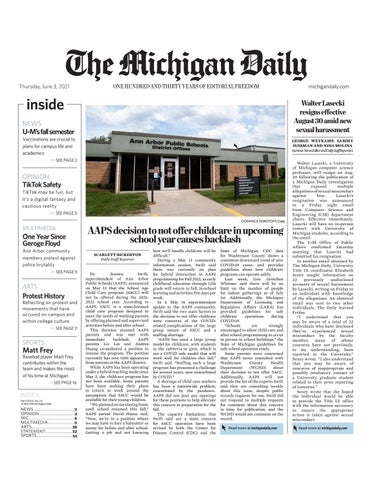
AAPS decision to not offer childcare in upcoming school year causes backlash SCARLETT BICKERTON Daily Staff Reporter
Dr. Jeanice Swift, superintendent of Ann Arbor Public Schools (AAPS), announced on May 13 that the School Age Child Care program (SACC) will not be offered during the 20212022 school year. According to AAPS, SACC is a state-licensed child care program designed to meet the needs of working parents by offering planned and supervised activities before and after school . This decision stunned AAPS parents and was met with immediate backlash. AAPS parents Liz Lin and Andrea Huang co-authored a petition to resume the program. The petition currently has over 1100 signatures from parents in the AAPS district. While AAPS has been operating under a hybrid teaching mode since May 3, the childcare program has not been available. Some parents have been making their plans to return to work around the assumption that SACC would be available for their young children. “We planned on me staying home until school resumed this fall,” AAPS parent David Hanss said. “Now, we’re in a position where we may have to hire a babysitter or nanny for before and after school. Getting a job and not knowing
how we’ll handle childcare will be difficult.” During a May 13 community information session, Swift said there was currently no plan for hybrid instruction in AAPS programming for Fall 2021, as early childhood education through 12th grade will return to full, in-school learning and activities five days per week. In a May 14 superintendent update to the AAPS community, Swift said the two main factors in the decision to not offer childcare were concerns of the COVIDrelated complications of the large group nature of SACC and a staffing shortage. “AAPS has used a large group model for childcare, with students in the cafeteria or gym, which is not a COVID safe model that will work well for children this fall,” Swift said. “Staffing such a large program has presented a challenge for several years, now exacerbated by COVID.” A shortage of child care workers has been a nationwide problem, exacerbated by the pandemic. AAPS did not post any openings for these positions to help alleviate this concern in preparation for the fall. The capacity limitations that Swift said are a main concern for SACC operation have been revised by both the Center for Disease Control (CDC) and the
2 NEWS
Thursday, June 3, 2021 The Michigan Daily — michigandaily.com
Vaccines are here. Here’s what you need to know about U-M’s fall semester
Ann Arbor Art Fair Back on After Cancellation CHRISTIAN JULIANO
Summer Managing News Editor
Design by Maggie Wiebe
JUSTIN O’BEIRNE Daily Staff Reporter
The University of Michigan is planning to hold a fall semester mostly featuring a return to normalcy, including in-person instruction for small and medium size classes, on-campus housing and large crowds at sports games. This is largely due to the state of Michigan’s and the University’s progress in COVID-19 vaccinations. In a previous interview with The Michigan Daily, University President Mark Schlissel said vaccinations against COVID-19 are crucial to the University’s plans to open in the fall. “The greater fraction of people who are vaccinated, the more likely we are to have a semester in the fall that feels as close to normal as possible,” Schlissel said. “The best case scenario is that 95 or 98% of students and an overwhelming majority of faculty and staff are vaccinated.” Vaccination Updates Everybody over the age of 12 in Michigan is currently eligible to get vaccinated. At the time of publication, 58.1% of eligible Michigan residents have received at least one shot of a COVID-19 vaccine. Washtenaw County has one of the highest rates of COVID-19 vaccination in Michigan, with 62.4% of those eligible receiving at least one shot of a COVID-19 vaccine. Anybody 12 years or older can receive a COVID-19 vaccine at Michigan Medicine. The University urges vaccinated students to
report their vaccination status to Wolverine Access. This information will be used to inform plans for the fall semester and will allow students to opt out of regular COVID-19 testing in the fall. LSA sophomore Ava Ben-David was impressed with how easy it is to access COVID-19 vaccines in Ann Arbor. “(I) think that vaccinations are very accessible, and that people are getting them,” Ben-David said. “Every single one of my friends is vaccinated, and I don’t really know anyone that isn’t vaccinated.” In an email to The Daily, University spokesperson Kim Broekhuizen said the University expects many students to get a COVID-19 vaccine without making it mandatory. “We remain confident that … we will have a sufficiently high percentage of our community vaccinated,” Broekhuizen wrote. “Encouragement may be more effective than a mandate to achieve the goal of maximizing vaccinations against COVID-19 in the months ahead. Any student who is in need of vaccination will have the opportunity to be vaccinated when they arrive in Ann Arbor.” Some faculty have grown frustrated with the lack of a vaccine mandate for students living on campus and attending classes during the upcoming fall semester. In early May, over 700 instructors signed on to a petition calling for a vaccine mandate. In the event that the administration refused to institute a mandate, the faculty members requested that instructors
The Ann Arbor Art Fair will be held after all this July, leaders of all three Ann Arbor Art Fairs (Ann Arbor Original Art Fair, The State Street Art Fair and the Summer Art Fair) announced in a joint statement released on Thursday. The move comes after the Art Fair was initially canceled on May 12 due to COVID-19 safety concerns and protocols limiting outdoor gatherings. In the statement, Art Fair Leaders wrote that Gov. Gretchen Whitmer’s May 20 announcement that all outdoor gathering restrictions would expire on June 1 paved the way for the Ann Arbor Art Fair to return in full swing. “In light of the recent announcement lifting the
uncomfortable with teaching unvaccinated students be able to opt out of in person instruction. Studnts who are not vaccinated against COVID-19 will be required to undergo weekly COVID-19 testing. However, as of May 20, Broekhuizen said the University has verified more than 13,300 vaccinated students. In December 2020, shortly after the first Emergency Use Authorization of a COVID-19 vaccine in the United States, Michigan Medicine released the “Blue Queue Questionnaire.” All U-M and Michigan Medicine students, faculty, staff and employees were encouraged to fill out the Questionnaire. The Questionnaire asked participants about certain criteria, such as age and occupation, as well as interest level in getting a COVID-19 vaccine. Participants were emailed when they became eligible for a vaccine. On Tuesday, May 18, the Blue Queue sent an email writing that everybody who demonstrated interest in receiving a COVID-19 vaccine through the Blue Queue have been officially told that they are eligible for vaccination. “We have at this point been able to clear the ‘Queue,’” the email said. “All U-M Personnel who completed the Blue Queue questionnaire and indicated an interest in the COVID19 vaccine have been invited to schedule an appointment or received the vaccine elsewhere.”
restrictions on outdoor events, the Fair Directors met with city officials and the local health department and decided that a safe and successful event could be achieved after all,” the organizers wrote. Due to the late timing of the decision, the Art Fair has been condensed from four to three days — July 15, 16 and 17. Additionally, the fair will be instituting stronger safety measures and protocols, organizers said. “This year’s event will include more space between booths to allow for social distancing, masks will be encouraged and hand sanitizing stations will be throughout the fair,” the organizers wrote. “Fair staff will also continue working closely with the health department to ensure the safety of the artists, fairgoers, staff and everyone involved.” Residence Halls Residence halls are planning to open this fall at no more than 80% capacity. Students planning to live in on-campus housing are required to be vaccinated against COVID19 and need to report receiving the vaccine to Wolverine Access by 5 p.m. on July 16. The Michigan Housing website says any students unable to meet this deadline should contact MHousing. The University will accept any vaccines approved by the United States Food and Drug Administration (FDA), including the Pfizer-BioNTech, Moderna and Johnson & Johnson/Jannsen vaccines, or the World Health Organization (WHO), including the AstraZeneca (Covishield) and Sinopharm vaccines. The University said it will help students get a vaccine if they arrive on campus unvaccinated, which has been of particular concern for some international students who come from countries that have not received many doses of the vaccine. According to the MHousing website, limited exceptions to the vaccination requirement will be allowed. Students may apply for a vaccine waiver no later than July 16. Students who receive a vaccine waiver will be required to undergo regular COVID-19 testing to live on-campus. Read more at michigandaily.com
420 Maynard St. Ann Arbor, MI 48109-1327 www.michigandaily.com
CALDER LEWIS Editor in Chief eic@michigandaily.com
KATIE LYNGKLIP
Business Manager business@michigandaily.com
CONTACT INFORMATION News Tips Corrections Letters to the Editor News section Photo Department Arts Section Editorial Page Sports Section Advertising
tipline@michigandaily.com corrections@michigandaily.com tothedaily@michigandaily.com news@michigandaily.com photo@michigandaily.com arts@michigandaily.com opinion@michigandaily.com sports@michigandaily.com wmg-contact@umich.edu
EDITORIAL STAFF Madison Gagne Managing Editor mbgagne@umich.edu
Allison Engkvist Digital Managing Editor engkvist@umich.edu
Christian Juliano and Shannon Stocking Managing News Editors news@michigandaily.com
Josh Taubman and Max Wadley Managing Sports Editors sports@michigandaily.com
Rosa Sofia Kaminski and Julian Wray Managing Arts Editors arts@michigandaily.com
Becca Mahon and Dominick Sokotoff Managing Photo Editors photo@michigandaily.com
Sarah Chung and Allison Yih Managing Design Editors design@michigandaily.com
Ethan Patrick and Caroline Atkinson Managing Copy Editors copydesk@michigandaily.com
Eliya Imtiaz and Lola Yang Managing Michigan in Color Editors michiganincolor@michigandaily.com
Amelia Duffy and Zoe Storer Managing Social Media Editors socialmedia@michigandaily.com
Mary Rolfes Editorial Page Editor opinion@michigandaily.com
Margaret Rudnick Managing Video Editor video@michigandaily.com
Samantha Cole Managing Statement Editor statement@michigandaily.com
The Michigan Daily (ISSN 0745-967) is published Monday through Friday during the fall and winter terms by students at the University of Michigan. One copy is available free of charge to all readers. Additional copies may be picked up at the Daily’s office for $2 per issue. Subscriptions for September - April are $250, and year-long subscriptions are $275. University affiliates are subject to a reduced subscription rate. Subscriptions must be prepaid.
Thursday, June 3, 2021 The Michigan Daily — michigandaily.com
Ann Arbor Independent Community Police Oversight Commission talk George Floyd, accountability and optimism at monthly meeting Meaningful oversight means that
PAIGE HODDER AND TEAGAN when something happens to you, STEBBINS you feel safe going to the police Summer News Editor and Daily Staff Reporter
because you know the police are actually accountable to you.” Jackson then went on to discuss two projects the committee is involved in in the city: establishing a system of responders responsible for mental health crises, instead of police, and the creation of unarmed traffic enforcement. “It is only by taking officers out of situations that they’re not equipped to handle and holding those officers who abuse their authority accountable (that) we can create the conditions for real relationships between the community and the police,” Jackson said. Unarmed traffic enforcement has been made a priority in cities such as Berkeley, California, and the committee expressed a
their implicit bias and require training to help identify people who are having a mental health crisis and how to deescalate that,” Irwin said. Throughout the meeting, there was also much discussion of optimism and the role it plays or doesn’t play in activism. Commissioner and LSA sophomore Makiah Shipp said many negative police interactions have been harmfully normalized, but that people should be optimistic about the work that young activists are doing, on the University of Michigan campus especially. “When you think about maintaining optimism or grabbing a little bit if you’ve lost it all, I hope that you can do so for our generation,” Shipp said. Shipp also said serious work needs to be done in examining
On the one-year anniversary of the murder of George Floyd, the Ann Arbor Independent Police Oversight Commission (ICPOC) both reflected on the past of police violence in the nation and in the community and looked forward to the future of policing in Ann Arbor. A year ago, Minneapolis police officer Derek Chauvin knelt on George Floyd’s neck for nine minutes and 29 seconds while other officers watched Floyd die. In response to the murder and national outrage, protests in cities across the world took place in search of systemic change. Following the response, Chauvin was fired and more recently found guilty of second-degree murder, third-degree murder and seconddegree manslaughter. The meeting opened with a prayer from Pastor Mashod Evans from Ann Arbor’s Bethel AME Church, a historically Black community institution in the city. Evans called on the meeting attendees to remember the long historical legacy of the murder of Black people in the U.S. and to acknowledge how the fight to end this violence continues every day. “While we have lost a brother, a friend, in George Floyd and so many, that has spurred a DOMINICK SOKOTOFF/Daily movement for something greater, something newer, something The Ann Arbor Independent Community Police Oversight Commission held an outdoor forum in Liberty Square on the anniversary of George Floyd’s murder better,” Evans said. Wednesday afternoon. Dr. Lisa Jackson, chair of the commission, then opened the desire to follow their example. In the role that the U-M Division of public forum with a statement cities such as Denver, successful Public Safety and Security (DPSS) of reflection on Floyd’s murder changes have been made to send plays on campus. and also the numerous other health care workers instead of “(DPSS is) equally as important, incidents of violence committed police in response to mental health because those are the people that against Black people over the crises. are also interacting with students years. Jackson emphasized that State Sen. Jeff Irwin, D-Ann and regular people on campus,” for Ann Arbor to make substantive Arbor, spoke about a bipartisan Shipp said. “People will have progress, the community must package proposed in the State PTSD from police interaction and establish meaningful oversight. Senate that includes bills targeting nobody believes it.” “Meaningful oversight means accountability and transparency Former Ann Arbor City that the results of oversight in policing. If passed, the bills Councilmember Stephen actually change the way that would ban chokeholds and Kunselman talked about the policing is done in our city in a way no-knock warrants. Irwin’s bill importance of police in the that is just for all of its inhabitants, focuses on de-escalation and communities and how, even with workers and visitors,” Jackson de-stigmatization of mental their flaws, the police’s role should said. “Meaningful oversight means illness. not go unappreciated. that when a policing mistake “I proposed this bill to include Read more at michigandaily.com is made it is not obfuscated. training to help officers recognize
NEWS 3
Schlissel’s “Go Blue Guarantee” survey question draws criticism from faculty, campus organizations JARED DOUGALL AND KATE WEILAND SummerNewsEditorandDailyStaffReporter
University of Michigan President Mark Schlissel is facing backlash from U-M faculty and campus organizations after portraying expanded tuition assistance for UM-Flint and UM-Dearborn students as a financial and academic burden on the UM-Ann Arbor campus. In a survey sent to over 4,000 faculty, Schlissel asked faculty to rate their agreement with the statement: “UM-Ann Arbor should provide funding for students at UM-Flint and UM-Dearborn to benefit from the Go Blue Guarantee even if it means sacrificing academic excellence or lower salary growth on the Ann Arbor campus.” Screenshots of the survey, which is part of Schlissel’s annual formal evaluation, were posted by faculty to Twitter Wednesday. Schlissel also asked faculty in the survey about their comfort level with in-person teaching and their satisfaction with progress on U-M diversity and inclusion efforts. The Go Blue Guarantee campaign, launched for the UM-Ann Arbor campus in 2018, offers free tuition for in-state families with collective incomes under $65,000. In the years since, representatives from U-M Flint and U-M Dearborn have worked to bring the program to their respective campuses to increase its outreach to students. UM-Ann Arbor campus community members have also called for the program to be extended to the satellite campuses. The phrasing of the Go Blue Guarantee question on the survey received backlash from faculty because of its implication that the University would have to sacrifice the quality of education and faculty in exchange for affordability for students, multiple faculty members told The Michigan Daily. The U-M Office of Public Affairs did not respond directly to a question of whether Schlissel believes extending the Go Blue Guarantee to UM-Flint and UM-Dearborn would “sacrifice
academic excellence” and “lower salary growth” at UM-Ann Arbor. In an interview with The Daily last month, Schlissel said the leadership of UM-Flint and UM-Dearborn were considering instituting the Go Blue Guarantee on their own. “If they decided to do a Go Blue Guarantee, they would take money away from somewhere else,” Schlissel said. “So they’re making the balancing act or values judgement about what is best needed on each of their campuses.” Schlissel said the Ann Arbor campus instituted the guarantee because it had very few students from the bottom 50% of the socioeconomic strata in the state of Michigan. “We wanted to invest in making sure that Michigan in Ann Arbor was accessible to people throughout the economic spectrum,” Schlissel said. 42% of UM-Dearborn and 39% of UM-Flint students qualify for the Pell Grant, a federal grant awarded to high-achieving students with financial need, who are not eligible to receive Go Blue Guarantee benefits as they are not enrolled on the Ann Arbor campus. 15% of UM-Ann Arbor students qualify for the Pell Grant. One University, a faculty- and student-led group that advocates for equitable funding across the University’s three campuses, released a statement condemning the wording of Schlissel’s survey and calling for an apology. The One University campaign said the survey “traffics in the most base classist and racist assumptions about our students;” “pits working-class students at Flint and Dearborn against faculty salaries at UM-Ann Arbor;” “threatens (faculty) with lower salaries if they support those (lower-income) students;” “implies that it is exclusively the priorities of the Ann Arbor campus that matter when formulating university policy;” and is “clearly designed to elicit a particular result, which happens to align with the policy preferences of the President.” Read more at michigandaily.com
4 OPINION
Thursday, June 3, 2021 The Michigan Daily — michigandaily.com
ALEXIS HANCZ | OPINION COLUMNIST
Edited and managed by students at the University of Michigan since 1890.
Prioritizing safety over expression on TikTok
420 Maynard St. Ann Arbor, MI 48109 tothedaily@michigandaily.com
MARY ROLFES
CALDER LEWIS
Editorial Page Editor
Editor in Chief
EDITORIAL BOARD MEMBERS Julian Barnard Zack Blumberg Brittany Bowman Elizabeth Cook
Brandon Cowit Jess D’Agostino Andrew Gerace Jessie Mitchell
Mary Rolfes Gabrijela Skoko Jack Tumoowsky Joel Weiner
Unsigned editorials reflect the official position of The Daily’s Editorial Board. All other signed articles and illustrations represent solely the views of their authors.
DANIELLE CANAN | OPINION COLUMNIST
The un-quantization of music courses at the ‘U’
M
usic is considered to be a universal communicator of human emotions. This can be seen in the ever-present K-pop craze, as English-speaking fans rock out to hits in a completely different language. If 10 people with 10 different native tongues were listening to Kool & The Gang sing “Celebrate good times, come on!” together, it wouldn’t matter that some might not fully understand the lyrics — the jovial brass and funk guitar communicate in the same way that the words do. Depending on cultural background and life experience, individuals are bound to glean a variety of emotional experiences from the same piece of music, but there is always emotion to be found nonetheless. The language of music truly knows no bounds — that is, until a prospective music student finds out they can’t fit the requirements to be admitted into a music program. That barrier is one I’ve given much thought to recently. My senior year of high school was the first time I thought of music composition as an actual possibility for a major, and I became incredibly excited at the idea. Some research about the University of Michigan’s program in October revealed that up to seven original works, scored and recorded, were required for the application due in December, plus a recording of the student playing their preferred instrument of focus. And if all that works out, you get the opportunity
to interview in the spring. I did not end up completing a portfolio in time. Today I sit in musical limbo, wanting to compose with my entire heart and then some, but unable to get in the door. It can be saddening to be barred from studying and developing something that feels so entwined with your existence. Unfortunately, this has been the majority of my music experience at the University. I have strong musical instincts and abilities in, apparently, all the wrong areas, like harmonizing, sight-reading and learning music by ear. I do play the violin, sing and read sheet music, but not to a high enough level that it will get me anywhere that I want to go here — including the music composition program. In the digital audio workstations like Logic Pro and Ableton that people use for music production, there’s a built-in tool for correcting any note or drum hit that doesn’t fall precisely on a beat. This is called quantization. Jacob Collier, a prolific musician and Grammywinning artist, is an advocate for un-quantizing music. In a January 2020 livestream, he mentions his desire to “get the grid out of people’s psychologies,” describing the result of quantizing as “something which is … grid-based, which is not human.” He goes on to say that “grids are not the same as humans. Humans are some of the least grid-based creatures … in the world, in the universe.” Collier
also briefly mentions how education accomplishes something eerily similar, keeping different subjects in neatly separate containers. It is not a new idea that the separation of subjects presents a skewed and frankly untrue view of how different knowledge bases operate and interact. Music is a culmination of science and math and art, and oftentimes philosophy. Yet it is still kept quantized, even at our university. I’d like to acknowledge the perspective I’m writing from, which is that of a student in LSA who doesn’t have a lot of technical skill on the violin and has taken only a year of classical singing lessons. I am very much someone on the outside looking in at what I haven’t gained access to. This whole column could be seen as fist-shaking at the musical doors that I haven’t worked as hard as others to enter. The audition process is completely understandable for performance majors, and I get why it’s the typical mode of admission for music programs everywhere. There are people in the world who lack rhythm, good pitch or both, and it would be nearly impossible to study certain aspects of music without these qualities, let alone prepare for years to have other people pay for your skills. Read more at michigandaily.com Danielle Canan is an Opinion Columnist and can be reached at dcanan@umich.edu.
Design by Jessica Chiu
T
ikTok’s explosion in popularity in recent years marks a new era in Generation Z-dominated internet culture, and the trend doesn’t seem to be slowing down. TikTok had amassed over 689 million active users as of January 2021, and over 60% of them were people under 30 — including many Gen Z kids creating comedy, fashion, dance and beauty videos. TikTok is known for its pageantry and trendiness, with young women and girls posting elaborate beauty transformations set to viral music and using flattering filters. Young women like Loren Grey and Charli D’Amelio are hugely responsible for many of TikTok’s trends as well as its popularity. And for a generation of young people that grew up on iPods and iPads, social media applications like TikTok are nothing new. Many image and video-focused social media applications like Instagram, Twitter and Snapchat carry much of the same content. However, TikTok’s interface has inspired staggering fashion and beauty trends often led by young women on the platform. One common video trend starts with a girl lip-syncing to music in a shabby outfit, looking moderately unkempt. The next moment — ideally at the drop of the beat — the girl transforms into a fashion fantasy, with wild clothing, hair and a pleased look on her face as she admires herself while dancing. Despite its fun, the internet has never — and likely will never — be a safe place for young girls looking to express themselves. While scrolling, I often see TikToks of girls dressed in vibrant, show-stopping looks with a caption poking fun at potential conservative Karens who would disapprove. These
bold young women echo feminist ideals of wearing whatever one wants, whether scantily-clad or conservatively dressed, no matter the opinions of society. I see their strong sense of identity and self-expression and feel happy that they’ve found a corner of the internet where they can confidently show off and unleash their creativity. At the same time, I feel an intuitive pull to warn them of their vulnerability. Young people who routinely post themselves on TikTok risk exposing themselves to being digitally consumed, and even approached, by adult predators. Children ages 12 to 15, who comprise a significant chunk of TikTok users, are especially at risk for internet sexual harassment. In recent years, TikTok has been accused of being a hub for pedophiles with little punishment for those who engage inappropriately with minors. Even more concerning, rates of femicide, sexual violence and harassment against women, both in-person and online, have been climbing since the start of the pandemic. This is part of an overall uptick in online harassment against women and girls. Participating in the fun of social media is a part of growing up in the digital age, and I wholeheartedly want to encourage the fun. And yet, the perspective of “I wear what I want, no matter the stares I get” is at odds with the notion that selfexpression, creativity and sensuality are not safe to display online. Read more at michigandaily.com
Alexis Hancz is an Opinion Columnist and can be reached at ahancz@umich.edu.
Thursday, June 3, 2021 The Michigan Daily — michigandaily.com
OPINION 5
TYLER WATT, ZACKARIAH FARAH, ERIK WILLIAMS AND RILEY LIST
Op-Ed: Why we need the Campus Conservation Corps
Ninety years ago, millions of young Americans embarked on a journey to revitalize a polluted and environmentally degraded nation. They were members of the Civilian Conservation Corps, a program created by former President Franklin Delano Roosevelt in 1933 to repair America’s natural beauty while also creating millions of jobs. The Civilian Conservation Corps planted over 3.5 billion trees nationwide, including nearly 500 million in Michigan alone. Despite the tremendous success of the Civilian Conservation Corps, funding for the program ran out in 1942, shortly after the start of World War II. As we walk through our campus today, the accomplishments of the Civilian Conservation Corps seem distant and nearly forgotten. The lack of an organized effort to maintain and protect our environment is abundantly clear. There is garbage in our streets, sidewalks and even the Diag — nearly everywhere. It’s some-
thing that we blind ourselves to at this point. Beyond its ugliness, we know that litter negatively impacts our environment and our health. Plastic waste can break down into tiny pieces called microplastics, which then permeate our soil and infiltrate our drinking water. From there, microplastics inevitably enter the bodies of all animals — including you and me! That means that you have plastic in you at this very moment. In fact, in several recent studies, Americans were found to have microplastics embedded in every major organ, and according to National Geographic, humans are consuming about 1,000 pieces of microplastic every week (the equivalent of eating an entire credit card) — and that’s not even counting the plastics we inhale. This shouldn’t come as a surprise. As you walk through campus, try counting how many pieces of plastic you come into contact with in a single day. Our food is wrapped in plastic, our clothes are made of plastic and there’s
flooding our city. However, the scope of the Student Government’s CCC extends far beyond our campus cleanup project. The CCC plans to protect our local environment by removing invasive species from nature preserves and planting native Michigan plants like carrots, blueberries and black-eyed Susans in community gardens. The CCC will also be partnering with the Ann Arbor City Council to take on many important conservation tasks in our city that often go neglected due to a lack of volunteers. We’re joined in these efforts by representatives from Central Student Government and Engineering Student Government as we bring together voices and minds from across the UniFILE PHOTO/Daily versity of Michigan to save and beautify our environment. plastic in the air we breathe. Some- ernment has created the Campus ConBut we can’t accomplish this work thing must be done to clean up our servation Corps, reviving the mission alone, and that’s why we are asking for campus. of the original Civilian Conservation your help. In response to the looming threat of Corps. Our initiative aims to organize Read more at michigandaily.com ecological disaster, LSA Student Gov- students to finally clean up the litter
MEERA KUMAR | OPINION COLUMNIST
We’ve changed. Now what?
Many people, including myself, define themselves differently after the past year. As things return to normal, I can only wonder how to move forward. A few months ago on TikTok, there was a trend where creators would lip-sync to an audio of Dr. Umar Johnson asking, “What happened to the original plot of the movie?” while adding text over their videos that described how their life trajectory changed entirely due to the pandemic. This trend was popular because it was relatable — different relationships, gender identities and sexual orientations, academic interests, living situations and much more revealed themselves to many over the course of the lockdown, seemingly out of left field. Defining oneself has always been essential. As humans, especially ones finding our place in the world, it feels integral to know our identities and how they fit into society. You need to have an elevator pitch about yourself because when an interviewer, a club application or a person at a party says, “Tell me about yourself!” you need something to say. In her speech, “Learning from the 60s,” Audre Lorde said, “if I didn’t define myself for myself, I would be crunched into
other people’s fantasies for me and eaten alive.” And so, many were — in attempts to own our narratives, we adopted labels and conventions that we didn’t stop to evaluate. However, when the pandemic happened and people were left without the constant policing of society, they began to redefine themselves on their own terms. Now, more than a year later, restrictions are loosening, and it’s almost time to return to regular social interaction. What now? I entered the University of Michigan at the beginning of August 2020, eager to major in environmental engineering. Now, I am decidedly not pursuing engineering for my undergraduate degree (not out of dislike for the department — after much reflection during the lockdown, I’ve found that my interests lie elsewhere). It’s daunting to float untethered, but it’s a step forward from lying to myself about what I’m interested in. My major was the easiest thing on the list to decide, and now, without one, I’ll show up to classes next year unsure of my interests or identity. But after seeing the alternative — convincing myself to follow something I’m not interested in — I’m thankful for the opportunity to question the rest of my
life. How we define ourselves has changed over the last year due to time spent away from those outside of our bubbles. However, when addressing the pandemic, it’s integral to remember that not all, or even most, change has been positive. Lockdown affected different groups unequally — many people have been altered by grief, loneliness and anxiety, and some much more than others. Not everyone was in a place where they could “find themselves” — many had to worry about simply surviving and keeping their families alive instead. To act as if this pandemic was ultimately a “learning experience” while brushing the traumatic experiences of millions under the rug would be elitist; being able to “discover yourself” is a privilege. The way powerful universities handled crises involving graduate students and underrepresented groups, such as students of color and low-income students, during the pandemic is something we must keep in mind as we move forward. With the scandals that many institutions have gone through in the past year alone, it feels odd to accept establishments as a part of one’s identity. Additionally, it was much easier to
AMBIKA TRIPATHI | OPINION CARTOONIST AND CAN BE REACHED AT AMBIKAT@UMICH.EDU.
define ourselves by the institutions we occupied when we interacted with them constantly. I’m sure that if a random person asked me, “Tell me about yourself,” during a regular year, I might mention the university which I attend, but since I live at home, and all of my classes have been online, the fact that I attend the University of Michigan barely crosses my mind. Since we’ve been so removed from personal connection, the idea of “school spirit” feels foreign. What will football games look like? Will people still be proud to sport maize and blue? To define themselves by the school they attend? The answers could swing to extremes. Many, feeling lonely, may be extremely eager to participate in school spirit and make up for lost time,
whereas others may feel alienated and therefore unwelcome by communities and events they would, in normal times, be familiar with. I have no clue what the next year brings, but I know it will be quite odd. After mask mandates for vaccinated people were lifted in Michigan and many classes are scheduled to be inperson in the fall, a return to “normalcy” may be approaching. It’s important that we remember what we discovered in isolation, and bring it with us. As we move into the unknown, we can only hope that we preserve the eagerness to find our true selves, as well as our irreverence for powerful institutions. Meera Kumar is an Opinion Columnist and can be reached at kmeera@umich.edu.
6 MICHIGAN IN COLOR
Thursday, June 3, 2021 The Michigan Daily — michigandaily.com
How Can I Extend an Olive Branch?
Design by Megan Young
MARIAM ODEH MiC Columnist
Palestine. The Holy Land. An ancient motherland, where every nook and cranny possesses a piece of sacred history. Home of the olive tree — a renowned symbol of peace and tranquility yet trampled in the face of oppression. A centuries old fruit bearer, ripped from its roots, as though it holds no weight, no meaning. I’ve been lucky enough to be allowed entry into my beautiful homeland four times before. I was very young the first time and didn’t know much, but I could see the guns and tanks everywhere we went and hear the innocent children as they screamed at soldiers to put them down. After crossing the Allenby bridge at the Jordanian border and waiting for over a day at military checkpoints in the occupied West Bank with nausea sweeping over me through the countless bumpy bus rides, we had finally arrived at my grandparents’ house in the small village of Kifl Haris. They immediately greeted me: my sitti with her warm embrace, and my sido lifting me up into the air while screams of joy escaped me, my fatigue superseded by the excitement of seeing my estranged family. When he finally put me down, the sound of a small kitten drew me near the back of the house. In an attempt to follow the soft purrs, I stumbled upon their colorful garden, pervaded by plants I did not know the names of. Treading through the greens with careful steps, the leaves of the fruits and flowers
brushed over the back of my hand, tickling me as though they longed for the presence of a child in their midst. Using one of the purple plastic chairs lying on the back deck, I stood to reach grape vines hanging above me and climbed trees to pluck sweet figs and bitter pomegranates. My arms overflowing with fruit and with a kitten in tow, I emerged 15 minutes later with the biggest smile plastered onto my face. Seeing how much I adored their garden, my grandparents were excited to introduce me to their eminent glory: their olive tree groves. After freshening up, we all piled into my grandpa’s ten-year-old Volkswagen that rattled at every turn. As we drove the short distance together, I was awestruck by the majestic mountains that crowned the landscape and the palm trees that lined the streets. Children played soccer with a makeshift ball while soldiers strapped with AK47s loomed in the background. As we approached our destination, I nearly jumped out of the moving car as I got a glimpse of what awaited me. The beautiful earthy green field was filled with olive trees standing tall, laden with olives and stretching beyond the corners of my eyes. Waving at me in the breeze, they begged me to climb up their strong limbs and pluck their olives gently. For the second time that day, I was completely blown away by the scene that surrounded me. As I ran towards the first tree I laid eyes on, standing on my tiptoes to reach the tall branches, my sido hauled me up on his shoulders. While I struggled to grab as many as I could, my sido grabbed
my wrist and set me back down. He explained why we don’t pick olives one by one — there are simply too many of them on each tree. Instead, with his instruction, we spread out a few white cloth sheets underneath the tree. As my sido beat the olive tree with his wooden cane, the sheet-covered ground beneath us quickly filled with black and green olives. While I sorted through the ripe black olives and put away the firm green ones that still had to be cured, the olives gleamed under the scorching sun. I suddenly wondered if my ancestors also experienced this feeling of inner peace at this very spot while they sorted through olives like me. While we worked, my sido told me stories about the history of the land: ancient prophets who roamed the lush fields centuries ago, the religious significance of the monotheistic faiths associated with the region and the Crusades that were fought not far from where we were standing. His face was overtaken with a childlike marvel when describing the spiritual aura surrounding the Al-Aqsa mosque and golden Dome of Rock, but the light in his eyes dimmed when he mentioned the Gaza Strip, which was still under complete siege. This meant that little kids like me had restricted access to clean water to wash their favorite shirts or take baths with their toys. They were forbidden from getting too close to the beach, even on a bright summer day. They were denied usage of electricity to watch TV as their family shared breakfast or stay up late to play computer games. They were
barred from traveling for vacations or leaving Gaza to visit family. They were strippedof the opportunity to grow up and attend college or carry dreams for their future. As I listened to my sido in silence, blood rushed to my head and tears welled up in my eyes. I gripped each olive harder, afraid that they would fall out of my trembling hands and smash on the ground. How could the world remain silent as children suffered under such brutal conditions? How could a land famous for its olive trees not know peace? The answer: settler-colonialism in all its glory. Settler-colonialism is a distinct form of colonialism that seeks to uproot and dispossess the Indigenous population of a desired land, replacing them with a new group of colonizing settlers, while ruling over the remaining Indigenous peoples through an imperialist authoritative structure. The state of Israel is, in fact, a settler-colony, and its Zionist ideology is rooted in the dispossession and ethnic cleansing of the Palestinian people. Israel’s propaganda machine, however, supervises and censors raw footage, presenting the world with a one-sided narrative while giving no room for Palestinian voices to be heard. It has painted a picture in which colonized Palestinians are the sole aggressors, leaving the poor colonizer Israel, the principal nuclear power in the Middle East, with no choice but to defend itself. Part of Israel’s dangerous rhetoric to depict itself as the victim is through an intentional conflation of anti-Zionism with antisemitism. This draws sympathy and unwavering
support for Israel from the Western world, rendering it nearly impossible to criticize Israel and its use of brute force against Palestinians without being labeled an antisemite. So, how then, can I tell my side of the story without being silenced? How can I appeal to a Western audience who is already dead set on the fact that I belong to a group of savage terrorists and convince them of my right to freely exist? Is the only way I have to tell my story through the lens of an innocent happy child spending time with her grandparents, picking fruits and olives? Must I always omit the gruesome details of settlercolonialism and the constant threat of dispossession in favor of descriptions of pretty scenery? Can I only garner support for my dignity by slipping in the subtleties of living under an excruciatingly violent military occupation with a smile on my face? Why is it expected that I accept the subjugation with my head low to avoid upsetting my oppressor and its supporters? How can I remain silent when an apartheid power is actively profiting off of the conquest of my land? How can I be asked to “understand both sides” when a colonizer still denies me access to the land my ancestors called home less than 73 years ago? How can I extend an olive branch to an oppressor who consistently denies my existence and tries to erase my story?
Thursday, June 3 2021 The Michigan Daily — michigandaily.com
MICHIGAN IN COLOR 7
Rekindling an Old Flame
Design by Madison Grosvenor
SMARANI KOMANDURI MiC Columnist
There we sat in her childhood bedroom. Except it was no longer purple like mine. In fact, it felt like her entire house changed. New pictures on the walls, new appliances in her kitchen. I felt like a stranger in the house I grew up going to every day. You never realize you start to drift away from someone you love until you reconnect and rekindle the old flame. This feeling hit me recently as I started seeing my best friend from my childhood more often this past week. We’d been best friends since fourth grade. Every day we would ring each other’s doorbells to ask if we could play outside, sleepover at each other’s houses every weekend, sit next to each other on the school bus every morning, go on walks together every day, gush over cute boys in our classes, paint each other’s nails, anything and everything you would think a pair of best friends would do. We’re going to be best friends forever. It felt like I had found my person. Imagine lighting a match and immediately seeing the flame appear, how bright that flame shines — that’s how the friendship felt. Bright and exciting. High school came around, and
suddenly we were no longer at each other’s houses every day. We weren’t texting each other everyday, playing outside, going on walks, talking about our crushes, painting each other’s nails. There wasn’t any of that anymore. We were still friends, don’t get me wrong, but the flame was starting to burn out right in front of us. Looking back, I never knew what triggered the flame to start dwindling. Some days I think to myself that maybe it was because we both got busy with school, applying to college, clubs and other extracurricular activities. Plus, she was a year older than me, so there was no way we’d even be in the same classes. Other days I think it was because we met new people. Again, both of us were in different grades and made friends in our own classes. We wanted to strengthen our relationships with other people since ours had always been solid. Not knowing, for me, is the worst part. Why did the flame start to die out? It’s almost impossible to pinpoint when and why exactly things started drifting apart. Then we both got to college. I moved to Ann Arbor, and she moved to Mount Pleasant. We rarely texted each other, rarely were home on the same weekends. She just turned into someone I followed on Instagram, someone who would slide up on my
Snapchat stories. The flame was on its last legs. Again, we both were college students living in different cities, and we needed time for our work and our extracurriculars. We also needed time to strengthen the relationships we were creating in our new homes. Still, I was hopeful the flame would persist. But the match completely burned out. The flame was dead. I kept telling myself that we were on good terms, we were just busy. I was making excuses to myself that everything was fine with our friendship when in reality we were turning into strangers right before our eyes. The reality of it didn’t hit me until all of a sudden she was in a relationship, and I found out through Instagram. Don’t get me wrong, I was happy for her, but I felt like that was something you would tell your friend in person instead of finding out by watching an Instagram story. I couldn’t be mad at her though because I caught myself doing the same thing. I started trying new things, meeting new people and immediately showed the world on social media. I didn’t text her anything about what was happening in my life and she didn’t text me anything about what was going on with her. We met new people, made new inside jokes with them, went on trips without each other and listened to different music.
We weren’t the ones in each other’s houses every weekend anymore. The flame stayed dead. The most contact we had with each other was via social media, just viewing each other’s pictures, stalking the new friends we’re tagging, occasionally sliding up on each other’s stories. It wasn’t until the pandemic hit that we started talking to each other again. Out of the blue, she invited me to spend the night at her house, just like old times. I was hesitant, of course. I didn’t know what to think of it. But we both had tested negative for COVID and were both free that weekend. Plus, we were still each other friends, albeit, or at least acquaintances. I decided to go, and immediately I felt out of place. Her house looked completely different, so unlike the home I spent every weekend at in fourth grade. But the night progressed, and I slowly started feeling comfortable again. The hours kept passing by, and we started opening up. We started with the shallow stuff: “I tried a new restaurant!” “I went to my first college football game!” And then it all vomited out of us. Everything we hadn’t told each other came spewing out of each of us. By the end of it all, we were in tears. She looked at me and said “Smarani, I thought you hated me.” I started sobbing even more. How could I hate you? If only you knew the
number of nights I’ve stayed up tossing and turning, wondering what went wrong, and why I couldn’t manage to keep the flame. The number of sleepless nights I’ve spent silently shedding tears because I missed my best friend. The only words I managed to get out were “I thought you hated me.” We embraced each other, our tears staining each other’s shirts. I was able to get a good night’s sleep that night. It’s impossible to relight a match that has been burned out. In the same way it’s impossible to ever go back to the stage of friendship we were once at. We had drifted so far apart that at this rate, who knows how long it would be until we were back. The fact that we’re getting older doesn’t help either. She’s getting ready to relocate for an internship. I’m working on my passion projects and taking classes over the summer. It’s a hard pill to swallow. But we’re both ready to try and take the baby steps necessary to get as close as we can to where we once were. Although we’ve grown up to be different now, we both want to go back to how it once was. Back to talking about our crushes again, taking trips together, sharing our music and going back to spending every weekend at each other’s houses.
8 MULTIMEDIA
Thursday, June 3, 2021 The Michigan Daily — michigandaily.com
Dearborn community holds candlelight vigil for Palestine BECCA MAHON
Summer Managing Photo Editor
A few hundred Dearborn residents came together outside of the Dearborn Police Department on Friday evening for a candlelight vigil to show their support and mourning for the people of Palestine. Organized by Dearborn resident and activist Laila Abunab-Elabed, the event called for peace and liberation in Palestine. As the crowd formed, children were invited to gather in front where they each received a paper sign to wear. The signs each read the name and age of a child killed by airstrikes in Palestine. A few dozen children ranging from toddlers to teenagers stood in front of the crowd quietly, with many turning to wave at parents and smile for pictures. “I have all of you guys behind me,” Abunab-Elabed said to the crowd as the group of children formed in front of her. “I have all of you guys behind this community and a community that is behind humanity.” Dearborn lawyer and poet Hassan Salamey stood with the children while he read a poem and prayer to the crowd. “In order for you to journey with me,” Salamey began, “I need you all to close your eyes, take four deep breaths.” As the crowd stood and listened with their eyes closed, Salamey spoke on the importance of unity and understanding between various faiths and backgrounds. His poem continued, “Tonight we stand as the unified children of Abraham, as the sons and daughters of Muhammad, Moses and Jesus.” He closed with a prayer in Arabic,
before leading the crowd in a moment of silence. Following Salamey’s reading, the children returned to their families as attendees helped each other light their candles one by one. Abunab-Elabed spoke once more as the candles were lit, emphasizing the importance of youth in the community. “Your children are going to be able to tell these stories,” AbunabElabed said, “You are instilling such a beautiful tradition into them. They are going to grow up and be even stronger, and then their children will be even stronger.” The crowd stood silently with their candles for several minutes, before beginning chants of “free, free Palestine!” and “end the occupation!”, led by Salamey’s young daughter. As the vigil wrapped up with closing words from Salamey and AbunabElabed, as organizers arranged small candles reading “Palestine” on the ground where the group of children had stood before. These candles were lit as the event wrapped up and continued to burn while attendees slowly dispersed.
Thursday, June 3 2021 The Michigan Daily — michigandaily.com
MULTIMEDIA 9
Community members march to remember George Floyd ISAAC MANGOLD
Daily Staff Photographer
One year after the murder of George Floyd, community members gathered in Ann Arbor to protest against police brutality and systemic racism Wednesday afternoon. Protesters marched down Washtenaw Avenue to the Washtenaw County Sheriff’s Office where they joined hands in solidarity and sang in memory of George Floyd and other victims of police brutality both nationally and locally. The protesters then took a knee at the Hogback Road intersection for 9 minutes and 29 seconds — the amount of time former Minneapolis police officer Derek Chauvin knelt on Floyd’s neck. Protesters were joined by Matthew Harshberger, the director of public safety In Pittsfield Charter Township, who took a knee in solidarity. Following the march was an open mic where members of the community shared their thoughts. Among those who spoke were organizer Machelle Pearson, activist Leslie Windless, and Washtenaw County prosecutor Eli Savit.
10 ARTS
Thursday, June 3, 2021 The Michigan Daily — michigandaily.com
“A Quiet Place Part II” struggles in comparison to its predecessor SABRIYA IMAMI Daily Arts Writer
After over a year-long break from movie theaters, I went to see “A Quiet Place Part II,” thoroughly expecting my first foray back into the theater to be an enjoyable experience. Unfortunately, “A Quiet Place Part II” disappointed. To be fair, I had high expectations. The first film was thrilling (even to someone like me who usually can’t handle scary movies and jump scares). Writer and director John Krasinski (“The Office”) had a lot of interesting reasons to make a sequel and I wanted more than anything to have my first back-in-the-theaters film blow my mind. But “A Quiet Place Part II” just seemed to be missing something —
and I’m pretty sure that missing piece was John Krasinski’s character, Lee. The film opened with a flashback from before the events of the first film, which captured my attention quickly. Having seen the first film and knowing all too well the importance of sound and silence, I was hyper-aware of every single noise I heard in the film — Lee’s footsteps, the rustling of a plastic bag, the hum of the news on a television, the sounds of an idyllic kids’ baseball game. I was enthralled by this scene that seemed to be the antithesis of “A Quiet Place”’s dark, muted tones and nearly complete silence. Too quickly, though, the film reverted back to where the end of the first film left off — with Lee’s family trekking through the woods in silence and trying to survive the attacks of the monsters (or aliens?) that were attracted to sound. In many ways, this film was too
similar to the first, making it feel like an unnecessary addition or extension of a film that ended on a pretty good note. On top of that, the characters were too unbelievable, making it easy to fall out of the film’s world. Evelyn (Emily Blunt, “Mary Poppins Returns”) is still a caring mother in an awful situation, trying to help her kids in the best way she can. However, she makes decisions that are completely out of character for a mother putting her children first. Her eldest son, Marcus (Noah Jupe, “Wonder”) is as timid as he was in the first film, but seemed to make worse decisions than he had in “A Quiet Place,” including leaving his baby sibling alone in order to explore his new ‘home.’ Regan (Millicent Simmonds, “Wonderstruck”) struck out on her own to try to save her family (although it’s not made entirely clear how she planned to do that).
Simmonds’s performance, enhanced by her communication through sign language, is moving, just as it was in the original film, but her character’s flawed decision-making made it difficult to pay attention to anything else. Finally, the new addition to the “Quiet Place” cast, Emmett (Cillian Murphy, “Inception”) is perhaps the most confusing part of the film. Presumably present to fill John Krasinski’s character’s shoes, Emmett tries to help the struggling family survive. But his character’s inconsistencies are too difficult to ignore; he starts out willing to sacrifice the family for his own benefit and safety, and ends up being Regan’s greatest ally. The shift in character comes too quickly and thus feels unrealistic and unbelievable. Murphy’s performance as Emmet is good — commendable,
even — but the role was written in a way that made it difficult for the audience to garner any sympathy for him or see him as anything more than a poor man’s substitute for Krasinski’s heartfelt performance as Lee. If you enjoy the suspense and jump scares that a film like “A Quiet Place” offers, you’ll probably enjoy the sequel whilst watching it. But the second the credits start rolling and you start actually thinking about what you just watched, it all falls to pieces. In all honesty, this film didn’t need to be made. Perhaps the anticipation that the film’s various release dates created made people’s expectations even higher, ensuring that any version of “A Quiet Place Part II” would fall flat, but I can’t help but think that with the way the first film ended, any attempt to continue the storyline and expand the universe would end on a sour note.
Album Review: Bruiser Brigade - TV62 NORA LEWIS
Daily Arts Writer
Detroit-based rap group Bruiser Brigade are virtuosos of immersive hip-hop. Led by rapper Danny Brown since 2012, the collective weaves the narratives of what may appear to be disparate musical talents into a thoroughly enjoyable listening experience. On their sophomore album, TV62, released earlier this month on Bandcamp, the group continues to flex their knack for storytelling. The 16-track amalgamation of Detroit hip-hop veterans and rising stars alike teems with humor and biting tales of hard-edged upbringings and life experiences. Following their first unofficial album, Reign Supreme, streamed in 2018 exclusively on the gaming platform Twitch, TV62 welcomes back old talents from its previous project like Danny Brown, Fat Ray and ZelooperZ, while opening the door to newer features like J.U.S and Bruiser Wolf. Unlike Reign Supreme, which incorporated Brown’s iconic animated flow on almost every song, Bruiser Brigade’s latest album takes on a more evenhanded distribution of airtime. Yet the group’s dedication to painting vivid portraits of Detroit street life and the city’s storied cultural richness remains unchanged. In its opening clip, TV62 begins with an audio snippet from a
WGPR-TV announcement, the first Black-owned TV station in the United States, based in Detroit and serving as the inspiration for the project’s title. The following track, “The Dopest in the Building,” follows Bruiser Wolf and his trials with drugs and poverty. Wolf’s delivery may be cartoonish, but his subject matter is anything but. He details the cyclic nature of drug dealing and addiction with a sunny timbre, quipping, “Product of my environment / Victim of circumstance / Supply it if you buy it, from bricks to grams.” Although arguably the most vocally similar to Brown, Wolf etches out his own path of unorthodox delivery nonetheless. Wolf brings his sharp wit to the table as well, supplying some of the funnier lines on the album. On the track “Your Gone,” he references a sinister yet memorable Michigan news story from last year, rapping, “plottin’on a white girl like them guys that tried to kidnap Whitmer.” Wolf’s dark repartee and balanced staccato mannerisms separate him from his peers, further reinforcing Bruiser Brigade’s ability to shine light on its individual talents without sacrificing the connectedness of the wider project. Fat Ray, a seasoned professional in Detroit’s underground rap scene, delivers his own distinctive flow on tracks like “Superhero” and “Juice.” With a more straightforward
delivery, Ray’s smooth babble mirrors the classic narrative-heavy nature of ‘90s hip-hop, a contrast that works surprisingly well with the more experimental idiosyncrasies of Brown and ZelooperZ. On the tracks “Dylon,” “Welfare” and “The Ends,” Danny Brown reminds the listener of his ability to deliver masterfully weird and often crude commentary. The entire project drips with Brown’s avant garde instrumentation style, with clear parallels to his sixth and most recent solo release, uknowhatimsayin¿. Perhaps one of these moments unique to Brown on the album is the final track, “The Ends,” which can only be explained as Renaissance Faire meets sleek hip-hop funk — who knew a flute could go so hard? Brown collects an executive production credit on TV62, and there’s no doubt that his influence seeps into the project’s sonic developments as well as the establishment of the Brigade’s physical body of members. Yet Brown is not the singular voice shining on the album, making it clear to the listener that Bruiser Brigade is very much a collective effort. Intermittent clips of laughter and lively conversation among Brigade members throughout the project only adds to the obvious chemistry between the artists. It’s as if the listeners have been welcomed into
Album cover from Bandcamp page
the studio themselves, the mic traveling around in a circle to catch energetic freestyles and raunchy jokes alike. Afterall, a group that could think of the line, “All my rules scientific, bitch feed me Fig Newtons,” has to have some kind of wildly entertaining brainstorm sessions going on behind the scenes. TV62 is personal and carefree rapping at its finest. Yet even with its easy-going undercurrent, it remains a disarmingly witty and technically
polished project. With the establishment of Bruiser Brigade Records earlier this year, members like J.U.S, Bruiser Wolf and Fat Ray have released critically successful solo projects alongside their work with the Brigade. It’s apparent that Bruiser Brigade represents a new chapter not only in the musical endeavors of its members, but in the wider bounds of a hip-hop world seeking autonomy and untethered creativity.
Thursday, June 3, 2021 The Michigan Daily — michigandaily.com
ARTS 11
Preserving Humanity on Campus ZOHA KHAN
Daily Arts Writer
Last weekend, almost three thousand protestors mobilized in Ann Arbor to rally for the Palestinian people and shed light on this terrible humanitarian crisis. The consequence of highly controversial issues is that the humanity of the victims of injustice is ignored. Their worth is stripped down by the dehumanizing and apathetic debates we are surrounded by. For this reason, seeing protestors on the Michigan campus brought me a surge of hope. At my college, on my campus, in my community, we were able to preserve the humanity of a people that has been silenced, and consequently, we are able to hope for a brighter future. To see thousands
of people mobilize in Ann Arbor brings me hope, and I can only pray it brings solace to the Palestinians who are suffering right now. In an increasingly connected world, we bear witness to millions of atrocities and humanitarian crises all over the world. From our backyard to halfway across the world, there is widespread inequality and injustice. It’s easy to get lost in politics and ignore what doesn’t directly concern us. But in doing so, we invalidate the struggle of a whole group of people and diminish their worth. In a world with almost 8 billion people, come 8 billion reasons to hope for justice, peace, and equality. Global humanity needs to be preserved. We need to empathize with the victims of injustice and hold the people in power accountable. It has become abundantly
clear to me that the University of Michigan campus is a core location for movements to mobilize and organize. It is on this campus that people protest, strike, and demand accountability from the people in power. It is on this campus where we can, and should, preserve humanity. It is among the thousands of students where conversations are started and where empathy is fostered. This year, my bedroom has been my classroom — my college has been a desk in the corner, a laptop, my niche habitat. It’s been difficult to imagine myself as a part of a wider student community, as engaged in the different events on campus. Despite this, I was able to participate in important conversations, from the comfort of my bedroom. In the first few months of my freshman year, the graduate students (graduate
students employees organization) went on strike. I clearly remember each of my graduate student instructors actively discussing their position with us, what they were fighting for, and who they were doing it for: us, the student body. There were many ways in which I could participate remotely, such as attending “zoom strike meetings.” Although their demands were not met, I felt incredibly affirmed that there are people who care about the same things I do and are working to make the campus a more accepting place for all. We come to college for education; this includes what we can learn from activism, raising awareness, and starting important conversations. Protests, rallying, and mobilization is ingrained in college culture and crucial to preserving and
maintaining our humanity. The University of Michigan plays its fair part in these conversations and movements. This upcoming fall we will all (hopefully) be physically present, thus, directly interacting with each other. This begs the question: how will we continue to use our positions to support different movements, to rally and mobilize? In light of this, let’s make the conscious decision to choose benevolence over violence, to choose empathy over division. Let’s use our positions, big or small, to be openminded, learn what we can, and in the process, preserve our collective humanity.
The Value of the Visual Novel as Literature HARPER KLOTZ Daily Arts Writer
Humans have told stories since we invented language and art, but the history of storytelling has reached new heights in the last forty years thanks to a complex, marvelous technological invention: video games. Video games combine art, music, performance, science, and perhaps most important of all, writing. There is an endless list of video games that have been praised for their creative methods of storytelling, but one genre is at last rising in popularity and gaining respect in the gaming community: visual novels. Visual novels consist of text accompanied by character portraits and static backgrounds. There is minimal gameplay, usually only involving choosing dialogue which determines the direction of the branching storyline. Many visual novels also include point-and-click elements for exploring the setting of the game. It’s becoming increasingly common for visual novels to include minigames, like the bartending element of Sukeban Games’ “VA-11 HALL-A” or the real-time shooting sections of Kazutaka Kodaka’s Danganronpa series. Ultimately, what lies at the heart of the visual novel is the ability to not just read or
watch a narrative, but interact with it. I’ve been a fan of the genre since I first played “Phoenix Wright: Ace Attorney” on my Nintendo DS as a kid. I was a voracious reader who tore through stacks of books at my local library, but nothing held my attention as well as a game that allowed me to become a central part of the action. I was never the most skilled when it came to real-time action in games (and to this day
often used to separate “real” gamers from the rest of the pack. Similarly, simplicity is used as an insult against readers. In a class with my fellow English majors, I’m far less likely to gain respect by making comparisons to the Twilight series or “The Fault in Our Stars” than if I were to discuss “A Farewell to Arms” or “Moby Dick.” Some visual novels are written with the intent of not being taken seriously, such as the dating simulation “Hatoful Boyfriend”
Design by Yassmine El-Rewini
I’m still more puzzle and strategy oriented), but that’s what hooked me about this genre — it was accessible, but just as exciting as any book or video game. Complexity and skill level are
in which all romance options are pigeons. Others are just as sincere and contemplative as the novels I’ve been required to study. What makes a story worthy of the label “great literature?” If it’s the
level of complexity, then “To Kill a Mockingbird” would not be held in as high regard as “Finnegans Wake.” Complexity alone is not the measure of what is deemed literature; enjoyment and depth are equally important. By this logic, visual novels (due to their focus on text) should easily fit in this category. History shows us that as technology advances, the boundaries between mediums blur, as do the benchmarks of value. A prime example of this in recent memory is developer Vanillaware’s 2019 visual novel “13 Sentinels: Aegis Rim.” It was praised by the biggest outlets in gaming journalism and nominated for awards across the world for its exceptional non-linear storytelling. In fact, it was the only video game nominated for the 51st Seiun Awards, a long-running award for the best Japanese science fiction. If a game of this genre is deemed important enough to be nominated for an award typically only given to literature and films, should the genre not be taken more seriously as an art form? The genre’s history can be traced all the way back to the early 1980s, but until recently it has been considered very niche. Nintendo was one of the first big names to influence the genre with 1983’s “Portopia Serial Murder Case” on the Famicom console. They were also
the first to bring the genre into the mainstream with the Ace Attorney and Professor Layton series on the Nintendo DS. Though they continue to be developed more often by indie developers than large studios, visual novels now rank among the top selling games of the Nintendo Switch, Steam and Playstation stores. Elements of visual novels can also be found in many successful games today outside of the genre; the social aspects of “Fire Emblem: Three Houses” and “Persona 5” are some of the most enjoyable sections of the games, both of which have sold millions of copies. It’s encouraging to see visual novels on the rise as they are finally being appreciated as the thoughtful pieces of art that they are. It’s challenging enough to write something engaging, but add in animation, a soundtrack and interactivity and something singularly creative is born. Regardless of content, visual novels open the door for creators to craft a narrative without the limitations other forms possess. As the genre gains popularity with serious gamers and newcomers alike, it simply makes sense to consider this an exciting step in humanity’s constant search for the best way to share stories.
12 STATEMENT
Thursday, June 3, 2021 The Michigan Daily — michigandaily.com
“The COVID transition: Summer travel, social activities and masks BY ELIZABETH SCHRINER
Design by Erin Ruark
Over late night cups of tea during finals season, one of my housemates and I discussed our hopes and plans for the summer. She would be vacationing in Florida with her boyfriend and going on a trip home to Seattle. The talk of travel and social activities was exciting; however, there was a lingering uncertainty about just how “normal” life would be during the summer. When I described my hopes to be back in The Big House by next fall, my housemate admitted that she wasn’t sure when she would feel fully comfortable in crowds again, even though she is fully vaccinated. Less than one month later, new public health guidelines have equipped us with more knowledge on what this summer will look like and how to navigate travel and social activities. On May 13, the Centers for Disease Control and Prevention announced that in most cases, fully vaccinated people no longer need to practice social distancing or maskwearing. For U-M students, there is a clashing mix of excitement and apprehension surrounding the shift in guidelines, particularly concerning what it means for returning to a sense of normalcy in time for summer
vacation. I talked to several students to hear their thoughts surrounding travel and social activities this summer. Is there a hesitance to go back to things like concerts and parties, as my housemate expressed in our conversation nearly a month ago? Or are students ready to get back into the world with full force? I expected to hear a mixture of enthusiasm and hope for post-COVID life, but I was also prepared to encounter some concerns or anxiety about the transition. LSA senior Sophie Einbund described feeling immense excitement for her travel plans in the upcoming months, though she also expressed some uneasiness over the balance between having fun with being safe and responsible. “I don’t get too nervous when it comes to traveling, but I guess in terms of traveling during COVID-19, it is somewhat nerve-wracking even though I’m vaccinated,” Einbund said during our Zoom conversation. “It is frustrating to wear a mask and hope that other people are vaccinated as well.” In July, she plans on going to Miami with a friend, and in August her family
is flying to Hawaii. She mentioned that Florida will most likely be a vacation hotspot, but she is hoping she will be protected from COVID-19 after previously contracting the virus and more recently getting the vaccine. “I think I was pretty opposed to traveling when COVID started, but now that people … are vaccinated, or obviously more than prior stages when there were no vaccines, I definitely feel more comfortable traveling myself or for other people to travel,” Einbund said. Engineering junior Thomas Dokas also plans on traveling this summer. He will be visiting South Carolina with his family. “My entire family has been vaccinated, so we are mostly not concerned about it,” Dokas said. “But if any of us weren’t, then I think that would have become a big issue.” He and his family members are among the over 4 million Michiganders who have had at least the first dose of a COVID-19 vaccine. For Dokas, being vaccinated plays a huge role in terms of safety and comfort with traveling. “Personally, I’m not terribly concerned about (traveling) because I know how to keep myself safe from
that sort of thing,” Dokas said. “I’ve been doing it for over a year now, but it’ll be interesting to see how other people start to behave.” On the flip side, LSA freshman Maggie Sterling questioned the necessity of travel in general. While she will be traveling from Texas to Michigan when classes start in the fall, she has her reservations. “Personally, I’m not traveling for unnecessary reasons just because it still seems crazy, and planes have these enclosed spaces,” Sterling said. These feelings, she noted, account for her own actions and concerns and not her judgment of others. “I have known friends and family that have traveled during the pandemic with unnecessary travel, and I definitely found it hard for me to tell them not to because everyone makes the decisions that they feel (are) best for themselves,” Sterling said. As of right now, the CDC still requires face coverings for public transportation, including airplanes. Still, there could be some hesitance over such excursions. Dr. Jon Zelner, assistant professor of epidemiology at the University of Michigan School of Public Health,
talked to me about his recent experience traveling to New York. Dr. Zelner is vaccinated, but with two young children not yet able to get vaccinated, there was added risk to consider. “I drove up there by myself because I was not comfortable getting on a plane,” he said. “I would be fully masked, but the idea of sitting in an airplane with lots of people in close proximity, I just couldn’t handle it and it didn’t feel safe yet, even though this is one of these things where it’s probably just fine.” Dr. Zelner emphasized it could be a difficult transition for some people, one that may just take time. “Certainly a year and a half ago (safety measures) seemed like bizarre things to do, like to sit six feet apart and keep our mouths covered, or if you have somebody at your house and keep the windows open in the dead of winter … you know, all these things felt kind of apocalyptic,” Dr. Zelner continued. “And it’s nice to let them go, but I think they become such a habit that to just focus back on our lives can be hard to do.” Read more at michigandaily.com
Thursday, June 3, 2021 The Michigan Daily — michigandaily.com
A faith of my own
STATEMENT 13 BY EMILY BLUMBERG
Design by Katherine Lee
The pages of the frayed old children’s book peek out of my nightstand, begging to be read once again. Prepared for the overflow of emotions and tears that I know are on their way, I wipe my eyes, put on my glasses and open the little white drawer. Inscribed on the inside of the book — written in my grandpa’s curly, comforting cursive — is a short poem:
asshole (my words, not the book’s). She runs off into the sunset in her paper bag gown and scraggly tiara, joyful as can be. Elizabeth learns to fend for herself and realizes that she does not need a judgemental, snobby prince to keep her in line, for she is stronger than he will ever be. What makes her a princess is not the beautiful gown she wears and the massive castle she lives in, but her ability and drive to forge Dearest Emily, her own path. May the wind be at your back, I tuck the book back into its Let no grass grow under your feet, crevice in my crowded drawer and Spread your wings and learn to fly, finally get out of bed. We have to Let your boundary be the sky. be at the temple in less than an Thoughts with love from Aunt Liz hour, and I am nowhere near ready. My mom struggles to zip up the My copy of the 1980 children’s dress I swore still fit me, and to my book “The Paper Bag Princess” is own embarrassment, my 12-yearonly one of many my grandparents old brother comes in to help her. sent out. In an effort to send Liz’s Once it finally zips shut, I can love to a generation she will never feel my chest being pushed back meet, my grandparents mailed out into itself. It is unclear whether or copies of this feminist-in-training not I will have the oxygen supply story to all of her friends as they to make it through a two-hour had children. The story itself service in this dress. One thing takes the classic fairytale and Liz and I do not happen to share flips it on its head: when Princess is our cup size. But it once fit her, Elizabeth’s husband-to-be Ronald so I insist it will fit me. I slip into is captured by a dragon, Elizabeth high heels that I cannot walk in outsmarts the dragon, rescues her and hobble out the door alongside fiance and then proceeds to dump my family. him because he’s honestly a real I have never had the privilege
of meeting my Aunt Liz myself. What little I know about her comes from teary anecdotes told by my grandparents and old photo albums I can barely stomach looking through. I know much more about the pain my family endures having lost a loved one at the tragically young age of 28. She was kind, and sensitive, and thoughtful, and much more. She went to Cornell and then Harvard to study public health in hopes of setting up children for healthier futures. She loved the outdoors and grew up skiing with her family. She saw right through all of the bullshit thrown at her growing up and instead focused on finding true friends. She cried to my grandparents about problems with her friends and feeling overwhelmed by the world in the same way that I do. She understood the importance of being authentic and in tune with her heart. She was a beautiful, inquisitive soul who had a simple love for exploring the world and all its wonders. And the world loved her back for as long as it could. The temple lobby is as antiqued and musty as ever. The dusty brown carpeting, the abstract art donated by half-hearted temple dues – all
of it is the same as whenever I had been here last. As we take our seats in the giant, stained glass-adorned synagogue, we grab prayer books filled with Hebrew that not even the Bar Mitzvah boy himself understands. Before they have the chance to take their socially distanced seats, my maternal grandparents come running towards me with love radiating from their teary eyes. They know I was planning on wearing her dress, but that doesn’t stop their emotions from overflowing all over their disposable masks. This dress had not even originally been owned by Liz; she found it at a thrift store (another hobby we share). A few years back, we were sorting through my grandparents’ closet when we stumbled upon this simple little flapper-esque dress. My grandma raved about how proud Liz was of this absolute steal of a Nicole Miller original dress. I had been waiting for the right occasion to wear it ever since. The service began with the booming voice of our rabbi as he welcomed my brother Ethan to the bema (stage) to begin the service. After months of memorizing
Hebrew, he would finally be symbolically indoctrinated into manhood! He worked hard, he sang everything flawlessly and, best of all, he got sent a lot of checks from old family friends he wouldn’t recognize. The beauty of the reform Jewish Bar Mitzvah. After he finished his Torah portion, Ethan returned to his seat and the rabbi took the lead once again. “As per the family’s request, we will now recite the Mourner’s Kaddish, in honor of Ethan’s Aunt Liz.” It was the uncontrollable kind of crying. The tears-silentlystreaming-down-your-facewithout-having-to-push-them-out kind of crying. The rememberingthe-baby-pictures-of-her, sittingnext-to-my-mom-and-wonderingwhat-could-have-been kind of crying. And it was hitting everyone. This was a wonderful day celebrating familial love and the ascendance into adulthood, yet it was clear that someone was still missing from the equation. And I was wearing that someone’s old dress. Read more at michigandaily.com
14 SPORTS
Thursday, June 3, 2021 The Michigan Daily — michigandaily.
Dickinson declares for NBA Draft while retaining eligibility JARED GREENSPAN Daily Sports Writer
Af ter an accolade-f illed freshman season, Hunter Dickinson is testing the NBA waters. Wednesday af ternoon, Dickinson announced that he will enter the NBA Draf t while sig ning with an NCA Acertif ied agent in order to retain his college elig ibilit y. “It has always been my dream to play in the NBA, so it is important for me to gather
the NBA Draf t, it would be a major loss for Michigan. With f if th-year senior center Austin Davis not taking an NCA A waiver to return for a sixth season, the Wolverines’ depth at center is limited to Dickinson and incoming freshman Moussa Diabate, who projects as more of a power forward. In that scenario, it’s likely that Michigan would need to search outside the prog ram for options. Dickinson will have until July 7th, ten days following
JULIA SCHACHINGER/Daily
information before making this decision,” Dickinson posted on Twitter. “I look forward to getting feedback and I am excited for the next steps of this process.” The 7-foot-1 Dickinson burst onto the scene as one of the nation’s premier centers, dominating the Big Ten as a freshman. He averaged 14.1 points, 7.4 rebounds and 1.4 blocks per game across 28 appearances, 23 of which were starts. He was named Second Team All-American, First Team All-Big Ten and captured Big Ten Freshman of the Week honors a whopping seven times. Dickinson becomes the second Michigan underclassmen to declare for the draf t, joining Franz Wag ner, who declared last month following his sophomore season. While Wag ner is a projected lotter y pick, Dickinson has not appeared in many mock draf ts. Should Dickinson stay in
the NBA Draf t Combine, to withdraw from the draf t. Dickinson proved to be a major factor in many of Michigan’s sig nature wins this season. He notched 11 points, 15 rebounds and 5 blocks in a road win over Wisconsin on Feb. 14 following a 23-day pause, scored 22 points against Ohio State in a top-f ive matchup on Feb. 21, and limited National Player of the Year frontrunner Luka Garza to a season low 16 points in a Feb. 25 win over Iowa. In the nation’s toughest conference, Dickinson never looked the part of a freshman for the Wolverines. Much of Dickinson’s success can be attributed to Michigan coach Juwan Howard. The t wo frequently work together on one-on-one f ilm sessions, and Howard’s past as a former big man at both the colleg iate and professional level have helped Dickinson. Read more at michigandaily.com
Paul Nasr: The NCAA failed Michigan, and softball as a whole PAUL NASR
Daily Sports Writer
Sleepless in Seattle. For the Michigan softball team, a long weekend in the Pacific Northwest turned even longer in the early hours of Monday morning. After dealing with 14 innings of NCAA Player of the Year finalist Gabbie Plain, Michigan was sent packing back to Ann Arbor. The double–header sweep abruptly ended the Wolverines’ promising season, yet they were denied the opportunity of a night’s stay in Seattle before heading back home. Instead, they had to endure a near-instant turnaround. At 4 A.M. PST, Michigan was at SeattleTacoma International Airport, checking in its large travel party for a 6 A.M. flight to Detroit. After already feeling wronged by being sent to the West Coast instead of hosting a regional, Michigan coach Carol Hutchins did not appreciate the travel schedule thrust upon her team. She took aim at the NCAA in a series of tweets from the airport. Having just completed her 37th season as the head softball coach at Michigan, the winningest coach in NCAA softball history is no stranger to the NCAA and the way it conducts its business. She does not shy away from calling the
organization out either. This past March, for instance, disparities between the men’s and women’s NCAA basketball tournaments were laid bare on social media. Hutchins and her team made their voices heard in the matter, directly criticizing the NCAA for its failures. Hutchins has become a titan in activism for equality in sports throughout her storied career. Her Title IX fight has been welldocumented, and tremendous strides have been made since Hutchins began coaching at Michigan in 1985. There is, however, a long way to go. Despite all the progress, there continue to be roadblocks. When a group of athletes lay it all on-theline in elimination softball, battling late into the night, a 6 A.M. crosscountry commercial flight early the next morning becomes one of those roadblocks. The Wolverines’ grievances with the NCAA earlier in the week were directed towards the organization’s disregard for their body of work on the softball diamond this season. They were sent west, forced to face an underseeded Washington team that they would eventually succumb to, and then sent home immediately afterward. “(The NCAA softball committee) disrespected our entire conference.”
Hutchins said after the selection show on May 16. “(They) absolutely did not do a very good job.” Hutchins believed the NCAA did not truly know the teams it was evaluating, an outcome she foreshadowed earlier that week. And her prophecy came true. The COVID pandemic caused major schedule changes in sports throughout the NCAA landscape. Cutting down on travel decreases the amount of out-of-conference games teams can play, and limits their abilities to show postseason NCAA committees how they stack up to the rest of the nation when seeding rolls around. This became less of an issue in sports like basketball. In basketball, the NCAA has been refining its NET rankings to aid committees in team evaluations over the last couple of seasons. With NET, teams are evaluated using a far more holistic approach, one that goes beyond simple strength of schedule via opponents’ records alone. NET uses multifaceted analytics to provide greater-accuracy evaluations of teams, giving teams that opted for more-local schedules due to the pandemic a fair-shake in tournament seeding. That type of high-level, complex data was unavailable for those Read more at michigandaily.com
MADDIE HINKLEY/Daily The NCAA not only failed Michigan, but the sport of softball.
SPORTS 15 When Michigan’s biggest strength became its Achilles’ heel Thursday, June 3, 2021 The Michigan Daily — michigandaily.com
SPENCER RAINES Daily Sports Writer
SEATTLE — All year, there were two people Michigan could count on. Pitchers Alex Storako and Meghan Beaubien. One was the Big Ten pitcher of the year, and the other, a senior who came into the weekend ranked 12th in the country with her ERA of 1.08. No other team in the field of 64 in the NCAA softball tournament had a pair of pitchers better. And with a superb outfield behind them, it was easy to see why the Wolverines posed a threat to any team that came across them. At least on paper that is. In the biggest game of Michigan’s season, where it was just one win away from its first super regional since 2016, its two aces combined to give up 13 hits and ten runs — season highs in both categories. To name a few more of the absurd hitting stats Washington
compiled against two of the best pitchers in the nation. The Huskies batted 0.419, they hit three for five with the bases loaded and batted over 0.400 with runners in scoring position. Numbers the Wolverines simply haven’t given up all year, not even close. With the majority of that damage being done in just the bottom of the fourth, where Washington scored seven runs. An inning that truly showed Michigan what type of night it was, and the aces up its sleeve were gone. An inning that started off with a solo home run from Husky outfielder Jadelyn Allchin that cut into the Wolverines’ lead and sent Storako to the dugout. Just under three weeks after she threw 23 strikeouts in an eight inning game against Michigan State, a program record, Storako was benched. The pitcher, fresh off a no-hitter on Friday and a perfect game last Sunday, Beaubien, was brought on to try and patch up the wound and stop the bleeding. That did not happen. Instead, the Huskies smelled
blood and like a pack of wolves, they jumped on their prey, piling on six more runs and eating up every pitch Beaubien flung their way. By the time the inning was over, Washington’s entire lineup made it up to bat. And, the scoreboard read 10-5, Huskies. “I don’t know what to say,” Michigan coach Carol Hutchines said in a somber post game press conference. “They’re a strong, powerful team and they…,” Hutchins paused. “They were pretty formidable.” But there are, in fact, things to be said. One of which being that in the biggest game of the year, they were outdone by what gave them the edge all year. All year long Michigan lived by its pitching, but on Sunday night, it also died by it. Juxtapose that with their opponent, another team who lived and died by their star pitcher — Gabbie Plain — all year, and the difference is striking. Plain threw over 200 hundred pitches on the night — including her count from
MADELINE HINKLEY/Daily Michigan relied on its pitching all year. On Sunday night, it came back to bite them.
the first game of the doubleheader — and yet, she still came up big. After Plain gave up five runs in the first two innings, she only saw 15 batters over the final five innings, the minimum, and didn’t allow a single run. And that was the difference between the two sides. Strength
against strength, Washington overpowered the Wolverines, and ended their season. On a night where the Huskies were the better team. On a night where Plain was the better pitcher. On a night where Michigan’s biggest strength was its Achilles’ heel.
Bats go quiet, come up short against Nebraska SAM BERNARDI Daily Sports Writer
Trailing 5-1 in the top of the ninth inning, sophomore first baseman Jimmy Obertop launched a home run over the left-field wall. Obertop brought the Wolverines within two runs, leaving the door open for another comeback opportunity. Michigan went down swinging, a microcosm of their offensive struggles this past weekend at Nebraska. During their three games against the Cornhuskers, the Wolverines mustered a measly five runs. In the opening game on Friday, Michigan was stumped at the plate. Through the first four innings, they produced hardly any offense. Their lone baserunner came via a hit by pitch in the top of the fourth. In the fifth, however, the Wolverines appeared poised to break the scoreless tie. Sophomore infielder Ted Burton worked a walk and sophomore outfielder Tito Flores lined a single down the left-field line. With two men on and no outs, Michigan finally had a chance to score. Unfortunately for the Wolverines, the next three batters
were silenced. Michigan would have a few more chances with runners in scoring position, but they were unable to put anything on the scoreboard, falling 1-0. The lineup may have disappointed
against Nebraska, but that did not deter the team’s confidence. “What doesn’t show is the amount of barrels that we did put in play,” Flores said. “We understand that this is baseball, failure is going
to come. But when that hits, how can we overcome that adversity and keep competing.” During the first half of Saturday’s doubleheader, the Wolverines’s early struggles continued. Through
BECCA MAHON/Daily Michigan’s offense struggled against Nebraska.
three innings, they had done nothing. Then, they finally scored against the Cornhuskers thanks to a pair of walks, a passed ball, and a fielder’s choice RBI. Michigan would tack on another, but the story of game two was sophomore right-hander Cameron Weston. He more than made up for the quiet offensive performance, pitching seven scoreless innings. His excellence pushed his team over the hump and propelled them to an even series. Weston’s offense may not have given him much support, but like Flores, his mindset remains unchanged. “We were hitting balls hard, I don’t have any concern for it moving forward,” Weston said. “We feel prepared. We feel like we’ll play our best baseball, whenever the lights turn on. We’re pretty confident. Whatever happens, happens.” In the second half of the doubleheader, the Wolverines had an opportunity to erase their offensive shortcomings and steal the series. They did not come through. For the first eight innings of the game, they were shut out. Read more at michigandaily.com
16 SPORTS
Thursday, June 3, 2021 The Michigan Daily — michigandaily.com
JACK WHITTEN Daily Sports Writer
Inside the Michigan baseball program, it’s customary for a senior to make a short speech to his teammates before each series. Before the Wolverines’ seasonopening series against Iowa, fifthyear infielder Matt Frey took his turn. In the speech, he told his teammates that they won’t know when they’ve played their last game, so they should always play and act in a way that will leave them with no regrets when that time comes. Frey considered the topic to be a little ironic, because he was about to enter his fifth season of college baseball and will likely play a sixth. But he’s also an expert on the subject. In the fall of 2020, Frey was preparing for his best season yet. He had improved steadily and significantly during his four years at Davidson, progressing from a light-hitting bench piece as an underclassman to an everyday
Matt Frey: No regrets player as a junior to a five-tool standout as a senior, when he slashed .327/.507/.551 with five stolen bases in a shortened season. Then he used the spring and summer to get even better. “Over quarantine, I decided to try to swing the bat harder,” Frey said. “And then balls that I was hitting that were outs when I was not swinging as hard started to fall or go over the fence.” When the NCAA announced an extra year of eligibility for Division 1 baseball players in response to COVID-19, Frey committed to Michigan. Davidson coach Rucker Taylor played under Michigan coach Erik Bakich at Vanderbilt, and sung Bakich’s praises to Frey. “The culture that (Bakich) has built around here, the winning mentality that he’s built around here, the team performance, coupled with the academic side …. It was a no-brainer,” Frey said of his decision to commit to Michigan. When he arrived in Ann Arbor, Frey continued to improve with the help of Michigan’s coaching staff
and other program resources. He established himself as Michigan’s best hitter “by a landslide” during fall practices, according to Bakich, and was the frontrunner to be the team’s starting third baseman. Then disaster struck. Frey was fielding a bunt during the last official fall practice when his cleat got stuck in the turf, making him fall and twist his knee awkwardly. He was able to get up and walk, and didn’t think the injury was very severe. But an MRI taken shortly after revealed that he had torn his ACL, ruling Frey out for the entire 2021 season. Frey had played his last baseball of the near future. So when he told his teammates that they’ll never know when time’s up, he knew what he was talking about. Even though he can’t play, he’s found ways to contribute that are just as important. Frey has managed to become an indispensable part of Team 155 and has made the most of his time at Michigan. Becca Mahon/Daily. Buy this photo.
*** Michigan takes its pitching machine with it on road trips. The machine is big and awkwardly shaped, and it always makes a
their bags, furrow their brows as they try to make sense of the situation. Frey and his teammates find this hilarious. Little moments like that, he said,
BECCA MAHON/Daily An injury knocked Matt Frey out for the season. But he’s still found a way to be an important part of the team.
loud crashing noise when it exits the luggage chute for the baggage carousel at the airport. Other passengers, waiting for
are what he has enjoyed most about this season. Read more at michigandaily.com
Michigan’s offense falls short as Wolverines drop close-fought series to Nebraska STEEL HURLEY Daily Sports Writer
Pitching and defense. Those were the themes for both teams throughout the series as the Michigan baseball team (27-17 Big Ten) went 1-2 to close the regular season at Nebraska (31-12). In game one, redshirt sophomore left-hander Steven Hajjar took the hill for the Wolverines. Hajjar tossed a complete game, giving up just one run on four hits. Hajjar picked up five strikeouts in the contest, dominating for much of the game. “Steve was really good. He was throwing hard, he had all of his pitches working, he was using his change-up a lot,” Sophomore right-hander Cameron Weston said. He was using his changeup to get a lot of early outs and used our defense. He usually is a high strikeout guy but he was able to get early outs on Friday, which made him go deep into the game.” But the Michigan offense did not fare much better than
Nebraska’s. The Wolverines picked up four hits as well but were unable to push across a run and fell, 1-0. Sophomore outfielder Tito Flores led the way with two hits, but was thrown out trying to stretch a double into a triple, rendering graduate transfer catcher Griffin Mazur’s ensuing single useless. Sophomore outfielder Clark Elliott also reached twice in the game. In game two, the Wolverines picked up a win in another close-fought, low scoring affair. Weston was electric, allowing just four hits over seven scoreless innings. “(Hajjar and Weston) came to play,” Flores said. “You can see it in their eyes, they kept their composure. They just full-out played Michigan baseball, all the way, just competed all the way through and played for the eight letters across their chest.” The defense was on full display as well. Graduate transfer infielder Benjamin Sems made a spectacular spinning play in the first to record an out, while
graduate transfer infielder Christian Molfetta also made several nice plays. Meanwhile, the Huskers made several diving catches in the outfield
and the third baseman made several diving stops to rob the Wolverines of multiple hits in each of the three games. “I was just getting a lot of
strikes,” Weston said. “Getting a lot of ground balls and just letting my defense work for me.” Read more at michigandaily.com
KATE HUA/Daily Michigan couldn’t overcome a sluggish offense and dropped a series to Nebraska, 2-1.