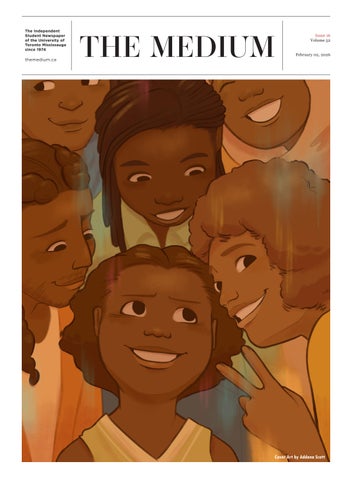
Volume 52 Issue 16

Page 1


Cover Art by Addana Scott

02 NEWS

Brand new Computational Linguistic Society hosts its first event

Students had the opportunity to hear from researchers on the area and participate in a workshop.

On January 28 from 2 p.m. to 4 p.m., the newly founded University of Toronto (U of T) Mississauga (UTM) Computational Linguistic Society (UTMCLS) hosted its inaugural event in MN 3280. The launch party included presentations from master and PhD students, a collaborative workshop, and breaks for the attendees to converse and enjoy free food.

From 2:10 p.m. until 3 p.m., panelists Liam McFadden, a former UTM undergraduate currently pursuing a masters in linguistics at U of T St. George, and Jai Aggarwal, currently pursuing a PhD in Computer Science at also St. George, presented their fields of research.

From aerial linguistics, language contact, speech perception and the correlation between borders and languages, to how cognition constrains the structure of language and how this same structure changes over time, the panelists explained in rich detail how they relate linguistics to computation. After each panel the attendees had the opportunity to ask McFadden and Aggarwal about their research experiences.

After the presentations, UTMCLS executives facilitated a workshop in which students worked together to solve a hypothetical problem. A cat was found in a box speaking the fictional language “Meowian” along with a buggy translator supposed to decipher what the cat was saying. The attendees’ task was to fix the code and translate the message.

Students paired up in groups to work together on the code, they also counted with the help of the event’s organizers who stayed ready to assist them during the whole activity. After solving what they called a “challenging task,” the attendees were able to fix the malfunctioning translator, discovering what the message said: “Eat cheese, cheese is the best food, a cat without cheese is very sad. Do you have cheese?”

At the end of the event, UTMCLS President Habbie Dem took a few minutes to speak to The Medium about the founding of her club. When questioned about the reason behind the club’s creation, she said, “Last year I kept thinking to

myself, ‘I want to make a club,’ and then this summer I happened to look up computational linguistics in the SOP [Student Organization Portal] list, and I found out that there’s already a club at St. George.”

Dem decided to bring this club to UTM as well, so she emailed a professor asking for guidance on creating the club. “So then we announced [it to] the class, and some of my classmates decided to join, and it all snowballed from there,” she said.

Dem also shared her satisfaction with the launch party’s outcome. “Yeah, it was really fun. I didn’t really know what to expect because this is the first event I’ve ever done, but yeah, I’m happy!”

Habbie affirmed that the club will be back with more events in the future. One of them is on February 5 at MN3180, a General Meeting where students will have the opportunity to vote on the club’s constitution that needs to be amended. For more information about the club and its future events, students can follow the @UTMCLS Instagram page.

MSA stands up to Islamophobia during Muslim Advocacy Week

Nearly a decade after the Quebec City mosque attack, UTM students reflect on the importance of remembrance and action against Islamophobia.

On January 29, the University of Toronto Mississauga (UTM) Muslim Student Association (MSA) joined the Green Square Campaign to honour the victims of the 2017 Quebec City mosque attack. During the National Council of Canadian Muslims Advocacy (NCCM) Week, which coincided with the National Day of Remembrance of the Quebec City Mosque Attack and Action Against

Islamophobia, students campaigned by wearing green felt squares as a sign of solidarity and remembrance.

On January 29, 2017, a gunman opened fire in a mosque in Quebec City, killing six worshippers and wounding 19 others. Nearly a decade later, the Muslim community in Canada continues to remember the victims, Ibrahima Barry, Mamadou Tanou Barry, Khaled Belkacemi, Abdelkrim Hassane, Azzedine Soufiane, and Aboubaker Thabti—renewing calls for remembrance, action and awareness against Islamophobia.

The MSA highlighted the need for remembrance with the green felt squares pinned to students’ and faculty’s clothing as a symbolic tribute to the victims of the attack. The Green Square Campaign was launched in 2020 by the NCCM.

The two-by-two green felt square is provided by NCCM, representing the green carpet inside the Quebec City mosque. Unfortunately, due to the January 26 snowstorm, delivery of the squares was delayed. The MSA worked around this issue by creating its own green felt squares.

From January 27 to 30, the MSA tabled on campus from 11 a.m. to 3 p.m. to encourage students to participate in discussions about Islamophobia, common misconceptions, and how it feels to be

Muslim in Canada and on campus.

The tabling included activities inviting students to answer on sticky notes, “What Does Islamophobia Mean to You?” Also on the table was an Islamic trivia game, free English-translated Qurans, and pamphlets highlighting common misconceptions about Islam.

Some of the students’ sticky notes read “ignorance towards the teachings of Islam,” “injustice and discrimination,” and “lack of understanding of others.” Pamphlets addressed basic questions about Islam, such as “Women’s rights in Islam,” “What does Islam say about terrorism,” and “Human rights in Islam.”

Islamophobia is not a new issue on the UTM campus. Last October, following a student commemoration for the victims of the genocide in Gaza, Minister of Energy and Mines Stephen Lecce publicly condemned the MSA, the UTM Students’ Union (UTMSU), and the Association of Palestinian Students.

In October 2025, Lecce called the groups a “hateful, antisemitic, and anti-democratic mob” that should be “condemned and banned from any campus,” on a post on X. The same month, MSA responded to the claims with an Instagram post stating that they had sent a legal letter to Lecce

Photo Credits: PSSA
Illustrated by April Roy
Photo Credits: Camille Dornellas

regarding his “defamatory and completely false” remarks. The MSA statement asserted, “To label an event rooted in remembrance and solidarity as violent rhetoric is to incite further hostility and Islamophobia.”

Open discussions among students on campus are important. Yusef Sehrai, a Da’wah Associate at the MSA, said in an interview with The Medium, “The role of the Da’wah team is to just spread awareness about Islam.” Students on campus can meet with Da’wah members to not only discuss questions about Islam but also to report instances of Islamophobia.

The MSA team invites students to ask more questions than just about religion. Sehrai said, “People share their experiences with Islamophobia; you

don’t have to be a Muslim to experience it, you can see other people experiencing it.”

Salaar Khan, a first-year Advocacy Associate member of MSA, told The Medium about the importance of Islamophobia advocacy week, even when some students are in support of Islamophobia.

Khan shared his experience with students scared to share their opinions or questions, concerned they would come off as Islamophobic. He emphasized the importance of open-mindedness during discussions, “If you do want to come and debate, you are more than welcome. If you want to have a respectful debate, then we’re here.”

The team reported receiving positive feedback

from both students and staff. Mohammad Mahi, the Advocacy Associate for MSA, stated, “The campus security [was] on board; they told us to drop by and give them the green felt square, [and] they would proudly wear them on Thursday.”

Mahi explained that the cause goes beyond student campaigning. “It’s not just one isolated effort, it’s a broad across Canada thing that we’re happy to help out a little bit.”

The MSA will be tabling from February 2 to 6 for Islam Awareness Week (IAW). Students are invited to come and discuss Islam or Islamophobia. Following the end of the week, the MSA will be hosting an IAW dinner for all students. More information on IAW will be posted on their Instagram @UTMMSA.

New POSts, residences, and student fees coming to UTM in the 2026-2027 academic year

The building includes shared kitchens, study spaces, and community areas. Cunha noted that the project is fully internally funded, meaning residence revenue will be reinvested into housing operations and student services.

The Campus Affairs and Academic Affairs Committees convened to approve new budgets and to discuss academic life at UTM.

Each month, administrators, staff, and student leaders at the University of Toronto (U of T) Mississauga (UTM) meet to discuss on-campus facilities, services, and academic opportunities for students. Most recently, the Campus Affairs Committee (CAC) met on January 26, and the Academic Affairs Committee (AAC) met on January 27 to discuss upcoming campus and academic changes for the 2026-2027 academic year.

CAC talk new residence building, ancillary budgets, enrollment, and multiple fee increases

Antonia Lo, director of budget, planning, and finance, presented financial forecasts for the current fiscal year. She said residence revenues are expected to be slightly lower than budgeted due to changes in compensation for dons and community assistants. Hospitality revenues are trending higher due to strong food sales and conference activity, though lower meal plan purchases and reduced film shoots have affected overall revenue.

Parking revenues are projected to exceed expectations because of higher permit sales and increased use of mobile payment options.

New residence building opening in September

Brian Cunha, director of Student Housing and Residence Life, said demand for on-campus housing remains high. He also stated that demand continues to exceed supply, citing a housing demand study from the fall that garnered more than 2,000 student respondents.

Cunha said a new residence building is scheduled to open in September this year, adding 400 beds to the campus and increasing UTM’s total residence capacity to approximately 2,000 beds.

He also outlined proposed residence rate changes for 2026-27, which vary by building. Some higher demand residences will see increases, while Schreiberwood undergraduate housing will see a 15 percent decrease. Student family housing rates will remain frozen.

Assistant Director of Hospitality Operations Megan Evans gave updates on hospitality and parking services. Evans said that despite higher revenues from retail food sales and catering, there are increasing costs related to technology upgrades and campus chargebacks associated with film shoots.

With the opening of the new residence building, hospitality services expect approximately 400 additional students to purchase meal plans. Required minimum meal plans are proposed to increase by 2.5 per cent, while optional larger meal plans would increase by 5.6 per cent.

For parking, Evans said revenues exceed the budget due to increased permit sales, particularly in the CCT garage. Proposed permit increases for next year range from 2.5 per cent to 3 per cent, with no changes to hourly or daily parking rates.

The committee approved the ancillary operating plans without opposition.

Registrar and Assistant Dean of Strategic Enrolment Engagement Renu Kanga Fonseca provided an update on undergraduate enrollment. UTM currently has 15,215 undergraduate students, with approximately 24 per cent identifying as international students. Fonseca said international enrollment has been affected by federal study permit changes announced in 2024.

Fonseca shared an early look at fall 2026 admissions data, showing that applications to UTM are up six per cent compared to the last year. International applications are up 14 per cent, and first-choice applications, students ranking UTM as their top Ontario university option, are up 12 per cent.

The admission average for Ontario high school students entering UTM in fall 2025 was 86.6 per cent. Fonseca added that approximately 70 per cent of students graduate within six years, noting ongoing efforts to improve academic advising and student support.

Interim Dean of Student Experience and Wellbeing Tim Fricker and Assistant Dean of Students and International Initiatives Chad Nuttal introduced student services operating plans. Proposed initiatives include expanding wellness programming, exploring online health appointment booking, completing repairs to the campus pool ventilation system, strengthening international student support, and maintaining funding for services such as the shuttle program and child care grants.

Samuel Kamalendran, chair of the Quality Services to Students (QSS) council, reported that QSS endorsed the health services fee and the student services bundle, but did not endorse the recreation, athletics, and wellness proposal. Samuel said several student members of QSS abstained due to concerns about student fees being used for capital infrastructure costs.

During the discussion, committee member Marc Laflamme questioned why students did not support the recreation proposal despite high service usage. Administrators responded that concerns focused on capital funding responsibilities, including necessary heating, ventilation, and cooling repairs in the pool area.

The committee approved the student services item with one opposed vote and

Nguyen Bao Han Tran Contribut0r
Laila Alkelani Associate News Editor
Photo Credits: April Roy

one abstention out of 34 total voters.

The committee also considered a fee proposal from the UTM Association of Graduate Students (UTMAGS).

Faisal Halabeya, UTMAGS president, said the proposed three per cent increase is intended to cover rising costs associated with the MiWay U-pass. The motion passed without opposition.

The next CAC meeting is scheduled for March 10 at 3:10 p.m.

AAC covers enrolment projections and outreach to prospective students

The AAC observed a presentation of the annual undergraduate enrolment data. The student body at UTM currently includes 15,215 undergraduates, 24 per cent of whom are international students.

Due to federal changes to international study permits in 2024, UTM fell short of its international targets but exceeded domestic targets. Overall, applications were up 6 per cent, with international applications up 14 per cent, though still below the 2023 levels.

The AAC also addressed the financial implications of decreased enrolment. Committee members noted that lower international enrolment could lead to a C$25-$50 million revenue loss.

Programs that are more structured and programs with higher deregulated fees tend to have higher graduation rates. This is likely because students in those

programs have clearer course paths and stronger incentives to graduate on time.

Finance Professor Andreas Park commented that it is disappointing to see so many secondary students consider other universities such as Laurier, Guelph, and McMaster instead of UTM, saying that “UTM is never in the conversation.” He expressed that this is especially displeasing as “ultimately, we are U of T quality without all of the U of T downsides… there is a lot we can do to promote ourselves better,” said Park.

UTM Principal Alexandra Gillespie responded by saying that UTM must differentiate itself from the university as a whole. “In order to make it clear that [students] should come to UTM, we have to be able to go out into the market and say ‘we’re UTM,’ not ‘we’re U of T’.”

New programs coming to UTM

The AAC presented and unanimously approved a new specialist in accounting and finance with the bachelor of business administration, with a tentative launch date of September 2026. The program, which is a response to student demand, will comprise existing courses and faculty.

The committee also approved a new minor in criminology, law, and society (CLS), which was also approved, designed to complement existing specialist and major CLS programs. This program was presented in response to students’ desire to pursue studies in criminology without committing to a CLS specialist or major. Students will be able to enrol in the new minor program starting in September 2026.

Urbanism Club and UTMSU conduct surveys to supplement their lobbying efforts for better public transit

The UTMSU and the Urbanism Club have completed surveys to assess student perspectives on transit.

In the fall of last year, the University of Toronto Mississauga (UTM) Students’ Union (UTMSU) and the UTM Urbanism Club each commissioned transit surveys to evaluate students’ public transit needs.

The surveys, announced on the UTMSU’s Instagram on October 3, 2025, and on UTM Urbanism’s on October 14, 2025, are meant to support advocacy efforts from a student perspective when lobbying for better transit options to serve the campus community.

UTMSU Vice President External Rajas Dhamija and UTM Urbanism President Unezila Jamal shared insights into their surveys in interviews with The Medium.

According to Dhamija, the UTMSU’s survey “lets the numbers speak for themselves,” yielding hard data that the union can present to MiWay in its lobbying efforts.

UTM Urbanism had similar goals with its surveys, with Jamal explaining that her club is using it to “demonstrate that there’s a demand for a particular service that might be missing” from transit service to campus. That way, advocacy for these identified problems could proceed, which the transit survey uncovered.

While the UTMSU utilizes one overall survey, UTM Urbanism has two surveys—one in the fall and one in the winter—to reveal whether seasonal factors have any impact on commuting habits.

Both UTM Urbanism and the UTMSU have previously used transit surveys to successfully lobby for better transit service, including the formation of MiWay’s Route 126 Burnhamthorpe Express from UTM to Kipling Terminal, as well as extending Route 110 University Express services into the weekend. According to Jamal, future campaigns would include digital signage at the UTM bus stop, allowing the 126 to run all day, addressing the problem of “ghost buses” especially in the winter months, and generally providing greater “connectivity and accessibility” for the commute to reduce student stress.

Surveys designed for maximum student engagement

The surveys, which were conducted separately this year due to scheduling conflicts, were designed for maximum student engagement, taking into account the usefulness, depth, and breadth of the data collected, while remaining concise enough to avoid excessive survey fatigue.

Jamal explained that Urbanism’s fall and winter surveys pose similar questions, allowing her club to “observe the trend.” Testimonies from students, as well as advice from MiWay, ensure the contents of both surveys are applicable to the typical student commuting experience. For Urbanism, this can arise from its Urbanism Lunches every week, where students can talk directly about transit with Urbanism execs.

Meanwhile, the UTMSU uses comprehensive datasets on commute times to and from campus, as shown in the transit document for last year’s Lobby Week, based on last year’s survey, to make the strongest case for its recommendations when supplemented with survey data.

In fact, according to Dhamija, student responses to this year’s survey reached a record high of over 500, allowing the advocacy process to begin much earlier in November. “[We took] the first 500 responses, turned them into quality data that can be used in a presentation… [so we can] go to MiWay and discuss it with them,” he explained.

The relationship between student representatives and MiWay has been very cordial, and both Jamal and Dhamija have noted that the transit agency has always communicated clearly about feasibility and mutual collaboration. Dhamija described relations with MiWay as an “all-time high,” while Jamal indicated that “MiWay is always willing to collaborate with us, and they’re always willing to listen to what’s going on” and be transparent about costs, timeframes, and limitations to any recommendations provided by the survey.

Although the UTMSU survey has closed, the Urbanism Club plans to release its winter survey next month regarding the winter commute.

Photo Credits: Melody Zhou
Diana Fu Community Correspondent
Photo Credits: April Roy

05 OPINION

Editorial The pursuit of freedom in the 21st century

In a world which seeks to dominate, our strength lies in the embrace of our individuality, our unique human potential, and our relentless evaluation of the norms which define our reality.

The institution of slavery has known no bounds historically or geographically. One only needs to explore the earliest recorded human civilizations for proof; from the Hammurabi Code of 1754 BC, to ancient Egypt, to Biblical narratives that produced some of the most influential narratives on slavery and freedom, like the emancipation of the Israelites by the hand of Moses.

At the most fundamental level, the intention to exert immoral control over another human being, in a way that deprives them of agency and free will, originates from an unrestricted rampage of “animus dominandi.” It is the desire for power, a realist term popularized by international relations theorist Hans Morgenthau, who regards the quality as the “root of conflict and concomitant evil.”

Just as the state is an extension of the individual, the same characteristic that leads states to gain and demonstrate power over others can reign in the individual, an ideal echoed by the Greek historian and general, Thucydides. In the Melian Dialogue, Thucydides wrote concerning the Athenians who were sieging the city of Melos and even the human projections encapsulated within the Greek pantheon: “Of the gods we believe and of men we know, that by a necessary law of their nature they rule wherever they can.”

Attempts to realize ambitions for domination, however, range in their realization, due to natural limitations, moral boundaries, or cultural norms—all of which can both constrain the depths of human evil or reinforce its proliferation. The latter route, unfortunately, reigned in gargantuan societies which were built on the corrupted pillar of slavery. Empires like Greece, Rome, and the colonial powers behind the transatlantic slave trade relied on millions of bodies to do everything, from serving their food, to building their monuments, to entertaining them with blood.

Slavery in the Modern Era

If there is truth to the claim that slavery and similar forms of human exploitation are inspired by a dark human nature—driven by lust for power and greed, a willingness to defy moral principles, and surroundings which will not prevent such practice but allow and even codify it—it is no surprise that such abuse continues until today.

According to Anti-Slavery International, 50 million individuals experience some form of modern slavery, which is defined as “when an individual is exploited by others, for personal or commercial gain. Whether tricked, coerced, or forced, they lose their freedom.”

The organization lists various types of modern slavery, including human trafficking, forced labour, debt bondage, descent-based slavery, child slavery, forced and early marriage, and domestic servitude. While the institutions and systems which underpinned slavery over the past centuries and millennia may differ, the core impact of slavery remains the same: to undermine

an individual’s agency.

Pseudo-Slavery

The foundation pertaining to the core ideal of slavery is what I will use to make the argument that we all are susceptible to such fetters. Obviously and undoubtedly, this pseudo-slavery I will explore is not comparable to the evil inflicted upon individuals in the past and present through legitimate slavery. However, if slavery is defined by its interference with self-determination, the 21st-century world—replete with the global interconnectedness brought about by the internet, economic interdependence, and technopolarities—is guilty of more than a few instances of wrongfully influencing human free-will.

While there may be various ways through which the external world influences individual choices and actions, the overarching theme I have selected to apply regards the notion of social customs, and how they calcify into chains which may bind and limit human potential.

This idea of customs and the following study originates directly from On Liberty, an essay written by the English philosopher John Stuart Mill, with aid from his wife Harriet Taylor Mill.

Mill, a proponent of utilitarianism—the philosophy that seeks to maximize the greatest good, happiness, and wellbeing for as many as possible, equally—was specifically interested in the limits of the power which can be legitimately exercised by society over the individual.

While historically the people feared unrestrained political authority, the rise of rights and democratic institutions diminished fears of tyranny, as democracy brought with it the ideal of self-governance, or at least, the domination of the majority. The issue lies in the fact that “the ‘people’ who exercise the power are not always the same people with those over whom it is exercised” and this majority “may desire to oppress a part of their number.”

This line of thinking, which can rightfully be applied to legislation and undermines the interests of minority demographics, props up discussion about another type of infringement which Mill is interested in: the tyranny of social norms which pressures individuals to conform at the risk of condemnation and suffering. Mill argues that this tyranny is even more threatening than that of the political because of how it is so finely intertwined with our daily lives through relentless definitions of what is socially acceptable.

It is here that the idea of pseudo-slavery takes root. While many of us may not face the infractions of truer forms of slavery, we are not always as free as we would like to believe.

Mill foregrounds his perception of norms by noting that we will always be subject to external power—specifically from the state—but that it is necessary to develop a standard of determining how and when such interference is acceptable. This idea echoes when Mill notes that decisions regarding how we live our lives are not made in a vacuum. Instead, our choices are the culmination of our surroundings: the “likings and dislikings of society.” In that sense, even the choices we may see as our own are not truly produced by our own will but instead represent multitudinous inspirations and pressures through our various sources of education and socialization.

EDITORIAL BOARD

Editor-in-Chief

Aya Yafaoui editor@themedium.ca

Managing Editor Samuel Kamalendran managing@themedium.ca

News

Aaron Calpito news@themedium.ca

Opinion

Yasmine Benabderrahmane opinion@themedium.ca

Features

Gisele Tang features@themedium.ca

A&E

Yusuf Larizza-Ali arts@themedium.ca

Sports

Tyler Medeiros

Photo

Melody Zhou photos@themedium.ca

Design

Sehajleen Wander design@themedium.ca

Social Media

Jannine Uy

Outreach

Mashiyat Ahmed

social@themedium.ca outreach@themedium.ca sports@themedium.ca

Copy

May Alsaigh may@themedium.ca

Anaam Khan anaam@themedium.ca

TO CONTRIBUTE & CONNECT: themedium.ca/contact @themediumUTM @themediumUTM @themessageUTM

Photo Credits: UTM Career Centre

that we will always be subject to external power— specifically from the state—but that it is necessary to develop a standard of determining how and when such interference is acceptable. This idea echoes when Mill notes that decisions regarding how we live our lives are not made in a vacuum. Instead, our choices are the culmination of our surroundings: the “likings and dislikings of society.” In that sense, even the choices we may see as our own are not truly produced by our own will but instead represent multitudinous inspirations and pressures through our various sources of education and socialization.

Besides this innate type of interference, a more practical way that we lose our agency is due to the bindings of the social tyranny Mill discusses Social customs, which dictate what is acceptable and what is not, force individuals to alter the ways they think, act, and ultimately, live, to avoid being punished for deviation. Unlike political tyranny, which possesses more official and tangible forms of retribution—like prison-time or corporal punishment—social tyranny punishes proportionate to the violation of a social ideal: to isolate and exclude individuals, forcing flight from the group as payment for violating the ideas that underpin the collective. Ultimately, these notions of what is right, and the pressure they apply, can bind individuals, preventing them from claiming true agency over their lives.

Freedom to Think and Speak

Mill particularly dwells on a specific, critical manifestation of agency: thought and speech. Both thoughts and their expression are treated as intrinsically linked; thoughts can only truly be examined and developed after they are conveyed through speech or writing. The right to engage in both at will is a freedom which Mill desires humanity to have, as he writes that even if just one individual has an opinion contrary to the rest of humanity, “mankind would be no more justified in silencing mankind,” if they were to try to restrain the one person.

Here, the argument against social customs which infringe on freedom merges with the freedom of thought and expression—a right which is often fought against, especially when backdropped by political tyranny. Moreover, this is where we can better understand why social customs must be pushed against.

ety can compare them to their own perceptions to judge their validity.

Secondly, Mill argues that value can be gained from erroneous ideas, as there may be kernels of truth even from unappealing views. Moreover, the process of evaluating these ideas is such that we can emerge with new ideas, which fortify our prior logic and bring about a “clearer perception and livelier impression of truth, produced by its collision with error.”

The third and fourth reasonings are closely intertwined and deal with the criteria for an opinion to be wholly true: our ideas stay alive when we constantly evaluate them through meaningful thought. Without challenges to the norm, such ideals can morph into customs we fear— a “dead dogma” which society follows not because they know and believe in its intrinsic value but because they have been trained to.

Real life examples to substantiate these claims originate from a myriad of individuals who proposed ideas which challenged contemporary norms—individuals like the Greek philosopher Socrates and Jesus Christ, both of whom were put

value of being open to new perspectives. Freedom to Act

Just as ideas should be kept free from binding, Mill extends the same right to actions. Just as the reality of human fallibility should prevent the enforcement of one way of thought, individuals should be free to experiment with other modes of life, allowing the collective to evaluate what is optimal living.

Again, this does not mean to imply that every way of life is correct—it does, however, take the utilitarian view that emphasizes human happiness, which requires self-determination, and societal progress.

Besides giving individuals full free-will, there is another, perhaps an even greater, reason for emphasizing individuality: the potential to develop our unique abilities and become “well-developed human beings.” Such agency is a weapon in the hands of humanity—a feature that makes us different from other living creatures and, at least as of now, machines. According to Mill, an individual who embraces individuality has “a character” while he who allows his life to be fully shaped by the world he experiences “has no need of any other faculty than the ape-like one of imitation.”

It should be noted at this time that Mill is not attacking customs, which are fundamentally connected to group identities and, tying in another philosophical perspective, would have bridged Rousseau’s state of nature with the emergence of the first human tribes, as discussed in Discourse on the Origin and Basis of Inequality Among Men. Nor is this an argument for anarchy, as Mill acknowledges that a valuable existence “depends on the enforcement of restraints upon the actions of other people.” Instead, Mill seeks to oppose social tyranny for the purpose of advocating for unadulterated freedom.

Moreover, this claim should be prefaced by stating that Mill is not claiming that all opinions are valid. However, he does argue that even invalid, repulsive ideas must be allowed to exist. To fortify this claim, Mill provides specific reasons as to why opinions which dissent from that of the majority should be permitted.

The first reason is premised on the fallibility of human nature and poses the possibility that the dissenting opinion is actually the correct one. Tying in the power of speech to test thought, it is imperative to allow such opinions to be voiced so soci-

to death because of the conflict their ideas had with societal norms. In this regard, Mill seeks to increase freedom of thought for the “eccentrics” of our time. Individuals who truly have a unique ability to inspire monumental change, and whose prodigiousness in a society is “proportional to the amount of genius, mental vigour, and moral courage” it contains. It is our responsibility to create a society that does not snuff out such flames but nurtures them so that they may consume and change the world as we know it for the better—a sharp contrast to the domination of one ideal where humans become like sheep, “lost in the crowd.”

A strong philosophy-based example of the importance of enabling the challenging of norms is found in A Vindication of the Rights of Woman: with Strictures on Political and Moral Subjects, an essay by the British philosopher and women’s rights advocate Mary Wollstonecraft. In the essay, Wollstonecraft highlights the lacking and haphazard education of women in eighteenth-century Europe, which emphasizes attractiveness, beauty, and charm for the purpose of marrying well, while failing to exalt virtue and reason.

What was then a proposition for equal access to high-quality education for both sexes is now practiced all around the world, showing how attitudes and norms can indeed change, underlining the

The argument goes that blindly following customs wastes the potential of our abilities to act independently, create, and alter our surroundings. Again, the idea of human development as the ultimate outcome appears as a pressing reason to embrace the mosaic, as an environment nurturing the application of human talent will often breed ideals— whether philosophical, religious, social, or technological—which optimally will offer better approaches to life.

The Embrace of Individuality Through Relentless Evaluation

On Liberty’s emphasis on individual freedom serves a critical purpose in regard to our discussion of modern pseudo-slavery. While we may not be bound with physical chains that restrict our movement or face threats of physical punishment, we are never completely separated from collective ideals of what is mainstream, which often impact our approaches to living, even if such norms may not be optimal.

The concern with social conformity does not just regard the most overarching ideals in a nation— ones which are birthed from history and blanket a region’s culture. They also include norms which develop in smaller groups: cultural pockets, religious settings, classrooms, and more today than ever, the unlimited spaces created on the internet and social media. These forums inject values into their groups, creating standards and norms by which their followers are judged and judge others.

Just as broader social customs can create moulds which limit human individuality, improper engagement with such groups can also lead to a pseudo-slavery, where individuals submit to ideas without properly evaluating them to ensure their truth.

In essence, to Mill, every way of life and thought is free to exist in our society. However, this does not mean we must embrace every way of life, but that we must critically evaluate every belief, regardless of its source or implied importance. Especially those which have been instilled in us by virtue of identity features we naturally come upon, like what country or family we were born into and

Photo Credits: Melody Zhou

what that means for us in terms of the values and cultures which become our realities.

Just as Mill’s emphasis on individuality opens the world to every approach to living, it also demands that we take full control of our own individuality, and fully express said individuality by freeing our agency from interferences created by the systems and norms that we consciously or sub-consciously submit ourselves to—placing us under a form of bondage that incapacitates our self-determination.

In this regard, the cliche which claims ignorance is bliss is far from wrong.

It’s easier to accept the beliefs we’ve lived with our whole lives without taking them out of the unspoiled packages they were gifted to us in and putting them through the dirty process of evaluation. It’s easier to submit to the norms that underpin the social circles we want to enter and belong in. It’s easier to not challenge the status quo, especially when we stand to benefit from such standards.

While all these choices may be the simpler options, they all translate into a form of mental slavery—ways through which we are prevented from fully realizing our human potential by freely giving ourselves to ways of living we have not tested nor understand.

Black liberation is an example for us all

Justice that waito become convenient is not justice at all.

The world loves the language of justice until justice becomes disruptive. We praise resistance once it is safely in the past, while refusing to recognize it in the present. Once its leaders can be quoted without discomfort and its demands no longer interrupt power, liberation becomes something to celebrate rather than confront. But when Black resistance insists on action in the present, when it disrupts comfort, challenges authority, or refuses politeness, it is quickly reframed as excessive, divisive, or inconvenient.

This contradiction is not accidental. Black liberation movements have shaped how resistance is organized across the globe, laying the groundwork for struggles against colonialism and authoritarian rule. Yet despite this legacy, Black resistance continues to be treated as a footnote in global advocacy; acknowledged intellectually but abandoned politically.

Black liberation is not undermined because it lacks clarity or moral grounding. It is undermined because dominant narratives recast Black resistance as disorder rather than justice, allowing the world to praise liberation in theory while refusing to defend it in practice.

Black freedom as a threat: the history

Black liberation movements have always understood a sobering truth: opEarly examples like the Haitian on a world stage.

communities in Haiti overthrew and founded the first Black republic, myth of imperial permanence. The reaction from the world’s powers was swift and punitive. Haiti’s independence was met with “great fear and rejection” by surrounding slaveholding nations, which sought to isolate the new republic and stifle

In 1825, under the threat of French warships, Haiti was forced to pay an indemnity of 150 million francs to former slaveholders—a crushing “independence debt” that took well over a century to pay off.

Fast forward to the 20th century, and Black liberation movements in America and Africa continued to unsettle the status quo. Black figures hailed as heroes today were once vilified in their time, now honoured in the name of racial justice. For example, the renowned Martin Luther King Jr. was deeply unpopular during his life: by

This process is not guaranteed to reverse everything you thought of as correct, since every custom and norm has or had some substance to it. But, it may very well alter some perceptions, or at least give you a new lens through which you can see the world. Even if you, after carefully examining your beliefs, come out with every approach intact, you will emerge different, with beliefs now not founded in routine, normalcy, or despondency, but made of life that echoes ideals worth dying for.

“Truth gains more even by the errors of one who, with due study and preparation, thinks for himself, than by the true opinions of those who only hold them because they do not suffer themselves to think.”

1966, 72% of Americans held an unfavorable view of him.

Likewise, activists like Malcolm X and organizations like the Black Panther Party were derided as dangerous radicals. We often forget that the civil rights movement praised now was widely seen as too “extreme” in its day. Black resistance frightened those in power not simply because of its message, but because it threatened to upend structures of racial and economic control.

Black resistance was unforgivable until its victories could be neatly folded into history textbooks.

Intersectional resistance: from Harlem to Hebron

Black liberation movements were never just about one people in one country. Black resistance sought to redefine resistance itself as a global, interconnected project.

Throughout the 20th century, Black activists built bridges with anti-colonial and freedom movements worldwide. Notably, the Black Panther Party was housed and found purpose in newly-independent Algeria, united under a common banner for liberation.

This solidarity was born of a recognition that systems of oppression—be it racism, colonialism, or apartheid—operate across borders and often in concert. Black liberation leaders saw common cause with people fighting colonial rule in Africa, Latin America, and Asia, and vice versa.

Nowhere is this kinship more enduring than in the relationship between Black liberation and Palestinian resistance. Pro-Palestinian and Black activists drew parallels not because the histories were identical, but because the structures of oppression felt familiar: military occupation, segregated spaces, surveillance, and the branding of resistors as “terrorists” or criminals.

In the 1960s, Black Panthers like Stokely Carmichael described Palestine as “the tip of Africa,” framing the Palestinian struggle as a natural extension of anticolonial fights in the Global South. Many African nations, having shed colonial shackles themselves, were quick to support the Palestinian cause; when Yasser Arafat declared an independent Palestinian state in 1988, “half of the countries that immediately recognized it were African or Caribbean.”

Nelson Mandela later distilled this bond in a famous pronouncement: “Our freedom will be incomplete without the freedom of the Palestinian people.” From Harlem to Hebron, oppressed communities have exchanged lessons and support.

Black activists and Palestinian activists have often spoken in the same language of liberation, reminding the world that state violence and resistance are globally connected. Solidarity, in this sense, is not merely emotional; it is analytical and practical.

When Black causes become a footnote

If Black resistance paved the way for so many other movements, why are Black causes pushed to the periphery? Today, even as social justice rhetoric has become mainstream, Black-led struggles are too often treated as an afterthought. Nowhere is this more evident than in the world’s response to African crises and Black struggles outside the spotlight.

Take Sudan. In 2019, massive protests in Sudan toppled a 30-year dictatorship, a breathtaking example of people-power. Yet Sudan’s ongoing pain—including the devastating war that erupted in 2023—has been largely relegated to “the world’s largest humanitarian crisis” that few talk about. As Sudanese writers have observed, Sudan has been reduced to a “mere footnote” in global activism, with performative mentions that signal virtue more than commit to action.

The pattern repeats across the African continent. In the Democratic Republic of Congo (DRC), conflict fueled by global greed for minerals has killed millions over decades, making it one of the deadliest wars since World War II. Yet this

Nguyen Bao Han Tran Contribut0r Illustration by Rojin Hajiabbasali

tragedy unfolds with minimal international outrage or coverage.

The head of the Norwegian Refugee Council recently blasted world leaders for the “level of global neglect” faced by civilians in eastern DRC, calling it a neglect so egregious it “should shame” those in power.

Dr. Denis Mukwege, the Congolese Nobel laureate, similarly urged western nations to drop their double standards, noting how the swift, forceful response to crises elsewhere is absent for African lives, leaving Africans communities feeling as though their suffering is “totally forgotten” by the world.

That is also the case within the United States—which is often vocal about democracy and rights abroad—Black resistance is met with discomfort when it challenges American complacency. The resurgence of open white supremacist and neofascist movements has been answered by Black-led movements like Black Lives Matter, which demand a true reckoning with racism.

Yet instead of universal support, these modern Black resistances face familiar accusations: too radical, too divisive, too “political.”

In 2020, as protests against police brutality swept the U.S., there were calls to pacify and marginalize the movement. US society and officials alike dusted off their old playbooks, creating terms like “Black Identity Extremists” to monitor Black activists as if they were a domestic enemy.

All of this underlines a harsh reality: Black causes are celebrated only so long as they don’t disturb the existing order.

FEATURES

Beyond selective solidarity: learning from Black resistance

The world loves to champion resistance heroes of the past, to name boulevards after them, to quote their most uplifting lines. But true homage to Black liberation movements means learning the lesson they have taught time and time again.

Justice is not a passive endeavor, and solidarity is not selective. Black resistance, in all its forms, shows that organized and collective action is the engine of real change. It teaches that dignity must be defended consistently, not just when convenient. Most importantly, it warns us that silence is political. To remain neutral or indifferent in the face of oppression is to side with the status quo.

If we genuinely want to honour the legacy of Black liberators, we must break out of our transactional, comfort-driven approach to activism. That means refusing to treat Black struggles—whether in Sudan, in Congo, or in Ferguson—as peripheral issues. It means amplifying the voices of Black and African activists on the ground and following their lead, rather than waiting to mourn tragedies after it’s too late. It means acknowledging that an Western (and white) life is not worth more than any other life, and acting on that belief in how we allocate attention, aid, and political pressure.

Above all, becoming more vocal and committed to current Black causes requires that we embrace resistance not just once it’s safe and over, but while it is risky and urgent.

History is not meant to comfort us. It is meant to confront us. To praise Black liberation in retrospect while undermining Black resistance in the present is not enlightened or neutral; it is hypocrisy.

Justice that waits to become convenient is not justice at all.

Black History Month in the Canadian context

as well.

How BHM became official in Canada

Black History Month and its significance in prompting an honest recognition of Canada’s own history of racial inequality.

Every February, Black History Month (BHM) is celebrated in Canada to raise awareness, honour sacrifices, and acknowledge the struggles of racial inequality. But the story of how BHM became official in Canada and the true value behind this month go beyond trending hashtags and legacy posters.

In Canada’s mainstream media, there is often much focus on prominent figures’ milestones achieved in battling racial inequality in the US. However, this subtly reinforces that racism happened elsewhere and that Canada’s role has been a bystander.

Black Canadians came together to fight for their rights and livelihoods. In a country which has its own history of racial inequality and prejudice, it is important to recognize the gravity, significance and history of BHM not only in the US, but in Canada

Canada’s recognition of BHM was rooted in institutional resistance, featuring grassroots advocacy. In 1979, Toronto became the first municipality in Canada to officially claim February as Black History Month. It followed sustained lobbying by Black community leaders who wanted their histories acknowledged in public life.

This local momentum eventually reached Parliament. In December 1995, Member of Parliament Jean Augustine introduced a motion in the House of Commons to formally recognize February as Black History Month across Canada. The motion passed unanimously.

However, it is important to recognize that this significant progress was achieved through Black Canadians’ persistence in advocating despite experiencing oppression for years. By the time that BHM was recognized across Canada, Black Canadians had long been contributing to the country’s cultural, political, and intellectual spheres.

Unfortunately, that wasn’t the end of their struggles. It would take more than a decade for the recognition to be completely institutionalized. In March 2008, the Senate adopted a motion completing Parliament’s formal acknowledgment of Black History Month. The timeline reveals a core fact: recognition followed efforts, not the other way around.

Canada is not an exception

Compared to the severity of racial inequality issues in the US, Canada is often perceived as a haven. Canada is known for its Underground Railroad and multicultural ideals. Though not entirely false, this narrative oversimplifies and obscures Canada’s own history of racial inequality.

Long before its independence, slavery existed in Canada for over 200 years under the colonial rule of the French and British governments. Enslaved Africans and Indigenous people were held legally as property until the Slavery Abolition Act of 1833. Un-

fortunately, the Abolition Act did not exterminate slavery in practice.

In addition, in provinces such as Nova Scotia and Ontario, Black Canadians faced legally sanctioned school segregation up until the twentieth century. In Nova Scotia, legislation allowed separate schools for Black students to remain into the 1950s. Even after formal resistance, informal segregation and exclusion persisted culturally and societally in housing, employment, and education.

One of the most recognizable Canadian resistance voices is Viola Desmond. In 1946, Desmond refused to leave a whites-only section of a movie theatre in New Glasgow, Nova Scotia. Desmond was then arrested, fined, and criminalized for an alleged tax violation. Her act of resistance remained absent from national curricula.

Efforts of erasure from state power

Canada’s self-image is further complicated by the Africville narrative. For more than a century, Africville was a thriving Black neighbourhood in Halifax. But they were often denied basic municipal services like waste collection, sewerage, and clean water despite having paid taxes.

In the 1960s, the City of Halifax razed the neighbourhood and forced its residents to evacuate under the pretext of “urban renewal.” It was not until 2010 that the city issued a formal apology. This underscores how recently racial oppression occurred, and how state institutions actively contributed to Black dispossession within Canada.

Black History is intertwined with the present Statistics Canada has consistently reported disparities in employment outcomes for Black Canadians, particularly among youth and working adults. Black Canadians face higher unemployment rates and barriers to advancement.

The Ontario Human Rights Commission has documented systemic anti-Black racism in policing, including disproportionate street checks, use of force,

Photo Credits: Ndaru Bhramastra
Prekshaa Surana Associate News Editor
Illustrated by Melody Zhou

and criminalization. Based on institutional data, these findings reveal patterns embedded in systems rather than isolated incidents.

BHM cannot be disentangled from present-day responsibility. The structures that marginalized Black Canadians historically did not disappear; they simply changed.

BHM’s implications on Canadian Society

While BHM is a celebration of Blackness, it is also an important reminder that Canadian history is not neutral, and although progress has been made, it is

incomplete. Recognition of Black excellence without remembrance of Black exclusion is performance and misses the essence of BHM’s existence.

Canada’s relationship to Black history is not a by-product of the American narrative; it is an entity on its own. It is majorly shaped by colonialism, resistance, perseverance and acknowledgement. Therefore, acknowledging such truth is not national self-criticism, but a prerequisite for intentional inclusion and the foundation for true equality.

Black History Month exists not only to honour the past, but to educate the present society and remind Canada of the responsibilities it holds.

An honest conversation: What you’re missing about Black History Month and its significance to the UTM community

Anozie shared that there is also a sense of confusion around BHM for students who come from places that are historically Black.

An interview with UTM’s Black Students Association on Black students’ experiences during Black History Month, the values often overlooked, and how everyone can meaningfully celebrate Blackness.

Most students are aware that February is Black History Month (BHM) in Canada. However, not many understand what it reflects about society and its attitude and progress in human rights.

In an interview with The Medium, Political Director of Black Students’ Association (BSA) at the University of Toronto Mississauga (UTM), Chukwudum Anozie, discusses what BHM means to Black students at UTM and its significance to all students.

28 days of community celebration

Anozie shared that BHM serves as a specific time to celebrate Blackness. Black students who grew up in more ethnically diverse regions like Southern Ontario might have had many opportunities to celebrate their Blackness.

However, many Black students grew up in regions of North America that did not have as much appreciation for Blackness. Anozie said, “... a lot of them really want to go in on [BHM] and express themselves in a way that celebrates who we are.”

While Blackness is expressed year-round, BHM fosters a greater sense of community and encourages efforts to understand the Black experience.

A rainbow of emotions

When asked about common emotions that BHM elicits among Black students, Anozie answered, “There’s a funny one, stress.”

He explained that this is due to the many planning efforts dedicated to numerous events hosted by Black clubs. During this month, attention is directed towards these events as the number of participants peaks.

“During BHM, we have events every day at every corner of UTM. And it’s up to students to lead and run these events as they’re supposed to be done,” said Anozie. “People start preparing for Black History Month as early as September, and they just go hard in the paint for 28 days.”

The pressure is driven by students’ passion to provide the best experience for participants and to celebrate the Black community. With such dedication, it attracts students from all years and programs. Ultimately, it brings together a strong sense of warmth, excitement and connection.

He recalled a conversation he had with a friend. “He said, ‘Being Black was something I never had to be, it’s something I was.’ My friend never needed an ASA (African Students’ Association) or a BSA, because most people [around them] were Black anyway.”

Anozie added that confusion also stems from the impression of BHM as an American tradition. “There are going to be students who are a little bit standoffish. It’s like, ‘I thought BHM is an American thing. Why does Canada need to copy when Canada’s race politics are different?’”

While Canada’s race politics might be similar to those of the US, fundamentally, Canada has its own culture, history and responsibilities to address.

“BHM elicits a mix of emotions. There’s a lot of dimensions, aspects and nuance to it.” Anozie stated, “But I would say it’s net positive. And there is an overwhelming sense of community.”

The overlooked significance of BHM in Canada

“The Black experience within Canada is often undermined because it’s ‘not as bad’ as the States,” said Anozie. He stated that many Canadians try to find their identity by comparing whether Canada and the US are the same.

“In reality, our politics aren’t the same. We’re just similar because we’re both in North America.”

In addition, much focus is put on current difficulty, while acknowledgement of important overcomings is overlooked. Anozie gave the example that

many don’t know who is printed on the Canadian ten-dollar bill—Viola Desmond, a civil rights activist who challenged racial segregation.

“Historically speaking, there have been Black people everywhere. There’s a large discussion in terms of how Black liberation has always involved everyone else,” said Anozie.

He pointed out that the liberation of other groups rarely involved Black liberation. “Most people’s form of liberation has a very complicated relationship with their proximity to whiteness. Of which Black liberation does not have, or refuses to have, for multiple important reasons.”

This leads to a lack of understanding of the need to dedicate 28 days to Black people in North America, and the importance of expressing this honour.

“You can argue that every day is Black History Month, which, if you’re living the Black experience, it is.” Anozie said.“But there’s importance to these months and dedications because of the visibility and respect that previously did not exist.”

He added that BHM is significant in inspiring action that deepens understanding in people from all racial backgrounds.

“History’s important,” he emphasized. “You’re not going to understand all of Black History because it includes a large web. But you have to start somewhere.”

Your effort matters, whether you’re in the Black community or not

When asked about the best way that other students can support UTM’s Black community, Anozie answered with one word—read.

Reading provides informed insights. It acts as a foundational step in acknowledging that Black liberation has been a continuous fight throughout the years around the world. “Read and dive into Black history and Black experiences without trying to copy us or shut us down,” said Anozie.

“There is such a thing as having a better life than someone who is facing exploitation somewhere,” he said. “But there is no such thing as ‘racism does not exist’.”

“When it starts with, ‘Why [are we raising awareness]? Racism isn’t even that bad.’ Then it becomes a subtle breakdown of fundamental forms of respect and understanding.”

He shared that Black people are often taught the struggles of most communities around the globe. However, many others’ perception of liberation and activism excludes the Black experience and the impact of societal issues on Black communities.

Gisele Tang Feautures Editor
Illustrated by Melody Zhou

Anozie suggested that dialogues are crucial in the progress of deconstructing unjust societal systems, ultimately leading to a reconstruction of a respectful world.

Be part of the “story” in BHM

Rather than focusing on the fascination of individual events, Anozie described events held for BHM as “one big story”. February serves as an opportunity for the Black community to connect and celebrate themselves through collective effort.

While many events are held for the Black community, Anozie hope to see more events focused on education for other students on Black history and culture.

“A lot of people like what Black people do, but they don’t like Black people,” he said. Education can deepen understanding and help cultivate true respect for Black communities.

Anozie expressed excitement for students to join

various events for BHM. Aside from BSA, various organizations will host events that are free of charge. Activities will range from a fashion show to a live jazz night to a clay workshop, galas and student success panels, just to name a few.

Interested students can keep an eye out for updates and details through the Instagram pages of BSA (@utm.black), ASA (@utmasa_), Black Future Lawyers at UTM (@bflutm) and Black at UTM’s website.

ARTS Celebrating Black History Month by Spotlighting Influential Black Authors

From famous names like Audre Lorde, to UTM’s own Andrea Thompson, Black authors have had a massive, positive impact on society that needs to be appreciated.

With Black History Month approaching, it’s time to shine a light on some authors of colour who’ve been wildly influential through their works.

Audre Lorde and bell hooks are two prolific Black authors, who are mainly known for speaking out about the intersectionality of race with sexuality, gender, religion, politics, etc. Lorde described herself as a “Black, lesbian, feminist, socialist, mother, warrior, poet.” She worked as a professor of English at the John Jay College of Criminal Justice. She wrote a lot of poetry, including “A Litany for Survival”, whose main theme is fear amongst marginalized communities, and their resilience. She also wrote more than a dozen books, all a mix of creative writing, poetry collections, and nonfiction. The Cancer Journals is written as a diary, following Lorde’s life as she battles with breast cancer and how that experience tied into other social/societal aspects of her life. Sister Outsider is a collection of essays that touch on the intersectionality sectors above, and calls for solidarity amongst them.

Bell hooks is a pen name used by author Gloria Jean Watkins. The lowercase of her name is a significant stylistic choice, as her goal was to take attention away from her name so that it could be shifted and focused on her message. hooks was also a professor, working at Ivy League institutions like Stanford University and Yale University, teaching English. She published over 30 books, ranging from children’s books to adult novels. One of hooks children’s stories is called, Happy to be Nappy, and it is centered around appreciating the natural texture of Black hair, encouraging self-love. Ain’t I a Woman? Black Women in Feminism is one of hooks adult, nonfiction novels. In it, she explores the intersectionality of sexism and racism throughout history, especially focusing on how slavery put Black women at the very bottom of the social hierarchy, and how certain stereotypes persist to this day.

Desmond Cole is a Black Toronto author who has spoken out a lot about racial discrimination and systemic racism in the last decade. Earlier in his career he

Racism in Reboots and Remakes

A look at the racism and misogyny targeting Black actresses in recent film releases

The Little Mermaid live action film adaptation from 2023 was a commercial flop, leading to almost $5 million dollars at the box office. There were, of course, several valid reasons for this—the film went over its production budget, it was released in a line of unwanted Disney remakes, and

articles for The Toronto Star, The Walrus, and Buzzfeed. In 2017, CBC Television released a documentary called The Skin We’re In, which starred Cole as it was based on his 2015 award-winning essay of the same name. In 2020, Cole released his first novel, The Skin We’re In: A Year of Black Resistance and Power, which detailed a year of his life living as a Black man fighting against racism in Canada. It became one of Canada’s bestselling nonfiction novels that year.

One of UTM’s own, Prof Andrea Thompson, (who teaches ENG373) is a woman of colour and an accomplished poet/writer. She has had many poems published in various anthologies, including Best Canadian Poetry: 2020, as well as published critical essays on spoken word poetry. Thompson has been nominated for multiple poetry awards, and she won the 2021 Pavlick Poetry Prize. Some of Thompson’s work, including Over our heads and A selected history of soul speak, is available at the UTM library, and at the U of T St. George campus libraries. Her most recent publication, The Good Word, is an album of spoken word poetry that centers around Black history, and how it intermingles with faith, love, and cultural identity.

of course the super-realistic, giant Flounder was nightmare worthy. However, if you were to ask certain fans of the original movie, they would say the issue was the casting of Halle Bailey, a Black actress, as Ariel. Layota Lee writes in a MsMagazine that the trailer, published in September of 2022, received 1.5 million dislikes on Youtube within the first two days of its release, forcing the site to disable the dislike button completely.

Throughout the movies campaign and release, several hateful hashtags circulated online, such as #StopRaceSwapping and #NotMyAriel. A rationalization made for these racist hashtags was that it was “inauthentic the original character,” and of course, the age-old argument that “Well, it wouldn’t be okay if a white actress played Tiana,” to which the response is that there is a difference between whitewashing a character whose story revolves around her race, and race swapping a

mythical mermaid whose story revolves around her coming-of-age. It would be remiss to not point out that her story also centered around her voice being taken away, which lends itself well to the real experiences of many women of color.

This combination of racism and misogyny crops up often when a Black actress is introduced in a remake role, from Quvenzhané Wallis as Annie in 2014, Laci Mosley as in the 2021 iCarly reboot. The hatred for reboots, remakes, and unimaginative sequels is fair—these multibillion dollar companies owe their fans the creativity their earlier years promised—but this call for new content is often used as an excuse to spread hate and racism when these are two separate, incomparable issues.

The hate doesn’t stop at actresses either. In her article for the Guardian, Tayo Bero explains how Marvel director, Nia DaCosta, was the only Black

Photo Credits: Melody Zhou
Editor | Yusuf Larizza-Ali arts@themedium.ca
wrote
Emma Catarino Contribut0r
Photo Credits: April Roy

woman to have directed a movie in the top 100 grossing films of 2023. When her part in the film-making was made public, she had to face a severely racist and misogynistic hate campaign, where Disney made no moves to protect her.

The bottom line is that the pressing matter isn’t whether or not mermaids and directors can be black or not. The problem is how hard the industry and audience make it for Black actresses to win. If they play an existing role, they’re accused of “ruining the integrity” of fictional characters, and if they create or partake in fresh, new projects, they are still accused of being “too woke,” all in the name of hiding blatant racism. While the audiences are part of the problem, it is also important to hold companies and the industry accountable to protecting their hires and creating more di-

Poetry Corner Esanland by Joy Pius

I come from a land of wealth not measured in gold, but in the soil that remembers every footstep.

A land of green pastures, once promised following with milk and honey.

A land where waterfalls comb the hairs of stones and streams pulse like living veins, flowing toward the heart of the earth.

A land spoken of in whispers as Eden reborn, watered by grace, blessed by God, the heartbeat of Africa born in Nigeria.

Esanland, the land of my people

Where the river speaks in riddles to the sun and the sun answers with rain.

Where the wind carries the names of our ancestors, guiding us home when paths disappear. Where the tallest tree kneels before lightning, and thunder does not threaten but gives hope

In the wet season, our hands toil the soil.

In the dry season, we harvest joy from its abundance.

Esanland, the land of my people

A place I call home.

Home, where nene prayed for my mother, and her words became a shield around my future strengthened by my mother’s prayers, two generations covering my tomorrow. Double Blessing.

Home, where abba taught my father the language of sweat under the sun’s stern gaze, and my father taught me the power of pages, placing a book in my hands.

Home, where what an elder sees sitting, I can never see even from the highest mountain.

Home, where the masquerade dances, and the veil between worlds grows thin, for the spirits walk with us.

Esanland, the land of my people

A land without strangers, where faces are learned before names, and community is the language spoken. Where drums travel farther than voices, and gestures carry entire conversations. Where love tastes like shared meals, passed hand to hand, bowl to bowl.

A culture so rich it refuses borders, echoing in all four corners of the world.

Esanland, the land of my people

My people are revered.

Our women move like poetry in motion, beauty crowned with grace.

Our men stand as shields and pillars, protectors carved from honor, their character louder than their words. Wherever we go, we are recognized— not by noise, but by presence.

Esanland, the land of my people.

SPORTS & HEALTH

New Year, New Eagles

UTM Men’s Volleyball’s Culture Shift Sparks Champion Ambitions

The UTM Eagles men’s volleyball team may currently hold a two win, two loss-2 standing in the

Tri-Campus circuit, but their season thus far has already been defined by something greater than wins and losses. With renewed leadership, unmatched chemistry, and an unmistakable hunger for success, the Eagles are quickly establishing themselves as one of the most motivated and dangerous teams in the circuit. Head Coach Tozie Amaechi touched on the squad’s unique ability. “I think what makes this season so different from past years is that we are building towards a standard. Previously, we’ve just been playing volleyball. But what sets this team apart is that there is much more to the ultimate goal

than just playing,” he said.

While the standings provide one snapshot of the season, the story unfolding on the court reveals a program undergoing a cultural transformation; one built on commitment, effort, and the belief that this team is capable of achieving something special.

A season of momentum and growth

Through the opening stretch of the Tri-Campus 2025-2026 season, the Eagles have shown flashes

Photo Credits: April Roy
Photo Credits: Melody Zhou
Illustrated by Sehaj Wander

of the contender they aim to become. With two wins and two losses this season, the team has faced both challenges and breakthroughs, competing in matches that have tested their resilience and sharpened their identity. Each game has served as an opportunity for growth, and the Eagles have responded with an intensity that reflects their evolving mindset. This is not a team simply participating in the season; it is one actively building toward something bigger.

A new coaching era led by the Eagles themselves

A major catalyst behind the Eagles’ shift this year has been the arrival of the new coaching staff: Tozie Amaechi and Ramiz Khan, both former teammates and UTM students/alumni. Their return to the program has brought not only technical leadership but also a deep understanding of what it means to represent the Eagles. With fresh voices leading the team, practices have taken on a new level of structure, urgency, and accountability. The coaching philosophy is clear: effort is non-negotiable, standards are higher, and the goal is not simply improvement, but it is to win. Coach Amaechi’s philosophy is straightforward, “Play hard, play smart, and most importantly, play for the guys beside you.”

Chemistry on another level

Perhaps the standout story of the Eagles’ season so far has been the chemistry within the roster. The camaraderie between teammates has reached an alltime high, creating an atmosphere that is both competitive and supportive. The energy the Eagles bring into practice has translated directly into their performances. Every rally, every celebration, and every moment of communication reflects a shared belief in their collective goal: to win games and play at the highest level possible. Second year Middle Blocker, Christian Nguyen, expressed the team’s mentality this season, “Every day, we come into practice with the desire to be better. It’s empowering to be around those who not only share that desire, but are determined to fulfill it.”

Familiar faces, stronger bonds

Adding to the Eagles’ cohesion is the presence of familiar faces throughout the lineup, building trust and connection over time. Fourth-year Middle Blocker, Aidan Sham, spoke of his time as an Eagle “This team has been shaped over many seasons of playing together. Both on and off the court, what was initially introduced as comrades has now become a brotherhood.” This continuity has allowed the Eagles to operate with a level of comfort and confidence that is rare early in a season.

The reverse sweep against the Maroons

If there has been one match that symbolized the Eagles’ new identity, it was their dramatic reverse sweep victory over the UTSC Maroons. In a contest where momentum shifted rapidly, the Eagles refused to fold under pressure. Down the first 2 sets, they rallied back with relentless effort, composure, and belief; ultimately completing a comeback that showcased their resilience. “Being a student athlete at any level is a challenge, but the progression away from selfishly getting caught up in mistakes towards a ‘next point’ mentality is something we haven’t truly had in past years,” Amaechi explained. The win was more than just a highlight in the standings. It served as a statement: this Eagles team means business!

No longer Taken lightly

In past seasons, the Eagles have been underestimated. According to Second Year Captain and setter, Mateo Moreno, that narrative is changing fast. , “We’re done being defined by our past seasons. Every practice and every game we are proving what UTM volleyball means.” With their new philosophy, intensity, and competitive drive, UTM is establishing itself as a program that demands respect.

Fans, support, and a growing Atmosphere

Another noticeable change this season has been the growing support surrounding the program. More fans have begun to fill the gym, creating an atmo-

sphere that reflects the excitement building around Eagles Volleyball. Third year Opposite, Tobe Otoh, commented on the importance of the fans. “The feeling of having fans watching is exhilarating. Knowing that this moment isn’t just for me makes me work that much harder. And when we get the win and see everyone’s cheers, that feeling can’t ever be matched.”

Going for gold

As the season continues, expectations remain skyhigh within the Eagles locker room. The mindset is simple: going for gold. There is no reason this team should not be competing for the grand championship title. With their chemistry, leadership, commitment, and support, the Eagles believe they can win it all. Not just this season, but in future seasons to come. Freshman Opposite, Andrew Zhang, spoke about the team’s future, “As a rookie, I’m excited to grow with this team and see what the next few years have in store. Even after players graduate, I know the bonds we’ve built will stay strong. I can’t wait to be part of all the memories and achievements ahead,” Zhang said. One thing is already clear: the UTM Men’s Volleyball Team is not to be taken lightly anymore. They are HUNGRY. They are UNITED. And they are just getting started!

The Eagles return to the court on Sunday, February 1, at 7:00 pm to take on UTSC (University of Toronto Scarborough) at Toronto Pan Am Sports Centre. Come support your Eagles on the road as they look to secure the win.

Jamoi Anderson Shares his Story at UTM

The award winning Paralympian talks about resilience and the way forward for accessible sports.

It’s not everyday a professional athlete comes to the sporting grounds of UTM. Last Friday on the 30th of January was one of those special occasions. UTM was proud to host Multi-bronze medalist Paralympian Jamoi Anderson, at the university. Anderson shared his story of resilience and engaged with students at the RAWC.

Anderson’s battle with illness

Jamoi Anderson was a regular kid just like anyone else. He came from a big family which consisted of 27 cousins. He recalls memories of a competitive sporting relationship between them. “We were always pushing each other to win, really. Even though it’s not always about winning, it’s about putting forth the effort,” he said. Anderson channeled this competitive spirit into basketball during high school and college.

One day he suddenly fell ill and on the fourth day of feeling this illness, he knew something was wrong. “I’m sitting on the couch right? I’m trying to reach for the remote on the coffee table and I can’t even reach for the remote. I’m frozenish. Ambulance came and took me to the hospital and later that night, I was in a coma. For twenty six days I was in a coma,” Anderson said. “To this day they don’t know what it was, some kind of infection was spread through my body via my blood,”

After getting out of the coma Anderson mentioned that his foot was heavily infected and doctors were debating how much of it they should cut off. Yet during all this, his first thought was, “Am I going to pick a basketball up again?” Eventually he was discharged without amputation but needed daily wound care for his foot. This only lasted for so long. One day when doing his own wound dressing, his pinky toe fell off. “I had an appointment with a plastic surgeon and she would talk to me about a transplant and I was like, I’m ready to amputate,” Anderson said.

Back to the court

Anderson eventually amputated his left foot and soon got a prosthetic leg. He began attending rehab to learn a new way of life. “I was already back to the basketball court in a couple of days,” he said. During a game in Variety Village he was approached by former gold medalist Paralympian Jeff Tiessen who encouraged him to try adaptive sports. “ I was so focused on getting back to playing

sports, I didn’t even think about using a wheelchair to play sports,” he added. Through joining the Canadian Men’s Sitting Volleyball team back in 2012, Anderson helped the Canadian team to consecutive bronze medals at the Toronto 2015 and the Lima 2019 ParaPan American Games.

Wheelchair Basketball at UTM

After this talk about finding a new way to compete in sports, Jamoi Anderson had this to say about the RAWC and students playing wheelchair basketball. “I see the same smiles in you guys in the wheelchairs, the same smiles I see in people competing in regular sports. So I think that number one, wheelchair basketball can be just as competitive as regular basketball and silting volleyball is just as competitive as conventional volleyball.”

When asked about what he would like to see in Universities such as UTM to push accessible sports forward, he said that he would love intramural leagues for sports using adaptive devices. He pushed the idea that when competing at a high level, adaptive sports just become like any other sport and that there should be no difference between them.

After the talk and Q&A session, Anderson stayed back for an hour at the RAWC to talk with students and engage in some sports.

In one of his final remarks of the day, Anderson said, “In life you get five minutes, five minutes to soak in your feelings and for the rest of it, you got to be a gangster.”

Photo Credits: Melody Zhou
Photo Credits: Alward Castillo
Photo

Turn static files into dynamic content formats.

Create a flipbook
Issuu converts static files into: digital portfolios, online yearbooks, online catalogs, digital photo albums and more. Sign up and create your flipbook.