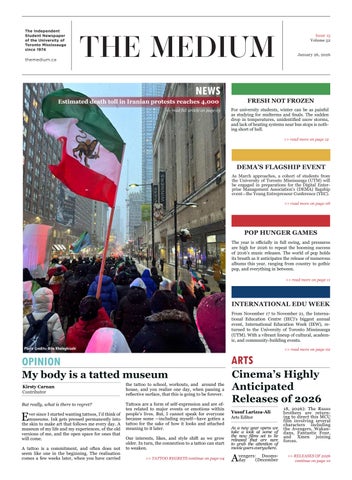
Estimated death toll in Iranian protests reaches 4,000
>> read full article on page 03
My body is a tatted museum
Kirsty Carnan
Contribut0r
But really, what is there to regret?
Ever since I started wanting tattoos, I’d think of museums. Ink gets pressed permanently into the skin to make art that follows me every day. A museum of my life and my experiences, of the old versions of me, and the open space for ones that will come.
A tattoo is a commitment, and often does not seem like one in the beginning. The realisation comes a few weeks later, when you have carried
the tattoo to school, workouts, and around the house, and you realize one day, when passing a reflective surface, that this is going to be forever.
Tattoos are a form of self-expression and are often related to major events or emotions within people’s lives. But, I cannot speak for everyone because some —including myself—have gotten a tattoo for the sake of how it looks and attached meaning to it later.
Our interests, likes, and style shift as we grow older. In turn, the connection to a tattoo can start to weaken.
>> TATTOO REGRETS continue on page 04
FRESH NOT FROZEN
For university students, winter can be as painful as studying for midterms and finals. The sudden drop in temperatures, unidentified snow storms, and lack of heating systems near bus stops is nothing short of hell.
>> read more on page 12
DEMA’S FLAGSHIP EVENT
As March approaches, a cohort of students from the University of Toronto Mississauga (UTM) will be engaged in preparations for the Digital Enterprise Management Association’s (DEMA) flagship event—the Young Entrepreneur Conference (YEC).
>> read more on page 08
POP HUNGER GAMES
The year is officially in full swing, and pressures are high for 2026 to repeat the booming success of 2016’s music releases. The world of pop holds its breath as it anticipates the release of numerous albums this year, ranging from country to gothic pop, and everything in between.
>> read more on page 11
INTERNATIONAL EDU WEEK
From November 17 to November 21, the International Education Centre (IEC)’s biggest annual event, International Education Week (IEW), returned to the University of Toronto Mississauga (UTM). With a vibrant lineup of cultural, academic, and community-building events.
>> read more on page 02
Yusuf Larizza-Ali Arts Editor
As a new year opens we take a look at some of the new films set to be released that are sure to grab the attention of movie goers everywhere.
A vengers: Doomsday (December
18, 2026): The Russo brothers are returning to direct this MCU film involving several characters including the Avengers, Wakandans, Fantastic Four, and Xmen joining forces.
>> RELEASES OF 2026 continue on page 10
Photo Credits: @utmississauga
Photo Credits: Bita Khaleghisohi
02 NEWS
Culture, community, and connection shine at International Education Week
Prekshaa Surana Associate News Editor
The IEC’s International Education Week brought together students to learn, connect and celebrate diversity and culture through seminars, workshops and events.
From November 17 to November 21, the International Education Centre (IEC)’s biggest annual event, International Education Week (IEW), returned to the University of Toronto Mississauga (UTM). With a vibrant lineup of cultural, academic, and community-building events, the weeklong series created spaces for meaningful dialogue among students and faculty. The initiative aimed to spotlight the importance of intercultural learning on a modern university campus.
The event encompassed various smaller events, pop-ups, showcases, workshops, and fairs. According to the IEC’s website, some of the biggest events were: Global Cuisine Tour, Tastes of Culture with Hart House, Taste of Canada, Learn to Play Lacrosse, International Sports Trivia Night, the IEW Fair, Global Dance Fusion, Runway Without Borders: Threads of Home, and Behind The Masquerade, among many others.
These copious events, and others during the week, were especially notable because of their involvement of various student clubs and organizations on campus, such as the Health and Counselling Centre (HCC), Caribbean Connections, the Centre for Student Engagement (CSE), the Recreation, Athletics and Wellness Centre (RAWC), Hart House, the Office of Indigenous Initiatives (OII), UTM’s Department of Management, the Indonesian Student Association (ISA), and UTM Synix.
The high level of collaboration throughout the week was epitomized through the IEW Fair, which itself hosted the South Indian Student Association (SISA), the Lebanese Student Association, the Filipino Student Association, Caribbean Connections, the University of Toronto Erindale Hong Kong Students’ Association (UTEHKSA), the ISA, the Taiwanese Student Association (ROCSAUT), the Canadian Asian Student Society (CASS), and the Egyptian Student Association.
The fair also featured various UTM departments, including the Library, Sustainability Office, CSE, OII, HCC, Department of Language Studies, RGASC Gaming Cafe, and Accessibility Services, along with key IEC branches, such as the Global Learning and Programming and Events teams. Students exploring the fair could also enjoy a Henna artist, jewelry making, quilting with UTM’s Studio X, and caricatures. For many international students, IEW served as
a reminder that their stories, identities, and tran sitions are valued at UTM. Domestic students, too, engaged with global experiences through food, art, and conversations. The atmosphere across campus felt lively, inclusive, and intentionally global.
Lavinia Lau, events and program facilitator intern at the IEC, discussed how heading Runway Without Borders was an overall enriching experience and how the event created meaning and impact on the UTM community. “This was the first time we held an event like this. The main idea was to organize a culturally rich fashion show to celebrate diverse identities, traditions and stories within the UTM student community.”
Runway Without Borders brought together different student groups from various cultural and ethnic backgrounds, visual performers, and faculty to showcase traditional regalia and attire from around the world, with standout musical and dance performances.
Lau added, “The event specifically fits in with the goals of the IEW and broadly with the IEC as the event is student-led, and the target group is the UTM student community. While it is culturally diverse at its core, the event is organized by students, for students cradle to grave, which makes it stand out as the IEW’s flagship event.”
When asked why fashion specifically is an important medium to communicate cultural diversity, she replied, “A lot of the clothes available today in mainstream trends are modernized, making it monotonous. More often than not, cultural pieces are overshadowed by these modern clothing. For
example, I got to see Indonesian couture, which wouldn’t have been the centre in pop culture media otherwise.”
In response to the idea of cultural diversity being obvious and present at UTM, she said, “While I was pursuing my undergraduate degree, I did not participate extensively in student life and culture around campus, but now since I directly helped execute the event, I’d say I have more information about the diversity and sense of community that different students bring from different cultures. There [are] so many cultural and ethnic student groups on campus.”
She added, “Canada is one of the most diverse countries in the world, and I think that sense of belonging and unity, despite being from various backgrounds and ethnicities, is apparent in UTM students. This event helped make that sense broader and stronger in a way.”
Moreover, the IEW Fair, an annual staple during the week saw
Beyond the scheduled events and packed calendars, IEW also captured something quieter and more personal. Students wandered into events between classes, some staying only for a few minutes, and others lingering far longer than they expected. Whether it was trying a dish from a country they had never visited, watching a dance that reminded them of home, or simply striking up a conversation with someone new, these moments felt meaningful in small but lasting ways. For a campus as fast-paced and commuter-heavy as UTM, IEW aimed to create rare pauses where students could slow down and connect, irrespective of their backgrounds and identities.
Photo Credits: Melody Zhou
Photo Collage created by Melody Zhou
Liberal MPs address students at UTM Liberals social event
The challenges these Palestinian students face are under the purview of the Palestinian Students and Scholars at Risk Network (PSSAR) and Immigration, Refugees and Citizenship Canada (IRCC).
The chair of the Liberal Party of Canada (Ontario) and federal representatives from Peel Region visited UTM to address students’ concerns about the field of politics.
On January 21, the University of Toronto Mississauga (UTM) Young Liberals (UTMYL) club collaborated with members of the Liberal Party of Canada to host Youth in Politics, a three-hour open floor discussion for students. The event featured Liberal Party of Canada (Ontario) Chair Qasir Dar and Members of Parliament (MPs) Amandeep Sodhi of Brampton Centre, Fares Al Soud of Mississauga Centre, and Iqra Khalid of Mississauga-Erin Mills.
Starting at 6:30 p.m., roughly 45 students gathered in a conference room in the William G. Davis building for the event.
Mekayel Omier, Membership Officer of the UTMYL, began with a strong message for students, stating, “We sitting in this room are responsible, and are required to be responsible as the youth of this country.”
Omier also led the discussion by raising common questions among youth interested in politics, such as “What can students do to create effective change in their current positions?” while also sharing concerns about barriers that young students may face.
As recently young MPs, Sodhi and Al sound each expressed that they resonate with these concerns.
Sodhi explained that she represents students who don’t have large political backgrounds, and that her age didn’t deter her from her goals, saying, “fear and potential judgment shouldn’t stop you.” Sodhi advocates that “age can be a strength.”
Al Soud, the first MP of Palestinian origin in the House of Commons, stated, “Everyone here is already a leader. Young students shouldn’t shy away, whatever your ambition is in the world of politics, that is why you are here.”
Both Sodhi and Al Soud expressed that being young is an advantage, asserting that youth are especially suited to recognize and address many current issues, such as the increasing prevalence of artificial intelligence in daily life. Throughout the discussion, Omier also noted that students can feel reassured with young voices in the House of Commons, like Al Soud and Sodhi, representing them.
To address students’ general feeling that getting into politics can be intimidating, UTMYL President Aanchal Kapoor asked the MPs how students can better deal with political anxiety. Khalid answered, “When we all take ownership of that anxiety, change can happen. To make change happen, you have to feel uncomfortable.”
A word of advice Al Soud and Sodhi shared is that joining the MP constituency youth council and signing up for clubs are the easiest ways to get your foot in the door.
Al Soud told students, “There’s always someone to advocate for.” MP Khalid repeated that sentiment when she said, “A good leader knows the people they are trying to represent.”
To create an impact, Chair Dar focused on the influence of writing. “If you want to make a change and you have an idea, through policy writing, you can make that change.”
During the open question period, a first-year student who wished to remain anonymous brought up a concern to MPs regarding the 130 Palestinian students who gained acceptance to Canadian Universities but are trapped in Gaza due to visa delays.
Khalid acknowledged that students are stuck in both Gaza and Egypt, facing issues with biometric verifications that they should not have to. She said she’s dealing with the issue directly and that she’s raised the issue to cabinet ministers, including Prime Minister Mark Carney.
Al Soud added that many MPs are focused on the issue as “Palestinians are also owed the same opportunities.”
Al Soud and Khalid said they both worked with the PSSAR and attended a recent trip organized by The Canadian Muslim Vote in hopes of meeting Palestinians refugees, displaced people, and the Palestinian Authority. Unfortunately, they were denied entry into the West Bank by Israeli authorities due to security reasons.
In an interview with The Medium, the anonymous student expressed that they admire the MPs for their work for human rights. “These MPs I look up to, I see their work for Palestine, they’re my inspiration.” They continued, “They fight for what’s right, even though they get backlash from it.”
Responding to a question from Han Tran of The Varsity, the student also touched on how they favour Canadian universities for giving them the freedom to express political opinions and pursue political activism. That said, they ultimately decided to remain anonymous due to the community backlash that happened against students after the UTMSU Commemoration for the Gaza Martyrs event in October 2025, citing safety concerns for their family members.
Attendee Madelynne McBride, a second-year political science major, also shared that she felt the event helped students realize it’s okay to be nervous about pursuing politics. “It shows you have a passion behind what you’re doing, use that anxiety as a moving point in your career.”
UTMYL Organizational Officer Zara Razi, spoke about the team’s efforts and the outcome of their first event of the academic year.
The UTMYL Youth in Politics event took shape with the help of Ontario Young Liberals and Qasir Dar. Student connections through volunteering, youth constituency councils, and showing up to see MPs at other social events helped to speed up the process, which ultimately took a month of planning.
Razi concluded, “We hope to invite them again to share their inspirational stories and give meaningful advice on how to really set an example in politics.”
The next UTMYL event will be hosted in February. Further information can be found on their Instagram page, @utmliberal.
For future opportunities to network and meet MPs and other government officials, all students interested in politics are welcome to join the Liberal Party of Canada National Convention happening in Montreal this coming April.
Natalie Ramadan Associate News Editor
Photo Credits: Jack Chan
Estimated death toll in Iranian protests reaches 4,000
Camille Dornellas Contributor
Iranian people rise against a history of 47 years of oppression.
On December 28, shopkeepers took to the streets of Tehran to protest against the significant fall of Iran’s currency, the rial, compared to the US dollar in the open market and the rise of inflation by 40 per cent. The protesters suffered severe repression from the authorities, leading to the death of at least 4,000 people and more than 18,100 detained, according to the US-based Human Rights Activists News Agency.
The spike in inflation resulted in the rising prices of everyday items like cooking oil and meat, causing the population to struggle to afford basic necessities. Deputy Interior Minister Ali Akbar Pourjamshidian confirmed that protests have spread to more than 400 cities and towns across Iran.
The Iranian government has responded violently to the protest, deploying weapons such as water cannons, rubber bullets, and live ammunition. Medics have reported to BBC News that hospitals were “overwhelmed” with dead and injured. On January 8, the Iranian government imposed an internet blackout, which made it difficult to get updates from within the country. International news agencies have reported that some protesters were able to use SpaceX’s Starlink satellite internet service to counter the blockage, but terminals are banned in Iran, and authorities are reportedly attempting to trace them.
US President Donald Trump responded to the increasing toll on January 13 in a Truth Social post, stating, “Iranian patriots, KEEP PROTESTING—TAKE OVER YOUR INSTITUTIONS.” He added: “I have cancelled all meetings with Iranian Officials until the senseless killing of protesters STOPS. HELP IS ON ITS WAY.” Trump later told reporters that his administration would wait for an accurate report on the number of deaths before acting
OPINION
“accordingly.”
Even though the recent protests were incited by economic reasons, the roots of the Iranian people’s frustrations go far beyond that.
In an interview with The Medium, President of the Persian Students Association (PSA), Bita Khaleghisohi, at the University of Toronto Mississauga, explained how the portrayal of the events as an economic uprising isn’t entirely correct. “I think the main issue with Iran is not that America has sanctions on the country. I think it’s the regime and the lack of freedom they give to the people.” She also explained how the lack of freedom doesn’t kill someone instantly; rather, it slowly tortures people.
She argued that the economic issues posed by the sanctions and a poor administration had immediate consequences. “There’s been a lot of inflation and wages haven’t increased [...] people could actually die because they can’t afford food.” She added that these issues posed as a “last straw” for the Iranian people and that it “triggered these uprisings, because they’re not just slowly dying anymore.”
When questioned on how these conflicts might affect students, Khaleghisohi said, “When it first happens, I’m constantly on Instagram trying to see what’s going on, if anything changed.” She mentioned how she had to delete her social media because of the misinformation and hateful comments present on the platform. “It was kind of sad knowing that people were actually dying, and then some are saying that the regime is good. But it’s actually killing my people.”
She also added that students can face difficulties when coming to environments where people don’t have to fight against this kind of violence. “It’s sort of hard to understand the level of difficulty [that] people in Iran are living with. So I guess it can be isolating because not everybody can understand you.” However, she explained that connecting with others, like the PSA, could help with this. “I think connection definitely helps. We [the PSA] are try-
My body is a tatted museum
Kirsty Carnan Contributor
ing to do a gathering for the Persian community here to hang out and connect.”
Khaleghisohi recently helped to organize a rally in Toronto in support of Iranian protesters on January 16. Led by the Iranian Students’ Association at the University of Toronto, the rally drew support from Iranian student organizations nationwide, according to The Varsity. Khaleghisohi concluded by saying how important she thinks it is that people engage and advocate for these topics, but, mostly, research them before forming an opinion. “If you truly want to talk about this topic, you should do some research before you do. It’s a complicated situation; it’s not something that could fit in a social media post.”
I’ll name a few and you can throw in your guesses over which I regret: a skeleton of a snake, a Twilight quote, a rose lady, a half-sun half-moon, or angel wings.
The point is, we evolve with acceptance of these past interests and influences, often allowing them to continue to subtly impact our current ones. It can be tricky when that interest is permanently visible to not just you, but everyone you pass. There have been times where I have been stuck in a sticky self-conscious loop that begins to feel just as permanent as the stain on my skin.
Fortunately, my tattoo regret is not with one tattoo itself, although I do have the occasional I wish I did it differently or I shouldn’t have gotten it this young thoughts. My regret is letting my perspective of others’ opinions take control. A tattoo becomes part of me, so these opinions often feel quite personal. The long term exposure to mixed interpretations, reactions, and comments about my tattoos starts to impact how I view them. They stop being about a time in my life—an exhilarating spur of the moment, an important memory, or a shared memento—and become a judgement.
I think it is safe to say tattoos are a risk. And by no means am I telling you that your tattoo needs to mean something extravagant for it to exist. If you like sunflowers, get that sunflower tattooed.
But, as an offering for those who worry about the tattoos they have or might get, the trick for dodging the bullet of judgement is to remember that your tattoos are strictly for you. Remember this is your museum, and not anyone else’s.
Photo Credits: Bita Khaleghisohi
Illustrated by Ishwar Metharu
Music and movies of a Malayalee-Otaku
Madhav Ajayamohan Contributor
Sticking to one genre of media is restricting
Whenever I’m with a group of friends, listening to music, I always hesitate to add my own songs to the queue because I have a very particular playlist. Less than 10% of my songs in my playlists are in English—or what I consider to be “appropriate” to play to my friends here.
The majority of my playlists consist of a large amount of anime opening and ending themes that you just don’t listen to with someone who is not an otaku (a person interested in Japanese culture and media consumption). A good quarter of my songs are Indian, ranging from Malayalam to Hindi to Tamil, which you can’t just spring to a Western listener.
My playlist represents the unique cultures I deal with: the Western world I live and work in, the Japanese anime I love to watch, and the Indian heritage I grew up with and enjoy. Each of these cultures influenced my own taste in media, and redefined what it means to me for art to be a “classic.”
Malayalam Movies and ജീവിത
When it comes to movies, I strongly prefer Malayalam movies over any other genre. I will admit that this mainly stems from the fact that I mostly watched Indian films throughout my childhood. Of course, there was the occasional Disney film or Spiderman film here or there, but my diet of movies was mainly Malayalam.
And, I want to make it very clear to you that I am not talking about Indian movies in general, but Malayalam movies to be specific. There is a very distinct difference between Mollywood (Malayalam film industry) and Bollywood.
Bollywood is characterized by glamour, over-exaggerated acts,, large dance sequences, colour, and a general flashiness. Mollywood is a lot more subtle and down to earth.
But, while Mollywood movies can sometimes take on exaggerated plots and tropes—like a protagonist fighting multiple people off at once and choreographed dance sequences—the films often focus on ജീവിത ഗാന്ധി (the smell of reality). In Malayalam films, stories of the “common” man are captured: the problems he undergoes, the conflicts he finds himself in, and how he resolves it.
A film that particularly speaks to this idea is Premam, a romantic drama where we see the protagonist falling in love with three different people over the course of his life. It’s not a dramatic or life changing plotline, but it’s filled with small moments of humanity. The characters are genuine and the emotions they convey are both relatable and poignant.
Maybe my preference stems from the fact that I am culturally a Malayalee. The subtle, dry wit in Mollywood matches my own, and I can see people with the same faces and languages as mine tackle different problems. Maybe it’s also because I don’t indulge in many Western classics. But to me, Malayalam films are the epitome of cinema.
For anyone interested in
in Mollywood, I recommend some of my personal favorites: Maheshinte Prathikaaram (2016), Meleparambil Aanveedu (1993), Manasinakkare (2003), and Snehaveedu (2011).
Music: The Poetry of India to the Energy of Anime
For the longest time, I firmly thought that English music was bad and Indian music was simply better. The issue mainly stemmed from the fact that I could actually understand the English lyrics, as opposed to the Indian lyrics. Even for Malayalam songs, the lyrics often use high-brow vocabulary that I can’t fully parse.
But English songs, which I could understand the lyrics, I would often decipher the implicit sexual messages, and it would put me off when I was a kid. Or, I would listen to whatever was popular, like rap and which definitely wasn’t my taste.
Now, I like to believe that my thinking has evolved a bit more, being able to accept music that can be good regardless of language. I’m still picky with English songs, but I have discovered some that I’ve liked: Summer of ‘69 by Bryan Adams, I’m Doing Fine by Marino, and Payphone by Maroon 5 and Wiz Khalifa.
However, a large part of me still relates more to Indian music–by which I mean Indian film songs. I feel that, at least compared to (my limited knowledge of) Western music, Indian music is more poetic. But the songs transform the poetry, connecting each verse with beautiful melodies.
I don’t have nearly enough understanding about song theory to describe why Indian songs are good. But, the best Indian songs sound like poetry drizzled in golden honey.
The songs I believe exemplify this the most are Amruthamayi Abhayamayi by Hariharan and Illyaraja from the Snehaveedu soundtrack, Pavizham Pol by K.J. Yesudas from the Namukku Parkam Munthiri Thoppukal soundtrack and Puthumazhayay Pozhiyam by M.G. Sreekumar in the Mudra soundtrack.
And a large part of my playlist is chiefly anime opening and ending theme songs. In fact, it was anime that got me into listening to songs regularly. I started to want to listen to a few openings regularly, and I started compiling them, and eventually it became a playlist.
I think one aspect that helped me like anime songs may be due to the fact that I don’t understand the lyrics at all. So, I purely go off how the songs sound, and it hasn’t served me wrong since. I think what mainly attracts me to anime theme songs is that they are energetic, and it motivates me to get off my chair and do something. Some of my favorite songs in that regard are V.I.P by SID (first opening to Magi: The Labyrinth of Magic) and Youthful by the 99 Radio Service (first opening to Chihayafuru).
I’ve also recently taken an interest in Japanese jazz. After enjoying some of the pieces in Sakamichi no Apollon (a really good jazz-anime recommendation), I started exploring jazz. Curiously enough, I didn’t feel too much from American jazz, but I’ve been enjoying a lot of Japanese jazz bands. In particular, I found a project called All That Jazz that provides jazz renditions of some popular anime openings and Studio Ghibli Soundtracks, which are amazing!
What is good is good!
At the start of the writing process, I pondered on what “classic” media was to me. Now, I know that whatever is good…is good! My favourite media pieces might not be consistent with everyone else’s taste, but that is okay.
I think that the concept of having a certain set of “classics” is restricting. After all, you don’t need a reason to like something; you just end up liking it anyways.
Is cyber celibacy the analogue resistance we’ve
been searching for?
Building your own library isn’t the same as building yourself
Illustrated by Sehajleen Wander
T he resurgence of physical media has become undeniable. In 2021, I discarded my CD player because it broke, and even though I momentarily mourned my 5-item CD collection—mainly comprised of unreturned library and thrifted albums—I since, nevertheless, have happily been on the streaming bandwagon, using a mix of Spotify and smaller, more ethical platforms to listen to my music. However, in 2021, I didn’t realize that owning a CD player would someday, in the near post-pandemic future, become more than just a device. It would become a suggestive personality trait, a performance, and a much deeper yet flawed resistance to our generation’s growing disillusionment with corporatized technologies and the slow death of ownership.
The resurgence of physical media is undeniable. My Instagram regularly feeds me content of people going to libraries, making zines at the park, printing their photographs and social media feeds curating impressive if not obsessive wall-to-ceiling CD and DVD collections, reading magazines (again), and even making the ultimate switch to flip phones and other forms of analog communication and entertainment.
Mashiyat Ahmed Outreach Coordinator
Photo Credits: Melody Zhou
ecosystem and the safety of our online presence: in the last few months, I’ve deleted unused accounts that I didn’t know I even had, gave Meta a good scrub (by disabling location services and limiting my data sharing), started using alternative browsing alternatives, and began using temporary emails. But in all likeliness, if you’re anything like, going digitally celibate or having an ascetic online footprint is not an option all the time. In 2026, a conscious digital presence isn’t about perfection. I still use ChatGPT to help me research or think of title ideas for essays. I still overshare on apps and let them steal my data. I accidentally had my home address on the resume I uploaded to my public LinkedIn account for months. I’ve been scammed twice, lost $5,000, and had to reopen financial accounts countless times. I still bank with TD even though they have a documented track-record of financing fossil fuel expansion, especially on unceded Indigenous territories. Changing isn’t about perfection. It’s just about…change and intention, however slow and flawed. No such world exists where I will be printing out my Instagram feed or not be looking forward to a two-hour session of forgettable doomscrolling after a long winter’s day. My brain cells can go suck it.
But the physical media trend is more than just a material switch or mere digital cleanse. In my view, our material lives shape behaviour and ideas. Or does behaviour and ideas shape our material lives? This isn’t a lesson in dialectical materialism. Ultimately, I think the popularity of physical media comes as a response to three intersecting realities of modern living: the death of ownership by streaming, a resistance to brain-rot content and hyper-consumption, and the urgency of slowing down and intentionality in a world that implicitly rewards burnout and grind culture.
For me, there’s a particular thrill to discovering new art through browsing a vinyl shop while in a long, caffeine-fuelled fever: the thrill of a complete lack of predictability. You simply don’t know what you’re going to find. You might stumble across a gem of a lifetime. Or not.
I love summers in Toronto when I can just walk down a particularly unremarkable street only to be blown away by the graffiti or even the hand-painted lettering on window signs (a rarity nowadays). Who painted this mural? When and why is it here? What’s the artist’s story? If you’re anything like me, walking into a bookstore (not Indigo or Chapters, please) is simmering with the possibility of striking up a conversation with a stranger or even exchanging book-centered small talk with the cashier. To collect CDs with the prospect of passing them down to my future nibblings is simply delightful.
If you think this all sounds too romantic, then, you’re right. But that’s exactly what physical media represents for us: it signals a shift in what we’re able to appreciate and observe in our daily lives. By slowing down and de-algorithmizing our consumption and curation of art, our experiences have more substance to them. In response to cultural nostalgia, physical media and tangible keepsakes resists algorithmic curation by privileging intentionality and chance encounters over recommendations that feel fine-tuned and optimized but ultimately lack a human touch.
Has the sub-culture become mass culture?
Amidst all this fervor of recapturing a memory for a time long gone or for resisting brain-rot, is the physical media movement reproducing the same over-consumption and frailty it claims to resist? TikTok Shop now sells CD players and other vintage items that signal Y2K aesthetics. At the heart of the analog movement, so to speak, is the irony of it becoming a trend. People (I’ve fallen victim to this) have flocked to their local thrift stores to buy a bunch of CDs all at once or using online stores to purchase niche items that signal nostalgia.
The inescapable irony of physical media is that it’s devolving into just another trend that encourages over-consumption of certain items simply on the basis that they are tangible, perpetuating the illusion of intent and slow curation. I think if this continues, physical media will be just another trend corporations can manipulate to steal our money and attention spans.
Of course, I can easily point the finger at capitalism, but beyond that, I think, at least for me, physical media cannot be a replacement for the world of digital media. Digital media will always be more efficient, convenient, and interactive, and if I go in with the mindset of desiring the same dopamine hit or reach of my physical media library as I do my digital one, I will always be disappointed.
Another reason why I see an inherent tension with physical media is that, due to its rising trendiness, engaging in offline activities and analog items has become almost an accessory to a certain personality; in trying to keep up with the hype of it, the physical media trend blurs the lines between what’s authentic and what’s performance. This isn’t to say that human nature isn’t performative; the very truth of existing means being witnessed by others. For some, it’s survival. For others, its belonging and access to social or cultural capital. However, if we start engaging with physical media by mimicking how we consume digital media, then analog items and behaviours become less about resisting the drudgery of capitalism or slowing down, and more about impressing a certain gaze.
The ironic trendification of analog ultimately stems from a fundamental misunderstanding of what analog truly is. Sure, it can be about monitoring our digital lives, reading more, crafting zines, and consuming art physically. But it can also be about nourishing experiences rather than just consuming an object with the secret hope that someone finds us cool.
For me, even though I will never fully transition or even halftransition into the analog lifestyle all the cool, niche girlies on Instagram flaunt, I will use my public libraries more, slow down by spending more time at the park than at the bar, cooking more for myself than eating out, giving myself free hair cuts, and sharing resources with my friends and community. True analog lifestyle is a state of mind where slowness, vulnerability, reciprocity, and appreciation are packaged (no pun intended) into messy yet real experiences.
Analog resistance looks different for everyone.
US voters deserve better
Cyrus Gazdar Contributor
There isn’t a very clear future for the US Democratic Party
As the 2026 Midterm Elections come closer for our southern neighbours, we will continue to see more heated rivalries emerge and distinguish themselves within the opposition US Democratic Party.
While progressive factions have been prominent in the party for nearly a decade now, the inadequate and unpopular response that the second Trump administration by the current Democratic leadership (DNC) has caused a large disruption within the party base, tanking leadership approval and giving voice to legacy progressive candidates in Alexandria OcasioCortez (D NY-14) as well as electing underdog candidates such as Zohran Mandani in New York.
There’s no question about the outcome of the House of Representatives in November; the Democrats are projected to win in large numbers. While the Senate generally remains unfavourable to the Democrats by nature, new races in Maine,
EDITORIAL BOARD
Editor-in-Chief
Aya Yafaoui editor@themedium.ca
Managing Editor Samuel Kamalendran managing@themedium.ca
News
Aaron Calpito news@themedium.ca
Opinion
Yasmine Benabderrahmane opinion@themedium.ca
Features
Gisele Tang features@themedium.ca
A&E
Yusuf Larizza-Ali arts@themedium.ca
Sports
Joseph Falzata sports@themedium.ca
Photo
Melody Zhou photos@themedium.ca
Design
Sehajleen Wander design@themedium.ca
Social Media
Jannine Uy
Outreach Mashiyat Ahmed Copy May Alsaigh may@themedium.ca
Anaam Khan anaam@themedium.ca
Furthermore, while it’s hard to predict what will happen in 2028, it would not be too extraordinarily unlikely that a left-wing ticket crushes any Republican candidate. All this has occurred despite DNC leadership, not because of it. Approval ratings remain low for how well the rest of the party
TO CONTRIBUTE & CONNECT: themedium.ca/contact @themediumUTM @themediumUTM @themessageUTM social@themedium.ca outreach@themedium.ca
Texas, Iowa, and Alaska have possibly opened up the chance for a total liberal victory in Congress in November.
Photo Credits: Melody Zhou
polls, and most voters do not think the party is doing enough to contest Trump’s authoritarian agenda. While a feature of democratic politics, it’s not the sole focus of a political party to win elections and nothing else. There’s still an important component to politics apart from this: actually governing. While the Democrats might see successes this year, there still isn’t a clear outlook for the future of the party.
Despite his surprisingly good effort at uniting House Democrats when dealing with critical votes, House minority leader Hakeem Jeffries retains an extremely poor record among Democratic voters. He is unable to relay authenticity to Democratic voters on important issues, most importantly relate to Israel and to ICE enforcement. Regarding the former, he has consistently supported Zionist efforts and lent immense political support to the state of Israel since October 2023, despite it being clear that young voters are increasingly viewing Israel in a more negative light in response to their genocidal campaign in Gaza. The latter issue is more recent, as he has been unable to take a substantive stance against ICE funding, despite a number of Democrats now vowing to review ICE’s funding in the next budget in response to the killing of Renee Nicole Good in Minneapolis.
These two issues show that Jeffries is not a leader suitable for the House, so who comes next? The benefit of picking a House speaker is that there is a very large pool to choose from, and it’s realistically possible for any House member to throw their hat in the ring.
While there are a good handful, one stands out above them all, and that’s Ro Khanna (D C-17). Despite spending less than a decade in his seat, Khanna has made a large name for himself by adopting both a progressive and populist stance against the Republicans and Democratic establishment. His popularity in recent months has exploded both for being the first elected Democrat to call for the resignation of DNC Senate leader Chuck
Schumer (D-NY), while also supporting a Palestinian state, advocating for universal healthcare, and most recently, teaming up with Thomas Massie (R KY-4) to force Trump to release the Epstein files. Khanna has, as such, proven to be an extremely effective leader in the short time he has had in the House, and would likely be a seasoned Democrat by 2030, which would pose well for a leadership bid.
Unlike the House, the Senate Democrats are already in flames. Schumer’s popularity is at an all-time low, and polls indicate he could be ousted of his Senate position by AOC if she became a challenger. Also unlike the House, there really aren’t that many Senators, meaning whoever seeks a leadership bid has to do so only if they are a serious candidate.
While there are a few, only one really spells a positive future for the Democrats, and that’s Chris Van Hollen (D-ML). Already a seasoned Congressman, Hollen has picked up immense traction since last year, when he publicly visited El Salvador to meet Kilmar Abrego Garcia, who was deported by the Trump administration. His politics are progressive as well. He has strongly supported expanding healthcare, is pro-choice, and supports LGBTQ+ rights. Additionally, he opposed Israel’s plan to annex parts of the West Bank and was one of just 11 Senators who sided with Bernie Sanders to halt arms sales. His experience and strong positions make him the ideal candidate for Senate leader, even as soon as this mid-term if the Democrats can get the flips they need and Schumer decides to end his tenure early.
Finally, the presidency.
While polling remains tenuous, Kamala Harris and California Governor Gavin Newsom are the two frontrunners. If either of these two candidates runs, it would be an extremely poor decision.
Harris was firmly rejected by American voters in 2024, and her inconsistent stance on issues like Palestine and transgender rights should immediately be a disqualifier for a party that wants to make itself seem authentic. Newsom on the other hand has not outlawed penal slavery and has ordered vicious crackdowns on homeless communities. Not to mention, he has remained the center of attention for Republican attacks, making it extremely difficult for him to win large swaths of the Rust Belt, bible-belt, and South.
There are almost an infinite number of tickets that could be proposed, but in the interest of time, I believe the best presidential ticket is JB Pritzker. Governor of Illinois, he has taken a hard stance against Trump and recently sued the administration over their ICE deployments. Furthermore, while a billionaire, he is a firm progressive and even a socialist. He is capable of reaching many different economic classes while embracing elements of antiTrumpism, social democracy, and populism.
There is one group which Pritzker cannot grasp on his own as a Jewish politician, however, and that’s practicing Christians—particularily those afraid of losing the “Christian values” of the US. To try and amend this, Kentucky Governor Andy Beshear should be on the ticket as the VP. While not a socialist himself, Beshear has managed to keep a hold on his governorship in a deep red state by framing his progressive policies in the context of his faith. This ticket would likely cover the majority of important groups needed to capture most of the people needed to form an informal coalition while also keeping Congress on their side — especially if Congressional Democrats sway more left.
American voters deserve better, they’ve made this clear to the Democrats. Liberals in Washington need to respond in turn and commit to the radical changes their voters are looking for.
Lost in Translation: Groceries
What your grocery shopping experiences reveal about you.
Grocery shopping is a mundane, everyday activity. But, the choices—the products you consume, the shops you choose, the rituals you commit to—of shoppers reveals much more than you’d think. Here are two grocery shopping experiences to follow!
Nguyen Bao Han Tran: Plans lost in translation.
I go grocery shopping with a list and a plan every time. I tell myself this is the trip where I’ll stay disciplined and save money.
That plan usually collapses the moment I walk through the door.
Before I even reach the aisles, I’m greeted by neatly stacked fruits and vegetables. Everything looks fresh, healthy and intentional. I immediately start thinking I should buy more of this. It feels responsible. It feels like progress. What I don’t realize or pretend not to is that I’ve already stopped following my list.
I don’t choose products only because I need them. I choose them because of what they represent. Buying healthy food makes me feel like I’m taking care of myself, even when it wasn’t part of the initial plan. Slowly, my basket fills with items meant for a version of me who meal-preps, eats perfectly, and never lets food rot in the fridge.
By the time I reach checkout, I’ve spent more than expected. When I get home, I realize I forgot the essentials: rice, oil, toothpaste—the things I actually went in for.
We often frame moments like this as personal failure. Bad budgeting. Weak selfcontrol. But grocery stores are designed to push us toward emotional decisions. Layout, lightning, and placement all encourage us to spend first and reflect later.
I could avoid this by shopping online, and sometimes I consider it. But I still choose to walk the aisles, wanting to see the shelves for myself, knowing exactly how easily intention turns into impulse.
Grocery shopping has taught me that discipline isn’t always about effort. Sometimes it’s about recognizing when choice itself has already been shaped and how easily our plans get lost in translation.
Avneet Kaur: Groceries are an identity crisis.
Grocery shopping feels less like an errand and more like emotional exposure therapy. You walk in with a list and leave with existential dread, five unnecessary snacks, and zero memory of why you came in the first place. The lighting is too bright. The aisles are weirdly organised. The decision feels too permanent.
Why does choosing pasta feel like a personality test? Why does every cart squeak like it’s narrating your internal panic?
Grocery stores are somehow very psychological. The chocolate aisle attracts whilst the salad aisle distracts. One of them guarantees dopamine and comfort. The other one is the vow of discipline, self-control and the version of yourself that drinks green juice and gets up at 6 am. It is not only food but identity. Grocery shopping is not always convenient but it is a strategy especially when you live with PCOS or in a body that is conscious of what it eats. Sugar isn’t just sugar. Carbs aren’t just carbs. There are no consequences in vain and a cookie now seems a moral choice rather than a snack.
And yet, reason vanishes once entering the store.
Nguyen Bao Han Tran Contributor Avneet Kaur Staff Writer
Photo Credits: Rojin Hajiabbasali
I end up excessively buying all that I already possess. Every time, no exceptions. I had once gone home with two bottles of ketchup and found two more already sitting at home, filled to the brim. My fridge is a gallery of the doubles. Three mustards. Two soy sauces. Enough spices to start a business.
Despite that, I feel offline shopping will never be it.
It is somehow more real to actually be on the aisles, feel produce, look at what is on the aisles. It feels real, messy, and human. Back at home in India, the main source of groceries were not aisles stacked with brands, but grocery shopping was done on the streets. One doesn’t have to scroll for vegetables on the screen, they have to bargain the price to break even the price and gain free coriander on top of all they buy.
FEATURES
Here, it’s shopping carts instead of the street vendors; checking out machines instead of conversations with cashiers; loyalty points instead of community. Nothing is cozy and everything is efficient. Nothing feels relational. Nothing feels like home.
There is more to grocery shopping than food, there is culture, memory, and identity. It is about what you want when you are exhausted, what you spend money on when you are in a bad mood, what you escape when you are frightened and what you indulge in when you are struggling to become a better person than you are.
It’s not an errand. It’s a mirror.
And somehow, I will still forget the one thing I actually went there for.
An insider’s look into DEMA’s innovative, equitydriven flagship event empowering UTM students
Rameen Hashmi
Associate Features Editor
The Young Entrepreneur Conference inspires and equips students with skills enabling them to thrive in their careers, all while bridging systemic gaps
As March approaches, a cohort of students from the University of Toronto Mississauga (UTM) will be engaged in preparations for the Digital Enterprise Management Association’s (DEMA) flagship event—the Young Entrepreneur Conference (YEC).
It is anticipated that over 80 participants will be immersed in a case-competition in the YEC. The competition will focus on thoroughly selected industry topics that equip participants’ career journeys. This event serves both as a career launch pad and a bridge connecting students’ academic and professional aspects.
In an interview with The Medium, Co-Chairs of YEC, Jannine Uy and Noor Mohamed, discussed the YEC’s initiative.
Established in 2010, YEC has since brought in over 900 attendees across 13 consecutive conferences. Uy shared that the organization has worked with “notable sponsors and partners” like LinkedIn, Red Bull, Rotman MBA and Interact Corp. She added that this year, the YEC is excited to bring on Microsoft as a primary collaborator.
What makes the YEC stand out?
“YEC has a very direct exposure to industries and realworld problems. Especially with how cases are drafted differently every single year with a different team,” said Mohamed. “Alongside that, we do workshops and provide mentorship to prepare competitors leading up to the conference.”
The YEC is designed to be widely accessible. It ensures that students, no matter their academic experience or field of study, are able to participate in the conference. In addition, it is not limited to students from UTM. All students across Ontario can participate in the YEC regardless of their program of study.
“This is significant, because similar opportunities may not often be accessible to students without particular business experiences, or students [who] are enrolled in other programs,” Uy shared.
At the YEC, mentorship is not only made available to all students. It is organized with a variety of students in mind. “We have mentors [who] are not just there to help the case teams. They’re tailored with relevance towards each year’s case theme,” said Uy.
This year, the YEC’s theme focuses on creating personalized Fintech (financial technology) solutions and how AI can be used for accessibility and different demographics.
“That’s why we’re bringing on our collaboration with Microsoft, and in particular, focusing [on working] with di-
rect relationships, with their accessibility designs team, and interns,” Uy shared. She explained that having interns from Microsoft will benefit participants, as Microsoft interns can share practical knowledge related to the theme of the competition.
A theme surrounding practicality and innovativeness
Uy and Mohamed discussed the intense thought-process and research that went into crafting this year’s theme. The theme was finalized with the goal of making a student contribution to a developing field, while enriching students’ experiences and insights.
“After much research, we decided on the Fintech-AI intersection. We realized there’s a gap in the market that needs to be filled,” said Mohamed. “And it can be filled if students are able to craft creative solutions using AI, especially if they have the guidance.”
She further discussed that the partnership with Microsoft can allow students to learn how to integrate AI in a “very accessible and ethical way in sensitive transactions.”
Unlimited learning opportunities
Competitors can expect an immersive, deeply engaging conference this year, both on the full day of the conference and the lead-up to it. The competition theme is announced ahead of time, while the case problem will be released one week before the conference for participants to work closely with their teams and mentors to finalize pitches and workshops led by industry professionals.
On the day of the competition, students get to present their pitches and gain access to numerous networking opportunities with industry representatives from leading companies.
Notably, the learning process involved in the conference is not passive. The iterative learning process continues
during the competition. Mohamed shared, “After participants present for round one and receive their feedback, they have time to work on their pitches, which stimulates their problem-solving skills on the spot.”
Mohamed shared that the YEC stimulates consulting-style thinking. As participants receive real-time questions from experienced industry professionals, they are prompted to provide practical answers in an environment similar to real-world situations.
An extensive opportunity for growth
This year, many efforts have been made by Uy and Mohamed to best support and prepare students for the conference.
Uy shared, “What Noor and I have been pushing towards is to have a trilogy workshop series. Regardless of [whether] participants attend the competition or not, each session is designed to equip students. It familiarizes students with the process of case-pitching and to be more comfortable presenting in front of peers. It also helps students learn about the applications of Fintech, AI, and accessible design.”
This design ensures that each workshop hosted by the YEC targets strengthening students’ experience leading up to the conference. Drawing on examples of this year’s workshops, Uy emphasized that the workshops have been designed to provide tangible benefits and skill development.
With this as the centre of design for the YEC, no matter how many workshops students participate in, they can walk away with new connections or showcase an experience in their portfolio.
Success from past conferences
YEC has had a tremendous positive impact on many of its participants. Kathy Vinh, a participant of YEC 2025
Photo Credits: Jannine UY
shared that the conference provided knowledge and insights on AI governance, as it tackled topics of AI ethics and legal dispute.
Victoria Guan, another participant of YEC 2025, described her experience as “incredibly rewarding” and “inspiring”. Guan expressed her excitement and gratitude for the opportunity to form meaningful connections with professionals, and stated she “could not be prouder” of her team’s accomplishments.
In addition, Aaron Yen, one of the case competition judg-
es for YEC 2025, described it as a “first-class” event.
In terms of conference benefits, Mohamed and Uy shared that the YEC has been designed to allow for deeper connections with industry professionals through a participant cap, while also maximizing opportunities for students to participate.
Among the many aspirations Uy and Mohamed have for the YEC, they shared that they are determined to “be intentional with how [they are] setting students up for success, not just in their professional and personal lives, but
long-term career-growth wise.”
Uy and Mohamed encourage students, especially those early in their undergraduate careers, to put themselves out there and engage with opportunities like YEC to grow personally and professionally.
The YEC will be held on March 2nd at the Microsoft Canadian Headquarters, and competitor tickets are available. For students interested in the conference, the YEC’s Instagram page provides updates and details for the competition as well as future opportunities.
A procrastinator’s attempt to build good habits
Exploring how to build habits and what pitfalls to avoid when it comes to self-improvement.
The first of January is the start of a new year, and with a new year comes new aspirations and goals. Therefore, it seems ironic that the second Friday of January is called “Quitter’s Day,” when we give up on our New Year’s resolutions and goals.
We’ve all picked up habits that never stuck, which is why many of us have failed to keep up our resolutions. That said, this article will explore what actually makes habits stick, as I also touch on my own experience and share my two cents.
Last summer, after closing out my worst semester thus far, I felt like I needed to make a change. So I decided to read Atomic Habits by James Clear. In fact, many articles about self-improvement reference Atomic Habits.
In 2025, I tried and failed to implement strategies from Atomic Habits. This January, I decided to re-evaluate myself and try again. To my surprise, some methods worked.
I’ll touch on my experiences with Clear’s methods, where I failed, and how I’ve gotten back on the right track. I want to be clear (an unfortunate pun) that this article is not a summary of Atomic Habits. It’s a case study on how I tried to start new habits based on the book, in the hopes that something in my experience strikes a chord with you.
A focus on changing my identity
One of the concepts that struck me from Atomic Habits was the idea that you can change your behaviour by focusing on who you wish to become. Clear explains that habits or behaviours often arise from how we view ourselves. For example, I signed up to write articles for The Medium because I identify as a writer. Or, I eat Indian food because I identify as an Indian.
Both of these behaviours, like writing articles or eating Indian food, are automatic—they are habits for me. They are automatic for me because of my self-belief. I was enamoured with the idea of changing myself through my selfperception.
So, I decided to write down some identities I wanted to develop, things like “I want to be someone who exercises” or “I want to be someone who does research.” Then, I read these notes each day to reaffirm my belief in those identities.
The results did not work, however. For one thing, I didn’t read the affirmations every day, because that was another habit I needed to develop. But more importantly, I completely misunderstood Clear’s point on how to change your identity.
Rather than the message inspiring me to rethink who I am and take action, I needed to take action first to reframe my identity. If I want to identify as someone who exercises, I need to start consistently exercising. If I want to identify as a researcher, I need to start consistently researching.
Clear describes this as “voting” for your identity. Each time you act, you cast a vote for that identity. And gradually, the more votes you accumulate, the more your selfimage changes.
This failed experiment of mine led to my lack of progress from September to December in 2025. One failed day led to another, and it was a vicious cycle where I couldn’t see myself recovering. However, in January 2026, I decided to re-evaluate my position.
Systems over goals
Usually, when we want to start a new habit, we set a goal and try to achieve it. However, that isn’t a very sustainable approach to building habits, because goals only give short-term motivation.
Take the example of studying. For many students, including myself, our goal for studying is often just to pass the exam. Our act of studying is simply fueled by upcoming exams. We’ll study particularly hard right before the exam, and slack off after it’s done. We have no impetus to continue studying and develop the habit.
Clear suggest that instead, we should focus on developing an appropriate system. Rather than worrying about your goals, create a robust system that ensures you study every day. Analyze what you are doing right now, and what you need to fix to develop strong habits.
Taking this into consideration, I decided to take a look at what was hindering me.
Taking a deeper look
First, I thought about the identities I wanted to develop. I decided to focus on the following: first, I want to be someone who exercises daily. Second, I want to be someone who researches and explores things after school or work.
I looked up what I have been doing so far. While I was successful in exercising or being productive after school for one or two days in a row, it would all crash down when I experienced a bad day. I wouldn’t have enough motivation to continue doing the careful things I planned out.
When I came home, I felt exhausted and not motivated to do anything. Then I would be sucked into YouTube Shorts for the entire evening until midnight. The lack of sleep then disrupts the rhythm of my ideal lifestyle, and I start spiralling out of control. Based on how I failed, I decided to tackle my problems one by one.
Baby steps through minimal but meaningful habits
Clear defines four components to make a good habit:
1. Make sure the habit has an obvious cue
2. Make sure the habit is attractive
3. Make sure the habit is easy to do
4. Make sure the habit is satisfying
When I wanted to develop a habit of exercising, I decided to buy a purple exercise mat. Every night before I sleep, I would set up the exercise mat and shoes, so the first thing I see in the morning is the shoes and mats—they were my obvious cue.
I noticed that, given my reluctance to exercise, it would be unlikely for me to drag myself to a gym, so I decided to exercise at home to make the habit easier.
I also started to keep track of every day I exercised. This showed me how much progress I was making and provided a sense of pride and reward.
However, despite optimizing my habits, I rarely exercised in the morning. The exercise mat started to be more like a rug. The tracking system that was supposed to reward me started to depress me instead.
Then I realized the issue: I hadn’t made the exercise easy enough for me. I planned on doing 30-minute workouts from day one. However, for someone who hadn’t consistently exercised for a long time, that was still a large barrier to cross. I was so focused on doing the most I could and being perfect, but I couldn’t maintain that perfection.
Clear advises that we should start with a two-minute habit. Eventually, after doing that two-minute habit for multiple days, we’ll get used to the idea of doing that activity every day. Then we’ll start to expand the activity on our own.
I decided to go with a different approach. I defined my minimum viable exercise: 10 pushups, 10 situps and 10 squats. I made a rule—as long as I did the minimum exercises, I would earn one exercise point. However, if I decided to exercise for 30 minutes that day, I would stick with it until it’s completed.
This approach helped me move forward on days when I feel like it’s too hard to do exercise for 30 minutes, and it made exercising easier for me. Currently, I’ve been able to consistently exercise multiple days in a row.
Restructuring my system
Clear also explains that we can reverse the four components of a good habit to break a bad habit: make the habit’s cue invisible, make it unattractive, make it harder to do, or make it unsatisfying. However, this was hard to do with my obsession with YouTube Shorts.
I deleted the YouTube app from my phone to make it harder, but I could just search for YouTube on Google. Furthermore, the cravings hit me whenever I was feeling bored at home, triggering a spiral.
I tried to quit YouTube by not accessing it at all, but I couldn’t do it. Other than YouTube Shorts, there are a lot of content creators I enjoy on YouTube. Giving up on it meant not seeing those content creators as well. But merely watching their videos lured me into shorts, and this addiction would ruin my day.
I couldn’t make YouTube invisible, unattractive, harder to access or unsatisfying. So, I just restructured my schedule to restrict YouTube.
Instead of completely banning it, I decided to only watch YouTube on Sundays. That has surprisingly worked for me so far. I haven’t binged on shorts or videos for a while now. With this tiny modification, I was able to be rid of a habit that’s bothered me for a while.
Although it doesn’t seem to have much effect, because then I dived into bingeing anime. While anime is better than YouTube Shorts, content-wise, it doesn’t really solve my issue, which leads to my next point.
The appropriate environment
Clear explicitly discusses the idea that motivation isn’t enough to carry a habit through. Rather, you need to create an appropriate environment for the habit to flourish. If you simply rely on motivation, you crash and burn on a bad day. But if you curate a proper environment, you can keep your motivation high despite your mood.
In this case, my house is not a proper environment for me to do any serious work. I live in a one-room basement, and I do everything there. I eat, watch television, wash dishes, fold clothes, sleep, and occasionally exercise at home. This is a place of relaxation for me. It’s no wonder I can’t properly focus on work at home. The environment has set my mind up to drift to other things.
Madhav Ajayamohan Contributor
Photo Credits: April Roy
Recently, I’ve had to write three articles for The Medium. I was having a particularly good week, so I was able to sit down and start writing at home. But I could barely get past the first three paragraphs of my first article. Then, on the day before it was due, I decided to write at Tim Hortons. Within that hour, I was “in the zone” and started working through the entire article.
I realized that for me, the best environment to achieve my
ARTS
goal of researching and exploring knowledge is outside of my house, away from distractions. So, I have been exploring different locations to help me become more productive in my off time.
The final reflection I’m still in the process of constructing a system that works for me. It’s not perfect yet, given the fact that I am writ-
ing this article at 5:47 a.m. after pulling an all-nighter two hours before my shift starts at work.
However, I am starting to be more consistent. I’m able to identify what needs to be improved and implement systems according to changes I want to make. I hope that my observations and experience have helped you in your selfimprovement journey.
Editor | Yusuf
Celebrating the One Hundred Year Anniversary of Winnie-the-Pooh
Emma Catarino Associate Arts Editor
Author A. A. Milne published Winnie-the-Pooh in 1926, making this year the titular character’s centennial celebration
First published in 1926, Winnie-the-Pooh has been a childhood staple character for the last 100 years. Author A. A. Milne created Winnie, and his friends, Eeyore, Tigger, Piglet, Rabbit, Roo, and more, based on his son’s plush toys. Milne’s son, Christopher Robin Milne, inspired the character Christopher Robin, a little boy who plays with Pooh and his friends in The Hundred Acre Wood. Milne’s stories followed the boy and his crew of came-to-life stuffed animals as they explored their forest, got into mischief, learned heart warming life lessons, and of course, ate lots of honey.
Much of the original Winnie-the-Pooh story was based on real life. The characters are all based on A. A. Milne’s son and his toys, which are on display at the New York Public Library. The Hundred Acre Wood, where Pooh’s adventures take place, is based on the Five Hundred Acre Wood in East Sussex. Most famously, the name “Winnie” was based on a real life bear. A soldier in WWI named Harry Colebourn bought a black bear cub while living in White River, Ontario. He named her Winnipeg, after his home town, or Winnie for short. He took care of the cub while serving with the Fort Garry House regiment, for which Winnie became an unofficial mascot. When Colebourn’s troop needed to move to France, he left Winnie at the London Zoo where she became a very popular attraction, leading to Colebourn officially donating her after he returned home. Christopher Robin would often visit the London Zoo with his father, loving the black bear so much that he named his own stuffie after her.
In the early 1930s, the rights to Winnie-the-Pooh were purchased from A. A. Milne by Stephen Slesigner. It was Slesigner who first drew Pooh with his iconic red shirt, and he played a big role in making the character a household name. In 1961, Shirley Slesigner Lasswell, Stephen Slesinger’s widow, licensed some of the character rights to Disney, in exchange for royalties. Through six decades, Disney has produced numerous animated television shows and features of Winnie-the-Pooh and his friends, making him a staple of their brand. Pooh is one of the roaming character performers seen at the Disney parks, with Disneyland and Disneyworld both having a Winnie-the-Pooh themed attraction where riders gently coast through different scenes in The Hundred
Acre Wood. One of Disney’s most recent portrayals of Pooh was in the live action film Christopher Robin (2018), where a grown Christopher Robin returns to The Hundred Acre Wood and rediscovers the whimsy of his childhood friends.
In 2022, the character of Winnie-the-Pooh entered the public domain. While Disney still owns the rights to the trademark and certain iterations of the character, the general public is now free to use the original character designs in any way they’d like leading to creative interpretations of the bear. Most famously, in 2023 a horror movie titled, Winnie the Pooh: Blood and Honey, was released. The film follows Pooh and Piglet as they turn violent after Christopher Robin abandons them for college, causing them to go on a murder spree killing anyone who enters into The Hundred Acre Wood. It’s safe to say this interpretation of his character is likely one that A. A. Milne couldn’t have dreamt of when he first published Winnie-the-Pooh 100 years ago.
Cinema’s Highly Anticipated Releases of 2026
Yusuf Larizza-Ali Arts Editor
As a new year opens we take a look at some of the new films set to be released that are sure to grab the attention of movie goers everywhere.
Avengers: Doomsday (December 18, 2026): The Russo brothers are returning to direct this MCU film involving several characters including the Avengers, Wakandans, Fantastic Four, and Xmen joining forces. They will be going up against a newly portrayed villain Doctor Doom played by Robert Downey Jr known for portraying the hero Iron Man aka Tony Stark throughout the franchise.
The Hunger Games: Sunrise on the Reaping (November 20, 2026): A prequel in the popular franchise which will focus on the 50th Hunger Games 24 years before the first film The Hunger Games (2012). Directed by Francis Lawrence the prequel will follow a young Haymitch Abernathy [the future mentor of the series main protagonist Katniss Everdeen] who is selected to compete in the games where he must fight to the death.
The Odyssey ( July 17, 2026) An adaptation of the epic poem by Homer will be brought to life by popular director Christopher Nolan. The film stars Matt Damon
as Odysseus the Greek king of Ithaca who undergoes a long journey home following the Trojan war. Nolan was interested in Odysseus’s cleverness and ability to strategize and encouraged Damon to grow a full beard as opposed to using artificial hair to capture the physicality of real hair. Other notable casting includes Anne Hathaway as Penelope, Odysseus’s wife, Robert Pattinson as Antinous, a potential suitor for Penelope and Tom Holland as Telemachus, Odysseus’s son. The film will also be the first of Nolan’s films to be shot entirely on IMAX cameras.
Toy Story 5 (June 19, 2026) The fifth installment in Pixar’s flagship franchise; despite earlier speculation that Toy Story 4 (2019) would be the final film, Tim Allen expressed interest in returning for this sequel. Directed by Andrew Stanton the film follows Bonnie’s room after dealing with the arrival of digital tech in the form of a frog-like tablet named Lilypad an allusion to the kids entertainment & electronics company Leapfrog and how this threatens their relationship with Bonnie.
Scream 7 (February 27, 2026) an upcoming slasher film and the seventh installment in the famous horror franchise. Directed by Kevin Williamson and starring actress Neve Campbell returning as Sidney Prescott after her absence in Scream VI (2023) who has built a new life for herself in Indiana. However when a new ghostface killer appears and targets her daughter Ta-
tum she is forced to face her past and bring the killings to their ultimate end.
The Super Mario Galaxy Movie (April 3, 2026) Illumination’s sequel to The Super Mario Bros. Movie (2023) and adaptation of the 2007 video game Super Mario Galaxy. Directed by Aaron Horvath and Michael Jelenic and stars Chris Pratt reprising his role as the titular character joining Princess Peach and his brother Luigi on an outer space adventure to face off against Bowser’s son Bowser JR. Nintendo president Shuntaro Furkawa said that they’d be interested in producing more animated films based on their video game franchises if the first Mario film was a success and its box office success resulted in the release of this one.
Larizza-Ali arts@themedium.ca
Photo Credits: Maryam Raheel
Photo Credits: Maria Alampay
Photo Credits: April Roy
Still “Alive and Happening:” Highlighting What Makes UTM’s Art Club Pop
Maaz Ahtesham Contributor
Learning more from their current executives about how UTM Art Club is able to endure
Nestled in Student Centre room 225, at the back of a second-floor hallway housing about a dozen other UTMSU-recognized clubs, is a small space containing, most notably, a worn-out orange couch, two shelves colourfully loaded with board games used by the Erindale Gaming Organization, and a wall decorated with drawings crafted by both executive and general members of UTM Art Club. At a thin black Ikea table beneath this wall, I sat down with Art Club’s president Belinda Zhao, a thirdyear Commerce Specialist, and treasurer Nini Ning, a fourth-year Anthropology major, to discuss their recent events and initiatives.
The earliest mention of an art club on campus can be found in the first ever issue of campus newspaper the Erindalian, released on November 14, 1968, which begins its brief about the club’s activities by announcing that “the art club is alive and happening.” The current iteration of the UTM Art Club, however, began its activities in spring of 2014.
“When I came to U of T, I thought to myself, ‘Hmmm...the campus is massive and has many clubs. There are clubs for dancing, music and even archery! but none for art.’” wrote then-president and founder on a website used alongside their Facebook page to inform members about club events and share their artwork. “I enjoy creating art and I’m sure many other people do too, so when I found out that UTM has no art club, I was heartbroken. I myself am a life science major, but that doesn’t mean that I can’t be an artist too. I figure maybe some people feel the same way, and that’s why I created the club.” Now-president Zhao has been able to witness this same sentiment in today’s members as well. “You know, surprisingly, in the art club a majority of the members actually aren’t in art. When we see introductions, it’s always, like, Life Science. I’m also in Commerce. It’s really cool... all these majors that aren’t related to art, but we still do art.”
my big brain strat: I’ll learn commerce. I’ll make a company. It’ll be an art company. And the motto, ‘art doesn’t starve.’ I’ll hire artists who have heard this phrase before, and they’ll be able to prove their parents wrong. That was the goal. And then in the middle of—don’t do this—but in the middle of a management class, I was Googling clubs and I found the art club.” Ning, meanwhile, was drawn to Art Club also as a first-year through it being “one of the only chill clubs that didn’t have either a registration fee or ‘you have to go to these meetings’ or anything like that.”
Explaining how they improved the club since their arrival, the executives stressed a substantial focus on events and, especially, collaborations. “We almost never turned down a collab,” Ning recounts.
March, which was one example of an Art Club event where “members of the exec team took aspects that they were very comfortable in in art and then held workshops of it for the general members.” Other regular initiatives include “a lot of tabling” and playing online games of Gartic Phone on the club’s Discord server.
Next, Art Club plans to repeat the “Artcade,” a collaborative event they ran last February with UTM Esports where “They had a whole bunch of games set up and you could win tickets from playing the games against an exec of the Esports club. And with these tickets, you could get art prints. It’s like an arcade, but art-cade.” The club also teases a “big collab” event that will have a whole day’s worth of activities scheduled.
Zhao’s goal for the future remains to “Expand the Art Club. We will art everywhere! And also gotta do more collabs; collab with everyone.”
The purpose of UTM Art Club, according to their founder back in 2014, “Is to gather artists of all levels to interact, collaborate and engage with each other in friendly conversations and brainstorms.” Ning credits the enduring presence of Art Club to the fact that “A lot of people draw, so there’s always new people. And a lot of people find community in the art club, right? So we have a pretty steady stream of members.” Zhao asserts that having places on campus for self-expression is important since “You need a break sometimes because you can’t just always study. You always need a moment for yourself to have fun. And for me, that’s art. I feel like a lot of people also share that sentiment and that’s why there’s an art club.”
Zhao shared their story about finding Art Club in first-year following an initial reluctance to study Commerce: “Since I was out of the womb, I’ve been drawing, actually. And so I was speaking with my parents, and you know how parents are always like, ‘art starve.’ So I was like, here’s
In just the previous semester, Art Club ran events such as a “bookmark decorating event” in September alongside UTM Book Discovery; a Bob Ross themed painting workshop in October with the UTM Social Justice Club and Mending Minds UTM; and a 3D card making and painting event in November with the University of Toronto Card Game Club. Zhao particularly enjoyed the latter, mentioning how Card Game Club “came in with a whole bunch of Pokémon cards and, us execs, we just spent a few hours, like, every day cutting them out so then we could glue them together and make 3D cards. And if you came to the event, you could take the card home.” A standout event for Ning that also involved “a lot of background research” was the Creature Design Workshop held last
Among the many aspirations Uy and Mohamed have for the YEC, they shared that they are determined to “be intentional with how [they are] setting students up for success, not just in their professional and personal lives, but long-term career-growth wise.”
Uy and Mohamed encourage students, especially those early in their undergraduate careers, to put themselves out there and engage with opportunities like YEC to grow personally and professionally.
The YEC will be held on March 2nd at the Microsoft Canadian Headquarters, and competitor tickets are available. For students interested in the conference, the YEC’s Instagram page provides updates and details for the competition as well as future opportunities.
Year of the Pop Hunger Games
Associate Arts Editor
A look into the anticipated music releases of 2026
T he year is officially in full swing, and pressures are high for 2026 to repeat the booming success of 2016’s music releases. The world of pop holds its breath as it anticipates the release of numerous albums this year, ranging from country to gothic pop, and everything in between.
The month of January has already become the release month for Madison Beer, who released her album, locket. The album has been received generally well by fans, but faced criticism from those who were expecting the album to be Beer’s chance to cement herself in the “Pop Girl Hall of Fame.” The singer responded on the Elvis Duran Show that she isn’t looking to curate a persona, and she’s content with where her fanbase and fame currently are. While personas aren’t for everyone, Lana Del Rey’s upcoming album, Stove, is her venture into country music and storytelling, set to be released by the end of January after several delays.
February brings with it Charlie XCX’s new album, the Wuthering Heights soundtrack, which follows her runaway success with Brat. Bruno Mars’ The Romantic is his first album release in five years, announced for the end of February. Other notable mentions are Gorillaz, with their upcoming album The Mountain, Blackpink’s third extended play, Deadline, as well as Jill Scott’s sixth studio album, To Whom This May Concern. After the packed, star-studded lineup of February, the following month contains the highly anticipated release of Harry Styles’ return to music with his album Kiss All the Time. Disco, Occasionally; a name worthy of a Fall Out Boy title. Harry Styles isn’t the only member of the former band, One Direction, to make a return. Fans are excited for Louis Tomlinson’s album release on January 23rd, named How Did I Get Here?, followed shortly by Niall Horan’s single, Drive Safe. Zayn Malik has
Diana Varzideh
Photo Credits: Alisa Mirzaei
Photo Credits: April Roy
also announced upcoming projects and has performed several unreleased songs in Las Vegas.
Beyond the announced releases, many fans are speculating on drops from their favourite artists, with names such as Olivia Rodrigo, Beyoncé, and even Paul McCartney coming up.
Many of these albums are the artists’ returns to music after relatively long hiatuses. Beyond the sheer amount of time that has passed, the majority of the albums are following very successful releases, such as Brat, Harry’s House, and GUTS. These prior successes are combined with the general hype around the year 2026 as a revival of 2016, although this hype may be misguided at times when the early 2000’s are lumped into the 2016 nostalgia. All things considered, expectations are high, fans are excited, and the fight for number one in the charts is about to begin.
SPORTS & HEALTH
Editor | Tyler Medeiros sports@themedium.ca
The Gloominess of Winter Exercise and How to Overcome it
Maram Qarmout Contributor
The importance of staying active during the winter
For university students, winter can be as painful as studying for midterms and finals. The sudden drop in temperatures, unidentified snow storms, and lack of heating systems near bus stops is nothing short of hell. When most of their worries are overtaken by how many layers they need to wear to stay warm, it may never occur to them that as quickly as the temperature drops so does their effort to stay healthy. Winter is not only the perfect excuse to stay inside, but it also drives the cravings of many for hot chocolate and sweet desserts. A dangerous combo that not only limits movement, but also increases sugar intake.
Why do we exercise less in Winter?
It’s pretty simple actually. With shorter days, more cloudiness than vibrancy in the sky, and less vitamin D intake, our bodies feel more tired than ever. You may have looked outside on a particularly gloomy day and rather than feeling happy, your mood unintentionally drops. As quickly as the sun rises, it sets, leaving no room for anyone to enjoy it. With many students held up by lectures all day, they begin and end their day with the gloom. So, naturally, when they’ve gone home, all they want to do is rest and recharge, leaving no room to keep up with those new years health and fitness resolutions.
Scientifically, the sun’s diminished appearance also prevents students from producing a sufficient amount of vitamin D. In the summer, it takes as quickly as eight to 10 minutes to absorb the necessary amount, but with 90 per cent of our body covered in the Winter, it takes nearly two hours. The significant drop of vitamin D intake can lead to fatigue, muscle weakness, bone pain, and many more symptoms that diminish one’s ability and motivation to exercise.
For those who do exercise, they may notice a decline in their intensity routines. This is due to various factors, one of which is the increase in our basic metabolic rate. The colder the weather, the more our bodies burn calories. Therefore, for those exercising, it may feel as though they can’t reach the same intensity as they would’ve in the summer because most of that energy is spent keeping the body warm outside the gym.
How to stay active in the Winter
There’s value in staying healthy, as hard as it can be when all you want to do is bundle
up in your favourite hoodie. Physical activity decreases the risk of many health conditions, such as coronary heart disease and type 2 diabetes, along with breast and colon cancer. It also reduces fatigue and depression, an essential factor for staying motivated in lectures and study sessions.
Students may opt-in to UTM’s various intramurals, from soccer, volleyball, badminton, archery, to many more for their daily dose of exercise. They can also head straight for the gym, where the equipment remains a constant unchangeable tool for students to meet their goals whatever mother nature may bring.
For those struggling to actively seek hardcore regimes, a simple walk around the house for 15 minutes is as valuable as making sure your body stays active and moving. If being outside in the fluffy white snow is your style, the Recreation, Athletics & Wellness Centre (RAWC) at UTM offers a plethora of engaging adventures from nature walks to skiing and snowboarding. There’s no perfect way to exercise, as long as you find the right method to move your body, you’re making sure the winter gloom doesn’t catch you.