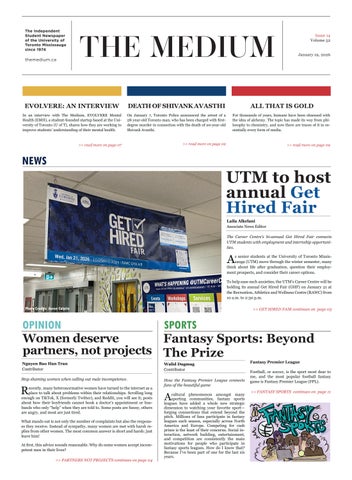
Volume 52 Issue 14

Page 1


EVOLVERE: AN INTERVIEW DEATH OF SHIVANK AVASTHI ALL THAT IS GOLD

In an interview with The Medium, EVOLVERE Mental Health (EMH), a student-founded startup based at the University of Toronto (U of T), shares how they are working to improve students’ understanding of their mental health.

>> read more on page 07

On January 7, Toronto Police announced the arrest of a 28-year-old Toronto man, who has been charged with firstdegree murder in connection with the death of 20-year-old Shivank Avasthi.

>> read more on page 02

OPINION

Women deserve partners, not projects

Stop shaming women when calling out male incompetence.

Recently, many heteronormative women have turned to the internet as a place to talk about problems within their relationships. Scrolling long enough on TikTok, X (formerly Twitter), and Reddit, you will see it; posts about how their boyfriends cannot book a doctor’s appointment or husbands who only “help” when they are told to. Some posts are funny, others are angry, and most are just tired.

What stands out is not only the number of complaints but also the responses they receive. Instead of sympathy, many women are met with harsh replies from other women. The most common answer is short and harsh: just leave him!

At first, this advice sounds reasonable. Why do some women accept incompetent men in their lives?

>> PARTNERS NOT PROJECTS continues on page 04

SPORTS

For thousands of years, humans have been obsessed with the idea of alchemy. The topic has made its way from philosophy to chemistry, and now there are traces of it in essentially every form of media.

>> read more on page 09

UTM to host annual Get Hired Fair

The Career Centre’s bi-annual Get Hired Fair connects UTM students with employment and internship opportunities.

Assenior students at the University of Toronto Mississauga (UTM) move through the winter semester, many think about life after graduation, question their employment prospects, and consider their career options.

To help ease such anxieties, the UTM’s Career Centre will be holding its annual Get Hired Fair (GHF) on January 21 at the Recreation, Athletics and Wellness Centre (RAWC) from 10 a.m. to 2:30 p.m.

>> GET HIRED FAIR continues on page 03

Fantasy Sports: Beyond The Prize

How the Fantasy Premier League connects fans of the beautiful game

Acultural phenomenon amongst many sporting communities, fantasy sports leagues have added a whole new strategic dimension to watching your favorite sport— forging connections that extend beyond the pitch. Millions of fans participate in fantasy leagues each season, especially across North America and Europe. Competing for cash prizes is the least of their concerns. Social interaction, network building, entertainment, and competition are consistently the main motivations for people who participate in fantasy sports leagues. How do I know that? Because I’ve been part of one for the last six years.

Fantasy Premier League

Football, or soccer, is the sport most dear to me, and the most popular football fantasy game is Fantasy Premier League (FPL).

>> FANTASY SPORTS continues on page 11

Photo Credits: Aaron Calpito

U of T reeling after shooting death of Shivank Avasthi

Honouring a student, holding grief and navigating safety in the aftermath of a shocking loss.

OnJanuary 7, Toronto Police announced the arrest of a 28-yearold Toronto man, who has been charged with first-degree murder in connection with the death of 20-year-old Shivank Avasthi.

On December 23, 2025, Avasthi was pronounced dead on a trail near Highland Creek Trail and Old Kingston Road on the University of Toronto (U of T) Scarborough (UTSC) campus. Police have stated that the suspect and Avasthi did not know each other and that there is no known motive as of yet. Police have noted that the investigation is ongoing.

In a statement, Toronto Police described Avasthi as a young person who “had his whole life ahead of him.” That sentiment has echoed

across U of T students online. Students have shared memories of his warmth, his presence, and the quiet ways he impacted those around him, reminders that loss is felt most deeply in the spaces someone once occupied. In an Instagram post by @uoftpowerlifting, students leave heartfelt comments about the devastating loss.

The timing of the incident, during winter break, meant that most of the students were not present on campus for the holidays. For some, returning to campus or even thinking about familiar trails and walkways has been unsettling.

“I think the scariest part about this whole incident is that it happened so close to campus, a place that’s considered safe for studying and spending time with friends,” said a UTSC student who wished to remain anonymous. “It makes one wonder and pause for a second.”

Others have spoken about the difficulty of holding grief alongside daily responsibilities, especially as the winter term begins. Counselling and mental-health support remain available through all three campuses, and students are encouraged to reach out, not only to services but to each other.

Naturally, in the wake of Avasthi’s death, questions concerning safety have emerged. Students are worried about patrolling, lighting, and visibility in areas surrounding campus, especially near trails and sidewalks.

According to an email thread between U of T President Melanie Woodin and UTSC Principal Linda Johnston, addressed to students on January 8, Campus Safety has highlighted the increased patrolling near UTSC and Highland Creek Valley, along with adequate safety measures remaining in place. “We encourage you to make use of safety resources, including Travel Safer (a walk-safe campus escort service), UTSC’s Lone Worker program and mobile Bluelight. More information can be found on the UTSC Campus Safety page or via the Campus Safety mobile app,” the email read.

They also emphasized that current protocols are under review, and conversations concerning how to best support students’ sense of security moving forward are actively taking place.

As the community continues to come to terms with the events, many have emphasized keeping the focus on Avasthi’s life and legacy, rather than solely on the circumstances of his death.

Photo Credits: Melody Zhou
Photo published by Toronto Police Service

UTM to host annual Get Hired Fair

The Career Centre’s bi-annual Get Hired Fair connects UTM students with employment and internship opportunities.

The GHF offers students the opportunity to speak with representatives and employers from various organizations to learn about fulltime, part-time, and summer jobs, along with internships, volunteer opportunities, and tech co-op placements. The GHF will have an early opening at 9:30 a.m. for students interested in attending an earlier time.

What to expect

The Medium spoke with UTM Media Relations to learn more about the GHF and the rationale for holding it. Felicity Morgan, director at the Career Centre, stated that students should expect “the perfect opportunity to connect with hiring managers from a wide range of industries—from global brands like Samsung and TD Bank to dynamic mid-sized companies and innovative smaller businesses like Mainfreight.”

One fourth-year student who wished to remain anonymous in the professional writing and communication (PWC) program stated her reasons for planning to attend. “The fair has a lot of companies that are interested in the field of media technology, marketing, humanities, and… there will be publishing companies such as MDPI [Multidisciplinary Digital Publishing Institute], and I am a writing student, so I’m looking for publishing opportunities,” she said.

OPINION

She continued, “It’s a good networking opportunity even if I don’t find a job. I can connect with [recruiters] on LinkedIn, I can make valuable connections… and it will be good practice to learn how to present and… sell myself, which is a very important skill… to get a job in this chaotic market.”

How to prepare

Morgan suggested a few ways for students to prepare for the GHF. She recommended researching the attending companies in advance. “Review the employer list,” which can be accessed on the Career Centre’s GHF web page, “and learn about the organizations you want to meet.” This will help students prepare wellthought-out questions for potential employers, which Morgan also encouraged. “Ask about the company’s work, the skills they value, and the roles available for students and new graduates.” Morgan also recommended crafting a thorough and efficient introduction. “A concise, confident introduction helps you stand out. For example: ‘Hi, I’m Ifra, a second-year Biology student looking for opportunities to apply my interpersonal and problem-solving skills in your industry.’ Tailor your introduction to your skills, interests, and the employer you’re speaking with.”

Support beyond the fair

Students unable to attend the fair should not worry; the Career Centre offers various employment supports and programs. Morgan stated, “We provide students with programs, resources, and personalized support to help [them] explore career options, develop in-demand skills, and connect [them] with a network of employ-

ers in Mississauga and beyond.”

“Our team of career counsellors and employment strategists offer one-on-one appointments, interactive workshops, and convenient drop-ins. These services can help you craft standout resumes, cover letters, and LinkedIn profiles, build a strategic job search plan, and practice interview techniques.”

Additionally, the Career Centre offers Skills Accelerator Programs, which “[connect students] with employers to tackle real-world challenges or develop industry-specific skills that employers value,” according to Morgan. Students can find more details on registering for events on the university’s website on the CLNx page.

Resources for upcoming graduates

The Career Centre will be conducting its signature workshop “Now That I’m Graduating, What’s Next?” for students in their final year. This workshop will help students “create a postgraduation plan, explore the supports available through the Career Centre, and connect directly with a career development professional to get answers to [their] questions,” according to Morgan.

Morgan also discussed another event—Sweats to Suits—which is “an exclusive conference for the graduating class. This event features practical sessions on job search strategies, plus networking opportunities with employers and alumni—designed to help you transition confidently from campus to career. Sign-up will be available on CLNx in February.”

The AFCON: beyond memes and banter

African football is not just a sport; it’s a culture.

Since 1968, every two—soon to be four—years, the African continent is engulfed in the politics, history, and pride of football, hosted by the African Cup of Nations (AFCON).

For decades, the tournament’s asymmetry has platformed new names and opened doors to African excellence. But recently, the AFCON infiltrated international feeds; not as an ode to the talent of the continent, but as a mockery of its participants. This year, just weeks shy of the tournament, international football audiences anticipated the memes of the AFCON.

Online, the culture of the AFCON is reduced to an event of “things you’ve never seen on a football field.” On ESPN, the supposed oddi-

Photo Credits: Arina Lee

ties listed include late-equaliser goals, celebrity cameos, and faulty celebrations—things that are present in most football matches.

But, football is not the only aspect of African culture that is prone to ridicule.

On TikTok, Nigerian cinema is reduced to out-of-context Nollywood clips as memes amongst international audiences, overlooking remarkable Nigerian cinematography like Eyimofe (2022), My Father’s Shadow (2025), and Mother of George (2013). African politicians are diminished to funny soundbites online, and whilst it can be comedic, the very audiences of these videos deafen their ears at the cries of attention towards African politics and Western interventionism.

It is ridiculous to tend to the continent merely in moments of humour. In many instances, it has become a case of digital blackface, wherein the twenty-first century, anti-Black racism is reinforced through the exploitative use of Black culture as comedic relief.

While I raise criticism of this meme-ification, I acknowledge that the tournament is festive and the jokes that arise from its duration can be comical. There is nothing wrong with African joy. But, to rinse the entirety of the tournament—and the continent—to memes is insulting.

The politics of African football

Football is more than just a sport; it is the very heart of Africa.

Since the twentieth century, football has embodied an extension of the independence movements occurring on the African continent. When football was limited to European communities in African colonies, the pitches served as a field for revolutions and the birth of national identities amongst Africans.

In 1958, four years prior to Algeria’s official independence from France’s 132-year occupation, eleven Algerian footballers disappeared from France, just months before the World Cup. When they reappeared a few days later, they sought to initiate an Algerian national football team—a team without a “land.” But, it was this organisation that reinforced international pressure to recognise the statehood of a free Algeria.

In South Africa, football has been a mirror for apartheid history. Unlike rugby during the 1990s, South African football was an organised “normal sport in an abnormal society,” proclaiming racial integration years prior to the rise of the African National Congress (ANC) and Nelson Mandela’s anti-apartheid policies.

To the West, in Senegal, football is culturally deemed as a measure of economic and social prosperity—and this is a trend that floats across the continent, for the success of teams shapes national self-perception.

In the North, the AFCON is a fertile ground for identity politics. Debates about the Africaness of North Africans during the tournament become popular. And in recent years, younger generations have reclaimed their Amazigh identities as a way of legitimising their national team’s participation in the AFCON.

It is distasteful that the AFCON is painted as an unofficial and “[non] major tournament” by the international world, whilst treating African players—like Zineddine Zidane, Kylian Mbappe, Paul Pogba, Romelu Lukaku, Bukayo Saka—as European excellency. The irony is that European football excellency has been sculpted by the African diaspora.

But, in many ways, African football serves as a useful mirror for European imperialism and internalised racism.

Whilst the AFCON often comes with the emotional loyalty of patriotism, and in turn, a division that European colonialism intended for, the culture that is refined from the tournament destabilises cultural monopoly and strengthens Africanity. Musical production, songs like Coup du marteau and Mabrook ‘alina, bleed beyond drawn borders and renegotiate the boundaries of citizenship and nationality.

For a month, at least, being African transcends the walls of Europeanmade divisions, harnessed by a familial banter of Africanity. And the banter of the AFCON is what makes African football feel authentic. It does not require European validation to be recognised as a major tournament—because it is, regardless of what the unrefined palates of the international masses claim.

The AFCON is ours to enjoy, not yours to ridicule.

Women deserve partners, not projects

Stop shaming women when calling out male incompetence.

Why do some women accept incompetent men in their lives? While this question matters, the response reveals a bigger problem: calling out male incompetence often ends up shaming women rather than holding these men accountable.

The answer isn’t stupidity or low standards. Women stay in these relationships because they are taught that relationships require work, their work. From a young age, women are told that love means patience, compromise, and emotional endurance. Over time, this idea turns into the belief that it is normal to struggle. When men fail to meet basic expectations—what people now call the “bare minimum”—women are told to lower their standards or teach grown men how to behave.

This is not a partnership; this is unpaid labour.

Understanding why women stay does not mean excusing male incompetence. It means recognizing that leaving is not always simple. Emotional attachment, money, shared children, immigration status, and fear of being judged all matter. In a society that still values women being married as a rite of passage in their lives, leaving can feel like failure. That

explains why even when unhappy, staying still feels safer for some.

But the cost of staying is high. Women take on the mental load of managing schedules, emotions, and daily life. Over time, frustration turns into exhaustion. When women speak about this online, they are often blamed for choosing the wrong partner and for complaining too much.

At the same time, the “just leave him” response doesn’t come out of nowhere. Many women giving this advice are not cruel; they are tired. They’ve already done the hard work of setting boundaries and rebuild-

Photo Credits: Melody Zhou
Photo Credits: April Roy

ing their lives. They’ve already left relationships like this. Watching the same patterns repeat can be draining, especially in online spaces that show no care.

But exhaustion does not justify turning blame into moral superiority.

Telling women to “just leave” turns complicated lives into moral judgements. It suggests that if a woman stays, she is responsible for her own mistreatment. Instead of holding men accountable, the blame shifts back onto women. Men’s failures become women’s “bad choices.” Language meant to sound empowering ends up being a weapon that attacks women who don’t leave fast enough.

This is the contradiction at the heart of the conversation. In trying to call out male incompetence, we often recreate the same misogyny we claim to be fighting. The words sound feminist, but the outcome is familiar: women are judged, shamed, and told they should have known better, while men fade into the background.

So, where does that leave us? Not in choosing sides between staying or leaving, but in questioning why women are forced to choose at all. Why are women

expected to either suffer silently or blow up their lives completely? Why is accountability a burden that women are expected to carry alone?

Calling out male incompetence matters. But when that conversation turns into shaming women for staying, struggling, or not leaving quickly enough, it stops being empowering. Feminism should give women more choices, not leaving them into silence or exile.

There is another option: stop shaming women when calling out male incompetence.

Adult men should be expected to act like adults. Poor behaviour should not be excused as misunderstanding or lack of effort. Stop telling women to be patient when what they need is support. Relationships should involve shared responsibility, not one person carrying the weight of two.

Until accountability reaches men instead of circling back to women, this conversation will keep missing the point, and women will keep paying the price for the problems they do not create.

Women deserve partners, not projects.

Growing out of friendships

Stop shaming women when calling out male incompetence.

Although I’m grateful to never have had any friendships end in conflict or bitter feelings, the loss of a good friend due to drifting apart can sting. Many of my closest friends have never shut the door on me, just simply faded away until we’re nothing but strangers who used to once knew of and hung out with each other.

While it has become a somewhat common occurrence for me, growing out of friendships tends to hurt the most when it’s with friends who you have known since childhood.

My former friend group from elementary school took a blow when the Covid-19 pandemic happened and we were all isolated from each other for a couple years. However, some of my friends had gone back to school in-person earlier and were able to reconnect with each other, as well as make new friends and find romantic partners.

By the time I returned to high school, I could already tell we were completely different people than the

EDITORIAL BOARD

Editor-in-Chief Aya Yafaoui editor@themedium.ca

Managing Editor Samuel Kamalendran managing@themedium.ca

News

Aaron Calpito news@themedium.ca

Opinion

Yasmine Benabderrahmane opinion@themedium.ca

Features

Gisele Tang features@themedium.ca

A&E

Yusuf Larizza-Ali arts@themedium.ca

Sports

Tyler Medeiros

sports@themedium.ca

Photo

Melody Zhou photos@themedium.ca

Design

Sehajleen Wander design@themedium.ca

Social Media

Jannine Uy

Outreach Mashiyat Ahmed Copy May Alsaigh may@themedium.ca

Anaam Khan anaam@themedium.ca

TO CONTRIBUTE & CONNECT: themedium.ca/contact @themediumUTM @themediumUTM @themessageUTM social@themedium.ca outreach@themedium.ca

Photo Credits: Fabiha Ruthmila

kids we used to be, but I tried to still make it work. However, I myself was also very different: a lot shyer and quieter due to the social isolation of the pandemic.

What I may have perceived as me making efforts with them was likely very minimal from their perspective due to my shyness. When many of them moved onto new friend groups and went their separate ways, it seemed no one thought much about where I ended up; it may have looked to them that I never cared about maintaining our friendships to begin with.

Although there were some external factors that caused me to lose touch with these friends—like the Covid-19 pandemic—growing out of friendships often comes down to any sort of personality changes that affect how well people “fit” together.

As our values differ, priorities change and pathways diverge, drifting apart is inevitable. Along with many other things in life, it’s out of our control.

But, accepting that doesn’t make it hurt any less.

As someone who has trouble opening up to people , the stronger connections I forge with others are ones I hold on to for years to come, even after that friendship has come to its natural close. I often find myself imagining that if I had done things differently, we might still be friends today. But I know that while friendships take mutual effort and time to grow and strengthen, forcing yourself to act a certain way is not a healthy way to go about maintaining a friendship.

The fear of losing friends can factor into how some friendships fade as well, because you may be putting extra work into a friendship just to keep it alive. Depending on your love language, this may mean trying to “buy” friendships or using some other incentive to keep a friend in touch, rather than continuing to hang out from a place of mutual respect and enjoyment of being around each other. It all becomes performative and harmful at the end of it.

FEATURES

Sometimes, even these things can’t tie people together, but that doesn’t mean they aren’t powerful. Having trust in a friend to show up and be there when you need them most is more impactful than arranging hang outs everyday to maintain a superficial connection.

Letting go of the fear of losing friends allows you to savour the friendship, regardless of its duration.

However, to truly move on from those friends and the nostalgia of that time of your life, you have to see the bigger picture. No friendship is perfect and each one has its ideals and faults. Once you recognize both the good and the bad in a friendship, you may begin to understand that while it will always be a pivotal moment in your life, it is important for that chapter to close so that another one will open.

And for the friendships that last, do not overwhelm yourself with the possibilities of its loss. Savouring the time you have might just be the way to truly appreciate the people around you.

Editor | Gisele Tang features@themedium.ca

Students gather to celebrate Dino’s sixth birthday paw-ty

UTM’s Career Centre hosts a special Paws & Unwind session to celebrate the campus therapy dog, Dino’s birthday.

OnJanuary 12, the Career Centre hosted a birthday party celebrating Dino—University of Toronto Mississauga’s (UTM) therapy dog. Several students visited Dino (pronounced dee-no), petting him and enjoying his contagious, cheerful energy. Participants also got the chance to socialize with other students, enjoy refreshments, and write unique messages to a birthday wish wall.

This is not the first time students have met Dino. UTM’s Career Centre hosts routine “Paws & Unwind with Dino” drop-in sessions and appointments. Though this birthday wish wall was a unique activity to celebrate Dino, it also raised awareness for Save Our Scruff.

This Ontario-based rescue non-profit organization provides medical attention, care, and homes to both local and international dogs. This charity works with volunteers, foster homes, veterinarians, and trainers to rescue dogs and provide them with care until they find and screen permanent homes for them. Dino was adopted through this charity from Antigua.

Paws & Unwind with Dino sessions also provide students with career guidance and support, led by April Forbes, a UTM career outreach consultant with extensive experience and knowledge of on-campus opportunities. Forbes is also Dino’s handler.

Published April 2025, UTM’s Career Centre uploaded a YouTube video to provide more information about these sessions. Forbes states in the video, “Paws & Unwind is successful not only because of Dino, but because students feel comfortable coming to a space. So, that space needs to feel warm and welcoming and inviting so that when they are here, they end up staying. The way that it’s set up is very intentional.” Forbes also

touches on his “easygoing” personality, and especially, the immense impact he has had on campus, with students sharing heartfelt testimonials in the video. The community he has garnered is seen online, too, with hundreds of followers and thousands of reel views on his personal Instagram page (@life_of_dino20).

In a discussion with The Medium, Forbes touched on all of the planning and student enthusiasm leading up to the event. “Plans for Dino’s birthday party started back in the fall during a Paws and Unwind drop-in session. Some students asked when his birthday was and suggested we throw a birthday party for him.”

Forbes continued, “The event took on a life of its own as students shared ideas on what we could do, like having him ‘open’ a few gifts and devour a slice of his favourite food, pizza. Dino is known for his love of destroying stuffies so that was absolutely incorporated.”

When asked about her message to the UTM community, Forbes ex-

Photo Credits: Arina Lee

plained, “Dino has brought our community together in such an authentic way. Students come together week after week to enjoy his presence, chat with each other and ask career-related questions. This party honours the community we have built together.”

This month, the Career Centre is also facilitating a two-part art contest, inviting students to draw or build Dino in a physical display. The “Dear Dino” contest is running until March 31 with prizes available for first and second place. More instructions are available on the Centre’s Instagram post.

The next Paws & Unwind session will be on February 3 from 12 p.m. to 1 p.m. in the William G. Davis Building’s Activity Room. For those who cannot attend, another session will be held soon after on February 9 with the same time and location. Students can also follow Dino’s Instagram page at @life_of_dino20 to follow along on his journey as UTM’s therapy dog.

EVOLVERE Mental Health: Mental health resources built by students, for students

U of T student-founded startup shares their passion, innovation and vision on building a student-specific mental health support platform.

Mental well-being is not just a trend, but a lifelong journey that requires consistent effort from each individual.

In an interview with The Medium, EVOLVERE Mental Health (EMH), a student-founded startup based at the University of Toronto (U of T), shares how they are working to improve students’ understanding of their mental health.

From the importance of mental health care to providing resources tailored to students, EMH has started a crucial conversation to progress toward sustainable, accessible and impactful mental support.

What is EVOLVERE & how does it serve students?

Founder and CEO of EMH, Tanisha Sylvester, emphasized the organization’s student-centred mission, stating, “We are building an ecosystem where students can come together to build community, co-design resources, and be directed to resources that fit their psychosocial needs.”

Sylvester points out four main goals that EMH is striving towards. It includes equipping students with resources to proactively prioritize mental health, amplifying students’ perspectives in mental health conversations and resource creation, innovating creative applications of peer support, and facilitating sustainable, healthy habits.

To bring their vision to reality, EMH created a digital platform that targets each of its core goals.

“The focal point of our ecosystem is our digital platform,” said Sylvester. “Our interactive forum community is where students can engage in conversations and resource sharing with peers, clinicians, researchers and mental health advocates.”

Aside from its interactive features, EMH’s platform has a catalogue of curated articles written by clinical professionals. Student experiences and student reflections on overcoming mental health challenges are also featured.

In addition, interactive multi-day challenges are provided to help students foster habits suggested in the forum or articles. “Each challenge is a module that includes a series of prompts and activities that students can engage with,” Sylvester explained.

Importance of having a student-tailored mental health platform

Sylvester shares that the key difference of a student-focused platform is that it creates relatability and trust, which larger systems often lack for students.

She elaborated, “After engaging with our platform, students reported that they liked the differentiation of being spoken to. Compared to being spoken at, students feel like they are seen at an eye-to-eye level.”

EMH prioritizes giving students a direct voice in its resource develop ment. “When students lead these conversations, stigma shatters. Our support systems are reshaped, and it changes the mental health cultures we see on campuses for the better.”

Anika Nagpal, co-president of EMH at the Scarborough campus (EMH @ UTSC), added, “For EMH, it’s not about reusing traditional mental health resources. Instead, we build upon it. It’s about ways that we can further contribute to what already exists.”

Nagpal pointed out that EMH gathers resources specifically for U of T students, supporting common challenges like academic stress and a fast-paced environment within the institution.

Innovation based on evidence

EMH has been striving to build their platform based on factual evidence. Sylvester shared that her academic background lies in mental health, specifically within the context of public health. This inspired her to build all of EMH’s products with societal evidence as a foundation.

“My experience of contributing to the development and evaluation of digital resources at U of T is what taught me to ground innovation in evidence.”

Bridget Taylor, co-president of EMH @ UTSC, added, “We’re looking to put out student surveys within specific campuses within U of T. They are just so culturally different in what their needs are. And no singular resource would fit for all three campuses.”

Biggest misconceptions about student mental health

When asked about the biggest misconception about student mental health, Sylvester shared three main points. The first being the notion that mental health only becomes relevant once someone is already struggling. “I think mental health is something that we all need to nurture proactively,” said Sylvester.

The second misconception is that the only kind of “real” support is professional help. “Clinical and reactive care is essential, but so is peer support and community-based proactive support. Specifically at the selfguided end of the resource provision spectrum.”

Sylvester explained that self-guided resources are the first level of mental health care, where most of them hold more free spaces for students to open up.

Photo Credits: EVOLVERE Mental Health

For the third misconception, she said, “People often treat students as a monolithic group.” Sylvester elaborated that mental health resources are often provided to students in “cookie-cutter” form, where resources are expected to be one-size-fits-all.

This expectation undermines the perspectives and experiences of niche demographics within the overarching student body. Resources then fail to provide students the full support that they need.

With great vision comes great challenge

“The biggest challenge is connecting with diverse student populations,” said Sylvester. She explained that the obstacle does not lie in outreach, as EMH has been able to connect with students from various academic programs.

“However, diversity and inclusivity extend far beyond racial, ethnic, and cultural backgrounds. They also encompass differences in physical abilities, neurodiversity, socioeconomic status and lived experiences.”

Sylvester stressed, “True inclusivity means recognizing the value of the full spectrum of human experiences and perspectives.” Having recognized the complexity of human experience, EMH is actively strategizing to address overlooked aspects in student connection.

EMH for UTM students

As a newly established chapter, Anhthu Hoang, co-president at U of T’s Mississauga campus (EMH @ UTM) shared that their focus is to let

the value of EMH be known to students.

“We’re hoping to spread the message that EMH isn’t a platform that is just for the general public. It can definitely be something that’s personalized,” said Hoang.

Initiatives that they have taken include connecting with the Health & Counselling Center to host drop-ins and de-stressors for students during exam periods.

Hoang shared that the appeal of these events is that they are not restrictive. “They are not too structured in a way that students have to attend them. It’s more of a resource where, if they have the time and are interested, they can drop by and connect.”

Other events and tri-campus collaborations

Although EMH has three student-led Chapters across U of T, according to campus locations, the co-presidents of all three U of T campuses participate in regular meetings to ensure the unity of their values. Tri-campus collaborations are also prioritized to connect students with a larger supportive community. For example, a tri-campus summit is being planned to support students.

“It would be a full-day event with speakers, panels, workshops and discussions all centred around student mental health experiences,” said Taylor. “The primary goal is to bridge the silos between campuses and increase their connectedness.”

The change they hope for

Taylor noticed that under U of T’s competitive environment, many students feel the need to mask their struggles during stressful times.

“Something we really want to address is to create a more open space for dialogues and build relationships within campuses to promote effective conversations and support systems,” said Taylor.

“I would also love to see a bigger team of students working towards the same things,” Hoang said. With more students working towards the same goal, it can help ensure EMH’s resources reach its intended audience and help as many students as it can.

Co-presidents of EMH at U of T St. George (EMH @ UTSG), Muhammad Ansar and Ayanika Bhattacharjee, added, “We also want to create a space for memorable experiences to advocate for such a relevant and impactful issue. And create a movement that evolves mental health culture in academic settings.”

Sylvester shared that she wishes to see a cultural and perspective shift towards mental health among students. “We hope to have each conversation and resource that we curate to feel reflective for current students, and be a positive resource for future students who can relate to our messages.”

For EMH, their ultimate goal is to transform the view that mental health challenges are weaknesses. Instead, they strive to lead students to see such obstacles as opportunities for connection, encouragement and growth.

ARTS Behind-the-Scenes Look into David Blackwood’s Studio

Janita Wiersma, former assistant to Blackwood, recently did an interview detailing his artistic process, and what it was like to work with the Canadian legend.

DavidBlackwood is a well known Canadian artist known for his depictions of Newfoundland culture. Blackwood utilized a unique art style called “intaglio,” which involved etching designs onto a copper plate, which was then covered in ink so the image could be transferred onto a canvas. Blackwood created more than 80 pieces of art over the course of his lifetime, with some of his work being displayed at the National Gallery of Canada at just 23 years old. Today, the Art Gallery of Ontario is hosting the David Blackwood: Myth and Legend exhibit, which is the world’s largest collection of his work.

In the late 1960’s-early 1970’s, when UTM was still named Erindale College, Blackwood worked as an artist-in-residence. He was a key figure in helping to establish our campus art gallery, located in Kaneff, which was

later named in his honor.

For over a decade, Janita Wiersma worked as Blackwood’s studio assistant. She was recently interviewed by Foyer on her behind-the-scenes experiences working with Blackwood. The interview covered four key pieces in Blackwood’s collection, and Wiersma gave her insight on the creation story of each one.

The first piece covered is Ephraim Kelloway’s Door (2012), and Wiersma said this was one of the first pieces she helped work on. As the assistant, she performed tasks such as preparing the paper for the print. She detailed some of Blackwood’s artistic techniques, including wiping more ink off of the copper plates in areas where the painting needed to be lighter, like with the stars in this painting.

The second piece was The Nickerson Passing (2015), which was unique in that Wiersma had a more direct role in its creation. This image was created when Blackwood was in the hospital, so Wiersma would transport the copper plate to Blackwood so that he could etch the surface. She’d then return it to the studio and follow his meticulous instructions

Editor | Yusuf Larizza-Ali arts@themedium.ca

The way Wiersma talked about Blackwood’s third piece, Hauling Oram’s House, 2018, is a testament to his dedication to the craft. The acid bath that this plate was dropped in ate away at the surface more quickly than expected. Instead of getting upset, Blackwood trusted the process, working his magic to enrich the final image through techniques like scraping and re-etching. To this Wiersma said, “He never tried to “master” the plate so much as collaborate with it, allowing the process to lead the way.”

The final piece Wiersma highlighted was Search Party Lost (1970-2021) a particularly interesting one as Blackwood actually lost the copper plate for it for over 40 years. Throughout his life Blackwood moved to different houses and studios but hadn’t found the plate. That was until 2017 when Wiersma was categorizing his over 200 plates, and found this missing one.

The theme that shines through this interview the most is Blackwood’s undying love for his craft. Wiersma commented that, “He felt that the copper plate was like a piece of music; everyone interprets it differently, and he wanted to play it the way he heard it”. The full interview goes in depth describing various artistic techniques that Blackwood would use in this work to bring out the “music” within his copper plates. It is a fascinating read for anyone interested in unconventional art forms, or who has a deep appreciation for the representation of Canadian culture.

All That Is Gold

Alchemy and its resonance in popular culture, how the ultimate search for immortality has persisted throughout all forms of science and fiction.

For thousands of years, humans have been obsessed with the idea of alchemy. The topic has made its way from philosophy to chemistry, and now there are traces of it in essentially every form of media. But to understand the grip alchemy has on popular culture, we must first try to make sense of what alchemy is.

Alchemy is a vast area of study, and its history is typically debated. It is believed to have originated in China, India, and Greco-Roman Egypt before making its way to the Middle East. It has absorbed aspects from all of those cultures as the name “alchemy” itself has a complex etymology of words, such as the Greek word khēmeía, or the Egyptian kēme, joined together with the Arabic definite article al-. The word roughly means “the process of transmutation.” In its essence, alchemy is a form of chemistry focused on turning ordinary metals into gold, making an elixir of immortality, and curing diseases. It is magic in the form of science and this appeal is one of the reasons alchemy has found itself at the center of many types of content today.

The philosopher’s stone is a physical manifestation of alchemical powers. Beyond the wealth it brings, the stone serves as an ancient

Cinderella story: transforming something worthless into a coveted material. This rags-to-riches in stone form serves well as a macguffin for the first book in the Harry Potter series, where Harry himself is put through a magical transformation from a nobody into The Boy Who Lived. The stone mirrors his journey throughout the series, making a fitting title for the first book. Ironically, the book’s title was changed in its American publication since American publishers decided it sounded too old-fashioned. They were concerned audiences wouldn’t recognize the name, despite the book being published just a few years after the successful release of Indiana Jones and the Philosopher’s Stone. The book followed the popular American hero as he hunted down the stolen manuscript that held the answer to immortality. The stone was subject to several heists in the book, and it is only natural that alchemy is associated with thievery and distrust in popular culture. After all, its powers are a temptation that only the most compelling heroes can withstand. The concept of stealing is tied to alchemy in video games as well. Pokémon incorporates the Power of Alchemy as an ability that allows you to steal your opponent’s ability when they faint. In Elder Scrolls, alchemy is a skill classified under the thief playstyle.

Alchemy has even wandered into the world of music. For example, Machina/The Machines of God, an album by the Smashing Pumpkins, was famous for its concept based around alchemy and chemistry. They leaned into the Jungian view of alchemy as an allegory for self-actualization. This is an idea alchemy has always come back to: the need for reaching one’s full potential, of rising above the normal and becoming something rare, special. The science lends itself fully to

Illustrated by Aria Zheng
Photo Credits: Janita Wiersma

to humanity’s need for improvement. Whether it comes from curing diseases or achieving immortality, the outcome is al-

YOUR ADVERTISEMENT GOES HERE

SPORTS & HEALTH Elevators vs Stairs

How the small decisions affect our health

Every day us UTM students are faced with the same question, how am I going to get to school? There are a multitude of different transportation options that we all take depending on our proximity to campus. Many students use motorized transportation vehicles like buses and cars, while some students prefer the more leisurely walk or bike. Once you arrive at the building your class is in, you are faced with another question, how am I going to get upstairs? Do I wait for the elevator? Should I make the trek up the stairs? Or maybe you only took classes that are on the first floor to avoid this conundrum, who knows.

Elevators > Stairs for Physical Health

What may seem like unimportant small decisions that we typically wouldn’t think twice about eventually add up to impact our overall health and well-being. While the temptation to avoid the gruelling task of walking five flights of stairs is well and truly real, studies have shown that scaling even just a few flights a day can reduce the risk of atherosclerotic cardiovascular disease.

It’s not just our muscles that could use the extra bit of exercise from climbing the stairs, it’s also our brains. Research has shown that climbing stairs daily can improve cognitive functioning in

adults aged 18-24. So the next time you’re thinking about how long it’s taken you to get up countless flights of stairs, just remember that your brain is getting a warm up for that lecture or tutorial you’re about to walk into.

The Blue Zones

Maybe you’re not quite ready to commit to walking up several sets of stairs to reach your class on the fourth floor of MN. Or maybe you need to take the elevator out of physical necessity. Well, there are still ways to improve our overall health by making slight adjustments in our daily lives.

Editor | Tyler Medeiros sports@themedium.ca
Photo Credits: April Roy

our daily lives. In the blue zones, areas in the world where life expectancy is significantly increased, citizens’ daily tasks like cooking, cleaning, commuting, etc require more physical output. One study found that men living in a blue zone have a higher life expectancy due to the daily farm operations. Milking, feeding, and the general maintenance of a farm keep farmers active and healthy.

Not everyone can live in the blue zone, but many of their core values can be applied to our lives. Residents of blue zones are deterred from using automated machinery like vacuums, dishwashers, and drying machines. They use the manual alternative of these devices (brooms, sponges, and drying racks) that require motor skills. Choosing to hang your clothes

outside to dry won’t magically give you a six-pack set of abs, but it will contribute to your overall calories burned throughout the day.

Despite the abundance of evidence that points to the positive impact of choosing the stairs over the elevator and incorporating manual labour into our daily routine, people still decide to patiently wait for the elevator and have their mini robots at home do daily chores for them. A large reason for this is the convenience of automatic machinery. All it takes is setting aside the extra few minutes to take the stairs instead of the elevator during your commute to and from school. Making an effort to commit to these daily habits will pay dividends in the long run.

Fantasy Sports: Beyond The Prize

(contd. from pg 1)

How the Fantasy Premier League connects fans of the beautiful game

Created via the English Premier League (PL), the most watched European football league in the world, FPL has become one of the most important pillars in the PL’s digital strategy due to its community building success.

Playing for the last nine seasons on FPL, I’ve been a co-founder of a private fantasy league for the better part of over half a decade. However, what started as a small family league, has grown into a community of almost 50+ managers spread across our network. After topping the league three seasons in a row, I fell into a run of poor finishes, at least to my standards. But, it was only then when I realized the appeal of fantasy sports— especially in long running leagues like ours—isn’t just the prize pool at the end of the season, it’s the shared experience.

When we first set up our league, the prize pool was modest compared to now, because it was a small group of family members. Now, the top five managers get rewarded with 1st naturally rewarded the most. However, the real power of

our league is the social aspect. It creates constant interaction every single week, pressurized competition and mid-season crisis conversations. It’s the social dimension the game provides that pulls people back in every season. I mean, I still get trash talked for not winning after all these seasons!

Fantasy Sports at UTM

If you are or someone you know is interested in connecting with Premier League lovers on campus, check out the UTM Soccer Club’s (UTMSC) Instagram page to learn more about the Fantasy Premier League they are running. The UTMSC also plans on hosting World Cup watch parties on campus during the summer. Be on the lookout for updates!

Photo Credits: Melody Zhou

Turn static files into dynamic content formats.

Create a flipbook
Issuu converts static files into: digital portfolios, online yearbooks, online catalogs, digital photo albums and more. Sign up and create your flipbook.
Volume 52 Issue 14 by The Medium - Issuu