
MEDICALEXAMINER

THEHIDDEN ADDICTION
by Priscilla Bence, BSN, MPH
Addictions ravage our families and culture and country today, and pornography is one that is often forgotten. It is so pervasive and ubiquitous and subtle that we sometimes forget its power. I got interested in the subject three years ago when I began fighting to get books with porn or early sexual dysphoria topics moved from the children and teen sections of the library to the adult section for easier supervision by parents. Early introduction to porn is correlated with sex criminality, whether as a victim or perpetrator. Two of the books that gave me good research data to base my work on are How Pornography Harms by John Foubert, PhD, and The Porn Myth by Matt Fradd, who gathered extensive studies and put them into his book. I recommend these books to everyone, especially if you have children or grandchildren.
As enormous as it is, this cultural problem is hidden. It is shameful, the leprosy of our day. Remember in the Bible that the Jews would not touch or even go near a leper. Porn addiction seems hopeless, as if that person is
EVERY11MINUTES
This episode of Staying Alive, our award-wanting new series exploring (oddly enough) how people stop staying alive, will discuss a subject we’ve addressed before. The last time we covered it, we were still getting hate mail more than a month later.
Have we learned our lesson? Of course not.
Addressing this topic — gun safety — it is our duty to point out that gun owners haven’t learned their lesson either.
If they had, we would not have shocking and tragic statistics like these to share:
• Someone is shot and killed in the US every 11 minutes
• Pregnant women face a 37% higher risk of being killed with a firearm compared to non-pregnant women; guns are involved in two-thirds of pregnancy-related homicides
• Gun violence is the leading cause of death for children in the U.S., surpassing car crashes, cancers, and drownings
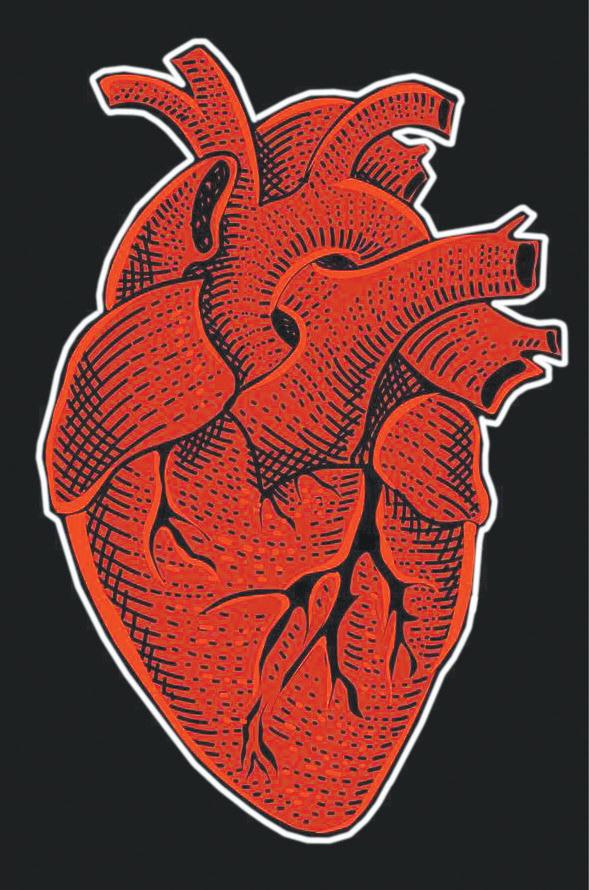
We could fill the rest of this issue with additional stats. They are abundant and heartbreaking. It can all be a bit dry and clinical, but it gets real when things hit close to home. We have had no shortage of shootings in our area recently, and they haven’t all been in sketchy neighborhoods at 2 am either. Two people died at Best Buy; there was a daytime shooting at Augusta Mall; a 14-year-old was shot and killed in front of small children in another daytime shooting; two customers of a North Augusta convenience store were shot and killed at 2 o’clock on a Sunday afternoon. These are but a tiny portion of a scourge that takes nearly 50,000 lives every year across this country.
Added to the thousands of one- or two-at-a-time shootings in petty crimes, suicides, et cetera, are the hundreds of mass shootings that happen each year. Not too many decades ago, no one kept statistics on mass shootings because there were no mass shootings. Now there are actually organizations which track them in multiple categories: public events, drive-bys, family annihilations, bar/ club incidents, workplace incidents, and others.






PARENTHOOD
by Dr. Warren Umansky, PhD
Recently, you heard a discussion at your hair salon about sharing family history with your children. You have some embarrassing “characters” in your family and some embarrassing moments in your life. You’re not sure you want your kids to know about them. You also have some strong people who conquered adversity to bring you to where you are. What do you do?
A. You may not be proud of every member of your family, but you want your children to know their history and who made sacrifices for them to be here with what they have.
B. Your kids have enough to deal with in these challenging times. With social media, school, thinking about careers, you want them to focus on their future, not the past.
C. You your kids don’t know where you went to school and how you did in school or what kinds of jobs you had when you were young. Maybe talking about family history will be good for everyone.
D. The days are so busy, you don’t know when there would be time to talk about things like this.
If you answered:
A. Great approach to raising your children. No doubt you have thought or said, “I want to give you a better life than the one I had.” Research at Emory University a number of years ago suggests that children who know stories about relatives who came before them show higher levels of emotional well-being. Sharing those stories appears to be important.
B. Winston Churchill coined a variation of a phrase from Spanish philosopher George Santayana. Churchill wrote, “Those that fail to learn from history are destined to repeat it.” Perhaps there is value to knowing one’s past in order to make a better future. Parents have the responsibility for directing their children to a successful future based on what you have learned from your past and what you can teach them, not social media.
C. Your children should be interested in your stories. To get a sense of what kinds of stories to tell, search for the Do You Know Scale that was developed as part of the Emory study. One of the items not included on that scale that should be a part of the discussion is what generation of your family first came to the United States and how did that happen.
D. This answer suggests that you need to re-organize your day. There should be some time every day for talking to your children. One of the best times is sitting at the table for meals. It is a “tradition” that should begin when your children are young and continue through their adolescence. Schedules may have to be modified for after-school extracurricular activities, but the tradition should never be abandoned.
David Isay founded StoryCorps to capture family stories and preserve them. He began a tradition of recording interviews between friends and family members to capture and preserve important memories. He suggests that holidays when families are together is a good time for younger people to ask questions of their older family members. (He provides a list of sample questions. Search StoryCorps Questions.)
Make family stories a part of your daily and holiday rituals. You and your children will reap the benefits.
Dr. Umansky has a child behavioral health practice in Augusta.
THOUGHTS ABOUT THOUGHTS THOUGHTS

“I’M ALREADY DEAD” ANOREXIA NERVOSA
Editor’s note: Written by local mental healthcare professionals, this series explores how people may think and act when affected by common and not-so-common mental health conditions.
At 17, “Emily” was known as a straight-A student, dedicated athlete, and someone who never made waves.
What most people didn’t see was the silent battle she fought every day.
In the months leading up to her high school graduation, Emily had become increasingly strict about what she ate. What started as “just eating healthier” quickly turned into skipping meals, exercising twice a day, and obsessively tracking every calorie.
Her parents noticed she was losing weight quickly—too quickly—but Emily brushed off their concerns. She insisted she felt fine, even when she became dizzy walking up the stairs or couldn’t concentrate in class.
One afternoon during soccer practice, Emily fainted. The physical exhaustion, malnutrition, and dehydration had taken a toll her body could no longer hide.
Emily was diagnosed with anorexia nervosa, an eating disorder that affects both the mind and body, often long before the warning signs become visible to others.
What
Is Anorexia Nervosa?
Anorexia nervosa is a serious eating disorder characterized by:
• An intense fear of gaining weight
• A distorted body image
• Significant and sometimes dangerous weight loss
• Restriction of food intake or severe dieting behaviors
People with anorexia become fixated on weight, body shape, and control. This condition is not a lifestyle choice or a diet—it is a complex mental health disorder with potentially life-threatening consequences.
Although commonly associated with adolescents and young adults, anorexia can occur in individuals of any age, gender, or background.
Signs & Symptoms
Anorexia can be difficult to detect early, especially when behaviors are hidden or justified as “healthy habits.” Common symptoms include:
Physical Signs
• Noticeable weight loss
• Fatigue and weakness
• Dizziness or fainting
• Hair thinning or loss
• Low blood pressure and slowed heart rate
• Feeling cold frequently
• Gastrointestinal issues
Behavioral Signs
• Restricting food or skipping meals
• Intense fear of gaining weight
• Excessive exercise
• Avoiding eating around others
• Obsessive calorie counting or weighing
• Denial of hunger
• Wearing loose clothing to hide weight loss
Emotional & Psychological Signs
• Distorted perception of body shape or weight
• Anxiety, irritability, or depression
• Perfectionism or rigid thinking
What Causes Anorexia?
There is no single cause, but research suggests that anorexia develops from a combination of:
• Genetic factors – family history of eating disorders, anxiety, or mood disorders
• Biological influences –dysregulation of appetite and reward pathways in the brain
• Psychological traits – perfectionism, need for control, low self-esteem
• Environmental factors –cultural pressure to be thin, bullying, trauma, or major life changes
Anorexia is often misunderstood as vanity or attention-seeking. In reality, it is a complex disorder deeply rooted in emotional and biological processes.
Treatment and Management
Recovery from anorexia is possible but often requires a multidisciplinary approach. Early intervention significantly improves outcomes. Common treatment approaches include:
• Medical Monitoring: Because anorexia affects nearly every organ system, medical supervision is essential to address malnutrition and prevent complications.
• Nutritional Rehabilitation: Registered dietitians help patients rebuild a healthy relationship with food, restore weight safely, and challenge harmful beliefs about eating.
• Psychotherapy: Effective therapy approaches include:
• CBT-E (Enhanced Cognitive Behavioral Therapy) – focuses on thoughts and behaviors maintaining the eating disorder
• Family-Based Therapy (FBT) – especially effective for adolescents, involving parents directly in restoring
too weak to get well (if they are so inclined) and stupid to get involved in the first place. In my seventy-three years, I have known four church leaders in four different churches--we’ve been members of about twelve over the years—who ended up with criminal records related to pornography addiction that progressed into crime. Thankfully, they were not the preachers, but even members that you look up to is quite a shock. We’ve attended many denominations so you can’t pin it on that.
Both personally or professionally, I learned to say out loud “alcoholic” and “drug addict” and “gambling addict” for a family member or friend. However, I never had a name for the problem a friend’s husband had, compelled to see porn on a regular basis, which really harmed their marriage. That was 1989. He was addicted to porn, but what was he? A pornographer? A pornoholic? No, he was a porn addict. I googled it. So, there is a name for it, and hope, and it is not entirely hidden. The sooner one with problems joins a Porn Addict Anonymous (PAA) zoom meeting, the better. There are even groups for people as young as 18. Does that tell you something about our growing problem?
I found an open PAA meeting. That means the public is welcome, not just addicts. I am familiar with open AA, AlAnon, Narcotics Anonymous, and Naranon meetings. I want to see if someone attending PAA will testify at the state legislature about the need to pass Georgia Senate Bill 74 to make it illegal to have books with porn in the children’s sections of public and school libraries. I am not sure I am brave enough to go, but sometimes you must get into the weeds to get a job done. Ask Mike Rowe of Dirty Jobs fame
Porn is like other addictions in that it is insidious and gradual. It requires increasing depravity to satisfy the “customer,” and that is how big porn business gets rich. There is great damage financially and relationally when it goes on unabated, so the key is prevention, never starting to view porn and not letting kids be surprised by it. It is often caught too late, in terms of consequences suffered by the individual and their family. No one can predict who the person will be who cannot stop looking at it. Victims are well-heeled businessmen and doctors, as


well as malcontents and homeless dudes. This addiction can hide for a long time. By contrast, gambling or drugs or alcohol addictions might be part of the excesses of college life that can be set aside, while porn addiction could be easier to hide and harder to conquer. True, some can put it down after a year or two of exploration, but many cannot.
Addictions and recovery from them are complex and related to one’s genetics, environment, determination, group support, personal willingness, intense treatment (preferably inpatient), spiritual conviction or a miracle. It is not a question of “handling it” like we learned in movies about the Old West. Men and women in those friendly bars could have one or two drinks and stop. The exception was the lone town drunk, like on The Andy Griffith Show. That was misleading. There was never just one. The others were “off camera.”
The big question is, how do we stop our loved ones from continuing in what we suspect be an addiction? Better yet, how do we prevent it in the first place? See Part II in the next issue.
ABOUT THE AUTHOR, Priscilla Bence, BSN, MPH “The Medical Examiner has been a good friend of mine for many years, because it feeds me light humor and interesting medical information and opinions. I save articles like “Pour Decision-making” from Aug 15 and “I Remember” from Sept. 19. I already miss the Steppingstones articles, as I learned a lot from that author. I miss Dr. Karp, who is the most common-sense science-based dietitian I have known. I was a nurse for forty years, and twenty of those years were in public health. I appreciate the traffic death and injury column as I spent five years studying traffic crashes in Richmond County as a public health nurse. In the Army I visited families with abuse and neglect problems and served as the Chairman of the Family Advocacy Case Management Team. One year, I taught codependency classes at Eisenhower.” +


DOES MICROWAVING AFFECT NUTRITION?
Pretty much any type of cooking can cause some degree of nutrient loss. The main factors involved are time, temperature, and the amount of water used.
Boiling food is viewed as the worst offender in losing nutrients because of the amount of water-soluble vitamins that can and do leach out into the water, which is often then poured down the drain.
When frying foods, the high heat involved can degrade some nutrients, and in addition the process adds fat.
Agencies like the FDA have extensively reviewed microwave safety and the conclusion is that no unique risks to food safety or human health is posed by microwaving.
Why is the word “unique” in the previous sentence?
Because cooking using a microwave does alter food molecules, but only in the same ways any heat-based cooking does. The heat generated by microwaves has the same effect on food at the molecular level that baking or steaming or roasting does.
Microwave ovens employ non-ionizing radiation, meaning the waves cannot break chemical bonds or create harmful mutations. If you guessed, based on the three main enemies of nutrition in paragraph one, that microwaving is one of the best (if not the best) ways to cook food and preserve its full nutritive value, give yourself a gold star. What makes microwaving a better option to keep the most nutrients in our foods? Its top asset is speed. Microwaving is the quickest way there is to get foods up to their cookable temperature. Foods can go from refrigerator to piping hot literally in seconds, minimizing heat damage over time; in addition, cooking via microwave usually involves very little added water.
Studies show microwaving can preserve vitamins, antioxidants and phytochemicals better than boiling, baking, roasting, steaming, frying, or stove-top cooking, and the changes caused by heat are basically the same across the board no matter what cooking method is used. +

Direct editorial and advertising inquiries to: Daniel R. Pearson, Publisher & Editor E-mail: Dan@AugustaRx.com AUGUSTA MEDiCAL EXAMINER P.O. Box 397, Augusta, GA 30903-0397 (706) 860-5455 www.AugustaRx.com • E-mail: Dan@AugustaRX.com

Who is this?
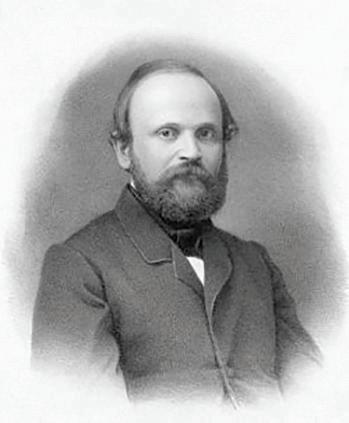
Sometimes being a world-class genius just isn’t enough.
The career of this man illustrates the point. His name was Robert Remak, and he was born in Prussia (what is now Poland) in 1815. Acknowledged as a pioneer of medical research to this day (even if not a well-known one), he labored in obscurity for much of his career and faced near constant personal rejection. Every step forward in his career was obtained only through much patience and dogged perseverance. More about that in a moment.
The son of a cigar merchant, Remak studied under several noted professors in Germany, and earned his M.D. degree from the University of Berlin in 1838 with a dissertation about the structure of nerve tissue. His medical explorations and discoveries were amazingly diverse, spanning embryology, pathology, and histology (the study of the microscopic structure of tissues).
Consult a medical dictionary or encyclopedia and enter the name “Remak,” and you will be rewarded with a long list of eponymous discoveries: Remak’s band, Remak’s fibers, Remak’s ganglia, Remak cells, and more.
Some medical historians credit Remak with the discovery that cells originate from other cells through cell division, that “life comes from life.” Not only was that a radical discovery for its time, an era when it was believed that life could generate spontaneously, but the discovery was completely ignored.
The discovery is generally credited to Rudolph Virchow (previously profiled in this series), who announced his findings some three years after Remak did, and is said to have been well-informed of Remak’s earlier discovery. He gave no credit to Remak.
That was just one of many slights Robert Remak was forced to endure during his career. Why? Simply put, his faith. Jews were barred from teaching positions and from most high offices by Prussian law. Much of his research, which has survived nearly two centuries without correction, was performed as an unpaid lab assistant. He supported himself independently through a small medical practice. It was almost 20 years after gaining his MD degree that he was finally appointed as an associate professor, but never as a full professor.
The systematic lifelong prejudice Robert Remak had to face wasn’t limited to him. His grandson, a noted and gifted mathematician, was stripped of the right to teach when the Nazis came to power in 1933. He was arrested in the infamous Kristallnacht raids on November 9, 1938. Sent to Sachsenhausen concentration camp, he was released after a few weeks and permitted to relocate to Amsterdam. When Germany later occupied the Netherlands, he was once again in the Nazi cross-hairs and was arrested, deported to Auschwitz, and executed there in 1942.
Robert Remak died in 1865 at the age of 50, probably of sepsis secondary to diabetes. +
ADVENTURES IN
Middle Age
BY J.B. COLLUM
It’s funny how aging changes what gets you excited. When I was much younger, hearing about a “happening” party put me in a good mood. Now, the first thing I ask is what time it starts—and if it’s after dark, I’m probably out.
These days, nothing perks me up like hearing that a grocery store is opening nearby. We’ve been watching them build a brand-new Publix about six miles up the road. When it opens—hopefully around December 6th— it’ll be the closest full grocery store to us, pharmacy included. I’m already planning to move my prescriptions there, which will cut a big chunk of time off that errand.

it takes to work off a Publix glazed donut? Okay, fine—two glazed donuts. Asking for a friend.
I’m hoping for a new restaurant. Oh, and a gym. Definitely a gym. Really.
Now, it’s not like we don’t have places to buy basic supplies, but they’re all Dollar Generals.
And is it just me, or does the proliferation of Dollar Generals defy the laws of physics? I have two within three miles of my house—and I live in the boondocks. They’re building another one two miles away, plus one between my house and the new Publix. That’ll make five—yes, FIVE—within five miles. At this rate, another one is probably sprouting as you read this.
Don’t get me wrong—they’ve saved my bacon more than once when we needed something at the last minute. But it’s not like each store brings tons of jobs. Most seem to have one overworked employee and a couple of others who may or may not exist. Some stores even have two registers. That always cracks me up. As if…
But I digress. Back to the important stuff—my newfound excitement over mundane things. With a full-service grocery store nearby, I may start popping in during my lunch hour for a sandwich or some sushi, like at the other Publix I go to. During the dog days of summer, I might even use it for my walking exercise. Speaking of walking…any idea how many laps

And that’s not all! (I know, I sound like an infomercial. My apologies.) There are five more storefronts next to the new Publix, and I’m crossing my fingers that one is a place I’d enjoy eating. Since we already have an Asian restaurant, an Italian restaurant, and a sandwich shop nearby, I’m hoping for a good Mexican place. They may not match Dollar General in sheer numbers, but I wouldn’t complain if they tried.
Since this is a “salubrious” publication, I should probably hope for a small gym, too. That wouldn’t be the worst thing. As long as they leave out payday loan places, title loan offices, and tax prep storefronts, I’m good.
Should I feel sad that little things like this make me happy now? I don’t think so. Life changes, priorities shift, and the things that once mattered don’t always matter anymore. A shiny new grocery store with a deli, bakery, and pharmacy is enough to get me out of the house—and honestly, I need that. If that’s all it takes, maybe other businesses can take notes from Dollar General and learn to turn a profit while opening more stores than there are stars in the Milky Way. (Slight exaggeration. Please consult your local astronomer.)
In short, whatever lifts your spirits—go find it. Whether it’s walking the aisles of a new store, hiking a trail, or doing glazed donut bicep curls, just do it and enjoy it. And maybe walk it off afterward.
+
J.B. Collum, author of this column and Special Forces Parenting, is a local novelist, humorist and columnist who wants to be Mark Twain when he grows up. He may be reached at johnbcollum@gmail.com

Special Forces Parenting
Ah, it’s the time of year when families come together and get fat together—or in my case, get fatter.
It’s the season when people who love each other argue about politics or life decisions unapproved of by parents or grandparents. It’s when us middle-aged folks find ourselves trapped in a house not our own, surrounded by the hubbub of voices, clinking plates and silverware, laughter, crying, and screams of children, and the roars and boos of football on a TV turned up just loud enough to drown everything else out. It’s also loud enough that we older folks have zero chance of understanding anything you say. We will ask you to repeat yourself again and again until we eventually give up and repeat back whatever nonsensical word salad we think we heard—at which point you either give up or repeat yourself at a decibel level that would make OSHA shut down a factory.
As you read this, you likely just experienced this torturous ritual. Yet we’ll do it all again on the next holiday that demands it of us. Either we develop collective amnesia about how overwhelming it was, or our sense of obligation outweighs the fear and dread our memories try to warn us about.
When you have the special children we have in our lives, though, these gatherings can be even more exciting and challenging. Some of them struggle with the noise and the number of people, some of whom are “relative strangers,” as in relatives who are nevertheless strangers because we see them


so seldom. We do our best to accommodate their needs. For us, that means regularly checking on little Freyja to make sure she isn’t taking her clothes off or sculpting with the contents of her diaper as a coping mechanism. Yes, it’s a little extra to deal with. But there are good parts too. She gets held, hugged, and talked to by people who love her and are thrilled to give her attention.
While everyone was here, and even after they left, Freyja seemed more talkative than usual. She repeated sounds as if trying to perfect them. She’s been doing this with her speaking tablet too—pressing the picture-buttons over and over, sometimes making the corresponding sounds.
No, her sounds don’t match the words yet, but we like to add the word “yet” to the end of that sentence. We know the odds aren’t in our favor, but we still hope. A more realistic intermediate goal is simply understanding more of her unique language. So we search for patterns, guessing at what she means—giving her a drink or a snack when that seems to be what she’s asking for. And she is responding correctly to more and more words, which shows her understanding is growing.
Obligation to family keeps us doing things that are hard. Obligation—and love. So even when we face the stress of a crowded, noisy house… even when Uncle Joe won’t stop talking politics… even when the kids’ shrieks of joy give you a pounding headache… keep doing it.
Human connection is what life is about. Being with people. Talking to them. Doing things to make them happy. When your time to say goodbye to this world arrives, these are the things you will regret not doing. And when you are gone, how you treated people will be how you’re remembered. Let’s try to make our memory a pleasant topic of conversation at the next family gathering following our eventual demise.
Our children will imitate our conduct far more than they will obey our words. If you want to leave a legacy of unity, love, kindness, and generosity, then practice those things now, at every opportunity. They will become a memorial to you long after you’re gone, carried forward in the good deeds of your descendants. +




Who is this?
Not everyone in healthcare can be Florence Nightingale, right? Despite the long-running series on page 4, there are clunkers in medicine, and we will examine some of them in this series. Unfortunately, there’s enough material to keep this side of the page going for a while.
If you needed somebody to sell ice to Eskimos, this would be your guy. This man convinced nearly the entire medical community — including the Food and Drug Administration — that opiates are not addictive, even though their addictive nature had been known for decades before he came along.
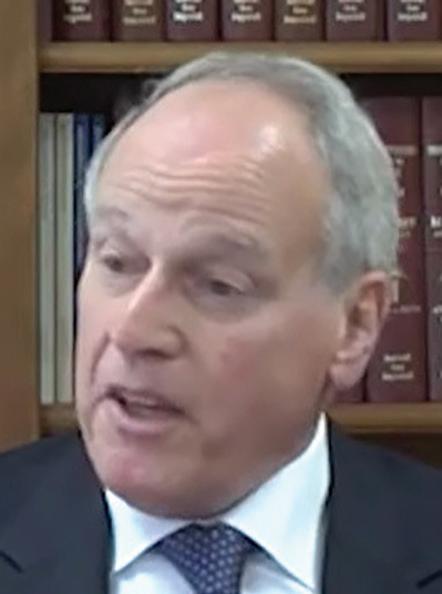
From that brief bio, you probably have figured out at least the last name of this man. He is Dr. Richard Sackler, one-time chairman and president of Purdue Pharma, the company behind OxyContin. A whole family of Sacklers were involved in creating the opioid crisis, but as the head of Research & Development and Marketing for the infamous company, Richard was the key figure in creating an aggressive campaign that pushed an addictive drug and company profits over patient safety.
The debacle started in Purdue’s R&D labs, with the development of a slow-release coating for OxyContin tablets. Purdue claimed (and convinced the medical establishment) that the formulation made the drug addiction-proof. It was as though they had invented a cap for whiskey bottles that would only allow a few drops at a time to slowly dribble out. Drinkers bought the bottles and simply removed the cap. Or in Purdue Pharma’s case, people crushed the tabs and snorted the powder. Which is not to say that all the victims of the opioid epidemic were junkies. Many people were respectable, honest, law-abiding citizens who happened to be in serious pain for one reason or another, and who were prescribed a legal drug by their trusted family doctor.
As alluded to in our introductory paragraph, those fooled by the Sacklers reached the highest levels of the federal government, experienced family physicians, decent, hardworking patients, as well as long-term addicts. The Sacklers have never admitted to serious wrongdoing, blaming the entire opioid crisis on the addicts and “reckless criminals” who misused their perfectly safe and harmless drug. That hasn’t stopped dozens of states from successfully suing the firm and the family to the tune of billions of dollars. It must be said, however, that no amount of money, no matter how enormous, could ever undo the damage caused by the Sackler family. How can a pricetag be placed on the loss of trust in the medical community? Who could accurately measure the burden placed on the entire healthcare system? How can the opioid crisis’ impact on the economy be repaired? Most of all, what compensation could ever provide solace to the families of the more than 900,000 Americans who died from overdoses between 1999 and 2023, in which OxyContin played a major role?
Truly, Richard Sackler and his company deserve an entire wing in medicine’s Hall of Shame.
+
1350 WALTON WAY| AUGUSTA

DO YOU SUFFER FROM MEDICAL INFORMATION INDIGESTION?
Guest column by Warren B. Karp, Ph.D., D.M.D.
Do you get an upset stomach every time you hear health advice nowadays? “Where’s the beef?” in scientific medical information today? Doesn’t it seem that all too frequently, science and medicine are areas being addressed by politicians rather than health professionals? That means the responsibility now lies on YOUR shoulders to understanding where scientific, evidence-based and peer-reviewed medical information can be found. There are many readily available places where important, verified medical information can be found. This information is critical to your health and the health of your loved ones. Let me help you figure out where to find and “bite into” this medical information.
Where to look
For non-medical professionals, the first places I recommend are the many verified, world-recognized health and medical organizations, especially ones specializing in the medical subject of your specific interest. These organizations usually have a section for the public where you can find summarized, easy to understand information. Scientific medical organizations with such websites include The American Medical Association, The American Dental Association, The American Public Health Association, The American Academy of Family Physicians, The American Academy of Pediatrics, The American Nurses Association, The American Physical Therapy Association, The World Health Organizations, as examples. There are many more.
Over this past weekend alone (from Thanksgiving Day through Sunday night) the Gun Violence Archive recorded 58 shooting deaths nationwide, and another 101 people shot and wounded. Think about those numbers. Not only is that a lot of people, but for every single victim dozens of friends, family members, schoolmates, classmates and neighbors are also saddened and traumatized. That kind of violence goes on day in and day out, all year long.
Other than the aforementioned close-to-home killings and the occasional out of the ordinary shooting that somehow grabs our collective attention, most shootings go unnoticed. Usually they generate about as much interest as the weather forecast.
A number of law enforcement and public health experts have observed that as a society we have gradually transitioned from prevention to preparation. In other words, rather than stopping shootings before they happen, we’re making plans about how to deal with the aftermath. Speaking broadly, we have in large part accepted gun deaths as normal and unavoidable. We focus only on what we can fix: the aftermath.
Of course, not everyone shares that viewpoint. Gun safety advocates have lots of ideas on how to stem the tide of bloodshed that affects the US more than almost any other country on earth. The strategies aren’t even that complicated.
Number one on every list: safe storage. Safe storage saves lives. That means storing firearms and ammunition separately under lock and key. Studies show that one simple step dramatically reduces accidental shootings, youth suicides, and anger-fueled in-the-heat-of-the-moment shootings that only happen because a firearm was conveniently located during a domestic argument (see statistics above about shootings involving pregnant women).
Safe storage boils down to a few simple elements. Store firearms unloaded, and as mentioned, with ammunition under separate lock and key. Make sure the key and/or combination is inaccessible to unauthorized people.
Many people resist the idea of storage in the belief that they will be unable to protect themselves if their weaponry is locked away and inaccessible.
A family could go decades and never need the protection a firearm offers, or they could need that protection tonight. No one ever knows. But here is a fact: studies consistently show that guns stored loaded and unlocked are far more likely to be misused than used in defense. Statistically, a family is far safer practicing safe storage.

Here is a word of caution. There are quite a few fake but real-sounding medical associations and groups out there. Double-check and verify that the site you are on is, in fact, an established, recognized authority for answering your questions.
If you have a health or medical background, the first place to go to for medical science knowledge and data is PubMed, which is the public internet source for current, updated medical data and information. As stated on the PubMed search page, “PubMed® comprises more than 39 million citations for biomedical literature.” How cool is that! A readily-available source of evidence-based medical information right at your fingertips. This website publishes studies not just from the U.S.A. but from countries throughout the world.
Where not to look
Do not use social media as a source of your information. Comments on such sites are often based on personal feelings and individual experiences rather than scientific fact and data. Don’t get me wrong, a person’s feelings and experiences are very important for many reasons, especially the psycho-social and emotional issues that come along with a medical treatment. I am simply advising you against using feelings and experiences, rather than data, to understand the evidence and facts behind a particular drug, treatment or therapy.
There are some telling ways of figuring out if you are finding good information or are being misled. For example, are the people supplying the medical information about a product also the ones selling the product? Do the ads tell you what unnamed “experts” and patients say and feel, rather than what the independent facts show? Are marketing agencies and businesses sponsoring the information or advertisements? Do you see a lot of “pseudo-scientific” but real-sounding jargon? Are you being told that all current medical knowledge is wrong, but “Aha!” they just happen to have the correct information that the entire medical community has missed, or is trying to hide? Don’t just walk away — run!
What is my “No-Nonsense” advice for today? Before you take a big bite out of some delicious-looking medical information beef, do this: make sure it is peer-reviewed, evidence-based, published in leading medical and health science journals and verified by independent researchers, laboratories and expert organizations. If you don’t do this, you will surely end up with low-quality beef and a case of medical information indigestion.
About the author: Dr. Karp is a Professor Emeritus of The Medical College of Georgia at Augusta University. He has had a distinguished career in research, teaching, and public service, especially in the area of preventive health. He is former Vice Chairman of The Columbia County Board of Health. You can find out more about Dr. Karp at wbkarp. com
Realistically, no guns isn’t the solution. Owning them is a constitutionally protected right. Gun safety is a better focus for reducing fatalities.
THE PAPER CHASE NIGHTMARE
Obamacare totally misled us from day one.
President Obama promised premiums would go down, coverage would go up, and the relationship between the patient and the doctor would remain the same. Now that we have lived with Obamacare for years, we can say that premiums have gone up drastically, deductibles have increased, and access to the ideal plan you once had may be just a distant memory.
The amount of time needed to manage patients by physicians their staff has gone up dramatically while reimbursement has decreased. (That means more work, less pay.)
Let me walk you through a recent behind-the-scenes patient management episode.
Rod has ADHD. Attention deficit hyperactivity disorder. He has been thoroughly and properly diagnosed. He has been treated with Adderall and over a few months his dose has been optimized. His ability to function as a family man and at work have both improved. He was promoted by his superiors. They feel he is capable of more
responsibility. Of course, his income increased.
Additionally, he will have a new insurance plan that will cover his medication costs with a small co-pay.
It falls upon the physician to interface with his insurance company and obtain prior approval so the insurance company will pay for Rod’s medications. When he was admitted to the insurance plan, he clearly listed ADHD as a pre-existing and long-standing diagnosis. He was accepted into the program.
Under existing conditions, Rod went to his pharmacy and presented his monthly prescription and his new insurance card. The prescription payment was automatically turned down because he did not have prior approval from the insurance company (for a drug he had been taking for years). The pharmacy told Rod to go get prior approval. In the meantime, Rod had to pay out of pocket for the medication even though his insurance company was supposed to.
Someone on his doctor’s
BASED ON A TRUE STORY
(most of the time)
A
series by
Bad Billy Laveau
staff called an 800 number and had to wade through a long recorded set of instructions regarding which buttons to press when. After losing the connection a couple times, a human voice finally answered. The voice was heavily accented and certainly not from anywhere near Augusta, Georgia.
After verifying the doctor’s name, medical school education, Georgia license number, DEA number, NPI number as well as his callback number and email address, they were put on hold for a while and then routed to a second person. The second person’s accent was no more understandable than the first.
The second person apparently had never heard of the first person or any of the information provided to the first person. The same information rodeo started all over again.
Finally they asked the
patients name, birthday, and address. They asked for the diagnosis. ADHD. They said, “Yes, I see that on h is policy.” (Or at least that’s what it sounded like.)
Then the screener said, “I must ask you an important medical question.”
Great. We’re getting somewhere … after being on the phone for almost half an hour.
Office patients waited. Nurse was not pleased and wanted to get through and go home because she had a husband and family waiting and the evening to prepare.
So here was that important medical question: “Is the patient over 12 years old?”
The interviewer indicated he had a copy of the policy in front of him and surely you could read the age that would indicate Rod was 39 years old and fully employed.
Words like “astounded” and “perturbed” came to mind. And worse. A ll of this, and they still have to ask how old is the patient? And he had the policy in hand which clearly shows the birthdate. They have wasted an hour of office
time to ask if the patient is more than 12 years old?
“Yes, he is 39 years old.”
After a few seconds, the heavily accented voice said, “I will approve medication. You will receive a fax in a few days. Is there anything else I can do to help you?”
This is the kind of useless, time-consuming, drudgery that physicians and their staff must endure every day. Of course, the patient never sees this, nor do they understand the amount of time it takes to comply with governmental and insurance company regulations.
We have a person with the computer who must approve a doctor’s prescription having never seen Rod nor the doctor nor the patient nor the pharmacist. Yet they have control of medical treatment because they control the purse strings.
Thank you, Mr. Obama for Obamacare. In my humble opinion, it can’t go away soon enough.
Forgive me. At this point, although I usually write with some humor, the only socially acceptable emotion I can muster here is sarcasm





THOUGHTS from page 2
nutrition
• Dialectical Behavior Therapy (DBT) – helps regulate emotions and reduce harmful behaviors
• Medication: While no medication cures anorexia directly, antidepressants or anti-anxiety medications are sometimes used to treat co-occurring conditions.
Because anorexia often becomes a coping mechanism, treatment also involves learning healthier ways to manage stress, perfectionism, or feelings of inadequacy.
Prognosis
Anorexia nervosa has one of the highest mortality rates of all psychiatric conditions, largely due to medical complications and increased suicide risk.
However—with early, consistent, and comprehensive treatment, recovery is absolutely possible.
Many individuals regain their health, rebuild their relationship with food, and learn to treat their bodies with compassion rather than criticism.
If you suspect you or someone you love may be struggling with anorexia, seeking professional help early can be lifesaving.
+
Need Support?
Integrated Psych Solutions (IPS) provides comprehensive inpatient and outpatient mental health services, with or without a referral, to help patients and their families progress through the care journey. To make an appointment, call 706-204-1366 or visit integratedpsych.care. THANK YOU










CRASH COURSE

More Americans have died on US roads since 2000 than in World Wars I & II combined
The final official numbers won’t be known for quite some time, but the preliminary numbers from early 2025 in Georgia show a 6.3% drop in traffic fatalities compared to the same period in 2024.
As we have previously discussed in this space, Georgia and roughly 49 other states would like to see all numbers of traffic misadventures continue to drop. The ultimate goal of the Governor’s Office of Highway Safety and the Georgia Department of Transportation is outlined in a program called Vision Zero. Its objective, as you might guess from the name, is zero fatalities. Do not adjust your Medical Examiner. Zero means less than one. Is it an ambitious goal? Unquestionably. Is it also unattainable? The quick and easy answer would be yes.
essentially deliberate.
In other words, every one of those crash scenarios is avoidable. They did not have to happen. They were caused by driver error. Probably every person who has been in a collision of any kind, whether major league or just a fender bender will, if they are being honest, admit that they could have prevented the crash. Or if the other driver was completely at fault, he could have done so.
THERE IS GOOD NEWS ON THE ROADS
A person would have to sift through a mountain of crash reports to harvest a scant handful of collisions that were truly accidental. It would not be an easy task. Did someone’s brakes fail, leading to a crash that seems unexpected and unavoidable? That’s a possibility.
On the other hand, had the driver been ignoring the symptoms of brake trouble for weeks?

I WAS THINKING
by Pat Tante
BEULAH THE CHRISTMAS TURKEY
Author’s note: Years ago, a white turkey destined for the turkey processing plant in Newberry, SC escaped and showed up at my sister’s house. I thought it would make a good children’s story, but I never tried to publish it. I was waiting for my daughter to draw the pictures for me. Perhaps you can envision the book by reading my story.
She was lost. She had wandered for hours not knowing where she was. At least she was not packed feather-to-feather with others of her kind in the long, slatted truck.
They had ridden many miles from her home and had stopped at this big building.
During the pushing and shoving to empty the truck, she somehow fell off the ramp. So here she was, in a strange place and it was getting dark.
But studying this topic all the time to prepare these articles twice a month led us quite some time ago to discontinue using the term “traffic accidents.” There are crashes left and right. They happen by the thousands across the state every year. But accidents? That word implies a random event that could not have been anticipated, something unexpected and unavoidable, a chance out of the blue incident.
Accidents hardly ever happen when vehicles collide. When someone is driving impaired by alcohol, drugs, lack of sleep, texting, or the everyday crime of simply holding a cellphone and talking to someone else while driving (yes, that is illegal in Georgia and South Carolina and we all know it), a resulting crash is hardly random, unexpected, or unavoidable.
When someone is speeding, weaving from lane to lane, tailgating, running yellow and red lights and then they crash, that’s not an accident (unless we change the definition of the word).
The same is true for driving aggressively and engaging in road rage. Resulting collisions after that kind of behavior are no accident. They’re
Did a tire unexpectedly blow, leading to the inability to steer and resulting in a crash? Barring any additional incriminating information, that’s the kind of collision that seems like a true accident. Then again, how often does a crash like that happen? Accidents like that are rare.
The more one looks at road safety (and the occasional lack thereof), the more realistic goals that aim at zero seem. Nearly every crash is caused by avoidable actions.
That doesn’t mean traffic engineers and road patrol cops think humans can avoid every mistake. They know we are all imperfect. We all make mistakes, including driving mistakes.
But there are more and more elements of vehicle and roadway design that act to compensate for our mistakes and protect us from their consequences (air bags, as one example).
But it is truly encouraging to think that I canand you can - dramatically reduce the numbers of traffic injuries and fatalities. They are not simply an unfortunate but unavoidable result of our mobile society. They are instead preventable and avoidable. It’s up to each driver. +


She walked and walked and came to a little white house. It was quiet here and she was so tired. She pushed behind the hedge, sat in a pile of leaves and fell fast asleep.
Early the next morning, she crept out of her hiding place and walked around to the back of the house. Just as she did, the back door opened and she was face to face with a man.
They were both very surprised to see each other. The man called back inside, “Hon, come here. There’s a big white turkey in our yard – just in time for Thanksgiving too.”
The lady peered at the turkey from behind the door. “Maybe, she’s hungry, Cass. I’ll get the breakfast scraps.”
At the sight of the food, she realized how hungry she was. She followed the man and the plate right into the fenced yard and he shut the gate. “Well,” said the man. “I guess we will furnish the turkey for the family’s Thanksgiving dinner.”
News of the turkey’s appearance soon made the rounds of the family grapevine.
Each family member, in turn, came by to have a look.
“It’s a turkey alright,” said Grandma. “What’s her name?”
“She doesn’t have a name,” said Cass. “She’s going to be Thanksgiving dinner.”
Grandma peered a little closer through the fence. “She looks like a ‘Beulah’ to me.”
And so, Beulah she became – even to the grandkids who looked through the chain link fence and tried to feed her leaves and sticks.
Thanksgiving came and after dinner, everyone went outside to see Beulah who high-stepped around the yard enjoying the attention. The grandkids poked pecans and driveway gravel through the chain link fence.
“Well,” said Cass, “I guess we will furnish the turkey for Christmas dinner. Yessir, Beulah, the Christmas turkey.”
During the busy weeks between Thanksgiving and Christmas, no one thought much about Beulah, but when Christmas finally rolled around the family came for dinner. Slowly, they walked to the rear of the little white house to get a look at the backyard. They held their breaths…
But there she was! Beulah’s head went up at the cheering sounds from the assembled family. “Well,” said Cass, “I guess we’ll furnish the turkey for Easter dinner.”
And, so he did.

TRYTHISDISH
SCRAMBLED TOFU
This is a delicious rendition of scrambled eggs, complete with protein, flavor and fiber!
Ingredients
• 2 teaspoons extra virgin olive oil (divided)
• 1/2 cup onion finely chopped
• 1/4 red bell pepper, finely chopped
• 1 small tomato, diced
• 1 clove garlic, minced
• 1 teaspoon fresh parsley, chopped
• 14 oz extra firm tofu (one block), drained
• 1 tablespoon nutritional yeast flakes (optional)
• 1 tablespoon Mrs. Dash seasoning or any other chicken style seasoning
• 1/8 teaspoon turmeric
• ½ teaspoon kosher salt
Instructions
Place a teaspoon of oil in a nonstick skillet and once hot, add the onion, and bell pepper. Sauté the mixture over medium-high heat until the vegetables are soft approximately 2-3 minutes. Next add the garlic and tomato; sauté for about 30 seconds. Remove the veggies from the pan and set aside
Add another teaspoon of olive oil to the nonstick skil-
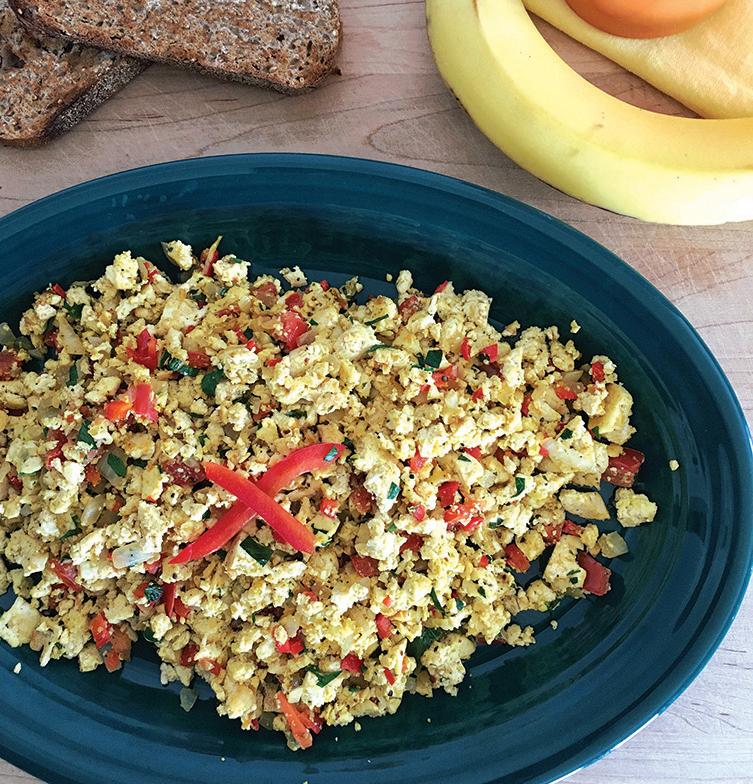
let and place over medium to medium-high heat. Once the oil is hot, add the tofu, break up with a wooden spoon, then allow to get lightly browned. Mix in the seasonings and add the veggies back to the pan.
Serve with whole wheat tortillas and salsa, or serve on toasted whole bread.
Yield: 4 servings
Nutrition Breakdown: Calories 140, Fat 8g (1g saturat-





ed), Cholesterol 0mg, Sodium 250mg, Carbohydrate 7g, Fiber 3g, Protein 12g, Potassium 175mg.
Percent Daily Value: 10%
Vitamin A, 30% Vitamin C, 10% Iron, 8% Calcium
Carbohydrate Choice: ½ Carbohydrates
Diabetes Exchanges: 1 Vegetable, 1 ½ Lean meat, 1 Fat
Optional: Add ½ cup of spinach or chopped mushrooms to the onion and bell pepper mixture. +
our fundraiser?
We’re trying to whittle down the balance on our printing bill. A free press isn’t free. Who knew?
single dollar helps and is appreciated.
Here is a link to visit for details: https://gofund.me/6b0e99951, visit Facebook.com/AugustaRX, or mail a contribution to PO Box 397, Augusta GA 30903

I hope you didn’t mind me giving you your present early.
I didn’t mind early. It was the present I minded.

ACROSS
1. Of the ear
5. Frau’s partner
9. Incline
13. Calypso music from Trinidad 14. Hip bone
16. Islamic chieftain
17. Some are said to be white 18. Slant
19. Aquatic bird
20. Dated
22. Chemical (atomic #53)
24. Wedding words
25. Blue Goose, in brief
26. Blvd. in medical district
28. Sigh of pleasure
29. Type of hound
32. Biopsy destination
33. AU, not long ago 34. Nobel Prize winner in Literature (1936)
Cleckley/Thigpen title
Grand ___
Mr. Floyd
British can
A of ABC
Rule of ______ (in burns)
WORDS
Why would I want a box full of pictures of my ex-husband and all my old boyfriends? What???

by Dan Pearson
Then why did you tell me that’s what you wanted? I said I wanted an Xbox, Einstein.
CAPTION THIS
Check out our new reader contest on p. 16 Write your most appropriate, clever, or funny caption to the photo shown for a chance to win whatever cool swag we decide to give away!
Email your entry to Dan@AugustaRx.com
DEADLINE TO ENTER: 5:00 PM FRIDAY, DEC. 12, 2025 Have fun!
S U D O K U
DIRECTIONS: Every line, vertical and horizontal, and all nine 9-square boxes must each contain the numbers 1 though 9. Solution on page 14.
64. Type of chair
65. Scent
66. Downtown Bar
67. Otherwise DOWN
1. Scandinavian capital
2. Labor
3. Chilled
4. Late Augusta historian Ed
5. Prefix relating to tissue
6. Building add-on, sometimes
7. Cap. of Brazil (until 1960)
8. Indonesian currency
9. Former employee?
10. Corner of note
11. Muck
12. “As needed” in med.
15. Catcall
21. Large CSRA employer
23. Famous Thomas
25. ______ reflex
26. Jefferson of note
27. Famous film critic
28. Knee injury ltrs.
30. Brandon ________
31. Kettering’s partner
32. Meadow
33. Augusta’s ____ Park
34. Canoe power
35. High tennis shot
37. Dwight’s better half
38. What you do with 34 & 46-D
41. Noted lexicographer
42. 30 Rock creator
45. Liquids
46. Scull implement
47. Popular magazine
49. Road division
50. Type of cavity
51. Peruse
52. Be _____ someone; leery
54. European mountain range 55. _____ flash
56. Unit of force 57. Self-esteem 59. Natal beginning
Flightless bird

DIRECTIONS: Recreate a timeless nugget of wisdom by using the letters in each vertical column to fill the boxes above them. Once any letter is used, cross it out in the lower half of the puzzle. Letters may be used only once. Black squares indicate spaces between words, and words may extend onto a second line. Solution on page 14.
following
are the
letters of the various words; the letters following #2 are the second letters of each word, and so on. Try solving words with letter clues or numbers with minimal choices listed. A sample is shown. Solution on page 14.

THEBESTMEDICINE

ha... ha...

Three women who had spent their lives in nursing arrived together at the pearly gates. Peter greeted the first one and asked where she had worked. “I was an ER nurse for years and years.” “You had a very hard job and saved many lives,” Peter told her. “Go right in.”
He greeted the second one and she told him, “I spent my career as a hospice nurse and helped dying people find comfort.” Peter said, “Thank you for providing such compassionate care. Welcome!”
Finally the third one answered Peter’s question by saying, “I was a nurse for an insurance company.”
Peter had to check his computer. After a few minutes of typing he finally told the nurse, “You can enter, but you’re only approved for 30 days.“
Moe: My daughter had a wild day at school.
Joe: What happened?
Moe: The minute she walked in after school, she said the principal of her school had run off after getting another teacher pregnant. Then they announced on the school PA sys-
tem that a real estate company had bought the school’s playground areas to build apartments, and they started tearing everything out today. As if that wasn’t enough, there was a Bigfoot sighting in the parking lot, so once they made sure he was gone they dismissed school early, but then her bus caught fire on the way home!
Joe: Didn’t I warn you it was a mistake to send her to drama school?
Moe: Is there such a thing as a food that promotes procrastination?
Joe: Yes. I believe they’re called hesitater tots.
Moe: I ate a kid’s meal at McDonald’s today?
Joe: Did you like it?
Moe: Yeah, it was ok. But his mom got really mad at me.
Moe: I just found out there’s no popcorn in popcorn shrimp.
Joe: Well, there’s probably no need to try pot roast then.
Moe: I’m doing crunches twice a day.
Joe: At the gym?
Moe: No, the kitchen. Cap’n in the morning and Nestlé at night.
Patient: When I applied the hemorrhoid cream you gave me, I got a terrible reaction.
Doctor: Where did you apply it?
Patient: On the bus.
Staring at my phone all day has certainly had no Effect on ME!

By popular demand we’re making at-cost subscriptions available for the convenience of our readers. If you live beyond the Aiken-Augusta area, or miss issues between doctor’s appointments — don’t you hate it when that happens? — we’ll command your mail carrier to bring every issue to your house!
NAME
ADDRESS CITY STATE ZIP
Choose six months for $26 or one year for $48 . Mail this completed form with payment to Augusta Medical Examiner, PO Box 397, Augusta GA 30903- 0397
Dear Advice Doctor,

The Advice Doctor

Two weeks ago I was halfway through an ordinary day at work, feeling perfectly fine, when suddenly I started to feel light-headed. I did the exact wrong thing: I stood up, and when I did I almost fainted. My boss insisted I take the rest of the day off, but by the end of the day I was notified that I needed a doctor’s release to return to work. It took me three days to get in to see my doctor, and before that could happen I was terminated. Should I sue?
— Felt Faint; Felt Fired
Dear Felt,
This is an unfortunate situation, indeed, and it’s far more common than it should be. In fact, discrimination against people who are light-headed is rampant, and all too often there is not even the barest attempt to conceal the bias.
As we all know, being light-headed (usually called “blonde”) is constantly equated with being dumb. A 2012 survey found more than two dozen joke books on Amazon that included blondes in the title, but just two for brunettes and only one for red heads. But is the “dumb blonde” stereotype based in fact?
It is not.
A study published by The Ohio State University in 2016 examined decades of data sourced from the National Longitudinal Survey of Youth 1979 (NLSY79). The study has followed, studied, and repeatedly surveyed the same huge pool of participants on a wide variety of topics since 1979 when the enrollees ranged from age 14 to 21. One of the questions added in 1985 was “what is your natural hair color?” NLSY79 also includes IQ test results.
Data from more than 10,000 people found the average IQ for women with blonde hair was 103.2. For women with brown hair the IQ figure was 102.7; for red hair, 101.2; and for women with black hair, 100.5. (Among men, blondes came in second to brunettes, 103.9 to 104.4.)
Yes, blonde women sported the highest IQs of the four major hair color groups.
My advice —and last time I checked, I am The Advice Doctor — if you were terminated solely for being light-headed, you may have grounds for legal action. Victorious legal action at that.
Thanks for writing, and I hope I answered your question.
Do you have a question for The Advice Doctor about health, life, love, personal relationships, career, raising children, or any other important topic? Send it to News@AugustaRx.com. Replies will be provided only in the Examiner.


CAPTION THIS

CAPTIONTHIS
PROFESSIONAL D
ACUPUNCTURE
Dr. Eric Sherrell, DACM, LAC Augusta Acupuncture Clinic 4141 Columbia Road
706-888-0707 www.AcuClinicGA.com
CHIROPRACTIC

DERMATOLOGY



Evans Chiropractic Health Center Dr. William M. Rice 108 SRP Drive, Suite A 706-860-4001 www.evanschiro.net

Jason H. Lee, DMD 116 Davis Road Augusta 30907
706-860-4048 Floss ‘em or lose ‘em!
Georgia Dermatology & Skin Cancer Center 2283 Wrightsboro Rd. (at Johns Road) Augusta 30904 706-733-3373 www.GaDerm.com SKIN CANCER CENTER


DEVELOPMENTAL PEDIATRICS
Karen L. Carter, MD 1303 D’Antignac St, Suite 2100 Augusta 30901 706-396-0600 www.augustadevelopmentalspecialists.com

Steppingstones to Recovery 2610 Commons Blvd. Augusta 30909 706-733-1935


Parks Pharmacy 437 Georgia Ave. N. Augusta 29841 803-279-7450 www.parkspharmacy.com PHARMACY










HEARING ASSOCIATES OF SOUTH CAROLINA welcomes patients from South Carolina and Georgia
NORTH AUGUSTA
105 E Hugh St., Suite 103 North Augusta, SC 29841 (803) 441-3937
AIKEN
39-A Varden Drive Aiken, SC 29803 (803) 641-6104
AikenHearing.com