603 Diversity Issue 18

Page 1


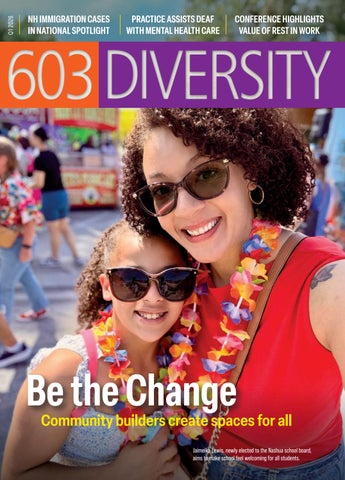
Be the Change

Community builders create spaces for all

Jaimeika Lewis, newly elected to the Nashua school board, aims to make school feel welcoming for all students.

Do the next right thing

There is some debate over where the expression “it’s a blessing and a curse to live in interesting times” comes from. What’s not debatable is that these times we’re living in sure are interesting.

Technological upheaval, economic turbulence, political polarization, fragmenting perceptions of truth and meaning ... it’s a lot. Of course, depending on one’s vantage point, people have always been living through interesting times. The context of history can be comforting.

And just as was true for our historic forebears, right now, how we decide to respond to our times may determine whether we perceive them to be a blessing or a curse, an onus or an opportunity. Maybe some days they’ll feel more like one or the other, but if there’s a long-view blessing to be found (or made), it’s likely incumbent on us to individually perceive it into being.

But it’s overwhelming, right? Too many problems in too many spheres. Where does one even begin? Self, family, community, state, nation, world ... where to start?

This calls to mind for me a response Carl Jung once wrote to a woman who asked him how she should live. He replied, in part:

“If you always do the next thing that needs to be done, you will go most safely and sure-footedly along the path prescribed by your unconscious. Then it is naturally no help at all to speculate about how you ought to live. And then you know, too, that you cannot know it, but quietly do the next and most necessary thing.” *

This in turn calls to mind the six rising changemakers we profile in this issue of 603 Diversity. They somehow seem to have not only avoided paralysis in the face of the overwhelming-seeming numbers of problems to be solved in the world right

now but have also determined a next thing that needs to be done and set about doing it. As I read through the pieces, I was struck repeatedly by their courage, vision, humility, endurance, and especially, their capacity to pick that next, right thing and get to it.

Their stories paint powerful portraits of people who have lived the challenges, identified the problems, envisioned solutions and then embarked on the journey of doing the next right thing, day after day. I highlighted some of their words that illustrate this beautifully as I read.

• "I could see, firsthand, that local businesses were really the backbone of a community's stability. Finding ways to stand beside them and helping them navigate was something that I realized was important to me. And that's where economics became less of numbers and more about lifting the communities through connection and access."

— Latonya Wallace

• "How can I work to change these cycles of inequity, to make sure they don’t continue?" — Jason Bonilla

• "I’m not here to be an exception. I’m here because, when I was a youth, I told myself that leadership would one day look like me." — Jaimeika Lewis

• "Knowing that I have these people in my life, nurturers and family to protect me and help me heal, knowing that I need to use these systems instead of trying to bear it all by myself, helped to lift me up."

— Kenny Frasch

• "I get so much joy in seeing people be authentic to themselves."

— Randall Nielsen

• "It just showed me how many people needed support, and how many people were struggling." — Nicole Sublette Their full interviews begin on page 18. Reading them in full, I assure you, is the next right thing. 603

*I encountered this quote in the book "4,000 Weeks" by Oliver Burkeman. It’s sort of an anti-time-management, pro-meaning-finding book, and I highly recommend it.

Contributing Photographers

Contributing Artist Richard Haynes

Editor/Publisher

Ernesto Burden x5117 ernestob@yankeepub.com

Managing Editor Mike Cote x5141 editors@603diversity.com

Managing Editor, Custom Publishing Sarah Pearson x5128 sarahekp@yankeepub.com

Creative Services Director Jodie Hall x5122 jodieh@yankeepub.com

Graphic Designer Christian Seyster x5126 christians@yankeepub.com

Senior Production Artist Nicole Huot x5116 nicoleh@yankeepub.com

Sales Executive John Ryan x5120 johnr@yankeepub.com

Operations Manager Ren Chase x5114 renc@yankeepub.com

Information Manager Gail Bleakley x113 gailb@yankeepub.com

Commercial Street,

Manchester, NH 03101 (603) 624-1442

Email: editors@603diversity.com

Advertising: sales@603diversity.com

A MISSION ON THE

Rise

To illustrate the mission of 603 Diversity, Seacoast artist Richard Haynes has provided one of his recent designs to accompany our motto “Live Free and Rise.” We are selling T-shirts and other merchandise featuring Haynes’ design, or a design created by art student Chloe Paradis, to benefit the Manchester Chapter of the NAACP.

Visit 603Diversity.com to buy one today.

Underwriters ROCK!

THANKS TO THE UNDERWRITER OF THIS ISSUE FOR THEIR SUPPORT

The 603 Diversity underwriters provide a significant financial foundation for our mission, enabling us to provide representation to diverse communities and for diverse writers and photographers, ensuring the quality of journalistic storytelling and underwriting BIPOC-owned and other diverse business advertising in the publication at a fraction of the typical cost. We’re grateful for our underwriters’ commitment to diversity, equity and inclusion in this magazine, their businesses and their communities.

OUR CONTRIBUTORS

SUZANNE LAURENT

Raised in a diverse community in Boston, Massachusetts, Suzanne Laurent worked as a registered nurse for the Boston Head Start Program. She moved to Toronto, Ontario, in 1982, and unable to work as a nurse, Laurent pursued a career in photojournalism. She has been a resident of New Hampshire since 1987. She has an extensive award-winning background in journalism. She is also a juried photography member of the New Hampshire Art Association and a published poet.

JAMES MCKIM

James McKim, who was involved in the original planning of 603 Diversity and has written essays for past issues, serves as managing partner of Organizational Ignition. He is driven by an intense need to help organizations achieve their peak performance through the alignment of people, business processes and technology. He is recognized as a thought leader in organizational performance, the uses of neuroscience and program management.

RONY CAMILLE

A regular 603 Diversity contributor, Rony Camille is a freelance journalist and a native of Canada. He became a U.S. citizen in 2019 after being a U.S. permanent resident for nearly 25 years. Camille is currently the media program director for the Town of Tyngsborough, Massachusetts.

ROBERT ORTIZ

Primary photographer for 603 Diversity is Robert Ortiz of Robert Ortiz Photography. Ortiz began his photographic career at 15, and has chronicled everything from local weddings and events to the lives of the native peoples of the Peruvian Amazon. He lives in Rochester with his wife and children.

CAITLIN ANDREWS

Caitlin Andrews has been a reporter and writer for nearly 10 years and has covered everything from politics to restaurant openings. She lives in Maine.

AMARA PHELPS

Musician and community organizer Amara Phelps loves to engage with her city of Manchester in more ways than one: fronting her popular local rock band Cozy Throne, teaching and sharing art in southern New Hampshire, and promoting community events and efforts for local publications, including Manchester Ink Link. She was recently named Youth Social Justice Champion by the Manchester NAACP.

DAN COMLY

Freelance photographer Dan Comly began taking pictures as a teen. He studied photojournalism at Boston University, graduating in 1978. While his career detoured to technical writing, photography remained a dormant passion. Now living in southern New Hampshire, Dan has returned to photography as his second career, specializing in documenting events with a photojournalist’s eye.

WIL ARVELO

Dr. Wildolfo Arvelo is president of Thrive Collective, consulting on nonprofit leadership and management, property development, board development and fundraising. Prior to that, Arvelo served as executive director of Cross Roads House and director of the Division of Economic Development for New Hampshire. From 2007-2017, he served as president of Great Bay Community College in Portsmouth. Arvelo has a doctorate in educational leadership from the University of Massachusetts/Boston.

YASAMIN SAFARZADEH

Advocate, coordinator and educator

Yasamin Safarzadeh, a native Angelino and current resident of Manchester, compiled our calendar. Safarzadeh hopes to secure a future for a more diverse young adult population in New Hampshire to ensure a more prosperous and effective future for all. DM her at phat_riot on Instagram.

EMILY REILY

Emily Reily is a freelance journalist and music critic based in Dover whose work has appeared in New Hampshire Union Leader, NH Home Magazine, New York Times for Kids, and Washington Post Magazine. She’s also a former newspaper photojournalist and copy editor.

ERNESTO BURDEN

As publisher of New Hampshire Magazine and the NH Business Review, Ernesto oversees their publication and that of 603 Diversity, NH Bride and many more. He’s also a writer who’s published a couple of novels, a bunch of short stories and a livelihood of non-fiction pieces. Outside the office, you might spot him running around Manchester and at the 2025 Boston Marathon, or playing guitar and singing at one of southern New Hampshire’s bars and restaurants.

SARAH PEARSON

Sarah Pearson is managing editor of custom publications for Yankee Publishing, which produces 603 Diversity and many other titles. She is an award-winning editor and journalist who previously worked for a newspaper. She is a lifelong New Hampshire resident and mother of two.

The Activism Work That Continues When People Finally Rest

At a time when activism is often framed as a constant urgency, speakers at the Black New England Conference at Southern New Hampshire University argued that rest, sustainability and care are not pauses in the work, but are essential to building a durable future for Black communities in New England and across the country.

cross hours of dialogue, one idea kept returning: rest.

Not rest as an escape from work, but rest as power. As preservation. As the necessary ground from which a community can imagine its future, instead of only responding to its present.

Over the course of the day on Oct. 25, a panel of historians, journalists, attorneys, educators and organizers traced the long arc of Black life in America and New England. They touched on history, media, trust and survival. Again and again, the discussion returned to the same realization: a future cannot be built if the people doing the building are burned out.

Public historian Cheyney McKnight, known for her work through Not Your Momma’s History, challenged one of the most persistent narratives about Black America.

“It is propaganda to say that we are not united,” McKnight said. “The reality is

there is so much diversity in Black America, and we make space for everyone. You will hear jokes, but at the end of the day, you will come and get a plate. You will always have a seat at my table.”

Her point reframed the conversation. Unity, she argued, has never required sameness. It has always been rooted in care, shared responsibility and cultural memory. Black communities are not held together by uniformity, but by the ability to hold difference without breaking apart.

That idea set the tone for much of what followed. Panelists and attendees, including those in breakout groups, were not rejecting the past. They were situating themselves within it.

Immediate right: Shay Stewart-Bouley, an antiracism speaker, was moderator at the Black New England Conference. Speakers included Lynae Vanee, Shannon LaNier, Antonio Saunders, Cheyney McKnight, Ronelle Tshiela and Ebony Curry.

“The reality is there is so much diversity in Black America, and we make space for everyone.”
— Cheyney McKnight

Ebony JJ Curry, a senior reporter with the Michigan Chronicle and a fellow at The 19th News, shared her thoughts about the role storytelling has always played in shaping power.

“Media is not a side note to this conversation,” Curry said. “It is the battlefield.” She reminded the audience that American narratives have long protected power by softening history and reframing inequality as inevitability.

“If you control the story,” Curry said, “you never have to fix the structure.”

“We live our freedom every single day. It can no longer be an aspiration; it has to be a lived experience."
— Antonio Saunders

Her remarks grounded the discussion in accountability. The promise of equality may be repeated often, but outcomes tell a more complicated story. That tension, she argued, is precisely why the Black press has always mattered.

One of the most resonant moments came from Ronelle Tshiela, a New Hampshire civil rights attorney and litigation fellow whose organizing roots are in the state. She spoke candidly about the cost of sustaining movement work in places where Black communities are small but expectations are large.

“So much work is being put out by Black people in this state,” Tshiela said. “We need everything that has been named here. But we also need rest. We need to prioritize ourselves. I want to just exist and live life.”

Tshiela has helped build the largest mutual aid fund in New Hampshire. She has organized, advocated for and led initiatives across multiple fronts. What stood out was not just her résumé, but her willingness to name exhaustion without framing it as failure.

Burnout, she made clear, is not about commitment; it is about sustainability.

What was striking was how openly the older generation on the panel embraced this shift. There was no dismissal of fatigue, no insistence that constant urgency

is simply the price of progress. Instead, there was recognition and pride.

Entrepreneur and community leader

Antonio Saunders spoke about freedom, not as a distant goal, but as a daily practice.

“We live our freedom every single day,” Saunders said. “It can no longer be an aspiration; it has to be a lived experience.”

Others echoed that sentiment. The future they described was not centered solely on resistance, but on creation. On building institutions, culture and opportunity without defining every step by opposition.

McKnight put it plainly. “We do not need to be fixed,” she said. “We need to be left alone and allowed to exist. And when we are, we will succeed.”

The conversation did not avoid harder truths. When the discussion turned to the future, trust emerged as an unresolved challenge.

“We cannot build anything if there is no trust,” one panelist said. “Right now, we do not have a foundation of trust.”

The observation was met with recognition rather than surprise. Collaboration requires good faith. Partnership requires consistency. Interdependence requires more than symbolic support.

Members of the next generation made clear they are willing to build together, but not at the expense of their health or humanity.

As the gathering came to a close, there was no neat ending, no summary. Instead, participants seemed to recognize how much had already been done, and how difficult it is to keep carrying that work without rest or community.

That framing shifted the discussion away from abstraction and back toward lived experience. Unity was treated as something already practiced, protected and passed down, not something in need of repair.

From there, the conversation moved away from urgency and toward stewardship, particularly in breakout groups. Younger voices spoke openly about burnout and the cost of always being present, always responding, always holding things together. Older voices did not resist that honesty; they recognized it.

What passed between generations was not a handoff but a shared understanding.

No one suggested the work was over. What emerged instead was an acknowledgment that the same people cannot be asked to carry it endlessly. When the conference ended, without ceremony or a closing statement, a sense of fellowship lingered.

It felt like a safe space, one where people could speak openly, be heard, and support one another in the shared work of ensuring Black culture in America not only endures, but continues to thrive. 603

*APR = Annual Percentage Rate. Effective 1/1/2026.

Celebration of culture

INDONESIAN FESTIVAL A SHOWCASE OF ART, FOOD, MUSIC, SMALL BUSINESSES AND MORE

The 12th annual Somersworth Indonesian Festival returned on Dec. 13 after a delay from its original fall date. The Indonesian Festival is a vibrant cultural celebration that showcases a rich tapestry of Indonesian culture through captivating performances, arts, crafts, traditional dances and even a film festival. It was also a great opportunity to explore local small businesses and learn about tourism in Indonesia. Hundreds attended the event to explore Indonesian culture within the wider New Hampshire community and beyond. 603

Left: The official opening of the 2025 Indonesian Festival by the cutting of the ribbon by the

Matthew Gerding, while U.S. Rep. Chris Pappas, state Sen. David Watters and ICC Director Raude Raychel watch. Below left: Owner Aisyah Ismail promotes her mobile spa business, Malaya Orchid Spa. Below right: Lila's Asian Kitchen specializes in Malaysian food.

PHOTOS BY ROBERT ORTIZ
Somersworth Mayor

Counterclockwise from above: Local vendors and politicians including U.S. Rep. Chris Pappas and Mayor Matthew Gerding joined the celebration. Cendra Wasih Dance Group of Boston. Adi and his son Ilya visited from Boston. Gus & Gek served Indonesian food. Unicorn Cove Hula Hui from Maine teach dance regionally. Five women from Dover and Somersworth comprise a local Indonesian dance group.

SPECIALIZED

FOR THE DEAF AND HARD-OF-HEARING SUPPORT

MENTAL HEALTH CENTER OFFERS SERVICES IN SIGN LANGUAGE

Greater Nashua Mental Health (GNMH) is home to New Hampshire’s only team specializing in mental health and substance use care for individuals who are Deaf and Hard-ofhearing.

The Deaf Services Program was started in 1995. Before this, there were virtually no linguistically appropriate counseling services available in New Hampshire.

Dr. Cynthia L. Whitaker joined the Deaf Services Program at Greater Nashua Mental Health as its director 19 years ago and became CEO of the center in 2020.

Dr. Cynthia Whitaker joined the team as its director 19 years ago. Then there was a small team of a therapist and a case manager. The team now includes director Adam Lemay, LICSW, a team of therapists, a case manager, and a supported employment specialist, Greg Quirion.

Whitaker is currently the CEO of GNMH. All the staff in the program are Deaf except for Whitaker and an American Sign Language interpreter.

Three experiences early in life led Whitaker to learn ASL at the age of 5.

“I was introduced to sign language at the age of 5, because an organization that my parents belonged to, the Grange, had a relationship with the Rhode Island School for the Deaf and promoted Deaf awareness in all kinds of ways, including basic sign language classes and contests for kids that I was part of starting at the age of 5,” Whitaker said.

“As I was growing up, my uncle married an interpreter/social worker who worked with the Deaf community — their wedding included Deaf guests and was interpreted. My boyfriend, when I was a teenager (now my husband), also had an uncle who married a sign language interpreter.”

When Whitaker attended college, she double-majored in psychology and speech and hearing sciences, taking formal ASL classes and interacting even more with the Deaf community.

“Upon graduation, I worked at a local psychiatric hospital. One day, a Deaf patient came in (this was before the passage of the ADA). There were no interpreters, so with only a B.A. in psychology, I ended up asking all the assessment questions and working with the psychiatrist to ensure she could get admitted,” Whitaker said. “I was off for the next few days, and when I returned, she came to me grateful to see me again and crying about not being understood, having had been given an injection of medication against her wishes, and unsure what to do.”

Two things happened as a result.

Whitaker didn’t take another day off for the remainder of the patient’s admission. And she decided she would apply to doctoral programs and work to improve access to mental health care for the Deaf community.

“I was accepted into the Clinical Psychology PsyD program at Antioch University in Keene, NH, and I also enrolled in a sign language interpreting program at the University of New Hampshire to improve my fluency and understanding further. My dissertation was on interpreting in mental health settings, and the rest, as they say, is history,” she said.

“Within five months of my official graduation with my doctorate, I joined GNMH as the director of our Deaf Services Program, which I called my ‘dream job,’ a role I held for almost four years before taking on larger and larger leadership roles, and ultimately becoming the CEO in 2020.”

There is a small percentage of the population in New Hampshire who are Deaf. GNMH saw about 75 clients in 2025.

Lauranna Turano, MSW, said a lot of the clients she sees are

The Deaf Services team at Greater Nashua Mental Health, left to right: Greg Quirion, supported employment specialist; Adam Lemay, director of deaf services and language access; Amy McCollom, therapist (on the screen); Michelle Woodruff, case manager; Lauranna Turano, therapist; Gwen Tyrie, therapist; and Michaela Borstel, therapist.
“ We help our clients support navigating everyday life at home and in school where they keep being told, ‘you can’t, you can’t.’ We help our clients navigate the hearing world and inspire them to become more independent.”
— Greg Quirion

depressed and have language deprivation.

“I see clients from a whole age spectrum, from children to senior citizens,” she said during a Zoom interview through an interpreter for this story.

“There is a lot of trauma and anxiety from children who can’t communicate with their parents, people who struggle with ASL and the English language in reading and writing. There is a feeling of discrimination. It’s interesting to have a Deaf Service Team. We know their experiences, as well as Audism. We help support them and are a role model to provide support until they thrive.”

Audism refers to the discrimination or prejudice against individuals who are Deaf or Hard-of-hearing. This discrimination can manifest in various forms, including the belief that hearing individuals are superior to Deaf individuals, the systemic exclusion of Deaf people from social, educational or employment opportunities, and the imposition of hearing-centric norms and practices without consideration for Deaf culture and communication preferences.

Greg Quirion, supported employment specialist for the program, agreed with Turano. He, too, is Deaf, and joined the Zoom meeting for this story.

“We help our clients support navigating everyday life at home and in school where they keep being told, ‘you can’t, you can’t.’ We help our clients navigate the hearing world and inspire them to become more independent,” he said. “This newest service we added has so much success with us serving as role models.”

There are 10 centers for mental health throughout the state that GNMH partners with for services, including the Deaf Service Program. They offer telehealth sessions and intake meetings at other mental health centers around the state.

Turano and the other social workers at GNMH collaborate with Quirion to provide treatment services, while also acting as role

models of successful Deaf people for their clients.

“One concept of being a role model is to show clients how to respond to someone who is yelling without overreacting,” Turano said. “To be collaborative instead of depending on emotions. Our clients have different treatment schedules depending on their needs.”

Quirion said he tries to meet weekly with different clients to motivate them to look for employment. He prefers to meet them in person to see what their environment is like and to understand more about them — if they are an immigrant or have a language barrier.

Whitaker said that, just as other communities are becoming more diverse, the Deaf community has also seen an increase in individuals immigrating who are Deaf, many of whom are not fluent in ASL. When they come to GNMH for treatment, the team works to break down language barriers by working with other interpreters who are fluent in other signed or spoken languages.

The Deaf Service Program is trained in evidence-based practices, including play therapy, Dialectical Behavior Therapy, and others, that allow them to effectively support youth, adults and families. A psychiatrist dedicated to the team is experienced in working with interpreters and Deaf clients. The team can accommodate various preferred communication modalities and tailor services to meet the unique needs of the Deaf and Hard-of-hearing community. 603

Left to right: Holly Rioux, LICSW, previous director of Deaf Services at Greater Nashua Mental Health, and Adam Lemay, LICSW, current director of Deaf Services at GNMH. Rioux is now with the NH Office of Health Equity.

At NH Mutual Bancorp our values drive a culture of respect, inclusion, and belonging where we embrace the uniqueness that each individual brings forth to our organizations. Values are at the core of who we are; they drive innovation, foster collaboration and a respect for diverse thought and unique experiences. Ultimately, they ensure that individuals feel welcomed and empowered to succeed.

We are committed to dedicating our efforts, including leadership focus and financial investment, to promoting equal opportunity across our work environments and within the communities we serve. Doing so makes us a stronger, more successful, and sustainable organization over the long term.

www.nhmutual.com/careers/

Spotlight

on Rising Changemakers

Profiles of leaders who are lifting diverse voices

Since this magazine’s launch in the fall of 2021, it’s been 603 Diversity’s mission to share stories so that the people of New Hampshire could get to know their neighbors better, especially those who may be newer to the state or whose lives are underrepresented in other media. That goal continues to guide our work today.

Recently, we reached out to past sources, frequent contributors and editorial board members to seek out people who are making a difference in diversity spaces of New Hampshire and who’ve not been in this publication before. What we received were the names of dozens of people who are entrepreneurs, advocates,

artists and community builders who are creating spaces where people feel seen, supported and valued. In this issue, we will highlight six of these “Rising Changemakers,” but you can expect even more in issues to come. If you know of someone who deserves some spotlight, please email us at editors@603diversity.com.

Nicole Sublette
Kenny Frasch
Latonya Wallace
Jason Bonilla
Randall Nielsen
Jameika Lewis

Nicole Sublette

CITY: Manchester

PASSION AREAS: Mental health counselor

QHow did you get the idea to start Therapists of Color New England?

Nicole Sublette: I remember that when the pandemic hit, I got 700 requests for services within a few months, and at that point, I had realized that it was something I necessarily couldn’t navigate by myself. It just showed me how many people needed support, and how many people were struggling.

At that time, I thought maybe I could expand to group practice, but I wasn’t sure. But what happened is that people were asking me if they could work for me, because they were looking specifically for supervision, for licensure from a person of color.

Even when I was micro and solo, I saw how systemic oppression continues to play out in our mental health systems. Evidence-based practices are studied on a specific population, which is typically middle-aged white men. And we’re taught in grad school that these are the evidence-based practices that have the highest efficacy. I was finding that, for people who face marginalization, those methods don’t always have the highest levels of efficacy, and so part of my service in practice is finding and redefining different ways to treat people who are struggling.

Q

Do you serve a lot of people of color and people who are LGBTQIA?

Nicole Sublette: We definitely do. I mean,

we’re certainly niche like that. We’re the only group practice that specializes in folks of color and LGBTQIA in the intersections of those identities. People are naturally drawn to us.

Historically, in the medical fields and behavioral health fields, there has been a lot of harm done to folks who have faced any marginalization or oppression. There’s been a lot of mistrust due to historical harm being done in the helping and healing professions: Black women still die at higher rates than any other group. Even poor white women are dying at lower rates than affluent Black women.

There’s been a lot of overdiagnosis. Black men tend to be diagnosed with psychotic disorders at higher rates, such as schizophrenia, than any other group.

People are coming to my practice because harm has been done. They know that they want support, they know that they’re seeking help, but they’re hoping, by seeing us, those same harmful patterns are not going to be repeated.

QAre there any unique needs when you’re trying to serve this population?

Nicole Sublette: Mental health is a medical-based system, but it’s also a deficit-based system, meaning if you’re coming to get therapy and you’re using commercial insurance or insurance such as Medicaid or Medicare, you must have a diagnosis. But what makes

it unique to people of color is that sometimes it can further internalize their oppression.

If someone comes to me and they’re experiencing racism or discrimination at work, and then they’re coming to me and they want to talk about how harmed they’ve been by experiencing chronic racism, whether it’s at work or just in general, the harm is done, but now I must give them a disorder and pathologize them.

Q

What are you looking for when you’re looking to hire a therapist?

Nicole Sublette: First and foremost, we’re looking for a clinician who is on an anti-racist and anti-oppression journey, and we’re not necessarily looking for people of color. We’re looking for someone who understands how oppression impacts people, how systemic oppression impacts people, and how that impacts the physiology and mental health of someone.

When you’re in a therapeutic setting, there’s a hierarchy of power. The therapist has a lot of power, and we really need people who are aware of their intersections of identity, how their power and privilege play out in the treatment of the folks they’re serving.

QYou’re also a Reiki Master and a transformation coach. How does having different disciplines and skill sets add to the work that you do?

Nicole Sublette: I identify as someone who is Black and queer and someone who holds oppression in my body. I recognize that talk therapy isn’t the only way to access healing within ourselves. We often talk about folks having resilience, but to me, resilience is like a salmon swimming against the dam during mating season — they swim against the dam, and they’ll bash themselves to death. It’s exhausting. For me, it’s about how we can incorporate different modalities to move from systems of resilience, into vitality, to wellness, into wholeness, into really living.

BY CAITLIN ANDREWS COURTESY PHOTO

QWhat drew you to economics and business as a career focus?

Latonya Wallace: I didn’t set out to be an economist or a business advocate. I kind of grew into it through lived experience. I spent nearly 20 years in retail banking, and started as a teller, then leading teams and then managing relationships that really went beyond the transactions. When I moved into community work, everything shifted for me. I could see, firsthand, that local businesses were really the backbone of a community’s stability. Finding ways to stand beside them and helping them navigate was something that I realized was important to me. And that’s where economics became less of numbers and more about lifting the communities through connection and access.

Q What led you to start the Business Alliance for People of Color?

Latonya Wallace: It came from a group of BIPOC nonprofit leaders and business owners from across the state. We were tired of watching people navigate the entrepreneurial landscape without the tools, without the networking or the visibility that they deserved. Scarcity

Latonya Wallace

CITY: Portsmouth

PASSION AREAS: Founder of The LeadHERship Network and Bossy

Scribes and co-founder at The Business Alliance for People of Color.

zations or businesses are partnering in places where they might have previously been kind of competing. It’s creating that visibility for business owners that historically may not have had that, or maybe they don’t have the capital to invest in marketing in different ways. I feel there is more openness and willingness to widen the circles. I think I am seeing a lot more of these place-based economic strategies, where communities and organizations are investing in more neighborhood business hubs, more localized incubators and accelerator programs.

is the reason that BAPOC exists. It was a scarcity of capital and networks for BIPOC entrepreneurs here in New Hampshire. We didn’t want another organization that simply named the barriers — we needed a space that a place where action was taken, a place where people could access social, human and financial capital.

I was in banking at the time, and I could see that the funding and access to having a banking relationship were not getting into all communities, and I think that was the beginning of my personal experience with a scarcity kind of mindset. I realized how siloed a lot of our business owners are instead of building with other business owners and having that connection to the community. Historically, when it comes to the financial system and the BIPOC community, there is a bit of a history that has not necessarily been positive. We wanted to kind of change that.

Q What changes have you seen in the business community since you began this work?

Latonya Wallace: There has been a rise in genuine collaborations, where organi-

But some systemic pieces still exist. I think the access that was once there for business owners has changed quite a bit. We’ve seen the rise and fall of organizations that were providing business resources, and there’s been a dissemination of these organizations that want help; they no longer exist.

QHow do you stay focused on the work amid cultural upheaval?

Latonya Wallace: I try to focus on the things that ground me. I journal. I stay connected to the spaces and the organizations that inspire me. But I have to practice self-maintenance. You have to take care of yourself when you’re working through all the changes in the world that happen day in and day out. I think the work is only going to be sustainable when I’m honestly, truly willing to ask what makes me whole and honor those things. Because I can say all day long that I love to put some words on paper and to journal, but what it’s really about is staying focused, present and in the moment when I need to care for myself in that way. For anybody out there, it’s about finding truly what connects you, what puts you in a space where you can continue to stay inspired and making sure that you truly take the time to honor that for yourself.

Randall Nielsen

CITY: Manchester

PASSION AREAS: Nielsen is an artist and the executive director of Queerlective, a communitypowered arts organization uplifting queer and BIPOC voices through creative expression, storytelling and collective action.

Q

Where did you get your start in changemaking, movement building and community organizing?

Randall Nielsen: I moved to New Hampshire in 2017, and for the first four months, I didn’t really leave my apartment. During the height of the pandemic, I, like lots of other Americans, faced a really big mental health crisis. I realized I needed to be more authentic to myself and started taking art more seriously. Very quickly after starting that, I realized there’s a great need for more community opportunities to gather and celebrate around art. But attending a black-tie Juneteenth gala at Hopknot introduced me to a wider community of organizers. That was kind of the start.

Q What inspired the beginnings of Queerlective?

Randall Nielsen: I started trying to find my community, or realizing I’d have to create it. After helping out with Queen City Pride, we (myself and my husband, Jason DeYoung) realized there really was a need for a new space, focused on celebration, that used art but was also operating year-round. In terms of queer spaces, it’s predominantly a lot of gay, cis white men; having an alternative to that, and to the typical alcohol-focused spaces, was important.

Q

What are some of your goals for Queerlective in 2026?

Randall Nielsen: We really want to grow what we are offering at our CoLab. We’re going to have a lot more regular opportunities for people to gather in the space — both artists and non-artists. Co-Lab is going to grow into a makerspace and a shared community space for other community organizers and artists. Beyond that, we want to support establishing a social change ecosystem across the state; one of the tools we’re using to propel that work forward is our State of Queer NH Resource Book, which will outline a list of resources and organizations that are queer/ BIPOC-owned or -led who are affirming, and providing resources to marginalized groups. We’re working to identify distribution partners across the state to work on getting the resource book into communities. Hopefully, this network can be a communication hub for the community going forward to better help with communicating efforts and needs across the regions.

QWhat does it mean to you to operate a queer and BIPOC-focused space specifically in New Hampshire, and what does it mean for our communities?

Randall Nielsen: I think everybody’s life would thrive much better if they were more authentic to themselves and who they wanted to be. That’s why I really love celebrating and centering queerness in everything we do, because for me and a lot of Queerlective's community members, queerness is really just about being authentic to yourself. I know that a lot of systemic barriers in our communities are because of things like racism and capitalism; and using the lens of queerness to look at systems, how they operate and the potential alternatives for mutual community connection, is extremely valuable. I get so much joy in seeing people be authentic to themselves. There is so much magic and beauty in someone defining who they are for themselves, and that’s really the core of what Queerlective is trying to do, while looking at the things around people that prevent them from doing that.

QHow has Queerlective helped to shape the type of community you want to see in our state?

Randall Nielsen: I love doing our community art projects. They are analogous to what I am trying to do with community-building; people get to contribute to this piece, greater than the sum of its parts, and at the end, you are left with something really cool and beautiful, and people can point to exactly how they contributed to it. You can take this idea and apply it to community-building as well: on trying to create a space where people can contribute to their community in a meaningful way and find a sense of pride in that. Our community art pieces, like our queer community quilt that has over 400 squares, are a great example of that. I think the visibility Queerlective has created throughout the state around celebrating people for their queerness is really impactful.

Kenny Frasch

CITY: Manchester

PASSION AREAS: Kenny is a drag mother, an advocate and the owner of Hop Knot, an establishment that creates safe spaces and performance opportunities for the intersections of queer and people of color. Hop Knot became the site of convening for Queen City Pride, Juneteenth and countless drag shows aimed at adults and youth. It became known as the spot in Manchester for our community.

Q

This year was challenging when considering the socio-economic climate and the impacts tariffs have had on small businesses. How is Hop Knot doing?

Kenny Frasch: It has been a really, really rough year. People are being super frugal. Some people are afraid to go outside; queer people and people of color are afraid to socialize in public. The younger generation doesn’t drink as much anymore. This year, a Nazi swastika was spray-painted on the door of the bar. People spit on the front of the restaurant, and each week I have to go outside and clean it. Every time I do, it builds up — the understanding that some community members commit hate crimes every week and we’re on the receiving end. We got robbed as well, and our front door was shattered. There are surprisingly not a lot of people seeking employment. And all this while a close family member slowly loses her battle with cancer.

Q

How did you keep going to work every day? How do you keep showing up?

Kenny Frasch: I called who I needed to call. I really leaned into my support

PHOTOS BY

network, and honestly, I spent many nights cooling off at other bars after work.

QDid your drag family give you strength?

Kenny Frasch: Knowing that I have these people in my life, nurturers and family to protect me and help me heal, knowing that I need to use these systems instead of trying to bear it all by myself, helped to lift me up.

QI am fascinated by the drag houses that you have been a part of. This past year, you started your own drag family. What’s that been like?

Kenny Frasch: Yeah, I have made three beautiful babies this past year. They are all wildly different: Siasi, Scarlett and Bobby. They are all radical.

QHow does one shift from hanging and communing to becoming a formal drag house? What do y’all call yourselves again?

Kenny Frasch: The Soup Kitchen because we got a whole bunch of ingredients. It started with Siasi. She wanted to do drag, and so we took her and just put her in drag. We threw her on stage. She’s a performer, and it was a natural fit. She took to it as glue takes to a hairline. She is also a classically trained violinist and bringing that intersectionality into her performance is key.

Bobby is a freak and gorgeous. They do weird art stuff. They would show up to our drag shows dressed and styled better than a lot of the drag queens, so I just put her in drag one day and that was baby No. 2.

Scarlett wanted to know how she could get into drag. Again with providing the right opportunities, she hit the ground running and has, now, a huge network in Boston and is slaying the game.

I love my drag family — the house I came from, House Marvel. I had to

learn how to compartmentalize and understand how to be a mother, a co-worker, a friend. How to provide my children with what they needed while still honoring the House, which created my persona, Glamme Chowdah.

QI can imagine that it is tough to work with your friends.

Kenny Frasch: You know, it has been a hard year to have conversations and to respect people enough to actually speak truth with them, which has served me and my relationships far better than keeping my mouth shut and not engaging with that deep work. I think it’s a good sign of trust to be able to speak openly to someone. I think it’s awesome to know when one needs their own space and when we’re in work mode, we gotta work. This makes the relationships stronger.

QI am interested in how you work through all the emotional labor involved in nurturing performers, being a performer and leading with integrity while operating a restaurant bar.

Kenny Frasch: It’s hard to work somewhere where, socially, the company looks like it’s doing well, but financially, we are having just as hard a time as any other small shop. Look at Elm Street: This is like the olden days when half the spaces are lying empty. Still, I know I have to put a smile on and be everything the patrons need me to be. We have to do our best for our customers.

Q

Why is it so important for our communities to have spaces like the one you have created?

Kenny Frasch: Be it cliché or not, Hop Knot is one of the places where everyone can go in and be unapologetically themselves. We want to see you on your best days and your worst. We’re

there to celebrate with you on great days and hold your hand on hard days. Real conversations are what spark real change, and what better place to do that than at a gay bar?

Q Your drag events are immensely popular and often sold out. Are there other events that you believe deserve some extra attention?

Kenny Frasch: Definitely King of Drag. There’s an insane throughline of misogyny in the queer community, especially from cis gay men. The Drag Kings who perform here are far more conceptual, they are funnier and they’re more talented. It’s wild that there’s not as much love for them as for Drag Queens.

QIf you could ask one thing of our community, what would it be?

Kenny Frasch: I guess I would say, please stop the infighting. We are already combating so much to protect ourselves and our people that creating more dissonance and silos almost seems like helping to further disenfranchise our communities. It would be better for us to work together, move together than work against each other.

Q You have worked so hard to keep Hop Knot open for everyone. I, myself, have decided to come to Hop Knot once a month to play board games with the homies. But what do you want for your own future?

Kenny Frasch: I want to be able to travel again. I want the ability to be able to take sick days. I want to have weekends off. I want to go dancing. I miss dancing so much.

Jason Bonilla

CITY: Manchester

PASSION AREAS: Jason Bonilla is an advocate, a tireless community builder, the director of Equity Leaders Fellowship Program and, as of Jan. 6, the Alderman for Ward 5 in Manchester.

QWhen did you start to adjust your own growth and professional drivers towards one of engagement and service?

Jason Bonilla: I knew there were disparities in my Massachusetts school system when I was in my teens and those impacts on students, even though I was in my own bubble. At 21, I realized I needed to get my life together. I was born in this country speaking two languages, and I started to get involved in my community. I knew being bilingual could be used as a tool for translation and interpretation services. Then, at 24, I started with City Year/AmeriCorps; that changed everything.

City Year was founded in 1988 as a national service program uniting young

adults for full-time community service. Then, it evolved from neighborhood beautification to its current focus on supporting students as mentors, and supporting them in attendance, behavior and coursework. I made the choice to go into a more formal service model. You receive a modest stipend and an honorarium when you complete the program. I lacked discipline at this time, and I felt like I had a greater purpose.

QMost people would go into the military when they have this mindset — why didn’t you?

Jason Bonilla: My mom didn’t want me to go to the military. She was too scared that I wouldn’t come back, but I really

did try to get into the military at the time. She coordinated an intervention and cried, so in the end, I went to serve with AmeriCorps because of the needs of people like my younger brother. I wanted to work towards uplifting the youth. I wore the Red Jacket they give you, and I realized my experience as a bilingual person is very similar to the youth I was integrating with. I started thinking, ‘wow, nothing has really changed since my time in school. How can I work to change these cycles of inequity, to make sure they don’t continue?’

QWhat are these systemic issues that you experienced and saw that the younger generations were dealing with?

Jason Bonilla: Lack of resources or support for students who were just getting into the country and integrating those students into the general classroom settings, as opposed to separating them. For me, when you keep people separated, you are isolating them. You also didn’t see a lot of educators who spoke the language of these young people, which is a detriment to their education. There was even a lack of male role models for these children.

As a City Year AmeriCorps member, I was still one of two male role models in the school where we were in service. The students migrated towards me because I had a similar background and spoke their language. Understanding that a student who was constantly late to school — was late because they were the oldest and had to take care of their younger siblings, for example — was integral in understanding how to best address their needs. So I became an advocate and could act as a liaison between the guardians/parents and the institutions and educators.

Then I applied for another year of service with City Year in D.C. during Obama’s last year as president.

QAnd at that time, what was your financial situation?

Jason Bonilla: I was on a modest stipend, food stamps and qualified for Section 8 housing. This is when I realized that, as soon as you don’t submit paperwork to local governing bodies, your essential services get cut off. Imagine if I spoke no English during these times of high need. Thankfully, D.C. was a very effective city in regard to public transportation, and City Year also provided us with a pass to get around the year. So I worked two jobs: I served with City Year and worked retail afterwards.

QWhat was your role in the D.C. assignment?

Jason Bonilla: My role in D.C. was to lead a group of first-year AmeriCorps members into their first year of service. Leading my team, but also illuminating to these first years how to enhance their engagement with the schools they were stationed in, helping students succeed towards their graduation, helping with increasing attendance and ensuring my team members were on top of their goals.

QI am curious how you got to Manchester.

Jason Bonilla: After City Year, I was able to get my first nine-to-five job in 2017, which was a huge deal because you could never get a job back then without a college degree. My job was to engage young people across New England to be interested in doing service with City Year. They told me there was this place called Manchester. All I really knew was that I wanted to stay with City Year after my years

of service, so I took the job. My name had been mentioned to members of the recruitment team, and they had heard of the work I had done. I then got a call, met up with the director, and the next thing I knew, I am interviewing for the position, and I was in! Within two weeks, I had relocated.

QYou and I met through the Equity Leaders Fellowship (ELF), leading members of our community into the broader network of collaborative community-building models. Is ELF singular, or is it based on a national model?

Jason Bonilla: I started my role at ELF in 2022. It’s a New Hampshire program founded in 2014 after community members demanded to enhance the representation of leadership of color in the state. In response, a group of experienced leaders of color came together and created ELF.

QI know from my cohort alone, the 11th group, many of us have been placed on boards throughout the state, and I am now serving on the board of BLM NH. Without ELF, these opportunities would be much more difficult to access. You recently won your race for the Ward 5 Alderman seat in Manchester. How did you manage running for office in the current political climate?

Jason Bonilla: Well, the wildest occurrences will take place when you run. You cannot feed the toxic narratives that you will face in your run. The internet and social media, especially, can be very ugly places, in addition to the benefits of democratizing narratives. There will always be upset people who will try to dehumanize you for the color of your skin or even for the languages you speak. The most important thing, however, is to continue to listen to your community, no matter if they voted for you or not. I have always been honest with my constituents. I told the truth no matter what.

QSo, what keeps you going?

Jason Bonilla: I am still coming to terms with the fact that we won our election. I am still reflecting, and I am focusing on rest. Running a campaign is exhausting. We ran the campaign ourselves instead of taking a playbook from partisan elections and superimposing it into our campaign. What I did instead of recruiting a team that uses the same old playbook is create a team of people from the community, with people who could change the normal way campaigns are coordinated in New Hampshire. I hired a group of folks who helped with campaign aspects like verbiage, canvassing, strategic planning, graphics and revenue development. What I want to show our state is that just your simple passion to love and give back to our state is more than enough. And that you, as an individual, are more than qualified to serve and run for office. I really want people to understand that you can look like me and do this job: serve our communities, no matter what others have told you to the contrary.

QWhat does it mean to you as a young woman of color to be elected? How do you plan to steward your role in the board of education?

Jaimeika Lewis: I think back to election day: I spent it with my 11-year-old daughter. It was a great day, and when we were told that I won and my daughter was there with me, I was in disbelief.

In that moment, I remembered the times as a child I would hope or wish there was a leader, teacher or someone in my community who looked like me. To be a young woman of color elected, it means that the dreams I had as a child I am able to give to my daughter. It means that I have a lot of eyes on me; it’s a bit overwhelming, and it’s a huge responsibility. I’m excited to contribute in the best ways I can to bring a better future for our children. I have so much gratitude stepping into this role, and I will listen. I will learn. I will advocate, and I will lead. This is for the kids.

With this role comes a seat at the table. Do you know how hard it is to find one? I mean, even Shirley Chisholm once said, “I’ll bring my own seat to the table.” I think it’s important to stay grounded with what families are experiencing. I think being honest and upfront with our community is

Jaimeika Lewis

CITY: Nashua

PASSION AREAS: S he is a community builder and newly elected member of the Nashua School Board.

so important in building trust. If we put the people first, our goals can be accomplished.

QWhat has been the greatest challenge in your career?

Jaimeika Lewis: My biggest challenge in my career has been being asked to do big work with limited support to build solutions in systems not built with equity in mind; to advocate without burning out, taking on so many rules and responsibilities because I said yes. You’re expected to bring back results, to report, to show impact. Being a young person of color and a woman walking into rooms, you don’t feel like you belong before you’ve even spoken a word. But the most important thing — I say to my daughter all the time, “believe in yourself” — believe that you can do the work and believe in what you want to become.

QHow do you hope to champion POC students in Nashua? Any specific ideas or issues you are hoping to address?

Jaimeika Lewis: I think, for our students of color, belonging is such an important aspect of growth and development. I want to see these kids feel like they belong in their classrooms, and I want to see students have access to ad-

vanced education and extracurriculars. Belonging shows up in ensuring people are welcomed in and communicated with. If a student can point out one adult that has made an impact in their life, whether it’s from saying hello, asking questions about their future and goals, or to advocating for that student when they needed it the most. I want to see this for every student in Nashua.

I believe that families shouldn’t have to try to figure out how the school system works, how to advocate for themselves, who to ask questions to; sometimes — most times — students are missing out because they don’t know that there’s a sport they can join. They don’t know that there’s an after-school club. Sometimes it’s not even the fact of knowing, it’s the fact of being able to plan things — “who’s going to pick me up? How am I going to get there? Is it a space that I feel accepted in?” Every child should have access to their goals, to achieve their dreams. We can do our part to make sure there’s access and give them the tools they need.

QHow has being a mother shaped your goals for your policy, career and experience?

Jaimeika Lewis: The one thing that is so empowering that comes from motherhood is that you will reach a point in your life that you will advocate for, cross valleys and climb mountains, when it comes to your child’s needs. To be a mom living in a system that is so complicated, you’re trying to navigate through, but still carry so much and quietly hold it in. In becoming a mom, in doing all of this, for you the beauty comes from the child seeing you build, fight and then having the courage to tell you to get up and stand for what’s right. You see that what you put out there into the world will be then reflected back to you.

My heart is fueled by wanting all our kids to have access to all the opportunities that they can. I know that not every student has that person in their life, and being a board member, being a mom,

a community member, being someone who loves to coach and empower students, you want them to be in schools that will support them academically, socially and emotionally. You know, if there’s just one person who believes in a child, it can change everything about their life; and my goals in policy and my career are shaped by this.

QHow do you think your background, network and community shaped your campaign?

Jaimeika Lewis: I believe that, in many years of meeting people across the city, putting in the work, being visible in my community, building relationships through nonprofits and community organizations, working with volunteers and building engagement programs — I’ve met many inspiring people over the years, and building community with these people and building relationships with them have strengthened my voice and sharpened my clarity. Getting involved in equity and inclusion work, joining different committees, attending additional training to learn about public and community health. I was given tools, people to look up to, friends and mentors. I’ve learned that community is what keeps you going.

QHow do you advocate for yourself as a Black woman in predominantly white spaces like New Hampshire’s political scene?

Jaimeika Lewis: Growing up in New Hampshire, I’ve learned to advocate for myself in spaces that are white. I’ve learned that you can’t wait for permission to lead — you just lead. You walk in rooms prepared, communicate clearly and stand tall. You don’t apologize for being direct and telling the truth. As a woman, as a Black woman, I get to choose my boundaries. I choose those I want to learn and grow from, staying rooted in the community. I aim to represent. I’m not here to be an exception. I’m here because, when I was a youth, I told myself that leadership would one day look like me.

Vote Now

Since 2000, New Hampshire Magazine has polled and published the picks of its readers and editors in categories that range from cupcakes to martinis to antique shops and everything in between. Vote now!

SAVE THE DATE. SAVE YOUR APPETITE.

Once the votes are tallied, we will host the state’s biggest celebration, the Best of NH Party, at Flag Hill Distillery and Winery in Lee, NH, on Thursday, June 25, 2026. Tickets will go on sale soon!

‘Unprecedented’

Changes in legal interpretations and enforcement put New Hampshire in the immigration spotlight

In 2025, there were a few congressionally passed changes to immigration laws, including the Laken Riley Act and increased funding for enforcement in HR 1 (aka One Big Beautiful Bill Act). However, some of the more dramatic changes were shifts in how legal policies are interpreted. The change in interpretations and departure from longstanding norms has created a lot of confusion.

“The biggest change is the fear, just the sort of overall nerves and panic that people are feeling, and they’re not wrong,” says Ron Abramson, an immigration attorney with Shaheen & Gordon.

“We’ve dealt with people getting detained illegally and are spending a lot more time in federal court than we ever did before, challenging what we frame as unlawful detention cases, where suddenly the government’s reinterpreting statutes that had been interpreted a certain way for 30 years.”

So far, immigration attorneys are winning those challenges, Abramson said: “By and large, the overwhelming majority of federal judges around the country who have considered the issue have disagreed with the government’s interpretation and granted what’s called habeas corpus relief and either ordered that people get bond hearings in immigration court or just ordered them released.”

IMMIGRATION POLICY’S IMPACT ON COMMUNITY

The cascading impact of the shifting immigration landscape has impacts beyond immigrants to our wider communities, schools and states. This has a disproportionate impact on communities of color and mixed-status families.

While immigration is a federal issue, the repercussions of these laws and policy interpretations are felt at the state and local levels.

More than a dozen town and county police departments, plus the New Hampshire State Police, have signed agreements under the 287(g) program to assist with Immigration and Customs Enforcement (ICE) detentions.

While some lawyers may specialize in niche areas of immigration law — only entertainer visas, for example — immigration lawyers in New Hampshire, like Abramson, are often covering a range of issues.

STATE NEWS COLLABORATIVE PARNTERS

“I do everything from family-based immigration to citizenship, to removal defense, to business visas (both immigrant and non-immigrant), to a lot of general advice,” Abramson said. “I end up spending a fair amount of time advising criminal defense lawyers and individuals about how to minimize adverse immigration consequences if they do get into trouble.”

Within the complexities and layers of immigration law, one slight misstep — from a late form to a traffic ticket — can create a devastating impact on a person’s legal status or ability to navigate everyday life.

Abramson said that most people are trying their best to follow the law. Immigration is a civil issue, but it can feel more severe in that it lacks the due process procedures that criminal cases have.

“We’ve dealt with people getting detained illegally and are spending a lot more time in federal court than we ever did before, challenging what we frame as unlawful detention cases.”
— R ON ABRAMSON

“If you are potentially detained or going to be incarcerated for a criminal case, you have the right to a court-appointed lawyer, a constitutional right to remain silent, suppression issues for any illegally obtained evidence, the list goes on,” Abramson said. “Immigration doesn’t provide those protections.”

NEW HAMPSHIRE’S IMPACT ON IMMIGRATION LAW

New Hampshire has found itself in the spotlight in at least three major challenges to policy concerns related to immigration and citizenship.

The American Civil Liberties Union of New Hampshire joined other organizations on behalf of the New Hampshire Indonesian Community Support in a challenge to President Donald Trump’s day-one executive order that sought to strip certain babies born in the United States of their U.S. citizenship.

Trump’s order seeks to end birthright citizenship — the guarantee of citizenship to almost everyone born in the United States. Some 30 countries offer birthright citizenship.

Under the order, which has never gone into effect, people born in the country would not be automatically entitled to citizenship if both parents were here illegally or temporarily. The challengers argue that the order conflicts with the 14th Amendment of the Constitution and the court’s longstanding case law.

Among the families impacted by this lawsuit are members of the New Hampshire Indonesian Community Support. One couple arrived in 2023, applied for asylum, and their application is awaiting review while the expectant mother was in her third trimester. If this executive order had been allowed to take effect, the baby would have been considered an undocumented non-citizen and could be denied basic health care and nutrition, putting the newborn at grave risk at such a vulnerable stage of life.

The U.S. Supreme Court is expected to hear arguments on this case in 2026.

move

cancel his record of immigration in an online database, on April 22, 2025.

Xiaotian Liu (center) speaks at a press conference with Ron Abramson (left), of Shaheen & Gordon, and Gilles Bissonnette, legal director of the ACLU of New Hampshire. Liu challenged a Trump administration
to

The fragility of legal status

In the spring, a Dartmouth College researcher was among thousands of international students whose visa status was revoked without notice.

ICE had begun terminating thousands of students’ Student and Exchange Visitor Information System (SEVIS) records, in many cases over what lawyers say were minor disciplinary records that the government uncovered after running background checks. Dozens of judges had issued temporary holds before the federal government restored the records.

Xiaotian Liu had been able to continue his studies and work under such a temporary order, and by August had his record fully restored. During these proceedings while Liu’s SEVIS record was deleted, his F-1 student status was never terminated.

“Again, most of those challenges are successful, because courts are determining that folks’ due process rights are being violated constantly.”
— R ON ABRAMSON

In this case, Liu had not done anything wrong, but a bureaucratic update threw his work and studies into jeopardy and required time and finances from him, the school, law firms and the government to correct.

A resolved issue resurfaces

Over the summer, a lawful permanent resident of Peterborough, NH, was detained at the U.S.-Canadian border over old misdemeanor offenses. Christopher Landry, then 46, has lived in the United States as a green card holder since he was 5. He is married and has three children, who are all U.S. citizens. Landry pled guilty to misdemeanor drug charges in his 20s. After visiting family in his native Canada, he was prevented from reentering the United States. Ultimately, he was able to get those old charges vacated on the grounds of insufficient counsel under the Sixth Amendment and allowed to return home after about a month.

“While many U.S. citizens might pursue an annulment of criminal charges to negate the impact of a poor decision they made years ago, immigration law does not recognize such annulments. The age of the convictions and subsequent years of law-abiding behavior do not matter to immigration authorities,” Abramson said in a statement at the conclusion of this case. “An individual must instead demonstrate that there was a defect in the original conviction, as we have shown in Mr. Landry’s case.”

This is another example of how an immigrant who has been a model resident for two decades could be separated from his family for an extended time over what would be a small legal issue otherwise.

“There are a lot of people who are following the law as laid out and established for years, decades or longer, who are finding themselves in immigration custody because of different enforcement priorities or these reinterpretations of custody rules,” Abramson said. “Again, most of those challenges are successful because courts — actual courts, not immigration courts, which are administrative — are determining that folks’ due process rights are being violated constantly.”

RIPPLE EFFECTS OF SHIFTING INTERPRETATIONS

These detainments and paperwork challenges raised concerns, not just for immigrants in the United States but also for citizens.

“The most unprecedented shift this year has been the number of panicky American citizens, both naturalized and natural born, who are worried about getting in trouble, either for a protest-related activity or being unable to return after international travel,”

Abramson said. “And there was a wave of those kinds of calls;

A sign in Stewartstown, NH, informs drivers about the customs office at the nearby border with Canada.

Christopher Landry, who holds a green card and has lived in Peterborough for 43 years, had been denied reentry to the United States due to past misdemeanor charges.

there were just dozens and dozens.”

The federal immigration rhetoric has increased stress, particularly for non-white people living here. Abramson believes that much of the rhetoric is fueled by a lack of nuance.

“There’s a lot of ignorance,” he said. “Some of that is sort of willful, and some of that is just people are not interested in understanding any of these issues. The biggest one is, there is ‘breaking the law’ and there is criminal behavior, and those are not always the same thing.”

Under an administration that is doubling down on enforcement, it’s critical that non-citizens living in the United States — whether refugees, asylum seekers, visa holders or green card holders — stay current on all paperwork renewals. Even one late form can snowball into issue obtaining legal identification, licenses, or school or work permits.

“The concrete takeaways are, if you are not a U.S. citizen, regardless of your status, you need to consult with somebody who knows about this to make sure you’re OK,” Abramson said.

As with some of the previously adjudicated cases in New Hampshire and the country this past year, small conflicts can quickly have outsized consequences. Increased volume of immigration cases will also mean it will be slower and more expensive to resolve cases.

“What we have had to prepare people for is that things are going to be harder. They’re going to take longer. They’re going to be more expensive when we’re talking about our fees and our time,” Abramsom said. “The more the government moves personnel and resources into investigations and enforcement, that’s fewer resources they’re dedicating to service and benefits. So that means processing times are longer than they’ve ever been. ... The takeaway is be prepared. Be proactive. Don’t be reactive. If a person who’s not a U.S. citizen gets into even very minor trouble, even if it’s a misunderstanding, they should consult with a lawyer who knows about immigration and criminal law, because very small legal problems can have huge ramifications.” 603

NEW HAMPSHIRE

603 NEWS GSNC Diversity News

ANTI-SANCTUARY CITY BILLS TOOK EFFECT AT START OF YEAR

Anti-sanctuary city bills signed by Gov. Kelly Ayotte went into effect with the start of the new year, but just how much impact they will have in New Hampshire is open to debate.

The U.S. Department of Justice’s list of states, cities and counties with policies, laws or regulations that impede enforcement of federal immigration law does not include any jurisdiction in the Granite State.

Proponents of the bills say reducing illegal immigration is a legitimate priority and that there are high-profile examples of violent crime perpetrated by people without legal right to be in the U.S. Opponents contend such measures gin up dangerous anti-immigrant sentiment for political gain rather than solve a complex problem that is not the province of police agencies funded by local taxpayers.

Both bills have language prohibiting “sanctuary city” policies that limit local cooperation with federal officials to enforce immigration laws. Ayotte made illegal immigration and anti-Massachusetts sentiment part of her platform in running for governor last year. She highlighted these issues when she signed SB 62 and HB 511. Sen. Tara Reardon, D-Concord, said the immigration crackdown under

President Donald Trump has sidestepped principles of fairness, due process and human dignity.

“We’re seeing families separated, U.S. citizens being deported, people being sent to detention centers far from home and people sent to countries they are not from and where they face real danger,” she said.

– Rick Green / Keene Sentinel via the Granite State News Collaborative

dropoulos, whose parents moved from Greece to Germany before he was born. “It’s so simple. It’s a lot of olive oil, it’s a lot of oregano. The simplicity of it is just so amazing.”

He grew up in Germany with his mother cooking all her favorite Greek specialties. When he was 18, he moved to the U.S. and enlisted in the military, carrying his love of Mediterranean cuisine with him.

YAMAS GREEK EATERY BRINGS A NEW ENERGY TO DOWNTOWN CONCORD

Kosta Alexandropoulos has a philosophy when it comes to food. One of his favorite Greek words, philoxenia, means love of strangers.

That’s the environment he hopes to foster at his restaurants, which he described as the intersection of food and company. Early last month, a new blue sign appeared on the papered-over door of the shuttered Vibes Burgers on Main Street in Concord: “Coming soon, Yamas Greek Eatery.”

“I love Greek food,” said Alexan-

After six years of active duty, he became a commercial fisherman and then transitioned to law enforcement, spending several years as a police officer in Alaska, where he was stationed. After meeting his wife and moving to her home state of New Hampshire, then to Idaho, Alexandropoulos transitioned careers again. His cousin owned a Mediterranean restaurant near where his family was living, and eventually he decided to start one of his own. The first Yamas Greek Eatery opened its doors nearly a decade ago in Walla Walla, Washington.

When the pandemic struck, Alexandropoulos’s family moved back to New Hampshire to be closer to his in-laws. He decided to carry Yamas with him.

The Concord location, which he expected to open by the end of January, will become the “mothership” of the business. Alexandropoulos said he will be splitting time between Concord and a location in Plymouth, New Hampshire.

– Rachel Wachman / Concord Monitor via Granite State News Collaborative

Kosta Alexandropoulos stands in front of his new restaurant in downtown Concord.
Photo: Rachel Wachman, Concord Monitor

CONCORD MAN, ACLU SUE NEW HAMPSHIRE OVER LOITERING

An unhoused man in Concord is suing New Hampshire over its loitering law, claiming it criminalizes innocent behavior, gives police officers too much discretion and unfairly targets the state’s homeless population.

Robert Clark, 37, has been unhoused since 2012 and sleeps in the woods of Concord. He’s been arrested twice under the law, which bans “loitering and prowling,” and he leads the class-action lawsuit that’s been brought by the American Civil Liberties Union of New Hampshire.

The lawsuit argues that this section of the law, which bans people from knowingly appearing somewhere under circumstances “that warrant alarm for the safety of persons or property in the vicinity,” discriminates against and allows police to “harass and arbitrarily punish unhoused people.”

The lawsuit, filed in the federal district court of New Hampshire, alleges that the state law is unconstitutionally vague and violates the Fourth and Fourteenth Amendments, which outline the right to due process and to not be subject to “unreasonable searches and seizures” by the government.

It’s too easy for people to accidentally violate the law while engaging in unavoidable, harmless conduct, the lawsuit said, and the law gives too much discretion to police officers over what constitutes cause for alarm.

In New Hampshire, more than 2,400 people experienced homelessness in 2023, according to a report from the Coalition to End Homelessness.

– CHARLOTTE MATHERLY / Concord Monitor via the Granite State News Collaborative

RESILIENCE, COMMUNITY AT HEART OF TRANS DAY OF REMEMBRANCE

Several dozen people gathered together in Keene’s Railroad Square on Nov. 20, 2025, to remember and honor transgender people from across the globe who died in the past year from anti-trans violence.

I think they’ll be less scared of us and more accepting.”

“They shouldn’t be forgotten,” Jenessa LeRay, 46, said. “We should see their humanity, that they weren’t objects. They were people.”

Writer and activist Gwendolyn Ann Smith started Transgender Day of Remembrance in 1999 to honor Rita Hester, a transgender woman who was murdered in her Massachusetts apartment the year prior, as well as other transgender people lost to violence.

“People are scared of what they don’t understand, and trans people are not easy to understand,” LeRay said. “I think if people are more informed on what we are and who we are and why we do the things we do,

Now, the day falls at the end of Transgender Awareness Week and honors transgender people who have been victims of violence while bringing awareness to that violence. At the vigils, names from the list are usually read and pictures, when available, are displayed in a slideshow of the people whose lives were lost the past year.

In 2023 the Human Rights Campaign declared a state of emergency for LGBTQ+ people in the United States, citing an “unprecedented and dangerous spike in anti-LGBTQ+ legislative assaults.”

– Elizabeth Underwood / Keene Sentinel via GSNC

James Rinker pulls a sunflower from a basket during the Transgender Day of Remembrance vigil in Keene. A sign in front of the flowers stated: “In moments of darkness sunflowers turn to one another, similar to how trans folks find strength and community together.”

Hunter Rivera and Finnegan Jackson sit apart from the crowd during Keene’s Transgender Day of Remembrance vigil in November.
Photo: Ethan Weston, Keene Sentinel

NH LEGISLATORS PROPOSE BILLS TO ADD TRANSPARENCY TO IMMIGRATION EFFORTS

In June, Rep. Zoe Manos of Stratham, said she heard of a report of an arrest by Immigration and Customs Enforcement in Exeter. She said she called around to learn more, but had trouble getting a clear picture. “We got different stories, different versions of the story, different information,” she said. As a result, Manos is sponsoring a bill this year that would require any local jail or law enforcement agency that has detained someone on an immigration detainer to submit two reports to the New Hampshire Attorney General every year.

Immigration detention in New Hampshire has become a more urgent topic of conversation recently: Merrimack residents in January turned out to protest a reported proposal by

ICE to turn an industrial warehouse in that town into a federal detention center. The federal prison in Berlin is housing immigration detainees. And the Rockingham County commissioners have applied to the federal government to use their new jail for immigration detainees.

But Rep. David Meuse of Portsmouth, thinks local jails shouldn’t be used to hold immigration detainees. In a tough budget year for New Hampshire, he pointed out that the state Department of Corrections is already facing staff shortages and that federal enforcement efforts have seen billions of dollars in new spending. Meuse sponsored a bill that would keep local county jails from holding immigration detainees or let local governments spend money on detention facilities.

Several bills also focus on 287(g) agreements, a partnership that allows

local law enforcement agencies to help ICE with immigration enforcement. ICE pays for the cost of virtual training for officers, but local agencies pay other expenses associated with carrying out the agreement.

Rep. Buzz Scherr of Portsmouth wants to add another step before any New Hampshire law enforcement agency can sign a 287(g) agreement. He introduced a new bill that would require police to get permission from the committee that runs their budget, like a police commission or board of selectmen, ahead of signing any agreement with ICE.

Another bill would require officers with those agencies to be unmasked and clearly identified with their name, badge number, and agency name whenever they carry out immigration functions.

– Lau Guzman / NHPR via the GSNC

GIRLS INC . OF NEW HAMPSHIRE GIRLS INC. OF NEW HAMPSHIRE

When the Granite Thaws

Growing a stronger New Hampshire together

The days are getting longer, the sidewalks are doing their annual impression of melted marshmallows, and you can almost smell the first whiff of mud season in the air. Yes, spring is returning to New Hampshire. Somewhere between the last frost and the first maple run, something else is thawing, too: a sense that this little Granite State is opening up — not just to sunlight, but to possibility. As New Hampshire and the nation both approach their 250th anniversaries, our story is clearer than ever. Celebrating diversity doesn’t just enrich the lives of those who’ve been overlooked. It makes the entire state stronger, smarter and infinitely more interesting.

Let me explain it this way: When one person in your community gets the mental health care they need, that’s one less person in crisis at the grocery store, one more stable family on your street, one more kid who can focus in the classroom. When someone who’s been marginalized finds their voice and uses it to improve systems, those improved systems help everyone. When immigrant entrepreneurs open businesses on Main Street, everyone gets new restaurants to try and more economic vitality downtown. This isn’t charity. This is enlightened self-interest with a side of basic human decency.

The Granite State gets a glow-up

In 2025, the Black New England Conference set the tone for what feels like New Hampshire’s great cultural “glow-up.” History, art, entrepreneurship and humor all took the stage, showing us that Black life and creativity here aren’t just surviving; they’re rewriting the Granite narrative.

The conference featured local leaders whose energy could melt a snowbank — scholars, artists and entrepreneurs blending deep intellect with contagious humor. One panelist joked, “We’re proving you can make Black history and decent

When New Hampshire learns how to communicate across differences — whether that difference is language, race, disability or immigration status — everyone gains new tools for connection.

hot chocolate in the same weekend.” That pretty much sums it up: brilliance with a smile. What stood out wasn’t just the content — it was the audience. Folks from every background filled the seats, nodding, laughing, reflecting. Black celebrations in New England have always carried power, but this year felt different. They weren’t events for a few; they were reflections of us all.

Changemakers in full bloom

Across the 603, rising changemakers are treating this anniversary moment less like a birthday party and more like a renovation project. They are repainting the story of who belongs here, using bold strokes of creativity, courage and sometimes a little holy impatience.

The profiles in this issue of 603 Diversity spotlight people who are not waiting for permission to make New Hampshire more just and more joyful. There are young organizers reshaping school classrooms, advocates pushing for fairer housing, artists insisting that our public spaces reflect all of our faces, and entrepreneurs proving that you can run a solid business and still lead with conscience.

Courtesy photo

Care that everyone can hear

One of the most powerful signs of that expanding vision is the growing commitment to mental health care that truly reaches everyone. For too long, deaf and hard-of-hearing Granite Staters have run into steep barriers when seeking therapy — barriers of language, access and simple awareness of their needs.

New services led by deaf professionals and culturally competent clinicians are beginning to change that picture, offering counseling in American Sign Language and designing care where deaf culture is understood, not explained. This is not just a win for the deaf community; it is a lesson for the entire state.

When New Hampshire learns how to communicate across differences — whether that difference is language, race, disability or immigration status — everyone gains new tools for connection. Communities that practice inclusion in one area become more agile and compassionate in others. Accessibility is like a good ramp: sure, it helps the wheelchair user first, but pretty soon everyone is grateful when rolling a stroller, a suitcase or a stubborn cart.

Immigration, belonging, and the 250-year question

Of course, the story of who belongs here is not abstract. It shows up in real debates about immigration, public safety, schools and jobs. In a small, still mostly white state, changing demographics can stir old fears. Yet those same demographic changes are the reason New Hampshire’s population is growing at all, and becoming more diverse, especially among children.

In towns and cities across the state, immigrants are opening restaurants and

shops, staffing hospitals and child care centers, volunteering at schools and joining local boards. Their presence keeps economies alive and classrooms from emptying out. The question is not whether immigration helps New Hampshire; it is whether New Hampshire will fully recognize this as shared progress rather than a zero-sum game.

As we approach 250 years of statehood and nationhood, that is the choice in front of us. Either we cling to the idea that every gain for “them” must be a loss for “us,” or we admit what both data and daily life keep showing: new ideas, new energy and new perspectives make the whole state thrive. Even our spring jokes get better when they’re told in multiple languages.

A better future for all of us

603 Diversity was created to tell exactly these kinds of stories where business and culture meet, where history and possibility shake hands, where the faces of New Hampshire look more like the world and still somehow, very distinctly, like us. That mission is not boutique or niche; it is a blueprint for a state that wants to succeed in the next 250 years, not just admire the last 250.

So, as the frost lifts and the mud tries to eat our shoes, it is worth pausing on a simple truth: Every time New Hampshire invests in Black excellence, immigrant resilience, deaf leadership or any community that has been pushed to the margins, the center of our shared life gets bigger and stronger. What was once “their” celebration becomes “our” advantage. Call it the math of belonging: When everyone is counted, everyone counts. And in this new season, that might be the most hopeful sign of all. 603

Summer Day & Overnight Camp at The Granite YMCA is more than just summer fun—it’s where kids build lasting friendships, celebrate achievements, and discover a place they can truly belong.

Bad Bunny Redlined

Finding enjoyment in cultures beyond the familiar

When the NFL announced that Benito Antonio Martinez Ocasio — aka Bad Bunny — as the headliner for the Super Bowl Halftime Show, they were not only taking a risk, but they were also thinking out of the box. As they expand the brand, they recognize there is a growing and huge potential within Latin American viewership here and abroad. As a matter of fact, Latinos are the fastest-growing fan base for the NFL. From a business perspective, Latino viewership of the Super Bowl increased 51% from 2021–24, and they are 52% more likely to attend live games and 35% more likely to purchase NFL paraphernalia, according to Nielsen data.

With the continuing growth in Latino NFL viewership, it seems that stars were aligned in 2025 when the NFL chose Bad Bunny. He has been the top Latin American artist on Billboard from 202024. On Spotify, he was the most-streamed of any artist in any language in 2020-22 and 2025. He has been the recipient of numerous Grammys and Billboard Music Awards, amongst many others. The man is talented and accomplished and, by any comparison to his peers, he belongs on the NFL stage.

I am happy to see that, despite all the controversy of the choice, NFL Commissioner Roger Goodell has stuck by Bad Bunny. He faces immense pressure on the choice of the headliner. But this is a good thing, America. If anything, it shows tolerance and that we are maturing in our acceptance of cultural diversity and representation.

To be honest, I do not know Bad Bunny, and though we are both Puerto Rican, I do not know his music in depth. Still, I cannot help but be proud of a young man who represents my original culture with such passion and intentionality. I do know that he is a major artist and that he is beloved the world over for being a strong representative of Latin culture, for being innovative in his music, for being outspoken in defense of his cultural identity as Puerto Rican, and for defending the LGBTQ+

America is not one thing or one culture. ... We can’t deny that we are made up of 50 states, plus territories, with their own subcultures, and that there exists a myriad of cultures that add to our whole.

community and freedom of expression. Granted, he may not be well known in mainstream America, but in my mind, the rabid opposition to his being the headliner at the Super Bowl comes from a bigoted place in the American psyche that we cannot seem to shake, no matter the passage of time and how much we may wish it were not part of who we are.

In large part, it stems from a misplaced notion of purity and a misunderstanding of American revisionist history that still continues to sell the idea that, in order to be American, we must all be English speakers, preferably of an Anglo-Saxon derivation.

If we understand anything about our true American history, it is that, except for Native peoples, we are a diaspora of many peoples: European, African, Middle Eastern, Latin American and Asian. Today, if you go into most American cities, you will see communities steeped in their home country’s cultures and languages. Little Havana, Little Italy, El Barrio, Chinatown, Little Tokyo and so on. In many of these communities that have existed in America from its founding, individuals and families live to some degree without existing in the main-

Courtesy photo

stream, still speaking languages from their countries of origin.

America is not one thing or one culture. There are many things and cultures all contributing to and supporting the original idea of the founders stated in the Declaration of Independence, “Life, Liberty, and the pursuit of Happiness.” There is no denying that a larger culture exists where we all come together and speak the same language, but we can’t deny that we are made up of 50 states, plus territories, with their own subcultures, and that there exists a myriad of cultures that add to our whole. Why do we continue to be first in innovation, economics, artistry, philanthropy and so much more? Because we are a destination where people can come to try to make their dreams and passions a reality. That is our strength, our richness and why we lead the world.

Yet, America continues to fight a fight with itself. Saying to the world that we are an open society that welcomes those seeking freedom and safety, when in reality, even through the prism of legal immigration, that is not true. The most recent examples of this quandary have been the Haitians and the Somalians, but the most extreme and longest-lived disenchantment and bigotry are reserved for Native Americans, Mexicans, Blacks and Puerto Ricans. Mexicans were part of the American landscape long before any English-speaking European landed on Plymouth Rock. Puerto Ricans have fought in just about every war since the War for American Independence and were given American citizenship as a whole in 1917. These groups, among so many others, continue to battle the “go back to where you came from” mentality that still has

strong adherence within the American psyche. The problem is that — like the Japanese, Chinese, Jewish, Somalian, Haitian, Venezuelans, etc. — we are not going anywhere except to the nearest mall, stadium or concert hall. America never was monolithic and never will be. We must move to a culture of respect for all our cultures, because our strength lies in our diversity of thought, expression and artistry; much of it was made possible because of our cultural diversity. I point all this out because the Bad Bunny controversy is the latest in a long string of xenophobic diatribes that go back to our founding as a nation. We cannot even accept ourselves, because we continue to think of ourselves as monolithic when we are not. Remember, Puerto Ricans have been U.S. citizens since 1917.

If Benito Antonio Martinez Ocasio sings only in Spanish during the Super Bowl Halftime game, so what? Celebrate it and dance to it. Excellent music of any kind is music, and if you can’t swing to those Latin rhythms, you have a bigger problem than Bad Bunny headlining the NFL Halftime Show. Learning to dance in Spanish, or for that matter in any other language or musical genre, speaks to your ability to explore, be vulnerable, and take risks; to be open to enjoying and exploring the diversity of life.

Evidence-based treatment delivered with respect, sensitivity, and confidentiality, in an affirming and inclusive environment where patients feel safe, seen, and supported. NOW ACCEPTING NEW PATIENTS IN NH & VT 603-227-6047 support@ granitepridenewhampshire.org Find out how you can join the fight to ensure equality in healthcare, education, criminal justice, and economic prosperity for people of color that benefits us all.

In an America that will continue its unstoppable march toward more acceptance of diversity, closed minds will not thrive. In that spirit, and for those who watched the Super Bowl, I hope that it was an enjoyable alternative to the traditional fare and that it is another step in our broadening acceptance of our cultural and linguistic diversity. 603 THOUGHTFUL, INDIVIDUALIZED MEDICAL CARE AND PSYCHOTHERAPY FOR LGBTQ+ YOUTH AND ADULTS

603 HAPPENINGS

Events THAT MAKE A DIFFERENCE

FEB. 14

Cupid Lied – Manchester

Cupid Lied is a queer anti-Valentine art market and community gathering centered on love outside the script. This will be a curated market featuring queer artists, zines, prints, patches and objects, alongside community activities and space for connection. Queerlective is also planning an optional 18+ section for adult artwork, with clear signage and boundaries. Market will be located at CoLab inside the YWCA, 72 Concord St., Manchester, on Feb. 14 from 11 a.m. to 4 p.m. Learn more at queerlective.com

FEB. 14

Lunar New Year Dragon Dance – Hanover

Lunar New Year signifies the coming of spring and is celebrated around the globe in East Asian cultures. 2026 will be the Year of the Horse, symbolizing power, beauty and freedom. Experience crafting, dance and tai chi and then join the parade with our 12-person puppet dragon around the Hop and the Dartmouth Green. Traditional gifts, candies and decorations enhance this celebration in the newly renovated Top of the Hop. All are welcome for this free family event beginning at 11 a.m. Top of the Hop is located on the second floor of 4 East Wheelock St., Hanover at Dartmouth College. Learn more at hop.dartmouth.edu/events/ lunar-new-year-dragon-dance.

To submit multicultural or changemaker events for the next issue, send them to editors@603diversity.com.

COURTESY PHOTOS

FEB. 15

“Unbound & Unbossed”:

Black Female Oratory – Portsmouth

From the stirring voices of Sojourner Truth, Ida B. Wells and Fannie Lou Hamer to contemporary trailblazers like Amanda Gorman and Imani Perry, Black women have advanced truth-telling through the power of speech. This discussion celebrates their rhetorical brilliance, unflinching advocacy and unique ability to weave personal experience with collective struggle in the ongoing fight for justice and equality. This Black Heritage NH Tea Talk will be held at 2 p.m. at the Portsmouth Public Library. Learn more at blackheritagetrailnh.org

FEB. 22

“On

the Pulse of Morning”: Future of African American Oratory

A new generation of African American leaders is shaping the future of oratory through politics, activism, poetry and ministry. This closing conversation highlights emerging voices that blend tradition with innovation, demonstrating how young speakers, poets and activists continue to inspire, mobilize and lead movements for justice in the 21st century.

This Black Heritage NH Tea Talk will be held at 2 p.m. at the Portsmouth Public Library. Learn more at blackheritagetrailnh.org

Poster illustration by Hannah Rowell-Jore
Slavery By Another Name, by L’Merchie Frazier
Photo: Dragon dance courtesy of Dartmouth Top of the Hop
Children = Hope, by L’Merchie Frazier

FEB. 26

NAACP Unit Meeting – Manchester

This is a general meeting open to all members of the Manchester Branch of the NAACP. In-person at the Manchester City Library, 405 Pine St., or via Zoom at 6 p.m. Learn more or register naacpmanchesternh.com

FEB. 28

Maternal Health Conference

The goal of BLM NH’s Maternal Health Programs is to educate, advocate and uplift by bringing visibility to the alarming disparities Black women and women of color face in reproductive and maternal care. These disparities are not just statistics — they are costing lives, causing trauma, and leaving too many unseen and unheard within healthc are systems. Learn more at blmnh.org

MARCH 1

Mx. Gay Granite State - Manchester

The Third Annual Mx. Gay Granite State pageant is back! This year, 13 contestants will compete for the crown to represent the Granite State. Tickets for the Big Gay Event program are available on Eventbrite, eventbrite. com/e/mx-gay-granite-state-tickets-1979893754517, for $28.52. It will be held at Backyard Brewery and Kitchen from 5 to 8 p.m. It is a 21+ contest.

MARCH 1

Drag Brunch – Manchester

Big Gay Events is excited to be back for a second season of Big Gay Drag Brunch, with an all-new cast! Brunch is held at HopKnot at 11 a.m. Tickets start at $15 for standing room or $22 for seating admission and can be purchased at eventbrite.com/e/dragbrunch-at-the-hop-knot-tickets-1979877285257

MARCH 31

Climate Challenge

101 – Virtual

This free entry-level program is designed for the workplace. NH Businesses for Social Responsibility will provide six weekly e-learning modules to introduce topics such as the impacts of climate change, climate resilience, emergency preparedness, understanding the problem and your company’s impact, climate strategies that work and your role as an employee. Sign up at nhbsr.uteach.io/courses/climate-challenge-101

APRIL 10

Isle of Sapphos – Concord

Pack your togas, folks! NightOUT with the Free Range Revue is whisking you away to The Isle of Sapphos, where art, love, cabaret and fabulousness are the only laws! Expect a wild mix of drag and non-drag performances, all celebrating the glorious LGBTQ+ community, plus vendors, signature drinks and general merriment. Tickets are $31-$44 and doors of the Bank of NH Stage in Concord open at 6:30 p.m. for the 7:30 p.m. show.

ONGOING THROUGH JULY 11

“Inhabiting Historical Time” Exhibit – Hanover

“Inhabiting Historical Time: Slavery and Its Afterlives” explores slavery's impact and its enduring legacies via histories of oppression, resistance, subversion and resilience. Objects related to these themes range from a 19th-century ceramic by David Drake, an enslaved man, to Civil Rights–era photography, and contemporary artists' exploration of enslavement and resistance. On display at the Hood Museum of Dartmouth College, 6 E. Wheelock St., Hanover, on Saturdays, 10 a.m. to 5 p.m. and Wednesday through Fridays, 11 a.m. to 5 p.m. Empowerment Programs

Faith Ringgold, “United States of Attica,” 1971, offset photolithograph printed in green, red, blue and black on white wove paper. Gift of the artist and ACA Galleries, New York; 2012-23.

Photo courtesy of Free Range Revue
Photo:

“I

Whether

603 SHOUT-OUT

Delivering ON DIVERSITY

NH Businesses for Social Responsibility enters 2026 strengthening its DEI programs

It was a practice for many businesses to implement diversity, equity and inclusion (DEI) policies that support all people across gender, age, ethnic backgrounds, religious beliefs and other characteristics. These efforts have come under more fire since last year, when the Trump administration issued an order to end DEI initiatives in government and private sector companies. Businesses like Wal-Mart, Target, Disney, Google and

Amazon have rolled back their DEI policies to comply, leading to public boycotts and protests.

Zeina Eyceoz, New Hampshire Businesses for Social Responsibility’s executive director since August, says maintaining programs rooted in DEI principles is more important than ever.

Eyceoz says workplace diversity doesn’t exist just on paper. And DEI in the workplace isn’t really in decline — diverse business teams do make a positive impact.

“The evidence is overwhelming. It’s not just correlation — diverse teams make better decisions, drive more innovation and solve problems more effectively. This matters especially for workforce development, employee retention and long-term economic sustainability,” she says.

Since its founding 25 years ago, the nonprofit NHBSR has supported and inspired local businesses to improve their

The New Hampshire Businesses for Social Responsibility leadership team includes Director of Communications Debbie Roy, Executive Director Zeina Eyceoz, Business Operations Manager Madeline Brooks, and Director of Policy and Advocacy Tiffany Brewster.

workplaces through DEI and sustainability measures.

Comprising more than 250 groups, from small businesses to large employers around New Hampshire, Maine and Massachusetts, NHBSR members share a common goal of building a better place where everyone feels welcome.

Instead of removing these supports that help provide equal opportunity for businesses and employees as seen nationwide, NHBSR is adding yet more guidelines and initiatives to build up its mission.

This year, NHBSR is strengthening its

DEI strategies by hiring a new business operations and finance manager and a new director of policy and advocacy.

NHBSR’s decision to incorporate more advocacy work into their education strategy was solidified in 2021, when it rallied businesses to oppose HB 544, which aimed to limit DEI training for state contractors.

“That letter opposing the bill drew signatures from companies across New Hampshire, marking a turning point where NHBSR wasn't just talking about values, but actively defending them in the State House,” she writes.

“NHBSR builds its advocacy work on educating and engaging members first — it's all about creating understanding before asking for action,” Eyceoz adds.

Among NHBSR’s diverse workplace initiatives include their flagship, Welcoming Workplaces, a DEI training program with learning modules, workshops and roundtables that educate others on workplace inequalities.

“NHBSR builds its advocacy work on educating and engaging members first — it's all about creating understanding before asking for action.”
— ZEINA EYCEOZ

Measure What Matters assessment tool contains information on inclusivity practices, helps companies track their progress, and improve inclusivity within the fields of climate, energy and workplace practices.

“It's about making inclusion measurable and actionable,” Eyceoz says.

And its Pathways to Prosperity Initiative puts a spotlight on the systemic issues

that target DEI practices, such as access to child care, affordable housing, immigration rights and education funding.

Eyceoz says their DEI advocacy strategy in 2026 will see regional roundtables to discuss ways to attract, and keep, talented workers around New Hampshire.

“That's what NHBSR provides: a community of businesses that support each other in doing what's right, even when it feels risky. You're not alone, and there's real strength in a collective voice,” Eyceoz says.

For 2026’s Welcoming Workplaces & Communities program, NHBSR has joined with the NH Center for Justice and Equity, the NH Theater Project, and the Diversity Workforce Coalition to present dialogue sessions that foster a welcoming workplace culture.

“It's practical, scenario-based learning that helps business leaders work through the real dilemmas they face,” Eyceoz says. Those interested in taking part can sign up at NHBSR.org. 603

New Hampshire will thrive when we engage the power of business and our people to build a sustainable and prosperous state for all.

Turn static files into dynamic content formats.

Create a flipbook
Issuu converts static files into: digital portfolios, online yearbooks, online catalogs, digital photo albums and more. Sign up and create your flipbook.