3 minute read
Nova Utopia

2013 DIGITAL PRINT 4 FT 4½ IN × 5 FT 7½ IN (1.34 M × 1.72 M) TAG FINE ARTS, LONDON, UK
STEPHEN WALTER
Advertisement
SCALE
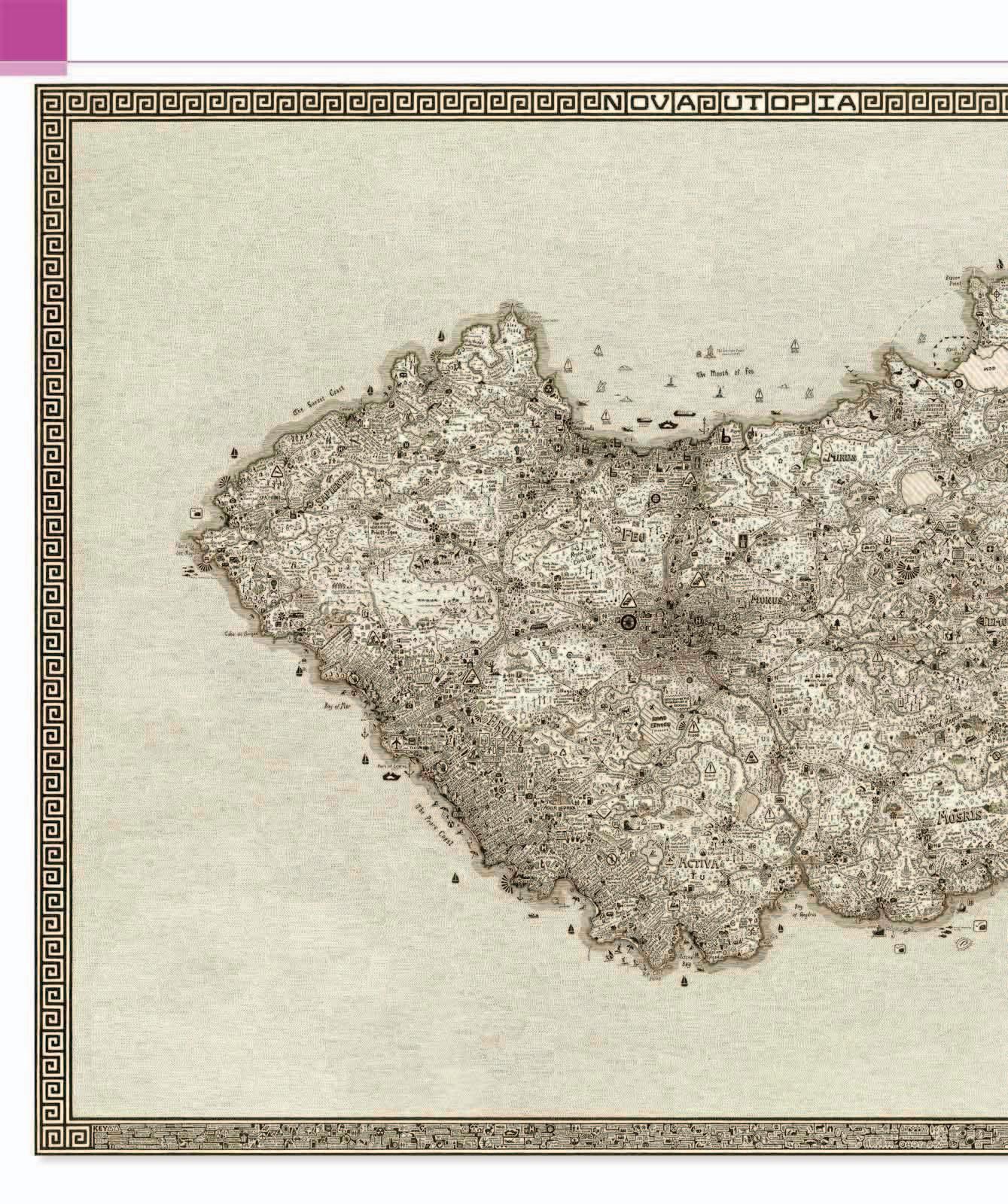
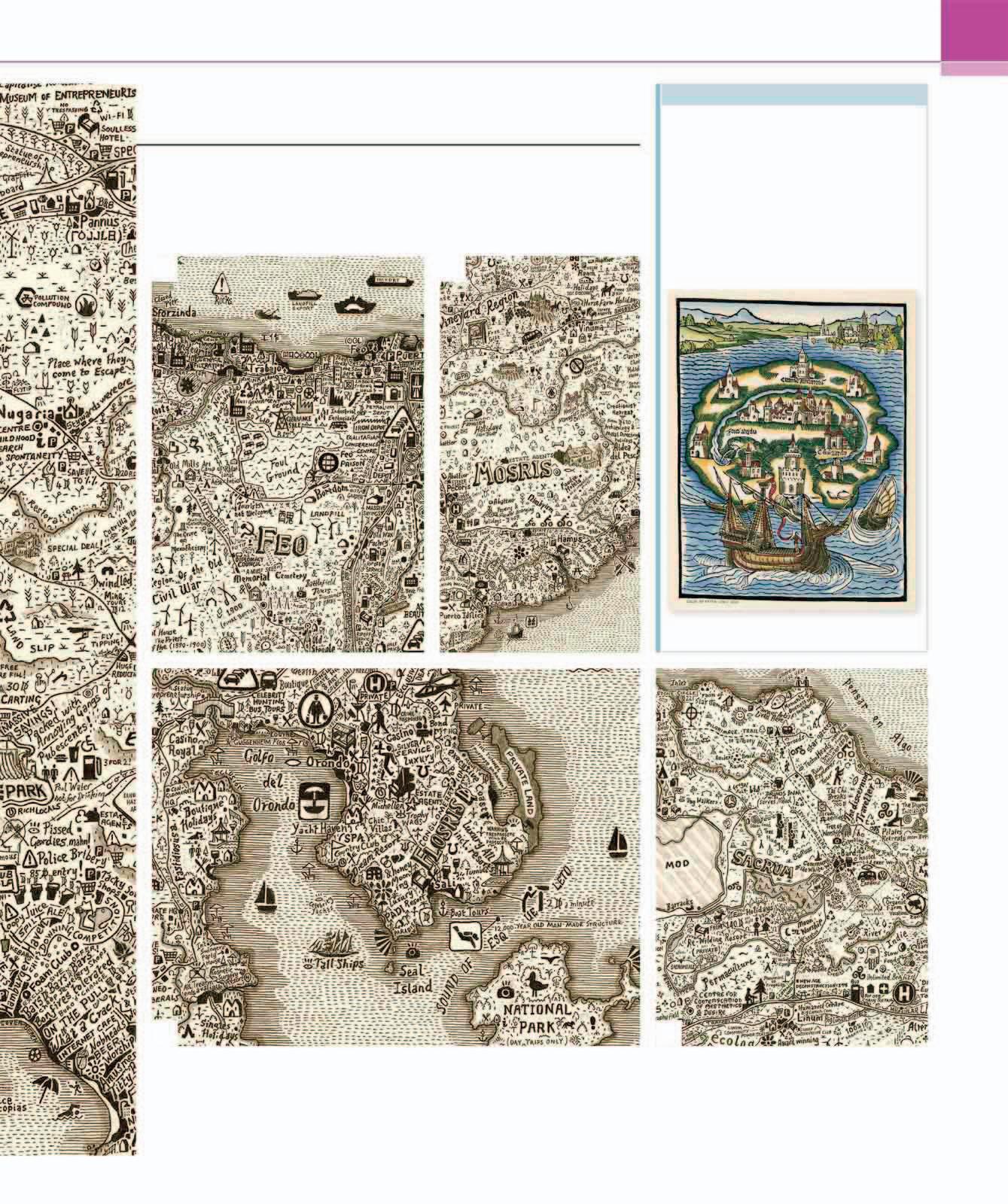
One of the wittiest and most penetrating recent attempts to map the concept of Utopia is found in Stephen Walter’s Nova Utopia. Rather than drawing his own conception of an ideal state, Walter bases his work on Thomas More’s original idea of Utopia (see pp.94–95), treating it as if it were a real place. His map describes an island transformed by a capitalist revolution in 1900, when a group of “Entrepreneurs” crushed the “Utops” on April 23, 1900. This may be an allusion to St. George’s Day (the patron saint of England), suggesting that, like More’s Utopia, Walter’s map is also a commentary on modern Britain. The triumph of private enterprise turned the island into a wealthy tourist destination, known as the “Leisure Island.”
Walter asks if Utopia is still a valid idea, and shows how easily its ideals can be compromised. With compulsively drawn detail he depicts the darker, dystopian aspects of contemporary life usually omitted from maps. Yet this work, he says, also “glories in landscape, semiotics, etymology, and the intricate details of life.”
Nova Utopia sits somewhere between the wonderful, the beautiful, the entertaining, the rich, the sublime, and the ridiculous
STEPHEN WALTER
STEPHEN WALTER
1975–
A graduate of London’s Royal College of Art, British artist Stephen Walter is renowned for prints and drawings exploring the concept of place, usually mapped in intricate, almost obsessive detail.
Much of Walter’s work documents his home town, London. His print Subterranea (2012) shows a buried, underworld London including abandoned underground railroad lines, sewers, burial sites, historical trivia, and ghost stories, while his sprawling work The Island is a humorous, semihistorical map of the city, full of stereotypes, local knowledge, personal anecdotes, and little-known facts. His art is characterized by its wry, informal tone, and it often refers curious readers to books and websites for more information. Walter has exhibited his work in cities including London, Berlin, Sydney, San Francisco, and Tel Aviv, and has also designed book and album covers.
Visual tour
3
1
KEY
4
2 7
5 6
1
4 THE PRORA COAST,
THE TOURIST’S DREAM
Taking its name from a Nazi-designed beach resort, Prora is a satirical vision of the despoilation caused by modern mass tourism and overdevelopment. The area features commercialized seaside towns such as El Dorado, which is named after a mythical golden city, and also a much-derided British soap opera.
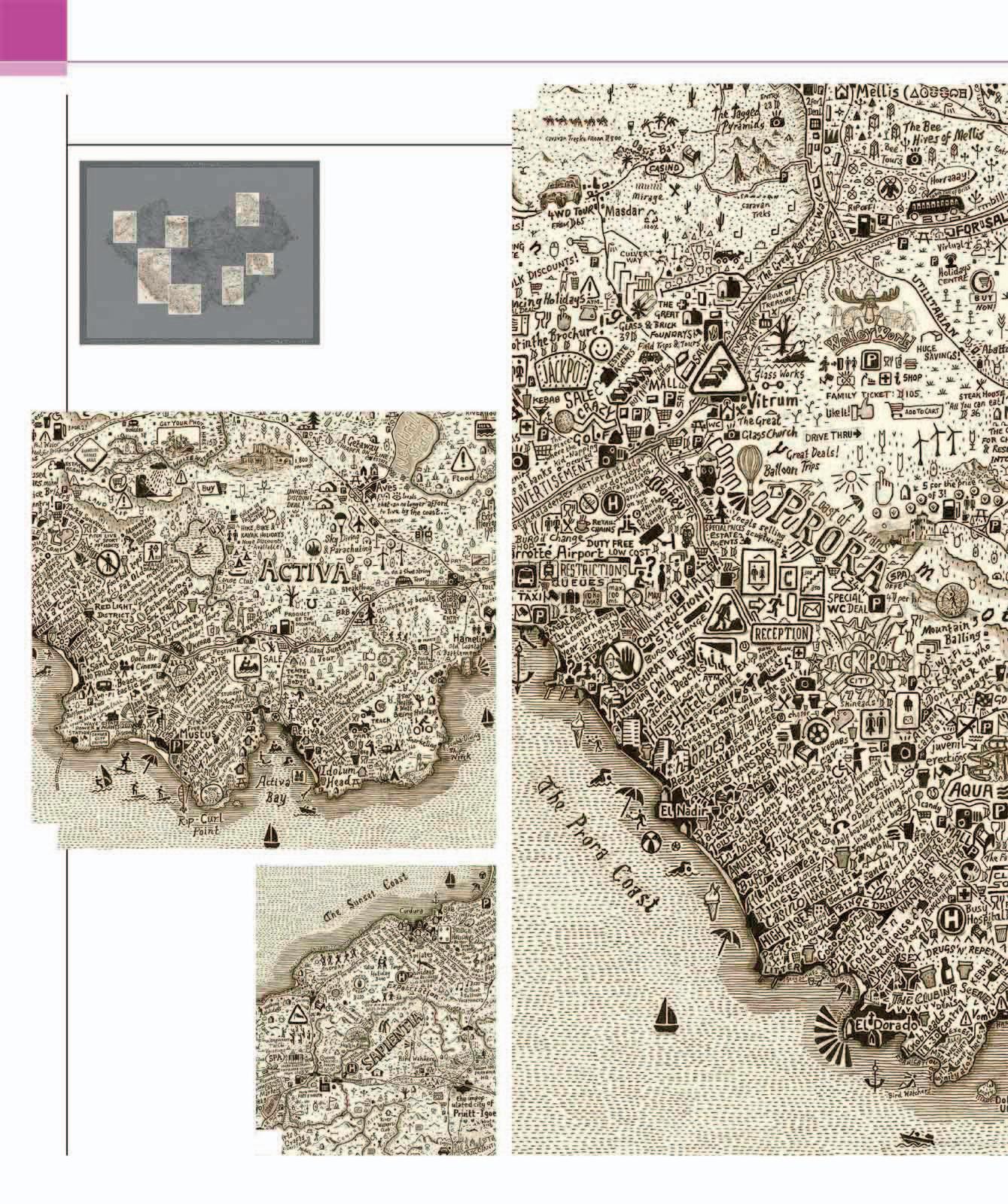
1 SPORTS IN ACTIVA An area “popular with the young and sporty,” Activa also includes a red light district and areas inhabited by “locals that can no longer afford to live by the coast.
4 “AUTHENTIC” UTOPIA IN SAPIENTIA From the Latin for “wisdom,” Sapientia retains the vestiges of traditional utopian life, and is represented as one vast retirement home. 3
3 FEO, THE HOME OF NOVUS UTOPOS Containing Novus Utopos—held by the locals to be the country’s capital—the region of Feo (meaning “ugly” in Spanish) is a dilapidated industrial wasteland. Here, Walter observes with his acerbic political wit, “gentrification may well be on its way.” 3 GETTING AWAY FROM IT ALL IN MOSRIS The island’s traditional rural retreat of Mosris has not escaped the impact of commercialization. Walter advises that “pre-booking your visits and transport is strongly advised.
4 5
IN CONTEXT
Walter’s map of Utopia is part of a long artistic tradition, going back to Ambrosius Holbein’s 1518 woodcut (see pp.94–95). Nova Utopia’s “aesthetic template” is a Renaissance map of Utopia made by the famous Flemish mapmaker Abraham Ortelius in 1598, which was directly inspired by Thomas More’s Utopia (1516). Mapmakers and artists such as Walter are interested in Utopia as a graphic “no place,” an invented world upon which they can project a range of contemporary hopes and fears.
1 The title page of Thomas More’s Utopia, 1516.
6
1 FILTHY RICH IN FLOSRIS Many people’s utopian aspirations could be encapsulated in the wealthy retreat of Flosris, the playground of the superrich, with its yachts and villas—it even includes “Paradise.” However, it also has its dystopian dimensions: there are cosmetic surgery resorts, swingers’ party houses, and trespassers are liable to prosecution. 7
1 AN ALTERNATIVE IN SACRUM A refuge for alternative cultures opposed to privatization, Sacrum offers one ray of hope in Walter’s new Utopia. It boasts ecological awareness and organic initiatives. Walter notes that this region has become more popular recently, in contrast to “the island’s more mainstream tourist traps.”