4 minute read
Cartogram

2008 DIGITAL UNIVERSITY OF SHEFFIELD, SHEFFIELD, UK
WORLDMAPPER
Advertisement
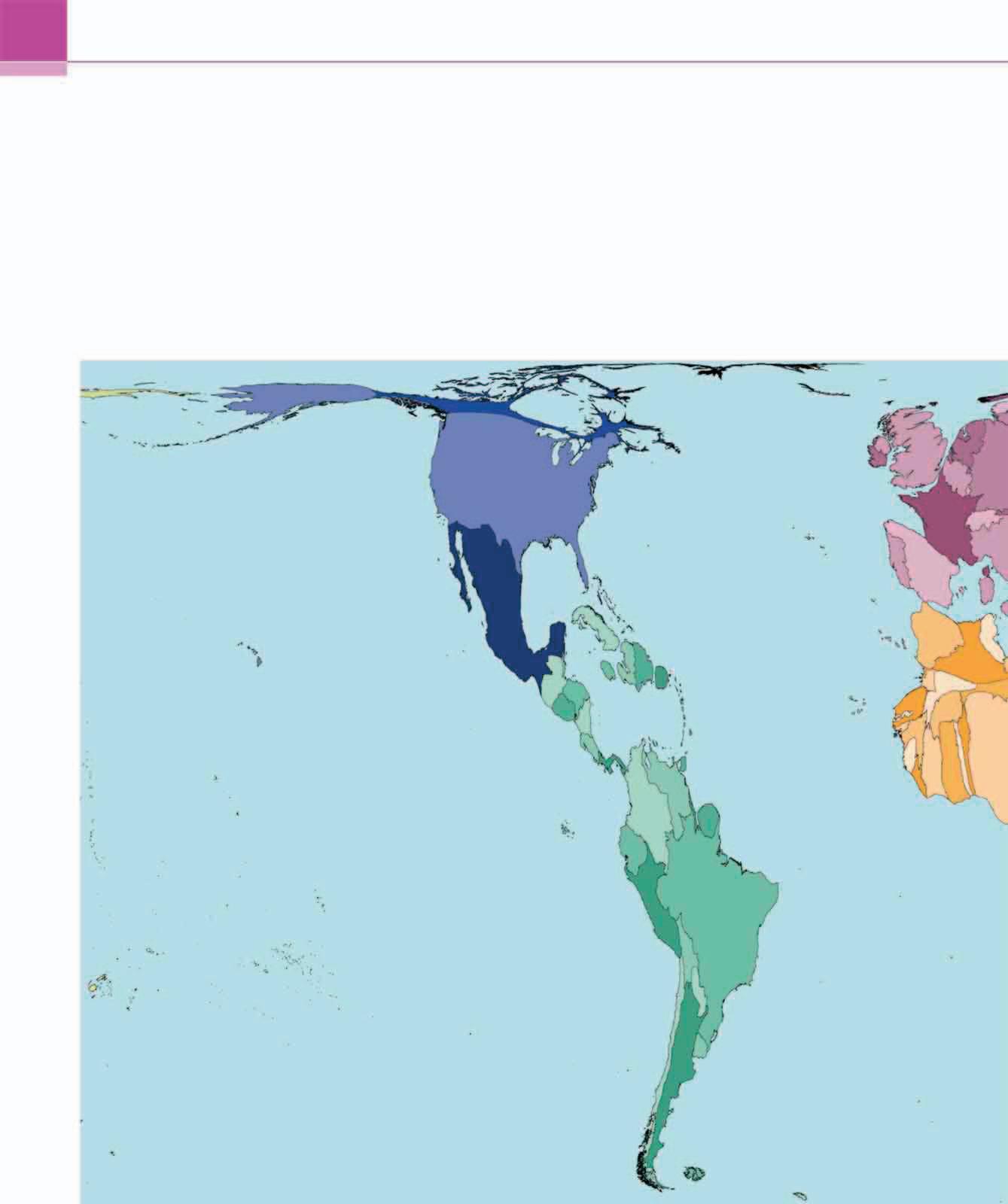
As statistical data on global issues becomes more complex and digital technologies generate increasingly innovative and versatile mapping techniques, the cartogram has become one of the most important recent cartographical developments. A cartogram uses a single variable subject that can be measured statistically, such as population or immigration, which is then mapped on to land areas to convey an image of its proportional distribution.
The British academic Danny Dorling is one of the method’s most innovative practitioners. He worked as part of a team called Worldmapper, which used data gathered from a variety of organizations including the United Nations (UN), the World Health Organization (WHO), and the World Bank, to map subjects as diverse as world population (shown here), transportation, poverty, health, war, and prostitution.
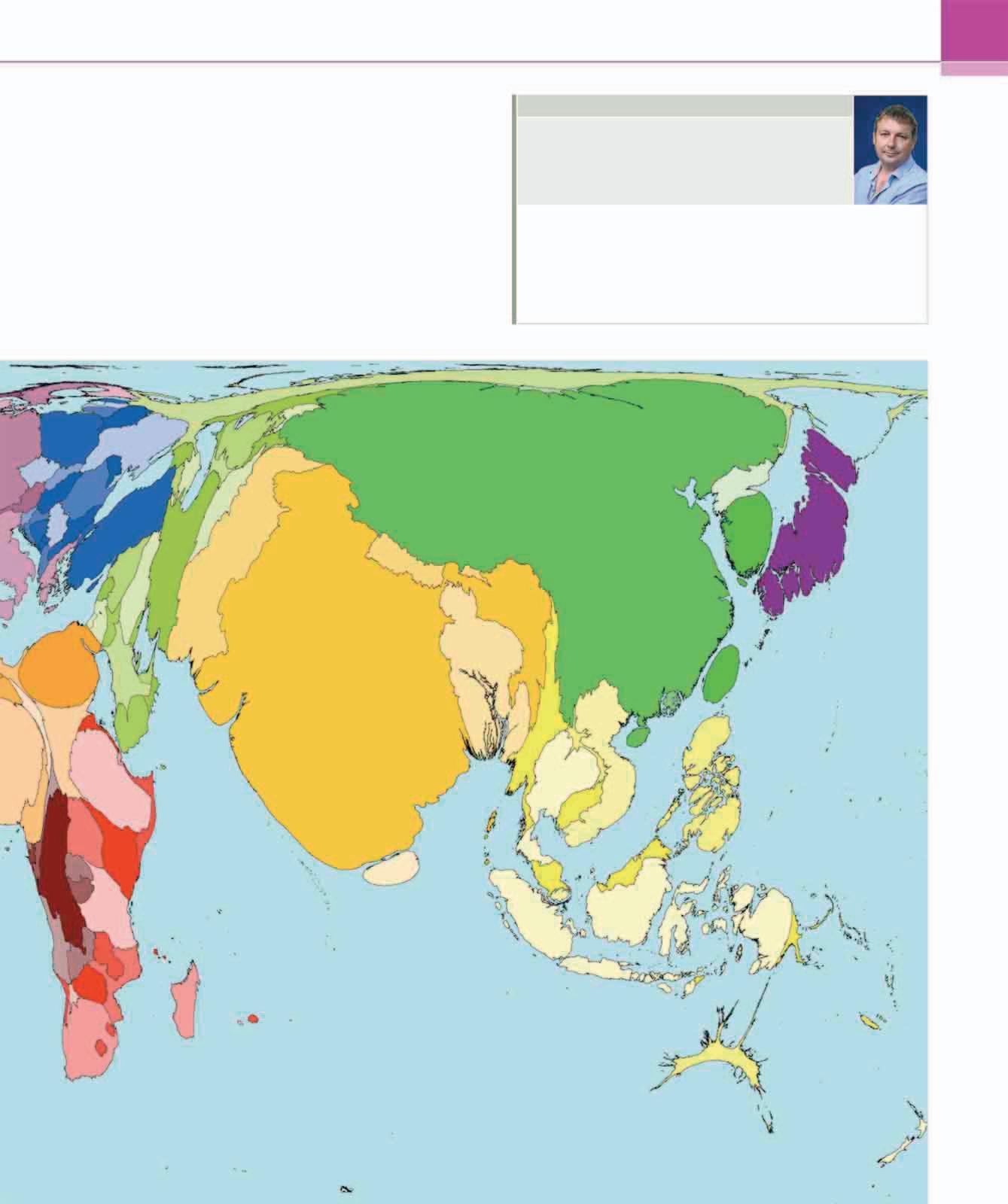
Rather than using traditional color or shading, these maps inflate or shrink countries according to each subject. This cartogram shows the distribution of the Earth’s estimated population of six billion in 2000.
DANNY DORLING
1968–
Currently the Halford Mackinder Professor of Geography at Oxford University, Danny Dorling was trained as a geographer and has held academic posts at several UK universities.
Dorling is a renowned social geographer who has published extensively. His work is characterized by the use of mapping techniques to visualize a variety of social and demographic statistical information, usually with a strong political and moral message, on subjects such as poverty, mortality, and housing.
Visual tour
4 6
3 1
1
KEY
7 5
2
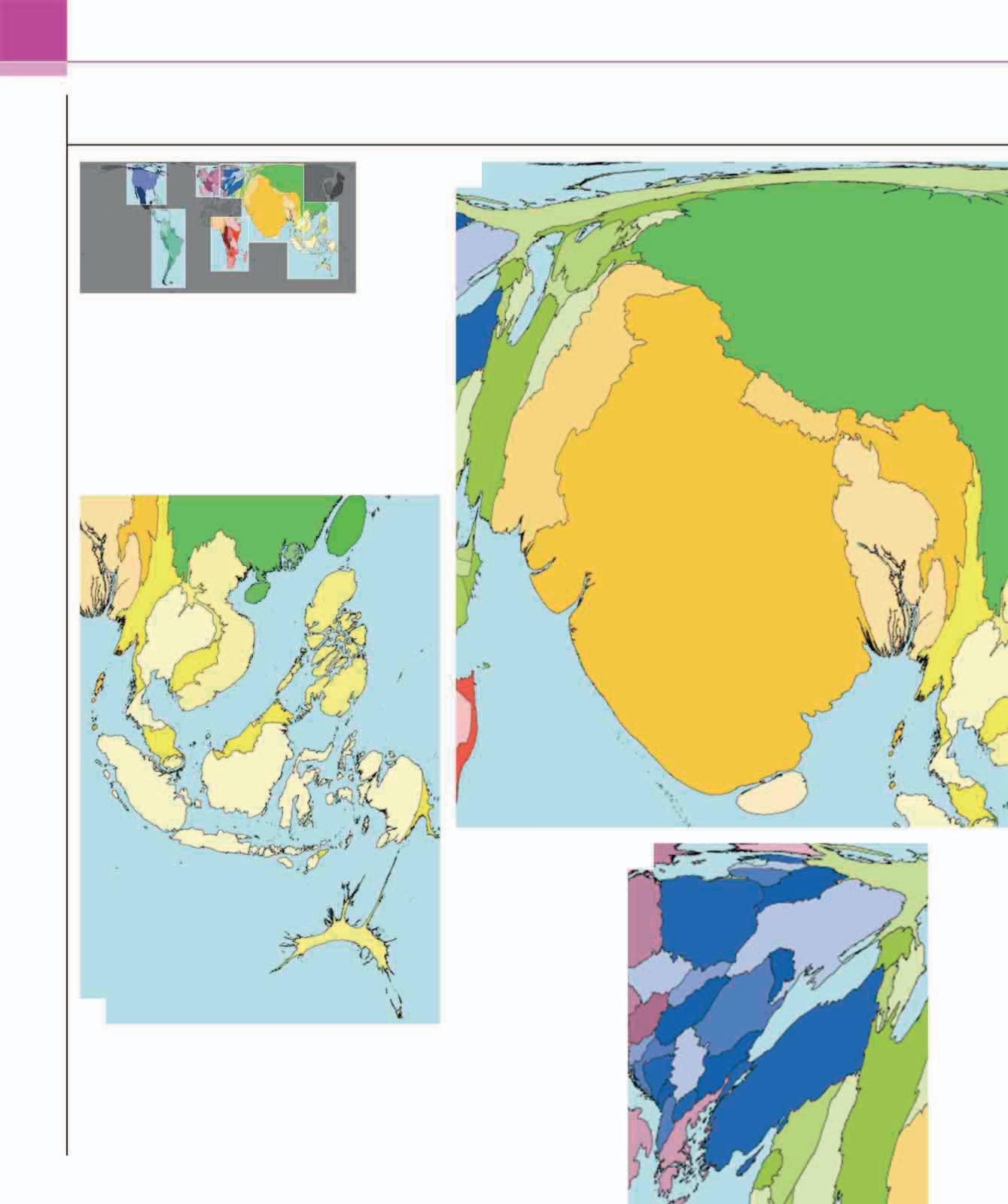
4 INDIA Although marginalized on many historical maps, India is prominent on most geopolitical maps today, including population cartograms such as these. With over 1.2 billion inhabitants, it is the world’s second most populous country, after China. However, India’s population is predicted to eclipse China’s by 2025 and by 2050, it is estimated that India will have 1.6 billion inhabitants.
1 SOUTHEAST ASIA Over 4.2 billion people live in the Asia-Pacific region, representing around 60 percent of the global population. However this figure obscures complex demographic variations: population growth rates have actually dropped in the region to just 1 percent, due to declining birth rates and lower death rates. The region’s greatest challenge is an estimated threefold increase in the number of people over 65 years old—to an estimated 1.3 billion—by 2050. 4 RUSSIA One of the cartogram’s most surprising results shows Russia—a geopolitical giant—suffering dramatic shrinkage, thereby revealing some of the country’s problems. With just 21 people per square mile (about eight per square kilometer), it is one of the world’s most sparsely populated countries, and in recent decades mortality rates have been extremely high while birth rates have been low. Although now stable, some estimates predict that Russia’s population will contract to just 107 million by 2050.
2 3
4
2 NORTH AMERICA Like Russia, the United States does not look as large or imposing as one might expect. With a modest population density of around 88 people per square mile (or 34 per square kilometer), its current population of 312 million remains relatively stable due to falls in immigration. Nevertheless, by 2050, the population is expected to grow to nearly 400 million, an increase of 28 percent. ON TECHNIQUE
Worldmapper’s team created a series of high-impact cartograms by applying differential equations to a single global variable, such as population data. They used a mathematical model, driven by elementary physics, to “warp” the conventional world projection and adjust its proportions according to the chosen variable. The results are dramatic, conveying statistics in a radical, visual way that an ordinary table could not hope to achieve.
1 This “mopeds and motorcycles” cartogram reveals in which countries the ownership of motorcycles is most prominent.
6
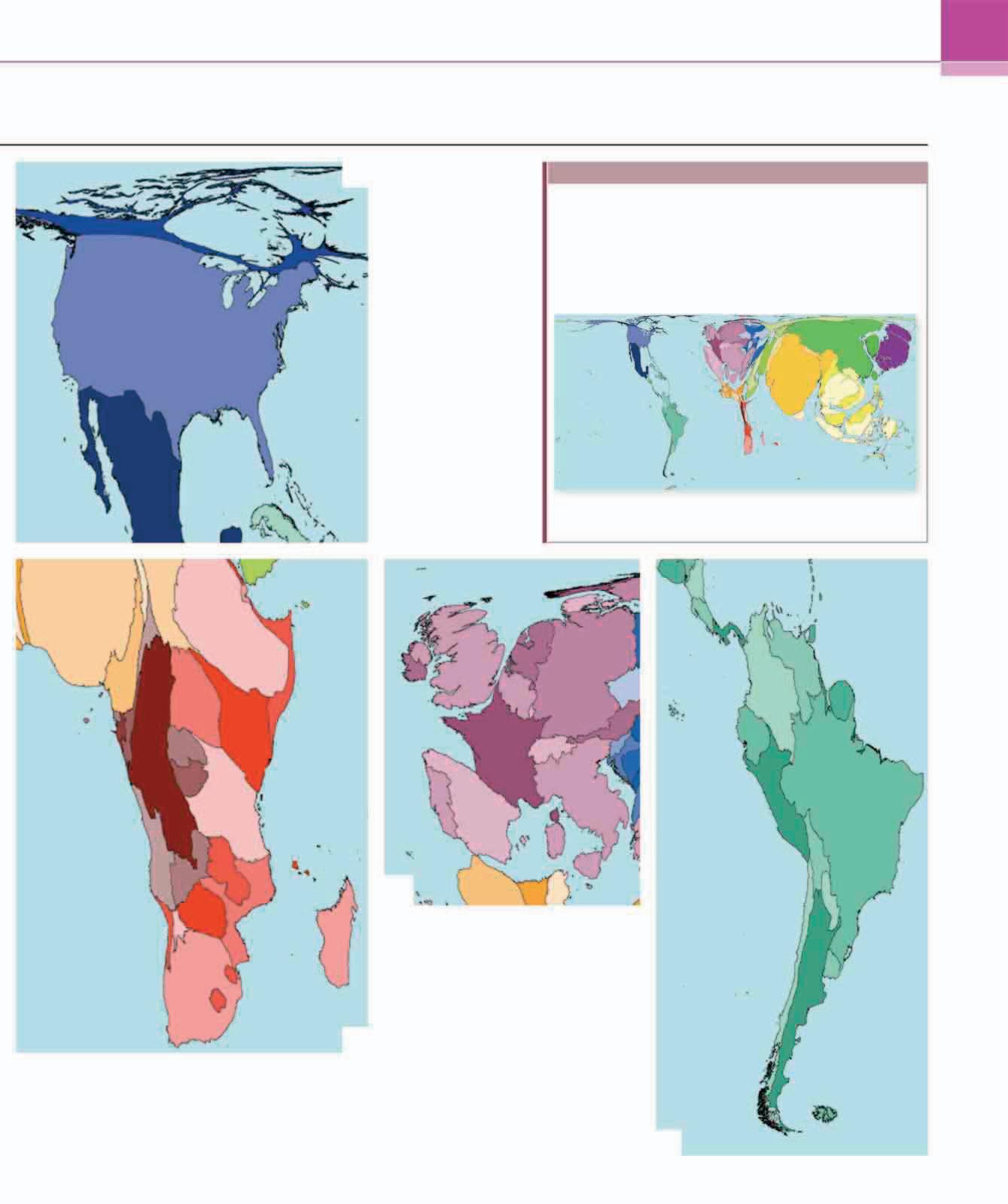
1 UNITED KINGDOM With a population of 63.7 million, the United Kingdom is the third largest nation in Europe, behind Germany and France. With 666 people per square mile (around 256 per square kilometer), it also has one of the world’s highest population densities, hence its prominence.
5
1 AFRICA Relations between Africa’s population and land area are striking: Sudan is Africa’s largest country, although its population of 35 million is dwarfed by the much smaller Nigeria (177 million). By 2050, the population of sub-Saharan Africa, one of the world’s poorest regions, is predicted to double in size to 2.4 billion people. 4 SOUTH AMERICA As a developing continent that has often suffered cartographic distortion, South America appears long and thin due to its 7 million sq miles (17.8 million sq km) being populated by a relatively few 386 million people, rising to a projected 482 million by 2050. 7