5 minute read
The Book of Curiosities

c.1020–1050 INK ON PAPER 9½ IN × 12½ IN (24 CM × 32 CM) BODLEIAN LIBRARY, OXFORD, UK
UNKNOWN
Advertisement
SCALE
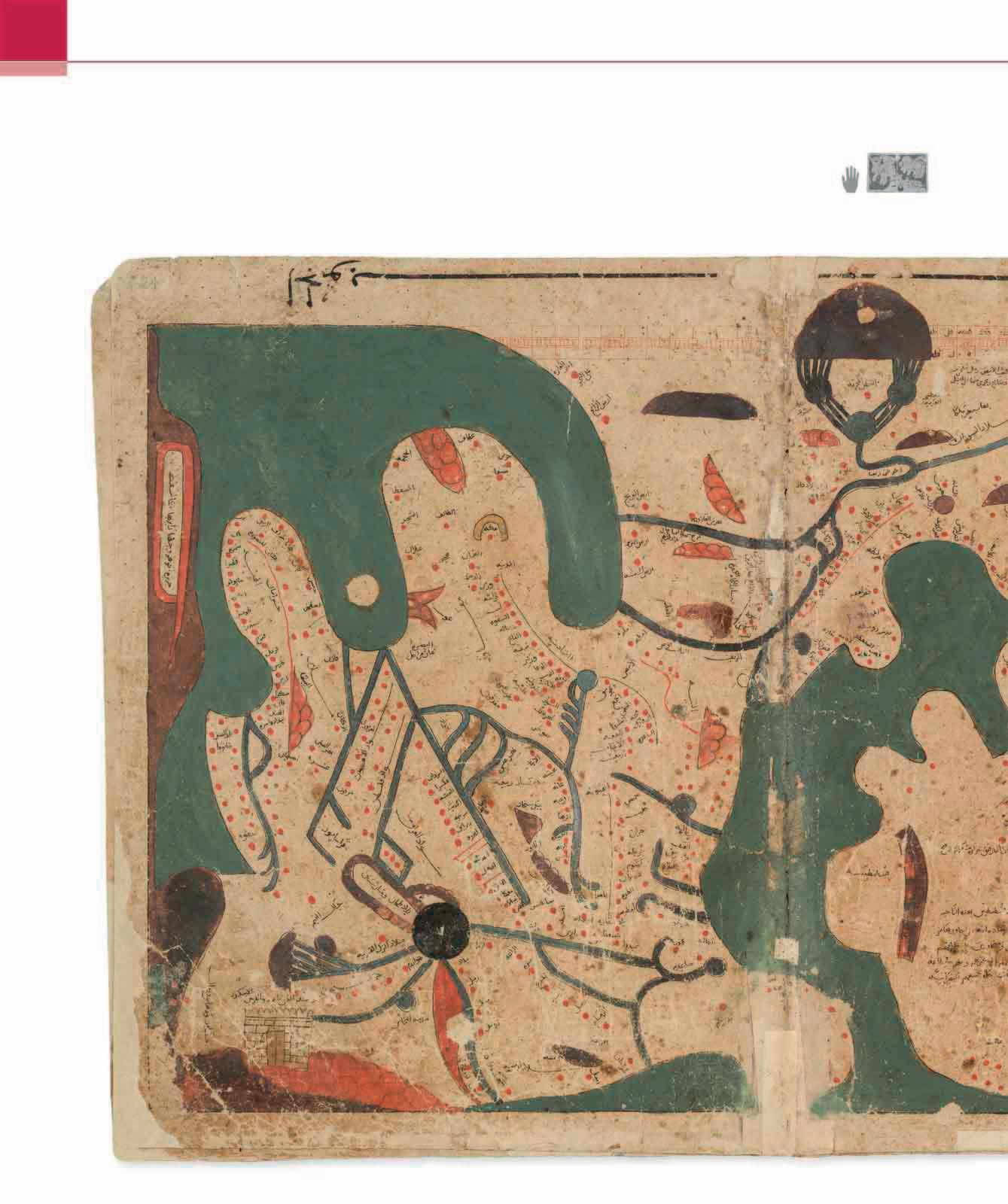
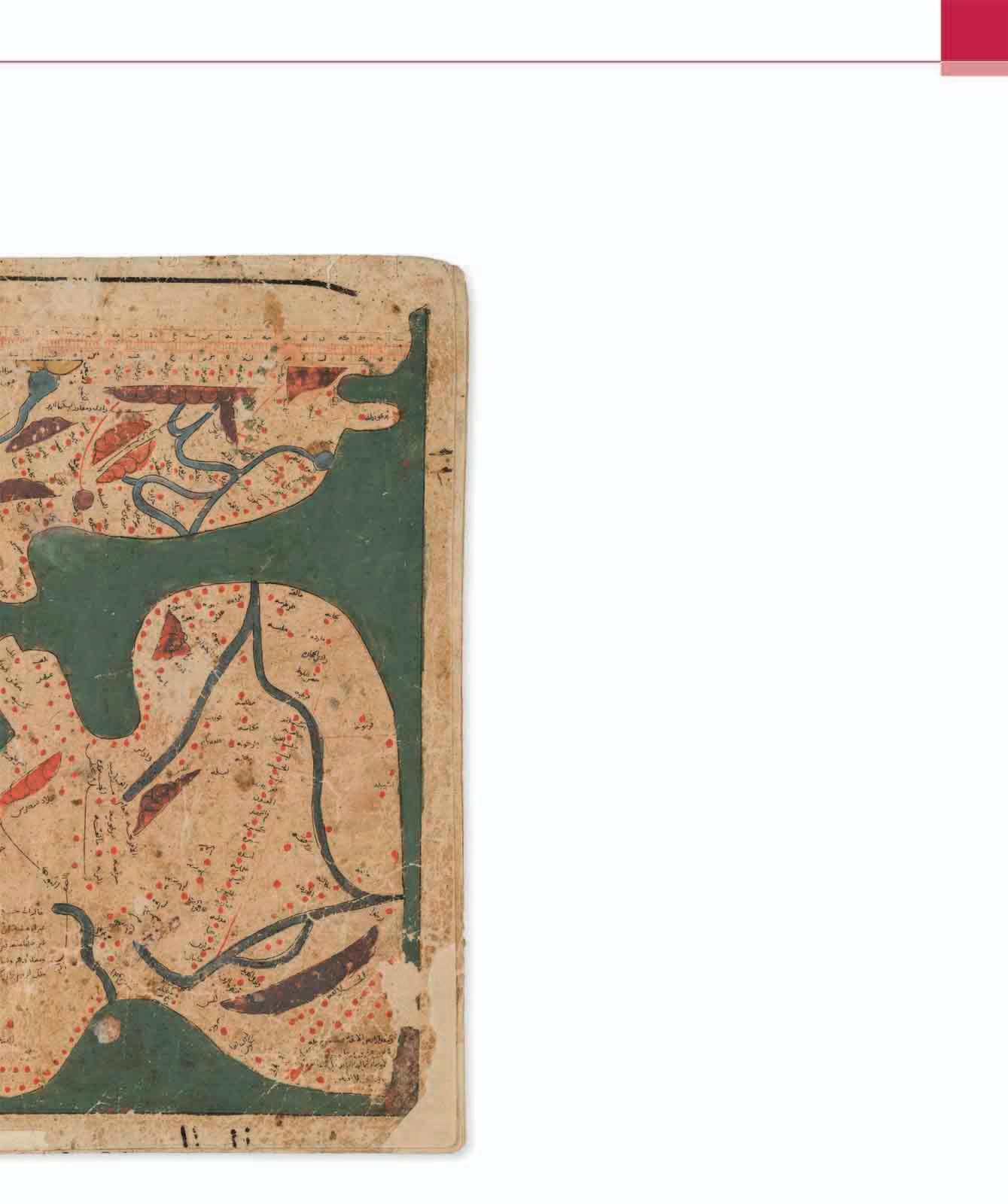
In 2002, the Bodleian Library in Oxford, UK, acquired an anonymous Arabic treatise compiled in Egypt between 1020 and 1050 during the Fatimid Dynasty, titled Kitāb Gharā’ib al-funūn wa-mulah al-‘uyūn (“The Book of Curiosities of the Sciences and Marvels for the Eyes”). The manuscript, which describes the heavens and the Earth according to Muslim astronomers, scholars, and travelers, has transformed our understanding of early Islamic cosmology and geography. It includes several maps of the inhabited world, including two world maps, one of which is circular, while the other, shown here, is rectangular. This map is unlike any other surviving map from either the Christian or Muslim medieval worlds.
A medieval Islamic perspective
The map is oriented with south at the top, which is typical of Islamic cartography of the time, with the Arabian Peninsula and Mecca displayed with particular prominence. Europe, to the lower right, is dominated by a huge Iberian Peninsula, concentrated on Muslimcontrolled Spain. Meanwhile, North Africa dwarfs Italy and Greece, and it is shown in far greater detail, particularly Egypt and the complicated tributaries that make up the source of the Nile. Arabia is dominated by Mecca and is depicted at twice the size of India and Persia, while central Asia includes the Euphrates and Tigris rivers and the city of Constantinople (now Istanbul), which is noted as having a “Christian creed.” This region also retains mythological elements, such as Alexander the Great’s fabled wall built to keep out the monstrous Gog and Magog. Farther east, India and China are shown, but in increasingly hazy detail, while the limits of the inhabited world are represented on the far left by the mysterious “Island of the Jewel.” The scale bar along the top suggests the use of mathematical applications hitherto unknown in medieval mapmaking. Both book and map are heavily indebted to Greek sources, particularly the works of Ptolemy (see pp.24–27), as well as a variety of Arabic and Islamic authorities.
God has divided Earth into regions, and made some regions higher and others lower; and He made the constitution of the inhabitants of each region to correspond with the nature of the region
Visual tour
2 1
5
KEY
4
7 3
6
4 ARABIAN PENINSULA AND MECCA The holy Muslim city of Mecca (center right) dominates the Arabian peninsula. Unlike other cities on the map, it is symbolized by a horseshoe shape, which may refer to the Hatim, a semicircular wall opposite the Kaaba, the city’s holiest building. The sacred geography of early Islam is emphasized, including the cities of Medina, Sana’a, and Muscat, indicated by red dots. Yemen’s Hadramawt mountain range (top) is shown colored red. 1
2
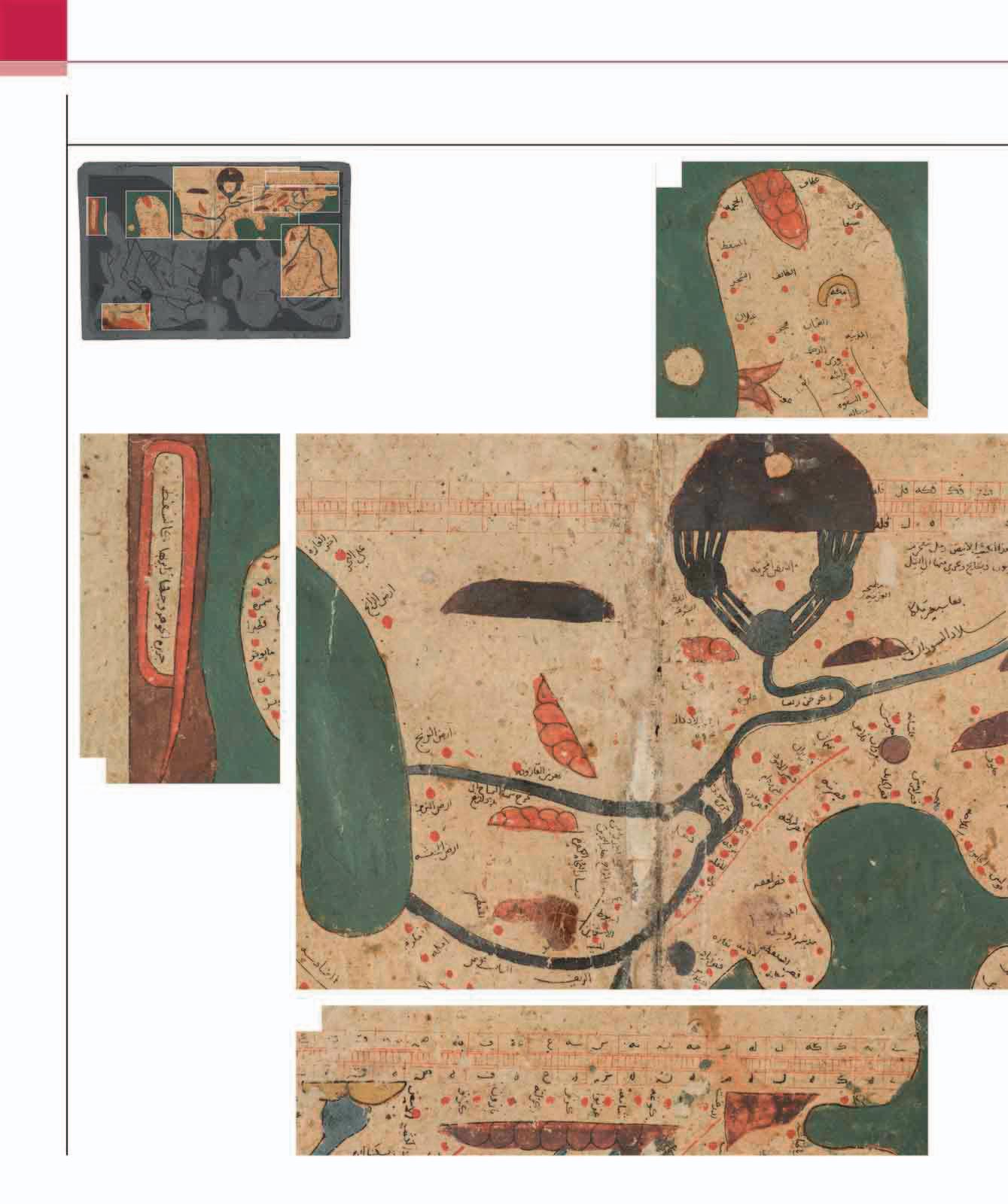
1 ISLAND OF THE JEWEL The location of this enigmatic island, placed at the easternmost limits of the inhabited world, is taken from the works of the Persian mathematician and geographer al-Khwārizmī (c.780–c.847 CE). He describes the island as situated close to the Equator and near the “Sea of Darkness”—the Atlantic. Here it lies east of India and China; it may be what is now Taiwan, although its true location and identity remain a mystery.
4 SCALE BAR The scale bar is one of the earliest recorded on any map. It increases from the right in units of five degrees, suggesting a sophisticated attempt to measure the Earth mathematically. The numbering stops on the left, suggesting the mapmaker tried unsuccessfully to copy an earlier, more technical map. 3
5
1 ALEXANDER’S BARRIER Both Christianity and Islam believed in the story of Alexander the Great walling in the mythical monsters Gog and Magog in the Caucasus Mountains. Here the wall is shown as a “barrier which the possessor of two horns built.” Alexander was associated with ram’s horns—a symbol of power and virility. ON TECHNIQUE
Like many Islamic mapmakers, the author of The Book of Curiosities divides the world up into seven climates (taken from the Greek klimata, meaning “incline”). Aristotle believed that climate influenced the degree and nature of the Earth’s inhabited regions. They included the “intemperate,” equatorial regions, the frozen wastelands of the north, and the “temperate” areas of the Mediterranean. Islamic scholars embraced the concept and it appears in The Book of Curiosities in the description of climates stretching from the first in the south, which runs through Africa (“Land of the Scorching Heat”), India, and China, to the seventh in the far north, which runs through Scandinavia and includes descriptions of an island populated solely by women. The fourth climate runs through Rhodes and Babylon, and “has the best constitution and disposition.”
1 Shown here in The Book of Curiosities , the Mediterranean region was considered “temperate” in the Aristotelian model.
4
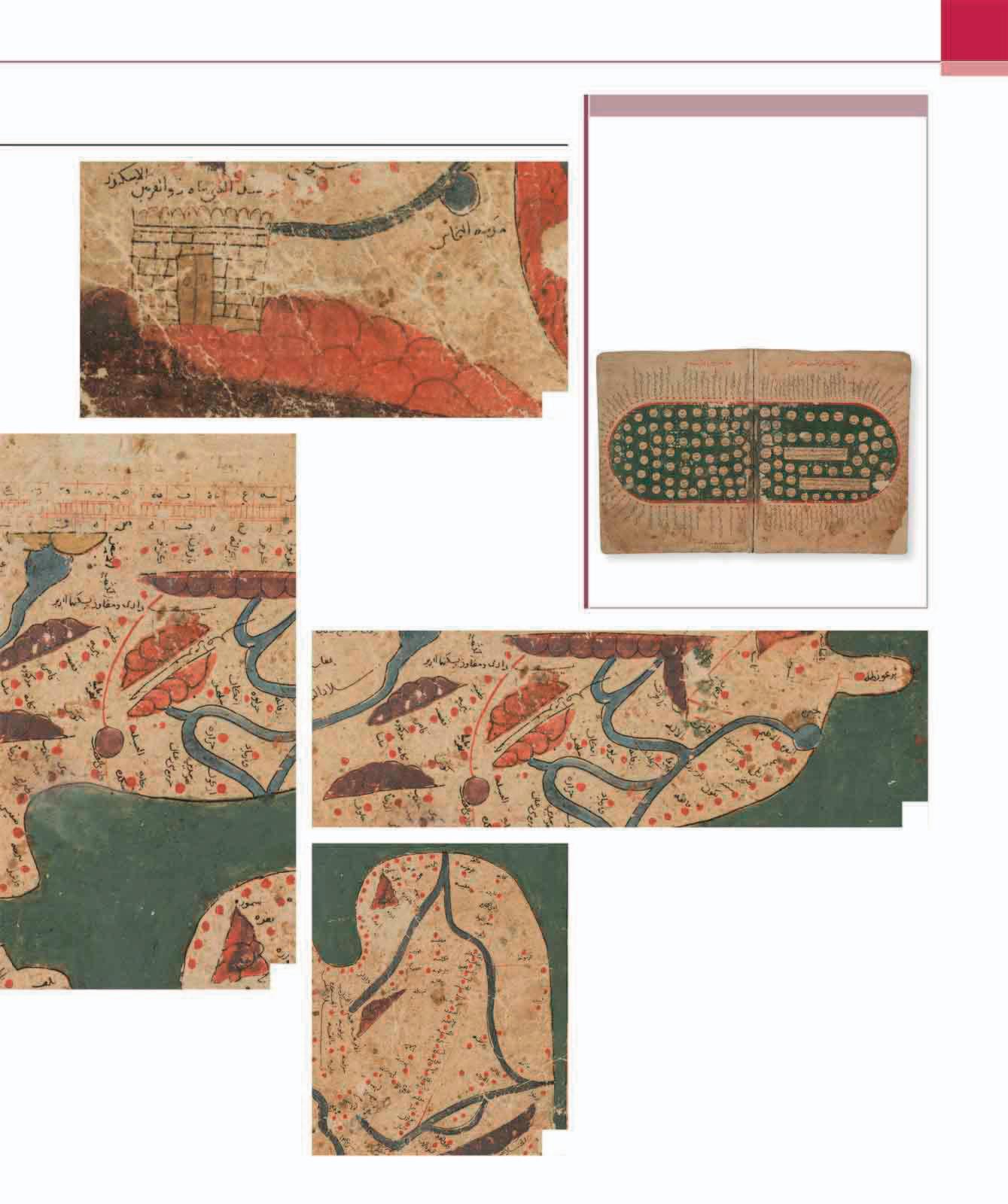
1 THE NILE AND THE “MOUNTAINS OF THE MOON” The source of the Nile has fascinated explorers since the time of the ancient Greeks. Here it is represented according to the theories of the Greek philosopher Diogenes (c.404–323 BCE). He mistakenly believed it originated in a central African mountain range from which ten rivers flowed into lakes running into the Nile. The myth was only disproved in the 19th century. 1 MOROCCO As the westernmost point of the Islamic world, Morocco’s rivers, mountains, holy cities, and commercial routes are shown in great detail—the cities of Tangier and Fez are particularly prominent. The struggle to impose Islamic authority on the region is also shown: in the top right is Barghwatah, a Berber confederation that ruled much of the coastal regions; inland are “deserts inhabited by the Berbers.”
2 ANDALUSIA By the 11th century, Moorish Spain, or “Andalusia,” was fragmenting politically because of factionalism among competing Muslim dynasties and the resurgence of Christianity. The region is described as being “20 days’ journey in breadth,” and shows a diagonal itinerary, outlined in red dots, running through Lisbon and Seville to Almeria, with Córdoba, the home of the Umayyad Caliphate, depicted just above the Guadalquivir River (top left). 6