
UNIVERSITY OF NEBRASKA PRESS
SPRING / SUMMER 2026
Contents
Ebooks are available for every title unless otherwise indicated.
Subject Guide
Afghanistan 28
African 14–16
African American Studies 2, 57, 69
Agriculture 40
American Studies 21–22, 47
Anthropology 38, 46, 59, 62, 69
Art 48
Biography 3, 6, 7, 9, 31, 37, 45, 54, 57, 60–61
California 41
Canada 2
China 51
Civil War 10–11, 27
Cuba 47
Cultural Criticism 21, 40, 43, 64–65
Current and Political Affairs 21, 28, 42, 53
Ecology/Environment 24–25, 36, 41–44, 67
Economics 49, 51
Education 50
Ethnic Studies 69
Europe 68
Family and Relationships 18, 35
Fiction 14
Cover image: Adobe stock
Support the Press
Help the University of Nebraska Press continue its vibrant program of publishing scholarly and general-interest books by making a tax-deductible donation today.
To give to UNP, visit us online at: nebraskapress.unl.edu/nebraska/about/support/
To find out how you can help support a particular book or series, contact Jane Ferreyra, Press director, at 402-472-2861 or jferreyra@unl.edu.
Geography 46
Globalization 51
Great Plains 36
History/American 4, 7–11, 22–24, 26–27, 31, 36, 38, 40–42, 45, 48–51, 58–59, 60–62, 68–69
History/American West 22, 24–25, 36, 41, 44, 68–69
History/World 52–55, 68
Holocaust 52–53, 68
Horses 23
Human Rights 28
Iraq 32
Jewish History and Culture 34–35, 52, 68
Labor 56
Latin American Studies 55–56, 63
Legal Studies 26
LGBTQ+ 14
Literary Criticism 44, 63, 65–66, 69
Literary Nonfiction 33
Media Studies 47, 65
Memoir 8, 18–20, 22–23, 25, 29–30, 36, 38
Mexico 54–56
Middle East 30, 32, 38
Midwest 40, 46
Military History 10–11, 27, 32
Military Studies 32–33
Montana 67
Native Studies 8–9, 26, 38, 48–50, 57–63, 67, 69
Natural History 36
Northeastern U.S. 69
Pacific Northwest 45, 62
Philosophy 64
Poetry 13–16
Poland 52
Political Science 31
Religion 34–35, 38, 69
Southwestern U.S. 61
Sports 1–7, 24, 31, 37
Sustainability 25, 36, 43, 46
Travel 25
Ukraine 29
Women, Gender, and Sexuality 8, 18, 28, 38, 47, 50, 54, 56, 64
World and National Affairs 29–30
World War II 52, 68
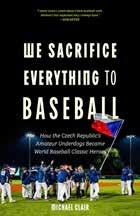
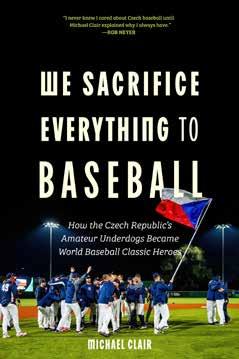
We Sacrifice Everything to Baseball
How the Czech Republic’s Amateur Underdogs Became World Baseball Classic Heroes
MICHAEL CLAIR
Despite long odds and low funds, the Czech Republic’s national baseball team of amateur players managed to shock the world at the 2023 World Baseball Classic—the sport’s World Cup—when they took an upset win against Spain in the WBC qualifiers and then defeated China in the actual tournament, securing their place in the upcoming 2026 tournament. While the rest of the teams in the WBC rely on experienced professionals, and some like Italy and Great Britain bring in American “passport” players, the Czech Republic’s roster consists almost entirely of amateur players who were born and have played only within the Central European nation. The team’s roster consists of firefighters, teachers, financial auditors, and field caretakers—even the manager is a neurologist!—and yet the team managed to not only compete on the international stage but succeed against global superstars like Shohei Ohtani.
In a world where athletes have become multi-milliondollar legends, We Sacrifice Everything to Baseball reveals how teamwork, sacrifice, and self-belief can still make a difference. Michael Clair, who spent time with the Czech team throughout the 2023 World Baseball Classic, has unparalleled insight on the team and their unlikely success.
Like the Jamaican bobsled team in Cool Runnings , Leicester City’s unexpected Premier League soccer title, and the United States’ remarkable victory against Russia in the 1980 Olympics, the Czech Republic baseball team has an underdog story everyone can cheer for. Their story proves it’s still possible to build a team from the ground up, with a small player pool, little attention, and a low budget, and compete on the world stage.
“You’ll never find an author and subject better suited for one another, and Michael Clair’s passion for Czech baseball shines brightly on every page of this delightful book.”—Rob Neyer, award-winning baseball author and commissioner of the West Coast League
“Baseball came to Czechoslovakia in 1921, but the sport has faced a long, jagged road to penetrate the heart of Central Europe. In We Sacrifice Everything to Baseball Michael Clair chronicles the hardscrabble push of a ragtag group of amateurs determined to do it the right way: homegrown. Clair takes us along as this endearing team of underdogs chases glory on the world stage—or, if not quite glory, something perhaps more lasting, like progress, respect, and the fulfillment of a dream that maybe, just maybe, baseball can become a truly global pastime.”—Tyler Kepner, author of the New York Times bestseller K: A History of Baseball in Ten Pitches and The Grandest Stage: A History of the World Series
Michael Clair is a reporter at MLB.com, specializing in international baseball and the World Baseball Classic. He has written and appeared on the MLB Network shows Carded and Inside Stitch , featured in the coverage of official World Baseball Classic, London Series, and All-Star Game programs, and has published in Baseball Prospectus and its associated annuals, as well as Japanese baseball magazine Number . Clair was given the 2024 Global Ambassador Award by MLB.
APRIL
216 pp. • 6 x 9 • 25 photographs, appendix, index
$34.95T • hardcover • 978-1-4962-4266-2
$49.00 Canadian / £28.99 UK
ALSO OF INTEREST
In the Japanese Ballpark
Behind the Scenes of Nippon Professional Baseball
Robert K. Fitts
$36.95 • hardcover • 978-1-4962-4407-9
Sean J. McLaughlin is a historian, serving as the director of Special Collections and Exhibits at Murray State University in Kentucky. He is the author of JFK and de Gaulle: How America and France Failed in Vietnam, 1961–1963 and coauthor of The Finest Place We Know: A Centennial History of Murray State, 1922–2022 .
APRIL
288 pp. • 6 x 9 • 10 photographs, 3 illustrations, index
$36.95T • hardcover • 978-1-4962-4431-4
$52.00 Canadian / £31.00 UK
ALSO OF INTEREST
Under Jackie’s Shadow Voices of Black Minor Leaguers Baseball Left Behind Mitchell Nathanson
Illustrated by Jackie Nathanson
$34.95 • hardcover • 978-1-4962-3717-0
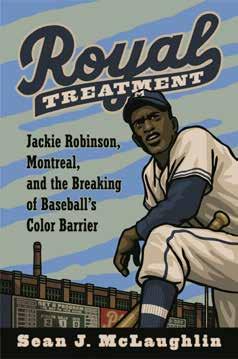
Royal Treatment
Jackie Robinson, Montreal, and the Breaking of Baseball’s Color Barrier
SEAN J. MCLAUGHLIN
The story of Jackie Robinson’s prodigious talent, his courageous journey, and his influence on both the game of baseball and American society writ large has been told well and often. What hasn’t been told is the full story of his first season in the minor leagues in Montreal. In 1946, before moving up to the Brooklyn Dodgers, Robinson spent a season thrilling home crowds in a Canadian city with Major League aspirations. He played for the AAA Montreal Royals of the International League, leading the team to victory in the Junior World Series.
As it turned out, postwar Montreal was the ideal location for Brooklyn Dodgers General Manager Branch Rickey’s “great experiment” to finally integrate America’s pastime. Although both Rickey and Robinson have rightly been at the center stage of this story, it was the masses of cheering Montrealers who first showed the world that professional baseball was ready to bury race-based segregation. As Robinson told a Canadian Broadcasting Corporation reporter years later, “Had it not been for the fact that we broke in in Montreal, I doubt seriously if we would have made the grade so rapidly. The fans were just fantastic, and my wife and I had nothing but the greatest of memories.”
In Royal Treatment Sean J. McLaughlin explores Robinson’s experience in Canada as a Minor Leaguer and the warm embrace he received from Montrealers well before he became one of baseball’s household names. Bringing the early fan experience of Robinson directly to the foreground, Royal Treatment is an intimate look at a pivotal juncture in Robinson’s career, and the overwhelmingly positive relationship he had with the community that supported his rise to fame. This baseball story centers Robinson within the context of the Black American expatriate experience in Montreal in the postwar era.
“Delving into Jackie Robinson’s transformative 1946 season in Montreal, Sean McLaughlin expertly intertwines his journey with the vibrant histories of both the civil rights movement and Quebec. Royal Treatment also explores how politics and social movements have shaped the ways Robinson has been commemorated and remembered in his adoptive city.”—Christian Trudeau, professor of economics at the University of Windsor
“Jackie Robinson had an aura that probably famous individuals just have. The first thing I wanted to do was shake his hand and say, ‘Hey, Jackie, I’m a pitcher with the Chicago Cubs.’ I was in awe of him.”—Fergie Jenkins, Canadian-born Hall of Fame pitcher and 1971 National League Cy Young Award winner, on meeting Jackie Robinson in 1968
So Young, So Great Bob Feller Electrifies Baseball and America
JIM INGRAHAM
When Bob Feller hit the Major League Baseball scene, he instantly became one of the most famous athletes in the country. Everything Feller did made headlines, primarily because anything he did had never been done before, especially by someone his age. To this day, Feller is the only pitcher to have signed his first professional contract and played in the Major League while still in high school. By the age of seventeen he had set an American League record for most strikeouts in a game, and by nineteen, he had broken his own Major League strikeout record.
So Young, So Great covers the first six years of Feller’s career, from 1936 to 1941, from his discovery in the small town of Van Meter, Iowa, as a high school junior, to his immediate entry into the Major Leagues with no minor league detours, the extensive media coverage of his every move and his box office appeal to fans, and his record-breaking feats up to his enlistment into World War II at age twenty-two.
Before signing a contract with the Cleveland Indians, Feller was a prospect of such magnitude that Major League scouts were fighting in hotel lobbies to get to Feller, still a minor, to sign a Major League contract. His high school graduation was broadcast nationally on radio. And when he had to have his wisdom teeth removed, a photographer and reporter were in the room to document it.
By focusing on the first six years of Feller’s career, So Young, So Great captures in revelatory detail Feller’s unprecedented arrival, as a high school teenager, on the Big League stage, and his rapid ascension into one of the game’s all-time greats.
“A teenager pitching regularly in the Major Leagues while still in high school? Only one player has ever done it: Bob Feller, ninety years ago. They don’t make ’em like that anymore, as you will learn in Jim Ingraham’s new book So Young, So Great.”—Mike Hargrove, manager of the Cleveland Indians, 1991–99
“Kudos to Jim Ingraham for identifying the period of 1936–41 in Bob Feller’s long and remarkable life to share with us. This period of Feller’s life, filled with incredible stories of a teenage boy thrust into the national spotlight, would be the foundation of his baseball career, which would result in induction into the National Baseball Hall of Fame.”—Bob DiBiasio, senior vice president of public affairs for the Cleveland Guardians

Jim Ingraham is an award-winning sports columnist for the Elyria Chronicle-Telegram in Ohio. He is the author of Mike Hargrove and the Cleveland Indians: A Baseball Life
JUNE
288 pp. • 6 x 9 • 13 photographs
$36.95T • hardcover • 978-1-4962-4559-5
$52.00 Canadian / £31.00 UK
ALSO OF INTEREST
Mike Donlin
A Rough and Rowdy Life from New York Baseball Idol to Stage and Screen
Steve Steinberg and Lyle Spatz
$39.95 • hardcover • 978-1-4962-3896-2
William H. Brewster is a writer, a former financial services executive, and a U.S. Air Force veteran who served as a cryptologic linguist. He is the author of The Workingman’s Game: Waverly, New York, the Twin Tiers and the Making of Modern Baseball, 1887–1898 , finalist for the 2020 SABR Seymour Medal, and That Lively Railroad Town: Waverly, New York, and the Making of Modern Baseball, 1899–1901
APRIL
336 pp. • 6 x 9 • 22 photographs, 9 illustrations, 2 maps, 8 tables, 1 appendix, index
$39.95T • hardcover • 978-1-4962-4596-0
$56.00 Canadian / £34.00 UK
ALSO OF INTEREST
Baseball before We Knew It A Search for the Roots of the Game
David Block
Foreword by Tim Wiles
With a new foreword by John Thorn
$29.95 • paperback • 978-1-4962-4269-3
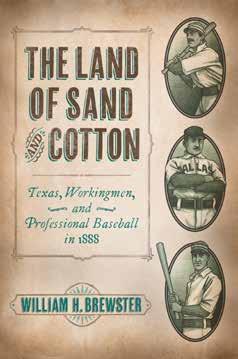
The Land of Sand and Cotton Texas, Workingmen, and Professional Baseball in 1888
WILLIAM H. BREWSTER
The Texas League’s first baseball season in 1888 took place during a turbulent political, economic, and cultural time in Texas. Amid the millions of acres of wild and rural Texas frontier boomed the cities of Galveston, Houston, Dallas, Fort Worth, San Antonio, and Austin, where the new state capitol building had just opened. The Texas economy was transitioning from its legendary cattle drives as those cities competed for diverse business. In this cauldron Texas cities used whatever means they had to compete for population and business from other parts of the country, welcoming urban activities and entertainment typically reserved for cosmopolitan Eastern cities, such as professional baseball.
The Land of Sand and Cotton uncovers key elements in the come-up of baseball in the state, such as important games in the newly formed Texas League, racial tensions and the semipro Colored League, the pivotal Major League barnstorming tour, financial struggles during the season, and outside political influences. The Land of Sand and Cotton tells the origin story of Texas baseball, which culminated in Major League franchises and World Series championships in both Houston and Dallas–Fort Worth. A much different game was played in 1888, when there really might have been cowboys, gunfighters, long horns, and horses around every corner.
“William Brewster, already an established expert on nineteenthcentury baseball, has combined exhaustive research and storytelling skills to capture the early game in Texas. His new book illuminates an important yet previously overlooked part of the culture of the growing state.”—Chris Holaday, author of Cracks in the Outfield Wall: The History of Baseball Integration in the Carolinas
“William Brewster captures a notable year in Texas history through colorful characters, from baseball pioneer John McCloskey to Texas Ranger–turned–governor Sul Ross. His story of the Lone Star State in 1888 is remarkable for both its research and writing.”—David King, author of Ross Youngs: In Search of a San Antonio Baseball Legend and San Antonio at Bat: Professional Baseball in the Alamo City
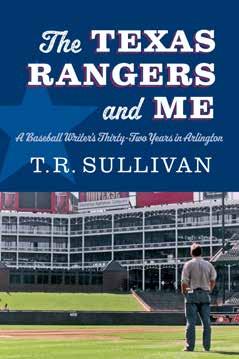
The Texas Rangers and Me A
Baseball Writer’s Thirty-Two Years in Arlington
T.R. SULLIVAN
Since the team was established in 1971, the Texas Rangers have built a rich history and identity that makes them unique among MLB teams. The Texas Rangers and Me takes readers on a journey through the incredible highs and lows and the unforgettable moments that have shaped the franchise through the eyes of beat reporter T.R. Sullivan, who covered the team for thirty-two years, longer than any reporter in franchise history. Sullivan attended thirty-two spring trainings, covered some four thousand regular season games, traveled the country over many post-season Octobers, and spent thousands of hours in the clubhouse and press box.
Sullivan was there for Nolan Ryan’s final two no-hitters, his three hundredth win and five thousandth strikeout, and his famous brawl with Robin Ventura. He covered José Canseco, Alex Rodriguez, and Josh Hamilton. He was there for Kenny Rogers’s perfect game and his assault on two cameramen. He was at the 1989 Earthquake World Series and was on the road with the Rangers on September 11. Sullivan covered sixteen World Series, including the first two ever for the Rangers. He reported through the steroids era and saw firsthand how it impacted the Rangers.
Sullivan covered the team’s ascent to their first World Series, led by manager Bruce Bochy and shortstop Corey Seager, as well as the less-known players and people who have influenced the team’s history. Sullivan portrays the heart and soul of a team that embodies the spirit of Texas itself: gritty, determined, and always fighting for glory. With firsthand stories from players, coaches, and fans alike, Sullivan brings the history of the Texas Rangers to life in a way that honors the team’s unique legacy and their dedicated following.
“Rangers fans will love this book. T.R. Sullivan has an amazing recollection of the inside stories behind the fascinating history of this franchise. Nobody is better qualified to tell these stories than Sullivan, and he does an incredible job in this book.”—Eric Nadel, Texas Rangers radio broadcaster and 2014 Ford Frick Award winner
“No one knows the Texas Rangers, their history, their highs, their lows, like T.R. Sullivan. As a lifetime Major League Baseball historian and student of the game, Sullivan is unparalleled. Coupled with his experience, dedication, and uncanny instincts as a reporter, this book offers extraordinary insight into the colorful world of a Major League franchise.”—Jim Reeves, honorary media member of the Texas Baseball Hall of Fame and four-time J.G. Taylor Spink Award nominee
T.R. Sullivan is a retired beat writer who covered the Texas Rangers from 1989 to 2020. He was inducted into the Texas Baseball Hall of Fame in 2005.
JULY
336 pp. • 6 x 9 • 16 photographs
$36.95T • hardcover • 978-1-4962-4680-6
$52.00 Canadian / £31.00 UK
ALSO OF INTEREST
The Whiz Kids
How the 1950 Phillies Took the Pennant, Lost the World Series, and Changed Philadelphia Baseball Forever Dennis Snelling
$36.95 • hardcover • 978-1-4962-4268-6
Dave Bohmer is director emeritus of the Pulliam Center for Contemporary Media and Media Fellows Program at DePauw University.
APRIL
400 pp. • 6 x 9 • 9 photographs, index
$39.95T • hardcover • 978-1-4962-4349-2
$56.00 Canadian / £34.00 UK
ALSO OF INTEREST Baseball
The Turbulent Midcentury Years
Steven P. Gietschier
$44.95 • hardcover • 978-1-4962-3537-4
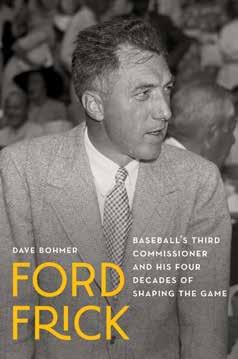
Ford Frick
Baseball’s Third Commissioner and His Four Decades of Shaping the Game
DAVE BOHMER
Many baseball observers have viewed Ford Frick as an ineffective commissioner of Major League Baseball, largely manipulated by the league’s owners, and more of an observer than a changemaker during his tenure from 1951 to 1965. Dave Bohmer challenges this perception, presenting Frick as a key figure in some of the massive changes baseball underwent during his thirty-one years as an executive of the Major Leagues, first as National League president for seventeen years and then as commissioner for fourteen. Frick is rarely credited with any Major League accomplishments besides his role in founding the Baseball Hall of Fame, but Bohmer argues that Frick was, in fact, one of baseball history’s most effective executives.
While National League president, Frick helped save four clubs from bankruptcy, enabling each to win a pennant. He was instrumental in assisting the sport’s survival during the Great Depression and World War II and closely involved in integrating the game. On being named commissioner in 1951, he had a leading role in facilitating the transfer of seven franchises, ensuring baseball was now played in all sections of the country. In a similar vein, he assisted in preparing Major League Baseball for expansion. During his tenure, he helped to stabilize the Minor Leagues, led the way in establishing the player draft that is still used today, and, through numerous congressional hearings, protected baseball’s antitrust exemption. He left his mark in other areas as well, such as protecting the player pension plan. This revisionist biography, with many untold stories of mid-twentieth-century baseball, casts new light on Frick’s sizable contributions to the game and his lasting legacy.
“Baseball resists change, but Ford Frick forced it—and Dave Bohmer shows how. From Jackie Robinson to expansion to the players’ draft, Frick shaped the game. This is the definitive case for baseball’s most overlooked power broker.”—Will Carroll, baseball journalist and author of The Juice and The Science of Baseball
“Dave Bohmer’s biography offers a revised view of the prevailing negative one on Ford Frick’s baseball leadership. This heavily researched and well-written volume covers Frick’s role in many mid-twentiethcentury changes to the game and the creation of the Hall of Fame.” —Ed Edmunds, baseball scholar and professor emeritus of law at Notre Dame Law School
Spitballer
Stan Coveleski and the 1920 Cleveland Indians
WILLIAM C. KASHATUS
Spitballer is the biography of one of baseball’s greatest pitchers. Stan Coveleski was a quiet, modest man, the youngest and most successful of five ball-playing Polish American brothers who worked in the coal mines near their hometown of Shamokin, Pennsylvania. Hoping to escape the mines’ low wages and dangerous working conditions, Coveleski turned to professional baseball. He learned the spitball pitch during a three-year stint in the Minor Leagues after making his Major League debut with the Philadelphia Athletics in 1912.
Coveleski won three games in a single World Series using the now-illegal pitch he altered with saliva to fool opposing hitters. The 1920 season was Coveleski’s best in the Majors; that year, he posted an impressive 24-14 record and led the American League with 133 strikeouts. “Covey,” as he was affectionately known, was even better in the World Series against the Brooklyn Dodgers, when he hurled three game victories, posting a sparkling 0.67 ERA.
But 1920 was also a season of tragedy for both Coveleski and the Indians. On May 28 Covey received the devastating news that his wife of seven years, Mary Shivetts, had died. Then, on August 6, as Coveleski was vying for his nineteenth victory of the season against the New York Yankees, Cleveland shortstop Ray Chapman was hit in the head by a pitch thrown by the Yankees’ Carl Mays and died twelve hours later. Nevertheless, Covey and the Indians persevered to capture the American League pennant and win their first-ever World Series title.
Based on contemporary newspaper accounts and five major interviews Coveleski gave, Spitballer tells Covey’s inspirational story in the context of his time and the rise and decline of the spitball, a tricky and sometimes dangerous pitch to control and one that had an enormous impact on early twentieth-century baseball.
“Stan Coveleski’s story would seem inconceivable to a modern ballplayer: a childhood working in the anthracite coal mines of Pennsylvania, with no baseball training beyond throwing stones at cans, he rose from that hardscrabble life to perfect the spitball and author an all-time World Series performance on his way to the Hall of Fame. Now, thanks to William Kashatus, Coveleski has a lively, deeply researched biography that honors his remarkable legacy.”
—Tyler Kepner, senior baseball writer for The Athletic and author of K: A History of Baseball in Ten Pitches
“William Kashatus offers a compelling study of Stan Coveleski, a complex personality who rose from the Pennsylvania coal mines to enshrinement in baseball’s Hall of Fame.”—Scott H. Longert, author of The Best They Could Be: How the Cleveland Indians Became the Kings of Baseball, 1916–1920

William C. Kashatus is a historian, educator, and the author of more than twenty books, including Blue-Eyed Soul Brother: The Versatile Football Life of Super Bill Bradley (Nebraska, 2024), Lefty and Tim: How Steve Carlton and Tim McCarver Became Baseball’s Best Battery (Nebraska, 2022), and Jackie and Campy: The Untold Story of Their Rocky Relationship and the Breaking of Baseball’s Color Line (Nebraska, 2014).
MAY
256 pp. • 6 x 9 • 29 photographs, 1 map, 1 appendix, index
$36.95T • hardcover • 978-1-4962-4698-1
$52.00 Canadian / £31.00 UK
ALSO OF INTEREST
Blue-Eyed Soul Brother
The Versatile Football Life of Super Bill Bradley
William C. Kashatus
Foreword by Ray Didinger
$34.95 • hardcover • 978-1-4962-4042-2
Pearl E. Casias served as the Southern Ute Indian Tribe’s chief judge for twelve years. She also served on the Southern Ute Indian Tribal Council and was the first woman elected chair of the tribe.
JUNE
120 pp. • 5 1/2 x 8 1/2
$29.95T • hardcover • 978-1-4962-4703-2
$42.00 Canadian / £24.99 UK
American Indian Lives
Lindsey Claire Smith, series editor
ALSO OF INTEREST Bitterroot
A Salish Memoir of Transracial Adoption
Susan Devan Harness
$24.95 • paperback • 978-1-4962-1957-2
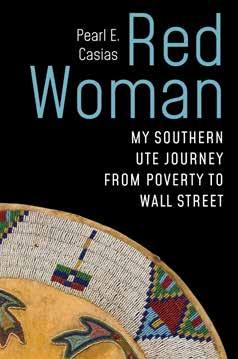
Red Woman My Southern Ute Journey from Poverty to Wall Street
PEARL E. CASIAS
In this singular memoir, Pearl E. Casias tells the story of her rise from poverty to chair of the Southern Ute Indian Tribe in rural southwest Colorado. Casias grew up in poverty and was raised by alcoholic parents. She endured domestic violence in one of her marriages. Despite those dire periods in her life, she put herself through college and rose to become a Southern Ute tribal judge. She details her experience in the tribal court, whose jurisprudence is guided by Indigenous knowledge and Ute-centered spiritual rehabilitation. Casias then spent time on the Southern Ute Indian Tribal Council, running the tribe’s political and economic affairs, particularly the development of considerable mineral resources on tribal lands. During her tenure, the Southern Utes attracted a significant investment from Wall Street as the tribe became a leading producer of natural gas. Casias’s eventual election as chair of the Southern Utes, the pinnacle of her accomplishments, made her the tribe’s first woman chair.
With unflinching honesty, Casias lays out the problems confronting Southern Ute people, including the harm that centuries of colonialism have wrought on the reservation. Blending her personal story with that of her tribe, Casias describes how, as a tribal leader, she strove to develop positive cultural values within Ute society.
“The way Pearl E. Casias combines her personal story with the history of her tribe as well as that of the larger world is illuminating. She possesses self-knowledge and an appreciation for justice that have enabled her to become a leader in her society. She writes with a candor that is unusual, almost disarming. I was hooked from the first word.”—Margaret Randall, author of Letters from the Edge: Outrider Conversations and More Letters from the Edge: Outrider Conversations
“Red Woman is a good story skillfully told, perfectly capturing the life of a woman who lived under difficult circumstances and whose difficulties are described in a straightforward way. A person of great integrity and compassion, Pearl E. Casias demonstrates how Indigenous peoples blend tradition and change and how family and community uphold the Ute people despite the pressures of poverty and isolation.”—Katherine M. B. Osburn, author of Southern Ute Women: Autonomy and Assimilation on the Reservation, 1887–1934
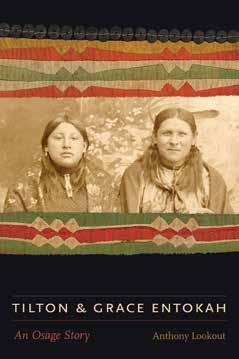
Tilton and Grace Entokah
An Osage Story
ANTHONY LOOKOUT
Tilton and Grace Entokah: An Osage Story offers an episodic history of the Osage Nation of Oklahoma as told through the life narratives of Anthony Lookout’s great-grandparents Tilton and Grace Entokah. Anthony Lookout grew up hearing the stories of his relatives, including those of his great-grandfather Fred Lookout, who served as the principal chief of the Osage Nation in the early twentieth century. Anthony Lookout’s father, Morris Lookout, methodically recorded the oral traditions and tribal stories of Osage elders and relatives on reel-to-reel tapes from 1965 to 1971. The recordings preserved generations of Osage history, religious practices, and cultural traditions reaching back to the mid-nineteenth century. To write this story of his family and Osage history, Anthony Lookout did additional research in archival collections, newspapers, and magazines and interviewed elders.
From the perspective of a participant rather than an observer, Lookout tells the tribal history of the Osage Nation’s removal from their Kansas homelands in 1865 and relocation to Oklahoma’s Indian Territory from 1872 to the early 1940s. The heart of the story revolves around Lookout’s great-grandmother Grace Entokah, who grew up as a traditional Osage woman, and adapted through traumatic and uncertain times, staying true to her Osage culture. She went from riding horses to riding in automobiles, eventually meeting the president of the United States. Lookout covers the family history of the Entokahs, the Allotment Act of 1906, Oklahoma statehood, the depredations of mining and oil companies on Osage lands, the establishment of tribal government and courts, Principal Chief Fred Lookout’s journeys to Washington, DC, to meet top government leaders, as well as tribal stories of the infamous 1920s Osage murders and other key episodes in Osage history. Tilton and Grace Entokah is not only the story of the Entokahs but also an Osage history written from the collective memory of those on the Osage reservation.
“This book is a collection of stories Anthony Lookout heard growing up in an Osage community embedded in white society. Readers of the stories will find them both familiar and perplexing, at times even strange. But isn’t that true of all good stories?”—Peter G. Stromberg, professor of anthropology emeritus at the University of Tulsa
“So much of our Native American culture is now beyond our experience, having left our world with only memories for us. . . . It is good to remember there were those who lived and loved the days and nights of their time. Anthony Lookout brings us into those times and they are worth remembering.”—Geoffrey M. Standing Bear, principal chief of the Osage Nation
Anthony Lookout is an Osage songwriter and musician from Tulsa, Oklahoma. His Osage name is Hunkathali, meaning “good eagle,” from the Hunka clan. He has spent his life playing music as a multi-instrumentalist performing and recording songs and music videos and producing other local artists. Also an actor, he worked for two years with the Native American acting troupe Mahenwahdose.
MAY
160 pp. • 6 x 9 • 7 photographs, 1 illustration, 1 map
$34.95T • hardcover • 978-1-4962-4655-4
$49.00 Canadian / £28.99 UK
American Indian Lives
Lindsey Claire Smith, series editor
ALSO OF INTEREST
My Grandfather’s Altar
Five Generations of Lakota Holy Men
Richard Moves Camp
Edited by Simon J. Joseph
$24.95 • paperback • 978-1-4962-3691-3
Brian K. Burton is professor emeritus of management and retired associate vice president for academic affairs at Western Washington University. He is the author of Fredericksburg and Chancellorsville: A Battlefield Guide (Nebraska, 2026), The Peninsula and Seven Days: A Battlefield Guide (Nebraska, 2007), and Extraordinary Circumstances: The Seven Days Battles.
JULY
328 pp. • 6 x 9 • 14 illustrations, 17 maps, index
$39.95T • hardcover • 978-1-4962-2971-7
$56.00 Canadian / £34.00 UK
Great Campaigns of the Civil War
Anne J. Bailey and Brooks D. Simpson, series editors
ALSO OF INTEREST
Spring 1865
The Closing Campaigns of the Civil War
Perry D. Jamieson
$34.95 • hardcover • 978-0-8032-2581-7
Forward to Richmond
The Virginia Campaign of 1862
BRIAN K. BURTON
In the early eastern theater of the American Civil War, the Northern and Southern armies saw little of combat and little of each other, with most of their military intelligence more akin to propaganda than objective fact. However, by 1862 both sides knew through bloody experience how the other could fight, though gaps in knowledge of the other’s tactics and political strategies remained. Perhaps most important, Northern soldiers had by then spent significant time in the South, and as they witnessed firsthand the effects of slavery, their attitudes hardened toward the South.
Covering all aspects of the war in Virginia in the first six months of 1862, Forward to Richmond treats the military actions in the Shenandoah Valley, the Piedmont, and the Peninsula as part of a theatre-wide campaign. Brian K. Burton goes beyond military events to also examine the political, social, and diplomatic interactions with military events, including the meetings of Union soldiers with Southern civilians and African Americans, ultimately leading to a turn away from conciliation and a beginning of a move toward support of emancipation.
“Brian Burton has given us a fascinating account of the contest in Virginia—chiefly between Lee and McClellan—during the one-year period when it seemed as if that most celebrated theater of conflict might decide the war’s outcome. Thoughtful and rich in fascinating insights, Burton’s book brings into sharp focus the things that period of fighting changed, the things it did not change, and the reasons why.”—Steven E. Woodworth, author of Six Armies in Tennessee: The Chickamauga and Chattanooga Campaigns
“An outstanding example of military history synthesis, incorporating modern Civil War scholarship in its military, social, and political aspects. It is an introductory volume whose intended audience includes both the well-informed enthusiast and the serious student.”—Christopher S. Stowe, professor of military history, Command and Staff College, Marine Corps University
Fredericksburg and Chancellorsville
A Battlefield Guide
BRIAN K. BURTON
Through the winter of 1862 and spring of 1863, the U.S. Army and Robert E. Lee’s Army of Northern Virginia clashed along the Rappahannock River in two major battles. Both demonstrated the height of power for the Confederacy in the eastern theater. The Battle of Fredericksburg was a tactically defensive triumph for Lee over the Army of the Potomac. The Battle of Chancellorsville, often described as Lee’s masterpiece, was a surprisingly aggressive response to Joseph Hooker’s operational flanking maneuver, as Lee sent Thomas J. “Stonewall” Jackson on a flanking maneuver of his own, dividing an army that already was substantially smaller than its Union counterpart to deliver a crushing blow at a decisive spot. It was in the latter stages of that blow that Jackson was mortally wounded by his own men. The battles, failed campaigns with high casualty rates for the Union, were a lead-up to the armies’ meeting at Gettysburg in July 1863.
Civil War historian Brian K. Burton provides a clear, concise narrative of the battles and offers a stop-by-stop guide through Fredericksburg and Spotsylvania National Military Park. Illustrated with numerous maps and filled with stories of the people and tactics of both battles, this indispensable guidebook will direct battlefield visitors and armchair historians through the events of these pivotal campaigns.
“The battles of Fredericksburg and Chancellorsville were separated by four and a half months and ten miles, but Brian K. Burton’s Fredericksburg and Chancellorsville: A Battlefield Guide reminds us how closely tied together the battles were in action and impact. His text and tour—easy to read and easy to follow—allow readers to explore the key spots of each battlefield in their own right, but he also provides a continuity of action between the two battles that allows each battlefield to shed light on the other.”—Chris Mackowski, editor-in-chief of the blog Emerging Civil War and author of numerous books on the Civil War
Brian K. Burton is professor emeritus of management and retired associate vice president for academic affairs at Western Washington University. He is the author of Forward to Richmond: The Virginia Campaign of 1862 (Nebraska, 2026), The Peninsula and Seven Days: A Battlefield Guide (Nebraska, 2007), and Extraordinary Circumstances: The Seven Days Battles .
JUNE
190 pp. • 6 x 9 • 22 maps
$29.95T • paperback • 978-1-4962-3620-3
$42.00 Canadian / £23.99 UK
This Hallowed Ground: Guides to Civil War Battlefields
Brooks D. Simpson, Mark Grimsley, and Steven E. Woodworth, series editors
ALSO OF INTEREST
Manassas
A Battlefield Guide
Ethan S. Rafuse
Cartography by Erin Greb
$21.95 • paperback • 978-0-8032-3643-1
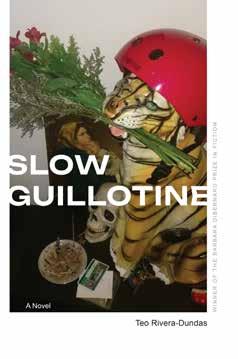
Teo Rivera-Dundas is a writer in western Massachusetts. His work has received support from the Wassaic Project, Anderson Center at Tower View, California Institute of the Arts, and the University of California, San Diego. His writing has appeared in Gulf Coast , Meridian , Tupelo Quarterly , and Desperate Literature’s annual Eleven Stories anthology, among other publications.
MARCH
208 pp. • 5 1/2 x 8 1/2
$21.95T • paperback • 978-1-4962-4731-5
$31.00 Canadian / £17.99 UK
Zero Street Fiction
Timothy Schaffert and SJ Sindu, series editors
ALSO OF INTEREST
Daddy Issues
Stories
Eric C. Wat
$21.95 • paperback • 978-1-4962-4358-4
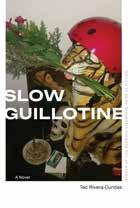
Slow Guillotine A Novel
TEO RIVERA-DUNDAS
Winner of the Barbara DiBernard Prize in Fiction
Slow Guillotine follows three broke weirdos whose collective desire to make and think about art is constantly interrupted by their art-industry-adjacent minimum-wage jobs. Throughout the novel, the three friends’ day jobs in a failing independent bookstore, a sterile gallery in downtown Manhattan, and miscellaneous living rooms across the Long Island birthday-party-clown circuit interweave with their attempts to come to terms with their precarity, gender-dysphoric embodiment, and the floating dream of collective liberation.
Spanning one year and told through an obsessive first-person present tense, Slow Guillotine brings the bildungsroman structure through the autofictional looking glass, questioning how “coming of age” could be feasible in a society of debtors, wage laborers, and renters.
“Slow Guillotine’s subversive, heat-seeking pulse is defiantly proennui, embracing projectile vomit and the thing we want most besides love, that is—language at the very edge, and the shedding of our perpetually too-snug skins.”—Jess Arndt, author of Large Animals: Stories
“An incisive, fluid, and absurdly funny portrait of both the bookselling industry and of what it’s like to try to piece a life together in Manhattan while young(ish) and poor. Whether talking about book-return scams, clowns, social media, cooking, the awfulness of searching for an apartment, tattooing, or pop-ups, Slow Guillotine is sharply observant as it eviscerates the movie myth of New York and replaces it with something less romantic but much more real, current, and painfully hilarious.”—Brian Evenson, author of Song for the Unraveling of the World
“Teo Rivera-Dundas makes the banal shine brilliantly—because when you’re young and in New York, geared with friendship, queerness, and art, even the most mundane trivialities can turn into bold misadventures. Slow Guillotine is a tender, slithering threat: hope hovering, ready to strike.”—Lily Hoang, author of A Bestiary
Nine Persimmons
KERRY JAMES EVANS
The Backwaters Prize in Poetry Honorable Mention
In Nine Persimmons Kerry James Evans traces a geography both intimate and far-flung—Tuscaloosa and Biloxi, Charleston and New Orleans, the Cloisters above Washington Heights, a banana orchard in the Azores, a journey to Rome. The poems move with the gravity of pilgrimage, their compass set between wandering and witness, as they cross from ballfields and shipyards into the charged realms of myth and ritual. Evans’s gift lies in how the ordinary gathers its own divinity: persimmon seeds split to forecast winter, a grandmother’s weed-eater gospel, Camaro burnouts paired with tarot, psalms rising as pelicans wheel into sudden sky. In this light Nine Persimmons reveals how the most unassuming corners of existence sometimes hold the deepest truths.
“Kerry James Evans mines his own experience, and with each poem unboxes honest feelings. His rules are simple: make sense, sing without pretension, take chances, imagine, reveal. The wonder is that he never seems to strain as he fights for that impossible understanding, poetry. Nine Persimmons is a major victory.”—Rodney Jones, author of Salvation Blues and Alabama
“‘I play it out measure by measure,’ writes Kerry James Evans. And those soulful measures are filled with a music that is unabashedly Southern. These poems are haunted, full of grit, and down-home. They have no quit in them.”—Tomás Q. Morín, author of Machete and Patient Zero
“In an honest voice born from a hardscrabble childhood rich with love and labor, Kerry James Evans gives us a book of ‘peanuts and Coca-Cola and a sprinkling of New Testament.’ A book of struggle where here, in rural Georgia, ‘is the heaven of Paradisio.’”
—Alice Friman, author of On the Overnight Train: New and Selected Poems
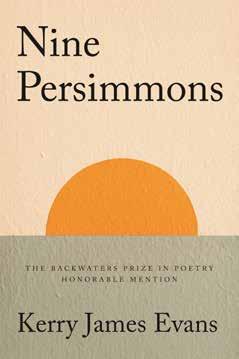
Kerry James Evans is an associate professor of English at Georgia College and State University, where he coordinates the MFA and undergraduate creative writing programs. He is the author of the poetry collection Bangalore . A recipient of a 2015 National Endowment for the Arts Fellowship and a Walter E. Dakin Fellowship from the Sewanee Writers’ Conference, his poems have appeared in AGNI , American Poetry Review , New England Review , Ploughshares , and elsewhere. He is the coeditor and managing editor of Peach .
MARCH
84 pp. • 6 x 9
$17.95T • paperback • 978-1-4962-4371-3
$25.00 Canadian / £14.99 UK
The Backwaters Prize in Poetry
Honorable Mention
ALSO OF INTEREST
Locomotive Cathedral
Brandel France de Bravo
$17.95 • paperback • 978-1-4962-4008-8
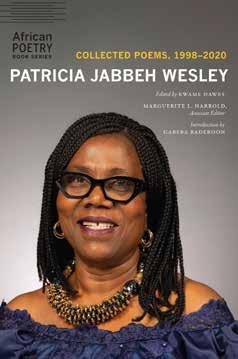
Patricia Jabbeh Wesley is a professor of English, creative writing, and African literature at Pennsylvania State University–Altoona. She immigrated to the United States with her husband and children in 1991, during the First Liberian Civil War. Wesley is the author of six collections of poetry, including Praise Song for My Children: New and Selected Poems , Becoming Ebony , and When the Wanderers Come Home (Nebraska, 2016). Kwame Dawes is a professor of literary arts at Brown University and the director and series editor of the African Poetry Book Fund. Marguerite L. Harrold is the author of Chicago House Music: Culture and Community. She is a PhD student in English (creative writing) at the University of Nebraska–Lincoln. Gabeba Baderoon is a poet and scholar. She is the author of three collections of poetry: The Dream in the Next Body , A Hundred Silences , and The History of Intimacy . She teaches at Pennsylvania State University.
MAY
434 pp. • 6 x 9 • 1 glossary
$27.95T • paperback • 978-1-4962-4424-6
$39.00 Canadian / £22.99 UK
African Poetry Book
Kwame Dawes, series editor
Patricia Jabbeh Wesley
Collected Poems, 1998–2020
PATRICIA JABBEH WESLEY
EDITED BY KWAME DAWES
MARGUERITE L. HARROLD,
ASSOCIATE EDITOR
INTRODUCTION BY GABEBA BADEROON
Patricia Jabbeh Wesley is the first major poet out of Africa’s oldest republic of Liberia since the nation’s founding and remains one of the most important poets from Africa. Spanning two decades of work, the poems in this collection tell stories of Wesley’s homeland that would have otherwise been forgotten. As she recounts her life as a refugee, mother, wife, and African woman, Wesley also remembers the Liberians who were killed in the fourteen-year civil war, the hundreds of thousands silenced and unable to tell their own stories.
In conversation with Africa and her new homeland of America, Wesley’s craft is imbued with Grebo oral tradition, bringing her language alive as she makes the reader cry out in anger or laughter. On one page you may find reason to mourn the brutality of war, and on the next, a reason to laugh about the beauty of family or at the small wonders of everyday life. Poetry, to Wesley, is not about words; it is about the story, the story of the living seeking to give new life to both the living and those she calls the dead living.
“Today [Patricia Jabbeh] Wesley is among the most celebrated poets of the new African diaspora. . . . Wesley is a rare figure: an African woman poet who has received high honors and become a public figure whose words have reshaped the public and literary discourse about Liberia. . . . It has taken years for her to arrive at the position she holds. She has had to navigate an inability in many to imagine an African poet of her gifts and presence. But her work has overcome this and created the future she foresaw as a child in Monrovia.”
—Gabeba Baderoon, from the introduction
ALSO OF INTEREST
When the Wanderers Come Home
Patricia Jabbeh Wesley
$15.95 • paperback • 978-0-8032-8857-7
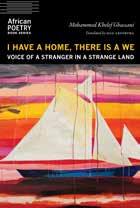
I Have a Home, There Is a We Voice of a Stranger in a Strange Land
MOHAMMED KHELEF GHASSANI TRANSLATED BY MEG ARENBERG
I Have a Home, There Is a We , whose original Swahili edition was in 2015 the first book of poetry to win the Safal-Cornell Kiswahili Prize for African Literature, brings the acclaimed verse of prolific Zanzibari poet, journalist, and cultural changemaker Mohammed Khelef Ghassani to Englishlanguage readers for the first time. The book explores the poet’s life as a migrant in Germany: linguistic and cultural alienation, nostalgia, and longing for his homeland on the island of Pemba. These poems form a catalog of sorrow and love addressed to the family he left behind, to the children whose roots “he tore forcefully from the ground” in hopes of offering them a better life, and above all to the country he calls home, using the deeply resonant Swahili term “kwetu”— our place—named over and over again as Zanzibar.
Utilizing the structured verse forms of traditional Swahili prosody, the collection is modern, unique, and innovative, speaking to a global diasporic experience even as it draws deeply on an idiom specific to the poet’s tiny island home. A ripple of political defiance suffuses the poems as Ghassani positions himself against layered forms of oppression and marginalization both at home and abroad in this synthesis of love song, lamentation, and freedom declaration.
“This beautiful translation introduces to an English reading audience Mohammed Ghassani’s captivating poetry. It is representative of new, young, confident, patriotic, hopeful, and vibrant voices currently emerging out of a long tradition of Kiswahili verse. This is a daring voice very much worth listening to.”—Abdilatif Abdalla, Kenyan political activist, author of Sauti ya Dhiki (Voice of Agony), and retired teacher of Kiswahili language and African literature at the University of Leipzig
“The journeys Mohammed Ghassani’s poetry beautifully takes raise questions about home: Is it a place that only poetry can find? Is it a road map back home or is poetry itself the destination, our final home? In Meg Arenberg’s translation is home to be found in many languages? And for the reader, do you now see you live in many homes? Come to Ghassani’s poetry all packed and prepared, with your arms wide open ready to embrace your many selves. Home here is a train traveling faster than the speed of light to all destinations at the same time.”—Mukoma Wa Ngugi, cofounder of the Safal-Cornell Kiswahili Prize for African Literature and author of Logotherapy
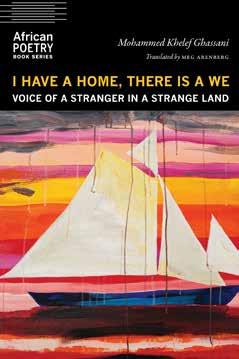
Mohammed Khelef Ghassani was born in 1977 on the island of Pemba, Zanzibar. He studied translation at the Open University of Tanzania, where he received a master’s degree in 2014. He now works as a reporter and editor of the broadcasting company Deutsche Welle in Bonn, Germany. He is the author of seven previous collections of poetry in Swahili. Meg Arenberg is a scholar and translator with specializations in Anglophone African, Indian Ocean, and Swahili literatures. Her work has won recognition from the American Comparative Literature Association and the American Literary Translators Association.
MARCH
124 pp. • 6 x 9
$19.95T • paperback • 978-1-4962-4428-4
$28.00 Canadian / £15.99 UK
African Poetry Book
Kwame Dawes, series editor
ALSO OF INTEREST
The Naming
Chinụa Ezenwa-Ọhaeto
$17.95 • paperback • 978-1-4962-4470-3

Michael Imossan is a Nigerian poet of Ibibio origin. He is curator of the poetry column for Nigerian NewsDirect , poetry editor for the Chestnut Review , and the author of the award-winning chapbook For the Love of Country and Memory . Imossan’s second chapbook, The Smell of Absence , was selected for inclusion in Kumi Na Moja: New-Generation African Poets: A Chapbook Box Set . He is a recipient of a PEN International writers’ grant. Kwame Dawes is a professor of literary arts at Brown University and the director and series editor of the African Poetry Book Fund.
MARCH
80 pp. • 6 x 9
$17.95T • paperback • 978-1-4962-4609-7
$25.00 Canadian / £14.99 UK
African Poetry Book
Kwame Dawes, series editor
ALSO OF INTEREST
Leaked Footages
Abu Bakr Sadiq
Foreword by Kwame Dawes
$17.95 • paperback • 978-1-4962-4013-2
All that Refuses to Die
MICHAEL IMOSSAN
FOREWORD BY KWAME DAWES
Winner of the Sillerman First Book Prize for African Poets
All that Refuses to Die is a poetry collection that interrogates the present conditions of Africans through a historical lens. Michael Imossan moves into historical spaces such as museums and sites of enslavement, touching artifacts that hold meaning, and asking, Where was Africa? Where is Africa now? And what has changed? The Biafran War that claimed three million lives, though declared over, still has its lingering effect on Nigeria and Nigerians. Congo, though free of King Leopold and the exploitation of cotton, is still not free of other kinds of exploitation, nor is Uganda. Though the slave trade has ended, African bodies are still found in the Sahara Desert and in the Atlantic Ocean.
All that Refuses to Die is a collection that brims with stories and memories that evoke as well as provoke. As he moves through historical places, the poet compares the past with the present and finds that nothing has really changed.
“Michael Imossan is a capacious poet. He shows us how a heart can take in an entire continent and spread it as love to the world. His collective heart is perhaps the most interior heart and most true.”—Fady Joudah, author of The Earth in the Attic and Tethered to Stars
“What is impressing me about Michael Imossan’s work is the manner in which he is negotiating multiple ‘influences’ and compulsions as a poet, for these manifest themselves in his lyricism and his engagement with a personal narrative of self and self-identity as well as his own wrestling with the influence of tradition. It is telling that were we to list the personages that appear in his epigraphs and, to some extent, in his allusions, we will understand Imossan to be fully ensconced in contemporary world literature. And yet we will also see the extent to which he has become immersed in the varied milieu of contemporary African poetry.”—Kwame Dawes, from the foreword
Award-Winning Poetry from the University of Nebraska Press
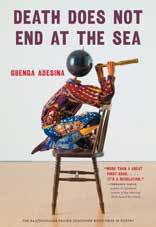
Death Does Not End at the Sea
Gbenga Adesina
Longlisted for the 2025 National Book Award in Poetry
The Raz/Shumaker Prairie Schooner
Book Prize in Poetry Series
$17.95 • paperback
978-1-4962-4477-2
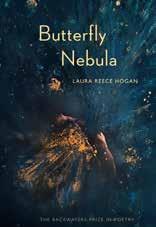
Butterfly Nebula
Laura Reece Hogan
Gold Medal for the 2024 Illumination Book Award
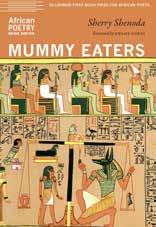
Mummy Eaters
Sherry Shenoda
Longlisted for the 2022 National Book Award
Winner of the 2023
American Book Award
African Poetry Book Series
$17.95 • paperback
978-1-4962-3254-0
Honorable Mention for the 2024 Catholic Media Association Book Award
The Raz/Shumaker Prairie Schooner
Book Prize in Poetry Series
$17.95 • paperback
978-1-4962-4477-2
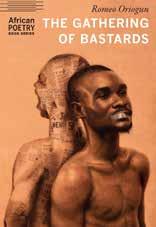
The Gathering of Bastards
Romeo Oriogun
Winner of the 2023
Julie Suk Award
Finalist for the 2024 National Book Critics Circle Award
African Poetry Book Series
$19.95 • paperback
978-1-4962-3403-2
The Track the Whales Make
New and Selected Poems
Marjorie Saiser
Winner of the 2022 High Plains Book Award in Poetry
Ted Kooser Contemporary Poetry Series
$19.95 • paperback 978-1-4962-2812-3

Jill Christman is the author of If This Were Fiction: A Love Story in Essays (Nebraska, 2022), Darkroom: A Family Exposure , and Borrowed Babies: Apprenticing for Motherhood . She is a professor in the Creative Writing Program at Ball State University, where she serves as editor of River Teeth: A Journal of Nonfiction Narrative and Beautiful Things .
MARCH
296 pp. • 5 1/2 x 8 1/2
$26.95T • paperback • 978-1-4962-4679-0
$38.00 Canadian / £21.99 UK
American Lives
Tobias Wolff, series editor
ALSO OF INTEREST
If This Were Fiction
A Love Story in Essays
Jill Christman
$21.95 • paperback • 978-1-4962-3235-9
The Heart Folds Early A Memoir
JILL CHRISTMAN
The Heart Folds Early is a story of transformation through tragedy, and an examination of the way in which great loss can make us simultaneously fearful and intrepid. Emerging from a childhood that included both devastating sexual abuse and the sustaining joy of being deeply (if imperfectly) loved, Jill Christman’s sights were set on building and protecting her own happy family—until her fiancé was killed in a car accident.
Christman folds the mournful recklessness of the young widow she was against the backdrop of her later marriage and new motherhood, including the choice to end a halfterm pregnancy when a routine ultrasound revealed her baby boy had just half a heart. Courageous, clear-eyed, tender, and unexpectedly funny, Christman’s book reflects on her life and asks: What happens when we’re afraid the worst thing will happen and then, sometimes, it does? What does it mean to make and live with a heartrending choice? How do we carry life and death in our bodies and survive with our hearts intact?
“At once fierce and exquisitely tender, The Heart Folds Early is a breathtaking journey into the mind of a mother grappling with an impossible choice. Jill Christman has written a profoundly generous book, offering her story with open palms.”—Nicole Graev Lipson, author of Mothers and Other Fictional Characters
“This book is a continuous wonder, a compulsively readable story told with keen wisdom and nerves of steel about the fierce desire to grow and birth babies from a full life of one’s own.”—Sonya Huber, author of Voice First: A Writer’s Manifesto
“A brilliant, breathtaking memoir about the dignity and necessity of our choices. . . . Jill Christman writes about the toughest matters of human existence with a directness, empathy, and humor that is the closest thing I’ll ever know to love born from a page.”
—Brooke Champagne, author of Nola Face: A Latina’s Life in the Big Easy
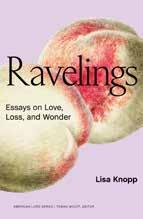
Ravelings Essays on Love, Loss, and Wonder
LISA KNOPP
In Ravelings , Lisa Knopp takes up an older, opposing meaning of the verb “ravel”—“to entangle”—as she explores the deaths and departures of loved ones and the rituals by which we mourn and honor them, while contemplating her relationships with writing, spirituality, sense of home, aging, desire, and the relationship between body and mind. Entangled in these losses and changes, Knopp experiences wonder, joy, connectivity, and wholeness.
In these nimble and companionable essays, Knopp considers hunger and fullness through ethical, disordered, and mindful eating; awakens to common magic through two chance encounters with a magician; and finds humility and empowerment as an unpartnered sixty-year-old woman in a ballroom dance class filled with young couples. Knopp comprehends her experiences with nuance, revealing time and again that the same ravel of text can encompass the blending in a single moment of the exotic and mundane, of fullness and want, of love and abhorrence, of desire and contentment, of freedom and bondage, of severance and connection, and of the creative act as both an evocation and an imposition.
“Knopp is clear-eyed and reverent as she harnesses examples from art and etymology, memory studies and theology, to explore loss, aging, and the rich layers of human appetite. These essays embody the holy work of paying attention, of forging connection and of letting go. A luminous, tender collection by a master of the form.”
—Sonja Livingston, author of The Virgin of Prince Street
“Lisa Knopp’s essay ‘Still Life with Peaches’ is a map for how to see, how to find words for close-seeing. I couldn’t put this book down.”
—Fleda Brown, author of The End of the Clockwork Universe
“With every deep dive into these streams of Lisa Knopp’s life, we vibrate like a tuning fork, resonating and enriching our understanding of the intricate balances and delicious contradictions of everyday life.”—Pamela Carter Joern, author of At the Corner of Past and Future: A Collection of Life Stories
Lisa Knopp is a professor of English at the University of Nebraska at Omaha. She is the author of several books, including From Your Friend, Carey Dean: Letters from Nebraska’s Death Row ; Interior Places (Nebraska, 2008); and The Nature of Home: A Lexicon and Essays (Nebraska, 2002).
MARCH
208 pp. • 5 1/2 x 8 1/2
$21.95T • paperback • 978-1-4962-4494-9
$31.00 Canadian / £17.99 UK
American Lives
Tobias Wolff, series editor
ALSO OF INTEREST
The Perils of Girlhood
A Memoir in Essays
Melissa Fraterrigo
$21.95 • paperback • 978-1-4962-4220-4
Timothy J. Hillegonds is the author of The Distance Between: A Memoir (Nebraska, 2019). His work has appeared in publications such as The Guardian , The Daily Beast , Los Angeles Review of Books , and Salon.com. He serves as a contributing editor for Slag Glass City , a digital journal of the urban essay arts. Hillegonds lives, works, and writes in Chicago.
MARCH
156 pp. • 5 1/2 x 8 1/2
$19.95T • paperback • 978-1-4962-4623-3
$28.00 Canadian / £15.99 UK
American Lives
Tobias Wolff, series editor
ALSO OF INTEREST Character Witness A Memoir
Jason Brown
$21.95 • paperback • 978-1-4962-4263-1
And You Will Call It Fate A Memoir
TIMOTHY J. HILLEGONDS
In And You Will Call It Fate , Timothy J. Hillegonds explores an eight-year relationship with Sean Dempsey, a charismatic yet volatile former NFL player turned entrepreneur who profoundly reshaped the trajectory of Hillegonds’s life. Set against the backdrop of Chicago’s financial district, the memoir follows Hillegonds—a high school dropout, struggling addict, and estranged father—as he unexpectedly enters the high-stakes world of finance under Dempsey’s intense mentorship.
A troubling undercurrent of manipulation and control soon belies Dempsey’s initially supportive mentorship. As he considers the devastating two-year lawsuit through which he broke free, Hillegonds thoughtfully explores the complicated bonds formed when gratitude intersects with obligation, and harm with healing. Part workplace memoir and part nuanced meditation on masculinity, power, and redemption, Hillegonds’s tightly crafted narrative asks the reader to consider a difficult question: How does one reconcile the debts owed to those who simultaneously save and harm us?
“A stunningly clear-eyed exploration of masculinity via Timothy Hillegonds’s long relationship with Sean Dempsey, a man capable of startling generosity as well as unchecked rage. . . . In an era where cultural conversations about masculinity can be dismayingly binary, And You Will Call It Fate is exactly the book the world needs.”
—Kristi Coulter, author of Exit Interview: The Life and Death of My Ambitious Career
“Haunting, disturbing, and uplifting, And You Will Call It Fate tells the complex tale of a friendship that saved the author from addiction—a friendship as exhilarating and ensnaring as a line of cocaine, full of false promises and flashes of rapture and insight. The character of Sean Dempsey is Hillegonds’s Gatsby—enigmatic, lavish in lifestyle, and dangerous to be around. But, like the author of this brave and beautiful book, you’ll be glad you came into his orbit.”—Miles Harvey, author of The Island of Lost Maps and The King of Confidence
Bummerland
Ruin and Restoration in Trump’s New America
RANDOLPH LEWIS
With radical candor and sardonic wit, Randolph Lewis offers an autopsy of the recent past, looking for glimmers of hope and redemption among the detritus strewn about by neo-Gilded Age billionaires, Big Tech, and political extremes during the first Trump administration and the pandemic era. American life took a weird turn in June 2015, when an aging reality star descended a golden escalator to announce his bid for the White House. From there, Lewis watched from his longtime home in the Lone Star State as the country slipped into an endless fever dream churning with chaos, uncertainty, and fear.
Wanting to decipher how things went sideways in such a hurry, Lewis drove all over the Sunbelt and beyond, trying to make sense of what was happening. He sojourns to an apocalyptic slab of the Mojave Desert; the rugged mountains under assault near Colorado Springs; the epic sprawl of Las Vegas, Austin, and Houston; the expat communities of central Mexico; the hotbeds of racism in the Deep South; and the fjords of Norway, from which, surreally, Lewis watched the unfolding news of the school shooting in Uvalde, Texas, and decided to go there. In a register mournful, meditative, and darkly comic, Lewis offers a portrait of modern American life under a system whose democratic norms have been stretched to the limit.
Lewis, an American studies professor for three decades, examines the trajectories of cultural burnout that have ushered us into a new Gilded Age of fear, hustle, and hype. In this passionate critique of the anxious new world we inhabit, Lewis offers sketches of where we’ve ended up, why it feels so wrong, and how we might find our way out of Bummerland.
“Keenly observed, deeply felt, and beautifully written, Randolph Lewis’s Bummerland is the funniest, saddest, and wisest book you’ll read this year. You won’t find a better guide to the tragic America wrought by Donald Trump and Elon Musk.”—Ari Kelman, author of A Misplaced Massacre: Struggling over the Memory of Sand Creek, winner of the Bancroft Prize in History
“This acid-tongued, profoundly sad and hilarious, tragic-gonzo adventure trip through a seductively deranged country feels out the grim landscape of the great American derailing of the 2020s. It invents, with a growing number of other shining books, a passionate pragmatic genre to approach a soft revolution devoted to well-being, creativity, equity, sustainability, and solidarity.”—Kathleen Stewart, author of A Space on the Side of the Road: Cultural Poetics in an “Other” America

Randolph Lewis is a professor of American studies at the University of Texas at Austin. He is the author of “ Navajo Talking Picture”: Cinema on Native Ground (Nebraska, 2012), Alanis Obomsawin: The Vision of a Native Filmmaker (Nebraska, 2006), and Under Surveillance: Being Watched in Modern America .
MARCH
280 pp. • 6 x 9 • 17 photographs
$32.95T • hardcover • 978-1-4962-4485-7
$46.00 Canadian / £27.99 UK
ALSO OF INTEREST
The Great Oklahoma Swindle Race, Religion, and Lies in America’s Weirdest State
Russell Cobb
$24.95 • paperback • 978-1-4962-3040-9
Diane J. Purvis taught cultural history at Alaska Pacific University for twenty-five years. She is the author of They Came but Could Not Conquer: The Struggle for Environmental Justice in Alaska Native Communities (Nebraska, 2024) and Ragged Coast, Rugged Coves: Labor, Culture, and Politics in Southeast Alaska Canneries (Nebraska, 2021).
MAY
240 pp. • 6 x 9 • 10 photographs
$26.95T • paperback • 978-1-4962-4476-5
$38.00 Canadian / £21.99 UK
ALSO OF INTEREST
The Turtle’s Beating Heart
One Family’s Story of Lenape Survival
Denise Low
$21.95 • paperback • 978-1-4962-3689-0
More than Flower Power Coming of Age in the Tumultuous 1960s
DIANE J. PURVIS
Diane J. Purvis’s memoir offers a unique view from the Los Angeles County suburbs as she was coming of age during the era of civil rights activism, the women’s movement, and Vietnam anti-war movement. More than Flower Power recalls the youthful energy that surged in the 1960s as political and cultural tensions rose to the surface. Her parents, Midwest transplants to California, sought the postwar American dream and went from pinching pennies to living in upper middle-class suburbs, which were imbued with rigid social and political codes. Purvis rejected this conservative bias while attending racially integrated schools and witnessing the dichotomy between suburban and inner-city students, motivating her to embrace social justice. Purvis and her peers were influenced by images of the Vietnam War and political protests they saw on television and the music they heard on their transistor radios, two emerging technologies that shaped popular perceptions during this tumultuous decade.
Purvis was possessed by the desire to make a difference even though inroads to social and political equality looked impossible in the face of America’s cultural consensus and conformism of the era. Through the lens of one person’s experience, More than Flower Power offers an intimate portrait of a West Coast generation’s optimism, idealism, and transformative influence on American culture and society.
“The 1960s remain a critical decade for understanding contemporary America, so hard, honest looks at what was happening then and how it prefigures our current political space are welcome. More than Flower Power charts the influence of that time on adolescents who were watching from a distance yet absorbing the implications of this new order.”—Robert Aquinas McNally, author of Cast Out of Eden: The Untold Story of John Muir, Indigenous Peoples, and the American Wilderness
“The 1960s is a decade that has been distorted and maligned, and we need more than a few books—from different points of view—that set the record straight. Diane Purvis lived through the era and her insights are valuable.”—Margaret Randall, author of I Never Left Home: Poet, Feminist, Revolutionary and More Than Things
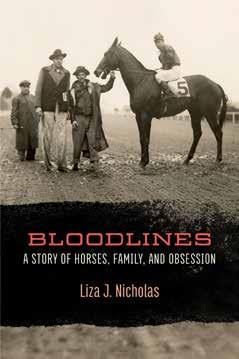
Bloodlines A Story of Horses, Family, and Obsession
LIZA J. NICHOLAS
Bloodlines: A Story of Horses, Family, and Obsession is a love story—of a mother’s love for her husband and a father’s love for horses. Combining memoir and social history with a journey into the world of horses, Liza J. Nicholas reveals how a parent’s passions can determine the destiny of an entire family.
In the darkest days of the Depression, and still in high school, Nicholas’s father, Chuck, escaped his fate on a failing Iowa farm and joined a local horse trainer on the nationwide county fair circuit. From the moment he fell in with the strutting strangers who passed through town at fair time, his life trajectory was set. He was ensorcelled by the thoroughbred, the most royal of equines. And even as he and his wife had children of their own, the menagerie of grooms, jockeys, trainers, and gamblers who made up the world of horse racing became his true family.
Set in western Montana, the Nebraska Sandhills, rural Iowa, and beyond, Bloodlines tells the story of how one man’s passions ripple through generations. It is the story of a family who followed their father across the country in search of the fastest horse, the best deal, the promise of a payday.
“In clear, honest, and eloquent prose, Liza Nicholas examines the double-edged and lasting inheritance of our parents’ dreams and ambitions. Bloodlines avoids false nostalgia and maps the reality and sacrifice of recognizing and even accommodating those larger-thanlife yet often invisible forces as we strive to shape our own narratives. Hard-earned empathy, compassion, and wisdom fill these pages.”
—Robert Stubblefield, director of the University of Montana Press
“Beautifully written and impeccably researched, Liza Nicholas’s Bloodlines portrays the nomadic and insular life of horse racing, as her family travels across America in the wake of her father, who trained and raced thoroughbreds. Nicholas’s depiction of this world of bush boys, jockeys, and trainers in this American story of reinvention and restlessness is as powerful as her father’s desire for the next great horse.”—Caroline Patterson, author of The Stone Sister, winner of the 2021 High Plains Book Award
Liza J. Nicholas is the author of Becoming Western: Stories of Culture and Identity in the Cowboy State (Nebraska, 2008) and coeditor of Imagining the Big Open: Nature, Identity, and Play in the New West .
JULY
204 pp. • 5 1/2 x 8 1/2 • 9 photographs, 4 illustrations
$24.95T • paperback • 978-1-4962-4732-2
$35.00 Canadian / £19.99 UK
ALSO OF INTEREST
The Horse Lover
A Cowboy’s Quest to Save the Wild Mustangs
H. Alan Day with Lynn Wiese Sneyd Foreword by Sandra Day O’Connor
$19.95 • paperback • 978-1-4962-3263-2
R. W. Hafer is a former distinguished research professor of economics and finance at Southern Illinois University Edwardsville.
APRIL
288 pp. • 6 x 9 • 7 photos, 8 illustrations, index
$27.95T • paperback • 978-1-4962-3514-5
$39.00 Canadian / £22.00 UK
ALSO OF INTEREST
Wilderness of Hope
Fly Fishing and Public Lands in the American West Quinn Grover
$26.95 • hardcover • 978-1-4962-1180-4
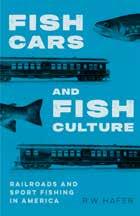
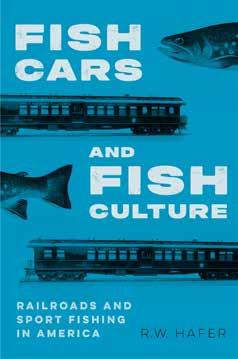
Fish Cars and Fish Culture Railroads and Sport Fishing in America
R. W. HAFER
Fish Cars and Fish Culture explores the intersection between the development of railroads and fish culture during the last half of the 1800s. R. W. Hafer traces how the growth in the railroad industry, both in terms of its technology and its geographic reach, assisted the newly formed U.S. Fish Commission in its attempt to restore the nation’s rapidly declining fish populations. Because of railroads, the Commission was able to transplant millions of fish, often into non-native waters, across the country. Railroads also fostered the public’s interest in the pastime of sport fishing by not only providing greater access to lakes and streams, but by creating marketing campaigns that popularized sport fishing, especially among women. In addition, railroads contributed to the development of a conservation movement that led to changes in how Americans viewed and took part in outdoor activities.
“R. W. Hafer’s Fish Cars and Fish Culture is a welcome, indeed foundational, addition to the library of anyone wishing to understand a remarkably dynamic period in the evolving culture of American outdoor sport. It sets the historical stage for many of today’s most vexing natural resource management challenges and controversies.”
—Paul Schullery, author of American Fly Fishing: A History
“State general assemblies and consumers annually fund billions of dollars connected to fishing culture. Where does this influential economy come from? R. W. Hafer’s epic story entertains and educates in his wide sweep through the synergism of governments, recreation, and commerce. A very pleasant read.”—Lynn Morrow, editor of The Ozarks in Missouri History: Discoveries in an American Region
“An intriguing account of how the nineteenth-century crusade to replenish America’s declining fish stocks became dependent on improved railroad technology, which in turn facilitated the spread of sport fishing across the country.”—John F. Reiger, author of American Sportsmen and the Origins of Conservation
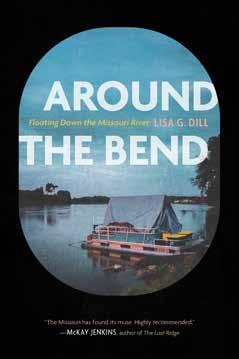
Around the Bend Floating Down the Missouri River
LISA G. DILL
The Missouri River is one of the most dangerous rivers in the United States—and one of the most economically important. Even as prolonged drought in the Midwest has imperiled urban drinking water and agricultural water supplies, parched regions in the basin far from the river have proposed piping water from the Missouri to alleviate their own water shortages.
In an attempt to better understand the river and its place in the American imagination, Lisa G. Dill set out with four of her mother’s cousins on a forty-year-old pontoon boat on a modern voyage of discovery. The hope was to sail nearly 750 river miles from Sioux City, Iowa, to St. Louis, Missouri, a goal whose success was by no means assured, given the rickety state of the family vessel. From departure—a day late, because the motor wouldn’t start—until she got off the boat, Dill bears witness to the river, its flora and fauna, the efforts to control it, and its history, along with the misadventures of a crew of “relative strangers” and the boat’s tenuous viability on one of the world’s most powerful rivers.
In Around the Bend Dill teases out the cultural and environmental history of the Missouri and urges readers to change the way they think about America’s rivers and the landscapes through which they flow.
“Lisa Dill’s tale of a fortnight traveling along the muddy, moody Missouri is enlivened by a wealth of influences, including the wit of Mark Twain, the adventurous spirit of Lewis and Clark, the wisdom of Indigenous peoples, and the lore of scholars. Her own keen reflections flow through every page.”—Scott Russell Sanders, author of The Way of Imagination and A Conservationist Manifesto
“This book is delightful, witty, and deeply observed, fed by tributary streams of history, geography, and ecology. The Missouri has found its muse. Highly recommended.”—McKay Jenkins, author of The Last Ridge: The Epic Story of America’s First Mountain Soldiers and the Assault on Hitler’s Europe
“Lisa Dill shows us the living, breathing, silty life of the river as it wends its way across the continent. Her experiences and observations . . . make a compelling case for why the river must be conserved.”—Charlene Porsild, author of Gamblers and Dreamers: Women, Men, and Community in the Klondike
Lisa G. Dill is an adjunct professor of creative and environmental writing at the University of Delaware.
APRIL
240 pp. • 6 x 9 • 11 photographs
$24.95T • paperback • 978-1-4962-3731-6
$35.00 Canadian / £19.99 UK
ALSO OF INTEREST
Uphill Both Ways
Hiking toward Happiness on the Colorado Trail
Andrea Lani
$21.95 • paperback • 978-1-4962-2900-7
Walt Bachman is a historian and retired lawyer. He is the author of The Last White House Slaves: The Story of Jane, President Zachary Taylor’s Enslaved Concubine ; Officer, Gentleman, Slavemaster: Slavery and Racism at West Point and Fort Leavenworth ; and Yankee Slaveholders in the Charleston Harbor: The Untold Story of Northern U.S. Army Officers Who Kept Slaves at Fort Sumter and Fort Moultrie
APRIL
436 pp. • 6 x 9 • 10 photographs, 2 illustrations, 3 maps, 1 appendix, index
$27.95T • paperback • 978-1-4962-4599-1
$39.00 Canadian / £22.99 UK
ALSO OF INTEREST Journey to Freedom
Uncovering the Grayson Sisters’ Escape from Nebraska Territory
Gail Shaffer Blankenau
$34.95 • hardcover • 978-1-4962-3152-9
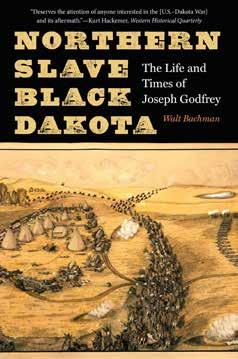
Northern Slave, Black Dakota
The Life and Times of Joseph Godfrey
WALT
BACHMAN
Born into slavery in free territory, Joseph Godfrey died widely reviled for his controversial role in the U.S.–Dakota War of 1862. Separated from his mother at age five when his enslaver sold her, Godfrey sought refuge in his teens among the Dakota people he had befriended as a child. Godfrey married a Dakota woman and was living with his family on the Lower Sioux Reservation in 1862, when the U.S.–Dakota War broke out. Pressured to join Dakota warriors in the war’s opening days, when the six-week conflict ended, he became the first of hundreds of men tried by a military court created by Commander Henry Sibley. Sibley, who was one of Godfrey’s former enslavers, approved death sentences for Godfrey and 302 other Dakota soldiers.
In this riveting biography, Walt Bachman untangles the thorny questions that haunt Godfrey’s story: How was he enslaved in a free state? Did he murder the frontier settlers for which the Dakota dubbed him Otakle (“Many Kills”)? Did he turn traitor to save his own life? Did Godfrey’s testimony send thirty-eight Dakota men, including his fatherin-law, to the gallows? In this carefully researched book, Bachman argues that the 1862 war trials, which ended with the largest mass execution in U.S. history, were both more just and more unfair than we have ever understood.
“As a former prosecutor [Walt Bachman] excels at untangling and clarifying the trial record. . . . This fresh look at issues of race, identity, and the Dakota War deserves the attention of anyone interested in the conflict and its aftermath.”—Kurt Hackemer, Western Historical Quarterly
“Bachman, confronting conventional wisdom and bias, gives us a fascinating portrait of a man who for so long lived as a ‘man without footnotes.’ This book supplies plenty of them. Bachman’s research is meticulous. His analysis is sound.”—William D. Green, Minnesota History
Emancipation War
The Fall of Slavery and the Coming of the Thirteenth Amendment DAMON ROOT
Speaking to a fractured country for the first time as president, Abraham Lincoln endorsed a constitutional amendment designed to permanently safeguard slavery in every state in which the institution already existed. If that proslavery provision had been ratified, it would have become the Thirteenth Amendment to the U.S. Constitution. Three years later, Lincoln again threw his support behind a constitutional amendment to address slavery: this time to abolish it. Formally ratified in 1865, this is the Thirteenth Amendment we know today.
What happened in those intervening years that led Lincoln to switch from supporting a proslavery amendment to embracing the antislavery provision that ultimately became enshrined in the Constitution? Why did the Thirteenth Amendment of 1864–65 win out over that of 1861? Lincoln himself provided a key to understanding: “I claim not to have controlled events,” he said, “but confess plainly that events have controlled me.”
In Emancipation War award-winning journalist Damon Root chronicles the great legal, political, and military struggle to amend the U.S. Constitution to outlaw slavery once and for all. It is the story of canny political tacticians and unyielding radicals; of famous orators and unsung pamphleteers; of liberty-minded Union officers and enslaved persons who liberated themselves by following the North Star to freedom, and who then, in some cases, donned uniforms and took up arms against their former enslavers. It was this wide-ranging movement against slavery— operating both inside and outside the halls of government power, fighting both on and off the battlefield—that made an antislavery constitutional amendment possible.
Telling the story from both the top down and the bottom up, Emancipation War provides a gripping and revealing new history of the Thirteenth Amendment.
“It has been well-said that the purpose of education is to learn to praise—to learn standards of excellence, and honor those who achieve them. Damon Root, whose education has made him one of the most consistently illuminating writers of constitutional questions, demonstrates how ‘heroism, fellowship, and dignity’ produced a noble deed: the Thirteenth Amendment.”—George F. Will, Pulitzer Prize–winning columnist and author of American Happiness and Discontents: The Unruly Torrent, 2008–2020
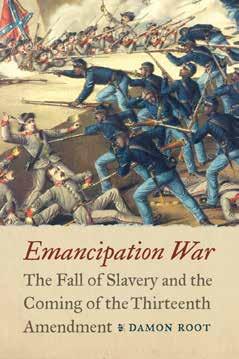
Damon Root is an award-winning legal affairs journalist and the author of A Glorious Liberty: Frederick Douglass and the Fight for an Antislavery Constitution (Potomac Books, 2023) and Overruled: The Long War for Control of the U.S. Supreme Court . His writing has also appeared in the Los Angeles Daily News , Chicago Sun-Times , Newsweek , New York Post , New York Daily News , New York Press , Washington Times , Wall Street Journal , Globe and Mail , and other publications.
JUNE
168 pp. • 6 x 9 • Index
$29.95T • hardcover • 978-1-64012-643-5
$42.00 Canadian / £24.99 UK
ALSO OF INTEREST
A Glorious Liberty
Frederick Douglass and the Fight for an Antislavery Constitution
Damon Root
$19.95 • paperback • 978-1-64012-573-5

Marzia Babakarkhail was a judge in Afghanistan for seven years before becoming a member of the board and chair of the Women’s Committee of the Afghan NGO’s Coordination Bureau. Now living in the UK, she is a caseworker for a member of Parliament and is a lifelong women’s rights activist and advocate. Babakarkhail appears on the BBC and other news outlets as a spokesperson for Afghan women. Pamela Say is a nonprofit consultant and serves as a book coach, writer, and editor for emerging authors through her consulting firm. She is the author of five books and spent more than six months interviewing and collaborating with Marzia Babakarkhail to tell her story.
MARCH
208 pp. • 6 x 9 • 28 photographs
$29.95T • hardcover • 978-1-64012-677-0
$42.00 Canadian / £24.99 UK
Marzia
A
Judge’s Fight for Afghan Women’s Rights
MARZIA BABAKARKHAIL AND PAMELA SAY
From her childhood in Puli Khumri, Afghanistan, to her courageous advocacy on the global stage today, Judge Marzia Babakarkhail weaves together deeply personal stories that resonate with international audiences. Marzia:
A Judge’s Fight for Afghan Women’s Rights takes readers on a heart-pounding journey through the stark realities of life under Taliban rule following the U.S. withdrawal from Afghanistan in 2021—navigating checkpoints, relying on secret networks, and making high-stakes decisions in moments where every second mattered. Through vivid storytelling, Marzia brings to life the fear that gripped so many, as well as the resilience that carried her and countless others forward.
As a former judge and advocate, Marzia’s commitment to justice never wavered, even in the face of threats, exile, and unimaginable pressure. Her story is not merely one of survival, but also of determination and strength. It reflects the broader struggle faced by women throughout Afghanistan, particularly those in the legal system who risked everything to uphold the rule of law and protect others’ rights.
Through Marzia’s journey, this book stands as a tribute to the International Association of Women Judges, honoring countries, governments, organizations, and individuals who refused to stay silent. It is a call to remember, to act, and to stand in solidarity with Afghanistan—especially with its women of justice, whose bravery and unwavering spirit continue to inspire the world.
This is not just Marzia’s story—it is the story of a movement, of resistance, and of hope in the darkest of times.
“Marzia Babakarkhail’s life story is one of tenacity, integrity, and hope. . . . She is a true hero of Afghanistan. Reading her story will make you think, What would I have done in the same circumstances? It will challenge your values and whether you’d be prepared to give up everything to live those values.”—Debbie Abrahams, member of the UK Parliament
“Marzia is more than a story of survival. It is a story of a woman whose bravery, kindness, and unshakable belief in justice changed countless lives.”—Deeyah Kahn, Emmy and Peabody Award–winning documentary filmmaker
“Judge Marzia Babakarkhail is a hero to so many women, including me. No one should miss a chance to learn more about her story. Marzia conveys the triumph and tragedy a whole nation of Afghan women and girls has experienced in recent decades, all through the lens of her extraordinary life.”—Heather Barr, associate director of the Women’s Rights Division at Human Rights Watch
Life Beyond Fear
A Ukrainian Woman’s Memoir
NATALIE OCEANHEART
Life Beyond Fear chronicles the harrowing journey of a Ukrainian woman and her family, forced to flee their war-torn homeland in search of safety, hope, and a new beginning. When Russia invaded Ukraine in 2022, life as Natalie Oceanheart’s family knew it crumbled overnight. Oceanheart woke up her two small children to explain that their city was under attack, moved her elderly parents to safety, and ultimately moved her family to the United States. Yet the war had been shadowing their lives since 2014, with Russia’s first invasion.
Through raw and honest storytelling, Oceanheart traces her family’s path from the bombed streets of Ukraine to the uncertain crossroads of Europe, and finally to the United States, where they navigated an unfamiliar culture and rebuilt their lives as immigrants while carrying the invisible weight of trauma and loss. Oceanheart captures not only the horrors of war but also the small moments of humanity that shine through in the darkest times—the kindness of strangers, the strength of family, and the enduring hope for peace.
Life Beyond Fear is more than a personal story: It is a testament to the resilience of families displaced by war, the complexities of immigration, and the universal human quest for safety, belonging, and freedom.
“Natalie Oceanheart’s unsparing account of war is told with both a psychologist’s eye for human observation and a woman’s heartache at being in the center of an impossible situation. This memoir of surviving the war in Ukraine and becoming a refugee serves as a crucial reminder of both our humanity and inhumanity.”—Katya Cengel, author of From Chernobyl with Love: Reporting from the Ruins of the Soviet Union
“For all who have endured war, displacement, and loss, or carry that legacy within their families, may we find in Natalie Oceanheart’s Life Beyond Fear a reminder of our shared hope for one humanity and lasting peace.”—Joanie Holzer Schirm, author of My Dear Boy: A World War II Story of Escape, Exile, and Revelation
Natalie Oceanheart is a trained psychologist and volunteer counselor. She immigrated to the United States in 2023 after the second Russian invasion of Ukraine. She has been awarded for her volunteer services and leadership by the Red Cross.
MARCH
272 pp. • 6 x 9
$27.95T • paperback • 978-1-64012-687-9
$39.00 Canadian / £22.99 UK
ALSO OF
INTEREST
Out of Gaza
A Tale of Love, Exile, and Friendship
Katharina Galor
$24.95 • paperback • 978-1-64012-651-0
Mimi Nichter (née Beeber) is a cultural and medical anthropologist, public speaker, and a professor emerita of anthropology at the University of Arizona. She is the author or coauthor of four anthropology-related books and the recipient of the Margaret Mead Award and the George Foster Practicing Medical Anthropology Award.
MARCH
240 pp. • 6 x 9 • 3 photographs, 15 illustrations, 1 map
$26.95T • paperback • 978-1-64012-684-8
$38.00 Canadian Sales in North America only
ALSO OF INTEREST Disruption Inside the Largest Counterterrorism Investigation in History Aki J. Peritz
$26.95 • paperback • 978-1-64012-646-6
Hostage A Memoir of Terrorism, Trauma, and Resilience
MIMI NICHTER
On September 6, 1970, twenty-year-old Mimi Nichter was on a flight home to New York from a summer in Israel when armed members of the Popular Front for the Liberation of Palestine crash-landed her plane in a remote desert in Jordan. Passengers were held on board for six days in sweltering heat without flushable toilets or running water. Most were sent home, but Mimi—accused of being an Israeli soldier—and thirty-one others were held hostage in Amman, fearing for their lives as a violent civil war erupted around them.
In Hostage: A Memoir of Terrorism, Trauma, and Resilience , Mimi recounts her survival of the hijacking of Trans World Airlines Flight 741, the first incident of international terrorism and one of the most significant events in aviation history.
After her dramatic release, Mimi returned to college a different person. Plagued with terrifying memories, she silenced her experience. One year later, striving to live in the present, she backpacked across Africa and Asia with her boyfriend and in doing so found a path forward, but her buried trauma resurfaced each time a new global hostage crisis occurred. Mimi finally realizes that to fully heal, she must explore how this trauma, and her silence about it, has shaped her life. Told with courage and empathy, Hostage is the story of how one’s strength and humanity can flourish even in the most fearful and untenable circumstances.
“Hostage offers an intimate and entirely fascinating account of uncommon bravery, compassion, and transformation. Written in vivid, gripping prose, Mimi Nichter’s experiences during an airplane hijacking more than fifty years ago show us once again that the past is not the past—but rather a prelude to who we are today.”—Dinty W. Moore, author of The Mindful Writer
“Hostage offers the nuanced storytelling of an anthropologist and the emotional vulnerability of a hostage survivor. Mimi Nichter reminds us with compassion and empathy that the human spirit can endure the scars of terror, and that personal connections and hope remain not only a possibility but also a necessity.”—Aomar Boum, author of Memories of Absence: How Muslims Remember Jews in Morocco
Theodore Roosevelt and the Tennis Cabinet
MICHAEL PATRICK CULLINANE
In his final days in office in 1909, Theodore Roosevelt invited dozens of friends to the White House for lunch. They had never met as a group, but they had one thing in common: Each played tennis with the president and advised on policy matters. Roosevelt half-joked that the public would never know how much these tennis partners did to make his administration a success. Journalists dismissively called them the “Tennis Cabinet,” making light of their contribution, but Roosevelt knew otherwise.
This inner circle led the administration’s campaigns against corporate greed, investigated public health violations, and formulated consumer protections. They founded environmental conservation policies, prosecuted civil rights violations, and implemented bureaucratic efficiencies that saved the government billions. Roosevelt’s tennis mates shaped the nation’s diplomacy, ending wars and promoting American interests abroad.
Never had a more eclectic group advised a U.S. president. The Tennis Cabinet included legendary frontier lawman Seth Bullock and the starched-shirt corporate lawyer Henry Stimson, who served in five presidential administrations. Texas wolf wrangler Jack Abernathy played with stuffy bureaucrats like Labor Commissioner Charles Patrick Neill and social activist James Bronson Reynolds. The French ambassador Jean Jules Jusserand spun yarns with football hero George Washington Woodruff and Roosevelt’s college friend and banker Robert Bacon. James Garfield, namesake son of a martyred president, sipped mint juleps with Supreme Court Justice William Henry Moody. And J. P. Morgan’s silver-spooned son-in-law Herbert Satterlee kept company with rugged soldier Luther “Yellowstone” Kelly.
For all their differences, these men shared a desire to help the president transform the nation from a parochial nineteenth-century republic into an imperial and industrial global power. They have escaped the attention of reporters and historians only because of Roosevelt’s towering celebrity. Turning away from Roosevelt as the singular force behind his administration, it is possible to see how the contributions of his Tennis Cabinet quietly sowed the seeds of the American Century.
“Michael Cullinane has written a lively and perceptive book that will become essential reading for understanding Theodore Roosevelt’s effectiveness as president.”—Kathleen Dalton, author of Theodore Roosevelt: A Strenuous Life
“What the ‘team of rivals’ was to Abraham Lincoln, the ‘Tennis Cabinet’ was to Theodore Roosevelt. Michael Cullinane brings to vivid life an unusual menagerie of confidants and compatriots who met on the court to reshape a nation. This wonderful book reminds us that while many names are lost to history, no president, perhaps especially the great ones, works alone.”—Edward F. O’Keefe, author of The Loves of Theodore Roosevelt: The Women Who Created a President and CEO of the Theodore Roosevelt Presidential Library Foundation
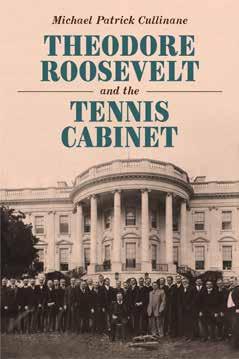
Michael Patrick Cullinane is a professor of history and Lowman Walton Chair of Theodore Roosevelt Studies at Dickinson State University. He is the author of Theodore Roosevelt’s Ghost: The History and Memory of an American Icon and Remembering Theodore Roosevelt: Reminiscences of His Contemporaries . Cullinane is the public historian for the Theodore Roosevelt Association and the senior historian for the Theodore Roosevelt Presidential Library, opening in 2026.
MAY
296 pp. • 6 x 9 • 10 photographs, 1 illustration, 1 appendix, index
$32.95T • hardcover • 978-1-64012-689-3
$46.00 Canadian / £27.99 UK
ALSO OF INTEREST
Richard Nixon
California’s Native Son
Paul Carter
Foreword by Tricia Nixon Cox
$36.95 • hardcover • 978-1-64012-560-5

Stephen P. Phillips served in the U.S. Navy as a surface warfare officer and Explosive Ordnance Disposal technician. During his naval career he deployed to Haiti, Somalia, the Balkans, and the Persian Gulf and served in the Global War on Terrorism. Phillips is currently a design strategist and scientific diver at the Johns Hopkins University Applied Physics Laboratory. He is also a host of Preble Hall , a naval history podcast from the U.S. Naval Academy Museum, and host of Talk a Little, Learn a Lot , the podcast of the American Society of Naval Engineers.
APRIL
288 pp. • 6 x 9 • 23 photographs, 1 illustration, 1 map, 2 tables, 1 appendix, index
$37.95T • hardcover • 978-1-64012-694-7
$53.00 Canadian / £32.00 UK
A Poisoned Chalice
The U.S. Navy in the Persian Gulf, 1987–1988
STEPHEN P. PHILLIPS
FOREWORD BY HAROLD “HAL” BERNSEN
In the 1980s, Iraq and Iran attacked each other’s petroleum industry in the Persian Gulf in what became known as the Tanker War. In an effort to restore stability to the world’s oil markets, the United States deployed a U.S. Navy flotilla to escort convoys of oil tankers in an operation dubbed Earnest Will. Although U.S. leaders imagined the Navy’s presence would deter hostile action, the United States instead found itself embroiled in a secret war with Iran.
During Operation Earnest Will, U.S. Navy minesweepers and Explosive Ordnance Disposal technicians kept commerce lanes clear of Iranian mines. U.S. Navy Special Boat Units and U.S. Army Special Operations helicopters interdicted the Iranian fleet of gunboats and minelayers. At a time when U.S. Navy planning focused on carrier battle group operations against the Soviet Navy, surface combatants and minesweepers found themselves taking the leading role against a regional power. As the conflict escalated, the U.S. Navy decimated the Iranian fleet in a one-day war called Operation Praying Mantis.
Though the United States would triumph over Iran, great tragedy came first. On July 3, 1988, USS Vincennes mistakenly shot down an Iranian commercial flight, and all 290 passengers perished. Though gravely tragic, this event provided Iran’s religious leader a face-saving means to end the Iran–Iraq War. Even as Ayatollah Khomeini signed a peace treaty, he stated, “Signing this document is like drinking from a poisoned chalice.”
Although the Iran–Iraq War ended, Operation Earnest Will led to all the American conflicts in the modern era— the wars in Iraq, the Global War on Terrorism, and the attacks brewing today between the U.S. Navy and Iran’s Houthi proxies in Yemen. In A Poisoned Chalice , former U.S. Navy Commander Stephen P. Phillips discusses the Iran–Iraq War’s strategic implications, what happened at operational and tactical levels of warfare, and what the war teaches us about the United States’ relationships with the Middle East today.
“A Poisoned Chalice includes previously unknown details of the [Iran–Iraq War], especially an unsurpassed discussion of mine warfare. Stephen Phillips’s operational experience in surface warfare and Explosive Ordnance Disposal combined with his exhaustive research to include candid interviews with those who served in the conflict, supported by his detailed analysis, has created a tome that should be on the shelf of every naval officer and student of military operations.”
—Adm. James Stavridis, former NATO supreme Allied commander and author of Sailing True North and The Accidental Admiral
Have You Landed? Military Love Stories in Essays
EMMA COMERY
ILLUSTRATIONS BY ANNETTA KILLIAN
In this collection of literary profiles, Emma Comery weaves together interviews and research to explore what it means to be the partner of someone in the military. These depictions offer an intimate narrative of the marriages, family dynamics, and interior lives of military partners: the young wife of an intelligence officer who finds herself in the middle of Nevada, a Marine Corps spouse caught in the crossfire of a foreign riot, a therapist who recognizes the signs of mental illness in her own husband, and a new mother who doesn’t know she’s kissing her husband goodbye for the last time. Have You Landed? offers nuanced portraits of life across the U.S. military—Army, Navy, Air Force, Marine Corps, Coast Guard, and National Guard—and includes the experiences of wives, husbands, partners, widows, and exes. It describes life as a modern military partner and the commitment to a lifestyle that often challenges our notions of love, family, strength, and self.
“Equal parts tender and unblinking, Have You Landed? is a generous and deeply immersive portrait of the most intimate proximities to military life. More than that, though, it’s a record of the profound power, complexity, and dignity inherent in an individual life, and of the constellation of ways we are—all of us—part of greater wholes.”
—Molly McCully Brown, author of Places I’ve Taken My Body: Essays
“Immersive, intimate, and reminiscent of Lisa Taddeo’s Three Women, Have You Landed? has the quality of a song performed in moving harmony. Each voice is its own, but together they create a sound that is at once stoic, brave, and tender. For me, this collection did what the best books do: It reminded me that I am never alone.” —Simone Gorrindo, author of The Wives: A Memoir
“Emma Comery rewrites and broadens what we know of military living. . . . The quiet details of lives inside the imperative distance shine a light on what love looks like to servicepeople and civilians caring for country and home.”—Remica Bingham-Risher, author of Soul Culture: Black Poets, Books, and Questions that Grew Me Up
Emma Comery is a writer and the assistant director of communications for one of the largest veteran services organizations in Texas. Her work has appeared in The Bend Magazine , Military Families Magazine , Reserve and National Guard Magazine, Arts and Letters Journal , Line of Advance , and Poets.org.
AUGUST
234 pp. • 6 x 9 • 6 illustrations
$29.95T • paperback • 978-1-64012-655-8
$42.00 Canadian / £24.99 UK
ALSO OF INTEREST
Red, White, and True
Stories from Veterans and Families, World War II to Present
Edited and with an introduction by Tracy Crow
$21.95 • paperback • 978-1-61234-701-1
JULY
2148 pp. • 6 x 9
$49.95T • hardcover • 978-0-8276-1603-5
$70.00 Canadian / £42.00 UK
ALSO OF INTEREST
JPS TANAKH: The Holy Scriptures (blue)
The New JPS Translation according to the Traditional Hebrew Text
$24.95 • paperback • 978-0-8276-0366-0
The JPS Hebrew-English TANAKH Revised Edition
With Gender-Sensitive Translation
The JPS Hebrew-English TANAKH Revised Edition renews and revises the iconic Jewish Publication Society Bible translation, enabling readers to experience the Hebrew Bible with all the power and precision of the original Hebrew text.
Using the English translation first published in JPS’s landmark 2023 volume The JPS TANAKH: Gender-Sensitive Edition , along with the Hebrew text, this landmark Revised Edition clarifies archaic or unclear English language and ritual terminology to offer a more accurate understanding of the Bible’s meaning. It presents gender-inclusive renderings where appropriate and gendered ones when called for historically and linguistically, incorporating the best of contemporary research on the subjects of Israelite history and religion, literary studies, philology, linguistics, and the social sciences to offer a faithful and accurate translation. References to persons are gender sensitive yet consistent with ancient gender norms, and the translation strives for inclusive language when referring broadly to people, ancestors, and humankind. References to God are typically gender neutral and generally avoid grammatically masculine pronouns and labels, with careful examination of each context yielding the most appropriate rendering. To enable the Tetragrammaton (God’s four-letter name) to be encountered as a name and without masculine connotations, the edition typically translates it as “ God” (in small capitals) rather than “the Lord .”
By integrating advances in scholarship and changes in English while maintaining utmost fidelity to the original Hebrew, the Revised Edition of the venerable JPS TANAKH translation is sure to become the new Bible translation of choice for readers who embrace biblical scholarship with reverence for tradition, and for communities and individuals who adopt an inclusive perspective in today’s world.
“This gender-sensitive translation will transform our understanding of the Tanakh and our place within it. It invites the reader to envision the Divine and the main actors of the Bible in a more expansive way.”—Rabbi Angela W. Buchdahl, Central Synagogue, New York City
“This revised translation is not only gender sensitive; it is also gender sensible. Every decision regarding gender has been carefully considered to produce a faithful rendering of the Bible that is finely tuned to contemporary sensibilities. The explanations of the principles that direct these decisions are a welcome bonus; they enhance our understanding of the workings of biblical Hebrew and modern English.”—Adele Berlin, Robert H. Smith Professor Emerita of Biblical Studies at the University of Maryland
“JPS’s new gender-sensitive translation offers us a momentous contribution to biblical study—a massive and crucial step forward. A must for every Jewish library and for every contemporary student of Torah.”
—Rabbi Shai Held, president and dean of Hadar
God and the First Families
Parenting, Trauma, and
Healing in the Book of
Genesis
STEPHEN SPECTOR
God and the First Families offers a novel exploration of God’s role as a parent in the book of Genesis. Compellingly, author Stephen Spector introduces Americans’ four main perceptions of God and their four most common styles of parenting as lenses through which we can reckon with God’s own methods of parenting in the first biblical book.
God begins as an authoritarian parent who demands obedience and submission to authority, but shifts in striking ways. Next, God’s parenting seems entirely benevolent. Stunningly, God reverts to authoritarianism during the near sacrifice of Isaac—but then invents a new parenting style focused on guiding the characters’ moral and emotional growth. Many psychologists consider this the most successful childrearing method. Genesis reached that conclusion two and a half millennia ago!
Throughout, Spector engages with familiar stories— sibling rivalries, family ruptures, traumas—from unexpected angles. He dramatizes how parental love in Genesis builds resilience against trauma, another idea validated by modern psychology. Surviving trauma, healing from parental favoritism, repairing broken relationships, earning forgiveness, possibly even reconciling after injury—Genesis offers wisdom on all.
“This wise, compassionate, learned guide to trauma and love in Genesis enables us to better understand both the biblical book and the dynamics in our own fractured families.”—Rabbi David Wolpe, author of Teaching Your Children About God
“Keen observer Stephen Spector brings a wealth of learning and original insight to this lively rereading of familiar family stories. Readers will gain greater appreciation of the wounds and blessings that come with being part of a family—and useful tips on how to cope and heal.”—Arnold M. Eisen, chancellor emeritus of the Jewish Theological Seminary
“For those wishing to bring their contemporary understandings of God into line with biblical depictions of the divine, the interpretive strategy employed in the book will provide significant food for thought.”—Danna Nolan Fewell, editor of The Oxford Handbook of Biblical Narrative
Stephen Spector is a professor of English emeritus at Stony Brook University. He is the author of Operation Solomon: The Daring Rescue of the Ethiopian Jews and Evangelicals and Israel: The Story of American Christian Zionism , among other volumes. Spector has taught the Bible to undergraduate and graduate students for fifty years. He has been a visiting scholar at Hebrew University and a senior research fellow at the National Humanities Center and the Wesleyan Center for Humanities.
JUNE
256 pp. • 6 x 9 • Index
$26.95T • paperback • 978-0-8276-1601-1
$38.00 Canadian / £21.99 UK
ALSO OF INTEREST
Biblical Women Speak Hearing Their Voices through New and Ancient Midrash
Rabbi Marla J. Feldman
$26.95 • paperback • 978-0-8276-1514-4
The Power of Scenery
Frederick Law Olmsted and the Origin
of National Parks
DENNIS DRABELLE
Wallace Stegner called national parks “the best idea we ever had.” But where did the idea originate? Before Yellowstone, with nothing to put up against Europe’s cultural pearls—its cathedrals, castles, and museums—Americans came to realize that their plenitude of natural wonders might compensate for the dearth of manmade attractions. That insight guided the great landscape architect Frederick Law Olmsted as he organized his thoughts on how to manage the wilderness park centered on Yosemite Valley, at first a state-owned precursor to the national park model of Yellowstone. Haunting his thoughts were the cluttered and carnival-like banks of Niagara Falls, which served as an oft-cited example of what should not happen to a spectacular natural phenomenon. Olmsted saw city parks as vital to the pursuit of happiness and wanted them to be established for all to enjoy. When he wrote down his philosophy for managing Yosemite, a new and different kind of park, he had no idea that he was creating a visionary blueprint for national parks to come. Dennis Drabelle provides a history of the national park concept, adding to our understanding of American environmental thought and linking Olmsted with three of the country’s national treasures. The Power of Scenery tells the fascinating story of how the national park movement arose, evolved, and has spread around the world.
Dennis Drabelle is a writer and former attorney. During the 1970s he was counsel to the assistant secretary of the interior for fish and wildlife and parks. His books include Mile High Fever: Silver Mines, Boom Towns, and High Living on the Comstock Lode and The Great American Railroad War: How Ambrose Bierce and Frank Norris Took on the Notorious Central Pacific Railroad
“This is a micro-history that feels big.”—Sam Sacks, Wall Street Journal
MAY
274 pp. • 6 x 9 • 11 photographs, index
$24.95T • paperback • 978-1-4962-4639-4
$35.00 Canadian / £19.99 UK Bison Books
Wild Idea Buffalo and Family in a Difficult Land
DAN O’BRIEN
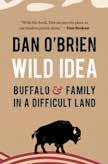
For more than forty years the prairies of South Dakota have been Dan O’Brien’s home. Working as a writer and an endangered species biologist, he became convinced that returning free-roaming buffalo to the grasslands would return natural balance to the region and reestablish the undulating prairie lost through poor land management and overzealous farming. In 1998 he bought his first buffalo and began the task of converting a cattle ranch into an ethically run buffalo ranch.
Wild Idea is a book about how good food choices can influence federal policies and the integrity of our food system, and about the dignity and strength of a legendary American animal. It is also a book about people: a daughter coming to womanhood in a hard landscape, a friend and ranch hand who suffers tragedy, a venture capitalist who sees hope and opportunity in a struggling buffalo business, and the husband and wife behind the ranch, wondering if what they’re doing will ever make a difference. At its center, Wild Idea is about a family and the people and animals that surround them—all trying to build a healthy life in a wide and sometimes dangerous land.
Dan O’Brien is the author of numerous award-winning novels and memoirs, including Great Plains Bison , Stolen Horses , Equinox , The Indian Agent , and The Contract Surgeon , all available from the University of Nebraska Press. He founded Wild Idea Buffalo Company in 1997.
“O’Brien’s writing is rich with detail, humor, and insight. He is especially gifted at characterizing people in just a few lines of description and dialogue. . . . He is even more skilled at evoking the feeling of being out on the land. . . . Brims with fierce, subtle joy.”—Tyra A. Olstad, Great Plains Research
MAY
272 pp. • 5 1/2 x 8 1/2
$24.95T • paperback • 978-1-4962-4681-3
$35.00 Canadian / £19.99 UK
Bison Books
Charlie Murphy
The Iconoclastic Showman behind the Chicago Cubs
JASON CANNON
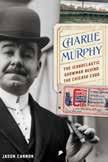
Winner of the 2023 SABR Larry Ritter Book Award
You don’t know the history of the Chicago Cubs until you know the story of Charles Webb Murphy, the ebullient and mercurial owner of this historic franchise from 1905 through 1914. Originally a sportswriter in Cincinnati, he joined the New York Giants front office as a press agent—the game’s first—in 1905. That season, hearing the Cubs were for sale, he secured a loan from Charles Taft, the older half brother of the future president of the United States, to buy a majority share and become the team’s new owner. In his second full season, the Cubs won their first World Series. They won again in 1908, but soon thereafter Murphy’s unconventional style invited ill will from the owners, his own players, and the press, even as he led the team through their most successful period in team history.
In Charlie Murphy: The Iconoclastic Showman behind the Chicago Cubs , Jason Cannon explores Murphy’s life both on and off the field, painting a picture of his meteoric rise and precipitous downfall. Readers will get to know the real Murphy, not the simplified caricature created by his contemporaries, but the whirling dervish who sent the sport of baseball spinning and elevated Chicago to the center of the baseball universe. Cannon recounts Murphy’s rise from the son of Irish immigrants to sports reporter to Cubs president, charting his legacy as one of the most important but overlooked figures in the National League’s long history.
Jason Cannon worked in collegiate sports information before turning to teaching and writing. He is the author of A Time for Reflection: The Parallel Legacies of Baseball Icons Willie McCovey and Billy Williams and his articles have appeared in NINE: A Journal of Baseball History and Culture.
“Everything a great biography should be: impeccably researched, fair, eminently readable, and ultimately as satisfyingly instructive as having personally known the subject oneself.”—Spitball Magazine
MAY
400 pp. • 6 x 9 • 13 photographs, 1 illustration, index
$29.95T • paperback • 978-1-4962-4650-9
$42.00 Canadian / £24.99 UK
New Kids in the World Cup
The Totally Late ’80s and Early ’90s Tale of the Team That Changed American Soccer Forever
ADAM ELDER
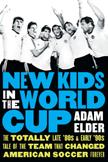
In 1990 a fearless group of players changed the sport of soccer in the United States forever. Young, bronzed, and mulleted, they were America’s finest athletes in a sport their country loved to hate. Even sportswriters rooted against them. Yet this team defied massive odds and qualified for the World Cup, making possible America’s current obsession with the world’s most popular game.
Back then players earned twenty dollars a day, the crowds at home games cheered for their opponents, and the fields were often mismarked. In Latin America the U.S. team bus had a machine gun turret mounted on the back, locals sabotaged their hotels, and in the stadiums spectators rained coins, batteries, and plastic bags of urine down on the U.S. players. The world considered the U.S. team impostors. Yet on the biggest stage of all, in the 1990 World Cup, this undaunted American squad and their wise coach earned the adoration of Italy’s star players and their fans in a gladiator-like match in Rome’s deafening Stadio Olimpico.
From windswept soccer fields in the U.S. heartland to the CIA-infested cauldron of Central America and the Caribbean, behind the recently toppled Iron Curtain and into the great European soccer cathedrals, New Kids in the World Cup is the origin story of modern American men’s soccer. It’s the true adventure of America’s most important soccer team—and the one that made America finally fall in love with soccer.
Adam Elder is an award-winning journalist whose writing has appeared in the New Yorker , the New York Times Magazine , New York Magazine , Esquire , WIRED , Outside , the Wall Street Journal , the Guardian , and elsewhere.
“Entertaining.”—Hua Hsu, New Yorker
JUNE
353 pp. • 6 x 9 • 26 photographs
$29.95T • paperback • 978-1-4962-4649-3
$42.00 Canadian / £24.99 UK
Prophets of the Great Spirit
Native American Revitalization Movements in Eastern North America
ALFRED A. CAVE
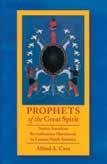
Prophets of the Great Spirit offers an in-depth look at the work of a diverse group of Native American visionaries who forged new, syncretic religious movements that provided their peoples with the ideological means to resist white domination. By blending ideas borrowed from Christianity with traditional beliefs, they transformed “high” gods or a distant and aloof creator into a powerful activist deity that came to be called the Great Spirit. These revitalization leaders sought to regain the favor of the Great Spirit through reforms within their societies and the inauguration of new ritual practices. Covering more than a century, from the early 1700s through the Kickapoo Indian removal of the Jacksonian era, the prophets of the Great Spirit sometimes preached armed resistance but more often used nonviolent strategies to resist white cultural domination. Some prophets rejected virtually all aspects of Euro-American culture. Others sought to assure the survival of their culture through selective adaptation.
Alfred A. Cave explains the conditions giving rise to the millenarian movements in detail and skillfully illuminates the key histories, personalities, and legacies of the movement. Weaving an array of sources into a compelling narrative, he captures the diversity of these prophets and their commitment to the common goal of Native American survival.
Alfred A. Cave (1935–2019) was a professor of history at the University of Toledo. He is the author of The Pequot War and Lethal Encounters: Englishmen and Indians in Colonial Virginia (Nebraska, 2013).
“Prophets of the Great Spirit provides a useful overview of a rich and varied historiography. . . . For readers and students interested in the broader history of eastern North America, Cave illustrates important themes in the ongoing struggle of First Peoples to resist the United States’ expansion westward.”—James Taylor Carson, Michigan Historical Review
JULY
344 pp. • 6 x 9 • Index
$29.95T • paperback • 978-1-4962-4738-4
$35.00 Canadian / £24.99 UK
From Miniskirt to Hijab A Girl
in Revolutionary Iran
JACQUELINE SAPER
Named a 2020 Chicago Writers Association Book of the Year Award
Jacqueline Saper, named after Jacqueline Kennedy, was born in Tehran to Iranian and British parents. At eighteen she witnessed the civil unrest of the 1979 Iranian Revolution and continued to live in the Islamic Republic during its most volatile times, including the Iran–Iraq War. In a deeply intimate and personal story, Saper recounts her privileged childhood in prerevolutionary Iran and how she gradually became aware of the paradoxes in her life and community, primarily the disparate religions and cultures.
In 1979, under the Ayatollah regime, Iran became increasingly unfamiliar and hostile to Saper. Seemingly overnight she went from a carefree life of wearing miniskirts and attending high school to listening to fanatic diatribes, being forced to wear the hijab, and hiding in the basement as Iraqi bombs fell over the city. After witnessing her six-year-old daughter’s indoctrination into radical Islamic politics at school, she fled to the United States in 1987 with her husband and children. At the heart of Saper’s story, From Miniskirt to Hijab: A Girl in Revolutionary Iran , is a harrowing and instructive tale of how extremist ideologies seized a Westernized, affluent country and transformed it into a fundamentalist Islamic society.
Jacqueline Saper is a CPA, educator, translator, public speaker, and expert on Iranian subject matter. Her opinion columns and articles regularly appear in national and international publications. She can be reached at JacquelineSaper.com.
“Provides a well-informed and richly detailed portrayal of one woman’s life as she bears witness to the cultural backlash and economic inequality that inspired a revolution against Iran’s secular and Western-friendly government.”
—Lauren Hakimi, Forward
JUNE
239 pp. • 6 x 9 • 13 photographs, 1 illustration
$24.95T • paperback • 978-1-64012-702-9
$35.00 Canadian / £19.99 UK Potomac Books
SCHOLARLY BOOKS
Rebecca Shimoni Stoil is an assistant professor of history at Clemson University and a former journalist.
AUGUST
322 pp. • 6 x 9 • Index
$70.00S • hardcover • 978-1-4962-4365-2
$98.00 Canadian / £58.00 UK
Tied to Their Country
The Farm Crisis, Agrarian Activism, and the Rise of Rural Anti-Federalism
REBECCA SHIMONI STOIL
Historically, rural spaces in the United States have encompassed a wide array of political cultures and affiliations, but in the late twentieth century, rural America became a breeding ground for anti-government militancy. Disparate groups coalesced around an ideology grounded in virulent rural anti-federalism. Although farmers today are often beneficiaries of federal programs and payments, anti-federal sentiments run rampant across rural America. The reason, Rebecca Shimoni Stoil argues, lies in the collapse of rural society during the Farm Crisis of the 1970s and 1980s.
In Tied to Their Country , Shimoni Stoil examines the immediate and long-term political repercussions of the Farm Crisis. Beginning as an agricultural crisis, it quickly enveloped all of rural America as banks collapsed, Main Street storefronts closed, and small towns became ghost towns. Because the federal government failed to offer farmers viable solutions, previously disparate ideologies converged in this political vacuum to advocate for agrarian America amid growing distrust of federal institutions and intentions. Farmers found their best strategy was appealing to romantic ideas of American traditions, and social conservatives quickly reciprocated, turning farm country into the heartland of social conservatism. The perceived failure of the federal government’s response to the Farm Crisis generated distrust, resentment, and a crisis of faith in government that resonates across rural spaces today.
“The Farm Crisis is a vastly understudied subject, and yet it had enormous implications for the political, economic, and social history of the United States. . . . Tied to Their Country does an exceptional job of examining the politics of the era. . . . It explores not only the political but the cultural problem in which farmers found themselves as they moved from being the majority to a tiny minority.”—Pamela Riney-Kehrberg, author of When a Dream Dies: Agriculture, Iowa, and the Farm Crisis of the 1980s
“There is a need to understand the political realities of rural America, and a need to grapple more intentionally with the devastating effects of the Farm Crisis. Tied to Their Country offers several concrete contributions to the fields of agricultural, rural, and political history, shifting historical focus back to the intersection of rural identity with rural political economy.”—Cory Haala, author of When Democrats Won the Heartland: Progressive Populism in the Age of Reagan, 1978–1992
The Mountains Are Calling Tourists and the Unmaking of Yosemite
National Park
MICHAEL W. CHILDERS
Yosemite National Park hosts more than four million visitors annually, a number that underscores both the national park’s immense popularity and its limits. Large numbers of visitors means air pollution from car emissions, noise pollution that drowns out the sounds of nature, and destroyed habitat—especially near campgrounds and crowded hiking trails. From the first party of tourists in 1855 to the millions who visit today, Yosemite’s visitors have played a primary role in shaping the park’s history. Visitors drove Yosemite’s development and, ultimately, its popularity, but in doing so, they have turned out to be the greatest threat to the very experiences they seek.
In seeking to understand how visitors’ perceptions and experiences have shaped their understanding of the purpose of national parks, and nature more broadly, The Mountains Are Calling places visitors at the center of Yosemite’s story. In histories of the national parks, environmental historians traditionally focus on either a conflict between preservation or exploitation, or a celebration of its founders, but such approaches often overlook the millions of visitors or depict them as backdrops in a larger morality play over the preservation of nature. Michael W. Childers instead addresses the lived experiences of visitors and their role in creating national parks, within the context of national park policy shifts and broader American cultural history. Foregrounding the stories of Indigenous people, tourists, innkeepers, soldiers, rangers, climbers, concessioners, and administrators, The Mountains Are Calling tells a more complete story of the park’s past to make sense of tourism’s environmental costs.
“By turning attention to the many different voices and developments that have contributed to Yosemite’s history, Michael Childers offers a much richer, more diverse, and more complicated understanding of Yosemite National Park. Childers excels at uncovering interesting, important, and revealing stories that illuminate the many people and forces that have shaped the park, and in doing so, he invites readers to ponder the wonders of Yosemite and their future anew.”—George Vrtis, coeditor of Mining North America: An Environmental History since 1522
“We have a lot of Yosemite scholarship, but Michael Childers is correct that we have not paid nearly enough scholarly attention to the visitors. Childers has an eye for setting a scene or a moment by opening with a narration of a person or group arriving in, walking in, or contemplating the park. The visitors in this book help us imagine the park they saw, knew, and experienced. Their stories are more captivating than those of John Muir, Theodore Roosevelt, and Carleton Watkins.”—William Deverell, director of the Huntington–USC Institute on California and the West
Michael W. Childers is an associate professor of history at Colorado State University. He is the author of Colorado Powder Keg: Ski Resorts and the Environmental Movement , winner of the International Ski History Association 2013 Ullr Award.
JULY
286 pp. • 6 x 9 • 29 photographs, 1 illustration, 3 maps, index
$65.00S • hardcover • 978-1-4962-3958-7
$91.00 Canadian / £54.00 UK
Environment and Region in the American West Leisl Carr Childers and Michael W. Childers, series editors
David Benac is an associate professor of history and public history coordinator at Western Michigan University. He is the author of Conflict in the Ozarks: Hill Folk, Industrialists, and Government in the Courtois Hills
JUNE
286 pp. • 6 x 9 • Index
$99.00X • hardcover • 978-1-4962-4346-1
$138.00 Canadian / £83.00 UK
$30.00S • paperback • 978-1-4962-4682-0
$42.00 Canadian / £23.99 UK
Rainforest Radicals
A History of Rainforest Action Network and Transnational Organizing
DAVID BENAC
Rainforest Radicals presents the first history of one of the most innovative and successful environmental organizations of the late twentieth century. Rainforest Action Network emerged in 1985, when it took over a fledgling effort to protect rainforests from transnational corporations funding the expansion of tropical cattle ranching. It excelled at using nonviolent, civil disobedience in dramatic campaigns that captured the attention of the public, media, and RAN’s corporate adversaries. As a result, two decades later rainforest conservation went from a niche academic topic to a fixture in American popular culture, the rights of Indigenous people had gone from ignored or romanticized to at least considered in discussions of the management of their ancestral homelands, and RAN had scored a series of victories over some of the planet’s largest corporations.
In Rainforest Radicals David Benac traces the evolution of RAN and radical, transnational grassroots environmentalism through the four campaigns identified at the group’s founding: rainforest beef, Hawai‘ian rainforests, tropical timber, and multinational development banks. Forty years after RAN’s inception, there is much to learn from how it organized people in small towns and large cities across the United States, created alliances that spanned oceans, and inspired a new movement that integrated human rights, Indigenous sovereignty, and environmental protection to challenge multinational corporations, national governments, and neocolonial corporate-led globalism.
Through more than thirty oral histories, including those of key players from different eras of RAN’s history as well as leaders from other environmental and Indigenous rights organizations, Rainforest Radicals provides unparalleled insight into the network.
“This history of the Rainforest Action Network is necessary for our times. From civil disobedience in Hawai‘i to raucous protests in the aisles of Home Depot and annual auto shows in the 1990s, the pages of Rainforest Radicals offer uplifting stories of solidarity and blueprints for successful (and not-so-successful) actions. I could easily see this being a sort of guidebook for grassroots activists today.”
—Allyson P. Brantley, author of Brewing a Boycott: How a Grassroots Coalition Fought Coors and Remade American Consumer Activism
Confronting Water Insecurity Global Institutions and the Transformation of Water Science,
Policy, and Practice
ROBERTO L. LENTON
Confronting Water Insecurity provides an account of the role of multilateral cooperation and global institutions in transforming science, policy, and practice for water security from 1945 to 2024, a period characterized by significant disparities in water security between low- and high-income countries, ever-rising water use, and growing concerns about the harms of climate change and other disturbances on the global water cycle.
Roberto L. Lenton tells how the scientific and policy response to these new challenges has become more global and integrated, and describes the role of global institutions in addressing fundamental global water issues with long-term implications for sustainability. Following the quest for water security as it transformed from an issue driven primarily by local or national interests into one of global concern, Lenton offers lessons from the successes and failures from 1945 to 2024 that will help us imagine the new approaches we need to ensure that the world can meet the next generation of water challenges. Beyond the world of water, he provides insights into how we can better address the global challenges that arise from humanity’s complex relationships with the natural world.
“In this important, timely, and readable book that holds many lessons for environmental action, Roberto Lenton lucidly narrates how global institutions helped water management science and policy become more global, multidisciplinary, and multistakeholder, calling for holistic approaches and an appropriate global institutional architecture.”
—Julia Marton-Lefèvre, former director general of the International Union for Conservation of Nature
“By understanding our past, provoking the status quo, and crafting the future, Roberto Lenton takes us on an inspiring journey toward a world where water is prioritized as an organizing principle, and where the water cycle is valued and governed as a global common good.”—Henk Ovink, executive director and founding commissioner for the Global Commission on the Economics of Water

Roberto L. Lenton is professor emeritus of biological systems engineering at the University of Nebraska–Lincoln. Before coming to the University of Nebraska in 2012 as founding executive director of the Robert B. Daugherty Water for Food Global Institute, he held leadership roles in major global institutions including the Ford Foundation, the International Water Management Institute, the United Nations Development Programme, and the World Bank. Lenton is coeditor of Integrated Water Resources Management in Practice: Better Water Management for Development
MAY
260 pp. • 6 x 9 • Index
$99.00X • hardcover • 978-1-4962-3344-8
$138.00 Canadian / £83.00 UK
$30.00S • paperback • 978-1-4962-4683-7
$42.00 Canadian / £23.99 UK
William R. Handley is an associate professor of English at the University of Southern California. He is the author of Marriage, Violence, and Nation in the American Literary West , coeditor of True West: Authenticity and the American West (Bison Books, 2007), and editor of The Brokeback Book: From Story to Cultural Phenomenon (Bison Books, 2011).
MAY
310 pp. • 6 x 9 • 17 color photographs, 14 color illustrations, index
$99.00X • hardcover • 978-0-8032-8849-2
$138.00 Canadian / £83.00 UK
$30.00S • paperback • 978-1-4962-4610-3
$42.00 Canadian / £23.99 UK
Postwestern Horizons
William R. Handley, series editor
Horizons of Catastrophe in the American West
WILLIAM R. HANDLEY
Horizons of Catastrophe in the American West contributes to discussions in the environmental humanities and western U.S. studies about how we read past cultural history in the light of our determined yet unknown future under climate catastrophe. Examining an eclectic but interrelated and interdisciplinary range of photographs, films, and novels of the West; Western historiography; geological science; Tony Kushner’s Angels in America ; the Los Angeles freeway system and the city’s layered temporalities; and the long poem form among contemporary Indigenous poets, William R. Handley argues that artists within mostly twentieth-century settler cultures saw on past horizons of the West premonitions of catastrophe—without, of course, knowing what their civilization was doing to the atmosphere and what that portended for the planet’s future. The possibilities and limits of their artistic forms, Handley shows us, offer a way for us to find hope in the wreckage of the past and to forge a future grounded in environmental realism.
“William Handley is one of our most brilliant and provocative critics. . . . This is a capacious, erudite, and timely book.”
—Keith Gessen, author of All the Sad Young Literary Men and A Terrible Country
“Horizons of Catastrophe in the American West offers a timely and powerful exploration of how key literary, visual arts, cinematic, and architectural texts produced during the last century have represented interlocking ecological, political, and cultural crises of the Anthropocene. With intellectual rigor, lucid prose, and interdisciplinary finesse, William Handley’s brilliant close readings explore how his selected texts . . . both obscure and illuminate the past environmental catastrophes that continue to shape our present crises, as well as excavate another possible ‘horizon,’ that of hope.”—Stephen Tatum, author of Unhomely Wests: Essays from A to Z
“For William Handley, the American West is a palimpsest wherein the deep time of geology challenges and supersedes settler hegemonies and where ever-present catastrophe opens settler time to other worlds, ‘between nihilism and paradise.’”—Stephanie LeMenager, coeditor of Environmental Criticism for the Twenty-First Century
The Country for Me Joel Palmer and the Shaping of Oregon
WILLIAM L. LANG
The Country for Me is the first full biography of Joel Palmer (1810–81), born in Canada to American parents, who played a central role in the political and economic shaping of Oregon. Having traveled on the Oregon Trail three times, he wrote a popular trail guidebook used by later emigrants. Palmer’s experience in public life and government service during his first five years in Oregon led to his federal appointment as superintendent of Indian affairs for the territory. Palmer is honored by Native Nations in Oregon because he generally considered their conditions and honestly presented a federal government pledge to protect and support their interests. He did not use his office for personal enrichment, a legacy that did not adhere to most federal agents in their dealings with Native peoples.
In this nuanced biography of one of Oregon’s most significant nineteenth-century leaders, William L. Lang uses Palmer’s story as a means to better understand the context and realities of change in Oregon as it transitioned from a contested territory to a state.
“Others have written on Joel Palmer, but William Lang’s new biography stands well above them all. It is especially balanced and judicious, the mark of a seasoned historian. Lang tempers some of the earlier near-heroizing praise given to Palmer while expanding our understanding and appreciation of a figure who played prominently at a critical time in Oregon’s history.”—Elliott West, author of Continental Reckoning: The American West in the Age of Expansion
“Using the life and mind of Joel Palmer as a lens, William Lang updates our understanding of the territory and state of Oregon as it was colonized by the United States. Lang’s unmatched knowledge of nineteenth-century Oregon is literally encyclopedic, and the research in The Country for Me is amazingly thorough and current. Lang does an impressive job connecting developments in Oregon to those on the national level, and Palmer’s perspectives on Oregon prove particularly informative, given that he rose to the forefront of so many key episodes of U.S. colonization.”—John M. Findlay, author of The Mobilized American West, 1940–2000
William L. Lang is professor emeritus of history at Portland State University. He is the founding editor of Oregon Encyclopedia of History and Culture and the author and editor of numerous books, including the coauthor of Two Centuries of Lewis and Clark: Reflections on the Voyage of Discovery . Lang is the great-greatgreat-grandson of Joel Palmer.
JULY
442 pp. • 6 x 9 • 9 photographs, 5 maps, index
$80.00S • hardcover • 978-1-4962-3374-5
$112.00 Canadian / £67.00 UK
Margaret E. Farrar is a professor of political science at John Carroll University. She is the author of Building the Body Politic: Power and Urban Space in Washington, D.C. Adam Kaul is a professor of anthropology at Augustana College. He is the author of Turning the Tune: Traditional Music, Tourism, and Social Change in an Irish Village .
JULY
260 pp. • 6 x 9 • 21 photographs, 7 illustrations, 5 maps, index
$99.00X • hardcover • 978-1-4962-4351-5
$138.00 Canadian / £83.00 UK
$30.00S • paperback • 978-1-4962-4721-6
$42.00 Canadian / £23.99 UK
Anthropology of Contemporary North America
James S. Bielo and Carrie M. Lane, series editors
Becoming Utopia
History, Heritage, and Sustainability in the American Midwest
MARGARET E. FARRAR AND ADAM KAUL
Becoming Utopia centers on the tiny community of Bishop Hill, Illinois, whose marketing materials call it “Utopia on the Prairie,” home to a radical communal religious sect that emigrated from Sweden in the 1840s. Through rich textual and ethnographic analyses, Margaret E. Farrar and Adam Kaul tell the story of what happens when a small, historically significant Midwestern community negotiates the contradictory impulses of twenty-first-century place-making. At first glance, Bishop Hill is simply a small heritage tourism destination in Midwestern flyover country, but further inspection reveals it to be a complex place that mixes a deep nostalgia for the past undercut by complex origin stories of displacement and colonialism, an active historic preservation movement amid futuristic green energy technologies built by multinational corporations, and a commitment to localism in the context of omnipresent globalization. Based on fifteen years of fieldwork, Becoming Utopia is an interdisciplinary contribution to conversations about the importance and meaning of place-making, heritage-making, and sustainability (social, economic, and environmental) in the twenty-first century.
“Within political science and anthropology, Becoming Utopia provides an excellent case study for how heritage and environmental decisionmaking play out at the local level.”—Jennifer Eastman Attebery, author of As Legend Has It: History, Heritage, and the Construction of Swedish American Identity
“Why do some places become important to us? And what (and who) has to be devalued for them to accrue certain kinds of personal, historical, and economic values over time? Becoming Utopia answers these questions through a unique dialogue between American studies; rural anthropology; studies of place, landscape, and cultural meaning; critiques of settler colonialism and constructions of whiteness; and recent and ongoing critiques of cultural heritage and tourist industries around the world. It offers an invaluable contribution to each of these in turn, all while remaining empirically sound and carefully researched.”—Joshua O. Reno, coauthor of Imagining the Heartland: White Supremacy and the American Midwest
Making the Miami Cubanita A Pop Cultural Genealogy
PAULA DAVIS HOFFMAN
At the end of the nineteenth century, William Randolph Hearst’s New York Journal glorified cubanas as “the most feminine and simple women in the world.” Ever since, the stereotype of Cuban femininity as chaste and dutiful has informed Cubans’ racial, social, and ethnic identity in the dominant American imagination, and this gendered and deracialized narrative has taken different forms and served various purposes throughout the Cuban diaspora.
In Making the Miami Cubanita Paula Davis Hoffman examines the cultural precepts and political aims underlying the construction of Cuban femininity in pop culture outlets produced by, for, and about Cuban Americans of the Cuban diaspora. By incorporating academic texts, oral interviews, and elements of popular culture as well as personal accounts of growing up in a first-wave Cuban exile family, Hoffman discusses the historical forces that molded vacillating constructions of Miami Cuban women. Organized by decade, this book traces internal and external articulations of Cuban American culture and examines how Cuban American exceptionalism played into the evolution of the term chonga , originally an insult disciplining young cubanas who performed stigmatized ethnic signifiers that has today become a label some proudly own. Not only does Hoffman fill a gap in academic research surrounding the subculture of Cuban American women, she further demonstrates how migration, race, gender, and sexuality are informed by popular culture and political agenda within the diverse context of South Florida.
“From Joan Didion to Desi Arnaz, many cultural workers have tried to make sense of the complexities of Cuban American identity, especially in Miami. Paula Davis Hoffman’s highly readable Making the Miami Cubanita is a particularly deft examination of this community, its contradictions, and its meanings. This fabulous book takes readers on quite a ride!”—Jason Ruiz, author of Narcomedia: Latinidad, Popular Culture, and America’s War on Drugs
“Paula Davis Hoffman’s readings of Miami Cuban culture bring a fresh critical perspective to our understanding of gendered diasporic cubanidad for those who are specialists in Cuban American studies as well as for Latinx studies scholars. I cannot stress enough the importance of these two contributions.”—María Elena Cepeda, author of Musical ImagiNation: U.S.-Colombian Identity and the Latin Music Boom
Paula Davis Hoffman is an adjunct professor of history at Houston City College.
MARCH
306 pp. • 6 x 9 • 8 photographs, 7 illustrations, 1 appendix, index
$65.00S • hardcover • 978-1-4962-4017-0
$91.00 Canadian / £54.00 UK
Daniel H. Usner is Holland N. McTyeire
Professor Emeritus of History at Vanderbilt University. He is the author of Native American Women and the Burdens of Southern History and Weaving Alliances with Other Women: Chitimacha Indian Work in the New South , among other books. In 2024 Usner was awarded the Lifetime Achievement Award from the American Society of Ethnohistory.
AUGUST
384 pp. • 6 x 9 • 18 photographs, 3 illustrations, 3 maps, index
$70.00S • hardcover • 978-1-4962-4669-1
$98.00 Canadian / £58.00 UK
New Visions in Native American and Indigenous Studies
Margaret Jacobs and Robert Miller, series editors
From Bayou Teche to Fifth Avenue
How Basket Diplomacy Saved the Chitimacha Indian Nation
DANIEL H. USNER
Daniel H. Usner offers a cultural, political, and social history of the Chitimacha Tribe in South Louisiana and its struggle for political sovereignty. Between the 1890s and 1940s, Chitimacha Indian women in South Louisiana—with extraordinary baskets they created from rivercane—strategically built a network of allies that originated in a relationship with neighboring white women and that would eventually extend across the United States. Responding resourcefully to renewed interest in their basketry largely driven by the arts and crafts market and ethnographic collection, the Chitimachas were able to contact individuals and groups far from their home who possessed potential influence on government policy. Confronting at the same time perilous threats to their land, autonomy, and even their lives in the Jim Crow South, women in this Indigenous community were in essence weaving political allies as they wove their rivercane baskets.
Besides the considerable revenue Chitimacha baskets brought to tribal coffers, the story of the Chitimacha people and their predicament gained attention as their basketry appeared in major art gallery shows and museums and was sought by art collectors. By expanding the view beyond southern Louisiana and tracking the nationwide circulation of Chitimacha basketry, From Bayou Teche to Fifth Avenue illustrates how Indigenous people in North America have creatively confronted adversity and peril with aesthetic forms of expression.
“Intimately grounded on the banks of Bayou Teche, but reaching far beyond, Daniel Usner celebrates the incredible Chitimacha women and their white allies who preserved community by weaving baskets as well as personal connections. The result is a powerful tribute to the women whose fight to save their nation changed America.”
—Cathleen D. Cahill, author of Federal Fathers and Mothers: A Social History of the United States Indian Service, 1869–1933
“Truly a remarkable piece of scholarship! The depth and breadth of coverage is amazing. Daniel Usner takes the history of a much-neglected tribe and links it to broad themes of race, class, gender, and the environment across U.S. history, and he covers several genres of historical study to boot.”—Katherine M. B. Osburn, author of Choctaw Resurgence in Mississippi: Race, Class, and Nation Building in the Jim Crow South, 1830–1977
To Be Men of Business
The Origins of Chickasaw Capitalism, 1700–1840
DAVID ANDREW NICHOLS
Capitalism during the American colonial era was an economic system known primarily for dispossessing and exploiting Indigenous peoples. Some Indigenous nations, however, learned to use its primary features—wealth accumulation, private investment, and a globalized marketplace—to strengthen their families and defend their communities. The Chickasaws of the American Southeast exemplified these Indigenous capitalists.
To Be Men of Business examines the Chickasaw Nation’s education in business and commerce, adaptation to a capitalist economy, and survival by maneuvering in the market economy established by settlers in North America. The Chickasaw Nation, initially a subsistence-oriented society, first entered the Atlantic market economy in the late 1600s through the Native American slave trade, when Chickasaw men’s participation in slave raiding brought significant material gains and introduced their families to European goods. Over the course of two hundred years, Chickasaw families adopted aspects of capitalist culture while retaining elements of their own foundational culture norms.
The Chickasaw Nation’s economic history provides a case study of how a noncapitalist society integrated itself into an increasingly capitalist atmosphere. Amid this economic shift, Chickasaw leaders worked to protect their people from predatory white traders and officials by sending children to mission schools for English literacy and resisting efforts by the U.S government to gain land cessions from the Chickasaw people. Business and commerce literacy also allowed the Chickasaw Nation some control over their forced migration, and the protective economic institutions Chickasaw leaders established became the basis for a revived Chickasaw national identity following removal from their homeland.
“To Be Men of Business is a significant treatment of both culture change and the preservation of Indigenous social and political systems. David Nichols effectively demonstrates how Chickasaw business acumen helped them cope with the trauma of removal.”
—Katherine M. B. Osburn, author of Choctaw Resurgence in Mississippi: Race, Class, and Nation Building in the Jim Crow South, 1830–1977
“David Nichols, perhaps better than any other historian of the Native South, knows and understands the primary sources for this time and place, and he has put his knowledge of these sources to excellent use in this volume.”—Robbie Ethridge, author of From Chicaza to Chickasaw: The European Invasion and the Transformation of the Mississippian World, 1540–1715
David Andrew Nichols is a professor of history and Native American and Indigenous studies and Donald Carmony Chair of History at Indiana University. He is the author of, most recently, Peoples of the Inland Sea: Native Americans and Newcomers in the Great Lakes Region, 1600–1870 and Engines of Diplomacy: Indian Trading Factories and the Negotiation of American Empire . He is the editor of Indiana Magazine of History
APRIL
250 pp. • 6 x 9 • 2 maps, index
$65.00X • hardcover • 978-1-4962-3781-1
$91.00 Canadian / £54.00 UK
New Visions in Native American and Indigenous Studies
Margaret Jacobs and Robert Miller, series editors
Anne Ruggles Gere is Gertrude Buck
Collegiate Professor of Education Emerita and Arthur F. Thurnau Professor of English Emerita at the University of Michigan. She is the author of Intimate Practices: Literacy and Cultural Work in U.S. Women’s Clubs, 1880–1920 and coeditor of Renovating Rhetoric in Christian Tradition , among other books.
MAY
282 pp. • 6 x 9 • Index
$75.00S • hardcover • 978-1-4962-4498-7
$105.00 Canadian / £63.00 UK
Indigenous Education
Margaret Connell Szasz and John W. Tippeconnic III, series editors
Agents of Survivance Indigenous Women Teachers in the Boarding School Era
ANNE RUGGLES GERE
In Agents of Survivance Anne Ruggles Gere complicates and enriches established accounts of the Indian boarding school era and what preceded it by looking closely at the largely ignored Indigenous women teachers in these schools. Focusing on Sarah Winnemucca, S. Alice Callahan, Angel DeCora, and Ella Deloria, Gere shows how these and many other Indian women teachers subversively resisted assimilation with tribal presence, relationality, connection to land, rejection of victimhood, and maintenance of cultural traditions, art, and languages. Their vulnerable positions in schools directed by Euro-Americans necessitated that their contributions be subversive, nearly invisible. Despite this, they developed policies and practices that were passed to Indian students who in turn became teachers of the next generation of Indian students, and many of their innovations inform contemporary movements toward sovereignty for Indian education.
Indispensable for future research, Agents of Survivance includes two appendixes drawn from Bureau of Indian Affairs records documenting dozens of Native women teachers, as well as Native women who worked in boarding schools doing laundry, kitchen work, dormitory cleaning, and sewing.
“Agents of Survivance breaks new ground in terms of primary source engagement and represents a monumental contribution to the field. Anne Ruggles Gere does well in discovering a litany of women who have mostly been overlooked in previous literature. I know of nothing comparable.”—Hayes Peter Mauro, author of The Art of Americanization at the Carlisle Indian School
“The research Anne Ruggles Gere has compiled includes long-overlooked material that provides an enlightening look into the post–Civil War environment for Indian women teachers. It also shows how the women’s creativity challenged the schools’ assimilationist purposes. I believe that Gere’s material will be appreciated as new and important by specialists in Indigenous history, especially those with an interest in Native American feminism.”—Martha Louise Hipp, author of Sovereign Schools: How Shoshones and Arapahos Created a High School on the Wind River Reservation
This World in a Teacup Credit, Taste, and Power in the U.S.-China
Tea Trade, 1784–1911
DAN DU
Popular history tells the story of how the tea boycott during the American Revolution caused a transition in American taste from tea to coffee, making the young country a coffee-drinking nation. In truth, Americans did not give up their tea so easily, and the United States grew to be the second-largest importer of tea from China. Diverging from British black tea traditions, U.S. consumers preferred green tea, cultivated a particular taste for oolong tea, and invented the English Breakfast Tea brand to market Chinese black tea.
This World in a Teacup is the first book to detail the American tea trade with China after the American Revolution through the early twentieth century. Drawing on archival sources and perspectives from both sides of the Pacific, Dan Du offers new insights to help understand fundamental developments in U.S.-China relations within a global context. This World in a Teacup shows that, rather than depending on hard-money transactions or a barter economy, a sophisticated credit system buttressed American tea purchases in China: Credit instruments such as promissory notes, bills of exchange, and checks financed the transactions between Chinese and U.S. tea merchants, crystallizing changing power dynamics in the global economy. This World in a Teacup explains how the circulation of these credit instruments challenged the conventional understanding of China’s economy as a primitive system and how the power structure of American, British, and Chinese tea trade in the credit economy reshaped American consumption patterns.
“Breaking new ground, this study explores the overlooked SinoAmerican tea trade and financial interactions during the nineteenth century. Meticulously researched, it illuminates their role in global commerce, offering fresh insights into transnational economic history.”—Yi Sun, professor of history at the University of San Diego
“This World in a Teacup explores the untold story of the U.S.-China tea trade (1784–1911), revealing tea’s pivotal role in American culture and finance. Dan Du uncovers a transpacific credit system that powerfully challenges Eurocentric views of China’s economy. This groundbreaking work reshapes understandings of global-local capitalism and U.S.-China relations.”—Xi Wang, Distinguished University Professor at Indiana University of Pennsylvania

Dan Du is an associate professor of history at the University of North Carolina at Charlotte.
AUGUST
296 pp. • 6 x 9 • 10 photographs, 1 map, 3 tables, 19 charts, index
$70.00S • hardcover • 978-1-4962-4433-8
$98.00 Canadian / £58.00 UK
Studies in Pacific Worlds
Rainer F. Buschmann and Katrina Gulliver, series editors
Joanna Beata Michlic is a social and cultural historian of the Holocaust and its aftermath. Her research focuses on Jewish childhood, rescue, and the long-term impact of genocide. Michlic is author, editor, and coeditor of numerous books, including Poland’s Threatening Other: The Image of the Jew from 1880 to the Present (Nebraska, 2006) and Bringing the Dark Past to Light: The Reception of the Holocaust in Postcommunist Europe (Nebraska, 2013).
MAY
330 pp. • 6 x 9 • 28 photos, 1 illustration, index
$70.00S • hardcover • 978-1-4962-2607-5
$98.00 Canadian / £58.00 UK
Through the Eyes of Jewish Child Survivors from Poland
Family, War, Identity, and Nationhood
JOANNA BEATA MICHLIC
Through the Eyes of Jewish Child Survivors from Poland offers an intimate social history of Jewish childhood during and after the Holocaust. Centered on children from Germanoccupied Poland but informed by experiences across Nazi-occupied Europe, the book highlights the child’s own perspective to illuminate rescue, survival, and relationships with adults under the Nazi occupation. In the first part, Joanna Beata Michlic examines children’s wartime experiences, showing how agency, gender, class, and religious or social background shaped their chances of survival. The second part traces the complex efforts of these young survivors to reclaim both childhood and Jewish identity, revealing the gap between their hopes and the actual opportunities of the immediate postwar period.
Drawing on children’s diaries, letters, testimonies, and memoirs, Michlic illuminates how children experienced and remembered trauma: the destruction of their families, the loss of their prewar worlds, and the struggle to adapt to a new reality, challenging myths that sentimentalize the children’s endurance and portray the Holocaust as neatly concluded. This powerful study shows why the history of Holocaust child survivors remains a vital resource for understanding vulnerability, agency, and the enduring impact of war and genocide.
“Invaluable as a contribution to Holocaust studies, this volume likewise serves as a cautionary tale for our own times.” —Jonathan D. Sarna, distinguished university professor at Brandeis University and chief historian of the Weitzman National Museum of American Jewish History
“A remarkable and moving study [that] sheds a great deal of new light on the complex problems of rescue and survival under Nazi occupation in Poland.”—Antony Polonsky, author of The Jews in Poland and Russia, volumes 1–3
“An enormously significant contribution to our understanding of the way children experience, adapt to, and remember trauma, the loss of childhood, and the destruction of their families and their prewar world.”—Samuel D. Kassow, editor of Listen and Believe: The Ghetto Reportage of Peretz Opoczynski and Jozeph Zelkowicz and translator of Rokhl Auerbach’s Warsaw Testament
Fascist Legacies Far-Right Ideologies Then and Now
EDITED BY ARI KOHEN AND GERALD J. STEINACHER
The world has changed since the 1930s, but human nature has not. What can we learn when comparing far-right populism in the United States to far-right populism elsewhere? How can we better understand the underlying ideas and ideologies that seem to transcend time and place? How can we best address them? How can we communicate what we have learned about these issues to those outside of academia? These are the central questions in the three-part conversation of Fascist Legacies
The first part of the book examines the rise of authoritarianism in Europe, the United States, and Latin America; the second part analyzes aspects of the far right and discusses the best strategies for teaching about fascism; and the third part focuses on the relationship between white nationalism, individual Christian churches in the United States, and antisemitism in the past and present. By discussing different aspects of the current global rise of right-wing populism, Fascist Legacies helps readers better understand what is happening in our societies.
“A timely and essential contribution to the field. The editors have done an excellent job in bringing together a series of chapters that . . . show the different aspects of fascism and how it might be interpreted. . . . A succinct and accessible guide to the relevant debates.” —Bob Moore, emeritus professor of modern history at the University of Sheffield
“With nuanced scholarship, Fascist Legacies contributes to the intense and ever-changing debate over what is or is not fascism in the twenty-first century. The diversity of contributors, from historians to political scientists and activists, is unique. . . . It is transnational, if not global, in perspective and includes so many methodologies: history, political science, sociology, literature, education.”—Brian E. Crim, author of Our Germans: Project Paperclip and the National Security State
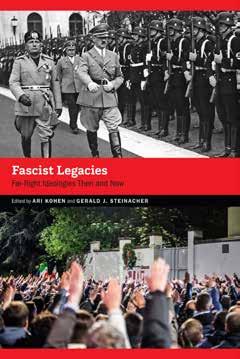
Ari Kohen is a professor of political science, Myer and Dorothy Kripke Chair of Judaic Studies, and director of the Norman and Bernice Harris Center for Judaic Studies at the University of Nebraska–Lincoln. Gerald J. Steinacher is the James A. Rawley Professor of History at the University of Nebraska–Lincoln. Kohen and Steinacher are the coeditors of Antisemitism on the Rise: The 1930s and Today (Nebraska, 2021) and Unlikely Heroes: The Place of Holocaust Rescuers in Research and Teaching (Nebraska, 2019).
AUGUST
214 pp. • 6 x 9 • 1 table, 9 graphs, 1 appendix, index $40.00S • paperback • 978-1-4962-4600-4
$56.00 Canadian / £32.00 UK
Contemporary Holocaust Studies
Gerald J. Steinacher and Ari Kohen, series editors
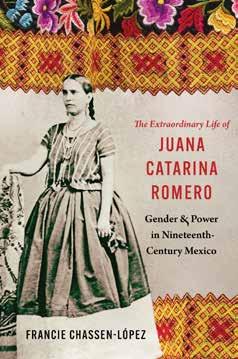
Francie Chassen-López is Distinguished Professor of History at the University of Kentucky. She is the author of From Liberal to Revolutionary Oaxaca: The View from the South, Mexico, 1867–1911
AUGUST
364 pp. • 6 x 9 • 17 photographs, 3 illus., 4 maps, 1 table, index
$99.00X • hardcover • 978-1-4962-4670-7
$138.00 Canadian / £83.00 UK
$40.00S • paperback • 978-1-4962-4720-9
$56.00 Canadian / £32.00 UK
Confluencias
Susie S. Porter, María L. O. Muñoz, and Diana Montaño, series editors
The Extraordinary Life of Juana Catarina Romero
Gender and Power in Nineteenth-Century Mexico
FRANCIE CHASSEN-LÓPEZ
The construction of the nation-state, the development of capitalism, and the modernization of society have historically been defined as masculine endeavors, with women on the sidelines. This biography of Juana Catarina Romero (1837–1915) shatters many of the stereotypes of nineteenth-century women and provides a new perspective of women’s national agency during a time in which women could neither vote nor hold political office. Romero’s breathtaking climb from illiterate cigarette peddler and Liberal spy to wealthy entrepreneur, philanthropist, and, finally, cacica (political boss) of the city of Tehuantepec, despite the opposition of male elites, reveals the growing fluidity of class, race, and ethnicity.
Francie Chassen-López’s fascinating biography of Romero offers rich insight into the complexities of modernization as it developed on the periphery of Mexico. Romero sought a Tehuantepec-style modernity, a modus vivendi between modernization, Catholicism, and isthmian Zapotec culture. Like her friend President Porfirio Díaz, Romero formed part of a group of ambitious Mexicans of modest origins, forged in civil war, who would build the Mexican nation-state.
“A magnificent book—certainly the best and most innovative we have on gender, nation building, and market expansion in nineteenth century Mexico. . . . It will be a model for gender studies. It is also a model for studies integrating history at the local, regional, national, and international levels.”—Mary Kay Vaughan, author of Portrait of a Young Painter: Pepe Zúñiga and Mexico City´s Rebel Generation
“This modern biography of Juana Catarina Romero from a gender perspective is original due to its very structure: The author combines two axes, the thematic and the chronological, and uses several methodologies such as regional history, microhistory, education and culture, public health, and daily life. The management of biographical time with historical time is another of Francie Chassen-López’s achievements.”—Mílada Bazant, author of Laura Méndez de Cuenca: Mexican Feminist, 1853–1928
Rebellious Citizens Social Upheaval and Democracy in Revolutionary Mexico
ULICES PIÑA
In Rebellious Citizens Ulices Piña shows that democracy in Mexico has never been the exclusive domain of elites, nor confined to the ballot box. Focusing on the aftermath of the Mexican Revolution of 1910–20, Piña explores how citizens forged a substantive democratic culture in the crucible of three successive social upheavals that shook the established social order in the central western state of Jalisco during the 1920s and 1930s—a formative period in the nation’s political history.
Piña examines how ordinary Mexicans actively shaped the political process, made their own history, and fought for equality in the country’s long fight for democracy. The longterm effects of the recurring uprisings in Jalisco were central to the new political system produced by the postrevolutionary state: After each rebellion, authorities consolidated institutional power, elected officials debated the strictures of government, and ordinary people grappled with the promise and limits of political emancipation. Because of the contradictions that arose from the creation of this modern political system, especially those that emerged at the nexus of democratic inclusion and authoritarian rule, seemingly powerless populations claimed equality, exercised participation rights, and demanded respect, even amid the violence and surveillance the state deployed against marginal groups to achieve its goals. Rebellious Citizens brings into focus the struggles of ordinary people to experiment with new ways of doing politics to remake the nation.
“Rebellious Citizens takes an original approach to unpacking the origins of Mexico’s modern political history. . . . I especially appreciate how Ulices Piña establishes a through-line between how policies were discussed in the halls of government, such as around the conflict over anticlericalism and the implementation of socialist education, to the communities reacting to these debates and changes. The reader comes away with the impression that making politics—and especially making democratic and civic-minded politics—can be a prolonged messy affair. . . . Piña is a master storyteller throughout.”—Gladys I. McCormick, author of The Logic of Compromise: Authoritarianism, Betrayal, and Revolution in Rural Mexico, 1935–1965
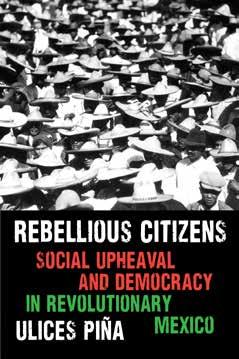
Ulices Piña is an associate professor of history at California State University, Long Beach.
JULY
258 pp. • 6 x 9 • 11 photographs, 3 maps, 1 table, index
$99.00X • hardcover • 978-1-4962-4622-6
$138.00 Canadian / £83.00 UK
$30.00S • paperback • 978-1-4962-4722-3
$42.00 Canadian / £23.99 UK
Confluencias
Susie S. Porter, María L. O. Muñoz, and Diana Montaño, series editors
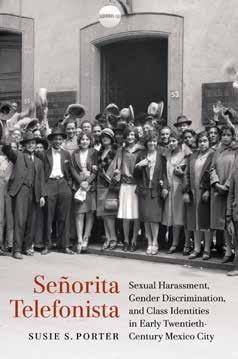
Susie S. Porter is a presidential societal impact scholar and distinguished professor in the humanities at the University of Utah. She has been named as a corresponding international member of the Mexican Academy of History. Porter is the author of Working Women in Mexico City: Public Discourses and Material Conditions, 1879–1931 and From Angel to Office Worker: Middle-Class Identity and Female Consciousness in Mexico, 1890–1950 (Nebraska, 2018).
MAY
316 pp. • 6 x 9 • 17 photographs, 13 illustrations, 1 table, index
$99.00X • hardcover • 978-1-4962-4430-7
$138.00 Canadian / £83.00 UK
$35.00S • paperback • 978-1-4962-4656-1
$49.00 Canadian / £27.99 UK
Engendering Latin America
Donna Guy, Sonya Lipsett-Rivera, Anne Macpherson, and Martha Santos, series editors
Señorita Telefonista
Sexual Harassment, Gender Discrimination, and Class Identities in Early TwentiethCentury Mexico City
SUSIE
S. PORTER
In Señorita Telefonista Susie S. Porter recounts the dynamic role of telephone operators in labor organizing in early twentieth-century Mexico City, taking us from switchboards to union halls and into the streets as working women fought for better wages and against sexual discrimination and harassment. The telephone operators’ struggles reveal how bodily autonomy is historically contingent and constructed through the lived experiences of class. When and where were working-class identities available to women who wanted to make demands as workers? How did middleclass conceptions of respectability, sexual and otherwise, limit the space for working women to speak against male authority and to denounce assaults on their bodily autonomy? Porter charts the shifts in the ways women could (or could not) speak out against discrimination related to gender, marital status, and pregnancy.
Señorita Telefonista examines the emergence of the idea that women were maladapted to the workplace and charts Mexican women’s fight to claim their rights as workers. As languages of class circulated and identities were made and unmade––by management, organized labor, working men, and working women themselves––women’s support for organized labor hung in the balance.
“Señorita Telefonista reveals that the telefonistas are unsung heroines in the founding of Mexico’s most important unions. Illuminating, well written, and a good read.”—Sonya Lipsett-Rivera, author of Gender and the Negotiation of Daily Life in Mexico, 1750–1856
“This compelling book illuminates how two major changes of the twentieth century—the surge of the middle class and the expansion of women’s role in society—intertwined, shaping Mexico’s labor struggles and gender inequality.”—Aurora Gómez-Galvarriato Freer, professor of history at the El Colegio de México
“Susie Porter centers the long history of sexual harassment in Mexican labor history. Porter has done yeoman’s work to bring this history to light, and Señorita Telefonista will help us move the needle on the gendered history of labor toward women’s lived experience of both sexual abuse and their struggle against it.”—Elizabeth Quay Hutchison, author of Workers Like All the Rest of Them: Domestic Service and the Rights of Labor in Twentieth-Century Chile
The Franz Boas Papers, Volume 3 Paper
Bridges Between Franz Boas and Russian Anthropology
FRANZ BOAS
EDITED BY DMITRY V. ARZYUTOV, SERGEI A. KAN, LAURA SIRAGUSA, AND ALEXANDER PERSHAI
Anthropology is inseparable from writing, whether in field diaries, letters, articles, or books. Among these writings, letters form paper bridges—holding a special place as material artifacts uniquely capable of building scholarly communities and sustaining relationships with field collaborators long after the fieldwork is completed.
The story of Franz Boas, one of the founders of American anthropology, can be imagined as a res publica literaria, a network that, like its Renaissance prototype, shaped the contours of transnational anthropology. This two-part volume chronicles more than forty years of Boas’s collaborations and friendships with Russian and Soviet anthropologists, following a small group of anthropologists as they built the house of Arctic and Siberian anthropology. Through these letters, readers are introduced to a lesser-known aspect of Boas’s political life and his ambition to redefine anthropology as a transnational discipline, one that transcended national borders and political obstacles. Through meticulously gathered correspondence from more than thirty archives in the United States, Russia, France, and Norway, The Franz Boas Papers, Volume 3 reveals an untold chapter in the history of anthropology.
“The editors of The Franz Boas Papers, Volume 3 of have produced a painstaking, valuable, and remarkable volume containing letters and little-known publications that capture anthropological, political, and biographical aspects of this long and fruitful Republic of Letters.”—Herbert S. Lewis, author of In Defense of Anthropology: An Investigation of the Critique of Anthropology
“For a Boas scholar, this work is the central publication that must be consulted for the impact of Boas on shaping and stimulating the intellectual engagement of international scholars.”—Rosemary Lévy Zumwalt, author of Franz Boas: The Emergence of the Anthropologist

Franz Boas (1858–1942) was a professor of anthropology at Columbia University and a public intellectual and advocate for social justice. He is the author of The Mind of Primitive Man, Primitive Art, Anthropology and Modern Life , and Race, Language, and Culture , among other books. Dmitry V. Arzyutov is an assistant professor in the Department of Slavic and East European Languages and Cultures at the Ohio State University and an honorary research fellow at the University of Aberdeen (United Kingdom). Sergei A. Kan is a professor of anthropology at Dartmouth College. Laura Siragusa is an assistant professor of teaching in the Department of Linguistics and in the Department of Slavic and East European Languages and Cultures at the Ohio State University. Alexander Pershai is an associate director of equity at the University of Waterloo (Canada). Pershai has published a book in Russian on gender stratification in idiomatic expressions.
JULY
1064 pp. • 7 x 10 • 39 photographs, 11 illustrations, 5 maps, 1 table, appendix, index
$120.00X • hardcover • 978-1-4962-3882-5
$167.00 Canadian / £100.00 UK
Franz Boas Papers Documentary Edition Regna Darnell, series general editor
Charles W. A. Prior is a professor of history at the University of Birmingham. He is the author and editor of several books, including Settlers in Indian Country: Sovereignty and Indigenous Power in Early America and A Confusion of Tongues: Britain’s Wars of Reformation, 1625–1642
MAY
278 pp. • 6 x 9 • Index
$65.00X • hardcover • 978-1-4962-4484-0
$91.00 Canadian / £54.00 UK
Treaty Ground Diplomacy and the Politics of Sovereignty, from
Roanoke to the Republic
CHARLES W. A. PRIOR
Charles W. A. Prior offers a new account of the sovereign claims of Native Americans, the Crown, and colonies in early America, arguing that Native American diplomacy shaped how sovereignty was negotiated and contested among all three, from Virginia’s founding to the ratification of the U.S. Constitution. Previous scholars have focused on the contested relationship between the British imperial state and the colonies it established along the Atlantic Coast without addressing how sovereign Native nations shaped the colonial process through warfare, diplomacy, trade, peace-making, and treaty-making.
Prior adopts a new interpretive framework for examining sovereignty in early America, arguing that the Native and colonial spaces of the Northeast were a treaty ground thickly layered with agreements and negotiated rules of interaction. Drawing on an extensive range of treaty records, writings on colonial and imperial affairs, letters, and official documents, Treaty Ground argues that sovereignty was negotiated within diplomacy and shaped the norms of war, the terms of peace and alliances, the rightful ownership of territory, and appropriate responses to treaty violations. This process in turn structured relations between the Crown and colonies and framed initial positions on how the power of congress related to that of the states.
Treaty Ground offers historical depth to our understanding of how Native nations articulated Indigenous power within colonialism, cuts settler colonialism down to size, and expands contemporary understandings of the sovereign relationships between Native nations in the United States and Canada.
“Treaty Ground connects Native American history to the history of Anglo-American political and constitutional thought, which hasn’t been done before, at least not through the lens of diplomacy. Charles Prior’s focus on war and the sovereign powers it summoned forth is a valuable corrective to scholarship on Anglo-American thought, which has been almost exclusively focused on the tensions between English subjects and their rulers, and between colonists and royal officials in London.”—Craig Yirush, author of Settlers, Liberty, and Empire: The Roots of Early American Political Theory, 1675–1775
The Pursuit of Family A
History of Dakota and Lakota Family and Kinship on the Standing Rock Reservation, 1794–2022
THOMAS GRILLOT
In The Pursuit of Family Thomas Grillot examines how Dakota and Lakota people on the Standing Rock Reservation have lived as families since the 1870s in what is now North Dakota and South Dakota. Grillot examines the collective and individual efforts that made survival possible on Standing Rock, one of the most understudied reservations despite being one of the best-known Native locations in the United States—Sitting Bull died there in 1890, and a protest camp organized there against the Dakota Access pipeline made international news in 2016. Yet this is a book not about famous people or events but about ordinary people confronted with a deceptively simple question: How can we be a family on the reservation? Integrating archival material, oral history, and fieldwork, Grillot tells the history of dozens of reservation-based Dakota and Lakota families from the beginning of the reservation era to today.
The Pursuit of Family reveals how the Dakotas and Lakotas, tied by a common language and way of life, developed under the pressures of settler colonialism and shifted formations of kinship across time and space. It is a story of resistance, negotiation, and adaptation.
“Thomas Grillot’s powerful book, based on mining the archives and immersive ethnography, reveals how ‘making family’—a concept he develops across dozens of families and more than two hundred years—was defined by Dakota people amid the forces of colonization.”—Christian W. McMillen, author of Making Indian Law: The Hualapai Land Case and the Birth of Ethnohistory
“Thomas Grillot demonstrates how Dakota and Lakota have constantly reorganized themselves to adapt to challenges from before the reservation to the present. While honoring and defending the lessons of their ancestors they have utilized varied combinations of individual and family agency to mitigate a wide array of internal and external pressures. . . . Provides a timely, deep, and unique view into Lakota and Dakota family dynamics.”—William C. Meadows, author of The First Code Talkers: Native American Communicators in World War I
Thomas Grillot is a research fellow at the National Center for Scientific Research. He is the author of First Americans: U.S. Patriotism in Indian Country after World War I
JULY
378 pp. • 6 x 9 • 5 illus., 10 photographs, 1 map, 5 tables, index
$99.00X • hardcover • 978-1-4962-4483-3
$138.00 Canadian / £83.00 UK
$40.00S • paperback • 978-1-4962-4755-1
$56.00 Canadian / £32.00 UK
Studies in the Anthropology of North American Indians
Rani-Henrik Andersson and Mark van de Logt, series editors
Nancy Mattina taught research and nonfiction writing at Prescott College until her retirement in 2016. She is the author of Uncommon Anthropologist: Gladys Reichard and Western Native American Culture
MAY
220 pp. • 6 x 9 • 5 color illustrations, 10 b&w photographs, 5 b&w illustrations, index
$65.00S • hardcover • 978-1-4962-4435-2
$91.00 Canadian / £54.00 UK
Adee Dodge Navajo Artist, Intellectual, and Individualist
NANCY MATTINA
Adee Dodge: Navajo Artist, Intellectual, and Individualist chronicles the life of Navajo artist and intellectual Adee Dodge (1912–92). Born on the Navajo Reservation near Canyon de Chelly, Arizona, Dodge studied anthropological linguistics at Columbia University, taught Navajo literacy at Indian Bureau boarding schools on his reservation, rose from private first class to captain in the army during World War II, and founded Adee Dodge Enterprises, Inc., the first uranium prospecting and mining firm owned by a Navajo. At age forty, by then living in Santa Fe, New Mexico, Dodge began to paint allegorical pictures grounded in Navajo wisdom traditions and aesthetics. By 1960 he was an acclaimed Southwest Native watercolorist based in Arizona’s Phoenix metro area. His devotion to interpreting the Navajo worldview in modernist form earned him praise as the best of the Navajo painters of his day. Upon his death, Dodge left behind a rich record of his intellectual history that has since been conserved at major museums and archives.
Written from a postcolonial perspective, this biography conveys Dodge’s assessment of the contributions the Navajo Nation might yet make to the American experiment, if only Americans would honor their promise to treat tribal peoples with dignity and respect.
“Nancy Mattina has written an important biography of a largely unknown Native American artist and scholar who, despite his flaws and lack of recognition during his lifetime, sought to bring greater understanding of the relationship between Navajo culture and non-Native Americans. When considering Dodge’s scholarly work, his attempts to share his Navajo culture with a non-Native audience, and his unique style of artwork, it’s apparent that his story has been waiting to be told for some time.”—Alan Petersen, curator of fine arts at the Museum of Northern Arizona
“Adee Dodge is an underrecognized Indigenous artist and intellectual in the scholarly record. During his lifetime he received high acclaim from Native art collectors, academics, curators, and aficionados, as well as other Navajo artists for his paintings. This book provides new insights into why much of Dodge’s work went unpublished and why, despite his success as an artist, he was and largely continues to be marginalized from other modern Native painters in most scholarship on this subject.”—Laura E. Smith, author of Horace Poolaw, Photographer of American Indian Modernity
Mary Louise Eldridge Missionary and Field Matron to the Navajos
VALERIE SHERER MATHES
In the fall of 1891 Mary Louise Eldridge and Mary Raymond were sent by the Women’s Home Missionary Society of the Methodist Episcopal Church to work among the Navajos living along the San Juan River in northern New Mexico. There they founded the Navajo Methodist Mission, which later moved near Farmington. After Raymond’s unexpected death, Eldridge was appointed to replace her as a government field matron, and with the support of the Cambridge Indian Association, an auxiliary of the Women’s National Indian Association, Eldridge supervised Navajo men in digging the Cambridge Ditch and their wives in weaving blankets in industrial rooms supported by the WNIA’s Indian Industries League. Before Eldridge retired in 1915, she supervised the founding of six WNIA missionary stations on the reservation. One scholar described her as nurse, farmer, civil engineer for irrigation projects, trader, hospital administrator, fund raiser, policy advocate, cottage industry entrepreneur, and adoptive mother—duties far exceeding the government’s vision of a field matron.
This biography with selected letters is the first history of Eldridge’s WNIA-funded missionary work. It opens a critical window into social reform efforts among Native peoples in the American Southwest, the predicament of the Navajo Nation after their return from incarceration at Bosque Redondo, and the coercive assimilationist policies enacted against resistant Native peoples in the Dawes Act era.
“This enlightening biography of Mary Louise Eldridge added to Valerie Sherer Mathes’s previous books makes Mathes the leading scholar on the Indian reform era of the late nineteenth century. With lively prose, the author illuminates the devoted missionary work of Eldridge among the Navajos during hard times. Everyone interested in Native history needs to read this book.”—Donald L. Fixico (Shawnee, Sac and Fox, Muscogee, and Seminole), Regents’ and Distinguished Foundation Professor of History, Arizona State University
“This work enlarges our understanding of Diné–Euro-American interactions in northeastern Navajo lands during the post–Long Walk era, after the Navajo Treaty of 1868 provided for the Diné’s return to their homeland.”—Margaret Connell Szasz, author of Indian Education in the American Colonies, 1607–1783
Valerie Sherer Mathes is professor emerita of history at City College of San Francisco. She is the author of numerous books, including Divinely Guided Revisited: The Women’s National Indian Association Beyond California , Amelia Stone Quinton and the Women’s National Indian Association: A Legacy of Indian Reform , and Charles C. Painter: The Life of an Indian Reform Advocate .
JUNE
320 pp. • 6 x 9 • 28 photographs, 2 maps, index
$70.00X • hardcover • 978-1-4962-4668-4
$98.00 Canadian / £58.00 UK
Coquelle Thompson (ca. 1848–1946) was an accomplished storyteller who lived through the Rogue River Wars of 1855–56. His tribal community was evicted from its homeland and resettled with other Athabaskan groups on the Siletz Reservation, where he lived for ninety years. William R. Seaburg (1947–2022) was a professor of interdisciplinary arts and sciences at the University of Washington Bothell. He was the editor of Pitch Woman and Other Stories: The Oral Traditions of Coquelle Thompson, Upper Coquille Athabaskan Indian (Nebraska, 2007) and the editor and annotator of The Nehalem Tillamook: An Ethnography by Elizabeth D. Jacobs. Elizabeth D. Jacobs (1903–83) was a therapist and ethnographer who conducted fieldwork among the Native peoples of the Pacific Northwest in the 1930s.
JUNE
252 pp. • 6 x 9 • 6 photographs, 3 maps, index
$65.00X • hardcover • 978-1-4962-4615-8
$91.00 Canadian / £54.00 UK
Global Indigenous Literatures
Mishuana Goeman and Cristina Stanciu, series editors
Ghosts Dance in an Empty House and Other Stories
BY COQUELLE THOMPSON, UPPER
COQUILLE ATHABASKAN INDIAN
EDITED AND WITH AN INTRODUCTION AND COMMENTARY BY WILLIAM R. SEABURG
COMPILED BY ELIZABETH D. JACOBS
EDITED BY JAY MILLER, LAUREL SERCOMBE, AND SUSANNE YOUNG
Ghosts Dance in an Empty House and Other Stories comprises forty-five narratives dictated by Coquelle Thompson, an Upper Coquille Athabaskan Indian residing on the Siletz Indian Reservation in Oregon, during the fall of 1935.
Elizabeth D. Jacobs transcribed the stories from Thompson and selected some for intended publication. In addition to those Jacobs chose, William R. Seaburg combed through Thompson’s field notebooks and chose a handful of additional stories, as well as several cognate texts Thompson told to Smithsonian Institution linguist John Peabody Harrington in 1942 and cognates from other Athabaskan and from non-Athabaskan groups in the region.
This companion volume to Pitch Woman and Other Stories: The Oral Traditions of Coquelle Thompson, Upper Coquille Athabaskan Indian , which collected Thompson’s myths and folktales, focuses on Thompson’s semi-historical tales, narratives of historical events, ethnographic texts, and personal and family stories.
“The volume brings out stories that have otherwise been kept in private academic collections and library special collections, making it now possible to return them to the Upper Coquille community and share them with a broader audience as well. This book will appeal to both scholarly and broader audiences, those interested in Upper Coquille storytelling traditions, and the Upper Coquille community.”
—Jolynn Amrine, editor of Chehalis Stories
“This is a fascinating work. The original narratives, the background of the collector Elizabeth Jacobs, all combined with William Seaburg’s commentary, make it a scholarly and engaging book.”
—Charles R. Menzies, author of People of the Saltwater: An Ethnography of Git lax m’oon
Inca Garcilaso de la Vega
Literary Genealogies of
an
Indigenous Intellectual in Nineteenth-Century Peru
THOMAS WARD
Thomas Ward examines Inca Garcilaso de la Vega’s seventeenth-century work and how it influenced postindependence Peruvian literature in the nineteenth century. As literati struggled to define their fledgling Peruvian Republic, they found inspiration in the dual-heritage author Garcilaso de la Vega’s previously banned work, Royal Commentaries . Ward focuses on four authors who turned back to the colonial-era chronicler Inca Garcilaso de la Vega as they synthesized Inkan tradition into modern national thinking: Juana Manuela Gorriti, Clorinda Matto de Turner, Manuel González Prada, and Ricardo Palma. An element of this cultural dynamic included gender awareness. At the time, women were accepted in the literary establishment much more than they would be in the following century, a fact Ward highlights in this study of the two most famous men authors and the two most famous women authors from this time period. In Inca Garcilaso de la Vega Ward brings gender and ethnic perspectives into a postcolonial discussion of a reality that was striving to establish “Peruvian” as a bona fide proper noun with substantive denotative and connotative meaning.
“An erudite, sophisticated approach to the influence of Inca Garcilaso’s writings after Peru’s establishment as a nascent nationstate in 1821. . . . Inca Garcilaso de la Vega provides an engaging account of writers who founded Peru’s national literature. . . . At the same time, this book comments on the dynamics of gender and race that determined complex destinies, especially for women writers, during this violent period.”—Enrique E. Cortez, professor of Latin American literatures and cultures at Portland State University
“Thomas Ward’s study takes Inca Garcilaso to another dimension as he discusses how key nineteenth-century authors embraced his writings as a springboard to envision a new Peruvian culture.
. . . Ward’s ability to link history, literature, culture, and national and international politics provides a singular overview and nuanced appreciation of a complex period of Peru’s Republican era.”
—Raquel Chang-Rodríguez, distinguished professor emerita at the Graduate Center, City University of New York
Thomas Ward is professor emeritus of Spanish at Loyola University. Among his numerous books are Coloniality and the Rise of Liberation Thinking during the Sixteenth Century , The Formation of Latin American Nations: From Late Antiquity to Early Modernity , and Decolonizing Indigeneity: New Approaches to Latin American Literature
APRIL
340 pp. • 6 x 9 • 4 photographs, 2 maps, 1 appendix, index
$70.00X • hardcover • 978-1-4962-4437-6
$98.00 Canadian / £58.00 UK

Lisa Downing is Professor of French Discourses of Sexuality at the University of Birmingham, United Kingdom. She is the author or editor of twenty books, including Selfish Women and After Foucault: Culture, Theory, and Criticism in the 21st Century . She is an editor of Paragraph: A Journal of Modern Critical Theory .
APRIL
164 pp. • 5 x 8
$25.00S • paperback • 978-1-4962-4230-3
$35.00 Canadian / £19.99 UK
Provocations
Marco Abel and Roland Végsö, series editors
Against Affect
LISA DOWNING
Against Affect interrogates shibboleths of feeling and reason and their relationship with ideas of identity, gender, and freedom in the twenty-first century. Lisa Downing starts with the familiar premise that emotion has been historically gendered and racialized since the Enlightenment, with women, people of color, and other nonnormative subjects associated with emotionality, and only white men with logic and reason. The “affective turn” in the academic humanities attempted to redress this injustice in the 1990s, and affect theory, ubiquitous today, revalorized precisely what was excluded from logos: the bodily, the emotive, and the experiential. But how effective has this strategy truly been in changing perceptions of marginalized forms of knowledge and subjectivity? Against Affect argues that the academic affective turn has prompted a broader cultural one, marked by increasing prioritization—and exploitation—of feeling over reason, issuing from both the political left and right.
Using a series of case studies, Against Affect explores how the deployment of a language of emotion in both the academic and cultural spheres constitutes a new normativity. In thinking against affect, Downing questions the efficacy and desirability of idealizing feeling and proposes instead the redistribution of reason.
“For progressives, a moment of truth arrives when their battles against old dogmas merely prove to entrench new ones. In Against Affect Lisa Downing . . . throws down the gauntlet to everyone active in the humanities and social sciences today.”—Eric Heinze, author of The Most Human Right: Why Free Speech Is Everything
“A clear and precise argument for the return of rationality, grounded in a feminist neo-enlightenment, to academia and Western culture more widely. Against Affect is not a book that can or should be ignored by anyone interested in navigating a route through present cultural challenges that is progressive but also grounded in reason.”
—Darren Langdridge, author of Sexual Citizenship and Social Change: A Dialectical Approach to Narratives of Tradition and Critique
The New Old Style Anachronism in Contemporary Comics
MATTHEW LEVAY
The New Old Style explores how the deliberate use of cartooning styles that mimic those of the early twentieth century has paradoxically become one of the most significant vehicles for formal experimentation in contemporary comics. Dubbing this phenomenon “the anachronistic aesthetic,” Matthew Levay argues that what can initially appear to be a nostalgic affinity for outmoded drawing styles is in fact a complex and holistic movement in contemporary comics with profound consequences for how artists and audiences might understand the critical possibilities and historical legacies of the medium itself.
The phenomenon of anachronism as an aesthetic mode is visible in North American comics as early as the 1970s, but it rose to prominence in the 1990s. Since then, multiple artists have drawn in ways that reference cartooning styles of the distant past—those of early twentieth-century newspaper comics, early American animation, and midcentury comic books for young children, to name a few. The New Old Style characterizes these cartoonists’ use of anachronism as a mode of critical engagement that reveals how comics, as a medium, can simultaneously interrogate its history—and the violence, misogyny, and racial stereotypes that pervade it—while opening up new ways of addressing its aesthetic conditions. A work of comics history as well as theory, The New Old Style traces the uses of anachronism in comics published from the 1970s to the present and, via a focused set of case studies, argues that those uses represent a wide-ranging critique of the politics of the past, the material culture of the present, and the aesthetic possibilities of the future.
“In isolating the anachronistic aesthetic, The New Old Style makes an important contribution to the field of comics studies.”
—Barbara Postema, author of Narrative Structure in Comics: Making Sense of Fragments
“Through the notion of the ‘anachronistic aesthetic,’ The New Old Style helps contextualize an important strand of comics and cartooning that is increasingly prevalent in both independent comics and those owned by major media corporations. By introducing this term, The New Old Style situates itself at the forefront of a conversation that is only beginning to emerge.”—Zack Kruse, author of Mysterious Travelers: Steve Ditko and the Search for a New Liberal Identity
Matthew Levay is a professor of English at Idaho State University. He is the author of Violent Minds: Modernism and the Criminal.
AUGUST
210 pp. • 5 x 8 • 10 illustrations, index
$35.00S • paperback • 978-1-4962-3762-0
$49.00 Canadian / £27.99 UK
Encapsulations: Critical Comics Studies
Martin Lund and Julia Round, series editors
Melissa J. Homestead is a professor of English and program faculty in women’s and gender studies at the University of Nebraska–Lincoln. She is the author of The Only Wonderful Things: The Creative Partnership of Willa Cather and Edith Lewis and American Women Authors and Literary Property, 1822–1869 and the coeditor of Cather Studies, Volume 9: Willa Cather and Modern Cultures (Nebraska, 2011), among other books.
AUGUST
286 pp. • 5 1/2 x 8 1/2 • 9 photographs, 5 illustrations, 3 maps, 3 tables, 3 charts, index
$40.00S • paperback • 978-1-4962-4715-5
$56.00 Canadian / £32.00 UK
Cather Studies
Melissa J. Homestead, series editor
Cather Studies, Volume 15 Willa Cather and Letters
EDITED BY MELISSA J. HOMESTEAD
Although it has long been claimed that Willa Cather destroyed most of her letters in order to protect her privacy, the record now makes clear that this is largely myth: The Complete Letters of Willa Cather digital archive has collected more than three thousand letters, and more are regularly being located. What can we learn about Cather and her fiction from such a wealth of firsthand writings?
The essays in Willa Cather and Letters use a variety of approaches to consider both letters authored by Cather and letters written to her, shining new light on Cather’s relationships with her brother Roscoe Cather and her friends playwright and screenwriter Zoë Akins and opera diva Olive Fremstad.
Readers also come to understand Cather’s pleasure in artistic works produced by others, her experience of disability, and her appreciation of the GIs who read her books in Armed Services Editions. Contributors show how digital tools can be used to read across her letters at a larger scale, finding patterns and trends not discernible using conventional methods.
“The seven essays in this volume are only the beginning. They illuminate several of Cather’s literary works, including The Song of the Lark, Cather’s opera diva short stories, and Sapphira and the Slave Girl. While no single letter can reliably answer an interpretive question about Cather’s fiction (as the spurious letter to J. John Munson about My Ántonia attests), there is great untapped potential for using letters to enrich literary interpretation. The Munson case and [Elizabeth] Wells's essay also suggest that there is much more that scholars can learn about how Cather wrote letters, and especially her use of the typewriter as a technology and her reliance on secretaries.”—From the editor’s introduction
Sčiɫpálq
Biocultural Restoration of Whitebark Pine on the Flathead Reservation, Montana
MICHAEL DURGLO JR., RICHARD G. EVERETT, TONY INCASHOLA JR., MAUREEN I. MCCARTHY, SHINAASHA H. PETE, JOSHUA M. ROSENAU,
SÉLIŠ-QLISPÉ ELDERS CULTURAL
ADVISORY COUNCIL, THOMPSON SMITH, SHIRLEY TRAHAN, AND ANNE A. CARLSON
This book describes the efforts of the Confederated Salish and Kootenai Tribes to save and restore sčiɫpálqʷ or whitebark pine, which is now threatened with extinction from accelerating and intensifying effects of the climate crisis and disease. Often there is too little communication and exchange between Indigenous communities working on issues of cultural survival and restoration and scientists focused on their own research methodologies and approaches. On the Flathead Reservation, however, these disparate worlds are being brought together in a visionary biocultural restoration effort to save whitebark pine.
Michael Durglo Jr. , climate coordinator, Confederated Salish and Kootenai Tribes; Richard G. Everett ; Tony Incashola Jr. ; Maureen I. McCarthy ; ShiNaasha H. Pete ; Joshua M. Rosenau ; Séliš-Qlispé Elders Cultural Advisory Council , Confederated Salish and Kootenai Tribes; Thompson Smith , historian, Séliš-Qlispé Culture Committee, Confederated Salish and Kootenai Tribes; Shirley Trahan , elder and cultural adviser, Séliš-Qlispé Culture Committee, Confederated Salish and Kootenai Tribes; and Anne A. Carlson .
OCTOBER 2025
74 pp. • 6 x 9 • 18 color photographs, 1 map, index
$18.95T • paperback • 978-1-934594-36-0
$26.00 Canadian / £14.99 UK No ebook avaialble
ALSO OF INTEREST
Irrigation, Timber, and Hydropower
Negotiating Natural Resource Development on the Flathead Indian Reservation, Montana, 1904–1945
Garrit Voggesser
$16.95 • paperback • 978-1-934594-19-3 , , , , , ,
Chief Eneas Bigknife Kootenai Indian Patriot and Diplomat
PETER RONAN
EDITED BY ROBERT BIGART
Chief Eneas Bigknife: Kootenai Indian Patriot and Diplomat has been assembled from excerpts of the letters of Flathead Indian Reservation agent Peter Ronan written to the U.S. commissioner of Indian affairs about Ronan’s dealings with Eneas Bigknife, chief of the Flathead Reservation Kootenai
Indians from 1865 to 1900.
Agent Ronan was impressed with Chief Bigknife’s dedication to his community and his struggle to protect Kootenai rights and property. The Kootenai band on the Flathead Reservation was small—only 315 members in 1877—and vulnerable to physical extinction from intertribal conflict with the Plains Indian tribes and later to hostile white settlers in the Upper Flathead Valley. Since the Kootenai settlement was approximately sixty-five miles from the Flathead Agency in the Jocko Valley, Ronan relied on Bigknife to keep the peace between the Kootenai Indians and local white men. Bigknife used his government salary to purchase agricultural equipment and tools to help the Kootenai expand their farms and horse and cattle herds. He struggled to get the biased white legal system to give justice to the Kootenai Indians who were assaulted and murdered by white men.
Peter Ronan was the Flathead Indian Agent from 1877 to 1893. Robert Bigart is a librarian emeritus at the Salish Kootenai College in Pablo, Montana.
OCTOBER 2025
104 pp. • 7 x 10 • 2 photographs; 1 map; index
$18.95T • paperback • 978-1-934594-37-7
$26.00 Canadian / £14.99 UK
No ebook avaialble
ALSO OF INTEREST
“A Great Many of Us Have Good Farms” Agent Peter Ronan Reports on the Flathead Indian Reservation, Montana, 1877-1887
Peter Ronan
Edited by Robert J. Bigart
$24.95 • paperback • 978-1-934594-10-0
Between the Wires
The Janowska Camp and the Holocaust in Lviv
WAITMAN WADE BEORN
Winner of the 2025 Omeljan Pritsak Book Prize in Ukrainian
Studies
Finalist for the 2024 National Jewish Book Award
Between the Wires tells for the first time the history of the Janowska camp in Lviv, Ukraine. Located in a city with the third-largest ghetto in Nazi-occupied Europe, Janowska remains one of the least-known sites of the Holocaust, despite being one of the deadliest. Simultaneously a prison, a slave labor camp, a transit camp to the gas chambers, and an extermination site, this hybrid camp played a complex role in the Holocaust.
Based on extensive archival research, Between the Wires explores the evolution and the connection to Lviv of this rare urban camp. Waitman Wade Beorn reveals the exceptional brutality of SS staff alongside an almost unimaginable will to survive among prisoners facing horrendous suffering, whose resistance included an armed uprising. This integrated chronicle of perpetrators, victims, and bystanders follows the history of the camp into the postwar era, including attempts to bring its criminals to justice.
Waitman Wade Beorn is an associate professor of history at the University of Northumbria in Newcastle, UK. He is the author of Marching into Darkness: The Wehrmacht and the Holocaust in Belarus and The Holocaust in Eastern Europe: At the Epicenter of the Final Solution
“A masterful microhistory of the Holocaust. Exploring a major though now widely forgotten site of Nazi terror from every angle, Between the Wires offers an intensely powerful close-up view of everyday life and death, bringing the Holocaust as a whole into sharper focus. Moving, compelling, perceptive, and thought-provoking, it is an important contribution to our understanding of the Nazi extermination of European Jewry.”—Nikolaus Wachsmann, author of KL: A History of the Nazi Concentration Camps
APRIL
400 pp. • 6 x 9 • 27 photographs, 5 illustrations, 2 maps, 4 tables, index
$35.00S • paperback • 978-1-4962-4638-7
$49.00 Canadian / £27.99 UK
The First Atomic Bomb The Trinity Site in New Mexico
JANET FARRELL BRODIE
Named a 2024 Southwest Book of the Year by Pima County Public Library
On July 16, 1945, just weeks before the atomic bombing of Hiroshima and Nagasaki that brought about the surrender of Japan and the end of World War II, the United States unleashed the world’s first atomic bomb at the Trinity testing site located in the remote Tularosa Valley in south central New Mexico. Immensely more powerful than any weapon the world had seen, the bomb’s effects on the surrounding and downwind communities of plants, animals, birds, and humans have lasted decades.
In The First Atomic Bomb Janet Farrell Brodie explores the history of the Trinity test and those whose contributions have rarely, if ever, been discussed—the men and women who constructed, served, and witnessed the first test—as well as the downwinders who suffered the consequences of the radiation. Concentrating on these ordinary people, laborers, ranchers, and Indigenous peoples who lived in the region and participated in the testing, Brodie corrects the lack of coverage in existing scholarship on the essential details and everyday experiences of this globally significant event. The First Atomic Bomb also covers the environmental preservation of the Trinity test site and compares it with the wide range of atomic sites now preserved independently or as part of the new Manhattan Project National Historical Park. Although the Trinity site became a significant node for testing the new weapons of the postwar United States, it is known today as an officially designated National Historic Landmark.
Janet Farrell Brodie is professor emerita of history at Claremont Graduate University. She has published articles on atomic secrecy in multiple venues, including the Journal of Social History and the Journal of Diplomatic History and in the edited volume Inevitably Toxic: Historical Perspectives on Contamination, Exposure, and Expertise .
JULY
318 pp. • 6 x 9 • 27 photographs, index
$40.00S • paperback • 978-1-4962-4640-0
$56.00 Canadian / £32.00 UK
America’s Public Lands
Char Miller, series editor
Shades of Gray
Writing the New American Multiracialism
MOLLY LITTLEWOOD MCKIBBIN
Examining the African American and white racial binary in contemporary multiracial literature, Molly Littlewood McKibbin offers a social and literary history of multiracialism in the twentieth-century United States.
“Distinguished by deep historical knowledge and meticulous critical and conceptual thinking.”—Sinéad Moynihan, Journal of American Studies
JUNE
346 pp. • 6 x 9 • Index
$35.00X • paperback • $49.00 Canadian / £27.99 UK
978-1-4962-4652-3
Borderlands and Transcultural Studies
Declared Defective Native Americans, Eugenics, and the Myth of Nam Hollow
ROBERT JARVENPA
Robert Jarvenpa offers both an intriguing history of the mixed-race Native Americans named the Nam, who originated from western New England, and a critical reevaluation of one of the earliest studies on family eugenics.
“There is much to recommend this book. Drawing on a wealth of sources, Jarvenpa reconstructs this fascinating, if enigmatic, community’s history.”—Boyd Cochran, Journal of American History
MAY
256 pp. • 6 x 9 • 9 photographs, 1 illustration, 3 maps, 2 tables, 8 charts, index
$30.00X • paperback • $42.00 Canadian / £23.99 UK 978-1-4962-4653-0
Critical Studies in the History of Anthropology
The Life of Ten Bears
Comanche Historical Narratives
COLLECTED BY FRANCIS JOSEPH ATTOCKNIE
EDITED AND WITH AN INTRODUCTION BY THOMAS W. KAVANAGH
The Life of Ten Bears is a collection of multigenerational Comanche oral narratives that include personal histories and traditional tales, as told to tribal historian Francis Joseph Attocknie.
“Rare is history told from the Native point of view, which we get in this new set of stories collected by Francis Joseph Attocknie. . . . [It] will no doubt be of intense interest to scholars of Comanche and western Native American history and to Comanche and other Native peoples themselves.”—Jack David Eller, Anthropology Review Database
JULY
250 pp. • 6 x 9 • Index
$35.00S • paperback • $49.00 Canadian / £27.99 UK 978-1-4962-4654-7
Tears of Repentance
Christian Indian Identity and Community in Colonial Southern New England
JULIUS H. RUBIN
Tears of Repentance is an examination of Christianized Indian communities in seventeenth- through early nineteenth-century New England.
“A useful overview of the history and meaning of Indian conversions. For the specialist reader, it is useful to see the whole knit together afresh and to reap the benefits of Rubin’s careful and synthetic analysis of the extensive primary sources and secondary literatures.”—Ann Marie Plane, Connecticut History Review
JUNE
421 pp. • 6 x 9 • Index
$40.00S • paperback • $56.00 Canadian / £32.00 UK 978-1-4962-4651-6
American Book Review
American Indian Quarterly
Americas: A Hemispheric Music Journal
Anthropological Linguistics
Collaborative Anthropologies
Feminist German Studies
Frontiers: A Journal of Women Studies
German Yearbook of Contemporary History
Gettysburg Magazine
Great Plains Quarterly
Great Plains Research
Historical Geography: An Annual Journal of Research, Commentary, and Reviews
Home Front Studies
Intertexts: A Journal of Comparative and Theoretical Reflection
Journal of Austrian Studies
Journal of Black Sexuality and Relationships
Journal of Literature and Trauma Studies
The Press also distributes these two journals:
The Baseball Research Journal
The National Pastime
Requests for these two journals should not be combined with orders for University of Nebraska Press journal titles but should be sent direct to:
University of Nebraska Press c/o Longleaf Services, Inc. 116 S. Boundary Street Chapel Hill NC 27514-3808 800-848-6224 (phone)
Unless otherwise indicated, journal orders with payment should be sent to:
University of Nebraska Press
c/o MPS Limited
941 W. Morse Blvd, Ste 100 Winter Park FL 32789 866-978-0295
You may also order online at nebraskapress.unl.edu
Journal of Magazine Media
Journal of Sports Media
Journal of the Society for Armenian Studies
Legacy: A Journal of American Women Writers
Middle West Review
Native South
NINE: A Journal of Baseball History and Culture
Nineteenth-Century French Studies
North Dakota Quarterly
Nouvelles Études Francophones
Resistance: A Journal of Radical Enviromental Humanities
Storyworlds: A Journal of Narrative Studies
Studies in American Indian Literatures
Studies in American Naturalism
symplokē: a journal for the intermingling of literary, cultural, and theoretical scholarship
Western American Literature
Women and Music: A Journal of Gender and Culture
Index
Adee Dodge 60 Against Affect 64
Agents of Survivance 50
All that Refuses to Die 16
And You Will Call It Fate 20
Arenberg, Meg 15
Around the Bend 25
Arzyutov, Dmitry V. 57
Attocknie, Francis Joseph 69
Babakarkhail, Marzia 28
Bachman, Walt 26
Baderoon, Gabeba 14
Becoming Utopia 46
Benac, David 42
Beorn, Waitman Wade 68
Between the Wires 68
Bigart, Robert 67
Bison Books 21–26, 36
Bloodlines 23
Boas, Franz 57
Bohmer, Dave 6
Brewster, William H. 4
Brodie, Janet Farrell 68
Bummerland 21
Burton, Brian K. 10–11
Cannon, Jason 37
Carlson, Anne A. 67
Casias, Pearl E. 8
Cather Studies, Volume 15 66
Cave, Alfred A. 38
Charlie Murphy 37
Chassen-López, Francie 54
Chief Eneas Bigknife 67
Childers, Michael W. 41
Christman, Jill 18
Clair, Michael 1
Comery, Emma 33
Confronting Water Insecurity 43
The Country for Me 45
Cullinane, Michael Patrick 31
Dawes, Kwame 14
Declared Defective 69
Dill, Lisa G. 25
Downing, Lisa 64
Drabelle, Dennis 36
Du, Dan 51
Durglo, Michael, Jr. 67
Elder, Adam 37
Emancipation War 27
Evans Kerry, James 13
Everett, Richard G. 67
The Extraordinary Life of Juana
Catarina Romero 54
Farrar, Margaret E. 46
Fascist Legacies 53
The First Atomic Bomb 68
Fish Cars and Fish Culture 24
Ford Frick 6
Forward to Richmond 10
The Franz Boas Papers, Volume 3 57
Fredericksburg and Chancellorsville 11
From Bayou Teche to Fifth Avenue 48
From Miniskirt to Hijab 38
Gere, Anne Ruggles 50
Ghassani, Mohammed Khelef 15
Ghosts Dance in an Empty House and Other Stories 62
God and the First Families 35
Grillot, Thomas 59
Hafer, R. W. 24
Handley, William R. 44
Harrold, Marguerite L. 14
Have You Landed? 33
The Heart Folds Early 18
Hillegonds, Timothy J. 20
Hoffman, Paula Davis 47
Homestead, Melissa J. 66
Horizons of Catastrophe in the American West 44
Hostage 30
I Have a Home, There Is a We 15
Imossan, Michael 16
Inca Garcilaso de la Vega 63
Incashola, Tony, Jr. 67
Ingraham, Jim 3
Jacobs, Elizabeth D. 62
Jarvenpa, Robert 69
The Jewish Publication Society 34–35
The JPS Hebrew-English TANAKH Revised Edition 34
Kan, Sergei A. 57
Kashatus, William C. 7
Kaul, Adam 46
Kavanagh, Thomas W. 69
Knopp, Lisa 19
Kohen, Ari 53
The Land of Sand and Cotton 4
Lang, William L. 45
Lenton, Roberto L. 43
Levay, Matthew 65
Lewis, Randolph 21
Life Beyond Fear 29
The Life of Ten Bears 69
Lookout, Anthony 9
Making the Miami Cubanita 47
Mary Louise Eldridge 61
Marzia 28
Mathes, Valerie Sherer 61
Mattina, Nancy 60
McCarthy, Maureen I. 67
McKibbin, Molly Littlewood 69
McLaughlin, Sean J. 2
Michlic, Joanna Beata 52
Miller, Jay 62
More than Flower Power 22
The Mountains Are Calling 41
New Kids in the World Cup 37
The New Old Style 65
Nicholas, Liza J. 23
Nichols, David Andrew 49
Nichter, Mimi 30
Nine Persimmons 13
Northern Slave, Black Dakota 26
O’Brien, Dan 36
Oceanheart, Natalie 29
Patricia Jabbeh Wesley 14
Pershai, Alexander 57
Pete, ShiNaasha H. 67
Phillips, Stephen P. 32
Piña, Ulices 55
A Poisoned Chalice 32
Porter, Susie S. 56
Potomac Books 27–33, 38
The Power of Scenery 36
Prior, Charles W. A. 58
Prophets of the Great Spirit 38
The Pursuit of Family 59
Purvis, Diane J. 22
Rainforest Radicals 42
Ravelings 19
Rebellious Citizens 55
Red Woman 8
Rivera-Dundas 12
Ronan, Peter 67
Root, Damon 27
Rosenau, Joshua M. 67
Royal Treatment 2
Rubin, Julius H. 69
Sčiɫpálqʷ 67
Salish Kootenai College Press 67
Saper, Jacqueline 38
Say, Pamela 28
Seaburg, William R. 62
, ,
Séliš-Qlispé Elders Cultural Advisory Council 67
Señorita Telefonista 56
Sercombe, Laurel 62
Shades of Gray 69
Shimoni Stoil, Rebecca 40
Siragusa, Laura 57
Slow Guillotine 12
Smith, Thompson 67
So Young, So Great 3
Spector, Stephen 35
Spitballer 7
Steinacher, Gerald J. 53
Sullivan, T.R. 5
Tears of Repentance 69
Teo Rivera-Dundas 14
The Texas Rangers and Me 5
Theodore Roosevelt and the Tennis Cabinet 31
This World in a Teacup 51
Thompson, Coquelle 62
Through the Eyes of Jewish Child
Survivors from Poland 52
Tied to Their Country 40
Tilton and Grace Entokah 9
To Be Men of Business 49
Trahan, Shirley 67
Treaty Ground 58
Usner, Daniel H. 48
Ward, Thomas 63
We Sacrifice Everything to Baseball 1
Wesley, Patricia Jabbeh 14
Wild Idea 36
Young, Susanne 62
Ordering Information
orders & customer service
University of Nebraska Press c/o Longleaf Services, Inc. 116 S Boundary Street Chapel Hill nc 27514-3808
phone 800-848-6224
919-966-7449 fax 800-272-6817
919-962-2704
orders orders@longleafservices.org inquiries customerservice@longleafservices.org online catalog nebraskapress.unl.edu bisonbooks.com potomacbooksinc.com
sales & marketing information
email mpress@unl.edu
SALES SPECIALIST: James Chan, jchan8@unl.edu
subsidiary rights
general rights & permissions: Leif Milliken, lmilliken2@unl.edu foreign rights: Jennifer Schaper, booktranslations@dukepress.edu film rights: Judy Coppage, coppage@aol.com
Libraries and institutions with established accounts may be billed or may order through a wholesaler. Direct orders must be prepaid. Discover, MasterCard, Visa, and American Express are accepted. For domestic orders please add a shipping charge of $6.00 for the first book and $1.00 for each additional book. For international orders please add $10.00 for the first book and $6.00 for each additional book. Shipping charges are subject to change without notice.
U.S. customers: state and local sales tax will be charged on purchases in states where applicable. Canadian residents, please add the applicable gst/hst (5–15%).
Publication dates of forthcoming titles are identified, and books will be shipped when available.
all prices subject to change without notice.
returns
For full credit, return books undamaged with original invoice number within 18 months of the invoice date. Books must be clean, saleable copies currently in print as listed on the publisher’s website. Longleaf Services will not accept liability for lost/damaged returns in transit. Return claims must be submitted within 30 days of shipment in writing to the mailing address at bottom or via email to credit@longleafservices. org. Claims must include a proof of delivery and a packing list with weights. Returns may be combined for all Longleaf client presses.
Longleaf Services c/o IPS Distribution Solutions Returns 1250 Ingram Dr Chambersburg PA 17202
booksellers
T trade discount
S —short discount
X text discount
ND no discount
Discounts are published in the aba Bookbuyers Handbook or can be obtained from your sales representative or the sales coordinator, University of Nebraska Press.
ebooks are available for all titles unless otherwise indicated
review copy policy
Please send review copy requests via email to mpress@unl.edu.
text adoption and examination policy
Please visit our website for our exam copy policy.
sign up online at nebraskapress.unl.edu to receive news and special offers from the university of nebraska press.
Sales Representation
University of Nebraska Press c/o Longleaf Services, Inc. 116 S Boundary Street Chapel Hill nc 27514-3808
phone 800-848-6224 or 919-966-7449 fax 800-272-6817 or 919-962-2704 orders orders@longleafservices.org inquiries customerservice@longleafservices.org
online catalog nebraskapress.unl.edu bisonbooks.com potomacbooksinc.com
UNITED STATES SALES REPR ESENTATION
COLUMBIA UNIVERSITY PRESS SALES CONSORTIUM
Catherine Hobbs Sales Consortium Manager
Southern U.S. Sales Representative DC, VA, WV, TN, NC, SC, GA, FL, AL, MS, AR, LA, TX
Phone: 804-690-8529
Fax: 434-589-3411
Email: ch2714@columbia.edu
Conor Broughan
Northeastern U.S. Sales Representative ME, VT, NH, MA, CT, RI, NY, NJ
Phone: 917-826-7676
Email: cb2476@columbia.edu
Sam Jaffe Goldstein
Mid-Atlantic Sales Representative PA, DE, MD
Phone: 347-645-3949
Email: sj3176@columbia.edu
William Gawronski
Western U.S. Sales Representative AK, AZ, CA, HI, NV, OR, WA
Phone: 310-488-9059
Fax: 310-832-4717
Email: wgawronski@earthlink.net
Kevin Kurtz
Midwestern U.S. Sales Representative IL, IN, IA, KS, KY, MI, MN, MO, ND, OH, OK, WI
Phone: 773-316-1116
Email: kk2841@columbia.edu
JIM SENA & ASSOCIATES
Jim Sena
Mountains and Plains Representative CO, ID, MT, NE, NM, UT, WY, SD
Phone: 719-210-5222
Email: sena.wilcher@gmail.com
The University of Nebraska Press participates in the Cataloging-in-Publication program of the U.S. Library of Congress. The paper in all new University of Nebraska Press books meets the minimum requirements of the American National Standard for Information Sciences —Permanence of Paper for Printed Library Materials.
The University of Nebraska Press belongs to the Association of University Presses. Visit the association's website at aupresses.org.

This catalog is printed with soy ink on recycled paper.
INTERNATIO NAL SALES
Prices and terms of sale vary outside the U.S. CANADA
Sales Representation: Ampersand – Head Office Suite 213 321 Carlaw St., Toronto, ON · M4M 2S1 · CANADA
Toll Free: 866-736-5620
Fax: 866-849-3819
Email: hello@ampersandinc.ca
Send orders to: UTP Distribution utpbooks@utpress.utoronto.ca 5201 Dufferin St · Toronto, ON · M3H 5T8 · CANADA
Phone: 1.800.565.9523 Fax: 1.800.221.9985 www.utpdistribution.com
UK, EUROPE, ASIA, THE PACIFIC, AUSTRALIA, NEW ZEALAND, MIDDLE EAST & AFRICA
Sales Representation: Mare Nostrum Group Tel: +44 (0) 1423 526 350 enquiries@mare-nostrum.co.uk mngbookshop.co.uk/information-for-booksellers/
Send orders to:
Wiley European Distribution Centre Oldlands Way, New Era Estate Bognor Regis, West Sussex, PO22 9NQ Tel: +44 (0) 1243 843291 trade@wiley.com